Spring Offer: Get 1 Year, Save 58%

Are we stressing the wrong metrics for climate change?

Dr. Kevin Trenberth is one of the world's foremost authorities on climate change. He is a distinguished scholar at the National Center for Atmospheric Research, worked for the World Climate Research Programme (WCRP) and has published more than 600 articles on climatology. Yet despite these impeccable credentials, as Trenberth spoke with Salon about his recent paper in the Journal of Climate Action, Research and Policy, an unmistakable tone of frustration crept into the scientist's voice. It was that of an expert who is not being listened to by the broader public, despite having something extremely important to say.

"Climate change is clearly well underway and represents a major, even existential threat that is not being adequately addressed," Trenberth writes. "Improvements are much needed in expressing why and how the climate is changing from human activities."

"We really should think more about it in terms of global heating rather than warming."

He asserts that when it comes to fixing climate change, humanity is missing a key point, one that he has repeatedly emphasized throughout his career: Warming and heating are not the same thing. As Trenberth explained both in his paper and in his interview with Salon, if our species does not soon fully grasp both this fact and its implications, the consequences will be disastrous.

It all comes down to a statistic known as EEI, or Energy Earth Imbalance, that measures the difference between the solar energy that reaches Earth and the amount which returns to space.

"Carbon dioxide is a greenhouse gas, and greenhouse gases are those which trap the infrared radiation that would otherwise be escaping to space," Trenberth told Salon, adding that the "general rule of thumb" is to classify any molecule with more than two atoms in it as a greenhouse gas. This includes carbon dioxide (CO2), water vapor, methane (CH4) and the various CFCs, also known as fluorocarbons.

These gases trap heat that would normally escape back into space — creating an EEI that could prove detrimental to humanity's future. While temperature is a part of this imbalance, there are other aspects of it too that cannot be measured solely with a thermometer.

"In this case, we really should think more about it in terms of global heating rather than warming," Trenberth said. "Heating and warming are synonyms, in some sense, but not always. Sometimes 'heating' relates more to temperature change rather than simply the temperature itself, and that's where some of the confusion arises."

In his paper, Trenberth elaborates on why this confusion is bad for humanity.

"The United Nations, and especially the Intergovernmental Panel on Climate Change (IPCC) in their Summary for Policy Makers, focus on global temperature targets rather than broader facets of climate change including EEI, and do not always adequately discriminate between temperature and heating," Trenberth wrote. "This also has consequences for future climate if or when heating is brought under control by cutting emissions. Improvements are needed in expressing how the climate is changing by properly accounting for the flow of energy through the climate system."


Want more health and science stories in your inbox? Subscribe to Salon's weekly newsletter Lab Notes.


"There is a greater risk of heavy rains and flooding as a result, but in the places where it's not raining, then things dry out. There is a greater risk of drought and wildfire, and heat waves as a consequence of that."

If humanity reaches net zero in terms of greenhouse gas emissions, Trenberth pointed out, the planet will still be be much hotter than our recent past and present, while the nature of our climate will still be very different.

"At that point, there is no longer this close relationship between heating and temperature," Trenberth observed. "The temperature maybe stalls, doesn't go up anymore or not quite so much," but other issues caused by overheating such as problems with the water cycle will persist. Those problems will, in turn, lead to extreme weather events impacting millions of people.

Other experts who spoke to Salon agreed with Trenberth's assessment.

"The basic premise — that greenhouse gas increases are causing changes in the hydrological cycle and various types of weather extremes — is well-founded," Dr. Michael E. Mann, a professor of earth and environmental science at the University of Pennsylvania, said in an email. "I think the paper is mostly just suggesting a different way for scientists to frame the climate crisis, i.e. rather than emphasizing the warming, better explain how the warning is symptomatic of a whole range of changes, including an intensified hydrological cycle and increases in various types of weather extremes."

Dr. Shiv Priyam Raghuraman from the University of Miami also told Salon that he "largely agree(s) with the paper," adding that his own 2021 paper for the journal Nature Communications "shows that this heating, known as Earth's Energy Imbalance (EEI), is increasing due to human activities." 

Raghuraman also shared Trenberth's concern about people not paying enough attention to this aspect of climate science.

"A positive EEI, i.e., a surplus of heat in the Earth system, manifests as many symptoms such as global warming, less sea ice and land ice, a more powerful hydrological cycle, etc," Raghuraman pointed out. "The paper advocates not focusing on just the global warming part but also paying attention to the entire planetary heating."

We need your help to stay independent

Trenberth was not shy about how humanity will suffer if the planet does not fully heal from its positive EEI. His paper focuses on the water cycle because it is the "best example, or the simplest example" that can be used to illustrate how this is the case.

"If you have extra heat, a lot of that heat goes into evaporating moisture at the surface, and that puts more moisture into the atmosphere," Trenberth said. "It rains harder. There is a greater risk of heavy rains and flooding as a result, but in the places where it's not raining, then things dry out. There is a greater risk of drought and wildfire, and heat waves as a consequence of that."

None of these extreme weather events will come as a surprise to those who have been following climate change — but the exact reason why they are occurring might be. If Trenberth's paper does what the scientist hopes, policymakers and ordinary people alike will better understand how climate change is changing the weather and be able to react accordingly.

As Trenberth and other experts agree, the stakes could not be higher.

“Tradwives” offer an alluring vision of right-wing Christianity — online warriors are fighting back

As social media stunts go, it's hard to top this one: Give birth to your eighth child at age 33. Then, just two weeks later, compete in a beauty pageant, complete with a swimsuit competition. Hannah Neeleman, a "momfluencer" who has nearly 9 million followers for her Instagram account "Ballerina Farm," did just that in January, strutting in the Mrs. World pageant after winning the Mrs. America pageant last year. "I don’t think there’s any shame in showing I just had a baby," Neeleman told the New York Times. "Like, I’m not going to have a perfectly flat stomach."

Her videos and photos of the event suggest that whatever tummy imperfections she was confessing to were not visible to the naked eye. 

@ballerinafarm


What an incredible experience it was to compete on the Mrs World Pagent stage. There were so many emotions last week, the biggest one being gratitude. Grateful to feel it all. Grateful to be a mother, woman, daughter, sister. Honored to have made top 17, and congratulations to our new Mrs World, Mrs Germany!

♬ original sound – Ballerina Farm

This combination of faux humility and orchestrated perfection is intoxicating to some, infuriating to others and confusing to many. But what's indisputable is that it's hard to look away. It's how this Utah resident built an online following of millions for a social media account that purports to portray the humble life of a former ballerina turned farm wife. (It's fair to note that her family's financial security has other sources: Her father-in-law founded JetBlue.) 

Neeleman, with her bucolic images of grazing cattle and her sourdough recipes, is an especially successful example of the growing industry of social media influencers often described as "trad" (for "traditional"), or as "momfluencers" and "beige moms," for the minimalist aesthetic that dominates this online universe. Some of these influencers are married couples and some are just women, but they all sell variations of the same fantasy: a simple-but-luxurious life with a loving husband and charming children, all for the low, low price of abandoning one's ambitions of a career outside the home. 

Feminist critics like Sara PetersenAnne Helen Petersen (no relation) and Anna North have built an impressive body of social criticism unveiling the cynical blend of capitalism, gender politics and plain old dishonesty of the "momfluencer" enterprise. (Neeleman's feed, for example, never shows us her farm workers, her kids' full-time teacher, her babysitters or her personal assistant.) What is less often discussed in these critiques is the ways many of these online influencers also function as propaganda outlets for the Christian right. 

There's another group of whistleblowers, however, who are working to confront what they see as a deeply misleading portrayal of life inside right-wing religion. It's an amorphous but devoted collection of former evangelicals, former members of the Church of Jesus Christ of Latter-day Saints (aka the Mormons) and other critics of the Christian right. What unites them is the desire to call B.S. on the idyllic self-portrayal of conservative Christian influencers. And they're fighting on the same turf as their adversaries: TikTok, Instagram, YouTube and Spotify. 

"You could have this too, if you just submit to your husband"

It's hard to keep track of the metastasizing numbers of Christian influencers peddling beatific images of their family lives online: Estee Williams, Nara Smith, Cynthia Loewen, Natalie Bennett and Mrs. Midwest, just to name a few. These women (and occasionally couples) often rack up followers in the hundreds of thousands, if not millions, despite (or because of) a depressing sameness in their presentation: Magazine-perfect kitchens and gardens. Rows of mostly-blond children. Long, layered haircuts, ranging from cornsilk blond to light brown with blond highlights. 

"They lead with the beautiful babies and the pretty families and the obedient children," explained Tia Levings, a former fundamentalist who now releases TikTok and Instagram videos exposing what's known as "Christian patriarchy." It's "a very wholesome image of function and beauty and order." 

She continued, "In chaotic times, people crave order, they crave fundamentalism. They want formulas."

"It's seductive," said Matthias Roberts, a therapist who helps people recover from religious trauma. "It offers certainty and belonging, which are core to what we need as humans."

"They lead with the beautiful babies and the pretty families and the obedient children. It's a very wholesome image of function and beauty and order." 

Dr. Laura Anderson, a therapist who herself left a fundamentalist sect and now helps others who are leaving, said she had longed for that "sense of stability" and argued that "fundamentalism is a coping mechanism for a deregulated nervous system." But what's "underneath the photos," she said, is not "reality." 

In one sense, there's nothing new about Christian influencers, explained Blake Chastain, who hosts the Exvangelical podcast. Christian right YouTubers and TikTokers, he said, are continuing a century-old "alternative media ecosystem." 

Evangelicals have always "seized whatever the media was at the time," Jennifer Bryant of the YouTube channel Fundie Fridays said. "Before you had radio, they were doing tent revivals. Then they started to get on TV. Now it's on TikTok."

Christian social media differs from those previous efforts in two principal ways. The omnipresent nature of the internet means that online personalities can have wider reach and more influence than even the biggest televangelists of the past. Bradley Onishi, a former evangelical minister who now hosts the "Straight White American Jesus" podcast, described how the "rabbit hole" effect of social media leads people to consume exponentially more of this content than they ever could in the past.


Want more Amanda Marcotte on politics? Subscribe to her newsletter Standing Room Only.


Even in his hardcore Christian youth, Onishi said, he might "go to church three times a week and, in between, visit a Christian bookstore and listen to Christian radio." Now, he argued, by the time a believer gets to church on Sunday morning, they've "digested a hundred hours of influencers, podcast, pundits, talking heads, Fox News and YouTube." Online Christianity has, for many, totally overwhelmed what's on offer from a pastor "you see once or twice a week." More than 40% of self-described evangelicals rarely or never attend church. As Ruth Graham and Charles Homans reported for the New York Times, these unchurched Christians build their spiritual lives around "podcasts and YouTube channels that discuss politics … from a right-wing, and sometimes Christian, worldview."

Secondly, social media influencers who present themselves as lifestyle gurus aimed largely at women don't necessarily foreground religion. Their primary focus is guidance on parenting, housekeeping, sexuality and being more attractive to men. "They're the marketing department," Bryant said. Their "job is to look pretty" and advertise "how amazing my life is," with the underlying pitch: "You could have this too, if you just submit to your husband."

"They will do all this normal influencer stuff," McKay Forsyth, who hosts a popular ex-Mormon YouTube channel, said. "Then they'll just slip in a Sunday photo of them going to church."

"Fundamentalism is really good at taking what we love in our hearts and using it to exploit us," Levings said. 

"I know your Bible way better than you"

This veneer of polished perfection is increasingly under attack, however, by social media competitors who want to tell a different story about what's going on behind all those family photos and lovely landscapes. "The only way to debunk something that is so pretty and so attractive and so comforting," Levings said, "is for people who've actually lived it to share" their stories. 

The people doing this work often call themselves "exvangelicals," or "ex-mos" for former members of the Latter-day Saints. Some call their campaign "#fundiesnark," a phrase that apparently launched on Reddit, and is now a common hashtag on Instagram or TikTok. A more serious term is "deconstructor," derived from the "deconstruction" concept pioneered by philosopher Jacques Derrida. Originally that meant exploring the dynamic relationship between a "text" — which could be writing, visual art, film or something else — and its social context. For the anti-fundamentalist movement, it's become a favored term to describe the process of unlearning what they see as the toxic and unhealthy views enforced by conservative religion. 

Maybe it's a big leap to link 20th-century European philosophy to people who make YouTube videos mocking "tradwives." Spend enough time with the fundie-snarkers, though, and it starts to make sense. Authoritarian religious leaders push the notion, for instance, that the Bible is literal truth — and there's only one correct reading. Through music, storytelling and, of course, humor, the snarkers undercut that certainty, arguing that such texts are being selectively interpreted to suit the political and social goals of fundamentalists.

We need your help to stay independent

Anti-fundamentalist influencers who spoke to Salon almost universally described their community as one grappling with massive trauma inflicted by conservative religion. At the same time, an irresistibly infectious sense of fun informs their debunking of conservative Christian ideas. 

"It's so liberating, not only to question but to laugh," said journalist Sarah Stankorb, the author of "Disobedient Women."

"Why Don't Mormon Influencers Wear Their Garments?" asks one popular video by McKay Forsyth and his wife, Jordan. The video is an amusing explanation of what the "magical underwear" worn by Latter-day Saints actually is, and why so many popular Mormon influencers clearly are not wearing it. Garments that cover the body from shoulder to mid-thigh, the Forsyths explain, are mandatory for all adult members of the church — which probably turns a blind eye to influencers who show up online in miniskirts and tank tops, serving as attractive, relatable symbols of their faith.  

But if people actually join the church, McKay Forsyth said, they will find the garments are not optional. It's just an effort to sell "a more palatable version of Mormonism" and get people "started down their high-demand religion path."

Karen Alea, who hosts the podcast "Deconversion Therapy," told Salon that she and her co-host, known only as Bonnie, wanted to share the "funny and odd experiences" they and others like them had "growing up as Christians." One listener described how, as a child, he was finally given the stuffed Smurf he'd longed for, only to see it burned in a church bonfire targeting "demonic influences." He saw "Papa Smurf flying over his head into the fire," Alea said, followed by a cloud of "blue toxic smoke."

Levings makes videos recounting the horrors of the "Quiverfull" life. But watching them is hardly a death march — they're often sarcastic and focused on the weirder details of her former life, such as being told that girls and women never need haircuts:


Fundie Fridays started off as a channel where Jen Bryant did her makeup on camera while telling the back story of some famous or influential fundamentalist. If that sounds like a bizarre juxtaposition, it worked brilliantly on YouTube, creating an atmosphere of intimacy. She no longer does her makeup in public view, although she still shows up with enviably colorful looks. Now she and her husband, James Bryant, bring a mix of research, clever editing and their personal charm to bear in a series of videos meant to capture what James calls "the best and the worst of Christianity." 

That, of course, entails a lot of dunking on Christian influencers and revealing the less-than-godly motivations that drive lucrative online ministries. In one recent video, "Kat Von D is Christian Now," Jen Bryant recounted how the famous tattoo artist and makeup peddler "rebranded" herself as a Christian after losing fans and sponsorship deals amid allegations of racism and anti-vaccine views. Jen Bryant points out that this Christian "rebrand" brought Von D to an audience with different standards than the secular world, where marrying a guy with a swastika tattoo is frowned upon. 

There's "a low, low point of entry" to the Christian-influencer world, James Bryant said. "As long as you're like, 'I'm saved, I found Jesus,' you're going to get people who mindlessly agree with that to follow." But to keep that audience, an influencer must keep dishing out more red meat, which usually means increasingly right-wing politics. "You see this pattern of them doubling down more over time" in pursuit of that audience, he said. "You're making yourself, ironically, more niche," since most people outside the world of conservative Christianity reject those far-right views.

There's "a low, low point of entry" to the Christian-influencer world, James Bryant said. "As long as you're like, 'I'm saved, I found Jesus,' you're going to get people who mindlessly agree with that to follow."

This new crop of anti-fundamentalists is dramatically different from the militant and male-dominated "New Atheist" movement that emerged early in this century. These newer and younger opponents of the religious right are more focused on social justice issues than on whether or not there's a God. Many still identify as Christians or hold other spiritual beliefs. Their focus is on fighting what they see as the widespread damage done by right-wing religion. Many will point out that evangelical intolerance and Christian nationalism "cause problems for the rest of" believing Christians, by giving them a bad name.

While many of this movement's prominent figures are women and LGBTQ folks, the #fundiesnark and deconstruction world is predominantly white. In that sense, of course, they resemble their conservative Christian rivals and peers. As Bradley Onishi points out, this sometimes means unintentionally minimizing the role that racism and white identity play in the Christian cultures they critique.  

But this cultural mirroring also lends the #fundiesnark community a major strength: They come from the world they're now attacking, and bring a level of knowledge that makes their criticisms harder to ignore. "You'll never out-evangelical me," Onishi said. "I know your Bible way better than you. I can speak your language with no accent.” This cultural fluency makes it easier, he said, to reach people who are still inside right-wing religion but are "trying to find a window to the outside."


Want a daily wrap-up of all the news and commentary Salon has to offer? Subscribe to our morning newsletter, Crash Course.


"On the sly," Onishi said, someone like that can "listen to the podcast, watch the YouTube channel" and come to understand "the other ways people think" and "why they left." 

The journey Onishi describes, from conservative Christianity to more skeptical circles, was dramatically illustrated this week. Dav Beal — the husband of popular Christian influencer Bethany Beal, of "Girl Defined" — revealed that he is "circling deconstruction," meaning that he's considering leaving his faith. "When I try to find my identity in Christ, it just doesn't seem to work," he said in a video the couple posted. The announcement spurred a frenzy of excitement in the #fundiesnark community.

@the.cassiemarie Girl Defined husband deconstructed! #girldefined #bethanybeal #paulandmorgan #deconstruction #deconstructiontiktok #exvangelical #exvangelicaltiktok #christianitytiktok #christiantiktok #evangelical ♬ original sound – No Culty Vibes

There are dozens of Reddit threads about this, largely expressing a desire to welcome Beal to their side, and glee that their message seems to be breaking through.

Sex sells … Jesus?

Hannah Neeleman, she of Ballerina Farm and the beauty pageants, is no outlier with her swimsuit photos and her unfathomably toned post-partum body. It swiftly becomes apparent, when one delves into the world of tradwives and Christian-influencer content, how downright sexy a lot of it is. It's not just the Latter-day Saints forgoing otherwise mandatory garments in order to pose in spandex and low-cut blouses. As I noted in a November column on tradwife content, it's hard not to get a cheesecake vibe off the chest-first photography or the TikTok videos that pretend it's normal to bake bread while dressed like a pin-up.

@gwenthemilkmaid My testimony, from ØF to GOD is now up on my YouTube channel. I’m answering your most asked questions like why I made an account in the first place, what made me turn my life around, do I worry about money, will I have kids despite my past, and more. This is not as easy video for me to make but I truly feel called to do so! I hope I can inspire you to trust God always, no matter how scary. Redemption is always possible. You are never too far gone for God. #christiantestimony #godsaves ♬ original sound – 𝑛𝑒̀𝑙𝑙𝑎ଓ

Even when Christian influencers aren't using age-old tricks to capture eyeballs by appealing to the lizard brain, it's astonishing how much of their content is about sex and romantic relationships. Indeed, that's primarily what the term "trad" reflects. Sure, influencers go on about all manner of "traditional" lifestyle choices, but "trad" largely refers to the fundamentalist conception of what a healthy sex life should look life: Heterosexual and married, with overtly regressive gender roles.

Deconstructors call this "purity culture," and it runs much deeper than the well-documented fundamentalist obsession with controlling people's sex lives. Purity culture is also a promise that conservative Christians make to young people: If you follow the strict life path we're showing you, you'll be rewarded with true love, a beautiful family and lots of scorching hot sex — within the bounds of marriage, of course.

This sales pitch goes back decades, Chastain explained, citing Elisabeth Elliot's 1984 book "Passion and Purity," a romantic account of her brief marriage to a Christian missionary who was killed in Ecuador in 1956 by members of an indigenous group he tried to convert. As Liz Charlotte Grant at the Revealer recently wrote, the book appeals to those "hungry for romance," turning that longing into an argument for self-denial. As a young woman, Grant wrote, "I loved her example of courtship, of 'saving yourself' for ecstatic marital sex, of the hand of God directing a humble woman’s love life." But, she added, "it never worked for me."

It's hard not to get a cheesecake vibe off the chest-first photography or the TikTok videos that pretend it's normal to bake bread while dressed like a pin-up.

Other bestsellers have made similar pitches: "Every Man's Battle" portrays giving up masturbation as the path to a satisfying sex life; the self-explanatory "I Kissed Dating Goodbye," which has since been rejected by its author; "Love & Respect" by Emerson Eggerichs argues for rigid gender roles and chastity before marriage

The rulebook of purity culture often goes beyond a ban on premarital sex to proscribing kissing and holding hands. Some go further and seek to forbid all forms of dating, embracing a "courtship" model almost indistinguishable from arranged marriage. (The infamous Duggar family of reality TV believes in "courtship.") Of course abortion is forbidden, but in many cases so are all forms of birth control. 

Therapist Laura Anderson said that when she was still a believer, "the tenets of purity culture provided a sense of stability." She didn't like the restrictions, but amid the "chaos of having to choose a career and life path," it felt like a "life raft": "If I did things this way, then I would get this reward."

In the world of Christian influencers, with intense competition for audience share, things can get weird fast. Influencers use sex to get attention, while also proving their purity bona fides through performative adherence to ever-stricter rules. The result can be uncanny, as in videos of conventionally attractive young couples discussing whether it's OK to kiss before marriage. Or when the aforementioned Bethany Beal, who built an empire by pushing abstinence before marriage, now hawks "The Ultimate Sex Course for Christian Women" for $169 a pop.

Jeremiah Gibson, a couples therapist who hosts the Sexvangelicals podcast with his wife and fellow therapist Julia Postema, told Salon that the sex-and-relationships material that dominates the Christian influencer world is a form of bait-and-switch. "Conservative folks are less concerned about sex and more concerned about the performance of gender," he said. "Sex just happens to be the vehicle" they use to promote rigid gender roles. 

Content that promises to be about sex is really "talking about a gender dynamic," Gibson said. In this worldview, being a man means "you lift weights. You eat certain foods. You stuff your emotions down." Being a woman means "you bake bread. You pay attention to the needs of your husband." For many people, it can be comforting to "sit with" these kinds of stereotypes, hoping they'll solve all your problems. But what Gibson and Postema find in their practice, they say, is that these "gender scripts stop working for people."

Multiple sources said this dynamic is especially pronounced among LGBTQ people, whose bodies, desires and identities simply can't adhere to the idealized vision of purity culture. A 2023 study by the Williams Institute at UCLA found that "two-thirds of LGBTQ people who were raised Christian no longer identify as Christian." Levings argues, however, that "everybody who grew up in those kinds of environments" experiences this pain to some degree. 

"People get married young and then they realize that there's a whole bunch more to marriage than just sex. It leads oftentimes to a self-discovery that is a lot more painful."

For deconstructors, Christian influencers' focus on sex and relationships is a kind of Achilles heel, offering a crucial opportunity to tell the world that these promises of sexual bliss are empty. When people buy into purity culture, Anderson said, "we have a lot of sexual dysfunction as a result." She has seen "sexual pain" and a lot of "shame and disgust toward self" in her practice, she said, along with people who define themselves as asexual "because sex feels so uncomfortable."

Chastain agreed that this disconnect between the sexual promises of purity culture and the messy realities of life leads many people to start questioning conservative Christian values. "People get married young and then they realize that there's a whole bunch more to marriage than just sex," he said. "It leads oftentimes to a self-discovery that is a lot more painful."

People struggling with that disconnect have often done so in silence and shame. Now they're a few Google inquiries away from finding videos, podcasts and other media from the deconstruction community that validates what they're feeling. "When we've experienced trauma in community," Roberts said, "the only way to heal that is by being in community."

While online spaces are no substitute for therapy or in-person community, he said, they can offer a "breadth of voices" that open up "more options for people to really find what works for them."

Freeing oneself from conventionally gendered scripts about love and sex isn't easy, Gibson said, but it can allow people to "develop a sustainable happiness" based on "challenging each other and pushing each other."

"They get really defensive"

The conflict between Christian influencers and the anti-fundamentalist community invites an irresistible comparison to the biblical story of David and Goliath. The Christians have more money, sleeker marketing and institutional support from their churches, while the deconstructors are a ragtag bunch of nerds broadcasting from their bedrooms. Many began with nothing more than an iPhone and a ring-light. Yet there are signs the Christian Goliaths are worried about their online hecklers. 

For one thing, various churches, faith organizations and Christian influencers appear to have invested in search engine optimization around the term "deconstruction." Typing terms like "Christian deconstruction" into Google's search bar returns pages of results from Christian sites with titles like "The Most Dangerous Form of Deconstruction" or warnings that "you can easily come out the other side a lonely and bitter person with no hope." Some sites that claim to offer "deconstruction" content deliver bland Christian generalities, possibly concealing a more conservative agenda. (A technique seen recently in the "He Gets Us" ads aired during the Super Bowl.)

“People that are still within the evangelical camp," Chastain said, rarely engage with genuine "exvangelicals," only with "straw-man versions." Most anti-fundamentalist influencers that spoke with Salon don't seem worried. Many noted that they had built up audiences with little to no marketing, and saw no need to echo the aggressive proselytizing of their counterparts. Most offered some version of "If we build it, they will come." Faith may require an advertising budget, they argue, but doubt sells itself. 

Trolls are more of an annoyance, especially those Christians who genuinely seem hurt or aggrieved by anyone who dares to criticize them. "A lot of them think I am attacking the religion, so they get really defensive," Jen Bryant said. Some of her jokes are "a little mean," she admits, while saying she doesn't intend to attack anyone's faith. The Bryants, who do not come from religious backgrounds, avoid discussing theology on Fundie Fridays, focusing on the real-world harm they see caused by the bigotry or corruption of religious leaders and Christian influencers. 

Alea is amused by the trolls, who she says typically can't even land good insults. They'll accuse her of not being married (although she is) or say that "she lives at home with three cats." Apparently the worst thing they can say about a woman, she jokes, is that she's single. "This reveals where modern Christianity is today. I let it display itself," Alea said.

Various churches, faith organizations and Christian influencers appear to have invested in search engine optimization around the term "deconstruction."

Some Christian influencers escalate past complaints or arguments into attempted censorship, usually through bogus copyright claims. A good deal of #fundiesnark content relies on appropriating clips, images and music from Christian influencers, which generally falls within the bounds of legal "fair use," since it's deployed "to comment upon, criticize, or parody a copyrighted work." But the big corporations behind social media networks are generally unwilling to adjudicate disputes between users, and tend to err on the side of those who claim copyright infringement, often without bothering to investigate.

Fundie Fridays nearly lost its YouTube channel in 2022 when Lawson Bates, a Christian influencer who has spun off his own empire from his relationship to the Duggar family, kept lodging copyright claims against the Bryants. At first the couple appealed to Bates directly, asking him to chill out about obvious parody. When that failed, they had to fight to keep their channel, which provided a full-time living by that point. Eventually, they prevailed and got it reinstated, but the experience left a bad taste in their mouths. 

Sometimes efforts by conservative Christians to silence their critics can backfire in a fashion reminiscent of the "Streisand effect." That's what happened in the case of Matthew Blake, aka "Flamy Grant," a drag singer-songwriter. Blake belongs to an LGBTQ-affirming Christian church and wrote a '90s-style country-pop tune called "Good Day" for their congregation to "sing on Sunday mornings." The song is religious in a broadly appealing sense, with lyrics like, "Out of the light, I'm not gonna hide/ I got a heart in the right place."

Flamy tasted the ugly side of online attention when Christian nationalist influencer Sean Feucht attacked her on Twitter, accusing Flamy of trying to force "perversion" on kids and quoting a threatening Bible passage calling for "a large millstone [to be] hung around their neck and to be drowned in the depths of the sea." 

Flamy admitted to Salon that the incident was frightening, since Feucht is a notorious MAGA-world character. Still, "drag queens know how to make lemonade," she said. Instead of pulling back, Flamy went to her followers: "I was like, 'Hey, I've got this album, I've got this song.'" People spread the word and started downloading "Good Day" on Apple Music, driving the song to No. 1 on the iTunes Christian music charts.

"There's no such thing as bad publicity, right?" Flamy said. She recalled being a child in an evangelical family reading criticism about the 1995 drag-centric film "To Wong Foo, Thanks for Everything! Julie Newmar" in Focus on the Family's magazine. "I didn't even realize I was queer — I was like, I need to see this movie."

"They're like sirens"

Hard numbers are difficult to come by, but most #fundiesnark and deconstruction influencers believe they've seen a dramatic surge in interest in their content in recent years. "Once the 2016 election cycle began, we started to see an outflux of people from high-control religion," Anderson said.

"Because of our political realities, people are realizing this world that I once existed in is not good, I want to get out," Roberts agreed. There's some evidence to back that up. Church attendance has gradually declined for decades, but took a precipitous fall after the election of Donald Trump. The COVID pandemic, which forced churches to choose between protecting their congregants by closing down or yielding to MAGA pressure to stay open, creating major rifts that have not healed. Church attendance has not recovered to pre-pandemic levels. For those in the anti-fundamentalist online world, offering a soft landing to people who are bailing out is a major priority. 

When you leave a "high-control religion," Cait West, an escapee from Christian patriarchy said, you're often "leaving your friends and your family and your community." To go online and "find people who understand what you're going through, it's like a found family."

“My end goal is making people feel seen and safe," Flamy said. "I realized that my drag had the power to do that for people, because that's what it did for me.”

"You're not anti-MAGA one day and then you wake up … storming the Capitol." Far-right radicalization is a "slow fade" that "slowly chips away at a person's sense of self and autonomy."

Even for those who haven't suffered these experiences, this struggle matters. There may be no single greater predictor of support for Trump than white evangelical identity. As Atlantic reporter and lifelong evangelical Tim Alberta makes clear in his new book "The Kingdom, the Power, and the Glory," people within that subculture are not allowed to harbor doubts about Trump. Those who do often find they are no longer welcome in their faith communities. 

Anti-fundamentalists are keenly aware of how Christian influencers try to normalize far-right politics — and recruit vulnerable young people. 

"I am worried about younger men," West said, noting that "trad" content offers them a deceptive promise: "If only the world was like this, then I would get what I deserve."

"It's not an overnight thing," Anderson noted. "You're not anti-MAGA one day and then you wake up the next day" to find yourself "storming the Capitol." She called radicalization a "slow fade" that "slowly chips away at a person's sense of self and autonomy" until they find themselves deeply entrenched in far-right ideology.

Jen Bryant noted that social media has created "the perfect place for pipelines" of radicalization, "because of the never-ending scroll" and the promise of community that conservative influencers offer. "Their job is to entice you in. They're like sirens.”

As extremism researcher Brian Hughes told Salon last year, "individuals pursue radicalization because it meets certain social and psychological needs." There's no easy way to measure how much a counternarrative, delivered within the same social media networks, can help deter people from that path. Anti-fundamentalists believe that encountering progressives, especially those who defy ugly stereotypes and are literate in internet humor, can undercut right-wing messaging and interrupt young people's journey to darker places.

Social media can be a hellscape of bad faith, right-wing propaganda and porn-inflected material. It can also be where people learn how to think, debate and discuss ideas. In that sense, the #fundiesnark and deconstruction world suggests the best possibilities of the internet. "I like to think of the old philosophers' dens, where it was just 20 or 30 students going back and forth," James Bryant said. These kinds of exchanges can get heated, he said, but they have a purpose. "You're figuring out life. You're breaking the world down around you in those conversations.”

Expect Trump to pop off as trials pick up: “No governor between his addled brain and big mouth”

Donald Trump is not the same man he was eight years ago. Moreover, he is not the same man he was even three years ago in terms of his apparent mental, emotional, and cognitive health. The ex-president and now de facto 2024 Republican presidential candidate is under enormous pressure. He is facing hundreds of years in prison for his political crime spree. He has been ordered to pay almost 500 million dollars in civil penalties and fines. His desire to be America’s first dictator is as much a function of his megalomania and obsession with obtaining revenge against his “enemies” as it is an existential need, literally, to get ultimate power so that he can avoid being put in prison for the rest of his natural life. In all, such pressure would bend if not outright break the average person’s emotional, mental, and physical health.

Trump is 77 years old. Beyond the normal impact of aging on one’s mind and body, at his recent rallies and other events, Trump has been manifesting what appear to be extreme challenges in speaking, memory, and thinking. Like many of us, Donald Trump also has a family history of dementia and Alzheimer’s. Trump has not always had the best diet or otherwise taken good care of his physical health and he was “gravely ill” and could have easily died from the COVID-19 virus in 2020.

In a recent series of widely-read conversations here at Salon, Dr. John Gartner, a prominent psychologist and contributor to the bestselling book "The Dangerous Case of Donald Trump: 27 Psychiatrists and Mental Health Experts Assess a President," has concluded that based on Trump’s public behavior, he appears to be suffering from some type of brain disease – one that is rapidly worsening:

I had to speak out now because the 2024 election might turn on this issue of who is cognitively capable: Biden or Trump? It's a major issue that will affect some people's votes. Not enough people are sounding the alarm, that based on his behavior, and in my opinion, Donald Trump is dangerously demented. In fact, we are seeing the opposite among too many in the news media, the political leaders and among the public. There is also this focus on Biden's gaffes or other things that are well within the normal limits of aging. By comparison, Trump appears to be showing gross signs of dementia. This is a tale of two brains. Biden's brain is aging. Trump's brain is dementing.

Dr. Harry Segal, who is a clinical psychologist and a senior lecturer at Cornell University and Weill Cornell Medical School, shared his concerns with me via email about Donald Trump's apparent cognitive challenges, where he concluded that the ex-president should withdraw from the 2024 presidential campaign: 

There seems to be an emerging difficulty maintaining linguistic control that may well be caused by his incapacity to manage the stress caused by his multiple indictments, court appearances, and huge legal fines. In addition, his daughter and son-in-law are no longer supporting him, and his wife hasn’t appeared with him in public at any of his rallies or victory speeches. This lack of support may be contributing to what appears to be his intermittent cognitive disorganization.

First, I would recommend a full neuro-psychological assessment to identify the deficits in his cognitive functioning. Given those results, I would then recommend limiting his daily activity, scheduling tasks that require high-level cognition early in the day to avoid “sun-downing,” and psychotherapy to explore the sources of stress contributing to mental difficulties. I would certainly recommend that he immediately cease running for president.

Ultimately, a person does not need to be a medical professional to see that Donald Trump appears to be cognitively impaired. Moreover, to witness a leading public figure struggle in such a way is retraumatizing and triggering for those of us who have personal experience with loved ones and other people we care about who have suffered (or are suffering) from such an affliction.

"This is not a political horse race but an explicit existential threat to the American democratic experiment."

In an attempt to make better sense of Donald Trump’s obvious cognitive challenges and related behavior in the context of the country’s democracy crisis and the 2024 election, and what may happen next, I recently asked a range of experts for their thoughts and suggestions.

D. Earl Stephens is the author of “Toxic Tales: A Caustic Collection of Donald J. Trump’s Very Important Letters." His website is Enough Already

I’ll be honest, I can’t stand the sound of Donald Trump’s voice. I already know what he is: repulsive.

The little I catch, mostly via soundbites, he’s the same racist, loudmouth he has always been since his days bankrupting casinos and selling steaks in my home state of New Jersey. There is no governor between his addled brain and his big mouth. He can say whatever he wants because everything he says has lost all meaning. He doesn’t even believe half of what he says because he’s a huckster and B.S. artist. He has no command over any subject matter of importance. He’s the guy at the end of the bar who won’t shut up, and talks, and talks, and talks until he finally gets a reaction. Anybody who talks that much is invariably going to stumble and massacre complete sentences. Hell, he might even say something that occasionally makes sense. But who cares as long as he is the center of attention?

As shown by his actions, Trump has proven he is abusive, a thug, a traitor, a sellout, a racist, a terrible businessman, a tax cheat, a fraudster, a horrible president, and a spoiled baby. That is what everybody should pay attention to. 

It goes without saying that we are facing the greatest threat to our democracy since the Civil War. It would be really great if the media started treating it that way given the first thing that will go if our democracy falls is a free press. There are no second chances when an authoritarian regime gains power. This should literally be the only thing that matters right now because everything else that matters will be destroyed in the event Trump wins. 

It’s still incredible to me how badly Merrick Garland failed to bring this man and his crooked associates in the Republican Party to justice. If our democracy goes, the blood will be on his hands. I could stand to hear a helluva lot more about that, too. How and why did the Department of Justice let this happen?

We need your help to stay independent

At this point, I’ve completely given up on most of the media. I take no pleasure typing that. I spent decades working among them. They have completely lost the thread, and what their responsibility is to their readers, listeners and viewers. In every story about Trump this paragraph or a close approximation should be included:

“Despite losing the 2020 election to Joe Biden by more than seven million votes, Trump lies about the results every chance he gets. This lie, his refusal to concede that election and his many failed attempts to have it overturned have ripped America apart, radicalized his base, and resulted in the worst attack on our Capitol since 1812. Federal and state charges are pending in the attack that resulted in the deaths and beatings of law enforcement officers and sent lawmakers running for their lives.” 

You simply cannot write a story about a man who is running for the president of the United States, without mentioning his open hostility to America and her democracy, and his sympathetic treatment of dictators like Russia's Vladimir Putin and others like him across the globe.

Biden has stood up for that democracy for 47 years in public office. Seems like a worthy accomplishment that might be worth mentioning. 

The American people need to ignore all these endless polls. They have become a cancer on the American landscape. They are almost always wrong and are now used as a political club to drive false narratives. The New York Times, for instance, will spend three news cycles promoting polls they conducted. Instead of reporting on the news, they are trying to make news. What kind of journalism is this? And do you know that buried inside the endless coverage of their polls they insert this: “The limitations of polling are well known, especially almost a year before an election.”

Absolutely pathetic. 

Steven Beschloss is a journalist and author of several books, including "The Gunman and His Mother." His website is America, America.

We have witnessed for eight years the constant pathological lying and the deeply ugly and hateful condemnations and scapegoating of anyone whom Donald Trump perceives as his enemy. We have also watched millions of cult followers sticking by him despite or perhaps more sickeningly because of his malignant verbiage and his desire to end our form of government. Given this, it’s hard to see how the obvious cognitive decline illustrated by his failures in memory and speech will change their minds; this underscores not just their cultist admiration for him and attraction to strongman leadership, but their profound hostility toward liberals and the depth of their angers and resentments more broadly. Honestly, I think Trump could be foaming at the mouth and it still wouldn’t change their minds about wanting him back in the White House.

I’m among those who tried to minimize the amplification of Trump’s daily degradations and desecrations. But I am increasingly convinced it’s necessary to expose as much of this malignancy as we can tolerate to reach the sliver of Republicans and the proportion of independents who still believe in democracy, expect some iota of decency and are capable of imagining the horrors of a dictator on day one.

I also think this can clarify for some Democrats still unsure about their need to get off the couch and vote in November. It’s appalling to watch the mainstream media continue to proffer the false equivalencies between Joe Biden’s age and Trump’s behavior—or worse, treat Biden’s physical signs of aging as somehow more problematic than Trump’s openly voiced intention to end democracy. It’s as if they remain unable to grasp this is not a political horse race but an explicit existential threat to the American democratic experiment—a reality that requires them to stop the tired tropes and the dangerous both sides-ism. We must demand better from the media, while there’s still time for responsible journalism.

Cheri Jacobus is a political strategist, writer, ex-Republican, and host of the podcast "Politics With Cheri Jacobus."

Donald Trump has never been a grand physical specimen, as evidenced by his insecure need to blatantly and obviously lie about his height, weight, cholesterol and other health-related issues. He is in perhaps the worst physical shape of any modern president.


Want a daily wrap-up of all the news and commentary Salon has to offer? Subscribe to our morning newsletter, Crash Course.


But his apparent mental decline is on full display, making it impossible for him to lie about it with credibility with anyone outside of the hard-core MAGA cultists.  That Nikki Haley was openly and publicly discussing Trump's alarming cognitive decline is an indication of widespread concern within the establishment GOP, and importantly — donors. The only ones seemingly obtuse and unaware of Trump's dementia are the media, who still desperately want 2015/2016-level Trump ratings and are willing to ignore the peril that exists on many levels.

Trump's vile-ness and legal woes are finally beginning to show some fraying around the edges of what conventional wisdom long claimed was an immovable, cemented 35% base of support. I never bought it, confident that at least some of his voters simply were not accessing accurate information, if they only watch FOX News and are not active on social media other than for recipes, sports scores, or cat videos. Over time, many of them have come to understand that Trump is a liar, rapist, criminal, cheat, adulterer, conman, and traitor.  (And they suspect those may be his good points!)  But close elections are won or lost in the margins. Many Nikki Haley primary voters are saying if Trump is the nominee, they will either vote for President Biden, or not vote at all in the presidential election. 

Trump has no path to winning the popular vote — not surprising since he's lost it twice already.  And he can't win without independents. Given that out of the $300 million spent so far in the GOP primary, $100 million has been spent against him, Trump isn't as strong as the media would have us believe. Polls have been way off, with President Biden receiving more than 30% more in South Carolina than polls predicted, as just one example. 

In a healthy society and democracy, we would not find ourselves in this position.  But if our better angels prevail, the GOP will ensure they have a "back up" to Trump in Nikki Haley, and even be willing to endure a brokered convention to save the country from him and Putin.

The American news media harping on Biden's age while Trump is essentially the same chronological age, yet decades "older" physically and mentally, is embedded in their ratings-hungry DNA, creating a controversy where none exists. Why? Because Biden's performance as president has been spectacular, especially on economic issues that Republicans traditionally have cared about, leaving literally no room for legitimate substantive criticism. As well, it serves as a racist, sexist "dog whistle" for his MAGA base — a stab of "fear" that should something happen to the president, the Black woman Vice President would then become President of the United States — an unfathomable notion for MAGA. The media doesn't shy away from double standards if it helps feed the ratings and clicks beast, or they'd be grilling Melania on why she didn't leave her cheating husband the way they did Hillary Clinton.

The wholesale takeover of the Republican National Committee by Donald Trump and his family ensures all resources will be funneled to his campaign, leaving literally nothing for GOP House and Senate candidates, let alone those running down ballot across the country. That may start to rub big GOP donors the wrong way. 

The state of the union — and accountability for Donald Trump — is stronger than we think

As is customary, when President Joe Biden delivered the State of the Union address, he declared, “The state of the Union is strong.” The same can be said of the state of accountability for Donald Trump.

The legal cases against the former president and his enablers are making significant progress in achieving consequences. He is facing mammoth civil liability and he will likely soon join some of his closest associates in sustaining his first criminal convictions. While there is also considerable uncertainty in some of the cases, the overall pattern points to accountability.

Just this week, Allen Weisselberg, the former chief financial officer at the Trump Organization, pleaded guilty to perjury, admitting that he repeatedly lied in an apparent effort to protect his former boss. This was the second guilty plea secured by Manhattan District Attorney Alvin Bragg against Weisselberg, following an earlier one to 15 counts of tax fraud in his dealings with Trump. 

Weisselberg is just the latest occupant of Trump’s collapsing house of cards; a long list of people and entities associated with him have been convicted. The Trump Organization and another business bearing his name were convicted of criminal tax fraud in 2022 with prosecutors telling the jury that the misconduct was “explicitly sanctioned” by the former president. In the Fulton County election interference case, Kenneth Chesebro, Sidney Powell, and Jenna Ellis all pleaded guilty in October. Other examples of legal accountability abound, including for Trump’s former White House advisors Steve Bannon, Peter Navarro, and Michael Flynn, his erstwhile political guides Roger Stone, Paul Manafort, Rick Gates, and many more.

We need your help to stay independent

Now Trump himself is being hit by the courts, starting with major financial ramifications for his actions. He was found by a civil jury in 2023 to have sexually assaulted E. Jean Carroll. Following the multi-million dollar verdict in that case, Trump was in January ordered to pay a staggering $83.3 million in damages for defaming Carroll, and then commanded to pay more than $450 million last month (including prejudgment interest) in the civil fraud case brought by New York attorney general Letitia James. The damages levied against Trump were important steps for holding him accountable. They are so large that his lawyers have said he may have to sell properties to pay them. 

Even more serious consequences likely loom in New York, where Trump made his home and his reputation for most of his life. DA Bragg’s 2016 election case lies just ahead, with jury selection beginning on March 25. Trump is alleged to have hidden information about a sex scandal from voters following an eruption of controversy over his  “Access Hollywood” tape. The evidence that Trump falsified records to cover up that campaign corruption is damning. If found guilty of the 34 felonies, Trump could face incarceration. Each count carries a penalty of up to four years in prison. 

It is when we get beyond the New York case – expected to take about 6 weeks — that the state of accountability becomes murkier. But with three additional serious criminal cases on the docket, it is more likely than not that at least one more makes it through to trial. While there are no guarantees when it comes to criminal cases — especially ones against the notoriously slippery former president — the likelihood that at least one of those cases is tried makes the state of accountability stronger still.

In the January 6 federal case, while the decision to give a hearing to Trump’s claims of absolute presidential immunity by the justices of the Supreme Court that Trump helped to shape will delay the case, there is still more than enough time for a trial if the justices resolve the case on the same timetable as they applied in the 14th Amendment case, where a decision came less than a month after oral argument.  

The immunity question can be decided quickly if the Supreme Court makes this as much of a priority as they just did with Trump’s ballot status in Colorado in advance of the Super Tuesday primary. If the justices care that much about finishing that case before an intermediate primary date, they should care a whole lot more about finishing the immunity case in time for a verdict before the presidential election in November. The American public needs to know whether Trump is guilty of abusing the very powers he seeks to recover before they decide whether to restore him to office. 

In Fulton County, the case against Trump’s election interference in Georgia has been delayed for weeks by a distraction manufactured by Trump and his co-conspirator, Michael Roman to focus on the DA in the case. After nearly twenty hours in court, however, Trump and his allies have failed to make the legal or evidentiary case to disqualify DA Fani Willis. A decision is expected on disqualification shortly. The steep legal hurdle to prove disqualification has not been met and time to move past this distraction now, to a swift trial before a jury. The DA had requested an August start date and if the federal election overthrow case is not moving there’s no reason not to grant that request.

Perhaps the most dubious prognosis is in the Mar-a-Lago case— but even there a trial is possible. After prior indications of favoritism toward Trump by Judge Aileen Cannon, who Trump appointed, and numerous delays invited by the judge, she is considering putting the case before a jury this summer. The prosecution is asking for a July 8 trial and Trump has counter-offered the option of August 12, although he would strongly prefer kicking the can to 2025. And no wonder: If that happens and he is elected, he will likely try to dismiss the case, pardon himself or both. Despite Cannon’s partiality so far, we should not write off this prospect until we see what happens.

The chances of holding former President Trump accountable in the 2016 campaign corruption and cover up case election case plus at least one of these three possible prosecutions still look good. Polling indicates that Americans would take the conviction and sentencing of Trump seriously. The American people want answers from a jury of Trump’s peers — from their own fellow Americans. I believe they can still get those answers this year – before it is too late. If they do, then the state of accountability in our nation will, like the rest of our union, be strong indeed.

Professor: The Black history knowledge gap is widening — and GOP politicians are making it worse

On the day of the Super Bowl, Matt Gaetz, a Republican member of Congress from Florida, publicly announced that he would not watch one of the most popular sporting events in America.

The reason for his boycott?

“They’re desecrating America’s national anthem by playing something called the ‘Black national anthem,’” Gaetz explained.

The song he criticized is “Lift Every Voice and Sing,” which was written by James Weldon Johnson and his brother Rosamond Johnson in 1903. For more than a century, this hymn has celebrated the faith, persistence and hope of Black Americans.

“Lift Every Voice and Sing” was sung at the Super Bowl by Andra Day, after Reba McEntire sang the national anthem.

Whether or not Gaetz’s racist antic was the result of ignorance about the song’s legacy, it is clear that there is a knowledge gap between Black and white students on our nation’s racial history. This gap makes it vital to teach high school and college students more African American history, not less, as Republicans have mandated in many states, including Gaetz’s home state of Florida.

As someone who teaches Black history to mostly white college students, I have seen how learning this subject can create the understanding and empathy needed to bridge America’s racial and political divides.

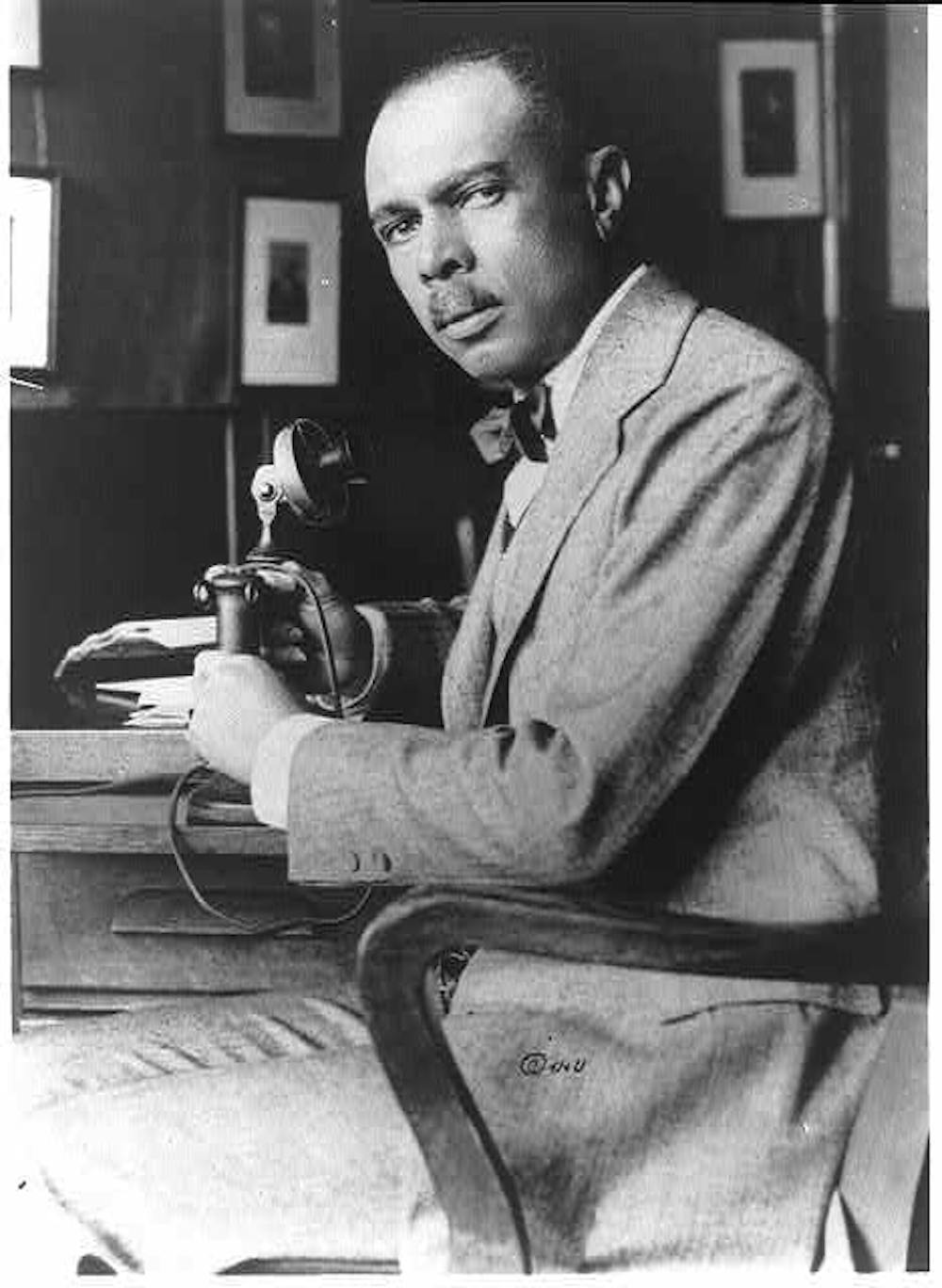
Who was James Weldon Johnson?

In my Black American Narratives class, we are currently reading James Weldon Johnson’s 1933 autobiography “Along This Way.” Johnson’s life provides a rare example of the opportunities that existed for very few Black Americans after the Civil War and before white Southerners wrested away those possibilities through the creation of Jim Crow laws and social customs that maintained white supremacy.

Man in suit holds hold-fashioned telephone

James Weldon Johnson became the first Black American to head the NAACP in 1920. Library of Congress

Johnson’s parents grew up free – his father in New York and his mother in the Bahamas. Both were literate at a time when 80% of Black Americans were not. These advantages helped them become homeowners when many Southern Black families lacked the money to buy land.

Raised with this rare opportunity, Johnson thrived.

He graduated from Atlanta University in 1894 during an era when only about 2% of 18-to-24-year-olds in the U.S. received any college education. He became a high school principal in his native city of Jacksonville, Florida, the editor of a daily newspaper and the first Black Floridian to pass the state bar exam.

He published poetry and novels, produced musical theater and served as U.S. consul to Venezuela. He was a professor at New York University and Fisk University and the first Black executive secretary of the NAACP. While Johnson’s successes were extraordinary, they illuminate what Black Americans could achieve when provided with even the narrowest avenues for advancement.

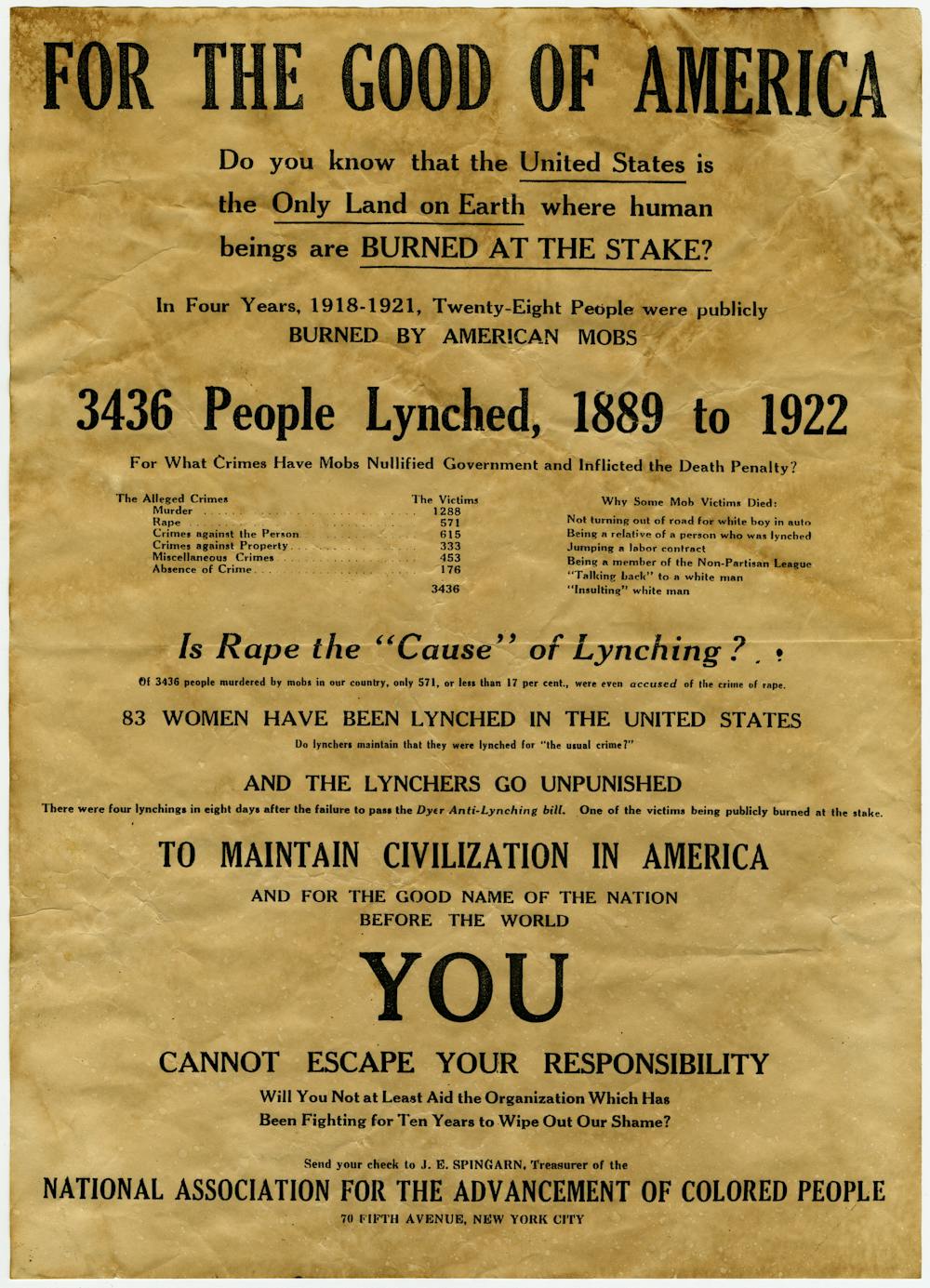
An old NAACP poster calls attention to 3,436 people lynched between 1889 and 1922.

The NAACP produced this anti-lynching poster in 1922. National Museum of African American History and Culture

The accomplishments of Johnson and contemporaries such as Moses Fleetwood Walker, Ida B. Wells and George Washington Carver help students today understand that Black Americans’ struggles were predominantly the product of barriers created by white supremacists rather than their own shortcomings.

The knowledge gap

Normally, I play “Lift Every Voice and Sing” for the students when we reach the part of Johnson’s autobiography that covers his writing of the song, but the immediate relevance of Andra Day’s version justified playing it a few classes earlier this semester.

When I asked who knew the song, both Black students in my class said they did, but only two of the 24 white students raised their hands. That gap has remained fairly consistent during the four years I have taught Johnson’s autobiography.

We discussed the importance of the song, then turned to that day’s assignment.

In his book, Johnson discusses his experience as a summer school teacher in rural Georgia during the 1890s. He described those months as his “first tryout with social forces” and “the beginning of my knowledge of my own people as a ‘race.’”

We reviewed his first encounters with “White” and “Colored” signs on bathroom doors, and the laws and unspoken traditions of segregation that this young man learned during his time in the rural South.

Students often regard these “social forces” as ancient history, so I explained that these same traditions caused the murder of 14-year-old Emmett Till in 1955 after he spoke to a white woman while buying candy in a Mississippi store. They were startled to hear Till was born the same year as my father, making him about the same age as many of their grandparents.

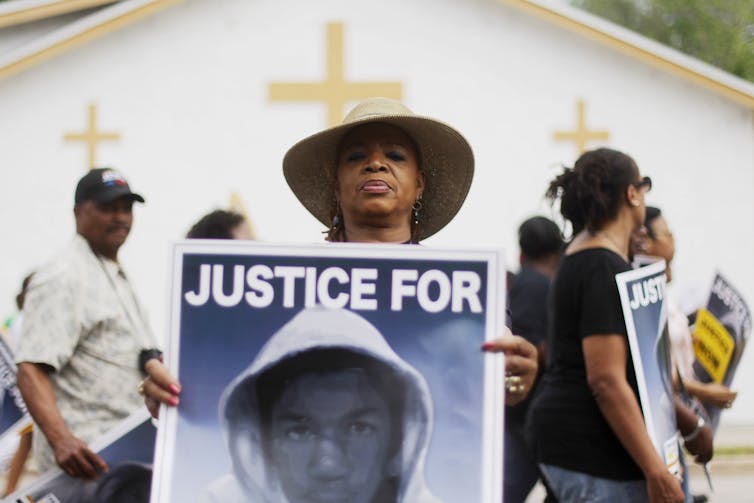
Then I mentioned that even in 2012, Trayvon Martin was killed for walking through a predominantly white neighborhood at night while wearing a hoodie.

Silence.

“How many of you know about Trayvon Martin?”

The two Black students raised their hands. The white students looked at me blankly.

A Black woman stands in front of a church and holds a poster of a Black man wearing a hoodie.

A Trayvon Martin supporter displays her sign during a march in Florida on March 31, 2012 . Mario Tama/Getty Images

Stunned, I told them the story of Martin’s death, but in the moment I couldn’t remember his killer’s name.

One of the Black students quietly said “Zimmerman.”

These students were only 6 or 7 when Martin died, so not remembering the event is understandable. Not learning about it since then highlights the continuing racial divide in our children’s education.

When students do learn this history, it can literally improve the culture of a campus and a city.

Students from these classes have helped to strengthen the relationship between the Black Student Union and the Jewish student organization Hillel on our campus. They have also conducted interviews with alumni of the local high school who attended classes during the racially segregated days of Jim Crow.

In another example of gaining firsthand knowledge, students have attended Sunday services at a local historically Black church – a first experience for most of them. These students subsequently helped the congregation build a mobile exhibit about the church’s history.

Despite what Republican politicians have claimed, learning this history does not generate guilt or shame among students. It often inspires them how to reach across cultural divides in ways they have never attempted before.

The value of Black history

Most students enter my class knowing only of Rev. Martin Luther King’s “I Have a Dream” speech, Rosa Parks’ bus protests or Malcolm X’s activism. Some may know about Jim Crow.

But white students tend to know little about the recent history of racial violence in the U.S. They are familiar with George Floyd and the protests that emerged after his murder by a white police officer, but few other recent victims of this kind of violence.

Ferguson, Missouri, where protests led by Black Lives Matter emerged after 18-year-old Michael Brown was shot and killed by a white police officer, means little to them.

The problem is not a general lack of historical knowledge but its disparity along racial lines. Black students do know this history, or at least more of it than their white peers.

Bridging this knowledge gap is made more difficult because today’s young Americans of different races do not sit in the same classrooms as a result of segregated schools in segregated communities – nor do they learn the same history.

It's my belief that schools fail all students when they omit the difficult parts of U.S. history. Teaching Black history can create understanding and spark rare discussions on challenging topics across racial lines.

Those of us who actually teach these subjects recognize these benefits – no matter what the politicians say.


Paul Ringel, Professor of U.S. History, High Point University

This article is republished from The Conversation under a Creative Commons license. Read the original article.

“Roe v. Wade got it right”: Biden promises to restore the right to abortion during SOTU address

As Rep. Marjorie Taylor Greene, R-Ga., sat before him wearing a MAGA hat — shouting out her point-by-point grievances — and Speaker of the House Mike Johnson, R-La., sat behind him, President Joe Biden sang the praises of Roe v. Wade during his State of the Union address, promising to turn back time for the second time and correct the damage done to people's right to abortion at the hands of the GOP.

"History is watching another assault on freedom," Biden said, starting on the topic of IVF and how it should be maintained as a service that's legally and easily obtained. From there, he went into his remarks on abortion as being another freedom that should be kept as such, saying, "I believe Roe v. Wade got it right," turning behind him to thank Vice President Kamala Harris for being "an incredible leader in defending reproductive freedom."

Finding a good opportunity to slam Trump here, Biden continued with, "My predecessor came to office determined to see Roe V. Wade overturned. He's the reason it was overturned, and he brags about it. Look at the chaos that has resulted." And over on Truth Social, where he's been firing off commentary throughout the whole address, Trump had very little to say on abortion, but a lot to say about Biden's hair and periodic coughing:

He just screwed up his primary line of the evening, having to do with Roe v. Wade, while looking at the Highly Respected Justices of the Supreme Court, for whom it was intended!

His hair is much better in the front than on the back!

He is so angry and crazy!

THE COUGHING, THE COUGHING – ALWAYS THE COUGHING!

"Those bragging about overturning Roe V. Wade have no clue about the power of women," Biden furthered. "But they found out . . . and we'll win again in 2024." Ending the topic here, he promised to restore it as the law of the land again.
 

Jessica Biel wrote a children’s book about periods hoping to de-stigmatize the topic

If you're at all familiar with the story of NASA sending Sally Ride into space for one week and asking if 100 tampons would be enough to last her through the trip, then it may make sense why Jessica Biel wrote her debut children's book on the topic of menstruation. 

"People don't talk enough about periods,” Biel said in an interview with PEOPLE about "A Kids Book About Periods," which she hopes will de-stigmatize the topic and educate youth, regardless of their gender identity, before they're out in the world as adults lacking necessary intel. "I’ve always felt strongly that we need to normalize the discussion around periods and as a parent, writing this book felt like an organic way to engage kids in the conversation from early on.”

Scheduled for release on May 7 as the latest addition to Penguin Random House subsidiary DK's "A Kids Book About" series in partnership with the nonprofit PERIOD, Biel drew from her own personal experience while writing the book, saying she felt terrified and unprepared when she first got her period, and wants to help prevent others from going through that.

“If we grownups have the confidence to tell the truth about how our bodies work, then we'll give the kids around us the agency and voice to talk about their own bodies with confidence, now and for the rest of their lives," she says.

https://www.instagram.com/reel/C4JYoPwPhzj/?igsh=N2d2YjV0ZG5zaGxz


Trump hit with more legal fees as result of failed “Steele dossier” pee-pee lawsuit

As Donald Trump prepares to live-tweet Joe's Biden's State of the Union address, $382,000 just got added to his growing mound of debt.

According to court documents released on Thursday, a British judge ordered Trump to reimburse the cost of legal fees spent by Orbis Business Intelligence — a company founded by former British spy Christopher Steele — for their defense against a failed lawsuit brought about by the former president over the now infamous “Steele Dossier” commissioned by Democratic consultants before the 2016 presidential election. The suit against Orbis was dismissed in February, with the judge saying that Trump's complaint that Steele authored a number of defamatory memos relating to his ties to Russia was “bound to fail.”

Per reporting by AP News, Orbis said "the report was never meant to be made public and was published by BuzzFeed without the permission of Steele or his company." Part of this report, which Trump argued soiled his reputation, "alleged he had received 'golden showers' from Russian prostitutes, participated in St Petersburg sex parties and had been compromised by the country’s FSB security service," according to The Telegraph. Trump has denied these allegations. 


Republican Mayorkas impeachment staff have theocratic ties

The top two staffers on the committee that led the impeachment of Homeland Security Secretary Alejandro Mayorkas have ties to multiple theocratic organizations, including one that teaches Hill staffers to inject Biblical views into their work, disclosure filings show.

Some of the organizations have histories of amplifying falsehoods to combat their political enemies.

The Homeland Security Committee chair, Rep. Mark Green (R-TN), oversaw last month’s impeachment and is one of the impeachment managers appointed by Speaker Mike Johnson (R-LA) to prosecute Mayorkas in the Senate. Senate Republicans are pushing Majority Leader Chuck Schumer (D-NY) to allow a trial, but it’s not clear that he will.

Although Green has not made public which of his staffers will assist the House impeachment managers, it’s expected that the team will draw from his committee’s impeachment veterans.

And staffers on the team that impeached Mayorkas in the House have multiple ties to far-right, theocratic organizations. That includes the staff director and his deputy.

Related: A Stephen Miller Aide Helped Impeach Mayorkas
Related: GOP’s Top Mayorkas Investigator Is Benghazi Probe Alum

Their affiliations include organizations that have used lies to counter or even remove political enemies, as even some Republicans have suggested Green’s committee is doing to Mayorkas by characterizing policy differences as prosecutable offenses.

Green’s committee staff director is longtime aide Stephen Siao. The deputy staff director is Eric Heighberger.

The groups to which they’re tied include the Council for National Policy (CNP), the Faith and Law Project, and even the Guatemalan affiliate of the secretive Christian group behind the U.S. National Prayer Breakfast, according to records I reviewed.

When Green went to Congress in January 2019, he tapped Siao, his friend and campaign manager, as his chief of staff. 

Between March and July of that year, Siao became a member of the CNP, according to membership rolls obtained by Documented.

The Council for National Policy

The far-right, theocratic leanings of CNP leaders and members have been well established. The group has explicitly identified its goals as including national “policy and leadership that restores … Judeo-Christian values under the Constitution.”

CNP’s executive director today, and when Siao joined, is former lobbyist and Rep. Bob McEwen (R-TN), a longtime insider at and emissary for the Fellowship Foundation, aka The Family, the group behind the National Prayer Breakfast. Another Family insider, Pres. Ronald Reagan’s Attorney General Ed Meese, has been a CNP fellow.

CNP’s 2019 Board of Directors included Ginni Thomas — who sought to help Trump steal the election — and Ken Blackwell, now a senior fellow at the Family Research Council. The CNP Board of Governors included Ralph Reed, Jay Sekulow, Leonard Leo, and Foster Friess.

CNP has embraced former Pres. Donald Trump, including after his attempt to steal the presidency. But even before Trump, some of CNP’s Christian right leaders had a history of challenging democratic results they didn’t like — even if it meant lying.

When Côte d'Ivoire’s then-President Laurent Gbagbo refused to step down after losing a 2010 election that international observers deemed fair, McEwen was one of the Christian right stalwarts who rode to his rescue.

Gbagbo, an evangelical Christian, paid McEwen, then a lobbyist, $25,000 a month to help him retain power. McEwen falsely called the assumption of the presidency by Gbagbo’s Muslim opponent “a coup.”

(Another Family insider, then-Sen. James Inhofe, also backed Gbagbo. Inhofe claimed he had “evidence of massive voter fraud” in Côte d'Ivoire, almost a decade before Trump did it here.)

Siao’s Christian-right affiliations aren’t limited to the CNP. In 2022, he won a ten-month fellowship focusing on “American political theory“ from Hillsdale College, the conservative Christian school where the board of trustees is chaired by right-wing game-show host Pat Sajak.  

Reportedly, Siao “started his career” with the Becket Fund for Religious Liberty, which has fought as high as the Supreme Court for religion-based exemptions to anti-discrimination law.

His background also includes communications and grassroots work for Heritage Action for America. A spinoff of the Heritage Foundation, the group acts as its political arm, advocating for legislation. A number of the Mayorkas impeachment staffers, including top investigator Sang Yi, have connections to Heritage, the right-wing think tank behind Project 2025, a detailed plan to fill the federal government with loyalists of Donald Trump if he wins in November.

Siao’s deputy, Heighberger, is a longtime congressional staffer. Heighberger’s been tied even more closely to a right-wing Christian group that mustered lies in the pursuit of power. (Neither Siao nor Heighberger nor Green’s committee responded to emailed questions and a request for comment.)

Guatemala Prospera

Back in 2007, Heighberger was a bit player in a relatively trivial, albeit troubling, instance of government deception. FEMA held a fake news conference, and Heighberger was a participant. It’s not clear whether Heighberger understood the nature of the fake event, but he’s also been associated with a group involved in a much more grave use of deception against political opponents.

Last year, Heighberger traveled to Guatemala on the dime of a group called Guatemala Prospera.

Guatemala Prospera is one of The Family’s many international spinoffs. Its own version of the National Prayer Breakfast served as a nexus for corrupt businesses and individuals who helped elect right-wing evangelical President Jimmy Morales.

Morales allegedly won office thanks in part to illegal infusions of cash from Guatemala’s elite, some of whom were drawn to the Guatemalan breakfast by the chance to hobnob with American members of Congress — flown there by The Family.

When a UN anti-corruption task force trained its sights on those potential campaign-finance violations, the founder of Guatemala Prospera and his American allies in The Family succeeded in killing the task force.

The task force had enjoyed strong bipartisan support in the U.S. at the time. But then Family insiders, most notably Sen. Marco Rubio (R-FL), embraced and elevated claims that the task force was compromised by the Russians. The tale was so far-fetched even the State Department of then-Secretary Mike Pompeo rejected it.

It didn’t matter. Rubio and others used the Helsinki Commission to push the story. Right-wing media picked it up and the consensus supporting the task force broke. Without that U.S. shield, Morales had a green light to run the task force out of the country.

The nation’s top prosecutor fled, becoming a refugee living in a Washington, DC, studio apartment with help from expatriate donors. Morales escaped prosecution, and was succeeded by another religious right-winger.

Last year, the political allies of allegedly corrupt companies behind all of these efforts came extremely close to subverting first the election of a progressive president and then his assumption of the office in January.

During that time, Heighberger’s trip, sponsored by Guatemala Prospera, included meetings with some of those companies, according to the itinerary he filed with his congressional disclosure form

There’s no indication Heighberger played any role in Guatemala’s domestic politics; the trip was about boosting U.S. investment that would benefit those companies. One of the trip’s goals, according to Heighberger’s filing, was to “look at issues such as illegal migration.” One driver of such migration, of course, is corruption, which the UN task force is no longer there to combat. 

Politically advantageous lies aren’t the only Christian-right tool to be found looking at the past associations of Mayorkas’s prosecutors.

There’s also the conviction that one’s individual religious beliefs should influence how you carry out your official duties, even to the point of superseding traditional democratic norms. That creed, the supremacy of one’s personal faith over the obligations of government service, is made explicit by a right-wing Christian group that Siao and Heighberger have in common.

It’s called the Faith and Law Project, and its history suggests that faith comes first not just in the title, but on the job. The disclosure filings by Siao and Heighberger downplay the organization’s evangelical Christian nature, but it’s clear in other documents. 

Faith or Law

In Siao’s filing to attend Faith and Law’s October 2022 conference, he wrote that the event consisted of “sessions on characteristics that are essential to public service, and how they should be applied in our roles on Capitol Hill.” He said, “The sessions included those on truth, justice, peace, and love.”

Faith and Law’s filings for both Siao’s and Heighberger’s trips were similarly anodyne. The retreat’s purpose, the group said in each filing, was “to equip Hill staff and other attendees on how to critically think about, apply, and discuss faithfulness and good character in public service.”

If those descriptions sound laudable, or even benign, it’s because they both omit what Faith and Law clearly says elsewhere about its work. It’s not just generic “faithfulness” that Faith and Law has in mind. It’s Christian faithfulness. And Christian faith. 

The conference’s agenda, for instance, is straight-forward. The actual name is “Christian Faithfulness in Public Service: Essential Characteristics of a Christ-follower on Capitol Hill.”

Lessons about essential characteristics for Capitol Hill Christ-followers came from event speakers including Paul McNulty, a co-founder of Faith and Law and president of the Christian, conservative Grove City College, which has a history of being ranked among the schools most hostile to LGBTQ+ people.

McNulty is probably most famous, however, for his role in the Bush administration’s attempt to use false claims of voter fraud to justify official voter suppression. After the Bush White House pushed out federal prosecutors who refused to go along with lies of rampant voter fraud, McNulty, then a Justice Department official, said in congressional testimony that most of the departed prosecutors left for “performance-related” issues and that the White House wasn’t involved.

When DOJ documents emerged refuting McNulty’s testimony, he blamed other DOJ officials for not briefing him fully.

McNulty’s topics at the 2022 Faith and Law conference included truth and justice. To his credit, the agenda flags an important epistemological tool, being “watchful for politically beneficial assumptions.”

Other references are more ambiguous. “Does truth even matter in political debates?” one bullet point asks, presumably rhetorically. Another suggests that justice is “[M]ore about wisdom than knowledge,” and follows that up with the question, “To what extent does your general view on the virtues of government align with God's purposes as revealed in the Scriptures?”

Also speaking was Mark Rodgers. Head of the Clapham Group, a political consultancy group that seeks to shape the culture, Rodgers is former chief of staff for then-Sen. Rick Santorum (R-PA). While Rodgers holds typical evangelical views such as opposing reproductive rights, they’re somewhat tempered by more progressive positions, such as advocating for paid parental leave and tax credits for low-income parents.

But the broader theme of the conference assumed the injection of personal religious belief into one’s government work. The expectation, the agenda says, is that attendees will learn lessons that might “impact how you interact with public policy — the laws you draft and the laws you seek to stop…”

Another filing for the same event, submitted months later by a Democratic staffer, gives much more explicit detail about the sectarian and even theocratic themes. It says the conference “explores how a Christian worldview impacts public policy and a vocation in the public square.”

The reason Faith and Law gives in this filing for holding the retreat is that it’s “for attendees to learn how to apply a Biblical framework to their work.”

One exercise asked participants to consider whether Christians should be “more winsome” or, like right-wing pundit Eric Metaxas, a former National Prayer Breakfast speaker, “more bold in our confrontation with the culture as it becomes more hostile to traditional Christian values,” asking, “Is it possible to do both?”

The group alludes to its evangelical beliefs in one dinner-table exercise for participants. The suggested discussion-starter asks participants to think down the road about the direction of the culture, “other than Jesus's second coming.”

Participants are asked to consider several questions that presume the intertwining of their personal faith with the public office they hold, or even to use that office to proselytize:

  • “What has helped you in the context of your work to pursue faithfully your calling to be a partaker of the divine nature?”

  • “In what ways does your job's interaction with people allow you to bear witness to the Gospel?”

  • “From your vocational platform, what are ways that you can work to advance the Kingdom of God beyond doing your job with excellence?”

The agenda also takes as a given that Hill participants will work to advance the gospel. One dinner discussion topic: “To what extent is the current divisiveness in public life compromising the advancement of the gospel? What can we do to remedy this problem?”

Siao’s filing didn’t include this version of the agenda. 

In it, only one Christian dictate is questioned specifically. The question arises in another suggested discussion topic: “How does Jesus's command to love one another get misused in policymaking?” the agenda asks. “Is there a proper place for its consideration, and if so, where?” No examples were offered of love’s misuse in policymaking.

Another Homeland Security Committee staffer, attending the 2023 Faith and Law conference, was straightforward about incorporating her religious beliefs in her work. “As a Research Assistant on the Committee on Homeland Security, I frequently ask myself how my personal faith should influence my approach to national security and emergency management,” she wrote. “This retreat will help me answer that question…”

That filing was signed by Green on Sept. 28, 2023, during the committee’s Mayorkas investigation.

Somewhat paradoxically, the staffer both anticipates learning how her personal beliefs should influence her government service and laments a lack of humility on Capitol Hill.

That same 2023 conference included a session moderated by Ammon Simon, a Securities and Exchange Commission lawyer. Simon’s LinkedIn page shows he graduated from Wheaton, home to The Family’s archives, and worked for Family insiders including then-Rep. Randy Hultgren (R-IL), who’s now on the National Prayer Breakfast Foundation board.

Simon was also senior counsel at the Department of Housing and Urban Development under Secretary Ben Carson, whose political career was launched at the National Prayer Breakfast.

Simon’s LinkedIn page doesn’t include his prior work for the right-wing Judicial Crisis Network. He’s also listed as an author at The Daily Caller.

In his 2023 Faith and Law presentation, Simon offered “a brief framework on how Christians could and should engage with the distinctive tensions within vocations in law, policy, and associated disciplines.”

Simon also moderated a panel at the 2023 conference, in which Siao was a panelist, alongside Ann Thomas Johnston (a former lobbyist, Hill staffer, and Trump Defense Department official) and former GOP Hill staffer Katherine Haley. 

Another session used a papal encyclical to “highlight the tension and possibility inherent in Christians in political vocations.”

The president of Westmont College was also there. Westmont is a Christian university with decades-old ties to The Family, allegedly “a feeder school.” Its motto is “Holding Christ Preeminent.”

One session led by Westmont President Dr. Gayle Beebe focused on leadership. For that exercise, on “Ethics and Morality in Public Square,” Beebe shared observations about world leaders “shaped by their religious upbringing.” Examples included Henry Kissinger.

Beebe and former Rep. Dan Coats (R-IN), another longtime Family insider, led a discussion on “frames that Christian Hill staffers can use to understand their vocational roles…” Panelists included officials from Navigators, Ministry to State, and Christian Embassy, organizations with varying degrees of theocratic histories.

Faith and Law’s advisory board includes McNulty, House Speaker Johnson, and several Family insiders: Sen. James Lankford (R-OK), and former Reps. Joe Pitts (R-PA), Zach Wamp (R-TN), and Frank Wolf (R-VA).

Faith and Law Executive Director Susan Gates, according to the group’s bio for her, “has a passion for the intersection of Christian faith and public policy.”

In an email included with one Democratic staffer’s travel disclosure filing, a Faith and Law official who previously worked for both Heritage and Rep. Pitts acknowledges the group’s partisan nature. “I’m really trying to make this more bi-partisan and would love more ideas of Christian democrats to invite,” then-Executive Director Lauren Noyes wrote in 2022 to the Democratic staffer. “We’d love to have you!”

Where to stream the Oscar best picture films

After an incredibly strong year for movies, it feels like the moviegoing experience is back after a myriad of issues plaguing the industry like COVID-19-related box-office slumps and the dual labor strikes that halted Hollywood entirely. 

This comeback has built to this year's Academy Awards, which will be broadcast live on Sunday, March 10. Some of the most talked about films from last year like "Barbie," "Oppenheimer" and "Poor Things" have snagged the most nominations this year. If you want to watch last summer's atomic blockbuster, travel to Barbie Land, go on a sex-fueled European adventure or wrecked by childhood sweethearts in "Past Lives" — these films are now available to watch on streaming right in the comfort of your home. Besides, don't you want to know which movies are worthy before they take home the prize?

Here's where you can stream all the Oscars best picture nominees:

 
"American Fiction" (Digital rental)

Best actor nominee Jeffrey Wright stars in this adaptation of the 2001 novel "Erasure" by Percival Everett. In "American Fiction," Wright plays Monk, a disillusioned Black novelist whose novels are mildly successful. Frustrated by the predominantly white publishing world that profits from offensive and played-out stereotypes about the Black experience — he writes a satirical book playing into all the stereotypes he despises. 


"Anatomy of a Fall" (Digital rental; Hulu on March 22)
Directed by Justine Triet, the only woman nominated for best director at this year's Oscars, "Anatomy of the Fall" is the slow-simmering French courtroom drama highlighting the fracturing of a marriage following one man's possibly accidental death. Sandra Hüller also snagged a best actress nomination for her role as Sandra.


"Barbie" (Max)
The Greta Gerwig comedy-drama starring Margot Robbie as Barbie and Ryan Gosling as Ken was a part of last year's major "Barbenheimer" movie experience. The film follows the iconic Barbie and Ken who leave their pink-infused Barbie Land and are exposed to the messy highs and lows of the human experience when they travel to the real world. 


"The Holdovers" (Peacock)
This warm story about the people left behind at a New England boarding school during the holidays shows the power of accepting unexpected people into your found family. It stars Paul Giamatti and Da'vine Joy Randolph, who have both been nominated for best actor and best supporting actress, respectively.


"Killers of the Flower Moon" (Apple TV+)
This Martin Scorsese epic is based on the true American history of the wealthy Osage people who were massacred by opportunistic white people. Mollie (Lily Gladstone) is at the center of this plot hatched by her uncle-in-law William (Robert De Niro) and her sheepish husband Ernest (Leonardo DiCaprio) to infiltrate their community and marry rich Osage women to steal their wealth.


"Maestro" (Netflix)
The biopic about legendary conductor Leonard Bernstein played by Bradley Cooper focuses on his intrapersonal relationships specifically the tumultuous marriage with his wife Felicia Montealegre played by Carey Mulligan. It also addresses Bernstein's sexuality and his documented affairs with men throughout his marriage.


"Oppenheimer" (Peacock)

"Oppenheimer" examines the ethical dilemma behind making the atomic bomb and starting the perilous arms race between the United States and the Soviet Union. Christopher Nolan's three-hour epic starring Cillian Murphy as physicist J. Robert Oppenheimer examines his role as the leader of the Manhattan Project, creating the bombs dropped on Hiroshima and Nagasaki in World War II. 


"Past Lives" (Free on Kanopy, Digital rental or Paramount+ with Showtime)
A romance that spans continents, decades and possibly alternate realities, "Past Lives" is about South Korean childhood friends Nora (Greta Lee) and Hae-sung (Teo Yoo) who spent most of their lives apart, separated by distance or circumstances. Twenty-four years after their last in-person meeting, Hae-sung visits Nora in New York, seeing each other for the first time since they were children.


"Poor Things" (Hulu)
The bizarre tale of spunky Bella Baxter (Emma Stone) is a journey of self-discovery and womanhood. Paralleling Mary Shelley's "Frankenstein," the Yorgos Lanthimos film follows Bella, a woman brought back to life by scientist Godwin Baxter (Willem Dafoe) and then runs off with a lawyer (Mark Ruffalo) on a life-altering adventure across Europe. 


"The Zone of Interest" (Digital rental)

Based on the novel of the same name by Martin Amis, "The Zone of Interest" is a haunting story about a Nazi commandant (Christian Friedel), his wife (Sandra Hüller) and their disturbingly idyllic family life as their home is situated adjacent to the Auschwitz concentration camp. 


The 96th Academy Awards will be presented live on Sunday, March 10 at 7 p.m. ET on ABC.


“There’s no evidence”: Data disproves right-wing talking points about migrant crime

As Republicans — including likely GOP presidential nominee Donald Trump — continue to push the racist belief that immigrants are bringing crime to the United States, a new analysis has shown that such claims are outright false.

In recent weeks, Trump and his Republican allies have latched on to the story of Laken Riley, a 22-year-old nursing student from Athens, Georgia, who was murdered late last month, allegedly by Jose Antonio Ibarra, a Venezuelan immigrant. Republicans have cited Riley’s death as proof that the U.S.’s already-restrictive and inhumane immigration laws must be stricter.

However, numerous studies showcase that undocumented immigrants are actually less likely to engage in crime, including violent crimes, than U.S. residents.

In response to far right claims about immigrants and crime, NBC News published an analysis of cities that have received an influx of migrants as part of Texas Republican Gov. Greg Abbott’s cruel media stunt to bus undocumented immigrants to Democrat-run cities across the country. (In at least one case, a 3-year-old child was denied medical attention while on a bus en route to Chicago and died as a result.)

According to the NBC News analysis, which examined 2024 data of cities where migrants were transported, crime levels have actually dropped in those cities from the previous year.

Graham Ousey, a professor of crime and sociology at the College of William & Mary, told NBC News in its report that Republicans’ claims about migrant crimes are false. “There’s no evidence for there being any relationship between somebody’s immigrant status and their involvement in crime,” Ousey said.

In response to the analysis, the Trump campaign peddled outlandish claims that the data was wrong — and that “Democrat [sic] cities purposefully do not document” crimes by immigrants “because they don’t want American citizens to know the truth.”

Such accusations are not only false — they also contradict data from Abbott’s own home state, which extensively tracks the immigration and citizenship status of individuals who are arrested.

A University of Wisconsin-Madison study that compares crime rates of undocumented immigrants and U.S.-born citizens residing in Texas, published in 2020, shows that U.S.-born residents are many times more likely to commit crimes than are undocumented immigrants.

The U.S.-born residents were more than two times more likely to commit violent crime and nearly two and a half times more likely to violate a drug law. U.S.-born residents were four times more likely to engage in property crime than immigrants were, and 2.52 times more likely to commit a homicide, according to the figures.

“Criminality among the undocumented is a paramount social science concern. Yet despite substantial public and political attention, extant research has established surprisingly few empirical findings on the criminological impact of undocumented immigration,” the report noted, adding that “undocumented immigrants have substantially lower rates of crime compared to both native U.S. citizens and legal immigrants.”

“These findings clearly run counter to some of the basic assumptions behind strict immigration enforcement strategies,” the study said.

Despite study after study refuting Republicans’ claims, it’s likely that Trump and his GOP adherents will continue to vilify undocumented people moving forward due to the fact that immigration is the top motivating issue among Republican voters.

Some polls also show that immigration is the most important issue among voters overall — however, those surveys did not include the option to pick “threats to democracy and extremism” in government as a more pressing concern. When that option is included, as it was in a recent Reuters/Ipsos poll, it becomes the number one issue for voters (by far the top pick among Democrats and independent-leaning voters), with only Republicans choosing immigration as their most important issue.

Katie Porter cries “rigged” after losing out in her bid for California Senate

In election years past, we've come to associate the term "rigged" with Republican candidates such as Donald Trump, who has established a pattern of attributing losses to this, that and the other, as the word is conveniently nebulous. But Democrats can lean on that crutch too.

In a recent analysis from The Washington Post, they illustrate this using Rep. Katie Porter (D-Calif.) as an example. After losing her bid for the U.S. Senate in Tuesday’s primary elections — coming in third (by a lot) behind Rep. Adam Schiff (D-Calif.) and former baseball star Steve Garvey (R) — she issued a statement to X (formerly Twitter) singing a familiar tune:

Thank you to everyone who supported our campaign and voted to shake up the status quo in Washington. Because of you, we had the establishment running scared — withstanding 3 to 1 in TV spending and an onslaught of billionaires spending millions to rig this election.

When criticized for her use of the word "rigged," she issued a follow-up, defining the word in a way that best-suits her original sentiment which, as The Washington Post points out, is what makes the word so handy in situations such as these. It's harder to disprove than downright "stolen.”

“‘Rigged’ means manipulated by dishonest means,” Porter writes. “A few billionaires spent $10 million+ on attack ads against me, including an ad rated ‘false’ by an independent fact checker. That is dishonest means to manipulate an outcome. I said ‘rigged by billionaires’ and our politics are — in fact — manipulated by big dark money.”

"What happened in California was not some nefarious force that was surreptitiously rigging electoral outcomes. For better or worse, it’s just how politics works," writes columnist Philip Bump.

"The loud rebuke of Katie Porter’s 'rigged' claim shows that the pro-democracy crowd isn’t putting up with that crap no matter which party it comes from. And that’s a good sign for our country," co-signs Mark Jacob, Ex-editor at Chicago Tribune & Sun-Times, in a tweet on the topic.

“Death sentence”: Outrage after GOP pushes measure to expand gun access in government funding bill

Some Congressional Democrats are growing concerned about a gun-related policy rider — which will expand gun rights for veterans determined to be mentally incompetent to manage their own affairs — that was included in the latest bill to fund the government.

The House voted 339-85 on a package of six funding bills, drawing support from 207 Democrats and 132 Republicans. It is now set to move to the Senate, leaving little time before yet another government shutdown deadline looms.

Sen. Chris Murphy, D-Conn., a prominent advocate for gun reform since the tragic mass shooting at Sandy Hook Elementary School in Newtown in 2012, vowed Wednesday he would not vote for the legislation as it “significantly rolls back” the firearms background check system.

“I can’t sugarcoat this: this provision – which could result in 20,000 new seriously mentally ill individuals being able to buy guns each year – will be a death sentence for many,” Murphy wrote on X/Twitter. “It’s unacceptable this provision was pushed by Republicans. Democrats shouldn’t have acquiesced.”

While the provision was a Republican priority, it also drew support from some Democrats including Henry Cuellar and Vicente Gonzalez of Texas, Jared Golden of Maine, Mary Peltola of Alaska, Marie Gluesenkamp Perez of Washington and Gabe Vasquez of New Mexico, Roll Call reported

The legislation includes a provision that will enable veterans who have been deemed “mentally incompetent” by the Veterans Affairs Administration to purchase a firearm by withholding information from the National Instant Criminal Background Check System (NICS). Under current law, veterans who are unable to manage their finances and benefits are reported to the Justice Department for a background check.

The gun-related rider would change that and prohibit the department from sharing such information unless a judge rules that the beneficiary is a danger to themselves or others.

Democrats and activists expressed concerns that the provision could potentially exacerbate gun violence, leading to more deaths and an increase in veteran suicides. 

Reps. Maxwell Frost, D-Fla., and Mark Takano, D-Calif., voted against the “minibus” legislation Wednesday.

Frost, who was the former organizing director for March for Our Lives, the student-led organization founded by survivors of the 2018 high school shooting in Parkland, Fla., said the provision’s inclusion in the package has the “greatest rollback of the background check system since it was created.”

“This rollback would allow veterans that have been deemed by the Veterans Administration to be mentally incompetent to buy guns,” Frost wrote on X. “These are folks that the VA no longer trusts to manager their own benefits. Veterans who are also unfortunately, at a high risk of suicide.” 

We need your help to stay independent

Takano, the ranking member on the Veterans’ Affairs Committee, said a determination of mental incompetency by the V.A. is typically based on “very serious mental health conditions like schizophrenia and dementia”

“There are very serious reasons why people with those conditions should not be able to purchase a firearm,” Takano said. “It's also the case that firearms are used in 68% of veterans' deaths by suicide…So why on earth would this Congress cede one more important safeguard against a veteran's death, and that is why I cannot support this bill.”

Everytown for Gun Safety Support Fund released a new report highlighting the rise of firearm suicide among veterans, which found that seven out of 10 veteran suicides are by gun, marking the highest proportion of veteran suicides with a gun in over 20 years.

Nearly 87,000 veterans died by gun suicide from 2002 to 2021. This was 16 times the number of service members killed in action over the same period, according to the report. 

By including this rider, Congress “threatens to undermine” a decades-long practice meant to keep “vulnerable” veterans safe, John Feinblatt, president of Everytown for Gun Safety, told Salon. It aims to enable veterans who are prohibited from purchasing and possessing firearms under longstanding federal regulations and law to pass a background check and obtain them. 

“We know there can be serious, irreversible consequences when someone in crisis gains access to a firearm and, should this pass the Senate, it will put at-risk veterans at even greater risk of harming themselves and undermine public safety,” Feinblatt said. 

The “devastating rise” of firearm suicide among veterans “isn’t new,” but it’s made all the worse by easy access to guns, he added.


Want a daily wrap-up of all the news and commentary Salon has to offer? Subscribe to our morning newsletter, Crash Course.


“This proposed change puts veterans' lives at risk, and gun sense lawmakers and lawmakers who have promised to help protect veterans from suicide should be doing everything in their power to reverse it before it’s too late,” Feinblatt said. 

The anti-gun-violence organization Giffords. led by former Rep. Gabrielle Giffords, D-Ariz., also opposed the package because of the inclusion of the rider, emphasizing that the funding bill makes cuts to law enforcement agencies necessary to curbing gun violence.

This is a “dangerous and reckless” change that will “endanger” veterans, Vanessa N. Gonzalez, VP of Government and Political Affairs at Giffords, told Salon. Republicans framed the existing process that exists at the VA as “unfair” to veterans, but in reality, the VA’s process helps them “intervene at moments of crisis to potentially save lives.”

“The VA’s existing process for evaluations provides additional support for veterans who are diagnosed with severe PTSD or dementia or schizophrenia – veterans who are at increased of risk of suicide – and also gives them the opportunity to appeal to have their access to firearms restored,” Gonzalez said. “The Republican proposal will upend 30 years of practice and allow veterans who may harm themselves or others access to firearms.”

Public health research proves that easy access and the presence of a firearm increases the risk that a suicide attempt will be fatal, she added. More than 6,500 veterans die by suicide each year, and veterans account for roughly one in five firearm suicides in the U.S. Veterans who have been deemed “incompetent” by the V.A. are at a higher risk of suicide and giving them easier access to firearms will sadly lead to more fatalities.

“Our veterans serve our country with pride, and we need to do our part to ensure they receive the care they need when they come home,” Gonzalez said. “This move by Republicans, to distort the truth about a process that has been created to keep them safe, is a shameful step in the wrong direction. Their rhetoric doesn’t match their covert actions."

Wendy’s won’t be introducing surge pricing, but it’s nothing new to many industries

The recent controversy over Wendy's pricing strategies is a perfect example of how online word-of-mouth can distort marketing communications and create confusion for consumers.

Wendy's new president and CEO Kirk Tanner announced plans to test dynamic pricing and AI-enabled features by 2025 on Feb. 15 during an earnings call. He said: "Beginning as early as 2025, we will begin testing more enhanced features like dynamic pricing and day-part offerings."

Many interpreted this to mean Wendy's would be introducing surge pricing — a term often associated with the dynamic pricing models used by companies like Uber, where prices increase during periods of high demand.

The issue likely stemmed from confusion over terminology. Although surge pricing and dynamic pricing are often used interchangeably, they have slightly different definitions. Dynamic pricing refers to any pricing model that allows prices to fluctuate, while surge pricing refers to prices that are adjusted upward.

Several news outlets ran stories suggesting Wendy's would raise prices during busy periods, prompting widespread backlash and criticism online.

Wendy's executives have since clarified that its dynamic pricing model would not increase prices for customers, saying in a news release the CEOs comments were "misconstrued." Wendy's said that while price adjustments could happen in both directions, the upper limit would remain the current price.

Although Wendy's won't be exploring dynamic pricing until 2025 at the earliest, this type of pricing strategy is nothing new for many industries.


Dynamic pricing is nothing new

One aspect of the Wendy's dynamic pricing controversy that warrants further examination is the nature of the product being sold. Traditionally, dynamic pricing has been associated with high-value goods and services, such as airline and concert tickets and ridesharing services, where consumers are accustomed to fluctuating prices.

In contrast, fast food is generally perceived as a low-cost, everyday convenience with an expectation of stable pricing. Introducing dynamic pricing into the fast food industry represents a significant departure from these established norms.

Of the industries that already use dynamic pricing, ride-sharing apps are perhaps one of the most well-known. Uber, for example, uses surge pricing during peak times, meaning prices increase during periods of high demand when there aren't enough drivers available for every customers.

The travel and hospitality industries have long used dynamic pricing models as well. Airlines adjust ticket prices based on a variety of factors, including time until departure, the day of the week and demand for specific routes. The hospitality industry similarly adjusts room rates based on demand, seasonality and local events.

Ticket prices for concerts, sporting events and other live performances often vary based on factors like demand, seat location and timing as well. In this context, dynamic pricing allows event organizers to match prices to perceived market value.


Benefits of dynamic pricing

When implemented effectively, dynamic pricing can offer a number of benefits to both businesses and consumers. One advantage it offers is an enhanced customer experience. Dynamic pricing can provide value to consumers by offering lower prices during off-peak times or for less popular products and services.

This can make certain goods and services more accessible to budget-conscious customers and encourage them to make purchases they might otherwise forgo. Additionally, dynamic pricing can help businesses respond to market changes and customer preferences more quickly, leading to a more personalized and satisfying shopping experience.

Dynamic pricing can also help with inventory management. For industries dealing with perishable goods or limited inventory, dynamic pricing can help manage supply and demand more efficiently.

By adjusting prices based on demand, businesses can encourage sales when inventory is high or demand is low, reducing the risk of unsold inventory. This can be particularly beneficial for events or services with fixed capacities, like concerts or flights, where unsold seats represent lost revenue.

Lastly, dynamic pricing can help businesses maximize revenue and profitability. It allows businesses to adjust prices in real-time based on demand, competition and other market factors.


Challenges of dynamic pricing

While dynamic pricing offers a number of benefits, it also comes with its own set of challenges. One of the biggest risks associated with dynamic pricing is the potential negative impact on customer perception and trust. If customers feel that prices are unfair or unpredictable, they may lose trust in the brand.

This was evident in the Wendy's situation, where the misunderstanding around surge pricing led to a backlash. Transparency and clear communication are crucial to maintaining customer trust when implementing dynamic pricing strategies.

Another concern is the way dynamic pricing can be perceived as a form of price discrimination, where different customers are charged different prices for the same product or service based on factors like demand, time of purchase or even personal data. Businesses need to ensure their dynamic pricing models are fair and do not inadvertently discriminate against any customers.

Implementing a dynamic pricing strategy can be complex and requires sophisticated technology and data analysis capabilities. Businesses need to invest in the right tools and systems to effectively manage and analyze large volumes of data in real-time.

Additionally, businesses need to ensure their pricing algorithms are accurate and responsive to market conditions. Failure to do so can result in pricing errors, lost revenue and damage to the brand's reputation.


Lessons for businesses

As technology continues to advance, dynamic pricing models are expected to become more common across sectors like retail, energy and transportation. While these pricing models offer the potential for increased profitability, businesses need to approach them with an honest and genuine consumer-first approach.

The recent pricing controversy at Wendy's underscores the importance of precise language and transparent communication for companies looking to adopt dynamic pricing. It serves as a reminder that businesses need to avoid misunderstandings and negative reactions from customers.

As dynamic pricing gains popularity, companies must carefully choose their words and clearly articulate their pricing strategies to prevent misunderstandings and maintain customer trust. Failure to do so could result in losing control over how consumers and the public interpret their pricing strategies, which could significantly impact their reputation and overall success.

Omar H. Fares, Lecturer in the Ted Rogers School of Retail Management, Toronto Metropolitan University

This article is republished from The Conversation under a Creative Commons license. Read the original article.

“Finish the problem”: Trump’s answer on Gaza shows he’s “even worse” than Biden on Israel

Shortly before winning nearly every GOP primary on Super Tuesday and all but locking up the 2024 Republican nomination, former President Donald Trump said in a Fox News interview that he wants Israel to "finish the problem" in Gaza — a clear endorsement of a military campaign that has killed more than 30,000 people in less than five months and sparked one of the worst humanitarian catastrophes in recent history.

Fox host Brian Kilmeade told Trump that voters who have marked "uncommitted" on their primary ballots to register their opposition to President Joe Biden's support for Israel's war are "not gonna like you either because you are firmly in Israel's camp."

"Yeah," Trump responded.

Asked whether he is "on board with the way the [Israel Defense Forces] is taking the fight to Gaza," Trump said, "You've gotta finish the problem."

"You had a horrible invasion. It took place. It would have never happened if I was president, by the way," said Trump, who went on to claim that Hamas militants attacked Israel because they "have no respect for Biden" and because Israel "got soft."

Trump dodged when asked whether he would support a cease-fire in Gaza.

Watch:

Until Tuesday, Trump had largely been quiet about Israel's large-scale attack on the Gaza Strip, but as president he was a staunch supporter of the Israeli government.

Trump's administration recognized Jerusalem as Israel's capital, moved the American embassy to Jerusalem, and reversed longstanding U.S. policy that deemed Israeli settlements in occupied Palestinian territory "inconsistent with international law" — a shift that the Biden administration rolled back last month.

Following Trump's Fox interview Tuesday morning, the former president's national press secretary Karoline Leavitt told NBC News that Trump "did more for Israel than any American president in history."

"When President Trump is back in the Oval Office, Israel will once again be protected, Iran will go back to being broke, terrorists will be hunted down, and the bloodshed will end," Leavitt added.

With former North Carolina Gov. Nikki Haley officially dropping out of the GOP presidential primary race on Wednesday, a rematch between Biden and Trump is now essentially set for November.

As Democratic voters have used state party primaries in recent weeks to voice their objections to Biden's unconditional support for Israel, The New York Times reported Friday how the Trump campaign and its allies "plan to exploit that division to their advantage" during the general election.

"One idea under discussion among Trump allies as a way to drive the Palestinian wedge deeper into the Democratic Party," the Times reports, "is to run advertisements in heavily Muslim areas of Michigan that would thank Mr. Biden for 'standing with Israel.'"

In a column on Monday, The Intercept's James Risen argued that Trump and "his MAGA Republicans" would "be even worse" on Israel than the Biden administration, which has supported Israel's Gaza assault militarily and diplomatically while also issuing mild calls for the protection of civilians, delivery of humanitarian aid, and a temporary cease-fire.

"Trump is a big fan of war crimes, especially against Muslims," wrote Risen, The Intercept's senior national security correspondent. "During his first term, he intervened on behalf of Special Operations Chief Eddie Gallagher, a Navy SEAL platoon leader convicted of posing for a photo with the body of a dead Iraqi; another SEAL team member told investigators that Gallagher was 'freaking evil,' but Trump said at a political rally that he was one of 'our great fighters.' Trump also pardoned Blackwater contractors convicted of killing Iraqi civilians in a wild shooting spree in Baghdad's Nisour Square. There is no chance that he would try to stop Israel from indiscriminately killing Palestinians."

"Although the Biden administration has bent over backward to support Israel, the president has said repeatedly in recent weeks that an independent Palestinian state is still possible. What's more, political unrest within the Democratic Party is starting to have an impact on Biden, forcing changes in the White House's approach to Israel," Risen continued. "Trump would never face such pro-Palestinian pressure from within the Republican Party. He and his MAGA cult of Christian nationalists would never force Israel to accept a cease-fire — or a Palestinian state."

The Oscar underdogs that deserve to win (but probably won’t)

The Academy Awards “recognize and celebrate all aspects of the arts and sciences of moviemaking through renowned awards for cinematic achievement” according to its website. But that doesn’t mean they don’t get things wrong from time to time. “Brokeback Mountain” lost to “Crash” for best picture, and Robert Redford (“Ordinary People”) beating Martin Scorsese (“Raging Bull”) for best director are two egregious examples. 

More often than not the Oscars will let a mediocre film rise to the top. (See “CODA” beating “Power of the Dog” and other examples). In the acting categories, it is often the most acting, not the best acting that is rewarded. (This explains why La Streep is frequently nominated for her hammy performances.) 

Even the screenplay awards are deemed prizes that signify, “Your film is really great, but we can’t give it best picture.” (See last year’s “Women Talking” as an example of an adaptation, and “Get Out” for an original screenplay).

But if the Oscars are the ultimate prize for cinematic achievement, there are some award-worthy films and performances this year that deserve recognition but are longshots to win. As such, here are this year’s Underdog Oscars, to honor those that may not get a chance at the podium.

01
Best picture
American FictionIssa Rae in "American Fiction" (Orion/Amazon)

Oppenheimer”  is all but guaranteed to win and possibly even sweep several categories after it led with the most nominations this year. Nolan’s biopic about the father of the atomic bomb is exactly the kind of long, historical prestige film the Academy likes to honor.


What deserves to win is director Yorgos Lanthimos’ “Poor Things,” an eye-popping allegorical fantasy — it's phantasmagorical! — about a young woman (nominee Emma Stone) who learns about life and sex while also developing language and motor skills. It’s not unlike its fellow nominee, the juggernaut “Barbie” in several respects — except it’s better. 


But this year’s best picture underdog is “American Fiction,” Cord Jefferson’s brilliant and biting comedy-drama about race, and how a Black academic (Jeffrey Wright) finds unexpected — and unwanted — success when he pens a pandering so-called Black novel that becomes a bestseller. “American Fiction” has a slim chance to upset “Oppenheimer,” but it features an ending that bites the very Hollywood hand that feeds it. And that would make its winning even more delicious. 


The Zone of Interest,” which is arguably the least commercial film to ever be nominated for best picture, has an even slimmer chance to win, but it will be rewarded with the best international film statue instead.

02
Best director
Anatomy of a FallAnatomy of a Fall (Neon)

Director Christopher Nolan is expected to be one of the many "Oppenheimer" wins for the night.


However, this year’s best director underdog is Justine Triet’s “Anatomy of a Fall,” which exacts a remarkable pull on the audience for two and a half hours as a woman (nominee Sandra Hüller) is tried for possibly killing her husband. Featuring extensive and intense courtroom scenes, and possibly the greatest marital spat ever committed to film, Triet’s drama will likely pick up the best screenplay prize, which acknowledges its achievement.

03
Best actor
RustinColman Domingo as Bayard Rustin in "Rustin" (Netflix)
The best actor race was favoring Paul Giamatti for his role in “The Holdovers,” perhaps as compensation for being snubbed for “Sideways” two decades ago. But the oddsmakers are now expecting the Oscar to go to Cillian Murphy for his performance in/as “Oppenheimer,” which makes sense given the big push for that film.
 
The underdog in the race is Colman Domingo, who has to settle for the honor of being nominated. Domingo has been generating Oscar buzz in recent years with his performances in everything from “Zola” to “Ma Rainey’s Black Bottom.” And it is satisfying if unsurprising that he scored yet another nomination for “Rustin.” Domingo delivers a blistering work as the gay civil rights leader, and while his performance is often big when he inspires folks to help organize the largest peaceful protest” even getting folks to sing. But Domingo is also moving when he cries, being told by Ella Baker (Audra McDonald) to put his differences aside and work with Dr. Martin Luther King (Aml Ameen). Rustin tells Ella that he likes his men to be passionate and smart. Domingo is both throughout “Rustin” which is why his feisty performance deserves the Oscar.
04
Best actress
Anatomy of a FallSandra Huller in "Anatomy of a Fall" (Neon)

This race was initially focused on Lily Gladstone’s strong, often silent performance in “Killers of the Flower Moon” as she would make history were she to become the first Indigenous actor to be win an Oscar. But the oddsmakers are now favoring Emma Stone’s maximalist performance in “Poor Things,” which involves considerable physical and verbal dexterity.  


The underdog here is Sandra Hüller, whose does exceptional work as Sandra, a writer accused of killing her husband in “Anatomy of a Fall.” From her opening scene, where Sandra is practically flirting with a young woman who is interviewing her, to her deliberate and caring conversations with her blind son Daniel (Milo Machado-Graner), she comes off as a funny, likeable, caring person.


But then Sandra is absolutely stoic on the stand as she is cross-examined for practically every decision she has made in her life. Watching her react  —  by not reacting  —  as a recording seemingly incriminates her and accusations fly, shows how masterful Hüller’s performance truly is. And that Sandra’s utmost concern that her friend and lawyer, Vincent (Swann Arlaud) believes her to be innocent is full of drama. A scene of Sandra crying in a car is astonishing and should be her Oscar clip. Hüller was also magnificent in “The Zone of Interest,” as the privileged, selfish wife of a Nazi commandant, but her performance in “Anatomy” is staggeringly great.

05
Best supporting actor
Poor ThingsMark Ruffalo in "Poor Things" (Atsushi Nishijima/Searchlight)
The Oscar will likely go to Robert Downey, Jr. for “Oppenheimer,” which aligns with the film’s domination. Downey delivers solid work as Lewis Strauss, and the prize may be seen as an opportunity to reward his body of work over a decades-long career.


The underdog here is Mark Ruffalo, whose comic turn as the cad Duncan Wedderburn in "Poor Things." His rants are hilarious, and Ruffalo’s mugging is a comic highlight. The actor can wring laughs by revealing his incredulity at Bella’s behavior; his expressions of shock are priceless. Watching Ruffalo process what Bella has done provides a giddy pleasure, especially when he deadpans, “Oh,” or “Bella!” because he expresses so much emotion in a single word response. The actor gives what may be a career best performance here. It is a shame he is a longshot to win. But at least he was nominated — unlike his costar Willem Dafoe, who was also fantastic in “Poor Things,” but was snubbed this year.

06
Best supporting actress
NyadJodie Foster as Bonnie Stoll in "Nyad" (Kimberley French/Netflix)
Da’Vine Joy Randolph is a lock for this race for her kitchen scene in “The Holdovers.” It is next to impossible for anyone to spoil her chances of winning, as she's collected statuette after statuette during this awards season.


The underdog in this category is Jodie Foster in Netflix's “Nyad,” who delivers an ingratiating performance as Bonnie, Diana Nyad’s (nominee Annette Bening) ride-or-die bestie and coach who joins the 60-year-old Nyad on an “adventure” — swimming from Cuba to the Florida Keys. Equal parts cheerleader and drill sergeant, Bonnie understands the rush that achieving against the odds provides and watching her convince others to help her and Diana accomplish the impossible is inspiring.


While Bening is terrific in the title role, Foster steals her every scene with her tough love telling a hospitalized Diana about her experience “watching her die,” or when truly exasperated, quietly asking, “Do you have any idea how exhausting you are as a friend?” Foster’s Bonnie may be second banana, but she engenders real compassion when she asserts herself letting viewers in on her life even if Diana is blind to Bonnie’s desires. And when Bonnie practically goes hoarse coaching Diana on her historic swim, it is impossible not to share her triumph. If only Foster could triumph at the Oscars.


Want a daily wrap-up of all the news and commentary Salon has to offer? Subscribe to our morning newsletter, Crash Course.


07
Best original screenplay
May DecemberJulianne Moore and Charles Melton in "May December" (Netflix)
“Anatomy of a Fall” is being touted for the original screenplay prize, as indicated above. Which makes the Samy Burch-penned “May December” – the multilayered drama (or is it a comedy?) inspired by the Mary Kay Letourneau scandal – the underdog.
 
Burch’s script about actress Elizabeth (Natalie Portman) following Gracie (Julianne Moore), whom she will play in a movie about her tabloid life, is a brilliant and puzzling drama about truth and lies that prompts viewers to recalibrate things in almost every scene, not unlike “Anatomy of a Fall.”
08
Best adapted screenplay
American FictionJeffrey Wright stars as Thelonious "Monk" Ellison in writer/director Cord Jefferson’s "American Fiction" (Courtesy of Orion Pictures Inc./Claire Folger)
The adapted screenplay award will likely go to “Oppenheimer,” though it would be great to see “American Fiction” steal its thunder for its caustic dissection of race (and class). Cord Jefferson made some minor changes in adapting Percival Jackson’s novel “Erasure,” such as changing the setting from DC to Boston (so the film can take advantage of Martha’s Vineyard), but it captures the key concepts at the heart of the story regarding race and taste, as well as the absurdities of academia, white privilege, literary awards, family dynamics and more. It is often very funny and moving, which “Oppenheimer” is not.

The 96th Academy Awards will be presented live on Sunday, March 10 at 7 p.m. ET on ABC.


Liberty University hit with record fines for failing to handle complaints of sexual assault

ProPublica is a Pulitzer Prize-winning investigative newsroom. Sign up for The Big Story newsletter to receive stories like this one in your inbox.

The federal Department of Education has announced a historic $14 million fine against Liberty University for failing to properly handle reports of sexual assault and other campus safety issues.

Universities are required by law to support victims of violence. The Education Department found that the Christian evangelical Liberty University had fundamentally failed to do so. Sexual assault victims were “punished for violating the student code of conduct,” the report concluded, “while their assailants were left unpunished.”

The government found that Liberty’s actions had created a “culture of silence.”

The findings, which the department announced Tuesday, echo a ProPublica investigation that detailed how officials had discouraged and dismissed women who tried to come forward with accounts of sexual assault. Women who went to school officials to report being raped recalled being threatened with punishment for breaking the university’s strict moral code, known as “The Liberty Way.”

The coverage prompted widespread outrage, including demands from senators for a Department of Education investigation.

That investigation culminated in Tuesday’s announcement. The fines against Liberty are more than double the amount of the next-largest fines in Department of Education history — against Michigan State University for its failures to protect hundreds of women and girls from sexual abuser Larry Nassar.

Liberty will also face two years of federal oversight.

Elizabeth Axley, a former Liberty University student who was threatened with punishment when she reported her rape to campus officials, said the government’s findings against Liberty feel “so validating and sort of surreal.”

“For an official report to say, ‘Yes, everything you said happened, everything you described was real,’ is more powerful than I can describe,” said Axley, who recalled that when she first wanted to report her rape, a resident adviser told her to pray instead. “After I first fought to stand up for myself at Liberty, I was silenced. I didn’t feel hopeful. It took everything for me to stand up to tell my story again and hope it turned out right. This reminds me it was completely worth it.”

In response to the government’s report, Liberty University said in a statement that it faced “unfair treatment.” But the school also admitted to mistakes and committed to spending $2 million to improve campus safety.

“We acknowledge and sincerely regret these errors and have since corrected them in a manner that allows us to maintain compliance in each of these areas,” the school said. “Today is a new day at Liberty University. We remain committed to prioritizing the safety and security of our students and staff without exception.”

Liberty University was co-founded in 1971 by the televangelist Jerry Falwell. His son, Jerry Falwell Jr., took over the university’s helm in 2007 but resigned in 2020 after a series of scandals. With more than 90,000 students enrolled on its Virginia campus and online, Liberty remains one of the most influential Christian universities in the county.

S. Daniel Carter, who helped craft the Clery Act, the federal law that requires schools to report sexual assault and other crimes, said the significance of the Department of Education’s actions go beyond the record fines. “It’s not about a bottom line number,” Carter said. “It’s about the fact that they are proactively investigating and leading efforts to bring schools into compliance.”

“Rust” armorer found guilty of involuntary manslaughter. What does this mean for Alec Baldwin?

"Rust" armorer Hannah Gutierrez-Reed has been found guilty of involuntary manslaughter and not guilty of tampering with evidence in the on-set shooting involving Alec Baldwin and the death of cinematographer Halyna Hutchins.

The two-week trial in New Mexico ended on Wednesday when the jury announced their verdict in a quick deliberation that was only two and a half hours. Gutierrez-Reed, who originally pleaded not guilty, now faces up to 18 months in prison at a later sentencing date. The judge ordered that she be held in custody until sentencing, NBC News reported. The fatal shooting on the "Rust" film set was at the center of the criminal trial. In 2021, lead actor Baldwin held a prop gun that fired a live round of ammunition then killing the film's cinematographer Hutchins and injuring the director Joel Souza.

During the trial's closing arguments, the prosecution claimed that Gutierrez-Reed "was negligent, she was careless, she was thoughtless." After the fatal shooting, Gutierrez-Reed was more “worried about her career” and less about the victims, the prosecution said.

Following the verdict, Gutierrez-Reed's attorney told People Magazine that they would appeal.

Next up in the "Rust" shooting trial is Baldwin. He has been charged twice with involuntary manslaughter, one of the charges dismissed in April last year. However last month, a grand jury indicted Baldwin again following a forensic report that determined he had to have pulled the trigger. Baldwin has denied the allegations and has pleaded not guilty.

Baldwin’s legal team did not respond to a request to comment, NBC News reported. His criminal trial is set to begin in July.


“Drill, baby, drill”: Trump’s plan to curb food inflation? He doesn’t seem to have one

On Super Tuesday, the results which made the seemingly inevitable November rematch between former president Donald Trump and President Joe Biden all but official, Trump called into Fox News and was asked how he would tackle sustained food inflation in America. 

"Mr. President, a lot of people believe that you're at your best when you're fighting for the American people, and we just heard in the diner, we heard immigration as the other top issue with the economy. " Fox and Friends co-host Lawrence Jones said, referencing an earlier segment in which Texas diner customers were interviewed about their political concerns. “What are you going to do to give us some relief when it comes to this inflation? People go into the, you know, whether it's the gas station or to the grocery store and they're being hit hard. How do you fix that in the first 100 days?"

"Well, first of all, let me speak to the people in the diner," Trump replied. "I saw the vote, and it was 100% Trump. None for my opponent. And I love you in the diner. I will take care of you and we're gonna drill, baby, drill and we're gonna get prices down, energy's going to bring it all down."

Trump continued: “We’re gonna get a lot of that oil, are going to get the oil and gas right from Texas and other places, but from Texas largely, and I just appreciate it.” 

If you’re unclear as to how drilling for more oil in Texas will impact the price of bread and eggs, you’re not alone; as David Badash pointed out in a report for RawStory, Trump's claim  “appears to ignore that right now, the U.S. is producing more oil than at any time in our history.” This also isn’t the first time Trump has quoted Michael Steele’s now-infamous campaign slogan in response to inquiries regarding his plans to bring down grocery bills. At a January campaign rally in Las Vegas, Trump said: 

His inflation that he [Biden] caused and would’ve been so easy not to. All it was — is energy. Remember this, gasoline, fuel, oil, natural gas went up to a level that it was impossible. … That’s what caused inflation, and we’re going to bring it down because we’re going to go drill, baby, drill. We drill, baby, drill. We’re bringing it way down.

Yet despite griping about “Bidenomics” as a key part of his campaign strategy, when it comes to Trump’s actual plan for curbing food inflation — an issue that becomes more pressing as new reports indicate that Americans are spending the biggest share of their income on food in three decades  — his lack of a response doesn’t inspire much confidence that he actually has one. 

Pulling back for a minute, it’s important to understand what we do (and don’t) know about why food prices are so steep right now, despite the fact that general inflation has slowed, unemployment is decreasing and wages are rising. 

As reported by the Washington Post in February, grocery prices have jumped 25% over the past four years, as opposed to overall inflation rising 19% during the same period. “While prices of appliances, smartphones and a smattering of other goods have declined, groceries got slightly more expensive last year, with particularly sharp jumps for beef, sugar and juice, among other items,” they write. 

We need your help to stay independent

The report continues: “Prices remain elevated [at the supermarket] due to a mixture of labor shortages tied to the pandemic, ongoing supply chain disruptions, droughts, avian flu and other factors far beyond the administration’s control. Robust consumer demand has also fueled a shift to more expensive groceries, and consolidation in the industry gives large chains the ability to keep prices high, economic policy experts say."

In establishing how Trump will actually deal with inflation while in office, it’s important to consider how his first presidency impacted food prices. 

Perhaps the most significant decision he made in that regard was in levying billions of dollars in tariffs against several countries, including China. The country then struck back with its own set of retaliatory tariffs and other nations followed suit. 

As reported by CNBC, Trump’s trade war with China “cost Americans an estimated $195 billion since 2018, according to the American Action Forum, a conservative think tank. The economic battle also led to the loss of more than 245,000 U.S. jobs, according to the U.S.-China Business Council.” Experts say the impact of this is still being felt in the U.S. agricultural industry and could impact future production, further raising food prices.

The impacts of the original tariffs were felt by consumers quickly. When interviewed by the network in 2018, just a few weeks after they went into effect, Matt Gold, a former deputy assistant U.S. Trade Representative for North America under former President Barack Obama, told CNBC that, “Absolutely, you’re going to see higher prices passed on to consumers — almost immediately.”

"Absolutely, you’re going to see higher prices passed on to consumers — almost immediately."

To be clear, Biden’s record on tackling food inflation hasn’t been immaculate; experts have agreed that his Inflation Reduction Act didn’t really aid in reducing inflation as much as it provided incentives for lowering energy and health care costs for families, thereby helping to bring down the deficit. “I wish I hadn’t called it that because it has less to do with reducing inflation than it has to do with providing alternatives that generate economic growth,” Biden said at a Utah fundraiser in 2023, adding that he still believes that with the law “we’re literally reducing the cost of people being able to meet their basic needs.”

However, his messaging around food prices has sharpened with recent calls to do away with “shrinkflation” and, as argued by the writers of the New York Times’ DealBook newsletter, the Federal Trade Commission's new suit intended to block the mega-merger of Kroger and Albertsons — the country’s two biggest grocery companies — could actually bolster Biden’s argument that he’s fighting inflation. Many consumers and labor groups have expressed concern that a partnership between the two companies would drastically reduce competition leading to skyrocketing prices. 

“The agency operates independently, but Lina Khan, the F.T.C.’s chair, has taken the most aggressive and expansive antitrust enforcement stance in decades,” The Times reported. “That may help Biden’s message with voters that he’s fighting for their interests.” 

Meanwhile, what Trump’s messaging lacks in substance, it makes up for in consistency. 

Trump has promised to intensify tariffs if he is reelected. In an interview on Fox’s “Sunday Morning Futures" with host Maria Bartiromo in February, he confirmed that he is considering a plan to impose tariffs of 60% or higher on Chinese goods in his potential second term. “Maybe it’s going to be more than that,” he said.


California pushes to expand the universe of abortion care providers

California’s efforts to expand access to abortion care are enabling more types of medical practitioners to perform certain abortion procedures — potentially a boon for patients in rural areas especially, but a source of concern for doctors’ groups that have long fought efforts to expand the role of non-physicians.

The latest move is a law that enables trained physician assistants, also known as physician associates, to perform first-trimester abortions without a supervising physician present. The measure, which passed last year and took effect Jan. 1, also lets PAs who have been disciplined or convicted solely for performing an abortion in a state where the practice is restricted apply for a license in California.

Physician assistants are now on par with nurse practitioners and certified nurse midwives trained in abortion care, who in 2022 won the ability to perform abortions without a doctor present.

The need for more abortion care practitioners is being driven by efforts in many states to gut abortion rights following the Supreme Court’s 2022 decision ending constitutional protection for the procedure. Thirty-one states have implemented abortion restrictions that range from cutting federal funding for abortion coverage to outright bans, according to the Guttmacher Institute, a research organization concerned with reproductive health.

With the new law, “there will be fewer barriers, and shorter wait times for this essential service,” said Jeremy Meis, president-elect of the California Academy of Physician Associates. While it is unclear how many of California’s 16,000 PAs will be trained in performing abortions, research shows that PAs are more likely than physicians to practice in rural areas where access to abortion is limited. More than 40% of counties in California lack clinics that provide abortion.

"It’s encouraging this cross-profession training and collaborations, which is really important when we’re looking at increasing access to essential services."

Comparing data from the first six months of 2020 with the same period in 2023, the number of abortions jumped from 77,030 to 92,600 a 20% increase as the state became a refuge for women seeking abortions. California has passed a suite of reproductive health laws to build in protections and increase access, and a dozen other states, including Oregon, Minnesota, and New York, have mounted similar efforts. Seventeen states, including California, now allow PAs to perform first-trimester abortions, according to the American Academy of Physician Associates.

There was little opposition to the new California law, with two physicians’ groups supporting it. But the American Medical Association, the country’s most powerful doctors’ lobby, has fought vigorously against what it calls “scope creep” — that is, changes that allow clinicians like PAs to do medical procedures independent of physicians.

“Our policy stance is the same on scope of practice expansion regardless of procedure,” noted Kelly Jakubek, the AMA’s media relations manager. The AMA’s website points to legislative victories in 2023, including striking down “legislation allowing physician assistants to practice independently without physician oversight,” in states including Arizona and New York. The AMA did not take a formal position on the California legislation. Its local chapter, the California Medical Association, took a neutral position on the legislation.

In preparation for the new law, one physician assistant at Planned Parenthood Pasadena & San Gabriel Valley began learning how to perform aspiration abortions — a procedure also known as dilation and curettage that uses gentle suction to end a pregnancy — at the end of last year. The PA, who requested anonymity due to concerns about safety, said that with abortion restrictions in place around the country, “I just think it’s really important to be able to provide a comfortable, safe, and very effective way to terminate a pregnancy for patients.”

She is now one of six PAs and midwives at her clinic who can offer aspiration abortions. To reach competency, she participated in 50 procedures and learned how to administer medication that eases pain and anxiety. Such conscious sedation, as it is known, is frequently used for first-trimester abortions. Now she, like any other advanced practice clinician who has obtained skills in performing abortions, can train her peers — another feature of the new law.

The length of time for training and the number of procedures to reach competency varies based on a practitioner’s previous experience.

“It’s encouraging this cross-profession training and collaborations, which is really important when we’re looking at increasing access to essential services,” said Jessica Dieseldorff, senior program manager of abortion services at Planned Parenthood Mar Monte in Santa Cruz.

In December, California committed $18 million to help accelerate training in abortion and reproductive care for practitioners, including PAs, through the Reproductive Health Care Access Initiative.

Dieseldorff, a nurse practitioner who trains other advanced-practice clinicians in abortion care, said that rural communities, in particular, will reap the benefits since many rely solely on physician assistants and other allied clinicians.

Reflecting on her career, she said much has changed since she became a nurse 25 years ago. At that time, she worked only as support staff to doctors providing abortions.

“When I began, medication abortions did not exist in this country,” she said, referring to the practice of using two drugs often prescribed to induce abortions. “It’s been gratifying to be able to progress and become a provider myself, provide non-stigmatizing and compassionate and safe care to patients; and now, at this stage in my career to be training others to do the same.”

This article was produced by KFF Health News, which publishes California Healthline, an editorially independent service of the California Health Care Foundation. 

KFF Health News is a national newsroom that produces in-depth journalism about health issues and is one of the core operating programs at KFF—an independent source of health policy research, polling, and journalism. Learn more about KFF.

Subscribe to KFF Health News' free Morning Briefing.

Failed Trump-backed GOP candidate posts $200K bail after arrest in suspected killing

A former pro wrestler and ex-congressional candidate wanted in connection with a 2023 Las Vegas Strip killing turned himself in to the Clark County Detention Center Wednesday evening, the Las Vegas Review-Journal reports

Daniel Rodimer, 45, was seen walking into the jail shortly before 6 p.m. local time with his lawyer, David Chesnoff. As he entered the building's front entrance, he avoided reporters and covered his face, the outlet noted.

“Mr. Rodimer is voluntarily surrendering to authorities and will post a court ordered bail,” Chesnoff and attorney Richard Schonfeld wrote in a statement to the Review-Journal. “He intends on vigorously contesting the allegations and asks that the presumption of innocence guaranteed all Americans be respected.”

The Metropolitan Police Department issued an arrest warrant for Rodimer Wednesday in connection with the November death of 47-year-old Christopher Tapp, an Idaho man who served a 20-year prison sentence after his wrongful conviction.

According to Metro police records, Rodimer went into a Resorts World suite bathroom to confront Tapp, who was alleged to have offered Rodimer's stepdaughter cocaine or other drugs during a party at the hotel. A "visibly upset" Rodimer was then heard saying, “If you ever talk to my daughter again, I’ll f—-ing kill you,” which was followed by two loud bangs, arrest records said. A witness told police Rodimer had punched Tapp.

After completing the booking process Wednesday, Rodimer posted a surety bond on a $200,000 bail, court records show. He is scheduled to appear in court April 10.

Rodimer, a Republican who received an endorsement from then-President Donald Trump in 2020, was defeated in Nevada's 3rd congressional district race by incumbent U.S. Rep. Susie Lee, D. Rodimer launched another congressional bid in a special election in Texas' 6th district in 2021, but also lost that race.

“This could be a sign”: Experts say Jack Smith’s filing to Cannon hints he’s “gearing up” for appeal

Special counsel Jack Smith's latest filing may be a signal that he is preparing for an appeal after U.S. District Judge Aileen Cannon failed to rule on key matters in her highly anticipated hearing last week and previously rejected Smith's bid to shield witnesses in the case.

Two prosecutors in Smith's office, James Pearce and Cecil VanDevender, submitted notices of appearance in the former president's classified documents case on Wednesday, New York Times legal reporter Alan Feuer reported

"VanDevender has been handling appellate issues for Smith. Could an appeal be coming?" Feuer tweeted.

VanDevender previously "argued the gag order at the DC Circuit; the other argued the immunity appeal at that court," MSNBC legal correspondent and former litigator Lisa Rubin pointed out on X/Twitter. 

"To folks watching for when and if the Special Counsel's office will appeal a Cannon order, this could be a sign that they are gearing up for one," Rubin added.

It's unclear what the special counsel may be considering appealing. His team previously wrote in a filing that Cannon's decision not to shield the identity of witnesses in the case was a "clear error" and would cause "manifest injustice."

RFK Jr. bizarrely defends Jeffrey Epstein meetings by listing other “sexual predators” he met

Independent presidential candidate Robert F. Kennedy Jr., on Wednesday gave a bizarre answer when asked about flying on convicted sex offender Jeffrey Epstein’s private plane.

Comedian Andrew Schulz during a podcast asked Kennedy about his meetings with Epstein, on whose plane he flew twice.

Kennedy said that as a New York resident, he would “run into everybody.”

“I mean, I knew Harvey Weinstein. I knew Roger Ailes. I knew—OJ Simpson came to my house. Bill Cosby came to my house,” Kennedy continued.

Weinstein, a longtime Hollywood mogul, was convicted of rape. Ailes was ousted as the head of Fox News after former anchor Gretchen Carlson filed a sexual harassment lawsuit against him. Simpson, who was acquitted in a double murder case, later served a nine-year sentence for armed robbery and kidnapping. Cosby was serving a three- to 10-year sentence for sexual assault before a court overturned his conviction in 2021.

Kennedy’s bizarre response sparked a lot of attention on social media. 

“Quite a guest list!” tweeted CNN’s Jake Tapper.

“This somehow keeps getting worse with every single word that he says,” tweeted political commentator Brian Tyler Cohen.

“’I hosted sexual predators in my house,’ isn't the flex you think it is,” wrote Joshua Eakle, the founder of Project Liberal.

“Kudos to RFK Jr for name dropping Epstein, Weinstein, OJ, Bill Cosby, and Roger Ailes in one sentence. Where’s Ted Bundy?” quipped Dan Pfeiffer, a former Obama administration adviser and “Pod Save America” co-host.

Schulz during the interview interjected to ask, “You also knew good people, right?”

“I did know a lot of them,” Kennedy replied. “But you don’t know these people are swamp creatures until all this stuff comes out.”

Kennedy went on to compare Epstein’s plane to that of Donald Trump and claimed Epstein essentially admitted to financial crimes when they first met.

“I did see creepiness immediately,” Kennedy said of Epstein.

Oscar Mayer launches plant-based hot dogs and sausages for grilling season

As longer days have many ready to gear up for grilling season, Oscar Mayer, which is owned by Kraft Heinz, has announced the debut of several plant-based options. 

As reported by CNN, the products, called Oscar Mayer “NotHotDogs” ($5.99) and “NotSausage” ($7.99), roll out nationwide later this year. This is a continuation of Kraft Heinz's joint venture with NotCo, which has already released plant-based cheese, mayonnaise and Kraft Macaroni and Cheese. There will be multiple flavors and variations, such as bratwurst or Italian flavors.

"But unlike the meat varieties, the new products incorporate plant-based ingredients such as bamboo fiber, mushroom, pea protein and acerola cherry," writes Christopher Doering at FoodDive, noting the ingredients that will be used in place of the customary animal product.

As reported by CNN, plant-based meat as an industry has experienced declining interest from consumers. Plant-based meat sales fell 9% in 2023 to nearly $886 million, according to figures provided to CNN from research firm NIQ. However, Lucho-Lopez May, the CEO of the Kraft Heinz Not Company, isn't deterred. “This is an attractive space. There is an unmet need," he said in a statement.