Spring Sale: Get 1 Year, Save 58%

Why seasonal depression is about more than the bleakness of winter

"This season is my nemesis," a friend groused to me recently. "I'm just hanging on till spring." The good news, I guess, is that at least now the days are getting longer again. But for those of us who don't live in especially warm, bright parts of the world, winter can be a real mood killer. The American Psychiatric Association estimates that about 5 percent of American adults suffer from seasonal affective disorder (SAD), a condition marked by "mood changes and symptoms similar to depression" and typically (but not exclusively) tied to the winter months.

The notion that a particular time of year can exacerbate mental health issues just seems to make sense. I mean, look outside. Bleak, right? But the concept of seasonal depression is a relatively modern one. The term is attributed to author and psychiatrist Norman Rosenthal and his colleagues at the National Institute of Mental Health, who identified the condition back in 1984. It entered the DSM just a few years later. It's still one of the more enigmatic mental health conditions.

"There is little known about the exact origins of SAD."

"There is little known about the exact origins of SAD," says Sarah Rollins, a licensed clinical social worker and practitioner with Embodied Wellness in Michigan. "Researchers have indicated a few possible causes including your biological clock, vitamin D deficiency and melatonin."

As with any mental health disorder, a SAD diagnosis requires a professional, but Rollins notes that "Common symptoms of winter depression include oversleeping, changes in appetite such as craving foods high in carbohydrates, weight gain, low energy or fatigue and negative thoughts."

We need your help to stay independent

As with other real and misunderstood disorders like OCD and ADHD, SAD can at times be a casual shorthand for a self-diagnosed range of emotions and responses. It's definitely not a tidy cause and effect that the colder weather equals misery. A 29 year survey of suicide rates in the U.S. found the highest occurrence in April, May and June. Not exactly months known for being chilly. And as a feature in Johns Hopkins Medicine noted in 2019, "Those numbers can be two to three times higher than in December, when suicide rates are the lowest." Similarly, a U.K. 2018 review of psychiatric referrals found that "There were fewer referrals to psychiatric liaison services in winter months compared with other seasons."

Conversely, while a recent WalletHub study did list Hawaii among the happiest U.S. states, it also placed the decidedly untropical Utah, Maryland, Minnesota and New Jersey at the top. And when the World Happiness Report annually lists its happiest nations, the top spots inevitably go to countries with some of the longest, darkest winters on earth — Finland, Denmark, Switzerland, Iceland, the Netherlands, Norway and Sweden. Maybe winter itself isn't always the problem here.

"When we think about Norway and Iceland, they also have some socialized medicine, they have social determinants of health that make life a little bit more 'difficult' in our country," says family physician Dr. LaTasha Perkins. "If you know you can go to the doctor at any time you need, if you know that your basic needs are going to be met, that helps your baseline sense of well-being be a little bit higher."

If you're in a culture that prioritizes stability and strong social connections, the dark days might not be so grim.

Perkins says we need to "Think about the socialization and sociology of those places that you're talking about." Looking at the more ostensibly happy regions of the U.S. and the world, it seems clear that if you're in a culture that prioritizes stability and strong social connections, the dark days might not be so grim. They may not even be that dark.  

"You don't have to go lay out on a Hawaiian beach to get the benefits of sunlight," Perkins says. "Sunlight helps with vitamin D. Also, there are serotonin receptors in your brain that are tripped by how much time you spent in the sun." She says that "Although it's winter, there's sun and there's snow reflecting that sunlight," she says. "It's definitely worth it to get up and open those shades and get that winter sunlight in your house. Having 20 minutes of indirect sunlight is great for your mood."

While seasonal affective disorder is a complex diagnosis, it still affects millions of us. Millions more experience periods where the cold and lack of daylight negatively affect our mood and our ability to do the things that give us pleasure. But there are positive actions to help get through the rough weeks. Emily Pagone, the founder and clinical director of Authentic Growth Wellness Group in Illinois, says that because this time of year is often "a little more sedentary" for a lot of us, she recommends to "Push through and lean into the cold to get those dopamine levels up. Being in nature, working on mindfulness and other mental wellness strategies, are so important to do. Venture out, even if it's cold, to keep that going on."

Pagone says winter is a good time of year to check in with your physician and mental health provider to see if there are any shifts that could make a difference. "See what their recommendations would be in terms of labs, supplements to integrate, making sure that the greens are going in, the whole constellation of things that can change because of winter." 

And on days when the season's fury is leaving you housebound, Dr. LaTasha Perkins says, "During wintertime, I often tell my patients to dance. Turn some music on and move your body. Sweat it out, even if it's some old school jams that really get your body moving, because music releases endorphins in your body if it's connected to a happy memory." Perkins also recommends, "Call someone you haven't talked to in a while. You can spend hours flipping through TikTok, or in an hour you could call someone you haven't called in a long time. Connecting with people is way to get through the quote unquote dark times."

Sarah Rollins, meanwhile, suggests giving a happy lamp a spin. "These lamps are specially designed to mimic natural light," she says. "They are relatively inexpensive and available at major retail stores. It's recommended to sit in front of a lamp 30 minutes a day. It's easy to brush your teeth, get ready for work or even watch TV in front of a happy lamp."


Want more health and science stories in your inbox? Subscribe to Salon's weekly newsletter Lab Notes.


When the trees are bare and the sky is thick and dark and seeing your loved ones means, ugh, putting on a coat, it can be very tempting to just stay inside until spring. But if you're feeling blue this season, it's worth examining the circumstances of what's going on. Are you less active? Are you lonely? These are things that can be helped. And whether it's to mitigate seasonal depression or just have a more pleasant time until the next equinox, Pagone says it's worth it to put that coat on anyway.

"If someone's feeling the feels, that's legitimate, especially if it takes a turn when those clocks change and it gets dark around 4:15. But, she adds, "If we're boiling it down to something to keep in mind that encapsulates all of this, it would be behavioral activation, moving your body before your mind gets in the middle and prevents you from doing the thing you've been thinking about for a while, which could simply be going for a walk in the cold. Use the energy that you're able to, even no matter what kind of body that you have, or what your body is able to do or not do. Move towards the thing that you want to work towards," she says, "and see what happens."

“Ferrari” delivers on style and speed but even Adam Driver can’t fuel this biopic with passion

Director Michael Mann’s ambitious biopic, “Ferrari,” takes place in 1957, when Enzo Ferrari (Adam Driver) is having a series of personal and professional crises. But as the film juggles its various storylines, viewers may learn more about how an engine works than what drives Ferrari — other than his basic needs for love and money.  Mann’s film is as flat as a punctured tire.

An early episode sets the uneven tone. Enzo’s wife, Laura (Penélope Cruz) pulls a gun on her husband and fires it, deliberately missing him. She is angry that he is cheating on her and not adhering to an agreement they had for him to be home in the morning. The scene is over-dramatic and comes off as more risible than powerful. 

Laura’s anger is justified as she controls half the company, which is on the brink of financial ruin. Enzo, however, is trying to finagle a deal to buy her out. In the process, she discovers his affair with Lina Lardi (Shailene Woodley, delivering a terrible Italian accent). Watching Laura piece things together is saved from being humdrum because of Cruz’s feisty performance. She may sport a perpetual scowl, but Cruz is fun to watch as she skulks through “Ferrari.” 

The same cannot be said for Driver, who also does a lot of skulking. Driver does not seem to embody Ferrari here, and only has a passing resemblance to the entrepreneur. He acts subdued as Enzo tries to be cool as a cucumber, but he has a palpable internal anxiety. Driver conveys some of that, but much of it is told not shown. Enzo is haunted by the early death of the son he had with Laura — there is an ongoing blame game — yet an early, tearful scene by the youth’s grave is unmoving.

“Ferrari” does pick up speed during the racing scenes . . . and give viewers the “you are there” thrill. 

Enzo is likely masking his real emotions by his need to have total control, which is why he yells at his drivers when they lose, and yells at journalists who disappoint him with their coverage. He even pushes a woman, Linda Christian (Sarah Gadon), out from in front of his car’s logo to get the Ferrari emblem in a photograph. It might be the film’s most revealing moment. 

Enzo professes his love for Lina, but his relationship with their son Piero (Giuseppe Festinese), feels stronger. Enzo has not recognized Piero yet, much to Lina’s chagrin. Laura specifically asks him not to, as a condition for the money he needs. This love triangle plays out in ways that never generate much emotion. A title card before the credits provides more insight than the scenes depicting the issues.

Mann’s film, written by Troy Kennedy Martin, and based on Brock Yates’ book, “Enzo Ferrari; The Man, the Cars, the Races” never makes Ferrari interesting, which is its fatal flaw. While Enzo is a toxic man who may not engender sympathy, it is easy to root for his drivers, especially the charismatic Alfonso De Portago (Gabriel Leone), who gets on Ferrari’s team after the untimely death of one of the racers. The other racers, which include Peter Collins (Jack O’Connell) and Piero Taruffi (Patrick Dempsey), are underdeveloped. Ferrari desperately needs to win the upcoming Mille Miglia race to stay afloat financially, which is why he makes a deal with Laura for a share of the company. 

There is a line Enzo has in the film that racing is a “deadly passion, a terrible joy,” but much of “Ferrari” fails to generate much passion.

“Ferrari” does pick up speed during the racing scenes, which are shot at high speed, by cinematographer Erik Messerschmidt, and give viewers the “you are there” thrill. The scenes of cars jockeying for position are exciting, and there are a few accidents — one in particular is especially fatal. Mann emphasizes the impact of the race as much as the race itself, which is important; for viewers who do not know the history, the results are complicated. But what happens generates a rushed ending, and another title card answers a big question raised by what transpired in the race.

“Ferrari” constantly feels like it is underperforming. The film features stylish costumes and cars, but what period film about Ferrari in the 1950s would not look gorgeous? Mann’s direction can be solid during the big racing scenes, but it is shakier when he crosscuts between Ferrari in church while a racer is testing a car on the track. The editing here is meant to build tension, but it only draws out a tragedy that has been unsubtly telegraphed.  

There is a line Enzo has in the film that racing is a “deadly passion, a terrible joy,” but much of “Ferrari” fails to generate much passion. Enzo impulsively makes love to Laura in a curious scene that is supposed to re-cement their bond. In contrast, Alfonso’s cuddling with his girlfriend Linda Christian, is far more appealing. 

If Mann has affection for Ferrari, he mutes it. It is wise that “Ferrari” covers only a discrete part of its subject’s life. Unfortunately, the film, like its protagonist, is stuck in second gear.

“Ferrari” opens Christmas Day in theaters nationwide

Donald Trump asks appeals court to toss Jan. 6 indictment

Donald Trump's lawyers asked a federal appeals court on Saturday to throw out special counsel Jack Smith's indictment of the former president related to the Jan. 6 uprising, arguing that Trump is immune from prosecution for acts he committed as president. This follows the U.S. Supreme Court's refusal to fast-track Trump's appeal of a previous ruling by U.S. District Judge Tanya Chutkan, who rejected the immunity claim.

Trump's legal team claimed, in a filing with the U.S. Court of Appeals for the District of Columbia, that he was acting within "quintessential" presidential authority in pursuing claims about "alleged fraud and irregularity" in the 2020 presidential election. The ex-president's lawyers further suggested that the Trump indictments may endanger national stability and are "likely to shatter the very bedrock of our Republic — the confidence of American citizens in an independent judicial system.”

Smith's team of federal prosecutors, on the other hand, have argued that "Trump broke the law after the election by scheming to disrupt the Jan. 6, 2021, counting of electoral votes, including by pressing then-Vice President Mike Pence to not certify the results and by participating in a plot to organize slates of fake electors in battleground states," as the Associated Press reports.

Trump's argument was emphatically rejected by Chutkan in a ruling earlier this month, in which she wrote that the presidency “does not confer a lifelong ‘get-out-of-jail-free’ pass.” Smith then asked the Supreme Court to consider Trump's appeal, in hopes of sticking to a trial date in March. The appeals court has set arguments in the case for Jan. 9, but with a further appeal to the Supreme Court likely, Trump's trial is nearly certain to be delayed.


Donald Trump vs. the military: Top brass must think hard about the danger ahead

The prospective return of Donald Trump to office as president and commander in chief may — and in fact should — prompt a fundamental rethinking of civil-military relations in this country. Rather than a call to action, I offer here an appeal for preventive reflection by the military establishment on a matter of utmost domestic and international, strategic and ethical consequence.

Think of civil-military relations as a tacit but binding social contract of mutual rights, obligations and expectations among the three parties to this ideally harmonious but inevitably sometimes discordant relationship: the uniformed military, the military’s civilian overseers in Congress and the executive branch, and the general public. In the ideal version of this tripartite relationship, all parties have recognized institutional roles they are expected to fulfill for the common good. But if and when any of the parties fails to perform their roles correctly, the contract is broken and democracy is jeopardized, at least in some measure.

When we consider Trump’s past dealings with the military; his disdain for particular generals (and others of lesser rank, dead and alive), even as he embraces unprofessional malefactors in uniform accused of war crimes and other serious misconduct; his selection of bottom-feeding loyalists to run the Pentagon in the waning days of his administration; his self-indulgent obsession with personal loyalty at the expense of all else; and his openly stated plans for autocratic rule, score-settling and the undermining of democratic institutions if he returns to office, we must conclude that traditional precepts of civil-military relations seem demonstrably outmoded and ill-equipped to counter any such enemy from within.

As a longtime observer and teacher of civil-military relations myself, I have been forced to question some of the most deeply held tenets of this field. For one thing, I have long accepted the proposition that civilian control of the military is possible without democracy, but democracy isn’t possible without civilian control of the military. Dictators obviously maintain unilateral control of their militaries, employed as they invariably are as praetorian protectors and coercive extensions of their autocratic overlords.

But the leaders of inherently pluralistic democracies, by contrast, exercise control of their militaries only to the extent, generally unacknowledged, that those militaries allow themselves to be controlled — out of loyalty to higher-order principles and institutions. In every case, civilian control, whether loose or restrictive, is an independent variable upon which democracy depends. The survival and viability of democracy in the face of impending internal tyranny would require the military to effectively manage how much control it will submit to, and perhaps to push back openly against improper or unconstitutional commands from above. The question to be answered is whether democracy would be enhanced or undermined by the forced loosening of civilian control by the military itself.

Civilian control of the military, whether loose or restrictive, is an independent variable upon which the survival and viability of democracy depend.

There is also a second sense in which I have rethought my views on civil-military relations in the face of a civilian “Man on Horseback” scenario. It is best reflected in President Harry Truman's oft-referenced dismissal of Gen. Douglas MacArthur, following MacArthur's public statements that directly conflicted with the Truman administration’s policies in the Korean War. MacArthur made his views on the affair known almost immediately after he was relieved, in a July 1951 speech before the Massachusetts state legislature:

I find in existence a new and heretofore unknown and dangerous concept that the members of our armed forces owe primary allegiance and loyalty to those who temporarily exercise the authority of the executive branch of government, rather than to the country and its Constitution which they are sworn to defend. No proposition could be more dangerous. None could cast greater doubt upon the integrity of the armed services. For its application would at once convert them from their traditional and constitutional role as the instrument for the defense of the Republic into something partaking of the nature of a praetorian guard, owing sole allegiance to the political master of the hour.

Truman would make his countervailing position clear later, in the second volume of his memoirs:

If there is one basic element in our Constitution, it is civilian control of the military. Policies are to be made by the elected political officials, not by generals or admirals. . . . We have always guarded the constitutional provision that prevents the military from taking over the government from the authorities, elected by the people, in whom the power resides. . . . Any man who has come up through the process of political selection, as it functions in our country, knows that success is a mixture of principles steadfastly maintained and adjustments made at the proper time and place — adjustments to conditions, not adjustment of principles. These are things a military officer is not likely to learn in the course of his profession. The words that dominate his thinking are “command” and “obedience,” and the military definitions of these words are not definitions for use in a republic.

I have long sided unreservedly with Truman on the issue — not so much on principle, I must admit, as because of MacArthur’s overweening, self-aggrandizing arrogance. Now, however, faced with the prospect of another Trump presidency a year hence, I am surprised to find myself siding with MacArthur in the belief that under a commander in chief like Trump, the military must become a guardian of the democratic constitutional order.

This unorthodox suggestion that the military must be an ultimate guardian of the Constitution prompts us to recall the oaths of allegiance that all uniformed service members swear to that document. Officers swear to support and defend the Constitution against all enemies, foreign and domestic, and to bear true faith and allegiance to the same.

Before being commissioned, though, officers also take the enlistment oath that all enlisted personnel are guided by throughout their time in service. To the imperatives for supporting and defending the Constitution, and bearing true faith and allegiance to it, that oath adds the pointed injunction to “obey the orders of the President of the United States and the orders of the officers appointed over me, according to regulations and the Uniform Code of Military Justice.”

These must be understood as pledges of unconditional allegiance to principles, values, processes and institutional prerogatives and arrangements, not as a pledge of loyalty to any particular individual. This presumably includes upholding such precepts as the rule of law, popular sovereignty, popular consent, public accountability, separate and shared powers, and checks and balances.

The president, on the other hand, is accorded much more license in the oath he takes under Article II of the Constitution: to preserve, protect and defend the Constitution to the best of his ability. That phrase alone provides abundant discretionary license (even in the face of impeachment) — especially if ability is defined in terms of will or intention.

All of these oaths are codified in law, so we must trust that the democratic institutions we have established, as well as the socialization that accompanies those institutions, will ensure that no initiative to change the law in favor of personal loyalty oaths will ever gain traction in this country.


Want a daily wrap-up of all the news and commentary Salon has to offer? Subscribe to our morning newsletter, Crash Course.


A third sense, then, in which I have come to revisit the traditional tenets of civil-military relations in the face of Trump’s potential return concerns a reversal of the widely held belief that a healthy state of civil-military relations in a healthy democracy enjoins the military to defer unconditionally to properly constituted civilian authority, regardless of the latter’s political affiliation or ideological orientation. That requires service members of all ranks to be apolitical, deferential, obedient, compliant, and silent, whatever the circumstances and without expectation of compensatory favor or disfavor. This is not to suggest that those in uniform don’t make judgments and harbor personal opinions about their civilian masters as a matter of course, but that they regularly subordinate such views in the interest of professional integrity.

When the commander in chief and his appointed officials demonstrate obvious myopia, cowardice, incompetence and hypocrisy, the military  is arguably justified in being neither silent nor compliant.

But Donald Trump's return suggests that such self-imposed inhibitions and constraints may warrant urgent reconsideration, contingent on the ability and willingness of the military’s civilian overseers to demonstrate strategic literacy, strategic competence and exemplary strategic leadership. When the commander in chief and his appointed officials demonstrate vision, courage, competence, integrity, accountability and empathy, for example, they are upholding their end of the contractual bargain, thereby making themselves worthy of the limits the military has imposed on itself. But when the reality is the opposite — when those civilian officials demonstrate obvious myopia, cowardice, incompetence, hypocritical expediency, unaccountability and intolerance — the military is arguably justified in being neither silent nor compliant.

If such a posture seems too dangerous even to contemplate or discuss, that reflects the military’s self-imposed socialization during more normal times with the Uniform Code of Military Justice, which threatens heavy personal sanctions for speaking out in public and resisting direction, even improper direction, from above. For example, Article 90 of the UCMJ (10 USC 890), concerning anyone in uniform who willfully disobeys a lawful command from a superior commissioned officer, Article 92 (10 USC 892), concerning anyone failing to obey an order or regulation, and Article 94 (10 USC 894), concerning intended mutiny or sedition of lawful authority, all call for court-martial and attendant punishment. There also are the catchall prohibitions of Article 133 (10 USC 933) and 134 (10 USC 934), which respectively prescribe courts-martial for “conduct unbecoming an officer” and “acts that prejudice good order and discipline that thereby bring discredit upon the armed forces.”

The military, let us remember, is a hierarchical, authoritarian institution that paradoxically exists within a democracy and is sworn to uphold democracy. Its strengths as an institution — including the norm of unquestioning obedience to authority — also tend to be its weaknesses. They could in fact lead to its undoing come January 2025, if military leaders do not give adequate thought in advance to the changing contours of dissent, disobedience, politicization, democratic rule, constitutionalism and the ethics of public service that are in play. The imperative for the military under a Trump regime seems clear and distinct from established practice: to demand that orders be bona fide orders, not mere suggestions or expectations; that such orders emanate directly from the commander in chief, not from staff aides ostensibly speaking for him; and that the orders be in writing, openly transmitted, thereby depriving the president the cover of deniability that has become so commonplace.

No less a soldier-statesman than Dwight D. Eisenhower, in a 1954 speech at Columbia University’s bicentennial, offered words that may or may not have been meant to include those in uniform: “Here in America we are descended in blood and in spirit from revolutionists and rebels — men and women who dare to dissent from accepted doctrine. As their heirs, may we never confuse honest dissent with disloyal subversion.” Certainly, an idea of such cardinal import should include those in uniform today, especially in the face of what may lie ahead.

Don’t panic, men: We’re not helpless — and we don’t need the right’s phony masculinity

In spare moments between elbowing rivals, physically threatening colleagues and witnesses, dehumanizing their political opponents and refusing to stand up for the truth or simply to do their jobs, purportedly adult Republican males remain in a fever pitch trying to convince us they know what it takes to be a man. 

Apparently, it’s all about vague notions of character and virtues and morality and — gosh darn it — not being some wimpy woke liberal-intellectual-hedonist-groomer-babykiller (or some version of that, ordered according to taste). Oh, and you need to stand back and stand by for Donald Trump’s next assault on the American experiment.

Men have forever worried about being manly enough. The disgraced former guy, for instance, found it necessary to reference his “manhood” during a debate and can’t seem to stop talking about his junk like an insecure adolescent. I occasionally fall prey to thoughts about my male bonafides. I don’t even own a table saw. What’s up with that? During the pandemic, I convinced myself I ought to learn how to tie more knots (I quickly noticed that having busy hands near your lap is not a good look in a Zoom call).

Books on what constitutes masculinity keep churning out like a fraternity pledge spewing after shooting a tallboy. One notorious recent example is “Manhood: The Masculine Virtues America Needs,” by Sen. Josh Hawley of Missouri, a weighty tome of supposed biblical lessons for how to raise boys and young men in the midst of what he decries as a plight of “Epicurean liberalism” that leads the males of the species astray into lives for hedonistic pleasure.

The Washington Post’s Becca Rothfeld opened her entertaining review of Hawley’s book pointedly: “For practically as long as men have existed, they have been in crisis. Everything, it seems, threatens them with obsolescence.” Again, despite Hawley’s fervor, this is nothing new: the alleged crisis of masculinity seems to be a recurring feature in Western culture. It's true, however, that there appears to be something of a crisis for young men in America at the moment. Graduation rates are down and suicide rates are up, and the more general epidemic of loneliness seems to afflict men in particular.  

In Josh Hawley's supposedly Christian version of righteous manhood, men never judge other men for predatory sexual behavior.

Whether this is a chronic issue or an acute crisis, the situation has been exploited, and likely exacerbated, by self-styled manly politicians and podcasters who profit in selling fear and despair. Republicans in Congress constantly set awful examples of what it means to be an adult, much less a man. Among other things, these men never want to pass legislation that would give younger people, whatever their gender expression, a leg up in life.

In the Hawley version of righteous manhood, men do not judge other men for predatory sexual behavior. Donald Trump has been found liable for sexual assault and defamation in the E. Jean Carroll case and has been accused of sexual assault or harassment by dozens of women. He will almost certainly be the Republican presidential nominee next year. None of Trump's documented or alleged behavior merits any direct comment in Hawley's book.

As Salon’s Amanda Marcotte recently noted, none of the other Republican candidates vying for the nomination even bothers bringing this history up: “Neither he nor the voters he’s speaking to give a single fig about sexual violence. If anything, rape charges just burnish one’s reputation in MAGA circles, which have made a virtue out of toxic masculinity.” 

Nor do men like Hawley, who make such ostentatious use of the Bible, flinch from other forms lawlessness, at least not when it’s perpetrated by other white men. They support a twice-impeached former president who faces four separate criminal indictments comprising 91 felony charges, and who yearns to return to the White House in order to pardon himself, seek revenge on his enemies and exercise dictatorial powers. Hawley rendered himself a global laughingstock by raising his fist in support of the insurrectionists gathering outside the Capitol on Jan. 6, 2021, and then scampering away from the very mob he had encouraged once they had stormed that potent symbol of our democracy. 

So manly, bro! Hawley is likely calculating that his loyalty will be rewarded when what's left of American democracy is short-circuited by a Trump victory in 2024.

Religious belief has, of course, been weaponized by conservatives for many decades. Abortion became a hot-button issue in the late 1970s because GOP strategists needed something to attract the votes of right-wing Christians that was more acceptable than the fight to re-segregate public education. Fundamentalists and evangelicals have been trained for the past half-century to turn the other cheek to the actual lessons of Jesus and set their sights on the Prosperity Gospel, where God is perceived as something of a fiduciary, blessing those who do well financially (and support the pastors' lavish lifestyles). In the hyper-ideological MAGA world of American Christianity, Jesus has largely been cast aside as too wimpy, too woke, too concerned with unmanly things like healing the sick and welcoming the foreigner.

I'm not trying to sell young men (or anyone else) on any particular form of religious belief, but the basic morality of Christianity — turning the other cheek, serving those in need, welcoming the stranger — which are certainly virtues also embraced by other faiths, could be said to offer a decent foundation for creating responsible citizens and future workers, husbands and fathers. 

Some people of faith have formed groups like The Christian Left to remind the cultists of Mammon of what their faith is supposed to be about. Salon contributor Nathaniel Manderson, an evangelical believer and former pastor, regularly writes on how the right is twisting the faith he once preached, most recently in this essay about House Speaker Mike Johnson, who likes to boast that his worldview is an open book, if that book is the Bible. Know-nothing members of Congress insist that they are sick and tired of the separation of church and state mandated by the First Amendment. To be fair, they aren’t all that keen about the rest of the Constitution, either. 

The funny thing about Christian nationalism is that beyond keeping men in charge (yet another perversion of the actual gospel), it isn’t Christian and it’s immensely damaging to our shared sense of nationhood.

I ask the young men of the so-called manosphere: Haven't you noticed that your feelings of loneliness, and your perceived difficulty in finding a decent career and meaningful relationships, are being stoked for political purposes? As Will Norris writes in the Washington Monthly, in an analysis you should stop right now and read: “To a new generation of Republican leaders, Trump proved the potential of disillusioned young men as a growth demographic.” 

I ask the young men of the "manosphere": Haven't you noticed that your feelings of loneliness, and your perceived difficulty in finding a decent career and meaningful relationships, are being stoked for political purposes?

But of course Republicans aren't really trying to help young men become engaged citizens who can fully participate in the economic and cultural life of the country. In the economic sphere, they want to keep you a gig worker or "independent contractor" as long as possible, with no guaranteed living wage or benefits or even reasonable workplace safety standards. Similarly, they’d prefer you to remain a kind of junior citizen for as long as possible, not fully vested in democracy or the country's future. Oh, and on balance they'd like it if you didn’t vote, especially if you’re a “woke” student on campus.

Young people in a democratic republic need more training in civics and media literacy, in large part to better understand the critical role journalism plays in democracy. They could also use training on how to spot a con man (or woman), especially when they use religion as part of the pitch. As has been true throughout history, those most concerned about religious morality and in dispensing rules about “how to be a man” often have deep issues with themselves, and often with women. There was an earlier masculinity panic that led to a push for a manlier version of Christianity around the time of World War I. That affected many young men in that era, including one conflicted young man who grew up in segregated Washington, D.C., and became the deeply paranoid director of the FBI and one of the most powerful Americans of the 20th century. Others have noted that the false notion of America as a uniquely "Christian nation" was also prominent in World War I propaganda, though men of many faiths or none fought side by side in that horror show.

We can't go back to some idealized past that never existed (no matter how badly the MAGA forces want to). But we can certainly use wisdom from the past to inform us now. Instead of taking highly dubious marching orders from a faux-religious right-wing politician or some muscle-bound misogynist podcaster, perhaps young men should be encouraged to look to classic literature and music, and to the voices of women as well as men.  


Want a daily wrap-up of all the news and commentary Salon has to offer? Subscribe to our morning newsletter, Crash Course.


Personally, I think young men could find sounder advice from this old song by Stephen Stills than from anything in Josh Hawley's recycled 256 pages:

We are not helpless, we are men.
What lies between us,
It can be set aside and ended.
Every day we learn more how to hate, 

We shut the door,
And then we tell ourselves we can't relate.
Only to the ones who are the same,
Yet even they are different,
And ever so they shall remain.

That line, “And then we tell ourselves we can’t relate” feels especially relevant in an era when so many younger men may feel lost and unable to pursue healthy relationships, not to mention distracted by the angry messaging of fundamentalists, grifters, online trolls and "manfluencers" with weird ideas about sex and gender who encourage them, among other things, to “keep women in their place” and find a “tradwife.”

To state the obvious (again), what Hawley and other “concerned” Republicans think makes a good man is belied by much of their behavior. Maybe it's sufficient to mention that a slew of them broke their oath of office. In his book, Hawley argues that “No menace to this nation is greater than the collapse of American manhood.” I would argue that traitorous and grifting members of Congress pose a somewhat greater menace.

Hawley was educated at Stanford and then Yale Law School, two of the most exclusive elite schools in America. But that doesn't stop him from blatantly misunderstanding the Greek philosopher Epicurus in his nonsensical complaint about "Epicurean liberalism." Following some early Christians, Hawley spins Epicurus' philosophy as an appeal to wantonness and gluttony, which it absolutely is not.

Josh Hawley's education at Stanford and Yale doesn't stop him from blatantly misunderstanding Epicurus as an advocate of wantonness and gluttony, which he absolutely is not.

Epicurus advised people (addressing not just male citizens but also women and enslaved people) to work to attain tranquility in life, to strive to avoid fear and bodily pain, to be courageous, to try to live a well-considered life, to appreciate having fewer worldly things, to be authentic and not to fear death. (He also developed the concept that the physical world is made up of tiny particles, which he named atoms!) 

Any person, of any age and gender, would do much better to study the far-ranging ideas of Epicurus than the warmed-over nostrums Josh Hawley cribs from his readings of the Bible. It’s the easiest thing in the world to play the tough guy; it’s much harder to face your fears and become a human being.

“Disturbing pattern”: The most unhinged right-wing conspiracy theories of 2023

Right-wing extremism has played a key role in spreading conspiracy theories targeting marginalized individuals and groups, unnecessarily blaming them for a variety of societal problems. In the last year, some of the claims that started on the media fringes of the far right have crept into the Republican mainstream with the most harmful online conspiracy theories becoming the subjects of formal congressional investigations. 

A significant portion of conspiracy theories adopted by Republicans, which have embraced far-reaching online narratives, are dubious, implausible or verifiably false. However, what’s concerning is that extremist groups are employing some of these conspiracy theories as a tool to not only advance their agendas but also for recruitment purposes. 

Salon has compiled a list of some of the most unhinged Republican conspiracy theories of 2023 that have either been thoroughly debunked or fall into the category of speculative fiction. 

More than a dozen members of Congress have spread the “fedsurrection” conspiracy theory

Sixteen members of Congress have pushed, or at least “entertained,” a conspiracy theory suggesting that the January 6 insurrection was an "inside job" orchestrated by the FBI, according to an analysis by Citizens for Responsibility and Ethics in Washington. Although the theory originally stemmed from right-wing reports, it has now permeated the mainstream of the congressional GOP.

House Republicans that have spread or entertained the conspiracy theory, include Reps. Clay Higgins, Troy Nehls, Thomas Massie, Matt Gaetz, Marjorie Taylor Greene, Paul Gosar, Andy Biggs, Eli Crane, Madison Cawthorn, Louie Gohmert and Jim Jordan and Sens. Ron Johnson, J.D. Vance, Tom Cotton, Mike Lee and Ted Cruz, according to CREW. Of the 16 who have amplified the false belief, two are no longer in office.

The origin of the conspiracy theory can be traced to right-wing reports claiming that certain individuals who were a part of the crowd that incited violence on January 6 were undercover FBI agents. The conspiracy theory gained prominence through Tucker Carlson's Fox News show and docuseries, with a particular emphasis on a rioter named Ray Epps. Over the span of 18 months, Carlson discussed Epps on his show nearly 20 times, accusing him of “stage-manag[ing]” the insurrection and highlighting the Department of Justice's failure to charge Epps with any crimes, CREW pointed out in its report. 

Trump supporters in Congress quickly embraced the theory, shifting responsibility for the attack away from Trump and onto "the deep state." Greene shared a surveillance video on X showing a rioter holding a law enforcement badge in his hand, suggesting that he was an undercover police officer “disguised as a Trump supporter” and that the attack was an inside job, The New York Times reported. Upon closer examination, the object held in the man's hand in the screenshot she shared seems to be a vape pen. The man was later convicted and sentenced to more than four years in prison.

Lee, a Republican senator from Utah, shared the same video clip and pushed the false claim that the man had displayed a badge. He said that he looked forward to questioning the F.B.I. director about the incident, the Times reported. In a separate post featuring a video of a violent clash between rioters and the police, he questioned, "How many of these guys are feds?"

On January 6, 2022, Greene and Matt Gaetz, R-Fla., held a press conference to discuss the theory, asserting that January 6 was not an insurrection but potentially a "fedsurrection," according to CREW’s report. On the same day, then-Rep. Madison Cawthorn, R-N.C., tweeted, "Who is Ray Epps?" Trump posted about the "fedsurrection" theory three days later. The following day, Sen. Ron Johnson, R-Wis., during an appearance on Sean Hannity's show, inquired, "What about Epps? Did he work for the FBI?"

Regardless of evidence disproving the "fedsurrection" claims, other Republicans outside of Congress including failed Arizona gubernatorial candidate Kari Lake and presidential candidate Vivek Ramaswamy have all boosted the false narrative this year with Ramaswamy saying: “Why am I the only person, on this stage at least, who can say that Jan. 6 now does look like it was an inside job?” 

How Fox News cited “fake” terrorist attack 97 times and used it to vilify Muslims

Fox News has been the origin of some of the most widely embraced conspiracy theories on the right. It comes as no surprise then that the news network has paid one of the largest settlements in a defamation case in U.S. history to a voting machine company after being accused of airing election lies. 

One of their more recent claims targeted Muslims, Arabs, Palestinians, and their supporters for being responsible for an act of terrorism that didn't happen. Fox News personalities and guests made at least 97 claims alleging or speculating that a car accident at the Rainbow Bridge in Niagara, New York, last month was an act of terrorism. The network broadcasted unfounded claims on screen for hours, suggesting that the car crash at the U.S.-Canada border was an act of terrorism based on the reporting of correspondent Alexis McAdams, who sourced her information from unnamed law enforcement officials.

She later walked back her claims, blaming “conflicting reports” on a breaking news situation, but her falsehoods spread on both mainstream and social media platforms contributing to significant and unnecessary anxiety in the community. By then, it was already too late as other Fox reporters had further pushed her claims and far-right figures on social media began fueling the narrative. 

Laura Loomer, a right-wing activist who once described herself as a “proud Islamophobe,” tweeted about the incident saying that the FBI is “suspecting that the Car Bomb Explosion TERRORIST ATTACK at the Rainbow Bridge US-Canada border in Niagara Falls could have been heading directly to the Macy’s Thanksgiving Day Parade in NEW YORK CITY.”

Another anti-Muslim activist, Robert Spencer, got on board and started echoing similar claims. He said that an Iranian passport was found at the scene where the incident took place. Spencer’s tweet received more than 250,000 views at the time it was posted. 

McAdams ultimately retracted her initial claims, explaining she encountered “conflicting reports” as news broke out, but regardless of the damage that these falsehoods had caused, Fox continued to exploit the incident to advance its narrative against Palestinians and migrants.

“Today's explosion at the border, regardless of the motive behind it, is a chilling reminder that we are all on high alert and living in a post-9/11 mindset, which means that our borders need to be secure,” guest host Jason Chaffetz said on "The Ingraham Angle". He added that the Biden administration doesn’t “have the political will to actually shut down the border."

Schools evacuated due to bomb threats after Libs of TikTok pushed right-wing "groomer" conspiracy theory

One of the more dangerous conspiracy theories that has had real-world ramifications this year includes the social media account "Libs of TikTok" targeting schools over anti-LGBTQ+ grooming conspiracies. Chaya Raichik, the individual behind the account, employed right-wing "groomer" propaganda to target 42 school districts and their staff members, accusing them of "indoctrinating" children into LGBTQ+ identities and exposing them to sexually explicit content.

Shortly after these conspiracy theories gained traction, at least 11 schools or school districts reported receiving bomb threats. The threats indicated a “disturbing pattern” of being targeted within five days of being featured in Raichik’s posts.

Libs of TikTok has played a key role in amplifying the baseless "grooming" conspiracy theory, co-opted by some right-wing politicians and pundits. This narrative has even entered mainstream discussions, especially as Republicans have actively opposed LGBTQ+ rights and introduced policies aimed at undermining them in recent years. The "Don't Say Gay" bill for example has been referred to as the "anti-grooming bill," with advocates of the bill accusing opponents of preying on children. The Anti-Defamation League and GLAAD published a report this June, which documented the rise in anti-LGBTQ+ incidents across the U.S. and found that more than half of them were linked to the "groomer" trope. 

Etsy is dubbed “The new Wayfair” in the latest far-right conspiracy theory

Far-right figures are spreading a conspiracy theory claiming listings on Etsy selling downloads of pizza photos for thousands of dollars are merely a cover for promoting child pornography.

This false claim echoes a baseless accusation from 2020 that targeted the online furniture and home goods retailer Wayfair. Some far-right figures are dubbing Etsy "the new Wayfair," and the conspiracy theory is spreading across various platforms, including X, gaining millions of views as Media Matters pointed out.

We need your help to stay independent

The claim that the term "pizza" serves as a code for pedophilia played a key role in the debunked Pizzagate conspiracy theory, which suggested that Democrats were harboring child sex slaves in a Washington, D.C., pizza parlor.

A QAnon-promoting account on X posted that it had discovered pizza-related products selling on Etsy for thousands of dollars, asserting that these products were suspicious. “Don’t let them gaslight you anymore,” it said. 

Other accounts on X continued to push the conspiracy until other right-wing figures with larger followings on X caught on. Podcast host Kyle Seraphin and QAnon influencer Ben Moore also amplified these claims. Moore congratulated the QAnon-promoting account that posted the baseless claim on October 10 for “exposing this,” MMFA found. 

In a statement, Etsy refuted the trafficking allegations, stating that it discovered no evidence posing a risk to child safety. However, the platform removed the posts related to pizza since they did not appear to be legitimate.

After Hunter Biden tax charges, right-wing media began circulating conflicting conspiracy theories 

Another conspiracy theory that gained traction on the far-right this year involves President Joe Biden and his son Hunter Biden. On Dec. 7, the younger Biden was indicted on three felony and six misdemeanor charges relating to tax crimes in California in unpaid taxes that he has already repaid. 


Want a daily wrap-up of all the news and commentary Salon has to offer? Subscribe to our morning newsletter, Crash Course.


Conservative media responded to the indictment pushing the unfounded claim that the charges are both an effort to force his father off the 2024 ballot and a “cover-up” to protect one or both of them, according to MMFA’s report.

“I see this as a very convenient time for the FBI and the DOJ to roll this out to once again give cover to Hunter Biden,” Fox News anchor Maria Bartiromo said on her show. She claimed that Hunter Biden could use the charges to avoid testifying before the House Oversight Committee.

Fox Business host Larry Kudlow also repeated a similar claim suggesting that “The Biden White House helped orchestrate” charges against Hunter so he could avoid testifying before the House.

Jesse Watters, another Fox host, said that special counsel David “Weiss is actually helping” Hunter by indicting him “because of the timing.” His guest Brett Tolman agreed, saying: “This is an effort to also protect Joe Biden.”

Sen. Ted Cruz, R-Tex., also took to X to tease a segment of his podcast claiming that the DOJ “Covers Up for Joe Biden & FBI Stonewalls Congress.”

Starbucks CEO said those protesting the company over Israel-Gaza conflict are misled by social media

Starbucks chief executive Laxman Narasimhan wants people to stop protesting the company over so-called false, online claims regarding the coffee corporation’s pro-Israel stance amid the Israel-Palestine conflict. “We see protestors influenced by misrepresentation on social media of what we stand for,” Narasimhan said in a letter to Starbucks employees and customers earlier this week.

“Cities around the world — including here in North America — have seen escalating protests. Many of our stores have experienced incidents of vandalism,” he said on Tuesday. “We have worked with local authorities to ensure our partners and customers are safe.”

The recent plea comes in the wake of Starbucks’ tensions with Starbucks Workers United, the union representing Starbucks baristas. In October, Starbucks sued Starbucks Workers United over a post the union made on X that said “Solidarity with Palestine” following the Oct. 7 attack. Starbucks claimed the post angered several of its loyal customers and tainted its reputation. Workers United countersued, saying Starbucks defamed the union by suggesting that it supports terrorism and violence.

There’s little evidence to prove that the boycotts along with employee strikes have impacted Starbucks financially. Regardless, the corporation has been hit hard these past few months. Starbucks lost over $11 billion in value this last quarter and unsuccessfully attempted to bounce back during Red Cup Day. The company has since seen its market share crash by 8.96 percent, which equates to a nearly $11 billion loss, the lowest Starbucks has experienced since 1992, according to Newsweek.

A bottle of wine, flowers or a box of chocolate: How did host gifts become so fraught?

So, you’ve been invited to a holiday party. Naturally, you’re probably racking your brain for an acceptable yet thoughtful gift to give to the host. Perhaps a nice bottle of wine? Or, maybe, a bouquet of fresh flowers? How about a box of chocolates? After all, they are pretty innocuous host gifts. And they easily get the message “thank you for having me” across.

“It’s always a nice gesture and arguably better when it’s unexpected,” event planner Jessica Sloane told Today about getting a host gift. Other party experts echoed her sentiments, advising prospective guests to stick to gifting the basics: cheese, wine or even olive are just a few of the safest choices. Some even offered appropriate price ranges depending on the kind of party being thrown. For smaller events (i.e. a dinner party or a festive wine night), spending between $20 to $30 is a-okay. Housewarming parties typically call for a slightly more expensive gift, especially if you know the host well, while overnight gatherings call for a gift anywhere between $50 to $200.

There’s no specific rule that says it’s mandatory to bring a host gift, but the practice has long been customary and deemed an act of respect. Showing up to a function with a gift in hand is the least a guest could do to thank their host for their hospitality. It’s also always appreciated!

Well, not always. In recent years, there have been an increasing number of very online opinions about how it’s actually an imposition to bring your host any kind of gift. Some say the practice has become a thing of the past, best reserved for just our parents’ and grandparents’ generations. Others say it actually breaks, rather than upholds, proper guest etiquette.

The main argument is that gifts, whether big or small, are an added hassle for hosts, who are already overwhelmed with entertaining a crowd. Take for example flowers, which require a host to go fetch a vase (something they may not have readily available), or wine, which the host may not even care to drink. Chocolates require a host to awkwardly share them with other party attendees, or they’ll just occupy valuable space inside a pantry or refrigerator.

When it comes to dinner parties, some hosts may discourage their guests from bringing additional gifts, especially if they’ve asked them to provide an item, like a side dish or a dessert, instead: “In many cultures, showing up to an event empty-handed is considered rude. Speaking as a host, I get it!” wrote Salon’s Melanie McFarland. “But I also don’t want to be stuck with that chili or five desserts at the end of the night — unless I request five desserts.” Simply put, “if the host tells you not to bring anything other than yourself, take them at their word,” McFarland clarified.

Now, if guests are hellbent on bringing something, the best thing to do is to ask their host or give them a heads up. Of course, that also defeats the whole purpose of a host gift. A gift is both given and received. Some folks say that if you have to reach out and ask your host whether they’d like a gift or not, then it’s best to show up without one.

Host gifts as a whole are a subjective issue. Those who are for it argued that wanting to both give and receive gifts isn’t greedy. They also said not every occasion is worthy of a gift. Coming over to nosh on pizza and binge-watch trashy reality television doesn’t require a host gift, said Huffpost’s Brie Dyas. But a formal, sit-down event does.


Want more great food writing and recipes? Subscribe to Salon Food's newsletter, The Bite.


Dyas said there are several reasons why people need to bring back host gifts. The first is that a gift “acknowledges the considerable time and effort your host has expended just to have you over in the first place.” For one night, a host is also a “chef, activities coordinator, bartender, server, clean-up crew and maybe innkeeper," Dyas said. A host gift is simply a small token of appreciation.

Host gifts also “minimize the awkwardness of spending the night at a friend's house.” Essentially, it helps make a guest “feel less of a bother and more on the same footing as your host.” Most importantly though, host gifts simply signify that guests are “being polite” and “preserving hope in humanity.” 

“While rudeness has always existed, the sheer opportunity for rudeness has increased significantly,” Dyas wrote. “I firmly believe that doing something nice for someone else helps that person from descending into Andy Rooney territory the next time they encounter an annoying situation.”

So there you have it. There isn’t really a clear-cut answer on whether host gifts are wrong or right. They are simply a personal preference. With that in mind, it doesn’t hurt to bring something small for your host this holiday season. That’s if they said otherwise, of course. If the only gift they crave is your attendance, simply bring just that.

Banksy put up a $600,000 stop sign. Two men with bolt cutters took it down

On Friday, a piece of street art — a red stop sign featuring illustrations of three military drones — was erected on a south London street corner, which elusive artist Banksy confirmed via social media was an original artwork. However, an hour after it was hung, it was removed by two men with bolt cutters, according to the BBC

One gallery owner told the outlet that the Banksy-made sign, which his Instagram followers largely interpreted as calling for a ceasefire in the Gaza Strip, could be worth up to £500,000 (or over $600,000). Jasmine Ali, a member of the Southwark London Borough Council, said the theft is about more than a street sign. “It is a work of art which was put there for the community,” Ali said. "It is street art and it is for the people.” 

Witnesses on the scene took clear photos and videos of the men involved and while police are treating the incident as a theft, officers are yet to make any arrests. Some members of the art community, including gallery owner John Brandler, have questioned whether the incident is a publicity stunt. A similar argument was sparked when, in 2018, the artist's "Love is in the Bin" painting half-shredded itself while being auctioned at Sotheby's London


A new Minnesota law prevents potential employers from asking about past or current pay

Minnesota is implementing a new law in the new year which is aimed at reducing the state’s pay gap between employers of different races and genders. According to Lieutenant Governor Peggy Flanagan, compared to their white male counterparts, white women make 81 cents on the dollar, while Asian women make 70 cents, Black women make 61 cents, Indigenous women make 61 cents and Latina women make 55 cents. “That’s unacceptable and that’s real money,” Flanagan said, according to CBS News.

The Preventing Pay Discrimination Act, which will go into effect on Jan. 1, prevents potential employers from asking job applicants about past or current pay during the hiring process. In implementing this law, Minnesota will join 21 other states that have barred questions about pay history; according to 2020 research, in states that have already “ended the pay history question,” pay is up 8% for all women and 13% for Black workers. 

"When you're interviewing for a job or negotiating a salary, you should be judged on your skills. Not on how you look, and finally our state law will reflect exactly that," said Flanagan.

Is America ready for a cheese fondue comeback?

Fondue has long been regarded a thing of the past. The famed Swiss comfort dish enjoyed its heyday in the United States amid the 1960s and 70s, when it would be enjoyed at home and in restaurants nationwide. With time, however, the dish dwindled in popularity, so much so that at one point, it seemed like people had entirely forgotten about the great pleasures of dipping fresh bread into melted, hot cheese (sincere apologies if you're lactose intolerant).

Was there even a possibility for fondue to make a grand comeback?

Well actually, yes! In fact, fondue is currently enjoying its time under the spotlight.

Fondue first made its return in the United Kingdom in 2018. According to The Telegraph, research from Oxford University claimed there was a resurgence of a 1970s dinner-party fondue set piece at the time. Much of that fascination was tied to the fact that fondue is a dish meant to be shared and enjoyed for comfort. Fondue became a symbol of Swiss unity after it was popularized as a Swiss national dish by the Swiss Cheese Union in the 1930s. Widely revered as a cold weather meal, fondue was later promoted alongside slogans like “fondue creates a good mood” and “fondue is good and creates a good mood” in an effort to heighten Switzerland’s cheese consumption.

“Its origin is traced to isolated communities who had limited access to fresh food in the colder months so used old bits of cheese and bread, turning them into a rich, warming meal with the help of some local high-acidity white wine…,” wrote food writer Rosie Sykes in The Guardian.

A similar resurgence reached the United States only recently, thanks to a ruling made by a U.S. District Court in Virginia. Early last year, Judge T.S. Ellis ruled that gruyere cheese — which typically comes from certain regions of Switzerland and France, per the European Union (EU) — no longer has to come from those regions for it to be labeled as such. He argued that the term “gruyere” has become generic, meaning cheesemakers anywhere can make the cheese:

“It is clear from the record that the term ‘gruyere’ may have in the past referred exclusively to cheese from Switzerland and France. However, decades of importation, production, and sale of cheese labeled ‘gruyere’ produced outside the Gruyère region of Switzerland and France have eroded the meaning of that term and rendered it generic."

Understandably, the decision caused quite an uproar amongst Swiss and French cheese makers. Gruyere, which is a key ingredient in fondue, is widely revered in Switzerland and has long been produced with special care. Legend has it that cow herders in Gruyères would feed their livestock grass from the tops of mountains because its sweet taste would yield better tasting milk for better tasting cheese. Cheese making has since been hailed as a sort-of art form amongst the Swiss.

We need your help to stay independent

As explained by Le Gruyère, the cows which produce milk for gruyere are “solely fed on natural forage — fresh grass in summer and hay in winter, with no additives or ensilage.” That milk is then delivered to cheese makers twice a day, both in the morning and evening. The “morning milk” is mixed with the “evening milk” and left to sit overnight before it’s curdled. After being pressed for 16 hours or more, the resulting cheese is left to sit in maturing cellars for anywhere between five to 18 months.

Making gruyere is no easy feat, which is why a group of French and Swiss cheese makers filed a lawsuit in an attempt to appeal the recent decision and protect their cheese making history, The Washington Post reported. Their efforts were ultimately unsuccessful after a Virginia-based U.S. Circuit Court of Appeals upheld the prior ruling in March. 


Want more great food writing and recipes? Subscribe to Salon Food's newsletter, The Bite.


Both the European Commission and the EU have remained committed to protecting their specialty foods, including produce, wines, spirits and, yes, cheeses. The EU even touts an elaborate classification system that stamps certain foods with seals that explain a specific product’s origin (like where it was grown or how it was made). Granted, Switzerland is not part of the EU. But its signature gruyère is still protected by the “AOP” or “Appellation d'Origine Protégée” (Protected Designation of Origin), explained the Tasting Table.

Despite its downsides, the ruling was celebrated as a major win for the U.S. Dairy Export Council. The council’s representative, Shawna Morris, told the Post that the group was “thrilled that the judge made a great call here, in our view.”

Outside of the courts, fondue has also made major strides in retail spaces and restaurants. This month, The Melting Pot launched two new fondue products to make eating fondue at home simpler: “Melting Pot saw the opportunity to meet consumers when and where they want, whether it’s dining in a restaurant or eating fondue at home,” said Bob Johnston, Chief Executive Officer of Front Burner Brands.

The Melting Pot also presented its all-new Ultimate 5-Course Experience, which promises a Chef-Crafted Cheese Fondue offering. The elaborate fondue spread includes a selection of six savory toppings, making it the perfect treat for those looking to enjoy more fondue in anticipation of the new year.

That's all to say that the future of fondue looks really promising. As for whether America is ready for a cheese fondue comeback, the answer is undoubtedly yes.

“An absolute fool”: Senator Lindsey Graham ridiculed for political Chick-fil-A selfie

On Friday, Senator Lindsey Graham, R-SC, uploaded a picture of himself 700 miles away from his home state of South Carolina, standing in front of a New York City Chick-fil-A with a small crowd of people milling about in the background. He attached the caption: “I showed up to their Manhattan location today while visiting NYC to send a clear message: Hands off OUR Chick-Fil-A!”

Graham was specifically protesting a proposed New York bill that would require restaurants at rest stops on the New York Thruway be open seven days per week, which directly challenges Chick-fil-A’s policy of being closed on Sundays. 

“While there is nothing objectionable about a fast food restaurant closing on a particular day of the week, service areas dedicated to travelers is an inappropriate location for such a restaurant,” the bill reads. “Publicly owned service areas should use their space to maximally benefit the public. Allowing for retail space to go unused one seventh of the week or more is a disservice and unnecessary inconvenience to travelers who rely on these service areas.” 

However, while Graham called on his followers to “join [him] in this fight,” his post was largely met with ridicule, including from other conservatives who said politicians need to choose their battles in order to be taken seriously. “Even when Lindsey Graham says the right things he still manages to look like an absolute fool,” reacted conservative journalist Ben Kew, while commentator Ashley St. Clair wrote: “Thanks for the Chick fil a selfie Lindsey. That’ll show them!”

The 12 biggest moments in animation this year

I ran into an old friend a while back, someone I hadn’t spoken to in a few years, and we got on the topic of anime. Something I’m fanatical about, but something I thought he knew nothing about. “Right now I’m like 400 episodes into ‘One Piece’ and during the pandemic I binged ‘Naruto’, ‘Demon Slayer’, and a bunch of others,” he told me. He wasn’t the only one who had chatted me up about anime either.

Much the same way that comic book movies made nerding out over superheroes part of the mainstream, anime and animation are starting to have their moment. It’s been building for a few years, with more people openly talking about when they first watched the Chimera Ant arc in “Hunter X Hunter” or whole heartedly recommending “Cyberpunk: Edgerunners.” “Have you played the game? Oh, you’ll love this then,” they’ll tell you. Heck, even the New York Times is talking about Sailor Moon. The misconception that animation is only for kids, will never be breakable for some people, but more and more are tuning in and discovering animated worlds of magic that they have been neglecting all this time. The tide is turning, and I’m here for it.  

This year had numerous successes. “The Super Mario Bros. Movie” proved that movies based on video games could do big numbers at the box office, something that will undoubtedly lead to more video games being adapted. “Nimona” finally had its day in the sun after Blue Sky, the original studio working on the film, was bought and then quickly shuttered by Disney in 2021. It was touch and go whether the film would ever be made, but the queer story about a shapeshifter finally made it to Netflix. The nerdy cult hit “Scott Pilgrim vs. The World” came back in animated form in 2023, with “Scott Pilgrim Takes Off” bringing the entire cast from the film back for a new take on its story.

(It should also be worth mentioning that Disney did not have a great year, with excitement dying off fairly quickly for both “Elemental” and "Wish”. Making waves online for the wrong reasons. When the titles in this list are elevating animation, delivering stories that resonate, and experimenting with form and technique, the big D is simply getting left behind.)

Anime had a banner year as well, doing a little bit of something for everyone. “The Dangers in my Heart” gave us an emo loner falling for the most popular girl in his class, their completely opposite social standing in fact making for a lot of common ground. Meanwhile, “Insomniacs After School” delivered a romance that can only be described as all about the vibes. Featuring a pair of high schoolers who bond over their shared insomnia, staying up late, exploring their small town by moonlight and the excitement and comfort of finding that one person they can truly open up to. “Oshi no Ko” came out of the gate storming with a supersized first episode that played itself off as a critique of the pressures of Japan’s pop idol industry before ratcheting the stakes up to 11 as the credits rolled. The premiere episode shocked viewers, creating unreal buzz online, as those who had seen it were shook, and those that hadn’t yet seen it had to put up blinders to avoid spoilers. Massive shonen franchises continued to dominate fandom, with “Demon Slayer: Kimetsu no Yaiba” continuing to print money with its latest season, while “My Hero Academia,” “Jujutsu Kaisen” and old stalwart “One Piece” all delivered high quality action and impressive animation.    

But when settling on what were the most significant moments this year, I tried to determine which ones made the biggest waves in the cultural zeitgeist. Whether that be through exceptional animation and storytelling, thematically striking a chord with viewers or sheer amounts of hype making a show unavoidable, the works on this list make up some of the most talked about anime and animation of the year.

12
"Attack on Titan: The Final Chapters: Part 2" (Crunchyroll)
Attack on Titan: The Final Chapters: Part 2Attack on Titan: The Final Chapters: Part 2 (Hajime Isayama/Kodansha)

It’s over! It’s finally over!


There are very few anime that can generate the level of buzz that “Attack on Titan” has over its intermittent 10 years on the air. It rocked the anime world in 2013 with one of the most impactful first episodes ever. The internet and social media still weren’t quite as integrated into everyday life then, but folks found ways to talk about “Attack on Titan.” Blogs, forums, fansub communities – it was unavoidable. Everyone had seen it, everyone was hooked. 


This year we reached the end of author Hajime Isayama’s polarizing story, the final part of the final season, and the excitement from fans was so great, it shut down Crunchyroll’s servers temporarily. Whether this surge of viewers crashing the site was out of genuine investment in the stor, or folks tuning in to witness a trainwreck in all its glory is unknown. It’s sort of a “Game of Thrones” Season 8 situation with “Attack on Titan,” but regardless, it was one of the biggest anime events of 2023.


Released in the form of two supersized episodes, clocking in at 145 minutes between the two of them, “Attack on Titan’s” final season attempts to wrap up a story that has gone far beyond the walls of the medieval fortified town besieged by giant beasts we saw in Season 1. Eren Yeager’s savior complex to free his people from oppression and idealism to rid the world of violence completely by turning the world against him reaches its climax here. And after skirting past some uncomfortable symbolism that drew comparisons to Jewish persecution during WWII back in Season 4, “Attack on Titan’s” complicated, at times not always coherent, look at systems of oppression, fascism and empire somehow stuck its landing. 


Right from Episode 1, “Attack on Titan” has delivered top tier animation, truly something that reaches the level of spectacle. While Seasons 1 through 3 were handled by WIT Studio (who in my opinion did better work), this final season was handled by Studio MAPPA, a titan in the industry itself. There are extended sequences of intense action throughout these final two movie-length episodes that are frenetic, over-the-top and breathtaking. Director Yuichiro Hayashi balances these action heavy scenes with needed exposition to feed the viewer with the show’s final philosophical and thematic musings. Hiroshi Seko, who has written scripts for the series since its earliest episodes in 2013, condenses a lot of Isayama’s work into these supersized episodes, tying together the many themes of the show. Completing the package, Kohta Yamamoto’s soundtrack drives the action and hits the emotional beats when it needs to.


“Attack on Titan” made an impact in 2023 as the most anticipated anime finale of the year. Fans knew this day would come, though few thought it would take 10 years to get here. No other show crashed streaming service servers like “Attack on Titan” did (although Netflix had a hiccup with its second live outing). It was appointment viewing. This is a show that pulled in fans from outside the usual anime viewer and delivered a product that was full of bombast, melodrama, while not shying away from asking tough questions of its audience. Whether those questions were always clear is up for debate and the themes were muddled at times, one thing “Attack on Titan” never was, was boring.


11
"Frieren: Beyond Journey’s End" (Crunchyroll) 
Frieren: Beyond Journey's EndFrieren: Beyond Journey’s End (Kanehito Yamada, Tsukasa Abe/Shogakukan)

At an initial glance, Frieren: Beyond Journey’s End looks like a lot of anime out there. Vague European medieval fantasy setting, stoic elf girl, characters with silly hair color. Have I seen this anime before? Trust me, you have not. 


“Frieren” begins at the end. Not in an in media res way though with a cheeky “yeah, that’s me, now let me tell you how I got here . . . ” but at the actual end of our heroes’ journey to slay the Demon King. For Frieren, the titular character, this journey passed by in the blink of an eye. Her lifespan being many hundreds and perhaps thousands of years longer than her human companions, means a mere 10-year adventure wasn’t much at all. Her fellow heroes see it differently. It meant everything to them. “Frieren" plays with memory and our relationship to time. How do we define the time we have on this Earth? 


The story leaps ahead 50 years, with Frieren returning to the capital of the kingdom she saved all those years ago. She reunites with the heroes she journeyed with only briefly, before the hero Himmel passes away. It is here that Frieren realizes she never knew anything about Himmel and she is struck with an incredible sense of regret for not cherishing those 10 years of adventuring more. Himmel’s death affects Frieren greatly, and after meeting with Heiter, another of her fellow heroes, he gives her a new purpose, to train a young mage and set off on a new adventure.


“Frieren" is being handled by Madhouse, one of anime’s premier studios. It is known for producing the works of Satoshi Kon, the famed director of critically acclaimed, cult classic films "Perfect Blue," "Millennium Actress," "Tokyo Godfathers" and "Paprika." Madhouse has also given us the terrific "Hunter X Hunter" adaptation, Mitsuo Ito’s "Dennou Coil," "Death Note," "Sonny Boy" and a host of other beloved series. This is director Keiichiro Saito’s newest project after 2022’s surprise hit "Bocchi the Rock!," and in his hands the source manga by Tsukasa Abe and Kanehito Yamada comes to life on the screen. Frieren’s journey through pastoral countrysides and across towering mountain ranges looks amazing. While the series does feature fights with antagonistic demons, where exciting flourishes in the animation wow the viewer, the bread and butter is the detail in the quotidian moments of a slow-paced journey through quaint towns and in memories Frieren recalls as she revisits places from her past.

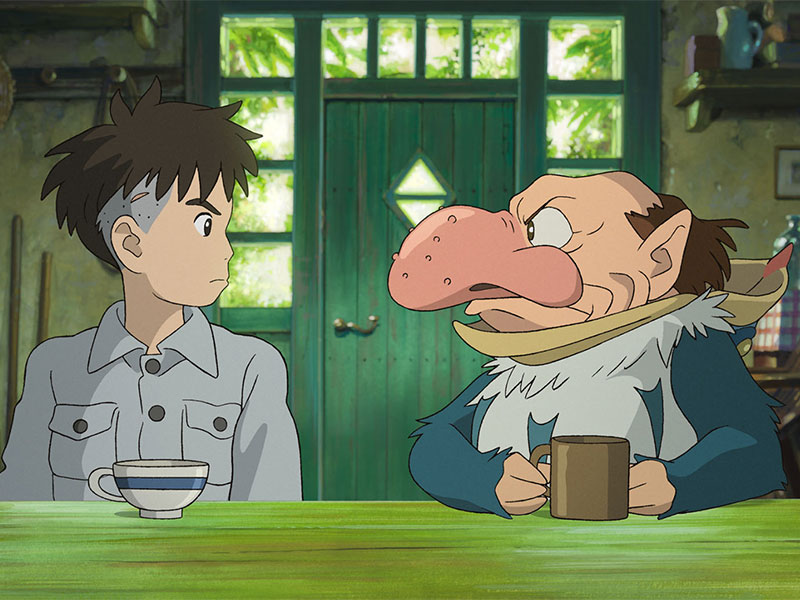
“Frieren” excels when it is interrogating how we make sense of time, how we form memories, and, much like Miyazaki’s “The Boy and the Heron,” how do we live? We begin to see that Frieren has in fact made some long-lasting memories over the years; she just couldn’t see it at the time. Each flashback we get reveals more of Frieren’s true self to us, providing us with wonderfully emotional story beats that show us Frieren’s growth as a person, without cheapening a moment by dipping into melodrama. The burden of regret, of guilt, lessens as Frieren realizes she did care about her companions and she holds them tightly in her memory. She uses those memories to enjoy the time she has with the young mage Fern, and the newly minted hero Stark. When you add an exceptional score by Evan Call ("Violet Evergarden"), it completes the package. An ambling tale of adventure that takes its time to reach its destination – or maybe what matters most is the journey.

10
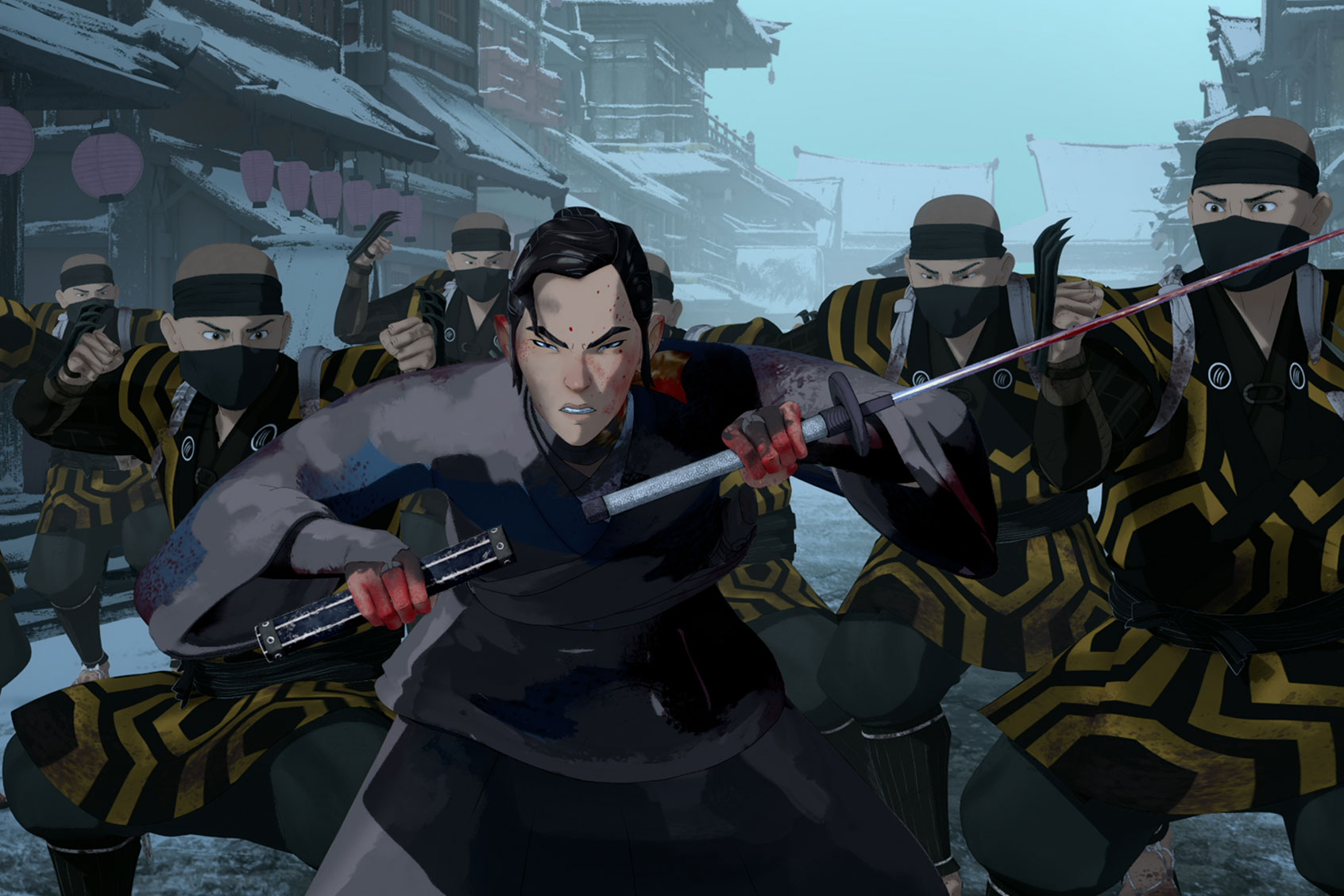
"Blue Eye Samurai" (Netflix) 
Blue Eye SamuraiMaya Erskine as Mizu in Blue Eye Samurai. (Courtesy of Netflix)

What if “Kill Bill,” but anime? A tale of revenge in 17th century Japan delivers all the spectacle, bombast and edginess you would expect from a Tarantino film, in beautifully animated form.


The story of the titular blue eye samurai is that of Mizu, a mixed-race woman whose piercing blue eyes reveal to all her mixed heritage, which she hides behind orange-tinted sunglasses to not draw attention. She has been labeled a “white devil” and now seeks revenge on her father for cursing her with these eyes. Her father is one of four white men who came to Japan as the country began to open its ports to foreigners and are now believed to be hiding out as the nation begins to close its borders once again. Mizu is a skilled swordswoman, and the search for her father is a bloody one, confronted by samurai looking for a fight or by roving armies serving local lords. Mizu’s story intertwines with that of Princess Akemi, the daughter of a lord, who is reluctant to wed the man her father has chosen for her. In this first season (the show was recently announced as being picked up for a second), Mizu’s focus is on the thoroughly contemptuous Abijah Fowler, an Irishman who seethes and sneers with every word he speaks. Mizu searches for information on the whereabouts of Fowler, who is mostly confined to his castle, unable to move freely about the country due to the whole closed borders situation. He awaits Mizu’s arrival like the final boss of a video game.


“Blue Eye Samurai” impresses with its blending of 2D and 3D animation. The painterly backgrounds are gorgeous, and the camera work employed is strikingly cinematic in feel. Anime tends to have its own visual language, but “Blue Eye Samurai” brings a bit of a Hollywood lens to its anime-like world. The camera is very active, with dolly-style shots, swoops and wide panning shots while the framing and composition have all the hallmarks of filmic technique —  as opposed to anime-ic, though that’s not to say that the two are mutually exclusive. "Blue Eye Samurai" leans more towards its Tarantino influence than the techniques employed by anime directors like Shuhei Yabuta. It creates a different feel, but is something that it pulls off well. Something else this series nails is its fight sequences. Any revenge tale needs to make the scenes where the protagonist exacts that revenge look appealing. “Blue Eye Samurai’s” fights are crisp, engaging, bloody and just exaggerated and extreme enough to rev up the audience without feeling gratuitous.

“Blue Eye Samurai” is a big swing for Netflix this year in their attempt to bring mature animation to its audience, having already found some level of success with its “Castlevania” series. Netflix continues to show interest in building properties with that anime aesthetic. Showing off a successful series like this could mean more mature animation in the future. There are some issues with dialogue that borders on so edgy it falls into cringe, as well as some not particularly fitting dialogue for the time period in which this story is set. The word "orgasm" is used, when that would have been just breaking over in France at the time. So unless Princess Akemi had the trendiest French magazines, it just doesn’t make sense for her to use it. Yes, I know it’s super pedantic, but when they get Mizu’s animation right for sitting in the formal kneeling, or seiza, position, to toss in idioms that didn’t exist at the time or have characters slide in a "f**k" for emphasis, it pulls you out of what is otherwise a beautifully realized 17th century Japan. “Blue Eye Samurai” is worth your time for its compelling main character, excellent background art and some truly kick-ass fight scenes. 


09
Suzume" (Crunchyroll)
SuzumeSuzume (Toho/Crunchyroll)

A love story as old as time. You know the one. About the girl and her . . . chair?


March 11, 2011 is a date seared into the Japanese consciousness. It was the day when a powerful earthquake created a tsunami that washed away entire towns along Japan’s northeast coast and irreparably damaged the Fukushima nuclear power plant. “Suzume” director Makoto Shinkai has spent the better part of three films (2016’s “Your Name,” 2019’s “Weathering With You,” and now “Suzume”) trying to make sense of the disaster’s impact on Japan. Whether metaphorically or, in “Suzume,” more directly, it has been a theme that has woven itself into his works. 


Suzume Iwato is a typical high school girl who lives in a small, coastal town on the island of Kyushu with her aunt Tamaki. A chance encounter with Souta Munakata, a mysterious (and very handsome) stranger sends Suzume on a road trip across Japan chasing a cat and closing magical doors. There is a world on the other side of these magic doors, and Suzume seems to have a connection to this other world. The first door is found at an abandoned hot spring resort near her town, and after Suzume sees a large dark cloud billowing from the area near the resort, she rushes to the scene and finds Souta trying to close the now open door. They manage to do so, but this sets off a chain reaction of doors across the country opening. The worm, a cloudy entity that emerges from each door, is the cause of earthquakes in Japan, and if it escapes the other world, it will unleash a devastating earthquake wherever it appears. While Suzume tends to the injuries Souta sustained during the encounter with the worm at the hot spring resort, a talking white cat appears in the window of Suzume’s house. The cat is the keystone that will lead Suzume to the other open doors, and isn’t a fan of Souta, so it turns him into a sentient chair. Suzume, Chair Souta and the little cat Daijin make their way across Japan to stop the worm from getting loose, while Suzume reckons with her past and maybe, just maybe, falls in love with a piece of furniture.


The art in “Suzume” is, as is to be expected with a Shinkai picture, nothing short of stunning. Since "5cm Per Second" all the way back in 2007, Makoto Shinkai and his team have delivered the very best in background art, scenery, and landscapes. Producing shots so photorealistic that they border on the hyperreal. It is the perfection of representing the everyday mundane spaces of Japan in the most magical way that blends the fictional with the real. The scouting team for a Shinkai film will photograph real places, and those become the basis for these representations that are the most gorgeous fictionalization of that place possible. It is easy to imagine that what ends up on the screen is the reality. This has always been Shinkai’s greatest strength. Moments when the worm appears are also striking and limited edition chair version Souta is wonderfully animated. Popular Japanese band Radwimps continues their collaboration with Shinkai (having worked on "Your Name" and “Weathering With You” as well), providing the score for the film alongside composer Kazuma Jinnouchi. 


Makoto Shinkai is a bonafide hitmaker and one of the most respected directors in anime. When one of his films comes out, it is an event. “Suzume” looks fantastic. Shinkai and his talented team of animators at CoMix Wave Films are unmatched at making a hyperreal Japan seem so inviting. “Suzume” is an interesting film in that it seems to be reaching for greater thematic depth, but doesn’t quite coalesce around any philosophical themes to ground the film. Nevertheless, the dual earthquake and meltdown aftermaths, however, may resonate with Americans, who had endured a record-breaking number of natural disasters this year. As climate change continues to wreak havoc, this trend sadly doesn't seem to be going away.


Shinkai has said he wanted to "mourn deserted place"’ which is why the doors in the film appear at an old school, an abandoned theme park and in the Tohoku region of Japan still recovering from the tsunami. Yet, he doesn’t seem to be saying anything about these places. Is it capitalism’s fault? Is it a loss of connection to community? Is it nature taking revenge on human kind? It’s not clear. What is clear is that Shinkai is much better at writing love stories. He wrote one of the most genuinely bittersweet romances ever in the first part of “5cm Per Second” in 2007, and while he has trended towards happy endings lately, he writes love well. He knows how to hit the right emotional notes between Suzume and chair Souta, and their relationship carries the film well. And sometimes we need that in our films.


08
"Heavenly Delusion" ("Tengoku Daimakyo") (Hulu)
Heavenly DelusionHeavenly Delusion (Masakazu Ishiguro/Kodansha)

When the world ends, why not go on an adventure?


Post-apocalyptic fiction is one of those done to death genres in the mainstream. While it is a place where societal critique can be magnified, and there are ways in which the post-apocalypse can be used to radically reimagine society, more often than not, it can feel almost rote and by the numbers. So how do you take a post-apocalypse story and make it memorable? Well, one way to do it is to animate the heck out of it. Make a show so gorgeous, it can’t be denied. 


"Heavenly Delusion" is a story that splits its time between two drastically different places in its post-apocalyptic world. The more mysterious narrative is the one set in a clinical, futuristic orphanage. The kind of sci-fi utopian location that, from the get-go, you can tell that something is definitely off about the place. The kids seem healthy, they’re being educated, they have ample free time to play and pursue hobbies. But as the kids begin to get curious about “outside” and wonder if there is a world beyond the walls of the orphanage, they begin to uncover secrets about the only home they’ve ever known. On the flip side, a more straightforward search for a place called Heaven somewhere out there in the crumbling remnants of Japan is what drives Maru and Kiruko, a teenage duo who get along almost like they’re in a buddy cop flick. This world is extremely dangerous, but for every tense encounter with a monster or hostile humans the pair crack jokes that cut the tension. They’re just kids after all, they’re goofy, awkward, and hormonal at times. The beautiful landscapes the duo travels through hide many unknowns and the journey stirs up lingering trauma that reveals itself slowly to the viewer.


“Heavenly Delusion” is animated by Production I.G., another of Japan’s best studios, with a team of experienced animators who have experience working with each other. That ability to play off each other's strengths has an obvious, and extremely positive, impact on how "Heavenly Delusion" looks and feels. While many anime start with their strongest material to pull a viewer in and then let the quality slip a little in later episodes, “Heavenly Delusion” looks absolutely gorgeous from start to finish. There are so many little details that give the production so much life. Simple things like each character having a unique walk, or visibly different levels of physical ability, each character’s movements add to their personality. While the background art is stunning, the color design is also worth noting. Color sets the mood in a show like this, coloring the world to give it an authentic, lived-in feel, while also making bold choices to heighten emotional response. Action sequences crackle with intensity whether it’s a fist fight with some local toughs, or a harrowing encounter with one of the many dangerous monstrosities that lurk in this beautiful post-apocalyptic nightmare.


“Heavenly Delusion” is arguably the best looking anime of 2023. The rich world that manga author Masakazu Ishiguro has created is breathtaking to behold in animated form. It is a production that has been in the works for some time, and that long production time has meant that a great deal of care has been put into this adaptation. The mysteries on both sides of the narrative coin are intriguing, keeping viewers invested as we peel the layers away and get to deeper truths about this post-apocalyptic world.


07
"Teenage Mutant Ninja Turtles: Mutant Mayhem" (Paramount+) 
Teenage Mutant Ninja Turtles: Mutant MayhemTeenage Mutant Ninja Turtles: Mutant Mayhem (Paramount Pictures)

As a millennial, I have seen more than enough of the treasured properties from my childhood mined from my memories and reassembled into some kind of facsimile of the thing I remember. I’m supposed to watch these reimagingings, reboots and remakes with the highest prescription rose-tinted glasses available and eat up the nostalgia slop like a good little consumer piggy. So you’ll have to forgive me for thinking that the latest TMNT film was another attempt to cash in on my love for the '80s cartoon (have you ever heard the Japanese dub’s ending theme? Bass line absolutely slaps). Watching "Mutant Mayhem," I was ecstatic to see that this film was not solely aimed at me. I never felt like my memories were being exploited, and the film stands fully on its own without giving in to gratuitous levels of *wink wink* “did you get the reference we did there?” (though there are still enough of those if you’re looking for them). If I were a kid today, this movie would be totally radical.


With that said, “Teenage Mutant Ninja Turtles: Mutant Mayhem” is a reboot of the Turtles franchise. It starts with an origin story of how the turtles came to be, and the plot is a tried and true take on the outsiders who want to be accepted, as the turtles – Leo, Raph, Mike and Don – skirt around the fringes of society and want, more than anything, to go to school and be normal kids. They know enough about the human world to concoct some plans they think might get people on their side. Top of that list is to become heroes, and once the humans realize how cool they are, they’ll immediately be accepted in the school hallways where they can nerd out about “Attack on Titan” with the human teens. Or at least, they think it will be that simple. Unsurprisingly, their plans do not go off without a hitch, and they find themselves caught up with a gang of other mutants (all the baddies we millennials remember from the comics & the original cartoon) to destroy New York. The story plays it pretty safe, but again, this is absolutely fine. This movie is meant to be accessible enough for kids.


The art style employed in “TMNT: Mutant Mayhem” is an absolute standout. Inspired by scribbled notebook drawings, the film has a frenetic energy to it that is conveyed in the animation. Effect lines, exaggerated reactions and roughly sketched bits and pieces give it the energy of a 2D comic book panel exploding out of the page and onto the screen. The movements are fluid, but retain that comic book appeal as the characters strike and hold poses as they would if they were in the pages of a comic. The art in the film also makes a character out of New York City, from Times Square and the Brooklyn Bridge, to the bodegas and brownstone apartments, the city feels alive. French studio Mikros Animation and VFX studio Cinesite deserve praise for bringing director Jeff Rowe’s vision to life.


“TMNT: Mutant Mayhem” is a reboot that is truly rebooting for a new generation of kids who might not be as familiar with the Ninja Turtles, and not for us goober millennials chomping on 'member berries. Too often an old franchise makes a return out of nowhere, old actors are dragged out of their nursing homes to do a little nostalgic song and dance for us, and we’re supposed to remember the good times. It’s a transparently cynical cash grab. This film feels fresh, even if, to an older audience who is familiar with the Turtles, it might seem like a retread. Once again, it’s not just for us. The voice actors playing the Turtles – Micah Abbey (Donatello), Shamon Brown Jr. (Michelangelo), Nicolas Cantu (Leonardo) and Brady Noon (Raphael) – feel like real kids, because they ARE real kids. In interviews, it has been shared that the actors recorded lines as a group, with the kids improvising and riffing on each other. This makes perfect sense because the dialogue actually sounds like teens do. What all this does is creates an authentic film, with voice performances that hit and animation that is playful, fun and unique.


06
"Pluto" (Netflix)
PlutoPluto (Netflix)

How can you take one of the most iconic manga and anime franchises of all time (“Astro Boy”), somehow turn it into a noir thriller, and end up creating a series that honors the legacy of “Astro Boy’s” creator, Osamu Tezuka, while also being something extraordinary and entirely its own thing? “Pluto” is an adaptation of the manga by Naoki Urusawa, itself a reimagining of the Greatest Robot on Earth arc from Tezuka’s “Astro Boy” manga. Urusawa is also the author of “Monster,” one of the underappreciated (by western audiences at least) gems of both manga and anime, having received multiple awards in Japan for the manga, and a full anime adaptation in 2004. For years veteran anime producer and studio head Masao Murayama has wanted to see “Pluto” in anime form. His studio M2 is behind production here for Netflix and in interviews claims that his team have suffered in the making of “Pluto,” putting in incredible effort to do justice to Urusawa’s work.


While “Pluto” is a densely layered work about artificial intelligence, personhood, humanity and geopolitics, its plot is centered around the robot Gesicht, a detective for Europol tasked with solving a series of grisly murders. Both robots and robot-sympathizing humans are targeted, and Gesicht has to figure out what connects these crimes. As the plot expands, it appears that someone, or something, is targeting the strongest robots in the world, of which Gesicht is one. The series becomes a race against time to find out what this evil force is, and prevent it from reaching these fascinating robots, many of whom were once instruments of war, now serving the public and beloved by most everyone.


“Pluto” has an almost retro look to it, which makes it immediately stand out against the copy/paste design trends of its weaker contemporaries. A throwback to the highly detailed, grittier designs of '90s anime, “Pluto’s” animators sell the series aesthetic. This is probably a result of putting a legendary animator in the director’s chair for the project. Toshio Kawaguchi has been a key animator on several Studio Ghibli films, the 1988 masterpiece “Akira” and the 1985 cult classic “Angel’s Egg” – and while this is his first time working as a director, it appears he is up for the challenge. With a team made up of veterans from Madhouse, the level of polish puts “Pluto” into the highest tier of anime production. The show is anchored by a stellar voice performance from Shinshu Fuji as Gesicht, slowly breaking his robotic facade as the case ratchets up, allowing human emotions to start manifesting in his psyche. Once a cool customer, Gesicht reels when remembering past trauma and the injustices inflicted upon robotkind in a society still not all the way accepting of robot personhood.


“Pluto” has been years in the making. A universally acclaimed manga based on a story told by the father of anime, and given an adaptation worthy of the source material. “Pluto” is also a big deal because it tackles big themes that are relevant today. While the manga was written in the early 2000s, and the geopolitics being critiqued were those of the wars in Iraq and Afghanistan, when a character from a fictionalized Persia monologues about how his country was "bombed to ashes" because the imperial powers needed a "country of have-nots" to demonize, one can’t help but see how these themes and ideas are still front and center today. This is a serious anime that asks serious questions.


05
"Scavengers Reign" (HBO Max)
Scavengers ReignScavengers Reign (HBO Max)

Sometimes you put a new show on and you can immediately tell “oh, this is special.” From the opening frame, “Scavengers Reign” showcases an aesthetic that feels like a graphic novel brought to life. If early anime was seen as a way to bring manga off the page — it wasn’t called manga eiga or "moving picture manga" for nothing — ”Scavengers Reign” is nothing short of graphic novel eiga. It is a graphic novel moving on the screen.


“Scavengers Reign” follows the parallel stories of the displaced crew of the interstellar cargo ship Demeter 227 as they attempt to make their way back to their ship, which has crash-landed on a strange alien planet. While at first we know nothing about the crew, flashbacks are employed deftly to build character and establish connections between the crew members and flesh out their personal histories. The alien planet is filled with flora and fauna that are as deadly as they are beautiful. While some characters have either learned about, or had previously studied, the lifeforms of this hostile planet, more often than not, an encounter with a creature is a harrowing ordeal. This world is rich with its own ecology. When our characters stop to observe, we see the planet in its natural state. Plants blossom, little critters nibble at the flowers, bigger critters take chunks out of the little critters. Circle of life. The pacing between the stories is perfect. Told in little snippets that feel like chapters in a graphic novel, "Scavengers Reign" keeps the narrative plates spinning, never letting one slip.


“Scavengers Reign” looks fantastic. Plain and simple. As I mentioned earlier on, this show feels like a graphic novel in motion. It is an aesthetic that stays consistent throughout. The art style immediately draws those comparisons, but it’s more than that. I couldn’t get away from thinking that each cut in a scene was my eye moving to a different panel on the page of a graphic novel. The storyboarding is so exceptional, creating that paneled aesthetic to each scene, and the framing and composition of each shot is so crucial, as there is intentionally little camera movement. Pans are used sparingly, there are no fades between scenes, in fact, when we do move to a different storyline, the only scene transition we get is a sharp cut to black and then another equally sharp cut into the next scene. Turning the page, starting the next chapter.


“Scavengers Reign” flawlessly integrates another medium entirely into its aesthetic. The series is is deceptively simple looking, but the discipline of the techniques employed to create this simple look are masterful. This is a mature series, but not in a gratuitous or edgy sense. It is refined, doesn’t hold the viewer’s hand, and doesn’t use cheap trickery or melodrama to create emotional resonance. The graphic novel look and feel is something I haven’t seen pulled off so effectively before. Now I just want Tillie Walden’s “On a Sunbeam” to get the same treatment.


04
"Mobile Suit Gundam: Witch From Mercury" (Crunchyroll)
Mobile Suit Gundam: Witch From MercuryMobile Suit Gundam: Witch From Mercury (SOTSU/Sunrise/MBS)

For over 40 years, the Gundam franchise has told stories about boys who pilot giant robots. Series creator Yoshiyuki Tomino has been spinning yarns about the damage done by war, and the idealistic youth who take up the mantle for a better tomorrow. Yet, for all its history, and for the many series that make up the iconic franchise, there hasn’t ever been a female lead protagonist in a Gundam series. Until this year’s “Mobile Suit Gundam: Witch From Mercury.” That the show is also the franchise’s first front-and-center queer romance makes it an even more remarkable achievement.


The show follows Suletta Mercury, an awkward Mercurian girl, attending the prestigious Asticassia Academy, where the best and brightest pilots and robot mechanics gather (along with  a healthy dose of nepo babies) to learn the ins and outs of mobile suit manufacturing and the business behind them. Because Suletta’s home planet of Mercury is considered to be the sticks, the blue blood elites that make up most of the student body immediately turn their noses up at Suletta. As an outcast, Suletta begins to doubt herself and it isn’t until she runs into Miorine Rembran, the daughter of business magnate Deling Rembran, that she finds an ally. Despite Miorine’s frosty personality, she can’t shake that there is something special about Suletta, and she warms up to the bumbling, stuttering Mercurian. The two team up, along with fellow outcast students from Earth House — Earthians being seen as less than the elite Spacians who make up the nepo baby contingent — to dismantle the corrupt power structures of the academy, and challenge the authority of the adults who are using their children like pawns.


The Gundam franchise has long been made by a passionate group of artists, animators, writers and directors. The studio behind it, Sunrise, doesn’t put its name towards too many other projects. Gundam is their baby. Each series in the franchise has its own look and feel. In “Witch From Mercury,” that look and feel starts with the character design. With characters created by the artist Mogumo, “Witch From Mercury” makes it easy to get invested in its story as each character’s design is memorable and expertly drawn. There isn’t a single character I don’t like the look of in this show. Another staple of any Gundam series is the design of the giant robots. The mobile suits in “Witch From Mercury” are interesting, and the Gundam that Suletta pilots, Aerial is a fantastic design. There is a good reason why the Aerial model kit had the highest initial sales in the history of the franchise. These giant robots also engage in some wonderfully animated battles. Though “Witch From Mercury” isn’t as battle-heavy as some past entries in the franchise, when a fight breaks out, it usually looks pretty darn good. Tying all this together is an exceptional soundtrack from Takashi Ohmama, the blend of stirring orchestrals and moody synth-focused pieces highlight and accentuate the story perfectly. 


“Witch From Mercury” proudly plants its queer flag in the very first episode, with Suletta winning a mobile suit duel, the result of which earns her the title of Holder. In the world of Asticassia, the Holder is the person who will become Miorine’s fiancée. Did I mention that Miorine’s dad owns the school? And his daughter is essentially the prize to be given away as a result of these duels that take place at the school. And the whole idea is to give the Holder title to another nepo baby to strengthen Deling Rembran’s Benerit Group (a massive multiplanetary conglomerate). The adults in the room are repeatedly caught with their pants down. Making the kinds of business decisions that inflict suffering on marginalized groups, these CEOs and self-proclaimed great minds are a detriment to humanity, and are shown to be foolish buffoons often. Series creator Tomino has long said that adults aren’t to be trusted, and in “Witch From Mercury,” the kids at Asticassia put these adults, who hold so much power, in their place.


But what is “Witch From Mercury’s” most significant impact in 2023? Not only has the show been a huge hit, bringing in new fans to the world of Gundam, it wastes no time taking shots at Japan’s conservative, and frankly embarrassing, position on same-sex marriage. This year, a number of smaller Japanese courts ruled that the country’s ban on same-sex marriage was unconstitutional, but despite this, the Diet, Japan’s national legislature, has bailed on making a ruling to overturn the ban. Under this political climate, “Witch From Mercury” centering a queer romance is a big deal. Advocacy groups are fighting for equality, and here is a show, from a major Japanese anime studio, saying that this is love and it needs to be celebrated (except when they tried to walk it all back and say it was up to interpretation but it’s clearly not and they got blasted for it). In the first episode, Suletta says to Miorine after becoming the Holder: “B-b-b-but, I’m a woman . . .” to which Miorine casually replies, “I guess Mercury is pretty conservative . . . this is normal here.” It was a bold statement to lead with, and the series never shied away from what Suletta and Miorine mean to each other. "Witch From Mercury" breathes new life into the iconic Gundam franchise, and makes a great entry point for folks who have never even heard of a Gundam before.


Spider-Man: Across the Spider-VerseSpider-Man: Across the Spider-Verse (Sony Pictures)

It seems that every piece of media nowadays is part of some bigger universe. Once a franchise clicks with audiences, the bird-brained executives running these media companies proceed to run a good thing into the ground by building these content universes. Franchises are made to be infinitely expandable and retcon-able so content can be produced in perpetuity (or at least until the money dries up). The Spider-Verse comic series is also a parallel world, multiversal, all-the-Spiderpeople-you-could-ever-want kind of situation, but at least for now, it all works up on the screen. Probably because the animation is absolutely fantastic.


“Across the Spider-Verse” is the middle film in what is (for now) a trilogy continuing the stories of Miles Morales and Gwen Stacy. Miles and Gwen visit different parallel universes each with its own Spider-Man and, in an inspired move, each with its own art style. Miles faces off against the Spot, the main antagonist of the film who has the ability to generate teleportation portals and who declares himself to be Miles’ rival. As The Spot’s power increases and Miles involvement with Spider-Society causes more anomalies in the multiverse, the stakes continue to rise. As someone who didn’t remember this was the second part of a trilogy, as the run time went on, I kept thinking, “How are they gonna wrap this up?” and then, “Oh boy they are gonna rush this ending . . .” before it really got to the end and I finally remembered “Oh, there’s another film coming.”  This is two hours and 20 minutes that keeps up the tempo the whole way through, and ends at just the right spot to carry on next time with “Spider-Man: Beyond the Spider-Verse.” 


The animation in “Across the Spider-Verse” is an exceptional labor of love. With each of the parallel worlds featuring their own unique art style, it does a lot to differentiate locations in the film. It gave animators some freedom to use the different art styles to express a wide range of emotions. The watercolor impressionistic styling used in Gwen’s Earth-65 to color the whole world in emotional energy, with everything giving off an aura of color, matching the mood, to really grab the viewer’s attention. Or the mostly black and white, thick-lined comic book style used when the Spot goes into his backstory. Or Spider-Punk Hobie Brown’s collage-inspired character design with his somewhat intentionally choppy frame rate (it was explained that for certain scenes Hobie was animated using less frames than the rest of the characters) giving his paper aesthetic an almost anime flavor by having his character animated less at times. This movie is a scatter shot of impressive technique and creativity, featuring the work of nearly 1,000 artists, but for how impressive the end product looks, this effort came at a cost.


“Spider-Man: Across the Spider-Verse” had an impact on animation this year because of the beautiful work done by the artists and animators – it is truly a standout film as a result. But the film also made waves for allegations of overwork, something that has impacted a number of productions in animation in recent years. In a year when striking workers have fought for better wages and better working conditions, folks in the animation industry have yet to be given their chance to seek improvements in their field. 


This isn’t just a problem in North America, but in Japan conditions for lower level animators have long been deplorable. Extremely underpaid for the work they are expected to do, and working days on end without break, it is the worst kept secret that anime studios exploit their workers. One of the biggest offenders is Studio MAPPA, a studio that takes on several major projects each year. Animators working for MAPPA made the unheard of (in Japan at least) move to take to social media and air grievances about working conditions and insultingly low pay. One of the year’s biggest blockbusters is the series “Jujutsu Kaisen,” and as the show entered its second season, the high octane action depicted in the series came at the animators expense. Overwork hit hard, and while the end product looks great, it comes at such a cost we have to wonder if it is worth it?


In comparison, famed anime studio Kyoto Animation, the studio targeted by an arsonist in 2019, produced one show this year, the sublime “Tsurune” about a high school archery club. Kyoto Animation not only pays its workers a fair wage and has a strong policy against overworking, it also retains many of its talented artists and animators, helping develop their skills so they can advance in the industry. The model means less anime, but better quality. Not only for the end product, but for employees’ lives as well.  As we’ve seen, animation is art. It is the creation of beautiful things by talented people. And the people that make it deserve better than being ground to dust under the weight of unfair wages and soul-crushing working conditions.    


02
"Vinland Saga" Season 2 (Netflix, Crunchyroll)
Vinland Saga Season 2Vinland Saga Season 2 (Makoto Yukimura/Kodansha)

Makoto Yukimura’s award-winning manga set in the Age of Vikings could have been just another glorification of the violent history from this time, but instead this setting is used as the backdrop for a reckoning with violence itself. How do we determine the value of a human life? Who is worthy of salvation? Is freedom from oppression and cycles of violence even possible? Yukimura implores us to think deeply on these questions.


This particular viking tale is centered around a fictionalized version of real life viking Thorfinn Karlsefni. In Season 1, Thorfinn is broken down and rebuilt as a fighting machine. Taken under the wing of Askeladd, a brilliantly written character and the leader of a mercenary band of vikings. Thorfinn plods along through 11th century England doing Askeladd’s bidding. He is exposed to, and commits, gruesome acts of violence as Askeladd and his merry men raid villages and slaughter innocent farmers. In Season 2, Thorfinn is sold off into slavery where he is dehumanized further, uttering the gut-wrenching line, “Not a single good thing has happened to me in my entire life.” Thorfinn is reduced to a state of nothingness. He wonders if it matters if there is any value in him living, or should he just give in to the abuse he suffers and die. Feeling this violence inflicted upon him, he begins to see just how much destruction he has wrought with his own two hands. He vows to escape his situation and begin a journey of not only self-healing, but a crusade to pull more people out of the cycles of violence that keep them perpetually marginalized. 


“Vinland Saga” is a series that has been given an incredible amount of love and care from the team behind it. For its first season, the anime was produced by Wit Studio, a studio known for its polish and ability to extract so much from the source material it pulls from. They produced the superior first three seasons of “Attack on Titan” before Studio MAPPA took over. The same has happened here, with MAPPA taking the reins of "Vinland Saga." The concern around this change was warranted by fans, as MAPPA’s track record is spotty, but thankfully, a number of Wit Studio employees moved over to MAPPA to continue their work on “Vinland Saga.” Perhaps most important of all is director Shuhei Yabuta whose steady hand and clear passion for “Vinland Saga” has allowed for the series quality to not dip at all. This season of “Vinland Saga” is lighter on action, allowing for a focus on intimate moments between characters and details that the manga also highlights. There are shots of hands throughout “Vinland Saga,” something manga author Yukimura is transfixed by, with the author saying they reveal a lot about a character. The rough hands of a slave, the clean hands of a prince, the wrinkled hands of an old man who has seen so much.


Thorfinn is an incredible protagonist. His profoundly humanist vision for the future is idealized, certainly, but it is so hopeful, we want it for him and for ourselves. “Vinland Saga” so viscerally shows the cruelty that humans are capable of, how violence becomes systemic and wins out over even a shred of empathy, and the twisted justifications we use to be complicit in such violence. Thorfinn wants to find another way to exist. To create a world without violence, a world where people want to live instead of wishing for death. While his character was (intentionally) stifled at every turn in Season 1, here he is allowed to grow and as he begins to shape his own politics and worldview, every moment of struggle and tragedy he faces is felt so deeply. He confronts his past, and looks towards a brighter future, despite all he has been through. This is my anime of the year without question.


01
"The Boy and the Heron" (In theaters) 
The Boy and the HeronThe Boy and the Heron (Studio Ghibli)

At this point in his career, every film that Hayao Miyazaki makes could be his last, and no one is reckoning with this inevitability more than Miyazaki himself. He’s been in and out of so-called retirement since “Princess Mononoke” in 1997, but his recent works have grappled with notions of legacy and what we leave behind. While 2013’s “The Wind Rises” examines what happens to our life’s work when it is released into the world, and how little control we have over how it is interpreted, used and repurposed. With “The Boy and the Heron” Miyazaki seems to be searching for a philosophy to leave behind, this film being a letter to his grandson after all, on how to reclaim and nurture the self in a world that seems to just keep dragging us all along. While “The Boy and The Heron” is certainly . . .  a title someone chose, the Japanese title “How Do You Live?” is truly the question at the heart of this story. It is Miyazaki at his most existential. 


The film is set in the Japanese countryside during World War II, though war is not at the forefront, save for one harrowing scene that echoes through the film. War simmers in the background, a constant, subtle reminder that this is a world marred by violence. The low hum of the war machine is never fully out of earshot. After tragedy befalls his family, Mahito, the titular boy, leaves Tokyo and relocates to the country with his father to live with his aunt, Natsuko. Even in the rural locale, there is no escape from war. Soldiers march to the train station to join the effort, and Mahito’s father runs a factory making windshields for fighter planes — an autobiographical influence as Miyazaki’s own father built rudders for fighter planes, including the famed Mitsubishi A6M Zero. 


When Natsuko goes missing, Mahito takes it upon himself to find her. This marks the start of Mahito’s journey into a messy, violent, somehow parakeet-filled, dream world of self-discovery, to perhaps find an answer to the question: “How do you live?”     


As with any Studio Ghibli film, the animation on display is simply unmatched. The Ghibli house style has been refined to perfection at this point. Able to create beautiful, lived-in realities and fantastical unrealities that are overflowing with detail. Ghibli’s animators — after two years of pre-production and five years of full-on production — have delivered a film that is supremely confident in its aesthetic. The cohesiveness and vision of a Studio Ghibli film’s animation is one of its greatest strengths. Plus, the food has never looked more delicious. It must also be said that Joe Hisaishi’s score is also magnificent. Miyazaki’s long-time collaborator, Hisaishi often composes his pieces for Studio Ghibli’s films after looking at early storyboards and drafts, but in the case of “The Boy and The Heron,” Hisaishi was shown the nearly finished film, only a year ahead of its theatrical release. The results are themes that crescendo with precision, and in stretches with minimal dialogue — Mahito is a stoic boy, after all — Hisaishi’s pieces are able to carry the narrative wonderfully.


Hayao Miyazaki will be 83 in January. This could be the last film we ever get from him. Thankfully it is a wonderful film that is thematically dense, but can also be viewed lightly as a sort of “Spirited Away" but for boys. Miyazaki has been searching for a philosophy on how to exist in a world that has been corrupted. Perhaps there isn’t a way, perhaps we’ve already gone too far, but it seems he still thinks it is worth trying to find a way. Giving up on trying to change will only lead to more suffering, more oppression, more misery. It is easy to be dragged down into the abyss, to give in to misanthropy and nihilism, but Miyazaki, even after all he has seen in his life, still believes there is a way forward for humanity. It’s just no longer something he can do, so he’s leaving it to us to keep searching for it. 


“People do forget, and that is OK: “Occupied City” challenges how we recall the Holocaust

Steve McQueen’s first documentary, “Occupied City,” is a doozy — a four-and-a-half-hour film, with intermission, featuring a voiceover narration by Melanie Hyams talking about Amsterdam during the Nazi occupation. This narrative thread is juxtaposed with images of the city during COVID. It sounds like a lot — and it is — but this hypnotic project, written by McQueen’s wife, Bianca Stigter, and based on her book “Atlas of an Occupied City (Amsterdam 1940-1945)” dutifully explores themes of oppression and resistance. These topics have been embedded in McQueen’s films, such as “Hunger” and “12 Years a Slave,” and here they have the added value of showing how the past informs the present.  

"It is one of the situations that the liberty of now is because of what happened in the past."

“Occupied City” recounts the history of persecution of Jewish citizens, the Roma, homosexuals and others by mapping out places where arrests and deaths took place. As addresses of houses, schools, theaters, parks, hospitals and other sites are reported, Hyams’ narration indicates what took place there, including betrayals, interrogations, deportations, sterilizations, suicides and more. But the visuals show the location’s contemporary use and depicts everyday life unfolding during the pandemic. 

The juxtaposition allows viewers to reflect on how much has changes in 80 years — and how much has not. White Supremacy is still pervasive and dangerous. There are connections between the Nazi era and COVID with talk about ID/vaccination cards, boarded-up storefronts, curfews and food distribution shortages. Protests still need to take place to change minds. (Episodes depict anti-fascism and climate change rallies). There are also scenes that memorialize what has occurred in the past with monuments, including the Holocaust Memorial of Names, that emphasize the importance of collective memory.

McQueen and Stigter’s film is, admittedly and deliberately, numbing. But there is a power to the repetition as horrific stories of violence, corruption and collaboration are recalled. And viewers may want to learn more about the Hunger Winter or the February Strike Protest, a massive public act of resistance. Likewise, viewers may wonder about individuals to understand what drove a Jewish woman to turn a Jewish family over to the Nazis? Or, how effective was an individual’s resistance work during the occupation before he was caught and killed?

During the Telluride Film Festival, where the documentary had its U.S. premiere, McQueen and Stigter spoke with Salon about making “Occupied City.”

You take a very specific approach to telling this story. What decisions did you make adapting this book into a documentary and a four-and-a-half-hour one at that? 

Steve McQueen: I am a Londoner who came to Amsterdam 27 years ago and met Bianca. We live in a formerly occupied city. The fact that these buildings are 17th-century city buildings, which existed during the war, pushed forward the idea of the past in the present. There was this immediacy. It was interesting investigating it. I thought about finding footage from that time and marrying that footage with contemporary times and projecting one image on top of the other, so it reinforces the buildings, and you can see the living and the dead in the same frame. But then I thought, Bianca was writing this book, “Occupied City,” and I thought of using the text as the past and the images as the present.

Bianca Stigter: Amsterdam wasn’t bombed very much during the war, so officially, it didn’t leave such a big impact, so to say. When you are in Amsterdam, you see the 17th-century canals. Knowing what happens, from the text in the book, and putting that on what you can almost feel but cannot see, you get this kind of tension. Sometimes you can recognize something in the text [with the visuals] and sometimes not at all. This is the past not coming back. You feel that in different ways. Amsterdam has changed because of the war.

McQueen: The film is like an archaeological dig in a way because you have layers of history. You have 17th century, the Second World War, and the present day and everything in between. Sometimes it merges, sometimes it fractures, sometimes it repels. Some things fit like a glove, other things are so opposite and contrarian and challenging and confronting. It is one of the situations that the liberty of now is because of what happened in the past. That is apparent when you have a house where a whole family [died by] suicide and you [see] a gentleman playing Spanish guitar for his grandchild. Maybe he is oblivious to what actually happened, but the reason he is there, unfortunately, is because of what happened in the past.

Stigter: For me, it is very much that the past didn’t end, and the present doesn’t end. You feel those things. There is randomness in there. In the city, so many things happen, and this film tells you that you can’t know it all. 

Occupied CityOccupied City (A24)

Can you talk more about how you married the history with the contemporary scenes? I was disturbed by a discussion of death and suicide being reported over images of people partying.  

McQueen: The perverse is within our everyday. It is part of our lives. There is no point in hiding it. The fact of the matter is these things happen. Coincidences happen. In a place where people [died by] suicide, other people are partying. It’s the power of life. It is to be embraced. It is not about things that are in sync. Things that are totally out of sync can appeal to us. What is totally out of sync is an idea of freedom. People have been liberated because of those events. As an artist and filmmaker, at least in this sense, it wasn’t about having that kind of control, but allowing things to be themselves and showing it for what it is.

Stigter: With every new scene, you are invited to negotiate the relationship between the past and present and you. There is not one form for it. There is a monument, but it is also in the different ways you negotiate those connections. 

What I appreciated most in your film was the idea of memorialization. There are discussions about street names being changed, monuments being erected and other forms of commemoration, including Bianca’s book and this film. Can you talk about creating collective memory and its importance?

McQueen: People do forget. And that is OK. This film is a meditation, it is not something to hit people on the head with. It’s about the fluidity of life, and the changing of life.

Stigter: You can see how the Second World War is remembered in Amsterdam. It changes. After the war, there was a lot of attention on the resistance workers and there were statues raised for them. What happened to the Jewish citizen, there were no monuments for that. That changed in the '60s. In the '70s, other groups, like Roma, homosexuals [were commemorated].

McQueen: The climate changes, therefore memory changes, and therefore history changes.

There are several scenes recounting historical resistance and depicting contemporary protests. The forces of white supremacy, racism, xenophobia and homophobia remain pervasive. How did you consider these issues? There is talk about Roma in the historical narrative, and a scene of a same-sex union in the visuals. I kept wanting more connections.

McQueen: You can make sense out of it. You can make nonsense out of it. People are looking for some kind of answer within the images, and sometimes it is just how it is.

Stigter: There is never one comparison — this happened then, and this happens now. It never makes this very simple equation. You have to find a connection or see that there is no connection.

McQueen: What happened at that location now, and what happened at that location then, doesn’t necessary mean they are married. It is of the time. That’s what happens with liberty and people can do what they want. 

You feature many static shots that absorb the feeling of a place, we sit with the scenes, but you also feature a stunning sequence where the camera moves and turns upside-down, disorienting viewers. A penultimate sequence moves with an empty tram car, creating a bubble that one could see as being symbolic with a deportation train, or COVID. Can you talk about creating the film’s hypnotic visuals?

McQueen: It is regurgitating everything you see travelling through the city. It is how not to be judgmental. It’s finding it, which is like listening, rather than looking. That language is felt, and working with my DP, Lennert [Hillege], that is what we did. Putting the camera in the right position is about feeling it. What is the location telling you, showing you, asking you what to do? There is no structure and no rhyme or reason other than putting the camera in the right position. It’s difficult to articulate. It is a feeling of what this space gives you.

There are descriptions of violence that are reported but not shown. One involving an open sewer, blows to the head, and kicking was particularly horrific. We are forced to imagine the horrors. Can you discuss this aspect of your film? It is very palpable even though you don’t see any of it.

McQueen: The violence is shocking because it is personal. How we describe the violence is shocking because you know the person and have an idea of the person and you are seeing images that are contemporary. It is shocking because this happened to civilians . . .

Stigter: . . .  in this nice and beautiful-looking place. How can you reconcile those two things? Sometimes you just can’t.

McQueen: In one particular location, you are in a hospital where a lady gets kicked and has a miscarriage, and then you have people drinking wine in the sun, and people pushing children, and on their bikes being carefree on a beautiful summer afternoon. For that to happen, people fought for their liberty. To marry the two is very confronting, but that is what makes the power of the movie.

Am I correct that the film has been cut down from 36 hours?

McQueen: Yes, I shot 36 hours of footage. I have a 36-hour film. I’m going to do something else with it. 

Stigter: The film needs the length. It was very important to film so much [footage] because things you don’t expect will appear in front of your camera.

"The perverse is within our everyday."

McQueen: The editing process with myself and Xander [Nijsten] was so interesting. What did we have, and what would make a narrative within a feature film setting? Working with film as a medium to make this picture was not about bad reportage or interviews or found footage. I wasn’t going against that. The subject was asking me to work in this way. It’s about filmmaking. How you tell a narrative is still to be played with. This subject refused for me to work in any convention.


Want a daily wrap-up of all the news and commentary Salon has to offer? Subscribe to our morning newsletter, Crash Course.


Can you talk about these ideas of resistance against oppression, which are themes in all of your films, but also in Bianca’s previous documentary, the remarkable “Three Minutes — A Lengthening.”

Stigter: The way you went about the projects, the smallest thing can become an event worth watching. Because of that value of life. That nothing is unimportant. That was a beautiful message of the movie.

McQueen: It’s a meditation on looking. Often, when you look at something, obviously, you go somewhere else. It can be a starting point for a thought. It’s like living with artwork. People live with artwork forever because it’s a starting point for a conversation. It’s not the be all and end all. What happens outside the frame is just as important as what happens inside the frame. 

Stigter: It’s not a history lesson. It’s an experience. 

“Occupied City” opens in select cinemas in New York and Los Angeles on Christmas Day with a national rollout to follow.

A new COVID variant is now dominant in the U.S. Will it cause another massive surge like Omicron?

Once again, COVID-19 cases are rising sharply across the world, along with hospitalizations and death. That also means more cases of so-called long COVID, in which some people take months or years to recover from this illness. We're in the midst of this year's winter wave of respiratory illness, including flu and RSV, but COVID-19 is by far the most worrisome. How bad will this winter be? No one can say for sure, but one of the ways experts can make predictions is by analyzing the genetics of the viruses responsible and gauging caseloads.

The virus that triggers COVID-19, SARS-CoV-2, keeps mutating, as viruses naturally do, which can change the landscape of the ongoing pandemic. As of Friday, JN.1 is now the most dominant strain the United States, according to estimates from the Centers for Disease Control and Prevention (CDC.) The agency also reported more than 25,000 Americans were hospitalized from COVID the week ending Dec. 16, a 10 percent increase from the previous week, while the CDC director Mandy Cohen has said we're not yet near the peak.

The coronavirus subvariant has gone from being the third most prevalent strain in the U.S., after EG.5 and HV.1., to surpassing EG.5 and becoming the second most prevalent strain, to now becoming the first over the course of a month. This news comes after the World Health Organization announced earlier this week that it was classifying the variant JN.1 as a separate variant of interest from its parent variant BA.2.86 (nicknamed Pirola.)

As Salon has previously reported, JN.1 is largely contributing to this year’s surge of winter illnesses. But it didn't come out of nowhere. In August, virus trackers first discovered BA.2.86 and noted that it was significantly different from Omicron. With nearly double the number of mutations on the spike protein than previous strains, experts warned BA.2.86 likely had a stronger ability to bind to our cells making it more infectious. It also had a mutation similar to the “FLip mutation” in the virus’s spike protein. (The name FLip comes from a shift in two amino acids labeled F and L.) This specific mutation, experts said, increased the chances of immune evasion to the disease. Until now, the two have been grouped together with experts referring to them and tracking them as the so-called "Pirola clan.” 

But the WHO’s move shows that virus trackers are narrowing a focus on BA.2.86’s descendant, JN.1. At the time of its discovery, JN.1 didn’t appear to be spreading as quickly throughout the population as other variants with similar mutations. And yet, it’s showing that it’s not going anywhere — leaving many to wonder: Is this the new Omicron on the brink of sparking a tidal wave of infections like previous winters?

Experts have previously speculated that Omicron hit so hard and fast because it evaded immunity from both natural infections and vaccination.

Dr. T. Ryan Gregory, an evolutionary and genome biologist at the University of Guelph in Canada, explained to Salon that scientists have been referring to clans of variants “to capture the idea that evolving lineages is what matters, rather than any individual variant per se.” The “pirola clan,” which not only includes BA.2.86 and JN.1, but also other descendants that have been identified, like JN.10 and JQ.1, are ones we haven’t heard so much about. However, Gregory agreed the most notable of the clan is JN.1 which continues to evolve and increase in prevalence.

Experts have previously speculated that Omicron hit so hard and fast because it evaded immunity from both natural infections and vaccination. But with JN.1, vaccine manufacturers said the latest shots hold up against the Pirola lineage. Additionally, the CDC said antibody therapies like Paxlovid, Veklury and Lagevrio should work against it as well. For these reasons, experts who have been following JN.1 don’t believe it will cause an Omicron-like wave this winter like it did in winter 2022. 

“Since summer 2022, the pattern hasn't been ‘one variant, one wave,' but rather a soup of variants that keep the baseline number of infections and hospitalizations elevated,” Gregory said via email. “This doesn't overwhelm hospitals like early big waves did, but it does put sustained (and unsustainable) pressure and it does mean more long COVID, more variant evolution.”

When asked if JN.1 is the next Omicron, Dr. Scott Roberts, an infectious disease expert, said he thinks it is similar, but he doesn't think it will look like the winter 2021 surge. 


Want more health and science stories in your inbox? Subscribe to Salon's weekly newsletter Lab Notes.


"There is a much greater degree of immunity in the population, both from natural infection and vaccination that will still be effective in reducing the impact of JN.1," Roberts said via email, adding that he is still concerned about JN.1. "I think we are already seeing the start of waves where JN.1 is the most prevalent subvariant."

Its rapid spread, substantial growth advantage over existing lineages, and ability to evade immunity have contributed to a rise in COVID-19 hospitalizations in regions where it prevails.”

The WHO hasn’t assigned any new Greek letters to a variant since November 2021 when it gave BA.1 the name Omicron. Since then, they have changed their definition so that only variants of concern will receive a new letter, a process that is done for the sake of simplicity. Notably, the WHO’s latest announcement was that JN.1 is a variant of interest, not of concern. Gregory said he would be very surprised if the organization gave JN.1 a new Greek letter, which would be “Pi,” and classified it as a variant of concern.

That being said, this doesn’t mean that the WHO’s recent move is insignificant or that everyone agrees that a Greek letter is not in JN.1’s future. Dr. Rajendram Rajnarayanan, of the New York Institute of Technology campus in Jonesboro, Arkansas, told Salon the WHO’s move holds “crucial significance” and suggested that the classification of variants of interest came too late. 

“Many countries rely on WHO cues to shape or adjust their public health policies, and international aid often aligns with WHO statements and guidelines,” Rajnarayanan said. He added he believes JN.1 “is now on the brink of being designated a Variant of Concern (VOC),” adding that a good way to think of it is like “a great great great, grandkid of Omicron.”

We need your help to stay independent

“Its rapid spread, substantial growth advantage over existing lineages, and ability to evade immunity have contributed to a rise in COVID-19 hospitalizations in regions where it prevails,” Rajnarayanan said. “The clinical aspects of this variant remain unclear, but it is gaining prominence as the leading variant of the season.”

As the SARS-CoV-2 virus continues to evolve, it’s hard not to wonder at what point does this become a new virus? At least when it comes to JN.1, that’s unlikely to happen. Experts say it's possible that it could eventually receive a Greek letter, but it’s unlikely to be dubbed SARS-CoV-3 any time soon. 

“By contrast, JN.1 (BA.2.86.1.1) differs from BA.2.86 by a few mutations, including only one in the spike protein – it just happens to be a mutation with a significant effect on the success of JN.1 relative to BA.2.86 and the previously dominant XBBs,” Gregory said. “So, JN.1 isn’t likely to be considered a new virus if BA.2.86 wasn’t.”

No matter how the virus changes, our response largely hasn't. Masking in public and staying up-to-date on vaccinations are two of the best ways to protect oneself from this winter's scourge of illness.

Heart of peppermint-barkness: I infiltrated Hallmark town, changing my view of its holiday movies

When my editor asked if I had an ugly Christmas sweater to wear, I knew she was only looking out for me. My assignment required me to infiltrate a Hallmark Channel hub just over the Canadian border called Martini Film Studios.  

Once there I’d walk approximations of streets that could be part of a small town or double for Brooklyn, all decked out in evergreen garland, sparkling lights, giant candy canes and other holiday ornaments. Surrounding me would be the natural denizens of Martini Town, if such a burg existed, all eager to savor the lot’s first Hallmark Fan Experience.

A little knitted camouflage might come in handy, she thought. I had none and could only hope for the best – that the Hallmark Experience, held on the first Saturday in December, was as idyllic and welcoming as the channel’s movies.

What does it mean to be a Hallmark fan? As someone who only watches Hallmark Holiday Movies when her mother-in-law or a friend’s mom has it on in the background – mothers seem to be the channel’s main target audience – I did not know. My hope, and that of the editors who assigned me to cover the experience, was that I’d have a better idea of what that meant by the end of the day.

Martini Town’s Fan Experience welcomed 120 people, including me and The Husband, to spend the day with “Some of Your Favorite Actors!”  

It did not disappoint. A few of the network’s favorite locally based stars, directors and producers – including Benjamin Ayres, Peter Benson, Paul Campbell, Antonio Cupo, Ali Liebert, Kimberley Sustad, and Victor Webster – met with their grateful fans. Later they shared their experience of working on Hallmark movies on a panel.

At one point Cupo spotted me and my spouse, who agreed to serve as my photographer, and walked over smiling brightly. “Want a picture?” he asked. I shocked myself by gleefully consenting. I also revealed that I was writing about the Experience, which made Cupo’s smile widen even more. Genuinely, in fact.

Cupo not only stars in many Hallmark productions, he also produces a few. Every star attending that day’s panel wears multiple jingling hats in the Hallmark Movie factory, whether performing in, directing or writing these movies. Hallmark’s main claim to fame is to provide an afterlife for network TV names like Lacey Chabert, Autumn Reeser and Lori Loughlin, pre-college admissions scandal conviction. Brandon Routh, who was Superman before Henry Cavill donned the cape, co-stars with Sustad in the 2014 feline favorite “The Nine Lives of Christmas.”

They work hard to make these distractions that help people take it easy at a hectic time. Although their devotees appreciate them, the average reporter might not.

Here is a fine time to confess that when Cupo slung his arm around my shoulders, jazzed to play his part in immortalizing this moment, I had no idea who he was.

But I did recognize Campbell from his role in “Battlestar Galactica,” in which he played Billy Keikeya, the chief of staff to Mary McDonnell’s President Laura Roslin. To this day “Battlestar” is beloved by critics. Campbell is featured in 25 episodes, his longest-running role in an American TV series. From there he had a main role in NBC's “Knight Rider” reboot, which is not remembered as fondly. He also appeared in “Supernatural,” a show that was to Vancouver performers what “Law & Order” is to New York actors.

A decade ago, when Campbell was given the chance to audition for his first Hallmark movie “Window Wonderland," he told the audience assembled for the fan panel, “I'll be completely honest . . . both my agents said, ‘You're not doing a Hallmark movie. They're not great. They're not right for you.’”

He continued,“And I said, ‘Let me read it’. And I read the script. And I was like, ‘You're crazy. This is fantastic’ . . . and I said, 'Don't ever tell me again what I shouldn't be doing.' I haven’t looked back, honestly.”

The stars work hard to make these distractions that help people take it easy at a hectic time. Although the fans appreciate them, the average reporter might not.

Campbell’s Hallmark credits include, but are not limited to, “Holiday Hearts,” “Once Upon a Holiday,” “A Godwink Christmas” and “The Santa Stakeout.” But his choreographed dance in “Three Wise Men and a Baby” floored the audience, proven by their wild whoops at his mentioning the title. Then again, the crowd cheered and applauded at the mention of every Hallmark title, elated to have their memories sparked.

Paul Campbell, Andrew Walker and Tyler Hynes in "Three Wise Men and a Baby" (Hallmark Media/Photographer: Bettina Strauss)Hallmark's holiday lineup is an annual cultural force, seen by enough people this year to make the channel the most-watched cable entertainment network in 2023 in total day audience averages, according to Nielsen. Ayres' latest, “Miracle in Bethlehem, PA,” debuted as Thursday's most-watched entertainment program on primetime cable, drawing 1.9 million viewers to Hallmark Movies & Mysteries, which my friend and colleague Josef Adalian shared in an X post.

Joe, Vulture's West Coast editor and resident TV data expert, has long sung Hallmark’s praises. In November he examined Hallmark’s ratings durability at a time when most non-news cable channels are hurting for live-plus-same day viewers. Between the main channel and Hallmark Movies & Mysteries, the company rolled out 40 original holiday movies in 2023.

It can do this, he explained, because a healthy portion of its nearly 70 million cable subscriber base still shows up to watch its content on linear TV – this, at a time when the cable model is shrinking and more viewers are cutting the cord.

“It’s not uncommon for Hallmark to have the most-watched entertainment program in all of cable on a given night, especially during the holiday season,” he wrote. “In many ways, Hallmark is TV’s last great basic cable channel.”

When I let Joe know I’d gotten this assignment, he expressed genuine pleasure at the news, urging me to have some cider and cocoa for him.

“Mainly telling you so that if I disappear you know what to tell Dateline,” I messaged back.

“Lololol if you disappear, I will know it's by choice because you joined the Hallmark cult!!” he replied.

We’ll see about that.

I am the farthest thing from a Christmas enthusiast, solely due to end-of-the-year burnout. The Husband is slightly more into the season, dutifully trudging out to the local hardware store the weekend after Thanksgiving to pick out a tree that he decorates by himself while I slump on the couch nearby, occasionally murmuring, “Good job.” Our holiday movie marathon tradition stars “The Long Kiss Goodnight,” “Bad Santa,” Peter Jackson’s “Lord of the Rings” trilogy and maybe “Krampus.”  

We are not the target audience for, say, “Lights, Camera, Christmas!” or “A Tale of Two Christmases” or “Friends & Family Christmas,” all of which were filmed in part on the Martini Studios backlot. That makes me one of the least qualified on our staff to journey into the heart of peppermint bark-ness and Christmas tree lots.  

But I am probably more game than my colleague Amanda Marcotte, whose story “Hallmark movies are fascist propaganda” drew the ire of no less than one of the network’s favorite sons Dean Cain when it was published in 2019. 

Marcotte’s piece resurges in popularity every December since then, Salon’s seasonal equivalent of what “The SantaLand Diaries" was to NPR two decades ago.

In the same way David Sedaris gamely signed up to be a Macy's elf for a season, I agreed to submerge myself in Hallmark culture for one Saturday – willingly, if not entirely eagerly. After all, I too have entered my share of critiques about Hallmark’s insistent whiteness under its previous president and CEO Bill Abbott.

Contrary to most old-school Hallmark movie heroines, you see, I’m already married to a guy from a smaller Midwestern city who reminds me every year that Christmas is happening.

That doesn’t mean he was pumped to drive to Canada at 8 a.m. on a Saturday for any reason that didn’t involve goofing off in Vancouver. “Let’s do this,” he growled, handing me a to-go mug full of coffee as he slid into our car's driver’s seat and turned over the engine.

It was only when we got on the highway and I took the first sip that I realized he'd spiked my caffeine with seasonal cheer. “Is there . . . Bailey’s in this?” I asked. Remember — it was not even 9 a.m.

“Only yours,” he said. “You’re welcome.

Hallmark Fan ExperienceThe author at the Hallmark Fan Experience (Photo by Melanie McFarland)The Hallmark many Salon readers know is the Hallmark that in 2019  pulled an ad featuring a lesbian couple kissing at their wedding ceremony, caving to pressures from a conservative group of joy-killers, aka One Million Moms,  aka the American Family Association, which the Southern Poverty Law Center designates as a hate group. Hallmark reversed its course in short order, mainly in response to the larger public’s decrying that decision and calling B.S. on the company’s excuse that it doesn’t show any ads featuring "overt public displays of affection . . . regardless of the participants."

But that lame reasoning isn’t surprising from Abbott, who told me in 2016 that Hallmark’s lack of diversity was because casting directors had a Dickens of a time find non-white actors in Canada.

Abbott was replaced in mid-2020 by Wonya Lucas, who made increasing diversity a main goal as the CEO of Hallmark Media. Lucas left that position this year although, according to the company, she continues to serve on the Hallmark Media Board of Directors. During her tenure, Hallmark's lineup has noticeably featured more inclusive casts, including gay couples, disabled main characters and non-white leads who aren’t relegated to the BFF zone. Even so, the channel's competition has been way ahead of them in that department for some time. In 2020, for instance, Broadway star Ali Stroker became the first wheelchair user to star in a holiday romance with her leading role in Lifetime's "Christmas Ever After."

Since the Hallmark Channel model revolves around airing holiday films non-stop between mid-October and the New Year, the changes it has made won’t necessarily be apparent to anyone who might look up the channel on a whim. During the hours outside of primetime you’re more likely to encounter content from Hallmark’s Endless White Christmas era, confirming every punchline at the channel’s expense.

In case you're not familiar with what this refers to, and because it’s funny, you might also read about them in Salon Chief Content Officer Erin Keane’s 2018 commentary:

Overwhelmingly white and Christian, these movies dramatize the attainment, after the requisite miscommunications and crises of faith, of a specific American suburban fantasy that seamlessly blends the following ingredients: a nonthreatening career that never demands evening and weekend work or relocation; a heterosexual marriage to a handsome employed man who values family, with at least one child guaranteed; and a palatial suburban home located within walking distance of one or both sets of parents, surrogate or real.

Hallmark Media’s executive vice president of programming Lisa Hamilton Daly has heard all those jokes and more, both as a leader at the network and its one-time competitor. Before joining Lucas’ team in 2021, Daly worked at Netflix and Lifetime. And yes, she’s aware of the fascist propaganda parallels drawn by my coworker lo those many (ok, like, four) Christmases ago.

“The minute there’s a new Hallmark parody, someone sends it to me, very helpfully,” Daly told Salon in a recent Zoom interview. “Look, there's a long history here at Hallmark. And for a long time, I think that people felt that the audience was finding comfort in watching the exact same thing over and over and over again.”

“What I think we're trying to do a little differently is, who's having a happy outcome?"

Daly doesn’t intend to challenge the core of that successful model, pointing out that the holiday season calls for traditions everyone returns to regardless of their culture or belief system. Hallmark’s movies boil down to a predictably happy outcome, she says.

“What I think we're trying to do a little differently is, who's having a happy outcome? . . . And I think this year, and over the last few years, if you really look at what we've done, we still have that core of emotion. You still have a happy ending. But I think the way that we get to that happy ending can be a little more sophisticated.”

What that means, she explains, is that Hallmark productions are broadening beyond the heteronormative girl-meets-boy-at-the-tree farm stories. Hallmark still has those, she says, and they’re an important part of their repertoire.

“I closely monitor social media,” she says. “So I see a lot of the criticisms as well as what people are happy with. And what I've seen a lot of is that people see themselves, they're happy to see themselves, they see their friends, and they still know it's going to have a feel-good aspect.”

We need your help to stay independent

And the truth is, these movies have a place in many households' holiday traditions. Have for years, even when Hallmark was at its least inclusive. I recently spoke with Yvette Nicole Brown, who has plenty of experience with holiday specials through her role in “Community.”

She associates Hallmark movies with the memories of her mother, who passed away two years ago.

“She loved Lifetime and Hallmark movies. From, like, Nov. 22 to Jan. 3, all she did was just watch them,” Brown said. “And it’s the same story. Somebody came home, and they’re tearing down the Christmas tree lot. And they have to be at a Christmas social on the weekend, where somebody wins the prize. If they don’t everybody’s gonna lose the town. And that cute guy that used to wear glasses loves her.

“Same story,” she concluded, “but it's delightful. And it works because it's a great story. But yes, I do enjoy them.”

Hallmark Fan ExperienceHallmark Fan Experience (Photo by Melanie McFarland)Langley, the British Columbia township where Martini Film Studios occupies 250,000 square of soundstage and support space, along with a 150-acre forested back lot called Martini Acres, is farm country. Rolling down our car windows at the border crossing provided fragrant confirmation of its status as the horse capital of British Columbia. Visual proof came with the drive passing green fields and paddocks, affording glimpses of some of the backlot's many equine neighbors.

Martini Town, however, might as well have been a snow globe celebrating Picturesque Christmasville, U.S.A. Hallmark movies are shot in a variety of places around Canada, the U.S., and Europe, but you could ask for no better living example of what these movies romanticize than this.

Its monthlong Holiday Merry & Bright event is set on six acres arranged in a variety of very Hallmark backgrounds, including a Romance University gift shop, a fake courthouse with stately columns, a movie theater with an old-fashioned marquee, and a funeral parlor gladdened by a silver wreath on its door.

A street lined with artificial brownstones to resemble a New York borough is the main sign that the place sometimes provides a stamp-sized view of city life. At the center, a few steps away from the Martini Town Christmas tree, is the lot’s version of the hallowed Hallmark gazebo. Standing still in the midst of all that allowed me to feel the infectious joy buzzing in the air. Strangers weren’t simply nice, they were welcoming.  

When I accidentally bumped a woman and begged her pardon she gently replied, “No apologies needed, friend!” Canadians are notoriously polite, but this was another level. It also was sunny that day in Langley, with temperatures hovering around 50 degrees. Mild winter days bring out the best in everyone. The glittery, nostalgic surroundings only amplified that. My spouse was smiling. How could he not? Even the alleys looked inviting, with adult-sized nutcrackers casually loitering there instead of the usual muggers.

Snow gently piled on window sills and in corners didn’t melt, revealing one piece of trivia most Hallmark aficionados have long known. Most of the frosty stuff you see in their movies is made of cotton-like batting.

Once you’re knee-deep in it, resistance to the Hallmark holiday movie spirit is futile.

If you’re picturing the Hallmark Fan Experience to be something akin to BravoCon in New York City which offered, among other escapades, a Real Housewives Museum featuring exhibits such as one of the star’s breast implants, then you don’t know this audience. The Hallmark Experience panel provided a window into filmmaking techniques and scriptwriting instead of prodding attendees to hoot at debauched moments caught on camera. (This is Hallmark we're talking about — there are no such things.) People were invited to submit questions, and most asked about the possibility of sequels or other choices.

BravoCon hawked cocktails. The Hallmark Experience offered attendees cocoa and comfort food for lunch, where the choices were artisan-style pizzas or a selection of items from a barbecue vendor, including loaded baked potatoes, melt-in-your mouth brisket, and macaroni and cheese.  

Martini Film Studios founder and CEO Gemma Martini bustled about unobtrusively, making sure the talent was where they needed to be and, above all, that the attendees were happy. In a series of emails with Salon, she explained that this Hallmark Fan Experience is the first she’s produced, along with the monthlong Merry and Bright event that she says averages around 3,000 visitors per night.

Once you’re knee-deep in it, resistance to the Hallmark holiday movie spirit is futile.

Martini was inspired to open the lot to the public after observing other fan experiences. “I felt that we could do a better job of serving and engaging the fans,” she said. With her monthlong holiday festival already planned, “What could be better than a fully decorated Christmas Town where the movies had been filmed?”

Since the Martini Studios lot was built out in 2020 to accommodate the production of Netflix’s Grendel – it was also used for the second season of Apple’s “Schmigadoon,” and for many commercials, Martini said – it has hosted 19 Hallmark movie productions.

Hallmark Fan ExperienceCraig Ewing at the Hallmark Fan Experience (Photo by Melanie McFarland)Hallmark has long had a presence around the Vancouver area and British Columbia, where the actors featured on the panel are based. The crowd that showed up for the Fan Experience was mainly local too, and reflective of the average Hallmark movie viewer. That is to say, women aged over 50. Not all – one of the day’s most unmissable attendees was Craig Ewing, who wore a blue Christmas-patterned suit and tie for the occasion. Ewing and fellow Vancouverite Lisa Alguire made the trek to Martini Town with their friend Alanna Schier, who joined them from Victoria, B.C.

Not every Hallmark holiday film is made in Canada these days. “A Biltmore Christmas” was filmed in Asheville, North Carolina at the Biltmore Estate, an example of the company’s expanding its productions beyond Canada. “Christmas in Notting Hill,” as the title suggests, was shot in the U.K. and Ireland.

For Ewing, Alguire and Schier, the location matters less than the uplift they offer. “They’re just easy to watch,” Ewing said. “You know, you start with a nice basic concept. You kind of know what's going to happen.”

As for the critiques Hallmark has sustained related to its thematic homogeneity, Ewing simply shrugs it off. “It's just like watching a TV series, right? You watch a TV series for a specific reason because you're going to get something out of it. Go way back to say, watching ’24.’ You know there's going to be tension and drama. Well, these are the exact same thing — different movies, but it's the same feel, and you know you're going to feel good by the end of it.”

Does strolling beside obviously fake snow in person melt any of the magic? “You know what? No. When I look at movies, being from around here, I can tell it's fake snow. You’re from around here, so you know that when you start pushing snow aside it gets a little bit brown. You don’t see that in Hallmark movies, so you know it’s fake snow.”

Another smidgen of realism you won’t see in Hallmark movies is warm breath misting on cold winter breezes. Most of their holiday films are filmed between August and October. (Martini said her studio site was busy in June of this year “because of the expected actors strike,” work that was covered by Screen Actors Guild waivers.) Write off those simple stories all you like, but when you realize these actors are making you believe you’re watching a midwinter tale despite it having been shot in the dead of summer, you can’t accuse them of not plying their craft.

Hallmark Fan ExperienceHallmark Fan Experience (Photo by Melanie McFarland)The panel discussion revealed a lot about how the sausage is made, but it didn’t get much more dramatic than Campbell and Peter Benson recalling how filming “The Santa Stakeout” in 2021 dangerously wilted Campbell’s co-star Joe Pantoliano.

That’s because they were inside of a barn in full winter weather getup – scarves, hats, the whole ball of wool – during the record-setting heat dome that dangerously cooked the Pacific Northwest. The air conditioning unit they’d ordered from another set had not been delivered.

“It was a real problem,” Campbell said.

“No, it was actually scary,” said Benson, who can still remember Pantoliano slumping over while dressed in a complete Santa suit. “I was like, ‘We just killed Joey Pants.’ It felt like an episode of ‘The Sopranos,’” he joked. But they also felt for all the background performers who have to wear layers and stand around between takes.

“For sure, [“Friends & Family”] could have come a couple of years ago, but we're here now."

Then, Ayres said, “Right before you say ‘Action,’ you're like, ‘And remember, it's cold. You're freezing. And happy!”

Fan cultures arise around any popular entertainment franchise, and certainly Hallmark qualifies. During the panel some asked Liebert and Sustad to reveal what they do with their assorted Hallmark coats, which is apparently an obsession among regular viewers. Each was wearing one from a recent production that day.

As the stars traded anecdotes, it became clear that they know each other and frequently work together. Martini, too. In her life before founding a studio backlot, she co-starred with Cupo on a 2018 Lifetime movie called “Muse,” and has film credits stretching back to 2009 on her IMDb page.

This familiarity lent additional warmth and intimacy to the experience while also pointing to the reason that Lucas’ efforts to include more Black, brown, Asian and Indigenous talent in Hallmark productions aren’t merely a matter of window dressing. It can also lead to more employment for these performers in front of the camera and behind it.

In 2021, Samba TV found that out of all of Hallmark Channel’s Countdown to Christmas programming presented in 2020, only 17% featured a non-white lead. The only film that over-indexed for Black viewers by a slim margin was “Christmas Comes Twice” starring Tamera Mowry.

At the Hallmark Fan Experience, stars benignly joked about Lifetime the way the home team takes swipes at the competition, but Lifetime draws a more diverse audience by counterprogramming against Hallmark with holiday films featuring Black and other non-white leads. Other networks have followed suit, including OWN, Netflix, BET and VH1.

“For the longest time, there weren't films that had people that look like me,” Brown said in answer to my question about the changes to which Hallmark has committed. “I hope that they understand that it's the right thing to do. And nobody's hating on Hallmark. Hallmark has wonderful cards, and they put out really fun and romantic movies. We just want everybody to get to come and play, and if they’re righting that ship, God bless.”

Liebert's latest, “Friends & Family Christmas,” represents a turn of that wheel.

Friends and Family ChristmasAli Liebert and Humberly González in "Friends and Family Christmas" (Hallmark Media/Allister Foster)“Friends & Family” is the first Hallmark holiday movie featuring two women in the hero romance, casting Liebert opposite Venezuelan-born Canadian actor Humberly González. Their story is another version of a familiar tale, with two people set up by well-meaning but meddling families who simply want them to have love in their lives.


Want a daily wrap-up of all the news and commentary Salon has to offer? Subscribe to our morning newsletter, Crash Course.


Liebert’s Amelia is a high-powered attorney who buries herself at work to avoid dealing with her heartbreak over a broken engagement. González’s Daniella is an artist pouring her soul into a local artists’ collective. Neither believe they have anything in common, let alone time to get to know each other, but this is a Hallmark movie. Of course they figure it out.

The shift away from the old Hallmark way of doing things is visible in all corners of "Friends & Family." All of Daniella’s peers are young people of color. Several are queer. Since Daniella is too busy to go home for the holidays, her parents come to (the Martini Studios version of) New York to spend Christmas with her. Neither set of parents mentions anything about their child’s sexual orientation – they just want their daughters to be happy and find love.

“Friends & Family” is one film that evokes the new Hallmark philosophy Daly describes as being all-welcoming. Liebert believes it made it onto the schedule based on the success of last year’s “The Holiday Sitter,” a movie she directed that featured two men falling in love.

Speaking as a queer woman, Liebert said she’s heartened to see Hallmark back holiday romance movies that feature same-sex couples. Working with Hallmark has also given her a chance to build her resume as a director – she’s steered two other movies that premiered this year: “Christmas in Notting Hill” and “Time for Her to Come Home for Christmas.”

“I can't speak for Hallmark but for me, as a director and executive producer, that's when I have more contribution in the casting,” she said. “I’m always advocating for diversity and inclusion, and it’s my opinion that Hallmark is committed to increasing the different types of stories we tell.

“For sure, [“Friends & Family”] could have come a couple of years ago,” she added, “but we're here now.”

Asked for her opinion as to why Hallmark was so slow to change its repetitious plots and exclusionary casting practices, Daly generously surmised those decisions were based on who the Hallmark audience is and continues to be. Translation: women age 50 and up, according to data provided by National Media Spots. That demographic comprises more than 70% of the channel’s audience.

But that also means Hallmark has to begin building toward the future. “I think as we start to move further into the 21st century, we're looking with an eye towards like younger audiences, wider audiences. . . .  And I would like to pull in everybody, right? That's my idea is to pull in everybody. So what stories do we tell that have had the widest appeal?”

Hallmark’s 2023 offerings include a few answers. There’s the Hanukkah-themed “Round and Round,” which plays upon the Groundhog Day device of having characters stuck in a time loop. One of the year’s best, “A Biltmore Christmas,” is a time travel romance that marries old Hollywood glamour with modern rom-com difficulties.  

“Magic in Mistletoe” casts Black actor Lyndie Greenwood opposite Campbell. “Christmas with a Kiss” features a Black main cast, and “Holiday Road” is an ensemble road trip comedy featuring Black and Asian characters alongside Hallmark repeat players Sara Canning and Warren Christie.

Not all of these are romances, and few of the love stories follow the standard “career woman surrenders aspirations to the small-town Christmas spirit" model. Not that Daly apologizes for those.

“A lot of our audience are people like emergency room nurses, people with very stressful and traumatic jobs,” she said. “And they find real solace and comfort in watching movies where the world is ordered, where it feels comforting to be there, and familiar. And I never want to lose some of that element.”

Hallmark Fan ExperienceHallmark Fan Experience (Photo by Melanie McFarland)The Hallmark Fan Experience wore us out, and once we’d returned home and traded in our jeans for pajama pants, we settled in for a double feature of “Friends & Family” and “Biltmore” – for the research, initially, and later, we forced ourselve to admit, for the pleasure.

Noticing the appearance of certain Martini Studios-rendered shop fronts and intersections in the former was, I’ll admit, kind of exciting. Knowing there would be no tragic endings, despite hints to the contrary, allowed me to sink into the couch cushions more deeply as the tension melted from my muscles.

A day at Martini Town hadn’t irrevocably changed me, understand. I am not a newly registered member of the Hallmark cult, as Joe hinted might happen. But I do have a better understanding of the passion its viewers have for movies assumed to be devoid of it and respect Hallmark's efforts to transform with the times. It’s just going to take a while for that evidence to emerge from under its back catalog's snowy avalanche.

"Friends & Family Christmas" encores Sunday, Dec. 24 at 9 a.m. PT/ noon ET and Wednesday, Dec. 27 at 6 a.m. ET.


Lordy, there are more tapes: How Trump’s Michigan arm-twisting may come back to haunt him

Lordy, there are tapes. Make that, MORE tapes!

On Thursday, The Detroit News reported that it had a recording from November 17, 2020 of Trump arm-twisting by phone Monica Palmer and William Hartmann, two Republican “canvassers,” to get them not to certify the vote in Wayne County, Michigan.Biden won that county, where Detroit sits, by more than twice the votes he needed to turn the state his way. 

Canvassers are ordinary citizens appointed by the parties to the small local boards that certify county elections. According to the Free Press, Republican National Committee Chair Ronna McDaniel phoned the canvassers, and Trump joined. He and McDaniel persuaded the two not to sign the certification; it turned out their signatures weren’t needed. 

Foreshadowing Trump’s Jan. 6 speech in Washington, Trump told the pair, “We can't let these people take our country away from us." He also said, “We’ll take care of” getting you lawyers.

We need your help to stay independent

There are at least three ways these new tapes can hurt Donald Trump.

01
Biden can wrap Trump’s mantra around his neck. 

Expect Trump’s 2024 campaign battlecry to be “Election Interference!” whenever he talks about his prosecutions. That’s what Steven Cheung, Trump campaign spokesman, howled after Wednesday’s Colorado Supreme Court ruling removing him from the state’s primary ballot as an insurrectionist under the 14th Amendment.


Talk about chutzpah! Here’s Trump, someone who just got caught on tape arm-twisting two local Republicans to help him steal the 2020 election. 


And for the umpteenth time! Who can forget Trump’s January 2 recorded call to Georgia Secretary of State trying to “find 11,780 votes” to overturn the state’s election. Or former Arizona Senate Speaker Rusty Bower’s testimony about Trump’s and Rudy Giuliani’s November 22, 2020, call trying to get the Arizona Senate to flip its Biden certification?


Just imagine Biden’s stump speech:


My opponent says his four criminal prosecutions are all ‘election interference.’ 


As we used to say in Scranton, that’s the pot calling the kettle black. Here’s a guy caught red-handed interfering with Georgia’s and Michigan’s 2020 elections. 


What d’ya think he’d do next time? Oops, I forgot. If,  God forbid, he gets elected, he’s proclaimed himself dictator. There won’t be a next election.

02
The tapes undermine Trump’s claim of presidential immunity.

If you’re paying attention, you know that the hottest legal issue of the day is Jack Smith’s attempt to expedite Trump’s appeal from the denial of his motion asserting he’s immune from being prosecuted in DC. He’s indicted there for trying to overturn the 2020 election. (Or should we say, “interfere” with it?) 


Trump claims that he can’t be tried because everything he did was part of his official presidential duties. Trump spokesman Cheung said on Thursday that Trump’s calls to the Wayne County officials were all part of his constitutional responsibility as then-president to “take care” that the laws were faithfully executed.


Good luck with that claim in court. The Constitution delegates to the states responsibility for running federal elections. Presidential duties on that front are at their nadir. 


It’s especially preposterous to contend that a president has a duty to oversee his own election. Foxes don’t guard chicken coups, and presidential thieves don’t guard the bank vault where ballots are stored.

Don’t be surprised if you see the Detroit news story somewhere in the government’s appellate briefs contesting Trump’s claim to immunity.

03
Fani Willis and Jack Smith Can Use The Tape Against Him

Trump’s indictments in Fulton County, Georgia and Washington, DC, each describe Trump’s “fake elector” schemes in battleground states, part of his overall criminal conspiracy to ignore the voters’ will and hold on to power. Michigan is one of those states.


Consider these two ways that Fulton County District Attorney Fani Willis and special counsel Jack Smith can use the newly revealed tapes.


First, the pressure on the Wayne County canvassers was part and parcel of the alleged multi-prong conspiracy for Trump to stop the lawful transition of presidential power. 


Second, if Trump was simply doing his job, why was it a secret that took three years for an enterprising reporter to unmask? Why did canvasser Palmer tell the House January 6 committee she just couldn’t recall what the phone conversation was about or whether the election was mentioned? 


Right.


How often does a local Republican get a call from a president? Why wasn’t Trump boasting about how hard he worked contacting local officials to “Stop the Steal?”


Concealment is a hallmark of what jury instructions call “consciousness of guilt.” It’s among the best tools in prosecutors’ arsenal to prove criminal intent, which no defendant ever admits but which their post-crime conduct often betrays.


You may well see this tape find its way into courtrooms where Trump is sitting with his counsel at the defendant's table.

“The stock price is down”: The biggest Fox News fails of 2023

Fox News' brand of journalism is widely regarded as, well, not quite that. Though the network features — and has curtailed at critical hours — some news programming, it more frequently champions the staunchly right-wing commentary of its most popular shows, which traffic in misogyny, racism, transphobia and xenophobia, if not all-out conspiracy theorizing

The network has come a long way since its founding in 1996, today acting as a trusted source for much of the nation's most conservative audience by providing its millions of viewers with the news they want to hear — at times at the cost of true fact-based reporting and factually honest political analysis. In some ways, Fox News has appeared to embrace that. It changed its longtime motto "Fair and Balanced" to "Most Watched, Most Trusted" in 2017 after all. That said, Fox Corp. remains bright on the radar of media watchdog groups (and prominent in the headlines of liberal and progressive publications) that endeavor to track its news department's failings and expose the dangers of its opinion offerings' bigoted rhetoric. 

Salon has rounded up some of the network's biggest fails of 2023:

Putting the company's stock above telling viewers the truth about the 2020 election

The depth of Fox News' apparent scheme to simultaneously deceive and appease its audience by peddling 2020 election lies was revealed early this year after Dominion Voting Systems filed a damning, nearly 200-page brief in its $1.6 billion lawsuit against Fox Corp.

The February court filing detailed texts and emails between some of Fox News’ top anchors and executives exposing how they did not believe the lies they pushed and, in some cases, were more concerned with how neglecting to further circulate the claims could hurt their finances. 

In one instance outlined in the filing, Tucker Carlson, the network's top star until his firing in April, and host Sean Hannity urged executives to fire a Fox reporter who tweeted that election infrastructure officials debunked voter fraud claims, with Carlson texting Hannity that reporter Jacqui Heinrich's fact-check was "measurably hurting the company. The stock price is down. Not a joke." Hannity escalated the complaint to CEO Suzanne Scott, who, per the filing, told company executives Heinrich had "serious nerve doing this" and worried about viewers' potential disgust with it. Heinrich deleted her tweet soon after.

A Fox News spokesperson rebuked the filing, telling NPR that the voting technology company had "mischaracterized the record, cherry-picked quotes stripped of key context, and spilled considerable ink on facts that are irrelevant under black-letter principles of defamation law." 

But come mid-April, right as the civil trial began, Fox News agreed to settle the lawsuit for $787.5 million, accepting with "no contest" the judge's previous rulings that "the evidence does not support that FNN conducted good-faith, disinterested reporting" and makes it "CRYSTAL clear that none of the statements relating to Dominion about the 2020 election are true."

Fox News acknowledged the judge's rulings, adding, "We are hopeful that our decision to resolve this dispute with Dominion amicably, instead of the acrimony of a divisive trial, allows the country to move forward from these issues."

The settlement, according to Time, meant the rulings stood as legal fact and could not be appealed all while opening the company up to greater legal battles.

The company was hit with a shareholder lawsuit — filed under seal — two days later that, per Bloomberg Law, could blame Fox's leadership for putting the corporation in legal peril. A lawyer for international voting tech company Smartmatic, which sued Fox in 2021 for $2.7 billion for defamation, also signaled shortly after that Dominion's award set a baseline his company plans to exceed.

Espousing white nationalist, anti-immigration rhetoric 

White nationalist rhetoric has become a prominent fixture of Fox News' opinion programming, especially after Carlson made it a key feature of his show.

In 2023, the rhetoric, alongside fearmongering and xenophobia, bled into the network's news coverage in response to the May 12 expiration of Title 42, a Trump-era policy that forced migrants out of the country and effectively halted the asylum system in a supposed effort to contain the spread of COVID-19. Public health experts had previously rejected the notion that migrants played a major role in the spread of the virus in the U.S.

Media Matters compiled more than 25 instances of Fox News anchors and hosts alluding to, if not outright pushing, the white, Christian nationalist "great replacement" theory in the two weeks leading up to Title 42's expiration.

The ideology alleges a plot perpetrated by those in power — often claimed to be Jews and Democrats — to replace white citizens in the West with nonwhite, non-Christian immigrants who will effectively threaten white people's lives and power. It has motivated a number of mass shootings in recent years, including a 2018 attack at the Tree of Life synagogue in Pittsburgh, Pennsylvania, a 2019 massacre at an El Paso, Texas, Walmart and a 2021 grocery store shooting in Buffalo, New York.

In one instance from Fox's "America Reports," anchor Sandra Smith asked Sen. Lindsey Graham, R-S.C. a leading question about the expiration's impact: “The president acknowledged chaos, but is it chaos? Is anybody shocked by this? Or is it a well-executed strategy, Senator?”

Graham's response alleged the Biden administration is "making a conscious effort to allow as many people in this country as they can get in, I think."

The network's push of white nationalist rhetoric is particularly alarming given a February Brookings/Public Religion Research Institute survey found that a majority of respondents who said they most trust Fox News leaned toward Christian nationalism, breaking down to 20 percent of adherents and 34 percent of sympathizers. Adherents and sympathizers amount to 10 percent and 19 percent of Americans, respectively, according to the report.

Running an incorrect story about a fallen Marine, failing to properly correct the report, and pulling it from the site with no explanation.

In July, Fox News published an erroneous report that claimed a fallen Marine's family had to pay for the transport of her remains, citing a false account from Rep. Cory Mills, R-Fla. Mills alleged that family members of Sgt, Nicole Gee, one of 13 U.S. service members killed in a bombing in Kabul, Afghanistan, in 2021, endured a "heavy financial burden," paying $60,000 to retrieve her body from the country. 

The story, however, was false. Marine Corps officials said the family did not incur any financial burdens in transporting Gee's body to Arlington National Cemetery. They disputed the story — written by Fox reporter Michael Lee — in repeated emails to company executives shortly after its publishing. Mills eventually walked back his claims.

“The allegations originally published turned out to be false, which I suspect Mr. Lee knew in the first place, and was the reason he did not seek comment from the Marine Corps,” wrote Marine Corps spokesman Maj. James Stenger in an email to Fox executives.

Fox first quietly amended the story's headline and revised its opening paragraph, but Stenger followed up to inform the outlet the story was still wrong.

Fox News eventually removed the article from its site completely after receiving additional complaints. However, as The Washington Post noted, it did not correct the false report or clarify its reasons for pulling it in the month after publishing, an intentional alert to readers that news organizations typically make after major changes to published articles.

For its part, the outlet did apologize for the false story in August. 

Continuing to push anti-vaccine rhetoric and misinformation while COVID was on the upswing.

Fox's repeated peddling of vaccine misinformation in response to this year's booster rollout while COVID cases were on an upswing constitutes a major fail given a March report of its direct influence on the nation's COVID vaccine hesitancy.

An early March study in the journal Political Communication found a link between negative reports on COVID-19 shots that aired on Fox and apprehensions toward the vaccines, Bloomberg reported. Concerns about the safety of the vaccines increased following boosted periods of negativity in Fox News' vaccine coverage, the study found, noting that public opinion surveys also showed Fox viewers reported higher levels of vaccine hesitancy throughout the pandemic compared to consistent viewers of other programs. 

We need your help to stay independent

“When Fox News’ negativity about vaccines goes up, so too does vaccine hesitancy. When it goes down, so too does vaccine hesitancy,” Matthew Motta, a professor of health policy at the Boston University School of Public Health, told Bloomberg.

Earlier research saw that, starting in May 2021, counties with higher Fox News viewership had lower vaccination rates, while a June 2023 study found that "excess mortality" from COVID was higher for Republican voters than Democratic voters after the initial vaccine rollout, but not before. COVID-19 has killed more than 1.1 million people in the U.S. since the 2020 outbreak. 

Fox News did not respond to Bloomberg's request for comment.

In August, after President Biden called for new funding to support the updated vaccine booster, Fox News hosts returned to their roots, warning that the shots are dangerous and ineffective, Media Matters reported.

Several suggested that because the first vaccines provided limited protection from newer variants (despite still providing strong protection from death and serious illness), people should doubt the efficacy of an updated shot specifically intended to target current strains. They also urged their viewers — largely comprised of seniors, who are more vulnerable to the virus — against taking the booster.

"That’s a recipe for Fox’s viewers to once again put their health in danger by declining the shots," Media Matters wrote. 

Falsely reporting a terror attack

When reporting on a deadly car accident at the Rainbow Bridge border crossing at the end of last month, network personalities and guests alleged or speculated at least 97 times that the crash was an act of terrorism. The hours of false claims Fox News aired drew mostly on an X/Twitter post from correspondent Alexis McAdams, who attributed her information to anonymous "high level police sources" before walking them back and blaming her allegations on "conflicting reports."


Want a daily wrap-up of all the news and commentary Salon has to offer? Subscribe to our morning newsletter, Crash Course.


Just over an hour after her tweet, The New York Times reported that an investigation found the car "did not contain explosives," as McAdams had claimed, and that investigators did not suspect any terrorist activity. Ultimately, McAdams had to retract her initial report, again citing "conflicting reports" she had encountered.

McAdams' retraction came far too late, however. By then, other Fox News personalities had already picked up the story and woven a bigoted narrative implicating Muslims, Arabs and Palestinians. Anchor John Roberts piled on, baselessly suggesting Hamas may have executed the supposed terror attack. 

The report also caught fire on social media where a number of right-wing and anti-Muslim influencers stoked the fearmongering with more misinformation about alleged evidence found at the scene and speculated potential target locations for another attack.

Worse still was that after McAdam's retraction, Fox News hosts and anchors exploited the deadly incident to further its nativist, anti-immigration messaging. Host Kayleigh McEnany even suggested that inferring the car's explosion was linked to Hamas or pro-Palestinian protests was reasonable. 

Israel's war on Hamas, which has since killed nearly 20,000 Palestinians, in the besieged Gaza Strip had already sparked an uptick in anti-Arab and Islamophobic incidents in the U.S. Fox News' manufactured terror attack likely only added fuel to that vitriol, an extremism expert told Salon

Despite its failures, Fox remains the top cable news network in the nation, averaging more total day viewers than other basic cable networks like MSNBC and CNN, Nielsen ratings data shows, according to Adweek

For what it's worth, however, Fox's ratings haven't fully recovered from the slump that followed Carlson's April firing. Last month, the network averaged 1.725 million viewers during primetime while last November, albeit a midterm election year, the channel's primetime offerings netted 2.4 million viewers.

Organic compounds found on asteroid and meteorite challenge ideas of where organic molecules formed

Carbon is often referred to as "the bedrock of life" because the element appears in all known life forms. This is because the sixth entry on the periodic table has the unique ability to form the complex molecules needed to form so-called "organic" matter. As such, when scientists search for signs of life beyond Earth, one of the first things they do is search for organic compounds — that is, matter which has carbon and could therefore support life.

A recent study in the journal Science gives more insight into how life arose. After analyzing samples collected by the Japanese spacecraft Hayabusa2 from both the Ryugu asteroid and Murchison meteorite, researchers determined that it contained an organic compound known as polycyclic aromatic hydrocarbons, or PAHs. More intriguingly, they determined that some of the PAHs had nuclei which could only have been formed in temperatures under 100 kelvin, which is extremely cold.

The conclusion was clear: These PAHs had to have been formed in the cold regions of space between stars, rather than in the hot regions close to the stars, challenging previously held assumptions about where these ingredients came from. This discovery has potentially profound implications for scientists invested in learning about the origins of life.

“This research gives us valuable insights into how organic compounds form beyond Earth and where they come from in space,” study co-author Dr. Alex Holman, who hails from the WA-Organic and Isotope Geochemistry Centre (WA-OIGC), told Astrobiology.com. “The use of high-tech methods and creative experiments has shown that select PAHs on asteroids can be formed in cold space.”

“Bad news for Judge Chutkan’s March trial date”: SCOTUS rejects Jack Smith request on Trump immunity

The Supreme Court on Friday rejected a request by special counsel Jack Smith to expedite arguments on whether Donald Trump had presidential immunity from federal prosecution for crimes he's accused of committing while in office in his federal election subversion case, CNN and Politico report. The high court did not offer any explanation for its reasoning and did not note any dissents.

The court's decision marks a major blow to Smith, who took a massive risk when he asked the justices to skip a federal appeals court — a rare move — and quickly decide a key concern of his criminal case against the former president for his efforts to overturn the 2020 presidential election. Both sides will still have the option of appealing an eventual ruling from the DC Circuit Court of Appeals, in which an expedited review of the matter is already underway. But the court's decision hands a huge win to Trump, whose delay tactics in the criminal case included launching a prolonged battle over the immunity question, which must be settled before the case goes to trial. In urging the court against taking the case, Trump's attorneys argued the special counsel was attempting to "rush to decide issues with reckless abandon." The DC Circuit has scheduled oral arguments over the question for Jan. 9, 2024. 

National security attorney Brad Moss predicted that the matter "won’t get to SCOTUS any earlier than February now." Former U.S. Attorney Joyce Vance added that the decision is "bad news for Judge Chutkan's March trial date because even if the court of appeals rules quickly, Trump gets 90 days to file for cert, and he can ask for the full appellate court to rehear the appeal en banc, with all of the judges present, as an intermediary step." But Steve Vladeck, a Supreme Court expert at the University of Texas School of Law, argued that the issue is not a "big deal" because the D.C. Circuit Court is "moving very very quickly." The "real question, assuming it affirms Trump’s non-immunity, is what happens *then,*" he added.

John Schneider said Joe Biden and son Hunter “should be publicly hung” in a now-deleted post

Just an hour after his appearance on “The Masked Singer” aired Wednesday, actor John Schneider took to X to bash Joe Biden, suggesting that the president along with his son, Hunter, should be publicly executed, according to HuffPost. 

The former “Dukes Of Hazzard” star responded to a tweet from Biden in which the President said that while “Trump poses many threats to our country,” his greatest threat “is to our democracy.” “If we lose that, we lose everything,” he added.    

In his now-deleted reply (but screenshot by multiple people), Schneider wrote, “Mr. President, I believe you are guilty of treason and should be publicly hung. Your son too. Your response is..? Sincerely, John Schneider.”

In a statement to HuffPost, Schneider denied the blatant call for violence he made in his post.

“Seriously, folks? I said no such thing. Despite headlines claiming otherwise, I absolutely did not call for an act of violence or threaten a U.S. president,” he said.

Schneider made a second statement, asserting that suggesting the president “be publicly hung” isn’t a call for a violence: “It’s my position, which I am entitled to have, that some of our nation's leaders in Washington have lost their way, and corruption runs rampant, both on our nation’s borders and abroad. Transparency and accountability must happen in order for our constitutional republic to survive. There is no threat implied or otherwise in that statement.”

Making a credible threat against the President is a violation of federal law and can result in a fine of up to $250,000, up to five years in prison, or both.

“I’m not a student of Hitler”: Trump insists Nazi leader “didn’t say it the way I said it”

Former President Donald Trump on Friday defended his widely criticized comment that undocumented immigrants are "poisoning the blood of our country," dismissing outcry that his language espoused Nazi rhetoric by saying he is "not a student of Hitler," The New York Times reports. During a radio interview, conservative commentator Hugh Hewitt requested Trump explain his remark and asked him multiple times to respond to those outraged that his phrase echoed statements made by Nazi leader Adolf Hitler in his bigoted manifesto, "Mein Kampf."

The former president said he put no racist intentions behind the statement, adding, “I know nothing about Hitler. I’m not a student of Hitler. I never read his works.” News articles, biographers and books about his presidency, however, have indicated that Trump has a long history of interest in Hitler. His first wife, Ivana Trump said she had seen him occasionally leaf through a collection of Hitler's speeches that a friend had given him. In Friday's interview, Trump continued to defend his comment, noting that "poisoning the blood" differs from passages in "Mein Kampf," in which Hitler uses "poison" and "blood" to outline his views on how outsiders tainted Aryan racial purity. “They say that he said something about blood,” Trump said. “He didn’t say it the way I said it, either. By the way, it’s a very different kind of a statement.”

Trump told Hewitt that he intended "poisoning the blood" to reference immigrants from Asia, Africa and South America — though he did not mention Europe — who he broadly alleged came from prisons and mental institutions. He elaborated that he was "not talking about a specific group" but speaking of immigrants from "all over the world" who "don't speak our language." Trump first directly addressed the comparisons between his remark and Hitler's on Tuesday at an Iowa campaign event. His political career has largely hinged on anti-immigrant rhetoric, and his tone has only worsened as he carries out his third presidential bid. 

“They perform pain”: “Iron Claw” filmmaker on the contradictory emotional life of wrestlers

Inspired by a true story, “The Iron Claw” recounts the “curse” of the Von Erich brothers — Kevin (Zac Efron), Kerry (Jeremy Allen White), David (Harris Dickinson) and Mike (Stanley Simons) — who wrestled their way to fame (and misfortune) in the 1980s. The bond between the brothers is close. Dad Fritz (Holt McCallany), a former wrestler whose signature move was the “iron claw,” lets his sons sort out their problems on their own. He is single-mindedly focused on what they need to do to earn the World Heavyweight Championship title.  

Writer/Director Sean Durkin (“Martha Marcy May Marlene”) immerses viewers in the world of wrestling, featuring several bouts that convey the real pain of body slams and theatrics of the sport. But “The Iron Claw” is really about the toxic masculinity of Fritz, who lets his sons suffer more outside of the ring. The family experiences a series of tragedies that test their toughness, strength and success. 

Nevertheless, the love, especially between the brothers, is heartfelt, and despite some difficult moments, the Von Erichs endure making this an engrossing sports drama that is also a Greek tragedy.

Durkin spoke with Salon about wrestling, the Von Erichs, and making “The Iron Claw.”

As with your previous features, “Martha Marcy May Marlene” and “The Nest,” you immerse viewers into a world that is very closed. What is your fascination with these cloistered worlds that are understandable from within, but less clear to outsiders? The strength of your films is that you provide insights as to how people behave. 

I’m really interested in families and how, oftentimes in families, we can grow up thinking that the way our family operates is the way people operate. Getting out in the world, the world reflects back that not everybody is like that. Why we believe what we believe, and where those beliefs come from, endlessly fascinates me.

What did you know about the Von Erichs and wrestling prior to making this film? 

"One thing that drew me to this was the sort of mythical nature of the family. It is an epic Greek tragedy."

I knew a lot about wrestling from my own childhood obsession. I was really into it, and tried to consume everything I could when I was a kid. I knew about wrestling history, and all the different federations, and all the wrestlers of the '80s and '90s. So, when I came to it as a filmmaker, I reflected on that base passion that I had and that emotional connection I had to it. It was a place where I could really express myself. I wanted to explore that.

Can you talk about your passion for wrestling?

I watched WWF, WCW, and I would find tapes of old matches. That’s where I came across the Von Erichs. I would get “Pro Wrestling Illustrated” magazine. I would have toys and I would play and be writing with wrestling figures — having feuds and championships. It was creative exploration. I was a quiet kid, but I would go to wrestling matches and scream and yell and be upset when my favorite wrestler didn’t win.

Who was your favorite wrestler?

Bret Hart was probably my all-time favorite.

Did you get to talk with Kevin Von Erich about his family? What did they reveal that provided insights for the film?

I didn’t talk to Kevin when I was writing the script or developing the film. Once I knew what film I would make, I reached out to him. We were very much on same page. The first thing he said to me is that he wanted to make sure I was making something that shows how much he and his brothers loved each other. I was certainly doing that. We hit it off, and he has provided such support over the last year and a half.  

Can you talk about staging the sport scenes? How did you lean into — or steer clear of — the sports film tropes? You film the bouts in ways that really get the audience into the action, especially one of Kevin’s big fights. 

I wanted to give that satisfying sports journey because it is so familiar, but in the end, it is more about letting go of the desire to achieve as opposed to trying to achieve. That’s the truer self for Kevin. It’s using wrestling as sport as a throughline, but the true story is what is happening emotionally underneath. 

Can you talk about staging the wrestling sequences?

We built the [Dallas arena] The Sportatorium. We wanted to recreate that specificity of the time. We had 300 extras, and we were shooting full wrestling matches to create as much of the real feeling as we could. The guys trained really hard and learned how to wrestle. We were wrestling full matches in front of live crowds, which was giving the actors the real energy of communicating with the audience and getting that boost from them and the adrenaline of it all. It was fun and exciting. Those shooting days were incredible.

The family dynamic was very interesting and unusual. What observations do you have about the Von Erichs in general and Fritz in particular? They are tight-knit but also brimming with toxic masculinity.

It’s very complicated. I was drawn to this idea that wrestlers show the extremes in the ring. They perform pain. But behind the scenes, they can’t really show their feelings. They are supposed to be tough men who don’t talk about if they hurt, or have pain or are sad. That was the thing to explore — how to get inside the emotional journey of guys who are not able to talk about feelings and the toxic and damaging toll that took on their family. That silence is the real curse that destroys them, and the film looks at how Kevin breaks that by being able to change.

The Iron ClawThe Iron Claw (A24)The film shows the mental and physical toll the sport and the family took on the lives of the brothers. What observations do you have about the “curse” they felt they lived under? Was that all real or just their father? There was a tremendous sense of dread.

"The way they use bodies is body before mind, and before emotion."

I wanted that feeling of something coming. One thing that drew me to this was the sort of mythical nature of the family. It is an epic Greek tragedy. When you lay out everything that happened, it is unthinkable. There is this notion of a curse destroying family. The dread you are feeling [plays into] this idea that the curse is coming for them. But also, I wanted to look at the way the masculine tropes are the real curse. My belief is that there is no such thing as a curse; it’s not real. But when you are in a family where bad things have happened, and one bad thing happens to you, it is very easy to think your fate is sealed because of the history of your own family. That is a curse, and it can be self-fulfilling. And that is very real, and very psychological.

What can you say about filming the bodies in “The Iron Claw?” You focus on their physicality and strength. 

We wanted to celebrate wrestling in form, and bodies, and the way they move together in a ring and the work and dedication it takes to perform in that way and be physical. It is respect for the rigor of their life. The way they use bodies is body before mind, and before emotion. They put their bodies first — putting their feelings way down, and their thoughts second. Their form of communicating is very physical, so naturally the focus is on the physical.

How did you want viewers to feel about these individuals? It is a very loving portrait.

I never want to judge a character. I wanted it to be loving. They are a very loving, close family. Even Fritz, whose decisions we may judge through a modern-day lens. If you think about the violent world he came from, he thinks he is giving his son the best tools to survive. His decisions are made with love. I wanted to focus on that side of things.

Fritz doesn’t have self-awareness, and he pits his sons against one another.

He’s thinking about the family business. If we are on top right now, how do we continue to be on top? You need to be on top to survive because the world is a cruel place, and it will eat you alive. His ideals are the tougher you are, the better you are, and the more successful you will be. He does not have the foresight or the ability to take a step back and look at the emotional side.

They way Fritz treats his son Mike, who wants to play music, not wrestle, was telling.

The music thread was important to me, and I wanted to include that detail that Fritz was classical musician who rejected that and chose sports. Instead of talking to Mike and sharing a passion with his son, which could influence his life differently, Fritz’s shortsightedness is the real tragedy. But Fritz believes he is doing everything for the right reasons.

I see “The Iron Claw,” oddly, as a love story? Love of brothers/family/wrestling. But it isn’t feel good. What are your thoughts about tone? 

It is a love story, about Pam (Lily James) and Kevin’s love, and her coming in with a perspective that allows him to see things differently. It’s about his love for his family and using that to rebuild. It’s also about the love of wrestling, coming from me and my childhood love of it. The tone was really difficult to strike between the tragedy the wrestling spectacle and the emotional side beneath it. It’s challenging, but that’s why wanted to do it. I’d not seen that combination of things before. 


Want a daily wrap-up of all the news and commentary Salon has to offer? Subscribe to our morning newsletter, Crash Course.


What can you say about working with Zac, Jeremy and Harris?

I love those guys. They were so committed, and it was a great energy. Everyone had each other’s backs. There was a genuine chemistry you don’t have with those brothers. The physical transformation was their own to make. The wrestling, we trained really hard. Zac and I worked through the emotion beat-by-beat of the film, often to remind him, “This is not time to release emotion. Hold it in. Keep it simple. You might be feeling this but hold it in, or you are not aware of it.” We tried to be truthful to the character at a given point and time, scene by scene. There are moments where you think this is a moment where he would break down, but he doesn’t. That was the ongoing conversation. Jeremy and Harris were different, but there were similar things. I try to keep things simple and present and trust the guys with what they are doing and tweak it. We dealt with the moment we were in and being present with that.

“The Iron Claw” opens Dec. 22 in theaters nationwide.

Law professor: RNC Chairwoman Ronna McDaniel could face legal “trouble” after damning phone call

Republican National Committee Chairwoman Ronna McDaniel could soon be in legal hot water, experts predicted Friday after a report revealed she had participated in a November 2020 call where former President Donald Trump pressured two Michigan officials to not certify the 2020 election. The Detroit News first reported the recorded phone call, made Nov. 17, 2020, where Trump told Monica Palmer and William Hartmann, two Republican members of the Wayne County Board of Canvassers, that signing the document after first voting against doing so and then later voting to approve certification in the same meeting would make them look "terrible."

McDaniel, a Michigan native, at one point during the call told the officials, "If you can go home tonight, do not sign it… we will get you attorneys," with Trump adding that they will "take care of that." McDaniel's proposition raised a flag for legal experts online as it could be seen as bribing a public officer because "a promise was offered in exchange for an official act," Georgia State law professor Anthony Michael Kreis wrote on X, formerly Twitter, citing section 750.117 of Act 328 of Michigan's penal code, which governs such a violation. "It seems like Ronna McDaniel could be in some trouble in Michigan and Donald Trump may be facing a fifth set of charges. A promise was offered in exchange for an official act unlike in Georgia where the preferred method appears to have been limited to browbeating state officials," he wrote.

"The real issue is whether providing a lawyer is a 'valuable thing,' Kreis added. "On the one hand, it isn’t the kind of thing that we typically would consider as being offered as a bribe. On the other hand, it is a materially valuable thing offered in exchange for an corrupt official act." Former FBI general counsel Andrew Weissman seemed to agree with the latter point: "Trump and Ronna McDaniel – Offering a thing of value to a public official to violate oath of office = a crime," Weissman tweeted. McDaniel reportedly did not dispute the reported summary of the recordings.