Spring Sale: Get 1 Year, Save 58%

Ohio voters finally get a chance to overturn dangerous abortion ban

Voters from coast to coast cast their ballots last November to protect reproductive freedom through ballot measures and by delivering decisive victories to lawmakers who will champion their fundamental rights. They have the chance to do it again on Tuesday in Ohio. 

Voters in the Buckeye State will weigh in on Issue 1 next week.  Ahead of the vote, a coalition of progressive and reproductive rights organizations are working tirelessly to protect abortion rights and access. If approved, the measure will block the state’s dangerous six-week abortion ban, passed by the GOP-led state legislature and currently blocked by the courts.. On Tuesday, the voters can put people—not politicians—back in charge of their own decisions about their bodies and families. 

Polls show that 8 in 10 Americans believe in legal abortion.

As we witness the devastating fallout of extremist Republicans’ abortion bans in the wake of the Supreme Court’s decision in Dobbs v. Jackson Women’s Health Organization, these opportunities to win back our rights are as important as ever.

Polls show that 8 in 10 Americans believe in legal abortion, and we know that, given the chance, voters overwhelmingly vote to protect their freedoms at the ballot box. But that hasn’t changed what we’re up against. In state after state, voters must overcome dirty tricks and dishonest politicians who simply cheat when confronted with the reality that the public doesn’t support their dangerous anti-abortion agenda. 

There is perhaps no better example than Ohio, where Republican Frank LaRose, the current secretary of state also running for U.S. Senate, has made it clear he will do whatever it takes to support his own political ambitions—no matter the cost. He has left no stone unturned in his attempts to trick and silence voters. 

We need your help to stay independent

In August, Ohioans rejected his thinly-veiled power grab designed to make all future citizen-led amendments more difficult to pass. For weeks, GOP politicians out-of-step with the majority of Ohioans lied about the amendment’s true intentions until LaRose said the quiet part out loud, acknowledging that it was “100%” about blocking abortion rights. Weeks later, Ohioans overwhelmingly rejected his amendment by 14 points.

Yet Columbus politicians only dug their heels in further. 

Weeks after his failure, LaRose used his official position to rewrite the language Ohioans will see when they vote on Issue 1 this November and cram in anti-abortion disinformation meant to muddy the waters. It is yet another blatant attempt to silence and trick voters and block an effort that more than 700,000 Ohioans signed on to support. 

But LaRose, much like his colleagues across the Republican Party, does not care what his constituents want. He doesn’t care about their health and well-being. After all, he has already promised to support a national abortion ban if elected to the Senate, regardless of how Ohioans vote this November.

At Reproductive Freedom For All, we’ve been in this fight for over 54 years and we know there will always be politicians like Frank LaRose who are more concerned with getting ahead than doing the right thing for the people they were elected to represent. But we have hope, because voters have shown time and again that they will not sit back and take extremists’ efforts to roll back their most fundamental rights.

Last year, voters showed the country that a consensus of Americans believe everybody should have the freedom to make their own decisions about their lives and futures. They went to bat for abortion rights and access, securing victories for reproductive freedom in every state where it was on the ballot — including red states.

Now, voters have a chance to do it again in Ohio. 

There’s still a long road ahead to make sure every person in our country can access the abortion care they need. It’s a fight that will take every tool in our toolbox to win—including ballot initiatives like Issue 1 and races up and down the ballot, from statehouses to the U.S. House and Senate to the White House. It’s on us to build the future we want, and this November, we have another chance to move a step closer to that world in Ohio. 

Fast food isn’t cheap anymore. Here’s why that’s both a good and bad thing

For several years, I was commuting nearly daily from Louisville to Lexington, Kentucky, and always tended to plan a pit stop at the McDonald’s closest to the midway point, largely because it had both the cleanest public restroom along the route and surprisingly decent coffee. Most of the mornings I came in, there was a corner table of older men in their 70s and 80s who would meet up mostly to nurse their own cups of coffee and complain. “It’s a group for ranting,” one of the participants told me with a sly smile. 

And rant they would: about politics, about the daily news, about the dry growing season and any number of personal grievances. One of the most popular was the price of the food on the menu board across the restaurant dining room. As one of the men once bemoaned while tapping his receipt with his thumbnail, “Fast food just isn’t cheap anymore.” 

However, it’s not just McDonald’s. 

Things have changed since 2016, when Marketplace ran a report answering the question of “Why fast food is cheap. Really cheap.” In it, they spoke with Buzzfeed editor Vanessa Wong, who had spent time covering what had come to be regarded as a serious price war between the major fast food companies. At the time, fast food as an industry was in a tense spot; after years of losing customers to fast-casual restaurants like Chipotle and Panera Bread, the competition for any remaining drive-thru loyalists was hot. 

In February of that year, Wong reported, McDonald’s announced that customers could pick two of four “iconic menu items,” including a Big Mac, Filet-O-Fish, a Quarter Pounder with Cheese or a 10-piece order of Chicken McNuggets, all for $5. This coincided with Wendy’s “four for $4” deal, as well as Burger King’s “five for $4” promotion. 

Seven years later, Wendy’s has actually overtaken Burger King as the most expensive fast-food chain with the average meal costing $6.63.

Across the board, fast food menu prices jumped significantly throughout the pandemic. As reported by CNET, data from Pricelisto, a website that tracks menu prices for United States fast food chains, shows that menu prices were up about 13% from 2021 to 2022. Wendy’s and Chick-fil-A were both on the higher end of price increases, with a respective 35% and 15.6% increase over the previous year’s prices. 

In 2023, the numbers only continued to climb; a report from the National Restaurant Association shows that menu prices in September rose by 6%  over the same period in 2022. This is both a good and a bad thing. 

Cheap food always comes at a cost.

I know, I know. Are price increases ever really a good thing? It’s tough to say “yes,” especially when there’s currently a score of people waiting in lines at fast food chains across the country, each with a few dollars in their pocket hoping that it’s enough to scrape together a satisfying meal. However, on a more global scale, the fact that the price of fast food has risen to the point that it’s hitting the Reddit headlines, means that perhaps consumers — especially those who don’t truly rely on McDonald’s, Wendy’s and Taco Bell as an affordable solution to hunger — will start to assess more critically the conditions from which their value meal emerges. As the pandemic showed us, cheap food always comes at a cost. 

There’s a lot that goes into how a meal is priced, including the cost of labor, the cost of ingredients and the cost of logistics and transportation — essentially how much it costs to get all the elements of said meal from wherever they originated into the walk-in. Over the last several years, most of these factors have gotten more expensive. 

The price of minimum-wage labor, which buoys the fast food industry and has for decades, is rising, which is a good thing, despite the throngs of fast food leaders warning that it may result in higher prices. For decades, many full-time fast food workers were living beneath the poverty line themselves, which was one of the biggest motivations behind the new California law passed in September that will raise the minimum wage for the state’s fast food workers to $20. In doing so, Democratic Governor Gavin Newsom said he wanted to dispel the long-held notion that fast food work was just for teenagers, rather than household leaders trying to provide for their families. 

“That’s a romanticized version of a world that doesn’t exist,” Newsom said. “We have the opportunity to reward that contribution, reward that sacrifice and stabilize an industry.”

We need your help to stay independent

Fast food restaurants are also navigating the same ingredient inflation that home cooks are facing. 

Food prices in August 2023 increased 4.3% from the same time in 2022, and those numbers were already high, too. As TIME reported in January, nearly every food group cost more in 2022 than it did in 2021; per Bureau of Labor Statistics data, grade A eggs were up 138%; margarine was up 43.8%; butter sticks were up 38.5%; all-purpose flour was up 34.5%; and spaghetti and macaroni noodles were up 31.3%. 

For the last several years, most restaurants have also been subject to unexpected ingredient shortages and supply chain delays, as the increased demand for delivery and takeout exacerbated runs on items like paper napkins, coffee cups, straws and to-go containers. 

Yet despite all the costs that go into creating a  Baja Blasted, Ronald-approved, finger lickin’ good meal, fast food’s identity and legacy in the United States is practically inseparable from topics of inequality and poverty, which is one of the thornier sides to the current price increase. 

It’s well-documented that nutritional, accessible, and culturally relevant food is disproportionately situated in middle- and high-income neighborhoods. Meanwhile, as public health historian Chin Jou wrote in her 2017 book “Supersizing Urban America,” following the 1968 riots in the wake of the assassination of Martin Luther King Jr., then-president Richard Nixon thought that promoting “Black capitalism” could serve as a balm for civil unrest. His administration began issuing federal funds to incentivize McDonald’s and other fast food chains to enter low-income, primarily Black markets. 

As Max Holleran wrote for The New Republic

In a position statement released after he created the Office of Minority Business Enterprise in 1969, Nixon stated: “What we need is to get private enterprise into the ghetto, and get the people of the ghetto into private enterprise—not only as workers, but as managers and owners.” The program was allocated $65 million in the first year, although Nixon asked for three times as much, and fast food companies were some of the most eager participants. They used federal money to expand franchises from the white suburbs into low-income black neighborhoods, providing an easily-copied business model and a tested product.

This is one of the several systemic reasons why many residents of urban communities in the United States have access to multiple fast food restaurants, but not necessarily a good grocery store. 

As a result, as NPR reported in 2020, about 19 million people, or roughly 6% of the population, live in a food desert where access to fresh, healthy food is limited. The fresh food that is available is also often pricier; a 2010 estimate from the USDA found that groceries sold in food deserts can cost significantly more than groceries sold in suburban markets, meaning people in low-income communities impacted by food insecurity often pay more money for their food.

Of course, it’s not just residents of low-income communities who eat fast food. In fact, as Vox reported, research shows that the wealthier one is, the more they actually eat fast food. “About 32% of people who earn less than 130 percent of the federal poverty line — $32,630 a year for a family of four — ate fast food daily,” Vox’s Rachel Sugar wrote. “But 42 percent of people above 350% of the poverty line — $112,950 a year or more for that size family — were daily consumers.” 

 It’s easy to decry fast food as “lazy” when you don’t have to take two buses after work to the nearest grocery store only to pay more for basics than one would in a suburban community outside the city. 

These statistics both push back on the stereotype that poor people are less discriminating in their diets, as well as crystalize the difference between consuming fast food as a convenience and as a need. It’s easy to decry fast food as “lazy” when you don’t have to take two buses after work to the nearest grocery store only to pay more for basics than one would in a suburban community outside the city. Even the National Institute of Health has determined that “people experiencing food insecurity may adopt an unfavourable diet with high fast-food intake due to financial constraints, as this kind of diet is generally less expensive than healthier diets.” 

However, regardless of how much the price for a chicken sandwich or side of fries increases, at the end of the day, fast food companies are multinational corporations who can’t — and honestly shouldn’t — be compelled to stand in as supplemental nutrition assistance in the form of dollar menus and seasonal deals. That responsibility largely belongs to the United States government, who is currently fumbling the ball, especially after the election of infamous SNAP-hater Mike Johnson as the new House speaker. 

More Americans than ever need affordable solutions to feed themselves and their families, and fast food is no longer the cheap way out.

Trump claims he won all 50 states in the 2020 election

During a campaign event held in Florida on Saturday, Donald Trump continued with his usual deal of crediting himself for unearned victories, claiming to have won all 50 states during the 2020 election, although Biden took Arizona, Nevada, Michigan, Wisconsin, Pennsylvania and Georgia for 74 electoral college votes.

"We won, the last time, 50 states, think of it, 50 states," he told the Freedom Summit, outside Orlando, Florida. "We won every state. We then did great in the election. We got 12 million more votes or so … 12 million more votes than we got the first time."

As ABC News points out, Trump "faces 91 criminal charges across four indictments, two of which are related to election interference," but that doesn't seem to be slowing him down much when it comes to consistently refusing to admit that Biden took the win against him, and will likely do it again in 2024.

"The whole thing is a lie … the whole election is a lie," Trump continued on Saturday. 

Earlier in the evening, former state governors Asa Hutchinson and Chris Christie did their best to offer alternatives to Trump, with Hutchinson reminding that "There is a significant likelihood that Donald Trump will be found guilty by a jury on a felony offense next year."


A brain injury removed my ability to perceive time. Here’s what it’s like in a world without it

I slumped in a wheelchair in my doctor’s office. The clock above the door ticked erratically, as if someone outside the room was winding the gears forward and then turning them back every few seconds. The words Dr. W spoke seemed to fall from her mouth, then slowly float across the room one by one. To my ears, her speech was devoid of any cadence. Unable to hear the pauses that indicated the ends of her sentences, I kept interrupting her.

A month before this doctor’s appointment, lupus, the chronic autoimmune disease I had lived with for the past four years, had spiraled out of control. In rare cases like mine, lupus can cause severe brain inflammation called lupus cerebritis. I’d first realized I was seriously ill when I stood up after teaching a violin lesson and forgot how to walk. My legs didn’t hurt — they simply refused to lift from the floor. 

Over the next few weeks, my brain quickly unraveled, despite the high doses of immunosuppressants and IV steroids my doctor prescribed. I lost sensation in my left arm. I forgot that my favorite color was red and even whether or not I liked yogurt. I no longer remembered telling ghost stories around a campfire with my family as a child or the day I left for college. My emotions vacillated from fury to giddiness to crushing depression on an hourly basis. I hallucinated fireworks onto my bedroom ceiling and stared as the air around me appeared to ripple like water. Due to problems with my short-term memory, I repeated myself over and over — that is, when I remembered enough of my vocabulary to actually speak.

Unable to walk, communicate or think coherently, I lay in bed for months, wondering if my mind would ever be the same. But as a classically-trained string musician, one of the cognitive abilities I grieved the most was my ability to comprehend time.

Due to problems with my short-term memory, I repeated myself over and over — that is, when I remembered enough of my vocabulary to actually speak.

At the core of any orchestra or string quartet is synchrony: a diverse, often eclectic mix of individuals with the finely-tuned ability to play in time with each other, to move together, and even to breathe together. An orchestra of well-trained musicians can accelerate the tempo or slow it down, pause to let a beautiful chord ring throughout a concert hall, then restart exactly together. When each instrument in an orchestra plays precisely in time with each other, the result is a seemingly effortless command of time that can only be achieved through many years of rigorous study.

I had fallen in love with the viola as an elementary school student. Over many hours of private lessons, orchestra rehearsals and practice, I’d built my career as a professional musician. That the many years I’d spent honing my skill as a musician could vanish in a month terrified me.

Whether we’re managing a demanding career, caring for children, or both, most of us have dreamt of not being bound to the metaphorical hourglass through which our day seems to slip. But what we actually want is more time, not the absence of time altogether. Being unaware of the passage of time felt like being trapped in a single chaotic moment that never ends. I had no way of knowing how long I’d been sick for, when my caretakers would bring me dinner, or how long my recovery might take. Without a sense of time, seconds stretched indefinitely into the future. When I asked my caretakers for food or coffee, they seemed to disappear for hours before they returned.


Want more health and science stories in your inbox? Subscribe to Salon's weekly newsletter Lab Notes.


In addition to my difficulty perceiving short spans of time, my comprehension of longer periods of time was also affected. I referred to every past event in my life, whether it was my doctor’s appointment the day before or an audition I’d taken years ago, as having happened “yesterday.” I couldn’t remember what date, month or even year it was. I forgot what times of day were appropriate to call friends and family on the phone, and I didn’t understand what people meant when they said they were “busy.” Bedridden and unable to comprehend time, my illness seemed to drag on for eternity with no end in sight.

Even while bedridden, I tried to piece together the meaning behind my brain’s dysfunction. Learning about neuroscience helped me come to terms with my disease. I learned that no one area of the brain is solely responsible for measuring time. Rather, “the entire brain is critically dependent on the timing of neural transmissions throughout,” explains Dr. Alan Brown, former chair of psychology and associate dean of the College of Arts and Sciences at Southern Methodist University. “The information that we receive from the outer world is sent through our neurons in waves or pulses, and this is how the brain processes everything (the smell of a rose, the color red, a rough touch). So, literally, we have several trillion small temporal processing units in our brain.”

"The entire brain is critically dependent on the timing of neural transmissions throughout."

Unlike more concrete and specific brain functions with designated areas within the brain, like our sense of smell, sight or touch, the brain’s perception of time is abstract. A combination of external input (like seeing the streetlights outside our house flick on), internal sensory input (like feeling tired), and memory (like groaning when we remember we have an early work meeting ) might lead our brains to determine that it’s time to go to bed.

“Most recent brain research has found that the brain is a lot less localized than we previously thought. That is, a specific piece of information (i.e., your grandmother’s face) does not reside in a precise location in the brain, but may involve tens of thousands of different small processing sites throughout the brainstem and cortex,” says Dr. Brown.

A 2020 report in the Journal of Neuropsychiatry cites meta-analysis of MRIs and PET scans in determining the collaboration between different areas of the brain in processing time. “These studies support the presence of a widespread network of cortical and subcortical areas that are variably recruited based on specific task parameters and demands,” the authors write.

Neuroscientists have long known that the human brain is capable of measuring units of time under ten seconds more or less accurately due to a group of time-keeping cells in the hippocampus. But in a 2018 study published in the journal Nature, researchers at Norwegian University of Science and Technology’s Kavli Institute for Systems Neuroscience believe they made a breakthrough discovery in determining exactly how the brain measures longer periods of time.

“Our study reveals how the brain makes sense of time as an event (that) is experienced. The network does not explicitly encode time. What we measure is rather a subjective time derived from the ongoing flow of experience,” says the Kavli Institute’s Dr. Albert Tsao, the study’s lead author. “The primary function of episodic time is to record the order of events within experience, which does not require a precise representation of metric time,” Dr. Tsao’s and his colleagues explain. A 2021 study in PubMed confirmed that the creation of episodic memories shapes our sense of time, and that the hippocampus “binds features of an event to its context.”

As we move through our day, our brains react to our environment in the form of thousands of tiny observations. The rumble of the coffee machine, the drop of milk that splashes from our cereal bowl onto the tablecloth and the crunch of cornflakes between our teeth are all observations that our brain makes about our environment without us consciously thinking about it. The observations our brains record occur in a continuous flow. This input from our environment then is encoded, or stored, in our memory. Certain events, particularly those that indicate changes in our environment, serve as boundaries between experiences. These boundaries help our brain organize encoded memories into segments, or episodes. For example, the sensory input above might be grouped into an episode labeled “breakfast.” Groupings of memories that were formed in the same environment are referred to as episodic memories.

“The primary function of episodic time is to record the order of events within experience, which does not require a precise representation of metric time.”

The accumulation of episodic memories form the neural clock at the crux of Dr. Tsao and his team’s discovery, and are responsible for helping humans gauge how much time has passed. The Journal of Neuropsychiatry study reached a similar conclusion: “There is evidence that events that occurred in different episodes are perceived as happening farther apart in time, and events occurring within an episode are perceived as happening closer in time.”

While no single area of the brain controls humans’ abstract concept of time, particular networks of neurons play a role in our brain’s perception of time by aiding in the formation of episodic memories.

Two years after my brain first became inflamed, I stood next to three of my colleagues on a stage holding my viola. After bowing to the audience, we sat facing each other, our musical instruments ready. After a quick cue from the first violinist, we launched into motion, the synchronized voices of our instruments blending precisely together.

Recovery from brain trauma is complicated and varies from patient to patient, Dr. Brown explained, adding, “Many variables could be involved, with the most important being how the damage occurred.” My own recovery had felt like scaling a mountain: exhausting and grueling, but worth it when I finally reached the summit and saw how far I’d come.

For much of the first year I spent recovering, I was too mentally and physically exhausted to practice more than a few minutes. I returned to playing the violin before the viola. Because the violin is much lighter than the viola, my atrophied arm muscles were able to hold it. When I was well enough to begin seriously practicing the viola, I worked extensively with a metronome, a device that musicians use to keep a steady beat.

We need your help to stay independent

Interestingly, the Journal of Neuropsychiatry study confirms that using a metronome can help brain trauma patients recover their sense of timing. “The therapeutic value of temporally based interventions (e.g., rhythmic cueing, slow rhythmic drumming) has been demonstrated for multiple neuropsychiatric conditions.”

Six years after my recovery, my memory overall is not as sharp as it was before my illness. I use to-do lists to keep myself on track. I triple-check the rehearsal dates on emails I send my students to make sure I haven’t listed the wrong day or month, although sometimes mistakes still slip through. I also sometimes struggle to remember how far back events in my past happened. I’ll catch myself wondering if I had the oil in my car changed three months ago or a year ago. But every time I take my viola out of its case, I feel grateful to be able to think like a musician again.

While performing in the viola section of an orchestra recently, my mind drifted briefly to the complex method through which the brain comprehends time. Sensory input becomes tiny memories, which then become encoded into episodes that the brain uses to estimate how much time has passed. Then my mind returned to the musicians on stage moving in time: many voices blending together to create a moment, a phrase, then an entire symphony.

We need an extraordinary act of peace in the Middle East — and I know it can happen

On Oct. 7, Hamas fighters crossed the Israeli border in multiple places and systematically murdered men, women and children, resulting in more than 1,400 fatalities, thousands more wounded, and the taking of more than 200 hostages. This assault was as unexpected as it was appalling. Israel’s response, beginning with air strikes and now moving into sustained ground operations in Gaza, has been widely criticized for cutting off humanitarian supplies and a rapidly growing number of civilian casualties in Gaza. Global opinion is split between those who view the Hamas attack as an unjustifiable act of terror, those who see it as a natural response to decades of Israeli mistreatment of Palestinians and those who can thread the needle and see that horrors have been committed by and to both parties.  

This conflict can be seen as another episode in the regional cycle of violence that has followed a predictable pattern for decades. Israel is attacked for simply existing, and is also attacked in response to the dire conditions of the Palestinian people. Israel responds with increasing levels of force, fueling hatred and motivating would-be terrorist recruits across the region — and the cycle starts again. Israel’s stated objective in the current conflict is to wipe Hamas off the face of the earth, likely not an achievable task but one that ensures many more thousands of civilians are likely to die. Hamas’ intentions, as recently explained by Hamas’ leadership and as stated in the organization's charter, are clear enough: “Israel will exist and will continue to exist until Islam will obliterate it, just as it obliterated others before it.”

If these are the starting points for each side, in which there is no obvious common denominator, any talk of a negotiated two-state solution seems absurdly unrealistic. Numerous international observers and political leaders have proposed ideas for at least a temporary ceasefire or a “humanitarian pause,” which Israel has so far rejected as potentially offering Hamas the opportunity to regroup. But as Adam Shatz puts it in the London Review of Books, “The inescapable truth is that Israel cannot extinguish Palestinian resistance by violence, any more than the Palestinians can win an Algerian-style liberation war.” If violence begets violence, and this perpetual cycle perplexes even the world’s leading experts, then perhaps it is time to think of something wildly new: A path that perhaps won’t resolve the blood feud between the Arabs and Jews, but could at least grant a substantial pause, allowing for much needed humanitarian relief. An extraordinary act of peace.

And how might we make good on such a seemingly naïve notion? The current conflict has stirred memories and emotions from my own experience in Iraq during 2004 and 2005 as an attorney with the U.S. Army Judge Advocate General’s Corps, assigned to the 1st Cavalry Division, 2nd “Black Jack” Brigade. One battle in particular, while I certainly do not intend to draw a direct comparison to the horrors now unfolding in Gaza, illustrates how what look like no-win, high-stakes situations can sometimes be resolved by creative, peaceful means. Whether we choose to avail ourselves of these means is another question.

One battle from 2004, while there's no direct comparison to the horrors unfolding in Gaza, illustrates that no-win, high-stakes situations can sometimes be resolved by creative, peaceful means.

On Aug. 5, 2004, after months of intermittent fighting with Iraqi and U.S.-led forces, the militia led by Muqtada al-Sadr staged a 2 a.m. attack on a police station in the holy city of Najaf, triggering a battle for control of the city. Al-Sadr, an outspoken cleric and son of the revered Grand Ayatollah Muhammad Sadiq al-Sadr (who was assassinated under Saddam Hussein’s rule), waged battles using his militia (sometimes called the "Mahdi army") in an effort to oust U.S.-led forces, undermine the interim Iraqi government and build an Islamic state. Following the attack on the police station, reinforcements were called in for support. Two U.S. Army battalions and four Iraqi Army battalions arrived to reinforce the 11th Marine Expeditionary Unit, which was already at the city. Fighting was primarily centered in and around the five-square mile Valley of Peace Cemetery, one the largest in the world and dangerously close to the Imam Ali Shrine, one of Shiite Islam’s holiest sites.  

Not long after the battle, I had the opportunity to meet with the chaplain serving in one of the Army battalions that fought in Najaf. As he described it, the battle conditions were the stuff of nightmares. He described how members of the Mahdi army burst out of tombs the size of small houses, with soldiers and Marines returning fire while avoiding booby traps strewn among the graves. He calmly described comforting and praying with U.S. soldiers and Marines wounded in battle. One image in particular has remained with me: His description of holding the hand of a dying Marine, praying for him until he took his last breath.    

We need your help to stay independent

The stakes were exceptionally high for both sides. For al-Sadr, a victory over U.S.-led forces would gain him notoriety and increased political clout. For Iraq and the United States, victory meant eliminating the threat posed by al-Sadr and his militia and demonstrating that the interim government, backed with U.S. firepower, was capable of maintaining peace and security in post-Saddam Iraq.  

Al-Sadr and his followers had established a headquarters in the Imam Ali Shrine, creating a wicked problem for the government and U.S. forces. To eliminate al Sadr would, even in the best possible case, require entering the shrine — itself an act of sacrilege — and at worst would mean causing significant damage to the holy site and endangering civilians in the city.

By Aug. 26, U.S. and Iraqi forces had advanced to within 100 meters of the Imam Ali Shrine. Iraqi soldiers — the only ones authorized to enter the Shrine — were poised to launch a final assault to oust al-Sadr and his 500-strong contingent from their stronghold. Before fighting engulfed the mosque, however, came an unlikely breakthrough. 

Grand Ayatollah Ali al-Sistani, the spiritual and unifying leader of Iraq’s Shiite Muslims and Shiites across the Middle East, entered the scene and quickly resolved the conflict. Returning to Iraq after receiving treatment in England for a heart condition, al-Sistani arrived in Najaf via motorcade and immediately set to work. As described by Michael R. Gordon and Gen. Bernard E. Trainor in their book "The Endgame," al-Sistani "led a widely publicized march from Basra to Najaf … [and] arrived in Najaf in a convoy of thirty vehicles, with many more of his followers trailing behind.” Relying on his religious and political influence, the grand ayatollah was able to negotiate a truce that allowed U.S. forces to pull back from the mosque, al-Sadr and his remaining militia to lay down their arms and retreat from the city and, ultimately, protection of the shrine and the civilians in Najaf, many of whom were religious pilgrims. 


Want a daily wrap-up of all the news and commentary Salon has to offer? Subscribe to our morning newsletter, Crash Course.


Al-Sistani’s actions were as surprising as they were effective. But that sort of grand gesture is not unique. History is replete with examples of nonviolent protests and acts of resistance that shifted the course of human events: Consider the march from Selma to Montgomery in 1965, led by John Lewis and Martin Luther King Jr. to protest the lack of voting rights for African Americans in the South; or Mahatma Gandhi’s Salt March in 1930 to protest British taxation of salt, which impacted the poorest communities in colonial India. Or consider such powerful symbols of atonement as German Chancellor Willy Brandt kneeling before the Warsaw Ghetto memorial in 1970, praying for forgiveness for the atrocities committed by Nazi Germany against European Jews.

Who would not be moved by the sight of a group of interfaith leaders marching together along the border between Israel and Gaza, holding a combined religious service for peace or serving food to civilians displaced by the violence?

Who today has the political and moral leadership to carry the banner of peace and reconciliation? Current religious leaders and scholars, such as al-Sistani, representing the Shiite tradition, and Sheikh Ahmed el-Tayeb, representing (part of) Sunni Islam; Sephardi Chief Rabbi Yitzhak Yosef and Ashkenazi Chief Rabbi David Lau, representing Judaism; and Pope Francis, representing the world's largest Christian denomination, could send a powerful message to their combined 3.17 billion followers, nearly 40% of the global population. Including other religious leaders who have long advocated peace, such as the Dalai Lama, would illustrate the universal nature of our humanity, regardless of religious or political affiliation.  

There are people making efforts to counter a natural inclination to hate, and these voices need to be amplified and embodied by religious leaders. Who would not be moved by the sight of a group of such leaders marching together along a stretch of the border between Israel and Gaza, holding a combined religious service for peace or serving food to civilians displaced by the violence? Such acts could speak to and encourage alternate means to resolve the conflict in ways that political and military leaders cannot. Just as al-Sistani was able to do in Najaf, perhaps they can convince both parties to stand down and de-escalate the current crisis.  

While the conflict in Gaza is in part over territory, security and issues of human rights, it is also an existential conflict with a profound religious text, with each side threatening the other's basic right to live. Perhaps, then, religious leaders are best suited to demonstrate an extraordinary act of peace that could, if it does nothing else, create some breathing space in a conflict that seems to be racing toward an awful conclusion, and could perhaps even stir political leaders to find a way to end this continuous cycle of conflict.  

Elon Musk begins testing on a snarky AI bot named Grok

Elon Musk has entered into the initial testing stage for an artificial intelligence bot named Grok, which will be able to access information via X (formerly Twitter) and deliver answers in a sarcastic and humorous fashion. In a post made to his social media platform on Saturday, he announced that the AI assistant will be provided as part of X Premium+ for $16, going up against other bots such as ChatGPT.

In a demonstration of what xAI (the startup he unveiled in July) is rolling out as its first product, Musk shared a screenshot of Grok's response to the question, “Tell me how to make cocaine, step by step.”

“The threshold for what it will tell you, if pushed, is what is available on the Internet via reasonable browser search, which is a lot…” says Musk.

In another post, the billionaire referred to the Grok bot as "based," adding, "I have no idea who could have guided it this way," followed by the laughing emoji.

“The pace of AI is faster than any technology I’ve seen in history by far,” Musk said on Thursday in a discussion with U.K. Prime Minister Rishi Sunak during an international summit focused on the technology. “On balance I think AI will be a force for good most likely, but the probability of it going bad is not zero percent, so we just need to mitigate the downside potential.”


Bill Maher jokes that Mike Johnson’s celebrity crush is Kirk Cameron during “Real Time” segment

During a segment of "Real Time with Bill Maher" on Friday night, the host did a comical run-down of some key things to know about new House Speaker Mike Johnson, R-La., who he compares to a combination of an election denier and the preacher from "Footloose." 

Johnson has been giving the show a lot to work with since he officially took over for Kevin McCarthy on October 25, and was ripped in another segment just last week, during which his strict conservative views on gay sex and abortion prompted Maher to call him "super-duper-uper" Christian. This week, he got even more creative with a list titled "24 things you don't know about Mike Johnson." Here are a few tidbits that stood out:

  • I got my start in public service as Jerry Falwell Jr's pool boy
  • I'm what it sounds like when Black comedians do their White Guy voice
  • The Book of Revelation mentions me by name
  • My celebrity crush is Kirk Cameron
  • The nickname I have for my penis is "The Fetusmaker"
  • I find it awkward being around Lindsey Graham because the Bible says I have to kill him

Watch here:

From Goop to Oprah, this year’s gift guides may signal the end of the world

The last time Salon cracked wise at the offerings listed among Oprah’s Favorite Things or the zanier items in Goop’s holiday gift guide was in 2019. Two holiday seasons hence would be the first time a stranger casually suggested to me that the world was ending.

These things are not unrelated, because the person inferring this was a waiter advising me to just order the pasta carbonara already. His apocalypse prediction was delivered sans despair or even humor but, rather, in a casual “smoke ‘em if you got ‘em” tone of someone who’s way past the freaking out stage of accepting imminent vaporization.

And you know what? It worked. The pasta was delicious, and I had no regrets.

I’d be reminded of society’s imminent collapse many times after that, often by friends and loved ones but always in the context of commerce. Where “you only live once” was the guilt-cleansing mantra of pre-COVID, pre-Jan. 6, and pre-every other anxiety that's happened since those horrors beset us, the new ace card of reasons to eat dessert first may be some version of “the end is nigh.”

This is the only way I can explain why I perused each celebrity’s current advice columns for conspicuous consumption and, much to my shock, found some items that in 2023 seem . . . reasonably priced, comparatively speaking.

Reader, I am not within the same income hemisphere as either of these women or, let’s face it, the people who curate these fa-la-la-la-la flexes. There are vibrators on Gwyneth Paltrow’s holiday suggestion extravaganza that are worth more than 10 times my 20-year-old car’s Blue Book value.

And yet, when I looked at the $396 price tag for 11 pounds of Parmigiano Reggiano “sourced from Valserena Soladibruna, the oldest dairy in Parma,” I found myself thinking: I would hit that. After all, the whole reason I drive a jalopy manufactured during George W. Bush’s presidency is to have an easier time paying for food. Why can’t some of those groceries be absurdly priced every, oh, once in a lifetime? Not to mention, 11 pounds of parm will class up a whole lotta pizza as society falls apart.

After pandemic lockdowns eased up there was a post-COVID luxury spending spree. But since then, inflation made many blingier items further out of reach for most of us, both quotidian and high-end. That may be why this year’s Goop list, and many of Oprah’s 2023 Favorites, feature relatively sensible preposterous items in the two- or three-figure range.

Passable versions of items on Goop’s holiday collection can be attained at a normal shop for normal people near you.

This includes La Paltrow’s always-good-for-a-giggle “Ridiculous but Awesome Gift Guide,” where one might find the aforementioned $15,000 lady buzzer along with the opportunity to purchase a $14,580 backgammon set; a chance to share your life with a $2,000 traditional Heng gong; or a shot at owning a pair of $2,250 limited edition skis sporting a design “honoring the iconoclastic spirit of Jean-Michel Basquiat,” the maker says.

Everything you need, in other words, for a relaxing getaway to the Park City resort of your choice where, if you’re lucky, you might bump into Goop’s founder on the slopes.

That list is where the cheese stands not alone, but beside a 53-piece, $10,000 bar cart. And it’s not even the least expensive ridic offering – that honor belongs to the offer of tickets to Asi Wind’s magic show which, according to Goop, starts at $120. Counterpoint: What’s in it for you?

That may be why the delight we once took in the nuttiness previous Goop holiday guides is not as present somehow in 2023. 

Past versions hawked markers of exclusivity that were impractical, sometimes bewildering and often hilariously vulgar. This time a lot of it looks basic and overpriced. If humanity is in fact gliding towards last call, at least give us something crazier to clutch than a $48 tea towel.

OK, sure, there are those $5,125 Chanel skates, but do they also give you a reflexology treatment while you're wearing them?

We need your help to stay independent

We kid . . . somewhat. It’s nice that Goop is generously tossing cake to the commoners by, among other things, featuring worthwhile non-profit organizations such as Women’s Health Access Matters, the Brooklyn Library’s Books Unbanned initiative and The Ocean Cleanup. Feel free to pair that last one with renting an island in Fiji for $39,500 a night – with a three-night minimum to prove you’re not a total barbarian.

Oprah’s Favorite Things list predates Goop’s existence, which means its creators are better at aligning with consumer sentiment – which is to say, they understand we’re feeling broke these days, not to mention emotionally defeated given the destabilizing wars in the Middle East and Ukraine.

$999 countertop pizza oven is about as wacky as the ur-influencer gets — and would go great with that parmesan wedge — although Oprah’s hat tip to a $600 drip coffee maker also reasonably tempts those of us who aren’t wealthy, but might want to feel rich a sip or a nibble at a time.

If there’s less about Oprah’s list that’s brazenly comedic – nothing will beat the $45 jar of air that she managed to sell out in 2017 – that’s because many of its items are sourced from small businesses, with a focus on companies owned by people of color, women and veterans.

Most of the things on the 112-item list cost less than $100 and fulfill a proletarian need instead of gesturing toward patrician signaling. The objects that ring up above that threshold, in the main, reflect our post-pandemic, pre-Ragnarok yearning for stylish comforts, such as wide-legged pajama pants you can wear to the market without raising suspicions that your f**ks account is overdrawn.

In comparison, passable versions of items on Goop’s holiday collection that may have had a gleam of rarity in the past can be attained, albeit by more mainstream manufacturers, at a normal shop for normal people near you.

To wit, these Regalis black summer truffles are offered at a decent price point, $30, but how Goop-y is a jarred item that you can score at Costco? The list offers masks, creams and scrubs a-plenty, but so do the bins at a T.J. Maxx or Marshall’s in one of your city’s bougie neighborhoods or suburbs. Don’t even get us started on the $220 “self-care towel set.”

But I get why Goop is trying. As Reuters reported, this year many luxury brands faced slumping sales as escalating inflation and economic uncertainty led aspirational shoppers to curb their urge to keep their drip flowing.


Want a daily wrap-up of all the news and commentary Salon has to offer? Subscribe to our morning newsletter, Crash Course.


Haute couture brands pulled back in catering to the sneakers and streetwear market to redouble their focus on luring in wealthier customers. People like my sibling who desperately needs to unclench, and to whom I might send a $17 bottle of “bowel support” listed under the site’s gifts for travel enthusiasts.

Maybe all this is a good thing. (Don’t sue us, Martha.) Or maybe it means that Goop has so thoroughly infected American culture that its holiday list is tottering toward, if not obsolescence, becoming yet another garden variety overpriced catalog, albeit one offering a $1,925 dog house designed by Hermès. But what does it matter if it feels like the world is ending?

For, in case you missed it, a peal of what may or may not have been the archangel Gabriel’s horn cut through the noise a few days ago signaling, ominous, that it’s time.

Or maybe I’m mistaken, and what I heard was this:

Either way, go ahead and order the expensive cheese and $30 jar of truffles. The end is nigh . . . although it has been for some time now.

What if I can’t “savor every single moment” of their childhood?

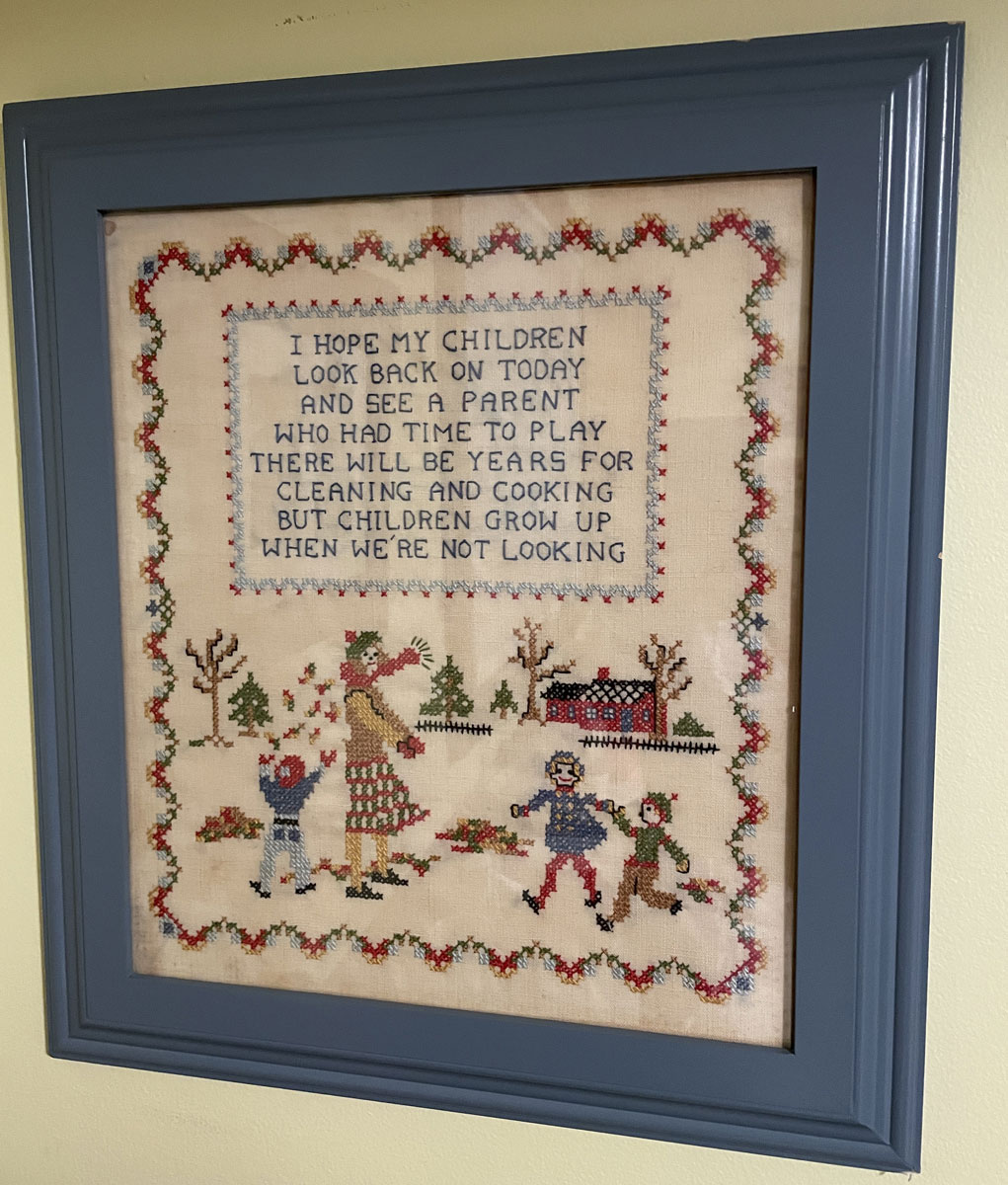
There is an embroidered saying that has hung on the wall in my parents’ house for as long as I can remember, declaring “There will be years for cleaning and cooking / But children grow up when we’re not looking.”

The sentiment made me uneasy as a child and also uneasy as a parent, particularly during the year I turned 38, and the phrase haunted me so thoroughly that the sing-song fear crept into my writing. In a scene where the narrator considers how often she finds herself seeking reprieve from the constant look-heres of parenting, she is racked with guilt over how she can be both aware of the future — when her children will leave — and yet unable to “savor every single moment.”

I am deflecting by referring to her as “the narrator.”

I am also deflecting by not including the entire phrase:

“I hope my children look back on today and see a parent who had time to play.
There will be years for cleaning and cooking, but children grow up when we’re not looking.”

Embroidery posterEmbroidery poster (Photo courtesy of author)

The truth is that even in my self-condemnations, I couldn’t admit the crumple in my soul that the “hope” suggested because I was afraid there was no way my children would ever remember me as a parent who had prioritized play.

This is the terrible dichotomy of parenting: it exhausts while you are in it; you have the energy for it when it is over.

The parent is confessing that they are not always looking. Yet the mother in the embroidery is not deflecting — she is fully present with her children. The mother is not looking at her children but at the embroiderer, at the camera lens. Her scarf is high in the wind, she wears mittens on her hands, the leaves are red and gold and green. Her home is far away; she has left her responsibilities and come out here into the front yard, past the faraway fence, to be with her children. Her lips crook up ever so slightly, unlike the obvious smile on the blue-coated girl — the girl I always knew was me, the oldest child. The mother is allowing her son — my brother, facing away from the embroidered — to throw leaves at her, like the photo my parents took when I was 16, my brother 14, my sister 12. We had driven out West and found snow at high altitude in July; there is a photo of the three of us throwing snowballs at my mom, the photographer.

My parents have hung the embroidered saying in the bedroom they reserve for my daughters — a bedroom that serves no function other than for my children to sleep in when we visit my parents, who live six hours away from us. My parents have outfitted the room with a bunk bed and an additional twin bed, loaded the bookshelves, stuffed the closet with toys my daughters have played with over the years. I am always touched by how much my parents care for my children. There is something my parents know that I do not, which is how it feels when this time has passed. I am trying to inoculate myself against it, steeling my heart because I am terrified of the destruction if I do not. My children will leave me — I have known this since before they were born. I never intended to train them to stay. But the hush I seek now will become the hush I cannot fill when they are no longer coming and going, no longer asking me to play. I will not sweep the broom every day, will not stack their breakfast dishes with a sigh, will not wipe their Nutella smears off the countertop.

This is the terrible dichotomy of parenting: it exhausts while you are in it; you have the energy for it when it is over.

I have loved my daughters at every stage of their growth. I was not one of those baby-moms who missed the baby stage when it left; I looked forward to the next, to the toddle, to the reading, to the school days. I am a rabid fan of my children’s activities, hollering at every single soccer game, in the basketball stands clapping so hard I get bruises on my palms. Framed on the wall beside my desk, the card one of my daughters drew for me, commemorating their performance of “Sisters” from "White Christmas" for my 40th birthday gift.

Yet: I missed my middle daughter’s starring role in her middle school play because I was at a conference.

The fear of what happens when we’re not looking. How even as a child that phrase filled me with a melancholy, knowing I would grow away from being a child, would assume the position of my mother, would no longer be my parents’ child. The tremendous ache of aging, the inevitability toward the change my parents always applauded — I grew another two inches since last year! — but also toward the truth that growing meant I would have to leave them one day. I would leave my parents, as we both always expected, and they might miss the moment when I did. They might miss me. The horror that my parents might NOT miss me.

A hard part of that embroidered saying is the use of  “we’re,” because it means the embroiderer is aware that loss is a generational knowledge; the saying commemorates a generational desire to be different than we actually are, acknowledges the necessity of making the art to remind ourselves of who we cannot be. Who we know we are supposed to be.

I think about my parents often when I examine my conscience and ask myself if I am being the mother I can be.

There WILL be years for cleaning and cooking, but when you are raising children, you do not always have time to play. Cleaning and cooking is part of being a parent, part of caretaking, part of how I — as someone with Acts of Service as one of my top Love Languages — show love. My second Love Language is Quality Time. I am trying to do both.

But the hardest part of the saying is the hope because it means the embroiderer is aware that it is a pipe dream and wants to shape her children’s memories otherwise. I think about my parents often when I examine my conscience and ask myself if I am being the mother I can be. In my memories, I frequently consign my father to the garage because I remember him there so often, but I pair every trip to the garage with my father on the carpet beside me and my siblings, explaining the rules of wrestling and then gleefully declaring THERE ARE NO RULES! before we squeal and scramble to topple him together. I remember my father standing in the cul-de-sac hitting Domes with his tennis racket for me to catch in my softball mitt.

I remember my mother at all my events — the recorder concerts, the middle school basketball games I largely spent on the bench, the Spell Bowl Championships — and I remember my mother driving me to the mall, the movies, the friends’ houses. I remember my mother taking me to the library and the store for the posterboards I forgot I needed the night before the projects were due.

I remember my mother cleaning and cooking, but I struggle to remember her playing with me. I was so young before my playmates (my siblings) were born and my mother did not need to play with me so much anymore. It is something I struggle with now as my own children age and I list for them the litany of activities to which I once took them — the endless library storytimes that only lasted 20 minutes, the interminable afternoons at the children’s museum, the Mudpies at Fontenelle Forest as my children toddled from finger-painting to craft to snack to book and I dutifully followed them around the room, bored out of my mind — and they recall none of it. All those years I invested in making my children feel loved and none of the memories have stayed with them.

I suppose that is why the embroidery exists. I suppose that is where the hope comes from. I love my mother tremendously and when I think of all the meals she made for us—and cleaned up after! and did our laundry and vacuumed the carpets and made sure our lunches were made!—I know my mother’s Love Language must be Acts of Service as well. Perhaps it becomes a mother’s love language.

I think of Jill Talbot in her memoir "The Way We Weren’t," asked what she would like to do differently when she leaves rehab and telling her counselor, “I want to play in the leaves with Indie.”

I think of Ramona’s mother in her titular book (Beverly Cleary’s "Ramona and Her Mother") confessing to her daughters that she was tired of “being sensible all the time,” telling Ramona and Beezus she wanted to “sit on a cushion in the sunshine…and blow the fluff off dandelions.” Beezus replies, “But you always said we shouldn’t blow on dandelions because we would scatter seeds” and her mother sighs, says, “I know, very sensible of me,” gets up and goes to her chores.

All those years I invested in making my children feel loved and none of the memories have stayed with them.

When I Google the embroidered phrase on my parents’ wall, I can only find misquotes, all changing the “parent” to “mother,” which I suppose I should have expected. One website considers my embroidery to be a bastardization of the poem “Song for a Fifth Child” by Ruth Hulburt Hamilton, published in 1958, the year my mother was born. Ruth’s poem directly addresses mothers, not parents, and refers to the messiness of the house because the mother is upstairs with her youngest (and last) child, rocking her baby because she knows this phase will pass quickly.

When I was a young mother — and I was a young mother, my first daughter born when I was 25 years old — I knew I intended to have more. I was happy with each stage of my daughters’ growth because it made things easier; watching my daughters develop their independent skills was a stage I actively and loudly celebrated. Even my youngest, because by the time she was born, I was exhausted. The morning she emerged I was euphoric: the whole family I had desired to create was now present, there was no one left to hope for.

My daughters are curious about my writing; of course they are. Like the embroidery on the wall in my parents’ house, the sight of me at my desk, typing and staring at a screen, has been a fixture in my daughters’ childhood home. I haven’t wanted them to read about these years of my life until they have lived them for themselves. I don’t want my experience to color theirs; don’t want them referencing my missteps or judging me until they emerge on the other side and become parents themselves, a future which no one may desire and which also may not be assured.

I finally called my mother to ask her about the embroidery and she told me she had sewed it herself. My mother embroidered the cross-stitch sometime when she was pregnant with my younger sister. I asked my mother what it meant to her, the phrase, and she told me she embraced the philosophy and spent time with her children rather than keeping a clean house. Yet I remember a clean house AND a present mother, though not one who played with her children. This is the wisdom I can only hope is a generational inheritance I will someday accept: a mother does not need her children to remember their shared history the same way she does. She trusts her memories. Embroidering the truth is framing her love around her intention, which was always looking.

“Are you happy now?”: Alabama mayor dies by suicide after being outed as transgender

F.L. “Bubba” Copeland — mayor of Smiths Station, Alabama and pastor of First Baptist Church in Phenix City — was found dead on Friday evening from a self-inflicted gunshot wound after being involuntarily outed as a transgender woman by a local conservative news blog.

According to The Advocate, using information sourced from WRBL, "deputies responded to a request for a welfare check on Copeland, spotting them driving their truck on a county road near their grocery store. Upon attempting to pull Copeland over, they stopped, exited their truck, and fatally shot themself."

Copeland had been struggling after Alabama blog 1819 News reported on Wednesday that they "had been engaging in explicit online activities, allegedly posting pornography, memes, and photos of themself in women’s clothing online under the pseudonym 'Brittini Blaire Summerlin,' per The Advocate's coverage, adding that the blog "shared screenshots from Copeland’s now-deleted Instagram and Reddit accounts where they openly explored their transgender identity," reportedly discussing hormone replacement therapy in some of their posts, and sharing transgender-specific fiction and erotica that they authored.

One of Copeland’s friends, former Phenix City School Superintendent Larry DiChiara, commented on the tragedy via a statement to Facebook, writing, “Are you happy now? What crime did [they] commit? Some of you people make me sick. I hope you are really proud.”


The year’s worst Halloween couple costume, Johnny Depp and Amber Heard, indicates a disturbing trend

People dress in inappropriate Halloween costumes all the time, whether it's the egregious cultural appropriation or the over-sexualization of nuns or minors, yuck. But this year, we have reached new heights of weird — dressing as the polarizing former couple Johnny Depp and Amber Heard.

"Schitt's Creek" actress Emily Hampshire dressed as Depp and one of her friends as Heard, posting the now-deleted photos to Instagram. In the photo, the actress was seen sporting fake tattoos and a suit that was supposed to resemble an outfit Depp wore during the highly publicized 2022 libel trial against Heard. Her friend emulated Heard's most emotional and mocked reactions during the trial. The couples costume was met with incredible levels of backlash which led to Hampshire deleting the photos and posting an apology on Instagram.

“I want to address what is one of the most thoughtless, insensitive and ignorant things I’ve ever done," she wrote. "For Halloween, I stupidly thought it would be funny to dress as Johnny Depp and Amber Heard. I am deeply sorry and ashamed for putting something that awful out in the universe. Domestic abuse is never, ever funny. These are real issues with real people and I REALLY regret my actions. In the future I will do better. I’m so sorry.”

Sadly, this isn't the only time people have dressed as couples with troubled relationships for Halloween. Last year, when Hulu's "Pam and Tommy" was released, countless people dressed as the infamously abusive couple Pamela Anderson and Tommy Lee for Halloween. Let's remember that Lee was arrested for spousal battery and served six months in jail after he pleaded no contest to assaulting Anderson who said Lee kicked her while she was holding their infant. People also dress as Ike and Tina Turner — a marriage that Turner described was filled with vicious beatings, broken bones, and sexual assault. All of this is widely known after the 1993 biopic "What's Love Got to Do With It" earned multiple awards and nominations, in particular for the performances by Lawrence Fishburne and Angela Bassett portraying that embattled relationship. I also recently saw online singer Halle Bailey and her rapper boyfriend DDG dress as Whitney Houston and Bobby Brown, another relationship that was rife with abuse. Brown was reportedly charged with misdemeanor battery related to domestic violence in 2003.

Needless to say, people can't read the damn room when it comes to dressing an abusive couple. It's almost like the abusive aspects of the relationship become a spectacle and gimmick — exactly the way the Depp and Heard trial snowballed into a vicious media circus. It just shows a pattern that the public's continued fascination with the controversy surrounding domestic abuse and abusive relationships is a problematic and borderline abusive relationship within itself. 

The defamation trial that captivated the nation last year became daily episodic entertainment for people. Some found entertaining to watch Heard recall some of the most gruesome and violent violations of her body and Depp pathetically pander to his fans as he played into the tired Jack Sparrow bit, crusading for justice. 

And along the way, people bought into the narrative being crafted by courtroom broadcasting. The more people engaged with the trial, the more money execs were benefitting from trauma. Salon contributing writer Elisa Gubitosi wrote, "As an employee of one such station, I can attest to the fact that these networks have just as much to gain from this trial as Heard has to lose." And as everyone cashed in on the popularity and sensational aspects of the trial, people were able to forget the context of Depp and Heard's deeply abusive relationship. To us, it was like the couple was playing a fictional version of themselves in a courtroom drama about their salacious relationship.

We need your help to stay independent

Moreover, people's obsession with the trial bled into other facets of our lives, infiltrating the cesspool of TikTok where misinformation ran rampant and people analyzed, vilified, belittled and mocked Heard's testimonies day in and out while also painting Depp as the wrongfully convicted real victim. But the trial also found its way into mainstream spaces like "Saturday Night Live," in which the cast ridiculed the defamation case hinging on domestic abuse. Kate McKinnon playing MSNBC anchor Nicolle Wallace calls the trial "cuckoo." Cecily Strong portraying an eager judge on the case, is more of a Depp fangirl viewing the trial as a fun diversion and opportunity to fawn over the actor. 

No matter if we have reconceptualized the dynamics and roles of a victim of abuse and the person who perpetuated that abuse — we still have a major blind spot, and that blind spot has grave repercussions. The Depp and Heard trial was one of the general public's weakest showings of empathy and the understanding of what it looks like to be a survivor of abuse and to openly fight back against that abuser. We took Heard's palpable, pulsating pain and put it on display as something to scoff at — something to taunt and demean. 

It's easy to see why celebrities like Hamsphire thought it was socially acceptable to dress up and poke fun at the trial and Heard and Depp because, for all of last year, it was. It was even widely unpopular to say that Heard was a victim of abuse that Depp inflicted on her. All of this is to say that we as a whole have to recognize that turning survivors of abuse into a costume and a caricature for a night of drinking and debauchery isn't the way we uplift and support those who have been affected by abuse — it's the way we alienate and invalidate them and their experiences.


Right-wing fake history is making a big comeback — but it never went away

Who controls the past controls the future; who controls the present controls the past
— George Orwell, "1984"

The historian is a prophet looking backwards.
— Friedrich von Schlegel, "Philosophical Fragments"

The phonetic resemblance of the word “history” to “story,” which can be anything from a factual narrative to a fairy tale, should warn us about the pretended objectivity of any interpretation of past events. The ambiguous nature of the discipline is even more obvious in foreign languages: In German, “history” and “story” are the same word, Geschichte. The French word histoire also does double duty; “Quelle histoire!” means “what a story!” but inevitably conveys a subtext of doubtful credibility.

It is hardly surprising that ideologues are tempted to hijack history to vindicate their worldview; the interpretive nature of the field makes it vulnerable to misappropriation in a way that math or physics, generally speaking, are not. As we have seen in Florida, Texas and other laboratories of autocracy, once Republicans obtain unified control of government, they are compulsively driven to monkey with the history curricula of the public schools.

This flare-up of officially sanctioned historical fiction (“slavery taught useful skills”) is just the most recent example of the long struggle over who gets to tell us who we are. The desire to seize history and manipulate it to flatter present-day conservatives and help them feel they are the culmination of an historical inevitability, while their opponents are doomed to defeat, is what motivates the historical polemics on the far right.

A glance through the catalog of Regnery or almost any other conservative or evangelical publishing house will reveal works of “history” covering just about every aspect of America, but they tend to concentrate on three eras. These eras were the key inflection points in the development of the United States.

The first of those is America at its inception. What is America supposed to be? Who gets to rule? What is the cultural foundation of the country? Who were the so-called founding fathers, and what were their intentions?

The second theme is America at its bloodiest moment of crisis, the Civil War. What was the war about, and what was the role of slavery, the most peculiar institution in all American history? Who were the heroes, and who were the villains? 

Finally comes the great crisis of the 20th century, the Great Depression and World War II. Was it good or bad that the federal government assumed greater responsibility for the well-being of its citizens? Which economic theory would have worked best to end the Depression? Was a world war against fascism necessary to defend freedom, or a dangerous entanglement America should have avoided? 

The pious Founding Fathers fraud

The near-deification of the founders has been a feature of popular histories for over 200 years; one need only think of Parson Weems’ legends about the flawlessly virtuous George Washington. This view was subscribed to across the political spectrum until relatively recently, when more critical scholarship spotlighted, among other things, Thomas Jefferson’s monumental hypocrisy in proclaiming the rights of man while owning slaves and never even manumitting them. That facts such as these weren’t obvious from the beginning only shows the power of myth in subduing skeptical thinking.

Overwhelmingly, conservatives still reject a balanced, critical view of the founders or the debates leading to the establishment of the Constitution, in favor of full-on adulation. The only exception is the lunatic fringe, such as the Ludwig von Mises Institute in Alabama, which believes the Constitution was a capitulation to central planning and the extinction of state sovereignty by the federal Moloch. But then, the anarcho-capitalists at the institute also believe in the right to drive drunk (no, really!).

The vast majority of conservatives, with their alleged constitutional originalism, claim to venerate the founders. But there's a problem: The signers of the Declaration of Independence and framers of the Constitution were, if not exactly creatures of the Enlightenment like Voltaire or Hume, then heavily influenced by its political and social theories. While the great majority were formal members of some Protestant denomination or other, many were, at most, Deist by inner conviction. Tom Paine opposed organized religion altogether.

Given that the modern-day American conservative movement is largely a political campaign against the Enlightenment and its fruits, the founders’ beliefs present a problem. Conservatives solve it by systematic distortion of the historical record, even as they hand-wave away the establishment clause of the First Amendment.

The best-known and most influential of contemporary pseudo-historians to take this approach is David Barton, whose history qualifications consist of a BA in religious education from Oral Roberts University. Among his more risible claims is that 29 of the 56 signers of the Declaration of Independence were lay ministers. This is technically known as a lie; only one was. Likewise his claim that the Constitution was derived verbatim from Scripture. Given Barton’s appeals to religious prejudice and his attacks on minorities, the Southern Poverty Law Center has profiled him as a bigot.

A favorite conservative technique is to place some delicious quote, concocted in the present, in the mouth of a founder, preferably Thomas Jefferson.

Nevertheless, Barton remains an influence, with Republican operatives like Mike Huckabee and Newt Gingrich endorsing him. His 2012 book "The Jefferson Lies" was a New York Times bestseller — until fact-checking by authentic Jefferson scholars found so many outright falsehoods that the publisher finally withdrew the book. But no doubt thousands of children afflicted by home schooling or attendance at Christian academies are being indoctrinated with Barton’s lies to this day.

A favorite conservative technique is to place some delicious quote, concocted in the present, in the mouth of a founder, preferably Jefferson. There are almost too many bogus Jefferson quotes to count; one of them is this: "My reading of history convinces me that most bad government has grown out of too much government." It makes him sound both prophetic and like a gung-ho disciple of Ayn Rand.

The uncivil war on historical truth

If the founding of the American republic was imbedded with ambiguities that conservatives refuse to acknowledge, the country’s greatest internal crisis ought to appeal to their generally binary, Manichaean worldview. What could possibly be a greater evil than slavery, the institution that mocked the claims of a nation conceived in liberty? But in this case, conservative chroniclers become agonizingly nuanced; so nuanced, in fact, that one glimpses definite signs of sympathy for the Confederate cause.

The key to conservative historiography on the Civil War lies in its claims as to causes: The war was supposedly about states’ rights or sectional rivalry or discriminatory protective tariffs or internal improvements or disputes over westward expansion and the transcontinental railroad — about pretty much anything and everything except slavery, in other words. You will notice that his viewpoint is highly consistent with the ex-Confederates’ Lost Cause myth that began to spread soon after the war ended.

That myth consistently downplayed the role of slavery, despite the plain words in the Southern states’ proclamations of secession, as well as the infamous cornerstone speech given by Confederate Vice President Alexander Stephens. (The speech also gives the lie to Lost Causers’ claim that Southerners were simply trying to protect the liberties of the original republic from Yankee encroachment; Stephens used the word “revolution” several times to stress that Confederates were rejecting the old form of government.)

Central to the Lost Cause was the elevation of Robert E. Lee to sainthood. Lee was unquestionably a talented military leader, but he made his share of mistakes, as a glance at the field across which he ordered Pickett’s division on a suicidal charge at Gettysburg will attest. But according to Southern legend his leadership was faultless, and any disasters were the fault of subordinate commanders.

Conservative historiography on the Civil War is focused on causes: The war was about states' rights or sectional rivalry or tariffs or westward expansion — but never about what it was actually about, which was slavery.

The principal architect of Lee’s reputation was Douglas Southall Freeman. A native of Richmond, he received a Pulitzer Prize for his multi-volume biography of Lee in 1935. Freeman was very influential, teaching at the Army War College for seven years. Respectful study of Lee’s campaigns has been a feature of U.S. Army curricula right up to the present. Only recently has he become subject to critical evaluation, with Civil War scholar Eric Foner calling Freeman’s works on Lee “hagiography.”

Freeman's work, along with many other encomiums, resulted in a cult of Lee and a cult of the Lost Cause that curses us to this day. Its strength can be measured by the fact that it took 160 years to topple statues of Lee and other Confederates from numerous Southern cities, and the Army is only now in the process of rechristening bases named for Rebel generals. (Whatever one thinks of Lee, he was at least a capable commander; but there's no defense for sub-mediocrities like George Pickett or Braxton Bragg, not to mention disastrous incompetents like John Bell Hood — yet all were memorialized in military base names. Consistent with his sociopathic nature, Florida Gov. Ron DeSantis wants to restore Bragg’s name to the base in North Carolina.

Not until 2021 was a bust of Nathan Bedford Forrest removed from the state capitol in Tennessee. Forrest was a monster even by Confederate standards: a slave trader, a war criminal (the Fort Pillow massacre, in which 600 Union soldiers were slaughtered, about half of them Black) and an early leader of the Ku Klux Klan. To gain some perspective, imagine the reaction if the postwar Federal Republic of Germany had erected a statue to Heinrich Himmler. It is a tribute to the crass pettiness of Tennessee’s political hacks that a statue of Admiral David Farragut was removed along with Forrest’s likeness. Farragut was a Tennessean who remained loyal to the Union and became a genuine hero; the zanies of the Tennessee legislature thought that if their beloved war criminal had to go, dumping Farragut was an acceptable "compromise."

America has always been a self-absorbed, parochial country. Evidently we must conduct debates with millions of our fellow citizens about why the nation should not memorialize treasonous insurrectionists and slaveholders, and about why they should not view slavery and treason as a precious “heritage” that must not be criticized for fear of hurting their feelings. It's among the worst possible examples of American Exceptionalism, one stoked at every turn by bogus histories.

Franklin D. Roosevelt: the archfiend in peace and war

The economic crash of 1929 descended on America like an ice age, ending a meretricious prosperity. In the four years of Herbert Hoover’s presidency, U.S. gross domestic product plunged by an astonishing 41 percent. Commerce was so completely frozen that by the eve of Franklin D. Roosevelt’s inauguration in 1933, according to William Manchester, money had very nearly ceased to circulate in parts of the country.

Roosevelt’s New Deal policies, as he cheerfully conceded, largely consisted of guesswork and experimentation. They also mostly worked: GDP increased in every year of his presidency but one, and that only happened because he gave in to fiscal conservatives and tried to balance the budget. Unemployment also fell significantly, and throughout his presidency was substantially better than under Hoover.


Want a daily wrap-up of all the news and commentary Salon has to offer? Subscribe to our morning newsletter, Crash Course.


Trickle-down economics and fiscal austerity was precisely what had created and deepened the Great Depression (although those terms were not yet in use), and unwisely heeding conservatives’ advice resulted in the “Roosevelt Recession” of 1937-38. Yet despite their dismal record, conservatives have made a cottage industry ever since of claiming that the New Deal prolonged the Great Depression. Not only that, they have persistently characterized the Roosevelt years as un-American and akin to the fascist movements of the 1930s. As I have written elsewhere, when you consider the fascist sympathies of Charles Lindbergh, Father Coughlin and other FDR opponents, this looks like another example of the extreme right's propensity for psychological projection.

Indeed, the political reaction against Roosevelt’s presidency probably created American conservatism as we know it today. "The Conservative Manifesto," a 1937 document wrapped in the same high-minded language of fiscal probity and individual initiative that would be recognizable today, was the movement’s blueprint. Its lofty slogans about rugged individualism were code for “let ‘em starve” and the reference to states’ rights was decipherable as “no equal rights.”

Political reaction against FDR's presidency and the New Deal probably created American conservatism as we know it today, beginning with "The Conservative Manifesto" of 1937.

It seemed that everybody hated Roosevelt but the voters, and his blowout re-election victory in 1936 caused immense exasperation to his enemies. How could this charlatan possibly get away with it? From ex-President Hoover himself, who crisscrossed the country giving anti-New Deal speeches, down to present-day tirades in the op-ed pages of the Wall Street Journal, FDR hatred is a wellspring that nourishes the roots of reactionary conservatism. 

One of the more recent and ballyhooed polemics against Roosevelt was "The Forgotten Man: A New History of the Great Depression," a 2007 bestseller by Amity Shlaes. The author’s political views may be inferred from her hagiography of Calvin Coolidge, her work at the George W. Bush Presidential Center, and her co-authorship of a diatribe about America’s slide into socialism with none other than Peter Navarro, would-be overthrower of the Constitution and former Trump White House adviser. Ironically, Shlaes’ indictment of the New Deal was published just before the financial crash of 2008, during the last gasp of a Republican-engineered financial bubble similar in destructiveness to the one presided over by Coolidge. 

As with David Barton, whenever Shlaes confronts inconvenient facts, she manipulates them to suit her narrative. She contends that FDR’s record with unemployment was miserable, but only because she omits government-provided jobs from the employment rolls, on the pretext that those were temporary jobs, with no long-term prospects. Workers, we might insist, do not eat in the long term. And never mind that those hired by the Works Progress Administration or the Civilian Conservation Corps learned skills in a wide range of trades that would later serve many of them well in the private sector. Go to any national park or look at any of thousands of post offices and libraries across America, and you will see their handiwork.

What good is an economic history that doesn’t discuss the economy as measured by gross domestic product? It’s a crude measure of well-being, but it's surely better than subjective and agenda-driven accounts. Yet "The Forgotten Man" contains none of this, despite the fact that "Historical Statistics of the United States" is available free online. Instead, Shlaes gives impressionistic sketches of “self-starters” who made good during the New Deal, and offers those as evidence that FDR’s programs were unnecessary. That also suggests that if people found success in private enterprise, then the New Deal was hardly a Stalinist command economy. As Jonathan Chait wrote when reviewing her book, “intellectual coherence is not the purpose of Shlaes’s project. The real point is to recreate the political mythology of the period.”

Reputable scholars tell us that while some of Roosevelt’s programs, like the National Recovery Administration, were clearly failures, he stabilized the economy enough to prevent a potential fascist takeover of government. Likewise, industry was sufficiently revived to make possible the Arsenal of Democracy that buried Nazi Germany. Without New Deal programs like the Tennessee Valley Authority or the Grand Coulee Dam, the U.S. might have lacked the surplus electricity to smelt the aluminum required for the 300,000 military aircraft it produced in the war, or to generate power for the enormous gaseous diffusion plants necessary for building the atomic bomb.

But no matter — conservative historiography was as quick to condemn Roosevelt’s war leadership as it was to pounce on his domestic record. In the right’s telling, FDR was either an icy manipulator, exerting a Svengali-like control over events to drive a reluctant America into war, or a naïve bungler who guilelessly handed over half of Europe to Joseph Stalin — if, that is, he wasn’t secretly in cahoots with the Soviet dictator. Sometimes he apparently managed the difficult feat of being all these things at once.

World War II revisionist Charles Tansill claimed that FDR, understanding the political strength of the isolationist movement, sought to “enter the war by the back door,” duping the Japanese into firing the first shot.

One of the earlier efforts that established the template for World War II revisionism is "Back Door to War," by Charles Tansill, published in 1952. Tansill had earlier been a historian of the U.S. Senate, and by the 1930s had become a staunch isolationist. His account of World War II claims that Roosevelt jawboned British Prime Minister Neville Chamberlain into reversing his policy of appeasement by guaranteeing Poland’s sovereignty, a move that provoked an otherwise peace-minded Adolf Hitler into war. In reality, there is no evidence that Roosevelt forced any such decision; Hitler’s violation of the Munich Agreement by invading and occupying all of Czechoslovakia alarmed and outraged both the British public and establishment, leaving Chamberlain little choice but to forge alliances meant to contain German expansion.

Roosevelt then proceeded to supply Britain with armaments, and in Tansill’s narrative this was just a prelude to FDR driving the U.S. directly into the war. But since Roosevelt understood the political strength of the isolationist movement, Tansill claims, he sought to “enter the war by the back door”: By duping the Japanese into firing the first shot, he would get his pretext for war.

Another pop historian who replicated Tansill’s thesis was Harry Elmer Barnes, a pro-German apologist and rabid isolationist. During the war and for more than 20 years thereafter, Barnes amplified and embellished the ”back door to war” theory, making it even more extreme: Germany was blameless, while Roosevelt and Churchill were the villains entirely responsible for the war. And worse yet, either through stupidity or ideological allegiance, FDR then handed half of Europe to Stalin on a plate.

Barnes represents the interpretive bridge between wartime isolationists and the red-baiting McCarthyism of the postwar Republican Party; all the elements of conspiracism, scapegoating and a narrative comprising an implausible chain of events are evident. This kind of stuff lingers on into the present day: “the U.S. deliberately provoked Vladimir Putin into attacking Ukraine,” or “Biden’s deal with Iran to release U.S. citizens provided the financing for the Hamas attack on Israel” are contemporary examples of the paranoid style Barnes perfected.

Even more fatefully, Barnes forever conjoined World War II revisionism with right-wing extremism and Holocaust denial. Possibly his most important spiritual heir is the notorious Englishman David Irving, a veritable publishing machine who has cranked out countless paeans to the Third Reich with a side helping of Holocaust denial. His career received a considerable financial setback, however, when he had the poor judgment to sue a genuine scholar for defamation.

Even Pat Buchanan, author of the infamous “culture wars” speech at the 1992 Republican convention (prompting Molly Ivins to quip that it “probably sounded better in the original German”), has gotten into the act. In 2008, he published "Churchill, Hitler and the Unnecessary War," a polemic that literally argued the world would have been much better if the democracies had simply stood aside and allowed Hitler to conquer Europe. It is no more than one might have expected from Buchanan, who arranged Ronald Reagan’s scandal-plagued trip to the cemetery at Bitburg, Germany, where Waffen-SS members were interred.

Why does it matter?

Poring over these examples of systematic distortion and noting their persistence over the decades (in 2012, Tansill’s book was reprinted) has driven me to conclude that there is a vast market for bad history, just as one supposes Thomas Kinkade will always be more popular than Vermeer. Look at Amazon reviews of a book on some historical topic; if several of them announce, “The truth at last! This is a book that really opened my eyes!” you have likely stumbled on a work of right-wing hack history. But this isn't just a matter of degraded popular taste. Social and economic factors combine to give reactionary pseudo-history an advantage that may grow even larger in the future.

History, like other humanities, is getting short shrift in both secondary and higher education curricula compared to scientific subjects. History departments are being downsized, and career prospects for history PhDs are bleak

That is much less true, however, when it comes to the types of pseudo-history I have outlined. The American conservative metaverse contains its own diffuse history department as a component of its larger bad ideas-industrial complex: the countless billionaire-funded think tanks, institutes and foundations that keep “scholars” on payroll or make grants to people like Amity Shlaes. If you don’t want to pay for a reprint of "Back Door to War," the Mises Institute has thoughtfully provided a PDF online. Online ads denouncing “woke” history by Hillsdale College, a propaganda ministry disguised as an academic institution, are practically unavoidable, and their bogus history lectures blanket YouTube. While legitimate academic history declines in funding and influence, the right-wing alternative prospers.

But more than wingnut welfare is responsible. This may sound unlikely given the anti-intellectualism that pervades conservatism, but the right cares passionately about ideas. They may be bad ideas or even dangerous ones, but the flood of conservative manifestos, Republican campaign biographies and Bill O’Reilly-style histories that continue to roll off the presses demonstrates a purposefulness in the marketplace of ideas that liberalism lacks.

The paradox is this: Their ideas are not supported by facts, evidence or empirically derived data. As Kellyanne Conway put it, they are “alternative facts.” Saying that the Civil War wasn’t about slavery, the death camps never existed and Donald Trump was duly elected in 2020 are all symptoms of epistemological nihilism: If literally nothing can be proved, let’s repeat our version over and over while coercing schoolchildren to memorize it at taxpayer expense.

The current political struggle, whether at the ballot box or in the pages of real or imagined history, is not just a struggle for the country. It is a struggle over the nature of reality itself.

“We’re all feeling this atmosphere of fear and danger”: War fuels rising attacks on Jews and Muslims

Arab, Jewish and Muslim communities have witnessed a rise in threats and violence amid the ongoing violence in Gaza and Israel.

The FBI and DHS warned last week that “the volume and frequency of threats to Americans, especially those in the Jewish, Arab American, and Muslim communities in the United States, have increased, raising our concern that violent extremists and lone offenders motivated by or reacting to ongoing events could target these communities.”

The Council on American-Islamic Relations has also observed a surge in complaints, including reported bias incidents, with 774 incidents received between October 7 and October 24. This is a threefold increase compared to the same period last year, when the organization received about 224 complaints in a span of 16 days, Corey Saylor, Research and Advocacy Director at CAIR, told Salon.

“I am of the belief that it is the worst wave that we've seen since December 2015, and that was when Donald Trump announced his plan to ban Muslims from the United States,” Saylor said. 

He noted that there’s been a “very significant wave of backlash” and violence erupting due to what’s happening in Gaza and Israel, pointing to incidents of a vehicle driving through a crowd rallying in support of Palestinians and people brandishing weapons at protesters.

One of the reported acts is also being investigated by the Justice Department as a hate crime. A landlord in Illinois stabbed his tenants, Hanan Shaheen and her 6-year-old Wadea Al-Fayoume, killing him and inflicting over two dozen stab wounds on his mother due to them being Muslim, according to police

Saylor highlighted that students on campuses have also faced harassment for speaking out on behalf of Palestine. He pointed to the incident of a billboard truck driving through Harvard’s campus last month and displaying the names and faces of students, who released a statement that held “the Israeli regime entirely responsible for all unfolding violence.”

Individuals are also experiencing doxxing, where their personal information is being exposed in mass documents and Google Sheets. Some companies have requested the names of students and stated they would not consider hiring individuals, Saylor explained. 

“Now, what we're seeing is pretty much everyone who speaks up is essentially red meat on the barbecue,” he added.

But what’s further contributing to the ongoing “dehumanization” narrative against Arabs and Muslims in the U.S. are the statements being made by Israeli officials and the Biden administration, Saylor said. 

President Biden specifically “repeating propaganda” and making comments saying that he had "no confidence in the number that the Palestinians are using,” have further fueled more tension, he added.

Implying that you cannot trust Arabs is part of an anti-Arab trope that's been “built into our society for years,” Saylor said. Perpetuating these narratives will only drive more hostility toward Arab and Muslim communities.

Independent nonprofit organizations have consistently said that the death toll estimates produced by the Hamas-run Gaza Health Ministry have been broadly accurate despite the administration's complaints.

Framing this ongoing violence in Gaza as an “Israel-Hamas war” is also a part of the problem, Amer Zahr, professor at the University of Detroit Mercy School of Law and the president of the Dearborn-based New Generation for Palestine, told Salon.

“When you put a hyphen between two things, it almost makes it sound like they're somehow equal,” Zahr said. “This is an Israeli war on Palestinians and Israeli attacks on Palestinians. Obviously, in our point of view, it's a genocide… When we go out on the streets and call for an end to the war, or call for an end of bombing on Gaza, or say that the real problem is the occupation, every Palestinian is branded as loving Hamas.”

As an activist, Zahr said he’s used to receiving backlash and harassment for his advocacy efforts. But in recent weeks, these attacks have “accelerated,” leaving community members with a heightened sense of unease.

“I've been in America since I was three, and the only two times in my life that my mom has called me and told me to be careful was the day after 9/11 and the day after that six-year-old boy was stabbed 26 times in Chicago,” Zahr said. “So, we're all feeling this atmosphere of fear and danger.”

We need your help to stay independent

The White House announced Wednesday that the administration will work on developing a National Strategy to Counter Islamophobia in the United States, partnering with local communities to come up with the strategy.

“The most helpful thing for them to do would be to get a ceasefire because that is really in many ways what I was driving a lot of the incidents that we're seeing,” Saylor said. 

Similar incidents of harassment and violence are also impacting the Jewish community, which has seen a nearly 400 percent increase in antisemitic incidents across the United States, including assaults, harassment and vandalism, according to the Anti-Defamation League. 

During the weekend, a series of online threats targeted a Jewish student center at Cornell University. The online messages included threats to shoot Jewish students and encouraged others to harm Jews, according to the school’s student newspaper, The Cornell Daily Sun.

Earlier this week, the Justice Department disclosed that it had pressed charges against a Las Vegas resident for leaving threatening voicemails to kill a U.S. senator in relation to the conflict in Gaza. The threats were directed at Senator Jacky Rosen, D-Nevada, who is Jewish and a strong advocate of Israel, her office said. 


Want a daily wrap-up of all the news and commentary Salon has to offer? Subscribe to our morning newsletter, Crash Course.


The ADL has recorded a total of 312 antisemitic incidents between Oct. 7 and 23, and 190 of those were directly linked to the ongoing violence in Gaza and Israel with college campuses facing a “brunt of severe antisemitic incidents,” a spokesperson for ADL said. 

The ADL recorded 54 antisemitic incidents on campuses since Oct. 7, of which 43 could be directly linked to the situation with Hamas in Israel.

There have been a total of 110 anti-Israel rallies on U.S. campuses since the war started; at least 27 included expressions of support for terrorism, according to the group.

Jewish civil rights organizations in the United Kingdom, France, and various other regions have also observed an upsurge in incidents of antisemitism in recent weeks when compared to 2022. “League officials said London police had received 218 reports of antisemitic crimes between Oct. 1 and Oct. 18, which was 13 times greater than the numbers reported in 2022,” The Associated Press reported.

“When conflict erupts in Israel, antisemitic incidents soon follow in the U.S. and globally,” said Jonathan Greenblatt, ADL CEO. “From white supremacists in California displaying antisemitic banners on highway overpasses to radical anti-Zionists harassing Jewish people because of their real or perceived support for the Jewish state, we are witnessing a disturbing rise in antisemitic activity here while the war rages overseas.”

Fox News has wild theories about why Obama is advising the White House on AI development

On Monday, President Biden signed an executive order establishing some government oversight of AI development, and he's called upon former President Barack Obama to advise the White House on strategy for this. 

According to NBC News, Obama has been "engaging behind the scenes with tech companies and holding Zoom meetings with top West Wing aides at Biden’s request," and he was tapped for this endeavor because he shares the same views as Biden on this particular issue and "brings a certain heft that could help move the process along quickly." But, as Fox News host Laura Ingraham sees it, Obama has his own agenda.

In a recent segment, Ingraham shares the news of his partnership with the White House as though she's telling a horrific sci-fi tale, warning that Obama's dream "has always been to transform America and artificial intelligence may just be the best way to do it.” 

"We always assumed that Obama was still pulling some of the White House levers and we were right," she says. Questioning what's in it for him, she runs a clip of him discussing the possible need for shortened work weeks and universal basic income, which she laughs at in a "gotcha" way, calling it his "dream grab-bag of policies." 

Mark Meadows made false election claims in his book and the publisher wants their money back

Prior to the publication of Mark Meadows' book, “The Chief’s Chief,” which was released in 2021, he entered into an agreement with All Seasons Press in which he assured them that everything he'd written was factual and well-researched. But that turned out to not be the case.

According to a court filing on Friday, the former White House Chief of Staff's publisher is looking to recoup their $350,000 advance, along with $600,000 in out-of-pocket damages, and at least $1 million each for loss of expected profits and just generally making them look bad after it was determined that Meadows made false election claims in his writing, including opening a chapter with, “I KNEW HE DIDN’T LOSE,” in reference to Trump's 2020 campaign.

On the specifics of the broken agreement, the filing states that “Meadows breached those warranties causing ASP to suffer significant monetary and reputational damage when the media widely reported … that he warned President Trump against claiming that election fraud corrupted the electoral votes cast in the 2020 Presidential Election and that neither he nor former President Trump actually believed such claims," per a quote obtained from The Hill

HBO trolled critics online to shut down negative reviews, reflecting a disdain for true criticism

HBO has landed itself in hot water after its CEO, Casey Bloys, admitted to using various aliases on X (formerly known as Twitter) to troll critics who wrote negative reviews of several HBO shows.

“For those of you who know me, you know that I am a programming executive very, very passionate about the shows that we decide to do. And the people who do them and the people who work on them,” Bloys said Thursday morning at a New York promotional event for HBO and Max, according to Variety. “I want the shows to be great. I want people to love them. I want you all to love them. It's very important to me what you all think of the shows.

“So when you think of that mindset, and then think of 2020 and 2021, I’m home, working from home and spending an unhealthy amount of scrolling through Twitter. And I come up with a very, very dumb idea to vent my frustration.”

Bloys continued, saying the six tweets that he wrote within a year and a half time period were “not very effective.” He then apologized “to the people who were mentioned in the leaked texts,” adding that “obviously, nobody wants to be part of a story that they have nothing to do with.”    

“But also, as many of you know, I have progressed over the past couple of years to using DMs. So now, when I take issue with something in a review, or take issue with something I see, I DM many of you, and many of you are gracious enough to engage with me in a back and forth and I think that is probably a much healthier way to go about this. But we’ll talk more about that, and you guys can ask me anything you want in the Q&A. I just wanted to put that out there,” Bloys concluded.

The HBO boss’ admission and apology came just one day after Rolling Stone published a report detailing a wrongful-termination lawsuit against Bloys and HBO from an ex-employee, Sully Temori. In his lawsuit, Temori claimed he faced harassment, retaliation and discrimination after disclosing a mental health diagnosis to his bosses. He also was allegedly “asked to perform menial tasks not related to his work duties, such as creating fake online accounts to respond to critics,” the report detailed.

Rolling Stone published a slew of text exchanges between Bloys and HBO’s senior vice president of drama programming Kathleen McCaffrey, in which the duo allegedly discussed targeting critics who spoke negatively about HBO shows. Rolling Stone said it reviewed the metadata associated with the messages, which were provided by Temori, and verified their authenticity.

In one such exchange, Bloys expressed his annoyance with Vulture TV critic Kathryn VanArendonk’s thoughts on the HBO drama series “Perry Mason.” VanArendonk, who felt the show’s World War I-centric plot was weak storytelling, subtweeted the series, writing, “Dear prestige TV. Please find some way to communicate male trauma besides showing me a flashback to the hero’s memories of trench warfare.” 

“Maybe a Twitter user should tweet that that’s a pretty blithe response to what soldiers legitimately go through on [the] battlefield,” Bloys texted McCaffrey after seeing VanArendonk’s review. “Do you have a secret handle? Couldn’t we say especially given that it’s D-Day to dismiss a soldier’s experience like that seems pretty disrespectful . . . this must be answered!”

“We just need a random to make the point and make her feel bad,” he added.

Bloys’ so-called “random” was Kelly Shepard, a made-up person who described herself as a vegan Texan mom on her Twitter profile. At Bloy’s request, Temori sent snarky tweets from Shepard’s account in response to critics who dare criticized an HBO production.

In response to VanArendonk, Kelly Shepard wrote, “A somewhat elitist take. Is there anything more traumatic for men (and now women) than fighting in a war. Sorry if that seems too convenient for you.”

Bloys’ largest attack came after several critics gave unfavorable reviews of Joss Whedon’s steampunk-fantasy series “The Nevers.” Bloys initially targeted Rolling Stone chief TV critic Alan Sepinwall for his 2.5-star review of the show.


Want a daily wrap-up of all the news and commentary Salon has to offer? Subscribe to our morning newsletter, Crash Course.


In response to Sepinwall, the Kelly Shepherd account wrote, “Alan is always predictably safe and scared in his opinions.” The account also launched a similar assault on New York Times chief TV critic James Poniewozik and Times TV critic Mike Hale:

“How shocking that two middle aged white men (you & Hale) are sh**ting on a show about women . . .” Shepard said.

Salon's Senior Critic Melanie McFarland wasn't targeted by the fake tweeter, but was similarly unenthused by "The Nevers," writing in her review that the characters "deserve better, as does this cast and the broader TV audience."

It's curious that Bloys chose "The Nevers" hill to die on since the show was not received well and earned a disappointing 49% score on Rotten Tomatoes. The first season of 12 episodes was split into two parts, but the show was canceled before the second set of episodes ever aired.

Meanwhile, the popular Sepinwall found himself at the center of another one of Bloys’ attacks after he gave “Mare of Easttown” a  3-star review. The crime drama, which stars Kate Winslet and Evan Peters, earned an astounding Rotten Tomatoes score of 95%.

“Alan missed on 'Succession' and totally misses here because he is busy virtue signaling,” Bloys’ troll account wrote in a response.

Bloys also came after an anonymous user, who criticized his leadership in a Deadline article about the sudden cancellation of the comedy series “Run.” The rom-com thriller earned mostly favorable reviews on Rotten Tomatoes, with an overall score of 81%. He also attacked another anonymous user who left “mean comments” about Bridget Everett’s new comedy-drama “Somebody Somewhere.”

True criticism hasn't been particularly valued these days, to the point that some studios are trying to game the system. Lately, many audience members have been bashing film and TV critics, especially in the wake of Vulture's Rotten Tomatoes exposé, which found that publicists and PR companies were bribing less principled, self-published critics to write positive reviews to boost overall scores on the website. The report encouraged many to question the integrity of online criticism and whether authentic criticism, as a whole, has officially lost its value.

Stop speculating and judging whether or not a woman is pregnant

One-half of the Grammy-nominated duo, Chloe x Halle, and this year's Black Disney princess, Halle Bailey, has faced an onslaught of internet hatred for years for her racebent portrayal of Ariel in the live-action version of "The Little Mermaid." But this time the hate isn't fueled by racists irate over Ariel being Black. The biggest gripe the internet has with her is not knowing whether she's pregnant or not. 

If she is pregnant, the criticism is that she will lose out on her prime years in the industry. 

The guessing game surrounding Bailey's potential pregnancy has been ongoing tabloid fodder on Page Six, TMZ and the Shade Room in the last couple of months – all wondering whether the 23-year-old actress and singer is hiding a pregnancy and seemingly ready to label her as a has-been if she is pregnant. Bailey is yet to confirm or deny the rumors but the internet continues to speculate about her body in every comment across all her social media accounts. It is a relentless barrage of theorizing on the young star's body and personal choices.

This isn't the first time a woman in the public eye has been hounded over a rumored pregnancy — in fact, it's a disturbing pattern that seems to be prevalent for almost every female celebrity. Stars like Kylie Jenner, Vanessa Hudgens, Hailey Bieber, Jennifer Aniston and so many others have had to deny constant rumors about their bodies whether they were pregnant or not.

Aniston even wrote an op-ed for Huffington Post in which she dispelled pregnancy rumors with her ex-husband Justin Theroux. “The sheer amount of resources being spent right now by press trying to simply uncover whether or not I am pregnant (for the bajillionth time . . . but who’s counting) points to the perpetuation of this notion that women are somehow incomplete, unsuccessful, or unhappy if they’re not married with children,” she wrote.

But none reached the frenzy surrounding Jenner's first pregnancy. It was an unrelenting social media firestorm from the paparazzi taking pictures of her any time she left the house in baggy clothing or just people online pressuring her to make a statement. The star did not confirm her pregnancy until her child was born but that did not stop people from scrutinizing her body, constantly taking pictures of her body and picking apart her changing looks unable to make peace with the fact that she did not care to confirm that she was pregnant. 

Bailey faces similar criticism because she has not made any statements or announcements to her fans and the media's prying eyes. Unfortunately for Bailey, her need for privacy only increases everyone's desire to involve themselves in her personal life. The fans' biggest concerns are that they believe she will be slowing down her fast-moving career. If she is pregnant, the criticism is that she will lose out on her prime years in the industry. 

This notion that young women or women, in general, have an expiration date when they are pregnant is dangerous and harmful rhetoric that confines us into stereotypical gender roles defined by age. It doesn't allow us to exist, to be desirable, to be successful outside of our 20s. It just adds pressure onto having it all by the time we are 30. The younger women are the most vulnerable to this idealistic image people have for us to have it all figured out before the clock strikes 30, and we are no longer the young ingénue.

The most troubling criticism leveled at women during pregnancy is that they won't be able to quickly snap back into shape post-birth. Even though their body has been a literal physical incubator for a growing fetus for nine months. It does not matter to people that the body has gone through incredible distress, just as long a woman looks as thin and desirable as she did before her pregnancy — no matter the cost. Most importantly, the message is also that their ability to get back into shape may determine whether they will have a successful career post-pregnancy. 

Sadly, this messaging was so strong that actress Jamie Chung bought into the notion that the industry hammers into actresses that pregnancy will put your career on hold when she received backlash for using a surrogate to have her first child. She explained she was "terrified of becoming pregnant. I was terrified of putting my life on hold for two-plus years," which played a large role in her decision to use surrogacy.  

"People probably think, 'Oh, she's so vain. She didn't want to get pregnant,' and it's much more complicated than that. For me, personally, and I will leave it at this, it's like, I worked my a** off my entire life to get where I am," she said. "I don't want to lose opportunities. I don't want to be resentful."

No celebrity owes anyone transparency about a pregancy.

This fascination with female bodies needing to be a specific size and level of perfection is only reinforced by the female celebrities who certainly do have all the resources to return to peak physical shape and return to work as easily as they had their very public pregnancies. Of course, we never know what they are dealing with behind closed doors whether it's post-partum depression, any sort of mental health issues or physical complications post-pregnancy. Therefore, they still uphold an unrealistic standard of what it looks like to be a pregnant person. Nevertheless, even the Beyoncés and Keke Palmers of the world who look even more glowy and all the post-pregancy adjectives, don't deserve to be picked apart for their looks and body either.

Most of all though, these invasive comments about a person's career and body during pregnancy or even outside of a pregancy are nobody's business. Pregnancy is one of the most personal experiences a woman can have – so constantly speculating about all the whys strips a woman of her right to privacy. In a country so dead set on controlling and policing women's bodies and our reproductive rights, privacy is literally all we have when it comes to our personal choices about pregnancy. No celebrity owes anyone transparency about pregnancy because it is a person's prerogative when they get to share that news or if they don't at all. For the most part, people don't share their pregnancies because there are unforeseen complications that could happen like miscarriage if they announce too early.

At the end of the day, as long as we continue to pick and prod at women's bodies, playing a guessing game about whether they are pregnant or not, we are also stripping them of the agency that lawmakers have recently done to us with the overturning of abortion rights in America. It may not be as egregious and it may be a completely harmless, well-intentioned comment but it has larger implications on the struggle women have had in this country over our reproductive rights and bodies and who gets to determine what pregnancy looks like and means to women.

“How we are is who we are”: Dolly Parton’s support of transgender and broader LGBTQ+ community

Country music legend Dolly Parton, in a recent interview with "The Hollywood Reporter," offered her thoughts on anti-transgender legislation passed in Tennessee, her home state, this year, saying that she wants "everybody to be treated good." 

"I try not to get into the politics of everything. I try to get into the human element of it," Parton told THR. "I have some of everybody in my own immediate family and in my circle of employees. I’ve got transgender people. I’ve got gays. I’ve got lesbians. I’ve got drunks. I’ve got drug addicts — all within my own family. I know and love them all, and I do not judge. 

"I know how important this is to them," she added. "That’s who they are. They cannot help that any more than I can help being Dolly Parton, you know, the way people know me. If there’s something to be judged, that is God’s business. But we are all God’s children and how we are is who we are."

In March, Tennessee Gov. Bill Lee, R, inked into law a bill completely banning gender-affirming healthcare for transgender children. Lee also signed a law that aims to curb "adult-oriented entertainment," legislation that cropped up after heated controversy over drag show performances.


Meghan McCain says leaving “The View” was like “a bomb going off”

Former "The View" panelist and television personality Meghan McCain rehashed her 2021 departure from the daily talk show on the latest episode of her podcast, "Meghan McCain Has Entered the Chat."

Speaking to her guest, journalist Brian Stelter, McCain said being on the show was "bad for me emotionally."

"When I left 'The View' — and I quit, it was very dramatic — it was like a bomb going off, when I was going into the studio to announce that I was leaving," she continued. "My entire body was trembling. I couldn't get my body to stop because I was having a physical reaction. I didn't know how people would respond. I didn't know if I was doing the right thing, and then even my agent at the time was like, 'If you're going to pull this rip cord, you need to make sure you're pulling this rip cord, and you're ready to do whatever.'"

McCain also likened her former role to "The Devil Wears Prada" (2006), in which Anne Hathaway, as a plucky writer, works under an unpleasant, megalomaniac magazine editor, played by Meryl Streep. "Working on 'The View' is a big job, people watch it, but for me, it was like in 'The Devil Wears Prada' where it's like, 'a million girls want this job,'" she said. "What I thought I wanted was the most miserable I was in my entire life."

“Unbelievable”: Cannon scolds Jack Smith for warning that Trump is trying to “manipulate” her

Judge Aileen Cannon, the U.S. district court judge presiding over Donald Trump's classified documents case in Florida, appeared to reprimand the special counsel after he alerted her that the former president was also trying to delay his 2020 election subversion case in Washington, D.C. and warned her not to "be manipulated," The Guardian's Hugo Lowell reports. Cannon's response to the special counsel's Thursday filing was curt, indicating that the warning was too long. "Except as authorized by Court order, the substantive content of any such notice (or response) may not exceed 200 words and may not be used as a surreply absent leave of Court," Cannon wrote in the paperless order. "Future non-compliant noticed or unauthorized filings will be stricken without further notice." The notice the special counsel filed early Thursday amounted to 237 words, Talking Points Memo found.

Cannon signaled at a Wednesday hearing that she would likely add another delay to the trial, which is currently slated to begin in May, in accordance with Trump's attorneys' argument that they needed one, in part, because of the D.C. federal case's schedule. But federal prosecutors intensified their effort to keep the May 2024 trial date with one prosecutor arguing during the hearing that, because the D.C. trial date could also shift, basing this case's schedule on it could possibly prompt greater delays. Hours after the hearing, Trump asked the judge in the D.C. case to pause the prosecution until his motion to dismiss the case on the grounds of presidential immunity is resolved, a request that could take months to go through multiple appeals. That move prompted prosecutors to submit the notice, demonstrating Trump's request as evidence of “his overriding interest in delaying both trials at any cost.”

Former Mueller prosecutor Andrew Weissmann said it was "unbelievable" that Cannon chose to criticize Smith's team after "the Trump defense pulls a fast one and gets called on it by the Special Counsel." Former U.S. Attorney Joyce Vance tweeted that Cannon "chastised prosecutors for violating word limits & showed no interest that Trump's lawyers asked her to delay the MAL case because of the DC case, without telling her they'd filed a motion to delay in DC… Special Counsel may regret not trying to recuse her straight off the bat when they had a shot."

“Absolutely untrue”: Judge shames Trump lawyer for using Breitbart article to attack clerk in court

Donald Trump's civil fraud trial in New York took a nosedive before the proceedings got underway Friday with Manhattan Supreme Court Justice Arthur Engoron opening by raising his concerns about the former president and his legal team's jabs at Engoron's principal law clerk, Allison Greenfield, over their perceptions of "bias."

“I’m worried about this,” Engoron told the defense, according to The Daily Beast.

“To the extent that there is the perception of bias,” Trump lawyer Chris Kise replied, he needed to “as a lawyer… at least mark it.”

Engoron said he didn't consider the case to be political and “promised not to pound the table again, the bench.” But he reiterated a Thursday assertion that he had an “unfettered right to get assistance” from his clerk, who sits at his side on the bench, and explained he had "no idea" how that act demonstrates bias.

“You can say whatever you want about me,” he said. “And that has been taken advantage of. I think that’s where there would be any appearance of bias, but I cut this case right down the middle.”

In response, Kise dove into a rant about how the matter was "treading in a dangerous area."

“The entire country, if not the world, is watching this proceeding,” Kise argued. “And the U.S. heretofore has been a model for integrity and impartiality in the judicial system, since its founding. Nothing in here should create any appearance that the adherence to those principles has wavered… Yes, as a judge you’re entitled to receive [assistance], but from someone who has potentially demonstrable bias… and the manner in which that has taken place, we at least have to make a record.”

Kise rehashed the same argument he made at the end of the day Thursday, griping about how “things are frequently, if not inordinately, against us on every major issue.” He said he felt as if he were taking on “two adversaries, not one,” and referenced a Thursday night article calling for Greenfield to be disbarred because of her political donations to Democrats.

The allegations in the article, he said were, "delivered to the court" on Friday morning, asserting that he may move for a mistrial and adding that the same "information" about "extrajudicial conduct” was brought up last month. 

"It's not information, it's an allegation," Engoron fired back, saying that he had no idea what article Kise was referring to and hadn't seen it. 

Though he admitted to not remembering the specific publication, Kise said he thought it "may be Breitbart," which is a website once run by Trump's ex-strategist Steve Bannon. The Daily Beast confirmed that the story in question was a "thinly sourced Breitbart article about a complaint filed by a Wisconsin man not involved in the trial."

Specifically, the article is sourced entirely to an X/Twitter user from Wisconsin whose account bio reads, "Applying the 69th Amendment to the Internet!" according to The Messenger. That user filed a bar complaint, circulated on a website with a URL in Greenfield's name that was created on Oct. 4, 2023, the day after Engoron first issued the gag order against Trump. The user's feed is also rife with attacks of the judge.

When Kise disclosed the origin of the claims on the pro-Trump website, audible groans resounded in the courtroom.

At that point, Engoron seemed to have reached his wits end, calling Kise's claim that he had been made aware of the story on Friday morning, "absolutely untrue, okay?!”

“I would have remembered receiving such an allegation,” he roared, adding. “Let everybody in the room decide what they think of Breitbart… It's a shame things have descended to this level.”

We need your help to stay independent

After telling the defense that he just wanted to “move ahead with the trial,” Eric Trump rose to the witness stand — around 30 minutes behind schedule — to resume his testimony from Thursday. In his Friday testimony, The New York Times reported, he consistently evaded questions about what he knew of the Trump Organization's financial statements, claiming that he did not know about the minute details. 

“That is not what an executive at my level of the company does,” Eric Trump said at one point when asked about the process of assessing properties in Florida.

Relations between the judge and Trump's legal team have become increasingly fraught as the trial progresses. At the end of Thursday's proceedings, Engoron blew up at Kise, pounding on the bench and threatening to expand a gag order to bar Trump's attorneys from attacking court staff.

Kise had complained that Greenfield was passing notes to Engoron, suggesting that she was co-judging the trial. But an angry Engoron replied that he had an “absolute unfettered right to get advice” from his clerk, adding that there “may be a bit of misogyny” in the repeated slights at Greenfield. Kise countered that he couldn't be a misogynist because he's married and had a daughter.


Want a daily wrap-up of all the news and commentary Salon has to offer? Subscribe to our morning newsletter, Crash Course.


Later Friday morning, Engoron ruled that Trump's attorneys were prohibited from making statements about his staff, adding that he would issue a written order on the matter later. 

Counsel for the attorney general, Kevin Wallace, ripped Trump's teams' "sideshow" of the clerk passing notes to the judge as being "designed to interrupt our ability to put an end to this."

"If there's something improper between a judge and a clerk passing notes, you should make your motion now," Wallace said, prompting agreement from the judge.

"If you want to appeal, or move to recuse, you have plenty of ammunition," Engoron said.

Engoron has previously fined the former president a total of $15,000 for repeatedly going after Greenfield in violation of a partial gag order, including a social media post where Trump called the clerk “[Chuck] Schumer’s girlfriend.”

The judge ruled in a partial summary judgment ahead of the trial that Trump and sons Eric and Don Jr., the Trump Organization and other company execs were liable of fraud in overvaluing their assets on financial statements to secure better loan terms and make more favorable deals. Through the bench trial, Engoron will determine the exact penalty the co-defendants will receive. 

The New York attorney general brought the lawsuit against the former president and is seeking $250 million in damages as well as a ban on the co-defendants' ability to do business in the state. Engoron granted part of that request but it has been placed on hold pending appeal. 

The 6 biggest takeaways from Sylvester Stallone’s Netflix documentary “Sly”

When Sylvester Stallone moved back to New York City to pursue a career in acting, he wasn’t anticipating becoming a writer, director and producer. But following the epic success of his 1976 sports drama film “Rocky,” Stallone was known for it all. He could act, fight and perform stunts in front of the camera. And behind it, he could direct, write and shoot like nobody's business.

Stallone’s Hollywood endeavors didn’t end with “Rocky,” of course. The Oscar-nominated actor-filmmaker later directed the blockbuster franchises “Rambo” and “The Expendables.” Although Stallone celebrated many wins throughout his lengthy career, he also suffered numerous lows — which he opens up about in an all-new Netflix documentary. 

“Sly" chronicles Stallone’s life, from his early childhood to his love-hate relationship with the sport of polo, along with his career beginnings. Much of the focus is placed on “Rocky” and how the film is primarily based off of Stallone’s own upbringing and relationship with his father.

“What is healthier, to live under the illusion and still have a little glimmer of hope that you could have been great,” Stallone said in the documentary, “or blow it, and be like, ‘You’re a failure?’ I think the easier route is to live under the illusion. The rejection was my encouragement.”

Directed by Thom Zimny, the documentary features appearances from Stallone himself along with interviews from Arnold Schwarzenegger and director Quentin Tarantino.

Here are the six biggest moments from “Sly”:

01
Stallone’s parents basically “pawned” him and his siblings off
SlySylvester Stallone in "Sly" (Netflix)

Stallone grew up in Hell's Kitchen, New York, NY, which he described as a “rough” neighborhood amid the late '40s. His father, Francesco "Frank" Stallone Sr., worked as a hairdresser while his mother, Jacqueline "Jackie" Stallone, worked as a cigarette girl at Billy Rose’s Diamond Horseshoe nightclub.


Stallone and his younger brother, musician Frank Stallone Jr., recalled being “pawned off” by their parents because both Frank and Jackie were so "self-absorbed" with their own careers.


“The majority of the time I was living in a boarding house. Basically 12 months a year, never went home, ‘cause they just didn’t have time,” Stallone said. “They were both working.”


He continued, “And people say, ‘Oh, you feel deprived and you weren’t nurtured.’ I thought, ‘Yeah that’s true.’ And maybe the nurturing comes from the respect and love of strangers. To feel embraced and loved by an audience, it’s insatiable. I wish I could get over it, but . . . you can’t.”

02
Stallone's first polo trauma
SlySylvester Stallone in "Sly" (Netflix)

Following his parent’s bitter divorce, Stallone moved to rural Maryland with his father. Although Frank didn’t have much money to spare, he got involved with a local polo team and bought horses of his own for around $20 to $25 each. Stallone said he loved the horses he grew up with, even though many of them were in poor shape.    


“The horses, most of ‘em, had medical problems. Some of ‘em, if you pulled up too quickly, they’d go blind,” he said. Stallone later began playing low-level polo before advancing to more nationally ranked competitions.  


“So I started playing polo, but sandlot kind of polo, low level. But I learned. Anyway, I started getting better and better and better,” he said. “And then when I was 13, I was starting to get ranked. I’m gonna get nationally ranked.


“My father wasn’t liking that so much. And in the middle of a game, I was going for a nearside backhand, and I didn’t do anything wrong, he goes, ‘You’re pulling too hard on the horse!’ I said, ‘I know what I’m doing.’ He goes, ‘You don’t! You don’t know what you’re riding.’ Screaming from the stands.”


Stallone continued, “And finally I pulled the horse up to get ready for another throw, and he comes out of the stands, grabs me by the throat, throws me on the ground, takes the horse and walks off the field.”


“And I laid there and I went, ‘I never want to see a horse again in my whole life.’”

03
Stallone’s “Rocky” was the first film to blur the line between sports and drama
SlyQuentin Tarantino in "Sly" (Netflix)

The 1976 film, which follows a poor but persistent small-time club fighter, was written by Stallone himself. “Rocky” premiered in New York City on November 20, 1976, a day that became one of Stallone’s biggest moments in life.


“When he knocks Apollo down, the whole theater went up, and the producers all look and it’s like, ‘Holy s**t,’” Stallone said. “The audience is participating like it’s a real sporting event. We blurred the lines.”


In the documentary, Quentin Tarantino added, “We just assumed he would be a joke out there fighting against Creed. But when he knocks him on his back in the first round, that kind of excitement, it was almost unheard of.”


Tarantino continued, “It was one of the really glorious moments of an audience reacting to the drama on screen. To see that fairy-tale story come to life, it just turned the audience on.”

04
Stallone’s biggest competitor was Arnold Schwarzenegger
SlySylvester Stallone archival photo in "Sly" (Netflix)

Following the success of “Rambo,” Stallone became a notable action movie star in Hollywood. His main competitor at the time was Arnold Schwarzenegger, who made a name for himself after starring in the 1984 sci-fi/action film, “The Terminator.”


“Sly, all of a sudden with ‘Rambo,’ he stepped into my arena,” Schwarzenegger said in the documentary. “All of a sudden he was ripped, and everyone talking about his body. And so that created competition, of course. 


“At that point we were like little kids. Who uses bigger knives? Who uses the biggest guns and holds them in one arm and [imitates gunfire]? And who has more muscles, who has more muscle definition, who has less body fat? I mean, stupid stuff that we would be fighting over. Now we look back and we laugh at the whole thing.”


The actors have costarred in two "Expendables" movies together.

05
Stallone's deadly polo match with his father ended his love of the sport
SlySylvester Stallone archival photo in "Sly" (Netflix)

Stallone began playing polo again when he was about 40 years of age. He decided to go up against his father in one game, which took place at the National Polo Center in Wellington, Florida — the No. 1 field in the world — and included a “super-team” of 10 goal players.


“So I’m out there, playing well. My father, we’re going neck and neck, and I go out for a nearside,” Stallone recalled. “My father spears me in the back. Hit me so hard, I went down. 'Entertainment Tonight' is there. The horse walked right over. I don’t know how it didn’t kill me. But I see myself getting up, and the first thing was like [groans]. And I think, ‘He just rode away.’


“That was it. I never played polo again from that moment on. I sold everything. I sold every horse, the ranch, the truck, and that was the end."

06
Stallone wishes he had a father like Rocky
SlySylvester Stallone "Rocky" photo in "Sly" (Netflix)

Much of Rocky’s storyline was akin to Stallone’s personal life, especially the tumultuous relationship he shared with his father. Throughout the documentary, Stallone spoke about how he craved love as a child and later grew bitter as an adult. Much of his anger was channeled into filmmaking and art.


“I wasn’t given a shot, really. In my childhood, everything was . . . it was not good,” Stallone said. “So in my world, the Stallone film world, what wouldn’t normally happen can happen. That this loser fighter is gonna become a winner.


“I was blessed with an ability to deflect this bitterness into what I wish . . . what I wish had happened,” he added. “I wish I had a father like Rocky.”

"Sly" is currently available for streaming on Netflix. Watch a trailer for it below, via YouTube:

Starfish are walking heads with their buttholes pointed to the sky, study reveals

While the cartoon starfish Patrick Star from "SpongeBob Squarepants" is famously stupid, his real-life counterpart in science may in fact be all head. This at least is the conclusion of a landmark recent paper in the journal Nature, which solved a lingering puzzle about starfish anatomy by turning to the enigmatic echinoderm's genes. Echinoderms like starfish have a five-fold body plan but, mysteriously, still must have evolved from ancestors with two-fold body plans. The scientists analyzed starfish genes and compared them with genes from vertebrates like humans (which have two-fold body plans) and acorn worms (which also have two-fold body plans, but are closely related to echinoderms).

Their astonishing discovery? As it turns out, starfish do not switch on the genes that would give them a trunk with an abdomen and limbs. Instead, their body plan develops from the genes that acorn worms and vertebrates use to develop their heads.

"To summarise starfish anatomy, I would say it’s a mostly head-like animal with five projections, with a mouth that faces towards the ground and an anus on the opposite side that faces upwards," Dr Jeff Thompson, a co-author on the study at the University of Southampton, told The Guardian. In an accompanying opinion piece, Thurston Lacalli from the University of Victoria in British Columbia described the starfish as “a disembodied head walking about the sea floor on its lips — the lips having sprouted a fringe of tube feet, co-opted from their original function of sorting food particles, to do the walking.”

This unique supper club has a deep purpose: Honoring the work of enslaved chefs throughout history

Supper clubs are amazing. Supper clubs that honor, prioritize and amplify history, culture and ancestral recipes are even better.

Sometimes, though, they can be seen as elite or upper crust — and not particularly accessible. 

That isn’t the case for Black Pot Supper Club. For Chef Martin Draluck, celebrating and sharing the stories (and food) of enslaved chefs is a central point of his career. With Black Pot Supper Club, he is able to concentrate his culinary prowess and his deep knowledge and passion for those that came before him into a singular, inspired organization.

Black Pot Supper Club is an eight-course, wood-fired tasting menu that lasts three hours and serves 20 people at a communal table. There are Black bartenders, discussions of the "black pot" itself, highlights of enslaved chefs, superb food and a tour of the kitchen. "For these dinners, we build a makeshift wood-fired hearth in a space behind the restaurant’s patio to recreate how chefs like Hemings and Hercules would have been preparing food, allowing you to smell the smoke and feel the heat of the fire, an integral part of the enslaved chef experience," Draluck said. The experience also highlights "small, Black-owned vineyards and their varieties" with their wine pairings. 

“With every course, we share stories about the lives of James Hemings and Hercules Posey or about some of our other earliest culinary influencers like Malinda Russell and Abby Fisher,” Draluck shared, referencing some of the people the Black Pot Supper Club often honors.  

Black Pot Supper ClubBlack Pot Supper Club (Marielena Champney)
What about the food, you might be asking?  

“The seasonal menu has featured things throughout our time like black eyed pea cakes, yam tostones and Philadelphia pepper pot," Drackluck said. "These are all small-bite courses leading to a family style main course that could feature anything from suckling pig, to fried fish or wood roasted capon (castrated chicken) and all served with an assortment of accouterments meant to mimic the large meals that were consumed during the colonial era that could often feature up to thirty different dishes per course, for tables consisting of up to 60 people at a time.”

We need your help to stay independent

The name of the club hails from the deep importance of the cast iron pot — the historic, iconic and amazingly functional vessel which, as Draluck put it, "will last you multiple lifetimes (if you take care of them)." He shared that many cast iron black pots are often deemed heirlooms that are "passed along with the recipes that nourished our ancestors."

Draluck notes that he was most inspired by his maternal grandmother, "a New York raised Jew and passionate Civil Rights activist and history buff," along with her husband and Draluck's grandfather, who is a "Black, Texan-born, former cotton-picking, Marine veteran-turned-BBQ pitmaster." He was also, of course, inspired by his mother. 

Draluck also highlights Brian Dusmoor, his friend and culinary mentor, with whom he worked at Hatchet Hall. The pair were curious about the tenets of what defines "American food" and what that means at its core. They formed Fuss & Feathers, a multi-course tasting menu, to explore those questions. Eventually, Draluck ended up focusing on the work of Hercules Posey and James Hemings — arguably America's first "celebrity chefs," who were also the enslaved property of two United States presidents — as a spin-off of Fuss & Feathers. That eventually led to the Hemings & Hercules series that currently defines Black Pot Supper Club. 

"Hemings and Hercules were enslaved chefs and the property of Presidents Thomas Jefferson and George Washington, respectively and in many ways can be considered the country’s first celebrity chefs due in part to the famous men they worked for, but also for their prowess in the kitchen," Draluck said. 

Draluck's knowledge of these men and their deep influence is both impressive and inspiring, as he detailed their shopping habits, their dressing proclivities, their amazing repertoires and resumes, the places in which they cooked and the people whom they cooked for, including President Thomas Jefferson.

At the time, Jefferson "took a 19-year-old James [Hemings] with him with the specific purpose of having him trained in classic French haute cuisine. James would train with the top chefs, pastry chefs and caterers in the country, culminating in him running culinary programs in the country, as well as cooking for the distinguished guests visiting Jefferson at his embassy home"

Chef Martin Draluck of Black Pot Supper ClubChef Martin Draluck of Black Pot Supper Club (Marielena Champney)

After the initial supper club dinners, COVID did a number on Draluck’s growing supper club until "High on the Hog" was released on Netflix. The series featured their Hemmings & Hercules dinner. Afterwards, Draluck spoke with John Cleveland chef and owner of Post & Beam about utilizing his space to continue his important endeavor. 

Since then, he has served over 60 dinners, honoring his cultural and culinary ancestors with each dish. "I enjoy looking through the old cookbooks and trying to present old ideas in a new way," Draluck said.


Want more great food writing and recipes? Subscribe to Salon Food's newsletter, The Bite.


Draluck specifically mentions a particular supper club event held at Dunmere by the Sea.

"The Dunmere itself was built in 1884, sits steps from the beach and is a historically protected site for being featured in the 1964 edition of 'The Green Book' as one of a handful of places suitable for rent to traveling Blacks at the time," Draluck said.

Dr. Jessica Harris the author of "High on the Hog"  attended the dinner, which was the highlight of the evening for Draluck. 

Black Pot Supper ClubBlack Pot Supper Club (Amari Dixon)

Draluck has two favorite dishes; "The first is our head cheese grilled cheese dish which can best be described as an open faced, ham and cheese sandwich with pickles and dijonaise." 

His other favorite? James Heming's snow egg, which he described as "an egg custard, which is one of only about four recipes that exist directly attributed to James. It’s a beautiful light dessert that isn't very common here in the states and is a perfect ending to the eight-course meal."

When the dish is served, "we hand out a two-sided recipe card that has James’ original recipe on one side, as well as the recipe for the dish presented to them that has updated measurements and directions for the modern kitchen,” Draluck shared, noting that it’s a “nice touch to end the evening.” 

Black Pot Supper ClubBlack Pot Supper Club (Amari Dixon)

So, what's next for Draluck and the Black Pot Supper Club?

"The ideal future for the Supper Club has many avenues. I’d love to be able to set up a traveling program where we can share these stories all over the country highlighting some of our most well-respected Black restaurant and event spaces," Draluck said. "I’d love to work with Mount Vernon and or Monticello in some capacity telling the stories of Hercules, James Hemings and Edith Fossett."

Furthermore, Draluck is encouraged and enthused about the idea that he can "give the opportunity or lay a foundation for other people and cultures to share their food history." 

"Because," he continued, "The cast iron pot isn't exclusive to just Southern or Black food."

For additional information on Black Pot Supper Club, you can learn more here.