Spring Sale: Get 1 Year, Save 58%

Trump nixes security clearances for Biden, Harris, Clinton, other enemies

Donald Trump continued his revenge tour late Friday as he directed federal agencies to revoke security clearances for Joe Biden, Kamala Harris, Hillary Clinton and his other enemies.

“I have determined that it is no longer in the national interest for the following individuals to access classified information,” Trump wrote in a presidential memo listing 15 people who have taken him on directly or have been caught in his crosshairs.

“I hereby direct every executive department and agency head to take all additional action as necessary and consistent with existing law to revoke any active security clearances held by the aforementioned individuals and to immediately rescind their access to classified information," the memo read, per media outlets.

It was unclear which names on the list have active security clearances. One of them, former GOP Rep. Adam Kinzinger, posted on X: "I haven't had one for years." A spokesman for New York Attorney General Letitia James said, "What security clearance?"

The list names people who upset Trump in a variety of ways during and since his first term, such as testifying in his first impeachment hearings, investigating his actions related to the Jan. 6, 2021 attack on the U.S. Capitol or prosecuting him for fraud.

Politico reported some of the other names included former Rep. Liz Cheney (R-Wyoming) and Manhattan District Attorney Alvin Bragg. Former Biden aides appeared on the list: Antony Blinken, who served as secretary of state, and Jake Sullivan, who was national security adviser.

Fiona Hill and Alexander Vindman, who both testified during Trump's 2019 impeachment hearings, and Norman Eisen, a lawyer who oversaw the impeachment, are on the list, The New York Times reported.

Some were mentioned as targets earlier this year, including Biden, who revoked Trump's security clearance in 2021. Clinton and Harris appear to be new to the list, and Biden's entire family was also named, per The Times.

The revocations are "largely a symbolic action" but could also block Trump's rivals from entering federal buildings, The Times reported.

Trump said he would also “direct all executive department and agency heads to revoke unescorted access to secure United States Government facilities from these individuals," per The Times.

Earlier this week, Trump revoked security protections for Biden's children, Ashley and Hunter.

Trump has also targeted his own aides, pulling security detail from former National Security Adviser John Bolton, former Secretary of State Mike Pompeo and former aide Brian Hook.

George Foreman, two-time heavyweight champ, dies at 76

George Foreman, two-time heavyweight boxing champ who became the face of a grilling machine empire, died Friday night at the age of 76. 

The announcement, made by his family on social media, did not give a cause of death. The New York Times reported he died in Houston. 

“A devout preacher, a devoted husband, a loving father and a proud grand- and great-grandfather, he lived a life marked by unwavering faith, humility and purpose,” the family wrote. “A humanitarian, an Olympian and two-time heavyweight champion of the world, he was deeply respected. A force for good, a man of discipline, conviction, and a protector of his legacy, fighting tirelessly to preserve his good name — for his family.”

A native of Texas, Foreman won an Olympic gold medal in 1968 before rising to the top of the heavyweight division in 1973, when he defeated Joe Frazier. A year later, Foreman lost his belt to Muhammad Ali in the famous "Rumble in the Jungle" bout.

Foreman retired a few years later at the age of 28 and became an ordained minister in Texas, ESPN reported. Ten years later he returned to boxing, and in 1994, at the age of 45, he defeated Michael Moorer to become the oldest man ever to win the heavyweight championship, The Associated Press reported

That same year, Foreman started hawking the George Foreman Grill, which sold more than 100 million units around the world, introduced him to a wider audience and resulted in a much more lucrative career than boxing.

Foreman starred in the 1990s television sitcom “George" and more recently appeared on the reality TV show “The Masked Singer." A biopic released in 2023, "Big George Foreman," showed his journey from poverty to stardom.

Foreman's boxing career ended in 1997 with a loss to Shannon Briggs.

Boxing promotional company Top Rank called Foreman "one of the biggest punchers and personalities the sport has ever seen," media outlets reported.

"George was a great friend to not only myself but to my entire family," Top Rank chairman Bob Arum said, per The Associated Press. "We've lost a family member and are absolutely devastated."

Goats, guts and a glorious day: “Severance” closes with a man divided

“A double-minded man is unstable in all his ways.” The Gospel of James, Chapter 1, Verse 8

She’s alive. But who cares? We ask this because it is the question steering Mark Scout. Both of him.

Severance” can only provide part of an answer since Mark, played by Adam Scott, is two men in one body. Both exist for the same reason: Mark was so shattered by the untimely death of his wife Gemma (Dichen Lachman) that he consented to Lumon Industries’ severance procedure, dividing his consciousness.

The "outie" version of Mark remains despondent yet motivated by a renewed sense of hope. Thanks to a little at-home brain surgery, courtesy of a mysterious ally (Karen Aldridge) who never confirms whether she’s a licensed physician, Mark flashes back and forth between the office and his home. He knows Gemma is still alive and somehow connected to the workplace of his "innie."

That’s where Mark’s innie half exists unburdened by grief or any memories linked to life and the world beyond the office. He is content to lead Lumon’s Macrodata Refinement department and his shared life. Mostly.

A few doubts nag him, such as: what are he and his team accomplishing by sorting random numbers? Why is his manager, Mr. Milchick (Tramell Tillman), pressured and controlling?

How can he trust that his co-worker and crush Helly R. (Britt Lower) is who she says she is and not her outie, Lumon heir apparent Helena Eagan? How can he trust anyone?

Britt Lower in "Severance" (Apple TV+)Much about “Cold Harbor,” the Ben Stiller-directed “Severance” second season finale, borrows its biblical undertones from that line about a divided man. Lumon casts Mark as its Messiah, and his work is “mysterious and important,” worthy of a massive and alarming painting in the elevator lobby on the severed floor. It depicts him surrounded by his co-workers, managers and the cult of Kier Eagan's mythical figures as his hand floats above his keyboard, eyes squeezed shut.
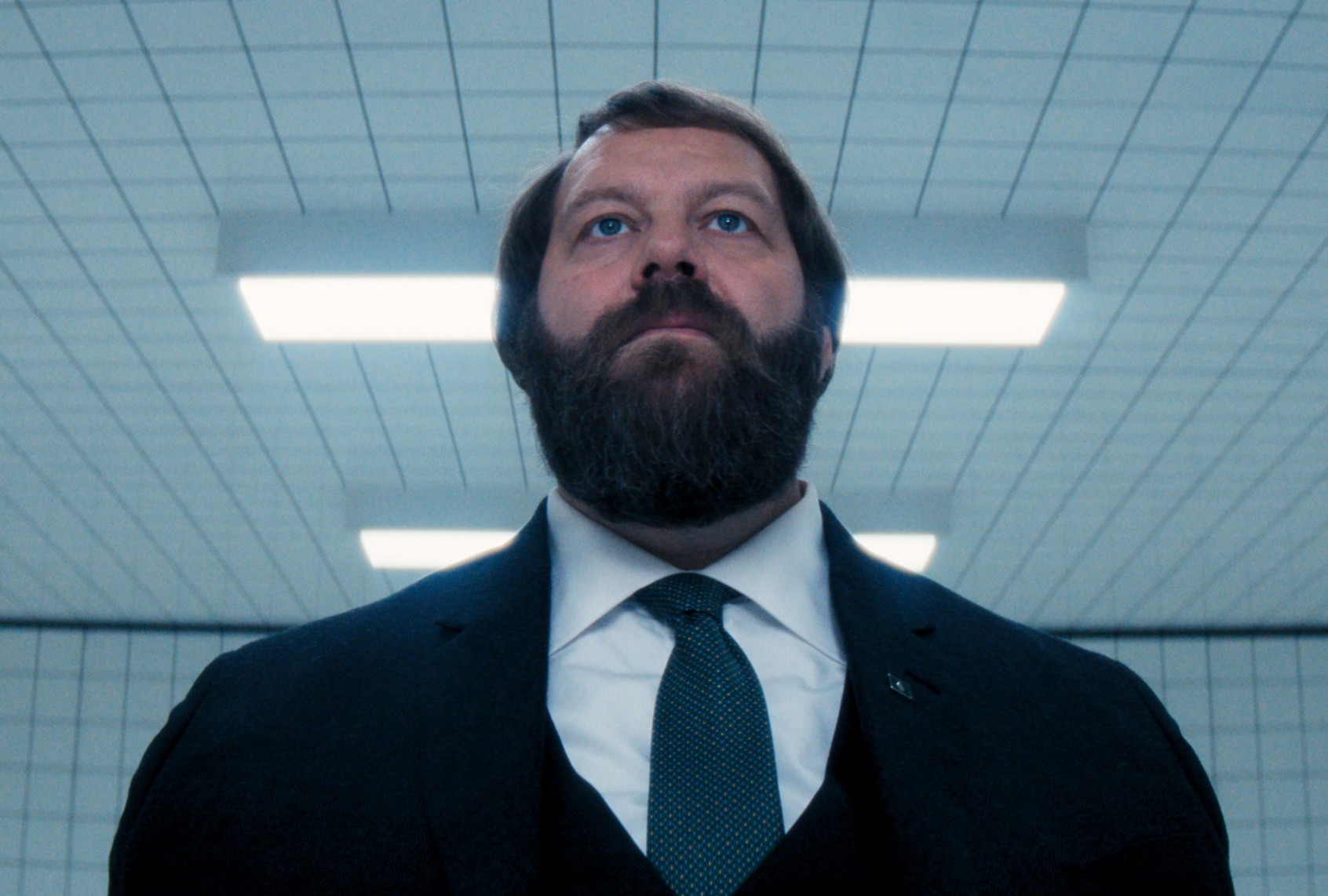
Now we know what that indoor goat farm is for, and why its shepherds stay angry.

Once he hits the blessed keystroke — Praise Kier! — Lumon’s manager Mr. Drummond (Darri Ólafsson) marks the occasion by readying a baby goat for sacrifice. “Has it verve?” he sternly asks Lorne (Gwendoline Christie), the head of Mammalians Nurturable. “It does,” she answers, devoid of enthusiasm.

“Wiles?” he asks.

“The most of its flock,” Lorne assures him.

“This beast will be entombed with a cherished woman whose spirit it must guide to Kier's door,” Mr. Drummond says.

Mark isn’t aware of any of this, however. All he’s told is that he must complete Cold Harbor.

As for why, series creator Dan Erickson answers that question and others in this hour and 16-minute episode. Audiences only have so much patience for drawing out the unexplained, however minor. Now we know what that indoor goat farm is for, and why its shepherds stay angry.

This is also the right time to bring the mystery of what really happened to Gemma to a close, since it began with last season’s finale, along with explaining Mark’s inscrutable job.

A few levels down from the severed floor, Gemma is Lumon’s test subject, enduring assorted life scenes and tortures before returning to her baseline self, where she’s asked what she remembers. The answer is always nothing, although some discomfort lingers – a sore mouth from a dental visit, a cramped hand from signing stacks of Christmas cards. None of the women she dresses up to be are natural parts of her. But Cold Harbor is.

Mark’s innie spends his days placing number clusters into digital folders based on feelings sparked by certain groupings, as his ex-manager Harmony Cobel (Patricia Arquette) tells him. Kier’s followers call these the Tempers: Woe, Frolic, Dread and Malice. Assembling each file creates a corresponding personality for Gemma.

The last connects to the bleakest memory outie Mark and his wife share – a miscarriage that followed months of difficulty conceiving. The chilliest, darkest place in the unseen ocean of the soul. This is Cold Harbor, the name of the last room Gemma is set to visit on the testing floor. Mark's innie has no concrete memory of this but the feelings are part of his physiology nevertheless.  

Prior episodes establish this narrative's runway, setting Mark and his sister Devon (Jen Tullock) en route to meet Ms. Cobel, who sneaks them into a “birthing cabin” in an out-of-the-way Kier compound.

Ólafur Darri Ólafsson in "Severance" (Apple TV+)The cabin works much in the way Lumon’s office does: once Mark S. steps inside, his innie assumes control. Since Devon and Ms. Cobel are unsevered, they can speak with both versions of Mark. With the help of a camcorder, innie and outie Mark converse for the first time, which is when each discovers that, although they share the same body, they want different things.

Erickson and the writers prepared us for this scenario through Mark’s co-worker Dylan G. (Zach Cherry), whose innie met and fell in love with his wife Gretchen (Merritt Wever), angering his low-vibration outie. Because of this, Gretchen told innie Dylan she had to stop seeing him, leading him to tender his resignation. But outie Dylan declines to free his innie, leaving it up to innie Dylan to decide whether to stay. “I guess I like knowing you’re there,” Dylan-at-home wrote.

Mark's quandary is that his two sides disagree on which love is true and worth preserving, and which is the disposable illusion.

Of the two Marks in that dark cabin, which is the better man? They pass messages back and forth, with outie Mark explaining that he needs his innie to save his wife, expose Lumon’s crimes and free the severed workers from what he supposes is a nightmare. Outie Mark presumes his innie wants to be reintegrated and free. That way they both get to live with Gemma, he says, while acknowledging his innie's relationship with Helly as a nice thing for him to have had. 

The Bible casts the double-minded man as insecure in his faith, divided between divine direction and worldly distraction. Mark's quandary is that his two sides disagree on which love is true and worth preserving, and which is the disposable illusion. Thus, what Mark's outie assumes about Helly incenses his innie, who insists his love for Helly is real. Even if she is an Eagan.

This is where their conversation abruptly ends. Despite Ms. Cobel assuring innie Mark that Lumon will dispose of him and all of his co-workers once Cold Harbor is complete, he threatens to betray everyone if the next thing he sees after stepping outside isn't the office’s elevator doors opening.

His wish is granted, and what comes after the seamless transition between the cabin’s front door and the severed floor is horrifying. He’s greeted by Helly – who experienced her own haunting encounter with Jame Eagan (Michael Siberry), her outie’s creepy father – and that bone-chilling painting. It's a real Kubrickian mind screw, only 23 minutes in.

The rest of the episode combines bloody, frantic action; a thriller; an absurd stage play; and “choreography and merriment.”

We need your help to stay independent

When Helly and Mark step into their usual workspace, it's dark, aside from a dimly lit life-size animatronic statue of The Founder, Kier Eagan. It holds a letter congratulating Mark, instructing him to finish the 25th file, Cold Harbor, as Helly. bears witness. "Goodly splendors await upon your victory. Love, Mr. Milchick."

That's when they notice their office space holds three desks instead of four, since Irving B. (John Turturro) is on a train to parts unknown, likely saving his life. But Irving left behind instructions to a dark hallway with an elevator at the end — the passage to Gemma. Helly previously intercepted Irving's note, having taken it from Dylan, and passes it to Mark just prior to him hitting the last key.

Before that, she lets Mark know that Jame Eagan came to see her, and Mark shares what he knows about their work and Gemma. Upon hearing this, Helly urges Mark to fulfill his outie's plan, to have a chance at living. "But I want to live with you," he says tearfully.

Michael Siberry in "Severance" (Apple TV+)"But I'm her, Mark," says Helly, reminding him of immutable realities. So he steels himself and proceeds. As he files, she wistfully lists names of places that linger in her deep memories but have no meaning: Delaware, Europe, Zimbabwe and the Equator.

“The Equator?" Mark asks in response, smiling. "Is that a building?” They lightly banter until the moment of truth.

With one click, the lighting changes and the Alan Parsons Project’s banger “Sirius” (Michael Jordan’s entry theme at the height of the Chicago Bulls’ championship dynasty, a nice touch) blares over the speakers. A few floors below, Gemma dons the outfit she wore the last time she saw her husband and walks into the room, which is all white and empty except for a crib.

Back on the severed floor, Milchick bounds in and launches into a stilted skit with the statue of Kier that ends awkwardly, with the fake Kier taking jabs as Milchick speaks, which he takes personally. The manager insults Kier in kind, who tersely thanks him for the "feedback," referring to him as "Seth" before shutting down. Milchick's forced smile returns and he introduces, with a flourish, “Choreography and Merriment.”

On cue, a marching band enters, filling the MDR area with music and raucous dance moves.

Tillman, by the way, is fantastic here – moving and undulating along with the instrumentalists, lacing the music's joy with the character's menace. (Stiller loves marching bands, Tillman previously told Salon, and he designed this performance in the style of drumlines from historically black colleges and universities). And the organized chaos is the distraction Helly and Mark need. Helly rushes Milchick, grabs his walkie and dashes into the bathroom. She misdirects him to an empty stall, then slips out behind him and pulls the door shut, using her whole body to prevent him from opening it.

As this transpires, Mark dashes into the hallway and follows Irving B.’s instructions to the black hall. Unfortunately — or fortunately, from Emil the goat and Lorne's point of view — he interrupts the bloodletting ceremony. He and Drummond tussle and it almost ends with Drummond strangling Mark to death before Lorne joins the fight, eventually overpowering Drummond and pointing the bolt pistol he would have used on the kid at him.

Mark talks her down and takes Drummond hostage, holding the pistol to his throat as they enter the elevator. This was only meant to keep the security goon under control, but when Mark shifts between his innie and outie as the lift descends, he squeezes the trigger, accidently and messily killing the senior manager. But the gore turns out to be useful since entry to the Cold Harbor room requires a blood sample. There, Mark finds Gemma serenely disassembling the crib, and coaxes her to run with him.

Their reunion is painful, beautiful — and weird. Once they shift in the elevator, mid-kiss, from loving husband and wife to Mark S. and Gemma’s severed-floor wellness counselor, Ms. Casey, the moment takes on a surreal quality. This is also the moment of truth — and innie Mark fulfills his task, rushing Ms. Casey to the emergency stairwell per Ms. Cobel’s instructions and making her step out of that persona into that of his wife. Once Gemma is in the stairwell, she calls her husband to open the door and come with her.

But this Mark S. is not the man she married.  

Once Helly's part in distracting Milchick is done, she finds Mark just in time to steer his indecision in her direction. He chooses the girl who is as real as he is — which is to say, not at all.

On the day of the finale's release, Apple TV+ officially picked up a third season of "Severance." The finale writes that as a foregone conclusion, though. Milchick is enraged at having been hoodwinked but doesn't seem to entirely disagree with Helly's rebellion, aided by Dylan and the Choreography and Merriment players she persuaded by letting them know their lives were on the line. The severed floor's manager has some explaining to do although, thanks to Mark, he doesn't have to deal with an abusive superior anymore.


Want a daily wrap-up of all the news and commentary Salon has to offer? Subscribe to our morning newsletter, Crash Course.


Helly, meanwhile, may be the focus of Jame Eagan’s new mission. Before Mark's arrival, the Lumon CEO sneaks up on Helly in the dark and creepily confesses, “I do not love my daughter. I used to see Kier in her, but he left her as she grew . . . I sired others in the shadows. But he wasn’t in them either. Until I saw him again. In you.”

“Why did you come here? What do you want from me?” Helly yells as Jame walks away. And there we have it, the next stage of this mystery.

As always, the blissful artistry of “Severance” is in the details – the completed circle of Mark opening the season with a mad dash through the halls and ending it hand in hand with Helly, jogging to who knows where as Mel Tormé croons a wending carpet of easy listening psychedelia behind them.

That finale closing song selection, “The Windmills of Your Mind,” is spot-on and portentous; its lyrics speak of the dreamy confusion enveloping these two. “Like a tunnel that you follow to a tunnel of its own/ Down a hollow to a cavern, where the sun has never shone…” If the severed workers' utility has ended, where can Mark and Helly run to?

Mark's choice leaves us to marinate on all the possible consequences of that and all the other action. Until that date is set we can only quote what Helly tells Mark S. before he turns on himself and capsizes our expectations.

“See you at the Equator.” Whatever or whenever that might be.

All episodes of "Severance" are streaming on Apple TV+.

Spring’s must-have farmers market find? It’s not what you think

The scent of freshly baked bread drifts through the open-air stalls, mingling with the bright, green scent of just-picked herbs. Shoppers weave through tables stacked high with vibrant produce, filling their baskets with the best of the season. Farmers' market season is upon us now that spring has officially sprung.

Spring is the best time to enjoy bright, refreshing recipes packed with seasonal fruits and vegetables. That includes leafy greens (think spinach, arugula, kale, lettuce, collard greens and Swiss chard), root vegetables (carrots, radishes, beets and turnips), stalk vegetables (asparagus, rhubarb and celery), stone fruits (apricots and cherries), fresh berries and herbs. Aside from produce items, seafood (like clams, black sea bass and lobster) along with eggs, gourmet cheeses and honey are also seasonal must-haves.

Among all the vibrant spring ingredients, there’s one that doesn’t get nearly as much attention as it deserves: mushrooms. Although peak mushroom foraging season varies from location to location, most species tend to come out in early fall. Some, like the highly prized morel mushrooms, will enjoy seasons beginning as early as March. According to Outdoor Life, morel season kicks off in March, ending early in the South but stretching into June in the Midwest and Northeast.

“I think that with spring finds, we’re looking at the possibility of more forage mushrooms and also just more forage produce out there with short growing seasons,” said Celine Beitchman, Director of Nutrition at the Institute of Culinary Education’s New York City campus. “There might be some producers who are kind of doing it in hydroponic settings for small local farms. But again, it's going to be this really short window.”

Beitchman said morels are spring’s best farmers market find: “I'd say morel mushrooms are your kind of little sweet spot of the darling of spring that pops out for like a month, and then it's gone.

“So if you have an opportunity to find morel mushrooms fresh at the farmers market, that's going to be the peak time to get them,” she added. “When I started to discover the fresh morel concept, it was a whole other world. So I really do highly recommend them.”

Morels are prized for their earthy, hay-caramel flavor. They also have “a very light aroma that's associated with a woodland kind of experience,” Beitchman described.

Unlike shiitake, porcini or white button mushrooms, morels have a distinct appearance with a honeycomb-like top and hollow stem. Even when cooked or sautéed for slightly longer periods of time, morels will hold their shape and maintain their honeycomb structure.


Want more great food writing and recipes? Subscribe to Salon Food's newsletter, The Bite.


“Some of the simplest ways to cook morels is sautéed in butter, vegan butter or dairy butter with a little salt and pepper,” Beitchman said. “You can eat them on toast or add them to other foods like risotto or pasta, where the morel mushroom itself is going to shine and there's not going to be a lot of other strong flavors competing for attention.”

It’s important to clean morels properly and ensure no dirt, debris, or pests are hiding in the mushrooms' crevices. Beitchman recommended gently wiping down each mushroom with a dry paper towel first. You can also use a pastry brush or a clean, unused paintbrush to dust off the surfaces.

“The bristles would allow you to gently brush into all the little honeycomb sections or little divots,” Beitchman explained.

Nutritionally, mushrooms are great sources of fiber and vitamin D and wild forage mushrooms reportedly have more added benefits.

“There is some research that suggests that they're more nutritious for us, that they're riper and have evolved into a more healthful product because they've been allowed to grow in their natural environment for you know the length of their growing season,” Beitchman said. Some foraged mushrooms contain anti-inflammatory, anti-cancer and immune-boosting properties. They also help boost gut health because they contain prebiotic fibers.

That's all to say when you spot fresh morels at the farmers market, don’t hesitate — grab a basketful, cook them simply and savor the fleeting magic of their season.

Imagine deportation: When Nixon tried to pull a Trump on John Lennon

In trying to deport a Palestinian anti-war activist, Mahmoud KhalilDonald Trump follows in the footsteps of another former Republican president. Richard Nixon tried to deport Beatles member John Lennon in 1972.

Trump, during an October 2023 campaign stop in Iowa, pledged to "revoke the student visas of radical, anti-American and anti-Semitic foreigners at our colleges and universities" and "send them straight back home." Khalil, the holder of a green card, which grants lawful permanent resident status, was a Columbia University graduate who led pro-Palestine protests at the school last year.

Trump's use of government agencies to suppress anti-war protesters echoes that of Nixon, whose administration used the FBI and CIA to surveil, infiltrate and harass anti-Vietnam war peace groups. The Nixon administration also called on the Internal Revenue Service to audit the president's critics.

The ex-president even debated a secret plan to suspend the Fourth Amendment and make nationwide mass arrests, a proposal eventually vetoed by FBI Director J. Edgar Hoover. Since virtually all of the anti-war protesters in the '60s and '70s were American citizens, the Nixon administration could not use the threat of visa cancellation and deportation to intimidate them.

"Give Peace a Chance"

One high-profile foreign visa holder, however, did catch the Nixon administration's attention when he arrived in New York in 1971. His name was John Lennon.

Lennon and his wife, Yoko Ono, came to New York to escape from London and the constant attention of the aggressive British tabloids. The Beatles had recently broken up, and the couple sought the anonymity of a busy, crowded city: New York. They were also involved in a legal fight to obtain custody of Kyoko, Ono's daughter with her second husband, Richard Cox. The girl and her father were believed to be hiding in the U.S. Lennon, a U.K. citizen and Ono, a Japanese citizen, initially obtained short-term visas allowing them to stay in the U.S.

In 1971, Lennon was the most famous musician in the world. His song, "Give Peace a Chance," his first solo effort apart from the Beatles, had charted on the Billboard Hot 100 and went on to become an anthem for the rapidly growing anti-war movement in the U.S.

Nixon's political ambitions and Lennon's past collide

Nixon decided to run for reelection in 1972. Thanks to the 26th Amendment, it would be the first election in which 18 year olds could vote, and Nixon's campaign feared Lennon could lead a nationwide youth movement against him. That fear intensified after Lennon and Ono headlined a benefit concert in Ann Arbor Michigan on Dec. 10, 1971, drawing 15,000 people. The concert, benefiting White Panther John Sinclair, featured Stevie Wonder, as well as speeches by Jane Fonda, Jerry Rubin and Bobby Seale.

Rumors reached the campaign that a similar protest concert might be staged in Miami Beach in August 1972, at the same time as the Republican National Convention. (The concert was never held.)

The administration began working to deport Lennon and Ono. In March 1973, the Nixon's Immigration and Naturalization Service (INS) ruled that Lennon had to leave the U.S. within 60 days. The musician was ruled "deportable" because he had a criminal record — a 1968 arrest in London for half an ounce of cannabis. Ono was allowed to stay — and granted status as a "permanent resident alien" — so she could pursue her efforts to find her daughter.

Lennon was able to hire top immigration attorneys, who successfully fought the deportation in federal court. While his attorneys were able to extend the 60-day order many times, Lennon lived under a cloud while the appeals moved forward. The stress of the ordeal weighed on him. Lennon drank heavily, and in 1973, he separated from Ono for about a year, a period he later dubbed his "Lost Weekend." In August 1974, after Nixon's illegalities were exposed in the Watergate hearings, he resigned; then-Vice President Gerald Ford went on to assume the presidency.

"Selective deportation based upon secret political grounds"

In October 1975, the U.S. Court of Appeals for the Second Circuit ruled that Lennon could stay in the U.S. The court found the arrest for a tiny amount of marijuana was not sufficient grounds to bar him from the U.S.

The ruling warned that "the courts will not condone selective deportation based upon secret political grounds." The Ford administration dropped the case, and Lennon was given his green card allowing permanent resident status.

Lennon and Ono no longer had to worry about deportation. On October 9, 1975, their son Sean was born. In November 1980, Lennon released the "Double Fantasy" album to lukewarm reception, only three weeks before his murder.

Political activists, singled out by GOP administrations

Both Lennon and Khalil are political activists singled out by Republican administrations bent on stymying individuals who publicly protested their policies, even if it means ignoring the Constitution. Their cases, however, diverge in significant aspects. Lennon, of course, was very wealthy and could hire a top-rank legal team. He also had the vocal support of many well-known musicians, artists and writers.

Khalil is a graduate student, who had been living in an apartment with his pregnant wife, did not have any criminal background and was not alleged to have violated any U.S. laws. While the INS sought to deny Lennon a visa based upon a prior criminal act, Khalil has no known arrests. His deportation is being sought on a little-known provision of the 1952 Immigration and Nationality Act that authorizes the U.S. secretary of state — who currently is Marco Rubio — to deport foreigners deemed to create "potentially serious adverse foreign policy consequences" for the U.S.

While the 1973 and 2025 cases are based on different sections of the immigration law and being prosecuted by different presidents, the message is the same. Khalil's attorney, Amy Greer, stated the following after his March 8 arrest: "He was chosen as an example to stifle entirely lawful dissent, in violation of the First Amendment. The government's objective is as transparent as it is unlawful."

The Trump administration had attempted to block Khalil's legal efforts to fight back. A federal district court judge in New York has denied the move, ordering the case to be transferred to New Jersey. Khalil, who is currently being detained in Louisiana, appeared on Friday in immigration court.

Columbia, at risk of losing federal funds, yields to Trump

Columbia University said Friday it has agreed to the Trump administration's demands that it overhaul rules on campus protests, student discipline and more in exchange for restoring $400 million in federal funding.

The university — accused of failing to fight antisemitism amid pro-Palestinian protests — agreed to take on a formal definition of antisemitism that could include “targeting Jews or Israelis for violence or celebrating violence against them” or “certain double standards applied to Israel,” The New York Times reported. Columbia also agreed to ban protesters from wearing face masks if they are trying to conceal their identities; ban protests in academic buildings; hire a security force that can remove protesters from campus or arrest them; overhaul its student discipline procedures; and appoint a senior vice provost to oversee the balance of curriculum and leadership in its Middle Eastern studies department. 

It was not immediately clear whether the agreement would result in the restoration of the funding. But it "stunned and dismayed many members of the faculty" who viewed it as caving to Trump, per The Times. And it raised questions over whether other colleges could be next.

The Trump administration is examining dozens of universities for their DEI programs, per The Associated Press. The administration told the University of Pennsylvania on Wednesday it could lose $175 million because of its transgender athlete policies. 

"Columbia's capitulation endangers academic freedom and campus expression nationwide," Donna Lieberman, executive director of the New York Civil Liberties Union, said, per The Associated Press. 

Columbia’s interim president, Katrina Armstrong, said the university intends to “make every student, faculty and staff member safe and welcome on our campus," The Times reported.

“The way Columbia and Columbians have been portrayed is hard to reckon with,” Armstrong said, per the media outlets. “We have challenges, yes, but they do not define us.”

“A tragedy for the world”: How the Trump-Musk takeover is sowing global chaos

I recently interviewed social psychologist Kurt Gray about his new book, "Outraged! Why We Fight About Morality and Politics," in which he argues that we can bridge ideological divides by drawing on evolutionary evidence and developing ways of building trust. Despite the state of the world today, there’s evidence that this is possible through the use of randomly selected mini-publics modeled on jury duty, whether here in America or around the world. But creating conditions in which such examples can flourish may seems like a pipe dream as America risks descending into autocracy, where no dialogue is possible or permitted. 

The sharp disconnect between what Gray believes is possible and what we're all experience day to day was much of what we explored in that interview, in which I referenced the work of social scientist Michael Bang Petersen in exploring the evolutionary reasons why deception — such as deliberate falsehoods and conspiracy theories — may confer a coalitional advantage to anti-democratic forces, thereby undermining the social trust on which Gray’s approach depends. During Donald Trump’s first term, I interviewed Petersen about an earlier paper which found that many marginalized but status-obsessed individuals, such as internet trolls, experience a "need for chaos" and want to "watch the world burn."

Both papers shed light on sources of Trump’s appeal that conventional commentary simply couldn't see, the earlier paper more by focusing on individual motivations, the second on group frameworks. With the bridge-building promise Gray points to fresh in mind — but Democratic leaders like Sen. Chuck Schumer seemingly blind to the profound obstacles that make that impossible under current conditions — the time seemed ripe to interview Petersen again, primarily about how he make sense of Trump’s second term so far, with the world's richest internet troll by his side. 

But there was another good reason for the interview: Petersen is Danish, and his nation has a tool to analyze its democratic challenges in hopes of addressing them. Roughly every other decade, the Danish parliament commissions an expert “power and democracy” study to investigate the state of Danish democracy in the face of new challenges that have emerged since the previous study. It's not just an academic exercise. Work aimed at a for the general public is also produced, and this offers an example of what it looks like when elected leaders are serious about seeking to strengthen democracy. Petersen is in charge of Denmark's current investigation, which will run through 2028. He speaks from the perspective of a leader responsible for addressing and improving democracy at a fundamental level — a task our country sorely needs addressed. that America is sorely in need of. 

I spoke with Petersen by video from Copenhagen. This transcript has been edited for clarity and length.

One of Kurt Gray's key arguments is that humans evolved as a prey species with a profound orientation toward avoiding harm, which has become the basis for all our morality. He thinks that's also a basis for liberals and conservatives to understand each other by focusing on how they both see harm. There's evidence for that in citizen's assemblies in specific contexts, but in politics at large that doesn't seem to be the case. Your work seems a lot more realistic, in terms of what we actually see right now. I want to start by asking about what's happening on the individual level, and what you've called the "need for chaos." That seems to apply most clearly to internet trolls, and now we have the biggest social media troll of all acting as co-president of the U.S. How does the "need for chaos" help explain Elon Musk and how he operates?

It's always difficult to apply these general theories to single individuals, because there's so much contextual information that isn't available and it's difficult to get people's genuine motivations from a distance. But at least we can talk about the effects that he is creating. If you look at the observable behavior and the patterns, he seems to be a person who is extremely motivated or willing to share information that is false, to the extent that it fits into his political talking points, his overall political agenda. So you have a person who is not sharing information with the objective of creating an accurate representation of the state of the world, but who is trying to mold the way that his audience thinks such that it aligns with his core interests.

"You have a person [Elon Musk] who is not sharing information with the objective of creating an accurate representation of the state of the world, but who is trying to mold the way his audience thinks such that it aligns with his core interests."

We know that's an example of information warfare. That's an example of how humans use information to strategically manipulate each other. We've been doing that as a species always. The difference now is that you have an actor with these highly strategic motivations who is not only the richest man in the world and therefore has virtually unlimited resources available to broadcast that information, but is also the owner of the largest social media network dedicated to politics, which means he can craft these messages very efficiently.

And with powerful effects.

Let's talk about the effects of those messages in a second, but if we talk a little bit more about Musk's dispositions, it does seem that he has all the behavior patterns of a person who scores high in dominance-seeking, a core feature of individuals who have a high need for chaos. It does seem to be an explicit leadership strategy to use dominance to instill fear into people who are working within his organizations, and it's very clear that there has been a strategy of instilling fear into bureaucracy through the random firings, constant threats of firings, cutting funding and so on. 

So he's navigating using fear as an instrument, and we also see other dominance displays. One of the most visually striking is the happiness with which he wielded that chainsaw. You can say that was just a pure dominance display. So this does seem to be an individual with a personality — again, from observable behaviors — that tends towards dominance. He certainly seems to be using a tactic of prioritizing messages that fit his own agenda, rather than that is aligned with an accurate portrayal of the state of the world. 

When it comes to leaders who are making heavy use of propaganda, it's important to understand that it's not necessarily because his audience is convinced of what he's saying, in any normal sense of the term. We humans use information for strategic purposes, on the basis of whether that is aligned with our social goals. Often we don't process information for epistemic reasons. It's not a game where we are trying to build an accurate understanding of the world. We use information in order to signal, and we absorb information in order to signal our place within the group. 

Right. This segues into the subject of your second paper, the one where you explain that there are multiple levels at which group needs, and group members’ individual needs, are met. 

Yes. The point is that if you are a person who already has a somewhat similar worldview to whoever is the leader within a group, then when you're closely tracking the information that leader is putting out, what you're trying to figure out is what kinds of beliefs I need to hold in order to be a loyal group member. In that sense, you should think of propaganda and things like that as fashion shows. It's more like fashion than about an actual description of what is going on. 

"We can think about beliefs the same way we think about football jerseys — it signals what team you are on, and you constantly need to track information flow from the leader, who is setting the latest fashion."

You're getting these signals that, today, in order to be a good MAGA Republican, Ukraine was responsible for Russia invading it. And then, the next week, you need to have the idea that tariffs are a beneficial thing for the economy. So essentially we can think about beliefs the same way we think about football jerseys — it signals what team you are on, and you constantly need to track information flow from the leader, who is setting the latest fashion. Therefore, you adapt to those beliefs not because you necessarily believe all of them for reasons of accuracy, but because you want to learn the social signals that are going around in your group. 

From the perspective of introspection, one or the other belief doesn't necessarily feel different. It doesn't necessarily feel different to think that Mount Everest is the highest mountain in the world and to believe that Ukraine was responsible for Russia invading it. They feel the same. But those two pieces of information are processed and absorbed for fundamentally different reasons. One is because you are actually interested in understanding which mountain is the largest in the world — you want to have an accurate understanding of that — and the other is because you want to be a good MAGA Republican. 

In that paper, you broke down the coalitional functions of falsehood into three stages. The first of those was mobilization. You said, "By enhancing the threat — for example, by saying things that are not necessarily true — then you are in a better situation to mobilize and coordinate the attention of your own group." I thought of that when Trump made the claim about Haitian immigrants eating pets: Clearly that was false, and they didn't care that it was false. That didn't seem to matter at all to Trump's followers, who seemed to revel in claiming it, regardless of whether it was true or false. Could you say something about how that works?

When you're trying to mobilize a coalition, you need to overcome a fundamental problem, which is the coordination problem. Even if everyone within a group wants to do the same thing, it is actually difficult to get the group to do that thing, because their attention is scattered across multiple different issues. It's not the only thing that they want to do. So they need to agree: Is it now that we're doing that thing? That problem of coordinating people's attention at the same time to do X is a difficult problem. A lot of propaganda is about creating that coordination, to say it's now that we need to do something about it, and we need to do this

"Propaganda is always filled with the atrocities that the other group has done — but more than an accurate description of what they have done, it psychologically functions as a recipe for what we are going to do against them."

We have seen those kinds of processes operate over human history. It's well documented in the context of ethnic massacres and riots, to the extent that one of the leading authors on the social dynamics behind ethnic massacres, Donald Horowitz, says that when you see propaganda spread prior to an ethnic massacre, you should see it as essentially a recipe for what is going to happen. A lot of that propaganda is always filled with the atrocities that the other group has done, but more than an accurate description of what they have actually done, it psychologically functions as a recipe for what we are going to do against them. We see this on many occasions with the rhetoric coming from Trump and Musk. 

Can you be more specific?

I think a lot of what goes on with Canada is similar. There is this constant talk about injustice: Canada is treating the United States unfairly, Europe is treating the United States unfairly. It's very unclear how that is the case. But essentially that serves as a pretext for going with the tariffs, and this understanding that, OK, we need to do something about this problem now. 

If we go back to the story about the Haitian immigrants eating pets, I think it shows something slightly different but also quite interesting about our psychology of falsehoods. Because I think it's absolutely true that neither Trump nor his core audience cared whether it was true or false, but part of the reason is that they cared about the underlying direction of society that was implied by the misinformation. Trump and the core of the movement wanted to do something about immigrants. They wanted them to be deported. As long as the specific piece of information that you are giving out has implications in the direction that you want to go, then the actual circumstances matter less. In that sense, you could see what Trump did as a clever form of agenda-setting. 

I don't think he believed that the migrants were eating dogs. I don't think that a lot of his followers believe that cats and dogs were being eaten. But it didn't really matter, because it had the right implications. By messaging those implications in the form of misinformation, it got everyone to talk about it, which meant that the underlying issue of immigration was kept high on the agenda as people were trying to debunk the underlying falsehood. 

So that also shows something about how difficult it is for benign actors to navigate strategically in an information environment where some people have absolutely no regard for the truth, and perhaps to figure out: Is this a falsehood we should just sort of ignore? Or is this a falsehood we should strongly push back against? Because the risk is that by pushing back against the falsehood you are keeping the underlying issue at the top of the agenda. 

What you're talking about there involves both the mobilization and the coordination functions. But there's a third aspect you talk about, regarding commitment. A good way to signal group loyalty is to take on a belief that's the exact opposite of what the other group believes. That creates pressure to develop bizarre beliefs about the other group being evil. That sums up what I see, as an American, in Trump openly claiming to be king while simultaneously claiming that his enemies are trying to destroy America, which of course was founded on rejecting the rule of a king. What does that look like from your perspective?

I think that's a very good example of the kind of dynamics that we are trying to describe in our work. Going back to these different forms of beliefs, it's not a good team signal to believe that Mount Everest is the highest mountain in the world, because everyone believes that. So if your basic goal is to figure out who's loyal and who's not, you need to push a narrative that is against a large number of people's basic way of understanding things. 

In the U.S. context, proclaiming you are king is very much in opposition to a large number of American values and therefore it's a pretty good signal of loyalty if you're actually going along with the narrative. Just as it's a good signal of loyalty if you go with the narrative of Trump buying Gaza and turning it into a beach resort. Because from a European perspective, that looks so bizarre that I almost don't have words for it, especially for the video that that he used to communicate this on Truth Social. 

But it really makes it helpful from a leadership perspective, especially if you are a leader looking for blind obedience. Because by making it bizarre — where people will feel pressure and tension in going along with it — then it becomes what we in psychology call a "costly signal." You need to pay something to go along with it. And we're seeing this not just at the level of rank-and-file voters in the MAGA movement but among elected Republicans who are putting out legislation or proposals to put Donald Trump on Mount Rushmore, who are suggesting that Donald Trump should be on $100 bills, who are suggesting to turn Trump's birthday into a national holiday. 

"You cannot show loyalty to a dominant leader by doing something that doesn't cost you anything. You need to do something that will make other people turn their backs on you."

All these over-the-top proposals are signs of loyalty. You cannot show loyalty to a dominant leader just by doing something that doesn't cost you anything. You need to do something that will make other people turn their backs on you. 

So Trump is dominating U.S. politics, but the problems he represents are common to the rest of the world. You're involved in a project in Denmark to try to understand and address those problems. Tell me something about what you and your team are trying to do.

This is a particular toolbox in Scandinavian parliaments. Every other decade or so, parliaments in Scandinavia — Denmark, Norway and Sweden — have initiated these power inquiries or "power and democracy" studies. The idea is to let independent researchers audit the state of democracy in the given country. So here in Denmark we had the last of these democracy audits around the turn of the century, just before the. advent of social media. And now because of digitalization and how that has changed the way politics work, they want us to do a new audit, and I was appointed by the government to lead that team of researchers. 

So what does it involve?

It's a slow-working, long-term project, so I'm 100 percent out of all regular university responsibilities until 2028, when we are to hand in our final report. We’re trying to mobilize all the researchers in the social sciences and in the humanities with relevant expertise to bring together their research in order to make this evaluation of how robust Danish democracy is, what core challenges we are facing and what the potential paths are ahead for facing some of those challenges. The background is not only digitalization, but also democratic backsliding, as we have seen in in a number of countries, including countries that are close to Denmark, members of the EU such as Poland and Hungary. But of course we have also been following very closely what is happening in the United States, in one of the oldest democracies in the world. 

So what do you see?

When things go bad, it's always interesting for a researcher — although it's not interesting to live through it! One thing that seems to emerge from the current U.S. experience is how fragile our institutions really are. A lot of stable democracies work not because of formal institutions, but because of cultural norms and traditions. That means that if you are a person with absolutely no regard for tradition and an exclusive focus on your own interest, you can create a lot of chaos and destruction very quickly, especially if you combine that with instilling fear into the bureaucracy. Because it is really the bureaucracy and the judicial system who should be stepping up against politicians overstepping their power. But if you are able to make them fearful of following their professional norms and you exploit that to the fullest, then things can go bad pretty quickly. 


Want a daily wrap-up of all the news and commentary Salon has to offer? Subscribe to our morning newsletter, Crash Course.


We are still early on the project, but we can see a lot of what is going on in Danish democracy, which has a lot less problems than the U.S. democracy. A lot of what makes Danish democracy work is also cultural traditions and norms. The unique thing about this project is that it's parliaments themselves that ask to be audited: “Please come and see if we are wielding our power in the interests of democracy.” I imagine that it is only possible to have such a project in stable, high-trust societies. 

I know it's early in the process, but are there any lessons or directions that have emerged so far, in terms of how to improve things?  

We will be publishing a series of books over the next four years, and then will publish our final report. We will publish the first three books here in the beginning of the summer. They will be laying the groundwork for the rest of the audit. One of the key problems that we are focusing on is, again, how a lot of the functions of democracy rest on these norms, but we are pointing to a large number of challenges that have emerged and are putting pressure on the Danish democratic system. I think probably the most important, from a U.S. perspective, is rising inequality. 

In Denmark, inequality has gone up since the turn of the century. Not to the same extent as in the United States, and Denmark is still a relatively equal country. But I think a lot of the problems the United States is facing right now have to do with rapidly increasing inequality since the beginning of the '80s. I think a key lesson is that politicians need to have a strong focus on the slow building of societal tensions that emerge out of inequality, and fixing them as soon as they can. 

"If you have a two-party system, it can take a really long time before societal tensions reach the top at the political level, and then suddenly you have this takeover by ideological extremists, as we have seen with the Republican Party."

That's a lot more difficult to do in a two-party system than it is in a multiparty system, as we have in Europe, because when you have these sort of social tensions that are slowly building up, there will always emerge a new political party. In a multiparty system, that party will grow larger and larger until the political establishment fixes the underlying issue that they're campaigning on. But if you have a two-party system, then it can take a really long time before those tensions reach the top at the political level, and then suddenly you have this takeover by ideological extremists, such as we have seen with the Republican Party, and then things can go really bad very quickly.

I think at this point it is really up to politicians to disregard short-term electoral incentives, and disregard also the economic incentives from lobbyists, interest organizations and so on, and really do the job they were elected to do, which is to take care of society at large. Sometimes that means you need to sacrifice short-term electoral gain and economic benefits. That's at the core of what they need to do.

OK, so what's the most important question I didn't ask? And what’s the answer? 

One thing we could talk about is whether what is happening in the United States is sort of your problem, in the United States, or whether it's our problem. This is followed extremely closely — what is unfolding in the United States — in European media. Politically interested people across Europe are talking a lot about the situation in the U.S., because what is happening in the U.S. is a tragedy, in my view, for the American people, but it's essentially also a tragedy for the world. 

The signs are that the international order is collapsing, and that will create massive problems for all of us. The threats against former allies — well, still formally allies like Canada and Denmark, in the case of Greenland — but also the constant threats that the U.S. will not back up NATO, those are destroying a large number of alliances. Essentially the whole world is changing over just these past few months. What is happening in the United States is definitely not just affecting the United States but affecting people across the entire world. It's a huge problem for all of us when the most powerful country in the world turns toward authoritarianism. 

“A pivot moment”: Some travel agents are now urging their clients to avoid the United States

By midday Wednesday, Canadian travel agent Micheline Dion had received another two emails from clients canceling their travel plans to the United States or voicing worries about their safety should they keep them. One client sought to nix his cruise out of Puerto Rico, while another wrote that they were worried about visiting Rochester, N.Y. this coming May.

Their messages all stemmed from "fears of how they will be treated, their safety," and whether they'll be allowed entry, Dion, who is based in Ontario, told Salon. "No one wants to enter a possible volatile situation and even worse be denied entry."

Dion said she's been receiving an influx of these emails from clients since President Donald Trump began targeting Canada and enacting his crackdown on immigration — and as stories of U.S. border officers denying entry to or detaining tourists in harrowing conditions made international headlines. Since Trump took office in January, U.S. Immigration and Customs Enforcement has detained at least four tourists, three from Europe and one from Canada, each for upwards of 10 days after they attempted to enter the country. U.S. Customs and Border Protection has also been denying entry to foreign nationals — in one French scientist's case, doing so over text messages criticizing President Donald Trump.

The combination has made potential visitors scared to travel to the U.S. out of fear they, too, will be detained, turned away or targeted. Now some travel agents, like Dion, are loathe to encourage U.S.-bound trips altogether.

On Facebook earlier this month, Dion cautioned her clients against using U.S. dollars in other countries and flying out of the nearest American airport in Buffalo, N.Y., and urged them to rethink their travel habits. Though she knows a few Canadians who are crossing the border to visit close friends and family, she said she couldn't in good conscience continue to encourage her clients to travel to the U.S. under the circumstances.

She cited Trump's economic attacks of Canada, the lack of education on Canada's role as a close U.S. ally, recent plane crashes, a fear of facing potential violence from Trump supporters and the recent increase in her clients facing heightened scrutiny when attempting to cross the border as the primary reasons pushing her to make her posts.  

"As long as there is no stability in the U.S., we will not feel safe or confident to go back," she said in a phone interview, emphasizing that she will continue to advise against travel to the U.S.

About 10 of her clients have reported encountering more intense questioning from border officers when attempting to enter the U.S. in recent weeks, she said. Dion herself had wanted to plan a 14-day cruise out of New York later this year but decided against it because of the uncertainty of how long the crackdown will last. 

"If I'm limited that I'm not going to travel for my own safety, I'm going to educate other Canadians to do the same because the last thing you want is another something coming up saying, 'Oh, we're having trouble coming back home. They won't let us go. They've arrested us. They put us in a detention place," she said.

"We already know that the Trump administration is not even listening to the court there in the U.S," she added, referencing the president's recent defiance of a court order blocking a deportation. "So what are our chances going to be if we had to end up in court?"

Those fears have only heightened following reports last week that ICE had detained a Canadian traveler, Jasmine Mooney, over visa concerns. Mooney, who had been offered a marketing job in a U.S.-based startup, had attempted to enter the country in early March after applying for a TN visa, which allows Canadian and Mexican professionals to stay here temporarily. She told The New York Times that she first applied for the visa last year but was rejected because her documents didn't include the company's letterhead. 

Mooney had successfully reapplied a month later, but a U.S. immigration official in a Vancouver airport revoked the work permit, citing improper processing and concerns over a company employing her also selling hemp-based products. Upon bringing another work visa application earlier this month to the San Diego border, an immigration officer told her she needed to apply through the consulate.

Another officer soon whisked her away to a different room, where she was searched and interrogated. She was transferred to the first of two detention centers ICE would hold her in and would then spend 12 days in detention. She was finally allowed to return to Vancouver last Friday.

In an article for The Guardian, Mooney likened the detention experience to being kidnapped.

"It felt like we had all been kidnapped," she wrote of her and her fellow detainees, "thrown into some sort of sick psychological experiment meant to strip us of every ounce of strength and dignity."

Mooney's detention came on the heels of that of Rebecca Burke, a Welsh comic artist who ICE detained for 19 days at a Washington state facility over concerns she had violated her visa. Before Burke, who returned to Wales on Tuesday, ICE had held two German tourists in a detention center for up to six weeks. Both were permitted to return home earlier this month.

These detentions, experts recently told Salon, mark a clear escalation in enforcement under the Trump administration as border officers take strict interpretations of laws governing tourists' and other foreign nationals' entry into the country. While legal, the actions threaten the nation's relationship with affected countries, 43 of which the U.S. has made agreements with to allow citizens relatively free access to enter with the Electronic System for Travel Authorization visa waiver. They also open Americans up to greater scrutiny and the possibility of receiving similar treatment by these countries when going abroad. 

As tourist encounters with CBP and ICE escalate, foreign governments have moved toward issuing travel advisories for citizens seeking to travel to the U.S., warning that their ESTA visa waivers do not guarantee them entry to the country. The UK issued a travel advisory on Thursday, while Germany updated its advisory on Wednesday after previously issuing a warning for transgender and gender-expansive citizens who wish to travel to the U.S. 

In Canada, Mooney's detention has inflamed already tense relations ushered in under Trump. Since the president threatened to annex the country and imposed tariffs on its exports into the U.S., Canadian citizens have engaged in boycotts of U.S. travel and goods, and encouraged others to instead buy Canadian to bolster their nation's economy.  

Trump's threats to Canada's sovereignty, coupled with his executive orders and rhetoric targeting LGBTQ people — particularly transgender people — and diversity, equity and inclusion, made independent travel advisor Karen Wiese, based in Nova Scotia, decide in February she would no longer be assisting her clients with travel to the U.S.

"I support a lot of different racialized and LGBTQ+ clients who are just very nervous about being attacked and going anywhere in the United States," Wiese told Salon in a phone interview. 

She announced her decision on Feb. 1, telling followers on Facebook that she can't support or promote tourism in a destination that doesn't align with her values, which privilege inclusivity and respect. Since seeing ICE's treatment of Mooney — and the increase in tourist encounters with border officers in general — she's become even more firm in her decision. 

Facing possible detention "is terrifying for anybody who wants to be able to travel to a destination," Wiese said. "I'm all for my clients going to a different destination to just avoid anything like that that may happen."

Wiese said that around 40% of her roster of some 250 clients have canceled trips they were planning to take to the U.S. in recent weeks while a smaller percentage are still mulling whether to do so. Many say that they're afraid to come, while others refuse to support the U.S. economy. Ahead of her phone interview with Salon, one client emailed her to cancel a Christmas cruise they'd planned that is set to leave from Los Angeles over concerns for the safety of their gay son.   

"It's been constant people saying, 'We don't want to do this. What else can we do?'" she said. "It's just a pivot moment where we look for something else. Mexico might be an easier place for them to visit."

Correction: Karen Wiese is based in Nova Scotia. A previous version of this article misidentified where she is based.

Elon Musk is accelerating a 50-year government privatization project

Since returning to office, President Donald Trump has aggressively moved to shrink the federal government. His administration has frozen federal grants, issued executive orders aligned with the Heritage Foundation’s Project 2025, and, most prominently, created what he calls the Department of Government Efficiency, or DOGE.

DOGE has been billed as a cost-cutting initiative, although the actual amount of money being saved remains unclear. To lead DOGE, Trump appointed Elon Musk, a megadonor whose companies hold federal contracts worth billions. Musk has already moved forward with major cuts, including sweeping workforce reductions, the curtailment of government operations and purges of entire agencies. Thousands of federal workers have lost their jobs.

While certainly dramatic, these actions reflect a longer trend of privatizing government. Indeed, my sociological research shows that the government has steadily withdrawn from economic production for decades, outsourcing many responsibilities to the private sector.

3 indicators of privatization

At first glance, total government spending appears stable over time. In 2024, federal, state and local expenditures made up 35% of the U.S. economy, the same as in 1982. However, my analysis of Bureau of Economic Analysis data offers a new perspective, recasting privatization as a macroeconomic phenomenon. I find that U.S. economic activity has become increasingly more privatized over the past 50 years. This shift happened in three key ways.

First, government involvement in economic production has declined. Historically, public institutions have played a major role in sectors such as electric power, water delivery, waste management, space equipment, naval shipbuilding, construction, and infrastructure investments. In 1970, government spending on production accounted for 23% of the economy. By 2024, that figure had fallen to 17%, leaving the private sector to fill the gaps. This means a growing share of overall government spending has been used to fund the private sector economy.

We need your help to stay independent

Second, government’s overall ability to produce goods and services – what economists call “productive capacity” – has fallen relative to the private sector, both in terms of labor and capital. Since 1970, public employment has lagged behind private sector job growth, and government-owned capital assets have trailed those of the private sector. Although public sector capital investments briefly rebounded in the 2000s, employment did not, signaling a shift toward outsourcing rather than direct hiring. This has significant implications for wages, working conditions and unionization.

Third, and relatedly, government increasingly contracts work to private companies, opting to buy goods and services instead of making them. In 1977, private contractors accounted for one-third of government production costs. By 2023, that had risen to over half. Government contracting – now 7% of the total economy – reached US$1.98 trillion in 2023. Key beneficiaries in 2023 included professional services at $317 billion, petroleum and coal industries at $194 billion and construction at $130 billion. Other examples include private charter schools, private prisons, hospitals and defense contractors.

The meaning of privatization

Privatization can be understood as two interconnected processes: the retreat of government from economic production, and the rise of contracting. The government remains a major economic actor in the U.S., although now as more of a procurer of goods and services than a provider or employer.

The government’s shift away from production largely stems from mainstreamed austerity politics – a “starve the beast” approach to government – and backlash against the New Deal’s expansion of federal economic involvement. In 1971, the controversial “Powell Memo,” written by future Supreme Court Justice Lewis Powell, mobilized business leaders around the goal of expanding private sector power over public policy. This fueled the rise of conservative think tanks, including the Heritage Foundation, the eventual architect of the Project 2025 privatization agenda.

While government production shrank, government contracting expanded on promises of cost savings and efficiency. These contracting decisions are usually made by local administrators managing budgets under fiscal stress and interest group pressure, including from businesses and public sector unions.

Yet research shows that contracting frequently fails to reduce costs, while risking monopolies, weakening accountability and public input, and sometimes locking governments into rigid contracts. In many cases, ineffective outsourcing forces a return to public employment.

The consequences of privatization

Trump’s latest moves can be viewed as a massive acceleration of a decades-long trend, rather than a break from the past. The 50-year shift away from robust public sector employment has already privatized a lot of U.S. employment. Trump and Musk’s plan to cut the federal workforce follows the same blueprint.

This could have major consequences.

First, drastic job cuts likely mean more privatization and fewer government workers. Trump’s federal workforce cuts echo President Ronald Reagan’s 1981 mass firing of more than 11,000 air traffic controllers, a source of prolonged financial struggles and family instability for many fired workers. Trump’s firings and layoffs are already reaching far beyond Reagan’s.

In addition, since federal spending directly contributes to gross domestic product, cuts of this magnitude risk slowing the economy. The Trump administration has even floated the idea of changing GDP calculations, potentially masking any reality of economic decline.

Rapid privatization is also likely to trigger significant economic disruptions, especially in industries that depend on federal support. For example, USAID cuts have already sent shock waves through the private sector agricultural economy.

Finally, the privatization trend risks eroding democratic accountability and worsening racial and gender inequalities. That’s because, as my prior research finds, public sector unions uniquely shape American society by equalizing wages while increasing transparency and civic participation. Given that the public sector is highly unionized and disproportionately provides employment opportunities for women and Black workers, privatization risks undoing these gains.

As Trump’s administration aggressively restructures federal agencies, these changes will likely proceed without public input, further entrenching private sector dominance. This stands to undermine government functioning and democratic accountability. While often framed as inevitable, the American public should know that privatization remains a policy choice – one that can be reversed.The Conversation

Duterte’s bloody drug war was really a war on the poor

On the night of August 16th 2017, three police officers dragged 17-year-old schoolboy Kian delos Santos through a filthy alleyway in the sprawling Philippine capital of Manila and shot him three times in the head. Witnesses heard Kian pleading with the officers before he was executed, telling them he had exams the next day. The cops then left his body slumped next to a pigsty as they claimed he pulled out a gun and started blazing.

Kian’s murder sparked unprecedented outrage. 5,000 mourners showed up for his funeral which turned into a protest march with signs reading “Stop the Killings” and "Run, Kian, Run."

Among those at the procession was Catholic priest Father Flavie Villanueva.

“Whenever I join a funeral march, I would always find myself walking beside the hearse and people have asked me, why do I do this?” he told Salon.  “My immediate response was, 'I know how it is to be left out, to be singled out and to walk alone.' And this is what precisely this person felt. He was abducted alone. He was gunned down alone. And he suffered and died alone. I wouldn't want to do that to them now, even if it's kilometers and kilometers of walking.”

Kian’s death was not an isolated instance of police brutality. It was part of a systematic massacre of so-called “drug addicts” and “pushers” orchestrated by then-president, Rodrigo Duterte.

“I have to slaughter these idiots for destroying my country,” Duterte declared in his inaugural State of the Nation Address. As many as 30,000 Filipinos may have been slaughtered over the course of Duterte’s six year reign, from 2016 to 2022. Since no due process was afforded to them, it’s likely many, like Kian, were entirely innocent. The International Criminal Court brought charges of crimes against humanity — normally filed against genocidal dictators — and on March 11, Duterte was arrested in Manila upon his return from Hong Kong and placed on a plane to The Hague.

For a while, it seemed like he’d get away with it. Under his tenure the Philippines had withdrawn from the ICC, while his daughter Sara had been elected vice president. But tensions between the Dutertes and current president Ferdinand Marcos Jr., son of kleptocratic despot Ferdinand Marcos, left him vulnerable. 

"That’s beautiful," Duterte remarked on hearing 32 people had been killed in one night.

“There was suspense when he was returning from Hong Kong, because I know he was trying to bargain an asylum,” Villanueva recalled. “From the fact he returned, we can conclude China denied his request. And when it came, when the warrant was finally served, the question was ‘Will they be able to bring him out of the country?’ When the jet took off, that was the only time we opened the champagne. The feeling, in a word, is jubilant. It allowed me to sing hallelujah in the Lenten season,” referring to the run-up to Easter. 

The Philippines, an archipelago of more than 7,000 islands in Southeast Asia, had long been ruled by a succession of dynasties, out-of-touch with ordinary Filipinos, and their cronies while wealth inequality deepened. Along came Rodrigo Duterte, a swaggering ruffian from the southern island of Mindanao, whose 1998 psychological assessment concluded he had a “pervasive tendency to demean, humiliate others and violate their rights.” 

Former Philippine President Rodrigo Duterte and former Executive Secretary Salvador Medialdea were on board the jet to The Hague on March 11, 2025, for Duterte's trial at the International Criminal Court on 11 March 2025. (Senator Bong Go / Wikimedia Commons)

The Philippines has a long history of death squads. During the 1980s, right-wing vigilantes known as Alsa Masa (“Masses Arise”) carried out murders and abductions of real and suspected communists amid an insurgency by the New People’s Army (NPA), which deployed its own hit squads called the “sparrows.” In rural provinces, strongmen wielded their own militias: in 2009, 58 were slain in a massacre ordered by a powerful clan seeking to prevent another clan challenging them in local elections.

As mayor of the crime-ridden Davao City, Duterte admitted to leading the Davao Death Squad composed of ex-cops and NPA defectors who executed hundreds of small-time drug users, peddlers, thieves and street kids, plus the occasional unlucky witness. The youngest was reportedly 12-years old. From 1998 until 2015, they’d racked up a body count of 1,424. The hitmen were paid monthly salaries plus bonuses for each job, and victims were often executed in a quarry — the women sometimes raped. Ex-killers turned whistleblowers claim Duterte got his hands dirty too, emptying two full Uzi clips into an investigator.

In 2016, embracing the popular rage against the elites and bolstered by an army of Facebook trolls, Duterte won the presidency. Fascist demagogues always need to rally against an opponent, and Duterte found his in drugs, which he claimed were drowning the country. He pledged to expand the Davao Death Squad model nationwide.

“These human rights [advocates] did not count those who were killed before I became President. The children who were raped and mutilated [by drug users],” he told a crowd.

“I’d like to be frank with you,” asked the president. “Are they humans? What is your definition of a human being?”


Want more health and science stories in your inbox? Subscribe to Salon's weekly newsletter Lab Notes.


The scourge of society was seen as shabu, or crystal methamphetamine. There was a criminal element, of course, but it was mostly blue-collar workers and street vendors who took it to endure tiring shifts, using the euphemism pampagilas or “performance-enhancer.”.

The killings began as soon as Duterte stepped into office. Extrajudicial killings typically came in two varieties: a drug suspect gunned down by police while supposedly resisting arrest, or a purported pusher dispatched by unknown hitmen.

The first type typically went as follows: dealers under surveillance were approached by an informer or undercover, made a sale, then opened fire on the cops when they closed in. “Nanlaban sila,” the officers replied when asked what happened, meaning “They fought back.”

“That’s beautiful,” Duterte remarked on hearing 32 people had been killed in one night. “If we can kill another thirty-two every day, then maybe we can reduce what ails the country.”

It’s remarkable how the cops achieved a near-total kill rate (few suspects were merely left wounded) while rarely suffering casualties themselves. The death rate perpetuated stereotypes about drug dealers willing to shoot it out to the bitter end, risking the lives of their loved ones nearby and despite knowing the cops don’t miss. Weapons and sachets of meth were invariably found next to their corpses — sometimes handguns with the same serial numbers would appear at different crime scenes. 

The death squads were on the payroll of the police, if not actually being the police themselves.

The local Commission on Human Rights said nearly all cases it investigated uncovered mischief on the part of the police: covering up evidence, signs of torture. And yet, as of last year there have only been four convictions of police officers for unjust killings, including the trio who murdered Kian delos Santos. Perhaps this might change with Duterte in the dock.

In congressional hearings last year, Duterte himself admitted encouraging officers to provoke suspects, and the hearings also revealed cops received bonuses for each target eliminated — incentivizing murder. The police drew up their kill lists based on names volunteered by the community; in other words, if you’ve got beef with your neighbors, just claim they’ve been dealing meth.

Other times victims were found with their hands bound in duct tape, wrapped in plastic sheets, next to a sign reading “drug pusher huwag tularan” or, “I am a drug pusher, don’t imitate (me).” Officially warring gangsters or private citizen vigilantes were blamed, but in reality the death squads were on the payroll of the police, if not actually being the police themselves.

Duterte’s anti-drug campaign attracted attention overseas as suspicious accounts of police shoot-outs were reported in Bangladesh, while the president of Indonesia ordered his officers to deploy deadly force.

“I just wanted to congratulate you because I am hearing of the unbelievable job on the drug problem,” Donald Trump, then on his first term as commander-in-chief, told Duterte in a phone call. “Many countries have the problem, we have a problem, but what a great job you are doing and I just wanted to call and tell you that.”

But according to the Filipino police’s own data, in the first three years of the campaign they’d managed to interdict only an estimated 1% of the nationwide shabu supply and cash earned from its sales.

Meanwhile, only a tiny fraction of victims were powerful movers and shakers in the narco-economy: an estimated 2% were officials or politicians, and 1% were kingpins. The rest were largely working-class, in low-wage jobs or unemployed. In some instances, the families couldn’t even afford to bury their dead, only rent space in tightly-packed urban cemeteries.

Father Villanueva, a priest, gestures during the funeral march for 17-year-old student Kian Delos Santos, who was killed allegedly by police officers during an anti-drug raid, in Manila on August 26, 2017. (NOEL CELIS/AFP via Getty Images)

“When Duterte came into power, I felt compelled to help rebuild and empower the lives of the widows,” Villanueva said. “There was a great need to rebuild their lives that were shattered and traumatized, to empower them so that they would feel taking responsibility for what they need to do to be the breadwinners and to become agents of social transformation of the country.”

Villanueva manages Program Paghilom, which provides food, counseling and legal assistance to grieving families, as well as paying for orphans’ schooling and exhuming, cremating and blessing the victim’s remains when their lease expires in the cemetery. They’ve also built the first memorial for drug war victims.

“It was perhaps my penance for having voted for the devil,” he added, shyly admitting to having voted for Duterte.

Villanueva became publicly outspoken about the drug war, earning him the ire of Duterte supporters. At one point, Villanueva and Jesuit priest Albert Alejo were charged with sedition for allegedly making videos implicating the Duterte family in drug trafficking themselves (Duterte’s close associate and onetime economic advisor Michael Yang has been accused of being a major meth baron in Mindanao). They were later acquitted, but the pressure is still on Villanueva.

“I've had four surveillance security issues since January — visits from unknown people, tailing on motorcycles,” he said. “A motorcycle stopped in front of me to ask how am I doing, mentioning my name, and after a snappy conversation, he left with a smile saying, ‘take care, Father Flavie.’ [And] a visit from people in another house where I celebrate mass who insisted that they see me, but I don't live there and the sisters who received the visitor were helplessly pointing to where I live. And I was telling them, ‘you know, sisters, you really are very generous. You give things that are not supposed to be given away!’”

Victims’ friends and relatives, too, are often harassed and intimidated by police, and threatened if they speak out.

We need your help to stay independent

“Even to this date, the stigma that they are victims of the war on drugs is still very much alive,” said Villanueva. “During the pandemic, they were singled out as either the last or zero recipients of aid from whatever agencies would offer the communities. They've been labelled, bullied, both in the communities and social media.”

And yet, despite all the terror and bloodshed, Duterte left office with an 81% approval rating — one of the most popular rulers of the Philippines. After his arrest, supporters held both protests and celebratory rallies in both Manila and The Hague.

So does a guy riding up and blasting you with a Glock because you took a hit from a meth pipe at least constitute an effective drug policy? According to the Dangerous Drugs Board, after three years of the drug war, the number of regular drug consumers fell by only 4.5%. By 2023, the total reduction from pre-Duterte levels was estimated at 17% — not unsubstantial, but it’s worth considering that drug deaths in America plunged by a similar level in just one year, from 2023 to 24, without any masked assassins in balaclavas dispensing state-sponsored street justice.

It’s also worth remembering that in Western countries, we too are waging a drug war against our poor and underprivileged. Duterte’s rage is simply the logical end point of our own lack of sympathy and understanding towards consumers of illicit substances, and demonization of those who sell them. Even if we don’t put a bullet in their dome directly, we make their lives hell with arrests and prison spells, let them die entirely preventable deaths through a toxic drug supply, and maintain the business model of brutish gangsters and thugs. 

“I pray that this arrest would also address the ignorance of Filipinos thinking that evil will succeed,” Villanueva smiled. “Yesterday was a very stark statement that evil may linger, but there will always be a day of reckoning where good will triumph over evil.”

Tariffs have “a profound effect” on new car prices — but may boost value of your used car

On April 2, a month-long reprieve that U.S. automakers were given from a 25% tariff on Canadian and Mexican imports is set to expire. 

That means car prices are expected to rise dramatically, given that they’ll also be impacted by President Trump’s 25% tariff on steel and aluminum, which went into effect last week. 

The steel and aluminum tariffs alone are “going to have a profound effect on the prices of vehicles,” Joe Giranda, director of sales and marketing for CFR Classic, told Salon. Combined with the tariff on Mexico and Canada — countries that provide supplies for U.S. automakers — he said he expects prices to rise by as much as $4,000 to $10,000 per vehicle. 

So, what does this uplifting economic news mean for you? That depends. 

If you were already planning on buying a car, experts agree: Buy it before Trump’s tariffs take effect. 

“If buying a new car was in your plans for the first half of the year, and you've been saving for a down payment and have worked the car into your budget, then you should do some car shopping,” Melanie Musson, an auto industry expert with AutoInsurance.org, told Salon.

We need your help to stay independent

Used car prices tend to increase alongside new car prices, Musson said. Experts also encourage consumers to make mechanical repairs to their cars before the tariffs take effect, too, since tariffs will likely raise the price of auto parts.

Shoppers who already have a vehicle they can sell or trade in may find themselves in a better situation, Musson said. “If new cars are more expensive, your used car will likely be worth more, which will help offset the cost of a new car,” she told Salon.

But for anybody who wasn’t planning on buying a new car, the advice from experts is clear: Don’t make financial decisions from a place of fear.  

“There's no need to put yourself in a position where you could be financially strapped just because you're afraid that car prices could increase,” Musson said. “No one knows for sure what will happen, and this is not a time to panic.”

Could you live without a car?

Nearly 92% of American households have at least one car, according to Forbes Advisor; a fifth of U.S. households have three. Much of this is because America is built for car ownership: Urban walkable areas account for just 1.2% of the nation’s land mass, and the average American now lives 27 miles away from their job — a figure that may be distorted by remote workers living further away from their workplaces than regular commuters.

For most American workers, it's not a practical option to live without a car if you can afford one. Unless you’re living in a handful of mostly expensive, East Coast cities with robust public transit, you’re often left to rely on an underfunded, unreliable and disparately connected patchwork of a transit system, one that might turn a 15-minute commute into one that takes an hour or more. “North America really is unique in the world in the lack of good public transit,” the author Jake Berman told The Guardian. 

So if you can afford to own a car, it makes sense that the attitudes around car ownership in the U.S. dictate that you should own a car (and, to please the ever-present Joneses, as nice a car as possible).

We don’t have an inherent need for cars, though, anymore than we have an inherent need for airplanes. Cars give us access to the thing we need: transportation to and from the places we frequent, as well as the places we want — or need — to get to quickly. Our vehicles, like all of our most expensive purchases, should enhance our lives, or at least add more to our lives than the financial stress removes. And while the benefits of car ownership are often enormous, the downsides — maintenance costs, filling and refilling the tank, the perpetual risk of emergency repairs — can be significant, and likely to intensify in the coming months. 

Depending on what type of city or town you’re in, the question “Could you live without a car?” might feel impossible under any circumstances (for most Americans, it’s probably the latter). But if it feels possible — if, say, you live in an urban area, have a regular routine that’d be bikeable, own multiple cars in your family or are simply considering a lifestyle shift away from certain polluters — it’s worth crunching the numbers on at least one alternative to permanent car ownership: day-to-day car rentals. 

The gig economy’s answer to Hertz and Enterprise is a slew of apps that allow individuals to rent out their cars in the way Airbnb allows folks to rent out their houses. The mobile app Turo is perhaps the most popular option (or at least the one I encounter the most). Day rates for most car rental companies tend to range from $50 to $100, while Turo charges around $49 per day to rent a car in Los Angeles. So, for the purposes of this exercise, let’s say it costs $80 per day to rent a car, adding a little cushion for gas and unforeseen costs.  

If you own a car, you’re paying for a few things: gas, monthly insurance and potentially a car payment. The average American driver spends around $200 a month on gas and around $220 for full-coverage car insurance. That’s $420 a month right there. New car owners with a monthly car note pay an average of $742, per month, while used cars owners have an average monthly payment of $525, according to Experian data

So, let’s average out that monthly car note to $600. Combined with gas and insurance, it costs American car owners around $1,000 a month for the gift of said ownership. And at $80 per day, a consumer could afford to rent a car for 12 days a month and still save $40.

Of course, that’s a crude analysis. And it also feels worth mentioning that my last car payment, for a 2019 Kia Optima, was around $425 a month — well below the figure we used here. Still, at the very least, perhaps this exercise is a nudge to consider what ideas might be calcified in your consumer psyche as hard and fast truths about our spending lives — what you need to have, how you need to live — that may not be serving you, your wallet or your overall well-being

I’ll also confess that I write this all as a car owner living in Brooklyn, New York, where it’s more of a headache to own a car than to go without (we traded in the Optima for an old SUV). We’ve lived here for around two years with this car, and I tell myself that when our two senior pups decide to “move to Santorini,” we’ll sell it.

But then I think about how frequently I use it to drive to estate sales and was able to haul home a vintage chair for pennies on the dollar, or pop into Manhattan to pick up a designer bookcase some rich, disassociated banker is selling for $20. Never mind the parking tickets I get each month, or the speeding tickets I can’t seem to escape as a driver raised on Houston’s infamous Interstate 45, or the fact that walks and subway rides leave me feeling far more connected to humanity than a trip in my cramped metal box.

Suffice it to say, some engrained consumer habits can fester for years if left unaddressed — long beyond the point that they’re serving you.

Musk, trying to sway a Wisconsin Supreme Court election, offers voters $100

The world’s richest man is back to offering voters cash ahead of a race to determine the makeup of Wisconsin’s highest court.

Elon Musk’s America PAC — known for its potentially illegal million-dollar giveaways ahead of the 2024 election — is offering Wisconsin voters who pledge their opposition to “activist judges” a $100 payout, a giveaway that comes weeks before a high-profile race for a state Supreme Court seat.

“Judges should interpret laws as written, not rewrite them to fit their personal or political agendas,” stated a post to X from the PAC, which was then shared by Musk.

The April 1 race between former Republican Attorney General Brad Schimel and liberal-leaning Judge Susan Crawford has drawn millions in donations from right-wing billionaires and is on track to become one of the most expensive judicial races in the country’s history. Its outcome will decide the state's Supreme Court's ideological leanings for years to come.

Another Musk-funded PAC, Building America’s Future, made headlines for spending $1.6 million on ads accusing Crawford of going easy on sex criminals. But the direct cash handout is the biggest attempt to move the needle yet from Musk, who spent over $250 million to influence the outcome of November’s presidential race.

Still, the offer might be too good to be true. Musk’s promise of payments between $47 and $100 each to petition signers and referrers in swing states last year was an easy sell for many, but some say payday never came. A New York Post report from January found Musk’s PAC was still on the hook for hundreds of thousands in payments to multiple swing state volunteers. 

“I’ve done a lot for this PAC. I’ve earned my [money,] and the silence is deafening,” one Arizona voter told the Post. “Elon Musk gave us a voice, and is now not living up to the promise.”

The payouts are part of Musk’s broader strategy to remake state and federal judiciaries. The DOGE boss is also campaigning to remove a federal judge who ruled against the administration, donating cash to GOP lawmakers who back an impeachment effort.

“Pathetic man-child”: Musk’s estranged daughter doesn’t know how many siblings she has

Vivian Jenna Wilson, Tesla CEO Elon Musk’s estranged daughter, spoke out about her broken relationship with the world’s richest man in an interview with Teen Vogue this week.

The 20-year-old said she hasn’t seen her father in nearly five years and doesn’t even know how many siblings she has (reports suggest there are at least 13.) But that gap doesn’t bother her anymore.

“I'll see things about him in the news and think, That's f*****g cringe, I should probably post about this and denounce it, which I have done a few times,” Wilson said. “But other than that, I don't give a f**k about him. I really don't.”

Wilson condemned Musk last year for comments he made against her, when he for the first time acknowledged being estranged from her, claiming she’d been “killed by the woke mind virus.”

“It's annoying that people associate me with him,” Wilson said. “When I initially did the whole thing, when he came for me, the Jordan Peterson interview, that was the most cathartic moment of my entire life by far… And then I was like, okay, whatever.”

Wilson added that she isn’t intimidated by the “pathetic man-child” and the massive amount of power he’s usurped both as the world’s richest man and a close advisor to Trump.

“Why should I be scared of this man? Because he's rich? Oh, no, I'm trembling. Ooh, shivering in my boots here,” she said. “I don't give a f**k how much money anyone has. I don’t. I really don’t.”

Wilson, who is transgender, also shot down a link between her identity and her father’s far-right pivot. 

“It's such a convenient narrative, that the reason he turned right is because I'm a f*****g t****y, and that's just not the case,” she said. “Him going further on the right, and I'm going to use the word 'further' — make sure you put 'further' in there — is not because of me. That's insane.”

North Carolina appeals court weighs GOP arguments for tossing out a Democrat’s win

A three-judge panel of the North Carolina Court of Appeals heard oral arguments Friday in the contentious legal battle surrounding the state's Supreme Court election — the only uncertified race in the country. Appellate Court Judge Jefferson Griffin, the Republican candidate who trails by just 734 votes, is seeking to have some 65,000 votes he claims are invalid thrown out from the November contest.

The panel, comprised of two Republicans and one Democrat, peppered counsel for Griffin, the state Board of Elections and Democratic North Carolina Supreme Court Justice Allison Riggs for around 90 minutes. They asked the attorneys to square competing legal precedents with election law principles barring last-minute changes before an election and questioned who, if anyone, bears the burden of the election challenges.

"Petitioner in this case is only challenging certain votes in certain counties," Judge Toby Hampson, a Democrat, told Griffin's lawyer Craig Schauer, noting that in-person votes have not been challenged. "How does it not impose a significant burden on voters all across North Carolina, where we're only selectively looking at certain ballots?"

In an appeal, Griffin asked the panel to overturn a lower court's ruling that the North Carolina Board of Elections correctly denied his election challenges, order the board to discount the votes and send the case back for a fact-finding hearing. He claims that more than 65,000 votes are invalid because the votes were cast by voters who did not provide or were not asked to provide their driver's license or Social Security numbers on their registrations; overseas voters who failed to provide photo identification with absentee ballots; and inherited residence voters who said they never lived in the state. 

Discounting these votes, he argues, will rightfully hand him the victory. Griffin, however, has so far failed to prove in court that these voters would be ineligible.

During Friday's hearing, Judge John Tyson, a Republican, appeared focused on the question of voters' eligibility, asking counsel for Riggs, Ray Bennett, whether the voter bears the responsibility of proving their eligibility to vote. 

Though Bennett affirmed that voting eligibility is subject to challenge, he made a distinction between eligibility and registration. He noted that the qualifications for voting outlined in the Constitution are appropriate grounds to challenge, but the Constitution and statute require that each voter be registered in order to cast a ballot. 

"Every single one of these voters was registered. They were registered, they were on the books, they were on the voter rolls," Bennett said, adding later: "You can't scrub the registration records in the last 90 days, precisely to avoid the kind of mischief that can result if people start trying to say, 'Oh, well, these people shouldn't be registered, and others should be.' But you can still challenge somebody who's not eligible in those limited categories."

The panel also spent much of Friday's hearing interrogating the merits of Griffin's incomplete voter registration petition. At one point, Republican Appeals Court Judge Fred Gore asked if there still existed matching errors with voter information in the state Board of Election's database and what the court should do with that fact.

"I'm troubled that we're at 2025, and we still have voter identification errors sitting in our state registry. I'm troubled by that," Gore said. "And the fact that we haven't been able to get it right up until this point — I see why we have this [voter registration] challenge to a certain degree."

North Carolinians whose votes have been challenged under that petition previously told Salon that they suspected their registrations were flagged due to clerical errors in matching their names to their identification information; both would learn that their voter registrations did contain their Social Security numbers. The nature of Griffin's petition and how long it has dragged on, they said, has undermined their trust in the integrity of North Carolina's elections and courts, and dredged up fears for the future of democracy. 

"I just feel incredibly heavy about the state of our democracy, and it feels like a very real possibility that we will no longer have free and fair elections in North Carolina," Hillsborough resident Spring Dawson-McClure told Salon in January. 

Griffin's election challenge is now in its fourth month of litigation and is expected to return to the state Supreme Court. 

How to perfect an imperfect pasta sauce

Pasta is one of the world’s best foods. A bowl of pasta can nourish and satisfy like almost nothing else. In some instances, though, soggy, overcooked pasta can be coated in an unappealing sauce, which is a disservice to the true virtue of pasta. So how to avoid this?

The pasta part is easy. Be sure to salt your water heavily — “like the ocean,” as chef Anne Burrell always says — and to cook al dente, even a minute or two shy of the box directions. 

In order to marry and unite sauce and pasta, it’s best to finish your pasta in the sauce itself. Let the sauce slightly reduce as it simultaneously enrobes the pasta and also helps finish cooking it. (I do this method for any and all pasta dishes except for a red sauce, to be transparent but many Italians and Italian-Americans also do it in that case.)

But what to do when you give this finished pasta a taste and find that the sauce is: Lackluster? Uneventful? Nothing special? There are always options.

Too flat?

In this case, you’ll need some sort of boost to bolster your sauce.

Let’s start with salt simple enough, right? with just a sprinkling and a good stir. Sometimes, that’s all you need. 

If that doesn’t do it, try a crank of freshly ground black pepper, a dash of sumac or a squeeze of lemon. If you don’t have sumac or lemon on hand, you can even try something flashier, like balsamic, Worcestershire, fish sauce, soy sauce or the like. 

Wine can add depth, but if added too late, it won’t cook down properly and can make the sauce taste egregiously boozy. You could also melt some anchovies into the sauce, too, if you think that that bite would be a welcome addition.

Also, definitely add a Parmegiano-Reggiano rind, if you have one on hand. I love doing this with all of my sauces; it adds a barely-there salinity, umami and savory note, a familiar flavor profile running through the sauce which is then further emboldened if you serve said sauce with pasta and some extra grated Parm. on top. You can’t beat that. (Just be sure to fish out the rind at the end, before serving). 

In some cases, a bit of grated cheese stirred into the sauce (plus a garnish on the finished bowls) will help round out the seasoning aspect. Also, always remember that balance is key to all dishes. Don’t over-season the sauce, forgetting that you’ll be adding more cheese at the end or that your over-seasoned sauce may actually balance out with your under-seasoned pasta, for example. 

Balance is the goal, regardless of how you achieve it.

Too thin? 

If your acidic and flavor components seem great, but your consistency is off, you just need to reduce a bit more. Crank the heat up a bit (but make sure there is no pasta in your pan, just sauce!) and let the sauce reduce for a good 3 to 4 minutes, swirling the pan here and there. 


Want more great food writing and recipes? Subscribe to Salon Food's newsletter, The Bite.


Not rich enough? 

This is an easy fix. You can always throw in a touch of cream or half-and-half or of course a few pats of butter. Be sure not to crank your heat up too much or your sauce might break (in which the fats separate from the rest of the sauce, leaving an unappealing layer of melted butter or broken cream atop your otherwise lovely sauce).

Other options here are crème fraîche, mascarpone, fromage blanc, etc. Be sure, though, to keep your heat low when adding these dairy products.

Not enough textural contrast?

Your best bets here are chopped nuts or breadcrumbs. 

In terms of other textural bites, fresh herbs added at the end, dried or dehydrated fruits or citrus zest also work. But those won’t be as big and bold as, say, toasted walnuts or buttered breadcrumbs. 

Of course, some dishes may have protein additions, vegetables or accoutrements, so in those cases, additional texture over and above might muddy the dish on the whole. Sometimes pasta is comforting because it doesn’t have a crispy, crunchy aspect, with the softness of the pasta and sauce one of the most familiar, reliable components. So keep that aspect in mind, too! 

Too heavy? 

This is a simple one: Merely add a splash of starchy cooking water, plain water or even a bit of stock or broth to help loosen up the richness. Reduce just a bit more and you should be good to go!

We need your help to stay independent

Too one-note? 

I’m not a spice guy by any means, but if you are a heat seeker, don’t hesitate to use some red pepper flakes to spruce up the flavor of your dish or chilies, cayenne pepper or whatever other incendiary ingredients you might have on hand. Pasta Arrabbiata is an immensely popular dish for a reason, so if heat is your game, then feel free to make your sauce a super hot one.

Looking to spruce up store-bought sauce? 

If you’re looking to enliven jarred sauce or some plain tomato puree, you can never go wrong with enriching the latent flavors. In a pan, warm up some olive oil and add a few chopped shallots or a half a large onion, well minced. Once it's translucent, add in some chopped garlic and let it toast until fragrant, about 30 seconds or so. Add your sauce, let warm through, then spruce up with some of your favorite chopped fresh herbs. I have a vitriolic distaste for dried herbs in my sauces, but if you love them or they’re all you have on hand, go for it! 

Final notes

Always save some pasta water before draining. It’s the key to emulsifying the sauce.

It can help by bringing the whole dish together adding starchy cooking water as you finish your sauce helps unite the disparate pasta and sauce. It also deepens some of the flavor inherent in both, as well as aiding in the consistency of the final result by helping with the emulsification process. Then, you end up with a sauce that is rich, creamy and enrobes the pasta beautifully.  

Also, unless you’re reducing your sauce, try to keep your heat at low or medium-low for all of these suggestions.

With these tricks, no pasta sauce will ever be lackluster again. Just rich, balanced, glistening and ready to impress. 

Disney’s “Snow White” sidesteps a legacy of bad disability representation

Since Disney announced plans to do a live-action remake of their 1937 feature “Snow White and the Seven Dwarfs,” the disabled community had questions. How would the Dwarf characters be handled in a way that wasn’t offensive? Some, like actor Peter Dinklage, even questioned whether the movie could even be remade considering current progressive attitudes about people with disabilities. I always go in with trepidation to movies that have a historically sticky attitude about the disabled, specifically the little people (LP) community. Films like the recent “Wonka” have been met with mostly shrugs from those who don’t take notice of disability representation in movies, while “Wicked” tried to do something new by authentically casting actress Marissa Bode as Nessarose, but didn’t really grapple with the fractured legacy of the Munchkins.

Where does Disney’s new “Snow White” fall? Surprisingly, it aims a bit higher than either “Wonka” or “Wicked,” though it doesn’t acknowledge the problem with the Dwarfs so much as it pivots away from it. This isn’t unexpected. The movie is titled “Snow White,” period, with billboards and other promotional materials prioritizing stars Rachel Zegler and Gal Gadot front and center. A billboard for the movie in Los Angeles simply shows the Dwarfs’ feet along the bottom. 

When the Mouse House saw criticism over the fact that the characters would be CGI, they announced that the Dwarfs weren’t actually . . . dwarfs, meaning LPs. They were “magical creatures.” When the Dwarfs first meet Snow White they say she’s a “human,” and they are not. The Dwarfs are introduced working in their mine where their touch helps them locate where diamonds are. They don’t have any other job outside of this, short of one bizarre moment where Snow White believes Doc (voiced by Jeremy Swift) is actually a doctor and tasks him with saving someone’s life, which ends up being successful. Is he really a doctor then? In the landscape of the film, labeling them as magical (but not human) plays like the script painted itself into a corner, considering the Evil Queen (Gadot) also has magic powers and is human, and the only other creatures we see are the big-eyed CGI critters that seemingly coordinate and can communicate with Snow White. The Dwarfs are othered in a landscape where the movie’s rules don’t posit what the other is. The Dwarfs, once again, are different because they’re small. 

Gal Gadot as Evil Queen in Disney's live-action "Snow White" (Giles Keyte/Disney )Hollywood has had a difficult time with LPs in movies. The 1930s saw actor and little person Billy Barty spend much of his film career playing children, most famously a lecherous baby in the Busby Berkeley musical “Gold Diggers of 1933.” Since then the most famous examples of LPs have been the child and doll-like Munchkins in 1939’s “The Wizard of Oz” and the worldly-wise, prophetic Oompa Loompas in 1971’s “Willy Wonka and the Chocolate Factory.” Since then, LP actors have been relegated to playing various types of elves and/or placed in comedic roles due to their short stature. Nowadays, with the rise of CGI, even those roles are disappearing in a desire to just “shrink” actors of typical stature down to small size. 

Authentic casting is a priority if you make it one.

In the current landscape, studios engage in what I call “awareness acknowledgment.” This happens in movies where the studio/director is aware that they need to show people with disabilities, and thus place them prominently in the frame but give them zero characterization. A great example is Greta Gerwig’s “Barbie.” A dance sequence prominently places a wheelchair user in the front and another scene shows a woman with a limb difference. Neither of these characters has a name or any type of personality  — even more frustrating considering there is a wheelchair-using Barbie named Becky. They are essentially extras with prominent placement because they are disabled. Awareness acknowledgment like this doesn’t do anything for representation as the characters aren’t characters. They are set dressing placed in the frame to avoid criticism or backlash. 

“Snow White” attempts to negate the implication that the Dwarfs are representative of LPs by not only having actual LPs in the film but giving one of them a bona fide character. Snow White meets a charming bandit named Jonathan (Andrew Burnap), the leader of a group of thieves who reside in the forest. One of those thieves is Quigg (George Appleby), the self-proclaimed “Master of the Crossbow” who is also an LP. Quigg doesn’t have a ton of backstory, but he is presented as just as brave and courageous as the other bandits who fight against the Evil Queen. He’s got solid comedic timing and gets the opportunity to save the day. Because he is an active participant in the story, he ends up having more characterization than the actual Dwarfs do. There are also other LP actors in the crowd sequences. These aren’t ground-breaking changes but it would have been easy for Disney to just not do them. It continues to show that authentic casting is a priority if you make it one.

(L-R) Jonathan (Andrew Burnap) and Snow White (Rachel Zegler) in Disney's live-action "Snow White" (Giles Keyte/Disney )The saddest element of this is how complacent audiences have become regarding bad disabled representation. Much of the discourse around the movie is about the “woke” casting of Latina actress Zegler in the title role, coupled with disparaging comments she’s made about the original film as well as President Trump. Gadot, an Israeli national, has also come under fire due to the current situation happening in Gaza. But it seems like people are so wrapped up in those controversies because disability is still so invisible. We’re used to seeing Hugh Grant play a little person in “Wonka,” but we’ve grown complacent to disabled erasure. 
This isn’t a slam dunk. Disney still struggles to prioritize disabled characters and stories. They are still putting disabled characters in supporting roles and aren’t always casting authentically in regards to voice actors (though, in “Snow White’s” case, LP actor Martin Klebba is the voice of Grumpy). Having a character like Quigg around is a good start, but that’s all it is, a start.

“Venus and Mars” revisited: Wings’ 1975 classic gets the ultimate upgrade

Lovers of the 1970s-era music of Paul McCartney and Wings are living the dream. When it comes to new content, we’ve been treated to one revelation after another in recent years. Hot on the heels of last year’s "One Hand Clapping" is a newly minted half-speed vinyl edition of "Venus and Mars," Wings’ exquisite follow-up release to the chart-busting "Band on the Run" album. And it doesn’t disappoint.

Originally released in May 1975, "Venus and Mars" proved that "Band on the Run" hadn’t been a fluke. When it came to the "One Hand Clapping" sessions, McCartney wanted to test Wings’ roadworthiness, an exam that the post-Beatles outfit passed with flying colors. "Venus and Mars" acted as the blueprint, then, for the blockbuster "Wings Over the World" tour. Indeed, the epic “Rock Show” prefigured McCartney’s plans for conquering the rock ‘n’ roll box office. With unchecked bravado, he promises to stage Wings blowout events at Amsterdam’s Concertgebouw and fabled North American venues like Madison Square Garden and the Hollywood Bowl. “We’ll be there!” he sings. 

Propelled by the chart-topping single “Listen to What the Man Said,” "Venus and Mars" typified Wings’ warm, cozy  and colorful 1970s vibe. Recorded in large part during the band’s sojourn to New Orleans, the record positively brims with energy and musical timbre. “Call Me Back Again” and “You Gave Me the Answer,” for instance, find McCartney mining the city’s jazz tradition for a pair of throwback songs that would earn their places on the "Wings Over the World" setlist.

But for many fans, the real star of the re-release will be the Dolby Atmos version of the album. Supervised by Giles Martin and Steve Orchard, the "Venus and Mars" Atmos experience absolutely soars. Songs like “Love in Song,” “Letting Go” and “Spirits of Ancient Egypt” thrive in that immersive environment. With the addition of so much sound and space, listeners will feel like they’re hearing these mid-1970s McCartney gems for the very first time.


Want a daily wrap-up of all the news and commentary Salon has to offer? Subscribe to our morning newsletter, Crash Course.


In its heyday, "Venus and Mars" proved to be a harbinger of things to come, eventually selling more than four million copies. But Wings was only just getting started. Released in 1976, chart-topping follow-ups in "Wings at the Speed of Sound" and "Wings Over America" underscored the band’s status as an honest-to-goodness juggernaut. And the group’s sales record speaks for itself. During the band’s nine-year run from 1971 through 1980, the group charted 14 Top 10 US singles, culminating in the number-one hit “Coming Up (Live at Glasgow).”

USDA has halted millions of dollars worth of deliveries to food banks without any explanation

The U.S. Department of Agriculture (USDA) has abruptly halted millions of dollars worth of deliveries to food banks, POLITICO first reported.

Per the outlet, the executive department previously set aside $500 million in deliveries to food banks through the Emergency Food Assistance Program for fiscal year 2025. At this time, it’s unclear how much of that $500 million has been nixed.

The recent — and surprising — move comes just days after the USDA terminated two food aid programs, cutting more than $1 billion in funding for local food banks and schools. The Local Food for Schools Cooperative Agreement Program and the Local Food Purchase Assistance Cooperative Agreement Program were given the boot because they reportedly “no longer effectuate the goals of the agency,” the USDA said in a statement to The Hill.

“As a pandemic-era program, LFPA will now be sunsetted at the end of the performance period, marking a return to long-term, fiscally responsible initiatives. This isn’t an abrupt shift — just last week, USDA released over half a billion in previously obligated funds for LFPA and LFS to fulfill existing commitments and support ongoing local food purchases,” the statement continued.

“With 16 robust nutrition programs in place, USDA remains focused on its core mission: strengthening food security, supporting agricultural markets, and ensuring access to nutritious food.”

The recent cuts are the Trump administration’s attempts to “claw back CCC money the Biden administration previously allocated in order to devote funds to other priorities,” POLITICO reported. The USDA was supposed to spend $148 million of the $500 million early this year to buy dairy products, eggs, blueberries and more, but canceled those food orders last month.

“USDA has not yet announced plans to move forward with the canceled food orders,” according to an email that Feeding America sent to its network of food banks on Feb. 20. The letter was obtained by POLITICO.

“We believe the best approach is for network members to work through state agencies to obtain clarification from USDA.”

“Throw these bums out”: AOC and Bernie Sanders take their campaign against “oligarchy” out west

Rep. Alexandria Ocasio-Cortez and Sen. Bernie Sanders hit the road this week to rally Democrats to fight back against President Donald Trump and billionaire Elon Musk’s “move to an oligarchy.”

The Vermonter and New Yorker each brought their pro-worker stump speeches to the southwestern purple states on Thursday, day one of a three-day tour.

The pair's Las Vegas stop drew over a thousand people, per the Las Vegas Review-Journal, with supporters chanting "primary Chuck” during AOC’s speech, referring to Senate Minority Leader Chuck Schumer. In Tempe, Arizona, the duo addressed a crowd of more than 15,000 between an arena and overflow attendees outside, the senator said on social media.

Speaking in Arizona, Sanders, whose “Fighting Oligarchy Tour” has already touched down in Wisconsin and Michigan, homed in on the billionaires he says are tightening their grip on the country.

“We will not allow you to move this country to an oligarchy. We’re not going to allow you and your friend Mr. Musk and the other billionaires to wreak havoc on this country,” Sanders told rallygoers. “We’re not a poor country. There is no excuse on God’s earth for people to have to choose between food and the medicine they need to stay alive.”

Ocasio-Cortez brought a similar but more optimistic message, championing universal healthcare, a living wage and other progressive reforms while peaking out against the Trump administration.

“I want to live in an America that guarantees healthcare to every person. I want to live in an America that has a living wage for every person. I want to live in an America where you have free speech to express yourself and not be afraid of being put on a list or deported,” she told the cheering crowd. 

The fourth-term congresswoman, once considered a hard-line left-winger by most Americans, is quickly building a broader tent with her progressive vision for the party. Ocasio-Cortez even topped a poll of Democratic voters this week of leaders who best reflect the party’s core values. The New Yorker told supporters that policies like universal healthcare are not extreme.

“I don’t believe in health care, labor and human dignity because I’m a Marxist — I believe it because I was a waitress,” Ocasio-Cortez told Vegas rallygoers. “Because I scrubbed toilets with my mom to go to school, because I worked double shifts to keep the lights on… We deserve better than this.”

Her message on Trump and DOGE boss Musk was simple: “We’re going to throw these bums out and fight for the nation we deserve,” she said.

The New York lawmaker also appeared to hint at a run against Schumer following his vote to wave through a GOP budget filled with cuts to social services.

“We need a Democratic Party that fights harder for us, too,” Ocasio-Cortez said. “That means our communities – each and every one of us — choosing and voting for Democrats and elected officials who know how to stand for the working class.”

AOC: One thing I love about Arizonans is that you all have shown that if a US Senator isn’t fighting hard enough for you, you’re not afraid to replace her with one who will.

[image or embed]

— Acyn (@acyn.bsky.social) March 20, 2025 at 11:53 PM

“One thing I love about Arizonans is that you all have shown that if a U.S. Senator isn’t fighting hard enough for you, you’re not afraid to replace her with one who will,” Ocasio-Cortez said. Last year, Sen. Ruben Gallego, D-Ariz., successfully ran for the seat previously occupied by Democrat-turned-independent Sen. Kyrsten Sinema.

The Sanders-AOC stops earned a warmer welcome than some Republicans and moderate Democrats have had at their own town halls, which have become the site of anti-DOGE protests in recent weeks. Rep. Andy Biggs, R-Ariz., even resorted to screening for party identification at the door at a Tuesday town hall, weeding out independent voters who came to question his positions. Schumer, meanwhile, scrapped a book tour amid “security” concerns after protests over his GOP budget vote erupted.

The duo is slated to speak to voters in Denver and Greeley, Colo. later on Friday, and make a return to Arizona for a Tucson rally on Saturday.

A group of 8 artists lived in a mall for 4 years — this documentary uncovers their secret world

While shopping malls have been hit with hard times due to the ease of online shopping, back around the turn of the 21st century, they were desirable places to go and hang out — so bustling and packed with people that, in 2003, a group of eight artists, led by Michael Townsend, got away with living in a secret apartment they built and furnished in the Providence Place mall in Providence, Rhode Island for four years.

The terrific new documentary “Secret Mall Apartment,” directed by Jeremy Workman (“Lily Topples the World”) and produced by Jesse Eisenberg, chronicles this amazing true story, which is described by one interviewee in the film as a “work of art,” “performance art,” “trespassing” and “a prank.” Townsend, along with his seven coconspirators — whose names had not been divulged until this film was made — regroup for the first time in 17 years to describe why they did it, and how they went undetected for so long.

“It seems like you shouldn’t be able to pull it off,” one artist stated, but Townsend and his friends slowly developed this underutilized, windowless area, loading in a couch, a TV (and PlayStation), a large cabinet, a table and chairs  and dozens of cement blocks to create a space that one “squatter” described as a sitcom set. (The footage of them moving is fantastic.) They ran an extension cord to steal electricity and had a waffle iron to make breakfast when they weren’t snacking on popcorn that they got from the mall’s IMAX movie theater. It was a fabulous hang-out space — until Townsend was caught.

Workman includes plenty of background on Townsend, a tape art artist, who teaches kids how to create art and, with his coconspirators, made 9/11 memorials in New York City, among other projects.

Townsend’s subversiveness serves a purpose; he is making an artistic comment on gentrification and urban renovation in Providence as well as capitalism and the unrealistic/unattainable fantasies of consumerism. But maybe he is just eking out life with no end game. Whatever the reason, his act of resistance is inspiring as Workman’s fun film shows.

Salon spoke with Workman about “Secret Mall Apartment.”


Want a daily wrap-up of all the news and commentary Salon has to offer? Subscribe to our morning newsletter, Crash Course.


How did you hear about this remarkable story and how did you conceive of making this film 17 years after the event? 

I met Michael Townsend randomly in Greece when I was filming “Lily Topples the World.” I was meeting Ernő Rubik and we were in a cultural center, and it was covered in tape art. And as you know from “Secret Mall Apartment,” Michael is one of the greatest tape art artists in history. He had done this building in Greece. I was attracted to that. I’ve always made films about artists. We met and became friends; he told me about this story. I thought he was totally punking me. When I was so skeptical, he pulled out a cracked iPad and he showed me footage of them pushing the couches up the ladder. My jaw dropped. I wondered, how come this is not a huge movie? I proceeded to spend the next months getting him and everyone else to let me make the movie. What I didn’t know was that a lot of filmmakers tried to make this movie. The artists had been approached for 15 years and were always turning folks down. My own naivete was trying to find the right way to tell the story.

Michael Townsend sitting outside of the Providence Place shopping mall in Providence, Rhode Island (Courtesy of Jeremy Workman)What were your impressions of Townsend when you met him, and how did you gain his trust to tell his story?

So many people had come to them and wanted to tell the sensational New York Post side of the story — ‘Oh, My God! They were living at the mall for four years! Oh, My God! They were eating at the food court!’ Of course, I loved that part of the story — how could you not?! —  but what really connected with me was how what they were doing on the side with their art was interconnected with the secret apartment. The secret apartment is bonkers and crazy and ridiculous, but it also had all these connections with their working in hospitals and going into cancer wards and [making] 9/11 memorials. I was always interested in the bigger picture, and that really spoke to Michael and the others.

What do you think of the secret mall apartment? Would you have participated and lived there for four years if you could? 

I don’t think I would want to have gone in there. It’s cramped, it’s dark, it’s dirty, it’s dusty, it’s hard to get into. There is this line Adriana [Valdez-Young], Michael’s ex-wife said to me off-camera: “I didn’t want to eat all my meals at Panda Express.” The fantasy of living in a mall is not really for me, but what amazed me was the passion of all these guys who pursued this. That this became so important to them for so many reasons. First, it was a stance against gentrification and then it became an art project, and then it was this stage. I love capturing that on film. It’s so inspiring.

We need your help to stay independent

You assemble some fantastic footage that Townsend shot over the four years with a tiny camera while he was “living” in the Providence Place mall. How did you select what to use and how to explain what transpired? 

“They weren’t recording to make a documentary or a film. It was just to catalog what they were doing, and they recorded nearly 25 hours of footage over those years.”

When they were in the secret apartment, they were there for four years and filmed two-thirds or three-quarters of that time with a tiny consumer camera called a Pentax Optio that they bought at Radio Shack for $100. It was not a camera for video. These were artists who were in the habit of recording what they did. They weren’t recording to make a documentary or a film. It was just to catalog what they were doing, and they recorded nearly 25 hours of footage over those years. What they got was just remarkable. It was an inventory of everything they were doing in the secret apartment — bringing in furniture, sneaking in, recording conversations, going to the food court, or going to the movie theater. The coverage was amazing. Besides the secret apartment, they were filming their regular art life. It was an incredible amount of footage. The one caveat was that the footage was of low quality in terms of format. These were not cameras for movies. It was worse than a VHS tape. It posed technical challenges and problems, but they captured so much before everyone ran around filming everything with iPhones.

I really like how you show the development of the space over time as well as that you recreate the space for the artists to recall their emotions and experiences and reenact certain scenes. Can you talk about that? 

I was looking for ways to approach the movie in a different way. The space itself was so unconventional, and they were really unique artists. A movie on this story needed to embrace unconventional moves and not feel like just another run-of-the-mill documentary. I invited them to participate in the movie. It’s kind of meta in a way that you watch the process of the movie happen midway. You watch an artist making a model of the mall that becomes a prop in the movie. Other characters participate in the recreation rebuilding the space inch by inch. We watch that as it is happening. I wanted to do a recreation. We didn’t have footage to show the last days of the secret apartment because they stopped filming. I had to figure out a way to tell that story and visualize that. The recreations were a way to do that.

The film addresses issues of race and class in that the coconspirators are all white and had a certain amount of privilege. They discuss how they are able to elude security while smuggling in cement blocks. What do you think of how Townsend was able to get away with this and that he got away with it for as long as he did? 

“The fact that they were white kids in their 20s. Had they not looked like that it probably wouldn’t have gone as well. ”

He acknowledges that. It has a lot to do with who they were. The fact that they were white kids in their 20s. Had they not looked like that it probably wouldn’t have gone as well. What is interesting about the film coming out now, there are all these inflection points. We see things differently now. Race is one of them. You can see how they are able to get away with this because they are privileged white people. We are seeing how this story has changed and evolved. There are neat aspects about cities and society and race and smaller details like what malls mean and what private space means. That is very different now than when they were doing this in 2003. It adds another layer to it.

One artist talks about buying stuff from the mall to furnish the home they want to have, rather than the “sitcom” set they do have. What are your thoughts about the meta-ness of the apartment as a commentary about the aspirations of home ownership

It was so interesting. Adriana sees the space in her own way and Michael sees it as one thing, and Colin sees it as another thing. I started seeing it in all these different ways. Adriana’s entry point was, “I want to create a perfect place or space that is aspirational. Furniture by Pottery Barn.” That was how she was dealing with it and decorating it and processing it as they were creating the space. It was interesting for each artist, because they were approaching it in a different way. These are eight different unique artists and when they were making it, they had different sensibilities that went into it. You can’t put your finger on this space in some ways.

Colin Bliss and Greta Scheing in “Secret Mall Apartment” (Courtesy of Michael Townsend)I like that the apartment constantly changed and evolved. That they didn’t just set this apartment up and live there. One artist explained that the secret mall apartment was a way of “performing a lifestyle.” How do you define what Townsend and the other artists did? Was it performance art, or an act of resistance, or an ingenious stunt? Does it have a purpose, and does it have to? It reminds me of Pico Iyer living in LAX.

I think it is all that and more. I am trying to remind people that it’s stupid, ridiculous and dumb. These eight people sneak into their local mall and find this concrete box and turn it into a secret headquarters, like a fort or a secret club. In some ways, that is what makes it dada to me. You can look at it and there are deep and profound things to say about where it fits in the history of art and situationism. But is also this stupid idea where they evade security to bring in a couch to play PlayStation. I love how it has that element of humor and ridiculousness.

It is probably not a spoiler to say Townsend gets caught. What do you think about the punishment he received? 

He was banned from the mall, and not allowed to go back. He has not been back for 17-18 years. There was a time when it amounted to almost a felony on his record. He understands what he did, and he took the punishment and accepted it. Hopefully, the mall embraces the documentary and sees it as an opportunity to bring the community of Providence back to this incredible urban legend.

Will “Secret Mall Apartment” play at the Providence Place mall?

The mall has booked the movie, and we are very eager. We kept the movie out of Providence for months because we wanted to play in the mall. It took us a long time to navigate that, and now we are opening at the Providence Place mall. It’s so meta. The secret apartment is below the theater and there are scenes in the film that take place at the mall’s theater.

Do you think the punishment fit the crime?

Sure it did. He lived inside the mall. He kept a secret apartment. He went in and out and brought in furniture and passed through alarm doors. He was appropriately banned for 17 years. He didn’t hurt anyone, but it’s become a rallying cry for people in Providence. There is probably an argument that the punishment was not worth the crime.

“Secret Mall Apartment” is now streaming on Netflix.

“Ripe with potential”: Here’s what real estate developer speak really means

One moment, everything’s fine. The next, boom. There it is, sprouted from the ground.

Maybe it appears on an empty lot in the neighborhood, or on the razed site of a treasured eatery that just closed its doors after 30 years. The structure is sleek, alien — a simple gray tower, usually between four and seven stories tall, its cold minimalism belied by an inexplicable design choice that suggests its developer — you might call him Chad, Brad, Thad or Trevor — is the kind of guy who opens enough Vineyard Vines’ promotional emails to have them appear in his primary inbox.

Maybe all the balconies are cherry red. Perhaps the entryway’s tile floor is paisley. If the building has a street address number, it’ll likely be in Helvetica. No, you’re not looking at a Norwegian prison. You’re looking at a mid-rise luxury apartment. And once you’ve spotted one in your neighborhood, it’s important to act fast.

This common infestation, native in expensive urban enclaves, has been rapidly spreading in working-class neighborhoods. Mid-rise apartments can attract other pests to your neighborhood: luxury workout studios, Sweetgreen and its competitors, droves of high-earning white professionals in a perpetual limbo of well-funded arrested development, which mostly seems to involve drinking mimosas and gentrifying.

Behind every apartment development, of course, is its developer. And if we’re to exterminate these structural pests from our society, we must focus our attention on their creators. 

Luckily, I've spent around a decade reporting on the real estate industry. As such, I speak their unique language, and offer below a few translations to some of their most commonly used phrases and expressions. Fair warning: It sounds a lot like English, but the language takes on an entirely new meaning in developers’ native dialect. 

We need your help to stay independent

“This area is ripe with potential.”

Translation: “This area is home to a vibrant Vietnamese community that’s built a thriving tapestry of businesses, cultural institutions and cherished eateries. As if that wasn’t bleak enough, know this: There’s not a single gastropub in the neighborhood serving up IPA-infused smashburgers. 

“This neighborhood is ready for its next chapter.”

“This neighborhood is south of lower downtown proper, so we’re going to start calling it SoLoDoPro — and you are, too.”

“This is a historic part of the city.”

“This neighborhood is Black.”

“This is a vibrant part of the city.”

“This neighborhood is Hispanic.”

“This is a vibrant, historic part of the city.”

“Man, I wish more white people lived in this neighborhood.”

“This apartment promotes green modes of transportation.”

“This high-rise apartment has one (1) bike rack. We paid the developer’s nephew $50,000 to design it. It’s an abstract interpretation of the word “CULTURE,” looks like an egg, and does not function as a bike rack.”

If we’re to exterminate these structural pests from our society, we must focus our attention on their creators

“This apartment stands proudly at the apex of service and technology.”

“Residents can download an app for our proprietary dog-walking service. No ‘bully breeds’ allowed.”

“We’re committed to doing our part to clean up the violence in the neighborhood.”

“We surrounded the property with six-inch steel spikes that stab the unhoused if they even think about sleeping on our turf.”

“This project is committed to honoring the neighborhood’s history.”

“This project is committed to driving out any unhoused person within a five-mile radius, giving them the opportunity to talk about their neighborhood’s history with someone else far, far away.” 

“While distinctive, this apartment still fits in with the fabric of the neighborhood.”

“Of course this apartment doesn’t fit in with the ‘fabric of the neighborhood.’ It’s a brutalist Jenga tower that functions as an adult dorm for white professionals stuck in a state of well-funded arrested development. We’re technically referring to a future version of the neighborhood, when that family-owned Chinese spot is a Mod Pizza, there’s an Orangetheory next to an anal bleaching center next to an Orangetheory, and the only place you can get ramen is at a restaurant with a corporate TikTok account.”

“This neighborhood was once dead; it’s now more vibrant than ever.” 

“You can’t put a roof over your head for less than $4,000 a month in this neighborhood — our nod to the grit of its longtime community members, most of whom no longer live here.” 

Taking down Jackie Robinson reveals what the fight against DEI is all about

Whatever happened to Critical Race Theory, also known by its three-letter acronym, CRT? If you'll recall it was the cause celebre of the 2021 Virginia governor's race which had all the DC tongues wagging about the resurgence of the right-wing culture war. Moms for Liberty, which grew out of the anti-mask, anti-vax crusades of the pandemic, quickly adopted CRT as their crusade and was given credit for Glenn Youngkin's win that year. Florida Governor Ron DeSantis made it one of the primary targets of his "anti-woke" campaign for re-election in 2022 and rode it hard during his presidential run the next year.

The whole movement against CRT was the brainchild of a right-wing activist by the name of Christopher Rufo, who single-handedly pushed the idea into the mainstream in 2020, during the pandemic. He had been making some waves about it for a while and caught the attention of Tucker Carlson, then Fox News' top talent. Rufo appeared on Fox and made a big splash with this comment:

Conservatives need to wake up. This is an existential threat to the United States. And the bureaucracy, even under Trump, is being weaponized against core American values. And I’d like to make it explicit: The President and the White House—it’s within their authority to immediately issue an executive order to abolish critical-race-theory training from the federal government. And I call on the President to immediately issue this executive order—to stamp out this destructive, divisive, pseudoscientific ideology.

Most people had no idea what it was but the Republican base was very excited at the chance to attack anything that sounded like a discussion of racism. Some school districts banned the teaching of CRT which was a very easy thing to do since schools weren't teaching it in the first place. (It was a graduate school topic that never had any application to elementary and high school curricula.) There was a spate of book banning and cancellations of African-American history classes, particularly in Florida where DeSantis was making his bones as a MAGA-style warrior and brought Rufo in as an adviser. But after the GOP defeat of 2022 and DeSantis' spectacular flameout in the presidential race, CRT promptly faded as a right-wing boogeyman.

It has since been replaced by a new three-letter enemy, DEI, which stands for Diversity, Equity, and Inclusion. It, too, was Rufo's brainchild, and thanks to Donald Trump's disastrous restoration to the White House, we are watching it being turned into a policy attack on a national scale.

DEI is basically a concept that's been around since the Civil Rights Act of 1964, which made discrimination based on race, color, religion, sex and national origin illegal in employment. Over the decades, as people began to fully recognize that the historic marginalization of those groups required greater effort to address that discrimination, the various institutions in society from corporations to academia to government put policies in place to ensure people had a fair shot. It eventually included ethnic, religious and LGBTQ+ communities and became a normal part of the American workplace.

If you want to know the real motivation for all this you need to look no further than what's been going on at the Pentagon over the last couple of weeks.

It was in 2020 when the George Floyd protests and the Black Lives Matter movement galvanized the whole planet and precipitated efforts to ramp up DEI programs across society that the backlash began in earnest. I'm sure right-wingers had hated it forever, for obvious reasons, and there were plenty of other people who felt that some of it was overkill, fuelling the larger "anti-woke" fervor that had the MAGA base up in arms over everything from kitty litter in the schools to Mr. Potatohead to rainbow onesies at Target.

Trump explicitly ran on ending DEI throughout his campaign much as he had run against "common core" in his first campaign — but had no real idea what it was. It got an applause line from the MAGA faithful and that's always good enough for him. There are many people around him who do know what it is, namely the Project 2025 authors who explicitly called for a variety of terms to be deleted from "from every federal rule, agency regulation, contract, grant, regulation, and piece of legislation that exists" as well as the dismantling of every DEI program that exists in the government.

He's doing it exactly as they instructed.

All of the federal DEI programs have been canceled and the people running them have been fired. Scientific research is being strangled by orders to the NIH and CDC. University grantees are being forced to eliminate any research focused on diverse populations (which includes "women.") Trump even blamed DEI for the fatal plane crash in Washington D.C. in January suggesting that the FAA had hired unqualified air traffic controllers. The EEOC and the Department of Justice are going after law firms, universities and private companies demanding they account for their DEI programs, suggesting they are guilty of discriminatory hiring practices. It is a full court press across all of society.

If you want to know the real motivation for all this you need to look no further than what's been going on at the Pentagon over the last couple of weeks. Defense Secretary Pete Hegseth made it quite clear before he was nominated that he believes racial minorities, women and LGBTQ members of the military are inferior. His first step upon taking the job was to have Trump fire the Black Chairman of the Joint Chiefs of Staff (whom he had called "DEI" earlier) replacing him with a white man and the two top women officers leaving the military without a single woman in a four-star general or admiral leadership position.

We need your help to stay independent

The Pentagon websites recognizing the contributions of racial minorities such as the Tuskegee Airmen, the Navajo Code talkers and baseball legend Jackie Robinson, as well as all the women pilots going all the way back to WWII, were taken down with urls that distinctly said "DEI." They removed all the references to the same at the website of Arlington National Cemetery.

The Pentagon restored some of the websites as they've caused a public outcry but many that aren't famous will probably go unnoticed. But even if they put them all back, we can see the intention. As a spokesman explained, "We salute them for their strong and in many cases heroic service to our country, full stop. We do not view or highlight them through the prism of immutable characteristics, such as race, ethnicity, or sex.”

In other words, they do not believe that the stories of these particular patriots having overcome the discrimination and adversity that led to them being the "firsts" and the "few" are important. In fact, they want to erase all traces of that discrimination and adversity altogether and pretend it never happened. They want to pretend that the world is a meritocracy where white men just happen to be the best. DEI says that's not true and they are not going to stand for it.

The State Department Under Secretary for Public Diplomacy and Public Affairs Darren Beattie said it most plainly in a post on X a while back: “Competent white men must be put in charge if you want things to work. Unfortunately, our entire national ideology is predicated on coddling the feelings of women and minorities, and demoralizing competent white men.”

That's what the fight against DEI is all about. And in just two months, Trump and his henchmen have gotten a vast swathe of American society scrambling to ensure that no one will ever say otherwise again. 

Musk to receive Pentagon briefing on top-secret China war plans: NYT

The world’s richest man is reportedly slated to receive a briefing on the military’s plans for a potential war with China, despite his deep financial ties to the country.

Tesla boss Elon Musk will sit for a top-secret presentation on the U.S.’s operational plan for conflict with China, plans that China could use to bolster its defenses if it got word of specifics, The New York Times reported Thursday.

Though high-ups at the Department of Defense, including Secretary Pete Hegseth, tried to shoot down reports that China will come up at the meeting, multiple Pentagon sources told the Times the subject will indeed be discussed at the meeting, set to take place in a secure conference room at the Pentagon.

Musk, the owner of SpaceX, one of the country’s largest defense contractors, could stand to benefit from a strategic look at the country’s defense plans. But it’s far from his only conflict of interest. Musk’s ties with China could make his briefing a liability.

China is also home to a Tesla production facility responsible for more than half of the company’s cars produced in 2024. Musk and Tesla are still on the hook for a $1.4 billion loan from the country’s government to build that factory.

At least one ex-defense official, former Lt. General Russel Honoré, sounded alarm bells late last year on Musk’s potential access to top-secret intelligence around China. 

“Musk’s business dealings in China could require him to hand over sensitive classified information, learned either through his business interests or his proximity to [then] President-elect Donald Trump,” Honoré wrote.

Reporting on the planned meeting triggered President Donald Trump to refute the story in a post to Truth Social on Thursday night, claiming “China will not even be mentioned or discussed” in the briefing. On Friday morning, he circled back to raise doubts about the suggestion that Musk would “spill the beans” to China because of his business interests.

Trump’s big move in the war on education could strip students from schools

In 1972, 29-year-old journalist Geraldo Rivera filmed an expose revealing the atrocities inside Willowbrook School, a state-supported institution on Staten Island for people with intellectual and developmental disabilities. Children whose only crimes lay in looking and acting slightly different from their nondisabled peers were sentenced to life in a filthy, reeking room where they huddled naked on the floor in their own feces or rocked and howled in terror or sat slack-jawed and vacant-eyed day after day while a single staff member tried to attend to the basic needs of 50.

Contrast these images with a recent New York Times photo of Rachel Handlin, 30, resplendent in a black lace top and smiling beside the field camera she used to shoot photos for her solo exhibition “strangers are friends I haven’t met yet” at New York City’s White Columns Gallery. In May 2024, Handlin became the first person with Down syndrome to earn a Master of Fine Arts degree.

The exhibition depicts other people with her genetic condition who’ve graduated from two- and four-year colleges and universities around the world, including Spain’s Pablo Pineda, 51, who left his acting career to earn a B.A. in Educational Psychology and a teaching certificate; community college graduate Kayla McKeon, 38, who — in 2017— became the first Capitol Hill lobbyist with Down syndrome; and Adam DeBacker, 27, who earned a B.S. in Theater and a recording arts graduate certificate at Missouri State University where he now works as a recording engineer.

On Thursday, President Donald Trump held a showy ceremony at the White House to mark his signing of an executive order attempting to dismantle the U.S. Department of Education (DOE). Elon Musk’s Department of Government Efficiency canceled dozens of DOE contracts, including an 11-year study of youths with disabilities that was supposed to identify which programs are effective in improving employment and educational outcomes for these students after high school. “Over 1,000 students with disabilities were supposed to receive special instruction and support in 2025 and 2026 through this study, which has now been terminated,” the nonprofit Hechinger Report notes. Earlier this month, the Department fired more than 1,300 of its employees including over half of the staff in the Office for Civil Rights—the department responsible for fielding student and parent complaints about discrimination in schools. The National Down Syndrome Congress responded by issuing this statement: “This action will have very negative consequences for students, educators, and the future of our education system, and especially students with disabilities.”

In 1975 when my brother was born in Southern California, the pediatrician told my parents that because he’d never be able to walk or talk, they should put him in an institution. “Over my dead body,” my mother replied, and brought him home and enrolled him in infant physical therapy and later, in special education classes at schools separate from the public school I attended—the only option he had back then. I’m here to tell you that he can walk and talk just fine, and also hold down a job at his local steakhouse, compete on his Special Olympics bowling and track teams, and do a spot-on impression of The Three Stooges.

Inspired by my brother, I’ve spent a year and a half researching and interviewing people with Down syndrome all over the world for my forthcoming book “Down Syndrome Out Loud: 20+ Stories about Disability and Determination” . I listened as designer Isabella Springmuhl Tejada, 28, who presented her collection at London Fashion Week, recounted how she graduated from college in Guatemala but was denied entrance into fashion schools by teachers who worried she couldn’t keep up with the curriculum. I spoke with Charlotte Woodward, who graduated summa cum laude with a Bachelor of Arts in Sociology and now works as Education Program Associate for National Down Syndrome Society. She told me how she’d been popular and happy, enrolled in general education K-8 classes until the first day of high school, when she found herself placed in a special class for people with intellectual disabilities far away from her friends. She advocated for her right to access the general education curriculum and won.

“But that’s not the reality for many people with disabilities,” she told me.

Over and over, as I spoke with the subjects in my book, I heard stories of people having to fight for the right to mainstream education, people who literally had to sue their schools for the same educational opportunities as their non-disabled friends and peers. They’ve relied on the support of investigators in the Office for Civil Rights—employees who were placed on administrative leave Friday—ironically, World Down Syndrome Day. What will become of our youngest students with Down syndrome and other intellectual and developmental disabilities without the backing of skilled and compassionate educators at the government's highest levels? 

More and more people with Down syndrome are graduating from mainstream high school, college, and university classes and going on to be of service in the world. I’m thinking of Cody Sullivan, 23, who earned a Certificate of Achievement in Concordia’s College of Education and works as a teaching assistant in Portland, Oregon. I’m thinking of Dr. Karen Gaffney, 47, who earned her teacher's aide certificate at Portland Community College and received an honorary Doctor of Humane Letters degree from the University of Portland for her activism as president of the Karen Gaffney Foundation. And I’m picturing Mexico’s Ana Victoria Espino De Santiago, 26, who, last year, became the first lawyer with Down Syndrome. In her graduation photo, De Santiago stares the camera down, resplendent in her black satin cap and gown. She told The Latin Times that her goal is to end discrimination for people with disabilities.

We’ve come a long, long way from committing to institutions those who look and act slightly different from the majority and condemning them to a lifetime of fear and filth and isolation. Even those with the hardest hearts among us must agree that we cannot go back.