Spring Sale: Get 1 Year, Save 58%

It’s tough to explain what makes the aggravating “Morning Show” mess appealing

Something has always irritated me about explaining the appeal of “The Morning Show” by citing its messiness. That’s a legitimate answer, but it’s also too pat for a show that’s a ‘90s network primetime soap masquerading as a prestige drama. Power struggles! Backstabbing! Surprise hookups! Sometimes I’m forced to remind myself that the action takes place in Manhattan, not on some mythical version of Melrose in Los Angeles.

But during “Strict Scrutiny,” its writer Bill Kennedy clicks a puzzle piece into place right around the time the UBA’s staff reacts to the 2022 SCOTUS leak tipping off the Supreme Court’s intent to overturn Roe v. Wade.

The news breaks while most of the staff are attending a UBA-Valentino fundraiser for the Fashion Institute of Technology and sends Alex (Jennifer Aniston) scrambling to assemble coverage for her next show. As she and Chip (Mark Duplass) brainstorm on what to include, she directs him to pull a famous quote Ruth Bader Ginsburg shared about the case with members of the Senate Judiciary Committee grilling her in 1993.

“It is essential to woman's equality with man that she be the decisionmaker, that her choice be controlling,” Ginsburg said. Small details like that point to an intelligence and reason behind the season’s overall arc, since that quote's essential meaning contradicts everything each woman in this show represents and does. In this seventh episode, Paul Marks (Jon Hamm) gains more leverage over two of UBA’s most powerful women. Oh wait – that’s not how we’re supposed to view his tumble into the sheets with Alex Levy (Jennifer Aniston), who has only recently recovered from having her affair with her on-air partner and the company resident sexual predator, the late Mitch Kessler, made public.  

 The Morning ShowJon Hamm and Jennifer Aniston in "The Morning Show" (Apple TV+)Alex is smart and unintimidated by Paul, with whom she spars in a one-on-one interview and scores a win by getting him to admit, on camera, that he exploited a young college student by co-opting her million-dollar idea, leading her to attempt suicide.
That student grew up to be . . . news division president Stella Bak (Greta Lee). Even if Alex didn’t know that, she would surely absorb the lesson from that incident that this is a man who toys with people. Or maybe not, because shortly after the cameras turn off and her crew leaves, Alex and Paul – journalist and source, and at this point possibly future employee and boss – start sleeping together.

None of the women in this show have a firm grip on their destinies.

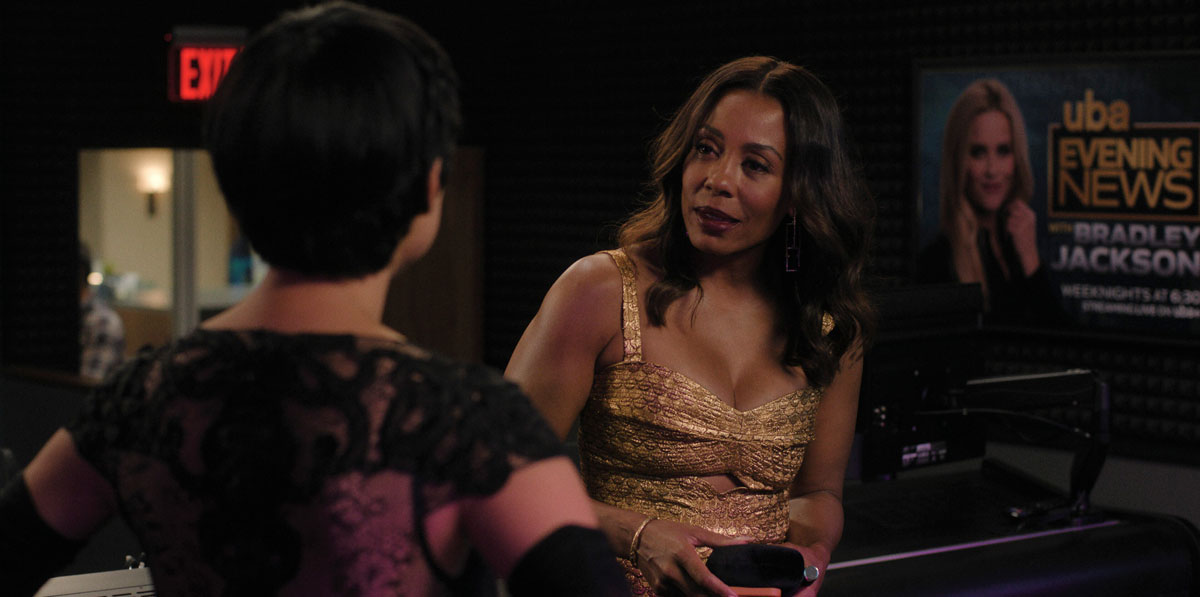
Simultaneously Paul offers Stella — the person he nearly drove to off herself — the top job at UBA which, at the moment, belongs to Cory Ellison (Billy Crudup). And Stella, a highly intelligent woman, doesn’t just flirt with the opportunity, she gets thisclose to letting Paul put a ring on it. To slow herself down Stella broaches her quandary confidentially to devoted producer Mia Jordan (Karen Pittman), admitting she feels queasy about selling out Cory after he’s been so good to her, the always levelheaded Mia sets her straight.

“Failure for Cory means a big, fat check and another turn in the grand game of corporate musical chairs,” she says. “There are only so many jobs at the top. White men don’t give them up willingly.”

“No, they don’t,” Stella admits. “But do I want to be like them?”

“Please. You already stepped over a few bodies to get here,” Mia reminds her, adding, “I think the only difference between us and them is that we let the ghosts torment us.”

Right there, this exchange illustrates this show’s potential to be an insightful, elucidating workplace drama that honestly portrays the stakes and pitfalls of working in media or any high-level corporation. This season has struck a couple of bullseyes in terms of depicting the two-tiered compensation system at UBA wherein Black employees are paid less than their white colleagues for doing the same job, a fact with which Mia is as familiar as how the rest of the game is played.

So . . . why doesn’t Mia tap into that knowledge to make her own moves? For that matter, why does Christina Hunter (Nicole Beharie) have to be the character to flip out in a bathroom full of fancily dressed white women who aren’t sufficiently bothered about their abortion rights being stripped away? Why can’t the job fall to, say, Alex? Or any woman other than her or Mia?

 The Morning ShowKaren Pittman in "The Morning Show" (Apple TV+)The core irony of “Strict Scrutiny” is simple to suss, which is that none of the women in this show have a firm grip on their destinies. Neither Alex nor Stella are immune to what smells like manipulation on Paul’s part, although they should know better. Mia is married to her job but somehow unable to demand more from that withholding spouse, including some material assistance in ensuring her freelance photographer/lover Andre (Clive Standen) made it out of a war zone safely.  

We need your help to stay independent

For reasons that we can’t quite explain Chris — a morning anchor on a major news network — decides to post a selfie of her posing with her middle finger extended after writing “Abort the Court” in lipstick on the bathroom’s mirror.

By inserting real-life headlines into its alternate universe long after their fires have gone cold for us, “The Morning Show” strives to maintain a certain topical relevance while ensuring each season will always feel at least a year out of date. Even that’s something of an improvement since the first season’s #MeToo arc played out about two years after the movement died down.

Still, if one were to remove the actual context of that RBG quote, the third season so far almost competently organizes itself around its female characters struggling and failing in their quest to take control of their careers and their place in UBA’s twisted foxhole.

That’s why it’s frustrating to see the writers transform Alex into what is essentially a version of Julie Chen Moonves, as in a TV personality who binds herself to a millionaire’s power despite his rotten reputation. Alex surfaced revelations about Paul in an interview that, as a reminder, hasn’t aired yet. Admittedly some of my annoyance with this subplot’s development is related to a general irritation at shows that feature journalists sleeping with sources as if that’s, you know, a widespread phenomenon instead of one of the gravest ethical missteps someone can commit.

What does this show want us to care about? The end of “Strict Scrutiny” leaves us baffled on that account.

In this season it’s another tick on the count of occasions where realism is tossed out the window in favor of duh-doy! melodrama. Having said that . . . the love scene between Alex and Paul — or, more to the point, two very attractive actors – was pretty steamy, wasn’t it?

Maybe not as thrilling as meeting Cory’s mother Martha (Lindsay Duncan), which Bradley (Reese Witherspoon) is hauled into doing for reasons that aren’t entirely crystal. That is other than enabling the writers to make a point about Cory having been raised by a politically connected emotional chimera of Joan Crawford and Faye Dunaway. Perhaps mummy's crazy toughened him into the relentlessly ambitious controlling bastard he is today, one who’s still obligated to center himself by listening to a few bars of the Beach Boys’ “Kokomo” before ringing her doorbell.

Mother, it seems, has been freelancing on her son’s behalf – unasked – by poking a few of her D.C. connections to smooth Paul’s acquisition of UBA. The board isn’t pleased by this, according to Leonard Cromwell (Stephen Fry), who urges Cory to put a stop to the meddling.

The real treat is to watching Duncan purr and hiss her way through mood swings, culminating in a roughly whispered, revealing complaint to her son: “It’s so interesting what happens when women get older. We carry this wisdom, but no one cares. And we’ve survived the death cult of capitalism but, really, you just want us to get out of the way, don’t you? You want us to be silent, quiet as the grave.”

Then he sings her into temporary calm by launching into “Ain’t No Mountain High Enough” on the piano, luring Mommie Dearest to join him in a duet. The spell breaks with Martha barking a warning at Bradley that Cory is simply managing both of them.

Seven episodes into the third season a part of me craves some deeper meaning and messaging about information control and the slow strangling of the Fourth Estate by billionaires like Paul Marks, about whom Christina sagely observes, “There are studies that show power, it actually changes the brain. It erases the ability to empathize. It makes me wonder, what does Paul Marks really care about?”

That's probably expecting too much of "The Morning Show." But, to pick up on that note, what does it want us to care about? The end of “Strict Scrutiny” leaves me baffled on that account.


Want a daily wrap-up of all the news and commentary Salon has to offer? Subscribe to our morning newsletter, Crash Course.


Stella’s old friend Kate (Natalie Morales) shows up unannounced to warn Stella that Paul fired her and UBA needs to be investigating him, not getting cozy with the titan. But she soon realizes Stella is back under Paul’s thumb: “This is how you are with him; he owns you,” she says before leaving angrily.

 The Morning ShowGreta Lee in "The Morning Show" (Apple TV+)In the car ride on their way back to New York from mom’s place in Connecticut, Cory coldly informs Bradley that they’re not friends: “We are two people who use each other, Bradley. That’s it,” he says.

Back at UBA, after freaking out over a tabloid obtaining a shot of him being intimate with Alex, Paul pulls her into a post-party make-out session in her office. Which Chip, of course, sees.

It is essential that women be the decision makers, which explains why seeing the central women on “The Morning Show” ignore their supposed wits to be handled by the men around them is so aggravating. And that may provide enough of a reason to keep watching – the end of one of their puppet strings may connect to a way out of this murk after all.

New episodes of "The Morning Show" stream Wednesday on Apple TV+.

Experts explain what it really means to be “triggered” and how to navigate personal trauma

Dr. Ramani Durvasula is a clinical psychologist who writes extensively about mental health topics, so when she uses the term "triggered," it is not done flippantly — such as to complain that one was "triggered" by a woman's ugly dress. She said that people who misuse the term "trigger" are "doing a disservice to people who are navigating life while managing recollections and reminders of prior traumas. I work with clients with trauma histories, and to be 'triggered' is a very real and disruptive experience."

In the same vein, Dr. Jessica January Behr told Salon by email that "triggers are not just things you don't like or that offend you," adding, "the word trauma and trigger are thrown around very easily these days and while exposure and destigmatization are important, it is also important not to co-opt trauma into the generic colloquial lexicon. It is crucial that words retain their meaning in order to properly identify what it is we experience and what we can do about it."

Indeed, people who are triggered by traumatic memories experience genuine distress and even danger, and as such conversations around being "triggered" are most productive when they focus on actual mental health patients. "Trauma is a neuropsychiatric condition resulting from the experience of distressing or life threatening events," Behr told Salon. "Triggers are the environmental catalysts that set off psychophysiological memory of the trauma and initiate a set of symptoms."

Dr. Benjamin W. Bellet, a clinical psychology postdoctoral fellow at Massachusetts Mental Health Center, broke down exactly what happens in the brain of a trauma patient when they experience being triggered, emphasizing that post-traumatic stress disorder (PTSD) is at its core a "disorder of memory."

"Those suffering from PTSD have a memory of a traumatic event that is highly accessible (frequently recalled) and emotionally intense when recalled long after the traumatic event has occurred," Bellet explained to Salon by email. "This means that (relative to individuals who have experienced trauma but do not have PTSD, who form the majority of trauma survivors), those with the syndrome experience frequent unbidden intrusive memories of the traumatic event, flashbacks (feeling as if the traumatic event is happening again in the present moment), and psychological and physiological reactivity to reminders of trauma."

People will feel intensely afraid or anxious, their heart rate will shoot up, their body will tremble and they may suffer panic attacks.

"Traumatic stress creates an increase in the firing and presence of neurotransmitters cortisol (a stress hormone) and norepinephrine (adrenaline)," Behr explained. "MRI studies have shown that those experiencing symptoms of PTSD or traumatic stress exhibit structural brain changes including smaller and less active hippocampus (memory center of the brain) and increased amygdala function (emotion center). Therefore, when a traumatic experience occurs the cortisol and norepinephrine receptors in your brain and body increase and this can create structural brain changes that can increase emotional response and decrease the proper encoding and storage of memory."


Want more health and science stories in your inbox? Subscribe to Salon's weekly newsletter Lab Notes.


"Those with the syndrome experience frequent unbidden intrusive memories of the traumatic event."

Durvasula, who echoed Behr's explanation of the neurochemistry behind being triggered, helped clarify matters by detailing exactly what happens to a triggered person as they endure they ordeal. It is not merely that they are remembering something unpleasant — there are a whole panoply of emotions and emotional responses that factor into being triggered.

"When a person is triggered they are responding as though there is a clear and present threat – though to an external observer there is not – these threats can either be experienced internally (e.g internal sensations) or due to external stimuli (e.g. smelling something associated with a past traumatic event)," Durvasula observed. People who are triggered respond in part through their sympathetic nervous systems, involving what is traditionally known as the fight/flight/freeze response. People may also hyperventilate, sweat, experience chest tightness or sweat profusely. All of this culminates in the patient feeling panicked.

"Accompanying these physical sensations can be a whole set of emotional reactions including fear, terror, anger, sadness, exhaustion, guilt/shame," Durvasula told Salon. "In some cases, when a person is triggered they will dissociate – which may manifest as an alteration of consciousness and numbing of emotion. These won’t be the same for every person – and will vary based on numerous factors including history of adverse childhood experiences, other co-occurring mental health issues, issues specific to the trauma."

"Breathing grounds us, and dysregulated breathing is one of the many of the sympathetic nervous system responses at the time of being triggered."

It's important to note, people who are triggered do not have to suffer alone. In addition to having a strong support network of family and friends, there are ways that people who suffer from these reactions to cope. Durvasula said that there is no substitute for getting professional treatment, urging people who have experienced treatment to work with licensed mental health providers. In addition to that, though, Durvasula said there are also techniques a person can use at home and in the moment. This includes breathing exercises.

"Breathing grounds us, and dysregulated breathing is one of the many of the sympathetic nervous system responses at the time of being triggered," Durvasula observed. "By working on breathing at times a person is not triggered, it can become a practice a person can turn to as a tool to center and ground when they do feel triggered."

She also recommended placing a hand on one's chest, finding one's pulse, feeling one's hand go up and down — anything that can ground an individual when the negative physical responses associated with being triggered seem overwhelming. Taking an inventory of one's environment through one's physical senses is a mental trick both Durvasula and Behr suggested.

"Returning to your body through grounding practices can be beneficial for combating your response to a trigger," Behr pointed out. "One way of going about this is to activate the Five Senses. Name 5 things I can see, 4 things I can hear, 3 things I can touch, 2 things I can smell and 1 thing I can taste. This exercise returns us to our bodies and allows us to activate our senses in a way that can decenter the trigger."

We need your help to stay independent

Bellet offered other suggestions for how people can escape from feeling triggered when that happens, such as leaving the classroom when a difficult topic is brought up. Of course this is only a temporary coping strategy — ultimately, patients are encouraged to expose themselves to reminders in a supportive environment so they can learn healthy ways of managing adverse stimuli.

"Indeed, most evidence-based therapies for PTSD entail the opposite behavior, i.e., exposure to the trauma memory and reminders in a supportive therapeutic environment in order to help survivors to deal with difficult emotions without forming their lives around the basis that such emotions are dangerous," Bellet told Salon. "Therefore, the best way to feel safe around triggers is to seek evidence-based therapy for PTSD."

The “Bake Off” competition heats up during chocolate week — and now a double-elimination looms

In the introduction to this week’s episode of “The Great British Bake Off,” reigning star baker Tasha had some choice words regarding chocolate week: “The things that you love the most, hurt you the most.” 

As has been the case for the last several seasons, the start of chocolate week is falling on the hottest day of the year in Wellford, the palatial English village surrounding the tents. Coincidence or purposeful scheduling from the production crew to introduce just a whisper of drama to the show? You decide. 

What’s clear from the jump, though, is that the 50s-style freezers stationed throughout the tent will be getting a workout this week as the contestants are challenged to temper, cast and sculpt all manner of chocolate, starting with the signature challenge: a decadent chocolate torte — made without traditional wheat flour. These tortes, which are usually layered with mousse and jam, are already a little denser than your average chocolate cake; the challenge here for the bakers is going to be making sure that whatever they choose to replace the wheat flour doesn’t weigh the final product down. 

The most common replacement used among the contestants is ground almonds, but some people, like Rowan, are attempting something a little more ambitious. In his case, he’s skipping the flour altogether and going for a base made solely of whipped egg whites, which Prue says will be quite luxurious if he can pull it off. 

“They can show off a bit,” Prue said in an aside to the camera. “And they should.” 

By and large, however, everyone seems to be playing it a little safer than they did during last week’s bread-themed challenges, which tripped up even consistently even players like Dan. That said, Dan tells the judges he’s had a good reset (perhaps derived from doing tai chi on a mountain as Noel suggested?) and that everything is tickety-boo, and while his ultimate creation, a chocolate and cornmeal torte with chili-chocolate truffles, isn’t quite a complete success, it’s clear that he’s feeling a bit more centered this week. 

Rowan’s flourless cake doesn’t sink and turns out perfectly balanced, incorporating espresso flavors which judge Paul Hollywood seems to love; I’ll be honest, I was anticipating a Hollywood handshake based on Paul’s face as he ate, but it didn’t come. In the end, Nicky seems to have come out on top with Prue by making a simple, but dreamy chocolate torte with sleek, molded chocolate decorations, which Prue describes as “classy and cool” and  “a little piece of art.”

“I think I’m ready to skip off into the meadow,” Nicky jokes, before doing just that. 

This week’s technical challenge comes from Prue “Princess of Puddings” Leith. She asks the contestants to make six perfectly-baked individual cheesecakes with a caramelized white chocolate filling, biscuit crust, a layer of jelly and molded white chocolate decorations. 

Unlike the signature challenge, the bakers haven’t had a chance to practice this dessert and, as always, the instructions are pretty vague. What promises to trip them up in this round is achieving an evenly  caramelized batch of white chocolate, which in this recipe is actually achieved by microwaving the chocolate in short, 30-second bursts and then stirring it aggressively. 

Prue had teased that the contestants needed “perseverance and patience” in this round, and if having to babysit a notoriously temperamental ingredient, a process soundtracked by an uneven score of appliance beeps, doesn’t teach you those virtues, I’m not sure what will. After scorching his white chocolate pretty badly — leaving it looking like flaking cosmetic foundation caked to the inside of a bowl —Rowan looks to the camera in despair and declares: “I’m going to set up a charity for everyone who has ever worked with caramelized white chocolate.” 

The heat isn’t doing anyone any favors, either. Midway through the round, Tasha, who had been sick the week leading up to the challenge, begins feeling unwell and after consulting with the show medic, is sent home to rest. Everyone wishes her well, but it raises the question of how the elimination round this week will be handled. 

We need your help to stay independent

As the eight remaining bakers line up their cheesecakes, it’s clear that this was a rough challenge. The judges roll through the critique: Saku’s cheesecakes were terrible and overbaked; Cristy’s were melted and a bit grainy; Josh’s were far too dark; Dana’s jelly was rubbery; Nicky’s base was uneven; Rowan’s were melted. 

Matty — whom Allison joked came in acting like a professional this week — came in second place after a fairly successful signature in which he made an ambitious chocolate and hazelnut torte. Maybe things are turning around for this baker who has kind of hovered in the middle of the pack, so far? But once again,  it’s Dan standing at the top of the podium with the only cheesecakes the judges described as coming out correctly. 

I know it’s a little early to start making predictions, but I think Dan and (provided she returns) Tasha are going to be our final two bakers. 

This week’s showstopper challenge is deceptively simple: The bakers are charged with making a chocolate cake, and then making a box out of chocolate to put said cake inside. The specifications beyond that are pretty loose, which leads to some interesting interpretations. 

Some bakers — like Matty, Josh, Nicky and Saku — go for sleek, simple chocolate boxes with decadent cakes inside, really focusing on flavor and technique. Others go a bit more whimsical, like Dan, who made a treasure chest filled with a tropical-flavored cake, and Dana, who attempted to make a Cinderella-style carriage out of the chocolate. 

This week, simplicity wins as Matty is rewarded with the title of star baker. This feels like a real breakthrough week for him and it will be interesting to see if he can keep up the momentum in next week’s pastry-themed challenges. 

There are no great failures this week, though Rowan had a bit of a rough go making his painter’s palette-inspired chocolate box. He didn’t have a chance to practice because it was final’s week at his university, so I think we should give him a pass. 

And in the end, everyone actually ends up getting a pass because, according to the unspoken laws of reality television, on any week in which a contestant leaves unexpectedly, there’s no elimination round. However, the specter of an impending DOUBLE-ELIMINATION round now looms over the tent. 

Not even Martin Scorsese can beat Taylor Swift at the box office

Taylor Swift's “Eras Tour” concert film — well into its second week, pushing aside "The Exorcist: Believer" when its director knew better than to risk sharing a premiere date — is still dominating at the box office, beating Martin Scorsese’s “Killers of the Flower Moon” on it opening weekend. 

According to Variety, the epic-length historical drama starring Leonardo DiCaprio, Robert De Niro, Lily Gladstone and Jesse Plemons earned $9.4 million from 3,628 theaters on its opening day and is now projecting a finish of $23 million over the three-day opening frame — tracking ahead of the opening for Scorsese’s last Leonardo DiCaprio collaboration “The Wolf of Wall Street” — and yet, it's but another example of star power losing out to "Swiftie" power. On its second Friday, "Eras Tour" earned $10.4 million, having exceeded $100 million domestic gross. 

As The Hollywood Reporter points out, the audience for "Killers of the Flower Moon" is skewing older and more notably male at 61percent.  With droves of women and young girls flocking to theaters over the past two weeks to sing along with Swift's film, the box office numbers may be reflecting expectations when it comes to putting on a good show. 


What if they’re not crazy? Belief in conspiracy theories may be normal

At least since the publication of Richard Hofstadter's "The Paranoid Style in American Politics," belief in conspiracy theories has been seen as an aberrational, fringe phenomenon. But what if is isn't? A 2014 study by Eric Oliver and Thomas Wood of the University of Chicago found that “half of the American public consistently endorses at least one conspiracy theory.” So such belief isn't just found on the fringe. Now a new paper by a team at the University of Antwerp, led by Sander Van de Cruys, argues that it’s not so aberrational either. “The motto of the conspiracist, ‘Do your own research,’ may seem ludicrous to scientists,” they write. But a close look at the information-seeking process itself finds that it’s not fundamentally different from what scientists themselves do in making discoveries — especially when it comes to the importance of “aha moments.”

This isn’t to say there’s no flawed thinking involved in embracing conspiracy theory — but flawed thinking is itself normal among human beings, including scientists. So the question isn’t whether conspiracy theorists’ thinking is sound, but rather to what extent it isn't, and how it differ from the thinking of people who don’t embrace conspiracy theories. This entire approach offers some good news by opening the door to better and more open-minded ways of engaging with conspiracy theories and their followers. To learn more about this paper — which is titled “Insight in the conspiracist’s mind” — I interviewed Van de Cruys, a postdoctoral researcher at the Antwerp Social Lab. Our email exchange has been edited for clarity and length.

The conventional view is that conspiracy theories and those who embrace them are aberrational. Your paper argues that they're not, and offers a specific model for why. But first you go into some of the problems with that conventional view that recent research has brought to light. What are those problems?

The key problem is both moral and scientific. These "aberrational accounts" paint a picture of some humans (those with conspiracy theories) that is not supported by psychological science, namely that they are mere passive recipients of whatever (mis)information they are bombarded with. The metaphor of (mis)information as viruses in an infodemic reinforces this view of passive, gullible people who are powerless against "infection" by "contagious" misinformation.

The epidemiological analysis of the spread of misinformation that flows from this and the efforts to come up with "misinformation vaccines" (so-called prebunking) are not without value. But psychologically speaking, it is a simplification that hampers us in understanding unusual beliefs that people actively (re)construct, and that generally hang together in networks of beliefs (like conspiracy theories) rather than being built from a pile of isolated, debunkable pieces of misinformation. 

"Their search for alternative answers is genuine, and is born from the fact that their experiences are excluded from official knowledge-gathering in society."

The immediate impetus was that I talked to and read about conspiracy believers who were smarter than conventional theories, which presented conspiracists as flawed cognitive beings, made it look. Their search for alternative answers is genuine, and is born from the fact that their experiences are excluded from official knowledge-gathering in society. One could say they are very empiricist in this: They conclude that bedrock facts are denied by policy makers and intellectual elites. It is easy to ridicule the theories they come up with to explain this denial, but what drives them is this curious discrepancy and the sense of insight that comes from discovering subjectively plausible patterns behind it. 

So the moral problem that flows from the aberrational view is that it reinforces the sense of exclusion that is at the very root of people's autonomic search for alternative answers in conspiracy theories. 

You write that "The motto of the conspiracist, 'Do your own research,' may seem ludicrous to scientists." But your paper explores "the information-seeking activities ('research') that conspiracists do engage in," focusing on the role of "aha" moments specifically. So what are "aha" moments?

If the "viral" social transfer view of how people adopt misbeliefs is incomplete, we wondered: What other model do we have of how beliefs are formed? The classical competing view is that of normative reason, namely that we adopt beliefs when they are justified and true. But this is equally implausible psychologically. What this view does right is to acknowledge that humans are epistemic agents, meaning they actively search for information and construct their own mental models of the world. But we are limited creatures, limited in our experiences, in what we can do to explore the world and in the resources we use to build our models of the world. There is no way we can live up to the tall order, or indeed afford the luxury, of only forming justified, true beliefs. We'd all be dead before we could make the fully resolved judgments and actions. 

So while ultimate-ground truth is unavailable for us mortals, we do have experiences that guide us in our search toward uncovering the structure of our world. We have curiosity that urges us to actively seek out particular pieces of information, and such epistemic quests are often marked by "aha" experiences, when we suddenly get an insight that "clicks" together pieces of already existing beliefs and new information. When this happens, beliefs seem to be reinforced and they take on new confidence, as empirical research on "aha" experiences shows.

Can you give me an example of how that works?

"There is no way we can live up to the tall order, or afford the luxury, of only forming justified, true beliefs. We'd all be dead before we could make the fully resolved judgments and actions." 

In the lab, we create "aha" experiences in by presenting people with a puzzle, usually visual (think of the Dalmatian dog hidden figure) or verbal, for example: "Breakfast was excellent because the thread was sticky." These puzzles create uncertainty, leading to an active search for a solution. Eventually, people will suddenly discover a restructuring of the input that provides a satisfying explanation for the puzzle and resolves the uncertainty experienced (they see the Dalmatian, or they understand that spiderweb is the key concept to "reorganize" the puzzle sentence above). In the best cases, this comes with an intense positive feeling, and a sense of truth that cannot be unseen: The Dalmatian will be one's experience now, rather than the disorganized black-and-white patches one experienced before finding the solution.

Why are "aha" moments" epistemically important?

Both the seeking out of information, experienced as curiosity and the "aha" experience are limited by our particular mental models and the evidence we can gather, so they are not foolproof. The "aha" experience will depend on a so-called top-down hypothesis one has learned and can apply to the perceptual inputs. If I have experienced Dalmatian dogs before, I will be more likely to get to the solution in those distorted images. 

Even though they are often reliable indicators of actual states of affairs, they remain subjective. False insights are possible and can be elicited in the lab as well. We all, scientists included, know those instances of an "aha" experience that later turned out to be wrong. These may be rare, precisely because it is pretty hard to backtrack once you've had this sense that you have a clear picture of the situation. "Aha" experiences feel like a distinct endpoint. One could say that science is characterized not by more frequent insight experiences, but by counterintuitively taking "aha" experiences as starting points rather than endpoints. 

So why are "aha" moments useful in helping us understanding conspiracist thinking as normal — or at least as normal-ish?

Because this shows that part of what drives the scientist and the conspiracy builder is the same. It is not that the conspiracy believer "falls for" a conspiracy theory, while the rest of us (notably scientists) "discover" our beliefs through insights and evidence. We both discover our beliefs. We usually reserve the word "discovery" for tech breakthroughs or Nobel Prize-worthy scientific work. But especially for infovores like ourselves, who need to explore and get insight in the structure of our world, before we can get what we need (whether that is food, social status, sex or something else entirely), the sense of discovery or insight is as vital as those other biological needs. 

If conspiracists are driven by insights, they’re not so strange. Or as I like to put it: Scientists are not so strange. They are far from the only ones with a need for epistemic agency and discovery. This is all based on the underlying theory of the Bayesian brain, which says that  we’re all proto-scientists, continually trying to capture and predict the structure of our environment, but with a strong bias towards our pre-existing models. 

"One could say that science is characterized not by more frequent insight experiences, but by counterintuitively taking 'aha' experiences as starting points rather than endpoints." 

Our "aha" experiences are the only thing we can rely on in our individual quests for knowledge. They are metacognitive signs that our model-building is going well, that we have succeeded in resolving uncertainty about the world using our own thinking and actions. So the normal cycle is to experience curiosity when we come across uncertainty we feel can be resolved (as in the puzzles described above), to forage new information, search our models when this happens and, when we are lucky, to find cognitive closure or uncertainty-reduction in the insight experience, when we manage to restructure our impressions of the world. 

The models that conspiracy thinkers start out with will differ from other people's models, but within this thinking-frame particular information-seeking and restructuring can lead to "aha" experiences, meaning that they suddenly reduce uncertainty relative to a prior state of uncertainty. 

You note that "aha" moments "have properties that can be exploited by conspiracy theories, such as the potential for false but seemingly grounded conclusions." What are some examples of how those moments can lead us astray?

We already mentioned that "aha" experiences do not necessarily imply complete truth, but empirical research shows that they come with a confidence-boost for that content. Interestingly, recent research suggests this can carry over to co-occurring content. They used sentences like "ithlium is the lightest of all metals," where the anagram was used to create an "aha" experience. People subsequently tend to judge the whole statement as more accurate when they experience an "aha" for it, even though the "aha" is strictly unrelated to the truth of the sentence. 

We need your help to stay independent

We also mentioned that "aha" experiences provide a sense of clarity or understanding that works as an endpoint in one's information search. They have what philosopher C. Thi Nguyen has called a thought-terminating effect. They mark the moment when uncertainty is resolved, relieving you from the need for further thinking, such as trying another hypothesis or collecting additional information. 

Another interesting property is that an "aha" experience depends on something the individual has inferred or generated themselves. I might have told you that there is a Dalmatian dog in the image, but you have to reconstruct it yourself to really experience the "aha." We know from experimental psychology that people remember things better when they have contributed to it or generated it themselves, and also value such things more. It creates ownership of ideas, and that is of course important in conspiracy beliefs as well.

The "aha" experience also projects into the world what was clearly a construction of your own mind. You might say the Dalmatian is the truth of the image, because the image is created from an actual distorted photograph of a Dalmatian — but the image wasn't sufficient evidence of that until you constructed the Dalmatian. We see that people sometimes, with great confidence, will discover things in these kinds of images that are not there, in the sense that they weren't in the photograph that the image is derived from. All these properties help explain the "stickiness" of conspiracy beliefs that are formed by insight experiences.

How do conspiracy theories and those who spread them exploit this?

Anytime conspiracy believers use questions, partial cues or "mysteries," like the Q-drops we see in QAnon, to recruit people instead of mere statements of "fact," they rely on people's curiosity and invite people to do their own searching for "truth," collecting clues and generating the "plot" behind them. These challenges present information in a subtle, non-directive way that does not feel patronizing or manipulative (compare this to the "fact checks" that are often used, with limited effect, to debunk conspiracy theories).

"Anytime conspiracy believers use questions, cues or 'mysteries,' like the Q-drops we see in QAnon, instead of mere statements of 'fact,' they rely on people's curiosity and invite people to do their own searching for 'truth.'"

These tactics aren’t specific to conspiracy theories: As a student, I was encouraged to generate questions myself which had the central pieces of information as part of the to-be-constructed answers, instead of making summaries or regular notes. Knowledge acquisition is (re)constructive in this way, so it is no wonder that conspiracy circles have also evolved to use these techniques for reliable belief change.

Conspiracy theorists seem to go a step further, however, by prepackaging the insight (or answer) into the question. The prototypical form is the internet meme, often used in modern conspiracy milieus. They often rely on some kind of expectation-violation that attracts attention (curiosity) — it poses a question, but also has a pre-engineered resolution, a conclusion to be drawn by the meme consumer. It requires a cognitive contribution, albeit with minimal effort, from this consumer. So an idea is planted, but the individual does most of the planting themselves. We can only truly convince ourselves.

While the phenomenon of the "aha" moment is relatively easy to grasp, you write that "At the core of our account is the role of epistemic arcs to explain the pull of conspiracy thinking," and that's a less obvious concept. So what is an epistemic arc?

The epistemic arc is a concept we use to emphasize that "aha" moments don't stand on their own, but start with a level of curiosity which creates the urge to act and seek more information to reduce uncertainty, which in turn can result in an "aha" experience, understood as a sudden, unexpected resolution of uncertainty. This is rooted in computational, mechanistic theories of what causes curiosity and "aha" experiences on the subpersonal level, that are the subject of active empirical study in psychology, neuroscience and artificial intelligence.

What's a specific example?

Epistemic arcs can be short, as in the example of the memes discussed above. Little effort is necessary here to resolve uncertainty. But they can also be longer, which means more effort, more information seeking and hypothesizing is needed, so uncertainty persists longer. There is more risk that people will prematurely break off such arcs. 

Think of a detective novel, or better yet a literary novel. While the detective novel will often gradually resolve uncertainty and give you clear frames of thinking that lead to limited, well-defined regions of uncertainty, for a literary novel you might not know whether you'll be able to comprehend and resolve uncertainty. Here, curiosity becomes crucial: If the author can sustain the feeling that the uncertainty created will also be resolved — one can read this as building trust by enabling the reader to close other arcs— the reader will continue to "work" to resolve uncertainty.


Want a daily wrap-up of all the news and commentary Salon has to offer? Subscribe to our morning newsletter, Crash Course.


Our impression is that conspiracy theories tend to shape people's beliefs through shorter epistemic arcs, always requiring some epistemic agency, but the challenges remain low-threshold so the insights are accessible to many. Again, everything depends on already existing mental models of reality: They will make uncertainty manageable or not.

The information-seeking that conspiracy thinkers conduct is often belittled: It's just internet searches to dredge up supposed evidence that supports already fully-formed beliefs. But we know very little about these acts and the epistemic arcs in which they feature, because much of this takes place in the secluded context of home internet use, using proprietary systems. There is interesting scientific research to be done on the methods and effects of online search in conspiracy believers.

You have some suggestions about how to test this explanation of conspiracist thinking.

One route is the exploratory one: Looking at conspiracy thinkers' information-seeking strategies, either in natural settings or in controlled lab settings where we give people semi-structured search tasks and look at how they go about it. A second route is to do more ethnographic studies into what role information-seeking practices and epistemic emotions like curiosity and "aha" moments play in the development of conspiracy views. This research can rely on in-depth interviews, but also on content analysis of social media conversations in conspiracy channels. 

Experimental research will also be necessary to establish our explanation of how conspiracy beliefs are formed. We’re working on integrating challenges or puzzles in stories that contain conspiracy accounts of an event, versus control stories that present official accounts. Participants can solve these challenges on their own, leading to an "aha" moment that will reveal crucial information on the conspiracy or control story. We examine whether such embedded puzzle-solving and "aha" experiences will lead to higher judged plausibility of the stories — both kinds of stories, or only the conspiracy version.

In a correlational study, we recruit people who are high or low in conspiracy beliefs and look at whether conspiracy believers tend to have stronger "aha" experiences, even with materials not linked to conspiracy theories. The goal is to characterize conspiracy theorists' epistemic sensitivities and how they might differ from nonbelievers.

How does your account connect with the broader observation that conspiracy theories tend to be embraced by people who feel socially excluded?

We propose to look at the epistemic dimension of this social exclusion or injustice. A common core in social exclusion is the sense that one's actual lived experiences have no place in society, while one's autonomous knowledge-building based on those experiences is disparaged. Conventional wisdom holds that this should be left to epistemic authorities like doctors, scientists, lawyers, politicians, engineers, etc. Social, existential lack of autonomy is hence mirrored in epistemic lack of autonomy. People deprived of epistemic agency and subjective insight in their own life will reassert it, in ways that of course also explain the exclusion. 

This doesn’t mean people will correctly discover the specific causes for their exclusion. As journalist Sebastian Milbank recently wrote: “The specifics of conspiracy theories are nonsense, but they flourish because the generalities — that we’re governed by unaccountable elites, whose interests are served by global rules and organizations — seem unassailably true.”

"People deprived of epistemic agency and subjective insight in their own life will reassert it, in ways that also explain the exclusion. That doesn’t mean they will correctly discover the specific causes for their exclusion."

So we make a distinction when it comes to the peddlers of conspiracy theories in media or politics. They generally don't do so from a sense of exclusion: A dominant group can sometimes claim the underdog position as a way to attract adherence from actually disadvantaged groups. As a psychologist, my focus is on the formation rather than the instrumentalization of conspiracy theories.

Your paper takes on a number of possible objections. The fourth one seems most central to me: How we "reconcile the ubiquitous idea that conspiracists have a fixed, closed mind, with the dynamic practices of world-building and discovering" that you identify as a "core feature and attraction of conspiracy thinking."

Look at how dynamic conspiracy theories actually are. Because conspiracy theorists come across as extremely stubborn, it is often assumed that their thinking is maximally rigid, and there is little actual research that follows conspiracy thinkers or their theories for a longer time to see if this holds true. So we don't really know.

Another way to respond is to emphasize that discoveries require new observations, but not necessarily a lot of change in one's prior beliefs. Such new evidence can create a new sense of insight, showing the goodness of an explanation. Note that what counts as relevant evidence is in itself dependent on your models of the world.

Without denying the differences between scientists and conspiracy theorists, philosopher of science Thomas Kuhn has argued that so-called puzzle-solving is the default activity of scientists: Fitting new evidence within known frameworks and working out the details of a more or less fixed paradigm. Paradigm shifts are comparatively rare, and only induced by repeated, persistent violations of the paradigmatic assumptions. 

"It's possible to see conspiracy theory as a 'pirate science' that's stuck in the puzzle-solving phase, with its own conferences, its own publications, its own channels for evidence evaluation."

It's possible to see conspiracy theories as a "pirate science" that's stuck in the puzzle-solving phase. We see that conspiracy circles have their own conferences, their own publications, their own channels for evidence evaluation. We tend to see an elaborate ploy in this — these are things they set up to give themselves more respectability than is warranted — but our analysis suggests there's an authenticity to this social puzzle-solving. Let's not forget that science has also had periods of stagnation, where dead ends were pursued that later turned out to be pseudoscientific or proto-scientific. 

In your conclusion, you discuss some implications for how conspiracism can be dealt with as a social challenge. What would you suggest?

First, if conspiracists do not engage in harmful behavior, we should let them be. There’s already a strong sense among conspiracy theorists that there’s a well-organized thought police, so organized efforts to fight these ideas have little chance to succeed. 

Also, given that the label of "conspiracy theory" is sometimes used by politicians to dismiss legitimate concerns, as scientists we should avoid getting drawn into this. We can use our expertise in doing research to counter the inaccurate claims of conspiracy theorists when they risk getting adopted more broadly in society, but we should maintain clear independence from ruling parties, whether in industry or politics. For example, we can investigate the roots of epistemic and social exclusion in society, and we can be more receptive and inclusive to experiences of people who have little voice in society.

A well-functioning democratic society can deal with  minority dissent, even if it gets a bit weird. Research has shown that conspiracy theories become more than a small minority view in dysfunctional societies with higher corruption. This evidence is merely correlational, so it’s theoretically possible that higher conspiracy beliefs cause corruption, but most scholars agree that the other way around is much more plausible. The COVID pandemic illustrated this: Urgency led policy makers to skimp on some civic freedoms, creating a surge of conspiracy theories.

The way governments try to regain trust is by an emphasis on transparency, but these efforts are often quite shallow. Making information available is not the same as giving people insight. We have an abundance of information in modern society but it’s not disclosed in accessible ways or adapted to the models of listeners. In our increasingly scientifically and technologically advanced society, more and more aspects of our lives are governed by processes opaque to most citizens. This reduces our epistemic autonomy and creates a democratic deficit. Note that modern conspiracy theories often center on new technologies such as 5G or microchips or vaccines. There is no doubt these technologies have brought us great advances in health, safety and comfort. But when we fail to get people on board in our knowledge-creating system, and allow them to get insights within this system, they will search for it elsewhere. 

This is an immense task for science communicators, educators and any other expert in society, as the complexity of our knowledge only increases as we compete against low-threshold, readymade but flawed insights. If we succeed in building epistemic arcs in our science communication, like the best YouTube explainer videos do, we may be able to rebuild trust in our common knowledge-creation system of science and society. Not that all expertise needs to be disclosed in this way — that would entail actually becoming an expert — but just to rebuild trust and the sense that this knowledge has been responsibly built up by showing that it is in principle accessible and comprehensible.

Finally, we can try to use the "aha" experiences that conspiracists exploit to draw people in, to instead invite people out. We can use non-directive communication, such as curiosity-evoking questions and surmountable challenges, instead of simple statements of fact, to debunk false information. This approach may be more effective with people who are already suspicious of knowledge "passed down from above," such as conspiracy thinkers. More fundamentally, there is a worry that "one just can't talk to conspiracists." But a more Socratic approach of asking questions, thinking along further — saying, "Let's suppose this is true …" — as well as discussing information-seeking methods instead of the particular contents of beliefs, might give both sides a better idea of the concerns at play. 

Alexandra Pelosi discusses “The Insurrectionist Next Door” on “Real Time with Bill Maher”

In the first segment of "Real Time with Bill Maher" on Friday night, Alexandra Pelosi — documentarian and daughter of former Speaker of the House, Nancy Pelosi — discusses her latest film, "The Insurrectionist Next Door," in which she speaks directly with certain individuals who found themselves stalking the halls of the Capitol building two years ago. 

Referring to these people not as "bad," but as people who did a stupid thing on January 6 that they'll forever have to answer for, Pelosi points a finger at social media as a factor in how and why the insurrection played out the way it did.

"They're not bad people," Pelosi says to Maher. "They may have done some stupid things. They may be a little broken. They may be a little lost. But they have a different social media feed than you or I have."

Going into this a bit more, Pelosi tells an anecdote about one of the subjects of her film — who she calls "the gay Obama voter" —  calling her afterwards to say that his husband watched the movie and commented that he'd never seen footage of the violence in the tunnel before. 

"It's because they're on a different media feed than we are," she furthered. "They're not watching the same shows that we're watching . . . I think it's all about the social media and the way it's put everybody in their own little bubble. It's brainwashed them to believe that certain people are evil, and they've just been programmed to hate."

Watch a clip below:


Look what you made her do: The 8 takeaways from Prime Video’s Taylor Swift documentary

Taylor Swift has been enjoying her time under the spotlight recently. The acclaimed pop star is in the midst of her once-in-a-lifetime concert experience, The Eras Tour. Her highly anticipated movie "Taylor Swift: The Eras Tour" is already the highest-grossing concert film of all-time in the United States. And, on top of it all, she’s been enjoying nights out with her posse and rumored boyfriend, Kansas City Chiefs tight end Travis Kelce.

Of course, that isn’t enough content for Swift’s loyal Swifties because this week, Prime Video released an all-new Swift-themed documentary called “Unstoppable Taylor Swift.” The showcase delves into Swift’s masters dispute — in which Swift fought with her former record label, its founder and its new owner over the ownership of the masters of her first six studio albums — along with her journey to re-release her music.

From Swift's 2016 feud with Kanye West and Kim Kardashian to her record-breaking song and album, here are the eight biggest moments from the documentary:

01
At the age of 14, Swift became the youngest artist ever to be signed by Sony/ATV

In 2003, when Swift was just 13 years of age, she traveled to Nashville to sign with major labels but was unsuccessful. The following year, Swift was given an artist development deal after performing original songs at an RCA Records showcase. 


Swift ultimately left RCA Records at the age of 14 to sign with Sony/ATV, making her the youngest artist ever to be signed by Sony Music Publishing.

02
Swift's masters go to "incessant, manipulative bully" Scooter Braun

Swift’s infamous battle with music exec and entrepreneur Scooter Braun reached its peak when Braun acquired Swift's old record label, Big Machine Records, for a whopping $300 million in June 2019. As part of the deal, Braun became the new owner of Swift's first six albums with Big Machine Records: her self-titled debut, "Fearless," "Speak Now," "Red," "1989" and "Reputation."


Although Swift was aware that her label would eventually sell the masters, she wasn’t expecting them to be sold to Braun, whom she claimed was an "incessant, manipulative bully" during their prolonged feud.


“I knew he would sell my music. I knew he would do that,” Swift recalled in a conversation she had with Scott Borchetta, the founder of Big Machine Records, during a CBS News Sunday Morning sit-down. “I couldn’t believe who he sold it to. Because we’ve had endless conversations about Scooter Braun, and he has 300 million reasons to conveniently forget those conversations.”

03
Swift's beef with Kanye West and Kim Kardashian

The video features West lying in bed alongside a row of naked, lookalike sleeping bodies of famous celebrities, including Swift. Although West did not reveal which bodies were real and which ones were fake, he maintained that the video was "not in support or [against] any of [the people in the video]" and was purely “a comment on fame,” in an interview with Vanity Fair.


Shortly after the video’s release, fans noticed that Swift had liked a tweet accusing West’s video of being “straight-up revenge porn.”


“The famous music video was straight-up revenge porn. Not to mention putting abuse victims next to their abusers and celebrating sexual assaulters. It was disgusting and he doesn’t get enough crap for it,” the full tweet read.


Swift also referred to West and his then-wife Kim Kardashian as "bullies" in a 2019 Elle interview:


"I learned that disarming someone’s petty bullying can be as simple as learning to laugh. In my experience, I’ve come to see that bullies want to be feared and taken seriously," Swift said. "A few years ago, someone started an online hate campaign by calling me a snake on the internet."

04
Swift said Braun and Borchetta “exercised tyrannical control” over her music

A few months after Braun’s acquisition of her music in June 2019, Swift claimed Braun and Borchetta had told her she wasn't allowed to perform any music from her first six albums during her 2019 American Music Awards performance. 


Per the documentary, Swift said Braun and Borchetta “exercised tyrannical control” over her music, and Borchetta had told her team “that she would be allowed to use the music only if she agreed to not re-record copycat versions of her songs.”


“The message being sent to me is very clear,” Swift wrote in a comment. “Basically, ‘Be a good little girl and shut up, or you’ll be punished.’”

05
Swift’s eighth studio album, “Folklore,” was an unexpected creation
“Folklore” was created amid quarantine when Swift was spending most of her time watching movies and reading books “that dealt with times past.” Swift was inspired by the works of fiction she consumed to write songs “that weren’t strictly autobiographical, and instead experimented with alternative points of view,” the documentary explained.
 
The stories told in "Folklore" include a ghost that discovers its murderer at its funeral, a young girl with a traumatized friend, an elderly widow shunned by her community, recovering alcoholics and a love triangle between the fictional characters Betty, James and an unnamed woman," the documentary added.
06
Swift fills “Look What You Made Me Do” music video with Easter eggs

Swift’s lead single in her sixth studio album “Reputation” is riddled with Easter eggs, which she said are difficult to spot all in one go. The album was released when Swift stepped away from the public eye due to increased tabloid scrutiny on her private life. “Look What You Made Me Do” was Swift’s way of staying connected with her fans and expressing her sentiments about the heightened media attention she was garnering.


“Literally the whole video is just an Easter egg,” Swift told Entertainment Weekly. “There are thousands of Easter eggs. There are some that people still haven’t found. It will be decades before people find them all.”

07
William Bowery is a pseudonym used by Joe Alwyn

The English actor — and Swift’s ex-boyfriend — collaborated with Swift on several tracks from “Folklore” under the alias William Bowery. “William” was the name of Alwyn’s great-grandfather, William Alwyn, while “Bowery” is the name of the Bowery Hotel, where Swift and Alwyn first met in 2016.


William Bowery’s identity was officially confirmed in Swift’s Disney+ film “Folklore: The Long Pond Studio Sessions.”

08
“Anti-Hero” made history for its outstanding number of streams on opening day

Following the release of Swift’s tenth studio album “Midnights,” the hit single “Anti-Hero” earned over 17.4 million plays in its first 24 hours on Spotify globally, making it the biggest opening day for a song in the platform’s history.


As for the album, “Midnights” also broke major records on Spotify, like the record for the most streamed album in a single day with a whopping 186 million streams in its opening day.

"Unstoppable Taylor Swift" is currently available for streaming on Prime Video.

Mosquito-borne illnesses are picking up speed. Experts say Americans are unprepared

This summer, public health officials in Florida issued a warning to residents to avoid mosquitoes after five cases of dengue fever were reported. Also known as “breakbone fever,” dengue fever is an illness not to be wished upon a worst enemy. Symptoms include nausea, high fever and debilitating body aches and headaches, usually behind the eyes. Rashes can occur across the body, and in severe cases, bleeding can occur in the nose or gums.

It’s one of many mosquito-borne illnesses to creep back onto U.S. soil recently after many species were eradicated in the U.S. in the 1960s. Europe is also experiencing a surge in dengue, and severe outbreaks were also reported in Bangladesh, Costa Rica and Peru. The problem is only expected to get worse as warmer temperatures due to climate change expand breeding seasons and habitat ranges for mosquitoes. It’s a matter of when, not if, future outbreaks will spread in even bigger regions across the U.S., said Sadie Ryan, Ph.D., the co-director of the Florida Climate Institute at the University of Florida.

“This is important, and it is coming,” Ryan told Salon in a video call. “We know it's getting worse.”

Some drugmakers are working toward treatments and vaccines for mosquito-borne illnesses, with Johnson & Johnson yesterday reporting some positive results in an early study for a pill to treat dengue. However, scientists say we’re still unprepared for these outbreaks and should avoid repeating the same missteps made in the COVID-19 pandemic and the Zika outbreak in 2016.

It’s a matter of when, not if, future outbreaks will spread in even bigger regions across the U.S.

“The fact is, we’re not really ready,” said Dr. Peter Hotez, dean of the National School of Tropical Medicine at Baylor College of Medicine and co-director of the Texas Children’s Hospital Center for Vaccine Development. “Our local health departments are very spotty with their ability to do mosquito control and to even try to diagnose these viruses and mosquitoes.”

Dengue has popped up in occasional outbreaks in recent years, with cases usually located in small pockets along the U.S.-Mexico border that originate outside the country. However, 516 locally acquired dengue cases occurred in 2023 alone in Texas and Florida, according to data from the Centers for Disease Control and Prevention (CDC). 

This summer, Alabama reported two cases of another potentially fatal, rare mosquito-borne illness called eastern equine encephalitis, and the U.S. reported its first cases of locally transmitted malaria in 20 years. An August CDC report found cases of West Nile virus, the most common mosquito-borne illness in the U.S., were recently at their highest since 2012. 


Want more health and science stories in your inbox? Subscribe to Salon's weekly newsletter Lab Notes.


As a result of urbanization, climate change and natural climate patterns like El Niño, mosquito-born illnesses are on the rise across the globe. Dengue had spread across 129 countries, with half the world’s population at risk as of June, according to the World Health Organization. A 2021 study in The Lancet projected that the number of people at risk for dengue could increase by between 4 and 7 million by 2070.

“Not only are [mosquitos] anthropophilic — that is, they like people — but they are also really good at exploiting things like small water pockets in garbage and using public environments in the urban landscape,” Ryan said. “We're essentially doing what's called ecological filtering, where we're reducing the mosquito community, or the number of different species, down into very specific ones, and they just happen to be really good disease transmitters as well.”

Last year, the CDC initiated a public health strategy to protect against these diseases, including modernizing surveillance systems, improving diagnostic tests and developing new treatments. But a report the same year in the Journal of Medical Entomology said funding streams designed to protect against vector-borne diseases like those stemming from mosquitoes were “reactive,” which can lead to “gross inequities” that end up supporting repeat outbreaks. 

Just like the COVID-19 response, the Zika response illuminated the fragmentation of the U.S. public health system.

In interviews with The New York Times, a dozen public health officials said the U.S. response to Zika left poorer nations behind while failing to issue adequate public health guidance for pregnant women, with tens of thousands of children affected as a result. Another review in the American Journal of Public Health in 2017 said it took so long for Congress to pass emergency funding that an entire mosquito season passed. Ultimately, 400,000 people were infected across the Americas. 

Just like the COVID-19 response, the Zika response illuminated the fragmentation of the U.S. public health system. A Kaiser Health News analysis found more than half of states rolled back public health protections during the pandemic, and a CDC report revealed one in three public health employees faced workforce violence during the public health emergency.

Because public health measures are often deployed by local health departments, the way different regions use the CDC’s new public health strategy for surveillance and prevention will be dependent on how much funding they have, who is in charge of it and who their constituents are.

“Mosquito vector surveillance in our country is heterogeneous,” said Dr. Desiree LaBeaud, a pediatric infectious disease physician at Stanford University. “In certain places in the country, there's less support and less resources to go toward surveillance.”

A large portion of malaria cases in Texas, Florida, Maryland and Arkansas recently documented have occurred in people who are unhoused, LaBeaud said. Just like health disparities made themselves clear in the COVID-19 pandemic, so too will they with any future mosquito-borne illness epidemics.

“I don’t think we can ignore that,” LaBeaud told Salon in a phone interview. “In order to fight infections abruptly, we're also going to need to disrupt the status quo and actually pay attention to general inequities.”

Unlike COVID-19, these illnesses have been around for decades and there are already proven mitigation measures known to work to reduce the spread of disease. Public health officials can survey and test mosquitoes in the region to detect diseases before they infect humans and deploy fumigation or public health messaging in affected areas to alert residents to any threats. 

“We've been in this fight for a very long time, we have a lot of tools,” Ryan said. “A lot of it is just, ‘Do you have the resources to leverage to do that?’”

“The panic of a new virus pathogen can accelerate vaccines, but unfortunately, it also accelerated the anti-vaccine movement.”

There are a few vaccines for dengue, but research done retroactively six years after one vaccine manufactured by Sanofi-Pasteur went on the market found that while it reduced severe infections in places with high transmission, it actually increased the risk for places with low transmission. This led the drug company to issue a warning that it should only be used in people who were already infected once with dengue — ultimately increasing hesitancy around vaccines and making it more challenging to develop additional vaccines as a result, Ryan said. There are also vaccines for some other mosquito-borne illnesses like malaria and yellow fever, the latter of which hasn’t returned to the U.S. but did recently jump from the Brazilian jungle to an urban city in an epidemic three times the size of outbreaks over the past 36 years.

Because most Americans are unvaccinated against these mosquito-borne illnesses, any outbreak has the potential to tear through unvaccinated populations rapidly. Yet Americans might be more hesitant to take existing or new vaccines for mosquito-borne illnesses due to increasing vaccine hesitancy.

We need your help to stay independent

“The panic of a new virus pathogen can accelerate vaccines, but unfortunately, it also accelerated the anti-vaccine movement,” Hotez said.

While the spread of dengue and other mosquito-borne illnesses in the U.S. and Europe could hold the promise of accelerating vaccines and new treatments for these conditions, much like how the spread of COVID-19 accelerated vaccine development, that doesn’t mean it will translate to people in countries like Bangladesh and Peru having access to them, despite these populations spending decades battling severe dengue outbreaks. After all, the U.S. was accused of hoarding COVID-19 vaccines in the initial stages of the pandemic instead of ensuring they were globally equitably distributed.

“These infections seem strange and far away and people imagine they couldn’t possibly be touched by them,” LaBeaud said. “We are all interconnected, and the way the world is changing, there aren’t even ecological barriers that used to be there before. … There are no borders here, and one of the things we learned is that we really do need to be as proactive as possible and pay attention to these emerging viruses.”

MAGA lawyers take a sweetheart deal for democracy. Trump should be frightened

Within 24 hours this week, two of the lawyers most closely identified with Donald Trump’s attack on the 2020 election officially jumped off the MAGA train.

On Friday, Kenneth Chesebro pled guilty in a Georgia courtroom. The plea is momentous because Chesebro was the main architect of Donald Trump's “coup in search of a legal theory,” as a federal judge has called Trump’s attempt to overturn the results of the 2020 election. Chesebro’s admission of guilt and promise of cooperation send a stark message to Trump: the erroneous legal theory central to his coming prosecutions was part of a criminal scheme. Taken with Sidney Powell’s surprise guilty plea the day before, this means two of the main actors in the 2020 election conspiracy have just become witnesses against Trump, who now faces an enhanced prospect of conviction as a result. 

Though Chesebro kept a lower profile than Trump’s other collaborators, he provided the legal bedrock of the coup attempt. Chesebro began his involvement in the 2020 election scheme in Wisconsin, where he provided the Trump campaign’s attorney there with legal advice in recount litigation. After those measures failed, Chesebro zeroed in on the presidential electors. While another of Trump’s outside lawyers, John Eastman, has become the face of the “alternate electors” dimension of the overarching scheme, Eastman’s ideas were in fact originally developed by Chesebro. He contended that the presiding officer in Congress on Jan 6 – either the vice president or, if Pence were to step aside, the President pro tempore of the Senate, could refuse to count legitimate and certified electoral votes with the goal of perpetuating Trump as president.

That theory might seem far-fetched, but Chesebro — and Trump by extension — appeared poised to defend it — until Chesebro pled guilty. His court filings suggested that he planned to rely on a dispute in Hawaii during the presidential election of 1960 to establish a precedent and justify his conduct. In that case, electors for the dueling candidates both provided certificates to Congress. Richard Nixon, the Republican candidate but also the vice president at the time, chose between them as the presiding Senate officer. 

But Chesebro distorted the Hawaii example, and with his plea it is now an even more unsustainable defense for Trump. That is because Hawaii’s 1960 election was an exceedingly close race decided by fewer than 200 votes. In 2020, however, there was no real question about the outcome when the Electoral College met on December 14: Joe Biden’s margin in the closest state—Georgia—was more than 11,000 votes. Moreover, there was good-faith post-election litigation in Hawaii as of December 14, 1960, whereas in 2020 the litigation was frivolous or already concluded. Finally, in Hawaii the then-governor issued a certificate for the alternate slate when Kennedy moved ahead in the recount. In 2020, the alternate slates had no such official certification. Taken together with the relevant law, it is painfully clear that the vice president does not have the unilateral power to use defective electoral certificates to crown an election’s loser as its winner.  

The problem for Trump is that Chesebro has just in effect turned into a witness against that theory—and thus against Trump. The former president was already in trouble because his White House Counsel Pat Cipollone, his deputy Pat Philbin, their senior colleague Eric Herschmann, the acting attorney general and his deputies, and Trump campaign lawyers had all rejected the theory. Now the principal proponent of that theory may also testify that it was baloney. That is ominous for Trump in the Georgia case, where Chesebro has pledged to appear.

But it is also likely damaging in the federal case against Trump. That is because federal prosecutors have named Chesebro as an unindicted co-conspirator, and today’s state plea deal means a federal one is more likely. Even if Chesebro refuses to cooperate with federal prosecutors, they can utilize his agreement in Georgia and his statements on the record on Friday to help establish Trump’s culpability. 

Chesebro’s lawyer reportedly stated on Friday that Trump should not fear what Chesebro had to say. But that is likely more a reflection of Chesebro’s own fear of offending the former president. There is no universe in which the chief architect of the legal theory that Trump relied upon pleading guilty in connection with that theory is good for the former president. Quite the opposite. 

We need your help to stay independent

Trump’s lawyers may try to cross-examine Chesebro, but they will have a difficult time doing so because his testimony is bolstered by his own words. For example, in recently published emails, Chesebro in December 2020 admitted that his gambit had less than a “1 percent” chance of success but that his machinations could offer a “political payoff” that would push the American people to “come away from this believing that the election in Wisconsin was likely rigged, and stolen by Biden and [Kamala] Harris, who were not legitimately elected.” Earlier in the post-election period, he called his strategy "dicey," conceded that "we will probably lose," and cast other aspersions on his own theories, which shifted over time and drifted further from the law with each iteration. 

For his part, Trump has already indicated that he will advance an “advice of counsel” defense in the D.C. case and surely in Georgia as well. But that defense pivots in part on the validity of Chesebro’s legal theory, meaning the plea will significantly hamper Trump here as well. 

Then there is the one-two punch represented by Sidney Powell’s guilty plea that will also harm Trump in the state and federal cases. For starters, Trump was alleged to have committed the same overt act in furtherance of the RICO conspiracy as Powell: Act 90, the infamous December 18, 2020 Oval Office meeting once referred to as “the craziest meeting of the Trump presidency.” In it, Trump, Powell, Giuliani and others “discussed certain strategies and theories intended to influence the outcome of the presidential election, including seizing voting equipment and appointing Powell as special counsel with broad authority to investigate allegations of voter fraud in Georgia and elsewhere.” Her testimony regarding this overt act will help prove Trump’s involvement in the conspiracy.   

And beyond that, Powell’s admission to her participation in the Coffee County voting machine breach, which is the focus of 10 of the 12 overt acts in furtherance of the conspiracy alleged against her, will bolster the RICO charge against Trump and all other 17 defendants by helping to demonstrate the requisite elements of a RICO crime, which boil down to two things: showings of the existence of an “enterprise” and of a “pattern of racketeering activity.” That just got a whole lot easier for the DA to prove.  

That’s not to mention the impact of the Powell plea on the federal Jan. 6 case, where she has been identified as unindicted co-conspirator 3 in the special counsel’s indictment against Trump for the same scheme nationally. Now that she’s pleaded guilty to charges for her conduct in Georgia and agreed to testify against Trump and others there, little stands in the way of her agreeing to do the same in the special counsel’s prosecution of Trump to avoid possible federal charges in that prosecution. Whatever she does in that regard, federal prosecutors have a variety of ways to utilize evidence and testimony from Powell given in the Georgia courtroom.  

Of course, all of that does not mean that Trump will fail to put up a fight in the state case or the federal one. But his defense stood on the factual proposition that he had actually won the 2020 election, and that he therefore had a legal right to press his vice president to use these “alternate” and false electoral certificates to refuse to recognize Joseph R. Biden as the winner of the election in the January 6 meeting of Congress. With the plea of Powell on Thursday, the first leg has wobbled under Trump, and with Chesebro’s plea on Friday, Trump can no longer rest on the second.


Want a daily wrap-up of all the news and commentary Salon has to offer? Subscribe to our morning newsletter, Crash Course.


These plea deals raise another prospect that is quite negative for Trump and the remaining defendants in the Georgia case: the pleas open up the judge’s trial calendar for the next five months, potentially allowing him to schedule the trials of others in that window, including possibly the former president. The first Trump trial on these issues in federal court is not set until March. If Chesebro and Powell could get ready for trial on an accelerated basis, surely it’s not unreasonable for Trump and other possible defendants to prepare themselves to face a jury in Atlanta at some point in the coming months. 

The impact of the pleas will not only be legal but political as well. The twin admissions by Chesebro and Powell will now color the looming GOP presidential primary. That matters because the D.C. case will not be resolved until the primaries are over. Substantial polling suggests that Republican and even more so independent voters would waver on Trump if he were convicted. Because Trump's defense has been undermined by this week’s pair of pleas, these developments allow voters and opposing primary candidates to more directly consider the hypothetical of Trump’s guilt. 

Beyond those near-term legal and political ramifications, the pleas bear on a more fundamental issue for our democracy: whether lawyers and their candidate clients can breach the law to attack election outcomes. An acquittal would have threatened our elections and the rule of law in 2024. Indeed, the playbook employed by Trump, Chesebro, and Powell was deployed in the 2022 midterms in Arizona, Nevada, Michigan, and beyond. While ultimately unsuccessful, their strategy created substantial litigation ferment and offered a preview of what might ensue in the coming election cycle.

Conversely, Chesebro’s and Powell’s guilty pleas have just sent a warning to lawyers and their candidate clients—above all Trump—not to engage in these kinds of criminal behaviors. With the 2024 election looming, that sends a positive and badly needed message about the rule of law and accountability. That is good news for our democracy, and very bad news, indeed, for Trump and his ilk.

“Putin’s Western fan club” wants to force Eastern Europe into a Russian bearhug

I was born in a country that weathered two dictatorships and underwent five name changes throughout the 20th century. Our enemies have occupied us. Our allies have as well. We Czechs are imbued with many flaws, but holding illusions about international politics is not among them. 

It’s been merely three decades since we’ve gained the chance to shape our own destiny, to experience what Americans take for granted. Yet, for a certain circle of U.S. elites, it appears centuries of foreign rule still don’t warrant us the luxury of freedom.

It's one thing to read outrageous comments spread by anonymous trolls on social networks. It's quite different to face similar rhetoric from renowned figures like John Mearsheimer, Noam Chomsky, Glenn Greenwald, or Cornel West. One of the biggest names in this group is economist Jeffrey Sachs, who has recently doubled down on his prior assertions that the Russian invasion of Ukraine was provoked by the grave misstep of extending NATO membership to Eastern European countries. If the West had respected Moscow's sphere of influence, goes the narrative, and hadn't welcomed Poland, Czech Republic, Hungary, and others into the alliance, Russia would not have felt threatened, and all would have been fine.

For these individuals, small nations are mere accessories to regional powers, deemed unworthy of their own foreign policy and national interests.

These opinions may not reflect mainstream thought. Still, they are treated as an acceptable part of the public discourse. Most Americans probably don't even understand what makes them problematic. In a time when Western colonialism is universally condemned as an era of injustice and exploitation, Eastern colonialism often remains overlooked, ignored, or understated. 

The Czech lands have always been the prize for any apex predator lurking in the neighborhood: Austrians, Germans, and the Soviet Union. Between 1526 and 1990, Czechs enjoyed a mere 22 years of sovereignty. The German and, later, Russian occupations in the 20th century rank among the worst periods of my nation's history. The former was bloodier, the latter, much longer. Both stripped away our freedom, destroyed the lives of our people, and crippled our economy. Both left an indelible scar on my homeland. 

However, despite these similarities, there is one major difference. Each German chancellor who has visited the Czech Republic has apologized for the horrors committed by their country. We've lost count of how many times have German representatives bowed their heads before the victims of their predecessors. They approach us with genuine humility and remorse. 

The Russians, less so. No apologies, no flowers adorning the graves. Former Russian President Boris Yeltsin did, indeed, pen a memorandum in 1993, branding the invasion into Czechoslovakia "unacceptable." However, since Vladimir Putin's rise to power, not a shred of remorse has been heard from the Kremlin. On the contrary, Moscow has time and again proclaimed Eastern Europe as its own backyard.

Trouble is — we don’t like that. Our nations have been exploited, abused, and controlled by Moscow long enough. Colonization at its worst. Living under the shadow of the Iron Curtain has crushed the souls of entire generations. We have had enough. For us, inclusion in NATO isn't a geopolitical game. It's an assurance against reliving the fates of Georgia in 2008, Crimea in 2014, and the rest of Ukraine at present. We want to forge our own destiny. People like Jeffrey Sachs believe we shouldn't have the right to make such a choice.

For these individuals, small nations are mere accessories to regional powers, deemed unworthy of their own foreign policy and national interests. They are meant to be neatly packaged and surrendered to the Russian bear as sacrificial lambs, serving as buffers against the West to make the Kremlin's autocrats feel safe.

Sachs, Mearsheimer, and their ilk contend that present-day Russia is not the Soviet Union. True, it is not. Yet the Soviet Union was fundamentally Russia at its core, with other nations relegated to peripheral roles. And those who argue that Russia wouldn’t like to become the USSR again are simply not paying attention.

Putin has repeatedly declared the Soviet Union's collapse as "the greatest geopolitical catastrophe of the century." Former Prime Minister Dmitry Medvedev aptly calls Latvia, Lithuania, and Estonia "our Baltic provinces." While a majority of Americans have chosen a president who abolished slavery as their most esteemed historical figure, the favorite of most Russians was a Communist dictator who enslaved and murdered millions of his own people.

We need your help to stay independent

Russia remains an emperor stripped of his empire. The final dissolution of the USSR in 1990 produced a whole lot of winners. Lithuanians, Estonians, Ukrainians, Uzbeks and Moldavians all reveled in their newfound independence. Only the Russians felt like losers, a sentiment from which they have yet to recover. Stalin enjoys greater popularity now than he did during Khrushchev's rule in the 1950s.

Advocates for Russia assert that Putin's latest war is motivated by security. They turn a deaf ear when the Russian leader dismisses Ukraine as a fake nation without a real identity. Putin's supporters at home do listen and understand, because that's what they believe as well. In their view, it is the Russian leaders who should decide the future of Ukraine—and indeed any other nation within their reach.

The root of this problem is not an inherent malevolence within the Russian populace. It’s a mirror reflecting decades of relentless indoctrination from a state-controlled media and education system, both imbued with a level of bias that is inconceivable to most Western minds. As admirable as the courage of Russian citizens opposing the regime is, even the most hopeful liberal in St. Petersburg would admit that their ranks are too thin to make a difference.


Want a daily wrap-up of all the news and commentary Salon has to offer? Subscribe to our morning newsletter, Crash Course.


How could anyone with a modicum of reason expect Eastern Europeans to remain under the sway of such a state? True, Americans no longer know how it feels to be occupied; it’s been nearly 250 years since they were last governed by a foreign power. Nonetheless, it's hard to imagine that the U.S. public would tolerate assertions that African or Asian nations should relinquish their autonomy and obediently return to the “sphere of influence” of their erstwhile colonizers. Yet, astonishingly, there is no public outcry when renowned intellectuals propose the same fate for Eastern Europe, as though we are not people but mere pawns on a global chessboard.

Some might argue this is simply realpolitik—pragmatic, unfair, occasionally ruthless. If so, realpolitik is precisely what has engulfed Russia, a once-powerful country whose firmest allies today are Belarus and North Korea. Putin's Western fan club can't have it both ways. We are either talking about realpolitik and pragmatism, which makes NATO’s eastward enlargement perfectly legitimate, or we're in the realm of idealism, where every nation is free to carve its own destiny. To force Eastern Europe into the Russian bearhug makes no sense in any of these scenarios.

The truth is that people like Jeffrey Sachs are, in fact, enemies of freedom. “We hold these truths to be self-evident, that all men are created equal, that they are endowed by their Creator with certain unalienable Rights, that among these are Life, Liberty and the pursuit of Happiness.” These words should be sacred to every true American. Saying that Eastern Europe should have been left under Russia's influence makes liberty a privilege of the powerful and the mighty. What's alarming is the lack of response to their words.

“He is the right person for the job”: Kevin McCarthy endorses Tom Emmer for speaker

With the top job in the U.S. House of Representatives still vacant as of Friday night, a mixed-bag of names are being thrown around for consideration when it comes to who will dust off the gavel that's sat dormant since October 3. But among these names — Jack Bergman of Michigan, Kevin Hern of Oklahoma and Austin Scott of Georgia, to name a few — only one has the endorsement of Former House Speaker Kevin McCarthy, and that's Republican Majority Whip Tom Emmer.

In a verbal thumbs up given at the end of a week of voting rounds that went nowhere, McCarthy heaped praise upon Emmer, saying, “He is the right person for the job. He can unite the conference. He understands the dynamics of the conference. He also understands what it takes to win and keep a majority."

For those who have never heard the name, Reuters provided a brief bio for him:  

Representative Tom Emmer of Minnesota, the House's No. 3 Republican and chief vote counter, received only one vote on Friday but won ousted Speaker Kevin McCarthy's endorsement. The former ice hockey coach is speaking with members about a possible run, a source familiar said.

Elsewhere — his own Wikipedia page, to be exact — Emmer's life and career are broken down in sections including headers for "Drunk driving," "Allegations of antisemitism," "'Fire Pelosi' machine gun video," and "Bullying." 

According to The Washington Times, Emmer has begun "making calls to his fellow Republicans to determine if he had enough support to win the nomination."

Health officials say a flesh-eating parasite is now endemic in Texas. Here’s what that means

A parasitic, flesh-eating disease is now endemic in Texas, according to a new report from the Centers for Disease Control and Prevention (CDC). Though this condition, known as leishmaniasis, is relatively common in other parts of the world, it's not regularly found in the U.S. A growing number of cases over the years, however, indicates this has changed, and a form of the disease is now “native,” or endemic, to parts of Texas.

According to the World Health Organization, there are three primary forms of leishmaniases: “visceral (the most serious form because it is almost always fatal without treatment); cutaneous (the most common, usually causing skin ulcers); and mucocutaneous (affecting mouth, nose and throat).” The disease is commonly spread by biting insects called sandflies that populate beaches. Vaccines against the disease don’t exist, but some drugs may work against it.

The CDC analysis sifted through genetic information from cases collected between 2005 and 2019. The majority of those cases involved patients who had no travel history, meaning they most likely acquired the pathogen locally.

"This genetic information adds credence to this idea that leishmaniasis is occurring here in the United States, it's endemic here in the United States, at least in Texas and maybe southern border states," Dr. Mary Kamb of the CDC's Division of Parasitic Diseases and Malaria said in an interview with CBS News.

The news is yet another indicator of the shifting infectious disease landscape in the U.S. as a result of climate change and other factors that are making diseases like mpox, malaria and flesh-eating bacteria more prevalent, underscoring the need for robust investment in public health surveillance and research for treatments.

“Beyond the warning stage”: Trump fined for violating gag order

Donald Trump was fined $5,000 on Friday after violating a gag order by sharing a post attacking court staff and then not removing it in a timely fashion when asked to. As The Daily Beast points out, this is "the first time the former president has been materially punished by a judge for his repeated, incendiary social media posts," and, should he persist down these same lines, Justice Arthur F. Engoron could very well escalate consequences via adding jail time to the pot.

Before news of the fine was made public, Engoron ripped into Trump for his defiance, issuing a foreshadowing warning. “In the current overheated climate, incendiary comments can and in some cases already has, led to serious physical harm and worse. I will now allow the defendants to explain why this blatant violation of the gag order would not result in serious sanctions, including financial sanctions and/or possibly imprisoning him,” he said.

In the offending post, originating from a MAGA-aligned Twitter user and then shared to Truth Social and echoed in sentiment on donaldjtrump.com, Engoron's Principal Law Clerk, Allison R. Greenfield was targeted in a way that was viewed as a personal attack that could encroach on her privacy and safety, as it linked to her personal Instagram page. After being asked to take it down, Trump deleted the message from Truth Social, but it lingered on his campaign website for over two weeks. It has since been taken down completely, but only in response to an email from the court.

“This court is way beyond the warning stage,” Engoron said on Friday while handing down the fine.


The Rolling Stones’ “Hackney Diamonds” is pure rock ‘n’ roll, capping an unparalleled career

If "Hackney Diamonds," their 24th studio album, is to be the band’s last, then the Rolling Stones will be going out in fine style. The group is on a bit of a roll — no pun intended. Released in 2016, "Blue and Lonesome" was a spectacular return to form, an homage to the blues that stirred their youthful souls way back when. By contrast, "Hackney Diamonds" is pure rock ‘n’ roll.

The Rolling Stones may be decades removed from their artistic heyday — namely, their quartet of Jimmy Miller-produced masterworks in "Beggars Banquet" (1968), "Let It Bleed" (1969), "Sticky Fingers" (1971), and "Exile on Main St." (1972) — yet "Hackney Diamonds" finds the band playing with a renewed gusto. 

With Steve Jordan handling drum duties in place of the late Charlie Watts, the LP features an array of guest stars, including Elton John, who plays piano on “Get Close” and “Live by the Sword”; Paul McCartney, who lends a spirited bass part to “Bite My Head Off”; and Lady Gaga, who brings down the house on the epic “Sweet Sounds of Heaven.” While the special guest stars provide welcome highlights, there is plenty to enjoy on "Hackney Diamonds". The album’s lead single, “Angry,” is a pot-boiler, with a fresh, contemporary sound to boot.

"Hackney Diamonds" pointedly concludes with the group’s take on “Rolling Stone Blues,” the 1950 Muddy Waters R&B hit. A variation on the adage that “a rolling stone gathers no moss,” Waters’ classic tune makes for a fitting capstone — perhaps even for the band’s unique, unparalleled career on rock’s highwire. 

Six decades removed from the Stones’ debut single — a cover version of Chuck Berry’s “Come On” — “Rolling Stone Blues” finds Mick, Keith and the gang doing what they do best: laying down a bluesy beat and following it to its natural conclusion. The band may no longer be considered diamonds in the rough like they were in 1963 when “Come On” very nearly cracked the UK Top 20, but they’ve still got the chops to go toe-to-toe with anybody. I know it’s only rock ‘n’ roll, but I like it just the same.

Legal expert: Jan. 6 architect’s guilty plea turns the tables on Trump attempt to blame his lawyers

Kenneth Chesebro, a Donald Trump-aligned lawyer who was one of the architects of the former president's Jan. 6 fake electors scheme, pleaded guilty Friday in the Georgia election interference case to conspiring with Trump and others, CNN reports. The deal marks a major victory for Fulton County District Attorney Fani Willis, who indicted Trump and 18 others, alleging a broad conspiracy to overturn the state's 2020 election. It also follows a day after former Trump lawyer Sidney Powell pleaded guilty to six reduced charges in the case.

Chesebro pleaded guilty to one felony — conspiracy to commit filing false documents — and Fulton County Superior Court Judge Scott McAfee sentenced him to five years of probation and ordered him to pay $5,000 in restitution. As part of his plea deal, Chesebro agreed to testify in further proceedings and admitted that he conspired to elevate fake GOP electors in Georgia with Trump and his former attorneys Rudy Giuliani and John Eastman, who have both pleaded not guilty. The agreement came shortly after jury selection in the trial started Friday morning.

"The dominos are starting to fall. Trump is planning to blame the attorneys, but now they’ll be prosecution witnesses pointing the finger at him," former federal prosecutor Renato Mariotti wrote on X, formerly Twitter. "A deal like this, with no jail time, is warranted in my view IF and only if [Chesebro] can provide ample inculpatory evidence against people who are more culpable than he," Andrew Weissman, a former assistant U.S. attorney, tweeted. George Washington University law professor Randall Eliason said the agreement is "very bad news for Trump," noting the allegations also relate to Jack Smith's parallel criminal case. "Chesebro's plea is a big deal with Fani Willis. But it may be a bigger deal for Jack Smith," former U.S. Attorney Joyce Vance added,

Abortion coverage is limited or unavailable at a quarter of large workplaces

About a quarter of large U.S. employers heavily restrict coverage of legal abortions or don’t cover them at all under health plans for their workers, according to the latest employer health benefits survey by KFF.

The findings demonstrate another realm, beyond state laws, in which access to abortion care varies widely across America since the Supreme Court overturned the constitutional right to abortion last year in Dobbs v. Jackson Women’s Health Organization.

More than ever, where someone works and the constraints of their health insurance can determine whether an abortion is possible. Workers without coverage are left to pay out-of-pocket for abortion care and related costs.

In 2021, the median costs for people paying out-of-pocket in the first trimester were $568 for a medication abortion and $625 for an abortion procedure, according to a report from Advancing New Standards in Reproductive Health at the University of California-San Francisco. By the second trimester, the cost increased to $775 for abortion procedures.

KFF’s 2023 annual survey found that 10% of large employers — defined as those with at least 200 workers — don’t cover legal abortion care under their largest job-based health plan. An additional 18% said legal abortions are covered only in limited circumstances, such as when a pregnancy is the result of rape or incest, or endangers a person’s life or health.

The share of employers that said they don’t cover abortion under any circumstances “is bigger than I would have expected,” said Matthew Rae, an associate director at KFF who helped conduct the survey.

So far, 14 states, mostly in the South and Midwest, have enacted near-total abortion bans, and an additional seven states have instituted gestational limits between six and 18 weeks. Abortion is legal in 24 states and the District of Columbia.

Sharply divergent state abortion laws solidified in the aftermath of the Dobbs decision compound the complexity for employers with workers across multiple states, Rae said. Many large companies employ people in places with vastly different abortion policies, and their health benefits are more likely to cover dependents who may live elsewhere.

“Those dependents can be college kids — and college kids can be anywhere — or any other type of dependent who could just spread out over an area much larger than where you just have actual physical establishments,” Rae said.

Employer health plans’ treatment of abortion has changed little since the Dobbs decision.

The KFF survey found that about a third of large companies said they cover legal abortions in most or all circumstances; the largest companies, with at least 5,000 employees, were more likely to offer the benefit compared with smaller firms. An additional 40% said they were unsure of their coverage — perhaps because employer policies are in flux, Rae said.

Employer health plans’ treatment of abortion has changed little since the Dobbs decision, the survey found. Among companies that said they did not cover legally provided abortion services or covered them in limited circumstances, 3% reduced or eliminated abortion coverage. By contrast, of the large companies that generally covered abortion, 12% added or significantly expanded coverage.

That’s in sharp contrast to the rapidly changing laws governing abortion access in the states. It’s unclear whether workers at companies that don’t cover abortion or heavily restrict coverage are located primarily in states that have outlawed the procedure.

The KFF survey includes information from more than 2,100 large and small companies on their health benefits and the related costs for workers. Annual premiums for family coverage rose 7% on average this year, to $23,968, with employees on average contributing $6,575 toward that cost. The jump in premiums represents a notable increase compared with that of the previous year, when there was virtually no growth in those costs. Average yearly deductibles for workers were $1,735 for single coverage, a cost that was relatively unchanged.

One tactic employers use is to provide separate benefits for abortion-related expenses. In response to increasingly restrictive state abortion laws and the Supreme Court’s decision, large companies — such as Amazon, Starbucks, Disney, Meta, and JPMorgan Chase, among others — announced they would pay for employees’ abortion-related travel expenses.

However, the KFF survey found that a small share of large employers said they provide or plan to provide workers with financial help to cover abortion-related travel expenses. Companies with at least 5,000 workers are the most likely to provide that assistance. Overall, 7% of large employers said they provide or plan to provide financial assistance to employees who must travel out of state for abortion care.

According to the Brigid Alliance, a New York-based nonprofit that helps people with logistics and defrays abortion-related costs, average travel costs now exceed $2,300. As restrictive laws proliferate, distances traveled have also increased since the Dobbs ruling, with each person on average traveling roughly 1,300 miles round trip in the first half of 2023.

Recent research published by job-search firm Indeed, the Institute of Labor Economics, and academics from the University of Southern California and the University of Maryland found that employers that announced abortion-related travel benefits saw an 8% increase in clicks on their job postings compared with similar jobs at comparable employers that did not announce such a policy.

However, job satisfaction among existing employees also dropped at those companies, with ratings of senior management dropping “8%, driven by workers in typically male-dominated jobs,” they wrote, “illustrating both the potential perks and pitfalls for companies that choose to wade into contentious political waters.”

KFF Health News is a national newsroom that produces in-depth journalism about health issues and is one of the core operating programs at KFF—an independent source of health policy research, polling, and journalism. Learn more about KFF.

Subscribe to KFF Health News' free Morning Briefing.

Do you “Believe” in the immortality of Cher’s pop music anthem after 25 years?

In the spring of 1999, this recent Pacific Northwest transplant was craving the energy of a 24-hour city like Chicago, where I grew up. Thus, when a work trip took me to New York, I was overjoyed. I was also broke and knew nothing about the place. The concierge at my touristy hotel probably sniffed that on me when he recommended a joint within walking distance, which wasn’t so much a nightclub as an establishment with a velvet rope by its entrance.

That velvet rope wasn’t cordoning off anything but wishes and dreams. Luckily, the bouncer recognized that I had been misled and invited me to peek inside to decide if it was worth the $20 cover. He was a good man.

Inside lurked a nearly vacant dance floor radiating “friendless rich kid's birthday party” energy. A terminally bored drink slinger slumped behind a lonely bar. A disco ball ambitiously sparkled for nobody but two mullet-sporting ladies tipsily writhing by a bistro table. It was the tune, Cher's “Believe,” that injected nitro into my run for the exit. “You’re welcome,” he said as I re-emerged, directing me toward decent bars within walking distance.

Let me be the first to admit what music snob the girl in this story was — and still is — but if you were in circulation back then, you may also recall how inescapable "Believe" was for months on end.

The downside of creating pop music immortality, an achievement for which “Believe” is being celebrated on its 25th anniversary, is that few such hits ascend that mountaintop without pushing millions of people over the edge.

For well over half a year, Cherilyn Sarkisian’s throaty question of whether we believed in life after love confronted us in malls and convenience stores; at hair and nail salons; and on every radio station’s repeating drivetime playlist. Strains of its speed-laced melody violated my peace by wafting into my apartment like a garbage truck’s drive-by stink. It would not surprise me if some church choir director retrofitted it to suit their Sunday services. The title track of Cher’s 22nd album spent a whopping 31 weeks on the Billboard Hot 100, four of which were on top at No. 1.

The downside of creating pop music immortality is that few hits ascend that mountaintop without pushing millions of people over the edge.

A quarter of a century has provided enough distance for me to tolerate the odd free-range encounter with the biggest hit of Cher’s career. I can even say that “Believe” was — and still is — a force for good. Cher was already a gay icon when “Believe” dropped, but the song sealed her reign for a new generation while mainstreaming her fabulousness in the flyover states similar to the way Madonna brought voguing to the masses a few years earlier. I can even appreciate the innovations it contributed to modern American music, partly because its most significant one bolsters my argument as to why it’s still sort of detestable.

I’m referring to the song's introduction of auto-tune, birthing a sea of robotic audio assaults from which the occasional Daft Punk and T-Pain banger bob forth. In 1998, British producers Mark Taylor and Brian Rawling pioneered its modern usage by making Cher’s velvety contralto pixelate and reconstitute over and over, measure by measure, making history.

Since Cher is among the first to lead the auto-tune revolution, referred to as the “Cher effect” for a time, one might forgive her for popularizing the technique into hackneyed overuse. But by layering her tech-manipulated vocals over a club synth beat rolled in pixie dust, Taylor and Rawling smashed our assumption that Cher might be sliding into the emeritus chapter of her career — revered, perhaps, but no longer a vital force in popular music.

We need your help to stay independent

This anniversary finds me a lot closer to Cher’s age when “Believe” revitalized her sound. Cher had gone nearly 25 years without scoring a No. 1 hit before “Believe” first laid siege to our ears — and in a time when the hot hitmakers were a young Britney Spears and Brandy. At 52, the success of “Believe” made Cher the oldest female solo artist to top the Hot 100, a title she still holds in the Guinness Book of World Records. That aspect of its legacy, I stan.

The track also earned Cher her only Grammy Award to date, for best dance recording, which would seemingly vindicate that Midtown tourist trap's DJ. Fair enough.

TV sufficiently reassured me that I wasn’t alone in my distaste for the ditty. In a third season episode of “South Park,” authorities from a government agency blasted “Believe” (or, rather, Trey Parker’s license-free approximation of it) outside of a party. “This is what we did in Waco: play really bad music really loud until it drives them nuts and makes them want to come out . . ." an officer remarked. "Nobody can stand this much Cher!” I didn’t always agree with the show, but on that topic, we were of like mind.

A few months after that episode aired, a fourth season episode of “Buffy the Vampire Slayer” showed its heroine struggling to coexist with a college roommate from Hell, who she suspected was an actual demon, citing her new co-tenant's off-putting insistence on blasting “Believe” on repeat as proof, along with her habit of ironing her jeans. Spoiler alert: Buffy was correct.

So was Cher’s legion of fans, who loved the song into Hall of Fame status, establishing its place as a timeless anthem for Gen X, Millennials and Gen Z. Jackhammering any Top 40 tune into our brains tends to win such campaigns since — love them or hate them — their ubiquity makes them part of an era’s commonly accepted soundtrack.

There’s something more to consider in the song’s longevity, which is its reaffirmation of the upbeat break-up track’s potency. “Believe” is one in a long time of happy heartbreak tunes, but it set a pattern for a slew of tracks urging the newly jilted to dance out their despair.


Want a daily wrap-up of all the news and commentary Salon has to offer? Subscribe to our morning newsletter, Crash Course.


Does it deserve credit for being a recent pop progenitor of hits like Robyn’s “Dancing on My Own,” Kelly Clarkson’s “Since U Been Gone” or Miley Cyrus’ “Party in the U.S.A.” — or, heck, any Taylor Swift cut that calls people off the sidelines to stomp out their ex’s memories on the dancefloor? Better question: Does it not?

“Believe,” both the track and the album, transformed Cher’s sound and musical direction in a way that resonates today, which you can hear in the auto-tune lacquering of “DJ Play a Christmas Song." The holiday single is from her just-released “Christmas,” the first studio album of original material she has recorded in 10 years. Similar to her balking at the suggestion that she record a dance music album in 1998, Cher recently told Billboard that she never intended to make a holiday album.

“. . . I almost never like what I do,” she said to Billboard. “But I mean people love it, and I’m happy. I’m so particular, but I love the songs and everyone who hears them loves them.” Well, maybe not everyone at first, but eventually, most of us do come around.

Cher's “Believe (Deluxe Edition)” will be released on Friday, Nov. 3. “Christmas” was released on Friday, Oct. 20.

Jordan out as speaker candidate in secret ballot after top ally warned death threats “will continue”

House Judiciary Chairman Jim Jordan, R-Ohio, is out as the Republican Party's speaker designee after losing a secret ballot shortly after losing his third attempt to be elected speaker on the House floor Friday.

With only 194 votes — compared to House Minority Leader Hakeem Jeffries' 210 — Jordan fell dramatically short of the majority needed to secure the speaker's gavel in the absence of four lawmakers, according to The Washington Post. Twenty-five Republicans opposed Jordan on in the latest vote, a figure up from 20 in Tuesday's count and 22 in Wednesday's total.

Republicans held a caucus meeting after the vote where a majority of members voted against Jordan, meaning the party will look for a new candidate next week. "122-86 was the final tally," Punchbowl News' Jake Sherman reported. "Jordan went down handily."

The House has been without a speaker for 17 days following former Speaker Kevin McCarthy's, R-Calif., ouster, a move propelled by the same GOP in-fighting between the far-right and moderate factions that's delayed the elevation of the California Republican's replacement. As the GOP's internal division belabors the process of electing a new leader for the chamber, lawmakers are also stalled in responding to any legislation brought to the floor, including the $106 billion in aid President Joe Biden is requesting for Ukraine and Israel.

But casting a darkening shadow over the Ohio Republican's repeated, failed bids for the speakership are the mounting number of death threats against Republican holdouts coming from his far-right allies. 

Rep. Ken Buck, R-Colo., became the latest member of Congress to report he got death threats in connection with his refusal to support Jordan's effort, The Hill reports. Buck, who voted for Rep. Tom Emmer, R-Minn. in all three ballots this week, told NBC Thursday that his office received four death threats out of the 20,000 phone calls his team had fielded. He also noted that he lost office space over his stance. 

“I’ve been evicted from my office in Colorado. I have notice of an eviction because the landlord is mad with my voting record on the Speaker issue,” Buck told the outlet. “And everybody in the conference is getting this. Family members have been approached and threatened. All kinds of things are going on. There’s going to be some tension.”

Reps. Mariannette Miller-Meeks, R-Iowa; Drew Ferguson, R-Ga.; and Don Bacon, R-Neb. also reported being threatened for not backing the Ohio Republican.

Bacon, a Republican centrist who doubled down on his opposition to Jordan in the face of the threats, told the Associated Press that the barrage of harassing text messages and phone calls led his wife to sleep with a loaded gun near her bedside one night. 

"Ferguson told the conference that he‘s had to have a sheriff stationed at his daughter’s school over death threats from the far right. Also one at his house,” a senior GOP source told Axios reporter Juliegrace Brufke.

CNN also obtained an alarming voicemail threatening the wife of an unnamed GOP congressman who opposed Jordan, Mediaite reports.

"Why is your husband such a pig?" the call began before descending into a profane, vitriolic threat. "Why would he get on TV and make an a—hole of himself? Because he’s a deep-state prick? Because he doesn’t represent the people? So what we’re gonna do is we’re going f—king follow you all over the place. We’re gonna be up your ass f—king nonstop. We are now Antifa."

The caller went on to deride the congressman using a homophobic slur and restated their vow to follow the wife "to every appointment you have, everything you f—king do" and bombard her with messages after claiming to have doxxed her.

"Jim Jordan or more conservative or you’re going to be f—king molested like you can’t ever imagine," the caller concluded. "And again, non-violently. You won’t go to the beauty parlor. You must be a b—h to marry a f—king ugly motherf—er like that."

We need your help to stay independent

Despite the severity of the threats leveled against their colleagues, some of Jordan's allies have chosen to minimize them altogether and even blame the holdouts for the vitriol they're facing. 

In a meeting Thursday between the Freedom Caucus co-founder and his opponents, his close ally, Rep. Warren Davidson, R-Ohio, said that it's not Jordan's supporters' fault that the holdouts are receiving death threats but theirs for voting against him, sources told Punchbowl News' Jake Sherman. That harassment "will continue as long as people oppose Jordan for speaker," Davidson added per Sherman. 

Rep. Scott Perry, R-Pa., a top ally of the Ohioan, dismissed the threats against his colleagues to reporters outside the chamber Friday, dubbing them "another red herring."

“All of us in Congress receive death threats. I don’t know if that’s a newsflash for anybody here, there are people out in the world that dislike us and threaten us. That’s nothing new. It’s nothing new to any member of Congress. We all know it,” he said per Mediaite

"They didn’t seem to mind, no one in this town seemed to mind the pressure campaign from all the lobbyists and the special interests in Washington, D.C. in January," Perry added. "But suddenly, now they mind all the calls, and the emails, and the texts, and the letters, and the visits from their own constituents."


Want a daily wrap-up of all the news and commentary Salon has to offer? Subscribe to our morning newsletter, Crash Course.


Earlier Friday, Perry had already made his stance on the GOP holdouts known, writing on X, formerly Twitter, "If you’re not voting for Jim Jordan, you at least owe it to the American People to tell them the REAL REASON."

Jordan, whose allies were blamed for "bullying" tactics and pressure campaigns in the days leading up to this week's votes in an effort to get support from those opponents, condemned the "abhorrent" threats and harassment being directed toward his colleagues in a Wednesday tweet, calling for them to stop. 

After Friday's third failed vote, Rep. Dan Crenshaw, R-Texas, during an appearance on CNN  reflected on the attacks being leveled against opposing Republicans and the attention the GOP's internal unrest over the speakership is taking from their real work.

"These attacks have become extremely vicious. They're different," he told Jake Tapper. "I've been a subject of a lot of attacks from the far-right. These are different, and they have entrenched the opposition. They're not moving."

Crenshaw went on to predict that any votes held over the weekend would "definitely backfire" on Jordan as he'd likely lose more supporters.

"I think the conference needs a reset. The reset was proposed yesterday frankly, which was to empower Speaker pro tempore McHenry with temporary powers to simply bring bills to the floor," he explained, adding "That would allow us to reset — stop yelling at each other, stop pretending that its the people's work when you're just in a room yelling at each other about who's the most popular. That's not the people's work. The people's work is what we do on committees. We legislate."

Gwyneth Paltrow calls out “nepo baby” criticism

Gwyneth Paltrow slammed “nepo baby” criticism, arguing that celebrity progeny should not be judged harshly or scrutinized for following in their parents’ professional footsteps. “Now there’s this whole nepo baby culture, and there’s this judgment that exists around kids of famous people,” the actor and wellness brand mogul said. “But there’s nothing wrong with doing or wanting to do what your parents do.” 

Speaking about her teenaged daughter, Apple, Paltrow said she “just wants to be a kid and be at school and learn,” adding, “Nobody rips on a kid who’s like: ‘I want to be a doctor like my dad and grandad.’” Paltrow, however, is something of a nepotism baby herself, as The Guardian noted, landing her first Hollywood role in 1991 after her godfather and lauded director, Steven Spielberg, cast her in his Peter Pan adaption, “Hook.”

“The truth is if you grow up in a house with a lot of artists and people making art and music, that’s what you know, the same way that if you grow up in a house with law, the discussions around the table are about the nuances of whatever particular law the parents practice,” Paltrow added, attempting to shield her daughter from being branded with the term. “I think it’s kind of an ugly moniker. I just hope that my children always feel free to pursue exactly what they want to do, irrespective of what anybody’s going to think or say.”


Cry me a river: Why Justin Timberlake always soared while Spears and Jackson suffered

From Janet Jackson to Britney Spears, famous women in Justin Timberlake's gravitational orbit are seemingly sucked into his blackhole-like energy, ready to be eviscerated as his decades-long career grows and grows to undeniably indestructible heights. He’s been on the edge of a lot of scandal over the years, but has largely exited the situations unscathed as the women around him are left open to public blows. 

Spears, Timberlake’s childhood sweetheart, has mostly taken the brunt of his blatant and insidious misogyny. The pair first met in 1992 on the set of "The Mickey Mouse Club," when they were 11 and 12. In her explosive new memoir, "The Woman In Me," Spears said she had her first kiss with Timberlake during a game of Truth or Dare. They did not start dating until 1999 when Spears was 17 and they were together until 2002. When they were together, their short-lived relationship became a pop culture phenomenon, one that is still talked about today.

I mean, c'mon, they wore iconic matching Canadian tuxedos at the 2001 VMAs. 

However, in the book, Spears candidly shares that when she was 18, she had an abortion because Timberlake "wasn't ready to be a father." She said, “to this day, it’s one of the most agonizing things I have ever experienced in my life." 

"Justin definitely wasn’t happy about the pregnancy,” Spears wrote. “He said we weren’t ready to have a baby in our lives, that we were way too young." The decision was so traumatic for Spears that fans online are speculating that her poignant music video for the song "Everytime,” which features a scene of a mother who had just given birth meets her baby for the first time, was a symbolic way to memorialize this time in her life.

Spears also said in her memoir that if it was solely her decision, "I never would have done it. And yet Justin was so sure that he didn’t want to be a father." 

While this was happening privately, as the documentary "Framing Britney Spears" depicted, the public was hellbent on making Spears live up to this impossible standard of the virginal Madonna "good girl." However, Timberlake swiftly opened a barrage of slut-shaming for Spears after he revealed in an interview that he had sex with Spears, who had previously told the press she was waiting for marriage. When the couple broke up, the public sided with Timberlake because he released the explosive "Cry Me a River." The breakup-revenge song and music video is about a cheating partner whom people speculated was meant to be Spears. The video even stars a woman who looks eerily like Spears (whom Timberlake creepily watches as she showers). 

Of course, this blew up Spears' reputation in the celebrity-obsessed, women-hating tabloid media culture at the height of the aughts.

Timberlake successfully weaponized the song and video to implicate Spears in the demise of their relationship, all while she was privately dealing with the difficult emotions surrounding her abortion and the loss of a relationship. While he was at the top of the industry— earning a Billboard No. 1 song and winning a Grammy — Spears was being grilled by the media, infamously including Diane Sawyer, for causing Timberlake “"so much pain." 

 "I didn’t recognize it for all that it was while it was happening in my own life, but I do not want to ever benefit from others being pulled down again.”

Next up in the line of fire is icon Janet Jackson and the “nip slip seen around the world” (or at least by the audiences of the 2004 Super Bowl halftime show). While Timberlake and Jackson were performing, he reached across her chest and ripped off a section of her bustier to reveal her breast. Following the incident, which caused an immense amount of public backlash against Jackson, she said that it was planned ahead of time. But that did nothing to alleviate the vitriol directed at her. She lost her record label deal, movie deals and sponsors, as the documentary "Malfunction: The Dressing Down of Janet Jackson" reveals. She was even banned from the Grammys.

Timberlake finally publicly apologized to both Spears and Jackson, but not until after the Spears documentary dropped in 2021. 

“I understand that I fell short in these moments and in many others and benefited from a system that condones misogyny and racism,” he said. “I specifically want to apologize to Britney Spears and Janet Jackson both individually, because I care for and respect these women and I know I failed. Because of my ignorance, I didn’t recognize it for all that it was while it was happening in my own life, but I do not want to ever benefit from others being pulled down again.”

The apology was a nice little PR move to placate the rabid stans that were calling out Timberlake for his rampant misogyny, but it's not nearly enough to rectify and atone for the damage that has followed Spears and Jackson after their relationships and interactions with Timberlake. The only public pressure Timberlake faced was at the hands of fans who demanded respect for Spears and Jackson; for the most part, I find celebrity apologies to feel disingenuous because it seems like they are mostly done to save face as online warriors wait ready with their pitchforks and #JustinTimberlakeIsCanceledParty tweets.

We need your help to stay independent

Timberlake is still one of the most successful male pop stars in music. He produces hits for hyper-visible, chart-dominating, and pop culture-shaping Black women like Beyoncé and SZA and nobody bats an eye. He's even recently reunited with his NSYNC band members using the nostalgia train to sell a new song for the "Trolls" soundtrack, which Timberlake produced. The industry has never faltered with their support of Timberlake, while that certainly hasn't been the case for Spears. 

She suffered amid the onslaught of media exploitation and misogynistic abuse from men like Timberlake and her father, Jamie Spears who locked her in a 13-year-long conservatorship. Jackson literally was blacklisted in the music industry for something that Timberlake did to her. In Timberlake's own words: "The industry is flawed. It sets men, especially white men, up for success. It's designed this way."

He has always seemingly been able to reinvent himself as a man who now knows better.

Let's note it took him about 20 years to publicly apologize for behavior that he and his team of publicists and managers played into for decades. The reputational downfall of Jackson and Spears only made his star shine brighter. Even accusations that he cheated on his now-wife and actress Jessica Biel in 2019 haven’t  quite dimmed it. 

Timberlake was seen holding hands with one of his co-stars, which he called a "strong lapse in judgment." 

“But let me be clear – nothing happened between me and my co-star,” he said. 

As we have a public reckoning with the misogyny weaponized at female celebrities like Spears and Jackson, we mustn't forget Timberlake's role in it all and how he has always seemingly been able to reinvent himself as a man who now knows better. Those are always the most dangerous ones.


“Playing with fire”: Judge threatens to throw Trump in jail for “blatant violation of gag order”

The judge presiding over Donald Trump's civil fraud trial ripped the former president on Friday for failing to delete a post attacking a court clerk on his campaign site, weeks after the post prompted the imposition of a partial gag order. “I learned that the subject offending post was never removed from the donaldjtrump.com and in fact, has been on the website for the past 17 days,” New York Supreme Court Justice Arthur Engoron said, according to The Messenger, asking why Trump shouldn't incur "serious sanctions” for his "blatant violation of the gag order," such as fines or “possibly imprisoning him.”

Trump's attorney, Christopher Kise, immediately apologized for the incident and claimed it was an "inadvertent" result of Trump's team crossposting between social media and his website. "There was no intention to evade or circumvent or ignore the order. I assure you that,” Kise said per The Daily Beast, blaming the flub on the GOP frontrunner's large-scale "campaign machinery." Though the former president had deleted the inflammatory post on Truth Social circulating the false and identifying information about his principal law clerk, Allison Greenfield, after the gag order, Trump and his campaign left a mirroring message up on his site until hours after liberal political action committee Meidas Touch flagged the now-deleted webpage.

The Daily Beast reported that the New York attorney general's office had notified the judge of the web page's existence, which Engoron said was only removed late Thursday night "in response to email from this court." The judge further upbraided Trump, noting that messages like Trump's could lead, and have led to "serious physical harm and worse." Of Engoron's rebuke, former federal prosecutor Renato Mariotti tweeted, "That’s one way to get Trump’s attention. When you ignore a judge’s orders, you’re playing with fire."

“What is he doing?”: Jordan allies “completely befuddled” by press conference as opposition grows

House Judiciary Chairman Jim Jordan, R-Ohio, said Friday that he believes his opponents among the House's GOP can still be converted to supporters ahead of what will likely be another losing vote for his speaker bid.

“Look, there’s been multiple rounds of votes for speaker before. We all know that. I just know that we need to get a speaker as soon as possible so we can get to work for the American people,” Jordan told reporters at a Friday morning press conference, referencing former Speaker Kevin McCarthy's, R-Calif., 15-vote series to secure the speaker's gavel in January. “We stayed the same. We picked up a few, we lost a few. I think the ones we lost can come back,” Jordan added.

Later in the press conference, Jordan was asked whether the 2020 election was stolen from former President Donald Trump. "Yeah, there were all kinds of problems with the 2020 election," Jordan said.

House Republicans, who have repeatedly failed to unite behind Jordan, don't appear to have been moved by the press conference.

In fact, both supporters and opponents of the Ohio Republican were "completely befuddled" by it, Punchbowl News' Jake Sherman reports, adding that he received a number of "what-is-he-doing-calls" after the event.

"Fox & Friends'" Lawrence Jones told his co-hosts after it concluded he wasn't "sure what the purpose of the press conference was."

twitter.com/atrupar/status/1715341153053155832

We need your help to stay independent

During the Friday edition of "CNN This Morning" host Poppy Harlow asked, according to RawStory, "What was the goal there? Did he say anything different than he has been saying?"

Shortly after, panelist and former GOP congressman Charlie Dent asserted that Jordan's morning effort to garner support fell flat as many of those Republicans voting against him are "immovable objects" on the matter.


Want a daily wrap-up of all the news and commentary Salon has to offer? Subscribe to our morning newsletter, Crash Course.


Asked whether he was able to sway any holdouts at a caucus meeting on Thursday, Jordan claimed that he had good conversations with the group. But sources told Politico's Olivia Beavers that the meeting was "brutal" and holdouts urged Jordan to drop out and "do the right thing and that they won't be backing down."

twitter.com/Olivia_Beavers/status/1715351198855778572

A source similarly told Sherman that it was a "direct, precise meeting in which Jordan was told he will never be speaker. This group doesn't want anything. They want Jordan to understand he will not be speaker."

“I have to believe John McCain is smiling”: Jimmy Kimmel on Sidney Powell’s guilty plea

Late-night host Jimmy Kimmel offered a grim prediction for Donald Trump after one of the ex-president's 18 co-conspirators, disgraced attorney Sidney Powell, entered a guilty plea in Fulton County on Thursday in District Attorney Fani Willis's Georgia election interference case. The former federal prosecutor pleaded guilty to six misdemeanors accusing her of conspiring to intentionally obstruct the performance of election duties in the 2020 presidential election. She agreed to serve six years of probation, pay a $6,000 fine, write a letter of apology to Georgia residents and testify truthfully against her co-defendants at future trials.

“The Chicken McNuggets are coming home to roost, aren’t they?” Kimmel quipped. “The rats are jumping off the Spray-tanic. The big, beautiful walls are closing in ― and somewhere up there, I have to believe John McCain is smiling. You know, he likes people who don’t get caught.” Trump during a 2015 interview, remarked that McCain, a former Navy pilot and Republican Arizona senator who died in 2018, was "not a hero" because he was captured and tortured at a North Vietnamese prison. "He was a war hero because he was captured," Trump said to CBS pollster Frank Luntz. "I like people who weren’t captured.” The former president added that he felt "John McCain’s done very little for the veterans. I’m very disappointed in John McCain.”

“Startling”: Jack Smith filing takes a sledgehammer to Trump’s “absolute immunity” defense

Donald Trump's argument that he holds "absolute immunity" from criminal prosecution as a former president falls apart in the face of nearly all of American history, special counsel Jack Smith argued Thursday per Politico. In a 54-page filing pointedly refuting Trump's sprawling efforts to impede the federal criminal case alleging he conspired to overturn the 2020 election results, Smith's team referenced the prosecution of Aaron Burr, Richard Nixon's pardon, the civil lawsuit against Bill Clinton and Trump's own remarks on his 2021 impeachment trial for allegedly inciting the Jan. 6 insurrection. In another part of the filing, prosecutors called out Trump lawyers' attempts to "draw a parallel between his fraudulent efforts to overturn the results of an election that he lost and the likes of Abraham Lincoln’s Gettysburg Address and George Washington’s Farewell Address,” writing, “these things are not alike.”

In each example, the Constitution and its upholders affirmed that former presidents can be prosecuted for actions they take in office, prosecutors said. “The implications of the defendant’s unbounded immunity theory are startling,” prosecutor James Pearce and other members of Smith’s team argued. “It would grant absolute immunity from criminal prosecution to a president who accepts a bribe in exchange for a lucrative government contract for a family member; a president who instructs his FBI Director to plant incriminating evidence on a political enemy; a president who orders the National Guard to murder his most prominent critics; or a president who sells nuclear secrets to a foreign adversary.”

Trump's attorneys argued earlier this month that he simply can't be prosecuted for efforts to subvert the election results because they pertained to his official duty as president to safeguard federal elections. But prosecutors countered Thursday that his efforts fell outside of his job responsibilities and were inherently political, adding that the assertion defies the Constitution as the document anticipates former presidents' prosecution for crimes that may occur while in office. The parties' dispute marks the first substantive clash over the legal framework that will define Trump's prosecution in this case.