Spring Sale: Get 1 Year, Save 58%

Wayne Brady comes out as pansexual: Who else is pansexual, and what does that mean?

The “Whose Line Is It Anyway?” veteran Wayne Brady just came out as pansexual. The comedian shared his personal struggle to come to terms with and eventual confidence in his pansexuality in a People Magazine exclusive.

Brady described his sexuality as “bisexual — with an open mind.” His interpretation of pansexuality is that “pan means being able to be attracted to anyone who identifies as gay, straight, bi, transsexual or non-binary.”

In Brady fashion, the comedian came out in a TikTok posted to his Instagram page. The video shows Wayne’s blended family, his ex-wife Mandie Taketa, her partner Jason Michael Fordham and his daughter Maile Brady dancing and singing along to Celine Dion’s “It’s All Coming Back to Me Now” while holding gay pride flags.

He shared with People Magazine that he had been attracted to certain men in his life “but I’ve always pushed that aside because of how I was raised.” He said that he’s always had friends and family in the LGBTQ+ community but “I’ve always felt like a sham because I wasn’t being forthcoming with myself,” he said.

Brady almost kept his sexuality private “but that gave me license to still live in the shadows and to be secretive. What does that feel like to actually not be shameful, to not feel like, ‘Oh, I can’t be part of this conversation because I’m lying?’ I had to break that behavior,” he said.

The comedian now said he is “a single, open-minded pansexual” who can “be free and open to other people.”

What is pansexuality?

GLAAD describes pansexuality as “a person who has the capacity to form enduring physical, romantic, and/ or emotional attractions to any person, regardless of gender identity.”

Some people confuse pansexuality for bisexuality and that is a common misconception (Netflix’s sex comedy “Big Mouth” famously messed up) because it falls under the bi+ category in terms of sexualities. Bisexual people have the “potential to be physically, romantically, and/or emotionally attracted to people of more than one gender, not necessarily at the same time, in the same way, or to the same degree.” 

Pansexuality exists under the bi+ umbrella which also includes other sexual orientations like polysexual, omnisexual, fluid or queer, GLAAD said.

In other words, bisexuality is attraction to more than one gender, while pansexuality is attraction regardless of gender. The distinction matters.

Representations of pansexuality in media include the former MTV reality dating series “Are U The One.” The show’s eighth season had 16 cast members all somewhere on the pansexual spectrum, which meant that any of them could be a perfect match for each other — opening up the options for all the contestants to find their most compatible match regardless of gender.

Other famous people who are pansexual

Outside of television, there are many celebrities who have also come out as pansexual in recent years. One of the most memorable celebrities to share their pansexuality was Miley Cyrus. The Disney child star turned mega pop star opened up about her sexuality in 2015, saying that she was neither straight nor gay because she was pansexual. “I’m very open about it – I’m pansexual,” Cyrus said. She has had a few high-profile relationships with women like Stella Maxwell and Kaitlynn Carter, and was once married to Liam Hemsworth.

Another one of Cyrus’ Disney peers, Demi Lovato also identifies as pansexual and gender fluid. On an episode of Joe Rogan’s podcast in 2021, the host asked if the singer was pansexual, and they confirmed: “Yeah, pansexual.”

We need your help to stay independent

Multi-talented singer and “Knives Out: Glass Onion” actress Janelle Monáe is also another celebrity who identifies as nonbinary and pansexual. Monáe told Rolling Stone in 2018 that “being a queer Black woman in America, someone who has been in relationships with both men and women — I consider myself to be a free-a** motherf**ker.”

They said they first identified with bisexuality “but then later I read about pansexuality and was like, ‘Oh, these are things that I identify with too.’ I’m open to learning more about who I am.”

While Brady is one of the few fluid men in Hollywood that has fully embraced his pansexuality, his coming out so openly will likely add to the already growing number of representations of pansexuality through gender-fluid celebrities and in other forms of media like reality television.

July was the hottest month ever recorded in human history

As many suspected, the month of July 2023 was the hottest 31 days in recorded human history, setting new all-time records in air temperatures and ocean surface temperatures across the world. The culprit is overwhelmingly humans burning fossil fuels that emit greenhouse gases, unnaturally warming the Earth, which has shifted the global climate.

“We just witnessed global air temperatures and global ocean surface temperatures set new all-time records in July,” explained Samantha Burgess, deputy director of the European Union’s Copernicus Climate Change Service (C3S), in a statement. C3S found that temperatures across the globe were on average one-third of a degree Celsius higher than the previous record, which had been set in 2019. As Burgess pointed out, “2023 is currently the third warmest year to date at 0.43ºC above the recent average, with the average global temperature in July at 1.5°C above pre-industrial levels.”

Disturbingly, in terms of preventing further sea level rise, C3S found that Antarctic sea ice levels were 15 per cent below average — the lowest figure ever recorded by satellite for the month of July. Burgess emphasized that if the pattern of climate change does not subside, there will be “dire consequences” for humanity. Other scientists have echoed that theme when studying the current record heatwaves.

“It’s a ‘new abnormal’ and it is now playing out in real time,” Dr. Michael E. Mann, a professor of Earth and Environmental Science at the University of Pennsylvania, told Salon last month. “The impacts of climate change are upon us in the form of unprecedented, dangerous extreme weather events.”

Bill Maher calls “Barbie” movie a “preachy, man-hating” zombie lie

Greta Gerwig’s billion-dollar box office hit “Barbie” has not been met without criticisms from both sides of the political spectrum from Sen. Ted Cruz to Rep. Matt Gaetz. Now comedian Bill Maher joins the ranks. “Real Time with Bill Maher” host took to Twitter (X) on Monday to rant about the “preachy, man-hating, and a #ZombieLie” that is the “Barbie” movie. 

He described a “zombie lie” as “Something that never was true, but certain people refuse to stop saying it (tax cuts for the rich increase revenues, e.g.); OR something that USED to be true but no longer is, but certain people pretend it’s still true.” And the “Barbie” film was an example of a zombie lie.

Maher stated in an extended tweet that his biggest issue with the film was the inaccuracy of the fictional Mattel board members, who represented one of the many forms of patriarchy in the film, which did not accurately reflect the gender breakdown shown in real life. In actuality, the Mattel board consists of seven men and five women, which Maher mentioned is closer to national data on gender in the corporate world “where 45% of the 449 board seats filled last year in Fortune 500 companies were women.” He also called the film “so 2000-LATE,” a misquoted lyric from the Black Eyed Peas’ song “Boom Boom Pow.”

He went on to say that the film was fun and that he enjoyed it but it is still a “#ZombieLie. And people who don’t go along with zombie lies did not take some red pill – just staying true to CURRENT reality. Let’s live in the year we’re living in!”


Tyson Foods is closing 4 US chicken processing plants in new effort to lower costs

Tyson Foods Inc. announced Monday that it will shut down four chicken processing plants nationwide as it looks to lower costs amid financial difficulties, per the Associated Press. The processing plants in question are located in North Little Rock, Arkansas; Corydon, Indiana; Dexter, Missouri and Noel, Missouri. The company said it will shift production to other facilities and halt operations at the four plants in the first two quarters of fiscal 2024. The company also expects a total charge of $300 million to $400 million from these closures.

“[The team members] will all be offered the opportunity to go to another place,” Tyson Foods CEO Donnie King told Yahoo Finance. “Even some of our live production, suppliers, our family farmers … many of them will have the opportunity to get out of the business or go to work with another integrator, or they will have the option of, in some cases, producing for one of our other operations where geographically [it] makes sense.”

In the wake of struggling business, financial losses and steep inflation on labor, grain and other inputs, Tyson closed its corporate offices in Chicago and South Dakota late last year and consolidated its workforce in Arkansas. In March, Tyson announced the closure of two plants in Arkansas and Virginia “in order to better use available capacity at other facilities,” the AP reported.

Trump judge forces Southwest attorneys to get “religious liberty training” from Christian hate group

A Texas judge ruled that a trio of senior Southwest Airlines attorneys must partake in “religious liberty training” from a conservative Christian hate group. 

On Monday, U.S. District Judge Brantley Starr mandated the lawyers to take eight hours of training with Alliance Defending Freedom, which the Southern Poverty Law Center has labeled to be an anti-LGBTQ+ hate group.

“Founded by some 30 leaders of the Christian Right, the Alliance Defending Freedom is a legal advocacy and training group that has supported the recriminalization of sexual acts between consenting LGBTQ adults in the U.S. and criminalization abroad; has defended state-sanctioned sterilization of trans people abroad; has contended that LGBTQ people are more likely to engage in pedophilia; and claims that a ‘homosexual agenda’ will destroy Christianity and society,” The New Republic reported. “ADF also works to develop ‘religious liberty’ legislation and case law that will allow the denial of goods and services to LGBTQ people on the basis of religion. Since the election of President Trump, ADF has become one of the most influential groups informing the administration’s attack on LGBTQ rights.”

The New Republic also reported that ADF played a pivotal role in the overturning of Roe v. Wade, eventually suing to remove the abortion drug mifepristone from the domestic market. The organization also represented plaintiff Lorie Smith in the SCOTUS case 303 Creative v. Elenis, in which the web designer was suing to refuse services to LGBTQ+ identifying people. 

The Alliance Defending Freedom, according to Starr, who was appointed by Trump in 2019, is one of a number of “esteemed non-profit organizations that are dedicated to preserving free speech and religious freedom.”

The sanctioned training comes as part of a larger lawsuit filed by a Southwest flight attendant who argued she was discriminated against based on her religious beliefs after the airline fired her in 2017 for sending anti-abortion messages to the president of her union. Charlene Carter, a “longtime union critic,” called her union president despicable for attending the 2017 Women’s Rights March in Washington, D.C., where thousands of women gathered to protest the inauguration of former President Donald Trump and rally for various other women’s rights issues,” according to The Associated Press

We need your help to stay independent

In December, an $800,000 ruling was issued against the airline after a jury in Dallas found that Southwest had violated Carter’s right to religious speech. Carter was also reinstated as a flight attendant. 

In his triple-threat Monday order, Starr also sanctioned Southwest to cover Carter’s most recent legal fees and dictated a statement for the airline to disseminate to its employees. The latest mandates come after he said Southwest took seeming liberties in one of his post-trial rulings,  seemingly provoking the judge’s ire. At the time, Starr ordered the airline to tell flight attendants that under federal law, it “may not discriminate against Southwest flight attendants for their religious practices and beliefs.” Southwest instead told employees that it “does not discriminate” on religious beliefs, and cautioned telling flight attendants to heed the policy that it cited in terminating Carter.

The judge in this week’s order ruled that Southwest “didn’t come close to complying with the Court’s order,” and cited Merriam-Webster dictionary definitions of “may,” “does” and “tolerate.” Starr also demanded that Southwest share a new verbatim statement with its employees noting that the airline may not discriminate against flight attendants for religious beliefs “including — but not limited” to abortion.


Want a daily wrap-up of all the news and commentary Salon has to offer? Subscribe to our morning newsletter, Crash Course.


The left-leaning D.C. watchdog group Accountable.US called out Starr as a longtime Federalist Society member.

“This is a new low for our federal judiciary — even for an extremist Federalist Society judge,” the group tweeted.

Slate legal analyst Mark Joseph Stern called the order “frightening.”

“If upheld, Trump Judge Brantley Starr’s order would let courts force lawyers to undergo religious indoctrination sessions from an extremist group that may well contradict their own deeply held spiritual beliefs and freedom of speech,” he warned. “This cannot possibly be legal.”

Ex-US attorney: Jack Smith “may need to politely tell Judge Cannon to butt out” after latest order

U.S. District Judge Aileen Cannon on Monday asked special counsel Jack Smith about his use of an out-of-district grand jury in the classified documents case against former President Donald Trump.

Cannon, the federal judge in South Florida assigned to the case, is demanding answers from Smith on the “legal propriety of using an out-of-district grand jury proceeding to continue to investigate and/or to seek post-indictment hearings on matters pertinent to the instant indicted matter in this district.”

Most of the classified documents case is being handled out of Cannon’s district in South Florida, but some grand jury work in the case was also conducted in Washington D.C., where the former president was also recently indicted for his attempts to overturn the 2020 election.

Cannon took issue with this and questioned why a grand jury heard evidence in D.C. after Trump had already been indicted by a grand jury in Florida, demanding an explanation from Smith by Aug. 22.

“Based on her order, it appears that Cannon is crossing into the government’s lane,” former U.S. Attorney Barb McQuade, a University of Michigan law professor, told Salon. “Under the constitutional separation of powers structure, the executive branch has sole authority to investigate and charge criminal offenses. There is no reason the special counsel cannot investigate related charges in other districts.”

McQuade gave the example of a witness lying to the FBI in D.C., which would mean that the case would properly be charged in D.C. In this case, the special counsel is “not required or even permitted” to share grand jury information from DC with a judge in Florida. 

“It may be awkward, but the special counsel may need to politely tell Judge Cannon to butt out,” she added.  

But criminal defense attorney Julia Jayne of the San Francisco Bay area Jayne Law Group said it is unusual for a case to be investigated by grand juries in different jurisdictions.

“Unless this is some play to drop Florida charges and have it proceed elsewhere – say Washington D.C., where the documents originated from – this is an odd development,” Jayne said. “If the special counsel wants to add charges or continue investigating the classified documents case, that would typically be done in the same jurisdiction the charges are pending. In this case, that would be Florida.”

We need your help to stay independent

Cannon also ordered two sealed filings submitted by Smith on her docket struck from the record. ​​The filings were connected to the request made by Smith’s team last week seeking a hearing on potential conflicts of interest that might arise from the legal counsel of Walt Nauta, a Trump associate and co-defendant indicted alongside Trump. Nauta’s attorney Stanley Woodward also represents other potential witnesses who might testify against Nauta in the proceedings.

Prosecutors requested a Garcia hearing to inform Woodward’s clients about “potential risks and inquire into possible waivers.” 

“The Special Counsel states in conclusory terms that the supplement should be sealed from public view ‘to comport with grand jury secrecy,’ but the motion for leave and the supplement plainly fail to satisfy the burden of establishing a sufficient legal or factual basis to warrant sealing the motion and supplement,” Cannon said in the ruling.


Want a daily wrap-up of all the news and commentary Salon has to offer? Subscribe to our morning newsletter, Crash Course.


Trump pleaded not guilty last month to 37 criminal counts related to his handling of classified materials after prosecutors said he repeatedly refused to return hundreds of documents containing information from nuclear secrets to the nation’s defense capabilities. Nauta also pleaded not guilty to related charges.

A superseding indictment subsequently brought charges against Trump, Nauta, and Carlos De Oliveira, a Mar-a-Lago employee. The new charges included two counts of obstruction based on allegations that the defendants attempted to delete surveillance video footage at Mar-a-Lago in late June 2022, following a subpoena for security footage.

Legal experts have questioned Cannon’s fitness since she was assigned to oversee the classified documents case and has frequently handed him favorable rulings.

The Trump appointee slowed down the FBI’s investigation by issuing rulings in favor of the former president, including appointing a “special master” to review seized files at Mar-a-Lago. That ruling was later overturned by an appeals court.

Cannon was appointed to the bench by Trump after he lost the 2020 presidential election to Joe Biden.

The strange history of ice cream flavors, from brown bread to Parmesan and paté

English Heritage is now selling what it calls “the best thing since sliced bread” at 13 of its sites — brown bread ice cream, inspired by a Georgian recipe. The announcement of the flavor mentions several more outlandish Georgian flavours trialled by English Heritage before it landed on brown bread, such as Parmesan and cucumber.

English Heritage is not alone in its efforts to beguile visitors with historical treats. In Edinburgh, the National Trust for Scotland’s Gladstone’s Land features an ice cream parlor linked to the dairy which stood there in 1904. The property sells elderflower and lemon curd ice cream based on a recipe from 1770 and visitors can go on several food-themed tours.

While brown bread ice cream, praised for its caramel nuttiness, may be a more familiar flavor to contemporary eaters than other historical offerings, the iced delights eaten in Britain in previous centuries took a huge variety of flavors and forms.

Agnes Marshall, the authority on ice cream during the late 19th century, published two cookbooks specifically about “ices” (1885) and “fancy ices” (1894). They included flavors from an elaborately moulded and colored iced spinach à la crème, to little devilled ices in cups.

The latter consisted of a chicken pâté spiked with curry powder and Worcestershire sauce, egg yolks and anchovies, which was then mixed with gravy, gelatin and whipped cream, before being frozen in decorative cups and served “for a luncheon or second-course dish”.

Earlier texts contain even more outlandish flavors alongside the typical, sweet offerings.

French foodie Monsieur Emy‘s L’Art de Bien Faire les Glaces d’Office (1768) has recipes for truffle, saffron and various cheese-flavored ice creams.


The history of ice cream

By the time Marshall was publishing, ice cream was far more accessible to the public than in earlier centuries. Prior to the 1800s, ice was collected from frozen waterways and stored in underground ice houses, largely restricted to large estates with the necessary land, wealth and resources.

From the 1820s, however, ice was imported to Britain from Europe and then the US and stored in ice wells and warehouses. The importation of larger stocks of ice reduced costs, while simultaneously, innovators were designing apparatus for mechanical freezing.

It would be a long time until ice was easily produced within the home, but cheaper ice made ice cream more readily available and implements were devised so it could be made at home. Both Emy and Marshall’s cookbooks depicting ice cream makers and Marshall’s patent freezer enlisted the same freezing technique as Emy’s Sarbotiere et son Seau (pot freezer and bucket).

Ice and salt were placed around a bucket, within which a custard or water mixture was stirred or rotated until it froze. Marshall’s innovation was the shallow pan, which gave an increased surface area for faster freezing. Equipped with such a freezer (and perhaps Marshall’s patent Ice Cave, for storing the ices), middle-class housewives could produce ice cream in their own kitchens.


Ice cream and leisure

Ice cream is well suited for engaging visitors at heritage properties today, not because of the history of how it was produced within the home but because of its holiday connotations. Whether it is a “99”, an “oyster” enjoyed at the beach, or the nearing jingle of an ice cream truck, ice cream has clear cultural and emotional links to recreation and enjoyment. This was also true in the past.

In 19th century Britain, street vendors (many of them Italian immigrants) began selling penny licks or “hokey-pokey” from stalls or carts in the streets. In contrast to the immaculately-moulded delicacies in Marshall’s cookbook — which required the purchase of several pieces of equipment — this ice cream was to be enjoyed while out and about. It was also cheap, as implied by “penny” in the title.

Customers would purchase their ice upon a glass “lick”, eat it and then return the lick to the vendor for reuse. With growing numbers of seaside resorts and the rise of the leisure industry over the 19th century, ices were enjoyed while on holiday or daily excursions and at public events like exhibitions or fairs.

It is the portability of ice cream, as well as its culinary appeal, that has led to its lasting place in our leisure time — a delicious treat that can be enjoyed, one-handed, as part of a larger experience. The act of eating ice cream prepared from a Georgian or Victorian recipe therefore connects today’s visitors to a long tradition of enjoying ices recreationally.

While heritage properties are unlikely to embrace the more unsanitary ways ice cream used to be eaten, serving up historical recipes gives visitors a chance to savor a new sensory layer of the past. That taste can be linked into larger histories. From ice cream, we can learn about technological developments, changing attitudes towards sanitation, global travel, the availability of ingredients throughout time, trends, fashion and leisure habits.

Delving into the history of food — from the tins in our cupboards, to a cup of tea or an ice cream at the beach — can bring new perspective to both the past and the present.


Looking for something good? Cut through the noise with a carefully curated selection of the latest releases, live events and exhibitions, straight to your inbox every fortnight, on Fridays. Sign up here.


Lindsay Middleton, Food Historian and Knowledge Exchange Associate, University of Glasgow

This article is republished from The Conversation under a Creative Commons license. Read the original article.

Randall Park reveals his “Shortcomings”: “You never got to see Asian Americans in that context”

A lot has changed in the 16 years since Randall Park first discovered Adrian Tomine’s cult classic graphic novel “Shortcomings.” Back then, as Park recalled in a recent “Salon Talks” conversation, the Japanese American artist was told that his story of youth, love and friendship “wasn’t castable.” But Park explained, “Eventually, the industry started to change and open up,” ushering in breakthrough hits like “Crazy Rich Asians,” “Minari” and Park’s own long running sitcom “Fresh Off the Boat.” 

Now, featuring a stellar cast led by Justin H. Min and Sherry Cola, “Shortcomings” marks Park’s directorial debut. It’s an intimate, quietly affecting film that recognizes that, as Park says, “Hanging out in a diner, eating a sandwich with your friend, talking about your feelings is just as authentic an Asian American story as making dumplings with your grandma.”

Park talked to us about the long journey to bring “Shortcomings” to the screen, how the films of Greta Gerwig and Noah Baumbach inspired his own visual style, the “now or never” reality of the Hollywood strike and why he says, “I don’t think representation on movies and TV is necessarily the answer to everything that’s going on in the real world right now.” 

Watch my full “Salon Talks” interview with Randall Park here or read a transcript of our conversation below.

This conversation has been edited and condensed for clarity.

You have history, going back 16 years, with the graphic novel this is based on.

Yes, since ’07. Well, ’07 was when the book came out and that’s when I first read it. I was in the Giant Robot store in Los Angeles on Sawtelle Boulevard. I saw the cover and I was like, “Oh, that’s a very intriguing looking cover. I’m just going to check it out.” Next thing I know, I finished the book in the store. 

The story just stuck with me all these years. It felt so real to me and it felt like such an accurate reflection of my life at the time and the life of my friends. I felt very much seen by the book, for better and for worse, in terms of all the things that were going on in my life at the time. It stuck with me, and it’s a marvel that I got to direct it and now it’s coming out.

You have said you never thought this was going to become a movie because you never imagined this actually translating. Tell me how it became a movie and then you wound up being the director. 

Shortly after the book came out, Adrian wrote a script and there was interest in adapting it into a movie or TV show. At the time, back in ’07, he was told that it wasn’t castable and they asked him if he’d be open to changing some of the characters. It’s a deeply personal work for him, so he refused, and that script just sat around for all these years. 

Eventually the industry started to change and open up a little bit and you had things like “Crazy Rich Asians” come out and “Fresh Off the Boat” and all of these great projects. My career was slowly moving to a point where I felt like I was ready to direct a feature. I looked into “Shortcomings,” found out there was this script that was written so long ago and they were meeting with directors. I was like, “Oh, I’ve got to throw my hat in the ring. I’ve been thinking about this book since ’07.” I threw my hat in the ring and it just all came together pretty quickly.

I heard you say you did a great pitch.

I did.

What was your pitch?

Really, I was being honest about my relationship to the material, why it spoke to me, why I felt like it was an important story to tell. Just explaining my passion for the project and why it was important to me to have these Asian American characters represented that were so flawed and so complicated and so not necessarily what we were used to seeing in the media, these very deep multilayered characters. That’s what sold them on me and what sold Adrian on me. He was like, “Oh, he gets it.”

This is a personal story about Asian American characters who are having Asian American experiences, and all of those layers of identity. It is also about just a bunch of friends of a certain age dealing with  relationships and work and all of that. How do you tread that line where it’s about a community, but it’s also about a time in life?

“It was important to me to have these Asian American characters represented that were so flawed and so complicated and so not necessarily what we were used to seeing in the media.”

It was about keeping it as real and as grounded as possible. I seek authenticity when I watch things. I want it to feel real and authentic. When it comes to Asian American portrayals, authenticity usually equates those cultural markers that we’re used to seeing, stories about generational conflict and achieving the American dream, all of these things that we’re used to seeing and we identify with. But to me, a story about hanging out in a diner, eating a sandwich with your friend, talking about your feelings is just as authentic an Asian American story as making dumplings with your grandma. It’s real and it’s a little bit more everyday and mundane, but it’s just as worthy, to me at least, of being on screen.

So much has changed in the past 16 years. So much is different from when, as you said, this movie was “un-castable.” How did you work with Adrian then on adapting this? It doesn’t take place in 2007 anymore. 

“I felt very much seen by the book for better and for worse.”

It was about making a movie and not necessarily a direct page-for-page adaptation of the book. We wanted it to stand on its own so that a viewer who wasn’t familiar with the book could watch it and just enjoy it just as much. For us, that meant modernizing it, finding ways in which we could speak to today’s audience. Also, just taking these characters . . . In the confines of a graphic novel, you see these images and you feel the characters, but you can only go so personal with the characters. 

Our goal was to really flesh out these characters, make it a movie. For a couple of years, Adrian and I sat down and talked about, “OK, how do we adapt this in a way where it can really stand on its own and we could really feel the backstory of these characters and to understand them as people?”

The casting is so important in that because they have to be compelling, but they also have to be kind of jerks sometimes.

Yeah. What was most exciting to me about this was the fact that they all were so flawed. But again, on-screen, it’s hard to sit with a character who’s a complete jerk throughout and that’s all he is for an hour and a half. Our goal in casting was to really find actors who could bring a lot of depth to these characters and humanity to these characters. So when Ben is going off on a tirade, it’s jarring and it’s off-putting and uncomfortable, but also you understand the character. You get where he is coming from. you know it’s coming from a vulnerable place. There’s heartache there that’s driving some of this behavior. Justin H. Min is just such an incredible actor and such a thoughtful person, and he really was so passionate about the project, as well as Sherry Cola and Ally Maki and our entire cast. They felt like this was a special project and they put a lot of their heart and soul into these characters.

I feel like one of the central love stories in this movie is the love of movies. You open with a nod to one of the biggest breakthrough films of the last several years, “Crazy Rich Asians.” You also have this character who’s also watching classic movies. How did you work on that cinematic language? It’s so important to the storytelling and as a viewer, you get this whole backstory from the films.

“Right now I’m out here promoting this movie as a director, and then as soon as I’m back, I’ll be back on the picket lines.”

Maybe it’s because it was my first feature, but I wanted to show all my influences. I couldn’t help but do that because I was just so excited to direct a feature. I love movies, and there are so many movies that inspired this movie. So, throughout our movie, there are nods to Noah Baumbach and Alexander Payne and Greta Gerwig.

There are these little visual nods to these movies that I love, and similar types of movies of people walking in cities, talking, eating sandwiches in diners, but you never got to see Asian Americans in that context. It was important for me to visually show that this is of that lineage. It’s just different in the sense that these characters look different. But that’s really it; these are stories about complicated people trying their best, which is what those great filmmakers like to depict often.

There have been all these great breakthroughs for Asian Americans in film and TV, and yet it is also a moment, as I know you know, of unprecedented hate crimes and bigotry. Hate crimes against Asian Americans went up 339% in the last two years. You’ve got to be feeling that duality, that sense of eyes on this film and these characters in a way that you can’t necessarily control.

For me, I don’t think representation on movies and TV is necessarily the answer to everything that’s going on in the real world right now, all of these problems, but I do feel at the very least they help humanize folks. For me, humanizing doesn’t just mean portraying people in positive lights. It means portraying people in every light, and the gamut of emotions and the wide spectrum of ways of seeing the world, just portraying more human beings as humans. The goal here with “Shortcomings” is to show these complex people doing their best. My hope is that that just helps open up the world a little bit more.

We’re talking about opening up the world a little more, but now we are in this moment where so much has shut down. You are a writer, you’re a director, you have a production company, you’re an actor. Everything is now affected by the strike. What are you doing in this time and what is your hope for the outcome? (Salon’s unionized employees are represented by the WGA East.)

I am a proud member of SAG-AFTRA and the WGA, so I’m out there on the picket lines with everybody. I’m supportive of the strike. I think it’s really the time, “It has to happen now or never type of thing. There are a lot of sacrifices that have to be made. And for this movie, it’s like none of our actors are out here promoting, and Adrian, our writer, is standing down from promoting. That certainly doesn’t help our film in terms of getting the word out, but I  feel like it’s OK because there are bigger, more important things that need to happen, and I think the strike is one of them. I’m confident this movie will find its audience eventually.

What else are you working on or you want to be working on when you can work again?

Who knows? Who knows what’ll happen? Right now I’m out here promoting this movie as a director, and then as soon as I’m back, I’ll be back on the picket lines. And then once we resolve these issues, then just more writing, more acting, and definitely I’ll start looking for my next movie to direct because I just loved it so much. It was just such an incredible experience, so I want to do another one.


“Only Murders in the Building” is more the merrier as guest stars join in visiting old friends

Three seasons into “Only Murders in the Building,” the sprightly mystery comedy has banked enough affection with its fans to make the main case less essential to our enjoyment than what’s happening in the lives of its citizen detectives. If you’ve discerned the show’s common patterns and tells over the past two seasons, which happens to nearly every series in its third go-round, you may even finger a culprit weeks before the finale.

Even if that’s the case, who cares? The killer reveal is always simply the cherry on the sundae, or the marmalade on the Pickle Diner’s off-menu sandwich – it’s a wonderful bit of sweetness added to something that’s substantial on its own. And hanging out with old friends for a few weeks is the real grade-A meat and dairy this show provides.  

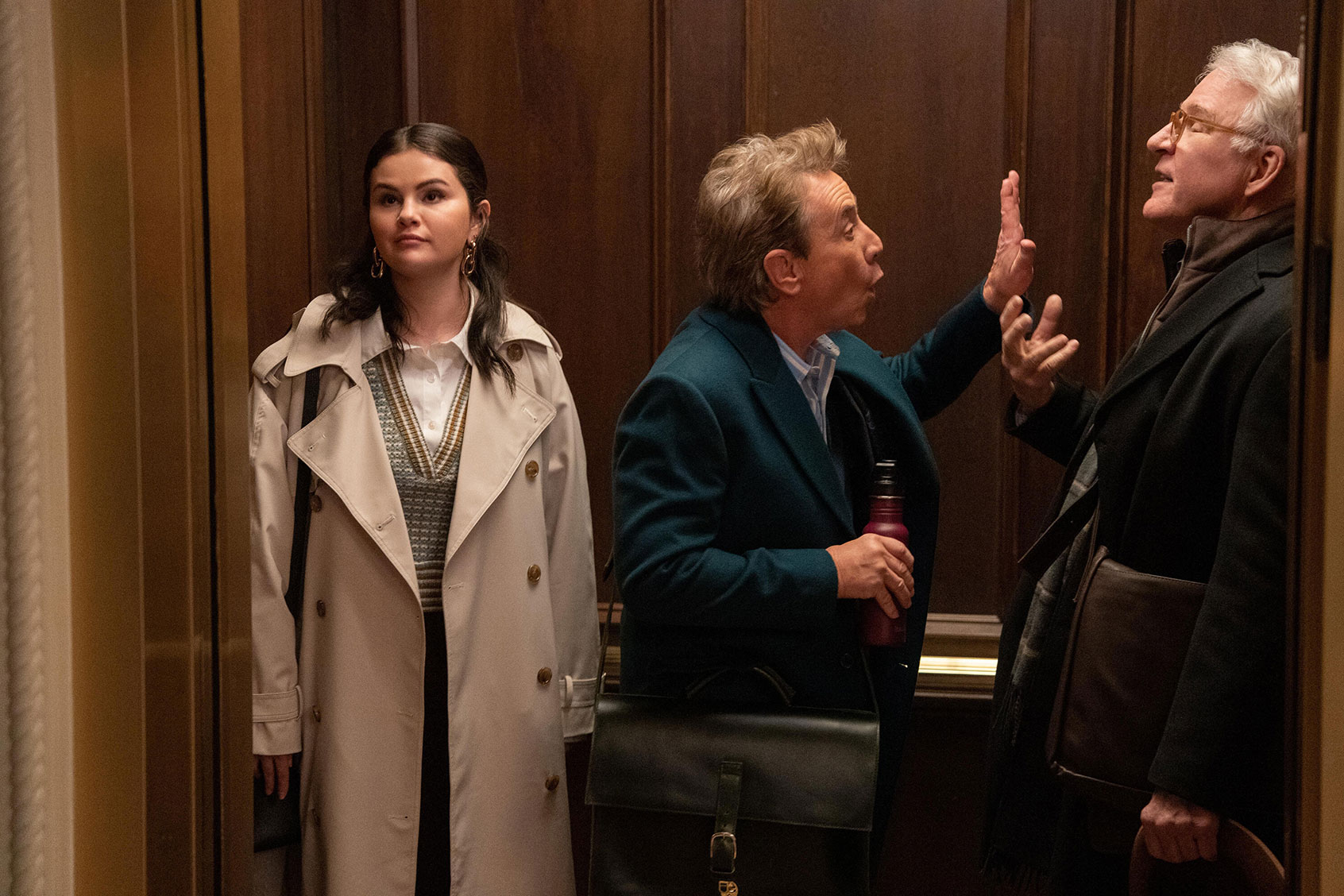
It’s been more than a year since we caught up with Mabel Mora (Selena Gomez), Charles-Haden Savage (Steve Martin) and Oliver Putnam (Martin Short), which is too long of a stretch between visits to the Arconia, the grand New York City apartment complex where two homicides have occurred so far.

This season’s death, which was teased in the second season finale, occurs outside the building and in the opening moments of Oliver’s return to Broadway, in a play he wrote called called “Death Rattle.” Charles co-stars with the body, actor Ben Glenroy (Paul Rudd), with Mabel in the audience. Does this oblige the trio to expand its podcast beyond the boundaries described in its title? The premiere contains that answer.

It also introduces one of the top-heaviest A-lister lineups yet. Rudd’s last-minute appearance at the end of the previous season was enticing enough, but when Meryl Streep joined the cast as a struggling actor named Loretta (Meryl Streep), that certainly caught people’s attention.

Only Murders in the BuildingOnly Murders in the Building (Hulu)Blinding guest star rosters are nothing new for this show. Along with Gomez, Short and Martin, “Only Murders in the Building” has cycled the likes of Sting and Amy Schumer through the building in its designated unit for the famous and delighted viewers with recurring appearances by the likes of  Jane Lynch and Nathan Lane. (Matthew Broderick has also signed on for this season but appears in a later episode.)
We need your help to stay independent

It’s one thing to draw top-tier celebrities to a show like this, which always stood an excellent chance of doing so given that Martin created it and critics love it. Using them innovatively while channeling what we know about them takes a precise hand. And this season employs Rudd and Streep adroitly by having them sensibly play against their respective images.

It’s one thing to draw top-tier celebrities to a show like this. Using them innovatively while channeling what we know about them takes a precise hand.

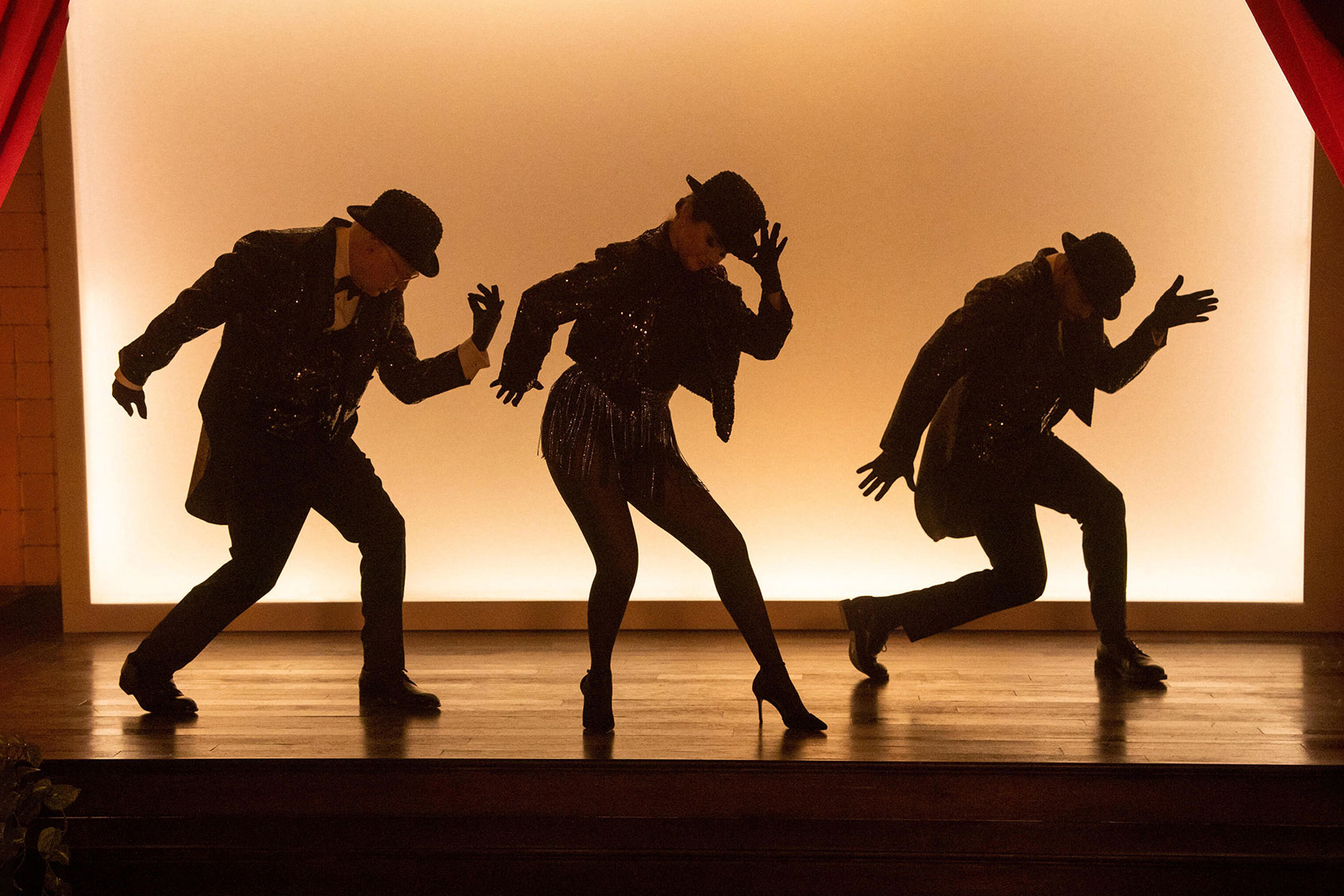
Season 3 operates within two distinct timelines at first: one drops us in a few months before the play’s debut when we meet Ben and his “Death Rattle” co-stars Kimber (“Joy Ride” star Ashley Park), Ty (Gerald Caesar) and Bobo (Don Darryl Rivera), along with Loretta, as they struggle to mount the production. The second is in the present, where Oliver reels at the prospect of having his first big return to Broadway prove as disastrous to his reputation as his last – remember how he described the undoing of “Splash! The Musical”?

This time Oliver is contending with the demanding and uncomfortably Oedipal mother and son producer team Donna (Linda Emond) and Cliff (Wesley Taylor), whose patience is much thinner than that of his former best friend Teddy Dimas (Lane, absent from this season due to a production scheduling conflict). And there’s another omnipresent witness to every moment and misstep – a filmmaker named Tobert (Jesse Williams), hired by Ben to chronicle his Broadway debut.

Casting Rudd as a star with limited acting talent and a reputation for being a badly behaved narcissist is a simple gambit. Rudd has played good-natured dim bulbs before. Handing him one with a backstory as ridiculous as Ben’s, a guy whose claim to fame is playing CoBro – “just a friendly zoologist who morphs into a 20-ft. cobra and helps the cops save the day!” – is one of the many arch winks embedded in the script. (If CoBro is an idiotic concept, what about “Ant-Man”?)

But the writers also develop Ben Glenroy’s deep-rooted insecurities, allowing us to see more humane and bruised sides of him at appropriate moments.  


Want a daily wrap-up of all the news and commentary Salon has to offer? Subscribe to our morning newsletter, Crash Course.


Streep’s evolution of Loretta is a little more straightforward since, well, she’s still alive. But Loretta is the obverse of the actor, a woman who spent most of her life trying to seize the merest glow of the showbiz spotlight and gains it through Oliver, only to deliver some epically terrible acting in her first days on the production.

Only Murders in the BuildingOnly Murders in the Building (Hulu)Her performance and Rudd’s meld with that of the rest of the excellent cast, including returning residents Michael Cyril Creighton’s cat-worshipping Howard, whose experience as a theater nut is put to good use. Creighton’s Howard is a neighbor who keeps us coming back to the show for his sweetness and his quirks, and pairing him with Short to respond to Oliver’s endless barrage of colorful, cutting one-liners is bliss. All these moments compensate for the softer corners this season manifested in the usual physical farce and misdirects, and the questionable choice to make Andrea Martin’s Joy as campily vivacious as she comes across.

Ultimately, however, that matters less than the vibe weighing on our trio, who begin to wonder who they are to each other when foul play between neighbors isn’t the glue holding them together. Even that doesn’t seem like a crisis that can’t be solved by some quality time with a couple of recording devices, a bit of deadpan banter, and a murder map. With those lures in place, we’re happy to keep prowling this place’s halls for as long as it takes to find the next culprit, whether famous or merely criminal.

The two-episode third season premiere of “Only Murders in the Building” streams Tuesday, Aug.8 on Hulu.


Nearly 10,000 people said they’d legally change their name to “Subway” to snag free subs for life

Subway asked its fans if they would legally change their name to “Subway” to get free subs for life — and overwhelmingly they said yes! Nearly 10,000 sandwich lovers said they’d make the change, just 96 hours after Subway announced its Name Change Challenge, which will award one lucky Subway winner with free sandwiches for life from the chain’s biggest refresh yet.

The promotion comes after the debut of freshly sliced meats in Subway restaurants nationwide, along with several menu updates, including a new lineup of Deli Hero subs to the Subway Series menu. Subway’s Name Change Challenge was first launched July 26 with an entry period that ran from August 1 to August 4. In addition to free subs, the winner will receive money to reimburse legal and processing costs to complete the name change process.

“The latest Refresh is the high-water mark in Subway’s transformation journey, which began in 2021 and has led to both ten straight quarters of positive sales growth and record average unit volumes in North America,” the chain wrote in a Tuesday press release. “This latest update is Subway’s most complex, investing more than $80 million to bring deli meat slicers to more than 20,000 U.S. restaurants.”


“It isn’t a crime”: Chris Noth still denies sexual assault allegations, says it was all consensual

Former “Sex and The City” actor Chris Noth spoke on the record for the first time since sexual assault allegations were made against him in 2021, which led to Noth’s longtime cast members, Sarah Jessica Parker, Cynthia Nixon and Kristin Davis publically denouncing him and supporting the accusers. 

Noth said that his encounters with the women who accused him of assault were consensual, USA Today reported. He admitted that he “strayed on my wife, and it’s devastating to her and not a very pretty picture. What it isn’t is a crime.”

Known for playing Carrie Bradshaw’s longtime love interest, Mr. Big — Noth was accused of sexual assault by multiple women while the first season of the “SATC” spinoff “And Just Like That” was airing in December 2021. Noth was immediately dropped from his management team, fired from his series regular role on CBS’ “The Equalizer,” removed from a final scene the actor shot as Big by HBO Max early last year and even his Peleton ad was pulled.

In 2021, Noth denied all the allegations in a statement, saying they were “categorically false” and “It’s difficult not to question the timing of these stories coming out. I don’t know for certain why they are surfacing now, but I do know this: I did not assault these women.”


“There’s some raunchiness”: Florida crackdown on books comes for Shakespeare

School district officials in Hillsborough County, Fla., have implemented a newly designed curriculum guide for English teachers that will see students reading only selections from William Shakespeare plays, The Tampa Bay Times reported.

The change comes as a result of amended state teaching standards and new state exams endorsed and inked by Republican Gov. Ron DeSantis in the Parental Rights in Education Act. DeSantis, who has decried anything deemed to be sexual in nature, has taken his culture war crusades to schools with various book bans and curriculum revisions. Now, rather than read titles like “Romeo and Juliet” or “Macbeth” in full, students will be assigned excerpts from the works. District officials stated that students seeking to read the classics in full may do so if they obtain copies; however, teachers have been cautioned to heed the excerpt-only guidelines, as they could face parent complaints or disciplinary action for going against them.

The decision was made “in consideration of the law,” according to school district spokeswoman Tanya Arja. “There’s some raunchiness in Shakespeare. Because that’s what sold tickets during his time,” said Joseph Cool, a reading teacher at Gaither High School. “I think the rest of the nation — no, the world, is laughing us,” he added. “Taking Shakespeare in its entirety out because the relationship between Romeo and Juliet is somehow exploiting minors is just absurd.” When asked by the Tampa Bay Times if he felt students could glean the same experience from reading play excerpts as one might from the full works, Cool replied, “absolutely not.”

This summer, I finally surrendered to the pumpkin spice creep

This was the summer that I finally surrendered to the ever-lengthening pumpkin spice creep. Since debuting in the fall of 2003, Starbucks’ pumpkin spice latte has arrived progressively earlier each year (“creeping,” one might say), moving back a few days at a time and then, eventually, a few weeks at a time until the cult-favorite beverage is now rumored to be releasing on August 29 of this year. 

My local coffee shop — a houseplant-forested storefront which trades in juicy-sounding specialty lattes with flavors like toasted banana sundae and spicy mango — isn’t, however, burdened by the hitches and hurdles associated with an international seasonal beverage roll-out, so they offer their version of the PSL all year long. And I had one, on ice, as soon as there was a slight break in the sweltering heat of July, which went down as the hottest month on Earth on record. 

It was the middle of summer, but I was craving autumn. 

I’m not going to lie and say that it was a revelatory experience (though I did spend at least a little time grimly chewing ice and contemplating what fall weather, or the absence of it, would look like in 20 years). Their pumpkin spice latte, which is made with frothy vanilla oat milk, two shots of espresso and a clove-dominant spice mix, could almost pass for the horchata latte the cafe up the street sells, or even the oat milk latte with cinnamon that my boyfriend makes for me most mornings. However, it did make me think of how much of what we eat and drink is dictated by seemingly arbitrary rules. 

Some of these are, of course, rooted in tradition. For example, a Facebook recipe-sharing group of which I’m a member is currently in shambles as members are choosing sides in an argument over the “right” way to cook rice; the group is made of up of international home cooks, so the distance between cumin-rich Indian Jeera bhaat and the sugared-and-buttered rice of the American South feels pretty vast to some. 

“Have you even tasted REAL RICE?” one member asked, seemingly exasperated. 

Some of the rules are rooted in compulsion or perhaps neuroses. I remember reading in high school that Broadway icon Carol Channing would visit all of New York City’s finest dining rooms, only to pull a dry chicken breast out of her purse and ask a waiter to plate it up. Channing’s former publicist Scott Gorenstein confirmed this to Page Six, “We’d eat out a lot and mostly at the Russian Tea Room — but Carol never ate a bite off the menu.” 

At the time, I was a young figure skater in the throes of disordered eating, which meant that I, too, kept a tote bag of “safe foods” — non-fat dressings, low-calorie snacks, a little yellow bulbous container of store-bought lemon juice — so that I wouldn’t be tempted to break the food rules I had set for myself. 

We need your help to stay independent

For years, every visit to the supermarket, a restaurant or a party meant consulting my mental guidebook to establish what was and wasn’t verboten. Selecting an entree always became a tangle of rules. Rules that were meant to make me smaller. Rules that were meant to help me disappear. 

I think that’s why the concept of intuitive eating, to which I largely subscribe these days, was initially both so freeing and anxiety-inducing for me. According to the National Eating Disorders Association, intuitive eating is about trusting your body to make food choices that feel good for you, absent of self-judgment or the influence of diet culture.

Once I was able to sort through some of the more serious rules that were actively damaging my relationship to my body and to food, it became easier to interrogate the more superficial guidelines that had previously guided how I ate and drank. The other day, for instance, I was ordering in from a Vietnamese and Thai restaurant on my block and couldn’t decide between two excellent soups on their menu; instead of getting a “real” entree, I just got both and reveled in the sheer coziness of a self-made soup sampler. 

It’s like buying yourself a birthday cake just because, or perhaps succumbing to your desire for fall and allowing yourself to become fully engulfed in the orange-tinged pumpkin spice wave inching closer and closer to our collective shores. 

Rules are, after all, made to be broken. 


How summers in Greece taught me the joy of frying

A few years ago I made donuts at home for the first time. To some, this may feel trivial, and to others, impressive. Personally, I was in awe. Moi? Me? I can make donuts at home?! It was as if I’d discovered how to print money on a 2002 LaserJet. I was surprised by how easy the process was and shocked by how judgmental or perhaps intimidated, I’d previously been by the idea of deep frying at home.

To some, this epiphany may sound basic. As a child of latkes, I wasn’t a total stranger to frying food at home, but, growing up, frying was not in our regular repertoire, nor did I seek it out in early adulthood. Of course, I love a fried good — fried chicken, fried dumplings, samosas, katsu, empanadas, donuts — you name it, I love it. But for some reason, I compartmentalized these items as “things I eat out.”

In reality, frying simply refers to cooking food in hot oils and fats and therefore encompasses everything from a light sauté to a shallow fry to deep frying. When you think of it that way, frying doesn’t feel like such an unattainable home cooking experience — in fact, we’re mostly all doing it already, even if we don’t know it.

In 2014, I moved to Greece and lived there for a few years. Seasonality in Greece is very strong, especially during the summer. There’s a specific air and expectation about summer in Greece — it’s essential to be by the sea, enjoying oneself. We’re talking sea, salt and sun on a national level. With that comes specific foods and drinks that orbit the days and nights: cold coffee in the morning, chilled fruit, cold drinks and ice cream in the afternoon and salty, heavier foods in the evening. As I noticed my own cravings adapt to this rhythm, I found that fried dishes became a very appealing treat after a day by the sea.

Years later, I reflected on this trend. I also made that donut. Stars aligned, I saw the figurative light and I realized that I could make so many of my favorite Greek fried dishes at home on demand, from oven-roasted potatoes swimming in olive oil to fried fritters, to doughy desserts (all of which indeed constitute fried food). The more I fried, the more confident I became and soon, any and all oil-based projects felt attainable.

Along my journey there were trials and tribulations — dense loukoumades, splattered oil, fallen feta — I experienced it all. But as with any cooking journey, practice, perseverance and intuition are key. What oils cook best for which frying project? How does different food react with different amounts of oil? Once I got comfortable with my newfound friend called oil, the more I pushed myself to explore its boundaries and all the delicacies it can offer.

And now here we are: Summer is in full swing and its produce is plentiful at farmers’ stands. My mind (and stomach and skillet) are filled with kolokithokeftedes (zucchini fritters) and ntomatokeftedes (tomato fritters) as I dream of fried calamari with a cold beer by the sea in Greece soon. I hope that my fried food journey is an inspiration to explore the wealth of possibilities that frying food at home can offer.

How the Texas trial changed the story of abortion rights in America

During the five decades that followed Roe v. Wade, lawsuit after lawsuit in states across the country chipped away at abortion rights. And again and again, the people who went to court to defend those rights were physicians who often spoke in clinical and abstract terms.

“The entirety of abortion rights history is a history of doctors appearing in court to represent their own interests and the interests of pregnant people,” said Elizabeth Sepper, a law professor at the University of Texas-Austin.

But in July, in a Texas courtroom, the case for abortion was made by women themselves who had been denied abortions and sued the state to clarify the exceptions to its ban, which makes it illegal to perform an abortion unless a patient is facing death or “substantial impairment of a major bodily function.” The aspiring mothers described in vivid, harrowing detail how the state’s abortion ban had endangered their health, traumatized them, and, in the case of Samantha Casiano, forced her to carry and give birth to a baby girl without a formed skull or brain only to watch her die a tortured death four hours later.

“She was gasping for air,” Casiano testified on the witness stand. She described how her baby turned purple and her eyeballs were bleeding. “I just kept telling myself and my baby that ‘I’m so sorry that this has happened to you.’ I felt so bad. She had no mercy. There was no mercy there for her.”

Casiano had been denied an abortion months earlier after she found out her baby had anencephaly, a fatal condition. She had wanted her daughter, whom she named Halo, to be spared from suffering and to “go to rest sooner.” She described abortion as an act of compassion, mercy, and love.

“All of these secrets — abortion, miscarriage, the blurring of miscarriage and abortion — that’s something people viscerally appreciate now.”

For decades, Christian anti-abortion groups have deployed ultrasound fetal images and grisly photos of what they say are aborted fetuses on highway billboards, protest signs, and online ads to garner sympathy for “unborn children” and advance their religious and political aims. But the Texas hearing, for the first time since the early 1970s, according to legal scholars and historians, trained the camera upward, away from the high-resolution fetal images to the faces of sympathetic women who say they suffered grievously under the state’s abortion ban.

Women have long shared abortion stories privately, and at public speak-outs, through #ShoutYourAbortion and the nonprofit group WeTestify. But the formality of the Austin courtroom focused unblinking attention on their experiences. The black-robed judge and court stenographer leaned in to hear plaintiffs as their testimony under oath was recorded for a national television audience. It put anti-abortion activists on the defensive.

“We’re in this moment where all of the stories are coming out and it’s raw,” said Greer Donley, an associate professor of law at the University of Pittsburgh School of Law. “All of these secrets — abortion, miscarriage, the blurring of miscarriage and abortion — that’s something people viscerally appreciate now.”

Before the Supreme Court’s conservative majority eliminated a federal right to abortion last June, polls showed that nationwide support for abortion care was “pathetically stagnant,” Donley said. Compare that stagnation, she said, to the support for same-sex marriage rights, which broadened as gay people and their families shared their stories publicly.

“Storytelling is the future,” Donley said. “That’s how you change hearts and minds.”

“These women in court are saying, ‘What was best for my child was the abortion. I was denied that, but so was my child.'”

The pregnancy complications and medical emergencies described by the plaintiffs both “subvert ideas about motherhood” and “support ideas about motherhood,” said Mary Ziegler, a professor of law at the University of California-Davis who has written books about the history of abortion.

Soon after the Supreme Court held that women had the right to abortion in 1973, the anti-abortion movement began a concerted effort to narrow that newly established constitutional right. Movement leaders spoke in gruesome detail about abortions later in pregnancy, coining medically inaccurate phrases, such as “partial-birth abortion,” that infused the language of the abortion debate with emotional and provocative imagery.

“Usually, the story is women versus fetuses, and that people having abortions are selfish or don’t care,” Ziegler said. “But these women in court are saying, ‘What was best for my child was the abortion. I was denied that, but so was my child.'”

Some Catholics and conservative Christians who oppose abortion proffer the notion of “natural womanhood,” Ziegler said — the religious belief that God created women to complement men, and “that abortion is forcing women to be like men” and “disrupts nature.”

That belief was expressed by Ingrid Skop, a Texas OB-GYN who opposes abortion and testified last month as an expert witness for the state. When asked on the stand about Casiano’s description of watching her baby die, Skop said inducing a birth is “a much more holistic way to progress through the grieving process than to dismember your child and not have a way to grieve.”

Infant deaths have spiked in Texas since the government mandated births of nonviable pregnancies. In September 2021, Texas banned abortions after six weeks of pregnancy and then instituted a prohibition on all abortions from the moment of fertilization unless a woman was experiencing “a life-threatening physical condition aggravated by, caused by, or arising from a pregnancy.” The Texas law makes no exception for nonviable pregnancies.

In 2022, preliminary infant mortality data from the Texas Department of State Health Services, first obtained by CNN, showed a 21.6% increase in infant deaths caused by severe genetic and birth defects. That increase reversed a 15% decline in infant deaths from 2014 to 2021.

The Texas lawsuit has highlighted the myriad reasons women and their families require abortion care throughout an entire pregnancy.

The case in Austin comes as abortion rights and civil liberties groups and state Democratic parties are mounting a series of legal and electoral challenges to the Supreme Court’s ruling in Dobbs v. Jackson Women’s Health Organization, which overturned Roe last summer. In November, Ohio voters will take up a proposed constitutional amendment that would ensure “every individual has a right to make and carry out one’s reproductive decisions.” Litigation against abortion bans is ongoing in at least 17 states, according to KFF.

A new poll by the nonpartisan research firm PerryUndem that explored the impact of a “viability limit” on support for abortion ballot measures found that voters were 15 percentage points more likely to support ballot measures when they contained no government regulations on abortion over those that restricted abortion later in pregnancy.

The Texas lawsuit has highlighted the myriad reasons women and their families (at least two husbands were in the Austin courtroom) require abortion care throughout an entire pregnancy, Donley said.

In considering doing away with any limits on abortion, “we don’t have to trust that women are perfect, benevolent mothers,” Donley said. “We just have to believe they are rational actors.”

After 24 weeks, most abortions require induced birth, she added. “So, we’re imagining a person who, for no good reason, endured the burdens of pregnancy, watched her body change completely, and went through labor and delivery of a stillborn baby just because she couldn’t get around to an abortion earlier? People have abortions late because horrible things happen.”

Texas District Judge Jessica Mangrum on Aug. 4 ruled in favor of the plaintiffs, but the Texas attorney general has appealed the decision, blocking the order. The state’s assistant attorney general, Amy Pletscher, had asked the court to dismiss the case. She told Mangrum that the “plaintiffs sustained their alleged injuries as a direct result of their own medical providers failing them.”

But while the outcome of the case is uncertain, legal scholars said it marked the beginning of a new strategy for the abortion rights movement in the United States.

“We had a 50-year fight to get rid of Roe,” Ziegler said. “This is the beginning of the 50-year fight to get rid Dobbs.”

KFF Health News is a national newsroom that produces in-depth journalism about health issues and is one of the core operating programs at KFF—an independent source of health policy research, polling, and journalism. Learn more about KFF.

“We have to be very careful”: Trump at odds with his own lead lawyer over judge’s recusal

Former President Donald Trump claimed he would be seeking the recusal of U.S. District Judge Tanya Chutkan — the federal judge overseeing his election conspiracy case — in a recent Truth Social post, but his latest lawyer seemed to indicate that the legal team has no such immediate plans. “THERE IS NO WAY I CAN GET A FAIR TRIAL WITH THE JUDGE ‘ASSIGNED’ TO THE RIDICULOUS FREEDOM OF SPEECH/FAIR ELECTIONS CASE,” Trump wrote on Truth Social on Sunday. “EVERYBODY KNOWS THIS, AND SO DOES SHE! WE WILL BE IMMEDIATELY ASKING FOR RECUSAL OF THIS JUDGE ON VERY POWERFUL GROUNDS, AND LIKEWISE FOR VENUE CHANGE, OUT IF D.C. [sic]”

Not long after, however, Trump attorney John Lauro claimed that the former president had merely been speaking with “a layman’s political sense,” expressing frustration that Chutkan had been nominated to the bench by former President Barack Obama. “We haven’t made a final decision on that issue at all,” Lauro said on a podcast hosted by David Markus, a Florida attorney who previously turned down Trump as a client. “I think as lawyers we have to be very careful of those issues and handle them with the utmost delicacy,” Lauro continued. “I think it’s a little bit different than our standard case where we would pull our hair out if a client commented on a prosecutor or a judge. He feels strongly that he needs to speak out, and he also, in particular, looks at this prosecution as a political prosecution. I think, in his mind, it’s sort of fair game from a political perspective to make these comments.”

“I have a responsibility, certainly, as an officer of the court to conduct the proceedings in a dignified manner, and I will do that at all times,” Lauro added. “To the extent that I can make any appropriate suggestions to a client, I do. But as we know, David, sometimes clients follow our suggestions, sometimes they don’t.”

Judge Tanya Chutkan gets increased security amid Trump’s Truth Social attacks: report

New security measures have been implemented for U.S. District Judge Tanya Chutkan, the federal judge overseeing former President Donald Trump’s election conspiracy case. CNN reported an uptick in security for the judge on Monday, as well as talks for security plans. “Ensuring that judges can rule independently and free from harm or intimidation is paramount to the rule of law, and a fundamental mission of the USMS,” spokesperson Drew Wade told CNN. “While we do not discuss our specific security measures, we continuously review the measures in place and take appropriate steps to ensure the integrity of the federal judicial process.”

The bolstered security comes amid recent seeming threats Trump made on his Truth Social platform, including several posts aimed at the judge herself. Jack Smith’s team of prosecutors submitted a filing on Monday asking Chutkan for a protective order after Trump posted the following message last week: “IF YOU GO AFTER ME, I’M COMING AFTER YOU!” On Sunday, Trump said he would ask for the judge to be recused as well as a venue change for his trial. “THERE IS NO WAY I CAN GET A FAIR TRIAL WITH THE JUDGE ‘ASSIGNED’ TO THE RIDICULOUS FREEDOM OF SPEECH/FAIR ELECTIONS CASE,” Trump wrote. “EVERYBODY KNOWS THIS, AND SO DOES SHE! WE WILL BE IMMEDIATELY ASKING FOR RECUSAL OF THIS JUDGE ON VERY POWERFUL GROUNDS, AND LIKEWISE FOR VENUE CHANGE, OUT IF D.C. [sic]”

CNN legal analyst Elliott Williams said on Monday that “judges don’t have security under normal circumstances” but they “can get it if there’s some reason, if they’ve been threatened in some way.” Williams predicted the situation would not affect Chutkan’s ruling on the proposed protective order. “I worked for two different federal judges. They like to sort of put that stuff aside and try to rule to the extent they can on the facts and the law,” he said. “And I would hope and think that’s what the judge would do.”

“This man cannot shut up”: Ex-judge warns Trump risks gag order as his judge sets speedy hearing

U.S. District Judge Tanya Chutkan on Monday night ordered a hearing to discuss a protective order proposed by special counsel Jack Smith’s team to prevent him from publicizing evidence in the case.

Prosecutors asked Chutkan to issue a protective order after Trump issued a seeming threat on Truth Social, writing, “If you go after me, I’m coming after you!” 

“The order — which is different from a so-called ‘gag order’ — would limit what information Trump and his legal team could share publicly about the case brought by special counsel Jack Smith,” as the Associated Press noted. The order would not inhibit Trump from discussing the case in its entirety, nor would it limit him from speaking about aspects of the case that are already publicly available, per ABC News. 

In response to Smith’s filing, the ex-president’s legal team issued a statement arguing that the post was directed at political interest groups, saying, the “Truth post cited is the definition of political speech.” On Monday, the Trump’s attorneys submitted their own filing to Chutkan, accusing Smith and his team of asking the judge to “assume the role of censor and impose content-based regulations on President Trump’s political speech that would forbid him from publicly discussing or disclosing all non-public documents produced by the government, including both purportedly sensitive materials, and non-sensitive, potentially exculpatory documents.”

Trump, the filing adds, “does not contest the government’s claimed interest in restricting some of the documents it must produce” but “the need to protect that information does not require a blanket gag order over all documents produced by the government.”

The special counsel’s team in a quick response filed hours later slammed Trump’s lawyers for attempting to advance a motion “designed to allow him to try this case in the media rather than in the courtroom.”

“To facilitate the efficient production of discovery to the defense, the Government proposed a reasonable protective order consistent with current practice in this District,” Smith’s team wrote. “To safeguard witness privacy and the integrity of these proceedings, the Court should enter the Government’s proposed protective order.”

Trump’s proposed protective order, Smith argued, “would lead to the public dissemination of discovery material.”

Chutkan ordered the two sides to set a hearing for later this week.

We need your help to stay independent

Former federal prosecutor Andrew Weissmann, who served on special counsel Bob Mueller’s team, said it was “interesting” that Chutkan excused Trump’s presence at the hearing “given his dangerous and contumacious social media posts.”

“Agreeing to a hearing at all is indulgent of Trump and his far-fetched arguments about using discovery to try the case in public,” tweeted former U.S. Attorney Harry Litman. “But the resolution of his arguments on Friday will not please him I think.”

“Trump may win a few points in this battle (although Smith will likely win more) — but the speed at which this is moving suggests he will lose the war,” tweeted Norm Eisen, who served as special counsel to the House Judiciary Committee during Donald Trump’s first impeachment trial.


Want a daily wrap-up of all the news and commentary Salon has to offer? Subscribe to our morning newsletter, Crash Course.


Retired California Superior Court Judge LaDoris Hazzard Cordell told CNN that Trump’s rageful Truth was “clearly a threat.”

“I don’t know necessarily that that quote impacts the protective order, but that certainly would get me thinking if I were the trial judge about a gag order in this case,” Cordell said. “It’s clearly a threat, and a good trial judge doesn’t just look at the law, you use common sense.”

Cordell, who noted that she feels a gag order is impending, also felt that “Trump would violate it in a heartbeat and then we’ll see what the judge does in terms of consequences for violating yet another court order.”

“I absolutely can see it coming because this man cannot shut up. He’s a ‘chatty Charlie’ and he’s going to just talk and talk and he really doesn’t care about rules that say you can speak or cannot speak,” Cordell said.

“So this is where the test of a good trial judge comes about. If you’re going to have a fair trial, it’s going to be by the rules set by that person in the black robe. And if the rules are you do not talk about this other than in the court, because it’s not punishment it’s to ensure fair trial. If that doesn’t happen, there have to be immediate consequences to violating a court order. Only in that way can everyone have respect for the system.”

Latest COVID mutation EG.5 seems to be driving a recent surge in cases

Although COVID-19 rates are overall still near historic lows after about seven months of decline, an increase in cases observed in recent summer months is a cause for concern for many who anticipate another spike in the fall when schools start back up. 

Ever since the COVID-19 pandemic began, there have been a long list of variants with confusing, jumbled names — from BA.5 to BQ.1 to XBB — which can feel like a bit of an alphabet soup. One of the country’s prominent vaccine researchers, Dr. Peter Hotez, coined the term “Scrabble variants” to describe the ever-growing list of COVID mutations. In July, yet another was added to the list of variants to keep track of: EG.5, a descendent of the omicron strain that first emerged in November 2021. We’ve been dealing with omicron’s children ever since.

Every two weeks, the Centers for Disease Control and Prevention (CDC) stirs through the “variant soup” and reports the largest shares of COVID variants. On Friday, August 4, CDC estimates pegged EG.5, as the top variant, contributing to 17.3% of reported cases. First identified in Indonesia, EG.5 has since spread globally. There are still many other variations of omicron circulating in the U.S., with XBB.1.5, nicknamed Kraken, accounting for 10.3% of cases and XBB.1.16, another variant nicknamed Arcturus, still making up 15.6% of cases, according to CDC data.


The reason behind the spike in cases is likely because “our natural immunity is waning,” said Dr. Rajendram Rajnarayanan, of the New York Institute of Technology campus in Jonesboro, Arkansas. “Natural immunity is rendered by the previous variant that everyone had. This [variant] is slightly different than the previous one.”

COVID infections have surged in the past three summers in the U.S and this year seems like no exception. The summer spike could be partially driven by record high travel rates and heatwaves sending people indoors. After President Joseph Biden and the World Health Organization declared the pandemic was over in April and May respectively, many were likely eager to take trips that had been postponed or canceled in the earlier stages of the pandemic, while many abandoned pandemic protocols altogether.

“Our natural immunity is waning. This variant is slightly different than the previous one.”

This also reduced the amount of data collected on COVID transmissions available for researchers to track, Rajnarayanan said. Currently, hospitalization data, as well as wastewater monitoring, are some of the best available tools to monitor the spread of the virus. Both metrics are on the rise across the country, with CDC data on hospitalizations rising 12.5% in the past week to roughly 9,000 cases.

“After the public health emergency ended, one by one our testing and sequencing tools went away,” RajnarayananI told Salon in a phone interview. “I hope the wastewater sequencing still continues, but I’m not sure how long it’s going to continue either.”

While the beginning surges of COVID infection rapidly increased in big waves, cases in the past year have been rising more slowly. Dr. T. Ryan Gregory, an evolutionary and genome biologist at the University of Guelph in Canada, said the increase in cases in the past year has been more like a “rising sea level” rather than “tsunami” waves.

The increase in cases in the past year has been more like a “rising sea level” rather than “tsunami” waves.

“My best guess right now is that we’ll see a return to a high baseline, but not a huge wave,” Gregory told Salon in an email, adding that a similar pattern was observed in Canada in spring 2022 with the BA.2 variant. 

“I think we may be returning to that situation – which also is not good, because a sustained high baseline means a lot of infections overall, which means more long COVID and more variant evolution,” he said.

It’s likely that some forms of EG.5, including EG.5.1, which scientists are calling Eris, will present with symptoms very similar to omicron variants, Gregory said, including headaches, sore throat and cough.

“It’s very difficult to assess severity or symptoms for any particular variant these days when several are circulating at the same time and when there is so little testing,” Gregory said. “The mutations that Eris has wouldn’t necessarily be expected to change its severity or symptom profile relative to previously dominant XBB variants.”

EG.5 descends from XBB.1.9.2, nicknamed Hyperion, which currently makes up 5.4% of cases. One of the differences between EG.5 and its immediate ancestor is that it has another spike protein mutation that effectively allows the virus to attach to receptors in cells even more easily. XBB.1.9.2 also underwent a spike mutation that distinguished it from its ancestor, Kraken. Essentially, the virus is getting more adept at finding new ways to attach itself.

We need your help to stay independent

“Every time you put some kind of pressure on this virus, it learns new tricks,” Rajnarayanan said.

Vaccine makers are in the process of developing new boosters specifically geared toward XBB omicron subvariants that will likely work against the EG.5 variant as well. Current vaccines will still reduce the risk of hospitalization and severe disease, but may not work as effectively to reduce the spread of newer mutations like EG.5, Rajnarayanan said.

“Every time you put some kind of pressure on this virus, it learns new tricks.”

As always, following standard COVID protocols, including masking, will also help reduce the risk of infection. Staying up to date on vaccines, testing often and improving indoor air quality are all strategies that will work against the SARS-CoV-2 virus, which causes COVID, no matter how much it mutates.

“The surge is starting right now but the real surge is probably going to be happening right after Thanksgiving,” Rajnarayanan said. “We want to be sure we have our boosters ready before that period.”

Legal experts: Trump lawyers “undermined” their own argument — and Jack Smith walloped them

Special counsel Jack Smith’s team on Monday accused former President Donald Trump of trying to publicly disclose evidence and trying his election conspiracy case in the media in response to a filing from Trump’s lawyers asking the judge to reject a proposed protective order in the case.

Smith’s team over the weekend asked U.S. District Judge Tanya Chutkan to issue a protective order barring Trump from releasing evidence after Trump issued a seeming threat on Truth Social, writing “IF YOU GO AFTER ME, I”M COMING AFTER YOU!”

Trump’s lawyers filed their response on Monday, five minutes before Chutkan’s imposed deadline, asking the judge to limit the order to “genuinely sensitive” material.

“In a trial about First Amendment rights, the government seeks to restrict First Amendment rights,” Trump’s attorneys wrote. “Worse, it does so against its administration’s primary political opponent, during an election season in which the administration, prominent party members, and media allies have campaigned on the indictment and proliferated its false allegations.”

Former federal prosecutor Renato Mariotti said Trump’s legal team “dresses up a fairly mundane dispute about the scope of a protective order to make it seem like a First Amendment fight with the Biden administration.”

“Lots of flash and very little substance,” he tweeted.

Former federal prosecutor Andrew Weissmann called the First Amendment claim “bogus” because the Constitution allows a defendant to be jailed pending trial and face restrictions if he is released.

Trump’s lawyers in a footnote insisted that Trump’s Truth Social post was “generalized political speech, not directed to this case.” In the same footnote, MSNBC legal analyst Lisa Rubin noted, Trump’s lawyers accuse Smith’s office of “pos[ing] the greater risk of improper disclosure, given the frequency of apparent leaks from the Special Counsel’s office.”

“The most important thing to know about Trump’s opposition to the government’s proposed protective order is this: He wants the freedom to disclose witness interviews, recordings, etc. conducted outside the grand jury,” Rubin explained. A fight over which evidence is too sensitive could slow down proceedings but “it’s more than timing. A protective order that allows Trump to reveal the identity of witnesses and discuss the substance of their statements outside the grand jury could 1) prejudice potential jurors; and 2) intimidate, if not endanger, some of the most helpful witnesses,” she added.

Smith’s team fired back in a quick response filing Monday afternoon, accusing the former president of seeking to “try the case in the media rather than in the courtroom,” calling out Trump attorney John Lauro for appearing on “five television programs” on Sunday to discuss the case in “detail.”

We need your help to stay independent

“The defendant has previously issued public statements on social media regarding witnesses, judges, attorneys, and others associated with legal matters pending against him,” the filing said. “If the defendant were to begin issuing public posts using details — or, for example, grand jury transcripts — obtained in discovery here, it could have a harmful chilling effect on witnesses or adversely affect the fair administration of justice in this case.”

National security attorney Bradley Moss criticized Trump’s team for “stepping on rakes” by undermining their viable legal arguments by “peppering your pleadings with political hyperbole.”

“It does not help your argument and will annoy the judge,” he tweeted.


Want a daily wrap-up of all the news and commentary Salon has to offer? Subscribe to our morning newsletter, Crash Course.


“Trump’s team undermined their arguments with extraneous hyperbole and Smith is hitting them for it,” he added.

Chutkan late Monday ordered both sides to schedule a hearing this week to discuss their arguments. Trump has repeatedly lashed out at the judge, an Obama appointee who has issued the harshest sentences on Jan. 6 rioters, accusing her of bias and demanding she be recused.

“Trump may win a few points in this battle (although Smith will likely win more),” predicted CNN legal analyst Norm Eisen, “but the speed at which this is moving suggests he will lose the war.”

“Anti-woke” darling Richard Hanania is exposed: What this says about the “intellectual” right

For those who want to understand the vast differences between elite and everyday Republican voters, this past weekend was a perfect study in contrasts.

Donald Trump — who has a rich-daddy-funded college degree he definitely didn’t earn — spent the weekend communing with the bulk of Republican voters, who love basking in MAGA red meat, served raw. Despite agreeing in court last week not to threaten potential witnesses in upcoming trial for his attempted coup, Trump did just that, repeatedly, singling out his former vice president, Mike Pence, for the same vitriol that inspired Trump followers to threaten Pence’s life on January 6, 2021. Trump also issued one of his unhinged stemwinders in Alabama over the weekend, blaming imaginary “Marxists” and “communists” for his legal woes, as opposed to his own choice to conspire to overthrow democracy. And, in a pattern we’ve all become numb to, the more garish Trump gets in his fascistic language, the more the GOP base swoons over him. There is no “too far” with these folks. They clearly adore Trump not just because he’s a violent, racist pig, but also because he’s so damn proud of it. 

Optics are the only real difference between the redhats screaming at Trump rallies and the suit-and-tie set keen on debating the “excesses of wokeness” under the banner of “academic freedom.”

Meanwhile, the small but well-heeled world of “anti-woke” politics — a mish-mash of elite conservatives, “leftist” critics of so-called “identity politics,” wealthy Silicon Valley investors, and centrists in a tizzy over “cancel culture” — was left rocked by its own scandal.

On Friday, Christopher Mathias of HuffPost released an exposé of Richard Hanania, a rising star of the right’s supposed intelligentsia. Under his real name, Hanania runs a think tank called the Center for the Study of Partisanship and Ideology, has a spot as a visiting scholar at the University of Texas, and was published in the New York Times and Washington Post. But Hanania also had a robust secret career as “Richard Hoste,” who wrote for white nationalist websites, where he expressed a belief that Black people are intellectually inferior, obsessed over “miscegenation,” and advocated for forced sterilization of those he considered “low IQ.”

Hanania’s outing embarrassed the anti-wokers, the college-educated class of people who claim not to be MAGA but who share the Trumpian loathing of liberals.  Hanania had been well-regarded by that crowd, which ranged from supposed contrarians like Bari Weiss to faux-socialists like Freddie deBoer, who was recently seen gate-keeping the progressive bona fides of Rep. Alexandria Ocasio-Cortez, D-N.Y. He has also bro’d down with Hanania on the “question” of female intelligence. 

After the HuffPost exposé, there was a mad scramble among these self-styled “independent thinkers” to disavow Hanania.

But the protestations of shock at his secret fascist views are hard to swallow, as there is very little difference between views Hanania espoused under his own name and those he shared under the “Richard Hoste” pen name. His “academic” opinion-writing in the Washington Post was thinly veiled apologia for those who opposed equal rights for women and Black people. In May, he tweeted that we “need more policing, incarceration, and surveillance of black people.” His upcoming book from Harper Collins, “The Origins of Woke,” uses the current “anti-woke” mania to revitalize 60s-era racist grievances over civil rights. Then there’s his 2018 doctoral thesis

We need your help to stay independent

Even in his response to the HuffPost piece, which purports to be an “apology” and offers claims to have reformed, Hanania shows he hasn’t evolved. “The reason I’m the target of a cancellation effort is because left-wing journalists dislike anyone acknowledging statistical differences between races,” the man who claims to not be a racist now writes. 

This unseemly incident has exposed how all this “anti-woke” chin-stroking is just putting an academic gloss on old-fashioned racism. Hanania reveals that these folks may have fatter wallets, nicer clothes, and bigger vocabularies than the hoi polloi at a Trump rally, but at the end of the day, they share the same vile bigotries. John Ganz explained it beautifully in his newsletter response over the weekend: 

For some, it appears to be just a pushback on annoying, overly-PC peccadilloes, but for the really serious and clear-sighted they would use that sentiment a wedge to attack and try to reverse core elements of the American democratic project. The rhetorical move is to make “woke” or “C.R.T.” encompass more and more phenomena, from music to movies to basic egalitarian principles of American democracy.

As Ganz goes on to argue, “But for a lot of people in the intelligentsia, generalized anti-wokeness is a kind of gateway drug to extreme politics.” Even as many on the right are trying to salvage Hanania by claiming he’s de-radicalized, it’s clear he and others like him play exactly the role that Ganz describes: Putting a veneer of respectability on politics that otherwise reek of a KKK meeting. 

This unseemly incident has exposed how all this “anti-woke” chin-stroking is just putting an academic gloss on old-fashioned racism.

Optics are the only real difference between the redhats screaming at Trump rallies and the suit-and-tie set keen on debating the “excesses of wokeness” under the banner of “academic freedom.” This difference even shows up in the most recent New York Times poll. 

When presented with the choice between two hypothetical Republican candidates, only 24 percent of national Republican voters opted for “a candidate who focuses on defeating radical ‘woke’ ideology in our schools, media and culture” over “a candidate who focuses on restoring law and order in our streets and at the border.”

Around 65 percent said they would choose the law and order candidate. Among those 65 and older, often the most likely age bracket to vote, only 17 percent signed on to the “anti-woke” crusade. 


Want more Amanda Marcotte on politics? Subscribe to her newsletter Standing Room Only.


Jonathan Weisman of the New York Times offers a tortured analysis of this difference, but really what it comes down to is this: “Law and order” is a more straightforwardly racist dogwhistle than “anti-woke.” Obviously, Republicans aren’t for law and order in the literal sense, as their likely presidential nominee is a rapacious criminal who is facing 78 felony counts so far. It’s just a paper-thin cover for what MAGA really supports, which is an aggressive police state that uses false pretexts, overpolicing, and unfair sentencing practices to relegate people of color to second-class status.

“Anti-woke,” in contrast, is about burying the racism under many more layers of bad faith about “free speech” and “academic freedom.” The posture of non-bigotry makes it more presentable in college-educated circles. As the Hanania example shows, it opens the door to publishing in major newspapers that would likely turn their noses up to more openly fascistic content. But it doesn’t get the MAGA juices flowing like the blunter rhetoric peddled by Trump. 

These right-wing elite no doubt think of themselves as more cunning than their Trump rally-going brethren that are always at risk of saying the n-word on camera. But this pathetic desire to be seen as part of the “smart” set makes it pretty easy to scam the elite right.

Take the fake presidential candidacy of Vivek Ramaswamy, an Indian-American “running” on an “anti-woke” message. Ramaswamy’s schtick is transparent. Because he’s not white and not Christian, he offers rich conservatives a chance to claim that being “anti-woke” is somehow separate from the earthier racism on offer by Trump. But that’s also why Ramaswamy doesn’t have a snowball’s chance in a Republican primary, where most voters would like their racism without all the deflective set-dressing. That much was made clear after Ramaswamy, who is a practicing Hindu, appeared on  the Christian nationalist program “FlashPoint” with a pandering message about how he supports “Judeo-Christian values.”

The audience for “Flashpoint” leans more snake-handler than country club, and they were not having it. The producers of the show have been scrambling ever since to reassure their audience that they still hate everyone who is not a right-wing Christian. As Kyle Mantyla of Right Wing Watch writes

Ramaswamy’s appearance apparently did not sit well with “FlashPoint’s” audience, prompting host Gene Bailey to reassure viewers that “neither I nor anyone else on this team has or will ever embrace another religion” and “FlashPoint” panelist pastor Hank Kunneman to deliver a Sunday sermon attacking Ramaswamy’s faith and warning anyone who supports his campaign that they “will have a fight with God.”

“FlashPoint” continues to grapple with the fallout from Ramaswamy appearance, as far-right anti-choice activist Abby Johnson used the program Tuesday night to launch yet another attack on Ramaswamy’s faith….

“Do not be fooled,” Johnson warned. “Do not be a victim of Satan’s confusion right now.”


Want more Amanda Marcotte on politics? Subscribe to her newsletter Standing Room Only.


Ramaswamy has not been deterred by this overt bigotry aimed straight at him. He’s kept up the “I’m not a racist, but” pandering, by arguing the Juneteenth should be canceled as a “useless” holiday. Of course, on the actual holiday, he put up a video celebrating the new federal holiday as “a celebration of the American Dream.” Finding that sweet spot of “racist enough to get donations, while keeping up appearances” is more art than science, I guess.

It’s unlikely that Ramaswamy thinks he’s got a chance at winning the GOP nomination with these transparent ploys. But he is getting loads of attention from that small-but-wealthy class of Republicans who desperately want to be told that there’s a way to be “anti-woke” without being some low-rent racist. Hanania’s defenestration was entertaining, but as long as there are rich people willing to pay to hear that their bigotries are smart instead of evil, there will be dozens of “anti-woke” grifters to take his place. 

One key figure is missing from the Trump indictment: Will he be revealed as a MAGA “traitor”?

Let us consider the federal government’s second criminal indictment and forthcoming trial of Donald J. Trump, as well as his likely impending criminal indictment and subsequent trial in Fulton County, Georgia. Both these prosecutions are for conspiracies to subvert American democracy, disenfranchise voters and defraud the government. There are also related charges and counts regarding the corrupt obstruction of a congressional proceeding on Jan. 6, 2021, in the former case, and anticipated counts of obstructing justice according to Georgia’s racketeering statutes in the latter case. Together, they make it perfectly clear why both of these trials must occur — and must be televised for the world to see.

As Jamelle Bouie of the New York Times writes in his latest column, even if Trump’s Democratic opponents must ultimately “defeat him at the ballot box, it would have been untenable for the legal system to stay quiet in the face of an effort to put an end to the American experiment in republican self-government.” It is also worth underscoring that Trump’s “attempt to overthrow our institutions,” in Bouie’s phrase, could never have occurred without the distinctively American and undemocratic institution of the Electoral College.  

As almost everyone outside Trump’s MAGA base knows, the ex-president is guilty of these crimes as charged whether he is convicted or not. What most people do not know, but what Trump and his lawyers know all too well about these charges – despite their empty political rhetoric about “free speech” and “criminal intent,” not to mention their ace-in-the-hole argument that #45 was simply relying on the advice of his attorneys — is that there is no legitimate legal defense to these criminal charges. 

What passes for a substantive legal defense is the argument that free speech has been weaponized by Trump’s opponents. That may work in the court of public opinion, but it will not in a court of criminal law. All Team Trump really has are procedural legal defenses. That is to say, Trump’s attorneys will file a few serious motions — and as many frivolous motions as they can — aimed at indefinitely delaying the eventuality of a criminal trial. That’s exactly what they did at 4:55 p.m. on Monday in their 29-page response to the prosecution’s protective order motion regarding the rules of behavior during discovery. 

In short, the Trump defense team’s primary tactical goal is to run out the clock in hopes of preventing the trial from occurring before the 2024 election. If Trump regains the keys to the White House, he clearly intends to derail his own prosecution and continue with what Times columnist Maureen Dowd has dubbed his “Coup-Coup-Ca-Choo, Trump-Style.”

Dowd reminds us that “we’re mid-coup, not post-coup. The former president is still in the midst of his diabolical ‘Who will rid me of this meddlesome democracy?’ plot, hoping his dark knights will gallop off to get the job done.” She continues, “While Trump goes for the long con, or the long coup – rap sheet be damned, it’s said that he worries this will hurt his legacy.”

I am not sure what “alternative” legacy Trump imagines for himself. As for the one he has cemented in American history, his real legacy is safe. Drawing a term from Gaelic folklore, Dowd calls him “the most democracy-destroying, soul-crushing, self-obsessed amadán ever to occupy the Oval.” 

As much as we know from Jack Smith’s two criminal indictments of Trump and the forthcoming indictment in Georgia, we still know relatively little about the facts behind these indictments. That includes the vast amount of information and evidence gathered from the House select committee that investigated Jan. 6 (but had no subpoena power) as well as that gathered by Smith and Atlanta District Attorney Fani Willis that almost certainly will not be shared with the American public until Trump faces a courtroom trial.

Here’s one big thing we don’t know: What role will Mark Meadows play in Jack Smith’s prosecution of Trump? 

For example, to this point we do not know how many individuals and groups were involved in the coordinated efforts across seven states and the District of Columbia to steal the 2020 election from the American people. The number of knowing or unknowing participants in that conspiracy, at a minimum, will be over 100 and probably closer to 200. 

As for the millions of dollars spent by pro-Trump PACs and supporters to fund the coup, or spent by federal and state governments to investigate it, we are all but clueless and still in the dark. Rest assured that Jack Smith and company are following the money, as the hoary but useful saying holds.   

Here’s one more thing we do not know: what role Mark Meadows, Trump’s last White House chief of staff and apparent point man for all things coup, will play in Smith’s prosecution of the crimes leading up to the Jan. 6 assault on the Capitol. 


Want a daily wrap-up of all the news and commentary Salon has to offer? Subscribe to our morning newsletter, Crash Course.


That’s why the first thing I will look for in the Georgia indictment is whether Meadows is listed as an indicted or unindicted co-conspirator. Will he be left out of the document altogether, as he was in Smith’s second Trump indictment?

If that happens again in the Georgia charges, it is safe to assume that Meadows will soon become Trump’s No. 1 “traitor,” ahead of even former Vice President Mike Pence (and Michael Cohen, Trump’s longtime personal attorney). That would strongly suggest that Meadows will be a star witness for the prosecution, both in Washington and Atlanta. 

This is of course a familiar scenario in classic racketeering cases regarding organized crime conspiracies. It is often the consigliere who brings down the boss — but never before has the crime boss in such a case been a former president of the United States.    

We’re dumping less plastic in the ocean than previously thought. It’s still a dangerous amount

The good news is that, according to recent research in the journal Nature Geoscience, we’re dumping less plastic into the ocean than previously estimated. The bad news is that it’s still a dangerously high amount that will have dramatic negative effects for the environment if not mitigated.

From an ecological standpoint, the new study is equivalent to a doctor telling a patient with high cholesterol: Your cholesterol is still dangerously high, but perhaps not as bad as we previously thought.

Annual human plastic pollution in the ocean equals “about 500 kilotonnes per year, less than previous estimates.”

The difference is that, for the planet Earth, the “cholesterol” is plastic pollution clogging up and contaminating its oceans. According to researchers from Utrecht University in the Netherlands, “long-lived plastic pollution in the world’s oceans, which our model suggests is continuing to increase, could negatively impact ecosystems without countermeasures and prevention strategies.” At the same time, like a patient with high cholesterol who finds out that it at least is not even higher, the authors argue there is not as much plastic being dumped into the oceans as previously estimated.

To ascertain the quantity of plastic in Earth’s oceans, the researchers analyzed a wealth of data, such as “different marine reservoirs, including coastlines, the ocean surface and the deep ocean” while analyzing plastic particles ranging in size from “0.1–1,600.0 mm.” Ultimately they concluded that larger plastics bigger than 25 millimeters contribute to “more than 95% of the initially buoyant marine plastic mass: 3,100 out of 3,200 kilotonnes for the year 2020.”

Additionally, they determined that annual human plastic pollution in the ocean equals “about 500 kilotonnes per year, less than previous estimates.” Previous annual estimates placed plastic pollution in the ocean at roughly “800–2,400 kilotonnes from rivers and 4,800–23,000 kilotonnes from coastal regions.”

At the same time, the study’s authors emphasized that plastic pollution in the ocean is dangerous for Earth’s future. A chief problem, they identified, is that the amount of plastic being dumped into the ocean continues to increase by roughly 4% each year.

“Without further mitigation strategies and clean-up efforts, our estimated growth rate of 4% per year has the potential to double the plastic standing stock within two decades,” the authors write, later adding that “the combination of a projected exponentially increasing input and long persistence of marine plastics means a likely increasing negative impact of marine plastic pollution on ecosystems in the future.”


Want more health and science stories in your inbox? Subscribe to Salon’s weekly newsletter The Vulgar Scientist.


“Without further mitigation strategies and clean-up efforts, our estimated growth rate of 4% per year has the potential to double the plastic standing stock within two decades.”

There are a number of reasons why environmentalists are concerned about the amount of plastic in our oceans. From the perspective of animals’ rights, plastic pollution is known to cause endless hardships, from drinking straws getting painfully stuck up turtles’ noses to Cape fur seals being torturously tangled in discarded fishing gear, often on multiple occasions in a single lifetime.

A 2019 study by Duke University student Caroline Gordon for the Nicholas School of the Environment chronicled how “at least 700 species worldwide have been affected by plastic ocean pollution, including 84% of sea turtle species, 44% of all seabird species, and 43% of all marine mammal species. It is also estimated that one in three marine mammals have been found tangled in some type of marine litter, such as lost fishing gear or plastic bags.”

There are also human health concerns associated with plastic pollution in the oceans. In 2021, Salon discussed these issues with John Hocevar, Oceans Campaign Director for Greenpeace USA.

“The plastic commonly used in packaging contains thousands of chemicals that are known carcinogens [a term for cancer-causing agents] and endocrine disruptors,” Hocevar told Salon. “Chemicals from packaging can leach out of packaging into our food, particularly when the plastic is heated. Once we’re done with the plastic packaging, it goes into a landfill or an incinerator, or often straight into the environment. Very little of it is recycled.”

Hocevar added, “If it’s incinerated, there are extremely dangerous chemicals called dioxins that can be produced which cause cancer and other health impacts. If it’s landfilled, the chemicals can still leach out into water and soil or be blown into the air. At this point, we’ve put so much plastic into our environment that we’re eating it, breathing it and drinking it every day.”

Additionally, there are chemicals in many commonly-used plastics that have been linked to infertility. Dr. Shanna Swan, a professor of environmental medicine and public health at Mount Sinai School of Medicine in New York City, spoke with Salon in 2021 about that aspect of the plastic pollution crisis — particularly as it involves “endocrine disruptor” chemicals like phthalates and bisphenols.

We need your help to stay independent

“These chemicals have a direct action on the steroid hormones, and the steroid hormones are critical for proper development during pregnancy,” Swan explained. Because they interfere with the fetal development of male humans, they are linked to inadequate sperm count, genital birth defects and reproductive diseases like testicular cancer.

Finally there is the impact that plastic pollution has on communities which directly depend on the ocean for survival. Erin Simon, head of plastic waste and business at the World Wildlife Fund (WWF), broke down this problem for Salon in 2021.

“We also know that we have these areas, where a lot of this plastic waste is persisting and collecting, in coastal communities, right at the ends of waterways entering our oceans, and those are areas where you have a lot of communities that depend highly on fishing for their livelihoods and food,” Simon told Salon. “And because of the increase of plastic rates, they’re having to travel further off shore. It costs them more in fuel and it means they may make less money. They may not be able to provide that for their family.”

“Heartstopper” illuminates that being a trans youth is joyful, everyday and larger than politics

Netflix’s young adult breakout hit “Heartstopper” is back but most importantly, this season, it gives Elle (Yasmin Finney) — the show’s biracial transgender lead — room to be front and center to revel in being a dynamic, full-fledged teenager. Her existence and arc in the show, depict a radical view of acceptance juxtaposed to the national backlash against trans people and children in America’s growing and incessant culture wars involving anti-trans views from celebrities like Ne-Yo and author J.K. Rowling and in state-level legislative agendas banning gender-affirming care and education.

Ne-Y’so and Rowling’s comments reflect a sentiment that illustrates a complete and utter lack of understanding of transgender issues.

The three-time Grammy winner, Ne-Yo was recently criticized after he shared his views on gender identity, gender-affirming care and parenting. “If your little boy comes up to you and says, ‘Daddy I wanna be a girl,’ you just let him rock with that?” he said. Although he apologized for his comments on Twitter (now X), regretting any hurt he may have caused, but just as quickly walked back his comments. In a two-minute video he posted, he doubled down, saying, “I will never be OK with allowing a child to make a decision detrimental to their life.”

Unlike Ne-Yo, Rowling has not apologized for her anti-trans beliefs and has doubled down. But she has faced some public repercussions and fallout since her anti-trans barrage on Twitter. She has been recently been removed from the Museum of Pop Culture for her “super hateful and divisive” transphobic views, and Daniel Radcliffe — the lead of the very lucrative film adaption of Rowling’s “Harry Potter” book series — penned an open letter publically denouncing her stance on transgender women multiple times. 

In both instances, Ne-Y’so and Rowling’s comments reflect a sentiment that illustrates a complete and utter lack of understanding of transgender issues and the pressing violent agenda that continues to attack trans liberation. In particular, their comments could have an impact on transgender youths, whose stories are woefully underrepresented onscreen. While young transgender characters do exist, they’re often brought in for a single special episode – such as on Netflix’s “Baby-sitters Club” or ABC medical drama “The Good Doctor” – in which their trans identity is their sole reason for inclusion, or as a recurring character, such as on Freeform’s “The Fosters.” 

HeartstopperYasmin Finney in “Heartstopper” (Netflix)In contrast, “Heartstopper’s” Elle is one of the few lead trans teen characters in popular media, and in particular on one of the most-watched Netflix shows that has a global reach of over 200 million people around the world. This reach is important because Elle is one of the few transgender youth characters with enough screentime to achieve the level of care, interiority and humanity required to create a fully dimensional person.

Elle exists as a multitude of different versions of herself.

In the series’ first season, Elle’s main story was adjusting to a new school and making new friends there, a relatable experience for many youths. This season gives her more of a spotlight, and therefore even more time to shine. Elle is worried about ruining her friendship with her best friend Tao (Will Gao) because she’s in love with him. She fears moving away from the ones she loves after she’s accepted into a prestigious art school. She’s excited because she found new queer and trans friends she can relate to. She’s anxious about her junior prom.  All the while, she is also trans. Her journey isn’t inherently political. The show stresses that Elle has struggled with her identity partially because of the lack of acceptance from ignorant people, and partly because she’s a teenager who’s still on her journey to self-actualization. 

Elle exists as a multitude of different versions of herself. Finney does not have to play the transgender identity of the character because it’s already present. It’s a part of Elle’s journey throughout the show, but it’s not the only thing about her that matters — in actuality, it’s more like the thing you forget about because she’s such a fleshed-out teenager.

Attacks on the beauty of being transgender fail to see that just because one does not understand it, does not mean they have to vilify it by denying trans people basic human decency. Ne-Yo’s statements negate that gender-affirming care is life-saving care for transgender children and teenagers, especially since the percentage of trans homeless and suicide in children grow increasingly troubling as each state legislature passes restrictions on trans rights. 

Rowling’s position as one of the most successful children’s authors ever has launched her into the upper echelons of the cultural sphere. Most of the enjoyers of her media are young adults — some of whom are trans. This is why Radcliffe, Harry Potter himself, said since finishing the blockbuster film series, “I’ve met so many queer and trans kids and young people who had a huge amount of identification with Potter on that. And so seeing them hurt on that day I was like, I wanted them to know that not everybody in the franchise felt that way. And that was really important.”

All of this is to say, Elle’s story shouldn’t be an outlier in young adult media. There must be healthy, honest portrayals of trans coming-of-age stories because it may not be revolutionary to some but it can create the shift in the paradigm necessary to change the imagery associated with being trans from villainization or victimization to main character.