Spring Sale: Get 1 Year, Save 58%

“It’s a very sad day for us”: Texas cheerleaders shot after accidentally getting into wrong car

A high school cheerleader is in critical condition after she and a teammate were shot early Tuesday morning after an altercation with a man in a grocery store parking lot in Texas, police say.

Payton Washington, an 18-year-old all-star cheerleader, was airlifted to a hospital following the shooting. She was one of four cheerleaders gathered in the carpool meeting spot on Monday following practice with the Woodlands Elite Cheer competitive program that they participate in. 

Another cheerleader injured in the shooting, Heather Roth, told media that, thinking she was entering her own vehicle after hopping out of her friend’s, she mistakenly opened the door to a different person’s car and got in, The Daily Beast reports.

When Roth saw a man in the passenger’s seat, she got out and jumped back into the friend’s vehicle. 

The man exited his vehicle, approached their car, and as Roth began to apologize through the open window, the man “threw up his hands, pulled out a gun, and started shooting — he fired multiple shots at the group,” she said.

Roth was grazed in the leg by a bullet and treated at the scene, while Washington was shot twice and badly injured.

“Payton opens the door, and she starts throwing up blood,” Roth said of the girl’s condition immediately following the shooting to ABC13.

Washington, though stable, remains in the intensive care unit, according to a GoFundMe set up Tuesday by Woodlands Elite Generals to cover her medical expenses.

The suspect, identified by Elgin, Texas police as 25-year-old Pedro Tello Rodriguez Jr., was arrested and charged with a third-degree felony and deadly conduct. As the investigation continues, additional charges could be filed, police say.


Want a daily wrap-up of all the news and commentary Salon has to offer? Subscribe to our morning newsletter, Crash Course.


“It’s a very sad day for us,” Woodlands Elite owner Lynne Shearer told KTBC. “Everybody knows [Washington], and everybody is praying for her. We’re doing the same.”

Washington, who was also born with just one lung, is renowned for her achievements in the sport, winning “every title there is to win in All-Star cheerleader except for a world title,” Shearer said.

“She’s really a huge face in the all-star cheerleading world,” she said. “She’s a mentor and role model to so many kids in this industry. She’s an amazing athlete, amazing kid.”

Washington is set to attend Baylor University later this year on an athletic scholarship, joining the university’s acrobatics and tumbling team.

Attorney warns Fox: Dominion “exposed some of the misconduct” — Smartmatic “will expose the rest”

Fox News agreed to pay over $787 million to Dominion Voting Systems to settle its defamation lawsuit but the network’s legal troubles are far from over.

Smartmatic, another voting technology company embroiled in TrumpWorld conspiracy theories about the 2020 election, has also sued the conservative media company airing baseless claims about the company. Smartmatic is demanding $2.7 billion in financial compensation from Fox, arguing that the conspiracy theories “decimated” its business. 

The complaint was first filed with the New York State Supreme Court in February of 2021. Smartmatic claims that Fox News knowingly made “over 100 false statements and implications” that contributed to former President Donald Trump’s election narrative and compromised the company’s integrity in the public eye. 

Smartmatic’s suit lists Trump allies Sidney Powell and Rudy Giuliani, as well as Fox News anchors Lou Dobbs, Maria Bartiromo, and Jeanine Pirro as defendants. Powell in 2020 claimed that Smartmatic assisted in rigging an election in Venezuela — in actuality, as Insider reported, the company was a key whistleblower in unveiling election fraud under President Nicolas Maduro in 2017. 

Following the announcement of Fox’s settlement with Dominion on Tuesday, Smartmatic lawyer Erik J. Connolly released a statement affirming that the company “remains committed” to seeing Fox be held accountable.

“Dominion’s litigation exposed some of the misconduct and damage caused by Fox’s disinformation campaign. Smartmatic will expose the rest,” Connolly said. “Smartmatic remains committed to clearing its name, recouping the significant damage done to the company, and holding Fox accountable for undermining democracy.”


Want a daily wrap-up of all the news and commentary Salon has to offer? Subscribe to our morning newsletter, Crash Course.


Sara Fischer, a senior media reporter at Axios, shared a “remarkable statement” Fox sent her in response.

“‘There is nothing more newsworthy than covering the president of the United States and his lawyers making allegations of voter fraud,” the statement said. “Freedom of the press is foundational to our democracy and must be protected, in addition to the damages claims being outrageous, unsupported, and not rooted in sound financial analysis.'”

“The Marvelous Mrs. Maisel” gives us a refreshing take on abortion, but how realistic is it

As soon as she announced she was pregnant, the dread set in. Prime Video’s “The Marvelous Mrs. Maisel” primarily takes place in the late 1950s and ’60s New York. The character Mei, played splendidly by Stephanie Hsu, has always been vibrant, intelligent and ambitious on par with Rachel Brosnahan’s Midge, a rising comic in a field of dismissive men. 

Mei is an aspiring doctor, a daunting feat for any woman of the era, but especially for a woman of color. The book “Women Physician Pioneers of the 1960s” describes women in the medical field as “nearly invisible in the United States of the mid-1960s.” And Mei is Chinese-American, unmarried and in a relationship with divorced dad of two Joel (Michael Zegen), who hasn’t even introduced her to his parents. 

As our real world slips further into post-Roe darkness, is the show’s treatment of abortion an actual bright spot?

Pregnancy complicates things, for both of them. Historically, Joel has not been known for supporting women’s dreams, especially if they at all infringe upon his own. His anger about his then-wife Midge first daring to be a comic — and even worse, daring to be really, really good at comedy — is partially fueled by his own thwarted and unrealistic dreams of the spotlight. Joel doesn’t want to be a doctor like Mei, but he also doesn’t have the same vision for the future that she has. Hers is more realistic, understanding the struggles they will face and the burdens that she alone as a mother would bear. And by the first episode of the fifth season, Mei isn’t pregnant anymore. 

Abortion has come to “Mrs. Maisel,” a pretty world of matching hats to dresses and gloves to hats, and tea cakes, and little concern about childcare, rent or equity. How does the show handle the abortion storyline? Is it realistic? And as our real world slips further and further into post-Roe darkness, is the show’s treatment of abortion an actual bright spot?

Mei has an abortion in a pre-Roe world. In 1960s New York, abortion was not legal. That doesn’t mean it wasn’t accessible, but it was dangerous. According to the Guttmacher Institute, “the number of illegal abortions in the 1950s and 1960s ranged from 200,000 to 1.2 million per year.”  Doctors had been persecuted for performing abortions in the 1940s and ’50s, which meant that fewer skilled practitioners would be willing to risk their careers for the procedure. Hopkins Bloomberg Public Health reports fear of persecution “drove the practice underground and into less skilled hands,” and in 1965, around the time Mei would have had an abortion, “17% of reported deaths attributed to pregnancy and childbirth were associated with illegal abortion.”

As a woman of color, Mei is at a higher risk of complications, even death. According to the Guttmacher Institute, “Abortion accounted for one in two childbirth-related deaths among nonwhite and Puerto Rican women,” specifically in 1960s New York City.

Midge speaks in modern parlance, “That’s not fair. She chose.”

Mei is in medical school, which might mean that she could potentially have access to more of a health professionals network than the average woman at the time. But Mei doesn’t say how or where her abortion was obtained. She also doesn’t tell Joel about it until afterward. Joel, predictably, doesn’t handle it well.

His first response is confusion, then when the abortion dawns on him, anger flashes across his face. His sympathetic expression shifts to smug dismissal. “Oh s**t,” he says flatly. “If you were going to do this, why the hell did you tell me you were pregnant in the first place? I mean, since I don’t matter in the equation.” He then starts cursing about his relationship history and insults her with sarcasm. Keep in mind, Joel has still not introduced her to his own children at this point. They refer to her as “a lady.”

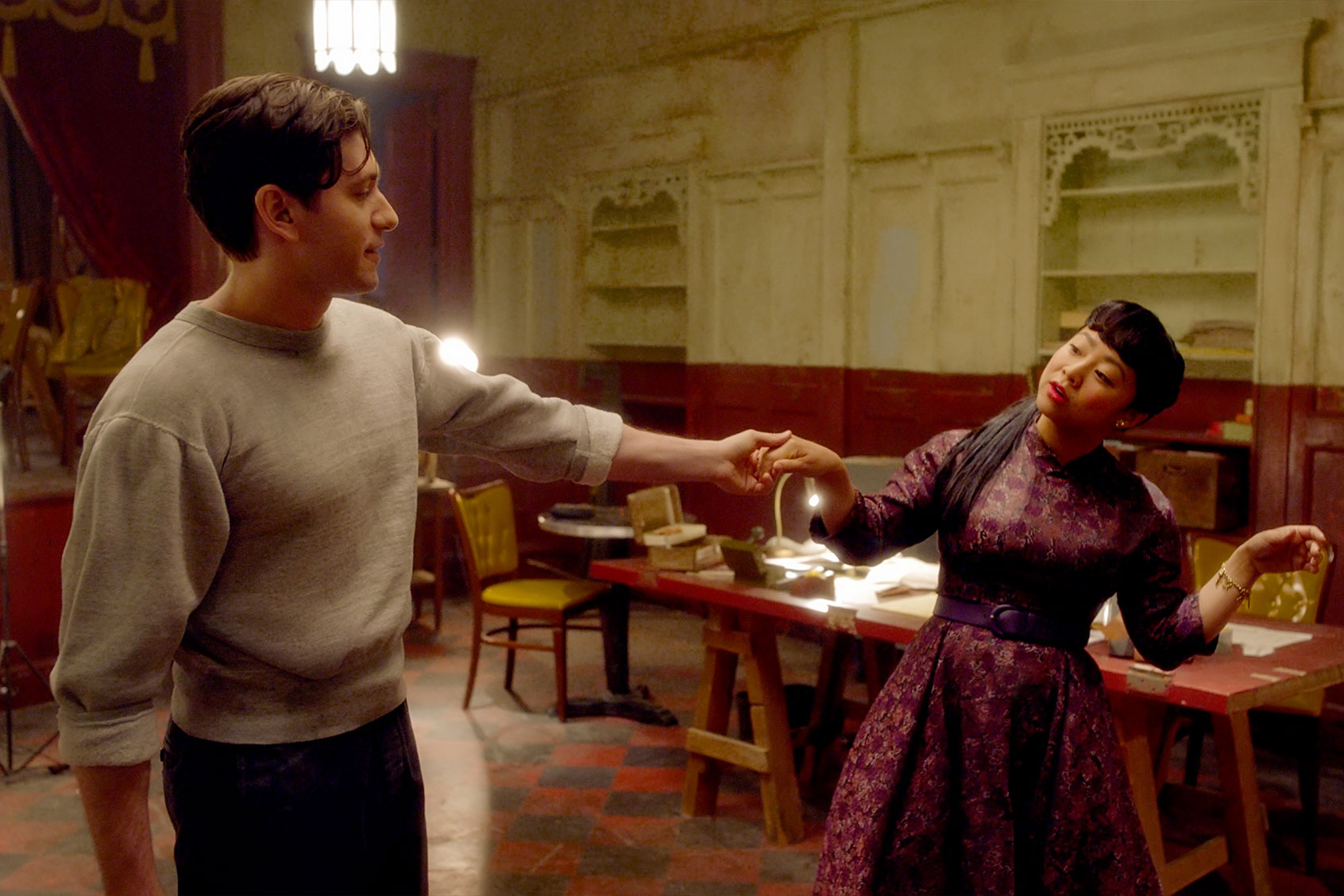
The Marvelous Mrs. MaiselMichael Zegen (Joel Maisel) and Stephanie Hsu (Mei) in “The Marvelous Mrs. Maisel” (Amazon Studios)But Joel accepts the abortion — or pretends to — faster than the Joel of previous seasons would have. Still, his anger is right there, barely below the surface. He tells Mei to get her things pretty quickly after that, shows up extraordinarily drunk to his own bar, hitting on random women with dates and attempting to do a hammered, horrible comedy set, just like the old days! He insults the band, largely made up of Black musicians, waxes poetically about Midge’s breasts, then goes after Mei’s relatives. As Zegen told Entertainment Weekly, “Every season Joel gets into a situation where he either gets punched or he punches somebody.” Sounds like a personal problem.
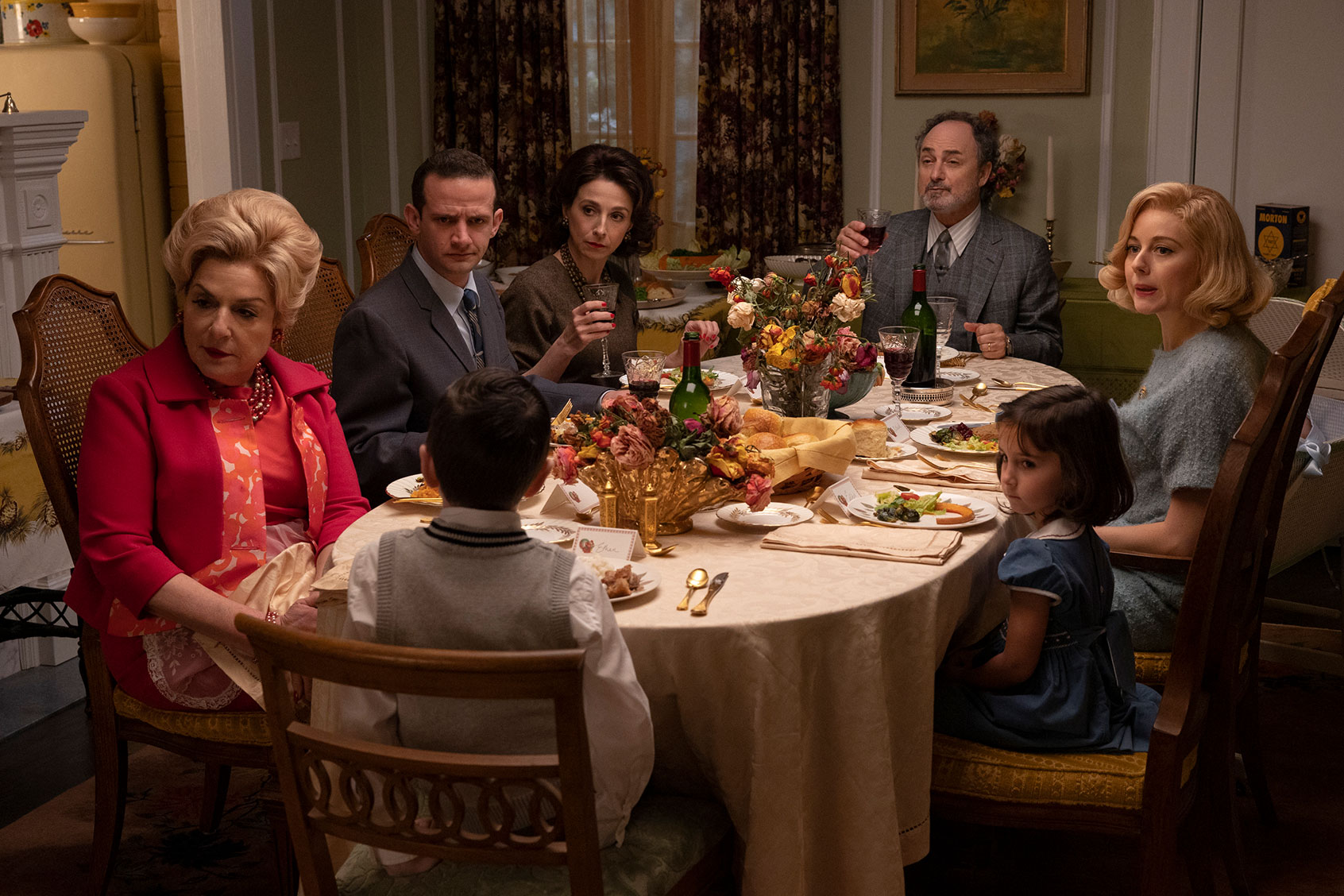
Midge understands much quicker about the abortion and she takes it more in stride, though her character’s default — blame someone else! — switches on immediately. “She wasn’t ready,” Midge says knowingly (and judgmentally). But when Joel turns his accusations on her, that talking with Midge somehow tipped Mei’s decision, Midge speaks in modern parlance, “That’s not fair. She chose.”

The Marvelous Mrs. MaiselThe Marvelous Mrs. Maisel (Philippe Antonello/Prime Video)

To simply accept the abortion is a surprisingly progressive move for the show.

When Joel at last tells his parents that Mei isn’t going to have a baby anymore, his mother Shirley (Caroline Aaron, in a powerhouse performance) is sympathetic at once. She also misunderstands. “She lost it?” Shirley asks, her hand over her heart and her ordinarily gruff voice soft and caring. Shirley is a force, but when you need love, she is there. No judgment, only grandmotherly hugs, snacks and a tornado of empathy. Joel lets her and his father (Kevin Pollak) think that it was a miscarriage, and that the event has broken him and Mei up.

At first, the abortion storyline on “Mrs. Maisel” feels like a whirlwind. No one presses for details. No one wants to know when or where or how, or even if Mei is OK physically. (Statistically speaking, at the time she may not have been.) But refusing to linger on it, or to dwell in sorrow or any negative emotion, to simply accept the abortion is a surprisingly progressive move for the show. It’s a simple fact. Mei had an abortion. We don’t need to say more or make it a big deal because it isn’t. 


Want a daily wrap-up of all the news and commentary Salon has to offer? Subscribe to our morning newsletter, Crash Course.


“Mrs. Maisel” has always taken a refreshingly different view of motherhood. Being a mother doesn’t complete Midge. She doesn’t feel actualized or satisfied as a person solely staying at home and being a caregiver and homemaker for the children she had quite young and the (cheating) husband she married young. “Mrs. Maisel” has never idealized motherhood the way that so, so many other shows and fictions do. They’ve never pretended that women can have it all.

And this season, Mei spells it out, plainly. “I can’t have it all, Joel. The world doesn’t work that way.” It especially won’t work that way for women like Mei, who doesn’t have the wealth and white privilege of Midge. Abortion’s appearance on “Mrs. Maisel” and the treatment of the storyline only prove its normalcy as an aspect of many people’s lives, much in the way parenthood is. 

“The Marvelous Mrs. Maisel” releases new episodes Fridays on Prime Video.

What is “complex PTSD” and who gets it? Kathy Griffin opens up about her diagnosis

Last week, comedian Kathy Griffin took to social media to share her recent mental health struggles in a video. In it, Griffin reveals between deep breaths how she had an eight-hour panic attack the day before.

“Eight hours of freaking writhing in pain in the bed,” Griffin says. “So today I felt like one might be coming on so I started to feel a little iffy, so I’m on my walk now, I’m outside and looking at the ocean, which is helpful — and I’m sort of almost mid-anxiety attack right now.”

On her Instagram account, Griffin explains that she’s been “plagued with terrifying panic attacks” over the past year and a half — and says that she’s been diagnosed with “complex PTSD,” short for complex post-traumatic stress disorder (C-PTSD). 

“Sometimes they [panic attacks] last a few hours or more typically, they last at least a full day if not multiple days in a row,” she said. “I feel silly even telling you this, because I always thought PTSD was just for veterans and stuff.”

While it is hard to find universal statistics for everyone on Earth, European researchers estimated in a study published in 2018 that more than 0.5 percent of people in Germany suffer from C- PTSD. According to a separate study in the Lancet, it is estimated that the disorder has a 1–8 percent population prevalence.

The symptoms of C-PTSD can be debilitating. Griffin says that sometimes during a panic attack she vomits, and that previously she’s gone to the emergency room to get IV fluids. Indeed, experts say that physical symptoms of a panic attack include racing heart, sweating, chills, difficulty breathing, dizziness and nausea.

While people with PTSD can can experience the physical sensations of panic attacks, C-PTSD is, as its name implies, a bit more complex. But how exactly does C-PTSD differ from PTSD?

“In distinguishing complex PTSD from a more incident-specific diagnosis of PTSD, the focus is largely on a history or series of interpersonal traumatic events that lead to ongoing suffering,” Carla Marie Manly, a clinical psychologist and author of “Joy From Fear,” told Salon. “Complex PTSD generally includes the symptoms of PTSD along with three additional clusters of symptoms described as interpersonal difficulties, emotional dysregulation, and negative self-beliefs.”

Those with PTSD may find themselves reliving a traumatic experience through nightmares, intrusive thoughts, or flashbacks.

While complex PTSD isn’t listed in the Diagnostic and Statistical Manual of Mental Disorders (DSM-5), meaning it’s not a mental health condition that can be officially diagnosed, professionals have been pressing for a distinct classification for this disorder for some time.

“In distinguishing complex PTSD from a more incident-specific diagnosis of PTSD, the focus is largely on a history or series of interpersonal traumatic events that lead to ongoing suffering,”  Manly added.

Those with PTSD may find themselves reliving a traumatic experience through nightmares, intrusive thoughts, or flashbacks. They also may avoid triggers of the traumatic event, and experience a sense of self-isolation and detachment; or conversely, a heightened state of emotional arousal such as experiencing anger outbursts or feeling constantly on-guard for long stretches of time.

“In general, when we look at how complex PTSD differs from PTSD, we are focusing on the individual’s trauma history and level of disruption in self-regulation, self-cognition, and interpersonal experiences,” Manly said. “The genesis of complex PTSD is more pervasive and often more interpersonally devastating than PTSD.”

Manly added it’s important to note that PTSD is not “less than” complex PTSD.

“They are both very serious diagnoses that deserve attention and healing,” Manly said.


Want more health and science stories in your inbox? Subscribe to Salon’s weekly newsletter The Vulgar Scientist.


In 1992, psychiatrist Judith Lewis Herman wrote a paper coining the term C-PTSD for the first time. In the paper, she proposes that there is evidence that a “complex” form of PTSD exists in survivors of prolonged trauma. That trauma, she wrote, usually occurred early in life, often in survivors of child abuse and neglect, and affected a person’s regulation of impulses; attention or consciousness; self- perception; view of the perpetrator; and their relationship with others. Since then, researchers have debated whether C-PTSD can be diagnosed on its own, since its symptoms can often overlap with other mental disorders following trauma. C-PTSD is not listed in the Diagnostic and Statistical Manual of Mental Disorders (DSM), considered the “bible” for mental health diagnoses and practitioners; however, Complex PTSD was included in the 11th edition of WHO’s International Classification of Diseases (ICD), a similar diagnostic manual to the DSM. 

“Complex post traumatic stress disorder (Complex PTSD) is a disorder that may develop following exposure to an event or series of events of an extremely threatening or horrific nature, most commonly prolonged or repetitive events from which escape is difficult or impossible,” the ICD stated, including examples such as “torture, slavery, genocide campaigns, prolonged domestic violence, repeated childhood sexual or physical abuse.” 

Griffin has long been an open book about her past hardships and struggles, which include  surviving sexual abuse from her late brother and being diagnosed with lung cancer. In 2019, Griffin sat down with Salon Talks and discussed being targeted by former president Donald Trump, and being investigated by the FBI for posting a fake photo of Trump decapitated.

“I was put under a two-month federal investigation by two federal agencies, and a lot of people thought I’d just got a call from the Secret Service or something,” Griffin said. “But no, they investigated me for two months. I was on the no-fly list, like I was a 9/11 terrorist. And I ended up being interrogated under oath.”

In a separate interview for Salon Talks, Griffin spoke about the importance of resilience and how humor helps her in tough times.

“Using humor is the only way I know how to communicate,” Griffin said. “My dad passed away, but he was comedian-funny, where he could be funny on cue. My mom is hilarious and she doesn’t know why, she’s just a character. I was born to be a comedian.”

Jake Tapper can’t keep a straight face while reading Fox statement touting “journalistic standards”

CNN’s Jake Tapper struggled to hold in his laughter while reading Fox News’ settlement statement on Tuesday, following the network’s $787.5 million settlement with Dominion Voting Systems.

“This is gonna be difficult to say with a straight face,” the CNN host said, struggling to hold back laughter as he read off Fox’s self-proclaimed commitment to “the highest journalistic standards.” 

“We are pleased to have reached a settlement of our dispute with Dominion Voting Systems,” the network’s statement read. “We acknowledge the Court’s rulings finding certain claims about Dominion to be false. This settlement reflects FOX’s continued commitment to the highest journalistic standards. We are hopeful that our decision to resolve this dispute with Dominion amicably, instead of the acrimony of a divisive trial, allows the country to move forward from these issues.”

This statement comes after Fox admitted to broadcasting false claims about the voting software company just ahead of what would have been a landmark defamation trial set to begin on Tuesday. According to Tapper, the network tried to put a “positive face on what can only be interpreted as one of the ugliest and most embarrassing moments in the history of journalism.”

Prior to the settlement, Dominion had been pursuing $1.6 billion in damages against the right-wing news network over allegations that Fox pushed false claims implicating the voting technology company in a conspiracy to “steal” the election from former President Donald Trump.

The trial, which would have been one of the most important in the history of First Amendment law, ended abruptly after news of the settlement reached the courtroom following jury selection on Tuesday.

“The parties have resolved this case,” presiding Judge Eric Davis told jurors in his Wilmington, Delaware, courtroom. “Without you, the parties would not have been able to resolve their situation. … Although it’s short, not the six weeks you’ve expected, you have done your duty. The case has been resolved.”


Want a daily wrap-up of all the news and commentary Salon has to offer? Subscribe to our morning newsletter, Crash Course.


MSNBC host Joe Scarborough echoed Tapper’s sentiments about the settlement.

“This is what happens when you have a 93-year-old man running a company, and everybody’s just a yes man to him,” Scarborough said, according to Mediaite. “I can’t believe Murdoch 20 years ago would have settled this months ago.”

He said that Fox had “[humiliated] everybody at the network” by attempting to fight the case only to settle at the last second, especially after bruising evidence — including exchanges between Fox News hosts and executives stating that they did not believe the false claims aired on the network following the 2020 election — cast doubt on their top people.

Though Fox has dodged the heat of what would have been a widely publicized trial with Dominion, the network is still in hot water as it faces a $2.7 billion defamation lawsuit from Smartmatic. The voting software and hardware company also alleges that Fox News defamed it with false allegations of election fraud in 2020.

Dominion’s team, however, celebrated the settlement as a victory. 

“The truth matters, lies have consequences,” Dominion lawyer Justin Nelson said.

 “Fox has admitted to telling lies about Dominion that caused enormous damage to my company, our employees, and the customers that we serve,” added Dominion CEO John Poulos.

“Accountability is coming”: Dominion turns focus on TrumpWorld after scoring Fox News payout

Dominion Voting Systems reached a $787.5 million last-minute settlement with Fox News on Tuesday but the company is far from finished.

Justin Nelson, Dominion’s lead counsel, told CNN on Tuesday that the voting machine company still has pending lawsuits against numerous Trump allies and right-wing broadcasters that falsely claimed the company rigged machines to flip votes to President Joe Biden.

“What this settlement today shows is that the actual malice standard isn’t just on paper … journalists can’t knowingly lie,” said Nelson. “Journalists can’t say one thing in private and another thing in public. And when we have that protection and that knowledge that in fact, there is the protection of the actual malice standard, and that is from the First Amendment. We can be assured that journalists will go ahead and report the truth and will do so with the full freedom the First Amendment allows.”

“Your team had mentioned earlier that this is sort of the first step,” said CNN correspondent Sarah Sidner. “What happens next for Dominion? What does this mean for other lawsuits against other networks that were promoting false theories about the 2020 election?”

“That’s a great question,” Nelson replied. “This is one of seven lawsuits. This one settled today. There are six left. And I think it sends a message to the other six lawsuits that accountability is coming as well. It’s not over. We have lawsuits against Newsmax, against One America News, against Sidney Powell, against Rudolph Giuliani and Mike Lindell and MyPillow and Patrick Byrne. And many of them are still propagating these lies about the election, and they are still having an effect.”


Want a daily wrap-up of all the news and commentary Salon has to offer? Subscribe to our morning newsletter, Crash Course.


“So we intend to hold people accountable because, as we have said, the truth really does matter and if you are lying, that has consequences,” he added. “It had a consequence for Dominion in the … grievous blow to the reputation that it had over the past couple of years and the threats the death threats that the company really continues to receive, and it had a consequence for Fox. Today they paid nearly three-quarters of a billion dollars.”

Smartmatic, another voting tech company embroiled in TrumpWorld conspiracy theories, has also sued Fox News, its hosts, and other Trump allies. The list of those who have been sued in connection with advancing election falsehoods includes former Trump attorney Sidney Powell, former Trump attorney Rudy Giuliani, MyPillow CEO Mike Lindell, Overstock CEO Patrick Byrne, Fox News and several of its hosts including Jeanine Pirro, Lou Dobbs, and Maria Bartiromo, right-wing outlet Newsmax, and One America News, which refused to acknowledge Biden’s win in the 2020 election.

The trial Fox News deserves

Talk about an anticlimax. For the past couple of weeks we’ve all been on tenterhooks waiting for the latest trial of the century, the defamation case by Dominion Voting Systems against Fox News. The judge had already ruled that there was ample proof that Fox had lied so all Dominion had to prove was that they did it with malice (which I think we can all see every day by the venom they spew). The weeks of very juicy discovery material which had already become public, exposing the executive suite and all the top Fox stars as venal liars, were thrilling previews of what was assumed to be the main event: the prospect of all of them, including the Murdoch patriarch himself, Rupert, on the witness stand trying to explain how they could square what they said in private with what they said publicly. It led to the exciting expectation that this was going to be a long overdue comeuppance for the right-wing propaganda outlet.

Sadly, it was a dud.

Just as they had chosen a jury and were about to start opening arguments, a settlement was reached and the trial was over before it started. Dominion lawyers and executives took to the microphones and announced that they had accepted a whopping settlement offer of $787,500,000.00. Fox News issued a preposterous statement and that was the end of that:

https://youtu.be/7v7lrqxlfE0

To say it was a disappointment is a massive understatement. I think all of us who care about our country and about journalism were hoping that this might finally break the pernicious right-wing juggernaut Rupert and Roger (Ailes) built that has brought us to this dangerous political moment. But we were being unrealistic. A defamation case by one private company against another private company is a weak instrument with which to save democracy.

To say it was a disappointment is a massive understatement

As much as we wanted to hear about Rupert Murdoch squirming on the stand and yearned to see Tucker Carlson forced to read a statement on the air admitting that he lied repeatedly, it was always about money. Dominion got a massive payout, for which you can’t really blame them for taking. There were many legal observers who felt confident they would win the case but that their 1.2 billion dollar claim for damages was weak. For Fox, it’s just the cost of doing business. It cost a bundle but they live to lie another day and make a tidy profit doing it.

As my colleague Amanda Marcotte astutely observed, Fox News thought it had been grooming its audience for over two decades to believe everything the hosts said and it turned out that they had actually been groomed to only hear what they wanted to hear. Today’s Fox viewers are impervious to any information that conflicts with their worldview and we know this because when Fox reporters and pundits tepidly suggested that Trump’s insistence that the vote had been stolen was not borne out by the facts, Trump unleashed a primal scream and his followers lashed out hysterically, decamping to the competing networks OANN and Newsmax which were happily disseminating the Big Lie. If Fox has learned a lesson from this it’s almost certainly that they need to pay even closer attention to the jungle drums in the right-wing fever swamp — and maybe just a teensy bit more careful when they go about defaming private companies.


Want a daily wrap-up of all the news and commentary Salon has to offer? Subscribe to our morning newsletter, Crash Course.


If the settlement had forced Fox celebrities to read a statement apologizing and admitting that they’d knowingly spread lies about the election on air, I feel confident that the viewers would not believe a word of it. There is no limit to the rationalizations MAGA true believers are capable of coming up with to justify their refusal to face reality. I might even expect Trump himself to say that it was a smart business move by Fox just to get the lawsuit out of the way. After all, he himself spent 25 million to settle the Trump University fraud lawsuit after he was elected in 2016. (And as much as he might diss Fox whenever they stray, they’ve recently come back in the fold and he is running for president.)

The cost of doing business is getting very expensive for Fox News.

This case isn’t the end of the line. The other voting machine company, Smartmatic, has also filed a lawsuit asking for over $2 billion in damages. This settlement will only help their cause. Their lawyer, Erik Connolly, issued this statement after the settlement was announced:

Dominion’s litigation exposed some of the misconduct and damage caused by Fox’s disinformation campaign. Smartmatic will expose the rest. Smartmatic remains committed to clearing its name, recouping the significant damage done to the company, and holding Fox accountable for undermining democracy.

With what we already know, it does seem likely that Murdoch is going to have to write another big check. And now we see the shareholder suits coming online. The cost of doing business is getting very expensive for Fox News.

There is a silver lining for those of us who were looking for some sort of justice. The power of the paper trail that Dominion was able to obtain proved without a doubt that Fox knew that Joe Biden had won the election. They were told by many people both internally and externally that Trump was lying and there was no basis to his claims. It is now in the public record that they lie to their audience because their audience demands to be lied to and they only care about ratings and money. There are tapes and emails and text messages all proving they are what we always thought they were and we know for a fact they are not only not a news organization, they know they are not a news organization.

There really is a win for America in all this. Everything we’ve learned from the depositions and the discovery documents can’t be disappeared. The truth still matters to most of us and the truth is that Fox is not really about ideology or even sheer political power. Fox News’ mission is to entertain its audience by telling them whatever they want to hear for money. They can continue to perform for their audience, and they will, but everyone else knows what they really are: a greedy carnival act, slavering over the attention of a bunch of deluded conspiracy theorists. 

Fox News media reporter refuses to reveal Dominion settlement amount on air

Fox News on Tuesday settled Dominion Voting Systems’ defamation lawsuit for $787.5 million — but the network’s own media reporter claimed he could not “independently confirm” the settlement amount on air.

Fox struck a deal with the voting machine company as the trial was set to start on Tuesday. Fox as part of the settlement acknowledged its falsehoods about the company in a statement but the network will not have to acknowledge them on air, according to CNN’s Oliver Darcy.

“Don’t expect hosts to have to read statements,” Darcy tweeted.

Fox News media reporter Howard Kurtz reported the settlement during the 4 pm hour but claimed he did not know the settlement amount.

“A Dominion lawyer gave reporters a dollar figure for the settlement, but I have not been able to independently confirm that,” Kurtz said.

Daily Beast media reporter Justin Baragona reported that Fox News host Neil Cavuto did mention the settlement amount, citing the Wall Street Journal, another outlet owned by Rupert Murdoch.

“Really stands out that the in-house media reporter just refused to tell Fox audiences the hefty settlement figure,” Baragona tweeted.

Top Fox News hosts Tucker Carlson and Sean Hannity likewise did not reference the settlement at all during their broadcasts, according to Reuters. And Washington Post reporter Aaron Blake noted that “the Fox News website’s story on the Dominion settlement is only 161 words long.”

“It makes no mention of the dollar amount and little mention of the substance, which it summarizes as involving ‘coverage of the post-2020 presidential election,'” he wrote.

Fox News in a statement on Tuesday said it was “pleased” to have reached the settlement.

“We acknowledge the Court’s rulings finding certain claims about Dominion to be false,” the statement said. “This settlement reflects FOX’s continued commitment to the highest journalistic standards. We are hopeful that our decision to resolve this dispute with Dominion amicably, instead of the acrimony of a divisive trial, allows the country to move forward from these issues.”

Darcy on Twitter pointed out that it’s “notable that the language Fox News uses in its statement acknowledging it aired election falsehoods is much softer than the usual run-of-the-mill correction issued for far smaller errors at actual news outlets.”


Want a daily wrap-up of all the news and commentary Salon has to offer? Subscribe to our morning newsletter, Crash Course.


New York Times reporter Nick Confessore told MSNBC that despite the hefty settlement, the fact that the network does not have to air an apology makes it a “draw for Fox.”

“Because, think about it, on any given night or week on Fox, they are telling a different version of the same story that Donald Trump should be president, that the Jan. 6th conspirators are innocent victims of government overreach, that they had a right to be angry, that something was, you know, amiss,” he said. “That’s the story that still animates the viewership on Fox. That’s the story they tell every night.”

CNN’s Pamela Brown pressed Dominion lawyer Justin Nelson on why they did not push to make on-air apologies part of the settlement.

“Our goals were accountability, number one, and trying to have some semblance of a whole for Dominion as a company, to have some remuneration for the reputational hit that it has suffered and continues to suffer as a result of these lies. And those have been our goals all along. And today’s settlement achieved that,” Nelson said.

“This is a civil litigation case and what we think happened here was we took the civil litigation as far as we can take it,” he added. “We could have gone all the way to verdict and under defamation law, you don’t get an apology. You get money.”

2022 was a particularly deadly year for land and environmental activists

In February of 2022, Colombian human rights activists Teófilo Acuña and Jorge Tafur were assassinated in front of their friends and families after decades of working to protect small, rural communities from mining and land-grabbing. Their killers have not been brought to justice. 

Acuña and Tafur were just two of 401 human rights defenders killed in 2022, according to a new report from Frontline Defenders, an international human rights organization. According to researchers, approximately 48 percent of those killed were protecting land, environmental, and Indigenous peoples’ rights, while 22 percent of people killed were Indigenous. The report also found that environmental and Indigenous rights defenders were most targeted and regularly faced arrest, detention, legal action, physical attacks, death threats, and murder.

“There will always be defenders who will step up, there always is and there always will continue to be,” said Olive Moore, Frontline Defenders’ interim director. “What’s more worrying is how much more sophisticated the pushback by governments by authoritarian countries and by business against those defenders are.”

Nearly 46 percent of killings occurred in Colombia, followed by assassinations in Ukraine, Mexico, Brazil, and Honduras. Combined, those five countries accounted for more than 80 percent of all human rights defenders’ deaths in 2022. 

Latin America remains the deadliest region on the planet for Indigenous peoples working to protect their rights or lands. More than 10,000 conflicts related to land rights and territories were recorded between 2011 and 2021, and a report released last year revealed that during that same time frame, 342 land defenders were killed. Many of those conflicts were driven by former Brazilian president Jair Bolsonaro, who swore he would not “give the Indians another inch of land,” tried to dissolve the Ministry of the Environment and Climate Change, and attempted to leave the Paris climate accords. During the Bolsonaro administration, deforestation in the Amazon increased 56 percent. 

“The challenges they are facing is that they are being thrown off their land and they are losing their livelihoods,” Moore said. “There are no alternatives for them.”

The endangerment of human rights activists and land defenders has only grown. In 2021, Frontline Defenders reported 351 killings, and a report from the Business & Human Rights Resource Centre showed there were disproportionate attacks against Indigenous land defenders during that same year.

Moore said conflicts around mines, water, and pipelines continue to pit rights defenders against governments and businesses that rely on police, military, or private security groups to back agendas. 

“They have the resources and they have the power and they are remarkably effective at closing down spaces for defenders,” Moore said. “Those who are the violators have sufficient resources to up their game, and constantly try to create more threats and take out defenders.”

EPA targets cancer-causing emissions from medical sterilization facilities

Sterilizing medical equipment is essential for modern healthcare, but the process generates a substantial public health risk. The key culprit is the chemical ethylene oxide, which is both a highly effective fumigator and a potent carcinogen. The Environmental Protection Agency revealed the shocking extent of the pollutant’s toxicity in 2016, but it has not proposed comprehensive regulation of the chemical until now.

This week, the EPA proposed a rule that promises to reduce annual ethylene oxide emissions by at least 19 tons a year — an 80 percent reduction from current levels. The proposal builds on a separate set of rules that the agency passed earlier this month to curb ethylene oxide releases from certain types of chemical plants.

Environmental advocates called the news an important but belated response to the cancer risk that communities near these facilities have endured, in some cases, for decades. The Clean Air Act directs the EPA to update its pollution standards for medical sterilization facilities every eight years, but the agency has repeatedly missed these deadlines. The rules proposed this week come after the environmental nonprofit Earthjustice filed a lawsuit over the agency’s failure to issue the rules by April of last year. In that case, the court ruled that the EPA must publish the rules by this spring.  

“Today’s proposals are an important first step in remedying an injustice that affects far too many communities,” said Earthjustice attorney Marvin Brown in a press release. “Too many workers and community members have gotten cancer from facilities that are supposed to make sure that our medical equipment is safe.”

Brown and other advocates argued that the EPA should go further to protect residents living near sterilization facilities by requiring companies to install air quality monitors at the facilities’ borders and regularly post the collected data to a public site. 

According to the EPA, there are 86 medical sterilization facilities currently operating across the U.S., 23 of which generate levels of cancer risk that the agency considers unacceptable. They operate quietly in nondescript buildings, sometimes mere feet from schools and residential neighborhoods. It is impossible for residents of these areas to understand their exposure to ethylene oxide without special monitoring technology, since it is colorless and odorless. 

Medical sterilization facilities came under scrutiny in 2016 when the EPA published an assessment finding ethylene oxide to be 30 times more toxic to adults and 60 times more toxic to children than previously known. Numerous studies had linked the chemical to cancers of the breasts, lymph nodes, and lungs. Research also found that it is a mutagen, meaning it can alter DNA. 

The EPA directed its regional offices to inform communities near the biggest polluters of the risks they faced. In response, elected officials and residents in Georgia and Illinois filed lawsuits against medical sterilization companies, leading to settlement deals and the closure of a major plant in a suburb of Chicago, Illinois. 

But news did not travel as fast for other residents. In Laredo, Texas, where the most toxic industrial sterilizer in the nation is located, residents were not informed of their exposure until 2021. That plant continues to operate today. 

“Here in Laredo, a South Texas border community that is 95% Latinx, our children attend schools with some of the worst air quality in the country because of ethylene oxide pollution,” said Tricia Cortez, co-founder of the Clean Air Laredo Coalition, in a press release.

During a press conference on Tuesday, EPA Deputy Assistant Administrator Tomás Carbonell said that the agency’s proposed rules, if implemented as written, will help protect residents in places like Laredo. They require that 86 commercial sterilization facilities install equipment that better captures ethylene oxide and reduces emissions of the chemical by 80 percent. To ensure that the facilities are meeting these standards, the rule requires that facilities monitor for ethylene oxide releases and report to the agency twice a year. 

While the EPA invoked the Clean Air Act to protect residents near sterilization facilities, it also leaned on a different environmental law to protect workers within those plants. The Federal Insecticide, Fungicide, and Rodenticide Act gives the EPA the authority to assess whether chemicals used as pesticides are safe. Since ethylene oxide has antimicrobial properties and is used for sterilization, the EPA used its authority under that law to require that workers wear protective equipment like respirators if ethylene oxide levels exceed 10 parts per billion in the air.

As part of the proposal, the EPA conducted a risk assessment and found that the chemical posed as much as a 1 in 10 lifetime cancer risk for workers. That means that, if 10 workers are exposed to current workplace levels of the chemical over the course of their lifetimes, one of them would be expected to develop cancer from the exposure.

The proposal also requires facilities to not use more than 500 milligrams of ethylene oxide per liter of solvent for one sterilization cycle. EPA officials said that some facilities are already meeting that requirement, but that others are using twice as much. In cases where alternatives to ethylene oxide exist — such as in some cosmetics manufacturing and in museum work — the EPA is prohibiting the chemical’s use. 

Ethylene oxide manufacturers and sterilizers have long been opposed to stricter rules for governing ethylene oxide emissions. Industry groups like the American Chemistry Council have taken issue with the EPA’s 2016 finding that ethylene oxide is 30 times more toxic for adults than previously understood. In response to EPA’s announcement last week, the Council said in a press release that it opposes any rule-making that uses the EPA’s “flawed” assessment of ethylene oxide’s toxicity. 

Scott Whitaker, president and CEO of AdvaMed, a trade group representing medical technology companies, also raised concerns about this week’s rules. The EPA is requiring the companies comply with the rule in 18 months — a shorter time frame than is typical due to the chemical’s toxicity and potential for harm. Whitaker said the timeline for compliance “is much too short” and that it could take many months to procure emissions reductions equipment. “Supply chains and manufacturing are still recovering from the pandemic,” he said in a press release. 

Whitaker noted that ethylene oxide is used to sterilize half of all medical technology — about 20 billion devices — in the U.S. each year. Many medical devices cannot be sterilized through other methods, and shuttering even a few sterilization facilities could adversely affect patients, he claimed.

Still, Whitaker appeared confident about the industry’s ability to comply with the rules overall. 

“If we have careful coordination with the EPA, we are confident we can deliver for all interests as these regulations are refined and finalized,” he said. 


Editor’s note: Earthjustice is an advertiser with Grist. Advertisers have no role in Grist’s editorial decisions.

This article originally appeared in Grist at https://grist.org/regulation/epa-rules-ethylene-oxide-medical-sterilization/.

Grist is a nonprofit, independent media organization dedicated to telling stories of climate solutions and a just future. Learn more at Grist.org

Ron DeSantis’ Disney obsession: Why he can’t let it go

Ron DeSantis, the arch-conservative Republican governor of Florida, graduated from Yale University and Harvard Law School. Due to these elite credentials, he has long enjoyed the presumption of phoniness in the mainstream media. The far-right authoritarian politics DeSantis touts are treated almost universally in the press as evidence he’s trying to win over the MAGA base rather than a direct reflection of his own fascistic worldview.

“Everything he does is about what can further his own career ambitions,” one Florida activist, quoted by the Associated Press, said of DeSantis’ efforts to ban all acknowledgment of LGBTQ people in public schools.

The New York Times argued the “don’t say gay” law is a way for DeSantis to be “more of a warrior figure to his political base.”

People like DeSantis continue to benefit from the rarely-questioned assumption that no one who went to Harvard or Yale can really be a serious authoritarian.

In writing about DeSantis’s embrace of draconian censorship laws, Greg Sargent of the Washington Post writes, “DeSantis probably calculates that this would serve his short-term political interests,” because it “will bolster him among GOP primary voters.”

There’s probably some truth to the idea that DeSantis hopes hardcore culture war antics will help distinguish him from Trump, whose interest in hating LGBTQ people has always seemed perfunctory and who was more focused on silencing his critics than banning books with sex in them. But there’s substantial evidence that DeSantis is motivated just as much, and likely more, by his own longings to be a petty dictator guided by an entirely sincere ideology of hate.


Want more Amanda Marcotte on politics? Subscribe to her newsletter Standing Room Only.


Vox legal reporter Ian Millhiser tweeted a story about meeting Desantis a few years ago in the green room at CNN. “After his segment, he spent at least 30 minutes in the makeup room, ranting to no one in particular about a conspiracy theory involving Hillary Clinton and Russia,” Millhiser wrote, affirming that DeSantis is an authentic right-wing nut, even when the cameras are turned off. 

Other indicators have popped up, as well. There’s the time DeSantis had a meltdown at a bunch of high school students who chose to wear masks. It not only cut against his false claims to support “personal choice,” but it was so vicious that even the biggest pandemic-denying Karen was likely grossed out by his behavior. Then there was his recent signing of a near-absolute ban on abortion in Florida. DeSantis is aware that abortion bans are bad politics, which is why he signed the bill in the middle of the night in a failed attempt to sneak this one past the voters. All of this suggests that DeSantis knows some of his views aren’t helpful, perhaps even in a GOP primary. He just is a true believer who wants to impose his bigoted beliefs on the public. 

The latest evidence that the MAGA behavior is not an act: DeSantis’ bizarre and obsessive war with Disney.

DeSantis won’t listen to that classic Disney song and just let it go.

It all started last year when the company released a milquetoast statement lightly condemning the “don’t say gay” bill as a threat to the safety of Disney employees and their families. DeSantis overreacted dramatically, by threatening to violate both state law and First Amendment protections by revoking Disney’s municipal control over the Disney World area. He got pretty far in this plan until he discovered that Disney — being equipped with fancy corporate lawyers — had figured out a workaround that denied his newly appointed board of right-wing ideologues most of the power over the company. DeSantis won’t listen to that classic Disney song and just let it go, however. He’s now threatening to build a competing amusement park or even a prison next to Disney World, all as a petty act of revenge.


Want more Amanda Marcotte on politics? Subscribe to her newsletter Standing Room Only.


A politician whose main goal is gaining political advantage in a presidential primary would not be going down this rabbit hole. Even the hardest core MAGA types will struggle to care about a battle over trash pickup and water bills in the Disney World area. Frankly, it’s hard for most to remember why DeSantis is so mad at Disney to begin with. But DeSantis is motivated by a very personal obsession, and he’s using his electoral office to prosecute a grudge match. 

DeSantis did try to make this story relevant to the MAGA base by pretending that he could leverage what is a real estate battle into censorship powers over Disney’s content, but it was a stretch. Yes, there is a small but vocal group of right-wing whiners who are angry all the time over a Black Little Mermaid or the fact that “Frozen” had two female leads. But even in Republican circles, most people simply don’t care enough about “woke” Disney to work themselves into a lather over it. As Sarah Jones of New York wrote last week, right-wing activists have spent decades trying to paint Disney as a threat to the red state way of life, and it’s never made a dent in Disney profits. Other conservative “boycotts” end up the same. The ravings about “woke” corporations on social media never seem to translate to any serious shift in red state consumption habits. Plus, DeSantis never really explained how battling with Disney over municipal control would make the Black Little Mermaid white again. So even those who care about that won’t be able to connect DeSantis’ fixation on Disney to their own culture war goals. Even at Breitbart, where culture war obsessions are the order of the day, the latest story on this got a paltry 3 comments. Only one supported DeSantis’ actions. It’s worth remembering that Disney is the largest employer in the Sunshine State. Only the most MAGA-poisoned Republican voters think it’s smart to run lucrative companies out of your tax base. 

Donald Trump definitely seems to think all of this just hurts DeSantis, by making DeSantis look weak and trifling. 

DeSantis is far from the only example from just this month alone that Republican leaders aren’t faking it, but are in fact the wild-eyed right-wing radicals they present themselves to be.

Judge Matthew Kacsmaryk ignored not just all law and science in an effort to ban the abortion pill, but overwhelming evidence that his actions would backfire politically. His choices build on the Republican-controlled Supreme Court’s original decision to overturn Roe v. Wade, despite polls showing it would harm their party. In Tennessee, Republicans made a spectacle of their own racism by expelling two Black lawmakers from the state legislature for speaking out against gun violence. In Oklahoma, recently released secret recordings show that conservative officials sound like an anonymous forum of white supremacists when they don’t think anyone is listening. 

The simplest explanation for why Republican politicians behave like a bunch of bigots is that they are, in fact, a bunch of bigots. And yet, this media myth persists that it’s all just an act to win over the “base” of uneducated yokels. The belief that “savvy” politicians are manipulating the unwashed masses goes at least back to the 2005 bestseller “What’s the Matter with Kansas.” In that book, author Thomas Frank posited that opposition to abortion rights was just a pose that Republicans adopted to win votes. He insisted they never intended to actually outlaw the procedure. 

Frank was so wrong that it would be hilarious, except for all the millions of women who are now under threat because of the complacency he encouraged. But the elitist attitude that fueled his book persists in the media. People like DeSantis continue to benefit from the rarely-questioned assumption that no one who went to Harvard or Yale can really be a serious authoritarian. The idea that it’s just an act is too hard to shake, even in the face of overwhelming evidence that people like DeSantis are exactly the monsters they play on TV. 

Fox News caves, and the real winner isn’t Dominion — it’s democracy and the rule of law

Fox News has caved. On Tuesday afternoon, its parent corporation settled the defamation lawsuit that Dominion Voting Systems had brought against the right-wing cable network for a reported sum of $787.5 million. That dollar amount, although less than half the $1.6 billion Dominion originally demanded, will clearly capture the headlines.

But as a former federal prosecutor concerned above all else with the strength of the rule of law and our constitutional order, three points stand out. 

  1. The rule of law stands taller now than it did on Tuesday morning. It rests upon accountability, and Dominion has achieved accountability for falsehoods perpetrated by a media outlet seeking profit over principle.
  2. In cases brought to court, facts and truth are what matter. Conspiracy theories fail.
  3. In the public square, publishing the truth requires a vibrant media protected by a vital First Amendment. Tuesday’s capitulation by a ratings-driven cable channel reinforces both, as counterintuitive as that may seem.

Let’s start there. If Fox had escaped accountability in this case, the damage to our democracy could have been irretrievable. Here’s why.

America’s free press operates today under the protection of the landmark 1964 Supreme Court case New York Times v. Sullivan. It is a bulwark of our freedom, and it’s under constant attack from the right.

In Times v. Sullivan, the court erected a mile-high barrier against successful libel suits by public officials — which was later extended to “public figures” and large corporations like Dominion — who are criticized in the media. The court required such plaintiffs to establish “actual malice” on the part of the critic before they could prevail. In practice, this means a plaintiff must prove not only that a media outlet published false statements, but did so either knowingly or with reckless ignorance, having made no serious effort to determine the truth.

In the Times v. Sullivan opinion, Associate Justice William Brennan delivered a ringing endorsement of press freedom. Speaking for the unanimous court, he wrote of the “profound national commitment to the principle that debate on public issues should be uninhibited, robust, and wide-open.” Such debate, he reasoned, requires “breathing space to survive.”

In other words, critics in the media need room to be wrong in order to take the risk of speaking truth to power. The free press has wide latitude to publish accusations about public figures and prominent institutions, so long as those charges are not knowingly or recklessly untrue. Without such breathing room, the truth dies and the oxygen of democracy is consumed by fear.

Tuesday’s three-quarter-billion-dollar settlement means that Dominion surmounted that barrier in this case. It demonstrates that “actual malice” can still be proven in egregious circumstances, and that standard can keep critics honest.


Want a daily wrap-up of all the news and commentary Salon has to offer? Subscribe to our morning newsletter, Crash Course.


There is no way to exaggerate the importance of this victory in today’s anti-democratic environment. The “actual malice” standard is under relentless assault from America’s previous and would-be next president, Donald J. Trump.

And he’s not alone. As recently as 10 months ago, Justice Clarence Thomas wrote in a dissenting opinion related to Coal Ridge Ministries Media v Southern Poverty Law Center that the high court should “revisit” Times v. Sullivan.

Translated from legalese to English, that means: Let’s lower the wall that blocks libel suits by politicians and other public figures. It’s too high for anyone to climb. The balance too strongly favors the press by making it virtually immune to legal action.

The Dominion settlement demonstrates that the standard of “actual malice” can keep the media honest. There’s no way to exaggerate the importance of that victory.

This week the Dominion case has undermined that attack and strengthened some of our most important freedoms. You don’t need to be James Madison to imagine the damage to freedom of the press if Donald Trump, Ron DeSantis or Jim Jordan could weaponize the negligence standard that right-wing judges like Thomas would prefer in the place of “actual malice.” 

Indeed, one need only think of the ProPublica investigations published over the past week or so that compelled Justice Thomas himself to correct his past financial disclosure statements. Indeed, those articles might never have been published in the first place. The mere possibility of a viable threat can kill investigative journalism; investigations that don’t happen leave important truths unspoken. Those kinds of silences erode and corrupt democracy.

That brings us back to points one and two. Dominion had the courage to put Times v. Sullivan to the test. As one of the company’s lawyers said at its press conference on Tuesday, in the courtroom, “truth matters” and “lies have consequences,” while conspiracy theories and “alternative facts” evaporate.

The rule of law and our judicial institutions did their work. Delaware Judge Eric Davis, a by-the-book jurist, held Fox’s feet to the fire with a series of firm rulings, based on the evidence, that limited the network’s path to any kind of victory.

Davis also appointed a special master to investigate whether Fox’s lawyers had withheld damaging evidence from their adversaries and the court. He impaneled a jury of 12 ordinary citizens, and the trial that could have destroyed Fox’s entire business was about to start. That was apparently quite enough for the network’s legal team.

Anyone who feels disappointed that Dominion did not recover the full $1.6 billion its complaint demanded should understand that that number was invented for the purposes of negotiation. The sum Dominion has actually won, without taking a risk on an extended and unpredictable jury trial, amounts to nearly four times the company’s value. That’s a very big deal. 

But here’s an even bigger deal: The system that protects our freedoms endures, even stronger than before. It will continue, as Dominion’s lawyer put it, as long as the American majority continues to share “a commitment to the facts” and to our democratic institutions. That part is up to us.

Republicans’ war on teachers backfires

Last week, voters in Chicago did something the mainstream media thought would never happen: They listened to the advice of educators in their community and elected a former middle school teacher to be the mayor of their city — after he promised to invest in schools and communities. 

Imagine that. 

Brandon Johnson’s election to lead the Windy City, while being celebrated by working families and educators across Chicago and the nation, has Republicans and their right-wing echo chamber scratching their heads. They believe teachers are responsible for all that ails our country. In their minds, educators indoctrinate students, encourage them to understand racism and the sordid history of our past and reject the gender God gave them at birth. So many are questioning why on Earth the third largest city in the country would choose to put a teacher at its helm. It’s because Republicans got it wrong. 

Polls in Chicago and nationwide show that most people respect and admire teachers. We all remember that one inspiring educator who made a difference, the one who believed in us, saw our potential and encouraged us to succeed. To the vast majority of Americans, teachers are the good guys.

According to some of Mayor-Elect Brandon Johnson’s former middle school history students,  “Mr. J” did more than just teach them history. He taught them how to be productive and disciplined citizens. And, he instilled in them the importance of being more than their circumstances but rather an amalgamation of their dreams. 

“If he can change the kids at Cabrini Green he can change the city,” said Tara Stamps, a fellow educator who worked with Johnson at Jenner Academy in Chicago’s Cabrini Green neighborhood. 

The deep commitment to young people from Johnson and the millions of educators like him across the country stands in stark contrast to the right-wing caricatures of educators and their “big, bad power-grabbing union.” Polls also show that people trust teacher unions, more than politicians, to do right by students, their families and communities that are served by public schools. 

Whether it be the push to ban books about Black history, limit discussions related to sexual orientation and gender identity, curtail the teaching of history in classrooms or the trumped-up faux hysteria around the teaching of “critical race theory,” Republican talking points and their relentless attacks against America’s classrooms are not grounded in evidence or the lived-experience of public school students and families. And Chicago’s recent election is the proof point. 

In Chicago, and in many school buildings across the country, parents and community members see educators being forced to solve problems with fewer and fewer resources. Teachers navigate the complicated social dynamics of the classroom and the political dynamics of a school district. Like police and firefighters, they are first responders, dealing with the daily social and emotional emergencies and disasters that students face. 

During the pandemic, educators supported students through the trauma, grief and loss of loved ones from a deadly virus. During remote learning, teachers had a bird’s eye view of their students’ struggles at home. They saw students caring for their siblings or forced to take a job to help their parents make ends meet. And when schools reopened their doors, educators raised their voices to guarantee that their classrooms were safe, adequately ventilated and equipped with all the supplies to ensure that students and their families remained healthy. 

When students come to school hungry, teachers help feed them. They buy warm winter hats and gloves for those in their care as well as school supplies. And they hold out a helping hand when a student is scared, lonely, or traumatized by violence in their neighborhood. 

That’s why electing teachers to lead makes so much sense. 

This election shows that it’s not just Chicago that appreciates its teachers. On the same day Chicago elected a teacher mayor, in the city’s suburbs, a slew of far-right school board members—intent on banning books, punishing queer and transgender students, and barring the teaching of actual American history — lost their elections. Voters rejected their extremist notion that teachers are usurping parents’ rights and need to be put in their place.  

Far right conservatives have spun a narrative that says teachers are the enemy. They blame educators for everything from the breakdown of families to the crime and violence in our streets. And they want politicians, not educators, to control what our students hear, read and think.    

Pundits continue to assert that America is deeply and equally divided when it comes to how we feel about our educators and the role they play in our society. Over and over again, those with the loudest megaphones continue to give credence to a far-right ideology that is seeped in misinformation, feigned  outrage and attempts by politicians to scapegoat educators and their classrooms for political gain. 

On some issues, we may, indeed, be divided. But, when it comes to appreciating the difficult job teachers have and the critically important public service they provide, we are incredibly united. 

Most people love, respect and admire our teachers. And when given the opportunity, they will elect them to public office. 

Two new scientific papers break down how the rich are destroying Earth

As the climate crisis becomes more acute — exemplified in interminable wildfire “seasons”, intense drought and extreme weather — it’s becoming clear that saving the planet will involve more than politely asking consumers to recycle their yogurt cups. Indeed, many of climate change’s effects are largely spurred by resource hoarding and inequality via the super-rich. This is not the perspective of a progressive op-ed writer, but rather the conclusion scientific research that sought to quantify the relationship between resource consumption and wealth.

Intriguingly, it is not merely that the wealthiest are causing global warming — they are also engaged in behaviors that are hurting the world’s poor more than climate change is. Particularly regarding access to safe drinking water, overly extractive and selfish behaviors often outpace the damage global heating is inflicting on the world’s poorest.

 “Urban water crises can be triggered by the unsustainable consumption patterns of privileged social groups.”

A pair of studies demonstrates just how stark the inequality is. The first, recently published in the journal Nature Sustainability, details how “urban elites are able to overconsume water while excluding less-privileged populations from basic access.” The second, published in the journal Cleaner Production Letters, explains how the lavish lifestyles of rich people are disproportionately choking the planet, making it unlikely for us to achieve targets for keeping global temperatures from rising.

Let’s start with water, that precious liquid that makes life on Earth possible. Sprawling mansions attached to evergreen golf courses, idyllic lawns and massive swimming pools all suck up a disproportionate amount of H2O. In contrast, access to clean drinking water, which is internationally recognized as a human right, yet 1 in 4 people globally don’t have such access, a disparity responsible for approximately 1.2 million deaths per year. Even in California, which may soon become the planet’s fourth largest economy, persistent drought has driven up the cost of water so much that millions of residents struggle to pay their water bill. Meanwhile, places like Jackson, Mississippi face water treatment plant failures.

“More than 80 big cities worldwide have suffered from water shortages due to droughts and unsustainable water use over the past 20 years, but our projections show this crisis could get worse still as the gap between the rich and the poor widens in many parts of the world,” Professor Hannah Cloke, a hydrologist at the University of Reading who co-authored the Nature Sustainability study, said in a statement. “This shows the close links between social, economic and environmental inequality. Ultimately, everyone will suffer the consequences unless we develop fairer ways to share water in cities.”

To demonstrate this, Cloke and her colleagues looked at Cape Town, South Africa, a city of 4.7 million that experienced “one of the most extreme urban water crises ever recorded” in mid-2017 to mid-2018. Thanks to severe drought and increased demand, water levels dropped to historic lows — notably, in the Theewaterskloof Dam, which sank to less than 13 percent capacity at one point. The situation became so dire that the government warned of a “Day Zero,” in which taps would run completely dry.

“Despite representing only 1.4% and 12.3% of the total population, respectively, elite and upper-middle-income groups together use more than half (51%) of the water consumed by the entire city.”

Thanks to a concentrated conservation campaign, Day Zero never came, though Cape Town’s water troubles haven’t fully evaporated. But similar scenarios are threatening to play out in other cities from São Paulo to Miami to Bangalore to London, as water becomes more of a precious resource. The issue is typically framed in terms of unchecked urban expansion or overuse in agriculture. The problem, as Cloke and her coauthors argue, is framed in terms of overall consumption — decoupled from the political realities that underlie the crisis and promote technological strategies that “perpetuate the same logic and, in turn, reproduce the uneven and unsustainable water patterns that have contributed to the water crisis in the first place.” But when you look closer, it’s clear that a small sector of affluent individuals and their families use far more than others.

In Cape Town, the researchers used a system-dynamic model to capture the complex interplay of water systems. They broke down the city into five social groups: the elite, upper-middle income, lower-middle income, lower income and informal settlements scattered at the edges of the city.

“Despite representing only 1.4% and 12.3% of the total population, respectively, elite and upper-middle-income groups together use more than half (51%) of the water consumed by the entire city,” the authors reported. “These groups usually live in spacious houses with gardens and swimming pools and consume unsustainable levels of water, while informal dwellers do not have taps or toilets inside their premises.”


Want more health and science stories in your inbox? Subscribe to Salon’s weekly newsletter The Vulgar Scientist.


The authors do not mince words about this stark contrast, emphasizing that “urban water crises can be triggered by the unsustainable consumption patterns of privileged social groups. Critical social sciences explain that these patterns are generated by distinctive political–economic systems that seek capital accumulation and perpetual growth to the exclusive benefit of a privileged minority. In other words, there is nothing natural about urban elites overconsuming and overexploiting water resources and the water marginalization of other social groups. Instead, water inequalities and their unsustainable consequences are products of history, politics and power.”

They conclude that the only way to counteract these trends is through political change; specifically, by “reimagining a society in which elitist overconsumption at the expense of other citizens or the environment is not tolerated.” They argue we must refuse to allow such privileged lifestyles to dominate water use — which is a pretty sharp political argument, but the authors deem it appropriate given that water use is inherently political, whether we like it or not.

The Cleaner Production Letters paper takes a broader view, not just focusing on water usage but overall consumption by they wealthiest individuals. They start by examining carbon budgets and how that fits into international goals to limit rising temperatures to 1.5º Celsius. They identify that wealthy people disproportionately spew more greenhouse gases than poor individuals, especially via private aircraft and yachts, and hoarding real estate across continents. And the situation just keeps getting worse, as more people become millionaires, increasing their lavish carbon budgets.

The study, led by Stefan Gössling, a tourism research professor at Lund University in Sweden, predicts that at the current rate, the number of millionaires in the world will more than triple from 0.7 percent of the global population in 2020 to 3.3. percent by 2050. Yet, at current levels, they will still use up about 72 percent of the annual carbon budget. A carbon budget is a benchmark for the maximum amount of carbon dioxide emissions that can be released into the atmosphere while still having a reasonable chance of limiting global temperature increase to a specific target, usually 1.5 or 2 degrees Celsius above pre-industrial levels.

“Our findings raise the issue of global policy choices, with this research confirming that targeting the high emitters will be key,” write Gössling and his coauthor professor Andreas Humpe, a professor at Munich University of Applied Sciences. “Staying within temperature limits of 1.5º C or 2.0º C is difficult without addressing the consequences of wealth growth. While a dollar spent by low-income takers is associated with greater emissions than one spent by the wealthy, the concentration of wealth at the top means that a significant share of the remaining carbon budget to 1.5° C is depleted by a very small share of humanity.”

It’s unclear if we can get off this railway to complete climate collapse. A lot could change in the next three decades. But as Gössling and Humpe note, “without policies that mandate change, including a reduction in energy use as well as a transition to the use of renewable energies by the wealthy, it is difficult to see how global warming can remain within critical thresholds.”

Some political leaders, including President Joe Biden, have proposed higher taxes on the ultra-rich, such as a 25 percent tax on all wealth over $100 million — which is estimated to affect just 0.01 percent of Americans. But this proposal is put forward as a way to reduce the federal deficit, not fight climate change. Given the urgency of the current situation, which is only spiraling more out of control the longer we wait, it’s critical that folks understand the political and economic realities that underpin our unraveling climate.

Where your 2022 tax dollars went: Average taxpayer spent $1,087 on Pentagon contractors

The average U.S. taxpayer in 2022 spent over four times as much on Pentagon contractors than on primary and secondary education, according to the annual Tax Day analysis published in recent days by the Institute for Policy Studies’ National Priorities Project.

NPP found that, on average, American taxpayers contributed $1,087 to Pentagon contractors, compared with $270 for K-12 education. The top military contractor—Lockheed Martin—received $106 from the average taxpayer, while just $6 went to funding renewable energy.

According to the analysis, the average 2022 U.S. taxpayer:

  • Paid $74 for nuclear weapons, and just $43 for the Centers for Disease Control and Prevention;
  • Spent $70 on deportations and border control, versus just $19 for refugee assistance;
  • Contributed $20 for federal prisons, and just $11 for anti-homelessness programs; and
  • Gave $298 to the top five military contractors, and just $19 for mental health and substance abuse.

“The main message? Our government is continuing to invest too much in the military, and in militarized law enforcement, and not nearly enough on prevention, people, and our communities,” NPP said.

The annual analysis shows how individual income taxes—the portion withheld from workers’ paychecks—were spent in 2022. It does not include corporate or individual payroll taxes that fund Social Security and Medicare. To determine what constitutes the average tax bill, NPP divided the total amount of federal income tax collected by the number of applicable returns filed.

NPP’s analysis comes just over a month after the White House released President Joe Biden’s $1.6 trillion budget requestfor fiscal year 2024. More than half of that amount—$886 billion—would go to the military.

Responding to the $886 billion request, NPP program director Lindsay Koshgarian said last month that “this military budget represents a shameful status quo that the country can no longer afford.”

“Families are struggling to afford basics like housing, food, and medicine, and our last pandemic-era protections are ending, all while Pentagon contractors pay their CEOs millions straight from the public treasury,” Koshgarian noted.

“A responsible budget would restore the Pentagon’s spending to previous reduced levels from just a few short years ago, and reinvest that additional money at home where we need it the most,” she added.

Sudan crisis explained: What’s behind the latest fighting and how it fits nation’s troubled past

Days of violence in Sudan have resulted in the deaths of at least 180 people, with many more left wounded.

The fighting represents the latest crisis in the North African nation, which has contended with numerous coups and periods of civil strife since becoming independent in 1956.

The Conversation asked Christopher Tounsel, a Sudan specialist and interim director of the University of Washington’s African Studies Program, to explain the reasons behind the violence and what it means for the chances of democracy being restored in Sudan.

What is going on in Sudan?

It all revolves around infighting between two rival groups: the Sudanese army and a paramilitary group known as the RSF, or Rapid Support Forces.

Since a coup in the country in 2021, which ended a transitional government put in place after the fall of longtime dictator Omar al-Bashir two years earlier, Sudan has been run by the army, with coup leader General Abdel-Fattah Burhan as de facto ruler.

The RSF, led by General Mohammed Hamdan Dagalo – who is generally known by the name Hemedti – has worked alongside the Sudanese army to help keep the military in power.

Following Bashir’s ouster, the political transition was supposed to result in elections by the end of 2023, with Burhan promising a transition to civilian rule. But it appears that neither Burhan nor Dagalo has any intention of relinquishing power. Moreover, they are locked in a power struggle that turned violent on April 15, 2023.

Since then, members of the RSF and the Sudanese army have engaged in gunfights in the capital, Khartoum, as well as elsewhere in the country. Over the course of three days, the violence has spiraled.

The recent background to the violence was a disagreement over how RSF paramilitaries should be incorporated into the Sudanese army. Tensions boiled over after the RSF started deploying members around the country and in Khartoum without the expressed permission of the army.

But in reality, the violence has been brewing for a while in Sudan, with concern over the RSF seeking to control more of the country’s economic assets, notably its gold mines.

The developments in Sudan over the last few days are not good for the stability of the nation or its prospects for any transition to democratic rule.

Who are the two men at the center of the dispute?

Dagalo rose to power within the RSF beginning in the early 2000s when he was at the head of the militia known as Janjaweed – a group responsible for human right atrocities in the Darfur region.

While then-Sudanese President Bashir was the face of the violence against people in Darfur – and was later indicted on crimes against humanity by the International Criminal Court – the Janjaweed is also held responsible by the ICC for alleged acts of genocide. While they were doing so, Dagalo was rising up the ranks.

As head of the RSF, Dagalo has faced accusations of overseeing the bloody crackdown of pro-democracy activists, including the massacre of 120 protesters in 2019.

The actions of Burhan, similarly, have seen the military leader heavily criticized by human rights groups. As the head of the army in power and the country’s de facto head of government for the last two years, he oversaw a crackdown of pro-democracy activists.

One can certainly interpret both men to be obstacles to any chance of Sudan transitioning to civilian democracy. But this is first and foremost a personal power struggle.

To use an African proverb, “When the elephants fight, it is the grass that gets trampled.”

So this is about power rather than ideology?

In my opinion, very much so.

We are not talking about two men, or factions, with ideological differences over the future direction of the country. This cannot be framed as a left-wing versus right-wing thing, or about warring political parties. Nor is this a geo-religious conflict – pitting a majority Muslim North against a Christian South. And it isn’t racialized violence in the same way that the Darfur conflict was, with the self-identified Arab Janajaweed killing Black people.

Some observers are interpreting what is happening in Sudan – correctly, in my opinion – as a battle between two men who are desperate not to be ejected from the corridors of power by means of a transition to an elected government.

How does the violence fit Sudan’s troubled past?

One thing that is concerning about the longer dynamics at play in Sudan is the violence now forms part of a history that fits the trope of the “failed African nation.”

Sudan has, to my knowledge, had more coups than any other African nation. Since gaining independence from the U.K. in 1956, there have been coups in 1958, 1969, 1985, 1989, 2019 and 2021.

The coup in 1989 brought Bashir to power for a three-decade run as dictator during which the Sudanese people suffered from the typical excesses of autocratic rule – secret police, repressions of opposition, corruption.

When Bashir was deposed in 2019, it was shocking to many observers – myself included – who assumed he would die in power, or that his rule would end only by assassination.

But any hopes that the end of Bashir would mean democratic rule were short-lived. Two years after his ouster – when elections were due to be held – the army decided to take power for itself, claiming it was stepping in to avert a civil war.

As striking as the recent violence is now, in many ways what is playing out is not unusual in the context of Sudan’s history.

The army has long been at the center of political transitions in Sudan. And resistance to civilian rule has been more than less the norm since independence in 1956.

Is there a danger the violence will escalate?

A coalition of civilian groups in the country has called for an immediate halt to the violence – as has the U.S. and other international observers. But with both factions dug in, that seems unlikely. Similarly, the prospect of free and fair elections in Sudan seems some ways off.

There doesn’t appears to be an easy route to a short-term solution, and what makes it tougher is that you have two powerful men, both with a military at their disposal, fighting each other for power that neither seem prepared to relinquish.

The concern is that the fighting might escalate and destabilize the region, jeopardizing Sudan’s relations with its neighbors. Chad, which borders Sudan to the west, has already closed its border with Sudan. Meanwhile, a couple of Egyptian soldiers were captured in northern Sudan while violence was happening in Khartoum. Ethiopia, Sudan’s neighbor to the east, is still reeling from a two-year war in the Tigray region. And the spread of unrest in Sudan will be a concern to those watching an uneasy peace deal in South Sudan – which gained independence from Sudan in 2011 and has been beset by ethnic fighting ever since.

As such, the stakes in the current unrest could go beyond the immediate future of Burhan, Dagalo and even the Sudanese nation. The stability of the region could also be out at risk.


Christopher Tounsel, Associate Professor of History, University of Washington

This article is republished from The Conversation under a Creative Commons license. Read the original article.

“She had the talking points”: Rosie O’Donnell claims “The View” favoritism for Elisabeth Hasselbeck

Rosie O’Donnell is opening up about her controversial run on “The View” along with her tumultuous relationship with conservative co-host Elisabeth Hasselbeck, who O’Donnell alleged received special treatment from one of the show’s top producers.

In Tuesday’s episode of the “Now What? With Brooke Shields” podcast, O’Donnell — who served as the moderator on the daytime talk show from 2006 to 2007 — revealed that she was once close with Hasselbeck until their infamous on-air feud in 2007. Shortly afterward, O’Donnell left the show one month before she had been scheduled to leave. She later returned as a co-host on “The View” in 2014, only to announce five months later that she was exiting for good.

O’Donnell’s recent comments come after rumors claimed she would consider returning to the show if current co-host and moderator Whoopi Goldberg agreed to step down. In a video posted on TikTok, O’Donnell said she had no plans to come back.

Here’s a rundown of all the bombshell comments O’Donnell made about her time on “The View”:

01
Hasselbeck supposedly was given special talking points

In conversation with Shields, O’Donnell said she went into the show with a “teamwork attitude,” which was difficult to maintain when she learned about Hasselbeck’s collaboration with the show’s former executive producer Bill Geddie:


“Elisabeth Hasselbeck was on there, and Bill Geddie was the producer of an all-woman talk show and supposedly a woman’s voice was a man, an old, cis, white man Republican who was against everything that I believed in and stood for. And he loved Elisabeth Hasselbeck and would go into her little dressing room and give her notes and talking points of the Republican press that they’d release daily,” O’Donnell said. “She had the talking points.”


“I was trying to get her to feel more than to fact, I’m like, ‘But what do you feel about this?’ I tried. Here’s what I did. When I took the job, I said to myself, I’m going to love her no matter what. I took her to her first Broadway show, I took her kids to see the Nickelodeon shows with me and my kids, I had her to my house.”

02
O’Donnell and Hasselbeck’s ruined friendship

O’Donnell claims that she and Hasselbeck were once friends “in a civil kind of way.” That all changed when Hasselbeck “kind of threw me under the bus,” O’Donnell said about their bitter feud in the show’s May 23, 2007 episode. 


“[I] was like, ‘Are you f**king kidding me?’ I finished the show, got my coat, walked out, and said I’m not going back, and I didn’t, until a few years later when they asked me to come back and Whoopi [Goldberg] was on it and we clashed in ways that I was shocked by,” O’Donnell added. She later returned to “The View” in 2014, following Geddie’s exit that same year.

03
Goldberg refused to discuss Bill Cosby on the show

When asked by Shields if she thought she was made to be the villain in all of the show’s drama, O’Donnell said, “in some ways I was, but it was all right.” In general, she felt that the show steered away from more substantive topics in lieu of lighter fare or to avoid making some co-hosts uncomfortable.


“I had produced my own show. I was the solo boss, and here I was not having any power to make decisions. There would be the Rory Kennedy documentary about Abu Ghraib was out about the torture that we did as a country, how we sanctioned it,” she continued. “And Bill Geddie wanted to do the new fall lipstick colors. And I’m like, ‘We’re not going to talk?'” 


O’Donnell added, “And then, you know, Bill Cosby was a big topic and I wanted to discuss Bill Cosby [and the rape allegations against him], and Whoopi did not.”

04
O’Donnell’s struggles with the show’s argumentative agenda

Though O’Donnell was once dubbed “Queen of Nice” when she hosted her own syndicated daytime talk show, “The Rosie O’Donnell Show,” she maintained that she was actually quite the opposite:


“It wasn’t a horrible thing to be called, but I didn’t think it was accurate,” O’Donnell said. “I don’t think anyone who ever saw my standup in my heyday would think that I was nice. I went after Woody Allen and I went after sexism . . . and I cursed. I was definitely not the ‘Queen of Nice.'”


Nevertheless, she did believe “The View” constantly made her to remind the others to have a humane and respectful attitude.


“I know this, it’s not the best use of my talent to get in a show where I have to argue and defend basic principles of humanity and kindness. It was not something I’d ever do again,” she explained, adding that she remained on good terms with show creator Barbara Walters while she was both on and off the roundtable:  


“Barbara and I got along after, we went out to dinner, we knew each other way before I did that show, before she asked me to do it, and we remained friendly toward the end. I forgave her, because she was older and did the best that she could with what she had to work with, but it’s nothing I’d want to do again, I can say that.”

Fox News saves itself from grueling trial with last-minute $787.5M settlement

An apparent settlement has been reached in Dominion Voting Systems’ $1.6 billion defamation lawsuit against Fox News.  Shortly after jury selection concluded on Tuesday, and just before opening statements were to begin, what was likely to be one of the most important trials in the history of First Amendment law was abruptly cut short. 

“The parties have resolved this case,” Judge Eric Davis told jurors in his Wilmington, Delaware, courtroom. “Without you, the parties would not have been able to resolve their situation. … Although it’s short, not the six weeks you’ve expected, you have done your duty. The case has been resolved.”

The last-minute settlement, reportedly for a sum $787.5 million, averts a potentially lengthy trial that would have focused the national media’s attention for weeks, and might have seen prominent Fox News hosts like Tucker Carlson and Sean Hannity on the witness stand along with Fox Corp. chair Rupert Murdoch.

But the long-dominant right-wing news network could have more legal trouble ahead. Fox News still faces a $2.7 billion lawsuit from Smartmatic, another voting software and hardware company that alleges Fox News defamed it with false allegations of election fraud in the wake of Donald Trump’s defeat by Joe Biden in the 2020 presidential election.

In a statement, Fox News said it was “pleased to have reached a settlement of our dispute with Dominion Voting Systems” to avoid “the acrimony of a divisive trial.” Without directly admitting that its election coverage had been full of lies, Fox News said it acknowledged “the Court’s rulings finding certain claims about Dominion to be false.” The settlement, the network said, “allows the country to move forward from these issues.”

For its part, Dominion celebrated the settlement as a victory for honesty in reporting.

“The truth matters, lies have consequences,” Dominion lawyer Justin Nelson said. “Fox has admitted to telling lies about Dominion that caused enormous damage to my company, our employees, and the customers that we serve,” added Dominion CEO John Poulos.


Depressed? Experts say these “embarrassing,” “time-wasting” activities can make you feel better

When Dr. Heidi Kar was a psychologist for the Department of Veterans Affairs, one of her patients was a veteran who refused to give up his gun — despite being so depressed that he had repeatedly tried to take his own life.

Today, Dr. Kar is the Principal Advisor for Mental Health, Trauma and Violence at Education Development Center (EDC). But at the time, she was just a doctor trying to save a suicidal patient’s life. As a compromise, Dr. Kar suggested that the patient put his gun in a bucket of water and stick it in the freezer, so that at least he couldn’t easily get to it. As Dr. Kar anticipated, the patient was unable to access the gun the next time he wanted to kill himself. Frustrated at the delay, Dr. Kar’s patient began frantically chipping at the ice in the hope that he could quickly extract his weapon.

“We often put pressure on ourselves and others to constantly produce to a great detriment.”

“His wife came home to find him chopping the ice, trying to get to his gun,” Dr. Kar told Salon by email. “When he looked up and saw her, and realized how long it was going to take him, he burst into laughter with her – in other words, the humor of the moment distracted him from his emotional pain.” He hadn’t stopped hurting, but two crucial variables — delay from being able to kill himself, and a disruption of his suicidal thought patterns — entered his life at exactly the right moment. 

“The delayed access of the weapon allowed that extreme emotionality to subside and allowed him to latch onto alternate thoughts about the humor in the situation,” Dr. Kar explained. “The humor became a life-saving distraction.”

Of course, there are much less extreme ways that we can break out depressive thought patterns. Ashley Kolaya is the lead of the Mental Health Storytelling Initiative, which advocates for a positive national narrative about mental health within the entertainment sector and mental health fields. Kolaya’s organization believes strongly in the importance of quality storytelling, and Kolaya recalled a work of fiction that has helped her during her darkest hours.

“The movie ‘Wild‘ starring Reese Witherspoon and based on the book by Cheryl Strayed is an example of a film I saw after losing my mother that helped validate my experience,” Kolaya told Salon. “It’s an honest depiction of the complicated nature of mother/daughter relationships, especially when a substance use disorder is at play.”

The case for being unproductive

“People are inherently motivated to be productive, and ‘downtime’ plays an important role in thought and experience consolidation so we can continue to learn and grow.”

The link between the stories shared by Kar and Kolaya is that both involve distraction and escape as a mental health tool. Traditionally there is a stigma around spending one’s time doing “non-productive” things like watching movies or TV shows, relaxing to music, playing video games, LARPing and other kinds of entertainment. It is similarly regarded as “weird” or “inappropriate” to engage in activities like laughing at a dark subject such as suicide; Kar’s patient and his wife were able to do that because both recognized they were in an absurd situation (thawing a gun) in the first place. Both anecdotes reinforce the same point — that taking one’s mind off of a depressed subject through distraction, though not a permanent solution, is nevertheless a powerful temporary one.

“People relax and let go of tensions and distress in many ways, most typically with distractions,” Dr. Jill Harkavy-Friedman, Senior Vice President of Research at American Foundation for Suicide Prevention, told Salon by email. “The idea that we must always be productive is not only unrealistic, but it would also not give us time to process thoughts and feelings by distracting ourselves. We often put pressure on ourselves and others to constantly produce to a great detriment. People are inherently motivated to be productive, and ‘downtime’ plays an important role in thought and experience consolidation so we can continue to learn and grow.”

Depression is a disease, and like many diseases it causes immense pain to its sufferers. “When someone is depressed, they often feel heavy, like they can’t move, and have poor concentration,” Dr. Harkavy-Friedman explained. “Taking a shower and getting dressed can feel like a huge accomplishment. This is difficult for people who have not had depression to understand.” When a person with depression distracts themselves, it serves as a form of pain relief, “alleviating heaviness, worries, depressing thoughts and rumination.”


Want more health and science stories in your inbox? Subscribe to Salon’s weekly newsletter The Vulgar Scientist.


As such, distractions are great salves for those who are depressed — things like “watching movies and TV, playing video games, doing puzzles, coloring, exercising, doing art activities, fishing or going for a walk,” Harkavy-Friedman says. But it’s equally important for those who are depressed to have people in their lives — individuals whose main effect on the depressed person is to alleviate their pain. Indeed, quite often, using entertainment to escape and using socialization to escape became one and the same thing.

“Community connection is one of the most powerful antidotes to depression.”

“Research shows that community connection is one of the most powerful antidotes to depression and suicidality,” explains Dr. Laura Erickson-Schroth, Chief Medical Officer for The Jed Foundation (JED), a non-profit that helps young people and teenagers dealing with suicidal tendencies and depression, in an email to Salon. “Social media and gaming can offer spaces for those who are struggling to find community and connect with others.”

She added, “Young people who tend to be more cut off can find real benefit in online interactions.” These include people of color, LGBTQIA+ young people who “use digital spaces to learn about their identities, find role models, and access educational resources for themselves and their families” and other young people who are struggling with mental health issues. So-called “time-wasting” activities like spending all of your free time listening to music or joining fan communities can literally save lives.

“There is evidence that music therapy has benefits for depression, and many people find that particular kinds of music can be helpful for their mood when dealing with difficult emotions,” Erickson-Schroth told Salon. Similarly “being part of a fandom, such as K-pop or manga, can open up new worlds, including social connections centered around a common interest.”

Experts caution that certain time-wasting activities can sometimes be detrimental. A prime example is social media, which can actually make people feel worse about themselves in certain cases, studies have found. 

“From the psychological perspective, we see unhealthy activities or behaviors as those which lead to negative consequences,” Kar told Salon. “The key here is that behaviors can affect people differently, depending on the consequences and resulting thought patterns.” 

Kar pointed out that some people spend so much time on social media that they lose connections with human beings who could be positive influences in their day-to-day lives. “But others who spend the same amount of time on social media may experience benefits, like feelings of closeness with friends, and may have positive, healthy thoughts of connectedness to others.”

“The bottom line is that consequences and/or thoughts elicited from activities we spend time doing are key in understanding whether those activities are positive for us,” Kar added. She recommended distractions such as enjoyable physical exercise (for example, playing games) and relying on resources like the “gold standard” Stanley Brown Suicide Safety Plan. Notably, the third step in this plan is phrased “distraction” precisely because it is open-ended enough to allow each person to tailor the distraction to their specific needs. Kar recommended a website by Dr. Ursula Whiteside that also relies on the latest research on effective distractions.

And for those who do not want to stop being sedentary or talk to other people, they should never underestimate the power of a good story. That is what motivates Kolaya as the Lead Impact and Engagement Officer for the Mental Health Storytelling Coalition.

“Primarily we focus right now on film and television,” Kolaya explained, adding that “we’re also working in music, podcasting individual storytellers such as [YouTube celebrities].” They have made efforts to include positive mental health messaging in programs like Wolf Pack, which used the guide to accurately depict the anxiety attacks suffered by the main character (Armani Jackson). 

I have my own story of a distraction that saved my life. It was not a work of art that I admired, but one I detested: The 2021 movie “Music,” written and directed by pop star Sia. At the time in my life when I watched that film, I was dealing with a tremendous amount of emotional pain due to a Xanax addiction and the recent death of my dissertation adviser. Yet from the opening frames, I was so aghast at the horribly offensive depictions of autism (I am autistic) that I channeled all of that negative energy into trying to write a funny-angry negative review of a film that richly deserved one. The lingering thought to take so much Xanax with alcohol that I might stop breathing was, temporarily, allayed. And that was enough.

Suicide is currently the 12th leading form of death in the United States, with 45,979 confirmed deaths by suicide in 2020 alone. If you or someone you love is in danger, please utilize these resources and know that you are not alone.

These wildly popular Dollywood-inspired fried chicken sandwiches are truly incredible

Seasoned Dollywood lovers will tell you that if you have to pick just one lunch item in the park, go for this blue ribbon award–winning fried chicken sandwich! This noteworthy sandwich contains chicken breast that is marinated in pickle juice. When making this sandwich at home, finish it off with your favorite condiments, such as mayonnaise, ketchup, mustard, Thousand Island dressing, or barbecue sauce! Enjoy with a side of fries for the full park experience.

Buy the book here!

Served at: Grandstand Café, Country Fair


Want more great food writing and recipes? Subscribe to Salon Food’s newsletter, The Bite.


Frannie’s Famous Fried Chicken Sandwiches
Yields
02 servings
Prep Time
hours 10 minutes
Cook Time
 40 minutes

Ingredients

2 (4-ounce) boneless, skinless chicken breasts

1/2 cup buttermilk

1 cup dill pickle juice, divided

1/4 cup cornstarch

2 large eggs

1/2 cup all-purpose flour

3/4 teaspoon salt

1/2 teaspoon ground black pepper

2 teaspoons confectioners’ sugar

1 quart canola oil (for fry method)

2 large hamburger buns, toasted

2 large slices ripe globe tomato

4 medium leaves green leaf lettuce


Directions

  1. Place chicken between two pieces of plastic wrap. Use flat side of a meat tenderizer to pound until breasts are of even thickness.

  2. In a gallon-sized zip-top bag, add buttermilk and 2/3 cup pickle juice. Place chicken breasts in liquid so they are fully submerged. Seal bag and refrigerate 2 hours.

  3. In a shallow, flat-bottomed container, add cornstarch. In a second shallow, flat-bottomed container, whisk eggs with remaining 1/3 cup pickle juice. In a third shallow, flat-bottomed container, stir together flour, salt, pepper, and sugar.

  4. Remove chicken from marinade and let excess drip back into bag. Dredge in cornstarch, coating both sides, and shake off excess. Dip chicken into egg mixture, letting excess drip back into container. Dredge chicken in flour mixture, making sure both sides are fully coated, and set onto a clean work surface.

  5. Fry Method: In a wide sauté pan fitted with a thermometer over medium heat, add oil 11/2″ deep. Heat to 375°F. Fry chicken 4 minutes on each side or until golden brown and cooked to an internal temperature of 165°F. Use tongs to transfer to a large plate lined with paper towels.

  6. Oven Method: Preheat oven to 400°F. Place a metal oven-safe rack over a medium baking sheet and spray generously with cooking spray. Place chicken on rack, leaving room between each piece, and spray flour coating lightly with cooking spray. Bake 30 minutes, flipping halfway through or until golden and cooked to an internal temperature of 165°F.

  7. Serve chicken on toasted buns topped with tomato and lettuce

Excerpted from The Unofficial Dollywood Cookbook by Erin Browne. Copyright © 2023 by Erin K. Browne. Photos by Harper Point Photography. Used by permission of the publisher. All rights reserved. 

Salon Food writes about stuff we think you’ll like. While our editorial team independently selected these products, Salon has affiliate partnerships, so making a purchase through our links may earn us a commission.  

“Potentially more explosive”: Expert warns next trial may be “fatal to Trump’s political future”

A federal judge on Monday denied former President Donald Trump’s request to delay a trial in the lawsuit brought by by author E. Jean Carroll, who alleged that Trump raped her at a Manhattan department store in the mid-1990s.

Trump lawyer Joe Tacopina asked U.S. District Judge Lewis Kaplan in a letter last week to postpone the trial, arguing that his client should be allowed a “cooling off” period after his recent indictment by a Manhattan grand jury in connection with an alleged hush money payment to adult film actress Stormy Daniels.

“Most defendants want to delay a trial because they know that evidence diminishes in value over time,” said former U.S. Attorney Barb McQuade, a law professor at the University of Michigan. “Records can be lost, sometimes witnesses even die. The longer you can kick the can down the road, the longer he can avoid accountability.”

In the letter, Trump’s lawyers argued that the delay was needed because of the  “deluge” of publicity and “prejudicial media coverage concerning [Trump’s] unprecedented indictment and arraignment.” 

The trial is scheduled to start April 25, but his lawyers requested that it begin at the end of May.

Kaplan rejected the notion that delaying the trial would decrease the possibility of “negative publicity” before the trial.

“It is quite important to remember that postponements in circumstances such as this are not necessarily unmixed blessings from the standpoint of a defendant who is hoping for the dissipation of what he regards, or says he regards, as negative publicity,” Kaplan wrote. “Events happen during postponements. Sometimes they can make matters worse.”

Earlier this month, the former president pleaded not guilty to 34 felony charges that he falsified business records to conceal reimbursement payments to his former lawyer Michael Cohen, who had paid off Stormy Daniels before the 2016 election.

The media coverage of Trump’s indictment and arraignment could taint the jury pool, his lawyers argued. 

“The negative publicity argument might work in some cases, but not in this one…” McQuade said. “The publicity surrounding Trump’s various legal matters is only likely to get more intense over time.”


Want a daily wrap-up of all the news and commentary Salon has to offer? Subscribe to our morning newsletter, Crash Course.


Kaplan noted that “at least some portion” of recent media coverage of Trump’s indictment “was of his own doing” and concluded that there is a “possibility that this latest eve-of-trial request for a postponement is a delay tactic.”

In 2019, Carroll, a longtime Elle Magazine writer, accused Trump of sexually assaulting her in the dressing room of Bergdorf Goodman. Trump repeatedly denied Carroll’s allegation, saying she was “totally lying” and “not my type”. Carroll sued him for defamation in late 2019 and later added a charge of battery under a recently adopted New York law that provides adult sexual assault victims the opportunity to file civil lawsuits, even if the statutes of limitations have long expired.

In that suit, Carroll said Trump “forcibly raped and groped her” and that he “knew he was lying” when he responded to her allegations, The Washington Post reported.

“Although Trump’s recent criminal indictment and ongoing grand jury investigations have been the focus of much attention, E. Jean Carroll’s parallel civil suits, accusing him of rape and defamation, are potentially more explosive,” said Kevin O’Brien, a former federal prosecutor.

He added that the trial court has already ruled that Carroll can “buttress her testimony” by introducing the “notorious ‘Access Hollywood’ tape as well as the testimony of two other alleged victims of Trump, to prove that Trump has a “propensity” to sexually assault women, not just Carroll herself.”

Carroll is among more than a dozen women who have accused Trump of sexual misconduct over the years.

The impact of her testimony, which has been corroborated by several acquaintances, O’Brien said, combined with other evidence “could be fatal to Trump’s political future.”

How does intermittent fasting affect athletic performance?

Intermittent fasting has become increasingly popular and is now gaining a following among athletes.

The practice consists of going without food for periods of varying lengths. Outside these periods, you can eat any type of food in any quantity you want.  There are several types of intermittent fasting, including alternative fasting (every other day), modified fasting (reduced calorie intake on two non-consecutive days per week) and time-limited eating (for example, fasting from 6 p.m. to 10 a.m.).

How does intermittent fasting affect athletic performance? And what are the benefits, practical considerations and risks involved?

I am a dietitian nutritionist with a PhD in nutrition from Laval University and currently a postdoctoral fellow at the Université du Québec à Chicoutimi (UQAC). This article was written in collaboration with Geneviève Masson, a sports nutritionist who advises high performance athletes at the Canadian Sport Institute Pacific and teaches at Langara College in Vancouver.


Varying effects on athletic performance

During physical activity, the body primarily uses carbohydrate reserves, called glycogen, as its energy source. During fasting, glycogen reserves decrease rapidly. So in order to meet its energy needs, the body increases its use of lipids (fats).

The practice of intermittent fasting has been associated with a decrease in fat mass and maintenance of lean mass in athletes. However, as contradictory results of several studies have shown, these changes do not always improve athletic performance.

Several studies reported that aerobic capacity, measured by a VO2 max test, remained unchanged after intermittent fasting in elite cyclists and runners, as well as in well-trained long-distance and middle-distance runners. In trained runners, there was no effect on running time (10 km), level of perceived exertion or heart rate.

Trained cyclists reported increased fatigue and muscle soreness during Ramadan, but this may be partly due to dehydration, since fluids are also restricted during this period when you cannot consume anything from sunrise to sunset.


Power sports

In the context of fasting, low glycogen (carbohydrate) reserves may limit the execution of repeated, intense efforts. Active adults reported a decreased speed in repeated sprints after fasting 14 hours per day for three consecutive days.

Active students reported decreased power and anaerobic capacity after ten days of intermittent fasting as assessed by the Wingate (stationary bike) test, although the study reported that power increased in the same group after four weeks.


Strength training

Men and women who followed a strength training program had similar gains in muscle mass and strength when practicing intermittent fasting compared to a control diet. There was no significant difference in muscle power between active men who did or did not practise intermittent fasting. However, one study reported an increase in strength and muscular endurance in active young adults after eight weeks of strength training combined with intermittent fasting.

So, as we see, the results vary greatly from one study to another and are influenced by several factors, including the type of fasting and its duration, the level of the athletes, the type of sport they practice and so on. In addition, very few studies have been carried out in women. Also, the lack of a control group in most studies means the effect of intermittent fasting cannot be isolated.

So for the moment, it is not possible to draw a conclusion about the effectiveness of intermittent fasting on athletic performance.


The effects of intermittent fasting on athletic performance, according to the current state of knowledge. (Bénédicte L. Tremblay)
           

Eating before and after training

Athletes who wish to use intermittent fasting should consider several practical issues before starting. Are their training schedules compatible with this dietary approach? For example, does the period during which an athlete is allowed to eat allow them to consume enough food prior to doing physical exercise or to be able to recover after the training?

And, importantly, what about food quality, given that athletes must consume sufficient protein to recover and maintain their lean body mass and limit negative impacts on their performance?


Questioning the impacts of — and reasons for — fasting

Intermittent fasting may result in an energy deficiency that is too great for  athletes with high energy needs to overcome. This could be the case for endurance athletes (running, cycling, cross-country skiing, triathlon, etc.) due to their high volume of training. These athletes may end up suffering from Relative energy deficiency in sport (RED-S), a syndrome that affects hormone secretion, immunity, sleep and protein synthesis, among other things. If the deficit is prolonged, this will have an adverse effect on an athlete’s performance.

           
Intermittent fasting could result in an energy deficiency that is too great for athletes with high energy requirements, including endurance athletes, to overcome due to their high volume of training. (Geneviève Masson), Author provided
       

It is also important to question the motivation for adopting a dietary practice as strict as intermittent fasting. Some people do it for religious reasons such as Ramadan. Others are motivated by weight control goals and the hope of achieving an “ideal” body according to socio-cultural norms.

A recent study showed a significant association between intermittent fasting in the past 12 months and eating disorder behaviors (overeating, compulsive exercise, vomiting and laxative use). Although this study does not determine whether fasting causes eating disorders or eating disorders lead to fasting, it does highlight an associated risk in this practice.

Finally, the potential impact of intermittent fasting on social interactions must also be considered. A fasting schedule may limit participation in social activities that involve food. What is the risk of negatively influencing the eating behaviors of other family members, especially children or teenagers who see their parents abstain from eating and skip meals?


Is this a good or bad idea?

With such conflicting scientific data, it is not possible at this time to come to a conclusion about the effects of intermittent fasting on sports performance.

Further studies are needed before this practice can be recommended, especially for seasoned athletes. Furthermore, the potential negative effects on other aspects of health, including eating habits and social interactions, are not negligible.

Bénédicte L. Tremblay, Nutritionniste et stagiaire postdoctorale, Université du Québec à Chicoutimi (UQAC) and Catherine Laprise, Professeur UQAC, Co-titulaire de la Chaire de recherche en santé durable du Québec et Directrice du Centre intersectoriel en santé durable de l’UQAC, Université du Québec à Chicoutimi (UQAC)

This article is republished from The Conversation under a Creative Commons license. Read the original article.

“Clean is never clean enough”: Are white countertops good for obsessive cooks?

I moved into a new apartment last week. It’s an old one — 120 years give or take — in a converted brick mansion with slanting maple wood floors and a non-functional butler bell in the wall of the hallway. Its kitchen cabinets are much too narrow for my oversized Le Creuset pots; oil pools to one side of the skillet when I cook on my crooked little stove; and every time I sear something, I set off the fire alarm. But none of this matters, because I’ve achieved an unspoken goal I’ve had ever since I started documenting my own cooking as a food writer in 2009: white-quartz countertops. 

If you pay attention to this sort of thing (and I sincerely hope you don’t), you may already know that quartz overtook poor old granite some years ago as the trendy kitchen countertop material of choice. However, my obsession with white countertops began years before I even knew what quartz was, when I started following one of the OG food bloggers-turned-cookbook author, Heidi Swanson. 

A longtime photographer, Swanson started 101 Cookbooks in 2003 to document recipes from her namesake collection of plant-based cooking volumes. She lives in one of those unattainably beautiful, airy yet inviting California homes. Her kitchen is almost entirely white — like, down to her oven hood. 

She shoots all of her colorful rice bowls, lush salads and pots of long-simmered soup on her white-marble countertops, occasionally accented with a dusting of spilled spices or a strategically haphazard tea towel. I remember at one point early in my food blogging days feeling viscerally devastated that I had no excuse to replace our ugly, yet perfectly serviceable, beige-granite countertops. When my husband and I installed a new backsplash in 2010, I chose white subway tile specifically to mimic Swanson’s. This will at least get me halfway there, I thought bitterly. I promptly began angling all of my crappy food photos such that the snow-white tile was visible in the background.

So when, over a dozen years later, the landlord of our new place told me he was installing white-quartz countertops just before we moved in, it felt like Christmas came early for yours truly. Every backdrop a canvas of pure white, tracked ever so delicately with gray veining! I figured there’d be extra cleaning required before photographing dishes, of course. What I didn’t realize was how dangerous immaculate countertops are for an already Type A person. 

When you add countertops the color of freshly fallen snow to this already neurotic equation, spot-cleaning takes on Sisyphean proportions.

I am a clean-as-I-go sort of cook. I loathe the sight of piled-up dishes and prefer a tidy workspace bordering on unfeasible. When you add countertops the color of freshly fallen snow to this already neurotic equation, spot-cleaning takes on Sisyphean proportions. Every time I come into the kitchen, I find a few coffee grounds to sponge up here, or a dried-up splatter of last night’s red sauce to blot out there. Clean is never clean enough when there’s nowhere for the crumbies to hide. 

The whole thing reminds me a little bit of saving up and waiting in line for the latest sneaker release. Once you have those coveted white Nikes in your grasp, you lovingly clean and swaddle them in protective shoe covers, and save wearing them only for favorable weather days. In this case at least, the caretaking ritual is wrapped into the joy and pride of owning those hardwon shoes, which make a bold statement every time you put them on. Other than looking amazing, I’ve so far found that white countertops’ main function is to pile an extra chore on top of the already time-consuming task of home cooking meals most days of the week. 

I remember reading an interview with Swanson on “Remodelista” back in 2015, in which she said she never bothered to seal her white marble countertops; after all, it’s not meant to be a show kitchen, she said. (Isn’t it though?) She is careful with saffron and turmeric — “even with micro-drops, you’ll end up with yellow freckles,” she noted — and red wine. 

Otherwise, she just lives on it, “etchings” and all (a far posher descriptor for scratches that I have decided to adopt). Part of quartz’s appeal over marble, and like granite, is its durability and resistance to stains. Yet having that knowledge somehow doesn’t assuage the anxiety that strikes the moment I see a ring of oil-slicked curry from the pot lid besmirching my flawless countertop. 

I suppose I’m just not cut out for real-life aspirational living. I appreciate the grace that fusty, grainy-looking granite counters afford, allowing us to leave paprika spills and dried-up lemon juice for another day because we simply can’t see them. Yet like so many things, it took netting that elusive white whale to treasure what I had

Dianna Agron on embracing indies after “Glee”: “When you ask for something, life can give it to you”

“I just want to keep it moving,” Dianna Agron said. “I don’t want to feel as if I’m sitting in one character too often. It has to feel fresh.”

Over the past several years, the actor, best known for her iconic role as Quinn Fabray on “Glee,” has been quietly carving out an impressive body of work in indie dramas like “As They Made Us” and “Shiva Baby.” Now, in her new film “Acidman,” she plays a woman seeking to reconnect with the father she hasn’t seen in several years (played by Thomas Haden Church) — and maybe even with something deeper in the universe.

Agron, who was a teenager when her father was diagnosed with multiple sclerosis, said on “Salon Talks” that “given my long-standing history with my father and his personal health, I thought that that might be something I would be willing to incorporate into my filmic storytelling.” Agron also discussed how she’s found her groove in the world of independent films, her timely new horror movie “Clock” and why she has no interest in locking down a superhero franchise.

Watch the “Salon Talks” episode with Dianna Agron here, or read a Q&A of our conversation below to hear more about why she was destined to be on a musical show like “Glee” and how independent films have led to beautiful discoveries for her as an actor.

This conversation has been lightly edited for clarity and length.

How would you describe “Acidman”?

My character Maggie shows up on her dad’s doorstep and it’s been 10 years. She’s hoping for reconnection, which Thomas [Haden Church], who’s playing Lloyd, doesn’t expect, so things aren’t as smooth as could be as one could imagine. It’s mostly a two-hander about a father and a daughter trying to find a way to reestablish their relationship having not known each other, really, for the last 10 years. Both of them are quite different than the last time that they remember each other, trying to find a way to re-understand each other.

Like in another movie of yours, “As They Made Us,” this is a story that is about a father and a daughter and issues of communication, mortality, physical health and mental health. These are things that are really personal for you. What did you draw on from your own life and your own relationship with your family?

Can you imagine I filmed these movies back to back? The timing was funny, as life can be. I remember the beginning of the pandemic, slowing down, thinking about worlds and characters that I hadn’t explored yet. Given my long-standing history with my father and his personal health, I thought that that might be something I would be willing to incorporate into my filmic storytelling. Then Alex [Lehmann]’s film comes my way, and Mayim [Bialik]’s film comes my way, and it just so happens that we’re going to be filming both of those, truly, back to back. I think I had five or six days in between them. So when you ask for something, life can give it to you, and then you should be ready. 

“The only thing I was certain of when I moved to Los Angeles was that I wanted to find a musical.”

I was so happy to take on the challenge, especially with this film. I loved Alex‘s work. I loved “Blue Jay.” I loved “Paddleton,” and I really was so excited to understand what we would be playing with because we were going to be incorporating so much improvisation.

When he brought the script to me, he had tailored this character, Maggie [to me]. Originally it was a father-son piece, and that’s how he had been approaching it for quite some time. At the point of taking it to me, he had switched. We discussed what her motivations were. There was a reveal in the movie that we had designed together because it just felt right that that might be a motivator to encourage her to up this process of trying to establish a reconnection to her father. And we just worked it. 

Then we loved the idea of Thomas Haden Church as Lloyd as the father, and both wrote him these love letters, and he said yes. He really responded. The three of us spent months talking to each other on the phone and preparing for this opportunity. Once we got to Oregon, we really hit the ground running. I think we shot in 17 days. 

This does become a personal place, from the time you were 15, with your own dad’s health.

Yes. My father, unfortunately, has been sick. I’ve known many different versions of him because his sickness has progressed, so I very much can relate to showing up on a doorstep and not being completely familiar with the person that’s in front of me. Sometimes that shift can happen in months, and sometimes it can happen in years. In this case, with Maggie and Lloyd, it’s because they haven’t seen each other in 10 years. These were seeds that I pulled into this project, but Maggie and Lloyd’s disconnection is so different than anything I’ve ever experienced in my own life. And that was really, really fun to build with both Alex and Thomas.

You also are a person who comes from the world of ensembles. This is, you said, a two-hander, how did you develop this quiet, often unspoken, intimacy between the two of you?

With Alex’s direction and guidance, it was a balancing act of, “Who has more of the upper hand in this moment? Who is being more vulnerable? How are each character reacting, scene to scene, and how does that move their story forward?” With her, there were moments where I felt that she was her age, which was my age, and there were moments where she just felt like a little girl. She felt like an 8-year-old version of herself, just wanting so badly to have that embrace, or hear the things she’s been waiting to hear. I think likewise for Lloyd. 

I think that when two people are at odds, ultimately, both of them are wishing and wanting there’s a list of things that could activate them. It’s a delicate situation because ultimately, you can only control what you have to share and offer somebody. You can’t control the other person. That was very fun to explore those moments and those scenes.

“I feel very lucky to work with people who really understand the choices that I make.”

Also, Lloyd never really wanted her to touch him. There wasn’t a physical comfort between the two. That was something so interesting, because I think oftentimes people can use that as a tool to bring somebody in. But there’s quite a bit of space between us for a large portion of the opening bit of the film. Slowly, over time, you see us getting closer and closer together. There are moments where one of us leans in, but then it’s uncomfortable and you lean out.

With all of those things, it was such an interesting dynamic with Thomas and with Alex. I loved every day of filming. Every day had its own new surprises and challenges, and that’s what happens when you build a movie where you’re shooting so fast and you have very limited time.

You came off “Glee,” the biggest television show in the world, and it wasn’t just a television show. It was tours, it was music, it was everything. Now, you found a groove in this independent film world. What is it about that speaks to you at this point in your life?

It was something that allowed for many different characters. Between Maggie Betts’ “Novitiate,” or Emma Seligman’s “Shiva Baby,” Mayim [Bialik]‘s “As They Made Us,” Alex’s “Acidman,” the doors were open in those capacities and they were a world I wanted to play in.

Last year, I returned to TV for the first time, and there’s a miniseries that’s going to be coming out on Netflix. That was such an interesting world because that almost felt like indie filmmaking again. It’s really about surrounding yourself with people who are willing to take chances. That happens a lot on indie films because the resources are more limited, but also what you discover can be really beautiful and not something that was found on the page. This return to TV, I was like, “Ah, this is so fun to explore characters for a greater length of time. We have six episodes to understand where this person started, where they’re going, flashbacks.” Such a big world. That was fun as well.

I think project to project, I just have to connect with the people involved and the character. I just want to keep it moving. I don’t want to feel as if I’m sitting in one character too often. It has to feel fresh.

In an industry where it feels like everybody is chasing that next superhero franchise, it is a unique career strategy. To make that kind of conscious choice, have you had pushback? Have you had people say like, “You need to get yourself in a superhero suit now, Dianna”?

Nobody has said that. They don’t want me. That universe does not want me. I feel very lucky to work with people who really understand the choices that I make and who help nurture those worlds. 

The only thing I was certain of when I moved to Los Angeles was that I wanted to find a musical. That was it. I grew up on musicals; that was the goal. The goal happened, wildly, because so many people had teased me and said, “Then why didn’t you move to New York?” Then past “Glee,” it’s just all a delightful surprise, and it all feels very authentic to me. 

I just feel so grateful to work with incredible filmmakers who are my friends and this network of people around me that I admire and appreciate. I am constantly surprised by what ends up coming. This year has been a little bit of a slower start, which has allowed me to dream and think about creation and what’s coming, and bring some of that energy in and start putting some of that into motion as far as seeding things. 

“Past ‘Glee,’ it’s just all a delightful surprise.”

When I was working opposite some of the young people in this new show, they were asking me a lot of questions that was causing a lot of reflection, because they were completely new to it. Some of them were like, “You’ve been doing this for how long? You’re how old?” I was like, “You’re 13. That’s so cool.” Watching it from their eyes, their sense of discovery — I still have that. I get on set and I want to be there every moment. I want to watch it all unfold. I don’t want to be in another room. I don’t want to be in a trailer. I want to be watching every piece of it made. Because that’s the joy.

When you’re talking to these 13-year-olds, what advice do you give?

It’s funny to me because I started after high school. I’m watching these young people, and they’re doing something at an age when I didn’t even think I could achieve that. It might have been a seed of a dream, but it really wasn’t until right as I was about to graduate high school that I thought, “You know what? Going to go for it. Let’s see.”

For them, so much of it was that they wanted to know if I felt that they were free in these moments, or if there was anything that I could help them, as far as acting tips, things like that. We’d do little exercises, body movements, vocal kind of strategies, warm up, things like that. But they were so free. That was the beauty of the thing. They had gone through a little bit of a training camp in Mexico City and they just found it really easily. That was an indication that they should have been there doing that. That was their summer breaks. They went right back to school, and they were kind of bummed about it because they had such a good time. I think you should only be doing this if you’re having fun and you’re feeling free, because then you’re up for discovery.

Speaking of things that you love that are fun, you have done residencies at the Carlyle. Where are you now in your music?

“I don’t want to feel as if I’m sitting in one character too often. It has to feel fresh.”

It’s not something that’s being nurtured at this very moment, other than singing in the shower and singing at my piano. This very time last year, we were back in the Carlyle, which was amazing to be in that room again. It had been closed for two years. It was the first month it was back. Just to be on that stage again and be with our band was so fun. Audience members felt very extra joyful to be there, because it had been such a long time coming. Now, there’s always a want and a desire to bring that into filming life and things like that, but nothing to talk about at this very moment.

I like the sly way you say that.

We’ll talk in a year.

You have another project coming out called “Clock,” which also deals with these issues of the body and relationships and parenthood. Tell me about that.

“Clock” was just such a fun and, I felt, important movie to get behind. Alexis Jacknow wrote this movie that talks about a woman whose personal world feels so flawed because she does not feel that she wants to have a child. Her family and her social circles have all made her feel that something is wrong with her. She goes on a mission to see if her biological clock is broken, and things go awry. It’s a psychological thriller. It comes out on Hulu.

I was just so interesting to make this film with so many female department heads and Alexis, and be filming something about an issue that is so personal — whether one wants to have children, how they do it, when they do it.

So many people have opinions about your personal decisions in this way, and your body, which is so specific to women. It’s really comforting to understand that there are so many people who also believe that it should be a choice and that you, as a person, should be allowed to make decisions without the chorus of people around them. But it’s really personal, and this film is a very personal story from Alexis. It’ll be cool to see that film out in the world and see what conversations that film leads to.