Spring Sale: Get 1 Year, Save 58%

How a far-right think tank made everything “woke”

When Republicans use the word “woke,” it’s a deliberate bit of obfuscation, a way to signal bigotry to their fellow travelers while pretending it’s something else to those who call them out for it. But it’s also pretty hard to ignore the bullhorn levels of racism that are often embedded in complaints about “woke” culture. When Rep. Marjorie Taylor Greene, R-Ga., complains that it’s “woke” to let Black women sing at the Super Bowl, for example, the only rational conclusion is that it’s their skin color that offends her. 

After the recent collapse of Silicon Valley Bank (SVB), the Republican obsession with blaming everything on “woke” hit a ridiculous new level, as the biggest clowns in the party — who happen to be the agenda-setters for the GOP — rushed forward to say that it was because the bank was “woke.” This was met with a cacophony of laughter. How on Earth is a bank “woke” and how would “wokeness” force them to, as happened with SVB, invest too much in bonds that created a liquidation crisis when interest rates rose?

Even the dunderheads who think Tucker Carlson is a moral authority struggle to buy that one. But rather than abandon this dumb-as-nails talking point, right-wing media has been working overtime trying to backfill the “woke banks” gambit with post hoc rationalizations.


Want more Amanda Marcotte on politics? Subscribe to her newsletter Standing Room Only.


So far, the efforts to make “woke banks” make sense have been underwhelming. The first pass at it, courtesy of the Wall Street Journal and Donald Trump Jr. was to point to a small handful of bank executives who aren’t white men as evidence of “woke.” But even for the Fox News crowd, it’s hard to pretend that “only white men can bank” isn’t straight-up bigotry.

Rather than abandon this dumb-as-nails talking point, right-wing media has been working overtime trying to backfill the “woke banks” gambit with post hoc rationalizations.

So pass number two to put some lipstick on this pig was to argue that SVB was “woke” because they supposedly gave money to “Black Lives Matter.” Jesse Watters of Fox News breathlessly claimed that SVB “donated $74 million to Black Lives Matter.” It was a lie that was immediately replicated throughout the right-wing media and by trolling Republicans like Sen. Ted Cruz of Texas. 

Obviously, to people outside of the Republican media bubble, this still is a wildly racist argument. But to the right-wing audience, trained by years of disinformation campaigns to believe “Black Lives Matter” is a well-financed group of professional rioters, this was good enough to satisfy their desire to be racist while also denying they’re racist. 

It was also a total lie: The amount of money given to “Black Lives Matter” by SVB is zero dollars

That Watters and his compatriots are dishonest is self-evident to anyone not living in the Fox News Cinematic Universe. People who live in reality know both that the Black Lives Matter protests were overwhelmingly peaceful and the handful of people who did riot were not funded by any outside groups, much less corporate America.

But how Republican propagandists generated this lie is darkly interesting. Talking Points Memo founder Josh Marshall decided to dig around into where this number was coming from. Watters and other right-wing propaganda outlets pointed to the Claremont Institute, a right-wing think tank that’s gone pure MAGA in the past few years. The group put together a database of corporate charities that they claim exposes “who funded the BLM riots.” That dubious $74 million number comes from this supposed database. Marshall discovered, however, that in order to gin up this fake data, Claremont reclassified basically any charity you can think of as “BLM Movement & Related Causes.”


Want more Amanda Marcotte on politics? Subscribe to her newsletter Standing Room Only.


Charity groups that Claremont labeled “BLM Movement & Related Causes” include, The American Heart Association, the United Negro College Fund, a STEM program for kids at Saint Paul Public Schools, the Martin Luther King Jr. Center for Nonviolent Social Change, Smithsonian’s National Museum of African American History and Culture, the U.S. Vaccine Adoption Grants, Grameen America, which provides small business loans to female entrepreneurs, and the Local Initiatives Support Corporation, a group that helps expand child care and housing in underserved communities.

Here are major corporations investing heavily in charities that help people get housing, education and health care. And their reward for it is that Republicans are accusing them of funding “rioters.” 

It goes on and on like this, but you get the picture. Claremont decided that any charity that has programs that might benefit Black people was “Black Lives Matter” and therefore also “rioters.” As Marshall points out, this database was only put up earlier this week, suggesting it was thrown together in a haste to justify this asinine “woke banks” talking point.

So in their efforts to argue that the “woke banks” claim wasn’t racist, Republicans ended up doing the opposite and stuffing even more racism into their argument. To use the Claremont data is to argue that any help whatsoever that goes to a Black person is “riots.” Black girls learning to code, Black women starting businesses, Black people getting preventive heart care, Black moms getting child care: All of this, according to Claremont, is “riots.” 

I’m old enough to remember when Republicans would argue that we don’t need a robust social spending net, because charity would make up the difference. Well, here are major corporations investing heavily in charities that help people get housing, education and health care. And their reward for it is that Republicans are accusing them of funding “rioters.” 

The whole thing also tells us a lot about how the Republican propaganda machine works. They throw together a talking point — “woke banks” — and then start to create “evidence” for it. That evidence doesn’t have to be real, much less meaningful. They just construct something, such as this Claremont database, that sort of looks like “evidence,” at least if you don’t look too closely. It’s a simulation of an argument, the illusion of evidence.

One can see from this how Fox News got itself sued by Dominion Voting Systems for defamation. As court filings show, Fox News “sources” include such colorful characters as a woman who claims she’s a ghost who is telepathically connected to the wind. That seems nuts, but it’s just how the GOP noise machine does business. What matters not is whether evidence is true or believable, but that they can point to something they can say is “evidence,” no matter how silly.

This claim that SVB funded “Black Lives Matter” is no different. The “source” for the claim is honking nonsense. Fox news correctly figures their audience won’t ask any hard questions about it, however, so they aren’t too worried about it. Lucky for them, unlike Dominion Voting Systems, SVB will cease to exist soon, which means the bank won’t be able to sue. 

Biden-Trump pact 2024: Biden should commit to not run for president if Trump agrees to do the same

President Biden knows that a majority of Americans don’t want him to run for president in 2024. But Biden also believes he is the best candidate to stop Trump, who he views as the biggest threat to our democracy. So let’s take a look at more direct action that Biden can take to ensure Trump doesn’t retake the presidency: The president can voluntarily commit to not running for a second term if Trump also agrees to end his bid for the White House. To sweeten the deal, Biden could also offer Trump a pardon that’s conditioned on him not seeking the presidency. 

The offer would reinforce democracy no matter what.

If Trump agrees, Biden removes an election denier from presidential contention. If Trump declines, Biden’s selflessness would not go unnoticed. That a sitting president would make such a sacrifice could cause many voters, including independents and Republicans, to take a second look at the dangers our democracy is facing. 

Biden — unlike his predecessor — potentially realizes that the office is bigger than one person. To step down and not seek reelection would be an unequivocal stand, an act on par with George Washington’s decision to decline a third term run. It would also be a graceful exit, something else Biden understands. (He was allegedly keeping the plush ambassadorship to Italy open for Rep. Nancy Pelosi, D-Calif., in case she didn’t want to run again for Congress.) 

But why would Trump agree?

A presidential pact also gives him an elegant out. It protects him from a potential loss in the GOP primary or a second defeat in the general election. It allows Trump to say he stopped Biden from attempting to ruin the country for another four years. 

The deal would keep him out of federal prison. No one knows if charges will be brought over his alleged mishandling of classified documents or his alleged role in inciting the January 6th insurrection. Yet unlike state investigations in Georgia and even New York where a sizable portion of any jury pool might be MAGA supporters, the same would not hold for federal cases brought in Washington D.C., where Trump received only 5.4% of the vote in the 2020 presidential election. If federal charges are brought, Trump can’t count on jury nullification. Extending the offer of a pardon to Trump now, regardless of anticipated charges, gives him security and lessens the need for him to run again to avoid charges. 

Of course, Trump could accept and then renege on his word — which would be true to form. So the deal should be structured to make it painful for Trump if he tried to walk back his promise. First, his conditional pardon would immediately be revoked. There is ample precedent that conditions placed on pardons are legally enforceable. If Biden decided to run for a second term while offering Trump a pardon conditioned on not running, it could raise concerns of a sitting president potentially personally benefitting from pardoning someone–something the draft Protecting Our Democracy Act is attempting to unequivocally make illicit. Yet if Biden also agrees not to run again, the offer of a conditional pardon for Trump would be unrebukable.

Even if Trump accepted the pact, special counsel Jack Smith could continue investigating any potential crimes committed by Trump in case of a breakdown in the agreement, to determine the full scope of all possible breaches in national security, and, similar to truth commissions, to establish as complete a historical record of events as possible.

Any number of additional protections could be built into the Biden-Trump pact, both contractual and extra legal. For example, at the outset of the agreement, both Trump and Biden could plea with their respective supporters not to vote for them in the primaries if they breached the agreement not to run. Even if only a fraction of supporters followed suit, it could be determinative. 

Plus, there aren’t many good lawyers around who want to help Trump wiggle out of things anymore, anyway. A well-known Republican lawyer told the Washington Post that, “Everyone is no.” Our former president’s legal team now includes an “insurance lawyer who’s never had a federal case, a past general counsel for a parking-garage company and a former host at far-right One America News.” 

To be clear, even with Trump’s proclivities to break deals, the Biden-Trump pact would offer Trump so much–a federal pardon, bragging rights for ousting Biden, no chance of losing again at the primaries or general election, and an elegant exit–that the possibility of him reneging shouldn’t be overblown. 

If Biden got Trump to drop out of the race by committing to do the same, it would prove that Biden’s loyalties lie first and foremost with our nation’s democracy, not his party’s agenda. It may not heal our political divide. It might, however, elevate expectations of what we should expect from public servants. 

Hey, Irish Americans: Your “Celtic” tattoo isn’t Celtic — because that whole idea was made up

Let’s have a little talk among ourselves, Irish Americans. Let’s celebrate our diversity. No, I’m serious; that’s the real story of our heritage. There is no pure ethnic identity to be found deep in our ancestry, or in anyone else’s. To quote the Harvard geneticist David Reich, whose research on ancient DNA has upended the study of human prehistory, “Present-day populations are blends of past populations, which were blends themselves.”

Let’s talk about your sort-of-but-not-entirely benign passion for the supposed “Celtic” past: Let’s talk about your tattoos, very likely an ahistorical mishmash of definitely-not-Celtic stuff and pseudo-medieval Christian lettering and incoherent 20th-century nationalism. Let’s talk about the fairies, the ancient monuments, the spiritual meditations, the mispronounced names of traditional holidays, the cobbled-together bits of mythology and folklore. 

That stuff sucks. I mean, I get it, up to a point: Some of it is about the understandable and maybe even honorable yearning to connect with meaningful cultural traditions from the past, at a historical moment when many people in America and other Western nations (i.e., white folks) feel disconnected and rootless. But some of it is just white supremacist garbage. It’s not always easy to tell where one ends and the other begins.

Nearly all the Celtomania of the last few decades, unfortunately, amounts to just making stuff up, or to a fantasy-novel mishmash of stuff that doesn’t fit together. Let’s take the ever-popular triple-spiral design motif, identified all over the internet as “Celtic,” which is nothing of the kind. That design is found in exactly one place in Ireland, the impressive prehistoric passage tomb in County Meath called Newgrange, which was built roughly 2,000 years before any tangible evidence had appeared anywhere of the Celtic culture and Celtic languages that had spread across northwestern Europe by Julius Caesar’s time. 

Some of it is just white supremacist garbage.

You’ll notice I didn’t say that Newgrange was built “before the Celts.” That’s because there never were any “Celts” in the first place. OK, that might be a bit too simplistic — but we can clearly say that the whole story about a distinctive ethnic or tribal or genetic group called the Celts who rampaged across Europe and into the British Isles during the first millennium B.C. has been demolished. That was the standard narrative for most of the last 200 years, repeated in legends and histories and anthropological dissertations — and it flat-out didn’t happen.

As historian Jennifer Paxton puts it, in a lecture from her series “The Celtic World”: “There’s a clear lack of evidence in support of a Celtic invasion.” She goes on to specify that there’s no historical evidence, no linguistic evidence and no archaeological evidence. Furthermore, thanks to the recent breakthrough in DNA research (by Reich and others), there is strongly contrary genetic evidence, since the modern-day inhabitants of Britain and Ireland “are not closely related to the inhabitants of central Europe,” where the Celtic-speaking people who fought Caesar’s legions came from. Recent studies by the geneticist Rui Martiniano and the archaeologist Claire-Elise Fischer indicate that people living in the most remote and most “Celtic” regions of Ireland and Scotland today have “substantial genetic continuity” with people who lived in those places during the Iron Age, more than 3,000 years ago. 

Most serious scholars step carefully around the term “Celts” these days, and “Celtic,” as the Welsh linguist Patrick Sims-Williams puts it, is now used as an “umbrella term” for an “ethno-linguistic group” that shares related languages and overlapping cultural practices but is highly diverse in terms of geography and ancestry. He argues that it doesn’t even make sense to speak of “Celtic art” or “Celtic archaeology,” since those terms don’t describe anything coherent.

The “Celtic revival” of the late 19th and early 20th centuries — which continues today, in increasingly bastardized and increasingly online fashion — was mostly about resurrecting or renewing suppressed or forgotten traditions in art, literature and language. (A lot of which, in historical terms, weren’t Celtic at all.) That movement became an important element of Irish nationalism — and to a lesser extent Scottish and Welsh nationalism — but also got way too easily conflated with problematic notions of ethnicity and race, and with the ahistorical notion that there was some pure Celtic identity or nationhood that could be found in the distant past. That’s pretty much never true, anywhere, about any culture on Earth.

The real and endlessly complicated story of Ireland’s past is a lot more interesting than the search for some made-up “Celtic” essence that never existed.

Anyway, it doesn’t look like the Celts of mainland Europe ever came to Ireland — and by the way, if they had, they’d only have been the third of the four major waves of human migration into the British Isles. In retrospect, the whole “Celtic” thing looks like a narrative artifact of 19th-century romantic racism, cooked up in the first instance by German scholars who tried to connect some piecemeal archaeological discoveries to a handful of references in Greek and Roman sources and then to a crackpot philological theory that the Germans were really the Celts or the other way around. As you may be aware, this kind of racialist thinking in Germany led to some pretty dark stuff a few decades later.

So if there was no Celtic invasion as such, then how did the Irish, the Welsh and the Scots (and everybody else in pre-Anglo-Saxon Britain) end up speaking Celtic languages — which are indeed related to the now-extinct languages spoken widely across northern Europe in Roman times? To cut a very long story short, the revolutionary DNA research conducted by Reich, Fischer and various others tells us that modern people of Irish or Scottish descent mostly carry genetic material from the “Bell Beaker people” who moved to those islands from central Europe around 4,000 years ago — and were themselves descended from the “Yamnaya culture” who brought the horse and the wheel into Europe from the steppes of modern-day Ukraine and Russia. 

Linguists have long suspected that the Yamnaya people also brought with them early versions of the Indo-European languages that would later conquer the whole continent, and while that’s not provable the genetic evidence seems to support it. But the question of exactly how and when the Celtic languages — and the Celtic religion and other elements of Celtic culture — got to ancient Britain and Ireland is, let’s just say, highly contentious. 


Want a daily wrap-up of all the news and commentary Salon has to offer? Subscribe to our morning newsletter, Crash Course.


As the child of a Celtic studies scholar and linguist, I urge you to steer clear of this particular rabbit hole: It’s full of tiny warring factions whose disputes can never be resolved, and features an epistemological turf war between archaeologists and linguists about who’s doing real science and who’s just a quack. But if you insist: It’s conceivable that the Bell Beaker folk — so named for their distinctive pottery — brought some super-early proto-Celtic language with them to Britain and Ireland that evolved into modern Irish, Welsh, Scottish Gaelic and Breton. That’s roughly what the linguist Patrick Sims-Williams (cited above) thinks.

So, wait: Does that mean that the Bell Beakers are really the Celts after all, and they just staged their big invasion 1,500 years or so earlier than we thought? Maybe, sort of, but not exactly. Archaeologist J.P. Mallory, author of “The Origins of the Irish,” calls this “a very difficult problem”:

[I]n Britain and Ireland it could be regarded by many as the smoking gun that points to the Celtic migration to Ireland but the date — at c 2300 BC — is so early compared to where most place Proto-Celtic and also to the level of similarity in the earliest attested Celtic languages.

He’s referring to the fact that the first known evidence of written Celtic languages shows up more than 1,600 years after the Bell Beakers reached Britain — and about a thousand miles away, in northern Italy. There’s also no strong correlation between Bell Beaker DNA and the historical range of Celtic-speaking peoples: Irish and Scottish people are closely related to each other (and to the people of northern France and Spain), but not closely related to other known “Celts.” Jennifer Paxton suggests it’s more likely that Celtic culture spread to the British Isles as a kind of Iron Age “meme,” by way of a Celtic-speaking mercantile elite along the Atlantic edge of Europe. (To clarify this slightly: Paxton does indeed say this, but she’s effectively echoing the “Celtic from the West” hypothesis promoted by historian and linguist John T. Koch.)

In other words, nobody knows anything. There will be a quiz.

I’m not telling you to scrub off that triple-spiral tattoo in shame. It’s not Celtic, and anyone who tells you what it “symbolizes” is having you on — but it’s definitely something.

Where I’m going here with all this, my Irish-American friends, is that the real and endlessly complicated story of Ireland’s past is a lot more interesting than the search for some made-up “Celtic” essence that never existed, and which always ends up at two connected destinations: blatantly fake racist B.S., and somebody trying to sell you something. This ever-frustrated quest for plastic-shamrock authenticity is one of the big reasons why so many Irish Americans feel bewildered or alienated by the realities of contemporary Ireland, a small island of abundant contradictions and deep historical ironies that doesn’t want to be a misty stereotype of itself — but is still willing to play that role for the Yanks if there’s enough money on the table.

There is a darker side to Irish-American bewilderment, although we’re on friendly terms and I won’t accuse you of that: I mean the retrograde right-wing tendency exemplified by Sean Hannity and Mick Mulvaney and Kellyanne Conway and any number of other Trump-affiliated Republicans, which remains attached to an idealized, nostalgic vision of Ireland as a Gaelic-Catholic-nationalist (but English-speaking) monoculture, the land of saints and scholars and “comely maidens dancing at the crossroads,” to quote the 1943 St. Patrick’s Day address by Éamon de Valera, the American-born, half-Hispanic leader who shaped 20th-century Ireland, for better and (mostly) for worse. 

When those “make Ireland great again” folks look across the Atlantic today and see a country whose current Taoiseach (i.e., prime minister) is a gay man of Indian ancestry, and where the starting goalkeeper for the national soccer team is Black, I can only hope they feel outraged and baffled. They should be: Jesus, Mary and Joseph, how did Ireland turn woke? That’s the world telling them that their understanding of Irishness is bound for the rubbish bin of history.

I would be untrue to my heritage if I didn’t pause to observe that Leo Varadkar is an ineffective leader with failed ideas, and that Gavin Buzunu really hasn’t proved himself on the international stage (and plays for Southampton in England, who are crap). But the larger point is that of course those guys are Irish — more Irish than me or Sean Hannity, despite the names — and that considered in the larger history of Ireland their stories are not inconceivable or oxymoronic or even all that remarkable.

Let’s get back to Newgrange, which was built way before the Bell Beaker folk and the imaginary Celts: I’m not telling you to scrub off that triple-spiral tattoo in shame. It’s not Celtic, and anyone who tells you what it “symbolizes” is having you on — but it’s definitely something. Honor it instead as a tribute to a lost civilization that was “Irish” in some sense we will never understand, and that poses questions we will never answer. 

Ireland is not a place of answers; it’s a place of questions.

Furthermore, Newgrange is an amazing place and you should definitely go. It’s an elaborate tomb complex built with Stone Age technology, and with such calendrical precision that on the morning of the winter solstice the rising sun shines directly into the heart of its innermost chamber for a few minutes. Along with many of the other prehistoric stone tombs and monuments in Ireland, it was built centuries before Stonehenge, or for that matter before the Great Pyramid of Giza. It was built a thousand years before the Mycenaean culture of ancient Greece began to write things down.

We don’t have the slightest idea what the people who built Newgrange may have called themselves. They were part of a much larger migratory group in human prehistory that archaeologists call the Early European Farmers. They probably originated in Anatolia (present-day Turkey) and got to Ireland somewhere around 6,000 years ago, where, by the way, they overwhelmed or killed off a native hunter-gatherer population about whom we know even less. (A bit later, of course, they in turn would largely be supplanted by the Bell Beakers.) Why this particular subset of EEFs developed such an obviously sophisticated ritual culture in Ireland (and in parts of Britain and northern France), but not so much in other places, is a great mystery. 

They left no written records, and we will never know what language they spoke. (Some scholars claim to discern fragmentary clues, in the form of a “substrate” to the existing Celtic languages — yet another rabbit hole). They lived and died a long, long time before anything that could be called “Celtic,” but there might be a little of their DNA in me, and maybe in you if you’ve actually read this far. That’s not their real legacy. What Ireland has to give the world is not ancient mystical wisdom or imagined ethnic heritage — those are things we invent in the present and mold to our weak-minded purposes. Ireland is not a place of answers; it’s a place of questions. No country on earth can show you quite so vividly the imponderable depth of human history, or the biggest single thing that connects our species, across all the centuries and all the continents: the unconquerable urge to reach for what lies just beyond our grasp. Let’s drink to that.

Wealthy executives make millions trading competitors’ stock with remarkable timing

ProPublica is a Pulitzer Prize-winning investigative newsroom. Sign up for The Big Story newsletter to receive stories like this one in your inbox.

On Feb. 21, 2018, August Troendle, an Ohio billionaire, made a remarkably well-timed stock trade. He sold $1.1 million worth of shares of Syneos Health the day before a management shake-up caused the company’s stock to plunge 16%. It was the largest one-day drop that year for Syneos’ share price.

The company was one Troendle knew well. He is the CEO of Medpace, one of Syneos’ chief competitors in a niche industry. Both Syneos and Medpace handle clinical trials for biopharma companies, and that year they had jointly launched a trade association for companies in the field.

The day after selling the Syneos shares in February 2018, Troendle bought again — at least $3.9 million worth. The value of his Syneos stake then rose 75% in the year that followed.

In February 2019, Troendle sold much of that position, netting $2.3 million in profit. Two days later, Syneos disclosed that the Securities and Exchange Commission was investigating its accounting practices. The news sent the company’s shares tumbling. Troendle’s sale avoided a 25% loss, the stock’s largest decline in such a short period during either that or the previous year. (Troendle declined to comment.)

The Medpace executive is among dozens of top executives who have traded shares of either competitors or other companies with close connections to their own. A Gulf of Mexico oil executive invested in one partner company the day before it announced good news about some of its wells. A paper-industry executive made a 37% return in less than a week by buying shares of a competitor just before it was acquired by another company. And a toy magnate traded hundreds of millions of dollars in stock and options of his main rival, conducting transactions on at least 295 days. He made an 11% return over a recent five-year period, even as the rival’s shares fell by 57%.

These transactions are captured in a vast IRS dataset of stock trades made by the country’s wealthiest people, part of a trove of tax data leaked to ProPublica. ProPublica analyzed millions of those trades, isolated those by corporate executives trading in companies related to their own, then identified transactions that were anomalous — either because of the size of the bets or because individuals were trading a particular stock for the first time or using high-risk, high-return options for the first time.

The records give no indication as to why executives made particular trades or what information they possessed; they may have simply been relying on years of broad industry knowledge to make astute bets at fortuitous moments. Still, the records show many instances where the executives bought and sold with exquisite timing.

Such trading records have never been publicly available. Even the SEC itself doesn’t have such a comprehensive database. The records provide an unprecedented glimpse into how the titans of American industry make themselves even wealthier in the stock market.

U.S. securities law bars “insider trading” — buying or selling stocks based on access to nonpublic information not available to other investors — under certain circumstances. Historically, insider trading prosecutions and SEC enforcement have both focused on corporate employees, and those close to them, trading in the stock of their own companies.

But executives at companies can also have extensive access to nonpublic information about rivals, partners or vendors through their business. Buying or selling stock based on that knowledge can run afoul of insider-trading law, according to experts. ProPublica described multiple trades, without mentioning names, to Robert Zink, a former chief of the Justice Department’s criminal fraud section, who responded that if he were still at the Justice Department, “of course we would look at it.” He added that the key to ProPublica’s findings is “the trading doesn’t appear to be a one- or two-time thing. It’s happening a lot.”

Harvey Pitt, former chair of the SEC, said it was unwise for corporate officials to bet on the fortunes of competing companies.

“Executives should not be trading in the stocks of their competitors,” Pitt said. “Why go looking for trouble? It’s perfectly possible to invest in the stock market without investing in companies you have actual nonpublic information about or that you might be argued to have nonpublic information about.”

There’s at least one sign that the SEC has gotten interested in this sort of trading. In 2021, the agency brought an insider-trading case against an executive at a biopharmaceutical company who learned his own company was about to get acquired, then bought options in a competitor, whose share price also rose on the news. (The case is still pending; the defendant has denied improper conduct.) It’s not clear if that action is a harbinger of increased enforcement by the SEC, which declined to comment about its enforcement priorities.

Insider trading is a simple concept and simultaneously difficult to prove, because it hinges on blurry definitions and court rulings that have favored defendants and weakened enforcement. Matters are even murkier when it comes to executives buying and selling shares of rivals and partners. This can be perfectly legal.

But even when legal, such trades can allow executives to win when their companies lose, according to securities experts. Executives are often handsomely compensated with their own company’s stock, which gives them a direct reward for maximizing profits and raising their company’s stock price. Owning shares of competitors’ stock potentially gives them a reason to root for their rivals to succeed, said Alan Jagolinzer, a professor of financial accounting at the University of Cambridge’s business school.

And by making millions through trading on nonpublic information, executives could contribute to the perception that the stock market is rigged to benefit the privileged. Well-placed executives enjoy access to information within their industry that isn’t available to ordinary investors. The perception that industry insiders use that knowledge for personal gain could undermine the public’s confidence that the markets are fair.


In the wake of the stock market crash of 1929, Americans learned that wealthy corporate executives had taken advantage of their positions to reap profits on their personal investments. In response, Congress created the SEC and passed reforms aimed at leveling the playing field for investors. Those reforms required top executives of public companies, who swim in an ocean of nonpublic information, to disclose any trades they make in their own company’s stock.

This disclosure requirement, however, has never applied to trades that executives make in shares of partner companies and competitors. Congress also didn’t explicitly ban, or even define, insider trading. Instead, it generally outlawed securities fraud, and left it to regulators and judges to hash out the specifics.

Still, the basic concept of insider trading is well-established. Any employee (or contractor who works for them, such as lawyers or investment bankers) who knows about, say, a coming announcement of a bad quarter, a new blockbuster product or an upcoming takeover is generally prohibited from buying or selling shares in that company.

To bring a case, federal authorities have to prove two main elements. First, they must show that the trader had what’s known as “material nonpublic information”: a significant fact, not yet publicly known, that would affect the company’s share price. And second, that the employee who traded on that information, or provided the tip to the person who did, had a duty not to disclose it or use it for personal benefit.

These elements can be hard to pin down. The CEO of a public company can argue their well-timed trade of a competitor’s shares was informed by a deep knowledge of the industry, not a nonpublic tip. The owner of a private firm may argue that they can use nonpublic information from their own company to trade the stock of competitors because they have no duty not to use the information for personal benefit.

Many employers add their own restrictions. Law firms and investment managers often require employees to clear any securities trades ahead of time. Some companies have policies that forbid trading while in possession of nonpublic information about competitors, clients or partners. Medpace, the publicly traded company that Troendle has led while profiting from trades in several competitors, acknowledges the likelihood that employees will learn nonpublic information about firms other than their own and warns that employees “who obtain material non-public information about another company in the course of their duties are prohibited from trading in the stock or securities of the other company.”


No other executives in ProPublica’s database appear to have traded in shares of rival companies on the scale that Isaac Larian did. The CEO of MGA Entertainment, whose Bratz fashion dolls competed with Mattel’s Barbie dolls, Larian traded hundreds of millions of dollars worth of his rival’s securities between 2005 and 2019. (Records show Larian also traded, often profitably, in shares of Hasbro, another close competitor.)

Over a recent five-year span, Larian earned about $28 million in profit on Mattel trades. That equates to an 11% return on his investment, which sounds like a modest outcome until you consider that Mattel’s stock crashed by 57% during the same period.

MGA and Mattel are fierce competitors. Larian has poached Mattel employees, and he frequently lashes out at the company on social media and cable news. He uses mocking nicknames to describe Mattel executives in public, referring to former general counsel Bob Normile as Bob “Abnormal,” and refers to the company as the “evil empire.”

Mattel and MGA have sued and countersued each other. Larian’s rival filed suit in 2004, claiming MGA had stolen the idea for Bratz, its first giant success. The litigation dragged on for years, with MGA ultimately claiming victory after an appeal.

And through it all, Larian was buying and selling shares of Mattel. For example, on June 5, 2008, he sold $3 million of Mattel stock. That same day, he was in court fighting the company in the Bratz lawsuit — and he had just obtained evidence that could hurt Mattel. He had received an anonymous letter alleging Mattel was spying on Larian and his family. It was a potentially game-changing piece of evidence in a lawsuit in which Larian’s MGA was being accused of unsavory business practices.

The judge ordered the letter sealed, but its existence became public later that day, when it was revealed in the press. The next day, Mattel stock fell 2.6%. Having sold the day before, Larian avoided the loss on those shares.

By 2015, the two companies were in litigation once again. At that point, MGA was alleging that Mattel was stealing its ideas for new toys. In April, Larian emailed Mattel’s CEO after the two met, suggesting that Mattel’s share price would rise if the two companies came to an out-of-court agreement. “I believe the street will reward the Mattel stock positively once this is settled and the legal fees go away,” Larian wrote in the email.

But Larian never settled. And he appears to have invested millions in bets against Mattel during the month the companies were discussing a settlement. The trades are not described as short sales in the IRS data. But when Mattel’s share price fell, Larian’s broker reported profits, a scenario two securities experts said suggested the trades were either short trades or stock options that Larian took out in anticipation the stock would tumble.

Larian has publicly acknowledged shorting Mattel stock. “I made a LOT more money shorting Mattel stock than they did running a $4.5 billion toy company,” Larian boasted in one LinkedIn post in 2020. (In other instances, he has also posted about holding a long position in Mattel. “I’m a major shareholder,” Larian said on LinkedIn in 2017.)

Larian’s trades sometimes corresponded with the rollout of new MGA products that could cut into Mattel’s market share and thus might lower Mattel’s stock price. In the month before MGA unveiled a new line of Bratz dolls in July 2015, Larian appears to have invested (here, too, the evidence is not conclusive) about $3 million betting against Mattel.

At other times, Larian traded Mattel stock before the company announced news, which industry experts said he may have been in a position to learn about as CEO of a rival. Toy companies all deal with the same vendors and retail stores and compete with each other for prime shelf space. It’s not uncommon to gain intelligence on how well a competitor is doing. And according to interviews with eight people who have worked for him, Larian is a boss with an endless appetite for information about his company and its competitors, constantly grilling subordinates on minutiae about the industry.

On July 26, 2017, Larian sold $1.4 million worth of Mattel shares. The next day, Mattel announced its earnings for the previous quarter, with declining sales for Barbie and some of the toymaker’s other doll lines, including Monster High and American Girl, all of which MGA had competed with. Mattel’s stock fell nearly 8% by the end of the next day, the beginning of a 23% slide over the next month. Larian avoided those losses.

ProPublica described Larian’s trading history — without identifying him or the companies involved — to multiple securities experts. They said the pattern was potentially troubling and deserved regulatory and legal scrutiny. But they also noted numerous caveats and ways in which the law offers latitude for this sort of trading.

Generally, the experts said, these types of trades are more perilous for executives at either public companies or private firms with investors. Executives at such companies typically have a clear duty to refrain from using company information for their own personal benefit, according to experts.

But if an executive owns all of his company, trading ahead of his own actions, such as the announcement of a new product line, or based on his own sales data, would likely not be legally problematic. (Larian’s tax data suggests he owns about 80% of the company, but it’s not clear whether another person or a different Larian entity owns the rest.) “U.S. law does not generally prohibit trading on information that you own,” said Joshua Mitts, a Columbia University law professor who has studied insider trading laws.

However, using confidential information from outside one’s own company, such as if an executive traded after learning something about a competitor from a retailer, experts say, could raise legal questions, as could trading after learning a nonpublic fact that was expected to remain confidential during litigation or settlement talks. “The SEC would certainly look at this,” Mitts said.

Pitt, the former SEC chair, echoed those concerns. “This conduct contains the seeds of some very potentially pernicious activity,” he said. “This is very risky.”

Larian declined requests for an interview and also declined multiple requests to answer a list of detailed questions for this article. His lawyer, Sanford Michelman, told ProPublica that any suggestion that Larian violated the law is “false and defamatory.” He asserted that they were not aware of any evidence suggesting that Larian possessed material, nonpublic information that Larian knew was obtained in breach of a duty. Michelman also accused ProPublica of making “false assumptions and allegations” but did not identify any specific errors in ProPublica’s reporting.


Often executives can know even more about their business partners than they do about their competitors. ProPublica’s data shows that some executives have bought stock in their partners with superb timing.

Gerald Boelte is the chairman and founder of LLOG Exploration, one of the largest privately owned oil production companies in the U.S. After the Deepwater Horizon spill spewed millions of gallons of oil into the Gulf of Mexico in 2010, some companies gave up on drilling there. But Boelte stayed, buying up new leases.

One of Boelte’s oil production partners was Stone Energy, at the time a publicly traded company; both LLOG and Stone were based in Louisiana. In 2013, the two companies drilled a deepwater well together in the gulf. And in June 2015, they struck oil together on a well in another part of the gulf known as Viosca Knoll.

That same summer, a separate project Stone was working on in another part of the gulf south of Louisiana, the Cardona wells, looked to be turning into a success. In an earnings report on Aug. 5, 2015, Stone announced that the value of its reserves had increased, along with revealing promising new details of the Cardona field. In the days that followed, Stone’s stock surged.

That was good news for Boelte. The day before Stone’s earnings were announced, he began purchasing $527,000 in the company’s stock. His tax data suggests it was the first and only time he bought the company’s stock during the years for which ProPublica has data. By the time he sold the shares two months later, Boelte claimed $343,000 in profit, a 65% return.

Aside from being Stone’s partner, there’s another reason Boelte could have received insights about how the company was doing before the public did. After seeing positive signs in its Cardona project, Stone sold LLOG its stake in the Viosca Knoll well the two companies had been working on together. Stone planned to use the sale proceeds to continue developing its own projects, such as the Cardona wells. The two sides concluded the sale in October, according to company filings, but typically such negotiations take months, an expert said. That suggests Boelte might have known about Stone shifting resources before he bought shares.

In a detailed statement, Boelte said, “I do not and have never traded on any material, non-public information of competitors, business partners or others.” He went on: “I did not draw any conclusion about Stone Energy’s intentions for other specific investments one way or another, and I had no discussions with Stone Energy regarding their intentions with respect to other investments by Stone Energy.” His purchase of the shares, he said, was motivated by his expectation that crude prices were about to rise; based on that, he invested in “several energy securities, including Stone Energy.”

Boelte said he quickly sold half of the Stone shares, and held on to the remainder until 2021 (which is beyond the period covered by ProPublica’s data), and that overall he lost money on the trades. “Any implication that I was investing based upon advance knowledge,” Boelte said, “is therefore clearly false.”


The board of Checkpoint Systems had been quietly considering its “strategic” options for more than a year. The New Jersey-based company, which makes anti-theft tags and other inventory tracking devices for stores, was suffering as its clients closed brick-and-mortar locations. By late 2015 and early 2016, Checkpoint’s board had made a list of potential acquirers, and the company’s bankers began contacting them.

Talks heated up with one potential buyer, CCL Industries, and Checkpoint gave the company access to its confidential business and financial documents. In January 2016, CCL told Checkpoint that it was going to ask its board for approval to make the acquisition. CCL would offer $10.15 per share, a significant premium.

As this was happening, on Jan. 14, Jim Sankey, the CEO of InVue, one of Checkpoint’s competitors, bought $285,000 in shares of the company. He was just getting started. Over the course of the next month, Sankey bought more shares, $3.2 million in all. (ProPublica’s tax records show no indication that he had traded shares of Checkpoint before.)

A month later, news broke that Checkpoint was getting acquired. Sankey made $2.3 million in profit from his investment, a cherry on top of the $25 million he made from his own company that year.

In an interview, Sankey said that he did not know Checkpoint was going to be acquired, and that his company was not among those approached by Checkpoint about a possible sale or partnership. Sankey said he bought shares because the price had been falling. Years earlier, in 2007, he had overseen a roughly $150 million sale of one of his anti-theft product lines to Checkpoint. He knew that division’s operating income at the time of the sale, and that it hadn’t lost clients since. Based on that calculation, he believed the stock was undervalued. “I built the business,” said Sankey, who remains CEO of privately held InVue. “And I knew they couldn’t screw it up.”

Sankey said that investigators, he believes from the SEC, interviewed the two brokers he had instructed to buy Checkpoint shares. The investigators, he said, dropped the matter after his brokers relayed his explanation for why he bought shares. He had no proof, Sankey said, but “they took my word.”

For Barry Wish, on one occasion, losing a contract to a competitor came with a significant benefit. In the 1980s, Wish co-founded Ocwen, a mortgage-servicing company, then helped steer the West Palm Beach, Florida-based firm for decades on its board. Mortgage servicers essentially act as brokers between lenders and homeowners, handling billing, modifying loans for borrowers and carrying out foreclosures.

In the years after the housing crash, Ocwen and its competitors grew rapidly, as big banks auctioned off the loans they were administering amid costly new regulations.

One of the prize tranches — $215 billion in home mortgages from Bank of America — was won by Wish’s rival, Nationstar, in January 2013. The day the company’s deal with Bank of America was announced, its stock shot up almost 17%, its biggest one-day gain since the company had gone public almost a year earlier. According to reporting at the time, Wish’s firm had been jockeying with Nationstar for the deal.

But losing wasn’t a total loss for Wish.

Less than three weeks earlier, he had bought $600,000 of Nationstar shares. The day the deal became public, Wish sold his shares, earning himself a $157,000 profit.

In a phone call with ProPublica, Wish said he didn’t recall buying Nationstar shares. Asked if he ever traded competitors’ stock, he said, “No, not at all.” When told his tax data showed he had, Wish said, “You might see it, but I don’t have any recollection,” before hanging up.

Steven Grossman is another executive who was fortunate enough to buy stock in a company just before it was acquired. Grossman’s grandfather founded Southern Container Corp., a corrugated packaging and containerboard manufacturer based on Long Island. It was one of the largest private companies of its kind, with more than half a billion dollars in annual sales until Grossman sold it in 2008 for about $1 billion. He stayed on after the sale, remaining on the payroll of the new owner, Rock-Tenn, until 2013.

ProPublica’s data shows that during his years in the industry, Grossman was also frequently trading the stock of companies he competed with. He sold no company’s stock in higher volumes than that of Temple-Inland, a Texas-based corrugated packaging firm.

Many of Grossman’s trades were well-timed, but few were as timely as his June 2011 purchases. On June 2, he bought $223,000 of Temple-Inland shares. Then, on June 6, he bought an additional $428,000.

On the very day of Grossman’s second and larger purchase, after trading closed, another paper company announced it was trying to acquire Temple-Inland. Executives had secretly been negotiating the takeover for weeks.

When the market opened the next day, Temple-Inland’s stock skyrocketed in what was its biggest one-day increase in more than a decade. Grossman quickly cashed out, making a 37% return in less than a week.

In an interview, Grossman denied trading stock altogether. When told that IRS data documented his trading activity, and asked about Temple-Inland in particular, Grossman said, “I haven’t traded stock since then.” The IRS data shows he continued to trade. Grossman said that after he sold his company in 2008, he never worked for the buyer, Rock-Tenn. But his tax data shows he was on Rock-Tenn’s payroll through 2013. “They paid me but never used my services,” Grossman said. He asserted that he did not know about the acquisition talks involving Temple-Inland when he bought shares. Asked what prompted him to buy that day, Grossman replied, “That was 10 years ago.” With that, he hung up.

Methodology

Data background and limitations

When an investor sells stocks, bonds or other securities through a broker, the firm is generally required to issue a tax form called a 1099-B, which details several pieces of information about the transaction, including a description of the asset sold, the proceeds from the sale and the date the sale occurred. The brokerage provides a copy of the 1099-B both to the investor and to the IRS. ProPublica’s universe of trades was drawn from tens of millions of these records, part of a larger set of records that formed the basis of ProPublica’s series “The Secret IRS Files.”

ProPublica’s database does not include a complete picture of all trades made by or for investors. Investments made through a separate legal entity like a partnership, for example, are not included. Additionally, 1099-B forms are produced when an asset is sold, not when it is purchased. Many records, however, did list the date the securities were acquired, so ProPublica’s reporters were often able to see a portion of an investor’s purchasing activity. Securities that were purchased but not sold until recently are not included in the data.

The dataset spans roughly two decades. Trades from more recent years generally include more information because disclosure requirements have increased over the years. That additional detail allowed ProPublica to better determine how successful the individuals in our data were in the stock market. For stock bought before 2011, brokers were required to report the date it was sold and the total proceeds it generated but not the price paid.

These disclosure changes also affected how certain types of trades appear in the data. That includes short sales, in which an investor borrows shares of a stock, sells the borrowed shares, then “closes” the transaction by buying an equal number of shares to replace the borrowed stock at what they hope is a lower price. The IRS previously required that brokers issue a 1099-B disclosing only when someone entered into a short sale and how big the position was, but not when they closed the short. For shorts initiated after the disclosure changes in 2011, the agency required brokers to submit information about the short being closed, listing both the date it was closed and the overall profit, but no longer required the date the short was entered into. By 2014, options trades were also required to be reported in more detail.

Sometimes it was straightforward to identify short sales and options — for example, a field on the 1099-B form described them as such. However, according to experts, the forms are nonintuitive and brokers frequently fill them out incorrectly. To determine whether the anomalous cases were indeed short sales, ProPublica presented them to experts and the subjects themselves to ascertain the nature of those trades.

How we analyzed the records

To gauge how a stock’s price changed after an investor purchased or sold shares on a given date, ProPublica obtained a dataset outlining the price history for stocks traded on the New York Stock Exchange, the Nasdaq or the American Stock Exchange. We combined that data with the records of the trades documented in our IRS records. Reporters then compared the closing price of a stock on the day a trade occurred to the closing price after a number of different intervals of trading days (5, 10, 20, 60 or 120 days). Closing prices were used because brokers aren’t required to report the share price at the moment the trade was made. This approach mirrors a common method used by academic researchers who study insider trading.

By calculating a stock’s change in price after various time intervals, we could identify trades made close to significant movements in a company’s share price. But because the prices of some securities are much more volatile than others, it was important to determine how anomalous those swings were.

We compared the return from each individual trade to the full distribution of returns for that stock: For example, a one-day return of 20% was compared to all other one-day returns for that stock over a certain period of time. We found several instances in which the days executives traded in their competitors’ stock were more opportune — if not the most opportune — over certain windows of time. One executive, for example, sold more than $1 million worth of shares in a competitor’s stock the day before the company had its largest one-day price drop that year.

ProPublica also examined what ties, if any, individuals had to the companies they were trading, using interviews, news reports, SEC filings, tax records, court records, social media and other avenues.

Sociology scholars: Tennessee’s drag ban rehashes old culture war narratives

Tennessee recently passed legislation that bans drag from being performed in public spaces, as well as in the view of children. Although Tennessee is the first state to enact such a ban, it is unlikely to be the last, as others with conservative legislatures are currently considering similar action. Some states proposing bans have explicitly targeted Drag Story Hour, which involves drag performers reading books to children in public spaces such as libraries.

So why does the American public suddenly need to be protected from drag?

The answer to this question has deep roots in modern U.S. history.

Tennessee’s ban on drag is not an isolated event. Rather, it is only the latest volley in the broader culture war between American conservatives and progressives to define the values of the country.

A centurylong war

In 1991, sociologist James Davison Hunter alerted Americans that the nation was in the midst of a perpetual culture war that would “continue to have reverberations not only within public policy but within the lives of ordinary Americans everywhere.”

Examples of early culture war battles include the 1925 Scopes Monkey Trial, in which a Tennessee high school science teacher was prosecuted for violating anti-evolution laws, and the 1962 Supreme Court ruling that deemed school-sponsored prayer unconstitutional.

Culture war conflict came to a head in the 1980s and 1990s, with Senate hearings over the perceived dangers of heavy metal music and obscenity in rap music.

Social scientists largely thought the culture wars had receded at the turn of the 21st century. Then former President Donald Trump’s battle cry to “Make America Great Again” rallied troops back into action.

As Hunter noted in his monumental tome, culture war disputes usually intensify during times of upheaval, such as changes in the country’s demographics and shifts in the distribution of political power. These shifts lead people to wonder exactly whose values, languages, religions and opportunities are respected or promoted by the government, law and popular culture.

Not surprisingly, cultural conflict tends to emerge within institutions that have practical implications for Americans’ lives: family, public schools, popular media, public art and law.

Ripe conditions for a new battle

The first Drag Story Hour took place in 2015. It was organized by author and queer activist Michelle Tea and the San Francisco-based literacy nonprofit RADAR Productions. The official mission of Drag Story Hour is to celebrate “reading through the glamorous art of drag” and create “diverse, accessible, and culturally-inclusive family programming where kids can express their authentic selves.”

Because these performances take place in public spaces and in front of children, they hit upon a couple of important culture war triggers.

First, public performances can spark cultural conflict because they can signify exactly whose values are prioritized over others. Second, art and performances that reach audiences of children are often perceived as a threat to the family as an institution.

For example, in the 1980s, some activists and politicians viewed profane music as a threat to the family. This led to the introduction of parental advisory labels to identify music deemed inappropriate for children.

‘When librarians were nice Christian ladies’

As social scientists who study gender and culture, we recently analyzed reactions to Drag Story Hour that were posted on social media forums.

In our analysis, we found that many grievances centered on institutions and values crucial to the culture wars.

We found that conservatives reminisced about a time when their values were dominant in American society and rehashed old culture war narratives about “threatened children.”

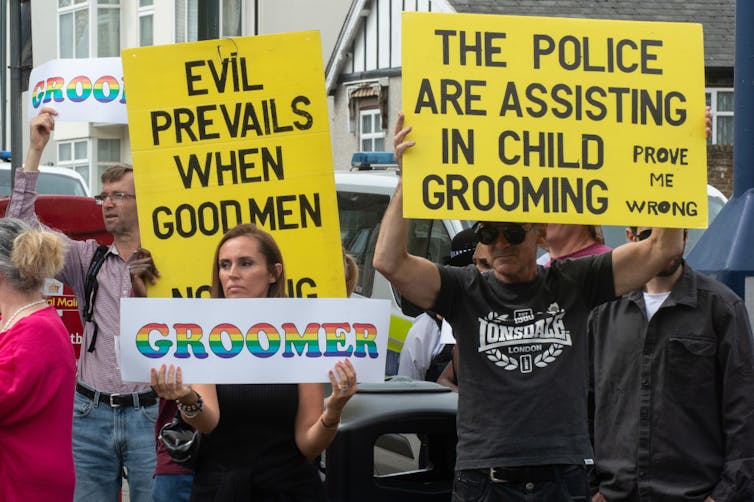
Group of protesters hold signs with text reading 'groomer.'

Many opponents of Drag Story Hour claim that the events endanger kids by ‘grooming’ them to be sexually exploited. Guy Smallman/Getty Images

They specifically expressed nostalgia for a time when American culture was anchored by conservative values, and progressive views existed on the periphery of public life. As one forum member lamented, “When I was a kid, the librarians were nice Christian ladies and there was an American flag outside. My current public library [has] scary levels of liberal posters and talks.”

Some conservatives also used rhetoric reminiscent of the “Satanic Panic” of the 1980s and 1990s by claiming that drag performers were satanic pedophiles who sought to recruit, groom and sexually abuse children. Others argued that parents who take their children to Drag Story Hour should be jailed or lose their parental rights.

The safety of children as political fodder

In our view, it’s no accident that Tennessee’s ban on drag specifically targets drag performed in front of children.

Emphasizing threats to children is a well-established strategy for conveying the decline of American culture and values. As sociologists Joel Best and Kathleen Bogle have noted, adults often project their anxieties and fears concerning a perceived disintegration of traditional norms onto younger generations, whom they believe need to be shielded.

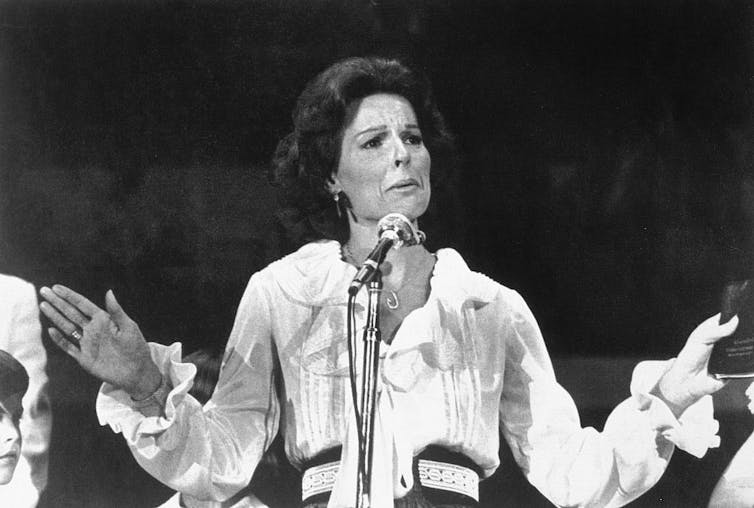
In the 1970s, anti-gay activist Anita Bryant launched her “Save our Children” campaign. Claiming that gays and lesbians were “recruiting children” to their cause, she successfully pressed voters to oppose anti-discrimination statutes.

Black and white photo of woman speaking at a microphone.

In today’s opposition to Drag Story Hour, there are echoes of the rhetoric of anti-gay activist Anita Bryant. Bettmann/Getty Images

And in the 1980s, fears over changing family structures, such as rising divorce rates and an influx of working mothers, fueled a moral panic that day care staffers were ritualistically abusing children.

Almost half a century later, fears regarding advancements in LGBTQ+ rights have produced legislation restricting discussions of gender identity in schools and stoked claims that drag performers are satanists who terrorize children.

The deployment of these well-worn narratives is unlikely to end with legislation such as Tennessee’s drag ban. Rather, it will continue as long as conservatives and progressives battle to define American values.


Heather Hensman Kettrey, Assistant Professor of Sociology, Clemson University and Alyssa J. Davis, PhD Student in Sociology, Vanderbilt University

This article is republished from The Conversation under a Creative Commons license. Read the original article.

Health officials delayed report linking fluoride to brain harm

Last May, the National Toxicology Program (NTP), a federal research agency, was set to release its eagerly awaited report into the cognitive and neurodevelopmental impacts on humans from fluoride exposure.

The report was anticipated for several reasons, including its review of studies linking fluoridated water to cognitive harm in children. Water fluoridation is the long-established public policy of adding fluoride to drinking water to fight tooth decay. The report was also set to play a key role in an ongoing lawsuit, filed by government accountability nonprofit Food & Water Watch, to get the Environmental Protection Agency to regulate water fluoridation because of fluoride’s possible neurotoxic harm. More than two years ago, the judge put the case on hold in expectation of the NTP report’s public release.

Before the NTP could release the report, however, “They were blocked,” said Linda Birnbaum, NTP director until 2019. According to Freedom of Information Act (FOIA) records obtained by the plaintiffs and shared with Capital & Main, the U.S. Department of Health and Human Services (HHS) held back the release of the report after criticism of its findings from health and dental organizations that advocate for community water fluoridation. Those groups challenged the report’s scientific validity and expressed concern that it could jeopardize water fluoridation, which they said could especially impact the dental health of low income communities.

The report found that a link between typical levels of fluoride added to water and possible harm to brain development is unclear, with a recommendation for more studies, according to records. But the report did find a possible link to cognitive harm at approximately two times the current recommended water fluoridation level, records show. Some health experts believe this finding makes current water fluoridation levels potentially unsafe for developing fetuses and young children. Because many common foods and drinks contain fluoride, consuming them along with fluoridated water could amount to harmful exposure levels, these experts say.

Leading up to the report’s intended release, individuals from dental organizations including the American Dental Association (ADA) scrutinized the report’s scientific credibility in communications with staff from other dental groups and health agencies including the National Institutes of Health and the NTP, divisions of HHS, records show.

This January, Birnbaum issued a scathing legal declaration as part of the lawsuit, writing, “The decision to set aside the results of an external peer review process based on concerns expressed by agencies with strong policy interests on fluoride suggests the presence of political interference in what should be a strictly scientific endeavor.” Birnbaum said she issued the legal declaration in part over concerns the report might never be publicly released.

The NTP has announced that it will now release the report on March 15, alongside an updated version of the same document that includes the NTP’s responses to what it describes as a “significant number” of comments and criticisms received from experts at various federal health agencies.

Birnbaum, however, remains adamant that the science proves there is “no real benefit” from ingesting fluoride. “The benefit from fluoride is from topical applications,” she said.

*   *   *

Water fluoridation is described as one of the 10 greatest public health achievements of the 20th century for its part in reducing tooth decay in adults and children by roughly 25%. According to the latest figures, nearly 73% of people connected with community water systems receive fluoridated water, accounting for more than 200 million people, or just under two-thirds of the overall U.S. population. Advocates argue that fluoridation is especially needed in low income communities where rates of tooth decay are generally higher than in wealthier neighborhoods.

At the same time, a growing body of research links fluoride exposure to neurotoxicological impacts in humans, including IQ loss and a higher prevalence of ADHD in children.

The NTP has been working since 2016 on its systematic review of the science into these impacts. By the time the report was set for release last May, it had already undergone more rounds of peer review than is typically the case for such a document, court records show — twice with the National Academies of Sciences, Engineering, and Medicine (NASEM), and external peer review by five experts in the field. According to Birnbaum, similar reports are typically sent out for public comment, peer reviewed by an on-site panel, then finalized by the NTP.

Despite this unusually rigorous review process, a network of health officials and influential dental groups argued that the NTP had failed to address several issues raised by the NASEM review committee. These issues include a need to consider more studies in the review, and a failure to properly account for bias among some of the studies selected. One key health official wrote that if the Centers for Disease Control and Prevention (CDC) had been given the option to clear the report, “We would have non-concurred,” records show.

Birnbaum said she strongly disagrees that the NTP had failed to address NASEM’s concerns. In her declaration, Birnbaum wrote that various sources told her the five external peer reviewers agreed with what was then the final report’s conclusions, and that “NTP’s staff and leadership considered the monograph to be complete and ready for publication by May 2022.”

The report’s critics also feared its findings could erode public trust in water fluoridation, with the head of one leading dental research organization calling it “potentially very bad fluoride news.”

In April of last year, American Fluoridation Society President Johnny Johnson wrote an open letter to “Oral Health Advocates and Public Health Leaders” warning how the NTP’s findings were already causing public health officials to second guess their stance on community water fluoridation (CWF).

“In at least one U.S. state the NTP’s draft Monograph has led to that state’s Toxicologist not being willing to support CWF as safe, when in the past that same Toxicologist was supportive. This is directly due to the NTP’s report,” Johnson wrote.

In response to questions, Johnson wrote in an email that “since the NTP report is not yet publicly available, it would be premature to comment on something that I haven’t seen.” Johnson did not answer when asked which state toxicologist had reversed their stance on water fluoridation.

Though the report has not been public, records suggest that in the lead-up to last May’s scheduled release it had been shared with members of nongovernmental dental groups like the ADA.

If federal health agencies shared the report with outside organizations, “That was completely inappropriate,” said Birnbaum. “It’s either everybody gets a chance to look at it, or only very restricted government entities,” Birnbaum added. “That trust, I would say, was broken.”

In a February 2022 email to various senior health officials including HHS Assistant Secretary for Health Rachel Levine, ADA senior manager for strategic advocacy and public policy Robert Burns asked the NTP to “exclude — or carefully consider how to characterize — any lingering neurotoxin claims” from the upcoming report. He wrote that “such claims are often taken out of context,” and might “undermine national, state, and local efforts to expand community water fluoridation” at the CDC’s recommended levels.

Jayanth Kumar, who sits on the board of the nonprofit Association of State & Territorial Dental Directors (ASTDD), wrote in June to other figures within the organization that the NTP “has dug in and doesn’t want to change its recommendations. The report gives the impression that the effect observed at high level [sic] of fluoride is causal although the report doesn’t state it. NTP recommends more studies at low F [fluoride] levels.”

Neither Burns nor the ADA responded to repeated requests for comment.

Kumar, state dental director for the California Department of Public Health, forwarded an email request for comment to an agency spokesperson, who wrote “CDPH does not comment on pending litigation or on studies in which it did not participate.”

Last May, current NTP Director Rick Woychik sent the document for yet another round of peer review with the agency’s Board of Scientific Counselors (BSC). Once the BSC has made its recommendations, Woychik will decide about “publication and dissemination” of what is now expected to be the final version of the report.

The decision to put the report on hold last May appears to have come from Levine, communications show. Levine’s office did not answer questions about whether she made the decision to shelve last May’s report and if so, why. A spokesperson for Levine instead linked to the NTP webpage summarizing the report’s scientific progress.

Christine Flowers, communications director for the National Institute of Environmental Health Sciences (NIEHS), where the NTP is headquartered, did not answer questions about who ultimately decided to shelve NTP’s report last year. Instead, she pointed to the same NTP webpage.

“It is important to note that the NTP is an INTERAGENCY organization made up of the NIH [National Institutes of Health], FDA [Food and Drug Administration] and the CDC, which work collaboratively,” Flowers wrote in an email.

*   *   *

The EPA’s legal drinking water limit for fluoride is 4 parts per million (ppm), but that level was established for naturally occurring fluoride. The CDC uses a nonenforceable guideline of 0.7 parts per million (ppm) as a safe level to counter problems like dental fluorosis, which is a change in the appearance of tooth enamel.

Communications between federal health officials and others show that the report the NTP was set to issue last May found that at typical fluoridated water levels in drinking water in the U.S., the effects on brain development are unclear. But it found a possible statistical association with cognitive harm and fluoridated water exposure at approximately 1.5 ppm and above, records show.

That level is not low enough to be safe because of fluoride in other foods and drinks consumed daily, said population health scientist Bruce Lanphear, an expert witness for the plaintiffs. This includes certain teas, coffee, canned shellfish, as well as oatmeal, raisins and potatoes. “Even if there’s no effects at the optimally fluoridated levels, people are going to be exposed to other sources of fluoride like black tea,” explained Lanphear. “For pregnant women or avid drinkers of black tea, they’re going to get more fluoride because it’s a hyper accumulator of fluoride.”

The CDC provides guidelines for fluoride intake in small children and babies in the womb, including a recommendation for youngsters under 8 years old living in communities where fluoride occurs naturally at levels above 2 ppm to be given alternative drinking water.

The CDC recommends breastfeeding infants, as breastmilk contains significantly less fluoride than fluoridated drinking water. If breastfeeding is not possible, the CDC also endorses using fluoridated water in infant formula, though it suggests mixing the formula with low-fluoride bottled water to lessen the risk of dental fluorosis.

Infants who are fed formula made with fluoridated tap water can have three to four times higher fluoride exposure than adults, warned Lanphear. He added that before an infant’s teeth erupt, there’s no benefit to fluoride exposure. “There are vulnerable groups we have to be worried about,” he said, “and that’s not being brought out adequately by these agencies.”

Step aside, pineapple! How to turn any cake upside-down — complete with a modern upgrade

The pineapple upside-down cake went viral long before social media. The concept first appeared in the 1920s as an elegant, sophisticated dessert that took home the gold medal in a now-famous Dole recipe contest and after that the recipe was passed from housewife to housewife. Even to this day, its popularity hasn’t waned. Now considered a retro classic, it still makes appearances at potlucks, picnics and barbecues and its trendiness is easily explained: It’s super delicious, easy to make and truly a work of art.

Classic versions of this dessert features pineapple rings and maraschino cherries that are arranged in the bottom of a cake pan with butter and sugar, then topped with batter and placed in the oven. Once the cake is baked, it’s inverted to reveal the gem-like fruit. And while the pineapple version made the upside-down cake widely known in North America, the concept was around long before then. Upside-down cakes used to be known as skillet cakes, which pre-date the modern oven, going all the way back to the Middle Ages. They were made in — you guessed it — a skillet over a fire or stovetop in which you’d first caramelize the fruit and sugar, then cover it with a batter. Once cooked, it was flipped to expose the beautiful self-saucing cake. For centuries, chefs and home cooks alike have experimented with different fruit and cake combinations to create a world of endless upside-down cake possibilities.

With the help of Instagram and TikTok, my very own upside-down cake recipe went viral. If you haven’t heard of it, let me introduce you: Miso and Banana Upside-Down Cake.

Caramelized bananas top a tender banana cake that’s made with mashed, overripe bananas in the batter and a hit of shiro miso (aka white miso) in the caramel gives it a smack of rich umami. It’s a perfect combination of savory and sweet flavors, yet just one of the many upside-down cake possibilities. Ready to make an upside-down cake with your own combination of fruit and caramel? Here’s everything you need to know.

The Fruit

So you’re wondering what fruit to use and exactly how much of it? There’s really no wrong answer here. Is frozen fruit all you have on hand? Great! Peaches, cherries, you name it — throw ’em right in the pan without thawing. If you use frozen fruit, you’ll need to extend your bake time because of the added moisture, so tack on another five to ten minutes and check for doneness before removing your cake from the oven. For fresh fruit, if you’re using apples, pears, stone fruit or bananas, make sure your fruit is not overripe and maintains a bit of firmness. This will help the fruit keep its integrity during the bake. Like frozen fruit, you’ll also want to extend bake times for juicier fruit like berries and cherries. As for how much fruit to use, you’ll want enough fruit to cover the surface of whatever vessel you’re using, usually around two to three cups for an 8- or 9-inch cake pan.

Once you’ve made your fruit selection, it’s time to think about cutting it. If fruit is cut too thinly, it will turn into mush during the bake. Aim for ½-inch-thick slices so that they stay intact. If using small fruit like apricots or Italian plums, you can simply pit and halve them and arrange them cut-side down. If you’re cutting chunks of any type of fruit, aim for 1-inch-thick pieces. Feel free to dump the fruit right into the cake pan, fan the fruit slices to make it pretty or choose your own adventure.

The Cake

The world is your oyster when it comes to cake! Chocolate cake, olive oil cake, polenta cake, banana cake, white cake, chiffon cake, pound cake, almond cake . . . you get the idea. Here are some of my recommendations: Peaches pair nicely with an almond crumb cake, sour cherries sing atop a rich chocolate cake and sweet blood oranges balance the delicate flavors of an olive oil crumb cake. If you have arranged your fruit in a pattern, I recommend spooning your first cake batter layer over so the arrangement doesn’t get disturbed, then gently pour the rest.

The Caramel

The fruit in a classic upside-down cake caramelizes in a butter and brown sugar mixture that gets poured into the cake pan before anything else is added. However, sometimes butter is omitted altogether and the fruit is gently tossed with sugar beforehand. Once again, there’s no wrong answer about how you choose to make an upside-down cake. Looking for something richer? Add butter! About 4 tablespoons of butter is ample for an 8- or 9-inch cake pan. As for brown sugar, it really depends on how sweet your fruit is and how sweet you want the cake to be. I recommend scaling between ¼ cup and ½ cup. If you want to keep your fruit looking as vibrant as possible, opt for white sugar. You can add things like citrus zest, fresh herbs or miso (like I use in my recipe) to enhance the overall flavor of your caramel. To make the caramel, you’ll melt the butter and whisk in the sugar along with any flavoring before pouring it into the pan (you can do this on the stovetop or in the microwave).

The Cooking Vessel

You can use any greased cake pan, casserole dish or oven-safe skillet (like a cast-iron or ceramic option) when it comes to upside-down cakes. If you’re using a cake pan, I recommend cutting a piece of parchment to fit the bottom — this will help avoid sticking during the flip. Keep in mind that the material and shape of the vessel will impact the bake time. Glass can take longer to heat up, which could add time to your bake and an extra-deep vessel will also add to bake times.

You may be wondering, is one vessel better than the other? And the truth is, any vessel will make a delicious upside-down cake, but the cast-iron skillet has a few added benefits. With a cast-iron skillet, you can make the caramel right on the stove-top, then assemble the rest and transfer the whole thing to the oven, saving yourself a dish or two. Cast iron’s ability to retain even, steady heat will evenly bake the crumb and avoid burning the caramel. Plus, the handle makes for an easier flip.

The Flip

Flip the cake while it’s hot. Let the cake rest for about five minutes after removing it from the oven, then run a small paring knife around the edges. Place a large plate over the cake and swiftly invert it onto the plate. Then, bask in the beauty of your delicious creation! And remember: The secret to upside-down cake making is that there is no wrong way to do it. I encourage everyone, from rookies to veteran upside-downers, to experiment with combinations both classic and novel.

14 best grocery buys you can pick up right now from your local Dollar Tree

Grocery prices are still at record highs, which means many of us are seeking more affordable alternatives to pick up essentials for the fridge and pantry. While the Dollar Tree may be best-known for party props, cleaning supplies and inexpensive housewares, the store also carries a wide variety of the familiar food brands you can find in any Walmart, Kroger or Publix. In fact, they even boast a range of specialty items to accommodate more specific cooking and baking needs — all priced competitively at the chain’s signature $1.25 per unit.

After a recent perusal of the shelves, we’ve rounded up 14 products we were pleasantly surprised to find. From gnocchi and tamarind soda to egg noodles and guava nectar, Dollar Tree is a one-stop shop for a good portion of your grocery list (the chain doesn’t sell fresh produce and many refrigerated items). Even better, these budget-friendly products are also conveniently available online for same-day delivery.

1. Gnocchi Packs

This potato-based pasta is sold in 17-ounce packs and happens to be one of the most affordable on the market, according to dozens of five-star reviews in the comments section. Fry up and toss with your favorite sauce, from Marcella Hazan’s brilliant Tomato Sauce With Onion and Butter to fresh pesto.

2. Panko Breadcrumbs

Light and airy yet perfectly crunchy, these breadcrumbs will elevate any dish that could use a crispy touch (creamy lemon spaghetti, anyone?) and make an A+ homemade mac and cheese topper.

3. Pumpkin Pie Spice

Here’s a little secret: Pumpkin pie spice will save you additional money since it’s already a blend of common aromatics like cinnamon, ginger and cloves. Instead of buying them separately to make seasonal desserts, opt for the solo shaker and go to town. Mix a teaspoon into your morning oatmeal as well and you can enjoy the tastes of fall year-round.

4. Jarritos Tamarind Soda

If you like a little tang, you’ll appreciate the sweet-sour notes of this tamarind-flavored soft drink — made with 100% natural sugar — from popular Mexican soda brand Jarritos.

5. Canned Sardines

Love ’em or hate ’em, Dollar Tree’s got sardines. Eat them straight from the tin or use them as a base to your favorite briny salad dressings (they also make a great pantry staple to survive any impending zombie apocalypses).

6. Egg Noodles

Egg noodles are endlessly versatile—starring in everything from soups to stroganoffs—which is why we loaded our cart with a couple of these 12-ounce bags.

7. Crunchy Rice Rolls

This simple, crunchy-sweet snack is great to keep stashed in a car, purse or office desk drawer when hunger strikes at a moment’s notice and you need a quick energy boost to get you through the day.

8. Guava Nectar

While it’s going to be a touch too sweet to sip on its own, add a splash of this tropical nectar to smoothies, sparkling water and most importantly, cocktails (margaritas, to be specific).

9. Spicy Pickled Sausages

When it comes to snacking, we’re strong believers in eating whatever you’re in the mood for. And if that happens to be a spicy, pickled sausage, then you now know where to get it.

10. Cornbread Crisps

Similar to a pita chip — only sweeter and slightly more coarsely textured. But like pita chips, these can also stand up to thick dips like hummus to chunky salsas. They’re simply delicious on their own, too.

11. Canned Smoked Oysters

Nothing beats slurping a freshly shucked oyster, but smoked oysters make wonderful additions to pastas, soups and stews. You can also serve them, as is, with a splash of hot sauce and a butter cracker for any cocktail hour.

12. Graham Cracker Pie Crust

While you can certainly make your own pie crust at home, it’s good to know that Dollar Tree carries a pre-made version for any last-minute baking snafus. This is something to keep in mind during the holidays when grocery stores are jam-packed with last-minute shoppers.

13. Crispy Jalapeños

Toss these delightfully crunchy, peppery jalapeño crisps on practically any dish to add some subtle heat. And we do mean anything: soups, salads, grilled meats, dips and even casseroles as a zippier alternative to fried onions.

14. Ultra-Thin Pizza Crusts

Skip delivery and concoct your own cheesy creation with these ultra-thin crusts. In fact, you can even build a homemade pizza for about $5 if using Dollar Tree ingredients (cheese, sauce and spicy pickled sausage included).

The dubious economic calculus behind the Willow project

President Joe Biden’s decision to approve the massive Willow oil project earlier this week infuriated climate advocates and environmentalists while drawing praise from Alaska politicians and oil industry figures. As the Biden administration weighed the benefits and drawbacks of the project over the past year, the latter camp argued that the project would help replace Russian oil supplies as well as deliver an economic boon for Alaskans.

The Willow project’s champions have stressed the need for the U.S. to achieve energy independence in light of Russia’s invasion of Ukraine. Senator Lisa Murkowski, an Alaska Republican, said last month that Willow could help “reduce our energy imports from some of the worst regimes in the world.” Mary Peltola, a Democratic representative and Alaska Native who was elected to Congress last year, said just last week that the project could “make us all safer in a world that has grown more unpredictable after Russia invaded Ukraine.”

There’s no doubt that the Willow project, led by ConocoPhillips, represents the largest new Alaskan oil project in decades. At full capacity, it could increase total oil production in the state by more than a third. But experts told Grist that the energy and economic benefits of the project are smaller and less certain than its boosters have suggested. Not only will the Willow project provide an insufficient substitute for Russian oil, but it will also deliver an ambiguous mix of costs and benefits to Alaska state coffers, which have long relied on fossil fuel revenue that is increasingly hard to come by — even with new drilling in the Arctic.

It’s not clear how much the Willow project would help replace Russian oil supplies. First there’s the matter of timing: The project will not deliver its first barrels until 2028 or 2029, and it will take even longer for all three well pads that the Biden administration approved to start producing at full capacity. It’s possible the global oil supply picture will look very different by then: Western countries may have access to new sources of oil, like recent offshore projects in places like Guyana, and where crude prices will be is anyone’s guess.

Second, the particular kind of oil that Willow will produce isn’t a perfect substitute for the oil that the U.S. once bought from Russia. The chemistry of petroleum beneath Alaska’s North Slope is different from both light shale oil and the heavier oil that tends to come from places like Russia and Venezuela, so it will need to be blended with other oil in order to enter domestic refineries, which are mostly designed to refine specific types of crude. That’s why the United States kept importing oil even after the fracking boom began, and it’s why much of Willow’s oil wouldn’t replace imports from other countries.

“Alaska remains an important energy state, but it will not make or break the nation’s energy independence in the coming decades,” Phil Wight, an assistant professor of history and northern studies at the University Alaska Fairbanks, told Grist. 

Indeed, the federal Bureau of Land Management’s own analysis found that Willow’s effect on the global energy market and American energy independence will be muted. According to the Bureau’s final environmental impact statement, only around half of the oil produced from the project will replace foreign imports from tankers and pipelines, with around 30 percent replacing other oil extracted in the United States. 

Furthermore, the project’s position on the North Slope of Alaska will constrain potential demand for the new crude from refineries on the U.S. Gulf Coast, since it would need to travel through the Panama Canal to get there. The top domestic markets for the oil will be California, Oregon, and Washington, three states that are all making aggressive attempts to promote electric vehicles and transition away from fossil fuels. Given that some estimates suggest electric vehicles could make up the majority of U.S. passenger car sales by 2030, it’s difficult to gauge how much West Coast demand there will be for Willow’s oil over the coming decades.

Even if ConocoPhillips does find buyers on the West Coast and overseas, Willow’s overall impact on oil prices will likely be small. According to the Bureau’s model, Willow will lower global oil prices by about 20 cents a barrel for as long as it operated at peak capacity. As of late Wednesday, the Brent oil benchmark was trading at around $75 a barrel.

“It’s hard to say that this will make a dent in either prices or supply,” said Chanda Meek, a professor of political science at the University of Alaska Fairbanks.

The project’s economic impact within Alaska isn’t clear-cut, either, despite what the state’s politicians say.

Alaska is the third most oil-reliant state in the nation, behind Wyoming and North Dakota. According to the state’s own estimate, nearly 85 percent of the state budget comes from oil revenues. Taxes on oil have funded the construction of new buildings and hospitals, and oil prices affect how much funding public schools get. Alaskans, who don’t pay an income or sales tax, also get a check every year from a pot of money called the Permanent Fund Dividend, which is funded by oil royalties. (Each check topped more than $3,000 last year, the highest amount residents have ever received.)

But this picture is changing. In 1988, Alaska’s trans-Alaska pipeline, or TAPS, was pumping a tremendous amount of petroleum from Prudhoe Bay on the North Slope to Valdez on the state’s southern coast — approximately 2 million barrels a day. Now, however, depleted reserves within Alaska and the competing fracking boom in the Southwest’s Permian Basin have made the state’s oil less relevant — Alaska is currently pumping less than a quarter of the oil it was moving in the 1980s. Alaskan oil production hit a 40-year low in 2020

That’s why the Alaska congressional delegation lobbied the Biden administration long and hard to approve the Willow project. 

“Willow is finally reapproved, and we can almost literally feel Alaska’s future brightening because of it,” Murkowski said after the Biden administration announced its decision. “We are now on the cusp of creating thousands of new jobs, generating billions of dollars in new revenues, improving quality of life on the North Slope and across our state, and adding vital energy to TAPS to fuel the nation and the world.”

Experts in Alaskan economic policy say those assertions don’t hold up under scrutiny, and the Willow project is unlikely to bring back the kind of economic security oil provided the state a few decades ago.

Some estimates say Alaska could see $6 billion in revenue from the Willow project, but that payout is years away. In the short term, the state may actually see a decrease in revenue. Because the project is on federal land, the state can only collect production taxes on the project and can’t collect royalties on the oil produced there. More importantly, ConocoPhillips can use a carve-out in the state’s tax law to write off its expenses for this project against the taxes the company pays on its other oil developments in the state. One analysis, conducted by the governor’s office in 2018, forecast that the state wouldn’t see a positive economic impact from the Willow project until 2026 and that the development would result in up to $1.6 billion in negative revenue through 2025 — a 6 percent decrease to the state’s overall revenue. An analysis from this year, conducted by Alaska’s Department of Revenue, says the project wouldn’t become “cash flow positive” for the state until 2035.   

While the state would see negative revenue from the project’s first years of operation, municipalities will admittedly see more immediate positive benefits. Production taxes from the project are earmarked as grant programs for local communities, especially in the North Slope borough. The Department of Revenue’s recent analysis shows the North Slope will get $1.3 billion through 2053, and the cash will start flowing in the coming months. Communities impacted by the project will get an additional $3.7 billion over the next three decades.

Of course, the communities closest to drilling face a complex and sobering set of tradeoffs. The Alaska Native Village of Nuiqsut is going to be virtually surrounded by oil fields as a result of the approval of Willow, which threatens the subsistence hunting and fishing that has long sustained the town’s households. Nuiqsut’s mayor has been vocally opposed to the Willow project, and local tribal leaders passed a resolution opposing it in 2019.

Zooming out, Wight said, the project signals to Alaskans, oil companies, and the rest of the world that the United States believes there will still be a market for Conoco’s oil three decades from now. At that time, however, the world’s governments should be completing a transition to clean energy. Indeed, President Biden recently signed a law that puts the nation on track to slash emissions 50 percent by 2030. How can that be the same world that needs 600 million new barrels of oil from Willow?

“We have the policy to build a renewable energy future,” Wight told Grist. “It’s much less clear how a managed decline of fossil fuels is going to happen.”


This article originally appeared in Grist at https://grist.org/energy/willow-project-economic-benefits-alaska-energy-independence/.

Grist is a nonprofit, independent media organization dedicated to telling stories of climate solutions and a just future. Learn more at Grist.org

Expert: Trump lawyer’s attempt to do “damage control” on TV may have done the opposite

Former President Donald Trump’s new lawyer struggled to defend his client’s actions ahead of a possible indictment in Manhattan over the 2016 hush-money payment to Stormy Daniels. 

Attorney Joe Tacopina, who appeared on multiple news networks this week, laid out Trump’s defense for his role in the $130,000 payment by lodging a series of questionable claims.

“When individuals facing charges are public figures, I think they sometimes want to engage in damage control in the court of public opinion,” former federal prosecutor Barb McQuade told Salon.

But Tacopina’s appearance on MSNBC’s “The Beat with Ari Melber” may have done the opposite. 

Melber during the interview questioned Tacopina about why Trump lied at the time that he did not know about his then-attorney Michael Cohen’s payment to Daniels. The attorney disputed that Trump lied, arguing that the former president didn’t lie since the statement was not made under oath. 

“A lie to me is something material, under oath, in a proceeding,” Tacopina said

He went on to clarify why he didn’t consider Trump’s statement to not be a lie.

“Here’s why it’s not a lie,” Tacopina said. “Because it was a confidential settlement so if he acknowledged that, he would be violating the confidential settlement. Is it the truth? Of course it’s not the truth. Was he supposed to tell the truth? He would be in violation of the agreement if he told the truth. So by him doing that, he was abiding not only by his rights, but Stormy Daniels’ rights. I would advise my client to do the same thing.” 


Want a daily wrap-up of all the news and commentary Salon has to offer? Subscribe to our morning newsletter, Crash Course.


Cohen testified that he made the payment during the 2016 campaign and was later reimbursed by Trump. He was sentenced to three years in prison after pleading guilty to multiple federal crimes, including campaign finance violations related to the payment.

“Lawyers can say things a client can’t because the client’s words could be used against him at trial,” McQuade said. “A lawyer’s public statements are not evidence in a case against the client, so it is a low risk way to advocate publicly for the client.”

While Trump’s other attorneys are handling the actual legal work, Tacopina has been busy making cable news rounds, fighting a PR battle. He recently appeared on CNN criticizing Cohen.

“(Manhattan District Attorney) Alvin Bragg once said — I hope he remembers these words — he can’t see a world in which he would base a prosecution of Donald Trump on the word of a convicted puncher and felon like Michael Cohen,” Tacopina said. “He is still a convicted perjurer, someone convicted of lying, and it’s not about vengeance; it’s all about vengeance for him.”

Cohen in a subsequent appearance on CNN called Tacopina “a fool” and said he was sent out by Trump to “lie” and continue pushing out a narrative that pleases the former president. 

“What this is is about accountability,” Cohen said. “I don’t want to see anyone, including Donald Trump, indicted, prosecuted, convicted, incarcerated simply because I fundamentally disagree with him. This is all about accountability. He needs to be held accountable for his dirty deeds.”

“I will burn this session to the ground”: Neb. Dem filibusters for 3 weeks to block anti-trans bill

The Nebraska state Senate’s 90-day legislative session reached its halfway point on Wednesday, but not a single bill has been passed yet thanks to a filibuster that was begun three weeks ago by state Sen. Machaela Cavanaugh in a bid to stop Republicans from “legislating hate” against transgender children across the state.

Cavanaugh (D-6) was horrified to see an anti-transgender rights bill advance to the Senate floor in late February and was determined to keep it from passing into law, as at least nine other anti-LGBTQ+ bills have in state legislatures so far this year.

The so-called Let Them Grow Act (Legislative Bill 574) would bar transgender and nonbinary people under the age of 19 from obtaining gender-affirming healthcare.

Republicans hold 32 seats in the state Senate compared to Democrats’ 17, but it takes 33 votes to overcome a filibuster.

So Cavanaugh has spent every day in session since the bill arrived on the Senate floor introducing dozens of amendments to other pieces of legislation, slowing the Senate’s business to a crawl and taking up every hour of debate time permitted by the chamber’s rules—at times speaking at length about unrelated topics including her favorite foods and movies.

“If this Legislature collectively decides that legislating hate against children is our priority, then I am going to make it painful, painful for everyone, because if you want to inflict pain upon our children, I am going to inflict pain upon this body,” Cavanaugh told her colleagues during one debate session. “I have nothing, nothing but time, and I am going to use all of it.”

“I will burn the session to the ground over this bill,” she added.

The Let Them Grow Act, like a number of the approximately 150 anti-LGBTQ+ bills that have been introduced in other states so far this year, would prohibit gender-affirming surgical procedures, hormone therapy, and puberty blockers for minors.

Gender-affirming care for minors is supported by the American Medical Association, the American Psychiatric Association, and the American Academy of Pediatrics, with the latter organization noting in a 2018 policy statement that many transgender youths experience fear of discrimination by providers and “lack of continuity with providers” as a result of limited access to gender-affirming care.

A study by the University of Washington found that youths who received gender-affirming care were 73% less likely to experience suicidality and 60% likely to suffer from depression than those who did not obtain care.

Cavanaugh also told the Associated Press Wednesday that 58% of transgender and nonbinary youths in her state seriously considered suicide in 2020, according to a 2021 survey by the Trevor Project, and more than 1 in 5 said they had attempted suicide.

“The children of Nebraska deserve to have somebody stand up and fight for them,” Cavanaugh told the AP.

Speaking to “The New Yorker Radio Hour” last week, the senator said some of her Republican colleagues have privately told her they are frustrated with their own party’s agenda as GOP leaders including Florida Gov. Ron DeSantis and former President Donald Trump wage attacks on transgender children.

“What has been expressed to me is a frustration over discussing policies like this instead of discussing policies that most of them ran to be here discussing. This is what a culture war looks like apparently,” said Cavanaugh. “What I’m asking of them is to rise up and say that, if this really isn’t who they are, rise up and say that and stop having private conversations with me telling me how much you don’t like the bill, how much you don’t want to be focusing on this issue, and rise up and say something about it. I’m challenging them.”

LGBTQ+ advocacy group OutNebraska told the AP that Cavanaugh has embarked on a “heroic effort.”

“It is extremely meaningful when an ally does more than pay lip service to allyship,” said executive director Abbi Swatsworth. “She really is leading this charge.”

Why experts say you should go easy on picky eaters

No person in the world will humble you like your second child will. As soon as my firstborn started eating solid foods, I puréed her fresh vegetables and exotic fruits. I took her out for sushi and tacos. She ate with the gusto of what I called a “good eater,” and I applauded myself for it.

Then her baby sister arrived. And she, in contrast, pretty much wouldn’t eat anything that wasn’t plain buttered noodles. Like her father, she is a natural-born picky eater. It’s taken me a very long time to get here, but I can now say that it’s not her fault. It’s not my fault either. In fact, it’s not a fault at all.

As my family and I learned over the years, much of my younger daughter’s so-called pickiness was an instinctively wise protectiveness of her sensitive system. Foods that the rest of us tolerate just fine can give her intense pain and nausea. She also has her own specific tastes, and you can’t ever really persuade someone who doesn’t like beets to come around on that one.

As parents, we’re tasked with feeding our children and teaching them to feed themselves. In a world of grocery recalls and conflicting advice, this responsibility can be overwhelming and stressful even in the best of circumstances. If you throw reluctance, resistance or temper tantrums into the mix, it makes mealtime exponentially harder. But no child is going to love every food — you and I don’t either.

There’s mounting evidence that how we perceive taste is baked into our DNA. Think, for instance, of cilantro, the most divisive of herbs. Research in 2012 confirmed those unfortunate souls who find it soapy carry a particular olfactory receptor gene that makes it taste different to them.

A 2017 study published in Lifestyle Genomics similarly found that “genes related to chemosensory perception may play a role in children’s picky eating behavior.” You don’t get mad at people over their finger length or whether their earlobes are detached. Similarly, if your kids are pickier than you are, they may come by it naturally. 

A little pickiness is also developmentally appropriate. “The issue is really multifactorial and often unique based on the individual child and family dynamics,” says Christopher Carrubba, MD, medical director at the test prep company TrueLearn.

“Being a picky eater is often a control issue,” he continues. “What the child eats may be one of the few things that they feel they have a say in — and the child is exerting their personal preferences.”

“Being a picky eater is often a control issue.”

For average level fussiness, it’s better for everybody to keep mealtimes as conflict-free as possible. “Don’t make a big deal about it,” says Michele Schwartz, pediatric occupational therapist and founder of The Virtual Pediatric OT. Instead, “offer new foods along with preferred foods at meals. These can be foods you are eating or foods your child previously ate.”

“Consistency is key when offering your child other foods. Just because they reject them once should not mean you stop presenting them to your child,” she adds. “I like to put these new foods on the table, but I do not offer them verbally or even make mention of them.”

Above all, don’t force your child to eat the new foods, Schwartz advises.

While a certain degree of pickiness is often normal, in some circumstances, it can be a signal of physical or developmental problems. Marielle Marquez, a licensed occupational therapist and feeding and swallowing specialist, notes that “picky eating may be complex. Common issues underlying include oral motor dysfunction, tongue tie, sensory integration challenges, food allergies or intolerances and gastrointestinal issues.”

Shena Jaramillo, MS, RD, a registered dietitian nutritionist specializing in eating disorders, adds that “sometimes a person is experiencing what is called ARFID (avoidant restrictive food intake disorder), which means that they will be extra sensitive to taste and textures of foods. This is not something they will grow out of or be pushed out of. Mealtime can be traumatic for these people.”

“Mealtime can be traumatic for these people.”

“Another consideration,” she says, “is that picky eating can be an eating disorder or a response to allergies or intolerances. Something like an allergy to dairy can cause all foods to feel painful. Allergies should be ruled out before trying other food tolerance techniques.”

I’ve learned this lesson firsthand — it’s funny how much less “picky” my daughter became when we learned she couldn’t handle eggs or dairy.

So when, exactly, should a parent be concerned? “If a child won’t eat an entire food group, eats fewer than 20 foods, has very strong emotional reactions to certain foods being on their plate or is starting to show signs of malnutrition, such as slowed growth or nutritional deficiencies, the family should seek out assistance from a professional,” says Kristen Nauss, MS, RD, the registered dietitian and founder of Buying School Food.

Left to develop their likes and dislikes without pressure as they grow up, picky eaters often become more expansive in their tastes all on their own. If Nigella Lawson — who has admitted that “I absolutely loathed eating as a child” — can come around, it’s entirely possible that with encouragement, the fussy eaters in your life can, too.

Sometimes they won’t. While we usually don’t have to feed the adults in our lives, we still have to figure out how to peacefully eat with them, even as they methodically, maddeningly pick 95% of the ingredients out of a stew or scrape the frosting off a cake.

For those of us who have watched a few too many Anthony Bourdain series in our time, it’s easy to get carried away with our own contrastingly adventurous self-image. It’s true that being flexible in my tastes makes me an easier dinner guest and a more relaxed traveler. It does not, however, make me a better human being.

I realize now that my own bias against picky eaters has often arisen from a sense that they’re somehow not as fun as the rest of us; because they enjoy fewer foods, they enjoy food less. But why would that be the case?

“Oh, I like to eat,” Brian Franklin says.


Want more great food writing and recipes? Subscribe to Salon Food’s newsletter, The Bite.


Franklin is the public relations and communications director for America’s Test Kitchen — and a self-proclaimed picky eater. Last year, in an effort to expand his horizons and be a positive role model for his son, he endured an “intervention” on ATK’s podcast “Proof.”

Among other things, Franklin tried a fresh tomato for the first time, which he was underwhelmed by. However, he really appreciates “great food.”

“I’ve gone to some great restaurants,” he continues. “I look forward to eating not just because I like it, but also the community aspect, being with family and so forth.”

Being a picky eater doesn’t automatically make a person unhealthy either. Of course, a varied diet is usually a good idea, but a tightly curated one isn’t the same as a junk food diet. For individuals with certain health issues, bland is a whole lot better than trying to be a hero on “Hot Ones,” where celebrities like Kate Hudson have answered questions while eating hot wings.

I’ve tried to raise both my daughters to be gracious, to not be rude about food that is offered to them and to remember that trying new things can be good. With them and my spouse, I have in turn tried not to shame anyone for their personal preferences. I also eat mushrooms and olives on my own time.

It’s a lot easier to broaden our own minds than to broaden anybody else’s palate. And hey, more anchovies for me. There’s room at the table for everyone.

“There have been a few things I’ve tried, and I’m like, ‘OK, this is this is decent,'” Franklin says. “But more often than not, I always go with a proven winner, stuff I know I’ll like.”

“I’m really not up for an adventure,” he concludes. “I’m content with stuff that’s plain.”

“Like photographing sculpture”: Cinematographer reveals what makes “Creed III” look so good

Kramer Morgenthau has been working as a cinematographer for more than three decades. He has lensed indie films (“The Man from Elysian Fields” and “Chef”), episodic TV (“Boardwalk Empire,” “Game of Thrones“), and Hollywood franchises (“Thor: The Dark World” and “Terminator Genisys“). His style is a mixture of sleek and gritty; Morgenthau often uses warm or dark colors to create a mood, but they can also turn harsh. That is how he focuses viewers’ attention.

His latest film “Creed III” is no exception. Morgenthau bathes this film in tones that create emotion, particularly during the climactic bout between Adonis Creed (Michael B. Jordan, who also directed) and Damian Anderson aka “Diamond Dame” (Jonathan Majors)—a sequence that shifts from bright whites to dark blacks. 

The new film has a very different look from its predecessor, “Creed II” — which Morgenthau also shot — in part because it was set in Los Angeles, as opposed to Philadelphia. The cinematographer chatted with Salon about creating the look of “Creed III” and being in the ring with Jordan and Majors.

What decisions did you take regarding the look of “Creed III” to make it distinctive? “Creed II” had a different feel to it. This installment had some really interesting tonal choices.

It was my second time shooting a “Rocky” franchise movie. We want to bring a different take to each one and honor the legacy of these films. Michael [B. Jordan] wanted the visual language to swing big and hard as a director, and he brought in anime, and a poetic take — “the void,” which is in Round 11 during the final fight — which was super cool. The only other movie where I’ve seen anything like that would be in “Raging Bull” where it is a very expressive take on boxing.

Michael B. Jordan stars as Adonis Creed and Jonathan Majors as Damian Anderson in “CREED III” (MGM)

Can you talk about the process of shooting the fight sequences? 

It’s a tremendously physical experience. I had an amazing Steadicam operator, and we embedded him with the boxing choreographers early in the process to design how the fights were photographed. Garrett Brown invented the Steadicam [for the original “Rocky”] and it is one of the best ways to film boxing because there is a tremendous amount of handheld shooting. It’s like boxing with a camera. 

I was also interested in the way you film bodies here because the athleticism of the actors is often so prominent. Can you discuss that?

The way we photographed the bodies was like photographing sculpture. Their bodies are sculpted and beautiful, and covered in sweat and oil and very reflective. Shooting them was about how their bodies and faces were reflecting light and honoring their performances was showing them in their “best light,” so to speak. I studied paintings by George Bellows, and the Ashcan school of painting was an inspiration. There was an Eakins painting in a museum in Philadelphia that I was looking at, and I referenced great boxing photography, like some of the Ali color photographs. These images inspired how we lit the boxers. 

I was struck by scenes such as Creed arriving for his title bout. He is bathed in red, and the camera follows/tracks him. It’s a big, important moment. Can you talk about the camera movement and the lighting?

The use of red around Adonis is very intentional. Green is used around Diamond Dame. These colors delineated their characters and their emotional universes. The dramatic scenes are shot in chiaroscuro and in warm, expressive light so the character is always the focal point of lighting and photography. You bring out the performance with light and photography; it is how you project it to the audience. You don’t want to be intrusive, at the same time, you want to say something with it that elevates it. It has to have a slickness and a larger-than-life quality to it. At the same time, you want to speak to the grittiness of their backstory and the emotional tension. The red elevating the tension during the walkout [to the ring], is the ultimate moment of real theater. A lot of theatrical lighting instruments were used for that. The use of shadow and light were echoing. Dame is in the shadows, and Adonis is in the light.

Jonathan Majors in “Creed III” (MGM)

Can you talk about using your visual references and how that informs your choices as a cinematographer?

When I bring visual reference into how a movie is photographed, it is generally subconscious versus, “I am going to emulate the same light in ‘Raging Bull,’ or use the same lens.” I’ll study a film, and absorb it, and figure out how to find my voice as a cinematographer and bring out Michael B. Jordan’s voice as a director.

“Creed III” features an underclass story and there is a Dickensian element to it. Diamond Dame is in Crenshaw and never left Crenshaw. He did time, 18 years, and lost everything, including his chance to become a boxer. Then there is Adonis, who got out of Crenshaw, and moved to Beverly Hills.

They are meeting on a huge world stage and duke it out. The whole feeling changes when we go into the boxing matches. We change formats. We went into IMAX, we used different lenses, spherical lenses, different aspect ratios, so things are much taller to make it super visceral. And we used anamorphic lenses for all of the dramatic scenes. We used slow motion for the skin rippling in the punches. It was all about extreme slow-motion, 1,000-frames-per-second photography. It is where filmmaking and cinematography meet. It’s all the layers of the same onion. 

How do you collaborate with a director and his vision?

My collaboration with Michael B. Jordan started as a friendship, and a bonding over his interest in what I was doing. He has been studying what I do, and what other cinematographers do, on sets since he was 16 and started acting on “The Wire.” He studied directors like Ryan Coogler [“Creed”] and Steven Caple, Jr. [“Creed II”], and Denzel as an actor-director. Our bond was made initially as a friendship, and when he did have the opportunity to be a director, it was a huge jump from having directed nothing to making an $80 million sports movie, where he is also the star, the producer and a huge celebrity who has all kinds of people and things to pay attention to aside from direction. He’s an amazing dude. Part of it was just trusting me to support him. That is how he gets the best performance out of actors and out of cinematographers. He had all these ideas and said, “Let’s figure them out together.” He brought anime into our visual language and this poetic interpretation, “the void,” which was like an abstract, experimental theater interpretation of boxing. It was amazing he wanted to do this and take this risk. It was a great experience to be trusted and given license to bring out his vision. 

Director Michael B. Jordan and cinematographer Kramer Morgenthau on the set of their film “CREED III” (MGM)

Do you aspire to direct one day?

I would love to direct something, someday. I’m not a cinematographer because what I want to do is direct. I’m a cinematographer because I love what I do. It has been an amazing trip for the last 30 years. I lean towards cinematography because I am more of a visual person. I’m not a man of words, I’m a man of pictures. It is who I am. I’d love to tell my own story, and it would have to be something I grew up with or understand as deeply as MBJ understood Adonis Creed. I would love to make a Jewish gangster story. I love historical drama, and political thrillers. That would be super dope to do. I have directed things in the past, but it is not the ultimate goal. I’m not secretly angling to direct, but if the opportunity came up . . .

Princess Diana’s brother trashes Trump boast: “She clearly viewed him as worse than an anal fissure”

Princess Diana’s brother on Wednesday refuted former President Donald Trump’s claim that his late sister wanted to “kiss his arse.”

Trump next month is releasing a $99 book including 150 letters to the former president from prominent leaders and celebrities, including Princess Diana, Queen Elizabeth, North Korean Leader Kim Jong-Un and former Brazilian President Jair Bolsonaro.

“I knew them all — and every one of them kissed my ass,” Trump told Breitbart while promoting the book earlier this month.

Diana’s brother, Earl Charles Spencer, hit back at Trump over the claim.

“Surprised to hear that Donald Trump is apparently claiming that my late sister Diana wanted to ‘kiss his arse,’ since the one time she mentioned him to me – when he was using her good name to sell some real estate in New York – she clearly viewed him as worse than an anal fissure,” he wrote on Twitter.

Trump in 1997, just months after Princess Diana’s death, bragged in a radio interview that he “could have” had sex with the royal but only if she passed an HIV test.

He later told radio host Howard Stern in 2000 that he would have slept with Princess Diana “without even hesitation.”

“I tell you what,” Trump said, “I think she’s magnificent. Lady Di was truly a woman with great beauty. I’ve seen her a couple of times. She was really beautiful, and people didn’t realize that beautiful. She was supermodel beautiful. She had the height, she had the beauty, she had the skin, the whole thing.”


Want a daily wrap-up of all the news and commentary Salon has to offer? Subscribe to our morning newsletter, Crash Course.


Longtime British journalist Selina Scott wrote in 2015 that Trump showered Princess Diana with flowers after her divorce from Prince Charles in 1996.

“Trump clearly saw Diana as the ultimate trophy wife,” Scott wrote. “As the roses and orchids piled up at her apartment she became increasingly concerned about what she should do. It had begun to feel as if Trump was stalking her.”

Scott wrote that Princess Diana told her about Trump’s actions during a private dinner.

“What am I going to do?” Scott recalled Diana asking her. “He gives me the creeps.”

How Bitcoin and other magic internet money loans endanger your financial health

The collapse of Silicon Valley Bank (SVB) last week raises serious issues far more significant than the obvious ones cited by the financial press and a broad range of Washington politicians.

Chief among these are bank loans against dubious assets. That’s not getting much if any attention in the news or from Washington and is likely to soon be swept under the rug, allowing needlessly risky banking practices to continue.

Before its collapse last week, SVB made loans against Bitcoin and other cryptocurrencies.

The question: why is any bank anywhere allowed to accept crypto as collateral for loans?

Bitcoin and its imitators are not money. They are not currency. They’re hardly used to buy and sell, an unsurprising fact given that by design the Bitcoin system can process only seven transactions per second compared to many thousands of transactions per second for credit cards.

Indeed, except for laundering proceeds from drug trafficking as well as hiding assets from creditors, estranged spouses, and the tax police, cryptocurrencies have no use.

High-tech Ponzi Scheme

Cryptocurrencies and their cousins, Non-Fungible Tokens or NFTs—are just a high-tech Ponzi scheme. Instead of Charlie Ponzi or Bernie Madoff personally running the con, the crypto scam relies on decentralized computer blockchain and “mining” of mathematical solutions.

Bitcoin’s supposed inventor, who went by the pseudonym Satoshi Nakamoto, has never been identified. He or she has since vanished, leaving holders with a digital string worth only as much as the next fool, or crook, will pay for this imaginary asset.

Early participants in Ponzi schemes profit mightily if they cash out while the gullible souls who get sucked in later wipe out. That is what happened to SVB, America’s 16th largest bank, which was big on crypto loans.

Many Bitcoin “investors” have already been wiped out as the “market cap” of Bitcoin plummeted from nearly $1.3 trillion in 2021 to about $389 billion on Friday, down almost 70%.

Why do banking regulators allow our federally insured and regulated banks to make loans using magic internet money as collateral? That’s a crazy policy, no different than allowing banks to accept buckets of ice cubes in winter as collateral, even though they melt come spring and evaporate in summer

Silicon Valley Bank is just one of many federally insured financial institutions that accept crypto currency as collateral for loans. Some banks will loan you 90% of the seemingly value of your crypto, though 50% loan-to-value is more common and that appears to be the standard at SVB based on its web pages.

Zero Interest Crypto Loans

All sorts of financial news outlets offer advice on borrowing against crypto. These include NerdWallet, and the increasingly naïve and unreliable ForbesPeople with crypto can even borrow at zero interest. Gadzooks!

For a sober look at the big risks of crypto loans read Investopedia’s essay.

In the wake of the second largest bank failure in history, you should be deeply concerned that for more than four decades we have failed miserably at regulating banks. That history contrasts with the period from 1935 until voters abandoned the moderating and successful New Deal banking rules in favor of Reaganomics.

We took a wrong turn when the prudent New Deal banking regulations in effect from 1935 were killed by Reaganomics, which re-regulated banks to reduce regulations and increase the risk of financial institutions failing. (There is no such thing as deregulation, only new regulation,  which in our time on terms typically means regulations favoring corporations, including banks, over customers, financial prudence, and public safety.)

Congress’s Role

What we need now are Congressional hearings to examine the reasons that cryptocurrencies can be collateral for bank loans.

Contact the White House in writing via the hypertext link or call 202-456-1111 to demand a ban on crypto as loan collateral. Call 202-456-1111.

Even if you don’t own Bitcoin or its growing list of alternatives this story matters to you for multiple reasons.

Your money is only insured up to $250,000. Any money above that isn’t insured. That means if you’re a trustee of a nonprofit, for example, and it’s got $1 million in the bank you or the organization you help lead is at risk of being wiped out in a bank failure.

The federal government is covering all deposits for SVB and at Signature Bank in New York, which failed Sunday. But that doesn’t mean it always will. During an earlier banking crisis nonprofits with more than the guarantee then in effect of  $100,000 lost their deposits above that sum, which got very little news coverage at the time.

If people want to buy crypto, they should be free to do so. But they should not be allowed to put our bank deposits and investments at risk by using these digital tokens as collateral for loans. After all, it’s your, and my bank deposits, along with those of businesses, nonprofits, and our governments that the banks use to make loans, so it’s not like we don’t have a deep interest in blocking crypto of any kind as collateral for loans.

Donors who gave $23K to GOPer for child burial garden demand he “tell us where the money went!”

Donors raised questions about what happened to the money they donated to Rep. Andy Ogles, R-Tenn., intended for a child burial garden, according to local news outlet WTVF.

Ogles, a freshman congressman who drew comparisons to disgraced Rep. George Santos, R-N.Y., after he was caught inflating his resume, now faces questions related to a GoFundMe fundraiser he held following the stillborn death of his child in 2014.

The GoFundMe was intended for a child burial garden called “Lincoln’s Place.”

“Help us help other families. No family should have to bury their child; no child should be alone,” the GoFundMe page said, vowing to use the funds raised for a “burial garden” that would “create a place for Lincoln’s new play friends,” “a life-size statue of Jesus watching over the children,” and “benches for families to sit while surrounded by flowers.”

Donors contributed $23,375 to the fundraiser, which GoFundMe confirmed went to Ogles.

One donor told WTVF that she wanted “to believe that that money went for something good” but was left with “gnawing questions about what happened to these funds.”

Ogles in 2015 told The Tennessean that none of the money had been spent, blaming government bureaucracy.

“What we found over the past year as we have been going through this process is that burials are heavily regulated,” he said at the time.

But WFTV found that “there is no evidence that any government regulation would have prevented the purchase of several cemetery plots for burying children.”

Williamson Memorial Funeral Home director Pam Stephens told The Tennessean in 2015 that she planned to meet with the Ogles family to “help organize a unified effort to aid parents dealing with the financial and emotional trauma of burying children.”

But Stephens told WFTV eight years later that Ogles never followed up.

“Back at that time, we could have helped them do something, but they never came back to us,” Stephens told the outlet.

Donors have raised questions about what happened with the money. One donor told the outlet that he demanded and received his money back after Ogles failed to provide a straight answer. But other donors said they were not given the option.

“Tell us what you did!” one donor who spoke with WFTV demanded of Ogles. “Tell us where the money went!”

WFTV reporter Phil Williams likened the questions about the fundraiser to those about another GoFundMe campaign by Santos, who was accused of swindling $3,000 meant to help save a disabled vet’s dying dog.


Want a daily wrap-up of all the news and commentary Salon has to offer? Subscribe to our morning newsletter, Crash Course.


Williams pressed Ogles on the questions outside of a recent political event.

“What did you do with the money that people donated for Lincoln’s Place?” Williams asked Ogles, who ignored the question.

“Congressman, this doesn’t have to be a story if you just offer some evidence it went for a good cause,” Williams pressed before Ogles got into a truck and slammed the door.

After the story was published, Williams called out Ogles for issuing a statement “portraying himself as the victim” after refusing to respond to donors’ questions.

Ogles in the statement said that he and his wife were the largest donors to the GoFundMe campaign, followed by his family and friends, but were unable to raise enough for “our original goal of a more significant memorial.”

Ogles claimed that the “purpose evolved from a memorial to direct financial support for families covering the cost of funeral expenses and other needs for their children as opportunities to help arose.”

The statement quoted Andy Miller, who gave $2,500 to the campaign, saying that Ogles “has used that money and the other donations received to assist families in the community and honor Lincoln’s life.”

Ogles also criticized Williams for following up on questions raised by donors to the campaign.

“I knew politics could be ruthless, but I never expected it to sink to such disgusting lows as to have a reporter calling around to my close friends asking about the death and burial site of our beloved son, Lincoln, and to question our giving in his honor,” Ogles said. “The smear campaign and muckraking against me is one thing, but questions about my son have crossed the line, and I will not tolerate it,” he added. “Exploiting the death of any child in an attempt to gain some sort of journalistic fame is vile.”

Williams responded by calling out Ogles for failing to provide any evidence that he used donor funds for a good cause.

“He offers no proof,” Williams tweeted, challenging the congressman to “release the records.”

Pandemic fatigue and a lack of research dollars means long COVID patients are being left behind

So far this year, most metrics for measuring the COVID pandemic have been trending downward. On average, there are fewer deaths, hospitalizations and overall infections, while traces of the SARS-CoV-2 virus in wastewater have dropped. Antiviral drugs and vaccines still work, even against XBB.1.5, the most dominant variant the last several months. We understand how to fight this disease better than ever compared to three years ago and the good news is that we seem to be winning. For now.

Unfortunately, none of this means the pandemic is truly “over.” And it’s especially not over for a certain subset of the population: the long COVID community. Long COVID, technically known as Post-Acute Sequelae of SARS-CoV-2 infection (PASC), is a broad category of chronic illnesses that linger long after catching the virus, usually with symptoms persisting for three months or more. And as the rest of the country moves on, many of those with long COVID feel they’re being left behind and forgotten. 

An estimated 10 percent of people who contract the virus, no matter what variant, develop long COVID.

That’s not the kind of news that many people want to hear, least of all self-centered celebrities or politicians. All of us are truly tired of this endless COVID cycle constantly swishing through us — but the harsh reality is that while aforementioned metrics are dropping, they are still very high relative to months and years past. In other words, our baselines have shifted as we have become accustomed to a certain degree of COVID-associated death and illness.

In approximately 72 percent of the country, there is still an elevated level of community spread, which gives the virus ample opportunity to mutate into something that can evade our immunity — a trend we’ve seen over and over with the omicron and delta strains, for example. A future surge remains a distinct possibility, especially if a new mutation gives a variant an advantage to once again drive high levels of death and illness.

Some public health experts and “long hauler” advocates describe long COVID as a “mass disabling event,” given the surging number of people who have become jobless or permanently disabled by COVID infection. An estimated 10 percent of people who contract the virus, no matter what variant, develop long COVID. The risk is about 15 to 20 percent for the unvaccinated. It’s sort of a pandemic within a pandemic, like a set of Russian nesting dolls.

Yet the long COVID problem gets far less attention and some patients still struggle to be believed. Funding for long COVID patients is drying up, a burden that seems unlikely to ease as public health emergency funds also evaporate. Research exists into this condition, but there are no universal treatments and some health insurance companies seem baffled with how to approach this. Many patients struggle to afford care, if they can even find a clinic that can treat them.

To make matters worse, this patient population is regularly subjected to “medical gaslighting,” or not having their health taken seriously by doctors. Not even health care workers themselves are immune to being dismissed or accused of lying about their lingering illness.

“For some reason, the idea of dying and that imagery of people on ventilators was very compelling to the general public at the beginning of the pandemic. But somehow, the imagery of people being bedridden gets dismissed as laziness or psychosomatic,” explains Dr. Julia Moore Vogel, a program director at Scripps Research, a nonprofit American medical research facility. “I wish people understood the risk of these severe long-term symptoms and how absolutely life-changing it can be. There’s this tendency to trivialize it because of the nature of the disease. There’s a long history of this with many post-viral illnesses.”

Vogel knows firsthand what it’s like living with PASC, being a patient researcher that developed long COVID herself in July 2020. Like most people, her infection began with a loss of taste and smell.

“I called my health system and they said, ‘You’re young and healthy, this will probably be your only symptom, you’ll definitely be fine in two weeks,'” Vogel recalls to Salon. “About 10 days in, I started having real difficulty breathing. And I ended up getting some outpatient care to help with that, but then I just never recovered. I never bounced back from it.”

Even today Vogel says she struggles with the critical thinking that is crucial for her job, but her baseline energy levels have continued to lower over the years. Some preventative medications have only made her symptoms worse.

“None of them have considerably helped me,” Vogel says. “I’ve tried a lot of different supplements, none of which have given me an appreciable quality of life improvement. I’m basically just trying whatever is out there, whatever has some evidence behind it, even though there’s a severe lack of well-powered studies.”

Vogel is a coauthor on a recent paper in Nature Reviews Microbiology which summarizes what we know about long COVID so far and what gaps we still have in our understanding of this condition. Those uncertainties range from not knowing how to effectively treat long COVID (though some drugs and therapies work for some patients) to a basic understanding of the disorder and how it pathologizes. Some patients will recover from COVID, develop some persisting medical malady and yet never even realize they have PASC. Many physicians, especially in underfunded rural areas, may not even recognize it, let alone know how to treat it.

“One of the challenges about long COVID is that the symptoms are so diverse. It’s not like there’s one presentation that is easy for an individual or even the medical community to recognize,” Vogel explains. “It’s a really dispersed sort of syndrome.”

Long COVID can encompass more than 200 symptoms across multiple organ systems, from the brain to the gastrointestinal tract to the heart and lungs. The reason for this is a testament to SARS-CoV-2’s innovative evolution, which allows it to gingerly enter our cells using its spike protein — a sort of master key for receptors, which are like doors on the membranes of our cells.


Want more health and science stories in your inbox? Subscribe to Salon’s weekly newsletter The Vulgar Scientist.


Different people experience different symptoms, which can manifest as fatigue, chest pains, heart palpitations, cognitive impairment, poor sleep, blood clots, erectile dysfunction, irregular menstruation and much more. A common form of long COVID resembles conditions like myalgic encephalomyelitis/chronic fatigue syndrome, a highly disabling, severe condition distinguished by extreme fatigue after even minor exertion, like getting out of bed.

Experts aren’t entirely sure why people develop post-viral illnesses like PASC. Some theories involve persisting reservoirs of SARS-CoV-2 viruses or activation of other viruses many people carry, such as Epstein-Barr. Some people recover from long COVID, while others, like Vogel, are still struggling to recuperate. But with so many associated symptoms, it begs the question: What isn’t long COVID? Can we really blame this virus for so many different diseases? Even the term “long COVID” can sound somewhat vague. Is there a better way of defining something so extensive and devastating?

“The term long is tough because we don’t really know how long it is. How do you define ‘long?'” Dr. Nicole Gentile, a primary care physician that specializes in post-COVID rehabilitation at the University of Washington Medical Center in Seattle, told Salon in a phone call. Gentile has been treating PASC patients since autumn 2020 and still sees about 150 new patients and 200 return patients per month. She also conducts research on long COVID and has helped design clinical trials to better understand this condition.

“I don’t know if anyone really knows the best term … I will use the term long COVID with patients because it acknowledges them, that what they’re experiencing is very real and I believe that it is because they had COVID.”

“We use caution with terms like ‘long hauler’ or ‘post-COVID’ patient. We don’t like to say that because it can shape the identity and culture of this [condition], as we have very well seen, and doesn’t really allow for possibility of recovery,” Gentile says, noting that long COVID is actually a term invented by the patients themselves, back when the condition was so new that doctors didn’t really have a universal word for it like they do now with PASC.

“I don’t know if anyone really knows the best term,” Gentile says. “I will use the term long COVID with patients because it acknowledges them, that what they’re experiencing is very real and I believe that it is because they had COVID. One of the most important things is making sure that we validate the patients when they come in, because this condition is very real.”

Aside from the challenge of convincing people that PASC is a genuine threat to public health, there is a general lack of research in this area, a lack of funding and a lack of treatment access. Many treatments also remain in experimental limbo, which makes health insurance coverage a patchwork nightmare.

“While some of this stuff works, we don’t yet know the optimal dosing of some of these things. That all needs to be studied,” Gentile says. “Some of this stuff can be really dangerous. Oftentimes, we’ll get patients coming in requesting referrals for some of these very expensive and risky treatments that have not been studied in randomized controlled trials yet and the safety profile has not been determined.”

Unsurprisingly, but no less tragic, access to treatment and even recognition of PASC as a condition is riddled with racial disparities. For a long time, there wasn’t even clear data showing how long COVID was affecting Black and Brown communities compared to white populations, but the initial analysis pointed to a trend that began with the pandemic: COVID has made systemic racism worse.

Two recently published studies underscored this problem. The first, published last month in the Journal of General Internal Medicine, analyzed the health records of 62,000 adults in New York City who received a positive COVID-19 test, finding racial and ethnic minority groups had “significantly different odds of developing potential PASC symptoms and conditions.”

“Our study suggests that different communities may have different experiences and needs, and that ensuring diversity of enrollment in PASC trials and clinics is essential,” the authors wrote.

In another study, published in BMC Medicine, data from the electronic health records of nearly 34,000 adults and children who received a long COVID diagnosis revealed that patient demographics skewed toward female, white, non-Hispanic individuals in areas with low poverty and greater access to healthcare. What this suggests is that certain groups aren’t even able to receive long COVID diagnoses, though more research is needed to really understand what’s causing these discrepancies.

There are still things that people can do to prevent long COVID, the same basic tips we’ve been told repeatedly throughout the pandemic: keep up to date on vaccines and boosters and wear masks in public.

“I think for the general public vaccination is a no brainer. It has a great safety profile and great evidence for preventing severe disease and in some cases reducing transmission,” Vogel says. She notes that in rare cases some people can develop long COVID in response to the vaccines, although it’s not yet clear how or why.

“There are some cases reported of vaccine injury where people end up with long COVID-like symptoms from the vaccine,” Vogel explains. “It’s a rare side effect that still doesn’t outweigh the benefit of vaccination for the general public. But I think it’s something that needs to be looked into more so that we can fully understand it and quantify what that risk is. I think there’s a tendency to say, vaccines are good, period, and not acknowledge those low risks, even though they exist. And I think that just erodes trust and feeds the fuel of the anti-vaccine community if you’re not acknowledging that.”

If not long COVID, the vaccines are still especially good at preventing hospitalization and death. There’s still a lot we don’t know about this condition, but COVID is most likely here to stay, with occasional seasonal flareups or perhaps continuing this sustained level of moderate to high infection rates. The more infections, the more long COVID we can expect.

“This pandemic has impacted everybody, regardless of whether or not they’ve been diagnosed with COVID,” Gentile says. “I need the government and the public to realize that this is a big thing. I don’t like that people think that the pandemic is over. But if you’re going to move forward and move us into the chronic stage of the pandemic, please acknowledge that long COVID is not yet in the chronic stage, as no one has even acknowledged that it is a pandemic in and of itself.”

“Outrage” over Texas plan to take over Houston’s independent school district: “This is a dark day”

Sign up for The Brief, The Texas Tribune’s daily newsletter that keeps readers up to speed on the most essential Texas news.


After a prolonged legal battle and weeks of speculation, the Texas Education Agency on Wednesday confirmed it’s removing Houston Independent School District’s democratically elected school board and superintendent, effectively putting the state in charge of its largest school district.

Houston ISD, with 276 schools and an enrollment of nearly 200,000 students, will now be the largest district the agency has taken over since 2000, when it first intervened in a struggling school district.

Superintendent Millard House II and the current school board will finish out the school year, but the TEA will replace them after June 1 with “a board of managers.”

The TEA commissioner decides how long the board is in place. Usually, this sort of takeover has lasted two to six years.

The agency will host community meetings in the coming weeks to explain how the takeover will take place.

The move is in response to years of poor academic outcomes at a single campus in the district, Phillis Wheatley High School, and allegations of misconduct from school board members. TEA Commissioner Mike Morath said state law requires his agency to either close that campus or appoint a new board to oversee the district.

Texas passed a law in 2015 mandating a state takeover if a school district or one of its campuses receives failing grades from the TEA for five consecutive years. Phillis Wheatley reached that threshold in 2019.

Morath and the agency moved to force out the district’s school board that same year. The district pushed back and sued, but the Texas Supreme Court ruled in January that the agency could move forward with its plan to take over the district.

“Even with a delay of three full years caused by legal proceedings, systemic problems in Houston ISD continue to impact students most in need of our collective support,” Morath wrote in a letter to district leaders Wednesday.

In an interview with The Texas Tribune, Morath said that “for parents whose students are not being served as well as they should, this intervention is designed to try to improve that situation and do it as quickly as possible.”

The far-reaching decision has put the agency in the spotlight, with supporters saying the state needed to fix the district’s entrenched problems and opponents noting that Houston ISD has made improvements in the years since the lawsuit against TEA started.

The TEA, which grades schools and districts each year based on their academic achievement, gave Phillis Wheatley a grade of F in 2019. Last year, Phillis Wheatley got a C, and Houston ISD as a whole received a B. In the last 19 months, HISD has made strides reducing the number of its campuses with a D or F rating from 50 to 10. Ninety-four percent of HISD schools now earn a grade of A, B or C.

While student scores have improved, Morath said that doesn’t change the fact that the school received failing grades in its accountability rating for five consecutive years — enough to require the agency to intervene.

“There are still systemic challenges in Houston,” he said. “We are still required to act and so we are acting.”

Nyla McCullum, a graduating senior at Phillis Wheatley, said the takeover is a big disappointment for everyone who’s worked to get the high school in better standing with the state.

“The test scores have risen, but they’re still trying to take over after we have worked so hard to accomplish that,” McCullum said.

House, the current superintendent, said the TEA’s decision should not discount gains the district has made since he took the job in 2021.

“As we wrap up this school year, my focus will be on working with our Board of Trustees and the TEA to ensure a smooth transition without disruption to our core mission of providing an exceptional educational experience for all students.”

At least one school board member said Wednesday he was on board with the TEA’s decision.

“Mike Morath, to me, is like the exterminator,” Kendall Baker, a Houston ISD board member, told KHOU on Wednesday. “He’s coming to clean the house.”

While House will be replaced, the agency said it would like him to stay to consult for the new superintendent, unless House has a new job lined up.

Documents first reported by the Tribune on Tuesday night show the agency is ready to appoint new leaders. Before taking down the documents from its website, the agency posted job applications for the new board of managers and a slideshow with details of the body’s responsibilities. They will be unpaid positions, just like elected school boards.

Houston Mayor Sylvester Turner said in an interview that the agency has already selected a superintendent but did not name them.

The TEA has taken over 15 school districts in its history. It still manages Marlin ISD, outside of Waco, and Shepherd ISD, east of Conroe. The agency gave back control of eight districts to their local school boards; in other instances, it has shut them down or annexed them to other districts.

Chloe Sikes, deputy director of policy at the Intercultural Development Research Association, said research shows that school takeovers are not effective in increasing student achievement. Instead, there is an increase in teacher turnover and lack of communication between the community and an appointed board.

“In some cases, it’s led to greater turnover and turmoil in the district,” Sikes said.

Morath disagreed. He said in Texas, board of managers have worked with school districts to improve their accountability ratings.

State Rep. Jarvis Johnson, D-Houston, said the agency is gambling with the livelihood and education of hundreds of thousands of kids.

“We have way bigger issues weighing on our state that could use the governor’s immediate attention,” Johnson said.

State Rep. Ron Reynolds, D-Missouri City, said Morath met with the Houston delegation Wednesday morning to explain the takeover process.

“We’re outraged,” Reynolds said. “This is a dark day for HISD.”

Jackie Anderson, president of the Houston Federation of Teachers, said the teachers union opposes the state replacing the democratically elected board.

“We will work night and day to make sure that students have access to specific programs and services that they need and deserve to receive a high-quality public education in Houston schools,” she said.

Ruth Kravetz, co-founder of the Community Voices for Public Education, a local education advocacy group, said the commissioner should have been congratulating Houston ISD for its recent academic improvement instead of punishing it.

“The takeover of the largest school district in Texas is a politically motivated, irresponsible experiment that will worsen inequities and disenfranchise Houston voters,” she said.

State Sen. Paul Bettencourt, R-Houston, on the other hand, said the Houston ISD board failed to raise students’ scores and fully supports the TEA’s actions.

“Commissioner Morath made the right decision by choosing to install a Board of Managers for the future of the students, families, and staff of HISD,” he said.

Harris County GOP Chair Cindy Siegel said the state takeover is an unfortunate situation, but Houston ISD must face consequences for its years of failing grades.

“We have to draw the line somewhere; today, the TEA drew that line,” Siegel said. “Students must come first, and the TEA stepping in is an important first step to getting the largest school district in Texas back on track.”

Gov. Greg Abbott said Wednesday he hopes the takeover means that problems within the Houston ISD school board and district are fixed.

“All of us Texans have an obligation and should come together to reinvent HISD in a way that will ensure that we’ll be providing the best quality education for those kids,” he said.

In an editorial published this week in the Houston Chronicle, state Rep. Harold Dutton, D-Houston, a Phillis Wheatley alumnus who co-authored the 2015 legislation that ultimately allowed the TEA to take over Houston ISD, defended the law.

“When a student fails once, there are consequences. When a district fails at least five consecutive times, there should also be consequences,” he wrote. “HISD has failed.”


We can’t wait to welcome you Sept. 21-23 to the 2023 Texas Tribune Festival, our multiday celebration of big, bold ideas about politics, public policy and the day’s news — all taking place just steps away from the Texas Capitol. When tickets go on sale in May, Tribune members will save big. Donate to join or renew today.

This article originally appeared in The Texas Tribune at https://www.texastribune.org/2023/03/15/texas-education-houston-isd-takeover/.

The Texas Tribune is a member-supported, nonpartisan newsroom informing and engaging Texans on state politics and policy. Learn more at texastribune.org.

GOP author of bank deregulation law says “no need” for tougher safeguards despite collapse

Republican Sen. Mike Crapo, the lead author of a 2018 bank deregulation law that weakened key guardrails designed to prevent another financial crisis, insisted this week that there is “no need” to impose more strict rules following two of the largest bank collapses in U.S. history.

“There is no need for regulatory reform,” said Crapo, who chaired the Senate Banking Committee when Congress passed the 2018 law despite vocal warnings from experts that it would destabilize the banking sector. Dozens of Democrats supported the measure.

In a Fox Business appearance on Tuesday, the Idaho Republican deflected blame for the failures of Silicon Valley Bank and Signature Bank, both of which were in the category of firms that saw regulatory relief thanks to the 2018 law.

“The fact is that President Biden—through all of the spending that he did in the last Congress and the last two years—has driven inflation up to the point where wage earners have to get a 14.8% wage increase just to hold even with this kind of inflation,” said Crapo. “And when the Fed responded to push interest rates up, that’s what caused a liquidity crisis for these two banks.”

While analysts agree that the Fed’s aggressive interest rate hikes are at least partly to blame for the collapse of SVB and Signature Bank, they also argue that the 2018 law’s removal of enhanced capital requirements and stress tests for banks with between $50 billion and $250 billion in assets—reforms implemented by the post-financial crisis Dodd-Frank Act—also played a significant role.

“You have to be hard-core committed to mindless free-market fundamentalism—or truly in thrall to your donors—to insist there’s no need for new regulations after Silicon Valley Bank,” wrote Robert Weissman, the president of Public Citizen. (Crapo received more than $880,000 in donations from the securities and investment industry between 2017 and 2022, according to OpenSecrets.)

In effect, the 2018 law ( S.2155) removed the “systemically important” designation and the associated regulations from SVB and Signature Bank—a change that didn’t stop the Fed and the Biden administration from rushing in to backstop the financial system and prevent “contagion” after the firms collapsed.

SVB’s announcement last week that it sold its bond portfolio at a major loss and was trying to raise funds led venture capitalists to advise startups—SVB’s primary clientele—to withdraw their money, setting off a bank run that ultimately resulted in the firm’s failure and takeover by regulators.

“The federal government then stepped in to guarantee the deposits, a dramatic move designed to prevent the panic from spreading to other banks,” HuffPost‘s Arthur Delaney noted Wednesday. “But this kind of intervention… was not supposed to be necessary. The enhanced prudential standards under Dodd-Frank include liquidity requirements that would have automatically covered Silicon Valley Bank if Congress hadn’t relaxed the law in 2018.”

As former FDIC attorney Todd Phillips toldThe Washington Post earlier this week, “Congress gave regulators permission to take their eyes off of these mid-sized regional banks.”

Hilary Allen, a law professor at American University, similarly observed that the 2018 law “did indeed reduce regulatory requirements for banks like Silicon Valley Bank.”

“While it is impossible to say categorically that legislative rollback equals the bank’s collapse,” Allen added, “it does seem that it made it more likely.”

The Fed, as then-central bank governor Lael Brainard lamented in 2019, proceeded to take the Republican-authored law and run with it, further weakening safeguards against financial chaos.

“I see little benefit to the banks or the system from the proposed reduction in core resilience that would justify the increased risk to financial stability in the future,” Brainard said in a statement at the time.

On Tuesday, dozens of lawmakers led by Sen. Elizabeth Warren, D-Mass., and Rep. Katie Porter, D-Calif., introduced legislation that would repeal the section of the 2018 law that relaxed regulations for banks with less than $250 billion in assets.

In a floor speech, Warren said that “both SVB and Signature Bank suffered from a toxic mix of poor risk management and weak supervision.”

“If Congress and the Federal Reserve had not rolled back key provisions of Dodd-Frank, these banks would have been subject to stronger liquidity and capital requirements to help withstand financial shocks,” Warren continued. “These threats never should have been allowed to materialize. Now, we must prevent them from occurring again by reversing the dangerous bank deregulation of the Trump era.”

America’s downward elevator ride: Biden promises hope — is that enough?

He sat on his porch smoking a joint with a friend, and laughed as I walked by.

I was headed for the nearby Boys Club to hear Joe Biden speak. I didn’t have time to ask him what he found so amusing, but I vowed to myself to do so later.

Biden put in an appearance in Monterey Park, a city of about 60,000 people just east of Los Angeles, less than two months after a horrific mass shooting there. He told the crowd of more than 250 that he was there “on behalf of the American people to mourn with you.”

Local politicians, longing to be seen next to the president, made a point of pressing the flesh among the crowd. Monterey Park Mayor Jesse Sanchez told reporters he was “incredibly optimistic” that something could be done about the “epidemic of gun violence” in the country.  Activists among the crowd were a little less sanguine. “At least he’s talking about the issue,” said Charles L. Blek from the Brady Center to Prevent Gun Violence. “It seems like it’s always baby steps, but Biden does care.”

After four years of Donald Trump offering little more than “hopes and prayers” as deaths mounted across the country in a seemingly daily display of random mass shootings, Biden came here to announce an executive order, which in effect just urges Congress to action. Still, it was welcome news. “At least someone in our government appears to care,” another young woman explained. 

Man, talk about low expectations.

The overall sense of dread that nothing will ever be done about gun violence in America hung like a pallor over the assembly of survivors and local residents, in keeping with an uncharacteristic gray day rains and flooding continued in Southern California.

Biden’s speech was laced with hopeful language, but also reflected the tone of those who wonder, “Does anything work anymore?”

More than ever, this country seems worn out. Donald Trump is still out there preaching fear and hate. Ron DeSantis is doubling down on it. Other Republicans still can’t admit reality, and the Democrats can’t get a handle on how to deal with it.  On the same day Biden spoke about the loss of lives in a high-profile mass shooting, the EPA proposed its first-ever action against the “forever chemicals” that are turning our drinking water into cancer cocktails.

“I don’t even know what to say to that,” one of the young men at the Boys Club said. “It seems like it’s all bad news.”

According to Rep. Judy Chu, the Democrat who represents this district, the Lunar New Year spate of gun violence that claimed 10 local residents — and several more in Half Moon Bay, a few hundred miles north — was “an attack on Asian Americans.”

“It feels like our society has unraveled,” one young activist told me. 

Who am I to argue with that? We are a diverse species that disrespects its diversity. We are intolerant to the very diversity of thought that enables us to understand our environment. We are fearful of everything and most everyone around us.

Since the beginning of the year I’ve heard dozens of people speak similar thoughts. “Feels like we’re trending down.”  There is a fear of civil war and bank collapse. We no longer even look at our entertainment institutions that traditionally give us respite from the storm with the respect we once gave them. 

Jim Carrey said, “We’re no longer the cool kids,” when speaking about the Oscars. He could have been talking about pop music, the NFL, the NBA or Major League Baseball. Movies these days suck, to put it bluntly. No one reads books. A mother at the Boys Club Tuesday told me, “My kids are out of control.”


Want a daily wrap-up of all the news and commentary Salon has to offer? Subscribe to our morning newsletter, Crash Course.


It is as if we are frozen in fear — and nothing makes that feeling more tangible than the realization that we are not safe in public.

Instead of trying to solve that problem, everyone is torturing themselves over the definition and application of terms like “racist,” “misogynist,” “woke” and “gender.” Millions apparently think that if you show 30 seconds of isolated video, then, hey, there was no violence on Jan. 6, 2021. There are those who describe Tucker Carlson’s propaganda as showing a “mostly peaceful” protest and claim the video was “unedited.”

Uh huh. All video is edited, and Carlson’s chop-shop turned out a video that was the equivalent of claiming that the Titanic’s maiden voyage went great. 

Here’s a reminder that no one is being prosecuted for just milling around, or simply walking to the Capitol. It wasn’t as if those involved in the insurrection advanced from the White House to the Capitol like the cartoon Tasmanian Devil, growling, spitting and spinning. They’re being prosecuted over those moments of violence or vandalism that led to loss of life, injury and property damage.

But you can’t talk to people and explain anything anymore without it resonating in the deepest chambers of some very hollow hearts, and being twisted into a narrative in direct opposition to reality. Rep. Steve Scalise of Louisiana, now the majority leader in the House of Representatives, got shot in a mass shooting and still supports cheap and plentiful handguns. If you’re a survivor of a random mass shooting and still can’t endorse responsible gun policy, there’s little hope you’ll face the facts about an insurrection.

Once upon a time we had a ban on assault weapons. Mass shootings dropped. But Congress, in its eternal display of a lack of collective common sense, let the ban expire. Now, few of us aren’t fearful about assembling in public. 

It doesn’t take a genius to see that authoritarians don’t have to be as melodramatic as DeSantis in trying to ban peaceful assembly or free speech: Just arm the populace, slash mental health care and education, and destroy the economy to the point of hopelessness, while parents remain too busy working to spend time with their children. Bingo — you have the secret sauce. We have the illusion of freedom of assembly, but that’s problematic when you know you might get shot in any school or church or nightclub, or at the local barbecue.

The last 40 years have been a descent down a dark elevator. Education has been dismantled. Savings are nonexistent. Jobs have gone overseas. Organized labor has been attacked. We’ve had members of Congress propose not just destroying Social Security, but raising the mandatory retirement age to 70. Women have lost the ability to care for their own bodies. We live with diminished expectations, but on the upside we still have plenty of racism, hate and guns.

One of the chief architects of this intellectual and economic dystopia is the senior senator from Kentucky, Mitch McConnell.

Mitch is both the byproduct and legacy of Ronald Reagan — the co-architect of our modern world.

McConnell, who is now 81 years old, was discharged from the hospital on Monday after suffering a “minor rib fracture” and a concussion after tripping and falling at a private dinner party last week. At the advice of his doctor, his next step will be a “period of physical therapy at an inpatient rehabilitation facility before he returns home,” according to McConnell’s communications director, David Popp.

For those who surmise that McConnell may be replaced as one of Kentucky’s two senators by Kentucky Gov. Andy Beshear, a Democrat, let me throw cold water on that idea. McConnell oversaw state legislation that limits the governor’s ability to appoint a successor, should that time come. Beshear will have a list of three people, supplied by the Republican Party, from which to appoint a successor. Democrats in the Kentucky legislature couldn’t stop McConnell’s coup; they are more rarely seen than UFOs. 

McConnell is the big reason we have people like George Santos, Marjorie Taylor Greene, Lauren Boebert and Kevin McCarthy representing us. He was integral in destroying the checks and balances of responsive government. He did that solely to promote himself, which is what he has done consistently for 40 years. Mitch McConnell is now and always about himself — and the deep irony there is that the Republican Party, as it exists now, no longer wants him.

McConnell has become the enemy of his political bastard children because even he finally had to recognize reality and stand up to the garbage that Trump, Carlson and Fox News have shoveled out about the Jan. 6 insurrection.

That’s what I was thinking about as I left Biden’s speech and walked through the downpour in Monterey Park to my car. How different would things be if we recognized and voted out those people most dangerous to our democracy, like Mitch McConnell? How much better would the national mood be if we had an assault weapons ban, universal health care, retirement savings and organized labor? Popular music might be better — so might the movies. Maybe people would even read books! Oh, to dream. 

I was buried deep in my thoughts when I walked past the man on his covered porch who I’d seen laughing earlier in the day. He and a few friends were still gathered there, and still laughing, hours later. Maybe it was the weed, or maybe he was laughing for another reason. Whatever it was, his laugh was infectious. So I had to strike up a conversation and find out what was so funny.

He tilted his head, the way  my dog does when he’s curious. “You really want to know? Porque?” 

“Because you have a great laugh,” I replied. “Que chistoso.”

Que chistoso,” he said with a smile. “The cops, they kiss the politicians’ ass while the cameras are on. But after you guys leave, they’ll beat us down. The politicians ignore it and you won’t report it. And that, vato, I find very funny.”

He said it without a hint of guile, but what he said next chilled me. “No tenemos esperanza, vato.” 

We have no hope. 

His was the laughter of someone who believes his goose is cooked and is just watching it all go down while the rest of us pretend we are solving problems. Until that man sitting on his porch has some hope, we’re all cooked.

This country has never dealt with gun violence. It is partly, maybe largely,  the hopelessness of those who see our politicians failing so miserably that fuels the fire that leads to  more deaths, more violence, more fear.

“Jaw-dropping”: Experts stunned after report reveals new tape of Trump pressuring Georgia official

A Fulton County grand jury heard a previously unreported recording of former President Donald Trump pressuring a top Georgia Republican to help overturn his election loss in the state, according to the Atlanta Journal-Constitution.

The special grand jury investigated Trump’s efforts to overturn his election in the state after District Attorney Fani Willis launched a probe into the former president’s infamous phone call pressuring Georgia Secretary of State Brad Raffensperger to “find” enough votes to reverse his loss. But five grand jurors who spoke with AJC revealed that investigators also have an audio recording of Trump pressuring then-Georgia House Speaker David Ralston to push for a special session to reverse President Joe Biden’s win.

Ralston proved to be an “amazing politician” on the call, a juror told AJC.

The speaker “basically cut the president off. He said, ‘I will do everything in my power that I think is appropriate.’ … He just basically took the wind out of the sails,” the juror said. “‘Well, thank you,’ you know, is all the president could say.”

Former federal prosecutor Renato Mariotti called the report “jaw-dropping.”

The call “sounds incendiary,” tweeted former U.S. Attorney Harry Litman. “How big does Willis want to go in her charges?”

The special grand jury wrapped up its work and its foreperson publicly revealed that the panel recommended indictments for more than a dozen people in the case, though it’s unclear if Trump was one of them. The ultimate decision on whether to bring charges will fall on Willis.

Ralston, who died last year, revealed Trump’s call in December 2020 a day after it happened.

Trump “would like a special session of the Georgia General Assembly. He’s been clear on that before and he was clear on that in the phone conversation yesterday. You know I shared with him my belief that based on the understanding I have of Georgia law that it was going to be very much an uphill battle,” Ralston told a local news outlet. Ralston explained that there were not enough votes in the state legislature to call a special session and Gov. Brian Kemp declined to call for one despite Trump’s pressure.


Want a daily wrap-up of all the news and commentary Salon has to offer? Subscribe to our morning newsletter, Crash Course.


Ralston during the same interview also referred to then-Trump legal adviser John Eastman’s Jan. 6 strategy to try to block the certification of Biden’s victory in Congress.

“That’s something I think we want to tread very, very carefully around because that could be used against us someday,” Ralston said. “As is this call for a special session.”

The AJC report revealed numerous details about the special grand jury probe, including how one juror was driven to tears after hearing from witnesses whose lives had been “upended by disinformation and claims of election fraud.”

Jurors said that the most compelling witnesses included former poll workers Ruby Freeman and her daughter Shaye Moss, who went into hiding after receiving death threats when they were targeted by Trump and attorney Rudy Giuliani, and former Dominion executive Eric Coomer, who left the voting machine company after being targeted with conspiracy theories. Raffensperger’s wife Tricia, a juror said, broke down while describing the threats and vitriol she had received.

“I was pretty emotional throughout the whole thing,” a juror said. “I wouldn’t cry in front of any of the witnesses, but when I would get in my car, I was like, I just left that and I have to just go do my job now?…. I just know things that are hard to know.”

Another juror recalled testimony from Sen. Lindsey Graham, R-S.C.

“He said that during that time, if somebody had told Trump that aliens came down and stole Trump ballots, that Trump would’ve believed it,” the juror said.

Some jurors said the proceedings gave them a new outlook on the election system.

 “I can honestly give a damn of whoever goes to jail, you know, like personally,” one juror said. “I care more about there being more respect in the system for the work that people do to make sure elections are free and fair.”

The judge overseeing the case released a redacted version of the special grand jury’s report earlier this year but the full report is not expected to be released until Willis makes charging decisions.

“A lot’s gonna come out sooner or later,” one of the jurors told AJC. “And it’s gonna be massive. It’s gonna be massive.”

How rising temperatures are intensifying California’s atmospheric rivers

California is no stranger to big swings between wet and dry weather. The “atmospheric river” storms that have battered the state this winter are part of a system that has long interrupted periods of drought with huge bursts of rain — indeed, they provide somewhere between 30 and 50 percent of all precipitation on the West Coast. 

The parade of storms that has struck California in recent months has dropped more than 30 trillion gallons of water on the state, refilling reservoirs that had sat empty for years and burying mountain towns in snow.

But climate change is making these storms much wetter and more intense, ratcheting up the risk of potential flooding in California and other states along the West Coast. That’s not only because the air over the Pacific will hold more moisture as sea temperatures rise, leading to giant rain and snow volumes, but also because warming temperatures on land will cause more precipitation to fall as rain in the future, which will lead to more dangerous floods.

The family of storms that descended on the state this week only underscored this danger, shattering snow records and overtopping levees across the state.

“There’s a cascading chain of impacts,” said Tom Corringham, a researcher at the Scripps Institution of Oceanography at the University of California, San Diego. “As you push the rivers harder, as you push the flood protection system harder and harder, you get sort of exponentially increasing impacts. You flood the whole floodplain, or a levee breaks, and that’s where you get the really catastrophic events.”

An “atmospheric river” is a long, narrow ribbon of moisture that carries water vapor from the tropics to land at higher latitudes. One of the most well-known examples is the “Pineapple Express,” which streams eastward from Hawaii across the Pacific Ocean and makes landfall on the West Coast. The term atmospheric river originated back in the 1990s, and caught on because of the high volume of water that these ribbons can contain: A single one can move more than twice as much water through the sky as flows out of the mouth of the Amazon, the world’s largest river by volume.

As sea and air temperatures in the Pacific Ocean rise, the storms hitting the West Coast now retain more moisture, leading to longer and more intense bouts of rain. At the same time, precipitation from low- and medium-intensity storms has started to taper off, leaving California to swing on a pendulum between extreme drought and extreme rain. Research suggests that with further warming, atmospheric river events will account for an ever-larger share of California’s total water budget, dumping water faster than the state can absorb it.

“Across the globe, some places are gonna get wetter, and some places are gonna get drier, and for California, it looks like we’re gonna get both,” said Corringham. “There’ll be longer periods of drought, and then when the rains come, those events are going to be more intense. For water management, that’s not what you want.”

When an atmospheric river touches down in North America, it releases all its moisture. Depending on where you are along the West Coast, you encounter that moisture as either rain or snow: lower-altitude areas like the Central Valley experience heavy rains, while mountainous areas like the Sierra Nevada see massive mounds of snow. When it comes to controlling water and avoiding floods, this balance is crucial: Snow piles up, creating a steady source of freshwater as it melts during warmer, drier months; extreme rain, meanwhile, rushes downstream all at once. 

Climate change is upsetting this balance. The warmer it gets in California, the more precipitation arrives as rain rather than snow, which will put much more pressure on the state’s rivers and reservoirs. The state’s reservoir systems are designed to absorb gradual snowmelt, but they can’t handle a sudden influx of rushing water.

Corringham’s research shows that because a slight increase in flooding can cause rivers to overtop levees and spill out into floodplains, the risk of flooding increases exponentially even with a moderate increase in the wetness of an atmospheric river. As a result, it won’t take much planetary warming to lead to widespread flood devastation — the results may be visible over the next few decades, or even earlier.

We’ve already seen what big bursts of rain can do to the state’s fragile water control system. In early 2017, when an atmospheric river storm eased the state’s last big drought, water levels at the state-managed Lake Oroville reservoir reached unprecedented heights. As rain kept falling, the reservoir’s spillway began to collapse, forcing the state to evacuate more than 180,000 people from the river basin downstream. A subsequent investigation found that federal regulators had deferred major upgrades on the spillway structure. 

Just last week, during a torrential atmospheric river storm, a decades-old levee burst along the Pajaro River near Santa Cruz, inundating the entire community. Officials in the town said it may be months before homes in the area are habitable.

Even if the state makes it through the present round of storms without a catastrophic flood, it won’t be out of the woods yet. That’s because of the monumental snowpack in the Sierra Nevada range. As temperatures shoot up over the coming months, much of that snow will thaw out and flow downstream, creating what one expert has called a “stress test” for the Central Valley’s flood management system. 

“If temperatures are warmer, and warm at a faster rate, that can cause the snowpack to melt faster than normal, and it might be harder to anticipate and harder to control,” said Allison Michaelis, an associate professor at Northern Illinois University.


This article originally appeared in Grist at https://grist.org/extreme-weather/climate-change-atmospheric-river-pineapple-express-california-snowpack/.

Grist is a nonprofit, independent media organization dedicated to telling stories of climate solutions and a just future. Learn more at Grist.org

Why the GOP is obsessed with “woke” — but can’t define it

“Woke” is currently the favorite word of the right. Republican politicians can’t go more that 5 or 6 words without peppering “woke” into their sentences. Turning on Fox News, you’ll hear the word “woke” repeated ad nauseam, like a record skipping, but for hours at a time: “woke woke woke woke woke.” Everything is  “woke”: Banks. Children’s books. The military. Disney. M&Ms. Super Bowl performances. To be a Republican in the year 2023 is to spend every waking moment outraged and terrified by “woke,” certain its wokey tendrils will snake their wokeness into your brain and woke-ify you into wokeitude. 

But the funny thing about “woke” is that, while all Republicans hate it, they don’t seem to have any idea how to define it. That was hilariously demonstrated in a viral video clip of conservative author Bethany Mandel falling completely apart when asked in an interview to define “woke,” a concept she wrote an entire book denouncing. Mandel couldn’t do it.

“So, I mean, woke is sort of the idea that, um…” she stammered before admitting it “is something that’s very hard to define,” and then failing utterly to get close. 

Mind you, Mandel was not being cornered by some progressive journalist. She was on a reactionary show with two sympathetic hosts who bent over backward to give Mandel room to explain what “woke” meant, coaxing her gently with, “take your time.” Yet she still couldn’t define “woke.”


Want more Amanda Marcotte on politics? Subscribe to her newsletter Standing Room Only.


This made a lot of people laugh, as it should. But make no mistake: The inability to define “woke” is a feature, not a bug. “Woke” is very much meant to be a word that cannot be pinned to a definition. Its emptiness is what gives it so much power as a propaganda term. “Woke” is both everything and nothing. It can mean whatever you need it to mean, and you can deny that it means what it obviously means. The ephemerality of “woke” is what makes it so valuable. “Woke” morphs into being when a right-winger needs to feel outrage and evaporates into thin air should anyone try to ask a rational question about it. 

“Woke” is both everything and nothing.

Mind you, that wasn’t always the case with “woke.”

It wasn’t so long ago that “woke” was a slang term from Black America, and it meant something substantive and easy to define. To be “woke” was to refuse to be complacent about social injustice. This definition offended Republicans, whose very existence depends on complacency in the face of social injustice. So as an act of very racist revenge, they appropriated the term “woke,” turning it into a catch-all insult for anything that annoys them. 

In right-wing mouths, the term “woke” is very slippery, which is necessary for people who both want to be bigots but don’t want to be called out for it. Labeling someone or something “woke” allows Republicans to live in a liminal space, communicating a vile belief to their fellow travelers while maintaining that’s not what they meant at all. 

Its emptiness is what gives it so much power as a propaganda term.

For instance, imagine you’re a trollish Republican congresswoman from Georgia, and you want to commiserate with your followers about how aggravated you are that they let Black people perform songs at the Super Bowl. In your grandparents’ era, this would be expressed by muttering racial slurs to your friends over chicken wings during halftime. Now, however, that gets you called “racist.” So instead you just tweet that every performance not from a white guy was “woke.” 


Want more Amanda Marcotte on politics? Subscribe to her newsletter Standing Room Only.


The beauty of “woke” here is how vague it is. If your critics call you “racist,” you simply say you aren’t mad at Rihanna and Sheryl Lee Ralph because they’re Black. You can say it’s just that they have an ineffable “woke” vibe that offends you. In the grand tradition of victim-blaming, Greene shifts responsibility to Rihanna and Ralph to somehow be less “woke.” But of course, that’s an impossible target to hit, even if they wanted to. (Outside of disappearing entirely, naturally.) Greene declines to explain what makes them so “woke,” if it’s not their skin color that so offends her. 

Or say you’re the pinch-mouthed Republican governor of Florida and you want to terrorize LGBTQ people back into the closet. Banning homosexuality, at least for now, is out from a legal standpoint. Plus, being proudly prejudiced against people based on sexual orientation is politically unpopular. So instead you redefine any behavior that offends you — being out of the closet, publicly supporting LGBTQ rights, writing a book about two male penguins in love — as “woke.” Now you can crush human liberty while pretending to merely hold the line against this elusive threat of “woke.” 

Gov. Ron DeSantis, R-Fla., is particularly keen on how the indescribable nature of “woke” makes it a perfect word for his favorite political ploy: gaslighting. For instance, DeSantis signed a law he bragged would keep “woke” books from schools. Of course, no one actually knows what “woke” means, so some teachers stripped their libraries bare to avoid a kid reading something someone else might call “woke.” Now DeSantis is pretending that he’s being misunderstood and that his book ban was narrow instead of broad. 

“Woke,” you see, expands and contracts depending upon the momentary needs of authoritarian figures like DeSantis. When teachers are stocking shelves, “woke” is a massive category, covering thousands of books, to the point where it’s easier not to let kids read at all. But when deflecting criticism, “woke” is minuscule, covering almost no books at all. The brilliance of “woke” is that it is Schrödinger’s cat as a political concept. A book is both “woke” and “un-woke,” depending on the moment. In the classroom, the book is “woke” and forbidden. Outside, when speaking to reporters, it’s not “woke.” Indeed, the victims are blamed for misreading “woke,” probably because they are too “woke,” but of course, they will never actually be told what it would take to not be “woke.”

This is hardly the first time that Republicans have latched onto deliberately amorphous terms to convey a sense of outrage while evading responsibility to define what exactly the hell they are on about. “Marxism,” “socialism,” “political correctness,” “demonic,” “sexualization”: The world of right-wing propaganda is rife with terms that have been appropriated and rendered meaningless, allowing conservatives to apply them to everything. A Republican loves an empty signifier. Specificity invites rational discourse. And rationality is the death of reactionary politics. 

As an act of very racist revenge, Republicans appropriated the term “woke,” turning it into a catch-all insult for anything that annoys them. 

The near-infinite flexibility of “woke” as a concept is why it was so useful to Republicans trying to deflect attention from their role in deregulating banks, which likely contributed to the collapse of Silicon Valley Bank (SVB). To charge “wokeness” for the bank’s collapse allows Republicans to both pin the blame on women and people of color while claiming they are doing no such thing. This became comically obvious in the Wall Street Journal article by Andy Kessler, in which he noted that SVB board is “45 percent women, they also have ‘1 Black,’ ‘1 LGBTQ+,'” and while, “I’m not saying 12 white men would have avoided this mess, but the company may have been distracted by diversity demands.”

One longs for old school bigotry, which is at least a little clearer in its arguments. You can hear Kessler’s yearning to say women aren’t smart enough to be bankers. But he can’t say that in 2023. Instead, the board is “woke.” It’s not that women are inherently “woke,” but you can tell the board is “woke” because of the women. He’s not saying only men are smart enough to be bankers, but you know, that people who disagree with that position are “woke.”

“Anti-woke” is the catch-all term for all the things Republicans wish they could say but can’t. You know what they mean, though, but of course, they will never admit it. 

A Texas man is suing those who helped his ex-wife get an abortion. What happens if he wins?

A Texas man is suing three women for wrongful death, claiming they allegedly helped his now ex-wife end her pregnancy by undergoing a medication abortion via the abortion pill.

Marcus Silva — the plaintiff of the lawsuit filed in Texas’s Galveston County state court last week— alleges that under Texas law, helping his ex-wife, Brittni Silva, obtain an abortion is akin to aiding a murder. Silva further argues that the surviving parent — in this case, himself — has the right to sue under the state’s wrongful-death statute.

“Abortion is a criminal offense in Texas unless the life of the mother is endangered, and the abortion of baby Silva occurred after Dobbs v. Jackson Women’s Health Organization which eliminated any court-invented license to flout or disregard the state’s abortion laws,” the lawsuit states. “Assisting a self-managed abortion in Texas is also an act of murder.”

The word “murder” is used in some variation 27 times in the lawsuit. 

Notably, Marcus is not pursuing any claims against his ex-wife. As a pregnant person, she is exempt from civil and criminal liability under Texas law. The lawsuit is seeking over $1 million in damages, plus legal fees, from the three confidants who helped her obtain the abortion pill. In regards to potential criminal charges following the civil suit, that will be up to the district attorney. However, the lawsuit claims that the “manufacturer of the abortion pill” will also be added as a defendant once identified in the discovery process, in addition to “any other person or entity involved in the distribution of the abortion pills that Brittni used is jointly and severally liable for the wrongful death of baby Silva.”

The lawsuit includes screenshots of text messages to build the case for the wrongful death lawsuit. From the text messages, the lawsuit alleges that the friends helped Brittni look for an out-of-state clinic and sent her a link to Aid Access, which mails abortion pills to people who are unable to access them. Ultimately, she was allegedly connected with a third woman who allegedly offered to provide the pills. The lawsuit is “unprecedented” since the Supreme Court overturned Roe v. Wade, and likely a move to scare people from helping their friends and family obtain abortion pills, legal experts told Salon.

“This is a real attempt to chill people helping others get abortion pills — and especially with the million dollar price tag, that’s there to sensationalize the case and make it seem like if you help your friend we’re going to bankrupt you,” David S. Cohen, a professor of law at Drexel University’s Kline School of Law, told Salon. “But the case is unprecedented, and under Texas law, it is not against the law to self manage an abortion, so I think there’s a serious legal question under Texas law whether this is wrongful death.” Cohen noted that Brittni Silva’s taking the pills itself likely couldn’t be constituted as a crime, merely the act of helping her obtain them.

“This is a real attempt to chill people helping others get abortion pills.”

Seema Mohapatra, a professor of law at Southern Methodist University’s Dedman School of Law, agreed that this lawsuit is being used to scare people.

“It’s absolutely a scare tactic — the public statements and the wording of the complaint is so over the top, the pictures, the screenshots, it’s just such an invasion of privacy,” Mohapatra told Salon. “The point is to scare people, and it’s going to force people to be in secrecy and not have the support of their communities.”


Want more health and science stories in your inbox? Subscribe to Salon’s weekly newsletter The Vulgar Scientist.


Cohen said that plaintiffs will likely try to make the case that this is a wrongful death suit akin to a situation in which someone overdoses from a drug. 

Wrongful death is “defined differently in every state,” Cohen explained, but typically the legal term is used in cases where “close family members and those who are related” want to “sue someone who has wrongfully caused the death of someone you care for or are related to.” 

Thus, Marcus Silva’s claim is that “this was his kid, and someone caused its death, so thus it’s wrongful,” Cohen added. 

It is not unusual for a parent to sue someone else over the wrongful death for their child. But what is unusual is that in the case of this lawsuit, the clump of cells that constitutes the fetus is the “child” in question.

“The Texas wrongful death statute says that a person includes the fetus, so that part of the statute already establishes personhood in this context,” Cohen explained. “But I think the question of whether the death was wrongful is the issue, because like I said she did not violate any Texas law by taking these pills.”

“You can see how the threat of these kinds of lawsuits can be used to intimidate pregnant people.” 

Will the case hold any merit in court? Cohen said civil lawsuits can take years before there’s any resolution to a case, especially if there are appeals.

Regardless of how long it takes, the filing itself could be enough to scare many Texans, and have horrific consequences on pregnant women in Texas.

“You can see how the threat of these kinds of lawsuits can be used to intimidate pregnant people [into] staying in their relationships, and basically silencing them,” Mohapatra said.

Mohapatra said she sees no legal basis for the lawsuit either, but she didn’t trust the judge would rule that way. “Because of how people are picking where they litigate, because of the way that the federal benches have been stacked, it’s not super clear the way they’re going to come out even though legally this shouldn’t be a question,” she noted.