Spring Sale: Get 1 Year, Save 58%

Will sports get over Trumpism?

Overwhelmed by the intertwined plagues of Covid-19 and Trumpism, sports didn’t stand a chance in 2020. No wonder I’m weirded out by the strange, metaphorical moments of that last disastrous year and the first days of this one. To mention just three among so many: Dr. Anthony Fauci’s errant pitch on opening day of the Major League Baseball season; Ben and Jerry’s announcement of its newest ice cream flavor, Colin Kaepernick’s Changing the Whirled; and President Trump’s awarding of the Medal of Freedom to three pro golfers the day after his own all too “proud” team stormed the Capitol.

Much of sports was crammed not only into bubbles of physical isolation but of intense scrutiny that led to the inevitable certainty that sports still does matter (though far less than it did before the reign of Trump) — but also that something is truly the matter with sports. The greedy, entitled manner in which most of its overseers, college and pro, responded to the dangers of the virus illustrated vividly their commercial priorities. Profitable games über alles. It also mirrored Trump’s unmasked attitude toward the citizenry he had sworn to protect, especially the 450,000 virus victims he helped to kill.

And now, as the National Football League season ends with the Super Bowl, that annual spectacle celebrating socialism for billionaires and patriotism for poor people, it’s hard not to wonder whether sports, at least as we’ve known it, can survive exposure not just to the coronavirus but to Trumpism Lite.

The Three Promises

Like democracy, sports has been up for grabs ever since the big three promises offered by its corporate version — real live amusement, a moral crucible for exhibiting individual models of behavior, and a sense of belonging (that is, fandom) — disappeared or were co-opted just when we needed them most.

Having spent the last 64 years as a reporter and sports columnist, mostly covering jock culture’s relationship to the larger society, none of this surprised me. (I expected no less once I grasped the nature of the pandemics of both Trumpism and the coronavirus.) What did, however, sadden me was the diminishment of sports at its brightest: the power to enrich young lives, bring health to older ones, inspire, and entertain. No such luck in the Covid-19 season.

At its darkest, of course, sports have always fueled caste divisions, sexism, and racism, reckless cheating, and the kind of bullying domination that can be found from schoolyards to the online universe to global politics. While Donald Trump may have been the quintessential jock culture president (and bully), his malpractice certainly came out of an old playbook.

In 1938, the year I was born, for instance, one of the preeminent sportswriters of his moment, Paul Gallico, published a valedictory book, A Farewell to Sport, before graduating to the higher pop literary leagues by writing, among other works, The Poseidon Adventure. Gallico’s lofty musings on Blacks, women, Jews, and deplorables in A Farewell to Sport were not only conventional for his time but — sadly enough — still resonate in today’s Trumpian world.

What I learned as a teenager from his book included such gems of Jock Culture as: “like all people who spring from what we call low origins, [Babe] Ruth never had any inhibitions”; Mildred (Babe) Didrikson Zaharias became one of the greatest athletes of the century “simply because she would not or could not compete with women at their own best game — man-snatching. It was an escape, a compensation”; and the reason basketball “appeals to the Hebrew… is that the game places a premium on an alert, scheming mind and flashy trickiness, artful dodging, and general smart aleckness.” Gallico’s racial observations — that the success of Black boxers could be attributed to their thick skulls, for instance — were no less stupid and bigoted.

The struggle against such sensibilities in sports has made a real difference in recent years as an impressive new wave of activism emerged among athletes, which, in turn, spawned “woke” journalists, fans, and even management. That’s why sports wasn’t completely overwhelmed by the despicable values of our recent president. But it didn’t escape the damage caused when those three big corporate promises were essentially replaced (however temporarily we don’t yet know) by a new “sport” that, along with the coronavirus, would dominate the news: Trumpism.

Elites Versus Lunchpails

As a start, Trumpism replaced sports as America’s most compelling live entertainment last year because The Donald intuitively knew how to provide what normally makes that field so successful and addictive — constant conflict, surprises, unscripted action, and a set of heroes and villains to cheer, jeer, or even feel empathy for, like former Trump adviser Kellyanne Conway’s family.

Conflict is intrinsic to sports fandom. It’s the glue that keeps us in the cult. In sports, conflict is naturally embodied in the games themselves, but also in the relationships among the players, coaches, owners, and especially the fan bases. In New York City, for example, the supposed caste differences between the Yankees (elitist) and the Mets (lunch pail) were always vigorously promoted to sell tickets and newspapers. It made no difference, for instance, that for years the Mets millionaire owner was in bed withPonzi schemer Bernard Madoff.

Then there are the never-ending bar bickers over who was better — say, the late Henry Aaron or Willie Mays? And when Tom Brady was the New England Patriots quarterback, who couldn’t argue windily about how much of his success was due to his own talents and how much to those of team coach Bill Belichick? Now, of course, with Brady leading a new team, the Tampa Bay Buccaneers, into the Super Bowl, the argument seems not just moot, but far less important than the way Belichick, also a Trump supporter, rejected a Presidential Medal of Freedom after the January 6th assault on the Capitol. That’s the news, even for sports fans, these days.

No wonder relatively benign jock chatter couldn’t compete in the pandemic election moment with Trump-style conflict; with those breathless, unmasked rallies of his and their undercurrent of sadism; with the president’s continual news-making flip-flops in tactics; with the constant fear of hacking, disloyalty, and betrayal; or with a riveting and endlessly revolving and evolving cast of jettisoned officials like Trump’s chief strategist Steve Bannon, FBI Director Jim Comey, Attorney General Jeff Sessions, White House Director of Communications (for 10 days) Anthony “the Mooch” Scaramucci, and so on — and on and on. We hardly got to hate them before they were gone.

And then, of course, came the Big One. No Super Bowl has ever exceeded expectations the way the terror attack on the Capitol, supported by some members of Congress and urged on by Coach Trump, rattled our sense of security, horrifying, stunning, and (yes) keeping us glued to our screens in a way that no football game ever could.

Hack Teams, Not Countries

In addition, sports lost its role as America’s (supposed) moral crucible once the president’s transactional ethics overshadowed the values of traditional sportsmanship, however hypocritical and flawed they were. In the age of Trumpism, the 2019 revelation that the 2017 Houston Astros had been electronically stealing pitching signs to win the World Series seemed quaint, if not beside the point, at a time when Russian hackers were suspected of having electronically done the equivalent to try to tip the 2016 election to Trump and possibly alter the history of the world.

A credible case can be made that the transgressions and lies of Trumpism opened the way for a moral moratorium in sports in what would otherwise have been a set of far more headline grabbing scandals, ranging from the Astros-style sign-stealing caper of the Boston Red Sox to the so-called Varsity Blues scandal in which rich parents, including Hollywood actors, bought their children’s way into college by pretending they were athletes.

It’s hardly as if sports had been an unsullied enterprise before Trump came along. Consider the exploitation of “amateurs,” especially in the Olympic Games or those “student-athletes” in college sports; the blind eyes turned toward performance-enhancing drugs, whether self-administered or given out by team doctors; not to speak of pro football’s appalling cover-up of the extent of brain trauma among its players.

In all of that, at least, there was a sense of shameful wrongdoing in the cover-ups involved, nothing like the jaw-dropping blatancy of the cases of the pardoned presidential confidant Roger Stone, National Security Advisor Michael Flynn, and, of course, that classic pardoner Trump himself, unashamed bad guys all.

Compare them with the miscreants of sports: Pete Rose, who secretly bet on games while playing and managing baseball; Barry Bonds, who allegedly abused steroids to become the most productive home-run hitter of all time; and Lance Armstrong, who bullied colleagues as he juiced his way to seven Tour de France victories. Those guys, as reviled as they might have been, simply don’t belong in the same league with the White House gang. Unlike the shunned Barry Bonds, denied a place in baseball’s Hall of Fame, Trump’s crew have already admitted themselves to their own ongoing hall of shame.

The president’s two impeachments might have been satisfying to many of us, as would be his Senate conviction (and being barred from future office), even if neither will happen. However, the only meaningful moral punishment Trump seems to have felt deeply was when the very white, old-school Professional Golf Association, or PGA, pulled its championship from his New Jersey golf club in the wake of the January 6th assault on the Capitol. That was the single act that reportedly “gutted” him, the only knockdown punch that truly landed, however trivial it might seem to the rest of us in this anything but sporty season.

Beware the Left Behinds

Finally, Trump’s base is too often described — and dismissed — as a mosh pit of maskless deplorables, violent and brainless as British soccer thugs. I think that’s a leftish mistake and that their support for him is a far more complicated phenomenon than a former sports reporter can indeed grasp.

As it happens, I know a few of them, including a couple of friends of long standing, one a sophisticated lawyer who cherishes the sense of belonging to something with an undercurrent of danger. And then, more typically, I suspect, there’s the Brooklyn guy who’s always felt disregarded by Manhattan elites. Personally, I connect the Trump base to the crowd of 1960s Mets fans I used to cover, Manhattan elite box-seat holders and working-class bleacherites alike, all united in their feeling of victimhood, their fear and envy of Yankee fans (and the World Series championships they always seemed to end up with). Mets fans, when I covered them, were the sports deplorables of that moment, former Brooklyn Dodgers and New York Giants fans who felt left behind, dropped in the dust, when those two teams suddenly moved to the Golden State of California in 1957.

As Mets fans, their gratitude for having a new team to cheer faded after several losing seasons, but their bonding with each other was real and understandable rather than deplorable. The team came into being in 1962 and survivors of that era still have a shared emotional history and language that can seem like a cause, classic hats and T-shirts included. Such a cause comes with permission to hate the team’s enemies, call them Yankees, libtards, or the media (that enemy of the people). And Trumpism’s fans may, in the years to come, have a similar experience.

Nor are they alone in their sometime violence. Sports fans, especially of college teams, often express themselves with violence, from fighting in the stands to tearing down goal posts. While the sports media officially disapproves of such behavior, it also whips them on in its reportage with the constant use of emotionally charged words like hate, revenge, and humiliation. And that’s not merely the product of lazy sports writing (although there is that), but a recognition of the audience’s perceived need for a certain kind of reinforcement which gives importance to their rooting.

Whenever the pandemic is more or less over and Donald Trump becomes just part of the past, not the present and the future, the question is: Will American sports — at least in its present form with the dominance of its current major pastimes — recover from Trumpism? After all, slouching toward us are not just the Proud Boys, the Oath Keepers, and crew, but e-sports, particularly video games as spectator entertainment and, with them, universal gambling from home, bar, and arena consoles. That, too, could be, as the broadcasters like to say, a game-changer.

Meanwhile, at the end of this deadly season, a Super Bowl arrives with what should have been enough of a sportswriter’s dream backstory to top any imaginable weekend. The defending champion Kansas City Chiefs with their Mozart of a 25-year-old quarterback, Patrick Mahomes, considered the future of the sport, against the perennially mediocre Tampa Bay Buccaneers with their recently purchased ($50 million for two years plus incentives) 43-year-old quarterback, Tom Brady, arguably the best of all time.

Yet that fabulous match-up in that most Trumpian of sports has every chance of fading into the woodwork this weekend when compared to the recent contest at the Capitol between treason and reason, the spectacle that eventually confirmed Trump as a loser, but left the left of us shaken.

And yet, for many of us still hoping to be hyped on hope, there’s always the dream that last season’s toxicity can be assuaged by the promise of the old-style game around the corner. Perhaps we can seek salvation in the springtime ritual of a new season as pitchers and catchers all limber up for that Biden-esque renewal called baseball.

Copyright 2021 Robert Lipsyte
Even Biden’s $1.9 trillion isn’t nearly enough pandemic relief

President Joe Biden wants a $1.9 trillion pandemic relief package; Senate Republicans only a third that much. Both proposals are too little for too short a time. Even more important, both propose too little for where help is needed most.

The Republicans say America just can’t afford more relief. Their skimpy plan would provide nothing for renters facing eviction, just the latest sign of how since Trump the Republicans have chosen to become the party of white skin privilege since it’s Black and Latino renters most at risk of eviction.

The GOP would do little for small business, offering only 10 cents on the Biden dollar; to reopen schools, 12 cents; for the jobless, 34 cents.

Complaints that America can’t afford the Biden relief package ring hollow. The Trump-Radical Republican tax cuts—passed in December 2017 without a single vote from a Democrat—used borrowed money to bestow $2.4 trillion in tax savings to large corporations and rich individuals. The 99% got crumbs.

Biden’s tax plan would raise $2.1 trillion over 10 years, taking back much of the savings from large companies and individuals making more than $400,000 per year.

Welfare for the Rich

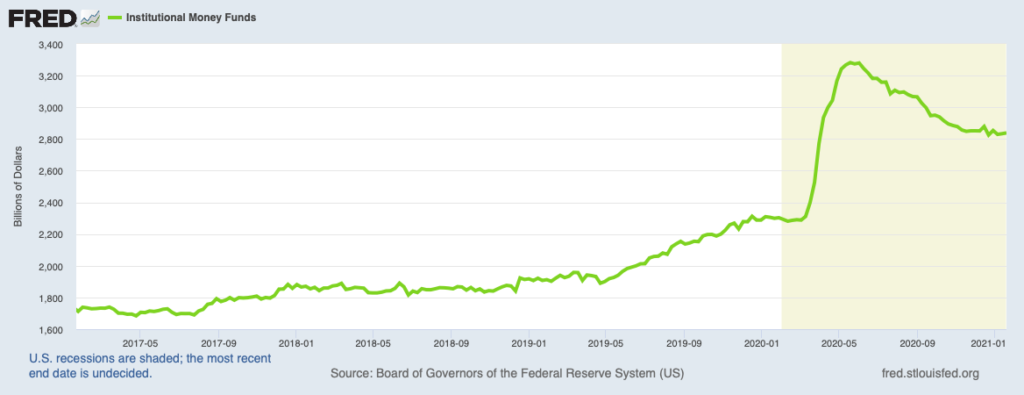
The COVID-19 relief package Trump signed into law last spring was heavily weighted to those who didn’t need help. As the graphic below shows, such excess cash nearly doubled from when Trump assumed office and last May. Only a little of that money has been withdrawn, an indication that federal aid included a lot of welfare for the rich.

Institutional Money Funds Soar

Cash parked in institutional money market funds used by corporations almost doubled between Trump becoming president and soon after.

During the pandemic, many millions of American households have reduced their debts and increased their savings because they had continued to be employed while their spending dropped. They don’t need relief.

Since your spending is my income, and vice versa, the people suffering because of the drop in spending do need help. Think of restaurant workers, barbers, gym trainers, and retail store clerks.

Invisible Suffering

In a nation whose political and economic power structure is largely white and in which large numbers of Americans have few to no minorities as neighbors, it’s easy for those suffering the most to be invisible.

One of the striking patterns I’ve noticed in print and broadcast interviews with COVID-19 deniers, the people who reject masks and social distancing, is that they are overwhelmingly white and often say they don’t know anyone who died from the virus. These people let their anecdotal experience trump what the data show.

It’s easy to never notice the depth and breadth of American poverty because it’s highly concentrated in neighborhoods with aging houses and apartments, little bus service, and often far from good jobs. There’s plenty of rural poverty, too, which is even less likely to be noticed by the majority culture.

The data show the tremendous suffering in places like Rochester, N.Y., a once fabulously rich city. These days every sixth Rochester resident subsists on less than half the income needed to escape poverty.

For a family of four, that’s $1,000 per month or less, hardly enough for a single person to pay bills. Rochester is far from alone among once rich cities turned poor.

$25,000 a Year

The official federal poverty measure, created when Lyndon Johnson was president, is badly outdated. It assumes that an income of about $500 per week or about $25,000 per year is enough for a family of four to escape poverty. That’s not even true in rural areas where housing is dirt cheap.

A newer and much more reliable poverty measure called ALICE should guide Congress.

ALICE is an acronym for Asset Limited, Income Constrained, Employed – people who work but don’t have savings and find it hard to make ends meet. The concept was developed by the nonprofit United Way. Think of the majority of American households who have less than $1,000 in savings and often nothing at all.

ALICE indicates that to meet basic needs a family of four in most urban areas needs about $1,200 per week—more than $62,000 per year. That’s not much less than the median household income these days of about $68,000.

$10 Million a Year

For perspective, a third of American households make less than $25,000;  90% make less than $134,000. The fastest growth is among the $10 million-and-up class that now has more than 24,000 households.

The economic carnage from Trump’s incompetent and malicious response to the coronavirus has been concentrated in poor and minority neighborhoods. In large part, that’s because close to two-thirds of higher-income Americans have jobs they can do from home, only about 9% of lower-paid workers enjoy that privilege.

And many of these lower-paid workers are deemed essential, risking their health and sometimes dying so we have clean floors in hospitals, food on grocery store shelves, and other fundamental services.

Many of those hardest hit are workers who show up and do their jobs but have had their hours cut or their jobs eliminated. That’s where relief needs to be concentrated – extending jobless benefits and making sure people aren’t evicted, which can make them homeless and set them back financially for years.

Families Facing Eviction

As many as 40 million families are at risk of eviction because they can’t pay the rent. Miles long lines of cars at food giveaways shown in television news reports attest to the depth of the income problem from those made jobless by the pandemic.

Relief needs to help both renters and their landlords.

Black and Hispanic renters are “twice as likely as white renter households to be behind on housing payments and twice as likely to report being at risk of eviction,” said Sophia Wedeen of Harvard University’s Joint Center for Housing Studies.

Giving poor renters cash grants to cover their rent would be the cleanest way to help landlords avoid foreclosure. That would also save on the social costs of dealing with people who become homeless, lose their household furniture, and may not recover for years.

Loan Thieves

That first round of help also attracted hordes of thieves. The suspected thefts exceed $4 billion. A rapidly growing list of borrowers is now charged with making up vast numbers of employees so they could get Payroll Protection Plan loans that don’t have to be paid back. One North Carolina man was indicted for fraudulently collecting $5.5 million using 12 companies with wildly inflated payroll numbers.

One of the greatest needs is for more and longer-lasting jobless benefits including an expansion of eligibility. I’ve talked to small business owners whose operations are seasonal and failed before the pandemic or otherwise fell between the cracks in qualifying for the $400 per week in jobless benefits and the $600 per week that was in the initial relief bill.

Congress should make the $400 per week of federal jobless benefits open-ended just like the pandemic’s effects are open-ended. Otherwise, as the pandemic drags on because the Trump administration failed to plan for distributing vaccines there will have to be another vote in Congress on extending relief. Take care of it all. Now.

Fox cancels “Lou Dobbs Tonight” after being sued for $2.7 billion: report

After spending months pushing conspiracy theories about voter fraud, Lou Dobbs is reportedly out of a job.

“Fox News has canceled “Lou Dobbs Tonight,” the program hosted by television’s staunchest supporter of Donald Trump and of his assertions of voter fraud in the 2020 election, The Los Angeles Times has learned. Dobbs’ program, which airs twice nightly at 5 and 7 p.m. Eastern on the Fox Business Network, will have its final airing Friday, according to a Fox News representative who confirmed the cancellation,” The Times reported on Friday.

“Dobbs, 75, remains under contract at Fox News but he will in all likelihood not appear on the company’s networks again. In addition to his Fox Business Network program, he occasionally turned up on the Fox News Channel as a commentator,” The Times reported. “The cancellation comes a day after voting software company Smartmatic filed a $2.7 billion defamation suit against Fox News and three of its hosts — Dobbs, Maria Bartiromo and Jeanine Pirro. The company claims the hosts perpetuated lies and disinformation about Smartmatic’s role in the election, damaging its business and reputation.”

Read the full report.

Even Zendaya can’t save the stylish “Malcolm & Marie,” a tantrum in search of a reason to exist

Sam Levinson knows what a gift he has in his “Malcolm & Marie” stars, Zendaya in particular. Levinson’s highly stylized “Euphoria” is nothing if not a temple to stylistic excess but Zendaya’s prodigious talent holds up its center; it is that show’s oaken truth.

Here, she can only do so much to cut through the studied glamour Levinson designs into her role and that of co-star John David Washington (“BlacKkKlansman“), two highly adept actors relegated to speaking for the artist instead of being allowed to let the art and its message work through them.

This could be because the message at the core of “Malcolm & Marie” is facile, vain and undemanding, an attempt to sell a loud, sullen tantrum about artistic work as soulful debate shot on 35 mm film.

Rendering the story in dazzling black and white seduces from the moment the credits roll, I’ll admit, and cinematographer Marcell Rév (the man who gives “Euphoria” its gorgeously spaced-out look) frames what’s about to take place in a single intoxicating visual gulp, showcasing a sweep of Carmel California desert against broad glass panes of the modern architectural house the couple calls home.

They’re returning from the successful premiere of a film directed by Washington’s Malcolm, and from his self-aggrandizing speech and dance around the living room, much of it filmed from outside, he knows he’s killed it. From there Washington launches into a petty speech about the shallowness of critics reading reflections about his identity as a Black man into a movie he conceived simply as a great story about an interesting character.

In the course of this rant he name drops a list of great directors to whom he knows he’ll be compared by the white critics tasked with reviewing the film, reserving a special concentrate of vitriol for a female critic at the L.A. Times. Mention of this critic bobs to the surface again and again as he rails at her hackery.

All the while Marie quietly stews as she makes a pot of macaroni and cheese, and although she says she’s hungry and tired he’s the one devouring it. (Metaphor alert!) Once he finally pulls his head out of his rectum and asks why she’s not angrily leaping for joy with and for him, she points out that he forgot to thank her – an oversight that’s particularly hurtful considering that his cinematic coup sprung from his co-opting Marie’s life story.

Netflix wants to lure us in by advertising this couple’s story as a romance, and the film itself as a love letter to filmmaking, and once you’ve seen enough of such cinematic epistles, you should recognize that designation as a warning.

In practice “Malcolm & Marie” is neither of these things, although its actors do a superior job of channeling what is quite nakedly a case of Levinson arguing with himself: Malcolm, the 30-something director, is the screaming, self-important manifestation of the artist’s ego and confidence in his vision, the arrogant shadow every successful creator has to nurture in order to keep on going. Marie, his 20-something recovering addict girlfriend, is the wounded side that demands to be seen and questions his originality, acting as judge and would-be jailer.

They are the personification of the artist’s inner struggle, proving that seeing such internal battles made flesh really isn’t as interesting as one might imagine it to be.

The writer and director made this film in the midst of lockdown and with a pared down crew, which explains the location and setting, not that either needs explaining.

Similar to “Euphoria,” the aesthetic quality of “Malcolm & Marie” is sublime. Washington and Zendaya are flawlessly lit as they glide through the work of architectural porn where they face off or elegantly, furiously stumble past tangles of trees outside.

Rev achieves a fetching balance of wide atmospheric shots with tight grabs on the actor’s faces. Together the visuals augment a pair of bloodied, soul-wrenching and entirely committed performances that should command our attention. Their combined thunder is frustratingly muted by the overpowering paucity of true emotion, a necessary element abandoned in Levinson’s strenuous effort to make some sort of intellectual stand in the defense of the artist’s right to create separately from his identity.  

Levinson’s other work, “Euphoria,” does the opposite – and indeed, the two hour-long one-off episodes exemplify how brilliant the filmmaker can be when he searches beyond himself while capitalizing on the authenticity informed by his lived experiences. He achieves this with the December episode “Rue” by stepping back and allowing Zendaya to expand her character’s extreme weariness and sorrow to fill the mostly empty diner where the hour’s action transpires.

“Rue” asks only an hour of the viewer and scrapes every last bit of feeling out of the bottle. “Malcolm & Marie” wants you to watch two people fight over problems most people couldn’t care less about for 45 minutes beyond that.

I recognize that this is a damning criticism of a movie whose central figure makes damning critics his hill to die on. But even without that obsessive side of Malcolm on raging display, little else exists in the character that makes a person want to sit through the full story if they can even make it through a quarter of it.

However let’s pretend, as Washington’s intensely solipsistic character does, that as a critic and not a creator I lack the technical vocabulary, vision and ability to separate the artist’s identity from the work he’s in. Let’s assume the view not of the professional judge swirling a tumbler of gifted Pappy Van Winkle (because those who write, not do, can’t afford it . . . please) around in my glass as I strive to pontificate about this film’s shortcomings.

Instead, let’s look at this from the view of your average Jane or Joe searching for a film that will speak to their souls about romance and art, and hopefully transport them to another place. If that’s what you desire, be warned that “Malcolm & Marie” will only make you feel trapped.

“Malcolm & Marie” is currently streaming on Netflix.

The oceans have become a cacophony of man-made noise that’s upsetting sea creatures

Vacationers relaxing on the beach might feel soothed by the rhythmic sound of the waves lapping up against the shore.

It turns out the feeling is not reciprocated by the fish who have to listen to us, however. Indeed, for millions of marine animals that live in the ocean, the sound of the ocean isn’t relaxing or peaceful. It is a cacophony of strange, upsetting noises — and their very quality of life is being destroyed by them.

An article published in the journal Science on Thursday details how anthropogenic ocean noise — that is, noise in the ocean caused by human activity — is wreaking havoc on our marine ecosystems. It’s difficult to think of a type of creature that has not been impacted, be they cetaceans like whales and dolphins struggling to communicate with their singing and clicking (respectively) to baby clown fish being homeless because they cannot recognize their coral reefs or numerous species of fish displaying signs of stress.

“Oceans have become substantially noisier since the Industrial Revolution,” the authors explain. “Shipping, resource exploration, and infrastructure development have increased the anthrophony (sounds generated by human activities), whereas the biophony (sounds of biological origin) has been reduced by hunting, fishing, and habitat degradation.”

They also noted that climate change has interfered with natural sounds that come from the ocean; and since climate change is caused by human beings, this too must be lumped into the larger category of noise pollution.

“Existing evidence shows that anthrophony affects marine animals at multiple levels, including their behavior, physiology, and, in extreme cases, survival,” the authors add. “This should prompt management actions to deploy existing solutions to reduce noise levels in the ocean, thereby allowing marine animals to reestablish their use of ocean sound as a central ecological trait in a healthy ocean.”

Dr. Stephen Simpson, a professor of biosciences at the University of Exeter and co-author of the paper, told The New York Times that the scientists screened more than 10,000 research papers that covered every aspect of how the sounds made by human beings in the oceans were impacting the creatures that live there. Not surprisingly, it revealed that animals which are able to more easily flee from agitating or unhealthy noises tend to be more adaptable to the noise pollution than those which cannot.

The good news here is that the problem is solvable.

“Noise is about the easiest problem to solve in the ocean,” Simpson told the Times. “We know exactly what causes noise, we know where it is, and we know how to stop it.” He suggested that ships change lanes to avoid areas where creature sensitive to noise pollution might reside and that they use quieter propellers. Simpson also said that other industries, such as deep-sea mining, consider reforms that could make their work less noisy.

Simpson’s observations were echoed by the paper itself.

“Compared with other stressors that are persistent in the environment, such as carbon dioxide emitted to the atmosphere or persistent organic pollutants delivered to marine ecosystems, anthropogenic noise is typically a point-source pollutant, the effects of which decline swiftly once sources are removed,” the authors wrote. “The evidence summarized here encourages national and international policies to become more ambitious in regulating and deploying existing technological solutions to mitigate marine noise and improve the human stewardship of ocean soundscapes to maintain a healthy ocean.”

This is not the only recent study to underscore the devastating impact that humans are having on the ocean. In September Science reported that the pandemic had caused a surge in plastic pollution in the ocean, due to everything from an increase in personal protection equipment (PPE) and medical waste to the fact that petroleum prices have dropped and it is therefore cheaper to manufacture new plastic products than recycle existing ones. 

How “Saint Maud” turns a feminist lens on body horror and gives its “final girl” autonomy

Horror as a genre is preoccupatied with female sexuality, and often this leads to rather tired and sexist tropes, which isn’t surprising in a male-dominated genre. In Rose Glass’ feature directorial debut, she pushes against these expectations with the unsettling new psychological thriller she wrote, “Saint Maud.”

The film stars Morfydd Clark as Maud, a newly devout hospice nurse who becomes obsessed with saving the immortal soul of her dying patient, Amanda (Jennifer Ehle), a famous dancer and choreographer who has retired to the shore of a resort town for the final months of her life. Maud’s transformation throughout the film plays with many familiar genre elements – religion, sexuality, and physical trauma – in unexpected ways that elevates the film.  

In traditional slasher films, archetypal characters are plucked off one by one in a now-predictable order. The hot, popular cheerleader — who casually indulges in drugs, alcohol and sex — is one of the first to go, while “the final girl,” the last surviving character, is typically sexually unavailable or virginal. 

“Saint Maud” takes the usual heteronormative sexual experience out of the equation, but still achieves satisfaction, this time through different means. Amanda initially tolerates Maud’s talks of conversion — it’s purposely unclear if Amanda is genuinely interested or perhaps poking fun at Maud — and the two pray together. Where Maud genuinely seems moved to a kind of orgasmic ecstasy, Amanda pretends for Maud’s sake. Through the shared pseudosexual experience, Maud falls for Amanda, which prompts a flurry of excitement and shame. 

This does not mean that physicality is not a factor in “Saint Maud,” but it doesn’t fall into the well-established “death is sex” trope. As Randy (Jamie Kennedy) puts it in the first “Scream” movie, “There are certain rules that one must abide by in order to successfully survive a horror movie. For instance, number one: You can never have sex. Sex equals death, okay?”

Instead, women’s bodies in horror and especially in “Saint Maud” often become the source of dread itself. They are the monsters, and their respective monstrosity is an extension of their sexuality. This manifests in different ways. 

In 1942’s “Cat People,” the protagonist refuses to have sex with her husband because she fears it will turn her into a killer cat (spoiler: it does). There’s “Teeth,” a 2007 horror-comedy, which provides an update on ancient “vagina dentata” folk tales and not-so-subtly grapples with ideas of emasculation and castration at the hands of sexually active women. There are numerous films where coming of age and an ensuing pull between sexual expression and repression, coincides with developing horrific, supernatural abilities — “Carrie,” “Thelma,” “Ginger Snaps.” 

It’s an arm of body horror, a term that springs from horror cinema, but has existed in fictional narrative for as long as we’ve been telling stories. Body horror is a technique used in the genre to repulse or disturb audiences by showing visceral degenerations or transformations of the human body. Common examples include zombification, mutation, mutilation, possession and some types of self-inflicted gore.

From Io, the mortal lover of Zeus who was turned into a cow, to “The Exorcist,” the female body is prime for uncontrolled possession or transformation. It mirrors the physical reality of a life marked by painful metamorphosis through menstruation, pregnancy and menopause. 

As the now-famous line from “Fleabag” goes, “Women are born with pain built in. It’s our physical destiny — period pains, sore boobs, childbirth. We carry it within ourselves throughout our lives.” 

With “Saint Maud,” Glass joins a burgeoning line of filmmakers that, instead of preying upon or exploiting that pain, are subverting some of the sexist elements of body horror by imbuing their female subjects with a level of autonomy that often renders their films both more nuanced and more terrifying. 

We saw this in the 2015 film “The Witch”  in which a 17th century family who is banished from their colonial community and lives at the edge of a bleak New England forest. The patriarch, William (Ralph Ineson), is a pious Puritan who is apprehensive about the state of his teenage daughter, Thomasin’s (Anya Taylor-Joy) soul because she “begat the sign of her womanhood” and suspects her of witchcraft.

After her family dies off member by member, eventually, Thomasin becomes the “final girl” and decides to “live deliciously” at the invitation of the evil Black Phillip. Thomasin joins a coven, stripping her clothes and levitating above the treeline along with the other witches, and thereby actually becomes what her parents had accused her of being. It’s unclear however what transformation they most feared: her metamorphosis into something supernatural, or her development into a sexual being, marked by physical changes like the development of breasts, body hair and menstruation. 

As Stacey Schiff wrote in”The Witches,” her history of the 1692 Salem witch trials, “There’s something about teenage girls, coming into their sexual lives and coming into their power, that Americans consider scarier than Harvard-educated magistrates who accept accounts of women flying through the Boston night.”

Puberty is the embodiment of fear for others in Thomasin, which she eventually embraces. But in “Saint Maud,” Maud herself is the one actively visiting physical horrors on others and herself on her path. The tensions between patient and nurse come to a head when Maud learns of Amanda’s relationship with Carol (Lily Frazer), a young woman she met online for a final fling. Maud fears that Amanda’s salvation, as well as her own, is in peril and intensifies her proselytizing, until finally Amanda has had enough. 

“Maud, [God] isn’t real,” Amanda deadpans at an extravagant house party surrounded by her artist friends. Maud, in turn, snaps and strikes Amanda across the face. It’s a sharp flicker of a rage that illustrates what viewers have come to suspect; pulsating beneath Maud’s ascetic exterior is an unbelievable amount of hidden agony that, when it reaches the surface, often manifests as increasingly intense mortification of the flesh and capacity for violence. 

Self-flagellation has a long history in Roman Catholicism, a religious tradition where impurity and penance go hand-in-hand. Maud is plagued by memories of her hedonistic past and as such she pursues the New Testament command “let him deny himself, take up his cross daily and follow me” to the fullest extent. 

What distinguishes the body horror in “Saint Maud” from other films is that she personally tries to use it to catalyze a spiritual transformation. Blind, but passive faith isn’t enough for Maud to feel connected to God. She needs to actively feel it. Maud claws at her skin and eyes, and uses a bed of hard corn kernels as a prayer mat, letting the sharp edges dig into her knees as she kneels in front of a crucifix. When that isn’t enough, she fashions beds of nails out of a shoe sole and sticks them in her sneakers. 

Maud slips her feet in her shoes, stands up and screams, a mix of torment and ecstasy, but is almost immediately subdued. She goes for a walk through the resort town, blood seeping from her soles. Maud claims that she can feel God inside her, that her body is a vessel. 

There’s a level of nuance inherent to “Saint Maud” that’s absent from many other horror films because Glass blurs the lines for viewers between Maud being surreptitiously possessed by something otherworldly and her seeking out that possession deliberately. Her increased surrender to the divine, which at one point results in her levitating  — back arched and head tossed back — is both an escape from and a reminder of her fears surrounding her sexual urges. 

When her faith is tested in extraordinary fashion at the end of the film, Maud prepares for one final transformation. She calmly walks to the beach, douses herself in acetone and self-immolates. We’re presented with one view initially, of Maud’s body consumed by flames. Then a second: Maud glowing, with wings outstretched. She’s shed her physical body and fashioned herself a martyred saint. She’s a final girl of her own making. 

“Even if you’re not religious, you can connect to that idea of wanting to feel like a part of something bigger than yourself, transcending your body in some way,” Glass told the British Film Institute in 2019. 

In a telling scene early in the film, Maud confides in Amanda that her patron saint is Mary Magdalene, the woman to whom Jesus first revealed himself following his resurrection. She’s a deeply important character in Christian theology, but her legacy was marred by the early church’s leaders who portrayed her as a “sinful woman,” a prostitute who met Jesus, repented of her sins, and poured oil on his feet as a gesture of penitence. Despite the esteem she obviously held in the eyes of Christ, she was still defined for ages by her sexual history. 

Underpinning “Saint Maud” is a serious question: Regardless of how she manipulates and mortifies the flesh, can a woman ever really transform herself into something greater under patriarchal leaders who view her sexuality as a spiritual liability? Both Thomasin from “The Witch” and Maud exist in societies where their autonomy is considered either sinful or supernatural. As such, it’s a welcome contemporization of the horror formula that they are the ones embracing and, at least in part, generating their own transformations.

“Saint Maud” is currently in select theaters and will be available on Epix on Feb. 12. 

Biden rejects ex-Obama adviser Larry Summers’ suggestion stimulus too big: “We can’t do too much”

Democrats are laughing off calls from Washington’s consultant class to scale back the size of COVID stimulus and appear ready to move without Republican support, signaling a significant end to any hope for the bipartisan bill previously called for by Joe Biden and moderate Democrats in the Senate.  

In a meeting on Friday with Democratic leaders and committee heads pulling together another COVID-19 relief bill, the president ignored the advice of ex-Obama advisor Larry Summers, who suggests in a new Washington Post op-ed that the Biden administration that “the magnitude of what is being debated” can have harsh “consequences for the dollar and financial stability.”

“If I have to choose between getting help right now to Americans who are hurting badly and getting bogged down in a lengthy negotiation, or compromising on a bill that’s up to the crisis, that’s an easy choice,” Biden said at the White House on Friday, signaling his willingness to push the bill through without bipartisan support. 

House Speaker Nancy Pelosi, D-CA, later suggested Democrats are simply ignoring the warnings from the former Treasury Secretary, saying in a press conference, “We didn’t talk about Larry Summers.” 

In his op-ed, Summers penned what many “liberal wonks have been whispering about for weeks,” according to Politico, demanding that Biden’s “bold” plan to provide Americans with $1.9 trillion in Covid-19 relief be “accompanied by careful consideration of risks and how they can be mitigated.” 

In predictably abstruse language, Summers warns Biden of ratcheting up undue inflation, which he claims, would have “consequences for the dollar and financial stability.” Summers also warned Biden that he is risking the depletion of funds that might otherwise be used for other public investments. “If the stimulus proposal is enacted, Congress will have committed 15 percent of GDP with essentially no increase in public investment to address these challenges,” he said. “After resolving the coronavirus crisis, how will political and economic space be found for the public investments that should be the nation’s highest priority? Is the thinking that deficits can prudently be expanded longer and further?”

Summers’ wonkish hand wringing, likely to be co-opted by conservatives with an interest in “austerity orthodoxy” (as Summers calls it), was met with sharp criticism by those on the left who are intent on seeing immediate relief rather than fiscal responsibility. 

Sen. Brian Schatz, D-HI, took to Twitter to call out the economist’s history of failed fiscal conservatism.

https://twitter.com/brianschatz/status/1357700340037074946

“Why would we listen to the economist who admits he went too small last time if he’s warning us to go small again?” Schatz asked

Biden’s economic policy advisor Jared Bernstein specifically called out Summers, strongly disagreeing with his assessment. “I think he’s wrong. I think he is wrong in a pretty profound way,” Bernstein said in a CNN appearance, “We have consistently said the risks of going too small are much greater than the risks of too much.”

On Friday, after an hours-long proceeding known as “vote-er-ama,” Congress passed a budget resolution that will allow Democrats to legislate the COVID-19 relief package without GOP support. The resolution passed 51-50 on a party-line vote, with Vice President Kamala Harris casting one of her first tying breaking votes in the Democrats’ favor.

Although 49,000 jobs were added in the month of January, according to Friday’s latest jobs report, the U.S. is still down 10 million jobs since the start of the pandemic. “The one thing we learned is we can’t do too much here,” Biden said in the meeting, “The end result is … not just the macroeconomic impact on the economy and our ability to compete internationally,” said the President, “It’s people’s lives.”

Ben Sasse demands GOP choose between “conservatism and madness” amid censure threat

Sen. Ben Sasse, R-NE, is standing his ground against a Republican effort backed by leaders of his own state to censure him, warning that his party’s idolatry of Donald Trump has sowed self-destructive divisions within the party. 

In a video released on Thursday addressing Nebraska’s State Central Committee, Sasse demanded that his party choose between “conservatism and madness,” urging members of the Nebraska GOP, who will vote on a “Resolution of Censure” on Feb. 13, to open to criticism of Trump. 

Let’s be clear,” Sasse told viewers, “The anger in this state party has never been about me violating principle or abandoning conservative policy. I’m one of the most conservative voters in the Senate. The anger’s always been simply about me not bending the knee to one guy.”

Sasse, just one of the five Republicans to signal support for Trump’s impeachment trial, did not vote for Trump in 2016 or 2020 and staunchly opposed Trump’s failed attempt to overturn the election. In December of last year, Sasse published a lengthy Facebook status, decrying the Republican caucus that attempted to nullify the election certification. 

If you make big claims, you had better have the evidence,” he wrote, “But the president doesn’t and neither do the institutional arsonist members of Congress who will object to the Electoral College vote.”

Sasse is now echoing a similar sentiment in the wake of the Capitol riot, which he called “shameful mob violence” that “[disrupted] a constitutionally mandated meeting of the Congress to affirm … peaceful transfer of power.” 

“It happened because the president lied to you,” Sasses explained, “He lied about the election results for 60 days, despite losing 60 straight court challenges, many of them handed down by wonderful Trump-appointed judges […] He then riled a mob that attacked the capitol, many chanting, ‘Hang Pence.’ If that president were a Democrat, we both know how you’d respond. But because he had ‘Republican’ behind his name, you’re defending him.”

Sasse, citing his re-election in 2020, expressed that most voters in Nebraska share his perspective and do not support Trump (albeit the former president won Sasse’s homestate by roughly a 19% voting margin). 

“Nebraskans aren’t rage addicts and that’s good news,” said the Senator, addressing his state’s Central Committee, “You are welcome to censure me again, but let’s be clear about why this is happening — it’s because I still believe as you used to that politics isn’t about the weird worship of one dude.”

If Sasse is censured next week, it would make for his second in the last five years. Back in 2016, Sasse –– one of the first “Never Trumpers” joined by Sen. Mitt Romney, R-UT, –– was censured for not showing strong enough support for the former President.  Sasse also faces a motion to censure from the Scotts Bluff County GOP, according to the Scotts Bluff Star Herald.

Despite the mountain of disdain from his own party, Sasse has held true –– and naively so –– to the notion that the GOP can restore its moral rectitude. “Something has definitely changed over the last four years, but it’s not me,” he said. “Personality cults aren’t conservative. Conspiracy theories aren’t conservative. Lying that an election has been stolen, it’s not conservative. Acting like politics is a religion, it isn’t conservative.” While these phenomena might not be deemed “conservative” in Sasse’s imaginary utopia, they’ve certainly proven to be in reality.

Experts lambaste errors — both spelling and legal — in Trump impeachment defense filing

The defense team for former President Donald Trump’s impending impeachment trial was widely mocked Tuesday for issuing a response to the House of Representatives’ article of impeachment that contained both spelling and — according to critics — legal mistakes.

One spelling error that sparked a flurry of comments on Twitter came in the very beginning of Trump’s response (pdf), which is addressed to the “The Honorable, the Members of the Unites States Senate.” 

Typos have plagued numerous legal documents filed by Trump’s (former) attorneys in a string of losing cases seeking to overturn the results of the 2020 presidential election. One filing by lawyer Sidney Powell even misspelled “district” twice in the same heading. 

Trump—whose own tweets routinely contained spelling errors, including the infamous “covfefe” — reportedly called Powell’s errors “very embarrassing” during a heated White House strategy meeting in December. During that same meeting, White House staff secretary Derek Lyons brought up a more important point in relation to the effort to reverse the election results. 

“You’ve brought 60 cases,” Lyons reportedly told Powell. “And you’ve lost every case you’ve had!”

And so while many Twitter users once again lambasted spelling errors on Trump’s latest legal document, other observers focused their criticism on what they said were its legal mistakes, even if some of them managed to get in digs at both simultaneously.

“If you’re curious about the actual substance of the document, it’s of the same quality” as the spelling, tweeted Washington Post national correspondent Philip Bump, linking to his analysis of Trump’s defense. 

“As expected, the document’s evaluation of Trump’s actions surrounding the violent invasion of the U.S. Capitol on [January] 6 includes a defense of his claims that the 2020 presidential election was marred by voter fraud,” Bump wrote for the Post. 

Absent that “Big Lie,” as the House impeachment managers called the fraud claims in their Tuesday pretrial brief, “there’s no rally at the White House that morning and no crowd of people milling around who would then overrun the Capitol,” according to Bump. 

Bump and others, including Marc E. Elias, an attorney and founder of the progressive advocacy group Democracy Docket, lambasted the Trump document’s assertion that “under the convenient guise of Covid-19 pandemic ‘safeguards’ states election laws and procedures were changed by local politicians or judges without the necessary approvals from state legislatures.”

Another central argument of Trump’s trial defense involves the former president’s right to free speech. However, critics were quick to note that there are well-established limits on First Amendment speech, and that no one has the right to incite violence with their words: 

xx

“Lawyers are paid to make the best case they can for their clients,” Bump concluded. “If this is Trump’s best case, he’s lucky that nearly half the jurors who will evaluate it are already firmly in his camp.”

In the end, the fact that 45 Republican senators are likely to vote to acquit Trump may indeed matter more than any errors—typographical, legal, or otherwise—his defense may make. 

New Dominion legal threat targets Trump enablers — but MyPillow guy won’t stop election lies

Attorneys for Dominion Voting Systems asked social networks to preserve posts about the company made by former President Donald Trump and his allies as they pursue defamation claims against conservatives who spread the debunked claim that Dominion voting machines flipped votes in the election.

Dominion, which has already sued Trump attorney Rudy Giuliani and former Trump attorney Sidney Powell for $1.3 billion apiece, has asked YouTube, Facebook, Twitter and Parler to preserve posts, even those already taken down for violating misinformation policies, “because they are relevant to Dominion’s defamation claims relating to false accusations that Dominion rigged the 2020 election,” CNN’s Brian Stelter first reported. Powell, Giuliani and other Trump backers spread a baseless conspiracy theory that, among other things, Dominion had been founded by deceased former Venezuelan leader Hugo Chávez and flipped votes from Trump to President Joe Biden in a plot financed by communists in China and Cuba.

The letters to the social networks included varying lists of names. The company is seeking to preserve posts from Trump and his campaign, Trump legal adviser Jenna Ellis, pro-Trump attorney Lin Wood, former national security adviser Michael Flynn, far-right pundit Dan Bongino and MyPillow CEO Mike Lindell. The company also asked for posts from Fox News and its hosts Sean Hannity, Jeanine Pirro, Maria Bartiromo and Lou Dobbs, as well as conservative outlets Newsmax, One America News Network and The Epoch Times.

Dominion said in its letters that additional lawsuits would be forthcoming.

The new lawsuit threat comes after Smartmatic, a voting tech company that was inexplicably drawn into the pro-Trump Dominion conspiracy even though the two companies appear to have no ties and Smartmatic’s software was only used in a single California county during the 2020 election, filed a $2.7 billion lawsuit against Giuliani, Powell, Fox News and hosts Dobbs, Bartiromo and Pirro.

Fox News and Newsmax have been on the defensive ever since Dominion and Smartmatic began to issue clear legal threats. Both networks have aired segments debunking claims made by their hosts and guests pushing conspiracy theories about the two companies, which were cited in the Smartmatic lawsuit as evidence that the networks aired demonstrably false claims. But Newsmax has continued to invite Lindell, a top Trump backer and network sponsor, despite his insistence on continuing to push discredited claims about voting machines.

This week Newsmax invited Lindell on the air to discuss the suspension of both his personal Twitter account and the MyPillow corporate account for pushing false election claims, but the bedding magnate quickly pivoted to pushing those same false claims seconds into the interview.

“Mine was taken down because we have all the election fraud with these Dominion machines. We have 100% proof,” Lindell said. 

Host Bob Sellers interrupted Lindell repeatedly to read a statement reiterating that there is no evidence for his claims.

“Mike, you’re talking about machines,” Sellers said. “We at Newsmax have not been able to verify any of those kinds of allegations. We just want to let people know that there’s nothing substantive that we’ve seen. Let me read you something here. The election results in every state were certified. And Newsmax accepts the results as legal and final. The courts have also supported that view.”

Lindell continued to try to talk over the host and was cut off again. “I don’t want to have to keep going over this,” Sellers replied. “We at Newsmax have not been able to verify any of those allegations.”

Lindell refused to stop discussing his claims and Sellers’ pleas to his producer to cut the interview short went unanswered, prompting the host to walk off the set in the middle of the segment.

Despite the blowup, Newsmax welcomed Lindell back on the air just hours later, when host Rob Schmitt praised the MyPillow CEO as a friend of the network and Lindell urged viewers to use a Newsmax-related promo code to buy pillows on his website, since they have been removed from numerous retail outlets.

The next day, Sellers apologized for being “frustrated” that Lindell would not focus on the “cancel culture” topic and said he “could have handled the end of the interview differently.”

 “Mike also made clear he thinks Newsmax is ‘great’ — his words — and I can tell you he will continue to be an important guest on Newsmax,” he said.

Lindell later announced that he would air a three-hour documentary about his fictional claims that he claimed would be the “most important documentary you ever watch in history.” The documentary has since been shown on OANN, which accused Newsmax of “being swept up by leftist censorship.”

But even OANN aired a disclaimer prior to the documentary to make clear that the network does not “endorse any statements or opinions” in the program, particularly as it related to Dominion and Smartmatic.

“The statements and claims expressed in this program are presenting at this time as opinions only,” the disclaimer said, “and are not intended to be taken or interpreted by the viewer as established facts.”

Why conservatives are now targeting the victims of the Capitol riot

No doubt about it, making fun of trauma victims has been a major source of fun for movement conservatives for the past decade. In particular, right-wing trolls enjoy mocking the concept of being “triggered,” which is mental health jargon for experiencing stress or anxiety when reminded of traumatic events. Donald Trump Jr. even titled his book “Triggered,” trying to put this noxious cruelty on the bestseller lists

The targets of right-wing mockery aren’t usually people traumatized by car accidents or combat experiences, but people whose trauma is politically uncomfortable for conservatives. As Sophia Tesfaye wrote earlier this week at Salon, it’s “a tired shtick that is often trotted out by right-wing pundits who attempt to deflect negative attention like after a school shooting or publicized event of police violence.” And, of course, it’s leveraged against victims of sexual violence, as happened when Donald Trump made fun of Christine Blasey Ford for her story of being sexually assaulted by now-Supreme Court Justice Brett Kavanaugh. 

Mostly, conservatives who engage in victim-mockery tend to keep it in their own spaces (Trump attacked Ford at a rally, not a press conference) where they can high-five each other for their abusive behavior without drawing the attention of others who rightfully will be grossed out by it. But after the Capitol insurrection of January 6, this habit of reflexively mocking and denying the pain of trauma victims is being rolled out for a more national audience, as Republicans frantically try to minimize the violence of that day, looking to deflect from their own complicity in both causing and excusing it

After Rep. Alexandria Ocasio-Cortez, D-N.Y., took to Instagram to detail her horrific experiences during the insurrection, the right-wing noise machine moved into action, deploying the usual sexist stereotypes about hysterical, manipulative, deceitful women typically employed to discredit victims of rape or sexual harassment. Things swiftly escalated when Rep. Nancy Mace, R.-S.C., tried to imply Ocasio-Cortez was a liar, tweeting that “no insurrectionists stormed our hallway”. 


Want more Amanda Marcotte on politics? Subscribe to her newsletter Standing Room Only.


Mace’s insistent claim that the people in the hallway whiches houses her and Ocasio-Cortez’s offices experienced no trauma, however, was quickly debunked — by her own words from the days following the attack.

At the time, Mace described barricading herself in the office and feeling “threatened & unsafe.” She only changed her tune when it became politically useful to deny that her Democratic colleague had felt the same way. But rather than back down and apologize in the face of being exposed as a slippery liar, Mace instead doubled down, making fun of her for being “triggered by facts” and accusing her of “eagerness to politicize absolutely ANYTHING”. In reality, it’s Mace who is flipping out in the face of her own words and was misrepresenting the horrors of January 6 as a cynical political ploy. As usual with conservatives, she is projecting her own bad behavior on Democrats. 

Friday morning, Ocasio-Cortez and Rep. Jason Crow, D.-Colo., went on “CBS This Morning” to talk about how the GOP approach of mocking the survivors of the Capitol riot and minimizing their pain doesn’t just harm those victims directly, but all victims of traumatic experiences. 

“We are not good as a society at dealing with trauma,” said Crow, who compared the trauma of the insurrection to his experiences as an Army Ranger in Iraq and Afghanistan. Echoing what conservatives have derided Ocasio-Cortez for saying, Crow went on to argue that “the stigma that’s put on survivors” is a serious national problem because it “prevents survivors from actually coming forward and getting the help that they need.”

It’s killing people,” he emphasized, noting that “we have over 20 veterans a day that kill themselves” because they didn’t get the help they need in dealing with trauma. 


Want more Amanda Marcotte on politics? Subscribe to her newsletter Standing Room Only.


Ocasio-Cortez agreed, saying that victims “internalize people saying that their trauma isn’t big enough to get help” and that watching Republicans make fun of her and other Capitol riot survivors for speaking out reinforces the idea that it’s shameful to admit to feeling traumatized and getting help. 

Thursday night, Democrats in the House spent an hour giving speeches about the horrors of January 6, sharing stories of having to flee for their lives and choking up at the memories of worrying for the safety of staff and colleagues. Their testimonies really drive home how terrible it was for Trump to do what he did, and why he should be convicted for inciting a violent insurrection. In an upcoming episode for “The Circus” on Showtime, Rep. Nikema Williams, D-Ga., reveals that congressional members now need more security, saying, “We all deserve to feel safe.”

Sneering at people for having entirely normal reactions to violence isn’t just immoral, however. It also seems like it’s not too smart, politically speaking. But Republicans have backed themselves into a corner, having decided that the best approach to the Capitol insurrection is to minimize it and refuse to hold Trump accountable for inciting the riot. Now every story about Capitol police being attacked or congressional staffers hiding in terror makes them look — correctly, mind you — like absolute monsters. No wonder they’re scared of these stories, so scared they’re reverting to sleazy tactics to silence anyone with a story to tell. 

But this isn’t just about the recent GOP choice to kowtow to the violent mob who rampaged through the Capitol. This grotesque denial and mockery of trauma is the result of years of the right cultivating a sociopathic aesthetic, which really hit an apex during the presidency of Donald Trump, a man who mocked disabled people and called alleged sexual assault victims too ugly to rape

This sort of thing, unfortunately, plays well with the devoted right-wing base, many of whom have given up on trying to make positive arguments and live only for being a bunch of hateful trolls. But as Trump’s historic unpopularity with American voters shows, there’s a hard limit on how many people can be won over with the politics of mocking people’s suffering and sneering at the very idea of empathy.

It’s not like Republicans have a lot of alternatives either, however, having already decided it’s best to acquit Trump. So they’re left only with the choice of pretending that the insurrection wasn’t as bad as it was, which, in turn, apparently requires making fun of trauma victims. 

The TikTok feta pasta craze started in . . . Finland?

TikTok, this year’s great arbiter of food trends, strikes again, launching a new recipe into the viral stratosphere. The newest installment to the pantheon of internet recipe stardom, however, took an unlikely path to arrive at its current A-list position.

It started back in 2019 — ahh, remember the halcyon days before, well, all this? — when food blogger and artist Jenni Häyrinen posted a simple, wholesome, and thoroughly appealing pasta recipe to her Instagram: uunifetapasta, or oven baked feta pasta. The dish’s preparation was simple: Roast a block of feta, a smattering of cherry tomatoes, and a couple of chopped chilis on the same sheet tray. Once melty and blistered, remove, combine, and toss with freshly cooked spaghetti, or your pasta of choice. The result is a ridiculously easy and overwhelmingly flavorful pasta sauce (we know — we tried it!) that first took off in her native Finland.

“Right away, it started to go viral first on Instagram stories,” Häyrinen told me via email. “The next weekend I had a 3-day #uunifetapasta live on my Instagram stories, and reposted my followers’ creations. Newspapers picked up on it, and it was not long before everybody in Finland was cooking it.” Häyrinen remembers the response to her recipe being so fervent that feta cheese soon became hard to source in local supermarkets. She says the original recipe video was viewed more than 2.7 million times (and for context: Finland has a population of 5.5 million).

Nearly 2 years after its inception, Häyrinen’s feta pasta recipe is witnessing a TikTok revival. Accounts like @feelgoodfoodie and @grilledcheesesocial are bringing the recipe to the video platform, and garnering massive views. The recipe has taken firm hold on TikTok, with countless variations swirling across the platform. Some users add in basil, while others create vegan versions.

How does Häyrinen feel watching her recipe take off online? She’s used to it! It turns out, this is what she’s calling the recipe’s “third wave.” It peaked once more during the summer of 2019, when Mackenzie Smith @grilledcheesesocial) shared the recipe in an Instagram post. Like many internet phenomena, it’s hard to trace what accounts for the recipe’s sudden resurgence this time around, but Häyrinen isn’t complaining. “If things go the way I think they will, the world just might run out of feta cheese. I’m super happy and excited to see where all this goes.”

Amidst all the newfound excitement, Häyrinen joined TikTok. There was, she tells me, one key ingredient in the original recipe these new iterations seemed to omit: chili. “I just could not sit back anymore and watch people not add chili to it! So I posted the original viral recipe on TikTok too @liemessa.”

It turns out Thursday, Feb. 4, was actually International Uunifetapasta day in Finland. Häyrinen launched the day to gather all the feta pasta-makers across the world. This year’s celebration was sure to see a wave of new participants, given the recipe’s newfound fame. She planned to cook the pasta on Instagram Live, and invited everyone to cook along with her using the hashtags #uunifetapasta and #bakedfetapasta. “Uunifetapasta is here to stay, and people still make it all the time in Finland.”

Related recipes

Want better-tasting morning brew? Try cleaning your coffee maker

For most people, the coffee maker is a sacred appliance tasked with providing the day’s critical caffeine supply. And while the coffee maker gets a ton of use for this reason, it doesn’t actually receive as much care as it should. If you clean your coffee maker regularly, we stand corrected — but we’d be willing to bet you don’t. You’re not alone, though. Until we did our research, we weren’t maintaining our coffee makers properly, either. But once you know, you’ll never go back to your old ways.

According to an NSF International study, the reservoir of a coffee maker is the fifth germiest place in the home. Yeast and mold were found in half of the makers tested, which really shouldn’t come as a surprise. The warm, moist environment of most reservoirs is ideal for such microbes, as well as other germs and bacteria, to grow. We can all agree this is pretty off-putting, but it can also be harmful, especially to those with allergies and asthma.

On top of the yucky, potentially dangerous consequences of neglecting your coffee maker, failing to clean it can also negatively affect the functioning of the machine and the flavor of the coffee itself. (Nooooo!) A buildup of hard water minerals can result in clogging, while buildup of coffee oils left behind by brewed coffee can become rancid and cause even a fresh pot to taste bitter. These can both easily be avoided, however, by regularly removing the residue.

And that’s why we’re here, to show you exactly how to properly maintain your coffee maker. With a commitment to a combination of a daily quick-clean and deeper monthly cleaning, you’ll be sipping cups of safe, delicious joe in perpetuity.

Your Daily Routine

Step 1: Accept that you must clean your coffee maker every single day. 
Step 2: Dump out all your coffee grounds. 
Step 3: Wash all the removable parts of your coffee maker with warm, soapy water. That means the lid, filter basket, and carafe should all get a once-over. A sponge is highly recommended. 
Step 4: Once all the items are sparkling, either towel dry them or leave them out to air-dry. 
Step 5: Wipe down the exterior of the coffee maker with a damp paper towel. 
Step 6: Reassemble the coffee maker for tomorrow’s very necessary brew.

Your Monthly Deep Clean

Step 1: Force yourself to perform a deep clean, knowing your future self will thank you. 
Step 2: Fill the reservoir with equal parts white distilled vinegar and water. If your maker is extra icky, you can increase the amount of vinegar. Vinegar has natural sanitizing properties that will dissolve mineral deposits, cut through grime, and overall deodorize. 
Step 3: Place a filter into the machine’s empty basket, position the carafe in place, and brew the solution halfway. 
Step 4: Turn off the coffee maker and let it sit for 30 to 60 minutes. 
Step 5: Turn the coffee maker back on and complete the brewing. 
Step 6: Dump out the pot of vinegar water. 
Step 7: Flush the vinegar scent out of the coffee maker by brewing a pot of fresh water. 
Step 8: Brew a second pot of fresh water and feel happy that you don’t have to complete this process again for another month.

Related articles:

Rachel Maddow breaks down a key problem with the GOP’s legal rationale for not convicting Trump

On MSNBC Thursday, Rachel Maddow broke down a key problem with the GOP’s legal reasoning against convicting former President Donald Trump.

Specifically, she noted, the GOP’s defense rests on the shaky legal reasoning that it’s unconstitutional to impeach a president who is no longer in office — and yet Trump does his best not to acknowledge he isn’t in the office anymore in the first place.

“Donald Trump is not calling himself the former president. And it’s not just with the name of the office,” said Maddow. “Today, his spokesman for his post-presidential office said on Newsmax TV, ‘I do not expect the 45th president to be in Washington next week.’ You mean the former president? No, no, no, that cannot be said. I’ve been sort of picking at this for a few days now, but it is now going on for long enough and it is insistently consistent enough that this is worth noticing. In part because Mr. Trump really does appear to be insisting on this and that could get very weird very quickly.”

“Republicans right now are heading into the impeachment trial which starts at the beginning of next week and they think that they are mounting a defense against the conviction of Donald Trump on the technical grounds that the Senate shouldn’t even be holding an impeachment trial for him because he’s not president anymore. Because he’s a former president,” said Maddow. “I’m here to tell you, dude does not agree that he is a former president. And he is not allowing anyone to describe him that way.”

“If that’s the trapdoor they’re going to use to try to get him out of a Senate impeachment conviction, he’s going to fight it,” she continued. “He insists he cannot be called a former president. He must be called the 45th president. He’s still using the presidential seal. There’s no sign that he concedes that there’s now a 46th president so he’s an ex. I mean, how many ticks are we away from him claiming that he is still in office, that he still has the powers of the presidency? That he’s rightfully still president?”

You can watch the video below via YouTube:

Fox News is flailing without Donald Trump: Right-wing media ramp up the culture wars in desperation

There’s a lot going on in politics right now, but I think we can pretty much declare that this particular week belonged to Marjorie Taylor Greene and her history of sharing unhinged conspiracy theories on social media. It seems as though every day someone unearths another example of her obnoxious rants.

The Republicans held a right-wing encounter session on Wednesday night at which they gave Greene a standing ovation even as 147 of them voted —by secret ballot — to allow Liz Cheney to keep her leadership position after she voted to impeach Donald Trump. The next day, all but 11 stepped forward to show their fealty to Trump and his favorite new henchwoman Greene, by voting to allow her to keep her committee assignments even as the Democrats did their dirty work for them by voting to strip her of them.

House Republicans are running in circles trying desperately to keep the QAnon/Trump faction from exploding at them while also keeping some semblance of deniability if this whole thing goes sideways and they need to deny they are in thrall to the crazies when the next election rolls around. They do have to dial for dollars from big donors and appeal to at least a few informed voters who think this whole thing is nuts.

It’s a problem. But when you think about it, it’s really all they know how to do at this point. After all, the party didn’t even put out a platform for the 2020 campaign, so it’s not as if they would have a pressing agenda even if they had won the majority:

WHEREAS, The RNC, had the Platform Committee been able to convene in 2020, would have undoubtedly unanimously agreed to reassert the Party’s strong support for President Donald Trump and his Administration …

There were a couple of bullet points bashing the media as well, but that was it.

The truth is that Republicans didn’t actually have much of an agenda throughout the Trump years either. Other than their massive tax cuts for the wealthy and attempted repeal of Obamacare (both of which they rammed through the reconciliation process), confirming judges to the federal bench and pro-forma budgets with huge hikes in military spending, they mostly let Trump flail around in the White House and keep the country stirred up with his divisive behavior both here and abroad. As a result, Republicans are now the party of conspiracy theories, culture war, and Donald Trump.

Republican officials exist to feed that beast and nothing more. This is where it’s quickly led them:

Meanwhile, their propaganda arms in the right-wing media are in a strange new world without Trump. Fox News, in particular, is having a hard time finding its footing. For the first time in two decades, it’s ratings have left them in the number three spot behind CNN and MSNBC with far-right competitors OAN and Newsmax nipping at its heels. Recall that Trump had been sticking the knife in for quite a while, taking to Twitter at the slightest criticism and was particularly furious at anchor Chris Wallace for his moderating at the disastrous first presidential debate. Trump managed to convince his followers that Fox calling Arizona before the other networks somehow cost him the election and the network has been reeling ever since.

One might have thought that such a predicament would lead to a news organization having some kind of self-evaluation about how they got in the position of having to keep spreading lies in order to keep their audience, but Rupert Murdoch is back in the captain’s chair and he seems to be intent upon doubling down on the crazy in order to recapture the audience from the two low rent competitors. So, as we speak, the Fox News, OAN and Newsmax viewers are all being fed a diet of the same right-wing conspiracies, mockery and lies that they got during the Trump years, only this time without the dominating figure of Trump himself who, for all of his grotesque behavior was in fact the president of the United States so covering him, even as sycophants, had at least some relationship to reality.

The Big Lie of the stolen election, in particular, seems to have spun off the right-wing media into a separate political universe where politics, to the extent you can call it that, is nothing more than non-stop grievance.

For example, the story of the January 6th insurrection at the Capitol is one of the most stunning political events in American history. If you tune in to Fox or one of the others, however, this event was just a little blip on the screen, no different than an average street protest, despite the fact that the goal of the violence was to force the Congress to overturn the election resultsAs Salon’s Sophia Tesfaye noted, Fox hosts have now taken to derisively insulting people who experienced the event, like Alexandria Ocasio Cortez and Katie Porter, as dizzy hysterics, as if the ransacking of the U.S. Capitol was merely a rowdy tailgate party that got a little out of hand. And I don’t doubt their viewers think that’s true because Fox pretty much dropped the story after the first few days. The late Gore Vidal said, “We are the United States of Amnesia, we learn nothing because we remember nothing” but this is ridiculous. It just happened four weeks ago.

It will be very interesting to see if they even bother to cover the impeachment trial next week. If they do, you can be sure it will be framed as a partisan stunt, totally without merit. Nonetheless, I’m sure they will find time to denigrate the process and focus their audience toward whatever Democratic villains they choose to target. The Republicans in the Senate, supposedly the body that’s supposed to cool the passions of the polloi, are also captives of this alternate politics, in which governing is almost irrelevant. Most will refuse to convict, some no doubt hoping that America’s amnesia will kick in before their next election.

All of this leaves an opening for the Democrats who are busy with a real agenda and real plan for governing.

While the Republicans fulminate, whine, mock and deride, still wringing their hands over whether Donald Trump and his followers will be mad at them, the government is kicking back into gear and is starting to work again. Democrats are betting that delivering material benefits to the American people after all the trauma of these past few years will benefit them politically. The Republicans have no choice but to bet on their base continuing to live in an alternate universe, fighting phantoms and feeding their grievances. Over the next couple of years, we’re going to see which political vision most Americans really want. 

Desperately seeking honorable Republicans: Media’s snipe hunt comes up empty again

For at least the last five years, the American mainstream news media has been playing its own version of “Where’s Waldo?” But instead of looking for a man wearing a hat and glasses among a sea of other images, the media has desperately tried to find “good,” “decent,” “reasonable” and “responsible” Republicans who will “save” their party from Donald Trump.

Such a quest will prove fruitless, as there are very few such Republicans left.

After Trump’s coup attempt and his followers’ lethal assault on the Capitol last month, the dominant narrative among the country’s leading news outlets was that the Republican Party would experience a “reckoning.” The attack would be a type of shock therapy and wakeup call for the party and its leaders. Trump’s crimes were so great that Mitch McConnell — no longer the majority leader — and the other Republicans in the U.S. Senate would now vote to convict Trump in order to purge themselves of his power and rebuild the party after its 2020 defeat.

None of that has happened.

Within hours of the U.S. Capitol attack on Jan. 6, 147 Republicans in the Senate and House voted to overturn the results of the 2020 election – the exact goal of Trump’s murderous mob.

As they did during Trump’s first impeachment, Republicans have now made it clear that they will not convict Trump for his crimes of treason and insurrection. In refusing to hold the disgraced president responsible, the Republican Party has declared itself a criminal organization, one that gives aid and comfort to right-wing terrorists, traitors and insurrectionists.

Instead of being exiled, Trump and his movement remain in firm control of the Republican Party.

At New York magazine, Jonathan Chait recently summarized the failed Republican redemption narrative, writing that after the election defeats and the January insurrection, the party “appeared to be undergoing a crisis of confidence, if not an outright crack-up”:

Perhaps, finally, things had gone so far that the party would undertake the soul-searching it had avoided for four years. Senate Majority Leader Mitch McConnell let it be known he wished to be rid of Trump. The party “likely will face a raging internal war over policies and political leaders,” asserts longtime Washington hand Jim VandeHei. “Do not underestimate how divided and confused their party is right now,” posits David Brooks, “Do not underestimate how much Republicans trust Biden personally.”

But instead of a Glasnost for the Republican party, the days after January 6 seem instead to be a Prague Spring — a brief flowering of dissent and questioning of dogma quickly suppressed by a remorseless crackdown. …

You can already see the internal Republican tension abating as they pull together in opposition. Did Trump make mistakes? Perhaps so, they will concede, but they are behind us, and now they face new dangers and outrages from Biden. No rethinking of the Republican platform — indeed, no thinking of any kind — will be needed. Republicans can simply repurpose Trump’s attacks on Biden as a corrupt, doddering crypto-socialist tool of AOC. The Republican civil war is over before it even began.

The mainstream media has anointed Republicans such as Sen. Mitt Romney, Sen. Susan Collins and third-ranking House leader Liz Cheney as the honorable and decent standard-bearers of their party. But again, facts are inconvenient: Whatever grumblings about Trump some Republicans in Congress may have aired (including those just mentioned) they consistently voted in favor of almost all of his policies.

A recent editorial in the Washington Post offers an ideal-typical example of the “desperately in search of normal Republicans” subgenre that has dominated the weeks since Jan. 6, this time focused on the furor surrounding noxious previous statements made by freshman Rep. Marjorie Taylor Greene of Georgia:

What needed to be said — what too many Republicans have been too afraid to admit — was thankfully stated the next day by Senate Minority Leader Mitch McConnell (Ky.). “Loony lies and conspiracy theories are cancer for the Republican Party and our country,” Mr. McConnell said in a statement that never mentioned Ms. Greene by name but left no doubt about the subject. “Somebody who’s suggested that perhaps no airplane hit the Pentagon on 9/11, that horrifying school shootings were pre-staged, and that the Clintons crashed JFK Jr.’s airplane is not living in reality,” he said. “This has nothing to do with the challenges facing American families or the robust debates on substance that can strengthen our party.” …

 At least there is a battle over the soul of the Republican Party. Will it …  eschew the “darkness and division” of the past four years and return to its traditional conservative values? Or will Mr. Trump, enabled by the complicity and cowardice of Republicans who fear being primaried by the likes of Ms. Greene, maintain his cultlike grip? 

The Post’s editorial board describes McConnell’s statement as “significant and encouraging,” and concludes:

We hope it signals a moral repugnance with the consequences of Mr. Trump’s leadership. But Mr. McConnell is nothing if not shrewd, and presumably his statement also reflects a calculation that Ms. Greene and her type of politics are bad for the Republican Party. That provides some hope — however slim — that this once-proud party might return to its senses.

Such hope will not age well. McConnell is a skilled obstructionist who serves and seeks power for power’s sake. Reports that he personally dislikes Trump are credible, but he has consistently advanced the former president’s agenda over the past four years, only deviating from it on occasion out of a concern about blowback and overreach. Criticizing a junior House member such as Greene is very easy. But McConnell has done nothing to punish or otherwise rein in the most extreme right-wing voices in his own chamber, such as Ted Cruz or Josh Hawley.

Why is the mainstream news media so obsessed with finding “good” Republicans? In large part, this reflects an enormous investment in “normalcy.” To admit that the Republicans — one of the country’s two institutional political parties — have become an extremist, anti-democratic organization would be to upend longstanding basic assumptions about politics and how best to cover it. To admit such a dangerous truth would demand a radical reconfiguration of the rules and norms that govern both the culture and business of the American news media.  

Dominant frames like both-sides-ism, “balance” and horserace journalism lose even more legitimacy when there is obviously no substantive equivalence between the Democrats and Republicans. The former party, whatever its abundant flaws, is committed to multiracial democracy and the rule of law, while the latter is committed to destroying them.

In addition, the American news media consistently presents “truth” as something which exists somewhere between the policies advocated for by Democrats and Republicans. That fiction would also become even less credible if the Republican Party were correctly presented as being fundamentally opposed to democracy, committed to lies, disinformation and conspiracy theories, and consistently working against the public interest.

Indeed, the continued existence of “honorable” and “traditional” Republicans is a cornerstone principle of the American mainstream media’s approach to politics. With a few notable exceptions, the mainstream media has had no serious reckoning with its own failures in the Age of Trump, or with how it enabled his rise to power, normalized his behavior as both candidate and president, and then downplayed the obvious likelihood of his coup attempt.

In the end, the mainstream media, and especially its “journals of record” in their various forms, are more invested in access to the influential and affluent than in speaking truth to power. To state the plain fact that today’s Republican Party is a right-wing extremist organization and a dire threat to democracy and the common good is to be avoided at all costs.

Asked to share his observations, media critic and commentator Eric Boehlert (a former Salon reporter) responded by email: 

It’s been a five-year, Moby Dick-like pursuit by the press in search of elusive responsible Republicans.  They all took a dive for Trump, and now that he’s left the stage, the party is being ripped apart by his QAnon cult supporters.  Will there be a “reckoning” over the deadly insurrection? Not when 45 GOP senators are on course to vote no on impeachment.

Still, the press loves the narrative of honorable Republican men and women tossing and turning at night over Trump’s nasty influence on the party. That storyline allows the media to treat the GOP as a mainstream entity. But it’s not. It’s become uniquely radical movement in American politics. That’s not a story the press wants to tell.

There is abundant evidence of how radical, dangerous and extreme the Republican Party has become since the 1980s. The American public is now so polarized that politics is not simply a matter of reasonable disagreement over questions of policy and ideas. Political party membership and labels such as “liberal” and “conservative” have become statements of deeply held core personal identities and values.

Conservatives and Republicans, generally speaking, do not just see liberals and progressives as people they disagree with about politics. Instead, they are ready to view virtually all Democrats, including centrists like President Biden, as fundamentally different, as existential enemies who must be vanquished from the country. Democrats and liberals, in general, do not have the same level of intense existential animus and hostility toward conservatives — and if anything are overly eager to find common ground.

Political scientists and other researchers have documented that today’s Republican Party has more in common with right-wing extremist or neofascist European political parties than with mainstream liberal-democratic ones.

The Republican Party also offers a clear example of asymmetrical polarization: Since the late 1980s, it has moved sharply to the right while Democrats, rather than moving to the left, have tried to chase the Republicans rightward in the belief that would keep them competitive in elections. In Congress, the result we see is that the most “liberal” Republican is far more “conservative” than the most right-wing Democrat. In all, the Republican Party’s march toward the extreme right has made healthy and sustained democratic governance all but impossible in the United States.

To sustain all this, the Republican Party and the broader right-wing have created an alternative reality and episteme, an entire world of meaning where facts and empirical reality do not apply and Trump-style conservatism (with potent overtones of conspiracy theory) is a form of political religion. Any and all heretics are to be purged.  

Ultimately, to present the ongoing crisis of the Age of Trump as an aberrant situation or an outlier is to implicitly assert that it has an easy, quick solution. In reality, it will be a long and difficult struggle to reform and rehabilitate American democracy with the goal of protecting it from fascism. The mainstream American media’s obsession with finding and then elevating “reasonable” Republicans only serves to sabotage that struggle — and provides cover for Donald Trump and his successors, gnawing away at democracy far from the spotlight.

Proud Boys charged in Capitol riot may have been targeting police, filings show

The Justice Department on Wednesday handed down its most serious charges yet in the Capitol riot investigation, targeting a pair of right-wing internet personalities who publicly boasted about entering the building, and “maybe” spitting on a riot officer.

Nick Ochs, leader of the Hawaii chapter of the Proud Boys fascist organization, and Nick DeCarlo, a right-wing “vlogger,” were charged with conspiracy to impede Congress after raising money to travel to Washington as part of a larger coordinated effort to obstruct the certification of Joe Biden’s electoral victory. The pair were also charged with stealing flex cuffs from the Capitol Police, and face a maximum of 20 years in prison and a fine of up to $250,000, according to a Justice Department press release.

Salon first reported the full extent of DeCarlo’s involvement and cooperation with Ochs, who had shared photos and video of them inside the building. In a livestream interview after the attack, DeCarlo boasted of smoking and spitting on a police officer during the riot.

“It felt great and I did a lot of shit I shouldn’t have — maybe I did, maybe I didn’t — in the Capitol,” DeCarlo, a North Texas resident, said in the interview. “Maybe I smoked some cigarettes, maybe I spat on a riot officer. Maybe I didn’t.” He also acknowledged that he and Ochs spent “an hour and half, two hours” in the building and “got pretty far,” and promised to release “hilarious” footage and a virtual “tour” of their raid.

The FBI’s first complaint filed against DeCarlo, filed in District Court for the District of Columbia, notes that he had explained to the Los Angeles Times after the riot that he was a citizen journalist. The FBI pointed out that DeCarlo did not have a Capitol press credential, and the Times clarified that his YouTube channel had fewer than 600 subscribers.

DeCarlo himself appears to have undermined this particular defense, as Salon previously reported, claiming in an interview after the riot that “Me and Nick Ochs went there specifically to stop the steal,” adding: “You’re welcome America.”

Ochs and DeCarlo, who scrawled “Murder the Media,” the name of their Proud Boy-adjacent vlogging collective, on the exterior of the Capitol building’s Memorial Door, had initially been arrested last month on counts of impeding Congress and participating in various unlawful activities on Capitol grounds. The new filing appends those charges to include conspiracy, which extends to other unnamed participants, some of whom are known to the grand jury, according to the indictment. The move suggests that federal prosecutors plan to pursue more serious crimes against Capitol insurrectionists, most of whom have been charged with comparatively petty offenses amid the deadly attempt to overturn the election results.

These conspiracy charges came the day after another Proud Boy leader, self-described “Sergeant at Arms” Ethan Nordean, was indicted for his role in the riot. (Authorities have so far charged nearly a dozen Proud Boys in connection with the attack.) In the criminal complaint against Nordean, prosecutors indicate that the group’s pursuit of violence that day was in part a retaliation for what they perceived as unfair treatment at the hands of the police.

Proud Boys have often appeared at “Back the Blue” rallies, but since the 2020 election the group has repeatedly found itself sparring with law enforcement. One such clash in Oregon four days before the Capitol attack resulted in multiple arrests of Proud Boy members. By the time of the riot, the group had developed a new slogan, “Back the Yellow” — referring to their bumblebee-style outfits — which Nordean included in a video posted to social media on Jan. 4, featuring him and other members in military-style tactical gear.

In another video, recorded just before the group advanced onto Capitol grounds and first reported by Salon, a man authorities identified as Nordean throws out the slogan as he addresses a group of Proud Boys, including leader Joe Biggs, and issues vague challenges to the police through his bullhorn.

“Looking good, gentlemen, looking sharp. Back the yellow,” Nordean says, before apparently directly addressing law enforcement. “You have to prove it to us now. You took our boy in and you let our stabber go. You guys have to prove your shit to us now. We’ll do your goddamn job for you.”

Here, Nordean appears to connect group chairman Enrique Tarrio’s arrest in Washington two days earlier (“you took our boy in”) with the failure of D.C. police to charge a man who allegedly stabbed several Proud Boys during their Dec. 12 march, which also devolved into violent clashes. (There are no police visible in the video — at least none in uniform.)

In another video, posted to social media on Jan. 4 and referenced in the indictment, Nordean apparently references a “war” with authorities: “Let them remember the day they decided to make war with us.”

In a livestream interview with fellow Proud Boy Jeremy Bertino, recorded in December after the Washington stabbing incident and referenced in the indictment, Nordean expounds on the group’s new attitude toward law enforcement, saying, “The police are starting to become a problem,” and implying an element of betrayal: “We’ve had their back for years.”

The complaint also says that on Jan. 8, Nordean posted a photo of a Capitol Police officer using pepper spray on a rioter, captioned: “If you feel bad for the police, you are a part of the problem. They care more about federal property than protecting and serving the people.”

DeCarlo echoed the sentiment. Asked in a livestream interview after nightfall on Jan. 6 whether anyone involved in the riot had been “backing the blue,” DeCarlo told the host, “No, absolutely not.”

“In fact, there were much more people today shouting, ‘Fuck these guys, they’re traitors to us, they don’t protect us. Look at what they’re doing,'” DeCarlo said.

Senate Republicans could still save their party from disaster. We already know they won’t

Make no mistake about it: This is Donald Trump’s Republican Party. The party has become a wasteland of Trumpism. Rather than embracing Trump’s exit and beginning to reinvent itself, the party has chosen to double down on Trumpism. As a result, the Republican Party is in grave danger of becoming a fringe group, unmoored from reality and antagonistic to democracy. All because of Donald Trump and his four-year history of pathology and self-serving maliciousness. 

Trump’s mental pathology has been projected onto the country. Divisiveness, tribalism, cruelty, violence, lies, propaganda and conspiracy theories are all manifestations of his pathology. In the beginning, Republicans were enablers who were complicit in Trump’s mission of securing absolute power, politicizing the Department of Justice, grifting the American public and breaking all norms, rules and laws with impunity.

Even at the tail end of his regime, many Republicans supported or participated in Trump’s incitement of insurrection against our democratic election. Nothing could have been more anti-American and treasonous than an attempted coup of our election process, led by a sitting president. Trump understood that Vice President Mike Pence and House Speaker Nancy Pelosi were in grave danger and could have been murdered. He did not care a whit. Many congressional Republicans were on board. Some may have given tours to the insurrectionists the day before the Jan. 6 crisis at the Capitol. To be sure, the attempted rebellion against our government was orchestrated and sanctioned by President Trump. It was a history-making, jaw-dropping, America-bashing maneuver by a president who was trying to overturn the will of the people. 

After Jan. 6, the Republican party could have reawakened and changed course. Instead, it has regressed into an abyss of extremism, lies, conspiracy theories and threats of violence. House Republicans have refused to repudiate or expel Rep. Marjorie Taylor Greene, who in effect has now become the poster child for the party. Her vile and incendiary rhetoric has not been rebuffed or stamped out, and at best has only been set aside for the moment. Rep. Matt Gaetz has traveled to Wyoming to rile up supporters to denounce Rep. Liz Cheney for the sin of voting to impeach Trump.

Sens. Ted Cruz and Josh Hawley, who led the attempt in the Senate to overturn a legitimate election, have not repudiated the insurrectionists. House Minority Leader Kevin McCarthy has traveled to Florida to kiss Trump’s ring and enlist his further influence in the party. Senate Minority Leader Mitch McConnell talks out of both sides of his mouth. Sen. Lindsey Graham is a firm supporter of Trumpism, even while voting to reject the coup attempt itself. The list goes on.

It is inconceivable that all of Trump’s 74 million voters are supportive of the aberrant and imploding Republican party. They cannot possibly all believe that wildfires were started by “Jewish space lasers,” that school shootings which devastated the entire country were elaborate hoaxes, that Trump won the election by a landslide, and that the attempted overthrow of democracy is to be rewarded. Most reasonable and thoughtful Americans must understand that the Republican Party has devolved into an extremist faction that does not have our country’s viability and sustainability at heart. These conspiracy theorists, and those in Congress who support them, are anti-democratic in their basic belief system. They are unhinged from reality, and their unimaginable conspiracy theories are now at the core of Trumpism.

Donald Trump was never a healthy and effective national leader — and most certainly will never be one in the future — because his mental pathology will not allow it. Because of his disorder, Trump will forever be divisive, hostile, cruel,  paranoid and wedded to propaganda. It is impossible for him to be rational, compromising, empathetic or unifying. He is a transactional opportunist who simply does not understand public service, care for others, sacrifice or mutual understanding. He is a destroyer rather than a builder. He is consumed with greed and self-aggrandizement rather than an altruistic desire to help others. 

To have any kind of healthy future in American politics, the Republican Party must divorce itself from Trump immediately. It must reinvent itself with renewed democratic principles and ideals. The party must find fresh leaders who are courageous and fearless. Unfortunately, we already know this is unlikely to happen.

Senate Republicans still have a chance, at least hypothetically, to forge their final divorce from Donald Trump during his upcoming impeachment trial. This their chance to make their mark in history. This is their chance to shape the new trajectory of their party, and create the possibility of a healthy political future. Convicting Trump and banning him from future elected office would send a dramatic message to all Americans. Republicans have a chance to be true heroes — rather than spineless cowards. Many of them must understand that their party is dead in the water if they hitch their wagon to Trumpism going forward. It has no chance of success. Americans are not ready to lose their cherished democracy in the name of treasonous Donald Trump. It is not going to happen.

Even beyond Trump, the Republican Party must jettison its extremist and fringe followers. There must be no room for lies, conspiracy theories, white supremacy, radical violence or insurrection against our democracy. 

We are at an inflection point in the American experiment. Donald Trump is gone from office at last, but his influence is still metastasizing like a cancer within the Republican party. 

Senate Republicans face a historic choice. They can nail Donald Trump’s political coffin closed, or send our democracy down a dark and rocky path. 

Chuck Schumer picks his first fight with Joe Biden: Dems pressure president to cancel student debt

Democrats in both chambers of Congress launched one of the first serious pressure campaigns on the new Biden administration, unveiling a formal resolution calling upon the president to use his executive authority to cancel $50,000 of student debt for each borrower. Senator Elizabeth Warren, D-MA, a former bankruptcy law professor who first proposed the plan to cancel student debt during her failed run for the presidency, held a press conference with Senate Majority Leader Chuck Schumer, D-NY, to announce the resolution and ask Joe Biden for his support. 

The $650 billion plan would unburden students both past and present from a mountain of crippling federal debt, according to its co-sponsor, Rep. Ilhan Omar, D-Minn. 

“Canceling student loan debt would immediately put money in the pockets of millions of Americans,” Warren tweeted weeks ago. “It would help dig our economy out of this crisis. And we don’t have to wait for Congress: the Biden-Harris administration can get it done with their executive authority.”

Along with Warren, Schumer, and Omar, the campaign to pressure Biden into canceling $50,000 for each borrower is joined by Rep. Ayanna Pressley, D-MA, Rep. Alma Adams, D-NC, Rep. Mondaire Jones, D-NY, and Rep. Maxine Waters, D-CA, who last December called on Biden to enact the debt jubilee on his first day in office. 

“With the stroke of a pen, President Biden can provide relief to tens of millions of families across the country [and] close the racial wealth gap,” Rep. Pressley said on Thursday. 

However, with Biden already having pumped out nearly 30 executive orders, none of them addressing the student debt crisis, it remains unclear whether the caucus has the President’s allegiance. White House press secretary Jen Psaki said in a Tweet on Thursday that the administration is “reviewing whether there are any steps [Biden] can take through executive action” but reiterated that the president “would welcome the opportunity to sign a bill sent to him by Congress.”

Last November, Biden called for an “immediate $10,000 forgiveness of student loans,” which he later clarified should be carried out by way of Congress. In December, Biden told The Washington Post that it’s “questionable” he even had the executive power to forgive up to $50,000 in student debt. “I’m not sure of that,” he said, “I’d be unlikely to do that.”

However, Schumer and Warren do not share Biden’s trepidation and have maintained that the President can circumvent the legislative branch –– which generally decides upon matters of fiscal spending –– by invoking the 1965 Higher Education Act. As Warren noted on her website, Section 432(a) of the Act grants the U.S. Secretary of Education the authority “compromise, waive, or release any right, title, claim, lien, or demand, however acquired, including any equity or any right of redemption.”

“The easiest way to do it is for President Biden [to do it] with the flick of a pen,” Schumer said on Thursday. 

According to Warren, studies have shown that student debt cancellation would “substantially increase Black and Latinx household wealth and help close the racial wealth gap,” as well as “provide immediate relief to millions who are struggling during this pandemic and recession.”

The resolution has legion support from over 100 community, consumer, civil rights, and student advocacy organizations, which have penned a letter to Congress asking that they make “make student debt cancellation a priority.” 

On Wednesday, Warren asked Biden’s secretary of Education, Miguel Cardona, to provide “immediate relief,” stating, “One route that I’m going to continue to urge you to take is administrative cancellation of student loan debt. The law in this is clear.”

Cardona acknowledged the severity of the student debt crisis, as well as the racial wealth gap that continues to widen under the status quo. But he did not go into specifics about how the Biden administration plans to tackle the issue, which has especially put borrowers of color in financial straits amid the pandemic. 

Approximately 44 million Americans hold student debt, a number that translates to roughly 17 percent of the population, with total debt estimated to be about $1.6 trillion for the entire nation.

Giuliani and Fox News personalities hit with $2.7 billion lawsuit over election conspiracies: report

A voting technology company that was the target of baseless election fraud conspiracy theories filed a $2.7 billion lawsuit on Thursday against Fox News as well as pro-Trump attorneys Rudy Giuliani and Sidney Powell.

According to CNN, Smartmatic is alleging that Fox News personalities, along with Powell and Giuliani, coordinated to wage a “disinformation campaign” that has put the company in jeopardy.

“We have no choice,” said Antonio Mugica, the chief executive and founder of Smartmatic. “The disinformation campaign that was launched against us is an obliterating one. For us, this is existential, and we have to take action.”

“They needed a villain,” the lawsuit said. “They needed someone to blame. They needed someone whom they could get others to hate. A story of good versus evil, the type that would incite an angry mob, only works if the storyteller provides the audience with someone who personifies evil.”

“Without any true villain, defendants invented one,” the lawsuit added. “Defendants decided to make Smartmatic the villain in their story.”

Read the full report over at CNN.

AOC hits back at Republican colleagues who challenge her Capitol attack account

Republican Rep. Nancy Mace of South Carolina is the latest right-wing Republican to pile-on Rep. Alexandria  Ocasio-Cortez, D-N.Y., after the progressive firebrand accused conservatives who have downplayed the insurrection at the U.S. Capitol last month of deploying abusive tactics, specifically calling out Texas Sen. Ted Cruz for aiding the armed rioters looking to harm members of Congress by peddling baseless allegations about election fraud.   

In an attempt to debunk Ocasio-Cortez’s account that she feared for her life, Mace tweeted contradictory accounts of the U.S. capitol insurrection, creating a messy Twitter beef on Thursday. In an 80 minute Instagram live-stream, Ocasio-Cortez described hiding behind the door in her office bathroom as someone stormed her office.

“Where is she?” Ocasio-Cortez said she heard the person repeatedly shout. 

Attempting to prove AOC’s account wrong, Mace tweeted, “I’m two doors down from @aoc and no insurrectionists stormed our hallway…” Immediately following the attack on the capitol, Mace went to the media repeatedly to denounce the violence, but she now appears to be changing her tune.

Ocasio-Cortez responded to Mace’s attempt to refute her by tweeting, “Wild that Nancy Mace is discrediting herself less than 1 mo in office w/ such dishonest attacks. She *went on record* saying she barricaded in fear.”

On the day of the attack, Mace felt differently about the situation at hand. She tweeted, “Just evacuated my office in Cannon due to a nearby threat. Now we’re seeing protesters assaulting Capitol Police. This is wrong. This is not who we are. I’m heartbroken for our nation today.”

During the live stream, Ocasio-Cortez tearfully revealed she is a survivor of sexual assault and mentioned that Republican congressmen like Ted Cruz were using similar tactics of abusers to minimize and delegitimize her traumatic experience at the Capitol. She picked that point back up on Thursday, tweeting, “All I can think of w/ folks like her dishonestly claiming that survivors are exaggerating are the stories of veterans and survivors in my community who deny themselves care they need & deserve bc they internalize voices like hers saying what they went through ‘wasn’t bad enough’.” 

Even the Republicans who voted to impeach Trump on Jan. 13 are now attempting to minimize the capitol attack, urging Americans to “move on” from the perilous events that happened at the capitol on Jan. 6. Much like the radical Republican Marjorie Taylor Greene, who was stripped of her committee seats in an unprecedented Thursday vote, Mace may be trying to position herself as a rising star in the GOP. 


“The Conners” and the meaning of seeing Alexandra Billings be an average middle manager

Whenever Alexandra Billings appears on “The Conners” she noticeably does very little. This is a compliment. As Robin, Becky and Darlene’s boss at Lanford, Illinois’ local plastics factory, Billings – a recurring member of the cast in the sitcom’s third season – does a lot of heavy lifting with very little dialogue, and one would expect of a mid-level supervisor who strives to be taken seriously and knows she can’t fail.

She’s tough but fair, smiling sparingly and dressing frumpily. Her interactions with the Conner sisters inspire each to take on more responsibility: Becky (Lecy Goranson) becomes a union boss, while Darlene (Sara Gilbert) persuades Robin to groom her for management.

We know Robin has been married three times, has no kids and dotes on a poodle hybrid that Darlene tells her looks unfortunate. Robin respects hard work, which is how she initially notices Darlene’s potential; she also respects honesty and trustworthiness, which earns Becky some leeway with her, albeit tenuous.

The writers are not compelled to glam her up or goof her up with demands to deliver broad comedy. Robin – who like Billings is a transgender woman – is simply allowed to be. This shouldn’t be unusual enough to call out in this day and age, but it is.

Only recently have shows begun consciously writing trans characters in a way that make their individuality the focus instead of aspects of gender identity and disclosure. The other ABC show Billings appeared on before her recurring guest stint on “The Conners,” “How to Get Away with Murder,” demonstrates what I’m referring to.

In one “HTGAWM” episode, Billings plays a professional who kills her abusive husband in self-defense, and as part of the drama Viola Davis’ character Annalise presses her client on whether her husband “knew.” A cop accusingly flashes her character’s driver’s license in her face, doubting her story because the photo on it features the character before her gender transition. Nobody directly and specifically accuses Billings’ professor of deceiving the world, but it’s implied in all of the oblique lines of questioning.

To be fair, this episode first aired in 2015. Conversations regarding gender issues have evolved since then in all spheres, especially given the dangerous rollback in LGBTYQIA+ rights over the past five years.

“The Conners” debuted in 2018 almost as an act of defiance, with critics wondering whether the show could or should go on without Roseanne Barr, the eponymous star of the “Roseanne” revival that gave ABC its first top-rated show in nearly two decades. Barr was fired at the end of the first season for posting a racist tweet, but Gilbert and the rest of the show’s executive producers found a way to continue without her, likely buoyed by the fact that the core of the show soon demonstrated itself to be Becky and Darlene’s relationship.

Besides, “The Conners” is much more like the original “Roseanne” than the revival in spirit, in that the series interacts with hot button issues like race, class, gender identity and sexual orientation with empathy and realism instead of speaking clumsily to misperceptions and prejudices. And in these recent episodes that applies to both Robin and the community around her.

There’s been little to no effort to spin up a subplot catering to prurient curiosities about her – and besides, she puts enough about herself out there to let the audience know who she is.

Thus far “The Conners” has only brought up that Robin is trans once this season in a December episode written by Debby Wolfe, “Protest, Drug Test and One Leaves the Nest.” It did so via the completely organic circumstance of a new mandate requiring supervised drug testing. All of the workers are appalled at the thought of this invasion of privacy but only Robin, who announces the mandate, declares she’s going to quit.

Gossips on the assembly line assume her abrupt resignation is due to a substance abuse problem but only Becky, who is in recovery, approaches her with an offer of support, saying she wished someone had reached out to her. This leads Robin to share with Becky that she is trans, stressing that’s nobody’s business but hers.

Becky, being a Conner, agrees wholeheartedly and says that nobody should force her to come out. Robin waves that away and corrects her. “I came out a long, long time ago. All of my husbands have known, my friends know, my family knows. It’s the people that don’t know that don’t need to know,” she explains. “It doesn’t matter to my dry cleaner and it doesn’t matter at work. It’s not worth the PTSD. That happens a lot in our community.”

Robin goes on to bring up how disclosure is shown in movies like “Ace Ventura: Pet Detective,” “where all the men vomit because they find out the woman is trans. Doesn’t make you want to share stuff.” 

Becky replies by joking that maybe the actors were puking because they realized they were in that movie, which lightens the mood. Then she assures Robin that she’ll keep the information she’s shared in confidence, which she has.

The circumstance of this reveal are important because what Becky does next emphasizes the importance that everyone protect their right to privacy. None of the cisgender women in the factory wanted a stranger watching them urinate, either. They just didn’t realize they had a right to protest this violation until Becky raised the issue and obtained a compromise: she would do the supervising, thereby protecting Robin.

With a season-to-date same-day viewership averaging around 3.8 million, “The Conners” isn’t anywhere close to being the highest-rated broadcast comedy on the air right now; that honor belongs to another spinoff, CBS “Young Sheldon.”

But it is using its platform as a network comedy about a working-class family familiar to multiple generations to thoughtfully bring a transgender person into the lives of millions of people who likely have never met or interacted with someone like Robin.

One can’t overstate how important that is at a time when comics on other network series are still making transphobic jokes, and legislation is still directed at curtailing the rights of transgender people instead of expanding and strengthening them. I’m also obligated to point out here that HBO also recently aired a standalone episode of “Euphoria” about Hunter Schafer’s Jules that shows her movingly grappling with what it means to be trans and the weight of living in a female body.

Many millions more people have access to ABC than HBO or HBO Max, where “Euphoria” is currently streaming. Past episodes of “The Conners,” including “Protest, Drug Test and One Leaves the Nest,” can be seen on Hulu.

Admittedly we may notice Billings because we know her from “Transparent” and the many other shows she’s been, in in the same way we notice Laverne Cox, Mj Rodriguez, Trace Lysette or any actor who has delighted us over the years. We like these performers because of their talent, who they’re playing and how they’re written. That’s all we need to know about them, which is entirely the point of making sure America sees Billings, and Robin, as someone reminiscent of every mundane middle manager they’ve ever worked with.

“The Conners” airs Wednesdays at 9 p.m. on ABC.

People with schizophrenia are more likely to die of COVID-19

A new study reveals that people with schizophrenia are almost three times more likely to die if diagnosed with COVID-19 than individuals who do not have that mental illness. More peculiarly, scientists are not entirely sure why. 

The study, which was published the journal JAMA Psychiatry, analyzed medical information from more than 7,300 adults in a New York health system and examined whether there was any link between mortality rates and several mental health conditions. All of the patients had been diagnosed with COVID-19. The researchers followed up with them over a 45-day period, with the last follow up occurring on July 15, 2020. In addition to patients with schizophrenia spectrum disorders, the researchers also looked at patients with mood disorders and anxiety disorders. These groups were then contrasted with people who did not have those specific conditions.

Although the study found that people with anxiety disorders and mood disorders were not more likely to die after being diagnosed with COVID-19, individuals on the schizophrenia spectrum were almost three times as likely to die. The study even found that the schizophrenia-linked high risk of mortality ranked “second behind age in strength of an association among all demographic and medical risk factors examined in this sample.”

“In the first month and a half after COVID diagnosis, patients with schizophrenia as compared to patients without psychiatric disorders were roughly two-and-a-half times more likely to die,” Mark Olfson, a professor of psychiatry at Columbia University, told Salon by email. “An increased mortality risk was not found for patients with mood or anxiety, two common less severe conditions.”

He added, “Although the reasons for the heightened mortality risk in schizophrenia are not known, it is possible that delays in seeking medical care, which are common in schizophrenia, contribute to the elevated risks. The new findings underscore the critical importance of vaccination alongside heightened vigilance and screening to improve early COVID detection in adults with schizophrenia.”

Dr. Narges Razavian, another co-author of the paper and an assistant professor at New York University’s Department of Public Health and Department of Radiology, wrote to Salon that one broader implication of the paper is that “there should be more resources allocated to address the root causes of schizophrenia, and there should be more resources allocated to fund research programs to better understand the disease and improve the treatments available for it. In aggregate, the treatments and care available to many schizophrenia patients today seem to not have been in enough in creating resiliency in the face of COVID-19 infection. And moving forward, we need to change that.”

In their study, the authors did note limitations to their research including that it was performed when the pandemic was at a peak in New York City, that the group studied all had access to the New York University healthcare system and that testing itself was primarily restricted “symptomatic and high-risk people, as reflected in the high rate of positive test results (27.7%).” They also pointed out that the stage of an illness may contribute to the mortality rates among people with schizophrenia spectrum disorders.

This is not the only time that scientists have noted a connection between mental health conditions and COVID-19. A study over the summer suggested that COVID-19 can be linked to neurological and neuropsychiatric complications including psychosis and strokes. It argued that doctors needed to keep an eye out for “patients with COVID-19 developing these complications and, conversely, of the possibility of COVID-19 in patients presenting with acute neurological and psychiatric syndromes.”

There are also psychological conditions that may arise as a result of the lockdowns, social isolation and other measures taken to protect the general public during the pandemic.

“This will take generations to get past,” Dr. David Reiss, a psychiatrist in private practice and expert in mental fitness evaluations, told Salon last month. “And that’s because at every stage of development, things have been disrupted, whether you’re talking about like my two-year-old grandchild who somehow has to understand seeing family members in masks, to four and five-year-old kids who are just starting to socialize, to adolescents who can’t socialize and all through different stages of life.”

Is the pandemic making our social skills decay? Psychologists think so

After living in lockdown for nearly a year, it is hard for the human mind to fully grasp how the coronavirus pandemic has affected our health. Though we’re still in the thick of it, there are hints. Doctors warn that more screen time is causing vision problems. Longer work days and fewer places to go mean more complaints of back and neck pains. But most of all, our lack of socializing is taking its toll on our social skills

Indeed, psychologists say that the lack of everyday social contact could result in many once-extroverted people coming out the other end of the pandemic feeling socially awkward and anxious.

“It will not feel normal,” said Craig Haney, a professor of psychology at the University of California, Santa Cruz, whose research has focused on the psychological limitations of imprisonment. “We have all been forced to accommodate the absence of other people in our lives.”

Haney emphasized that one’s social experience is “relative”: some of us live with family, others live alone; many elderly people have been fully isolated for nearly a year; essential workers are still working and thus socializing more frequently (perhaps with masks). Still, the pandemic has led to a loss of everyday social contact in some shape or form for just about everyone. That’s subjected all of us to what he describes as “a mild form of solitary confinement.”

“I’m not for a minute suggesting that we’ve experienced the harsh, painful and often destructive experience of solitary confinement that prisoners have, but we’ve experienced a mild form of it,” Haney explained. “And a key aspect of that is that we’ve experienced social deprivation.”

According to the American Psychological Association, social deprivation is defined as “limited access to society’s resources,” and a “lack of adequate opportunity for social experience,” which sounds like an accurate description of most of our pandemic social lives. Haney said when experiencing social deprivation, it becomes harder for us to relate to one another — which is why many people may feel like it’s become harder to socialize right now. Hence, the anecdotal rise in awkwardness and anxiety.

Social psychologist Julie Blackman said “awkward” might not be the right way to describe what’s happening, and suggested that social interactions are “harder to construct.”

“If you haven’t been doing much, all of the things that we relied on for making good casual conversation, we don’t have available to us,” Blackman said. “I’m noticing that in my own conversations with friends that were sort of petering out a little because we’re not going anywhere or doing anything.”

Blackman said that once mass vaccination occurs and we can safely enjoy each other’s company in person again, we are going to have to work harder to overcome the uneasiness of socializing. 

“I actually think as people get back out into the world more that that piece of it will come back pretty quickly,” Blackman said. “I think what’s going to be harder over the long term is figuring out how to integrate this past year into our future.”

Blackman reflected on how her grandparents were alive during the Spanish flu; her grandmother graduated from college in 1920.

“I never heard them say one word about it, and my grandparents lived until I was an adult,” she said. “I wonder, what will we say, what will we tell our children?”

Indeed, the effect of this (or any) pandemic on our physical and mental health is more complex than just feeling like you don’t know how to socialize anymore and having to refine your social skills. Haney said he believes what’s happening is a “profound assault on the human psyche.”

“To be deprived of contact with other people, to be deprived of natural, normal, social interaction — all of these things that connect us to one another have all become problematic and prohibited,” Haney said. “And this is producing depression, it’s producing anxiety, it’s producing a destabilization of their sense of self.”

Previous research has shown how social isolation can also affect a person’s sleep quality, accelerate cognitive decline, and cause an imbalance between oxidants and antioxidants which can impair a person’s large arteries. In other words, the changes that are happening to us are both psychological and biological.

According to a study by German scientists published in 2019, the effect of social isolation and monotony can be also observed in the makeup of our brains. In the study, before and after MRI scans of nine polar explorers showed that their brains got smaller over the course of 14 months when they lived at a research station in Antarctica. Specifically, the “dentate gyrus” — the part of the brain that’s responsible for forming memories, and critical in learning — decreased by 7 percent.

This makes sense considering that our memories often rely on where something happens. It’s called the method of loci in psychology.

“When you don’t change location, you are just always in the same spot,” Blackman said. “It’s kind of hard to remember whether something happened on a Tuesday or Wednesday.”

Evidence suggests that human brains have evolved to being used to having people around. The loss of proximity to others on a regular basis is likely causing us to also be in a constant stage of “hyper-vigilance,” said Julianne Holt-Lunstad, a professor of psychology and neuroscience at Brigham Young University.

“That heightened alertness has biological manifestations,” Holt-Lunstad said. “It can lead to increases in heart rate, blood pressure and increased inflammation; if these are not mitigated and remain chronic that can lead to chronic health conditions or exacerbation of existing health conditions.”

So, what are we to do to make sure we don’t stay like this longer than we have to?

Haney said what he’s heard from people during the pandemic— feeling more anxious, more depressed, people struggling with their sense of self, feeling socially awkward— is all similar to what he’s heard prisoners report in his research. And that’s why he expects much of this so-called awkwardness and anxiety to remain for some time as we re-emerge into society. But he also fears for some people, it might never go away.

“This will cause some degree of anxiety for people, and I’m talking about the patterns I’ve seen in formerly incarcerated persons — they end up self-isolating because they don’t feel comfortable around other people because they’ve been isolated so much,” Haney said. “When they have the opportunity to be around people they don’t take it. They feel awkward, pull back and keep to themselves.”

Mental health professionals, Haney said, should be “prepared” for that after the pandemic.

“They should encourage people who are feeling that kind of paralyzing social anxiety to seek treatment and seek counseling,” Haney said.

Blackman agreed it’s certainly a concern, and that it won’t be a “flip the switch” situation when the pandemic ends, but she hopes that it doesn’t happen.

“One of the unfortunate things in social psychology, or about human behavior more generally, is that the best predictor of tomorrow’s behavior is today’s,” Blackman said.

Holt-Lunstad said that intentional acts of kindness and safe volunteering could be an antidote to loneliness and the anxiety we will face as the world comes back together.

“There’s evidence to suggest that those who are chronically lonely may have a cognitive bias — and negative cognitive biases can make it difficult to engage and initiate those kinds of social engagements, [meaning] it may be difficult to kind of make the first move, socially, so to speak,” Holt-Lunstad said. “By doing something to help someone else, that can kind of potentially take some of that hesitancy away, because it puts the person in a less vulnerable position because they’re focused on helping someone else.”