Spring Offer: Get 1 Year, Save 58%

Top billionaire GOP megadonor had big stake in company in Trump’s Truth Social deal: report

Jeff Yass, a billionaire Republican megadonor, was the biggest institutional shareholder of a shell company that merged with former President Donald Trump’s social media company last week, according to the New York Times.

A December filing shows that Yass’ firm Susquehanna International Group owned 2% of Digital World Acquisition Corp., which on Friday merged with Trump Media & Technology Group, which owns Truth Social. The stake was worth about $22 million based on the last closing price, according to the report.

It’s unclear if the firm still owns those shares, but if it does, it would make it one of Trump Media’s biggest institutional shareholders following the merger, according to the Times.

“Susquehanna is a market maker and has zero economic interest in Trump Media,” the company said in a statement. “The firm’s long position is offset by short positions of the same size.”

Filings show that the firm used offsetting securities to try to minimize its gains or losses in the stock, according to the report.

Yass is also a major shareholder in ByteDance, which owns TikTok. The House earlier this month voted to force the company to sell TikTok. Trump, who previously supported banning TikTok in the U.S., reversed his stance ahead of the bill shortly after a meeting with Yass, though he said the two never discussed TikTok.

A source close to Trump’s campaign told the Times that Yass was expected to give a large donation to a group backing Trump but Yass through a spokesperson said he has never donated to Trump and has no plans to do so.

“Quite the accomplishment”: Biden trolls Trump for bragging he won championship at his own golf club

President Joe Biden dinged former President Donald Trump’s brag about winning two trophies at his own golf course.

"It is my great honor to be at Trump International Golf Club in West Palm Beach tonight, AWARDS NIGHT, to receive THE CLUB CHAMPIONSHIP TROPHY & THE SENIOR CLUB CHAMPIONSHIP TROPHY. I WON BOTH!" Trump declared on Truth Social Sunday night. "A large and golfing talented membership, a GREAT and difficult course, made the play very exciting. The qualifying and match play was amazing. A large and distinguished group will be there tonight. Very exciting, thank you!!!"

“Congratulations, Donald. Quite the accomplishment,” Biden tweeted in response.

Biden, who has been criticized for not going after Trump more forcefully on the campaign trail, has increasingly taken to mocking the presumptive Republican nominee. The president took a shot at his predecessor’s massive fraud penalty after his lawyers admitted he could not secure a bond to appeal the ruling.

“Just the other day a defeated-looking man came up to me and said, ‘Mr. President, I have crushing debt, and I’m completely wiped out,’” Biden said at a fundraiser, according to HuffPost. “And I had to look at him and say, ‘Donald, I’m sorry. I can’t help you.’”

“His greatest fears”: Trump melts down on Truth Social as $454 million fraud deadline arrives

Former President Donald Trump spent Monday morning raging on Truth Social ahead of a deadline to pay his $454 million fraud judgment or post bond to appeal it.

Trump at around midnight Monday morning cried “election interference” and claimed that he “intended” to use hundreds of millions on his campaign.

“Why should a Crooked, highly political New York Judge, Arthur Engoron, working in concert and coordination with an even more Corrupt Attorney General, Letitia ‘Peekaboo’ James, his Puppet Master, and the White House, be allowed to take away, and sell off, very successful properties and assets that took me years to zone, build and nurture into some of the best of their kind anywhere in the World – WHEN I HAVE  DONE NOTHING WRONG!” Trump wrote.

“These Radical Left Lunatics and Communists ask me to pay a ridiculous and completely unheard of fine of over $450,000,000 only because they saw a similar amount in my bank account. I had intended to use much of that hard earned money on running for President. They don’t want me to do that — ELECTION INTERFERENCE!” he added.

There is no indication Trump has enough money to pay and his lawyers told a court last week that he was unable to secure bond despite approaching 30 different underwriters.

“They were laughing. Top executives of the largest surety companies had never seen anything of this size,” Trump’s son Eric complained on Fox News Sunday.

Trump last week claimed that he had $500 million in cash but his attorney Chris Kise told CNN that Trump was “talking about is the money reported on his campaign disclosure forms that he’s built up through years of owning and managing successful businesses.”

Trump at around 7 am claimed without evidence that the cases against him are “all coordinated by the White House and DOJ” and argued that his fraud judgment should be “ZERO.”

“There should be no FINE. Did nothing wrong! Why should I be forced to sell my ‘babies’ because a CORRUPT NEW YORK JUDGE & A.G. SET A FAKE AND RIDICULOUS NUMBER,” he wrote in another post.

Trump’s posts came as he is set to “face his greatest fears” in New York on Monday between both the payment deadline and a hearing in his Manhattan criminal prosecution in which he is seeking to delay the trial, The New York Times’ Maggie Haberman and Ben Protess reported.

Unless Trump can strike a last-minute deal, James could freeze Trump’s bank accounts and begin the process of seizing his properties. “The twin threats — on the same day, in the same town — crystallize two of Mr. Trump’s greatest and longest-held fears: a criminal conviction and a public perception that he does not have as much cash as he claims,” Haberman and Protess wrote.

We need your help to stay independent

CNN legal analyst Norm Eisen and attorney Andrew Warren warned that Trump on Monday faces a “one-two punch that has the potential to inflict lasting damage,” noting that James has already effectively filed a blanket lien on Trump’s Seven Springs property in Westchester County, N.Y.

“The bottom line, however, is that the New York attorney general is likely going to continue putting liens on Trump’s properties,” they wrote in a CNN op-ed. “And although she likely won’t evict Trump from his 30,000-square-feet Trump Tower apartment (which we now know is actually 10,996 square feet) immediately, even Trump has recognized that he may have to sell his ’Great Assets’ at ‘Fire Sale prices.’”

Experts think James is likely to first target Trump’s bank accounts, CNN reported.

“The banks are the easiest part, they’ll receive the judgment from the Attorney General – the court order – then the banks will enforce,” attorney Peter Katz, a former federal prosecutor at the Eastern District of New York who has handled fraud cases, told the outlet. “They take the funds from the account and put it in the attorney general’s accounts. The other stuff is a little more challenging.”


Want a daily wrap-up of all the news and commentary Salon has to offer? Subscribe to our morning newsletter, Crash Course.


Seizing property would take much longer but would eventually require a sheriff to put his properties up for public auction.

“They could say ‘hand over the ownership of these 500 corporations and LLC’s to the sheriff for public auction’ or just enough so that they could satisfy the judgment or $455 million worth,” former assistant New York Attorney General Adam Pollock told CNN.

Trump is still waiting to hear whether an appeals court will lower the amount he has to pay or pause the judgment while his appeal is pending. If his appeals fails, he could file for bankruptcy.

“You don’t want him to file bankruptcy, then the debt will be discharged,” attorney Alden Smith, who specializes in debt collection, told the outlet. “If he files for bankruptcy then the judgment is automatically stayed. Bankruptcy is the biggest nemesis of collection enforcement for lawyers.”

But if Trump can’t come up with the money, he may have limited options.

“I don’t see any other way he could stop the process from proceeding without going into bankruptcy or getting a bond,” Smith said.

Another world war? We are already there

I’ve been describing this world of ours, such as it is, for almost 23 years at TomDispatch. I’ve written my way through three-and-a-half presidencies — god save us, it could be four in November! I’ve viewed from a grave (and I mean that word!) distance America’s endlessly disastrous wars of this century. I’ve watched the latest military budget hit almost $900 billion, undoubtedly on its way toward a cool trillion in the years to come, while years ago the whole “national security” budget (though “insecurity” would be a better word) soared to well over the trillion-dollar mark.

I’ve lived my whole life in an imperial power. Once, in the wake of the collapse of the Soviet Union in 1991, it was even “the lone superpower,” the last great power on planet Earth, or so its leaders believed. I then watched how, in a world without great-power dangers, it continued to invest ever more of our tax dollars in our military. A “peace dividend“? Who needed that? And yet, in the decades that followed, by far the most expensive military on planet Earth couldn’t manage to win a single war, no less its Global War on Terror. In fact, in this century, while fighting vain or losing conflicts across significant parts of the planet, it slowly but all too obviously began to go down the tubes, or perhaps I mean (if you don’t mind a few mixed metaphors) come apart at the seams?

And it never seems to end, does it? Imagine that 32 years after the U.S. became the last superpower on Planet Earth, in a devastating kind of political chaos, this country might indeed reelect a man who imagines himself running a future American “dictatorship” — his very word for it! — even if, publicly at least, just for a single day.

And yes, in 2024, as chaos blooms on the American political scene, the world itself continues to be remarkably at war — think of “war,” in fact, as humanity’s middle name — in both Ukraine and Gaza (with offshoots in Lebanon and Yemen). Meanwhile, this country’s now 22-year-old war on terror straggles on in its own devastating fashion, with threats of worse to come in plain sight.

After all, 88 years after two atomic bombs were dropped on the cities of Hiroshima and Nagasaki to end World War II, nukes seem to be making a comeback (not that they were ever truly gone, of course). Thank you, Kim and Vlad! I’m thinking of how North Korean leader Kim Jong-un implicitly threatened to nuke his nonnuclear southern neighbor recently. But also, far more significantly how, in his own version of a State of the Union address to his people, Russian President Vladimir Putin very publicly threatened to employ nukes from his country’s vast arsenal (assumedly “tactical” ones, some of which are more powerful than the atomic bombs that ended World War II), should any European countries — think France — send their troops into Ukraine.

And don’t forget that, amid all of this, my own country’s military, eternally hiking its “defense” budget, continues to prepare in a big-time fashion for a future war with — yes — China! Of course, that country is, in turn, rushing to upgrade its own nuclear arsenal and the rest of its military machine as well. Only recently, for instance, the U.S. and Japan held joint military maneuvers that, as they openly indicated for the first time, were aimed at preparing for just such a future conflict with China and you can’t get much more obvious than that.

Another World War?

Oh, and when it comes to war, I haven’t even mentioned, for instance, the devastating civil war in Sudan that has nothing to do with any of the major powers. Yes, we humans just can’t seem to stop making war while, to the tune of untold trillions of dollars globally, preparing for ever more of it. And the truly strange thing is this: it seems to matter not at all that the very world on which humanity has done so forever and a day is now itself being unsettled in a devastating way that no military of any sort, armed in any fashion, will ever be able to deal with.

Let’s admit it: we humans have always had a deep urge to make war. Of course, logically speaking, we shouldn’t continue to do so, and not just for all the obvious reasons but because we’re on a planet that can’t take it anymore. (Yes, making war or simply preparing for it means putting staggering amounts of greenhouse gases into the atmosphere and so, quite literally, making war on the planet itself.) But — as both history and the present moment seem to indicate all too decisively — we just can’t stop ourselves.

In the process, while hardly noticing, it seems as if we’ve become ever more intent on conducting a global war on this planet itself. Our weapons in that war — and in their own long-term fashion, they’re likely to prove no less devastating than nuclear arms — have been fossil fuels. I’m thinking, of course, of coal, oil, and natural gas and the greenhouse gases that drilling for them and the use of them emit in staggering quantities even in what passes for peacetime.

We need your help to stay independent

In the previous century, of course, there were two devastating “world” wars, World War I and World War II. They were global events that, in total, killed more than a hundred million of us and devastated parts of the planet. But here’s the truly strange thing: while local and regional wars continue in this century in a striking fashion, few consider the way we’re loading the atmosphere with carbon dioxide and methane while, in the process, heating this planet disastrously as a new kind of world war. Think of climate change, in fact, as a kind of slow-motion World War III. After all, it couldn’t be more global or, in the end, more destructive than a world war of the worst sort.

And unlike the present wars in Gaza and Ukraine, which, even thousands of miles away, continue to be headline-making events, the war on this planet normally gets surprisingly little attention in much of the media. In fact, in 2023, a year that set striking global heat records month by month from June to December and was also the hottest year ever recorded, the major TV news programs of ABC, CBS, NBC, and Fox actually cut their coverage of global warming significantly, according to Media Matters for America

If I Don’t Get Elected, It’s Going to Be a Blood Bath”

I live in New York City which, like much of the rest of the planet, set a heat record for 2023. In addition, the winter we just passed through was a record one for warmth. And I began writing this piece on a set of days in early March when the temperature in my city also hit records in the mid-60s, and when, on March 14th (not April 14th, May 14th, or even June 14th), it clocked 70-plus degrees. I was walking outside that afternoon with my shirtsleeves rolled up, my sweater in my backpack, and my spring jacket tied around my waist, feeling uncomfortably hot in my blue jeans even on the shadier side of the street.

And yes, if, as my wife and I did recently, you were to walk down to the park near where we live, you’d see that the daffodils are already blooming wildly as are other flowers, while the first trees are budding, including a fantastic all-purple one that’s burst out fully, all of this in a fashion that might once have seemed normal sometime in April. And yes, some of what I’m describing is certainly quite beautiful in the short run, but under it lies an increasingly grim reality when it comes to extreme (and extremely hot) weather.

While I was working on this piece, the largest Texas fires ever (yes, ever!), continued to burn, evidently barely contained, with far more than a million acres of that state’s panhandle already fried to a crisp. Oh, and those record-setting Canadian forest fires that scorched tens of millions of acres of that country, while turning distant U.S. cities like New York into smoke hells last June have, it turns out, festered underground all winter as “zombie fires.” And they may burst out again in an even more devastating fashion this spring or summer. In fact, in 2023, from Hawaii to Chile to Europe, there were record wildfires of all sorts on our increasingly over-heated planet. And far worse is yet to come, something you could undoubtedly say as well about more intense flooding, more violent storms, and so on.


Want a daily wrap-up of all the news and commentary Salon has to offer? Subscribe to our morning newsletter, Crash Course.


We are, in other words, increasingly on a different planet, though you would hardly know it amid the madness of our moment. I mean, imagine this: Russia, whose leader, Vladimir Putin, clearly doesn’t consider climate change a significant issue, is on pace to achieve an oil-drilling record for the second year in a row. China, despite installing far more green power than any other country, has also been using more coal than all other nations combined, and set global records for building new coal-fired power plants.

Meanwhile, the third “great” power on this planet, despite having a president dedicated to doing something about climate change, is still the largest exporter of natural gas around and continues to produce oil at a distinctly record pace.

And don’t forget the five giant fossil-fuel companies, BP, Shell, Chevron, ExxonMobil, and TotalEnergies, which in 2023 produced oil, made profits, and rewarded shareholders at — yes, you guessed it! — a record pace, while the major petrostates of our world are still, according to the Guardian, “planning expansions that would blow the planet’s carbon budget twice over.”

In sum, then, this world of ours only grows more dangerous by the year. And I haven’t even mentioned artificial intelligence, have I? As Michael Klare has written in an analysis for the Arms Control Association, the dangers of AI and other emerging military technologies are likely to “expand into the nuclear realm by running up the escalation ladder or by blurring the distinction between a conventional and nuclear attack.”

In other words, human war-making could become both more inhuman and worse at the same time. Now, add just one more factor into the global equation. America’s European and Asian allies see U.S. leadership, dominant since 1945, experiencing a potentially epoch-ending, terminal failure, as the global Pax Americana (that had all too little to do with “peace”) is crumbling — or do I mean overheating?

What they see, in fact, is two elderly men locked in an ever more destructive, inward-looking electoral knife fight, with one of them warning ominously that “if I don’t get elected, it’s going to be a blood bath… for the country.” And if he isn’t victorious, here’s his further prediction: “I don’t think you’re going to have another election, or certainly not an election that’s meaningful.” Of course, were he to be victorious the same could be true, especially since he’s promised from his first day in office to “drill, drill, drill,” which, at this point in our history, is, by definition, to declare war on this planet!

Unfortunately, Donald Trump isn’t alone. All too sadly, we humans clearly have trouble focusing on the world we actually inhabit. We’d prefer to fight wars instead. Consider that the definition not just of imperial decline, but of decline period in the age of climate change.

And yet, it’s barely news.

Newly released transcripts reveal a MAGA betrayal: Donald Trump never cared about Ashli Babbitt

Nine people died as a result of the Jan. 6, 2021 insurrection that Republicans pretend was a "normal tourist visit." Four rioters and five police officers lost their lives during the attack or in its immediate aftermath, in ways that likely would not have happened but for the Capitol riot. This death toll is rarely discussed in the media coverage of the attack, likely because journalists don't want to argue with gaslighting fascists who want to get into bad faith debates about whether the assault "caused" the heart attacks and suicides that took lives. But there is one death that no one can deny was due to Jan. 6: That of Ashli Babbitt, the QAnon-believing insurrectionist who was shot by a Capitol police officer as she attempted to lead a charge of rioters to run down fleeing members of Congress. 

Instead of erasing her death in their efforts to pretend the riot was "peaceful," Donald Trump and his goons have turned the 36-year-old conspiracy theorist into a MAGA martyr. As with much of Trump's campaign antics, it calls back to the tactics of the Nazis, who turned a murdered scumbag named Horst Wessel into a fallen fascist hero honored in iconography and song. Babbitt is even easier to prop up as a sympathetic figure, she was both pretty and female.

Not all voters know that Trump is for-real sociopathic, and they may be surprised to find he reacted to a deluded woman dying for him like normal people react to stepping on an ant. 

Trump in particular likes to get maudlin, calling Babbitt an "innocent, wonderful, incredible woman." He also spent months demonizing the Capitol police officer, Michael Byrd, who was forced to shoot Babbitt that day. (Byrd's actions have been exonerated through multiple investigations, though anyone who has seen the footage of the shooting can see he had no choice.) Trump has suggested Byrd should face extra-legal execution, complaining, "if that were on the other side, the person that did the shooting would be strung up and hung." It's language that should remind us that his "bloodbath" talk is both serious and literal


Want more Amanda Marcotte on politics? Subscribe to her newsletter Standing Room Only.


So really, it should be bigger news that recently released testimony from a White House valet shows that Trump's reaction when told about Babbitt's death was utter indifference. It's buried in a New York Times report on this recently released transcript of an interview the anonymous valet did with the House committee investigating Jan. 6. The Times reporters are more focused on the valet's recollections of how Trump told his vice president, Mike Pence, that it would be "a political career killer" if Pence refused to steal the election for him. In passing, however, they also mention Trump did not care about Babbitt's killing — and the timeline suggests he understood perfectly well at the time that Babbitt was to blame for her own death. 

As the transcript shows, the investigator asked the valet about a note that was given to Trump, shortly after the shooting, informing him that "1X civilian gunshot wound to chest at door of House Chamber." The valet affirmed that he saw Trump with the note, and that they also knew of the killing because it was being reported on cable news, which Trump was watching avidly throughout the riot. 

Trump is making his phony concern about the fates of the January 6 insurrectionists the centerpiece of his campaign.

"But there was no, like, reaction" to the news, the valet explained. Trump said nothing. But shortly after being informed, he did send out a tweet telling the insurrectionists "to remain peaceful, no violence," and to "[r]espect the law and our great men and women in blue."

Everyone understands — and understood at the time — that the tweet was just a CYA measure from Trump, who stubbornly refused for hours to ask the rioters to chill out, despite drinking in all the violent images on TV. But that he issued it after being told a supporter of his was shot makes it all the more clear that his main focus at the time was disavowing responsibility for the violence he fomented. 

That Trump did not actually care about Babbitt's death, outside of fears that it made him look bad, is not a surprise to most Salon readers, journalists, or anyone who is honest about Trump's utter lack of morality. Perhaps this is why this revelation isn't getting more press attention. There's a tendency in the jaded press to assume "everyone" knows that Trump has never in his life cared about anyone but himself. But not all voters know that Trump is for-real sociopathic, and they may be surprised to find he reacted to a deluded woman dying for him like normal people react to stepping on an ant. 

But this should be a huge story. Trump is making his phony concern about the fates of the January 6 insurrectionists the centerpiece of his campaign. He opens his rallies with elaborate ceremonies to honor the rioters, characterizes them as "hostages" and "unbelievable patriots," and promises pardons for people convicted of assaulting police and seditious conspiracy. He pretends to care about these people to valorize his selfish efforts to overthrow democracy. His feigned love of them is also about keeping up morale among the nastier members of the MAGA movement because Trump unsubtly expects them to use violence on his behalf again. 

Trump's exploitation of Babbitt's is also part of a larger habit of faking outrage over imaginary threats to innocent white womanhood from dark-skinned men. Trump loves to brag that "I protect women," which is a lie like most words that come out of his face. But he definitely likes to share his elaborate fantasies of men of color raping and killing white women. That goes back to his 2015 campaign kickoff when he said Mexicans were "rapists." He has falsely declared that, because of immigration, "women are raped at levels that nobody has ever seen before." He's recently been hyping the murder of Laken Riley, a Georgia woman who was allegedly killed by an undocumented immigrant.

We need your help to stay independent


Trump's lurid obsession with violence against women is dishonest on two levels. First, he's lying about the racial dynamics of gendered violence. Most men who sexually abuse, beat or kill women target those they know, and who are usually of the same race. It's not the dark-skinned strangers lurking in bushes of Trump's imagination. Trump knows this personally, as nearly all the over two dozen women who have come out with stories of being sexually abused by him are white women who met him through normal work and social situations. 

Trump's exploitation of Babbitt's is also part of a larger habit of faking outrage over imaginary threats to innocent white womanhood from dark-skinned men.

Thus, Trump not only doesn't care about violence against women, he's a big fan of it. He bragged about sexually assaulting women on the infamous "Access Hollywood" tape. A New York jury found he did sexually assault journalist E. Jean Carroll in the 90s. He's repeatedly used the word "fortunately" when asked if he thinks rich men have the privilege of sexually assaulting whomever they wish. Over and over, Trump goes out of his way to defend other men who are accused of sexual harassment or abuse. 

Babbitt's death is an outlier in the sense that she was the person at fault and gender had nothing to do with it. Still, Trump talks about her with the same tones of fake outrage he brings when exploiting the deaths and rapes of genuine victims. Pretending to suddenly care about violence against women when it suits his political needs is doubly gross, given Trump's otherwise lengthy record of cheerleading for gendered violence. But the mainstream media tends to avoid contrasting his pretend views on this issue with the substantial real-world evidence that he has no problem with violence against women.

The Babbitt case is especially egregious because, ultimately, her death is his fault. If Trump hadn't spun up ordinary people with lies about a "stolen" election, she wouldn't have been in the Capitol, foolishly dying for a man who does not care about her. That he's now using her corpse as a campaign prop is disgusting. Most MAGA voters will refuse to see this, of course, or make false claims that "all" politicians do it. But if they knew how little he cared, maybe a few would wake up and see that Trump would happily let them all die for him.

Forensic psychiatrist on physical signs of Trump’s mental decline: “Changes in movement and gait”

Donald Trump’s obvious public challenges with speech, language, and thinking are continuing to get worse. At a recent rally in Ohio, the former president continued to act like a broken computer, going off on odd tangents, rambling, muddling his speech, and saying, “Joe Biden won against Barack Hussein Obama, has anyone ever heard of him? Every swing state, Biden beat Obama but in every other state, he got killed.”

This is not an example of one so-called gaffe or misstatement but rather part of a much larger pattern where Donald Trump confuses people and time. Experts have empirically shown such behavior likely indicates some type of brain disease. Dr. John Gartner, a prominent psychologist and contributor to the bestselling book "The Dangerous Case of Donald Trump: 27 Psychiatrists and Mental Health Experts Assess a President," has repeatedly warned in a series of conversations about Trump’s apparent challenges in cognition and communication that something seems to be very wrong with the ex-president:

Not enough people are sounding the alarm, that based on his behavior, and in my opinion, Donald Trump is dangerously demented. In fact, we are seeing the opposite among too many in the news media, the political leaders and among the public. There is also this focus on Biden's gaffes or other things that are well within the normal limits of aging. By comparison, Trump appears to be showing gross signs of dementia. This is a tale of two brains. Biden's brain is aging. Trump's brain is dementing.

Dr. Gartner’s attempts to sound the alarm about Trump’s behavior have been joined by the hundreds of medical professionals who have signed his Change.org petition, “We diagnose Trump with probable dementia: A petition for licensed professionals only.”

To deny the obvious about Donald Trump’s evidently diseased mind is to deny reality and to ignore the real possibility that a man who is already morally and ethically corrupt and now appears to be experiencing problems with his thinking could be back in the White House with the awesome responsibility and power of the presidency – including the sole authority to order the use of America’s nuclear weapons. Trump’s mind and overall behavior and character are not just a national emergency but a global crisis as well.

Because of a commitment to horserace journalism, fake objectivity and balance, self-interest and fear, the mainstream American news media – especially the elite agenda-setting news media – has largely ignored Donald Trump’s obvious struggles with communication and cognition. The Washington Post’s Jennifer Rubin is a notable exception.

"His walk appears wide-based and he has developed a swing of his right leg. He appears glued to the floor when he “dances” for his audience. If caught on camera standing still, he appears unnaturally immobile."

In an attempt to better understand what we are witnessing with Donald Trump’s behavior, I recently spoke with Dr. Elisabeth Zoffmann, a forensic psychiatrist and an Associate Clinical Professor of Forensic and General Psychiatry at the University of British Columbia. Dr. Zoffmann shares her evidence-based preliminary conclusion that Donald Trump is displaying a range of behaviors that suggest cognitive challenges if not impairment. The former president appears to be suffering from Behavioral Variant Fronto-Temporal Dementia, Dr. Zoffmann concludes, and needs to be evaluated by neurologists who specialize in the condition.

This interview has been edited for length and clarity

What do you see when you look at Donald Trump through a clinical lens?

My observations are garnered from viewing the phenomenon of Mr. Trump for the past decade. Also, observations from viewing old videotape interviews and coverage of Mr. Trump as a younger man form part of my impression that Mr. Trump might benefit from a thorough evaluation by a neuropsychiatrist with expertise in neurodegenerative disorders.  My observations are as follows:

  • Changes in speech patterns with many fewer and simpler words (decline in vocabulary) with fewer adjectives and adverbs.
  • A decline in cognitive focus on speech subjects with incomplete sentences and an inability to focus on a topic long enough to complete a sentence when not reading from a teleprompter.
  • Difficulty pronouncing words, word substitution and nonsense words – known as paraphasia
  • Tangential thinking where the topic switches mid-sentence to some unrelated topic.
  • Frequent repetition of words and phrases as if his mind is stuck in a loop.
  • Disinhibition and an inability to control verbal outbursts.
  • Socially inappropriate behavior – mocking a man with muscular dystrophy, disrespecting fallen soldiers as losers.
  • Lack of self-awareness in that he apparently cannot see how inappropriate his behavior has become and use his judgment to stop himself.
  • Changes in movement and gait. His walk appears wide-based and he has developed a swing of his right leg. He appears glued to the floor when he “dances” for his audience. If caught on camera standing still, he appears unnaturally immobile.
  • The changes in judgment and impulse control have uncovered and perhaps worsened underlying personality traits that others have characterized as narcissistic and antisocial. The changes have led some experts to suggest a diagnosis of “malignant narcissism."

Mr. Trump has stated that he passed a cognitive that he described in terms that suggested either the Mini-Mental Status Exam (MMSE) or the Montreal Cognitive Assessment (MOCA) scale. These are both simple screening tests for suspicions of Alzheimer’s Disease.

We need your help to stay independent

My clinical experience and these collected observations are congruent with the diagnostic criteria for Behavioral Variant Fronto-Temporal Dementia (FTD). People presenting with such a cluster of observations should undergo expert assessment. This diagnosis is often largely based on external observations and collateral reporting from others close to the person. Early in the disease, the individual may be aware of changes, but as frontal lobe deterioration progresses the capacity for self-awareness diminishes. Unlike Alzheimer’s Disease, people with FTD have intact short-term memory and can easily score full points on screening tests like the MMSE and MOCA.

Is a person with FTD inherently dangerous?

No.

When social awareness is deteriorating the sufferers may become irritable with caregivers. In Mr. Trump’s case, the overall picture is consistent with Behavioral Variable Fronto-Temporal Dementia (with the caveats mentioned about needing a thorough evaluation including an MRI brain scan.) The associated disinhibition exposes unfortunate aspects of his personality and worldview where he repeatedly dehumanizes anyone he sees as “the other." His repeated statements dehumanizing migrants and exaggerating their numbers and suggesting they are all killers is a good example. This meme has caught on with his supporters and in situations of mass-thinking they may pose a danger to migrants seeking refuge.

"My clinical experience and these collected observations are congruent with the diagnostic criteria for Behavioral Variant Fronto-Temporal Dementia (FTD)."

Mr. Trump’s memes seem to resonate with a stratum of American society that feels disaffected and maligned in a rapidly changing world. Being blinded to new information and new ways of experiencing scientific discovery poses a risk for those people – for example, anti-vaccine people frequently dying of COVID-19 when they could have vaccines.

People often conflate dementia and Alzheimer’s. Can you please clarify?

Dementia is a catch-all term for a number of recognized neurodegenerative disorders: Alzheimer’s Disease, Lewy Body Disease, Multi-infarct Dementia, Pick’s Disease, Parkinson’s Disease, Primary Progressive Aphasia variant Fronto-temporal Dementia and Behavioral Variant Fronto-temporal Dementia.

In reading and hearing the comments of other observers and experts I am reminded of the fable of Five Blind Men trying to describe an elephant. One has the tail, others have the trunk, tusk, legs, and ears and all give a version of what they have observed. One cannot get a complete picture of the elephant without combining all of the observations. In the various interviews and comments from other experts, I recognize all the criteria I set out from my observations of Mr. Trump. I think we get a clearer picture if we combine all these observations.

When you were first approached about making a public statement about Trump's apparent neurological challenges you were reluctant to speak “on the record.” What changed your mind?

I am an older, semi-retired, female psychiatrist though during my career, I was (and still am) a respected Forensic Psychiatrist and an Associate Clinical Professor of Forensic and General Psychiatry at the University of British Columbia. I have observed through my career that opinions expressed by female experts are not taken as seriously as those posed by male experts even though they are lying through their teeth. There are ample scientific studies with mock juries that support these observations.


Want a daily wrap-up of all the news and commentary Salon has to offer? Subscribe to our morning newsletter, Crash Course.


However, seeing that I am but one of many experts expressing similar opinions I am assured that my observations are not spurious and that I can contribute to a dispassionate process collating all our observations into a cohesive whole.

The American mainstream news media is fixated on the narrative of President Biden’s mental competence and suggest that he is as impaired as Trump. What are your observations?

I have not had the same opportunities to observe President Biden the way I have followed the fascinating American political events unwinding over the past 9 – 10 years. I have seen President Biden in videos describing his lifelong problems with stuttering. I have also seen video of him encouraging youngsters with the same affliction. President Biden is an example of a person who has worked very hard to conquer his stutter so he can speak in public.

The most cogent example of President Biden’s cognitive abilities is his recent State of the Union Address. He spoke for 63 minutes, without a teleprompter during many points. There were no tangential digressions, no word-finding problems, his sentences and paragraphs were articulate, he was coherent, and there were no insults or other disinhibited behavior. At times he spoke slowly and purposefully and at other times he was passionate (not shouting). Throughout his speech, there were instances where his stutter caused him to start and pause but he was able to correct himself and not lose his train of thought.

In other instances, I observe President Biden speaking more slowly and purposefully. That may be a sign of thoughtfulness, attempts to control stutter or needing to take more time to gather his thoughts. Whatever else is going on his responses are coherent and socially appropriate.

If Donald Trump is found to suffer from FTD will his condition stabilize or improve?

FTD is a progressive neurodegenerative disorder that leads to progressive deterioration and early death. Once again, I caution that my observations combined with those of other experts should lead to a thorough assessment by a neuropsychiatrist expert in the diagnosis and management of neurodegenerative disorders.

Seeds of dissent: Agricultural manufacturers and farmers clash over “right to repair” equipment

Last Tuesday, dozens of Tennessee farmers and advocates visited the state capitol for Ag Day on the Hill, a celebration of the state’s agricultural industry. Between the annual straw bale-tossing competition —in which members of the House, Senate and executive branch separate into teams — and an acknowledgement of 4-H and Future Farmers of America chapters from across the state, a vocal group of advocates shared a clear message with the lawmakers present: Tennessee farmers want the right to repair their own tractors.

In recent decades, as farming technology becomes increasingly computerized, agricultural equipment manufacturers like John Deere have imposed certain anticompetitive restrictions on who can repair the products they sell. In many cases, farmers do not actually acquire ownership rights to the software embedded in their tractors. Instead, they receive a license to use the software needed to operate them. 

As such, manufacturers are concerned about both the protection of intellectual property, as well as “the very real damage to the environment [and] consumer safety” that would come from giving customers from full access to the “materials, such as repair manuals, and tools, such as, diagnostic software to enable the property owner to repair the property themselves,” according to The National Agricultural Law Center

Simultaneously, there’s a growing group of farmers who say these restrictions are deeply impacting their businesses and profitability. Tennessee isn’t the first state to consider “right to repair” bills; more than a dozen states have also introduced similar legislation following Colorado historic decision in 2022 to approve the first “right to repair” law in the country, which protected wheelchair owners' right to fix their own mobility devices and was later expanded to include agricultural equipment. This has prompted manufacturers to push back with increased intensity, making “right to repair” one of the defining agricultural issues of this generation.  

When speaking during Tennessee’s Ag Day on the Hill, the Farm Action Fund's Senior Policy Advisor on Right to Repair, Willie Cade, thanked Rep. Justin Jones and Sen. Sara Kyle for introducing Tennessee’s right to repair bill (HB2029/SB2035). 

“Our farmers have been able to fix their own farm equipment for more than a century, and they thrive on this spirit of self-sufficiency,” Cade said. “Repair restrictions cost farmers precious money and time. Since equipment dealers simply don’t have the workforce needed to serve farmers during harvest season, our farmers must be able to fix their equipment on their own.”

Jess Wilson, Board President of the Southeast Tennessee Young Farmers, emphasized that repair restrictions are particularly felt by early-career farmers. 

“Many farmers within our network depend on older equipment because it is more affordable and it can be repaired either by the farmer or by a local mechanic,” Wilson said. “Because of high prices and proprietary technology that can only be repaired by a dealer, new agricultural technologies are often out of reach for young and beginning farmers.”

We need your help to stay independent

However, manufacturers say that as equipment has become more digitally complex, sweeping “right to repair” laws don’t fully consider the implications for both technological innovation and industry compliance. According to the National Agricultural Law Center, “many manufacturing companies agree with farmers’ belief that they should have the right-to-repair their agricultural equipment; however, the two sides disagree on which limitations should be implemented.”

“Manufacturers worry that if equipment owners are given access to source code, they could override safety features and jeopardize the equipment’s compliance with environmental and emissions standards,” they write. “Additionally, they worry that innovation in equipment development could be hindered by both a patchwork of state standards and a minimalization of value in intellectual property.”

In 2018, to address the already mounting pressure from consumers regarding “right to repair,” two industry groups — the Association of Equipment Manufacturers and the Equipment Dealers Association — released a statement of  principles to help satisfy farmer’s demand for repairability by 2021. In it, they said manufacturers and dealers would make available: manuals, product guides, product service demonstrations or seminars, fleet management information, on-board diagnostics via port or wireless interface, and electronic field diagnostic service tools (and training on how to use them). 

At the time, AEM president Dennis Slater said equipment manufacturers were proud to offer customers “common sense solutions” to easily make simple repairs to their tractors or combines, or assess when to involve a dealer. 

“This strikes the right balance in the way ‘right to repair’ legislation would not,” he said. 

“Manufacturers and dealers invest considerable resources in making sure their customers have what they need to be successful,” EDA President Kim Rominger said in a 2018 statement. “This commitment by our industry is a market solution to a market need. Dealers and manufacturers will ensure that end users have the tools they need to perform maintenance and basic repairs on their equipment and to allow them to quickly identify more serious issues, which require the assistance of a dealer. Simply put, our industry commitment is to ensure that folks have the ‘right to repair’ while continuing to work against attempts to improperly modify equipment so as to compromise safety and emissions features.”

This has resulted in a few shifts in the industry. For instance, according to the National Association of Manufacturers, in 2022, John Deere began allowing customers and independent repair shops to obtain a diagnostics tool — which had been available previously through dealers — through its website. 

In 2023,  the American Farm Bureau Federation and John Deere signed and released a memorandum of understanding, which formalized what information will be made available for the upkeep and repair of John Deere agricultural equipment. Companies including AGCO, CLAAS of America, CNH Industrial (including Case IH and New Holland) and Kubota have signed similar documents. However, many farmers want these commitments — which, in the case of John Deere, is specifically characterized as “a voluntary private sector commitment to outcomes rather than legislative or regulatory measures” with a provision that the memorandum can be terminated if any “right to repair” bills are passed — codified into law. 

"If they truly, honestly wanted to give farmers and ranchers and independent repair shops the right to repair equipment, why are they so afraid of legislation that authorizes that?" Walter Schweitzer, president of the Montana Farmers Union, told NPR

In Tennessee, there is still a long way to go for their “right to repair”  bill to become law. According to local reports, the bill has been killed for this session, meaning it has been deferred for consideration until the summer. 

Former RNC chairwoman Ronna McDaniel admits that Biden beat Trump in 2020

Ronna McDaniel — former Republican National Committee chairwoman and recent NBC hire — was a major topic of conversation on Sunday.

At the end of the weekend, former “Meet the Press” moderator Chuck Todd attacked his own network for hiring McDaniel as a paid political analyst, saying, “There’s a reason a lot of journalists at NBC News are uncomfortable with this,” going into how she led the charge in “gaslighting” and “character assassination” when dealing with the news media as a pro-Trump election denier. 

But, the same day, McDaniel admitted in a pre-recorded interview on NBC News' "Meet the Press" that she does, in fact, believe Biden won. Which is a twist.

"He won, he is the legitimate president, fair and square. He won, it's certified, it's done. But I do think it's fair to say there were problems in 2020," she said to host Kristen Welker.

As Newsweek points out, Welker stated prior to Sunday's interview that "in full disclosure to our viewers, this interview was scheduled weeks before it was announced that McDaniel had become a paid NBC News contributor. This will be a news interview, and I was not involved in her hiring."


Azealia Banks slams Donald Trump and Candace Owens in on-brand Instagram rant

Who said Azealia Banks three times? Because she's in the headlines again, and this time it's for calling Donald Trump "fat."

In a recent Instagram story which has since vanished into the ether, the outspoken "212" rapper slammed Trump, Candace Owens and Kanye West in the same breath while sounding-off on recent comments made by Owens in which she expressed her issues with feminism, the LGBTQ community, and the fat acceptance movement.

"These are not politics, these are opinions. And they are tired as hell," Banks writes in her post. "Donald Trump and Kanye are fat, and we saw Kanye fat ashy butt in the gondola… where's the disdain?"

As Newsweek points out, Banks has previously spoken in favor of all three of those people, as well as Vladimir Putin, but new year, new her. I guess.

In 2020, Banks posted an entirely different sentiment to Instagram, this time congratulating Trump following the election, writing, “First off, I would like to apologize to Donald Trump for all the stupid jokes I made. (I was kidding). secondly, I would like to apologize for all the other times I was dumb enough to let the liberal media sway my opinion of you. Thirdly I’m f**king proud as F–K of you.” Let's put a pin in this for November. 


5 life-changing lessons from Larry David

Larry David’s existence has made us all better, and we all need to give him his flowers right now. 

This is the last season of "Curb Your Enthusiasm" and I have to say that I am actively grieving. I am really going to miss this show. Which is funny because, I had no idea what "Curb" was about when it first aired. I would ask my friends who were trying to turn me on to "The Sopranos" and "The Wire" how did this old white guy get a television show about running around LA and going out to lunch, and who would always seem to end up in an argument that he started? “Larry David isn’t a TV show,” I argued, “He’s a menace!” 

“Nah, bro, he famous because he invented 'Seinfeld,'” My friend Troy told me, taking a long pull of the blunt I had just passed him. “Slim [David] made all the money off of 'Seinfeld,' and now he just go out to lunch and f**k with people all the time.” 

“Wow, that is a pretty good story,” I responded before watching and becoming a fan. 

I unlocked a level of pettiness that Larry would be sure to respect and appreciate.

For the past 24 years, I have watched Larry David go out to lunch and use a mix of comedy and forced interactions to make the world a safer place for all of us – well maybe not all of us, but those of us who enjoy the humor wrapped up in everyday life. And as we enjoy the 12th and final season, I would like to share some classic lessons from "Curb" through the form of practices, that if applied right, will deliver infinite joy while raising the quality of your life as well. 

Larry's gifts to us: 

01
Identifying the chat and cut (and pig parkers): Season 8, Episode 5

In the episode, Jeff (Jeff Garlin) and Larry are in a lengthy food line at a party when he notices a woman smoothly skip the entire line and make her way to the front where she pretends to know a guy who is about to be served. Larry eyes her as she starts to have a conversation, and quickly identifies her as a person who's trying to pull off the chat and cut. 


The chat and cut is very simple; you act like you know a person, you start a small meaningless exchange and try to pretend that you are with them, so you don't have to wait in line like everyone else. This is extremely wrong, and not only did David name it, he called it out while giving us the language to make sure it never happens to us again. 


I have since called out people who were trying to pull off the chat and cut while also being crafty enough to chat and cut my way in front of a number of people. Thank you, Larry. 


Pig parkers get honorable mention in this episode. A pig parker is an absolutely disgusting person who pulls up into a parking lot that have lines for designated parking spaces, ignores those designated spaces and parks on the line, or even worse takes up two parking spots. These people deserve their windows busted. Not saying you should do that, but at least hold them accountable like Larry did.

02
The "Happy New Year" cutoff: Season 10 Episode 1 

Larry has developed rules for the statute of limitations on saying Happy New Year. People are in the episode telling Larry “Happy New Year” weeks into the year, which I believe is too long. This is also a question that I struggled with in my own life, where there has been times I've been told “Happy New Year” all the way up until like April or May. Why are you telling me Happy New Year in May? That makes no sense; the year's halfway gone. 


Larry decides on three days, which is plenty. If I don't see or hear from you during the first three days of a new year, then you don't have to wish me a happy new year. Not to mention that we wish people a “Happy New Year, the whole entire week after Christmas, meaning that the phrase lingers around long enough.


The moment after I saw this episode I could not wait for the New Year to roll back around, so I could just tell people who told me Happy New Year, that they missed the cutoff time, meaning that I unlocked a level of pettiness that Larry would be sure to respect and appreciate.


This episode also introduced us to “jostling the fetus.” A phrase Larry laid on a pregnant woman who was jogging on the treadmill. I’m not saying that you should go around offering unsolicited advice to pregnant women, but Larry made it funny. 
 

03
Becoming a social assassin: Season 8 Episode 3

In this wonderful episode, Larry is headed to a dinner with friends. Once he arrives at their place, he hits his golf buddy’s car while parking, causing about $1,500 worth of damage. Larry admits that he's wrong and agrees to pay. 


While at the dinner table, some pleasantries and jokes are exchanged when Larry notices his golf buddy’s wife saying, “lol, lol,” as a response, instead of actually laughing out loud. Larry identifies this as verbal texting, which is one of the most disgusting things a person can do. I agree. 


Later in the evening, Larry tells the host that her potatoes are too cold amongst other sharp critiques. Larry's golf buddy is so impressed with his truth-telling ability, that he agrees to wipe away the $1,500 debt if Larry pulls his wife aside and tells her to stop speaking in verbal texting. Larry says he would have done it for free, but is happy to be out of paying the bill. 


After the task is complete, Larry explains the whole ordeal to Jeff who calls Larry a social assassin. 


The world needs more social assassins, people who are brave enough to cut through the BS and tell the truth, regardless of how it makes people feel. I feel like if they were in existence, the Supreme Court would look completely different, and a guy like Trump would have never run for president. 


Wishful thinking. 
 

04
The breakfast loophole: Season 12, Episode 4 

Larry goes to a restaurant and is seated with his party around 10:50 am. The waitress pops in and disappears, not coming back till after 11. The problem is that at this point, the restaurant switches over to lunch so there's no way for the party to order breakfast, which presents a problem as everyone at the table wants breakfast. 


Don’t you hate this? I know all of my breakfast lovers do. 


This is one of the most ridiculous rules in restaurant history, and we all have been there. However, I say this as a pedestrian who has never worked in the kitchen. But I don't need the work in the kitchen because I got a chance to watch Larry, who discovers the breakfast loophole. Most restaurants sell a cobb salad or some variation of such where eggs and bacon are always the main ingredients. So, if you have eggs and bacon available in the kitchen, then you can still have breakfast, and that is the loophole.

05
The non-recommendation recommendation: Season 6 Episode 10 

Larry has a meeting with Matt Tessler, who was once a "Seinfeld" director. Tessler is looking for a new opportunity because after he directed a cancer scare episode of "Home Improvement," he claims to be stuck in the dramedy ghetto. 


Tessler hears that Larry's best friend comedian Richard Lewis is shooting a new pilot and meets with Larry to get a recommendation. The problem is that Larry thinks Tessler is a horrible director, so he doesn’t really want to recommend him. But he is kind of a friend and a collogue, so he does recommend him, in a non-recommending way. 


“I’m recommending him because he asked” says Larry, but not because he thinks Tessler can do the job. 


Lewis thinks it's a real recommendation though and hires Tessler, who ultimately ruins the pilot and Lewis' chances of returning to Hollywood with a bang. 


The lesson here is to stay away from the non-recommendation recommendation because my no’s mean no. But I had to reference it because it was a genius piece of comedy between Larry David and the late Richard Lewis who we miss dearly. 


We all love "Curb" because of Larry David's antics; however, "Curb" wouldn't be "Curb" without Richard Lewis. May he rest in peace. 


"Curb Your Enthusiasm" airs Sundays on HBO and streams on Max. The finale airs on April 7.

Eric Trump says he was laughed at while attempting to secure his dad’s $454 million bond

On Monday, Donald Trump will be called upon to make good on the $454 million judgment in his New York fraud case or post bond in order to appeal the ruling. And if this doesn't happen, AG Letitia James is prepared to seize his assets in an effort to ensure that gets paid one way or another. 

In an interview with Fox News host Maria Bartiromo on Sunday, Eric Trump re-circulated the story initiated by Trump's team that they've been turned down by every lender they've reached out to regarding the bond, saying that they basically laughed in his face.

"This is 'lawfare,'” the younger Trump said. "They want to hurt my father, who’s winning the presidential race right now. He’s beating Biden in every single poll in every single swing state. He came out and said he wants to put hundreds of millions of dollars of his own money into his campaign. And, how do they deprive him of that? They have (Judge Arthur Engoron) come up with an astronomical number, give you zero time to post a bond, a bond that’s not even commercially available in the United States. It’s not — no one’s ever seen a bond this size. Every single person when I came to them saying, 'Hey, can I get a half-billion-dollar bond?' Maria, they were laughing. They were laughing. Top executives of the largest surety companies had never seen anything of this size. What, they’re going to start seizing assets if he can’t put up something that’s not available in the United States?"

Watch here:

“Pain don’t hurt”: Is it even “Road House” without the bro-appeal of its philosophy?

Let’s recognize what a brave and daring act Doug Liman has undertaken in remaking “Road House” especially considering, and I am simply repeating what I have been told, that “Road House” is to white men over 40 what “The Color Purple” is to Black women.

Think about it, I was also told by that person, mainly to prevent me from reflexively slapping them for suggesting such blasphemy. Each movie’s hero overcomes the darkness of their past and calls on stores of resilience to surmount overwhelming obstacles. Well, sure. You can say that about any number of movies.

But while Alice Walker’s Pulitzer Prize-winning story exalts the power of sisterhood to mend intergenerational wounds inflicted by racist violence, misogyny and all variety of physical and emotional abuse, the 1989 multiple Golden Razzie Winner preaches, “Pain don’t hurt.”

Separating the mental from the physical, and thought from feeling, is noble. Explains a few things, doesn't it? 

One important omission robs the new “Road House” of that spice that made the original magnificent —  Gyllenhaal’s Dalton does not have a Ph.D. in Philosophy from NYU.

The 2024 version of "Road House" is not all that. Although it follows the basic architecture of the original, enough has been changed that it loses the cellular bro-appeal of the Patrick Swayze masterwork. Casting isn't the issue. Taking over for the late Swayze, bless his soul, is an extremely ripped Jake Gyllenhaal, whose Elwood Dalton is an appealing down-on-his-luck former mixed martial arts fighter with a sunny disposition, a grim secret and a shredded core. 

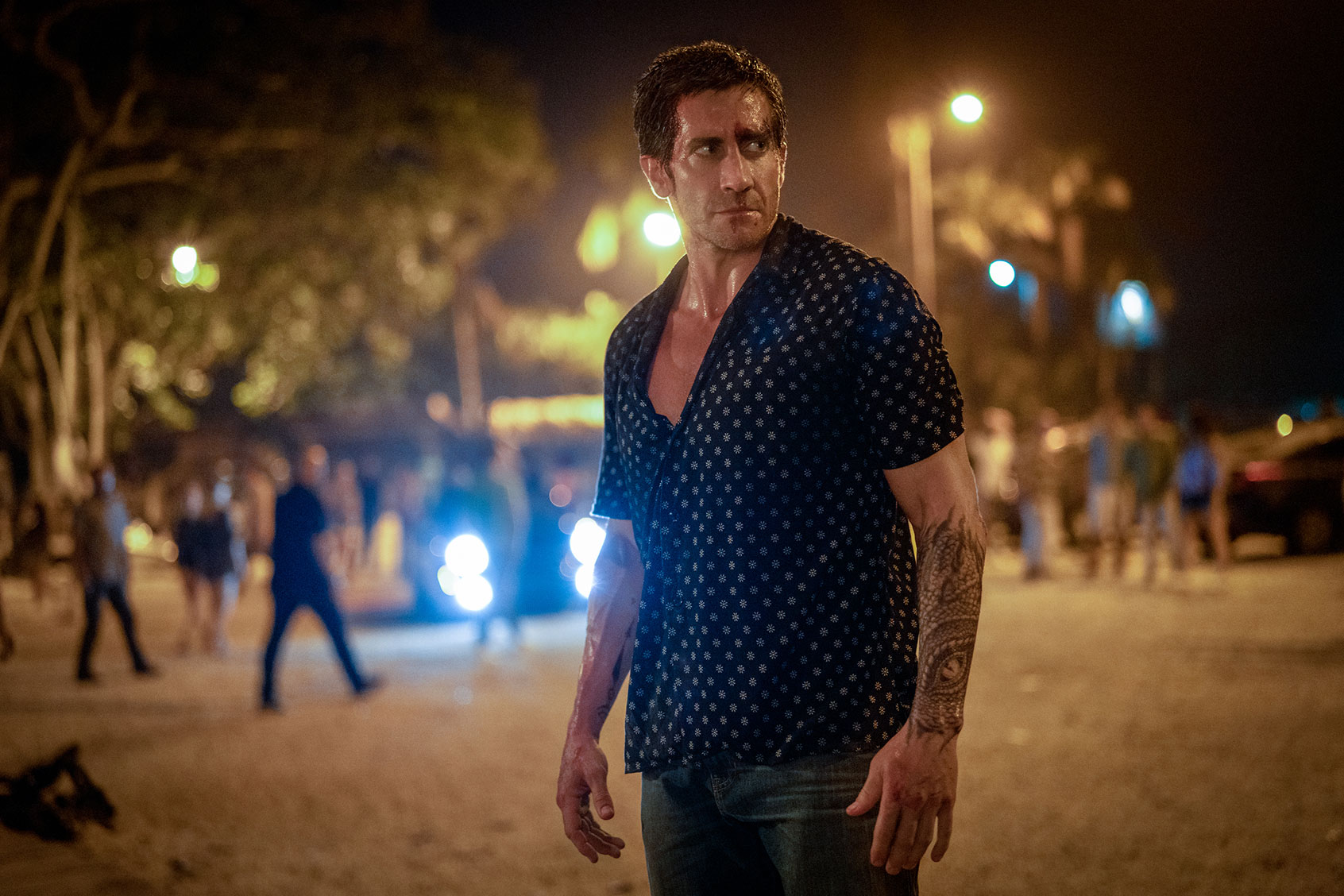
Road HouseJake Gyellenhaal in "Road House" (Laura Radford/Prime Video)What he is not is a highly in-demand bouncer in the bar rescuing business, just as the new dive in distress isn't classily named the Double Deuce. It's a beachfront bar in Florida – that might as well have been regurgitated from the unsettled belly of a Jimmy Buffet tune – called . . . wait for it . . . the Road House.
This new Dalton steps up to help a nice lady named Frankie (Jessica Williams) who is right to see potential in her thatch-roof bar. If not for the predatory biker gang messing up in the place on a whim or the randos beating each other silly, it could be rented out for weddings or tiki-themed bar mitzvahs, you name it! As it stands, though, fists can start flying for any reason at all, or no reason whatsoever.

But one important omission robs the new “Road House” of that spice that made the original magnificent —  Gyllenhaal’s Dalton does not have a Ph.D. in Philosophy from NYU.

If he does, he doesn’t list that in his medical file that he carries around with him from town to town. As one does! But that detail lends a strange raison d'être to this movie.

The longstanding joke about philosophy degrees is that they are pointless, unless the goal is to live in your parents’ basement or pursue another degree in a discipline that’ll actually pay your bills. 

“I want you to be nice until it's time to not be nice."

The New York University Department of Philosophy’s website begs to differ. It insists their undergraduates are prepared for “the many professional pursuits that benefit from critical thinking, analysis and argumentation (including education, law, medicine, politics, business, computer science and publishing) and for the kind of life deepened by awareness and reflection that is most worth living.” Arm bars and joint locks are sold separately.

We need your help to stay independent

As Friedrich Nietzsche observed, “When a man feels that he has a divine mission, say to lift up, to save or to liberate mankind; when a man feels the divine spark in his heart and believes that he is the mouthpiece of supernatural imperatives . . . it is only natural that he should stand beyond all merely reasonable standards of judgment.”

Ergo, if one were inclined to read a more layered significance in a movie directed by Rowdy Herrington, Dalton’s intellectual baseline explains his burning devotion to restoring America’s honor by beating the drool out of sweaty, handsy boozehounds and letting the local Jezebels know they don’t have to rent out their boobs for $10 a squeeze.

When he shows up at the Double Deuce in Podunk, Missouri U.S.A., it’s the kind of place “where they sweep up the eyeballs after closing,” the owner says. The crooked-toothed filthy patrons can’t keep their tongues in their mouths and break everything in sight.

But Dalton has standards and ways he teaches to the resident bouncers, and soon enough they are bathing regularly and methodically taking out the trash.

“I want you to be nice,” Dalton tells his rough prairie diamonds, “until it's time to not be nice."

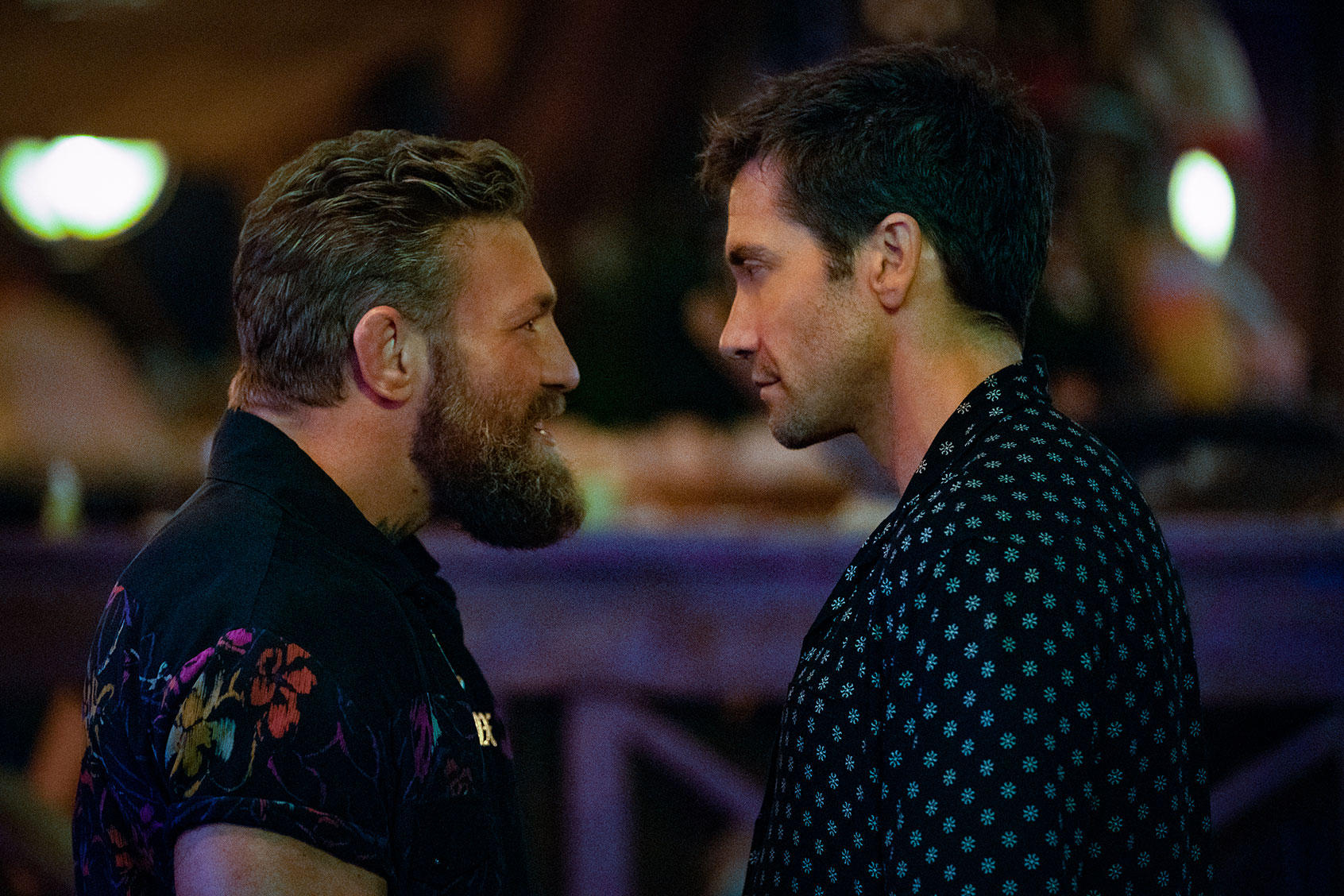
Road HouseConor McGregor and Jake Gyellenhaal in "Road House" (Laura Radford/Prime Video)Gyllenhaal’s Dalton is also nice, but in a Dexter Morgan, “you will never find the body” kind of way. He smiles at the people whose bones he’s about to break and even offers to drive them to the hospital after he completes his job.
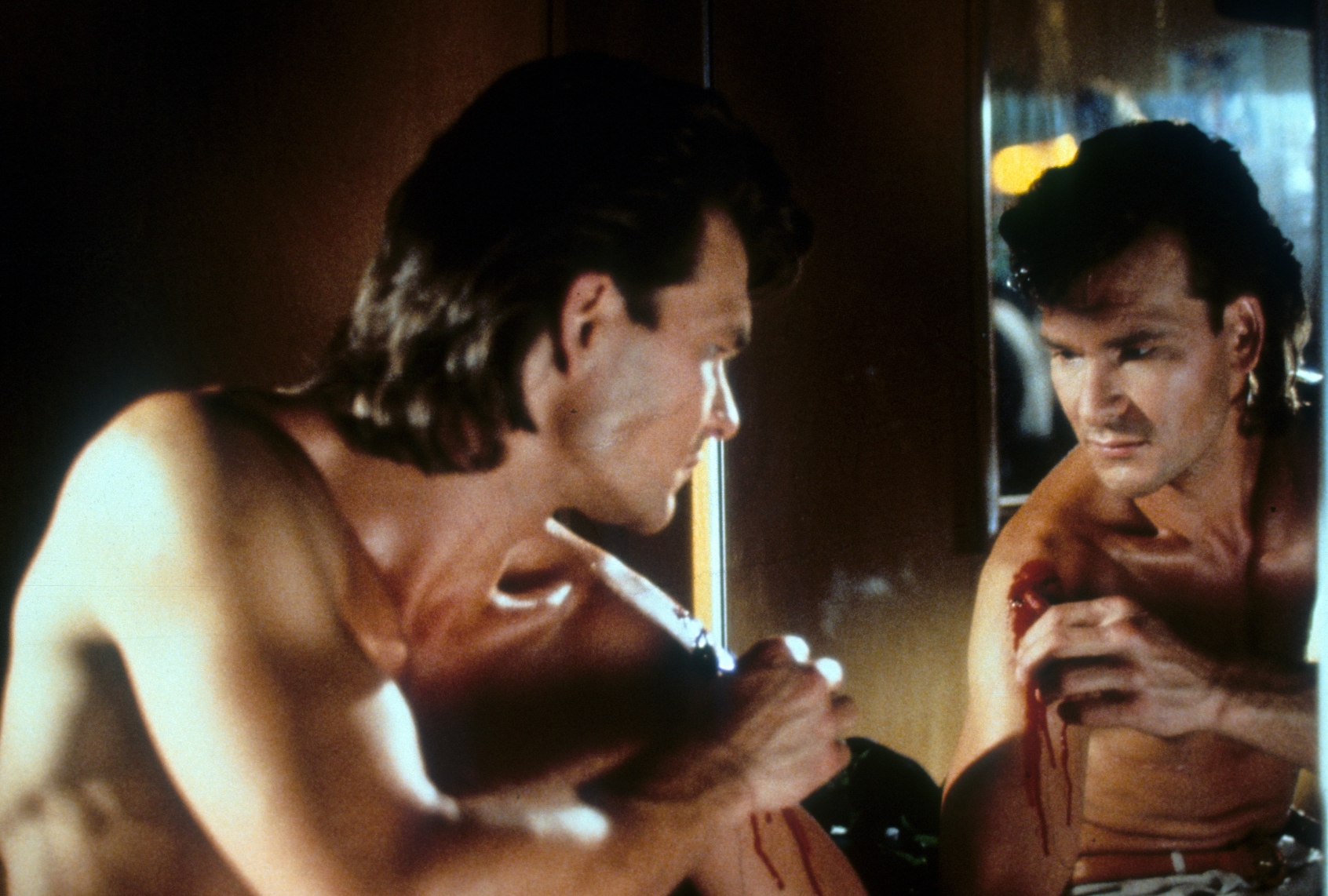
“Nobody ever wins a fight,” he solemnly tells the hot E.R. doctor who patches him up, echoing the words of Swayze’s sunrise tai chi practitioner.


Want a daily wrap-up of all the news and commentary Salon has to offer? Subscribe to our morning newsletter, Crash Course.


His niceness opposes that of Knox, an unruly, psychotic hired killer appropriately depicted by Conor McGregor, an actor and MMA star associated with multiple assault cases who’s pretty much just being himself. The contrast between the two men is explained in the last scene when a wise little girl at the bookstore Gyllenhaal's Dalton frequents tells him that he may not be the hero, but he’s not the villain either.

Patrick Swayze tends to a wound in a scene from the film "Road House" (1989) (United Artists/Getty Images)

By the end of the movie Swayze’s "cooler" has stopped a JCPenney department store from ruining the town’s all-American tanginess, or whatever, and heads off to spruce up some other fetid swill hole. Gyllenhaal disappears on a bus to walk the Earth. Like Caine from “Kung Fu,” or Jack Reacher, or some broke dude who can’t find a job with his philosophy degree.

The original Dalton explains philosophy to his Doctor Girlfriend as “man's search for faith, that sort of s**t” which, I’m sure, is precisely how a tenured NYU professor would love to hear his life’s work and teachings summed up. She asks: How did he end up as a bouncer?

“Just lucky, I guess,” he says. 

That’s about as philosophical as that “Road House” gets, and more than we receive in the new one — and let's be honest, all either aspires to be is a dumb good time. Nevertheless, it’s a shame that removing an integral piece of nonsense that, in its own way, makes us think. And laugh.

"Roadhouse" is streaming on Amazon.

Why supermarkets have abandoned some of America’s poorest neighborhoods

Despite the recent news that Family Dollar would be closing nearly 1,000 of their 8,000 American locations, dollar stores are spreading across the country at a staggering rate. Since 2011, the number of dollar stores nationwide has climbed from 20,000 to over 30,000, meaning there are now more dollar stores than Walmart and McDonald’s combined, according to a report from the Institute for Local Self-Reliance

Though they rarely carry fresh fruit, vegetables and meat — and despite likely exacerbating American food deserts — dollar stores are actually the fastest-growing food retailers in the United States, according to a 2023 study from experts at Tufts University School of Medicine and the Friedman School of Nutrition Science and Policy, which was published in the American Journal of Public Health

There are a variety of reasons for that, but one of the most significant by far is the way in which big-name supermarkets have largely abandoned, or avoided, many low-income neighborhoods over the last half-century, leaving a gigantic vacuum for dollar stores to fill, specifically in urban communities of color. 

In "Attracting Supermarkets to Inner-City Neighborhoods: Economic Development Outside the Box,” a 2005 study, author Kameshwari Pothukuchi wrote that many supermarkets left mixed-income central city neighborhoods after civil disturbances in the late 1960s and 1970s, following customers who left those areas during “white flight” — and they never really returned. “Supermarkets have abandoned the inner city for suburban and exurban locations,” Pothukuchi wrote. “Which offered more land for parking, easier loading and unloading by trucks, convenient access to highways and arterials, and a development context for much larger stores.”

Then, in the 1980s, several top grocery chains merged, meaning that the few store locations that survived in cities further consolidated. As supermarkets left urban communities, the landscape they left behind changed, too. As Dave Olverson wrote in the Southern Urbanism Quarterly article “The Death of the Neighborhood Grocery Store,” most cities around the U.S. have made getting zoning approval for certain small commercial buildings nearly impossible in residential neighborhoods. 

“Today, academics and community advocates alike talk about ‘food deserts,’” Olverson wrote. “These conversations often revolve around why big supermarkets don’t choose to locate in a particular area. They rarely discuss the neighborhood grocery store that has been outlawed across the country.” 

He continued: “In essence, this means that in most residential neighborhoods, people don’t have a choice. They are forced to drive to get their groceries. What’s more, thanks to zoning codes, residents have been stripped of any avenue to come up with solutions to the problems facing their neighborhood. They have no agency over whether or not a large supermarket chooses to locate in their area.” 

We need your help to stay independent

Food retail experts say that there are a variety of factors that a supermarket’s leadership team takes into account when determining where to open a new store. In a statement to CNN in 2020, Heather Garlich, spokesperson for FMI, a trade group for the food retail industry, said: “Market, economic and demographic factors influence a company’s decision to establish a store. Grocery stores require an adequate customer base and economic support to remain viable; real estate costs and availability are significant factors to determine where and how a store is built.”

That said, studies have shown that some supermarket leaders may perceive low-income urban areas — particularly those inhabited by people of color— as higher-risk due to concerns about crime, vandalism or social instability, while questions of profitability, operating costs and consumer demand come into play, too. This impacts where they choose to put their locations, resulting in what some sociologists have termed "supermarket redlining." 

Former Philadelphia mayor Michael Nutter has spoken about trying to convince several national grocery chains to open a location in a predominantly Black area of the city by offering tax incentives, only to receive little interest. “We went to virtually every national grocery retailer in our region,” Nutter told CNN. “White people don’t think Black people spend money, and they weren’t willing to invest in predominantly Black neighborhoods.”

If the supermarkets do invest, they aren’t necessarily there for the long-haul. The story of a large grocery chain putting down roots in low-income communities of color only to leave within a few years unfortunately isn’t an unfamiliar narrative. 

"If the supermarkets do invest, they aren’t necessarily there for the long-haul."

In 2016, Whole Foods opened the doors to its first and only location in Englewood, one of Chicago’s poorest neighborhoods. The decision was reportedly regarded by the company’s co-CEO Walter Robb as “one of the most meaningful things we’ve done as a company,” while the city’s mayor at the time, Rahm Emmanuel, said that opening the store would result in “opening doors to a new future for the Englewood community.” 

The store generated a lot of buzz in the majority-Black neighborhood, where 72% of households are at risk for food insecurity, according to data from the University of Chicago — but just five years later, it closed. This decision received as much attention as the opening. Former mayor Lori Lightfood decried the move as “a great disappointment” and “gut blow” to the community, while some neighborhood leaders questioned whether the location, which received  $13.5 million in federal tax credits, should have even opened in the first place. 

In another really telling example, in 2023, Aldi closed a “key location for Black and impoverished Minneapolis neighborhoods” when they shuttered a location on the city’s Northside. 

“We are sad, frustrated, and angry that Aldi, one of the three main sources of fresh produce and basic necessities at an accessible price point in North Minneapolis, suddenly announced its permanent closure this week,” the North Minneapolis food security nonprofit Appetite for Change wrote in a statement at the time. “That said, we are not surprised.”

They continued: “The Northside has a history of businesses coming to our neighborhoods and then abruptly exiting, leaving our community shaken by the instability. Abrupt closures seen all too often in our community cause gaps in essentials goods or services that are not easily or swiftly replaced.” 

However, for Aldi, it was simply business as usual. Just two days after their North Minneapolis location shuttered, the corporate account tweeted: “If we were looking for new store locations, any suggestions on where we should go next?” 

Who brought the crime, the drugs and the rape? It was him

When Donald Trump came down that tacky golden escalator in his grotesque Fifth Avenue building on June 16, 2015, to the half-hearted applause of a group of paid actors, he had a lot of incoherent, half-baked things to say in announcing his seemingly unlikely campaign for president. But his most quoted utterance of that day, ostensibly about Mexican immigrants, turned out to be a fair and accurate preview about what he would offer America as Republican candidate and then president:

When Mexico sends its people, they’re not sending their best. They’re not sending you. They’re not sending you. They’re sending people that have lots of problems, and they’re bringing those problems with [sic] us. They’re bringing drugs. They’re bringing crime. They’re rapists.

Many more Americans now believe Trump's xenophobic claims that immigrants are “bringing” the drugs and the crime and the rape, as well as taking more public assistance and perhaps creating hundreds of thousands of new Democratic voters. None of those claims are true.

When a pathologically insecure and vindictive person warns about bad things (as in, “He’s a terrible guy!” and “Democrats are destroying the country”), it is generally because he’s unconsciously making admissions about himself. To use the technical term, it's psychological projection.

In other words, when Trump derides someone or something, or fear-mongers about an imagined threat, he’s basically talking about himself. He's revealing his fears, his insecurities and his plans for vengeance at not being treated as he believes is his due. Trump-watchers have understood this for decades, and much of the country has learned it over the last eight or nine years.

Most Americans and sensible people around the world quickly came to understand who was bringing the crime. More recently, we have seen definitive evidence that he was also bringing the drugs. As a New York jury determined last year, Donald Trump also committed a sexual assault that would be understood, in ordinary language, as rape. 

They’re bringing drugs

As first reported in Rolling Stone, Trump’s White House was awash in drugs, mostly amphetamines, antidepressants and anti-anxiety medications. That shouldn't come as a surprise to anyone, given years of rumors about Trump’s alleged reliance on Adderall to stay focused and get through his long, rambling public speeches. Does Trump look unwell because of drug abuse or just because of his unhealthy McDiet? Perhaps it's both.

Whenever Trump derides someone or something, or fear-mongers about an imagined threat, he’s basically talking about himself.

In yet another example of Trumpian projection talking about himself, he recently made fun of Illinois Gov. J.B. Pritzker, a Democrat, for his weight, suggesting that the governor orders too many hamburgers. (Trump's affection for McDonald's cuisine is well known.) Pritzker has been plenty critical of Trump on many issues, but perhaps what most hit home were the governor’s comments about cruelty and kindness during a commencement speech last summer at Northwestern University. Or could it be that Pritzker is an actual billionaire, believed to be the wealthiest politician in the country, while Trump has clearly never been as rich as he claimed?

After the Oscars ceremony, host Jimmy Kimmel noted that Trump couldn’t help but post his diatribe about Kimmel on his Truth Social media platform because the “Adderall McFlurry” had kicked in. (Kimmel got off the best line of a good night, thanking the former president for watching but wondering why he was still up: “Isn’t it past your jail time?”)

They’re bringing crime

It’s difficult to know where to begin when trying to enumerate Trump’s determination to get away with unsavory and often illegal, deals aimed at enriching himself and his corrupt family business. (It wasn’t like we hadn’t been warned about the man’s character.)

Trump and his MAGA followers are doing everything they can to push the ludicrous narrative about a “Biden crime family.” That might be projection dialed up to 11.

It should be enough to note that the doubly-impeached ex-president faces scores of felony charges in four separate cases: for violating campaign finance laws in paying off an adult film actress he slept with; for trying to overturn the election results in Georgia; and for hoarding and failing to return confidential government documents after leaving office in a huff, not even bothering to attend Biden's inauguration.

Then we come to the so-called Trump University (shut down, with a $25 million settlement for students), the Donald J. Trump Foundation (dissolved, with a $2 million fine, after Trump admitted to misusing funds for his 2016 campaign), the former Trump International Hotel in Washington, a nonstop grift center during Trump's term in office; the $2 billion that Jared Kushner, Trump's son-in-law, garnered from the Saudis for his own investment company; and Trump's endless appeals to his supporters for money to pay his ever-escalating legal fees.

Bill Lueders at The Bulwark dubbed Trump the "Maximum Grifter" in 2022, and that tendency has only gotten more intense since then. Trump is now so deeply in debt that by any reasonable standard he represents a national security risk (especially with his loose talk about nuclear submarines, and at least a few government documents he withheld still unaccounted for).

We could go on almost indefinitely through a list of Trumpian grifting, financial improprieties and possible or likely crimes. 

As Democratic strategist Simon Rosenberg writes in his newsletter, if you sign on with someone like Trump, you are likely to end up in big trouble:

Peter Navarro, a senior advisor to Trump, went to jail [this past week]. His CFO went to jail last year, and is returning soon for committing more crimes. Most of his core 2020 campaign team were convicted or pled guilty of crimes. The man who was fueling the Impeachment inquiry [directed at Joe Biden] was just arrested, and appears to have been working with both Russian intelligence and Trump. Everywhere you look there are crimes, crimes and more crimes. 

They’re rapists

How many women have claimed that Donald Trump sexually assaulted or harassed them? A lot. At least 26 women have said that Trump groped or forcibly kissed them, and roughly 40 more have said he harassed them or behaved inappropriately. Of course the real numbers are almost certainly much higher; those were the women willing to go on the record.


Want a daily wrap-up of all the news and commentary Salon has to offer? Subscribe to our morning newsletter, Crash Course.


As Trump infamously bragged to Billy Bush on that hot mic in 2005, before a guest appearance on a soap opera:

I better use some Tic Tacs just in case I start kissing her. You know, I'm automatically attracted to beautiful … I just start kissing them. It's like a magnet. Just kiss. I don't even wait. And when you're a star they let you do it. You can do anything…. Grab them by the p***y. You can do anything.

If you read the accounts of Trump's alleged sexual assaults and even the lesser instances of alleged harassment, which include sleazy behavior directed at pageant contestants and disturbing comments about his own daughter, you may find it incomprehensible that he ever got close to becoming president. But, hey, maybe not. There are a lot of MAGA voters out there who want women to be second-class citizens. As Salon's Amanda Marcotte has pointed out repeatedly, many evangelical Christians are devoted to Trump specifically because he’s a lecherous womanizer with a long history of apparent sexual misconduct:

While the mainstream press still finds it puzzling that the anti-sex Christian right loves a sexually loose cad like Trump, he actually embodies the evangelical attitude towards sex: That it's about male domination over women, not pleasure.

So, yeah: You know what he said about Mexican immigrants? He was the one bringing the rape.

Why do I reiterate facts that appear obvious to so many of us? Because they have to be pointed out again and again. Because so many people simply refuse to face these facts, or admit them. 

Trump knows the propaganda value of habituating people to lies which they eventually assume are truths — consider the name of his social media platform, which pushes out nothing but lies and invective. (Check out this discussion of habituation with Tali Sharot, co-author of the new book "Look Again," on Alan Alda's podcast.) The media has a responsibility to fight back in kind, and at least try to habituate people to recognizing and confronting the truth. 

How Israel hides its atrocities in Gaza

When we condemn Hamas for its October 7 attacks in Israel, we’re not accused of anti-Arab bigotry. Nor should we be. Nothing could possibly justify the atrocities that Hamas committed against hundreds of civilians, who were the majority of the 1,200 people killed as a result of the attacks.. And nothing can justify the taking of civilian hostages.

But when we condemn Israel for its actions since then, we run the risk of being accused of antisemitism. Meanwhile, nothing could possibly justify the atrocities by the Israeli government in Gaza, where the death toll is now estimated at 32,000, while uncounted thousands of other Palestinian people remain buried under rubble. Seventy percent of the victims, a UN committee found, have been children and women. 

The U.S. government, meanwhile, continues to make Israel’s atrocities possible. As retired Israeli Major General Yitzhak Brick said midway through the second month of the war: “All of our missiles, the ammunition, the precision-guided bombs, all the airplanes and bombs, it’s all from the U.S.” He added: “Everyone understands that we can’t fight this war without the United States. Period.”

Because of federal laws and minimal decency, the U.S. should have cut off all military aid to Israel long ago. A single standard of human rights should apply. But adhering to that simple, basic precept can provoke the virulent accusation of “antisemitism.”

The gist of the trick is to equate Israel with the Jewish religion — and then to equate opposition to Israel’s actions with antisemitism.

And so, writing in the New York Daily News last November, an official at the American Jewish Committee declared that a “virus of antisemitism has spread to the U.S., where college campuses and city streets have been taken over by anti-Israel protesters raging, ‘From the river to the sea!’ — a call for the mass murder of Israelis, and ‘Globalize the Intifada!’ — an appeal to kill Jews worldwide.” But Peter Beinart pointed out in a 2022 essay, “Under the definition of antisemitism promoted by the Anti-Defamation League, the American Jewish Committee and the State Department, Palestinians become antisemites if they call for replacing a state that favors Jews with one that does not discriminate based on ethnicity or religion.”

We need your help to stay independent

While Israel continues to slaughter children, women and men — no more guilty of anything than a crowd you might see at a local supermarket — the extreme misuse of the “antisemitism” charge often boils down to: Be quiet. Don’t protest. Don’t even speak up.

For sure, antisemitism does exist in the United States and the rest of the world, and it should be condemned. At the same time, to cry wolf — to misuse the term to try to intimidate people into silence while Israel’s atrocities continue in Gaza — is an abuse of the word antisemitism and a disservice to everyone who strives for a single standard of human rights — like the17 rabbis and rabbinical students who went to Capitol Hill last week urging a ceasefire and an end to the unconditional U.S. military aid to Israel. 

“We are rabbis representing hundreds of thousands of Jews affiliated with Jewish Voice for Peace Action imploring our leaders to end their complicity in the Israeli military’s genocidal campaign in the name of tzedek (justice) and real safety for all people,” Rabbi May Ye said.

Are we supposed to believe that those rabbis are antisemitic? 

The Jewish American author Anna Baltzer grew up learning about the evils of antisemitism. “Much of my family was killed in the Holocaust,” she wrote. “My grandparents arrived at Ellis Island traumatized by the unfathomable murder of their families in the gas chambers of Auschwitz while the world let it happen.” And she added: “We must get clear that Israel’s wiping out of entire families in Gaza is not simply revenge for October 7; Israel is continuing its long-existing practice of forcing Palestinians out of Palestine and closing the door behind them.”

Do Baltzer’s words make her antisemitic?

In mid-October, 43 Jewish American writers, academics and artists — including Michael Chabon, Francisco Goldman, Masha Gessen, Judith Butler, Tony Kushner, and V (formerly known as Eve Ensler) — released an open letter to President Biden saying: “We condemn attacks on Israeli and Palestinian civilians. We believe it is possible and in fact necessary to condemn Hamas’ actions and acknowledge the historical and ongoing oppression of the Palestinians. We believe it is possible and necessary to condemn Hamas’ attack and take a stand against the collective punishment of Gazans that is unfolding and accelerating as we write.”

Along with denouncing Israel’s “war crimes and indefensible actions,” the statement added: “We write to publicly declare our opposition to what the Israeli government is doing with American assistance. 


Want a daily wrap-up of all the news and commentary Salon has to offer? Subscribe to our morning newsletter, Crash Course.


Do those words mean that the signers of the statement are antisemitic?

Or how about the more than 100 Jewish Americans who signed the statement released this week denouncing AIPAC, the Israel-is-never-wrong lobby?

Ten years ago, 40 Holocaust survivors issued a statement condemning Israel for its “wholesale effort to destroy Gaza.” The statement, also signed by 287 people who were descendants of Holocaust survivors or victims, called for “an end to all forms of racism, including the ongoing genocide of Palestinian people” and decried “the extreme, racist dehumanization of Palestinians in Israeli society, which has reached a fever pitch.”

Were the 327 Jewish signers of the statement antisemitic?

For that matter, when I write here that the Israeli government has been committing mass murder and genocide in Gaza, does that mean I’m antisemitic? 

There’s a word for seeing — and saying — that Israel is engaged in large-scale crimes against humanity. And that word isn’t “antisemitism.” It’s realism.

From convenience to crisis: Here’s what will happen if the Supreme Court restricts mifepristone

On March 26, the U.S. Supreme Court will finally hear oral arguments over the safety of mifepristone — the first drug used in a medication abortion. While experts don’t expect to hear a decision from the highest court right away, one in favor of the plaintiffs — Alliance for Hippocratic Medicine — could severely limit access to mifepristone across the country, even in states where abortions are still legal.

This would come at a time when medication abortion has become a more accessible option in a highly restrictive post-Dobbs landscape. For instance, a new Guttmacher Institute report from the Monthly Abortion Provision Study recently found that there were approximately 642,700 medication abortions in the United States in 2023, meaning they accounted for nearly 63 percent of all abortions. As women’s health specialists and doctors have told Salon before, the effects of such restrictions will be "devastating,” and have far-reaching consequences beyond impacting reproductive health. But what’s exactly at stake? 

The first significant way access to medication abortion could change in light of this ruling is the ability for it to be prescribed by telehealth and by mail. 

“More and more people are learning about this new model of care, and finding that it really enables those with more barriers to obtain this care,” Dr. Ushma Upadhyay, a public health scientist at Advancing New Standards in Reproductive Health, based at the University of California-San Francisco, told Salon. “It’s clear that those who have the most barriers to care are finding telehealth really critical to their ability to get a wanted abortion.”

"We're only seeing the patients who actually ended up getting to us — we're not seeing the patients who made attempts or can't take that much time off of work."

Upadhyay said telehealth has really grown over the last couple of years since the change was implemented during the pandemic. Before the Supreme Court overturned Roe v. Wade, which gave Americans a constitutional right to access abortion care, an estimated 4 percent of abortions were done via telehealth. In data from April 2022 to September 2023, 16 percent of abortions in the U.S. were done via telehealth, according to data by the Society of Family Planning, which was led by Upadhyay. With those who had a telehealth medication abortion, 43 percent said that telehealth made it possible for them to have a timely abortion.

“We found that 2 percent of those patients said they would not have been able to get an abortion at all,” Upadhyay said, noting that "sounds small, but there are over a million abortions in the U.S a year, so 2 percent of a million is quite a large number.” 

In a telehealth medication abortion, a patient usually talks to a provider over video or a secured chat platform. If the patient is less than 10 weeks pregnant and found to be eligible, the provider can prescribe the patient the two-step regimen. First, a patient takes mifepristone, which blocks pregnancy hormones, and then misoprostol, which causes uterine contractions. The medicines can be delivered via a mail-order pharmacy.


Want more health and science stories in your inbox? Subscribe to Salon's weekly newsletter Lab Notes.


Dr. Kara Cadwallader, who is a family medicine physician in Idaho, told Salon in a phone interview that while she is located in a state where abortions are nearly totally banned, with narrow exceptions, restricting access to mifepristone via telehealth and mail will still have a big impact on those in Idaho.   

“A lot of us are traveling to other states to provide abortion care, and a lot of folks are accessing medication through the mail,” Cadwallader said. “That's a big way to access abortion care, especially for folks who live in states where abortion is illegal or severely limited.”

Dr. Jennifer Kerns, a professor in the department of obstetrics gynecology and reproductive Sciences at UCSF and staff physician at Trust Women, an abortion clinic in Kansas, said she sees firsthand the burden of people having to travel out of state for an abortion — sometimes to even have access to medication abortion.

The ability to access medication abortion via telehealth is serving a population who already faces many barriers to access abortion care.

“Some people are traveling by car, up to 12 hours just to drive to the clinic to access medications,” Kerns told Salon. “We routinely hear about how long it's taken patients to garner all of the resources needed to make arrangements, to make this trip, and we're only seeing the patients who actually ended up getting to us — we're not seeing the patients who made attempts or can't take that much time off of work or can't find anybody to watch their kids.” 

The ability to access medication abortion via telehealth, Kerns emphasized, is serving a population who already faces many barriers to access abortion care. Taking away that option will leave them in very vulnerable situations.

“Those are the populations we really worry the most about,” Kerns said. “People who already face a lot of barriers in accessing care.”

The option to access medication abortions via mail or telehealth isn’t the only way the ruling could impact access to mifepristone. It would also shorten the timeframe that it could be used from 10 weeks to 7 weeks of pregnancy. This would restrict access to medication abortion for those who perhaps haven’t even confirmed if the pregnancy is viable yet, or those who need time to gather the resources to even access the medications.

We need your help to stay independent

“Low income people are still trying to gather the money to pay for an abortion,” Upadhyay said. “We do find that people more marginalized show up to a clinic later in pregnancy, because of the cost, because of all of the factors that they have to overcome to make an in-person clinic visit. They really do need the extra time.” 

Additionally, a ruling in favor of the plaintiffs would revert back to the 2000 label approved by the Food and Drug Administration for medication abortion, which would require a ​​higher dosage of mifepristone and a lower dosage of misoprostol. Upadhyay said this shift in dosing will ultimately lead to more failures of the medication, and could lead to an abortion patient experiencing more nausea and cramping during the process. Mifepristone stops the pregnancy hormones while misoprostol expels the fetus, so throwing off the established balance could have unpleasant — and unnecessary — consequences.

“The lining might be separated,” Upadhyay said. “But then your patient is just carrying a separated fetus in the uterus.”

Upadhyay emphasized that when mifepristone was first approved, the FDA put some pretty “onerous restrictions on it” that were not evidence-based. A SCOTUS ruling that restricts access to mifepristone would essentially be rolling back the clock.

Leading up to next week’s hearing, numerous amicus briefs signed by organizations representing the country's leading researchers and physicians have emphasized there is ample scientific evidence to support widespread use and availability of mifepristone. It has a well-established safety profile. But many are expecting the SCOTUS decision to be based on politics and not scientific evidence. 

If mifepristone is restricted, workarounds will vary depending on the state. In states where abortions are legal and easily accessible, it’s possible that clinicians will prescribe mifepristone off-label. 

“I suspect that people like myself who primarily practice in states with a lot of protections around abortion access will feel comfortable prescribing this off-label,” Kerns said, referring to a common practice of prescribing a drug in a way that isn't covered by its FDA label. Lithium, for example, is FDA-approved to treat bipolar disorder, but is very often (safely) prescribed off-label for major depressive disorder. “I'm not so sure that that's true for providers in other states, those providers may decide that it's a little too risky.”

Upadhyay said that in some states prescribing off-label won’t even be an option. 

“Ohio is a totally different case, they have a law on the books that requires them to provide medication abortion according to the FDA label,” Upadhyay said. “So clinicians will have no choice.”

DA Willis says Wade hearing caused no delay in working towards Trump’s election interference case

After accepting the resignation of special prosecutor Nathan Wade last week as part of an agreement that allows her to remain on the election subversion case against Donald Trump, Fulton County District Attorney Fani Willis is making a few things clear.

In an interview on Saturday, Willis says the Wade hearing caused no delay in preparing for Trump's looming trial, which she hopes to start sometime this summer, warning, "The train is coming."

Speaking to CNN while attending an Easter egg hunt organized by WAVE, an organization of law enforcement officers dedicated to helping children and the homeless throughout the year, Willis is candid about her prior romantic relationship with Wade, and pointed in her comments on Trump.

"I don't feel like my reputation needs to be reclaimed," she says. "Let's say it for the record, I'm not embarrassed by anything I've done. I guess my greatest crime is I had a relationship with a man. That's not something I find embarrassing in any way. And I know that I have not done anything that's illegal."

CNN points out that the racketeering case was delayed by two months, but Willis highlights that the main case was not delayed, because her team never stopped working on it.

"All while that was going on, we were writing responses and briefs," Willis says. "We were still doing the case in the way that it needed to be done. I don't feel like we've been slowed down at all. I do think there are efforts to slow down this train, but the train is coming."

Watch here:

Roseanne Barr and Tucker Carlson rev each other up in new interview

After being canceled — both literally and figuratively — after a series of racist tweets aimed at former Obama adviser Valerie Jarrett, among other MAGA-esque sentiments, Roseanne Barr seems to pop up in the media sphere now more than ever, which she touches upon in a recent interview.

During an appearance on "The Tucker Carlson Encounter" this week, the disgraced TV personality can't explain how it came to be that she's everywhere all of the time now, and says she never expected to be doing as much as she's doing at this stage of her life. But for a portion of it, she credits receiving a boost from Donald Trump.

"He's the only guy in my Hollywood career that ever returned a favor and gave me back more than I'd given him" she says of the former president and Republican frontrunner in the 2024 presidential race. 

Carlson, who was ousted from Fox News in 2023, claiming to have been fired as part of the defamation settlement between the network and Dominion Voting Systems, commiserated with Barr on their shared fall from grace, referring to Barr as "a very deep person," and agreeing with her that their cancelations were "personal."

Watch here:

A tale of two child stars: The tragedy and triumph of Amanda Bynes and Lindsay Lohan

Child stardom can be as fleeting as its young stars' rapid, meteoric rise. 

But the price paid for childhood fame sometimes results in long-lasting emotional damage stemming from unspeakable traumatic experiences. Just look at current Netflix rom-com star Lindsay Lohan, a symbol of resilience from the child actor's plight. Lohan survived the Disney machine – ever since achieving acclaim in the "The Parent Trap" remake – and even transitioned to respectable teen stardom in films like "Freaky Friday" and "Mean Girls."

Unfortunately, she then became party girl tabloid fodder alongside starlets like Paris Hilton and Nicole Richie. A string of arrests and DUIs, in addition to public battles with her parents over control of her finances only continued this impression. In adulthood she lost a series of roles, was panned for numerous performances and eventually entered rehab.

Nevertheless, more than a decade after her very public downward spiral, Lohan has rebounded personally and professionally. She is now married and gave birth to her first child. Her comeback has made way for the actress to become a part of the Netflix rom-com universe. Her second movie "Irish Wish" currently sits at No. 1 in the Top 10 movies in the U.S.

However, not everyone has been awarded a second chance after their career came to a halt at 25. This is what the Discovery Investigation series "Quiet on Set: The Dark Side of Kids TV" explores as the damning docuseries details deeply unsettling and abusive experiences from the sets of Nickelodeon's most popular shows like "All That," "The Amanda Show," "iCarly" and "Drake & Josh." The docuseries underlines that the entertainment industry has done a poor job of protecting children on set, often leading to arrested development and/or self-destructive behavior while making the transition from adolescence to adulthood.

Amanda Bynes' story sounds somewhat similar to Lohan's at the beginning at least. The "All That" actress ascended the child star ladder starting with her sketch comedy series "The Amanda Show" produced by Nickelodeon's former head honcho Dan Schneider. At 10, the actress was electric on screen with her comedic timing, charming personality and slapstick skills.  Front and center as Schneider's muse, Bynes was a quickly emerging young talent in Hollywood, and Schneider allegedly used that to his advantage. 

Reports on "Quiet on Set" alleged that Schneider would latch on to young, pretty girls he thought were talented, and Bynes was referred to in the documentary as "his new favorite." Not only did Schneider attach himself to Bynes, but former "All That" actor Leon Frierson recalled that Bynes would be absent from the required schooling on set, reportedly spending time with her boss instead. “There would be times where Amanda would just be missing, and a lot of times we would just hear that she would be with Dan pitching ideas and writing,” he said.

Amanda BynesAmanda Bynes during Nickelodeon's 16th Annual Kids' Choice Awards 2003 – Show at Barker Hangar in Santa Monica, CA, United States. (Chris Polk/FilmMagic/Getty Images)Furthermore, the docuseries showed an uncomfortable scene with Bynes and Schneider in a hot tub for a Nickelodeon promotion. The teenage girl was wearing a bathing suit with her boss fully clothed but still sharing the tub right next to her. The clip highlighted an obvious imbalance between a male figure – disingenuously portrayed as a fellow playmate – in a position of power to  a teenage girl. At the time, however, no one dared to voice any objections lest they face Schneider's wrath. It was only recently called out because former viewers, who are also now adults, have perceived the context differently in a post-Me Too era.
Like Lohan, Bynes also transitioned into teen rom-com stardom with "Agent Cody Banks," "What a Girl Wants" and "She's the Man." However, behind the scenes, the star's home life didn't reflect her larger-than-life characters and her movie's traditional happy endings. For years Bynes struggled with a turmoil-filled relationship with her parents who were also in charge of her career. According to the docuseries, Bynes reportedly ran away from home after a contentious fight with her parents.

Bynes' home environment was so troubling that she attempted to emancipate from her parents.

In a long apology YouTube video apology released March 19, Schneider addressed his close relationship with Bynes. He recalled the day she had allegedly run away, "The phone rang, I answered. It was Amanda and she was upset, she was in distress she had had some conflict with her parents — I think her father — and she called me," he said.

"I was immediately concerned about her safety. I called someone who I knew was fairly nearby. That person was able to go and pick her up, then I knew she was safe . . . she ended up being taken to the police."

Bynes' home environment was so troubling that she attempted to emancipate from her parents when she was around 16 or 17. However, the attempts were not successful and were axed by a judge. Schneider said the young actress turned to him and others for help. "We supported her, she tried to get emancipated. It ended up not working out and she didn’t."

Following years of successful big-screen comedies and the WB series "What I Like About You," Bynes hit a wall in adulthood and her career. Her last recognizable role was the hilariously quotable Christian mean girl, Marianne opposite Emma Stone in the 2010 cult classic teen movie "Easy A." Shortly after the success of "Easy A," Bynes dropped out of the 2011 movie "Hall Pass" and quit acting altogether. 

In her 2018 Paper magazine interview, Bynes revealed that she "abused Adderall" around the time of "Hall Pass" and that it left her feeling “scatterbrained.” Then it led to her inability to focus on her lines and memorize them. When Bynes left the industry altogether, she said she got “really into my drug usage, and it became a really dark and sad world for me.”

The starlet suffered through a string of public woes. Bynes was arrested multiple times for DUIs, reckless endangerment and drug possession. However, the run-ins with the law led the actress to be placed on a psychiatric hold, leading her mother to become her temporary guardian over her finances and estate, known as a conservatorship. After years of mental health treatment and a new life as a college graduate focused on fashion, Bynes requested the end of the nine-year guardianship. In 2022, a judge terminated the conservatorship. As controversial as conservatorships are, Bynes' attorney said it was "a collaborative effort with her parents. There was no fighting between her and her mother or father. Everyone was working together, including Amanda."

Similarly to Bynes, Lohan also suffered the same issues legally fighting with her parents over her finances. Her addiction and dependency issues then led to infractions with the law and eventually, she served 90 days in jail. But despite the tumultuous years spent in a toxic cycle of addiction and self-harm, Lohan not only survived her struggles but thrived. She's in what Netflix has dubbed "The Lindsay Lohan-aissance!” 

Irish WishLindsay Lohan in "Irish Wish" (Netflix)

In comparison, Bynes has taken a more quiet approach to her life after her string of arrests and battles with her family. We may never know what happened to Bynes as she was put through the child star wringer at Nickelodeon, and that's OK. Her experiences are hers to divulge or not. She has spent most of her adolescent life under the perpetual public microscope evaluating and dissecting her worth based on her looks, personality and talent.

If what was alleged in "Quiet on Set" is true, the adults, Nickelodeon and many more authority figures in Bynes' life failed her — just like they failed Drake Bell. While the docuseries helped reframe the plight of Bynes and other child stars, it's crucial to remember that she doesn't owe perpetual outsiders watching her life anything. It's a shame that her onscreen talents won't continue. A resurgence in her acting career like Lohan's might sound like a Cinderella story for us as long-time fans but that may not be true for Bynes. Not everyone's journey is the same. Most importantly, we don't get to tell Bynes who or what to be after so many years of control by others. She gets to decide. 

Chelsea Clinton says that Barron Trump has a right to privacy

For most of Barron Trump's life, efforts have been made to shield him from the same level of public scrutiny experienced by his parents — Donald and Melania Trump — but after just turning 18, there are already rumblings on social media and elsewhere referring to him as "fair game" in terms of press coverage. And Chelsea Clinton doesn't think that's fair.

Having been pummeled by the media herself while her parents — Bill and Hillary Clinton — were in the White House, Clinton has quite a bit of experience when it comes to vitriol by association. In an appearance on "The View" this week, she came to Barron's defense, advocating for his right to privacy, saying, "I feel so strongly that if you are a private citizen, you have an unimpeachable right to privacy; and I think the media should leave him alone."

In response to host Joy Behar asking, "What about the other ones?" Clinton said that it's different when it comes to Barron's older siblings, who have served in the administration in one capacity or another. 

"They put themselves in the public domain," she said. "It's a totally different conversation."

Watch here:


Trader Joe’s mini-tote bag is a big distraction from their reported union-busting

Forget about textured bags, bold waist-cinchers and tinted sunglasses, the hottest accessory this season is a canvas tote bag. Well, not just any ordinary tote, but a miniature one courtesy of Trader Joe’s.

Available for just $2.99 each, the canvas bags quickly became popular online once they were released earlier this month. The bags are pretty simple in design: a bland ecru exterior emblazoned with TJ’s trademark emblem along with straps that come in a red, navy, yellow or green hue. This isn’t the first time TJ’s has launched its own speciality bag. The California-based retailer currently sells a normal sized version of the same tote and a limited-edition reusable insulated bag. Despite those offerings, the mini-tote is the only one that’s gone viral — but what seems like a fun, spur-of-the-moment release actually seems a bit like a distraction from the latest reports about the supermarket chain's reported union-busting efforts.

In the same vein as the Stanley cup frenzy, the TJ’s totes are the “latest mundane item to suddenly become all the rage,” wrote Business Insider’s Emily Stewart. Videos across social media show eager consumers storming into stores, frantically grabbing as many bags as humanly possible. “These mfs wildin over a mini tote bag,” captioned one TikTok in which Trader Joe’s staff is seen wheeling out a tote-filled cart into an excited crowd. In some stores, the craze has become uncontrollable, forcing staff members to limit how many bags consumers can purchase. “Five! That’s the limit! Five!” yelled an employee in a separate video.

@athenaspud #traderjoes #totebag ♬ O Fortuna – Epic Trailer Version – Hidden Citizens

In other videos, happy consumers are seen obsessing over the bag, which allegedly “can fit a whole Macbook in there!,” per one user. Some even personalized their bags with dainty embroidery, drawings and decor. “The Trader Joe’s mini tote is cool and all,” said one creator. “But do you wanna know what’s even better? Embroidered Trader Joe’s tote!” Another unraveled the bag’s stitching to replace “Trader Joe’s” with “Trader Hoe’s.”

@abiiganesan when you gotta fix the trader joe’s mini canvas tote bags🧵🪡 #traderjoes #traderjoesmusthaves #traderjoesminibag #minicanvastote #traderjoesminicanvastote #fyp #traderhoes #hoefortraderjoe #embroidery #traderjoeshaul #traderjoesfinds #traderjoesnewitems ♬ original sound – kardashianshulu

Much of the hype surrounding TJ’s mini totes can be attributed to the internet and social media. Consumer fads — be it the Stanley cup, Le Creuset cookware or Hydro Flasks — have come and gone pretty quickly in recent months. But even though many of these items are relatively commonplace, much of their appeal stems from the fact that they are brand new. TJ’s totes, in particular, are available for a limited time only, which has only intensified the consumer craze surrounding the bags. Those who do have the bags feel special — as if they’re part of an exclusive club of TJ’s consumers — while those who have yet to get their hands on them are rushing to purchase at least one bag from their local store. The totes are also cheap, making them all the more desirable and accessible.   

However, a closer look at the latest news concerning Trader Joe’s reveals that the totes were launched in the wake of the grocery chain’s alleged ongoing efforts to squash its workers’ union. Earlier this year, the National Labor Relations Board (NLRB) — an independent federal agency tasked with protecting the rights of private sector employees — accused Trader Joe’s of “illegally retaliating against workers, firing a union supporter and spreading false information in an effort to chill an organizing campaign,” HuffPost reported. In response, the grocer’s legal team mounted a sweeping defense, arguing that the agency is “unconstitutional.”

“The National Labor Relations Act as interpreted and/or applied in this matter, including but not limited to the structure and organization of the National Labor Relations Board and the agency’s administrative law judges, is unconstitutional,” said Trader Joe’s attorney Christopher Murphy.

We need your help to stay independent

Reports noted that Trader Joe’s argument falls in line with conservative initiatives that take aim at federal agencies (including the NLRB) by ruling that they can no longer issue any regulation without authorization from Congress.

Trader Joe’s joins Starbucks as well as Elon Musk’s SpaceX and Amazon, which have all filed legal papers in hopes of shutting down the NLRB for good. The NLRB launched similar accusations against Amazon and Starbucks, and accused SpaceX of illegally firing eight workers for criticizing Musk, according to The Guardian. Many worker advocates said if courts were to declare both the NLRB and the National Labor Relations Act unconstitutional, it would be “an assault” on workers’ rights that have been “considered fundamental” since the New Deal.

This isn’t the first time Trader Joe’s has allegedly engaged in union-busting efforts. In 2022, the grocery chain abruptly shut down a popular Trader Joe’s wine store in New York City, just days before 30 employees planned to organize a union election. Per CBS News, some employees learned that the store was permanently closing only when they arrived for work in the morning. TJ’s later denied that the closure was union-related, instead stating that the store was “underperforming.” Nakia Rohde, a spokesperson for the company, also said at the time that TJ’s was searching for another location for its wine shop.

In Feb. 2024, at least 20 workers who are members of the Trader Joe’s United union walked off the job in protest of “multiple unfair labor practices including the unlawful termination of a vocal union organizer at the store,” per the union’s official website

“Trader Joe’s is illegally retaliating against its own workers for standing up for our rights. Workers are being harassed, intimidated, and unjustly fired,” said Jordan Pollack, a worker and organizer at the Essex Crossing TJ’s. “We walked out because Trader Joe’s needs to know that the harder they union-bust, the stronger we stand together to fight for each other. We’re calling on Trader Joe’s to actually act like the progressive company it claims to be: stop union-busting, respect the National Labor Relations Act, and reinstate Fredd!”


Want more great food writing and recipes? Subscribe to Salon Food's newsletter, The Bite.


As for the mini tote bags, TJ’s said the bags will be back in stock soon, after shoppers began reselling them on eBay for an astounding $500. In the latest episode of the “Insider Trader Joe’s” podcast, host Matt Sloan said more bags will be available by late summer.

“We had actually hundreds of thousands of bags come in and go out within a week,” he said. “We had no inkling that they would be this exciting, this quickly, for so many customers.”

Demand for the bag continues to be high — and clearly, the distraction is working on a slew of unsuspecting TJ’s customers.

“Indigenous people rarely make it into the headlines”: “Limbo” probes an aboriginal cold case

Shot in luminous black and white, the Australian Indigenous mystery “Limbo” takes place in the Outback, in a town called Coober Pedy, a place that often resembles the moon. There are craters and caves, and the “Limbo” motel rooms look otherworldly. It is here that cop Travis Hurley (Simon Baker, "The Mentalist) finds himself analyzing a 20-year-old case of an Aboriginal girl’s disappearance to determine if it should be reopened. 

Travis tracks down the girl’s now-adult siblings, Charlie (Rob Collins) who is reluctant to talk with cops after being a suspect at the time of the crime, and his estranged sister Emma (Natasha Wanganeen), a single mother raising three kids. Both are wary, but eventually cooperative as Travis finds himself stranded in the town after having engine trouble. 

“Limbo,” directed by Ivan Sen (who also wrote, edited, and did the phenomenal cinematography), is a low-key thriller. It is as much a character study of Charlie and Emma grappling with the compounded trauma of racism as it is a case study of Travis, a flinty, burned-out cop who listens to evangelical radio in the film’s first scene and then shoots up heroin in his hotel room in the next. Baker is terrific here, listening and observing all the folks he meets, shifting from reluctant cop to someone who becomes invested in the lives of the people he meets. A scene where Emma asks Travis to talk to Zac (Mark Coe) the young boy she is raising who is not her own, is quite revealing. 

Sen does not hurry his film along, letting viewers absorb this atmospheric environment much like Travis does. It is an effective, slow-burn crime drama that has a potent ending. In separate interviews, Sen and Baker spoke to Salon about making “Limbo.”

Can you talk about the look of the film? The emphasis on space and the composition of the visuals which depict isolation is very distinctive and atmospheric. 

Ivan Sen: When I write a story, everything grows from the location — the characters, the visual style, the camera style, even the editing. That Coober Pedy location has 6 million holes in the ground created by the newcomers to the land, after colonization. The Europeans dug holes in the ground that has an ancient history. This otherworldly feeling is present within every frame of the film, and Travis who finds himself in this landscape is like a space traveler. 

Simon Baker: We shot this film in a mining town where people live underground because the daytime temperatures are extreme. It’s a pockmarked landscape. It’s a place where people come in, drill holes, and if they find anything they explore it, or they move on and drill another hole over here. It is a beautiful landscape completely destroyed by human intervention and greed. They want [to mine] opals, a shiny object that has zero practical purpose, other than being something pretty.

Ivan, why did you choose to shoot in black and white? Was it to reflect the differences between the characters or the gray morality?

Sen: I was initially thinking of shooting on color film, but it is difficult to shoot on film in Australia. I didn’t feel that digital color was right for this story. I wanted a nostalgic, living in a memory type of film. It’s people living in a memory. These families have been living in the past, this limbo, as has our hero [Travis]. The absence of color allows you to concentrate on the story and the characters. The colors out there are quite strong and emotionally can distract you.  

What decisions did you make in how to tell this story? It unfolds slowly, quietly. 

Sen: I wanted to portray this case review as a very realistic one. I talked to detectives, and this is the reality of crime-solving 20 years after the fact. The chances of revealing any new information are really very low, and the chance of solving this case is much lower than that. I wasn’t going to push this into some Hollywood reality of solving a crime. This reflects the reality of my family and the reality of many Indigenous people in Australia, who have been victims of crime and had to deal with the lackluster police follow-up because it is involving Indigenous families. That has been passed down since colonization and is still part of the fabric of Australia. 

LimboLimbo (A Brainstorm Media/Music Box Films)

Travis goes about his work in a rather laconic fashion. Is he a burnt-out cop or a cynic or does he have justice in mind?

Sen: I modeled his character after some real-life police officers that I know. The apathy that Australian police officers have towards Indigenous Australians is highly prevalent. I wanted this character to have that. Because of the apathetic approach to the case 20 years ago, Travis is not that different. He is not going to roll into town and solve everything. That’s unrealistic. It’s in line with my view of the situation involving Indigenous Australians and the justice system. The cops are as flawed as everyone else, even more so in some cases. 

Baker: What I like about the film is that it sits in the gray. In a way, Travis is trying to redeem himself. The idea that he has self-isolated through his own traumas made it easy for him to access this story of this family being isolated through the neglect of the justice system and him being a part of that neglect as well. The generosity of the family and the grief they live with from day to day opens him up a bit. In essence, they help save him, and they show him a sensitivity and an openness and a generosity and a kindness, and he projects that back on to them. I liked the idea of all these broken people reaching for something.


The film addresses the racist treatment of Aboriginals by the police. Can you discuss the idea of authority in the film and the exploitation/abuse of Indigenous folks by those who colonize them?

Sen: I often talk about how the justice system and its relationship with Indigenous Australians is reflective of the wider society of Australia. This apathetic approach to Indigenous Australians permeates all of our government departments and mainstream society. Indigenous people rarely make it into the headlines. Last year we had a national referendum allowing Indigenous people to be recognized within our constitution. It was a met with a resounding “no.” For Indigenous people it was not only a slap in the face, but a kind of a survey to see where we were at as a country. The justice system is only one fragment of that attitude towards Indigenous Australians. When you make art about this stuff, hopefully, it does go on to have some influence.

Baker: There are situations like this going on all across Australia, and there are similar cases in Canada with crimes against Indigenous women. The lack of faith and trust in the justice system because of the years of misconduct towards First Australians is rife. What I did like about this film and the character in regard to race relations, is that there is a forthrightness to Travis. There’s a scene where Charlie says to Travis, “You don’t like Black fellas,” and Travis says, “No, I don’t like too many people. And they don’t really like me.” He has had a few bad run-ins in the past. I love how he doesn’t sugarcoat the “I’m not a racist” aspect. There is a frankness to it. He hasn’t had great experience with Indigenous Australians. It sets up, between those characters, a relationship that is founded on honesty. The strong relationship is between those two men. 

What did you think about the ending?

I think it’s a bit cynical and powerful, but we can’t talk about the ending!

Baker: There was a Q&A in Sydney, and a young lady asked about resolution and if the audience is owed a resolution. But that is an audience member looking at it as a film. Ivan, who is an Indigenous filmmaker, said in response to the lack of resolution, “We’ve come to realize in films that we want a resolution, and we expect that we deserve one, or are entitled to a resolution, but in my family and my people, we live constantly without a resolution.” That’s really the essence of what the film is about. What is justice for First Australians subjected to a long, violent, and protracted colonization? And still, in 2023 we vote against a referendum suggesting that Indigenous Australians should be enshrined in our constitution and have a voice to speak on their behalf for themselves in parliament. 

Simon, what does it mean for you to take roles in films like “Limbo” after achieving success in Hollywood? This is very far removed from some of your heartthrob roles. 

Baker: I’d much rather do this. [Laughs] I had a great run in the States as a younger man. I had a family and I'm working to provide for my family. You get older and develop a bit more character and understand who you are and see more things and reach deeper in characters you get to play. I am fortunate. I come from Australia, and we have a small film industry and compelling, interesting, cross-cultural stories to be told and we know how to do it inexpensively. The process and business of filmmaking in this country is less a business and more of a cultural exploration. I took myself out of Hollywood for a while. I made my own film over here, and then I did “Limbo” and the Netflix series, “Boy Swallows Universe.” 

And Ivan, what appealed to you about working with Simon?

Sen: His excitement right away was a good sign. We moved forward to develop the character. My main thing initially with Simon was to change his appearance. He was quite well known for a certain appearance, and I wanted to knock that on the head and change that and make him almost unrecognizable. Doing that introduced traits to his character, like shaving his head, the tattoos, the Christianity connection. All that came through immediately as he agreed to do the film. 

Baker: The character evolved from the early script where Travis was a diabetic. We explored that and took it a bit further — the escapism of heroin. That’s his medication, and I liked to see a somewhat functioning heroin user. He was not a flat-out extreme junkie. We played around with what he was listening to. I said to Ivan, "There is a bigger picture of looking for something else to redeem and attach to," and that religious idea was born out of that.  


Want a daily wrap-up of all the news and commentary Salon has to offer? Subscribe to our morning newsletter, Crash Course.


Do you think “Limbo” is a redemption tale?

Baker: I wouldn’t categorize it as a redemption tale. Is he a good guy or a bad guy? It’s interesting because of all the countries in the world, Americans attach themselves to “good” or “bad.” They want to know if it’s a good guy or a bad guy. I don’t know that actual good guys or bad guys exist. There are people who do wrong, and make bad choices, and get caught in a cycle of that who also love and care and have compassion for at the same time. I think it’s far more complex in our world. I think sometimes a character like Travis has a self-perpetuating negativity. The idea of making mistakes, then pile on top of that self-loathing, and suddenly you are in a cycle of negativity. The way you see yourself is as a piece of sh*t. It is pretty much where that guy exists — so uncomfortable within himself that he wants to be anywhere else. 

Sen: There is an element of that within Travis, and also a sense of it with other characters as well. In some strange way, all the characters get a sense of redemption — even the suspect.  

“Limbo” opens March 22 in New York, with a wider national expansion to follow in select markets. 

It’s time to ignore Trump’s trials: Criminal accountability is now a distraction

In the world of Trumpian politics and the 2024 presidential contest, constitutional democracy is ensnared by a modern-day Benedict Arnold. 

Donald Trump is a man who has managed to all but exorcize himself from four separate felony trials involving matters ranging from falsifying business records to illegally retaining classified documents to attempting to overturn a free and fair presidential election.

Whether Republican, Democrat, independent or “not committed,” most of us are more or less expended by a former president and “outlaw” candidate running a third time. If elected, the man is promising to release or pardon his political supporters who have been convicted and sentenced to prison for their criminal behaviors on Jan. 6,  2021. If he loses to Joe Biden for a second time, he is warning of a “bloodbath” for America. He is also “speaking truth to power.”  “If this election isn’t won, I’m not sure that you’ll ever have another election in this country.”

The wannabe dictator smells like a blackmailer to me. Please wake up sleeping America. Those who could not take any more of Trump and tuned him out, especially those who have been disconnected from politics. Together, you all probably make up about one-third of the potential electorate and could make the critical difference in whether the U.S. remains democratic or takes its first step into an autocratic or illiberal democracy.

The lack of criminal prosecutions have turned out to be Trump’s very costly “get out of jail” cards paid for by his political constituents to the tune of more than one hundred million dollars and counting.  

The dangerousness of Trump to the world at large and at home cannot be underestimated or undervalued. It is both very real and getting more dangerous all the time. Trump really threatens our democratic ideals and is a living-breathing existential crisis that every American should take seriously.   

Wake up mainstream media. Stop normalizing Trump, his lawlessness, the GOP and their insurrectionary behavior. In case you have not noticed, the 2024 election is anything but another political horserace between the party of donkeys and the party of elephants. In case you have not noticed, your very own 4th estate is on the chopping block should the former president recapture the White House.

Quit wasting your platforms and the public’s time by asking the voters what are the issues that they most care about in the upcoming election. And start informing them that there is only one issue on the 2024 ballot that matters:the future of American democracy versus the birth of fascist America. After all, the outcome of this issue will determine the future of the other issues.   

Until now I never thought that I would write that we should ignore the four criminal indictments unless they are dismissed or become actual trials. With U.S. democracy, at risk these pending indictments do not seem to mean “jack sh-t” except to illuminate or shine a light on some of the fallacies of our political and legal institutions. 

Not to mention what needs to be done to change these institutions for a new and improved democracy of a majority rather than a minority. First, we must save the democratic hemorrhaging from Trumpian wrath and prevent Trump’s “bloodbath” from happening when he loses the election by turning out the anti-Trumpers to vote for Biden. 

So from now until November 5, the “only” thing that really matters is defeating Donald Trump first in the court of public opinion and then at the polls.      

Inquiring minds want to know how did the United States come to this Machiavellian moment? To rearticulate “it takes a village to raise a child,” allow me to submit that “it takes a MAGA base and a Republican Party to raze a democracy.” And quoting #46, “Folks, this ain’t no hyperbole. I am not joking. I’m serious.” 

But don’t take President Biden’s word on Trump’s dangerousness. Listen to a growing list of ex-Trump officials who refuse to endorse him in 2024. These include such persons as former  Joint Chiefs of Staff Chair Mark Milley, former White House Chiefs of Staff Mick Mulvaney and John Kelly, former Secretaries of State Mike Pompeo and Rex Tillerson, former Navy Secretary Richard Spencer, former Transportation Secretary Elaine Chao and former Defense Secretary Mark Esper. 

To ponder how such a revolting revolution came about is complicated. However, I will try to briefly explain by locating Trump’s rise to political power in the demise of the old Republican party of Abraham Lincoln and the rise of the new Republican party of Barry Goldwater.      

When Trump announced his first bid to become president back in 2015, neither he nor anybody else thought that the New York real estate “billionaire” would ever defeat Hillary Clinton. From the moment Melania and Donald descended the escalator at Trump Tower, the publicizing scheme to enhance the Trump brand actually declined, as from the get-go he was trashing migrants as rapists or criminals and various migrant groups as less than human. 

However, Trump’s grievance politics and his politics of scapegoating,along with Steve Bannon’s mission to “deconstruct the state” controlled by a global elite, did indeed resonate with a lot of alienated, uninformed, and detached white people. 

Right from the beginning, racism, xenophobia, and misogyny were central to his messaging and campaign. Nobody channeled grievances and anti-woke as successfully as Trump did. Similarly, his politically “incorrect” agenda and policymaking with nationalistic and selective isolationism caught on as it clashed with American foreign policy since the beginning of the Cold War.   

After the first Biden defeat, a lot of election denial, and a failed coup d’état, Trump did not disappear from the political scene as most Democrats and Republicans were hoping for. I mean “objectively” speaking can anyone think of a better or baddest worst candidacy than Trump?  

Less than two years later and one week after the less than stellar performance of the GOP in the 2022 midterm elections, the former president announced his bid for the 2024 presidency. This was earlier than any other candidate for the highest office in the land had ever announced before for no reason other than as a presidential candidate Trump hoped to prevent his criminal indictments from materializing.   

At the same time, the lack of criminal prosecutions have turned out to be Trump’s very costly “get out of jail” cards paid for by his political constituents to the tune of more than one hundred million dollars and counting.  

Trump is pledging in his third bid for the Republican nomination to make America great again for a second time. There are two obvious problems with this scenario or view of things.

We need your help to stay independent

First, there never was the reality of an original MAGA. For example, scientific research reveals that 40% of US COVID-19 deaths could have been avoided if it were not for doctor Trump’s advice and mishandling of the pandemic crisis. Or take Trump’s record setting $7.8 trillion contribution to the national debt that according to the Federal Reserve Bank of New York will amount to about “$23,500 in new federal debt for every person in the country.”  

Second, despite Trump’s “doom and gloom” mantra the Biden economy is humming along well beyond any of the expectations of what most economists were predicting. Guess what, folks? Bidenomics is working as the US has the strongest economy in the world. Inflation is down, unemployment is down; infrastructure investments, climate expenditures, and the stock markets are up. Last but not least, “the GDP expanded by 3.1 percent in 2023.”   

Nevertheless, on the campaign trail in Dayton, Ohio this past Saturday, it was no surprise to hear Trump doubling down on his doomsday vision of the United States if he is not elected president this coming November to “save” us all from the vibrant economy. What was also not surprising was the opening video appearance of the J6 Prison Choir which has become routinized theater of the absurd as the opening act on the Trump campaign trail. There was a bit of an “add-on” at the Dayton rally as it began with a tribute to the rebellious “patriots” as an announcer’s voice directed the packed MAGA crowd: “Ladies and gentlemen, please rise for the horribly and unfairly treated Jan.6 hostages.” Then Trump and the choir led everyone present in the singing of the Star Spangled Banner.

Now for some important foreshadowing and historical context

Worldwide, fearmongering or scaremongering in relation to religious, sexual, and ethnic identities has always been a vital component of scapegoat politics and grievances. Mongering of this kind has been primarily about marginalized others but it has also included societal elites and political parties.  

With respect to elites or parties and Trump, for example, there are his repeated antisemitic remarks and tropes.  From his defense of Nazi violence in Charlottesville, Virginia in August of 2017 where he claimed that there were “very fine people on both sides” to his recent comments on Jews who vote for Democrats in defending Prime Minister Benjamín Netanyahu from the growing Democratic criticisms including those by the highest ranking Jewish politician, majority leader of the Senate, Chuck Schumer of New York:

Any Jewish person that votes for Democrats hates their religion. They hate everything about Israel and they should be ashamed of themselves.

In the U.S. fearmongering has often been joined by targeted or discriminatory violence. These patterned types of social interactions are as American as cheery pie or Fourth of July parades. 

Whether locally or nationally, to varying degrees the combination of verbal and physical intimidation is being propagated and weaponized especially around the criminal indictments of the 45th president. This has been operationalized by Trump’s minions, the GOP, MAGA politicians, and their supporters. 


Want a daily wrap-up of all the news and commentary Salon has to offer? Subscribe to our morning newsletter, Crash Course.


Looking backward there was fear-inducing grievances and fearmongering about freed Black people and white abolitionists before the Civil War and during the era of Reconstruction. At the beginning of the fighting, fearmongering subsided.It picked up some momentum after the Emancipation Proclamation was announced by Abraham Lincoln on New Year’s Day, 1863. After the war ended, it resumed and became ever stronger in the Confederate portion of the body politic. 

There was the passage of the Black codes in nearly all the Southern states. These were designed to limit the freedom of African Americans and to ensure cheap labor by broadly drawn vagrancy statutes that facilitated local authorities arresting freed people and subjecting them to involuntary labor. 

Throughout the Progressive Era (1900-1920), several states, including Idaho, California, Kansas, and Ohio enacted criminal syndicalism laws. These laws prohibited advocating crime, sabotage, violence or other unlawful means for accomplishing industrial and political reform.

Succeeding the Russian Revolution of 1917 and nearing the end of World War I, and again after WWII, there was widespread fearmongering concerning the threats of communists, anarchists, and socialists. 

During the first Red Scare (1917-1920), Congress passed the Espionage Act of 1917 and the anti-anarchist Sedition Act of 1918. Both of these were signed into law by President Woodrow Wilson (1913-1921). These laws have seldom been used by the authorities in the United Sates. 

The seditionist act criminalized language that was deemed to be disloyal to the U.S. government. Notably, Eugene Debs the socialist candidate for president was convicted twice and sentenced to 10 years in prison the second time. 

After receiving 914,191 votes or 3.4 percent of the electorate in the 1920 presidential race, which was substantially less than the 6 percent he received back in 1912. That was when Debs was. running against the former Republican President from 1901-1909, Teddy Roosevelt, who was now running on the newly formed Progressive Party ticket that split the vote giving the victory to Wilson, a Democrat. 

The second Red Scare (1950-1957) broke out during the early period of the Cold War when there were unfounded concerns about communist infiltrations. This Red Scare was better known as the McCarthy Era or simply McCarthyism. 

Named after its leading advocate Senator Joseph McCarthy,R-Wis, and his chief counsel Roy Cohn who Trump retained on behalf of his father and himself to defend them from their 1973 federal charges of discriminatory housing and rental practices. Cohn would become Trump’s first “fixer” with connections to President Ronald Reagan which helped Maryanne Trump Barry, Donald’s older sister, secure an appellate federal judgeship in New Jersey. 

McCarthyism is remembered for its Hollywood Blacklists, investigations of the House Un-American Activities Committee, and televised hearings of suspected communists, Soviet spies, and leftist sympathizers for allegedly infiltrating the federal government, the film industry, and prestige universities. 

One of the legacies of McCarthyism during the Trump era has been the weaponizing of law, politics, and culture by the former president and his associates. Accomplished mostly but not exclusively by the manufacturing of false, unfounded, and sensationalistic assertions blasted out by hundreds of thousands if not millions of tweets and pixels of disinformation.

The acceleration of the conflation of law and order and the politics of crime by the Republican party has become a tradition of its own that predates Trump by half of a century. It all began following Republican Barry Goldwater’s landslide loss to Democrat Lyndon Johnson for president in 1964. Goldwater carried only six states all from the Deep South and 38% of the popular vote as compared with Johnson’s 61 percent and 44 states. 

The election marked a turning point in American politics where the Deep South had always been thought of as Democratic territory. It would take almost three decades of employing the first Southern strategy to increase the political support among white voters to flip the South into the Republican column.

Beginning with the 1968 presidential campaign of Richard Nixon (1969-1974) and then again during the days of President Ronald Reagan (1980-1988) these two men supercharged the modern-day Republicans and their tough on crime party of “law and order.” 

With the exceptions of the Bush presidencies the Republican Party has mostly engaged in grievance politics, fearmongering, and criminalizing the identities of nonwhite and poor people while consistently ignoring the crimes of the rich and powerful such as those of their “outlaw” presidential candidate for 2024.   

In a nutshell, it does not matter whether street crime has been high and rising as in the 1960s, 1980s and early 1990s, or has been low and declining as in 2000, 2016, and again in 2024. For the Republican playbook has mostly been to falsely accuse the Democratic Party of being soft on criminals and lenient on punishment.

Finally, after the failed insurrection of January 6 and until recently I had been asking myself where is the Espionage Act of 1917 or the Sedition Act of 1918 when they are actually needed? Last month the Supreme Court answered: These two laws must have gone into hiding with section three of the 14th Amendment to the U.S. Constitution. 

This is not as absurd as one might think because in the United States and elsewhere ordinary crimes and political crimes may flip-flop from time to time in the administration of justice.

I got my own Trump document dump — and it makes clear why his election interference case is delayed

Our government lies.

Two and a half years ago, while doing some research, I filed a Freedom of Information (FOIA) request for information on former Trump fixer Michael Cohen and the investigation that led to his prosecution. Cohen gave me permission to pursue the information; he wanted it too. So for the last two and a half years, with the assistance of brilliant FOIA attorney Mark Zaid and his firm, we have pursued the information to no avail. I’ve sat in Zoom meetings listening to excuse after excuse. I’ve appeared in court. Nothing has ever been done. 

If you’ve ever filed a FOIA with any branch of the federal government, be prepared for a wait. It is always a long wait and the amount of information you obtain is usually minimal.

The idea behind the FOIA Act is to provide transparency in government. The reality is that the act is often used to obscure governmental activities. Often, we are told, the FOIA offices in the federal government are underfunded and overworked, thus producing a backlog of information that American taxpayers never get to see.

With a 30-day delay, Bragg must read, digest, condense, report on and determine if any of these 73,000 pages are relevant to a complex case in Manhattan.

“That’s an undeniable fact,” Zaid has told me on numerous occasions. My own investigation into the issue substantiates that claim. But, Zaid has also warned me the government drags its heels in providing information – which is a better explanation of what happened in Manhattan recently.

Manhattan District Attorney Alvin Bragg’s office said federal prosecutors had provided about 73,000 pages of records since March 4 in response to a Trump subpoena filed in January. They appeared “largely irrelevant,” but 172 pages were witness statements that Trump’s team could review before trial, according to a court filing from state prosecutors. For that reason, the Manhattan case has been delayed by 30 days

Not so coincidentally, around the same time the federal government responded with documents that. I had requested on that same case two and a half years ago. But I didn’t get 73,000 pages. The government reviewed 32 pages and sent me 31. 

In the beginning, the government told me there were no documents in their possession that matched what I requested. But, thanks to Cohen, I already had at least one document that indicated others also existed. When presented with that information the government then came back and said there were extensive documents and it would take years to process my request. Turns out, I just needed to be Alvin Bragg.

Donald Trump is right. There is a two-tiered justice system in this country. But only a fool would think he’s on the bottom tier.

Among the information I sought and received was information that detailed the beginning of the investigation into Michael Cohen and his dealings with Stormy Daniels. “In the course of this investigation, evidence has been gathered . . . focusing on Cohen, former executive in the Trump organization and current personal attorney for President Trump,” some of the released information from the Justice Department (DOJ) explained. “It is being reclassified from Bank Fraud to crimes related to the federal election campaign act.”

The information shows why Cohen was targeted and the acts he took for the “benefit of Donald Trump”. There is very little that is new that the DOJ provided me – but it does help verify what Michael Cohen has long said – and been accused of lying about by Donald Trump. Trump has long said that Cohen cannot be trusted – which makes you wonder why he ever hired him. But the evidence released shows that it was quite the contrary. Trump trusted Cohen with good reason – he carried out the Donald’s wishes as a good foot soldier. Everything released to me shows not only that Cohen was accurate in describing his actions – but that everything he did was for Donald Trump. His loyalty to Trump was unquestionable. Unshakable. Undeniable. And it cost him dearly. 

But I didn’t get 73,000 pages. The government reviewed 32 pages and sent me 31. 

The information I received also backs up most media reports – and indeed is based upon information already disclosed to the public. For this I waited two and a half years? Part of the information reads like an index of media articles and television shows regarding Donald Trump.

Some FBI interviews, private texts and phone calls are also part of the documents I received – but again – nothing new is mentioned in them. We all know why the federal government began investigating Cohen. What is interesting in the 32 pages I received are several blacked-out sections describing who was interviewed, yet the information provided from those interviews provides few insights.

Sure, if you want a backstage pass to the clandestine way members of the press get tips on the “Access Hollywood” tapes, then grab some popcorn. But none of this is news and none of it is new.

We need your help to stay independent

There is little doubt that the amount of information dropped on Bragg includes thousands of pages of minutia just like this, thereby ensuring that Bragg will have to take up his time to determine what we already know: Trump’s a criminal and asked Cohen to “fix it”. 

With a 30-day delay, Bragg must read, digest, condense, report on and determine if any of these 73,000 pages are relevant to a complex case in Manhattan. That means the processing of 2,433 pages a day. Even if you have 24 people reading 100 pages a day it will be difficult. Expect further delays, or expect some information to be overlooked, and/or the trial to be further delayed.

The right to a speedy trial doesn’t just belong to the defendant. It belongs to all of us.

Who does this benefit other than Donald Trump? No one, but it brings to mind several questions: Why did the government lie to me about processing my request? Why did the government make a last-minute dump to Trump.

The right to a speedy trial doesn’t just belong to the defendant. It belongs to all of us, a guarantee that the government doesn’t abuse our rights or railroad us indefinitely in matters of extreme and mundane importance.

The most telling thing in the information released to me was “He’s pissed!” which Cohen said about Trump when the former president found out his peccadillos were about to become public; just another look inside Trump’s bombast.

Meh. Still, that’s not even mildly entertaining after what I heard from Trump in person. It sounds less than amusing — boring.


Want a daily wrap-up of all the news and commentary Salon has to offer? Subscribe to our morning newsletter, Crash Course.


The biggest revelation to me was the statement that “the positive news coverage of Trump during the campaign and the payments . . . were intended to shield then-candidate Trump from public criticism and scrutiny, and therefore influenced a presidential election.”

There it is. The press helped Donald Trump. Some of us were cognizant of it, and some were victims of the crap spewed by Trump and his paid allies.

The U.S. press has a lot to answer for, then and now about our coverage of Donald Trump.

And as the actions taken by the government in the Bragg case also show, the government is complicit in this as well.

There is not a single truth to be told by Trump. There’s no amount of grifting he won’t do, and there’s no one he won’t corrupt to save his own skin.

There are obviously still members of the Department of Justice who through ignorance or malice will support Donald Trump for a variety of reasons. The released information this week also shows there are obviously members of the media who either are greedy or stupid and thus are assisting Trump.

Trump’s love/hate relationship with the press is a cautionary tale if ever there was one.

But I admit I could be wrong. I received less than three dozen pages. Bragg got 73,000. 

And we both got took.