Spring Offer: Get 1 Year, Save 58%

A rise in Texas teen pregnancies could foreshadow national trends, experts warn

For 15 years, the state of Texas has seen a steady decline in teen pregnancies. This is a big deal, as The Lone Star state has remained a place with one of the highest rates of teens giving birth in America. It has also been one of the states with the highest rate of repeat teen pregnancies. For these reasons, a 67 percent decrease in teen pregnancies since 2007 was certainly hailed as an accomplishment.

But now experts are worried as over a decade of progress has come to a halt, and the trend in decline of teen pregnancies is reversing. According to a new report from the University of Houston’s Institute for Research on Women, Gender & Sexuality (WGSS), teen pregnancies, females between the ages of 15 and 19, rose in Texas by 0.4 percent in 2022. A small, but significant data point potentially underscoring the power of the state’s six-week abortion ban, Senate Bill 8, which went into effect in September 2021. 

Elizabeth Gregory, a professor and director of WGSS at the University of Houston told Salon the increase might not look very big, but in the context of the data trend over the last eight years, it’s a big change. In 2021, the decline in teen pregnancies for all ethnicities of females between 15 and 19 was 9.16 percent; in 2016, it was 10.9 percent.

“In prior years, the decline was much larger,” Gregory said. “So you're actually seeing, if there had been a continuing decline, it could have been something close to a 10 percent, but it's reversing a trend of decline, and that’s notable.”

"Just looking at the difference in the numbers suggests that there is a difference in access."

In the report, researchers looked at data from the Centers for Disease Control and Prevention (CDC) which showed a 2 percent increase in overall birth rates across Texas. Specifically, more than 16,000 additional infants were born in Texas in 2022 compared to 2021. Researchers saw the largest increase, 8 percent, among Hispanic women between the ages of 25 and 44; a first-time increase in the last eight years. Taking a closer look at teen pregnancy rates, Gregory noted that the Hispanic teen birth rate increased substantially — by 1.25 percent. The teen pregnancy rate for Asians went up by 8.23 percent. Gregory said the data tells a story about inaccessibility and inequity in who can access contraception and abortion care amid the state’s ban.

“Just looking at the difference in the numbers suggests that there is a difference in access,” Gregory said. “And that could be based on where people are living, if their clinics are closing, or whether they are informed about how to access different forms of contraception, what kinds of information they have, and what networks they have.” 

Notably, the number of abortions in the state of Texas decreased from 50,000 in 2021 to 17,000 in 2022 to 40 in 2023.


Want more health and science stories in your inbox? Subscribe to Salon's weekly newsletter Lab Notes.


Hannah Lantos, senior research scientist at Child Trends, a research institute focused on studying the well-being of the United states’ children and adolescents, told Salon via email there are different factors that drive birth rates, but it “isn’t surprising” to see teen births increasing in the wake of abortion restrictions. 

“Access to abortion care and comprehensive sex ed in schools are critical to reducing teen pregnancy; both are facing widespread laws that limit their availability,” Lantos said. “Teens are scared to access the care that works for them and often don’t know who to turn to for support, particularly as states like Texas restrict comprehensive sex ed, don’t expand Medicaid to increase health insurance coverage, and try to enact out-of-state abortion bans.”

Indeed, it’s not just restricting access to abortion that could be behind the trend. Its reproductive rights-related tools that are also under attack that can be slowing down the decline in teen pregnancies. A previous report by Child Trends found that teens account for 6 percent of all pregnancies and 9 percent of all abortions. Pregnant teens are more likely to terminate their pregnancy than older pregnant people. 

But people say if the U.S. wants to know what’s going to happen after Dobbs nationwide, look to Texas. Could it be that Texas is foreshadowing what’s to come nationwide as a result of the June 2022 Supreme Court decision that overturned Roe v. Wade? 

Could it be that Texas is foreshadowing what’s to come nationwide?

According to the most recent data from the CDC, nationwide teen pregnancy rates are lower than they’ve ever been before. In May 2023, a report from the CDC’s National Center for Health Statistics showed the birth rate among 15 to 19-year-olds in 2022 was 13.5 per 1,000 females, a historic low. At the time, experts attributed the decline to a combination of factors. Some said it was because more teens were abstaining from sex. Contraceptives have become more accessible to teens. But the U.S. has yet to see data on teen pregnancy rates in a full year post-Dobbs. 

“If abortion and comprehensive sex ed are not readily available, states should prepare for more teen parents, meaning we need policies and practices that support their unique needs,” Lantos said. 

There are economic impacts of a rise in teen pregnancy rates, both researchers said. 

We need your help to stay independent

“There's definitely a correlation between the decline in teen births [nationwide] and a rise in high school graduation rates,” Gregory said. “Unplanned births are a direct connection for many to poverty, and not just short-term poverty, but frequently, lifetime poverty.”

Teens who get pregnant also face greater health risks. Research has shown that young teens have a greater risk of developing postpartum blood loss and eclampsia, a condition marked by seizures and high blood pressure. Both the economic and health effects of teen pregnancies should concern not only those who could be directly affected, but American society as a whole.

“It's both an individual issue, if people have differential access then some people are facing differential disadvantage,” Gregory added. “But it's also a wider societal issue.”
Sorry, conservatives – Taylor Swift, Joe Biden and The Chiefs win the Super Bowl LVIII

Taylor Swift and her Chiefs tight-end boyfriend Travis Kelce are winning, and conservative tears and anger aren't enough to stop the couple from relishing in the Chiefs' historic consecutive Super Bowl win.

On Sunday evening, the Kansas City Chiefs played the San Francisco 49ers in a tense overtime game, the second such match in Super Bowl history. The Chiefs landed the win, becoming the first-ever team to win back-to-back Super Bowls in two decades. 

However, the game was not the only part of the event people were tuned into. Swift and Kelce's relationship has been under intense scrutiny. Some fans had hoped that if Kelce clinched a win, he would propose to Swift. But others were observing as part of a larger conservative conspiracy theory that Swift and her boyfriend have a manufactured relationship, and that with a historic Super Bowl win, the couple's liberal political beliefs would be irresistible to voters. That's when the right speculates Swift will voice her endorsement of President Joe Biden in his bid for reelection, as she did for the 2020 election.

With the Chiefs' win, Biden poked fun at the conspiracy theories and tweeted, "Just like we drew it up."

During the game, Swift was posted up in a private viewing suite with friends like Blake Lively, Lana Del Rey and rapper Ice Spice, watching in suspense as the match was pushed into overtime. During the post-game trophy ceremony, cameras cut to a smiling Swift when Kelce took the stage to hype up the Chiefs fans, loudly singing "Viva Las Vegas." Finally, the singer was reunited with Kelce with a hug, kiss and shower of confetti crowning the Cinderella moment. Swift kept repeating "Oh my god" and "unbelievable" to Kelce, while also covering her mouth to whisper in his ear. 


“Love the throwback stuff”: Robert F. Kennedy Jr. Super Bowl ad mimics John F. Kennedy ’60s ad

A group supporting Robert F. Kennedy Jr. ran an ad during the Super Bowl on Sunday, mimicking a 1960s spot of his uncle John F. Kennedy's own campaign. 

The nostalgic 30-second spot funded by the PAC, American Values 2024, paralleled the former President JFK's presidential campaign ad. In the RFK ad, images of the third-party candidate and phrases like "A time for greatness," "vote independent," and "Kennedy for President 2024" flashed onto the screen with a vintage-retro 1960s aesthetic and callback to JFK's ad. 

American Values 2024 is supporting the former Democrat and now independent candidate running for the 2024 election, in what is called a long-shot campaign. The ad cost the PAC $7 million, The Hill reported.

The ad was met with varied responses online. Former Fox News anchor Megyn Kelly posted on X, "Loved that Kennedy ad! Love the throwback stuff."

Despite those few positive responses, Kennedy generally has been met with backlash for his candidacy. The politician, who is an anti-vaxx activist and descendant of lauded Kennedy heritage, launched his 2024 bid for a presidential campaign as a Democrat last spring. However, the candidate switched his party to Independent in October. Even members of Kennedy’s family opposed his bid for candidacy for potentially pulling votes away from President Joe Biden in the election.

“The panicked DC power brokers are working overtime to keep Kennedy off the ballot because they know he can and will end their culture of greed and corruption. They offer us soaring inflation, forever wars, and chronic disease,” co-chair of the PAC, Tony Lyons said in a statement to The Hill. 

The super PAC has been called into question by the Democratic National Committee (DNC), which filed a complaint against the PAC on Friday, claiming that Kennedy had received improper benefits from the organization. The complaint also noted that the group's donor, Mellon, who has given $15 million, happens to also be the largest donor to Donald Trump-aligned PACs, Deadline reported.

Kennedy addressed the DNC's claims on X, saying, "After the day they had yesterday, it’s understandable they’d want to put the focus on someone else,” he said. “The DNC is in no position to assert morality over anyone — they refused to have a primary and have worked against the will of the people in the past few elections. It’s sad to see the party my family built crash and burn.”

Trump makes a plea for Taylor Swift’s loyalty in pre-Super Bowl post to Truth Social

With Super Bowl LVIII just hours away, former President Donald Trump seems to be spending his day in much the same way as everyone else, thinking about Taylor Swift

In a post to Truth Social made just before noon on Sunday, Trump makes a plea for her loyalty while taking credit for some of her financing, writing, "I signed and was responsible for the Music Modernization Act for Taylor Swift and all other Musical Artists. Joe Biden didn’t do anything for Taylor, and never will. There’s no way she could endorse Crooked Joe Biden, the worst and most corrupt President in the History of our Country, and be disloyal to the man who made her so much money. Besides that, I like her boyfriend, Travis, even though he may be a Liberal, and probably can’t stand me!"

As Politico points out, in late January, "a New York Times report that Biden’s campaign was looking to court Swift’s endorsement fueled a chain of conspiracies, including one that the NFL postseason was rigged to favor the Chiefs so Swift could deliver the endorsement in front of a massive TV audience at the game."

Swift openly endorsed Biden in 2020, but hasn't spoken up in any direct fashion about her pick this election year. 


Because of Taylor Swift, I’m watching football again

Until two Sundays ago, I hadn’t made a point to watch an NFL game in years. Aside from the Super Bowl and the games that were on in the background when I was visiting home, I had gone from a football obsessive to a sporadic viewer. But, the Chiefs were playing the Ravens — and Taylor Swift would be in attendance — and at this point, even my friends who had never watched football wanted to check it out, so we went to a beer hall and stood in the back corner.

I never wanted it to happen, but the NFL and I have a very fraught relationship. As a female football fan, it was often hard to find a place in the sport. When I looked on-screen, there were few women working (aside from the criminally underpaid cheerleaders, who let’s face it, were historically partly there to be objectified by the NFL’s rowdy male audience), and when I talked to my male peers about football, I was belittled or excluded. I wasn’t alone in experiencing this. When one reporter asked former Carolina Panthers quarterback Cam Newton a question in a post-game conference, instead of responding to her, he laughed and said, “It’s funny to hear a female talk about routes.”

As a female football fan, it was often hard to find a place in the sport.

Microaggressions aside, the NFL’s misogyny problem runs much deeper. Growing up, I discovered this organically. In middle school, when Googling a player like former Patriots wide receiver Julian Edelman during halftime, in addition to where he went to college and his height, I learned that he was arrested for allegedly groping a woman at a bar (those charges were later dropped). Soon, everywhere I looked on the field, I could find a player accused of committing an act of violence against a woman, and then I could find a crowd of men cheering him on.

While most fans don’t know every player’s off-the-field history, for me, this only made the sport more alienating. A wide receiver like Tyreek Hill would make an incredible play, and it felt like I was the only person in the room who knew that he pleaded guilty to strangling his pregnant girlfriend (he was also later investigated for child abuse). I’d learn about cases like Jameis Winston and Matt Araiza whose rape accusations came before they even entered the league and wonder why these things didn’t stop a team from drafting them (Winston went on to assault an Uber driver once in the NFL as well; Araiza was recently dropped from the gang rape lawsuit against him). The message, while implicit, was clear: this wasn’t something that mattered to the NFL or most of its fans, not in a substantial way. Most recently, Cleveland Browns quarterback Deshaun Watson was accused by 22 massage therapists of sexual harassment and assault (he has since settled all but two of the cases out of court). Though his legal battles kept him off the field for an entire season, the Browns still decided to offer him a five-year, $230 million contract — one of the largest in NFL history. 

In light of all this, it’s not surprising that Sundays got complicated for me until they altogether turned into days when I did my grocery shopping and other errands instead. As much as I loved the sport, I knew that I was closer to the women brutalized at the hands of NFL players than the athletes themselves, so I kept a mental list of names until there became too many. I could do a lot with my newfound free time, and my beloved Patriots had certainly ended their winning streak, so I didn’t miss it too much. 

Then, Taylor Swift started dating Chiefs tight end Travis Kelce and my favorite singer learned something I had known for years: “Football is awesome, it turns out,” she admitted in her TIME Person of the Year profile in December 2023. Suddenly, I was turning on the TV to catch a glimpse of Swift (sorry, men that are upset when she’s shown; some of us really enjoy it!) and I found myself enjoying the football being played in between shots of her yelling “Let’s f**king go!” and hugging Donna Kelce too. I remembered what it felt like to be in the stands cheering on your team. While I never quite lived the box lifestyle that Swift enjoys, sitting in the nosebleeds bundled up at Gillette Stadium with my family and participating in the chants and commotion of a game was enough for me.

Thanks to Taylor, I also am not alone anymore. By the time I made it to the bar to watch the AFC Championship, it was filled with women, many of whom were unabashedly sporting some of the NFL-Swift crossover merch like a sweatshirt with the NFL logo that says “Taylor’s Version.” The intimidating boys club that I remembered started to feel more and more like the blissful experiences that are Taylor Swift-themed nights I occasionally attend in New York (in honor of the Super Bowl, there are many planned for this Sunday). The sport felt fun again. I started texting my family about who would win a game. I yelled at the TV during stressful plays. I considered buying Chiefs gear, but their name is racist and ultimately I am still loyal to the Patriots.

She's also reminded me that, for better or worse, this is a sport I enjoy, and I have a right to enjoy it.

Online, I see Swifties explaining the rules to each other, designing merch and building their own community within the NFL. Many close to the league itself are welcoming Swifties with open arms. Commentators and former players like Colin Cowherd, Stephen A. Smith, Charles Barkley, J.J. Watt, Dan Marino and Shannon Sharpe have all said that Swift’s connection to the NFL is a good thing for the sport and celebrated the fact that she’s bringing in new fans. Even Travis and Jason Kelce – Travis’ brother and Philadelphia Eagles center – take time out of their podcast to explain basic questions to Swifties in a segment they’ve kindly called “No Dumb Questions.” If two highly respected NFL players can explain football to young women without being patronizing, I hope more “dads, Brads and Chads” (as Taylor called them) are learning to do the same.

Though Swifties were excited to join in on Taylor’s Football Era, there is a lot of pushback from those outside her fanbase. Republicans are terrified that it will somehow cost them the election and NFL fans complain that she’s taking up too much airtime, something that was recently disproven. The NFL has always panned to celebrities in attendance, and it’s not surprising that they’d want to show one of the most famous people on the planet at their games, if only for 0.39% of the broadcast. But, Taylor’s image stands out because it’s an unlikely one of a woman enjoying football . . . and she’s bringing other women along. 

With each game Swift attended, football fans found a way to attack. Bills fans burned a picture of her before a game, she was accused of being the reason if the Chiefs had a bad game, and I personally watched men in Ravens jerseys boo and flip off the screen when she was shown supporting her partner. This time, instead of internalizing the displays of misogyny, I was reminded of Swift’s 2010 song “Mean,” in which she sings, 

I can see you years from now in a bar
Talking over a football game
With that same big, loud opinion 
But nobody's listening 
Washed up and ranting about the same old bitter things 
Drunk and grumblin' on about how I can't sing
But all you are is mean
All you are is mean
And a liar, and pathetic
And alone in life, and mean.

Over a decade later, Swift is even more unbothered by drunk football fans (and has once again proved her prophetic powers). Her highly televised interactions with the sport have provided evidence against the idea that women can’t enjoy football or understand it. In the year of the girl, Swift has shown that even hyper-masculine football isn’t off-limits, which is a threat to many of those who have supported the league for decades. She's also reminded me that, for better or worse, this is a sport I enjoy, and I have a right to enjoy it. I will always have complicated feelings about the league, but I will always have hope that it can get better. Swift’s connection to the NFL and the influx of female fans will not solve its bigger problems, but it is striking how much one woman can change the way an entire league feels and open it up to fans that it so seriously neglects. I don't know how long my rediscovered enthusiasm for the sport will last, but I will be watching the Super Bowl in my Eras Tour t-shirt, hopefully bothering a few "Brads and Chads" in the process. 

The scariest thing about “True Detective: Night Country” is how straight it had to be to survive

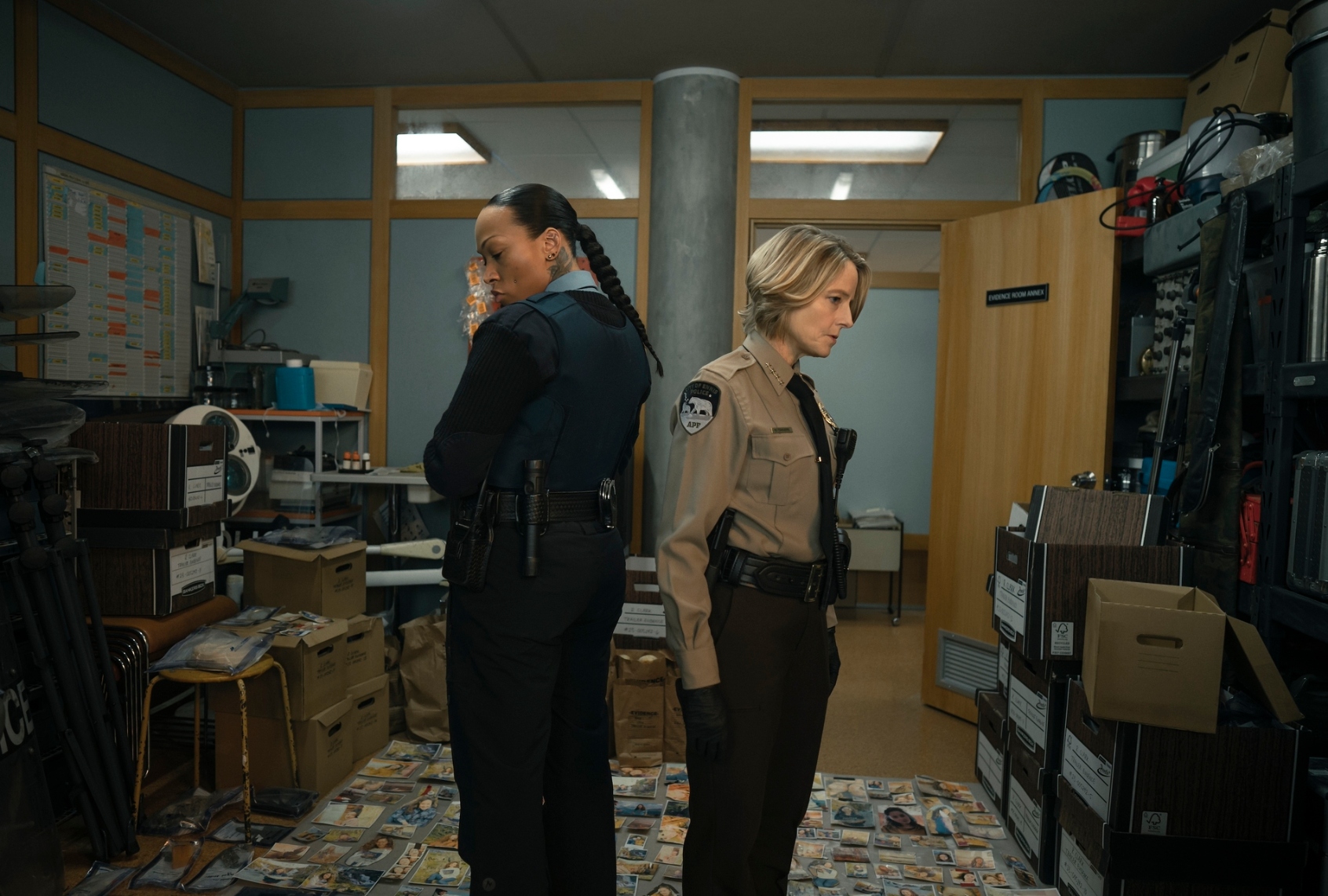
When it was first announced in 2022 that Jodie Foster would be taking on her first major adult TV role as one of two female leads in “True Detective: Night Country,” there was a sweeping assumption that her character would be gay. And not just because Foster herself identifies as such.

“Jodie, no!” I screamed in surprised confusion, feeling my expectations for this season crumble.

In the initial teaser trailer for the show’s fourth season, we get the first glimpse of her in action as Chief Liz Danvers, seated behind her desk talking about how “Some people come to Alaska to escape. To get away from something.” Working to piece together a mystery in the fictional town of Ennis as it braces for weeks of endless darkness, she later has a tense exchange with Trooper Evangeline Navarro — played by queer professional boxer turned actress Kali Reis — telling her, “We’re just gonna do this one thing. Work together to close this case. And that’s it for the two of us.” And for as coded as the dynamic between the two of them is, the first big scare of the season comes quick when we learn that, once again, the potential to add to the queer canon was sacrificed in favor of protecting ratings.

In the second episode, titled “Part 2,” Danvers has matter-of-fact sex with Captain Ted Connelly (Christopher Eccleston), who is very much not her hot female co-star, and the sight of it abruptly snapped me out of the lavender haze I was shrouded in going into this. “Jodie, no!” I screamed in surprised confusion, feeling my expectations for this season crumble with each baffling thrust. And I wasn’t alone in this. Aside from my wife screaming similarly beside me on the couch, others reacted in equal fashion. And while, obviously, it’s perfectly fine (important even) for gay actors to be able to play straight whenever the role calls for it, who called for this, exactly? Aside from the hordes of straight men ready to review bomb the season regardless, just because it features women as leads.

After premiering on HBO and Max on Jan. 14, “Night Country” showrunner Issa López spoke out against “bros and hardcore fanboys” of the series’ earlier seasons who participated in lowering the audience score on Rotten Tomatoes.

“So, if you liked last night’s episode, and have a Rotten Tomatoes account, maybe head over there and leave an audience review?” López reportedly wrote on X, which she later deleted. “The bros and hardcore fanboys of [Season 1] have made it a mission to drag the rating down, and it’s kind of sad, considering all the 5 star ones.”

In another post, which has also since been deleted, she wrote, “I despise review bombing of any kind, but A: our audience score in RT is much better now, and B: I used a generalization about who was bombing. And generalizations are ALWAYS a mistake. SO MANY beautiful bros and TD S1 hardcore fans loved our ep 1!”


Want a daily wrap-up of all the news and commentary Salon has to offer? Subscribe to our morning newsletter, Crash Course.


In an interview with The Independent, Kali Reis reacted to this level of trolling herself, saying, “If they could just get their heads out of season one’s a**, that’d be great. Issa did not attempt to rewrite the first season; there are connections to the first season, there’s an homage to the first season, but it is not trying to duplicate it.”

So this, compounded by original series creator Nic Pizzolatto publicly bashing the new season, calling its references “stupid” and saying, “I certainly did not have any input on this story or anything else. Can’t blame me,” point to an ingrained issue that higher-ups may have felt the need to get in front of. And what better way to do that than to defy all subtext by making it as outwardly straight as humanly possible? Because apparently masculine women who sleep with men are a safer bet than gay women when it comes to ratings.

Kali Reis and Jodie Foster in “True Detective: Night Country” (Michele K. Short/HBO)
In a deep dive to determine why and how “Night Country” ended up being the gayest straight show ever, I landed on a big clue. In a 2023 interview with Vanity Fair, Issa López talks about her vision for Foster’s and Reis’ characters in an initial draft, saying, “When I talked to HBO about the first draft, I was like, deep down, this is a rom-com. These are two characters that love each other, found each other and fell in love, and then fell out of love terribly. Now they’re enemies. And that’s when we meet them. And the show is the story of how they fall back in love. This is friendship. But in the end, it’s the same thing.”  (Salon reached out to the publicists for “Night Country” regarding this quote and received the following response: “HBO and Issa don’t have comment to provide.”)

What changed between then and now? Fear.

This can be interpreted in two ways, I suppose, just like the word “partner” can mean two things depending on who’s saying it, but from my perspective, it’s very telling. What I take from that quote is that these characters and the relationship they had, and continue to have, feels gay because that’s the way it’s supposed to feel. What changed between then and now? Fear. Fear of never moving past the show’s initial pitch. Fear of review bombing. Fear of low ratings in the wake of numerous other LGBTQIA series that got cancelled because even now, in 2024, normy audiences still can’t make room for depictions of relationships that wouldn’t be conveniently marketed to in a Hallmark store, if they even have those anymore.

“Night Country” was bent for the straights, if that’s the way they want it. And those still catching up after the first episode, who may have been holding on to hope that Danvers and Navarro would hook up later in the season, are sure to be disappointed. Spoiler alert. Sorry. But at least straight men are happy-ish. Right?

Trump says he wouldn’t protect NATO countries from Russian attack if they didn’t pay up

Speaking at a rally in South Carolina on Saturday, Donald Trump made a series of comments that led to unease in terms of where his head is at when it comes to shielding NATO allies against Russian attack.

Remarking on a conversation he had during his time in office where a leader of a “big country” asked whether they would be protected if Russia attacked, Trump painted a picture of such protection having a price tag attached to it, telling the leader that the U.S. would not protect them if they didn’t pay their fair share in defense spending, according to NBC News

“I said, ‘You didn’t pay? You’re delinquent?’” Trump said. “No, I would not protect you. In fact, I would encourage them to do whatever the hell they want. You got to pay. You got to pay your bills.” 

In a statement on Trump's comments, White House Deputy Press Secretary and Senior Communications Adviser Andrew Bates said, “Encouraging invasions of our closest allies by murderous regimes is appalling and unhinged — and it endangers American national security, global stability and our economy at home.” 

Donald Glover’s Asian women fetish isn’t just disturbing, it could have dangerous implications

"Mr. and Mrs. Smith" is an untraditional marriage of convenience story — one that's wrapped in spy missions, snarky humor and a lot of death. But ultimately, it's still a love story.

The tumulous relationship between operatives John (Donald Glover) and Jane (Maya Erskine) is the glue that binds "Mr. and Mrs. Smith" together. In the eight-episode Prime Video series, a nameless agency matches two directionless spies to create a married assassin team that are sent on missions. In this version of "Mr. and Mrs. Smith," neither Glover and Erksine pretend to emulate Brad Pitt and Angelina Jolie's iconic portrayals of Jane and John Smith in the original 2005 film. Instead, in Francesca Sloane and Glover's spy thriller, the two leads are people of color — one a dark-skinned Black man and the other a half-Japanese woman – creating a different dynamic.

Glover himself has been long criticized for his fetishization of Asian women.

From the outset, the show doesn't appear to focus on the characters' race unless it's a throwaway joke as Jane and John are getting to know each other as partners in life and partners in their work. However, that takes a turn in a scene where the couple is on a mission and John infiltrates a predominately Black space. Here he adopts a a crass "locker room" type of discussion with the other Black men about their preferences for Asian and Latina women. Immediately, the tone of the show shifts, and the audience is back into the real-world politics of dating.

Glover himself has been long criticized for his fetishization of Asian women which tends to make repeated appearances in his music as Childish Gambino and now his television work. This over-sexualization of Asian women is incredibly harmful to how people interact, perceive and date them, ultimately perpetuating dangerous narratives of Asian women.

During the show's sixth episode titled "Couples Therapy (Naked & Afraid)," John and Jane are at a standstill in their now romantic and enmeshed work life. Jane brings up to their couples therapist (Sarah Paulson), that she has had an issue with the way John spoke about Jane to the group of men that they were assigned to kill. "He was being racist. You were saying racist things about me," she said.

In said conversation, a group of Black men sit around a table smoking weed, drinking and seemingly playing poker. Of course, John is there to complete the mission to assassinate them, but he revels in a space where there is no need for code-switching. However, this conversation veers into uncomfortable territory as Jane is listening in nearby.

As the men are bantering, one of John's marks says, "I love Latina women but I don't love their families. I mean they just too involved." They notice John's wedding ring and ask him if he's married. "She a Latina?" 

"Asian, actually," he replies. Then they all coo like excited babies. "I went East," John ickily jokes.

"You went East? East of the border!" They all laugh. Another says, "You a lucky man, 'cause I love me some Asians. They low-key conservative. They know their role."

John corrects them, saying that Jane isn't submissive but jokes that she "could be low-key Korean." They all laugh in unison like evil hyenas. 

Back in their therapy session, John corrects himself and says he knows she isn't half-Korean dismissing her opinion that his comments were racist or misogynistic. The therapist tells him that this may be a way of bonding within that Black male circle but "bonding over racism within that community at your wife's expense is hardly the way to go about that."

After he's corrected, John argues that their issues as a couple are not about racism and sexism — it's Jane's fault because she kills the men he was chummily bonding with on the mission.

What's fascinating about the scene is that it serves as a vehicle for Glover to finally address the criticism he has faced over his fetish for years . . . but the writing fails to be either funny or smart. Ultimately, it's just a sad attempt to pull a fast one over his audience and his critics, with Asian women as the punchline again. It doesn't help that this scene was written specifically for Erskine, who is half-Japanese, after she was cast as Jane after Phoebe Waller-Bridge's vacated the role.

But John's deflection is pretty similar to Glover's own sentiments when he's confronted with his questionable lyrics that put a spotlight on his attitude toward Asian women. In one of his songs "Kids (Keep Up)," he addressed the fetish allegations and raps, "Finding you is like finding Asians I hate/They say I got a fetish, nah, I’m skipping all of it."

It's not the first time a soft boy has hidden his misogyny in his art or his persona and gotten away with it.

When asked about his fascination with Asian women, the rapper said in an interview, "It's not really a fascination. People think I have a fetish. I don't know; maybe I do." He continued that Asian women are easier to date than Black or white women because they're not as controversial, and their parents’ only requirement is that the guy is “successful.” Again, even if he means no harm by the comments, it is enforcing long-held and dangerous beliefs and stereotypes that Asian women are objects to be desired with no say in who desires them because they are submissive. 

That isn't the only instance that Glover has rapped about Asian women, in his song "Freaks and Geeks" he raps, "Love is a trip, but f**king is a sport. Are there Asian girls here? Minority report." In "You See Me," in his opening verse, he raps, "I'm on my ballin' each and every day/Asian girls everywhere, UCLA." And another song “Backpackers," Glover sees Asian women as a prize: “I got a girl on my arm dude, show respect/Something crazy, an Asian, Virginia Tech.” Lastly in "Bonfire" he boasts about stealing an Asian man's girl, “This Asian dude, I stole his girl, and now he got that Kogi beef.”

We need your help to stay independent

The critically acclaimed actor and five-time Grammy winner's music speaks for itself. A rapper would not be name-dropping a group of women like that if he weren't openly fetishizing them. Despite the blatant fetishization in his music and in "Mr. and Mrs. Smith," a figure as successful as Glover, whose new show has an all-female writers' room, and is co-created by a woman —is almost immune to this type of criticism as he can also claim to be marginalized. He is one of the very few multi-skilled leading Black men in the industry who socially and politically leans left. However, it's not the first time a soft boy has hidden his misogyny in his art or his persona and gotten away with it. Figures like rapper Drake and comedian Jonah Hill come to mind.

But more importantly, this criticism isn't just bound to how Glover views Asian women — it is based on how the world perceives them too. How one fetishizes people can turn into something as ugly as crimes committed against them, specifically marginalized women like Asian women. In the last few years, there has been an uptick in violence against Asian women. A large majority of hate crimes recorded by Stop AAPI hate targeted Asian women. And three years ago, in Atlanta, six women of Asian descent were killed in a spa because a white man had a “sexual addiction” and had to eliminate his "temptation," The New York Times reported.

While Glover is not responsible for these brutal acts of violence against Asian women, he has created a space where through his art he can indulge in a dangerous, stereotypical fantasy that he has of real-life, living and breathing Asian women. And the more normalized his views are through media like "Mr. & Mrs. Smith" even if it is supposedly delivered through ironic jokes — it can be reflected brutally in our lives without us even understanding the larger implications or consequences for Asian women.

Ditch the reservations: 5 things to do on Valentine’s Day other than going out to dinner

Do you love Valentine's Day? Feb. 14 is rapidly approaching, and I'm here to make sure that you do not look basic when trying to express your love to your lover. 

The fact that it is always almost impossible to get a reservation at a good restaurant on Valentine's Day should tell you that this idea is super unoriginal and overdone. Don't get me wrong. I love fine dining and a great movie like anyone else in the world, but it has become so normal to so many of us in society. It feels like dinner and a movie is not as special as it was when our parents used to get dressed up to hit the "fancy white tablecloth, guys can't get in without a sport coat" type of restaurants back in the day. 

All of my social media timelines are full of people who fancy themselves as amateur influencers and restaurant critics, constantly posting videos of their many culinary crusades where they critique the many dishes they enjoy or hate from the many food establishments they frequent every week. Not special, overdone, basic . . . what’s new? 

Experiences are everything.  

So, how do you separate yourself from what any and everyone else in the world is doing on Love Day? Do you want your Valentine to feel special? Do you want their stories about your plans to be glowing and interesting? I believe you can achieve all of this and it's not that hard. Before we get into some date recommendations, I will say that expensive gifts don't always work.

I tried giving out expensive gifts, when I could afford it, for years. It's sad to say, but people forget about their designer bag or nice piece of jewelry. Sure they value it, but may not be able to tell you if they received it for Valentine's Day or their birthday or Christmas as the novelty wears off and it gets replaced by the next new thing. But experiences, experiences are everything. You cannot erase them or lose them, only become more grateful over the years as you reflect on them, and that is the cheat code for having a successful Valentine's Day. 

Here's five things I'd love to recommend: 

01
Cooking together (aka The Chef Package)
Just because I am pushing you to say no to the expensive restaurant doesn't mean that you and your lover can't share an enjoyable meal. But first why not start with a shared experience to enhance that meal?
 
Find a recipe you both can agree on and cook it together. Maybe you're the head chef, and they are the sous chef or vice versa. Either way, it would make for a night of fun, and maybe, just maybe, you'll get a delicious meal, the opportunity to learn some new things about one another and some fun memories to hold on to. 
02
Spa day (aka The Relaxation Package)
Everybody loves a spa day. So figure out what your lover desires – like back rubs, manicures or facials – and book an appointment with professionals who can accomplish those things. If paying for a spa day is out of your price range, then watch a YouTube tutorial where a digital expert can explain the proper techniques that should be used so when you pamper them, you won't come off like a complete amateur. Take a trip to Target or Walmart, buy the appropriate supplies and give it a shot on your own. Either way, your lover will appreciate both the gesture and your effort. 
03
Physical activity (aka The Voyager Package)
There's more to life than just laying around and eating all day, so maybe you can book a physical activity that can be fun and romantic. Dates involving axe throwing, miniature golf and laser tag are inexpensive and can be competitive and entertaining. You could also take a self-defense class, go hiking or learn archery. All these activities are fun, and will allow you to take some beautiful photos and make even more meaningful memories. 
04
Vision board ( aka The Dreamer Package)

Learn to dream together. Maybe you are already in a relationship where one or both of you work so much that you don't get to spend much time outside of the house. Building and maintaining careers are complex and sometimes leave us too tired to focus on romance, but you know what is romantic? Dreaming of the reality you deserve. 


What if you and your lover took a bunch of old magazines, clipped out beautiful images of the life you deserve and are working towards, and placed them on a vision board? You can also discuss the planning needed to make these lives a reality, while working. Creating a vision board with your lover is the ultimate experience and could lead to fantastic life-changing conversations that will ultimately bring you closer.

05
Binging a show (aka The Couch Potato Package)
If you are too tired to participate in any activity, maybe you can use Love Day to connect and vibe. There's so much television in the world now, that it is impossible to keep up with everything. You can find an exciting television show – maybe a genre you haven't tried or a show that has been on your list for a while – and intentionally binge-watch it with your lover. Hopefully, you can pick a great one, and enjoy it along with that meal you may have cooked together. 

Happy Valentine's Day. 


Can America’s “sleeping giant” shake up the election? Let’s hope so

It’s ironic that in 2024  the very fate of our republic rests entirely in the hands of the nation’s 85 million low wage potential voters, roughly a third of the American electorate that society and the corporate news media regularly ignore.  It’s the common Beltway wisdom that these folks at the base of the pyramid are marginal to the political conversation as compared to the vaunted middle class upon which both major parties have for so long fixated on.

It’s the product of a perverse feedback loop that was flagged by a Columbia University study undertaken of the 2106 electorate with the support of the Poor People’s Campaign, which studied the low-wage voter cohort and found a majority of them did not vote and when they were surveyed they explained they didn’t turn out because they didn’t hear candidates discuss issues that had any relevancy to their lives.

Columbia University researcher Robert Paul Hartley found that only 46 percent of voters with household income less than twice the federal poverty rate cast a ballot in 2016, as compared to a 68 percent turnout rate for voters who had a household income more than twice the poverty line. “They’re saying that they’re not voting because people are not speaking to their issues and that they’re just not interested in those candidates,” Hartley, told the New York Times  “But it’s not that they couldn’t be.”

It’s a kind of conundrum. Low-wealth voters are left out of our deliberations and sit on the sidelines, their disengagement reinforced by voter suppression, and campaign consultants use their MIA status to justify the pursuit of that white suburban voter they feel more comfortable with anyway.

The Poor People’s Campaign is planning simultaneous actions on March 2 at over 30 state capitols.

Like so much Beltway wisdom that failed to flag the rise of Donald Trump and the Insurrection, it is seriously flawed and informed by racism, classicism, and condescension as well as by a corporate media looking to capture eyeballs that can afford a Viking cruise.

In 2016, in key rust belt states where unions were part of the historic Democratic base like Michigan, Trump won thanks to depressed African American voter turnout and the lack of engagement of the multi-racial cohort of economically struggling voters that polls show overwhelming support for reproductive rights, a living wage and universal healthcare.

In 2016, Trump carried Michigan by just 10,000 votes. 980,000 low-wage voters did not turn out. If. 1.1 percent of those voters had bothered the results would have been different. Michigan was no exception. In North Carolina, Trump’s margin of victory was 170,000 votes while 920,000 poor and low-wealth voters sat it out. If just 18.9 percent of those disengaged voters had been motivated to go to the polls history would have bent another way.

We need your help to stay independent

In the House of Representatives in 2022, now held by Speaker Mike Johnson, R-LA., an unapologetic insurrectionist, the GOP won control by just 3,500 votes in five tight House races.

In 2020, in Arizona, Georgia, Florida, Michigan, North Carolina, Nevada, Pennsylvania, and Wisconsin the Biden-Trump faceoff was really tight, close to just 3 percent. In Texas, a Republican bastion for decades, the margin was just over 5 percent. The numbers don’t lie. If voters want to vote the GOP into extinction they can do it by waking what the Rev. Dr. William Barber calls the “sleeping giant” that’s the low-wage, low-wealth multi-racial voter cohort.

That might yank the Democratic Party of Sen. Joe Manchin to the left considerably but we will have saved the republic just the same. This is too high stakes to be left to the courts.

This week in Washington at the National Press Club the Poor People’s Campaign, under the leadership of Barber and Rev. Dr. Liz Theoharis, announced their plans for a mass mobilization of 15 million poor and low-wealth voters nationwide ahead of November’s election. They were joined by respected pollster Celinda Lake, President of Lake Research Partners.


Want a daily wrap-up of all the news and commentary Salon has to offer? Subscribe to our morning newsletter, Crash Course.


"In 2024, the election is going to be about mobilization,” Lake told reporters. “There is no question that the biggest contest between the two parties is going to be who can get their voters out to vote. Democrats have an enthusiasm gap today, and the progressive alliance and Democrats have fissures within their constituency that makes getting out the vote even more important. The biggest bloc of potential voters by far is low-income, low-wage voters. Increased participation even by miniscule percentages could be game changers. It is a massive voter engagement that is being started here today.” 

Lake’s analysis was certainly born out in the recently concluded South Carolina Democratic Primary where President Biden easily prevailed but what has professional Democrats worried was the anemic turnout in a state where Black voters are pivotal and voter engagement has been downhill since President Obama.  In the 2008 primary over a half-million turned out, close to a quarter of the registered voters. In the most recent Democratic contest just over 130,000 came out, less than five percent of the state’s voters. 

In 2016, in a ‘proof of concept’, the Poor People’s Campaign targeted specific low wealth and low wage voters in several states including in Georgia where they identified and mobilized 36,000 previously unengaged voters that helped produce the margin of victory in the pivotal U.S. Senate races won by Rev. Raphael Warner (D-GA) and Jon Ossoff (D-GA).

The Poor People’s Campaign is planning simultaneous actions on March 2 at over 30 state capitols to launch “the campaign and highlight the policies being promulgated in state houses across the country that are hurting the poor or distracting from addressing the real issues facing poor and low-wealth people,” according to the PPC. The targeted states include Alabama, Arizona, California, the District of Columbia, Delaware, Florida, Georgia, Illinois, Indiana, Kansas, Kentucky, Massachusetts, Maryland, Maine, Michigan, Missouri, Mississippi, Nebraska, North Carolina, New Jersey, New York, Ohio, Oklahoma, Pennsylvania, Rhode Island, South Carolina, Tennessee, Texas, Vermont, Washington, Wisconsin, and West Virginia.

“For far too long extremists have blamed poor people and low wage people for their plight while moderates too often have ignored poor people, appealing instead to the so-called middle class while the poor and low wage people have become nearly half of this country,” Barber told reporters. “Poor and low wage people have the power to determine and decide the 2024 elections and elections beyond. In the 2016 election there were 34 million poor and low wealth people eligible to vote but didn’t. These voters made up more than a quarter of the electorate.” 

Barber continued: “Poverty is now the fourth leading crisis of death in America, a moral crisis in America taking the lives of 800 people a day and this is before and after COVID…These are the issues that must be at the center of the narrative of a democracy in our country. If we are serious about saving the democracy it can’t be some philosophical term. Saving the democracy must be a Third Reconstruction where people are paid a living wage—where people have health care—where public education is fully funded and where voting rights are protected and expanded.”

Barber called out by name eight moderate U.S. Senate Democrats that in 2021 joined with the Republicans to defeat raising the minimum wage to $1 from the $7.25 where it has been stuck since 2009 when Obama was president. Speakers at the press conference referenced Congress’s decision to roll back the expansion of the Earned Income Child Tax Credit, which caused a major spike in childhood poverty and the Biden administration’s decision to let states “unwind” Medicaid when the White House declared the pandemic was over. As a consequence, several million people lost their subsidized coverage including over three million children. 

“We are mobilizing, organizing, registering and educating people for a movement that votes, votes for healthcare and debt cancellation, votes for living wages and string anti-poverty programs and votes for fair taxes and the demilitarizing  of our communities and world,” said Rev. Dr. Liz Theoharis who noted that since the last presidential election close to 1,000 voter suppression bills have been introduced “that impacts poor and low income people the most.”

Dozens of local leaders from the state chapters of the Poor People’s Campaign were on hand in person and virtually for the high spirited kick off including Janice Guzman, an organizer with the Massachusetts Poor People's Campaign and SEIU 1199.

"I work for MassHealth as a Personal Care Attendant, helping to take care of people with disabilities and who are sick and need help with their daily activities. But I do not have health insurance myself,” Guzman told reporters.  “I am an essential worker living paycheck-to-paycheck and I have to make decisions every day. Do I put gas in my car or do I pay my bills? Or do I put food on my table?,” said Janice Guzman, an organizer with the. “This is why I am organizing with the Massachusetts Poor People's Campaign. We have got to get our power as people, get back the mic, raise our voices and register voters. Forward together!"

Conservatives are backpedaling on their Bud Light boycott. To understand why, follow the money

Last week, ten months after numerous right-leaning public figures called for a boycott of Bud Light because of the beer brand’s short-lived partnership with transgender influencer Dylan Mulvaney, former President Donald Trump took to Truth Social to say that it’s a “Great American Brand that perhaps deserves a Second Chance.” 

“The Bud Light ad was a mistake of epic proportions, and for that a very big price was paid,” Trump wrote on his social media platform. “On the other hand, Anheuser-Busch spends $700 Million a year with our GREAT Farmers, employ 65 thousand Americans, of which 1,500 are Veterans, and is a Founding Corporate Partner of Folds of Honor, which provides Scholarships for families of fallen Servicemen & Women. They’ve raised over $30,000,000 and given 44,000 Scholarships.”

Trump isn’t the only conservative to soften his stance on the Bud Light boycott in recent months. In November, for instance, musician Kid Rock — who infamously kicked off his boycott of the brand by tearfully shooting cases of Bud Light in a field — told “Fox News” host Sean Hannity that he “didn't want to be in the party of cancel cultures and boycotts that ultimately hurt working-class people.” He said he’d reconsidered the boycott in light of his religious beliefs: “As a God-fearing man, as a Christian, I have to believe in forgiveness. They made a mistake, all right. What do you want, hold their head under water and drown them and kill people's jobs? I don't want to do that.” 

The month prior to that, UFC CEO Dana White appeared on Fox News to announce a partnership with Bud Light, citing numbers suspiciously similar to those used by Trump on Truth Social; per a recent CNBC report, Trump’s post about the brand likely came after a conversation with White. 

Then, following Trump’s post, conservative commentator and reality television star Caitlyn Jenner took to X, formerly Twitter, to voice her agreement with the former president’s statement. “As someone that worked for this incredible American company, and got to know them very well, I raced for @AnheuserBusch in the 80’s I agree with @realDonaldTrump,” wrote Jenner. “Look at what the company does for so many Americans and their track record over the years. They made a huge mistake and have paid a large price. I think it is time to move forward – I am saying we should focus on big picture…agreeing with 45!”

Some conservative commentators, including journalist John Hasson , were quick to point out the irony of Jenner — who came out as a transgender woman during a “20/20” television interview with Diana Sawyer in April 2015 — commenting on how huge a “mistake” Bud Light made in partnering with a transgender influencer and activist. “Bud Light screwed up by working with a trans influencer, but they’re not woke,” he wrote in response to Jenner’s comments. “To prove it, here’s a message from OUR trans influencer.”

That statement teases out just a bit of the mental gymnastics conservatives are having to do to reconcile the quickly fraying edges of their very vocal boycott of the brand — but what’s behind the growing collective walk-back? 

In part, this is an obvious business play from Bud Light. Last year, as Salon Food reported, the brand tried to play both sides of the political fence following the fallout of the Mulvaney ad, starting with the company’s tepid response to the transphobia the boycott incited. "We never intended to be part of a discussion that divides people. We are in the business of bringing people together over a beer,"  Anheuser-Busch CEO Brendan Whitworth said in an April 14 statement titled "Our Responsibility to America."

We need your help to stay independent

He said the company has "a proud history supporting our communities, military, first responders, sports fans and hard-working Americans everywhere," and that he would "continue to work tirelessly to bring great beers to consumers across our nation."

However, based on Bud Light’s rock-bottom year-end numbers, that strategy obviously wasn’t working, so it appears like the company’s leadership is making a concerted effort to reestablish its conservative customer base. In addition to partnering with the UFC —whose CEO, White, described the concept of transgender women competing in women’s sports as “"nutty [and] insane” — Bud Light recently announced a partnership with Shane Gillis, the comedian who was infamously fired from “Saturday Night Live” in 2019 before even appearing on the show after racist and homophobic comments from his podcast recirculated. 

Of course this isn’t a one-sided reconciliation — which is especially apparent if one follows the money. 

On Tuesday, Bud Light posted a photo of Gillis at a Budweiser brewery with the caption: “Welcome to the team. Excited to be a part of your 2024 tour.” Gillis posted additional photos from the brewery tour later that day. 

As reported by Them, “in several (now-deleted) segments from Matt and Shane’s Secret Podcast with cohost Matt McCusker, Gillis referred to comedian Chris Gethard and director Judd Apatow as ‘white faggot comics,’ and used an anti-Chinese slur repeatedly, including in an extended segment with McCusker about reasons to dislike Chinese people.” 

Gillis later referred to himself as a “comedian who pushes boundaries” in a statement defending the jokes, and while he apparently doesn’t dig the “conservative comedian” moniker, he has endeared himself to the political right for his response to being “canceled.” For example, since Gillis’ partnership with Bud was announced, Greg Gutfield has already asked: “Comedian Shane Gillis beat cancel culture, can he save Bud Light?” and went on to praise the brand for “rediscovering their core values.”

Of course this isn’t a one-sided reconciliation — which is especially apparent if one follows the money. 

White obviously has an interest in Bud Light’s financial wellbeing given the UFC’s partnership with the brand. Meanwhile, as Spectrum News reported, in just a few weeks Donald Trump Jr. will be in Washington for a campaign fundraiser with lobbyist Jeff Miller, whose firm has collected $820,000 from Anheuser-Busch since 2020, including $270,000 last year, lobbying disclosures show. 

Additionally, according to financial disclosures he signed and submitted to the U.S. Office of Government Ethics, Trump also owned between $1 million to $5 million of stock in Anheuser-Busch, Bud Light’s parent company.


Here are 15 tasty Super Bowl commercials we’re looking forward to ahead of the big game

Super Bowl 2024 is this Sunday, Feb. 11, so understandably, most folks are looking forward to the big game (the San Francisco 49ers will go up against defending Super Bowl champion the Kansas City Chiefs), Usher’s halftime performance and a Taylor Swift mania. For us, however, it’s all about the commercials — namely the ones that spotlight our favorite snacks and beverages alongside Hollywood cameos.

This year’s commercial lineup is already feeding us well with witty quips, bombshell celebrity reunions and, yes, delicious edible offerings. Chris Pratt along with his newly grown handlebar mustache teamed up with Pringles and several notable stars from “Friends” picked up groceries with Uber Eats in a few anticipated big game commercials.

Here are 15 tasty Super Bowl commercials we’re excited about ahead of this year’s big game:

01
Lindt’s first-ever Super Bowl ad

Premium chocolate maker Lindt & Sprüngli will make its Super Bowl debut with a 30-second spot titled “Life is a Ball.” According to Adweek, the ad features various individuals savoring the irresistible taste of Lindor truffles. The 1957 Perry Como track “Round and Round” is heard playing in the background while its lyrics are casted on the screen throughout the ad.


Lindt’s recent campaign is in partnership with Kylie Kelce, wife of Philadelphia Eagles center Jason Kelce. In a recent promotional video, Kelce shared how she gets ready for the big game with Lindor Truffles.


02
Nerds Gummy Clusters enjoys its “Flashdance” moment
In Nerds’ first-ever Super Bowl ad, a giant anthropomorphic gummy candy recreates the iconic chair dance scene from the 1983 film “Flashdance.” Instead of being covered in water, however, the gummy is covered in colorful Nerds candies to create a Nerds Gummy Cluster — the brand’s latest and most popular offering. The ad also features a brief cameo appearance from TikTok star, actor, singer and dancer Addison Rae.
 

03
Chris Pratt adopts Mr. P’s signature handlebar stache
Chris Pratt takes on the “role of a lifetime” as Mr. P, the famed Pringles mascot, in a Super Bowl ad for the canned chips brand. The 30-second spot is inspired by fan sightings of "the Pringles guy" shared on social media. In it, Pratt swears he doesn’t look like Mr. P despite rocking the mascot’s famed handlebar mustache while buying a can of Pringles. Pratt later receives a call from his agent, offering “the role of a lifetime.” He’s then seen portraying Mr. P in an eponymous film and billboard.
 

04
Kris Jenner “twists on it” for Oreo

Oreo’s Super Bowl commercial suggests that notable figures – both in real-life and in mythology — have made world-changing decisions simply by twisting open an “Oreo.” In one scene, guards allow the Trojan Horse to enter the city of Troy after twisting open an Oreo. In another, Kris Jenner twists open an Oreo to determine if her family should be in a new reality series.


The recent ad marks Oreo’s grand return to the Super Bowl screen since 2013.


05
Jennifer Aniston, David Schwimmer, Victoria Beckham and more stun for Uber Eats
In Uber Eats’ star-studded commercial, celebrities are forgetful about everything except all the necessities they need from Uber Eats. Rapper Jelly Roll forgets about his many face tattoos. David Beckham and Victoria Beckham forget the name of Posh Spice’s girl group (“Remember when you used to be a Pepper Lady? Wasn’t it the Cinnamon Sisters? Basil Babes?”). And Jennifer Aniston forgets who her former “Friends” co-star David Schwimmer is.
 

06
Jenna Ortega’s grandmothers really love Doritos Dinamita
Jenna Ortega’s grandmothers, Dina and Mita, will do anything to get their hands on a bag of Doritos Dinamita. That includes embarking on a fast-paced car/motorized wheelchair chase, breaking into homes and using a scooter to slide down a telephone line. In the end they’re successful — that is before Ortega steals their bag to enjoy the chips on her own. The ad also coincides with the launch of four new Dinamita flavors.
 

07
Dr. Umstick saves the day with Drumstick

Will Dr. Umstick be able to cure Eric André’s stomach pain while they're 36,000 feet in the air? Certainly! Drumstick ice cream cones — for everyone on the plane except André — will most definitely save the day.


08
Lionel Messi and another soccer superstar drink Michelob Ultra by the beach
In Michelob Ultra’s Super Bowl ad, Lionel Messi shows off his soccer skills while waiting for a tall glass of beer. Messi steals the spotlight for most of the commercial…well, that’s until “Ted Lasso” star Jason Sudeikis makes a surprise cameo at the 42 second mark. “What do you mean Lionel? We go way back,” Sudeikis says while grabbing a can of Michelob Ultra from a cooler.
 

09
The Bud Light genie is here to make your wishes come true
Bud Light may have been hit with controversy in 2023, but that isn’t stopping the beer brand from releasing a Super Bowl commercial featuring two A-list guests. The star of the ad is the Bud Light genie, who grants Bud Light drinkers as many wishes as their heart desires. Anything from wanting bigger biceps to meeting Post Malone and Peyton Manning is all doable for the Bud Light genie.
 

10
Kate McKinnon enjoys Hellmann’s mayo alongside her feline co-star
Unilever mayonnaise brand Hellmann’s returns with a new Super Bowl ad, this one featuring Kate McKinnon and her feline co-star, the “Mayo Cat.” The dynamic duo attains celebrity status thanks to McKinnon’s talking cat, who instructs her to use “may-ow” in the kitchen. Mayo Cat becomes so popular that she later enjoys a brief high-profile relationship with Pete Davidson. Their subsequent breakup also makes it on the cover of People magazine.
 

11
Budweiser’s Clydesdale horses deliver beer amid a snowstorm
The heartwarming ad features Budweiser’s iconic Clydesdale horses as they trek through a raging snowstorm to restock a bar with beer.
 

12
Aubrey Plaza is having a blast with Mountain Dew Baja Blast
Aubrey Plaza’s wry sense of humor steals the show in Mountain Dew Baja Blast’s Super Bowl ad. Plaza is seen “having a blast” while sipping on Baja Blast, albeit in her signature deadpan manner. At the end of the commercial, Plaza reunites with “Parks and Recreation” co-star Nick Offerman while riding dragons “Game of Thrones”-style.
 

13
Ken Jeong waits more than 50 years to try Popeyes’ new wings
Ken Jeong plays Howie, who is revived after being cryogenically frozen for more than 50 years to try Popeyes' new wings. In addition to eating good chicken, Howie catches up on all the things he's missed over the years, like self-driving cars, massage chairs, robot vacuums and more.
 

14
Ice Spice sips on Starry, bids adieu to Sprite
Starry’s Super Bowl ad stars Ice Spice sipping on Starry lemon-lime alongside the brand’s mascots, Lem and Lime. Their casual chit-chat is suddenly interrupted by Ice Spice’s ex, a teary lemon-lime soda. The ad insinuates that lemon-lime soda, who is wearing a blurred out green top, is Sprite.
 

15
LL Cool J saves an awkward moment with Coors Light
LL Cool J manages to save an awkward game day moment by delivering Coors Light beers via the Coors Light Chill Train.
 

Joe Biden v. Vladimir Putin: This week’s dismal propaganda war had no winners

At one point in Tucker Carlson’s 127-minute “interview” with Vladimir Putin last week — which was more like a tendentious, digressive history lecture, occasionally interrupted by a dim but obsequious schoolboy — Carlson made the Russian president laugh. It was a creaky, troubling sound, something like the door of an antique iron safe being swung back and forth. One can only imagine how much Kremlin insiders hate that sound.

Carlson had asked why Putin didn’t try to score a “propaganda victory” by revealing information that might implicate the CIA in the still-mysterious Nord Stream pipeline bombing of September 2022. 

Putin laughed. Creak, creak, squeak. “In the war of propaganda, it is very difficult to defeat the United States,” he responded, “because the United States controls all the world’s media and the European media.” 

Well, OK. Let’s start with the obvious irony: Putin is no slouch in the propaganda wars himself, and is well aware of his reputation in the West as a master manipulator. Why was he talking to, or rather at, Tucker Carlson in the first place? 

We’ll get back to that. But there’s a second layer of irony, which even Putin could not have anticipated. His Carlson conversation was released online directly opposite Joe Biden’s hastily arranged White House press conference on Thursday evening. The contrast could hardly have been more striking, or more bizarre.

It’s both unfair and unreasonable, no doubt, to draw a direct comparison between the two presidents’ media events, which took place in dramatically different circumstances and for different reasons. But politics, whether global or national, has nothing to do with what is fair or reasonable and everything to do with appearance and perception. 

If Putin was the winner of this week’s propaganda battle, that was largely by default. As usual, Biden’s performance both demanded and deserved our compassion and empathy, even as we devoutly wished he were someone else, or somewhere else.

The president addressed the cameras for about five minutes, fueled by tangible human emotion and reportedly without a Teleprompter, before taking a few questions from reporters. Everything he said and did in that brief appearance, up to and including his now-infamous confusion of Mexico with Egypt, is defensible or at least explicable when viewed through the distortion lens of American partisan politics. Commentators on MSNBC and elsewhere in the liberal-inflected media demonstrated that to the best of their ability over the next day or two. 

What-about the White House press conference all you like: Trump is infinitely more dangerous, Biden struggles with a lifelong speech impediment, his Mexico-Egypt gaffe was entirely typical. OK, yes. But it was a catastrophe.

But if we could, just as a thought experiment, push ourselves away from that warped perspective, and ignore the orange-hued hobgoblin whose endless campaign speeches are laden with far worse misstatements, not to mention ludicrous delusions and outright fabrications — well, no, I realize we can’t do that. Donald Trump has transformed and stupefied American public discourse far more profoundly than he could ever have imagined was possible, and evidently we will remain mesmerized by him until he’s dead or we all are, and perhaps after that. (Will the MAGA movement have him stuffed and mounted, like Lenin, or carry him around on a plywood platform, like a medieval saint?)

But if we pretended, just for a minute, to notice that there are several billion people in the world who view the United States from outside with a mixture of terror, wonder and sheer mystification, we might also notice that what they saw in the White House on Thursday was the octogenarian leader of the most powerful military power in history, confronted with a report (from his own government!) that described him as an “elderly man with a poor memory” who suffers from “diminished faculties,” responding in an angry, mumbled monotone that was difficult to follow even if you knew what he was talking about and featured a spectacular mistake that he never noticed or corrected. 

What-about that all you like: Trump’s evident derangement is infinitely more dangerous, Biden has a lifelong speech impediment that can lead to verbal tics and mangled diction, his Mexico-Egypt transposition is entirely typical of the “gaffes” heard throughout his public life. All of that is true, or at least plausible. But if we can pull away, once again, from “What does this mean for the Democrats?” and the ghoulish social media gloating of Individual 1 and his many fans, and regard this pseudo-event from the perspective of Tanzania or Indonesia or Mars, I think the verdict is clear.

It was a catastrophe. A complete and total insert-a-profane-gerund disaster. Not just a political disaster, although probably that too. More of a global WTF: How in all the names of God in all the world’s religions did that guy end up as the most powerful individual on the planet, not to mention the supposed defender of so-called democracy against an insultingly idiotic fascist renaissance? 

We need your help to stay independent

To say that Putin looked good by comparison isn’t even damning with faint praise. I wouldn’t argue that he looked good at all. But in the face of Western media accounts that have depicted the Russian president as paranoid and isolated, he made an effort to appear statesmanlike and well informed. His history lessons were tendentious and highly selective, but his facts and dates were largely accurate. He appeared to view Carlson, understandably enough, with the attitude of a mildly bored spider who isn’t sure whether the small insect being wrapped in its web is even worth eating.

Let’s return to his creaky laugh and his answer about the risks of fighting a propaganda war with America. Putin is nowhere near being a deep thinker or an intellectual (Foreign Minister Sergey Lavrov is the brains of that operation), but as an intelligence professional he’s skilled at throwing shade, clouding the issue and twisting the knife.

The first part of Putin’s statement, in larger historical terms, is pretty much true: He is no doubt better informed than most Americans about the ideological importance of U.S. “soft power.” But the second part, about American control of the media, is about halfway between cranky conspiracy theory and acerbic Noam Chomsky commentary: Yes, the Western press has a built-in bias toward liberal democracy and market capitalism. Breaking news! 

Putin deployed that rhetorical approach repeatedly with Carlson: He starts with a premise that is approximately true, or at least has some basis in reality, then leaps forward to increasingly contentious and illogical conclusions. 

Ukrainian nationality is a modern invention, the Russian leader argued in his extended opening monologue — which he told Carlson would be “30 seconds or a minute” and went on for nearly half an hour — and the present-day Ukrainian state was constructed from territory that at various times belonged to the Russian Empire, the kingdom of Poland, the Grand Duchy of Lithuania and who knows what else. Sure! That’s all true, but it doesn’t follow that modern Ukraine has no right to exist, or that Russia is justified in clawing much of that territory back by force.

Present-tense Ukraine is a modern invention, Putin told us, made up of bits and pieces of defunct empires and kingdoms. True! But that describes most countries in the world, and we've concluded they have the right to exist.

Someone brighter than Tucker Carlson might have observed that all modern nation-states, pretty much, are artificial constructions. Nothing resembling present-tense Germany or Italy could be found on maps of Europe before the middle of the 19th century, and 200-odd years after the creation of the United Kingdom, the relationship between its constituent nations remains unsettled. One of the basic premises of post-Enlightenment global politics is that when a large majority of the people in a given territory decide that they’re a nation, as the Ukrainians have clearly done, the world is supposed to take them seriously: “When in the course of human events,” and all that.

Similarly, Putin made the familiar case that the U.S. and NATO broke a post-Cold War promise not to expand the Western military alliance into the former Soviet bloc, let alone all the way to Russia’s western border. He’s definitely got a point, although the fine-grained details are contentious and the actual history is more complicated than that. Next comes the argument that the 2014 Maidan “revolution” that overthrew the pro-Russian government of Ukrainian President Viktor Yanukovych — who was corrupt and incompetent but had more or less been legitimately elected — was actually a CIA-sponsored coup. I don’t think that has a yes-or-no answer. It's more like a “both-and”: Ukrainian nationalists turned decisively against Yanukovych and Russian influence, and the U.S. not-so-covertly helped force him out.

Even if we give Putin the W on that one, for argument’s sake, that’s when he runs out of rope. His following claim is that the U.S. and NATO engineered a civil war between government forces and pro-Russian militias in eastern Ukraine, and that his “special military operation” of 2022 — to the rest of the world, an unprovoked invasion — was simply an effort to settle that conflict. To give Carlson minimal credit, he keeps asking what possible threat Putin perceived in Ukraine that justified two years of grueling warfare, but doesn’t appear to notice how thoroughly that question has been bulldozed beneath a structure of halfway plausible, irrelevant or thoroughly specious claims.


Want a daily wrap-up of all the news and commentary Salon has to offer? Subscribe to our morning newsletter, Crash Course.


As many other commentators have observed, Carlson played his useful-idiot role faithfully: He never mentioned Russian war crimes, the suppression of internal dissent or the increasingly vicious crackdown on LGBTQ people and civil liberties more generally. But he was entirely unsuccessful at baiting Putin into endorsing Donald Trump — the Russian leader mentioned Trump just once, in passing — or into proclaiming some alliance with right-wing Christians in the West. Putin's vague remarks about religion were artfully dull and entirely unspecific, and to Carlson's ears might have sounded alarmingly like Western moral relativism. (There's a good reason for that: Less than half the Russian population identifies as Orthodox Christian, and nearly 40 percent profess no particular religion.)

All this confirms my sense that the larger audience Putin looks toward is global, and that contrary to the fantasies of some of his American or European fanboys, he has no interest in being identified as the leader of a white supremacist, Christian-centric campaign of reconquest. Russia’s most important actual or potential allies are the other BRICS countries — Brazil, India, China and South Africa — not Steve Bannon or Mike Johnson or the fractious white nationalists of Western Europe. Unsurprisingly, Carlson hadn't done his homework: Russian nationalism is built on the concept of a hybrid "Eurasian" identity — as explored in a recent New York Review article by Gary Saul Morson — which certainly has elements of racism but is entirely distinct from Euro-American notions of "whiteness."

Americans largely haven’t noticed, or haven’t wanted to notice, that most developing nations in the Global South have remained on the sidelines of the Ukraine conflict, at best, and have turned decisively against U.S. policy in the Middle East since Israel’s Gaza invasion. Vladimir Putin is acutely aware of those realities, and believes he can exploit the intractable qualities demonstrated by Russia over the centuries — patience, stubbornness and a remarkable tolerance for pointless suffering — to turn them to his advantage. Joe Biden, as we have lately witnessed, is still struggling to come to grips with those facts.

Would Putin prefer Trump to Biden? Without a doubt, but I’m not sure it matters to him as much as the hypnotized American political classes believe. He told Carlson that the personality of individual leaders isn’t important, and that the big historical question about the United States is whether its imperial decline comes suddenly and painfully, or more gradually over a longer period of time. He avoided saying whether he'd enjoy one of those options more than the other, graciously observing that it wasn’t up to him. 

What the NFL and Elon Musk’s Neuralink share in common

Elon Musk’s controversial brain-computer interface (BCI) tech, Neuralink, has supposedly been implanted in its first recipient — and as much as I want to see progress for treatment of paralysis and neurodegenerative disease, I’m not celebrating. I bet the neuroscientists he reportedly drove out of the company aren’t either, especially not after seeing the gruesome torture of test monkeys and apparent cover-up that paved the way for this moment. 

All of which is an ethics horror show on its own. But the timing of Musk’s overhyped implant announcement gives it an additional insulting subtext. Football players are currently in a battle for their lives against concussion-based brain diseases that plague autopsy reports of former NFL players. And Musk’s boast of false hope came just two weeks before living players take the field in the biggest and most brutal game of the year. 

ESPN’s Kevin Seifert reports neuro-damage is up this year as “players suffered a total of 52 concussions from the start of training camp to the beginning of the regular season. The combined total of 213 preseason and regular season concussions was 14% higher than 2021 but within range of the three-year average from 2018 to 2020 (203).”

These concussions are why traumatic brain injuries (TBI) and neurodegenerative diseases such as chronic traumatic encephalopathy (CTE) kill more people in contact sports like football than any other group. League medics now average 1.6 player evaluations per game, another increase. And there were twice as many medical timeouts in 2022 as in 2021. 

“No helmet will ever be concussion-proof, because the brain still moves inside the skull."

In 2017, CTE was found to have been implicated in the deaths of 99% of the 111 deceased former NFL players examined by scientists. That jaw-dropping study was echoed last week when researchers diagnosed CTE in 345 of 376 former NFL players, living and dead, including “former Kansas City Chiefs defensive tackle Ed Lothamer, who played for the Chiefs in the very first Super Bowl and was a member of their winning team in Super Bowl IV.”

Some changes to equipment and rules may bring these numbers down a bit — but we’ve known for years these tweaks aren’t going to stop TBI and CTE entirely, when a player’s job is to go head-first into car-crash-level collisions.  


Want more health and science stories in your inbox? Subscribe to Salon's weekly newsletter Lab Notes.


“No helmet will ever be concussion-proof, because the brain still moves inside the skull. And for the same reason, a helmet alone will not prevent CTE,” neuroscientist Julie Stamm said in 2019

The NFL may have banned head-to-head hits but you can’t really eliminate them from gameplay. Even if you could, they aren’t the main cause of concussions. As noted in a University of Texas-Austin case study, “there is little evidence that such incremental changes [e.g., in tackling techniques] have a substantial risk-reducing effect.”

What Irvin Muchnick wrote for Salon last year is just as true ahead of the game this year: “Dirty-shmirty. Clean-shmean. Football is deadly. It was designed to be deadly.”

So be it. If we refuse to prevent the injuries we cause, we have all the more obligation to heal them. In recent years, emerging BCI tech studies have begun offering a glimpse of hope in the treatment of TBI and CTE. Deep-brain stimulation and emerging methods aided by artificial intelligence are even presenting new potential for cognitive recovery. And if advanced monitoring of brain signals in football players helps prevent scores of them developing TBI and dying from CTE, then the league profiting off lethal human destruction has nothing short of a moral obligation to put every penny it has into research and development of medical tech aimed at players’ protection, subsequent treatment and their (shortened) life-long care. 

I’m a big fan of body-tech: pacemakers, 3D-printed hips and prosthetic limbs that allow you to wear your wedding ring again after 17 years. Same for brain chips. But BCI is the slow-moving front of body-tech development for good reason. The brain is too understudied. Consequences of the wrong move are dire. Overpromising marketable results on profit-driven timelines — on the backs of such a small community of researchers in a relatively new field — would be either idiotic or fiendish. 

Brown University’s research in the sector goes back to the 1990s. Since the emergence of a floodgate-opening 2002 study and the first implant in 2004 by med-tech company BrainGate, more promising results have inspired broader investment into careful research. But BrainGate’s clinical trials started back in 2009, and as noted by Business Insider’s Hilary Brueck, are expected to continue until 2038 — with only 15 participants who have devices installed. 

Buffalo Bills wave flags in support of Buffalo Bills safety Damar HamlinKaiir Elam #24 and Taiwan Jones #25 of the Buffalo Bills wave flags in support of Buffalo Bills safety Damar Hamlin at Highmark Stadium on January 08, 2023 in Orchard Park, New York. Hamlin's catastrophic on-field collapse and cardiac arrest on January 2, 2023 caused the unprecedented suspension of an NFL game, and brought home for a national TV audience the variegated harms of America's most popular sport. (Timothy T Ludwig/Getty Images)

Anne Vanhoestenberghe is a professor of active implantable medical devices at King’s College London. In a recent release, she cautioned against the kind of hype peddled by Musk.

“Whilst there are a few other companies already using their devices in humans and the neuroscience community have made remarkable achievements with those devices, the potential benefits are still significantly limited by technology,” she said. “Developing and validating core technology for long term use in humans takes time and we need more investments to ensure we do the work that will underpin the next generation of BCIs.” 

"This is much more than just an engineering problem"

She’s right. Cyberpunk-dystopia fears about Neuralink are warranted in the cultural conversation but, if we’re reading that genre for omens, let’s note that it’s almost never the tech itself in those stories causing problems. Rather, it’s the rich jerks who make it with low-bid quality and unethical experiments, neglect their duty to tech upkeep, and prevent owners from repairing it.

Neuralink is a metal coin in your head that connects to something as flimsy as an app. And we’ve seen how Elon treats those. We’ve also seen corporate goons steal a veteran’s prosthetic legs — and companies turn brain surgeons and dentists into repo-men by having them yank anti-epilepsy chips out of people’s skulls, and dentures out of their mouths. 

"I think we have a chance with Neuralink to restore full-body functionality to someone who has a spinal cord injury," Musk said at a 2023 tech summit, adding that the chip could possibly "make up for whatever lost capacity somebody has."

Maybe BCI can. But only in the careful hands of scientists who don’t have Musk squawking “go faster!” over their shoulders. His greedy frustration with the speed of BCI science is telling, as is the animal cruelty it reportedly prompted.

"How we think, how we feel, how we experience — this is much more than just an engineering problem," neuroscientist Anil Seth told the BBC recently. “The kind of strategy that Musk has found so successful in building electric cars or rockets, I don't think it transfers smoothly over to this domain.”

“Neuralink have not published information about their participant, nor about the specific aim of the trial,” Vanhoestenberghe pointed out.

Elon’s Neuralink hype is an ugly insult. To inflate medical hope of brain recovery based on concealed data and sloppy methods is cruel. But to do it ahead of the Super Bowl — where a good chunk of players are nearly guaranteed to age into a painful early death — is enough to make me wonder if it’ll take someone cracking Elon’s helmet to make him see the light.

An earlier version of this article originally appeared in Salon's Lab Notes, a weekly newsletter from our Science & Health team.

Nikki Haley fires back at Trump for asking where her husband is

During a rally in South Carolina on Saturday, Donald Trump — who is rarely joined by his wife Melania for campaign events — made a low blow at his opponent Nikki Haley's personal life, and she didn't take long to respond.

Speaking to potential voters, Trump went into a rant about Haley and her husband Michael, saying, “Where’s her husband? Oh, he’s away. What happened to her husband? Where is he? He’s gone. He knew.” And what wasn't mentioned in discourse on X (formerly Twitter) shortly after his comments were made, Haley was happy to fill in herself.

"Michael is deployed serving our country, something you know nothing about," she wrote in a post to X, along with a clip of Trump's tirade. "Someone who continually disrespects the sacrifices of military families has no business being commander in chief."

As CNN points out, Michael Haley is deployed in Africa with the South Carolina Army National Guard in support of the United States Africa Command, his second active-duty deployment overseas. The outlet also underlines the fact that former first lady Melania Trump has not joined her husband for any public campaign events since his presidential announcement in November 2022 and has not appeared alongside him at any of his court appearances.

“Joe is not helping his own cause”: Bill Maher weighs-in on Hur’s Biden report

In a segment of "Real Time with Bill Maher" on Friday, the host weighed-in on special counsel Robert Hur’s report that was released this week, in which the Trump-appointed U.S. attorney determined that President Biden “willfully” stored classified documents after his time as vice president, but would not face charges in the probe — depicting him as a forgetful old man.

Going into this, Maher said that Hur's report basically made Biden look like Mr. Magoo, and that the hundreds of pages slamming Biden's memory may as well have been signed off with, "I'm Donald Trump, and I approve this message."

Agreeing with the report to a degree by saying that "Joe is not helping his own cause," Maher kicked off the segment saying, "A bunch of things happened this week. He's not doing the traditional Super Bowl interview . . . we're not asking him to go on 'Dancing With The Stars.' Later adding, "First he mixed up French President Macron with former President Mitterrand, who died in 1996. Then he mixed up Angela Merkel, the former Chancellor of Germany, with the late Helmut Kohl." He ends with a joke about Biden saying, "This is all a big nothing, I just wanna watch the Super Bowl and enjoy the halftime show with Toby Keith."

Watch here:


Will the “Swift Effect” raise Super Bowl ratings to new heights?

Mastercard calls it “The Swift Lift.” That has more of a ring to it than “The Swift Effect,” the more common term used to describe Taylor Swift’s halo impact on local economies when her tour hits town.

Whatever you call it, it is accepted knowledge that the “Eras” star is a rising tide that lifts all merchant’s dinghies. Can the same be said about TV ratings? This is the 115 million viewer question heading into Sunday’s Super Bowl LVIII broadcast.

When the San Francisco 49ers face off against Swift’s boyfriend, two-time Super Bowl champion Travis Kelce and his backup band the Kansas City Chiefs, TV nerds may wonder whether the demographic addition of Swift’s fans to Sunday’s audience will boost the already-gargantuan Big Game’s audience to greater heights.

It’s not an unreasonable hypothesis.

Granted, the holiest of high holidays in all of American sportsballs never starves for attention. Regardless of who’s playing, it is always the highest-rated TV show of any given year.

But that aforementioned audience stat is the bar to beat, set by the 2023 telecast of the Kansas City Chiefs besting the Philadelphia Eagles. That was the most watched Big Game in history, making it a record-setter for the single most popular TV program in the U.S.

What that game didn’t have was a celebrity romance that has captivated tweens, teens and fans of all ages raised on an album catalog that doubles as a diary of boyfriends past. It was not accompanied by a cascade of MAGA conspiracy theories speculating that a cat lady and her tight-end boyfriend are instruments of a Pentagon-run psy-op designed to bend the nation to Dark Brandon's will.

And honestly, the injection of Swifties into the Super Bowl audience might not make that much of a difference, despite Nielsen data reported by NBC in October indicating significant "Sunday Night Football" demographic gains among girls 12 to 17, women 18 to 24, and women older than 35.

Nevertheless, what harm is it to consider the ratings outcomes of several recent live TV events?

Take last Sunday’s Grammys, our most proximate example. Swift became the first person to win album of the year four times, a possibility that surely motivated her faithful to tune in for the music industry’s biggest night. They were among some 16.9 million music fans that did, a 34% increase over last year’s audience and the most-watched show since the 2020 Grammys broadcast.

Surely Swift’s fandom didn’t carry the night to victory alone. Miley Cyrus’ base likely helped with that, along with Billie Eilish’s congregation and the Beyhive and the chuckle choir drawn to the festivities by Trevor Noah’s superb and Swift-endorsed hosting. This Grammys had all those magnets plus special performances by Joni Mitchell and Tracy Chapman.

Live music award shows are reliable spectacles, even in off years. More fascinating support for Swift Ratings Lift theories might be had by looking at the Golden Globes’ results. Despite being deadly dull and horrendously emceed, the Globes viewership was up from 2023 by a whopping 50%, attracting 9.4 million viewers, according to Nielsen.

We need your help to stay independent

That’s still less than half of the show’s pre-pandemic averages, but much stronger than anyone who suffered through it might have predicted. Again, this is not entirely thanks to the participation of Time’s Person of the Year. The “Barbenheimer” phenomenon and the multiple nods for “Barbie” and “Oppenheimer” could have been a draw. Those movies’ mass market appeal made them the pop stars of the 2023 filmdom.

Know what else was nominated that night? “Taylor Swift: The Eras Tour,” which competed against eventual winner “Barbie” in the cinematic and box office achievement category. This ensured Swift’s presence at the ceremony and, perhaps, gave the faithful who watched the Kansas City Chiefs game leading into the Globes a reason to stick around.

If the Globes’ popularity were only related to gawking at stars getting drunk in high style, then the numbers for the Emmys telecast, with its far superior production, should have been robust too. Nope. The Emmys bowed to a record low audience of 4.3 million. That awards show also sailed against massive headwinds, starting with its delayed airing from its usual September berth. If its lateness were the only battle, it still might have performed better.

But the Emmys were also competing against Iowa caucus coverage and, far deadlier, Monday Night Football. People had also seen many of the same stars grace the Globes’ red carpet the weekend prior – and on Emmy night, Swift was not among them.

That won’t be a problem on Sunday, according to a source no less official and silly than Japan’s embassy in Washington, D.C., which released a statement reassuring Swift followers unclear on the concept of private jet travel and time zones that she’d easily make the Las Vegas jaunt from Tokyo.

As for the question of whether one woman’s presence may transform the face of this game’s audience, that depends on who’s being asked. In its yearly Super Bowl viewership survey, digital marketing agency Adtaxi reports that 29% of its respondents claimed to be more likely to follow professional football, including the Super Bowl, based on Swift’s impact, a figure that doubles among her dedicated fans.


Want a daily wrap-up of all the news and commentary Salon has to offer? Subscribe to our morning newsletter, Crash Course.


Boston.com report is more skeptical, citing the NFL’s multiplatform expansion for viewership increases across all demographics, including women. The same story also reports that Dove purchased Super Bowl ad time from CBS for the first time in 18 years, along with e.l.f. and L’Oreal. That didn’t happen last year, when Fenty Beauty cosmetics mogul Rihanna ruled the halftime show.

This year’s midgame entertainment will be headlined by Usher, and while he’s hinted at featuring surprise guests Swift probably won’t be one of them, regardless of what the tinfoil-lined red hat crowd may fear.

If those conspiracists join many tens of millions of us watching the luxury boxes to spot the “Shake It Off” singer, they can’t exactly accuse her of being a divider – and, in fact, may contribute to her raising the ratings game of TV’s biggest live event. The curious will have to wait until Monday to see whether the Effect moves the needle, or how much if any. Haters gonna hate (hate, hate, hate, hate) either way, as the Swifties will move on to the next destination.

Super Bowl LVIII airs live Sunday, Feb. 11 starting at 3:30 p.m. PT/ 6:30 p.m. ET on CBS and streams live on Paramount+ 

Here’s why wearing red underwear is an enduring Lunar New Year tradition

Lunar New Year, which marks another year according to the lunar or lunisolar calendar often observed by various groups around the world, comes with its fair share of fun traditions, like lighting firecrackers, putting up ornate decorations and giving red envelopes (or red packets) with money inside. There’s also the long-standing tradition of wearing new, red clothes — which includes red underwear too.   

Donning a pair of red undies has been described as a “more contemporary” Lunar New Year tradition. But many have been embracing it for years. In a recent interview with Salon, actor Sherry Cola shared that wearing red underwear was one of many “funny superstitions” her mother had forced her to partake in growing up, especially when the year coinicided with her Chinese zodiac sign.

“I think it's just like vision boards, charging your crystals, manifesting, I think it is very much believing in something that is bigger than you,” Cola said while discussing her latest project, the animated Lunar New Year film “The Tiger’s Apprentice.”  

“It's special, and I think it's necessary. It's very much a major part of my life to trust in a higher power and let that guide you.”

Here’s a closer look at the enduring tradition of wearing red undies:

Red underwear and the Chinese Zodiac

The Chinese zodiac, which has been adopted by other Asian countries, is a traditional classification scheme based on the lunar calendar, which follows the cycles of the moon rather than the sun. Within the zodiac are 12 animals. Those animals, along with their notable attributes, are assigned to a specific year in a repeating 12-year cycle, which is as follows: Rat, Ox, Tiger, Rabbit, Dragon, Snake, Horse, Sheep, Monkey, Rooster, Dog and Pig.

As with the Western astrological calendar, it's believed that a person's Asian zodiac animal greatly influences their personality, career, marriage and fortune. Zodiac animals also determine compatibility. Animal signs that are four years apart from each other are said to be good matches. So, Rat, Dragon and Monkey; Ox, Snake and Rooster; Tiger, Horse and Dog; and Rabbit, Sheep and Pig are all suitable signs for one another.

People will run into their zodiac animal every 12 years, a phenomenon known as “ben ming nian” or the threshold year. According to Chinese superstition, one’s “ben ming nian” comes with misfortune. Wearing the color red — both on the outside and inside — is said to ward off evil spirits and ensure one will have a prosperous year. Therefore, wearing red undies 24/7, every day of that lunar calendar year is believed to provide extra protection. 2024 is officially the year of the Dragon, so those born in 1940, 1952, 1964, 1976, 1988, 2000 and 2012 should have their red undergarments on deck.

Within Chinese folklore, red is considered an auspicious color because it’s said to have scared off a vicious beast named Nian that terrorized villagers on the last day of the lunar year. Red also symbolizes loyalty, success, good fortune and joy. That’s why people will decorate their homes with red lanterns, hand out red envelopes and, yes, don red undies on Lunar New Year.

In recent years, major retailers have begun capitalizing off of the tradition. On Tmall, China’s biggest e-commerce platform, “Chinese New Year red” is its own category where long, red underwear is among the bestselling winter innerwear for local brands, reported Jing Daily. Alibaba and Temu also offer a vast selection of red high-waisted granny panties and boxer briefs for plenty of good luck.

Wearing lucky underwear is a common tradition around the world

Outside of Lunar New Year traditions, lucky underwear (regardless of color) is worn around the world in hopes of bringing good fortune in the new year, according to the solar calendar. In Italy and Spain, red underwear is worn on New Year’s Eve to guarantee success in the new year. In Brazil, different-colored underwear is worn to grant different wishes. Yellow underwear is worn for prosperity, red or pink for love, green for hope, and white for peace, per Babbel. The underwear must also be new to be lucky.

Western superstition also associates different underwear colors with different kinds of luck. Red underwear is said to welcome love and romance, white is for peace and tranquility, yellow is for good fortune, black is for power, green is for new adventure, pink is for overall happiness and blue is for health and wellness.

Our love of soft, sweet foods goes back even further than we imagined

This morning, as I sliced a ripe banana into a pillowy bowl of fresh yogurt, I wasn't just indifferently throwing together another breakfast. I was tapping into a hunger that stretches back to the time before humans were even human. And those gnawing cravings that I get for cake and ice cream? They started rumbling 30 million years ago.

A recent study on our early anthropoid ancestors published in the American Journal of Biological Anthropology offers compelling evidence on how we evolved to love soft, sweet foods — in particular the kind we could easily reach from our homes in the trees. Examining the dental evidence of early primates discovered in The Fayum Depression in the Western Desert of Egypt, researchers from New Zealand, Spain and the U.S. concluded that "Our ancestors took a long time to move away from a diet based on soft fruits," a predilection that may have in turn had an influence on everything from our ability to detect colors to our social behaviors. You can see the through line even now, in the way food companies know that we're still suckers for sweet and soft.

We need your help to stay independent

It's long been known that we humans engineered ourselves to seek sweet things. What's interesting about the new research is just how much further back our taste for sweetness goes, and how texture, not just flavor, played a role in shaping how we eat, evolve and survive. Let's look first at sweetness.

"Early primates evolved to crave fruits because these foods are high in calories and were healthy in the small amounts available to them," explains Gabrielle Yap, a senior writer at the food site Carnivore Style. This craving was an evolutionary advantage, helping our ancestors survive and pass on their genes." (We also evolved to seek fats, which helped protect our organs, preserve energy and keep us sated.) It's been an evolutionary love affair ever since.

"The sweet tooth is deeply embedded in our genetic makeup."

Dr. Sumeet Kumar, a Ph.D. in genetics and founder of the genetics information business GenesWellness, picks up the story from there. "Sweet tastes signal the presence of energy-rich nutrients, which would have been crucial for survival. This explains why the sensation of eating sweet foods triggers the release of dopamine, a neurotransmitter associated with pleasure and reward, reinforcing a sense of well-being and satisfaction. Now," he continues, "the sweet tooth is deeply embedded in our genetic makeup. The evolution of sweet taste receptors highlights the biological reasons for our preference for sweetness." 

Sweetness also signals safety, especially for our offspring. "Bitterness is typically linked to compounds that are poisonous, and the taste perception helps children avoid consuming plant materials in nature that would otherwise cause intoxication," says Dr. Bryan Quoc Le, food scientist, food industry consultant, and author of the book "150 Food Science Questions Answered." "This is an important taste feature for children especially, because their small size makes them more likely to die from smaller concentrations of toxins." 

We also seek out softness. For our fruit-loving forerunners a few million years before we figured out cooking, a little squish was an easy cue that our food was ready to eat. It also signaled that the food was a whole lot easier to consume. A 2022 New York Times feature on the science of chewing noted that "because chewing tougher food . . . takes significantly more energy, findings suggest that the metabolic costs of chewing may have played an important role in our evolution."

And when you combine soft and sweet, you get a great evolutionary bet. "Sweet, soft foods are typically associated with easy digestion and calories that can be rapidly absorbed or stored," explains Quoc Le. "For example, an unripe, hardened banana contains a high concentration of resistant starches, which is very difficult for humans to break down. However, ripened bananas are soft in texture due to their higher concentration of sugars and easier for humans to chew."

He adds that "foods with high concentrations of sugars and fats tend to be softer, which allowed early humans to take advantage of very energy-dense foods that were not difficult to break down."

Millenia later, sugar, fat and softness are still the comfort food jackpot. A 2017 study in the International Journal of Gastronomy and Food Science described the common denominator in what we consider comfort foods by noting that "on average they tend to be soft, smooth, sweet, and possibly have a salty/umami taste." A 2014 study by on how textures affect caloric intake by University of South Florida marketing professor Dipayan Biswas seemed to reinforce that notion. In one experiment, participants who'd been given soft, chewy brownies put away considerably more than those who'd been given harder ones.

We may have evolved to seek soft, sweet things, but we also evolved ourselves out of the trees and into the Costco. Most of us don't spend our days hunting and gathering, so we don't need to eat to like we do — even if the pull is still strong. "For most of history, humans lived in a state of food scarcity," says Dr. Christen Cupples Cooper, the founder of Pace University’s MS in Nutrition and Dietetics Program. "Food was hard to come by, requiring immense amounts of time and energy. It’s likely that sweet foods were attractive to the human palate because they provided a high calorie content and therefore, energy to sustain life." She notes that "The problem is that today, not only do we still like the taste of sweet foods, but we have considerably easy access to them and they are largely affordable. Many sweet foods people consume are not fruit hanging on trees in nature, but rather processed foods enhanced with added sugars and other chemicals that may pose harm to our bodies. Historically speaking, sweet foods have served us well at times — and have been detrimental at others." 

So why have some of us evolved to find sweet, soft things easier to resist than others do? Why do some people go all in on that box of strawberry donuts, while others seem to be take or leave them? Again, it's evolutionary.

"There is great genetic diversity in terms of the number of sweet receptors found both on the human tongue and inside the gastrointestinal tract," says Dr. Bryan Quoc Le. "These receptors help signal to the brain that there is a high concentration of readily available calories. Higher number of sweet receptors can help humans identify foods that would provide an energy advantage; humans that did not possess as many sweet receptors may not have been able to identify these excellent sources of food as easily." He says, "That difference in human sensory perception persists with us today." I'd like to take this as a verification that my love of pudding as a testament to the resourcefulness of my ancient ancestors.

"The human craving for sweet and soft foods is a complex trait," concludes Dr. Sumeet Kumar, shaped by millions of years of evolution, designed to optimize energy intake and survival." And now, he says, it still manifests in us, "as a source of comfort and joy."

Selma Blair receives backlash for Islamophobic comment endorsed by fellow celebrities

Actress Selma Blair's name was a trending topic on X (formerly Twitter) on Friday, with many curious users of the social media platform clicking through to see if there was news of her ailing health — having announced her multiple sclerosis diagnosis back in 2018 — but that ended up not being the case.

Blair's name was circulating due to an Islamophobic comment made on an Instagram video posted by Abraham Hamra one week ago, "in which he calls out U.S. Representatives Rashida Tlaib, D-Mi., and Cori Bush, D-Mo., for being the only two members of Congress to vote against a measure that would prevent anyone who partook in the Oct. 7 terrorist attack on Israel from immigrating to the U.S," according to NBC News

In the since deleted comment, Blair writes, “Deport all these terrorist supporting goons. Islam has destroyed Muslim countries and then they come here and destroy minds. They know they are liars. Twisted justifications. May they meet their fate.”

In a series of replies beneath her own, actor Michael Rapaport chimes in with "Love it," and actress Debra Messing adds her own endorsement of the controversial sentiments with, "THANK YOU."


Vince McMahon’s “Rosebud” moment: Was a family secret behind his career of abuse?

For many years the quintessentially Trumpian phenomenon of pro wrestling has been either not worth the time of respectable commentators or too big to fail — I forget which. Today it’s a lurid series of revelations about Vince McMahon, erstwhile boss of WWE, in the Wall Street Journal, newspaper of record of the financial class.

On the heels of the Journal’s 2022 report that McMahon and his publicly traded company had paid out nearly $15 million in hush money to former employees who alleged a longtime pattern of sexual harassment and abuse, he momentarily stepped down. Then, because he still retained majority control through ownership in the class of preferred voting stock, McMahon staged a comeback. Last year he sold WWE to Endeavor Group Holdings, the Hollywood powerhouse run by former superagent Ari Emanuel. Endeavor combined WWE and mixed martial arts troupe UFC into a new entity, TKO Group.

Either Emanuel and his Tinseltown money men did no due diligence or they ignored it. Now one of McMahon’s numerous abuse accusers, Janel Grant — who says she was stiffed out of two-thirds of her promised $3 million payout — has filed a civil lawsuit in federal court that ups the ante in grotesque detail. TKO Group bounced McMahon, this time surely for good. (A major WWE sponsor, Slim Jims, had pulled out and was lured back. There’s also the need to protect a new $5 billion streaming deal with Netflix for WWE’s flagship show, “Raw.”)

To top it off, the Journal reports that the federal government has been investigating McMahon for sex trafficking since last summer, and that agents have receipts from a raid that locked down text messages and other data from his phone. McMahon now seems poised to join the annals of all-time corporate sex fiends. Indeed, by objective comparison of scope and scale, movie casting couch mogul Harvey Weinstein might be just a handsy gawker at a nudist colony.

For the few who have actually been paying attention, the evidence about McMahon was out there for decades. It was even sublimated in lowbrow skits during the so-called WWE Attitude Era — from the scripts in which heel deluxe “Mr. McMahon” bragged about his “genetic jackhammer” to the time he forced blonde bombshell wrestling star Trish Status to strip, get down on all fours and bark like a dog.

In real life, as I wrote in Salon two years ago, there was McMahon’s limousine rape of his first female referee, Rita Chatterton, in the 1980s, not long after he consolidated wrestling’s regional territories into a global brand. Most significantly, there was the missed opportunity of his failed federal prosecution in the '90s. Sean O'Shea, then the prosecutor for the Eastern District of New York, made the disastrous decision to bust McMahon for steroid trafficking, when the real heinous crime was his harboring of two underlings, Mel Phillips and Terry Garvin, who sexually abused “ring boy” gophers, many of them underage. Meanwhile, McMahon’s right-hand man, former wrestler Pat Patterson, sexually harassed the male talent, in what office culture tossed off as either a randy running joke or a routine excess necessary to keep secret in order to protect the business.

With the fall of McMahon, Endeavor and TKO are expected to try to write out the most important promoter in wrestling history who, like his crony Donald Trump, was a genuine game-changer in American entertainment and culture. This could prove a heavy lift. McMahon himself had had to erase one of his top stars, Chris Benoit, from the marketing shelves and fans’ memory banks after Benoit murdered his wife and their 7-year-old son before taking his own life on a summer weekend in 2007.

We need your help to stay independent

On the theory that murder scenarios have explanatory backstories, I researched and wrote a book about this one, “Chris & Nancy: The True Story of the Benoit Murder-Suicide and Pro Wrestling’s Cocktail of Death.” The cocktail in question was a combination of drugs — not just steroids but, crucially, painkillers and antidepressants — and traumatic brain injuries from in-ring stunts. Benoit’s murder-suicide was only the most melodramatic episode among the scores of deaths of young wrestling performers during this sports entertainment’s so-called renaissance.

If murder can be deconstructed, so too might the scourge of sexual abuse, which infects all walks of life. The “fake” world of wrestling is just like everything else, only more so.

In the classic film “Citizen Kane,” star and director Orson Welles plumbed the psychological mysteries of his character, Charles Foster Kane, closely modeled on the newspaper magnate William Randolph Hearst. In the end, it seemed, Kane's yearning for power or comfort — or was it the comfort of power? — was rooted in “Rosebud,” the brand of his childhood sled, which represented Kane’s lifelong love fpr his mother.

Did the chaotic, violent, hugely American life of Vincent Kennedy McMahon have its own "Rosebud" moment? It may have been revealed in his 2000 interview with Playboy magazine.

Did the chaotic, violent, hugely American life of Vincent Kennedy McMahon have its own Rosebud moment? If so, it may have been revealed in his 2000 interview with Playboy magazine. At the time, McMahon was just coming off the success of the initial public stock offering of what was then called WWF (later renamed WWE). He was hyping his new winter-spring pro football league, XFL, which would become an epic all-time TV flop.

The original XFL ran for only one season on Saturday nights, hitting near-zero TV ratings by the end. It was the brainchild of McMahon and NBC executive Dick Ebersol, after the latter's network lost out in a reshuffling of the NFL’s broadcast rights. McMahon relaunched the XFL 20 years later, but it ran right into the COVID pandemic and also lasted just one season before going into bankruptcy. It will now have a third life after being purchased by movie star and former WWE champion Dwayne “The Rock” Johnson and merged with the USFL, another NFL also-ran.


Want a daily wrap-up of all the news and commentary Salon has to offer? Subscribe to our morning newsletter, Crash Course.


In that 2000 interview, McMahon talked about his early life. He had little or no contact with his biological father, second-generation wrestling promoter Vincent James McMahon, until later in life and largely lived in a trailer in North Carolina with his mother and her second husband, Leo Lupton. Vince remembered Lupton beating his mom — and also beating Vince himself, when he intervened to protect her.

McMahon also told the Playboy interviewer that he had experienced sexual abuse in that gothic backwater — but not by Lupton, his stepfather. The abuser was “not the male” parent, he claimed. Whether this story was true is impossible to determine from this distance. The underlying facts are deep in the past, toward the beginning of a life full of corruption and fabrication, and to put it mildly, Vince McMahon is not a reliable narrator of his own story or anything else. But he appears to have offered this story up, in public, as a kind of explanation for who and what he later became.

Native American communities have the highest suicide rates, yet interventions are scarce

If you or someone you know may be experiencing a mental health crisis, contact the 988 Suicide & Crisis Lifeline by dialing or texting “988.” To reach the Native and Strong Lifeline, call “988” and press 4.

Amanda MorningStar has watched her children struggle with mental health issues, including suicidal thoughts. She often wonders why.

“We’re family-oriented and we do stuff together. I had healthy pregnancies. We’re very protective of our kids,” said MorningStar, who lives in Heart Butte, Montana, a town of about 600 residents on the Blackfeet Indian Reservation.

Yet despite her best efforts, MorningStar said, her family faces a grim reality that touches Native American communities nationwide. About a year ago, her 15-year-old son, Ben, was so grief-stricken over his cousin’s suicide and two classmates’ suicides that he tried to kill himself.

“Their deaths made me feel like part of me was not here. I was gone. I was lost,” said Ben MorningStar.

He spent more than a week in an inpatient mental health unit, but once home, he was offered sparse mental health resources.

Non-Hispanic Indigenous people in the United States die by suicide at higher rates than any other racial or ethnic group, according to the Centers for Disease Control and Prevention. The suicide rate among Montana’s Native American youth is more than five times the statewide rate for the same age group, according to the Montana Budget and Policy Center. Montana ranked third-worst among states for suicide deaths in 2020, and 10% of all suicides in the state from 2017 through 2021 were among Native Americans, even though they represent only 6.5% of the state’s population.

Despite decades of research into suicide prevention, suicide rates among Indigenous people have remained stubbornly high, especially among Indigenous people ages 10 to 24, according to the CDC. Experts say that’s because the national strategy for suicide prevention isn’t culturally relevant or sensitive to Native American communities’ unique values.

Suicide rates have increased among other racial and ethnic minorities, too, but to lesser degrees.

“It is not clear that the creation of the national strategy had Indigenous voices informing the priorities.”

Systemic issues and structural inequities, including underfunded and under-resourced services from the federal Indian Health Service, also hamper suicide prevention in Indigenous communities. “I worried who was going to keep my son safe. Who could he call or reach out to? There are really no resources in Heart Butte,” said Amanda MorningStar.

Ben MorningStar said he is doing better. He now knows not to isolate himself when problems occur and that “it is OK to cry, and I got friends I can go to when I have a bad day. Friends are better than anything,” he said.

His twice-a-month, 15-minute virtual telehealth behavioral therapy visits from IHS were recently reduced to once a month.

Mary Cwik, a psychologist and senior scientist at the Center for Indigenous Health at Johns Hopkins Bloomberg School of Public Health in Baltimore, said the systemic shortcomings MorningStar has witnessed are symptoms of a national strategy that isn’t compatible with Indigenous value systems.

“It is not clear that the creation of the national strategy had Indigenous voices informing the priorities,” Cwik said.

The cause of high suicide rates in Indigenous communities is complex. Native Americans often live with the weight of more adverse childhood experiences than other populations — things such as emotional, physical, and sexual abuse, intimate partner violence, substance misuse, mental illness, parental separation or divorce, incarceration, and poverty.

Those adverse experiences stack upon intergenerational trauma caused by racial discrimination, colonization, forced relocation, and government-sanctioned abduction to boarding schools that persisted until the 1970s.

“There’s no way that communities shaped by these forces for so long will get rid of their problems fast by medical services. A lot of people in Indian Country struggle to retain hope. It’s easy to conclude that nothing can fix it,” said Joseph P. Gone, a professor of anthropology and global health and social medicine at Harvard University and member of the Gros Ventre (Aaniiih) tribal nation of Montana.

Most tribal nations are interested in collaborative research, but funding for such work is hard to come by, said Gone. So is funding for additional programs and services.

Stephen O’Connor, who leads the suicide prevention research program at the Division of Services and Intervention Research at the National Institute of Mental Health, said, “Given the crisis of suicide in Native American populations, we need more funding and continued sustained funding for research in this area.”

Getting grants for scientific research from NIMH, which is part of the National Institutes of Health, can be challenging, especially for smaller tribes, he said.

Officials at the NIMH and the Substance Abuse and Mental Health Services Administration said that they continue to build research partnerships with tribal nations and that they recently launched new grants and multiple programs that are culturally informed and evidence-based to reduce suicide in tribal communities.

NIMH researchers are even adjusting a commonly used suicide screening tool to incorporate more culturally appropriate language for Indigenous people.

Teresa Brockie, an associate professor at Johns Hopkins School of Nursing, is one of a small but growing number of researchers, many of whom are Indigenous, who study suicide prevention and intervention strategies that respect Indigenous beliefs and customs. Those strategies include smudging — the practice of burning medicinal plants to cleanse and connect people with their creator.

Without this understanding, research is hampered because people in tribal communities have “universal mistrust of health care and other colonized systems that have not been helpful to our people or proven to be supportive,” said Brockie, a member of Fort Belknap reservation’s Aaniiih Tribe.

“Given the crisis of suicide in Native American populations, we need more funding and continued sustained funding for research in this area.”

Brockie is leading one of the first randomized controlled trials studying Indigenous people at Fort Peck. The project aims to reduce suicide risk by helping parents and caregivers deal with their own stress and trauma and develop positive coping skills. It’s also working to strengthen children’s tribal identity, connectivity, and spirituality.

In 2015, she reported on a study she led in 2011 to collect suicide data at the Fort Peck reservation in northeastern Montana. She found that adverse childhood experiences have a cumulative effect on suicide risk and also that tribal identity, strong connections with friends and family, and staying in school were protective against suicide.

In Arizona, Cwik is collaborating with the White Mountain Apache Tribe to help leaders there evaluate the impact of a comprehensive suicide surveillance system they created. So far, the program has reduced the overall Apache suicide rate by 38.3 % and the rate among young people ages 15 to 24 by 23%, according to the American Public Health Association.

Several tribal communities are attempting to implement a similar system in their communities, said Cwik.

Still, many tribal communities rely on limited mental health resources available through the Indian Health Service. One person at IHS is tasked with addressing suicide across almost 600 tribal nations.

Pamela End of Horn, a social worker and national suicide prevention consultant at IHS, said the Department of Veterans Affairs “has a suicide coordinator in every medical center across the U.S., plus case managers, and they have an entire office dedicated to suicide prevention. In Indian Health Service it is just me and that’s it.”

End of Horn, a member of the Oglala Lakota Sioux Tribe of the Pine Ridge Indian Reservation in South Dakota, blames politics for the discrepancy.

“Tribal leaders are pushing for more suicide prevention programs but lack political investment. The VA has strong proactive activities related to suicide and the backing of political leaders and veterans’ groups,” she said.

It is also hard to get mental health professionals to work on remote reservations, while VA centers tend to be in larger cities.

Even if more mental health services were available, they can be stigmatizing, re-traumatizing, and culturally incongruent for Indigenous people.

Many states are using creative strategies to stop suicide. A pilot project by the Rural Behavioral Health Institute screened more than 1,000 students in 10 Montana schools from 2020 to 2022. The governor of Montana is hoping to use state money to expand mental health screening for all schools.

Experts say the kinds of strategies best suited to prevent suicide among Native Americans should deliver services that reflect their diversity, traditions, and cultural and language needs.

That’s what Robert Coberly, 44, was searching for when he needed help.

Coberly began having suicidal thoughts at 10 years old.

“I was scared to live and scared to die. I just didn’t care,” said Coberly, who is a member of the Tulalip Tribes.

He suffered in private for nearly a decade until he almost died in a car crash while driving drunk. After a stay at a rehabilitation center, Coberly remained stable. Years later, though, his suicidal thoughts came rushing back when one of his children died. He sought treatment at a behavioral health center where some of the therapists were Indigenous. They blended Western methodologies with Indigenous customs, which, he said, “I was craving and what I needed.”

Part of his therapy included going to a sweat lodge for ritual steam baths as a means of purification and prayer.

Coberly was a counselor for the Native and Strong Lifeline, the first 988 crisis line for Indigenous people. He is now one of the crisis line tribal resource specialists connecting Indigenous people from Washington state with the resources they need.

“It’s about time we had this line. To be able to connect people with resources and listen to them is something I can’t explain except that I was in a situation where I wanted someone to hear me and talk to,” said Coberly.

Amanda MorningStar said she still worries about her son night and day, but he tries to reassure her.

“I go to sleep and wake up the next day to keep it going,” Ben MorningStar said. “I only get one chance. I might as well make the best of it.”

KFF Health News is a national newsroom that produces in-depth journalism about health issues and is one of the core operating programs at KFF—an independent source of health policy research, polling, and journalism. Learn more about KFF.

Subscribe to KFF Health News' free Morning Briefing.

The malaise of MAGA

The bipartisan divide, coupled with the danger of electing Donald Trump for a second time, has left many Americans in a state of mass alienation and high anxiety. That will not likely dissipate anytime soon, whether the incumbent President Joe Biden is once again victorious as in 2020 or the former president is elected for a second time. 

As Malcolm Nance, a renowned expert on terrorism, extremism and insurgency, has contended, the Trump insurgency is a threat that the U.S. will have to confront for at least another generation. “The terrorists, street enforcers, militia members, Q-Anon adherents, and red-pilled Trump voters who believe the big lie collectively have the potential to drive America into civil war” or at the minimum will continue as a “slow-burning insurgency.”  

A case on the latter point is the current border standoff between Texas Gov. Greg Abbott and other GOP state governors versus the U.S. federal enforcement of immigration-border laws and the SCOTUS’ recent ruling calling out Texas’s illegal actions in this matter.   

Over the past several decades Americans regardless of political party have been losing their trust or faith in one another as human beings. According to various survey data, people of all parties are not psychologically feeling as connected or anchored to their local worlds as they once may have. 

People are a bit colder, harder, meaner, and less empathetic than they were back in the late 1980s. More recently, people are increasingly avoiding other people and more than a few are self-isolating post COVID-19. In fact, many people enjoyed the imposed isolation during the pandemic as it made avoiding other people easier especially when they could bubble with those adults and children whom they wished to spend time with. 

Overall, there has been rising anxiety and cynicism in the US – warranted and unwarranted — about government, religion, media, corporations, and the capacity of normal politics to resolve environmental conflicts from gun violence to climate change to financial looting to sexual conduct to the January 6 insurrection. The gathering anxiety and cynicism are not indivisible from the spiraling rates of mental illness especially among adolescent populations or from the bipartisan malaise regarding the potential loss and/or demise of American democracy as an existential crisis.

We need your help to stay independent

Bipartisan alienation reflects not only a decline in secure attachments as well as an increase in dismissive and fearful attachments, but also a growing dissatisfaction with the prevailing political, economic, and cultural conditions in America. 

Demographically, the United States is not exceptional as human anxieties and political discontent are on the rise worldwide. Here the data is supportive of the idea that we are living in an “insecure-attachment” period. Discomfort with intimacies of all kinds not only sexual are on the rise and are to be avoided not only among those people with avoidant or dismissive attachment styles who are committed to their independence free of taxing partners or offspring. But also among those adults with fearful or preoccupied styles of attachment who still crave intimacy. 

While a growing number of people want to be left alone, many more are longing for personal attachments and social connections.

The data between 1988 and 2011 suggests that mental health or well-being was in slight decline. With respect to the four attachment styles and the three insecure styles combined – dismissing, preoccupied, and fearful – these increased from 51.02% in 1988 to 58.38% in 2011. And during the same period the percentage of people with a commitment to independence and non-attachment had increased from 11.93% to 18.62%.  

Notably, anecdotal evidence and more recent research also suggests that Americans are growing wary of their own colleagues, neighbors, friends, partners, and parents. For example, the share of adults between the ages of 35 and 54 who had a spouse or partner in 1990 compared to 2019 fell from 67% to 53%.

While a growing number of people want to be left alone, many more are longing for personal attachments and social connections. One way among many political ways to feel connected or to belong is to become a part of Trump’s “cult of the personality” and/or to adopt one or more of the popular conspiracy theories ascribed to by Q-Anon adherents and the MAGA base.  

Similarly, across the political spectrum, other ways of dealing with the rising alienation and anxiety is to hook up with similarly minded people in chatrooms or Substacks such as former US Attorney for the Norther District of Alabama Joyce Vance’s Civil Discourse with more than six million subscribers.       

Individualized alienation — feelings of disconnect or of not belonging — is widespread throughout American culture. According to a nationally representative survey taken in 2022 using the Belonging Barometer, people are experiencing belonging ambiguity or exclusion. More people than not feel disconnected from three out of five life measure markings. 

Those people not belonging or feeling disconnected included: 64% with their work, 68% with their nation, and 74% with their local communities. Moreover, 20% of Americans do not feel a “fit” with their friends and families. 

The Belonging Barometer research has also disclosed who those people are that are more likely than not to feel that they do not belong or are detached: “Americans are more likely to report belonging if they see themselves as better off or much better off economically than the average American; are older; identify as a woman or a man (vs. another gender); or identify as heterosexual (straight) or homosexual (gay) rather than bi/pansexual, asexual, or queer.”     


Want a daily wrap-up of all the news and commentary Salon has to offer? Subscribe to our morning newsletter, Crash Course.


Importantly, neither negative attachment styles nor social alienation are inevitably self-destructive. They are also subject to self-agency or to a conscious desire to change. These flexible or malleable styles of attachment and belonging as well as those corresponding tendencies of interaction vary among social relationships as these are continuously being reshaped by changing associations. 

With respect to “what is to be done,” let me paraphrase from two of the leading theorists on the subject of the alienation of people from themselves, their work, and their communities, one from the 19th century Karl Marx and one from the 20th century Frantz Fanon. For these two analysts, the key to overcoming the malaises of social alienation have nothing whatsoever to do with catching up, getting even with, or hating one’s enemies, adversaries, abusers, oppressors, and so on. 

It is certainly not about reinforcing institutionalized relationships of subordination or returning to some kind of caste system where the discriminatory treatment of repressed people and other offenses against their fundamental human rights had been normalized or rationalized away for any reason. Rather, the key to overcoming the malaises of alienation is about changing the social conditions or epidemiology of this alienation and moving societies beyond common indignities, gross inequities, and identity politics. 

When it comes to contemporary partisan politics, the 2024 presidential election, and those social policies affecting the alienation of others as well as the alienation of us, Trump and his groveling GOP sycophants are primarily about retribution and spreading cruelty near and far in the name only of Making America Great Again. 

As an antonym to the Biden and Democratic party’s empathetic catchphrase, “we feel your pain,” an appropriate catchphrase for the vindictive Trumpian party would be, “we are your pain.” Likewise, the Democrats have been pushing a multicultural, multiracial, and multigender inclusive society with expansive individual rights for all, while the Republicans have been pushing a mono-nationalist, heterosexual, and white supremacist exclusive society with reserved individual rights for the others. 

Adding to the daunting sense of anxiety, the Trump legal saga and disturbing trauma escalated to the Supreme Court this week. On Thursday, the State of Colorado argued before the high court that it can remove Trump from the 2024 ballot according to the 14th Amendment. It is a court case that would never have materialized in the first place had the GOP done its constitutional duty and impeached the former president for instituting the January 6 insurrection. The upcoming court decision should affirm the decision of the Colorado Supreme Court disqualifying Trump from the state ballot but in all likelihood the far right court will find a way to avoid doing so.  

Meanwhile, Trump and his team of attorneys have found a way to merge their political and legal argument in order to push their conspiracy theory that accounts for all the former president’s “sham” lawsuits – civil and criminal – as the product of the concerted efforts of “crooked” Joe Biden and his “thugs” over at the DOJ doing their best to undermine Trump’s third run for the presidency in 2024. This “defense” however will not save Trump from almost certain convictions on all of his criminal counts.

“Frightening”: Experts alarmed after Texas border “invaded” by far-right “God’s Army” convoy

A far-right convoy calling itself “God’s army” rallied in three cities near the southern border last weekend to decry what they called a migrant “invasion” as a result of escalating tensions between Texas Gov. Greg Abbott and the federal government in Eagle Pass, Texas. 

The convoy, which was led by organizers known for promoting election denial narratives, QAnon and anti-vaccine conspiracy theories, formed amidst Abbott’s disapproval of President Joe Biden’s handling of the southern border.

“Texas is on the frontlines of this battle for freedom and state’s rights for their constitutional right to close the border if the federal government will not,” Texas congressman Keith Self said at a rally in Quemado, Vice reported

The convoy that passed through Eagle Pass attracted a blend of Christian nationalists, MAGA influencers, Jan. 6 rioters, QAnon conspiracy theorists and militia-style groups. The participants espoused anti-government conspiracies and dehumanizing language about migrants.

Mark McCloskey, who gained notoriety for brandishing guns at Black Lives Matter protesters in June 2020, addressed the crowd, alleging a conspiracy involving the government and cartels in child trafficking.

“These people are evil, they are pedophiles, they’re monsters, they run our government, they hate us, they think they know better than us,” McCloskey said. “This is all the culmination in their minds of a century-old progress towards a single-world socialist government.” 

He claimed that the “forces” that want to destroy “our republic” are “genuinely the forces of evil,” who hate “our republic” and “freedom,” according to Vice. 

Sheriff Brad Coe from Kinney County, Texas, who previously characterized the border crossings by migrants, some of whom are seeking asylum from countries afflicted by violence or political and economic instability, as “a flat-out invasion,” also addressed the crowd.

“As Christians, we’re called to speak the truth and that’s something that, if you’re trying to control people, is very dangerous to those in power,” Coe said. “There's a reason why they make fun of calling yourselves God's Army because it’s God’s Army being called to tell the truth. That means that your loyalty is to God, it’s to the Constitution.”

Dehumanizing rhetoric, especially “comparing people to animals and to trash,” are common “extremist tactics,” Libby Hemphill, a professor at the University of Michigan's School of Information and the Institute for Social Research, told Salon. The goal is to make some other group less relatable and seem less valuable so that extremists can justify actions and policies that hurt those groups. 

Abbott has intensified border enforcement as part of a deepening conflict with the federal government over control of a section of the Texas-Mexico border in Eagle Pass, a town with approximately 29,000 residents, The Texas Tribute reported. While immigration law enforcement falls under federal jurisdiction, Abbott asserts that the Biden administration's lenient approach to immigration enforcement has compelled the state to take matters into its own hands.

Texas has for months continued to lay razor wire along the Rio Grande to repel asylum seekers from crossing the river. Last month, the Supreme Court sided with the Biden administration in allowing Border Patrol agents to remove the wire put in place by Texas. The ruling neither explicitly provided Border Patrol agents access to the park nor mandated the removal of the concertina wire, leading Abbott to reaffirm his stance.

Abbott last week posted on X that Texas “will not back down from our efforts to secure the border.” 

His sentiment echoed previous ominous statements he has made, where he “declared an invasion” and vowed to take “unprecedented action” to halt illegal border crossings. Abbott’s defiance has earned him support from prominent Republican figures including former President Donald Trump, House Speaker Mike Johnson and 25 Republican governors, Mother Jones reported.

We need your help to stay independent

Last month, 25 governors released a joint statement supporting Abbott for "stepping up to protect American citizens from historic levels of illegal immigrants, deadly drugs like fentanyl, and terrorists entering our country".

Half of them even traveled to Shelby Park and praised Abbott for his efforts in building a border wall, using razor wire and floating buoys at the border.

Abbott as well as the other governors supporting his stance, assert that “because the Biden Administration has abdicated its constitutional compact duties to the states, Texas has every legal justification to protect the sovereignty of our states and our nation.”

When people buy into these “dehumanizing narratives, or become immune” to them because they're so common, they stop seeing other people as equally deserving, making it easier to “set up false battles and stoke intergroup violence,” Hemphill said. 

“There was a time when most of the violent extremism we saw in the United States was not politically motivated,” said Patrick Riccards, the CEO of Life After Hate — a nonprofit that helps deradicalize people from violent far-right groups and other extremist organizations. “There was still hating all sorts of groups, but it was it was not part of the political infrastructure. That's not true anymore. All of this is intertwined.”

From the very top, there's language and buzzwords that are serving as “rallying cries” to draw individuals, Riccards said.

The “God’s army” movement is a “frightening development” for our country, Riccards explained, adding that “the disorganization had been the one saving grace that we had.”

But now, as extremist groups band together in the United States, they begin to understand the potential power they have as a united front. “It becomes incredibly frightening,” he continued. 

“Extremist networks are effectively all feeding off one another and snowballing,” Hemphill said. “They use grievances and othering to set up false ‘us versus them’ battles and make things seem like zero-sum games. These battle narratives rile people up and make them feel part of something.”

Contrary to the rhetoric echoed by some of these groups, local residents of Eagle Pass Border express a starkly different sentiment. They have told reporters that the recent presence of Republican officials and the trucker convoy promoting Abbott's divisive rhetoric have contributed to spreading "hate and dissension" in their community.

“We are constantly being told that we’re being invaded, and that never felt true until today, when the convoy came to town in anticipation of the governors’ event,” Jessie F. Fuentes told WOAI NBC News Channel 4. “This is political theater by outsiders. The reality is that it has brought dangerous, violent groups into our beautiful, peaceful city. Eagle Pass is safer than most cities in America if you look at crime statistics. This is just a fact. We don’t appreciate these staged events that dramatically misrepresent our reality on the border and that invite extremist groups that pose a real danger to people in our community.”


Want a daily wrap-up of all the news and commentary Salon has to offer? Subscribe to our morning newsletter, Crash Course.


Much of the rhetoric around issues of immigration at the border is not being used to signal to extremist groups to come defend the border, but is instead being employed to tell individuals who share that ideology that “I believe in you,” Riccards said. 

“My greatest fear is that we're going to see some very real, ugly violence,” he explained. “These are individuals that have a specific belief, and they intend to enforce it.”

When it comes to maintaining public safety and addressing “safe paths” out of extremist organizations, Hemphill advised that individuals have to think of extremism as an “epidemic,” not just treat the symptoms like violence.

“Retribution against extremists or debating on their terms will not prevent violence or reduce their effectiveness,” Hemphill said. “People are susceptible to extremism, in part, because of real feelings of isolation, worry, financial strain and disempowerment. We need to recognize that folks are hurting and offer honest counternarratives about shared benefit and common humanity. People need something to be a part of and to feel like they matter; we can all understand that. Addressing the underlying reasons someone felt like extremists were a good fit for them will be more effective than trying to debate or punish people who are already bought in.”