Spring Sale: Get 1 Year, Save 58%

Remodeling is popular — but moving might be cheaper

Moving is stressful, but so is living on-site during a remodel. If you’re ready to upgrade your living space but hesitant about today’s sky-high home prices and mortgage rates, you’re likely stuck with a big decision: Should you buy a new place or improve the one you have?

There’s no easy answer since you’ll have to crunch the numbers and consider many factors before making a choice. But weighing the costs and benefits can help you make an informed decision that you won’t regret. 

Here are a few questions to ask yourself before taking the next step. 

Consider your budget

“The single most important factor that should help a homeowner in deciding between moving and remodeling is the cost of both activities,” Nicholas Irwin, research director at Lied Center for Real Estate and associate professor of economics at UNLV, said in an email. “Not only is it expensive to move (movers, packing, etc.), but you also need to consider the cost of the new home (difference in mortgage payments over a future time period) versus the cost of the loan/money used in the remodel.”

With the current high interest rate environment, this means the difference in mortgage payments can be pretty steep compared to a few years ago. “We’re talking upwards of $1,000 more a month in interest payments,” Irwin said. 

Renovating may not always have as high of an upfront cost as buying a new home, but it’s still not cheap. According to Angi, a kitchen remodel alone can cost anywhere from $14,592 to $41,533, depending on the scope of the project, and major renovations can easily go into six figures.

We need your help to stay independent

Will renovations actually add value?

Not all renovations will boost your home’s value or provide much of a return on investment. “Remodeling can add value, but only if it aligns with what homes in the area are worth,” Chris Heller, president of Movoto Real Estate, said. “If you spend too much upgrading a property beyond what’s typical for the neighborhood, you may not get that money back when you sell.” 

He suggests considering whether you’re remodeling for resale value or personal comfort. If a remodel is about updating an older home to match modern standards, it usually has a solid return on investment since buyers are willing to pay a premium for move-in-ready homes with updated kitchens, bathrooms and functional layouts. 

“But if your remodel is about adding random luxury features that don’t fit the surrounding neighborhood, it may not pay off in the long run,” he said. In those cases, he believes it’s better to buy a newer home that already has those features rather than invest in costly upgrades that may not hold their value.

According to Angi, these are the renovations that offer the biggest bang for your buck if you’re remodeling with hopes of increasing your home’s value. 

  • Roofing: 57% Return on Investment
  • HVAC conversion: 66% ROI
  • Front window replacement: 63-67% ROI
  • Small bathroom remodel: 73% ROI
  • New or renovated deck: 62-83% ROI
  • Small kitchen remodel: 96% ROI
  • Siding: 153% ROI
  • Entry door replacement: 188% ROI
  • Garage door replacement: 194% ROI

What’s the market like?

Timing matters. If home prices are soaring and there’s stiff competition for properties, staying put and renovating might be the way to go. 

"With rates high and inventory low, remodeling is currently the more appealing option for many homeowners"

According to Leo Peak, a real estate agent at Peak Family Real Estate Group, many homeowners are currently feeling the "golden handcuffs" effect of being locked into their homes by historically low mortgage rates. “We’re noticing that nowadays, people would rather live in an outdated home with a 3% rate than take on a 7% rate for a move-in ready home,” he said. “With rates high and inventory low, remodeling is currently the more appealing option for many homeowners.” 

So, if you locked in a super-low mortgage rate a few years ago, trading that for a new, higher-rate loan might not be worth it. But if rates drop in the future, buying could make more financial sense then. 

Do you like your neighborhood?

Money aside, you’ll also want to think about the emotional connection you have to your house. For example, if you love where you live, have great neighbors or are attached to your home, renovating may be the better choice.

Of course, if you’re able to find a new home in the same area, the transition may be easier. But if moving means uprooting your entire life — switching your kids’ schools, leaving behind a supportive community and dealing with the stress of selling — then ask yourself if you’re emotionally ready for that change. 

The hidden costs of remodeling

If you’re only thinking about doing small projects around the house, renovations may be cheaper than buying a new home. Still, it might not be as affordable and simple as you think. 

"If you’re short on space, need a different floor plan or want to be in a different location, no amount of remodeling will solve those issues"

Unexpected costs, delays and dealing with contractors can be a lot to handle. If you’re living in the home while renovations are happening, you’ll have to deal with weeks (or months) of dust and noise. And if you’re taking out a loan to finance the renovation, you’ll also have to factor in interest rates, closing costs and other loan fees.

Depending on the renovation project you want to do, you may need city approval, which can be time-consuming and add to your costs. Plus, if you fail to get the necessary permits, you could face legal and financial consequences, such as hefty fines or having to redo work that wasn’t permitted.

When is moving the better choice?

If your current home doesn’t have the potential to meet your needs, even with renovations, it might be time to move on. 

“If you’re short on space, need a different floor plan or want to be in a different location, no amount of remodeling will solve those issues,” Heller said. “In this case, moving may be the better option if the home is limiting your lifestyle."

Moving may also make more financial sense if the renovation costs significantly outweigh the potential increase in your home’s value. That said, if you love your neighborhood and don’t mind investing in upgrades that enhance your living experience — and not necessarily the home’s resale value — renovating can still be worth it. 

So, what’s the verdict?

There’s no one-size-fits-all answer, but here’s a simple way to think about it:

  • If your home has good bones and renovations will truly solve your issues, upgrading your current space might be the best move.
  • If you’re currently locked in a low mortgage rate, selling and buying a new home at today's higher rates could mean much higher monthly payments. In this case, you may want to stay put and invest in renovations instead. 
  • If your home can’t be renovated in a way that meets your needs (or if market conditions make selling attractive), buying a new place could be the better long-term decision.

Whatever you decide, make sure you’re thinking about both the financial and lifestyle implications. Run the numbers, consider your future plans and go with the choice that makes the most sense for you.

Democrat: “Deeply misinformed” NC ruling threatens to “disenfranchise” voters and overturn election

A Republican-majority, three-judge panel of the North Carolina Court of Appeals on Friday ordered the state Board of Elections to recalculate the vote totals in the state's contentious Supreme Court race. The 103-page decision overturns a trial court ruling denying Republican Appeals Court Judge Jefferson Griffin's request to toss out tens of thousands of votes he claims are invalid. 

The judges ruled 2-1, along party lines, in favor of Griffin, who recused himself from the case and lost the 2024 contest to incumbent Justice Allison Riggs, a Democrat, by 734 votes.

"The post-election protest process preserves the fundamental right to vote in free elections 'on equal terms,'" the judges wrote in the opinion, citing legal precedent. "This right is violated when 'votes are not accurately counted [because] [unlawful] [ ] ballots are included in the election results.'"

The judges also ordered that the 60,000 voters Griffin flagged as having incomplete voter registrations and the more than 5,000 overseas and military voters Griffin flagged as failing to provide a photo ID with their absentee ballots provide missing data or identification within 15 business days from the mailing date of the notice in order for their ballots to be counted. "Never resident" voters, the judges ruled, will not have their votes counted in the election.

In a statement following the ruling, Riggs vowed to appeal the decision. 

"We will be promptly appealing this deeply misinformed decision that threatens to disenfranchise more than 65,000 lawful voters and sets a dangerous precedent, allowing disappointed politicians to thwart the will of the people," Riggs said. The Democratic justice also vowed to continue to "stand up for the rights of voters in this state and stand in the way of those who would take power from the people."

Griffin's election challenge flagged three classes of ballots he argues are invalid: some 60,000 votes he says were cast by voters who did not provide or were not asked to provide their Social Security or driver's license numbers on their voter registration; another 5,500 from overseas voters who he says failed to include a copy of their voter ID with their absentee ballots; and a few hundred from inherited residence voters who have never physically lived in the state.

Tossing out these ballots, he argues, would overturn his defeat, which has been confirmed by two recounts. 

Following Riggs' appeal, the case will return before the state Supreme Court, which in January sent Griffin's petitions back to the trial court for bypassing the usual procedure for filing an election challenge. Though the justices dismissed his case then, their opinion signaled an embrace of Griffin's argument.

“You either fight for a future or you don’t”: Progressives get early jump on Democratic primaries

Democratic primaries are heating up with progressive candidates generating early hype and centrist candidates who lost their 2024 bids announcing new campaigns in the hopes that conditions in 2026 can deliver them a win. Despite both wings of the party gearing up for competitive races, the two factions aren't clashing — yet.

Since the Democrats' defeat in the 2024 elections, the 2026 primaries have loomed, with both the party’s progressive and moderate wings seeking to pull the Democrats in a direction that they believe will lead them back to the majority in 2026 and potentially to the White House in 2028.

So far, progressive candidates have had the jump, often criticizing the party for its limp opposition to Trump and Republicans and promising a more robust resistance to the administration. 

While firebrands like Sen. Bernie Sanders, I-Vt., and Rep. Alexandria Ocasio-Cortez, D-N.Y., have packed stadiums in western states, challengers like Saikat Chakrabarti, Ocasio-Cortez’s former chief of staff, and Katherine Abughazaleh, a political commentator, have launched House campaigns reminiscent of insurgent campaigns from the 2018 cycle.

Chakrabarti is currently running in California’s 11th District, which has been represented by Rep. Nancy Pelosi, D-Calif., the former speaker of the House, for the past 37 years. In his campaign, he’s criticized current leadership for failing to acknowledge a “completely new era” in American politics and subsequently failing to rise to meet the threat the Republican Party poses to the United States, its democratic institutions and the material wellbeing of Americans. 

“You know, they're playing a different game. And the Republicans, unfortunately, are going faster. They're moving too fast for them,” Chakrabarti told Salon in an interview.

Abugazaleh announced a primary challenge in Illinois’s Ninth District against Rep. Jan Schakowsky, who has represented the district since 1999. With Schakowsky being one of Congress’s more progressive members, Abugazaleh has focused on generational change and honing a new type of campaign strategy, focused on helping people in the district with the campaign infrastructure.

“I think that this strategy, yeah, it might, we might not be blanketing every single second of TV commercial space, but people will actually know me and will either be helped by this campaign and by the groups in their community who are doing the work or will know someone who has been,” Abugazaleh told Salon in an interview.

The Justice Democrats, which have backed progressive primary candidates since 2018, are also promising to field a slate of candidates in 2026, both in blue districts and swing districts. 

We need your help to stay independent

In the Senate, Mallory McMorrow, a Michigan state senator, has announced a bid for the U.S. Senate, criticizing the leadership of Sen. Chuck Schumer, D-N.Y., and telling Politico in an interview that it was time for him to step down from leadership, in the wake of his capitulation to Republicans on their recent government funding bill. She is running to replace Sen. Gary Peters, D-Mich., who is retiring.

“The checks and balances no longer exist. So you either fight for a future or you don’t. And that isn’t about whether a party moves left or right or center,” McMorrow told Politico. 

With establishment critical primary candidates cropping up across the country, centrist Democrats are also promising to pull the party in a more conservative direction, with California’s Gov. Gavin Newsom hosting right-wing activists like Charlie Kirk and former advisor to President Donald Trump, Steve Bannon, on his podcast. Other self-fashioned moderates like the former House speaker and Chicago Mayor Rahm Emanuel are hinting that they plan on returning to public office.


Want a daily wrap-up of all the news and commentary Salon has to offer? Subscribe to our morning newsletter, Crash Course.


However, it looks like progressives and moderates are playing on different turf, for now. Matt Bennett, a vice president of the centrist Democratic group Third Way, discussed the candidate recruitment strategy of centrist Democrats and, as it stands, he said they’re focused on swing districts currently held by Republicans.

Bennett said centrists were getting excited about candidates like Rebecca Cooke, who announced a campaign for Wisconsin’s Third District, which is currently represented by Rep. Derrick Van Orden, R-Wis. Centrists have also recruited Janelle Stelson to run against Rep. Scott Perry, R-Pa., in Pennsylvania’s 10th District and JoAnna Mendoza, a former drill instructor, to run in Arizona’s Sixth District, which is currently represented by Rep. Juan Ciscomani, R-Airz. A big part of the centrist push, Bennett said, is backing candidates who had performed well in 2024, even if they didn’t win.

“Occasionally, we, the party, nominates people from the farther left in those districts, and they lose, and when we nominate people from the center, they win. It happened in my hometown of Syracuse, where, you know, for two cycles in a row, we nominated somebody who was too far left in the district, and then we nominated John Mannion, and then he won,” Bennett said. “So and there's plenty of examples of that all over the country, so we are very much hoping that moderates will run in as many of the purple and even red districts as possible, and we're already seeing that.”

Eat the rich films have run their course

No, please, I couldn’t eat another bite. Is it too late to ask the waiter to cancel the rest of our order? Or maybe we can ask them to bring out a palate cleanser? I’ve heard they do a nice mango sorbet here. I’ll need something, anything, before we continue. I’m simply too full from eating the rich.

Perhaps that’s my fault. I shouldn’t have filled up on the rich before we arrived here at the movie theater to see “Death of a Unicorn,” the new star-studded film that sprinkles finishing salt onto the elite like it’s preparing them for a mukbang video. But how could I not arrive stuffed to the gills? From “Saltburn” to “The Menu” — not to mention all three seasons of “The White Lotus” — the viewing public has been inundated with “eat the rich” media for the better part of the last decade, and to varying degrees of digestibility. Some, like the first two seasons of “White Lotus” (Parker Posey is innocent!), have proven themselves excellent satires, casting a wide, barbed net to snare the affluent in their weak underbellies. Others, like “The Menu” and “Saltburn,” try their hand at shock and gags to trick the viewer into thinking they’ve got something novel to say when they’re really just glorified outlines for the final paper in an introductory economics course.

Eating the rich has never been quite so putrid a task as watching “Death of a Unicorn,” a truly toothless satire that I’d struggle to even deem “half-baked.”

Though, it’s not hard to see why this subgenre has become popular. Audiences are constantly looking to see the wealthy get their butts handed to them, and the fervency of that desire has only grown as the disparity between economic classes has widened. Getting a leg up in life — or just being financially comfortable — is an increasingly difficult solace to attain, blocked by tax breaks for the rich, incessant bills and unaffordable housing. Thought you’d saved enough money for a Nintendo Switch 2? Better put $300 more dollars away. That incoming tariff will hit your wallet where it hurts.

With so much “eat the rich” content for us to soak up (including one of these movies that took home the best picture Oscar), it was only a matter of time before the fleeting merits of the subgenre’s worst entries were diluted into pure, inedible mush. Eating the rich has never been quite so putrid a task as watching “Death of a Unicorn,” a truly toothless satire that I’d struggle to even deem “half-baked.” It’s boorish and grating, assuming its audience will lap up whatever tasteless parody it puts out for them just because it aligns with popular films that share its basic themes. 

The film, about a father and daughter (Paul Rudd and Jenna Ortega) who find themselves hunted by mythical creatures whose blood is the cure-all to any ailment, is almost devoid of any humor at all, saved only by its trio of conniving Big Pharma industrialists. What’s worse is that “Death of a Unicorn” hit theaters close to the same time the far superior satire “Common Side Effects” finished its first season, deriding the same topic. The wide gap in quality between the two projects speaks clearly to the dissonance between incisive, intelligent creators and those who want little more than to capitalize on an already dying trend. Unfortunately, viewers are caught in the middle, stuffing themselves on scraps when plenty of good food is left out there.

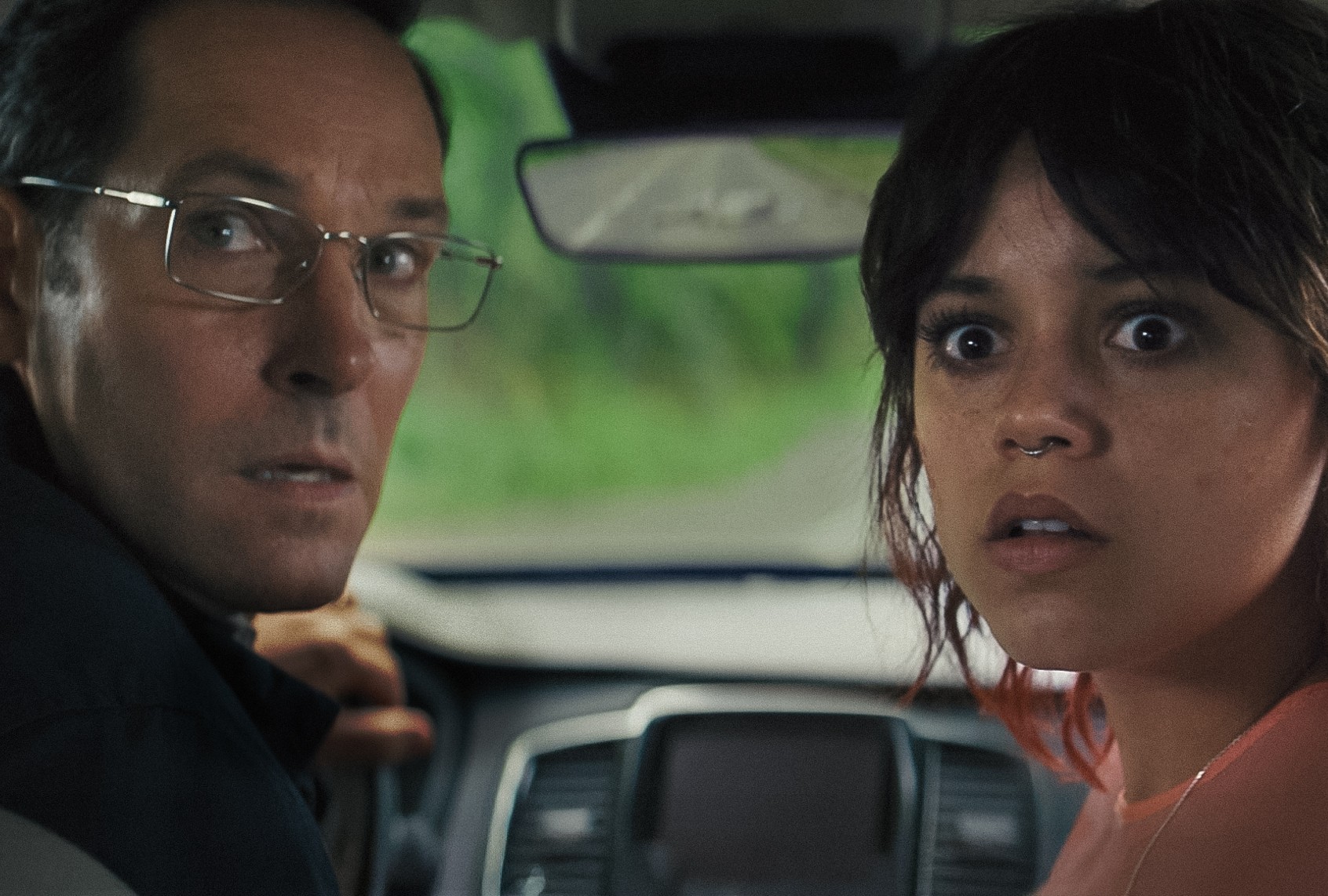
(L-R) Paul Rudd and Jenna Ortega in "Death of a Unicorn" (A24)
That “Death of Unicorn” opens the exact same way as other films of its ilk do isn’t the greatest vote of confidence for the film as it is. The movie begins with Elliot (Rudd) and Ridley (Ortega) taking a trip to the Leopold Wilderness Reserve, owned and operated by Elliot’s uber-wealthy employers. Perhaps you’ll recognize the familiar sight of middle-class characters wandering into elite circles on an idyllic getaway from films like “The Menu” and “Glass Onion.” The beats that follow aren’t much different, either. The Leopolds are looking to bring Elliot deeper into the fold (read: muck him up in their legal dirty work), and they’ve invited him and his daughter for a business visit — a gesture of goodwill after the relatively recent death of Ridley’s mother, whose memory serves to prop up the film’s flailing narrative. On the way to the Leopold estate, Elliot mows down an animal in the middle of the road. The thing looks suspiciously like a unicorn, horn and all. But there’s no time to waste, so Elliot puts the animal out of its misery with a tire iron and loads it into the trunk of their rental.


Want a daily wrap-up of all the news and commentary Salon has to offer? Subscribe to our morning newsletter, Crash Course.


Amid the ensuing gore, played for cheap chuckles, Ridley is splashed with the unicorn’s purple blood, which clears up her acne and gives Elliot perfect eyesight. Ridley insists that they examine this phenomenon further, but Elliot would prefer to brush it under the rug so as not to worry their hosts. That is, until the creature, whose healing powers work on itself too, comes back to life and starts kicking the hell out of their car. It's a good thing Elliot paid for the damage insurance.

In no time, the Leopolds — ailing father Odell (Richard E. Grant), his wife Belinda (Téa Leoni) and their ambitious son Shepard (Will Poulter) — get wind of what’s going on and devise a plan to use the unicorn’s blood for their monetary gain. If they can harness the creature’s healing properties, no other pharma company could compete with their product. The rich won’t just get richer, they’ll be virtually untouchable. 

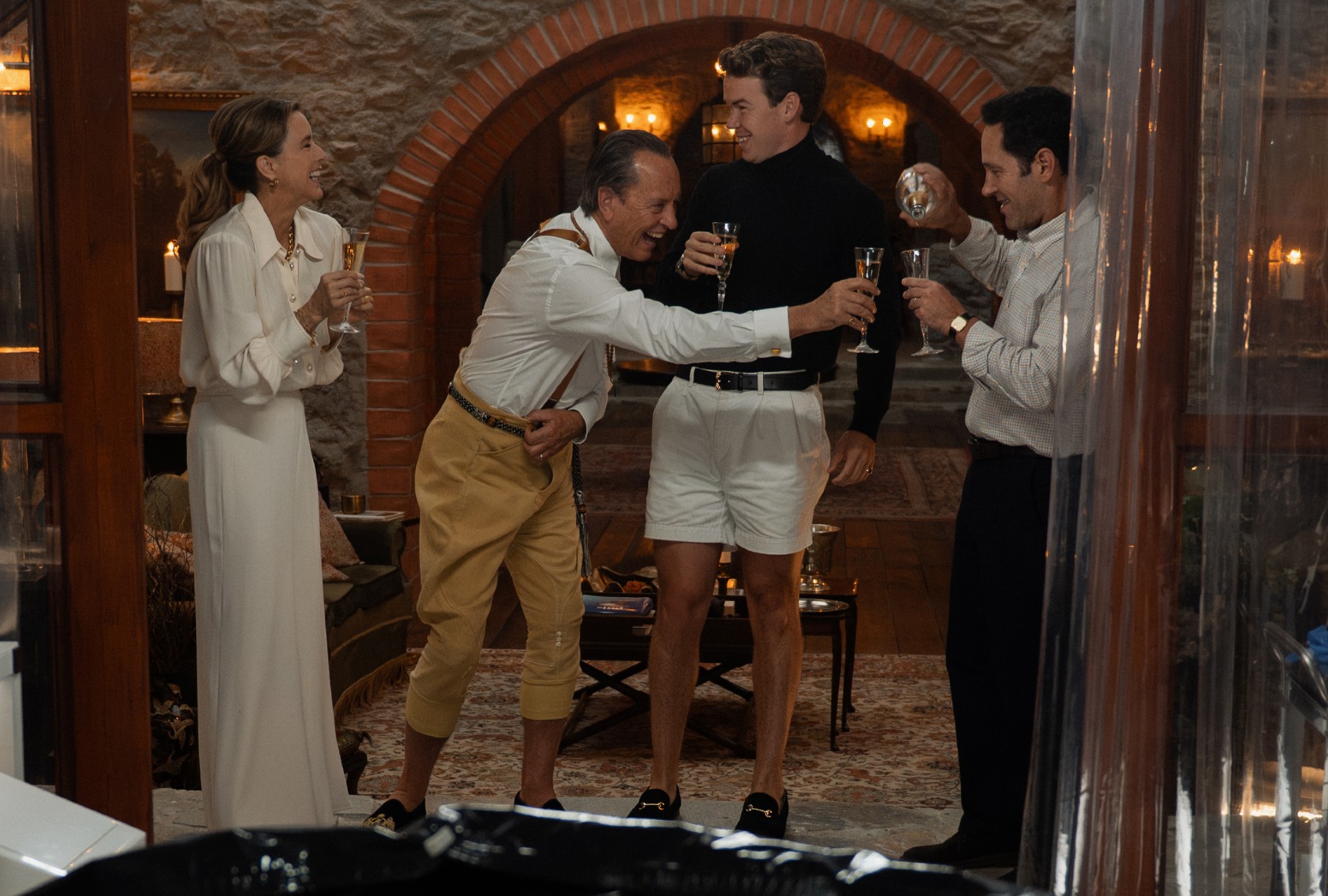
(L-R) Tea Leoni, Richard E Grant, Will Poulter and Paul Rudd in "Death of a Unicorn" (Balazs Goldi)

Unsurprisingly, this does not go as planned. The Leopolds are too blinded by their greed to foresee any potential consequences, and when the unicorns’ parents come in from the hills around their wildlife reserve, the film devolves into a “Jurassic Park”-style bloody disaster. Rudd and Ortega’s characters are so paper-thin that viewers can see right through them, getting a look at what will come next before Elliot and Ridley do. Writer-director Alex Scharfman makes a worthy attempt at sketching the Leopolds as a parodic version of the real-life Sackler family, but never gets close to conjuring their cold-blooded, dark-hearted evil. 

It’s worth noting that Leoni, Grant and Poulter hold the film together with their comedic turns; Belinda greeting Elliot by getting off the phone and saying, “We’re evacuating the orphans! Or . . . are we vaccinating them?” got a good laugh out of me. But the trio’s talents don’t excuse the fact that Scharfman gives his characters almost nothing to work with. What drives their greed? What’s their long game? We’re never supplied with any semblance of an answer, just expected to take these mere silhouettes of rich people as they are. Maybe it’s a fool’s errand to look for logic in a film about unicorns, but an effective satire demands a realistic, recognizable framework. The film’s actors all come ready to dig into material that isn’t there, tasked with making a meal out of crumbs. As it turns out, these rich are not very filling at all.

Such is not the case for “Common Side Effects,” the invigorating Big Pharma takedown that just finished its 10-episode first season on Adult Swim (and is streaming on Max). Creators Joe Bennett and Steve Hely are so adept at hooking viewers that it’s almost frightening. In the show’s first five minutes, Bennett, Hely and co-writer Jon Foor present a perfectly succinct vision. Frances (Emily Pendergast), the assistant to a high-powered pharmaceutical rep, reconnects with Marshall (Dave King), a former classmate who tells her about an all-healing mushroom so powerful it can bring the dead back to life. Frances is shocked when Marshall uses the mushroom to revive a dead pigeon and takes him up on his offer to help grow and spread the mushroom, deciding to keep her job a secret from Marshall — at least for now.

Before the opening theme even begins, “Common Side Effects” establishes its characters, stakes, humor style and the bevy of potential narratives it can work through. And the series makes good on each and every one of those promises throughout its first season. It’s a gripping saga that consistently makes unexpected turns to keep the viewer held by their collar, eyes wide, waiting to see what will happen to Marshall, Frances and their precious mushroom next.

 Common Side EffectsCommon Side Effects (Adult Swim/Warner Bros.)

And it’s that beautifully animated, glowing blue fungi that tie the show together. Unlike “Death of a Unicorn,” Bennett and Hely are far more interested in the effects and ramifications of the mushroom than they are in satirizing the rich who will inevitably be in pursuit of its power. They’re confident that the humor will emerge naturally as they move deeper into this story. “Death of a Unicorn” is so certain that its audience will care more about the paltry laughs it can draw out of its Sackler spoofs that the finished film feels altogether smug. Watching it is like seeing a waiter skip over with a covered silver platter, only to remove the top to reveal a watered-down, Cocomelon-level satire for iPad babies, dripping from the dish. Maybe the drivel would sate you for an hour, but something with genuine substance would taste and feel a whole lot better in the long run.

The “Common Side Effects” writers go to admirable lengths to explain why a cure-all mushroom could be hazardous; violence would soar, the medicine could fall into the wrong hands, evildoers would never die. But do those possibilities negate the benevolence of trying to get the mushroom to people who need it, those who don’t deserve to suffer the ravages of disease? 

That’s precisely what “Common Side Effects” is so adept at doing. Across its first 10 episodes, the show builds on itself for an endlessly satisfying watch experience. It’s not a means to an end but rather a journey that feels gratifying from start to finish. Unlike most post-“Parasite” satires, “Common Side Effects” encourages its viewers to think about its themes in new and mystifying ways. It does not present two sides of a conversation — the good and bad — but rather a variety of nuanced perspectives, cleverly explored through all of the possible figures that might have some interest in the mushroom and its powers. There’s the FBI, corrupt politicians, money-hungry pharma reps, the sick and the terminally ailing, drug addicts — anyone who might want to use the mushroom for any purpose. And instead of simply presenting these characters to an audience, as “Death of a Unicorn” does, the series scrutinizes them. What makes them tick, and can even the seemingly immoral be changed for the good? 

“Common Side Effects” is only just beginning to answer these questions, and luckily, the show has been picked up for a second season. But the show isn’t exactly seeking firm answers. Rather, it’s keen on probing our sick and broken world to reveal all of the hope that still exists in the shadows. This is not your average “eat the rich” farce. The series’ writers go to admirable lengths to explain why a cure-all mushroom could be potentially hazardous to our world. Yes, it could make pharmaceutical companies and their top staffers an enormous amount of cash. It could also divide society, creating a demand so intense that the supply could never match it. Violence would soar, the medicine could fall into the wrong hands, oligarchs and evildoers would never die. But do those possibilities negate the benevolence of trying to get the mushroom to people who need it, those who don’t deserve to suffer the ravages of disease? 

When “Common Side Effects” explores this further, analyzing the mushroom’s effects on Frances’ mother, who has dementia, the series strikes a stunning emotional core. I couldn’t help but think of that plotline while watching “Death of a Unicorn,” where Ridley’s anger at the healthcare and pharma industries that had a hand in her mother’s untimely death is shuffled to the background, so far from the main storyline you might just miss it. What’s left instead? Tiresome, gory unicorn revenge catering to the stoner crowd? “Death of a Unicorn” is content to be nothing more than a survey of a world divided, played for laughs as the cosmos burns. “Common Side Effects,” on the other hand, offers a hopeful fire extinguisher. It’s legitimately heartening, as timely as it is eternal. That’s precisely what a satire should be, and what the starved public needs. After so many years of eating the rich, the taste has grown bland. We’ve needed some glowing, blue fungi to spice things up.

Russell Brand charged with multiple counts of rape and sexual assault in UK

Prosecutors in the United Kingdom charged actor Russell Brand with multiple counts of rape and sexual assault on Friday, nearly two years after multiple women accused Brand of assault, rape and abuse spanning nearly a decade.

The actor, who has turned to conspiracy theories against “globalization” to wave off the allegations in the past, will face a first hearing next month, officials say.

“We carefully reviewed the evidence after a police investigation into allegations made following the broadcast of a Channel 4, Sunday Times and Times investigation in September 2023,” Crown Prosecutor Jaswant Narwal said in a statement. “We have concluded that Russell Brand should be charged with offenses including rape, sexual assault and indecent assault.”

Brand faced career backlash in 2023 after four people, including a woman who was 16 at the time of the alleged assault, spoke out about alleged misconduct. The offenses named in the charging statement occurred between 1999 and 2005, prosecutors said, not the allegations of abuse from 2006 and 2013 that were reported by the Sunday Times, the Times and Channel 4 Dispatches.

Brand denied those allegations and maintained they were part of a coordinated smear campaign against him in an interview with former Fox News host Tucker Carlson last year. 

“I deny any allegations of the kind that have been advanced – and what I have seen is the significance of family and the importance of beliefs that are transcendent of this, the importance of God,” Brand told Carlson, suggesting there was a deeper conspiracy against him at play. “Unless you're willing to be a participant in these systems of compliance and distraction then you pose some kind of evident threat.”

Law enforcement noted that the investigation “remains open” and urged any other alleged victims to come forward.

Costco is no longer offering its weight loss management program at a discounted rate

Last April, Costco made headlines when it introduced its brand-new weight loss program, which was launched in partnership with the online telemedicine platform Sesame. Costco members who signed up through the Sesame marketplace could access a three-month subscription at the discounted price of $179 (or $60 per month). The subscription also offered patients individualized clinical consultations, weight loss prescriptions (including GLP-1 medications like Ozempic and Wegovy) and nutritional guides and recommendations.

“We are witnessing important innovations in medically supervised weight loss,” said David Goldhill, Sesame‘s co-founder and CEO, in a 2024 press release. “Sesame’s unique model allows us not only to make high-quality specialty care like weight loss much more accessible and affordable, but also to empower clinicians to create care plans that are specific to — and appropriate for — each individual patient.”

On August 26, 2024, though, Sesame shuttered its discounted weight loss program, saying it will no longer accept new enrollments. “Existing enrollees will be able to continue their membership with no changes to their benefits,” the platform said on its company website.

Costco members can still receive weight loss management assistance through Sesame, although with no discount. Sesame offers two plans for patients with or without insurance. For patients with insurance, Sesame’s Success by Sesame $89/month option offers assistance with insurance paperwork to reduce the cost of medication. The plan also doesn’t include medication cost in the final pricing and instead allows patients to pick up their medication prescription at the pharmacy or choose home-delivery options.

For patients who don't have insurance, Sesame offers a $249/month option, which includes four pre-measured injectable syringes of compounded semaglutide per month, along with medication supplied from a registered 503B pharmacy.

According to Sesame, its $249/month plan is the cheapest option compared to hims/hers' plan (which starts at $399/month) and Ro's (which starts at $444/month).

“Female Invest” app lands in the US at a “time of crisis” for American women

Nearly a decade ago, 22-year-old Anna-Sophie Hartvigsen realized that she didn’t know that much about investing and women around her didn’t either. So she started a Facebook group called “Female Invest.”

Around 400 women joined on the first day. Hartvigsen saw that the problem and the thirst for investing knowledge and a supportive community was much bigger than just her and her group of friends.

Since then, that Facebook page she opened in Denmark evolved into a non-profit, then a global fintech company called Female Invest with $24 million in venture capital raised to date, including some from U.S. investors like Y Combinator and Green Visor Venture Capital.

After reaching 100,000 paying users, the company entered the U.S. market earlier this year, focusing on financial education in 2025 with plans to introduce financial instruments to U.S. users next year. 

We need your help to stay independent

The timing of their U.S. expansion is especially notable as established platforms like Ellevest are scaling back their focus on everyday investors with a few hundred bucks to play with to only focus on affluent clients–a reflection of growth challenges faced by financial advisors when managing small portfolios.

With its mission to educate and engage more women, Female Invest often draws comparisons with Ellevest. The firm was founded in 2014 by financial feminism pioneer Sallie Krawcheck, the former CEO of Merrill Lynch Wealth Management, one of the largest wealth management businesses globally. 

In February, Ellevest announced a deal with Betterment, in which it sold its automated accounts and will instead focus on “high and ultra high net worth individuals, families, and institutions looking to invest $500,000 or more” going forward.

Hartvigsen rejects comparison with Ellevest or Betterment, saying they have a “very different target group.” While Ellevest is now focused on high-net-worth clients, Female Invest is interested in potential investors who’ve been sitting on the sidelines while companies like Robinhood and Revolut mainly appeal to male investors or active traders, according to Hartvigsen.

Speaking with a hint of a European accent and resounding optimism about the future, Hartvigsen doesn’t seem deterred by the US competitive landscape or political headwinds.

“Women in the U.S. are going through an incredibly dangerous time,” says Hartvigsen, who is now based in London, noting that it’s more important than ever for women to think about investing on a regular basis.

Under the Trump administration, some financial experts have already raised concerns about potential economic hardships and threats across various aspects of their lives, including employer protections, access to healthcare, reproductive rights and educational opportunities, which can impact their long-term financial health and ability to save and invest. This is especially true for underrepresented fields like STEM.

“Now that the DEI programs are being taken away, we’re not looking to fill those positions with women anymore, so that could really cause some economic devastation for a lot of women,” says Pattie Ehsaei, a lawyer and financial literacy advocate. “And that also has a snowball effect, because if you lose your job, you’re not going to be able to get another job, because those programs don’t exist anymore to promote the hiring of women, and then women fall into poverty.”

Online, their feminist message and financial education content have resonated with over half a million Instagram followers, even as many American corporations dismantle many DEI initiatives and social media messaging. 

“Any company that can abolish their DEI initiatives never had equal opportunities anyways,” Hartvigsen said. “If they had, it would be impossible to roll back. For example, imagine if companies tried to roll back white male leadership. Impossible.”

Financial education more important than ever

Female Invest also has big plans for diving deeper into fintech. Next year, they’re planning to launch a trading platform catering to women.

“So many women getting started aren’t really on any trading platforms that are built by and for women, so as a result women just don’t engage with them,” she says.

They’re also looking to customize and retain a lot of values that are important to women investors and others who choose to use their app for investing.

“So you can choose things that matter to you, diversity and leadership or carbon footprint to show you how your portfolio aligns with the values, or what alternatives there could be,” Hartvigsen said. “Because that’s something our audience really cares about.”

Despite the tariffs drama, economic uncertainty and political standoff, the co-founder of Female Invest thinks it’s more important than ever for women to think about investing on a regular basis, along with regular budgeting and personal finance best practices.

“Financial education is even more important during times of crisis,” Hartvigsen says. “Even though it feels unprecedented, what’s happening right now when we look at history, it’s actually not unprecedented. So we talk about what we can learn from history, but we also talk about not just investing, but also from a personal finance perspective, how to think about money in different situations.”  

“Last thing we need”: GOP panic grows as Trump team can’t get its story straight on tariffs

Republican lawmakers are seriously worried about President Donald Trump’s far-reaching and market-rattling plan to impose tariffs between 10 and 50 percent on all U.S. imports.

Amid a bloodbath on Wall Street, GOP members of Congress worried the cost increases levied on many goods could come back to bite them in future races.

Former Senate Majority Leader Mitch McConnell, R-Ky., historically one of President Trump’s biggest enablers despite the animosity between them, called the scheme a “tax on everyday working Americans” on Thursday.

“As I have always warned, tariffs are bad policy, and trade wars with our partners hurt working people most,” McConnell said on social media. “Goods made in America will be more expensive to manufacture and, ultimately, for consumers to purchase, with higher broad-based tariffs. At a time when Americans are tightening their belts, we would do well to avoid policies that heap on the pain.”

McConnell, one of four GOP Senators to join with Democrats to vote against tariffs on Canada earlier this week, also worried that tariffs on American allies would hurt the country’s interests, adding that “the last thing we need is to pick fights with the very friends with whom we should be working with to protect against China’s predatory and unfair trade practices.”

Sen. Jerry Moran, R-Kan., agreed, saying his constituents favor a more targeted, gradual approach to balancing trade.

“The idea of a tariff to equal the stage has some merit and some support. But I think most Kansans would say, ‘let’s do this in a more gradual way,’” Moran told The Hill. “Most Kansans, including agriculture, which is so affected, I think they were expecting something less dramatic.” 

Kansas farmers and Wall Street traders alike seemed to be spooked by the massive and seemingly arbitrary list of tariff rates revealed Tuesday, with the Dow Jones Industrial Average experiencing its largest one-day drop since March 2020 the next day. 

Beyond the stock market shock, public opinion is souring on what former Vice President Mike Pence called the “largest peacetime tax hike in U.S. history” in a Wednesday post to X.

A Reuters/Ipsos poll earlier this week found that 53% of Americans believed tariffs would do more harm than good, with seven in 10 acknowledging the duties would hike prices domestically.

We need your help to stay independent

“Liberation Day,” which plunged the Nasdaq by 6% on Thursday, has been met with bipartisan condemnation. Some Republicans are even trying to take the power to put duties on trade back from the executive branch. Sen. Chuck Grassley, R-Iowa, introduced a bipartisan bill on Thursday to put some guardrails on Trump’s ability to levy tariffs, including requiring the president to get Congressional approval within 60 days on new tariffs.

Even Republicans who aren’t quite ready to restrain Trump’s tariff power are admitting that he may have taken it too far. Sen. John Kennedy, R-La. – who voted down the measure on reversing Canada duties – told CNN that the president’s calculation that tariffs would shift manufacturing back in the long run wasn’t a safe bet.

“In the long run, he’s right. But in the long run, we’re all dead,” Kennedy told Newsmax on Wednesday. “Nobody knows the impact of these tariffs. We're just going to have to wait and see.”

And inside the Trump White House, nobody can seem to get the story straight. As the Washington Post’s Jeff Stein flagged on Thursday, Commerce Secretary Howard Lutnick, Counsellor to the President Peter Navarro and Trump himself gave three contradictory answers in just a few hours on Thursday on whether the manufactured trade war was a ploy for leverage or a bid to liberate America from foreign trade forever.

All within a few hours –> Howard Lutnick: “I don’t think there’s any chance Trump is going to back off his tariff" Peter Navarro: “This is not a negotiation" Donald Trump: "The tariffs give us great power to negotiate. They always have.”

— Jeff Stein (@jeffstein.bsky.social) April 3, 2025 at 5:46 PM

That uncertainty is giving even the most loyal MAGA-worlders on Capitol Hill some pause. Sen. Ted Cruz, R-Texas, told Fox Business’s Larry Kudlow on Thursday that “high tariffs in perpetuity” could spell disaster. 

“If the result is our trading partners jack up their tariffs… I don’t think that would be good economic policy. I am not a fan of tariffs,” Cruz told Kudlow. “Tariffs are a tax on consumers, and I'm not a fan of jacking up taxes on American consumers. So my hope is that these tariffs are short-lived.”

Still, as Democrats attempt to force votes in each chamber to review the emergency declarations the Trump administration issued on Tuesday to gain authority to impose the tariffs, few Republicans have signaled whether they are ready to openly defy President Trump's tariff plan. 

Inside John Lennon and Yoko Ono’s fight for change: “One to One” unveils new truths

"One to One: John & Yoko" is one of the finest additions to The Beatles’ metaverse in years. Directed by Kevin Macdonald and Sam Rice-Edwards, the documentary traces the evolution of the Lennons’ August 1972 "One to One" benefit concerts at New York City’s Madison Square Garden. In so doing, Macdonald and Rice-Edwards explore the roots of John and Yoko’s 1970s-era activism in exquisite detail.

"One to One" begins some 18 months before the concerts as John and Yoko settle in New York City. For the Lennons, making a new life in the United States was rife with opportunity for continuing the social activism that they had begun with their notorious bed-ins and “Give Peace a Chance.” For John, establishing himself in New York City had been long overdue. “If I’d lived in Roman times, I’d have lived in Rome. Where else? Today, America is the Roman Empire, and New York is Rome itself.”

Not surprisingly, John and Yoko quickly ensconce themselves among the nation’s glitterati, making vital connections with the likes of "yippie" founder Jerry Rubin, Black Panther Bobby Seale and poet Allen Ginsberg. For the Lennons, the peace movement that flourished in the 1960s has all but evaporated in the new decade. Working with the Rock Liberation Front offers the only clear means for effecting change. “Flower power is over,” Yoko laments. To John’s mind, there is a new urgency in the air. “Young people are apathetic,” he cautions. “They think there is nothing worthwhile to do, and everything is finished. They want to take refuge in drugs to destroy themselves. Our work is to tell them that there is still hope and still a lot to do. The revolution has only just begun.”

For all of the Lennons’ optimism and encouragement, "One to One" makes it indubitably clear that dark clouds are on the couple’s horizon. For one thing, there is the lingering resentment towards Yoko among music lovers and the counterculture alike. “I was considered a b***h in this society,” she remarks. But “since I met John, I was upgraded into a witch.” Worse yet, President Richard M. Nixon included Lennon on his infamous enemies list. Recognizing that the federal government is actively surveilling his every move, John begins recording his telephone conversations.

Yoko Ono and John Lennon in "One to One" (Courtesy of Magnolia Pictures)In an absolute masterstroke, Macdonald and Rice-Edwards take full advantage of these previously unheard recordings, deploying them as a narrative tool that not only advances "One to One"’s storyline, but also serves as a means for understanding the Lennons’ mindset in groundbreaking fashion. The documentary abounds with crisp period footage of John and Yoko in the early 1970s, culminating, of course, with the August 30, 1972, concerts, which were held on behalf of disabled students at Staten Island’s Willowbrook School.
As it happened, the "One to One" event marked the only full-length concerts that Lennon undertook after The Beatles’ final show at San Francisco’s Candlestick Park in August 1966. Visually, Macdonald and Rice-Edwards bring the Madison Square Garden concerts vividly to life, taking special pains to ensure that Phil Spector’s original recordings are reproduced with the highest possible fidelity. Produced by Sean Ono Lennon and mixed and re-engineered from the original multitrack tapes by Paul Hicks and Sam Gannon, the audio from the "One to One" concerts has simply never sounded better. Released as part of Record Store Day 2025, a special EP from the concerts will feature three unreleased performances in John’s “Well Well Well” and “Cold Turkey,” as well as Yoko’s “Don’t Worry Kyoko (Mummy’s Only Looking for a Hand in the Snow.”


Want a daily wrap-up of all the news and commentary Salon has to offer? Subscribe to our morning newsletter, Crash Course.


But as breathtaking as "One to One" proves to be as a documentary experience—and there are few better when it comes to Lennon and The Beatles—the real message is unmistakable: in a world that challenges our values at every turn, that attempts to drain our efforts to be ineluctably human and serve our fellow citizens, apathy can never be allowed to win out. When it comes to fighting inertia and dreaming of a better life for everyone regardless of race or station, John and Yoko have very genuine peers. 

"One to One: John & Yoko" will see an April 11 release date in IMAX theaters, as well as plans for streaming releases later in 2025. 

Trump’s tariffs regime aims for much worse than a global trade war

Everyone knew that President Trump was going to pull the trigger on his big tariff policy on Wednesday, but he actually dropped a nuclear bomb. He put a 10% tariff on nearly every country in the world and added even more on a number of them based upon a goofy formula that reflected false assumptions at best or Trump's personal whims at worst. It sent shock waves across the globe, with the markets taking a massive tumble and economic forecasters scrambling to revise upwards their predictions for a recession. Let's just say it was not well received.

Everyone knew something was coming, but no one expected his plan to be so random and incoherent. The fact that it included tariffs on uninhabited islands and territories that are essentially U.S. military bases just proved that it was sloppily put together, likely by AI, and hadn't been vetted by anyone who knew what they were talking about. It is a radical reordering of the global trading system by a president who is clueless about how any of this works.

"America First" never meant isolationism to Donald Trump. It meant "America Above All."

The big question hovering over all these tariffs, starting with Mexico and Canada and now the rest of the world, is what Donald Trump really wants. It's not been entirely clear. He claims that Canada must stop the flow of fentanyl into our country in order to get their tariffs lifted, but there is no flow of fentanyl. He wants Mexico to stop immigrants from coming over the border and likewise stop fentanyl from coming into the country, and they've done everything asked of them to make that happen. It didn't matter.

Canada has come to believe that Trump is actually serious about wanting to annex their country and is intent upon collapsing their economy in order to make that happen. Mexico almost certainly understands that Trump is readying a military incursion of some kind, ostensibly to "take out" the drug cartels. Neither of those things has anything to do with trade. In fact, Trump himself negotiated the USMCA trade agreement just seven years ago between the three countries, calling it "the largest, fairest, most balanced, and modern trade agreement ever achieved. There's never been anything like it." This is something else entirely.

But what about all these other countries? What does he want from them? He doesn't believe in the idea that has organized global trading for almost a century now, which Amanda Taub of the New York Times defined as, "the 'positive-sum' game:  a collection of overlapping systems that benefit all who participate in them, even if the costs and benefits of participation aren’t distributed equally." Or as we might call it, "win-win." That is anathema to Donald Trump. To him, all of life is zero-sum.

So this isn't really about "trade" at least as it's commonly defined, as we can see with his behavior toward Mexico and Canada. This isn't really a trade war. It's a shake down. Trump simply sees tariffs as a weapon to be used to force the rest of the world to America's will.

Trump has been on this crusade since the 1980s, when he saw Japanese businessmen buying up U.S. properties and getting rich selling their cars to Americans eager to buy them. According to Barbara Res, a former executive vice president of the Trump Organization, "he had a tremendous resentment for Japan" and was jealous that they were considered business geniuses. He felt they were "taking advantage" of the United States by not paying for their defense and should be "taxed" accordingly.

He took out an ad in the New York Times back in 1987, expressing all of this in no uncertain terms, and has not changed his rhetoric at all except to add more countries to his list of grievances. He came to believe that tariffs were the tool you could use to force these nations to pay for their security.

He was uninterested, or perhaps unable to understand, the reason why America had been the "free world's" security guarantor during the Cold War and almost certainly failed to grasp the complexities of the nuclear age. During the 2016 election, he had no idea what the nuclear triad was in one of the presidential debates, and once said, "Let it be an arms race. We will outmatch them at every pass and outlast them all." (In the years since, he has pretended to fret about nuclear arms even as he was telling his military leaders he wanted to build back the nuclear arsenal to what it was at the height of the Cold War.) His erratic and provocative behavior since he took office the second time has now raised the spectre of a new nuclear arms race.

We need your help to stay independent

His belief that the allies should be paying America for their defense has now evolved into a full-fledged protection racket in which he is using these tariffs to say "nice little country you have here, be a shame if anything happened to it." Last night, on Air Force One, as he was jetting off to attend a golf tournament at his club in Florida (sponsored by his partners and for which he receives a cut of the profits), he told the press corps:

Every country is calling us. That’s the beauty of what we do. We put ourselves in the driver’s seat. If we would have asked these countries to do us a favor, they would have said no. Now they will do anything for us. The tariffs give us great power to negotiate. They always have.”

Note that he used the words "do us a favor," the same words he used to shake down Volodymyr Zelensky in the "perfect phone call" that got him impeached the first time. He's not negotiating. He's extorting.

We don't know what he specifically wants from all these countries. I would assume that some of them will gain his favor with elaborate obsequiousness and flamboyant flattery. Others may have to offer up something a bit more material, perhaps a nice gift of some sort. And he will punish others, particularly those he sees as having been disloyal. In other words, he's going to treat the world as if it's the Republican Party, under his thumb and answering to his whim.

It's possible that he will be able to coerce some companies to move their manufacturing to the U.S. (or at least make an announcement to that effect, which is what he really wants.) But it's unlikely that he'll ever take tariffs off the table regardless of whatever "deal" is made. Why would he? If they get him what he wants, he'll use them over and over again.

He has gotten away with everything in his life, and his belief in his own power is limitless. It sounds crazy to say it, but it's true — Donald Trump is trying to dominate the world. As I have said many times, "America First" never meant isolationism to Donald Trump. It meant "America Above All." And yes, it does sound better in the original German.

“Girls Gone Bible”: Spicy Christian podcast sells young women on MAGA. Will scandal hurt or help?

"We look for confidence in our achievements, our appearance, our accomplishments," intoned the perfectly coiffed and made-up Angela Halili on a recent episode of the "Girls Gone Bible" podcast. But "godly confidence," she continued, "has nothing to do with your external circumstance." Her co-host, Arielle Reitsma, also in heavy makeup and with equally perfect hair, chimed in with an occasional "yeah" as Halili continued: "It's about finding confidence that's rooted in your identity in Jesus and trusting God that he has a purpose and plan for your life." 

Fans of "Girls Gone Bible" swooned in the comments on YouTube over Halili and Reitsma's professions of Christian humility. But there's no denying that this explosively popular podcast has also produced worldly accomplishments for its hosts. "Girls Gone Bible" has only existed for two years, but it's been a huge success. Their YouTube channel has more than 730,000 subscribers and nearly a million Instagram followers. Their show sits at the top of Spotify's podcast charts in the Religion & Spirituality category.

Reitsma and Halili, both professed "Jesus freaks," have packed venues with thousands of fans on their national tours, delivering what the hosts call a "ministry" at ticket prices that start around $40 but can be $100 or more. They market "GGB+" subscriptions to their young female fanbase for $7 a month. The two women frequently appear on Fox News. They gave the invocation at a Donald Trump "victory" rally in January, making news by conflating Trump with God himself and using ominous language: "I pray that a holy fire will rain down" on Trump's opponents, they said, and that "no weapon formed against him will prosper."

Halili and Reitsma look nothing like stereotypical church ladies, to put it mildly. They look like sexy young actresses on the outer fringes of Hollywood, which is what they are: According to IMDB, their movie roles include the horror movie victim in "Spin the Bottle" and the "slutty girl" in "Rock of Ages." This incongruity between cosmopolitan appearance and fundamentalist message is central to their popularity.

Whether or not this is entirely strategic, "Girls Gone Bible" and other female-centric, Christian-themed podcasts can be understood as parallel to the better-known "manfluencer" content of Andrew Tate, Jordan Peterson and others. Although their content manifests first and foremost as lifestyle advice on dating, working out and fashion, for example, those influencers are perceived as driving younger men into the misogynistic far right and the MAGA movement, and may have been a decisive factor in the 2024 presidential election. Halili and Reitsma are offering a sense of community and religious fellowship to younger women who want to be seen as feminine, fashionable and sexually attractive. But the political and cultural ramifications of their messaging, which includes urging young women to accept a "submissive" role in marriage and overt support for the Trump agenda, are impossible to miss.

The political and cultural ramifications of the "Girls Gone Bible" message, which include urging young women to accept a "submissive" role in marriage and overt support for the Trump agenda, are impossible to miss.

Lifestyle and entertainment online shows that are nominally nonpolitical often "bring right-leaning politics to their trusted audiences," said Kayla Gogarty, research director for Media Matters. She authored a recent report that suggests this strategy has helped the far right capture larger audiences than progressive online creators, "seeping into nonpolitical spaces and exploiting algorithms that could bring users from lifestyle content to pro-MAGA, manosphere and other right-wing content."  

"The religious right has reached young men through new media with incredible success, but has largely struggled to reach young women," added Taylor Leigh, a former evangelical who hosts the Antibot YouTube channel, which analyzes and criticizes evangelical culture. It's clear that "Girls Gone Bible" is an attempt to change that.

What Halili and Reitsma are selling is a "mix between the Hawk Tuah Girl and the prosperity gospel," according to religion professor Bradley Onishi, host of the "Spirit and Power" podcast. As counterintuitive as this may seem to outsiders, Onishi said, it's a huge deal in evangelical culture when young people perceived as "fashionable" or "cool" who could be hanging out at "cool clubs or parties" are seen as giving that up and "committing themselves to God." That identity can also make them accessible to more secular users. One former GGB fan, Jennifer Nieman, told Salon that the hosts didn't initially strike her as political at all: They were offering "fun girly time, wrapped in with faith, and they're also beautiful women."


Want more Amanda Marcotte on politics? Subscribe to her newsletter Standing Room Only.


Tia Levings, author of "A Well-Trained Wife: My Escape from Christian Patriarchy," said she sees GGB and similar content as "definitely a pipeline to MAGA, a funnel to Christian nationalism." While the online far right targets married women with content about health nutrition and parenting, she said, GGB appeals to "a bevy of Kardashian and Sephora-addicted Gen Z young women who want to be rich, famous and in love." 

Like their male counterparts in online Christian discourse, Halili and Reitsma don't seem much interested in Christian doctrines about feeding the poor, healing the sick or welcoming the stranger. Theirs is a post-Oprah self-help Christianity, with podcast episodes about dating, mental health, addiction and the struggles of adolescence. Rather than connecting audiences with experts on such topics, however, they present evangelical-style faith as something close to a cure-all. "We found Jesus because of mental health issues," Halili explained in a 2024 episode, describing their podcast as a "healing ministry" that deploys the "authority of Jesus" as "the power to heal ourselves, to heal others," in the "same spirit that raised Jesus from the dead."

The hosts of "Girls Gone Bible" frequently speak about "staying pure," telling their followers that sex before marriage "ruins lives" and that "modesty is very important" if women wish to avoid appearing "promiscuous." So it was something of a branding problem when a video appeared on the internet earlier this year showing Halili on all fours wearing a minidress, while several other scantily-clad women dance around her, giggling. "I don't do this type of stuff anymore," says Halili. "I have a religious podcast!"

That video circulated rapidly on TikTok and other social media, leading to rumors and allegations that Halili and Reitsma had behaved abusively to fans who had trusted in them as "ministers." (Neither woman has any formal religious education or training in Christian ministry.) While they have frequently suggested they were both less than "pure" in the past — narratives of redemption and salvation are central to Christian faith, after all — the details were left vague. As the online rumors escalated, "Girls Gone Bible" devoted its March 21 podcast to addressing the controversy.

The episode was entitled "Past & Shame," and Halili promised "true raw transparency" that would add "clarity to the context and timeline" of the leaked video. It had been shot, she said, "before 'Girls Gone Bible' was even created." They were only in "talks" about creating a podcast at the time, she insisted, and her mock-protest seen in the video was "a joke that is just, like, ridiculous." Her behavior on camera was "provocative and, like, lusty," she admitted, but she said she was "not drunk, not high, not on anything" when it was filmed. She did not address any of the other online accusations or claims directed at either woman.

Comments below the video were largely supportive: "Your past does not define who you are," wrote one fan, a core American precept if ever there was one. Indeed, Reitsma and Halili have long portrayed themselves as reformed party girls, as already mentioned. Halili has said she is a recovered alcoholic, nearly six years sober.

Their stories about the past have never been specific, although the general outlines are clear enough: They went to nightclubs, they dated numerous men, they had sex without the benefit of matrimony. All of which sounds entirely normal and relatable, but is sufficient to provide a "redemption" narrative for Christian magazines like Relevant, without seeming remotely scandalous or unusual. "Past & Shame" appeared to fit neatly into that narrative. But questions about Reitsma and Halili's past, and exactly how their podcast was created and constructed, have not gone away.

A poker girl speaks out

Nicole Aldrete, who shared numerous text messages, photos and videos to Salon to establish her former friendship with Halili, suggests that the narrative behind "Girls Gone Bible" is largely untrue. Aldrete is a former "poker girl," the term used to describe young women — often unemployed or underemployed actresses — who work at underground poker games in Los Angeles, sometimes frequented by wealthy and influential men in Hollywood and related businesses. This is closer to the world depicted in the Oscar-winning movie "Anora" — which portrays the intersection of rich, criminal-adjacent men and strip clubs — than to a low-stakes basement poker game among friends. Glimpses of these games occasionally surface in local L.A. media, largely because of violence resulting from feuds between rival game operators. 

Poker girls are officially described as waitresses, and are hired along with other staff like bartenders, chefs and parking valets to work at poker parties in private homes. They dress in sexy outfits and are expected to drink and flirt with male customers in exchange for generous tips. They are not sex workers and their jobs are entirely legal, but Aldrete said that poker girls sometimes form "sugar" relationships with affluent players, exchanging their companionship for financial support.  

Young women in L.A. who "work poker behind the scenes" generally "don't talk about it," Aldrete said. "It's very taboo." Game operators can find a steady supply of labor in a city famously thick with struggling actresses and models. The work is "really draining," Aldrete added. "You have to put up with a lot from these men." The poker girls are expected to be "pretty accessories," and are often pressured to drink heavily and sometimes to use illegal drugs like ketamine or cocaine. She showed Salon photos and videos of poker girls doing their makeup in luxurious bedrooms of mansions, or partying aboard a yacht. She has signed a non-disclosure agreement and could not share specific names and addresses, but said: "I experienced a lot of crazy things and saw a lot of crazy things."

According to Aldrete, the now-viral video of Halili was shot at the end of such a poker party, likely around 3 or 4 in the morning. She says she met both Reitsma and Halili when all three were working as poker girls, and that the hosts of "Girls Gone Bible" were still working parties as they posted early episodes.

The video copy shared with Salon seems to corroborate this, since the date on the copy given to Salon indicates it was shot on the morning of April 13, 2023, exactly a week before Reitsma and Halili filed paperwork for the LLC that produces "Girls Gone Bible." The address given on the paperwork also appears in a text message from Halili to Aldrete, inviting her to a get-together. As many online observers have noted, Halili appears to be wearing the same outfit and makeup in the leaked video as she did in the first episode of "Girls Gone Bible," posted on May 10, 2023. 

Nicole Aldrete says she met the future hosts of "Girls Gone Bible" when all three were working as poker girls, and that they were still working parties as they posted the podcast's early episodes.

Text messages Aldrete shared with Salon seemed to confirm her story of a brief but intense friendship with Halili that began in late 2022. "We just started talking about how we're both Christian, how we both believe in Jesus and our love for Jesus," Aldrete said. The women bonded over their shared feelings about working in a "dark industry," which they felt was necessary because they were "struggling economically."

Soon after that, she said, the two began attending church services together — and also working poker parties together. Aldrete provided photos of herself with Halili and screenshots of text messages in which the two women talk both Christ and poker. In one text message from January 2023, Aldrete asks, "Babe did you get paid from the game on the 10th yet?" Halili replies, "No babe wtf. Idk why." In a text from May 2023, after the launch of "Girls Gone Bible," — Aldrete asks Halili, "Did you work last night?" She was concerned about a shooting and a car fire, covered in local media. Halili replies, "Yes babe." 

Their friendship lasted for several months after the launch of "Girls Gone Bible," but as the podcast began to take off, Aldrete said, Halili pulled away. Their last text exchange was in June 2023, when Aldrete wrote, "I miss my sister in Christ." Halili responded, "I love you more," but said she was "in Vegas tryna werk."

We need your help to stay independent

Nearly a year later, Aldrete said, in May 2024, Halili contacted her "out of nowhere." She texted, called and left a voice message apologizing for abandoning Aldrete, saying, "I had to separate myself from all of this." Aldrete said she believes this outreach was because the now-famous video of Halili on all fours had been posted on Instagram, and Halili was trying to find out who did it. The video didn't make much of a splash at first, but resurfaced again this year, apparently reposted by a former fan who had soured on "Girls Gone Bible." 

Aldrete says she's come forward now "not to shame their past," but because of "the hypocrisy of it all." After the podcast became successful, she said, she and other poker girls she knew "were happy for them." But when Halili and Reitsma "started talking about modesty and not living with your partner before marriage or having sex with your partner before marriage," she began to see them as dishonest. It was just a "cash grab," she said. "They were just doing it to exploit the Christian faith and the people."

Much of the "Girls Gone Bible" brand, Aldrete said, is about "being transparent" and embracing the forgiveness of Jesus Christ. If Halili and Reitsma are sincere, she asks, "why not just admit" the truth about their recent past?

"This isn't your mama's purity culture"

The marketing of "Girls Gone Bible" leans heavily on authenticity. The origin story Halili gave the Christian-themed magazine Relevant for a January profile makes the decision to start the podcast sound impulsive. "We were sitting in my living room, reading the Bible," she said, and spontaneously decided to "hit record and started talking."

That seems implausible based on the first several episodes, which appear professionally produced, with high-quality lighting and sound. It also conflicts with the paper trail, which shows that they incorporated and registered the domain "girlsgonebible.com" a month before the first episode was released. 

This authenticity branding is important to the success of the "Girls Gone Bible" brand, given the Christian right's dim view of female ambition. Halili and Reitsma don't wear aprons or pose with backyard chickens, but their content still belongs to the same social media universe as "tradwife" content and similarly-themed propaganda for womanly submission. Both women are single, but present themselves much like "before" images of the tradwife: a glamorous young woman who will someday be snatched up by a godly provider and find fulfillment as a compliant housewife. 

"I have such a desire, like a true yearning, to be led spiritually. I just want to sit and look up at a man talking to me about theology," Halili said in an episode about being single

Halili and Reitsma don't wear aprons or pose with backyard chickens, but their content still belongs to the same social media universe as "tradwife" podcasts and similar propaganda for womanly submission.

"I believe submission is, like, the highest form of beauty for a woman," Reitsma said in a video defending the fundamentalist teaching of male headship over women. Rather than asking for love or respect from a man, she said, a woman should pray to God and let her husband "come to me in his way." She assured viewers, "There's no way it can fail," because "you're not trying to go head-to-head with each other. There's God in the middle, who works it all out for you guys." 

Levings, the ex-evangelical memoirist, described the GGB aesthetic and affect as "sexy baby voice, high femme, tapping into the current vibe of being positive." It doesn't come across as "too political," she added, but said that after watching episodes of "Girls Gone Bible," her YouTube ads were "filled with tradwife content." 

There's a significant difference between GGB and tradwife content, however. The latter is partly crafted to appeal to men, with its heavily sexualized fantasies of a woman devoted to domestic servitude. Some of it, like the famous Ballerina Farm, also targets married adult women, offering an idyllic fantasy of farm life far removed from the stressors of most women's daily existence. GGB is clearly pitched at young single women, as evidenced by the "sizzle reels" advertising their live shows, which almost exclusively showcase female fans in their teens and early 20s. Levings identified the target demographic as "young people who aren’t interested in their parents’ religion," adding that the ads announce, "This isn’t your mama’s purity culture." 

Jennifer Nieman, the former GGB fan quoted above, has since become something of an anti-GGB influencer in her own right. She claims responsibility for recirculating the video of Halili on all fours, and has collected stories from other former fans and friends who say they've been harmed by the hosts. (Many such allegations can be found on social media, but Salon is not reporting claims that could not be directly sourced.) She first encountered "Girls Gone Bible" at "a low point in my life," after "a really bad break-up," Nieman told Salon. 

Her doubts began, she said, after attending a live "Girls Gone Bible" event in Tampa, Florida. Nieman grew up in the mainline Presbyterian church, and still belongs to a congregation that flies the Pride flag. She wasn't familiar with the charismatic, evangelical world behind the "Girls Gone Bible" version of Christianity and described what she saw in Tampa as "some crazy stuff," such as people crying aloud or praising Jesus in theatrical fashion. But it was after the GGB hosts openly embraced Trump, Nieman said, that she turned against them: "If you have good moral standing, you just do not support someone like Donald Trump." 

Nieman's existing political convictions drove her away from "Girls Gone Bible," but she believes the podcast's power could lead other young women, who haven't thought these issues through as deeply, down a different path. "The rhetoric they're using is super harmful," Nieman said, especially their message to "be brainless and follow men around." She hopes to "encourage other women to rely on themselves and never on a man." The GGB message is disguised as female empowerment, she said, but it "decreases the value of a woman at the end of the day, because I think we're so much more than a wife."

"Angela and Arielle have already hurt many women as they've built their careers," said Leigh, the former evangelical and podcast host. "I worry that many more will be hurt if their stories aren’t brought to light." Many previous televangelists, she noted, "have seen their empires crumble under the weight of allegations of hypocrisy, abuse and especially sexual scandal." The same fate, she suspects, could befall the "Girls Gone Bible" enterprise. 

Salon reached out to Halili and Reitsma, both individually and through the talent agency that represents them, with questions regarding the issues raised by this reporting. They have not responded. 

From the Confederacy to the Gilded Age: Manisha Sinha on the “sorry history” that inspires MAGA

America has always been like this: a place of immense contradiction, promise and disappointment, where noble, progressives ideals are embedded in a founding document written by men who purported to believe that all are created equal, even as most claimed the right to treat other human beings as property and to kill and displace the original tenants of the land. We helped defeat fascism in Europe, Americans can rightly claim; we also helped inspire Europe’s fascists, who looked longingly at the United States’ reactionary tradition of genocide and racial segregation.

Whether the country is good or evil is the wrong debate: like most people, and every other nation on earth, it’s a bit of both. Progress has always come in uneven fits, with hypocrisies galore — killing Nazis while putting Japanese-Americans in concentration camps — and a loud chorus of reactionaries claiming that every step toward fulfilling the promise of equal rights is itself part of the march to tyranny, classically liberal rhetoric perverted to defend white dominion over others as the true definition of freedom.

“It can be a depressing story if you look at the downfall and the kind of backlash and reaction to progressive change,” Manisha Sinha, a history professor at the University of Connecticut, said in an interview, “but it can also be inspiring to think about all the people who fought against injustices and inequality — and ultimately prevailed.”

Sinha merges the depressing and inspiring in her recounting of Reconstruction, when the U.S. emerged from a state of war as a flawed but budding multiracial democracy. Published on the eve of the 2024 election, “The Rise and Fall of the Second American Republican: Reconstruction, 1860-1920,” is more relevant today than its author would likely prefer. It’s not just that the concept of a true democracy for all is under attack, but that those waging the contemporary assault are pointing to this Gilded Age of reaction as their model for everything from tariffs to imperial expansion.

It can be utterly frustrating to read Sinha’s work and see that, while history does not quite repeat, the contemporary fights — over diversity and women’s role in society — sure seem to echo those waged by the liberals and conservatives of yore. But even in America’s darkest times, when its nobler aspirations were scorned in the name of white supremacy, the takeaway is: the seeds of a better tomorrow are being planted by those who refused to give up on this big, frustrating country, and refused to let the other side claim ownership of its history.

“We may be in a moment of backlash and reaction right now, but that doesn't mean that there isn't hope in terms of fighting against that,” Sinha told Salon. “I think American history shows there's always been a contest, even during what one historian called ‘the nadir of American democracy’ and Black freedom in the late 19th century.”

The following interview has been edited for length and clarity.

Are there any lessons you think from the example of the abolitionists or the suffragists that people trying to resist the current backlash could take inspiration from? Do you think they had tactics that could be useful for activists today?

Oh yes, I think there are a lot of sort of legacies and examples that we can invoke and rely on. I really think that sometimes a lot of radical activists do not realize that, in order to achieve their objectives, you have to be able to fight on principle but be pragmatic in building broad coalitions, and that's what the abolitionists did. They were for the immediate abolition of slavery and for Black rights, but they formed alliances with anti-slavery moderates and politicians who didn't want to go beyond the non-expansion of slavery.

But eventually, if you look at what happened before the Civil War and during the Civil War, you go from non-expansion of slavery to abolition — immediate abolition — which was the abolitionist goal, and eventually to Black citizenship, or what was called by W.E.B. Du Bois, “abolition democracy,” right? So if you think about it in that way, you realize that radical social movements should stand on principle even when they're in the minority, but that political change is possible only when you're willing to ally yourself with people who may not be as radical as you, but who are willing to unite with you against a greater threat. Another example from history would be the Popular Front era in the United States in the 1930s, when people on the left and liberals got together to fight fascism and authoritarianism and were successful in doing that. I think that's something that activists today should learn from — and also that, in order to preserve democracy, one should be willing to not just pay the price, but also be willing to evoke ideas that would actually appeal to the broadest group possible.

In a way, abolitionists did that by evoking the U.S. Constitution. They fought over the U.S. Constitution: Is it pro-slavery? Is it anti-slavery? But ultimately, they all wanted to uphold the guarantees of the Bill of Rights and civil liberties and uphold things that people could all agree on; something like our constitutional order, the rule of law. And if you think of many of the battles being waged today — whether it's immigrant rights or Black rights or voter suppression — you could invoke quintessential American values for change. And so I think that's what we should do; I think that's what the abolitionists did; that's what most of the civil rights activists did. You are radical in your belief in inequality, but you are pragmatic in trying to push through political change within our system.

Another group that you deal with extensively in the book — and some of these groups obviously overlap — is the suffragists. Post-Civil War, you discuss how there were certainly what we would call today kind of “intersectional” feminists, like Lucy Parsons, Sojourner Truth and Harriet Tubman. But on the other hand, as you well know, there were the likes of Susan B Anthony, and also some people that seem to have been even more genuinely white supremacist, who made the calculation that, you know what, we have principles too but we need to be pragmatic. And the best way to at least get some woman — white woman — the right to vote is to make an appeal that is specifically towards white people; in other words, selling out everyone who isn’t white in the name of pragmatic, moderate progress.

Do you see any parallels to that kind of debate that the suffragists had amongst themselves and the debate we see now with Democrats who might say, you know, with immigrant rights, trans rights — we don't necessarily oppose them, but the polls for us aren't so great right now, and there are other people that need defending. Do you see a connection between those two different debates?

That's a very good counter-example to what I was saying. I think the point of making coalitions of people who are moderates is, in fact, not to sacrifice your principle; to continue to be the radical Vanguard. And the history of the women's suffrage movement in the United States is illustrative of one thing: that is, at least the [Elizabeth Cady] Stanton/Anthony wing, first during Reconstruction, made expedient compromises because they were so angry at being left out of the Reconstruction amendments that they were willing to form expedient alliances with racist Democrats. Stanton is a bit of an elitist; Anthony actually comes from a more reformist, anti-slavery tradition, but she still makes those expedient compromises, which I think costs the suffrage movement.

By giving up the intersectional vision of the original abolitionist feminists, it leads to a divide in the movement. You get two competing organizations, and women's suffrage is kind of eclipsed for another 50 years. And so even though the 19th Amendment is modeled after the 15th Amendment that gave Black men the right to vote during Reconstruction — that's why I call it the last Reconstruction amendment — it was still passed in the shadow of the defeat of Reconstruction. And as the movement, you know, kind of grew in the shadow of the defeat of Reconstruction, they were willing to do more than make just expedient alliances with Southern white women, compromising on their principles by having segregated meetings, by sidelining Black women suffragists.

I think that is a problem that they bequeath to American feminism, and it's a real problem. Because when the 19th Amendment is passed, even though it has no racial qualification and it inspired some Black women in the South to attempt to vote, it still excluded them, for the most part, because of Black disenfranchisement in the South. So Black women really don't get the right to vote. As to the Voting Rights Act of 1965, I think, if anything, the history of the suffragist movement shows that you can make alliances with people, but you do not compromise on basic human rights.

I think that's something that most Democratic politicians should today understand, because it's easy to demonize and scapegoat a minority that is not liked or not understood by many people, but once you go down that road, it doesn't stop there. And so in this particular case, I would say that sacrifice of principle is something that the abolitionists, for instance, never did. They got into alliances with anti-slavery moderates, but they were like, “No, you may be for non-expansion, but we are still for abolition,” and that's why they are able to eventually push the non-expansionists towards abolition. But the suffragists, we see something different, and for all the compromises they made, they still didn't win the majority of the South because the South did not like the idea of a constitutional amendment or of even a federal law that would give women the right to vote, and they definitely wanted to exclude Black women. So in the end, they sacrificed principle for paltry or nonexistent gains, because most of the states that did not ratify the 19th Amendment were the southern states.

You have said that we are now living through the collapse of the “American Third Republic.” With the caveat that, as you know as a historian, history does not repeat, but there are echoes: Do you see the dominant, MAGA faction in American politics today as the successor to forces like the Know Nothings, the Confederacy and the Redeemers? Is that the same tradition rearing its head again? Or is this a new chapter in American history?

As a historian, I would say that the present and the future will always be informed by the past. And you're right: History does not repeat, but we cannot escape its legacies. Abraham Lincoln said, “Fellow citizens, we cannot escape history” during the Civil War, and he was right. It's not as if it's the same forces or the same people, but I think in the United States, we do have competing traditions of interracial democracy — bequeathed by the abolitionists, by the Civil Rights Movement, by the experiment in interracial democracy in the south during Reconstruction — but we also have a traditional reaction against it, whether it was the pro-slavery, anti-democratic traditions of southern slaveholders. They use “states' rights” to defend slavery and, later on, ex-Confederates use it to defend Jim Crow and disfranchisement.

Those traditions of reactionary authoritarianism are also with us. Even when you know you had the establishment of the New Deal, and after that civil rights, there were a lot of people who were critiquing that. And some of their criticisms sounded familiar to me, because during Reconstruction, a lot of southern elites critiqued the Reconstruction government for establishing a public school system, which they said was a big burden on taxpayers; they had taxpayers’ conventions. They were against big government; against what they saw as federal tyranny. So this kind of anti-government ideology, which was also linked with a sort of racist opposition to Black rights — that little poisonous brew has been in the United States for a long time and it rears up its head in the opposition to the Civil Rights Act of 1964, the Voting Rights Act of 1965 and the rise of modern-day conservatism, which is now kind of devolved into the MAGA movement.

I would say, though, that when the January 6 insurrection took place, there were a lot of historians who were saying, “this is who we are,” and others saying “this is not who we are.” I didn't agree with either side. I mean, I think this is what we should not be; that we've been there in the past, and we made some changes, and we should realize that this is not the way things ought to be and we should continue to contest those.

In terms of MAGA, it seems to me their agenda is quite clear. It's anti-government; Trump — the Trump regime and Trump himself — seems to really admire the era of the downfall of Reconstruction, the Gilded Age; the age of robber barons, of unregulated, rapacious capitalism and open imperialism, when the United States acquired an overseas American empire after the Spanish-Cuban American war of 1898. This was, of course, all in the administration of William McKinley, whom Trump refers to and admires; he wants the mountain in Alaska to be renamed “Mount McKinley.” He was a tariff man, but this is the point when the Republican Party completely ceases being the party of Lincoln and anti-slavery and becomes the party of big business.

But the fact that the MAGA movement actually admires that period in American history, it seems to me that they're looking at it as a model, as a model when there was no government regulation, no worker safety standards. This is before the Progressive Era, and before the New Deal that made for government regulation of the economy and safe labor conditions, minimum wages and things like that; a recognition of unions. It's also the height of social Darwinism and the pseudoscience of race. It's also the height of Lost Cause mythology when the Confederate monuments are put up. The fact that [Defense Secretary Pete] Hegseth renamed Fort Liberty back to Bragg saying, “No, but it's not the Confederate General Bragg but some private corporal we dug up from somewhere else, but we are going back to Bragg" — or that Trump says Confederate statues are beautiful and that we shouldn't get rid of them — shows to me that they seem to recognize the ideological affinities between their own ideas and those of the past. So it's not the same thing, but it is certainly informed by that sorry history.

We need your help to stay independent

I wanted to pull a quote from your book that I think is particularly relevant here: “A racist thermidor resulted from the unwinding of Reconstruction, which involved not just the subjugation of African Americans and western Indians but also the exclusion of Asian immigrants. The rise of Jim Crow in the South and other internal regimes of racist hierarchy fed into the logic and momentum of US imperialism. These domestic developments were, in fact, the preconditions for the rise of an overseas American empire.”

I know you have said that when you were working on this book, you did not know at the time how relevant it would be. But particularly with Donald Trump talking about an expansionist agenda — not just the Panama Canal or Greenland, but maybe even Canada too and, of course, the Gaza Strip, which might host a Trump hotel — I guess I don't need to ask you to spell out the parallels here, but are you surprised that it seems to repeat this history more than history should? As you said, history does not repeat, but this seems to be following a playbook.

Yeah, well, I didn't think we'd be back to the age of formal imperialism, right? Trump admires not just McKinley, but he also has, apparently, a portrait of James Polk, who was responsible for the Mexican War and the annexation of large amounts of lands from Mexico. And let's not forget that Abraham Lincoln began his national political career by opposing the Mexican war as a land grab for slavery. So I think what we see today in terms of Trump, I didn't expect that; I could ill imagine, to tell you the truth, that Trump would even entertain these ideas of invading Panama, acquiring Canada and Greenland and other places, even though, of course, Reagan had invaded Grenada. There's a whole history of American invasions and occupations of countries in the Caribbean, in Central America, in Latin America, of intervention; we've had that history, but we've also had, since the Second World War, a formal commitment to the international rules-based order — at least we paid lip service to it.

Trump is pretty brazen because he is not talking about the informal American empire. He's not talking about interventions; the U.S. government, of course, has intervened in other countries' affairs, and, in fact, overturned, democratically elected governments during the Cold War. He's talking about really old-fashioned, 19th century imperialism — wars of aggression and swallowing up smaller countries or less powerful countries. The United States will have a sphere of influence and we will cede Europe to Putin as his sphere of influence and feed perhaps Asia to China. It's a very 19th-century view of the world, and it's the view of the world that led to the First World War between nationalistic, imperialist, militaristic nations and which, of course, led to the rise of fascism and the Second World War.

You'd think that we are beyond all that. But the way that they nostalgically invoke that late 19th century period, and the way this global authoritarianism is in sync — in terms of not just invading, maybe, other countries and annexing parts of them, which is exactly what Putin is doing in Ukraine, and which Netanyahu wants to do in the Gaza Strip, simply eliminate the people of Gaza, it seems to be at this stage — that kind of mindset, that might makes right, is just so [retrograde]. Even when the US intervened [in the past], at least they had the sort of hypocrisy of saying, “Well, we are fighting for freedom or democracy,” but with Trump, that's not there.

It's a very 19th-century, old-fashioned imperialism. It's also a real denigration of anyone considered nonwhite. When Trump, in his first administration, said we should get, you know, immigrants from Denmark, he was evoking the 1924 immigration law, because it moved from Chinese exclusion to exclusion for all peoples, and also seeing southern and eastern Europeans as somehow “lesser whites,” and preferring northern and western European immigrants. That's the immigration regime he was referring to, and which changed after the Civil Rights Movement. In 1965 they revised that old, very racist immigration law; when people talk about people's IQs or where they're from, or denigrate the countries they come from or their culture and who they are, or characterize an entire ethnicity or group of people as somehow subhuman criminals not worthy of citizenship, that kind of talk really does replicate that era of pseudoscience and that era of social Darwinism that led directly to the rise of fascism, and so I find that talk very troubling.

And then that's why I feel it's not just the attack on the administrative state, which, of course, is happening now, and also these billionaires like [Elon] Musk wanting to literally capture the U.S. government and use it for his own private gain — those ideas are reminiscent of that time, but I think in a kind of warp speed manner. Because even the robber barons were not that bad; at least they endowed some libraries and foundations and fellowships and had some idea of wanting to pretend to some sort of cultural capital. But here, at this moment, we are in a regime with these billionaires who seem unaccountable to anyone and who think that they have basically bought the government of the United States and can therefore hollow it out from within.

I’m struck by your reference there to how this kind of post-Reconstruction, gilded, social Darwinist era kind of paved the road for fascism to come later. I wondered if maybe you wanted to weigh in on a somewhat tedious debate over the term “fascism.” I kind of think it's been settled, but in the past people have taken some issue with that on the basis that it implies that this is an imported, European phenomenon. People would point out that the Nazis were inspired by the racial caste system in the United States and of course, as you well know, we have a long tradition in this country of reaction. So I'm curious what you think of the interaction between U.S. reactionary movements and movements abroad, and just whether you think that the term “fascism” and the idea that America is informed by reactionary movements abroad is at all inconsistent with your reading of American history.

Another good question. As I say in my book, we have our own homegrown authoritarian tradition rising from this period and the establishment of racial apartheid in the South. I haven't really weighed in too much in this debate because, as I say, you know, we don't have to look at fascists in Europe. In fact, fascists in Europe, as you say, look to the Jim Crow laws of the South and the subjugation of Western Indian nations to inspire them and their race laws.

But I do think that there is a global element. I prefer to use the term “authoritarianism” to “fascism,” mainly because you think about “fascist” and you think of a very particular period in European history. You think of Mussolini; you think of Franco; and you think of Hitler — that very particular moment in European history. I think authoritarianism might work better in our times. To me, it is a global authoritarian movement with fascist roots. Clearly, a lot of these right-wing movements, from the AFD in Germany to Marine Le Pen’s movement in France, have actual fascist roots. The right-wing in Italy, too, actually has ties to the old fascism — a direct historical link, just like I think our right, the right today, is really inspired by some of these earlier forces of reaction in US history.

But I do think that the fall of Reconstruction and the fall of interracial democracy in the U.S. also had a global significance. It launched the U.S., or at least it made the U.S. join the race for empire. And all the people who were left kept saying that “we are no longer a republic.” And of course, our republic was founded on the dispossession of indigenous nations, but there was still at least an attempt to uphold republican ideas and ideas of citizenship, which they had to do away with. There were actual decisions that the Supreme Court had to say, “well, you know, the people of Puerto Rico and the Philippines, they do not come under U.S. constitutional protection, they do not get the guarantees of national citizenship of the 14th Amendment.” Like they had to actually exclude them from ideas of our constitutional republic.

I do think that these things are kind of connected. And there are a lot of historians whom I know, who are students of European fascism, [who] see a lot of linkages between the right, the MAGA right in the United States, and fascism. As a U.S. historian, I see many more connections with our own reactionary past. That does not mean that there isn't also a global resonance.

There are these global interconnections with the rise of the right-wing today; you can see them encouraging each other, attending each other's meetings and cheering on their particular favorite ideological candidates. I'm not one of those either-or people, but I can make a stronger case that we have our own homegrown traditions of reaction and authoritarianism that we need to take seriously.


Want a daily wrap-up of all the news and commentary Salon has to offer? Subscribe to our morning newsletter, Crash Course.


You just talked about the South and its kind of culture of authoritarianism that Lincoln identified. Of course, the Union won the war, and for a very brief moment, there was a military occupation of the South. But as you detail at length in your book, the people who were in the positions to shore up the gains of that progress seemed to blink at every key moment, like when the Southern Democrats and their allies in the Ku Klux Klan were terrorizing Republicans throughout the South. The federal government was well aware of it, but for various reasons, it did not intervene decisively and then, of course, Republicans lost those states, and then Reconstruction came to a close.

When you look at that and you see the ebbs and flows and how the periods of progress are punctured by the reaction, and the people on what I would call the right side of history don't seem to have the tenacity to hold on — why should I believe that, if this fever breaks, that we will be able to better prevent the future backslide? Is there any reason to think that we'll be better prepared and that we won't just be going through this cycle for the rest of human history?

Oh, well, you know, that's a big question. I think there is a moment during the Civil War when the political will is there to enforce Reconstruction in the South, right? There is that brief moment, relatively brief moment, even though it is contested by southern white elites from the get-go. You do have an attempt to even put down political violence with the enforcement acts and the establishment of the Department of Justice in 1870. But the experiment comes apart mainly, not only because of racial terror, but also the United States Supreme Court undoing many of the legal and constitutional gains of Reconstruction and the Republican Party itself changing in character.

You have the liberal Republicans who were arguing that we should not be interfering in the South and government should not interfere in the economy; they were called liberals like classical liberals laissez-faire people we would call conservatives today. So there are a number of things that come together. And they become increasingly sympathetic to southern planters who complain about Black labor, and they seem to adopt their elitist attitudes. But you know, it's not as if that overthrow — that lasted for quite a long time — was not contested. I mean surviving abolitionists, some abolitionist feminists, African Americans, other sort of labor activists, they continue to contest.

Even in the triumph of the worst, which is the age of robber barons and the age of rapacious capitalism and imperialism, even those things were being contested. You did have people forming the anti-imperialist league. You did have somebody like Mark Twain write really perceptively about the hypocrisies of that age. He's the one who coined “Gilded Age” and he's the one who said, “History doesn't repeat, but it rhymes.” So you had people, you had Americans fighting against that, albeit they were not winning at that time, but that's how you build momentum for political change. That's why, even right now, things are so bad and the only people who seem to show courage are ordinary individual American citizens who are drawing lines. The people who are in power are not the standard bearers of change. This might sound very naive, and maybe I'm looking at rose colored glasses at a very, very dismal and depressing period in American history, but even today — like that, that young Korean-American student who, unlike her institution, Columbia University, and my alma mater, which is completely caving in and not defending academic freedom or even using their bloated endowment to fight for academic freedom and against these really authoritarian demands being made by the Trump regime — you have this one student who is suing the Trump administration and challenging the idea that she doesn't have any of the protections of the Bill of Rights. She's not a citizen, but a permanent resident. And we need to think about that.

We know that in the 1920s the U.S. government deported even American citizens whom they saw as a threat. And so we can go back to that dark place. I'm thinking of the Palmer Raids and the red scares, etc., that have happened in the past, but there's always been opposition to that kind of authoritarianism. And so I'm hoping that that's the case right now too. I wouldn't look for leadership from economic elites or even political elites at this point. It really has to be ordinary Americans, citizens, just standing up for our rights, because that's the only way to defeat authoritarianism.

My husband's German, and he looks at what's happening here and it really makes him think of the rise of fascism in Germany. But I think we are at a different place right now. I think we should be able to mount an effective resistance. And I think of the 1850s, when slave owners pretty much controlled even the federal government, and then suddenly they didn't. I think we can't give up. We can't give up on the American experiment in democratic republicanism, especially on the eve of the semi-quincentennial centennial, the 250th founding anniversary.

I’m calling you from Philadelphia and I’m not really looking forward to the celebrations.

I mean, we have to be able to mark that. If there is a fall of the third American Republic, which seems to be in progress, maybe we need to be fighting for the fourth.

I wanted to ask you one last question. With the news that Timothy Snyder and Jason Stanley are both going to Canada, it just got me wondering.

Oh they are? They’re leaving for Canada?

They are leaving for Canada. The University of Toronto.

Oh, this is news to me. I did not know that.

There's now, of course, a discourse about whether one is abandoning the fight or if it's more effective to fight from exile. I don't know. I’m wondering if you have any thoughts yourself as an academic. You probably don't think of yourself as being on the top of anyone's enemies list, but then a random woman I wrote about [the other] morning, a grad student at Tufts, got detained for speaking out about Palestine. She was a foreign national, but I guess my point is: Who can say who is safe from harassment by this administration? I'm curious what you think about, you know, academics leaving, and whether one can resist abroad and complement the domestic resistance.

Well, what's happening in terms of science is truly frightening, because, as I said, they're destroying the United States in terms of — we have a leadership position in science, in medicine and higher education, and that is being hollowed out because they are seen as somehow the enemy…. People have been talking about a brain drain. The French government is inviting American scientists.

Our universities are the envy of the world. Our scientific progress is the envy of the world, and they're destroying that. So you don't have to be on the right or left or middle or any way to understand very seriously that this is a threat to the republic and to everything — to intellectual endeavor, which is exactly how authoritarians operate, right? We have Supreme Court justices who want to go to the pre-enlightenment era, who invoke medieval law when it comes to women's rights; this is like pre-founding, and these guys are supposedly originalists, but in terms of our Bill of Rights, and in terms of the Reconstruction constitution, they particularly hate the 14th Amendment. They want to gut the republic.

So it's at various levels. It's at all levels. And as an academic, and as someone who has to hear somebody like JD Vance say the “professors are the enemy” and things like that, one does feel that you're living in very precarious times — that the next four years are going to be a very rough ride, and the only way one survives these authoritarian regimes is by opposing it. You know, my husband sometimes says that if we get deported, it'll be because of me. Because, you know, when people ask me, I give them my opinion. I'm no great political leader or some sort of influencer or anything like that. But as a historian, what I see today in the United States is extremely dangerous. And in fact, I'm hearing our friends in Europe, in Germany and elsewhere, saying that the United States is really no longer a functioning democracy if these things continue to happen. We are in times that resemble, I think, a little bit the past, but also in kind of new, dangerous times. And at one point, I don't think these forces can be compromised with. They have to be defeated politically.

Are you planning to stay put in Connecticut, or are you thinking, that if an opportunity arose elsewhere, you might take it for your own safety’s sake?

My husband and my children are all dual citizens of the European Union and the United States because they all got German citizenship through my husband. I only have U.S. citizenship. I had to give up my Indian citizenship in order to get it; there's no dual citizenship allowed between the two countries. And I feel that my fight is here. As an American historian, as a historian of the United States, of American democracy, and somebody who was just presenting at Ford's Theater where Lincoln was assassinated by a Confederate sympathizer, I feel very invested in our experiment in democracy and representative government, and my views may be more to the left of you know many other citizens who are similarly invested in this project, but I feel my fight is here — that if I had to, if something comes at my doorstep, I will speak out against it. I think what's happening now, in terms of arbitrary deportations and concentration camps in areas beyond our constitutional protections, is un-American. It's against our rule of law. It's against our constitutional order, and everyone — any right-thinking person — should be speaking out against it. I'm seeing a lot of conservatives — some, not a lot, but a few of them who've not totally lost their minds to the MAGA cult — speak out against it. And I think we all need to, because it's a slippery slope. Frederick Douglass, I quote him in my book, he says, "once the wheels of progress start going backwards, you don't know when it's going to stop, and it's up to us to make it stop."

Erasing the stars: Satellite megaconstellations are a mega problem for Earth and sky

In some ways, the stars above us are the ultimate equalizer: we're all equally far away, we all share the right to look up at them; and, tiny glittering pinpoints that they are, when we contemplate that cosmic glow, our fractious lives seem so brief, so comfortingly insignificant, compared to the light years they've traveled to meet our eyes. Vast, dark expanses glittering with stars are the skies under which we evolved: every creature alive has countless ancestors who existed under the light of stars visible thanks to the velvety darkness of the night sky.

But industrialization has changed that, of course, by introducing light pollution that gradually erased the stars from view before the bright blue light of countless LEDs made the situation so much worse. And now, as the new space race heats up, spawning tens of thousands of satellites in orbit around the Earth, it only stands to make the visible night sky less so. Dimming stars are just one of many problems posed by satellites and especially megaconstellations, groups of hundreds or thousands of small satellites that work together to give us broadband internet and mobile connectivity.

Starting in the 1950s and up to 2019, there was a sum total of roughly 2,000 operating satellites in orbit. But in May of 2019, Elon Musk's aerospace company SpaceX launched the first megaconstellation, Starlink, with an initial 60 satellites. (The small satellites that make up a megaconstellation launch in groups, with Starlink for example typically sending up 50 small satellites at a time.) But since that fateful launch, several thousand other satellites have made their way into orbit, with many, many more on their way.

"It's like many, many thousands of rotating, glinting ruffled potato chips."

It's still not wall-to-wall satellites in low Earth orbit, but it seeming will be in the near future. (Astrophysicist Dr. Jonathan McDowell keeps a running list here.) The U.S. Federal Communications Commission has already approved well over 7,000 further satellites, and SpaceX alone is aiming to get tens of thousands of their own into LEO over the next decade.

"We have our version of the famous 'hockey stick' plot from climate change, where the temperature is up, steady, steady, steady and [then] rapidly increasing. That's what's happened in space due to satellites," Dr. James Lowenthal, a professor of astronomy at Smith College in Massachusetts who, in his work, observes young galaxies so distant that their light has traveled billions of years to reach us, told Salon in a video interview. The projected figures are the definition of exponential. 

"Now there are over 10,000," Lowenthal said, almost entirely relating to Starlink. But other companies are increasingly vying for real estate in orbit. "There are over 200 projects [in the works], each of them with dozens to tens of thousands of satellites. The Starlink project … has filed for plans to put in place some 40,000 satellites in low Earth orbit." 

Most of the non-SpaceX projects are private companies, too. But governments also want to reclaim their previous dominance of space, and everybody wants in.

"India, China, Brazil are all close behind. The United States military is developing its own [megaconstellations] right now," said Lowenthal. "The nation of Rwanda has filed plans for 330,000 satellites. Whether that comes to fruition or not, it's impossible to predict. But there are hundreds of plans, and the numbers of satellites filed are now at least 500,000 heading towards a million within the next ten years."

These satellites perform valuable services to humans on Earth and even, in some respects, to other living things — for example, by helping us monitor planet-heating emissions. In fact, recent research suggests they will be key to improving our data on CO2 emissions. Dr. John Barentine, an astronomer, dark sky consultant and historian of astronomy in Arizona, even pointed to the background image he uses for video calls as he spoke with Salon: it's a global composite image of Earth made by remote sensing platforms in space. "Without them," he said, "we would not have anything approaching the understanding of the problem that we do have."

But weighing those benefits against the various harms of vast numbers of shiny bodies whirling around the earth is already enough to push dark sky lovers into action. Over the next ten years, our night sky may be irrevocably transformed by the projected legions of satellites.

This affects the casual stargazer, both those of us straining to reconnect with nature on occasional camping trips in the wilderness and those of us who like to look for stars even in the city, longing to see shooting stars or the great spangled expanse of the Milky Way, but making do with a nice bright Venus or Orion's Belt on a clear night.

"What you'll see is the satellites moving across the sky. Those are just reflecting sunlight, just [like] the way the moon is reflecting something. The moon is not shining by itself, it's shining some reflected sunlight. So satellites do the same thing whenever they're in sunlight," Lowenthal explained. The more of them there are, the more shine you'll see. But satellites also shine in two other ways, which laypeople won't notice.


Want more health and science stories in your inbox? Subscribe to Salon's weekly newsletter Lab Notes.


"One, they actually do have a little bit of their own temperature. They're actually glowing in the infrared. So if you turn a sensitive infrared telescope to them, you see them. They're also emitting radio frequency radiation. That's how they communicate with each other and with the ground by usually short wave, or microwave radiation," Lowenthal said.

This level of interference has been noticeable by radio astronomers for a while. It's manageable for now, but then, the numbers of satellites in the sky are a mere fraction of projected numbers within the next few years.

"I don't think you could talk to a professional astronomer, an observer, who hasn't had satellites go through their images lately," Lowenthal said. "There are papers now, already, that had been published and then retracted, because it turned out that what we thought was a really cool thing was just another satellite." 

Such really cool things have included a near-Earth asteroid. "Nope," Lowenthal went on, "it turns out it was that Tesla car that Elon Musk launched into orbit around the sun. That will only happen more often." 

Beyond Tesla cars photobombing astronomical images, both amateurs and professionals have been photobombed by numerous non-vehicular Starlink satellites, including an image of the comet Neowise and others. Victims even include the low-orbiting Hubble Space Telescope

Radiowave interference

The use of the radio spectrum is regulated internationally by the Radiocommunication Sector of the International Telecommunication Union, which publishes regulations allocating frequency ranges for different services or uses such as astronomy, remote sensing, communication and navigation, and also provides thresholds on power flux densities not to be exceeded by other services. The ranges allowed are narrow, far more restrictive than the sort of electromagnetic compatibility standards used on Earth, and unintended electromagnetic radiation can leak from electrical devices and systems on satellites. 

For astronomy, the protected range is 150.05 to 153 megahertz. Research published in 2023 showed that emissions measured from dozens of satellites on the Starlink constellation exceeded their intended and allowed thresholds, interfering with the frequencies allocated to radio astronomy. They actually exceeded typical electromagnetic compatibility standards used for commercial electronic devices, too. Now, research published in September showed that the second generation of Starlink satellites also has this problem. And it's 32 times worse.

Blinding light

Satellites aren't currently the main source of light pollution that affects our view of the night sky. But given enough time, they may be — and to a very significant degree. While dark sky advocates have had some success getting individual jurisdictions to begin working towards mitigating the effects of terrestrial light pollution, mitigations are in no way keeping pace with the rate at which low earth orbits are being colonized by these zipping, flashing celestial bodies. 

There are working satellites in space, and there are non-functional satellites: what's called space junk or space debris.

It's getting cluttered up there. In fact, the issue of space debris is older than the concern about megaconstellations. Dr. Aparna Venkatesan, an astronomer at the University of San Francisco whose research focuses on cosmology and the re-ionization of the universe after the Big Bang, is a committee co-chair, and Lowenthal and Barentine are committee members, of the Committee to Protect Astronomy and the Space Environment, an advisory committee of the American Astronomical Society. Since 1988, COMPASSE has addressed both ground- and space-based light pollution and radio interference, Lowenthal said, "and the threats attended to use and overuse of space, namely space debris. What happens when things start crashing into each other. And there's just, whenever we do activities in space, there's always some debris associated with it. It's noticeable. Now it's going to get much worse, then what are the effects of it?"

One of those effects can be light. Not only because of especially bright satellites, but just because of their sheer numbers.

"It's like many, many thousands of rotating, glinting ruffled potato chips, basically," as Venkatesan put it. "This glinting, rotating cage of hardware that, first of all, don't cause a streak alone, but are rotating and have a little glint that can throw off a lot of areas of astrophysics, like time domain astrophysics, that look for variable phenomena."

"To their credit," said Lowenthal, "SpaceX has spent millions of dollars on this, and they've had several engineers devoted to this problem." 

They've tried things like applying darkening treatments to the satellite. They've tried giving the satellite a visor. They've tried a new coating that is super-dark. But nothing has been enough to solve the problem.

We need your help to stay independent

Right after launching, a bunch of satellites heading to join the megaconstellation looks like a string of moving stars going up in the sky. Within a week or so, they reach a higher elevation and are less visible. But they're still not faint enough, despite six years of effort, Lowenthal said. 

Additionally, there's the problem of debris from satellites crashing into each other or trash that orbits — everything from droplets of fuel to flecks of paint and other tiny bits of things that float around the Earth at 5 miles (8 km) per second. 

"It's a thin haze that reflects sunlight down and makes the sky look artificially bright," Lowenthal said — Venkatesan describes it as a fine dust — noting that some recent research suggests that if debris keeps tracking with the amount of satellites, the night sky as viewed from anywhere on Earth could become several times brighter, perhaps even too bright for astronomical observations to be made at all.

Pollution in space and on land

As well as brightening the sky and interfering with astronomy through their flashes and radio waves, satellites pollute the atmosphere on launch and on re-entry, as research from last October underscored. In 2021, the International Astronomical Union issued a report drafted from the work of 85 scientists that aimed to provide recommendations for how astronomy might be protected from the visible and radio impacts of satellites as well as from terrestrial sources of light through policy changes at local or international levels. When they talk about astronomy, this means that a large part of their focus is on protecting the remote sites where large telescopes and observatories are set up around the world from electromagnetic interference. But it's not just such remote sites that are impacted by satellites, which exert effects on the local and global environment both at launch and at re-entry.

Rockets have long been known to pollute the atmosphere in various ways. Depending on the type of rocket fuel used, launches produce nitrogen oxides, chlorine, black carbon particles, water vapor, carbon monoxide and carbon dioxide — and no propellant avoids creating of some kind of emissions.

The night sky as viewed from anywhere on Earth could become several times brighter, perhaps even too bright for astronomical observations to be made at all.

"There's a lack of policy regarding the environmental impacts of these megaconstellations," Dr. Connor Barker, a research fellow in atmospheric chemistry and physical geography at University College London, told Salon in a video interview. The many satellites now heading up to space don't live long: these days, they're designed to have a five-year lifespan to reduce the amount of trash in orbit.  Getting them out of orbit means they re-enter the atmosphere, burning up — but not without a trace. In October, Barker and co-authors Eloise Marais and Jonathan McDowell published a multi-year inventory of air pollutant emissions and CO2 from rocket launches and object re-entries spanning the early growth of the megaconstellation phenomenon from 2020 through 2022. 

Such data, he explained, is very challenging to compile. Barker and his team used multiple sources to put together their inventory, crosschecking information they found in different sources against launch livestreams and studies previously conducted by other researchers. Along with gaseous reactive nitrogen, satellites burning up as they re-enter the atmosphere at the end of their lives leave tiny particles of aluminum oxide, imperilling the still-recovering ozone layer. Chlorine (which reacts with the aluminum) and nitrogen oxides also drive ozone depletion.

"We're starting to see that we might be reversing some of the gains we've made from the Montreal Protocol through these increased rocket launch and re-entry rates," Barker said. So reducing debris in space might mean increasing the pollutants in our atmosphere. In fact, it's a bit of a battle of priorities, as Barker explained to Salon. And despite the laudable role satellites play in monitoring greenhouse gas emissions, they contribute to them too. 

"We're often dealing with large gaps in the data that we would want," Barker explained. Such gaps make it extremely hard to provide precise information about likely impacts. "For rocket launches, we don't even know sometimes how much fuel is used by the rocket or how much the rocket weighs or what altitudes the rocket operates over. Sometimes we get that information from American or European launch providers. It's extremely hard to get that information for Chinese launches. And then even harder if you're looking at something like North Korea. So there's a real lack of information that having all of that data would make our estimates more accurate."

SpaceX Falcon 9 rocketA SpaceX Falcon 9 rocket carrying a payload of 20 Starlink internet satellites into space soars across the sky after sunset above the Pacific Ocean after launching from Vandenberg Space Force Base on June 18, 2024, as seen from San Diego, California. (Kevin Carter/Getty Images)
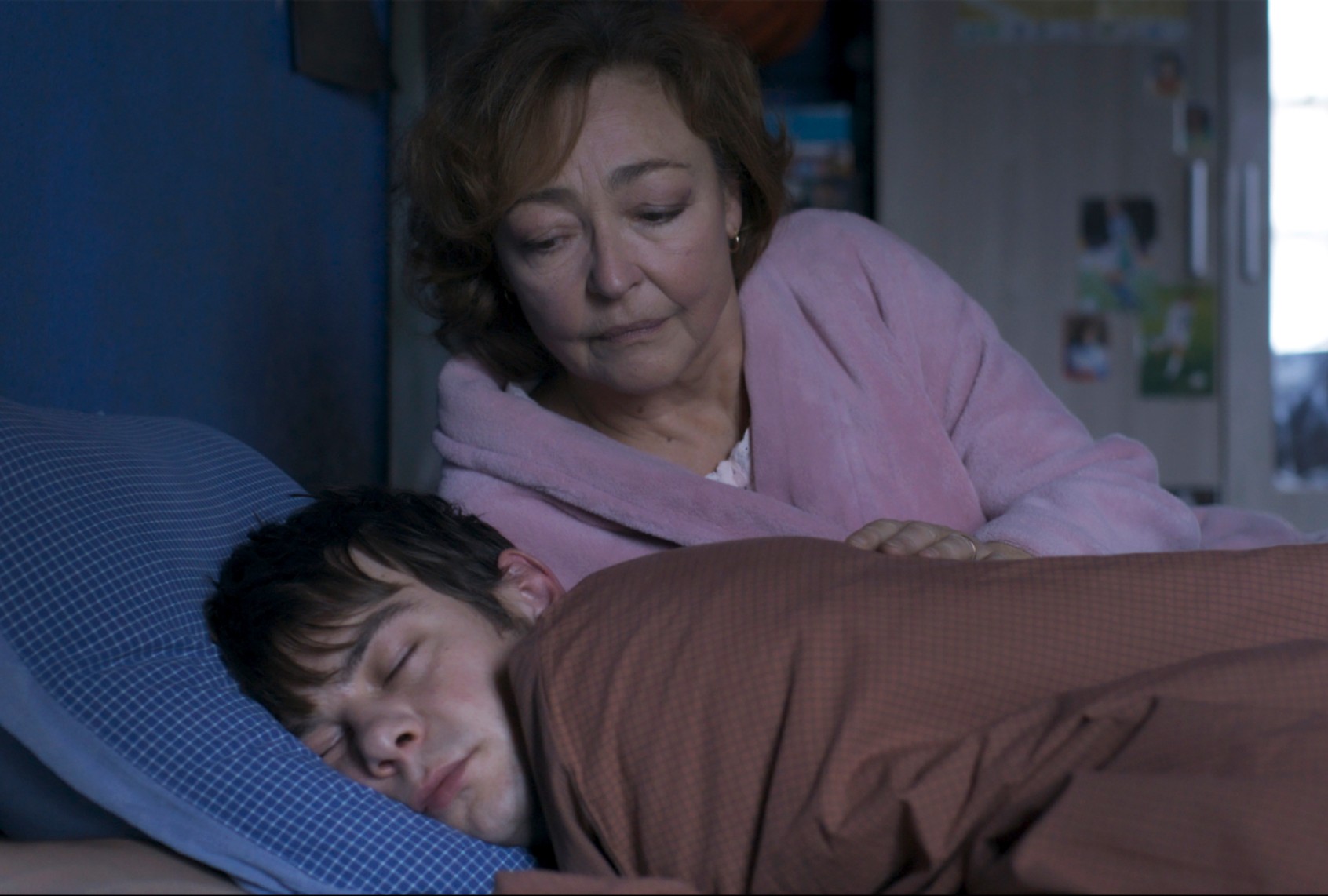
The researchers also have not had any direct contact with Starlink, which typically does not provide access to the data they use to make their own estimates and sustainability claims. Salon reached out to Starlink for comment via SpaceX, but did not receive a response.

"It's proprietary, so they don't want another company to take the data. The place you usually get the data from is a user manual — a document used by people that want to launch a satellite, and that will contain details about the rocket," Barker said. 

The multiple authors of a December paper published in Nature's Communications Earth and Environment note that "Satellite technologies are essential for global conservation actions through providing continuous, real-time Earth monitoring." The fact that even recent research on the impact of International Dark Sky Places on light pollution relies on observations made from orbiting satellites should make the point. However, the huge increase in rocket launches needed to get all those satellites up there (there were 223 launch attempts in 2023), places a significant and growing strain on the various life forms and biomes where launches take place. 

Right around the rocket launch site, local ecosystems are affected by explosive emissions, acoustic oscillations, and land and water use for installation. Meanwhile, the exhaust from rocket boosters and the shuttle cloud itself can cause local damage to vegetation. Fuel spills, chemical leaks, intense noise levels, and acid deposition all lead to loss of local biodiversity — but local in this case means up to 45 km (28 miles) from the launch site. The authors of the Communications Earth and Environment paper cite, for example, research showing hydrochloric acid emitted from solid rocket launches killing fish after it leached into nearby water. They note that over 62% of operating sites are located within or close to protected natural areas.

Falling debris from separating rocket parts extends the affected area to encompass 400 to 1,500 km (249 to 932 miles) from the actual launch site. That's of course not including emissions that become part of the atmosphere and circulate around the globe. And a rocket that blows up can shed debris over huge areas of ocean or land, as demonstrated by a SpaceX test launch that exploded early in March, raining debris over the Caribbean Sea and grounding flights around the globe.

Regulating the skies… And beyond

So far, most efforts to reduce all these effects and their growing impact involves voluntary mitigations, not significant regulation. The main and in fact only legal framework for international space law is the U.N.'s Outer Space Treaty. Article IX states that: “States Parties to the Treaty shall pursue studies of outer space, including the moon and other celestial bodies, and conduct exploration of them so as to avoid their harmful contamination and also adverse changes in the environment of the Earth resulting from the introduction of extra-terrestrial matter and, where necessary, shall adopt appropriate measures for this purpose.”

Two or three problems become evident here. For one thing, this treaty refers to states. Not corporations, not individual billionaires, just states.

"The Outer Space Treaty was really intended to apply to governments," Lowenthal said. "And I don't think the writers of the OST foresaw what we have today, which is essentially something akin to a gold rush or the discovery of oil or the building up of the railroads: tremendous infusion of investment by private interests, also by governments, to help promote the development of a new industry that is seen as potentially an economic driver."

Writing in Northwestern Journal of Law and Policy in 2023, Yuree Nam said that "the space industry and governments have shifted focus away from preventing mass destruction in space. Instead, the space industry is now concerned with private actors commercializing spaceflight and private companies trying to develop commercial activity on Earth and in outer space."

There is other relevant legislation and policy in addition to international space law, of course. But as well as sharing Lowenthal's concerns with the inadequacy of the OST to address the current reality, Nam argues that domestic regulation in the U.S., under the Federal Aviation Administration, is also not up to the job. Though the agency provides licenses to private space companies wishing to launch rockets, environmental review is only a small part of the permitting process. (Satellites being burned up in the atmosphere after five years in orbit is a requirement of FAA licenses under American law.)

Satellites in orbit communicate down to ground stations using radio signals regulated by the Federal Communication Commission. Of course, under the new administration it is possible that much of this will be reorganized. Lowenthal says that an Office of Space Commerce may take over some of the regulatory role of both the FAA and the FCC; all this remains to be seen.

Inadequacy for dealing with private companies is one problem. Another is that the language of the OST refers to avoiding contamination of the moon and other celestial bodies, as well as adverse changes in the environment of the Earth resulting from the introduction of stuff from space. It doesn’t refer specifically to all of the issues posed by satellites, including contamination by light, which comes from light-emitting sources on Earth or else from the sun. The sun isn’t to blame for light pollution that brightens the night sky, though — we are. 

A third potential problem with the language and scope envisioned by the OST is that it doesn’t define a geography that captures the creation of light pollution in the night sky, wherever that is exactly, from the perspective of organisms on Earth. 

"We think of light pollution as a local issue, and we are lacking a domestic light pollution strategy or a national light pollution policy at present," Venkatesan said. "But even though light pollution can be a local issue, its effects are global."

Not just global, but exponential: the issue of brightening skies, and the other problems of satellites, are both global and growing far more quickly than responses to them in the form of policies, regulations or laws, not to mention monitoring and oversight. 

"The challenge with quite so many satellites up there isn't just the changing [atmospheric] chemistry, the sheer numbers, the sheer pace at which they're being launched," noted Venkatesan. "It's that it's happening in parallel with the unchecked firing of a lot of branches of federal agencies that are keeping track of this." 

One of the early DOGE layoffs, Venkatesan added, was at NOAA, and involved staff that oversee the traffic coordination system for managing space traffic. Another was in the commercial remote sensing regulatory affairs division, affecting the staff responsible for oversight of remote sensing from space that allows us to understand the scale of the problem of light pollution down on Earth.

"We are not fundamentally opposed to the development of space," Barentine told Salon. "What we are concerned about is the way that it's proceeding."

“I don’t care about my 401k today”: MAGA writes off chaos as Trump tariffs roil markets

War is peace, ignorance is strength, and autoworker layoffs are a “positive reaction” in the marketplace, according to former Donald Trump adviser Kellyanne Conway.

Conway was asked for her take on the economic impacts of Trump’s broad tariff plans, which sent markets cratering during a stop by Fox News on Thursday.

“We were seeing some positive reaction today,” she told host Martha MacCallum. “For all the negative Debbie Downers, look at the positive reaction. Stellantis, which owns Chrysler and Ram and Jeep, they came out today and said that they are going to stop producing in Mexico.”

Stellantis announced just hours earlier that it would be cutting 900 jobs at five U.S. plants because of the tariffs, per Reuters, and temporarily pausing just some production in Mexico and Canada.

Conway isn't alone in trying to explain away the impacts of Trump's tariffs on the conservative news network. Fox News host Harris Faulkner's doublespeak on the subject drew comparisons to North Korean state media. Fox News’s Jeanine Pirro urged viewers to ignore the economic pain they were feeling on Thursday for the sake of patriotic dedication to the president.

“I don't really care about my 401k today. You know why?… I believe in this man,” Pirro said. “Who’s complaining? Wall Street. Too bad, he’s helping the middle class. I think it’s gonna be over this summer.”

Viewers flagged Fox News’s termination of a live stock ticker altogether midday on Thursday, shortly before Trump said his tariff plan was “going very well.”

But not all in the typically sycophantic MAGA world are ready to join team tariff. Texas Senator Ted Cruz told Fox Business on Thursday that long-term high tariffs weren’t good economic policy.

“I am not a fan of tariffs…If the result is our trading partners jack up their tariffs and we have high tariffs everywhere, I think that is a bad outcome for our consumers,” Cruz said. “Tariffs are a tax on consumers, and I'm not a fan of jacking up taxes on American consumers.”

Pentagon launches probe into Signalgate after Trump White House declares case “closed”

The Pentagon is diving deeper into the controversy surrounding a group chat between Trump administration officials discussing war plans in Yemen.

Department of Defense Inspector General Steven Stibbins shared in a memo that he plans to investigate Defense Secretary Pete Hegseth's contributions to the group chat, which unwittingly contained a member of the press. The announcement of the probe on Thursday came days after the Trump White House shared that the matter was "closed." 

“The objective of this evaluation is to determine the extent to which the Secretary of Defense and other DoD personnel complied with DoD policies and procedures for the use of a commercial messaging application for official business,” Stebbins wrote.

The probe was launched at the request of the top Republican and Democrat on the Senate Armed Services Committee. Those Senators, Roger Wicker, R-Miss, and Jack Reed, D-R.I., said reporting on Hegseth and others’ conduct “raises questions as to the use of unclassified networks to discuss classified and sensitive information."

Questions over security have dogged the DoD since National Security Advisor Michael Waltz inadvertently added journalist Jeffrey Goldberg to the group chat that also contained Secretary of State Marco Rubio and Vice President JD Vance.

The new investigation comes just days after White House Press Secretary Karoline Leavitt’s claim that the matter was settled.

“This case has been closed here at the White House, as far as we are concerned,” Leavitt said on Monday.

Stebbins has served as the acting Inspector General for the Department of Defense since January when Trump fired the previous IG amid a massive purge of the bureaucrats charged with agency oversight.

“Going very well”: Amid stock market freefall, Trump touts tariff “boom”

President Donald Trump shook off concerns about a tariff-induced stock market plunges on Thursday, saying his plan to shake up global trade is "going very well.

“It was an operation like when a patient gets operated on. It’s a big thing. I said this would exactly be the way it is,” Trump said. 

The Dow Jones Industrial Average experienced its worst single day since March 2020 after Trump announced late on Wednesday that the United States would place tariffs on all imports.

"The markets are going to boom. The stock is going to boom. The country is going to boom," he said.

Despite Trump’s reassurances, not all Republicans are sold on the scheme. The Senate voted on Wednesday to reject the previously announced 25% tariff on Canada, with four Republicans – including Kentucky Sens. Mitch McConnell and Rand Paul – joining Democrats to send a reversal measure to the House. 

A recent Reuters/Ipsos poll found that 7 in 10 voters expected prices to shoot up following Trump’s tariff scheme and a majority of voters felt that the tariffs would do more harm than good.

Inside Trump’s administration, the outlook is a little rosier. Commerce Secretary Howard Lutnick told CNN on Thursday that the market-rattling scheme was necessary to “drive growth.”

“That’s a whole lotta growth. You’re gonna get that starting in the fourth quarter,” Lutnick said.

Agriculture Secretary Brooke Rollins also defended the tariffs in a Thursday appearance on Fox Business.

“Certainly, the economy will be adjusting,” Rollins said. “We are really excited, and very grateful for President Trump’s leadership in being able to be bold.”

Trump makes National Security Council firings on advice of Laura Loomer

President Donald Trump has fired at least six officials from the National Security Council after far-right personality Laura Loomer pushed for the shake-up in an Oval Office meeting.

Senior Director for Intelligence Brian Walsh, Senior Director for International Organizations Maggie Dougherty, and Senior Director for Legislative Affairs Thomas Boodry were amongst those fired, per the New York Times.

The firings mark the latest salvo in Trump’s long-simmering antipathy toward the National Security Council, which was fueled in part by a spat with former NSC staffer and whistleblower Alexander Vindman. 

Loomer spoke to Trump on Wednesday, alleging that numerous NSC officials were unfit for service and had “slipped through” the Trump administration’s vetting process, per Axios. That vetting process reportedly included loyalty tests and questions about voting records.

In posts to X, Loomer defended her “opposition research" but declined to divulge specifics on individuals she flagged or other details.

Also present at the meeting between Loomer and Trump was National Security Advisor Michael Waltz, who accidentally added journalist Jeffrey Goldberg to a Yemen group chat discussing then-unknown military operations in Yemen last month. Per the Times, Waltz made attempts to defend various NSC staffers. Ultimately, it appears Loomer’s influence won out.

The far-right social media influencer has long had the ear of the president, but many inside the MAGA movement worry she could be toxic to Trump. The self-described “pro-white nationalist” has feuded with high-profile Trump loyalists in the past.

In 2023, Rep. Marjorie Taylor Greene condemned Loomer as “mentally unstable and a documented liar” after reports circulated that Trump was mulling hiring the influencer. Last fall, Greene joined other GOP figures to denounce a racist jab Loomer made towards former Vice President Kamala Harris.

In the queer thriller “Misericordia,” coming home is anything but melodramatic

To shoot his new thriller “Misericordia,” Alain Guiraudie went to the only place in the world capable of dredging up an all-consuming, metaphysical melancholy just by crossing the city limits: home. The film is set in the French director’s native region of Occitanie, during the rainy autumn season when fresh mushrooms crop up almost as frequently as secrets. It’s there, in the sleepy town of Saint-Martial, where the lascivious Jérémie (Félix Kysyl) violently collides with his past when he returns home to attend the funeral of his former employer. Jérémie’s presence immediately upends Saint-Martial’s sluggish pace. He is a virus entering a perfect, unchanging ecosystem, slowly working his way through the village until his influence has devoured every remaining shred of stasis. Suddenly, Saint-Martial is alive — but vitality comes at a lethal cost.

“Misericordia” subverts the long-held idea that gay coming-home movies equate to weepy melodramas. Its farcical mystery challenges the stagnancy of gay narratives in contemporary cinema, twisting a common trope into something fresh and sensual for our modern world.

Guiraudie — who is openly gay and has been making queer-centric films for decades — innately understands how awkward it is to return to the place you grew up. Coming home is strange enough as it is. But it's a particularly delicate experience for queer people, who often spend a fair share of their childhood and adolescence conforming to the rigid norms of their surroundings. But Guiraudie has never exactly been interested in working within the confines of reality. His films slant toward the surreal, hooking viewers with their forward-thinking attitudes toward sex and sexuality. Guiraudie celebrates the frivolity of a steamy glance or a leering gaze, and “Misericordia” is no different, which is precisely why it’s such an exciting venture in the realm of contemporary queer filmmaking. The film diverts expectations at every turn, shirking the burdens of the sob story you might see in a typical gay homecoming film. Here, nobody gives a second thought to the fact that Jérémie is queer. His appearance even encourages introspection among the townspeople. Maybe they’ve all got a little sugar hidden in their tank. 

But “Misericordia” is in no rush to answer that question. Guiraudie avoids urgency at all costs, letting his characters meander through the woods and have entire conversations that have nothing to do with Jérémie’s sexuality at all. His queerness is a welcome afterthought, divergent from a spate of gay homecoming films that hinge their narratives on a character’s struggle to come out or be themselves around their family. While that unease remains a familiar reality for queer people, Guiraudie’s film imagines a not-too-distant world where queerness is folded into the fabric of everyday life. “Misericordia” subverts the long-held idea that gay coming-home movies equate to weepy melodramas. Its farcical mystery challenges the stagnancy of gay narratives in contemporary cinema, twisting a common trope into something fresh and sensual for our modern world.

Yet, initially, Saint-Martial looks anything but modern. When Jérémie arrives, his car winds through narrow roads and past centuries-old brick buildings. Nary a person is outside. To a stranger’s eye, the village looks almost abandoned. As it turns out, its residents feel similarly. They’ve lost Jean-Pierre, the town’s baker, whose bread kept people lining up weekly, giving them a reason to rise each Sunday. Jérémie’s homecoming is a comfort for Jean-Pierre’s widow, Martine (Catherine Frot), who invites Jérémie to stay with her as long as he likes after the funeral. Martine sets him up in the childhood bedroom of Vincent (Jean-Baptiste Durand), her son and Jérémie’s best friend, which remains just as Jérémie remembers it.

Félix Kysyl and Catherine Frot in "Misericordia" (Courtesy of CG Films/Losange Production)
Guiraudie cleverly sprinkles these suggestions of what transpired before Jérémie left Saint-Martial throughout the film, tucked neatly into casual references to the past. Vincent has been married since he and Jérémie last saw one another, moving out of his mother’s house and leaving a free room for his old pal. But when the two see each other again, all these years later, the energy between them is charged. Their light jokes turn into physical shoving and wrestling. A masculine hedonism sits between them, but Guiraudie is reticent to confirm the nature of their relationship. One moment, the two men look like they’re play-fighting. The next, their gasps and grunts turn carnal, almost violent. 

Vincent eventually gets the idea that Jérémie wants to have sex with Martine, and that he’s staying in Saint-Martial after the funeral to seduce her. A strange Freudian complex wedges itself between Jérémie, Vincent and Martine. The thought of Jérémie sleeping in his bed, close to his mother, enrages Vincent, who brings Jérémie into the woods to fight in the privacy of the tall trees and their blinding fall foliage. This altercation is devoid of the playful eroticism their relationship once had. In a flash, Jérémie picks up a rock and splatters his friend’s blood all over the nearby porcini, stuck out of the wet earth like fungal voyeurs. 

Here, Guiraudie takes an even harder pivot from the typical gay homecoming story but gets closer to the truth than any other recent film tackling the same subject. Over the last five years, writers and directors have attempted to shift the coming out story into the coming home story. Films like “All of Us Strangers,” “Happiest Season” and “Of an Age” have attempted to depict the stomach-twisting anxiety of being queer and finding yourself smack dab in the place you tried so hard to get out of, and to varying success. These movies frequently become mired in their own good intentions, diluting their messaging to something as plain and palatable as, say, “Love, Simon.” 

In Andrew Haigh’s “All of Us Strangers,” the main character, Adam (Andrew Scott), travels to his childhood home outside London, where he finds his dead mother and father waiting for him. At first, this feels like an unusual and exciting way for Haigh to explore the motions of coming out and coming home. But the film eventually turns maudlin, going so far as to include a prolonged scene where Adam says goodbye to the memory of his parents in a restaurant they used to frequent as a family. It’s sweet and even a little cathartic. But it still feels like the character is eternally tied to his sexuality and all of the suffering it brought him in his formative years. It’s a film that gestures to how messy and uncomfortable it is to be queer in your hometown, but has little to say about why that discomfort occurs in the first place.

"Misericordia" (Courtesy of CG Cinema/Losange Production)

Being queer and coming home is a strange thing. Some of us spend the first 18-ish years of our lives waiting until the day we can leave, headed toward someplace where we can feel free to be more like ourselves. Establishing that freedom is one thing, but contending with it when you arrive back in your childhood home is another entirely. Being newly autonomous in a place where you once felt you had no control is an eerie thing. The power goes straight to your head, an intoxicating rush that splits desire from better judgment. The first few Christmases I returned to my hometown, I felt all-powerful and completely helpless, grappling with the memory of how things used to be while overindulging in bad decisions to make up for lost time. How strange it feels for your sexuality to finally be a mere footnote of your life, only to return to the place where every day was spent wishing it could all be so simple.

In “Misericordia,” things are never predictable. Guiraudie considers Jérémie’s future without using his sexuality as a deciding factor to point the character toward a definite future. His fate is opaque and, therefore, far more realistic.

Guiraudie makes that fantasy a reality in “Misericordia,” making queerness into something so routine it’s almost dull — but without denying that coming home is inherently chaotic. When the police come sniffing around trying to find the missing Vincent, Jérémie decides his best bet is to seduce virtually all of Saint-Martial, just like his dead best friend thought he’d do. Jérémie drinks to excess and hits on townspeople but can’t successfully throw the cops off his trail. That is, until Saint-Martial’s priest, Philippe (Jacques Develay), who admires Jérémie’s tall, slim frame and sculptural beauty, takes a liking to Jérémie. The two men walk in the forest among the rich oranges and yellows that adorn the branches around them. Under the cover of an autumn afternoon, Jérémie and Philippe hatch an absurd plan to give Jérémie an alibi: The two men were in bed together on the night of Vincent’s disappearance. 

Their defense means the two will have to enter into some form of close bond long enough for the police to stop suspecting Jérémie. In a small village like Saint-Martial, it could take years for the alibi to stick. When Jérémie debates turning himself in instead, Philippe tells him, “Imprisonment is worse than death.” For a moment, Guiraudie ponders whether staying in Saint-Martial would be a fate equivalent to imprisonment for Jérémie. Would being inextricably tied to Philippe not trap him in his hometown forever? 

But Philippe senses Jérémie’s hesitation and offers a bit of comfort. The priest assures his paramour that he does not require love in return for Jérémie’s freedom, only the occasional stroll through the woods or conversation. “I could love him without noise for eternity,” Philippe says, looking toward a hypothetical future with Jérémie. As crushing as coming home can be, it can produce these virtuous, alluring thoughts. This is what we’re capable of thinking when straddling two worlds: the one we exist in now as adults and the one we grew up in. With one foot in either place, we’re pulled between the impish naivete of childhood — when the future seemed vast and bright — and the doldrums of adulthood. 

In another film, this tug of war between past and present might produce an overly sentimental final act, where the main character comes to terms with the former life that’s haunted him since he arrived home. But in “Misericordia,” things are never so predictable. Guiraudie considers Jérémie’s future without using his sexuality as a deciding factor to point the character toward a definite future. His fate is opaque and, therefore, far more realistic. He’s caught in the mess he’s made for himself, and it’s one so dire that it can’t be helped by any sniveling revelations about how his queerness has impacted his trip to Saint-Martial. In Guiraudie’s film, queerness is neither the problem nor the solution. It is simply a facet of Jérémie’s existence, one that will help him forge a path forward, through woods dotted with mushrooms — new life born from rot and decay.

The essential spring herb you’re not using

As the weather thaws and April showers make their return, I feel called to incorporate more herbs into my dishes. Herbs: bright, fecund, verdant, elevating our food with both flavor and color, guiding us from heavy comfort foods into a punchier, lighter category of cuisine.

You may be well familiar with basil in your pestos, parsley atop endless dishes, thyme and rosemary on your focaccias, sage in your stuffing, cilantro in guacamole or mint in your mojitos—not to mention dill, oregano, chives, even bay leaves.

But what about the others? Don’t they deserve some acclaim? Some attention? It’s time to spotlight herbs with a quieter footprint: tarragon, marjoram, shiso and chervil.

As with all things, there is a hierarchy of sorts, a distinction of echelons—not in flavor, but in cachet.

To be fair, tarragon is often oddly hard to find in grocery stores near me. I’m not sure why that is. Ideally, that’s not the case in your neck of the woods.

Tarragon has a subtle anise, fennel-like flavor, and its leaves are slender and softer than other herbs. It’s a beloved ingredient in French cuisine and many classic dishes, but it has fallen out of favor in contemporary cooking, especially in America.

The lighter, more delicate herb chops easily, and both the leaves and stems are edible. It plays a starring role in béarnaise sauce, one of the many offshoots of the long-cherished mother sauces in French cuisine. A variation of hollandaise, béarnaise consists of nothing but lemon, butter, eggs, vinegar and, of course, tarragon. Simple. Classic.

Dried tarragon is also present in herbes de Provence, so you may already have some in your cabinet.

So how might you use tarragon? The possibilities are endless.

Enliven sauces, spreads and condiments

Of course, you can make béarnaise! But beyond that, whip up pestos, stir it into aioli or homemade mayonnaise, or add it to chicken salad (Ina Garten’s is one of my absolute favorites). Tarragon also shines in infused vinegars or oils.

It’s spectacular in beurre blancs atop crispy-skinned white fish or in creamy pan sauces for seared chicken. You can also blend it with oil for a finishing drizzle—maybe even atop a comforting congee.

We need your help to stay independent

Mix into drinks

Tarragon is an unusual but welcome ingredient in beverages. Try a tarragon syrup in lemonade, some muddled tarragon in cocktails or the slight anise flavor in homemade iced tea. If you’re a drinker, mix pernod with tarragon for a complementary flavor profile.

Incorporate into desserts

Tarragon has a delicate sweetness that sets it apart from the sharper qualities of raw fennel or anise. Use it in desserts, like a unique fruit cocktail with pernod, fennel fronds and tarragon for a layered anise flavor. It’s great with semifreddo, granita or panna cotta and pairs beautifully with citrus.

It also works well in pies, tarts and even cakes.

Use in main dishes

Tarragon complements seafood beautifully, especially lobster with lots of butter. It elevates risottos and pastas and can be a unique addition to pizza topped with shallots and provolone. Blend it into a salsa verde for roast chicken. Use it to garnish steamed clams or mussels or mix it into a savory stuffing for roasted oysters.

It also shines in fish stews and soups of all kinds, from cacciucco to tom kha gai to cioppino or caldeirada.

Of course, it’s wonderful in any sort of salad—whether leafy greens, egg salad, a raw vegetable medley or beyond.

The world is your oyster, and tarragon is your vehicle.

Use as a seasoning

Tarragon makes a wonderful herb crust on grilled meat or a colorful, flavorful garnish atop roasted veggies. Some adore it in eggs, and it lends depth to vinaigrettes and dressings. Tarragon compound butter brings a lovely note to any bread it touches.

So next time you’re in the herb aisle, perusing the verdant options, bypass the usual suspects. Look for the herbs that aren’t getting as much attention. Start with tarragon. You’ll be thrilled with where this beguiling herb may lead you.

“This is bananas”: Trump’s “reciprocal” tariffs rely on “indescribably crazy” math

April 2 marked what President Donald Trump and his administration described as "Liberation Day," or the announcement of sweeping “reciprocal” tariffs on almost every country, ranging from a base rate of 10% to as high as 50%.

Trump claims that the proposed duties were direct responses to “tariffs, non-monetary barriers and other forms of cheating” that other countries have enacted against the United States — per CBS News — but that’s not quite accurate. Instead, the “reciprocal tariffs” are based on the U.S.’s trade deficits with each country.

Specifically, the formula that the Trump administration used to calculate tariffs for each country was as follows: the U.S. trade deficit with the country, divided by the country’s exports to the US, halved.

What does that mean? A trade deficit occurs when the U.S. imports more from a country than it exports to said country. For example, the U.S. imports a significant amount of computer chips and semiconductors from Taiwan, but doesn’t export any product in particular to the island — resulting in a $74 billion trade deficit with Taiwan. This deficit is not caused by any tariff or currency manipulation but is the natural result of global trade.

The same logic applies to China, one of the major exporters to the US. In 2024, the U.S. imported $439.9 billion worth of goods from China, according to CNN, and had a $295.4 billion trade deficit with China. Dividing the deficit over the value of Chinese imports gives roughly 67%. Halving that, we get 34%, which was the tariff on China listed in Trump’s reciprocal tariff table.

“Knowing how these rates were calculated highlights that they are generally going to be most severe on the nations that U.S. companies rely heavily upon in their supply chain,” Mike O’Rourke, chief marketing strategist at Jones Trading, said in a note to investors Wednesday. “It is hard to imagine how these tariffs would not wreak havoc upon the profit margins of major multinational corporations.”

Economists were stunned at the Trump administration's math.

"It’s now clear that the [Trump] Administration computed reciprocal tariffs without using tariff data," wrote former Treasury Secretary Lawrence Summers. "This is to economics what creationism is to biology, astrology is to astronomy, or RFK thought is to vaccine science. The Trump tariff policy makes little sense EVEN if you believe in protectionist mercantilist economics."

"This is *bananas* The White House 'reciprocal' tariff bears no relation to actual tariff barriers. It's equal to half of the trade deficit (as a share of imports)," wrote economist Justin Wolfers. "This is indescribably crazy."

My perfect spring cake started with a box mix

When I was nine or ten, fueled by a steady diet of the Food Network and a recent purchase of “Moneymakers: Good Cents for Girls” (a financial masterpiece from the American Girl Company), I launched my very own baking empire. It was called The Batter Bowl and it had exactly one product: chocolate chip cookies, made from a recipe my mom had gradually adapted from the back of a Nestlé bittersweet chocolate chip bag.

Armed with a stack of handmade business cards, I went door to door in our suburban Chicago cul-de-sac, pitching the neighbors: “Would you like fresh-baked cookies delivered to your doorstep every Saturday morning?” If it worked for the Girl Scouts and their nationwide empire of other young entrepreneurs, why not me?

Fridays after school and figure skating practice, I’d set out the lineup — chocolate chips, brown sugar, eggs, vanilla, Crisco — pressing the dough into fat, craggy mounds on my mom’s old cookie sheets. Once cooled, they went into crinkly cellophane bags from Party Central, each one tied with a bit of lilac curling ribbon. The next morning, I’d pile them into my wagon, its wheels scraping the sidewalk, and make my deliveries: a dozen cookies for five dollars, cash only, which I kept in a plump white envelope tucked next to my bed.

I spent a lot of time fantasizing about the brick-and-mortar bakery I’d open one day. I even scoured the real estate section of the classifieds for potential store-fronts, convinced I just had to find the listings other people overlooked. I vividly remember one late spring day, I found one — miraculously cheaper than the others, a slip of land I could afford after another summer or two of weekly cookie deliveries. I circled the ad, marched downstairs and triumphantly showed my grandfather. He studied it for a moment, then gently pointed out that I had, in fact, selected a burial plot.

By the next summer, however, The Batter Bowl shut down — not because business was bad, but because I quietly began to shy away from the world I had so confidently built for myself. Real baking wasn’t for me. Or at least that’s what I told myself. 

In reality, that was the summer puberty hit me like a truck. Practically overnight, I had to adjust to how my new glasses slid down my nose and the way the elastics tethered to my braces snapped like rubber bands in a junk drawer. My school uniform sweater suddenly bunched in ways that felt like a personal attack. Just existing was mortifying. Seeing my cute (equally zitty) neighbor collecting the mail? Excruciating. Raising my hand in class? A form of torture.

Dragging a wagon of cookies door-to-door? Forget about it. 

We need your help to stay independent

And then, an off-handed comment from my math teacher: After a group of us — me included — failed to grasp a concept, he coldly told us, “You won’t even get into culinary school if you don’t smarten up.” It landed like a stone in my chest. This wasn’t just a bad grade. It was the end of something. I wasn’t cut out for baking, for the kind of real baking that required precision. I wasn’t cut out for the person I was becoming. 

And so, quietly, I stepped away.

It wasn’t that I stopped cooking — I still loved it. Cooking felt loose and instinctual. I could stand at the stove, tasting, adjusting, adding a little more of this, a little less of that—always able to fix it if something went wrong. I remember the first time I made spaghetti sauce from scratch, long before I understood ratios or had any true sense of technique. I could taste the raw garlic and basil and adjust. I didn’t need a recipe; I just knew what it needed. Baking, on the other hand, felt immutable. I’d follow a recipe to the letter and still end up squinting at the oven door, trying to gauge whether I’d accidentally created something leaden or gummy or wrong.

For years, I mostly avoided it, save for a few indulgences. I learned to make babka (thank you for the inspiration, “Seinfeld”), delighting in wrangling the dough’s sticky, elastic strands into tight, glossy braids. I got into English muffins because their griddled tops hid any number of sins. I still made my mom’s chocolate chip cookies. But the idea of true, confident baking — the kind where you understand how ingredients work and why — felt completely outside my reach.

And then, about five years ago, in the early days of the pandemic, I learned to bake — sort of. Not by mastering ratios or poring over scientific explanations, but by doing something I once would have considered cheating.

I learned to bake with boxed mix.

It felt safe. The chemistry was already handled; all I had to do was play around with flavor and texture. Between Zoom happy hours and “Stardew Valley” sessions, I folded cold coffee into brownie batter, added matcha to white cake, swapped butter for oil just to see what would happen. And something clicked: I wasn’t just following recipes anymore. I was understanding them.

Which is how I landed on what I now consider the perfect spring cake: a citrus olive oil cake with a simple orange marmalade glaze. It started as a craving—a way to will a new season into existence. I was tired of winter desserts, of fudgy cakes and stewed fruits, of warm spices clinging to everything like a wool coat. I wanted a cake that felt like eating fruit in the sun, like something you’d be served on the ivy-covered patio of a neighborhood trattoria, the air thick with early summer heat. Something bright, tangy, just sweet enough.

And armed with the confidence from my boxed mix education, I began gathering ingredients. 

Cornmeal was an easy early choice. It gives cake a little grit and toastiness, a reminder that not all desserts need to be pillowy soft.. But cornmeal is also thirsty, and my first attempt — which leaned on a mixture of olive oil, melted butter and a single egg for moisture — was dry, almost crumbly. I adjusted. The second version added an extra egg. The third ditched butter entirely in favor of buttermilk, and suddenly, the texture was perfect: tender with the kind of bite that lingers for half a second before melting on your tongue.

The lemon zest was another lesson in escalation. I kept adding more, testing the limits of absurdity until I hit two full lemons’ worth — enough that it left a whisper of citrus oil on my fingertips. And sugar, I learned, wasn’t quite right. The first version of this cake used only white sugar, and it was too one-note, too cloying. Swapping in honey added moisture, yes, but also something deeper, an earthiness and floral sweetness that makes you lean in for another bite.

And then, the final piece: the glaze. Bonne Maman orange marmalade (hey, I still like a well-placed culinary cheat), melted down with lemon juice and a little sugar, brushed over the top while the cake was still warm. It gave the cake a glossy, almost shellacked finish—the kind of thing that made it look like it had been plucked straight from the window of a sun-drenched Italian bakery.

Baking was never the problem. The problem was thinking I had to get it right. But it turns out, like anything, it gets easier when you stop worrying about perfection and just start playing.

Maybe ten-year-old me had it right all along. Back then, baking wasn’t about perfection—it was about playing, creating, and trusting my instincts. Now, years later, I’m back in that same space, but with a little more understanding. The joy is still there, just like it was when I made those first craggy cookies, but now I know: baking isn’t about getting it right; it’s about the process, the freedom to experiment, and the confidence to trust myself.

Citrus Olive Oil Cake with Orange Marmalade Glaze
Yields
8 servings
Prep Time
15 minutes
Cook Time
30-45 minutes

Ingredients

For the cake 

1 cup all-purpose flour

½ cup fine cornmeal (adds a lovely texture)

½  cup honey

1 teaspoon baking powder

½ teaspoon baking soda

½ teaspoon salt

Zest of 2 lemons

2 large eggs

½ cup olive oil

½ cup buttermilk

2 tablespoons lemon juice

1 teaspoon vanilla extract

For the glaze 

1/4 cup orange marmalade (I like Bonne Maman) 

1 tablespoon lemon juice (freshly squeezed is best)

1 tablespoon sugar (optional, for added sweetness)


Directions

  1. Preheat your oven to 350°F (175°C). Grease an 8-inch round cake pan and line it with parchment.

  2. In a large bowl, whisk together flour, cornmeal, sugar, baking powder, baking soda and salt.

  3. In another bowl, whisk the eggs, olive oil, buttermilk, lemon zest, lemon juice and vanilla.

  4. Gently fold the wet ingredients into the dry until just combined — don’t overmix!

  5. Pour the batter into your prepared pan and bake for 30–35 minutes, until a tester comes out clean and the top is golden.

  6. Let cool for 10 minutes in the pan, then transfer to a rack.

  7. In a small saucepan, combine the orange marmalade and lemon juice over medium heat.

  8. Stir the mixture until the marmalade is fully melted and smooth.

  9. Taste the glaze. If you'd like it sweeter, add the sugar and stir until dissolved.

  10. Remove from heat and let cool slightly before spooning over your cake, just a tablespoon at a time, smoothing with the back of a spoon. Once the cake is fully glazed, allow it to sit for an additional 10 minutes to cool before cutting. 


Amid NOAA cuts, scientists warn of weather and climate risks

In 1807, President Thomas Jefferson founded the nation’s first scientific agency. It was tasked with surveying the coasts of the United States. Roughly 60 years later, a national weather bureau was created, and a fish and fisheries commission soon followed. The focus of these three agencies was eventually brought together in 1970 as part of the new National Oceanic and Atmospheric Administration, or NOAA. Today, agency staff study the ocean and atmosphere, share knowledge, and conserve coastal and marine ecosystems. Under the new administration of Donald Trump, this agency with 218-year-old roots is undergoing another significant change — one that experts fear could significantly hamper NOAA’s work.

In fiscal year 2024, NOAA accounted for more than half of the Department of Commerce’s budget and, as of recently, it had about 12,000 employees worldwide. The agency has a broad portfolio of activities, including gathering data and monitoring oceans, the atmosphere, fisheries, and marine life. The National Weather Service, a NOAA sub-agency, provides weather forecasts that include watches and warnings used to protect people and their property. To carry out its work, NOAA has at its disposal an array of tools, including satellites, airplanes, weather balloons, maritime buoys, and radar systems.

Under the direction of the Department of Government Efficiency, the administration’s cost-cutting effort, CBS reported that 880 NOAA employees were let go in late February. In March, a U.S. district judge ordered thousands of fired federal workers to be temporarily reinstated, but many have been put on administrative leave. The administration has also discussed possibly terminating leases for properties housing NOAA operations. Moreover, all federal agencies are currently subject to a purge of certain words and phrases. The New York Times has found that “climate science” is among them.

“One could make a strong case that NOAA was under-resourced and under-staffed before these cuts, so this is simply making the situation worse,” wrote Keith Seitter, former executive director of the American Meteorological Society, in an email to Undark. This could lead to dangerous delays in forecasting extreme weather events like tornadoes and hurricanes, in addition to hampering climate research. Private entities aren’t likely to be able to fill the void, Seitter noted.

“There seems little question that these cuts are going to severely impair NOAA's ability to carry out its mission,” he wrote.


Trump and hissupporters have long criticized NOAA's climate research efforts as being politically motivated. Project 2025, a sprawling document created by the conservative Heritage Foundation, describes NOAA as a main driver of the “climate change alarm industry," and suggests the climate research of one of its divisions ought to be "disbanded." The document further states that some of NOAA's other functions could be carried out in the private sector “at lower cost and higher quality.” The National Weather Service, for example, could be commercialized, according to Project 2025.

Massachusetts-based meteorologist Brian Gonsalves wrote in an email to Undark: “We are already seeing immediate impacts from these cuts, which will only worsen if further cuts are made.” The reduced staffing could make it more difficult to gather and process the data coming in from across the country — on temperature, wind speed, and dew points, among other things. The end result may be a decline in the agency’s ability to produce accurate weather forecasts, he said.

This may ultimately put people’s safety at risk. Seitter, currently a visiting professor of environmental studies and geosciences at the College of the Holy Cross, pointed to the arrival of spring’s severe weather season. “It would not be a surprise to see insufficient staffing available to do some of the really important planning and preparation with state and local emergency managers,” he said. This could compromise forecasts of and preparations for tornadoes, for example, that have ripped through parts of the country in March with more likely throughout spring. Hurricane season, which extends from June to November, could be an issue, too.

Privatizing the National Weather Service would have additional implications, not only for ordinary people wanting to check the weather, but also for private entities that rely on data generated by the federal government. For instance, companies like AccuWeather depend on data collected by NOAA, among other sources.

On X, Tony Pann, a Maryland-based meteorologist, posted: “The information on your phone app comes from data provided by NOAA for free. NOAA gathers weather data (daily balloon launches) and feeds it into the modeling so your phone can tell you it’s going to rain tomorrow. Saying we don’t need NOAA or the NWS because I can see the weather on my phone, is like saying we don’t need farmers because I can just go to the grocery store.”

Project 2025, a sprawling document created by the conservative Heritage Foundation, describes NOAA as a main driver of the “climate change alarm industry."

It would be extraordinarily difficult for private companies like AccuWeather to do its work in the absence of NOAA-provided data, according to the meteorologists who communicated with Undark. Gonsalves, for example, said “it's impossible to adequately fill the void from a forecasting standpoint, as well as data collection for climate study.”

Seitter echoed this opinion, noting that the business models of private companies “are built on the foundation of a strong NOAA providing data from which they can create specialized products and services.”


Yet more cuts could be on the way. During the presidential campaign, Trump pledged to rescind unspent funds earmarked for climate mitigation in the Inflation Reduction Act, which was signed into law by President Joe Biden in 2022. Through the IRA, Congress allocated billions of dollars in resources to counter or prevent the effects of climate change, particularly in areas most likely to be affected, such as coastal cities. The IRA also funded efforts to improve NOAA weather forecasting capabilities.

All of this could lead to a worsening of climate change by reversing progress made in reducing greenhouse gas emissions. The U.S. might well relinquish its role as a global leader in climate research and forecasting. And with NOAA’s monthly climate change briefings indefinitely suspended in April owing to personnel reductions, staff may become less aware of what, precisely, is happening to the climate.

And as CBS News reported in February, a former top NOAA scientist in the first Trump administration, Craig McLean, is worried about the politicization of science could undermine objectivity going forward.

“We are already seeing immediate impacts from these cuts, which will only worsen if further cuts are made.”

McLean gave as an example so-called Sharpie-gate, which occurred in 2019, when President Trump claimed that Hurricane Dorian would hit Alabama and displayed an altered graphic in front of news cameras to show the direction the storm would take. After an X account for the National Weather Service office in Birmingham, Alabama posted on social media that the hurricane would not impact Alabama, Trump’s staff apparently pressured Neil Jacobs — Trump’s current pick to run the agency — to say the forecasters had been wrong.

Trump has denied human-caused climate change, calling it “one of the great scams of all time.” And now the president oversees agencies such as NOAA and the Environmental Protection Agency, which traditionally have conducted climate research work predicated on the long-standing scientific consensus that emissions of greenhouse gases caused by human activity are primary drivers of global warming. Lee Zeldin, the EPA administrator, went so far as to call climate change a “religion” at a briefing in March, outlining steps his agency would undertake to deregulate. Jacobs could very well follow suit.

This article was originally published on Undark. Read the original article.

Corruption hunters say Trump’s USAID cuts just made organized crime groups “much more dangerous”

While most of the fallout from the destruction of USAID will be felt abroad, journalists who were formerly funded by the agency say that the cuts are likely to enable organized crime and corruption abroad, which ultimately impact everyday Americans.

The Organized Crime and Corruption Reporting Project is among the largest international investigative journalism outfits, and up until a few weeks ago, the project received significant funding from USAID. The group’s reporting has been involved with some of the biggest international corruption stories in recent memory, including the Panama Papers, the Paradise Papers and the Russian Laundromat

Drew Sullivan, an investigative reporter and one of the founders of OCCRP, told Salon that the organization received about 38% of its operational budget from the United States government, coming through agencies like USAID, the National Endowment of Democracy and the State Department. Since the cuts came down, Sullivan said the organization has had to lay off about 22% of its staff.

This has impacted reporting projects covering topics from Tren de Aragua in Venezuela to 'Ndrangheta in Italy to money laundering operations buying up real estate in the United States. Sullivan said, from even from strictly an efficiency standpoint, the cuts don’t make sense, because OCCRP’s investigations, and the investigations conducted by its partner organizations, have helped return more money to Americans than it costs to keep these outfits open.

“We’ve had a tremendous return to U.S. taxpayers. Over $3 billion has been returned to U.S. coffers in the United States,” Sullivan said. “Every dollar invested in OCCRP has returned $100 to the U.S. Treasury or other government agencies”

This, Sullivan says, is in addition to the fact that cutting funding for journalists leaves many of them vulnerable to arrest or at risk of being removed from the country they work in, as many require work visas.

Pavla Holcova, a regional editor for OCCRP in Central Europe, worked on investigations into topics like the Pegasus Project and the Russian Asset Tracker.

“It's kind of short-sighted to think that the U.S. will save money by cutting this budget, because we, as journalists, getting this kind of grants, we are just keeping the environment for business much more transparent and much more accountable than it would be otherwise,” Holcova told Salon. 

One OCCRP investigation, for example, exposed how real estate in American cities like New York and Miami have become top destinations for those seeking to invest laundered cash. The demand for such investment properties rose to a level that developers appear to have contributed millions to New York City politicians in what appears to have been a successful effort to secure millions of dollars in tax breaks for developers building luxury properties.

We need your help to stay independent

Holcova said, in her view, the cuts by President Donald Trump and Republicans are short-sighted and that these issues of corruption and organized crime are likely to become “much more dangerous” if reporting teams are disassembled. 

Attila Biro, another journalist associated with OCCRP, reports on crime and corruption from Romania. His work in Romania led him to cover a credit-card skimming operation in Latin America. In the operation, an international gang operating in Romania and Mexico allegedly stole the credit card information of tourists by tampering with ATMs. The scheme brought in around $1.2 billion, which was funneled into real estate investments in the United States and Brazil. 

“If you were a tourist and you were going to Cancun, and you were using your credit card there, there were big, big chances that your data was stolen by this organized crime group that we have investigated. We have exposed them. We have showed the authorities how they are acting, and the FBI and other law enforcement in Mexico, in Romania and other parts shut this group down,” Biro told Salon. “You know, we are going after organized crime figures that affect everyone, no matter what type of political affiliation you have, you know, like monsters who steal from, you know, Democrats and Republicans at the same rate.”


Want a daily wrap-up of all the news and commentary Salon has to offer? Subscribe to our morning newsletter, Crash Course.


Biro said funding through OCCRP and the United States government enabled their investigation and the training of reporters to do these sorts of investigations. He said without this funding, his organization is taking things “month by month.”

As it stands, OCCRP is one of the organizations that has sued the federal government in an attempt to restore the funding it was supposed to receive, as allocated by Congress, and it joined with the AIDS Vaccine Advocacy Coalition in the suit. 

While the federal judge hearing the case agreed and ordered funding restored, the White House responded by claiming that, despite the court order, the administration still maintained the authority to freeze funds and terminate grants.

“Worse than the worst-case scenario”: Stock market nosedives after Trump tariff announcement

U.S. stocks tumbled on Thursday amid investor jitters over President Donald Trump's sweeping tariffs of at least 10% or higher for an array of trade partners. The S&P 500 dropped 3.6%, setting it up for its worst day since September 2022, while the Dow Jones Industrial Average lost 1,300 points, or more than 3%. The Nasdaq Composite suffered over a 4% loss.

The risk of a trade war and the disruption of supply chains have landed a blow on American companies like Nike, Apple and Gap, which dropped 11%, 9% and 20% respectively. Foreign stocks have also suffered, with the European benchmark Stoxx 600 falling by 2% and Japan's Nikkei slumping by 2.7%.

Investors had been bracing for the tariff fallout, but Trump's tariff announcement on Wednesday exceeded many of their worst fears. The new effective tariff rate for China will now be 54%, the White House told CNBC, far more than the 10% or 20% rate that investors hoped would be a universally applied cap, not a starting point.

Trump, in his usual bullish element, declared that April 2 was "Liberation Day" — as in, liberation from an allegedly disadvantageous trading position that has been costing the U.S. manufacturing jobs. Economists and many lawmakers, including those from Trump's own party, disagreed, warning that tariffs are effectively a tax on American consumers.

“This is probably worse than the worst case scenario that was modeled,” CNBC analyst Bonawyn Eison said on Fast Money, referring to the enormity of Trump's tariffs and the devastation they might wreak on the economy.

Steve Liesman, CNBC’s senior economics reporter, agreed. “This just seems like the president having his own sort of school of economics that’s different from everybody else," he said.

Trump also appears to be using his own unique calculation to justify what he calls "reciprocal" tariffs on other countries playing unfairly — fact-checkers have pointed out that his administration dividing each country's trade deficit with the U.S. by half and calling that a tariff.