Spring Sale: Get 1 Year, Save 58%

The opposite of “common sense”: No Labels campaign in 2024 is a revenge plot against Democrats

Back in April, I wrote about the potential sabotage of the 2024 presidential election at the hands of the centrist group No Labels. They were signaling that they planned to run a third-party “unity” ticket to satisfy the wishes of the majority of the public who are telling pollsters that they are unsatisfied with what looks to be a replay of the 2020 election. The group already gathered a lot of money, which they are not required to reveal because they claim they are not a political party (even though they are setting up affiliate groups in the states that are calling themselves parties.) They insist they are not trying to be spoilers, but that raises the question of what they are doing. If you ask them, they don’t seem to have any idea.

At the time I wrote that piece it was unclear if they were serious at all. There’s a lot of money to be made in organizing groups like this and the argument is tailormade to appeal to wealthy donors who yearn for things like “entitlement reform” (especially privatization of Social Security and Medicare) and what they call “common sense” solutions to difficult issues like climate change. But it’s not just about the money, that much is clear. The group has actually started holding events to sell their idea of a unity ticket.

On Monday, they hosted one in New Hampshire featuring everyone’s favorite Senate diva, Democrat Joe Manchin of West Virginia, along with a congenial bucket of warm water, former Republican Utah governor Jon Huntsman. They called their gathering a “Common Sense Townhall,” showing that they have a great sense of humor if nothing else. The GOP is going to run Donald Trump for president, a man who was twice impeached, tried to illegally overturn the election and is now looking at his third indictment in less than a year — and he’s polling very close to Joe Biden. The idea that it’s common sense for any Democrat or moderate Republican to run a third-party candidacy at a time when we are facing one of the most serious political challenges in our history is very dark comedy. There has never been a worse time to do something like this.

When asked whether he plans to be a presidential contender Manchin told NBC News:

“It’ll be next year,” Manchin said about his timeline to decide what to do, meaning speculation about it (and his West Virginia Senate seat) will linger into 2024. 

“Let’s see where everybody goes. Let’s see what happens,” said Manchin, an outspoken critic of partisanship in Washington. “Maybe they’ll come to their senses and start doing the job they were elected to do.”

That’s so him, isn’t it? What a tease.

There has never been a worse time to do something like this.

Since Manchin is a Democrat, it’s reasonable for his fellow Democrats to worry that the consequence of his candidacy would be to siphon off votes from the other Democrat on the ticket and they are justifiably nervous about it. The very close electoral college win in 2020 was notable for the fact that there were almost no third-party votes, unlike previous close elections such as 2000 and 2016 which didn’t turn out so well for them.

Republicans, on the other hand, are so unconcerned by the possibility that they are pouring money into the effort, clearly thrilled by the idea. According to Mother Jones, all those state No Label parties I mentioned are being organized by longtime GOP donors and activists. They obviously feel that No Labels can only help the ball club.

We need your help to stay independent

Most of the polling on this issue, from No Labels itself to a group that’s recently formed to oppose them, shows that the Republicans are right. However, this week Monmouth University polled the issue and found that it’s more of a wash and could hurt Trump more than Biden if Manchin were to run because more Republicans like him. And when Monmouth posed the idea to its respondents that the ticket could be a spoiler for Trump, only 7% of Democrats say they would vote third party while 19% of Republicans would. So who knows who this gambit would hurt more in a general election? I think it’s common sense not to take a chance, however, given the awful experience of 2017 to 2021.

One thing is very clear: a No Labels ticket doesn’t have a prayer of winning. So once again, you have to wonder why they are doing it? Katherine Miller in the New York Times pondered the question:

Is threatening to run a third-party candidate a leverage thing? Against whom? Do they think that the right unity ticket could reach the ephemeral threshold of belief where enough voters think they could win to make the ticket viable?

No Labels won’t say yet who’s funding it or who its candidates will be or which party will take the presidential slot. There will be a convention, in April in Dallas, with delegates, but who are the delegates going to be? One of the Maine voters who accidentally switched their party registration to No Labels? The group rarely, if ever, seems to mention circumstances in which setting up the logistically challenging mechanisms for a backup candidate would make sense: for instance, if Mr. Biden withdrew late from the presidential race. If Mr. Biden weren’t president, he might even be the hypothetical candidate that Joe Lieberman, a No Labels co-chair — also present in New Hampshire — would be calling for.

Joe Biden would indeed be the guy his former Senate colleague from Connecticut, Joe Lieberman, should look at as the perfect candidate. After all, he’s managed to get several big bipartisan bills passed in the most narrowly divided Congress in ages, he talks constantly about the friends he has on the other side of the aisle and makes it clear that he believes he is the president of all the people, not just those who voted for him. Does Joe Lieberman think that Manchin could do better?


Want a daily wrap-up of all the news and commentary Salon has to offer? Subscribe to our morning newsletter, Crash Course.


Russell Berman in The Atlantic interviewed Lieberman and asked him these questions and Lieberman couldn’t really come up with any concrete reason why now is the time to throw a monkey wrench into the electoral system with all that’s at stake. He insists that he won’t back any effort that could put Trump back in the White House but obviously, a third party effort is designed for that very possibility.

So what’s motivating this effort and Lieberman in particular? I think it’s what’s been motivating him ever since 2006 when progressives, tired of his endless centrist posturing, beat him in the primary at which point he became an Independent and never looked back. He caucused with the Democrats for the rest of his career but made it his mission to stab the progressive wing of the Democratic Party in the back whenever possible, most famously when he single-handedly killed the Public Option in the Affordable Care Act after supporting it for years.

Berman writes that Lieberman can’t really come up with any real reason for opposing Biden except that “‘he’s been pulled off his normal track too often’ by pressure from the left” and points out that this is a common complaint from Republicans and Joe Manchin.

But this isn’t about policy. What these “centrists” really want is for Joe Biden to “own the libs” because in their minds that is the only way you can truly demonstrate your commitment to bringing people together and achieving unity. Biden, to his credit, rejected that stale, failed tactic and the party is more unified than it has been in decades. Let’s hope they stay that way. If they do, Joe Lieberman and his buddies don’t stand a chance. 

Mosquitos are moving to higher elevations — and so is malaria

Climate Connections is a collaboration between Grist and the Associated Press that explores how a changing climate is accelerating the spread of infectious diseases around the world, and how mitigation efforts demand a collective, global response. Read more here.


As the planet warms, mosquitoes are slowly migrating to higher places — and bringing malaria to populations not used to dealing with the potentially deadly disease.

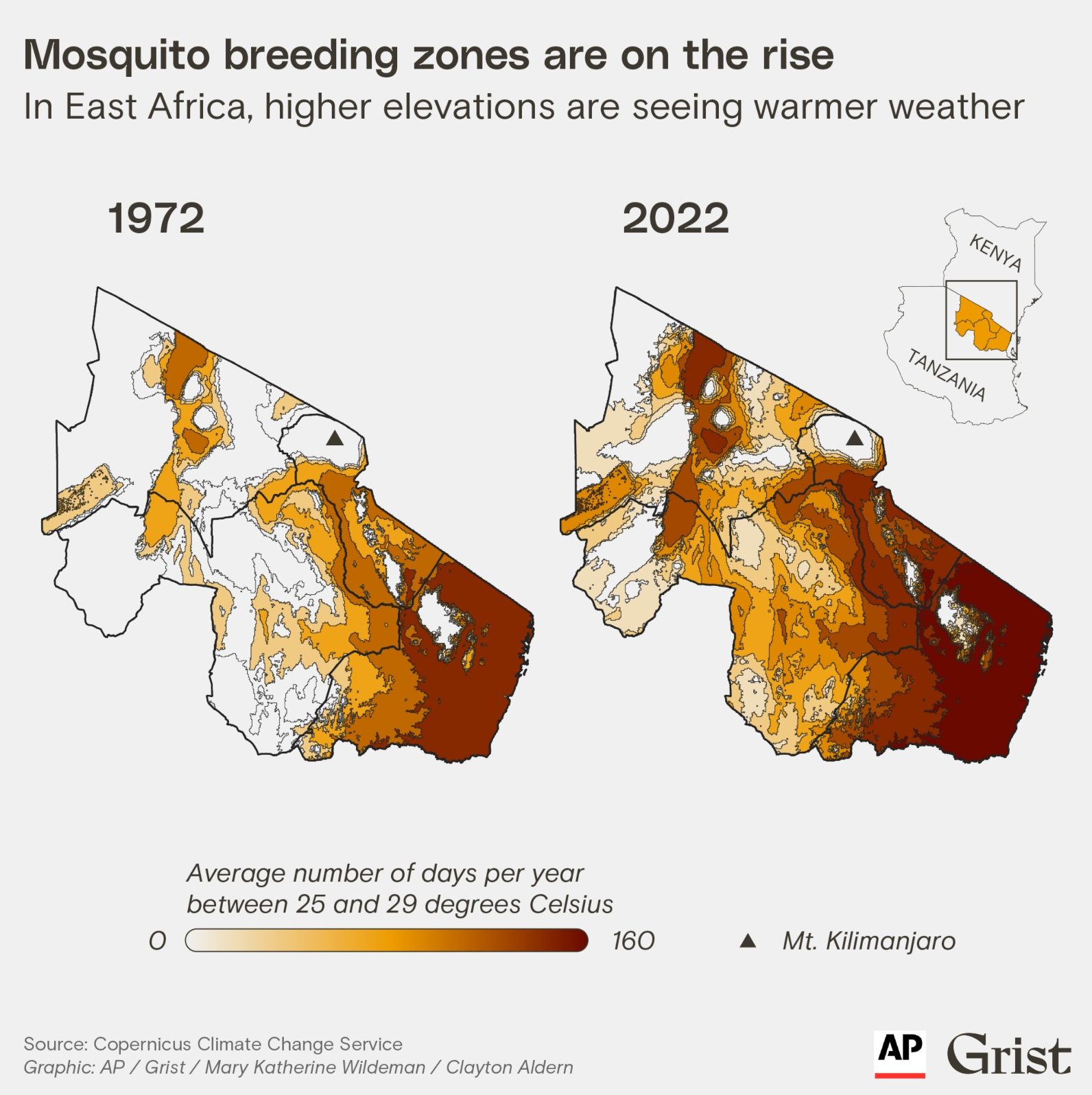
Researchers have documented the insects making their homes in higher places that are typically too cool for them, from the tropical highlands of South America to the mountainous but populous regions of eastern Africa. A recent Georgetown University study found them moving upward in sub-Saharan Africa at the rate of 21 feet per year.

“The link between climate change and expansion or change in mosquito distributions is real,” said Doug Norris, a specialist in mosquitoes at the Johns Hopkins Bloomberg School of Public Health.

It’s difficult to pinpoint how these shifting mosquito populations will affect specific populations, Norris said, in part because people have gotten better at fighting malaria. 

Global deaths from the disease declined by 27 percent between 2002 and 2021, as countries have adopted insecticide-treated nets, antimalarial drugs, and tests. Eighteen million doses of a new malaria vaccine are set to be distributed across Africa in the next two years. 

But the world faces new threats: U.S. health officials say the first malaria cases in the United States since 2003 were found in Florida and Texas in May and June, and an invasive mosquito species is likely behind spikes in malaria in Djibouti and Ethiopia. Climate change presents another emerging threat, World Health Organization officials wrote in their latest global malaria report. 

But scientists agree mosquitoes are on the move.

One study published in 2016 found the habitat for malaria-carrying mosquitoes had expanded on the higher elevations of Kilimanjaro by hundreds of square kilometers in just 10 years. The densely populated region faces new risks from malaria as a result, the research found, especially considering the population has not faced much exposure before. Meanwhile, the study found fewer mosquitoes at warming lower elevations. 

“As it gets warmer at higher altitudes with climate change and all of these other environmental changes, then mosquitoes can survive higher up the mountain,” said Manisha Kulkarni, a professor and researcher studying malaria in sub-Saharan Africa at the University of Ottawa.

The region Kulkarni studied, which is growing in population, is close to the border of Tanzania and Kenya. Together, the two countries accounted for 6 percent of global malaria deaths in 2021.

Map showing how temperatures have increased in Tanzania over time

The mosquito’s migration has been seen elsewhere. For example, researchers in 2015 noticed native birds in Hawaii were squeezed out of lower elevation habitats as mosquitoes carrying avian malaria slowly migrated upward into their territory. 

But given that 96 percent of malaria deaths in 2021 occurred in Africa, with children under 5 years old accounting for the majority of those fatalities, most research on the trend is found there.

One study found the habitat for malaria-carrying mosquitoes had expanded on the higher elevations of Kilimanjaro by hundreds of square kilometers in just 10 years

Jeremy Herren, who studies malaria at the Nairobi-based International Centre of Insect Physiology and Ecology, said there is evidence that warming temperatures influence where mosquito populations choose to live. But it’s challenging to make sweeping predictions about how that will affect the spread of malaria, he said.

For example, Herren noted the long-dominant mosquito species in Kenya fell off in the mid-2000s, around the same time that insecticide-treated nets were widely distributed. The species is now nearly impossible to find, he said, a shift that is likely not attributable to climate change. 

Mosquitoes are also picky about their habitat, Norris said. The different malaria-carrying species have various preferences in temperature, humidity, and amount of rainfall. In general, however, mosquito larvae grow faster in warmer conditions, he said. 

Rising temperatures are also not the only way a changing climate gives mosquitoes the upper hand. The bugs tend to thrive in the kind of extremes that are happening more frequently because of human-caused climate change.  

Mosquitoes tend to thrive in the kind of extremes that are happening more frequently because of human-caused climate change.  

Longer rainy seasons can create better habitats for mosquitoes, which breed in water. But conversely, while droughts can dry up those habitats, they also encourage people to store water in containers, creating perfect breeding sites. An outbreak of chikungunya, another mosquito-borne disease, between 2004 and 2005 was linked to drought in coastal Kenya for these reasons. 

Researchers found malaria cases in the highlands of Ethiopia fell in the early 2000s in tandem with a decline in temperatures as global warming temporarily stalled.

Pamela Martinez, a researcher at the University of Illinois, said her team’s findings on malaria trends in Ethiopia, published in 2021 in the journal Nature, lent more confidence to the idea that malaria and temperature — and therefore climate change — are linked. 

“We see that when temperature goes down, the overall trend of cases also goes down, even in the absence of intervention,” Martinez said. “That proves the case that temperature has an impact on transmission.” 

The researchers also noticed mosquito populations creeping upward to higher elevations during warmer years. 

Ethiopia’s temperatures began to warm again in the mid-2000s, but public health officials also ramped up efforts to control malaria in the highlands around that time, which has contributed to a sustained decline in cases.  But even as the Ethiopian Ministry of Health drafted a plan to eliminate malaria by 2030, its authors laid out the threats to that goal: population shifts, a lack of funding, the invasion of a new mosquito species, and climate change.

This article originally appeared in Grist at https://grist.org/health/mosquitoes-diseases-malaria-climate-change/.

Grist is a nonprofit, independent media organization dedicated to telling stories of climate solutions and a just future. Learn more at Grist.org


“An inner drive for self-destruction”: Psychoanalyst on Trump’s cycle of crimes and confessions

Donald Trump has repeatedly demonstrated, through the many direct and implied threats of violence that he has made during his decades of public life, that he is a very violent man. 

The many recent examples of Trump’s violent ways include wishing death upon Hunter Biden and inciting his followers to assassinate former president Barack Obama by sharing what is presumed to be the latter’s home address online. One of Trump’s followers acted on those de facto commands last month and was apprehended by the Secret Service near Obama’s Washington, D.C. home. The would-be assassin was armed with two guns and hundreds of rounds of ammunition.

Just this week, in a post on his Truth Social disinformation platform, Trump shared audio of his 2020 interview with the late right-wing radio host Rush Limbaugh, in which Trump says, “If you f**k around with us, if you do something bad to us, we are going to do things to you that have never been done before.”

And of course, Donald Trump attempted a coup attempt on Jan. 6 which included a terrorist attack on the Capitol by his followers. This is in addition to Trump’s repeatedly encouraging and outright commanding his followers to attack their “enemies” such as Black Lives Matter protesters, “Antifa,” and the news media. His labeling of the press as “the enemy of the people” is Trump’s version of the language used by the Nazis in Germany (the “lügenpresse” or “lying press”).

Trump and his regime also engaged in acts of democide through their active and passive neglect and sabotage in response to the COVID pandemic, a disease that has now killed at least one million people in the United States.

Recently, Trump was found liable in civil court for sexually assaulting E. Jean Carroll.

Suppose he is able to take back the White House in the 2024 Election. In that case, Trump has promised a “final battle” and to unleash hell in a campaign of revenge and punishment against the Democrats and other Americans who dared to defend democracy, the rule of law, and human decency by opposing him and his MAGA movement. Law enforcement and other experts have shown that there is a direct connection between Trump’s violent rhetoric and other pathological behavior and the increase in political and other violence (including hate crimes against non-whites, Jews, the LGBTQ community, Muslims and other marginalized communities) that took place during his presidency and continues through to the present.

In all, Trumpism, the MAGA movement, the Republican fascists, the white right, and the country’s larger democracy crisis are more than “just” political problems. In reality, the rise of American neofascism is a type of public mental health crisis – that the country’s multiracial pluralistic democracy will not survive unless a holistic approach is taken to confront and cure the underlying causes.

Just as an angry athlete might smash a golf club, tennis racket, or baseball bat, but not usually injuring themselves, Trump sees his base as something that can express his narcissistic rage for him without him doing it directly.

In a continued effort to sound the alarm about Donald Trump’s threats of violence, murder and mayhem, and the danger(s) such behavior represents to the American people and society, I asked several of the country’s leading mental health experts for their insights and suggestions.

These mental health experts also shared their thoughts about Trump’s pathological behavior and what will likely happen as he (finally) faces serious accountability for his many obvious public crimes including the Jan. 6 coup attempt and larger plot to steal the 2020 Election, and his allegedly stealing top secret and other highly sensitive national security documents in violation of the Espionage Act.

These interviews have been lightly edited for clarity and length.

Steven Hassan is one of the world’s leading experts on cults and other dangerous organizations, as well as how to deprogram people who have succumbed to “mind control.” Hassan was once a senior member of the Unification Church, better known as the “Moonies.” He is now the founder and director of the Freedom of Mind Resource Center.

Donald Trump’s threats of violence are predictable.

It’s an element of malignant narcissism, to threaten one’s enemies and to get revenge. Donald Trump and other people like him, dictators and malignant narcissists, want to control people through fear. Many people when they are afraid will stop engaging in critical thinking. They will surrender to the bullies. When Trump was a child, he was taught a rule, a binary, that one eats or is eaten. This means as an adult Trump will choose to threaten to eat everybody that gets in his way because he’s so afraid of being eaten.

We need your help to stay independent

Donald Trump is becoming more and more afraid. But I also believe that his behavior is being influenced by Vladimir Putin and other bad actors who want him to sow chaos and undermine the rule of law and trust in democratic institutions. I am hopeful in one way that the more Trump threatens people and acts badly more generally, the more evidence that is made known about his crimes, that there will be some of his supporters who leave the MAGA movement. I tend to think of these possible outcomes in terms of the rule of thirds: one third may leave; one third are going to double down on their beliefs and loyalty to the cult of Trump and become much more violent and extremist; the middle third could go either way depending on the forces around them.

Dr. Lance Dodes is a retired assistant clinical professor of psychiatry at Harvard Medical School and a training and supervising analyst emeritus at the Boston Psychoanalytic Society and Institute.

Trump openly threatening to imprison or kill anyone who opposes or even disagrees with him reflects, again, the enormity of his psychological impairment. His absence of a capacity for genuine empathy, contempt for the concept of truth, and a primitive need to destroy those who differ from him are familiar hallmarks of psychopaths. The fact that his threats are slightly less concealed now indicates that his veneer of normality continues to wear down as his actual criminality is made public. His calls for a civil war with an end to democracy likewise is not about actual political or social issues, but only his need to rule everyone and everything. This is covered by populist lies to try to con his supporters into thinking he cares about them or their concerns.

When Trump was a child, he was taught a rule, a binary, that one eats or is eaten. As an adult, Trump will threaten to eat everybody that gets in his way because he’s so afraid of being eaten.

I expect that his veneer of normality will continue to disappear. The future of democracy will depend on how many citizens can finally see that the emperor not only has no clothes but is a predator and they are his prey.

Dr. Mark Goulston is a leading psychiatrist, former FBI hostage negotiation trainer, and the author of the bestsellers “Just Listen” and “Talking to ‘Crazy’.” He is also co-founder of the Deeper Coaching Institute.

Donald Trump is displaying “impotent rage,” which is a condition that says the more power-seeking a high controlling individual is part of their identity, the more enraged they become when actual power or the threat of power being taken away from them. Given all the threats to Trump are coming at him the greater his rage and greater the impulse to act on it.


Want a daily wrap-up of all the news and commentary Salon has to offer? Subscribe to our morning newsletter, Crash Course.


A central tendency of people with a narcissistic personality is that they treat other people as an extension of themselves and their bodies. Just as an angry athlete might smash a golf club, tennis racket, or baseball bat as if they were an extension of them with a result he – and less likely she – is not happy with, but not usually injuring themselves, Trump sees his base as something that can express his narcissistic rage for him and become violent for him without him doing it directly.

In the near future the more the vice grip of justice is closing in on him, the more desperate he may feel, the more impotent rage we can expect in him and the more incendiary his language may become. That may include his slipping into being more direct about telling his base to harm someone which is different than saying Hunter Biden deserves to die or giving out Barack Obama’s personal address.

Many in his base, especially the unhinged ones, are happy to feel like an extension of Trump and happy to do his bidding that he, up until now, has stepped short of doing himself.

One of my concerns is that those in his base who feel powerless, frustrated, and with nothing left to lose have formed a psychological adhesion to Trump. This is much like the disaffected American youth who joined and formed psychological adhesions to the terrorist organization ISIS.

A psychological adhesion — similar to a post-surgical adhesion — is much more powerful than an attachment. It will not respond to logic or reason. It needs to be surgically severed. To do that with Trump’s base, we have to drill down and distill all the needs that being connected to him fulfills and then find a way to fulfill those needs powerfully enough that his base lets go of their connection to him.

Dr. Justin Frank is a former clinical professor of psychiatry at the George Washington University Medical Center and the author of “Trump on the Couch: Inside the Mind of the President.”

The title of Republican strategist Rick Wilson’s book “Everything Trump Touches Dies” is true.  And it turns out that everything Trump says, kills. He commands his unstable followers to violently attack his “enemies;” he instructed his White House minions to downplay the pandemic resulting in the completely preventable deaths of thousands of Americans, because the truth might make him look bad. Trump’s appetite for cruelty and destruction in the service of his personal agenda knows no bounds. It never has.  

In chapter seven of my book “Trump on the Couch,” I wrote that Trump has had a profound internal conflict between building and destroying since childhood. As his power grew, the destroyer instinct has overwhelmed any constructive instincts he had.  Even his single-minded drive for self-preservation is met with an inner drive for self-destruction, as we’ve all seen in his damning confessional rants.

Trump’s violent directives excite the fantasies of his mindless supporters, converting his words into weapons designed to destroy anyone he hates. Ninety years ago, the psychoanalyst Wilhelm Reich wrote about mass psychology and the origins of fascism. He described Hitler’s ability to stir up deep feelings of hatred. Trump is not (yet) Hitler, but he knows how to provoke those same feelings in others.

As the possibility of Trump trials approaches, his mental state of fear-driven outrage will intensify – as will his accusations of victimhood and betrayal. His followers are well-trained to respond, having already been deeply touched by years of relentless rants. He activates long-buried resentment and frustration in his supporters, deeply connecting them only to him and to one another, at the same time severing their ties with family, community, and reality itself.  

The danger to the rest of us will only increase, as words become literal “sticks and stones.” Trump’s words kill, when he uses them to incite vulnerable people to act on his craven directives – and it seems there are many millions of them ready and willing to do so.

Expert: Jack Smith can use “surprise” statute cited in Trump target letter for “enhanced penalties”

Special counsel Jack Smith’s target letter to former President Donald Trump indicated that he may be charged with violating a civil rights statute from the post-Civil War Reconstruction era, three sources told The New York Times.

The letter mentioned three criminal statutes in the grand jury investigation regarding Trump’s attempts to overturn the 2020 election results, two people familiar with the matter told The Times. Two of these statutes included conspiracy to defraud the government and obstruction of an official proceeding. But a third “surprise” statute cited in the letter included Section 241 of Title 18 of the United States Code, which makes it a crime to “conspire to injure, oppress, threaten, or intimidate any person” in the “free exercise or enjoyment of any right or privilege secured to him by the Constitution or laws of the United States.”

“The benefits for using Section 241 are three-fold,” Anthony Michael Kreis, a Georgia State University law professor, told Salon. “First, the statute isn’t novel in terms of applying it to election fraud. Second, is that the DOJ can go after the election fraud scheme and tie it to the insurrection for enhanced penalties. Third, the combination of the first two benefits allows Trump to be tried for January 6th without litigating whether his speech before the riots at the Capitol, which would be the basis of a free-standing incitement charge, is protected by the First Amendment.”

After the Civil War, Congress passed this statute to allow federal agents with a means to pursue Southern whites, including members of the Ku Klux Klan, who resorted to terrorism to hinder formerly enslaved African Americans from voting. However, in modern times, it has been applied more widely, even encompassing cases involving voting fraud conspiracies.

“Essentially, Trump could be charged for entering a conspiracy to deprive persons of their rights guaranteed under the Constitution and that conspiracy caused bodily injury, which would increase the penalty for the unlawful conspiracy,” Kreis said. 

While it remains unclear exactly how the statute may be applied, it is typically used when someone acting under “the color of law or authority” deprives a person of a right, pointed out former Assistant U.S. Attorney William “Widge” Devaney.

This can happen in instances of police brutality when the state doesn’t move forward with charges or a grand jury in the state doesn’t vote on an indictment and the federal government decides to step in. 

“In the context of a policeman, it makes a lot of sense under the color of authority,” Devaney told Salon. “Clearly, Trump acting as president is acting under the color of authority. So that part we get.”

We need your help to stay independent

But Devaney added that it will be interesting to see how the indictment lays out which specific rights were deprived in this scenario. 

“Is it the right of people to have their votes properly counted? Is it the right of the properly elected electors – their right to vote in the Electoral College? Is it Congress’ right to exercise their ability to certify the election?” Devaney said. 

One possible theory of the case, Kreis pointed out, could essentially go something like this: Trump knew he didn’t win the election so “he entered a conspiracy to discount ballots when he worked to overturn the election contrary to the law’s guarantee of equal protection and due process for voters. That conspiracy fomented violence on January 6th and injuries resulted.”


Want a daily wrap-up of all the news and commentary Salon has to offer? Subscribe to our morning newsletter, Crash Course.


The other statute referenced in the indictment, the conspiracy to defraud the government, is a “blunderbuss statute that encompasses a lot of combat,” Devaney said

“That goes squarely, I think, to the heart of the fake electors’ scheme, you could probably bring the January 6 riot portion of that in as part of the overall conspiracy to defraud the United States,” he added.

Similarly, a portion of the witness tampering statute discusses a person who corruptly seeks to influence an official proceeding. “That proceeding would assumably be the certification of the election,” Devaney said.

He added that he was surprised to not see a conspiracy to obstruct Congress, “but that same conduct can be covered under these other statutes, which might be more readily provable than a conspiracy to obstruct Congress or even a seditious conspiracy.”

FDA head Robert Califf battles misinformation — sometimes with fuzzy facts

Robert Califf, the head of the Food and Drug Administration, doesn’t seem to be having fun on the job.

“I would describe this year as hand-to-hand combat. Really, every day,” he said at an academic conference at Stanford in April. It’s a sentiment the FDA commissioner has expressed often.

What’s been getting Califf’s goat? Misinformation, which gets part of the blame for Americans’ stagnating life expectancy. To Califf, the country that invents many of the most advanced drugs and devices is terrible at using those technologies well. And one reason for that is Americans’ misinformed choices, he has suggested. Many don’t use statins, vaccines, or covid-19 therapies. Many choose to smoke cigarettes and eat the wrong food.

Califf and the FDA are fighting misinformation head-on. “The misinformation machine is really causing a lot of death,” he said, in an apparent ad-lib, this spring in a speech at Tufts University. The pandemic, he told KFF Health News, helped “crystallize” his need to tackle misinformation. It was a “blatant case,” in which multiple studies gave evidence about very effective therapeutics against covid. “And a lot of people chose not to do it.” There were “large-scale purveyors of misinformation,” he said, poisoning the well.

Occasionally, though, Califf and the FDA have added to the cacophony of misinformation. And sometimes their misinformation is about misinformation.

Califf hasn’t been able to consistently estimate misinformation’s public health toll. Last June, he said it was the “leading cause of meaningful life-years lost.” In the fall, he told a conference: “I’ve been going around saying that misinformation is the most common cause of death in the United States.” He continued, “There is no way to prove that, but I do believe that it is.”

Califf hasn’t been able to consistently estimate misinformation’s public health toll

At other times, as in April, he has called the problem the nation’s “leading cause” of premature death. “I’ll keep working on this to try and get it right,” he said. Later, in May, he said, “Many Americans die or experience serious illness every year due to bad choices driven by false or misleading information.”

Americans’ health is indeed in dire straits. The Centers for Disease Control and Prevention noted the country’s life expectancy has dropped two years in a row — it’s at 76.1 years as of 2021 — a dismal capper to four decades of lagging gains. Countries such as Slovenia, Greece and Costa Rica outrank the U.S. Their newborn citizens are expected to live more than 80 years, according to the Organization for Economic Co-operation and Development.

Misinformation is a “huge problem for public health.”

Several factors are at the root of those differences. But Americans’ choices, often informed by bad or misleading data, political jeremiads, or profit-seeking advertising, are among the causes. For instance, one 2023 paper estimated that undervaccination against covid — caused in part by misinformation — costs as much as $300 million per day, accounting for both the costs of health care and economic costs, like missed work.

Outside experts are sympathetic. Misinformation is a “huge problem for public health,” said Joshua Sharfstein, a Johns Hopkins University public health professor and former FDA principal deputy commissioner. Having a strategy to combat it is crucial. But, he cautioned, “that’s the easiest part of this.”

The agency, which regulates products that consumers spend 20 cents of each dollar on per year, is putting more muscle behind the effort. It’s begun mentioning the subject of misinformation in its procurement requests, like one discussing the need to monitor social media for misinformation related to cannabis. 

The agency launched a “Rumor Control” page seeking to debunk persistent confusion. It also expects to get a report from the Reagan-Udall Foundation, a not-for-profit organization created by Congress to advise the FDA. Califf has said he thinks better regulation — and more authority for the agency — would help.

Califf has noted small victories. Ivermectin, once touted as a covid wonder drug, “eventually” became one such win. But, then again, its use is “not completely gone,” he said. And, despite winning individual battles, his optimism is muted: “I’d say right now the trend in the war is in a negative direction.”

Some of those battles have been quite small, even marginal.

And it’s difficult to know what to take on or respond to, Califf said. “I think we’re just in the early days of being able to do that,” he told KFF Health News. “It’s very hard to be scientific,” he said.

Agency spokespeople declined to provide the FDA’s data reflecting increased social media traffic or injuries stemming from the NyQuil chicken meme.

Take the agency’s experience last fall with “NyQuil chicken” — a purportedly viral cooking trend in which users roasted their birds in the over-the-counter cold medicine on social media platforms like TikTok.

Califf said his agency’s “skeleton crew” — at least relative to Big Tech giants — had picked up on increasing chatter about the meme.

But independent analyses don’t corroborate the claim. It seems much of the interest in it came only after the FDA called attention to it. The day before the agency’s pronouncement, the TikTok app recorded only five searches on the topic, BuzzFeed News found in an analysis of TikTok data. That tally surged to 7,000 the week after the agency’s declaration. Google Trends, which measures changes in the number of searches, shows a similar pattern: Interest peaked on the search engine in the week after the agency announcement.

Califf also claimed “injuries” occurred to participants “directly” due to the social media trend. Now, he said, “the number of injuries is down,” though he couldn’t say whether the agency’s intervention was the cause.

Again, his assertions have fuzzy underpinnings. It’s not clear what, if any, actual damage the NyQuil chicken fad caused. Poison control centers don’t keep that data, said Maggie Maloney, a spokesperson for America’s Poison Centers. And, after multiple requests, agency spokespeople declined to provide the FDA’s data reflecting increased social media traffic or injuries stemming from the meme.

Efforts to respond to or regulate misinformation are becoming a political problem

In countering misinformation, FDA also risks coming off as high-handed. In September 2021, the agency tweeted about purported myths and misinformation on mammograms. Among the myths? That they’re painful. Instead, the agency explained that “everyone’s pain threshold is different” and the breast cancer-screening procedure is more often described as “temporary discomfort.”

Statements like these “erode trust,” said Lisa Fitzpatrick, an infectious diseases physician and currently the CEO of Grapevine Health, a startup trying to improve health literacy in underserved communities. Fitzpatrick has previously served as an official with the District of Columbia’s Medicaid program and with the CDC.

“Who are you to judge what’s painful?” she asked, rhetorically. It’s hard to brand subjective impressions as misinformation.

Califf acknowledged the point. Speaking to 340 million Americans is difficult. With mammograms, the average patient might not have a painful experience — but many might. “Getting across that kind of nuance and public communication, I think, is in its early phases.”


Want more health and science stories in your inbox? Subscribe to Salon’s weekly newsletter The Vulgar Scientist.


Scrutiny over the agency’s role regarding food and nutrition is also mounting. After independent journalist Helena Bottemiller Evich wrote an article criticizing the agency for relying on voluntary reporting standards for baby formula, Califf tweeted to correct a “bit of misinformation,” saying the agency did not have such authority. 

An agency communications specialist made a similar intervention with New York University professor Marion Nestle, referring to a “troubling pattern of articles with erroneous information that then get amplified.” The agency was again seeking to rebut arguments that the agency had erred in not seeking mandatory reporting.

“As I see it, the ‘troubling pattern’ here is FDA’s responses to advocates like me who want to support this agency’s role in making sure food companies in general — and infant formula companies in particular — do not produce unsafe food,” Nestle retorted. Notwithstanding the agency’s protests to Evich and Nestle, the agency had only recently asked for such authority.

Efforts to respond to or regulate misinformation are becoming a political problem.

Califf has consistently played down the government’s ability to solve the problem

In July, a federal judge issued a sweeping, yet temporary, injunction — at the instigation of Republican attorneys general, multiple right-wing political groups, and prominent anti-vaccine advocate Robert F. Kennedy Jr.’s Children’s Health Defense — barring federal health officials from contacting social media groups to correct information. A large section of the ruling detailed efforts by a CDC official to push back on suspected misinformation on social media networks.

An appeals court later issued its own temporary ruling — this time countering the original, sweeping order — nevertheless underscoring the extent of pushback on government pushback against misinformation. Califf has consistently played down the government’s ability to solve the problem. “One hundred percent of experts agree, government cannot solve this. We have too much distrust in fundamental institutions,” he said last June. 

It’s a remarkable change from his previous tenure leading the agency during the Obama administration. “I would describe the Obama years as genteel, intellectual and a lot of fun,” he has said. Now, however, Califf is bracing for more misinformation. “It’s just something that I think we have to come to grips with,” he told KFF Health News.

KFF Health News, formerly known as Kaiser Health News (KHN), is a national newsroom that produces in-depth journalism about health issues and is one of the core operating programs at KFF — the independent source for health policy research, polling, and journalism.

Scientists propose way to combat coral bleaching using curcumin

Things are not looking good for coral. Thanks to human-caused climate change, driven by the burning of fossil fuels, the marine invertebrates are turning white (or “bleaching”) en masse as they succumb to stress from the increasing heat. When they die, the rest of the underwater ecosystem often becomes devoid of life. In addition, corals are struggling from diminished access to nutrients and from the excess light shining on the reefs. Scientists have often concluded that these coral reefs are therefore doomed — although a new study suggests that we could avoid coral being bleached into oblivion with a little help from curcumin.

In a recent study in the scientific journal ACS Applied Materials & Interfaces, Italian researchers developed an “underwater drug delivery system” at the Genoa Aquarium, studying how curcumin, an antioxidant that can be removed from a plant called turmeric, can significantly reduce coral bleaching. Perhaps just as importantly, the team developed a biodegradable biomaterial that can deliver curcumin molecules to the corals without damaging the surrounding areas of the reef ecosystem. Because curcumin is a natural product that easily breaks down, it is unlikely to have toxic off-target effects.

“For massive or encrusting coral growth forms, the application of film materials could be challenging, but antioxidants could be delivered using other platforms such as particles, fibers, or hydrogels,” the authors report, adding that “antioxidants such as curcumin can be a powerful tool for tackling coral bleaching.”

Trump shares ominous video to Truth Social as Jan. 6 indictment hangs in the balance

A new video shared by Donald Trump to Truth Social ramping up to the decision on whether or not he’ll be indicted for the third time — this time in relation to his involvement in the events of Jan. 6 — has an ominous tone that could be taken as a threat towards the federal grand jury and/or special counsel Jack Smith.

In the clip, originating from the account MAGA.com, a stern image of Trump can be seen while a voiceover from a 2020 conversation about Iran can be heard saying, “If you f**k around with us, if you do something bad to us, we are going to do things to you that have never been done before.” As The Daily Beast points out in their coverage of the new video, “the message seems to target special counsel Jack Smith, one of Trump’s current biggest foes.” In Mediaite‘s coverage, they remind that earlier in the week, Trump weighed in on the possibility of Smith seeking jail time for him, saying, “I think it’s a very dangerous thing to even talk about, because we do have a tremendously passionate group of voters, much more passion than they had in 2020 and much more passion than they had in 2016.”

Hellhounds of summer: The hottest heatwave in human history just keeps getting worse

The global heatwave continues to sizzle as humanity experiences its hottest summer on record. Since June 10, when the heatwaves first began, more than 2,300 temperature records have been smashed around the globe, according to CNN. And there’s no end in sight for the ongoing scorch fest, with some predicting it could linger into August.

Welcome to the world altered by climate change: Heatwaves are so bad, they’ve been named after literal hellhounds, at least in the case with the ongoing European heatwave Cerberus, that received its moniker from the Italian Meteorological Society. Named in reference to the three-headed dog monster that inhabited hell in Dante’s Inferno, the title is somewhat controversial. However, it may be apt considering 61,000 Europeans died in last year’s heatwave, according to a recent study in Nature Medicine, and this one is just getting started.

Things are no less uncomfortable across the Atlantic. In Phoenix, Arizona, residents have suffered through at least 21 consecutive days with temperatures at or above 110ºF (43.3ºC). The previous record was 18 days. It’s not cooling off at night either, with the desert metropolis experiencing its “warmest low” in history: a shocking 97ºF (36.1ºC), even at night. At least 18 people in the area have died from heat so far this year, according to health officials. The majority of these individuals were either elderly or unhoused.

These alarming trends are consistent with predictions that climate change experts and social scientists have made for years that the Arizona metropolis would become uninhabitably hot due to climate change. Speaking to Salon in 2021, Dr. Juan Declet-Barreto of the Union of Concerned Scientists explained that this is due to the Heat Island Effect wherein “the temperatures inside the central parts of a city resemble an island, surrounded by a cooler ocean in the surrounding more rural areas.”

Protestors battered by police during George Floyd demonstrations awarded $13 million from NYC

 A class action lawsuit pertaining to excessive use of police force during the 2020 George Floyd demonstrations has been settled, with NYC awarding battered protestors $13 million.

According to CNN, upwards of 1,380 protesters arrested by the New York City Police Department during the demonstrations will be eligible to receive $9,950 in individual compensation if a judge approves the settlement, making it the heftiest amount to be paid in a class-action settlement to a group of protesters. 

Detailed in the lawsuit are claims that NYC police participated in “corralling protesters into spaces where they could not escape, beating protesters with batons and fists, throwing protesters to the ground, using pepper spray indiscriminately, and ultimately arresting many of the protesters without lawful justification and without fair warning.” In a statement given by the deputy chief of staff for the city’s law department, the settlement is in the “best interests of all parties.” “The City and NYPD remain committed to ensuring the public is safe and people’s right to peaceful expression is protected. The NYPD has improved numerous practices to address the challenges it faced at protests during the pandemic,” he said.

Why Margot Robbie is being criticized for her “mid” looks, despite embodying perfect Barbie doll

“Barbie”-mania has flooded our everyday lives – from Barbie’s international press tour (which just wrapped due to the SAG-AFTRA strike) and Margot Robbie’s stunning and doll-like red carpet looks mimicking different Barbies to Ryan Gosling’s charming “Ken-ergy” bit. “Barbie” is omnipresent, and this feeling of oversaturation of course ushers in unfounded discourse.

Last week, Robbie was trending for days on social media for her “Barbie” looks but also in darker internet fashion – she was trending because people were discussing how . . . mid or average she looked. Wait, what?

Tweets viewed over 60 million times picked apart the Oscar-nominated actress’s physical appearance. One user said: “This is [Robbie] without makeup. Definitely mid.” Another rating her appearance said: “She is a hard 7. You used to find a Margot Robbie in every Blockbuster Video in 1995.” 

Wait, what?!

You would think a person in this much spotlight is immune to being relegated to an object – and you’re wrong.

The comments on her appearance are so outlandish and out of left field for a woman who is so universally perceived as attractive. Throughout her career, the actor has been typecast as a sex symbol. Straight dudebros short circuit to her very naked bubble bath cameo in the “The Big Short” or as the sexy blonde bombshell in “Wolf of Wall Street” or as the vindictive antihero Harley Quinn in “Suicide Squad.”

Robbie’s desirability being under attack peels back the curtain on a potential pattern – that once a woman reaches a height in her success, the only way to humble her is to pick apart her physical appearance. It’s always a low blow but the internet falls for it every time, feeding the beast that are online trolls. 

You would think a person in this much spotlight is immune to being relegated to an object – and you’re wrong. It may even make Robbie increasingly vulnerable to this objectification especially as she takes on the role of a literal plastic doll known for her hyper-femininity. In fact, this is why Barbie is also being criticized for her looks and sexuality.  

A tweet in response to a critique of Barbie being too centered on girlboss feminism said unironically: “Barbie is a bimbo and a slut we should be teaching young girls it’s OK to be dumb and sexually promiscuous and obsessed with boys. That is literally the whole point.”

Remarks like this are troubling because while Barbie is an inanimate object, the doll has a had cultural significance and impact on the way young girls view themselves. So while it is extremely worrisome people are labeling a children’s doll with such gender-specific shaming language — it is typical of the kind of vitriolic commentary that has always surrounded women’s bodies, sexualities and desirability, and in turn reflects how these comments can become internalized for women. 

More than that, this limelight on Robbie does not shield her or Barbie from the verbal assault; it only intensifies it. The actor is at the center of attention right now as she’s traveled from city from city promoting the film. She’s in her element. She is in control. And that fires people up like a lit match to kerosene. Nothing pisses off people more than a women in control of the way she is being perceived in a hypersexual world. 

The conversation surrounding how Robbie looks is deeply superficial and plainly misogynistic. Stepping into the image of Barbie, Robbie becomes this thing that people target — based on nothing more than objectification of the female body.

Who decides who is desirable?

Unfortunately for Robbie, Barbie’s uber-feminine projection allows men on the internet to immediately write her off. And if Barbie is seen as the pinnacle of womanhood and desirability, hyper-masculinity rejects it unless it services the male gaze. Robbie is stripped of her humanity and is seen as the same commodity that Barbie represents. Her beauty is a pitfall but it also grants her access to space within the patriarchy — but only if she plays the role of a docile, desirable and submissive object.

We need your help to stay independent

This narrative creates a treacherous, slippery slope. It unleashes the question who decides who is desirable? Desirability politics “deals with the question of how social ideals for attractiveness can have a pull, and how one can also pull back,” Everydayfeminism.com states. “It’s the idea that desire is political — both affected by and simultaneously shaping systems of power and oppression.”

Let’s put this into perspective: Robbie is a rich, white, skinny, blonde-haired, blue-eyed A-list actress. She easily fits into what is desirable in a Western capitalist society that identifies beauty as social, political and economic capital.

Someone who fits so snugly into the beauty standard — so much so that she is emulating Barbie’s doll looks on the red carpet – should be above this type of dehumanization, right? But Robbie is not. And if Robbie isn’t exempt from the grueling and harsh beauty standards and criticisms that plague our beauty and entertainment industry – none of us working class, nonwhite, fat, disabled, gay and imperfect people are too.

Bethenny Frankel demands fair pay for reality stars: “Hollywood and actors don’t respect us”

As Hollywood actors reached one week of their ongoing labor strike, Bethenny Frankel, the former “Real Housewives of New York” cast member and CEO of lifestyle brand Skinnygirl, is urging reality television stars to bring forth their own set of labor terms, especially as reality programming continues to play a pivotal role while union productions are shut down until a new agreement is reached.

“Traditional Hollywood and actors don’t respect us and never really have,” Frankel told Salon in a video interview Thursday. “We are sort of the understudies that are going to fill in during times like this. The entertainment industry needs the circus clowns to come in and entertain the audience because the real talent is down.”

Watch Frankel’s interview with Salon here.

SAG-AFTRA and the Writers Guild of America are negotiating for better compensation and protections against artificial intelligence. For reality TV, Frankel points to compensation as a major issue for reality personalities, who don’t benefit from residual payments for their shows and don’t make much money for filming them either. For example, Frankel shared with Salon that she made just $7,250 for the first season of Bravo’s “RHONY.” 

On Friday, Frankel shared a video on her Instagram proposing 10 terms for a “reality reckoning.” “This is the new Bethenny clause,” she said, outlining the terms:

  1. For unscripted talent with shows that make it to air, the minimum should be $5,000 per episode.
  2. Talent should receive a 10% raise each season.
  3. If the show is a huge success and ratings have increased, then it is subject to negotiation. The talent can walk away.
  4. Talent gets 10% of their last negotiated talent fee for additional cycles.
  5. Any additional streamer airing that season will also pay 10%.
  6. On shoot and promotional days, talent gets a per diem of $100 a day.
  7. For series talent that have not been paid for shows that have continued to air, they should receive $5,000 per season retroactively from each distributor.
  8. Talent is not required to give any proceeds of their business to a network or streamer.
  9. Talent should not be prohibited from promoting specific brands on their social media so that networks and streamers can try to garner that income for themselves.
  10. Talent should receive a percentage of gross proceeds from ancillary merch; 5% if it’s a solo act, 2.5% if it’s an ensemble.

“I just am a leader in this,” Frankel told Salon. “I don’t know that I want to be, I just know that I am.” 

Since 2008, when the first season of “RHONY” aired, reality TV has changed and grown, but contracts have not kept up. “You start off and you sign a crappy deal for a crappy show, no problem. Then that show goes on to be a multi-billion-dollar franchise and literally cultural phenomenon, and the talent shares in none of that.”

Reality stars face an additional complication in their work: their personal lives are filmed, commoditized and replayed for years. “There are no residuals and they use your name, likeness and content to the end of time,” Frankel said. “And usually the content is things that people regret and are forever embarrassed by.” She cited Raquel Leviss and Tom Sandoval’s affair on “Vanderpump Rules,” her divorce from Jason Hoppy which played out on Bravo, and “Real Housewives of Atlanta” cast member NeNe Leakes’ husband Gregg dying. “The talent is building an intellectual property that they don’t own and they receive nothing from,” Frankel added.

Frankel has been a leader when it comes to building her personal brand off camera and the industry took notice. When she sold part of her Skinnygirl business for an estimated $100 million in 2011, Bravo added a clause to subsequent contracts known as the “Bethenny clause” which gives Bravo a percentage of their talent’s earnings for non-Bravo work, finding ways to profit further off of their talent. “People should never sign that,” Frankel told Salon.

No Labels wants to “rescue” the 2024 election with a third-party candidate — but on whose dime?

Back in May, a Monmouth University Poll found that voters they polled had a better idea about who they wouldn’t support in the 2024 presidential election than who they would. Subsequent polling indicates a majority of voters don’t want a Trump versus Biden rematch.

Last month an NBC poll found that close to three-quarters of the people polled believed the country was headed in the wrong direction. Yet, as the 2024 preliminaries get underway in New Hampshire and Iowa the dominant corporate news media narrative is that despite former President Trump’s mounting legal troubles, a rematch was as inevitable as the aging of the nation itself.

The country remains deeply divided coming out of the COVID-19 mass death event. Our inability to reach consensus on a path forward comes as we increasingly feel the real-world impacts of the earth’s existential environmental crisis of a warming planet manifesting in a mélange of toxic air, ever higher temperatures, and flash flooding.

Meanwhile, we can’t agree on who won the last presidential election, a controversy that dominates the national conversation, to the exclusion of so much else like our plummeting life expectancy.

NO LABELS TO THE RESCUE

Have no fear— behold a beacon of enlightenment from the swamp of the D.C. beltway doing business as No Labels, a tax-exempt group domiciled at 1130 Connecticut Ave. NW, Washington, D.C., is coming to deliver the nation from a Trump-Biden rematch with a third-party candidate.

“We are a growing national movement of commonsense Americans pushing our leaders together to solve our country’s biggest problems,” according to the No Labels website. “We created the first-of-its-kind House Problem Solvers Caucus and an allied Senate group that were the force behind historic bipartisan achievements like the 2021 infrastructure bill. We want to strengthen the two-party system and we believe laying the groundwork for an independent Unity presidential ticket in 2024 is the best way to do it.”

The website’s language is highly suggestive of being a grassroots movement. “Join over 1 million of your fellow Americans who embrace the politics of problem solving and always put country over party,” the No Label website asserts. “This grassroots groundswell hasn’t materialized. No Labels answered ‘no’ to a question about whether it has ‘local chapters, branches, or affiliates’ on its 2021 tax return, the most recent one that’s publicly available,” reported Slate.

No Labels did not respond to an InsiderNJ email query.

On that tax return the highest paid No Labels employee, at $260,000 a year, was journalist Mark Halperin who was accused by multiple women back in 2017 of sexual harassment, misconduct or assault — “some of which he apologized for and others he denied,” reported Politico. He left the non-profit in May.

No Labels has been a long-time big booster of Rep. Josh Gottheimer (D-NJ), who co-chairs the No Labels linked bi-partisan Problem Solvers Caucus in the House of Representatives. No Labels was founded back in 2010 by Nancy Jacobsen, a prolific fundraiser for President Clinton as well as other Democrats. She also founded Next Generation; a PAC focused on electing moderates that corporations adore to the U.S. Senate.

JERSEY CONTINGENT

Another one of her creations the bi-partisan Problem Solver Caucus is composed of dozens of House members including Rep. Tom Kean (R-NJ), Rep. Donald Norcross (D-NJ), and Rep. Chris Smith (R-NJ).

Several of the Democrats in the Problem Solver Caucus, led by Gottheimer, helped de-rail President Biden’s Build Back Better bill which included Universal Pre-K, continuing the Expanded Child Tax Credit, and rolling back some of Trump’s 2017 tax cuts for the wealthiest individuals and corporations. Gottheimer and his colleagues insisted Speaker Pelosi first advance the corporation-favored infrastructure bill up.

Back in 2021, the Intercept reported that Gottheimer and his Problem Solver Democratic colleagues were “rewarded” for their gambit “with an avalanche of campaign contributions from some of the country’s wealthiest donors many of them with shared connections to the dark-money group No Labels, a review of federal campaign disclosure records finds.”

On Monday, No Labels was back in the headlines when Sen. Joe Manchin (D-WV) and former Gov. John Huntsman (R-Utah) participated in a forum held by the group, which proclaimed it was laying “the groundwork for an independent Unity presidential ticket 2024” to “strengthen the two-party system.”

In a Q and A on the website, No Labels explains that it’s not running a presidential campaign per se but a “2024 insurance project’ making sure that ballot access is secured for such an effort. The website doesn’t specify who its donors are, and their tax filings don’t offer those details either.

“We never share the names of our donors because we live in an era where agitators and partisan operatives try to destroy and intimidate organizations, they don’t like by attacking their individual supporters,” the No Labels website explains. “No Labels’ 2024 insurance project is an effort to secure ballot access nationwide and is not and never will be a presidential campaign. Since we announced our project, we’ve been threatened online with acts of violence, including death threats. We’re not going to subject the thousands of patriotic and principled people who support us to that kind of treatment.”

DIALING FOR DOLLARS

In 2018, under the headline “How No Labels Went from Preaching Unity to the Dark Arts”, the Daily Beast reported it had obtained internal documents documenting the group was courting “individuals who’ve bankrolled massive parts of the Republican Party’s infrastructure, including David Koch, former AIG head Hank Greenberg, and billionaire hedge-fund manager Paul Singer; as well as top supporters of President Donald Trump, including PayPal founder Peter Thiel, businessman Foster Friess, and Home Depot founder Ken Langone.”

The news outlet continued.  “No Labels also courted liberal-minded moneymen, including Michael Vachon, a top political adviser to George Soros (one of the biggest funders of Democratic and progressive causes) and Reid Hoffman, an investor and entrepreneur who has called Trump ‘worse than useless.’ The group also targeted Wendi Murdoch (ex-wife of Rupert and rumored Ivanka Trump pal), uber-agent Ari Emanuel, and Dallas Mavericks owner and oft-rumored presidential aspirant Mark Cuban. Another possible 2020 candidate, former New York City Mayor Michael Bloomberg, was also among dozens of high net-worth individuals approached about donating to No Labels’ super PACs.”

According to the Daily Beast, most of the solicitations didn’t pan out but they did still net millions.  “No Labels-affiliated super PACs—No Labels Action, Forward Not Back, United Together, Govern or Go Home, Citizens for a Strong America, and United for Progress—had collectively raised more than $11 million from 53 individual donors. The average contribution to the groups was about $124,000, illustrating their reliance on high-dollar donors rather than grassroots financial support.”

Other names closely associated with the No Labels brand include former Senator Joe Lieberman, who was one of the group’s founders and Sen. Kyrsten Sinema, who was elected as Democrat from Arizona but subsequently switched her affiliation to independent.

Jacobsen, the group’s founder, is married to Mark Penn, a former CEO of Burson-Marstellar, a controversial global public relations firm for multinationals and foreign governments. Penn was President Clinton’s pollster and top advisor to former Secretary of State Hillary Clinton’s presidential campaign.

These days Penn is the president and managing partner of the Stagwell Group, a private equity firm focusing on the market services field. “Internationally, he helped elect more than 25 leaders in Asia, Latin America, and Europe, including Tony Blair and Menachem Begin,” according to his bio.

According to a No Labels FQA, Penn has never had a role in the organization that his wife founded.

“I think setting up the No Labels organization from scratch – that’s my biggest accomplishment,” Jacobsen told the Pascack Hills Trailblazer, in a 2022 interview. “I think having an idea which was to bring the Republicans and the Democrats together. From your area, [Congressman] Josh Gottheimer is one of our leaders of the Problem Solvers, which is great. So, I created the Problem Solvers Caucus. I named it, I created the whole thing, and we put Congressman Gottheimer in there, in fact, but I created the Problem Solvers. We raised so much money for all these members, and I think that’s my biggest accomplishment – creating No Labels and The Problem Solvers Caucus.”

In 2018 Jacobson told Politico that there was “a new realignment brewing between centrist democrats and centrist republicans. In less than 10 years this new coalition will be the dominant political force in the country.”

In an interview with NBC this week Jacobsen’s praised President Biden as a “good man” who had facilitated “a lot of tremendous legislation but went on to say, “the point is it’s about the voters…and the voters of this country right now are not saying they want his as a choice—right now.”

A TEXT TOO FAR?

Politico reported back in May, that No Labels had started to attack one of its charter members, Rep. Brad Schneider (D-Ill.) after the New York Times quoted him as saying he couldn’t “think of nothing worse than another Trump presidency and no better way of helping him than running a third-party candidate.”

No Labels texted Schneider’s constituents that it was “alarmed to learn” Schneider had attacked “the notion that you should have more choices in the 2024 presidential election” adding he was just “out of step” with voters, Politico reported.

“The Problem Solvers Caucus is currently co-chaired by Reps. Josh Gottheimer (D-N.J.) and Brian Fitzpatrick (R-Pa.),” reported Politico.  “A spokesperson for Fitzpatrick did not respond to a request for comment, but Gottheimer said in a statement that he opposed No Labels’ 2024 efforts.”

“Like Brad, this is not an effort I’m personally involved with or supportive of,” Gottheimer told Politico. “I also believe constructive conversations are the best way to solve problems and resolve disagreements — not personal attacks.”

No Labels has said it expects to raise $70 million to actualize its 2024 plans. According to the last publicly available tax document it had an $11 million budget as of it 2021 IRS filings.

While Lieberman is listed as No Label’s founding chairman, the group has other prominent national political figures as co-chairs including former Gov. Larry Hogan (R-Md.), Dr. Ben F. Chavis, the renowned civil rights leader, and former Governor Patrick McCrory (R-NC).

HEAVY HITTERS BEHIND NO LABELS

The group’s “legal board” of directors includes Jerry Howe, an attorney and business executive in the aerospace, defense, intelligence, and government services sectors. He serves as the executive vice president and general counsel of Leidos Holdings, Inc. in the defense, intelligence, civil, and health markets space — with over 44,000 employees and approximately $14 billion in annual revenue. In the 2021 tax return he’s listed as No Labels Treasurer.

Andrew H. Tisch, co-chair of the Board and Chairman of the Executive Committee of Loews Corporation, is another long-time No Labels trustee.  He also serves on the Board of Directors of CNA Financial Corporation and chairs the New York City Police Foundation as well as the executive committee of the New York Historical Society. He also serves as a trustee of the Brookings Institution and is vice-Chairman of the United States Global Leadership Coalition.

Andy Bursky, is another long-time No Labels booster and trustee for the non-profit. As chairman and managing director of Atlas Holdings LLC, he leads an industrial holding company that operates 17 global businesses, employing more than 23,000 associates at over 120 facilities worldwide.

Of course, no board of any consequence is complete without a former high-ranking member of the military. No Labels board member Retired Admiral Dennis Blair served as President Obama’s Director of National Intelligence. Before that, the U.S. Naval Academy graduate was Commander in Chief of the U.S. Pacific Command.

Back in 2006, the Washington Post reported Blair, who led a “Pentagon-funded research organization that analyzes large weapons systems” had “to resign from the board of a major defense contractor after senators raised questions about a potential conflict of interest.”

“Retired Adm. Dennis C. Blair, president of the Institute for Defense Analyses, said in letters to Sen. John W. Warner (R-Va.) and Sen. John McCain (R.-Ariz.) that he told EDO Corp. he would resign from its board,” the newspaper reported. “EDO is a subcontractor for the Air Force’s multibillion-dollar F-22 Raptor program, which the institute has evaluated for the Pentagon.”

The newspaper continued. “One of the studies, completed in February, supported the Air Force’s desire to shift from annual purchases of the F-22 to a three-year contract that begins in 2008 and will cost more than $10 billion. The report’s conclusions have been challenged by the Government Accountability Office.”

BLACK, MANAFORT & STONE

Another No Labels booster who adds some real beltway insider gravitas to the board is Charles R. Black, who along with Paul Manafort and Roger Stone operated a lobbying firm that domestically represented clients like Rupert Murdock and the tobacco industry while internationally catering to regimes with horrendous human rights issues.

Black’s lobbying firm figured prominently in the Center for Public Integrity’s report “The Torturer’s Lobby-How Human Rights Abusing Nations are Represented in Washington.”

“On a different continent, both Kenya and Nigeria have widely criticized human rights records. Last year, Kenya received $38 million in U.S. foreign aid, and spent over $1.4 million on Washington lobbyists to get it,” according to the Center for Public Integrity’s report. “Nigeria received $8.3 million and expended in excess of $2.5 million. Whom did both countries call upon to do their bidding before the U.S. government? The lobbying firm of Black. Manafort, Stone and Kelly Public Affairs Co., which received $660,000 from Kenya in 1992-1993 and $1 million from Nigeria in 1991.”

The report continued. “Former Reagan political operative Paul Manafort oversees foreign accounts; his partner, Charles R. Black, was a senior political strategist in the 1992 Bush-Quayle campaign.  Their firm’s fees to represent Nigeria. Kenya, the Philippines, and Angola’s UNITA rebel group in 1991 totaled more than $3 million. All four receive U.S. aid and abuse human rights. A spokeswoman for Black, Manafort, Stone and Kelly told the Center that the firm does not ‘attempt to explain away’ concerns about human rights. Instead, she said, ‘we try to open a dialogue.'”

The Center for Public Integrity argued it would undermine “public confidence in our political system….to allow former officials to become hired guns for foreign governments and receive exorbitant fees from their high-paying clients. Serious questions are raised when, as shown by this study, former officials appear to be using their political connections to exploit the appropriations process at the expense of the U.S. taxpayers.”

In 1991, Burson-Marstellar, then the world’s second-largest advertising firm bought Black, Manafort & Stone despite what the New York Times described as a “taint” over the lobbying firm’s reputation.

“Several public relations executives and industry analysts expressed surprise that Burson-Marsteller, and especially its parent company, Young & Rubicam, would associate with Black, Manafort, a 50-person firm that has brushed against controversy since its founding in 1980,” the Times reported.

The newspaper continued. “Last year, Paul J. Manafort, a partner in the firm and a top strategist in President Bush’s 1988 election campaign, conceded that his activities in obtaining grants from the Housing and Urban Development Department for clients could be called ‘influence peddling.’ The resulting furor forced another partner, Roger J. Stone, to resign as an adviser to James A. Courter, the Republican candidate for Governor of New Jersey.”

Thomas D. Bell Jr., a vice chairman of Burson-Marsteller, told the newspaper his firm “thoroughly reviewed the H.U.D. issue and all the allegations surrounding it and came to the conclusion that there was nothing there.”

“CMT pulled a Bud Light”: Jason Aldean’s controversial song removed, and conservatives are angry

Several right-wing commentators are ardently defending Jason Aldean after Country Music Television (CMT) removed Aldean’s music video for his song “Try That in a Small Town,” which has been widely accused of containing pro-gun and pro-lynching lyrics.

As the title suggests, the lyrics warn off any social justice seekers who might curse at cops or stomp on a flag to steer clear. At one point he even sings, “Got a gun that my grandad gave me / They say one day they’re going to round up.”

Although Aldean has denied the accusations — calling them “meritless” and “dangerous” in a tweet posted Tuesday — many feel that the video’s primary filming location suggests otherwise. Several scenes were shot at the Maury County Courthouse in Columbia, Tennessee, where a Black man named Henry Choate was lynched in 1927. The courthouse was also the site of the 1946 Columbia Race Riot.

“‘Try That In A Small Town,’ for me, refers to the feeling of a community that I had growing up, where we took care of our neighbors, regardless of differences of background or belief. Because they were our neighbors, and that was above any differences,” Aldean wrote in his Twitter defense. “My political views have never been something I’ve hidden from, and I know that a lot of us in this Country don’t agree on how we get back to a sense of normalcy where we go at least a day without a headline that keeps us up at night. But the desire for it to – that’s what this song is about.”

While several critics have condemned Aldean’s lyrics, saying it’s a “heinous song calling for racist violence,” conservatives have only intensified their support for the 46-year-old country singer and the message behind his recent single. GOP presidential candidate Vivek Ramaswamy, who has been dubbed “The C.E.O. of Anti-Woke, Inc.” by The New Yorker, complained that Aldean’s tune was “immediately sacrificed at the altar of censorship & cancellation.”

“These are the same people who cheer songs like ‘Cop Killer’ & the glorification of sex and violence in hip-hop,” Ramaswamy wrote. “Stand strong against these hypocrites and opportunist frauds, @Jason_Aldean. It’d be a real shame if the song hits #1. We’ll do our part & play it at our rallies.”

Colorado Republican congresswoman Lauren Boebert joined Aldean’s support train, tweeting, “The iTunes charts have spoken — Jason Aldean’s ‘Try That In A Small Town’ is number one. Whenever they try and censor us, we only go stronger. Time for CMT to get the Bud Light treatment,” referring the right-wing boycott of Bud Light after its partnership with a trans activist. Boebert previously tweeted Tuesday that Aldean “put everything that is on our minds to music. Everyone needs to listen to this song and just reflect on how far this great nation has fallen — but realize that WE THE PEOPLE can get it all back and MORE!”

Similarly, South Dakota Republican Gov. Kristi Noem posted a video Wednesday saying she was “so impressed” with Aldean’s song and had “hoped the video would be shot in South Dakota.”

“I am shocked by what I’m seeing in this country with people attempting to cancel this song and cancel Jason and his beliefs,” Noem continued in her video. “Him and Brittany are outspoken about their love for law and order and for their love of this country, and I’m just grateful for them.”


Want a daily wrap-up of all the news and commentary Salon has to offer? Subscribe to our morning newsletter, Crash Course.


Brittany Aldean also came to her husband’s defense on Instagram, writing, “Media . . . it’s the same song and dance. Twist everything you can to fit your repulsive [narrative]. How about instead of creating stories, we focus on the REAL ones such as CHILD TRAFFICKING? Food for thought.”

In the same vein as right-wing lawmakers, conservative pundits congratulated Aldean for unapologetically standing by his song: “Good for Jason Aldean not backing down on this idiotic non-troversy,” tweeted conservative political commentator Ben Shapiro. “Never apologize for your perspective based on the bad-faith trollery of the Twitterverse.”

MAGA influencer Ryan Fournier also tweeted “This is the Jason Aldean video that CMT pulled for being ‘too controversial.’ This song represents me and millions of others. CMT pulled a Bud Light and we won’t forget.”

“The View” comes to Jason Aldean’s defense regarding censorship of “Try That in a Small Town”

During a segment of “The View” on Thursday, hosts Joy Behar and Sunny Hostin came to the defense of country singer Jason Aldean regarding the censorship of the video for his controversial song, “Try That in a Small Town,” which Country Music Television (CMT) removed from their network amidst backlash towards its racist undertones.

“There’s no reason to separate big city people from small city people,” co-host Joy Behar said in a quote obtained from Fox News. “That to me is the divisive part of this song. I mean, it’s a deplorable song and it’s annoying. ‘Got a gun that my granddad gave me. They say one day they’re going to round up. Well, that s**t might fly in the city, good luck.’ It’s very divisive and provocative. But I defend his right to do this video.” Co-host Sunny Hostin agreed with Behar on this, pointing out that while the lyrics of the song — and accompanying imagery — do seem outwardly racist, she doesn’t believe that it should have been censored. “As a lawyer, when I put my legal hat on, I don’t believe in censorship. However, this man is from Macon, Georgia, my father’s from Augusta, Georgia, and Macon, Georgia. I spent many summers there. It is one of the most racist places in this country. So don’t tell me that he knew nothing about what that imagery meant, so I don’t give him the benefit of the doubt,” she said. 

Scenes in the video were shot at the Maury County Courthouse in Columbia, Tennessee, where a Black man named Henry Choate, was lynched in 1927.  


“You’re slandering me”: RFK Jr. snaps at Dems after Jordan’s “censorship” hearing goes off the rails

House Democrats on Thursday hammered Robert F. Kennedy Jr., a. notorious vaccine conspiracy theorist and Democratic presidential candidate boosted by numerous Trump allies, during his testimony before the so-called House Subcommittee on the Weaponization of the Federal Government,

Appearing before the Jim Jordan-led panel, Kennedy denied that he is racist, Sinophobic or antisemitic after comments leaked over the weekend in which he appeared to cite a conspiracy theory that the coronavirus was “targeted to” certain ethnicities while Chinese people and Ashkenazi Jews had more immunity.

Kennedy defended himself, saying that “in [his] entire life,” he had never “uttered a phrase that was either racist or anti-semitic.”

“I have spent my life fighting, my professional career fighting for Israel, for the protection of Israel,” Kennedy continued, conflating the state and government of Israel with all Jewish people.

“I have a better record on Israel than anybody in this chamber today,” he claimed before accusing the Biden administration of launching a “genocidal program” in making a $2 billion payout to Iran.

“I’m the only one who’s objected to that,” Kennedy continued. “I’ve fought more ferociously for Israel than anybody, but I am being censored here. Through this target, through smears, through misinterpretations of what I’ve said.”

Kennedy also insisted that he was not against vaccinations despite having previously peddled a range of conspiracy theories and misinformation on public health issues.

“I’m subjected to this new form of censorship,” he claimed at the televised hearing, “which is called targeted propaganda, where people apply pejoratives like ‘anti-vax.’ I’ve never been anti-vaccine. But everybody in this room probably believes that I have been because that’s the prevailing narrative.”

The environmental lawyer and author’s testimony before the committee followed 102 Democrats signing a letter earlier this week opposing his appearance over the comments recorded on video and released by the New York Post on Saturday.

In the video, which the outlet said was made during a press dinner in New York City last week, Kennedy can be heard spewing a series of false and misleading claims, including, “We don’t know whether it [COVID-19] was deliberately targeted or not, but there are papers out there that show the racial or ethnic differential and impact.”

“There is an argument that it is ethnically targeted,” specifically against Caucasian and Black people, Kennedy is heard saying.

Health officials around the world have determined that the COVID-19 pandemic disproportionately killed some groups of people not because of their race but because of underlying health inequities often linked to racial discrimination. 

During his testimony, Kennedy also alleged that Democrats were trying to censor him based on his views. 

“‘I’ve spent my life in this party. I’ve devoted my life to the values of this party,” he said. “This — 102 people signed this. This itself is evidence of the problem that this hearing was convened to address. This is an attempt to censor a censorship hearing.”

“If you think I said something that’s antisemitic, let’s talk about the details,” Kennedy added. “I’m telling you, all the things that I’m accused of right now, by you and in this letter, are distortions, they’re misrepresentations.”

Rep. Debbie Wasserman Schultz, D-Fla., who initiated the letter alongside Reps. Dan Goldman, D-N.Y. and Judy Chu, D-Calif., did just that during the hearing. She described his comments as “despicable, antisemitic and anti-Asian” while invoking a committee rule on defamatory, derogatory and incriminating testimony that would have moved his testimony into executive session.

Republicans blocked Wasserman Schultz’s measure in a 10-8 party-line vote, allowing Kennedy to proceed. But when the Florida Democrat later read off some of Kennedy’s remarks in an attempt to “give him a chance to repair some of the harm that he’s helped cause,” Wasserman Schultz and Kennedy sparred. 

“You’re misstating—,” Kennedy began before Wasserman Schultz interrupted to clarify that she quoted him.

“You are slandering me incorrectly. What you’re saying is dishonest,” Kennedy said, pointing angrily in her direction, while the congresswoman declared she was reclaiming her time.

When Wasserman Schultz asked him to renege on another past statement, in which he invoked Nazi Germany when complaining about COVID-19 health restrictions, Kennedy fired back, “what you are saying is a lie.”

We need your help to stay independent

The top Democrat on the subcommittee, Del. Stacey Plaskett of the U.S. Virgin Islands, also tore into Kennedy ahead of his testimony Thursday, both slamming Kennedy for his comments and accusing her Republican colleagues of endorsing his remarks by giving him a platform.

“Why are we here?” Plaskett began, arguing that the hearing was doing nothing to aid “the everyday lives of Americans.”

“Why would the Republican leadership in the committee majority give a hearing and a platform to the witnesses today, specifically to Mr. Kennedy, a man who has recently claimed that COVID-19 is targeted to attack Caucasians and Black people. The people who are most immune are Ashkenazi Jews and Chinese,” Plaskett continued.

The Democratic delegate recounted some of Kennedy’s other problematic comments, noting the “hyper superhuman” language from his film “Medical Racism, The New Apartheid” that alleged COVID-19 vaccines did not work for Black children because of their “kick ass kind of immune system” and citing his invocation of Nazi Germany in relation to pandemic restrictions.

“Now, many of my Republican colleagues across the dais will rush to cover that they have Mr. Kennedy here because they want to protect his free speech, that they do not believe in American censorship,” she said. “This is not the kind of free speech that I know of, the free speech that is protected by the Constitution’s First Amendment.”

She admonished House Republicans, accusing them of using Kennedy’s appearance at the hearing “to promote quasi-science, things such as the replacement theory that says that Brown people are replacing good White Americans here in this country.”

“Let’s not remember that this country first belonged to brown Native American people,” she added. 

She called the rhetoric “a rallying cry for bigotry and hate” and criticized her Republican colleagues who spout antisemitic claims, revel in white supremacist ideology and even deny the Holocaust without receiving any condemnation — but rather “chuckles, slaps on the back, shrugs” — from the Republican conference. 

“It’s a free country. You absolutely have a right to say what you believe,” Plaskett continued. “But you don’t have the right to a platform, public or private. We don’t have to give one of the largest platforms of our democracy — Congress, this hearing. Our right does not mean that we as Americans are not free from accountability.”

She added that it was distressing that Jordan and Speaker Kevin McCarthy, R-Calif., invited Kennedy to speak despite being aware of his comments and called on other witnesses to make their points. McCarthy said earlier this week that he disagreed with everything Kennedy said but felt “censoring somebody” during a hearing on censorship was not the answer.

“They intentionally chose to elevate this rhetoric to give these harmful, dangerous views a platform in the halls of the United States Congress,” Plaskett concluded. “That’s endorsing that speech. That’s not just supporting free speech. They have co-signed on idiotic, bigoted messaging.”


Want a daily wrap-up of all the news and commentary Salon has to offer? Subscribe to our morning newsletter, Crash Course.


Rep. Gerry Connolly, D-Va., lamented Kennedy’s remarks, arguing that the 2024 presidential candidate is disgracing his family name by being an “enabler” of the GOP, which Connolly claimed was wielding Kennedy as a political prop against President Joe Biden.

“And no matter what you may think, Mr. Kennedy. And I revere your name. You’re not here to propound your case for censorship,” Connolly said.

“You are here for cynical reasons to be used politically by that side of the aisle to embarrass the current president of the United States. And you are an enabler in that effort today,” he added.

“And it brings shame on a storied name that I revere. I began my political interest with your father. And it makes me profoundly sad to see where we have descended today in this hearing. I yield the balance of my time,” he concluded.

Kennedy’s bid for the presidency and challenge to Biden for the Democratic nomination has brought him much media and national attention but a new poll from the University of New Hampshire Survey Center found that Kennedy is lagging among the liberal voter base. Only 10% of Democratic primary voters support Kennedy, compared to Biden’s 70%. The poll also showed that Kennedy, who has seen his most prominent support in conservative media figures, is a deeply unpopular figure among Democratic voters with just nine percent of respondents holding a favorable opinion of him compared to the 69% who said they did not.

House Minority Leader Hakeem Jeffries, D-N.Y., echoed some of his colleagues’ sentiments about Kennedy’s campaign Thursday morning, dubbing the environmental attorney’s presidential candidacy a “false flag operation” run by “right-wing political operatives” and the hearing a “malignant clown show” intended to “peddle outlandish and out of control conspiracy theories.”

Can we really eliminate invasive species by eating them?

On restaurant menus across New England, green crabs are showing up in everything from bouillabaisse and bisques to croquettes and crudo. The umami-packed crabs are harvested locally — often a big selling point for diners. What patrons may not realize, however, is that by indulging in green crab for dinner, they’re also working to combat the growth of an invasive species.

European green crabs have been found in the Atlantic from New Brunswick to South Carolina, as well as in Puget Sound and along the West Coast. They are not native to these waters, where they easily outcompete native fish and shellfish for food and habitat. With few natural predators, invasive green crab populations have dug in, overtaking the eelgrass beds that native birds and fish depend upon to survive. They are also voracious eaters of clamsmussels and scallops, making them a huge threat to the billion-dollar shellfish industries on both coasts.

While green crabs have been here for a while — it’s believed they were first introduced to North America in the 1800s after catching a ride on merchant ships from Europe — the climate change-induced trend of warming waters and milder winters has led their populations to explode in recent years.

In an effort to reduce their numbers, a network of biologists, fishers, chefs and other food business owners are taking a page out of an old book: If you can’t beat ’em, eat ’em.


Introducing Invasivorism

While the campaign to consume more invasive green crab has ramped up over the last few years, the act of catching, hunting or foraging invasive species for the purpose of eating them is nothing new. The concept even has its own term — invasivorism — which was first coined by Joe Roman, a conservation biologist and researcher at the University of Vermont, in the early 2000s.

During part of his PhD research in organismic and evolutionary biology, Roman chose to study the genetics of the European green crab to try to better understand how the species got to North America — and how its population expanded so rapidly. He collected crabs from Provincetown, Massachusetts, all the way up to Nova Scotia, where he met a fisherman collecting periwinkles, an invasive sea snail native to Europe, to sell to restaurant markets in Boston and New York.

TERMS TO KNOW

Invasivorism: The act of catching, hunting or foraging invasive species for the purpose of eating them.

“I had been working on trying to reduce the impacts of our appetites,” says Roman. “Think about the loss of Atlantic cod or bison, both of which almost disappeared as a result of human hunting. It occurred to me that maybe we could put our destructive streaks to good use for change, and actually encourage people to harvest these invasives.”

Combating invasive species by turning them into marketable foods was an attractive idea. Invasives can negatively impact both the health of ecosystems and the economies that rely on those environments. They pose a significant threat to agricultural production, causing crop loss and food insecurity. According to a 2021 study, invasive plants and animals cost the economies of the United States, Canada, Mexico and the Caribbean at least $1.26 trillion between 1960 and 2017. Those costs have climbed in recent decades, growing from $2 billion per year in the 1960s to over $26 billion per year in the 2010s. The U.S. has experienced the greatest economic impact in the region. There are an estimated 6,500 invasive species — both plant and animal — now established in the country.

Roman’s invasivorism idea took a while to catch on, but eventually it started gaining traction — thanks, in part, to the locavore movement that started to emerge around 2005. Several years later, in 2011, Roman founded Eat the Invaders, an educational website that details how to use invasive species in cooking. Since then, we’ve seen chefs and adventurous home cooks experiment with lionfishpurple sea urchinsbullfrogs and wild pigs.

“I’m not about punishing invasives. They didn’t do anything wrong. Humans made the mistake of bringing them here,” says Roman. “The goal, of course, is to restore the ecological health and biodiversity of these areas where invasive species are found, and not in any way to make these species a villain. Treat them with the respect that they deserve but also acknowledge that there’s true ecological harm in having them outside of their native area, and some sort of mitigation is going to be necessary.”

There are several approaches that can be taken to reduce invasive species populations once they become established. Eating them, as opposed to culling them, is one of the least wasteful ways to do so — and especially with marine invasives, it can also help a local ecosystem by easing demand for other species that are overfished. “Whether it’s for food, for jewelry or other things, there are lots of creative ways to use invasive species,” Roman says.


Does Eating Invasives Make a Difference?

This year, California experienced one of its wettest winters in decades. The precipitation has been good for replenishing once-depleted reservoirs plagued by years of drought. It has also led to a destructive superbloom of black mustard, a fast-growing invasive plant that chokes out native vegetation relied on by native pollinators and, in turn, the birds that eat them.

Unsurprisingly, the superbloom wild mustard has attracted foragers and chefs eager to showcase its peppery flowers and leaves in dishes. Jutta Burger, science program director for the California Invasive Plant Council, understands the appeal. “It is based out of an interest — and very valid interest — in wanting to forage from the land, and see whether we can make lemonade out of lemons and do something that benefits both humans and benefits the environment,” she says.

Yet Burger is highly skeptical of eating as an effective control method. “That really is a positive message for consumers and for business folks and chefs and such, in a time when we do get a lot of messaging that there are a lot of changes in our environment that we can do nothing about. So I think people are wanting to hear messages like that,” she says. “But the trouble is: Is it a correct message?”

In many ways, invasive plants are even harder to eradicate than invasive animals. “One of the reasons that it’s not likely to be effective as a control method is because the goals of harvesting for foods are very different from treating or removing plants from an area,” Burger explains. “When you do the latter, you have to remove everything, the crappy plants with mold on it, as well as the one in the perfect stage for harvest. If you’re going out to make a fine, gourmet meal, you’re going to look for the best parts of that plant. You’re going to be selective in what you collect, and that selectivity itself makes the harvesting ineffective for controlling a plant.”

Experts agree: Eating invasive species isn’t going to solve the issue. For starters, only a fraction of those species are safe for humans to eat. It’s also unrealistic to expect consumers to eat every single last green crab, lionfish or periwinkle. But finding another purpose for invasives is better than just leaving them to wreak havoc.

“No matter how hard we try, we will never be able to eat our way into eliminating green crabs,” says Mary Parks, founder and director of GreenCrab.org, a nonprofit founded in 2020 to build culinary markets for European green crabs while spreading awareness of their impact. “We will never be able to harvest them to the point where they are no longer a threat in any capacity. They are simply too aggressive of an invasive. They [re]produce too fast. But we can potentially mitigate their impact by harvesting them.”

Even Roman knows invasivorism is only one of many tools when it comes to restoring ecosystems affected by invasives. But he points to the recent efforts to reduce populations of invasive lionfish in the Atlantic Ocean, Gulf of Mexico and Caribbean Sea as an example of how it can still have an impact.

Starting in 2015, the Florida Fish and Wildlife Conservation Commission has organized an annual Lionfish Challenge, which awards prizes to whoever harvests the greatest number of lionfish during a four-month season. Since the challenge’s inception eight years ago, it’s been touted as one of the most successful “eat invasive” campaigns, with more than 165,000 lionfish harvested. The flaky white fish has made its way onto menus in places like Florida, Georgia, South Carolina and Puerto Rico, where it has been turned into tacos, fritters and more.

Invasivorism is never going to be enough to eradicate the problem entirely. But in recent years, biologists fighting invasives have begun embracing a new strategy known as functional eradication. Instead of eliminating invasive species altogether, this approach focuses on managing them — in part, by eating them — and suppressing populations to a low enough level where their harm is limited. “We’re not going to eat every last lionfish. There’s just no way,” explains Roman. “But we could have pressure on lionfish in certain areas where it can make an ecological difference.”


The Chef Connection

When it comes to invasivorism, one of the biggest challenges in convincing consumers is the lack of familiarity. Many in the U.S. are familiar with blue crabs and Alaskan king crabs, both of which can be picked for their sweet meat. European green crabs, however, are small and not especially meaty, meaning people might not know what to do with them. Instead of trying to pick a steamed or boiled green crab, they’re better eaten in soft-shell form or used to make flavorful stocks, sauces and butters.

“In the U.S., we’re not super used to cooking with and eating smaller crab species,” says Parks. “But this isn’t the case in a lot of other parts of the world, including Venice and Vietnam. So it’s really useful, in talking about green crabs, to look at other applications.”

An important part of GreenCrab.org’s strategy has been enlisting chefs and restaurateurs in their efforts to get consumers interested in eating the invasive. “Once you have gotten them into the hands of enough restaurants, other people get excited about them,” Parks notes. “It’s really chefs who are going to be the tastemakers.”

Still, we don’t want the demand for these invasive species to grow too big. “We’re not trying to make this sustainable,” says Roman, speaking on the popularity and longevity of “eat invasive” campaigns. “Extinction, in this case, is a happy ending.”

In Illinois, the state government has worked with chefs to rebrand the invasive Asian carp as “copi” (short for “copious”), the goal being to bring a new appeal to the once-unpopular fish. Getting more copi on local menus is one way officials plan to curb the growth of the invasive fish in the state’s rivers, as well as the Great Lakes. But the positive impact may extend beyond the environment. “This is something we can benefit from in our low income communities where there’s food deserts,” says Kevin Irons, assistant chief of fisheries at the Illinois Department of Natural Resources. “We can get copi from our Illinois River and to Chicago much more affordably then we can fly in some frozen fish . . . from the Philippines,” for example.

“It’s not the silver bullet. This won’t take care of all of our problems, but we believe it can change the dynamic and provide some room for our native fish,” says Irons. “We’re trying to use all the tools in a toolbox, and this is one of the big hammers.”

“And Just Like That” star Karen Pittman on the “sexy” missed opportunity of Nya romancing Miranda

Karen Pittman knows she’s got “the gravitas.” The actor, who plays ambitious producer Mia Jordan on “The Morning Show” and erudite Columbia law professor Dr. Nya Wallace on “And Just Like That…,”  has built her career on strong, smart women. “When I come in with a character,” she told me on “Salon Talks,” (taped shortly before the SAG–AFTRA strike), “if you’re looking for someone grounded, that’s probably me.” 

So it’s been a refreshing shift on the second season of “And Just Like That” to watch the newly single Nya cut loose a little, in the most on brand way for the franchise. “You’re coming out of a 17-year marriage . . . and what do you do but have sex?”

Watch Karen Pittman’s “Salon Talks” episode here to hear more about her career-changing turns on two hit shows, finding the vulnerability in her high-achieving characters, how she sidesteps “the tropey things you see about women of color,” and who’s better for Miranda – Che or Nya.

This following interview has been lightly edited for clarity and length.

Let’s talk about Season 2 of “And Just Like That.” Season 2’s are so interesting in general for any show.

Aren’t they? It’s your sophomore attempt. This is your second chance, you know what I mean? Do some new things and try things out.

We know who Dr. Wallace is this time around, and she’s in a different era in her life. This season, I feel like she’s also getting to have a little more fun.

“You’re coming out of a 17 year marriage and what do you do but have sex?”

Yes. We start out Season 2 where she is realizing that things just are never going to work with the partner that she’s had for 17 years, and what a weird and scary and a hopeful place to be in because anything is possible. She is separating from her husband, but it looks like she’s on the hunt for a new life, and you’ll see that unfold.

I’ve seen you in so many things where you’ve been so serious. You’re often cast as a very smart, very accomplished person.

With the gravitas.  

Maybe it’s the opera training.

It might be. I think it’s also that I have two children, and they ground me a lot. When I come in with a character, if you’re looking for someone grounded, that’s probably me.

You get to be more fun this time.

Yes, yes. We do a lot of sex because you’re coming out of a 17-year marriage and what do you do but have sex? She’s exploring her new friendships with her friends, so you’ll see a lot of scenes with Lisa Todd Wexley, and Charlotte and Carrie and Seema. All of us on the show are out there tearing up New York City, like women can do.

It’s fun watching now this coalesced new friend group, because last season was all about creating these new relationships and dynamics. I heard that you were originally thought of to be Miranda’s love interest.

I heard that.

What happened?

I don’t know. What I will say is that it’s important that casting be appropriate, and I think that they made the right decision in that Sara Ramirez, they’re non-binary, and so I think that it was a better choice. I do think that if you are an actress who is same gender loving, you should have the opportunity to do those parts. I think it was a good choice. But that would’ve been kind of sexy and fun.

Can I continue to ship them?

You can if you want to.

There is a conversation about what this show looked like 25 years ago, not reflecting what New York City was, but also being in so many ways groundbreaking. The new show comes out, and all the conversation is about representation. You’re part of that, but you’re also playing a character. How do you balance that, because you do represent something now to audiences?

For me, as an actress, I try to stay focused on the humanity of any character I create. If I come on camera, I’m very obviously Black. Very obviously African American. You’re not going to miss it. But although people feel very strongly about making sure the representation happens in Hollywood, my job is really to reflect the art and the story of what the writers and what my fellow actors are trying to do. So although it’s very important that the show reflect diversity and inclusivity and equity in their storytelling, as an actor, I just try to stay focused on the art, which is hard sometimes because you do feel a responsibility to it. 

“I don’t think enough of the American film and television industry sees the gaze of what the African American woman looks on in the world.”

You do see areas in the industry where there’s still a lot of unconscious bias and sometimes conscious bias, so I try to just stay in the middle of the areas where I can contribute in positive ways. It might sound a little bit Pollyanna-ish, but it is the only way for me to stay connected to what my dream of my life has always been, which is to take advantage of every opportunity to do the work that I feel like I am called to do as an actor.

And playing these complicated, sometimes flawed, sometimes messy women, like on “The Morning Show,” women who aren’t perfect, who don’t have to be archetypes, but who feel real.

And also women who are fragile and who are vulnerable, and who are in a place where they’re trying to navigate their lives. Some of the tropey things you see about women of color, definitely Black women, is that they’re strong. They’re stoic. They’re obviously ambitious, but they’re not in touch with their feelings in that way. I want to make sure that I’m showing a well-rounded, nuanced woman as we see many women in the industry, but not always the African American woman, because that that’s a full picture of who we are.

I don’t want to give anything away, but that does get explored in this season with an older character talking about that need to be strong. Then you have the younger generations exploring and challenging that.

It’s something that I’m also exploring on “The Morning Show” because it’s timely. We are that generation of women who, our mothers sort of forged the way for us to be out in the industry, and now we’re out here. We have to make decisions about, do I have children? Or, I don’t want to have children. We have options. Sometimes as you get older, those options, you’re like, “Oh, shoot, I made the wrong decision. I should have done that. I should have done this.” Those things create vulnerability in your life and in your perspective on what life should be. 

This idea of “having it all” that mothers have to face. You’ve talked about how much of an impact your own mom’s choices in life had on yours as a working mom.

I could cry about this, so I’m not going to cry on Salon, but so much of what I learned about being a mother, I learned from my own mother. She was an extraordinary woman that imbued in us the importance, the significance of being on the earth and doing something purposeful. Every day that I raise my kids, I use something that she taught me, mostly because my mother didn’t really have the opportunities and options that she created for me. So much of what I do, even as a career person, as a businesswoman, is in reaction to the fact that my mother couldn’t make that choice. If my mother could have this choice, what would she do? Well, she would go for it. She’s now passed on. One of the last few conversations I had with her was, “Karen, go for it. Do it.”

She saw me on a show I did years ago. I was doing karate chopping and going flying through plate windows and running around. She was like, “Oh, Karen is stealing the show.” She used to say to me all the time, “Steal the show, Karen. Steal the show.” So definitely, a lot of the work that I do as a mother is in the reflection of all that my mother showed me. But as a career woman, a lot of it is in reaction to what she couldn’t do, what she didn’t have a choice to do.

You’ve also talked about the difference that it makes having women in the writers’ room, having women in the director’s chair. This season you get to be directed by Cynthia Nixon. You have the great Samantha Irby in the writer’s room.

Fantastic, right?

You have that on “The Morning Show.” How has that changed how you approach your career and what your workspaces feel like? 

“Ensemble storytelling is the best storytelling because when people come together to do anything, it’s almost always better.”

It’s so funny because over the last 10 years of my career, I have been in the company of women who have really been running the show. “The Americans” with Keri Russell, who was really extraordinary on that show and in the direction of it. I worked on a Broadway show with Francis McDormand and Laurie Metcalf and then another show. This just feels like part and parcel of my career to be witnessing these incredible actors who are elevating themselves into directors and executive producers and telling stories.

I’ve learned so much about what it really means to be thoughtful, exacting, generous, compassionate, focused, what it means to not be liked and be OK with it. It’s been a real proving ground for me and it’s inspired me to tell my own stories, to take the bull by the horns and just try to develop my own ideas of what I want to say as an artist, as an actor, because these women have been doing it so beautifully.

Are you going to direct? What’s coming next?

I don’t know. I certainly write and I have a lot of stories in me to tell. It’s a very specific perspective, being an African American woman right now in the 21st century. I don’t think enough of the American film and television industry sees the gaze of what the African American woman looks on in the world. I think that it’s a much-needed perspective. It could be so valuable for people to see, so any way that I can be useful and use my talents and my gifts is where I want to go. But I have not yet figured that out. I feel like the door will open for either directing or producing or writing, whenever that happens.

Well, in the meantime, you’re plenty busy.

I’m so booked and busy right now.

You were just at Tribeca Film Festival.

I was. With Mark Duplass.

Tell me about that show, “The Long Long Night.”

I have a small part in that, in one episode. But it was something that we did over the pandemic with the writer Barret O’Brien, and his sister is producing it as well. It was sort of a family project. It was something we did over a week of time. The pandemic was kind of an artistic space where we were all hungry to do something but needed to do it in a really safe and protected way. This story was just two, three of us at a hotel filming something as only the Duplass brothers sort of tell, a story and quick and dirty, but I really like how it turned out.

We have new season of “The Morning Show” coming soon.  I know you can’t say much, but you’ve got to tell me something. 

I could tell you that Mia Jordan is back and she’s still executive producing “The Morning Show.” It’s going through all of its shifts and changes. I think that Jen [Aniston] and Reese [Witherspoon] said that there’s some romance. I can say it’s kind of sensual this season. I think I can say that for the story. But otherwise, oh gosh, it’s going to be a beautiful story as only the producers can make it really. The production values are high. It’s beautiful storytelling, a lot of twist and turns.

Both of those are big shows.

Two big shows. Two big networks too.

Two big networks and also two big ensembles. I read an interview with you where you said you prefer to be in an ensemble.

I love it.

You’re a scene-stealer. 

I’m going to steal the show for sure.

But it’s hard to steal the show when you’re on a big show.

No, I don’t think so. When it’s your time to step out front, you step out front. When it’s your time to support your fellow actors, you do it. I think ensemble storytelling is the best storytelling because when people come together to do anything, it’s almost always better. It’s almost always elevated. I don’t think there are enough examples in television where we are all finding common ground that doesn’t have to do with finger pointing or wagging fingers at each other. It really is about how we come together and get around the fire and tell a really good story. And ensemble stories I think do that the best. They’re diverse. 

Oftentimes you hear things in the mouth of a character that you wouldn’t hear any other way. The writers on “The Morning Show” are incredible. And also in “And Just Like That,” we have a bunch of great directors on this season of “The Morning Show.”

It feels like coming out of the pandemic, there is this real connection with audiences for shows that are about groups of people coming together.

I was amazed at how much more popular I became post-pandemic. That was because all of my shows were suddenly available for everyone to see. That was “The Americans,” “Yellowstone” and “Luke Cage,” and suddenly I was everywhere. But this is just all of my work. The body of work came forward over the last 10 years for people to see it, so it’s suddenly a different game.

These no-mess, no-effort vegetable dips are going to save your summer dinners

As much as my body craves salad and cold, easy food in the summer, I inevitably go through a spell where what I make at home just doesn’t satisfy. Is is food fatigue? Am I too hot to care?

Thankfully, I have capital-S Science to help me understand what might be behind my dissatisfaction. 

Have you ever wondered why it is that a sandwich tastes so much better when someone else makes it for you? And the same goes for that perfectly cold, crisp salad. The one from your favorite lunch spot with the sunflower seeds sprinkled over those three perfect slices of pickled beets placed so beautifully on top. The one you have once or twice a week and absolutely love and have gone to ridiculous lengths to replicate e x a c t l y, but somehow when you make it at home, it pales in comparison. How can that be when you painstakingly use the same ingredients and even bought their overpriced dressing!? Or in the case of the sandwich, you actually purchased the meats, cheeses and bread (and everything else comprising it) from the shop itself.

Well, you are not hallucinating. It is better at the restaurant and it is better when someone else makes it for you. And I’ll stretch and assert that it is exponentially even better when someone other that you then serves it and tidies up afterward (but there is no science to back me up on that part).

Ten or so years ago, a group of researchers at Carnegie Mellon University studied this phenomenon of something tasting better when prepared by someone else and concluded that it is, in fact, a thing. They explain it as being a result of extended exposure to a stimulus — the stimulus is the food you’re making and the prolonged exposure is the thinking about/anticipation of eating what you are creating. They proved that the more their subjects imagined eating a specific food, the less they consumed of that food once prepared or presented. The consensus being that we generally eat less of anything we spend time imagining, looking at or actually making. Stated a bit differently, when the desire for a certain food is simply presented to you, where you haven’t spent time constructing it beforehand, you are more satisfied with it.  


Want more great food writing and recipes? Subscribe to Salon Food’s newsletter, The Bite.


I began thinking about that phenomenon after several guilt filled weeks of tossing my salad fixings to the rabbits and raccoons and whatever else eats out of the compost pile. I decided to take a break from the self flagellation, resulting from wasting clamshells of salad greens each week and do something different. I made these dips (yes, both of them) and bought, washed and prepped lots of raw veggies. I included the usual suspects like cucumber, carrots and celery, but also radishes, jicama, cauliflower, broccoli and a couple things I’m not sure I had ever even had before in my quest for variety. I figured, the more vegetable options, the less “prolonged exposure to stimulus,” and the more my husband and I would enjoy eating our vegetables.

Once everything was prepped and neatly stored, I left it all to rest in the refrigerator. I didn’t take a single taste. The next day, I pulled it all out, put some bagged chips and boxed crackers in a bowl, sliced some cheese onto a board — it was one of the best suppers I’ve made in ages! Zero prep and zero thought about what to have for supper. My husband I both ate more raw veggies that evening than all the wasted and tossed out salad greens combined.  

These dips are delicious, so there is that fact, but the exciting thing is they are different, not predictable like ranch dip. They add pizzazz and interest and give an unexpected zing to fresh sliced vegetables. 

I keep the dry mix for Giddy-Up in a small mason jar in the refrigerator so it’s ready to go anytime and I highly suggest you do the same, especially if you’re in a salad-slump. Veg out with these dips and lets all pray the heat dome lifts and we can turn our ovens on once again.

Until then, a cold bottle of white wine and these dips with raw veggies might just save the day. 

Giddy-Up Dip
Yields
cups
Prep Time
5 minutes, plus 3 hours refrigeration time 

Ingredients

Spice Blend to keep on hand:

1/2 cup dried parsley

1/3 cup dried, minced onion

1/3 cup chili powder

1/4 cup dried chives

1/4 cup ground cumin

2 Tbsp salt**

Store this blend in an airtight jar in the refrigerator until needed. 


1/2 cup mayonnaise

1 1/2 cups sour cream or full-fat, plain yogurt


Directions

  1. Mix 3 tablespoons dry mix with mayonnaise and sour cream or yogurt. 

  2. Stir well and refrigerate at least 3 hours before serving with fresh cut vegetables, chips and/or crackers.


Cook’s Notes

-If the mayo you like and keep on hand is salty, reduce the salt a bit in your blend. You can always add more once you prepare the dip.

-If you’d like more mayonnaise, opt for 1 cup of mayonnaise and 1 cup of sour cream or yogurt.

-Giddy-Up Dip also makes a great base for spinach dip. Simply add in several handfuls of thawed, chopped frozen spinach that you have squeezed dry along with some canned water chestnuts, drained and chopped.


We need your help to stay independent


Herbed Vegetable Dip 
Yields
2 cups
Prep Time
5 minutes, plus 3 hours refrigeration time

Ingredients

1 cup mayo

1/2 cup sour cream

Juice of 1/4 lemon

1/4 teaspoon garlic powder, or to taste

1/4 teaspoon paprika

1/4 cup fresh or dried parsley

1 tablespoon finely minced onion or onion powder

1 tablespoon fresh or dried chives

1/8 teaspoon curry powder

1 dash Worcestershire sauce

1/4 teaspoon salt, or to taste

1 tablespoon capers


Directions

  1.  

  2. Mix all ingredients together and combine well. Refrigerate at least 3 hours before serving with fresh vegetables.

Cook’s Notes

-I was taught to fold in the sour cream (or yogurt) last when making dips. I don’t know why, but it is written on these old recipes of mine. I no longer have my mother or either of my grandmothers to ask, but I am passing it along despite my lack of understanding.

Right wing blasts “Barbie” for “toxic femininity,” “pushing transgender” and communist “propaganda”

Greta Gerwig’s “Barbie” is all the rage right now but conservatives like Sen. Ted Cruz have rallied against the film, insinuating that it spreads communist propaganda. Others have said it “neglects to address any notion of faith or family [values].”

Cruz’s biggest issue with the film is the nine-dash line — a U-shaped dotted line on a map in the South China Sea, depicting territory that both China and Vietnam claim. Vietnam has banned the film, citing it threatened the countries sovereignty.

In a statement to the Dailymail.co.uk, Cruz’s spokesperson said, “China wants to control what Americans see, hear, and ultimately think, and they leverage their massive film markets to coerce American companies into pushing CCP propaganda — just like the way the Barbie film seems to have done with the map.

Meanwhile, right-wing personality Ginger Gaetz, Rep. Matt Gaetz’s wife, tweeted a lengthy post, voicing her pros and cons about the film and telling people to skip it because the film “tries to normalize the idea that men and women can’t collaborate positively (yuck).”

Also, Fox News contributor Leslie Marshall shared on a panel that women “don’t need to put men down to lift yourself up as a woman.” Another conservative commentator, Douglas Murray, referred to Ryan Gosling’s role as Ken as an example of “toxic femininity.”

Additionally,Christian movie review site Movieguide.org says the film “forgets its core audience of families and children,” to cater to “nostalgic adults and pushing transgender character stories.”

“Very strange quietness”: Legal experts think “there’s something up” with Mark Meadows

Conservative attorney George Conway questioned why former President Donald Trump’s chief of staff during the Capitol attack, Mark Meadows, was keeping a low profile amid the Justice Department’s investigation into Trump’s alleged 2020 election interference while discussing the case on CNN Wednesday, Mediate reports. When asked about Trump’s target letter and the potential for others, Conway told host Anderson Cooper that it’s “very, very difficult to read” the situation because some associates may have been sent a letter and never disclosed it, while others could be charged without ever having received one.

“I also think the last possibility, to me, is always the most intriguing,” Conway added. “We saw in the documents case that there’s basically only one person who didn’t end up cooperating in some way, which was Waltine Nauta. And we’ve seen some very strange quietness from Mark Meadows, for example. I just have the feeling something’s going on there. I mean, he’s someone who ought to be every bit as exposed as Donald Trump. Yet, he has been so quiet and they’re just–it just seems like there’s something up with him.”

Conway isn’t alone in his suspicions regarding Meadows’ silence. “Sure has been a long time since anyone’s heard anything from Mark Meadows,” former senior FBI agent Peter Strzok wrote on Twitter after Trump announced he received a target letter. “When Trump learns to the witness list for the coming indictment, his head will explode. First person I am looking for: Mark Meadows,” former U.S. Attorney Harry Litman added.

The cost of living is biting. Here’s how to spend less on meat and dairy

The cost of groceries has risen substantially over the last year. Food and non-alcoholic drinks rose by 7.9% in the year to May, with biggest increases in dairy products (15.1%), breads and cereals (12.8%) and processed foods (11.5%).

Meat costs rose by 3.8%, but the absolute increase was high, with a kilo of fillet steak costing up to A$60 for a kilogram.

Australians spend around 15% of their weekly food budget on meat and half that (7.4%) on dairy products.

About 43% of householders say grocery prices are a cause of financial stress, with half trying to reduce spending.

So how can you save money on meat and dairy products without skimping on nutrients?


Meat

Meat is a good source of protein, iron, zinc and vitamin B12.

Recommendations are for a maximum of three serves of cooked lean red meat a week. This includes beef, lamb, veal, pork, or kangaroo, with a serve being 65g cooked, which equates to 90 to 100g raw. This means purchasing 270 to 300g per person per week.

Check prices online and weekly specials. Less expensive cuts include oyster blade, chuck or rump steak ($22 to $25 per kilogram). They can be tougher, making them better for casseroles or slow cook recipes, like this beef stroganoff.

One exception is mince because higher star, lower fat, more expensive products shrink less during cooking compared to regular mince, which shrinks by 25 to 30%.

Extend casserole and mince dishes by adding vegetarian protein sources, such as dried or canned beans and legumes.

A 400g can of red kidney beans costs about $1.50 and contains 240g of cooked beans, equivalent to 1.6 standard serves. Add a can of any type of legume (black, adzuki, cannelloni, butter, chickpeas, four-bean mix, brown lentils) or use dried versions that don’t need pre-soaking like dried red lentils at about $5 per kilogram.

This adds nutrients including protein, B vitamins, iron, zinc, calcium, magnesium and dietary fiber.


Dairy

Dairy products are important sources of protein, calcium, magnesium, zinc, potassium and vitamins A, B2 and B12. Australian recommendations are for two to three serves a day for adults and four serves for women over 50. One serve is equivalent to a cup of milk or 40g cheese.

Fresh milk costs between $1.50 and $3.00 per liter depending on type and brand, while UHT milk is cheaper, about $1.60 per liter. It’s even cheaper to buy powdered milk ($10 per kilogram pack, which makes ten liters), equating to $1 per liter.

Making yogurt at home costs about $5 to 6 per kilogram using a powder mix and yogurt maker ($25). Once set, divide into smaller tubs yourself. Use as a substitute for cream or sour cream.

Fresh yogurt varies from $11 to $18 per kilogram, with individual serves and flavored varieties more expensive (but not always). Compare per kilogram or per 100g prices and check for specials.

Cheese prices vary a lot so compare prices per kilogram. As a guide, block cheese is cheaper than pre-sliced or grated cheese. Home brand products are cheaper than branded ones. Mature cheeses are more expensive and processed cheese least expensive. But, if you cut block cheese really thick you end up using more. Block cheese ranges from $15 to $30 a kilogram, while packets of pre-sliced cheese vary from $18 to over $30.

Pre-grated cheeses range from $14 to $30 per kilo, with most around $20 and processed cheese varies from $10 to $15. Extend grated cheese by mixing with grated carrot (about $2 a kilogram) and use as a topper for tacos, wraps, pasta and pizza. Use processed cheese slices for toasted sandwiches. Most recipes work adding less cheese than specified.

A high-calcium alternative to cheese in sandwiches is canned salmon, but at $15–$30 per kilogram ($6 to $7 per 210g can) you add variety but may not save money.


3 tips to save on your food bills

1. Have a household food budget

Ensure everyone is on the same page about saving money on food and drinks.

About 50% of household food dollars are spent on takeaway, eating out, coffee, alcohol, food-delivery services and extras, so have a budget for discretionary food items. This is where you can make big savings.

Your household might need an incentive to stick to the budget, like voting on which “discretionary” items food dollars get spent on.

2. Have a rough weekly meal plan

Use your meal plan to write a grocery list. Check what you already have in the pantry, fridge and freezer.

If you’re not sure where to start, look at ours at No Money No Time, either for one person or a family with young children.

3. Avoid food waste

Australians waste 7.6 million tonnes of food each year yet 70% is edible. Before heading to the shops, check your fridge.

Turn leftovers into tomorrow’s lunch or dinner. When clearing the dinner table, pack leftovers straight into lunch containers so it’s grab and go in the morning (or freeze for days you’re too busy to cook).

Use our resources at No Money No Time for ideas on how to help your food dollars go further. If you need food help right now, the Ask Izzy website can locate services in your area.

Clare Collins, Laureate Professor in Nutrition and Dietetics, University of Newcastle

This article is republished from The Conversation under a Creative Commons license. Read the original article.

Florida schools now teaching students that slavery brought “personal benefit” to Black people

In the newest leg of Florida Gov. Ron DeSantis’ crusade against “wokeness,” the state’s Board of Education on Wednesday approved new standards for its African American history curriculum that distort historical events and omit important context, The Daily Beast reports. Florida middle schoolers will soon be taught that Black people received a “personal benefit” from slavery because they “developed skills,” while high school students will be taught that the deadly white mob attack of Black residents of Ococee, Florida, in 1920 included “acts of violence perpetrated against and by African Americans.”

Members of the board maintain that that distorted portrayal of the racist massacre, in which dozens of Black people were killed to keep them from voting, is factually accurate. MaryLynn Magar, a DeSantis-appointed member of the board, said during the Orlando meeting that “everything is there” in the new standards and “the darkest parts of our history are addressed,” the Tallahassee Democrat reported.

The majority of the speakers who provided testimony during the Wednesday board meeting protested the standards, warning that they skirt key context, gloss over atrocities and, in some instances, will teach students to blame Black Americans. “When I see the standards, I’m very concerned,” state Sen. Geraldine Thompson said at the board meeting, adding that if she were still a professor, she’d give them an incomplete grade. “It recognizes that we have made an effort, we’ve taken a step. However, this history needs to be comprehensive. It needs to be authentic, and it needs additional work.”

Who would have guessed that “What We Do In the Shadows” would provide a decent model of polyamory?

Judging from the surfeit of reporting about polyamory, it has been “going mainstream” for more than a decade, lending the casual action and partner-swapping in “What We Do In the Shadows” a whiff of having been there and done that long before its 2019 debut. Admittedly that’s the jaded impression of someone who views the concept of ethical non-monogamy as profoundly exhausting.

“Shadows” does nothing to change my mind on that. The show has never been coy about Laszlo’s (Matt Berry), Nadja’s (Natasia Demetriou), and Nandor’s (Kayvan Novak) pansexuality, as if that were possible. The vampire trio is also preternaturally tireless, which is essential to putting up with other people. You really need to be a people person to pull off polyamory, which explains why Laszlo takes to it with enthusiasm.

Charm is Laszlo’s forte, a superpower he finds more persuasive than hypnosis. But as he once said, his true raison d’etre is “to suck blood and to f**k forever,” although he forgot to add anytime anyplace. Last year’s fourth season premiere places this on display as Nandor attempts to gently retrace the “Eat, Pray, Love” adventure that took him away from their Staten Island vampire residence. All the while, Laszlo furiously drills Nadja on the couch a few feet away, insisting that he’s listening — he can multitask, you see.

“You could join in, old chap,” Laszlo generously offers, further enticing Nandor with a gentlemanly, “Room at the back!”

So when Nandor’s staid and accommodating human servant Guillermo (Harvey Guillén’s) came out to his biological family last year, nobody blinked. Being gay is normal under any circumstance. In a house full of vampires who screw or marry reincarnated lovers, it is downright boring.

Out of all the bizarre vampire partialities presented as humdrum on “What We Do In the Shadows,” the Staten Island housemates’ unconventional, looser approach to intimacy is distinctive if not singular. The penetrative nature of vampirism couples easily with eroticism. This has been true since Bram Stoker introduced Dracula’s vampire brides, although our modern blueprint is Anne Rice’s Oedipally inclined sexual omnivore Lestat de Lioncourt, the gorgeous, antagonistic demon lover introduced in “Interview with a Vampire.” 

A few centuries on Earth would loosen anyone’s sexual boundaries.

Laszlo, Nadja and Nandor are not that deep. It’s unlikely they know what a polycule is, for one. (“What is mahw-luh?” Nadja asks Guillermo when she overhears his plan to visit the nearest shopping complex.) Nope, they’re simply a bunch of horny undead roommates lacking impulse control. Getting it on whenever and with whomever they want is just how they pass the time, along with ignoring the bystanders in their midst — which now includes Kristen Schaal’s The Guide, who badly wants to belong, with or without benefits.

They are not immune to jealousy, but they also get over it relatively quickly. A few centuries on Earth would loosen anyone’s sexual boundaries – even a beige flag like Colin Robinson (Mark Proksch).

What We Do in the ShadowsWhat We Do in the Shadows (FX)This season’s “Pride Parade” episode continues the show’s seamless gallivant through queerness by presenting clumsy, performative allyship from the perspective of mutual exploitation, with the palooka next door, Sean (Anthony Atamanuik), and his wife Charmaine (Marissa Jaret Winokur), enlisting their bloodsucking neighbors’ support for his run for the office of comptroller. Sean explains that his numbers are soft in the “LGBTQ . . . LMNOP community,” hence his solicitation. He recognizes Laszlo, Nadja, Nandor, Guillermo and Colin as “literally the gayest thing on the block.”
They are – but maybe not gay enough to balk at Sean’s moronic Pride-themed campaign T-shirts reading “YAS Sean!” and “Ay, I’m Bein’ Gay Over Here!” Instead Laszlo, who also volunteers to make Sean’s float, confidently tells him “We’ll buy the lot.” Laszlo may offer Sean some semblance of a queer-friendly seal of approval, but Sean and Charmaine him aid in holding up the illusion that, like Laszlo’s alter ego Jackie Daytona, he’s a regular human . . . bartender.

The new season is also emerging as a second coming-out story for Guillermo, who paid his former vampire slayer-turned-vampire-turned-convenience store clerk pal Derek (Chris Sandiford) to bite him. The deed was completed, but Guillermo’s transformation hasn’t fully taken. Days afterward he can tolerate sunlight and eat food, but his other vampire powers are hideously and hilariously irregular.

We need your help to stay independent

Stunted vampirism is less of a problem for Guillermo than his realization that he’s committed a crime punishable by death by going behind Nandor’s back to be made by another vampire. Nandor isn’t simply his master, but also Guillermo’s unrequited desire; they’re the show’s “will they, won’t they” couple even if the vampire ‘ship has already sailed.

What We Do in the ShadowsWhat We Do in the Shadows (FX)Still, that element of Guillermo’s rule-breaking illustrates what so many first-person essays, experts and documentaries like Showtime’s 2012 reality effort “Polyamory: Married and Dating” have not sufficiently impressed on their curious readers and looky-loos. That is, communication and trust take primacy over planning who’s hooking up with who and when. Messing with each other’s emotions is verboten. So Guillermo strains to stay in the vampire closet as a matter of survival and, presumably, to refrain from breaking Nandor’s heart.
He doesn’t last long, though, because Laszlo pries the truth out of him.

Laszlo had to be the one to get to the bottom of Guillermo’s affair of opportunity with Derek, and not merely to make good on his report that “I am the king of bottoms.” It’s because he’s the vampire who cares about those closest him. Colin doesn’t. Nandor is fickle, having been married to more than three dozen men and women at the same time in the 14th century. He resurrects one and marries her, only to transform her into a clone of Guillermo’s boyfriend when her agreeability bores him, low-key confirming that he feels something for Guillermo too.

The queerest house on the block is a functional one owing to an unspoken commitment to blend their loyalty with their hedonism.

Nadja’s consciousness is divided between her undead flesh and a doll containing her human soul. And as everyone else embarks on their separate quests of the week – Nandor decides to fly to space to impress Guillermo – Dolly Nadja informs her inhuman half that she’s tired of being a virgin, finagling a body swap so she can finally ride a rail.

“Trust me, dolly – you don’t want your first time to be with anyone in this house,” Nadja advises her spirit self once it’s in her vampire body. “These people are ran through.”

What We Do in the ShadowsWhat We Do in the Shadows (FX)Laszlo, however, is a loyal man with a lot of love to give. He genuinely likes his dumbass neighbor Sean and trusts Guillermo. This doesn’t mean he’ll want to do the deed with him someday, but it is a sign of acceptance and bonding. Besides, what if he did? Laszlo loves Nadja while appreciating a side diddle here and there, mainly by the Baron who sired them although sometimes he’s lent a helping hand to Nandor. Yes, I mean that way.


Want a daily wrap-up of all the news and commentary Salon has to offer? Subscribe to our morning newsletter, Crash Course.


Overall, though, Laszlo’s relationship with his “lady wife” is the center keeping this off-kilter poly-pan-pride parade on route. Remember that when you glimpse this episode’s shocking coda featuring a threesome that involves only two fleshly bodies.

Obviously this house’s arrangement is not the ideal example of ethical non-monogamy. The coven’s arrangement is haphazard at best, both tested and held together by supernatural forces. Nevertheless, the queerest house on the block is a functional one owing to an unspoken commitment to blend their loyalty with their hedonism, making one the strong basis of the other. Outsiders like Sean may only see them as immigrants and “soopa-doopa gay,” as he announces at the parade’s kickoff.

To anyone who has spent five seasons hanging out behind those run-down front doors, it’s plain to understand how well their mutual affection for each other, strained though it is at times, makes this odd sextet a pragmatic poly pod.  For anyone who can navigate such a setup, fantastic — seriously, you do you. And you. And you!  I affirm your life choices, even as contemplating the emotional labor required makes me want to pass out.

“What We Do in the Shadows” airs new episodes 10 p.m. Thursdays on FX and the next day on Hulu.

“Zero proof, but apparently some d**k pics”: MTG showing Hunter Biden nudes at hearing backfires

Democrats on the House Oversight Committee hammered Rep. Marjorie Taylor Greene, R-Ga., for displaying sexually explicit images of President Joe Biden’s son, Hunter Biden, during a hearing on Wednesday, citing it as evidence that Republicans have no evidence in their widely-hyped Biden probe.

Greene showed the graphic poster boards during her questioning of two Internal Revenue Service whistleblowers involved in an investigation into Hunter Biden’s taxes who testified before the committee Wednesday. While the faces of the other people in the images were covered with black boxes, what appeared to be the younger Biden’s face was left on display.

“I would like to let the committee and everyone watching at home know that parental discretion is advised,” Greene warned before questioning IRS special agents Gary Shapley and Joseph Ziegler. Both agents believe the federal investigation of Hunter Biden was flawed, and Shapley has claimed that officials for the Department of Justice hindered the probe.

Greene showed the explicit photographs near the end of her questioning, suggesting without evidence that they displayed Hunter Biden “making pornography.” She also asked Ziegler if Hunter Biden violated the controversial Mann Act, which criminalizes the transport of any woman or girl for “prostitution or debauchery,” or “any sexual activity for which any person can be charged with a criminal offense,” by buying a plane ticket for an alleged sex worker to visit him in Washington, D.C.

Other members of the committee’s panel immediately protested her move.

“In an effort to ‘own’ Hunter Biden, they are assembling nude photos of him, having some intern have to sit in a room and blow up these photos and put it on poster boards and figure out, ‘Oh, which ones are beyond the pale?'” Rep. Jared Moskowitz, D-Fla., said during his speaking time, mocking the ultra-conservative Georgian’s poster.

Rep. Robert Garcia, D-Calif., called out Greene’s move and lamented the lack of evidence produced in the GOP-led investigations into the Bidens.

“So let’s first zero in on the bottom line,” Garcia began, adding, “What we have is two IRS investigators who clearly worked very hard on the Hunter Biden investigation. And thank you both for being here today. You both gave recommendations to prosecutors based on your work which you describe today.

“And then Donald Trump’s handpicked prosecutor then made recommendations to charge Hunter,” he continued. “He acted independently and he himself has confirmed this. You did your job making recommendations and the prosecutor did his job. You don’t have to agree with his conclusions.

“But that’s the bottom line of what we have today at this hearing. But today’s hearing is like most of the majority’s investigations and hearings, a lot of allegations, zero proof, no receipts, but apparently some dick pics,” Garcia said.

“Now, at a certain point, the American people need some actual evidence. Actual evidence, but we’ve seen absolutely none,” he concluded.

Rep. Kweisi Mfume, D-Md., declared the hearing “ludicrous” and accused House Republicans of hypocrisy by suddenly caring about tax evasion and sex workers despite former President Donald Trump recently encountering similar charges.

“Let’s just remember, there was a case in New York not too long ago where our former president also got into trouble regarding payments and regarding a stripper and was found guilty of a violation in civil court,” Mfume said, according to Mediaite, adding, “But I’m grateful that my colleagues on the other side of the aisle are taking, at least, tax evasion very seriously. I would welcome also hearing on the former president’s history of tax evasion and how long it took to see his tax returns covering ten years, and what was the outcome of that decision.”

The Maryland Democrat also mocked the GOP’s elevated interest in protecting the IRS despite its repeated vows to defund or abolish the agency altogether.

“I love the fact that we are so much in love with the IRS. In fact, Speaker [Kevin] McCarthy said, when he was elected on the 15th vote, that the first bill that he would repeal funding for was the bill that would provide for 87,000 additional IRS employees,” he said. “My, don’t we love the IRS? We’re just gonna cut their budget. In fact, there’s a member of this committee who on their own website said that they are proud to have voted to strip away the plan to empower the IRS with additional funding.”

We need your help to stay independent

Mfume took one final jab at the GOP before tearing up his notes and yielding his time:

“[W]e could be, quite frankly, using our time to better talk about crime in America that’s affecting everybody. Attacks on women’s health, the economy, budgetary issues, public education, housing, the need for senior citizens to be able to pay for prescription drugs, child poverty and mental health, to name a few.,” he said. “And yet we are doing this all over again for “The Hunter Biden Show” to someone who has pleaded guilty and has taken responsibility for not filing taxes for two years.

“This is ludicrous. Beam me up, Scotty. There’s no intelligent life down here. None,” he concluded.

In her closing remarks, Rep. Alexandria Ocasio-Cortez, D-N.Y., who also sits on the panel, dubbed the images “pornographic” and admonished Republicans for hitting a “new low.”

“Frankly, I don’t care who you are in this country, no one deserves that,” she said.

Ocasio-Cortez also took aim at Rep. Matt Gaetz, R-Fla., in her remarks, seemingly making reference to the Justice Department’s investigation into whether he trafficked a 17-year-old.

“If the gentle lady from Georgia wanted to follow evidence, we should also take a look at hypothetically, a case where sex trafficking charges against a 17-year-old girl potentially—” Ocasio-Cortez said before her time expired.

Gaetz maintained his innocence throughout the investigation, which began in 2020 when he was accused of paying for sex, including with a girl he allegedly paid to travel with him, and ultimately no charges were filed against him. 


Want a daily wrap-up of all the news and commentary Salon has to offer? Subscribe to our morning newsletter, Crash Course.


The top Democrat in the panel, Rep. Jamie Raskin, Md., said in an interview after the hearing ended that showing the graphic images was “completely irrelevant” to the hearing and “did not advance in any way the putative objective of the hearing.”

He called Greene’s action “deliberately provocative and sensationalistic and voyeuristic,” adding that he hopes to speak to committee Chairman Rep. James Comer, R-Ky., “about this as an assault to the dignity of the committee.” 

Republicans, however, did not seem to consider Greene’s move an act of impropriety. An official Twitter account for the GOP majority of the committee posted a clip of Greene’s questioning and the poster boards. Spokespeople for Comer did not immediately respond to the Post’s requests for comment.

Hunter Biden’s attorney Abbe Lowell slammed the Georgia Republican’s display as “political theater.”

“We are curious to hear how that instance of pure harassment of a private person’s personal life informed Congress of some real gap in our tax laws,” Lowell said, adding “Nothing is beneath Ms. Greene.”

The hearing continued after the display, resuming its broader purpose of examining allegations that the federal inquiry into Hunter Biden was inappropriately lenient, a claim the Justice Department and those in the younger Biden’s orbit deny.

Hunter Biden reached a tentative agreement — which will likely prevent him from serving time — with federal prosecutors last month to plead guilty to two minor tax crimes and admit to the facts of a gun charge after the years-long investigation came to a close. He is due in a Delaware federal court on July 26 to enter his plea.