Spring Sale: Get 1 Year, Save 58%

“American hero”: Tucker Carlson’s fans mourn as star right-wing pundit departs Fox News

Tucker Carlson is officially out, effective immediately. Fox News announced Monday that the top-rated prime-time right-wing pundit’s last show had aired on Friday and Carlson wouldn’t even get a farewell episode of his long-running interview and commentary program. The network said that “Tucker Carlson Tonight” would immediately be rebranded as “Fox News Tonight,” anchored by a rotating roster of interim hosts.

Carlson’s Friday evening broadcast gave audiences no hint of a coming departure for the host, concluding with Carlson’s usual assurance: “We’ll be back on Monday” assurance. In fact, for several hours on Monday morning, Fox News aired promos of Carlson’s planned Monday-night interview with marginal Republican presidential candidate Vivek Ramaswamy. While the internet is already rife with speculation about the reasons for Carlson’s departure and his possible future plans, Carlson has so far made no comment. 

The exit comes in the wake of Fox News’ $787.5 billion settlement with Dominion Voting Systems, the conclusion of a defamation suit that could have put Carlson and several other Fox News celebrities on the witness stand and risked the network’s future. One source told the Washington Post that Carlson’s exit was influenced by his comments about Fox management, as revealed in the Dominion case. Carlson had made numerous potentially damaging remarks in private exchanges, including admitting that Fox was actively deceiving its viewers, expressing his “passionate” hatred for Donald Trump, and making clear he distrusted “expert” guest commenters who perpetuated lies about widespread election fraud. 

As it happens, on Friday night, Carlson delivered a keynote address at the 50th anniversary gala for the Heritage Foundation, a conservative think tank that has become increasingly aligned with Trump. A video clip of his speech, captured by conservative media mill Townhall, shows Carlson lamenting the fact that people are often willing to compromise personal ethics to keep their jobs.

“You look around and you see so many people break under the strain, under the downward pressure of whatever this is that we’re going through. And you look with disdain and sadness as you see people you know become quislings. You see them revealed as cowards. You see them going along with a new, new thing which is clearly a poisonous thing, a silly thing — saying things you know they don’t believe because they want to keep their jobs,” Carlson told the room. 

This could be interpreted as Carlson speaking pointedly, and with uncharacteristic candor, about his own role perpetuating deceptive political narratives. 

“You see people going along with this, and you lose respect for them,” Carlson said. “That’s certainly happened to me at scale over the past three years. I’m not mad at people. I’m just sad. I’m disappointed. How could you go along with this? You know it’s not true but you’re saying it anyway?” 

But then he swerved abruptly away toward easier and more conventional targets: “You’re putting your pronouns in your email? You’re ridiculous.”

At the same event, Heritage Foundation president Kevin Roberts appeared to tell Carlson: “If things go south at Fox News, there’s always a job for you at Heritage.” 

Conservative media voices and political figures surged online to mourn the loss of Carlson. In a segment clipped from his webcast, former Trump adviser and strategist Steve Bannon’s live reaction to Carlson’s departure was a blend of remorse and apparent confusion. 

“Tucker’s really the reason to watch Fox. With this, I don’t know why anybody needs to watch anything on the Murdoch empire because Tucker was the mainstay of the populist voice over at Fox,” Bannon said. 

Another conservative celebrity, Candace Owens, announced she was “positively shocked” at Carlson departure, calling the ex-host the “greatest talent at Fox News.”

Conservative YouTube personality Jackson Hinkle dubbed the moment the “end of an era.”

Rep. Lauren Boebert, R-Colo., chimed in with a rallying cry: “Wherever Tucker Carlson goes, America will follow.” 

Libertarian journalist (and former Salon columnist) Glenn Greenwald, a frequent guest on Carlson’s show in recent years, praised the host for his opposition to U.S. military adventurism, including the war in Ukraine. In similarly confusing territory, Robert F. Kennedy Jr. — who plans to run against President Biden for the 2024 Democratic nomination — called Carlson “breathtakingly courageous” for airing anti-vaccine views.  

Not all self-described conservatives were in mourning. The Lincoln Project was quick to applaud his departure. 

“Tucker Carlson is an abomination, a driver of conspiracy and the worst our nation has to offer. Good riddance,” the never-Trump organization tweeted Monday. 

Among Carlson’s critics, Twitter quickly overflowed with stinging insults and celebration. 

“In a win for democracy, Tucker Carlson won’t have a primetime platform to spread lies about the insurrection anymore,” tweeted Citizens for Responsibility and Ethics in Washington.  

“History books will reflect how Tucker Carlson’s final moment on Fox News involved him eating pizza and talking about munching on bugs,” said the Daily Beast’s Jose Pagliery.

Some unexpected theories surfaced about Carlson’s next moves. 

“Tucker Carlson is out at Fox News! I’ve been saying that he has been trying to get fired from there for quite some time now. Why? To potentially run for president. And it’s not too late yet for 2024. So, things could get real interesting around here,” said Cenk Uygur of The Young Turks. 

Ultimately, however, Twitter seemed to seize the moment as a chance to reflect, perhaps, on the larger personal resonance of this change. 

“If Fox News can break up with Tucker Carlson, maybe today is the day you break up that toxic relationship you’re in,” wrote Dr. Ruth Westheimer. 

“Very clearly incitement of violence”: AOC calls for Fox News to be punished over Jan. 6 attack

Rep. Alexandria Ocasio-Cortez, N.Y., on Sunday accused Fox News and some of its hosts of “incitement of violence” leading up to the Jan. 6 Capitol attack.

“We have very real issues with what is permissible on air,” Ocasio-Cortez told MSNBC while discussing Fox’s recent $787.5 million settlement last week with Dominion Voting Systems. 

“We saw that with Jan. 6 and we saw that in the lead up to Jan. 6 and how we navigate questions — not just a freedom of speech but also accountability for incitement of violence — this is the line that we have to really explore through law as well,” the congresswoman added.

Host Jen Psaki, the former White House press secretary, asked Ocasio-Cortez if media organizations should be held responsible for their content if it inspires violence. 

“I believe that when it comes to broadcast television, like Fox News, these are subject to federal law, federal regulation in terms of what’s allowed on air and what isn’t,” Ocasio-Cortez said. “When you look at what Tucker Carlson and some of these other folks on Fox do, it is very, very clearly incitement of violence — very clearly incitement of violence. And that is the line that we have to be willing to contend with.”


Want a daily wrap-up of all the news and commentary Salon has to offer? Subscribe to our morning newsletter, Crash Course.


Ocasio-Cortez also stated that she feels Rep. Marjorie Taylor Greene, R-Ga., is the real leader of the House Republican caucus.

“I think you’ve got Marjorie Taylor Greene running the caucus,” she told Psaki. “I mean, and she makes very common public statements to that effect. Every time something irks her, she communicates that McCarthy is doing her bidding. And I think that this is something that is quite clear.”

Ocasio-Cortez added that McCarthy “brought himself up a creek without a paddle” when he chose to back the far-right of his party.

“I think that Speaker McCarthy is stuck between having to please the most racist and heinous elements of his party with having to maintain a majority, and he is choosing to side with the extremists,” she said.

Don Lemon complains management “didn’t have the decency” to tell him about firing directly

CNN announced on Monday that it is cutting ties with longtime host Don Lemon — just minutes after Fox News announced that conservative host Tucker Carlson would be leaving as well. 

“CNN and Don have parted ways,” CNN CEO Don Licht said in a statement on Monday. “Don will forever be a part of the CNN family, and we thank him for his contributions over the past 17 years. We wish him well and will be cheering him on in his future endeavors.”

However, the network’s statement is in stark contrast to Lemon’s own, coming in the form of a searing tweet on Monday. 

“I was informed this morning by my agent that I have been terminated by CNN,” Lemon wrote. “I am stunned. After 17 years at CNN I would have thought that someone in management would have had the decency to tell me directly. At no time was I ever given any indication that I would not be able to continue to do the work I have loved at the network.”

The network called Lemon’s claim “inaccurate.”

“He was offered an opportunity to meet with management but instead released a statement on Twitter,” the network said in a tweet.


Want a daily wrap-up of all the news and commentary Salon has to offer? Subscribe to our morning newsletter, Crash Course.


The New York Times reported that the host’s reputation had become tarnished in recent years, owing to comments he made in February that were perceived to be sexist. Lemon had stated on-air that Nikki Haley, a 51-year-old GOP presidential candidate, was “not in her prime.” 

“A woman is considered to be in her prime in her 20s and 30s and maybe 40s.” Lemon qualified his remarks by saying, “I’m just saying what the facts are — Google it.” He later apologized for his behavior to the broader CNN Newsroom, agreeing to partake in a corporate training program.

The Times also reported that, in recent weeks, research indicated that Lemon’s audience popularity had declined, and CNN bookers found that some guests were unwilling to appear on-air with Lemon. 

Lemon joined CNN in 2006, hosting “Don Lemon Tonight” and “CNN This Morning” as part of his tenure at the company. 

The news came shortly after Fox announced Carlson’s abrupt departure.

“This is the craziest day in cable news history,” wrote media reporter Brian Stelter.

“Earth-shaking moment”: Watch Fox News announce Tucker Carlson’s departure live on the air

Fox News announced on Monday that it is cutting ties with longtime host Tucker Carlson.

“Fox News Media and Tucker Carlson have agreed to part ways,” Fox said in a press release. “We thank him for his service to the network as a host and prior to that as a contributor.”

The statement also added that Carlson’s last program was Friday, April 21. “‘Fox News Tonight’ will air live at 8PM/ET starting this evening as an interim show helmed by rotating FOX News personalities until a new host is named,” the statement added. 

Fox host Harris Faulkner read the statement during a brief Monday segment, also thanking Carlson “for his service to the network.” 

Media reporter Brian Stetler called the ouster an “earth-shaking moment in cable news.”

“The biggest ‘tell’ in Fox’s press release about Tucker Carlson’s exit is that he is not getting a final show. No chance to say goodbye on his own terms or point people to his next home,” Stelter tweeted.

“This is obviously a bombshell given his prominence in the political and media world,” tweeted Fox News media reporter Howard Kurtz.


Want a daily wrap-up of all the news and commentary Salon has to offer? Subscribe to our morning newsletter, Crash Course.


News of Carlson’s leaving the conservative media network comes on the heels of Fox host Dan Bongino’s announcement last week that he would be leaving Fox after he and the outlet were unable to reach terms on a new contract. 

“Folks, regretfully, last week was my last show on Fox News,” Bongino said Thursday on his podcast. “It’s tough. It’s tough to say that. You know, I’ve been there doing hits and working there for 10 years … so the show ending was tough.”

“I want you to know it’s not some big conspiracy,” Bongino added. “I promise you. There’s no acrimony. This wasn’t some WWE brawl that happened. We just couldn’t come to terms on an extension.”

It’s unclear what precipitated Carlson’s departure but the split comes just days after the network agreed to pay Dominion Voting Systems nearly $800 million to settle a defamation lawsuit. Discovery in the suit revealed Carlson trashing the same Trump election conspiracy theories he aired while severely lashing out at the former president.

“I hate him passionately,” Carlson wrote in one text, harshly lambasting Trump’s lawyers for advancing baseless narratives. 

“He could easily destroy us if we play it wrong,” Carlson wrote in one text.

Cooking pollutes your home and increases your health risks — but better ventilation will help

Most of us will spend more than two-thirds of our lives at home. But even indoors, many people will still be exposed to dangerous levels of air pollution — much of it resulting from cooking.

Food that is burned, seared or braised during cooking can produce tiny particles called particulate matter (PM2.5). Even food residue that collects in the oven or on the hob generates fine particles when burned. Research finds that you could be exposed to around three times more particulate matter while preparing a roast dinner than if you were to walk through India’s polluted capital, New Delhi.

When inhaled, these particles can affect the heart and lungs, worsening asthma symptoms and contributing to reduced lung function and airways irritation and increasing the risk of a heart attack. In 2019, roughly 2.3 million deaths worldwide were caused by long-term exposure to household air pollution.

Many countries are retrofitting their housing stock as a way of reducing carbon emissions. The Irish government, for example, has pledged to retrofit half a million homes by the end of the decade. Retrofitting homes offers millions of people the opportunity to both improve indoor air quality and reduce energy use.

However, as retrofitting makes homes more airtight, ventilation needs to be properly managed and cannot depend solely on air leaking into the building to dilute concentrations of air pollutants. Without appropriate ventilation, the pollutants produced when cooking could be prevented from escaping into the atmosphere.

Homes in western Europe have long relied on natural ventilation, so the move towards airtight homes requires some life adjustments from their occupants.


Ventilating our homes

As part of retrofitting, homes will often have mechanical ventilation systems installed. This could be as simple as a cooker hood in the kitchen or an exhaust fan in the bathroom. But some homes will instead be equipped with a full service heating, ventilation and air conditioning system that takes in and cleans outside air, before cooling or heating it.

A cooker hood is a canopy that covers the cooking area with a built-in fan, sucking air through a series of filters before venting it outside. Using your cooker hood is one of the most effective ways to reduce your exposure to particulate matter while cooking. Research finds that you could be exposed to around 90% less PM2.5 when cooking with a hood than without air extraction.

However, user behavior can limit their effectiveness and the ability of the ventilation system to work correctly.

Risks remain

Last year, we surveyed 14 Irish homes that had been retrofitted at least 12 months earlier. We found that cooker hoods that meet the appropriate regulations are still often not used as intended.

We also found that half the homeowners surveyed did not understand how to use their ventilation system correctly. They said the main reason for this was a poor handover process, with information on how to operate these systems deemed to be insufficient.

Our study revealed that 70% of the homeowners surveyed were unaware of how to maintain their home’s ventilation system to ensure it continued to work effectively. A lack of maintenance can cause the ventilation system to become noisy and may reduce people’s willingness to use it.  

Most homeowners were unaware of the sources and health risks of indoor particulate matter exposure and how this was related to cooking. It is a longstanding concern that occupants need to be better informed about the risks of indoor air pollution.  


How to reduce your exposure when cooking

There are, however, several simple tips that people should follow to reduce their exposure to poor air quality when cooking.

Food residue that is stuck on the hob will start to burn as soon as the hob is turned on. Your exposure to airborne particles will therefore increase as soon as you begin cooking.

So, if you have a cooker hood, turn it on before you start cooking and leave it running for 10–15 minutes after you stop. This way, the concentration of particulate matter is unlikely to rise to unsafe levels and will dissipate quickly once you have finished cooking.

The cooker hood removes particles generated from the back rings of a hob more easily than from the front rings, where more pollutants can escape into the room. Using the back burners or cooker rings is therefore an effective way of reducing your exposure to harmful indoor air pollutants.

You can even pair your cooker hood with PM2.5 sensors to reduce your exposure further. These sensors provide alerts on pollutant levels and allow smart control of the hood, so it is switched on at specific times, for example, or when PM2.5 levels reach a certain threshold.

It is equally important to have your cooker hood inspected and maintained annually by the installers. Like servicing your car or boiler, getting your ventilation system maintained each year will ensure it continues to work effectively.

Cooking at home can increase our exposure to harmful air pollutants. In energy efficient homes, people need to be informed about how best to use their mechanical ventilation system to avoid such exposure. Adjusting to these systems will take some time, but through some simple tips and information, we can reduce our exposure.

Asit Kumar Mishra, Postdoctoral Researcher, University of Galway and Marie Coggins, Senior lecturer in Exposure Science, University of Galway

This article is republished from The Conversation under a Creative Commons license. Read the original article.

Why long COVID could be a ticking time bomb for public health

The 1918 influenza pandemic, commonly referred to as the Spanish Flu, infected approximately one-third (500 million) of the world’s population (then 1.8 billion) and killed an estimated 50 million. With such a high mortality rate, even among young and healthy individuals, this acute infectious disease took its toll, erasing from existence nearly 3% of all people on Earth. But the damage did not stop there: across the globe, survivors of the initial viral infection reported “long flu” symptoms — profound fatigue, brain fog, depression, tremors, sleeplessness, and a litany of neurological disorders. 

While the initial pandemic forced governments to organize a response to the sudden crisis, an epidemic of chronic illness may not raise alarms that spur us into immediate action.

This “long flu,” an echo of sorts of the Spanish Flu epidemic itself, has its parallel in long COVID today — a similar cluster of symptoms that persist in those who were previously infected with COVID-19. And the similarities suggest that what we think of as long COVID is not necessarily a novel condition, but merely one more instance of the medical aftermath that accompanies certain infections.

The medical establishment calls this condition post-acute infection syndrome (PAIS). Back in 1918, these mysteriously persistent long flu symptoms wreaked havoc on human health and local economies. For example, many claim that debilitating lethargy caused by this post-viral syndrome led to the “famine of corms” in the region that is Tanzania today, as farmers lacked the energy to plant, harvest, and shear months after getting sick.

Around the same time, cases of a new brain-attacking disease called encephalitis lethargica started to emerge, affecting up to one million people worldwide. The cause of encephalitis lethargica remains one of the largest medical mysteries of the 20th century, though some scientists contend that the Spanish Flu may have been the trigger. The condition was colloquially known as “sleeping sickness,” as those infected developed extreme fatigue, neurocognitive impairments, psychiatric illness, and movement disorders.

A subset of these individuals fell into a semi-comatose state that lasted for decades. About one-third of encephalitis lethargica patients eventually died from respiratory failure caused by neurological dysfunction, while many survivors continued to suffer from ongoing Parkinson’s-disease-like (neurocognitive) symptoms. 

In 1969, as chronicled in his book “Awakenings,” the neurologist Oliver Sacks discovered that temporary remission of these chronic symptoms, coined post-encephalitic parkinsonism, could be achieved through the use of the Parkinson’s drug L-DOPA. Like with Parkinson’s disease itself, the benefits of the drug wore off over time, but the finding indicated that encephalitis lethargica impacted the substantia nigra (the part of the brain that helps control movement).

 We now have a plethora of information suggesting that COVID-19 is the latest addition to the list of infections spawning post-acute infection syndrome.

Although the medical community has long known that acute infectious diseases are not always entirely self-limiting, chronic sequelae (meaning the secondary symptoms that appear after an infection) receive little attention, remain under-researched, and continue to be misdiagnosed and overlooked by doctors. According to a study published in the scientific journal Nature Medicine, post-acute infection syndrome is associated with a number of infections, including Epstein-Barr virus, cytomegalovirus, Lyme disease, Q fever, West Nile virus, Dengue fever and the aforementioned influenza.

Often presenting well after the initial infection, post-acute infection syndrome manifests as a complex and variable disorder, typically entailing severe fatigue, gastrointestinal issues, confused sensory perception, and neurocognitive abnormalities.

Despite the growing pool of data from patients suffering from post-acute infection syndrome, a comprehensive explanation of the biological mechanisms by which the syndrome’s symptoms arise has yet to be established. This lack of scientific understanding creates an untold degree of hardship for those dealing with severe and chronic sequelae of infections. Worse, when doctors cannot find a biological explanation for reported symptoms, patients are often left with little recourse and the feeling that their doctor believes the cause of their suffering is rooted in mental illness.

Years into our current pandemic, we now have a plethora of information suggesting that COVID-19 is the latest addition to the list of infections spawning post-acute infection syndrome; that is, “long COVID.” Multinational surveys have been conducted, with thousands upon thousands of adult participants reporting that recovery from an initial COVID infection took more than 35 weeks. Some of these studies highlight the fact that new ailments are reported 6-12 months after an initial COVID infection, which most commonly include fatigue, post-exertional malaise, and cognitive dysfunction.

According to the CDC, in June 2022, almost one in five American adults who had COVID-19 still had long COVID. This statistic seems to be borne out by my anecdotal experience; I have met with and spoken to many people around the world who have lost their sense of smell, had to take medical leave, been fired from work, seen a drop in their focus during school, experienced overwhelming exhaustion and migraines, or become depressed after being infected with COVID. My home state’s newspapers recently shared the sad medical saga of a man, Charlie Vallee, whom I grew up with in Vermont. After only mild respiratory symptoms during his initial bout of COVID-19, Vallee went on to develop such severe long COVID symptoms, including brain fog, that he left his job as an intelligence officer in D.C. and tragically took his own life. His family has set up a foundation to fund long COVID research in the hopes of one day understanding how this pernicious form of post-acute infection syndrome can cause an otherwise happy and healthy individual to die by suicide.

In other words, long COVID is affecting more people than we likely know. And it eerily parallels other post-acute infection syndrome scenarios throughout history, including those potentially linked to epidemics of parkinsonism. Hence, the threat of long COVID could lead to a future public health catastrophe, much as the “long” effects of the Spanish Flu did a hundred years ago. Unfortunately, the pharmaceutical and medical community are not approaching long COVID with the same fervor that they had for COVID-19. As a result, there is a real danger that a broad-scale investigation into the origin of long COVID is postponed or neglected by funding agencies and the medical establishment.

While the initial pandemic forced governments to organize a response to the sudden crisis, an epidemic of chronic illness may not raise alarms that spur us into immediate action. Like climate change, a gradually-evolving threat, especially one perceived to be far away, is much harder to address. But the threat here is not that far off, as emerging science reveals — which is why it is of grave importance that we push for an explanatory theory of long COVID (and post-acute infection syndrome) that can fully account for the totality of symptoms observed after an initial infection with SARS-CoV-2 despite no clinical findings of active infection.

The science behind long COVID

Multiple studies published in the journal Nature Communications (one published last year and one published in February of this year) explain how COVID-19 has the ability to trigger the aggregation of proteins within the human body. The research suggests that SARS-CoV-2 can cause normal proteins to abnormally misfold. These misfolded proteins are known as “amyloids,” which are toxic to cells when they build up.

Specifically, amyloids occur when proteins misfold into twisted clumps and form long fibers, hindering cellular function. These so-called clumps can start stacking excessively, creating harmful deposits in the body — sort of like cholesterol in the bloodstream but at the cellular level. When misfolding of a protein named “alpha-synuclein” in the nervous system occurs, the amyloid buildup this causes in a neuron can lead to the formation of what is known as a “Lewy body,” which is resistant to breakdown and clearance. Think of it as plaque buildup in the nervous system. Lewy bodies spread as pieces of these amyloids break away and seed the formation of new Lewy bodies in neighboring neurons.

The scariest thing about this? Misfolded alpha-synuclein is a hallmark of Parkinson’s disease, Lewy body dementia, multiple system atrophy, and pure autonomic failure — all neurodegenerative diseases collectively known as synucleinopathies. And what can cause alpha-synuclein misfolding? Genetic mutations, exposure to certain toxins, and infections. COVID-19 may be one such infection — and that means long COVID symptoms may be a reflection of a developing neurological disorder.

Alarmingly, two studies published by the Mayo Clinic and the Medical University Innsbruck corroborate the findings in the Nature articles, recording signs of dream-enactment sleep disorder among one-third of patients after being infected with COVID-19. Over 80% of patients with dream-enactment sleep disorder go on to develop a Parkinson’s-like disease within two decades. 

So we need to ask the question: is the recent rise of dream-enactment sleep disorder after COVID related to neurodegeneration? Preliminary research from Stanford University and Beth Israel Deaconess Medical Center suggests that this may be the case, as disease-causing clumps of alpha-synuclein have been discovered in some long COVID patients.

So how does all of this connect? Basically, if dream-enactment sleep disorder is more common in those who have had COVID, and the vast majority of those who suffer from this kind of sleep disorder ultimately develop neurological diseases like Parkinson’s, then COVID-19 could lead to an explosion of these diseases in the coming years.

This is not mere speculation; animal models further substantiate these claims. For example, a study of macaques demonstrated that SARS-CoV-2 induces Lewy body formation (a feature of Parkinson’s disease), even after an asymptomatic infection. And, whether or not COVID is determined to be a direct cause of Parkinson’s, it could also accelerate the disease course in patients who are predisposed. This was exemplified by a study performed by infecting mice with COVID-19, which found that the virus made the brain more susceptible to toxic compounds known to cause Parkinson’s disease. The lead researcher on this study, Richard Smeyne, PhD, who serves as Chair of the Department of Neuroscience at Thomas Jefferson University and Director of the Jefferson Comprehensive Movement Disorder Center reviewed this article before publication, affirming what has been outlined and reiterating his study’s findings: “Should the predicted risk from SARS-CoV-2 manifest, the diverse consequences would represent a substantial burden on patients, families, and society.”

Dr. Smeyne elaborated on the seriousness of these findings, telling Salon, “Our studies in mice predict a 30-50% increase in Parkinson’s risk for those moderately to severely infected with the Alpha variant. While on an individual basis this only changes a person’s risk from 2% to 3% for developing Parkinson’s, over the whole of the population we would expect to see millions more develop Parkinon’s disease than would have if not for their COVID infection.”

“We still have to examine if the newer strains of SARS-CoV-2 also have the potential to increase the risk for Parkinson’s disease.”

A prominent theory for explaining Parkinson’s disease, put forth by Heiko Braak, a German doctor who studies Parkinson’s, aligns well with all these long COVID findings. It states that Parkinson’s is caused by a pathogen affecting either the nasal cavity or digestive system, thereby first initiating protein misfolding in the peripheral nervous system before spreading into the brain later on (sometimes decades later). This is why the onset of Parkinson’s often entails autonomic dysfunction — which means involuntary processes like heart rate, blood pressure, respiration, etc. are compromised. As autonomic dysfunction is a common symptom of long COVID, it is thus possible that the post-acute infection syndrome mechanism responsible for long COVID progresses to the central nervous system over time and could eventually present as Parkinson’s disease or a similar disorder.

In other words, while long COVID is not caused by the lingering viral remnants of COVID-19 per se, the initial infection could be precipitating amyloid buildup and Lewy body formation. If this is so, long COVID would mimic a chronic or slowly-evolving infection caused by the virus, similar to other post-acute infection syndrome cases, with the symptoms fluctuating and emerging unpredictably as the amyloids slowly spread throughout the nervous system.


Want more health and science stories in your inbox? Subscribe to Salon’s weekly newsletter The Vulgar Scientist.


Braak’s hypothesis was based on autopsy data, which indicated a distinct pattern of aggregated alpha-synuclein in those who died from/with Parkinson’s disease. However, according to Dr. Smeyne, “As of yet, there is no good non-invasive marker for alpha-synuclein aggregation in living patients, which is why The Michael J. Fox Foundation is offering a $2 million prize to any person or group that successfully develops such a marker.”

The way forward 

To investigate these claims, larger studies need to evaluate patients with long COVID for markers of Parkinson’s-like diseases, such as misfolded alpha-synuclein. A clinical trial is currently underway to do just that — so that the history of post-encephalitic parkinsonism in the years following the Spanish Flu does not repeat itself. Considering the mounting evidence, it is crucial that we address the long COVID public health emergency promptly, to provide answers to those suffering from long COVID and prevent a potential increase in “post-COVID parkinsonism.”

When asked about his outlook for the future, Dr. Smeyne said, “We are entering a period where we will have to learn to live with COVID being present as a fact of life. This means we still have to examine if the newer strains of SARS-CoV-2 also have the potential to increase the risk for Parkinson’s disease and whether vaccination against this virus can reduce the increased Parkinson’s risk, as has been shown following vaccination against influenza. Once we determine the answers to these questions, we can begin to look at other ways to interfere with the process.”

Salon then asked what it will take to definitively prove whether COVID-19 can trigger a Parkinson’s-like disease and whether long COVID is in fact the early stages of such a disease. Dr. Smeyne responded, “My best guess is we will need anywhere from five to ten years from the initial outbreak to see any statistically measurable effect.”

Encouragingly, Dr. Smeyne went on to say, “One bright spot in these observations is that there is a considerable period, often about a decade, between viral exposure and the development of a neurological disease like Parkinson’s. And there are currently scientists devoting their lives’ efforts to find ways to solve this problem — the lag between exposure and disease gives me hope that we will find a way to stop the progression from infection to disease in its tracks.”

There have been more than 760 million globally documented cases of COVID-19, with the real number of cases, including asymptomatic cases, presumably much higher. More than 750 million have survived, but, as reported, long COVID is occurring in 20-30% of these cases, meaning that hundreds of millions of people could be at higher risk of developing Parkinson’s disease or other neurodegenerative issues later in life. If it comes to pass, the public health resources required to help will be astronomical. It behooves us to study long COVID now, lest we end up in such a crisis.

The Roys never had a chance: “Succession” sells Alexander Skarsgård as TV’s finest Viking conqueror

Getting into the guts of “Kill List,” the “Succession” episode where the Roys face off with the Odin of Codin’ at long last, requires a lingering consideration of Alexander Skarsgård – and Swedes in general, but mostly him.

Skarsgård, who plays GoJo CEO Lukas Matsson, figured out his niche sometime after he seized our attention in 2008’s “Generation Kill.” That limited series may have announced him as a serious actor, but it wasn’t until he became Eric Northman in “True Blood” that Skarsgård nailed the elements of mood and chemistry that assured he’d slay this role.

Since Skarsgård is the common denominator in all these roles, reading what he recently told The Guardian about himself, and his people, may lend some clarity here.

“There’s a politeness to Canadians and Swedes,” he said. “But it’s all just a f**king facade. Deep down we’re animals. We’re just very good at concealing it.” 

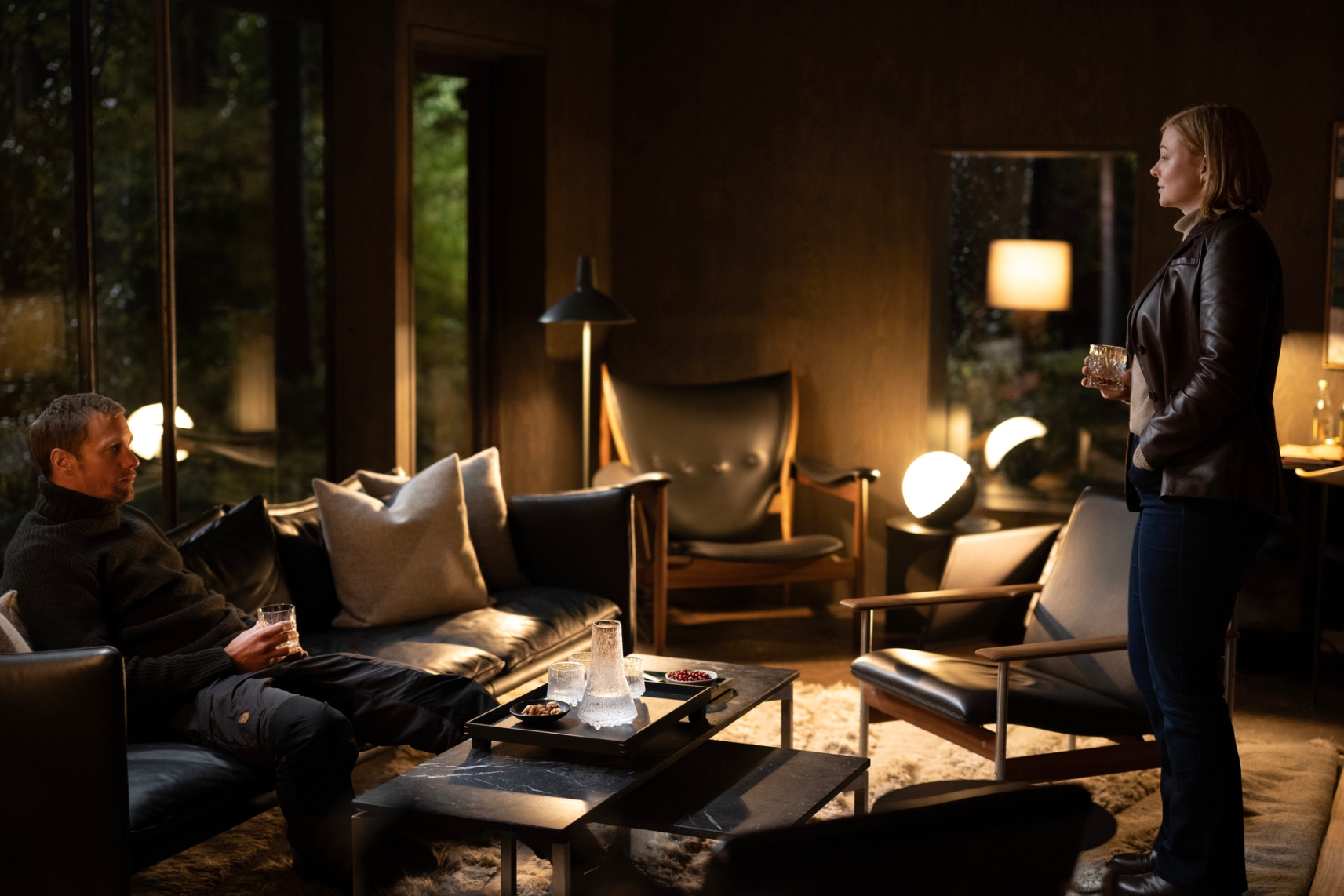
Matsson, being a(n Eric) Northman though, doesn’t bother hiding his beastly side. He delights in telling people exactly what he is. “I like to f**k around. I do!” he tells Shiv (Sarah Snook) in a patio chat out of earshot from her brothers. “But I, like, f**k around like . . . psilocybin at breakfast.”

“Kill List” shows what that means. The GoJo chief wields impropriety with verve at the Norway company retreat to which he beckons the Waystar Royco team – all the top executives, along with Kendall (Jeremy Strong), Roman (Kieran Culkin) and Shiv – for a culture compatibility check. (Alan Ruck’s Connor is left in New York to spar with Marcia over whether Logan will wear a kilt in his casket, a task he can barely handle.)

To no one’s surprise, Matsson’s boys’ club culture resembles ATN’s in many ways. “Privacy, pussy, pasta” are Matsson’s main motivators, as he announces when we first meet him in the seventh episode of Season 3,”Too Much Birthday.” Ergo, little of what we see in this hour defies that mission statement. He introduces his head of communications, Ebba (Eili Harboe), to Shiv as “an estrogen air freshener we keep around to try to keep us smelling clean.” 

Kendall, Roman, and Shiv could see their father’s vision through … if they weren’t Kendall, Roman, and Shiv.

Untroubled, Ebba tells Shiv she keeps notes on everything Matsson says so that when she walks she’ll either get a massive payoff to stay quiet or it’ll go in her tell-all. Despite this skeevy interaction, Shiv seems intrigued by Matsson’s danger.

“Kill List” is written by Ted Cohen, who collaborated on “The Disruption,” and Jon Brown, who wrote “Vaulter” and “Lion in the Meadow.” Those episodes are precursors as to what happens here. “Lion in the Meadow,” for instance, features Kendall and Logan meeting with a major shareholder (Adrien Brody, whose performance garnered an Emmy nod) who, upon witnessing their failure to get along, tells Ken he’s lost confidence in the company’s leadership.

“The Disruption” is the hour where Kendall disrupts Shiv’s speech at a Waystar town hall, her earliest coming-out as a member of the executive team, by having an assistant blast Nirvana’s “Rape Me” over her speech. One episode shows Kendall trying to impress a bigger dog and failing. The other sees Shiv publicly humiliated to an extent that warrants epic payback. It takes a while but at long last, here we are.

Alexander Skarsgård in “Succession” (Photograph by Graeme Hunter/HBO)

Matsson and the GoJo team are the Waystar crew’s opposites in every way. Karolina (Dagmara Domińczyk), doing her due diligence on the plane ride from New York to Norway, sounds the alarm that “the whole team has Fulbrights coming out of their asses. NASDAQ master race!” More fearsome than their resumes is their corporate track record: a recent acquisition of a video game publisher resulted in 10 percent staff retention, mostly the youngest employees.

Gerri (J. Smith-Cameron) counters this psych out with an inspirational pre-battle speech. “They may think they’re Vikings,” she tells the wavering troop, “but we’ve been raised by wolves, exposed to a pathogen that goes by the name of Logan Roy. And they have no idea what’s coming to them. OK?”

Yeah, well . . . Gerri can speak for herself.

Vikings have a complicated relationship with wolves. Matsson, if he believed in those old Norse myths, may have viewed Logan on par with Fenrir, the wolf who kills Odin in Ragnarok. But on this day, the alpha is dead, and Asgard is ready to bring his pups to heel. Odin also kept wolves as pets, don’t you know.

So when Kendall says at the top of the episode, “Let’s go get the deal. Let’s bleed the Swede!” you could probably guess who would be exiting this meeting with a mortal wound.

To review: Logan planned to sell off nearly all of his Waystar Royco empire except for his right-wing propaganda machine ATN, the only part of his business with the power to pick presidents and shape society to his will. With his entertainment concerns offloaded, he could corner the news and information sector by acquiring Pierce Global Media. But his death shot that plan to Hell along with his soul.

Kendall, Roman and Shiv could see that vision through . . . if they weren’t Kendall, Roman, and Shiv, an easily manipulated trio. Matsson has already sized up the boys. As for Shiv, soon after the Swede meets Tom (Matthew Macfadyen), he realizes Shiv’s husband offers no competition.

At breakfast, Matsson opens his attack by peeling Roman and Kendall away from Shiv, Gerri, Frank (Peter Friedman) and Karl (David Rasche) with a playground taunt: “You guys scared to come and talk without the village elders?” From there he corners them in a room and announces that he wants all of Waystar Royco, including ATN.

Kendall and Roman assume they’re born to win, but when they get in the room with Matsson and he announces he wants to purchase their entire legacy for . . . one dollar, they’re shaken. A few icepick stabs later he offers $187 per share: 50 percent in cash, and 50 percent in stock. 

The brothers Roy bring the offer to the “village elders” who salivate at how golden their parachutes will be. On the walk to deliver the news to Shiv, though, the boys decide they need to keep ATN.

Jeremy Strong, Sarah Snook, Kieran Culkin in “Succession” (Photograph by Graeme Hunter/HBO)

Shiv feels differently. She’s gotten word that back in the ATN newsroom, their head of news, Cyd (Jeannie Berlin), has had neo-fascist presidential candidate Jeryd Mencken’s campaign team dialed in on their editorial morning conference. Shiv asks them if they knew, and Roman answers, “I did not know that,” in a way that reads, “I totally knew.”

When Kendall redirects her attention to Matsson’s offer to take ATN in the deal, Shiv says, “Yeah. Sure, fine. Get rid of it. It’s a toxic asset.” Kendall counters that ATN is their father’s pride and joy, and he was trying to keep it when he died. “Yeah, well, let’s just keep one of his old sweaters,” she responds. “Less racist.” She insists that they get the deal done.

Resuming negotiations at a patio table, Shiv sitting nearby this time, does not close the deal.

“You don’t want ATN,” Matsson says. Kendall tries to persuade Matsson that he doesn’t know what he’s buying. Matsson assures them and “Succession” viewers that he does. “Long term, I don’t think news for angry old people works,” he says. (No kidding. It can also be unnecessarily expensive!)

Kendall says he’s wrong; Matsson says he doesn’t care what he thinks. “You’re a tribute band.”

Matsson shows Shiv that they’re more aligned on this issue than her brothers realize, mainly because Roman and Kendall do not consider Shiv’s insight on anything. So that night, while Kendall tells Roman he wants to tank the deal in a fireside chat, Shiv joins Matsson for a drink and a bump in his private quarters.

Vikings had a complicated relationship with wolves. Matsson … may have viewed Logan Roy on par with Fenrir, the wolf who kills Odin. But the alpha is dead and Asgard is ready to bring his pups to heel. 

Here is where Skarsgård’s talent for sinister seduction weaves beautifully with Snook’s way of making Shiv’s false self-assurance plausible. As Snook plays it, maybe Shiv knows what she’s doing. Maybe what she stokes here is entirely accidental. It’s hard to tell.

But, as Shiv and Matsson circle each other, he plies the time-honored panty-plundering technique of seamlessly mixing lies with truths to appear vulnerable. “I can find it hard to see the angles on people, you know?” (Lie.) “Like, I get into things, and I don’t have very good boundaries.” (Truth.) “Like . . . I’m doing it now.” (Also true; also tantalizing.) He asks Shiv for negotiation advice; she states the obvious – offer more money. He asks about Karolina, out of nowhere. Shiv assures him Karolina is good at what she does.

Then Matsson plays another enticement card, asking Shiv for relationship advice. He tells the story about “a girl” he broke up with, and that as part of a “nasty, friendly joke,” he sent her half a liter of his blood, frozen into a brick. “As a joke!” he repeats. Then he kept doing it, “again and again and again, and then it became not a joke, and then a joke again? And now it’s not a joke.” Maybe he’s serious. Maybe he’s not, and this is another test. Of course he’s talking about Ebba. His head of communications. He can just deny this, right? he asks Shiv, who points out the difficulty in that since Ebba has actual liters of his DNA in her possession which is waaaay off the creep charts.

Alexander Skarsgård, Sarah Snook in “Succession” (Photograph by Graeme Hunter/HBO)

Then she serenely offers a few tips in response. “Three-point PR plan, just off the top of my head: Point one might be hard for you, but – stop sending people your blood.” She continues with more sapience, offering Gerri as a sounding board.

“I like you,” says Matsson. “You’re cool. You’re not judgy. You can take a joke, and I like that. Like your dad.” This pleases Shiv. The next day she lords her nightcap meeting over Tom, praising how “broad” Matsson is. Tom flicks her earlobe hard and calls it “thick and chewy.”

By then the boys are ready to nuke the deal. They’ve forced the GoJo staff to watch a mind-numbing early cut of an upcoming theatrical release to tenderize them. Then Kendall and Roman take a gondola to the top of a mountain where Matsson waits, having traveled by helicopter to get there first. “People are f**king, tiny, right? But not us! Not us.” Matsson brags. Ah, flattery. He knows that Logan was the 100-foot-tall giant in the family and his children are pliable pygmies, like everyone else.

The boys open the conversation by complaining about the movie. Then Matsson gets pointed. “Are you Scooby-Doo-ing me here? . . . You’re telling me the theme parks are haunted, your big movie is s**tty? Are you tanking the deal?”

Alexander Skarsgård in “Succession” (Photograph by Graeme Hunter/HBO)

The ruse unmasked, the Swede moves in for the jugular: “I preferred doing this with your dad. I mean, he was a prick, but at least he knew what he wanted . . . I think he’d be embarrassed if he saw you two now. His two big boys playing Scooby-Doos. Am I going to have to go around you, talk directly to the Board? Talk directly to the old ones? Unbelievable.”

And Kendall, thinking he has Matsson where he wants him, sets Roman on the GoJo titan while he’s taking a piss. Roman screams insults at Matsson who listens calmly, grinning and muttering, “This is good.”

When Roman’s tirade is finished, Matsson leans in, smiles, and whispers, “Wait, wait, wait – you just f**ked yourself. Good.”

As the Scoobies take the slow gondola back down the mountain Matsson flies past in his whirlybird. He bypasses them again when they’re flying home, calling Village Elder Frank with a revised offer of $192 a share. Pending board approval and whatever unforeseen nonsense may gum up the works, Waystar Royco, including ATN, will belong to Matsson. 

Then the provisional “kill list” proposing which personnel should be bought out pops into their inboxes. Pretty much all of the old guard is on it, except for Karolina and Gerri, the two names Shiv dropped in Matsson’s whiskey glass . . . and Tom.

As the old ones celebrate having successfully raided the young Vikings, Shiv, feeling the power surge of clinching favorite child status from a new daddy, instructs Tom to fire Cyd. She starts to ask her humbled not-quite-ex if he wants dinner, but is interrupted by a call from Odin. Matsson instructs Shiv, in his bedroom voice, to send him a photo of her brothers’ glum faces. She surreptitiously complies, then clinks champagne glasses with her bros, smiling duplicitously in place of offering, “Skål.

“A series of crimes”: Ex-prosecutor says new Trump election texts “more damning” than Georgia call

Two men hired by former President Donald Trump’s legal team discussed a plot to use data obtained from a breached Georgia voting machine as part of an attempt to decertify the state’s 2021 U.S. Senate run-off election, according to CNN

Jim Penrose, a former National Security Agency official who worked alongside Trump attorney Sidney Powell to access voting machines in Coffee County, Georgia, communicated with Doug Logan, CEO of a firm that allegedly runs audits of voting systems.

“Here’s the plan. Let’s keep this close hold,” Penrose wrote. “We only have until Saturday to decide if we are going to use this report to try to decertify the Senate run-off election or if we hold it for a bigger moment,” Penrose added, referring to a potential lawsuit related to the impending confirmation of Democrat Jon Ossoff’s triumph in the runoff. 

CNN reported that the texts reveal the first instance in which Trump sympathizers contemplated using the data to overturn elections beyond the 2020 presidential race.

Georgia District Attorney Fani Willis is leading a criminal investigation into the scheme to breach voting systems. Willis has subpoenaed several individuals in connection to the probe, including Powell and former Trump attorney Rudy Giuliani. She has also subpoenaed both Penrose and Logan over their involvement in the Georgia runoff breach. CNN also reported that Willis’ office is considering a potential racketeering case against multiple defendants.

Former prosecutor Michael Zeldin told CNN that the report suggests violations of multiple state and federal laws.


Want a daily wrap-up of all the news and commentary Salon has to offer? Subscribe to our morning newsletter, Crash Course.


“What we have here is unauthorized access to this privileged computer data,” Zeldin said. “There is a conspiracy to acquire and improperly distribute that data. There is probably a crime of interfering with the rights of the people of Georgia to have a free and fair election. And this is a series of crimes, a pattern of criminal activity, then it could possibly violate the Georgia RICO statute, which criminalizes a series of criminal activities by the same person or group of persons, so there’s a lot at stake here.” 

Zeldin also said that the texts between Penrose and Logan are “more damning” than Trump’s phone call to Georgia Secretary of State Brad Raffensperger, in which Trump suggested that Raffensperger could “find” the 11,780 votes needed to flip the state election in his favor.

“Cost of doing business”: Fox News can claim massive tax break on $787M settlement

Fox News may claim a tax break on the $787.5 million settlement it reached with Dominion Voting Systems last week, experts say.

The network last week agreed to pay the voting machine company the largest known sum to settle a defamation case in history after acknowledging it aired false claims alleging Dominion rigged the election against former President Donald Trump.  

Despite the big payout, the overall cost the conservative media company will actually need to fork over itself will likely be far smaller. Experts told The Associated Press that the lawsuit’s actual cost remains murky because of ways Fox can offset the financial hit, specifically through insurance and tax deductions.

A tax write-off could potentially save Fox News millions, The New York Times reported, as U.S. law permits companies to deduct at least some amount of settlement fees “as the cost of doing business.”  

Robert Willens, a tax professor at Columbia Business School, estimates that once is all said and done, Fox will be on the hook for approximately $590 million.

“The key is that if the payments are being made to private parties and not at the behest of the government then you can pretty much conclude without any fear of contradiction that the payment will be deductible,” Willens told the outlet.


Want a daily wrap-up of all the news and commentary Salon has to offer? Subscribe to our morning newsletter, Crash Course.


Chad Milton, a partner at Media Risk Consultants, pointed out that a media conglomerate like Fox is likely to be well-insured — somewhere between $100 and $500 million in coverage — meaning that insurance will also likely cover a portion of the settlement. 

“It’s not hard to stack up $100 million but as you go higher than that, it gets harder and harder,” he said.

Following the settlement, Fox stated that it does not expect the Dominion settlement to affect its business.

“We don’t expect significant operational effects or changes to our business given our cash flow, strong balance sheet and the health of our business,” the company said. 

However, if Fox’s insurance company bails them out this time, an annual aggregate of liability could prevent them from receiving insurer assistance in any future multi-million dollar settlements — which could be significant given that Fox remains embroiled in another big-money lawsuit with voting technology company, Smartmatic. The company is demanding $2.7 billion in restitution from Fox, arguing that the 2020 election conspiracies “decimated” its business. 

Smartmatic lawyer Erik J. Connolly last week released a statement asserting that the company “remains committed” to seeing Fox be held accountable.

“Dominion’s litigation exposed some of the misconduct and damage caused by Fox’s disinformation campaign. Smartmatic will expose the rest,” Connolly said. “Smartmatic remains committed to clearing its name, recouping the significant damage done to the company, and holding Fox accountable for undermining democracy.”

The unequal treatment of Trump v. DeSantis: Who gets the advantage?

Florida Governor Ron DeSantis is crumbling under a mountain of criticism for his sinking campaign. Right now he’s traveling all over the country giving speeches and selling his book proclaiming he’s the greatest anti-woke warrior on the planet. This week he’s jetting off overseas, presumably to prove that he can meet with foreign leaders as an equal. Meanwhile, back in Florida, Ft. Lauderdale is drowning and he hasn’t bothered to change his busy schedule to appear (even belatedly asking for an emergency federal emergency declaration from the road.) And he was terribly embarrassed by all but one of the Florida congressional delegations, some of whom are his former colleagues in the House, endorsing Donald Trump in a carefully choreographed roll-out over the course of a week.

The New York Times’ Maggie Haberman notes that while all of this is true, it’s also true that DeSantis is being judged by the party and the press as a normal politician while Trump still gets graded on a curve. What she means by that is DeSantis is taken at his word while Trump still benefits from the 2016 trope that the news media takes him “literally but not seriously,” while his supporters take him “seriously but not literally.” This does appear to be true, however. DeSantis is being closely scrutinized for his agenda while, even after all this time, people are still dismissing Trump’s outlandish statements.

This is not to say that DeSantis doesn’t deserve it.

In fashioning himself as woke’s most energetic antagonist, he’s made himself into a uniquely malevolent political figure. His assaults on education, by banning books and the teaching of the real history of America, and attacks on LGBTQ kids are grotesque. Stunts such as his rendition of migrants from Texas to Martha’s Vineyard and his inane battle with Disney deserve to be thoroughly investigated and exposed. His recent signing of a draconian 6-week abortion ban, mere months after signing a 15-week ban, is basically just a doubling down on massively unpopular government overreach. DeSantis’ authoritarian agenda is barbaric so it deserves all the attention it is getting.

You will notice that most of the Republicans backbiting DeSantis have been doing so in highly personal terms. This article in Rolling Stone revealed that there is a rather large group of defectors from the governor’s staff who have gone to work for Trump and who are pledged to destroy their former boss. They really do not like the guy. Here’s just one quote from a former associate:

“The nature of the conversations among the people who used to work for Ron is just so frequently: ‘OK, how can we destroy this guy?’ It is not at all at a level that is normal for people who hold the usual grudges against horrible bosses. It’s a pure hatred that is much, much purer than that … People who were traveling with Ron everyday, who worked with him very closely over the years, to this day joke about how it was always an open question whether or not Ron knew their names … And that’s just the start of it.”

That’s brutal.

DeSantis is being closely scrutinized for his agenda while, even after all this time, people are still dismissing Trump’s outlandish statements.

And Florida Republicans are even starting to get impatient with his “woke” agenda. According to Politico, “they’re frustrated by a grinding session where legislators have pushed through bill after bill — and chewed up hours of contentious debate — that’s considered integral to DeSantis’ expected presidential campaign.” They had their own priorities and DeSantis is spending his time picking fights with the state’s biggest employer:

“People are deeply frustrated,” said former state Sen. Jeff Brandes, a St. Petersburg Republican who has been talking to his former GOP colleagues frequently this session. “They are not spending any time on the right problems … Most legislators believe that the balance of power has shifted too far and the Legislature needs to re-establish itself as a coequal branch of government.”

This is the first we’ve seen of Republicans criticizing DeSantis’ agenda and not just his obviously unpleasant personality. One even said, “We are not the party of cancel culture.” (You could have fooled me — and all the librarians and teachers dealing with the banned books.)


Want a daily wrap-up of all the news and commentary Salon has to offer? Subscribe to our morning newsletter, Crash Course.


Trump, on the other hand, is putting out an agenda that will make your hair stand on end and nobody is saying a word.

Back in 2016, Trump had a list of proposals that shocked the nation. He was going to build a wall on the southern border and make Mexico pay for it. He said he would ban all Muslims from coming into the country. He said he would pay off the national debt in four years and would deport thousands of refugees, even children. But mostly he whined about how stupid all the other leaders are and complained about how the country has gone to hell in a handbasket while promising to make America great again. His demagogic blather made a lot of people happy.

It’s a mistake to assume that Trump’s the same loudmouthed gadfly that he was back in 2016.

But this time, seeking revenge on his enemies, he has compiled a list of policies that show a much more systematic authoritarian agenda than he had before. Yes he, like DeSantis, is attacking Critical Race Theory and transgender people of all ages. He’s got the bigoted proposals like mass deportation and as I mentioned the other day, he’s now proposing to arrest the homeless and offer them to option of jail or concentration camps somewhere away from people (where he says their needs will be met.) That’s crazy talk, but it’s the kind of thing Trump has always had an ear for by tuning in to the right-wing jungle drums.

But Trump has another agenda that’s downright terrifying. He is determined to expand executive power beyond anything even Dick Cheney or Bill Barr could have imagined.

I’m sure you can see the theme there. Donald Trump is prepared to completely upend the civil service and executive branch to fill it with Republican toadies. Do I think he can accomplish that? I don’t know. But I think it’s a mistake to assume that he’s the same loudmouthed gadfly that he was back in 2016. He’s seen the power of the presidency and he is driven by a thirst for revenge. He says it clearly: “I am your warrior. I am your justice. And for those who have been wronged and betrayed, I am your retribution.”

Ron DeSantis is rightly being subjected to critical scrutiny for his deviation from our understanding of how the American system is supposed to work. Even Republicans are queasy about his expansion of executive power. But Trump is no longer just an eccentric TV star who got lucky, he’s a former president who attempted a coup to stay in power and is now the frontrunner for the Republican nomination. Why in the world isn’t the media taking Donald Trump’s plans both seriously and literally this time? 

Egos over freedom: Proud Boys trial proof MAGA will pay any price to avoid admitting they were wrong

Do the Proud Boys want to go to prison?

For those who have been following the seemingly endless D.C. trial for five leaders accused of crimes related to the insurrection of January 6, it’s starting to become a serious question. To start, the defense attorneys have been pulling stunts and filing nuisance motions, likely annoying the jury by drawing out a trial that was initially supposed to last a few weeks into a months-long affair. But most bizarrely, the defense keeps undermining its own strategy. 

Despite the circus atmosphere that has prevailed since the court procedures began late last year, the legal team for the Proud Boys seemingly has a simple defense: The right-wing group never intended to be the vanguard of Donald Trump’s insurrection but were just innocent protesters who got caught up in the moment. It’s always been a tough case to make. As with the members of a similar neo-fascist gang that was convicted on similar charges, the Oath Keepers, there’s a pile of text messages and video evidence demonstrating how intentional the attack was. This may be why the defense team decided to let Proud Boys defend themselves from the stand, hoping they could “humanize” them to the jury. 

Time will tell, of course, but so far, this feels like a risky bet.

Defense witnesses have been cantankerous and revealed themselves to be dishonest. They have done a poor job of showing remorse, and instead have often doubled down on the conspiratorial thinking that got them into trouble in the first place. That it’s even gotten this far is part of a more disturbing phenomenon that’s characterized the past couple of years after the insurrection: The outsized egos that characterize MAGA America will not allow Trump supporters to admit they were wrong. Not even when the costs of refusing to back down are spiraling. In some cases, the massive losses are financial. In others, as with the Proud Boys, they are literally facing the loss of freedom.


Want more Amanda Marcotte on politics? Subscribe to her newsletter Standing Room Only.


 On Thursday, Proud Boy defendant Dominic Pezzola had what the New York Times described as an “outburst.” Initially, Pezzola’s plan seemed to be to present a face of remorse to the jury, claiming he wants “to take responsibility for my actions on Jan. 6.” But this sad boy act seems to have fallen apart pretty quickly under cross-examination by the prosecutor. Pezzola started raving about “this corrupt trial with your fake charges.” He also ranted about the pandemic restrictions on the stand, complaining about “unconstitutional lockdowns” from “a tyrannical government,” a stance that’s even harder to sell in an era when those restrictions are long over. 


If they were trying to be martyrs, they’d own their behavior openly, instead of playing weaselly word games on the stand.

This was after Wednesday’s testimony, when Pezzola revealed that he’s still deeply buried in the world of conspiracy theories, by repeating claims that have circulated in insurrectionist circles falsely accusing one of the rioters of working for the FBI. Pezzola further undermined his credibility on Thursday by saying he had lied to investigators earlier when he said at least one fellow Proud Boy had been armed with a gun. Was he lying then or now? Hard to say, but either way, he’s reminding jurors he’s not trustworthy. 

While less incendiary, similar testimony from defendant Zachary Rehl makes it look like putting him on the stand may not have been the best idea. While he claims to “truly apologize” for the events that day, his claims that he meant no harm are hard to swallow and undermine his credibility. After he presented what the prosecutor derided as a “choirboy image,” the Justice Department lawyers reminded jurors of how Proud Boys actually behaved on January 6, showing videos of them pepper-spraying cops and punching a woman to the ground. In response, Rehl got defensive. “That’s a hard thing to try to defend to the public,” he admitted before claiming to not remember if it was him on the video pepper-spraying police. 

One does start to wonder why these fools went to trial instead of trying to plead down, especially after the Oath Keepers made the same play and ended up being sent to prison. If they were trying to be martyrs, they’d own their behavior openly, instead of playing weaselly word games on the stand. No, it appears the Proud Boys, like the Oath Keepers before them, went this route for a simple reason: Their egos will not let them admit that it was a stupid thing, following Trump to the point of rioting at the Capitol. They’d rather risk hefty prison sentences than say out loud that the liberals were right all along. 

This MAGA bullheadedness is, alas, not limited to the realm of those who are so far gone they joined the insurrection.

Most Republican voters, at this point, would rather lose the 2024 election than concede liberals were right about Trump in the first place.

It’s why Fox News agreed to pay Dominion Voting Systems $787.5 million in their recent defamation settlement. It’s a number that is nearly 10 times what Dominion was valued at in 2018, which means that it’s likely larger than what Dominion could have gotten at trial, despite overwhelming evidence that Fox knowingly spread lies accusing Dominion of stealing the 2020 election for President Joe Biden. By paying that eye-poppingly huge number, it’s likely Fox avoided having to apologize, much less admit out loud that the Big Lie was a lie. That’s what it’s worth to the company to avoid the dreaded “liberals were right” statement: Over three-quarters of a billion dollars. But it’s probably less about the egos at Fox than it is about the snowflake-fragile egos of their audience. If Fox apologized, that would be tantamount to telling their viewers that it was wrong and foolish to profess the Big Lie or to let a monster like Trump lead them down this path. Fox viewers can never, ever accept that liberals were right about Trump. So their favorite network will write out as many massive checks as it takes to avoid saying out loud that, in retrospect, maybe that whole MAGA thing was a bad idea. 

In her most recent Contrapoints video, YouTuber Natalie Wynn talks about what she calls the “bigotry whirlpool,” which helps explain why radicalized people tend to dig in deeper, even as the personal costs of doing so mount higher. 

“Reformed bigots have to face not only the shame of being dupes, but also the guilt of having devoted years of life to harming vulnerable people,” she explains. She points to people who have lost marriages, been fired, or otherwise paid enormous personal costs, all because they couldn’t, for instance, stop ranting about how they hate trans people on social media. The higher the costs become, the more they dig into their hateful beliefs, because otherwise they have to admit they gave it all up for nothing. The bigotry whirlpool effect is in play with MAGA. They’re just so wrong that they can never admit it without terrible shame, and so the costs they’ll pay to avoid that are unbelievably high. 

This is why Trump will be the GOP nominee in 2024. If Republican primary voters could humble themselves and think strategically, they would realize he’s very likely to lose again in a rematch with Biden. But saying that would be tantamount to admitting that it was probably a bad idea to back a grifting, sociopathic reality TV host in the first place. Most Republican voters, at this point, would rather lose the 2024 election than concede liberals were right about Trump in the first place. And they will soothe their hurt egos with more lies if that happens, by saying that Biden “stole” it again. Anything but dial down their egos by entertaining the possibility that they were wrong. 

The corporate attack on democracy

Contrary to what many people had hoped and wished for, Dominion Voting Systems’ settlement in its defamation lawsuit against Fox “News” for nearly 800 million dollars — the largest defamation settlement in United States history — is not some great victory for American democracy. In many ways, the outcome is a reminder of how corporate power and greed are antithetical to and actively undermine real democracy.

Fox has not been cowed or humbled by the Dominion lawsuit and settlement. It most certainly will not stop serving as the de facto propaganda outlet of the Republican Party. Moreover, Fox is not even required, and most certainly will not, publicly apologize for defaming Dominion with intentional lies and other misrepresentations that the latter’s voting machines were compromised and fraudulent. Fox made those false claims as part of Donald Trump’s Big Lie strategy during the 2020 election and in the lead-up to the Jan. 6 riot.

As I explained in an earlier essay here at Salon, Fox “News” will only use the Dominion case as a lesson and test for how far they can go in their assault on democracy and the truth without consequences.

Ultimately, that Dominion would settle with Fox for almost 800 million dollars is more proof of the wisdom and advice offered by the legendary hip hop supergroup the Wu-Tang Clan that “Cash rules everything around me C.R.E.A.M., get the money, dollar dollar bill, y’all”.

To that point, The Star-Ledger Editorial Board offered this excellent summary of the Dominion lawsuit and what it means (or not) for American democracy:

But while some may be satisfied that Fox conceded, it is another blow to democracy that this media gorgon can still go about its business, with no obligation to correct the record or repair the damage already done, while it continues to expose the country to dangerously high levels of mendacity and fanaticism.

To be clear: Dominion won, but America lost.

Fox took a hit in the wallet, despite perpetuating one of the biggest shams in our history by floating ballot fraud nonsense – all in service of a candidate they held in contempt and knew had lost the election. And in the months that followed the Capitol riot – which was triggered by those same lies – Fox’s talking heads repeated a full-throated denial of the insurrection and even attacked Republicans who wouldn’t go along with the Big Lie….

So Fox’s cynicism rolls on, as it deftly avoids consequences. That has become the norm for a network that has always reported lies and racist opinion as fact, distorted public understanding of everything from climate change to Barack Obama’s citizenship, and turned white grievance, fear mongering, and contempt for democracy into high art.

Media expert David Rothkopf put it best: “Nothing that is broken in our system got fixed today,” he wrote. “That is the only meaningful metric of the Fox-Dominion settlement. We seem increasingly incapable of righting wrongs, reversing attacks, reducing threats.”

At Esquire, Charles Pierce is even more blunt and direct:

All of these things will likely come to pass because American corporations, even the ones that own large media outlets, have the dedication to democracy of a sea urchin when it might impinge on the bottom line. Dominion Voting System was just doing what modern American corporations do. And, when it comes right down to it, it’s not Dominion’s job to make whole our commitment to our republic. That’s our fcking job, and we’ve shirked it long enough.

In all, Dominion’s decision to settle with Fox “News” is a “teachable moment” about how corporations are first and foremost (and by law) a legal arrangement designed to protect self-interested actors where money and profits are more important than people – or the Common Good or democracy or other civic virtues.

Fox News will only use the Dominion case as a test for how far they can go in their assault on democracy.

Contrary to how they brand themselves with sophisticated lifestyle marketing and other techniques (such as giving money to charity and being supporters of “diversity” and “the environment” and other “progressive causes”) that are designed to create an emotional connection between the corporation and the consumer, the corporation is not your friend. But beyond the Dominion settlement, many of America’s leading corporations are continuing to undermine the country’s democracy and civil society by giving money to the Republican Party and its candidates, elected officials, and other leaders who supported (and participated in) the Jan. 6 coup attempt.

A key part of America’s national mythology is that democracy and capitalism are one and the same thing and that corporations and big business and “free markets” are essential indicators of “freedom” and “democracy.” In reality, the corporation supports those arrangements of political economy that allow them to maximize their profits. Democracy is not a prerequisite for such an outcome. There are many examples, almost too many to list, where corporations have in the past and continue to support anti-democratic and authoritarian policies — and antisocial and anti-human policies more generally including genocide, slavery, war profiteering, and global climate disaster — if they deem it in their financial interests to do so.

Based on its behavior as compellingly demonstrated by law professor Joel Balkan in the bestselling book “The Corporation” (and in the award-winning documentary of the same name), the corporation can reasonably be described as a sociopath if not a psychopath. The Guardian summarizes this: “If you did a psychological profile of the corporation, what would it look like? Self-interested, manipulative, avowedly asocial, self-aggrandising, unable to accept responsibility for its own actions or feel remorse – as a person, the corporation would probably qualify as a full-blown psychopath.”


Want a daily wrap-up of all the news and commentary Salon has to offer? Subscribe to our morning newsletter, Crash Course.


If the corporation does support “democracy,” it is mostly a function of a realpolitik calculation that such governments and societies will allow the corporation more latitude of action and protections under the law (laws which the corporate and financial sector and other moneyed interests actually craft to serve their interests).

Also at the Guardian, Robert Reich offers these examples of corporate power and how they work against democracy and what the average person actually wants from government and public policy:

According to a landmark study published in 2014 by the Princeton professor Martin Gilens and Northwestern professor Benjamin Page, the preferences of the typical American have no influence at all on legislation emerging from Congress.

Gilens and Page analyzed 1,799 policy issues in detail, determining the relative influence of economic elites, business groups, mass-based interest groups and average citizens. Their conclusion: “The preferences of the average American appear to have only a minuscule, near-zero, statistically non-significant impact upon public policy.” Lawmakers mainly listen to the policy demands of big business and wealthy individuals – those with the most lobbying prowess and deepest pockets to bankroll campaigns and promote their views.

It’s probably far worse now. Gilens and Page’s data came from the period 1981 to 2002: before the supreme court opened the floodgates to big money in the Citizens United case, before Super Pacs, before “dark money” and before the Wall Street bailout….

Reich continues:

The corporate return on this mountain of money has been significant. Over the last 40 years, corporate tax rates have plunged. Regulatory protections for consumers, workers and the environment have been defanged. Antitrust has become so ineffectual that many big corporations face little or no competition.

Corporations have fought off safety nets and public investments that are common in other advanced nations (most recently, Build Back Better). They’ve attacked labor laws, reducing the portion of private-sector workers belonging to a union from a third 40 years ago to just over 6% now.

They’ve collected hundreds of billions in federal subsidies, bailouts, loan guarantees and sole-source contracts. Corporate welfare for big pharma, big oil, big tech, big ag, the largest military contractors and biggest banks now dwarfs the amount of welfare for people.

The profits of big corporations just reached a 70-year high, even during a pandemic. The ratio of CEO pay in large companies to average workers has ballooned from 20-to-1 in the 1960s, to 320-to-1 now.

Meanwhile, most Americans are going nowhere. The typical worker’s wage is only a bit higher today than it was 40 years ago, when adjusted for inflation.

But the biggest casualty is public trust in democracy.

In 1964, just 29% of voters believed government was “run by a few big interests looking out for themselves”. By 2013, 79% of Americans believed it.

Corporate donations to seditious lawmakers are nothing compared with this 40-year record of corporate sedition.

Public intellectual Noam Chomsky is even more direct in his assessment of corporate power (what he describes as the “RECD”) in the era of late capitalism:

First, let me say that what I have in mind by the term “really existing capitalism” is what really exists and what is called “capitalism.” The United States is the most important case, for obvious reasons. The term “capitalism” is vague enough to cover many possibilities. It is commonly used to refer to the US economic system, which receives substantial state intervention, ranging from creative innovation to the “too-big-to-fail” government insurance policy for banks, and which is highly monopolized, further limiting market reliance.

It’s worth bearing in mind the scale of the departures of “really existing capitalism” from official “free-market capitalism.” To mention only a few examples, in the past 20 years, the share of profits of the 200 largest enterprises has risen sharply, carrying forward the oligopolistic character of the US economy. This directly undermines markets, avoiding price wars through efforts at often-meaningless product differentiation through massive advertising, which is itself dedicated to undermining markets in the official sense, based on informed consumers making rational choices….

In a way, all of this explains the economic devastation produced by contemporary capitalism that you underscore in your question above. Really existing capitalism – RECD for short (pronounced “wrecked”) – is radically incompatible with democracy. It seems to me unlikely that civilization can survive really existing capitalism and the sharply attenuated democracy that goes along with it. Could functioning democracy make a difference? Consideration of nonexistent systems can only be speculative, but I think there’s some reason to think so. Really existing capitalism is a human creation, and can be changed or replaced.

To stop the rising fascist tide and the onslaught of the Republican Party, the “conservative” movement, and its agents such as Fox “News” and other parts of the neofascist machine on American democracy, freedom, and human and civil rights — and happiness — requires that the American people engage in collective action, organize, vote, pressure, boycott, educate themselves, become engaged citizens, and overall take their destiny into their own hands. Looking to corporations such as Dominion (or the courts or voting alone or the Democratic Party) or other centers of elite power will not save us from the rising fascist tide and its living nightmare.

Leaked papers reveal reality behind Ukraine war propaganda — and it’s grim

The corporate media’s initial response to the enormous leak of secret documents about the war in Ukraine was to throw some mud in the water, declare there was nothing to see here, and cover it as a depoliticized crime story about a 21-year-old National Guard member who published secret documents to impress his friends. President Biden dismissed the leaks as revealing nothing of “great consequence.”

What these documents reveal, however, is that the war is going worse for Ukraine than our political leaders have admitted to us, while going badly for Russia too, so that neither side is likely to break the stalemate this year and this will likely lead to “a protracted war beyond 2023,” as one of the documents says. 

The publication of these assessments should lead to renewed calls for our government to level with the public about what it realistically hopes to achieve by prolonging the bloodshed, and why it continues to reject the resumption of the promising peace negotiations it blocked in April 2022. 

We believe that blocking those talks was a dreadful mistake, in which the Biden administration capitulated to the war-mongering, since-disgraced former British Prime Minister Boris Johnson, and that current U.S. policy is compounding that mistake at the cost of tens of thousands more Ukrainian lives and the destruction of even more of their country.

In most wars, while the warring parties strenuously suppress the reporting of civilian casualties for which they are responsible, professional militaries generally treat accurate reporting of their own military casualties as a basic responsibility. But in the virulent propaganda surrounding the war in Ukraine, all sides have treated military casualty figures as fair game, systematically exaggerating enemy casualties and understating their own. 

Publicly available U.S. estimates have supported the idea that many more Russians are being killed than Ukrainians, deliberately skewing public perceptions to support the notion that Ukraine can somehow win the war, as long as we just keep sending more weapons.

The leaked documents provide internal U.S. military intelligence assessments of casualties on both sides. But different documents, and different copies of the documents circulating online, show conflicting numbers, so the propaganda war rages on despite the leak.   

The most detailed assessment of attrition rates of troops says explicitly that U.S. military intelligence has “low confidence” in the attrition rates it cites. It attributes that partly to “potential bias” in Ukraine’s information sharing, and notes that casualty assessments “fluctuate according to the source.”

Public U.S. estimates have supported the idea that many more Russians are being killed than Ukrainians, skewing public perceptions to support the notion that Ukraine can somehow win the war.

So, despite denials by the Pentagon, a document that shows a higher death toll on the Ukrainian side may be correct, since it has been widely reported that Russia has been firing several times the number of artillery shells as Ukraine, in a bloody war of attrition in which artillery appears to be the main instrument of death. Altogether, some of the documents estimate a total death toll on both sides approaching 100,000 and total casualties, killed and wounded, of up to 350,000. 

Another document reveals that, after using up the stocks sent by NATO countries, Ukraine is running out of missiles for the S-300 and BUK systems that make up 89% of its air defenses. By May or June, Ukraine will therefore be vulnerable, for the first time, to the full strength of the Russian air force, which has until now been limited mainly to long-range missile strikes and drone attacks.

Recent Western arms shipments have been justified to the public by predictions that Ukraine will soon be able to launch new counter-offensives to take back territory from Russia. Twelve brigades, or up to 60,000 troops, were assembled to train on newly delivered Western tanks for this “spring offensive,” with three brigades in Ukraine and nine more in Poland, Romania and Slovenia. 

But a leaked document from the end of February reveals that the nine brigades being equipped and trained abroad had less than half their equipment and, on average, were only 15% trained. Meanwhile, Ukraine faced a stark choice to either send reinforcements to Bakhmut or withdraw from the town entirely, and chose to sacrifice some of its “spring offensive” forces to prevent the imminent fall of Bakhmut.


Want a daily wrap-up of all the news and commentary Salon has to offer? Subscribe to our morning newsletter, Crash Course.


Ever since the U.S. and NATO started training Ukrainian forces to fight in Donbas in 2015, and during the time it has been training them in other countries since the Russian invasion, NATO has provided six-month training courses to bring Ukraine’s forces up to basic NATO standards. On this basis, it appears that many of the forces being assembled for the “spring offensive” will not be fully trained and equipped before July or August. 

But another document says that Ukraine’s offensive will begin around April 30, meaning that many troops may be thrown into combat less than fully trained, by NATO standards, even as they have to contend with more severe shortages of ammunition and a whole new scale of Russian airstrikes. The bloody fighting that has already decimated Ukrainian forces will surely be even more brutal than before.

The leaked documents conclude that “enduring Ukrainian deficiencies in training and munitions supplies probably will strain progress and exacerbate casualties during the offensive,” and that the most likely outcome remains only modest territorial gains.

The documents also reveal serious deficiencies on the Russian side, deficiencies revealed by the failure of its winter offensive to take much ground. The fighting in Bakhmut has raged on for months, leaving thousands of fallen soldiers on both sides and a burned out city that still is not 100% controlled by Russia. 

The inability of either side to decisively defeat the other in the ruins of Bakhmut and other front-line towns in Donbas is why one of the most important documents predicted that the war was becoming locked into a “grinding campaign of attrition” and was “likely heading toward a stalemate.”

Adding to the concerns about where this conflict is headed is the revelation in the leaked documents about the presence of 97 special forces from NATO countries, including the U.K. and the U.S. This is in addition to previous reports about the presence of CIA personnel, trainers and Pentagon contractors, and the unexplained deployment of 20,000 troops from the 82nd and 101st Airborne Brigades near the border between Poland and Ukraine.

Worried about the ever-increasing direct U.S. military involvement, Rep. Matt Gaetz, R-Fla., has introduced a Privileged Resolution of Inquiry to force Biden to notify the House exactly how many U.S. military personnel are inside Ukraine and what precise plans the U.S. has to assist Ukraine militarily.

We can’t help wondering what Biden’s plan could be, if he even has one. But it turns out that we’re not alone. In what amounts to a second leak that the corporate media have studiously ignored, U.S. intelligence sources have told veteran investigative reporter Seymour Hersh that they are asking the same questions, and describe a “total breakdown” between the White House and the U.S. intelligence community.

Neither side has been able to decisively defeat the other in the ruins of Bakhmut or elsewhere in Donbas, which is why one document predicted that the war was “likely heading toward a stalemate.”

Hersh’s sources describe a pattern that echoes the use of fabricated and unvetted intelligence to justify U.S. aggression against Iraq in 2003, in which Secretary of State Antony Blinken and national security adviser Jake Sullivan are bypassing regular intelligence analysis and procedures and running the Ukraine war as their own private fiefdom. They reportedly smear all criticism of President Volodymyr Zelenskyy as “pro-Putin,” and leave U.S. intelligence agencies out in the cold trying to understand a policy that makes no sense to them.

What U.S. intelligence officials know, but the White House is doggedly ignoring, is that, as in Afghanistan and Iraq, top Ukrainian officials running that endemically corrupt country are making fortunes skimming from the more than $100 billion in aid and weapons that America has sent them. 

According to Hersh’s report, the CIA assesses that Ukrainian officials, including Zelenskyy, have embezzled $400 million from money the U.S. sent Ukraine to buy diesel fuel for its war effort, in a scheme that involves buying cheap, discounted fuel from Russia. Meanwhile, Hersh says, Ukrainian government ministries literally compete with each other to sell weapons paid for by U.S. taxpayers to private arms dealers in Poland, the Czech Republic and around the world.

Hersh writes that in January 2023, after the CIA heard from Ukrainian generals that they were angry with Zelenskyy for taking a larger share of the rake-off from these schemes than his generals, CIA director William Burns went to Kyiv to meet with him. Burns allegedly told Zelenskyy he was taking too much of the “skim money,” and handed him a list of 35 generals and senior officials the CIA knew were involved in this corrupt scheme. 

Zelenskyy fired about 10 of those officials, but failed to alter his own behavior. Hersh’s sources tell him that White House lack of interest in doing anything about these goings-on is a major factor in the breakdown of trust between the White House and the intelligence community.

First-hand reporting from inside Ukraine by New Cold War has described the same systematic pyramid of corruption as Hersh. A member of parliament, formerly in Zelenskyy’s party, told New Cold War that Zelenskyy and other officials skimmed 170 million euros from money that was supposed to pay for Bulgarian artillery shells. 

The corruption reportedly extends to bribes to avoid conscription. The Open Ukraine Telegram channel was told by a military recruitment office that it could get the son of one of its writers released from the front line in Bakhmut and sent out of the country for $32,000.

As has happened in Vietnam, Iraq, Afghanistan and all the wars the U.S. has been involved in for many decades, the longer the war goes on, the more the web of corruption, lies and distortions unravels. 

The torpedoing of peace talks, the Nord Stream sabotage, the hiding of corruption, the politicization of casualty figures and the suppressed history of broken promises and prescient warnings about the danger of NATO expansion are all examples of how our leaders have distorted the truth to shore up U.S. public support for perpetuating an unwinnable war that is killing a generation of young Ukrainians.

These leaks and investigative reports are not the first, nor will they be the last, to shine a light through the veil of propaganda that permits these wars to destroy young people’s lives in faraway places, so that oligarchs in Russia, Ukraine and the U.S. can amass wealth and power. 

The only way this will stop is if more and more people get active in opposing those companies and individuals that profit from war — those Pope Francis has called the “merchants of death” — and boot out the politicians who do their bidding, before they make an even deadlier misstep and start a nuclear war.

“I wrote endless drafts”: “Sanditon” boss on the pressures of giving Jane Austen fans closure

It took 206 years, but at long last “Sanditon” heroine Charlotte Heywood got her man, even if he’s not the original one that Jane Austen may have intended. 

“Ultimately, it felt like a kind of gift and an acknowledgement of the fans who had said, ‘You can’t leave her here.'”

On PBS’ “Masterpiece” adaptation Sunday night, the broody yet handsome widower Alexander Colbourne (Ben Lloyd-Hughes) pulls the Regency equivalent of chasing after someone to the airport by galloping up to Charlotte’s (Rose Williams) carriage on a seaside cliff before she leaves for Ireland. After clearing up a mutual misunderstanding – neither one is engaged to other people – they’re able to finally acknowledge their love for each other. 

Colbourne channels his best Darcy for this swoonworthy declaration:

“You bewitched me in the very first moment we met, and ever since my affections have not wavered. Indeed, they’ve only grown deeper with every second I’ve spent in your company. I cannot imagine how fathomless they might be once we’ve shared a lifetime together.”

Both that scene and the ensuing declaration caused “Sanditon” head writer Justin Young no small amount of agony.

“That was one of the hardest things, writing those declaration of love moments because everyone’s waiting for them,” Young told Salon in a Zoom interview. “Personally, I’m allergic to people saying, ‘I love you’ [onscreen]. I think it’s very rarely romantic. Most romantic declarations of love in cinema – whether it’s ‘Shut up and deal,’ or ‘I really hate you, Harry’ – they’re not people saying, ‘I love you’ in so many words. So there was pressure, and I wrote endless drafts.” 

Of course, there’s added pressure that comes with this particular production. It’s likely the only “Sanditon” adaptation that’s had the temerity to kill off its original love interest, Sidney Parker, after actor Theo James left at the end of the first season. Low British TV ratings and that massive casting setback seemed to spell doom for Charlotte and her seaside friends.

But then the Sanditon Sisterhood stepped in, a decidedly vocal and insistent group of fans whose voices gained traction after the stateside airing of the first season. On the strength of that response, “Masterpiece” teamed up with Britbox to make sure that Austen’s partial 1817 manuscript wouldn’t go unfinished yet again.

That necessitated the aforementioned offing of Sidney, letting Charlotte mourn (no fickle heroines here) and introducing a suitable man who wasn’t a replacement, so much as a viable love interest who could commiserate a bit with Charlotte’s heartache and regrets. Fans eventually embraced the rather damaged Colbourne, and after that it all became about sticking the landing.

“The race to the airport thing is something we debated long and hard,” said Young. “The big question was, did we go back to those cliffs – back to the scene where we ended Season 1 with this heartbreaking, unresolved note? The reason that the show came back in many respects was because people said, ‘You can’t leave us there on the cliff with Charlotte brokenhearted. We need a resolution.’

“I hemmed and hawed and I thought, is that too on the nose? So we really, really, really debated – I can’t tell you. And ultimately, it felt like a kind of gift and an acknowledgement of the fans who had said, ‘You can’t leave her here.’ It felt like we were giving closure to all those people.” 
Rose Williams as Charlotte Heywood and Ben Lloyd-Hughes as Alexander Colbourne in “Sanditon” (PBS)Not all online fan campaigns are as successful, much less acknowledged so openly. Young has made no secret of how he enjoyed their responsiveness and support. While the creation of “Sandition” was a collaborative effort among “Masterpiece,” historical consultants and an inclusive writers’ room, Young acknowledges the impact that the Sanditon Sisterhood had on him as a creative.

“It’s easy to try and stress, particularly with a show like this, to treat it as an intellectual exercise,” said Young. “To go, ‘Well, this has to be really clever and this has to work on a number of levels.’ But one of the things I was reminded of was, first and foremost, audiences need an emotional response. That’s what I’ve gotten from the Sanditon Sisterhood and from those fans. I would rather make people feel something than have them think that I’m really clever. You’re not trying to impress people, you’re trying to move them.”

Check out the rest of Young’s interview in which he discusses why there are so many damn couples this season, the ways “Sanditon” breaks with Austen (but not history) and musings for a fourth season that absolutely will not happen.

The following has edited for lengthy and clarity.

This season I found that the language for the declarations were eerily reminiscent of Austen. Colbourne’s climactic speech halfway gave me Darcy vibes. But there was also one direct quote as well. I’m thinking of the “Persuasion” phrase “pierce my soul,” which Edward (Jack Fox) uses in a letter. How difficult is it to give nods to Austen and yet not lift from her directly?

I’ve seen people online saying that those are all conscious nods, and in all honesty, I don’t think we would consciously be that on the nose about it. Prior to starting this, I read every single Austen novel. You do start thinking in a certain way, and there are certain words if you’re thinking in that headspace that come to mind, like the word “bewitched.” I know people have picked up on that, but “bewitched” is the word you would use in that mode.

As for “pierced my soul” – we all had “Persuasion” on our mind because for a lot of us on the production it’s our favorite novel of Austen’s, and we wanted Season 3 to have a slightly more grown-up “Persuasion” feel. So I can only think that someone had absorbed that, and . . . I will cop to the fact that I wish I could have gone back and gone, “That’s just too close, and let’s tweak that.” We were under such pressure, sometimes we were rewriting stuff the night before. 

But actually, it kind of works because Edward is not somebody who will have his own material; he’s somebody who would borrow from somebody else. But anyway, I hope people will forgive us.

Since “Sanditon” is no longer dipping its toe into the overt sex pond, it adds weight and tension to the smaller moments, like when Charlotte and Colbourne touch the back of their hands at the recital, which is more in keeping with Austen. What went into creating these unspoken moments?

In talking to “Masterpiece,” who were incredibly collaborative and helpful, they really felt they needed those romantic moments and they were really keen that we needed something as early as possible, to remind the audience to get the audience believing in that chemistry. In Episode 2, there’s a moment where she drops a glove. Then there’s the moment of the recital. I was wary. I thought it’s a little bit much. If it was down to me, I probably would have just had them six feet apart for the season. But this is why you work with clever people. Looking back on it, I’m very happy to concede I was wrong.

“As a white Englishman, I grew up believing we were the good guys. The history we were taught in schools was that yeah, we abolished slavery … it’s far more complicated than that.”

And because we had this really intense schedule, the actors were called every single day for  six months. They were working, working, working. In an ideal world, we would have had more time for Charlotte and Colbourne to be together, and we just couldn’t. So we had to really make the moments where they were together count, to try and sell them as hard as we could to the audience as a viable romantic love story with the amount of space that we had.
Crystal Clarke as Georgiana Lambe in “Sanditon” (PBS)Moving on to Georgiana Lambe (Crystal Clarke), when her inheritance is threatened, she enters into this legal battle, during which she discovers that the story she was told her whole life was a lie. It turns out that her wealthy white father didn’t have this great love for her mother, someone he had enslaved, but in fact sold her to an American. Why was that revelation important for Georgiana to have this season?

One of the things we really shifted with Season 2 and 3 was trying to make sure we had people of color on all behind the camera. We had directors, in the writers room, researching across the board. That was a storyline where we referred to our advisor, S.I. Martin, who’s an expert in Black history. Then Robin French, who is writer of color of ours, we asked him to take the research and go away and think about what that story could be. We knew we wanted some kind of revelation in the court case that would drive the second half of the story for Georgiana that would basically make her think that marriage to the wrong man would be protection for her. And so again, really, it came down to the nature of the story we wanted to tell.

One of the interesting things that came out of dealing with Black history is how different one’s perception of slavery is as an American and as a Brit. We’ve both got a really shameful history, but it’s a subtly different perspective in that, as a white Englishman, I grew up believing we were the good guys. The history we were taught in schools was that yeah, we abolished slavery – and the reckoning that has been happening in our country over the last five years that’s been long overdue, is that actually, it’s far more complicated than that. All of these big houses that we’ve all watched in period dramas were built on the proceeds of slavery. All of these big rich, ostensibly good Englishmen were often slave owners or benefited from slavery.

So the story we wanted to tell took a bit of trial and error. We didn’t want it to feel preachy, we didn’t want it to feel like a history lesson. But it would have been disingenuous to say there was a white slave owner and he treated this woman terrifically. He probably didn’t respect this woman. We wanted to tell a story that was about the real history of colonialism.

I don’t know much about the British legal system, especially during the Regency era, but I did find it odd that Georgiana’s friend Arthur Parker (Turlough Convery) wasn’t called in as a character witness to say how badly Lockhart (Alexander Vlahos) hoodwinked them both. Was there a reason why that didn’t happen?

If you research, just about any person of color who had money in England at that time, more often than not, they were sued by their white relatives. So a lot of that case was very much taken from reality. And I recall, there was a draft where Arthur absolutely was in court. But in that scenario, I think part of the case made against Miss Lambe was that she and Arthur had had an inappropriate relationship. That was an early draft. I can’t honestly remember now 18 months later, why Arthur’s involvement didn’t last. But I think we needed Arthur, I think it was a combination of story and I strongly suspect sheduleding. We probably couldn’t have [Turlough] on the in the courtroom on the days that we were filming those scenes.
Kris Marshall and Kate Ashfield as Tom and Mary Parker in “Sanditon” (PBS)Well, he had to stay in Sanditon to fall in love Harry.  Speaking of, this was quite the season for multiple love stories. I felt that people were coupling up more than in a Shakespearean comedy. Why did that happen this season when there were only six episodes to fit all that in?

“I’m in my late 40s, and I like a rom-com with young, beautiful people, but I also like seeing myself onscreen sometimes.”

When we first went to the actors to pitch Season 2 and 3 [which were shot back to back], I literally had to pitch every single actor their entire [arc]. And in order to persuade them to give us their time, I had to make it worth their while. I couldn’t say, “You’re going to sit in the background for six episodes.” I had to get them. “Here is some really juicy stuff for you to get your teeth into.” And when it comes to Jane Austen, there’s only so many stories you can tell.

We pitched two or three stories about Tom, which got knocked back. There was one story I was quite fond of where he accidentally became the owner of a brothel. He got tricked into it by being just charming, and he had no idea what he was doing till Mary pointed out, “Those ladies are not charming ladies, Tom.” But quite rightly “Masterpiece said, “Yeah, no. That’s not gonna fly.”

The upshot is that we get some older love stories of people who aren’t just in their 20s. And in the case of Tom (Kris Marshall) and Mary Parker (Kate Ashleigh), theirs is one where they’re already married. In this case, Tom is ignoring Mary’s wisdom about the people in Old Town who’d be displaced by his hotel plans. How did that come about?

We did a few different versions of Tom and Mary. There was an early version, where there’s an opera singer, we meet in Episode 2. She’s called Elizabeth Greenhorn [Josette Simon], and there was an early version where Tom became enthralled by her and decides that he’s gonna become a manager. He basically wanted to get into theater, and Mary got jealous. That felt too much like an extramarital affair story as we were developing it. We thought that just feels unpleasant within the context of our world. It didn’t quite fit.

We needed a story where Mary can have her own agency. We get little glimpses of her backstory, she talks about who she was before she got married to Tom and she married a little bit later. She’s a kind of feminist born a little too early. After Season 1, Mary says, you know, Tom’s got two wives: Sanditon and Mary. So he’s got these two wives, he’s got to choose the right one, and he almost doesn’t till he loses the wife that he really loves. That’s his lesson really,.

That was absolutely deliberate, the older love stories. I’m in my late 40s, and I like a rom-com with young, beautiful people, but I also like seeing myself onscreen sometimes. Love stories come in every different variety, and they have just as much value as two young, beautiful people falling in love. So hopefully, everybody can see their own life reflected or their own age group reflected. I like to see James Bolam and Ann Reid [as Pryce and Lady Denham] flirting just as much as I like to see the younger characters. It’s just as fun and funny and charming.
Liam Garrigan as Samuel Colbourne and Sophie Winkleman as Lady Susan in “Sanditon” (PBS)Someone who gets a love story this time around is Lady Susan (Sophie Winkleman), a widow who’s also understood to be the mistress of the king. Was it freeing to be able to write for a woman who had more freedom, who didn’t need a chaperone, but at the same time had to contend with the hypocrisy in how people treated her?

Oh, for sure. She was a fairy godmother in Season 1. She was there to tell Charlotte what she was thinking. But Sophie Winkleman, what she brings is that sophistication. I thought, well, what we can do here is play something that’s actually really quite a sophisticated love story. When we knew that we had Samuel [Colbourne, played by Liam Garrigan] coming in – a man of the world, a man who has been around – I thought, wouldn’t it be lovely to have a love story that’s not about that innocence that’s kind of judgmental or prudish, whatever. It allowed us to show a different flavor of love story, which was not about love’s bright, young dream. It’s about somebody who knows better than that, that the world is a pretty brutal place. 

We also get a queer story for Arthur. What went into creating his love interest, Harry Montrose (Edward Davis), who’s a duke, a man of privilege and fully cognizant of his own sexuality? 

You’re looking for how some characters intersect. If Harry’s got a title but is poor, that gives him an interesting dynamic with Georgiana [who’s an heiress], because they’re going to need each other. That led us to the idea of them having this fake romance. The research that we did is that often people were aware of these couples, but they weren’t necessarily out in a contemporary sense.

And this story was about the awakening for Arthur, a man who doesn’t yet realize who he is. With Harry we thought it was about contrast. Arthur is so good and innocent, what if Harry initially at least is a bit of a rogue, a bit of a naughty boy and a bit of a player? His way of dealing with himself is just to stay up all night and get drunk and misbehave. Arthur, for him, represents a kind of odd honesty and the kind of acceptance and the kind of warmth and all of those things. 

When I very first pitched it to “Masterpiece,” way back in the very first pitch, I said, “I want to write an Austen proposal but for two men. I want to see how you could do that.” We went round and round, and the final scene with them – my initial intention was that Harry would say to Arthur, we were to get  the grand proposal: “Come and live with me in my house, and we’ll live happily ever after.” It felt in the draft a little disingenuous, a little too optimistic.  I don’t know whether we should have given them the big happy ending like everybody else, but of course, they can’t just kiss in the middle of the street [in that time].
Edward Davis as Harry Montrose, Crystal Clarke as Georgiana Lambe and Turlough Convery as Arthur Parker in “Sanditon” (PBS)How did you settle on pheasant and grouse as a period-appropriate metaphor for sexual preferences?

It was two things. It was loosely inspired by “Spartacus,” that snails and oysters scene. But also, it was about the specific context they found themselves in. They were at a shooting party;  they’re shooting grouse, they’re shooting pheasant. it felt like a kind of obvious, coded way of saying that. Then funnily enough, I think somebody told me that “House of the Dragon” came up with a similar metaphor. It’s a cosmic coincidence.

When I first gave them that scene, the grouse scene, I got a really interesting email from Turlough, who was concerned that it might read as comedic. And I said, “Honestly, the intention is not to be comedic at all. If you play it completely, naturally, I really don’t think it’ll read as that.”

“What we were saying was, ‘This is a story that is uncomfortable.'”
Jack Fox as Edward Denham and Eloise Webb as Augusta Markham in “Sanditon” (PBS)The Edward and Augusta Markham (Eloise Webb) relationship was probably the most contentious, I think, for two reasons. One, Edward’s history. People can’t forget that he poisoned his sister. But also last season we saw Augusta as a child in a schoolroom. Technically I think she is of age at this point. In our modern view, she’s not old enough to be getting married, but of course at the time, that’s probably not that big of a deal. How did you navigate this?

We really worried about this one, for all the reasons you’ve said. In the context and the time, that would have been completely normal. I think had we been pitching a story where we’ve been saying to the audience, “We want you to really invest in this as a beautiful love story for the ages,” then I think it would have been a little bit different. When the first episodes were going out, people were kind of going, “Are they trying to get us to buy into this? They tried to get us to ship these people?” And I was like, “No, we’re not. We’re not that naive.” What we were saying was, “This is a story that is uncomfortable. And she is younger than he is, but she is smarter than he is.” With Edward, it was never, “Oh, let’s redeem him.” It was, “Can he find a light glimmer of humanity?” That’s where we get into by the end of the season. He actually does have feelings for this girl, he actually does do the right thing, albeit by being brutal.

When we were having hypothetical conversations about Season 4 – but realized this really was the end – we talked about Arthur and Harry’s continuing story of them, and it would be Edward as hot priest. We love the idea of Edward as a hot priest. We see him at the end, and he’s now a priest, but he’s still a priest with a roving eye for the ladies.

I’m glad you confirmed it, because it was a blink-and-you’ll-miss-it moment. I had to rewind and look again. “Is that Edward wearing priests robes?” 

Oh, there’s so much stuff that was in my draft for Episode 6, that we had to just prune because it was so much. We had the journey that got Edward to the priesthood. I wrote several scenes about how he actually had been to Cambridge University, but got kicked out for some scandal that he created. Then there was a moment where he was like, “I’m not going to be a priest.” And Reverend Hankins (Kevin Eldon) said to him, “Yeah, it’s it’s onerous having people worship you all the time and not having to do any work.” And Edward’s like, “Hang on, so I don’t have to do anything and people tell me I’m great all the time? And I get paid for this?” So so there was a bit more connective tissue that we didn’t have space for in the end. There just wasn’t too much time spent with Edward alas. I love Jack and I love what he does with that character because he’s abhorrent, but gleefully so.
Emma Fielding as Lady Montrose, Alice Orr-Ewing as Lydia Montrose and Edward Davis as Harry Montrose in “Sanditon” (PBS)Harry’s sister Lydia Montrose (Alice Orr-Ewing) I know was developed to create an option for Colbourne, but she became enjoyable in her own right. She’s the only one who gets a love story but we don’t get to meet the suitor. What happened there?

“I do quite like writing those romantic scenes with wit and romance.”

I see Lydia is one of my big regrets if I’m honest, because Alice who played her is so brilliant. I’m really proud of the character we came up with because it would have been very easy for her to just be kind of the baddie, but she really isn’t. She’s witty, she’s funny and she’s lovely. She likes horses and dogs. . . . We did have the story where we wondered about whether her love interest was in Sanditon, maybe a groomsman of Colbourne’s or something. That felt too easy. I can’t even remember if the scene got filmed or not, but I wrote a scene, between Lady Montrose [Emma Fielding] and her two children after everything has gone wrong. She’s accusing Lydia of marrying a farmhand, and he’s not at all. He’s got a good estate, and he’s a respectable guy, but he’s just not on the status that lady Montrose wants for her daughter. So we imagined him as a nice guy who loves the outdoors, a few miles away, and they’d been writing secret letters to each other. In that scene, Lady Montrose is like, “Well, if you’re not gonna find rich husbands and wives for yourself, I’ll just have to do it. I’m capable of being very charming when I want to.” So Season 4 could have been Lady Montrose finds a rich husband, which would have been a joy.

I like how a very full hypothetical Season 4 has already taken shape.

Let me emphasize it’s never going to happen. Throughout the whole process, there were a lot of notes for a long time about make sure you leave some strands open and make sure you don’t close everything off for Season 4. After we finished writing Season 3, we thought actually no, this is it. We were done. And I’m glad of that. I think it would have been diminishing returns, Knowing that it’s now this triptych is quite pleasing. It’s self-contained and exists. 


Want a daily wrap-up of all the news and commentary Salon has to offer? Subscribe to our morning newsletter, Crash Course.


You’ve said that you are working on other things. Anything you can talk about?

Oh, it’s very early. TV development takes a very long time. I’ve got six or seven projects in different stages. I’m keen to kind of spread my wings, get a range of different tones. . . . You’re always trying to think what can I bring to the party that maybe not every writer can? And I do quite like writing those romantic scenes with wit and romance. So we’re in a golden age of romantic comedy again, praise be. So I’d love to have a go at writing some of those. One of the things I’m working on is a Christmas romantic thing, which I would love to get made. So yeah, watch this space for that.

Christmas and romance seems to go together and has created its own subgenre. Why do you feel like that works together?

Oh, my goodness, that’s such a good question. Why is it? Because there’s a lot of moments in “Love Actually,” where people say things like, “Because it’s Christmas!” and “At Christmas, people tell each other . . .”  But then you go, “Not in my house, not in my family.” So why is it in movies that? I think it’s because it’s naturally photogenic and heightened. And you’ve now got this kind of incredible industrial complex of Lifetime, Hallmark movies, which I’m fascinated by. There’s hundreds of them every year, and they hit the same exact beats. And that’s why people love them. People love them. I have huge respect for the fact they do that. I genuinely don’t know. But you’re right. This is a genre in itself. But I look forward to the first person to crack the Eid romantic comedy or the Hanukkah romantic comedy or the Kwanzaa romantic comedy. Why is it Christmas gets to have the monopoly on romantic movies?

“Let this be your own escape from your own wilderness”: Nicole Maines talks “Yellowjackets”

Nicole Maines is one of the newest members of the “Yellowjackets” cast, joining in Season 2 as Lisa, the right hand of Lottie (Simone Kessell) at her tranquil but suspicious “intentional community.” In the first introduction to Lisa, which we get in Episode 1, “Friends, Romans, Countrymen,” she dives into the previously established spooky mix from the jump, getting stabbed in the face with a fork by Natalie (Juliette Lewis) and consistently standing out in episodes amongst a powerhouse ensemble cast.

Prior to “Yellowjackets,” Maines was best known for her role as Nia Nal / Dreamer in CW’s “Supergirl” series, making history as television’s first transgender superhero — a character she furthers in her writing for DC Comics — but history was made even earlier than that. In 2014, at the age of 17, Maines set a precedent for trans rights by winning the discrimination case Doe v. Regional School Unit 26, barring a school district’s ability to dictate which bathroom students could choose to use, based on their identified gender. 

Salon spoke to Maines via Zoom about her role as Lisa and the importance of representation in “unapologetically queer” shows like “Yellowjackets.” 

Nicole Maines as Lisa (Kailey Schwerman/SHOWTIME)Lisa is a new character who, as far as we know, has no ties to the wilderness timeline. When the role was first pitched to you, did the showrunners give much insight into how much Lisa knows about what went down out there?
The way it was described in the breakdown for the audition was she’s a bit of a young Natalie and she is a devotee to this cult and is a little over her head. So she doesn’t really know anything about what went on in the wilderness and she doesn’t know anything about the Yellowjackets. All she knows is there’s this woman who is running an intentional community and, as far as she can tell, it’s working and it’s really helping her and she’s doing really well. Never mind the fact that, oh hey, if you leave and you go off on your own and you don’t have this woman to meet all of your needs then you completely fall apart.

You and Juliette Lewis seem to match each other’s sort of impassioned yet guarded vulnerability, and your characters seem to be growing closer as the season progresses. Being that little can be trusted in this show in the sense that things aren’t always what they seem, can we expect that vibe to continue or is there trouble brewing underneath the surface?

I think you can always expect to see trouble. I think it wouldn’t be “Yellowjackets” if everything doesn’t go up in flames. But their relationship is really special, and I loved it and I love Juliette. And I think one of the great things about those two is as Juliette and I got to know each other and got closer, I think so did the character. So I think that just worked really well on screen. But their relationship is really special because I think Natalie is of course coming into this thinking, “Girl, this is a cult. Like, this is bad news.” And Lisa’s saying, ‘”OK, well look around you. Everyone’s doing fine. Everyone wants to be here. Don’t you want to start finally feeling better?” I think they have a lot to learn from each other. Maybe Natalie should start embracing the cult a little bit, and maybe Lisa should hit the brakes. Maybe pull back from the cult thing. So maybe they can meet each other in the middle and actually find their way to being healthy people finally.

We’ve gotten a glimpse into Lisa’s home life, which doesn’t seem great. And though she seems fairly settled at Lottie’s place, it does seem limiting. If Lisa were to break out on her own, where do you think she’d go?

I don’t think she has any idea. And that’s the lovely thing about cults, isn’t it? You completely leave yourself incapable of leaving so then — even in a worse case scenario you do intend to leave the cult — then you realize, “I have nowhere to go and no one to talk to.” And I think she’s sort of in this position and she doesn’t even realize it yet because as far as she’s concerned everything’s going great. I think between being in a cult and a lifetime of just gaslighting and abuse from her mother, she herself believes that she is wholly incapable of standing on her own two feet. Which is tragic because she completely is, and she’s like Natalie; they’re both — well, were — completely healthy people. There was nothing in the world wrong with them except that the environments they grew up in were unsafe. They’re both victims of circumstance, which now leaves them as these two characters that have a lot wrong with them. And so Lisa herself believes everything her mom said, and I think Natalie is gonna be the first person that’s like, “No, you’re f**king fine. Why are you here?” Because Lottie’s absolutely not gonna tell her that. So she’s getting the support from Lottie insofar as, “You stay here and you stay dependent on me.”

Simone Kessell as Lottie and Nicole Maines as Lisa (Kailey Schwerman/SHOWTIME)Dependent is a good word there. For as much as we know that the character Lisa works so closely with Lottie, we haven’t seen exactly all that’s behind that. We very much get the sense that she’s sort of the right arm of Lottie, but there’s still that hand on the shoulder. Lottie’s steering this character but we don’t know where Lisa is being steered towards. Working with someone in a cult, but being a trusted member of that cult, where is the back and forth where you’re trusted, but not so much? Where do you see that dynamic going?
“It’s giving Lisa the illusion of responsibility and ‘I’m fine and I’m doing great,’ and so she needs to come to the realization that that is not the case. And I think without revealing too much, I think for Lisa that is going to come very quickly, very unexpectedly and with high f**king stakes.”

I think for Lisa the responsibility is giving her the illusion, “I’m capable. Oh I can do things. What are you talking about mom, I’m fine. I can stand on my own two feet. Look at all of the responsibility I’ve been given. I can go chop the heads off chickens, I can go to the farmers market. I can be kind of her right-hand guard dog.” She’s so protective over Lottie because she doesn’t register any of that relationship as dangerous. And [Simone Kessell] does it so brilliantly because when she’s giving these speeches and when Lottie looks at you . . . it was amazing to be on set with her because you feel this wave of like, me, Nicole, I was like, “Am I good enough?” Like, “Simone, I don’t know how you feel about starting a cult, but I think this could be really great for me.” So I think it’s giving Lisa the illusion of responsibility and “I’m fine and I’m doing great,” and so she needs to come to the realization that that is not the case. And I think without revealing too much, I think for Lisa that is going to come very quickly, very unexpectedly and with high f**king stakes.


Want a daily wrap-up of all the news and commentary Salon has to offer? Subscribe to our morning newsletter, Crash Course.


How long have you, personally, kept a goldfish alive?

Oh never. I’m dogsitting right now, and that’s a lot.

Dogs are somehow easier than goldfish, and I don’t know how that works but dogs kind of take care of you. But a goldfish, like a crumb drops in the bowl, and they’re dead.

Tell me a goldfish isn’t just a parasite. It just sits in your house. It doesn’t do anything. It just sucks your time and your money. My dad has fish that he loves, and my mom I think is plotting a fish murder. She was talking to me on the phone the other day, and it was a little chilling.

Nicole Maines as Lisa and Juliette Lewis as Natalie (Kailey Schwerman/SHOWTIME)Do you know the full arc of Lisa’s story? How much were you given walking into this?

Not a lot. And I do kind of like that because when you’re doing these characters — and I think it’s a double-edged sword because you don’t get the backstory on Lisa till Episode 4 — so that made the first three episodes like, “Who is this lady?” I like that it creates this organic feel of things surprising the character and I don’t know what’s gonna come next so as I’m doing this scene I have no choice but to be in the present and work with what the character already knows. So I appreciate that. Now, having finished the season, I’m dying to know like, “Is something gonna happen?”

Not since “Twin Peaks” has there been a show so primed for theories and speculation. A pill bug could be shown in a scene and people will be like “That’s Javi!” And there are some wild theories about your character for sure. Based on what you may have read, how close are fans in their theories regarding your character?

No one has any idea. I remember reading the scripts for the first time and I was like, “Oh my God!” It’s a good show, and that’s the best part of being on it. As a participant, I’m a fan of this. I remember watching the show for the first time. I hadn’t seen it until I’d been cast and I came up to Vancouver and I had like a day before I needed to be on set and so I watched the whole first season in my hotel room that day, and that was not hard. It was so bingeable. And my boyfriend was like, “Hey you know, our buddies . . .” and I was like, “I’m watching my stories!” I think especially in the environment we’re in right now where it’s sort of like reboots and prequels and sequels and all that; this is something that’s truly new. And I think that’s why people love it so much, because the writing is so brilliant and it leaves so much room open for theorizing and engagement as fans of the show and it’s something we haven’t seen before. The way I like to think of the show is that Twitter meme where they’re like, “I support women’s rights but more importantly I support women’s wrongs.” And that’s 100% what this show is. It’s just women’s wrongs after women’s wrongs after women’s wrongs, and it’s amazing because as a viewer you’re like, “Yes, yes, yes, yes, do the bad thing.”

A lot of the show’s queer Shauna (Melanie Lynskey) fans joke on Twitter and Reddit about wanting to be stabbed by her, and while we haven’t seen your character meet her yet, or know if that’s something that’s coming, you actually got to experience what it would be like to be stabbed by a fork by Juliette Lewis. Based on that experience, who do you think would win in a fight, Natalie or Shauna?

My initial thought would be Natalie. I mean, this is also just because I’m like Team Natalie all the way. I feel like Natalie is scrappy. But I think Shauna has . . . we have seen Shauna surprise us time and time again with just how bad she’s willing to be, and the places she’s willing to go, enjoyably. And even as she’s talking about the look on people’s faces as they realize they’re about to die, I don’t know if I’d wanna see Shauna alone in a dark alley at night. I’d cross the street. [Melanie Lynskey] is insane. All of them are bloody insane. Watching these performances . . . and that is one of the things I’m most thankful for, being a part of the present-day cast, is me being a dumbass college drop-out like, “I’m playing dress-up,” is being on set with literal legends who are so talented and being able to be there and just watch them do these scenes is like the craziest kind of masterclass that anyone could come up with.

As a member of the LGBTQ community myself, one of the biggest pleasures of watching this show is how queer it feels, and how the show isn’t afraid of playing along with the audience when it comes to innuendo and just generally queering things up and allowing us to kind of claim the show as our own. With so many queer shows vanishing into the ether like the “Queer as Folk” reboot, “The L Word: Generation Q” and “A League of Their Own,” was that element important to you when signing on?

I remember seeing “Yellowjackets” at the GLAAD Awards and being like, “Oh, cool, I keep hearing about this show.” But I hadn’t watched it until I was cast and about to go on set. So I signed up because I was like, “This audition is cool. She gets stabbed in the face Episode 1. I get to be in a cult.” These are all just cool things that appealed to me as a performer because my favorite thing is to get to play with the other kid’s toys  and play in these sandboxes and universes that are different from my own. And so I love genre and I love fantasy and the supernatural, and “Yellowjackets” just fits the bill. It’s just so crazy and wild and weird. So that was the first thing that was really appealing to me, and then watching the show and realizing just how unapologetically queer it is . . . this show is really

There’s a fine line to be walked when we’re doing representation and we’re telling these stories where it doesn’t come out like an after-school special. But “Yellowjackets” has done it perfectly

spectacular and you’re absolutely right, it is very hard to create content for the queer community — that’s not true — it’s very easy to create content for the queer community, it’s very difficult for that content to stick around. There’s a fine line to be walked when we’re doing representation and we’re telling these stories where it doesn’t come out like an afterschool special. But “Yellowjackets” has done it perfectly, and it shows that it is possible because you just tell a good story and you put queer characters in there and it just works. Just write them like human beings and have them make choices and decisions that reflect who they are as people and the pieces all fall together.

Nicole MainesNicole Maines (Photo by Manfred Baumann)There’s been some heated back and forth on Reddit and elsewhere about the assumption that because you’re a trans actress, Lisa will be revealed as also being trans. What are your thoughts on that and does it ever feel too heavy to so often have that extra educational/ambassador role tacked on to whatever role you play?

The pressure of being an ambassador, for me, I’ve been very very fortunate because I grew up in a window of time where I was able to thrive as a person having access to gender-affirming care, having parents who — you know, maybe not at first — but got on board and were supportive and advocated for me and fought for me. And despite the fact that I had been discriminated against in school, being able to take that lawsuit up to the main state Supreme Court and land a precedent In support of the rights of trans kids and their families, I was very very lucky. And now it feels like the sand is slipping through our fingers, and it’s terrifying.

Before I was an actor I was an advocate. And I will always be an advocate. My existence, my visibility on screen, the representation will always be advocacy because existing in spaces where people don’t want you is radical and rebellious in nature. We will march, we will vote, we will be out there and protest and continue to radically and rebelliously exist, but what we’re seeing is so many of these lawmakers who already made up their minds. And being able to at least make people smile, and at least be able to be a trans woman successfully existing happily. Being able to be on this incredible show, this unapologetically queer show, it’s like escape into this, theorize about this, let this be your own escape from your own wilderness right now.

Watch Nicole Maines as Lisa in Season 2 of “Yellowjackets,” and keep up with the furthering of the Nia Nal / Dreamer universe via DC Comics, for which Maines is a frequent writer. The latest from Maines is a full-length graphic novel titled “Bad Dream: A Dreamer Story.”

“Secrets of the Elephants” reveals their uncanny ability to grieve and empathize

Tolstoy used to be a formidable elephant: Massive in size, revered by the young bulls, and with tusks so long they touched the ground. When he was alive, Tolstoy had been more than just some random animal. He was a beloved member of a close-knit community filled with colorful personalities.

That is why when he died – the victim of a spear wound inflicted while he had been innocently searching for food — other elephants visited his body to pay their respects. The pachyderm rituals would not have seemed out of place at a human funeral: Some stood in quiet order while observing Tolstoy’s remains, and others gently touched his body with their trunks.

“There was a really strong feminine energy in how we told the stories, how we leaned into the emotions of elephants in a way that’s rarely done in wildlife documentary filmmaking.”

Quiet scenes like this are peppered throughout “Secrets of the Elephants,” a Disney+ series produced by “Avatar” director James Cameron that premieres on Earth Day (April 22). While it is not the first documentary series to profile elephants, it is certainly one of the most visually spectacular. With gorgeous cinematography and the guiding presence of narrator Academy Award-winning actress Natalie Portman, the four-part series travels from the Savannahs of Africa to dense Asian metropolises to chronicle how elephants think, feel and communicate with one another.

Dr. Paula Kahumbu, who is also the CEO of the charitable organization Wildlife Direct, is the secondary star of the series — one of the world’s foremost elephant experts, and an on-the-ground researcher who has spent years studying elephants in the wild. Kahumbu is the kind of elephant authority whose voice fills up with emotion as she describes an individual elephant who she drew to admire almost as a friend; not surprisingly, Kahumbu drops terms like “Big Tusker” and “Super Tusker” quite casually in conversations. (Big Tuskers are elephants so old that their tusks grew all the way to the ground; Super Tuskers have even larger tusks.) Salon spoke with Kahumbu about the filming process, elephant emotions and what she’s learned after observing elephants for decades.

The following interview has been edited for length, clarity and context.

I was very upset when Tolstoy the elephant died. In the show, you observed that his loss would profoundly affect the entire community of elephants, and especially the youth he was mentoring. Can you elaborate a little on who Tolstoy was as an individual and why you felt that way after his passing? 

I knew Tolstoy for many, many years and filmed with him. He’s one of the few Big Tuskers that we call a Super Tusker. They are bigger than an ordinary Big Tuskers, which are very large, full-grown adult elephants with very large tusks. His tusks were so long, they grew all the way down to the ground, and it’s very rare for elephants to get to that size. His nature was very calm, very relaxed and very patient and wise. He was an elephant who was always surrounded by other bulls… and that’s because of the role he played in his elephant society. Basically the Super Tuskers are the bulls that younger bulls would hang out with to learn because the Super Tuskers have had so many years of experience and knowledge. They know how to navigate difficult terrain or how to navigate human-dominated landscapes and other dangers and threats to them. He was a bull whose role in the society of elephants was to educate the youngsters, keep them in tow, because young elephants can be very boisterous. They can be very dangerous. And without doing anything that looks outwardly obvious to us, elephants speak in a language that we can’t hear. Tolstoy could manage the other younger bulls and make sure that they don’t do anything troublesome.

How did he communicate with them, though? I’m fascinated by this because you say in the documentary that they talk to each other and what they say clearly has meaning. How can you as an observer discern that meaning? 

Elephants have been recorded! You can use infrasonic recorders to capture what they’re saying, the actual sounds that they’re making, and you can actually play them back and you can see how they behave when you play back the sounds. You can also record the sounds and their body language and see what do they do and how they act when they make certain sounds. For example, sometimes elephants will be walking along and then they will all suddenly freeze. They’ll just be all still as statues, and one might wave its ears or something.

What is happening when they stop and they all stand still is they’re all listening. They’ll be listening with their feet. They’ll be listening with their trunks, which they rest on the ground. They’ll be listening with their ears. Then they will rumble. Some of their rumbles we cannot hear because it’s happening in a sound frequency that we cannot detect. The matriarch or the biggest bull will make a decision about what to do next. It could be we’re gonna go left, we’re gonna go to that mountain, or we’re gonna wait. Like, for example, if a baby elephant needs to sleep, the matriarch will make a decision: “Everybody stop! Nobody’s going anywhere. You can stay where you are, feed where you are, but we’re not walking anymore. The baby needs to rest.”

That reminds me of the episode in the African desert. A baby fell asleep, and the mother and aunt stayed behind to protect it while the other elephants in the pack moved forward. Why did that happen, given what you just explained? 

The matriarch is also making a decision for the whole family, and the mother is having to make a decision for her baby, her newborn baby. The matriarch is having to make really difficult choices. The family has to move. They have to keep moving. The mother, who is a a new young mother, hasn’t had the experience of waking up her baby on time. The matriarch is simply trying to survive. She is making sure that everybody moves, and the female who got left behind — I’ve seen that a lot, even in Kenya — sometimes elephants will be left behind two or three kilometers, but because they have this phenomenal ability to listen and hear several kilometers apart, you might look at elephants and think that they’re disconnected and they’re scattered across the landscape, but they’re actually really together because they’re still talking to each other. So I think that what happened in that episode is the family moved on. She said, “I’ll just wait for my baby.” She waited too long and then she lost track of the family, although she did find them.

“When they do die, you can clearly see that it affects the whole family… They will act as if they are so traumatized and sad about that incident. “

One of the scenes that affected me the most personally — and it’s because I have a disability and I suffer from disability-related issues — was the elephant with the shortened trunk who couldn’t feed himself, and one of the other elephants gave him food out of kindness. How often do you see that kind of behavior with elephants? 

It’s probably something that happens from time to time. We’ve seen it with that baby elephant with a shortened trunk. I’ve seen it myself in other elephants. So it’s something that if you’re a scientist and you’re really observing carefully, you might witness it, but it’s not something that all elephants would do because they don’t always need to be helped. The ability to capture that moment is another amazing thing about this particular crew. They went out to find those situations where an elephant would need help and where you’re likely to see that kind of behavior.

We have even seen elephants showing kindness to other animals. They’ll go down to a water hole, they’ll see a turtle or a tortoise close to the water, and they won’t step on it. They will just nudge it aside carefully with their foot. They won’t step on, they won’t hurt other animals if they don’t need to.

I’m going back to when Tolstoy died, but there was the scene where you see the other elephants approach his body. For all intents and purposes, it appears that they are mourning, and in your dialogue, you refer to it as a ritual. What do we know for sure about how elephants grieve the loss of other elephants? 

Well, that’s a really great question. We actually don’t know very much at all. All we know that they have an incredible sense of smell. And elephants can know each other from their individual smells. They can tell who’s who from their dung. They can literally sniff the dung and know who it was, who passed here, a little bit like a dog, but even better because their sense of smell is many times greater than that of a dog. So they can also detect the identity of an elephant that has died. And they often, for some reason, show a lot of interest in the tusks of dead elephants. And they will repeatedly return to dead elephants or relatives, dead relatives, and they will come towards them. They will touch them, feel them. If an elephant has recently died or is dying, they will even try to raise it, or they will stand around and just be with a dying elephant. 

Once an elephant has died, they will sometimes even cover it up with bushes. It’s a really peculiar thing. We don’t really understand it, to be honest. It’s not something that you see every day because elephants live for a very long time, so you don’t see a lot of dead elephants out there. But when they do die, you can clearly see that it affects the whole family. It affects all the relatives and the friends of that elephant. I’ve seen elephants standing around dead elephants, and they will stand there sometimes for days. They will act as if they are so traumatized and sad about that incident. 

What memories of your own individual encounters with elephants do you cherish the most? What are your favorite emotional memories of your experiences with elephants? 

I studied elephants for my PhD, which was incredible. I worked with elephants in the field. I think the most amazing thing with elephants is when they begin to trust you. When years and years later, I started filming elephants and I was filming Big Tuskers, including Tolstoy and his nephew Tim who was another Super Tusker they were all hanging out together with a big group of bulls. And I could see that they were tired, it was hot, it was a very humid afternoon. They’d clearly been up for hours and they needed to sleep. And mostly elephants will sleep standing up, and they will go and stand in the shade. They will basically hide out or conceal themselves somehow in the bush. 

These elephants did something so unusual. They came out of the bush close to our vehicles — literally, I’m talking about two or three meters — and then they lay down in front of our vehicles and they went to sleep and they snored for two hours in front of us. And that trust that they had in us… I mean, if I was a poacher, I could have taken out eight or 10 elephants in that two hours. They just lay down, went to sleep, snored their heads off, and then later on woke up and continued grazing. It was really a very moving experience. They trusted us enough to go to sleep with us right there.

“We have even seen elephants showing kindness to other animals. They’ll go down to a water hole, they’ll see a turtle or a tortoise close to the water, and they won’t step on it. They will just nudge it aside carefully with their foot.”

I’m empathizing with the elephants because I have sleep apnea. I’m just trying to imagine the size and design of a CPAP for a snoring elephant.

(laughing) How would they get the mask over the trunk? 

You and I should corner the market on elephant CPAPs.

They make a lot of noise! What’s interesting also, when they sleep like that and even when they sleep standing up, they’re usually touching each other. There’s very touchy-feely animals. They love and they seem to have a need to be in physical contact with each other. So one elephant will lie down and the next one will lie down, but its feet or its trunk will be touching the next elephant. When they get up, they will touch each other just very softly with their foot, almost like gently waking up someone the way you would with your hand. It’s really fascinating that how gentle they are with each other. 

This documentary was executive produced by James Cameron, maker of the “Avatar” movies, and I thought I could feel his influence in the cinematography. The visuals, the clarity of detail in the images was amazing. For instance, with the elephant’s skin in scenes where they’re walking along landscapes, you can catch every detail. I know that you’ve been studying elephants for decades, but have you worked with filmmakers like James Cameron for decades? If not, how was that experience unique for you?

I’d never worked with James Cameron directly, but I’d worked with many different filmmakers on documentaries — only maybe a little bit of animation, but nothing like “Avatar.” “Avatar” is extraordinary. I think they did an amazing job in the sequel of making those sea animals appear to be so much like maybe a marriage of an elephant and a whale. They seem to resonate with us. You could imagine a real animal. Working with filmmakers has been extraordinary. I’m blown away by, particularly in this series, the crews were not just people who are on a job and have got five days to do something. These are crews who committed months of their year to spend time in some of the most inhospitable places.

“While I thought Kenyan elephants were in trouble, I found that they’re in much more trouble in other places.”

I mean, in the deserts of Namibia, they’re sleeping in a tent. It’s extremely hot. There is no water, and you have to get up very early and you’ve gotta be out on the road searching for those elephants all day long. It’s physically hard. It’s also emotionally draining because you’re away from everybody for months at a time in the Congo. You are being eaten alive by insects. I’ve never experienced anything like it before. It was one of the most difficult physical environments to work in, but these crews didn’t ever complain. I was blown away. And when we did see the elephants in the Namibian episode in the desert elephant episode in particular, there was such a sense of celebration that we had. We could find these elephants even though they’re very difficult to find. This joy and appreciation of elephants among the crew made it a very special film to work on. I hadn’t expected that. 

I thought I’m the only one who really cares about elephants and I’m crazy about elephants. But I met people who really share that. And it comes out very clearly in the way that the film was shot. I don’t know if you know that quite a few of the producers — every single episode had a different producer — three of them were women, and the overall producer of the whole series was a woman. There was a really strong feminine energy in how we told the stories, how we leaned into the emotions of elephants in a way that’s rarely done in wildlife documentary filmmaking. And for me that was also such a joy to do. It was really incredible. 

Is there anything that you would like to discuss that I have not broached so far through my questions? 

I studied elephants in Kenya, where I’ve spent my lifetime fighting to save elephants, to stop the poaching, to keep their lands open, keep their migratory corridors open and all that kind of stuff. It sometimes feels like a thankless job because it’s quite hard. Human populations are growing. Elephants are encountering people increasingly. The challenges keep me very busy in Kenya. But this film forced me to go way beyond Kenya into many other countries of Africa and Asia. And what I found was that elephants are in peril everywhere. While I thought Kenyan elephants were in trouble, I found that they’re in much more trouble in other places. There are only 1,500 pygmy elephants left in the Namibian desert, only 150 desert elephants remaining in the Congo. The elephants have been so persecuted by people that they’re terrified and dangerous because some feel that they must retaliate against all humans. They don’t have a sense that any humans are good humans. I really feel that that’s a message we need to use this film, to help the people around the world to understand how amazing elephants are and that we have a big job ahead of us to save them — not not just for us, but for future generations.

A spill outside Philadelphia adds to the growing list of chemical accidents this year

A spill at a factory outside Philadelphia that sent thousands of gallons of chemicals into the Delaware River has sparked worries among the area’s residents over a major source of drinking water. One of the chemicals in the spill — butyl acrylate — was also on the 50-car train that derailed last month in East Palestine, Ohio, which spewed toxic fumes into the air as it burned for days.

The company that owns the chemical plant, Trinseo, estimated that 8,100 gallons of a latex finishing solution, a white paint-like substance, flowed into Otter Creek, a Delaware River tributary about a dozen miles upstream of a treatment plant that provides drinking water for more than a million people in and around Philadelphia. 

Exposure to high levels of butyl acrylate can cause skin irritation, headaches, dizziness and vomiting. Philadelphia officials at first told residents they might want to drink and cook with bottled water as a precaution, then changed tune on Sunday saying that tests showed no signs of contamination in the water supply intake and that tap water would be safe to drink at least through Monday evening. Workers stopped taking in river water at the treatment plant for most of the weekend but said they would need to bump up the water supply periodically to keep the plant operating.  

The accident occurred not only in a watershed long affected by industrial pollution, but also on the heels of the disastrous spill in East Palestine, which has prompted heightened scrutiny of chemical makers and railroad companies like Norfolk Southern, owner of the train that derailed in Ohio last month. Only three months into the year, there have already been 50 incidents resulting in chemical spills or fires around the United States, according to the Coalition to Prevent Chemical Disasters. Such incidents occur roughly once every two days, the Guardian estimated in a recent analysis of Environmental Protection Agency data spanning several years. 

Across the country, there is a “significant risk” of spills getting into drinking water, according to an EPA report, but most such events receive little notice. “Because releases to the environment are under-reported, there is no definitive assessment of the number or impact of releases to water,” the report said. 

Despite assurances from local officials, people in Philadelphia flocked to buy bottled water on Sunday, forming long lines and clearing shelves at stores. “We cannot be 100 percent sure that there won’t be traces of these chemicals in the tap water throughout the afternoon,” Michael Carroll, Philadelphia’s deputy managing director for transportation, infrastructure and sustainability, said in a statement Sunday morning. Several hours later, at a news briefing, officials said the spill hadn’t contaminated the city’s water supply and that rushing to buy bottled water wasn’t necessary. “If you want to store water, you should feel free to draw it from your tap, store it in a bottle, you can put in a pitcher, put it in your fridge,” Carroll said at the briefing.

Prior to the spill, some grocery store chains in the region had stopped selling water — including some gallon jugs from Giant Eagle and Acadia Spring Water — that had been bottled near East Palestine, citing an abundance of caution and ongoing tests for contamination following the train crash. Other supermarkets have continued to stock the water. (A scientist told Time it’s unlikely the bottled water is contaminated given its distance, 25 miles, from East Palestine.)  

According to Trinseo, an “equipment failure” caused the spill outside Philadelphia. The 2021 EPA report found equipment failure as the leading cause of chemical spills or unpermitted discharges nationwide — responsible for 49 percent of the total volume released into the environment between 2010 and 2019.

In addition to butyl acrylate, two other toxic chemicals — ethyl acrylate and methyl methacrylate — were in the solution that got into Otter Creek. Officials will continue testing the city water supply through the week, Carroll said at the briefing Sunday. 


This article originally appeared in Grist at https://grist.org/article/spill-philadelphia-chemical-accidents-delaware-river/.

Grist is a nonprofit, independent media organization dedicated to telling stories of climate solutions and a just future. Learn more at Grist.org

The surprising reason why an American pizzeria imports its oven bricks from Mt. Vesuvius

While the old adage may go “we all scream for ice cream” (which we most certainly do), I”d argue that an approximation of that phrase might also work well for pizza

In the realm of food, there may be nothing more simple, timeless and universal than the phrase “I don’t want to cook tonight . . . let’s order pizza.” For me, that usually involves an inexplicable amount of extra cheese which would make any pizza purist shiver in fright, but that’s just the way I prefer it. My parents always ordered it “well done.”

As with everything, everyone has their own cup of tea, if you will. 

However, pizza is not so easy to define when it comes to takeout or delivery apps. nowadays. There are so many wonderful types of pizza, a true tapestry of dough, sauce, cheese and toppings galore, so you never feel confined in any capacity (actually, as a Libra, the sheer breadth of options can sometimes be overwhelming).

For many, though, there’s nothing like a “real” Neapolitan pie. Smaller than an American pie with a focus on the inherent simplicity of the ingredients, the Neapolitan pie is truly the harbinger and the forefather of all of the pizza that came after it.

In order to delve more into the Neapolitan pie, the origins of pizza and of their specific pizzeria (as well as their super unique ovens), Salon Food spoke with the co-founder of Pupatella, an uber-popular pizzeria based in DC and Virginia, Enzo Algarme.

The following interview has been lightly edited for clarity and length.

Pupatella pizzaPupatella pizza (Photo courtesy of Pupatella)

How did Puptatella begin? What was your first location? 

When I moved to the United States from Naples, Italy to study medicine and play soccer at George Mason University, I found myself constantly searching for the type of food I ate at home. When I couldn’t find it, I decided to make it myself. That’s when I, along with my now-wife Anastasiya, started the first Pupatella as a food cart in Arlington, VA in 2007. Three years later, the first brick and mortar pizzeria opened and now, we have 7 locations across the DC/Virginia area, (with four more on the way) and an additional location in Richmond VA.

What does Pupatella mean?

Pupatella means “little doll” in Italian, more specifically in the dialect of my region in Naples. It was an endearing nickname my grandmother went by while I was growing up in Italy.

I see that you’re AVPN certified  what does that mean?

The Assozione Verace Pizza Neapoletana (AVPN) is the Italian legal entity that defines certified-traditional Neapolitan pizza. We’re proud at Pupatella to hold the title for the most VPN-certified locations in the DC area and the state of Virginia (and we’re on our way to holding the title for most in the country!).

The certification process ensures that pizza is made using the 200-year-old Neapolitan techniques down to the type of ovens used to the ingredients in the dough. Our dough is only made of four ingredients: Italian 00 flour, sea salt, fresh yeast and water. Our simple sauce uses just salt and San Marzano tomatoes, which naturally have the sweetness for a pizza sauce without all the added sugars.

The difference between Neapolitan pizzerias like Pupatella who are VPN-certified and those who aren’t, is that we are truly Neapolitan. Not “Neapolitan-inspired” or “Neapolitan-style.”

Pupatella pizza makersPupatella pizza makers (Photo courtesy of Pupatella)

How do you differentiate Neapolitan pizza from “American” pizza?

Neapolitan pizza differs from American pizza in so many ways — from methods of cooking, to ingredients, to presentation.

Something we’ve noticed is that Americans aren’t as used to the simplicity of traditional Neapolitan pizza, which has a soft, pillowy texture, fresh tomato sauce and soft mozzarella cheese. We also typically stick to the traditional toppings that you would find on pizzas in the streets of Naples, like Prosciutto di Parma, artichokes, spicy soppressata, basil, buffalo mozzarella.

In Naples, you’d never find a “Buffalo Chicken Pizza” or a pizza with a stuffed crust. American pizza is often known for its excess, while Neapolitan pizza is known for its simplicity.


Want more great food writing and recipes? Subscribe to Salon Food’s newsletter, The Bite.


What does the volcanic ash from Mt. Vesuvius in the ovens do for the pizza? What else can you tell me about the ovens you use?

Our volcanic ash ovens are imported straight from Acunto Mario in Naples, one of the oldest oven-making families in the region. When I was searching for the first oven for Pupatella, I wanted to ensure that our oven would achieve the same result as the ovens in Italy, which is why I decided to import one straight from the experts. Now, we have 12 of these ovens across our eight pizzerias (with a few more in storage for our next locations)!

Each one is hand-made with bricks forged from volcanic ash from Mt. Vesuvius and the ovens can reach up to 1000 degrees Fahrenheit due to the ash’s extreme heat retention qualities. That high heat retention of our volcanic ash ovens helps us achieve the perfect pillowy texture that is signature to Neapolitan pizza by cooking them in about one minute.

Pupatella storefrontPupatella storefront (Photo courtesy of Pupatella)

Are there any particular ingredients you are especially loyal to? Any specific tomato or cheese products?

Traditional Neapolitan pizza is incredibly ingredient-driven.

At Pupatella, our sauce is made of just San Marzano tomatoes and salt. These tomatoes, grown in the San Marzano region of Italy, naturally have a sweetness and high flavor profile that makes the perfect pizza sauce.

As for cheese, many of our pizzas include Buffalo mozzarella which we import weekly from family dairies in Naples. This mozzarella differs from traditional “block” mozzarella due to the soft texture and that it is made of milk from water buffalo. It allows for a creamier final product, unique flavor and prevents the cheese from drying out during the cooking process.

Do you have any plans to expand beyond the DC/VA area?

Our first Maryland location (Columbia) is on the way in 2024 and as of now we have three other locations on the way in DC/Northern Virginia. Our team has personal connections to the area, which is why we’re so passionate about bringing more Pupatellas to these communities.

Our hope is to continue expanding across the mid-Atlantic as opportunities arise organically, but we also want to ensure that we maintain the neighborhood pizzeria feeling that makes us so unique. While our menu, pizzas and ovens remain consistent from community to community, each of our pizzerias has its own unique design and vibe.

As long as our expansion ensures we can keep delivering top quality pizza and experiences to our communities, then we’d love to continue bringing Neapolitan pizza to DC/Virginia and beyond.

Pupatella pizza varietiesPupatella pizza varieties (Photo courtesy of Pupatella)
What do you think the future of Pupatella will look like?

Our goal at Pupatella is to bring the original pizza of the world to as many neighborhoods as possible. As we continue to thoughtfully expand throughout the region, I’m looking forward to continuing to bring my home country’s culture to the U.S. through the food and experiences our pizzerias offer.

Experts say loneliness isn’t just a social problem — it’s bad for your health, too

Loneliness isn’t just a social problem — it’s a physical problem as well, as scientific research over the past decade has revealed in spades. Research into the topic has found links between social isolation and a variety of physical and mental health conditions, including heart disease, high blood pressure, depression and anxiety. Knowing this, some social critics are asking a once-unthinkable question: should social contact be treated as a basic need, on par with food, water, sleep and shelter?

Research suggests that the answer is yes, in part because we now have a better understanding of how the human body responds to loneliness — and, in contrast, adversely reacts to a lack of social connection. According to a new study published by scientists in Psychological Science, the flagship journal of the Association for Psychological Science, the same part of the brain that is triggered when a person is hungry is activated when a person is lonely, too. 

In the study, scientists looked into the effects of social isolation in two different contexts: in the lab, and at home during COVID-19 lockdown. The study involved 30 female volunteers who visited their lab on three occasions, spending eight straight hours either without food, without social contact, or with both food and social contact. Throughout the experiment, the women indicated when they were stressed, experiencing mood changes or fatigued. Scientists recorded their physiological stress responses, such as heart rate and cortisol — and found they were similar to when they were hungry for food.

“In the lab study, we found striking similarities between social isolation and food deprivation,” said authors Ana Stijovic and Paul Forbes in a joint press statement. “Both states induced lowered energy and heightened fatigue, which is surprising given that food deprivation literally makes us lose energy, while social isolation would not.”

“In the lab study, we found striking similarities between social isolation and food deprivation.”

The researchers suggest that the lowered energy experienced by a lack of social contact could be the beginning of long-term detrimental effects of social isolation. The researchers compared their findings to a similar study conducted during the pandemic to validate their findings, which suggest a “social homeostasis” occurs in the brain when it’s socially isolated for too long.


Want more health and science stories in your inbox? Subscribe to Salon’s weekly newsletter The Vulgar Scientist.


“It is well-known that long-term loneliness and fatigue are related, but we know little about the immediate mechanisms that underlie this link,” Silani said. “The fact that we see this effect even after a short period of social isolation suggests that low energy could be a ‘social homeostatic’ adaptive response, which on the long run can become maladaptive.”

The findings are aligned with previous research that has found links between loneliness and hunger. In 2020, researchers at the Massachusetts Institute of Technology found that both loneliness and hunger share signals in the brain that govern basic reward and motivation impulses, also suggesting that our need to connect with others is as essential as the need to eat.

“Despite the fact that isolation lasted only 10 h[ours], and the participants knew exactly when it would end, participants reported more loneliness and social craving at the end of the day than they did at the beginning,” the MIT researchers concluded. “For people who are highly socially connected, a day of social isolation is a large deviation from typical rates of social interaction.”

Notably, the researchers stated that rest and isolation — when chosen — is good for us. Still, they emphasized an open question is how much social interaction does that brain need in order to not feel “hungry” is an open-ended question for researchers to answer.

“For people who are highly socially connected, a day of social isolation is a large deviation from typical rates of social interaction.”

Yet in terms of its capacity to become a social problem, loneliness is much harder to measure quantitatively than, say, other social problems like hunger or medical care or housing. Indeed, there is a lot of confusion around the source of loneliness; or the lack of social contact such that loneliness reaches a point where a person’s physical health is affected, especially if the lonely are physically around others all of the time. Of course, one cannot completely escape loneliness, as it is a natural part of the human experience; or “la condition humaine,” as a French existentialist might say.

Yet researchers are working on quantitative measurements, such as the UCLA loneliness scale — according to which there are unhealthy tipping points.

“Loneliness has more to do with a person’s perception of whether they’re in enough meaningful relationships,” Cat Moore, the Director of Belonging at the University of Southern California, previously told Salon. “Psychologists say there are thresholds that vary for each person and they aren’t related to the number of friends and followers we have on Facebook or the people we recognize when we go out and say “hi” to [them].”

Moore said it has to do more with relationships reaching a certain level, and when that layer of a relationship isn’t met, that loneliness can manifest into other mental and physical health problems.

Either way, when feeling lonely, Moore compared it to a feeling of hunger as well.

“Loneliness is indicating to you that a social need isn’t being met, like when you’re hungry, your stomach tells you that you need food,” Moore said.

“Top Chef” star Kenny Gilbert pairs chicken wing mole with charred corn–jalapeño mac and cheese

I created a signature version of mole that is authentic to the culture, yet has a unique twist. Black beans are usually not an ingredient in moles, but I like the texture and the flavor of the beans in mine. Mole is a Mexican comfort food, and mac and cheese is an American comfort food. I created a dish here that speaks to the flavors of Mexico and celebrates their place on American tables.

This recipe is excerpted from Kenny Gilbert’s new cookbook “Southern Cooking, Global Flavors,” which was released last week. Watch his interview with Salon Talks, in which he discusses the book’s macaroni and cheese chapter, the evolving definition of “fusion food,” and the first time Oprah tried his fried chicken. 

Chicken wing mole with charred corn–jalapeño mac & cheese
Yields
6-8 servings
Prep Time
1 hour, plus marinating and resting 
Cook Time
45 minutes 

Ingredients

For the Black Bean Mole 

  • 1 cup corn oil
  • 1 medium yellow or white onion, sliced (1 cup) 
  • 10 cloves garlic, peeled
  • 4 ounces butternut squash, peeled, seeded, and cut into large dice (1 cup)
  • 1 ancho chile, stemmed  
  • 1 jalapeño pepper, stemmed and sliced
  • 1⁄4 cup canned chipotle in adobo sauce  
  • 1⁄2 medium red bell pepper, seeded and cut into small dice (1⁄2 cup)
  • 2 bay leaves
  • 1⁄4 cup roasted pepitas
  • 2 tablespoons Chef Kenny’s Cinnamon Coffee Rub (to make your own, see page 16)
  • 2 tablespoons Chef Kenny’s Fried Chicken Seasoning, or other poultry seasoning
  • 1 (15-ounce) can black beans with their liquid
  • 1⁄4 cup dried cranberries
  • 2 cups low-sodium chicken stock 
  • 1⁄2 cup bittersweet dark chocolate chip or grated bar
  • Kosher salt

For the Chicken

  • 1⁄2 cup corn oil
  • 2 tablespoons Chef Kenny’s Fried Chicken Seasoning, or other poultry seasoning
  • Kosher salt
  • 24 jumbo chicken wings
  • 4 cups Black Bean Mole (see above)
  • 1 cup low-sodium chicken stock

For the Mac & cheese 

Charred Corn

Makes 4 cups

  • 6 ears corn, shucked 
  • 1⁄2 cup corn oil
  • 3 tablespoons kosher salt


Charred Jalapeño Queso

Makes 6 cups

  • 4 jalapeño peppers, stemmed 
  • 4 ounces (1⁄2 block) cream cheese
  • 4 ounces pepper Jack cheese, shredded (1 cup)
  • 4 ounces Monterey Jack cheese, shredded (1 cup)
  • 1⁄4 teaspoon xanthan gum
  • 3 cups half-and-half
  • 1 cup Modelo beer, or any amber or lager
  • 1⁄2 yellow onion, cut into small dice (1⁄2 cup)
  • 1⁄2 cup small-diced fennel 
  • 10 cloves garlic 
  • 1 tablespoon kosher salt

For the Gratin 

  • Kosher salt
  • 1 pound farfalle pasta
  • 4 cups Charred Jalapeño Queso (see above)
  • 3 cups Charred Corn (see above)
  • 6 ounces Monterey Jack cheese, shredded (11⁄2 cups)
  • 6 ounces pepper Jack cheese, shredded (11⁄2 cups)

For the Build

  • Crumbled Cotija cheese, for garnish
  • Fresh cilantro leaves, for garnish
  • Sliced jalapeño pepper, for garnish

Directions

  1.  Make the Black Bean Mole

    1. Heat a large saucepan on medium-high. Once warm, add the corn oil and heat for 1 minute.

    2. Cook the onion, garlic, butternut squash, ancho chile, jalapeño, chipotle, bell pepper, bay leaves, and pepitas in the saucepan, stirring, for 1 minute.

    3. Add the cinnamon coffee rub and chicken seasoning and cook for 1 minute, then add the black beans and cranberries and cook for 5 minutes, stirring regularly.

    4. Pour in the stock and reduce the heat to medium-low. Cook for 20 minutes, until the vegetables are tender.

    5. Stir the chocolate into the sauce to melt, then stir in salt to taste. Remove the bay leaves and discard. Puree with a handheld stick blender until smooth. Set aside.

  2.  Make the Chicken

    1. Whisk the oil, chicken seasoning, and salt to taste in a large bowl.

    2. Put the chicken wings in the marinade and toss to coat. Marinate the chicken,
    covered in the refrigerator, for a minimum of 2 hours and up to 12 hours.

    3. Preheat the oven to 425°F.

    4. Remove the chicken wings from the marinade and place in a large casserole.
    Roast the wings for 15 minutes. 

    5. While the wings roast, put 4 cups of the mole and stock in a medium saucepan
    and bring to a simmer over medium-low heat.

    6. Pour the mole-stock sauce over the wings and toss to evenly coat the chicken and submerge it in the sauce.

    7. Cover the casserole with a layer of parchment paper, then top with foil.

    8. Bake for an additional 15 minutes, then let rest for 20 minutes before serving.
    Switch the oven to broil.

  3. Make the Charred Corn

    1. Line a sheet pan with foil.

    2. Toss the corn with the oil and salt in a large bowl. 

    3. Transfer the corn to the prepared sheet pan and broil, rotating regularly, until evenly charred, about 10 minutes. Keep the broiler on to char the jalapeños.

    4. When the corn is cool enough to handle, cut the kernels off the cobs and set aside.

  4. Make the Charred Jalapeño Queso

    1. Line a sheet pan with foil.

    2. Put the jalapeño on the prepared sheet pan and broil until the peppers are charred on all sides, about 8 minutes. Put the charred jalapeños, cream cheese, pepper Jack cheese, Monterey Jack cheese, and xanthan gum in a medium saucepan.

    3. Bring the half-and-half, beer, onion, fennel, garlic, and salt to a boil on medium-high heat. Reduce the heat to medium-low and simmer for 10 to 15 minutes, or until the vegetables are soft. 

    4. Add the half-and-half mixture to the jalapeño and cheeses and allow the cheeses to melt naturally for 3 to 5 minutes.

    5. Over low heat, puree the cheese mixture with a handheld stick blender until smooth. Rewarm before assembling the mac & cheese. (Leftover queso can be stored in an airtight container in the refrigerator.)

  5.  Make the Gratin

    1. Bring a large pot of salted water to a boil. Add the pasta and cook for 8 to 11 minutes, until just under al dente, stirring occasionally.

    2. Drain the pasta and return it to the pot along with the rewarmed queso. Cook on medium-low heat, stirring to thoroughly mix the sauce and pasta.

    3. Transfer the cheesy pasta to a large casserole and fold in the charred corn. Preheat
    the broiler.

    4. Toss together the Monterey Jack and pepper Jack in a medium bowl. Sprinkle the cheese blend over the pasta.

    5. Place the casserole under the broiler for 1 to 2 minutes, until the cheese is
    bubbling and golden brown.

  6. The Build

    1. Place a large scoop of mac & cheese in the center of a dinner plate. Put several chicken wings to the side of the mac & cheese. 

    2. Sprinkle the Cotija cheese over the chicken wings and then sprinkle with fresh cilantro leaves and sliced jalapeños. Plate the remaining servings.

California fumbles again as cover-up of UC football player’s death slowly unravels

The propensity of state bar associations to coddle perpetrators of professional misconduct, when they’re supposed to be disciplining them, is a long-discussed breach of the social contract. Donald Trump henchman Rudy Giuliani pushed misrepresentations in numerous courts about the integrity of the 2020 election, confident that it would take years of such lies before the bar authorities would even begin to think about moves to revoke his license.

California is a venue where bar oversight corruption is now playing out in public view. One offshoot of the story involves my efforts, under the state’s Public Records Act, to liberate information in the cover-up of the 2014 death of University of California football player Ted Agu.

My case ebbed and flowed for six years, until a state Court of Appeal last fall reversed a lower Superior Court finding that my attorney, Roy S. Gordet, would be reimbursed $125,000 in legal fees. We were no longer the “prevailing party” for having spurred UC’s belated release of more than 700 pages of documents related to Agu death’s from exertional sickling, which at first was inaccurately reported as a cardiac episode.

I believe that a UC senior counsel named Michael R. Goldstein helped bring about that unfortunate result by floating particular blatant lies to courts. While the stakes may not have been Giuliani-esque, they weren’t trivial either. In an amicus brief on my behalf at the Court of Appeal, the Reporters Committee for Freedom of the Press and the California First Amendment Coalition wrote that the university’s move for sanctions against me for bringing a “clearly frivolous case” added up to a threat to “saddle ordinary [public records act] requesters who would assert their rights … with potentially devastating attorneys’ fees.” The threat alone, they added, “could chill the willingness of members of the public with legitimate claims to pursue litigation to enforce their right to access information.”

When the case was over, I filed a complaint against Goldstein with the state bar, alleging violations of ethics rules prohibiting “dishonesty, fraud, deceit, or reckless or intentional misrepresentation” and “conduct that is prejudicial to the administration of justice.” Earlier this month, the legal group’s Office of Chief Trial Counsel dismissed my complaint. The state bar’s credibility issues form part of the background of my appeal to the Complaint Review Unit.

Meanwhile, celebrity lawyer Tom Girardi is currently under two federal indictments for stealing more than $18 million from clients, following reports by the Los Angeles Times establishing that the state bar had blown off multiple official complaints about him for decades, through apparent quid pro quo with bar officials. Girardi was finally disbarred last year. 

I wasn’t surprised by the state bar’s dismissal of my complaint against UC counsel Michael Goldstein. What took me aback was its sheer laziness.

In its embarrassment, the state bar commissioned what its trustees chair, Ruben Duran, called two “unflinching investigations by outside experts.” Their findings, released last month, exposed “a shocking past culture of unethical and unacceptable behavior,” Duran said. Moving forward, he pledged “transparency and accountability and [restoring] public trust.”

I wasn’t entirely surprised by the state bar’s disposition of my complaint against UC’s Goldstein, given the reluctance there to do anything about lawyers who beat their wives, snort cocaine before court hearings or — as in the Girardi matter, the most common pattern — embezzle money from their clients.

What did take me aback, however, was the sheer laziness of the complaint dismissal, in the context of all the recent bad publicity. Providing no evidence, the investigator simply asserted that the disputed statements “allegedly” made by Goldstein “cannot be proven deceitful or as inadvertent mistakes.” Surrounding commentary didn’t even say whether Goldstein had been asked for his side of the story, or was contacted at all.


Want a daily wrap-up of all the news and commentary Salon has to offer? Subscribe to our morning newsletter, Crash Course.


State bar critics have advised me not to hold my breath for a better fate in the complaint appeal process. Jay Edelson heads a Chicago law firm that was victimized by Girardi. Edelson and a partner, Alex Tievsky, recently wrote an essay for American Law Media’s law.com headlined “The State Bar Lacks the Moral Authority to Oversee Attorney Discipline.”

Edelson told Salon: “The bar’s protection of the Girardi Keese fraud for decades would, by itself, call everything the bar does — or, particularly, does not do — into question. The fact that it has chosen to create a false public front of reform when it’s still protecting criminal lawyers demonstrates that it has forever lost its moral authority. The integrity of our judicial system depends on a bar we can trust, and we have the exact opposite.”

The California bar’s Duran did not return Salon’s messages requesting comment for this article.

*  *  *

Were Michael R. Goldstein’s prevarications as egregious as I maintain? You decide.

Throughout our case, Goldstein wrote in case management statements and briefs — as well as in a personal declaration sworn on penalty of perjury — two alternating and diametrically contradictory accounts. In one of them, UC first proposed trying to get a privacy waiver from the Agu family; in the other, I did. As I said in my state bar complaint, the argument wasn’t my word against his, but his against his. There were at least four substantial passages in the court record where Goldstein claimed, in service of a polemical point, that it had been my idea to seek privacy waivers from student-athletes named in documents. There were at least five times where he insisted with equal vehemence that it had been his idea.

In the climactic briefing in 2020, Goldstein outdid himself. Then he said ,”Counsel for Petitioner came with up with the idea of seeking a waiver early in the case.” Indeed, an entire section of the brief was captioned, “The Agu Family Waiver Was Petitioner’s Idea.” Yet in the same document of the same filing, Goldstein also wrote: “Petitioner never followed up on The Regents’ suggestion about obtaining waivers.”

If what Goldstein committed was indeed mere “inadvertence,” as the state bar investigator suggested, that wouldn’t have been his first such error in protection of UC’s cover-up of Agu’s death. (Conveniently, these “mistakes” were leveraged to try to persuade the California courts to punish a journalist for doing his job.)

In March 2019, nearly two years into the public records lawsuit, Goldstein sent to our side redacted copies of a Dec. 15, 2015, email exchange between Dr. Casey Batten, the football team physician, and Christopher Patti, the late Berkeley campus chief counsel. Batten had quarterbacked the cover-up: he withheld from the county medical examiner the fact that Agu had been screened for sickle cell trait and found to be a carrier of sickle cell trait, and pushed the false finding of “hypertrophic cardiomyopathy” (i.e., a thickened heart). The autopsy wouldn’t be corrected for two more years, until after discovery and depositions in a wrongful death lawsuit filed by Agu’s parents, which the university settled for $4.75 million. (Batten is now team doctor for the NFL’s Los Angeles Rams and practices at the prestigious Cedars-Sinai Medical Center.)

In the bag of sleazy litigation tactics, sudden attacks of bad memory — of the kind urged by a Trump-world lawyer to Cassidy Hutchinson, the former White House aide and Jan. 6 committee whistleblower — often pick up where inadvertence ends.

Later in 2019, my attorney Gordet deposed Solly Fulp, a former deputy athletic director at Cal. Goldstein defended the deposition. (Before his time at the university, Fulp had been an executive at Learfield, a college sports marketing company; when he left Cal, he returned to Learfield as its executive vice president.)

We questioned Fulp about a confidential email chain among athletic department and UC administration officials that he’d shared, for no apparent reason, with his father, Ian Fulp, a parks and recreation director in Alaska. This slip-up informed our argument that the documents had already found their way to members of the public and where subject to release under the Public Records Act.

Gordet asked Fulp why he’d shared the sensitive emails about the Ted Agu death with recipient “Dad,” and whether he’d had any related conversations either with his father or with other participants in the email chain.

The deposition transcript shows, by my count, that over the course of an hour Fulp answered “I cannot recall” or similar statements 119 times.

My state bar appeal letter can be read here.

Robert F. Kennedy Jr. believes that COVID-19 restrictions eradicated the middle class

On Wednesday, Robert F. Kennedy Jr. officially announced his bid for the 2024 Democratic presidential nomination and has been making campaign rounds with his wife, actress Cheryl Hines — best known for her role as Cheryl David in “Curb Your Enthusiasm.”  

Making an appearance on Fox News this weekend, Kennedy Jr. did not shy away from his controversial beliefs on COVID-19 and vaccinations in general, telling host Neil Cavuto he believes that the restrictions put forth during the pandemic led to the eradication of the middle class.

“The strength of a nation comes from a strong economy and a vibrant middle class. And we have wiped out the middle class in this country systematically,” Kennedy Jr. said. 

Going further into his explanation of why he believes the middle class was negatively impacted by the lockdown, the Democratic presidential hopeful said, “Worst of all is what it did to the economy . . . We shifted $4 trillion in wealth from the American middle class to this new aristocracy of billionaires. We created 500 new billionaires. The Oxfam report, which came out this week, shows that the billionaires that existed at the beginning of the pandemic, the people like Bill Gates, Mark Zuckerberg, Jeffrey Bezos, Bloomberg, etc., increased their wealth by 30% during the pandemic. From the lockdowns. And Amazon got to shut down all of its competitors.” 


Want a daily wrap-up of all the news and commentary Salon has to offer? Subscribe to our morning newsletter, Crash Course.


The nephew of former President John F. Kennedy, Jr. went on to describe why he’s the best candidate to run against Trump saying:

“I’m in a better position to run against Donald Trump than any of the Democrats because I can hold him accountable for the worst thing that he did, which was the lockdowns. The lockdowns were absolutely catastrophic.

Hines, who has been introducing Kennedy Jr. during this week’s campaign events, has previously gone on record as having different beliefs than her husband when it comes to COVID-19 and vaccinations.

In January 2022, Hines gave a statement in response to a comment her husband made which compared vaccine mandates to Anne Frank and Nazi Germany saying, “My husband’s reference to Anne Frank at a mandate rally in D.C. was reprehensible and insensitive. The atrocities that millions endured during the Holocaust should never be compared to anyone or anything. His opinions are not a reflection of my own.”

The Second Amendment is a ludicrous historical antique: Time for it to go

Those of us who are not gun fetishists are supposed to “keep our powder dry” on the subject, but it must be said: The Second Amendment is as antique as a muzzle-loaded long gun, and should be treated as a historical artifact.

We’re not supposed to even whisper such things because the NRA and right-wing extremists have sensible Americans — including many gun owners — so bullied and cowed that we feel we are only allowed to hope for sensible gun-safety legislation around the edges of their highly profitable assault on American lives.

We’ve said it before, but it is always worth repeating for the millions of younger people coming to voting age each year who may not have considered it before: It doesn’t take a grammarian or a constitutional scholar to tell you that the opening clause of the Second Amendment is obviously conditional:

A well regulated Militia, being necessary to the security of a free State, the right of the people to keep and bear Arms, shall not be infringed.

Meaning, so long as a militia of citizens is necessary (and a well-regulated one, at that), then what follows is true. But only if that first part pertains.

It no longer pertains and hasn’t since the modern National Guard was formally established in 1916. We’ve got the Army, Navy, Marines, Coast Guard, Air Force and even that Space Force thing, as well as the National Guard, with members who swear an oath to both their state and their federal governments. (I note that dual allegiance for all the anti-federalists still lurking out there, seething about some “tyranny” of the federal government, while at the state and local levels you busy yourself with taking away voting rights, reproductive rights, public schools and public libraries.)

The six branches of the armed forces, including the National Guard. No other militia need apply. It’s covered.

If you want to help protect the interests of your state and your nation, assist citizens during emergencies, understand tactical maneuvers and carry a gun (and learn how to operate it), you can sign up here or here. Join the Coast Guard. Or you can become a police officer. It turns out we need better ones. Your service will be deeply appreciated, if only by lip service from the right-wingers who drone on and on about how much they love the military and the cops.

So, the need for a well-regulated militia, crucial to the early history of the country, is no longer in play. We need to rewrite the amendment, dispensing with the oddball capitalization and punctuation, to fit the times:

The right of the people to serve in the armed services or the National Guard, or to serve as law enforcement officers if duly qualified, shall not be infringed.

I dropped the prefatory clause, since everyone ignores it anyway. And that word “militia” has gotten especially confusing of late. Now the thing is up to date.

But don’t take my word for it. After the Parkland, Florida, school shootings of 2018, former Supreme Court Justice John Paul Stevens wrote an op-ed in the New York Times describing the Second Amendment as “a relic of the 18th century” and arguing it should be repealed. Former Supreme Court Chief Justice Warren Burger, a conservative appointed by Richard Nixon, said in 1991 that the NRA’s reading of the Second Amendment was “a fraud” and said that if he were writing the Bill of Rights today he’d flat-out dump it. 

We’ve got the Army, the Navy, the Marines, the Coast Guard, the Air Force and even that Space Force thing, as well as the National Guard. We’re covered. No other “militia” need apply.

The current batch of right-wing Supreme Court justices sponsored by the Federalist Society have further discredited the high court by pretending they can peer into the hearts and minds of the founders as a way to keep the country hobbled on this issue. It’s always worth noting (especially, again, for younger voters) that the Heller decision, in which Justice Antonin Scalia simply divorced the “keep and bear arms” part of Second Amendment from any connection to militia membership, was in 2008, not way back at the founding of the republic.

We don’t live in colonial times, people. We live in these-here times — days of conspiracy theories, white nationalism and so-called government leaders who do all they can to prove government cannot work, who praise despots and work with them to undermine democracy, who call journalists “the enemy of the people” and dehumanize their political opponents. 

OK, none of that is entirely new to American history, but today we live in a country where there are more guns than people, where there are more mass shootings than days on the calendar, where Fox News has gun-clutching people living in a constant state of paranoia and fear, where young people are increasingly paying with their lives.


Want a daily wrap-up of all the news and commentary Salon has to offer? Subscribe to our morning newsletter, Crash Course.


If we could somehow summon up Franklin or Madison or Hamilton to speak to us on the gun issue, I imagine they’d have a lot to say. One suspects the founders would take a look at modern handguns and assault weapons, learn how they operate and tell us a bit more about the intent of the Second Amendment. They would say, I think, that the citizens’ right to safety and the pursuit of happiness far outweighs any imagined individual right to own a weapon of war or carry any kind of gun in public. 

Those who claim to be both “pro-life” and “pro-gun” should be aware that the rest of us consider those terms absurdly paired — and we see through the marketing fluff of “pro-life” used in place of “anti-abortion,” as well as the “pro-life” willingness to let women die in childbirth an abandon kids to lives of poverty. But in this country, where politicians of a certain stripe are busy teaching us that up is down and facts aren’t facts, and where the NRA owns many of those politicians, we see people being gunned down every day in every venue one can imagine — shopping centers, grocery stores, movie theaters, concerts, hospitals, churches, schools.

The vast majority of citizens want sensible gun regulations now. Parents and younger Americans of all political stripes are frustrated and deeply unhappy with gun culture, with all its simmering fear and dread about the next news bulletin and days of fruitless discussion of the shooter and his motive, and the hopelessness created by talk of the “slippery slope” if we take any action to stop the carnage.

This is what political operatives on the right have done so well for decades: They work the refs and move the goalposts until any objections to their aims are no longer recognized as legitimate. That “well regulated Militia being necessary” becomes (courtesy of the NRA and Scalia) no militia need apply becomes a tradition with deep roots in our culture becomes a God-given right.

It would be laughable if it weren’t so tragic, and if guns weren’t now the leading cause of death of younger Americans.

Young people recoil at the Second Amendment argument even more than they cringe at that out-of-fashion furniture their parents have piled up in the basement and are now offering them. Thanks, but no thanks.

We parents would like our children (and grandchildren) to be safe when they are at the movies, in a mall, in church, at school. All of us would like to feel safe in public spaces. We don’t need to hear a single damn thing from a criminal organization like the NRA or from politicians in the pockets of that criminal organization.

The Second Amendment is an antique curiosity — laughably outmoded for our times. It’s time for it to go.

We must say it precisely because we have been so bullied for so long into believing that we must not or cannot say it. One day, if we can keep our democracy intact against the frantic efforts of the self-proclaimed American “patriots,” younger Americans will band together to do what they did with laws against marijuana and will do in short order with restrictions on reproductive rights: They’ll put the Second Amendment right where it belongs, in the dustbin of history, already piled way too high with spent shells and needless deaths. 

FX’s fearless “Snowfall” comes to a close: A perfect ending to an American horror story

The final episode of FX’s “Snowfall”aired this week, marking the end of a creative, engaging and overall excellent television show, that made all of its viewers better, and hopefully policy makers paid attention. 

“Snowfall” debuted back in 2017. We meet Franklin Saint – portrayed by Hollywood newcomer at the time Damson Idris – a young, handsome, charismatic teenager with the skill set to accomplish anything. And that is precisely what we watched him perform over the last six years – as he builds a crack empire that nets him a real estate empire worth millions of dollars and $73 million in cash, the American dream. 

The fictional Franklin Saint is loosely based on the drug lord Freeway Ricky Ross, not the rapper. Freeway Ricky Ross, an LA guy, ran a drug empire worth hundreds of millions of dollars, used the proceeds to buy real estate and was alleged to be getting the drugs from the CIA – who was, in turn, using the funds to fund Ronald Reagan’s war in Nicaragua. All just like Franklin Saint. There are some stark differences between the two; Saint was an avid reader from day one, while Ross was illiterate until he went to prison. Saint did not end up in jail, but became an delusional alcoholic bum. Ross exited the prison and is now an author and sought-after motivational speaker. 

There’s a collection of brilliantly crafted storylines in “Snowfall” that can be analyzed and broken down for days. However, I want to focus on the three that speak to me and my lived experience the most. The unified journeys and arcs of Franklin, Wanda (Gail Bean) and Leon (Isiah John) perfectly depict a version of the Black American experience in America that has been going on for far too long. Anybody that has spent time in any hood knows Franklin, Wanda, and Leon – and if you stuck around long enough, you will see what society does to Black children. 

Isaiah John as Leon and Damson Idris as Franklin Saint in “Snowfall” (Ray Micksaw/FX)Leon is the neighborhood knucklehead, rough around the edges, and always the kind of guy who would make your grandmother say things like, “Stay away from that boy. He’s going to jail.” Wanda is the petite, big-spirited party girl that was always so easy to love. The kind of girl you meet in the second grade on the first day and have you dreaming about your wedding day by week’s end, even before you had your first kiss. And then there’s Franklin – the innovator, the quick thinker, the kid who always has an excellent plan, accompanied with the skill set to execute. When you meet a guy like Franklin you just know that he will have a successful life.

The Franklins of our neighborhoods typically tend to lack skills in fighting, which is why they always become best friends with the Leons. The Leons are as fascinated with the Franklins’ intellectual abilities as the Franklins are fascinated with the Leons’ ability to put their foot in someone’s ass. The Leons of our neighborhoods are also the ones who are most likely to settle with the Wandas because they represent everything a project boy needs in a partner – from the sassiness to the understanding of how the streets work, to their uncanny ability to surprise you, just when you thought you had them all figured out. The Franklins can’t settle with anybody from the neighborhood because they overthink love and are constantly searching for something bigger, better and far away from their origin. Funny moments creep in when the Wandas and Leons link up to laugh at the terrible romance decisions made by the hyper-ambitious Franklins. This was our All-American friend group.

Enter crack. Crack is the other official character I should have mentioned at the top. It should be mentioned in every piece because that drug single-handedly destroys our friend group on screen and continues to detonate generations in real life.  

Gail Bean as Wanda and Isaiah John as Leon in “Snowfall” (Joe Ablas/FX)Throughout six seasons, Leon, our beloved knucklehead, goes from being a street-savvy brawler with a mean right hook to a murderer and drug kingpin, two titles that are almost impossible to bounce back from. And Wanda goes from the cute round-the-way girl to a toothless crack addict who steals everything that wasn’t bolted down while burning every bridge around her. Our Franklin doesn’t make it to Harvard or Yale, two places that should have proudly accepted him. Instead, he becomes the orchestrator of the whole ordeal, the guy responsible for making Leon the kingpin and murderer and Wanda the crackhead. We watch Franklin’s transformation – and it has screamed authentic every season, as he goes from making a couple of extra to I’m running a legit business, to the need to have it all and the willingness  to kill any and everybody for it.
And what the people who glamorize drug dealing don’t tell you is that you never make it out.

Like Franklin, I was a child of the crack era and far too familiar with the spoils and ills that surround the industry. I remember seeing what the drug did to my dad, who started selling it and eventually used it. The hells he crawled through to reach sobriety made me vow to never even think about selling the drug all the way up until I found myself chopping up small pieces of rock and stuffing them into vials as fast as I could sell them. The business was highly lucrative and quickly decimated my moral compass to the point where I couldn’t see how the drug was ruining everyone in my  community or destroying me in the process – the only visible thing was the money. 

I’ve never run a million-dollar organization like Franklin; however, the mentality he slowly grows into is so familiar that the fictional show often scared me. Most of my friends who were part of the drug trade for a certain amount of time were thinking about and attempted suicide, including me. And what the people who glamorize drug dealing don’t tell you is that you never make it out. I haven’t touched an illegal drug in almost two decades and am still paranoid. I still have nightmares, wake up in cold sweats, have trust issues, and most of my closest friends are gone and never coming back. I didn’t make it out, neither did our friend group. 

Isaiah John as Leon and Gail Bean as Wanda in “Snowfall” (Ray Mickshaw/FX)Wanda beats her addiction, purchases a beautiful set of veneers, moves to Ghana and marries Leon, the love of her life. But she does not win, and she does not make it out. When Wanda returns to America from Ghana, her remaining family members will not speak to her, the neighborhood she loved is destroyed, and the remaining citizens cannot get past the person she was to see who she had become. As a woman who worked at a shelter with others suffering from addiction and people experiencing homelessness – snickers of “Look at crackhead Wanda” still linger in the background. Wanda has to leave LA and even America for her sanity. Her husband, Leon, is initially reluctant to travel with her. 
Leon undergoes a fantastic transformation – by evolving into a different person through literature that highlight the Black struggle and, ultimately, Black liberation. Once examining his role in tearing down his community, he becomes conflicted and starts to become the change he needs before going down the wrong path. As stated, Leon marries Wanda, which is highly inspiring. And the way he supports Wanda through her battle with addiction madkesviewers love them on a completely different level. Leon made his money but can’t get away from the community he helped destroy – a community that will continue to be destroyed because even though he’s not the guy selling drugs anymore, his actions paved the way for the next kingpin.

SnowfallDamson Idris as Franklin Saint in “Snowfall” (Ray MIcksaw/FX)

Franklin Saint goes from dreaming of financial freedom and ends up with freedom from no finances, freedom from no family, freedom from dreams, the kind of freedom attached to nothingness. 

“Snowfall” viewers who’ve invested so much time in Franklin and his wealth – and even looked past where his ill-gotten money came from in addition to his murderous ways, still rooted for him  because he was being manipulated by the U.S. government. We knew he could have conquered the world if he was white, and that’s why we’re crushed to see that he ends up homeless, addicted and out of his mind. Franklin has lost everything, his funds, his family, and his sanity. In the pilot, he told his girlfriend that he dreamed of freedom, and bragged of finding freedom in the finally. Franklin Saint goes from dreaming of financial freedom and ends up with freedom from no finances, freedom from no family, freedom from dreams, the kind of freedom attached to nothingness. 

Franklin, Leon and Wanda have all lost the ability to dream. And that is what the drug game does. It robs you of your family and strips away your ideas until nothing is left and we are a smart enough country to know this, yet we still allow it to continue with the ongoing drug war, the same stigmas, limited support for addicts and no support for former dealers, the combination of all equaling the perfect American horror story. As a country we failed, are failing and will continue to fail. “Snowfall” shows you why. 

As a collective, viewers should commend John Singleton, FX, and the entire cast and crew for this fearless piece of art. Many people know that the CIA allegedly played a role in the drug trade, but Singleton was brave enough to inject this hard truth into the mainstream, challenging many people who couldn’t imagine how evil our government can be to its poor Black residents.