Spring Sale: Get 1 Year, Save 58%

After Hurricane Maria, many Puerto Ricans fled to Florida. Then Ian happened

When Hurricane Ian hit Central Florida last fall, Milly Santiago already knew what it was like to lose everything to a hurricane, to leave your home, to start over. 

For her, that was the outcome of Hurricane Maria, which struck her native Puerto Rico in September 2017, killing thousands of residents and leaving the main island without power for nearly a year. 

So in September 2022, nearly five years to the day when Maria tossed her life apart, Santiago was in suburban Orlando, visiting a friend. As torrents of heavy rain battered the roof of her friend’s home, and muddy waters flooded the streets, she realized they were trapped.

And that her life was going to change, again.

“It created such a brutal anxiety in me that I don’t even know how to explain,” she said in Spanish. 

In the aftermath of Hurricane Maria, Santiago was one of more than 100,000 Puerto Ricans who left Puerto Rico and relocated to places like Florida, seeking safety, economic opportunities, and a place to rebuild their lives. Only now, with displacement caused by Hurricane Ian, as well as one of the worst housing crises in the country, the stability for Puerto Ricans in hurricane-battered Florida has never felt more at risk. With those like Santiago twice displaced, many are finding their resilience and sense of home tested like never before.  

Santiago’s life right before Maria was based in Canóvanas, a town on the outskirts of Puerto Rico’s capital of San Juan. There, she lived with her teenage daughter and son. Hurricane Irma visited first, grazing the United States territory in early September and causing widespread blackouts. When Hurricane Maria hit on September 20, it ultimately took the lives of more than 4,000 Puerto Ricans, making it the most devastating tropical storm to ever hit the region. It would take 11 months for power to be fully restored to Puerto Rico’s main island, home to the majority of the territory’s population of just over 3 million.

Santiago lost her business as a childcare provider in the wake of the devastation to Puerto Rico’s economy and infrastructure. She decided she had no other option but to leave. By mid-October of that year, Santiago, with her children — and their father —relocated to metro Orlando.

It took her years to adjust to her new life. And then Ian happened.

“It was already a nightmare for me,” said Santiago, “because it was like reliving that moment when Maria was in Puerto Rico.” In the aftermath of Ian, Santiago was displaced from a rental home where she had lived for only a week.

Santiago’s déjà vu is not unique among Puerto Rican survivors of Maria living in Central Florida. Many are still reeling from the trauma of economic hardship, poor relief efforts, and displacement that was only now starting to be addressed in Puerto Rico itself.

“There are people who feel like, ‘Man, I just came here from Puerto Rico and here I am in this situation again,'” said Jose Nieves, a pastor at the First United Methodist Church in Kissimmee, a suburb of Orlando. Nieves’ work in recent years has extended to supporting immigrant families affected by natural disaster displacement in Central Florida. 

Central Florida is home to large Latin American and Caribbean communities. Many members work in low-wage and low-skilled jobs in the area’s robust tourism industry, which is nonetheless vulnerable to the economic fallout from natural disasters like Ian. Puerto Ricans and other Latin Americans are also among the millions of Florida residents who live in homes without flood insurance.

Earlier waves of Puerto Ricans had relocated to the mainland primarily for economic reasons. Along with those who came to Florida directly from the main island, thousands more had moved in recent years from other long-established Puerto Rican communities in New York and other parts of the Northeast. 

By the time Santiago and her family arrived in Orlando in 2017, the metro area was already one of the fastest growing regions in the country. Over one million people of Puerto Rican origin now live in Florida, surpassing the number in New York. In Central Florida, Puerto Ricans make up the largest community of Latinos. Among them are sizable Colombian, Venezuelan, and other Latin American nationalities.  

Like many other Puerto Ricans who had come before her, Santiago thought that a new life in Florida would provide what Puerto Rico couldn’t: wages that they could live well on, stable housing and infrastructure, and a local government that was responsive to their needs and that would uphold their rights as U.S. citizens. There was also the benefit of a large network of Spanish speakers who could provide support and share resources on how to navigate social and civic life on the mainland. And perhaps above all, there was also a sense that in Florida their vulnerability to the devastation of tropical storms like Maria would be lessened.

At first, Santiago and her family settled at her sister’s house in Kissimmee. World famous theme parks like Walt Disney World and Universal Studios were minutes away, as was Orlando’s international airport. In December 2017, after finding out that the local government was providing hotel accommodation for those displaced by Maria, Santiago and her family moved into a local Super 8, one of several motels along Highway 192, Kissimmee’s main drag. Its concentration of hotels and motels has earned Kissimmee the moniker of “the hotel capital of Central Florida.” 

In August of 2018, after more than eight months living at the Super 8, Santiago and her family started looking for more permanent places to stay. “By then the rents had skyrocketed and they were asking for $50 to $75 [a night] per head of family,” Santiago said of the motels. Landlords were also asking for two to three months rent for a deposit, a standard practice in Florida but one that took Santiago by surprise. “We said if we plan to stay we are going to [need] that money,” she said, “because we left Puerto Rico only with what little we had.” The family eventually settled in an apartment in Orlando.  

Ian hit at a time when the cost of living in Central Florida had soared, housing had become more unaffordable, and wages had stagnated. “We’ve just seen this massive spike in the cost of rent and in the cost of everything else,” said Sam Delgado, the programs manager at Central Florida Jobs with Justice, or CFJWJ, an Orlando-based workers’ rights organization.

“They say we have California’s expenses and Alabama’s wages.”

Sam Delgado, program manager at Central Florida Jobs with Justice

Delgado explained that the timing of Hurricane Ian at the end of the month left many local families struggling with whether to prioritize emergency expenses or rent. In the wake of the storm’s devastation, many households were forced to use rent money to buy non-perishable food items and gasoline, or temporarily relocate their families to hotels. “People just don’t have enough money for an emergency,” he said.

Florida’s affordable housing crisis, as in the rest of the U.S., is the result of several factors: limited housing stock, zoning laws restricting construction of new rental housing, and stagnant wages that have not kept up with the cost of living. “They say we have California’s expenses and Alabama’s wages,” said Delgado. 

Central Florida’s low-income Latino communities are among the hardest hit by the state’s housing crisis. They have some of Florida’s fewest financial and social resources to both prepare for disasters before they happen and to respond adequately after they do. Many live in properties such as mobile homes that are more affordable but less resilient to wind or flood damage.

For families that have previously been evicted or have a poor credit history, it’s even more difficult to secure housing in the traditional rental market. Throughout Orange County (of which Orlando is a part), Osceola County immediately south (home to Kissimmee), and even the Tampa Bay area along the Gulf Coast, the last option for these families is to move into hotels or motels. A number of such makeshift apartment complexes also became micro-communities for Puerto Ricans displaced by Hurricane Maria. The award-winning 2017 film, “The Florida Project,” dramatized the life of a family living in a motel in Kissimmee. But few see this trend as sustainable. “It’s expensive to be poor here because it costs way more to rent a hotel [room],” said Delgado.

And it’s only getting more expensive, as more extreme weather and displacement is putting pressure on the rental market. Prices for apartments are rising higher and higher to meet this demand. After recently looking for an apartment for she and her daughter, Santiago returned to her friend’s home, having had no luck at finding anything affordable. One place she looked at was asking $2,500 per month. “I don’t know what they were thinking,” she said.   

In many ways, the housing crisis has faced no greater urgency. Coupled with the lack of affordable housing, many in the Puerto Rican and larger Latino communities feel that the local and state government is not doing enough to support those who have been displaced.

“If you were out of your house for 15, 20 days because of the flood, because you didn’t have electricity or services, it shows that [the state] was negligent,” said Martha Perez, who is a resident of Sherwood Forest, a RV resort community in Kissimmee. Perez was forced to leave her home, where she lived alone, after Ian’s floodwaters made her community uninhabitable for weeks. Both Milly Santiago and Perez, a Mexican citizen, have received material support from Hablamos Español Florida, a social services organization geared to Latino immigrant families in the state. 

“When our community gets hit by a hurricane, the recovery doesn’t take days or weeks. I mean, the reality is that many of those families are going to be struggling with the effects of the hurricanes for the next two years,” said Nieves of First United Methodist Church in Kissimmee. He says that the damage from Hurricane Ian has taken hundreds of homes off of the housing market, further exacerbating the affordability crisis.

For many locals and advocates, the needs that have arisen around housing, wages, and climate resilience are effectively the result of an unwillingness from those in power to address the needs of the state’s most vulnerable communities. And social support organizations and volunteers can only do so much. “Every time it’s a nonprofit organization responding to these immediate needs in communities, it looks more like a policy failure than it does a community coming together to help people,” said Delgado.

“What do I want from the government?” said Santiago. “I want them to be more fair with us, because there is a lot of injustice.” 
Report: A hotter, wetter Arctic spells trouble for everyone

When you think of the Arctic, wildfires, rain, and typhoons probably don’t spring to mind. But all of these events came for the Far North this year, and scientists say more freak weather events are in store.

The last seven years in the Arctic were the hottest on record, according to the National Oceanic and Atmospheric Administration’s annual “report card” released this week, the work of nearly 150 scientists. The Arctic, warming four times faster than the planet overall, is rapidly destabilizing — with troubling consequences for the people who live there as well as global weather patterns.

Warmer weather is already messing with the Arctic’s seasons. Snow cover is melting earlier on in the spring, allowing wildfires to get an early start and to tear through new areas. By June, fires had already burned 1 million acres, a record for that time of year.

The region is losing snow cover at a rate of nearly 20 percent every decade since the late 1960s and receiving more rain. In a new finding, the NOAA report’s authors documented an increase in precipitation over the entire Arctic region, with more frequent downpours. This year was the third-wettest for the Arctic in the past 72 years. As the ocean warms up and loses sea ice, more moisture is heading to the atmosphere, allowing for more rainfall. In September, for example, a typhoon fueled by unusually warm waters in the North Pacific struck Alaska, bringing a destructive storm surge that knocked coastal homes off their foundations.

That same month, a heat wave caused an outburst of melting across more than a third of Greenland’s ice sheet. Soon afterward, the remnants of Hurricane Fiona — after battering Puerto Rico and Canada’s east coast — once again sent warm air over Greenland’s southern ice sheet, prompting the worst melting event the area had ever experienced in late September.

Turning up the heat in the Arctic can cause far-reaching consequences. Once dubbed the “refrigerator” of the northern hemisphere, the region plays a key role in stabilizing weather further south — an ability that it’s losing. As the Arctic warms, it raises sea levels, alters the atmosphere’s circulation patterns, and sends strange weather across the globe. For instance, warm temperatures in the Far North can cause the polar jet stream to dip south, bringing bitter cold across parts of the northern hemisphere. The more unpredictable weather brought on by ice loss is already hurting crop production, instability that could raise food prices — another example of “heatflation.”

For the 400,000 Indigenous people who live in the Arctic, the effects of warming are especially acute. NOAA’s report card included the most comprehensive look in its 17-year run at how Indigenous communities in the Arctic are feeling these changes. “Our homes, livelihoods, and physical safety are threatened by the rapid-melting ice, thawing permafrost, increasing heat, wildfires, and other changes,” Jackie Qatalina Schaeffer, an Iñupiaq from Kotzebue, Alaska, who contributed to the report and directs climate initiatives for the Alaska Native Tribal Health Consortium, told the New York Times.

Amazon’s plastic packaging waste grew 18% in 2021, report says

Plastic packaging waste from the online retail giant Amazon ballooned to 709 million pounds globally in 2021 — equivalent to the weight of some 70,000 killer whales — according to a new report published Thursday by the nonprofit Oceana. That’s an 18 percent increase over Oceana’s estimate of Amazon’s plastic packaging for 2020, indicating a growing problem that environmental advocates — and even Amazon’s own shareholders — say the company is doing too little to address.

Amazon’s plastic packaging “is a problem for the world’s waterways and oceans, and it’s an issue they need to be prioritizing,” said Dana Miller, Oceana’s director of strategic initiatives and an author of the report. If all the company’s plastic from 2021 were converted into plastic air pillows — the inflated pouches inserted in some Amazon packages to reduce shifting during transit — and laid side by side, Miller said it would circle the globe more than 800 times.

As the largest retailer on the planet, Amazon goes through a lot of plastic. It ships 7.7 billion packages around the world each year, often using plastic air pillows, bags, and protective sleeves to cushion products during transit. Environmental advocates say these are some of the worst kinds of plastics: They can’t be recycled, and their light weight makes them prone to drifting into the oceans, where they kill more large marine mammals than any other kind of ocean debris. As the plastics break down, they not only leach harmful chemicals but can also bind with new ones in the environment, posing toxicity risks to the mussels, oysters, whales, and other animals that unintentionally ingest them.

This plastic “is not a friendly visitor to the oceans,” Miller said. Her organization estimated that 26 million pounds of Amazon’s plastic waste from 2021 will eventually end up in the world’s oceans, rivers, and other aquatic ecosystems. 

Plastics also cause harm during the production phase, emitting greenhouse gases and posing environmental justice concerns. Petrochemical facilities that make plastics tend to be sited near disproportionately low-income communities and communities of color,  exposing them to hazardous chemicals that are linked to cancer, respiratory disease, and neurological problems

Historically, the tricky part about holding Amazon accountable for plastic pollution has been its secrecy around the issue. The company has repeatedly declined to disclose its plastic packaging use, even after investors owning nearly 50 percent of Amazon’s shares voted in favor of a shareholder resolution demanding it. Conrad MacKerron, senior vice president of the shareholder advocacy group that filed the resolution, As You Sow, said Amazon has ignored his organization since the vote last May. “It’s really appalling behavior from a company like this,” he told Grist.

It wasn’t until this week, two days before Oceana’s report came out, that Amazon offered its own estimate for its plastic packaging footprint. In a blog post, the company said it used about 214 million pounds of single-use plastic packaging to ship orders to customers in 2021 — less than one-third the amount Oceana calculated.

Matt Littlejohn, Oceana’s senior vice president for strategic initiatives, said this is because Amazon’s estimate only accounts for plastic packaging used for orders sent through Amazon-owned and operated fulfillment centers — which account for an undisclosed fraction of Amazon’s total sales. (Amazon told Grist its figures represent “the majority of plastics used” to ship orders to its customers, and that it provides third-party sellers “incentives” to reduce packaging.) Oceana’s estimate, by contrast, considers all sales facilitated by Amazon, including those fulfilled through third-party sellers. 

Amazon’s reported figure “is not directly comparable to Oceana’s estimate,” Littlejohn said in a statement. To make its calculation, Oceana used publicly available data on the amount of plastic packaging waste from e-commerce in countries representing Amazon’s top nine markets and Amazon’s market share in those countries. Assuming that Amazon’s market share is correlated with its use of plastic packaging, Oceana multiplied the two numbers together, concluding that the retailer used about 709 million pounds of plastic packaging in 2021.

“Until Amazon is fully transparent on its company-wide use of plastic packaging,” Littlejohn continued in his statement, Oceana’s calculation “is the best available estimate of the company’s total plastic footprint.”

MacKerron, with As You Sow, echoed Oceana’s concerns and noted that Amazon’s blog post still does not address requests for the company to set quantitative plastic-reduction targets. Instead, it speaks in broad terms and highlights two initiatives where Amazon is replacing single-use plastics with paper alternatives, one of which was first announced three years ago.

Other solutions proffered by Amazon — like educating consumers about waste management and funding more plastic collection infrastructure — lean on plastics recycling, which experts say will never scale up to become a viable solution to the plastic pollution crisis. Virtually no U.S. curbside recycling programs accept the kind of plastic that goes into Amazon’s plastic packaging, meaning most of it must be dumped into landfills or incinerated. Amazon tries to get around this by encouraging customers to deposit packaging at “store drop-off” collection points for plastic film, which is ostensibly then picked up and recycled, but experts believe these programs are a “charade.” Not even 6 percent of Amazon users say they use them, and Oceana’s own investigation into 186 of the U.S. and U.K. drop-off locations that Amazon promotes on its website revealed that at least 41 percent don’t actually accept Amazon’s plastic packaging.

Environmental advocates say Amazon is capable of much more to reduce plastic waste, as evidenced by steps the company has already taken in other countries. In response to a plastic elimination policy in India, Amazon says it replaced all of its single-use plastics there. For orders originating from the EU, where the European Commission has proposed plastic reduction requirements for e-commerce, Amazon has said it no longer uses single-use plastic bags, pouches, or air cushions.

In the U.S., environmental advocates hope legislation enacted in California earlier this year could catalyze action from Amazon. The statewide Plastic Pollution Producer Responsibility Act will require companies operating in California to slash the amount of plastic they produce and sell by at least 25 percent between 2023 and 2032. Because California represents about 15 percent of the U.S. economy, Amazon is expected to follow the law nationwide rather than develop separate protocols for the Golden State.

Still, Oceana wants Amazon to preempt these policies and reduce plastics voluntarily. “It’s the right thing to do,” Miller said. Her organization is calling on Amazon to make a company-wide commitment to reduce its worldwide plastic packaging one-third below 2022 levels by 2030 — in addition to releasing public reports on its total plastic use. 

According to MacKerron, these asks are “quite mild,” given the hundreds of other companies — including corporations that generate huge amounts of plastic waste, like Unilever and Mondelez — that have long disclosed their total plastic packaging use and have set targets to reduce it. (They may be failing to meet those targets, but their actions suggest Amazon could publish a quantitative target if it wanted to.) A new shareholder resolution filed by As You Sow on Tuesday says Amazon is “falling behind its peers.”

Oceana’s final demand is for Amazon to account for and reduce the climate impact and plastics footprint of all the products it sells on its website. An investigation published earlier this year revealed that Amazon’s pledge to achieve net-zero climate pollution by 2040 counts life cycle emissions only for products with an Amazon brand label, which account for just 1 percent of the company’s online sales. Miller said it’s imperative that Amazon correct this error and not replicate it in the plastic-reduction policy that Oceana is asking for.

“Amazon should take responsibility for the full climate impact of all products sold through its website and all packaging used to ship these sales,” Oceana says in its report. 

This post has been updated to include additional comments from Amazon about its estimated plastic packaging use.

Congress can’t stop the CIA from working with forces that commit abuses

For more than two decades, the U.S. military has been barred from providing training and equipment to foreign security forces that commit “gross violations of internationally recognized human rights.”

The law, named for its author, Vermont Sen. Patrick Leahy, applies to military assistance for foreign units funded through the Defense or State departments. Lawmakers including Leahy, a Democrat, acknowledged that it does not cover commando outfits like Afghanistan’s Zero Units.

In an email, Leahy said he believes that the law’s human rights requirements need to be expanded to “cover certain counter-terrorism operations involving U.S. special forces and foreign partners.

“U.S. support for foreign security forces, whether through the Department of Defense, Department of State, CIA or other agencies,” Leahy wrote, “must be subject to effective congressional oversight so when mistakes are made or crimes committed, those responsible are held accountable.”

Leahy called on the Biden administration to apply the law “as a matter of policy” to all overseas military forces that work with any U.S. government agencies.

Tim Rieser, an aide to Leahy, acknowledged that the Leahy Law “is not all-encompassing, as much as we wish it were.” The Leahy Law, he said, applies only to congressional appropriations that fund the State and Defense departments.

“Sen. Leahy’s position has always been that the policy should be consistent, that we should not support units of foreign security forces that commit gross violations of human rights regardless of the source of the funds, but that is not what the law says.”

A source familiar with the Zero Unit program said the CIA’s officers in the field, and special forces soldiers working under their direction, are required to follow the same rules of combat as American service members. The agency does not fall under the Leahy Law.

U.S. military operations fall under the jurisdiction of the Senate and House Armed Services committees. Congressional oversight of the CIA and other intelligence agencies is handled by separate committees in the House and Senate that hold most of their meetings and hearings in secret. By law, the agencies are required to keep Congress “fully and currently informed” of all covert operations. Intelligence committee staffers have the authority to ask the CIA for documents and testimony about classified missions like the support for the Zero Units under the broad national security law known as Title 50.

Congressional officials said the two oversight committees are ill-equipped to monitor the complexities of paramilitary operations in foreign countries. The Pentagon and State Department have created entire bureaucracies to make sure foreign units meet the requirements of the Leahy Law. The intelligence oversight committees, with their relatively small staffs, are not set up to track what’s happening on the ground when U.S. military officers on loan to the CIA work with elite units in the hinterlands of Afghanistan, Somalia or Syria.

“The sense I get from former operators is they don’t give a shit,” said one congressional source. “Their attitude is, the world’s dangerous and you partner with bad people, that’s why we have Title 50.”

Congressional staffers said they believed the failure of Congress to extend the Leahy Law to intelligence agencies was no coincidence.

“I mean, it’s a huge and intentional gap,” one said. “It’s designed to not have oversight; it is meant to not be under the public view.”

In his email, Leahy said an amendment to the Leahy Law, which would expand the scope to certain counter-terrorism operations, is now in the works.

The lack of consequences for blatant human rights violations, he said, “foments anger and resentment toward the U.S., undermines our mission in these countries where we need the support of the local population, and weakens our credibility as a country that supports the rule of law and accountability.”

Why Taylor Swift could succeed as a director and what to expect from her first film

The Variety headline reads: “Taylor Swift, Film Director, In Conversation . . .” Swift, the singer-songwriter, 11-time Grammy Award winner? Swift, whose upcoming “Eras” tour broke the record for most concert tickets ever sold in a single day, launching a presale so mismanaged, Ticketmaster became the subject of an antitrust investigation at the Justice Department? Swift is a director now? 

Swift has been a director for a long time, but the brief Dec. 9 announcement that she’ll direct a feature film for Searchlight Pictures, based on her own script, sent the internet into a spiral. Vulture joke tweeted that she would helm a “Twilight” film while others in the industry or hoping to be expressed frustration that the already famous Swift could get a deal. 

The news of her feature film debut comes right on the heels of another Swift controversy, whose timing seems impeccably intentional now. The Variety headline was attached to her interview this week with Martin McDonagh for a series called “Directors on Directors.” In the annual series, directors who have both had a project released with the year meet in conversation. Many balked at Swift’s inclusion, with Buzzfeed airing detractors’ concerns, including “that Taylor could be depriving other directors of some much-needed exposure.”

Does she know what she’s doing? What is she doing? What in Swift’s past body of work has prepared her for this? What might we expect from the feature film, and is there a precedence for musicians like Swift occupying a director’s chair and actually succeeding?

One of the most bestselling musical artists of all time started in Nashville, where Swift and her family moved when she was 14 to advance her music career. Her first studio album reached No. 5 on the Billboard 200, and she was off. There have been multiple reinventions along the way, as with most artists with any staying power. She started as a country singer, has found a handhold firmly in pop, but albums like “Reputation” have a more gritty and experimental feel.

Past directing experience
 

One of her transformations included playing a male character with extensive prosthetics for the video for her 2019 song “The Man“— a video she directed, according to Swift in her Variety conversation with McDonagh, “out of necessity.” Swift wanted a female director for the video, but everyone she contacted was busy. “I was like, ‘I could do it, maybe,'” she told McDonagh. “And when I did direct, I just thought, ‘This is actually more fulfilling than I ever could have imagined.'”

While some have taken offense to the fact that Swift said she simply couldn’t find any female directors, thus had to become one, stepping behind the camera became a familiar, welcoming place for Swift. She writes all of her music videos, and has directed or co-directed nearly a dozen. Swift directed both of the released videos for her most recent album “Midnights”— and there are plans for a music video for every song.

The style of Swift

As a director, Swift’s style is playful and eccentric. Videos like the one for her song “Me!”, which she co-directed with Dave Meyers, highlight pastel, candy-colored visuals that dip into the surreal. A unicorn has a pink waterfall mane that is also Swift’s voluminous tulle skirt tumbling off a building. In the kitschy “You Need to Calm Down,” set in an epic trailer park, she plays with shapes: a round swimming pool, a round float, a crown that dissolves into a bowl of shrimp dip. Her cuts are fast, as befitting a music video, and she says she edits them on-set, sometimes with only one take, though she was quick to assure McDonagh that’s “not now I would approach doing a feature film.”

She doesn’t always focus on herself in her videos. “Lover,” co-directed with Drew Kirsch, who also co-directed “You Need to Calm Down,” is more interested in the scene than in the star. She’s also not afraid to poke fun of herself, to look monstrous or ridiculous, screaming in French, mascara running down her face, or throwing up on herself (blue glitter) in “Anti-Hero.” Lingering shots on minor characters in videos like “The Man” may indicate her proclivity for an ensemble piece. She’s interested in the reaction of others. 


Her storytelling is born of her background.

She also seems interested in time. “Lover” is all about the build-up, the accumulation of a life story. Time and memory happen in painful ways (and keep happening) in “All Too Well,” her most ambitious directorial project to date: the 2022 short film produced in conjunction with Swift’s re-recording a 10-minute version of her song of the same name. The short stars Sadie Sink of “Stranger Things” and Dylan O’Brien in a love affair gone wrong.

Swift loves a callback, a throughline; at the end of “All Too Well,” Swift plays Sink’s character, grown up and apparently a successful novelist while O’Brien’s character observes her doing a reading through a window in the snow, “Stella Dallas“-style, wearing that infamous scarf. Swift’s short film is character-centric, laser-focused on the female character. O’Brien starts the film but the camera quickly shifts to Sink’s reaction. We’re taking it all in through her eyes. In the film’s only scene with audible dialogue, O’Brien speaks largely unseen. The camera stays with Sink, leaning over the dishes, staying with her stunned response as her male partner explodes in anger.

It’s a lush, romantic film, despite the emotional unraveling that occurs. The Swift aesthetic is one of nostalgia, the ache of childhood. Many of her directed videos have clear narratives, but with highly stylized magical elements, like the golden, glowing rope in “Cardigan” and “Willow,” linked videos which show, like “All Too Well,” how she might connect with an extended story. 

Her storytelling is born of her background: country musicwhich has a focus on telling a tale and is people-driven. She’s always been a character in her songs, even if the character is a past version or persona of herself (though in more recent albums, it seems not to be).

The film industry

What Swift is doing is not a completely clear path, but it has been blazed before. From Spike Jonze to Daniels – the director duo behind this year’s smash “Everything Everywhere All At Once” – music video directors have spring-boarded their experiences into larger screens and longer stories. “Eternal Sunshine of the Spotless Mind” director Michel Gondry started with directing music videos for the likes of Björk, Radiohead, The White Stripes, Daft Punk and many others. Hiro Murai went on to direct episodes of “Atlanta.” Mark Romanek (“Never Let Me Go”) first made his mark with music videos like “Closer” for Nine Inch Nails.

What distinguishes Swift from this group is that music video directors who have found later success in cinema are primarily men.

The musician to film creator pipeline is also a popular one, for acting (like David Bowie), writing, directing and composing. Nick Cave and Wayne Coyne are some of the musical artists who have contributed to or made films. Rob Zombie has made a second career for himself as a filmmaker, directing such now-classic horror films as “House of 1000 Corpses,” “The Devil’s Rejects,” the 2007 remake “Halloween” and its sequel, “Halloween II.” 

I don’t think I would go headlong into another heartbreak story … just did that, takes a lot out of you.”

The list of musical artists who direct their own videos, if nothing else, includes more women, especially in recent years. Madonna and Beyoncé are some of the female musicians who direct, as do FKA Twigs and Grimes, shaping the visuals as well as the songs. M.I.A. and Azealia Banks have directed their videos. In 2011, Lana Del Rey launched herself into the wider world through the aptly titled, “Video Games,” a collage of vintage film clips and webcam performances she had directed and edited herself.

The storyline of Swift’s movie

As for what Swift’s movie could be about? Details have not yet been released, but audiences should not necessarily expect a heart-wrenching examination of love like “All Too Well,” or like some of her stated influences such as “Marriage Story.” As she told McDonagh, “I don’t think I would go headlong into another heartbreak story . . . just did that, takes a lot out of you.”

Clues as to the subject matter and tone of Swift’s first feature film may be found in her past videos, many of which display a surprising side of the singer of often-earnest, heartbreaking songs: humor. 

In “Me!” she describes her cats as her “two daughters.” “Bejeweled” skewers the Cinderella story and the notion of the happily ever after. “Anti-Hero” includes a brawl at a funeral and a portrait of Swift as an elderly woman surrounded by felines (she frequently mocks her cat lady tendencies). In a fall 2022 conversation with TIFF, she said of a (then hypothetical) feature film of hers, “I could see it going in a more comedic, irreverent place. I don’t always see myself telling stories about extreme, guttural heartbreak at your most formative age . . . I think I’ve done that.”


Want a daily wrap-up of all the news and commentary Salon has to offer? Subscribe to our morning newsletter, Crash Course.


One thing is certain, whatever her film may be about and whether it is a success or not (given her fan base, it will likely be popular), Swift is the kind of creative type who keeps going, keeps moving and changing not only to survive as an artist but to survive in general. As she said to McDonagh, “The more things I make, the more things I make, and the happier I am.”

“Threatened with extinction”: How your greenhouse gas emissions threaten biodiversity

Last week I flew from San Francisco to Montreal for a meeting of the most important global body trying to protect the planet’s biodiversity. Before taking off on my Air Canada flight I wondered how the greenhouse gases coming from our airplane might, perhaps, impact the biodiversity many of us were headed to find out how to protect. I popped my head into the cockpit and asked the pilot if he’d be recording the greenhouse gas emissions from the fossil fuels that would power our aircraft across North America. He said no, but that “someone in corporate would be tracking them.” We took off, and as we flew through the clear blue skies above the northern Great Plains, I thought about what the diversity of plant and animal species down there on Earth has to do with the greenhouse gases that our Airbus A220 was spewing from its two engines up here at 32,000 feet. 

Many of the some 200 other people on the plane were heading to the same place I was — the Convention on Biological Diversity (COP 15), where the world would gather to try to slow the wipeout of biodiversity on the planet. 

The greenhouse gas contribution of my one flight to Montreal, though tiny compared to what was released on a thousand or so flights that day and every day, is surely contributing to the biodiversity wipeout, for the turmoil in the atmosphere caused by greenhouse gases is one of the leading causes of biodiversity loss. But just as the pilot did not seem to be aware of the airplane’s emissions, many journalists often don’t make the connection between those emissions and biodiversity. The interplay between the disruptive effect of greenhouse gases in the atmosphere — including those from my fossil fuel–burning airplane — and the conditions for all living organisms on the Earth far below is a feedback loop that is often missing from journalism about climate change or biodiversity. Climate change is a biodiversity story, and biodiversity is a climate story.

The U.N.’s climate conference, COP 27, is already fading from the news, and here comes the U.N.’s COP 15 — the 15th Conference of the Parties (thus, COP 15) to the Convention on Biological Diversity. In fact, there’s a story hidden in those two numbers: 15 and 27. The agreements were birthed at the same time — in Rio de Janeiro at the so-called Earth Summit in 1992. From the Earth Summit was born the United Nations Framework Convention on Climate Change, which has been leading the charge on climate change ever since; and the Convention on Biological Diversity, which is where some 10,000 delegates, scientists, representatives of NGOs and journalists converge on Montreal for two weeks in the depths of December (the number of attendees is about a quarter of those who were present at the climate conference last month). For the most part, the two events have been decoupled by the media as if they’re reflecting concerns about two unrelated issues. But the two issues, and efforts to respond to them, are inextricably linked.

million species are threatened with extinction, and we are losing a tropical primary forest the size of a soccer field every six seconds — just a couple of the statistics that are animating this gathering. One major contributor to those losses is climate change — the multiple ways in which rising temperatures, drought and land-use changes spurred by those phenomena are triggering major die-offs of animal and plant species. The loss of biodiversity also weakens our ability to withstand the impacts of climate change, for it’s been found repeatedly that more biodiverse landscapes are more capable of withstanding climatic changes than monocultures or denuded lands. 

That is a theme being hammered at here in Montreal. On Friday, the International Union for Conservation of Nature, considered the premier scientific arbiter of threatened species, held a press conference and issued an alarming press release with its latest findings: Some 42,000 species of plants and animals are threatened with imminent extinction (as distinguished from the million whose extinction is less imminent but on the horizon). Among those are almost 9% of marine organisms, victims of rising ocean temperatures and populations of oxygen-hungry algae that are increasing partly because of those rising temperatures.

A main issue on the table here is the subsidies paid by governments to industries whose activities decimate ecosystems. The United Nations identifies hundreds of billions of dollars in yearly subsidies that contribute to undermining biodiverse ecosystems — which in the U.S. can take the form of subsidies to industrial agriculture, housing developments, transit projects and many others. (Here’s a handy list of what the U.N. calls “perverse incentives,” subsidies that contribute to the erosion of ecosystems and to threatening animal and plant populations). Top of the list is agriculture, most of which consists of large-scale farming operations that make heavy use of pesticides that kill off many beneficial insects — and contribute to erosion, water pollution and deforestation; and half a trillion dollars globally in subsidies goes to the fossil fuel industry, which is wreaking havoc on the Earth’s ecological balance. There’s also a push here for a ban on single-use plastics — which clog waterways and often end up in the stomachs of seabirds and marine mammals. 

The Convention on Biological Diversity has been signed and ratified by 196 countries. The United States — which signed the CBD in 1993 but has yet to ratify it, due largely to Republican opposition in the Senate — is not among them. But the issues on the table here for global action have their own versions underway in the U.S., including a proposal to ban single-use plastics worldwide; to reduce the use of toxic pesticides, which have devastating impacts on the ecosystems in agricultural areas; and to consider more ecologically sound methods for restoring lands that have been mined. 

Last week the Society for Ecological Restoration released the first-ever set of protocols for remediation of mining activities — a set of principles relevant to any journalism in areas where mining is being pursued. The SER has also been pushing to ensure that offsetting, which is being pursued in the biodiversity realm as it is in the climate realm, does not become “just another way to stop pollution in one place in order to do it somewhere else.” This is rich terrain for journalistic investigation: to check whether one’s local biodiversity-rich wetland is being preserved while another one nearby is being polluted or transformed into industrial centers, houses, freeways or farms.

The U.S. has observer status here; the Biden administration sent a top State Department official, Monica Medina, with deep experience in international environmental negotiations, as its emissary to represent the United States’ position through allies in Europe and Asia. It is not yet clear how the U.S. will wield its influence — even despite its lack of official representation — on the hot-button questions of a plastic ban or a reduction in pesticide use, issues that are also highly relevant to local communities across the United States. 

For journalists, reporting on biodiversity is different from climate change in one fundamental way. It is, unlike climate, a zero sum. To slow the rate of climate change, there is one clear response: Reduce the emissions of greenhouse gases in one place and it has the effect of subtracting that atmospheric burden across the planet; conversely, increasing the amount of intact forest ecosystem acreage will reduce the atmospheric carbon dioxide load, benefiting everyone. Species loss is in many ways more complicated: You can’t reduce biodiversity loss in one place and necessarily expect it to have impacts somewhere else. A biodiverse rainforest in Costa Rica, for example, may be able to withstand the whipsawing impacts of a changing climate, but that resilience may not translate to the climatic disruptions in, say, Florida or Pennsylvania or California. For resilience, you need biodiverse landscapes in the places where ecological traumas are occurring, which makes them the ultimate local story.

New data show Houston-area communities are being flooded with chemicals

In June, Public Health Watch, the Investigative Reporting Workshop and Grist published a year-long investigation about pollution, power, and politics in the Texas petrochemical industry. This story shows what has happened in the six months since.

One by one, the residents filtered into the small community center and found seats in the rows of plastic chairs. Some were teenagers wearing yellow-and-black Galena Park High School letter jackets. Others were parents and grandparents juggling children. Many wore white headphones to hear the Spanish translator standing nearby. Everyone looked worried.

They had gathered on that chilly November night to learn what two new, high-tech monitors had found in the air in Galena Park and Jacinto City, neighboring towns in eastern Harris County, the epicenter of North America’s petrochemical industry. They were prepared for grim news.

“Everyone here knows pollution is a big problem,” said Maricela Serna, a former Galena Park commissioner who has one of the monitors on the roof of her tax preparation office. “But we want to know just how bad things really are. We deserve to know. And those in power, especially at the state level, need to know.”

Serna, 66, has lived in Galena Park since 1988 and the stench of chemicals is part of her everyday life. The odor inside her home was so bad one day that a visitor from outside the community thought there was a gas leak and called the fire department. Still, Serna held out hope that the news that night might be positive — that maybe, just maybe, the pollution wasn’t as bad as the odors let on.

But the data from the monitors confirmed her worst fears.

Nitrogen oxides, which the U.S. Environmental Protection Agency has linked to asthma in children and lower birth weight in newborns, were consistently above the agency’s one-hour limit. Ozone, which can aggravate lung diseases including asthma and emphysema, was well above the EPA’s eight-hour limit. Particulate matter, which increases the risk for strokes and heart disease by settling deep into lungs and seeping into bloodstreams, hovered above the EPA’s annual limit. 

The readings from Serna’s office, located a block from a thoroughfare lined with petrochemical plants, were especially high. Monthly levels of nitrogen oxides, for example, averaged 170 parts per billion from June through August — nearly double what the EPA says is safe for just one hour.

The data was presented by Juan Flores, a lifelong Galena Park resident and clean-air advocate. He oversees community air monitoring programs for Air Alliance Houston, the nonprofit he works for, and Environmental Community Advocates of Galena Park, a smaller group he helped create and where he is vice president. Over the past few years, the two groups have built a network of air monitors that gives  residents basic information about the dangers they are living with.

Regulators and scientists are often skeptical of community-gathered data, because it’s usually less sophisticated than the data state and federal agencies collect. But the community data is still important, because it can be used to rally residents and prod elected officials to acknowledge a neighborhood’s plight. It can also complement the ongoing work of researchers by providing hyper-local information about wind patterns and chemical readings of volatile organic compounds, or VOCs, a diverse group of chemicals that includes some carcinogens. 

“This lower-level monitoring… warrants further investigation, but it supports what we’re seeing at the city level,” said Loren Hopkins, the chief environmental science officer for the Houston Health Department. “There’s a huge educational component, too. Instead of just using traditional advocacy, they’re actually using science to support their claims.”

Flores had looked forward to unveiling the new monitoring results that night. He was proud of the work the advocacy groups had done. But when he saw the residents’ worried faces, the reality of what he was about to tell them set in. 

They were accustomed to the burning smell of synthetics that filled their schools and churches, the grinding sounds of rail cars and the rumbling of industrial trucks outside their homes and businesses. They were unfazed by the sight of refinery flares burning in the sky above their parks and playgrounds. 

It’s one thing to assume the worst. It’s another to be confronted by data that proves it. 

“I could tell in their faces… they were shocked,” Flores said. “Reading it out loud just hit me like, ‘Damn, this is really bad.’ I was as horrified as they were.” 


Texas State Representative Penny Morales Shaw is also worried about the new monitoring results. 

In June, Morales Shaw, a Democrat whose district is in Northwest Houston, vowed to strengthen the Texas Commission on Environmental Quality, or TCEQ, after she read a Public Health Watch investigation of Harris County’s pollution problems. The reporting found there had been nearly 500 illegal chemical releases in the region since 2020, including one that killed two workers and injured dozens more at a LyondellBasell plant. In the six months since the story was released, there have been more than 80 additional illegal releases, according to an analysis of TCEQ records by Public Health Watch.

Morales Shaw said she was “deeply disturbed” by the TCEQ’s ineffectiveness and the mistrust the agency has created in heavily industrialized places like Galena Park. She said her top priorities in the upcoming legislative session, which begins next month, would include raising fines for unlawful emissions and giving local governments more power to push back against polluters.

Juan Flores’ new findings underscore the need for these changes, she said.

“Successful industry is important because that’s a key economic driver here, but we have to start prioritizing quality of life,” Morales Shaw said. “We’re hired and elected to work for the people. And the people in Galena Park and Jacinto City are suffering.”

State Senator Carol Alvarado, a Democrat who represents Galena Park, also plans to push for environmental reforms in 2023. She said she was “disappointed and disturbed” by the new monitoring results. “But growing up in that area, I can’t say I’m surprised,” she added.

Alvarado wants to increase the TCEQ’s funding so the agency can buy more air monitors and hire more staff. Between 2016 and 2021, the Texas legislature slashed the TCEQ’s funding by 20 percent, even as it increased the state budget by 16 percent. 

Other lawmakers have tried, and failed, to persuade the Republican-dominated legislature to strengthen the TCEQ. The oil, gas and petrochemical industries are such powerful forces in the Texas economy that politicians rarely oppose them. 

In 2021, the oil and gas industry employed more than 400,000 Texans and contributed nearly $16 billion to the state economy in taxes and royalties, according to the Texas Oil and Gas Association. The chemical industry employs tens of thousands more. The industries are key funders for state leaders, including Governor Greg Abbott, Lieutenant Governor Dan Patrick and Attorney General Ken Paxton, all of whom won reelection in November after receiving millions of dollars in campaign contributions from them. 

According to a report by Environment Texas and the Environmental Integrity Project, polluters in Texas were fined for less than 3 percent of nearly 25,000 illegal chemical releases between 2011 and 2016. A TCEQ spokesman told Public Health Watch in June that “the current enforcement rate for reported emission events is over 10 percent.” 


A new generation of Harris County leaders is doing what it can to fill the regulatory void left by the TCEQ.

The Democrat-controlled Harris County Commissioners Court — which oversees a multibillion-dollar budget and sets policies for everything from public health to law enforcement — gave the county’s  Pollution Control department $5.9 million in 2019 so it could hire more employees and buy air monitors and a mobile lab. In 2022, the court boosted  the department’s annual budget by $1.2 million. 

This trend is likely to continue, because the November elections gave the Democrats, led by Judge Lina Hidalgo, a 4-1 majority on the court.

Harris County Attorney Christian Menefee said local action is critical when the state fails to protect public health. Since becoming the county’s chief civil lawyer two years ago, he has made suing polluters a priority, even though he says he’s working “with both hands tied behind [his] back.” In addition to facing powerful companies with well-heeled legal teams, he also has to navigate industry-friendly state laws that restrict not only when counties can sue oil and gas companies but also how much money they can sue for. 

“We’ve had to get creative, find new angles when targeting facilities after emission events,” Menefee said. “Upholding the law shouldn’t be this hard, but the state of Texas has shown time and time again that its first goal is protecting industry, rather than protecting these communities.”


Despite the county’s growing commitment to environmental justice, communities of color like Galena Park, where nearly 30 percent of residents live below the poverty line and 40 percent live within a mile of an industrial facility, still feel left behind. That’s why the local air monitoring network is so important, Flores said.

At first, the network relied on inexpensive PurpleAir monitors that only capture readings for easily detectable pollutants like smoke and particulate matter. In March, it added the two new Apis air monitors that provided the data Flores shared last month. They gather real-time readings for ozone, nitrogen oxides and particulate matter. They also detect overall levels for VOCs. 

Next year the network will be able install even more advanced equipment, using a grant from the EPA. It includes $75,000 to buy canisters that can measure emissions from individual facilities, as well as monitors that can identify individual VOCs, including benzene. Benzene is of particular concern because it can cause leukemia and is frequently released by chemical plants and oil refineries. 

The grant also gives the network access to mobile monitoring services provided by a private, California-based company. Its equipment can pinpoint the presence of high-risk chemicals in as little as five seconds.

This kind of work should be celebrated, said Hopkins, the Houston Health Department’s top environmental scientist. But communities need more help from state regulators — and they need it now. 

“We can keep studying these communities, but the people there are tired of being studied. We need to take action,” Hopkins said. “Tightening permits, enforcing violations… The whole thing would be so much better if we controlled emissions to begin with, instead of trying to clean things up afterwards.”

The need for early intervention is especially apparent in Galena Park and Jacinto City, where residents have seen generations of neighbors ravaged by cancer.

Maricela Serna, the tax preparer with a monitor on top of her office, had a malignant tumor removed from her ovaries in 2012. Her biannual cancer screenings have been clean since then, but she worries the chemicals she breathes every day will cause the disease to return and spread. Her two oldest children moved away from Galena Park to escape the pollution, and they’re urging her to do the same. 

But it’s not that simple.

“I have a business to run and am still three or four years away from retiring,” Serna said. “I wish I could just get up and go now. But it’s very expensive to move and we don’t have the money.”

Real estate agent José Ramón said many of his clients are older Galena Park residents who decided to sell their homes after discovering they had cancer. Ramón also hopes to move before he gets cancer himself. Mark Felix

José Ramón, a real estate agent who has a PurpleAir monitor behind his Jacinto City home, said two of his children also left the area. He urged them to get out while they were still young.

“I’ve noticed a pattern: A lot of people, mostly in their late 50s, have called me up to sell their house because they’ve been diagnosed with different kinds of cancer,” Ramón said. “They just want to salvage their health. I want to do the same before it’s too late.”


The November meeting in Galena Park ended with one last reality check.

After all the questions had been asked and answered, Juan Flores paused for a moment, his face looking worn under the fluorescent lights’ yellowish glow. 

In September, he told the small crowd, he had been diagnosed with MGUS, a blood disorder that affects plasma cells in bone marrow and diminishes kidney function. MGUS can evolve into multiple myeloma — a blood cancer that, according to the American Cancer Society, has been linked to exposure to high levels of benzene. 

“It’s happening to me. I live here with y’all,” Flores said.  “And if it’s happening to me, it can happen to you and any other family member.”

As he spoke, Flores looked at his 6-year-old daughter, Dominique, who sat in the front row wearing a red superhero’s cape. She was born with a malignant tumor in her stomach that required chemotherapy and multiple surgeries. Years before, Flores’ father died of a heart attack on the job after spending decades working in refineries. He was just 51.

Flores said his doctor told him there’s a 10 percent chance that his condition will evolve into cancer. But he fears that number will go up if he stays in Galena Park much longer. He recently bought a small plot of land in Trinity, a rural town 100 miles to the north. Now he’s trying to scrape together enough money to buy a mobile home and move his family away from the pollution. 

Savanna Strott with Public Health Watch contributed to this story. 

Expert: Video of college student arrest raises questions about use of police on campus

When a video emerged of a 20-year-old Black student being arrested at Winston-Salem State University on Dec. 14, 2022, after she got into a verbal argument with her professor, it brought renewed attention to the often controversial role of campus police. Here, Jarell Skinner-Roy, a University of Michigan doctoral student who is examining how students of color view police and surveillance on college and university campuses, breaks down the significance of the episode at the historically Black college in North Carolina.

What does this video prove?

For me, this is additional evidence of how colleges and universities often function as an extension of what some scholars refer to as the “carceral state.” That includes penal institutions, but it also involves people’s views on when law enforcement should get involved in disputes and altercations.

A wide body of research has already found that people of color are disproportionately affected by the carceral state. My preliminary research is beginning to show that this also holds true in higher education.

To me, this incident is also an example of how colleges and universities weaponize police against students. In this case, a university staff member – who was not involved in the dispute – decided to call campus law enforcement on this Black student. Other students in the video can be heard saying that the student did not start the argument.

Elwood L. Robinson, the chancellor at Winston-Salem State University, denied that this incident is a case of police being weaponized against students. In the video, the student is shown being handcuffed by police as she questions why police were called.

In my view, there were other more productive and safer ways to handle this verbal disagreement between a professor and a student. Yet, in this case, university officials have defended the decision to call campus police.

“In accordance with law enforcement procedures, our officer’s first priority is to assess the situation and provide every opportunity for a positive resolution,” Robinson said. “As situations escalate, their responsibility is to ensure the safety of the students, faculty and staff members that are present.”

The chancellor denied that the incident was a case of police being weaponized.

“We understand that the weaponization of police is a prevalent problem in our community,” Robinson said. “However, that is not what happened in this incident.”

Why is this problematic?

When colleges and universities are so intimately tied with the carceral state through their partnerships with police departments as well as their own law enforcement agencies, punishment will always take precedence over safety. In this case, this student is now facing criminal charges for misdemeanor disorderly conduct.

This theme of prioritizing punishment over safety directly aligns with the preliminary findings of my ongoing research on campus policing with the Campus Abolition Research Lab at the University of Michigan. In interviews I did with 40 students in focus groups earlier in 2022, one preliminary finding is students of color often report having had negative experiences with campus police. They also report being unfairly monitored and reprimanded and therefore do not feel safe around them.

Is this a one-time thing or systemic and widespread?

I believe it’s important not to see these incidents as unfortunate yet isolated cases. In reality, there have been many documented incidents of colleges and universities weaponizing police against their students. Some recent and notable examples include a Georgia State University officer removing two Black students from their classroom for being tardy earlier this year, several campus police officers at Barnard College restraining a Black student who was trying to enter the campus library, and a Yale police officer holding at Black student at gunpoint who was just walking home from the library in 2015.

Furthermore, there have been many tragic incidents of campus law enforcement killing students on campus, including at Cal State San Bernardino in 2012 and Georgia Tech in 2017.

Colleges and universities have a long tradition of weaponizing police or even soldiers against their students, especially as a means of quelling student protests, as was the case in the deadly shootings at Kent State University and Jackson State University in 1970.

What can colleges do?

First, I believe institutions must examine their current policies and practices regarding campus safety, policing, surveillance and student discipline through an abolitionist view, which envisions other ways to repair harms instead of relying on police or penal institutions.

Relatedly, the experiences and voices of students — especially racially marginalized students — must be heard and prioritized in this review of campus safety policies and practices. Students from all over the country have demanded reforms to policing on campus, such as reallocating resources away from campus police departments or having campus police not be armed. If institutional leaders were serious about making changes, they would make sure to hear and learn from those who are most affected by these policies.

Lastly, I believe higher education must begin to redirect funding for campus police toward other programs and services that keep students healthy and safe, such as mental health services or organizations that push for alternatives to police and prisons.

Jarell Skinner-Roy, Doctoral Student in Higher Education, University of Michigan

This article is republished from The Conversation under a Creative Commons license. Read the original article.

Surrender to Alejandro Iñárritu’s Netflix movie “Bardo,” a surreal “chronicle of uncertainties”

“Bardo: False Chronicle of a Handful of Truths” is a profound, moving, imaginative and ambitious cinematic “docu-fiction.” It is also, arguably, one of the best films of the year. Alejandro G. Iñárritu‘s movie is an epic paradox about “everything that never was.” The film is “a chronicle of uncertainties” as it explores issues of identity, nationality, immigration, privilege, aging, creativity, fantasy, success, family and the meaning of home, among other topics. 

“Bardo” is very much wrapped up in Mexican nationalism.

The plot is pretty thin for a 159-minute film (cut down by 20 minutes after festival screenings) but the emotions run as deep as the philosophizing about life. Silverio Gacho (Daniel Giménez Cacho) a Mexican American journalist-turned-documentarian, returns home to Mexico shortly before he is about to receive a prestigious award. He sees friends and family for celebrations and considers his life as he grapples with his identity and the speech he has to give at the ceremony. 

This is all just a framework to hang a series of set pieces that reflect on Silverio’s internal conflict. He has a serious case of imposter syndrome, and it stems, no doubt, from his identity crisis about being a Mexican in America. He longs for a homeland he does not want to live in, and he criticizes his mother country from the safety of his adopted one. One of the film’s best jokes is an announcement, heard twice, that Amazon has purchased Baja California. 

“Bardo” is very much wrapped up in Mexican nationalism, from the red, green, and white credits (the colors of Mexico’s flag) to discussion of the Mexican American War and the colonization and deaths that came out of that. (Cue soldiers in blonde wigs storming the castle.) The city is described as headache-inducing because of the altitude and pollution, but Silverio also acknowledges, “How beautiful this ugly city is.”

Hernán Cortés makes an appearance in one particularly surreal sequence where Silverio climbs a mountain of naked or near-naked bodies to have a discussion about deities and ideas. And there are several scenes of migration — from Silverio’s documentary about Mexican’s leaving home for America, to an overplayed scene of Silverio returning to America and being insulted by the customs agent who insists Silverio, with his 0-1 Visa is not American. 

Almost every frame in “Bardo” brims with magical realist touches starting with the hypnotic opening sequence where a shadow in a desert suddenly flies and takes viewers with it.

As the film’s title suggests, Silverio is in a state of limbo — between life and death, between fiction and reality, between Mexico and America. Iñárritu masterfully captures this flux state of being “here” but also “not here,” being present and absent, visible and invisible at the same time. Almost every frame in “Bardo” brims with magical realist touches starting with the hypnotic opening sequence where a shadow in a desert suddenly flies and takes viewers with it.

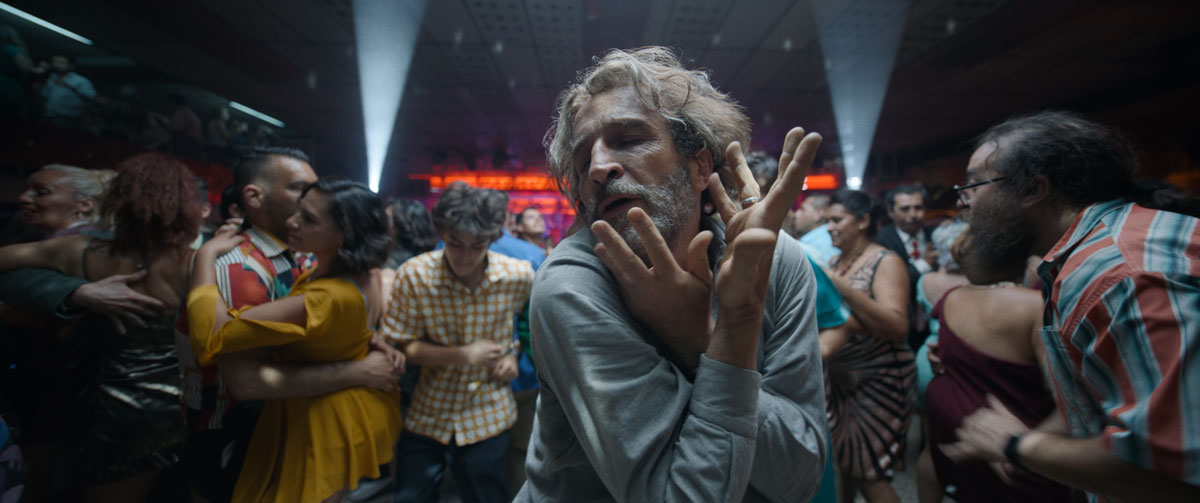
The film offers a surreal trip including a strange scene on public transportation where Silverio swims through the water flooding the tram car to a fabulous dance scene done in slow-motion to a stripped-down version of David Bowie‘s “Let’s Dance.” Each of these pieces builds towards creating a fuller picture of Silverio’s rich life. 

BardoBardo (Netflix)

Yes, “Bardo” may be Iñárritu’s take on Fellini’s “8 ½,” but it dazzles with fantastic camerawork by Darius Khondji, and a moving performance by Daniel Giménez Cacho, who conveys so much pain and melancholy by staring blankly, or energy when he is at his most manic.

An early scene has Silverio’s wife Lucia (Griselda Siciliani) giving birth and the baby, Mateo, wants to go back inside “because the world is too f**ked up.” It is a prescient, comedic moment, but it reveals a real tragedy; Silverio and Lucia’s son died 30 hours after birth. A later scene of them burying their baby in the ocean is poignant and oddly beautiful. It, too, is tinged with magical realism as the “ashes” are a tiny baby that makes the sad moment all the more heartbreaking.

“Bardo” is full of touching scenes like this that have a cumulative emotional potency. An exchange Silverio has with his father in a bathroom during a party has Silverio shrunk to child-size. The men talk about what it means to be a good father, and Silverio confesses, “Success has been my biggest failure,” suggesting his career has kept him from knowing his two grown children, Camila (Ximena Lamadrid of “Who Killed Sara“) and Lorenzo (Íker Sánchez Solano). But Silverio, while hard on himself, tells his father something deep and powerful that shows, even at the height of his existential crisis, he is thoughtful and introspective. 

In contrast, a discussion Silverio has with Lorenzo — who questions the appropriateness of his father making documentaries about poor immigrants who have a vastly different life experience from theirs — reflect both father’s and son’s privilege. The film is self-aware, and that is why a tender scene, in which Lorenzo tells a story about his fish that has a comic punchline, is followed by an emotional sucker punch. Likewise, when Silverio and his daughter have a heart-to-heart (in a gorgeous, exclusive pool) she tells him that what he thinks is best for her may not be best for her. A speech she gives later in the film is also both funny and insightful.

The dozens of affecting moments and the scenes among the family members are the most heartfelt. A visit Silverio has with his aging mother is incredibly poignant as it questions memory, reality and truth. It asks: Do we believe what is real, or what we want to remember as real? And, ultimately, does it matter, especially if it brings peace of mind? 

Many of the scenes are ideas that popped into Silverio’s busy head. Iñárritu floats from moment to moment through the dreamlike “Bardo.” (The editing can look up to the sky one minute and be on a plane the next.) Iñárritu employs a fish-eye lens to distort space, and features several breathtaking tracking shots, such as one in a TV studio or another as Silverio walks through the empty streets of a city that becomes more populous, and then more surreal. 

Many scenes in “Bardo” are dreams. One has Silverio on a talk show hosted by his friend and former colleague, Luis (Franciso Rubio) who humiliates him in front of the live studio audience, telling embarrassing stories about Silverio or chastising him for his success. In reality, Silverio did not show up for the TV interview segment, which may be worse. At a party the two men have a verbal confrontation where they tell each other what they really think, and it is gripping, because both men are right, as are their observations about fame and friendship.


Want a daily wrap-up of all the news and commentary Salon has to offer? Subscribe to our morning newsletter, Crash Course.


There is more, much more, to “Bardo,” which may require multiple viewings to catch all the ideas stuffed into it. There are probably several Easter eggs which will be fun to discover.

Ultimately, Iñárritu’s film espouses messages that “Life is a series of idiotic images . . . a mishmash of pointless scenes . . . a brief series of senseless events . . . surrender to it.” “Bardo” is sure to be seen as pretentious and self-indulgent — and how can an existential film about a filmmaker not be? The film is sure to have its share of detractors, but it is also among the most remarkable, risky and fearless work to grace screens this year. Surrender to it. It is extraordinary.

“Bardo: False Chronicle of a Handful of Truths” is streaming on Netflix starting Dec.16.


“Cash grab”: Knives out in TrumpWorld as his closest allies rage over his “worthless” NFT stunt

Former President Donald Trump’s “major announcement” that ended up being $99 non-fungible tokens (NFTs) has frustrated even his closest supporters, making him the target of ridicule online. 

The cash grab had many of his opponents and supporters rolling their eyes, with some criticizing Trump for not focusing on his 2024 reelection campaign, and calling on him to fire the person who thought of the NFT idea. 

“I can’t watch it again, make it stop,” conservative host Steve Bannon said of the video of Trump promoting the NFTs on his podcast. “Anybody on the comms team and anybody at Mar-a-Lago — and I love the folks down there — but we’re at war. They oughta be fired today.”


Want a daily wrap-up of all the news and commentary Salon has to offer? Subscribe to our morning newsletter, Crash Course.


Trump supporter John Cardillo took to Twitter to complain about the former president’s “weird” announcement. “I supported Trump for years but this is ridiculous,” he wrote on Thursday. “Pushing a worthless NFT for $99 a week before Christmas on the heels of the #FTX collapse is beyond wrong. Who advised him to do this?” Cardillo called the announcement “ridiculously tacky” on Twitter, adding that Trump “can’t help himself in making these unforced errors.”

Former Trump National Security Adviser Michael Flynn said on the conservative video hosting platform Rumble that he would fire whoever advised Trump “immediately.”

“I can’t believe I’m going to jail for an NFT salesman,” tweeted far-right media personality Baked Alaska, who pleaded guilty to unlawfully protesting on Jan. 6. 

Trump announced the cards on Truth Social, writing “AMERICA NEEDS A SUPERHERO.” The sold-out NFTs featured images of Trump in a variety of muscular costumes posing in front of various backgrounds with MAGA iconography. Some cards feature the former president ripping off his shirt, or surrounded by raining gold bricks that read TRUMP. 

Former Trump advisers Sebastian Gorka and Steve Cortes joined Bannon on his “War Room” podcast and agreed that the president should have stayed far away from this stunt.

“The president should not be involved with this,” said Gorka. “Whoever wrote that pitch should be fired and should never be involved” in Trump’s 2024 reelection campaign. 

Far-right talk show host Ben Shapiro sarcastically mocked Trump’s move, tweeting “Thank God, the digital trading cards are here. It was indeed a MAJOR ANNOUNCEMENT.”

Some also took the NFTs as a sign of Trump’s political decline, including conservative streamer Tim Pool who tweeted that the former president is “basically retired.” 

“Demand improvement. Put the pom poms down,” tweeted talk show host Jesse Kelly. “We need a better Trump.”

Even QAnon supporters had enough of Trump’s antics, calling his announcement a “foolish NFT cash grab,” according to a report from Vice. “QAnon John,” a conspiracy theory influencer, called the NFTs “tone deaf to a VAST MAJORITY of Trump’s base.” 

Despite the widespread criticism and mockery, Trump’s die-hard fans still rushed to get their trading cards. The 45,000 NFTs that were initially available are now sold out, with some being traded for more than $8,000. 

Texas GOP lawmaker hires Christian nationalist who called for drag show attendees to be executed

A Republican lawmaker and Texas House speaker candidate has hired a self-described Christian nationalist who called for the public execution of people who take children to drag events.

State Rep. Tony Tinderholt, R-Arlington, hired Jake Neidert, 22, last month as his office’s legislative director amid a wave of anti-LGBTQ violence and rhetoric, and ahead of an impending legislative session that is expected to focus heavily on anti-trans bills.

Tinderholt, one of the most conservative members of the Texas House, is currently mounting a long-shot challenge to Beaumont Republican Rep. Dade Phelan‘s House speakership. Tinderholt has previously pushed for legislation that proposed the death penalty for Texans who get and perform abortions.

Neither Tinderholt nor Neidert responded to multiple requests to be interviewed for this story.

Neidert is the twin brother of Kelly Neidert, the founder of the anti-trans group Protect Texas Kids that has been a key driver of protests of drag and LGTBQ events across the state, and who has aligned with far-right movements — including Holocaust deniers. And like his sister — who has called for “rounding up” people who attend Pride events — Jake Neidert has similarly espoused anti-LGTBQ views.

“You want to force kids to see drag shows, I want to ‘drag’ you to the town square to be publicly executed for grooming kids. We are not the same,” he wrote on Twitter on June 7, 2022, according to screenshots of his accounts that were posted by Living Blue In Texas, which first reported his hiring. His Twitter account has been suspended since this summer, but archived versions of his profile show a tweet from that day was removed for violating the site’s terms of service.

In another post this year, Neidert complained about the arrests of members of the Texas-based extremist group Patriot Front, who authorities say were apprehended on their way to commit violence at a Pride event in Idaho over the summer.

Neidert’s hiring comes amid skyrocketing violence and hate rhetoric aimed at the LGBTQ community. Across the state and country, drag and Pride events have been increasingly targeted by far-right movements, and right-wing pundits and politicians have routinely, and falsely, depicted drag events as opportunities for children to be sexually groomed.

Neidert has also joked about the death of George Floyd, the unarmed Black man who was murdered by Minneapolis police. “George Floyd is two years sober today,” Neidert wrote on the two-year anniversary of Floyd’s killing — a reference to Floyd’s earlier struggles with drug addiction.

Neidert’s hiring was condemned by LGTBQ rights groups and lawmakers.

“It is a frustrating thing to both be appalled and not surprised,” said state Rep. Erin Zwiener, a Driftwood Democrat and member of the House LGBTQ Caucus. “And while it’s sure alarming to know that there’s someone working in my building who has called for my execution, it feels just par for the course.”

Others said Neidert’s comments — and failures by Republican leaders to call out anti-trans and homophobic language more broadly — will only normalize hateful rhetoric and violence that have already been spiking in recent years as some politicians, pundits and organizations increasingly target the LGTBQ community.

“Neidert has publicly pushed transphobic campaigns that we know spew hateful narratives that yield very real violent results,” said Adri Perez, organizing director for the Texas Freedom Network, which advocates for LGTBQ equality. “Neidert does not share the collective interest of Texans and should not be allowed to use public funds and time to push his hateful and violent ideology at our State Capitol.”

In Texas, Gov. Greg Abbott last year directed Child Protective Services agents to investigate families who provide gender-affirming care to transgender children — which years of research show significantly curtails their likelihood of depression, suicide and drug abuse. And, on Wednesday, the Washington Post reported that Texas Attorney General Ken Paxton’s office sought information on Texans who requested gender changes on their drivers licenses — raising concerns among transgender Texans that they were being monitored.

Meanwhile, ahead of Texas’ next legislative session that begins early next year, lawmakers have already filed dozens of bills targeting LGTBQ rights, including bills that would criminalize gender-affirming care for minors. Neidert’s job as a legislative director allows him a great degree of influence over legislation and what bills Tinderholt supports.

Phelan declined comment when asked about Neidert’s hiring. Other Republican leaders, including Abbott and Texas Republican Party Chair Matt Rinaldi, did not respond to requests for comment.

LGBTQ groups say it’s impossible to divorce ongoing rises in hateful rhetoric like Neidert’s from violence and anti-trans legislation. The number of anti-LGBTQ demonstrations has nearly tripled this year, according to the Armed Conflict Location & Event Data Project. Far-right groups have also been increasingly armed at such events, ACLED found.

“We’ve seen 30 bills filed that attack the LGBTQ community in some form or fashion, and we’ve definitely seen an increase in attacks,” said Johnathan Gooch, spokesperson for Equality Texas. “And it’s extremists pushing these transphobic narratives and politicians disseminating disinformation that is driving these movements to intimidate queer people in safe spaces and entertainment venues — places where people shoudn’t feel unsafe.”

Neidert’s new job is not his first foray into Texas politics. As a student at Baylor University, he led the campus chapter of the Young Conservatives of Texas, a role in which he similarly received backlash for his tweets about the LGBTQ community and the Black Lives Matter movement.

In one tweet — which prompted a petition for the group’s removal from campus — Neidert compared LGBTQ allies to child rapists and serial killers, saying that homosexuality was equally sinful.

Neidert defended the post by saying he was a Southern Baptist, and that “many congregations and denominations of Christianity still believe that homosexuality is a sin. I would not say [the tweet] is a stretch.”

According to his Facebook page, Neidert also worked as a legislative intern for state Rep. Bryan Slaton, a Royse City Republican who has pushed for children to be banned from drag events and recently filed legislation that would expand the state’s definition of child abuse to include providing gender-affirming health care under the guidance of a doctor or mental health care provider.

Slaton did not respond to requests for comment.

Campaign finance records show that before joining Tinderholt’s office, Neidert also worked on the failed House campaign of Shelley Luther, the North Texas salon owner who rose to minor prominence after she was jailed for violating COVID-19 lockdown rules. During that campaign, Luther said she was “not comfortable with the transgenders” and said she supported school choice in part because of her disappointment that trans kids couldn’t be laughed at in public schools.

Campaign finance records also show that, during the 2022 campaign season, Neidert also received $9,750 in payments from Defend Texas Liberty PAC, a fundraising group tied to west Texas oil billionaires Tim Dunn and Farris Wilks that has poured millions of dollars into far-right campaigns across the state, including those of Tinderholt, Slaton and Luther. Leaders of Defend Texas Liberty PAC did not respond to a request for comment.

Dunn and Wilks have similarly espoused extremist views on the LGBTQ community, including comparing homosexuality to pedophilia and bestiality.

The two billionaires have also sought to blur the lines between church-state separation, a view that Neidert shares. He has previously described himself on Twitter as a Christian nationalist — an extreme brand of Christian politics that claims the United States’ founding was God-ordained and its laws and institutions should thus favor Christians.

“Please understand that we’re not trying to turn America into a Christian theocracy,” read one post that Neidert shared on his Facebook page earlier this year. “We’re going to do it.”

Experts say such extreme religious views would mean the death of pluralistic democracy in America. They note that there is a direct correlation between preferences for authoritarian leaders and the religious zealotry and anti-LGBTQ extremism that are frequently espoused by Christian nationalists.

Christian nationalism is predicated on the idea that there are “true Americans who deserve access to all the privileges of being an American,” said Andrew Whitehead, an Indiana University sociologist and prominent scholar of Christian nationalism. That makes adherents far more likely to accept the use of violence and oppression to enforce social — and often racial — hierarchies, he said.

“There is a comfort with authoritarian social control,” Whitehead said. “They are comfortable bringing violence to bear.”


Disclosure: Baylor University, Equality Texas and Texas Freedom Network have been financial supporters of The Texas Tribune, a nonprofit, nonpartisan news organization that is funded in part by donations from members, foundations and corporate sponsors. Financial supporters play no role in the Tribune’s journalism. Find a complete list of them here.

This article originally appeared in The Texas Tribune at https://www.texastribune.org/2022/12/16/texas-tony-tinderholt-jake-neidert-drag-legislature/.

The Texas Tribune is a member-supported, nonpartisan newsroom informing and engaging Texans on state politics and policy. Learn more at texastribune.org.

Conservative lawyer who saved Madison Cawthorn from election challenge sues him for not paying bills

A law firm that helped keep Rep. Madison Cawthorn, R-N.C., on the ballot during a legal challenge to his candidacy in the 2022 North Carolina Primary is now suing him for more than $193,000 in unpaid legal bills.

The Bopp Law Firm, based in Terre Haute, Indiana, filed a federal lawsuit on Dec. 1, accusing Cawthorn of breaching his contract and failing to pay his fees. The $193,296.85 bill does not include interest owed for late payments.

Cawthorn hired the legal team to represent him after opponents tried to keep him off the primary ballot due to his role in the Jan. 6 insurrection. Voters cited Section 3 of the 14th Amendment, which was supposed to prevent congressmen who fought in the Confederacy from returning to their position in Congress. They claimed that Cawthorn’s participation in the “Stop the Steal” rally disqualified him from running for Congress again.

A federal judge ruled in Cawthorn’s favor in March, preventing the North Carolina State Board of Election from keeping him off the ballot for the 2022 Primary in May. Voters then appealed the ruling to the 4th U.S. Circuit Court of Appeals in Richmond, Virginia, where they reversed the ruling and sent it back to the district court. 

Cawthorn’s attorneys moved to have the district court case “dropped as moot” to prevent any ruling that could affect his future campaigns, according to the lawsuit.

James Bopp Jr., a representative for Bopp Law Firm, said in an interview that Cawthorn contacted him on Tuesday and “expressed a willingness to pay the fee and resolve the matter.”

“Now that has not yet happened, but I’m hopeful that that would turn out to be the case,” Bopp added.

While Cawthorn was able to stop the challenge to his candidacy, he did lose the primary to Republican state Sen. Chuck Edwards due to various personal and political scandals in the leadup to his campaign.

In April, Cawthorn tried to bring a loaded gun through TSA at Charlotte Douglas International Airport, according to the Charlotte-Mecklenburg Police Department. Cawthorn admitted that the firearm was his, and cooperated with CMPD officers — ultimately, he was issued a citation for possession of a dangerous weapon on city property.

He was also issued various citations from the North Carolina Highway Patrol for speeding violations and driving with a revoked license.

Cawthorn also faced allegations of nepotism after giving $141,000 in campaign and taxpayer funds to his second cousin, Stephen Smith. However, the exchange of funds was deemed legal since Smith was a distant relative and not a first cousin. 


Want a daily wrap-up of all the news and commentary Salon has to offer? Subscribe to our morning newsletter, Crash Course.


The Bopp lawsuit is not Cawthorn’s only financial challenge. Earlier this month, the House Committee on Ethics ordered him to pay more than $15,000 for his role in promoting a meme coin, in a “pump-and-dump” cryptocurrency scheme.

The committee said it found substantial evidence that Cawthorn violated rules against conflicts of interest when he promoted a cryptocurrency that he had a financial interest in, according to their report. 

Cawthorn spent $150,000 on the “Let’s Go Brandon” coin in December 2021 (the name of the coin is a reference to a phrase that conservatives use to mock President Joe Biden). Cawthorn received 180 billion LGB Coin, with the favorable terms constituting an improper gift, according to the committee.

A day after Cawthorn publicly said he owned LGBCoin, the cryptocurrency announced that it would sponsor NASCAR driver Brandon Brown. Following the sponsorship news, LGBCoin’s value spiked by 75%, according to reporting from the Washington Examiner.

Watchdog groups told the Examiner that Cawthorn may have had advance knowledge of the deal with Brown, warranting an investigation from the Justice Department and the Securities and Exchange Commission “to see if the freshman congressman violated insider trading laws.”

In January 2022, the value of LGBCoin dropped from $570 million to $0. After the committee’s findings last December, Cawthorn was ordered to donate $14,237.49 to charity and pay off his late fees for cryptocurrency transactions that amounted to $1,000.

In August, Cawthorn’s campaign announced that they were $300,000 in debt with money owed to a business associated with his spokesman Blake Harp, his campaign adviser and a top congressional staff member. The debt has reportedly been paid off.

GOP Rep. Ronny Jackson’s false “pedophilia” attack on Katie Porter blows up in his face

Rep. Ronny Jackson, R-Texas, falsely accused Rep. Katie Porter, D-Calif., of saying that “pedophilia isn’t a crime” when Porter actually said that LGBTQ people have been wrongly branded on social media as “groomers” and “pedophiles.”

Porter was speaking with Kelley Robinson, president of the Human Rights Campaign, about the group’s latest report, which analyzed “the 500 most viewed, most influential tweets that identified LGBTQ people as so-called ‘groomers.'” 

“The ‘groomer’ narrative is an age-old lie to position LGBTQ+ people as a threat to kids,” Porter said. “And what it does is deny them access to public spaces, it stokes fear, and can even stoke violence.” 

She went on to ask why Twitter allows posts calling LGBTQ+ people “groomers” according to its own hateful content policy to which Robinson responded that while Twitter and Facebook have community guidelines in place, the platforms also need to hold users accountable to those guidelines.

The Human Rights Campaign’s report revealed that anti-LGBTQ+ content was largely driven by a small group of extremist politicians and their allies. 

Just ten people drove 66% of impressions for the 500 most viewed hateful “grooming” tweets — including Gov. Ron DeSantis’s press secretary Christina Pushaw, extremist members of Congress like Rep. Marjorie Taylor Greene, R-Ga., and Lauren Boebert, R-Colo., and pro-Trump activists like “Libs of TikTok” founder Chaya Raichik.

The report found that posts from the 10 people alone reached more than 48 million views, and the top 500 most influential “grooming” tweets altogether were seen 72 million times.

“[T]his allegation of ‘groomer’ and of ‘pedophile,’ it is alleging that a person is criminal somehow, and engaged in criminal acts, merely because of their identity, their sexual orientation, their gender identity,” Porter said. “So this is clearly prohibited under Twitter’s content. Yet you found hundreds of these posts on the platform.”

She did not say that pedophilia isn’t a crime, but the congresswoman’s remarks were inaccurately portrayed in tweets by Jackson and Libs of TikTok.

“Rep Katie Porter (D) says pedophilia isn’t a crime – it’s an identity,” the account falsely tweeted alongside a video, which omitted Porter’s full comments.

A context box appeared below the false tweet with Twitter’s Community Notes identifying that the clip had been taken out of context and misrepresented what Porter actually said.

Jackson further amplified the falsehood and tweeted: “Katie Porter just said that pedophilia isn’t a crime, she said it’s an ‘identity.’ THIS IS THE EMBODIMENT OF EVIL! The sad thing is that this woman isn’t the only VILE person pushing for pedophilia normalization. This is what progressives believe!”

Twitter’s content box also appeared under his tweet, stating that “Katie Porter did not say this.”


Want a daily wrap-up of all the news and commentary Salon has to offer? Subscribe to our morning newsletter, Crash Course.


The purpose of the hearing was to listen to survivors of the Club Q Shooting and activists testifying on anti-LGBTQ violence, who said that hateful right-wing rhetoric was a contributing factor to the shooting.

“For years, cynical politicians and greedy grifters have joined forces with right-wing extremists to pour gasoline on anti-LGBTQ hysteria and terrorize our community,” said Brandon Wolf, who survived the 2016 shooting at Orlando’s Pulse nightclub. “My own governor Ron DeSantis, has trafficked in that bigotry to feed his insatiable political ambition and propel himself toward the White House. we have been smeared and defamed. Hundreds of bills have been filed in order to erase us. Powerful figures have insisted that the greatest threats this country face are a teacher with they/them pronouns or someone in a wig reading Red Fish, Blue Fish and all along we warned that these short-sighted political maneuvers would come with a human cost, but they have continued anyway.”

2022 was a historic year for climate change reform — and for natural disasters

It may seem like 2022 was such a slog it felt more like three years instead of one — something about the pandemic has warped time perception — but even so, on geological timescales, it was a blip. Still, the industrial policies of human civilization have long-lasting impacts, especially when it comes to our influence on the environment. Our planet’s average temperature has fluctuated many times throughout its 4.5 billion year history, but things are heating up, fast, and humans are to blame.

We no longer have to worry about some drastic shift in temperature in a distant future. The climate has already changed. The disaster is here. The only question remaining is if we can act quickly enough to lessen the damage from getting worse.

This is not good. It’s surprising this still needs to be said in 2022, but despite the adamancy of scientists — in which agreement is 100 percent that global heating is throwing the planet out of balance — the general public still has not fully grasped the severity of the situation. Otherwise, there might be the kind of collective disruption necessary to stall this trend, which overwhelming evidence points to human activity as the underlying cause.

Many experts think humans still have a chance. But we must act, and soon. After all, it’s mostly our own existence that’s at threat, not the planet’s. The planet will be fine. If we want humanity to continue thriving, then we need to stop burning fossil fuels, restore the environment and shift to sustainable ways of living.

In reflecting on this, it’s good to look at what kind of impacts environmental policy had on us. Not everything was a catastrophe, either — in fact, there were many positive climate stories this year, which can help motivate us to continue the fight for a planet that has clean air, water and soil — a home for all life, not just human. Here’s Salon’s take on the most important climate stories of 2022.

Water dwindled across the globe…

Thanks to scorching temperatures and persistent drought, this year some of the world’s largest rivers shriveled up like worms in the sun. Both the Yangtze in China and the Rhine in Europe dropped to historically low levels in 2022. The mighty Mississippi became a trickle, so that in many place barges became grounded in the mud, temporarily halting major shipping lines.

Across the Southwest, reservoirs dehydrated as the Colorado River became creek-like in many areas, causing Lake Mead to reach such lows that at least six sets of human remains were recovered in the receding water. As this trend worsens, it could spell disaster, such as severe water shortages, for the roughly 40 million people who depend on the Colorado River.

…While other regions experienced Biblical flooding

Global heating also contributed to record flooding in 2022. That can seem counterintuitive. Didn’t we just talk about how heat caused so much water to dry up? So how is record rain connected to climate change?

When water evaporates, it needs to go somewhere. Specifically, it forms clouds. In fact, the warmer the atmosphere, the more water it can hold — and dump, all at once.

1.66 billion people were impacted by flooding between 2000 and 2020.

This is essentially what happened in Pakistan for months, which experienced a natural disaster that affected more than 33 million people. Between June and late August, regions of Pakistan experienced so much flooding that entire villages became islands while in the Sindh province, a lake 100km (62 miles) wide was created. Nearly 2,000 people died and some 1.7 million people lost their homes.

Also in 2022, widespread flooding in Nigeria affected 27 out of the 36 states, displacing 1.5 million people and killing more than 800. An analysis by international climate attribution experts found this deluge, the worst in decades, was made 80 times more likely because of climate change.

Other countries severely impacted by flooding this year include Afghanistan, Vietnam, Australia, Thailand and the United States. Towns were washed away in Venezuela and mudslides buried people in Brazil.

A recent analysis in the journal Environmental Research estimates that 1.66 billion people were impacted by flooding between 2000 and 2020. The study linked many of these events to climate change, predicting it will only get worse. “The general trend is increasingly extreme rainfall resulting in destructive flooding over a large portion of the world’s surface,” the authors write.

Things got heated and stormy, too

Heat waves also plagued the planet, especially in China, the U.K., the U.S., India and Pakistan. Europe experienced its hottest summer on record, which killed an estimated 16,000 people, while North America suffered through its third hottest heat wave. The excess heat contributed to wildfires, which creates a positive feedback loop as smoke traps more heat.

And don’t forget the hurricanes. There was Ian, which became Florida’s deadliest hurricane since 1935, with around 150 fatalities and could rack up $100 billion in repairs. But Yale Climate Connections count 28 other extreme weather events that did more than $1 billion in damage this year. Global heating has been shown to favor the meteorological conditions that makes these storms more common, more intense and more deadly.

COP27 didn’t move the needle, but some minor progress was made

The 27th United Nations climate change conference, or COP27, took place this year in Sharm el-Sheikh, Egypt, but the confluence of world leaders, policymakers, ecologists (and far too many fossil fuel companies) made for a watered-down event that doesn’t match the severity of the crisis unfolding on this planet, many climate experts argue.


Want more health and science stories in your inbox? Subscribe to Salon’s weekly newsletter The Vulgar Scientist.


Nonetheless, some progress was made, including a historic agreement to fund “loss and damage” as a way to financially assist the nations disproportionately experiencing the pitfalls of climate change. They aren’t always the nations with the most greenhouse gas emissions, either, which is quite unfair and the plan aims to address. The finer details have yet to be worked out, and no actual money has been put into this fund yet, but it’s good news for nations like Pakistan and Bangladesh experiencing disasters and being unable to recover from the steep costs.

Protests reminded the world what’s at stake

Pro-environment protests are nothing new — the first Earth Day was borne out of outrage over a California oil spill in 1969 — but in 2022, climate protesting took on a new flair, for better or worse: “destroying” artwork in an attempt to draw attention to impending climate disaster, arguing that our planet is artwork worth saving.

If these protests are so unpopular, it raises the question: what is an effective way of getting the public’s attention on this issue?

Just Stop Oil, an environmental activist group in the United Kingdom, launched in February 2022, staging protests at the 75th British Academy Film Awards and blocking traffic on the M4 motorway. Over the summer, the activists began gluing themselves to paintings, such as a copy of da Vinci’s The Last Supper. But most people are more familiar with Just Stop Oil’s stunt of splashing tomato soup onto a Van Gogh painting.

No paintings were damaged in any of these demonstrations, although sometimes the frames suffered some injury. However, a recent survey from the University of Pennsylvania found that for 46 percent of respondents, “these tactics decrease their support for efforts to address climate change,” with only 13 percent reporting increased support.

But if these protests are so unpopular, it raises the question: what is an effective way of getting the public’s attention on this issue? On Earth Day, April 22, Wynn Alan Bruce, a 50-year-old photojournalist and climate activist from Boulder, Colorado, set himself on fire in the plaza of the U.S. Supreme Court. Bruce’s self-immolation was also in protest of rising global temperatures, echoing the self-immolation of Buddhist monks during turmoil in Vietnam during the ’60s.

Before his death, Bruce allegedly posted a quote on social media from the late Thích Nhất Hạnh, a Buddhist monk who said “to burn oneself by fire is to prove that what one is saying is of the utmost importance.” In 2022, we had to ask ourselves if we are listening. In 2023, we have to ask ourselves if we will act.

FDA issues warning letters to food firms for selling CBD products that are “appealing to children”

The United States Food and Drug Administration (FDA) has issued warning letters to several food firms under its jurisdiction over their adulterated cannabidiol (CBD) products, many of which are also deemed “appealing to children” by the agency. Per Food Safety News, the five firms in question include Infusionz, LLC; 11-11-11 Brands; Newhere Inc dba CBDFX; CBD American Shaman, LLC; and Naturally Infused LLC. Here’s a closer look at the specific products and the violations:

Infusionz, LLC (Henderson, NV)

In a Nov. 16 warning letter, the FDA determined that all of the firm’s CBD products — which includes gummies, fruit snacks, gum, candy, oil/tinctures and lollipops — are “adulterated under section 402 of the Federal Food, Drug, and Cosmetic Act (FD&C Act), because they bear or contain an unsafe food additive.”

There is currently no food additive regulation which authorizes the use of CBD.

Due to the violations, it is also “a prohibited act” to introduce the aforementioned products into interstate commerce.

The agency continued, writing, the “FDA is particularly concerned that some of your products are in forms that are appealing to children. For example, your CBD gummies, CBD fruit snacks, CBD gum, CBD candy, and CBD lollipops products are all in forms that would be attractive to children and could easily be mistaken for traditional foods that are commonly consumed by children. Furthermore, your products have not been evaluated by the Agency for safety, effectiveness, and quality.” 

The FDA also raised concerns about the company’s CBD Dog Treats (Bacon & Cheddar Cheese Flavored) and Hemp CBD Tincture (also referred to as CBD Coconut Oil – CBD MCT Oil Broad/Full Spectrum), which are marketed to treat various health conditions in animals. In addition to CBD not being an approved food additive, the use of CBD in animal products does not satisfy the criteria for food safety.

11-11-11 Brands (Newtown, PA)

The FDA determined that the firm’s Mood33 Hemp Infused Herbal Tea products are adulterated under section 402 of the FD&C Act because they contain an unsafe food additive. Due to the violations, it is also “a prohibited act” to introduce the tea products into interstate commerce.

“FDA is particularly concerned that your products are in a form (herbal tea or beverage) that consumers may confuse with traditional foods. The Agency has collected and analyzed a sample of your product and has confirmed the presence of CBD in the product,” the agency wrote. “Therefore, with these products there is a risk of unintended consumption of the CBD ingredient by consumers, which is exacerbated due to the failure of the label to list CBD as an ingredient.”

Newhere Inc dba CBDFX (Chatsworth, CA)

Following an extensive review of the firm’s website and social media accounts, the FDA determined that the firm’s CBD products — including its flavored Chill Shots (all strengths and varieties), CBDFx Mixed Berry Gummies 1500mg, CBD Cookies with Protein 20mg (in Chocolate Chip, Oatmeal Raisin, and Peanut Butter flavors) — are all adulterated under section 402 of the FD&C Act because they contain an unsafe food additive. Due to the violations, it is also “a prohibited act” to introduce the products into interstate commerce.

In the same vein as the Infusionz, LLC products, the FDA is concerned that some of the firm’s products “are in forms that are appealing to children.”  These include gummies, vape pens, energy blends and balm sticks. 

“For example, your CBDFx Mixed Berry Gummies 1500mg, CBD Cookies with Protein 20mg, including Chocolate Chip, Oatmeal Raisin, and Peanut Butter flavors, products are all in forms that would be attractive to children and could easily be mistaken for traditional foods that are commonly consumed by children,” the agency specified. “Furthermore, your products have not been evaluated by the Agency for safety, effectiveness, and quality.”

CBD American Shaman, LLC (Kansas City, MO)

In a Nov. 16 warning letter, the FDA determined that the firm’s CBD products — including its CBD Suckers, CBD Hard Candies, Cookies [with] 10mg CBD per Serving, CBD Sparkling Tea, CBD Sparkling Water, CBD Coffee, CBD Honey Sticks, CBD Honey, Doggy Chews (all flavors), Soft & Tender Doggy Chews, Horsey Chews, Doggy Nugs, and Kitty Nugs — are adulterated because they contain an unsafe food additive. Due to the violations, it is also “a prohibited act” to introduce the products into interstate commerce.

The FDA is also concerned that some of the firm’s products, specifically its suckers, gummies, candies and cookies, are “are all in forms that would be attractive to children and could easily be mistaken for traditional foods that are commonly consumed by children.” 

“You also market other products that consumers may confuse with traditional foods for humans, including CBD Sparkling Tea, CBD Sparkling Water, CBD Coffee, CBD Honey Sticks, and CBD Honey; therefore, with these products there is a risk of unintended consumption of the CBD ingredient by consumers,” the agency noted.

Naturally Infused LLC (New Port Richey, FL)

The FDA determined that the firm’s CBD Lollipops, CBD Infused Sugar, CBD Gummies, CBD Infused coffees, D8 THC Infused coffees, and Delta-8 THC Gummies products are adulterated because they contain an unsafe food additive. Due to the violations, it is also “a prohibited act” to introduce the products into interstate commerce.

Many of the firm’s CBD products, specifically its CBD Lollipops, CBD Gummies, and Delta-8 THC Gummies, are also “in forms that are appealing to children.”

The agency continued, “Furthermore, you market other products that consumers may confuse with traditional foods for humans, including CBD Infused Sugar and CBD and Delta-8 THC Infused coffees. Therefore, there is a risk that consumers of these products, including children, will unintentionally consume CBD or Delta-8 THC ingredients.” 

“Additionally, we note that the CBD coffee products appear to contain caffeine,” the agency wrote. “Evidence suggests that CBD may affect caffeine metabolism and may increase and/or prolong caffeine’s effects.”

“You don’t get to lead a government you tried to destroy”: 40 Dems introduce bill to block Trump run

More than 40 House Democrats introduced legislation Thursday aiming to bar former President Donald Trump from the 2024 ballot, citing the 14th Amendment clause prohibiting insurrectionists from holding federal office.

“Donald Trump very clearly engaged in an insurrection on January 6, 2021 with the intention of overturning the lawful and fair results of the 2020 election,” Rep. David Cicilline, D-R.I., the lead sponsor of the new bill, said in a statement. “You don’t get to lead a government you tried to destroy.”

“Even Mitch McConnell admits that Trump bears responsibility, saying on the Senate floor that ‘[t]here’s no question, none, that President Trump is practically and morally responsible for provoking the events of the day,'” Cicilline added. “The 14th Amendment makes clear that based on his past behavior, Donald Trump is disqualified from ever holding federal office again and, under Section 5, Congress has the power to pass legislation to implement this prohibition.”

Section 3 of the 14th Amendment bars from federal office anyone who, “having previously taken an oath, as a member of Congress, or as an officer of the United States, or as a member of any state legislature, or as an executive or judicial officer of any state, to support the Constitution of the United States, shall have engaged in insurrection or rebellion against the same, or given aid or comfort to the enemies thereof.”

Section 5 states that “Congress shall have power to enforce, by appropriate legislation, the provisions of this article.”

Cicilline introduced the new bill with the original backing of 40 House Democrats, including Reps. Jamaal Bowman, D-N.Y., Pramila Jayapal, D-Wash., Rashida Tlaib, D-Mich., and Barbara Lee, D-Calif.

None of the top members of the House Democratic leadership have signed onto the legislation thus far, and it’s not clear whether it will be allowed a floor vote before Republicans take control of the chamber next month.

Cicilline unveiled the legislation a month after Trump formally announced his 2024 presidential bid even as he faced numerous federal and state investigations into his fraud-riddled business practices and central role in the January 6 insurrection, which the former president helped provoke with incessant lies about the 2020 election.

In the immediate wake of Trump’s 2024 announcement, the advocacy groups Free Speech for People and Mi Familia Vota launched a campaign urging top state election officials across the country to “follow the mandate of Section 3 of the 14th Amendment and bar Trump from any future ballot.”

“Secretaries of State have a duty to ensure that candidates who seek to appear on their state ballots meet the constitutional qualifications for serving in public office,” Alexandra Flores-Quilty, campaign director for Free Speech for People, said in a statement last month. “Donald Trump violated his oath of office when he incited and engaged in a violent insurrection on January 6, 2021 in an effort to overturn a democratic election.”

“The U.S. Department of Justice must hold Trump accountable for the multiple crimes that he has committed in connection with the January 6th insurrection, but secretaries of state and chief election officials have a separate responsibility to hold Trump accountable under Section 3 of the Fourteenth Amendment,” Flores-Quilty added. “People all across the country can join this campaign to fight to uphold Section 3 of the 14th Amendment and bar Trump from the ballot.”

In a tweet Thursday, Free Speech for People pointed to a new poll showing that a majority of Americans believe Trump’s recent call for “termination” of election rules in the U.S. Constitution should disqualify him from the 2024 ballot.

Citizens for Responsibility and Ethics in Washington (CREW), meanwhile, has vowed to pursue legal action to disqualify Trump from the 2024 ballot.

In September, CREW secured the removal of Otero County, New Mexico Commissioner Couy Griffin from office over his role in the January 6 insurrection. A New Mexico judge ruled that Griffin was disqualified from holding office under Section 3 of the 14th Amendment.

CREW said last month that the same standard should apply to Trump.

“The evidence that Trump engaged in insurrection is overwhelming,” said Noah Bookbinder, the president of CREW. “We are ready, willing, and able to take action to make sure the Constitution is upheld and Trump is prevented from holding office.”

Mary McCartney’s connection to Abbey Road Studios is a family affair

Mary McCartney’s documentary “If These Walls Could Sing” affords viewers with an unprecedented glimpse behind the gates of Abbey Road Studios. In a recent interview with me, McCartney provided insight into the documentary’s genesis, as well as the musical magic that has been emanating from the studio across its remarkable 91-year history.

Pointedly, McCartney’s film — streaming now on Disney+ — begins with early images of her parents Paul and Linda jamming with their band, Wings. When it comes to growing up with her famous father, Abbey Road has always connoted the notion of family for the documentarian, whose credits include “Mary McCartney Serves It Up,” the hit cooking show in which she showcases vegetarian dishes in her London kitchen.

Abbey Road Studios has been part of McCartney’s life for as long as she can remember. Located mere blocks away from her family’s Northwest London home, the legendary recording studio has served as the launching pad for many of her father’s most memorable recordings, Beatles and post-Beatles alike.

“If These Walls Could Sing” finds its origins in McCartney’s interest in learning more about the famous studio and the tremendous pull that it exerts upon generation after generation of music lovers. “People come from all over the world to write messages on the wall,” she told me, “and it feels like a real pilgrimage. It’s not just a tourist thing,” she adds. “It’s a place where people congregate, a place that is very meaningful to them.” With the documentary, she points out, her fondest dream is to help viewers understand “why it’s such a historic place that has inspired so many people.”

“It feels like a real pilgrimage. It’s not just a tourist thing.”

To bring her film to life, McCartney takes viewers on a journey back to November 1931, when composer Edward Elgar conducted the London Symphony Orchestra, including a performance of Land of Hope and Glory, which featured his time-eclipsing march “Pomp and Circumstance.” As the documentary unfolds, McCartney highlights decades of musical achievements that came into being at Abbey Road, including classic albums by the Beatles and Pink Floyd.

In an especially powerful sequence, McCartney focuses her lens on the tragically brief, albeit profound career of cellist Jacqueline du Pré, who recorded many of her most celebrated works within the studio’s hallowed halls. For McCartney, the story of du Pré’s life, which was cut short by multiple sclerosis, makes for the documentary’s “most poignant, sad moments.”

But to McCartney’s credit, the sequence also proves to be life-affirming, as the director shares vivid images of the kinetic cellist, who’s “got this amazing long blond hair. She bounces around as she plays her cello. You’ve never seen anything like it. Her face is vibrant, and she’s smiling, and the instrument becomes part of her body. It’s incredible to watch her play.”

These images are powerfully contrasted with du Pré’s final visit to Abbey Road, when her illness has taken hold of her and sapped her previously unquenchable energy. The difference is simply heartbreaking. The scene brims with “depth and emotion,” McCartney said. “She was such a vibrant talent.”

Ultimately, McCartney points out, Abbey Road finds its power in the people who have worked in the studio. “They’re like family,” she says, “very, very talented technicians, some of the best in the world.”

“There was talk of turning Studio 1 into a carpark or even tearing it down.”

In one of the documentary’s funniest moments, her father Paul notes that at Abbey Road, “all the microphones work,” thanks to the painstaking care of studio staffers like Lester Smith.

In many ways, McCartney observes, the studio techs act as “innovative, brilliant collaborators with the musicians.”


Love the Beatles? Listen to Ken’s podcast “Everything Fab Four.”


As we concluded our conversation, McCartney made special note of folks like Ken Townsend, the beloved studio head who deftly oversaw the facility’s name change from EMI Recording Studios to Abbey Road in 1976. In so doing, he not only capitalized on the title of the Beatles’ final recorded album but also ushered in a new era of entrepreneurialism in the studio’s history that persists into the present day.

And this spirit of innovation proved to be the studio’s saving grace. In the early 1980s, as EMI teetered on bankruptcy and the studio’s fate seemed to be in jeopardy, it was Townsend, McCartney remarks, who pivoted towards soundtrack recording. “Things were getting quite desperate,” she says. “There was talk of turning Studio 1 into a carpark or even tearing it down.” 

In the nick of time, Townsend fitted cavernous Studio 1 out with a screen and a projector to assist in recording film scores. The studio’s resurgence began with “Raiders of the Lost Ark,” followed by films in such lucrative franchises as the “Harry Potter” novels and “The Lord of the Rings” trilogy. In many ways, Townsend’s deft effort to court new clients among the world’s filmmakers made all the difference.

Capitol rioter cringes at Trump’s stunt: “I can’t believe I’m going to jail for an NFT salesman”

Notorious Capitol rioter Tim Gionet, better known by his Twitter name “Baked Alaska,” was suddenly filled with regret over his life decisions after watching former President Donald Trump hawk digital trading cards in a video in which he also declared himself a better president than George Washington.

Gionet, who earlier in the day said he believed Trump’s digital card gambit means he “can’t win” in 2024, wrote a follow-up missive in which he questioned his own decision to storm the Capitol building on January 6th, 2021.

“I can’t believe I’m going to jail for an NFT salesman,” he lamented.

Earlier this year, Gionet pleaded guilty to a misdemeanor count of parading, demonstrating or picketing inside a Capitol building, for which he faces up to six months in prison.

Before that, Gionet was also convicted of assault for pepper-spraying a bouncer who kicked him out of a bar in Arizona.

Although Gionet was once a major Trump supporter in his first two presidential campaigns, he has now apparently switched his allegiance to rapper Kanye West, who has taken to openly praising Nazi dictator Adolf Hitler and denying the Holocaust.

Kevin’s dilemma: Even if McCarthy finally wins the speakership, it won’t be much fun

Kevin McCarthy is having a very rough time. Like the rest of the Republican Party, he had anticipated a big win in November that would have given the GOP a comfortable majority in the House (and probably control of the Senate as well) which would have swept him into the speaker’s office in January. But in the event, Republicans barely squeaked out a win in the House (as well as losing a seat in the Senate). That gives tremendous leverage to a handful of Republican malcontents, showboaters and fringe fanatics — and they determined to make McCarthy’s life miserable.

This is the second time this seemingly mild-mannered glad-hander from one of California’s few remaining deep-red districts has been in line for the speaker’s gavel, and just like the last time he’s having trouble closing the deal. You’ll recall that back in 2015, McCarthy was the presumptive heir to Speaker John Boehner — who was essentially forced out by the right-wing fringe — but shot off his mouth in spectacularly dumb fashion, earning the ire of the House Freedom Caucus. That was when the party persuaded the supposedly reluctant Paul Ryan to step in, leading to the premature end of his political career. This time around McCarthy has pissed off some members of the Freedom Caucus once again, including its current chairman, Rep. Andy Biggs of Arizona — who says he too will run for the speakership — and at the moment he just doesn’t seem to have the votes. So what happens now?  

Here’s what we know: When the new Congress convenes on Jan. 3, the full House of Representatives will hold an election for speaker of the House. The winner must get a majority of all those who are present and do not abstain (an important detail, and that does happen.) Most or all Democrats will vote for Rep. Hakeem Jeffries of New York, the party’s newly anointed House leader, although a few may vote for someone else for eccentric reasons. None of them will vote for Kevin McCarthy, however, barring some bizarre and unlikely backroom deal. Bear in mind that if all Democrats are present and voting, McCarthy can afford to lose only five votes.

Curiously enough, outgoing Speaker Nancy Pelosi faced exactly the same margin when the current Congress convened in 2021 and had to navigate a narrow path to ensure her re-election. But she is a much more skilled legislator than McCarthy and there was never any serious doubt that she would pull it off. McCarthy’s skills are weaker, to put it mildly, but in fairness he is faced with a much more difficult challenge: His party is in total chaos. As the New York Times reports:

The past week has brought a few developments — many of them baffling even to Capitol Hill insiders. On Friday, seven conservative hard-liners issued a lengthy list of demands to the would-be speaker, mostly involving obscure procedural rules. On Tuesday, a group of nearly 50 moderates aligned with McCarthy said they would oppose some of those ideas. Then on Wednesday, news broke that a different group of five anti-McCarthy members led by Representative Andy Biggs of Arizona had made a pact to vote as a bloc, one way or another. If they stick together, those five are enough to deny McCarthy his gavel, and it is not clear how he gets them to yes. But it’s also not clear that Republicans have another viable option. To reinforce that point, McCarthy’s allies have begun distributing buttons saying “O.K.” — as in “Only Kevin.

The reality is that while Biggs may be too far out on the fringe to be a real threat, there is a viable option: McCarthy’s right hand man, Rep. Steve Scalise of Louisiana. Every single member of the Republican caucus voted for Scalise as majority whip while 36 members declined to vote for McCarthy as party leader. That was a secret ballot so we don’t know for sure which members didn’t vote for McCarthy — and he doesn’t know either. If McCarthy can’t pull together a majority on Jan. 3, Scalise would be the logical consensus candidate, although Rep. Patrick McHenry of North Carolina has also been mentioned as an alternative.

The worst-case scenario for McCarthy would that Republicans can’t get their act together at all and the Democrats offer to step in and rescue him — for a price, perhaps a power-sharing or concessions on committee membership. That is highly unlikely in this climate of extreme partisan division, but the way things are going, Democratic leaders had better be prepared for the possibility.


Want a daily wrap-up of all the news and commentary Salon has to offer? Subscribe to our morning newsletter, Crash Course.


Despite all this drama, the smart money is still on McCarthy. He has secured the support of some far-right members, including the immensely influential Marjorie Taylor Greene of Georgia, and has been cutting deals with anyone who wants one. The main sticking point seems to be the insistence from crazytown on bringing back the provision that any member, at any time, can force a snap floor vote to ditch the speaker, known as the “motion to vacate.” McCarthy is opposed to this, since he understands how weak he is and remembers that the chaos that finally drove Boehner out of the job. McCarthy may not be the brightest bulb on the Capitol Christmas tree, but he’s well aware that his enemies in the party wouldn’t hesitate to stage a floor vote against him every time he tries to do anything they don’t like. (Imagine trusting Greene, for example, with that kind of power.)

But what happens once McCarthy finally gets the gavel? He’s got a small rump of moderate members in states that Joe Biden carried in 2020 who will next face re-election during a presidential year. To his right, there’s the larger faction of wingnuts pushing him to go nuclear on the administration and the Democrats. These are the folks the New York Times characterizes as “chaos agents”:

[McCarthy] has to contend with something that no Democrat has had to face: a sizable group that was sent to Congress explicitly to obstruct. Some of the people he is attempting to bargain with don’t seem to have a price. They’re not motivated by legislating as much as they are about shrinking the federal government, or upending it completely.

That report observes that Pelosi has the relative luxury of being able to negotiate with her members, whether they’re progressives or moderates, and respond to specific demands. The only thing McCarthy can do is hand his members the matches so they can blow the place up.

What happens if and when McCarthy finally gets the gavel? He’s stuck between a rump faction of moderates from Biden states and a larger faction of wingnuts who want to go nuclear immediately.

This explains why Senate Minority Leader Mitch McConnell and Senate Majority Leader Chuck Schumer are working furiously with the White House to get the government funded for the next year during the lame-duck session that will conclude next week. They know exactly what the House extremists are likely to do and it appears that enough Senate Republicans recognize that it would be a disaster for the country if they are allowed to stage their confrontational politics right out of the box.

McCarthy is out there rending his garments over this possibility, exclaiming that the Senate should wait until his new majority is sworn in and “allow the American people what they said a month ago, to change Washington as they know it today,” whatever that’s supposed to mean. (In fact, McCarthy’s slim majority resulted from just 6,670 votes across the five most closely contested House races. A mandate it is not.)

Sen. Kevin Cramer, R-N.D., told Semafor that all of this was for McCarthy’s own good: “I just think for Kevin’s sake, even though he’s not asking for it, I think some Republicans just feel like we should relieve him of that burden.” That’s one way of putting it, I guess.

Keep in mind that all of this disarray and tumult is happening before the Republicans actually assume the House majority in the House. Even if Kevin McCarthy survives this challenge in the short term, it’s clear as day that he doesn’t have what it takes to control the situation. The chaos agents are in charge. All he can do is hang on for dear life and hope the maelstrom doesn’t swallow him whole. 

Read more on the Jan. 6 committee:

Elon Musk flees reporters after journalist “purge” — as EU official threatens Twitter “sanctions”

Billionaire Elon Musk abruptly left a live Twitter discussion about the company banning journalists on Thursday after he was pressed on the suspensions.

Musk this week suspended @ElonJet, an account that used publicly available information to track his private jet flights, and other private flight trackers that relied on public info and remain available on more popular social networks like Facebook and Instagram. Twitter on Thursday subsequently banned more than a half-dozen prominent journalists that had covered Musk.

The suspended accounts include The Washington Post’s Drew Harwell, The New York Times’ Ryan Mac, CNN’s Donie O’Sullivan, Voice of America’s Steve Herman, The Intercept’s Micah Lee, Mashable’s Matt Binder, former MSNBC host Keith Olbermann, and independent journalists Aaron Rupar and Tony Webster.

Musk, who has reinstated literal Nazis on the platform in the name of free speech, has claimed that the real-time flight trackers available on other larger platforms pose a risk of violence. He claimed that a man had followed a car carrying his young son because he thought it was him earlier this week, vowing legal action against the owner of the @elonjet account even though it’s unclear how the flight tracker would aid someone in identifying and tracking a car. Musk had the Twitter policy on the flight trackers, which he had vowed not to ban, changed so to accommodate his complaints – days after criticizing previous Twitter management for restricting access to Hunter Biden laptop data and banning accounts that had not violated the actual terms of service.

“Harwell was banished from Twitter without warning, process or explanation, following the publications of his accurate reporting about Musk,” The Post’s executive editor Sally Buzbee said in a statement. “Our journalist should be reinstated immediately.”

Charlie Stadtlander, a spokesman for the Times, called the suspensions “questionable and unfortunate.”

“Neither The Times nor Ryan have received any explanation about why this occurred,” he said in a statement. We hope that all of the journalists’ accounts are reinstated and that Twitter provides a satisfying explanation for this action.”

A CNN statement called the “impulsive and unjustified suspension” of reporters “concerning but not surprising.”

“Twitter’s increasing instability and volatility should be of incredible concern to everyone who uses the platform,” the statement said. “We have asked Twitter for an explanation, and we will reevaluate our relationship based on that response.”

The news alarmed a growing number of journalists and outlets.

“Elon Musk’s Twitter journalist purge has begun,” warned Vox’s Shirin Ghaffary.


Want a daily wrap-up of all the news and commentary Salon has to offer? Subscribe to our morning newsletter, Crash Course.


Musk on Twitter claimed that the journalists had posted links to the banned flight tracker and accused them of trying to evade the ban on what he called “doxxing,” which is more accurately used to describe the release of nonpublic information about private individuals. Musk hopped on a Twitter Spaces discussion among journalists about the ban, though he didn’t stay long.

“Showing real-time information about somebody’s location is inappropriate. And I think everyone on this call would not like that to be done to them,” Musk said on the call, adding that “you’re not special because you’re a journalist.”

BuzzFeed News reporter Katie Notopoulos, the host of the discussion, pointed out that Harwell and Mac were suspended for “reporting on it in the court of sort of pretty normal journalistic endeavors.”

Harwell, who was on the call, jumped in to note that “I never posted your address.”

“You posted a link to the address,” Musk insisted.

“We posted a link in the course of reporting about @elonjet. We posted links to @elonjet, which are not now online and now banned on Twitter,” Harwell said. “And Twitter of course also marks even Instagram and Mastodon accounts of ElonJet as harmful using, you know, we have to admit and acknowledge, using the exact same link-blocking technique that you have criticized as part of the Hunter Biden-New York Post story in 2020. So what is different here?”

“It’s no more acceptable for you than it is for me. It’s the same thing,” Musk said.

“So it’s unacceptable what you’re doing?” Harwell pressed.

“No, you dox, you get suspended. End of story. That’s it,” Musk said, abruptly jumping off the call as Notopoulos asked him a follow-up question.

Notopoulos wrote on Twitter that after Musk left, the Twitter Space “cut out, screen went suddenly blank on my end and everyone got booted.”

“Huh, appears the recording of this Space is strangely not available, funny that!” she added.

The company’s decision to suspend journalists drew strong backlash from freedom of speech groups and even lawmakers.

“We are concerned about news reports that journalists who have covered recent developments involving Twitter and its owner, Elon Musk, have had their accounts on the platform suspended,” The Committee to Protect Journalists said in a statement. “If confirmed as retaliation for their work, this would be a serious violation of journalists’ right to report the news without fear of reprisal.”

Rep. Tori Trahan, D-Mass., tweeted that her team had met with Twitter’s team earlier on Thursday.

“They told us that they’re not going to retaliate against independent journalists or researchers who publish criticisms on the platform,” she wrote. “Less than 12 hours later, multiple technology reporters have been suspended. What’s the deal, @elonmusk?”

The suspensions also caught the attention of officials in Europe, where tech regulation is stricter than in the U.S.

The German Foreign Office warned that “press freedom cannot be switched on and off on a whim.”

“The journalists below can no longer follow us, comment and criticize. We have a problem with that,” the ministry said on Twitter.

“News about arbitrary suspension of journalists on Twitter is worrying,” tweeted Věra Jourová, a European Commission vice president. “EU’s Digital Services Act requires respect of media freedom and fundamental rights. This is reinforced under our #MediaFreedomAct. @elonmusk

 should be aware of that. There are red lines. And sanctions, soon.”

Unpredictable 2022: Mostly devastating losses, with one bright surprise

I learned to expect the unexpected a very long time ago. That means I plan, but I don’t really plan. I have faith in people but don’t really have faith in people, because just like plans and the weather and political leaders and coworkers and our waistlines and our favorite watering holes, they change.

With that acknowledged, I still entered 2022 with a standard bingo card in mind, or rather a mindless list of expectations for the year that weren’t too farfetched: Billionaires would keep their money, artists from my heyday would reemerge with Christmas albums or reality shows, and longtimers in Congress would remain constant. And like every year, I was wrong, wrong, wrong.

“You know your boy on that stuff again,” my childhood friend Darnell told me on a phone call. “He checks himself into rehab, and then comes home and do the same sh*t, over and over again.”

That was February. The call started to be about my birthday plans but quickly turned into the Rod show. What’s Rod up to, why is Rod getting high, Rod knows better, be there for Rod, pray for Rod, I miss Rod, I’m not f**king with Rod, Rod, Rod, Rod.

I love Rod. We are old friends. And I hate hearing stories about his addiction and decline, mainly because I feel powerless to help. In addition to my responsibilities as a mentor, I also have my own family, a wife and daughter to protect, a sick dad, and a list of others who need my support in some way. There’s not much time these days to pull up on the block, find Rod and try to talk him away from the smack. Maybe 10 years ago, I could have found him and said something fiery, inspirational and slick. This year, I’ve been spread too thin. I have too much going on in my personal life, fighting to hold on to my own sanity.

“It’s not my place to get into it, man. I’m not really doing anything to help him out,” I said. “People gonna do what they do man, you feel me? You can’t stop a person from getting high.”

That’s how 2022 really started for me — my friend getting high and me accepting that I can’t do anything about it, which didn’t feel like me at all. That marked the beginning of this lopsided year. All those unexpecteds. And at the top of the list, directly behind Rod, is Ye.

That’s how 2022 really started for me — my friend getting high and me accepting that I can’t do anything about it, which didn’t feel like me at all.

I’ve had a rollercoaster relationship with Kanye West’s work for years. I wrote him off back in 2008 when I wasn’t really feeling “808s & Heartbreak,” but then “My Beautiful Dark Twisted Fantasy” and “Watch the Throne” pulled me right back in. And I liked his sneaker designs for a while. I wrote Kanye off again in 2013 after “Yeezus” because I couldn’t connect to that album or any he dropped after that, but I still bought the shoes, until I didn’t. Typical ups and downs for an artist’s output and my personal tastes.

But then Kanye said Trump was like a father figure while proudly sporting a MAGA hat, on top of his comments about slavery being a choice, and I was officially done — done — with that guy. And then he disappeared from headlines, seemingly distancing himself from MAGA. In February, Coodie & Chike dropped the epic Netflix trilogy “Jeen-Yuhs.” The docuseries was a long nostalgic reminder of why we loved the old Kanye in the first place. It forced us to consider his struggles with mental illness in combination with the impact of his mother’s untimely death. Dr. Donda West’s presence and soft voice of reason, healing and understanding in “Jeen-Yuhs” felt like a gift from heaven — no, more like a storm from heaven — that washed away Kanye’s ego and the rest of the filthy MAGA debris. I thought we were ready to bring West home. But then this guy hated on Virgil Abloh’s designs and selfishly made the late, great designer’s death and legacy about himself, baselessly claiming LMVH CEO Bernard Arnault “killed my best friend,” all to promote his corny, childish attention-seeking White Lives Matter shirts. That upset Virgil’s fans, along with most of the elite Black fashion community.

Kanye being done as far Black culture was concerned isn’t exactly the biggest surprise. We all could have guessed that day would come based on his unpredictable past behavior. But who would have thought Mr. “George Bush doesn’t care about Black people” would start spewing antisemitic rants, morphing into the real Uncle Ruckus slash Clayton Bigsby by buddying up with people like Candace Owens, and even hardcore white supremacists like Nick Fuentes? Definitely not me.

Speaking of Black people and white supremacist weirdos, Herschel Walker was almost elected to the United States Senate, campaigning on such serious issues as werewolves vs. vampires. And what’s sadder is how many people voted for this man. If the requirements for serving in the Senate included being transphobic, having a dossier full of lies, running a 4.2 and a 40 with the ability to pound defenders into the dirt, and giving ridiculous speeches that don’t make any sense, then Walker would have been the perfect candidate. Our divided system almost sent this clown to Washington, where we are also losing one of the strongest party leaders in American history with Nancy Pelosi passing the torch of House Democratic leadership. I imagined she’d be Speaker or Minority Leader until the end of our lives, I guess.

And we are supposed to approach 2023 with hope?

This year, watching Coach Prime two-step around the Jackson State University locker room on Instagram had me believing the school would be building a huge statue of Deion Sanders in front of a mega state-of-the-art football stadium he would be responsible for helping the school build, putting all of his charisma and coaching ability to work. But the University of Colorado dangled some money and recruiting resources in front of Prime and he danced his way right out of the locker room to the same tune he arrived with two years prior. Alumni, fans, and social media followers motivated by Deion’s work at Jackson State were left crushed by his decision to leave. But at least in 2022, Sanders taught us all that nothing lasts forever, and that love — earned or not — can be snatched away just as quickly as it’s delivered. HBCUs lost Deion’s spirit, but at least we are still alive.

Speaking of how quickly we can lose what we love, I’d like to honor some icons who transitioned this year.

I’ll start with NBA legend Bill Russell of the Celtics — a true champion whose intellect and grace taught millions of kids like me, who would never get to meet him, the power of teamwork and of knowing our history, and that conduct on the court is just as important as off.

Bob Saget was another unexpected loss. As a fan who remembers him playing the perfect dad on “Full House” and the coke head on “Half Baked,” I didn’t know how much I needed his work until I found out I would never hear anything new from him again.

Watching Take Off take off with Migos’ success, in combination with what he accomplished on his own, was extremely inspiring to me and my students at the University of Baltimore — we had a great time comparing his lyrics to rappers who dropped albums 30 years prior in my hip hop class. The news of his death crushed us. He was only 28, and he became just another example of the gun problem we have in this country.

We also lost Coolio, one of the funniest and most talented rappers from my childhood. Coolio’s untimely demise sparked an important conversation on why Black men in America are not getting the chance to grow old. I’m hoping that his loss helps to energize our communities to focus on wellness and health in light of the stress that comes with being a Black man in America. The kind of stress that even Will Smith apparently was carrying.

The biggest shocker of 2022 to me was seeing Will Smith slap Chris Rock on stage at the Oscars. I couldn’t believe it. My wife couldn’t believe it. We watched it in real-time and we still couldn’t believe it so we rewound our television back to the moment and watched the slap again and again, then checked Twitter to see others posting it, to make sure it really happened. When we woke up the next day we watched the news to make sure we didn’t all just imagine The Fresh Prince of Bel-Air slapping Chris Rock. It happened.

It’s been months since the slap, and I still can’t believe Will Smith slapped Chris Rock. If Will Smith, who had a reputation as one of the nicest guys in Hollywood, is capable of slapping Chris Rock, then what dark, crazy things am I capable of? Honestly, I was kind of ready to jump ahead to 2023 after the slap. This year just felt off. But I’m glad I didn’t. Because my last public speaking event of the year, at Morgan State University, was life-changing.

At this seminar on free speech, I shared the stage with an attorney from D.C. who ran off a series of questions about the First Amendment. These are always rich and complex conversations because, on one hand, we want students to speak freely; however, we also dream of eliminating hate speech, which can ultimately rob a person of their freedom to express themselves.

As we wrapped our conversation, a line of brilliant young people formed, all with questions about Ye, politicians, NBA star Kyrie Irving, who was penalized by the league and lost his Nike deal after sharing an antisemitic documentary on social media, and other questions that pushed the free speech conversation forward. I was burned out by the time I got to the last question, so much so I was thankful when the guy said, “I don’t really have a question, but more of a comment…”

I’m normally annoyed by a “more of a comment” know-it-all like every else, but when the brother said the system robbed him of his choice and freedom to speak back when he was a juvenile, I caught a second wind. That critique forced me to sit up straight in my chair as the brother continued. He sounds familiar, I thought, as I squinted my eyes and focused on his face. It was Rod. What in the hell is Rod doing at Morgan State?  

“I’m so happy that I’m learning all these things right now,” Rod continued. “And that I get to support people like my good brother D. I want to be positive like D. I’m four months clean. I’m righting my wrongs and getting better every day.”

The crowd stood and clapped. Rod paused. “I was stealing soap and lotion to sell for dope five months ago and now I’m here supporting my brother,” he said. “God can make anything happen.”

A clean Rod wasn’t on my bingo card. Hearing him tell a crowd that I was an inspiration wasn’t on my bingo card, either, after I felt I had been powerless to help him. I’m thankful that I don’t have all of the answers and will continue to embrace all that comes, good or bad. And I’m also thankful that I got to call Darnell back and tell him Rod is clean. Good luck to us all in 2023.

How Trump and Elon build their cults: Exploiting right-wing insecurity

It was too laughable not to share it: On his Twitter knockoff site Truth Social, Donald Trump posted on Wednesday about a “MAJOR ANNOUNCEMENT tomorrow,” which included a video of him dressed as a superhero shooting lasers out of his eyes. 

It’s what the kids online call “cringe” — and oh man, it couldn’t have been more perfect for the online churn of public mockery. I’m on a Twitter diet, but I totally sent this dumb image to my friends, so we could join in the hilarity. So many questions! Is Trump really so delusional about his physical form that he thinks he looks like Superman? How can his fans not perceive that he does not, in fact, look like that? The lasers-out-of-the-eyes thing is directly out of the “Dark Brandon” meme liberals use to celebrate Joe Biden’s accomplishments. Does Trump not know how desperate he looks, trying to bite Dark Brandon’s style? How dumb is he anyway? 


Want more Amanda Marcotte on politics? Subscribe to her newsletter Standing Room Only.


Trump has not returned to Twitter, even though Elon Musk reinstated his account and publicly begged him to come back. But he managed to dominate Twitter on Wednesday anyway, as one liberal hater after another retweeted screenshots of the superhero meme, making sure that every Beltway journalist was well aware of Thursday’s “MAJOR ANNOUNCEMENT.” The silliness of it guaranteed much more coverage than if Trump had tweeted out a vaguely normal picture of himself. 

Unsurprisingly, the actual announcement was not just underwhelming but an even higher degree of self-pantsing:

But here’s the part we cannot ignore: Trump is going to sell a lot of those dopey digital trading cards. As viral marketing campaigns go, this one was a solid win. Not only did all that liberal dunking garner news coverage and dramatic social media spread, but he also conveyed an important message to his supporters: Those liberal elites are laughing at you. And the way to strike back, proving that you’re in on the joke and making the liberals cry, is to buy this worthless crap and send Donald Trump more of your money. 

Since my book “Troll Nation: How the Right Became Trump-Worshipping Monsters Set on Rat-F*cking Liberals, America, and Truth Itself” was published in 2018, its central thesis — that the modern right is motivated by an obsessive desire to troll the left — has become a lot more widely accepted. Just this week, Washington Post columnist Greg Sargent pointed out that Musk has gotten into the troll business because he understands that “for large swaths of the right-wing media ecosystem, the Triggering of the Libs has become an end in itself.” By tweeting repulsive things and drawing liberal outrage and condemnation, Musk can get more engagement while sucking in more fans who love how angry he makes their perceived enemies.

But what is too often overlooked in these discussions is how much this empire of trolling relies on the right’s inferiority complex. At the root of the trolling mindset is defensiveness. Conservatives perceive, not always incorrectly, that liberals are laughing at them for being a bunch of tasteless rubes with boring sex lives and expanding beer guts. This perception does not motivate a desire toward self-improvement, but instead a longing for revenge, mostly in the form of imposing their grossness on the supposedly more refined existence of those they despise.


Want more Amanda Marcotte on politics? Subscribe to her newsletter Standing Room Only.


This inferiority complex is why the term “elite” has become common currency on Fox News. They don’t use it accurately — say, to describe those who hold excessive wealth and power, but as a swipe at the perceived progressive values of college-educate cultural tastemakers in coastal cities. It explains how Musk, who until very recently was ranked as the richest man in the world, can get away with styling himself as a populist hero. Childish as it may be, Musk and his fanboys are still agitated about their perceived rejection by the Cool Kids. 

The slavish fandom that people like Musk and Trump attract is generally confusing to folks on the left, because those two guys are such embarrassing losers. Trump’s superhero meme has its brother in Musk’s recent bout of social media thirst:

It was already pathetic enough that Musk has been reduced to begging right-wing douchebags to like him. The items in that image make it worse, creating a virtual bingo card of terminal dweebness: Caffeine-Free Diet Coke. A painting of George Washington that was uncool when our grandparents were kids. A fake gun. In order to get the women of Tinder to swipe left faster, all you’d need would be a pet iguana and a decorative sword. (Arguably, the vajra on the table of a non-Buddhist counts for the latter.) 

But it’s a mistake to conclude that Musk’s fans simply fail to understand how uncool the Tesla CEO has revealed himself to be. He’s created a cult of dork solidarity around him, one committed to a “Revenge of the Nerds”-style fantasy of ruining Twitter for all those blue-checked people who make them feel bad about themselves. That doesn’t just appeal to those who already identify as conservative, either. Musk’s cult is part of a larger ecosystem that seeks to redirect angry young men toward fascist politics. Musk may be running Twitter into the ground financially, but as a right-wing political project, his takeover of the company is going great: He’s adding 200,000 new followers a day

In his recent book “Weapons of Mass Delusion: When the Republican Party Lost Its Mind,” journalist Robert Draper explains that, in his many conversations with Trump voters, it became clear that they were not confused about the actual nature of Donald Trump’s personality. In fact, he writes, “the MAGA faithful adored their emperor without clothes.” As he told Salon, “everything that we would ordinarily view as a vice they found to be to be virtuous,” often precisely because it pisses off liberals so much. 

When conservatives make online jokes about the “Bad Orange Man,” they’re establishing some ironic distance: They know he sucks. But none of that detracts from his allure in the slightest.

You see this all the time on social media, when conservatives make jokes about how liberals hate the “bad orange man.” In making that joke, they’re indicating that they know Trump is a weird-looking guy who wears orange makeup every day and also that, by any reasonable standard, he sucks. But none of that detracts from his allure in the slightest. He’s basically a human pile of dog poop they get to rub liberal noses in, an animated and endlessly whiny punishment they can inflict on those who make them feel insecure. 

Shame is an odd emotion. It can sometimes motivate a person to slow down or stop behaviors that cause it. Just as often, however, it can backfire, creating a defensive reaction that causes the person to double down. Trump’s dumb superhero meme is a good example of the latter tendency in action. Liberals have mocked conservatives for years for their hero worship of Trump. But rather backing down, they just go at it harder — admittedly, with a bit of ironic distance — by churning out cartoonish images that reimagine Trump as Superman or Elvis or Rocky or some other masculine icon. 

Of course these folks are still suckers. They may think they’re sticking it to the liberals, but as usual Trump is just squeezing them for cash. But as long as they keep nursing their grievance over real or imagined liberal mockery, Trump fans will never quite be able to see how much the bad orange man has been using them all along. 

Trump and his movement are symptoms of America’s profound disorder — but not the cause

The American people — or a great many of them, at least — believe they can finally see the end of the fascist fever dream they have been lost in for these last seven years. It’s a cruel illusion; escape from the waking dream-nightmare is much farther away than it appears.

It is true that large numbers of Americans tried to reorient and steady themselves by voting in favor of “democracy” in the midterm elections. But most people in this country remain punch-drunk, confused by the trauma and abuse they’ve been bombarded with during the Age of Trump.

As for Trump himself and the neofascist movement and larger white right, they are largely undeterred by that electoral setback. Their existential threat to American democracy and society has by no means ended, and if anything they are amplifying their attacks. We cannot return to “normal” through a state of denial or by ignoring reality. The peril will not magically go away. History has repeatedly shown that ignoring fascism and other forms of authoritarianism is essentially to surrender to them.

This collective denial and amnesia is amplified by a deeper problem: American society and culture are profoundly immature, unserious and superficial. In many ways, 21st-century America is typified by the spectacular and the ridiculous. The Republican-fascists and “conservative” movement understand this, and have deftly exploited and cultivated those failings.

In an unhealthy democracy, politics is largely a function of supply and demand. The Republicans’ embrace of fascism and other forms of right-wing extremism simply reflects what their public wants — and what it has been trained to expect.

An immature culture is especially vulnerable to exploitation by right-wing fake populists and demagogues who care only about power and have no conception of the common good or responsible governance.

In a recent essay for the Atlantic, Tom Nichols explores this deviant political feedback loop, as exemplified by Republican candidate Herschel Walker’s failed U.S. Senate campaign in Georgia:

Win or lose, all the criticisms of Herschel Walker obscure a larger point: The Republicans have acclimated the American public to ghastly behavior from elected officials and candidates for high office. The result is lasting damage to our political system….  Walker’s candidacy is a reminder of just how much we’ve acclimated ourselves to the presence of awful people in our public life. Although we can be heartened by the defeat of Christian nationalists and election deniers and other assorted weirdos, we should remember how, in a better time in our politics, these candidates would not have survived even a moment of public scrutiny or weathered their first scandal or stumble….

The Republicans were once an uptight and censorious party — something I rather liked about them, to be honest — and they are now a party where literally nothing is a disqualification for office. There is only one cardinal rule: Do not lose…. There’s a lot of blame to go around, but no one did more to pioneer the politics of disgust than Donald Trump, who took the outrageous moments of his two presidential campaigns and turned them into virtues.

Nichols concludes by arguing, “As usual, however, the real problem lies with the voters,” who have fallen prey to “an unhinged faux-egalitarianism that demands that candidates for office be no better than the rest of us, and perhaps even demonstrably worse. How dare anyone run on virtue or character; who do they think they are?”

Nichols correctly observes that the fact that Walker became a viable candidate for high office, “and garnered millions of votes from perfectly normal American citizens,” is symptomatic of a profoundly damaged political system. It’s also true that Walker’s embrace by the Republican Party cannot be understood as something independent of racism and white supremacy as he fulfilled the stereotypical role of a Black buffoon.

Caroline Williams addresses this in another Atlantic essay:

Walker is a big, ball-carrying Black man, and these Republicans do not have an ounce of care for him. They are using him to advance their own Constitution-compromising agenda, the way conservative white people in this country have always used Black bodies when given half a chance.

Walker stands up at podiums, and I feel shame and sorrow and resentment. He is incoherent, bumbling, oily. He smiles with a swagger that does nothing to disguise his total ignorance of how blatantly he is being taken advantage of by a party that has never intended to serve people who look like him.

Walker’s candidacy is a fundamental assault by the Republican Party on the dignity of Black Americans. How dare they so cynically use this buffoon as a shield for their obvious failings to meet the needs and expectations of Black voters? They hold him up and say, “See, our voters don’t mind his race. We’re not a racist party. We have Black people on our side too.” Parading Walker at rallies like some kind of blue-ribbon livestock does not mean you have Black people on your side. What it means is that you are promoting a charlatan — a man morally and intellectually bereft enough, blithely egomaniacal enough, to sing and dance on the world stage against his own best interest. Is he in on the joke? Does he know they picked him to save money on boot black and burnt cork, this man who made his name by bringing the master glory on the master’s field, who got comfortable eating from the master’s table?…

From where I sit, the election looks like a kind of grotesque minstrelsy. The Republican Party is saying that it wants power more than decency. It’s saying that race is a joke. We must all take note—it is willing to destroy a man to advance its cause. The party thinks he won’t break. And if he does, well, he wasn’t really one of them, anyway, was he?

The immature and deeply pathological subculture that elevated Donald Trump and the panoply of other Republican fascists and extremists — Kari Lake, Marjorie Taylor Greene, Lauren Boebert, Ron DeSantis and many others — is multilayered and complex.

American society elevates anti-intellectualism and anti-rationality. As historian and political scientist Richard Hofstadter famously observed some six decades ago, this is especially true of the Republican Party and larger “conservative” movement. Since the rise of right-wing hate media in the 1990s, this embrace of overt ignorance and conspiratorial thinking, and the accompanying rejection of expert knowledge, has become a defining feature of the American right.


Want a daily wrap-up of all the news and commentary Salon has to offer? Subscribe to our morning newsletter, Crash Course.


More than half of all Americans cannot read at a sixth-grade level. High quality primary and secondary public education, as well as the college and university system — which should create citizens who are capable of critical thinking and acting as responsible members of a democratic community — have been systematically targeted for destruction by the Republican Party and “conservative” movement.

As part of the larger project of authoritarian capitalism, today’s “conservative” movement seeks to create human drones who possess “job skills,” rather than well-rounded human beings capable of thinking for themselves and asking questions about power, justice and the future of our society.

To some significant degree, the internet, social media and its algorithms, our ubiquitous smart phones and digital technology, and a larger media culture designed to drive what is euphemistically described as “engagement,” damages people’s ability to think deeply and critically about complex matters.

While overuse of social media and digital technology can be harmful across all demographic cohorts, research suggests it has a particularly negative impact on the brain and emotional development of younger people. Psychologists and other researchers have demonstrated that many Americans are increasingly unable to concentrate or engage in deep focused thinking for more than a few minutes.

Many Americans are trapped, by choice, in a surreal experience machine and surreality where they seek to medicate their social alienation, numbness and learned helplessness and misery through constant stimulation and distraction (as well as through pharmacological means as well). In the language of our gangster-capitalist dystopia, this is known as the “fear of missing out.”

Americans in general are also sleep-deprived. Public health experts, social psychologists and other researchers have demonstrated that sleep deprivation and exhaustion negatively impact empathy and other feelings of connectedness and shared concern for others, which can only facilitate the spread of authoritarianism and other cruel politics.

America’s media and public discourse are increasingly driven by speed, superficiality and endless desire for “content” that is antithetical to reflective writing that speaks truth to power.

America’s news media and the nation’s larger public discourse are increasingly dictated by speed and superficiality and an endless supply of “content” in service to clicks, likes, downloads, retweets and of course advertising revenue.  Contemplation, rigorous thinking, serious public conversations about politics and society, and the kinds of reflective writing and other thinking that speaks truth to power and empowers citizens is shoved underground or rendered invisible by such a system.

These cultural problems are amplified (and in some ways created) by what philosopher Nancy Fraser calls the “cannibalistic” tendencies of late capitalism, meaning its drive to monitor, regulate, financialize and ultimately devour every aspect of human life from before birth to after death. This version of capitalism has created extreme wealth and income inequality and a collective experience of economic precarity for most Americans. Survival mode and “grind culture” guts one’s ability to live a full and well-rounded and happy life. Such outcomes are antithetical, by design, to genuine democracy, let alone human freedom and human flourishing.

Ultimately, America’s democracy crisis and the rise of neofascism are a symptom, not a cause, of deeper cultural and social problems in what the Pulitzer-winning journalist Chris Hedges has called an “empire of illusion.” Donald Trump and the Republican Party could disappear tomorrow, and the Age of Trump will likely soon be deleted from the public’s collective memory. But the deeper roots of America’s democracy crisis will not go away. Our society is sick and is using maladaptive behavior to compensate for that condition. American society will not get better until its leaders and the public at large face admit the horrible reality of the situation and then do the hard work to remedy it. 

Why Elon Musk and right-wing pundits are cheering a doctor with questionable vaccine views

You may not know Dr. Jay Bhattacharya’s name, but you’ve likely heard his ideas. That’s because some of his lines have become common refrains of many politicians: arguments against pandemic restrictions like vaccines mandates and school closings, which the social media-savvy doctor has railed against. His heterodox views on the pandemic have earned him acolytes, particularly among the right. Among them: Twitter owner and CEO Elon Musk, who met with Bhattacharya on Saturday, and painted Bhattacharya as a man whose views had been wrongly stifled by Twitter prior to Musk purchasing it earlier this year.

Bhattacharya is a Stanford University professor best known for his outspoken opposition to the widespread COVID-19 lockdowns, as well as for his recent decision to work with Florida Gov. Ron DeSantis. According to a recent batch of Twitter documents released to the public, Bhattacharya had been “shadow-banned” by the social media giant during the pre-Musk era. This means that Bhattacharya’s posts were de-emphasized by Twitter staff behind the scenes so other users would be significantly less likely to see what he said. The doctor was placed on a so-called Twitter “blacklist,” one which Bhattacharya described as having deemed him a “fringe epidemiologist.” Shadow-banning is characterized by critics as a form of censorship, as it effectively silences the target while they usually remain unaware of (and thus unable to remedy) their situation.

The revelation about Bhattacharya’s blacklisting has been embraced by conservatives as proof that Twitter suppressing conservative voices led to real-world harm.

Right-wing outlets from Fox News to The Wall Street Journal have lined up to defend Bhattacharya, whose shadow-banning was publicly confirmed after The Free Press reporter Bari Weiss published documents given to her by Musk as part of his “Twitter Files” leaks. Weiss, a former New York Times staffer who left the publication for alleged ideological intolerance, argued the virologist was targeted after he “argued that Covid lockdowns would harm children.” Bhattacharya, who publicly speculated the shadow-ban had been prompted by “unspecified complaints Twitter received” about one of his tweets promoting focused protection, also expressed outrage at Weiss’ report. Last week he told Fox News’ commentator Laura Ingraham that the shadow-ban deprived Americans of the opportunity to judge his ideas on their own merits — and possibly avoid needless mass suffering.

“If we had an open discussion, Laura, the schools would not have closed in the fall of 2020. If we had an open discussion, the lockdowns would have been lifted much earlier because the data and evidence behind them was so bad,” Bhattacharya claimed to Ingraham last week.

While Bhattacharya’s proposal to encourage COVID-19 “focused protection” has led to him being compared to creationists and climate science deniers, he is not wrong about the mental health effects of lockdowns. There is extensive research demonstrating that the school closings and overall lockdown policies did harm children. For example, a study in the Proceedings of the National Academy of Sciences in April revealed that the pandemic caused “the largest disruption to education in history” and that children suffered from learning loss as a result. Similarly, a pair of recent studies in the journal Longitudinal and Life Course Studies illustrated that children from vulnerable communities suffered disproportionately in their education and health needs from school disruptions.

Not surprisingly, the revelation about Bhattacharya’s blacklisting has been embraced by conservatives as proof that Twitter suppressing conservative voices led to real-world harm in the pandemic.

By meeting with Bhattacharya, Musk has initiated a public discussion about both the validity of Bhattacharya’s arguments and the degree to which social media platforms should be allowed to censor potential misinformation. (It also occurred before Musk effectively reversed his “free speech absolutist” position by banning a number of mainstream journalists from Twitter.) Adding to the controversy surrounding the doctor, one of the conservatives with whom Bhattacharya is well-liked is DeSantis, a potential 2024 Republican presidential candidate, for whom Bhattacharya is currently serving on a panel to investigate COVID-19 vaccines.

So who is the man that Twitter shadow-banned, and why is the right so up in arms about the revelation? 

Born in the Indian city of Calcutta in 1968, Bhattacharya has four degrees from Stanford University (BA, MA, MD and PhD) and currently teaches medicine, health research policy and economics at the same university. As he once recalled to the Stanford Review, he had “always been interested in science generally, particularly chemistry, I was pre-med. I initially only took economics to satisfy an undergraduate requirement but ended up falling in love with it.” He also recalled how, since the early days of the HIV pandemic, he has been working in “economic epidemiology,” and Bhattacharya’s writings reveal interests in both medical science and economic philosophy.

When COVID-19 restrictions became increasingly unpopular, Bhattacharya emerged as a hero to those who objected to them from the start. 

After the pandemic broke out in 2020, Bhattacharya aroused controversy among Stanford liberals as he appeared on right-wing networks like Fox News and Spectator TV to publicly oppose a number of COVID-19 restrictions. Bhattacharya’s conservative views are not a secret; he is affiliated with conservative think tanks like the Hoover Institution and the American Institute for Economic Research (AIER), the latter of which sponsored one of Bhattacharya’s publications calling for focused protection, or a policy of quarantining targeted groups during a pandemic (as opposed to large lockdowns). Known as the Great Barrington Declaration (because it was signed at AIER headquarters in Great Barrington, Massachusetts), the 2020 document had two academically prominent co-authors, Dr. Sunetra Gupta at the University of Oxford and Dr. Martin Kulldorff of Harvard University. It argued that, because the COVID-19 lockdowns were causing psychological and physical harm, only vulnerable populations like the elderly and immunocompromised should be encouraged to stay quarantined. Otherwise, the authors claimed, society should be encouraged to function normally, from schools to businesses.

Current lockdown policies are producing devastating effects on short and long-term public health. The results (to name a few) include lower childhood vaccination rates, worsening cardiovascular disease outcomes, fewer cancer screenings and deteriorating mental health – leading to greater excess mortality in years to come, with the working class and younger members of society carrying the heaviest burden.

When COVID-19 restrictions became increasingly unpopular, Bhattacharya emerged as a hero to those who objected to them from the start. That said, Bhattacharya has gone beyond simply opposing lockdowns, and also advances controversial views about vaccines. By joining DeSantis’ Public Health Integrity Committee, Bhattacharya is expressing tacit agreement with the panel’s premise that “the Biden Administration and pharmaceutical corporations continue to push widespread distribution of mRNA vaccines on the public, including children as young as 6 months old, through relentless propaganda while ignoring real-life adverse events.” Bhattacharya is also agreeing to work with individuals like Florida Surgeon General Joseph A. Ladapo, who has spread misinformation about mRNA vaccines. Additionally, in May he argued the data on whether COVID-19 vaccines save lives is “surprisingly nuanced” and that it led him to believe “public health authorities should have recommended the cheaper adenovector vaccines over the mRNA vaccines all along for most patients.” 

In any case, Bhattacharya’s opinions about the mRNA COVID vaccines might well be characterized as  health misinformation. The World Health Organization agrees that all forms of COVID-19 vaccines are both safe and effective. Moreover, the number of “real-life adverse events” were minimal and consistent with other vaccines for other viruses. Similarly, COVID-19 booster shots do not have worse side effects than other vaccines, despite alarmism to the contrary. Finally, scientific research shows that regions with higher percentages of vaccination in their populations consistently have lower rates of premature mortality.


Want more health and science stories in your inbox? Subscribe to Salon’s weekly newsletter The Vulgar Scientist.


“The most important predictor of life expectancy loss in a large analysis performed in late 2022 across most European countries, the United States, and Chile seems to be lower vaccination uptake, especially in individuals over sixty years old,” explained Dr. Monica Gandhi, an infectious disease doctor and professor of medicine at the University of California, San Francisco. She added that “in the United States, excess COVID-19 mortality was fueled by the states with the lowest vaccination rates.”

Gandhi also pointed out that Bhattacharya was invested in older and vulnerable people getting vaccinated for COVID-19 and that “the misinformation ban on Twitter during COVID-19 should be restricted to those who opposed COVID vaccination, especially for those most at risk of severe disease. Dr. Bhattacharya pushed for school openings in a state (California) that was 50 out of 50 in terms of school openings for our youth. This is not misinformation as most public health officials by now have acknowledged that prolonged school closures in this country did harm to our children.”

“I will say that Dr. Bhattacharya certainly did not lack for media platforms on which to tout his views during the pandemic, so any argument that he was effectively silenced is ridiculous,” Lessler told Salon.

Looking at the Bhattacharya controversy strictly from the perspective of its impact on the doctor’s career, Dr. Justin Lessler — a professor in the Department of Epidemiology at the University of North Carolina Gillings School of Public Health — has little sympathy for his past Twitter predicament.

“I will say that Dr. Bhattacharya certainly did not lack for media platforms on which to tout his views during the pandemic, so any argument that he was effectively silenced is ridiculous,” Lessler told Salon by email. “I will also say that most of his arguments about the nature of the disease from those early days have been long since proved wrong.”

Salon corresponded with Bhattacharya by email in 2020 for an article about his most famous work, the Great Barrington Declaration. He insisted at the time that there is “an enormous body of evidence that documents the psychological and health harms induced by lockdown, with the poor in every poor country on earth hit the hardest.”

Bhattacharya added: “Lockdowns have a sorry track record to date in protecting the vulnerable in the US, Europe, and the Americas.”

When asked whether identifying and segregating the necessary proportion of the population may not be achievable for that approach to be effective, Bhattacharya replied by criticizing the experts who claimed that to be the case.

“If an expert decides that shielding the vulnerable is impossible, I’m not surprised that that expert cannot come up with good ideas to do so,” Bhattacharya asserted in 2020. “There’s a simple explanation: the reliance of public health folks on lockdowns to reduce community spread has stifled their natural creativity in solving problems like this.” He also pointed to a number of writings by himself and his colleagues “to provide methods to protect the vulnerable (including in the text of the Great Barrington Declaration itself).”

Bhattacharya added, “I am certain that other ideas are possible, if the public health community were to put its mind to the task, rather than relying on lockdowns to protect the vulnerable. Lockdowns have a sorry track record to date in protecting the vulnerable in the US, Europe, and the Americas.”

The pandemic has prompted a renewed public debate over how free speech abuts harmful misinformation, particularly in the realm of public health. Certainly, public health officials with good intentions frequently have sincere disagreements about medical policy. This happens even when there aren’t major social crises simmering in the background; it is inevitable that these divisions will be exacerbated during a pandemic. The underlying issue in the debate over Bhattacharya and Twitter is about more than scientific disagreement, however; it is about the intersection of politics and science, and the delicate questions involved with properly curating a public space when pressing and polarizing issues are at stake. It is a question with no easy answers, since those who ask it must choose whether it is worse to censor potentially valid ideas in the name of public safety or allow possible misinformation to harm people in the name of free speech.

Salon reached out to Bhattacharya for this story. After it was published, he replied and clarified his intent with the Great Barrington Declaration as encouraging “focused protection” rather than herd immunity, asking for the phrase “herd immunity” to be replaced in one sentence. He did not reply to any of Salon’s other questions.

This story was updated on December 16, 2022 at 2:00 PM ET