Spring Sale: Get 1 Year, Save 58%

“It’s horrendous, a load of bollocks”: Helena Bonham Carter stands by Johnny Depp and J.K. Rowling

Helena Bonham Carter has spoken out in favor of two of her closest — and contentious — co-workers: Johnny Depp and J.K. Rowling.

In a recent interview with The Times, Bonham Carter bashed “cancel culture,” saying, “Do you ban a genius for their sexual practices? There would be millions of people who if you looked closely enough at their personal life you would disqualify them. You can’t ban people. I hate cancel culture. It has become quite hysterical and there’s a kind of witch hunt and a lack of understanding.” As for specific Hollywood A-listers who fell victim to such ostracization, Bonham Carter said Depp “certainly went through it.”

Per Bonham Carter, Depp — who has worked with her in several films and is the godfather to her two children with former partner Tim Burton — has been “completely vindicated” following his six-week-long bombshell defamation trial against ex-wife Amber Heard.

“I think he’s fine now,” Bonham Carter added. “Totally fine.”

The Depp-Heard trial came to a dramatic end in June, after a seven-person jury determined that Heard had acted with “malice” in her 2018 op-ed published for The Washington Post. Per the jury, Heard’s written accounts of domestic abuse were enough to qualify as defamation and subsequently tainted Depp’s own career and reputation. Heard was ultimately awarded $2 million in compensatory damages for her counterclaim while Depp was awarded $10 million in compensatory damages and $350,000 in punitive damages.

When asked if Depp’s trial was the “pendulum of #MeToo swinging back,” Bonham Carter claimed that it was actually Heard who “got on that pendulum.”

“That’s the problem with these things — that people will jump on the bandwagon because it’s the trend and to be the poster girl for it,” Bonham Carter continued.

Bonham Carter also criticized the ongoing controversy involving “Harry Potter” author J.K. Rowling and her string of transphobic remarks. Rowling has taken a TERF stance for years and came under fire for her inflammatory rhetoric in June 2020, when she called out a Devex op-ed for using the term “people who menstruate” instead of “women.” The author continued to voice her beliefs in blog posts and even a 3,500-word essay, asserting that transgender rights essentially threatens the women’s rights movement.


Want a daily wrap-up of all the news and commentary Salon has to offer? Subscribe to our morning newsletter, Crash Course.


“It’s horrendous, a load of bollocks. I think she has been hounded,” Bonham Carter said of the backlash. “It’s been taken to the extreme, the judgmentalism of people. She’s allowed her opinion, particularly if she’s suffered abuse. Everybody carries their own history of trauma and forms their opinions from that trauma, and you have to respect where people come from and their pain. You don’t all have to agree on everything — that would be insane and boring. She’s not meaning it aggressively, she’s just saying something out of her own experience.”

Bonham Carter starred as Bellatrix Lestrange in four “Harry Potter” films: “Harry Potter and the Order of the Phoenix,” “Harry Potter and the Half-Blood Prince” and the two-part “Deathly Hallows.” 

When asked about her fellow cast mates who have recently condemned Rowling’s comments, Bonham Carter said, “Personally, I feel they should let her have her opinions, but I think they’re very aware of protecting their own fan base and their generation.

“It’s hard. One thing with the fame game is that there’s an etiquette that comes with it; I don’t agree with talking about other famous people.”

Misleading food labels contribute to babies and toddlers eating too much sugar

Australian infants and toddlers are eating unhealthy amounts of sugar. This is mostly because the products marketed and sold by the processed food industry are high in sugar.

Based on the last Australian National Nutrition Survey, children ages two to three years old consumed 32 grams of added sugar per day, equivalent to 8 teaspoons of white sugar.

Our research shows the increased availability of ultra-processed foods for very young children may be contributing to a sugary diet.

So what can parents do about it?

What too much sugar does to children

The problem with too much sugar in our diets is it provides kilojoules but little else nutritionally.

These extra kilojoules promote weight gain and obesity. They also contribute strongly to tooth decay in young children and often displace healthy options like fruits, vegetables and dairy foods from a child’s diet.

One in every four Australian children has dental cavities in their baby or permanent teeth.

The World Health Organization (WHO) recommends “free sugar intake” be limited to less than 10% of our total daily kilojoules for everyone. In fact, the WHO is now considering reducing that amount down to 5% given the knowledge children’s sugar intakes remain high.

Free sugars are those added to foods and drinks, as well as sugars naturally present in honey, fruit juices and fruit juice concentrates. Free sugars do not include natural sugars found within whole (unprocessed) fruits and vegetables or milk.

Results from the Australian National Nutrition Survey indicate toddlers ages two to three years old consumed 11% of their total energy intake from free sugar on average. Half of the toddlers exceeded the current WHO free sugar recommendation.

Where is the sugar coming from?

The latest National Health survey also tells us sugar comes mostly from highly processed foods like bakery products, sugar-sweetened beverages, chocolate and confectionary, breakfast cereals and desserts.

These foods provide 80 to 90% of children’s daily added sugar intake.

But it’s not just about treats. Commercial infant and toddler foods are a major source of hidden sugars in young children’s diets. These are largely ultra-processed foods that have undergone multiple industrial processes. They contain ingredients such as added sugar, salt and fat, as well as additives to make them appealing. Ultra-processed foods often contain ingredients that would not be used if we made a similar product at home.

Our research shows, ultra-processed foods, particularly snack foods, are common. They comprise 85% of all foods marketed as for toddlers in Australia (as of 2019).

These ultra-processed toddler foods often contain ingredients like fruit pastes, purées or concentrates. They can sound healthy — with slogans like “made from real fruit” — but are very different from the whole fruit they come from.

Consumers might assume these products are healthy due to the labeling and images of fruit on the package. But our body handles ultra-processed foods very differently than it does whole foods, which have had no or minimal processing.

Some toddler foods marketed as “no added sugar” or “all natural” are in some cases, up to 50% fruit sugar in the form of fruit purées or concentrates.

Some toddler milks, which are also ultra-processed, contain more sugar in the same volume than a soft drink. And nearly a third of savory foods for toddlers contain fruit purées, as well.

While this may make the food more palatable to a child, ensuring parents buy it again, it also ensures children will develop a preference for sweetness.

3 things parents can do

While there is no need to remove all free sugar, the evidence tells us most children are consuming more than is good for them. So how can we cut that down?

1. Demand accurate labeling

Honest food labeling where food manufacturers are required to reveal how much added sugar is in food products is needed. For example, a clear “added sugar” definition would ensure that all harmful sugars are included in food labels, including the highly processed fruit-based ingredients used in infant and toddler foods. You can sign up to advocate for this via the Kids are Sweet Enough campaign.

2. Pantry swaps

Replace sugar-sweetened foods with foods often already in the kitchen. Swap out the common sources of sugar, including cakes, biscuits, pastries, sugar and sweet spreads with wholegrain breads, low-sugar cereals (like porridge or Weet-Bix), vegetables and fruits (cut to safe swallowing size) and nut pastes.

Swap sugar-sweetened beverages, sweetened dairy products and toddler milks with plain water (boiled and cooled for children over six months) and unflavored cows milk (from 12 months of age).

3. Plug into places to learn more

For practical advice and support on feeding your baby or toddler, download the My Baby Now App from the App Store or Google Play.

Parents can join our free online course Infant Nutrition, or search here to see if the INFANT (INfant Feeding, Activity Play and NuTrition) Program is running in your area.

Jennifer McCann, Lecturer, PhD student, Deakin University and Miaobing (Jazzmin) Zheng, NHMRC Early Career Research Fellow, Deakin University

Julie WoodsKaren Campbell and Rachel Laws contributed to this article.

This article is republished from The Conversation under a Creative Commons license. Read the original article.

MTG and Jim Jordan see huge influx of Twitter followers after Musk takeover as Dem numbers plummet

Several high-profile Republican representatives gained tens of thousands of new followers on Twitter after billionaire Elon Musk acquired the social media network, according to an analysis by The Washington Post.

The report found that Democratic members of Congress have suffered a decline, with lawmakers like Sen. Elizabeth Warren, D-Mass., Rep. Adam B. Schiff, D-Calif., and Sen. Bernie Sanders, I-Vt., all losing around 100,000 Twitter followers after three weeks on Musk’s Twitter. In comparison, Republicans Marjorie Taylor Greene, Ga., and Jim Jordan, Ohio, both gained more than 300,000 followers in the same time span.

Follower fluctuation is affected by several factors, including the mass suspension of bot accounts, but the patterns found in the report suggest liberals are leaving the site in the tens of thousands while conservatives are enthusiastically joining, starkly changing the demographics of the site under Musk’s control.

Republicans on Twitter gained an average of 8,000 followers while Democrats lost 4,000, according to The Post’s analysis of data from ProPublica’s Represent tool which tracks congressional Twitter activity. 

The Tesla owner bought Twitter for $44 billion last month with the promise of free speech on the site without a “free-for-all hellscape, where anything can be said with no consequences!” However, Twitter users have already started abusing the site’s platform, with reports of hate speech rising.

Musk also declared — using an unscientific Twitter poll on Nov. 19 as a popular vote — that he would reinstate several accounts that broke community guidelines in the past, including former President Donald Trump who was banned following the deadly Jan. 6 Capitol riot.

“I’m fine with Trump not tweeting,” Musk tweeted on Friday night after the former president said he would stay on his own site Truth Social. “The important thing is that Twitter correct a grave mistake in banning his account, despite no violation of the law or terms of service.” 

Shortly following the informal poll, Greene gained 45,000 followers while Warren and Sanders each lost more than 22,000. Jordan’s follower count also increased by 290,000, nearly 10 percent more, in the past month. These trends continued for days according to the report.

Since Musk’s acquisition, several advertisers and celebrities have left the site, raising concerns that they will be unable to make money to maintain Twitter’s functionality. More than a third of the site’s top marketers have halted advertising, according to an analysis from The Post. 

While Musk has previously stated that he is a political moderate, he increasingly sided with far-right figures on the site who have claimed they were censored by Twitter in the past, despite producing no proof. 


Want a daily wrap-up of all the news and commentary Salon has to offer? Subscribe to our morning newsletter, Crash Course.


Since Musk’s takeover, the quality of conversation on Twitter has “decayed” due to a surge of extremism and misinformation, according to a report from researchers at Tuft University’s Fletcher School of Law and Diplomacy.

Social media CEOs rarely endorse political parties, but Musk has swiftly broken this tradition, tweeting on Friday night that he would back Florida Gov. Ron DeSantis if he runs for president in 2024, calling him a “sensible and centrist choice.”

Musk also advised his 119 million Twitter followers to support Republicans the night before the midterm elections.

“While it’s true that I’ve been under unfair & misleading attack for some time by leading Democrats, my motivation here is for centrist governance, which matches the interests of most Americans,” Musk said after urging his followers to vote red. 

Musk made his allegiance to the Republican Party clear long before his acquisition. While onstage at a tech conference in September 2021, Musk said Biden’s White House was “not the friendliest administration” after Tesla was not invited to a meeting on electric car production. He later claimed that the Biden administration was “controlled by the unions,” in apparent stark contrast to his own company, which has resisted unionization efforts.  

In May, he also tweeted that while he previously voted for Democrats because “they were (mostly) the kindness party,” they have since become “the party of division & hate, so I can no longer support them and will vote Republican.”

During a company-wide meeting earlier this month, Musk claimed that he is undergoing a “moderate-wing takeover of Twitter,” and proposed a “dual-headquarter” in California and Texas to cater to “people with a wide array of views even if we disagree with those views.”   

Musk has amplified several far-right accounts, spending his weekends interacting with people like Ian Miles Cheong — a Ron DeSantis supporter who falsely claimed the Buffalo mass shooter was a leftist — and the ultraconservative anonymous account Catturd. He also agreed with far-right fans such as Tom Fitton who tweeted: “[Musk] should prepare for increased attacks and retaliation from Biden administration, leftist politicians, media competitors.”

“Sure as night follows day,” Musk replied.

In addition to reinstating Trump’s account, he has also restored Greene’s account on the site. Greene was suspended in January after spreading misinformation on the pandemic, a violation of Twitter’s policies. 

Other account restorations went to self-described “misogynist” Andrew Tate, “anti-politically correct” speaker Jordan Peterson, and the anti-trans conservative satire account The Babylon Bee. 

Furthermore, an analysis of hundreds of Musk’s replies since he took control of the platform shows that he has created a “filter bubble” of right-wing opinions, according to French outlet Le Monde

Musk has also given attention to several openly conspiratorial figures such as Kim Dotcom, who is wanted under an extradition warrant to the United States for his role as CEO of a Megaupload, a host server that spreads conspiracy theories about the pandemic and election. Dinesh D’Souza, an election denier, also got a personalized reply from Musk after claiming Twitter was censoring conservatives. 

“Andor” reflects our ugly ambivalence, trafficking in antisemitic tropes while calling out fascism

While Star Wars may be set in a galaxy far, far away, it is and always has been an allegory for our world and its politics. 2016’s “Rogue One” built on this by taking the mostly vague anti-authoritarianism of the prior films and bringing it down to earth. Suddenly we weren’t watching a black-and-white struggle fought by elites with red and blue laser swords, but average people doing their best in terrible circumstances, in a world that looked an awful lot like our own.

Disney’s latest Star Wars television series, “Andor”—a “Rogue One” prequel that follows one of the movie’s heroes, Cassian Andor (Diego Luna) — picks up this mantle, but swaps allusions to U.S. wars in the Middle East for the rise of fascism. When it’s elaborating on the brutal consolidation of power under the Galactic Empire and the complicated struggle to overthrow it, “Andor” handles politics with more verve and nuance than any incarnation of Star Wars before it.

However, the way that creator Tony Gilroy portrays one particular family made some viewers uneasy. Eedy Karn (Kathryn Hunter), a human woman on Coruscant, embodies several antisemitic stereotypes, which is troubling enough. But then her son Syril (Kyle Soller) is also striving to join and serve an Empire meant to evoke the Nazis. Combined, these two depictions not only dilute the impact of the historical parallels that the show works hard to draw but has political implications in the real-world — as any good allegory should — that must concern us.

A civil servant and his mother (and Uncle Harlo)

When we first meet Syril Karn, he’s a deputy security inspector for an interplanetary corporation, Preox-Morlana — or the Pre-Mor Authority — to which the Galactic Empire has outsourced the governance of several planets. When Cassian kills two security guards in self-defense, Syril is ordered to “conjure a suitable accident” to cover up the embarrassing loss, but instead decides to investigate and then apprehend Cassian. The incursion quickly turns into a rout with two of Syril’s men dead and nothing to show for it. “Take solace in this,” Syril is told after he’s stripped of his rank. “You will not be replaced . . . As of this morning, the Morlana system is under permanent Imperial authority.” 

While Eedy and Syril are not Jewish — since, presumably, Judaism does not exist in the Star Wars galaxy — there are strong indications that they are coded as Jews.

Unemployed, humiliated, his spirit broken, Syril turns to the one person from whom he might reasonably expect unconditional help: his mother. She greets him first with a slap across the face, then a tight and tearful hug. Eedy’s emotional manipulativeness gets far worse from there. In an extended interaction between the two, Syril is hunched despondently over a bowl of cereal with blue milk, while Eedy demeans him:

“Is that how you’ve been presenting yourself to the world?” she asks. “It would explain a great deal. You might as well wear a sign that says, ‘I promise to disappoint you.’ Shame we couldn’t have seen more of each other when you were flourishing. I’d have the memory to sustain me.” Eedy then gets to her real point: “My assumption is, you have no prospect for the future.” Despite Syril’s half-hearted assurances, she’s unconvinced and exerts greater control, unilaterally deciding to, “call in the family favor” from a mysterious Uncle Harlo.

In two minutes flat, Eedy hits all the major notes of the “Jewish mother trope,” belittling, manipulating and aggressively meddling in her son’s life. Invoking the name of the well-connected yet unseen Uncle Harlo at the tail end of a litany of Jewish mother stereotypes only raises the antisemitic specter of conspiratorial Jewish power – but it’s a well that the show dips into again and again.

On the morning of Syril’s interview at the Bureau of Standards, secured by Uncle Harlo, Eedy questions Syril’s apparently uncommon choice of suit. “What makes you believe the Bureau of Standards is in the market for individuals?” she says. “Uncle Harlo’s influence is not a thing to be trifled with. He’s done us a tremendous favor. You need to remember you’re not just representing yourself today.”

AndorSyril Karn (Kyle Soller) and Flob (Alex Blake) in “Andor” (Disney+/Lucasfilm)
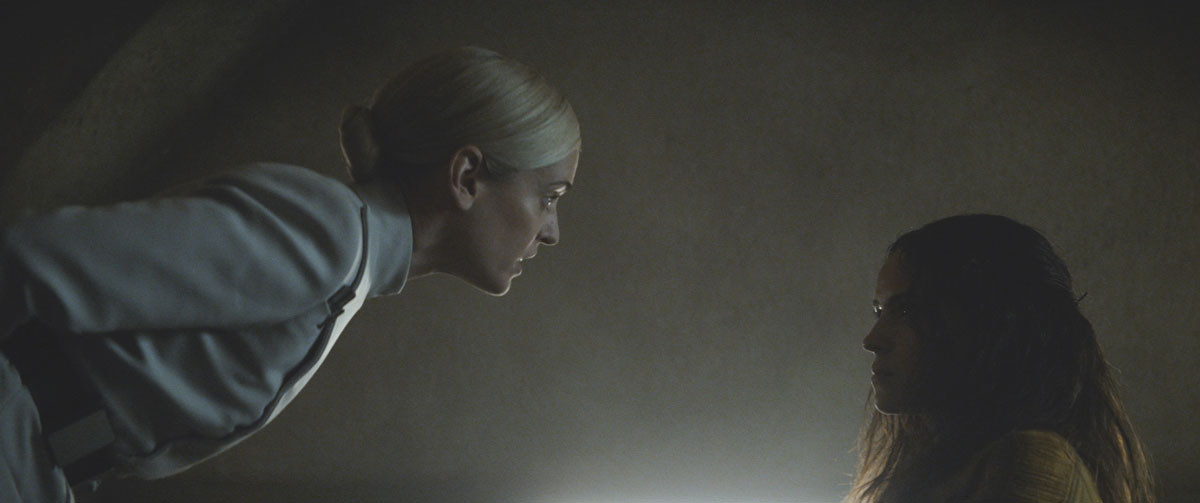
At Syril’s interview, we find out the extent of Uncle Harlo’s influence. While giving a tour of the enormous bureaucratic complex, the interviewer sees “Morlana One” on his tablet and recognizes the disaster Syril presided over. But even as Syril rushes to offer a defense, the civil servant reassures him, “Probably best for everyone to just edit this a bit before signing you in. I’m sure your uncle would approve.” Not only has Uncle Harlo secured Syril the interview, but he’s also made it possible to scrub that damning record.

Is Syril’s landing the job enough for his mother? Hardly. While she harangues him to eat since he’s been so busy (as an office drone and with his own secret mission), he in turn accuses her of searching his room, invading his privacy.

“I find you a job, I press your uniform, I prepare two meals a day,” she retorts. “I move mountains to scrape you off the floor and put you back on your feet, and what do I reap? What is the return on my investment? . . . The shadow of a son, a tenant, a stranger – all that time away on Morlana, imagine I’d cracked under the weight of your neglect. Imagine I’d cracked and wasn’t here now to pick up the pieces.”

Guilt trip done, when she learns that he’s been promoted, her demeanor once again turns loving. “I knew they’d recognize your promise,” she says before noting how pleased Uncle Harlo will be.

Jewish coding, alongside Nazi depictions

While Eedy and Syril are not Jewish — since, presumably, Judaism does not exist in the Star Wars galaxy — there are strong indications that they are coded as Jews. As a Jew myself, this coding is striking — Eedy’s appearance, accent, intonation, mannerisms and phrasing, as well as the topics of conversation and the dynamic of her relationship with her son. And this would extend to Syril because if we read Eedy as Jewish, then he would be too as her son.

All of this adds up to create a visceral impression in me, and I am not the only one to feel this way. Both the Jewish author Abraham Josephine Riesman, as well as the right-wing publication Bounding into Comics, share this appraisal of Eedy. While many of the elements of this coding would be fine on their own, their complete saturation of the character forms the context in which plot points like Uncle Harlo are able to take on a more sinister meaning.

The Empire is … crucially, subjects that go about their daily lives ignoring or enthusiastically supporting barbarity in the name of law and order, out of fear or simply for personal gain.

This is not to say that characters can’t seem, or explicitly be, Jewish while doing bad things and being bad people. No demographic group is exclusively good or bad, and this should be reflected in fiction. But, while I cannot speak to the intention of the show writers, piling antisemitic trope upon trope — narcissism, manipulativeness, shadowy influence and a greedy view of the world — can only cause harm. This harm is reinforced both by the story the show is telling about fascism, as well as the context in which it is being watched and absorbed.

AndorSupervisor Dedra Meero (Denise Gough) and Bix Caleen (Adria Arjona) in “Andor” (Disney+/Lucasfilm)

Star Wars has always drawn inspiration from the Nazis, but never has this had greater depth than in “Andor,” nor more weight than in our own time of rising fascism. Coruscant, the capital of the Empire and setting for the resistance intrigues of Mon Mothma (Genevieve O’Reilly) and Luthen Rael (Stellan Skarsgaard), has a retrofuture, art-deco aesthetic — from the clothing and hair to the architecture and interior design to the flying cars — suggesting a parallel with Nazi-era Berlin.

Beyond aesthetics, the genocidal aspect of the Empire is developed in greater detail, as well. Not yet vaporizing entire planets from afar, the Empire exterminates methodically and in close quarters — in one instance, recording the death lamentations of a species it was eradicating, and then using these sounds to torture political dissidents like Bix Caleen (Adria Arjona). “Andor” demonstrates, however, that the Empire is far from a hivemind. It’s a political and military organization with layers of bureaucracy, divergences of opinion, internal rivalries and, crucially, subjects that go about their daily lives ignoring or enthusiastically supporting barbarity in the name of law and order, out of fear or simply for personal gain.

Eedy and Syril are two such subjects. Syril is obsessed with the Empire, taking every opportunity he can to find a role to play within it, even resorting to stalking the exceptionally cruel Imperial Security Bureau (ISB) supervisor Dedra Meero (Denise Gough). While Eedy is less overtly enthusiastic, she’s still clearly a supporter of repression. As a news report about the rebel attack on Aldhani plays in the background, Eedy summarizes it as, “Rabble. They attacked a garrison. They’ll regret it.” Eedy and Syril are thus not just coded as Jews, but as Jews supporting a genocidal regime that is Nazi in nearly every way but name.


Want a daily wrap-up of all the news and commentary Salon has to offer? Subscribe to our morning newsletter, Crash Course.


The positive feelings I have for “Andor” come with a giant asterisk.

“Andor” is a genuinely exciting reinterpretation and deepening of the Star Wars universe and, to its credit, it uses the tremendous clout of the franchise to draw attention to essential issues. The show illustrates that fascism isn’t just imposed, but requires a broad base of support: it needs true believers and opportunists; it needs those who prefer it to the alternative and those who will tolerate it so long as it does not harm them personally; and, perhaps most importantly, it needs the largest number to feel too afraid and powerless to stand up for themselves, and one another, before it is too late. This could hardly be a more important lesson as we head into our own growing struggle against fascism.

AndorKloris (Lee Ross) and Mon Mothma (Genevieve O’Reilly) in “Andor” (Disney+/Lucasfilm)

But the positive feelings I have for “Andor” come with a giant asterisk. The show’s repeated use of Jewish stereotypes, which range from relatively benign to unequivocally antisemitic – in a time of increasingly uninhibited advocacy of the most virulent antisemitic conspiracy theories, and sharply increasing hate crimes against Jews – is genuinely harmful. What the depiction of Eedy and Syril Karn may lack in overt anti-Jewish animosity, it makes up for by delivering a more subtle and difficult-to-challenge antisemitism – an antisemitism that worms its way into basic assumptions, contributing to a swelling tide upon which hatred and violence are able to crest higher and higher.

Fascism needs targets, and Jews sit among the perennial favorites. In a time of a nearly ubiquitous fascist resurgence, in a show that makes fascism its thematic centerpiece, the inclusion of timeworn antisemitic tropes is, at best, a grave oversight, but it is one that we cannot overlook.

Planning your 2023 travel? Skip these places in order to save them

Fodor’s, the popular travel company that built its business on telling you where to go and where to stay, eat and drink once you’re there, has just released a list of places around the world you should skip in 2023. 

The company’s 2023 “No List” isn’t advising you to avoid these destinations because of bad food, lousy attractions, or risk of danger, but because the presence of large numbers of tourists in these places is causing unsustainable ecological, cultural, and social harm.

The “No List” focuses on global tourism’s impact on three key areas: unique and sensitive natural environments increasingly degraded by tourists, “cultural hotspots” facing overcrowding and strained housing and infrastructure, and destinations in the midst of water crises that already heavily burden local communities.

Lake Tahoe, California, and Antarctica made the list of natural wonders that deserve a respite from tourists due to their ecologically sensitive environments. As for cultural destinations on the list, Venice and the Amalfi Coast in Italy; Cornwall, England; Amsterdam, Netherlands; as well as Thailand, were noted as experiencing strained infrastructure and higher costs of living that are increasingly pushing out locals.   

Global tourism, through a combination of food consumption, accommodation, transportation, and the purchasing of souvenirs, contributes eight percent of the world’s greenhouse gas emissions. After a brief respite in the first months of the pandemic, tourism numbers have exploded, exceeding even pre-pandemic numbers. 

But the pandemic-induced downtown in tourism gave locals, environmental activists, and government officials in places like Thailand the chance to witness something seemingly unimaginable: the revival of their local ecologies and communities that had been devastated by the social and environmental costs attributed to the industry. In April, the Southeast Asian country’s government banned styrofoam packaging and single-use plastics from national parks. The minister of natural resources and environment also ordered that all national parks in Thailand be closed for one month a year.

Amidst global droughts and depleting reserves, water is central to understanding some of the pushback from local communities against mass tourism. On the Hawaiian Island of Maui, which also made the “No List,” many Native Hawaiians have become increasingly vocal about how mass tourism is negatively impacting their access to increasingly scarce water resources. This past June, mandatory water restrictions were put in place in parts of Maui most visited by mainland and international tourists. The order prohibited non-essential use of water, including irrigation, lawn watering and washing vehicles. But as local households were forced to adjust or face hefty fines, hotels and other tourism facilities were exempt from these cutbacks.

“When they stay in a destination, tourists essentially become temporary residents,” said Justin Francis, the co-founder and CEO of travel company Responsible Travel, in an email. “That can place an additional strain on local services and facilities.” Francis advocates for more tourism taxes, which he says can boost funding for infrastructure development – roads, access to clean water, energy provision – that benefits local communities as well as tourists. 

Pushback against mass tourism has also extended to policies on housing availability and affordability. On Oahu, Hawaii’s most populous island, the mayor of Honolulu signed a bill in April restrictions on short-term rental properties and Airbnbs in an attempt to help alleviate the local housing crisis. The proliferation of these properties, particularly in densely populated cities like Amsterdam and Barcelona, has become one of the most controversial issues not only among housing advocates and travel experts, but also official marketing and tourism officials. “They’re literally decimating communities – pricing local people out of their homes and areas they’ve lived their whole lives in,” said Francis. Amsterdam’s left-wing city council attempted to ban Airbnb rentals in three central districts of the city, but it was overturned by local courts last year.  

The city of Honolulu’s policy includes limiting the number of Airbnbs and short-term rental properties as well as increasing the minimum length of stay required for visitors who use these services. The majority of homeless on the streets of the city are Native Hawaiians, who experience disproportionate levels of poverty throughout the state.     

Of course, many communities most vulnerable to the negative social and environmental impacts of mass tourism are also dependent on it for their livelihoods. Simply boycotting travel can also hurt groups that are most vulnerable, including women, migrants, and people of color.

Some destinations are seeking to make the most of the economic benefits of tourism while minimizing its cultural and environmental impacts simply by restricting travel to “high value” tourists – i.e, those with more disposable income. The Himalayan nation of Bhutan is a prime example. Visitors are charged a daily $200 fee, which doesn’t cover the cost of hotels or other services. Bhutan’s government says that the fee supports sustainable tourism development and training, as well as carbon offsetting.  

As for Antarctica, some experts argue that its inclusion on Fodor’s list is complicated, due to the fact that the landmass has no local population that would benefit from visitors. On the other hand, thoughtful and sustainable tourism could arguably protect more of the environment there, which could serve as a buffer against more destructive economic industries like mining. “Tourism here cannot be allowed to grow without limits and mandatory environmental measures,” said Francis from Responsible Travel. However, The Antarctic Treaty, which prohibits economic and military exploitation of the region, will likely continue to protect the area’s environment and resources.

The big takeaway from Fodor’s list is that travel can be a force for good – both for nature and for local communities. The key is not necessarily to stay away, said Francis, but to always make informed choices that minimize harm and maximize benefits to local communities first. 

“As an industry we need to do better than ‘leaving nothing but footprints’, and actively work towards creating positive impacts,” he said.  

Herschel Walker, South Park, and the Prius: How loving gas-guzzlers became political

On the campaign trail earlier this month, U.S. Senate candidate Herschel Walker from Georgia delivered a strange defense of vehicles that spew gobs of pollution, celebrating their inefficiency. Walker, a Republican who’s facing a runoff race against Democratic Senator Raphael Warnock, told supporters at a rally in Peachtree, Georgia, that America isn’t “ready for the green agenda.”

“What we need to do is keep having those gas-guzzling cars,” Walker said. “We got the good emissions under those cars.” 

It was a moment when Walker’s absurd remarks actually squared with the party’s line (unlike, say, his comments about America’s “good air” deciding to float over to China). Republicans have said similar things over the years, displaying a worldview that fossil fuels have inherent virtue, once described as “carbonism.” It’s the belief system that drove former President Donald Trump to bar California from setting stricter emissions standards in 2019, and what led Republican congressmen to defend fossil fuels at the international climate negotiations in Egypt earlier this month.

This pro-pollution point of view can be partly explained by the GOP’s close connection to the oil industry, which funnels millions into Republican campaigns every election year. Walker’s celebration of gas guzzlers can also be understood as a reaction to the notion, quiet but widespread among many environmentally conscious people, that cleaner cars are morally superior.

In 2000, the United States was introduced to the Toyota Prius, marketed as a holier-than-thou, eco-friendly choice. The hybrid car set off a backlash so intense, you can still hear its echoes today. Prius owners were parodied in the cartoon South Park. On the road, hybrid drivers were sometimes blasted by clouds of thick black smoke, targeted by truck owners who had removed their emissions controls. A popular bumper sticker of the mid-2010s simply read “Prius Repellent.” Even Toyota embraced the image with ironic ads.

Today, gasoline-free vehicles are finally starting to go mainstream. When the all-electric version of the Ford F-150 pickup truck — America’s longtime bestselling vehicle, and a favorite among Republicans — was released this spring, its waitlist was three years long. Sales of electric vehicles were up nearly 70 percent in the first nine months of this year compared to the same period last year. And 36 percent of Americans reported that they were considering buying an electric vehicle for their next car, according to polling by Consumer Reports this summer, largely because of high gas prices and cost savings over the long term. For many, the environmental benefits may be just a bonus — or not even be a consideration.

“I don’t have the disposable income to throw $50,000 or $60,000 at a car just to help the environment,” Russell Grooms, a librarian in Virginia who bought a battery-powered Nissan Leaf, recently told the New York Times. “It really came down to numbers.”


In a Prius commercial from 2008, a hitman drags a body out of his car in the middle of the night and dumps it in the river. “Well, at least he drives a Prius,” the ad says.

It was one of many advertisements that poked fun at the car’s environmental bona fides. The joke relies on understanding that driving a Prius is a form of moral “capital” that can be used to “offset life’s other sins,” wrote Sarah McFarland Taylor, a religion scholar, in the book Ecopiety: Green Media and the Dilemma of Environmental Virtue. 

Buying a Prius isn’t really that pious an act. After all, the vehicle takes a lot of fossil fuels to manufacture and runs mostly on gasoline. The most eco-friendly move: not buying a car at all. But that didn’t stop the hybrid from taking off as a righteous choice. Within two years of its release in America, the Prius had gathered a long list of celebrity owners, including Leonardo DiCaprio, Cameron Diaz, and Larry David. In 2002, the Washington Post called the Prius “Hollywood’s latest politically correct status symbol.” 

For conservative commentators, that symbol made for a ripe target. “The bottom line here is that people that are buying Priuses are doing it for glamor reasons,” Rush Limbaugh said on his radio show in 2005. “They wanted to appear virtuous. But they’re accomplishing nothing … These liberals think they’re ahead of the game on these things, and they’re just suckers.”

It wasn’t just Limbaugh. In 2006, South Park devoted an entire episode, called “Smug Alert,” to making fun of holier-than-thou Prius owners. It opens with Kyle’s dad, Gerald, showing off his new hybrid car, the “Toyonda Pious.” 

“I just couldn’t sit back and be a part of destroying the Earth anymore,” Gerald tells his neighbor with a condescending smile.

“Well, there goes the high and mighty Gerald Broflovski,” one onlooker comments. “Yeah, ever since he got that new hybrid he thinks he’s better than everyone else,” another says. Not long after the episode aired, a market research firm found that 57 percent of Prius owners said the main reason they bought one was that “it makes a statement about me,” versus 36 percent who said they bought it for the good gas mileage.

The car remained popular — hitting the mark of 1 million vehicles sold by 2011 — and so did parodying it. In 2012, the satirical news site The Onion made a commercial about a new, even greener Prius that “reduces its driver’s carbon footprint to zero by impaling them through the lungs with spikes as soon as they get in the car.” 

The air of moral superiority around the Prius led to real-life consequences. Certain pickup truck owners took joy in rebelling against it, rolling up in front of hybrids and engulfing the vehicles in plumes of tailpipe smoke. This testosterone-fueled practice of “rolling coal” — modifying diesel engines to spew clouds of sooty exhaust — became a health menace in the mid-2010s. Directed at electric car owners, pedestrians, bikers, or anyone unlucky enough to be in the vicinity, rolling coal became for these aficionados a defiant symbol of American freedom — signaling “don’t tell me what to do.”

When states moved to ban rolling coal, some drivers pushed back, the New York Times reported in 2016. “Why don’t you go live in Sweden and get the heck out of our country,” one diesel truck owner wrote to an Illinois state representative who proposed a $5,000 fine for removing emissions equipment. “I will continue to roll coal anytime I feel like and fog your stupid eco-cars.”

One of the pitfalls of framing environmental concerns in moral terms is that it can provoke a counterreaction, especially when tied to individual behavior. One study found that listening to eco-friendly tips actually makes people less likely to do anything about climate change. Think about eating meat, often discussed as a moral issue among people concerned about animal rights or climate change. Fast-food chains like Taco Bell and Burger King have expanded their vegetarian menu items; meanwhile, Arby’s has leaned into the opposing “pro-meat” demographic. In 2018, Arby’s ran an ad with the tagline “Friends don’t let friends eat tofu.” The following year, the chain trolled vegans by introducing the “marrot,” a carrot made out of meat.

As America has grown more and more polarized, seemingly innocuous things have become associated with the other party, from pizza chains to sports leagues. One in five voters say that politics has hurt their friendships; there’s a growing aversion to dating people from the opposite party. With hybrids and electric vehicles owned most often by Democrats, Republicans like Walker might try to distance themselves from their perceived enemies by signaling their affection for fuel-hungry vehicles.

To be sure, the environment is still a major reason to buy a greener car for many Americans, especially among those on the political left. Almost three-quarters of those who would consider buying an electric vehicle said that helping the environment was a key consideration, according to polling from Pew Research. And in a survey released this month, 10 percent of Americans said it was “morally wrong” to drive a car that gets bad gas mileage. But even as they’re rolling out new electric models, car companies don’t seem to be chasing efficiency — instead, they’re making big trucks and SUVs. And they’re gaining popularity across party lines.

Aside from some lingering resentment against eco-friendly cars and what Walker called the “green agenda,” the United States seems to be moving beyond the hangups that surrounded the Prius. Over the last decade, the success of Tesla — which marketed its vehicles as cool and desirable, not a virtuous choice — paved the way for other carmakers to follow in hot pursuit. 

“The [Tesla] Model S completely delivered on its promise to change how the world thought about electric cars,” Jake Fisher, the senior director of Consumer Reports’ auto center, said earlier this year. “EVs were no longer the vegetables you should eat — they became the dessert you desired.”

GOP threat to rail workers: “Congress will not let this strike happen”

A House Republican from Pennsylvania said Sunday that Congress will intervene to stop a nationwide strike if rail companies and unions don’t reach a contract agreement soon, a step that would likely force workers to accept a deal without any paid sick days.

Acknowledging that rail workers “have a very reasonable ask” for better benefits and wages as they continue to labor under a punishing scheduling system, Rep. Brian Kevin Fitzpatrick said in a Fox News appearance Sunday that “Congress will not let this strike happen, that’s for sure.”

“It would be devastating for our economy” Fitzpatrick added. “We’ll get to a resolution one way or another.”

Powerful industry groups including the U.S. Chamber of Commerce and the Association of American Railroads have been pressuring Congress to step in after members of the largest rail union in the United States voted to reject a White House-brokered contract deal that rebuffed workers’ push for at least 15 days of paid sick leave. The deal, touted by the Biden White House as a victory for workers and profitable rail companies, does not include a single paid sick day.

Under the Railway Labor Act of 1926, Congress has the authority to intervene in rail labor disputes—power it has used in the past. In September, Sen. Bernie Sanders, I-Vt., blocked Republican legislation that would have forced rail workers to accept the inadequate contract recommendations of an emergency board convened by President Joe Biden.

The prospect of congressional intervention ahead of a potential strike on December 9 has angered rail workers who say it would let giant companies off the hook, allowing them to continue abusing their employees while raking in record profits. Rail workers are often forced to be on call 24/7—with minimal rest between long shifts—and are penalized for taking days off for doctor’s appointments or health emergencies.

In June, a locomotive engineer died of a heart attack after he put off a doctor’s visit when his employer BNSF—a rail giant owned by Warren Buffett’s Berkshire Hathaway—called him into work.

“When railroads refuse to give us sick time, what they are saying is their profits are worth more than their workers and the national economy,” Ross Grooters, co-chair of Railroad Workers United, tweeted over the weekend. “Hold the railroads accountable. Tell your elected leaders to give railroad workers the sick time they need or let them strike.”

Progressive lawmakers have also placed blame for the looming strike with large railroad companies, which have been gorging on their own stock, reporting huge profits, and enriching shareholders and executives while refusing to budge on workers’ longstanding demands for basic quality-of-life benefits.

“The corporate greed never ends,” Sanders wrote Sunday. “Last year, the rail industry made a record-breaking $20 billion in profits after cutting their workforce by 30% over the last six years. Meanwhile, rail workers have ZERO guaranteed paid sick days. Congress must stand with rail workers.”

Rep. Peter DeFazio, D-Ore., chair of the House Transportation and Infrastructure Committee, said last week that he is “hoping the railroads will get reasonable.”

“This is the 21st Century and to have skilled workers being denied sick leave, even unpaid sick leave, is unconscionable,” DeFazio told Bloomberg Government. “Freight rail companies are watching their record profits, ‘Oh my God, if we give people paid sick leave our stock might drop by a dollar.’ Give me a break.”

“They are going to slam this judge”: Experts say appeals court will shut down Trump judge’s “circus”

Legal experts predicted that the 11th Circuit Court of Appeals will soon shut down the special master process in the Mar-a-Lago probe that was ordered by U.S. District Judge Aileen Cannon.

The special master process ordered by Cannon, a Trump appointee, effectively allows former President Donald Trump to challenge the search warrant at his office and residence before he is indicted — an extremely rare opportunity for a criminal defendant.

The oral argument by prosecutors, who are now under the direction of the newly appointed Special Counsel Jack Smith, shows that the 11th Circuit may be close to reversing Cannon’s process. The three judges on the panel — two of whom are Trump appointees — shared their skepticism that Cannon had jurisdiction to take action before an indictment, and that even if she did, she had no factual predicate to appoint a special master. 

Judge Britt Grant, who was appointed by Trump, asked the former president’s legal team whether they tried to appeal Cannon’s finding that the Justice Department did not demonstrate a “callous disregard” for Trump’s rights. Trump’s attorney, James Trusty, said that they did not appeal the finding and Grant responded that the finding required a reversal of Cannon’s order.

Judge Andrew Basher also confronted Trump’s attorneys with two questions that stumped them: whether there was any precedent to prevent the DOJ from using the seized materials in its investigation before any indictments and whether there is any reason that Trump should be treated differently in the case than other defendants other than his status as the former president.

Trump’s attorneys were unable to give a satisfactory answer to the judges. After hearing the oral argument Trusty tried to keep the special master appointment by disparaging Cannon’s injunction against the DOJ. He argued that the DOJ was not harmed by the injunction because of an order issued by the 11th Circuit that allowed the department to use the 100 documents that were originally labeled “classified” in the investigation.

“Then, in language that I have never heard an attorney use in the more than 25 years I have worked as an attorney in criminal law, Mr. Trusty said that the injunction was ‘overblown’ and that what really mattered was preserving the Special Master,” wrote former federal prosecutor Mitchell Epner for The Daily Beast

“The 11th Circuit judges and the DOJ attorneys jumped on that statement, noting that it was unprecedented for the DOJ to be barred by the judiciary from using documents seized by search warrant during their investigation,” said Epner.

Epner added in his analysis that he rarely makes predictions on court rulings, but “this is the exception.”

“I would be shocked if the 11th Circuit does not overturn Judge Cannon’s order,” Epner wrote, “I also think it will happen quickly. The judges have asked for the upcoming schedule in front of the Special Master.”

Special Master Raymond Dearie has scheduled the next hearing for Dec. 1, when he is expected to hear arguments about the remaining 900 documents in the investigation. On Dec. 16, Dearie would be required to give his report and recommendations to Cannon, and the parties will then have the ability to object to Cannon or the 11th Circuit. This process would likely last months. 

“I cannot imagine the 11th Circuit allowing this circus to continue until Dec. 1, and that’s part of why I expect that the 11th Circuit will promptly overrule Judge Cannon, ending the entire process,” Epner predicted.

Former federal prosecutor Cynthia Alksne on Saturday also said that she expects the 11th Circuit to come down on Cannon for her protection of Trump. Speaking with MSNBC’s Ali Velshi, Alksne said that Cannon can expect to be reprimanded soon.

“It sounds like after reading the transcript of the appellate hearing in the 11th Circuit that they are going to get rid of the special master and they are going to slam this federal judge [Cannon] who put a wrinkle in the process that was totally unnecessary,” she said.


Want a daily wrap-up of all the news and commentary Salon has to offer? Subscribe to our morning newsletter, Crash Course.


“And that will speed up the process and allow the government to really dive into those documents because, remember, it is not only — when you look at this case to a prosecutor — it is not just does he have the documents, where they willfully maintained and did he not return them when he was asked to. You also have to have sort of a global outlook on it like, why did he do it?” she elaborated.

“In order to do the prosecution, you kind of want to know that,” she added. “Is it an ego thing, as somebody leaked from the Justice Department or did those documents make it into the stream of his financial considerations? Is that why he ended up with these deals in the Middle East? Has Jared Kushner seen the documents? Who has touched them, who has seen them, who knows about them, who has used them?”

“The sooner we get rid of the special master process, or we complete it, the sooner we can get to that point and we can move forward with the prosecution,” Alksne stated.

If the 11th Circuit does rule against the former president, there will likely be an emergency appeal to the Supreme Court which will be denied almost immediately, according to Epner. The former U.S. attorney predicted that Smith and his team will then quickly move in to indict Trump on multiple counts. Despite Trump’s attempts to keep the case in the Southern District of Florida, the indictment will likely be issued from the District Court for the District of Columbia due to the removal of national security documents from the White House. 

Trump’s worst fears will be realized if the trial happens in D.C. where he received only 5 percent of the vote in 2020, the lowest total in the entire country, Epner wrote.

The indictment may also go beyond the Espionage Act to include a felony charge relating to Trump’s demands that the IRS conduct audits of his political enemies. “I would not be surprised if each of those IRS employees cooperated with the DOJ, with all fingers pointing in Trump’s direction,” Epner said.

“The nice thing about prosecuting tax crimes is that the crimes are very clearly delineated. Few jurors have any sympathy for people who cheat on their taxes or wrongfully sic the IRS on an individual to carry out a personal vendetta,” Epner concluded.

“Unambiguous felony”: Legal expert warns that Trump risks prosecution over IRS audit probe

According to a report from former Assistant U.S. Attorney Mitchell Epner at the Daily Beast, Donald Trump’s legal problems may be growing exponentially because there appears to be evidence he attempted to use the IRS to persecute political enemies before he lost re-election.

At issue, Epner wrote, are accusations from former White House Chief of Staff John Kelly that the former president demanded the IRS look into tax returns filed by, among others, former FBI Director James Comey and former FBI Deputy Director Andrew McCabe.

According to the legal expert, there is already an investigation by the IRS inspector general into the suspicious audits of the two FBI officials, with Epner writing, “As reported earlier this summer, both Comey and McCabe were subjected to highly unusual IRS audits. The odds of an individual randomly being subjected to this type of audit are similar to being struck by lightning. For both to be the subject of special audit by happenstance is about as likely as a whale falling from the sky and landing in the middle of a mountain range.”

As he notes, there is evidence Kelly is willing to provide evidence about Trump’s illegal demand, with Epner writing that “a president who unlawfully seeks to have an individual audited is subject to up to five years in prison. The crime does not require that the IRS actually carry out the audit. The crime is completed with the mere request.”

“If Trump made this demand while he was president, that is an unambiguous felony. Section 7217 of Title 26 of the United States Code makes it a crime for the ‘President’ to ‘request, directly or indirectly, any officer or employee of the Internal Revenue Service to conduct or terminate an audit or other investigation of any particular taxpayer with respect to the tax liability of such taxpayer,'” he wrote before adding, “Based on my training and experience as an Assistant U.S. Attorney who prosecuted tax offenses, I expect that each IRS employee along the chain of command kept detailed notes and records of who ordered them to conduct the audit, and on the facts that were cited to support that audit demand. I would not be surprised if each of those IRS employees cooperated with the DOJ, with all fingers pointing in Trump’s direction.”

He concluded that “the nice thing about prosecuting tax crimes is that the crimes are very clearly delineated. Few jurors have any sympathy for people who cheat on their taxes or wrongfully sic the IRS on an individual to carry out a personal vendetta.”

You can read more here.

Trump demands election loser Kari Lake be “installed” as governor in late-night Truth Social rant

Former President Donald Trump called for Arizona Republican gubernatorial candidate Kari Lake to be installed as governor after falsely claiming that the elections in Arizona were a “criminal voting operation.”

Lake, who repeatedly refused to say she would accept the results of the governor’s race in Arizona if she lost, still hasn’t conceded to Gov.-elect Katie Hobbs. Still, several of her allies, including Trump, are claiming that the election was fraudulent despite no evidence of voter fraud.

“Massive numbers of ‘BROKEN’ voting machines in Republican Districts on Election Day. Mechanics sent in to ‘FIX’ them made them worse. Kari had to be taken to a Democrat area, which was working perfectly, to vote. Her opponent ran the Election. This is yet another criminal voting operation – SO OBVIOUS. Kari Lake should be installed Governor of Arizona. This is almost as bad as the 2020 Presidential Election, which the Unselect Committee refuses to touch because they know it was Fraudulent!” Trump wrote on Truth Social.

Journalist Jeremy Duda noted that virtually everything Trump claimed is “inaccurate”.

“Lake didn’t have to switch voting centers because there were no printer issues at PV Town Hall. Her opponent didn’t run the election. Technicians didn’t make the printer problems worse. No ‘voting machines’ were broken,” Duda tweeted.

Attorney Ron Filipkowski pointed out the time stamp on the post.

“2:30 AM post: ‘Kari Lake should be installed Governor of Arizona,'” Filipkowski wrote

On Election Day, Republican Maricopa County Board of Supervisors Chairman Bill Gates said that 60 polling sites experienced printing problems with the ink not printing dark enough to be readable by tabulators. But the issue was resolved before polls closed and all valid votes were counted, he said. 

Maricopa County officials added that the malfunctioning ballot-counting machines did not indicate any instances of “fraud” and did not deny anyone the opportunity to vote.

But Lake and her allies have claimed that Arizona’s “broken election system” disenfranchised Republican voters and stole her victory. 

Her team filed a lawsuit against Maricopa County elections officials last week, claiming that they broke election laws. She called the 2022 election “the shoddiest election ever, in history” on Steve Bannon’s “War Room” podcast, CBS News reported

“We want some information,” Lake said. “We’re on a timeline, a very strict timeline when it comes to fighting this botched election, and they’re dragging their feet.”  


Want a daily wrap-up of all the news and commentary Salon has to offer? Subscribe to our morning newsletter, Crash Course.


Lake also added that 118 polling centers appeared to have a “printer/tabulation problem,” even though officials previously said there were 60 polling centers with printer issues.

Her allies have continued to back her and have promoted false theories of voter fraud.  

State Senator-elect Jake Hoffman told Reuters he will lead an investigation into the state’s election when the legislature reconvenes in January.

Steve Bannon, Trump’s former chief strategist and election conspiracy theorist, has urged Arizona officials not to certify the election and said that Hobbs “will never be considered legitimate” due to voting machine mishaps.  

Bannon, who advised Trump to try to overturn the presidential election results, is also providing counsel to Lake.

The Trump-backed former news anchor denied the outcome of the 2020 presidential election. Since Election Day, she has been alleging problems in Maricopa County – Arizona’s largest county.

In a video Lake released last week, she said she has “assembled the best and brightest legal team” to explore “every avenue to correct the many wrongs that have been done”.

Lake’s Republican colleague, Abe Hamadeh, who ran for attorney general and lost by 510 votes to his Democratic opponent, Kris Mayes, also filed a lawsuit against his challenger as well as state and local officials, seeking to overturn his defeat.

Will wild coffee go extinct from climate change? Botanists say we can still save this crop

Every day, hundreds of millions of people wake up and immediately get high. Of course, their drug of choice is caffeine, meaning this is socially acceptable behavior that is even encouraged by workplaces, which often provide it for free. Caffeine consumption is so prevalent most people don’t even think of it as drug use, even though this is a substance that profoundly affects mood, digestion, sleep and many other biological processes. It can even be hard to quit, triggering cravings and headaches for people with strong dependency. (At least coffee has been linked with many health benefits.)

Some estimates warn that 50 percent of the land used to grow coffee will be unproductive by 2050.

We’re so used to having caffeine as part of our waking lives, it’s almost impossible to imagine a society not under the influence of coffee, tea and energy drinks. Similar to fish that don’t notice water, many humans also take their favorite stimulant for granted. But what if that were to all one day disappear? What if everyone’s morning cup of Joe suddenly became a cup of … No? (Sorry.)

Surprisingly, it is a real possibility. As climate change worsens, the threats against coffee plants are rising, meaning one day many species of coffee could be extinct in the wild. Drought, floods, heatwaves and the spread of pathogens like fungus and viruses are already making it more difficult for coffee to grow in some regions. If this trend continues, one of humans’ favorite substances may become scarce and extremely expensive, with some estimates warning that 50 percent of the land used to grow coffee will be unproductive by 2050.

Since the mid-’90s, Aaron Davis, a botanist and senior research leader at Kew Gardens in London, has traveled the world studying coffee plants. Last year, Davis co-authored a study describing six new species of coffee plants native to Madagascar, a few of which are already listed as critically endangered. Davis also co-authored a 2019 analysis in Science Advances, examining the health of global coffee species and found that 60 percent are threatened with extinction, with insufficient data on another 11 percent.

But the damaging effects of global heating on coffee cultivation are already being felt globally, with multi-generational coffee farmers witnessing their crops struggle in a transforming climate.

“Sometimes it’s been almost spooky to listen to what farmers tell me about changing climate, even though they’ve got no access to climate data or records,” Davis told Salon. “They haven’t seen the graphs, they haven’t seen the IPCC reports. But what they say very much corresponds to what’s happened and what’s happening,” both in climate models and recorded data.

The effects of climate change on coffee aren’t always direct. In fact, to some degree, higher temperatures can actually benefit coffee plants, Davis says. But the suitable regions where coffee grows best are starting to shift, which could make coffee a more rare and expensive commodity.

“Coffee has already moved,” Davis says. “It’s not really the temperature itself. It’s temperature in combination with many other things, particularly precipitation, rainfall, seasonality, extreme weather events, shifting weather patterns. It’s very complicated.”

For example, Davis was co-author on a paper published last month in Nature Food showing that Coffea arabica is sensitive to vapor pressure deficit (VPD), a variable not previously explored in coffee. VPD essentially relates to the way heat can suck moisture from the soil, forcing plants to draw more water from the ground. Assuming this doesn’t kill the plants, it can give them less energy for producing fruits, which are technically what coffee is. The corresponding rise in VPD with global temperatures could affect the yields of more than 90 percent of countries that produce coffee.

Cultivated coffee plants will likely always exist in some diminished form, Davis predicts, but in the meantime, wild coffee plants are especially threatened, which could create huge problems in the near future.  There are 130 coffee species known to science, but humans really only drink two: Coffea canephora and Coffea arabica, which make up 43 and 57 percent of the global market respectively. But that hasn’t always been the case.

For most of the 19th Century, the only species of coffee in circulation was C. arabica. Between 1869 and 1930, Southeast Asia was plagued by a fungus called coffee leaf rust (Hemileia vastatrix), which destroys the plant’s ability to photosynthesize. The disease swept through parts of India, the Philippines and Ceylon, the area now known as Sri Lanka, leaving “Arabica graveyards” in its wake.

Some plantations never recovered and switched to growing tea instead. Others began cultivating a different species, C. liberica, which was naturally resistant to the rust. However, its defenses waned over time and it too became susceptible to the fungal pathogen, though its distinct taste also helped to make it obsolete in the region.

“We have opportunities to broaden the crop portfolio of coffee to move away from just two species to maybe three, four or five, providing something that gives us more adaptation potential in the face of climate change,” Davis says.

In the early 1900s, C. canephoa, as known as Robusta, became dominant in the area. It’s just one example of how coffee plant preferences have changed throughout history and each time, it meant finding tools or alternatives that exist in nature. This practice is called “bioprospecting.” But if, for example, another weird plant disease makes Arabica or Robusta hard to cultivate, and wild coffee species are scarce or extinct, we may not be able to save this industry again, as has happened to many plants throughout history.

“Time and again, researchers and breeders have gone back to the wild to find plants with specific traits to sustain the industry, whether that’s disease resistance, pest resistance, etc.,” Davis says. “I think what we really need to do is work on these now in preparation for the difficulties that we that we will face in the coming decades.”

If coffee were to go extinct in the wild, we might be able to make synthetic coffee using some kind of substrate or plant material soaked in caffeine. Lab-based coffee made using bioreactors full of yeast or bacteria is another route that’s being explored. But Davis argues that we should try domesticating some of the other 128 species of coffee, before they’re gone. Some of these varieties will have a unique flavor, too — they may be less acidic or bitter, for example.

“We have opportunities to broaden the crop portfolio of coffee to move away from just two species to maybe three, four or five, providing something that gives us more adaptation potential in the face of climate change,” Davis says. “It’s also a great opportunity, I think, for consumers of coffee to broaden their sensory experience of coffee and try something that’s new, exciting, delicious.”

There’s also a strong economic incentive to save coffee, which is the most widely traded agricultural commodity in the world after crude oil. Around 100 million people, including 25 million farmers, are part of this international industry.

Despite how important coffee is to our global economy, let alone our morning routines, we still have many questions about how these plants thrive in the wild and what they may offer us. So it’s about more than finding synthetic replacements, new varieties or moving plantations to higher ground. It’s about preserving a drug industry (nothing wrong with that) that defines something special about being human.

“We really, really need to focus on carbon neutrality,” Davis warns. “There’s a deep psychological issue around losing things like coffee or wine or chocolate,” which are also threatened by global heating. “Life just becomes a little bit more mundane,” Davis says. “Not everybody’s a coffee drinker. But it starts to really wear on the psyche, once you start losing that, all those things that make life special.”

“He will do whatever they ask”: Democrat blasts Kevin McCarthy for pandering to the “QAnon caucus”

United States Representative and House Permanent Select Committee on Intelligence Chairman Adam Schiff, D-Calif., blasted House Minority Leader Kevin McCarthy, R-Calif., over McCarthy’s subservience to former President Donald Trump as well as his willingness to kowtow to conspiracy theorist Congresspersons Marjorie Taylor Greene, R-Ga., Paul Gosar, R-Ariz., and Matt Gaetz, R-Fla., in order to get elected as the next Speaker of the House.

On Sunday’s edition of CNN’s State of the UnionSchiff began by chastising McCarthy’s dismissal of the evidence obtained by probes conducted by Congress that showed how operatives within Trump’s 2016 presidential campaign solicited help from Russia to defeat Democratic nominee Hillary Clinton.

Anchor Dana Bash:

As you well know, the man who is trying to be speaker, Republican Kevin McCarthy, says that he wants to kick you off the Intelligence Committee, the committee that you now chair, because of your handling of the Trump-Russia investigation, and specifically that you repeatedly asserted that there was direct evidence of collusion, direct collusion, which didn’t materialize.

What’s your response to McCarthy?

Schiff said that “McCarthy apparently doesn’t think it’s collusion if your campaign manager is giving inside polling data and battle strategy in key states to an agent of Russian intelligence, while the Russians are helping your campaign, but most Americans would call that collusion.”

But “McCarthy’s problem is not with what I have said about Russia,” Schiff explained. “McCarthy’s problem is, he can’t get to 218 without Marjorie Taylor Greene and Paul Gosar and Matt Gaetz. And so he will do whatever they ask. And, right now, they’re asking for me to be removed from our committees. And he’s willing to do it. He’s willing to do anything they ask. And that’s the problem.”

McCarthy “has no ideology. He has no core set of beliefs. It’s very hard not only to get to 218 that way. It’s even more difficult to keep 218. That’s his problem. So, he will misrepresent my record” and those of Democratic Representatives Eric Swalwell of Connecticut or Ilhan Omar of Illinois, Schiff added. “Whatever he needs to do to get the votes of the QAnon caucus within his conference.”

Watch below or at this link.

What planting tomatoes shows us about climate change

There’s a piece of gardening lore in my hometown that has been passed down for generations: Never plant your tomatoes before Show Day, which, in Tasmania, is the fourth Saturday in October. If you’re foolhardy enough to plant them earlier, your tomato seedlings will suffer during the cold nights and won’t grow.

But does this kind of seasonal wisdom still work as the climate warps? We often talk about climate change in large-scale ways — how much the global average surface temperature will increase.

Nations are trying to keep the temperature rise well under 2℃. Taken as an average, that sounds tiny. After all, the temperature varies much more than that when day gives way to night. But remember: Before the industrial revolution, the world’s average surface temperature was 12.1℃. Now it’s almost a degree hotter — and could be up to 3℃ hotter by the end of the century if high emissions continue.

For many of us, climate change can seem abstract, but the natural world is very sensitive to temperature change. Wherever we look, we can see that the seasons are changing. Gardening lore no longer holds. Flowering may happen earlier. Many species have to move or die. Here’s what you might notice.

Spring is coming earlier

Warmer temperatures mean spring is arriving earlier and earlier. In Australia, it’s also now five days shorter than the 1950-1969 period, according to Australia Institute research. Trees and plants put out new leaves days earlier.

For some Australian plants, earlier spring means early flowering and fruiting — an average of 9.7 days earlier per decade.

Japan’s famous spring cherry blossoms are blooming earlier than they have in centuries. The cherry blossom peak last year was the earliest recorded bloom in a data record going back to the year 812.

Not only are flowers blooming earlier, birds are also migrating earlier and may also be delaying their autumn migrations.

Summer is getting hotter and longer

A hotter planet means hotter and longer summers.

It might not feel like it this year with all the rain, but the overall trend is clear. In turn, this means bushfire risk is growing year on year, with more days of high to catastrophic fire danger. Every year for the last three decades, an extra 48,000 hectares of forest has burnt across Australia.

Longer fire seasons are making it harder to schedule fuel reduction burns and reducing the amount of time for firefighters to rest and recover between fire seasons.

Hotter temperatures are already posing challenges for salmon farmers in Tasmania. Atlantic salmon grow best in cold water, and climate change has already pushed ocean temperatures up. In summers now, the waters around Tasmania are close to the fish’s limit. Warmer summers will be a substantial challenge for salmon farmers in the future.

Hotter water has also killed off almost all Tasmania’s giant kelp and made it possible for warm-water fish to migrate south.

For millennia, the North Pole has been covered by sea ice. This, too, is changing. Arctic sea ice is melting earlier in summer and freezing later in winter. As warming intensifies, the central Arctic is likely to go from permanent ice cover to ice-free over summer by 2100.

Autumn is falling behind

At the beginning of autumn, the leaves of nothofagus, Australia’s only temperate deciduous tree, change color and fall to the ground — just as many Northern Hemisphere trees do.

Here, too, we can see the climate changing. Around the world, warmer temperatures and rising atmospheric carbon dioxide are delaying the arrival of autumn colors by up to a month.

Winter is disappearing

Alpine species such as the mountain pygmy possum have life cycles built around winter snow, while many of the world’s cities rely on snowmelt for their water supply. In Australia, snowfall has been decreasing in recent decades.

In a warmer world, there’s less snow and ice. That’s posing major challenges for cities like Santiago in Chile, as well as semi-arid areas in the U.S. that have relied on snowmelt.

Species are on the move

What else might you notice? Different animals, birds, fish and plants. Not only are the seasons changing, but many species are now found in areas they could never have survived before.

Tropical corals have now been found happily growing near Sydney. Coral reef fish, too, are heading south to areas well outside their historic range.

You can see some of the surprising new finds on the citizen science project Redmap, such as sightings of the tropical yellow bellied sea snake in Tasmanian waters.

For First Australians, climate change brings a different upheaval. The seasonal link between, say, a wattle flowering and the arrival of fish species is breaking down.

Changes everywhere

Climate change really does mean change — both large scale and small. From extreme weather to ecosystems changing all the way through to the time when you can plant tomatoes.

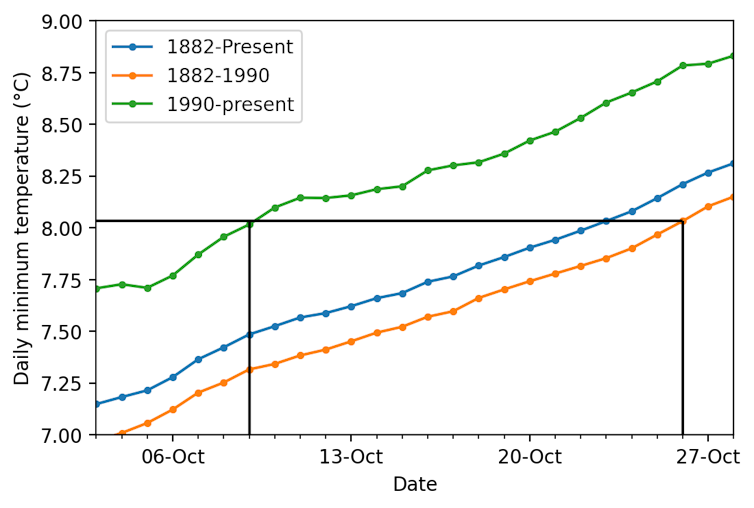
For gardeners, this means accepted wisdom no longer holds. In Tasmania, you can now safely plant tomatoes 18 days earlier than you could in the 1900s. That’s because minimum temperatures in October are now about 1℃ warmer than they were in 1910.


Hobart’s daily minimum temperature in October for three time periods: 1882-present, 1882-1990, and 1990-present. The last 30 years have been much warmer on average than the years before.

Climate change is altering our seasons and changing our world in both obvious and subtle ways.

So while planting tomatoes may seem like a trivial example, it’s yet another sign of the climate changing all around us. It’s no longer a problem for the far-off future. It’s our problem, now.

Edward Doddridge, Research Associate in Physical Oceanography, University of Tasmania

This article is republished from The Conversation under a Creative Commons license.

Trump rejects pleas to condemn Nick Fuentes — because he fears it would “alienate his base”: report

According to reporting from the Guardian’s Hugo Lowell, Donald Trump has no immediate plans to condemn white nationalist Nick Fuentes as part of an effort to douse the firestorm he created after having dinner at Mar-a-Lago with the infamous anti-Semite and Holocaust denier.

While some Trump allies have fanned out to try explain away the dinner meeting by saying the former president didn’t know who he was sitting down with — which is itself a questionable claim — Trump himself is reportedly refusing to go on the record and admit that he was wrong despite pleas from allies and aides.

According to Lowell, the more the former president is pressed by supporters to make a definitive statement about Fuentes’ views, the more entrenched he has become to say nothing.

“Donald Trump repeatedly refused to disavow the outspoken anti-Semite and white supremacist Nick Fuentes after they spoke over dinner at his Mar-a-Lago resort, rejecting the advice from advisers over fears he might alienate a section of his base, two people familiar with the situation said,” Lowell is reporting.

The report goes on to add that “despite efforts from advisers who reached Trump over the Thanksgiving holiday,” he is balking at helping out his own cause.

“Trump ultimately made clear that he fundamentally did not want to criticize Fuentes — a product of his dislike of confrontation and his anxiety that it might antagonize a devoted part of his base — and became more entrenched in his obstinance the more he was urged to do so,” the Guardian report states before adding that Trump is sticking to his story that he was unaware of Fuentes’ controversial background.

“The statements signal Trump will give extraordinary deference to the most fringe elements of his base – even if it means potentially losing support from more moderate Republicans who have not typically cared for his indulgence of extremism,” Lowell reported before adding, “The halting response to Fuentes most closely mirrored his inability to condemn white supremacist groups after Charlottesville, the people said, when Trump faced intense criticism for not naming the rightwing groups in the bloodshed that ended with the death of a young woman.”

You can read more here.

“Taking us all for fools”: GOP leaders called out for silence on Trump’s dinner with Nick Fuentes

Republican leaders are under fire for their silence on former President Donald Trump’s dinner with antisemitic rapper Ye and white supremacist Nick Fuentes at Mar-a-Lago.

Trump over the weekend met with Ye, formerly known as Kanye West, and Fuentes, a Holocaust denier who participated in the deadly 2017 Charlottesville white supremacist march. The former president claimed that he was unaware that Fuentes would be at the dinner and claimed that he did not know who he was.

“So I help a seriously troubled man, who just happens to be black, Ye (Kanye West), who has been decimated in his business and virtually everything else, and who has always been good to me, by allowing his request for a meeting at Mar-a-Lago, alone, so that I can give him very much needed ‘advice,'” Trump wrote on Truth Social. “He shows up with 3 people, two of which I didn’t know, the other a political person who I haven’t seen in years.”

In a subsequent post, Trump insisted that Ye “expressed no anti-Semitism” at the meeting and that he “appreciated all of the nice things” he said about Trump on Tucker Carlson’s Fox News show.

“Why wouldn’t I agree to meet?” he wrote. “Also, I didn’t know Nick Fuentes.”

Jonathan Greenblatt, the CEO of the Anti-Defamation League, condemned the meeting.

“For Donald Trump to dine with notorious white supremacists and unrepentant bigots, I think at a minimum it’s clarifying,” he told CNN. “He is trying to make America hate again and running arguably the most unapologetic white nationalist presidential campaign we’ve ever seen.”

David Friedman, Trump’s former ambassador to Israel, said that “Antisemites deserve no quarter among American leaders.”

“To my friend Donald Trump, you are better than this. Even a social visit from an antisemite like Kanye West and human scum like Nick Fuentes is unacceptable,” he said on Twitter. “I urge you to throw those bums out, disavow them and relegate them to the dustbin of history where they belong.”

Trump “seemed very taken” and impressed with Fuentes at the dinner, according to Axios. Trump “repeatedly refused to disavow” Fuentes over the weekend over “fears that he might alienate a section of his base,” The Guardian reported on Monday. As his advisers urged him to publicly condemn Fuentes, Trump “ultimately made clear that he did not want to criticize Fuentes,” according to the report.

Republican leaders have also stayed mum on the dinner. Spokespeople for nearly two dozen House and Senate Republicans, including party leaders, co-chairs of caucuses and task forces focused on Judaism or antisemitism and sponsors of bills to combat antisemitic hate crimes did not respond to Axios’ requests for comment.

Democrats condemned the meeting and called out the Republican Party’s leaders for their silence.

“Republicans who continue to remain silent become complicit in legitimizing bigotry and hate when the leader of their own party mainstreams fringe white nationalists and antisemites,” Rep. Debbie Wasserman Schultz, D-Fla., the former chairwoman of the Democratic National Committee, said in a statement to Axios.

“I don’t give a &$#! what some republicans are saying off the record about Trump dining with antisemites,” tweeted Sen. Brian Schatz, D-Hawaii. “At this point anything less than a clean, public break is just taking us all for fools.”


Want a daily wrap-up of all the news and commentary Salon has to offer? Subscribe to our morning newsletter, Crash Course.


“Bigotry, hate, and antisemitism have absolutely no place in America – including at Mar-A-Lago. Holocaust denial is repugnant and dangerous, and it must be forcefully condemned,” White House deputy press secretary Andrew Bates said in a statement.

A small number of Republicans have condemned the dinner.

“I am appalled,” Rep. Don Bacon, R-Neb., the GOP co-chair of the Caucus for the Advancement of Torah Values, told Axios.

Rep. James Comer, R-Ky., who will likely head the House Oversight Committee next year, told NBC News that Trump “needs better judgment in who he dines with.”

“I know that he’s issued a statement. He said he didn’t know who those people were,” he added.

Others spoke out without directly mentioning Trump or Fuentes.

“As I had repeatedly said, white supremacy, neo-Nazism, hate speech and bigotry are disgusting and do not have a home in the Republican Party,” Republican National Committee chairwoman Ronna McDaniel said in a statement.

“Anti-Semitism is a cancer. As Secretary, I fought to ban funding for anti-Semitic groups that pushed BDS,” tweeted former Trump Secretary of State Mike Pompeo, a potential 2024 presidential candidate. “We stand with the Jewish people in the fight against the world’s oldest bigotry.”

Republicans who invoked Trump’s name in their statements were largely limited to Trump’s longtime critics in the party and potential 2024 rivals.

“This is just another example of an awful lack of judgment from Donald Trump,” former New Jersey Gov. Chris Christie told The New York Times.

Arkansas Gov. Asa Hutchinson said it was “very troubling” that Trump met with an “avowed racist.”

“You could have accidental meetings. Things like that happen. This was not an accidental meeting. It was a set-up dinner with Kanye,” he told CNN. “You have to disavow it. It is as simple as that,” he added.

Rep. Liz Cheney, R-Wyo., called out Republicans like Rep. Marjorie Taylor Greene, R-Ga., for “hanging around” with Fuentes and said Trump’s meeting was “indefensible.”

“Has @GOPLeader [Kevin McCarthy] condemned this yet?” wondered Rep. Adam Kinzinger, R-Ill. “Or nah?”

Trump, Kanye and Nick Fuentes: Can we stop pretending that Republicans even care?

Leave it to Donald Trump to turn what was shaping up to be an unusually mellow Thanksgiving weekend into yet another paroxysm of monstrous racism. Reports started circulating last week that rapper Ye (formerly Kanye West), a noted antisemite, and well-known white supremacist Nick Fuentes had been seen together at the Palm Beach airport, supposedly headed for Trump’s residential beach club-slash-classified document repository for some kind of meeting. It was soon confirmed that the duo had dinner with Trump and chewed the fat extensively over their future political careers.

This set off yet another of those Trump brouhahas in which decent people are appalled, the press calls every Republican on their contact list to get comment (which usually fails) and Trump puts out a series of absurd statements both defending himself and attempting to distance himself from the controversy. Everyone wonders WTBTSTBTCB — Will this be the straw that breaks the camel’s back? — and it never is.

I suppose that moment may come some day. There may be a red line that finally breaks Trump’s hold on the 35% of the Republican Party that believes he is their Joan of Arc. But I very much doubt that, as outrageous as it is, this incident will be that moment. After all, Trump having dinner with such people is nothing new.

For instance, consider that Donald Trump has had dinner innumerable times, traveled the world and spoken virtually every day with a well-known white supremacist named Stephen Miller. He is one of the ex-president’s closest advisers even today. Trump has dined with Rep. Marjorie Taylor Greene of Georgia, who is proudly bigoted in just about every way possible, and has spent plenty of time with Fox News celebrity Tucker Carlson, the nation’s greatest proponent of the virulently racist “great replacement” theory. Who knows how many others of this ilk are joining him for meals on a regular basis?

Trump denies that he knew Nick Fuentes at all and claimed Ye didn’t say anything antisemitic in his presence, so it’s no big deal. In a series of posts on Truth Social, he claimed that Ye had begged him for the dinner and showed up with uninvited companions.Trump suggested that he felt sympathetic to Ye’s loss of business revenue (resulting from his stream of antisemitic remarks in the last few weeks), and I’m sure he was curious about why that had happened. Trump’s businesses have never paid even the smallest price for his grotesque bigotry, so he may have felt an obligation to provide advice on how to escape the consequences. He is, after all, an expert.

As far as the antisemitism is concerned, Trump has his own throwback style. Back in the day, when he was failing miserably in the casino business, he was heard to say, “Black guys counting my money! I hate it. The only kind of people I want counting my money are short guys that wear yarmulkes every day.” During the 2016 campaign, he told a group of Jewish donors that they probably wouldn’t support him because he couldn’t be bought: “You’re not going to support me because I don’t want your money. Isn’t it crazy?” As president he was often heard to say, after getting off the phone with Jewish leaders, that they “are only in it for themselves” and “stick together.”

This happened just last month:

So, no, Trump’s antisemitism isn’t quite as elaborate or as hostile as Ye’s railing against the alleged global Jewish conspiracy. But it is antisemitism nonetheless.

As for Fuentes, a truly odious character reviled by all who aren’t completely down the neo-Nazi rabbit hole, he is hardly someone Trump would turn away. In fact, it’s likely that if Trump didn’t know who Fuentes was when he showed up with Ye, the Secret Service would have informed him. Of course he knew who he was having dinner with that night, and it was perfectly fine with him. In Bob Woodward and Robert Costa’s book “Peril,” the authors recount a heated conversation between Trump and then-House Speaker Paul Ryan, in the wake of the monstrous Unite the Right rally in Charlottesville in 2017, after Ryan called white supremacy “repulsive.” Trump was fit to be tied and accused him of not being “in the foxhole” with him. Ryan replied that Trump had an obligation not to claim moral equivalency between white supremacists and those who protest against them, as Trump had done with his famous “very fine people on both sides” comment. Trump exploded at Ryan: “These people love me. These are my people. I can’t backstab the people who support me.”


Want a daily wrap-up of all the news and commentary Salon has to offer? Subscribe to our morning newsletter, Crash Course.


Nick Fuentes was with the “Jews will not replace us” marchers at that rally. He was also at the Jan. 6 insurrection. He is one of Donald Trump’s people. In fact, at the dinner, Trump reportedly turned to Ye and said, “I really like this guy. He gets me.” Of course he does. They are fellow travelers. Trump sees Ye, a famous and wealthy Black celebrity, as someone worth cultivating, and sees Fuentes as a leader of his base. Their attitudes don’t offend him; he very likely agrees with them. More important than that, he believes they are useful to him.

After Charlottesville, Paul Ryan told Trump he had a moral responsibility to renounce white supremacy. Trump exploded: “These people love me. These are my people. I can’t backstab the people who support me.”

All of this has been well known for years. Trump’s racism, antisemitism, Islamophobia, misogyny, etc., have been on display for decades and continued unabated during his presidency and beyond. In that light, I honestly don’t see how the ritual demands for Republicans to disavow him are worth bothering with. Sure, a few will timidly peek their heads up over the wall and say that Trump shouldn’t have done whatever abominable thing he just did. The press will chase down some others who will say they hadn’t heard about it, and it will all pass over until the next time we go through the same cycle all over again.

What we should realize is that unless Trump does something that actually offends his base, they will stick with him — and white supremacists and antisemites are a large part of that base too. I think it’s pretty clear by now that Trump’s flock don’t mind all kinds of racists and extremists breaking bread with their Dear Leader. They’re fine with that. Trump knows that and so does the Republican establishment. Many of them don’t much like it, but after all this time they clearly don’t have the courage to confront it or the integrity to walk away.

So let’s just abandon the pretense that the Republicans will ever really do anything about Donald Trump’s increasingly snuggly relationships with white supremacists and antisemites and far-right zealots and extremists of all kinds. Let’s just assume that for all practical intents and purposes, they’re on board. 

Former Obama lawyer Ian Bassin: The coming indictment of Donald Trump will break his power

For the last seven years or so, the American people have been on an emotional and political rollercoaster. The ride has been terrifying. They elected Joe Biden president in 2020 in an effort to escape the thuggery, violence and pathological lies of the Trump era, but Donald Trump and the Republican fascist movement made that impossible. America’s democracy crisis as epitomized by Trump’s coup attempt and the Capitol attack of Jan. 6, 2021, has not ended.

More recently, the American people again attempted to get off the rollercoaster by turning back the Republican “red wave” during the midterm elections. But this too is just a brief reprieve; the Republican-fascist movement is in no way deterred. Only days after the midterm elections, Donald Trump formally announced his 2024 presidential campaign. Too many political observers responded to Trump’s renewed threat with mockery and derision, which is in an example of what psychologists call “defensive contempt.” This is a phenomenon where laughter is actually an expression of denial mixed with deep-rooted fear.

Three days after that, Attorney General Merrick Garland announced the appointment of a special counsel to oversee the Department of Justice investigations into Donald Trump’s numerous alleged crimes, which include the Mar-a-Lago documents case, the Jan. 6 insurrection and the larger conspiracy to nullify the results of the 2020 election.

Garland’s announcement was greeted by a range of reactions. Some observers have expressed consternation at what they see as yet another sign that Trump will again escape justice, as he has throughout his decades of public life. Other more hopeful voices believe that Garland’s appointment of career prosecutor Jack Smith as special counsel is another sign that Garland and the DOJ have already decided to indict Trump for his crimes, and the question is not if but when that will happen.

In an effort to assess America’s ongoing democracy crisis and the country’s emotional life more broadly, I recently spoke with Ian Bassin, co-founder and executive director of Protect Democracy, a nonpartisan nonprofit organization working to stop American democracy from declining into authoritarianism.

Bassin previously served as associate White House counsel in the Obama administration. His essays and other writing have been featured by the New York Times, the Washington Post, the Los Angeles Times, The Atlantic and other leading publications.

In this conversation, Bassin explains how he is managing his hopes and anxieties in this turbulent and challenging time for America. The crisis of democracy that Donald Trump represents, he cautions, is part of a much larger global phenomenon that will not end anytime soon. The midterm elections, he agrees, offered a strong sign of hope for American democracy — but Trump, the Republican fascists and their larger movement represent a base of many millions of voters, and they’re not going away.

Toward the end of this conversation, Bassin explains his belief that Donald Trump will be successfully prosecuted for his crimes by the Department of Justice and other law enforcement agencies. While other experts have warned that Trump supporters will engage in widespread violence to prevent their Great Leader from being held accountable for his crimes, Bassin believes that will not occur.

Donald Trump’s prosecution and trial, Bassin suggests, may actually break Trump’s base of support and help bring an end to his reign as one of the most dangerous people in recent history.

The Democrats and the American people got some breathing room with the victories in the midterms, but Trump and the Republicans are not stopping their assault on American democracy. Merrick Garland has just appointed a special counsel to investigate Trump instead of directly prosecuting him. The Republicans will take control of the House in January and are telegraphing the theatrics they may unleash. How are you managing your emotions right now? 

There are going to be vicissitudes and setbacks on a day to day and weekly basis. We are going to have ups and downs. But if you overreact to any of those you will lose your balance, your focus and ultimately your path. To that point, the path that I think we need to stay on as a country is toward a stronger and more inclusive democracy. I believe that we can get there. But at present we are going through some extreme turbulence in our nation’s journey to that destination.

There was a real chance these midterms were going to make our democracy much sicker, with election-deniers poised to oversee the 2024 election in multiple states. But that didn’t happen and, as you say, for that we can breathe a sigh of relief.

There is a dominant narrative that the midterms were a win for “democracy.” Looking at exit polls and other data, that conclusion seems a bit exaggerated. Moreover, the Republicans now control the House, and more than 200 election deniers will soon be in office across the country, Trump is running for president, the Republicans are not deterred, and it does not seem that democracy was a main concern of most voters. How do you make sense of these countervailing forces?

As much as we are experiencing rising authoritarianism here in the United States with Trumpism and the Republican Party’s turn against democracy, we are not Venezuela or Hungary or Turkey. We are the world’s oldest continuous democracy.

We should be able to hold two truths in our minds simultaneously. We are living in an era of global democratic recession. The United States has not been immune to that trend. The evidence is clear that the quality of American democracy has been declining precipitously over the last 15 or so years. We have to understand that we are living in a moment of real danger for democracy, regardless of what happens in any given election. This is a 15-year trend. The challenge is not ending in the next three months or next year. The great political orders of history have all at some point come to an end, and the way it can happen here is if we convince ourselves that it can’t.

Here is a second truth: As much as we are experiencing rising authoritarianism here in the United States with Trumpism and the Republican Party’s turn against democracy, we are not Venezuela or Hungary or Turkey. We are the world’s oldest continuous democracy. We do have stronger democratic traditions and institutions than those countries and others that are succumbing to illiberalism and authoritarianism.

American exceptionalism is going to make us more resilient than Turkey or Brazil, for example. As we saw with the midterms, there are radical extremists in the Republican Party who are running on a platform of election denial, the Big Lie and pledging that if they are put in office, Republicans will never lose an election again. Right now, a person who attempted a violent coup to stay in power illegitimately is the frontrunner for the Republican nomination, which in a 50-50 country puts him a coin flip, give or take, away from achieving power again. And if he does that, he’s already made clear he doesn’t intend to relinquish that power so long as he lives and breathes on this earth.  

Which Americans are rejecting democracy? Being specific about that is an important intervention against the dominant narrative about the midterms, which takes it as a given that the “American people” defended democracy. There are tens of millions of Americans who do not believe in multiracial, pluralistic democracy, or who reject democracy if they are not the dominant and most powerful group.

If you look at the United States and other Western-style democracies, there has always been a not-so-insignificant number of people who are xenophobic, racist and generally antidemocratic. But in modern times they are typically marginal groups, consisting of 7%, 8% or, at most, 15% of voters. But then there are moments when those factions build coalitions with more mainstream constituencies who may not openly harbor the same extreme and noxious views. Together they create a much more powerful political bloc.


Want a daily wrap-up of all the news and commentary Salon has to offer? Subscribe to our morning newsletter, Crash Course.


That’s what has happened here. Trump cultivated a really revanchist, antidemocratic, extremist base, a base that is against democracy unless it puts their side in charge. And Trump brought this base into coalition with mainstream Republicans. Mainstream Republican elites thought they could ride the energy around Trump to power and then sideline him, but they were wrong — just as interwar leaders in Germany and Italy made the same miscalculation. Now the Republican Party is largely driven by Trump’s base. Unfortunately, this coalition does not need to get a majority vote in order to get power because of the structural features of the American political system, such as the Electoral College, the Senate, how the primaries work and gerrymandering. 

We’ve seen that anybody who tries to stand against Trump and that anti-democracy base is drummed out of the Republican Party. As for the midterms, it will take more research to see if the American people were rejecting Republican extremism or if they were truly defending democracy.

You worked in the Obama administration. How did it feel to watch the country go from Obama’s presidency and all the good that it symbolized and accomplished to the white supremacist backlash of Jan. 6 and the Age of Trump? How do you locate that in a larger context?

When I was an organizer on the Obama campaign back in 2008, I was struck by how optimistic and hopeful I was back then. There was a sense of energy and inspiration during Obama’s presidency and that first campaign that we do not have in America right now. We were looking at the future as one of possibility, unity and overcoming our darkest demons as a country. That’s not the feeling in America today.

When you recognize that autocrats are deploying this playbook in multiple countries, it becomes easier to see Trump as part of a trend. That trend didn’t start with one person, and won’t end when any one politician goes away.

The feeling in America today, I think, broadly is a negative one about the future. This is understandable given the range of huge challenges and crises we are facing, from global climate disaster to globalization, extreme income and wealth inequality and the corruption of our democracy that we have seen in recent years, including Jan 6 and the violent attack on the Capitol. Demagogues and strongmen feed on moments like this of darkness and despair. We need to find a way to see through the clouds to a blue sky again.

How do we explain to the general public that Donald Trump is a symptom of a much larger and deeper systemic, institutional and societal crisis? Donald Trump will go away at some point, but what Trump has given permission for will be here for a very long time. America’s democracy crisis is a decades-long challenge.

It’s important that we all recognize that Trump is a symptom and not a cause, and that we have been experiencing a global recession of democracy. People are attracted to these strongman demagogue figures because they take advantage of people’s grievances and fears. There is also a deep fear of societal change. Trump may go away, but we can already see in the Republican Party people who are trying to copy him.

When you recognize that autocrats are deploying this playbook in multiple countries right now, it becomes easier to see Trump as part of a trend. That trend didn’t start with one person, and won’t end when any one politician goes away. It’s playing on a wave of global discontent. 

We have to recognize that this is problem goes well beyond one person. One of the primary ways that these demagogic authoritarian leaders thrive is by making people feel that things are hopeless and that the Great Leader can protect them.

What does real justice demand in terms of holding Donald Trump and his regime accountable for their many obvious crimes?

One of the primary drivers of the democracy crisis that we are struggling through is a sense that the system we’d been promised — the American dream, equal justice under law — is a lie. To be fair, there are communities in America who have perceived that for a long time, but in recent years that perception has spread far more widely. After the 2008 financial crisis, one of the most salient public opinions was that those who had played by the rules had fallen behind, and those who’d cheated had gotten ahead. And worse still, that the cheaters — who never got prosecuted — were getting away with it, while those who didn’t rob the country blind were losing their homes. 

Anger over the feeling that there is a different set of rules for the powerful than for the average person was something Trump played on to great success in his 2016 campaign. It’s why “Lock her up” was such a rallying cry for his followers.

If Donald Trump can flagrantly break the laws of this country and get away with it, then we will have proven the Putins and the Trumps and the cynics of American democracy correct.

Fast forward to today. Who has been punished for the crimes of Jan. 6? The foot soldiers. The little people. Not a single one of the political leaders who inspired and commanded the insurrection has faced any criminal legal consequences. If that stands, such an outcome will cement the perception that there are two sets of rules in America, one for the powerful and one for everybody else. That may be the hammer that drives the stake all the way through the heart of our democracy.

If Donald Trump can flagrantly break the laws of this country and get away with it, then we will have proven the Putins and the Trumps and the cynics of American democracy correct, and it’s hard for me to see how we recover a belief in our system after that. 

Why isn’t Donald Trump in jail yet? If he were an everyday American — never mind if he were Black or brown or Muslim — he would have been prosecuted, put on trial and convicted a long time ago.

I have some hope and optimism about our system working the way it’s supposed to. It is obviously unprecedented to prosecute a former president. There are real dangers that once you cross that line, you increase the risk that future administrations will seek to prosecute their predecessors, sending us into a democracy death spiral. 

It is therefore appropriate for the attorney general and the Department of Justice to be extremely careful to ensure that the investigation is carried out by the book and that if they are going to indict a former president, the case is rock solid. If DOJ prosecutes and Trump is acquitted, that would be the worst of all worlds.

Moreover, Donald Trump has operated throughout his career like a mafia boss. He knows how to establish plausible deniability for the most egregious of acts. So it may not be easy to get a conviction, even considering how obvious some of his crimes have been. But Garland is taking care on both fronts. He’s using mafia prosecution strategies to try to flip lower level capos to turn on the boss. And now, by appointing a special counsel, he’s further insulating any prosecution from charges of political bias.

At the end of the day, I believe the Department of Justice will indict the former president. Every data point we have points in that direction. They are simply trying to do so in a way that is careful and likely to succeed. 

Considering the magnitude of Trump’s alleged crimes, what would be appropriate punishment? What of the argument that putting Trump on trial for his crimes will cause more chaos and violence, and that the more prudent course is not to prosecute him?

Justice looks like Trump being treated the way anybody else would be treated if they were put on trial and convicted of the same things. In our federal justice system, there are sentencing guidelines that judges use when a defendant is convicted. These guidelines tell the judge what the range of an appropriate sentence should be, and what the relevant factors are to consider in deciding where to place the sentence within that range.

Justice looks like Trump being treated the way anybody else would be treated if they were put on trial and convicted of the same things. One factor that does not exist in [DOJ] guideline documents is the political power or political popularity of the defendant.

One factor that does not exist in any of those guideline documents is the political power or political popularity of the defendant. Justice requires that Trump’s power and popularity are not taken into account in terms of sentencing or prosecution. In fact, the United States Attorney’s Manual includes explicit guidance that a defendant’s political popularity may not be a reason for not indicting someone who otherwise has violated federal criminal laws and should be indicted based on other legitimate considerations of prosecutorial discretion. Concerns about what may happen in terms of protest or unrest if a political figure or some other public figure is indicted can’t be a reason not to indict in any civilized nation. Otherwise you wouldn’t have the rule of law, you’d have rule by mob.

I am of two minds about Donald Trump being tried and convicted for his obvious crimes. In a just world, he would be prosecuted to the maximum extent of the law. If imprisonment is an option, he would be put in a Supermax prison or some other site deemed appropriate for his crimes and the danger he represents to the public. But in the world as it exists, it is more likely that Donald Trump, assuming he is even prosecuted, will accept a plea deal if his ego allows for it. Or that he will have a jury trial and one of his MAGA followers will nullify the verdict. I do not believe it at all likely that Donald Trump will ever be properly punished for his lawbreaking. The system will not permit it.

Given this nation’s track record, it’s understandable why you have those doubts. But we actually have done this before. No, we haven’t prosecuted a former president, but our laboratories of democracy — the states — have prosecuted countless former governors. You know what happens when they do? At first, the political party and the supporters of the indicted governor cry foul. They scream, “It’s a political witch hunt! It’s a partisan prosecution!” They threaten to retaliate. The supporters of the governor reject the legitimacy of the whole enterprise.

But what happens as the prosecution plays out and the trial proceeds and the evidence is put on? Support for the indicted and ultimately convicted politician dwindles. It’s the process itself playing out, the wheels of justice grinding along, that ultimately brings repose to situations that, at the outset, seemed so explosive. 

If our laboratories of democracy have a lesson for us here, it’s that ultimately, the American people will accept the results. What I fear they won’t accept, and what I fear our democracy cannot survive, is a president claiming that he could shoot someone on Fifth Avenue and get away with it, and being proven right.


FBI and DHS failing to address threat of domestic terrorism, according to new Senate report

A new investigation by the Senate Homeland Security and Governmental Affairs Committee into the rise of domestic terrorism has found that the federal government is failing to adequately address domestic terror attacks, which are predominantly perpetrated by white supremacists and anti-government extremists.

Although the Department of Homeland Security and the FBI have identified domestic terrorism, specifically white supremacist violence, as “the most persistent and lethal terrorist threat,” the federal government has continued to allocate resources to focus on international terrorist threats instead, according to the report

The 128-page report is the culmination of a three-year investigation, which relies on public testimony and interviews with federal law enforcement officials and executives from Meta (formerly Facebook), Twitter, YouTube and TikTok, as well as more than 2,000 “key documents” that offer insight into the most significant terror threats facing the U.S.

The report also identifies the role social media companies have played in amplifying extremist content, and says that both DHS and the FBI still fail to track and report data on domestic terrorism, despite a provision in the 2020 National Defense Authorization Act that requires them to do so.

“DHS and FBI’s inability to provide comprehensive data on the domestic terrorist threat creates serious concerns that they are not effectively prioritizing our counterterrorism resources to address the rising domestic terrorist threat,” said Sen. Gary Peters, D-Mich, the committee’s chairman, in a statement.

Over the last two decades, Congress restructured federal law enforcement and intelligence agencies to focus on the threat posed by international terrorists following the terrorist attacks on Sept. 11, 2001.

But it’s also true that in recent years attacks from domestic terrorists have surged, with 110 domestic terrorist plots and attacks in 2020 alone — a 244 percent increase from 2019, according to a 2021 Center for Strategic and International Studies study.

“The data is clear that the problem is right-wing extremism when it comes to terrorism,” said Heidi Beirich, co-founder of the Global Project Against Hate and Extremism. “That was most on display on Jan. 6, when white supremacists were mixing with QAnon conspiracists and anti-government people to literally overthrow our democratic system,”  

Social media has also contributed to the growing threat of far-right extremism, since it allows people to access “white supremacist materials within seconds and become indoctrinated,” Beirich added. Even more concerning, she says, are people in positions of power who are adapting or mainstreaming the same messaging as domestic terrorists. 

It’s not just that the “great replacement” theory is all over the internet, Beirich said. “It’s also that politically powerful people are endorsing and furthering it, so it doesn’t sound like some fringe idea that should be stuck way out on the edges of society.”

Beirich pointed out that several Republican candidates for office in the midterm election endorsed the “great replacement” conspiracy theory — a white nationalist ideology centered on the claim that immigrants are being deliberately imported into the U.S. and other Western countries to “replace” the white population. Belief in the “replacement” theory has been linked to several acts of racist violence, including the 2019 Christchurch mosque shootings in New Zealand and the August 2019 mass shooting in a Walmart in El Paso, Texas.

“It’s not just that this material is all over the internet,” Beirich said. “It’s also that politically powerful people are endorsing and furthering it, so it doesn’t sound like some fringe idea that should be stuck way out on the edges of society. They’re giving it an endorsement.”

The Senate report found that social media platforms have allowed for “increased recruitment, dissemination, and coordination of domestic terrorist and extremist related activities.”

While these platforms may have rules and guidelines in place to remove extremist content, their business models are designed to maximize user engagement, which often ends up promoting extreme content that can translate into real-world violence.


Want a daily wrap-up of all the news and commentary Salon has to offer? Subscribe to our morning newsletter, Crash Course.


A study by the National Consortium for the Study of Terrorism and Responses on Terrorism found that, in 2016 alone, social media played a role in the radicalization process of nearly 90 percent of extremists in the United States. 

Federal agencies have failed to adapt to the shifting landscape of social media and adequately address domestic terrorist threats online, said Patrick Riccards, the CEO of Life After Hate — a nonprofit that helps deradicalize people from violent far-right groups and other extremist organizations. 

“These groups are incredibly smart, incredibly savvy,” Riccards added. “When you look at their skill and abilities with regard to the digital universe, in terms of recruiting, organizing and executing action, they are a generation or two ahead of where the FBI was.” 

On top of this, the FBI and DHS both have different definitions for “domestic terrorism,” which can lead to the agencies categorizing the same event in different categories, the report highlights. Terrorist acts labeled as “international” rather than “domestic” provide law enforcement and national security agencies access to greater surveillance, investigative and prosecutorial tools and resources.

“These differences often lead to disparate treatment of immigrant and U.S. minority populations and inconsistent investigations of terrorist attacks, including whether or not to categorize an attack as terrorism,” the report said. 

“These groups are incredibly smart, incredibly savvy. When you look at their digital abilities in terms of recruiting, organizing and executing action, they are a generation ahead of the FBI.” 

One reason why these agencies are still so focused on international terrorism, Riccards said, is because it’s still “more acceptable” for them to spend “federal government resources going after the future generations of bin Ladens — going into the Middle East and saying, we’re not going to let another 9/11 happen again — than it is to go after Americans who half of this country may share political beliefs with.”

Riccards continued: “Now the domestic terrorists are wearing suits and ties. They’re not stomping heads in the streets. They’re raising money. They’re organizing. They’re incredibly successful at [promoting] online propaganda and constantly creating new platforms to spread it. It’s a new world when it comes to domestic terrorism, and in many ways we’re still trying to fight it under old rules and old ways of thinking.”

He added that, to this day, when shootings take place in a synagogue, a mosque or an LGBTQ-oriented nightclub, the media does not reflexively refer to them as “terrorist” acts and instead often describes such events as committed by a “lone gunman” who suffered from mental illness or who lost their way. That contributes, Riccards said, to a wider failure to address the real problem. 

The administration in power also plays a significant role in influencing the federal government’s priorities when it comes to counterterrorism. Under Donald Trump, DHS focused on international terrorism despite the clear and rising threat of domestic extremism, the report points out. That led to a decrease in staffing and budget allocations directed at countering anti-government extremists, white supremacists and other potentially violent actors.

DHS’s Countering Violent Extremism program, which was focused on preventing violence and terrorism of all kinds, was also impacted by Trump’s presidency. While the program had largely focused on combating Islamic extremism, its focus shifted toward the end of the Obama administration, Beirich said, to include white nationalism and extremism.

In 2017, DHS announced that 31 grantees would receive $10 million in funding to support local efforts to combat extremism, with at least two of those groups focused on countering right-wing extremism. After Trump took office, both of those grantees — Life After Hate and the University of North Carolina at Chapel Hill — were cut from the list. 

“Life After Hate works with people who are trying to leave extremist movements like white supremacy and whatnot, and the Trump administration came in and just canceled it,” Beirich said.

When shootings take place in a synagogue, a mosque or an LGBTQ club, the media doesn’t reflexively call them “terrorist” acts. Instead, we hear that such crimes are committed by a “lone gunman” who lost their way.

In 2021, Joe Biden became the first president to issue a national strategy aimed at dealing with domestic terrorism, and that same year DHS also designated combating domestic violent extremism as a “National Priority Area” within its Homeland Security Grant Program for the first time. Furthermore, Homeland Security Secretary Alejandro Mayorkas has established a dedicated domestic terrorism branch within the DHS Office of Intelligence & Analysis (I&A). 

While the Biden administration has taken a steps in the right direction by acknowledging the longstanding threat of domestic terrorism, the Senate report finds that “DHS has not provided the Committee with sufficient information or data that would enable the Committee to determine what actions it has taken to accomplish those goals and assess the effectiveness of those actions.”

In discussing both his organization’s specific goals and the overall challenge of addressing domestic terrorism, Riccards said: “We love telling stories about redemption in this country, but we don’t necessarily like practicing redemption, in believing that people deserve second chances.” Homeland Security under Biden and Mayorkas is trying to address the challenge, he said, “but you’re talking about throwing a pebble in the ocean at this point. There is so much happening that we are just playing catch-up each and every day.” 

Meghan McCain says Kari Lake’s behavior has been “so gross”

Former television host Meghan McCain blasted failed Arizona candidate for governor Kari Lake (R) on Sunday over an ongoing family feud and for denying the outcome of the 2022 election for governor.

“She made it so personal,” McCain told Fox News host Howard Kurtz. “She has attacked my mother, my brother, my dad, me. I mean, it made it wildly personal. Things I don’t want to repeat on your show because it’s so gross.”

“I would love for anyone to run for office as a Republican and not just crap all over my family,” she added. “They keep losing. My dad (Sen. John McCain) is the last Republican to win a general election on a national level in Arizona. Arizona is now blue!”

McCain said that denying the outcome of elections was “a completely losing path for Republicans moving forward.”

“Before the election, it was something people thought [Lake] would do if she ended up losing so I’m certainly not surprised,” McCain concluded. “And again, if she has evidence, go ahead and show us.”

Watch below:

Trump’s latest Truth Social tirade is over special counsel Jack Smith

Early Sunday morning, former president Donald Trump picked up where he left off late Saturday night, attacking special counsel Jack Smith who will be taking over the DOJ’s Mar-a-Lago investigation at the behest of Attorney General Merrick Garland.

On Thursday, Smith made his first move with a stern letter to the 11th Circuit Court of Appeals that is expected to pave the way for the Justice Department to investigate the theft of government documents hidden at Mar-a-Lago without interference from Trump-appointed Judge Aileen Cannon.

That has, in turn, led to the former president to begin a drumbeat of complaints about Smith in an attempt to smear him before he gets deeply involved in investigating Trump and his cronies.

Late Saturday, Trump wrote on his Truth Social account, “This sounds fair, doesn’t it? The ‘Justice’ Department is CORRUPT. Offered Christopher Steele $1,000,000 to lie about me, paid Russian a fortune to ‘get Trump,’ told Facebook not to mention the Hunter Biden Laptop before the Election, ‘it was Russian disinformation,”‘when the KNEW it was not. Is Trump Hater Jack Smith going to investigate that? Will his Trump Hating boss, Lisa M, allow him to investigate the reason for January 6th, the corrupt 2020 Election, or the troops I recommended be sent?”

Not content with that, early Sunday morning, he continued, “Jack Smith (nice, soft name, isn’t it?), is a political hit man, who is totally compromised, and shouldn’t be allowed anywhere near our already highly WEAPONIZED & CORRUPT ‘Justice’ Department and FBI, which are stuffed with, and listening to, Radical Left ‘MONSTERS,’ who will cause difficulties for our Country the likes of which we have not seen before. By the way, OBAMA SPIED ON MY CAMPAIGN (and got caught!), & what about the MASSIVE Joe & Hunter BIDEN CORRUPTION (Evidence already in!)?”

Not content with that, moments later he all-capped: “THE FAKE NEWS IS THE MOST CORRUPT OF ALL. THEY ARE TRULY THE ENEMY OF THE PEOPLE – THE ENEMY OF THE USA. TURN IN THE SUPREME COURT LEAKER!”


Gifts from “The Guardians of the Galaxy Holiday Special” we want year-round

My initial reaction to “The Guardians of the Galaxy Holiday Special” was one of disappointment, that the Disney+ short wasn’t a classic song and dance variety show, similar to the Johnny Cash Christmas Shows of yore, or the Kacey Musgraves Christmas Show of 2019. But by being a tightly plotted, mini movie of under an hour, the show made it up to me. Thankfully, it doesn’t skimp on the songs, either. 

The “Holiday Special” follows Marvel’s other recent holiday short, Halloween’s black and white mini “Werewolf by Night.” As The Verge writes, “The MCU has gone ahead and turned the most wonderful time of the year into another piece of its complex and ever-expanding narrative” and though the story is self-contained, it likely also functions as a prequel to the next full-length film. 

Directed by James Gunn, the holiday short starts with Chris Pratt’s Peter Quill mourning the loss of Gamora (Zoe Saldaña). Desperate to cheer him up, Drax (Dave Bautista) and Mantis (Pom Klementieff) seek to recreate for the human a Christmas an Earth holiday they know very little about. Fortunately for us the viewers, they think it should heavily involve Kevin Bacon, a favorite of Peter’s. The two set off on a quest to bring home the Bacon in time for Christmas morning.

From the musical accompaniment to the pairing of Drax and Mantis, here are some gifts from “The Guardians of the Galaxy Holiday Special” that keep on giving.  

01

The multi-calendar

Is there Christmas in space? It’s complicated. The show’s addressing of the holiday is reminiscent of the “Star Wars” theology debate. As my child with an eidetic memory for all things sci-fi would tell you: Han Solo uttered “I’ll see you in hell,” in “The Empire Strikes Back” and other mentions of “hell” and “godspeed” feed fuel to the fire of some kind of “Star Wars” god.


“The Guardians of the Galaxy Holiday Special” tries to skirt this by casually mentioning a multi-calendar which shows that it’s almost Christmas on Earth. What is this multi-calendar? Is it available in a planner? It’s that time of year when we’re shopping for organizational tools to start the next year off right, and I for one would like to mark all the holidays in the galaxy in 2023. Some of them have to involve delicious food. 

02

Drax and Mantis together

The majority of the short consists of Drax and Mantis pal-ing around together on their adventure to retrieve Bacon from Earth. The actors have always had chemistry, but seeing them carry the film on their shoulders you can’t help but want more of the same. Drax’s dry delivery and Mantis’ exasperation both are tinged with love and respect for each other. Give these kids a buddy cop show. Have them solve crimes in space. They both apparently enjoy holiday decorating – maybe a “Selena & Chef” type cooking show? Even just watching them slowly and confusingly get drunk in a dive bar is worth the cover charge. 

03

Christmas song

The special features several original tunes. Performed by the Old 97’s, “I Don’t Know What Christmas Is (But Christmastime Is Here)” is a kind of Tom Petty, surf rock ballad to the wintertime holiday as explained by extraterrestrials. Picture Harry from “Resident Alien” in a dad band. With lyrics like “Santa is a furry freak,” this may not be something you want your kids chanting in the car to grandmother’s house but they will be humming it. Could this be the new “Jingle Bells, Batman Smells”? The verses are more complicated than that but it is catchy. 

04

Drax’s ugly sweater

Not since last year’s “Hawkeye” did a superhero story give us so much seasonal cheer. There are decorations. There are colorful lights. There are Drax and Mantis stealing decorations and wrapped in holiday lights. A classic Christmas story wouldn’t be complete without holiday shopping and the two main characters get into the spirit — and into some ugly sweaters. Drax’s sweater, a green number with a pizza cat in a Santa cap with laser eyes, is particularly fetching. And you can have one of your very own, from sellers on Etsy and other retailers. Next year’s Halloween/Christmas costume, maybe?

05

Kyra and Kevin

Yes, Kevin Bacon plays a version of himself in the special, Nic Cage in “The Unbearable Weight of Massive Talent” style. The actor is a likable good sport, whether running from a bounding Mantis and Drax as they leap over box hedges, or adopting a fake accent. It’s an adorable kind of roman à clef. And when Bacon’s wife calls in the film, it’s Bacon’s real-life wife, actor Kyra Sedgwick, on the line. Married for more than 30 years, the couple famously alternated working vs being at home with their children. But the children are grown now. Get these two together in a sequel, please. 

06

Animated sequences 

This whole Christmas thing starts with a memory Peter shares of spending Christmas with notoriously grumpy (and secretly soft-hearted) Yondu (Michael Rooker). These memories are animated, in a style reminiscent of old Hanna-Barbera cartoons or the more recent Metalocalypse. It’s fun. It feels refreshingly retro. There was a Disney XD “Guardians of the Galaxy” animated series starting in 2015, but it ended in 2019. Bring a cartoon of the gang back to Saturday morning. It would be the perfect accompaniment to sugary cereal eaten straight out of the box.   


Want a daily wrap-up of all the news and commentary Salon has to offer? Subscribe to our morning newsletter, Crash Course.


07

Kevin Bacon singing 

Bacon, along with being an enormously talented actor and connected to everyone in the world via a few degrees, is also a musician. With his brother Michael Bacon, he fronts a band, the Bacon Brothers, whose style is a blend of alt country and soulful folk rock. The band has released eleven albums, and has toured all over the world, including playing shows at Carnegie Hall and the Grand Ole Opry. Bacon shows off his musical chops in the holiday special, collaborating with the Old 97’s on the original song, “Here It Is Christmastime.” His delivery is pure Americana, charmingly gruff around the lyrics “All I want is you for Christmas.” Look out, Bruce Springsteen. Bacon’s on the menu this marvelous holiday.

“Guardians of the Galaxy Holiday Special” is now streaming on Disney+.

The evolution of lighthouse keepers, the isolating yet romantic profession

Based on Winsor McCay’s 1905 comic strip “Little Nemo in Slumberland,” Netflix’s dreamy adventure film “Slumberland” follows an intrepid young girl whose imagination takes her on an epic quest alongside a hulking companion and her best friend Pig.

Our protagonist in question is Nemo, played by Marlow Barkley, who lives a quaint life in a charming old lighthouse with her father, a lighthouse keeper named Peter, played by Kyle Chandler. Together, the father-daughter pair revel in each other’s company, whether they’re playing the piano or sharing bedtime stories. But things quickly take a turn for the worse when Nemo’s father fails to return from a sudden rescue mission and Nemo is forced to abandon her life at sea to live with her uncle Phil, played by Chris O’Dowd. Thus prompts Nemo’s journey through her dreamland, Slumberland, as she searches for her late father.

Do people still live in lighthouses? Are their duties the same now that technology has taken over? We had questions.

Over the years, lighthouse keepers have been heavily romanticized in Hollywood, despite it being regarded as an isolating profession. Here’s a closer look at the origin of the job and how it has changed:

The evolving role of lighthouse keepers

Historically, lighthouse keepers were essential to keeping the lights on so that ships would have visibility and not wreck. Before electricity, that meant maintaining the oil lamps (such as trimming the wicks, which inspired the nickname “wickies”) and the clockwork mechanisms.

Because of the remoteness and dedication required, lighthouse keepers often lived on location. That also meant duties were often passed down from generation to generation, as seen in “Slumberland” when Nemo asks her father why she has to learn math if she’s going to take over his role and care for the lighthouse. In certain instances, duties were passed from husband to wife, usually when the former died or was incapable of maintaining their position.   

During the 18th century, most lighthouse keepers in the U.S. were employees of the United States Lighthouse Service, which was the first Public Works Act of the first United States Congress. Their duties also expanded as the job become more professionalized.

Lighthouse keepers often worked long hours, usually beginning their day before dawn and ending it well past dusk. Their duties included completing routine maintenance work, like making repairs; preparing to respond to emergencies, like shipwrecks; and keeping the light operating, which varied based on geographic location, weather conditions, and other factors. The Lighthouse Service provided keepers with additional guidance in the 19th century, notably with its “Instructions to Employees of the United States Lighthouse Service.” The hefty handbook “included instructions for keeping the lighthouse in working order and emergency response, but also instructions about matters of daily life, including standards of conduct and the required use of the official Lighthouse Service uniform.”

In 1896, lighthouse keepers officially became civil service employees. As for the care of individual lighthouses, that responsibility was given to the Bureau of Lighthouses in 1910 and then the U.S. Coast Guard in 1939.

Although electricity, automations and other technological advancements did away with the need to tend to the lights as diligently as in the past, lighthouse keepers are still needed in some areas to ensure ship safety. Many responsibilities were altered to include building and buoy maintenance, realigning navigational aids off the coast and technical maintenance on automated systems.

Earliest known lighthouse keepers

The earliest official documented lighthouse keeper was named William, who was part of the famed Knott family of keepers. William worked at the South Foreland lighthouse near Dover, England. 

In the United States, the first keeper — and the first to die in the line of duty — was George Worthylake. On Nov. 3, 1718, Worthylake, along with his wife and daughter, all drowned after their canoe capsized amid their return to the lighthouse from Boston.

The first female lighthouse keeper was Hannah Thomas, who took over her husband’s position and duties in 1776 while he served in the Revolutionary War. 

Early lighthouse keepers were paid “a lower middle class wage.” Worthylake was paid $250 a year, which is equivalent to $16,000 today. In the 19th century, the head keeper’s pay was between $250 to $600. In the West, however, keepers were paid $1,000 during the Gold Rush.

Today, most lighthouses in the United States are automated, except for the Boston Light in the Boston Harbor Islands National Recreation Area, which must be manned according to a 1989 law. Elsewhere, approximately 20 lighthouses were manned in Chile as of 2003. A lighthouse located on the northeast coast of Isla Gonzalo, in the Diego Ramirez Islands, remains manned and a meteorological station administered by the Chilean Navy.  

As of 2011, approximately a dozen lighthouses were still manned in France, 62 were manned in Italy and just two were manned in the Netherlands.

Lighthouse keepers in pop culture

Peter from “Slumberland” joins other lighthouse keepers on screen, such as the lonely keeper in “Latarnik,” an adaptation of Henryk Sienkiewicz’s famous 1881 novella “The Lighthouse Keeper”; and Will Denton, another lonely keeper in the adaptation of Jules Verne’s classic 1905 novel “The Lighthouse at the End of the World.”

SlumberlandJason Momoa as Flip and Marlow Barkley as Nemo in “Slumberland” (Netlfix)

There’s also Tom Curry, the father of Aquaman in the Marvel film of the same name, and The Captain in the British rendition of the children’s musical puppet television series “Fraggle Rock.” Additional mentions include Michael Fassbender’s Tom Sherbourne in the 2016 romantic drama “The Light Between Oceans” and Willem Dafoe and Robert Pattinson’s 19th century wickies in Robert Eggers’ 2019 horror, drama film “The Lighthouse.”

Being a caregiver for the elderly aged me prematurely

On my first Sunday in Florida, when I visited Cecile, her care team pulled me aside and quietly told me that her cancer had spread. I sat at her bedside, played songs and shared a pot of tea with her. I sang ditties from movie-musicals and Cecile’s favorite folk songs; the louder notes were just enough to drown out the sound of 90-year-old Vicky crying from next door, or the percussive noises emanating from Cecile’s bedpan.

Though I don’t look like it in this setting, I am, essentially, a gig worker: A few times a year, I accompany elderly people to Florida as an aide, hired by individual families. Professionally, my job title is up for debate; I like to think of myself as a surrogate grandaughter. When I’m not working in Florida, I shoot photos on film; when I am at work, I visit isolated elders, hopping from retirement home to long-term care residence. Winter is typically seasonally warm in Florida, and a good time to escape the social pressures of winter parties — you know, young people stuff. I’ve always been drawn to these kinds of places: In my youth, I performed and sang in retirement homes, which helped me overcome my battle with stage fright. Though I am a filmmaker now, I still find time to fly down for gigs like this.

Entertaining seniors is a relatively nuanced gig, as far as gigs go. Sometimes, I sing to my clients, as with Cecile. Other days, it’s more relaxed: one day, I meet with a woman named Sharon, and after singing to her we watch “Golden Girls” reruns together.

Help: I’ve fallen deep into the chasm of emotional labor, and I can’t get up.

Though I am in my twenties, not “old” yet, I find myself slipping into their mindset. The topics of conversation are funerals, aging; I think about the things that seniors think about, watching the shows they watch, absorbing the commercials they absorb. Embedded deep in my brain on replay lives a Life Alert commercial, in which an incongruously cheery narrator shouts, “Help! I’ve fallen and can’t get up.”

Help: I’ve fallen deep into the chasm of emotional labor, and I can’t get up.

On the first week in Florida, I sang for an hour to a group at a home; after, one of the elderly onlookers told me that I was “thin” for someone with my range. This is perhaps astute: like many caregivers, I often wonder if I am neglecting my own health in order to focus on their bodies’ needs, rather than my own. Ironically, for someone working in a healthcare facility, I don’t have American health care — I’m Canadian. What would happen if I fell and couldn’t get up?

But this is what I tell myself about myself: When I’m in Florida, singing to the elderly, I exist as a companion, a side character in their lives. That is my role; I’m not the protagonist in this world, as I am — I think — back home in Toronto. In Florida, I’m inching my way closer to my clients, and building relationships with them; while they are inching closer to death. Ours is a relationship in recession.

* * *

During my second week in Florida, I made the rounds in Boca Raton, tailoring my singing tracks to a given day’s audience. I developed a schedule: On Tuesdays, I’d hit a Jewish 55+ community; Wednesdays, I’d do a social music night for grandparents with their offspring. This is the perfect moment for classics like Somewhere Over the Rainbow and Getting to Know You — songs that bridge gaps between the generations, and invite audience participation.

Thursdays were my favorite day because I got to spend time with Nancy, one of my favorite clients. Nancy lived in a mansion off of South Ocean Boulevard; her son would visit for Christmas and events at Mar-a-lago, Trump’s infamous country club where he is a member. I typically try to leave her house before he arrives. Apart from her caregivers and these occasional visits from her son, Nancy is isolated.

Nancy is a tough cookie, the kind so hard that it’d break her dentures on the first bite. Nancy criticizes the way her cleaner mops, and her shoulders flop whenever she is asked to compromise her makeup routine.

On this particular day, I sang for Nancy, while her coral-painted lips twinged in agitation. After I finished my set, Nancy told her nurse that she had to pee.

I exited to fetch the walker in the next room, then heard a thump, and a wail. Nancy had broken her hip.

In the coming weeks, Nancy got surgery. I prepared for her homecoming, making the bed and writing a sweet note for her that she would see upon her return.

Miraculously, she recovered. In a month, Nancy was back from the hospital. Then, it was my job to fetch her groceries at Costco: her shopping list included her prescription-pain meds, Pedialyte and pumpernickel bread. She started rehab soon and has insisted that the fridge be stocked, and that all be ready before I had to leave Florida to go back to Canada to act in a movie.

“You don’t look like someone who would break a rib. You’re young, you’re healthy.” He told me to eat a steak.

I arrived at Costco and lined up at the pharmacy, waited around for her prescription, then headed over to the beverage aisle. Next to me, some young men bearing the cultural imprimatur of college bro were loading their carts with huge cases of seltzer. The Pedialyte cases were equally heavy and huge. For a moment, I debated asking them for help, but I wanted to assert my independence. I could do it myself…

As I reached for the large case of Pedialyte, the college guys’ shopping cart lurched towards me. I pivoted left whilst carrying the case to avoid a collision. That pivot was not smooth: as soon as I lifted the case, I felt something akin to daggers in my side. Without being fully cognizant of it in the moment, it seems their cart had struck me, and I’d twisted my torso. I cried out in pain.

I winced during the entire drive back to Nancy’s. The throbbing was too much to bear; I realized I couldn’t keep working. I left and drove — reluctantly — to an Urgent Care. Reluctantly, because I’m always a Canadian on American soil, and thus uninsured.

When the doctor saw me he asked, “Why are you here?”

I told him I think I injured my rib. He was Eastern European and glib: “You don’t look like someone who would break a rib. You’re young, you’re healthy.”

He told me to eat a steak.

“I’m kosher,” I said. He informed me that Costco sold Hebrew National hot dogs. After studying, he told me I’d sprained a rib with bruising on the bone. Another blow to the rib would cause permanent damage, he said. Finally, he left me with a warning and a bill.

I didn’t ask to be reimbursed by Nancy or her son. The experience and medical debt had been a cursed gift. A sprained rib was a privileged wake-up call: my devotion to the care of others had withered my own body.

On my next and final Thursday, I arrived at Nancy’s still with a sickly-looking bruise on my torso. Before I sang, I pulled my usual, crystal water glass out of the cupboard, plus one for Nancy; but instead of filling it with water, I poured orange Pedialyte into both. We drank it together — two old, enfeebled souls with injured torsos.

Sitting there, injured, watching “Golden Girls” together, sipping Pedialyte, I wonder: Has this labor made me age prematurely? Many of my clients are wheelchair-bound or use walkers to get around.

I stand and sang again at the commercial breaks and muted the television advertisements. Perhaps, one day, I too will fall, and no longer be able to get up.

Turkey bolognese is the most flavorful post-Thanksgiving comfort food

A little over a decade ago, I stumbled upon an Anne Burrell bolognese recipe that shifted my whole approach to cooking. 

I had been cooking since middle school, but took a bit of a moratorium in college; however, in the years immediately following graduation, I started cooking again with a real fervor — primarily thanks to having a full, functioning kitchen at my disposal for the first time in years. I look to this recipe as a turning point in my being able to take food in a different direction entirely, which then became one of the many things that led to my going to culinary school. I’ve actually alluded to this dish repeatedly in previous columns, noting how it also marked another important point in my culinary school education, so it’s really become quite an elevated dish in terms of both flavor and significance. 

Since, this recipe has maintained a very special place in my mental rolodex and has become an automatic go-to in the fall and winter.

I’ve made little tweaks over the years, but I’ve remained very loyal to the original iteration. I’ve only ever made it during the fall or winter; it’s so outrageously rich, filling and warming that it just wouldn’t make any sense during any other season. It epitomizes comfort food and was an automatic go-to on any weekend when the weather was blustery and cold. Also, I only ever make this on a Saturday or Sunday — I’ll get it out of the way now that it is by no means a weeknight meal. It takes a minute for it to reach its true designated flavor and thickness; don’t cut this short because it is an entirely different sauce at two hours than it is at four. It doesn’t call for many ingredients and the sheer amount of flavor seems like it’d indicate something special or highfalutin.

The trick, actually, is a ton of water and a lot of time. 

There’s something fascinating about the water component — it’s the bulk of the cooking process, it doesn’t require you to be in the kitchen for the entirety, but it’s unique to repeatedly cook down, add water, cook it out, allowing water to evaporate and concentrate the flavors over and over, until the sauce is so immensely flavored and rich that you must eat it post haste. I was also always tickled by the sheer amount of tomato paste that this recipe calls for. I remember Anne Burrell’s talking about taking each component “to the edge,” essentially bringing the vegetables to a level of browning that borders on burning, then doing the same thing with the meat and then the tomato paste, before allowing the wine and water to loosen everything up, then reduce and tighten up and so on and so forth until the sauce is thick as heck and there’s a slight resistance when you move your wooden spoon through it to stir.

About a year and a half ago, I pivoted to start making turkey bolognese as opposed to the red meat iteration and was stunned to find that there’s barely any difference whatsoever in flavor or consistency. I expected a slight change in the oiliness or fattiness, but it’s just not there. This recipe is astonishingly consistent and comforting in its reliability; it always tastes and looks the same. It is simply a perfect recipe. (I have a bunch of it frozen in my freezer as we speak)

Thanks, Anne.


Want more great food writing and recipes? Subscribe to Salon Food’s newsletter, The Bite.


This dish taught me something about food, about cooking, about the meaning of “taking your time,” and about simplicity at large. I hope it can mean as much to you and your cookery journey as it does for me.

Adapted from Anne Burrell’s sublime recipe

Turkey Bolognese                              
Yields
8 servings
Prep Time
10 minutes
Cook Time
4 hours

Ingredients

2 large leeks, cleaned well and roughly chopped, dark greens removed and saved for another use

2 carrots, peeled and roughly chopped

2 celery stalks, roughly chopped

2 fennel bulbs, stalks removed and discarded, fronds removed and saved, cored and roughly chopped

8 cloves garlic, peeled

Extra virgin olive oil

Kosher salt

2 1/2 pounds ground turkey or chicken

1 1/2 cups tomato paste

1 bottle red wine

2 bay leaves

1 lb orecchiette

A heaping mound of grated cheese


Directions

  1. Blend all vegetables in a food processor until very well minced.*
  2. In a very large, very heavy skillet set over medium heat, drizzle olive oil and warm through until it begins to ripple. Add vegetables, cook for about 2 or 3 minutes, then reduce heat to medium-low and let the moisture cook out. This could take up to 12 to 15 minutes and will brown the vegetables a bit. Be sure to stir throughout and don’t let the vegetables stick to the bottom of the pan. Season well with salt. 
  3. Add the ground protein, stirring well and incorporating the protein and the vegetables together and then repeat the process again: cook, stirring often, until the turkey or chicken begins to brown considerably. Season again with salt.
  4. Add in the tomato paste, stirring very well, until the color shifts to a darker red and the protein/vegetable mix is entirely coated in tomato. The smell should also shift slightly, from more of a “raw” tomato aroma to a darker, more savory note. 
  5. Add the wine. Let it reduce almost entirely. 
  6. Add 2 to 3 cups of water and the bay leaves. Stir well, increase heat back to medium and cook until the water almost evaporates entirely, which should take between a half hour and 45 minutes.
  7. Repeat this process another 2-3 times until the sauce has darkened and is incredibly thick. Season again with salt. Remove bay leaves.
  8. When your sauce is on the precipice of finishing, bring a large pot of water to a boil and salt it well. Add pasta and cook until al dente. Drain immediately.
  9. Serve pasta in a bowl and positively drown it in sauce and cheese. Eat with reckless abandon. 

Cook’s Notes

-The final product should be smooth and rich with visible chunks of ground protein, but I’ve found that errant, unpleasingly large chunks of vegetable are not especially appealing in this sauce, so I aim to pretty much obliterate the vegetables prior to cooking them. If you like the texture, though, then hand-chop and leave them a bit larger. 

-The original recipe calls for beef while I opt for ground poultry, but feel free to use anything you have on hand: a combination of pork and veal, lamb, vegan protein crumbles or other similar products.

-Similarly, if you happen to have some leftover Thanksgiving turkey on hand and you’re sick of sandwiches, why not finely chop some up and throw it into this bolognese? It’s also a great way to rehydrate any especially dried out turkey.

-I always use red wine, but I’ve seen many a bolognese recipe that calls for white. Use whatever you have on hand.

-I actually don’t use any dairy in this (which is uncharacteristic), but feel free to drizzle in some heavy cream, milk, half-and-half or nondairy milk just before serving. This will add even more body and richness to an already extremely rich dish. (I wouldn’t recommend adding mascarpone or anything that might bring the richness quotient to an alarming level.)

-Speaking of, I would only use water for the reduce, reduce, reduce component — no stock, no broth. Otherwise, this dish could definitely become too rich. 

-I’ve quite literally only ever served this with orecchiette; I like the way the “little ears” catch the sauce and turkey and the way the cheese pools inside each little cup. However, bolognese is also traditionally served with spaghetti, tagliatelle, or pappardelle. I wouldn’t recommend serving with a short-cut pasta, though.

-Taste, taste, taste throughout the entire process! This requires a lot of salt to be properly flavored and you should be (as always) seasoning throughout.

Salon Food writes about stuff we think you’ll like. While our editorial team independently selected these products, Salon has affiliate partnerships, so making a purchase through our links may earn us a commission.