Spring Sale: Get 1 Year, Save 58%

The player-coaches of addiction recovery work without boundaries

CENTENNIAL, Colo. — Sarah Wright stops by her peer support specialist’s hotel room-turned-office in this Denver suburb several times a day.

But her visit on a Wednesday morning in mid-October was one of her first with teeth.

The specialist, Donna Norton, had pushed Wright to go to the dentist years after homelessness and addiction had taken a toll on her health, down to the jawbone.

Wright was still getting used to her dentures. “I haven’t had teeth in 12½, 13 years,” she said, adding that they made her feel like a horse.

A new smile was Wright’s latest milestone as she works to rebuild her life, and Norton has been there for each step: opening a bank account, getting a job, developing a sense of her own worth.

Wright’s voice started to waver when she talked about Norton’s role in her life during the past few months. Norton wrapped her arms, adorned with tattoos of flames, spiderwebs, and a zombie Johnny Cash, around Wright.

“If you were to look me up on paper, you wouldn’t be in this room with me,” Norton said. “You would not let me near your house.”

“Oh, muffin,” she said. “I’m so proud of you.”

Norton, 54, is a Harley-riding, bulldog-loving, eight-years-sober grandmother and, professionally, “a cheerleader for the people that look bad on paper.”

People like her. “If you were to look me up on paper, you wouldn’t be in this room with me,” Norton said. “You would not let me near your house.”

If she were a therapist or social worker, hugging and sharing her experiences with drugs and the law might be considered a breach of professional boundaries. But as a peer support specialist, that’s often part of the job.

“I have no boundaries,” Norton said. “F— off,” she said, “is a term of endearment here.”

Norton works for the Hornbuckle Foundation, which provides peer support to participants in the SAFER Opportunities Initiative. SAFER provides short-term shelter in the hotel for people in Arapahoe County who are homeless and have mental health or substance use disorders.

Peer support specialists are themselves in recovery and are employed to help others. As billions of dollars in opioid settlement funds roll out to states and localities, local leaders are deciding what to do with the money. Supporting and training peer specialists, whose certification requirements vary by state, are among the options.

“Mounting evidence” shows that working with a peer specialist can result in better recovery outcomes, from greater housing stability to reduced rates of relapse and hospitalization.

States, counties, municipalities, and tribes filed thousands of lawsuits against drug companies and wholesalers that are accused of fueling the opioid crisis. Many of those cases were lumped together into one mega-lawsuit. This year, four companies settled out of court, agreeing to pay $26 billion over 18 years. Participating states must follow guidelines for how the money can be spent.

In Colorado, hundreds of millions of dollars from that settlement (and a few others) will go to local governments and regional groups, several of which submitted plans to use some of the money for peer support services.

David Eddie, a clinical psychologist and a research scientist at the Recovery Research Institute at Massachusetts General Hospital, said peer recovery support services have “been gaining a lot of traction in recent years.”

According to the Substance Abuse and Mental Health Services Administration, “mounting evidence” shows that working with a peer specialist can result in better recovery outcomes, from greater housing stability to reduced rates of relapse and hospitalization. A report by the U.S. Government Accountability Office identified peer support services as a promising practice in treating adults with substance use disorders. In many states, peer specialists are reimbursed through Medicaid.

“They can plug a really important gap,” said Eddie. “They can do things that we as clinicians can’t do.”

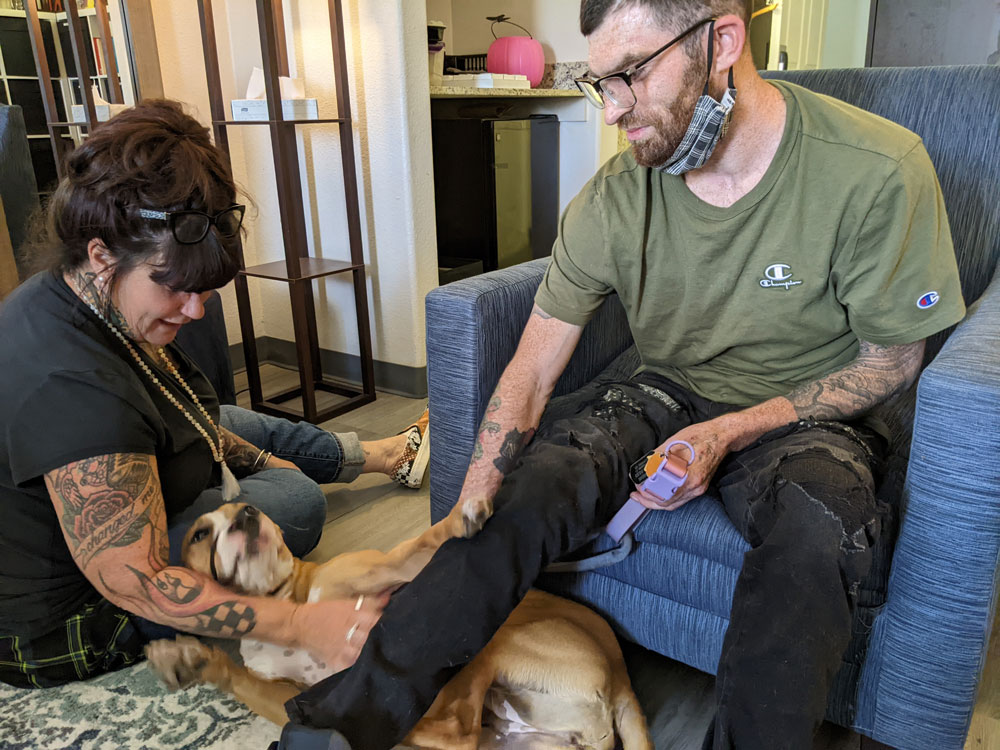
Peer support specialist Donna Norton meets with Ian Dereus and his dog, LolaPeer support specialist Donna Norton meets with Ian Dereus and his dog, Lola, at the hotel in Centennial, Colorado, where Norton helps people recovering from mental health and substance use disorders. Dereus is now considered a graduate and is living in his own apartment. (Rae Ellen Bichell/KHN)They can, for example, help navigate the bureaucracy of the child protective services system, about which clinicians might have little knowledge, or take someone out to coffee to build a relationship. If a person stops showing up to therapy, Eddie said, a peer support specialist “can physically go and look for somebody and bring them back to treatment — help them reengage, reduce their shame, destigmatize addiction.”

Norton has, for instance, picked up a client who called her from an alley after being discharged from a hospital stay for an overdose.

“Some people will tell you, ‘I decided I was going to get in recovery, and I never had to drink, drug, or use again.’ That’s not my experience. It took me 20 years to get my first year clean and sober. And that was trying every day,” said Norton from her office, her Vans planted just inches from a basket that lives under her desk: It contains three opioid overdose reversal kits stocked with Narcan.

Her office, warmed by the sunlight coming through a south-facing window and the nearly constant rotation of people plopping onto the couch, contains a shelf of essential items. There are tampons, for whoever needs them — Norton will “never forget” the time she got a ticket for stealing tampons from a grocery store while she was homeless — and urine analysis kits, for determining whether someone is high versus experiencing psychosis.

That October day, Norton pivoted from nagging one person to make a doctor’s appointment, to getting someone else set up with a food pantry, to figuring out how to respond to the bank that told a third client that an account couldn’t be opened without a residential address.

She teaches “stop, drop, and roll” as a coping mechanism for when people are feeling lost and thinking about using substances again. “If you’re on fire, what do you do?” Norton said. “You stop immediately, you lay on the ground, you roll and get yourself out. So I’m like, ‘Go to bed. Just go to sleep.’ People are like, ‘That’s not a wellness tool.'”

“It is,” Audrey Salazar chimed in. Once, when Salazar was close to relapsing, she stayed with Norton for a weekend. “I literally just slept,” Salazar said. The two rested and ate Cocoa Puffs and Cheez-Its by the box.

“It was so bad,” Norton said of the junk food binge. But the weekend got Salazar back on track. Working with a peer support specialist who has “walked the same walk,” Salazar said, “holds you accountable in a very loving way.”

That October day, Norton pivoted from nagging one person to make a doctor’s appointment, to getting someone else set up with a food pantry, to figuring out how to respond to the bank that told a third client that an account couldn’t be opened without a residential address. She also worked on lowering the defenses of a newcomer, a sharply dressed man who seemed skeptical of the program.

Some people come to Norton after being released from the county jail, others by word of mouth. And Norton has recruited people in parks and the street. The newcomer applied after hearing about the program in a homeless shelter.

Norton decided that sharing a little about herself was the way to go with him.

“‘My experience is jails and hospitals and institutions. I’ve got an old number,’ meaning a convict number. ‘And I have eight years drug-free,'” she recalled telling him. “‘My office is down the hall. Let’s get some paperwork done. Let’s do this.'”

“When we’re working and talking and troubleshooting different approaches to solve the opioid crisis, we should have the people that have been directly affected by those issues in the room, guiding those conversations.”

Norton is one of seven peers on staff with the Hornbuckle Foundation, which estimates that it costs about $24,000 a month to provide peer services to this group of residents, with peer specialists working full time make about $3,000 a month plus $25 an hour per client. Norton’s office is the hub of activity for a floor in one hotel where about 25 people participating in the SAFER Opportunities Initiative live while recovering from substance use disorders until they “graduate” to another hotel, located next door. From there, they’ll move on to their own housing, which staffers often help them find.

While in the program, residents meet at least once a week with a case manager, a therapist, and a peer support specialist, in addition to attending group meetings, which take place every day except Sundays and are all run by peers.

Kyle Brewer, based in Arkansas, is the peer specialist program manager for NAADAC, the Association for Addiction Professionals (formerly the National Association for Alcoholism and Drug Abuse Counselors). Brewer, who said his life derailed after he started using prescription opioids to manage the pain from a wisdom tooth removal, said opioid settlement funds present an opportunity to support the people who work on the ground.

“When we’re working and talking and troubleshooting different approaches to solve the opioid crisis, we should have the people that have been directly affected by those issues in the room, guiding those conversations,” he said.

Toward the end of the day, Norton ran into the new guy in the hallway again, this time on his way back from the ice machine.

“Eight years clean. My hat goes off to you,” he said.

“I started with one day,” said Norton.

“Well, I’ll start with one hour,” said the new guy.

He said he needed to clean out his car, where he’d been living. He said he has trouble putting his jeans on in the morning after losing a thumb to frostbite. He wanted to find a part-time job. He has trauma to work through in therapy. His mother died about a year and a half ago.

“Friday night, we’re going to the movies,” said Norton.

“Oh, cool,” he said. “I want to see ‘Top Gun,’ the new one.”


KHN (Kaiser Health News) is a national newsroom that produces in-depth journalism about health issues. Together with Policy Analysis and Polling, KHN is one of the three major operating programs at KFF (Kaiser Family Foundation). KFF is an endowed nonprofit organization providing information on health issues to the nation.

“Hide behind the skirts of women”: Inside an anti-abortion meeting with Tennessee GOP lawmakers

ProPublica is a Pulitzer Prize-winning investigative newsroom. Sign up for The Big Story newsletter to receive stories like this one in your inbox.


When state Sen. Richard Briggs voted “yes” on Tennessee’s total abortion ban, he never thought it would actually go into effect.

It was 2019, and Roe v. Wade was the law of the land. His vote seemed like a political statement, not a decision that would soon impact people’s lives.

But on Aug. 25, the ban, one of the strictest in the country, kicked in. It contains no explicit exceptions for circumstances under which the procedure would be allowed. Any doctor who performs an abortion in Tennessee faces a felony that carries penalties of up to 15 years in prison and fines of up to $10,000.

Republican state leaders have repeatedly said the law has enough protections for doctors who provide “medically necessary care to pregnant women,” referring to a narrow clause that allows doctors to defend themselves from charges by proving an abortion was necessary to prevent death. But already, some women have made costly rushes across state lines to end nonviable pregnancies or to seek high-risk care that Tennessee doctors weren’t sure they could legally provide.

Faced with the law’s real-world implications, Briggs and a handful of his fellow Republicans have made statements floating the idea that they will “clean up” or “clarify” the ban when the next legislative session begins in January.

Briggs, who won reelection last week, told voters he would like to see the law offer clear exceptions for rape, incest, severe fetal anomalies and cases where the pregnant patient’s life or health are at risk.

But any willingness from lawmakers to consider making changes to the ban provokes intense pushback from national anti-abortion lobbyists.

On Oct. 27, the Tennessee affiliate of National Right to Life held a webinar to encourage GOP legislators to hold the line. The anti-abortion organization helped write and lobby for so-called trigger bans — laws that outlawed abortion in anticipation of Roe being overturned — in Republican-majority statehouses across the country.

ProPublica reviewed a recording of the call. It provides the clearest examples yet of the strategy that the law’s architects are pursuing to influence legislators and the public amid growing national concerns that abortion bans endanger women’s health care and lives.

During the hourlong meeting, representatives of Tennessee Right to Life and Susan B. Anthony Pro-Life America urged the legislators to stay the course and protect the nation’s “strongest” abortion ban as it stands.

They said they see Tennessee’s ban, with its tiny carve-out for life-saving procedures and steep penalties for doctors, as the best example of a law that protects every potential life — even when it means pregnant patients must face serious risks or trauma in the process. The group has released model legislation suggesting it would like to see similar language adopted across the country, not weakened by exceptions.

During the call, one activist reminded the group about the law’s strict requirements for doctors. “The burden of proof, the onus, is on the doctor to prove that he or she was in the right.”

“It’s not that [the doctor] didn’t violate the text of the statute, it’s that they had a justifiable reason to do so,” said another activist. “And that reason — you’ve drawn it very narrowly — is to save her life, to prevent an organ system from failing.”

A Tennessee lawmaker on the call suggested health data could be mined to track and investigate doctors, to make sure the abortions they provided to save patients’ lives were truly necessary.

The discussion also captured anti-abortion groups coaching legislators on messages aimed at swaying the wider public to support their stance.

One researcher said that when lawmakers are challenged about the state’s lack of exceptions for rape and incest cases, they should try to “hide behind the skirts of women” who carried such pregnancies to term and believe abortion is wrong. Others suggested “negativity” toward the law would fade and raised the possibility of regulating contraception and in vitro fertilization in a few years’ time.

ProPublica reached out to National Right to Life, Tennessee Right to Life, Susan B. Anthony Pro-Life America and the Charlotte Lozier Institute. They did not respond to emails and calls seeking comment.

In the chat box, state Rep. Susan Lynn, who originally sponsored the law in the House, typed a question: “9 months after the enactment of this law, can we organize with the crisis pregnancy centers to see some of these babies? <3."

Will Brewer, the state’s most influential anti-abortion lobbyist, responded: “Yes!”

“A Lot More Complex”

Briggs, a heart surgeon and a retired U.S. Army colonel, was unimpressed.

A Methodist who considers himself a pro-life “Reagan Republican,” Briggs would prefer not to get involved with abortion politics at all. He told ProPublica that he sometimes wishes men would “recuse themselves from the whole thing, because we don’t need to be talking about that.”

But the trigger law he’d supported was now staring him in the face. As a physician, he felt the anti-abortion lobbyists were “skirting around” serious health care questions that the law’s language fails to address and instead were presenting “a simpleton’s message.”

“They really don’t want me talking when I bring up these medical issues,” Briggs said. “Because the medical issues are a lot more complex.”

When Tennessee Right to Life, the state’s main anti-abortion lobbying group, proposed the trigger ban in 2019, Briggs admits he barely read the two-page bill forwarded to his office.

He followed the lead of his colleagues, who assured state lawmakers that the bill included medical exceptions. He even added his name as a co-sponsor. “I’m not trying to defend myself,” he says now.

There was little pushback from advocates, doctors or Democrats at the time. Many took it to be a far-fetched stunt, doomed by the safeguards of Roe v. Wade.

When a Senate Democrat proposed changes that would allow abortion in cases of rape or incest, Briggs didn’t counter the chorus of “nays.”

The Democrat then narrowed her amendment to only apply to minors, but it was shot down too. The bill sailed through as originally written.

Briggs says he didn’t understand it at the time, but the law he voted for so quickly was part of a flurry of legislation that anti-abortion groups had pushed in Republican-majority statehouses after the confirmation of Supreme Court Justice Brett Kavanaugh energized the movement. Many states passed similar trigger bans, and Tennessee ended up with the strictest version: a criminal statute that contains no explicit exceptions. Not even for the life or health of the pregnant person.

It does include a legal mechanism called the “affirmative defense” that can be used in life-threatening emergencies. The defense is written in such a way that it means doctors who provide an abortion must “prove by a preponderance of evidence” that the procedure was necessary to save the pregnant patient’s life or prevent “irreversible impairment of a major bodily function.” No state agencies have released standards to help clarify what counts. The boundaries of enforcement would be left up to prosecutors and the courts.

In past years, Briggs often earned a 100% rating on Tennessee Right to Life’s scorecard for legislators who support the group’s policy priorities. But as outcry over the ban grew, he found himself agreeing with medical providers who said the law had gone too far.

“Here, the defendant is guilty until he can prove that he’s not guilty,” he said. “In my opinion, that is a very bad position to put the doctors in — why should this doctor have to pay his own legal bills for saving a woman’s life?”

A judge blocked a similar “affirmative defense” provision in Idaho’s abortion ban for “injecting tremendous uncertainty” into emergency care for pregnant patients.

Many Republicans argue that physicians are fearmongering and say it’s inconceivable that a prosecutor would use their discretion to go after a doctor for terminating a pregnancy for someone whose life was at risk. In the more than two months since the law has gone into effect, they point out, zero doctors have been arrested.

The law’s goal, they say, is to shut down what they call “elective” abortions that often happened at family planning clinics like Planned Parenthood.

Briggs agrees with that goal. But he looked at abortion bans in other conservative Southern States: They included explicit exceptions.

His position seems to more closely reflect the attitudes of the majority of Tennesseeans: While 50% identify as “pro-life,” 80% believe abortion should be either completely legal or legal under some conditions.

But his public statements, particularly in a debate with his Democratic opponent ahead of last week’s election, led to tense meetings with anti-abortion groups, Briggs says.

The Oct. 27 video meeting was advertised as an opportunity to hear “why Tennessee’s law is on solid ground and how medical facts back it up.” Briggs registered to attend.

Opening the call, Brewer, the legal counsel and lobbyist for Tennessee Right to Life, implored lawmakers not to tell the press that they had only voted for the law because they thought Roe would never be overturned. He urged them not to agree to any calls for clarification or new exceptions.

Instead, he advised lawmakers to wait for any backlash to die down and to continue to “play offense” in the abortion wars.

“It’s not something that we stumbled into,” Brewer said on the call. “It wasn’t just a PR move or to stoke the fires of our base. This was a law that we knew would come into effect, hopefully sooner rather than later, and we wanted Tennessee to be prepared.”

He was joined by members of the national anti-abortion group Susan B. Anthony Pro-Life America and a researcher affiliated with their nonprofit arm, the Charlotte Lozier Insitute. None of the speakers had medical experience.

Katie Glenn, Susan B. Anthony Pro-Life America’s state policy director, counseled lawmakers to let the law sit for another 200 days before reacting to any polls that showed Americans want more exceptions. The protests, she assured them, would fade as people moved on.

“It can feel like, ‘What did we do? We need to go back and like, tear this all apart and open up the law and change all these things,'” she said “But I really want to urge you tonight, if you take away nothing else from what I say in the next few minutes, please have confidence in your work.”

She laid out why the anti-abortion movement sees Tennessee’s ban as so important: “The way that many state laws work is they’ll say, ‘Abortion, elective abortion, is generally illegal except in these situations.’ … That’s the way they phrase it, is around this word of an ‘exception,'” she said. “What y’all did is you said, ‘Elective abortion is illegal all the time.'”

Brewer contrasted an “emergency room middle of the night instance, where a woman is bleeding” — which he made clear he believes the law’s affirmative defense covers — with a situation where a woman might want to terminate a pregnancy because of a high-risk medical history.

“That is not an urgent need,” he said. “We want to make sure that these quasi-elective abortions are being stopped.”

Glenn said cases involving abortion pills should not be permitted under the law because the process takes multiple days.

“Nothing about that is an emergency,” she said. Brewer and Glenn did not respond to requests for comment.

In the chat box, Lynn, the representative who first introduced the trigger ban, asked Brewer to check with the state Department of Health to find out if data could be monitored to flag doctors who performed abortions at a higher rate so they could be investigated to find out if patients’ lives were truly at risk.

“Do we need to follow up on that at some point and make sure that they are looking for the outliers?” she wrote.

“Yes we do,” Brewer responded.

Lynn did not respond to requests for comment.

After listening to the call, Briggs reflected on his 44 years of medical experience. He could think of plenty of dangerous and heart-wrenching situations that fall into the gray area Brewer and Glenn did not discuss.

What about ectopic pregnancies that grow outside the uterus, Briggs remembered thinking. If those aren’t dealt with, they could eventually rupture the fallopian tube, where most such pregnancies occur, and lead to death. Rarely, an ectopic pregnancy can attach to a cesarean scar, and in some of those cases, it may be possible to bring the pregnancy to term — though doing so risks serious complications, including uterine rupture and death. Yet the law gives no guidance on how to handle those cases, he thought. It defines a pregnancy simply as having a fertilized egg “within the body,” not specifically within the uterus. (Other abortion bans specify that treating an ectopic pregnancy is legal.)

Sometimes, Briggs knew, terminating a pregnancy could stop a dangerous condition before it becomes truly life-threatening. He pointed out other cases the law did not address: What about someone was diagnosed early in pregnancy with preeclampsia, which can lead to life-threatening complications? Or a patient whose water broke too early, leaving them nearly certain to eventually miscarry and at risk for sepsis? What about a patient with cancer or preexisting medical conditions that a pregnancy could brutally complicate?

How sick did a patient need to be before a pregnancy could be terminated? And was a doctor really supposed to wait to provide that care until the patient faced a truly immediate life-or-death situation?

“I think that’s wrong. I think that’s not the standard of care,” Briggs said. “If you willfully neglect her, then that goes from being malpractice to criminal.”

More than 1,000 Tennessee medical professionals have publicly opposed the law on the grounds that it interferes with care for miscarriage, ectopic pregnancies, serious infections and cancers during pregnancy. They have joined activists in asking the governor to convene a special legislative session to review the law, but he has repeatedly said he’s comfortable with it.

Briggs said a woman recently told him she believed 100% of women with cancer would want to continue their pregnancies instead of terminating to undergo chemotherapy. But Briggs knew that wasn’t true. How would a cancer patient who is already a parent assess their chances, for example? “That could mean a child raised without their mother,” he said. “The bottom line is it’s a woman’s decision, it shouldn’t be the decision of the legislature that she can’t do chemotherapy.”

There are many situations like that, Briggs said. Situations that aren’t black-and-white, that involve an intensely personal risk assessment, where every option comes with some measure of heartbreak.

As a surgeon, Briggs had dealt with cases of fetal anomalies, including cases where babies would be born without properly developed hearts or brains. Some could be operated on, but others clearly wouldn’t be able to survive. Watching their induced deliveries was bracing. “You really have a little baby there you just let sit there until it dies — to get cold and die,” he said. “I think anybody would be affected.”

Briggs says some Republican leaders have asked him to further define the health exceptions he’d like to see in the law. But he doesn’t see lists as the answer. The American College of Obstetricians and Gynecologists has said creating lists of exceptions is dangerous because they can interfere with a medical provider’s ability to assess fast-moving health indicators.

“You can’t hit every exception — there has to be medical judgment,” Briggs said. Otherwise, “you’ve got the legislature practicing medicine, which they have no business at all doing.”

“Hide Behind the Skirts of Women”

To Briggs, the anti-abortion lobbyists were asking lawmakers to respond to legitimate questions from voters with answers that weren’t based in science.

On the webinar, Briggs listened as the organizers brought on David C. Reardon, a researcher associated with the Charlotte Lozier Institute, the nonprofit research arm of Susan B. Anthony Pro-Life America. Reardon outlined a strategy that lawmakers could lean on when asked about rape and incest exceptions.

There is “no peer-reviewed medical evidence that shows that abortion in and of itself produces any benefit to women,” he advised the legislators to say. He claimed that abortion is connected with higher mortality and breast cancer rates. Briggs found his arguments suspect.

“Where in the world that came from, I have no idea,” Briggs said after the call. “I don’t think that Dr. Reardon was a physician.”

Reardon has a Ph.D. in biomedical ethics from a since-closed unaccredited online university, according to documents he provided to ProPublica. For decades, he has been publishing work that spreads doubts about the safety of abortion but that the wider medical community views as drawing inappropriate conclusions from cherry-picked data to serve an agenda.

“The flaws in his research are so profound that no person with minimal training in biostatistics and epidemiology would use these methods,” said Elizabeth Janiak, an assistant professor of social and behavioral science at Harvard T.H. Chan School of Public Health.

The American Cancer Society says scientific evidence does not support the theory that abortions raise the risk of breast cancer. The National Academies of Sciences, Engineering and Medicine reviewed existing research and found the risk of death after a legal abortion is a small fraction of the risk of carrying a pregnancy to term. They also found that previous studies linking abortion and long-term mortality rates had not adjusted for social risk factors and “no clear conclusions” could be drawn from them. A large body of peer-reviewed work finds that having a wanted abortion is not associated with worse health or mental health outcomes. Instead, denying a woman a wanted abortion is linked to worse economic and health outcomes and can strengthen a woman’s ties to a violent partner.

Reardon told the lawmakers he recently co-authored a book that was based on interviews with nearly 200 women who became pregnant due to rape or incest and felt misunderstood by the public discussion around abortion. Some of them, he said on the call, were coerced into an abortion by the parent or abuser who sexually assaulted them “to cover up their crime.” Those who carried to term, he said, “were overwhelmingly glad that they did.” He suggested lawmakers use their stories when talking to voters.

“It’s a dangerous assumption that women who have rape pregnancies have to have an abortion,” Reardon said. “I encourage you to be able to, in a certain sense, hide behind the skirts of women who’ve actually been there. Bring their voices forward. Challenge the other side to demonstrate that abortion actually benefits women.”

When reached for comment, Reardon said the phrase “hide behind the skirts of women” wasn’t the word choice he intended.

“Even as it slipped out, I knew it wasn’t what and how I wanted to say it,” he said. “What I have been advocating for years is that politicians should invite the women who have actually had sexual assault pregnancies, no matter what side they are politically, to testify before their legislatures.”

Reardon said many of the experts and studies on this topic have ties to pro-abortion-rights groups and disputed that his research is misleading. He said he enrolled in a Ph.D. program at Pacific Western University at a time when no accredited programs in biomedical ethics existed, and because it allowed him to combine his studies with full time work and raising a family. He said the coursework involved reading, writing and submitting nearly 50 papers that demonstrated a solid understanding of foundational literature in addition to his dissertation, and that he has since been published in medical journals and invited to serve as a peer reviewer of other researchers looking into abortion issues.

In a detailed response, he also acknowledged more complexity than he had expressed on the call.

To lawmakers in the webinar, he said that abortion is “something we know increases mortality rates of women.”

In response to ProPublica, he said: “While it is difficult to prove when, if ever, abortion is ever the direct and sole cause of any negative effect, it is equally (and perhaps harder) to prove when, if ever, abortion is the direct cause of any positive effects.”

On the call, Stephen Billy, Susan B. Anthony Pro-Life America’s vice president for state affairs, advised lawmakers to follow the “mantra” of “contrast and compassion.” When questioned about rape and incest exceptions, he said, they could turn the question around.

“The other side’s position is an assumption that abortion is going to be the right decision at every point in time,” Billy said. “Voters in Tennessee will be with us when we say our position is to protect that child and just stand with that mother so she can love her child.”

But Briggs recalled wondering who was going to support those children, from buying diapers to paying for college. Those arguments rang hollow, he said, at a time when family health insurance costs businesses a reported $22,000 a year per employee and Republicans in his state have repeatedly blocked Medicaid expansion.

During his years working at a hospital, Briggs said, he had seen pregnancies carried by girls as young as 11. He believes there are ways to support children and adults who have been sexually assaulted and still allow the option of terminating the pregnancy. In the next legislative session, he said, he plans to support a bill that would test the DNA of any fetus aborted due to rape in order to confirm the attacker’s identity.

The Next Battle

In the chat, Lynn asked for advice on answering questions about in vitro fertilization and the morning-after pill. IVF, a fertility treatment, generally involves creating multiple embryos, and some may ultimately be discarded. The morning-after pill is emergency contraception that prevents pregnancy if taken soon after unprotected sex. Some wings of the anti-abortion movement would like to see both banned or tightly limited because they believe those procedures amount to terminating human lives. The definition of an “unborn child” in Tennessee’s law starts at fertilization.

Responding to Lynn, the speakers suggested keeping the focus on the current law and reminding voters that IVF clinics and contraception are still available in Tennessee.

“Maybe your caucus gets to a point next year, two years from now, three years from now, where you do want to talk about IVF, and how to regulate it in a more ethical way, or deal with some of those contraceptive issues,” said Billy. “But I don’t think that that’s the conversation that you need to have now.” He did not respond to requests for comment.

As Billy wrapped up, he advised: “I think we have to be really careful that we don’t present our side of the argument as if we’re making the best decision for individual women.”

ProPublica asked about 70 lawmakers who sponsored the law if they wanted to see changes to it in the next legislative session. Two responded.

“Based upon our findings, it seems the current language is clear,” said state Rep. Ryan Williams.

“Just because somebody’s life started in a traumatic way does not mean that life should be destroyed,” said state Sen. Mark Pody.

In interviews, Brewer has said that he wants lawmakers to introduce bills that strike at the remaining avenues through which Tennesseans can access abortion. That could include passing laws that more tightly regulate online access to abortion pills and block companies from subsidizing employees’ travel to other states to terminate pregnancies. He said he would also like to stop “marketing efforts” from out-of-state abortion clinics that advertise within the state.

Brewer reminded the lawmakers: “We passed this law to put our state in a strong position. And we need to defend this law.”

Briggs didn’t raise any of his concerns during the webinar. He said he had already voiced them to Brewer in private conversations.

“They don’t want to change it one bit,” Briggs said of Tennessee Right to Life. “It’s like: We won the election and we got what we want, and we’re not going to compromise.”

“She only cares about herself”: Ruben Gallego rips Kyrsten Sinema for doing “nothing” to help Dems

Election denialism and the Big Lie suffered yet another defeat when, on Monday night, November 14, Arizona’s gubernatorial election was called for Democratic Secretary of State Katie Hobbs. It was a close race, but in the end, Hobbs prevailed over her GOP rival: far-right Big Lie promoter and conspiracy theorist Kari Lake, who campaigned on the false and thoroughly debunked claim that the 2020 election was stolen from Donald Trump.

Lake’s defeat follows the defeat of other MAGA candidates in Arizona, including Mark Finchem (who lost a secretary of state race to Democrat Adrian Fontes) and Blake Masters (who lost Arizona’s U.S. Senate race by about 5 percent to incumbent Democratic Sen. Mark Kelly). Lake, Finchem and Masters were all backed by Trump, ran hyper-MAGA campaigns, and lost. In 2023, Arizona — once a deep red state and a bastion of Goldwater conservatism — will have a Democratic governor, a Democratic secretary of state, and two Democratic U.S. senators: Kelly and Sen. Kyrsten Sinema.

2022 has been a good year for Democrats in Arizona, where Kelly will continue to occupy the U.S. Senate seat once held by Sen. John McCain and before that, Sen. Barry Goldwater (a highly influential figure among conservatives and libertarians). But according to Rep. Ruben Gallego of Arizona, Sinema shouldn’t be given any of the credit. The Democratic congressman, a vocal critic of Sinema, is arguing that she didn’t do nearly enough to help fellow Arizona Democrats in the 2022 midterms.

In an article published by The New Republic on November 14, journalist Prem Thakker reports that Gallego is “going after Sen. Kyrsten Sinema for being ‘nowhere to be found’ leading up to the midterm elections.” On November 13, Gallego (who was reelected in the midterms) tweeted, “We fought as a team in Arizona and we won. Senator Sinema was nowhere to be found, at all. We did not see her at one public event for anybody… she did nothing. Because she only cares about herself.”

On November 9, Sinema tweeted, “Every vote counted, every voice heard. That’s how our democracy works. It may take some time for the results to be finalized, so in the meantime, let’s stay patient. Democracy is always worth the wait.” And Gallego sarcastically responded, “Thanks for all your help this year.”

It is no coincidence that Gallego is making a point of publicly criticizing Sinema. Liberals and progressives have been urging the Arizona congressman to give Sinema a Democratic primary challenge in 2024, when she will be up for reelection.

Thakker observes, “Five days before the election, former President Barack Obama visited Phoenix to rally support for the state’s Democrats. Sinema was notably absent — not even to show support for Katie Hobbs, whose first foray in politics was volunteering for one of Sinema’s state legislative races.”

Gallego has not officially said that he plans to run for the Senate in 2024, but many liberals and progressives are hoping that he will. Sinema’s decidedly centrist voting record has been a frequent source of frustration to the liberal/progressive wing of her party. But Sinema has her share of defenders, who point out that she polls well among independents, McCain Republicans, Blue Dog Democrats and Never Trump conservatives. GOP activist Meghan McCain, the late Sen. McCain’s daughter and a scathing critic of Trump and Lake, has been a staunch Sinema defender despite their policy differences.

Sinema’s defenders fear that if the liberal Gallego primaries her and wins the Democratic nomination, he might struggle against a Republican in the general election and risk putting that Senate seat back in GOP hands. But James Carville doesn’t see it that way. The veteran Democratic strategist believes that Gallego has what it takes to go the distance.

In a February 2022 interview with Vox, Carville expressed his frustration with Sinema. When Carville was asked, “What kind of game is Sinema playing?” he responded, “I can’t explain it, and no one else can. The only explanation people have given is that she wants to be the next John McCain. But she’s not going to win a primary against Rep. Ruben Gallego, I’ll tell you that damn much. And I will personally volunteer to help him fundraise because I think we can keep that seat if he runs…. I have no idea what the hell she’s thinking.”

That’s saying a lot coming from Carville, who often cautions fellow Democrats against going too far to the left or being too “woke” and has been a champion of Bill Clinton/Barack Obama centrism. But he obviously believes that Sinema is too much of a contrarian for her own good.

Although Sinema is pro-choice, Gallego has argued that she hasn’t been aggressive enough when it comes to defending reproductive rights.

Thakker notes, “In July, after the Supreme Court overturned Roe v. Wade, Gallego tweeted at Sinema, asking her to have a town hall and explain her opposition to forgoing the filibuster in order to codify the right to abortion. Later that month, Gallego’s campaign fundraised on Facebook, teasing a potential primary challenge against Sinema in 2024.”

Trump announces 2024 presidential bid — after Republicans begged him not to

Twice-impeached former President Donald Trump launched his third presidential campaign on Tuesday night while repeating his long-discredited lie that his last election was stolen.

Trump announced yet another White House bid from his Mar-a-Lago resort, which was raided by the FBI in August after he took top-secret national security documents home and refused to give them back in response to a subpoena. Trump’s announcement came just days after a slew of election deniers he endorsed lost winnable races in the midterms, prompting pleas from his own longtime allies to delay his announcement because he could hurt the GOP’s chances in the Georgia Senate runoff — as he did after his 2020 election loss.

Trump, who has continued to push baseless conspiracy theories about his endorsed candidates’ midterm losses, skirted the issue of election denial in his hour-long speech on Tuesday. He endeavored to strike a positive message at times, declaring, “In order to make America great and glorious again, I am tonight announcing my candidacy for president of the United States.” But he also repeated familiar themes from his “American Carnage” inaugural address in 2017, suggesting that the U.S. was being “poisoned” by immigration and described American cities as crime-ridden “cesspools of blood.”

The scandal-plagued ex-president never explicitly mentioned the 2020 election — indeed, his announcement that he’s running for president again is as close as he’s ever come to admitting he lost that election — or the insurrection and attack on the U.S. Capitol he provoked on Jan. 6, 2021, two weeks before leaving office.

Trump’s nascent campaign is already messy. He is not expected to have a “traditional campaign manager” and will have a smaller staff and budget than in previous campaigns, according to a Tuesday report in the Washington Post, and some allies have already predicted “drama and cinematic firings” before the campaign even launched. Ivanka Trump refused to join him at the announcement or take part in his campaign despite Trump’s “begging,” according to the New York Post, though her husband Jared Kushner was in attendance. Other longtime allies privately say they are not sure they want to take part in another campaign after many received subpoenas related to their work for Trump, according to the reports.

The announcement has financial implications as well. Trump has raised tens of millions for his Save America PAC but he cannot coordinate with the group as a federal candidate. The Campaign Legal Center on Monday filed a complaint to the Federal Election Commission arguing that Trump illegally transferred millions from the PAC to back his presidential campaign.

Trump’s announcement could not have come at a worse time. His speech came one day after his Arizona gubernatorial pick, Kari Lake, narrowly lost her race in the wake of a string of defeats suffered by other Trump-backed candidates, including Mehmet Oz in Pennsylvania, Blake Masters in Arizona, Adam Laxalt in Nevada, Don Bolduc in New Hampshire and others.

Trump never directly mentioned the 2020 election or the Jan. 6 insurrection, and to some extent sought to sound positive. He also said America was being “poisoned” by immigrants and called U.S. cities “cesspools of blood.”

Some of Trump’s own advisers acknowledged after the midterms that his candidates’ failures caused him the “most significant damage to his political standing since the Jan. 6 Capitol riot,” according to Axios. Trump reportedly wanted to announce before the midterms to ensure that “he would receive sufficient credit for the GOP triumphs,” according to the report, but agreed to hold off.

The losses alarmed even Trump’s closest allies ahead of the Georgia runoff. Former White House press secretary Kayleigh McEnany urged Trump to delay his announcement and suggested that Florida Gov. Ron DeSantis should be the one to campaign in Georgia for Republican Senate nominee Herschel Walker. Longtime Trump adviser Jason Miller also urged Trump to hold off his announcement. Former Vice President Mike Pence predicted this week that the GOP “will have better choices in the future” than Trump.


Want a daily wrap-up of all the news and commentary Salon has to offer? Subscribe to our morning newsletter, Crash Course.


Alyssa Farah Griffin, a former top Trump White House aide, said Trump’s early announcement was “a sign of weakness.”

“Announcing a presidential run at this time is a sign of weakness usually a candidate in a strong place would wait until next summer but he clearly knows he got — we got our clocks cleaned in the midterms, and now he wants the attention back on him,” she said on “The View.”

Fox News pundits and other Rupert Murdoch-owned outlets have increasingly criticized Trump while pushing DeSantis as the future of the GOP. The Wall Street Journal last week dubbed Trump the GOP’s “biggest loser,” faulting him for costing the party election wins in 2018, 2020, 2021 and this year.

Some Republican lawmakers are already backing DeSantis for 2024.

“The question is: who is the current leader of the Republican Party? Oh, I know who it is: Ron DeSantis,” Sen. Cynthia Lummis, R-Wyo., told reporters this week. “Ron DeSantis is the leader of the Republican Party, whether he wants to be or not.”

“Looking forward is always a better campaign strategy. Looking back on 2020 obviously didn’t work out. We ought to look forward,” said Sen. Shelley Moore Capito, R-W.Va.

Even longtime Trump ally Sen. Lindsey Graham, R-S.C., demurred when asked if he would back Trump’s bid.

“Let’s see what he says,” he told reporters. “I’ll tell you after Georgia.”

A growing number of Republican voters are also jumping on the DeSantis bandwagon.

More Republican voters prefer DeSantis as the 2024 nominee than Trump, according to a new Yahoo News/YouGov poll. The conservative Club for Growth released a set of polls showing DeSantis leading Trump by double digits in Iowa and New Hampshire, the first nominating contests, as well as in Florida and Georgia. A poll sponsored by the Texas GOP found DeSantis leading Trump 43-32 in the state, a 28-point swing in three weeks.

Trump has increasingly hit out at DeSantis, labeling him as “Ron DeSanctimonious.” Rejecting blame for GOP losses in the midterms, Trump claimed credit for getting DeSantis elected and accused him of disloyalty for refusing to rule out a 2024 presidential run. Trump is also lashing out at other potential 2024 contenders, including Virginia Gov. Glenn Youngkin, bizarrely suggesting that his name “sounds Chinese” and claiming credit for his win.

Trump’s announcement comes after a week of unrelenting bad news, along with his attacks on potential rivals “Ron DeSanctimonious” and Glenn (“sounds Chinese“) Youngkin.

Along with attacks on members of his own party, Trump, who lost the popular vote in both of his previous campaigns by millions, has spent the last two years focused on debunked claims that the 2020 presidential election was somehow rigged, even though the Jan. 6 committee hearings have shown that his administration and campaign found no evidence to back up his claims. Trump’s lawyers lost nearly every court case they brought, with some now facing court sanctions or even billion-dollar defamation lawsuits for making baseless allegations about the election.

Trump’s obsession with overturning his loss to retain power culminated in the fake elector scheme that has come under investigation by the Justice Department, and ultimately the deadly Jan. 6 Capitol riot. Witnesses at the Jan. 6 hearings have described a petulant Trump repeatedly rejecting his own administration’s findings that his fraud allegations were false and trying to replace officials who would not go along with his lie with loyalists who sought to take actions to overturn his loss that White House lawyers repeatedly said were illegal.

A federal judge earlier this year found that Trump’s efforts to overturn the election “more likely than not” violated federal law, calling it a “coup in search of a legal theory.” While members of the committee have publicly called for Attorney General Merrick Garland to investigate Trump’s actions, the DOJ has slowly issued subpoenas to his allies while largely focusing on prosecuting those who stormed the Capitol.

Trump’s potential legal woes extend beyond the Jan. 6 hearings and the Justice Department, which is also investigating how top secret documents wound up at Mar-a-Lago. He also faces civil lawsuits from lawmakers and police officers who defended the Capitol during the riot. A Georgia grand jury is investigating his efforts to pressure state officials to overturn his loss. The New York attorney general’s office filed a $250 million fraud lawsuit against him and his three eldest children. And the Manhattan district attorney’s office is prosecuting Trump Organization executives on charges of fraud and tax evasion. Trump also faces a defamation lawsuit from E. Jean Carroll, who accused him of rape amid dozens of allegations of sexual misconduct.

Trump, who has continued to display a Teflon-like quality to avoid serious legal ramifications while countless underlings have been convicted, indicted or sanctioned, also faces a tougher political climb than he did in 2020, when no prominent Republicans challenged him for the nomination. 

Trump’s legal woes go far beyond the Jan. 6 hearings and the Mar-a-Lago investigation: There are civil lawsuits, a Georgia grand jury probe and a criminal case in Manhattan.

Along with DeSantis, the list of potential 2024 Republican rivals includes several former administration officials, including Pence, whom Trump has spent months attacking for not trying to unilaterally block his election loss after the riot. Former Secretary of State Mike Pompeo and former UN ambassador Nikki Haley have also been discussed as potential presidential contenders, though it is unclear whether they will run now that Trump has announced his bid. Pompeo said on Tuesday that Trump’s announcement would not have any impact on his decision.

A growing number of senators have also made moves ahead of a potential 2024 primary battle, including 2016 also-ran Sen. Ted Cruz, R-Texas, and Sen. Tim Scott, R-S.C., the only Black Republican in the Senate.

While the senators have been reticent about criticizing the former president, Trump critics like Maryland Gov. Larry Hogan, former New Jersey Gov. Chris Christie and potentially Rep. Liz Cheney, R-Wyo., the outgoing vice chair of the Jan. 6 panel, are also expected to be in the mix.

Cheney expressed confidence that Trump would lose. “There’s no question that he’s unfit for office and I feel confident that he will never be president again,” she predicted.

But no 2024 contender has drawn as much attention as DeSantis, who won re-election by nearly 20 points after snubbing the former president’s endorsement. DeSantis has raised “huge sums from six and seven-figure Trump donors” which could leave him with a massive war chest that he could later use to mount a White House bid, according to Politico.

Whichever Republican wins the nomination is likely to face off against Biden, who will be nearly 82 by the 2024 election. The president has repeatedly said he plans to run for re-election but his approval rating has consistently hovered around 40%, roughly the same level as Trump’s when he left office amid the COVID pandemic and economic turmoil. 

It’s unclear whether Trump can replicate the success he saw as a political newcomer in 2016. Some Republicans are worried not just about a Trump win but also a Trump loss.

“Let’s suppose for a second there is a real challenge to Trump for the ’24 nomination. And let’s suppose someone actually does beat him in that primary,” tweeted Brendan Buck, a former top aide to House Speakers Paul Ryan and John Boehner. “What then are the chances Trump wouldn’t entirely sabotage that person in the general election?”

“She wonders how she lost”: Reporter who spent 18 months covering Kari Lake unloads after defeat

When Arizona’s 2022 gubernatorial race was called for Democrat Katie Hobbs on Monday night, November 14, there was no shortage of gloating on Twitter. Far-right GOP nominee Kari Lake, according to her critics, went out of her way to be as insulting, condescending and mean-spirited as possible during her campaign. But in the end, she went down in defeat. In 2023, Hobbs, not Lake, will replace Republican Doug Ducey as Arizona governor.

The gloating came not only from Democrats like Rep. Ruben Gallego of Arizona, but also, from some of Lake’s critics on the right, including conservative activist Meghan McCain and Rep. Liz Cheney of Wyoming. And the following morning, some more gloating came from NBC News’ Vaughan Hillyard during an appearance on MSNBC’s “Morning Joe.”

Clearly, Lake’s defeat was something that a variety of liberals, centrists and conservatives savored, including “Morning Joe” hosts Joe Scarborough (a conservative ex-GOP congressman) and Mika Brzezinski (a liberal). And when Hillyard weighed in, he explained why so many people were delighted to by Lake’s defeat.

“Look, I’ve covered Kari Lake for the better part of the last year and half here,” Hillyard told Scarborough and Brzezinski from Palm Beach, Florida. “And I think it was perhaps fitting to be here across from Mar-a-Lago today…. I felt like I was covering Donald Trump’s campaign of 2024, but in Arizona, over the last year, she predicated her campaign on trying to sell the Big Lie — on trying to sell the conspiracy theories. When she wonders how she lost this race, look at it. This is the third election cycle in a row in which Arizonans rejected Trumpism.”

Hillyard continued, “In the final week of her campaign, who did she campaign alongside? She campaigned alongside Steve Bannon. She campaigned alongside one of the chief promotors of Pizzagate. She campaigned alongside an individual who promoted the notion of the war on White people. She campaigned alongside State Sen. Wendy Rogers, who earlier this year, was here in Florida speaking at a White nationalist conference — somebody who frequently spews antisemitism. This is somebody who, just last week, called her Democratic opponent a pervert. This is an individual who suggested there should be perp walks for election officials.”

Hillyard also noted that Lake “asserted that Cindy McCain wants to end America” and “called the media the right hand of the Devil.” And the reporter cited Lake as one of the many Trump-supported “election deniers” who lost in the 2022 midterms.

“And now,” Hillyard told Scarborough and Brzezinski, “Donald Trump is going to go and try to run on the very message that all of these folks lost on.”

Watch the video below or at this link.

Hilarie Burton Morgan calls Candace Cameron Bure a “bigot” for her remarks on “traditional marriage”

Candace Cameron Bure has landed herself in hot water after she told the Wall Street Journal that her new TV network partner, Great American Family, will not feature same-sex couples as leads in its holiday movies.  

When asked if Great American Family will follow in the footsteps of Hallmark Channel — which has featured same-sex couples in supporting roles and is slated to debut its first original holiday film focused on LGBTQ+ love next month — Bure said no and added, “I think that Great American Family will keep traditional marriage at the core.”

Bure’s comments were lambasted by “One Tree Hill’s” Hilarie Burton Morgan – one of the current stable of Hallmark Channel movie stars – who called Bure a “bigot” on Twitter and slammed Great American Family as “disgusting.”

“Bigot. I don’t remember Jesus liking hypocrites like Candy,” Morgan wrote. “But sure. Make your money, honey. You ride that prejudice wave all the way to the bank.”

She continued, this time making jabs at Great American Family founder Bill Abbott, Bure and their increasingly conservative network company: “Now they’re just openly admitting their bigotry. I called this s**t out years ago when Abbott was at Hallmark. Glad they dumped him. Being LGBTQ isn’t a ‘trend.’ That guy and his network are disgusting. You too Candy. There is nothing untraditional about same-sex couples.”

The Christmas movie culture war

Bure, who currently serves as Great American Family’s chief creative officer, told WSJ that she left the Hallmark Channel earlier this year “for a more sweeping role” at “an upstart cable channel that is positioning itself as the God-and-country alternative for holiday entertainment.

“My heart wants to tell stories that have more meaning and purpose and depth behind them,” Bure said. “I knew that the people behind Great American Family were Christians that love the Lord and wanted to promote faith programming and good family entertainment.”

Bure’s marriage comments were also backed by Abbott — albeit vaguely — who said, “It’s certainly the year 2022, so we’re aware of the trends. There’s no whiteboard that says, ‘Yes, this’ or ‘No, we’ll never go here.'”

Bure had been Hallmark Channel’s leading “Queen of Christmas” having starred in 29 holiday-themed movies for the network before she and a few other Hallmark stars jumped ship for Great American Family. They were following Abbott, who had previously been CEO of Hallmark and was replaced by Wonya Lucas.

The conversation shines a light on how Christmas movies have become big business for TV and have increasingly become a politically divisive point in the ongoing culture wars. In the past, Hallmark under Abbott had been criticized for its more conservative bent that included  homogeneous casting in its holiday films, queerphobia regarding its commercials and making Hannakuh more Christmas-like in its portrayal. Salon’s Amanda Marcotte even went so far as to call the channel’s Christmas movies “fascist propaganda.”

With Abbott moving his operations to Great American Family, and Lucas making Hallmark more inclusive for queer characters, characters of color and of different abilities, the culture wars may be played out in who gets to claim Christmas movie dominance this season.

A renewed beef

Morgan isn’t the only celebrity who criticized Bure — internet sensation JoJo Siwa, who is openly queer, also called out Bure in a Tuesday Instagram post.

“Honestly, I can’t believe after everything that went down just a few months ago, that she would not only create a movie with intention of excluding LGBTQIA+, but then also talk about it in the press,” Siwa wrote alongside a screenshot of a news article detailing Bure’s remarks. “This is rude and hurtful to a whole community of people.”

https://www.instagram.com/p/Ck_ffi9PJiz/?utm_source=ig_web_copy_link


Want a daily wrap-up of all the news and commentary Salon has to offer? Subscribe to our morning newsletter, Crash Course.


Siwa and Bure were previously embroiled in drama, after the former “Dance Moms” star called Bure the “rudest celebrity I’ve met” in a July TikTok. In response, Bure released an apology video, assuring fans that she had spoken to Siwa after learning that she’d declined Siwa’s request to pose for a photo together on the “Fuller House” red carpet.  

“I’ll be honest. I haven’t spoken to her at all since the whole thing,” Siwa later told E! News when asked about her relationship with Bure following the feud. “I think she’s alive and thriving. I think I’m alive and thriving. We’re . . . civil? I don’t know. I’ve got like three problems since that one so we’re moved on.”

From “Capturing the Killer Nurse” to “The Good Nurse,” here’s the true story of Charles Cullen

Conniving medical professionals continue to be popular subjects in recent entertainment. 

Last year, Dr. Christopher Duntsch, the former neurosurgeon who severely maimed — and, in two cases, killed — his patients, received the onscreen treatment with Peacock’s crime television series “Dr. Death.” Following in his footsteps is Dr. Paolo Macchiarini, the so-called “Miracle Man” whose innovative surgical techniques actually contributed to a slew of botched and fatal procedures.

Now Charles Cullen, the former-nurse-turned-serial-killer, is the focus of not one but two recent Netflix projects. Cullen’s story was first recounted in “The Good Nurse,” a drama film starring Eddie Redmayne and Jessica Chastain as Cullen and his real-life colleague Amy Loughren, respectively. His tale has also been revisited in the true-crime documentary “Capturing the Killer Nurse.” 

The film explores how investigators were able to piece together and prove Cullen’s string of crimes. “Capturing the Killer Nurse” also includes interviews with Cullen himself, his former co-workers, detectives, and Loughren, who helped detectives amid their investigation.

Here’s a closer look at the true story behind the real-life killer nurse:

Cullen’s career and crimes

Cullen was born on Feb. 22, 1960, in West Orange, New Jersey. In 1978, he dropped out of high school and enlisted in the Navy, where he rose to the rank of petty officer second class. During his service, Cullen faced both hazing and bullying by his fellow crewmen and in 1984, he received a medical discharge from the Navy for undisclosed reasons.

Shortly afterward, Cullen enrolled at Mountainside Hospital’s nursing school in Montclair, New Jersey. He graduated in 1986 and also began working at the burn unit of Saint Barnabas Medical Center in Livingston.

On June 11, 1988, Cullen committed the first of his many murders by contaminating Judge John Yengo’s saline IV with a toxic injection of lidocaine, a local anesthetic. Cullen later admitted to killing several other patients there, including an AIDS patient who had been given an overdose of insulin.

Cullen left Saint Barnabas in January 1992 amid an investigation into the hospital’s contaminated IV bags, and found work at Warren Hospital in Phillipsburg. There, he murdered three elderly women with overdoses of the heart medication digoxin.  

In March 1993, Cullen was arrested on felony charges for stalking his co-worker Michelle Tomlinson after he broke into her home in Pennsylvania. He pleaded guilty to trespassing and received one year of probation. He also took two months off from work before starting a new job at the intensive care unit of Hunterdon Medical Center in Flemington. Cullen later admitted to murdering five patients between January and September 1996, also with overdoses of digoxin.   

That same year, Cullen secured a new position at Morristown Memorial Hospital but was subsequently fired due to poor performance. He remained unemployed for six months and also sought treatment for depression in the Warren Hospital emergency room.  

In February 1998, Cullen found work again at the Liberty Nursing and Rehabilitation Center in Allentown, Pennsylvania, where he injured one patient and killed another (he blamed the death on another nurse). From November 1998 to March 1999, Cullen was employed at Easton Hospital, where he murdered another patient with an overdose of digoxin.

Cullen committed yet another murder while working at the burn unit of Allentown’s Lehigh Valley Hospital–Cedar Crest in March 1999. A month later, he voluntarily resigned from his position and began working in the cardiac care unit at St. Luke’s Hospital in Bethlehem, where he murdered at least five patients and is known to have attempted to kill two more. He eventually resigned from St. Luke’s Hospital too, after a co-worker found stolen medication vials in a disposal bin.  

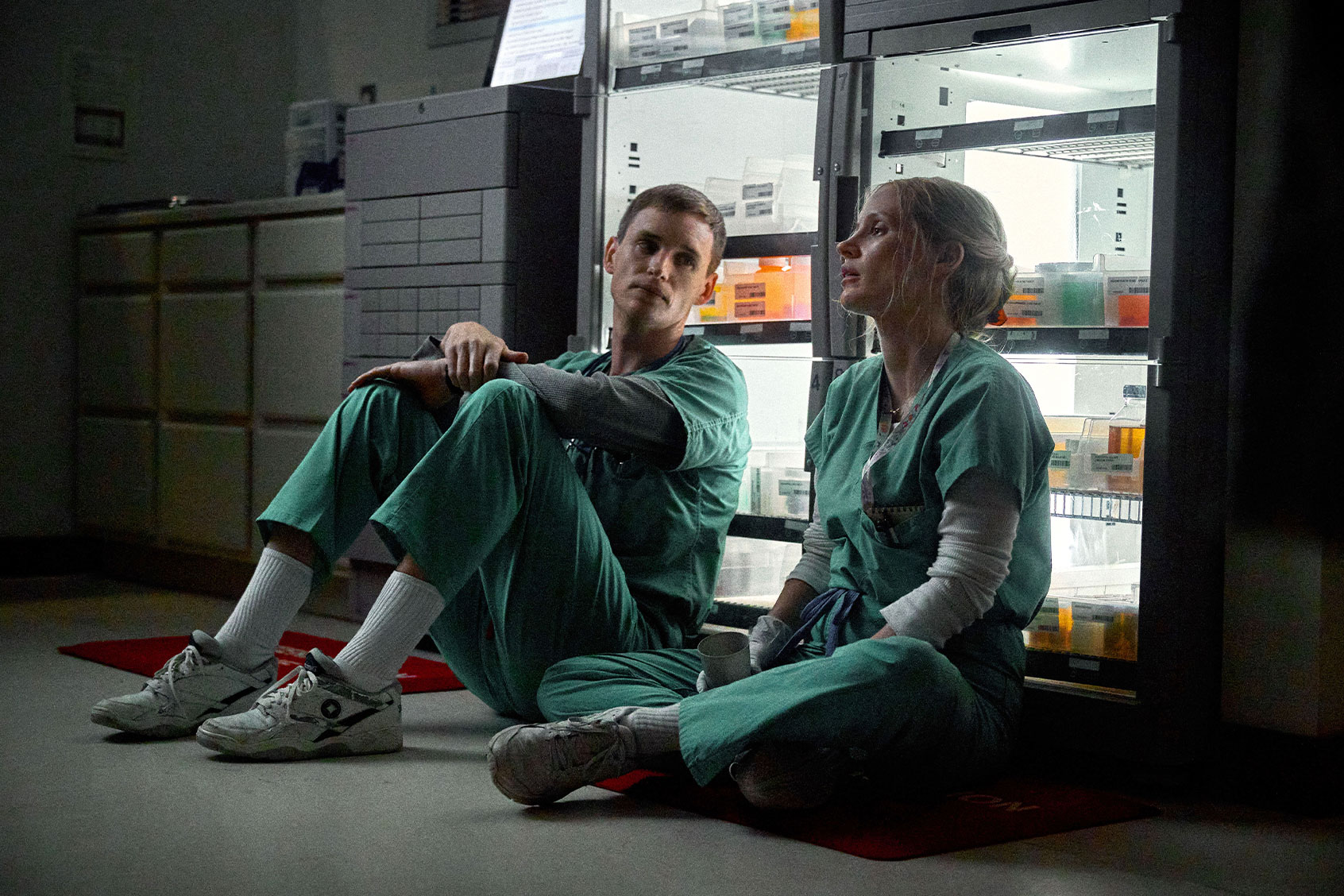
The Good NurseEddie Redmayne and Jessica Chastain in “The Good Nurse” (JoJo Whilden/Netflix)In September 2002, Cullen returned to New Jersey to work in the critical care unit of the Somerset Medical Center, where he committed most of his murders using digoxin, insulin, and epinephrine. Cullen’s wrongdoings eventually came to light when he partially admitted his crimes to Loughren, a fellow critical care nurse who Cullen became close friends with. On December 12, 2003, Cullen was arrested and in 2006, he was convicted following an investigation into his employment history.
Cullen’s trials

Two days after his arrest, Cullen admitted to detectives Dan Baldwin and Tim Braun that he had murdered Rev. Florian J. Gall and had attempted to murder another Somerset patient named Jin Kyung Han. Cullen eventually told the detectives that he had murdered as many as 40 patients over his 16-year career.  

In 2004, Cullen pleaded guilty to killing 13 patients and attempting to kill two additional patients by lethal injection while working at Somerset. He also agreed to a plea bargain with prosecutors, which entailed that he would help investigators identify victims in order to avoid the death penalty. A month later, Cullen pleaded guilty to the murder of three more patients in New Jersey and in November 2004, he pleaded guilty to killing six patients and attempting to kill three others.

Per a 2007 New York Magazine article, “Cullen told detectives that he killed the sick in order to end their suffering, but at some point, as Cullen spiked bags of IV saline in supply closets and killed patients who were not terminal, his compassion became compulsion, and when his personal life became stressful, killing became his outlet.”

Cullen’s trial grew heated in 2005, when he sought to donate his kidney to the dying relative of a former girlfriend. Prosecutors denied Cullen’s request, saying he could not go through with the donation until after his sentencing, and postponed his sentencing hearing. Cullen, in turn, attempted to avoid appearing at his sentencing, but to no avail.

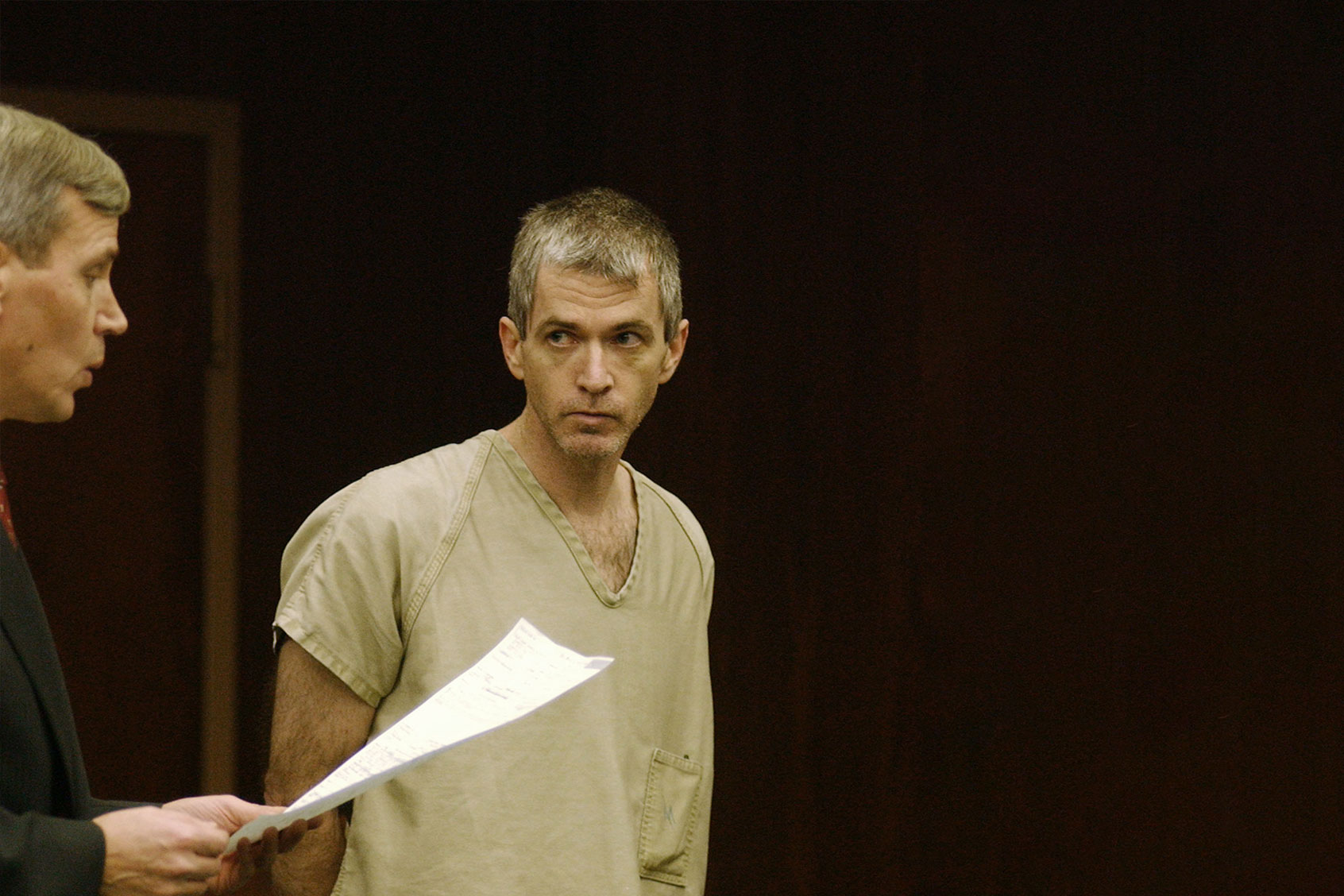
Charles CullenCharles Cullen, 43, from Bethlehem, Pennslyvania, is seen in a courtroom December 15, 2003 in Somerville, New Jersey. Cullen has admitted to killing 40 terminally ill patients in nine hospitals and a nursing home in the past 16 years. (John Wheeler/Getty Images)On March 2, 2006, Cullen was sentenced to 11 consecutive life sentences. A few months later, in August 2006, he donated his kidney to an unnamed male recipient, according to The New York Times, and returned to prison later that month.
Cullen is currently in protective custody at New Jersey State Prison in Trenton. As part of his sentencing, Cullen is not eligible for parole until June 10, 2388.

Cullen’s “60 Minutes” appearance

In 2013, Cullen made his first television appearance on “60 Minutes,” in which he spoke about his crimes with journalist Steve Kroft. 

“There was a lot of pain, a lot of suffering and I didn’t cope with that as well as I thought I would,” Cullen said about his nursing stint at Saint Barnabas Medical Center. “It’s difficult for me to go back in time and think about what things were running through my mind at the time.”

Cullen also said that he thought he was “helping” his patients so that they “weren’t suffering anymore.

“I can’t . . . my goal here isn’t to justify, what I did there is no justification. I just think that the only thing I can say is I felt overwhelmed at the time,” he added. “Like I said I can’t, it was more or less I felt like I needed to do something, and I did, and that’s not an answer to anything.”

“Capturing the Killer Nurse” and “The Good Nurse” are currently available for streaming on Netflix. Watch the trailers below, via YouTube:


The White House’s ‘AI Bill of Rights’ outlines how to make artificial intelligence safer

Despite the important and ever-increasing role of artificial intelligence in many parts of modern society, there is very little policy or regulation governing the development and use of AI systems in the U.S. Tech companies have largely been left to regulate themselves in this arena, potentially leading to decisions and situations that have garnered criticism.

Google fired an employee who publicly raised concerns over how a certain type of AI can contribute to environmental and social problems. Other AI companies have developed products that are used by organizations like the Los Angeles Police Department where they have been shown to bolster existing racially biased policies.

There are some government recommendations and guidance regarding AI use. But in early October 2022, the White House Office of Science and Technology Policy added to federal guidance in a big way by releasing the Blueprint for an AI Bill of Rights.

The Office of Science and Technology says that the protections outlined in the document should be applied to all automated systems. The blueprint spells out “five principles that should guide the design, use, and deployment of automated systems to protect the American public in the age of artificial intelligence.” The hope is that this document can act as a guide to help prevent AI systems from limiting the rights of U.S. residents.

As a computer scientist who studies the ways people interact with AI systems — and in particular how anti-Blackness mediates those interactions — I find this guide a step in the right direction, even though it has some holes and is not enforceable.

Improving systems for all

The first two principles aim to address the safety and effectiveness of AI systems as well as the major risk of AI furthering discrimination.

To improve the safety and effectiveness of AI, the first principle suggests that AI systems should be developed not only by experts, but also with direct input from the people and communities who will use and be affected by the systems. Exploited and marginalized communities are often left to deal with the consequences of AI systems without having much say in their development. Research has shown that direct and genuine community involvement in the development process is important for deploying technologies that have a positive and lasting impact on those communities.

The second principle focuses on the known problem of algorithmic discrimination within AI systems. A well-known example of this problem is how mortgage approval algorithms discriminate against minorities. The document asks for companies to develop AI systems that do not treat people differently based on their race, sex or other protected class status. It suggests companies employ tools such as equity assessments that can help assess how an AI system may impact members of exploited and marginalized communities.

These first two principles address big issues of bias and fairness found in AI development and use.

Privacy, transparency and control

The final three principles outline ways to give people more control when interacting with AI systems.

The third principle is on data privacy. It seeks to ensure that people have more say about how their data is used and are protected from abusive data practices. This section aims to address situations where, for example, companies use deceptive design to manipulate users into giving away their data. The blueprint calls for practices like not taking a person’s data unless they consent to it and asking in a way that is understandable to that person.

The next principle focuses on “notice and explanation.” It highlights the importance of transparency – people should know how an AI system is being used as well as the ways in which an AI contributes to outcomes that might affect them. Take, for example the New York City Administration for Child Services. Research has shown that the agency uses outsourced AI systems to predict child maltreatment, systems that most people don’t realize are being used, even when they are being investigated.

The AI Bill of Rights provides a guideline that people in New York in this example who are affected by the AI systems in use should be notified that an AI was involved and have access to an explanation of what the AI did. Research has shown that building transparency into AI systems can reduce the risk of errors or misuse.

The last principle of the AI Bill of Rights outlines a framework for human alternatives, consideration and feedback. The section specifies that people should be able to opt out of the use of AI or other automated systems in favor of a human alternative where reasonable.

As an example of how these last two principles might work together, take the case of someone applying for a mortgage. They would be informed if an AI algorithm was used to consider their application and would have the option of opting out of that AI use in favor of an actual person.

Smart guidelines, no enforceability

The five principles laid out in the AI Bill of Rights address many of the issues scholars have raised over the design and use of AI. Nonetheless, this is a nonbinding document and not currently enforceable.

It may be too much to hope that industry and government agencies will put these ideas to use in the exact ways the White House urges. If the ongoing regulatory battle over data privacy offers any guidance, tech companies will continue to push for self-regulation.

One other issue that I see within the AI Bill of Rights is that it fails to directly call out systems of oppression — like racism or sexism – and how they can influence the use and development of AI. For example, studies have shown that inaccurate assumptions built into AI algorithms used in health care have led to worse care for Black patients. I have argued that anti-Black racism should be directly addressed when developing AI systems. While the AI Bill of Rights addresses ideas of bias and fairness, the lack of focus on systems of oppression is a notable hole and a known issue within AI development.

Despite these shortcomings, this blueprint could be a positive step toward better AI systems, and maybe the first step toward regulation. A document such as this one, even if not policy, can be a powerful reference for people advocating for changes in the way an organization develops and uses AI systems.


Christopher Dancy, Associate Professor of Industrial & Manufacturing Engineering and Computer Science & Engineering, Penn State

This article is republished from The Conversation under a Creative Commons license. Read the original article.

The water paradox: How did the first life form in a hostile substance?

It’s a paradox: Life needs water to survive, but a world full of water can’t generate the biomolecules that would have been essential for early life. Or so researchers thought.

Water is everywhere. Most of the human body is made of it, much of planet Earth is covered by it and humans can’t survive more than a couple of days without drinking it. Water molecules have unique characteristics that allow them to dissolve and transport compounds through your body, provide structure to your cells and regulate your temperature. In fact, the basic chemical reactions that enable life as we know it require water, photosynthesis being one example.

However, when the first biomolecules like proteins and DNA started coming together in the early stages of planet Earth, water was actually a barrier to life.

The reason why is surprisingly simple: The presence of water prevents chemical compounds from losing water. Take, for example, proteins, which are one of the main classes of biological molecules that make up your body. Proteins are, in essence, chains of amino acids linked together by chemical bonds. These bonds are formed through a condensation reaction that results in the loss of a molecule of water. Essentially, the amino acids need to get “dry” in order to form a protein.

Considering that Earth before life was covered in water, this was a big problem for making the proteins essential to life. Like trying to get dry inside of a swimming pool, two amino acids would have had a hard time losing water to come together in the primordial soup of early Earth. And it wasn’t only proteins that faced this problem in the presence of water: Other biomolecules essential to life, including DNA and complex sugars, also rely on condensation reactions and losing water to form.

Over the years, researchers have proposed many solutions to this “water paradox.” Most of them rely on very specific scenarios on early Earth that could have allowed water removal. These include drying puddles, mineral surfaces, hot springs and hydrothermal vents, among others. These solutions, while plausible, require particular geological and chemical conditions that might not have been commonplace.

In our recent study, my colleagues and I found a simpler and more general solution to the water paradox. Quite ironically, it might be water itself – or to be more precise, very small water droplets – that allowed early biomolecules to form.

Why microdroplets?

Water droplets are everywhere, both in the modern world and especially during prebiotic (or pre-life) Earth. In a planet covered by crashing waves and raging tides, the small water droplets in sea spray and other aerosols would have plausibly provided a simple and abundant place for the first biomolecules to assemble.

Water microdroplets – typically very small droplets with diameters around a millionth of a meter, far smaller than the diameter of spider silk – might not seem to solve the water paradox at first, until you consider the very particular chemical environments they create.

Microdroplets have a substantial surface area-to-volume ratio that gets larger the smaller the droplet is. This means there is a significant space where the solvent they are made of (in this case, water) and the medium they are surrounded by (in this case, air) meet.

Over the years, researchers have shown that the air-water interface is a unique chemical environment. The chemistry of these microdroplet interfaces is dominated by large electric fields, partial solvation where molecules are partially surrounded by water, highly reactive molecules and very high acidity. All these factors allow microdroplets to accelerate the chemical reactions that occur in them.

Our lab has been studying microdroplets for a decade, and our previous work has shown how the rate of common chemical reactions can be sped up to a million times faster in microdroplets. Reactions that would have taken a full day could now be complete in just a fraction of a second using these small droplets.

In our recent work, we proposed that microdroplets could be a solution to the water paradox because their air-water interface not only accelerates reactions but also acts as a “drying surface” that facilitates the reactions needed to create biomolecules despite the presence of water.

We tested this theory by spraying amino acids dissolved in microdroplets of water toward a mass spectrometer, an instrument that can be used to analyze the products of a chemical reaction. We found that two amino acids can successfully join together in the presence of water via microdroplets. When we added more amino acids and collided two sprays of this mixture together, mimicking crashing waves in the prebiotic world, we found that this can form short peptide chains of up to six amino acids.

Our findings suggest that water microdroplets in settings like sea spray or atmospheric aerosols were fundamental microreactors in early Earth. In other words, microdroplets may have provided a chemical medium that allowed the basic molecules of life to form from the simple, small compounds dissolved in the vast primordial ocean that covered the planet.

Microdroplets past and future

The chemistry of microdroplets might be helpful in tackling current challenges across many scientific fields.

Drug discovery, for example, requires synthesizing and testing hundreds of thousands of compounds to find a potential new drug. The power of microdroplet reactions can be integrated with automation and new tools to speed up synthesis rates to more than one reaction per second as well as biological analysis to less than a second per sample.

In this way, the same phenomenon that might have aided the origin of the building blocks of life billions of years ago can now help scientists develop new medicines and materials faster and more efficiently.

Perhaps J.R.R. Tolkien was right when he wrote: “Such is oft the course of deeds that move the wheels of the world: small hands do them because they must, while the eyes of the great are elsewhere.”

I believe the importance of these small droplets is far bigger than their tiny size.


Nicolás M. Morato, PhD Candidate in Chemistry, Purdue University

This article is republished from The Conversation under a Creative Commons license. Read the original article.

HelloFresh is the latest food company to be accused of using coconut milk obtained from monkey labor

The People for the Ethical Treatment of Animals, or PETA, has called for a boycott of HelloFresh, alleging that the meal delivery service uses coconut milk obtained from monkey labor in Thailand.

The call for HelloFresh subscribers to cancel their memberships came as allegations of animal abuse were leveled against 57 operations in nine provinces in Thailand in a new investigation by PETA Asia. The newly released findings claim that monkeys are chained, whipped, beaten and forced to spend long hours picking coconuts for their milk.

“Monkeys are chained around the neck and forced to toil day in and day out, all for HelloFresh and other companies that lack a conscience,” Tracy Reiman, executive vice president of PETA, alleged in a statement to CBS MoneyWatch. “PETA is calling on everyone, including HelloFresh, to stop buying canned coconut milk from Thailand until monkeys are no longer used and abused for profit.”

According to a PETA news release, brokers to Aroy-D and Suree, HelloFresh’s coconut milk suppliers, demonstrated to investigators that “monkeys were being exploited to pick coconuts and that at a supplier to Suree, monkeys were chained on trash-strewn patches of dirt and flooded areas with car tires as their only ‘shelter’ from the elements.”

One worker reportedly told investigators that the animals would “be forced to pick coconuts for more than a decade and then spend the rest of their lives on a chain.”

In a statement to CBS MoneyWatch, HelloFresh said it had received written assurance that the coconuts weren’t sourced through animal labor.

“HelloFresh strictly condemns any use of monkey labor in its supply chain, and we take a hard position of not procuring from suppliers or selling coconut products which have been found to use monkey labor,” HelloFresh said. “We have written confirmation from all of our suppliers — in the U.S. and globally — that they do not engage in these practices.”

After Indonesia and the Philippines, Thailand is the world’s third largest exporter of coconuts, exporting more than 500,000 tons in 2019, National Geographic reported in 2021. Per the outlet:

The popularity of coconut milk as an alternative to dairy milk has grown steadily during the past five years, says Avinash Desamangalam, research manager at Mordor Intelligence, a company based in India that studies the market for alternatives to dairy products. He says the industry’s growth rate is expected to nearly double in the next five years.

A year prior, PETA released another investigation documenting how pig-tailed macaques — the monkeys most frequently used to pick coconuts in Thailand — are sometimes trained in “monkey schools” where they’re taught, using force, to climb trees in order to pick coconuts. 

Many were likely illegally captured from the wild as babies, according to PETA. The investigators allegedly found monkeys alone and in distress — screaming and pacing repeatedly, a sign of anxiety. Some were missing their canine teeth, which had been removed to prevent injury to handlers, farmers reportedly told PETA.


Want more great food writing and recipes? Subscribe to Salon Food’s newsletter, The Bite.


The 2021 investigation prompted numerous large-scale retailers, such as Costco and Target, to drop Chaokoh coconut milk, a brand PETA alleged was implicated in the abuse. At the time, Target released a statement to USA Today about its decision to stop carrying the label. 

“We believe in the humane treatment of animals and expect those who do business with us to do the same,” Target said. “We take seriously the claims made against Chaokoh, and given they were unable to sufficiently address the concerns raised, we made the decision to remove their product from our assortment in November 2020.”

PETA has been pushing reatilers to stop selling coconut milk made with coconuts harvested by monkeys since it began investigating alleged animal exploitation in 2019.

Knoxville’s black community endured deeply rooted racism, and now there is medical debt

When Dr. H.M. Green opened his new medical office building on East Vine Avenue in 1922, Black residents of this city on the Tennessee River could be seen only in the basement of Knoxville General Hospital. They were barred from the city’s other three medical centers.

Green, one of America’s leading Black physicians, spent his life working to end health inequities like this. He installed an X-ray machine, an operating room, and a private infirmary in his building to serve Black patients. On the first floor was a pharmacy.

Today the Green Medical Arts Building has been replaced by a tangle of freeways that were built after the city’s Black business district was bulldozed in a midcentury urban renewal project.

But the health gaps Green labored to narrow still divide this community. And if segregation is less apparent in medical offices today, its legacy lives on in crushing medical debt that disproportionately burdens this city’s Black community.

In and around Knoxville, residents of predominantly Black neighborhoods are more than twice as likely as those in largely white neighborhoods to owe money for medical bills, Urban Institute credit bureau data shows, one of the widest racial disparities in the country.

That tracks with a disturbing national trend. Health care debt in the U.S. now affects more than 100 million people, a KHN-NPR investigation found. But the toll has been especially high on Black communities: 56% of Black adults owe money for a medical or dental bill, compared with 37% of white adults, according to a nationwide KFF poll conducted for this project.

The explanation for that startling disparity is deeply rooted. Decades of discrimination in housing, employment, and health care blocked generations of Black families from building wealth — savings and assets that are increasingly critical to accessing America’s high-priced medical system.

Against that backdrop, patients suffer. People with debt avoid seeking care and become sicker with treatable chronic conditions like diabetes or multiple sclerosis. Worse still, hospitals and doctors sometimes won’t see patients with medical debt — even those in the middle of treatment.

“African Americans don’t seek health care until we are really, really sick, and then it costs more,” said Tabace Burns, a former emergency room nurse in Knoxville. Burns, who is also a leader in her church, said she routinely helps members of her congregation find medical care they should have sought earlier.

Nationwide, Black adults who have had health care debt are twice as likely as white adults with such debt to say they’ve been denied care because they owe money, the KFF poll found. Many Black Americans also ration their care out of fear of cost.

Burns recalled a friend who came to see her about an oozing growth on her breast. “She didn’t have any insurance, so she just thought it would get better,” Burns said.

Burns helped the woman find an oncologist to treat what turned out to be cancer. There was a cost to waiting so long, though. Because the cancer was so advanced, the friend had to undergo chemotherapy and have both breasts removed.

It could have been worse. “What if she didn’t know me? What if she just continued to let her breast leak and it was necrotic?” Burns said. But, she added, if her friend hadn’t been so worried about going into debt, she would have gone to the doctor sooner.

It’s a terrible cycle, said Berneta Haynes, a staff attorney at the National Consumer Law Center. “This legacy of segregation and structural racism underlies the racial health gap,” she said. “It impacts health outcomes and access. And it impacts the level of medical debt.”

In ‘The Bottom’

The story of how Knoxville’s Black residents came to be its primary victims of medical debt is written in the city’s changing landscape.

Just outside downtown, below refurbished office buildings and former warehouses, is an area once called The Bottom, long the heart of the Black community.

This area persevered through decades of Jim Crow segregation and violence. In one of the worst episodes, mobs of white rioters in 1919 vandalized Black-owned stores and shot residents after a young Black man was accused of killing a white woman.

It was here that Black physicians like Green opened medical offices alongside grocers, pool halls, and funeral homes. Knoxville’s first Black millionaire, a former enslaved man who’d made a fortune in horse racing and saloons, built a YMCA. Billie Holiday and Cab Calloway performed at the Gem Theatre.

Beginning in the late 1950s, the city systematically wiped out The Bottom and surrounding neighborhoods in an urban renewal and highway-building campaign. Officials razed more than 500 homes, 15 churches, and more than 100 Black-owned businesses, including Green’s medical building.

More than 2,500 families were displaced. Many ended up in public housing projects. Others left Knoxville. Businesses never reopened. “It changed the whole landscape,” said the Rev. Reneé Kesler, director of the Beck Cultural Exchange Center, a nonprofit that preserves Knoxville’s Black history. “You’ll have generations that won’t recover from that.”

What urban renewal left behind in East Knoxville was a neighborhood that’s the poorest in the city — and has the largest share of Black residents.

A tiny fraction of residents are homeowners. Blocks are blighted by boarded-up buildings and overgrown lots. Down the street from Knoxville’s oldest Black cemetery, a Dollar General recently closed — one of the few stores around that sold groceries.

The neighborhood’s residents are sicker than those elsewhere in Knoxville, with higher levels of diabetes and other chronic illnesses. They are less likely to have health insurance.

They also have much more medical debt.

More than 30% of the people have a medical bill on their credit record, according to credit bureau data collected by the nonprofit Urban Institute. A few miles west in Knoxville’s overwhelmingly white suburbs, fewer than 10% carry such debt.

It’s not difficult to understand the difference, said Eboni Winford, a clinical psychologist at Cherokee Health Systems, a network of clinics that serve low-income patients. “Black people are less likely to have generational wealth to pass on, which means we don’t have the pockets of money that we can just use if medical bills arise.”

Nationally, the median white family now has about $184,000 in assets such as homes, savings, and retirement accounts, according to an analysis by the Federal Reserve Bank of St. Louis. The assets of the median Black family total just $23,000.

“What happened is we concentrated Black poverty,” said Gwen McKenzie, a Knoxville City Council member who grew up not far from The Bottom. “From there, that’s where it became generational.”

‘Always a Sacrifice’

Monica Reed lives just up the hill from where The Bottom once was.

She considers herself luckier than most. Born in Knoxville and raised by a single mother, Reed became the first in her family to own a home, a small house built after the city demolished The Bottom. For the past 15 years, she’s worked for a faith-based nonprofit that assists low-income residents of Knoxville.

“It hasn’t always been easy,” said Reed, who just turned 60. She raised her son by herself. And though she’s always worked, her modest salary made saving difficult. “I just tried to live a frugal kind of life,” she said. “And by the grace of God, I didn’t become homeless.”

She couldn’t escape medical debt, though. Diagnosed with cancer five years ago, Reed underwent surgery and chemotherapy. Although she had health insurance through work, she was left with close to $10,000 in medical bills she couldn’t pay.

She’s been pursued by debt collectors and even taken to court. That’s forced Reed to make difficult choices. “There’s always a sacrifice,” she said. “You just do without some things to pay other things.”

Reed said she cut back on trips to the grocery store: “I don’t buy a lot of food. Just plain and simple.”

She has adjusted, she said. “You just do what you have to do.” What angers Reed, though, is how she’s been treated by the cancer center where she goes for periodic checkups to make sure the cancer remains in remission. When she recently tried to make an appointment, a financial counselor told her she couldn’t schedule it until she made a plan to pay her bills.

“I was so upset, I didn’t even find out how much I owed,” Reed said. “I mean, I wasn’t calling about a little toothache. This is something that affects someone’s life.”

Locking In Disparities

Health insurance gains made possible by the Affordable Care Act have narrowed some racial health disparities, studies show.

The expansion of Medicaid, in particular, has brought new financial security to millions of low-income Americans. In a recent analysis of credit bureau and census data, researchers estimated that Medicaid expansion helped enrollees avoid more than $1,200 in medical debt.

But many of those gains have remained out of reach in Knoxville. Tennessee is among 12 states that have rejected federal funding to expand the Medicaid safety net through the 2010 health care law.

Eight of the 12 are Southern states with large Black populations. The decision not to expand has disproportionately affected communities like East Knoxville that are already contending with deep racial disparities in health and wealth.

Of the roughly 2.2 million people locked out of health coverage because these states rejected Medicaid expansion, nearly 60% are people of color, according to a KFF analysis. About a quarter are Black.

Locked out of health insurance, many just try to hang on until they become eligible for Medicare, said Cynthia Finch, an advocate in Knoxville who has worked to improve health in the city’s Black community. “People pray they don’t get sick before they are 65,” she said.

If Black patients go into debt, they face yet another challenge: a medical debt collections industry that targets Black debtors more aggressively than their white counterparts, particularly for smaller debts.

About 6 in 10 Black adults with medical debts under $2,500 say they or someone in their household has been contacted by a collection agency in the past five years, the KFF poll found. By contrast, only about 4 in 10 white adults with similar debt said the same.

At the courthouse in downtown Knoxville, the dockets are filled with debt collection lawsuits filed by some of the region’s largest hospitals: Fort Sanders Regional Medical Center, East Tennessee Children’s Hospital, and Parkwest Medical Center.

That discourages many Black patients from seeking care even if they need it, said Cherokee Health’s Derrick Folsom, who helps patients enroll in health insurance. “Somebody knows somebody who’s getting sued for medical bills,” Folsom said. “So they stay away from medical centers.”

Reflecting on her experience with medical debt, Reed said she tries to stay upbeat. “I don’t sweat the small stuff,” she said. “What am I going to do against this hospital?”

But, she said, she has realized one thing about the nation’s health care system: “It’s not designed for poor people.”


KHN (Kaiser Health News) is a national newsroom that produces in-depth journalism about health issues. Together with Policy Analysis and Polling, KHN is one of the three major operating programs at KFF (Kaiser Family Foundation). KFF is an endowed nonprofit organization providing information on health issues to the nation.

Subscribe to KHN’s free Morning Briefing.

Possible missile strike in Poland sparks fears Ukraine war could escalate

Two people are reportedly dead after a Tuesday afternoon explosion at a Polish grain processing facility near the Ukrainian border that an unnamed U.S. intelligence official and Polish media have attributed to a Russian missile strike, sparking fears of an escalation of the Ukraine war.

The cause of the explosion in Przewodów, a village in eastern Poland about four miles from the Ukrainian border, could not be immediately confirmed. Polish government spokesperson Piotr Mueller told reporters that Prime Minister Mateusz Morawiecki and President Andrzej Duda convened an emergency session of the country’s National Security Council to address the “crisis situation.”

Mueller cautioned international media against publishing “unverified information.”

Peace advocates and foreign policy experts have warned since the outset of the war that an errant missile strike on a NATO country or a military miscalculation by either side could dangerously escalate the conflict.

The unnamed U.S. official, who spoke to the Associated Press on condition of anonymity due to the sensitivity of the situation, said that multiple Russian missiles had struck the grain center. Pentagon spokesperson Gen. Pat Ryder, meanwhile, told reporters that “we don’t have any information at this time to corroborate those reports and are looking into this further.”


Want a daily wrap-up of all the news and commentary Salon has to offer? Subscribe to our morning newsletter, Crash Course.


Under Article 5 of the NATO treaty, an attack on any member of the alliance is considered an attack on all. Poland joined NATO in 1999. When asked, Ryder did not say if the incident would trigger Article 5.

An Article 4 response could also be triggered by such an incident, which would include NATO members coming together to consult over a perceived security threat if any member demands such a meeting.

The Russian defense ministry issued a statement denying responsibility for the attack, calling media reports a “deliberate provocation.”

According to the New York Times, Russian forces launched around 100 missiles targeting Ukraine’s energy infrastructure on Tuesday in what Ukrainian Energy Minister Herman Halushchenko called the largest coordinated attack on the country’s power grid since the start of Russia’s invasion.

Is store-bought really fine? Our favorite tweets about Ina’s semi-homemade Thanksgiving

Legend, icon, kitchen empress, Hamptons ambassador, connoisseur of denim shirts, massive martini consumer, and Barefoot Contessa herself — Ina Garten epitomizes the best that a “food celebrity” or “celebrity chef” could have to offer.

Over the past twenty or so years, Ina has cultivated a true cult of personality, complete with cookbooks upon cookbooks, various shows, myriad impersonations across TikTok and YouTube, and of course, that iconic video circa April 2020 of her casually sipping a positively gigantic martini. In addition, she’s also racked up quite a host of Emmy and James Beard awards.

Barefoot Contessa (now streaming on Discovery+) was a stalwart show that I watched as a middle schooler, getting a kick out of Ina’s sometimes hilariously shady quips to “reader questions,” marveling at her dishes and chortling at her conversations with Jeffrey. I see now, though, that Jeffrey and Ina are something to make you go “aww” (or just lol) and smile, not pass judgment. Perfectly coiffed, always immaculately dressed, and even-keeled, Garten swoops in and out of Hamptons cheese shops and stores, breezily addressing pals and onlookers while punctuating nearly every sentence with her jocular, familiar laugh before returning home to whip up some not-especially-simple meals with some not-always-easily-accessible ingredients.

The show was always a joy to watch, whether you were watching it “ironically” to pick fun, or if you genuinely enjoyed the show. Now, two decades later, I’d argue that the bulk of us have softened and grown in appreciation, now authentically enjoying Ina and her calm, cool delivery and clearly adept culinary knowledge. 

Over the weekend, The New York Times published an Ina-cosigned “storebought is fine” Thanksgiving piece and slew of recipes. Taking a bit of a inspiration from “Semi-Homemade,” Ina capitalizes on store-bought ingredients, taking short cuts from the store: pre-made stuffing mix in her mushroom and gruyere bread pudding (yum), gussying up store-bought mashed potatoes with sour cream and Parmesan, nearly replicating the flavor profile of her actually homemade dish, and using frozen pie crust or shells instead of making one yourself (precisely what I did in this recipe)!

While this certainly isn’t her usual fare, Ina greets the challenge with aplomb, coming up with recipes that sound (and look) just as high-end as her standard work.

Furthermore, Ina notes that there’s no point in making homemade items that you can easily buy, like ice cream (she swears by Haagen-Dasz vanilla, especially atop a semi-homemade pie with a frozen crust or even a storebought pie with all of the work already done for you). 

Of course, in addition to these A+ tips, the Twitter reactions were uproarious, so without further adieu, here are some of our favorite tweets joking about Ina’s “storebought is fine” Thanksgiving:

While the gifs and memes are certainly lolzy, there is something to be said about taking the help from the grocery store, or perhaps even delegating dishes to certain guests. Frantically running amok as the host is truly never fun, so keep things simple, take some help from the store, and actually try to enjoy the food and the company instead of focusing on making some asinine, outrageously challenging dish and spending 99% of the day in the kitchen. 

In this video, Ina says, “I think the key to a really good Thanksgiving is a really good plan. And not just a plan for the day, but plan for the whole week.” – which is possibly the #1 takeaway from this entire moment. “Make the dinner as simple as possible, so you can have a good time, too.”

Thanks Ina, we think we will. After all, as you’ve taught us, store-bought really is fine. 

Trump accused of ‘brazen’ campaign finance violation one day before expected 2024 launch

A day ahead of his expected 2024 announcement, former President Donald Trump on Monday was hit with a campaign finance complaint that accuses him of unlawfully transferring a “colossal sum” of money from his leadership PAC to a super PAC that spent millions on this year’s midterms—and is positioned to spend millions more on Trump’s presidential bid.

The Campaign Legal Center (CLC), the watchdog organization that filed the complaint, alleges that Trump “directed the transfer” of $20 million last month from the cash-flush leadership PAC Save America to Make America Great Again, Inc., which dumped nearly $12 million into the midterm elections to boost Trump-friendly candidates.

MAGA, Inc., thanks to its status as a super PAC, is legally able to spend unlimited sums to support or oppose political campaigns.

CLC said the $20 million transfer, disclosed in a recent Federal Election Commission (FEC) filing, amounts to a “brazen attempt to circumvent the fundraising restrictions that apply to federal candidates, which are crucial to preventing corruption and its appearance.”

Specifically, CLC’s complaint argues that the move violates Federal Election Campaign Act provisions barring candidates and officeholders from spending unregulated “soft money” on federal elections.

“Because Trump was a federal candidate when his leadership PAC contributed $20 million to a super PAC that was actively spending in the 2022 midterms and is poised to spend again in the 2024 cycle, he and Save America blatantly violated soft money prohibitions,” CLC noted in a press release.

Trevor Potter, CLC’s president, said in a statement that “when federal candidates evade campaign finance laws designed to maintain transparency and combat corruption, they undermine our election system and damage voter trust.”

“Former President Trump made it clear months ago, through his statements and actions, that he was running for president again in 2024—long before his leadership PAC, Save America, gave $20 million to a super PAC that then spent over $11 million on the 2022 midterms,” said Potter. “By injecting this ‘soft money’ into a federal election, Trump violated the law, and the FEC must act.”

According to OpenSecrets, the Save America PAC has raised more than $107 million and spent more than $68 million since its inception in the wake of the 2020 presidential election.

In a blog post on Monday, CLC’s Saurav Ghosh noted that “recent developments appear to indicate that the remaining $39 million of Save America’s funds will be used as a war chest for Trump’s 2024 presidential campaign.”

“To date, MAGA Inc. has spent over $11.9 million on independent expenditures to help elect Trump-backed candidates around the country,” Ghosh wrote. “The problem is that Save America’s contribution [to MAGA Inc.], along with MAGA Inc. spending the money to influence the 2022 midterms, violated federal law and injected a huge amount of soft money into our federal elections.”

“Trump was already a federal candidate when Save America gave MAGA Inc. the $20 million, far more the $5,000 per year that a leadership PAC like Save America can legally contribute to another committee,” Ghosh added. “Trump’s public statements show that by early 2022, he had decided to run for president and was simply delaying announcing that decision to avoid the campaign finance rules applicable to federal candidates. And he has clearly raised and spent far more than $5,000 through Save America to advance his candidacy.”

CLC is hardly alone in raising alarm about Trump’s campaign finance activity ahead of the official launch of his 2024 White House bid.

Paul S. Ryan, a campaign finance lawyer and deputy executive director of the Funders’ Committee for Civic Participation, told The Daily Beast late last month that “the only thing Trump cannot do with the millions and millions of dollars he’s raised into his leadership PAC is support himself.”

Thus, Ryan said, “the only plausible explanation” for the transfer from Save America to MAGA, Inc. “is to convert that money to be spent on his own campaign.”

“Moving the money suggests he wants to spend it on himself,” Ryan added. “It’s illegal, but that seems to be the motivation and he will likely get away with it.”

“Black Panther: Wakanda Forever” earns its inheritance by embracing loss and matriarchal power

Is there another recent superhero movie that overtly invites open weeping before the plot kicks in? If there is, “Black Panther: Wakanda Forever” director Ryan Coogler overrides previous efforts by acknowledging the crater Chadwick Boseman‘s shocking death left in our collective spirit. The actor died in August 2020 at the age of 43 from colon cancer, which he kept a secret from nearly everyone save those closest to him.

What he gave the world as King T’Challa, the Black Panther, is irreplaceable and worth grieving, both in the real world and the version of Earth where a secret African nation is the planet’s foremost superpower.

Two years after his loss, “Wakanda Forever” allows audiences to mourn as the film begins and honor his legacy as its chapter closes similarly: by honoring T’Challa’s humanity through his sister Shuri (Letitia Wright). 

Shuri’s scientific genius bolstered Black Panther’s battlefield dominance, responsible for augmenting the superhuman strength bestowed upon T’Challa by Wakanda’s mystical heart-shaped herb with a uniform and accessories that made him just shy of invincible. But when an unspecified disease assails T’Challa’s body from within, Shuri is powerless. 

The pre-credits sequence opens with Shuri, her team, and her assistant A.I. Griot frantically searching for treatment options for T’Challa, who is never seen, only to be informed by Queen Ramonda (Angela Bassett) that they’re too late: “Your brother is with the ancestors,” she says.

Still, there was never any question that the Black Panther must endure. The crass business matter of the hero’s central role in the larger MCU franchise’s longevity requires that, along with the mythological import Boseman brought to the role and Coogler realized in gloriously creating the African utopia for the screen.

But these also freight “Wakanda Forever” with incredibly high expectations. Some might even call them impossible to meet. 

There was never any question that the Black Panther must endure.

As Coogler and his co-writer Joe Robert Cole strive to honor Boseman’s legacy, they take on several arduous tasks at the same time. “Wakanda Forever” introduces Namor (Tenoch Huerta), another superpowered savior who, in the spirit of Michael B. Jordan’s Killmonger, is noble and decidedly antiheroic. 

In the same way that shreds the genre’s standard of positioning good heroes against irredeemable villains, “Wakanda Forever” defies the habit of defining lead supers as extensions of their fathers. 

Black Panther: Wakanda ForeverAngela Bassett as Ramonda in “Black Panther: Wakanda Forever” (Annette Brown/Marvel Studios)

Wakanda is under matriarchal leadership, ruled by Ramonda and defended by the elite woman warriors of the Dora Milaje, with a woman leading the world’s most cutting-edge scientific lab.

Shuri and Namor eventually discover they have similar motivations, each informed by what their mothers taught them – and what happened to their mothers. 

As it incorporates all of these angles, the movie makes the case for Shuri’s assumption of the Black Panther mantle, a decision that was going to be controversial regardless of whether Wright ever made her anti-vaccine views public

There’s calcified misogyny within a segment of Marvel fandom, and Coogler and Cole are correct in ignoring that to dissect the meaning of loss and inheritance through Shuri’s journey and Ramonda’s – and in an auxiliary way, through Namor and the introduction of Riri Williams (Dominique Thorne), who’s also due to inherit an open role in the MCU (to be further explained in her upcoming Disney+ series).

In “Wakanda Forever,” resolving each term’s meaning to the larger story is interlinked and, for once, resolved thoughtfully. The Marvel Cinematic Universe does a decent job with exploring grief insofar as it is considered to be a temporary madness each of us copes with in our way, whether by slashing through the globe’s underworld criminal syndicates or holding an entire neighborhood hostage inside of a sitcom-perfect fantasy. 

This is part of the genre’s focus on triumph over evil, even if that enacts a massive cost. That’s why the exits of central characters like Iron Man, Captain America, and the Black Widow are simpler to accept; the audience may take comfort in recognizing that two of these three characters’ stories were amply explored. 

Boseman’s death represents something irretrievable, reminding us that we can only learn to live with loss, as Shuri ultimately must do. But her version of contending with losing T’Challa involves working through her pain, transforming the divine guardianship of Wakanda into a matter than can be handled through science and innovation. 

A key theme in the movie pits her rejection of the divine and spiritual against her mother’s belief, choosing to believe in the innovation she can see as opposed to trusting in the ancestral plane that Ramonda, T’Challa and other royal allies believe guides their people. 

The movie similarly invites us to contemplate the variations between legacy and inheritance that loss brings to the fore. Shuri questions whether Wakanda needs a Black Panther in an age where technology enables her to produce suits that can transform her nation’s army into a force with superhuman capabilities above their peerless fighting skills. 

That changes when she meets Namor. As the leader of another vibranium-enhanced culture descended from a Mesoamerican indigenous people, Namor is devoted to protecting Talokan, his hidden undersea empire.  

Black Panther: Wakanda ForeverTenoch Huerta Mejía as Namor in “Black Panther: Wakanda Forever” (Eli Adé/Marvel Studios)
Namor’s people came into being when a strange disease decimated the village, and the vibranium-imbued plant that cured their illness also made living on land impossible, forcing them into the sea. He would rather wipe out the surface-dwelling world shaped by colonizing forces than negotiate with it.

But T’Challa’s decision at the close of “Black Panther” to join the global community and share its technological knowledge is an altruism that may only be credited to a man who never had to be concerned about a colonialist threat. His outreach may empower the Black people Wakanda left vulnerable, but endangers Talokan, especially once word spreads of his death and the world’s superpowers decide Wakanda is unprotected. 

Legacy implies something akin to a spiritual mandate. Inheritance, however, is trickier.

To Namor, Wakanda’s choice is to either ally with him or perish, whether by the greedy governments of the Western world or his nation’s wrath.
Namor carries forth a legacy earned by birthright, as an extraordinary child born to a mother who was among the first generation of his kind. Shuri, on the other hand, has leadership thrust upon her when she suddenly loses her mother on the heels of her brother’s demise. And in the climactic moment, her ability to appeal to Namor’s desire to honor his mother saves both of their people from mutual destruction. 

Legacy implies something akin to a mandate. Inheritance, however, is trickier to accept in that it’s often unfairly apportioned and tacitly demands justification.  Shuri makes the journey to justification separately from Ramonda, through a mission with Okoye (Danai Gurira) that takes her and Riri deep into enemy territory – and, spiritually speaking, apart from her mother by transforming her wild grief into purposeful loss by eventually putting on the Black Panther’s suit.

Black Panther: Wakanda ForeverDanai Gurira as Okoye and Angela Bassett as Ramonda in “Black Panther: Wakanda Forever” (Eli Adé/Marvel Studios)
Namor isn’t simply a leader to his people, as M’Baku (Winston Duke) counsels his fellow Wakandans. He’s viewed as a god, which conveys a power all its own. Shuri may not believe in that, but she eventually comes to understand and believe in the power that comes from embodying a symbol.


Want a daily wrap-up of all the news and commentary Salon has to offer? Subscribe to our morning newsletter, Crash Course.


Predictably over the weekend, the hashtag #RecastTchalla trended on Twitter as the usual complainers griped about Marvel and Coogler’s respectful if unwieldy solution to dealing with Boseman’s death. This was always going to occur regardless of the way Coogler and Jones reconfigured the script to address the death of its star. Even the fact that they confirmed, via a midcredits scene, that T’Challa lives on through a namesake son borne in secret by Nakia (Lupita Nyong’o) isn’t sufficient. 

The thoughtful tribute to revolutionary history by having T’Challa’s son be raised in Haiti and go by the name Toussaint doesn’t matter either. Those folks would rather prioritize the two-dimensional comic book rendering over what Boseman made the Black Panther mean. 

This entirely misses the story’s message, demonstrated in Shuri’s final act of grieving. In that scene she does what she refused to do at her mother’s side, closing her eyes to sit with the memory of her departed brother. Coogler gives us the view from her mind’s eye of T’Challa smiling with love and admiration at her and the world around him – in effect, passing his mantle to her for safeguarding. 

“Wakanda Forever” may not be the perfect Marvel movie, but this scene and others prove its worthiness as a bridge – not merely between Phase 4 and Phase 5, as studio head Kevin Feige announced, but from the bleakness of loss to a stable place from which a new generation can move forward. 


Maggie Haberman: Trump thinks announcing presidential bid will insulate him “against indictment”

New York Times reporter following Donald Trump, Maggie Haberman, spoke on the newspaper’s morning podcast “The Daily” ahead of the big announcement in Mar-a-Lago only to explain that the monster the GOP has created is now too big for them to control.

She began by explaining that “the reason the mid-terms were a hot mess is because of Donald Trump.” Now, the picture is a little muddy.

“Trump’s insistence on getting Republicans to back his false claims about the 2020 election and repeat that over and over again did have an impact and there’s reason to believe it scared a lot of voters and this is an issue he’s been saying for 18 months he wanted them to run on and they did. And now look what happened,” Haberman continued.

Now candidates, officials, pundits and every Republican in between is talking about Trump being the albatross around the necks of the GOP if they don’t figure out how to drop him. Meanwhile, Trump is announcing his run, regardless of the smoldering embers of the fire.

Trump has already found scapegoats to explain away the losses by blaming a lack of funding for GOP candidates, failed strategy, and that candidates should have been pushing the 2020 election lie instead of running on the economy, she continued. While that didn’t work for Kari Lake, Trump has complained about Mehmet Oz’s performance in the debate with now Senator-elect John Fetterman, saying that Oz was not pressing the election denialism enough.

“So, he doesn’t accept responsibility at all,” said Haberman.

The main reason he’s announcing now, she said is to keep anyone else out of the race, particularly Gov. Ron DeSantis, R-Fla.

“This is often his playbook,” Haberman explained. “To make himself look inevitable so nobody should even challenge me.”

Meanwhile, she revealed, that behind closed doors Trump thinks that announcing his run “complicates things for the Justice Department.” It’s thought that Attorney General Merrick Garland will announce an indictment against Trump for stealing documents from the White House upon leaving in Jan. 2021. Many of those documents also turned out to be classified or top secret.

“He thinks that announcing gives him insulation against indictment,” Haberman said. “It does make it more challenging for the Justice Department. His thinking is that it’s already complicated for the sitting president, President Biden’s Justice Department, to indict Trump as a former president, but as a candidate, even though Biden has been very clear that it’s an independent Justice Department Trump is still going to say, ‘Biden is telling the Justice Department to come after me.””

If Trump had not announced his candidacy, however, it’s likely he would have employed the exact same strategy to try and make the Justice Department indictment against him look political. The one option the DOJ has is to ask the judge in the case to place a gag order around the case. Trying to keep Trump quiet on his own indictment, however, would likely prove difficult and a judge would have to warn of stiff penalties that included jail to ensure Trump abided by such an order.

Haberman said that most of his allies say that he doesn’t want to run another campaign but that he does want to be president again.

“He doesn’t miss traveling all over the place, he’s much older, but he does miss the power of the office,” she said.

She went on to say that many GOP leaders see Trump as a weak candidate because of exactly what happened in the midterms.

“These elections were a proxy in many ways because he made them talk about his issue set,” said Haberman. “They’re a proxy for how this will play in a general election. And Trump is not the same as he was in 2016 when he was seen as a political outsider and there was a newness about him. He is obsessed with election denialism and a number of issues that are not seen as appealing to independents as they are to his MAGA base.”

Many of the Republicans in the party leadership would prefer Trump not run, but there’s no power to stop him, she continued.

“They’re nothing they can do about it. If he wants to run he’s going to run. He is the party. This was settled in 2016 when he was the nominee and in 2020 when he was the nominee again. There’s no apparatus to stop him,” Haberman went on.

While there are individual Republican members who have a voice and “they can say and do whatever they want but Kevin McCarthy needs Trump to be House Speaker because a lot of these members are loyal to Donald Trump and a lot of these leadership elections haven’t happened yet. Mitch McConnell knows that senators’ voters support Donald Trump. The party chairperson has long been an ally of Donald Trump and was initially installed by Donald Trump. So that takes care of that.”

Trump still has a stranglehold on the Republican Party, even those who don’t like him believe he’ll be the nominee. Electability might have been important to Democrats in 2020, but in the GOP, Trump built a “personal fidelity” that is stronger. They also agree with his wars against the media or liberals and tech companies.

Haberman was asked how Trump could possibly spin when he keeps failing, but she reframed the question, saying, “you don’t acknowledge that failure exists. Failure is actually winning. So you just keep on doing the same thing the entire time.”

“But you don’t win!” said host Michael Barbaro.

“But if you tell people you really did, what’s the difference?” Haberman explained. “That’s what he’s testing and what got tested the other day and it’s got limits.”

Listen to the full podcast here.

“It is not a legal argument”: George Conway destroys Trump’s “nonsensical” court filing

On Monday’s edition of CNN’s “The Situation Room,” conservative attorney and longtime Donald Trump skeptic George Conway took down the former president’s latest defense of his classified document stash in Mar-a-Lago in a clash with the Justice Department this week.

Trump is now claiming, among other things, that his decision to transport records from highly classified storage facilities at the White House to his resort in Palm Beach, including Iranian weapons secrets, means he implicitly designated these as “personal” documents — a claim that Conway, the husband of a former Trump adviser, derided as absurd.

“In the Mar-a-Lago investigation, what do you make of the Trump legal argument that you just heard about?” asked anchor Wolf Blitzer.

“It is not a legal argument, it is a ridiculous argument,” said Conway. “The notion that personal records, that he could just define what a personal record is, it is just fallacious. It is contrary to the statute that defines presidential records that were prepared for or given to the president in the course of his duties, and if that is true then they are presidential records and he can’t say by stealing them, I am making them personal records.”

In fact, Conway continued, even if Trump were correct that he had designated the presidential records as personal records, “they would still be potentially subject to subpoena” of the type the DOJ issued and that he ignored.

“There is no reason that the Justice Department couldn’t have personal records,” said Conway. “In fact, Trump lost a case in New York with a subpoena of personal records of President Trump. So it doesn’t make any difference. And that a document could be personal and privileged at the same time is nonsensical. If it was executive privilege, it’s because it was given to him in the course of his duties to assist or advise him, and that’s not personal under the statute.”

Watch below or at this link.

Watchdog groups call to impeach Clarence Thomas after he tries to hinder Jan. 6 investigation

A long-standing call for U.S. Supreme Court Justice Clarence Thomas to face impeachment proceedings was renewed Monday after the right-wing judge indicated in an unsigned dissent that he would have blocked enforcement of the House January 6 panel’s subpoena for the communications records of Arizona Republican Party Chair Kelli Ward.

The House committee investigating the deadly January 6 insurrection “is seeking Ward’s records related to her role in former President Donald Trump’s effort to steal the 2020 election as a fake elector casting ballots in the Electoral College for Trump,” HuffPost reported.

In a 7-2 vote, the Supreme Court on Monday paved the way for the panel to obtain Ward’s phone records, rejecting the Arizona GOP chair’s appeal. Right-wing Justice Samuel Alito joined Thomas in dissenting.

This marked the second time Thomas has tried to hinder the committee’s probe of the Trump-led effort to remain in office despite his 2020 election loss—a plot in which Thomas’ wife, right-wing activist Ginni Thomas, played a major role.

Thomas in January was the only justice to vote against the release of White House records to the panel. Two months later, text messages between former White House chief of staff Mark Meadows and Ginni Thomas showed that she had been in communication with Trump’s team about efforts to overturn President Joe Biden’s electoral victory.

Weeks later, it was revealed that Ginni Thomas had lobbied Republican lawmakers in Arizona and other states to reject Biden’s electors and appoint fake ones who would support Trump. Since late March, congressional Democrats have called on Clarence Thomas to recuse himself, resign, or be impeached for apparently trying to shield his wife’s anti-democratic political activities from scrutiny.

“His wife, Ginni Thomas, pressured Arizona officials to illegally overturn Trump’s loss,” Citizens for Responsibility and Ethics in Washington (CREW), a D.C.-based watchdog, noted Monday. “It’s absurd that Thomas did not recuse.”

“Justice Thomas must face an impeachment inquiry,” the pro-democracy advocacy group Free Speech for People tweeted.

petition calling for the impeachment of Clarence Thomas has garnered more than 1.2 million signatures since details about Ginni Thomas’ direct participation in Trump’s failed coup were first made public.

“Blacks and Jews” authors on Chappelle, Kanye getting caught in the “Black antisemitism” loop

This past weekend Dave Chappelle devoted a 15-minute monologue on “Saturday Night Live” to Kanye “Ye” West’s recent troubles and made more than a few biting remarks about “The Jews.”

“These individuals without any power or support from established Black institutions have become the present face of Black antisemitism.”

One one hand, the stand-up routine appeared to take Ye to task for antisemitic remarks that caused longtime sponsor Adidas to drop the rapper. On the other hand, Chappelle backed the impression that Jewish people control the media and showbiz. “I’ve been to Hollywood – it’s a lot of Jews,” he joked. “Like, a lot.” 

The most head-scratching moment, however, occurred when Chappelle declared, “I know the Jewish people have been through some terrible things all over the world, but you can’t blame that on Black Americans.”

In ways, that comment exemplifies the lack of understanding of the nuanced and complicated discourse about the ongoing antisemitism displayed by Black individuals, especially leaders and celebrities. It seems as if every few months the country is gripped by what might be called a “Blacks and Jews” controversy. 

Since October, pundits, journalists, clerics, and associated culture warriors have been tracking the fallout from antisemitic remarks made by West, and a related, but more complicated, controversy involving Kyrie Irving. Before that, there was a storm about Whoopi Goldberg. And before that Nick Cannon. And before that DeSean Jackson, and on and on it goes back to the mid 1960s when these two storied Civil Rights allies endured a highly-publicized and long-in-the-making rift. 

Professor Terrence L. Johnson (Harvard Divinity) and Professor Jacques Berlinerblau (Georgetown) have spent years studying, teaching and writing together about the fascinating, weirdly framed, and widely misunderstood subject of “Blacks and Jews” (even that term, they point out in their research, is a misnomer) all of which culminated in their recent book “Blacks and Jews in America: An Invitation to Dialogue.”

They find that the best way to make sense of these controversies is to engage in honest conversation, which they continue below as they contemplate recent developments.

Jacques Berlinerblau: Terrence, over the past few weeks the worlds of commerce, art, sports and politics have all been roiled by controversies concerning antisemitic remarks by rapper Kanye West and tweets by Brooklyn Nets star Kyrie Irving. And just this weekend comedian Dave Chappelle raised the temperature even more in a controversial “SNL” monologue. Before we analyze the Kanye and Kyrie episodes within the context of the class we taught for five years at Georgetown University (i.e.,”Blacks and Jews in America”) let’s review the current episode. 

Terrence L. Johnson: Just as we contextualize debates in our class, we must do so with these controversies. These individuals without any power or support from established Black institutions have become the present face of Black antisemitism. Let’s start with Ye. His offense is straightforward. Though I also need to mention his provocations against Blacks. Ye posted on social media the propaganda that George Floyd died from fentanyl, not because former police officer Derek Chauvin placed his knee on his neck for nine minutes. As for Jews, he has a history there. He repeated antisemitic tropes of an existing “undergroud” Jewish mafia. He claimed Jews control the record industry and financially abuse Black artists. For good measure he vowed to go “death con 3 on them, whatever that means. 

Berlinerblau: I don’t know what it means either, but it doesn’t sound good. What about Kyrie Irving?

“I am not sure that anyone, even an NBA commissioner, has the power to consign Irving, or anyone, to theological penance.”

Johnson: Kyrie Irving’s situation is complicated and, frankly, I don’t fully understand it. Is his suspension from the Brooklyn Nets the result of posting on social media a link to a movie characterized as containing antisemitic tropes? Was he suspended for suggesting that the original Jews were Black? Remember, he had to apologize for asserting that the Earth is flat. And, now we are seriously debating his opinion of Africa and Judaism? 

Berlinerblau: What do you think is going on with him?

Johnson: He seems to be facing an existential crisis – searching for a Black historical narrative that predates the transatlantic slave trade. That narrative brings him to Judaism. Instead of shaming and suspending him, why didn’t Adam Silver, the commissioner of the NBA, send Irving to a nearby rabbinical school or the famed Union Theological Seminary in upper Manhattan to help him grapple with his religious questions? 

Kyrie IrvingKyrie Irving #11 of the Brooklyn Nets brings the ball up the court during the fourth quarter of the game against the Chicago Bulls at Barclays Center on November 01, 2022 in New York City. (Dustin Satloff/Getty Images)Berlinerblau: It’s an interesting idea. Maybe Hebrew Union College in Greenwich Village or Jewish Theological Seminary in Morningside Heights would have welcomed him. Wouldn’t it be cool if universities were seen as go-to places for contrition and national reconciliation? Then again, I am not sure that anyone, even an NBA commissioner, has the power to consign Irving, or anyone, to theological penance. In any case, upon hearing these remarks and the ensuing fallout – including Irving’s exceedingly belated apology – we both recognize certain patterns that are repeating themselves. In our recent book we referred to it as “the Loop.”  
Johnson: The Loop is a media vortex, toxically masculine, where white Jewish men berate, discipline and contain Black male entertainers, clerics, athletes and a handful of academics for invoking pejorative antisemitic slurs and diatribes (see for example Minister Louis Farrakhan, Jesse Jackson, Leonard Jeffries, DeSean Jackson, Nick Cannon, etc). The backlash can be especially strong when Blacks embrace Judaism as an African-derived religious tradition, as both Ye and Kyrie did. Speaking through institutional bullhorns like the Anti-Defamation League, white Jewish men assemble their multiracial allies, mostly elite Black male leaders, to denounce the speech or slur. An apology is demanded, and begrudgingly offered. This is followed by swift public shaming and severe financial punishment. What would you add to our description of The Loop?

Berlinerblau: I’d re-sequence it a bit. An anti-Semitic diatribe, usually from a non-Jewish Black male galvanizes the white Jewish community. The Major Jewish Organizations then ask Black organizations and individuals to denounce the speaker. Many in the non-Jewish Black community take umbrage at being asked to do that (Is Joe Biden asked to denounce racist and antisemitic statements by fellow white guy Donald Trump?). So, what started as an unfortunate or dumb statement made by one Black individual, triggers a collective white Jewish reaction which, in turn, infuriates Blacks. When we taught the history of The Loop to our undergraduates we lingered on Minister Louis Farrakhan. 

Johnson: The historic tensions brewing from Minister Farrahkan’s fierce opposition to the Loop animate our classroom discussions. Black students were generally unfamiliar with the historical backdrop, unlike white Jews for whom he was the face of antisemitism in America. 

Berlinerblau: Yet we were both surprised to learn that few of our students even knew that context, the fact that Blacks and Jews had this lengthy, complex relationship.

Johnson: The cursory understanding of the historical relationships between Blacks and Jews is a function of an even broader problem which we’ll discuss below about where students are and aren’t getting their knowledge from. Anyway, we’re back in The Loop again with Kyrie and Ye. What’s the same, and what’s different about this Loop? 

Berlinerblau:  Let’s start with similarities. These men are given to a conception of Jews as powerful, almost omnipotent, and deeply hostile to the Black community. 

“The Loop is a media vortex, toxically masculine, where white Jewish men berate, discipline and contain Black male entertainers, clerics, athletes and a handful of academics for invoking pejorative antisemitic slurs and diatribes.”

Johnson: The hostility is, in part, the fallout from previous Loops. And what we hear is the pain and frustration of men being treated like children, without any means to defend their interpretations of institutional power and authority within their respective industries.

That being said, I’ve been conducting an unscientific survey about how gender intersects with this controversy. In random social media posts I have observed, Black women seem to frame Ye’s comments within the context of mental illness, which he first discussed publicly after he canceled his 2016 Saint Pablo Tour and was hospitalized

Berlinerblau: And Black men?

Johnson: Black men, however, link the response to both Ye and Irving as yet another example of “shutting down the Black man.” The logic is bolstered at times by conspiracy theories of white Jewish control of the media industry. One line of thinking goes like this: “Jews” destroyed Michael Jackson in 1995 when he decried Jewish ownership of music. To be sure, Black male entertainers and athletes encounter white Jewish men in positions of power disproportionately more than the average Black person – an asymmetrical relationship worth noting.

Louis FarrakhanNation of Islam leader Louis Farrakhan speaks about his ousting from Facebook at St. Sabina Catholic Church in Chicago, Illionis on May 9, 2019. (KAMIL KRZACZYNSKI/AFP via Getty Images)

Berlinerblau: Jews are perceived by certain Blacks as being in control. As we noted above, after an antisemitic remark is made, Jewish communal leaders usually demand that their Black counterparts denounce the culprit.

Johnson: Did you see that occurring this time?

Berlinerblau: No! I don’t know about Irving, but, best I can tell, many Black folks have been frustrated with Ye. In other words, few needed prompting to denounce his threats against Jews. I think of him sporting that White Lives Matters shirt. When he went off on Jews (again) many in the non-Jewish Black community were already so disillusioned by him that they were like, “Hold my beer.” It’s ironic: his antisemitism may have prompted the media to finally recognize and address longstanding frustrations with Ye within the Black community.

Johnson: Communal reaction is a big part of any Loop and a huge part of this story, as is the role of the media.  Lisa Respers France exposed the visible but unspoken double standards in public responses to Ye’s comments. Ye is punished for antisemitic slurs, but when he posts  anti-Black racist rants claiming racism is a dated concept” and African enslavement was a “choice,” the media are silent.  Yes, Ye frustrated most progressives and Democrats with his speculative comments about running for president. I don’t recall loud cries from white Jews to censure him for attempting to sway the presidential elections by meeting our racist-and- misogynist-in-chief? 

Berlinerblau: Hmm. I see what you are saying. But that might have been a case of White Jewish Democrats feeling it wouldn’t be appropriate to attack an African-American artist about issues not pertaining to Judaism. They were staying in their lane. I think those Jews felt more comfortable calling out Ben Shapiro or Stephen Miller (which they did). 

“Having 31.8 million followers on Twitter, as Ye did – that’s a tangible form of power nowadays.”

Johnson: Excellent point, my friend! This is the problem – we don’t value Black lives enough to face the consequences of defending them. If we valued all lives in material ways, white folks could easily criticize Black artists and politicians without fear of retribution or rebuke. Why? Because justice demands accountability. This failure represents the limits of liberalism. American liberalism brackets race in public discourse, so many whites liberals are apprehensive about discussing race in the public sphere, even though the liberalism they praise and practice is embedded with racial categories and anti-Blackness. This silence sustains racial liberalism and gives individuals like Kyrie and Ye an outsized platform in a white media ecosystem that carefully chooses when to talk about race, who to talk about, and who to invite as “experts.” We must understand these structural forces at play. Kanye WestRapper Kanye West speaks during his meeting with US President Donald Trump in the Oval Office of the White House in Washington, DC, on October 11, 2018. (SAUL LOEB/AFP via Getty Images)
Let’s talk a little about social media and its relation to what we’re seeing in the classroom. Why did the media parse the comments as antisemitic without lingering on the mental illness angle?

Berlinerblau: I think in this case, “the media” is only partly to blame. I mean one of the things that the media formerly owned was the ability to radiate information far and wide. In the Digital Era – which is a real thing to me, like the Pleistocene or the Bronze Age – one needn’t be in the media anymore to accomplish that. Herein lies another peculiarity of this Loop. Back in 1984 when Jesse Jackson made his “Hymie Town” remark, it only came to the public’s attention because one Washington Post reporter – who was Black by the way – reported it. The media did the radiation. Ye, by contrast, is a skilled  content creator with his own mighty tools of propagation. He can disseminate his ideas through his own social media channels –and if he so desires with an assist from Fox News. In this case, the media didn’t start the blaze. It certainly poured gas on it. Though you have a point, this could have been framed as a “mental illness” story.

Johnson: Why do you think Ye and Irving are flooding social media content at this moment when everyone I know is consumed by the midterm elections, voter suppression and state violence against Blacks?

“Ye is welding together two forms of antisemitism.”

Berlinerblau: For a couple of reasons. Ye and Irving and Dave Chappelle too are really famous people – people whose fame is both a cause and effect of social media’s ascendancy in our lives. I totally hear you on “institutional power,” and how Jews have it and Blacks don’t in the United States. But there are other types of power, especially in an era of digital media. Having 31.8 million followers on Twitter, as Ye did – that’s a tangible form of power nowadays. 

Johnson: So what is the Jewish community fearful of?

Berlinerblau: The Jewish community, like the Black community, is facing real and terrifying threats. The most lethal manifestations for both are coming from White Christian Nationalists. So here comes an African-American icon, who, somehow, is aligned with Trump, Tucker Carlson, etc. and also depicts Jews as imposters because he believes Blacks are the true Jews. The latter is an idea which emerges from African-American quarters. Ye is welding together two forms of antisemitism that emerge from opposed social locations. Ye’s like the Unified Field Theory or dialectical synthesis of antisemitism. He’s amalgamating very different types of Judeophobia and it’s deeply worrisome. What do you think of the Jewish community’s response to Ye?

Johnson: I think Jewish communities are overplaying their hand. And back to your point: do social media followers translate into material power for any Black entertainer? Influence, sure. Power, no! Social media is an exploitative platform manipulated by companies for monetary gain. I don’t know any serious Black intellectual, artist, or activist responding to Ye’s absurd claims. Instead, many are frozen in disbelief. A Chicago native and son of a college professor involved in his community’s destruction is a sign of self-destruction, political ignorance and bad faith. How else do we explain his actions: denying African enslavement, dismissing anti-Black racism, and promoting White Lives Matter in the context of the Trump presidency?

Berlinerblau: Social media followers, old friend, can be awfully dangerous. You’re right though: when it comes to antisemitism we Jews often overplay our hand. Remember the Whoopi Goldberg dust-up? You and I were puzzled that the ADL would make such a big deal about that. With Ye, however, I think the ADL is absolutely right and continues its pattern of doing important work. You and I once concurred that Jews and Blacks overplay their hand. We’re so touchy – but who can blame us given what we’ve been through? So, as regards Ye, you’re saying this man needs help, not censure?

Johnson: Correct.

Berlinerblau: What about Irving. What do you think is something that people are missing about that Loop?

“It is safe to suggest that many working-class brothers in particular believe Jesus was Black, and therefore, so are historical Jews.”

Johnson: As we noted above, the Kyrie Irving debacle is different from Ye’s relentless slurs and attacks. Why? Irving’s problem/situation conveys a broader concern facing the nation and higher education in particular: distinguishing facts from falsehoods, myth from truth. The Pew Foundation reported in 2020 that 25% of Americans received their news from YouTube. This is astonishing. But not shocking. YouTube is likely the first and last place where Americans “discover” facts about a range of topics. Books and libraries were the cornerstones of Black freedom struggles. From pulpits to street corners in nearly every “hood” across the nation, Black folks from all walks of life celebrated the importance of reading and acquiring “book knowledge” for our emancipation. YouTube is an excellent  complement to reading but it should not replace research and the archives. 

Berlinerblau: What else are people missing? 

Johnson: The second major issue is Irving’s assertion that Judaism is “an African heritage that is also belonging to the people [i.e., Blacks].” This seems to be the source of the Jewish community’s fury – and, ironically, a central point routinely debated when the topic of Blacks and Jews surfaces among Black men at the barbershops I have frequented throughout my adult life. It is safe to suggest that many working-class brothers in particular believe Jesus was Black, and therefore, so are historical Jews.   


Want a daily wrap-up of all the news and commentary Salon has to offer? Subscribe to our morning newsletter, Crash Course.


Berlinerblau: Some Jews, as usually defined, have no problem with the African heritage argument, especially Sephardic Jews. It’s the idea of Jews as imposters which irks them. But back to your observation: when a student adduces a YouTube video, in terms of professorial ethics, how do you respond?

Johnson: During my time at Morehouse professors and classmates exchanged bibliographies. Now  when I ask students to support some of their claims they always send me a link to an online lecture! So I respond by handing the student a bibliography! And I tell him or her that online lectures cannot substitute reading and research.

For the recent converts to the Hebrew Israelite tradition I ask a series of questions: Is the King James translation of the Bible an adequate source? Do you need to know the original language to determine the veracity of scripture translated in English? If the Bible was distorted to justify African enslavement, which I assume you reject, do you ever question the limits of scriptural interpretations to understand the state of affairs today? I follow the same course of action we take in the classroom – raise piercing questions in a dialogical framework to challenge the presumption that – in this case – YouTube is a legitimate source on its own. 

Berlinerblau: Yup! Students are doing their own “research” – and they’re not doing it through GoogleScholar! Kyrie Irving has directed people to a video associated with Hebrew Israelites. You’ve taught students in that tradition, right?

Johnson: Students I know who identify as Hebrew Israelites share common characteristics: mostly Black men, many of whom searched in the assigned readings answers to existential questions about “manhood” and God. Discovering “the truth” or the singular source of Black death and suffering animates our discussions. This meandering pathway towards “knowledge,” which was a rite of passage when I was an undergraduate at Morehouse College, is nearly always framed in masculinist terms, a desire to prove to oneself and the world the “humanity” of Black men through material power. 

Kanye WestKanye West at Milk Studios on June 28, 2016 in Hollywood, California. (Jonathan Leibson/Getty Images for ADIDAS)

Berlinerblau: You raise an issue we in the University are not really thinking about enough. Where our students’ knowledge is coming from and how bizarre, tedious, and antiquated our mechanisms of knowledge production appear to them. So Terrence in the Digital Era, with all this hatred and rancor coming at us from all directions, and with democracy itself spinning and wobbling like an expiring top, what is our job as educators? 

Johnson: Our job is to challenge uncritically examined beliefs and values in, for instance, meritocracy, access to voting, and gender. I don’t care anything about Kyrie Irving’s views on “Black Judaism” or Ye’s tirades on social media. If the media and public officials had enduring relationships with Black institutions and Black activists, I don’t think anyone would respond to Irving or Ye. Why? We would easily recognize that individuals do not represent a wide-ranging community and swiftly dismiss the individual’s antics. Unfortunately, exceptional Negroes must account for all “Black” crazy talk because, alas, we are fundamentally an inferior group in the eyes of most Americans, never viewed as individuals with competing claims and interests. What do you see as our responsibility, Jacques?

Berlinerblau: In the classroom, we need to be honest and independent and fiercely critical. We have to be able to say what we believe is true on the basis of the research we conduct. And, Terrence, we are both part of that grimly dwindling cohort of academics who are tenured and thus have full freedom protections. It’s our obligation to “use” it (i.e., our tenure) even as we are losing it.  

Johnson: Black and white Jews should be angry with Ye and challenge the claims in the infamous Amazon movie. Where, by the way, is the public’s rebuke of Amazon? It’s profiting from alleged antisemitic tropes on its platform.  Rhetorical assaults can lead to violence against Jews. Period. 

Berlinerblau: Yup! One genuine affinity between what is called “Blacks and Jews” is predicated on the fact that we all get that. No explanations necessary. That’s a real commonality. Our communities intimately comprehend the “word-and-thought-defying” power of words. 

The authors wish to thank Megan Wee, Phil Scholer and Kellyn Lewis for their editorial assistance.

Hanh could you please add that the authors wish to thank Megan Wee, Phil Scholer and Kellyn Lewis for their editorial assistance


Ivanka made “a terrible mistake” by cropping Don Jr.’s girlfriend Kim Guilfoyle out of wedding photo

Ivanka Trump posted numerous photos from her half-sister’s Florida wedding, but one particular photo caused some speculation because Donald Trump Jr.’s girlfriend was cropped out.

Ivanka posted a photo showing the bride Tiffany Trump, who married billionaire Michael Boulous, along with Lara Trump, who is married to Eric, the mother of the bride Marla Maples, former first lady Melania Trump, and herself.

The original photo showed Kimberly Guilfoyle standing at the far-right of the group, but the photo Ivanka posted to Instagram had Guilfoyle cropped out.

It’s not known why Guilfoyle was cropped out, but the apparent snub fueled a lot of speculation that the two may be feuding.

“One of the funniest things I have seen in a long time… @IvankaTrump cropped @kimguilfoyle out of her Instagram post from Tiffany Trump’s wedding,” tweeted Newsweek’s Travis Akers.

Some wondered if Guilfoyle was cropped out because she was wearing a black dress, which clashed with the white, blue, and lavender tones shared by the other Trump family members in the photo.

Either way, Ivanka later shared the original photo featuring Guilfoyle to her Instagram stories, along with three “cute” emojis.

A source told The Daily Mail that the Instagram post was “a terrible mistake.” In addition, the unnamed source — who was described as “close to Ivanka” — said the pair have a “really have a wonderful relationship.”

Trump shares demonic QAnon conspiracy on Truth Social ahead of his “big announcement”

Donald Trump shared a QAnon meme about a biblical demon as he continued to tease his announcement of another White House campaign.

The former president amplified the meme suggesting that he risked his wealth and the safety of his “warm and loving family” by entering politics to fight global poverty and end ritualized child abuse in a clear embrace of the right-wing QAnon conspiracy theory.

“What does he get out of this?” asks the post, originally shared by a user called God_Bless_Trump. “Does he want to make the U.S./world a better place for his family and for those good and decent people who have long been taken advantage of? Perhaps he could not stomach the thought of mass murders occurring to satisfy Moloch? Perhaps he could not stomach the thought of children being kidnapped, drugged, and raped while leaders/law enforcement of the world turn a blind eye?”

“Perhaps he was tired of seeing how certain races/countries were being constantly abused and kept in need/poor/and suffering for a specific purpose,” the post adds. “Perhaps he could not in good conscious (sic) see the world burn.”

What just happened? David Rothkopf on the midterm surprise and the Trump-DeSantis battle

Despite the alarm sirens proclaiming an incoming “red tsunami” in the midterm elections that might wash away the Democratic Party and American democracy, the actual results were quite different. Democrats will remain in control of the Senate with at least 50 seats, and quite possibly 51. While it appears nearly certain that Republicans will win a majority in the House, their margin will be very small and their caucus is rife with internal bickering. That outcome is far better for Democrats than most political observers and so-called experts predicted. 

Democrats also won several important state-level victories in Pennsylvania, Michigan, Wisconsin, Arizona and Nevada, and Michigan that at least for now will help safeguard democracy and the rule of law — or at least prevent Republicans from nullifying and subverting future presidential elections.

Many countervailing factors were at work. It’s certainly true that voters were concerned about inflation and “the economy,” by historic measures should have punished Joe Biden and the Democrats as the incumbent party. But many voters were even more alarmed about Republican extremism and the threat that party posed to reproductive rights and the future of democracy. These preliminary explanations will certainly be complicated as time and distance yield more perspective. The narrative that younger voters and women saved the Democrats, for example, will require more unpacking: In fact, voters under 30 did not vote in higher proportions than other groups, but overwhelmingly voted Democratic. And while a majority of women clearly voted Democratic, it seems likely that white women (as is typical) were more likely to vote Republican.

In an effort to make sense of the 2022 midterms and their implications, I recently spoke with David Rothkopf, a columnist for the Daily Beast and USA Today, host of “Deep State Radio” and author of many books on politics and foreign policy. His new book is “American Resistance: The Inside Story of How the Deep State Saved the Nation.” He was formerly editor and CEO of Foreign Policy and a senior official in the Clinton administration.

In this conversation, Rothkopf argues that there is no single unifying explanation for the Democrats’ surprising victories in these midterms, and counsels that the threat to American democracy embodied by the Republican Party and Trumpism has not been vanquished or otherwise severely weakened. What we experienced leading up to the midterms, he says, was an echo-chamber effect that created a groupthink consensus that Republicans were on the verge of a huge victory. That was encouraged and amplified by Fox News and other right-wing propagandists who hoped to make Republican victory a fait accompli.

Rothkopf argues that the Republican donor class and other decision-makers will recalibrate after the midterms and continue to advance their anti-democratic and plutocratic agenda. But he says he looks forward to the impending Republican civil war between Donald Trump and Florida Gov. Ron DeSantis, who will seek to destroy one another — and in the process weaken their party, to the great benefit of Joe Biden, the Democrats and the American people.  

How are you feeling after the midterms? How did Democrats defy conventional wisdom? The supposed “red wave” was greatly slowed down by the American people. There is a lot to process here.  

Obviously, I am glad that the outcome was not as bad as it could have been. I feel pleased that a firewall of sorts has emerged in defense of democracy in a number of key states, such as Pennsylvania, Michigan and Wisconsin. The Democrats are going to hold the Senate. I’m also very pleased to see that democracy and fundamental human and civil rights, in particular reproductive rights, were a driving force in the outcome of the midterm elections. In the end, the pundits and the experts were wrong about almost everything.

How did the commentariat class, and the news media more generally, get the midterms so wrong? Conventional wisdom held that the Democrats were going to be thrashed and routed. Isn’t this part of a larger pattern through the Age of Trump where old expectations and norms about American politics are shown to be incorrect?

People in the news media are insecure. This is true whether they are good people or if they are biased and not very ethical people. In the end, they are human beings. They do not know with certainty what is going to happen with something as large and complex as a national election. Nobody does. When they start looking at the conflicting polls and other, they scratch their heads and try to make sense of it. Then they start talking to their peers and a type of group think sinks in.

To that point, Twitter and other forms of social media are the machine in which conventional wisdom is manufactured for the news media right now. Among that group there are voices who guide the conversation and shape the narrative more than others as a type of bellwether.

And of course there are some unscrupulous actors who are trying to spin things with a bias. This includes the likes of Rupert Murdoch. Fox News, the Wall Street Journal and The New York Post push that right-wing biased agenda. Those unscrupulous actors have also found ways to skew the narrative about politics. In terms of the midterms, one way this happened was that the media collectively put too much weight on polling averages. Some of the polls that were included were very skewed in favor of the Republicans, and that made the averages inaccurate and unreliable. In turn, that shaped the narrative about the midterms and what seemed inevitable. In the end, the larger media narrative about the midterms possessed no relationship to reality. 

I have described the 2022 midterms as a type of reprieve for democracy. But the is far from over. Unfortunately, I detect a consensus among the usual suspects that American democracy won a great victory and the tide has turned. Were the midterms actually a vote for democracy? Exit polls and other data suggest that the story is far more complicated than that.

I dismiss any unidimensional analysis of politics and voting. There are many reasons why people vote the way they do. These reasons are not all uniform. But having said that, was democracy a front and center issue for a lot of people? Yes. Were the voters that strategic about it? Likely not most of them.

There is a notable exception to that, however: There has been a big push on the right to put election-deniers in office. This was explicit. As it turned out, all the gubernatorial candidates who are election deniers were defeated, and at this point virtually all the secretary of state candidates too. That outcome is not an accident. Polls show that “democracy” was an important issue for many voters. Of course, different voters responded to that threat, and understood the meaning of that word, in different ways. But in the aggregate, Republicans who were seen as a threat to democracy were overwhelmingly rejected by the voters.

As for your point about the midterms being a type of reprieve for American democracy, we must not overlook how in certain parts of the country Republicans who support policies that are a threat to American democracy were actually elected. The election-denier in chief, Donald Trump, is likely going to announce that he is running for president again. Many of the senior people in the Republican Party have espoused election denial views. The right-wing justices on the Supreme Court have made it clear for the last 15 years that they are going to create an unequal system that favors a rich white minority in this country. In the end, this fight to protect America’s democracy is going to go on for a long time until it becomes a surefire political loser for a candidate or party to be anti-democratic and authoritarian.

There is another important subtext to the midterm election: Donald Trump picked a bunch of candidates who were very extreme on the issues, and a lot of them lost.


Want a daily wrap-up of all the news and commentary Salon has to offer? Subscribe to our morning newsletter, Crash Course.


There is also the predictable media narrative that the midterm elections mean that Donald Trump is done for and that there is a civil war in the Republican Party. As a corollary to that, you hear that American democracy was saved by the midterms and we’re on the verge of returning to “normal.” 

Even if the Republicans just control the House, Donald Trump isn’t the only threat to democracy. Ron DeSantis is more autocratic than Trump in some respects, and there are other Republicans and people on the right who are going to continue to be a threat to our democracy. I do think it’s possible to hold two ideas, even contradictory ideas, in our minds at the same time. There were some victories for our democracy and there were some developments that will make it harder to undermine the next election — and the threat to our democracy still exists.

Were the midterm elections a vote for the Democrats or a vote against the Republicans? That seems very important.

You have to entertain the possibility that it was both. Joe Biden has gotten more accomplished than most observers thought was possible. Biden’s policies have benefited a lot of Americans. To that point, there is some evidence from the midterms that candidates who ran on issues like infrastructure did pretty well. That’s to the credit of Joe Biden.

It’s possible for somebody to say “I wish I could pay less for gas,” and to also say, “Joe Biden’s trying to control the cost of drugs and medical expenses, and the Republicans blocked it. Joe Biden is trying to help me have a better future economically and the Republicans blocked it. The Republicans have no agenda and when they were in power, all they did was pass a tax cut for the rich.”

The facts are clear to me. If a voter cares about the economy in any serious way, there is no justification for voting for the Republicans. Historically and in the present, the Republicans have hurt the economy. The Democrats historically, and with Biden right now, have done well by the economy.

What do you think the Democrats will learn from these elections about their messaging?

In a country of 350 million people, there is no one message. All politics is local. There are local messages. Different groups have different priorities. Young voters respond much more to discussions of climate and the long-term future of the country. Older voters respond much more to concerns about Medicare and Social Security and the price of drugs. Should the Democrats be better at offering a clear message to the American people? Yes. Should they be better at challenging the lies of the GOP? Definitely. That is one of the biggest areas where I take issue with the Democrats, because when the Republicans attack on inflation, Democrats have to push back.

The things that drove inflation, which are corporate profiteering, Vladimir Putin’s war against Ukraine and the mishandling of COVID, were the fault of Republicans. Every time the Democrats offered a solution for inflation, the Republicans blocked it. Moreover, the Republicans created the problem.

Let’s acknowledge the fact that Joe Biden has done something that’s almost magical. I’ve been in Washington for 30-plus years, and Biden did something that almost nobody does: He focused on governance. Biden did not get caught up in the Beltway buzz, media controversies, discussions about his family, etc. Biden basically said, “What are we going to do? What can I do through executive orders? What can I do with Congress where there are areas of compromise? What do I and the Democrats have to do alone? Let’s set a bigger agenda than anybody has. Let’s address real problems that are impacting real people.”

We can be critical of Biden’s performance, but we also have to acknowledge that he has gotten more done in his first two years than any president in decades.

What are some of the lessons to be learned from John Fetterman’s winning Senate campaign in Pennsylvania? His human struggle and transparency and determination to overcome a serious medical crisis were something to behold.

The human level is fundamental. Fetterman suffered something that should have been a devastating, campaign-ending setback. We are in a tough environment, given the economy. He suffered a massive neurological crisis. Fetterman should have taken the rest of the year off. But instead he fought his way through it. He saw the Republicans and Mehmet Oz as a threat to the country.

Fetterman recognized that he would be criticized for how he sounds because of suffering a stroke, even if his brain is fully functioning — and he stayed in the race anyway. The voters responded by saying, “Yes, Fetterman is an authentic human being who is showing courage.” In the end, it comes down to this: Is a politician striking a chord with the American people? If it seems like a candidate or elected official is being insincere and phony, then the public tunes them out.

The news media and Beltway types are already focusing in on what they see as the next conflict-driven and personality-driven story. Trump is in trouble, and Ron DeSantis is the anointed one. What do you think about that matchup? To my eyes, Trump destroys DeSantis easily.

This will be a battle of egos. DeSantis is all ego. Donald Trump is a narcissist, but he is also mean-spirited in a way that will allow him to go after DeSantis and just obliterate him. I don’t think that DeSantis plays well on a national level. Add to that how Donald Trump is going to spend his every last ounce of energy trying to destroy DeSantis, and I don’t think that bodes well for DeSantis.

In my opinion, however, Trump does not have a real shot at the nomination and White House. There are the legal challenges. The Republican Party is turning on Trump because they see how toxic he’s been for them. Trump has lost three elections in a row for the Republicans. Someone is going to step into that void who is just as dangerous in their impulses. My main worry is about Trumpism, white supremacy and fascism. I worry much less about who the current champion of it all is.

What is it going to mean to have Republicans in control of the House? I’m concerned about how so many Americans are flying high right now because the Democrats did better than expected. They may soon come crashing down when the reality of what a Republican-controlled House of Representatives will mean finally sinks in.

You’re exactly right. It was a bad outcome that just wasn’t as bad as the outcome that we feared it would be. We can celebrate that it wasn’t that bad and there were some good things that happened. But at the end of the day, in all likelihood the Republicans are going to control the House. What does that mean? They will produce no legislation because the Democrats control the Senate and the White House. All the House Republicans can do is produce a circus. They are going to create a hot mess of investigations, accusations and one idiotic display of behavior and theatrics after another.

Republicans may actually shut down the government and refuse to raise the debt ceiling. There will be all manner of such chaos. Ultimately, it is going to be very difficult to get anything done in Washington for the next two years.  On the other hand, if the circus is run by Kevin McCarthy, Jim Jordan, Marjorie Taylor Greene, Matt Gaetz, Louie Gohmert and others of that sort, it is going to be very clear to the world who and what the Republicans really are.

I care about 2024 and preserving democracy. If the next two years are Donald Trump running against Ron DeSantis, and a bunch of Republican clowns who make it look like the mob actually took over the Capitol on Jan. 6, it’s going to make it easier for Joe Biden and the Democrats to win in 2024. That is good for America.

How are the Republican donors and other decision-makers assessing the outcome of the midterms? Will they back Trump or someone else? What is their calculus?

So much of the Republican money comes from a small group of people. We know those people meet with each other and strategize. They are going to decide which candidate works for them and will advance their particular interests. None of these people are motivated by any ideology other than greed. These right-wing donors and others of that class know that the Republican Party is not very good for the economy, but they support it anyway because it’s good for them. They get the tax breaks and regulatory breaks. They want their slice of the pie to get bigger. Their main concern is how to keep that going.

There are other voices in the Republican Party who influence policy and decide who the candidates are going to be. These various agendas are going to converge for the Republicans. There will be a discussion about whether Donald Trump is going to be the candidate. Republicans will also have to decide what their grand strategy is on the state and federal level going forward. We also need to understand that the Republicans and larger right-wing have achieved several of their huge objectives already. They packed the Supreme Court, and those right-wing justices will be rewriting the rules of American society for the next few years across a range of important issues.

The Democrats and the American people have won a brief reprieve. What are you most concerned about going forward?

I’m most concerned about the future of democracy in the United States. There are forces that want to push America farther down the road to authoritarianism. We have to be aware that most people do not want to think about these threats. Most people also don’t want to have to fight for American democracy all the time. We must be sufficiently motivated to put up the good fight to ensure that these authoritarians and other anti-democracy forces are defeated. We have to make sure there is a democracy for future generations here in the United States. Until that outcome is certain, everything else is a distraction.

Trump-backed Arizona election loser Kari Lake cries “BS” over results — and it badly backfires

Republican Kari Lake drew backlash Monday night after crying “BS” when news networks projected her to lose the Arizona gubernatorial race to Democrat Katie Hobbs.

Hobbs, the Arizona secretary of state, is projected to be the state’s next governor, according to the Associated Press and other news networks. Lake cut Hobbs’ election night lead since Tuesday but ultimately failed to make up enough ground. Hobbs on Monday led by more than 20,000 votes with less than 15,000 left to count, according to the Arizona Mirror.

Lake, a former news anchor who was backed by former President Donald Trump, became one of the most prominent election deniers in the country but ultimately lost like so many other election deniers that the former president backed in key battleground states. Fellow Arizona election deniers Blake Masters and Mark Finchem also lost the U.S. Senate and secretary of state races, respectively.

Trump complained about the call on Truth Social.

“Wow! They just took the election away from Kari Lake,” he wrote. “It’s really bad out there.”

Lake, who had spent days stoking doubt in the vote-counting, responded to her defeat in a terse tweet.

“Arizonans know BS when they see it,” she wrote.

Lake’s critics seized on the tweet.

“As it turns out, yes, yes they did,” tweeted former Sen. Claire McCaskill, D-Mo.

“Totally true, as the vote shows,” jabbed Rep. Jared Huffman, D-Calif.

“At least 50.4% of Arizonans knew,” wrote Bloomberg editor Tim O’Brien.

“Perfect concession: self-aware & concise,” quipped The New Yorker’s Philip Gourevitch.

“Self-ownership perfected,” added attorney Ari Cohn.

Rep. Liz Cheney, R-Wyo., shared a letter Lake sent to her in October thanking her for an “in-kind contribution” to her campaign by campaigning against her.

“You’re welcome,” Cheney wrote.

Others called out Lake for calling the late Sen. John McCain, R-Ariz., a “loser” and telling his supporters to “get the hell out.”

“Kari Lake told a legion of John McCain supporters across Arizona that they could go to hell. Tonight, they returned the favor,” an anonymous GOP strategist told CNN.


Want a daily wrap-up of all the news and commentary Salon has to offer? Subscribe to our morning newsletter, Crash Course.


Lake had stoked doubt in the vote-counting since Election Day, crying foul over voting machine malfunctions in Maricopa County. She then targeted Maricopa County Recorder Stephen Richer, a Republican who launched a PAC last year to defeat Republicans who backed election lies, even though that PAC spent no money promoting or opposing any candidates, according to the Arizona Mirror.

“Shouldn’t Election Officials be impartial? The guys running the Election have made it their mission to defeat America First Republicans. Unbelievable,” the election denier tweeted on Monday.

Sheriff’s deputies were dispatched to the Maricopa County Election Center over the weekend after dozens of GOP supporters, including some that were armed and wearing ballistic vests, staged a protest and carried signs claiming “Kari Lake Won” and “Hobbs is a Cheat.” But there was no repeat of the aggressive 2020 election protests at the vote-counting center, said Sheriff Paul Penzone, and the protest cleared out after about an hour.

Some of Lake’s closest aides have urged her to “take a measured approach” and not “storm the castle” in response to her loss, The Washington Post reported. Lake campaign insiders had prepared for a “stinging loss” to Hobbs over the weekend and realized over the last several days that Lake had little path to victory. But discussions have also included Trump adviser Steve Bannon, Trump attorney Christina Bobb and at one point Trump himself. Discussions have ranged from “how Lake could acknowledge a loss to whether she should adopt Trump’s playbook and claim the election was stolen from her,” according to the report. “People around Lake have told her it would not be in her best interest to claim the election was stolen. They have also warned of possible harm to Arizona, and the country more broadly,” the Post reported.

While many of the Trump-backed election deniers that have lost quickly conceded their races, there is no sign that Lake plans to do so. Former Republican strategist Tim Miller said her tweet that “Arizonans know BS when they see it” was “unintentionally” right.

“Arizonans saw that she was full of BS when it came to the election, and they voted her out,” he told MSNBC host Stephanie Ruhle. “It is a sign that she is going to, and in the vein of Trump continue to fight this to a certain level. But at some point, you would think that Republicans… would just say, enough is enough of this. It has unnecessarily cost them countless seats, really, this cycle in the House and Senate. It cost them the governorship of Arizona, and thank goodness for that.”

Ruhle wondered if Lake plans to fly down to Mar-a-Lago to appear alongside Trump at his “big announcement” on Tuesday amid speculation that she could be his running-mate. Ruhle added, “she can be the VP of catering services at Mar-a-Lago.”

Bees’ average lifespan has halved in fifty years. That could be bad news for humanity

It is a public health triumph that human life expectancy has increased linearly since the year 1800, rising about 30 years in that span. Imagine, then, if human life expectancy were to spontaneously halve, and the degree of panic that would ensue.

Alarmingly, this precise scenario is playing out among honeybees — a species on which humans are utterly dependent for our survival, given that one-third of the human diet depends on honeybee pollination, and bees pollinate more than 100 different crops worth about $6.4 billion. The bee lifespan crisis was discovered in a new study published in the scientific journal Scientific Reports, which found that honey bees today live only half as long as their counterparts in the 1970s.

The reasons for this dramatic shift may relate to humanity’s demand for honey. Beekeepers need to account for the fact that bees die periodically in the course of their hive-rearing; since the 1970s beekeepers have been forced to replace their bee colonies more frequently to stay afloat.

To understand why bees are dying younger, entomologists at the University of Maryland studied bee pupae that were collected within 24 hours of emerging from their wax cells. Those bees were raised in special conditions that included better water, which they hoped would closely mimic bees’ natural conditions. Soon, however, they noticed that the median lifespan of all their bees remained half of that of bees from the 1970s, with the average bee lifespan dropping from 34.3 days to 17.7 days. This was stunning because, historically, bee lifespans in laboratories have closely mimicked their wild lifespans.

“If we can isolate some genetic factors, then maybe we can breed for longer-lived honey bees.”

“We’re isolating bees from the colony life just before they emerge as adults, so whatever is reducing their lifespan is happening before that point,” Anthony Nearman, a Ph.D. student in the Department of Entomology and lead author of the study, said in a press statement.

Researchers believe that the problem could be genetic, meaning something in their DNA is giving them a shorter lifespan. 

“This introduces the idea of a genetic component,” Nearman continued. “If this hypothesis is right, it also points to a possible solution. If we can isolate some genetic factors, then maybe we can breed for longer-lived honey bees.”


Want more health and science stories in your inbox? Subscribe to Salon’s weekly newsletter The Vulgar Scientist.


This would be a boon for beekeepers, who struggle financially when they have a high turnover in their colonies.

As the authors pointed out, their findings about declining bee lifespans are consistent with beekeepers’ own observations, and offer ominous implications about the future of beehives — and by extension, the future of human food, given bees’ role in pollination of crops. 

“Modeled colony lifespans allowed us to estimate colony loss rates in a beekeeping operation where lost colonies are replaced annually,” the study states. “Resulting loss rates were reflective of what beekeepers’ experience today, which suggests the average lifespan of individual bees plays an important role in colony success.”

“Resulting loss rates were reflective of what beekeepers’ experience today, which suggests the average lifespan of individual bees plays an important role in colony success.”

In addition to being ecologically and economically important, bees are also among the more intellectually complex insects. A study released earlier this month in the journal Science found that bees enjoy play, which is considered to be a sign of intelligence. Bees were trained to associate rolling wooden balls with eating delicious food; then it was discovered that they would go out of their way to move the balls around even if doing so delayed receiving food, suggesting they enjoy the activity. 

Yet bees, despite being intelligent, have been just as vulnerable to human-caused environmental problems as most other species. While the new study suggests that their declining lifespan may be caused by genetic rather than environmental factors, bees struggle today due to everything from climate change to the overuse of dangerous pesticides. In the latter case, a class of man-made insecticides called neonicotinoids has been linked to colony collapse disorder and plummeting bee populations. They have also had a negative impact on other kinds of wildlife, including harming bird communitiesseeping into national wildlife refuges and perhaps affecting human brain development.