Spring Sale: Get 1 Year, Save 58%

JPMorgan, Bank of America, Wells Fargo sued for alleged fraud on Zelle

The Consumer Financial Protection Bureau on Friday sued JPMorgan Chase, Bank of America and Wells Fargo over their handling of fraud on Zelle, alleging the banks failed to investigate cases and reimburse consumers.

The peer-to-peer payment service was launched by the three banks and four others to compete with Venmo and CashApp. Zelle quickly surged to become the biggest payment app in the U.S. after its creation, according to CNBC.

But the banks neglected to implement proper anti-fraud safeguards, according to the CFPB. As a result, Zelle users who are customers of the banks have lost more than $870 million over the seven years Zelle has been active, the agency said.

“The nation’s largest banks felt threatened by competing payment apps, so they rushed to put out Zelle,” CFPB Director Rohit Chopra said in a statement. “By their failing to put in place proper safeguards, Zelle became a gold mine for fraudsters, while often leaving victims to fend for themselves.”

The CFPB also alleges the banks failed to properly investigate complaints, with some consumers having been told to “contact the fraudsters directly to recover their money” when they filed a fraud complaint.

Zelle denied the allegations and called the lawsuit “meritless.”

“Zelle leads the fight against scams and fraud and has industry-leading reimbursement policies that go above and beyond the law,” Jane Khodos, an Early Warning Services spokesperson, told CNBC. “The CFPB’s misguided attacks will embolden criminals, cost consumers more in fees, stifle small businesses and make it harder for thousands of community banks and credit unions to compete.”

The CFPB has faced more criticism as President-elect Donald Trump prepares to return to Washington. 

Earlier this month, banks sued the CFPB for its cap on overdraft fees, while lobbying groups challenging the agency for banning hidden junk fees.

Elon Musk has proposed eliminating the CFPB, which experts have said would be difficult to do. It's possible it could see key changes when Republicans take control of Congress and the White House next year.

Trump transfers entire $4B stake in Trump Media to his trust

President-elect Donald Trump has transferred all of his Trump Media shares to the Donald J. Trump Revocable Trust, controlled by his eldest son, Donald Jr., according to regulatory filings revealed Thursday. 

The Securities and Exchange Commission filing showed that Trump received no money for the roughly 115 million shares in Trump Media & Technology Group — the parent company of his social media platform, Truth Social — that were transferred to the trust, describing it as “a bona fide gift.” The shares are worth about $4 billion. 

Trump Jr. is the sole trustee and has sole voting and investment power over all securities owned by the revocable trust, The Associated Press reported. 

Trump Media shares slid in midday trading on Friday following the news, per The Associated Press. 

Trump Media —  created after he was banned from Twitter and Facebook following the Jan. 6, 2021, Capitol riot — was one of Trump's most valuable assets, according to The New York Times. He said on the campaign trail this year that he had no intention of selling any of his shares. It wasn't clear why he transferred them.

It may be an attempt to avoid future conflicts of interest between his second term and his social media company, the Times reported. Trump has used Truth Social to announce cabinet nominees, top-ranking Trump administration officials and make statements about his proposed policies, as well as respond to criticism

Some have raised concerns about investors in Trump Media trying to gain favor with Trump. He has nominated two Trump Media board members to high-level positions in his administration, according to CNBC, and named Trump Media CEO Devin Nunes to chair the President’s Intelligence Advisory Board.

In November, Trump Media & Technology Group was considering buying crypto trading firm Bakkt, the Financial Times reported. Industry analysts have warned that Trump's business connections to crypto could present conflicts of interest, since he selects the SEC chair overseeing crypto regulation and could financially benefit.

Dennis Kelleher, CEO of Better Markets, told the New York Times the transfer of shares to a trust would do little to address potential conflicts.

“This is not a blind trust with an independent trustee, where people can have confidence that the conflicts of interest are in fact removed,” he said.

William LaPiana, dean of faculty at New York Law School and an expert on trusts and estates, said the trust isn't bound to withhold anything from Trump.

“The person who created it can end it at any time,” LaPiana told the New York Times. “What you do is you tell the trustee: ‘I want all the property back.’”

12 shows for your end-of-year TV binge watch

The winter holidays are the perfect time to catch up on shows, but since it's also finite, not just any binge will do. However, deciding what to watch can feel like a daunting chore. Do you just let the algorithm feed you "Elf" and "Love, Actually" again? Let your relative choose the latest halfhearted Hallmark movie clone? Finally delve into your watchlist that still includes "The Wire" and "I, Claudius"?

We get it. We're all tired after this hellscape of a year, and making choices more complicated than eating pie or cake just seems like a lot of extra effort. God forbid you brave the approximately zillion streaming services out there to find something new. Fortunately, Salon's Culture team watched about 0.000001% of those zillion streamers and have helped sort the mid from the must-watch.

We've gathered an assortment of shows to fit your needs. Whether it's cosy fare to view by the fire or in a supine position – or a gentle comedy that you can share with family, we've got you.  Maybe you're angry for some *waves hands* reason, and need to blow off steam with some shoot-'em-up action or dissociate from your everyday reality. We have a few suggestions. Fresh faces with breakout performances can liven things up for you, or you can tune in for the comforts of veterans like Kathy Bates or Harrison Ford. No matter what the genre, format or type of star — we've got you covered.

Check out highlights of the Culture teams recommendations straight from their mouths in the video below, and then read on for the full list.

01
"Alice in Borderland" (Netflix)
Alice in BorderlandAlice in Borderland (Netflix)

If you can't get enough of death games after the return of "Squid Game," then "Alice in Borderland" can help quench that bloodthirst. In an alternate, abandoned Tokyo, stranded people must compete in dangerous games – with the difficulty level represented by playing cards – or else immediately be eliminated by a laser beam from the sky. Still with me? Some of the tests are simple: choose between two doors, with one of them leading to death. Others are simple in concept — run! – but have a twist. And as the difficulty increases, so does the incentive for betrayal.


There's also a bit of "Through the Looking Glass" shenanigans in the storytelling: Our hero Ryohei Arisu (Kento Yamazaki) represents Alice (A-ri-su, get it?), his main ally is a woman Usagi (Tao Tsuchiya) which means rabbit, and the higher-intensity games are played against the physical embodiment of face cards. (The King of Hearts makes a memorable appearance by showing exactly how he has skin in the game.)


But underneath those theatrical trappings are a deeper, more insightful story about human nature. Like "Squid Game," the players expose their true characters and must reckon with the choices made under desperate circumstances — meaning that the horrors are psychological as well as physical. And who you end up rooting for onscreen may tell you more about yourself than you'd expect. 


Why it's a good binge: "Squid Game" releases its second season on Dec. 26, but then you’ll have to wait a bit for its third and final season. In the interim, try "Alice in Borderland," which already has two seasons out, with a third arriving in 2025. — Hanh Nguyen

02
"Dash & Lily" (Netflix)
Dash & LilyDash & Lily (Alison Cohen/Netflix)

Grab yourself a cup of hot chocolate, a warm blanket and dim the lights because “Dash & Lily” is here to fulfill all your holiday needs. This short-lived Netflix romantic comedy series adapted from the book of the same name by Rachel Cohn and David Levithan is a winner. It’s probably important to point out that its lead characters, Dash (Austin Abrams) and Lily (Midori Frances) barely spend time onscreen together  – in the grand tradition of rom-coms like "You've Got Mail" – but their distant, lingering chemistry simmers through the eight-episode show. I promise it’s worth every single second – mostly because of Abrams’ charisma as a romantic lead and Frances’ endearing quirkiness. Their holiday love story kicks off with a red notebook and a scavenger hunt all over New York City, which is meant to transform the cynical, holiday-hater Dash into a Christmas believer like the eccentric Lily. The teen pen pals live in their version of “Sleepless in Seattle” nearly missing each other in landmarks across the city. Their festive rush through the streets will make you fall in love with New York's cheeriest seasonal spots while longing for the moment when strangers Dash and Lily finally collide. 


Why it’s good to binge now: Although this was released in 2020, it's worth adding to your annual holiday viewing rotation. With eight episodes it's long enough to enjoy over a few days but short enough to not be overwhelming. So cozy and romantic! – Nardos Haile

03
"Disclaimer" (Apple TV+)
DisclaimerDisclaimer (Apple TV+)

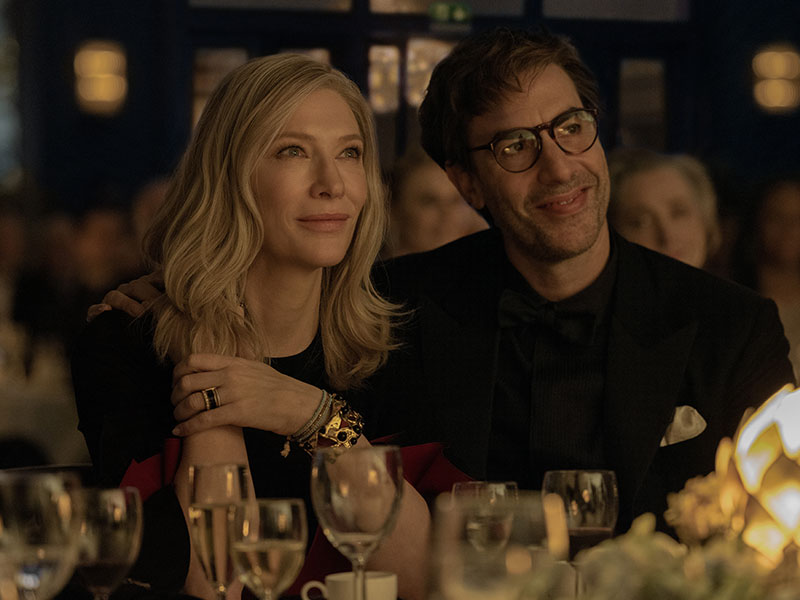
While it’s not exactly, uh, merry and bright, Alfonso Cuarón’s Apple TV+ limited series remains one of the most staggering pieces of television released in 2024. It’s abrasive and unforgiving, as cold as the blustery winter wind. The seven-episode series’ mercilessness is clear from the jump, when documentarian Catherine Ravenscoft (Cate Blanchett) comes across a mysterious novel, only to recognize herself and her dark past in its pages. Soon, Catherine finds herself embroiled in a plot that jumps between blackmail and revenge, all while trying to contend with the sins and trauma of an earlier life. In Cuarón’s hands, “Disclaimer” is as punishing as it is audacious, brimming with style and snared in a tangled thematic framework that’s as much fun to analyze as it is to watch. You’ll confront unscrupulous truths and battle preconceptions to reach a bravura end. “Disclaimer” will haunt you like Jacob Marley did to Ebenezer Scrooge, and like Scrooge, you’ll come away with lessons in hand.


Why it’s a good binge now: The show divided both audiences and critics, which means that it’s a prime candidate to watch for yourself and find out what side of the spectrum you fall on. — Coleman Spilde

04
"Feud: Capote vs. The Swans" (Hulu)
Feud: Capote vs. the SwansFeud: Capote vs. the Swans (FX)

For those who like their holidays served up with a side of scandal, there is “Feud: Capote vs. the Swans.” For its long-awaited second season, Ryan Murphy handed over the reins of his billionth anthology series to director Gus Van Sant and writer Jon Robin Baitz, who gave the show a fabulous shot in the arm. The show details the lead-up and sensational fallout from Truman Capote’s autofiction exposé of the gaggle of upper crust women in his social circle, which resulted in a banishment that would send “Gossip Girl” to the hospital in shock. It’s star-studded event television for those of us whose Super Bowl is not just the Oscars, but the glamorous gossip from inside the Vanity Fair after party. Tom Hollander is a dead ringer for Capote, while Naomi Watts’ Babe Paley is stunning and tragic. Throw in Chloé Sevigny, Diane Lane, Calista Flockhart, Demi Moore and Molly Ringwald, and you’ve got a party worthy of a modern Capote satire.


Why it’s a good binge now: This frothy gossip goes down like good champagne: fast and easy. It’s the perfect present to yourself this holiday season. — Coleman Spilde

We need your help to stay independent

05
"Love in the Big City" (Rakuten Viki)
Love in the Big CityLove in the Big City (Rakuten Viki)

No need to visit AMC Theaters to experience heartbreak that feels good, despite what Nicole Kidman will have you believe. "Love in the Big City" will take care of that for you in the comfort of your own home. In the k-drama, Go Young (played by the lovable breakout Nam Yoon-su from "The King's Affection") is a young closeted gay man living in Seoul who just wants to write, dance in the club with his friends and find a nice guy to fall in love with. The series jumps around in time, following Young's dating mishaps while he also deals with his ailing mother who had once forced him into gay conversion therapy


In lesser hands, this could feel like a self-indulgent Millennial mess, but "Love in the Big City" has a head start with its source material, Sang Young-park's novel that was long-listed for the International Booker Prize in 2022. With Sang writing the script, the series maintains the essence of his sardonic-sweet prose. Did we mention that Young has dubbed his HIV-positive diagnosis "Kylie" after his favorite pop diva? 


Conservative groups in South Korea had protested the release of "Love in the Big City" for its LGBTQ+-friendly content, which frankly, only helped to increase the show's profile. Nam himself was unfazed by the backlash and passed up other projects for this one, and we're so glad he did. It's a career-defining role, and one that would not have succeeded as well without Nam's sheer magnetism. Young himself may have been rather unlucky in love, but he wins us over by exquisitely making our souls ache.


Why it's a good binge: The eight episodes are broken into four distinct narratives of two episodes each, so you're essentially watching four sequential movies with the same protagonist. Bonus: The novel was in such high demand that a separate "Love in the Big City" was also adapted, which you can also check out Dec. 24 when it hits Viki.

06
"Matlock" (Paramount+)
MatlockMatlock (Brooke Palmer/CBS)

One of the year’s most pleasant surprises was the reimagining of “Matlock,” the long-running case-a-week series that bowed in 1995. Nearly 30 years later, “Matlock” returned to the airwaves with Kathy Bates stepping into Andy Griffith’s role . . . sort of. In this version, Madeline Matlock is a retired attorney returning to the workforce to take care of her family, or so she says. Really, Matlock is harboring a secret, one that allows her to operate under the disguise of a gullible granny who shares a name with the original series. “Just like the old TV show!” Bates chatters in almost every recap of the previous episode. That meta quality is a little silly, but “Matlock” is great because it has the bones of an old-school, earnest network drama, updated for our modern times. And if you question that, how’s this for a defense: Madeline Matlock is committing a radical act against the healthcare industry and the institutions that protect them. Sound familiar? See, “Matlock” can inspire us all! 


Why it’s a good binge now: It’s both the perfect before-bed comfort watch and an easy one to throw on around your family if no one can decide what to watch. — Coleman Spilde

07
"Nobody Wants This" (Netflix)
Nobody Wants ThisNobody Wants This (Netflix)

Some streaming titles have the flavor and pungency of a laboratory-synthesized snack, creations too perfect to be mistaken for natural. Here’s the thing about some of those pleasures, though – they may not have a lick of organic matter to them but darn it if they don’t taste like the absolute ideal of a delight and frictionlessly slide down the gullet. That’s what we have in this frothy romantic comedy realizing the fantasy ‘shipping of Veronica Mars and Seth Cohen from “The O.C.”  Consider the summary: Kristen Bell’s Joanne lucklessness at love is substantial enough to fuel a hit podcast she co-hosts with her sister Morgan (Justine Lupe), but that content takes a hit when she meets hot rabbi  Noah Roklov (Adam Brody). They’re heavily into each other, but can this shiksa overcome his community’s strict views on dating and aggressively hostile mother and sister-in-law? Bell and Brody’s swoon-inducing chemistry, their endearing co-stars (especially Timothy Simons, who makes an effective slapstick partner with Lupe), and a light, clever script conspire to make this a satisfying watch – and fulfilling to boot.


Why it’s a good binge now: The best part of the holiday season for many of us involves spending the day in our pajamas, and as much of it as possible in bed. This 10-episode love story is the perfect partner for that activity, and a great accompaniment if you already have a partner. Don’t forget to stock up on the snacks. – Melanie McFarland

08
"Severance" (Apple TV+)
SeveranceAdam Scott in "Severance" (Apple TV+)

While “Severance’s” slow-paced, sci-fi thriller vibes might not be for everyone – the time invested into this series will take viewers on a journey they cannot predict. Created by Dan Erickson and directed by Ben Stiller and Aoife McArdle, “Severance” is unlike any other show on TV right now. The show follows Mark (Adam Scott) leading a team of employees at a corporation called Lumon who have intentionally and willingly chosen to surgically sever their work selves and their personal lives. The series' spooky score and robotic and almost cult-like characters like Cobel (Patricia Arquette) and Milcheck (Tramell Tillman) are terrifying enough to give viewers nightmares. But when the larger mystery unfolds like an unraveling seam being perpetually yanked on, “Severance” draws viewers in and doesn’t let go. By the end of the season, audiences won’t want to stop watching this show’s smartly crafted class commentary on America’s hustle culture, capitalistic greed and the shocking revelations that even fictional corporations like Lumon find their employees completely disposable. 


Why it’s good to binge now: After three years since its season one premiere, the show is finally coming back for its second season on Jan. 17. Better catch up before you're inadvertently exposed to spoilers! – Nardos Haile

09
"Shrinking" (Apple TV+)
ShrinkingShrinking (Apple TV+)

Every cast member and character of the half-hour comedy “Shrinking” has permission to steal my heart. In the vein of “Ted Lasso,” “Shrinking” tells a feel-good, emotionally raw story of a grieving therapist, Jimmy (Jason Segel), and his unconventional therapy practices. Created by Segel, Bill Lawrence and Brett Goldstein, “Shrinking” takes mental health seriously by listening to its characters. But mostly it allows them the cathartic ability to laugh and find solace in friendship and family. This is where a character like Gaby, Jimmy’s co-worker (played by an electric Jessica Williams) excels and lightens every room she walks in. But I also can’t forget about the legend Harrison Ford, who plays Jimmy and Gaby’s grumpy boss, Paul. Paul is a straight-laced square, and Ford looks like he’s having a blast every episode pushing Paul to his limits. There’s nothing more appealing than watching a snippy Ford say some of the most outrageous lines on TV.


Why it’s good to binge now: “Shrinking’s” 30-minute episodes are a breeze to watch. Also, its second season is about to wrap up by Christmas Day. That gives you two full seasons to watch during the holidays. – Nardos Haile

10
"Somebody Somewhere" (Max)
Somebody, SomewhereSomebody, Somewhere (Sandy Morris/HBO)

Television will never tire of telling New York stories, but HBO only saw fit to give us three seasons of warm slices of life in Manhattan, Kansas. That’s where Bridget Everett’s Samantha retreats to grieve the loss of her sister Holly, forge a better relationship with her remaining sister Tricia (Mary Catherine Garrison), and figure out who she is. The holidays can feel lonely even if you’re surrounded by loved ones. If you feel that way, your heart will lift each time Sam finds new spaces and new people who help her to become a better version of herself – perhaps none as much as Joel (Jeff Hiller), her partner in teeny ‘tini tippling.


Many TV shows aspire to be feel-good viewing, but this one consistently lives up to that designation from the very first episode to the last, when Sam and Joel both land on some version of the life they want with the people they adore. With the world becoming increasingly bitter, riven and cynical, this show firmly reminds us that places like Manhattan, Kansas, exist too – where people are kind and big-hearted and understand that we all deserve happiness, love, and to be loved.  


Why it’s a good binge now: If your free screen time is at a premium right now, you may rejoice at knowing there are only 21 half-hour episodes to digest. That’s also a tremendous tragedy; the show ended far too soon. Much like the larger lesson of Sam’s story, though, you can always start it over and enjoy its familiar comfort in new ways. — Melanie McFarland

11
"The Sympathizer" (Max)
The SympathizerThe Sympathizer (HBO)

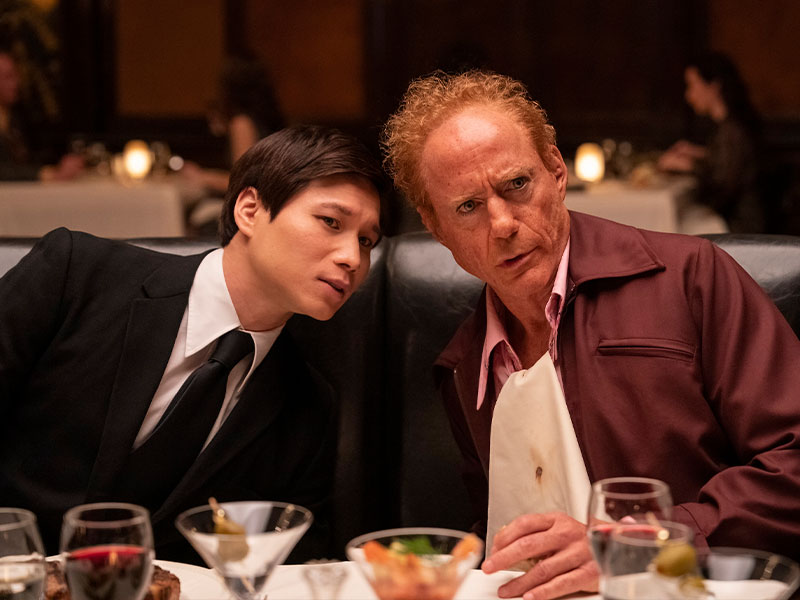
OK so maybe a satire about a Vietnamese double-agent challenging the American savior image who turns out to be an unreliable narrator in a prisoner reeducation camp may not sound like your definition of a fun binge, but hear me out. Viet Thanh Nguyen's Pulitzer Prize-winning novel seemed un-adaptable until HBO came along and put the care, resources and talent – hello, Park Chan-wook – behind it. Breakout Hoa Xuande is magnetic as the inscrutable man only known to us as the Captain, and through him, we encounter the confusion of post-war life and loyalties, the stunning shortcomings in an auteur-worshipping Hollywood system and a parade of Robert Downey Jr.s in various wigs and prosthetics. It's hilarious, disturbing, enraging and baffling all at once – but I defy you to emerge on the other side without gaining some glimmer of understanding of why the effects of the war still linger in our bones today. 


Why it's a good binge now: With only seven episodes total, you can watch one episode a day and be done in a week.— Hanh Nguyen

12
"What We Do in the Shadows" (Hulu)
What We Do in the ShadowsWhat We Do in the Shadows (FX)

If this is the time of year for staying in and doing the least, the Staten Island vampire coven has you covered. For six seasons the laziest roommates in this life or the afterlife – Nandor the Relentless (Kayvan Novak), Laszlo (Matt Berry), his "lady wife" Nadja (Natasia Demetriou) and Colin Robinson (Mark Proksch) – reminded us that withdrawing from the modern world is a valid and frequently hilarious survival option. Sure, the vampire quartet frequently venture into the streets of New York and beyond – they even hit Atlantic City once – but those adventures rarely go smoothly, often concluding with a body count or new enemy hunting them or unleashing some abomination. The lesson here is that leaving the house is overrated. As long as you have great friends around you and a reliable enabler like Nandor’s familiar Guillermo (Harvey Guillén), it’s better to bring the good times and blood orgies to your living room instead of navigating the never-ending amateur hour of the holiday hordes.


Why it’s a good binge now: Besides having just completed its run, the ending of “Shadows” reminds its faithful that starting over from the first episode is its own reward. And with 61 half hours under its lid, there’s enough good stuff to last you from Christmas through New Year's – if you drink in each season’s exploits bite at a time. – Melanie McFarland


King Charles’ “positive” cancer treatment will continue into the New Year, palace source says

King Charles' cancer treatment appears to be going well.

The king, 78, has been under medical care for his cancer since February this year has been responding well. Palace sources confirmed to People Magazine on Friday, Dec. 20, that "[Charles'] treatment has been moving in a positive direction and as a managed condition the treatment cycle will continue into next year.”

As the holidays are around the corner, Charles' promising health progress is shown in his busy schedule. He will spend the holidays with an array of public work and events, including trips planned around the U.K. and abroad.

Earlier this year, Charles was first hospitalized to treat an enlarged prostate. But while the king was in the hospital, doctors discovered cancer. The royal canceled all his engagements when his treatment began in February and returned to his public duties in April.

The royal family also had another member in their family with a cancer diagnosis. After a media frenzy about the Princess of Wales' whereabouts, the 42-year-old Kate Middleton revealed in March that she also had been undergoing cancer treatment in a video.

In a statement about Middleton, Charles' spokesperson said, he is "so proud of Catherine for her courage in speaking as she did," adding that he "remained in the closest contact with his beloved daughter-in-law throughout the past weeks," as they both were in and out of the hospital.

In the summer, the Princess of Wales said, “I am making good progress, but as anyone going through chemotherapy will know, there are good days and bad days."

“Saddest days”: “Wicked” star Ethan Slater’s ex-wife talks divorce amid Ariana Grande relationship

Lilly Jay, a psychologist and the ex-wife of "Wicked" star Ethan Slater, revealed how she felt about her marriage's public deterioration amid her husband's new relationship with co-star Ariana Grande in an essay for The Cut.

In the essay titled "How Does My Divorce Make You Feel?" Jay discusses the difficulties navigating her private life as a therapist after her separation with Slater became tabloid fodder. The media frenzy around their split only heightened as Slater's relationship with his then-married co-star Grande had gone public too. 

Jay and Slater were high school sweethearts and began dating in college in 2012. They married in 2018 and had their first child in 2022.

However, in 2023, Slater filed for divorce amidst speculation that he and Grande had begun a relationship while filming "Wicked." Reportedly, Grande had separated from her husband, Dalton Gomez. At the time, Jay told Page Six, "[Grande is] the story, really. Not a girl's girl. My family is just collateral damage."

In her essay, Jay wrote, "No one gets married thinking they'll get divorced. But I really never thought I would get divorced. Especially not just after giving birth to my first child and especially not in the shadow of my husband's new relationship with a celebrity."  

The therapist detailed that she survived preeclampsia during her son's birth. While Jay, as a perinatal therapist, knew how vulnerable postpartum was for new mothers and marriage, "I confidently moved to another country with my 2-month-old baby and my husband to support his career. Consumed by the magic and mundanity of new motherhood, I didn’t understand the growing distance between us," adding, "I work diligently on my private project of accepting the sudden public downfall of my marriage. This, I tell myself, is nothing to be ashamed of and nothing to hide."

Ultimately, Jay wrote, "As for me, days with my son are sunny. Days when I can’t escape the promotion of a movie associated with the saddest days of my life are darker."

Slater and Jay finalized their divorce in September this year.

Why Democrats can’t get over the grief of losing to Donald Trump

Following their trouncing by Donald Trump and the MAGA movement in the 2024 election, Democrats continue to plod through the stages of grief, vacillating between denial, anger and bargaining. This behavior is increasingly taking the form of self-soothing talk among its leadership, consultant and media class that their defeat in the 2024 election was not as extreme and dire as it first appeared (Trump won the popular vote and the Electoral College; the Republicans now control both chambers of Congress) and that a big rebuild and reassessment of the party and its strategy, messaging and leadership are not necessary.

At the Atlantic, Russell Burman details this reasoning in his new article “Maybe Democrats Didn’t Do So Badly After All:

Now a clearer picture of the election has emerged, complicating the debate over whether Democrats need to reinvent themselves—and whether voters really abandoned them at all.

Trump’s popular-vote margin has shrunk to about 1.5 percent — one of the tightest in the past half century — and because some votes went to third-party and independent candidates, he’ll fall just short of winning a majority of the vote nationwide. Compared with incumbent governments elsewhere in the world, Democrats’ losses were modest. And in the House, they gained a seat, leaving the GOP with the second-smallest majority in history. A trio of Republican vacancies expected early next year will make passing Trump’s agenda even more difficult, and Democrats are in a strong position to recapture the chamber in the midterm elections, when the incumbent party typically struggles.

The final results are prompting some in the party to push back against the doom-and-gloom diagnoses of Murphy, Sanders, and others who say the Democratic brand is in tatters and needs an overhaul. “If the Democratic brand was fundamentally broken and needed to be thrown out, this election would have been a complete blowout. And it was not. It was way too close,” Yasmin Radjy, the executive director of Swing Left, a Democratic organizing group, told me. Another Democrat, who requested anonymity in order to speak candidly, put it this way: “We lost an election. We didn’t lose the country.”

In some areas, the election looked like a red wave; compared with four years ago, the presidential vote swung to the right by about 10 points in some of the most populous blue states, such as New York, California, and New Jersey. But down-ballot races offer a solid case for Democratic optimism. The party label appeared to be far less of an albatross for Democratic congressional candidates than it was in strong Republican years such as 2010 and 2014.

Donald Trump supposedly does not have a mandate, they argue, because his victory was a very modest one, as The Nation summarizes:

FDR and Reagan had the numbers that were required to claim a mandate. Trump doesn’t. That’s why it is important, as he prepares to reoccupy the Oval Office, for progressives to unspin the narrative of the election that put him there. Yes, Trump beat Kamala Harris. But not by much. And the narrowness of the GOP advantage provides an opening for Democrats—along with a dwindling but potentially decisive cadre of rational Republicans—to block the worst appointments and most dangerous policies of a president who gained only a plurality of the popular vote.

The big lie Donald Trump told after the 2024 election was that he’d won a “powerful mandate” from the American people. He hadn’t, and neither had his MAGA movement. The United States is, undoubtedly, a divided nation. But a majority of Americans who cast ballots in the 2024 presidential election actually agreed on one thing: They did not want Trump as their president. With almost all of the votes tabulated, we now know that around 50.2 percent were cast for someone other than Trump….

Let’s crunch some numbers, shall we?

Trump’s margin was historically narrow. The president-elect’s 1.5-point advantage over Harris was, as a postelection analysis by the Council on Foreign Relations notes, “the fifth smallest of the thirty-two presidential races held since 1900.” Trump won 4 million fewer ballots than Joe Biden did in 2020. In 2024, if roughly 120,000 voters had switched their preferences in Wisconsin, Michigan, and Pennsylvania, Harris would have won the Electoral College and the presidency.

Donald Trump, for his part, has claimed a mandate. He behaves (and will continue to) as though he has a mandate to rule as the country’s first king. The polls show that the American people appear to be endorsing Trump’s “mandate” on such issues as “the border” and “the economy.” Arguing the details about vote totals will not stop Trump’s power and autocratic rule. In all, such obsessions are the equivalent of complaining about the referees when your team loses the big game. In the end, perception is usually treated as reality in politics.

If they proceed at the current pace, the Democrats (and their surrogates, news media and other opinion leaders — as well as rank-and-file voters and supporters) will not reach the depression and acceptance stages of grief anytime soon. As I have repeatedly warned here at Salon and elsewhere, they do not have the luxury of time.

In a sharp essay and call to action in the New York Times, Jamelle Bouie considers the Democratic Party’s lack of urgency and reluctance to rise to the challenge of Trumpism and the larger right-wing (fake) populist authoritarian movement. The Democratic Party needs to be in full opposition mode. Instead, the party and its leaders are mostly cooperating with, normalizing and de facto surrendering to President-elect Trump and the MAGA Republicans: 

An opposition would use every opportunity it had to demonstrate its resolute stance against the incoming administration. It would do everything in its power to try to seize the public’s attention and make hay of the president-elect’s efforts to put lawlessness at the center of American government. An opposition would highlight the extent to which Donald Trump has no intention of fulfilling his pledge of lower prices and greater economic prosperity for ordinary people and is openly scheming with the billionaire oligarchs who paid for and ran his campaign to gut the social safety net and bring something like Hooverism back from the ash heap of history….

The Democratic Party lacks the energy of a determined opposition — it is adrift, listless in the wake of defeat. Too many elected Democrats seem ready to concede that Trump is some kind of avatar for the national spirit — a living embodiment of the American people. They’ve accepted his proposed nominees as legitimate and entertained surrender under the guise of political reconciliation. 

There are other reasons for Democrats to try to take the initiative. There are still many Americans rightfully concerned with an authoritarian turn in the United States. Again, nearly half the electorate did not vote for Trump. They deserve leadership, too. Indeed, the party’s refusal to fight sends ripples through civic life. If Democratic leaders won’t fight, then it’s hard to expect civil society, or just ordinary people, to pick up the slack. Either democracy was on the ballot in November or it wasn’t, and if it was, it makes no political, ethical or strategic sense to act as if we live in normal times.

At the Hill, Democratic Party strategist Max Burns writes:

For the better part of two years, Democrats told voters that their country was on the precipice of disaster. Winning in November was imperative, party leaders insisted. Failure would bring catastrophe, not only for America’s democratic institutions but for the economy and working-class people as well. 

In normal circumstances, a party that fell short of preventing a crisis like that would be expected to engage in real introspection about what went wrong. Leadership changes would be expected. Like Republicans in the aftermath of 1960 or even 2008, the party would radically re-evaluate the decisions that led to this moment.

Not so in this Democratic Party, where long-time leaders are trudging forward as if nothing happened.

The result has been yet another schism between the base and the elites, with rank-and-file voters left to wonder why the party’s most visible young voices are once again being kicked to the side in favor of the same crop of stalwart septuagenarians. Democrats’ status quo leadership elections would be understandable for a party that outperformed expectations. But this is a party that just lost the White House, the Senate and blew a real opportunity to reclaim the House. 

Instead of listening to demoralized and frustrated Democratic voters, the party elders chose to protect leadership that has lost the confidence of the people. If the party has learned a lesson from the debacle of Nov. 5, it sure isn’t acting like it.

Last month’s elections proved that voters aren’t willing to wait around while Democrats get the message that it’s time for a change. The sooner Democrats realize that, the better for the party — and our democracy.

Demonstrating the validity of Burns’ and Bouie’s concerns, President Biden and Vice President Harris made a joint appearance at a Christmas holiday party last Sunday that was hosted by the Democratic National Committee (DNC) to thank the donors who collectively gave more than two billion dollars in the election. Harris told the attendees, “Our spirit is not defeated. We are not defeated … We are strong, we are clear about why we are in this….We cannot let any circumstance or situation or individual ever take away our power … we know what we stand for, and that's why we know what to fight for."

Grieve later, learn from the defeat and reorganize to fight back now.

As is his way, Biden offered one of his folksy sayings: “My dad would say, when you get knocked down, you've just got to get up, get up. The measure of a person or a party is how fast they get up.” Biden added, “The bad news for you all is I ain't going nowhere. We're going to stay engaged.”

Harris and Biden’s encouragements ring hollow. They are trying to rally the very same supporters that they led to a great defeat last month.

The loss to Donald Trump and the MAGA movement on Election Day should have been a profound moment of clarity for the Democratic Party and its leadership. Unfortunately, such a moment of clarity has not yet occurred. What Democrats need at this moment is bold leadership and clarity. Unfortunately, no such leader holds power.

During a speech earlier this month in Chicago at his foundation’s Democracy Forum event, President Obama also tried to chart a path forward for the country’s embattled democracy and by extension his political party. In a non-partisan speech (Trump was not mentioned by name) Obama emphasized themes of democracy and pluralism in a time of extreme polarization, division and ascendant American fascism and authoritarianism.

We need your help to stay independent

Obama’s speech was criticized for being too conciliatory and hopeful, if not naïve, about the prospect of coming together with a Republican Party and MAGA movement and its other “conservative” supporters who reject compromise, civility, truth, reality, facts, the rule of law and democratic institutions and who have elevated a political strongman to the highest political office in the nation.

On this, Obama said:

Now, I should tell you that when I’ve mentioned to a few friends that our foundation would be hosting a forum on democracy and pluralism, I got more than a few groans and eye-rolls. And it’s understandable, after all; here in the United States we have just been through a fierce, hard-fought election, and it’s fair to say it did not turn out as they hoped. And for them, talk of bridging our differences when the country and the world seem so bitterly divided felt like an academic exercise. It felt far-fetched, even naïve, especially since, as far as they were concerned, the election proved that democracy is pretty far down on people’s priority list. I understood their skepticism; maybe you have had a conversation with a friend that felt the same way. But as a citizen and part of a foundation that deeply believes in the promise of democracy — not only to recognize the dignity and worth of every individual, but to produce freer, fairer, and more just societies — I can’t think of a better time to talk about it.

You see, it’s easy to give democracy lip service when it delivers the outcomes we want. It’s when we don’t get what we want that our commitment to democracy is tested. And at this moment in history — when core democratic principles seem to be continuously under attack, when too many people around the world have become cynical and disengaged — now is precisely the time to ask ourselves tough questions about how we can build our democracies and make them work in meaningful and practical ways for ordinary people.

And that’s why we’re here. That’s what these forums have been about.

Here Obama considers the real challenge of trying to coexist in a democracy (however ailing) and political culture with a political party, political movement and other forces that reject such principles, norms and values.

Now, at this point you may be thinking, “All that sounds pretty good, but pluralism depends on everyone following a certain set of rules, that’s what you say, Obama.

It’s a problem. And when that happens, we fight for what we believe in. There are going to be times, potentially, when one side tries to stack the deck and lock in a permanent grip on power, either by actively suppressing votes, or politicizing the armed forces, or using the judiciary or criminal justice system to go after their opponents. And in those circumstances, pluralism does not call for us to just stand back and say, ‘Well, I’m not sure that’s OK.’ In those circumstances, a line has been crossed, and we have to stand firm and speak out and organize and mobilize as forcefully as we can.

I often wonder, how it must feel, emotionally and intellectually, for Obama to look at Trump’s second victory and what it will mean for multiracial pluralistic democracy and his legacy as the country’s first Black president. Obama is a great man of history. Donald Trump, America’s First White President (twice) is a great man of history as well. But their respective projects and legacies are anathema to one another. What will it mean for the nation as it tries to (or not) collectively reconcile such (dis)continuities?

At MSNBC, commentator Ben Burgis is extremely critical of Obama’s speech as exemplifying elite liberalism and meritocracy in an era of gangster capitalism and globalization and worsening income and wealth inequality, thus leaving the populist rage and anger of the working class and others left behind by that order to serve as fuel for Trumpism and authoritarian populism. In his essay “Obama still doesn’t get why Trump won. That’s the problem," Burgis explains:

During Obama’s eight years in power, America’s wars in the Middle East ground slowly onward. This was a crucial factor in the rise of Trump, who was able to (deceptively) market himself as “anti-war.” And on the economic front, Obama continued George W. Bush’s policy of bailing out “too big to fail” banks while leaving homeowners who lost their houses in the 2008 crash underwater. He oversaw eight years of mounting economic inequality. 

He’s not interested in giving the working class as a whole more structural power in our economy or our society. In other words, this is the same old centrism.

Those eight years saw flashes of left-wing populist outrage like Occupy Wall Street and the first Bernie Sanders campaign. These were handily defeated by the powers-that-be, though, from the NYPD clearing the protesters from Zuccotti Park to the Democratic Party quelling the Sanders insurgency. And at the end of the day there was nowhere for all that populist energy to go but Trump. 

Obama’s liberalism is far more concerned with shattering glass ceilings for deserving strivers than raising the floor of material security for everyone. And that’s exactly the kind of liberalism that failed the first time — so spectacularly that a grotesque pseudo-populist demagogue was Obama’s immediate successor. 

Now Obama’s vice president, Joe Biden, is running out the clock on his presidency, and Trump is returning to power, this time with far more working-class support. Meanwhile, more than a few Americans have despaired so thoroughly of fixing our society through politics that they’re willing to cheer for an assassin murdering a health care CEO in broad daylight on the streets of Manhattan. 

We urgently need a far better response to the current crisis than anything the dominant faction of the Democratic Party is offering. And the first step is to stop listening to Barack Obama.

In Obama’s speech at the Democracy Forum, some observers heard fire and growing motivation from the former president for direct intervention. By comparison, I heard (and read) a speech that was more mournful and, like the Democratic Party and other pro-democracy Americans, publicly working through the stages of grief about the 2024 election.

To that point, in an excellent article in Rolling Stone, Elizabeth Yuko explores the concept of “political grief” in the context of Trump’s victory in the 2024 election: 

In fact, there’s an even more specific term for what we’re going through.

“Political grief is a very real thing,” says Melissa Flint, PsyD, a professor of clinical psychology at Midwestern University Glendale, noting that it occurs on both individual and collective bases. “When one struggles with a particular ideology held by those in political power, there is grief.” 

This type of grief also reflects the feeling that your worldview or political beliefs — what we think is right vs. wrong, or morally valid — is under attack, she explains. In addition to the election loss, you may be mourning potential losses of your own rights and economic stability, as well as worried about the impact it might have on reproductive rights and public health. Political grief may also involve the fracturing of relationships as a result of ideological disagreements, or grappling with your identity if your values are at odds with the rest of your community.

You may also be mourning your future safety. “At the heart of political grief is a sense of despair due to the loss of predictability and safety in governmental structures,” writes Darcy Harris, PhD, a professor at King’s University College in Ontario specializing in non-death loss and grief, in her seminal article on political grief.

According to Harris, there’s also “a sense of paralysis” that occurs when you question whether those in power are capable of making decisions for the good of the country during a time of such political polarization. For those experiencing political grief, “loss of an election is equated with loss of identity, loss of agency, and loss of voice,” she writes. Its impact can be personal and painful.

Yuko continues, “What about the feelings of disappointment associated with the fact that more than half of the voting public chose a candidate who is a convicted felon, was accused of inciting an insurrection and routinely makes inflammatory and inaccurate remarks about women and marginalized populations? “We must acknowledge this as grief,” says Dion Metzger, MD, a psychiatrist practicing in Atlanta. “It’s not only the loss of the candidate you voted for, but also the dread of what’s to come. Grief and fear are two very strong emotions to have at once.”

The Democratic Party’s leaders need to be able to think in multiple dimensions, pragmatically, both about how they can win the political battles on the ground in the here and now, as well as in the future. In all, the Democratic Party needs much better vision and visionaries.

Trump and his MAGA agents and thought leaders possessed such a vision and that is why they were able to dominate on Election Day — and likely far beyond as they remake American society to serve their antidemocratic, anti-pluralistic and inhumane political and societal project. If the Democrats had a strong leader, he or she would have one standing order: Grieve later, learn from the defeat and reorganize to fight back now. With such a strong leader, the Democratic Party would now have its marching orders instead of being lost and slowly forming a circular firing squad.

Elon Musk throws his support behind Germany’s extremist far-right

Elon Musk, the billionaire whose support for Donald Trump has given him the president-elect's ear, is throwing his support behind Alternative for Germany (AfD), a far-right party that critics describe as xenophobic, extremist and perhaps even a successor to the Nazi Party.

“Only the AfD can save Germany,” Musk wrote in an X post on Friday. The post follows a series of endorsements for other far-right parties and leaders across Europe, including Italian Prime Minister Georgia Meloni and Reform UK chief Nigel Farage.

The AfD is on track to see its strongest election performance since 2013, when it was founded as a Euroskeptic party before embracing more strident ethno-nationalist views. Polls show the party winning the second-highest amount of votes ahead of the February 2025 election, setting it up to be the largest opposition party in the Bundestag.

The conservative Christian Democratic Union (CDU/CSU), helmed by Friedrich Merz, currently leads in the polls, with nearly double the support held by Chancellor Olaf Scholz's center-left Social Democratic Party (SPD). Trailing further behind are the Greens and Free Democratic Party (FDP), who both served as Scholz's erstwhile partners before the governing coalition collapsed last week.

A strong performance by the AfD would guarantee that no party gains a majority in the Bundestag. Merz has, for now, ruled out forming a coalition with the far-right.

AfD co-leader and chancellor candidate Alice Weidel welcomed Musk's endorsement. “Yes! You are perfectly right!” she posted, plugging an interview in which she blamed the "Soviet" European Union and "socialist" Angela Merkel, the former CDU/CSU chancellor of Germany, for her country's economic woes.

Musk has expressed support for the AfD before (despite one local imbroglio over a Tesla factory), writing in June that he does not understand why it is considered far-right, even as the AfD itself has provided reams of evidence.

The AfD's leader in Thuringia, Björn Höcke, once called Berlin's Holocaust memorial a "monument of shame" and called for a "180-degree turnaround" in Germany's remembrance of Nazi history. AfD co-chair Alexander Gauland spoke of fighting "an invasion of foreigners," while many influential blocs in the party subscribe to the belief that German citizens of migrant descent are not "properly German" and should be expelled. Indeed, in January 2024 senior AfD figures attended a secret meeting in which participants discussed a "master plan" for deporting millions of people with immigrant backgrounds, including naturalized citizens.

German authorities, citing publicly available data, classified the AfD as a "suspected extremist case" in 2021, a decision upheld by a high court earlier this year. That designation, part of a constitutional firewall against antidemocratic extremism set up after World War II, allows Germany's domestic intelligence agencies to monitor the party's activities and potentially apply the designation of "confirmed extremist," which could then open the way for a ban. The AfD's branches in Thuringia and Saxony, where the party has performed strongest, have already been classified as the latter.

Bitcoin, high on Trump, sobers up after Fed statements

Bitcoin, riding record highs following Donald Trump's embrace of the digital cryptocurrency, came back down to earth after Federal Reserve Chairman Jerome Powell said the central bank is not looking to hold it. 

Powell on Wednesday told reporters the Fed is "not allowed to own bitcoin," USA Today reported. He made the statements as he announced the final interest rate cut of the year and suggested fewer cuts next year.

"The Federal Reserve Act says what we can own, and we're not looking for a law change," Powell said. "That's the kind of thing for Congress to consider, but we are not looking for a law change at the Fed."

Powell was responding to a question on whether he saw any value in Trump's suggestion that the U.S. build a reserve of bitcoin in order to stay ahead of competition from pro-crypto countries, per USA Today.

On the campaign trail, Trump pledged to make the U.S. the "crypto capital of the planet" and helped launch a crypto business with his friend Steve Witkoff, a co-chair of Trump's inaugural committee who has been named special Middle East envoy. 

Bitcoin soared earlier this month after Trump nominated crypto backer Paul Atkins as Securities and Exchange Commission chair to take over from Biden appointee Gary Gensler, who led a crypto crackdown.

Bitcoin — a bellwether for the sector — hit a record high above $108,000 earlier this week. It has tumbled almost 15% since, and dropped to $92,600 on Friday morning, Bloomberg reported. Smaller tokens, including Ether and Dogecoin, were hit harder. Bitcoin and other cryptocurrencies had rebounded a bit by mid-morning Friday.

Bloomberg reports the mood shifted when a group of US exchange-traded funds investing directly in bitcoin on Thursday snapped a 15-day streak of continuous inflows to post a record outflow of $680 million.

The uncertainty in the crypto markets appears poised to continue over the holidays, Bloomberg reported.

“The interplay between monetary policy, institutional adoption, and political developments suggests Bitcoin will remain sensitive to both macro and crypto-specific catalysts through 2025,” Hani Abuagla, senior market analyst at XTB, said in a note on Friday, per Bloomberg.

Elon Musk just killed Donald Trump’s honeymoon

Back in 2016, the whole country was left in shock when celebrity businessman Donald Trump managed to take over the Republican Party and win the presidential election. At the time there was quite a bit of resistance within the GOP establishment due to the fact that Trump had not run as an ordinary conservative but rather as a populist demagogue. They had no idea that their voters were so hungry for his message. Gone were all the usual paeans to small government and family values and even his strong advocacy for expanding the military was coupled with a discordant isolationist stance that harkened back to the pre-WWII America First movement. (Trump had no idea about that history — he thought he came up with it himself.)

However, he was all for tax cuts for the wealthy, which is the lifeblood of the Republican Party. And he was reflexively hostile to anything his predecessor Barack Obama ever did, which meant that he was willing to reverse much of the progress that had been made in the previous eight years, pleasing Republicans to no end.

The activist base that had recently fashioned itself as the Tea Party after Obama's election in 2008, quietly reinvented itself as the MAGA movement and lost all interest in fiscal austerity the minute Trump came on the scene. But there has always been some restiveness among the right-wing ideologues in the House and Senate who really want to massively cut discretionary spending and the so-called entitlements to the bone. They're true believers in the idea that government should not help people, period. They were relegated to the back bench during Trump's first term and spent most of their time tilting at windmills because Trump was happily spending like the treasury was his own credit line at Deutsche Bank.

He had no appetite for big spending cuts that might hurt his chances for re-election. After all, he didn't run as a budget-cutting deficit hawk. He always claimed that he didn't need to drastically cut spending because the debt would disappear with tariffs and unprecedented growth. He said the same thing during the 2024 campaign, insisting that it would even pay for government-funded child care, the worst of all possible worlds.

He pays lip service to cutting spending but he doesn't really care about it. He's told people he's not worried about a U.S. debt crisis as he'll be out of office by then. And he's got stuff he wants to spend a lot of money on, like deporting millions of immigrants!

That's never been clearer than this week when Speaker Mike Johnson presented the bipartisan continuing resolution to fund the government until March and all hell broke loose in the House. Those rascally, backbench Tea Party/Freedom Caucus ideologues finally got the leader they've been waiting for and his name is Elon Musk, the richest man in the world.

It's clearly starting to come apart largely because Trump made himself a much lamer duck than he needed to be.

It was a given that the Freedom Caucus gang would not vote for the bill. They vote no on everything. It had been negotiated on a bipartisan basis in both chambers with the knowledge that the Senate was still in Democratic hands and the tiny GOP majority in the House required a compromise. Everyone knew that the screamers in the House would have a fit and call for Mike Johnson's head (which is why they changed the rule raising the threshold from one member to nine.) And since the speaker knows better than to go to the john without getting Trump's permission, you can be sure that Trump was kept informed of all of this. They all agreed that they would get rid of this hot potato, adjourn quickly and go home for the holidays.

That didn't work out the way they planned. Trump thought he had cleverly boxed Musk out of real power by creating a powerless "commission" for him and his sidekick Vivek Ramaswamy to come up with enormous spending cuts to reduce the federal government by as much as a third, which he knows won't happen. However, Trump has essentially empowered Musk to speak for him by having him by his side every minute for the last three months. And seeing as he's the richest man in the world who owns a major social media platform, he has plenty of power all on his own.

We need your help to stay independent

Apparently, Musk decided that it was time to show the world who's really in charge. As the anointed budget cutter in chief he took great umbrage that anyone would think of passing legislation that didn't pass muster with him personally and took to his social media platform to demand that the Republicans refuse to pass the bill, ordering a government shutdown until Trump takes office. The bill quickly fell apart, prompting Donald Trump, who clearly had no idea what was going on, to rush out with a statement that it was he who ordered that the bill be scrapped:

“As soon as President Trump released his official stance on the CR [continuing resolution], Republicans on Capitol Hill echoed his point of view. President Trump is the leader of the Republican Party. Full stop,”

But it was too late. The memes had already taken hold: Elon Musk is the actual president and Trump is just an old guy playing golf and holding court at his gaudy beach club in Palm Beach every night.

Trump then came up with what he thought was a clever idea to take control by demanding that they only pass a bill if it also delayed or eliminated the debt ceiling, which just showed how out of touch he is with the dynamic in the House. (As I said, Trump has a lot of spending to do and he doesn't want the debt ceiling hanging over his head.) But if President Elon's accomplices in the Freedom Caucus are on a crusade against more government spending, why in the world would they agree to eliminate the debt ceiling?

Trump no doubt thought the Democrats would bail him out because they have often done so in the past and they always wanted to get rid of that silly contrivance. Sadly for him, they said "hell no" and refused to vote for the pared down bill Johnson and the Republicans proposed without Democratic input. 38 Republicans also voted against it because of the debt ceiling demand Trump has inserted which is a full slap in the face of Dear Leader.

It's Elon Musk's House now. In fact, a bunch of Republicans are proposing that they fire Johnson and make him Speaker instead.

Musk is now furiously trying to mend fences with Trump by threatening to primary Democrats, blaming them for what he actually did. It's highly probable that his demand for a government shutdown over Christmas, which Trump knows will be blamed on the Republicans because they are always the ones who cause these things, has killed Trump's honeymoon.

What we are seeing is an emerging crack in the GOP coalition between the MAGA populists like Trump and JD Vance who want big government for their own ends and the fiscal hawks like Musk and Ramaswamy who want to burn the whole place down. There are many overlapping interests within the two camps but it's clearly starting to come apart largely because Trump made himself a much lamer duck than he needed to be.

Trump wanted the richest man in the world by his side, for both the glamour and the lucre he brings with him, and it's blowing up in his face. How's Trump going to get rid of Musk now that he's shown he has more clout with the base than he does? Who owns the MAGA brand now? 

MAGA hated Michelle Obama’s healthy food agenda — here’s why they changed their tune under RFK Jr.

Let's get one thing out of the way: Robert F. Kennedy's claim that he wants to "make America healthy again" is, like most things he says, a flat-out lie. Donald Trump's nominee to run Health and Human Services (HHS) is a conspiracy theorist who opposes not just vaccines but science-based medicine generally, promoting a bunch of "alternatives" that are often actively bad for people. Certainly, Kennedy and his defenders pretend to believe in healthy eating and exercise. As journalist Michael Hobbes pointed out on Bluesky, however, such rhetoric is one of the fig leaves vaccine critics use "to make their ideas seem palatable." Most of what Kennedy claims is "healthy" is very much not. Even when Kennedy mixes in a couple of truly healthy ideas, like eating vegetables, into the mix, he does so to promote the lie that the medical establishment supposedly discourages this behavior. 

This is a list of things that are either: A) 'suppressed' because they are quack bullshit (raw milk, chelating compounds) or B) not remotely 'suppressed'! Every health agency in the country already promotes vitamins and sunshine.

[image or embed]

— Michael Hobbes (@michaelhobbes.bsky.social) December 13, 2024 at 11:54 AM

To pretend Kennedy is just a healthy guy asking people to eat better, Republicans have suddenly discovered a yearning desire for people to drop the French fries for some broccoli. During a Senate hearing with the Food and Drug Administration (FDA) commissioner earlier this month, ranking member Sen. Bill Cassidy, R-La., laughably claimed that "promoting healthy foods is a top priority" for the incoming Trump administration, throwing in Kennedy's "make America healthy again" slogan, as a boot-licking flourish to his opening remarks. 

This feigned concern for American diets is especially silly because it wasn't all that long ago that these same Republicans were worked into a lather of outrage at then-First Lady Michelle Obama for suggesting kids should eat better and run around outside sometimes. CNN recently ran a supercut of Obama-era Republicans falsely claiming Obama was coming into their homes to confiscate salty or fatty foods. 

WATCH: “There was another person who tried to raise concerns about the health of the food we feed our children…” CNN’s Abby Phillip shows a supercut of how Hannity and other Republicans attacked Michelle Obama for what they’re now turning RFK Jr. into a hero for.

[image or embed]

— The Tennessee Holler (@thetnholler.bsky.social) November 14, 2024 at 11:28 PM


Want more Amanda Marcotte on politics? Subscribe to her newsletter Standing Room Only.


One of Trump's first moves in his previous term was to end government regulations keeping school lunches healthy so that schools could claim pizza is a "vegetable." Now the same Republicans who acted like they were being murdered by Michelle Obama's carrots are suddenly talking like they've always been down with good nutrition. 

Republicans are always engaging in bad-faith partisan politics, of course, but one reason this about-face is such an easy sell with the MAGA masses is plain old misogyny. GOP pundits found it easy to tar Obama with a sexist stereotype of the joy-kill mom telling kids to eat their vegetables. I'll leave it to readers to speculate what it says about MAGA voters that they so easily slotted themselves into the role of recalcitrant children. 

Much of what gets marketed as "wellness," by Kennedy and other grifters, is actively bad for people's health.

Kennedy, however, sells his phony "health" brand with hyper-macho imagery. He posts videos of himself working out shirtless and associates with dudebro influencers like Joe Rogan, whose constant chatter about nutrition is often tied to merch websites that sell overpriced and ineffective supplements. The "manosphere" of masculinity influencers is marketed largely through a "self-help" lens, promising men better romantic and financial lives. So it makes sense that there's an increasing overlap with the "wellness" industry.

But "wellness" is not health. In many cases, the two are in direct conflict. "Wellness" is best understood as an elite alternative to the proletarian "health." To use airplane tickets as a metaphor, "wellness" is first class, and "health" is economy. Especially as developed countries expand health care access, the baseline concepts of health — eating right, exercise, vaccination, regular doctor visits, blood pressure and cancer screenings — become associated with working-class people. It's not a coincidence that "wellness" took off after the Affordable Care Act was passed. When poorer people can go to the doctor regularly, the elite want something different to set themselves apart. Let the hoi polloi have vaccines. The wealthy will eat expensive organic foods and tell themselves it's a superior form of defense against disease. 

Much of what gets marketed as "wellness," by Kennedy and other grifters, is actively bad for people's health. For instance, Kennedy falsely claims that Americans are "being unknowingly poisoned" by vegetable-based oils, and should switch to animal fats like lard or butter. On Thanksgiving, he put up a video where he deep-fried a turkey in beef tallow, ridiculously claiming it's healthier than, say, roasting it in the oven. It should go without saying that this is exactly the opposite of the truth, and not because of the risk of burning down your $4 million mansion. But sure, as a reminder: Beef tallow, lard, and butter are all high in saturated fat, that stuff that gives you heart attacks and strokes. Seed oils like canola should be used in moderation, but they aren't nearly as dangerous to your heart as beef and pork fat. 

But a lot of people, especially right-wing men, are eager to hear that artery-clogging fats are good for you now because vegetables are coded as "feminine" and meat as "masculine." Kennedy is following other masculinity grifters, like Jordan Peterson or the Liver King, who have used gender anxieties to sell men on the false notion that hamburgers are healthier than salads. But this is also about class. Beef tallow and butter cost more than canola oil, and deep-frying a turkey requires pricey equipment and space — like that now-burned mansion — that is often not available to working-class people. 

As Hobbes points out, once you look past Kennedy's surface-level rhetoric to his actual positions, he's a bog-standard Republican who wants to repeal a slew of government regulations that protect people from disease, food poisoning, and pollution. The focus on "wellness" should be understood not as an effort to improve America's health, but as an excuse for tearing up systems that protect people. Implicit in "wellness" rhetoric is the idea that poor health is strictly a result of personal choices, which are subjected to moralizing judgment. If scaling back vaccines leads to people dying, the victims will be blamed for not eating beef tallow. Cuts to health care will be justified by claims that it's up to ordinary people to do more push-ups so they don't "need" doctors. If air pollution leads to higher rates of childhood asthma, the parents will be blamed for not buying supplements from Joe Rogan. This is just the "personal responsibility" grift Republicans have used forever, but repackaged with heavily gendered "wellness" trappings.  

Politics, discos, private islands: Billionaires spent big in 2024

By many measures, 2024 was a good year for the ultra wealthy. The world’s 10 richest people — including Elon Musk, Jeff Bezos and Mark Zuckerberg — saw their collective wealth increase by $64 billion following the reelection of former President Donald Trump

Over the past year, the wealth of the world’s billionaires leapt by roughly 17% to a staggering $14 trillion. That figure has nearly doubled in the last decade; in 2015, billionaires’ collective wealth stood at roughly $6.3 trillion, per Reuters.

So, what’s a billionaire to do when their wealth balloons beyond all comprehension? Why, spend some of that money, of course! Here are a few ways some of America’s wealthiest lightened their very large wallets. 

Musk's $277M election, $35M Texas compound

If Elon Musk, the world’s richest person with a net worth of $455 billion, didn't buy the 2024 election then he certainly splurged on it. Musk was the largest single donor, giving a whopping $277 million to the Trump campaign and other Republican candidates, according to The Washington Post

In October, The New York Times reported that Musk shelled out $35 million on a multi-property compound in Austin, Texas, where he envisions his children and two of their three mothers living. That way, Musk could “schedule time among them,” the Times reports. Cozy! Musk has at least 11 children, and one of the mothers has moved with her kids onto the compound, which has a villa spanning 14,400 square feet and another six-bedroom mansion behind it. It's not clear how successful this venture will be. 

We need your help to stay independent

In November, Musk’s artificial intelligence company, xAI, raised $6 billion in equity financing, per Reuters. The company plans to use those funds to purchase 100,000 Nvidia computer chips for a new Memphis supercomputer that’ll power Tesla’s self-driving cars, TechRadar reported. What a beautiful display of corporate synergy. 

Taking our sights off planet Earth for a moment, Musk’s space exploration venture SpaceX agreed in December to buy stock back from investors in a $1.25 billion deal, according to CNBC. That sale sent the company’s stock valuation soaring to an astronomical $350 billion valuation. 

And who says billionaires can’t joke about purchasing broadcast networks on a whim that would change the face of American media? After Trump’s reelection, Musk joked about buying MSNBC in a post on X, which he bought in 2022 for $44 billion. “How much is it?” Musk wrote, responding to a post from Donald Trump Jr. about Comcast’s November announcement that it would spin off MSNBC and other cable networks into a separate company. 

Musk quipped about buying MSNBC and Hasbro

Musk made a similar joke about buying Hasbro, the toymaking giant, after the company released a 40th anniversary “The Making of Original Dungeons and Dragons” book that acknowledged the game’s original content included insensitive and derogatory language. 

“Nobody, and I mean nobody, gets to trash … the geniuses who created Dungeons & Dragons," Musk wrote on X. "May they burn in hell."

“How much is Hasbro?” he quipped in a later post

Bezos bought a $90M Miami bunker

Jeff Bezos, worth an estimated $246 billion, paid $90 million for a six-bedroom home in April in Indian Creek, a 300-acre man-made island near Miami known as “Billionaire Bunker.” (Other residents include Tom Brady, Jared Kushner and Ivanka Trump, Carl Icahn and Julio Iglesias.)

Bezos already spent $147 million for two other mansions in Indian Creek, and Bloomberg reports that Bezos plans to live in the $90 million home while he demolishes the other houses he bought, citing a person with knowledge of the deal. 

If those construction projects become too much of a headache, Bezos can kick back on a flight in his $80 million private jet he purchased in August. Bezos’ new Gulfstream G700 luxury business jet can reach top speeds of 710 miles per hour — roughly 92.5% the speed of sound.  

The Amazon and Blue Origin CEO announced in 2023 he would leave Seattle after 30 years and relocate to Miami. It’s worth noting that in 2022, Washington state imposed a 7% capital gains tax on the sales of stocks and bonds worth more than $250,000. That change took effect in 2022; Bezos didn’t sell any Amazon stock in 2022 or 2023. 

As a Miami resident, Bezos sold more than 50 million shares of Amazon stock this year, netting him $13 billion, The Puget Sound Business Journal reported. Before Bezos executed those sales, CNBC estimated that moving to Miami would save him roughly $600 million in capital gains taxes on a sale of 50 million Amazon shares, according to CNBC

And while Bezos didn’t expand his collection of seafaring vessels, he and his fiancé Lauren Sánchez spent time entertaining on his $500 million superyacht, which is so huge that it once had to dock in a spot typically reserved for oil tankers. The couple hosted Katy Perry, Orlando Bloom, Leonardo DiCaprio and his girlfriend Vittoria Ceretti off the coast of Italy, and Kim Kardashian in the Aegean Sea near Greece.

Zuckerberg had a disco, with a side of statue

Like Bezos, Zuckerberg — worth an estimated $219 billion — reaped billions by selling stock in his companies in 2024. He made more than $2.2 billion this year through selling shares of Meta, according to an analysis from Fortune magazine

And like Musk, Zuckerberg has spent billions of dollars on Nvidia supercomputing chips this year. In the company’s third-quarter earnings report, released in October, Meta said total expenses for 2024 will be between $94 billion and $99 billion, driven in part by the company’s purchases of Nvidia chips and expanding its supercomputing capabilities. 

But don’t worry, it wasn’t all work for Zuckerberg. He threw his wife Priscilla Chan a massive backyard disco party in October (no, it wasn’t her birthday!), just two months after unveiling a giant statue of her, rendered in a brilliant turquoise. He also expanded his burgeoning watch collection, reportedly buying pieces by Patek Philippe, Jaeger-LeCoultre, De Bethune and F.P. Journe since March. 

Zuckerberg expanded his expensive watch collection

If you aren’t familiar with any of those brands, same. Just know that Patek Philippe watches can range from $20,000 to a couple million dollars, and a Google search of “De Bethune watch" shows prices between $90,000 and $160,000. 

It's good to be Larry

2024 was also a good year for billionaires named Larry. 

Larry Ellison, co-founder of Oracle, paid at least $277.3 million to buy Eau Palm Beach Resort & Spa — a five-star hotel and resort — in a wealthy town south of Palm Beach, Fla. That was Ellison’s second real estate deal in the small town of Manalapan; in 2022, he spent $173 million on another compound on the island, representing the largest residential real estate sale in Florida history. Ellison's net worth is estimated at $194 billion, per Bloomberg.

Meanwhile, Google co-founder Larry Page, worth $169 billion, kept things a bit more subdued, only shelling out $32 million to buy a Caribbean island between Puerto Rico and the British Virgin Islands, Fortune reported. Page owns at least five private islands across the globe, according to Fortune. 

This year, my biggest splurges included a $98 pair of wool pants and a new Owala water bottle. What’d you spend your fortune on this year, fellow normie?

Sudan’s gruesome civil war has a new driving force: the meth trade

In October, a member of the Reddit community r/meth, an online hub for methamphetamine enthusiasts, went viral for a series of posts purporting to be from an active duty soldier in the Sudanese civil war. In one post, he talks about looting baggies of crystal from the lifeless corpses of fallen foes. In another post, he’s dropping notoriously inaccurate barrel bombs “filled with whatever will go boom” from an old, Soviet-era warplane. 

This wasn’t the first time 31-year-old Adande had tried meth. After having largely grown up abroad, he’d already been busted for dealing the drug in Oman.

“I was taken from jail and deported and thrown directly in the middle of the war zone,” he told me. Stepping foot back in his homeland, where it was kill or be killed, Adande believed it was in his best interest to enlist.

Adande said he belongs to “a tribal militia called the United Front,” which is now supporting the Sudanese military in its campaign against the Rapid Support Forces, or RSF, a rebel military faction that broke with the government in 2023. He sent along a video of himself holding his ID as proof of his claims.

“I’m not in any specific division, I just happen to be related [to] the militia head, so I was trained a little and got to be a part of many aspects of the war,” he said. “I saw and still see ground action, aerial missions that are coordinated with the army, etc., but I am never on the frontlines as I mainly help with the technical/financial/logistics and anything else my education and experience allows … I do have a rank but it's kinda bulls**t and just based on the family/tribe thing and more honorary than anything. I was just lucky that even though I was never [living] here, just coming from the ‘right’ family is enough to get preferential treatment.”

Abande holding a gunAdande holding a gun (Courtesy of Adande)

Sudan, on the frontiers of Arab-dominated North Africa and sub-Saharan Black Africa, has long relied on using tribal militias to quash insurgencies. One such militia was the Janjaweed (sometimes translated as “devils on horseback”), which carried out a genocidal counterinsurgency in the Darfur region of western Sudan from 2003 to 2005, before evolving into the paramilitary RSF led by General Hemedti. After dictator Omar al-Bashir was toppled via a revolution in 2019, the RSF and official Sudan Armed Forces stepped in to “manage” the transition of power. Then, in a 2021 coup d’etat, the SAF cast aside whatever remained of civilian leadership altogether to rule alongside Hemedti’s RSF. But their uneasy power-sharing arrangement collapsed into open warfare by April last year.

The ethnic Arab RSF, backed by wealthy Middle Eastern monarchies such as the United Arab Emirates, has resumed its genocidal campaign against Black Sudanese, allegedly bursting into villages to gang-rape the women in front of their families and slaughter every male older than age 10. There have been reports of mass suicides among survivors. The death toll from the conflict may already be in the hundreds of thousands, although the true number is unknown, while over 14 million have been forced to abandon their homes.

"More than half" of Sudanese soldiers use meth, Adande said, "mostly to be able to stay up for four or five days straight and get more s**t done … and as a way to do missions that you probably won't do sober."

Sudan is a major producer and exporter of cannabis (known locally as "bango"), and for centuries that was the drug of choice until approximately 2019 with the arrival of stimulants, particularly methamphetamine or crystal meth. The seemingly sudden surge of meth use sparked a panic in Sudanese society. The reigning junta declared a war on drugs, claiming that counter-coup protesters were high, while independent media reports the narco-business is facilitated by elements within the military, police and RSF.

Lubna Ali, head of the Bit Makli Organisation and director of the Gadreen Centre for Addiction Treatment, the only such institution in the country which is still functioning, told Salon that in her centre in Port Sudan, 90% of substance use disorders involve methamphetamine.

“Methamphetamine is not produced in Sudan — it only comes from overseas,” Ali said. “The drugs began spreading before the war and attracted the youth, because they have not had self-esteem for a long time. First of all the revolution, and after that corona[virus] comes and there is no school or work for two years. Then this war. Almost five years from when the youth are supposed to finish university, they are stuck in the second year or third year.”

Abande holding a bag of methAdande holding a bag of meth (Courtesy of Adande)
“They feel they don't have any future,” Ali continued. “Some of them cope with the stress with drugs. Some of them committ suicide. Some of them illegally emigrate to Europe, paying whatever they have, selling their family houses or do anything. Maybe they sell drugs in the streets to get money to be able to escape out of the country.”

Ali noted that meth use has exploded since the outbreak of war, particularly among militia members. As for drug use within his ranks, Adande says it's “very common.”

“More than half" the soldiers use it, he said, "mostly to be able to stay up for four or five days straight and get more s**t done, and yeah, recreationally too, and as a way to do missions that you probably won't do sober." Senior officers tend to "turn a blind eye if you can control yourself and do your part, and if you tweak and go crazy, you'll get killed in the next mission/raid/battle anyway, so that problem sorts itself out.” He said some officers are using meth as well, but not as many or as visibly as ordinary soldiers.

We need your help to stay independent

Drugs and war have been a common combination throughout history. Probably the best-known case study was World War II, where stimulants were used on all sides to keep their troops fighting on minimal sleep. But pretty much any major conflict in the last 2,000 years has featured drugs in some way. The term “Dutch courage” (to do something drunk you'd be too scared to do sober) originates from the Anglo-Dutch wars of the 17th century, where soldiers braced themselves with sips of jenever, a Dutch version of gin.

“The use of alcohol and other drugs during wartime is historically documented back as far as 333 B.C., with references to the use of opium poppy sap to relieve the suffering of war during Alexander the Great's invasion into Persia,” said Dessa K. Bergen-Cico, a professor of addiction studies at Syracuse University. 

In the 1932-35 Chaco War between Bolivia and Paraguay, parcels of coca leaves were airdropped to Bolivian soldiers. Chewing coca provides a mild, invigorating buzz, and if processed further the leaves can be used to extract cocaine. During the 1939-40 Winter War with the Soviet Union, Finnish troops dosed themselves with heroin in order to keep fighting through their runny noses and the fierce Nordic winter. The Finns consumed 25 times more heroin than anyone else in the world, at a time when that drug could be found in any pharmacy as pills or cough syrup. Finland was so fond of heroin that the nation resisted U.N. efforts to ban it all the way into the 1950s.

Long before insurgents in the Middle East began deliberately blowing themselves up, the Japanese used kamikaze pilots in World War II, perhaps the first suicide bombers. Filling their planes with explosives, the kamikazes’ aim was to crash headfirst into U.S. warships, causing maximum damage. Methamphetamine was actually invented in 1893 by Japanese chemist Nagayoshi Nagai — before their final mission, the pilots were given large doses to fire them up in case the samurai credo of death before dishonor wasn’t enough. 


Want a daily wrap-up of all the news and commentary Salon has to offer? Subscribe to our morning newsletter, Crash Course.


The Nazis were especially mad for meth. Tank drivers and fighter pilots were fed meth-filled chocolate bars, and Berlin factories churned out 35 million “energy pills” for the 1940 invasion of France, which partly explains the rapid German advance — they were overamping (the technical term for “tweaking”) all the way to Paris. The Allies, meanwhile, swallowed pep pills known as Benzedrine: A hundred thousand pills were procured by Field Marshal Montgomery for the 1942 battle of El Alamein in Egypt. Only the Red Army didn’t dose its troops with speed, instead drowning them in vodka.

More recently, Captagon, a weaker speed-like stimulant, provided chemical courage to all sides during the Syrian civil war, numbing hunger, pain, fear and the need for sleep.

During the 1939-40 Winter War with the Soviet Union, Finnish troops dosed themselves with heroin to keep fighting through their runny noses and the fierce Nordic winter.

Substance abuse and addiction are closely correlated with trauma, and a population rattled by guns and grenades can take longer to find peace than negotiations themselves. After World War II, leftover meth stocks were peddled in occupied Tokyo by the yakuza, capitalizing on nationwide shock, defeat and humiliation. Could a postwar addiction crisis be awaiting Sudan?

“Yes, it most certainly will,” warned Bergen-Cico. “Drugs, including alcohol, are mechanisms of defense from one’s thoughts, emotions and physical pain. After decades of conflict, addiction rates among the population in Afghanistan are estimated at 10%. The Ukrainian Health Ministry and Ministry of Defense are actively preparing to meet the traumatic stress and addictions needs of its citizens, veterans and military — knowing that everyone has been affected to some extent.”

As for Adande, when we last spoke he was hiring a smuggler to drive him over the desert abroad. It turns out Sudanese intelligence officers intel are on Reddit as well, and were not too impressed with his viral meth-posting.

“They have a capture or kill order on me, I know that from three reliable sources,” he told me. “Simply because of my history, background and online activity, they think I’m paid by UAE or something and the level of noise my posts made means I am state-backed and not just an idiot over-sharing.”

For his part, Adande was pessimistic about his nation’s future or a resolution to war, saying “It’s just Sudan being Sudan.”

Trump-supported bill to avert government shutdown fails in House amid GOP revolt

Despite the backing of GOP leadership and President-elect Donald Trump, a proposal meant to avert a looming government shutdown failed 174-235 in the House on Thursday afternoon.

The package from Speaker Mike Johnson and the Appropriations Committee was the second attempt at passing a resolution to fund the government into March 2025. The so-called "Plan B" was launched after the disapproval of Trump and billionaire Elon Musk sunk a resolution meant to fund the federal government on Wednesday.

38 Republicans voted against the proposal, along with nearly all of the Democrats in the House. Minority Leader Hakeem Jeffries, who earlier in the day called the bill “laughable,” celebrated the package’s failure late on Thursday.

“The Musk-Johnson government shutdown bill has been soundly defeated. MAGA extremists in the House GOP are not serious about helping working-class Americans,” Jeffries said in a post to Bluesky. “They are simply doing the bidding of their wealthy donors and puppeteers.”

In addition to keeping the federal government operations, the bill would have handed the incoming Trump administration and GOP-controlled Congress a two-year suspension of the debt ceiling. Trump warned that he would push to primary any Republican who voted in favor of a funding bill that did not include a raising or suspension of the debt limit.

Republicans voting against the bill signaled their opposition to any long-term debt ceiling adjustments. Texas Rep. Chip Roy told reporters he would "go vote for another debt ceiling increase" without specifics on what spending could be cut from the federal budget.

The failure is yet another blow to Trump's supposed mandate. He had endorsed the proposal ahead of the vote in a post to Truth Social.

“SUCCESS in Washington! Speaker Mike Johnson and the House have come to a very good Deal for the American People,” Trump wrote. “All Republicans, and even the Democrats, should do what is best for our Country and vote 'YES' for this Bill TONIGHT!”

The maneuver that was used to introduce the funding proposal came with a requirement that two-thirds of the House approved the measure. Its failure will enable Johnson to reintroduce the bill with a simple majority requirement to pass. If the vote on Thursday is any indication, it will not pass that bar, either. Without an approved resolution, the federal government will enter a shutdown on Saturday.

Biden aides’ “hand holding” shielded the president from critiques: report

The White House took unusual steps to keep President Joe Biden out of the public eye and away from many daily duties, a new report alleges.

The Wall Street Journal shared that White House staffers kept Biden insulated from the outside world while Cabinet members independently implemented Biden’s agenda. The outlet based its findings on nearly 50 on-and-off-the-record conversations with staffers and other insiders.

“They body him to such a high degree,” an unnamed source told the Journal, criticizing top aides’ “hand-holding” of the president.

As Biden's term wore on, Cabinet officials took calls with Biden less frequently, the report alleges, directing their agencies without the president’s oversight.

Biden staffers kept a tight circle, shielding the president from second opinions, the report claims.

House Armed Services Committee Chair Adam Smith, D-Wash., alleges he had trouble sharing his concerns with Biden ahead of the 2021 withdrawal of troops from Afghanistan, only hearing from the president after he criticized the hasty retreat in the press.

“The Biden White House was more insulated than most,” Smith said.

Other disgruntled congressional Democrats corroborated that account. Connecticut Rep. Jim Himes said he also had no “personal contact” with Biden during negotiations to reauthorize a controversial surveillance law.

An unnamed Cabinet official reportedly told the Journal they met individually with Biden “​​at most twice in the first year” and infrequently in small-group settings. Cabinet aides said the White House would step in to issue broad directives but largely stayed out of details.

Not every Cabinet member agrees with the hands-off characterization, however.

“I spoke with him whenever we needed his guidance or his help,” Veterans Affairs Secretary Denis McDonough shared. 

Murmurs of Biden’s physical and cognitive decline came to a head this summer when a poor debate performance led the president to quit his re-election bid. Still, his office maintains the president was and is fit to lead.

White House spokesman Andrew Bates said Biden had “the most accomplished record of any modern commander in chief and rebuilt the middle class because of his attention to policy details that impact millions of lives.”

Biden, 82, is the second-oldest person ever elected to the presidency, beaten only by 78-year-old Donald Trump last month.

“Wack the CEO”: Feds allege Mangione kept a notebook outlining crime

Federal prosecutors filed new charges against Luigi Mangione, the suspect in the fatal shooting of United Healthcare CEO Brian Thompson, on Thursday. The unsealed complaint revealed some of the writings that police allegedly found in Mangione's notebook when he was taken into custody.

In the complaint, the Department of Justice alleges Mangione kept a notebook in the months leading up to the fatal shooting, writing in an Aug. 15 entry that “the target is insurance.” Mangione allegedly wrote that an attack on an insurance company "checks every box."

In a later entry that federal authorities cited in the complaint, they claim that Mangione marveled at his luck upon discovering the New York conference outside of which Thompson was killed.

“This investor conference is a true windfall … and — most importantly — the message becomes self-evident,” the notebook read.

Prosecutors further allege the notebook “describes an intent to ‘wack’ the CEO of one of the insurance companies at its investor conference.”

The federal complaint also contains surveillance photos of Mangione, a scan of his New Jersey fake ID, and a photo of a firearm Mangione was allegedly carrying at the time of his arrest. The complaint describes the gun as “consistent with the weapon” used to kill Thompson.

Mangione was transported to New York on Thursday to face murder, stalking, and weapons charges. He was escorted by a large gathering of local and federal law enforcement, as well as New York City Mayor Eric Adams. He was taken to a Manhattan federal courtroom where he heard the charges against hi,. 

The four federal charges – two counts of stalking, one count of murder with a firearm, and one count of using a weapon equipped with a silencer – come on top of 11 state-level charges filed in New York.

Mangione, who did not immediately request bail during the hearing, has attracted widespread support online. Crowdfunds for his legal expenses exceeding $160,000 on the platform GiveSendGo.

A Wednesday Emerson poll found that amongst voters aged 18 to 29, a whopping 41 percent viewed United Healthcare CEO Brian Thompson’s killing as “acceptable,” a bigger share than that of young voters who approve of President Joe Biden. In a Tuesday press conference, NYPD Commissioner Jessica Tisch condemned the support for Mangione as “shocking and appalling.”

Protestors assembled outside of Maryland Cracker Barrel after disabled students were refused service

A crowd of protestors organized outside a Cracker Barrel in Waldorf, Maryland after the restaurant was accused of refusing service to students with disabilities during a school field trip in early December.

“We’re protesting, not only for the 11 children that Cracker Barrel discriminated against, but for all kids or humans that are disabled or have special needs,” Dustin Reed, a protestor and parent of one of the students who was discriminated against, told CBS affiliate WUSA during the event on Sunday, Dec. 15.  

“I want awareness, I want discrimination to stop in all aspects,” Reed told TODAY.com. “No one deserves that kind of treatment.”

Protestors held up signs in front of the restaurant and chanted, “Can we eat now?,” in support of the students, TODAY reported. Other chants included “Treat us equally,” “Self-determination” and “Shut them down.”

The incident reportedly took place on Tuesday, Dec. 3 when 11 students and seven staff members were allegedly denied service while visiting the Cracker Barrel in Waldorf, according to a statement from Superintendent of Charles County Public Schools (CCPS) Maria V. Navarro. “Prior to the Dec. 3 visit, CCPS staff notified the establishment of the planned visit, including how many were in the party, and shared the community-based instruction (CBI) purpose of the visit,” the statement read. “CCPS staff was reportedly told by restaurant staff that no reservations were necessary. Upon arrival, the students and staff were declined service and asked to no longer include the restaurant on its CBI list. The group was able to place a carry-out order.”

An unnamed representative for Cracker Barrel told TODAY that the denied service was because of staffing issues and a partially closed second dining room. The rep added that Cracker Barrel’s missteps “were unfortunate but were unrelated to the students’ capabilities.”

The restaurant said it fired the general manager and two servers at its Waldorf location. Staff members are currently undergoing specialized training.

“Elton John: Never Too Late” moves at a snail’s pace until it throws a punch right at your gut

Recently, I’d been trying to understand why the news that Elton John had lost his eyesight — at least temporarily — due to an infection felt like a major blow to me. I’ve always valued and respected John as a gay pioneer, but have never been a major fan of his music. To me, his particular brand is more akin to elementary school sing-a-long songs than the types of classic rock I tend to gravitate toward. And yet, I couldn’t shake how sad I was about the prospect that John’s eyesight could be gone for good. It made me recall an old joke from “The King of Queens,” where Leah Remini’s character, Carrie, protests a laser eye surgery pamphlet that boasts about how saxophonist Kenny G got LASIK to save his vision. “He’s a musician,” Carrie says. “Aren’t a lot of them blind?”

“Never Too Late” is uninterested in being much more than a glorified Wikipedia page, but it strikes up a kismet conversation with the Elton John of right now.

True, a great number of musicians have achieved success with limited or no vision, and a preternatural pianist like John would be no different should he continue to compose. Perhaps, though, it was the knowledge that someone whose eyes have seen so much of the world’s expanse wouldn’t be able to create such undeniable music by drawing from the sights all around him. It wasn’t until watching the new R.J. Cutler documentary “Elton John: Never Too Late” that I understood exactly why this news was so affecting: Elton John is a musical powerhouse not just because of his ability to compose, but because of his capacity to feel.

Let’s get one thing out of the way: “Elton John: Never Too Late” is a terrible documentary. It’s gratingly surface-level, likely because it’s being released by Disney+, which made news this week for the cowardly decision to cut a trans story arc from an upcoming Pixar streaming series. John does discuss his history with drug abuse and his coming out story in the doc, but both of those matters are largely sanitized, seemingly to avoid anything that might not fit with the House of Mouse’s squeaky-clean image. Cutler’s film fails to elucidate many broader truths about an incredibly well-known and revered artist — especially compared to November’s “Martha,” in which the director quite cleverly posits that Martha Stewart’s downfall was the end of a contemporary desire for sophistication. 

That’s not to say that the film will disappoint John’s fans, only that it’s made primarily for them. “Never Too Late” focuses on the months leading up to John’s final North American show at Dodger Stadium, where he had previously performed two legendary, massive-scale shows in 1975 that solidified his fame forever. Archival footage and ruminations on past performances tell the viewer how John’s mythic stage presence came to be, and are interspersed with glimpses of John’s preparation for the final concert. The structure should really be the other way around, with the film focusing on John’s preparation for the end of his touring career, filled in with tales of the past to illuminate the present. But though “Never Too Late” is uninterested in being much more than a glorified Wikipedia page, it manages to strike up a kismet conversation with the Elton John of right now.

ELTON JOHN: NEVER TOO LATE – Elton and John Lennon anxiously wait backstage before performing together at Madison Square Garden in front of a sold out crowd in 1974. (Sam Emerson/Disney+)Though it was shot in 2022, “Elton John: Never Too Late” offers a few stirring insights as to why the recent news about John’s eyesight upset so many of his fans. John speaks about being fascinated by the piano for as long as he can remember, watching and idolizing English pianist Winifred Atwell when she would play on television. As he grew into his creative identity, John picked up the piano with ease, writing both moving melodies and the kind of collar-grabbing compositions that were more in line with Little Richard, another one of John’s noted idols. And while piano came easily, lyric writing did not. 

“My intuitiveness about not being able to write lyrics was right on the money,” John says in the film. “I wanted to be a part of a team, and I thought, ‘I need to have someone to write with because I can’t do it on my own.’” Enter Bernie Taupin, John’s longtime lyricist who penned some of John’s most famous songs. While this is a small detail within the documentary’s scope, it’s a critical one, especially for those watching who might not have known that John didn’t write tunes like “Your Song” or “Candle in the Wind.” Backstage at a show soon after, John is lost in conversation with his nephew, Olly. “I write to lyrics,” John tells him. “As soon as I see the written word, I can see the whole [piece of music] like a film.”

Suddenly, there is a disconnect between the Elton John in “Never Too Late” and the one promoting the film about the early days of his career. They are the same person caught in vastly different circumstances.

John is so misty at this moment that he doesn’t even realize he’s already supposed to be on stage singing for thousands of people. His passion is evident here, and his affection for his craft is downright palpable. He can connect so intimately with lyrics that the music comes to him almost divinely, and that music has, in turn, touched the lives of countless people — a fact that John doesn't attempt to hide his gratitude for. The music has given him his life, it freed him from addiction and it brought him his husband David Furnish and their two young sons. John can translate words to music because he can feel life’s vivid musicality that exists between the lines.

In a recent interview with “Good Morning America” following the loss of his sight, John spoke of his uncertainty about going into the studio and recording in his current state. “I can’t see a lyric, to start,” he said. Someone who doesn’t have the more minute details about John’s process might think that his natural talent would allow him to continue making music despite the loss of his vision, just like so many other musicians have been able to do. But for John, it’s different. Without being able to see the lyrics on paper, composing is a much more difficult task. Suddenly, there is a disconnect between the Elton John in “Never Too Late” and the one promoting the film about the early days of his career. They are the same person caught in vastly different circumstances. It’s a difficult thing to grapple with, a curveball that feels unfairly angled.

Documentaries — well, the decent ones — inform our past, improve our present, and shape our future. Initially, it seemed like “Elton John: Never Too Late” would only be a self-serving legacy project that wouldn’t do any of those three things. But a strange, melancholic case of timing ameliorates the documentary’s primary flaw: It didn’t tell us anything we didn’t already know. While the film itself is still largely a by-the-numbers bore, it gave me a much deeper understanding and respect for John’s musicianship and what a great artist losing his eyesight could mean for the state of music going forward. While Cutler might not have intended that, it put my grief into perspective, and for that I am grateful.

"Elton John: Never Too Late" is streaming on Disney+.


House hunting? This app shows how your future neighbors voted

As home sales rise, there's a new app for house hunters who want to know how their future neighbors lean politically before they make an offer. 

Tech startup Oyssey has developed a platform that lets buyers search for homes and view block-by-block consumer and political data on the neighborhood they are considering, Axios reports. The app has launched in New York and south Florida and uses data from election results, political donations and affiliations.

Oyssey can also tell homebuyers how many dogs are in the neighborhood, the average household income and how many homeowners vs. renters live there. The information is free for homebuyers whose real estate agents pay a subscription for the app and invite them to join. 

Oyssey believes buyers are influenced by social data like age, education and income demographics more than the physical condition of a home, Axios reports.

Home sales rose in November to their fastest pace since March as buyers found a wider selection of properties on the market, The Associated Press reports.

Sales jumped 4.8% last month from October — a 6.1% gain compared with November 2023 and the largest year-over-year gain since June 2021. 

Despite the increase, sales are still running below last year's pace, when they sank to a nearly 30-year low, per The Associated Press.

Baby food, formula and diapers would be exempt from sales tax if South Carolina bill is passed

Certain baby products would be free from a sales tax in South Carolina if a newly proposed bill is passed.

Per the bill’s text, tax exemptions would apply for baby formula and baby food, “which includes but is not limited to food purees, puffs, teether crackers, puree pouches and other food intended for sale for children under thirty-six months of age.” Diapers would also be exempt from sales tax.

At this time, the bill has been pre-filed in the South Carolina House of Representatives on Dec. 12 by Rep. Beth Bernstein. The bill was referred to the Committee on Ways and Means. Further action will be taken during the 2025-2026 legislative session, which begins in January.

A separate bill, pre-filled in the House on Dec. 12 by Rep. Shannon Erickson, would make breast pumps, breast pump collection and storage supplies and breast pump kits exempt from sales tax. The bill has also been referred to the Committee on Ways and Means.

“I’m gonna just sit back and sip my tea”: Democrats won’t save Johnson’s speakership

House Minority Leader Hakeem Jeffries signaled that Democrats would not step in to save Speaker Mike Johnson from a potential ouster attempt, paving the way for a tumultuous fight for the gavel.

Asked on Thursday if his caucus would consider voting for Johnson’s upcoming speakership bid if he worked to prevent an impending government shutdown, Jeffries answered “no.”

Come January, the GOP will hold one of the slimmest House majorities of all time. Johnson’s party won the chamber by a 5-seat margin. Three of those Republican seats will be empty at the beginning of the next House session, as Reps. Elise Stefanik and Mike Waltz have resigned to serve in President-elect Donald Trump's Cabinet. Rep. Matt Gaetz resigned on the belief that he would serve in Trump's Cabinet and has shared that he has no plans to return after his nomination fell to pieces.

Johnson's willingness to reach across the aisle to avoid a government shutdown has angered many hardliners in his party. Members of the MAGA-affiliated House Freedom Caucus have warned Johnson they wouldn’t support the deal on the table and threatened consequences for any deal made with Democrats. Rep Thomas Massie, R-Ky., said on Wednesday that he planned to oppose Johnson if he solved the shutdown.

“I think it’s shameful that Mike Johnson would do this after we received a mandate in the election," he shared with a local outlet. "I know it’s a lame-duck session, but still, there’s no reason for us to capitulate when on Jan. 20, Trump’s going to be President, and on Jan. 3, we have the majority in the Senate.”

If Johnson can't whip together support for his speakership, his time at the helm will have been remarkably short. A similar revolt from the right flank of the House GOP ousted former Speaker Kevin McCarthy earlier this year in the first successful motion to vacate the speakership in American history.

Johnson’s only hope might be the Democrats, and Rep. Jasmine Crockett, D-Texas, argued that they should watch him squirm a little.

“When they swear in in January… there’s gonna be fewer Republicans than we had in the 118th [Congress],” Crockett said in an appearance on MSNBC on Wednesday night. “There is no fixing this without the Democrats. We’ve seen this over and over. I'm gonna just sit back and sip my tea and wait on them to figure it out.”

This super festive Cranberry Chiffon Pie is the perfect centerpiece for your holiday dessert table

Easy as pie: Now that expression transports me back to my childhood.

Such sayings peppered conversations when I was little, and easy as pie is the first I remember thoroughly understanding. It took me longer to grasp just how tired was plumb tired and what really happened when someone flew off the handle. Idioms like, my foot! or the even better my fanny!, both spoken as fed-up, impassioned versions of “Well, I don’t believe that,” were a little confusing for a while. I had plenty of context clues to help my young mind sort it all out, but easy as pie was a great visual for me and such an apt cliche.  

Pies really are . . . a piece of cake. They are known for being the least time consuming to make of all the sweets. One bowl, two at the most, stir a few things together, pop it in the oven or often just refrigerate and you are done. Maybe whip some cream, perhaps make your own crust, but by and large, pies are simple and quick. It is no wonder holiday tables are filled with them.

Armed with the wisdom gleaned from a lifetime of hearing and saying, easy as pie, I decided to make a Cranberry Chiffon one for Thanksgiving last month. 

As I thought about it, I immediately remembered the color, first and foremost, but also of the clean tang of the cranberries and citrus that made it such a family favorite in the first place, especially after a big, heavy Thanksgiving or Christmas dinner.

More importantly, though, its particular shade of pink is an homage to my mother. And in the two years since she passed away, I find myself drawn more and more to what she appreciated most about this time of year: making things pretty and incorporating the color pink as much as possible into your holiday decor. Besides, I thought, it has been too long since we included this beloved (yet abandoned) pie in our Thanksgiving or Christmas lineup and I felt like it was time and wondered why we, as a family, ever let this pie  with its adorable little frosted cranberries on top  fall by the wayside in the first place.

We need your help to stay independent

I will refrain from stating exactly how long it had been since I, personally, had made a Cranberry Chiffon Pie before this past Thanksgiving — but I was not concerned, not in the least. It is a pie. The fact is, I was in high school (so, okay, several decades ago), but those were the years Mom and I cooked and baked together the most.

Sure, I glanced over the directions as I jotted down the ingredients, but I remembered making it, on more than one occasion, with Mom, so I was not worried . . . easy, peasy. Looking back to where I found myself on Thanksgiving Eve, I absolutely should have studied her recipe more carefully. 

Today, in light of my newfound clarity, I realize that I was just Mom’s glorified helper back then. Even though she let me take much of the credit, she did the heavy lifting, which is probably why I do not remember anything we made ever being difficult. Time-consuming? At times, yes. Intimidated or thinking we might fail? Never.

In my mind, we had too much fun for anything to have been all that hard and the mood was always light. Inevitably, some minor slip-up or misspeak would send us into debilitating, tear-filled laughter. Once recovered and breathing properly, one snicker from either of us in remembrance of what had been so funny, and off we would go, falling back into hysterics. Starting projects later than planned was a signature move of ours, which pushed us into the realm of slaphappy and barely able to focus before our finish line was in sight. I imagine, though, only I was giddy from tiredness. Mom was the consummate night owl, accomplishing her best work well after midnight.

Voice-over by Keith Morrison of Dateline fame: What Ms. Hutchings did not remember about this pie was that it is a multi-step endeavor, with one such step being an Italian or Swiss meringue, a ‘cooked’ meringue if you will, and she was unprepared. It was late in the evening and getting later, and she was far from her Alabama home. There in the mountains of western North Carolina, she thought she had everything she needed . . . but she was mistaken.  

Right, yes — okay, so, I did not remember the meringue.


Want more great food writing and recipes? Subscribe to Salon Food's newsletter, The Bite.


In my defense, meringue is not hard, and certainly nothing for which I would need to plan. It is little more than whipped egg whites, but because this pie is not baked, you do make a “cooked” meringue to fold into your cranberry mixture. Again, not difficult. But, I did not have a handy-dandy candy thermometer with me in the mountains and I had never made this kind of meringue without one.

Thankfully, it all worked out. I made do with a very old — possibly even a first generation — meat thermometer that I unearthed from the back of a kitchen drawer and my meringue turned out just as glossy and gorgeous as could be. There is more to the story, and I would love to share all the details of how I managed with this ancient thermometer that only read up to around 200F — but I am afraid I would come across boastful.

I will leave it at this: It was an adventure.

The pie was nothing short of sensational, perhaps even better than my sister and I remembered it being and it more than held its own among the assortment of other offerings. The sugared cranberries on top, of course, stole the show. They are so festive and cute, like little holly berries (not Halle Berrys!).

I am going to repeat my performance, sans the gadget stress, and make another Cranberry Chiffon Pie to have as part of our Christmas Eve dinner, when the whole family will be together at my sister and brother-in-law’s. It will be a red letter day (another cliche from my youth that took me a while to understand) and a first for us all to be under one roof. No one in our group is out of town, no one has a scheduling conflict and no one lives so far away anymore that an afternoon trip to the Gartman house on Fish River is out of the question. 

The day will be even more special for my sister and me because our father will be there as well and it has been thirty-four years since he spent Christmas with us in Alabama. Once our parents divorced, we trekked to his house in Hattiesburg, Mississippi after  Christmas each year, so having him with us actually on Christmas is exciting.

I guess you could say, she and I are both feeling extra grateful this year and will be happier than a possum up a pant leg on Christmas Eve. 

Cranberry Chiffon Pie
Yields
8 to 10 servings
Prep Time
30 minutes (plus chilling overnight) 
Cook Time
45 minutes

Ingredients


For the crust:

Ready made crust or simple homemade pie crust

1/2 cup chopped walnuts, lightly toasted

Sprinkling of brown or coconut sugar


For the filling:

2 cups cranberries

1/2 cup sugar, divided (plus 1/2 to 2/3 cup for meringue)

1/2 cup orange juice

1 1/2 teaspoons unflavored gelatin

2 egg yolks at room temperature (whites used in meringue)

1/2 teaspoon salt

1/2 cup whole milk or half-n-half


(a)For an Italian meringue:

2/3 cup sugar

2 egg whites at room temperature

1/4 teaspoon cream of tartar

1/2 teaspoon lemon juice

1/4 teaspoon vanilla

-OR-

(b)For a Swiss meringue:

2 egg whites

2/3 cup sugar

Pinch of salt


For the whipped cream:

1/2 cup heavy cream

2 tablespoons powdered or regular sugar


For the sugared cranberries:

1/2 cup cranberries

2/3 cup sugar

Superfine or additional regular sugar to coat


Directions

  1. Sprinkle toasted nuts into bottom of pie crust and then sprinkle with sugar.

  2. Pre-bake crust 10 to 12 minutes at 375F or until golden. Set aside to cool.
  3. In a saucepan, bring cranberries, 1/4 cup sugar and orange juice to a boil. Stir to help dissolve sugar and cook 8 to 9 minutes or until all the cranberries pop.
  4. Place a mesh sieve over a bowl and pour in cooked cranberries. Press through with the back of a spoon. Once pressed, there should be about 1 1/2 cups
  5. In a small bowl, sprinkle gelatin over 2 tablespoons cold water. Stir to hydrate all the gelatin and then set aside.
  6. In a saucepan, whisk or stir together egg yolk, milk, salt and 1/4 cup sugar. Heat gently at medium-low, stirring constantly. Cook about 7 minutes or until it is batter-like. The lines from your spoon should take a second to disappear.
  7. Remove from heat and stir in gelatin, then stir in cranberry mixture. Cover with wrap touching the top (so a film does not form) and refrigerate until slightly firm, about half an hour.
  8. For Italian meringue:
    -Place room temperature egg whites in a clean metal bowl and have cream of tartar, lemon juice and vanilla extract measured and ready. 
    -In a saucepan, heat 2/3 cup sugar with 1/3 cup water. Stir once it begins to simmer.
    -Using a candy thermometer, watch for sugar syrup to reach 230F and at that point begin whipping egg whites. (If you do not have a stand mixer, you will need a buddy to help at this point.)
    -In about 5 minutes, (you are still beating the egg whites) the syrup should reach 240F.
    -At that point remove from heat and slowly pour,
    in the tiniest stream you can, the syrup into your egg whites. Do not stop beating. Then add cream of tartar, lemon juice and vanilla and beat an additional 3-5 minutes more or until stiff peaks form and bowl is cool.
    For Swiss meringue:
    -Whisk together egg whites with 2/3 cup sugar and a pinch of salt.
    -Place bowl over simmering water and whisk gently until temperature reaches 160F-165F.
    -Remove from heat and beat until stiff peaks and bowl is cool. 
  9. Fold meringue into cooled cranberry mixture until uniform in color. Scrape into prepared crust and chill. 
  10. Make the sugared cranberries: In a saucepan, combine 1/2 cup water and 2/3 cup sugar and bring to a boil. Once sugar is dissolved, add 2/3 cup cranberries, return to boil and simmer about 1 minute. Do not let the cranberries pop. Remove cranberries with a slotted spoon and roll in extra-fine sugar. Allow them to dry then refrigerate until ready to use. 
  11. Before serving, whip cream with 2 tablespoons regular or powdered sugar.
  12. Decorate pie with whipped cream and sugared cranberries.  

Cook's Notes

Which meringue to make:

You hear the word stability used when discussing meringue and what that refers to is this: The better stabilized the meringue, the less incidence of “weeping,” of your egg whites separating out from your sugar. A Swiss meringue is a little less “stable” than an Italian and has the reputation of being easier. Swiss meringue does not include cream of tartar or lemon juice and secondly, you do not have to time your egg whites being whipped to a certain point with your sugar syrup being heated to a certain temperature.

Overflow filling:

I typically have more filling than will fit into my pie shell. If using a ready made crust with two in a pack, roll out the second one, use a cookie cutter to make rounds to place in an oiled muffin pan for mini pies. You can whip a bit more cream and make a few more sugared cranberries to top each one.

If you do not have time for that, pour into ramekin(s) for a crustless treat.

Georgia appeals court kicks DA Fani Willis off the Trump election interference case

Fulton County District Attorney Fani Willis must be disqualified and removed from President-elect Donald Trump's prosecution over his and his allies' efforts to subvert the state's 2020 election results, a Georgia appeals court ruled Thursday. 

The decision throws the case into further disarray and is poised to bring it to a screeching halt as Trump assumes office in 2025. It comes months after the trial court ruled Willis, who the president-elect's lawyers accused of improperly benefiting from hiring a romantic partner as a lead prosecutor, could continue to oversee the case if that prosecutor resigned. 

"After carefully considering the trial court’s findings in its order, we conclude that it erred by failing to disqualify DA Willis and her office," the court wrote in the 32-page opinion.

"The remedy crafted by the trial court to prevent an ongoing appearance of impropriety did nothing to address the appearance of impropriety that existed at times when DA Willis was exercising her broad pretrial discretion about who to prosecute and what charges to bring," the judges added. 

Trump spokesperson Steven Cheung celebrated the decision in a statement to NBC News

“In granting President Trump an overwhelming mandate, the American People have demanded an immediate end to the political weaponization of our justice system and a swift dismissal of all the Witch Hunts against him," he said.

Willis had come under scrutiny earlier this year over the revelation of her relationship with special prosecutor Nathan Wade. Though Willis denied Trump's allegations that she benefited financially from Wade's work, she admitted that they had dated while Wade was on the case. He resigned in March, within hours of the trial court's ruling. 

The appellate court's Thursday decision, while reversing the lower court ruling allowing Willis to stay, did not dismiss the indictment altogether.  

"While this is the rare case in which DA Willis and her office must be disqualified due to a significant appearance of impropriety, we cannot conclude that the record also supports the imposition of the extreme sanction of dismissal of the indictment under the appropriate standard," the court said. 

The court's decision allows the state to assign the matter to another prosecutor, which legal experts have said is likely to be a massive challenge given the complexity and novelty of Willis' case against Trump.

Norm Eisen, a senior fellow in governance studies at the Brookings Institute, argued that state prosecutors should continue to pursue the indictment. 

“The disqualification of Fani Willis is entirely unfounded, but there is a silver lining: the indictment against Trump still stands," Eisen said in a statement. "It should be pursued vigorously. As we’ve seen in the New York case, Trump is not immune, and prosecutors must continue to hold him accountable.”

“A calculated policy of deprivation”: Israel committing “act of genocide” in Gaza, HRW says

For most of the past year, human rights watchdogs have characterized Israel's deeds in Gaza as collective punishment, war crimes, violations of human rights, but not necessarily "genocide" — defined as intentionally destroying a people as a whole, and carrying more weight than perhaps any other crime. Now, a 179-page Human Rights Watch report is accusing Israel of doing just that, echoing a recent Amnesty International report in explicitly describing the Israeli campaign as a genocide against Palestinians.

While the report detailed a litany of alleged offenses that would qualify as acts of genocide, including the mass killing of 45,000 civilians with weapons of war, HRW singled out the cutting off of water to Gaza. That action, the report said, was further evidence that "Israeli authorities have deliberately inflicted conditions of life calculated to bring about the destruction of part of the population in Gaza" and caused "thousands of deaths."

The report found that, throughout the invasion, Israeli forces had restricted the flow of piped water, intentionally destroyed water and sanitation infrastructure and blocked attempts by aid groups to transport water into Gaza. In doing so, the report continued, Israel was directly responsible for the rampant illnesses and deaths linked to water-borne disease, dehydration and starvation — a catastrophe made even worse by Israel's concurrent destruction of hospitals and killing of doctors and medical staff.

“This isn’t just negligence; it is a calculated policy of deprivation that has led to the deaths of thousands from dehydration and disease that is nothing short of the crime against humanity of extermination, and an act of genocide," HRW Executive Director Tirana Hassan said in a statement.

To aid in its investigation, HRW researchers analyzed satellite imagery, photographs, videos and reams of data captured since October 2023, while interviewing more than 100 water utility officials, medical professionals, international aid workers and Palestinian civilians. The group also compiled statements by Israeli officials, including calls to exterminate Palestinians and "erase" Gaza, as proof of genocidal intent.

The current genocide, HRW said, was not a sudden act of malice but "part of the continuing crimes against humanity of apartheid and persecution that Israeli authorities have been committing against Palestinians" in both Gaza and the West Bank.

President Joe Biden considered issuing sanctions against far-right Israeli ministers for encouraging violence in the West Bank, but ultimately decided against it this week. His administration also continues to send billions of dollars' worth of weapons to Israel, despite calls by HRW and other groups for governments to "end their risk of complicity in atrocity crimes in Gaza and take immediate action to protect civilians with an arms embargo, targeted sanctions, and support for justice."

7 of the most fearless comedy specials you might have missed this year

From the moment the Golden Globes added a category for best stand-up comedy performance, cynics like me had doubts. Globes voters have a longstanding tendency to reward celebrity over quality, and last year’s inaugural comedy nominees and eventual winner Ricky Gervais proved that. In its second year, the Globes made more defensible selections. Or maybe the very famous comedians they selected simply did better work. 

Either way, it’s tough to find much fault with a nominees list that includes Jamie Foxx, Nikki Glaser (who’s also hosting the Globes telecast), Seth Meyers, Adam Sandler, Ali Wong and Ramy Youssef, save for the gender imbalance. Each of their specials deserves appreciation. Wong, Glaser and Youssef evolved their work beyond what we’ve come to expect of them. Meyers is consistently sharp and amiable and, yes, famous, but perhaps slightly less than Sandler and Foxx.

Yet there’s a wealth of more creatively adventurous comedy out around that doesn’t have “for your consideration” campaigns behind it. Too much, really, to be encapsulated in one brief category or any person’s highly subjective short list. Here are a few extraordinary 2024 specials you might have missed, along with an upcoming one that you shouldn’t.

01
"Rachel Bloom: Death, Let Me Do My Special" (Netflix)
Rachel BloomRachel Bloom (John Nacion/Getty Images)
Purists may argue with our lumping in Bloom’s Off-Broadway one-woman show with classic stand-up sets. Well, plenty of straight-up comedians produce sets that are essentially long-form storytelling, and nobody complains. Also, and this is important, who cares? I’d rather watch the star and co-creator of the dearly departed “Crazy Ex-Girlfriend” process the death of her longtime musical collaborator Adam Schlesinger in song than endure most comedians’ attempts to do something similar. Few can do that quite well, but even fewer can deftly transform their experience with pandemic-era grief into a dark, nimble songbook that includes a lullaby to her newborn daughter with the refrain “Please Don’t Die.”
 
Bloom’s special wasn’t supposed to be . . . this. She opens with a weird ditty about trees that smell like male ejaculate while dancing under a parasol. But then Death interrupts with a heckle – no really, he’s played by David Hull – to remind her, and us, that we can only pretend to ignore the pandemic’s lasting toll for so long.  Bloom lands on the wisdom, set to an appropriate if ludicrous closing number, that we need to acknowledge the inevitability of death while continuing to live fully for our loved ones. 
02
"Neal Brennan: Crazy Good" (Netflix)
Neal BrennanNeal Brennan (Jerod Harris/Getty Images for Netflix)

Brennan opens his special with what he says is terrible news for anyone there to support a “fellow traveler” in hinterlands of depression: “I feel pretty great!” This refers to his previous inward-looking Netflix specials “3 Mics” in 2017 and “Blocks” in 2021. “Crazy Good” is a more classic stand-up effort to scrutinize the lunacy of the world around us. His material ranges from his conflicted relationship with social media to his impatience with the prevailing tendency to view comics as moral authority figures — i.e. we're taking the opinions of clowns seriously; that's a serious problem. (Yeah. No kidding.) At the same time, he also posits that massive talent is often the result of some kind of mania, making society’s insistence on lionizing those people misguided. “Look, you do your best with the mental health stuff. Therapy, medication, whatever you’re gonna do,” he says. “Just know that if you don’t get there, some of the greatest things that have ever happened on Earth were created by psychopaths and drug addicts.” Brennan is neither (as far as we know!), and here's hoping he keeps riding his positive mood.
03
"Michelle Buteau: A Buteau-ful Mind at Radio City Music Hall" (Netflix, Dec. 31)
Michelle Buteau: A Buteau-ful Mind at Radio City Music HallMichelle Buteau: A Buteau-ful Mind at Radio City Music Hall (Clifton Prescod/Netflix)
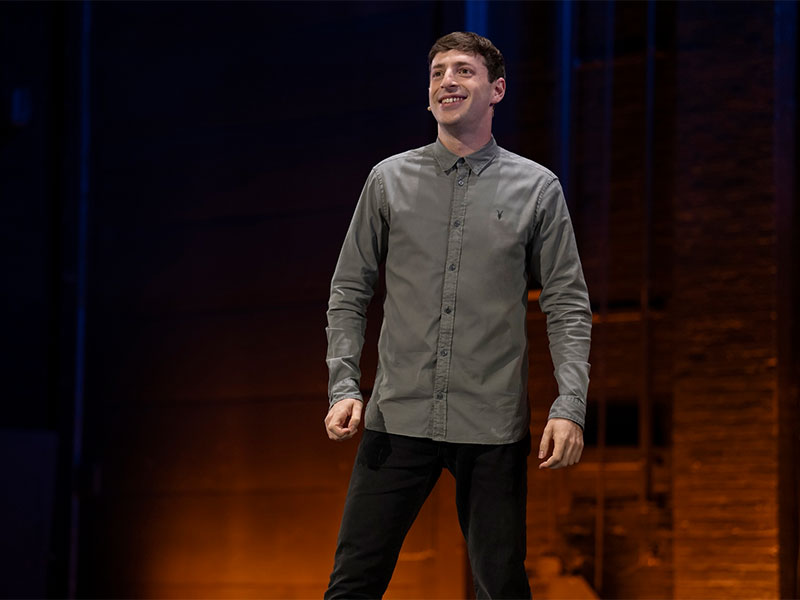
Given her high profile within Netflix's comedy stable, it's surprising Buteau didn't score a Globe nomination for this. She has a new season of "Survival of the Thickest" on the way, co-starred in an acclaimed movie, "Babes," and capped a stellar 2024 run by recording this special at Radio City Music Hall, becoming the first female comedian to do so. (Not to mention the joy she continues to offer as "The Circle" host/narrator.) We’re obligated to be careful with what we say beyond this, owing to the review embargo on "A Buteau-ful Mind," which premieres on New Year's Eve. But it merits including in a list of worthwhile 2024 stand-up because it's a smart, entirely welcoming conversation starter for all the right reasons, placing a neat bow on the “her-story” she makes simply by deservedly taking up space on that stage.
04
"Alex Edelman: Just for Us" (Max)
Alex Edelman: Just For UsAlex Edelman: Just For Us (Sarah Shatz/HBO)
Some very famous comics are basically trolls. Others are experts at dispensing with trolls. Edelman, though, took on his Internet haters in a different way, creating a list of antisemitic accounts (under a title that is the ultimate troll) that some interpreted as a handy way to stay in touch with each other. When one posted an open invitation to meet up in Queens to talk about their “whiteness,” Edelman decided he’d show up too. (“As an Ashkenazi Jew, I have questions about my whiteness!” he joked.) This Emmy-winning special chronicles what happened in that meeting, from the banal to the hysterical. It also inspired him to consider a few revelations about himself, including his reflexive empathy, tendency to be overly accommodating and a love of pastries. Edelman’s adventure is more enlightening than frightening, reminding us that this hatred can’t be reasoned with, but it’s also lazy and can be disempowered by leaning on our humor and humanity. “[T]here’s a huge part of me that genuinely walked into this room thinking, ‘They’re just antisemites because they haven’t met Alex yet!’” he shares near the show’s close. By then you’ll understand why he felt that way. Edelman explains he’s only telling us things he thinks we’d enjoy – and he’s right. We do.
05
"Langston Kerman: Bad Poetry" (Netflix)
Langston KermanLangston Kerman (Gilbert Flores/Variety via Getty Images)

This special’s title is inspired by an extended bit from Kerman’s days as a teacher, when he was ruthlessly heckled by a student to a degree that he envisioned sidesplitting dark fantasies of what he would do or say to shut her down if he weren't a responsible adult. Kerman’s easy, bright smile and genial energy make it easy to picture him as a nurturing sort – which he is, revealed in his detour through jokes about marriage and fatherhood. This may be weird to say about a comedy special spiked with punchlines only a professional can get away with, but the top strength of “Bad Poetry” is that it feels cozy. Kerman and his director John Mulaney chose to stage it inside a Chicagoland icon, the Green Mill, producing an intimate feeling as opposed to the grandeur of a large concert hall or stadium. This plays into our sense of Kerman’s familiarity since he’s popping up on more and more shows these days, the latest being “English Teacher” and his director’s live variety experiment “John Mulaney Presents: Everybody’s in L.A.”, which he also wrote for. But he’s also some version of that guy who lures us into dropping our defenses so that his increasingly bizarre gags take us by surprise. By the time he launched into his memory of crashing a softball game for his birthday, I'd guffawed myself to exhaustion. If this is what Kerman achieves with his first special, he'll probably knock us out the next time.

Want a daily wrap-up of all the news and commentary Salon has to offer? Subscribe to our morning newsletter, Crash Course.


06
"Kyle Kinane: Dirt Nap" (YouTube)
Kyle KinaneKyle Kinane (David A. Smith/Getty Images)
Kinane is the second comedian on this list whose latest special dives into the pandemic’s acceleration of our unreality with a creatively oblique approach, starting by boiling down the “Fast & Furious” franchise to its aggressively stupid essence before making pointed jokes about MAGA wingnuts decrying socialism while enjoying a national park. The meat of its 71 minutes covers Kinane’s move from Los Angeles to Portland with his partner, and his neighbors’ imagined distrust of a childless couple whose recycling container is full of empty baby food jars and booze bottles. All this circles back to Kinane’s cat, Dirt Nap, a creature that’s equal parts wonder, horror and wreck, kind of an avatar for America writ large. Kinane is never that obvious and serves his political digs in sprinkles. And you may appreciate the expertise with which he narratively wanders, sometimes in a way that feels like he’s jumping dimensions, only to return to a place in the story that lets you know he was never lost. 
07
"Jacqueline Novak: Get on Your Knees" (Netflix)
Jacqueline NovakJacqueline Novak (Dia Dipasupil/Getty Images)
Novak approaches fellatio in her Emmy-nominated special in a wholly unique way, starting with her narrating the way she walks onstage toward the microphone. Where most performers make sex jokes their closer, Novak barrels through a 91-minute ode to the single act of going down on someone. And when we say she tears apart the subject from root to stem, we aren’t kidding. “Get on Your Knees,” directed by Natasha Lyonne, transforms all the associations we attach to our bodies into an epic statement primarily composed of feelings and thoughts about our genitalia. The bulk of it dances with the metaphorical imagery attached to sex and what those popular terms imply about virility, strength and capability. Frequently Novak questions the accuracy of the words we use to describe our sexual organs. (“I mean, if I had a pebble in my shoe, I’d probably stop on the side of the street and take off my shoe and shake it out,” she says. “If I had a tiny, ‘rock-hard’ boner in my shoe, I think I’m just going home.”) Then she moves on to dissecting the intimate act, an honest and absurdist voyage through memory, personal history and experience. It’s a marvel that Novak remains consistently entertaining as she engulfs us with her rapid-fire poetic delivery and joyful pantomime. Maybe not, though; since this a celebration, what’s not to grin about?