Spring Sale: Get 1 Year, Save 58%

The war on Halloween: Why the right’s moral panic over ’80s horror movies still matters

Since Halloween is a holiday devoted to celebrating the scary, you might think that every type of fright would be welcome: Decomposing zombies and slimy aliens, ferocious werewolves and bloodthirsty vampires. Yet not so long ago in a galaxy a lot like this one, an outraged right-wing mob decided that a fictional killer in a Santa Claus costume was morally unacceptable. What happened after that might seem silly or completely irrelevant, but it's connected to real-world 21st-century problems that should frighten us all.

The selling of "Silent Night, Deadly Night": Accused of "blood money"

Our tale is set during the Halloween season, circa 1984. Millions of Americans were preparing their costumes, stocking up on candy and raking up fallen red and orange leaves. In Hollywood, TriStar Pictures was trying to figure out ways to get horror fans to see its new slasher film, "Silent Night, Deadly Night." Slated for release on Nov. 9, it followed the template used by many pictures in the genre after 1978, when John Carpenter's smash hit "Halloween" combined shocking and brutal kills with a plot centered around a major holiday. 

Not surprisingly, studios recognized the box office potential in applying the "Halloween" formula to the most commercialized holiday of all — Christmas. Even before "Halloween" popularized this approach, there had already been Christmas-themed horror flicks like "Silent Night, Bloody Night" in 1972 and "Black Christmas" in 1974. (The latter is believed by some to have inspired "Halloween.") "Christmas Evil," released in 1980, actually beat "Silent Night, Deadly Night" to the punch in featuring a killer dressed as Santa; this somehow slipped under the radar that year, as did another Yuletide spine-tingler, "To All a Goodnight." Even "Silent Night, Deadly Night" was joined in 1984 by a Christmas slasher called "Don't Open 'Till Christmas," which was released a month later.

Unlike its predecessors and successors, however, "Silent Night, Deadly Night" encountered a perfect storm of random bad luck. It all started on a Saturday afternoon when a grisly commercial made its way to TV stations, depicting the film's main character, Billy Chapman (Robert Brian Wilson), menacing innocent victims with an axe and a gun — while clad in Santa garb. Parents claimed it upset their children; this captured public attention, and protesters in various cities began to oppose not just the marketing of the film, but the movie itself. Organizations were quickly formed to get advertising for "Silent Night, Deadly Night" pulled from TV and newspapers. Media outlets hyped stories in which angry citizens accused a movie that hadn't been released (and which they definitely hadn't seen) of ruining Christmas and making children terrified that Kris Kringle might be a psycho killer. Many theaters buckled to pressure and pulled their screenings.

Despite this adverse publicity, it appeared for a moment that the box office run of "Silent Night, Deadly Night" would end in triumph. The film earned $1.4 million on its opening weekend — a decent return, considering that it played in fewer than 400 theaters — and TriStar declared that all would be well.

That changed, however, when film critics Roger Ebert and Gene Siskel weighed in on their popular TV show. Not content with merely saying they disliked it (neither was a fan of the slasher genre), the then-iconic pundits threw gasoline on the moral outrage fire. At one point Siskel accused everyone involved of trying to earn "blood money," scolding TriStar with the admonishment "Shame on you!" He went on to personally name the film's director, writer and producers, as well as the corporate owners of TriStar.

The gross for "Silent Night, Deadly Night" plummeted after that, and not long afterward it was pulled from theaters. Studio executives later implied that was due to its box office decline, but in fact the "Silent Night, Deadly Night" franchise was profitable enough in the long term to spawn four sequels and a remake. More likely than not, the studio simply felt that the controversy was causing them too much aggravation to be worth it.

All over a movie that the vast majority of protesters never saw.

The power of ignorance: As goes rock 'n' roll, so goes horror…

This reactionary backlash did not occur in a vacuum, as writer Paul Corupe observes. He covers genre film and Canadian cinema for the niche publications Canuxploitation! and Rue Morgue magazine.

"There was a high-strung moral panic over horror films in the 1980s that came out of larger parental and religious concerns about popular youth culture," Corupe told Salon by email. "Slasher movies came under significant scrutiny, but heavy metal music, role playing games and even children's toys and cartoons were also targeted as having a supposed demonic or corrupting influence on children and teenagers of the era. Some believed that they had to protect their children from the devilish forces lurking in every LP record groove and VHS rental case."

Brad Jones, a culture commentator known to horror fans and film buffs for his popular online series The Cinema Snob, said he often heard moral objections to gory films while growing up around a religious community. "It was the same crowd, and would be doing the same thing, with heavy metal music or rock music," he recalled. Adding to that was the moral outrage of film critics like Siskel and Ebert, who weren't right-wing Christians. They had felt inundated with slasher films over the previous few years, Jones suggests, and picked this one to attack.

"A lot of these movies were kind of new, at least to the mainstream," Jones said. "There had certainly been gory horror before, but after 'Halloween' and 'Friday the 13th' [released in 1980], you definitely saw a very mainstream upswing of a lot of these slasher movies."


Want more Amanda Marcotte on politics? Subscribe to her newsletter Standing Room Only.


Stacie Ponder, a horror blogger and writer for sites like Rue Morgue Magazine and Kotaku, explained that when the trailer for "Silent Night, Deadly Night" was released amidst this cultural backlash, it supposedly "broke the brains of children."

"Parents fumed over having to explain that no, Santa wouldn't kill everyone when he came down the chimney on Christmas Eve," Ponder wrote by email. One prominent critics was legendary actor Mickey Rooney, who penned a "particularly virulent" letter calling for the filmmakers to be run out of Hollywood. (How's this for irony? Years later, Rooney would star in "Silent Night, Deadly Night 5.")

"In the long run, the notoriety only made the film more sought after," Ponder explained, adding that the lesson of all those successful sequels might be "that outrage is all well and good but it ultimately means little when there are dollars to be made."

Even if "Silent Night, Deadly Night" hadn't been the center of an absurd controversy, it might still have become a cult classic: It's actually pretty good.

"I love the movie," Jones said. "I'm a big slasher-movie guy anyway, but that one in particular does a lot of things that your typical slasher movie wouldn't have necessarily done." For one thing, because the killer is the main character, the narrative is shared through his point of view, which is rare in the slasher genre.

"The whole first half of the movie is actually this pretty interesting character piece about all the terrible things that happened in this person's life … until at one point, halfway into the movie, he just snaps," Jones explained. "Then it definitely does a lot of slasher-movie tropes, but it had a good buildup and actually gave us this pretty interesting character. All of that was just ignored because people didn't see the movie and jumped on that outrage bandwagon." Buried beneath the blood-soaked Santa suit, "Silent Night, Deadly Night" has something a lot of slasher films lack — a unique identity, and thus cult film status.

No happy ending:

It all worked out OK for the creators of "Silent Night, Deadly Night," but the social forces that led to the film's initial suppression still lurk among us.

As culture has been increasingly politicized, it is difficult to separate the trends that influence how we view entertainment from those that determine our relationship with politics. "Silent Night, Deadly Night" was released when the president was a right-wing former movie star named Ronald; we recently got rid of a right-wing president who is a former reality TV star named Donald. This symbolic invasion of politics by the worst in our culture trickles down to political discourse. Just as reactionaries in 1984 felt confident that they could and should suppress a work of art despite total ignorance of its content, reactionaries today will support Trump's Big Lie and attack critical race theory, without understanding why the first claim is preposterous and the latter subject is not even being taught in public schools. That same brazen ignorance is present in the resistance to public health measures on masking and vaccines, where motivated reasoning and cultural bias outweigh medical and scientific data. It exists among the ever-persistent climate change deniers.

Arguably, the stakes were pretty low in a manufactured campaign of fake moral outrage about a slasher movie that almost no one had seen. But what we see in that 1980s controversy is an embryonic form of the battles we see around us today — when public health, our educational system, our democracy and the future of the planet itself are under attack.

University reneges on invitation to historian Jon Meacham after students hold anti-abortion protest

Samford University has decided to renege on its invitation to Pulitzer Prize-winning historian Jon Meacham for its upcoming inaugural ceremony for the university’s newly appointed. According to AL.com, the decision came after students held a protest to share their grievances about Meacham speaking.

When Meacham’s visit was initially announced, the university described him as a “‘skilled orator with a depth of knowledge about politics, religion and current affairs,’ and referenced work that ‘examines the present moment in American politics and life by looking back at critical times in U.S. history when hope overcame division and fear,'” the publication reports.

However, students argued otherwise. In fact, one student questioned his ability to speak at the event due to his recent appearance at a Planned Parenthood event that was recently held in Texas. In her petition submitted to university officials, Emily Kirby wrote, “His beliefs and core values do not align with those of Samford University, as it is a Southern Baptist institution.”

She added, “Mr. Meacham is involved with raising money in support of an organization that does not value life in the same way the Christian faith does.


Want a daily wrap-up of all the news and commentary Salon has to offer? Subscribe to our morning newsletter, Crash Course.


Dr. Beck Taylor, the newly appointed university president, recently addressed the concerns students had as he noted that Meacham would not be speaking about abortion during his visit. “Some in our community have assumed erroneously that Samford’s invitation by extension endorses any perspectives or viewpoints Mr. Meacham may have about the sanctity of life and abortion rights,” Taylor wrote.

Beck also noted that he appreciates the freedom of expression at the university but believes Meacham appearing for the inauguration would divert attention from the true purpose of the ceremony.

“Although I am disappointed by the narrative that has combined important conversations about pro-life issues and Mr. Meacham’s planned appearance at Samford, it is vitally important to me that next week’s events unify and draw our community together to celebrate the history and future of Samford University, a place we love and for which we all care deeply,” he said. “Unexpectedly, Mr. Meacham’s planned lecture has become a divisive issue, one that takes attention away from our opportunity to celebrate Samford.”

On Friday, October 29, a Samford University official released a statement confirming another invitation would be extended to Meacham at a later date. That event will not be held in connection with the inauguration. “Mr. Meacham, who is a noted historian and Pulitzer Prize-winning presidential biographer, has been invited to our campus to highlight his work in analyzing the current state of civility and discourse in our country. We look forward to hosting him at a later date.”

Jailing Capitol rioters together could lead to a new “American terror group”: Expert

In a column for the Daily Beast, former CIA counterterrorism analyst Aki Peritz warned federal authorities to separate accused Capitol rioters while they are being held in custody pending court appearances lest they start planning another insurrection as part of a newly-formed domestic terrorist group.

Noting reports that accused insurrectionists are being held a separate unit from the other inmates D.C. Correctional Treatment Facility where they reportedly are singing the National Anthem together as well as publishing their own jailhouse newsletter, Peritz, the author of “Disruption: Inside the Largest Counterterrorism Investigation in History,” explained that raises serious concerns for him.

“These seemingly small, communal actions of incarcerated men awaiting trial are exactly how other radical groups organized and forged their identity in prisons. Some of these groups then became effective forces that have challenged armies and governments,” he explained before adding, “…by mixing the hardcore ideologues with others who may be wavering in their anti-democratic feelings under adverse conditions—and by not giving them an offramp for their beliefs—the D.C. jail might inadvertently be the petri dish for a future American terror group.”

Writing that prisons have long been “incubators” for terrorist groups, the counter-terrorism expert claimed they are likely to unleash a wave of terror once released — and therefore will need to be monitored.


Want a daily wrap-up of all the news and commentary Salon has to offer? Subscribe to our morning newsletter, Crash Course.


“Radical groups even exploit prison sentences as symbolic acts in their greater struggles. A jail sentence paradoxically provides a degree of gravitas to a subset of individuals, easing their way to recruit new people on the outside to the cause,” he elaborated. “Which brings us back to the Jan. 6 insurrectionists in the D.C. jail. Some indeed might have realized the error of their ways. But those who might want to turn away from Jan. 6-style radicalization in the D.C. jail may be at greater risk inside the facility, since they are housed with the people dedicated to deepening their ideological commitment.”

Warning that it unlikely D.C. jailers are “monitoring the Jan. 6 folks’ activities,” Peritz added, “It’s hard for a radical ideology to exist for long without committed human infrastructure. But we’ve seen that multiple federal politicians publicly support the insurrectionists, calling them ‘political hostages‘ who are being ‘persecuted” for their beliefs.'”

He then added a cautionary, “Thus, between the identities strengthened inside a correctional facility, and the obvious slice of political support outside it, we may be seeing the emergence of a new, radical group—with a national network and skilled ideological operatives—ready to menace the streets of America in the years to come.”

You can read more here.

More like this:

Trump caught in a lie about being invited to World Series game by MLB commissioner: report

Former president Donald Trump reportedly lied when he claimed Saturday that he was invited to attend Game 4 of the World Series by New York Yankees president Randy Levine and Major League Baseball commissioner Rob Manfred.

“Looking forward to being at the World Series in Atlanta tonight,” Trump said in a statement from his Save America PAC on Saturday. “Thank you to the Commissioner of Baseball Rob Manfred, and Randy Levine of the great New York Yankees, for the invite. Melania and I are looking forward to a wonderful evening watching two great teams!”

New York regional sports network SNY notes that Trump’s statement “ran counter to a Wednesday report in USA Today, in which Braves CEO Terry McGuirk said, ‘He called MLB and wanted to come to the game. We were very surprised. Of course, we said yes.'”


Want a daily wrap-up of all the news and commentary Salon has to offer? Subscribe to our morning newsletter, Crash Course.


According to SNY, “two officials directly involved in the process said that McGuirk’s comments were accurate, and that neither Manfred nor Levine had reached out to extend an invitation.”

“[Levine] has nothing to do with who attends a World Series in Atlanta,” one of the officials said.

Read more.

My affair with witchcraft

I saw on Facebook that a local witch was holding a healing event for Halloween. I’d relocated to Los Angeles for a fresh start, but was haunted with depression. I was still reeling from a falling out with a spiritual community after revelations of power abuse had surfaced, along with a breakup — two relationships with abrupt endings I couldn’t shake. I drove to her bungalow on a street lined with cars. The door opened to a woman about my age in a swirly dress.

Though the stereotype of a witch is someone in all black cackling from a Disney cartoon, real witches are pagan, members of an earth-based spirituality honoring nature and women. They commune with the spiritual plane directly, free of mediators and are said to be one of the largest growing paths of spirituality in America. I’d been raised loosely Methodist in Upstate New York, each pastor I’d ever met a man. My ancestors, of Celtic descent, once practiced Halloween as Samhain, a spiritual day when the veil between the worlds of the living and dead was the thinnest. Maybe here I could reclaim that lost connection.

Inside the bungalow twelve women sat in a circle. For the ceremony we each had to bring a photo of a dearly departed loved one. I brought a picture of my grandmother in the 1940s, pin-curls under a white nurse’s hat.

“Feel their presence,” the witch said. I was surprised to be hit with anger. I remembered a story about my grandmother: she loved her job but was expected to give it up when she got married to follow my grandfather. It was something that haunted her at the end. She felt she’d given away her power. Had I accidentally done the same? 

RELATED: An ordinary girl born into a family of witches

My ex had been a meditation teacher. I met him as a student in his group. When he ended it, already dating another student in the community, he told me to disappear and not come back. I listened. But I also lost part of myself. Seeking healing, I’d then gotten involved with several yoga centers, where later leaders were revealed to be abusing their power. I was learning, alongside the wisdom, there was a history of this behavior among some gurus of yoga, meditation and other spiritual communities. I was frozen in confusion — how could places of healing be so rife with pain?

The witch lit a purple candle and laid Tarot-like cards out on a table. 

I flashed to another time I’d sat in a circle like this. As a teenager, my two younger girl cousins and I sat in a ring as I read healing practices from a book. I asked them to lie down as I passed a quartz crystal hanging from a string over them.

“It’s moving!” I exclaimed, writing down the direction and shape of the swing to later analyze, tracking their energy. I was a good beginner practitioner: I helped them see where they were closed off and where they were open.

“It’s your heart center,” I said, reading from the book solutions from nature — like other rocks to hold or colors to wear — to bring back balance. After, we went for a walk through the autumnal Northeast woods, remarking on the brilliance of nature’s letting go — all fiery orange as we listened to the punk ballads of Bikini Kill’s “Revolution Girl Style Now!” on our cassette players. I’d felt whole. Perhaps letting go was easier then. As an adult, I was still holding onto my ex story, letting him affect my spiritual path. 


Want a daily wrap-up of all the news and commentary Salon has to offer? Subscribe to our morning newsletter, Crash Course.


The witch explained that witches offer an archetype of feminism in the age of patriarchy. Here, the teachers we follow are our own inner selves. Once, I’d listened more closely to my inner knowing. When had I wavered? She let out a primal yell. We were asked to follow. I felt strong as I howled. 

That night I drove home from the witch’s house in a full moon and decided to keep going. I pulled up to the Pacific and took out a notebook. I’d been trying to write a list of what I wanted. The truth was, I hadn’t known what to say. I performed a ritual of my own, ripping up the paper and starting a new list in the moonlight. I wanted to write. Teach. Find love but not lose myself. Get my power back and keep it for good. But I wasn’t sure how. 

Six months later I reconnected with an old friend and we fell in love. Two years into that relationship, I was accepted to a graduate program in New York. He said he’d follow me. Unlike my grandmother, I could be the one leading the way with someone who loved me willing to follow. An old Brooklyn friend told me she was moving out, and would I want her apartment? Plus, she said, it came with a bonus. Her neighbor was wonderful, a witch who taught about feminism.  

Driving across the country, we listened to riot grrrl bands, the epic songs from when I’d been a teenage witch. 

Later, when my ex reached out to me, I blocked him, having learned that boundaries, too, are a magic spell. I found a new yoga community I trusted and invested in therapy. 

But it was what the witch had taught me — about honoring my own inner voice and prioritizing it — that helped the most. This was the real lesson. Focusing on assignments for graduate school, with each word I was building my body both backward and forward in time, to when it knew its own worth. The words we write are also a magic spell.

This Halloween, I’m thankful to the witches for modeling true agency. But now I know better than to put them, or anyone, on a pedestal. This strength is coming from within.

More stories about witches and power: 

“Joe Biden is, frankly, being a coward”: A conversation with the White House climate hunger strikers

It is Day 11 of a hunger strike for climate justice outside the White House — and the stakes are nothing less than saving the world, at least in the eyes of those protesting.

Salon spoke by phone Friday with two of the five youths who are participating in the high-stakes protest in Washington, D.C. Twenty-six-year-old Kidus Girma is the organizer, a climate activist who tells Salon he is originally from Ethiopia and grew up in Dallas. He joins the conversation a few minutes after Abby Leedy, a 20-year-old born in Portland, Oregon, and raised in Philadelphia. Three others are also participating: Paul Campion, Ema Govea and Julia Paramo. Their spirit of solidarity is immediately palpable, with Girma and Leedy emphasizing one point over and over: President Joe Biden needs to stop hiding from a public that desperately needs leadership.

It isn’t that they are unaware of the parliamentary snag in which the commander-in-chief finds himself. They understand that Biden has a slender 50-50 majority in the Senate — controlled by the Democrats solely because Kamala Harris is vice president — and that a pair of senators, Joe Manchin and Kyrsten Sinema, are holding up good faith efforts to act with enough time to mitigate the worst effects of climate change and maintain the planet’s livability for future generations.

They say Biden has no other moral choice, and must do whatever it takes to save the planet. They feel that he has failed to put himself forward as a leader, to rally the people who want to solve climate change against those that stand in the way. As the entire group explained in a letter shared with CNN, “We will continue to sit starving outside the White House everyday until you use your power as elected president of the United States to deliver your mandate for bold, and transformative climate action with justice and for jobs.”


Want a daily wrap-up of all the news and commentary Salon has to offer? Subscribe to our morning newsletter, Crash Course.


On Monday they had a virtual meeting with White House National Climate Adviser Gina McCarthy and Special Presidential Envoy for Climate John Kerry. The Biden administration has expressed deep admiration for the protesters — but not everyone feels that way. Manchin was more defensive than usual when confronted by Leedy on Tuesday about his role in weakening climate measures.

The group takes their stand as Congress haggles its way through increasingly watered down measures and the president departs for COP26, the United Nations climate summit in Glasgow.

The following interview has been edited for length, clarity and context.

The big question is, what do you think Biden should be doing differently?

LEEDY: Biden ran on the promise of being a climate champion, of being the next FDR, of fighting for my generation, and his administration has continued to approve new fossil fuel projects, like continuing to approve new oil drilling on public lands and offshore drilling in American waters. The administration has been using its powers to continue causing the climate crisis. I also think Joe Biden himself has frankly not done enough to stand up to Manchin and his fossil fuel donors. He has not done enough to use the power of the presidency to make the Democratic Party fall in line or make them accountable to my generation, instead of the fossil fuel billionaires and CEOs.

The Biden administration’s response is that they’re trying, but that Joe Manchin and Kyrsten Sinema are impeding progress. What is your response to that?

LEEDY: I think that Joe Biden is, frankly, being a coward. I have not seen Joe Biden stand up to Joe Manchin publicly. I’ve not seen him talk in honest terms about what’s going on, to call out the influence of the fossil fuel CEOs in these negotiations. I have not seen him like own up to that.

The Build Back Better plan that is getting passed is bullshit. It is not enough for my generation. It is not enough for the millions of young people growing up into the climate and economic crisis in the United States. Joe Biden is not speaking honestly about that. I think the least that he could do is admit that this has been a failure to my generation in which he knew better. I also like lots of this stuff that was in the bill, like the clean energy standard, like trying to move away from fossil fuels. There are so many things that Joe Biden could do unilaterally to address that, that he and his administration has refused to. So for him to say ‘Oh, this is Joe Manchin. I have no control over it,’ I won’t accept that, and young people won’t accept that. We know that that’s bullshit.

Kidus just joined me.

GIRMA: Hi Matthew. My name is Kidus. I just walked a little bit so I’m feeling a little bit tired, so my responses might be a little bit slow.

What is Biden doing wrong in terms of communicating to people on this issue?

GIRMA: I think the President of the United States could start being the President of the United States in the public sphere. I think there’s a lot of conversation about Manchin and Sinema not letting Biden get his agenda, but in reality Biden exercises very few of the tools that are in his toolbox. Right now our president, that we’re hungry striking from in front of his house, only knows how to invite folks to Delaware and backroom deals, trying to butter up of folks that are bought out by corporations to get them on his side. He currently is not fighting for us in the public sphere in the way that previous presidents have. And so I’m expecting my president to get on air and to demand that Manchin and Sinema fall in line because it’s what the majority of Americans want. Not just a majority, but a super-majority.

I think the last couple of days of hunger striking make me think about what a different president would have done, right? I’m thinking of LBJ and the Great Society and the Civil Rights Act of 1964. I’m thinking of Roosevelt and the New Deal and the way that, when they didn’t get something in a backroom deal and they knew it was what’s best for the American people — which is what climate means for the planet and every human being that currently exists and doesn’t exist — it means President Biden doing everything he possibly can to get Manchin and Sinema to be on the people’s side. And that means going to the people and saying, ‘I’m fighting for you and we need to move these two people,’ and it’s not going to be Biden that does it alone. It’s going to be the people as a whole. And for that to happen, the president needs to start swinging at the balls.

It seems like there are two issues. The first is that there is an existential crisis which, if it is not resolved, literally imperils the future of humanity, and that is an issue that is very urgent and very pressing. The problem is that unlike Roosevelt and Johnson, Biden only has a very slender majority in Congress. I’m not saying that this means he can’t do more, but that is the response that his team offers, because that example has been made about Roosevelt and Johnson. What they say is that they don’t have the same congressional majorities.

GIRMA: Yes, and that would be a reason even more for Biden to fight in the public sphere. Not less. If Biden has a worse hand, he should be going far more ham than he currently is.

So you’re talking really more Theodore Roosevelt and the bully pulpit?

GIRMA: Exactly. Yes. That’s what past presidents have done. And that’s how they have won. So I’m not dismissing the fact that Biden is in a bad position. I’m saying that Biden isn’t fighting hard enough for his own position, and what he’s been doing so far hasn’t actually worked. We’ve just seen the bill get whittled and whittled and whittled. And he’s playing easily into the hands of Sinema and Manchin.

Sinema’s whole plan is to delay. It’s to shoot down one funding structure, for other Democrats to come up with another funding structure, to also shoot that one down. In that context, Biden can’t keep playing the backroom deals because it fundamentally isn’t going to work. So that means Biden needs to switch it up. That means Biden needs to go to the people. Because politicians, in a lot of cases, don’t do what is impossible. They do what they think is possible. And the conditions for what is impossible only changes when a substantial amount of the American public is involved in the process. This is what climate needs in this moment. And that’s what Biden can provide. And so I am being deeply realistic when I say Biden hasn’t done enough. Because Biden hasn’t done enough for life-affirming, lifesaving climate legislation to become a reality.

LEEDY: Something I would add to that is, I just keep thinking what what if Biden got on a major network tomorrow and called out the donors, called out the fossil fuel CEOs and the corporate CEOs that are donating to Manchin and Sinema. It is clear to any average person that this is the reason why Manchin and Sinema are doing this. These two senators are receiving millions of dollars from these corporations. These corporations are acting against the interest of the American people. These senators are helping them do it. This is inexcusable. They need to stand with the majority of people in their states. I mean, paid family leave, for example, something like 75% of Republicans support that policy. And it got cut. I just don’t think enough people know that, frankly, and as Kidus said, Biden has the power to capture the attention of the American people. And he’s choosing not to use that, not to go to the American people and say in plain terms that this is what’s going on, this is what’s stopping me. And I just think if he did that enough times, I can’t imagine that those corporate donors would continue to act this way. I think that they need public approval just as much as Biden does in order to do what they do.

I’m going to close with a personal question for both of you. How are you feeling? What are you experiencing right now in terms of both your health, which I’m obviously concerned about, and also in terms of how people are treating you, what you’re observing, what is your experience at this point?

GIRMA: You asked me a question and my heart started racing. I immediately started thinking about my blood pressure, which jumps 30 or 40 points when I go from sitting to standing. Emotionally and spiritually, I’m feeling grateful. I’m feeling grateful for this moment and all of the things that had to happen to get us to this point. I’m thinking of all the organizing and care that folks across the climate movement and beyond have done to bring us to this moment. I’m thinking about Nina who brought me hot water last night, which was my treat (you know, not lukewarm water), and how important that was to me. I’m thinking about a stack of note cards of support that I got from some George Washington University students yesterday. And I’m thinking about what we need as human beings, and what my small role in that is, and what the big role is for all of us. Because we’re fighting for all of us in this bill and on this bill.

LEEDY: I feel like the adrenaline I get talking to you or when I ran into Joe Manchin the other day. And I just got this huge shot of adrenaline. And I know after this conversation, I’m going to have to lie down.

What happened when you met Joe Manchin?

LEEDY: I saw him come out of this meeting at this hotel like two blocks away from the White House. I was there with my parents, actually, they had been visiting that day. My mom was like pushing my wheelchair and I asked him if the millions of dollars he receives from the fossil fuel industry has anything to do with the fact that he was blocking lifesaving climate legislation right now. He lied to me about America’s role in the climate crisis. And then he told me I need to get a meeting with him. I was really begging him at one point to stop doing this and support this legislation, and he just like, walked away and got in his car. I was just kind of there in my wheelchair, screaming that I wanted to live.

You said that you felt adrenaline. What were you thinking at that moment?

LEEDY: I was just thinking about how I feel really desperate, honestly. I feel really desperate and just so furious. It was just incredible to me that I was there. There was this guy coming out who was doing so much evil in this moment. I’m a person of faith and it’s kind of incredible to me.

If you don’t mind me asking, what is your faith?

LEEDY: I’m a Christian. I feel like part of my faith is just the faith in all people’s ability to be good. And I’m sure that like somewhere Joe Manchin has a soul. I’m sure he’s capable of good. And as far as I can tell, he’s chosen to do a lot of evil, just really, really evil stuff with his time on earth and with his power. And that’s just honestly hard for me to wrap my head around.

How are you feeling right now?

LEEDY: Totally. I feel really weak and honestly scared about my physical health. I don’t have really that much fat left. I can see my ribs, which is really scary. Then your body starts eating your muscles for energy, and that happens around day 14. There’s a risk that the fat and muscle in your brain starts to get eaten, which can lead to permanent mental health effects. As we’re getting closer to Day 14, I’m just feeling frankly really scared about my health and about my body and about what this is doing to me. I also think I’m just as scared about the future and the rest of my life and the lives of the people here that I love if we’re not able to win more in this moment.

With 3 ingredients, you can have pasta and cheesy biscuits tonight

I will go to my grave feeling sorry for people whose parents wouldn’t let them have mac and cheese from the box. I can, on a leisurely afternoon, roll out fresh lasagna from my pasta roller. I can, if I want to, make a fast, beautiful dinner involving bucatini, garlic and a loaf of bread from the bakery. But that Kraft stuff is in a flavor class all its own. It’s like a weighted blanket for your mouth.

On those nights, however, the you feel like shaking things up, Sandra Lee’s reinterpretation of the classic is pretty clever. As she told People magazine in 2020, “There are so many quick dinners to make when you think outside the mac ‘n’ cheese box.” By recruiting some pancake mix and a can of tomatoes, in fact, you can get a whole different kind of meal — pasta with a delicate tomato sauce and cheesy biscuits.

RELATED: This secret ingredient creates the flaky layers you crave in biscuits without the chewy texture

Lee makes her pasta with stewed tomatoes but I prefer diced. And while she makes her biscuits with 2 1/2 cups of pancake mix, I got great results scaling back to just 2 cups. It’s a self-contained dinner that offers the comfort of a beloved pasta shape and the crunch of warm biscuits, and it can be on your plate in 15 minutes. What are you waiting for?

***

Recipe: Reconstructed Macaroni andCheesy Biscuits

Inspired by Sandra Lee

Makes 4 servings

Ingredients:

  • 1 box of macaroni and cheese, the kind with powdery stuff
  • 1 can (14.5 ounces) of diced tomatoes (I like the fire-roasted kind.)
  • 2 tablespoons of olive oil
  • 2 cups of pancake mix

Directions:

  1. Preheat your oven to 450°F.
  2. Over high heat, set a large pot of water to boil.
  3. Separate the macaroni from the cheese packet.
  4. Drain your tomatoes so you have 2/3 cup of liquid reserved.
  5. In a large bowl, combine your pancake mix and 2 tablespoons of the powdered cheese mix. Add your reserved tomato liquid and stir until just combined. Do not overmix. If you need a little more liquid, add a tablespoon or so of water.
  6. Drop your dough in 2 tablespoon portions on an uncreased baking sheet, spaced well apart. You should have six. Bake about 10 minutes, until golden.
  7. Meanwhile, boil your pasta according to directions. It should take about 10 minutes.
  8. While the biscuits and pasta are cooking, heat your olive oil in a skillet. Add your tomatoes and cook together around 3 minutes. If you are feeling Marcella Hazan-ish, add a knob of butter.
  9. Drain the pasta and stir in your sauce. Top with fresh ground pepper, oregano and a grating of hard cheese, if you like.
  10. 10. Remove the biscuits from the oven and serve with softened butter.

Want more great food writing and recipes? Subscribe to Salon Food’s newsletter.


More pasta recipes we love: 

How to store pumpkin seeds, raw or roasted

This weekend is prime for pumpkin picking and carving. With Halloween just days away, it’s time to grab a knife and carve a jack-o-lantern. But what are you supposed to do with all the leftover seeds from inside the pumpkin? The easy option would be to discard or compost them, but don’t! They make a delicious snack raw or roasted that you can enjoy for weeks to come.

How to store fresh pumpkin seeds

Once you’ve completely gutted the pumpkin prior to carving it, (“awww, you didn’t tell me you were gonna kill it!”), place the seeds and pulp in a large bowl and fill it completely with water. Using your hands or a fork, stir the pumpkin inners around, allowing the seeds to float to the top of the water. Once most of the seeds have separated from the pulp and floated to the top, use a slotted spoon or spider to remove the seeds from the water and place them in a separate colander. Rinse any remaining pulp from the seeds in the colander with running water. From here, it’s time to dry them! Spread the seeds in a single layer out on a dish towel or a few sheets of paper towel and pat them dry to get rid of any excess moisture.

Storing pumpkin seeds

To store raw, pumpkin seeds, you first need to dry them in the oven or a dehydrator. To do so, transfer the cleaned seeds to a sheet tray and bake them in a 250℉ for one hour until they’re crispy. Let them cool completely. Then, transfer the dry pumpkin seeds to an airtight container or storage bag. For an airtight, eco-friendly alternative to plastic Ziploc bags, use Stasher bags, which are made from reusable silicone. For a stackable storage solution, our team loves the Mepal Airtight Storage Containers from the Food52 shop, which are not only practical but also look incredibly chic in your pantry. And then there is the always-fan-favorite, the OXO Pop Containers; the 1.1 quart is the perfect size for holding a couple of cups of dry seeds.

How to store roasted pumpkin seeds

Roasting pumpkin seeds is a little different than drying pumpkin seeds in the oven. Roasting pumpkin seeds requires a higher temperature in order to not just dry them out, but to get them super crispy and crunchy too. Roasted pumpkin seeds may be seasoned simply with salt, or with tons of flavor from a combination of brown sugarbalsamic vinegarvanilla extract, paprika, garlic powder, maple syrup, or black pepper (though certainly not all of them together. That might be a bit much). Once they’re roasted and seasoned, store them in one of the aforementioned airtight storage containers or bags.

***

Recipe: Sweet and Salty Roasted Pumpkin Seeds

Prep time: 15 minutes
Cook time: 20 minutes
Makes: 2 cups

Ingredients

  • 2 small sugar pumpkins (yielding about 2 cups of seeds)
  • 1 teaspoon kosher salt
  • 2 tablespoons brown sugar
  • 1 tablespoon olive oil
  • 1 teaspoon balsamic vinegar (the thicker the better)
  • 1 teaspoon vanilla extract

Directions

  1. Preheat oven to 350°F.
  2. Cut the pumpkins in half. Scoop seeds and pulp into a large bowl. Cover with water. Stir a bit with your hands. Most of the seeds will float to the top. With a slotted spoon, scoop seeds into a colander. Remove as many of the remaining seeds from the pulp as possible. Discard pulp. Rinse seeds. 
  3. Spread the seeds out on a dishtowel and then blot with a second dishtowel (don’t use paper towels or you will be eating roasted paper). It’s a bit time-consuming because wet uncooked pumpkin seeds are very sticky. So put on your favorite song, take some deep breaths, and commit to at least 5 minutes of blotting and unsticking.
  4. Spread dry seeds out on a sheet pan covered with a Silpat or parchment paper. Sprinkle seeds with salt, brown sugar, olive oil, vinegar, and vanilla. Toss with your fingers until seeds are evenly coated. 
  5. Place in the preheated oven. Check after 10 minutes. Stir. Make sure they’re cooking evenly. Put back in the oven for a few more minutes. They take about 15 to 20 minutes. But keep an eye on them. They go from a lovely caramelized brown to black very quickly. Allow to cool on the sheet pan. Store in a jar at room temperature. They stay crispy for a few days.

Florida professors barred from testifying in lawsuit against DeSantis-championed voting restrictions

On Friday, The New York Times reported that three University of Florida professors are telling a federal court that the university has barred them from assisting plaintiffs in a lawsuit challenging a restrictive voting law championed and signed by Republican Gov. Ron DeSantis.

“University officials told the three that because the school was a state institution, participating in a lawsuit against the state ‘is adverse to U.F.’s interests’ and could not be permitted. In their filing, the professors sought to question Gov. Ron DeSantis, a Republican, on whether he was involved in the decision,” reported Michael Wines. “Mr. DeSantis has resisted questioning, arguing that all of his communications about the law are protected from disclosure because discussions about legislation are privileged.”

According to the report, the professors wanted to provide evidence, as expert witnesses, that the law discriminates against minority groups.


Want a daily wrap-up of all the news and commentary Salon has to offer? Subscribe to our morning newsletter, Crash Course.


“Lawyers for the plaintiffs sought to hire three University of Florida political scientists as expert witnesses: Dr. Smith, the chair of the university’s political science department; Michael McDonald, a nationally recognized elections scholar; and Sharon Wright Austin, who studies African American political behavior,” said the report. “In rejecting Dr. Smith’s request, the dean of the university’s college of arts and sciences, David E. Richardson, wrote that ‘outside activities that may pose a conflict of interest to the executive branch of the state of Florida create a conflict for the University of Florida.’ A university vice president overseeing conflicts of interest issued the other two rejections.”

According to the report, this is a radical departure from typical University of Florida practice, which “has routinely allowed academic experts to offer expert testimony in lawsuits, even when they oppose the interests of the political party in power.”

The Florida law in question, one of many around the country passed by Republicans to restrict voting rights in the wake of record 2020 turnout, restricts ballot drop boxes, adds new requirements to vote by mail, and makes it illegal to give food and water to voters waiting in line.

More on Florida Gov. Ron DeSantis’ norm-busting tenure:

“What We Do in the Shadows” proves the first law of thermodynamics with its refreshing cliffhanger

Previous to Salon’s recent “What We Do in the Shadows” viewing, we referenced the first law of thermodynamics. As a reminder to anyone who hasn’t darkened the door of a physics class lately, that principle states that energy can neither be created nor destroyed. It can only be transferred or changed from one form to another.

Maybe reading that citation made you groan. We get it! When our job is to find hidden depth in a show that runs on scatological humor and dick jokes, some theories about what we see are bound to be a stretch. This time, however, it turns out we were on to something.

The season finale of “Shadows” visits the vamps of the Island of Staten not long after energy vampire Colin Robinson (Mark Proksch) committed the ultimate centennial birthday party foul by expiring suddenly, and in a cloud of farts. Confirming that Colin wasn’t faking it, Nandor (Kayvan Novak) moves to playfully rap his unresponsive roomie on the forehead and accidentally puts his fist through Colin’s very empty skull.

This was in fact the end of our resident energy vampire . . . as we know him.

RELATED: Why the latest “What We Do in the Shadows” twist makes sense in The Great Resignation era

But in a show populated with folks who prove death is never the end, permanently counting out Colin Robinson would be foolish. Not even Nandor the Relentless can defeat universal law. Besides, Proksch’s character is incredibly popular. Pulling off some kind of a comeback felt inevitable.

Proving that suspicion, the third season finale ends with Colin Robinson’s pre-midnight resurrection as a bespectacled, wailing infant, an unexpected hello amid a hasty flurry of farewells.

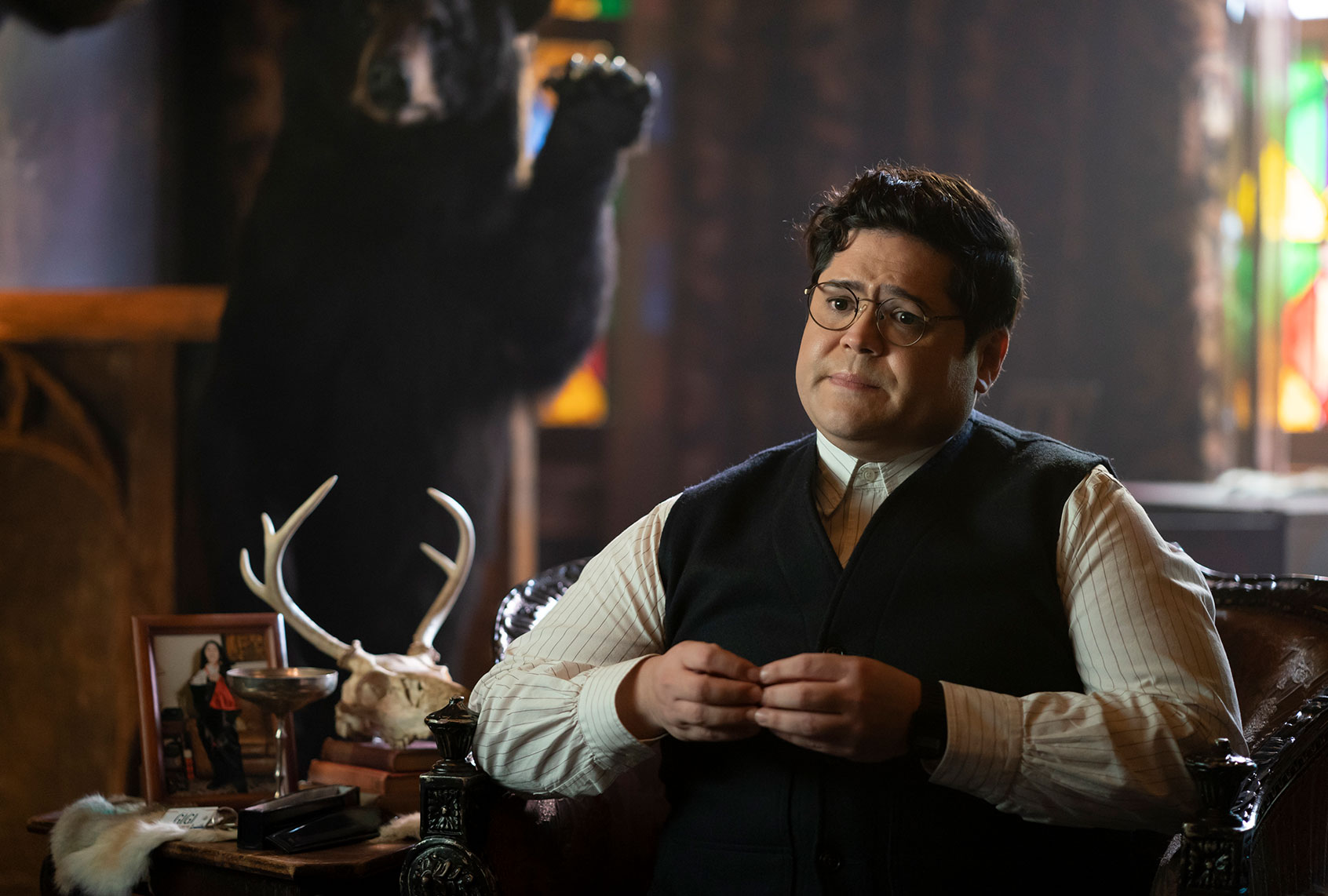
Similar to the energy vampire’s rebirth, the “Shadows” third season finale reads as a dividing a line between what the show was and fresh chapters for Nandor, Colin, Laszlo (Matt Berry), Nadja (Natasia Demetriou) and Nando’s human familiar Guillermo (Harvey Guillén).

Titled “The Portrait,” it opens with the roommates observing a kind of anti-memorial. Nadja explains that clans view commissioning a painting of a brood’s surviving members after losing a companion is the vampire’s way of writing off those who have died before moving on and never speaking of them again. To viewers it’s a freeze frame of how this family of choice looks at the end of three solid seasons together.

And, now? Anything could happen. Nobody in this clutch is where they or we expected them to be at top of the finale. Nandor changes his mind about sinking into a super slumber, deciding instead to travel the world, much to his co-dependent familiar’s horror. He coldly suggests he’s leaving Guillermo behind until the familiar fights his master for a place at his side, earning yet another promise from Nandor that soon, very soon, he will make him a full vampire.

The Supreme Worldwide Vampiric Council gives Nadja a promotion to a position in London, Laszlo’s hometown and a place he swore he’d never return to. The promise of being married to power changes his mind – until he visits Colin’s deathbed for a final farewell expecting to find a stinking husk of rotten flesh. Encountering a slime trail leading into an adjoining chamber where a mewling baby awaits shifts Laszlo’s plans yet again.


Want a daily wrap-up of all the news and commentary Salon has to offer? Subscribe to our morning newsletter, Crash Course.


Stefani Robinson and fellow writers Sam Johnson, Paul Simms and Lauren Wells structure “The Portrait” to let Laszlo pull off another last-minute twist without arousing much suspicion, quite a stunt considering the ninth episode blindside, which Robinson, Johnson and Simms co-wrote with Marika Sawyer. Looking back on the entire third season from the perspective of what we know now, the “Shadows” team did an impressive job of setting up the viewer to suspect the worst. Unnatural pairings on TV shows tend to be a sure sign that writers are running out of ideas, and Laszlo never had a reason to buddy up with Colin prior to their Vampiric Council library visit.

From there the writers set up Laszlo to be the keeper of a secret he could only reveal two-thirds of the way through the season’s penultimate episode, moments before Colin’s 100-year cycle of life ended. And yet, who expected them to follow that by having Laszlo pull off another turn that forces two people who barely tolerate each another, Nadja and Guillermo, into being stuck together on a freighter bound for England?

What We Do in the ShadowsHarvey Guillén in “What We Do in the Shadows” (Russ Martin/FX)

This left Nandor forlorn and lugging a backpack filled with his ancestral soil into a train headed out of New York, with Laszlo sticking himself with the job of raising baby energy vampire Colin (which is basically a squishy homunculus with Proksch’s head on top of it) on his own.

Our weekly visits to Nandor, Nadja and Laszlo’s claustrophobic manse have been time well spent, but this is a fine cliffhanger. As Colin’s role and persona is certainly bound to transform, so can the show around him. Blame the time we’re living in for this feeling, but the recently ended season reminded us that these characters haven’t traveled much farther than Atlantic City or exurban Pennsylvania. Flinging the main players to parts unknown vastly expands the story’s geographic range.

That’s part of the reason why people still clamor for the return of Laszlo’s alter-ego Jackie Daytona, Regular Human Bartender. Laszlo’s on-the-lam persona is the apex of absurdity, but the small-town goofs enabling Jackie’s benign foolishness made his one-off second season escapade unforgettable.

At various times the cast and writers have said there are no plans to haul Jackie out of storage. They don’t need to, if they give Nadja, Guillermo and Nandor equivalently memorable exploits instead. Nandor almost got there with his wellness journey this season. Now we know that was meant to be a stepping stone to a wider world. Given Nadja and Nandor’s lineage, along with Guillermo’s vampire slayer ancestry, each character has an opportunity to shed their old skins and become a little stranger.

Most can accomplish that by putting some space between each other and the Eastern seaboard of the United States. Colin, and Proksch, have the opportunity to leave one personality behind and take on quirks that are entirely new.

Change doesn’t always end up being good thing.  But sometimes the best strategy a long-running show can adopt to avoid sliding into a predictable graveyard rut is to infuse its arc story with a fresh narrative platelets procured from unfamiliar veins. The “Shadows” team’s surprise trips to foreign places are a positive move as we head into 2022, which is when the new season is scheduled to return.

Still, one suspects these undead fools won’t change too much, regardless of what they discover about themselves on their various “Eat, Pray, Love”-style excursions. As Nandor explains, “How I am going eat if I don’t prey on people, dummy?”

All current episodes of “What We Do in the Shadows” are available to stream on FX on Hulu.

More on this topic:

How to carve a pumpkin like a pro

Don’t be mad at us — we might be thinking about Halloween already. It’s just the creeping up of September and some cooling temperatures, we’re looking forward to the fall, OK? And with that, comes a new crop of candle scentsseasonal decor, and of course, lots of harvest-season fruits and vegetables ready to be plucked, baked, and carved.

And yes, everyone loves a good jack-o-lantern, but not everyone feels confident about carving a pumpkin. We get it — sharp objects, tough gourds, the whole thing is a little risky. And even if you manage not to lose a finger, there’s the question of the artistry itself.

Enter our friends Marc and Chris, also known as the Maniac Pumpkin Carvers, who were happy to show us how the pros do it. They were full of useful facts about fall’s favorite squash, and had a bunch of tips for making your jack-o-lanterns last longer.

Here are some we found particularly handy, from how to pick the healthiest pumpkin, to how to carve it using the tools you have — and preserving it so it lasts much, much longer.

As it turns out, pumpkin carving isn’t rocket science, but it is useful to have a game plan. Watch the video, and get carving with confidence.

How to pick a winner:

Believe it or not, the best pumpkin carving actually starts in the patch. When looking for the premiere medium for your gourd art (aka the best, healthiest pumpkin), look for firm, unbruised skin. Give it a full twice-over, spinning it to see it from all sides to ensure it’s not rotting in any places. The stem provides health clues as well: the greener, the fresher.

Another thing to look out for is the skin thickness — the thicker the skin of the pumpkin, the easier to carve. There are at least two ways to tell how thick the skin is, and it’s easy to determine at the time of shopping (so you won’t go home with a dud). A pumpkin that feels disproportionately heavy for its size probably has a thick skin, and a thick stem is usually another indication of thick skin.

The tools of the trade:

Always draw out your design with a washable marker. Industrial markers are a big no-no! While these guys use a special fruit carving knife from Thailand, a sharp paring knife or a craft knife will get the job done. And you’ll be surprised with what a melon baller can do! (Watch the video to find out.) You’ll also want to have a big spoon on hand to scoop out the flesh, a bowl for the discarded pulp and seeds, and lots of newspaper to cover your work surface.

Plus, if all else fails, the pumpkin carving kits you can get at any patch or grocery store in the fall have lots of one-use options that will be helpful for carving out a masterpiece.

Best carving practices:

While most people will carve a hole around the stem before starting to carve, these guys suggest cutting a small hole around the back. When you cut off the stem, you cut off the nutrients to the pumpkin, aka, a terrible plan for longevity.

When you’re done carving, spray the pumpkin with diluted lemon juice, which helps to slow down some of the oxidation. Another piece of good advice? Wrap your pumpkin and refrigerate it, until you need to put it on display. Another trick for preserving your pumpkin is to coat the exposed areas with petroleum jelly, which prevents mold from growing, and keeps it fresh longer.

This post contains products independently chosen (and loved) by Food52 editors and writers. Food52 earns an affiliate commission on qualifying purchases of the products we link to.

7 allegedly haunted dolls

Watch enough horror movies like 1988’s “Child’s Play” or 2014’s “Annabelle” and you’ll come to the conclusion that a creepy-looking doll is something to be avoided at all costs. Dolls and their vaguely lifelike features are unsettling at best, possessed with vengeful spirits and homicidal at worst.

But films aren’t the only place where dolls have been charged with paranormal abilities or general mischief. History has logged a number of tiny porcelain or stuffed playthings that have been said to be doing the devil’s bidding. Here’s a sampling of some tiny terrors.

1. Renesmee

“Twilight” fans will recall that the film series concluded with the birth of the offspring of fang-crossed lovers Bella and Edward. In “The Twilight Saga: Breaking Dawn — Part 1” (2011), their baby, Renesmee, was represented by some questionable CGI. On set, she was embodied by a very peculiar-looking animatronic doll (above). That prop is now being accused of malevolent sentience by people near the Forever Twilight display at the Chamber of Commerce in Forks, Washington, where the movies are set.

“One day she might be standing up straight, and the next, when you come in on another day, she’s in a weird position,” Lissy Andros, executive director of the Chamber of Commerce, told Jezebel in 2020. “It’s like, isshe moving around in there? We don’t know. But we tell everybody that the [display case] cover is on her for their protection.”

Fortunately, Renesmee appears to be decomposing as a result of the fragile materials used to build her, so she likely won’t be around to disturb people for too much longer.

2. Robert the Doll

This straw-stuffed moppet, with black eyes reminiscent of a shark’s, can be seen at the Fort East Martello Museum in Key West, Florida — though why anyone would want to is a mystery. Robert’s first owner was Robert Eugene Otto, whose grandfather bought the doll for his grandson in Germany as a gift. While residing with Otto, and with another owner after Otto’s death in 1974, Robert was said to have appeared in windows, changed facial expressions, and played in the property’s attic. Recently, visitors to the museum have claimed they’ve fallen into misfortune after “disrespecting” the doll.

Even souvenirs don’t appear to be safe from Robert’s influence: Musician Ozzy Osbourne once blamed his health issues on a replica Robert doll he purchased from the museum.

3. Annabelle

Made famous in a series of films spun off from “The Conjuring” franchise, Annabelle herself is no work of fiction. As reported by Ed and Lorraine Warren, the famous paranormal investigators portrayed by Patrick Wilson and Vera Farmiga, Annabelle was actually a Raggedy Ann doll (a red-haired rag doll introduced in 1915) who was given as a gift to an unnamed nurse in 1970. After settling in, Annabelle began to shift around on her bed, leak blood, and leave handwritten notes imploring the nurse to “help me” and “help us.” According to Lorraine Warren, the nurse and her friends discovered that a young girl named Annabelle Higgins had died on the site of the apartment building they occupied when she was just 7 years old. The doll, then, was believed to be imbued with her spirit (the Warrens later determined the doll was being controlled by an “inhuman spirit” that was looking for a human host).

Now located at the Warrens’ Occult Museum in Monroe, Connecticut, Annabelle has been blamed for a visitor’s fatal motorcycle accident. The man apparently taunted her before driving off to his fate.

4. Mandy

At the Quesnel and District Museum in Quesnel, British Columbia, Canada, visitors can come face to face with Mandy, a doll that so terrified her original owner that she was given up. As the story goes, Lisa Sorensen was given Mereanda, or Mandy, by her grandmother. Believing the doll was sinister, Sorensen gave it to the museum in 1991. Today, museum employees believe Mandy can follow them with her eyes, a possible result of having three-dimensional eye sockets that give the appearance of movement; attempts to record her have resulted in malfunctioning equipment.

5. Okiku

Visitors to Mannenji Temple in Hokkaido, Japan, are welcome to gaze upon Okiku, but no photography is allowed. As legend has it, the doll was originally purchased in 1918 by Eikichi Suzuki to give to his sister, Kikuko. The doll had a short haircut. When Kikuko tragically passed away the following year, Okiku’s hair began to grow out. When the family moved away in 1938, they gave Okiku to monks at the temple. Today, her hair is nearly down to her knees. Some observers also report that a close inspection of Okiku’s mouth reveals erupting teeth.

6. Island of the Dolls

Adventurous tourists near Mexico City can make a stop 17 miles south at La Isla de las Muñecas (Island of the Dolls), a tiny floating garden which is populated primarily by creepy dolls of every type. Local lore has it that the island’s caretaker, Don Julian Santana Barrera, once came across a young girl who had drowned (though some say he simply imagined her), then found a doll in the water he believed to have been owned by the girl. In tribute, he placed the doll on a tree and added more to begin a collection that grew until Barrera was found drowned in the same spot in 2001. Today, the property is awash in dolls in various stages of creepy disrepair, with some visitors believing the dolls are possessed.

7. Elsa

Fans of the animated hit “Frozen” (2013) know Elsa, the forlorn princess whose powers have relegated her to an endless winter. For a Houston family, buying an Elsa doll apparently relegated them to endless problems. The Madonias claimed that the mass-market doll inexplicably switched between English and Spanish voices, even when it was turned off. After throwing it away, Elsa inexplicably returned to the family home. The family stuffed the doll in two garbage bags and discarded it . . .  but Elsa returned a second time, none the worse for the wear. The family then mailed Elsa to a friend in Minnesota, where she appears to be content. For now

The 200-year-old history behind why we carve pumpkins

It’s that time of year again! You know, the one where we lop the heads off of unsuspecting gourds, to then scoop out their guts and chisel evil patterns into their flesh. Spooky, right?

But where does this rather odd tradition come from? Well, let’s start with Halloween itself, first. You’ll likely be unsurprised to learn that Halloween, like many American holidays, was once a religious observance that became secular over the years (about a thousand years, actually). Halloween can be traced back to the Celtic festival of Samhain, which was celebrated on November 1st. On the day of Samhain, people believed that the souls of the dead returned to their homes, so they’d dress in costumes and light fires to ward off evil spirits.

Later, in the 8th century, Pope Gregory III moved All Saints Day to Nov. 1 (likely as a Chrisitan substitute for the pagan holiday), and the day before became known as “All Hallows Eve,” or, Halloween of course. The holiday spread from Ireland and the UK to France and even the new American colonies, picking up practices and traditions along the way. One of these came from the Irish and Scottish custom of “guising,” in which a person dressed in a costume would do some kind of trick in exchange for a treat… we bet you can guess what the modern version is.

Another custom added to the mix? Carving pumpkins, of course.

The first Jack-o’-Lantern wasn’t actually a pumpkin at all — he was a man named Stingy Jack who invited the Devil out for a drink and then conned him into paying for it. (Have to say, the Devil should have known better.) Emboldened, perhaps, by the Devil’s fury — we can only speculate about the myriad why’s in this legend — Jack cons the Devil yet again, dies, and is promptly banished from both Heaven and Hell with only a burning piece of coal set inside of a carved turnip to guide his way. A turnip!

Jack of the Lantern, the Irish’s first name for this wandering ghoul, eventually became Jack O’Lantern, and 19th-century Irish and Scottish people started setting out their own turnips, potatoes, and “mangelwurzels” carved with scary faces to ward him away from their homes. Irish immigrants brought the tradition stateside, finding that local pumpkins lent themselves quite well to the task.

Besides teaching a few very good lessons, such as pay for your own drink and do not punk the devil, the story of Stingy Jack might also inspire you to shake up your carving game.

“We have to reconceptualize suicide”: Author Craig J. Bryan on one of our most pressing problems

We are in the midst of a public health crisis of suicide, yet our understanding of why it happens and how to prevent it remains frustratingly limited. Our widespread cultural perceptions about it — that there are clearcut depressive red flags before, that there’s a lengthy note left behind — only represent one kind of scenario. But not all suicides follow a Kurt Cobain narrative. And treating the problem as if they do that doesn’t do much to ameliorate all the other possibilities.

Author Craig J. Bryan is trying to shake up our limited understanding. His “Rethinking Suicide: Why Prevention Fails, and How We Can Do Better” is a powerful, eye-opening examination of research shows about why suicide happens, and the actions that could prevent many of them. While traditional mental health support has an important place, for example, it’s not enough. We need to be looking at circumstances and opportunity. Consider, for example, one of the most astonishing revelations of the book: “Whereas adolescents with a mental illness living in a household with a firearm are 3 times more likely to die by suicide, adolescents without a mental illness are 12 times more likely to die by suicide.” Our presumptions about the warning signs are not enough. So what does work?

Salon spoke to Bryan, a clinical psychologist and the Stress, Trauma, and Resilience (STAR) Professor of Psychiatry and Behavioral Health at The Ohio State University Wexner Medical Center, about what we get wrong about suicide, and what we need to know to tackle one of our most pressing “wicked problems.”

This conversation has been edited and condensed for clarity.

One of the first phrases you use in the book I had not heard before. What is a wicked problem, and how do we approach one in the context of suicide?

The term “wicked problem” was developed to really capture the notion that there are some types of problems that are highly complex and cannot be readily solved through traditional, solution-focused, linear thinking. A lot of the typical examples of wicked problems are these big societal problems. Right now that might be global warming, or poverty, or homelessness, where there really isn’t a clear single solution. You really can’t think about wicked problems in terms of solutions, especially in terms of right and wrong strategies. You have to think in terms of better or worse. Some strategies might be better than others, some strategies might be worse, but there’s no right answer or single solution.


Want more health and science stories in your inbox? Subscribe to Salon’s weekly newsletter The Vulgar Scientist.


It’s definitely the case with suicide. One of the arguments that I’m making in the book is that we tend to approach it from that solution focused angle, and the predominant solution that has been proposed and that’s been adopted, definitely here in the U.S., arguably globally as well, is “mental health problems, mental health treatment.” That if we could just get everybody into mental health, if we could identify them earlier, get them into treatment, then we could solve, theoretically, this problem of suicide.

That’s not a terrible start, raising awareness of mental health and mental health treatment. But the problem, as you lay out, is that this is not always just a clearcut mental health issue. You talk about confirmation bias and you also talk about survival bias, and the fact that a lot of what we know about suicide comes from people who survive attempts.

On top of that, the people who survive attempts oftentimes are interviewed, they’re surveyed, we collect data from them in clinical settings. They survive a suicide attempt so they come to the emergency department, receive medical care. They might be admitted to a psychiatric inpatient unit, they’re referred for mental health treatment. So we largely have based our assumptions about suicide from this subgroup that is convenient for mental health researchers to access. The voices that we are missing, of course, are those who don’t survive their first suicide attempt, those who don’t come in for mental health treatment. They could potentially have a very different pathway towards suicide. Some of what I explore in the book is that the data would seem to suggest that’s very probable that they are following a different course and we are largely missing them because their data, their information is totally invisible to us. In essence getting it wrong.

The thing that is extremely important, that is terrifying, but also maybe hopeful because it starts pointing us in the right direction, is how much of suicidality can be down to impulsivity.

What’s interesting is over the past, maybe decade, if not less time, that notion of impulsivity has become fairly controversial among suicide researchers. There are many who I think have argued very effectively that suicide is not impulsive. Or maybe a better way of saying it is that impulsive people do not necessarily attempt suicide.

What it reflects on is this notion of what we even mean by impulsivity. Impulsivity is actually a pretty nonspecific term. We use it to refer to lots and lots of different things. There are good data saying that the whole notion of trait impulsivity as a characteristic of who you are as a person doesn’t really seem to be strongly correlated with suicidal behaviors.

RELATED: America’s suicide epidemic

Nonetheless, there is a large subgroup of people who attempt suicide very suddenly. The question becomes well, is that impulsive? Things that happen quickly don’t necessarily mean the person’s impulsive. It just means that it was a rapid shift. The language that we have used gets very mixed up, such that it’s hard for us to fully understand this issue of suicide when we’re using verbal constructs in very imprecise ways.

It’s an imperfect correlation, but it made me think of that French phrase, l’appel du vide, the call of the void. There is some feeling that is not rational that comes over you. And that can be that tipping point. There’s something here that is so important to discuss, and that is the timeline of decision making for people. What does that look like for a lot of people?

If you look at some of the studies that have been published, when we interview those who have survived a suicide attempt and ask them, “How long did you think about it before you actually made the attempt?” What you see is something like a quarter of them will say five minutes or less.

A quarter. A quarter.

One in four will say it’s just, boom. It was within a few minutes.

I just want to tamp on that because that is so urgent.

It’s very rapid. Even if you extend the timeline a little bit, you go out to, “So I acted within an hour of my first thought or first impulse,” in some studies that’s up to about 75 percent of those who attempt. Now, there’s a lot of debate about this. There are a lot of researchers who argue, well, these are people who have thought about suicide in the past, and it’s episodic and it comes and goes. There’s a lot of good evidence, our research shows that as well. Then there are some researchers who say it’s impossible to attempt suicide or to engage in suicidal behavior without this sort of forethought. Yet what we see in our studies consistently is that there’s a good number, maybe like 10 to 15 percent, who are saying, “I didn’t have any thoughts about suicide at all before I attempted.” You can expand it to say, “I mean, I thought about suicide, but it happened at about the same time, or within an hour of attempting.” So it was the sudden transition.

We’ve largely dismissed that and said, it’s kind of a demeaning term, but, they’re bad historians. That these people have reasons to not disclose their true experience, or they’re incapable because they’re so upset. That might be true sometimes, but by and large, I don’t know that that many patients would be deliberately concealing or deliberately trying to lead us astray. The alternative explanation is, maybe people are actually describing what they experienced, and we should perhaps listen to that and think about suicide in a different way, abandon some of our notions about suicide and recognize that there are some who very rapidly move from a low risk state to a high risk state. What that means is that a lot of our classic prevention methods, like the whole notion of warning signs, they’re going to be pretty limited.

I give the example in the book of a gymnast. When I do presentations and talks, I show a video of a gymnast who’s doing this amazing routine and then just very all of a sudden, they fall off the balance beam. They lose their balance and fall. It just happens so quickly. In retrospect, there were warning signs. You saw her leg shoot out. You saw her trying to catch her balance. But it happened so quickly that you couldn’t even process it until after she had fallen off of the balance beam. I think the same thing happens with suicide. There’s a lot of people where, by the time we can even make sense out of a possible warning sign, the behavior has already occurred. If that’s true, then that means we really need to seriously rethink how we prevent suicide.

One of the things you talk about that must be very controversial to say, is that not having easy access to a gun in your house can make a huge difference.  

I would argue  if we really want to bend the curve on suicides in the United States, where we should probably put a lot of our time and effort is related to firearm availability. It is controversial. It’s the third rail of suicide prevention. We do a lot of work now. A huge part of our research is focused on firearms suicide. What we’ve found is that when you sit down with gun-owning communities, — we go to gun shops, we go to shooting ranges, we go to gun shows — we recruit gun owners and say, “Would you answer some questions for us?” We really have reached out to them. It’s predicated on the notion that there are actually sort of multiple ways that we can prevent suicide. The first and the classic is stop people from trying to kill themselves. That’s everything that we do in suicide prevention. The idea is, if you don’t try to kill yourself, then you can’t die as a result.

But there’s actually a second way to prevent suicide, and that’s to help people survive their suicide attempts. It’s really based on this notion that I think we will not be able to prevent every suicide attempt from ever happening. If we accept that as a truth, which is not a popular opinion, but it’s reality, then what we need to do is everything we can to maximize the likelihood that someone gets a second chance after a suicide attempt. We need to reduce the lethality of suicidal behaviors. One of the surest ways to do that is to make it difficult to die as a result of suicidal behavior.

In some cases that would be complete removal of firearms from the home. But in other cases, for firearm-owning households in the U.S., it’s using locking devices and other storage practices that can get in the way of your kid finding or having access to a loaded weapon during a breakup or some other momentary period of distress. It’s also relevant for adults. It’s not just for the kids. Even those few seconds that it takes to unlock the gun, to load it, things like that, sometimes is enough for that urge to pass and for a person to survive.

You’re talking about that ebb and flow.

One of the important lessons we’ve learned over the past several years as we do more and more research on firearms suicide is that one of unintended consequences of this heavy focus on the mental illness model of suicide is that it really has created a wedge between the suicide prevention community and the gun-owning community. It’s to the point that a lot of times when we bring this up with gun owners, they say, “I’ve taught my kids to respect guns, this has nothing to do with suicide prevention, that’s a mental health issue.” Things like that. We have to overcome those barriers to reconceptualize suicide from more of an injury prevention model. Once we start talking about things like, “You buckle your seatbelt even though you don’t plan to get into a car accident. I know you’re a great driver, but you buckle up anyway because everybody else is a dangerous driver, right? And you lock up the chemicals and cleaning supplies in your home so your kids don’t get hold of them.”

Once we take that perspective, we find that then gun owners are much more open and they think about it in a different way. They say, “I never thought of it that way before, maybe this is something that could be beneficial to me and my family.”

You talk about dialectical behavioral therapy and “the life worth living,” which is a huge concept. Tell me what that is, and how that can head off suicidal behavior in a way that other types of treatment and other types of therapy don’t necessarily do.

The status quo approach with suicide prevention is to prevent people from dying. So we put them in hospitals, we call the police, things like that. The whole idea is keep them alive. But what that fails to consider is that oftentimes to the suicidal person, life is unlivable. It’s very painful, there’s a lot of suffering. There may not be a lot of desire to continue living. So to many suicidal individuals, it’s like you’re just, prolonging my suffering by keeping me alive. I think being able to recognize that and then say, the alternative to dying is living, it’s sort of a subtle shift. I like to say living because it really captures that it’s a process. It takes lots of little things, not only for the person, but also the community around all of us, to impact the desire to live and to make living worthwhile.

How we treat each other, how we construct our environments and communities, how we think and how we behave, can  help us to find purpose, to find meaning, to find even positive outcomes or positive situations even in our darkest moments. What we think is, at the neural level, when a person’s making that decision, “Am I going to live, am I going to die?” if they can harness or tap into these positive emotional states, like having that sense of purpose and meaning, it hits as a braking system. It’s like, just hang on. Hold on just a second. Don’t act now. And it helps to get them through that urge.

My appreciation for this came with all the work that I did with suicidal individuals who said after our treatments, “I still get stressed out, I still have problems, I’m still depressed. But now I realize that there are good things in life. That people care about me.” What they were telling us was that in that moment of despair, being able to hit the brakes and say, here are the positive things in my life, that was to them the most impactful and most useful parts of going through treatments like DBT or cognitive behavioral therapy.

It shifted my thinking because initially, myself and I think others, really see treatment as, we get rid of the bad stuff. We get rid of the hopelessness and the depression and the anxiety. But what seems to actually be making a difference is strengthening those positive things. Helping people to remember what is worth living form which for some people is reconnecting with reasons for living that you’ve lost or that you’ve forgotten about. But there are others for whom we create new meaning in life that didn’t exist before.

I use with my patients a lot the notion of lost keys. Most people have lost their car keys at some point in their lives. I will ask my patient, “How did you find them?” They’re like, “I retraced my steps, I went back to where I last had them, I asked other people to help me find them.” The lesson that is really important is that when you lose your car keys, it’s not that they cease to exist. It’s just that you don’t know where they’re at. And there are these strategies we can employ to find them. Worst case scenario, maybe you never find those car again, but you can always get a locksmith to create a new lock and a new key set. That’s in many ways what a part of the meaning-making process is all about, sometimes finding what you’ve lost, other times creating something new that maybe wasn’t there before.

There’s a show that I like on Hulu called “This Way Up,” and there’s a character who has survived a suicide attempt. In one episode, she says, “If I could helicopter back to myself that day that was so bad, I’d have felt like it was going to last 20 years. But actually it was just a day. I’d say to myself that while it might not even be the worst day yet, it’s still just one of hundreds of days that might be great, and those are some really good odds. So keep going.”

I think there are these expectations, because that whole notion comes up all the time in therapy. I have patients who say, “Every time something good happens in life, then it all falls apart.” I’ll be like, “Have you also noticed that every time things fall apart, they start to get better afterwards?” We’ll draw it out on a board, like this up and down. When you’re up there’s probably going to be a down. But when you’re down, there’s probably going to be an up. Being able to take a step back and look at the bigger picture is often what we forget because we get locked into that tunnel vision and that moment of despair. Being able to hit the brakes, and take a step back and say, “It probably won’t always be this way, although right now feels like it’s never going to end.”

To anyone who’s going to read this book, what would you say is the biggest thing you really want us to understand about suicide so that we can help each other?

Suicide prevention is about the environments that we create. It’s about quality of life. I think we’ve gone so far down the spectrum of focusing on individual problems. It’s like a thing inside of us, or inside of people. We’ve got to find them and we’ve got to screen for them, and we’ve got to get rid of those bad things through treatment. That’s hard to do. The reality is that there’s a lot that we could be doing to create meaningful lives for all of us on a day-to-day basis. Some of which are related to political action. But some of which is just within our communities and how we treat each other. You know, treating each other with dignity and respect, expressing gratitude and appreciation, creating communities that foster hope and growth and positive emotional states, and surrounding ourselves with other people who model positive emotional states.

Those are the little things that we take for granted. I think sometimes they even seem kind of like cliché or almost pop psychology-esque. But if you really think about it in your own lives, how many times have we had a job that we were miserable at, or that was really stressful, but we loved the people that we worked with? That gives a great sort of example of how we can build community and support one another and create lives that are worth living. That goes beyond all of the traditional mental health approaches that right now I think have a major monopoly on suicide prevention.

More mental health stories: 

Texas cops refused to help Biden bus after “Trump Train” incident, 911 transcripts reveal

As supporters of then-President Donald Trump surrounded and harassed a Joe Biden campaign bus on a Central Texas highway last year, San Marcos police officials and 911 dispatchers fielded multiple requests for assistance from Democratic campaigners and bus passengers who said they feared for their safety from a pack of motorists, known as a “Trump Train,” allegedly driving in dangerously aggressive ways.

“San Marcos refused to help,” an amended federal lawsuit over the 2020 freeway skirmish claims.

Transcribed 911 audio recordings and documents that reveal behind-the-scenes communications among law enforcement and dispatchers were included in the amended lawsuit, filed late Friday.

The transcribed recordings were filed in an attempt to show that San Marcos law enforcement leaders chose not to provide the bus with a police escort multiple times, even though police departments in other nearby cities did. In one transcribed recording, Matthew Daenzer, a San Marcos police corporal on duty the day of the incident, refused to provide an escort when recommended by another jurisdiction.

“No, we’re not going to do it,” Daenzer told a 911 dispatcher, according to the amended filing. “We will ‘close patrol’ that, but we’re not going to escort a bus.”


Want a daily wrap-up of all the news and commentary Salon has to offer? Subscribe to our morning newsletter, Crash Course.


The amended filing also states that in those audio recordings, law enforcement officers “privately laughed” and “joked about the victims and their distress.”

Former state Sen. Wendy Davis, who was running for Congress at the time, is among the four plaintiffs in the lawsuit. The new complaint also expands the number of people and entities being sued to include Daenzer, San Marcos assistant police chief Brandon Winkenwerder and the city itself. A spokesperson for the city did not immediately respond to a request for comment late Friday. Daenzer and Winkenwerder could not immediately be reached.

The confrontation between the Biden bus and the Trump supporters made national news after it was captured on video the last weekend of October 2020, when polls showed a tight race in Texas between the two candidates. Trump later praised his supporters’ behavior, which occurred months before the former president’s backers violently stormed the U.S. Capitol in an apparent attempt to stop Congress from certifying the results of his reelection loss.

The Texas highway incident featured at least one minor collision and led to Texas Democrats canceling three scheduled campaign events in Central Texas, citing “safety concerns.” The original lawsuit was filed against Chase Stapp, San Marcos’ director of public safety, and the San Marcos city marshal’s department and claims the plaintiffs continue to suffer psychological and emotional injury from the event. They are asking for compensatory and punitive damages and for legal fees.

The lawsuit alleges that by refusing the help, law enforcement officers violated the Ku Klux Klan Act of 1871 because they were aware of “acts of violent political intimidation” but did not take appropriate steps to prevent the Trump supporters from intimidating eligible voters.

RELATED: Millions of Americans say they’d support violence to restore Trump to power

The provision of the Klan Act that the plaintiffs are citing in the lawsuit has laid dormant for years, but saw a resurgence under the Trump administration, according to Project Democracy lawyer John Paredes, who is representing some of the plaintiffs. It was also recently cited in a federal lawsuit against Trump after the Jan. 6 insurrection.

A second lawsuit was filed against a group of Trump supporters who allegedly harassed and followed the bus. That lawsuit claims the group of Trump supporters who surrounded the bus also violated Ku Klux Klan Act and Texas law by organizing a “politically-motivated conspiracy to disrupt the campaign and intimidate its supporters.”

“We’re not going to escort a bus”

The amended complaint in the lawsuit against officials said that a San Marcos crime analyst and a Biden supporter both alerted city police that the Biden bus was being followed by Trump supporters as it traveled to a scheduled campaign stop at Texas State University in San Marcos.

While Stapp, the public safety director, told the Biden supporter that San Marcos police would send backup, he did not order an escort. The complaint said he sent the information to Winkenwerder, the assistant police chief. Winkerwerder also did not order an escort or assistance, the complaint alleges. Instead, he told officers to “close patrol” the area near the university.

When the Biden bus entered San Marcos’ jurisdiction, a New Braunfels 911 dispatcher attempted to get San Marcos police to take over the escort that city had provided along Interstate 35.

The 911 dispatcher in San Marcos put the New Braunfels dispatcher and the Biden campaign staffer who was pleading for assistance on hold and called Daenzer, the police supervisor on duty.

“I am so annoyed at New Braunfels for doing this to us,” the dispatcher tells Daenzer, who answered the call and began laughing, according to the transcribed recording in the filing. “They have their officers escorting this Biden bus, essentially, and the Trump Train is cutting in between vehicles and driving — being aggressive and slowing them down to like 20 or 30 miles per hour. And they want you guys to respond to help.”

“No, we’re not going to do it. We will ‘close patrol’ that, but we’re not going to escort a bus,” Daenzer responds.

The transcript shows that the 911 dispatcher passes along information about the sense of danger expressed by the Biden campaign staffer who called for assistance as he was trying to caravan behind the bus in a white SUV.

“[T]hey’re like really worked up over it and he’s like breathing hard and stuff, like, ‘they’re being really aggressive.’ Okay. Calm down,” she said to Daenzer.

The transcription shows that Daenzer said the Biden bus should “drive defensively and it’ll be great.”

“Or leave the train,” the 911 dispatcher responds. “There’s an idea.”

RELATED: Republicans are increasingly ready for violence: We look away at our peril

According to the transcription in the complaint, the dispatcher gets back on the phone with the Biden staffer and tells him there would be no escort.

“If you feel like you’re being threatened or your life is threatened, definitely call us back,” she told him.

“Are you kidding me, ma’am?” the staffer responded before saying “they’ve threatened my life on multiple occasions with vehicular collision” and again asking for an escort.

The dispatcher repeated that officers would be there to monitor traffic infractions, but said there would be no escort and indicated that decision was made by a high-ranking police official the lawsuit claims is Winkenwerder.

The bus “could really use your help”

According to Friday’s filing, San Marcos police continued to receive 911 calls from other witnesses warning them of reckless driving along I-35, but the police department did not send an escort. The Biden campaign decided to cancel its event in San Marcos and continue north toward Austin.

Eric Cervini, one campaign volunteer and a plaintiff, had already arrived at the San Marcos event location. He alerted Cole Stapp, a deputy in the city marshal’s department who was at the site, that the event was canceled and told him the bus “could really use your help,” the filing stated.

When Cole Stapp called 911 dispatch to relay the message that the Biden event in San Marcos was canceled, he did not share that the bus needed help, according to another transcribed audio recording in the amended filing.

Instead, he told Cervini the people on the bus should call 911 if they needed emergency services. When Cervini informed him the bus had already called 911 and shared the bus’s exact location, Cole Stapp noted the bus was near the police headquarters, the filing states.

“Despite these multiple calls for help from Plaintiffs and others, for the roughly 30 minutes it took to drive through San Marcos on the main highway that runs through it, there were no officers from San Marcos or any other police cars in sight–not on the I-35 exit or entrance ramps, nor on either side of the highway,” the filing read.

Without a police escort, those on the bus allege, the Trump supporters grew more aggressive surrounding the bus and the campaign staffers’ car. At one point, there was a collision between one of the Trump supporters and the white SUV driven by the Biden campaign staffer who had earlier connected to the San Marcos dispatcher. It wasn’t until the bus reached Kyle around 3:46 p.m. that a police escort from that city arrived and the Trump supporters moved away from the vehicle, the lawsuit alleges.

But when the Kyle police escort departed at the Travis County line, the filing stated, the trucks of Trump supporters “resumed their threatening behavior.” It wasn’t until the bus was able to make it to a campaign stop in Austin that those onboard were able to get off. The Biden campaign canceled multiple events due to safety reasons.

Allegations of poking fun at the attack

According to the filing, plaintiffs argue a text message between some of the San Marcos police officers who refused to provide assistance “poked fun at the attack.”

To support that claim, the lawsuit refers to a group text message among San Marcos officers, including Winkenwerder, in which an unidentified person appears to refer to Democrats who drove through town as a derogatory slang term for someone who is mentally disabled.

The following day, Chase Stapp, the public safety director, texted multiple officers about the situation, according to Friday’s filing. “From what I can gather, the Biden bus never even exited I-35 thanks to the Trump escort.”

Yet in the days afterward, after news of the melee spread, officers started calling the event a “debacle” in internal emails and braced for a “political fire storm” after officers realized that what happened in San Marcos “might lead to political and legal consequences,” the complaint alleges.

When Daenzer wrote the report of the incident four days later, he said “due to the staffing issues, lack of time to plan, and lack of knowledge of the route, we were unable to provide an escort.”

A spokesperson for the city of San Marcos told The Texas Tribune last year that police responded to requests to assist the bus, but traffic prevented officers from catching up before the bus left the city limits.

Yet Lisa Prewitt, a former San Marcos City Council member who was running for a county commissioner seat at the time, told the Tribune in the days after the skirmish that she had flagged the event to local law enforcement 24 hours in advance and mentioned safety concerns. Prewitt said she had also called Chase Stapp and alerted him the bus was 30 minutes away from the event location in San Marcos and was being followed by 50 or more vehicles with Trump flags.

Last year, Chase Stapp denied that Prewitt specifically requested a police escort or mentioned the “Trump Train” was causing issues, but did not respond to follow-up questions at the time.

“With the exception of the two phone calls to me from Ms. Prewitt, at no time did anyone from the campaign request assistance from the San Marcos Police Department in advance of the event so that the request could be evaluated and prepared for,” Chase Stapp said in a statement to the Tribune last year.

Trump lawyer told Mike Pence’s team they were responsible for Jan. 6 even as mob breached Capitol

Even as a mob of Trump supporters were storming the U.S. Capitol building on Jan. 6, the team of inner-circle White House aides and lawyers that had spent months scheming to overturn the 2020 election were hard at work pressuring then-Vice President Mike Pence to aid their efforts — with one of them even going so far as to email Pence’s team to blame them for the riot itself.

The attorney who sent the email, John Eastman, has come under fire in recent weeks for authoring a document many are referring to as “the coup memo”: a list of six steps that Pence could have taken to challenge President Biden’s victory while presiding over the largely ceremonial step of Congress certifying the 2020 election.

“The ‘siege’ is because YOU and your boss did not do what was necessary to allow this to be aired in a public way so that the American people can see for themselves what happened,” Eastman wrote to Greg Jacob, a Pence aide, according to a new report in The Washington Post.

The note came as both Pence and Jacob were hunkered down in a “secure area” under armed guard due to the still-raging insurrection — which featured many of the pro-Trump protesters calling for Pence’s execution.


Want a daily wrap-up of all the news and commentary Salon has to offer? Subscribe to our morning newsletter, Crash Course.


The Washington Post obtained the email as part of an unpublished draft opinion article that Jacob wrote after Jan. 6 but later decided not to publish. In it, the newspaper reports Jacob blasted Eastman as displaying “a shocking lack of awareness of how those practical implications were playing out in real time.”

The exchange shows just how far Eastman and other members of the twice-impeached former president’s “War Room” team went in their quest to overturn the will of American voters in order to keep Trump in power, and exposes the rifts that formed even before the smoke cleared and Trump supporters were still milling about the Capitol building.

Eastman, for his part, did not deny sending the email or taking any of the actions outlined by the Post — but defended his team as righteously exhausting “every legal means” to challenge the results.

“Are you supposed to not do anything about that?” Eastman said, referencing Trump’s repeated, baseless accusations of widespread voter fraud. 

He also said the email in question to Jacob was in response to a similarly confrontational letter the Pence aide had sent moments earlier, in which he said Eastman’s “bull—-” legal advice was the reason the vice president’s team was “under siege.”

The House committee investigating the attempted Jan. 6 insurrection has indicated that Eastman is high on its list of subpoena targets. It is unclear whether he will comply with the order, setting up another Congressional showdown like the one former Trump aide Steve Bannon staged last week.

More like this:

Smells like witch spirit: How the ancient world’s scented sorceresses influence ideas about magic

Most perfume ads suggest that the right scent can make you sexy, alluring and successful. A blend by Black Phoenix Alchemy Labs, meanwhile, offers to make you smell like Hecate, the three-faced Greek goddess of witchcraft.

As a classics scholar who studies both magic and the senses in the ancient world, this idea of a witch-inspired perfume fascinates me — and "Hecate" is just one of many magic-inspired fragrances available today.

What does a witch smell like, and why would you deliberately perfume yourself like one?

Smells are impossible to see or touch, yet they affect us emotionally and even physically. That's similar to how many people think of magic, and cultures around the world have connected the two. My current research is focused on how magic and scent were linked in ancient Rome and Greece, ideas that continue to shape views of witches in the West today.

Greeks and Romans of all walks of life believed in magic and used spells ranging from curses to healing magic and garden charms. Magical handbooks from the time show that Greco-Egyptian magicians used fragrance extensively in their rituals, even scented inks, and doctors believed strong-smelling plant species to be more medically effective than others. The gods themselves were thought to smell sweet, and places they touched retained a pleasant odor, making scent a sign of contact with the divine.

Witches wielding perfumes

Professional magicians in the ancient world claimed they could curse enemies, summon gods, heal the sick, raise ghosts, tell the future and accomplish various other miraculous feats. Surviving descriptions suggest that a majority of them were men, although certainly not all.

When it comes to Greek and Roman fiction, however, most magicians are women.

Witches in ancient literature use smells even more aggressively than their real-life counterparts did. Medea, for example — the most famous witch of antiquity — casts magic through scent repeatedly in Apollonius' epic poem "Argonautica," about the hero Jason's quest for the Golden Fleece. To help him, Medea puts the dragon guarding the fleece to sleep by chanting spells and drizzling herbal potions in its eyes. The odor of her herbal concoctions finally overcomes the monster.

Later in the poem, more ominously, Medea scatters herbs into the wind, and their scent lures her own brother into an ambush. Medea has run off with Jason by this point, and he kills her brother to prevent her from being forced to return home.

The Roman poet Horace wrote several poems about a character named Canidia, who is a more horrific witch than Medea: Her teeth are black, and she uses her long fingernails to dig up graves.

In one poem, Canidia and her friends murder a child so they can use his liver and bone marrow in a magical perfume to re-enchant her lover, who has left her. In another poem, Horace even describes Canidia attacking him with scent. She made him ill with her odors, he writes, in return for his unflattering descriptions of her.

Women's wiles

In the patriarchal societies of Rome and Greece, women were regarded with general suspicion, especially in matters of self-control like sex, money and drinking. Not only were women considered liable to weakness, but they were likely to lead men into self-indulgence as well.

Stories about magical scents encode these ideas, especially fears about the dangers of sexually alluring women. It was said that women who used perfumes and cosmetics could seduce men into behaving in ways they would not choose to if they were in their right minds. Roman writer Pliny the Elder commented that the best perfume was one that made all the men in the area forget what they were doing when a women wearing it walked by. The poet Ovid suggested that if you want to get rid of love, you should pay your girlfriend a surprise visit to catch her without her makeup — her "blended potions."

Medea's odoriferous potions and Canidia's fragrant spells resemble ordinary women's perfumes, but exaggerated to supernatural levels. The same misogynistic fear that women have the power to enchant men's minds underlies both stories of witches and stories of ordinary seduction. In the "Iliad," the goddess Hera distracts her husband, Zeus, from the Trojan War by seducing him. Her preparations include cleansing and perfuming herself with divinely fragrant ambrosia as well as borrowing a magical, lust-inducing belt from Aphrodite. Zeus falls asleep in Hera's arms, unaware that a battle rages.

Becoming the witch

The association of fragrance and magic persisted long after the end of the Greek and Roman world. In C. S. Lewis' 1953 novel "The Silver Chair," for example, a witch appears who could be Medea's cousin. She throws a green powder onto a fire to produce a "sweet and drowsy" scent, which makes the characters more and more confused.

These days, however, smelling like a witch has its attractions. Misogynistic stereotypes of seductive enchantresses and evil crones have been reclaimed as feminist symbols, and the modern proliferation of perfume blends named for witches, spells and potions suggests that many people find their associations empowering.

Modern perfumes evoking magical imagery are often presented with a feminist twist, reclaiming ancient stereotypes. Another scent from Black Phoenix Alchemy Lab, "Medea," describes her as "the embodiment of ruthless power, indomitable will and furious vengeance." Aether Arts Perfume's "Circe" is based on Madeline Miller's novel about the great witch of "The Odyssey" and describes her as "a woman of power and strength." "Harry Potter" fans can find all sorts of Hermione-themed scented candles online.

Like costumes, perfumes offer a way to try on a persona for a little while. Maybe you want to feel like a powerful goddess, someone with a library full of magical tomes, or a seductive monster. But while costumes are obvious to other people, only the wearer knows what a perfume "means" — and perhaps that's half the fun of smelling like Hecate.

Britta Ager, Assistant Professor of Classics, Arizona State University

This article is republished from The Conversation under a Creative Commons license. Read the original article.

Trump to campaign for Glenn Youngkin on election eve as polls narrow and Republican gains ground

The twice-impeached former President Donald Trump announced he will phone it in for Virginia Republican gubernatorial candidate Glenn Youngkin during a Monday evening tele-rally event as the race tightens in its final days.

While the Youngkin campaign has maintained a healthy distance from Trump so far, it appears that firewall is breaking down as the candidate gains ground — a Fox News poll out Thursday reflects momentum being on the side of Youngkin, with an eight-point spread between the candidates, whose views couldn’t be more ideologically split.

FiveThirtyEight, in its aggregate of numerous national poll totals, shows a once runaway race for McAuliffe now turning into a nailbiter. On Thursday night, Youngkin was ahead by .01, and hours later on Friday, McAuliffe was up by .01. 


Want a daily wrap-up of all the news and commentary Salon has to offer? Subscribe to our morning newsletter, Crash Course.


At a rally this past week, which President Joe Biden crossed the Potomac to speak at, die-heard McAuliffe supporters who spoke with Salon remained largely optimistic. On a cold, windy night in Arlington, Biden pressed hard on driving home the importance of voter turnout  — though the event was frequently derailed by hecklers from across the political spectrum.

A group of four pro-Trump activists chanted, “We love Trump.” Just minutes later, climate activists began yelling “stop line three,” a plea to the Biden administration to halt the expansion of a pipeline from Alberta, Canada, to Superior, Wisconsin.

With the hecklers escorted out, Biden refocused his attention to taunting the Youngkin campaign over why Trump isn’t on the trail stumping for the Republican millionaire.

“Terry’s opponent has made all his private pledges of loyalty to Donald Trump,” Biden said. “But what’s really interesting to me, he won’t stand next to Donald Trump now that the campaign’s on. Think about it. He won’t allow Donald Trump to campaign for him in this state. And he’s willing to pledge his loyalty to Trump in private — why not in public?” 

“What’s he trying to hide? Is there a problem with Trump being here?” the president asked. “Is he embarrassed?”

RELATED: Joe Biden calls out Glenn Youngkin for trying to distance himself from Trump: “Is he embarrassed?”

Much of Democrats’ strategy has hinged on highlighting Youngkin’s association with Trump, which the Republican candidate has been able to downplay and dodge successfully. Last week, when asked by Salon if Trump would stump on his behalf, Youngkin responded, “So I’ve been really clear all along. I’m campaigning down the stretch in Virginia.” 

And as the race comes down to the wire, it appears Youngkin is finally welcoming the ex-president’s helping hand, accepting a phone-in appearance Monday during a last-minute rally on the eve of the election.

He denied any involvement in planning the Trump appearance, and told a gaggle of reporters Saturday that he “is not going to be engaged” with the former president during the rally.

“I haven’t been involved in that,” he added. “The teams are talking I’m sure.” 

“It’s confirmed: on Monday, Donald Trump is showing up to support Glenn Youngkin,” McAuliffe stated in a Thursday press release. “Youngkin’s entire campaign has been a full embrace of Donald Trump’s dangerous extremism: divisive culture wars, racist dog whistles, and bigotry.” 

The former Virginia Governor added that the people of the Old Dominion state “now know all they need to know about Youngkin’s plans for the Commonwealth,” while calling on residents to hit the ballot box and “reject Donald Trump and his extreme agenda once again.”

Read more coverage of the tight Virginia governor’s race:

Adam Schiff on Jan. 6, Republican lies big and small — and prosecuting Donald Trump

Rep. Adam Schiff, the California Democrat who chairs the House Intelligence Committee, is not the type of person who uses hyperbole just to create soundbites. This former prosecutor has a clear record of sober, measured public rhetoric. So we should all take note when Schiff states that the Department of Justice “should be doing a lot more” when it comes to investigating “any criminal activity that Donald Trump was engaged in,” as he did in our recent Salon Talks conversation. In describing the former president’s long list of possible or apparent crimes, Schiff said, “I don’t think you can ignore the activity and pretend it didn’t happen.”

I spoke to Schiff about his new book, “Midnight in Washington: How We Almost Lost Our Democracy and Still Could,” which is currently at No. 1 on the New York Times nonfiction bestseller list. The clear message Schiff has for America is this: “We came so close to losing our democracy,” and that threat is far from over. One of his main motivations in writing the book, Schiff said, is a sense that most people don’t “feel a sufficient sense of alarm” over the threat posed by Trump and much of today’s Republican Party.

To that end, Schiff opens the book with a gripping retelling of the Jan. 6 act of “domestic terrorism,” as the FBI has officially labeled that attack. Schiff says he felt compelled to give that personal account in order “to bring the reader inside that chamber, let them know what it was like to hear the doors being battered, the windows breaking as this mob was trying to get in.”  

Schiff also discussed what it was like to become a “villain” in Trump’s world, as the recipient of a barrage of crude insults launched by the former president and his supporters. Schiff says his sense of humor helped him cope with those slings and arrows, but it was more difficult to face the death threats from those incited by Trump. 

Watch the full interview with Schiff here, or read a transcript of our conversation below to hear more about Schiff’s warning and call to action. “We don’t have the luxury of despair,” he told me. “It needs to motivate us to be active.”

This conversation has been edited for clarity and length.

Your book opens with a retelling of Jan. 6. You paint a great picture — first of all with your sense of humor, but also of the fear involved and how this was very real. Can you share a little bit about what you went through, and other members went through, with gas masks being handed out and everything else. There are Republicans, as you may have heard, who are trying to depict Jan. 6 as a “tourist visit.” So I think the reality needs to be relayed to people about what really went on from the inside. 

This is one of the reasons that I wanted to write this down. I wanted to bring the reader inside that chamber, let them know what it was like to hear the doors being battered, the windows breaking as this mob was trying to get in.

I wasn’t on the floor the whole time. I had been assigned by the speaker to be one of a handful of managers to oppose the Republican efforts to decertify the election. I really was focused on what I was speaking, what I was saying, what the Republicans were saying. Then I looked up and the speaker was missing from her chair, which struck me because I knew from the preparations she planned to preside the entire time. Soon thereafter two Capitol police rushed onto the floor, grabbed [Majority Leader] Steny Hoyer, and whisked him off the floor so quickly. I remember thinking I’d never seen Steny move that fast.

It wasn’t long before we started to get messages from the Capitol police, one after another, of increasing severity, that they were rioters in the building, that we needed to get out the gas masks from under our seats, that we should get prepared to get down on the ground, and ultimately that we needed to get out, and that a way had been paved for us to get out. But I still hung back because there was now a real scrum to get out the door behind the chamber. I still felt relatively calm and was waiting for other people to go ahead. A couple of Republicans came up to me on the floor and said, “Basically, you can’t let them see you.” One of them said, “I know these people, I can talk to these people, I can talk to my way through these people. You’re in a whole different category.”

At first, I was kind of touched that they were worried about my safety. And then, you know, the more I thought about it, the more I realized that if they hadn’t been lying about the election, I wouldn’t need to worry about my safety. None of us would. One of them, when I finally did head to the doors when they were really starting to break glass to get in, and I walked out with a Republican who was holding a wooden post — it wasn’t just the Democrats were worried here — he was holding a post to defend himself. And I said to him, because he had a member pin on, but I didn’t recognize him, “How long have you been here?” He said, “72 hours. I just got elected.”

As you mentioned I used my sense of humor in dark moments to try to alleviate the stress. So he says he’d been there for 72 hours. I looked at him and I said, “It’s not always like this.” But I tell you, the anger after that day only grew. What I was most angry at was not the insurrectionists who really believed the Big Lie, although I was furious at them too. It was what I described as the insurrectionists in suits and ties, these members that I work with that knew it was a big lie. And even after that brutal attack, when we went back in the chamber with blood still on the floor outside of the chamber, they were still trying to overturn the election. That to me was unforgivable.

To watch it play off from our side, on TV, was stunning. For me, I’m Muslim and the same people on the right had demonized my community for years, saying we knew who the terrorists were and we weren’t turning them in because we were soft on terrorism. All of these are lies. Now we actually have Republicans literally defending terrorists by name. You have Donald Trump defending the terrorists, the same man who wanted to ban Muslims from entering the country. I find that hard to process intellectually because it’s just so devoid of any decency whatsoever. You mentioned a Republican congressmen saying to you, “These people might hurt you or kill you.” They know their base, they know how dangerous they are. So what do we do?

I thought the most powerful speech that day came from a source I was not expecting. It came from Conor Lamb [a moderate Pennsylvania Democrat], this former Marine, generally very soft-spoken. When we went back on the floor after that insurrection to finish the joint session, he talked about how these people had come in and attacked the Capitol and they’d done so because of the big lies being pushed on the other side of the aisle, and how a lot of them had walked in free and walked out free. And he said, “I think we know why they were able to simply walk away.”

What he was saying, of course, was that because of their color, because of who they were, because they were white nationalists and not people of color, that they were treated very differently. It was an inescapable truth. This was not just an insurrection against our form of government. It was also a white nationalist insurrection with Confederate flags and people wearing Auschwitz T-shirts. This too was a very sobering thing for me, which was to see where this was coming from and realizing just how far our country still had to go.

In your book, you share things about your family and growing up. One thing stuck out and it’s a small thing: You write that in 2010, you were on a plane flight with Kevin McCarthy, a fellow member of the House from California, a Republican. It was before the midterms and you had a conversation. Then he literally goes out and fabricates something, claiming you had told him, “Republicans are going to win this.” That was a lie and you went and confronted him. And I was stunned by his reaction, considering this is the man who might be the next speaker of the House. Can you share a little bit about that story?

Yes, and I tell this story because sometimes little vignettes tell us a lot about what people are made of. One of the most frequent questions I get from people is: When you talk to Republicans privately, do they really believe what they say publicly? And the answer, all too often, is no, they don’t. They don’t believe what they’re saying publicly and they will admit it. In this particular case, I was seated next to McCarthy just by coincidence on United Airlines, flying back to Washington. We were having a nothing conversation about who was going to win the midterms. I said I thought Democrats would win. And he said he thought Republicans were going to win. Then the movie started and I was like, “Thank God the movie started.”

So we get to D.C. and we go our separate ways and he goes off and does a press briefing and he tells the press, “Oh, Republicans are definitely going to win the midterms. I sat next to Adam Schiff on the plane and even he admitted Republicans were going to win the midterms.” The next morning, when that came out, I was beside myself and I went up to him, I made a beeline for him on the House floor. And I said, “Kevin, I would have thought if we’re having a private conversation, it was a private conversation. But if it wasn’t, you know, I said the exact opposite of what you told the press.”

He looks at me and says, “Yeah, I know Adam. But you know how it goes.” And I was like, “No, Kevin, I don’t know how it goes. You just make stuff up and that’s how you operate? Because that’s not how I operate.” But it is how he operates, and in that respect, Kevin McCarthy was really made for a moment like this, when the leader of his party had no compunction about lie after lie after lie. You say what you need to say, you do what you need to do. The truth doesn’t matter. What’s right doesn’t matter. And someone like that can never be allowed to go near a position of responsibility like the speaker’s office.

You also write about being the brunt of Trump’s attacks, over and over. Were you able to laugh it off? What was it like to be a Trump villain? Was it more fun to be villain than a hero like they say in the movies?

You know, much of the time I was able to laugh it off, and my family helped me laugh it off. In fact, I remember walking down the street in New York with my daughter, who lives in Soho. I was wearing blue jeans and a canvas jacket and sunglasses, and I was getting stopped. And I was astonished that I was getting stopped and eventually it started to get annoying to my daughter, because there’s only one center of attention in our family, and it’s her, not me. So finally, Lexi says, “Enough already.” I said to her, “I’m just shocked that people can recognize me.” She looks at me and she says, “Well, you know, Dad, it’s the pencil neck.” This is what you get from your own kid.

I do want to say, on a more serious note, that I found it so upsetting that he would demean his office by engaging in these kinds of juvenile taunts. It just brought the presidency down. But the more serious thing were the not-so-veiled threats he would make, calling me a traitor and saying, “Well, we used to have a way of dealing with traitors.” At one point he met with, I think, the president of Guatemala and said, “Well, you know, you used to have a way in your country of dealing with people like Adam Schiff.” Something along those lines. And, you know, that reaches people that are not well. I get death threats, and that part, you really couldn’t laugh off.

In the book, you write that after Jan. 6 there was no need for impeachment hearings before the vote: “No investigation would be necessary given we were all witnesses to his crimes,” speaking of Trump. When you think back on that now, do you think the Department of Justice should be doing more in terms of criminal prosecution of Donald Trump and the people around him?

I do think the Justice Department should be doing a lot more than what I can see — which is, with respect to some things, nothing at all. What I would point to most specifically is Donald Trump on the phone with the secretary of state of Georgia, Brad Raffensperger, essentially trying to browbeat him into finding 11,780 votes that don’t exist. I think if you or I were on that call, or any of my constituents, they would have been indicted by now. I understand the reluctance on the part of the attorney general to look backward, but you can’t have a situation where a president cannot be prosecuted and when they leave office they still can’t be prosecuted — that they’re too big to jail, somehow.

I think that any criminal activity that Donald Trump was engaged in needs to be investigated. It may be ultimately that the attorney general makes the decision after investigating that for what he thinks is the country’s best interests it makes sense  not to go forward with a particular charge. But I don’t think you can ignore the activity and pretend it didn’t happen.

Last week we had the vote in the House on charges of criminal contempt against Steve Bannon. Then it goes to the Justice Department. Do you have any sense what they will do? If they choose not to indict Bannon or to prosecute him, would you be calling for changes in the DOJ?

Well, first of all, I think they are going to move forward. That’s my personal opinion. It’s my hope and expectation. I say that because of a couple of things. They have repeatedly made it clear now, as they did to Mr. Bannon but in other contexts as wel,l that they are not asserting executive privilege, that the public interest here far outweighs any claim of privilege. So Steve Bannon had no basis in which to simply refuse to appear. I also think that because the Justice Department itself has not resisted our efforts to interview high-ranking, former Justice Department individuals, they understand the importance of this. Should he not go prosecuted, it will essentially send a message that the rule of law doesn’t apply to certain people close to the former president. And I just cannot imagine that’s a message that the Justice Department wants to send.

Rolling Stone recently reported about certain members of the House, including perhaps Rep. Paul Gosar [of Arizona], meeting with some of the Jan. 6 organizers. It’s not completely clear because it’s coming from anonymous sources, but there was an allegation that Gosar promised blanket pardons to people through Donald Trump. I know you’re on the Jan. 6 committee. Will you be investigating that?

Yes, we will be investigating these issues to see whether the public reports are accurate or not accurate, what role members of Congress played or didn’t play. We are determined to be exhaustive. Nobody gets a pass, so yes, we will be looking into all these things. Look, you can’t dismiss those allegations as being too incredible to be true because Donald Trump was dangling pardons to people like Paul Manafort. He was attacking those who did cooperate, like Michael Cohen, calling him a rat. The idea that they would dangle more pardons cannot be excluded. And if members of Congress played a role in that, then the public has a right to know. Ultimately Congress and the Justice Department will have to figure out what the consequences need to be.

There was reporting in the Washington Post on the Willard Hotel war room with things I had never seen, including the claim that in early January, after all the appeals were done, recounts had been done, the Electoral College had voted and we were days away from the electoral vote count, Trump was on the phone with over 300 state legislative officials in battleground states, telling them essentially to decertify the results. Could that potentially rise to a crime?

That ultimately would be a decision the Justice Department would have to make, whether it violated specific statutes and whether they could meet their burden of proof. But what we are most focused on is this violent attack on the Capitol, just the last stage in an effort to bring about a coup. When all the litigation failed, when all the efforts to coerce the vice president failed, when the efforts to get Brad Raffensperger to find votes that didn’t exist failed, then that was the plan: Use violence to intimidate the vice president or the Congress into not doing their job, to interrupt that peaceful transfer of power. Was that the plan all along? What role did the president play, and people around him?

I think the biggest black box in terms of unknowns, is what the president’s role was in all this. We know he incited the insurrection, and that was sufficient grounds to impeach and remove him. But what role did he play? How much was he aware of the propensity for violence, the participation of white nationalists? How much was he celebrating as he opened those doors and windows and heard the sound of the crowd the night before, saying they would use violence if necessary to make sure that he stayed in the office?

You’re a former prosecutor. If Donald Trump is not punished some way criminally for his actions, what would stop Trump or another president from mimicking the same conduct, thinking you can get away with this? This was a two-pronged coup attempt, one behind the scenes and one right in our face on Jan. 6. How could this be permissible in the United States of America?

It’s a very good question, and I think you can draw a straight line between Trump’s Russia misconduct, in which he invited a foreign power to help them cheat in an election and then lied to cover it up — and feeling he had gotten away with that after Bob Mueller testified — and that leading the very next day to his Ukrainian misconduct and new and different ways to try to cheat in the next election. When he got acquitted and escaped accountability for that in the first trial, you can draw a straight line to the insurrection and even worse ways to help to try to cheat in the election.

If he were to ever take office again, where does that straight line continued to go? So, yes, I think the danger is real and what’s going on around the country right now, in which the Republicans are running with the Big Lie to strip independent elections officials of their duties and give them over to partisans, seems to be the lesson they learned from the failed insurrection — which is that next time, if they couldn’t find a secretary of state in Georgia to come up with votes that don’t exist, they’ll be sure they have someone there who will. That’s why I titled the book “How Close We Came to Losing Our Democracy and Still Could.” Because the danger that we still could is all too real.

In the book, you quote from Shakespeare’s “Twelfth Night,” talking about what we saw and went through with Donald Trump. If this were a play, I could condemn it as an improbable fiction, but unfortunately it was real, we lived through this. At this point I’m thinking of “Hamlet” and our democracy: To be, or not to be. It really seems that’s where we are, that it’s that dire. Do you get a sense that enough Democrats, enough people in the media, share that dire view of the trajectory of our nation? Where just because this republic has been here for 240-plus years doesn’t mean it will be here for eternity, and that something needs to be done to save it?

I don’t think people feel a sufficient sense of alarm. It’s one of the main motivations for me to write this book. I got together recently with a couple of friends of mine. They’re a husband and wife married for decades. They’re in their mid 90s. And I asked them, “Have you ever seen anything like the present?” And they told me, “Look, we remember World War II, the Great Depression. We remember Korea and Vietnam, the civil rights struggles, the Cuban missile crisis. We’ve never been more worried about the future of our country and democracy than we are today. Because during all those former crises, we always knew we would survive as a democracy. But right now we just don’t know.” People do need to feel that sense of urgency — not a despondent state, not despair. We don’t have the luxury of despair. It needs to motivate us to be active.

I paint a portrait of a lot of the heroes that came through this period of time, Marie Yovanovitch and Fiona Hill and others. We need to use them to inspire us to act. We can’t all be Marie Yovanovitch, but in our own way we can figure out what we can do to come to the rescue of our democracy in this dark hour.

Bill Maher calls out Sean Spicer on “Real Time” for refusing to admit Biden won

Host Bill Maher called “bullsh*t” — literally — on Sean Spicer on Friday night after the former White House press secretary refused to admit that Donald Trump lost the 2020 election to Joe Biden.

After Spicer renounced the QAnon conspiracy theory during an interview on HBO’s Real Time, Maher asked, “What about (the theory that) the election was rigged and Trump really won? Is that lunacy?”

“I think there are some serious problems with the election,” Spicer responded, before claiming that several states illegally “changed the rules” before the election.

“This is a rabbit hole you want to go down to avoid the question: Did Trump win or lose the election?'” Maher said.


Want a daily wrap-up of all the news and commentary Salon has to offer? Subscribe to our morning newsletter, Crash Course.


“I don’t know,” Spicer responded.

“Well, there you go, because the world does,” Maher said.

“You’re afraid of Trump,” Maher said later.

“I’m not afraid of anything,” Spicer responded.

“Yes, you are,” Maher said. “This is all about, you work in the conservative sphere of media. If you say what I want you to say, what I think you truly believe, you won’t get your job, Trump will start attacking you,” Maher said.

“It’s bullsh*t, Sean,” Maher added. “You know it’s bulllsh*t.”

Watch below via YouTube:


Gina Schock on The Go-Go’s “explosive and crazy” energy together and her new book of insider photos

It’s safe to say Gina Schock has had a fantastic week. First and foremost, her band the Go-Go’s were inducted into the Rock & Roll Hall of Fame on Oct. 30. But several days before that, the drummer released a fantastic book, “Made In Hollywood,” overflowing with photographs she’s taken over the years.

Not only do these snapshots chronicle the meteoric rise of the Go-Go’s — who stormed out of L.A.’s late-’70s punk scene and became one of the most celebrated pop-rock bands of the ’80s — but it gave the drummer a chance to write stories to go along with them and enlist a few celebs (such as Jodie Foster and Paul Reubens) to contribute their own essays.

“Made In Hollywood” also benefitted from the Baltimore native’s extensive archive of ephemera and memorabilia. Among other things, she’s kept a daily planner since 1979: “That was helping me a hell of a lot,” Schock says now. “That was invaluable in this process.”

RELATED: Showtime’s “The Go-Go’s” film shows the punk side of the pioneering girl group

When reached in San Francisco a few weeks before the Rock Hall induction, Schock notes her biggest stress at the moment was figuring out what to wear to the ceremony. “Everybody’s freaking out about their outfits, so I’ve got to get my s**t together,” she says. “I’ve been so busy. I haven’t had much time. I need to dedicate a week to just go into a designer place and picking out something fabulous to wear, I hope.”

Post-induction, the Go-Go’s have 2022 tour dates planned with Billy Idol in the UK and perhaps some potential music-related things brewing. “We have a couple things cooking,” she says, “but I don’t think I should talk about things yet because I don’t know where they’re going to be, but hopefully we’ll have some stuff to show you next year.” 


Want a daily wrap-up of all the news and commentary Salon has to offer? Subscribe to our morning newsletter, Crash Course.


In the meantime, Schock is thrilled to be doing two photo gallery exhibitions, one in San Francisco and one in Los Angeles (“I can’t believe I’m going to have a gallery opening of my photos,” she says. “That’s knocking me out too”) and is amped to start taking Polaroids again with a new camera.

How did you sit down and figure out how to organize something like this book? Where did you begin?

It was overwhelming to try to put it together, and I needed to find someone to help me with it. Finally, I met a guy through a friend who worked on books, and I flew him up to San Francisco here to take a look at what I have. It blew his mind. He’s like, “Gina, we have to write a proposal and get you a book deal right away. This is a treasure trove of stuff here. This is golden what you have on The Go-Go’s,” and all the ephemera I have. I just collected everything. Everything.

I’m not a hoarder — don’t get me wrong, Annie. [Laughs.] Things that have sentimental value to me I keep, and all these things meant something. They were all stepping stones in my life: all these photographs, all the ephemera — the tour books that I have, the calendars, the buttons, and the posters. All those were things that marked a time in my history, and in the band’s history. I wanted to somehow, somewhere, document it one time, put it all in one place, so that the fans could appreciate.

The girls in the band, they were just dying to see me put something together for decades. Everybody was behind me doing this. I had 100% support from the band. 

I’ve said this in other interviews, but it’s true, I could start another book tomorrow with the amount of photographs I have.

“Made in Hollywood: All Access with the Go-Go’s” by Gina Schock (Black Dog & Leventhal Publishers)
I was going to say — you’re a true archivist. Every band has that person with an archivist mindset. I’m so glad, so years later you can look back on it and have that amazing history at your fingertips.

Yeah. It’s nice to have somebody that still is in possession of all these little gems, because they’re scattered through the decades everywhere. Who knows where they all end up, in bits and pieces all over the planet? For me, to get this book together and finally be able to get this out to the general public to see for all our fans, I am super excited about it. I’m so proud of getting this together. I think it turned out really well.

What I like about the book is that there’s the mix of things: the cool onstage stuff, but then also the behind-the-scenes stuff and then all of the random things that you wouldn’t expect to see, people you’ve met. I think people really like that: “There’s the Go-Go’s with David Bowie, that’s so cool. There’s Billy Joel.” 

I had to figure out who to put in and who not. There’s a lot more photos with other celebs, but I didn’t know when to stop. You know what I mean? I could have 10 pages front and back full of photographs of us with Robin Williams, and Richard Pryor. You name it; we’ve met them. But over these 40 years, we’ve come into contact with a lot of other folks in our business that we grew up idolizing, so it’s been quite a journey. For me to have carried around a camera and got a lot of this on film — and then came the Polaroid period, where I started taking Polaroids.

Did you have any photography idols growing up? What prompted you to always carry a camera around?

I don’t know — I have no idea. I’m a very visual person. I can go some place one time, and I can’t remember the names of streets, but I’ll have little landmark things that stick out in my mind, and I’ll know how to get there. 

Photography in itself fascinates me. You’re capturing something in a moment in time that will never happen again, and you have it. I love that. I’m a big fan of many photographers. 

I’m just like the biggest fan of everything. You name it. I’m a huge fan of music. I still get excited when I meet anybody. It’s been a pretty fantastic journey for me. I can’t believe that all these years later I’m still busy doing Go-Go’s stuff, and really it’s almost another period of my life that is pretty wonderful. I haven’t been this busy since the ’80s. [Laughs.] It’s a lot going on, and it’s all good stuff. 

When you were going over the photographs and arranging everything, were there any surprises? Did anything really stand out to you that you had either forgotten, or anything that really stood out to you that you’re like, “Wow, this is really poignant,” or profound?

Every single photograph I have in that book I feel that way about. They all were something important to me at that moment that I felt like I had to capture. That’s why I had such a hard time with choosing what [went] in this book, because every single photograph I wanted to put in the book. 

There’s a series of shots where I just took photographs of my feet with different kinds of socks on. [Laughs.]  It’s just weird stuff that I did over the years that I love. I look back at them and I just love them. And I have to have somebody say, “People don’t care about that, Gina. Here’s what they want to look at.” [Laughs.] They all really mean something to me. Don’t ask me what it’s about, where it comes from. It’s just who I am. 

You can do a gallery show just looking at your socks. You could do one now — and then. That would actually be pretty great.

[Laughs.] I have endless photographs of me taking a photograph of myself in a mirror with my camera. Whatever city I’d get into, one of the first things I’d do, no matter what I had on, is just snap a photo in the mirror of wherever I was. I have tons and tons of that. We couldn’t put them all in the book — I think I only put two of them in — but oh my God, I have a lot of those. 

You mentioned the love of music. I love how you started off the book talking about all the shows you saw and just how that sparked your interest. I know you loved drummers Charlie Watts and John Bonham and people like that. There’s that love of music throughout that grounds the book and really comes through.

Like I said, I’m the biggest fan. I just grew up loving music, waiting for Ed Sullivan to come every Sunday night so I could see who the musical guest was. That was the big thrill of the week for me. And going to the record store and buying all the latest British imports. I spent every penny on buying albums and concert tickets for whoever came into Baltimore. Whoever came into town, I was going to get a seat in that show, playing at the Baltimore Civic Center. It was my main interest. I didn’t care about anything else. It was really all about that, all about music, and however much I could just consume.

Do you still have your record collection?

Oh yeah, of course I have them. I put them in my dad’s truck when I drove across country [from Baltimore to California]. All of my vinyl I still have. God, I have so many records. When I moved in my house here in San Francisco, I had to have a wall rebuilt to house all of my albums, and DVDs, and VHS tapes, and CDs. There’s a whole entire wall. It’s like a section in my house where you can get lost because it’s endless. [Laughs.] That and books. I have a lot of art books around here too.

Gina Schock of The Go-Go's on the drumsGina Schock of The Go-Go’s on the drums (Photo courtesy of Gina Schock)

I recently moderated a chat with the band The Linda Lindas and they were so thrilled that you drummed with them in September at their show in Los Angeles. They could not say enough good things.

I just want to sweep them up in my arms and steal them. Those girls — I just love them so much. I see The Go-Go’s in them so much. I see them turning into the next Go-Go’s — and we need another Go-Go’s, come on. We need them. And it’s even Linda Lindas, Go-Go’s, Go-Go’s. [Laughs.]

They’re going to be playing at my art show up here, I just found out. Of course, it had to be on a Saturday night because they have school five days a week. You have to work around that schedule. But being around those girls, it made me full of joy. I was smiling from ear to ear the entire time I spent with them.

They really did have that effect. There was just so much exuberance.

You can’t help it, it rubs off. And when you’re with them, that energy that they have when they’re together, it’s just like The Go-Go’s when we’re together. There’s an energy that happens that’s explosive and crazy. That’s what I felt with them. 

What do you think is going to change for the Go-Go’s, if anything, after the Rock Hall induction

I don’t know. It’s a milestone in our legacy. It’s a big deal to have been inducted. So, I don’t know what change it will bring about. What do you think? I have no idea. What’s it going to do?

I don’t know either. And it’s funny because I think anyone who’s a fan of yours — and I’ve been a fan of the Go-Go’s for decades — you don’t need that validation, necessarily, for the Rock Hall to say you all are worthy.

No, we don’t. I’m saying what we’ve contributed is good enough.

But this is sort of the icing on the cake. You know what I mean? It really is. And it’s a lovely thing that’s happening. I’m grateful for all this. I think the whole band. At first, we didn’t give a s**t, and now we’re all really excited about this actually happening.

That makes a lot of sense. And for people who are fans of the band, I think there’s some validation: “Hey, look, people have been saying for years this band is amazing,” and finally everyone’s waking up to that.

Yeah. It is about time that we were inducted, but never too late, and I am thrilled that this is all happening. It’s just a funny time in your life and things happen when they’re supposed to, I guess, Annie. You never know. I guess it’s supposed to happen when it’s happening. I know that sounds ridiculous, but I do believe things are predestined. They happen when they’re supposed to.

It’s timing too. 

That’s what it is. You never know. You just never know when things are really meant to happen no matter how badly you want them to. It happens when it’s supposed to I believe.

What are you most proud of about the book?

That people get to see this band from a band member’s perspective, which doesn’t happen every day. [Laughs.] You see a lot of photographs of the band over the years, but all this stuff is going to be stuff that I either took the picture or, like I said, all the ephemera I have that’s in the book that’s just my personal possessions. I want to look back and then remember things. That’s just how I am.

Check out these other stories you might like: 

“The Morning Show” and making sense of Mitch and Alex’s wild ride in Italy

If this season of “The Morning Show” got off to a slow start, viewers better hang on. After watching Mitch Kessler (Steve Carrell) take a very fateful trip behind the wheel, we still have three more episodes on the wild ride that is this season.

Earlier, it was unclear why such long stretches of the show were taking place in Italy other than to watch disgraced abuser/TV host Mitch Kessler try to eat gelato in peace. Friday’s epsiode finally brought us closure, in one form or another: Mitch’s shocking death as his car pitches off a cliff. Considering how much time was poured into his character’s arc this season, and over the course of this show overall, the epic manner of his death can only really be called a choice — and a choice meant to even further the sympathy that “The Morning Show” has been building toward its resident, fictional abuser.

But let’s review how we got here. This season, Alex Levy (Jennifer Aniston) once again co-hosts the fictional Morning Show, but has struggled to focus on anything else save a book exposé that includes bombshell reports about her sexual relationship with Mitch. Meanwhile Mitch – as her former Morning Show co-host who was ousted for sexual assault and misconduct – has spent the season wallowing in self-pity over in Italy, which is an interesting location choice considering this season takes place in the early months of the pandemic. But more recently, things have turned around, and Mitch even makes a new friend in Paola (Valeria Golino), a feisty Italian woman and documentarian, who comes to his defense when a young feminist tries to give him grief.

RELATED: Assessing the Apple TV+ new series, from “The Morning Show” to “For All Mankind”

Now, Alex and Mitch’s storylines finally overlap when she shows up at his doorstep unannounced. It leads to some fraught conversations, which are alternately disturbing and well, heartbreaking. But they provide some insight into why the show has insisted on checking in on Mitch.

“So this is what being canceled looks like?”

Mitch and  Paola have been quarantining together in Italy, and when Alex shows up, she’s desperate for him to put out a statement unequivocally denying that anything had ever transpired between them. This leads the two to something reminiscent of a lover’s quarrel when Mitch is offended by Alex’s obsessive need to publicly disassociate with him, and Alex is enraged by Mitch’s glibness about doing so.

They eventually reconcile, tearfully admitting how important to each other they still are. As they dance to a romantic record in a sunlit room, Alex asks him jokingly, “So, this is what being canceled looks like?” It’s a loaded question, seeing as the entire point that Mitch’s arc this season sloppily seems to make is that “canceled” people are still people, and can even be good, sympathetic people. 


Want a daily wrap-up of all the news and commentary Salon has to offer? Subscribe to our morning newsletter, Crash Course.


At one point, Mitch tells Alex, “None of what I’m saying – I know it doesn’t absolve what I did. I just don’t want you to think it came from a malicious place. . . . I just don’t want you to think I’m evil.”

Of course, Alex doesn’t think Mitch is evil, and most audience members probably don’t either. They think he’s committed horrible, devastating acts that were enabled and encouraged by a horrible, devastating system. But contrary to how most conservative and mainstream framing of so-called “cancel culture” portrays it as an army of outraged, pitchfork-clad keyboard warriors demanding a problematic man’s head, most movements for survivor justice and accountability are fighting for systemic changes and protections for victims, more than eternal damnation for one person.

It’s self-victimizing narratives like what we see in “The Morning Show” this season that misrepresent this activism, painting those who seek justice and accountability for abusers as the aggressors, and abusers like Mitch as their victims.

If Mitch truly feels shame and wants to change and be better, as “The Morning Show” repeatedly seems to suggest, survivor justice advocates are the first people who would want to see that happen. Instead, Mitch’s journey to redemption and self-improvement is treated as doomed from the start, not because he’s a bad person, according to the show, but because our unforgiving, activist society refuses to let him be anything but the bad guy.

Letting go of the wheel

In the final minutes of the episode, Mitch and Alex witness a news report speculating about the upcoming tell-all book exposé about Mitch, which alleges Mitch had a pattern of harassment and inappropriate relationships with Black women employees, specifically. 

Mitch is aghast and defensive because he never intentionally meant to single out Black women. “Just because you didn’t mean to do it doesn’t make it OK,” Alex reminds him.

The news segment serves as a reality check for Alex after her blissful reconciliation, reminding her that as much as she loves him, he’s still the same person who’s done all the things he’s done. Alex then decides to leave for the airport early, and they share an awkward, fragmented last goodbye.

Before she goes, a distraught Mitch asks her, “Isn’t the fact I didn’t mean to do it worth something? I guess I don’t have the tools to understand. Could you teach me? I want to be better . . . I want to be a good person!” The dialogue is brilliantly delivered by Carrell, but is still cringe to witness, almost as a sort of propaganda for the right-wing “cancel culture” culture war. 

RELATED: Conservatives claim to hate “cancel culture” — but it’s the heart of the right-wing agenda

Survivors and marginalized people have been performing the exhausting, sometimes traumatizing labor of “teaching” people with vastly more power than them, for years. Sure, it’s not easy to unlearn patriarchy and white supremacy, especially at an advanced age, but the tools and resources are out there for anyone who wants to learn. Mitch certainly has the time to put in such effort — he’s not doing much else these days beyond sulking in his mansion feeling sorry for himself.

In any case, Mitch winds up finally consummating his relationship with Paola, and as he drives home (sneakily interspersed with scenes of Alex driving to the airport) a car swerves into his lane, causing him to jerk off the road. As he sees the edge of the cliff loom before him, he lets go of the steering wheel and closes his eyes – seemingly accepting his fate, possibly a metaphor for letting go of the life he’s too ashamed to go on living.

Mitch has struggled to forgive himself all season, and the new, added dimension of being accused of racism seems to have pushed him over the edge (literally). It’s as if he realizes he can never mentally escape his own shame, so much so that just letting go of life itself might have felt like the easier choice. 

Why Alex and Mitch’s goodbye feels so familiar

Mitch’s death isn’t the only significant event in the episode, however. His and Alex’s reconciliation is a reminder of how bonded they remain. The enduring love in their relationship reminds us that it can be natural for individuals to continue to care about people close to them who have been abusive and harmful, and want to see the best in them while also recognizing who they are and what they’ve done. 

Through the complexity and intimacy of Alex and Mitch’s relationship, “The Morning Show” in many ways offers a thoughtful depiction of the nuance of loving someone who is problematic, whose actions you don’t approve of. Perhaps the show could explore this more in the future by following Alex’s state of mind, but for now the show still manages to get in its own way by fumbling its commentary on being “canceled.” The fixation on how sad Mitch’s life is, and his self-aggrandizing story arc about how devastating “cancel culture” has made one man’s life, seems to be glossing over the many women he’s devastated in his life – not just the ones he took advantage of but also his wife and his friend Alex.

Mitch is at his most interesting when we see him through Alex’s eyes, and witness her painful, complicated inner struggle to admit to herself that she still loves him. It’s too bad we had to endure six episodes of Mitch moping about in his castle — and now, his death, to further enshrining him as a martyr — to get here.

New episodes of “The Morning Show” stream on Fridays on Apple TV+.

MORE STORIES LIKE THIS:

A brief examination of the science behind ghost hunting

In both the 1984 and 2016 versions of the “Ghostbusters” movie, a group of scientists are shunned by academia for insisting that ghosts not only exist, but can be captured using state-of-the-art technology. While these were not the first fictional stories to depict the paranormal as a legitimate science, they are arguably the most iconic.

The archetype of the gadget-bearing scientist tracking down specters and spooks has since become prevalent, particularly in popular TV shows like “Ghost Hunters.”

Today, ghosts are considered the realm of pseudoscience because there is no physical “theory” of how or why they might exist. Because of this, it’s difficult to prove — or disprove — their existence. Yet throughout history, that hasn’t stopped enterprising scientists and technologists from trying to suss out means of “detecting” them. 

Most of these attempts are based on folklore accounts of what ghosts are, with an eye toward guessing what kinds of traces they might leave. When it comes to developing ghost hunting technology, the trendy thinking seems to be: Figure out the kinds of physical clues that a ghost might provide that it was present, then build machines that can identify them. This approach is no doubt necessitated by the paradox of trying to use science to detect the inherently ethereal.

If ghosts or spirits exist in our world, that by definition would mean there was an interaction between the realm of matter, and the realm of the metaphysical. Since the metaphysical is, by definition, impossible to quantify (hypotheses like panpsychism exist to explain the existence of one immaterial substance: consciousness), any scientific approach would need to somehow study the residue or other contact points that were left behind by undead souls in the physical world.

To put it more simply: If you’re trying to prove that an invisible man is walking around a room, you won’t see his feet, but you might hear his steps and discover his footprints.


Want more health and science stories in your inbox? Subscribe to Salon’s weekly newsletter The Vulgar Scientist.


The difference between an invisible man and a ghost, of course, is that a human being is still made of flesh and blood, and therefore would leave tangible marks on the world around them even if they were invisible. We do not know what a ghost would actually be made of, which means ghost hunters have to guess how a poltergeist would impact its immediate environment. As such, even when ghost hunters use legitimate scientific equipment, they’re doing so based on speculation rather than a clear idea of what they need to look for.

Take electromagnetic field (EMF) detectors. These are some of the most frequently used devices among ghost hunters, who seek out anomalies under the assumption that they signify paranormal activity. Some ghost hunters, like those in the science-focused paranormal investigation group Para Science, seek two types of radiating electromagnetic emissions: ionizing and non-ionizing radiation. They argue that the presence of this radiation in certain contexts can indicate a visitation from an otherworldly presence. Yet there are often mundane explanations for what those detectors pick up, as well. EMF can be found virtually everywhere, and unusual EMF detection is far more likely to reflect incomplete scientific knowledge.

“They’re surprised that they’re getting results in an old house, when in fact there are all sorts of non-ghost sources such as faulty wiring, nearby microwave towers, sunspot activity and so on,” Joe Nickell, a senior fellow at an independent research organization called the Center for Inquiry, told NPR on the subject of EMFs and ghost hunting. “Even the electronic equipment — the walkie-talkies and TV cameras and all the other electronic gadgetry that they’re carrying with them — have electromagnetic fields.”

This is not how ghost hunters perceive it. As a British businessman who sells supposedly scientific paranormal kits told Live Science, “At a haunted location, strong, erratic fluctuating EMFs are commonly found. It seems these energy fields have some definite connection to the presence of ghosts.” Although he acknowledged that no one knows why that alleged connection exists, he added “the anomalous fields are easy to find. Whenever you locate one, a ghost might be present…. any erratic EMF fluctuations you may detect may indicate ghostly activity.”

RELATED: When I started to believe in ghosts

Yet just because people say a place feels haunted and it happens to have EMFs, that does not mean a haunting is the real-life explanation. There are studies which suggest that exposure to certain types of EMF can lead to physical and psychological side effects like paranoia, nausea and a belief that one is having profound experiences. In the 1980s, a Canadian psychologist named Dr. Michael Persinger created a famous “God Helmet” that placed electromagnetic emitting coils around a subject’s head. Once the helmet was activated, the wearer’s temporal lobes were pounded with EMFs. More than four out of five of the people who had this happen reported feeling a presence of some kind in the room with them, including on some occasions visions of God.

A similar effect may be happening with infrasound, which paranormal investigators have also claimed is a sign of ghostly doings. Low-frequency infrasound, like EMFs, are all around us, and they can have a seemingly enigmatic effect on our minds and bodies as the audio frequency ranges below the normal human hearing range. Everything from the movements of tectonic plates beneath our feet to the rumbling of thunder clouds in the sky can produce low-frequency infrasound. Depending on the origin and nature of the sound, people who are exposed may experience headaches, dizziness and nausea, as well as psychological effects like anxiety and a feeling of dread. Research suggests that infrasound helps inspire, or at least reinforce, perceptions of paranormal encounters.

There is a great deal of other popular ghost-busting technology. Ghost hunters can use infrared cameras and sensitive microphones, special thermometers to measure ambient temperatures and night vision goggles so they can see in the dark. Unlike Ouija Boards, dowsing rods and Ghost Boxes, these are actual scientific instruments that can be used for valid research. All of them, however, run into the same problem as EMF detectors and infrasound monitoring equipment. Because they are being used based on guesses about what a hypothetical ghost might do, rather than empirically and repeatedly demonstrated facts, their efficacy is, at best, questionable.

RELATED: Why real-life ghost hunters hate “Ghost Hunters”

The implications of using pseudoscience to detect ghosts are much bigger than simply figuring out what happens in the afterlife. As scientist Carl Sagan famously wrote in his 1995 book “The Demon-Haunted World: Science as a Candle in the Dark,” humanity suffers overall when people collectively lose their appreciation for authentically scientific approaches toward problem-solving.

“I have a foreboding of an America in my children’s or grandchildren’s time,” Sagan wrote, “when the United States is a service and information economy; when nearly all the manufacturing industries have slipped away to other countries; when awesome technological powers are in the hands of a very few, and no one representing the public interest can even grasp the issues; when the people have lost the ability to set their own agendas or knowledgeably question those in authority; when, clutching our crystals and nervously consulting our horoscopes, our critical faculties in decline, unable to distinguish between what feels good and what’s true, we slide, almost without noticing, back into superstition and darkness.”

This observation lends a sad irony to how science is now providing tools for people who, knowingly or otherwise, are using them in un-scientific ways.

From North Dakota to Occupy Wall Street: An unlikely untold story of prairie radicalism

To the four ex-North Dakotans holed up in a crumbling Bed-Stuy apartment on Aug. 27, 2011, Hurricane Irene was less a menace than a crossroads.

“People were like, ‘Batten down the hatches,’ but we piled into the apartment where Isham and I were living and went into life and political organizing mode,” explains Jez Bold, who, having grown up in the six-months-of-winter city of Bismarck, North Dakota, was accustomed to severe weather prep. “In these videos I’d made while walking around the apartment there’s butcher paper on the wall, and people are writing down things that they needed to be doing for their life. And also for Occupy Wall Street.”

It’s almost an afterthought, that last line, delivered in the understated way typical of Bold’s Norwegian-German progenitors. As such, Bold was deflecting the seriousness of what the nonbinary-pronoun-using librarian and zis mates (that’s the designation Bold prefers) — Mary Clinton, Isham Christie, and Lorenzo Serna — were up to that febrile night, which was nothing less than strategizing the dismantling of capitalism.

“Each one of us, sheltered in our individual apartments, [have] focused our efforts and solidified our plans,” reads Serna in one of Bold’s videos captured that night, in a statement later posted to occupywallst.org as an “Organizers’ Weather Report.” “Hurricane or not, the occupation of Wall Street will not be stopped.”

Shaking zis head today at the improbability of it all, Bold laughs not only at the fact that this group of  Midwestern exports killed time as Irene passed by playing Risk — “The Game of Global Domination” — but that their tireless organizing, in the end, paid off, such that a detachment of youth from the literal middle of nowhere played a pivotal role in kicking off the biggest challenge to American political economy in a generation.

This is why, riding the storm out in a tiny flat a week later, Bold was so anxious.

“Isham was making thai curry, making potatoes,” Bold continues, describing the lockdown that canceled what would have been the fourth meeting of the General Assembly of New York, a standing assembly that the former North Dakotans not only helped envision, coordinate and execute, but that in many ways served as the springboard for the occupation weeks later. “I’m not really sure what the right word for this is, but it was an intensive weekend of organizing that was also kind of apocalyptic.”

Almost as if Christie was preparing these believers’ last supper.

“It was a couple weeks before [OWS] actually started and we were all just doing nonstop work,” Christie says, recalling those delirious late summer days as nearly 24-hour Occupy prep. “We were immersed in that work from that little room, and particularly that one week with the storm we were just making orientation guides and doing social media and trying to get the word out.” 

And as the world soon learned, it actually worked.

*  *  *

It would be an overstatement to suggest that Occupy Wall Street began in that apartment, but it’s both amazing and true that a leaderless movement against capitalism got as far as it did because four-plus Midwestern kids educated at a relatively obscure public university — the University of North Dakota in Grand Forks — in the deeply conservative middle of the North American continent threw themselves unapologetically into activism on the East Coast 10 years ago, and in their own way changed history.

How does that even begin to compute?

“The Iraq war was very devastating for me personally, watching people get hoodwinked into this bullshit,” says Amos Wentz, a fellow UND grad who also ended up in New York in October 2011 for the occupation. In a Zoom call, he is describing the event that carried him and his friends from North Dakota to New York. “You know, being 21 years old and watching full-grown adults swallow these obvious lies hook, line and sinker, and just knowing what was coming and having no recourse.”

When the opportunity arose to travel to Washington and protest the war in 2007, Wentz jumped. Arriving in the nation’s capital, though, he was disappointed almost immediately with the “official” event unfolding in front of him: hippies and rainbow peace-sign placards, drum circles, acoustic guitars and other liberal clichés.

“I come out of the punk music scene,” he says, “so I don’t have any patience for that. Then I saw this ‘black bloc’ group marching in formation, and I was like, ‘Oh, that’s interesting.’ They looked more serious, and what really caught my interest is they had all these shields that were made out of bisected plastic barrels that said, ‘No war but class war.'”

As Wentz recalls, after the main contingent of protesters was redirected by the police to their designated parking lot far from the Pentagon, the scheduled speakers got on with their earnest speechifying, everyone cheered, and the crowd evaporated — all according to plan.

Or rather, almost all of the crowd evaporated. “Black bloc was like, ‘No, we’re gonna keep going to the Pentagon,'” he recalls. “And then a line of riot cops formed, helicopters came around, and we’re at a standoff for an hour. By then a bunch of reporters were taking pictures. Then eventually we’d started to disperse. So we’re walking back toward where we came from and the further we get back [from the Pentagon] the more the media disperses. Then, once the media decides that it’s over and the last reporter leaves, the cops just charge us.” 

Everyone scattered. Not everyone escaped.

Wentz did, though. Debriefing with his fellow protesters back on the bus, he started chatting with Christie, a UND student he didn’t know at the time who had also made the trip. Both wanted to bring the energy of the D.C. event back home, and within days the pair had organized the UND chapter of Students for a Democratic Society (SDS), the venerable leftist organization launched during the Vietnam era. 

In fact, a small group of leftist students had been meeting periodically on and off campus in Grand Forks prior to the Washington event, screening films and organizing other events. But the group had no name and little focus. 

An organized SDS at UND changed that.

The minutes from the group’s inaugural meeting are remarkable for their sobriety, ambition and clarity of purpose. Holding no illusions about their likely efficacy, and simultaneously assuming a good-faith posture at the outset, the organizers invited their friends and got down to business. They gave a general history of SDS and recommended that members educate themselves on the group’s politics. They discussed decision-making and issues the group was equipped to address locally, including not only an antiwar walkout on campus and a no-war-with-Iran petition, but teach-ins coordinated with UND faculty and bringing to campus speakers such as Winona LaDuke, Michael Parenti and former Weather Underground member Bill Ayers.

Joining Wentz and Christie at the first meeting, and most of the subsequent meetings in 2007 and 2008, were Clinton, Serna and Bold, plus what ultimately became a consistent bunch of regulars, who for the most part clicked. The walkout drew dozens of sympathizers, the petition and a variety of climate change events met with success and campus visits from veteran radicals also went well. By April 2009, the crew had helped coordinate a student-led UND Honors Program course on anarchism. (Full disclosure: I helped facilitate that course as a junior faculty member at the time.) There was talk of starting an SDS house in Grand Forks. 

“There was a void” in North Dakota, says Clinton, trying to explain their chapter’s outsized success in the third-largest city of America’s fourth-smallest state (in terms of population). “We had a wide range of political perspectives involved in SDS. And the common thread was that we were all anticapitalist, antiwar. Anything we did, I felt, was impactful as a result. And if I didn’t have my SDS experience I probably wouldn’t have been in New York during Occupy Wall Street.” 

Wentz agrees, referencing J.G. Ballard’s notion that it is often on the periphery where the future reveals itself.

“The advantage that we seemed to have was that there was no institutional left to get in our way,” he says, suggesting that despite its location near the geographical center of the continent, few places are as culturally, politically and economically peripheral to the U.S. as a whole as North Dakota, which may account for the state’s DIY ethic across the social and political spectrum. (With roughly 780,000 residents spread across 70,000 square miles, North Dakota has fewer people than at least 17 U.S. cities.) The Grand Forks SDS chapter, Wentz says, “was like a crucible for trying different things that I don’t think happens in bigger cities,” where one might encounter “this sort of decrepit old left with a lot of people who have too much leverage based on nothing — plus a lot of infiltration already baked in the cake. Here, there was nothing.”

*  *  *

The absence of a genuine left in the state gave this team an opening to create — or indeed to recreate, on its own terms and almost ex nihilo — a radical politics that had dominated North Dakota for decades in an earlier era.

In 1915, former North Dakota farmer and Socialist Party organizer A.C. Townley — tired of seeing his friends and neighbors exploited by banks, railroads and granaries operating out of Minneapolis, Chicago and, yes, New York — bought a Model-T Ford and began traversing North Dakota farm by farm to share his vision of collectivist and/or state-owned grain elevators and mills, packing houses and banks, all operating in farmers’ interests. Selling many rural North Dakotans on the plan of more local control, Townley collected cash dues and postdated checks and formed the Nonpartisan League, which grew exponentially as a progressive faction within the state’s Republican Party. 

So effective was Townley’s rousing that by 1917 the League had sent its candidates, Lynn Frazier and John Miller Baer, to Bismarck and Washington as governor and congressman, respectively. Soon holding nearly all the levers of power, the League eventually authorized not only the North Dakota Mill and Elevator in Grand Forks and the state-owned, Bismarck-based Bank of North Dakota, both of which operate to this day, but many progressive reforms still embedded in the North Dakota Century Code. 

Much of this radicalism emerged directly out of the state’s tradition of collectivist thinking among not only its indigenous population but its largely Scandinavian immigrant communities. As Elwyn Robinson puts it in his “History of North Dakota,” many of the 19th-century Norwegian immigrants to the upper Midwest in particular “had leftist sympathies and were socialists.”

So pronounced was this tendency among homesteaders that in the early 20th century open socialists held leadership roles in towns across the state and published a weekly paper, the Iconoclast, out of Minot, which “attacked and ridiculed the National Guard, the Reserve Officers’ Training Corps at the University of North Dakota, the Boy Scouts (‘hired hessians of capitalism’), and a deity which presided unfeelingly over capitalist injustice,” wrote Robinson, noting that the local Socialist Party even summoned the legendary Eugene Debs to speak at an antiwar rally in the state in 1915.

All of which is to say, before they were liquefied by the local chambers of commerce and their backers in Washington, Townley and his allies capitalized on the region’s leftism so effectively that by the 1930s the NPL-run legislature had authorized the creation of regional electricity cooperatives and was threatening full socialization of the state. When the Depression came, NPL Gov. William “Wild Bill” Langer not only issued, with little resistance, a moratorium on all property foreclosures, but literally seceded from the Union. 

The fact bears repeating: If only for a short time in 1934, North Dakota was genuinely independent of the United States.

“Those were my ancestors,” beams Clinton, whose maternal relatives still own and operate a farm in Divide County, “three farms over” from where the NPL was conceived. “So I understood that what was common sense for the farmers and your neighbors, and was in our own interest, was actually anticapitalist. The farmers came together because this system was completely rigged against them. Had the NPL not organized to kick out the politicos and cooperatized the system that was ripping them off, we wouldn’t have survived — we would’ve frozen to death or gotten sick or thrown out. But still today we have that farm.”

*  *  * 

But as Clinton and other core SDS members left the university, one after another, the focus and momentum they had brought to the group likewise dissipated. By 2009, SDS had all but dissolved as its founders contemplated their next moves.

After graduating in 2007, Bold ended up in Minneapolis, working what ze called a “deadening job.”

“I was a contract writer for a reinsurance broker,” Bold says, explaining how the job reinforced the new graduate’s anticapitalist convictions. “I was starting to see these contracts, just totally obscure documents, that were exchanging massive amounts of money. And I was writing them; you know, the English graduate writing a legal document where a massive amount of money was being exchanged. And I didn’t even know what I was doing.”

So repulsed was the self-described “optimistic nihilist” at participating in a system that enabled massive wealth transfers from one multinational firm to another with so little oversight that by 2009 Bold had quit the job, enrolled in a dual degree program in European studies and library science, moved to New York, and eventually undertaken a book project examining what it means to be “from North Dakota.”

Christie mirrored his friend’s relocation to New York in 2010 in order to complete the “union semester” at the CUNY School of Labor and Urban Studies that autumn.

Clinton later followed, but not before dabbling with traditional party politics. “I worked for the Democrats in North Dakota in 2010 and, if people remember, that wasn’t a good year,” she says, recalling the disastrous “Tea Party election” halfway through Barack Obama’s first term, in which two out of three of North Dakota’s formerly all-Democratic congressional delegation flipped Republican while the state’s Democratic Party, which had absorbed the NPL in the 1950s, lost nearly 50% its seats in the state legislature. “I decided: Never again electoral politics,” Clinton said. “I’m going to be a union organizer.”

She packed her bags, left a state that seemed to be getting more conservative with each election cycle, and made her way east to “crash with Isham in Jez’s little room” and enroll in the spring 2011 union semester at CUNY.

So it was that in what might have just been a matter of right-place-right-time, the trio got to work together again, taking inspiration from the Arab Spring and the emerging unrest in Spain, Greece, Latin America and even Wisconsin around the same time.

Finding an outcast’s comfort in the company of labor activists and teamsters, punks, writers and performance artists, Christie had, by this time, taken up with a group called New Yorkers Against Budget Cuts that was challenging the massive reductions written into Mayor Mike Bloomberg’s draft budget. After an energizing protest on March 24, 2011, into which Christie roped Bold and Clinton, the anti-austerity group began planning an encampment to be held outside City Hall in June. 

“Bloombergville,” as the camp was soon called, lasted more than three weeks before it closed following the passage of an only slightly less brutal budget package. But the trio learned from that experience that despite being relative outsiders — or maybe because of it — the skills they had cultivated back in Grand Forks had proven at least modestly effective in the nation’s largest city. So they got to work on their next project, which was then little more than a vague effort to organize a coalition of New York leftists they had come into contact with: single moms and climate activists, anarchists and Marxists, and student, antiracist and anti-austerity groups, many of whom, yes, had seen the July 2011 Adbusters magazine call to occupy Wall Street.

“It was Isham, I think, or it might have been Mary, who proposed that we have a general assembly on Aug. 2,” recalls Serna, who had by now made their way to New York from UND as well. Having just completed an MFA program in North Dakota that spring, the child of Chicano immigrants found the offer to spend the summer and fall in the city, almost for free, too compelling to ignore. “That’s how I ended up in New York. I got off the plane and Isham was like, ‘Hey, you want to go to this meeting? We’re gonna talk about this call to Occupy Wall Street.’ I was like, ‘Yeah, sure. Let’s go.'”

Together again, the quartet got to work building a coalition, working almost night and day, organizing affinity groups and doing outreach.

“I also remember a formative [post-hurricane] Labor Day party on my rooftop, which was down the street” from where Christie and Bold lived, Clinton recalls. “And all these activists were there because the only people we knew in New York were activists from Bloombergville and from these other protests. So we just brought everybody together and started introducing each other.”

“We took a picture all together on [Clinton’s] roof, and we were definitely seeing a pocket of people emerge,” Serna adds of the early September bash and remembering the moment they began hearing the rhetoric they had perfected that summer — “We are the 99%” — coming out of someone else’s mouth. “I was listening to the radio and this person I didn’t know said, ‘Yeah, we’re gonna occupy Wall Street.’ I had no idea who this dude on the radio was. That’s when I thought: this might be working.”

*  *  *

The scene is marvelous in its reversal of Fitzgerald’s “The Great Gatsby”: North Dakotans abandoning the Midwest for New York and throwing raucous parties, not for the benefit of the one percent, but as a toast to its impending and necessary collapse. It was as if the cohort, as Greil Marcus wrote of Baz Luhrmann’s 2013 film version, was putting a capstone on Fitzgerald’s vision by revealing “what the book had been searching for all along”: an illustration of the fact that American capitalism was always doomed.

This, at least, was the sentiment that Bold, Serna and seven of their associates held in mind as they made their way to Wall Street on Sept. 1, 2011, to make camp. Out to test the police response to a peaceful campout in the heart of the beast, this platoon, singing and laughing, had barely opened their knapsacks when the police materialized.

Undeterred, Bold mounted a retaining wall and began thundering against income inequality. 

“True emancipation can never happen through the present dominant institutions because they are the very ones that generate or replicate the hierarchies of injustice,” a video of the action shows Bold declaiming. Bold says those are the words of Alexandre Carvalho. “Wall Street is all streets!” 

It was like a Declaration of Independence, the call-and-response, inescapable in its accusation that the United States of America was and is simultaneously a police state and failed state. In that voice one can hear not only the prophet Amos and Martin Luther but Emma Goldman and Cesar Chavez.

Soon enough, Bold, Serna and the rest of the scouts were down at the precinct station slogging through a disorderly conduct charge.

“The funniest thing about it was, like, it was our test run to see how it goes,” says Serna, their Emiliano Zapato moustache bouncing with laughter. “Then we got arrested right away. But we did [OWS] anyway. After that, I thought that on [Sept. 17] we were just gonna get angry, were going to fight the cops for a while and then go to jail. And that would be the end.”

It wasn’t the end, of course. As the authorities soon learned, the Sept. 1 arrests were just the beginning. For when thousands of people showed up on Wall Street on Sept. 17, and then tens of thousands more over the weeks that followed, the North Dakota quartet — which had helped organize the general assemblies, designed and printed flyers, written and distributed an orientation guide, coordinated and populated OWS working groups, staged a trial encampment on a public sidewalk that tested police response and, later, coordinated disruptive actions at Sotheby’s and the Museum of Modern Art to help striking art handlers win a better contract — discovered how effective, and even how instrumental, their efforts had been. 

“I remember we had like a little squad huddle at Liberty Plaza,” Clinton continues. “All the different occupations around the world were reporting back, and I think [Jez] said, ‘If we build it, they will come.’ And they came.” 

Soon, this team’s faces and voices were popping up on news outlets of all persuasions reporting on the occupation, which increasingly looked like a real threat to capitalism. Serna, who live-streamed the occupation early on as part of the OWS Media Working Group and “wore through two pairs of shoes” traversing the city, was interviewed for stories by NBC News, Wired, CNN and Democracy Now!. Christie was quoted in Fast Company, Jacobin, the New York Times and Common Dreams. Clinton showed up in the Wall Street Journal and In These Times.

Left out of most of these stories — with the exception of Nathan Schneider’s passing reference to “the group who had gone to high school together in North Dakota” in his 2012 Harper’s essay — was the fact that each of these prophets had materialized in New York seemingly out of nowhere, like Jimmy Gatz, with nothing but a genuine desire to bring people together and an affinity for the underground. And like their literary antecedent, these latter-day ex-Midwesterners proved convincingly that everything we’ve been taught about the impossibility of change — that it’s easier to imagine the end of the world than the end of capitalism — is a lie.

In so doing, they resurrected the questions facing any American grappling with her nation’s history of injustice and structural violence: If people from the “middle of nowhere” can imagine the end of capitalism, can take themselves seriously enough to address pressing socioeconomic problems head-on and threaten the political status quo, why don’t you? Why don’t I?

A full decade after Zuccotti Park completed Fitzgerald’s narrative by turning it upside down, these questions are less rhetorical than existential: Capitalism is still destroying the planet, life expectancy has declined in the U.S. as diseases of despair have become endemic, and COVID-19 has all but incinerated whatever was left of America’s social fabric. 

So do the four colleagues, like the mountain climber in Lenin’s “Notes of a Publicist” whose inability to reach the summit nonetheless shows others a better path forward, keep at it: Clinton is a union organizer, as was Christie until recently. Bold presses on as a children’s librarian and member of New York’s Metropolitan Anarchist Coordinating Council. Serna, after founding Unedited Media in the midst of OWS, later worked with the radical media collective Unicorn Riot, which was one of the first organizations to cover both the Black Lives Matter movement and the Native American protests against the Dakota Access Pipeline near North Dakota’s Standing Rock Reservation in 2016.

All of this is rooted in Occupy. “It was super chaotic, but also some of the most beautiful moments I’ve ever seen,” Christie says, speaking more like a reader of Hegel than of Lenin. “It’s like, we didn’t have a revolution, so it’s a failure. But looking at it that narrowly is a problem, because let’s say, a couple years from now, we do have revolution: Occupy Wall Street is going to be incorporated into that narrative, and the legacies are always being rewritten.”

“I get a lot of shit at the union halls for ‘sleeping in the park,'” Clinton says. “But at the same time, I’ve garnered a lot of respect because I have this experience of being involved in something that was beyond our wildest dreams. We have a choice: We can do nothing, or we can organize and fight and continue to learn from each other and continue to figure it out together.”