Spring Sale: Get 1 Year, Save 58%

Politico reporter backs down after facing Twitter storm for sexist Kamala Harris post

A Politico reporter has expressed deep regret after facing heightened criticism on Twitter for a tweeted insult toward Vice President Kamala Harris.

According to Mediaite, after spending hours on the social network defending himself, Politico reporter Marc Caputo conceded and apologized for the insulting meme. On Friday, Feb. 26, Caputo sparked a heated debate after retweeting a meme from a now-deactivated Twitter account with a post that featured a picture of a stripper and a caption that read, “Kamala Harris on the Senate’s $15/hour minimum wage legislation.”

Caputo retweeted the post with a caption that read, “Sitting.”

Although Caputo has removed the tweet, screenshots continue to circulate on the social network. It also did not take long for Twitter users to fire back at the reporter.

According to the publication, the theme behind the meme centers on “progressive critics’ idea that VP Harris can unilaterally decide the fate of the $15 an hour minimum wage provision that will likely be stripped from the Senate version of the Covid relief package on procedural grounds.”

Despite the initial tweets firing back at Caputo’s post, he initially attempted to defend himself, the publication reports. One Twitter user named Michelle B. Young wrote, “I’m glad you think misogynoir is funny you lowlife.” In a now-deleted tweet, Caputo replied, “1) that’s not this. 2) who intentionally follows a “low life”?”

In other tweets, Caputo insisted the meme was “funny” as he fired back at critics. “It was funny,” Caputo tweeted. “But as I’ve said before: Twitter is where humor goes to die of abuse and neglect.” In another tweet, he wrote, “I RT lots of people and I even reply to people with 10 followers.”

Political consultant Julia Zebrak also tweeted, “This is incredibly disrespectful and sexist. If you can’t cover women in politics, then find a new beat.

Yet again, Caputo defended himself. “This is a reaction among many of a regular non-political person on Twitter who happens also to be a Kamala Harris fan (below) I would find it hard to call him “sexist” or his tweet that You shouldn’t be tweeting false inflammatory statements (repost).”

After Twitter users refused to back down, Caputo finally conceded and deleted his tweet saying, “I’ve un-retweeted an image from a viral meme concerning Kamala Harris. Forwarding that tweet was a lapse in judgment that I regret.”

Although Caputo removed the insulting meme, he reportedly did not remove his tweets defending the meme.

These addictive brown-butter lobster rolls are the best next thing to a trip to Maine

We love the rich brown butter sauce that the team at Eventide Oyster Co. in Portland, Maine, makes by cooking powdered milk with unsalted butter until it takes on a walnut hue. This butter is the base of Eventide’s signature brown-butter lobster roll, a departure from Maine tradition served on a Chinese-style steamed bun. We’ve adapted their recipe to serve on regular New England hot dog buns, but that addictive butter is well worth a try.

***

Recipe: Eventide Oyster’s Brown-Butter Lobster Roll

Total Time: 30 minutes
Hands-On Time: 30 minutes
Yield: 4 servings

Ingredients:

  • 8 tablespoons (1 stick) unsalted butter
  • 2 tablespoons nonfat dried milk powder
  • 1 tablespoon fresh lemon juice
  • Sea salt or kosher salt, to taste
  • 1 pound cooked Maine lobster meat, cut into medium chunks
  • 4 New England hot dog buns, steamed
  • Minced chives

Instructions:

In a medium skillet over medium heat, melt the butter.

Whisk in the milk powder and cook, stirring often, until the solids begin to brown and take on a nutty aroma.

Pour the butter into a bowl and add the lemon juice and salt.

Wipe out the skillet and add the butter and lobster meat, cooking until just heated through.

Divide lobster evenly among the buns and top with chives; serve warm.

Julie Delpy on breaking motherhood taboos in “My Zoe” & seeing the last of the “Before” franchise

Julie Delpy‘s son has just wandered in to the Zoom call. We are in the midst of talking about her labor of love new film, “My Zoe,” which she wrote, directed and stars in. “It’s wild in my home,” she says, as she shoos him gently away. “I wrote it on a notepad, I put it on the thing. My office is my office today,” she explains, “Nothing.”

In other words, the Oscar-nominated screenwriter’s pandemic is going a lot like yours and mine. Yet somehow, despite distractions, she’s managing to stay incredibly productive.

Though she’s known best in the U.S. for her role in the generation-defining “Before Sunrise/Sunset/Midnight” trilogy and “2 Days in New York” and “2 Days in Paris,” Delpy has acted in, written, directed, produced and composed for dozens of projects over her 30-year career in the entertainment industry. And if you know her solely for comedic and romantic work, “My Zoe” (which costars Daniel Brühl and Richard Armitage) may come as a surprise. In it, she plays Isabelle, a recently separated geneticist whose life is thrown into turmoil by a sudden family tragedy — and whose response to her grief raises serious ethical dilemmas. She talked to Salon recently from her “wild” home about the inspiration for the dark film, why she loves playing women who defy convention and how she’d “kill with my teeth” anyone who crosses her child.

This conversation has been lightly edited and condensed for clarity.

I hope this movie sparks a lot of conversations. It’s difficult to talk about without giving too much away, so I’m going to punt this to you. Julie, how would you describe this film?

It’s a drama, but with a bit of a twist. For me, the film is also a study on a woman character who doesn’t follow what is expected of a woman.

Women, for generations, have been given the role of the person who needs to mourn and accept loss, because women were giving birth and losing babies left and right. The normal process would be to mourn; that is expected of a woman. This is the journey of a woman who is exactly the opposite of what the world is expecting from her. Yes, she does something that is unethical, but I wanted to have this emotional approach to the unethical thing she does. She does it out of love. She doesn’t do it out of weirdness or creepiness. It might be creepy in the end, but she does it out of love. I just wanted to have this emotional approach to a subject matter that is such a taboo.

This story goes back 30 years, to your relationship with one of the first directors you worked with, in the “Colors” trilogy.

After I shot “White” with Krzysztof Kieślowski, he knew I wanted to be a director, I wanted to go study at NYU. A lot of other people around me we were like, “Oh no.” Directors were like, “You’re not going to be desirable anymore because you’re going to be in charge.” But he was very supportive of me being a director and a writer. He was best friends with Agnieszka Holland, who’s a wonderful Polish director. He started basically tutoring me into what screenwriting was about.

This idea came from a discussion about fate and accepting fate, and the role of women, and accepting what a woman is supposed to do or be. He thought it was an interesting idea to break ground and to bypass what is expected. There have been a million movies about mourning. But, what if you decide to completely break what is expected of the woman role, which is not mourn, but go in a direction that’s completely the opposite? Rebel against fate? He liked that idea.

This took years to grow because I almost needed to have a child myself to really feel it in my guts, this love that’s completely unconditional. Then I had a separation, which was very difficult, like most separations I know. The film, it’s about, “How do you cut a child in half? How do you do this thing and keep that child alive?” It’s almost impossible in a way.

The film is an allegory about separation and shared custody, in a weird way. At the time I was writing it, I was in the middle of that feeling of, part of my child being taken away from me. Even if I was sharing custody and the child was not taken away from me, one part of it was. It was a mix of feelings.
 
The movie takes very sharp and unexpected turns, but right from the opening moments, the tone is set. All of these issues about faith, about morality, about fate, about science, they’re all there in the first five minutes.

Simone Veil, the French politician, once told me, “Misogyny is not about hating on women. It’s for men to not like women that don’t fit their idea of what a woman should be.”

Isabelle is exactly the kind of woman I think could trigger a lot of anger from certain kind of men. Not all men, thank god. There are wonderful men out there, they are all around me and they support me. My dad first, and there’s wonderful feminist men that I adore, and all a lot them. But, some men will think, “I’m not at peace with a woman breaking the mold of what a woman should be.” Isabelle is exactly that.

What you’re really talking about here is, in academic, feminist terms, women’s morality.
 
I think the woman breaking ground and also getting outside of her role, that’s what feminism really is about to me. It’s not about anything else but for women to not be what they’re expected of. Even if what Isabelle does is the wrong thing, I’m not judging. That’s why I didn’t use music and score in the film. It’s easy, when you put in music. You make everyone cry, and then they feel a certain way. I just wanted to leave it raw, for people to judge for themselves, their own emotion about it.

There is this very beatific vision of what motherhood is, very placid, calm, serene and nurturing. The ferocity of it and the dangerousness of it are something that we don’t see often.
 
And the complexity of motherhood. Motherhood is not just one thing. Motherhood is a million things. I have many friends with kids, and we all have such different views. We all agree on politics, on work, blah, blah, blah. And then motherhood, we’re completely different. Everyone has their own way of dealing with motherhood. It’s always being portrayed as one thing, how it should be, the nurturing mother. Why mothers should be a certain thing?

For example, I’m the fun mom. The dad is dealing with the organization, and, I’ve chose that role because that’s who I am, and it’s okay. I’m also the nurturing mom, I’m very loving, and caring, and cuddling and all that stuff. And cooking, a lot, because that’s part of my family rule, is that we give love with food, with good food. Especially now, if you don’t make good food to people everyone’s going to lose their mind, it’s the only way to survive this, is to actually make great food.
 
And some great cocktails?
 
I actually stopped drinking completely during the pandemic. Not that I was drinking much. I would have a glass of wine once in a while.  I just realized that if I start drinking during this time that we’re all locked in, that’s all I’m going to be doing.
 
This film takes place in a five minutes from now world that’s very easy to imagine. You created this world before the pandemic, and now we are daily confronting, “Who gets resources? Who is prioritized? What is okay and what’s not okay? How do we experiment on human life?” What did you do to prepare for this? What kind of work did you do to understand these bioethical issues?
 
I read a lot of science magazines, and talking about bioethical issues. It’s something that you read in all science magazines, “Let’s get ready for this. We have the technology, how are we going to deal with the next step?”

While the world is evolving a certain way, we’re all going to face other pandemic. I was thinking, COVID is 1% death rate, imagine an Ebola-style virus that’s not 1%, that’s 60%. Then we have to face a tremendous issue, complete falling apart of social structures as we know them. Just look at what’s been happening in Texas, just a cold week can destroy. How do we prepare for that as a culture? I think it’s clear that societies that are selfish and thinking of just themselves are going to collapse. If we don’t have a structure that links us all, it’s going to really make us weaker. I think we’re strong as one, not as little patches of super rich and super poor. That’s not really viable, I’m afraid. I’m not criticizing capitalism; it’s great.

COVID is a horrible thing that happened. So many people lost their lives, and children and grandparents, the misery of everyone. It’s also reminding us that we need to be a little more in charge of each other. The film is based about a personal fear, the fear of losing a child, but also the fear of what the world could become as well. Is she doing something terrible, or is she doing something that is fair?

Emotionally, personally, intellectually, I’m completely against cloning, 100%. I think it’s a weird thing. We don’t want to reproduce individuals. We’re enough on earth anyway. We shouldn’t have to clone people now. But, there’s an element to it in the loss that’s, to me, interesting. Because, wouldn’t you do anything to save a child? You would do anything to save that child, you would give your own heart, your kidney, your liver. But then, how far would you go? And it always interests me because I don’t know how far I would go if I was presented with the possibility.

Before I had kids I understood what it meant to say, “I would give my heart to someone else, I would give my kidney.” Once I had kids, it’s like, “Oh, I would give someone else’s.” I would completely just organ harvest someone for my children.

I know, you would do immoral things. That’s the thing. If someone was trying to hurt my child, I could kill them with my teeth.

Oh sure, no problem.

I would bite them to death.

This is a film that has a very strong maternal point of view. And yet, you had a hard time making it. This was a film that had a lot of challenges, that you have said, arose from sexism. Tell me about that, and how it finally has made it to us now.

It was the hard work of a lot of people, of producers not giving up, Gaby Tana, and Daniel Brühl, and Malte Grunert got involved. And, when Daniel Brühl read the script . . .  He’s kind of the reason why the film happened. I was struggling for years and years and years.

This is your fourth film together.

I sent him the script, and he was crying for an hour afterwards. He’s a very sweet, sensitive guy. He says, “We have to make this film.” I was like, “You can’t play my ex, you’re too young. Just play the doctor.” And so, it got made that way, with people who really believed in the film.

Misogyny is a systemic thing, just like the rest of it, just like racism. It’s subtle, it’s not obvious. Some people say they love women, but they love only women who comply to their idea of women, who don’t speak too much, shut up, do what they want. And they, “Love women,” but no, “You don’t love women, you love a certain kind of women. You hate women who speak up, you hate women who don’t do what they’re supposed to do to your standard of what it’s supposed to be.”

In this film, the women really, really, go places that are, for some people, uncomfortable. It’s a taboo. It’s a taboo that partly was the reason why the film was so hard to make. If it was about a woman losing a child and crying the whole time, I think it would have been much easier. The fact that she rebels against the condition of what women should be doing at the loss of a child is what I think triggered the fact that it was so hard to make.
 
Do you feel there’s reluctance to tell different kinds of women’s stories? To tell stories that go outside the more traditional ideas of what motherhood is, of what womanhood is? You’ve been at this for 30 years, do you feel that is getting better?

I think it is getting a little better. People are open now to talk about it. There’s still some people that resist it, of course, it’s going to be like this. I don’t want to compare because it’s unfair, but it all goes together. Gay rights, women rights, this circle. I remember my mother saying, “Now it’s equality for everyone” in the ’60s, ’70s. And then, you have to fight back again and again. It’s never a won battle, and it’s something we always have to keep in mind. Also, to fight against fascism. It could come back obviously, we know that now.

So, it’s the same fight, it’s something we have to be very vigilant about. The film is a female point of view on a subject matter that makes some people uncomfortable. I’ve seen people react to the film angrily at me, and at the subject matter, and not even look at the film as a film. Not even say, “Okay, it’s interestingly filmed.” Or, “I like the structure, the acting.” No, no, no, no, a visceral reaction. It’s interesting to see that this is happening. At least I’ve achieved that. Maybe I haven’t achieved making a lot of friends, but . . . 

It provokes a strong response, which is I think what one hopes for when making art.
 
It’s not going to be a film that everyone’s going to say, “I love it, I’m so happy I saw it.” It’s not this kind of film. Some people will really go for it, and some people will be like, “This is not what I’m expecting.”

You have been staying busy throughout this whole pandemic. It looks like you’re working on something new. Can you tell me what you’re doing now?
 
I shot a show for Canal+, a French show. That’s already acquired by Netflix. It’s a comedy set in Los Angeles, about women in their 40s and 50s, and how to manage being a mother, and a working woman and a wife. I wanted something a little more rooted in truth, so I based it on specific friends of mine.

And, when will we get to see that?
 
It’s going to be in the fall.

One more thing. I know you’ve been getting this question for 25 years now, but have we seen the last of Jesse and Celine?
 
I think we have. Because, we haven’t come up with a story that all three agreed on for a fourth one. And it should have been this year, so it’s too late. I think Richard sent me an email about some idea, which I thought was not at all the direction I would like to go. So, the conversation stopped there, and we were like, “Okay, so we stop there.”

“My Zoe” opens in select theaters beginning Friday, Feb. 26.

“Dickinson” presents an Emily ablaze, incinerating false male allies

The “Dickinson” season 2 finale presents an Emily ablaze – with rage, desire, passion and determination. Within the confines of her home the poet smokes and fumes, bellowing pillars of flame at the man attempting to steal her agency and stoked the embers of lust in the skin of her truest love into a full-fledged fire.

Meanwhile in another part of town her sister, brother and parents witnessed their church burn down.

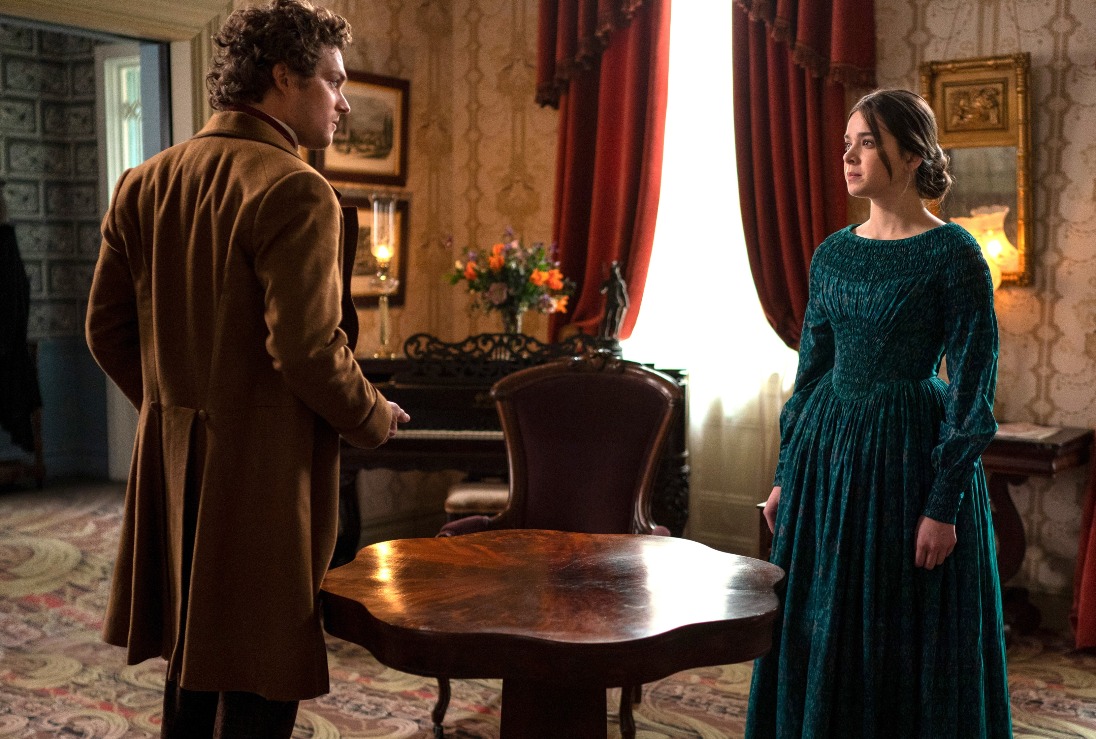
This is the only literal aspect of “You cannot put a Fire out” and ranks lower on the list of twists than those other metaphorical conflagrations, the first being the unavoidable confrontation between Emily (Hailee Steinfeld) and newspaper publisher Sam Bowles (Finn Jones) and the second a gorgeous, dreamy consummation of a love that dare only speak in stanzas.

Earlier in the season’s run “Dickinson” creator Alena Smith reminded us that everything about this series is a response to patriarchy. “If men hold all the power,” she told Salon, “then women need to contort and shape themselves around men in order to have access to power themselves.”

This thought is heartening and infuriating in equal measure because it involves different ways of contemplating desire and vulnerability in the context of this final hour.

“You cannot put a Fire out” is a culmination of indulgence, and a pure exhibition of empowerment through the female viewpoint. But it also invites us to consider how we define that concept for ourselves and, more specifically, what role fame plays in our concept of claiming our power. Modern audiences have a tendency to see a link between the two, chasing exposure and building brands that don’t necessarily match reality in order to convey an image of success.

Very little of this would seem to apply to Emily’s life in the 1800s except, that is, where the writers highlight those connections. In this second season Emily ruminates on what it would mean to remain great but anonymous as opposed to being a published and celebrated author. The mystery of why Dickinson, a very prolific poet, published very little of her work while she was alive is one of the unknowns this series plays with.

“Dickinson” makes the case that her choice to be a “Nobody” is one at which she arrived after several harsh lessons, the largest of which involves a betrayal of male allyship. In these episodes Sue introduces Sam to Emily and encourages Sam to become Emily’s artistic patron, a generosity he’s shown to other female artists in that era.

But neither Sam nor Sue encourages Emily to gratify her ego for purely altruistic reasons. Sue absolutely believes in Emily’s talent, pushing her out of a sense of loyalty and love, and to atone for her squelched physical  yearning for her best friend.

Sam, however, operates from a more selfish position. He sees a rare talent whose discovery he can claim, and he woos her into handing over all of her poems, persuading her that doing so is evidence that she believes in herself.  


Finn Jones and Hailee Steinfeld in “Dickinson” (Apple TV+)

Eventually Emily comes to realize his actual aims, helped there by stumbling upon Sam and Sue in flagrante delicto. Therefore, she takes advantage of an unannounced visit by Sam in the finale to demand he return her poems.

This launches Sam into a tirade familiar to any woman who has been betrayed by a man like him.

“Don’t let your emotions get in the way of your career,” Sam says. “That is always what happens to women!”

“I need my poems,” Emily seethes, to which Sam responds, “No, Emily. You need me.”

At some point many women befriend or at least make an acquaintance with a man who professes to support them – not merely as an individual, but as a woman. Through Season 2 Smith and the writers sprinkle hints that Sam isn’t less interested in furthering the cause of female empowerment than he is in breaching the barrier that is an extraordinary woman’s corsetry.

Sam Bowles represents every man who makes gaslighting into an art when he delivers a sucker-punch of a monologue designed to throw Emily off of her game.

“See,  a lot of people wouldn’t have even bothered with you. But I have, because I understand you,” he says. “You’re weird and you’re warped and you’re sick and you’re strange. But I understand that as a woman, your work comes from all of that.”

He continues, “Now, it would sadly be easy for the whole world to ignore you, but I won’t let them. No one would pay attention to you if it wasn’t for me pointing them in your direction. Trust me. You have no power without me. One day you will look back at all of this and you will thank me.”

He’s perfectly fine with her wearing a tiara as long as it’s understood that he’s the emperor.

Blessedly Emily doesn’t give in. She asks him again, and he refuses her again. She tries to grab the satchel where the letters are contained, but he wrests the bag away from her and dashes out the door to a waiting carriage that speeds off.

“You are the devil!” she screams at him.

To this Sam has the gall to reply, “I am a feminist!” And with that, he believes he’s scored the last word.

Luckily for Emily the family’s housekeeper Maggie (Darlene Hunt) retrieves Emily’s poems from Sam’s bag while he’s bloviating at the poet, so all is well.

Steinfeld and Smith use “Dickinson” to reconsider the poet’s association with introversion, oddity and even a presumed rigidity by inserting modern flourishes like that “feminist” line where it suits the moment, and where we have a chance to better relate through humor.

But where Emily’s face-off with Sam becomes a reclamation of her power, by way of a retreat to what she tells him is the “empire” in her mind, the Emily-Sue pairing curves around the obstacles standing in their way.

Sue and Emily steal kisses in the first season before Sue marries Emily’s brother Austin (Adrian Enscoe), but Sue could have easily put that aside along with all things childish. But the love scene they share in this last episode is entirely adult in nature without being explicit. The coupling is mostly implied, portrayed as a buffet of sweets and a shared milky bath with flower petals floating on the surface; it is sensual and erotic without being more visually explicit than showing a kiss.

Of course, this interlude also is an entryway to more tensions and worries next season, but that’s off in the distance somewhere. In the here and now they’re taking what power they have to be honest and real with each other, about each other. Greater than its arousing imagery, it is this implication that holds the most potential.

Other fires burn in this episode too — the church, the doomed engagement between Emily’s sister Vinnie (Anna Baryshnikov) and her handsome dolt Ship (Pico Alexander), who insists on moving to New Orleans even though the country is on the brink of civil war.

A spirit belonging to a man she knows is doomed to die in that war haunts Emily throughout the season, calling himself identifies himself as Nobody (Will Pullen). In the same way she comes to accept and welcome the presence of Death, she embraces this part of her too and finally understands the reason he pulls at her. “You must be a nobody,” he tells Emily, “the bravest, most brilliant nobody who ever existed.”  Regardless of this, “Dickinson” ensures her reputation continues to glow brightly.

Seasons 1 and 2 of “Dickinson” are streaming on Apple TV+.

I grew up in the city, not hiking or camping. As an adult, I want my family to enjoy nature’s beauty

I came along too late to get the best of what Mr. Warren had to offer. Being the youngest child on my mother’s side of the family is a double-edged sword. On one hand, you enter life as a well-protected citizen of the world, with a host of older siblings who can navigate some of the darkest alleyways life has to offer for you. They’re watchful, attentive, and have no problem policing the cliffs adolescence pushes us to drive off of with jeering smiles. The flip side is that certain people who are fixtures in your family’s growth are distanced by the steamroll of time. I arrived late. By late, I mean those humid Baltimore mornings, where you could basically bite the thickness of the air, when Mr. Warren would take my brothers crabbing — those mornings escaped me.

Mr. Warren’s family and ours lived a house apart on the same block for more than 35 years. He’d load my brothers in his wood-paneled Jeep Cherokee and head to the Chesapeake to bring back the lifeblood of our city. I didn’t get to sit on a boat on the still waters and learn step by step how to capture the food that can make or break a cookout, but I did get to see the final act when they returned. I’d watch Mr. Warren coat crabs with Old Bay as precisely as one of those competitive chefs on TV. This wasn’t a game to him, though. He was deadly serious about applying just enough seasoning so the flavor had bounce and the meat inside offered a savory journey through the five senses.

“I know you want some, boy, come on around here and have some. They nice and hot,” he’d say, peering through his glasses. The black of his eyes looked like two 8-balls side-by-side on a beach. His mustache overtook his face 99.9% of the time when he wasn’t smiling.

I would grasp the top of the silver gate to jump into his yard and would be met with, “Hey! Walk around and go through the gate. This ain’t no playground.” Even though we lived in row houses and the easiest way for an eight-year-old to get into the neighbor’s yard was to act like a fugitive, he was no-nonsense on gate-jumping. That was a crime punishable by becoming a crabless man.

“Ard, Mr. Warren. You right. You right,” I would say, power-walking out of my mother’s yard and into his. We’d sit down at his picnic table and he’d show me how to use a mallet, or no mallet, and how to push through the pain of getting a finger cut in the process. This was summer in West Baltimore. Amidst every other thing that was happening around my way — prison time, pistols, and paper with funny-looking white men on it inhaling the lives of some of my friends — Mr. Warren’s picnic table was an oasis. 

Mr. Warren was the only person I knew in my life that had a connection with the outdoors. He knew how to fish, crab, and do a host of other activities we would otherwise only watch on those country shows that used to play on Saturday afternoon television. My brothers would talk about being on the water, seeing how the bay opened up like the mouth of a hippo. Some people call it living off the land; others, just a way of life. Now, as an adult in quarantine with three apple-headed children who are the literal breath in my lungs, I realize that the expeditions my brothers took part in were more about seeing something outside of the city and losing the trappings of the all too familiar concrete than just catching a fresh lunch. 

Three years ago, I started to search for methods to curb my anxiety. I had a brilliant idea, one that felt completely foreign to people like me: We’d go outside, to the real outside.

Being a writer in the 21st century can keep you in front of a screen for so long it feels like the room is sideways. Being a human with the privilege of wifi and LTE can mean hours spent on social media, scrolling and posting for so long your sense of reality actually becomes sideways. After about 100 passes through the “my life is so incredible” conveyor belt, something had to shift. I knew nothing about the outdoors, but I had a four-year-old and a one-year-old with endless energy, so I figured I could solve two equations at once. I would get a breather from the matrix, my wife would let loose the nutjobs we call our children, and the kids would poke at insects and earn knee-scrapes.

“We going into the woods,” I told everyone with the type of smile that gamblers make when they jump into a high stakes game with a pocket full of pocket.

We drove to Great Falls, Virginia, where hundreds of people on any given day spend hours meandering through the hillside and dense forest. About 45 minutes into weaving through the trails, I could feel my phone calling me the same way people say guns talk to them when they have them. After checking it two times and realizing I had no service, I called it a loss. My withdrawals subsided at a summit point overlooking the Potomac River. The marine blue water pulsed, turning white and crashing powerfully hundreds of feet beneath us. The kids gasped as if they’d seen the climax of the magician’s final act. But there was no magic involved, no toys from Target leeching the creative juice out of their right brain; just nature, just the outside, that had been there all along. Since then, we’ve been hooked. 

COVID-19 gave the world a potent dose of cabin fever. It stripped us of being able to move through malls like grazing cows. It took being neck-on-neck with musty strangers at festivals away. And unless you’re an essential employee or of the ilk of people who knowingly endangered Pop-Pop and Mama’s lives just to take pictures in dimly lit clubs or standardized Thanksgiving feasts, you’ve been stuck in the house too, for a long time now. By last summer I felt my home’s walls closing in, so I decided to take my outdoorsmanship — bushcraft, they call it — up a notch and go camping.

My family had just moved to Detroit in June. Before our first experience of the folklorish winter, we knew we needed to explore the nearby outdoors. My friend Umar Raheem’s family has owned plots of land in the north of Michigan, in a place called Idlewild, for more than 60 years. Idlewild was made famous in the 1920s by people like business mogul Madame C. J. Walker. She and other small business owners who had earned enough money to humbly vacation were left with few options because of segregation. When the “Black Eden,” as it was called, began attracting attention, people upset with it began calling the people spending quality time with their families there “Idle men and Wild women.” The name was culturally reversed as has been the case with other relics of America’s inhumane vernacular. And every  summer in Umar’s childhood, his family would drive up from the Motor City and spend weekends swimming, fishing, emptying themselves of jokes and stories over campfire, letting the grandkids run around under the supervision of a sky blanketed with stars.

“Yo, I ain’t know pine needles spark fires that fast, bro!” I told Umar as he settled in his campsite. My family had arrived four hours earlier than the rest of the group, and I had been tasked with building my first solo fire. Umar had instructed me to find small twigs and build the fire until it can sustain logs. I figured pine needles were a good boost. But the natural burst of flame that comes from them can have a man from the city bricks thinking a forest fire was next. I’d be known as the brother who burned Idlewild down.

Thankfully, the needle fire subsided, along with my anxiety. For three hours my kids had watched me set up camp, kindle and maintain my first attempt at fire. They watched my every move like a hawk, asking every ten minutes to help get more twigs, roast meat, and play flashlight tag.

Umar and his camp arrived just as the night had become overrun with stars. “Bro, you seem like you all settled in. Fire’s decent. Tent is decent. Y’all ready for the bush,” he said.  

The next morning we treated ourselves to the lake the five generations of Umar’s family had learned to swim in. “My uncle would pick me up and launch me right over there,” he said chuckling, pointing to a part of the lake. “Everybody needs a break from the city, Tariq. I promise you,” Umar said.

The next three days were a sort of expedition: part history lesson, part hugging trees and sitting silent. 

About a month after Idlewild, my thirst to be detached grew again. We camped two more times before the cold came, each time seeing a bit more of what nature had to offer city folk. The early months of 2021 trapped many of us inside again with nothing but devices, memes, and a false sense of importance. But now, with spring approaching, I’m thinking about outside again, for everyone’s sake.

In a New York Times story on how inequity affects climate, Brad Plumer and Nadja Popovich wrote about how in places where redlining has been and still is a problem, even the temperature in a neighborhood can be different from other well-invested areas:

Neighborhoods with white homeowners had more clout to lobby city governments for tree-lined sidewalks and parks. In Black neighborhoods, homeownership declined and landlords rarely invested in green space. City planners also targeted redlined areas as cheap land for new industries, highways, warehouses and public housing, built with lots of heat-absorbing asphalt and little cooling vegetation.

Could it be that the same heat myself and Mr. Warren bathed in — our mouths blazing hot from seasoned crabs in the late ’90s — was caused by redlining? Or maybe because a city dumping ground lie just across the bridge from us? I’ll leave that to the researchers. What I know is that I was blessed to find another outlet to release the scramble of day-to-day life. Tomorrow, outside might be able to do the same for others. 

Three-ingredient broccoli cheese soup — can you guess the third?

Big Little Recipe has the smallest-possible ingredient list and big everything else: flavor, creativity, wow factor. That means five ingredients or fewer — not including water, salt, black pepper, and certain fats (like oil and butter), since we’re guessing you have those covered. Psst, did you hear we’re coming out with a cookbook? We’re coming out with a cookbook!

* * *

Albeit only two ingredients in name, broccoli cheese soup often includes a busload of backseat drivers, like onion, carrot, celery, potato, garlic, flour, cornstarch, vegetable or chicken stock, milk or cream or half-and-half, hot sauce, paprika, mustard, cayenne, nutmeg, and then some.

This Big Little Recipe doesn’t. Because when your broccoli cheese soup is mostly broccoli and cheese, your grocery list is littler, and your bounty is bigger. The trick? Use both of these high-powered ingredients not once, but twice.

The broccoli is our star, our lead, our Timothée Chalamet. Most of it, including the stalks, is blanched until tender and happy-go-lucky green, then whooshed in a blender until satiny. The stalks are key because, once puréed into oblivion, they become our thickener, the role typically played by a roux, flour, cornstarch, or even potato. And they don’t dilute the flavor along the way.

The rest of the broccoli gets blasted in a scorching oven, becoming brashly charred, with crackly, frilly, Frito-like tops. Sprinkling these florets on top adds lots of crunchy chew to an otherwise smooth soup, not to mention a bam-pow-pow of broccoli flavor.

Now about that cheese: cheddar, white, the sharper the better. This is just as funky and tangy as it is melty and gooey, which means when you throw a handful into the blender along with the broccoli, you get a soup so lush and fondue-esque, it seems like it must have cream or at the very least milk, right? But it doesn’t.

Even more cheddar gets sprinkled on top of the roasted broccoli. Thrown into the oven, the cheese goes from grated to melted to crispy like a cracker in a matter of minutes. A cheese cracker. A cracker made of cheese. Who doesn’t want that?

The only other ingredient you’ll need is onions. Which, I have a hunch, anyone eating this won’t be able to pinpoint. That’s on purpose. Sautéed until sweet and soft, the onions aren’t here to steal the show from the broccoli or the cheese. Much like chicken or vegetable stock, they serve as a cozy foundation, a savory backdrop, a way to round out the soup and make you think that you’re eating something with a busload of ingredients. Even though you’re not.

Recipe: Crispy Broccoli Cheese Soup

Prep time: 20 minutes
Cook time: 45 minutes
Serves: 4

Ingredients:

  • 1 1/4 pounds yellow onions (about 2 medium plus 1 large), diced
  • Neutral oil (such as canola or grapeseed)
  • 2 pounds broccoli (about 2 large or 4 medium heads)
  • Kosher salt
  • 8 ounces sharp cheddar, grated

Directions:

  1. Heat the oven to 450°F.
  2. Pour a glug of oil into a stockpot set over medium heat. Add the onions and a big pinch of salt. Cook, stirring occasionally and lowering the heat if needed, until the pieces are soft, translucent, and beginning to brown, about 12 minutes. 
  3. Meanwhile, cut away the broccoli stalks’ tough exteriors. Chop all the stalks into bite-size pieces and add these to a bowl. Chop what’s left into bite-size florets; add half of these to the bowl and the other half to a rimmed sheet pan. 
  4. When the onions are ready, add 6 cups of water to the pot, along with a couple pinches of salt. Increase the heat to bring the water to a boil. 
  5. While the water is heating up, generously drizzle the broccoli florets on the sheet pan with oil and sprinkle with salt. Toss with your hands, then spread out the broccoli as much as possible. Roast for about 15 minutes, until the bottoms are deeply browned and the stalks are knife-tender.
  6. When the onion water reaches a boil, add the broccoli stalks and florets in the bowl. Boil until the water is golden in hue and the broccoli stalks are fork-tender, about 8 minutes. 
  7. Use a slotted spoon or spider to transfer the onions and broccoli from the stockpot to a blender. Blend until smooth. Add all but 1 cup of grated cheddar (we’re using that in a bit) to the blender. Blend again. Add 2 cups of vegetable stock from the stockpot and purée again. You should have about 2 cups of stock remaining; add more to the blender if you want the soup thinner; otherwise, pour the leftover stock into a container and refrigerate or freeze for soupy situations down the road. 
  8. Pour the puréed soup into the emptied stockpot. If needed, set over low heat to stay warm. 
  9. When the roasted broccoli is ready, remove the sheet pan from the oven. Increase the oven to 475°F. Sprinkle the remaining 1 cup of grated cheese on top of the roasted broccoli florets. Return to the oven and roast until the cheese is lacey and deeply golden brown, about 5 minutes (you can rotate the sheet pan if needed for even cooking). Pull from the oven and let cool for a few minutes to slightly crisp. 
  10. Divide the soup into 4 bowls and evenly divide the crispy-cheesy broccoli florets on top.

Dreaming of Mom’s golden-crisp bread rolls . . . 4,000 miles from home

Good food is worth a thousand words — sometimes more. In My Family Recipe, a writer shares the story of a single dish that’s meaningful to them and their loved ones.

* * *

My mother often tells the story of how, as children, my sister and I would come home from friends’ birthday parties absolutely famished and declare that we hadn’t eaten anything at all. We’d then, she says, clamber onto our dining chairs and wait as she whipped us up something delicious in a matter of minutes: the fluffiest of cheese omelets with a sprinkling of cilantro and chile; shahi tukda that always managed to walk the fine line between cloying and scrumptious; or the thing I looked forward to the most — my favorite snack of all — the bread roll.

Even as my mother fed us, she’d puzzle over how we had returned hungry from a party where there ought to have been plenty of food. Her questions usually went unanswered.

It took my mother’s presence at one to figure it out. She says she watched as my sister and I both accepted paper plates piled high with cream cake, samosas, and chips with ketchup — staples at every ’90s birthday party in India. She then observed as we retreated to the furthest corner of the room, where we pushed the food around our plates for as long as we could before folding them in half, sliding them under the couch, and escaping. Before my mother could cross the room and get to us, the deed was done.

Back home, my sister and I were forced to explain. We’d been taught not to be rude, we explained, so we always accepted the food and then secreted it away, untouched. We’d rather eat at home, we added. That evening, my sister and I were taught a valuable lesson about not wasting food. It was also the first time we became aware of the concept of privilege.

It’s usually when my mother is done narrating this story (for the 127th time since we were kids) that I point out that she, and her endless stream of delicious food, were, in fact, to blame.

My mother has always been the pervading influence on us, and our tastes: Our steady diet of comic books was all her, as was our proclivity for black-and-white classic films (the blockbuster releases in Bangalore’s single-screen cinemas didn’t stand a chance). And, whether she meant for it to be this way or not, it was her relationship with food and her consummate skill in the kitchen that shaped our ideas around the what, why, and how of eating.

The interesting thing to me has always been how she managed to do that without actively teaching either of us how to cook. So, when I try to trace how and when I came to learn anything at all about food, my mind goes straight to her orchestration of mealtimes.

Even teatime was an event at our home — comprising not just steaming cups of chai, but piles of snacks. Sometimes, those snacks would be sourced: samosas dripping with mint and tamarind chutney from a Bengali sweetshop, potato buns from the neighborhood Iyengar Bakery, masala vadas from a man in the market whose entire setup consisted only of a giant vat of boiling-hot oil atop a tiny handcart. Other times, especially on rainy days, the snacks would be homemade: onion pakoras, piping-hot pazham pori (banana fritters), and those bread rolls—fried to a crisp on the outside, warm and starchy on the inside.

Teatime was so substantial, it’s a wonder we ever needed dinner. But we did.

Every evening, a mere hour or two after tea, the smells of dinner would come wafting up the stairs, compelling me to leave the comfort of my room and make my way down. I’d lean on the doorjamb in the kitchen, listening to the sound of knives on the wooden cutting board, the sizzle of onions as they hit the pan, and the grunting of our trusty Johnson mixer grinder as it pulverized tomatoes. From where I stood, I had a clear view of exactly what my mother was doing — without getting in her way.

It was there, standing at that door, that I realized that there often was a great deal of truth behind the many tired maxims I’d been fed at school. Like, “anything worth doing is worth doing well”: The vegetables that went into her poriyals always needed to be chopped to millimeter precision if they were to cook uniformly. Or, “timing is everything”: Ingredients went into the pan exactly when they were meant to go in and not a minute sooner — unless you wanted a curry in which water separated from the masala. I could keep going.

When I moved to Bombay in my early twenties to work as a writer at a magazine, putting 621 miles between my family and myself for the very first time, I was completely unprepared for the practical challenges of fending for myself. I remember spending that first afternoon on the bed in my temporary apartment, sobbing as I stuffed the chutney sandwich my mother had packed for me in my mouth. It tasted like home; finishing that sandwich had a heartbreaking permanence to it.

A month and a half later, when I moved into more permanent lodgings, I had to contend with cooking for the first time in my life. On my debut attempt at a meal of rice, dal, and potatoes, it dawned on me that the fact that I’d never cooked a single meal did not mean that I didn’t know how. My position by that kitchen door had, in fact, been the best seat at the only culinary school I would ever need to attend.

As I write this, the 621 miles have grown to more than 4,000. All the way in Berlin, my kitchen contains as many odes to items my mother has in her kitchen as I’ve managed to find. A rolling pin that’s exactly the same shape and weight as the one she has. A traditional South Indian filter coffee maker, because no stove-top espresso machine could ever come close. A recipe notebook with checkered pages — my mother’s preferred writing paper — that contain her recipes. I’ve got pretty good at replicating many of them over the years, too: chana bhatura and rajma chawal, and her version of kadai chicken that I’ve long since given up on referring to her notes for.

Perhaps it’s because snacks aren’t ever totally necessary to make, or that teatime doesn’t quite hold the same meaning here as it did back at home, that I’ve never quite developed the ability to recreate the teatime treats and midnight snacks my mother made us. Or maybe it’s that I like leaving them to her deft hands —t here are things you just want to assume she will make you forever. No wonder then that it’s these I miss the most; nothing terribly elaborate, but the sort of thing that really hits the spot when one wants to be reminded of home. On cold winter nights in Berlin, that craving for home can only really be assuaged by something deep-fried to golden brown perfection. Like my mother’s bread roll.

I will say, though, that the days my mother packed one into my school lunch were bittersweet. The problem was that my mother’s bread rolls were equally loved by my schoolmates. So nearly every single time she would send my sister and me off to school with bread rolls for lunch, we’d come back home “absolutely famished” and declare that we hadn’t eaten anything at all. We’d then clamber onto our dining chairs and wait as she whipped us up something delicious in a matter of minutes.

***

Recipe: Mama’s Bread Rolls

Prep time: 15 minutes
Cook time: 10 minutes
Makes: 6

Ingredients:

  • 6 small-medium potatoes
  • 1 small onion, finely chopped
  • 6 slices of multigrain sandwich bread, crusts off
  • 3/4 teaspoon cumin powder
  • 3/4 teaspoon mild red chili powder
  • 1/4 teaspoon garam masala (optional)
  • 1-2 small green chile (Indian or Thai), chopped fine (optional)
  • 1 tablespoon cilantro, finely chopped
  • salt to taste
  • Sunflower oil for deep frying
  • water in a medium-sized bowl

Directions:

  1. Boil the potatoes until tender, so they can be pierced quite easily with a fork. Peel them and mash roughly with a fork. Note: They don’t need to be creamy smooth. 
  2. Add the onions, cumin powder, mild chilli powder, garam masala (optional), green chile (optional), chopped cilantro, and salt to the potatoes, and mix together well. 
  3. Shape the mixture into six even-sized oblongs. 
  4. Moisten a slice of bread by dipping it into a bowl with water and immediately whipping it out. Press flat between your palms to squeeze excess water out. Place the potato mixture in the center of the moistened slice, and fold the bread over the filling, and shape into an oblong. 
  5. Repeat with the rest of the bread and potato mixture.
  6. Heat enough sunflower or any other vegetable oil in a large wok. The quantity of oil you will need for deep frying depends on the size of your wok. Once the oil is hot, drop one of the rolls in (it needs space to move around), fry for around 3-4 minutes, until it gets to a nice rich golden-brown color. Repeat with the rest of the rolls. 
  7. Serve with ketchup, cilantro chutney, or for absolute authenticity, Maggi Hot & Sweet Tomato Chilli Sauce.

Related recipes:

America’s power grid is broken. Here’s how to fix it

Last week Texas was struck by a freakish winter storm, one that left millions without electricity. Although much of the power grid has been restored, there are still ongoing problems with the Texas infrastructure, from plumbing issues to people struggling to find necessities like food and water. Yet the most immediate crisis was that Texas, a state not accustomed to wintery weather, left millions of people without heat in freezing temperatures. Texas public utilities at one point were less than five minutes away from a blackout that could have lasted weeks or months. Experts believe it will take months to fully calculate the death toll, although so far nearly 80 deaths connected to the storm have been confirmed.

Republicans like Texas Gov. Greg Abbott have argued, not surprisingly, that the massive power outage somehow discredits left-wing policies. “This shows how the Green New Deal would be a deadly deal for the United States of America,” Abbott told Fox News on Tuesday, later adding that the problem was with “[o]ur wind and our solar” and claiming that it “just shows that fossil fuel is necessary.”

Yet the reality about what went wrong and what can be done to prevent this kind of crisis, experts agree, is much more complicated. And it starts with understanding how our electricity grid works.

The American electrical grid, which The Wall Street Journal described in 2016 as “one of the engineering marvels of modern history,” can be traced back to the modern concept of power grid designs. Those, in turn, originated in the late 1800s, according to Dr. Alexis Kwasinksi, an associate professor of electrical and computer engineering at the University of Pittsburgh’s Swanson School of Engineering. The goal was to provide electricity to as many people as possible at the lowest possible cost.

“The solution for such a design problem led to the power grid concept in which a few large power plants provide electricity to many more but much smaller loads located sometimes hundred of miles away from the power plants,” Kwasinski told Salon by email. “One of the solutions to maintain system stability was to interconnect power plants and loads so they operate at an aggregated level.” As a result of this interconnected approach, the United States developed long transmission lines across the various states so that power could be transmitted across great distances with low losses.

One problem with this approach, Kwasinski explained, is that because everything is interconnected, all of the different loads receive the same quality of power. As a result it is expensive to alter power grids so that power can be allocated according to the needs of individual locations in ways that can prevent power outages or prioritize regions that have more urgent needs. 

Kwasinski says that resilience was not an objective in designing power grids — at least, not until now. “It is only recently that society [has] started to demand higher power grid resilience,” he rued.

The problem is originally power grids were designed to meet the needs of the early 1900s. Even more modern power systems are planned decades in advance, meaning that Texas’ existing power grid is the result of planning processes made decades ago, Kwasinski says.

“At that time (let’s say in 2011) no planner knew that in February 2021 the state’s power grid would be subject to such cold conditions, even when there were brownouts during the winter of 2011 because of insufficient power generation,” he added. Texan engineers were thinking, understandably, that they needed to design with heat waves in mind, not the kinds of winter storms you’d be more likely to encounter in the northeast.

Dr. Masoud Barati, who is also an assistant professor at Pittsburgh’s electrical and computer engineering department, broke down for Salon exactly how things went wrong in Texas. He explained it within the context of the HVDC line, or high-voltage direct current, and what the primary operation of the existing HVDC was in Texas’ Electric Reliability Council (ERCOT). He explained that in the Texas blackout there were five HVDC interconnections that ultimately amounted to 1.1 GW of “tie-line capacity as interconnection with other neighbors states and countries.” This proved insufficient for two reasons: First, “the winter peak load recorded by ERCOT was 69,150 MW and 34 GW loss of thermal and renewable generation resources,” meaning that “the 1.1 GW HVDC cannot support the significant generation loss and load.”

In addition, because Texas’ neighbors were hit by the same storm and either almost maxed out their ability to generate energy or found that the amount of electricity generated was less than the amount demanded because most Texas homes used that electricity for heating.

Ironically, although Gov. Abbott tried to argue that the winter storm and blackout somehow discredited a Green New Deal, it in fact illustrated precisely why we need one.

“From a Green New Deal perspective, we would want to have public utilities that prioritize public safety and resiliency and disaster readiness over the optimal price in a perfect market equilibrium situation and really nice weather, so I think that’s an important distinction,” Daniel Aldana Cohen, associate professor of sociology at the University of Pennsylvania and co-author of “A Planet to Win: Why We Need a Green Deal,” told Salon. After noting that the Texas power grid is deregulated and therefore undemocratic — “you don’t have a clear line of accountability in the way that you should have with a public system” — Cohen argued that the solution to issues of energy inefficiency, as presented in his book, is a national power grid.

“You would have a single national grid, very robustly interconnected,” Cohen explained. “That would mean a grid dominated by renewable energy sources like wind and solar. By virtue of having that full national interconnection, when there is less energy or no energy in one region of the country, you can shoot energy down there from other regions.”

For instance, in the case of events like the winter storm in Texas, a national energy grid would have allowed public authorities to divert energy that’s been stored elsewhere in the national system so that it could have been diverted where it was most needed. When it comes to disaster resiliency like extreme weather events, a national power grid would “essentially mean that there is like a national solidarity of energy that covers the whole country instead of having a big region that has to fend for itself.”

Cohen also warned that, if a Green New Deal is not implemented, we could wind up with “a kind of eco-apartheid situation where largely white, largely affluent people can basically hoard solar panels and batteries and resiliency at the expense of a fully egalitarian system where literally every single home and community is guaranteed safety and reliability.”

Barati offered a somewhat different set of suggestions to Salon.

“If only Texas had stronger connections to the rest of the U.S. with HVDC and HVAC [High Voltage Alternating Current] lines, they would have been fine,” Barati wrote. He also pointed out that “if only appropriate reliability planning were performed, taking into account the coordinated transmission line expansion and generation planning subject to rare and common-mode events, Texas would have had appropriate generation reserves.” In addition, he observed that “Texas has an energy-only market, which means that it is vulnerable to rare events. If only Texas had a properly functioning capacity market for both generation and transmission sides, they would have had enough spare transmission and generation capacity to deal with the shortages.”

Regardless of what solution you prefer, one thing is likely: Because of climate change, we should expect to see more extreme weather in areas not accustomed to it, from the West Coast wildfires to the Texas winter storm.

“The way is through the changes in the environment that have occurred from climate change,” Dr. Kevin Trenberth, a distinguished scholar at the National Center for Atmospheric Research, wrote to Salon when asked about the potential role of climate change in the Texas winter storm. “These include generally warmer conditions, including much warmer oceans, higher sea surface temperatures, reduced sea ice and glaciers, and higher water vapor in the atmosphere.” Trenberth noted that the extra available energy accelerated the water cycle, leading to more evaporation and heavier rains. 

CORRECTION: An earlier version of this story misidentified the HVAC acronym to stand for Heating, Ventilation, and Air Conditioning. The story has been updated.

The Doors’ John Densmore on how George Harrison’s words helped him mourn Ray Manzarek

Legendary Doors drummer John Densmore joined host Kenneth Womack to discuss life, loss, and his band’s parallels with the Beatles on “Everything Fab Four,” a podcast co-produced by me and Womack, a music scholar who also writes about pop music for Salon, and distributed by Salon.

Densmore, who played on every Doors release and is also an actor, dancer and author (most recently of the new book, “The Seekers”), describes both the Beatles and Doors as “evolving bodies of art” who in the mid-late ’60s were “experimenting with then-legal psychedelics” and meditation — all of which was reflected in their music. Densmore tells Womack that the backwards drum tracks on “Strange Days” were inspired by the Beatles. And in fact, George Harrison once showed up at a “Soft Parade” session and remarked that it reminded him of “Sgt. Pepper” because of all the horn players and Eastern influences. Listen:

Subscribe today through Spotify, Apple PodcastsGoogle Podcasts, StitcherRadioPublic, Breaker, Player.FMPocket Casts or wherever you get your podcasts.

But it also went deeper than that. Harrison, long credited as the most “spiritual” Beatle, is actually quoted in “The Seekers.” As Densmore explains, upon losing John Lennon, George had stated words to the effect of, “When you had a special relationship with someone and you can’t continue that after they died, then how can you have a relationship with Jesus or whoever you’re projecting as a deity?” Learning to change the way he thought about death helped Densmore (who had already lost bandmate Jim Morrison many years before in 1971) cope with Ray Manzarek’s passing in 2013. As he explains, George “wasn’t with John every day in the later years, but that didn’t diminish what they had.”

Densmore also came to accept that though Morrison’s death at such an early age was tragic, some people are “meant to be a quick shooting star, and [others’ roads are] much longer.” He says he still has dreams about Jim and Ray, and feels connected to them. “They are seekers,” he explains, “everybody is a seeker to a degree.” And he considers John Lennon to have been one of the greatest seekers, right up until the end.

But ultimately, as time passes on, Densmore says that both the Beatles and the Doors are “two private clubs who are forever grateful to their fans.”

Listen to the entire conversation with John Densmore, including asking fellow drummer and “terrific guy” Ringo Starr about “paradiddles,” on “Everything Fab Four” and subscribe via Spotify, Apple, Google or wherever you get your podcasts. 

“Everything Fab Four” is distributed by Salon. Host Kenneth Womack is the author of a two-volume biography on Beatles producer George Martin, the bestselling book “Solid State: The Story of Abbey Road and the End of the Beatles,” and most recently “John Lennon, 1980: The Last Days in the Life.”

“Worshipping the golden jackass”: CPAC mocked for displaying giant gold Trump statue

The Conservative Political Action Conference is set to begin this weekend, and early indications are that much of it will be dedicated to worshipping former President Donald Trump.

In fact, as a video posted by Bloomberg News’ William Turton shows, CPAC will even feature a literal gold statue of the former twice-impeached one-term president, who will also be a keynote speaker at the event.

Many Twitter users noted that a gold Trump statue would seem to violate biblical commandments against idolatry, and it drew comparisons to the golden calf idol destroyed by Moses in the Old Testament.

Check out some reactions below.

Talking to the boogaloo: An exclusive series of conversations with a would-be revolutionary

The history-shaping year that recently ended was a year of spectacular violence. It was the year of George Floyd and Breonna Taylor, the year when a pandemic took hundreds of thousands of lives, many of them needlessly. It was a year that forced us to recalibrate fundamental social and cultural systems, a year that spawned both a summer of protest and dozens of anti-government demonstrations featuring armed militia members around and inside state capitols. It was the year a Blackhawk helicopter performed show-of-force maneuvers over protesters in the streets of Washington. It was the year that QAnon went to Congress. It was and the year that bred — one week into the following year — a deadly insurrection at the seat of democracy, fomented by the president of the United States.

It was also the year when the “boogaloo” — a nonpartisan, anti-government militia movement marketed to millennials and zoomers, which professes the goal of launching, or perhaps just instigating, a bloody revolutionary war — saw its membership and media presence swell, capturing fears and headlines. The movement also saw a corresponding spike in attention from activists, academics and journalists who monitor extremist groups, and who urge caution when trying to analyze the boogaloo and its many feints and contradictions.

In recent weeks, one member of that movement approached Salon with an offer to tell his story as a dissident within the boogaloo. He asked not to be identified, for personal security reasons. He said he would go by Sam.

“It is not hyperbole when I say that the people I associate with would happily kill me,” Sam said in his introduction. He explained that his primary motive for approaching Salon was to expose what he considers the boogaloo’s bad-faith exploitation of marginalized communities and “to clarify what is being planned and the motivations behind those plans.”

“I believe the public, that is those not associated with a radical or extremist movement, have a right to know who is standing on their street and what they want,” Sam said.

Sam proved well-educated, thoughtful and articulate, with near impeccable grammar. He was also a nuanced, contradictory and at times evasive subject, whose intelligence and extensive knowledge of history do not appear to have led him to a coherent vision of the future. Those characteristics embody the boogaloo movement so well that Salon has chosen to publish excerpts from those conversations at length.

No professed boogaloo member has previously discussed the tactics, goals and internal dynamics of the movement with the media in anything close to this depth. These conversations, conducted over the course of several weeks, may offer some insight into what motivates this deliberately confusing, potentially violent and increasingly radical militia movement, which has repeatedly surfaced at armed demonstrations in many different contexts across the country. But while Sam appears genuine when discussing his own perspective, he made clear that he does not purport to speak for the movement. Even if his dissents are genuine, he is also still a member of a group known for its deceptive rhetoric, so his remarks in every case be approached with skepticism.

News organizations must report carefully on extremist movements, especially those like the boogaloo which seek to exploit and shape media coverage and burnish their public image. Many in the media have been too eager to provide the boogaloo the visibility they seek, or taken their admittedly puzzling words and signals at face value. So here’s a guiding truth: The boogaloo’s threats of violence must be taken seriously, even if the movement’s ideological wrapping is purposefully confusing and the package within it ultimately empty.

Stripped of its rhetoric, guns and Hawaiian shirts, the movement is at its core a fraternity with an appetite for destruction, but with few if any shared principles for creating anything at all. Boogaloo members will almost certainly never lead or spark a violent revolution or cause the destruction of the state. But Sam insisted that mass violence was “inevitable,” and any militia group that appeals to volatile, disaffected young men has the capacity to generate terror and death.

Notably, the boogaloo pride themselves on their unique brand of hardline but slippery militant ideology, which offers the cover of ephemerality and is a prime source of their appeal. It’s also their fatal flaw. Most adherents of “the boog” — the term Sam generally used — almost certainly would not want to occupy or police the scorched-earth future they claim to envision, for which they appear to have no agreed-upon plans anyway.

Still: The boogaloo is here. It’s violent, it’s seductive and it’s spreading through a segment of the population that is increasingly alienated from the major institutions of social, political and cultural life. It only takes one unstable, angry and highly motivated person to do something unspeakable. And they don’t have to believe in anything.

Belief

So who is “standing in your street,” to use Sam’s phrase? The boogaloo is difficult to define — and that’s a feature, not a bug, which they regularly exploit. The movement is a decentralized and politically diverse ecosystem — albeit overwhelmingly white and largely male — whose shared agenda aspires to foment violent revolution against what they perceive as a tyrannical federal government, a war in which they say they will happily kill anyone in their way. Once someone else starts it, that is.

“Those beliefs, paired with frequent encouragements to purchase firearms, body armor and tactical gear, create a highly volatile space with the potential for violence,” Jared Holt, resident fellow at the Atlantic Council’s Digital Forensic Research Lab, told Salon.

Some members manipulate the resulting confusion as a tool for recruitment and media attention. But if there are bonding agents beyond violence, it is that virtually all boogaloo members are anti-government, pro-gun and, as with many far-right extremist groups, vehemently anti-cop. (We’ll return to that later.) They just can’t say what comes next.

The boogaloo emerged from the white supremacist underground, but has since sought to distance itself from those origins in favor of a more palatable and media-savvy gray zone between the hard right (anti-government and pro-gun) and the hard left (populist and anarchist, with nods to antifa and Black Lives Matter). Last June, the Department of Homeland Security tweeted that a Politico article casting the movement as fundamentally right-wing was a “work of fiction,” saying that the agency “does NOT identify the Boogaloo movement as left-wing OR right-wing,” but as violent extremists who draw from both sides. Some extremism experts concur with that analysis; some don’t.

“I used to stand with the right, but the boog is not right,” Sam said. “We hate Trump. We hate Biden. We hate the entire system. It’s not right vs. left for us, it’s bottom vs. top.”

He continued: “There [are] and always will be contradictions. Radicals, extremists and so on are highly opinionated, and as such have viewpoints that oppose one another. This is nothing new. Since before Lenin groups have argued. It’s the ones that can put those arguments on hold that succeed.” He made clear, however, that he doesn’t claim to speak for the movement as a whole: “I’m just a guy trying to show a facet of it to the public.”

Sam, a midwestern white male in his thirties in the middle of a years-long search for belonging and achievement, described an earlier career spent bouncing around radical extremist groups. Early on, he found himself drawn to right-wing militia organizations like the Oath Keepers and Three Percenters, but says he found their racism and homophobia “unpalatable” and “abhorrent.” After that, he said, he drifted towards the left, hanging with groups such as the John Brown Gun Club and antifa factions.

“I spent years training the left how to fight. They were more interested in fighting each other, however,” he said. When those groups began to splinter, Sam turned to libertarian and anarchist ideologies, and eventually found the boogaloo.

Like many libertarians, Sam often quotes Thomas Jefferson’s maxim: “The best government is that which governs least.” But Jefferson’s success wasn’t the Revolutionary War. He didn’t command an army. He helped create a system that has lasted centuries — one that spawned the Constitution that right-wingers and the boogaloo purport to revere, and one that has already survived a civil war.

Amy Cooter, a professor who researches extremist groups at Vanderbilt University, explained the appeal of those scattered politics. “Boogaloo is more of an ideology than a movement, in my view, meaning that people with a variety of motives and broader perspectives may be drawn to it,” she told Salon. “Members are often both well-intentioned and honest in their accounting of what they believe to be true, especially about so-called distractions from the perceived central threat of the federal government.”

These contradictions, Cooter said, also make the boogaloo vulnerable to exploitation: “They sometimes dismiss other people with more overtly racist motives as not ‘really’ being boogaloo affiliates, in a way that can miss the potential negative influence of those people, both in terms of public perceptions of the ideology and in terms of shifting the behavior and mindset of other adherents.”

Like antifa, the boogaloo has no top-down structure — according to Sam, it’s more like “a set of principles to organize around” — and its membership is in flux, although he claims it continues to grow. The boog has largely recruited online, first on message boards, then on Facebook and then, after Facebook was finally convinced to ban boogaloo-flavored pages, in chat rooms and on the Russian social media platform VK, where talk of anti-government violence isn’t policed. (Sam says he isn’t aware of any viable overseas connections.) Sam says his “cell” often just waits for recruits to come to them.

Part of what draws those recruits is the boogaloo’s shrewd branding, which targets a younger and largely but not exclusively male demographic. For instance, the movement’s name stems from the 2010s smorgasbord of terminally ironic and racist right-wing memes: It’s a play on the objectively and infamously terrible 1980s breakdancing sequel, “Breakin’ 2: Electric Boogaloo,” with the idea that in this case the “sequel” is a second civil war.

The group’s most iconic images manifest in the perplexing Hawaiian shirts they wear at demonstrations under their tactical gear, which have been described as “stupid,” but intentionally slam together symbols of war and peace: The “boogaloo” — meaning the coming war — became the semi-homonymic “Big Luau,” a jokey juxtaposition meant to be chilling. The name has also been spun off into the “Big Igloo,” a term some members use online to evade social media police. (Sam never used either term in his conversations with Salon.) Affiliates frequently juxtapose images, with igloos and floral prints appearing on flags, patches, guns and, yes, T-shirts.

(The Big Luau, Sam said, is also a pig roast, “pig” being a pejorative term for law enforcement.)

Journalist Talia Lavin, the author of “Culture Warlords: My Journey Into the Dark Web of White Supremacy,” who has followed both the far right and far left for years, told Salon that no one should be seduced by the boog’s calculated ambiguity.

“You should always take a movement whose stated goal is violence seriously,” Lavin said. The boogaloo’s use of irony has dual purposes, she said, both of them evasive: “Their over-the-top aesthetic and goofy name is a common tactic on the far right, as with the Proud Boys and other groups. It serves as both a blinder to the public that prevents them from being taken seriously as a threat, and a means for members to protest that all their actions are ironic or a joke.”

Another way to think about irony and jokes: At heart, they’re lies. But Sam was never ironic or funny in his conversations with Salon. Even when he contradicted himself, which was not uncommon, he was earnest. “The satire and irony are just that, until someone acts,” he said at one point. He called the shirts a type of “camouflage,” and said the same thing about the movement’s professed vow of non-aggression. If violence ever does break out, Sam said, the boogaloo will not fight a guerrilla war in Hawaiian shirts.

“We don’t buy rifles and body armor to hang on the wall,” he said. “We don’t train multiple times a month for fun, and it is not for self-defense.”

The boogaloo hope that the branding and their break with “conservative” signaling — they often make a show of standing with LGBTQ+, Black Lives Matter and antifa in protest situations — will intrigue outsiders and appeal both to the naive mass media and to a broader, younger pool of recruits.

Members frequently call themselves “Boogaloo Bois” in public, a gesture toward (or hijacking of) LGBTQ culture. Again, Sam — who identifies as bisexual — never used that term in his conversations with Salon. In fact, one of his most salient criticisms of the movement was its eagerness to cynically co-opt the language and symbology of marginalized groups, such as LGBTQ and minority communities. He says that the boogaloo boasts a sizable LGBTQ contingent, and that he is unhappy with this disingenuous trend, which he says is creating an unproductive, corrosive effect. (Sam shared a screenshot of one chat in which another member emphasized that demonstration attire should include prominent displays of support for LGBTQ causes — entirely for tactical reasons. Photos of boogaloo members make clear this is common.)

In Sam’s view, the movement should align itself with oppressed groups in genuine solidarity, as he says it did when he first joined, He said he has collaborated with other members to “shift the media toward something positive.”

Holt, along with other researchers, disputes the movement’s claims to inclusiveness, saying that “radical elements with die-hard hatred of minorities and pro-terrorism philosophies exist in the movement” and are seldom condemned.

Sam, who said in early interviews that several of his family members hold high-status occupations, acknowledges that he shares the streak of rage pervasive among so many white American males. But other than that, and perhaps the intellectual appeal of a mutable, contrarian not-quite-movement, it’s not easy to tease out why he picked the extremist path.

“I am an angry white dude,” he said, “because other white dudes deny they have it better.” He added: “The boog has plenty of white dudes. We also have a huge contingent of females, a [sizable] amount of LGBTQIA+ individuals and some POC members. Yes, there are racist comments made. But actual racists are shown the door.”

Researchers and journalists who have explored the boogaloo are highly skeptical that the movement does much to purge racists and other bigots, pointing to the movement’s origins and its use of “woke” slang or symbology as a marketing ploy. Sam, as usual, says the overall picture is complicated. “There is very little racism and very little homophobia in its current iteration, but this is not due to it being morally or ethically correct,” he said. Boogaloo members “do not wish to alienate potential allies or pawns and they want the media to view them as less of a threat when it comes to progressive advancement.”

“That’s a lie,” Lavin said. “The movement happily includes racist and homophobic elements.”

Sam says that whenever fellow members target him in homophobic remarks, he jokes back and moves on. It’s that part about “pawns” that bothers him. Explaining why he decided to come forward and “expose” the boogaloo (his term), he told Salon, “Because they are exploiting legitimate struggles and problems to advance their agenda. I agree with using subterfuge, but not if it discredits work that is being done in those communities.”

He added: “I still believe in that work, but my colleagues in the movement have gone too far. What is being presented is only a part of the truth. A sugar-coated version of the boogaloo movement.”

War

Sam often uses the term “civil war,” but what the boogaloo appear to want is more like a revolution that would destabilize and overthrow the full apparatus of the U.S. government. That includes the police, and, presumably, the armed forces, though the movement recruits both veterans and active-duty service members — some of whom Sam says are “tier three or tier two” special forces, such as Navy SEALS or Army Rangers.

(In 2009, the Department of Homeland Security and FBI released a report that specifically listed “disgruntled military veterans” as recruiting targets of violent groups on the radical right: “Right-wing extremists will attempt to recruit and radicalize returning veterans in order to exploit their skills and knowledge derived from military training and combat.”)

Sam was consistent about the desire for such a war. “The boog has always been about accelerating the country toward civil war and removing anyone who stands in the way of that,” he said. Members also often say they will resort to force only if all other options are exhausted, a pledge Sam characterized as “camouflage.” Indeed, in Sam’s own words, the parameters of justifiable violence appear shaky and at times outright contradictory.

Sam first told Salon that there are two primary camps within the boog: “One that promotes and engages in actions to encourage violence, and one that believes violence is inevitable as systems continue to crumble [and] who prefer to remain reactive.” He added that “Each camp believes the other is wrong,” but that both work toward the shared goal of destroying the government.

Sam then said there were actually three camps, adding a third faction that “wants peaceful reform and uses firearms and the threat of violence as theater.” (The movement has described its demonstrations outside various state capitol buildings as “unity rallies.”) While Sam would appear to fall into the peaceful camp, none of this is straightforward.

“I prefer peaceful resolutions,” he said, because “terrorism and murder alienate the public.” But even after extensive conversations, it isn’t clear how Sam squares that personal preference with the violent purism of the movement, in which he still counts himself a member. In fact, he said the boogaloo’s claim to be nonviolent is “mostly mendacious” and calculated to shape media coverage. At another point he claimed that the boogaloo will use force “only as a last resort in self-defense,” but then added, “We are already at a last resort.” 

In separate conversations, Sam both dismissed the boogaloo’s professed non-aggression agreement (that they will not open fire unless provoked) as “camouflage,” and claimed flat-out that the boogaloo can’t initiate lethal violence. “If it comes to a confrontation I can see unequivocally the vast majority [of the boog] are willing to kill and die because they do believe that liberty is at stake,” he said. “They also know they will become heroes and legends in the movement. But circumstances have to be right. They can’t initiate.”

Despite his desire to “expose” the failings of the boogaloo, at no time in these conversations did Sam renounce the aspiration to revolutionary violence. “We view the government as an existential threat to liberty and, as free people, we feel we have the right to resist that any way we can, even if it ends in our death,” he said. “Their end goal is to burn it all down, kill their enemies and ensure that systems are in place to prevent it from ever rising again.”

Peace

Sam admitted that he cannot describe what new systems might replace the “existential threat to liberty” of the current U.S. government.

“We have no idea, but we have noticed that movements that bicker and argue over what comes after tend to fail, while those who focus on an easy-to-understand goal and go after it, no matter the cost, get to argue about what comes after when they’ve won,” he said. “Our immediate problems are survival and dismantling the system. Ideology on what things look like after are a distraction at best. Probably anarchy, in the political sense — or anarcho-capitalism, if you’re a jerk.”

He added: “Or it could just be rampant warlordism. That’s probably the most realistic answer.”

Sam pointed to the Revolutionary War as an example, but it’s a poor analogy. The American colonists did not revolt with emptiness in mind: There was significant ideological and philosophical combat involved in forging a new nation, but — thanks largely to Thomas Jefferson — they had embraced the principles of a new system before launching that war.

Violence may be inevitable, in Sam’s telling, but the war his movement imagines is a distant and almost comically grandiose mirage. The movement, which Sam admits is still small, needs to ignite a sympathetic segment of the population and hope to created enough ideological kindling for that fire to spread. But that project, as Sam explains it, is exceptionally vague, predicated on macroeconomics and unenumerated “loopholes” in the capitalist system.

“Currently the aim is to further damage the economy by using loopholes and the nature of the market to cause as much harm as possible,” he explained. “The goal is to create further hardship and mistrust of the wealthy and elected officials. In addition, plans remain in place to work with both the far right and far left in an effort to turn their anger, and hopefully violence, towards law enforcement and politicians and then each other.”

In that timeline, the boogaloo are not actors but manipulators. It is not clear when they get to use their own guns — or are forced to use them.

Economic destabilization is “one more thing to exploit and propagate,” Sam said, pointing to cracks caused by the pandemic, the excesses of capitalism and the recent blackouts in Texas. “The boogaloo did not start it, but are taking advantage of it and looking at ways to expand it and collapse or damage more firms. If they can do actual economic damage, great, but the real goal is to force companies to limit the free market, adding further hardship and putting pressure on politicians to go after possible campaign donors. It’s about making the American people feel like no one is steering the ship and that they should just take matters into their own hands. A troubling notion in a country with 350 million firearms, or more, floating around.”

It stretches credulity that a small and ideologically wobbly movement could wield enough economic power to bring down multinational corporations, let alone the larger architecture of capitalism. Perhaps this captures another aspect of the movement: Fear of itself.

This philosophy — in which the boogaloo are accelerants, not actual revolutionaries with a plan — may afford members a subconscious comfort: Once they shed the onus of firing the first shot, barring the off chance that someone else takes up that quixotic cause, the boogaloo don’t have to risk following through on their vows, and risk the bloodshed that would follow.

In the second half of this interview, Sam explains why the boogaloo sees right-wing militia groups as “mostly useless” and prefers to ally with antifa and Black Lives Matter activists — and why they particularly hate police.

CDC warns that gyms are more dangerous than we thought

Is going to the gym safe during the COVID-19 pandemic? New research from the Centers for Disease Control and Prevention (CDC) highlights how attending smaller sized fitness classes indoors is way riskier than most people think — especially if gym-goers aren’t wearing masks while exercising.

One case study showed a Chicago resident attended an indoor exercise class while feeling sick. The resident later tested positive for the coronavirus. The gym quickly shut down, but 55 of the 81 people who attended the high-intensity classes eventually tested positive between  Aug. 24 and Sept. 1, 2020. Nobody died, but one person was hospitalized for eight days.

The CDC estimates that 40 percent of people who got infected attended class on the day, or the day after, symptoms began. An estimated 76 percent of attendees wore masks infrequently. Gym members brought their own weights and mats to the classes, remained six feet apart, and were screened for symptoms before class, but not everyone wore a mask while exercising. People also attended the class, who were waiting for their COVID-19 test results and later tested positive.

“Most attendees did not wear a mask during exercise class; infrequent mask use when participating in indoor exercise classes likely contributed to transmission,” the CDC stated in their report. “In addition, the potential for infected persons to infect others between their testing date and receipt of test results reinforces the need to quarantine while waiting for a COVID-19 test result and avoid gatherings while unknowingly infectious.”

Experts say people should wait for the warmer weather to exercise outside.

“If you can wait until the spring and work out outside, it will be a lot safer,” Joshua Epstein, an epidemiology professor at NYU’s School of Global Public Health, told The Washington Post. “We are not out of the woods by any means. It’s not the time to relax.”

Epstein added that this “high risk behavior” had predictable consequences.

“It’s high respiration in a closed space,” Epstein said. “Yes, people brought masks but evidently [a majority] said they wore them rarely, including some attendees with covid. Some were symptomatic and some knew that they were positive. All of those are very, very high-risk circumstances.”

In a separate CDC report, public health investigators linked 31 coronavirus infections to a fitness instructor in Honolulu who taught fitness classes at multiple facilities. According to the report, he taught an hour-long cycling class with 10 participants on June 29 — nobody wore a mask. All of the participants tested positive for the coronavirus in early July. The outbreak led to one person hospitalized in the intensive care unit. Honolulu passed emergency orders requiring face coverings in fitness centers, including while exercising. Before then, people could remove their masks while exercising.

Public health officials are warning that masks must be worn while exercising indoors, in addition to people staying home while ill or waiting for coronavirus test results.

“To reduce SARS-CoV-2 transmission in fitness facilities, staff members and patrons should wear a mask, and facilities should enforce consistent and correct mask use (including during high-intensity activities) and physical distancing, improve ventilation, and remind patrons and staff members to stay home when ill,” the CDC states. “Exercising outdoors or virtually could further reduce SARS-CoV-2 transmission risk.”

“WandaVision” gave us the MCU’s first superpowered Black woman, which is long overdue yet not enough

The first major milestone of my developmental maturity happened in 1994 when I crossed the threshold from preschooler to kindergartener and eschewed the childishness of “Barney the Dinosaur” for much more elevated programming:  

“The Mighty Morphin’ Power Rangers.”  

I’d never seen anything like it before (granted, I was five years old and hadn’t seen much of  anything before). It ushered in my long-standing hero complex and started my love affair with all things superhero. The Power Rangers was my gateway drug into Superman (or rather, its network TV drama rendition, the Dean Cain/Terri Hatcher fronted “Lois & Clark”) and then the ’90s “Batman” movies the following year. From my Halloween costumes to when I pushed a boy on the playground for bullying a little girl I absolutely did not know, this love for on-screen heroism defined every bit of my life. And it all started with those color-coded adults-playing-high schoolers.  

I was understandably elated when “The Mighty Morphin’ Power Rangers” got the big screen  treatment during the summer of 1995. It was a movie I saw so much that I’d keep myself up at night, reciting every line by heart (no one said I had many friends at this point of my life).  Especially notable about the Power Rangers’ first theatrical release was its introduction of Aisha, the black ranger.  

Well, she was the Yellow Power Ranger, but a Black girl.  

Aisha’s role extended onto the TV series’ next season and though it’s been 25 years, I still remember so vividly her skin, her smile and even specificities about the one major story arc  she had on the show. Clearly I had the awareness to understand that Aisha was a Black girl like me and the only Black girl on that show at all. 

Except I didn’t want to be Aisha. I had my sights set on Tommy, the White Power Ranger. The leader. I didn’t want to be subjugated to side plots and taking orders. I wanted to be who  everyone looked to. I wanted to be the main character.

But Black women don’t get to be that in these superhero stories. In fact, it was retrospectively revolutionary that Aisha was even there at all because Black women are often the first to be left out, even as action shows and superhero franchises make pushes to be more diverse in their ensembles. It’s a Venn diagram of oppression, where gender and race collide and Black women fall through the cracks. 

When we do show up in on-screen superhero tales, it’s rarely as a part of the action. We’re  auxiliary pieces, benched on the sidelines or sent in for one scene as a plot device for the white man whom the story revolves around. Like Alfre Woodard in “Captain America: Civil War,” who captivates the screen for four minutes but whose character is ultimately only there to make Tony Stark (Robert Downey Jr.) feel guilty about the casualties of The Avengers’ carelessness.  

Of course this is not the Marvel Cinematic Universe’s only faux pas. Infamous for having an all-white Avengers team – if we’re not counting Zoe Saldana painted green for “Guardians of the Galaxy” (and we’re not) – the MCU doesn’t feature a Black woman in a significant action-based capacity until nine years and 17 movies in with Tessa Thompson as Valkyrie in  “Thor: Ragnarok.” Even then, it’s almost canceled out by the fact that, like Saldana’s Gamora,  Thompson is playing an alien. As an Asgardian on a world that likely doesn’t have the same  distinctions of “Black and white” as Earth, it can be argued that even though Thompson is a Black woman – and that is important – she’s not actually playing one on-screen. Not to mention that her character doesn’t just have to share hero duties with the titular Thor, but also franchise regulars Loki and the Hulk.  

There’s some reprieve with the MCU’s 18th film – the incredible and indispensable “Black  Panther.” A landmark for its cultural contributions to the film landscape, it not only shows Black men as heroes on the big screen, marketed en masse across the world, but also Black women. Not Black women as wives, children or distressed damsels but as warriors, spies and geniuses. So much of “Black Panther” is what Lupita Nyong’o, Danai Gurira and Letitia Wright bring to Nakia, Okoye and Shuri.  

But the Black women are still side characters. With a lot more agency and power than usual, sure, but we still aren’t allowed to take center stage or even given actual superpowers. There’s also something I can’t shake about the segregation of it all when it comes to “Black Panther” and this almost implication that Black people either have to be sidelined in white stories or kept entirely to narratives of our own. Especially doubled for Black women, it’s as if we can’t have any purpose beyond distinctly Black stories, as if these are the only spaces we can and do exist in.  

It’s what made me appreciate “Captain Marvel” and how it allowed a Black woman to be a part of the action without relegating her to this “Blacks only” section of the MCU or making her fight to shine in an overstuffed cast. It’s not perfect – a white woman is still at the center of the film – but to see Lashana Lynch as Maria Rambeau go toe-to-toe with alien threats when the camera was off Carol Danvers (Brie Larson) and to especially see how fearless, self-sufficient and powerful Maria was – never a victim, more than a side character but taking the reins in her own action  sequence – finally gave me the much coveted imagery of a Black woman getting to have all the fun usually reserved for white characters in these ensemble movies. By extension, it was like finally getting to see myself be a part of the fun.  

But this wasn’t enough. We’re making up for decades of invisibility, and Maria still didn’t have  superpowers. Give us our damn superpowers! 

Enter “WandaVision,” the MCU’s first foray into episodic programming (other than a bit of overlap with “Agents of S.H.I.E.L.D.”). I knew from casting announcements that Teyonah Parris had been cast in the series as Maria Rambeau’s grown-up daughter Monica, but with little hint of her in the show’s trailers and none at all in the first episode, I figured she would just be another Black woman relegated to the shadows of the white, titular heroes, shoved in there for diversity points.  

But as the episodes aired, the show has almost become just as much Monica’s as it is Wanda’s. An absolute scene-stealer, Monica has taken more and more control on her side of the narrative – the real-life parallel to Wanda’s televised fantasy. She even overshadows the return of fan-favorites Darcy and Jimmy Woo (Kat Dennings and Randall Park, respectively). Though her actions are in direct response to Wanda, Monica does not feel like she exists to be in service to Wanda but rather ultimately has motivations that stretch beyond her. They are each other’s foils – independent yet related.  


Teyonah Parris in “WandaVision” (Disney+ / Marvel)

Not only is Monica a full participant in the show’s action, but in the show’s seventh episode “Breaking the Fourth Wall,” she becomes the MCU’s first superpowered Black woman. I can’t shake the impact of seeing her burst through the Hex – skin a radiant brown, hair in dark, natural curls and eyes glowing with the power now surging through her. She’s the the character I’ve been waiting for my whole life. Commanding instead of obeying; compassionate while still kicking ass, Monica Rambeau is the long-awaited evolution of Aisha.

But can you believe I still want more?  

Because the show is ultimately called “WandaVision,” not “Rambeau.” And Monica’s superpowers origin story was relegated to one-off sentences culminating in a 20-second scene during “WandaVision”‘s arguably weakest (and quite stuffed) episode. Even in our greatest moments, Black women are still treated as the afterthought.  

It again takes me back to my childhood. Growing up, almost everything around me was white. From the pale stucco of our family home to the middle-class patrons of the neighborhood it was in and especially the schools I attended. There were moments of respite – like the massive and fully Black Southern church we attended on the Sundays when I wasn’t off playing basketball on mostly Black teams – but on the weekdays, I was relegated to navigate the unsteady terrain of  alabaster seas.  

I both learned assimilation at a young age and that assimilation would never be enough. My skin was a signifier that carried implications, whether they were true or not, for better or worse. In high school, I watched the people around me get into relationships (if pubescent couplings can truly be called that) and felt utterly left out. I was never a particularly insecure teen – at least not when it came to how I looked – but there was this unstated and understood reality that I’d likely never have a grade school boyfriend. Because I knew white boys didn’t date Black girls.  

(And as for the Black boys at my school – neither did they.) 

They never said it outright, but they didn’t have to. I could see it in their stares, in who they  extolled beyond just the classroom. Britney over Beyonce. Hilary over Raven. One of the 57 girls named Katie over me. Black girls weren’t just undervalued. Black girls weren’t valued at all.  

I saw it in my schools, then again when I turned on my TV, and again in movie theaters.  Sometimes extolled in our own communities, of course, but invisible to the world at large at best; demeaned at worst. It has dual implications. For girls like me, it teaches us that we aren’t worthwhile. To everyone else, it teaches them to see us as such, an unending cycle where they take the template they witness on screen and bring it out into the world with them, where they then create more things based on this narrowed perspective of the world. The relationship between art and life are inextricable, both influencing the other. So when will we slay this ouroboros?  

I’ve waited 26 years for my reckoning, from that first afternoon I stumbled upon the Power  Rangers and immediately became enamored with the idea of fantastical possibilities beyond my own life. I was fortunate to be the firstborn of proud parents who relentlessly instilled in me a transcendent self-worth that kept me from taking my cues from the media I consumed.  But what  about the Black girls without that privilege? Like it or not, media impacts us deeply in subtle and overt, conscious and unconscious ways. It’s why the conversation of diversity and representation has gained a bigger spotlight as our collective social consciousness continues to rise. But these discussions can’t be painted broadly then left alone. We need to needle into them. Everyone needs to be seen in all ways, and this isn’t just an issue that plagues Black women, but other women of color as well.  

Black women save the day regularly in real life, from Harriett Tubman to Stacey Abrams. Isn’t it about time we got to do it on your screens too? Monica Rambeau is so important, but we can’t treat her as an arrival but rather a far overdue start. In the way that other heroes in the MCU have made smaller debuts in earlier films and eventually grown to main character status, it is my hope that Monica is given the same treatment and allowed to evolve into a hero who has a story of her own. She is slated to appear in the upcoming “Captain Marvel 2,” but I don’t think I’ll be truly satisfied until she’s at the helm of her own spin-off – ideally one that premieres on the big screen.  

And Monica can’t be the only one. After decades of endlessly regurgitated inceptions of Batman, Superman, Spider-man and all their white sidekicks, it’s time for more than one Black woman’s superpowered alias in the title, at the center of movie poster and the narrative. Not just on the small screen (the MCU’s upcoming “Ironheart” is Black-led but still a TV series) or reimagined versions of previously white characters (like Javicia Leslie replacing Ruby Rose to become TV’s first Black Batwoman), not just in insularly Black films kept separate from the world at large but as blockbuster heroes for all.

The Capitol assault was an act of expressive politics. A backlash is surely coming—against the left

For weeks now, the news media have been flooded by a tidal wave of news and commentaries about the January 6 violent assault against the U.S. Capitol building. Most mainstream commentators condemned the assault using terms like “insurrection,” “terrorism,” and even “fascism.” Right wing media and many Republicans have echoed the ex-President’s lies about blocking a “stolen” election, while his Congressional defenders blocked his impeachment conviction.

I would suggest an additional way we might think about the January 6 assault, as a form of “expressive politics” that has its roots in the 1960s — a now-prominent form of protest “politics” that is both futile and counterproductive.

The 1960s era was a time when powerful social movements brought about profoundly important changes in the United States. But it was also a time when the news media broadcast seemingly incessant images of violence: police attacks on southern civil rights activists, shocking assassinations, the horrific U.S. war in Vietnam, and five successive summers of inner-city rioting as Black Americans’ frustrations boiled over.

Furthermore, some anti-war militants engaged in violent attacks on property while others displayed Viet Cong flags at antiwar protests, and for a while the media seemed saturated with bizarre images of hippies and their countercultural lifestyles.

Television imagery in particular became a vehicle for protesters to “gain attention” through militancy or provocative behaviors — in effect, to feel more “powerful,” even though the same media were consistently dismissing or attacking their fundamental criticisms of America.

As one young Black man declared after images of the 1965 Watts riot shocked the American public, “We won, because we made the whole world pay attention to us.”

Antiwar protester Jerry Rubin revealed the narcissistic element in “expressive politics” this way: “Media attention can be comforting. Someone is paying attention, we are having some impact — is the feeling.”

Yet in actual fact, the inner-city uprisings, along with other media images, were used then as fuel for a profound backlash campaign led by politicians on the right from Barry Goldwater and Ronald Reagan to George Wallace and Richard Nixon. They appealed to people left out of, and often alienated by, the events they witnessed in the media.

Aided by a massive corporate campaign, the backlash turned the country’s politics away from the democratic promise of the awakening social movements to a new creed that worshipped the so-called “free market” and rejected the use of government to meet the needs of people, the ideology known today as neoliberalism.

The mass media simply followed the cues. The 1960s became widely dismissed as an era of self-indulgence and mindless militancy. More precisely, the media romanticized a “good” sixties (civil rights and JFK) while condemning a “bad” sixties (virtually everything that happened after 1964). Consider, for example, how the imagery in the film “Forrest Gump” follows this demarcation to a T.

So now we have witnessed precisely those “left-out” and alienated populations on the right engaging in a violent assault against the U.S. Capitol. Not only did they feel the Congress was the enemy because it was going to validate an actual legitimate election outcome, but they took and broadcast so many selfies and videos that they provided law enforcement with a vehicle for arresting many of them.

Using burgeoning right wing social media, those who assaulted the Capitol continue to echo the wild conspiracy claims promulgated by neo-fascist organizations while simultaneously ranting about “revolution” or “civil war” and violence to come.

It doesn’t take a genius to see that the Capitol event and its aftermath have had one dominant effect. They have energized the forces of backlash and repression — not only against groups on the Right, but any groups carrying out protests which officials might deem as threatening the social order.

The strident attacks and police violence against Black Lives Matter protests over the last year — reinforced by well-established patterns in our history — suggest that the impact of these repressive measures will fall not on white conservatives going forward, but disproportionately on racial minorities and others on the Left. 

What then do we make of “expressive politics” and what do they suggest about effective ways to bring about much needed change?

First, let us recognize how the media-captured provocative act is particularly seductive for those who are powerless in the political process. Despite Donald Trump’s manipulative language, and except for the single factor of white supremacy, many of those assaulting the Capitol are as effectively cut off from political power as are racial minorities living in under-resourced neighborhoods and communities. White supremacy is, in effect, their only claim of “power” against Black Americans they feel threatened by.

Second, by itself, a media-captured episode of violence produces nothing but backlash and repression and fails to advance the real interests of those protesting.

How, then, can marginalized or oppressed groups effectively advance their interests? I would suggest both “inside” and “outside” strategies are necessary.

Inside strategy means tactics that cause political decision makers to reflect the interests of these groups. The 1960s are again a case in point — none of the significant, even historic, changes that occurred in that era would have occurred in the absence of mass movements from below. To achieve such a mass movement requires an outside strategy.

Obviously a great deal of networking and strategic on-the-ground organizing goes into creating a mass movement.  Mass protests become more powerful if they reach and draw into their ranks a wider slice of the population — or, according to a classic formula of direct action, if their audience becomes more sympathetic to the protesters’ cause than to the target of their protest.

Both the civil rights and — until the media zeroed in on looters, and commentators attacked them — Black Lives Matter movements succeeded at this because their audiences saw the legitimate reason for their protest: police attacks on nonviolent civil rights protesters and the widely-viewed police murder of George Floyd that followed a long line of police killings.

A huge challenge facing those on the left is how they can get marginalized audiences on the right to see the threat of climate change, or the impact of racism, or the counter-productivity of U.S. militarism.

A pivotal first step, however, would be to get those audiences to see that their economic self-interests can be advanced by joining with others who are also struggling economically, at the same time recognizing that right wing claims about hot-button emotional issues are essentially just that. 

This suggests that class inequality can be an effective focal point for coming together around a range of issues — jobs, health care, inequitable taxes, inadequate pay, demeaning work, etc.— that can often be addressed in a variety of ways at the local level, but which ultimately direct attention to the nature of our capitalist economy. Joint collaboration, in turn, is a catalyst for growing trust and interaction.

President Biden often speaks of his desire for “unity” in the nation. However, he doesn’t mean “unity” among all those who are struggling. Probably nothing scares the economic elites of this country more than a unified working majority mobilized to address economic inequities across the board.

That’s a radically different animal from “expressive politics.”

Meet the spouses whose marriages were destroyed by QAnon

Adam and his wife were always pretty conservative. While she was an “ardent” supporter of Donald Trump, as he described, it wasn’t until the November 2020 election — and nearly eight months into the coronavirus pandemic — that he started to get increasingly concerned about how deep her support for Trump ran. She was spending hours on her phone watching videos by pro-Trump conservatives like Dan Bongino and Ben Shapiro.

“I didn’t have a problem with that,” Adam, whose name has been changed, said in a phone interview. “But then she started to watch a lot of the QAnon conspiracy videos, and started to share those with me.”

She would watch these videos until 2 or 3 in the morning, Adam said. He feared she was having a “psychotic break.” Previously, she had been on antidepressants. He wondered if a mix of the pandemic and political chaos was driving her to the edge.

Then, one day, she came home and announced: “I’m going to join the militia.”

Adam said he’s still “emotional” about it, his voice cracking. He said he couldn’t believe what he was hearing as his wife repeated QAnon talking points.

“She started to tell me that we needed to start amassing guns, that we needed to start converting our currency into gold and silver because when the Civil War happens, we need to have something to trade other people,” he explained. “The adrenochrome, the pedophile rings — she was a believer that Tom Hanks was a pedophile, and it got to a point where I couldn’t watch the national nightly news without her believing I was giving in to the liberals and helping mainstream media ratings by continuing to watch.”

When he did watch the news, she would get so angry that she would leave the room, go to the basement, and watch more QAnon conspiracy theory videos, he said.

Adam tried to rationalize with her, and so did her two children. He begged her to see a therapist, but she refused. One morning, she woke him up early and asked him to watch a 40-minute video purporting to explain how Trump is the “world leader.” He watched it, and in return asked her to watch a Vice documentary on QAnon. Again, she refused.

Finally, he gave her an ultimatum: see a professional, or their marriage was over. He filed for divorce earlier this month.

“I just have to move forward, I really wish that she could have gotten some help,” he said. “I love her, I love her still.”

Adam is one of tens of thousands of people who have shared their stories on r/QAnonCasualties, a Reddit group for people whose spouses, family members and loved ones have been consumed by the baseless conspiracy theory known as QAnon. The Reddit forum has become a digital support group for nearly 137,000 people who swap stories, advice and guidance. Some posters describe the experience of completely “losing” their loved one. Others are more alarming, like the woman whose “Qhusband” got a gun license because of the conspiracy, which made her feel “sick to my stomach.”

One Reddit user described their girlfriend of 10 years becoming a QAnon follower. “She refuses to believe Trump lost which is bad enough, but she won’t even consider getting the COVID vaccine as she believes it will cause deadly side effects and tells me I am a sheep for getting one,” the poster said. “She just [in my opinion] has become brainwashed and refuses to ever admit she is wrong with anything concerning Trump, QAnon or the vaccine. I am at the point where it is going to become a deal breaker soon. Is there any hope of saving her?” 

But QAnon’s effect on families extends far beyond the capabilities of one Reddit support group. QAnon-related strife is overwhelming professional therapists. Daniel Shaw, a psychoanalyst who specializes in cult recovery, said he gets between two and three calls a day from people looking for help for their loved ones. Sometimes, the person is seeking help for a spouse who has become a QAnon follower. Other times, it’s for a parent.

“I’ve never seen anything like this before, and I’ve never had as many calls like this,” Shaw said.

One woman, who asked to remain anonymous, is struggling with her husband since he became a QAnon adherent. In a phone interview, she said he was always into pseudoscience, but his obsession with QAnon is beyond anything she’s ever observed.

“He has fallen real hard for it, more so than anything he has been into before,” she said. “That’s what he does every single evening — he reads stuff about it, and if he wants to talk to me that’s all he wants to talk about,” she said. “So we’re just not spending a lot of time together — we meet together to take care of our children, then he goes to work and I’m home with the baby.”

One night, she found him crying in the kitchen because of the “children,” as he explained. One of QAnon’s biggest baseless conspiracy theories, known as #SaveTheChildren, dates back to Pizzagate— a completely false theory that emerged in 2016, claiming that Hillary Clinton and John Podesta, her former campaign manager, operated a child sexual abuse ring. Conspiracy theorists peddled the false claim that Podesta’s use of the word “pizza” in the emails meant pedophilia; the email exchange surfaced when WikiLeaks published Podesta’s hacked emails. Four years later, there is still no evidence that there is any child sex–trafficking ring, or evidence of the other misinformation the conspiracy theory has generated.

Since her husband has also embraced anti-vaccine rhetoric, the anonymous woman now has to vaccinate their child without his knowledge. (Pandemic conspiracy theories and QAnon conspiracy theories often run together.) 

“I’m actually going behind his back now — I wish I didn’t have to, but it’s a matter of my children’s health,” she said. “You have to keep things from your spouse, like that you’re going to a doctor’s appointment, and that doesn’t seem right.”

Shaw said having a marriage, or any type of relationship, with a QAnon follower can be very challenging because most of them are no longer grounded in reality.

“Partners are used to having a rational, logical, partner, and suddenly they do not,” Shaw said. “This speaks to the extent to which some QAnon believers lose touch with reality altogether, and refuse to be willing to make contact with any other reality . . .  the creation of this completely alternate reality has completely taken over their imagination and it becomes an obsession, and fuels an enormous amount of paranoia, and this loss of touch with reality is not what most spouses are used to seeing in their partner.”

Shaw said it takes an “enormous amount of empathy, love, patience and persistence” to get through to a loved one who has fallen for QAnon.

“You cannot directly confront them, try to attack them, prove in a legalistic way that their ideas are false,” he said. “None of those things work, they just backfire — and it’s not normal for a partner to have that kind of gentle and caring approach when something so crazy is going on.”

Melissa Rein Lively is a former QAnon adherent who has been outspoken about how she was drawn in. Lively said she fell into the conspiracy theory by way of “spiritual influencers” that she followed online. It all culminated with her having a breakdown at Target that went viral, and nearly ruined her marriage.

“It absolutely ripped our marriage apart and drove us to the brink of divorce,” she said. “I’ve been in a lot of therapy with my husband and we’ve worked through our relationship, and we’ve come through stronger because of it, but I will regret for the rest of my life the day I sat there and looked at my husband and face and said ‘I choose QAnon over you.'”

College buddy joined Ted Cruz and family on Cancún vacation during Texas blackout

Republican Sen. Ted Cruz (R-TX) initially tried to lie that he was only “dropping off” his children in Mexico while his state was dealing with serious natural and utility disasters. He ultimately fessed up that he wasn’t going to come back to the U.S. until Saturday.

Further information revealed that Cruz took his college roommate along for the weekend, Axios reported Sunday.

According to the report, David Panton, Cruz’s longtime friend and former roommate at Princeton University and Harvard University Law, joined the family for their beach getaway.

A source explained that Cruz only invited Panton after they decided Tuesday that they were headed to Cancún.

Read the full report at Axios.

Even by Pentagon terms, this was a dud: The disastrous saga of the F-35

Somehow the United States has managed to develop a fighter jet for all three services — the Air Force, Navy and Marines — that goes for $100 million apiece, ran up almost a half-trillion dollars in total development costs, will cost almost $2 trillion over the life of the plane, and yet it  can’t be flown safely.

How did this happen, you ask? Well, it’s a long, complicated story, but basically it involves taking something that’s supposed to do one thing and do it well, like take off from the ground and fly really fast, and adding stuff like being able to take off and land on an aircraft carrier or hover like a hummingbird. 

That’s why they call it the “flying Swiss Army knife.” Have you ever tried to use one of the things? First of all, you can’t find the knife blade, hidden as it is among scissors and screwdrivers and can openers and nose hair tweezers and nail files and pliers. The geniuses at the Pentagon decided they needed to replace the aging F-16 fighter, and everybody wanted in on it. 

The F-16 is what you would call the M1A1 airplane of U.S. forces. The Air Force currently has about 1,450 of the planes, with 700 of those in the active duty Air Force, about 700 in the Air National Guard, and 50 in the Reserves. General Dynamics has built about 4,600 of them since the plane became operational in the mid-1970s, and they are used by allied air forces all over the world. You fill them up with jet fuel, push the starter button and take off. It will fly at twice the speed of sound, it will carry 15 different bombs, including two nuclear weapons, it can shoot down enemy aircraft with five different varieties of air-to-air missiles, it can knock out ground targets with four different air-to-ground missiles, and it can carry two kinds of anti-ship missiles. The thing is an all-around killing machine.

The F-35, on the other hand, can’t fly at twice the speed of sound. In fact, it comes with what amounts to a warning label on its control panel marking supersonic flight as “for emergency use only.” So it’s OK to fly the thing like a 737, but if you want to go really fast, you have to ask permission, which promises to work really, really well in a dogfight. What are pilots going to do if they’re being pursued by a supersonic enemy jet? 

The F-35 will carry four different air-to-air missiles, six air-to-ground missiles and one anti-ship missile, but the problem is, all of them have to be fired from the air, and right now, the F-35 isn’t yet “operational,” which means, essentially, that it’s so unsafe to fly the damn things, they spend most of their time parked. 

Take the problem they have with switches. The developers of the F-35 decided to go with touchscreen switches rather than the physical ones used in other fighters, like toggles or rocker switches. That would be nice if they worked, but pilots report that the touchscreen switches don’t function 20 percent of the time. So you’re flying along, and you want to drop your landing gear to land, but your touchscreen decides “not this time, pal” and refuses to work. How would you like to be driving your car and have your brakes decide not to work 20 percent of the time, like, say, when you’re approaching a red light at a major intersection?

But it gets worse. The heat coating on the engine’s rotor blades is failing at a rate that leaves 5 to 6 percent of the F-35 fleet parked on the tarmac at any given time, awaiting not just engine repairs, but total replacement. Then there’s the canopy. You know what a canopy is, don’t you? It’s the clear bubble pilots look through so they can see to take off and land, not to mention see other aircraft, such as enemy aircraft. Well, it seems F-35 canopies have decided to “delaminate” at inappropriate times, making flying the things dangerous if not impossible. So many of them have failed that the Pentagon has had to fund an entirely new canopy manufacturer to make replacements. 

There’s also the problem with the plane’s “stealth” capability, which is compromised if you fly the thing too fast, because the coating that makes the plane invisible to radar has a bad habit of peeling off, making the planes completely visible to enemy radar.

But fear not, Air Force Chief of Staff Gen. Charles Q. Brown Jr. has come up with a solution. He announced last week that henceforth, the Pentagon is going to treat the F-35 as the “Ferrari” of the U.S. combat air fleet. “You don’t drive your Ferrari to work every day, you only drive it on Sundays. This is our ‘high end’ fighter, we want to make sure we don’t use it all for the low-end fight,” he said in a press conference on Feb. 17.

Got it. If an enemy decides to start a war on a Tuesday or Wednesday, we’ll just “drive” our aging F-16’s, so our precious F-35s can be left in the garage waiting for good weather on Sunday. I’m sure we can get everyone to sign up for the “we’ll only go to war on Sunday” treaty.

The F-35 can be understood best as a na-na-na-na-na problem. Originally developed for the Air Force, the minute the thing was on the drafting table, the Navy and Marines started crying, “Hey, what about us?” To quiet the jealous fit being thrown by the other services, the Pentagon agreed to turn the thing into the “Swiss Army knife” it has become. 

A variant capable of taking off from and landing on carriers was promised to the Navy, with bigger wings and a tail hook. Except the tail hook refused to work for the first two years it was tested, meaning that every carrier landing had to take place in sight of land so the Navy F-35 could fly over to the coast and land safely on a runway. 

The Marine variety had to be capable of vertical takeoff and landing, because the Navy was jealous of its carriers and would only agree to allow the Marines to have mini-carriers with landing surfaces big enough for vertical use. That meant the Marine version had to be redesigned so it had a big flap under the engine to divert thrust so the thing could land on Marine ships. This meant the Marine version had added weight and space that would otherwise be used to carry weapons. 

So you’re a Marine, and you’re flying along in your F-35 and an enemy comes along and starts shooting at you, and you shoot back and miss, but you don’t have another missile, because where that missile should be is where your damn vertical landing flap is. 

Maybe they should just issue F-35 pilots a bunch of flags to use when they take to the air, and then they’d be ready for anything. Tail starts coming off because you went supersonic for too long? Fly your NO FAIR flag. Cockpit delaminating? Grab your JUST A MINUTE I can’t see you flag. Engine rotor blades burning up? That would be the OOOPS can’t dogfight right now, I’m waiting on a replacement engine flag.

Not to worry, pilots, the Pentagon is on the problem and they have a solution. Brown says they’re going back to the drawing board for a “fifth generation-minus” fighter jet, meaning they want to come up with something that looks like and flies like and has the combat capabilities of the good old F-16. Only problem is, if you use the F-35 project as a benchmark, it will be two decades before the “minus” jet is operational. Until then, guys, have fun watching your F-35’s gather dust on the tarmac while you continue to fly your F-16’s, which will be older than the average pilot’s grandfather by the time the new plane is ready.

A third vaccine just got approved. Does that mean more vaccines will soon be available?

On Friday, a Food and Drug Administration (FDA) advisory committee authorized Johnson & Johnson’s one-shot coronavirus vaccine, determining it to be safe and effective. This makes it likely that the FDA will allow the vaccine to be distributed throughout the United States potentially as early as Saturday. (It has not yet done so at the time of this writing.) When it does this, Johnson & Johnson’s COVID-19 vaccine be the third vaccine allowed for distribution the United States, as well as the first designed to be given in one dose and to not utilize new mRNA technology.

This, naturally, raises the one question that is on everyone’s mind: Will a third vaccine on the market mean more supply — and thus, a quicker end to the pandemic?

The answer to that question, like so many others involving the novel coronavirus, is mired in complexity and therefore uncertainty.

“It’s possible that there could be some bottlenecks in distribution, but we don’t really know yet as to whether or not they will actually materialize or not,” Dr. Rob Handfield, a professor of supply chain management at North Carolina State University, told Salon. (Handfield and the other parties interviewed by Salon for this article spoke with the publication prior to the FDA’s announcement.) “The problem is we don’t really know yet where those bottlenecks will be. There’s a good chance that there will be our distribution bottlenecks that potentially will occur.”

There are a number of ways in which vaccine distribution can go awry. Indeed, we have already seen some of them play out: Local governments throughout the country have come up short on their vaccination goals because of poor planning. Vaccines have often been wasted or given to non-prioritized individuals because people who are scheduled to get their shots don’t show up. The public and private sector has struggled to coordinate the logistics of an effective response, leading on many occasions to inefficiency and even chaos.

Yet there are also manufacturing issues that can occur, something that is easier to understand when you look at how vaccines are manufactured.

If you were to step inside the different factories that create vaccines, you would see something very different from the kinds of factories that mass produce cars or toys. Certain facilities exist to create the vaccine’s raw ingredients, including materials for the cell cultures that will help grow the vaccine’s antigens (often egg products) and inactivating ingredients like formaldehyde which weaken or kill the antigens before they are injected into the body. Then the raw materials are combined with absolute precision and inserted into sterile vials or syringes. After that, they are packaged, shipped and distributed, often with extra technology to make sure they don’t go bad (for instance, the Pfizer and Moderna mRNA vaccines need to be constantly stored at very cold temperatures).

These processes require expensive and often complex machinery: stainless steel vats, massive ultracold freezers, incubators, specialized machinery like centrifuges, and traditional scientific laboratory equipment like microscopes and glassware. You need the vials and syringes themselves, of course, and trays for transporting materials between different factory locations when necessary. You need the equipment for people to actually put the vaccines in their bottles on an assembly line and dry ice to keep vaccines at the appropriate temperatures once they’re ready to go.

With all of those variables, logistical difficulties can occur any step of the way. Even a seemingly small hiccup can cause a delay.

“The bottleneck is not workers — it’s actually validating the new equipment that’s going in to add to these production lines, and adding production lines is not simple,” Handfield explained. “You have to validate them, you have to get FDA approval, they have to be inspected, they have to be tested. You’re producing something that’s being injected into human beings on a massive scale, so you have to be darn sure that the vaccine that’s being manufactured meets all of these quality requirements.” As a result, there are multiple tests and stages of validation that the different equipment and materials used to manufacture vaccines have to go through.

“This just takes time,” Handfield explained. “You can’t do it as quickly as you’d like.” Indeed, Handfield said that the whole process usually takes many years; it is extremely impressive that pharmaceutical companies have gotten as far as they have as quickly as they have.

Other factors can also complicate the process. There can be supply chain shortages for everything from syringes and vials to the necessary raw ingredients. There can be unforeseen production issues and manufacturing delays, as something random can go wrong while scientists carefully create their complex biological products. Indeed, the unexpected problems can occur even before the vaccine have been manufactured. For instance, several pharmaceutical companies are purchasing their vials from a manufacturer, SiO2 Materials Science, that did not originally create airtight vials because they did not need to be airtight. Since the medicines will spoil if they come into contact with the air, the vials had to be modified using state-of-the-art chemical processes that hermetically seal them in. Although they have solved that problem, and SiO2 Materials Science is doing its best to increase production to meet demand, as of last month they still found that demand exceeded supply.

There are also potential problems with vaccine misinformation that may affect distribution. People who wrongly believe that the government will somehow track or harm them through the vaccination process could make it more difficult to track who has been inoculated.

“People are also really concerned in this country with the idea of being tracked by the government, so this will play into how we communicate with them,” U.S. Air Force Major Daniel J. Finkenstadt, an assistant professor in the Graduate School of Defense Management at the Naval Postgraduate School, said at a North Carolina State webinar in December. “How do we communicate that tracking through a personalized application is the safest bet for the whole country and for individuals – and that you’re not giving up your liberties or your privacy by using these?”

All of that said, this does not mean that it isn’t good news that the FDA is likely to authorize the Johnson & Johnson vaccine. As Stanford University infectious disease specialist Dr. Philip Grant told Salon by email, consumers do not have to worry about there being a shortage of facility to manufacture the vaccines because “each of the companies with approved vaccines have independent non-overlapping pipelines producing vaccine so a new vaccine approved will add to the overall supply.” What’s more, generally speaking vaccine companies had the foresight to make advance deals with the contract manufacturers whose facilities would be used to create the vaccines, so as Handfield told Salon, it is unlikely that either Johnson & Johnson or other large pharmaceutical companies will need to worry about not having buildings to manufacture vaccines. (By contrast expanding capacity to meet increasing demand, he noted, could take time.) He also pointed out that Johnson & Johnson’s vaccine could be easier to distribute because it only requires one shot.

“Getting them to come back for a second shot maybe is more problematic under these conditions,” Handfield explained. “If it’s a one-shot vaccine, which it is, that works better for these mass vaccinations. It also works better when you start going into rural communities where you might have a mass vaccination, say, to a church local church on a Sunday, or you might get community leaders to bring people together on a one-time basis. It’s a one and done, which is useful for these diverse populations where it may be difficult to get people back for a second shot.”

Republicans roll out “tidal wave of voter suppression”: 253 restrictive bills in 43 states

Republicans across the country responded to record voter turnout by unleashing a flurry of legislation aimed at restricting ballot access, citing concerns over unfounded allegations of rampant voter fraud that they themselves stoked for months.

At least 253 bills with provisions restricting voting access have been introduced, pre-filed, or carried over in 43 states, mostly by Republicans, according to an analysis by the Brennan Center for Justice at New York University Law School, dwarfing the number of similar bills filed at this point in 2020.

Many of these measures are in response to a “rash of baseless and racist allegations of voter fraud and election irregularities” that former President Trump and his Republican allies promoted for months without any evidence, the Brennan Center report said.

“We are about to be hit with a tidal wave of voter suppression legislation by Republican legislatures throughout the country,” warned Marc Elias, a prominent Democratic attorney and founder of the voting rights advocacy group Democracy Docket, who batted back many of the election lawsuits filed by Trump and his supporters. Elias said in an interview with Salon that he fears this could result in a historic “contraction of voting rights like we have not seen in recent memory.”

“Republicans are doing this because they think they can gain an electoral advantage from making it harder for Black, brown and young voters to participate in the process,” he said, adding: “This is the reaction of a party that knows it can’t compete for a majority of the votes. So it is acclimating itself to minority rule through a number of tactics. Gerrymandering is one piece of it. But certainly, voter suppression is a big piece of it.”

The proposed measures largely aim to limit mail voting access, impose stricter voter ID requirements, “slash voter registration opportunities” and “enable more aggressive voter roll purges,” the Brennan Center report said. “These bills are an unmistakable response to the unfounded and dangerous lies about fraud that followed the 2020 election.”

These types of restrictions also typically “burden voter of color more,” Eliza Sweren-Becker, who serves as counsel for the Brennan Center’s Democracy Program, said in an interview with Salon.

“Because of the intersections of race and socioeconomics in this country, voters at the margins generally are going to have a harder time meeting whatever the requirements are, including if the requirement means it takes more time to vote,” she said.

“Voters who have less economic flexibility, less job flexibility, that’s going to make it harder for them to vote,” Sweren-Becker continued. “A bill that is going to require a particular kind of voter ID typically burdens voters of color. Voters of color tend not to have whatever the required voter ID is in higher numbers than white voters, for example. I think you can’t divorce the current method of restricting voting access from the long history of voter suppression and racism in this country, where voter suppression measures were directly intended to stop Black voters in particular from being able to cast their ballots.”

Georgia and Arizona lawmakers have been particularly aggressive, introducing 22 bills in each state to restrict voting access. Even Georgia Secretary of State Brad Raffensperger, a Republican who debunked many of Trump’s lies about the state’s elections despite supporting certain voting restrictions, said many of the bills introduced in the state legislature are “reactionary to a three-month disinformation campaign that could have been prevented.”

Georgia Republicans have been particularly aggressive after Republicans lost the presidential race and both Senate races in the state for the first time in decades, although a state investigation and multiple audits have found no widespread irregularities or fraud. Georgia Senate Republicans have introduced a bill that would end no-excuse absentee voting entirely in the state and impose new ID and witness signature requirements, including one mandating that voters include a photocopy of their ID to be counted. Under the bill, only those who are required to be absent, are disabled or over 65, or observing a religious holiday can vote by mail if they meet all the other requirements.

Georgia House Republicans have introduced their own sweeping bill that would drastically reduce the state’s early voting period, add a voter ID requirement for mail-in ballots, reduce the amount of time voters have to request ballots and that election officials have to mail them out, and limit the use of ballot drop boxes, as well as barring counties from adding extra early voting hours. The bill would also eliminate early voting on Sundays, which is when Black churches traditionally hold “Souls to the Polls” events to bring parishioners to vote after church service.

The advocacy group Common Cause Georgia called the bill “Jim Crow with a suit and tie.”

“We used ‘Souls to the Polls’ as a means particularly to get our seniors and other members of our congregations to vote, to gather for worship and following worship to go to the polls to cast our ballot,” Georgia Episcopal Bishop Reginald Thomas Jackson said at a hearing on Monday hosted by the voting rights group Fair Fight Action, arguing that the bill “is nothing more than another attempt to suppress the Black vote.”

“Let’s just be honest,” he added. “This bill is racist.”

Last year, 71,764 Georgians took advantage of early Sunday voting, according to data provided by the voter registration group The New Georgia Project, and 37% of them were Black.

“The bills as they are currently drafted are egregious in their effort to prevent free and fair access to the ballot for all Georgians, but especially people of color,” Nicole Henderson, communications director at the New Georgia Project, said in a statement to Salon. “If these proposed voter suppression tactics were in place in the 2020-2021 general and runoff elections, at least 2,276,863 Georgians’ votes would have been affected.”

Like other Republicans, Georgia lawmakers have claimed that the measures are in response to concerns among their constituents who “expressed a lack of faith and integrity in our current election system,” even though the state’s mail voting laws were written almost entirely by Republicans and multiple reviews found no evidence of impropriety.

Henderson pointed to statements from Raffensperger and Georgia Lt. Gov. Geoff Duncan rejecting baseless allegations of widespread fraud.

“From these accounts, GOP lawmakers are trying to prevent something that never happened,” Henderson said. “They are offering solutions where there is not a problem.”

“The only reason why voters would have concerns about election integrity is because they were systemically and repeatedly lied to by the Republican Party and Donald Trump,” Elias agreed. “It is the height of hypocrisy for the Republicans to now hide behind that as an excuse having themselves lit the fire of the ‘Big Lie.'”

But the problem goes far beyond Georgia. Montana Republicans are pushing to end Election Day voter registration. Missouri Republicans are pushing a new voter ID requirement after their previous effort was struck down in court. New Hampshire Republicans are pushing to ban out-of-state college students from voting and ending same-day voter registration.

Florida Gov. Ron DeSantis, a Republican, has also proposed measures that could be the “worst voter suppression legislation” in the country, Elias said. The longtime Trump ally is pushing measures that would ban mail-in ballots from being sent to residents who did not request one, restrict the use of drop boxes, impose tougher signature verification requirements, and restrict who can assist voters in submitting ballots.

Iowa Republicans have already approved a bill that would shorten voting hours, limit the state’s early voting period, restrict the use of ballot drop boxes, ban officials from sending absentee ballot applications unless they are requested, and bar the counting of late-arriving ballots.

“Voter integrity is not telling an elderly person she has to jump through hoops,” Democratic state Rep. Bruce Hunter said in response to the legislation. “This is voter suppression. The dictionary definition of it.”

Republican lawmakers have been laser-focused on mail-in voting after Trump and his accomplices for months sowed doubt in the integrity of voting by mail, despite a total absence of evidence suggesting it is prone to fraud, and then baselessly alleged that the election was somehow stolen without offering any proof. Nearly half of the new restrictive bills are aimed at limiting mail voting, according to the Brennan Center analysis, even though Republicans have historically supported voting by mail. Multiple bills in Pennsylvania, Arizona, North Dakota and Oklahoma are among those aiming to eliminate no-excuse absentee voting entirely. Other bills have been introduced to make it harder to obtain ballots, restrict election officials’ ability to send unsolicited ballots to voters, and even bar state officials from sending absentee ballot applications without a request.

Elias said that he was not surprised that Republicans have launched a campaign against mail-in voting, even though they have supported it for years.

“In the Republican Party right now, the most important thing to them is to be loyal beyond comprehension to a failed one-term president,” he said.

Lawmakers have also proposed legislation to restrict who can assist voters in collecting and submitting ballots and to make it harder to satisfy witness signature requirements. Legislators in Pennsylvania and Virginia have introduced bills that would ban the use of ballot drop boxes. An Arizona bill would ban absentee ballots from being submitted by mail.

Other bills aim to increase poll-watcher access, impose more burdensome voter ID and signature matching requirements, and restrict the counting of late-arriving ballots.

“These legislatures saw a free, fair and secure election with record turnout that represented the will of the people, and are responding by saying ‘Actually, we didn’t want some of you to vote,'” Sylvia Albert, director of voting and elections at the government watchdog group Common Cause, said in a statement to Salon. “So there are real victims of this GOP fever dream, people who are losing access to the ballot because of the barriers that legislatures are putting in place — barriers specifically aimed at silencing Black and brown voices. Instead of embracing policies to attract more voters, Republican legislators across the country are very deliberately trying to dictate who can vote and who can’t for their own political advantage.”

The new slate of election-related legislation is not all bad. The Brennan Center found that state lawmakers have introduced 704 bills that would actually expand voting access in response to increased voter enthusiasm in the last election and challenges posed by current laws. But at least 125 of these bills were introduced in solidly blue New York and New Jersey, and in some cases these measures were paired with restrictive provisions. Outside of a rare bipartisan Kentucky bill that would create a three-day in-person early voting period while scaling the length back from its pandemic levels, Sweren-Becker expressed little optimism that expansive bills would advance in Republican strongholds.

“The politics remain such that those expansive provisions are unlikely to move forward,” she said.

Elias says that he and other Democratic attorneys stand ready to fight new restrictions in court. “If the state of Georgia or Iowa or any other place thinks that they’re going to suppress voting rights and not face a fight in court over it, they’re mistaken,” he said.

“I have proven that I am not afraid to take on states that are going to disenfranchise voters. … But beyond that, I think it’s fair to say that whether it is me or someone else, states that succumb to the impulse to try to gain partisan advantage by disenfranchising minority voters and young voters, they’re going to find themselves in court.”

Elias said he’s confident many of these restrictions would not withstand a legal challenge. “We’re not talking about the garden-variety voting restrictions that historically the two parties have disagreed over,” he said. “We’re talking about really, really extreme measures. … I’m not going to prejudge which provisions are acceptable and which provisions are not. But I do think that what we’re seeing right now is just so far out of bounds.”

Many of these provisions, particularly in Southern states with a history of voter discrimination, would have been subject to the pre-clearance requirement under Section 5 of the Voting Rights Act before it was gutted by the Supreme Court in 2013.

“Many of them would not have been pre-cleared because they are in fact retrogressive of minority voting rights,” Elias said.

But Elias also acknowledged that there are limits to how many of these restrictions can be defeated in court. “Unless Republicans either have a change of heart and a change of culture around voting, or there is federal legislation that protects voting rights, eventually enough of these will stick that it will really, really change the nature of participatory democracy in our country,” he said.

The For the People Act, also known as H.R. 1, is a sweeping pro-democracy bill that, among other measures, would automatically register voters, end partisan gerrymandering and make Election Day a federal holiday. The John Lewis Voting Rights Advancement Act would, among other things, restore the pre-clearance requirement for states with a history of racial discrimination to get approval from the Justice Department before enacting any electoral changes.

But even an expanded Voting Rights Act might not withstand the scrutiny of an ultraconservative Supreme Court majority, wrote The Nation’s Elie Mystal, and the bill as currently written lacks strong protections for mail-in voting because opposition to the voting method is so new.

“This means the act is already outmoded, and while I’m sure it will be rewritten and strengthened, it does go to show that, when it comes to voter suppression, Republicans practice the kind of racism that never sleeps,” Mystal wrote.

Some voting-rights advocates observe that the singleminded Republican focus on restricting mail-in voting could backfire. Despite a surge in mail-in voting amid the pandemic, Republican voters have historically tended to vote by mail in larger numbers than Democrats.

“Restrictions on mail voting may not have the partisan impact that some of these lawmakers advancing them would hope for them to have,” said Sweren-Becker, adding that Republican-led restrictions are largely predicated on the debunked idea that there’s a voter fraud problem in the country. “They’re using this misrepresentation as a premise to simply make it harder for all Americans to vote.”

Biden’s reckless Syria bombing: This is not the diplomacy he promised

The Feb. 25 U.S. bombing of Syria immediately puts the policies of the newly-formed Biden administration into sharp relief. Why is this administration bombing the sovereign nation of Syria? Why is it bombing “Iranian-backed militias” who pose absolutely no threat to the United States and are actually involved in fighting ISIS? If this is about getting more leverage vis-à-vis Iran, why hasn’t the Biden administration just done what it said it would do: rejoin the Iran nuclear deal and de-escalate the Middle East conflicts?

According to the Pentagon, the U.S. strike was in response to the Feb. 15 rocket attack in northern Iraq that killed a contractor working with the U.S. military and injured a U.S. service member. Accounts of the number killed in the U.S. attack vary from one to 22. 

The Pentagon made the incredible claim that this action “aims to de-escalate the overall situation in both Eastern Syria and Iraq.” This was countered by the Syrian government, which condemned the illegal attack on its territory and said the strikes “will lead to consequences that will escalate the situation in the region.” The strike was also condemned by the governments of China and Russia. A member of Russia’s Federation Council warned that such escalations in the area could lead to “a massive conflict.”

Ironically, Jen Psaki, now President Biden’s White House spokesperson, questioned the lawfulness of attacking Syria in 2017, when it was the Trump administration doing the bombing. Back then she asked: “What is the legal authority for strikes? Assad is a brutal dictator. But Syria is a sovereign country.”

The airstrikes were supposedly authorized by the 20-year-old, post-9/11 Authorization for the Use of Military Force (AUMF), legislation that Rep. Barbara Lee, D-Calif., has been trying for years to repeal since it has been misused, according to the congresswoman, “to justify waging war in at least seven different countries, against a continuously expanding list of targetable adversaries.”

The U.S. claims that its targeting of the militia in Syria was based on intelligence provided by the Iraqi government. Defense Secretary Lloyd Austin told reporters: “We’re confident that target was being used by the same Shia militia that conducted the strike [against U.S. and coalition forces].”  

But a report by Middle East Eye (MEE) suggests that Iran has strongly urged the militias it supports in Iraq to refrain from such attacks, or any warlike actions that could derail its sensitive diplomacy to bring the U.S. and Iran back into compliance with the 2015 international nuclear agreement or JCPOA.

“None of our known factions carried out this attack,” a senior Iraqi militia commander told MEE. “The Iranian orders have not changed regarding attacking the American forces, and the Iranians are still keen to maintain calm with the Americans until they see how the new administration will act.”

The inflammatory nature of this U.S. attack on Iranian-backed Iraqi militias, who are an integral part of Iraq’s armed forces and have played a critical role in the war with ISIS, was implicitly acknowledged in the U.S. decision to attack them in Syria instead of in Iraq. Did Prime Minister Mustafa Al-Kadhimi, a pro-Western British-Iraqi, who is trying to rein in the Iranian-backed Shiite militias, deny permission for a U.S. attack on Iraqi soil?  

At Kadhimi’s request, NATO is increasing its presence from 500 troops to 4,000 (from Denmark, the U.K. and Turkey, not the U.S.) to train the Iraqi military and reduce its dependence on the Iranian-backed militias. But Kadhimi risks losing his job in an election this October if he alienates Iraq’s Shiite majority. Iraqi Foreign Minister Fuad Hussein is heading to Tehran to meet with Iranian officials over the weekend, and the world will be watching to see how Iraq and Iran will respond to the U.S. attack. 

Some analysts say the bombing may have been intended to strengthen the U.S. hand in its negotiations with Iran over the nuclear deal (JCPOA). “The strike, the way I see it, was meant to set the tone with Tehran and dent its inflated confidence ahead of negotiations,” said Bilal Saab, a former Pentagon official who is currently a senior fellow with the Middle East Institute.

But this attack will make it more difficult to resume negotiations with Iran. It comes at a delicate moment when the Europeans are trying to orchestrate a “compliance for compliance” maneuver to revive the JCPOA. This strike will make the diplomatic process more difficult, as it gives more power to the Iranian factions who oppose the deal and any negotiations with the United States.

Showing bipartisan support for attacking sovereign nations, key Republicans on the foreign affairs committees such as Sen. Marco Rubio of Florida and Rep. Michael McCaul of Texas immediately welcomed the attacks. So did some Biden supporters, who crassly displayed their partiality to bombing by a Democratic president. 

Democratic organizer Amy Siskind tweeted: “So different having military action under Biden. No middle school level threats on Twitter. Trust Biden and his team’s competence.” Biden supporter Suzanne Lamminen tweeted: “Such a quiet attack. No drama, no TV coverage of bombs hitting targets, no comments on how presidential Biden is. What a difference.”

Thankfully though, some members of Congress are speaking out against the strikes. “We cannot stand up for Congressional authorization before military strikes only when there is a Republican President,” Rep. Ro Khanna, D-Calif., tweeted. “The Administration should have sought Congressional authorization here. We need to work to extricate from the Middle East, not escalate.” Peace groups around the country are echoing that call. Rep. Barbara Lee and Sens. Bernie Sanders, I-Vt., Tim Kaine, D-Va., and Chris Murphy, D-Conn., also released statements either questioning or condemning the strikes.

Americans should remind Biden that he promised to prioritize diplomacy over military action as the primary instrument of his foreign policy. Biden should recognize that the best way to protect U.S. personnel is to take them out of the Middle East. He should recall that the Iraqi Parliament voted a year ago for U.S. troops to leave their country. He should also recognize that U.S. troops have no right to be in Syria, still “protecting the oil,” on the orders of Donald Trump. 

After failing to prioritize diplomacy and rejoin the Iran nuclear agreement, Biden has now, barely a month into his presidency, reverted to the use of military force in a region already shattered by two decades of U.S. war-making. This is not what he promised in his campaign and it is not what the American people voted for.

The imperial presidency comes home to roost

Joe Biden’s got a problem — and so do I. And so, in fact, do we.

At 76 years old, you’d think I’d experienced it all when it comes to this country and its presidencies. Or most of it, anyway. I’ve been around since Franklin D. Roosevelt was president. Born on July 20, 1944, I’m a little “young” to remember him, though I was a war baby in an era when Congress still sometimes declared war before America made it.

As a boy, in my liberal Democratic household in New York, I can certainly remember singing (to the tune of “Whistle While You Work”) our version of the election-year ditty of 1956 when President Dwight D. Eisenhower faced off against Democratic nominee Adlai Stevenson. The pro-Republican kicker to it went this way: “Eisenhower has the power, Stevenson’s a jerk.” We, however, sang, “Eisenhower has no power, Stevenson will work!” As it happened, we never found out if that was faintly true, since the former Illinois governor got clobbered in that election (just as he had in 1952).

I certainly watched at least some of the 1960 televised debates between Eisenhower’s vice president, Richard Nixon, and John F. Kennedy — I was 16 then — that helped make JFK, at 43, the youngest president ever to enter the Oval Office. I can also remember his ringing Inaugural Address. We youngsters had never heard anything like it:

“[T]he torch has been passed to a new generation of Americans — born in this century, tempered by war, disciplined by a hard and bitter peace, proud of our ancient heritage — and unwilling to witness or permit the slow undoing of those human rights to which this nation has always been committed, and to which we are committed today at home and around the world… Ask not what your country can do for you — ask what you can do for your country.”

While a college freshman at Yale, I saw him give a graduation speech in New Haven, Connecticut. From where I was standing, he was as small as one of the tiny toy soldiers I played with on the floor of my room in childhood. It was, nonetheless, a thrill. Yes, he was deeply involved in ramping up the war in Vietnam and America’s global imperial presence in a fiercely contested “Cold War.” Most of us teens, however, were paying little attention to that, at least until October 1962, in what came to be known as the Cuban Missile Crisis, when he addressed us on the radio, telling us that Soviet missile sites were just then being prepared on the island of Cuba with “a nuclear strike capability against the Western Hemisphere.” As a generation that grew up ducking-and-covering under our school desks in nuclear-attack drills, young Americans everywhere, my 18-year-old self included, imagined that the moment might finally have arrived for the nuclear confrontation that could have left our country in ruins and us possibly obliterated. (I can also remember sitting in a tiny New Haven hamburger joint eating a 10-cent — no kidding! — burger just over a year later when someone suddenly stuck his head through the door and said, “The president’s been assassinated!”)

And I can recall, in the summer of 1964, hitchhiking with a friend across parts of Europe and trying, rather defensively, to explain to puzzled and quizzical French, Italian, and German drivers the candidacy of right-wing Republican Senator Barry Goldwater, who was running against Kennedy’s vice president and successor Lyndon B. Johnson. Goldwater was the Trump of his moment and, had I been in the U.S., I wouldn’t have given him the time of day. Still, as an American in Europe I felt strangely responsible for the weirder political aspects of my country and so found myself doing my damnedest to explain them away — perhaps to myself as much as to anyone else. In fact, maybe that was the secret starting point for TomDispatch, the website I would launch (or perhaps that would launch me) just after the 9/11 attacks so many years later.

The Coming of a “Presidential Dictatorship”

Although I never saw Lyndon Johnson in person, I did march through clouds of tear gas in Washington, D.C., to protest the bloody and disastrous conflict — the original “quagmire war” — that he continued to fight in Vietnam to the last Vietnamese, Laotian, and Cambodian. By then, as I was growing up, presidencies already seemed to be growing down and starting to look ever grimmer to me. And of course, as we all now know, there was far worse to come. After all, Johnson at least had reasonably forward-looking domestic policies in an age in which economic inequality was so much less rampant and the president and Congress could still accomplish things that mattered domestically — and not just for the staggeringly richest of Americans.

On the other hand, Richard Nixon, like Goldwater, a “Southern strategy” guy who actually won the presidency on his second try, only ramped the Vietnam War up further. He also plunged his presidency into a corrupt and criminal netherworld so infamously linked to Watergate. And I once saw him, too, in person, campaigning in San Francisco when I was a young journalist. I sat just rows away from the stage on which he spoke and found myself eerily awed by the almost unimaginable awkwardness of his gestures, including his bizarrely unnatural version of a triumphant V-for-what-would-indeed-prove-to-be-victory against antiwar Democratic candidateGeorge McGovern.

For Nixon, the V-for-defeat would come a little later and I would spend endless hours watching it — that is, the Watergate hearings — on an old black-and-white TV, or rather watching his imperial presidency come down around his ears. Those were the years when the Pentagon Papers, that secret trove of internal government documents on Vietnam war-making by successive White Houses, were released to the New York Times by Daniel Ellsberg. (His psychiatrist’s office would later be burgled by Nixon’s “plumbers” and he would play a key role in the fall of the house of Nixon.)

It was in those same years that former Kennedy aide and “court historian” Arthur Schlesinger wrote the book he classically titled The Imperial Presidency. And it was then, too, that Senator William Fulbright described the same phenomenon in his book The Crippled Giant, this way:

“Out of a well-intended but misconceived notion of what patriotism and responsibility require in a time of world crisis, Congress has permitted the president to take over the two vital foreign policy powers which the Constitution vested in Congress: the power to initiate war and the Senate’s power to consent or withhold consent from significant foreign commitments. So completely have these two powers been taken over by the president that it is no exaggeration to say that, as far as foreign policy is concerned, the United States has joined the global mainstream; we have become, for purposes of foreign policy — and especially for purposes of making war — a presidential dictatorship.”

Amen. And so it largely remains.

The Executive Order

Keep in mind that those were still the good-old days before George W. Bush launched his own imperial war on significant parts of the planet with the invasions of Afghanistan and Iraq, based only on an open-ended, post-9/11 congressional Authorization for Use of Military Force. That first AUMF and a second one passed a year later would then be cited by the presidents to follow, whether to “surge” in Afghanistan or drone assassinate an Iranian leader at Baghdad International Airport. Congress declare war? You mean Congress have anything (other than endlessly funding the Pentagon) to do with the mess that an American world of warfare has created?

So, before Donald Trump ever left The Apprentice, the presidency had already become an imperial one on the world stage. Meanwhile, Congress and the White House could still work together domestically, but just in Republican (or in the case of Bill Clinton, Republican-style) administrations largely to further the yawning gap between the 1% of wealthy Americans and everyone else.

Otherwise, especially in the Obama years (when Mitch McConnell took control of the Senate in all his oppositional splendor), the imperial presidency began to gain a new domestic face thanks to executive orders. What little Barack Obama could do once the Republicans controlled Congress would largely be done through those executive orders, a habit that would be inherited big time by Donald Trump. On entering office, he and his crew would promptly begin trying to wipe out Obama’s legacy (such as it was) by executive orders and similar actions.

Trump’s presidency would certainly be the most bizarrely “imperial” of our time, as he and his team worked, executive act by executive act, to essentially burn the planet down, destroy the environment, lock Americans in and everyone else out, and dismantle the country’s global economic role. And in the end, in the most imperially incoherent way imaginable, with Republican congressional help, Trump would come at least reasonably close to rather literally destroying the American democratic system (“fake election“!) in the name of his own reelection.

It couldn’t have been more bizarre. Today, in a country experiencing the Covid-19 pandemic like no other and with a Congress so evenly split that you can almost guarantee it will get next to nothing done, any president who wanted to accomplish anything would have little choice but to be imperial. So who could be surprised that Joe Biden launched his presidency with a flurry of executive actions (30 of them in his first three days), mainly in the Trumpian style — that is, taken to reverse the previous executive actions of The Donald).

Grandpa Joe

I doubt it’s happenstantial that the vibrantly imperial, yet still domestically democratic, country that elected the young John F. Kennedy would, 60 years later, elect a 78-year-old to replace a 74-year-old in the White House. Joe Biden will, in turn, join forces with the 80-year-old Democratic Speaker of the House of Representatives, while butting heads with the 78-year-old Minority Leader of the Senate to “run” a country that hasn’t been able to win a war since 1945, a pandemic nation of such staggering inequality as to be nothing short of historic.

As a senator who arrived in Washington just as Watergate was unfolding, Joe Biden presented himself as the opposite of the corrupt Nixon and so an opponent of an imperial presidency. And as he recently claimed in a phone conversation with the PBS NewsHour‘s David Brooks, he’s still evidently not a fan of it. And yet in a Congress unlikely to do much of anything, including convicting the previous president of incitement to insurrection, what choice does he have? The way has been paved and he’s already on that ever-wider imperial road to… well, history suggests that it’s probably hell.

Joe Biden may not believe in the imperial presidency, but it could be all he has. Congress is in disarray; the courts, stacked with Mitch McConnell conservatives, will be against much of whatever he does; and those wars launched by George W. Bush and now spread disastrously across significant parts of the Greater Middle East and Africa are anything but over.

Yes, Donald Trump was a nightmare. Still, as I wrote years ago, he was always the mosquito, not the virus. I think it tells you something, thinking back to the vibrant 43-year-old John Kennedy in 1960, that Americans, with the worst outbreak of Covid-19 on the planet, would choose to elect a former vice president who was an exceedingly familiar old man. In our moment of crisis, we have grandpa in the White House.

And yet what could be more striking than a country, not so long ago considered the planet’s “lone superpower,” its “indispensable nation,” that simply can’t stop fighting distant and disastrous wars, while supporting its military financially in a way that it supports nothing else? As it happens, of course, the “costs” of those wars have indeed come home and not just in terms of a “Green Zone” in Washington or veteransassaulting the Capitol. It’s come home imperially, believe it or not, in the very form of Grandpa Joe.

Joe Biden is a decent man, acting in the early days of his presidency in decent ways. He’s anything but Donald Trump. Yet that may matter less than we imagine. The odds are, hesitant as I am to say it, that what we face may not prove to be an imperial presidency but an imperial-disaster presidency, something that could leave Presidents Johnson, Nixon, and crew in the shade.

At 76 — almost as old, that is, as our new president — I fear that Donald Trump was just our (particularly bizarre) introduction to imperial disaster. We now live on a distinctly misused planet in a country that looks like it could be going to the dogs.

As I said when I began this piece, Joe Biden has a problem (what a problem!) and so do I. So do we all. We could be heading into American territory where no one of any age has been before.

Copyright 2021 Tom Engelhardt

To stay on top of important articles like these, sign up to receive the latest updates from TomDispatch.com here.

How Texas repeatedly failed to protect its power grid against extreme weather

In January 2014, power plants owned by Texas’ largest electricity producer buckled under frigid temperatures. Its generators failed more than a dozen times in 12 hours, helping to bring the state’s electric grid to the brink of collapse.

The incident was the second in three years for North Texas-based Luminant, whose equipment malfunctions during a more severe storm in 2011 resulted in a $750,000 fine from state energy regulators for failing to deliver promised power to the grid.

In the earlier cold snap, the grid was pushed to the limit and rolling blackouts swept the state, spurring an angry Legislature to order a study of what went wrong.

Experts hired by the Texas Public Utility Commission, which oversees the state’s electric and water utilities, concluded that power-generating companies like Luminant had failed to understand the “critical failure points” that could cause equipment to stop working in cold weather.

In May 2014, the PUC sought changes that would require energy companies to identify and address all potential failure points, including any effects of “weather design limits.”

Luminant argued against the proposal.

In comments to the commission, the company said the requirement was unnecessary and “may or may not identify the ‘weak links’ in protections against extreme temperatures.”

“Each weather event [is] dynamic,” company representatives told regulators. “Any engineering analysis that attempted to identify a specific weather design limit would be rendered meaningless.”

By the end of the process, the PUC agreed to soften the proposed changes. Instead of identifying all possible failure points in their equipment, power companies would need only to address any that were previously known.

The change, which experts say has left Texas power plants more susceptible to the kind of extreme and deadly weather events that bore down on the state last week, is one in a series of cascading failures to shield the state’s electric grid from winter storms, ProPublica and The Texas Tribune found.

Lawmakers and regulators, including the PUC and the industry-friendly Texas Railroad Commission, which regulates the oil and gas industry, have repeatedly ignored, dismissed or watered down efforts to address weaknesses in the state’s sprawling electric grid, which is isolated from the rest of the country.

About 46,000 megawatts of power — enough to provide electricity to 9 million homes on a high-demand day — were taken off the grid last week due to power-generating failures stemming from winter storms that battered the state for nearly seven consecutive days. Dozens of deaths, including that of an 11-year-old boy, have been tied to the weather. At the height of the crisis, more than 4.5 million customers across the state were without power.

As millions of Texans endured days without power and water, experts and news organizations pointed to unheeded warnings in a federal report that examined the 2011 winter storm and offered recommendations for preventing future problems. The report by the Federal Energy Regulatory Commission and the North American Electric Reliability Corporation concluded, among other things, that power companies and natural gas producers hadn’t properly readied their facilities for cold weather, including failing to install extra insulation, wind breaks and heaters.

Another federal report released three years later made similar recommendations with few results. Lawmakers also failed to pass measures over the past two decades that would have required the operator of the state’s main power grid to ensure adequate reserves to shield against blackouts, provided better representation for residential and small commercial consumers on the board that oversees that agency and allowed the state’s top emergency-planning agency to make sure power plants were adequately “hardened” against disaster.

Experts and consumer advocates say the challenge to the 2014 proposal by Luminant and other companies, which hasn’t been previously reported, is an example of the industry’s outsize influence over the regulatory bodies that oversee them.

“Too often, power companies get exactly what they want out of the PUC,” said Tim Morstad, associate director of AARP Texas. “Even well-intentioned PUC staff are outgunned by armies of power company lawyers and their experts. The sad truth is that if power companies object to something, in this case simply providing information about the durability of certain equipment, they are extremely likely to get what they want.”

Luminant representatives declined to answer questions about the company’s opposition to the weatherization proposal. PUC officials also declined to comment.

Michael Webber, an energy expert and mechanical engineering professor at the University of Texas at Austin, said the original proposal could have helped in identifying trouble spots within the state’s power plants.

“Good engineering requires detailed understanding of the performance limits of each individual component that goes into a system,” Webber said. “Even if 99.9% of the equipment is properly rated for the operational temperatures, that one part out of 1,000 can bring the whole thing down.”

Luminant defended its performance during last week’s deep freeze, saying it produced about 25% to 30% of the power on the grid Monday and Tuesday, compared with its typical market share of about 18%.

In a public statement, officials said the company executed a “significant winter preparedness strategy to keep the electricity flowing during this unprecedented, extended weather event.” They declined to disclose whether any of the company’s generating units failed during last week’s winter storms.

State officials are again promising reforms. Lawmakers have called on officials with the PUC and the Electric Reliability Council of Texas, which operates the power grid that spans most of the state, to testify at hearings later this week. Gov. Greg Abbott has called on lawmakers to mandate the winterization of generators and power plants, and Texas Attorney General Ken Paxton said he was launching an investigation into ERCOT and almost a dozen power companies, including Luminant. Separately, the PUC announced its own investigation into ERCOT.

Texas is the only state in the continental U.S. that operates its own electric grid, making it difficult for other regions to send excess power in times of crisis, especially when they are facing their own shortages, as they were last week. All other states in the Lower 48, as well as peripheral areas of Texas, are connected to one of two grids that span the eastern and western halves of the country.

Because Texas operates its own grid, the state isn’t subject to federal oversight by FERC, which can investigate power outages but can’t mandate reforms. Many energy experts say the very nature of the state’s deregulated electric market is perhaps most to blame for last week’s power crisis.

In Texas, a handful of mega-utilities controlled the distribution and pricing of the power they produced until two decades ago, when the Legislature shifted to a system where companies would compete for customers on the open market. Lawmakers said the change would result in lower power bills and better service, a promise that some experts and advocates say hasn’t been kept.

But under this system, power companies aren’t required to produce enough electricity to get the state through crises like the one last week. In fact, they are incentivized to ramp up generation only when dwindling power supplies have driven up prices.

Other states with deregulated power markets, including California, have made reforms and added additional safeguards after experiencing similar catastrophes.

“The fault on this one is at the feet of the Legislature and the regulators for their failure to protect the people rather than profits, the utility companies, rather than investing millions of dollars in weatherization that had been recommended in review after review of these kinds of incidents,” said Tom “Smitty” Smith, a longtime Texas consumer advocate and environmental activist. “They have chosen not to do that because it would be too expensive for the utilities and ultimately to the consumers.”

“We’ll Be Opportunistic”

Three years after the 2011 storms, the Texas electric grid faced another major cold weather test when a polar vortex swept across the state. Freezing temperatures helped to knock out nearly 50 generating units at Texas power plants in the first week of 2014, bringing ERCOT perilously close to ordering rotating outages.

The event quickly faded from public attention because it was a near-miss that didn’t actually leave people without electricity or heat. But because the state had come so close to blackouts, the North American Electric Reliability Corporation, which has some authority to regulate power companies in the country, launched an investigation. The probe found similar problems to those that dogged the state after the 2011 storms, primarily equipment that failed to stand up to the freezing temperatures.

Despite the equipment failures that brought the electric grid to the brink of disaster, the polar vortex was a financial windfall for power-generation companies. In the months that followed the storm, some of the companies stressed to investors the financial benefits of the two days of cold weather and accompanying high energy prices.

“This business benefited significantly from increased basis and storage spreads during the polar vortex earlier this year,” Joe McGoldrick, an executive with Houston-based CenterPoint Energy, said in a November 2014 earnings call. “To the extent that we get another polar vortex or whatever, absolutely, we’ll be opportunistic and take advantage of those conditions.”

The company did not respond to requests for comment.

Texas has relied on the principle that higher prices will spur greater power generation when the state needs it most, a structure that helps explain the persistence of blackouts, said Ed Hirs, a University of Houston energy expert.

In extreme weather events like last week’s freeze, prices per megawatt jumped from an average of around $35 to ERCOT’s maximum of $9,000.

Hirs said it’s in the power generators’ interest to “push ERCOT into a tight situation where price goes up dramatically.”

“They are giving generators incentive to withdraw service,” he added. “How else do you get the price to go up?”

Texans have already been hit with sky-high bills since last week’s event, with some climbing as high as $16,000, according to The New York Times. At an emergency meeting Sunday, the three-member PUC ordered electric companies to suspend disconnections for nonpayment and delay sending invoices or bill estimates.

Power companies weren’t the only ones that saw the 2014 event more as a success story than a sign of weakness.

ERCOT concluded that operators “handled a difficult situation well” and took “prompt and decisive actions” that had prevented systemwide blackouts. In the “lessons learned” section of its final report, the agency promoted the continuation of its winterization site visits, which are not mandatory.

Winterization efforts were paying dividends in the form of fewer generating units falling victim to cold weather, the report stated.

Federal regulators agreed. During a meeting of the National Association of Regulatory Utility Commissioners in February 2014, a month after the storm, a top-ranking official from NERC stated that the response showed “industry is learning [and] using the resources and tools available to improve their preparations and operations of the grid during a significant weather event.”

But NERC’s investigation exposed problems that would bring Texas to a crisis point last week.

In the 2014 report, NERC methodically laid out how power-generating equipment failed during the cold snap, detailing 62 examples that included frozen circulating water that caused a supply loss and moisture in the air causing valves to freeze. In all, those cold-related failures were responsible for the vast majority of lost power during the event, the agency found.

The incident also highlighted the need to improve winter performance of natural gas pipelines, which NERC found hampered the ability of gas-fired power plants to generate electricity. The agency declined to comment, saying it doesn’t discuss investigations.

Natural gas and power generation are highly dependent on each other: Natural gas processing requires electricity, which may be produced in turn by burning natural gas.

Citing preliminary figures from ERCOT that show natural-gas-fired power plants performed worse than those fueled by other types of energy during this year’s power crisis, energy experts say producers and distributors of that fossil fuel played a major role in the catastrophe.

Natural gas producers and pipeline companies in Texas are regulated by the Railroad Commission.

R.J. DeSilva, a spokesperson for the agency, declined to say whether it requires natural gas producers and pipeline companies to weatherize wellheads or pipelines. He noted that poor road conditions made it impossible for crews from natural gas companies to inspect wells and said some producers reported “the inability to produce gas because they did not have power.”

Because so many homes are heated with natural gas, fossil fuel plays a much more central role in the winter than it does in the hot summer months.

“When all this began, millions of Texans wrapped their pipes to keep them from freezing, and the Railroad Commission didn’t order — has never ordered — the gas companies, the gas producers and gas pipeline companies … to wrap their pipes to protect them from freezing,” said Smith, the consumer advocate.

xx

Failed Legislation

After days of scrambling to address the myriad crises that pummeled his city last week, former longtime state Rep. Sylvester Turner — now mayor of Houston, the state’s largest city — had a message for his former colleagues.

“You need to dust off my bill, and you need to refile it,” the Democrat said during a press conference Friday, referring to legislation he filed in 2011 that would have required the PUC to ensure ERCOT maintained adequate reserve power to prevent blackouts. “Because it’s not about just holding hearings.”

The state’s deregulated market is to blame for the crisis, according to some experts who say the catastrophe shows that the system ultimately prizes profits over people. But some of the architects of the system are doubling down.

In a blog post published last week on the website of U.S. House Minority Leader Kevin McCarthy, former Texas Gov. Rick Perry suggested that the current disaster was worth it if it keeps rates low and federal regulators from requiring changes to the system.

“Texans would be without electricity for longer than three days to keep the federal government out of their business,” said Perry, who was governor from 2000-15 and presided over the early days of energy deregulation in Texas. “Try not to let whatever the crisis of the day is take your eye off of having a resilient grid that keeps America safe personally, economically, and strategically.”

Perry, who returned to his job on the board of Dallas-based pipeline giant Energy Transfer LP after serving as energy secretary in the Trump administration, received at least $141,000 in campaign contributions from Luminant’s former parent company, TXU Corp., between 2002 and 2009, when he was governor.

On Saturday, Turner warned about the soaring residential utility bills that Texans would be getting in the coming weeks. In 2012, when Turner was still a state representative, he wrote a letter to the then-chairman of the House State Affairs Committee, raising concerns about PUC rule changes that increased the price caps companies could charge for power to $9,000 per megawatt.

Those price caps remain the same today.

This time, Turner called on lawmakers to pursue substantive reforms that don’t simply “scapegoat” ERCOT, referring to the increasing calls for an investigation into the council, including by Abbott. “You must include the Public Utility Commission in these reforms because they provide direct oversight over ERCOT, and all of those commissioners are appointed by the governor,” Turner said.

In 2013, Turner attempted, unsuccessfully, to pass a measure that would have replaced the governor’s appointees on the PUC with an elected commissioner. The same year, he tried to salvage a measure that would have increased the administrative penalty for electric industry participants that violate state law or PUC rules.

The Texas Sunset Advisory Commission, which audits state agencies every 12 years to determine how they can better function or if they should be abolished, recommended in 2013 that the PUC exercise additional oversight of ERCOT, including a review and approval of annual budgets and annual review of “PUC-approved performance measures tracking ERCOT’s operations.”

One of the recommendations called on the PUC to increase the administrative penalty to $100,000 a day per violation, stating that the $25,000 daily penalty “may not be sufficient for violations that affect grid reliability, which can cause serious grid failures, such as blackouts.”

Lawmakers passed a bill during that year’s legislative session that adopted many of those recommendations, but the change in penalties was left out. An amendment by Turner to restore the higher fee in the bill failed.

Another former Democratic lawmaker who now leads a major Texas city similarly tried and failed to pass legislation that would bring greater accountability to the state.

In 2015, Dallas Mayor Eric Johnson, then a state representative, authored a bill that would have required state agencies, including the PUC, to plan and budget for severe weather using state climatologist data.

“It would have forced state agencies to prepare for an event like what just happened and to account for that in their agency plans,” Johnson said during a Thursday press conference addressing the crisis. “It was quite unfortunate, because we can’t say that it would have prevented this situation but certainly may have.”

Then, two years ago, facilities owned or controlled by utilities regulated by the PUC were exempted fromlegislation that requires the Texas Division of Emergency Management to “identify methods for hardening utility facilities and critical infrastructure in order to maintain essential services during disasters.”

The bill’s author, Republican state Rep. Dennis Paul, declined to comment. State Sen. Eddie Lucio Jr., who co-sponsored the measure, said he did not know why the PUC was exempted.

“Demanding Answers”

For the past two decades, consumer groups have fought without success for a larger role in how the state manages its power grid. Giving residents a stronger presence on the ERCOT board would have forced the agency to take the lessons of extreme winter storms in 2011 and 2014 more seriously, said Randall Chapman, a ratepayer attorney and longtime consumer advocate.

“It would have changed things entirely,” Chapman said. “Residential consumers are the ones who have been through outages before. They are the ones with the broken water pipes, the ones freezing in their homes. They would be demanding answers.”

Chapman said the groups were stymied when the Legislature agreed to reserve only asingle seat on the ERCOT board for a representative of residential consumers. In comparison, eight seats, including alternates, are filled by representatives of energy retailers, power generators and investor-owned utility companies.

“Residential consumers need a stronger voice over at ERCOT,” Morstad of AARP Texas said. “Decisions are made every week that affect the health and safety of millions of Texans. You need a strong voice there to call B.S. when companies aren’t following through on winterizing or other things that are critical to reliability of the electric system.”

In 2011, Texas Comptroller Glenn Hegar co-authoreda bill while serving in the state legislature that would have increased the size of the ERCOT board and allowed for more consumer representation. It didn’t pass.

Hegar said the failures displayed in the last week once again bring the significance of representation to the forefront.

“As a result of this extremely unfortunate event where so many people were out of power and now have damage to their homes and their businesses, there needs to be a broader range of representation on the board and to bring those voices as we move forward in trying to decide what we want our electric grid to be,” Hegar said.

Lexi Churchill and Perla Trevizo contributed reporting.

This article is co-published with The Texas Tribune, a nonprofit, nonpartisan local newsroom that informs and engages with Texans. Sign up for The Brief weekly to get up to speed on their essential coverage of Texas issues.

The Supreme Court finally lets the light shine on Trump

Like a mob boss looking for payback, Donald Trump wanted the Supreme Court to do him two favors heading into the November election: keep him in power and keep him out of jail. To its everlasting credit, the court quickly declined to deliver on the first. Even though Trump had nominated three arch-conservatives to the bench—Neil Gorsuch, Brett Kavanaugh and Amy Coney Barrett—the court rejected his baseless challenges to the results of the election.

It took the court far too long to screw up the courage to decline the second favor, but in a one-sentence order issued on February 22, the court dismissed an emergency petition Trump’s lawyers had filed last October to stop Manhattan District Attorney Cyrus Vance Jr. from enforcing a critical grand jury subpoena issued to the former president’s accounting firm—Mazars USA, LLP—as part of a wide-ranging criminal investigation involving Trump’s business practices.

Pending the court’s ruling on the petition, Vance had agreed to pause enforcement of the subpoena. And in the meantime, as the court dithered, New York’s five-year statute of limitations continued to tick away, threatening to derail the entire probe.

The investigation can now move forward, full speed.

Of all the potential avenues for indicting Trump now that he is out of office and has lost the immunity from prosecution that comes with the presidency, Vance’s probe, which began in 2018, offers the most immediate promise. Although New York grand jury proceedings are secret, it has been widely reported that Vance is investigating Trump not only for the hush money paid to pornographic film star Stephanie Clifford, aka “Stormy Daniels,” and onetime Playboy Magazine model Karen McDougal, but also to determine if other aspects of Trump’s private financial dealings have violated state fraud and income tax laws.

The Mazars subpoena is a key component of Vance’s inquiry. It demands multiple years of Trump’s personal and corporate federal and state tax returns and other financial documentation, dating back to 2011.

As some commentators have noted, information from Mazars could help prove that the Trump Organization used deceptive accounting techniques to inflate the value of assets when applying for bank loans and insurance while understating values to reduce tax bills. Documents from Mazars could also help establish that Trump or members of his family acted with the knowledge and intent needed to prove the commission of financial crimes.

Usually, the Supreme Court rules on emergency petitions expeditiously, often within a matter of weeks, or even days. So, what was behind the inaction in this case? Was there a legitimate reason for the inordinate delay, or were political considerations in play?

The court itself isn’t saying. Unlike elected politicians, the justices don’t issue press releases or regularly speak to the media. In the absence of an official explanation, the reason for the delay appears to lie in the ideological orientation of the court, which has shifted sharply to the right since the death of Justice Ruth Bader Ginsburg last September.

The court’s conservatives now outnumber its liberals, 6-3. They determine the substantive outcome of most cases as well as the timing of decisions. But despite the backbone they displayed in rebuffing Trump’s 2020 election complaints, the conservatives may not have been willing to abandon Trump to deal with Vance and his prosecutorial team while he was still president.

Whatever the reason, there was no good excuse for the more than four-month delay on the Mazars subpoena, especially because the court was already familiar with the subpoena and the facts and issues it raised. Indeed, the subpoena was the subject of the court’s historic 7-2 decision last July, which recognized the authority of a state grand jury to demand documents from a sitting president.

Writing for the majority in last year’s case, Chief Justice John Roberts reached deep into the history of U.S. constitutional law, as I have noted before, citing the legendary Chief Justice John Marshall’s approval of subpoenas issued to President Thomas Jefferson in the 1807 treason trial of Aaron Burr. Roberts’ opinion was also layered with repeated references to the cases of United States v. Nixon and Clinton v. Jones.

In the process, Roberts rejected both the claim raised by Trump’s private attorneys that sitting presidents enjoy “absolute immunity” from state criminal investigations, as well as an alternative contention advanced by the Trump Justice Department that state prosecutors must demonstrate a “heightened” standard of need before gaining access to the president’s records.

Roberts and the majority, however, stopped short of ordering compliance with the subpoena. Instead, they remanded the case to the lower federal courts to permit Trump’s attorneys to argue the subpoena was overly broad in scope and issued in bad faith. Afterward, in short order, both the federal district court judge assigned to the litigation in Manhattan as well as the 2nd Circuit Court of Appeals upheld the subpoena, setting the stage for the Supreme Court to resolve the matter once and for all.

Lacking any sound basis to invalidate the subpoena, Trump’s attorneys were obviously counting on continued delays to keep their client out of jail. But despite the rejection of their emergency petition, they may not be done trying yet.

According to CNN, the disgraced ex-president’s lawyers are preparing to file a new petition with the Supreme Court, requesting a full hearing with oral arguments and a new briefing schedule to review the 2nd Circuit’s ruling. If granted, such a petition could impose additional delays and restrictions on Vance’s investigation.

Trump, for his part, has responded to the court’s order in typical fashion, releasing a statement lambasting the order as a continuation of the “witch hunt” against him. “The Supreme Court never should have let this ‘fishing expedition’ happen, but they did,” the statement asserted. “This is something which has never happened to a President before, it is all Democrat-inspired in a totally Democrat location, New York City and State, completely controlled and dominated by a heavily reported enemy of mine, Governor Andrew Cuomo.”

To restore the public’s faith in judicial independence, the court should reject any further efforts to undermine, limit or suspend the Vance investigation. In the aftermath of Trump’s shameful acquittal in his second Senate impeachment trial, the court should stand aside and force Trump to face accountability.

Now a private citizen, Donald Trump deserves no more deference or protection from the judiciary than any other criminal suspect. It’s high time to bring him to justice. Nothing less than the rule of law is at stake.

Deb Haaland isn’t as “radical” as some Republican senators think

Representative Debra Haaland, a Democrat from New Mexico and a member of the Laguna Pueblo tribe, introduced 13 bills with bipartisan cosponsors in 2019. Dozens of lawmakers, some of them Republicans, say she is a good collaborator and an excellent champion of public lands. She has a 98 percent lifetime score from the League of Conservation Voters, a mainstream environmental advocacy group. When President Joe Biden tapped her to lead the Department of the Interior, environmental groups, environmental justice advocates, and tribes rejoiced. Haaland will become the first Native American Cabinet secretary in U.S. history if the Senate confirms her.

“I would suggest respectfully you’ll find out that she will listen to you,” Republican Don Young, a representative from Alaska, told senators at Haaland’s confirmation hearing on Tuesday, urging them to support her nomination. If nothing else, he said, a president has the right to pick his “crew.”

But not everyone is on board with her confirmation. Haaland faced intense scrutiny from both Republicans and Democrats over her record this week. Senate hearings for Biden’s other nominees so far, including Pete Buttigieg and Janet Yellen, have largely sounded like what they are: job interviews. Haaland’s hearing resembled a cross-examination at times. Republicans kept circling back to one central argument: Haaland was too “radical” to lead the Department of the Interior. Senators also said she was “extreme,” noted that they were “troubled” and “concerned” about her nomination, and said her views will hurt an American “way of life.”

“I’m not convinced the Congresswoman can divorce her radical views and represent what’s best for Montana and all stakeholders in the West,” Republican Senator Steve Daines of Montana wrote in a statement ahead of the hearing. On Tuesday, Senator John Barrasso from Wyoming said Haaland’s views on oil and gas leasing were “squarely at odds with the responsible management” of public lands. Some House Republicans are aligned with these senators in their opposition to Haaland. In January, 15 House Republicans sent Biden a letter asking him to withdraw her nomination, which they called “a direct threat to working men and women and a rejection of responsible development of America’s natural resources.”

The main issue for some Republicans and even one centrist Democrat — Senate Energy and Natural Resources Committee chair Joe Manchin of West Virginia, who didn’t indicate that he would support Haaland’s nomination until Wednesday — is that Haaland has condemned fracking on public lands and has supported sweeping climate measures such as the Green New Deal resolution introduced by Representative Alexandria Ocasio Cortez of New York and Senator Ed Markey of Massachusetts. At Interior, Haaland will be in charge of administering Biden’s moratorium on new oil and gas leases on public lands. Haaland spent much of her speaking time at her hearings this week assuring senators that she wouldn’t let her personal views govern her decisions as the head of Interior. Her role, she said, is to “serve all Americans, not just my one district in New Mexico.”

Still, Republicans aren’t convinced. Before her hearing even began, Daines promised to block Haaland’s confirmation by placing something a hold on her nomination, which would force extra voting and generally slow down the confirmation process, and he has not signaled that he intends to drop the issue. Barrasso hasn’t said he’ll put a hold on Haaland’s nomination, but he’s signaled he’ll vote against her. “If Representative Haaland intends to use the Department of the Interior to crush the economy of Wyoming and other western states, then I’m going to oppose the nomination,” the Senator from Wyoming said during his opening remarks.

For some Indigenous environmental advocates and Democrats, the opposition to Haaland’s nomination smacks of racism and a resistance to progress.

“She is a Brown, traditional Indigenous woman who cares about the land and future generations,” Ashley McCray, a member of the Absentee Shawnee and Oglala Lakota nations and an organizer for the Indigenous Environmental Network, told Grist. “At the foundation of that, she is unsettling settler colonialism which is really what the United States government is.”

Julia Bernal, an enrolled member of the Sandia Pueblo tribe and environmental justice director at the Pueblo Action Alliance, a Pueblo community organization in New Mexico, told Grist that Haaland’s nomination and her identity as a Native American woman threatens the status quo in Washington D.C. “People in general are afraid of change,” she said.

In a USA Today opinion piece published on Tuesday, Mark Udall and Tom Udall, former U.S. senators from Colorado and New Mexico, respectively, wrote that the criticism of Haaland has been spurred by “something other than her record.”

“Were either of us the nominee to lead the Interior Department, we doubt that anyone would be threatening to hold up the nomination or wage a scorched earth campaign warning about ‘radical’ ideas,” the Udalls, who are first cousins, wrote. “Her record is in line with mainstream conservation priorities.”

Instead of badgering Haaland with questions about her “radical” views, Bernal wishes senators had spent more time asking her about how she would direct the Department of Interior, which oversees the Bureau of Indian Affairs, to consult with tribes. “There are a lot of issues that remain with how land has been managed” in the U.S., Bernal said, citing broken treaties and erasure of Indigenous perspectives throughout U.S. history.

Daines, the most outspoken critic of Haaland’s record, asked Haaland a total of 18 questions during his allotted speaking time on Tuesday. He only asked Trump’s Interior Department appointees, Ryan Zinke and David Bernhardt, a couple of questions apiece, according to HuffPost environmental reporter Chris D’Angelo, who compiled a list of the senators’ questions. Not one of Daines’ 18 questions for Haaland was about how she would support tribes as secretary of the Interior. Bernie Sanders, a Democrat from Vermont, did ask Haaland how the government could “help make Indian lives better.” “It’s the job of the federal government to live up to its tribal trust promises,” Haaland said.

Despite Republican opposition, Democrats likely have the votes they need to approve Haaland’s nomination. But Daines’s block will compound Haaland’s already delayed confirmation process. Biden’s nominee is on track to begin her tenure as head of the Interior later than any other president’s first Interior secretary in modern history.