Spring Sale: Get 1 Year, Save 58%

“Do not negate 184 years of debate”: Bill rolling back Māori rights in New Zealand faces backlash

Protests erupted inside and outside of New Zealand’s parliament this week as the country’s far-right ACT New Zealand Party pushed a bill to redefine a treaty outlining the rights of the indigenous Māori people.

The controversial Treaty Principles Bill would end the Māori right of self-determination outlined in a nearly 200-year-old treaty, opposition parties say. ACT leader and bill author David Seymour said he wants the bill to end the practice of granting Māori citizens "different rights from other New Zealanders.”

Seymour, who is Māori, heads up the minor party that formed a coalition government with other conservative parties in 2023. Introducing the maligned bill was a condition of ACT joining the coalition led by the center-right National Party and Prime Minister Christopher Luxon.

During a vote on the bill’s first reading on Thursday, the first step in passing a bill through Parliament, 22-year-old MP Hana-Rawhiti Maipi-Clarke led a haka in the chambers. After ripping up a copy of the bill in front of Seymour, Māori members who opposed the bill and some spectators in the gallery joined in the ceremonial dance. 

this rules 🇳🇿 #nzpol

[image or embed]

— Josh (@joshuadrummond.cynics.guide) November 13, 2024 at 11:24 PM

Parliament was briefly suspended due to the demonstration on Thursday. Maipi-Clarke was reprimanded and barred from the chamber for 24 hours, the New Zealand Herald reported.

Conservative leaders cracked down further on disruptions, expelling Labour MP Willie Jackson for calling Seymour a “liar” on the floor of Parliament. The right-wing MPs demanded an apology from Jackson, who refused in a post to X

“I will not apologize for what is the truth. David Seymour has continually misrepresented the Treaty,” Jackson wrote.

The bill passed its first reading, Radio New Zealand reports, and will head to New Zealand’s Justice Committee for further consideration.

Luxon granted a first reading on the bill despite opposition from even those inside the conservative-led coalition government. Luxon himself called the bill “simplistic” and voiced doubts to reporters that the bill would go much further.

"You do not go and negate, with a single stroke of a pen, 184 years of debate and discussion with a bill that I think is very simplistic,” he said on Thursday.

The haka in Parliament is one part of a wider outcry against the likely doomed bill. Reuters reports that an estimated 10,000 people joined a march across the nation toward the capital in opposition to the bill on Friday.

DOGE: How Elon Musk could use his new meme “department” to target government employees and programs

President-elect Donald Trump is gifting two of his most ardent billionaire supporters, Elon Musk and Vivek Ramaswamy, with control over a so-called Department of Government Efficiency (DOGE) and with it a supposed mandate to "dismantle Government Bureaucracy, slash excess regulations, cut wasteful expenditures, and restructure federal agencies.” According to the announcement, DOGE will be an advisory department that operates "outside of the government" while partnering with the White House and Office of Management and Budget to carry out its agenda.

Both men have voiced ambitious ideas for how to use their new powers, whatever they may turn out to be.

Musk boasted that DOGE, a reference to his favored cryptocurrency Dogecoin, will send "shockwaves through the system, and anyone involved in Government waste, which is a lot of people!” His recurring suggestion to cut government spending by a nearly a third, or $2 trillion, is outdone only by Ramaswamy's own proposal to cut as much as 75% of the federal workforce.

Such a reduction of the federal government would severely disrupt services central to national stability and the functioning of society, including quality control of consumer goods and medicines, background checks for firearms purchases, socioeconomic safety nets for working and middle-class Americans, law enforcement and special education programs. Musk has admitted that his plans would inflict "hardship" on Americans; austerity measures in other countries have led to skyrocketing poverty rates and economic instability.

However, some government experts have noted that DOGE faces significant guardrails to carrying out a hypothetical Musk-Ramaswamy agenda.

For one, it's unclear how Musk will chart a $2 trillion cut when two-thirds of the $6.7 trillion federal budget goes to mandatory spending through programs like Social Security, Medicare and Medicaid while discretionary spending is largely used for military and defense programs that neither Democrats nor Republicans have much appetite for downsizing. Trump, for his part, has denied any intention of cutting Social Security, Medicare and Medicaid though he does have a history of walking back on his promises, and his proposed 2020 budget would have cut all three. 

Any steep budget cuts or the elimination of agencies Musk and Ramaswamy might have in their crosshairs will require the approval of Congress, where Republicans hold only a narrow majority in the House and must, for now, contend with potential Democratic filibusters in the Senate. And it's not just Democrats who could thwart their plans — Republicans in favor of paring down government in general might also object to a number of cuts that would harm or anger their constituents, and many of their districts benefit from farm subsidies, military bases, public works projects and clean energy programs.

We need your help to stay independent

In 2023, a Brookings Institution study found that in the 117th Congress (2021-2023), Republicans on average requested over $20 million more in federal earmarks for their districts than did Democrats. For members of both parties, the successful allocation of funds is often rewarded with re-election by their beneficiaries.

Trump still has a number of options to enact DOGE proposals without congressional approval, including a plan to use Schedule F to reclassify federal workers as political appointees and fire them, or simply making their jobs much more unpleasant. Zoë Schiffer, a tech journalist and the author of "Extremely Hardcore: Inside Elon Musk’s Twitter," told Slate that Musk would welcome those kinds of methods. “He was willing to endure a certain amount of pain if it meant that he wasn’t going to have to pay a premium in terms of people’s salaries and equity,” she said of his approach to Twitter.

Trump's aides are also exploring ways to challenge a 1974 budget law that, if struck down, would allow Trump to unilaterally make cuts that would otherwise require buy-in from Congress. Ramaswamy has voiced support for this approach, publicly calling on Congress to repeal the law and suggesting workarounds if that fails.

Neither Musk nor Ramaswamy have offered a clear map for what they will cut and how they will do it, but they have floated individual hints and suggestions in the past. Musk has frequently taken aim at the Department of Education, characterizing it as a left-wing indoctrination tool, but has not yet called for its elimination. Ramaswamy has been more specific, saying on the 2024 campaign trail that he'd at the very least close the Department of Education, Federal Bureau of Investigation and Nuclear Regulatory Commission. If he persists in his desire to cut 75% of the federal workforce, he'd have to essentially dismantle the departments of Defense, Veterans Affairs and Homeland Security, which collectively employ about 60 percent of civilians working in government.

On Thursday, the official X account for America, Elon Musk's Super PAC, posted a list of programs that it claimed $900 billion taxpayer dollars was being "wasted on" and that DOGE would "fix," including "Dr. Fauci's Monkey Business on NIH's 'Monkey Island,'" "DOD's Lobster Tank" and "'Real Fake': DHS's 1st Graphic Novel About Disinformation." While the creative language sheds little daylight on what those programs actually entail, it seems that Musk wants to take the axe to a range of scientific projects sponsored by the government that he may or may not understand and which add up to far less than any federal entitlement program.


Want a daily wrap-up of all the news and commentary Salon has to offer? Subscribe to our morning newsletter, Crash Course.


The placement of DOGE outside government exempts it from the congressional approval process, but could put it under the Federal Advisory Committee Act, which lays out the rules for how external groups must operate and be accountable to the public, and means that at its starting point, the department will have no direct authority over federal government operations. The lack of clarity has raised questions over how it will be funded — some Trump advisors have suggested asking Congress for $35-50 million in funding or soliciting private donations for an office headed that's not really part of the government but still, in theory, has oversight of government, including the federal agencies that regulate and have investigated Musk's companies.

Regardless, Musk and Ramaswamy are forging ahead with hires, using language that suggests their project is the keystone of Trump's second term agenda.

“We need super high-IQ, small-government revolutionaries willing to work 80+ hours per week on unglamorous cost-cutting,” read a statement from DOGE's official X account, which already bears the grey check used to signify a government body. Interested parties must message DOGE directly after first paying Musk an X subscription fee.

The Musk tithe seems characteristic of a project that so far has divulged few specific details over what would be cut, but promises to reap great personal benefits for its appointed heads. The mere idea of DOGE has already caused the value of Dogecoin, Musk's favored cryptocurrency, to spike. If DOGE comes to fruition, Musk and Ramaswamy will possess an official channel to advise Trump on who does or doesn't deserve the government funding, even as their own companies have benefited from massive federal subsidies.

This conflict of interest is not the only contradiction at play. For all of Trump's railing against "unelected bureaucrats" holding political influence, he has now appointed a pair of unelected billionaires to propose changes to the same agencies that regulate and fund their companies. What it amounts to, and whether those involved can get along, remains to be seen.

Trump’s transition team is skipping FBI background checks for Cabinet picks: report

President-elect Donald Trump's transition team will lean on private companies to conduct background checks and vet potential Cabinet members in his administration, per a new report from CNN.

A source within Trump’s team cited the slow speed and rigor of the standard FBI screenings for their departure from the typical process, saying that the Trump team is worried delays could impede Trump’s plans for his early days in office. 

FBI-led background checks are a routine part of the nomination process, though they aren’t a formal legal requirement. FBI screenings are required to grant national security clearances, which would be required for controversial nominees like Matt Gaetz and Tulsi Gabbard to perform their jobs. However, Trump's extensive power as the head of the executive branch could offer him a way around this formality. He could simply order that his appointees be granted the appropriate clearances. 

Some national security experts say the move is in line with Trump’s skepticism toward the national security apparatus. D.C. security attorney Dan Meyer told CNN that Trump’s team has little interest in the norms of staffing his administration.

“[Trump’s transition staff] don’t want the FBI to coordinate a norm; they want to hammer the norm,” Meyer said.

American Enterprise Institute Foreign Policy Director Kori Schake called circumventing FBI vetting a “terrible idea” in an interview on Thursday with PBS’s Margaret Hoover.

“It will create the perception of corruption and foreign influence in a way that will actually be bad for the Trump administration, in addition to bad for the country,” Schake said.

The thoroughness of private background checks is uncertain, too. Details emerged on Wednesday of sexual assault allegations against Trump’s Secretary of Defense nominee, Pete Hegseth, that were reportedly not present in vetting reports by the transition team. 

“This alleged incident didn’t come up,” an unnamed higher-up in the transition team told Vanity Fair.

George Harrison’s “Living in the Material World” 50th anniversary deluxe remix sparkles

For George Harrison, the November 1970 release of "All Things Must Pass" possessed all the subtlety of an atomic bomb. The multiplatinum album acted as a coming-out-party, acquainting music lovers the world over with the incredible range of his gifts. But it would be three long years — a veritable eon during that pre-MTV era — before Harrison released the LP’s worthy successor.

"Living in the Material World" ascended the global music charts on the wings of “Give Me Love (Give Me Peace on Earth),” Harrison’s second of three post-Beatles chart-toppers. (I’ll save you the trouble, dear reader. The other two are “My Sweet Lord” in 1970 and “Got My Mind Set on You” in 1987, which marked the last time a former Beatle landed a No. 1 song.) While "Living in the Material World" was rightly feted by music critics after the album’s May 1973 release, in the ensuing years, the long shadows of "All Things Must Pass" have obscured much of Harrison’s solo career, prompting Simon Leng to describe the LP as a “forgotten blockbuster.”

With a deluxe new remix courtesy of engineer Paul Hicks and Harrison’s son Dhani, "Living in the Material World" has finally been burnished for our new millennium. As with the finest box sets, the production team has rendered the original contents with considerable fidelity, affording the recordings with greater definition while being assiduously careful about maintaining the artist’s five-decade-old vision.

Consequently, “Give Me Love (Give Me Peace on Earth)” absolutely glistens in Hicks and Harrison’s hands, reveling in the brightness of the original recording and shimmering with greater instrumental depth. Meanwhile, songs like the ethereal “The Lord Loves the One (That Loves the Lord)” and the enigmatic “Try Some, Buy Some” have never sounded better, benefitting greatly from contemporary engineering technology. Even “Miss O’Dell,” the B-side that originally backed “Give Me Love (Give Me Peace on Earth),” sparkles under Hicks and Harrison’s direction, bringing the musician’s homage to Apple insider Chris O’Dell into marvelous relief, cowbell and all.


Want a daily wrap-up of all the news and commentary Salon has to offer? Subscribe to our morning newsletter, Crash Course.


While the new remixes will, in all likelihood, be unable to remedy "Living in the Material World’s" forgotten blockbuster status, this latest treatment does the original release proud. In contrast with "All Things Must Pass," which featured dozens upon dozens of session players, "Living in the Material World" involved a fairly static group of musicians, a band that included Nicky Hopkins and Gary Wright on keyboards, Klaus Voormann on bass, and Jim Keltner and Ringo Starr on drums. It was a tight and heartily talented group, to say the least, and the deluxe treatment of "Living in the Material World" finds them soaring like never before.


Sylvester Stallone hails Trump as the “second George Washington”

On Thursday, Sylvester Stallone enthusiastically praised Donald Trump at the America First Policy Institute gala, held at Trump’s Mar-a-Lago resort in Florida, comparing him to America's founding father and, in a bold swing, Jesus himself. 

“When George Washington defended this country, he had no idea that he was gonna change the world,” Stallone said, prior to introducing the president-elect. "Because without him, you could imagine what the world would look like. Guess what? We got the second George Washington!"

Veering off down memory lane, the actor regaled the crowd with an anecdote about "Rocky," using it as a segue to equate Trump with an even bigger historical figure, the son of God.

“When I did ‘Rocky,’ remember the first image was a picture of Jesus,” Stallone said. “The image pans out from Jesus onto Rocky being hit, and at that moment, he was a chosen person. And that’s how I began the journey. Something was going to happen. This man was going to go through a metamorphosis and change lives — just like president Trump."

As The Hill points out, this is not the first time that Stallone has been a special guest at Mar-a-Lago, popping up at the Florida resort several times over the years.  

Watch his introduction speech from Thursday here:

“Jake Paul vs. Mike Tyson” perpetuates the long history of profiting from race conflicts in the ring

This week, Mike Tyson returns to the ring after a 19-year layoff. His opponent is Jake Paul, the YouTube sensation turned professional boxer who some claim is bad for boxing. But boxing isn’t bad for Paul’s wallet. He may make up to $40 million from this fight, although neither Paul nor Tyson confirmed their payday.

On the surface, the appeal is finding out if the 58-year-old Tyson can defeat Paul, who’s less than half Tyson’s age. There’s also this: learning if Paul can continue to build his resume as a boxer, defeating real boxers. However, at the lowest common dominator, the intrigue surrounds whether Jake Paul is the next great white heavyweight.

There’s a truism in advertising that sex sells. That’s not the only thing that sells . . . race sells too, especially in boxing.

Race (or racism) is a featured tactic in fight promotion. One of the most apparent examples was the Mayweather-McGregor fight in 2017, with McGregor engaging in pre-fight antics where he called Mayweather "boy" – the anti-Black slur that serves as a proxy for the N-word – when instructing him to “dance” for him.

Professional boxing is where the concept of the great white hope — and the Black villain — gained traction.

But there are other fights, like Wilder-Fury or even Mayweather-(Logan) Paul. Race in boxing is even sold in Hollywood. Examples include "The Great White Hope," "The Great White Hype" and most notably in the "Rocky" franchise — the fictional story of a self-made white (Italian) boxer taking on the Black heavyweight champion in the first movie, defeating that champ in the second and defending the title against another Black heavyweight in the third. 

For this, he earned a statue on the Philadelphia Art Museum steps. The irony of lauding a white fictional boxing hero in Philadelphia wasn’t lost on comedian Bill Burr who in 2011 said:

“F**king Rocky is your hero. The whole pride of your city is built around a f**king guy who doesn’t even exist. You got Joe Frazier from here but he’s Black so you can’t f**king deal with him, so you make a f**king statue of some 3-foot f**king Italian you stupid Philly cheese-eating f**king jacka**es.”

The city erected a Joe Frazier statue in 2015. 

Selling race works well in other sports. For example, one of this year’s major sports stories was the ascent of the WNBA and women’s basketball overall. The popularity of Caitlin Clark has a lot to do with that. Not only has Clark’s talent on the court created a buzz, but it’s her anointing as the next great white hope in an industry dominated by Black athletes; some of whom are cast as villains for their “treatment” of Clark, like Angel Reese and Chennedy Carter

Caitlin Clark #22 of the Indiana Fever controls the ball during the game against the New York Liberty on June 2, 2024 at the Barclayys Center in Brooklyn, New York. (Rich Graessle/Icon Sportswire via Getty Images)But professional boxing is where the concept of the great white hope — and the Black villain — gained traction. It’s not that African Americans dominating a sport was a foreign idea at that time. In horse racing, Black jockeys won more than half of the Kentucky Derby held from 1875 to 1903 — until Jim Crow eliminated the Black jockey. Still, horse racing wasn’t a sport where a Black man could physically harm a white man. Boxing is such a sport.
In 1908, White people began searching for a white boxer to defeat Jack Johnson, the first African-American heavyweight champion. White people couldn’t fathom a Black man being superior to a white man in boxing. Additionally, Johnson wasn’t a Black man who “knew his place.” He didn’t fear white people. He also flaunted his relations with white women in public.

James Jeffries was the first great white hope, announcing to America that he would “reclaim the heavyweight championship for the white race.” He was soundly defeated. From 1908 to 1915, numerous great white hopes tried and failed to beat Johnson, until Jess Willard, nicknamed the “chocolate dropper,” finally did, becoming the pride of white America. 

It would be seven years before a Black man was allowed to compete for any boxing title again and 15 more until a Black man could compete for the heavyweight title. The next Black heavyweight champion was Joe Louis, considered a “good Negro” by whites as opposed to Johnson. 

We need your help to stay independent

Muhammad Ali would turn the use of race to promote his fights on its head, using many of his Black opponents for white proxies. Per Jeffrey T. Sammons, a history professor at New York University and the author of "Beyond The Ring: The Role of Boxing in American Society": “Those Blacks became stand-ins for the authority or the establishment or the so-called ‘man . . .’ When there weren’t real white hopes, Black people became white folks based on what was perceived to be their political positions.”

Famed boxing promoter Don King labeled Gerry Cooney the great white hope in promoting Cooney’s fight with then-champ Larry Holmes. Cooney even admitted, “It’s a selling point.” So much so that Holmes had to move his family from their home because white supremacists shot up his mailbox.

That is the genius of boxing promotion, the understanding that people will pay to watch the downfall of the other.

Floyd Mayweather, a promoter himself, took advantage of the race angle in selecting McGregor to fight and in selecting Logan Paul. “Money” Mayweather, always the capitalist, seized on the opportunity to make lucrative paydays by exploiting the racism that fueled the desire for his downfall.  

Per Wayne State School of Law professor Khaled A. Beydoun, “Money drives the yearning for a white contender who can capture the imagination of new audiences and the maximum dollars only whiteness can bring.” It explains why Logan Paul, a boxing novice, was able to enter the ring with a boxer in the conversation as one of the greatest boxers ever. It is why Jake Paul can secure a deal with Netflix to fight the “baddest man on the planet.”

It’s good for business.

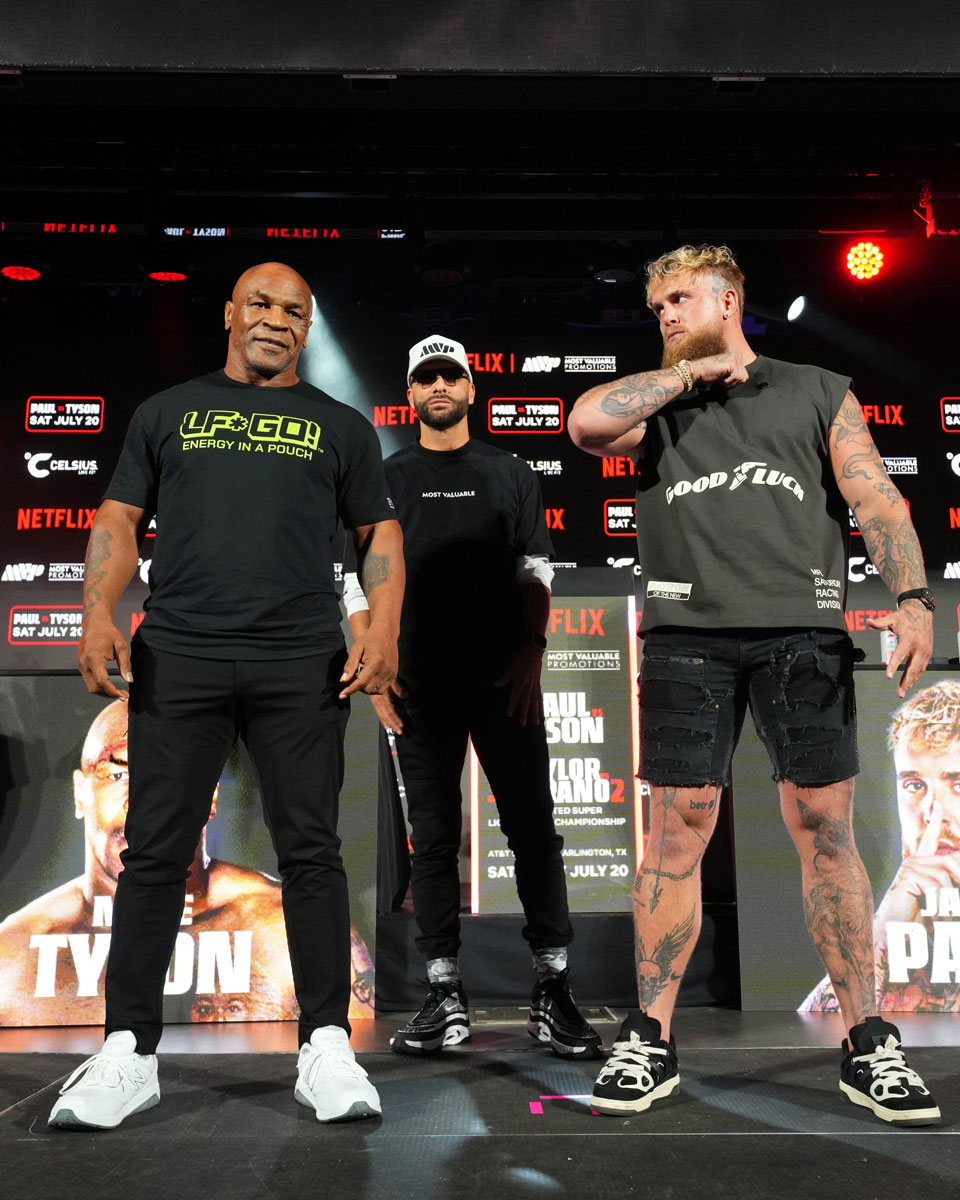
Jake Paul vs. Mike TysonMike Tyson, Nakisa Bidarian and Jake Paul pose onstage during the Jake Paul vs. Mike Tyson Boxing match Arlington press conference at Texas Live! on May 16, 2024 in Arlington, Texas. (Cooper Neill/Getty Images for Netflix)

But what’s good business doesn’t explain the vitriol away that’s aimed at the Paul brothers — particularly Jake. Hundreds of boxers train for years for the opportunity to earn life-changing money and a shot at a world title. Jake Paul has already secured millions after eleven fights. Fighting Tyson legitimizes him even more, and if Paul’s able to win, it’s likely to propel him to a world title fight. This, by building his resume fighting non-boxers; only recently boxing those with boxing experience, after his first loss to a boxer.

It’s the kind of pretentiousness and white privilege that mirrors Kim Kardashian’s pursuit of practicing law simply by passing the bar exam. Whereas Black people have to work twice as hard, white people and persons white adjacent only have to be half as good.

However, Jake Paul may know something that we as a society are reluctant to admit: we thirst for a race conflict, even if the conflict comes in a boxing ring. That thirst is for a semblance of race vindication-ism. For African Americans, “rooting for everybody Black” comes from the reality that Black people must overcome sometimes insurmountable odds to obtain justice or success. 

While a “win” feels like a blow against whiteness, ultimately justice or success doesn’t come from an isolated incident of race conflict – whether in a boxing ring, a courtroom or the ballot box. 


Want a daily wrap-up of all the news and commentary Salon has to offer? Subscribe to our morning newsletter, Crash Course.


For white people, the idea of reclaiming what was “taken” from them is a real thing: jobs taken by immigrants, college admissions by affirmative action, unfiltered opinions by cancel culture, Christian values by women and the LGBTQ+ community – and since the end of segregation – athletics by Black people. It’s the ethos that is the foundation for the “making America great again” mindset. It’s the sentiment, among others, that was behind the recent reelection of Donald Trump despite his loss in 2020.

But this view of the world is to their detriment. 

President Lyndon Johnson remarked, “If you can convince the lowest white man he's better than the best colored man, he won't notice you're picking his pocket. Hell, give him somebody to look down on, and he'll empty his pockets for you.” The MAGA mindset is picking the pockets of many white people. But like Floyd Mayweather, Jake Paul is ever the capitalist and doesn’t mind pickpocketing either.

Because nobody wins when humanity fails to see everyone as fully human. I suppose that is the genius of boxing promotion, the understanding that people will pay to watch the downfall of the other. They’ll pay with their vote or they’ll pay in cash. Jake Paul has mastered exploiting the expediency of securing the latter.  

We’ll soon see if he’s great white hope or great white hype.

Jake Paul vs. Mike Tyson streams live on Friday, Nov. 15 at 8 p.m. ET/5 p.m. PT on Netflix.

Kanye West allegedly said ex-wife Kim Kardashian has “Jewish masters” according to lawsuit

Another chapter to the Kanye West and Kim Kardashian saga has unfolded.

In a lawsuit by a former Donda employee, Murphy Aficionado claimed that besides being exposed to West's inappropriate sexual behavior, Aficionado was subject to West's "racist lectures." The language included what Aficionado said was an antisemitic rant about the Kardashians. According to the lawsuit, West said, “The Jews are out to get me. They froze my bank account. The Jews got Kim and my kids . . . The Jews convinced Kim. She has Jewish masters.”

Aficionado began working for West in October 2022 as a project manager. The former Donda employee also alleges for the first five months of his job, he was not paid for work, Variety reported. This is one of many lawsuits filed against West this year. Multiple ex-employees including West's former assistant, Lauren Pisciotta, have sued the rapper for alleged workplace harassment, unpaid wages and racism.

Kardashian has not commented on her ex-husband's alleged comments. Kardashian and West were married for six years and have four children together. Their divorce was finalized in 2022. The television and social media personality has talked about the difficulties of West's public downfall and how it has affected their children. In a podcast she recently said, "I just think that no matter what kind of help I have, basically raising four kids by myself.”

Also, Kardashian has said on her television show "The Kardashians" that she shields her children from any new developments on West's comments. She explained, "I can't risk 'Access Hollywood' coming up next or anything on the news coming up with their dad mentioned and they want to watch. I have to figure out a way to, like, protect. And so they still haven't seen anything, but I go into crisis mode."


Jimmy Kimmel: Trump runs US “like a reality show” but other reality hosts would do better

President-elect Donald Trump's cabinet picks have late-night hosts like Jimmy Kimmel in an uproar. The host recently observed, "I have to say it has been one interesting week watching Donald Trump go even crazier than anyone even imagined he would."

During Thursday's episode of "Jimmy Kimmel Live," the comedian flamed the new government officials hand-picked to join Trump in his second term. Kimmel joked, "He is running the country like a reality show but instead of Meatloaf and Dennis Rodman he's got Matt Gaetz and Tulsi Gabbard."

Kimmel continued, "If we wanted the host of a reality show to run the country there were much better choices. Jeff Probst, the host of 'Survivor': he’s smart, he’s fair, he wears the kind of safari clothes you used to see in the old movies. He knows how to settle disputes between warring tribes.”

But Kimmel didn't stop there. He named other reality television hosts like "The Amazing Race" host Phil Keoghan because “he could strengthen our ties all around the world.” RuPaul even received a shout-out from Kimmel, who said he would “throw the most fabulous inauguration party in American history.” Other hosts like Tim Gunn from "Project Runway," Ryan Seacrest known for "American Idol" and now the new host of "Wheel of Fortune." Kimmel also spotlighted  Alfonso Ribeiro and Julianne Hough from "Dancing With The Stars."

 “You think old Vlad Putin wouldn’t bend over if he got a call from Julianne Hough?” Kimmel quipped. “Of course he would.”

“This is really terrifying”: Trump cabinet picks put European capitals on red alert

Some of President-elect Donald Trump's cabinet picks are worrying European leaders, who are now preparing their governments for a scenarios in which NATO will have to survive with reduced or nonexistent U.S. support. While the rather conventional nomination of Sen. Marco Rubio, R-Fla., to be secretary of state caused some relief, the nominations of former Rep. Tulsi Gabbard, D-Hawaii, to be director of national intelligence and Fox News host Pete Hegseth to be defense secretary quickly jolted Europe back to the stunning reality.

Neither Rubio nor Mike Waltz, who was nominated to be Trump's national security advisor, sparked giddy enthusiasm, but as one European diplomat put it to Politico: "They are a bit less awful than others." Neither Hegseth nor Gabbard, on the other hand, have much experience in their respective portfolios; Gabbard in particular has provoked consternation over her promotion of Kremlin talking points and conspiracy theories.

“This is really terrifying,” Nathalie Loiseau, former French Europe minister under President Emmanuel Macron and now a lawmaker in the European Parliament's Renew Europe group, posted on X.

“I’m not sure whether it’s really possible to make any sensible predictions about the direction of this administration based on the staff picks,” another European diplomat told Politico. But if Trump acts on his most unilateralist tendencies, the first diplomat worries, Hegseth and Gabbard would hardly be the people to push back. “What’s clear is that there is not going to be any counterweight to Trump. They owe him everything," he said.

Throughout his first term, Trump often disregarded the advice of his cabinet officials and intelligence agencies to make ambitious foreign policy declarations and pursue direct arrangements with autocrats like Vladimir Putin, Xi Jinping and Kim Jong Un. He has also proven erratic, at one point praising them, at another insulting them and starting trade wars with China.

Marie-Agnes Strack-Zimmermann, a German lawmaker who leads the European Parliament’s subcommittee on security and defense, is preparing for the worst. “The time of European restraint and the hope that the USA would protect us is over,” she said.

Ben & Jerry’s files lawsuit against Unilever, says parent company silenced support for Palestine

Ben & Jerry’s has filed a lawsuit against Unilever, claiming its parent company “threatened to dismantle its board and sue its members” if the brand spoke out in support of Palestine, CNN reported.

In the recent lawsuit, Ben & Jerry’s claims that Unilever has breached the terms of a 2022 settlement. The popular ice cream brand previously sued the consumer goods company for breaching its 2000 merger agreement and allowing for the marketing and sales of Ben & Jerry’s products in Israel, despite disapproval from the brand. As part of the settlement, Unilever is required to “respect and acknowledge the Ben & Jerry’s independent board’s primary responsibility over Ben & Jerry’s social mission,” the lawsuit specifies per CNN.  

“Ben & Jerry’s has on four occasions attempted to publicly speak out in support of peace and human rights,” according to the lawsuit. “Unilever has silenced each of these efforts.”

Specifically, the brand has “tried to call for a ceasefire, support the safe passage of Palestinian refugees to Britain, back students protesting at U.S. colleges against civilian deaths in Gaza, and advocate for a halt in U.S. military aid to Israel,” CNN outlined. Their attempts have all been silenced by Unilever, Ben & Jerry’s states in its lawsuit.

In response to the recent legal action, Unilever told the outlet in an email statement: “Our heart goes out to all victims of the tragic events in the Middle East. We reject the claims made by B&J’s social mission board, and we will defend our case very strongly.”

“We would not comment further on this legal matter,” it added.

Elsewhere in the lawsuit, Ben & Jerry’s says its independent board was also silenced by Unilever. Unilever’s head of ice cream, Peter ter Kulve, said he was worried about the “continued perception of anti-Semitism” in connection to the brand’s stance on Gaza, per the suit.

The lawsuit adds that Unilever rejected Ben & Jerry’s selections of human rights groups to make donations to. The company took issue with the Jewish Voice for Peace, saying the organization was “too critical of the Israeli government,” according to the lawsuit.

Bitcoin’s record rally: A turning point for funding justice and equality

Bitcoin hit a new all-time high of $89,995 on Monday, increasing by $20,000 since former President Donald Trump was announced the winner of the 2024 presidential election. Notably, both President-elect Trump and Vice President Kamala Harris embraced cryptocurrency in their campaign platforms, even accepting crypto donations. The 2024 election cycle saw over $250 million in crypto donations made to candidates across the ballot, 13 times the sum raised in 2020.

While this economic surge is promising, the next four years under Trump will likely present significant challenges for the nation’s most vulnerable communities and the environment. He has pledged to deport millions of undocumented immigrants — the backbone of the U.S. labor market. Many are rightfully concerned that the policies he campaigned on will impact women's rights, LGBTQIA+ rights, gun safety, environmental protections and exacerbate poverty. This makes the ability to mobilize for the causes you care about even more crucial.

As advocates across social sectors brace for an uphill battle, the ability of organizations to respond effectively will depend heavily on funding, volunteer engagement and strategic mobilization. 

Here are five strategies of the Web3 ecosystem that offer valuable lessons:

DAOs for mobilization

Decentralized Autonomous Organizations (DAOs) are blockchain-based groups managed by smart contracts instead of traditional leadership structures, which have already demonstrated how Web3 can help mobilize funding quickly. 

In a DAO, members have a say in decision-making, aligning incentives and interests toward shared goals. Following the Supreme Court's reversal of Roe v. Wade in 2022, Choice DAO emerged as a powerful example, coordinating community and capital in the fight for reproductive access. Within just a few months, they raised substantial funds to support organizations overwhelmed by increased demand for abortion services. By using a DAO structure, they organized volunteers, directed resources efficiently and fostered collective action.

This model of decentralized mobilization can be adapted to any cause, empowering communities to act swiftly and effectively.

We need your help to stay independent

NFTs for justice

Non-Fungible Tokens (NFTs) are unique digital assets that represent ownership of specific items, such as artwork, music or virtual property. Unlike cryptocurrencies bitcoin or ethereum, which are interchangeable, each NFT is one-of-a-kind and holds distinct value. This uniqueness and verifiable ownership have driven the NFT craze, attracting collectors, investors and creators.

Nonprofits can leverage NFTs to engage the crypto community, offering donors a digital collectible as a token of appreciation. For instance, the Women Rise NFT collection sold 10,000 unique art pieces celebrating diverse women globally, raising $130,000 to support the Malala Fund, SOLA Afghanistan, Girl Effect and The Pad Project. At its peak, the NFT floor price reached .86 Ethereum or about $2,800. This approach not only generates revenue but also fosters a sense of ownership and connection among supporters.

Nearly 70% of U.S. crypto holders are Gen Z or millennials

Adding a new revenue stream

Nearly 70% of U.S. crypto holders are Gen Z or millennials, a prime audience for nonprofits seeking to engage a tech-savvy, socially conscious donor base. Crypto donors also give 82 times more than cash donors. Navigating the volatile crypto market, regulatory uncertainties and complex technological infrastructure can be daunting. However, Givepact’s donation platform simplifies the process by seamlessly converting over 30 cryptocurrencies into cash for any U.S. 501(c)(3) organization. Nonprofits can easily set up their profile on Givepact for free, unlocking access to a new, dynamic stream of funding from the crypto community."

Crypto donations can boost tax savings

The IRS treats cryptocurrencies as property for tax purposes, meaning donors can deduct the fair market value of their crypto donations on their tax returns without being subject to capital gains tax. With an estimated 52 million U.S. crypto holders, many benefiting from recent market surges, there's a limited window to consider these donations for the current tax year. By contributing appreciated crypto assets to nonprofits, donors can support causes they care about while optimizing their tax positions.

Open a Donor Advised Fund 

In the first four months of 2024, cryptocurrency contributions to Fidelity Charitable’s donor-advised fund exceeded $330 million, nearly matching the total crypto donations for all of 2021. This surge reflects the growing integration of digital assets into philanthropic giving. DAFs allow donors to contribute assets, receive an immediate tax deduction and recommend grants to their favorite nonprofits over time.

DAFs often have lower fees than other charitable vehicles, ensuring that a larger portion of each donation goes directly to the cause. Additionally, funds in a DAF can be invested, enabling the donation to grow over time and providing even greater support for charities in the future. Givepact offers both cash and crypto DAF services, making it easier for donors to make a lasting impact.

Trump Defense Department pick Pete Hegseth was accused of sexual assault in 2017

Fox News host turned Secretary of Defense nominee Pete Hegseth faced an investigation over a sexual assault allegation, blindsiding President-elect Donald Trump’s transition team, according to news reports.

Officials in Monterey, California, confirmed Friday that Hegeth was investigated for sexual assault in 2017 following an incident in the city that left a victim with “contusions to [their] right thigh.” Hegseth was not charged.

“The City of Monterey will not be making any other remarks related to this inquiry,” the confirmation read.

The allegations came to the attention of Trump’s incoming Chief of Staff Susie Wiles on Wednesday night, a day after Trump announced the pick, with one Trump team source telling Vanity Fair that Hegseth “wasn’t vetted.”

Another transition high-up told the publication Hegseth “was vetted, but this alleged incident didn’t come up.”

Wiles and Trump’s attorneys met with Hegseth on Thursday to discuss the allegations, a transition team source told Vanity Fair. Hegseth’s attorney denied the allegation and said the Monterey police department “found no evidence for it.”

Wiles has reportedly already been kept out of the loop on key personnel picks. Matt Gaetz’s attorney general bid came together on board Trump’s plane while Wiles was in a “different, adjacent room on the plane, apparently unaware,” per Politico Playbook.

The allegations come as Hegseth faces public scrutiny into a history of misogynistic comments, including his suggestion that women be banned from combat roles.

“I’m straight up just saying we shouldn’t have women in combat roles,” Hegseth said on a right-wing podcast last week. “It hasn’t made us more effective. It hasn’t made us more lethal. It has made fighting more complicated.”

“I hope you like measles”: Medical doctors in “horror” over RFK Jr. pick

The idea of Robert F. Kennedy Jr., an outspoken vaccine skeptic who has also made baseless claims about fluoride and other scientific issues, serving as secretary of the Department of Health and Human Services has the medical community panicking over the potential implications. President-elect Donald Trump has said that he would let Kennedy “go wild on health” and on “the food and “the medicines" by giving Kennedy control of federal health policy.

“Somebody said to me today, ‘I can’t think of any single individual who would be more damaging to public health than RFK,'" Dr. Sanjay Gupta, a neurosurgeon and CNN’s chief medical correspondent, told CNN's Wolf Blitzer Thursday.

Gupta said that the medical community was near-unanimous in its "horror" over Trump's flirtation with picking Kennedy to lead HHS, and was particularly troubled over his stance on vaccines. “He talked about COVID specifically being bioengineered to attack certain demographics of populations, but when it comes to vaccines and him talking about the connection between vaccines and autism, I think that probably gets the most attention,” he said.

Kennedy's vaccine views have drawn the attention of White House officials. Mandy Cohen, the director of the Centers for Disease Control and Prevention (CDC), said at a health summit Wednesday that she didn't want to see science to "go backwards."

“We have a short memory of what it is like to hold a child that has been paralyzed with polio, or to comfort a mom who has lost her kid from measles. It wasn’t that many generations ago,” she said. “And I don‘t want to have to see us go backwards to remind ourselves that vaccines work. They work. They protect our kids. They are our best defense against these terrible illnesses.”

Routine childhood vaccines — which have for decades acted as the primary safeguard against measles, chickenpox, polio and other illnesses that used to kill people in large numbers — have prevented roughly 508 million illnesses and more than 1.1 million deaths among children born within the past 30 years, according to the CDC.

In 2018, two infants died in Samoa when nurses accidentally prepared the MMR (measles, mumps and rubella) vaccine with expired muscle relaxant instead of water, causing the local government to temporarily suspend its vaccine program. Kennedy and his anti-vaccine nonprofit Children’s Health Defense took the opportunity to spread falsehoods about vaccinations across the island, leading a drastic decline in vaccination rates.

One year later, a measles outbreak infected 57,000 Samoans and killed 83 of them, including children. Kennedy has since declared that he bears no responsibility for the deaths.

“Well America, I hope you like measles,” CNN's Jake Tapper said sarcastically after Kennedy's nomination was announced on Thursday.

We need your help to stay independent

The prospect of federal health policy resembling Kennedy's meddling in Samoa and Trump's handling of the COVID-19 pandemic has scientists and doctors worrying of a looming health disaster under their watch. “Robert F Kennedy Jr. is a clear and present danger to the nation’s health. He shouldn’t be allowed in the building at the Department of Health and Human Services (HHS), let alone be placed in charge of the nation’s public health agency," Public Citizen, a progressive nonprofit organization focusing on consumer advocacy, said in a statement.

"By appointing Kennedy as his secretary of HHS, Trump is courting another, policy-driven public health catastrophe,” the organization added.

Kennedy has weighed in on other health issues. After endorsing Trump, he repeatedly claimed that fluoride, a mineral that strengthens teeth and reduces cavities, is the culprit of multiple health issues and said that the president-elect would push all federal water systems to eliminate it, even though the supply of drinking water is typically up to local government. He also touted also touted the effectiveness of raw milk and ivermectin, an anti-parasitic drug that scientists have proven is not an effective COVID cure. It's not known whether he took a dose of it when he purportedly had a parasitic worm in his brain "which ate a portion of it and then died."

“Imagine, if you will, giving the keys to the Centers for Disease Control and Prevention’s data vaults to someone who has spent years spreading misinformation about vaccines,” Dr. Kavita Patel, a professor of medicine at Stanford University and former government official, wrote in an op-ed. “It’s like asking a flat-earther to pilot our next mission to space.”

“Absolute abdication of their constitutional power”: Trump’s one weird trick for filling his Cabinet

If you wanted to test the loyalty of the U.S. Senate and its members’ willingness to capitulate to you and your agenda, you might do what the president-elect just did: nominate a slew of underqualified and unsavory characters to lead the nation’s most important institutions, all at once, and dare the upper chamber’s majority to say “no.”

In the past 72 hours, Donald Trump has named former Rep. Matt Gaetz, R-Fla., to lead the Department of Justice; former Rep. Tulsi Gabbard, D-Hawaii, to oversee the U.S. intelligence community; and anti-vaccine activist Robert F. Kennedy Jr. to lead the Department of Health and Human Services. All three lack relevant leadership experience and have been accused, respectively, of having sex with a 17-year-old, spreading deranged conspiracy theories about Syria and Ukraine, and having a literal worm eating away at their brain (actually, Kennedy said that about himself).

Then there’s the Fox News personality, Pete Hegseth, who doesn’t wash his hands and maybe has white nationalist symbols tattooed all over his body, that Trump picked to lead the Department of Defense.

What are Senate Republicans going to do, their party’s 78-year-old leader seems to be asking: Go along with the MAGA agenda that was just embraced by a narrow majority of American voters or take the blame for immediately derailing the second Trump presidency? Seventy-six million Americans spoke — and they said, whether they knew it or not, that they want the government to be in chaos.

But senators are people, which is to say they too have egos and a desire to feel needed and appreciated. In comments this week, some suggested they weren’t fully or at least immediately on board with handing over key Cabinet posts to cranks and an alleged pedophile.

Sen. John Cornyn, R-Texas, for instance, said he “absolutely” wants to subject Gaetz, in particular, to a rigorous confirmation process. “I don’t want there to be any limitation at all on what the Senate could consider,” he told reporters Thursday, saying he’d like to see an unreleased House Ethics Committee’s report on Gaetz and his purported improprieties.

The newly elected leader of the incoming majority, Sen. John Thune, R-S.D., likewise affirmed his commitment to the Senate’s traditional role of providing “advice and consent” to the executive branch.

“What we’re going to do is make sure that we are processing his nominees in a way that gets them into those positions so they can implement his agenda. How that happens remains to be seen,” he said earlier this week. “Obviously, we want to make sure our committees have confirmation hearings like they typically do.”

No one, however, has ever gone broke by betting that elected Republicans would ultimately cave to Trump and his whims. That could come in a couple ways: by confirming Cabinet picks who have no business serving in government — who would weaponize the justice system, put a pro-Russia spin on intelligence findings, discourage the use of life-saving vaccines and purge dissenters from the military — or by simply giving up their power in an ultimate act of surrender.

“All options are on the table,” Thune himself has noted, acknowledging the Senate has a role to play but also suggesting he’s open to bypassing it, if need be. How? By allowing Trump to unilaterally appoint members of his Cabinet while Congress is in recess.

It was one of the first things Trump demanded after winning the Nov. 5 election.

“Any Republican Senator seeking the coveted LEADERSHIP position in the United States Senate must agree to Recess Appointments,” Trump posted Sunday on X, blaming the confirmation process for thwarting his first administration.

Senate Republican leadership, perhaps having some respect for themselves and their offices, are hesitant to explicitly say they are 100% cool with that plan (“All options are on the table,” Thune has demurred). Sarah Binder, a political science professor at George Washington University, told The Washington Post that such a move would be “an absolute abdication of their constitutional power.”

It would, among other things, be sort of embarrassing. But this is also Trump’s Republican Party, to a far greater extent than it was in 2016. Why wouldn’t they just do whatever he asks?

We need your help to stay independent

He might not even need their consent. Trump’s transition team team is currently pushing the idea that the president himself could adjourn Congress, exploiting an “obscure and never-before-used provision of the Constitution” to effectively neuter a co-equal branch of government, in the words of conservative attorney Edward Whelan. The play here would be having House Speaker Mike Johnson, R-La., a reliable sycophant, pass a concurrent resolution through the lower chamber calling for Congress to go on recess; if the Senate failed to act, Trump could then declare that neither body is in session.

“I’ve heard that theory just now, and I’ve not researched that. I’ve not heard of it before, so I’ll have to go back and look at that,” Sen. Mike Rounds, R-S.D., told reporters this week. As anyone familiar with Trump’s first term knows, claiming ignorance is often the first step toward acceptance for elected Republicans. The next? Blaming Democrats.

“I think you get into a recess scenario where they grind the Senate to a halt and are refusing to allow regular order move forward and confirm folks,” Sen. Josh Hawley, R-Mo., told HuffPost.

Perhaps this is all smoke — or not even necessary. Already some senators who had been previously critical of Trump’s nominees (like suggesting Gaetz is a lecherous scumbag) appeared to be talking themselves into confirming them, noting Trump’s popular vote win and implicitly admitting they do not want to be blamed for obstructing his whims. This could all end with the Senate nominally preserving its institutional power by rubber-stamping Trump’s Cabinet of oddities.

But however it pans out, lawmakers — elected Republicans — finding the courage to say that science is real, the age of consent matters and that you really should wash your hands after using the bathroom? It’s 2024: Those people don’t really exist anymore.

House ethics committee skips meeting as Democrats push to make Gaetz report public

The House Ethics Committee is scrapping a planned Friday meeting as pressure builds for the oversight panel to release a report on attorney general nominee Matt Gaetz’s alleged sexual misconduct and illicit drug use.

Per Politico, the Friday closed-door meeting was abruptly canceled the day before, as Democrats on Capitol Hill seek to make a potentially damning report public. 

The release of the House Ethics report has been in doubt since former Rep. Gaetz, R-Fla., resigned on Wednesday, hours after Donald Trump nominated him to lead the Department of Justice and two days before the committee was reportedly slated to release it.

Though its full scope is unknown, the inquiry into Gaetz’s alleged misconduct included sworn testimony from a woman who says Gaetz slept with her when she was 17, ABC News reported, as well as an investigation into Gaetz’s presence at a drug-laden party in Florida in 2017, among a laundry list of other accusations.

Gaetz denied the then-17-year-old’s account in a statement to ABC, calling it “invented” and “false testimony to Congress.”

“This false smear following a three-year criminal investigation should be viewed with great skepticism,” he said.

The far-right ex-Freedom Caucus member has attempted to topple the investigation before, former House Speaker Kevin McCarthy alleged in April. McCarthy claimed Gaetz moved to end his speakership because he “wanted me to stop an ethics complaint because he slept with a 17-year-old.” McCarthy said on Thursday that he didn’t believe Gaetz would be confirmed in the GOP-led Senate.

Indeed, some in that chamber want to know more about Gaetz’s potential misconduct before clearing him to be the nation’s top investigator.

Sen. John Cornyn, R-Texas, said on Thursday that the chamber should “absolutely” see the full report and its findings before voting on Gaetz. In a letter sent the same day, Senate Judiciary Committee Chairman Dick Durbin, D-Ill., demanded the committee turn over the letter to the Senate.

It's unclear whether the evenly-split-by-party committee still has the authority to release the report with Gaetz gone, Chairman Michael Guest, R-Miss., has claimed. Still, Democrats are searching for a route to release the report whether Republican committee members want to or not, Axios reported.

RFK Jr.’s revenge: Trump’s controversial health secretary pick is payback for COVID

Well, President-elect Donald Trump certainly is off to a roaring start, isn't he? Ensconced at his Mar-a-Lago beach club with the richest man in the world glued to his side every moment, he's busy getting a whole new band together for his second term. Aside from his choice of Florida Sen. Marco Rubio for Secretary of State, this time there's nary an establishment figure anywhere to be seen as he chooses his new Cabinet and White House staff. Trump is going directly to the lifeblood of MAGA and picking the most controversial, lib-triggering extremists he can find.

I mentioned his first group of nominees earlier this week, none of whom have anything to particularly qualify them for these jobs but who at least have some government experience behind them. The choice of Fox News celebrity Pete Hegseth for Secretary of Defense was the first inkling that this was about to go seriously off the rails.

Trump is going directly to the lifeblood of MAGA and picking the most controversial, lib-triggering extremists he can find.

Hegseth has no experience running anything and has no government experience beyond serving as a National Guard officer in Iraq and Afghanistan and a prison guard at Guantanamo prison. From his perch as a talking head on Fox News, he was able to convince former president Trump to pardon war criminals against the wishes of the Pentagon, so he does have that going for him. And aside from the fact that Trump chose him because he "has the look," as Salon's Amanda Marcotte reported, he is a fierce critic of the military brass and suggests that at least a third of the 800 general and flag officers are "complicit" in the "politicization" of the military. He claims he will clean house and that's what Trump has hired him for.

Hegseth's startling choice was soon overshadowed by the absolutely shocking announcements naming former Hawaii representative Tulsi Gabbard as the Director of National Intelligence and (now former) Florida congressman Matt Gaetz as Attorney General. I would guess that most of America either gasped or laughed when they heard. I suspect that only picking Georgia firebrand Rep. Marjorie Taylor Greene for Surgeon General would have been more stupefying.

Gabbard never served on any of the intelligence committees during her eight years in Congress and has no relevant outside experience. Her claim to fame is as a Democratic apostate with very bizarre foreign policy ideas, including a soft spot for Syrian strongman (and Russian ally) Bashar al-Assad, with whom she personally met, and Russian President Vladimir Putin. She claims that America wants to destroy Russia and provoked it into invading Ukraine in order to impose draconian sanctions on the country. She has put forward Russian propaganda so often that the country's state media even calls her "our girlfriend." She also grew up in and remains a member of a cult called the Science of Identity Foundation whose leader is heralded by members as a deity in his own right.

Gabbard and Trump share a weird affection for Vladimir Putin but they also share a belief that they are being persecuted by the U.S. Intelligence community, which Gabbard claims has put her on a secret domestic terrorist watch list which no one can confirm.

And then there's Matt Gaetz. Apparently, he wasn't on anyone's shortlist but was on Trump's plane this week and they had a chat after which Trump concluded that he wanted the Florida congressman for Attorney General. He is totally unqualified for the job. He barely ever practiced law and spent his entire time in Congress as a political gadfly. He did defend Trump on television and he and Trump share an antipathy for the Justice Department having both been criminally investigated. Both men remain bitter and vengeful about that, which is undoubtedly the main reason Trump believes that Gaetz will be a perfect Attorney General. A Trump adviser told Marc Caputo at the Bulwark:

“None of the attorneys had what Trump wants, and they didn’t talk like Gaetz,” the adviser said. “Everyone else looked at AG as if they were applying for a judicial appointment. They talked about their vaunted legal theories and constitutional bullshit. Gaetz was the only one who said, ‘yeah, I’ll go over there and start cuttin’ fuckin’ heads.’

This nomination isn't some four-dimensional chess as some are suggesting. Trump wants Gaetz confirmed and there's no reason to think he won't get that done.

We need your help to stay independent

Just when you thought it couldn't get any worse, on Thursday Trump announced that he had chosen Robert F. Kennedy Jr for Secretary of Health and Human Services. He is a conspiracy theorist who claims he had a worm in his brain and admits to picking up a dead bear on the side of the road and dumping it in Central Park for a laugh.

David Corn at Mother Jones did a deep dive into RFK Jr.'s twisted reality and reported that he once told Trumpy podcasters Joe Rogan and Theo Von that "a global elite led by the CIA had been planning for years to use a pandemic to end democracy and impose totalitarian control on the entire world." He also said “Covid-19 is targeted to attack Caucasians and Black people. The people who are most immune are Ashkenazi Jews and Chinese" which is such utter nonsense it makes my head hurt to read it. And that's just the tip of the iceberg.

Kennedy has done some real harm already. He's closely linked to a measles outbreak that led to the deaths of more than 80 people in Samoa, most of them children, with his fearmongering about vaccines:

It is mind-boggling that such a person could be put in charge of the vast US government health care agencies. But all signs say that's exactly what's going to happen because the Republican Senate is composed of MAGA cultists and/or inveterate cowards who are going to try to blame the Democrats for making the confirmations difficult so they can say they have no choice but to allow Trump to give them all recess appointments.


Want a daily wrap-up of all the news and commentary Salon has to offer? Subscribe to our morning newsletter, Crash Course.


It seems clear that the only way these people will not be appointed is if Trump changes his mind and withdraws the nomination. And he has no reason to do it. Trump will never have to run for president again and, in his mind, his legacy is secure as the greatest president, maybe the greatest human, who ever lived. If he feels like rewarding people who supported him, he can do that — but it's purely at his discretion and he is not a generous person. Unless someone has something on him that's so devastating that it will destroy him, he is completely without restraint. He's already a convicted felon, a fraudster, a sexual assaulter, a proven pathological liar who stole classified documents and refused to give them back so it's hard to imagine what that might be. At this point, Donald Trump believes he is invincible.

And what that means is that he no longer has anything to lose and there are only two things he really cares about. It's not taxes or tariffs and it's not even mass deportation. Sure, he'll do those things if he can but they were mostly arguments for getting elected so he'll leave that in the hands of his henchmen and take credit for whatever they manage to do. What he really cares about is money and revenge, the same things he's always cared about.

He's worth billions and he's got the richest man in the world opening up his checkbook. He can now concentrate on what really makes him happy — vengeance. That's what he's hiring these crackpots to do for him. He wants payback against the DOJ for all the investigations, the military brass for refusing to abandon their oaths when he wanted them to, the intelligence community for saying the Russians were helping him, and the scientists and health professionals who exposed his lies during the pandemic. They all made him look stupid and he won't rest until they pay for it.

The following quote is making the rounds on social media in light of these absurd Cabinet nominations:

“Totalitarianism in power invariably replaces all first-rate talents, regardless of their sympathies, with those crackpots and fools whose lack of intelligence and creativity is still the best guarantee of their loyalty.” – Hannah Arendt in “The Origins of Totalitarianism”

I don't think I expected totalitarianism to come in service of one very petty narcissist's wounded ego but it appears that that's what's happening. And right now there doesn't seem to be any will to stop it. 

Rare “outburst” meteor shower will be visible this weekend

When the Leonids fly across the sky, stargazers know that the comet 55P/Tempel-Tuttle is nearby. Every year, the iconic meteor shower offers a spectacular show… and experts say this weekend is going to be particularly special.

Between November 3rd and December 2nd, but especially during the weekend of November 16-17, the Leonids will be unusually easy to see and appreciate, according to the American Meteor Society. Between the night of November 16th into the early hours of November 17th, and then again from late dawn November 17th into early November 18th, Technically speaking, the Leonids are nothing more than pieces of ice, rock and dust that turn into streaking flashes of light as they burn up in the atmosphere and Tempel-Tuttle makes its annual journey around Earth. The 2.24 miles-diameter comet also eventually orbits the Sun, although this takes 33 years.

The flashy meteor show occurs because our planet travels in a nearly opposite direction as 55P/Tempel-Tuttle, the meteors crash into our planet’s atmosphere. In ideal conditions, the Leonids may produce about 15 meteors per hour in 2024.

“Once every 33 years or so, the 'lion roars,' as Leonid meteors seem to rain down from the Sickle asterism of the constellation Leo,” writes David Dickinson of Universe Today, who has seen the Leonids up close, when explaining why this particular Leonids meteor shower could be memorable. The trails left by the soon-to-be-visible Leonids were laid down centuries ago, such as in 1633 (which yielded a storm in 2001) and 1733 (which is believed to have caused a Leonid meteor storm in 1866). Earth is not expected to encounter any new dense clouds of debris until 2099, so when 55P/Tempel-Tuttle returns in 2031 and 2064, it may not bring meteor showers with it.

Trump trolls GOP with Cabinet picks: The point is to bring Republicans to heel — but it may backfire

In these dark times, it's more important than ever to nurse tendrils of joy. So it is a great pleasure to watch all the Republican leaders who repeatedly intervened to protect Donald Trump from himself now reap their reward: a big ol' contempt loogie in their eyes. Senate Minority Leader Mitch McConnell, R-Ky. and his allies turned their nose up at the chance to bar Trump from ever running for office again after the Jan. 6 Capitol riot. In turn, Trump has worked to humiliate them by nominating the worst possible people for high-level federal appointments. 

If Gaetz's goal was burying the findings, he may have just ensured that they get much wider hearing than they would have if he had just kept quiet.

Trump's loyalty tests of congressional Republicans have escalated quickly from "walk naked through the streets" levels to "eat puke" levels. First, it was the nomination of Fox News host Pete Hegseth for Defense Secretary, even though he admitted the Army "spit me out" after "members of my own unit in leadership deemed that I was an extremist or a white nationalist because of a tattoo." (He's referring to multiple tattoos that are understood this way by Christian and white nationalists themselves.) Then Trump escalated to nominating substitute Fox News host Tulsi Gabbard as director of national intelligence, despite her affection for dictators like Syrian President Bashar al-Assad and Russian President Vladimir Putin, which then-Rep. Adam Kinzinger, R-Ill. deemed "traitorous." Then the topper: Rep. Matt Gaetz, R-Fla., to be the attorney general. 

Typically, someone in Gaetz's situation would keep his current role in Congress until he was confirmed in the new job, but despite the GOP's razor-thin margins in the House, he resigned immediately. Politico then reported that the resignation prevents the otherwise imminent release of "an Ethics Committee report investigating several allegations including that Gaetz engaged in sex with a minor." The Justice Department that Gaetz wishes to lead never charged him after a lengthy investigation, but Gaetz's good friend pleaded guilty, getting 11 years in prison for his role. Greenberg wrote a letter accusing Gaetz of "sexual activities" with an underage girl. In a text message to Trump associate Roger Stone, Greenberg wrote that "MG" and "I both had sex with the girl who was underage."

Late Thursday, a leak to ABC News confirmed that a woman testified to the House Ethics Committee that Gaetz "had sex with her when she was 17 years old." The age of consent in Florida is 18. 


Want more Amanda Marcotte on politics? Subscribe to her newsletter Standing Room Only.


The good news is that much of the political media understands that these trollish picks are a loyalty test for Republicans in Congress. It's their first big reminder that, as much as Trump brags about his non-existent powers at "deal-making," his only true theory of power is to rule through fear. After admitting he thinks Gaetz is not fit for the role, one Republican House member complained to a reporter, "But hell, you’ll print that and now I’m going to be investigated." No doubt that reaction would tickle Trump, who shuns coalition-building out of the belief that arm-twisting is a superior way to control his caucus. 

But — not to wallow in too much hopium — Trump is wrong in this view. It's the Achilles heel of authoritarians throughout time. They relish conflict, but conflict drives away potential allies, sows chaos and can often grind the gears of their agenda. We've seen this play out in the GOP-controlled House, which has been reduced to dysfunction and inaction, felled by in-fighting. Much of that was driven by Gaetz's multi-year vendetta over the House ethics probe, which appears to be his motive for kick-starting the eventually successful effort to oust then-Speaker Kevin McCarthy, R-Calif.

In an episode of "Pod Save America" released before the Gaetz announcement, New York Times columnist Ezra Klein predicted a second Trump term will feature "much more factional in-fighting than people are prepared for." The Gaetz pick immediately proved him right. As Politico Playbook reported, the "Gaetz-for-AG plan came together yesterday, just hours before it was announced," hatched by some of the more erratic hangers-on — likely including Gaetz — "while incoming White House chief of staff Susie Wiles was in a different, adjacent room on the plane, apparently unaware." 

This half-baked scheme to force congressional Republicans to eat Trump's poop while praising its taste and texture looks like it may not be working how Trump and Gaetz hoped. Investigative journalist Julie K. Brown posted, "Sources for Miami Herald/McClatchy confirm that the Ethics Report is 'highly damaging' — the report could be leaked today." Sen. John Cornyn, R-Tex., invited the House Ethics Committee to release the report as relevant information to a Gaetz confirmation hearing. If Gaetz's goal was burying the findings, he may have just ensured they get much wider hearing than if he had just kept quiet. 

In the wake of Trump's disastrous win, it's welcome news that he's focusing his love of chaos and division directly on his own caucus. It was only Tuesday night that the architects of Project 2025 were having their coming-out party, free now that Trump won to admit that Democrats were right: They were always the villainous puppeteers planning to pull Trump's strings in the White House. But their extensive schemes will require organization and buy-in from GOP leaders. That's a lot harder to pull off when Dear Leader is putting his energies toward encouraging everyone in the party to claw each others' eyes out. 

To be certain, things are still very bleak in America. Trump will still be able to inflict a lot of harm, even while getting in his own way. Although incompetence is better than competence, there are downsides. We saw in his last administration how the federal COVID-19 pandemic response was hamstrung by Trump's inability to lead anything other than a criminal conspiracy. Still, we should note silver linings where we see them. It's good if Trump's energies are focused far more on settling scores with other Republicans than working through the Project 2025 checklist. 

As Klein posted on Twitter, "Demanding Senate Republicans back Gaetz as attorney general and Hegseth as Defense Secretary is the 2024 version of forcing Sean Spicer to say it was the largest inauguration crowd ever."

It's worth remembering what happened to Spicer, Trump's first press secretary. He burned out and was pushed out. He now spends his time writing op-eds no one cares about and desperately begging for relevance. The reward for playing along and the reward for resistance are the same. Trump throws allies out as swiftly as his enemies. Republicans who think they're safe because they play along are fooling themselves. 

Trump's contempt for congressional Republicans was already manifesting in his vampiric posture toward their slim majority. He's already pulled Gaetz and Rep. Elise Stefanik of New York out of Congress and into his employ, shrinking the razor-thing margin further. Speaker Mike Johnson even went on Fox News to ask his boss to "give me some relief" to "maintain this majority." But Trump always cared more about having his ego regularly fluffed than boring matters of governance. This tendency appears to have worsened with age. If members of Congress please him with sufficient flattery, that will likely matter more than a future where Republicans get to focus on their legislative priorities. 

We need your help to stay independent

Trump talked a big game but, thankfully, got very little done in his first term. His refusal to persuade anyone meant he couldn't even get the Affordable Care Act repealed, as Sen. John McCain, R-Ariz., offered the decisive vote against Trump. Trump learned the wrong lesson from that, which is that he's not focused enough on purging the party. He has spent the years since chewing over his vendetta against McCain, long after the senator passed away, putting him well beyond any effort to return to the fold. Trump did sign a massive tax cut in his first year in office, but after that, he barely even bothered to pretend he had a legislative agenda. If it weren't for appointing three confirmed Supreme Court justices, the damage he did would be relatively small compared to his destructive yearnings. He also had extremely high staff turnover, due to the eternal principle that the more a person gets to know Trump, the more they hate him. 

It's possible Gaetz gets confirmed by quisling Republicans who want to avoid the wrath of Trump. It's also possible that, as McCarthy told Bloomberg Television Wednesday, "Gaetz won’t get confirmed" and "everybody" knows it. Either way, Trump will have sown resentment throughout the GOP before he even gets inaugurated. The ideal situation is that Gaetz loses and spends the next four years encouraging Trump to drive out more members of the party, depleting their already thinned-out ranks. But even if he becomes attorney general, Gaetz will probably use the DOJ powers to harass fellow Republicans for the perceived sin of not being cool with that alleged stuff about an underage girl. That will not win over hearts and minds. 

Hey, maybe I'm wrong and Trump is some kind of savant who knows that the best way to retain power is to reduce your numbers, alienate potential allies and make the rest wish their leader would disappear from their lives entirely. But if his first term is any indication, Trump's sociopathic tactics — while alarmingly charming to a lot of voters — tend to backfire in the art of the deal on Capitol Hill. Since all he wants to do is bad, it's good if his biggest obstacle to his agenda is his own terrible instincts. 

The ultimate answer to why Donald Trump won: White Christians

The Democratic Party, the mainstream news media and the political class are conducting a political autopsy of the 2024 election and how Donald Trump and the MAGA movement were able to easily triumph when the “conventional wisdom” suggested a historically close election. This political autopsy is even more urgent given that Trump and his MAGAfied Republicans will rule the country as authoritarians with control over all three branches of government and a Supreme Court that has decided that Trump is a de facto king who is above the law. Based on the people he is choosing for his Cabinet and for other senior roles in his administration, Trump is following the autocrat’s playbook of surrounding himself with yes-men and -women whose loyalty is to him personally and not the Constitution, the American people, democracy, the rule of law and the common good. Almost all of Trump’s choices are manifestly under-qualified, if not incompetent, for the vast amounts of power and responsibility they will be given to impact the lives, safety and future of the American people and the country.

The Democratic Party’s postmortem analysis of its defeat in the 2024 election is important, but they need to quickly move forward if they and the country’s democracy and civil society are to have any chance of surviving the Trump MAGA autocracy and authoritarian regime.   

Writing on X/Twitter, Tom Nichols counseled:

Uncharacteristically, I'll say that Dems should stop beating up on themselves and firing volleys back and forth. (They can get back to that later.) American voters – as I've been warning for years – are changing, and becoming more like Trump. That's hard to counteract…But no Dem can change the fact that millions of ungettable GOP votes are set in stone not because of economic conditions – which were the best any candidate could have hoped for – but because even relatively affluent voters have spent years marinating in complete craziness.

At The American Prospect, Thomas Nelson advises the Democratic Party to embrace an economic agenda that uplifts the American worker and fully embraces the labor movement:

A couple of years getting started with class-based policies can’t compensate for 40 years of the opposite.

Pound for pound, dollar for dollar, no Democratic president measured up to the Biden-Harris administration’s progressive street cred since LBJ’s Great Society. But it’s too early in the life cycle to expect a payoff. Sanders intimates a more important point. The beating heart of the Democratic Party is an economic, class-based coalition first and foremost…. 

The solution is not recriminations, finger-pointing, and hand-wringing but structural change. And it goes well beyond message. The tried-and-true way to close yawning gaps in income inequality, health care access, and worker satisfaction is with labor unions. Is it any wonder that as labor union membership plummeted, wealth inequality expanded, health care access dwindled, and paychecks stagnated?

The solution to rebuild the Democratic Party in the image of the worker is simple: Rebuild the labor movement.

While the Democratic Party is trying to make sense of how Kamala Harris’ campaign can spend more than $1 billion, suffer a decrease in voter turnout of 13 million people as compared to Biden in 2020 and lose key parts of its base to Donald Trump and the MAGA movement, the American people are going to have to do a deep reassessment of their behavior as well.

With Trump’s takeover and the country succumbing even faster to some form of fascism and autocracy, the American people are going to have their values, morals, character and personal relationships tested. Will they defend democracy or instead surrender and be collaborators and quislings? How will they respond when they see the rights and freedoms of their family members, friends, neighbors and other members of the community being taken away? Will they disengage from politics and sink into a state of learned helplessness (and self-medication and a culture of distraction and the attention economy) or instead become more engaged and active participants who have agency in their society and politics?

In an attempt to make sense of Trump’s victory, our collective emotions in this time of trouble and dread, what this election reveals about American values and character, and what comes next when Trump takes power in January, I recently spoke with a range of experts. 

Robert P. Jones is the president and founder of Public Religion Research Institute. He is the author of the New York Times bestseller "The Hidden Roots of White Supremacy and the Path to a Shared American Future," as well as "White Too Long: The Legacy of White Supremacy in American Christianity."

It’s been a heavy week. Looking at all the dead heat numbers down the home stretch of the election, I was never optimistic that the country would unite to block the second coming of Trump. But like most, I was surprised at the sweep of the swing states, the likely outright win of the popular vote and the decisive losses in the Senate. I’ve been down and distracted, not because a particular party won but because a majority of Americans have handed power back to someone who not only fails the basic test of human decency but who has openly tried to overturn an election he lost in 2020 and subvert democratic norms. On the professional front, I’ve been doing my own analysis of the election, writing to a great community of readers on my “White Too Long” Substack newsletter. My colleagues Jemar Tisby, Kristin Du Mez and Diana Butler Bass at "The Convocation Unscripted" are holding a space for conversations about faith and the future of democracy. We held a live webinar with over 1,000 registrants two days after the election and we’ll be taking the conversation on the road at St. Luke’s Episcopal Church in Atlanta on November 17. I’ve also gone on walks, reached out to friends and gone on long rides on my bike — something I started during COVID but feels vitally important again.

"The biggest thing mainstream analysis refuses to comprehend is the continued power of a politics of racial grievance and religious nostalgia among white Christian Americans."

On the one hand, we should all acknowledge that the pre-election polls were fairly accurate. They uniformly declared that the election was so tight, both at the national and state levels, that it was a coin toss. Pre-election polls are never good at — nor were they designed to be good at — predicting turnout, and by definition can’t account for late deciders. And while it was generally a high-turnout election, we see that Trump supporters turned out in force. For example, while white evangelical Protestants are only 14% of the general population, the early exit polls indicate that they may have represented as many as one in five voters.

The biggest thing mainstream analysis refuses to comprehend is the continued power of a politics of racial grievance and religious nostalgia among white Christian Americans. Many pundits thought that a candidate who ran the most racist campaign since George Wallace in 1968 couldn’t possibly move above a ceiling that would keep them far short of a majority. But in this election, most people who consider themselves to be good white Christians flatly declared that white supremacy was, at a minimum, not a deal breaker for them. As has been the case every time Trump has run, eight in ten white evangelicals cast their vote for him, as did six in ten white Catholics and six in ten white non-evangelical Protestants. By contrast, 86% of Black protestants voted for Harris.

The answer to the question on so many Americans’ lips — "How did we get here?”  — is straightforward. That answer won’t be found in the margins of which group shifted toward Trump between 2020 and 2024. It is right in front of us. White evangelical Protestants, along with other conservative white Christians, were the principal actors who baptized, defended, rehabilitated and sustained Trump’s candidacy. More than any other group, these white Christians, who once proudly called themselves “values voters,” have provided moral and religious cover for the immoral and the profane. Even a modest shift among white Christian voters would have denied Trump the Republican nomination and the presidency. So, the responsibility for Trump’s initial rise to power, his resurrection and everything that is now coming sits squarely with white Christian Americans.

We need your help to stay independent

It is difficult to overstate the magnitude of the dangers that will come our way beginning January 20, 2025. Some will be public and dramatic, and others will happen behind closed doors, with delayed effects. In Trump’s closing message the day before Election Day, he boasted, “We stand on the verge of the four greatest years in American history.” But if Trump follows through on even a fraction of the things he has promised — purging the civil service, instituting mass deportations including internment camps, jailing or even executing his political opponents — we will instead be witnessing the beginning of an unprecedented weakening of American democracy. Whether our democracy will still be standing four years from now depends on our willingness to defend it and protect those most vulnerable well before Trump’s authoritarian policies reach most of us personally.

Matthew Dallek is a professor at George Washington's Graduate School of Political Management and author, most recently, of “Birchers: How the John Birch Society Radicalized the American Right.”

Donald Trump’s election to a second term reminds us of a stark truth: American democracy isn't providing for the basic needs of most of its citizens. As Franklin Roosevelt understood, democracy could only survive in the U.S. if enough Americans felt like their government was helping them find work, shelter and dignity. That compact between citizens and government has been broken for a long time, but now, more than ever in recent decades, it is shattered. Trump won because he was seen as the agent of change at a time when inflation was making it hard for Americans to afford food, rent and buy a home.

But his victory was also something else: a popular revulsion toward elites, a repudiation of government, a vote to smash all institutions. In hindsight, it’s easy to see that this was, simply, a change election. Americans voted the Biden administration out of office. But questions need to be answered: How did the party of Franklin Roosevelt lose working-class voters so resoundingly? Will Americans vote for a woman for president? Why wasn’t the Trump-inspired violence on January 6 disqualifying? The potential damage Trump could reap should not be underestimated. His mass deportation proposal would likely sow enormous pain for millions of families and economic hardship across the United States.

The post-WWII system of international alliances, underpinned by NATO, is now in grave peril of being unraveled. Isolationism, protectionism, nativism and autocracy have become popular forces that may well undo the pillars on which U.S. leadership and prosperity have rested since 1945. Disinformation, misinformation and conspiracy theories have also triumphed for the time being, routing the pro-reason, pro-science forces. Nonetheless, Trump’s erraticism and sheer incompetence could be a saving grace. They might serve as a brake on some of his more extreme promises. His policies also may ultimately prove unpopular. Massive tariffs could lead to a new round of inflation. Mass deportations might bring economic growth to a standstill. Firing thousands of federal employees could cause all manner of disruptions in people’s lives — Social Security checks delayed and IRS refunds wrongly denied.

How destructive his term will be remains unknowable, but his helter-skelter, vengeance-fueled approach to wielding power may have the ironic effect of impeding his ability to deliver on his more radical promises. In 2004, amid the quagmire in Iraq, George W. Bush won a commanding reelection victory. He quickly claimed a mandate in his second term and then moved with speed to privatize Social Security. By the end of 2008, his approval ratings were stuck in the 20s. Trump’s popularity may prove surprisingly durable. But if the cost of living remains unaffordable for many and if the wars in Europe and the Middle East do not end soon after he takes office and if he blunders on the economy, he risks becoming unpopular again, making it harder for him to dismantle the very institutions he has promised to destroy.

One other thing to keep in mind: Trump’s victory may have intensified a generational fight to defend values like pluralism, internationalism and human rights, ideals that has made the United States, for all its warts, a beacon to many around the world.

Investigative reporter Heidi Siegmund Cuda writes about US politics and culture for Byline Times and Byline Supplement. Her Substack site is Bette Dangerous.

America is dead to me. I am a woman without a country. Will I fight to reanimate her? Absolutely. I wanted this vampire soap opera to be over, but we are stuck somewhere between the living and the dead. We are 1990s Russia; it will be violent and chaotic. Those who didn’t “like Trump but…” are gonna find out. Those who handed our country over to Putin and to US and foreign-born oligarchs because they couldn’t vote for a Black woman or because “owning the libs” are gonna find out. I’m glad my dad didn’t live to see it. He left post-war Germany for the American Dream, which he lived in full. They’re manipulating the older people in this country.

"I will manage my feelings by working to force Trump and the MAGA Republicans out of office at every turn."

Harris ran a flawless campaign. I believed women and young people would save us. I believed women didn’t like seeing women bleeding out in parking lots and I believed young people cared about climate justice. And maybe some do. The Patriarchy dies hard. I knew we’d lost when Democrats ganged up on Joe Biden and those conservatives who hated Trump but would vote for Biden just simply couldn’t bring themselves to vote for a California liberal like Harris. The churchy believe Democrats are baby-killing demons so they voted for Trump, whose anti-science beliefs led to the deaths of hundreds of thousands during COVID. I will manage my feelings by working to force Trump and the MAGA Republicans out of office at every turn.

Media is big business and big business typically backs fascism. Big business thinks it’ll benefit from a fascist regime — don’t have to worry about regulations or labor unions. All they have to do is look at Orbán’s Hungary to be reminded that media owners had to “donate” their businesses to the state-run department. There is no free press in Hungary anymore so by not reporting the truth of the Trumpocene they made a choice that will destroy them.

Reporters should be biased and that bias is truth. Access journalists lie by omission or lie by minimizing threats. Journalists are supposed to alert you to the threat, not parrot the propagandists. By normalizing Trump as a candidate, the media became the biggest villain in this entire era. They had a duty to warn since 2015, but the ratings were just too delicious. Former head of CBS Les Moonves said the Trump campaign “may not have been good for America but it was damn good for CBS.” The New York Times just wants to survive, tech billionaires just want to get richer — they’re not in the business of trying to get it right or serve the people, they serve themselves. Anyone who pays attention to where people are getting their information knows that half the country was being radicalized online to be anti-democratic, anti-Ukraine and pro-Trump. The pundits missed it because they’re still residing in the Land of the Norms

As for the character of the American people, if we took the digital poison away, people would snap out of their Trump-loving stupors pretty quickly. I am quite saddened because when we needed leadership to address the invisible war, we had none. No one wanted to tell the people that Russia and other hostile nations with direct access to the minds of our people have been moving them toward totalitarianism. By not putting a qualified woman in charge in 2016 and by not putting a qualified woman in charge in 2024, we revealed that the patriarchy dies hard, and with it, America. I was surprised that so many people of faith loved Trump, a man whose behavior is contrary to the values they claim to love so much. America is in very big trouble and it will last long after Donald Trump. The American people have been warned again.

Jackson Katz, Ph.D., is an educator, author and scholar-activist who has long been a major figure in the growing global movement of men working to promote gender equity and prevent gender-based violence. He is a frequent contributor to Ms. Magazine, where he writes about masculinities, politics and violence. Katz is the author of two books, including the bestseller "The Macho Paradox: Why Some Men Hurt Women and How All Men Can Help." His next book, entitled "Every Man: Why Violence Against Women Is a Men's Issue", is scheduled to be published by Penguin Random House UK in February 2025. 

I go back and forth between despairing and defiant. I also feel very badly and worried about undocumented and documented immigrants and many other vulnerable people who will be in deep trouble when Trump takes power. From the moment Trump announced his candidacy in 2015 I knew in my head that this country was capable of taking a sharply authoritarian turn, but in my heart, I couldn’t fully accept it. In fact, from the moment Harris was nominated I let myself get my hopes up. I actually thought she had a chance to beat him, right until the ominous results started rolling in. I’ve been talking with many friends. I try to be supportive of my women friends and colleagues, some of whom still have PTSD from 2016. For someone of my generation, who knew Trump as a cartoonish New York City figure decades before he got into politics, it’s truly unbelievable that he was and will be president again. I also know many people who have retreated (for now) and don’t have much bandwidth for processing this debacle. I’ve also been writing relentlessly about the reasons for his victory. I’m sure the act of writing posts and articles helps me feel less powerless.   

The mainstream media and the pundits, those establishment voices keep getting the story wrong for a variety of reasons. I think a big factor is the ongoing transformation of the media ecosphere caused by the digital revolution and the ways in which Trumpism and MAGA are ideally suited to that new environment. Trump and the savviest of his advisors understand that politics in this media environment is all about identity and story. As Steve Bannon says, everything is narrative.

Also, the partial democratization of the information economy means that the old gatekeepers in corporate media no longer have anywhere near as much influence as they used to have. More viewpoints have the chance to be heard – including ones that challenge corporate power and its influence in our politics. This was one of the goals of the progressive media reform movement, which I was part of starting in the late 1980s. But the right has taken advantage of the opening that gave them to platform ideas even further to the right than corporate media and spread conspiracies and all sorts of nasty and abusive rhetoric and attacks against liberals, progressives, feminists and Democrats. And some key spaces on the internet, like the broadcast world and the manosphere, draw many millions of male listeners/viewers and provide an incredibly powerful megaphone for Trump and MAGA. 

In 2020, the former high-level Republican strategist Stuart Stevens wrote that by embracing Donald Trump, people who created the modern Republican Party had egregiously betrayed the principles it claimed to represent. He asked: How did this happen? How do you abandon deeply held beliefs about character, personal responsibility, foreign policy and the national debt in a matter of months? His answer: You don’t. The obvious answer is those beliefs weren’t deeply held. That’s part of it, but I also think the problem is widespread political illiteracy.

It’s clear that many people don’t really know what they’re voting for, especially in terms of policy. That’s in part why you have all this crazy ticket-splitting, where people vote for minimum wage increases and on the same ballot vote for Republicans who block those increases every time they come up for a vote. We know that a lot of the young men who voted for Trump this time were low-engagement, low-information voters. Was their support for Trump an indication of their racism, misogyny, or anti-immigrant bigotry? I hope there’s a less depressing explanation — that Trump is just a really effective con man who knew how to convince a lot of highly impressionable young men that a “real man” had no other choice than to vote for him. What the success of that strategy revealed is that we have a ton of work to do to engage — and yes, educate — these young men next time.

It’s going to be non-stop bad news on the political front for four long years. I worry that many people will choose to refrain from publicly expressing progressive political views out of fear. One thing we’ll see is who in public life is principled and courageous, and who will bend the knee to Trump and degrade themselves? I don’t want to be self-righteous; we all make compromises. Some are trivial and others are more weighty. But I think Trump 2.0 is going to present millions of people with difficult ethical and moral choices, because I fear he is going to wield power in sometimes unimaginably cruel and heartless ways. Elections have consequences.

Experts say Trump is a threat to trans health. His next term is already alarming the queer community

Before the 2024 election, Dr. Molly McClain, a family medicine doctor at the University of New Mexico, was seeing an influx of patients seeking gender-affirming care from states like Texas that have banned it. The center is doing its best to accommodate more and more patients from in and outside the state, but there’s still a waitlist, stretching for months for some patients awaiting treatment. 

Members of the transgender and gender-diverse community are fearful that it’s going to get even harder to access care, now that president elect Donald Trump has won reelection. Sources who provide or connect people to gender-affirming care told Salon that patients are trying to bump up their appointments out of fear that they will soon be inaccessible.

“People are devastated and terrified about what this might mean for their access to medications,” McClain told Salon in a phone interview. “This is evidence-based and life-saving care.”

The first Trump Administration notoriously enacted a host of anti-LGBTQ policies, including repealing health care regulations that prohibited discrimination based on gender identity, implementing a ban on transgender troops, and rescinding a policy that allowed transgender and intersex inmates to be housed with inmates of the same gender identity rather than their assigned sex at birth.

Although the Biden Administration reversed all of the above-mentioned rollbacks, the new Trump Administration has shown signs of doubling down on anti-LGBTQ policies, and many are concerned he will restrict access to gender-affirming care. During the election, Trump spent $38 million on anti-trans campaign ads, promised to ban minors from having gender-affirming surgeries, and has said that he would end Medicare and Medicaid funding for hospitals providing this care to youth.

Gender-affirming care involves social transitioning, puberty blockers, hormone therapy, or surgical procedures. It can be lifesaving for children, and more than 30 medical associations have issued policy statements that support its use. Surgeries are typically not performed until transgender people near adulthood, despite the central focus surgeries often play in politics.

"What we expect is even greater increases in the number of kids feeling hopeless when all they're trying to do is live their lives."

“The data are strong for the benefit of what we call gender-affirming health care, that is medical care for transgender and gender diverse people,” said Dr. Joshua Safer, the executive director of the Mount Sinai Center for Transgender Medicine and Surgery in New York City. “Blocking access to care is associated with worse mental health outcomes – perhaps as we would expect if we blocked access to health care for any group of people.”

Transgender people are at a higher risk of dying by suicide than the general population due to the discrimination they face in schools, health care settings, and beyond. Gender-affirming care has been shown to reduce dysphoria, suicidality and depression for transgender and gender-diverse communities.

“These kids are being targeted and bullied by some of the most powerful people in their state and now at the national level,” said Kellan Baker, the executive director of the Whitman-Walker Institute, an LGBTQ health center based in Washington D.C. “So what we expect is even greater increases in the number of kids feeling hopeless when all they're trying to do is live their lives.”


Want more health and science stories in your inbox? Subscribe to Salon's weekly newsletter Lab Notes.


The day after Trump won the election, The Trevor Project crisis hotline reported a 700% increase in calls and texts compared to two weeks prior. Joan Erwin, CEO at Transhealth, which provides gender-affirming services to the trans and gender-diverse community in Massachusetts, said the center also saw a huge increase in call volume.

“It’s this sort of mentality that they better do this now, before they no longer have the option to do so,” Erwin told Salon in a phone interview. “Unfortunately, people are now feeling forced to transition faster than maybe they would have chosen to … They just want to blend in and not be easily identifiable as trans, and that's very concerning.”

At least 26 states have enacted partial or total bans on youth gender-transition care, according to the Human Rights Campaign. Last week, Texas Attorney General Ken Paxton sued a third doctor for providing gender-affirming care in the state, where it was outlawed last year. These punitive policies have caused many doctors providing this care and families with transgender children who can no longer access it to leave the state, Baker said.

“Now we are getting to the point where the net is closing and people are feeling like there's nowhere to go,” Baker told Salon in a phone interview. “As a transgender person who needs health care or a parent who's trying to get care for their kid, they're terrified because the message that is coming out loud and clear right now is: You are not safe anywhere.”

We need your help to stay independent

On Dec. 4, the Supreme Court will hear arguments for a landmark case, United States v. Skrmetti, which will determine whether bans on gender-affirming care are unconstitutional. If gender-affirming care is not protected, it could have dramatic consequences for the right to health care for everyone. And now that Republicans control both the Senate and Congress, the party has the power to enact major changes to health care.

This week, Trump selected many officials to join him in leadership who have a history of passing or advocating for anti-trans legislation: for Secretary of Defense he tapped Fox News host Pete Hegseth, who opposes having women in combat roles and has said transgender members create “complications” in the ranks; for Secretary of State, he picked Sen. Marco Rubio, R-Fla., who requested questions about gender identity be removed from the Census in 2023; and for Department of Homeland Security, he landed on South Dakota Governor Kristi Noem, who signed legislation banning gender-affirming medical care in her state of South Dakota.

“The thing that is worrisome is, in the last administration, there were at least some guardrails,” Erwin said. “It feels like that's out the window this time … And when he says in the first 100 days he plans to ban health care for trans youth, it feels like he will have more ability to do that this time because there's no one there to stop him.”

Transgender candidates did also celebrate some firsts this election. Delaware state Sen. Sarah McBride became the first openly transgender person elected to Congress, Aime Wichtendahl won a spot to become Iowa’s first trans lawmaker, and Zooey Zephyr, who has advocated to defend youth access to gender-affirming care, was reelected to the Montana House.

This is not the first time the transgender community has been the target of a political campaign, and it won't be the last time the community shows how resilience it is to get through it, Erwin said, adding "We've had to just kind of walk through the fire and come out better on the other side.”

McClain, at UNM, said the children she sees who have a support system there to help them get the treatment they need are often far healthier and happier than the adults she sees who didn’t have access to that supportive environment growing up. Once they start treatment, they light up when they walk in the room during their first appointments, she said.

“The first visit, kids are always just grinning from ear to ear, they're texting their friends … They're so excited,” McClain said. “Once they start hormone therapy, they feel aligned on the inside … And I have parents say things like, ‘I got my kid back.’”

In more than half of the country, this practice has been banned. The concern is that the second Trump administration is ready to further restrict it.

“My fear is that now, with this kind of legislation and who knows what will happen next, that is going to change even for kids who do have supportive families,” McClain said.

CDC: Overdose deaths set to dip below 100,000 for the first time since 2020

In October, provisional data from the Centers for Disease Control and Prevention (CDC) found overdose deaths decreased by 10% between April 2023 and April 2024, the first time since the 1990s that overdose deaths had declined at all.

That trend seems to be continuing downward, with drug deaths declining for a consecutive 12 month period ending in June 2024 by an even greater 17%, according to new CDC data released this week. Overdose deaths take a while to be measured, but the agency’s predictive model suggests that once these numbers are finalized across states, the number of people to die from an overdose across this 12-month period will be approximately 96,000.

Although still an extremely high number, roughly killing as many Americans per year as diabetes, the overdose crisis is set to kill fewer than 100,000 Americans this year for the first time since 2020. 

Around 2014, the ultra-potent synthetic opioid fentanyl began rapidly spreading across the drug supply and made an already deadly crisis far more deadly. It’s unclear what is causing the current decline, yet some have speculated that it could be due to ramped up harm reduction programs, increased access to substance use medications like buprenorphine, changes in the drug supply, or, likely, some combination of these factors.

“We are throwing a lot at this,” CDC Director Mandy Cohen said at a panel in Washington Wednesday, per STAT News. “And we’re starting to really break through, I think, with some important things.” 

Still, many are cautiously warning not to overly interpret the data to suggest that the country is in any way out of the woods with the overdose crisis.

“You take your eye off this ball, you take your resources away from it, and this can get away from us,” Cohen said. 

Musk met with Iranian ambassador to United Nations, per report

Billionaire Elon Musk spoke privately with Iran’s ambassador to the United Nations on Monday in a meeting aimed at easing tensions between the U.S. and Iran, per a report from the New York Times.

Musk and Ambassador Amir Saeid Iravani spoke for over an hour in a New York meeting that Iranian officials said was “good news.” Those same officials said Musk called for the meeting, and the ambassador picked the location.

Tensions between the United States and Iran nearly came to a head in the final year of President-elect Donald Trump’s first term in office. Trump pulled out of a nuclear deal with Iran that was struck by the Obama administration in 2015. Relations soured further when Trump ordered the assassination of top Iranian General Qassem Soleimani. Iran has allegedly plotted to assassinate Trump in recent months.

Trump spokesperson Stephen Cheung declined to comment on the meeting to the Times, calling it a “private [meeting] that did or did not occur.”

It is unclear whether Musk was meeting with the diplomat on behalf of the president-elect. It would be a crime for Musk to negotiate with Iran on behalf of the United States as a private citizen.

The conversation is the second time in a week that the president-elect has entrusted Musk with a key diplomatic conversation. Last week, the SpaceX CEO sat in on a call with Ukraine President Volodymyr Zelenskyy.

The Tesla CEO and X owner made massive contributions to Trump’s White House bid and gained the president-elect’s ear early in the transition process. Musk has been spotted at Mar-a-Lago in the days since election night. Trump tapped him and Vivek Ramaswamy to lead the as-yet-nonexistent Department of Government Efficiency.

“Totally unqualified”: Congress reacts to RFK Jr. nomination

Donald Trump picked Robert F. Kennedy Jr. to join his Cabinet as the head of the Department of Health and Human Services on Thursday, and that nomination is already ruffling feathers in Congress.

Democrats on the Hill sounded the alarm over Kennedy’s nomination, with high-ranking Democratic Rep. Katherine Clark saying she had “great concerns” over Kennedy’s “complete disregard for public health.”

House Minority Leader Hakeem Jeffries added that Kennedy was “completely and totally unqualified” for the position.

Republicans, for their part, seemed largely unbothered by the choice.

In an interview with CNN’s Jake Tapper, Trump-endorsed Indiana Senator-elect Jim Banks said he wasn’t worried about Kennedy’s history of vaccine skepticism.

“Donald Trump won the popular vote, and one of the things he promised on the campaign trail was to have a serious and thoughtful conversation about vaccines,” Banks said. “I imagine this will be a big topic of discussion in the confirmation hearings… I feel very comfortable with RFK Jr. having a significant seat at the table to lead big debates about this.”

Louisiana Sen. Bill Cassidy applauded the pick.

“RFK Jr. has championed issues like healthy foods and the need for greater transparency in our public health infrastructure,” Senator Cassidy said in a statement. “I look forward to learning more about his other policy positions and how they will support a conservative, pro-American agenda.”

Incoming Senate Majority Leader John Thune expressed uncertainty over whether Kennedy and other controversial nominees would be confirmed but said “they deserve a process” in a Thursday night interview with Fox News’ Bret Baier.

"None of this is gonna be easy,” Thune said. “But again, President Trump had a huge mandate from the American people…And the people in this country want change." 

Thune left room for installing Cabinet members without Senate approval via recess appointments, calling the process “an open question.”

Earlier in the day, before Trump announced the pick, Democratic Rep. Robert Garcia said in a spat with Marjorie Taylor Greene that it was "shameful" that Kennedy could be considered for any health leadership post, given his "outrageous comments about science and medicine."

But not all Democrats were aligned. Democratic Governor of Colorado Jared Polis turned heads with a Thursday night post to X praising the pick.

“I’m excited by the news that the president-elect will appoint [Kennedy],” Polis said. “He will face strong special interest opposition on these, but I look forward to partnering with him to truly make America healthy again.”

“I would love to serve”: Lara Trump beams over possible appointment to Senate seat

Lara Trump is ready and willing to join the U.S. Senate if called, she told Fox News’s Sean Hannity on Wednesday.

The co-chair of the Republican National Committee and daughter-in-law to Donald Trump has been floated by Florida Sen. Rick Scott as a potential replacement for Sen. Marco Rubio following his nomination earlier this week to serve as Donald Trump’s Secretary of State.

Lara Trump said the opportunity to join the Senate would be "incredible."

“If I am able to serve, I would love to be able to serve the people of Florida,” Lara Trump said, noting that she hasn’t yet been asked to take the role.

“No one knows better than I do the America First agenda or the goals of Donald Trump in the coming four years,” she added.

Florida Governor Ron DeSantis would be tasked with appointing Rubio’s replacement in the Senate. Outside of Lara Trump, other frontrunners for the opening include Florida Attorney General Ashley Moody and DeSantis himself.

Lara Trump has the support of at least one would-be colleague: Lindsey Graham. In an interview with Hannity earlier in the evening on Wednesday, the South Carolina senator praised her work as RNC co-chair.

“We could not do better on the Republican side than Lara Trump,” Graham said.