Help keep Salon independent

“Wrong rally”: Harris roasts hecklers, Trump’s “smaller” crowds in Wisconsin

Vice President Kamala Harris shut down anti-abortion hecklers during a La Crosse, Wisconsin rally on Thursday, making a dig at former President Donald Trump’s crowd sizes in the process.

Harris was speaking about former President Donald Trump’s “hand-selection” of three justices to the Supreme Court — noting that those Trump appointees helped to overturn Roe v. Wade — when she was interrupted by a handful of hecklers screaming “that’s a lie.”

“Oh, you guys are at the wrong rally,” Harris joked with a wave. “No, I think you meant to go to the smaller one down the street.”

The jab is one that's known to get through Trump's defenses, as the former president has repeatedly shown himself to be sensitive about the size of the crowd he draws. Trump has obsessed over crowd sizes since his inauguration day, repeatedly claiming he had the best-attended swearing-in in history, in spite of photo evidence to the contrary.

Harris has made crowd size a go-to attack on the famously thin-skinned ex-president. Former President Barack Obama took aim at Trump's infatuation with attendance during the Democratic National Convention, using his hands to turn his remark into a somewhat risqué joke. Harris' campaign turned that moment into an attack ad.

Harris running mate Tim Walz has tossed barbs over crowd enthusiasm at rallies and Harris herself brought up his dwindling rallygoer enthusiasm at the pair’s presidential debate last month.

Harris' quick response is an improvement over previous times she's been interrupted. The vice president drew criticism for how she handled pro-Palestine hecklers at an August rally. The vice president took a harsh tone with those demonstrators, responding, “I’m speaking.”

Harris sees “opportunity to end” to Israel-Gaza war in Hamas leader Sinwar’s killing

Vice President Kamala Harris said on Thursday that the death of Hamas leader Yahya Sinwar was “an opportunity to finally end the war in Gaza,” echoing calls for a ceasefire that have been largely ignored by Israeli leaders.

Sinwar was killed by Israeli forces in southern Gaza, per Israeli officials. The Israel Defense Forces released a video they claim shows Sinwar's final moments. In the clip, a drone flies into the open face of a bombed building. A man, wearing a keffiyeh and severely injured, throws a piece of wood at the drone.

“The United States, Israel, and the rest of the world are better off,” Harris said during a speech in Wisconsin on Sinwar’s death. “Today, I can only hope that the families of the victims of Hamas feel a sense and measure of relief.”

But the vice president, whose administration has faced criticism for enabling Israel’s continued mass killing of Palestinian civilians over the last year, expressed hope that the death of the Hamas leader could move the needle on ceasefire talks.

“Hamas is decimated and its leader is eliminated. This moment gives us an opportunity to finally end the war in Gaza,” Harris said. “It must end such that Israel is secure, the hostages are released, the suffering in Gaza ends, and the Palestinian people can realize their right to dignity, security, freedom, and self-determination.”

Israeli Prime Minister Benjamin Netanyahu said that the war was not over while speaking in Jerusalem after Sinwar's death was confirmed. 

"Today we have settled the score. Today evil has been dealt a blow but our task has still not been completed," he said, per Reuters

“Bullsh*t”: Cooper calls out Trump surrogate’s defense of fascist rhetoric

Anderson Cooper had heard enough.

The CNN anchor used some off-color language to dismiss ever-more-strained defenses Donald Trump's fascist campaign rhetoric. Republican former Lt. Gov. of California Abel Maldonado was on the news network on Wednesday — trying to defend Trump's decision to call immigrants “animals” and progressives "the enemy within" — when Cooper finally snapped.

“He’s a New Yorker, he’s a fighter, he’s a leader,” Maldonado told fellow panelist Carl Bernstein, when the Watergate reporter asked if Trump used "fascistic" language.

Cooper, born and raised in New York City, didn't buy the “New Yorker” defense.

“The idea that Donald Trump is a New Yorker, and this is just what New Yorkers say, that’s bullsh*t,” Cooper said.

The TV host pointed out that the Central Park Five, a group of innocent teens Trump once argued should be put to death, were also New Yorkers and weren’t espousing fascist rhetoric. Cooper labeled Maldonado’s picture of tough and honest New Yorkers as “a comic book.”

Bernstein isn't alone in calling Trump an outright fascist. The former president's rhetoric has taken a notably nativist turn in recent weeks, with Trump hosting entire rallies dedicated to bad-mouthing immigrants and promising mass deportation. The Republican candidate has regularly accused  immigrants of having “bad genes” and peddled far-right conspiracies about them eating pets

Bernstein's former reporting partner Bob Woodward found out that the belief Trump is a fascist even extends to his one-time associates. Former Joint Chiefs of Staff Chair Mark Milley warned that Trump is a “fascist to the core” in Woodward's upcoming book "War."

“The public has been poisoned”: Trump files to block Jan. 6 documents from release before election

Donald Trump is trying to stop new evidence concerning his role in the January 6 attack on the U.S. Capitol from being released ahead of the election.

In another move to try to staunch the bleeding from special counsel Jack Smith’s incisive investigation, Trump's legal team filed to request that evidence in the case scheduled to become public on Thursday stay sealed. Attorneys for Trump argued that prospective jurors in Trump's election interference case may be prejudiced via “cherry-picked documents” if the documents became public. They asked to pause the release until Trump’s team compiles its response to Smith's bombshell filing after the election.

“[It’s] essential that the public fully understand the arguments and documents on both sides of this momentous issue, and is not misled by one-sided submissions,” Trump’s lawyers wrote.

The ask comes a week after Judge Tanya Chutkan granted Trump’s team a delay in the documents' release. Trump’s attorneys argued in their last-minute filing that they deserved even more time to plot a response to the documents. 

Chutkan allowed the release of a 165-page report from Smith’s office earlier this month, detailing Trump's alleged actions on the day that a mob stormed the seat of the U.S. government. Those unsealed docs included allegations that Trump responded “so what?” to reports that Mike Pence was in danger.

In Thursday’s motion, Trump’s team argued that release of testimony was already a boon to Vice President Kamala Harris’s election chances.

“The public has been poisoned by a one-sided prosecutorial narrative that is being used for political purposes by the incumbent administration,” Trump’s attorneys complained, adding that the case had an “improper impact” on the race.

A Trump legal victory on the motion wouldn’t be without precedent. in September, New York Judge Juan Merchan delayed the former president’s sentencing in his criminal fraud case until after the election in an effort to “dispel any suggestion” of political bias.

Eva Mendes says she won’t eat Kellogg’s cereal, demands brand to “remove artificial food dyes”

Eva Mendes will never eat Kellogg's cereals ever again. In the wake of protests over the breakfast food company’s use of artificial dyes, the actor shared her thoughts on the matter.

“I grew up on cereal. I still love it but I won’t eat @kelloggsus anymore after I found out that so many of the ingredients they use here in the US are BANNED in other countries. Why? Because they’re harmful for children,” Mendes said in an Instagram post made Oct. 8. On Tuesday, she urged her followers to join in on a “peaceful march to Kelloggs HQ to ask them to REMOVE artificial food dyes.”

https://www.instagram.com/p/DA3tx8sx7lB/?hl=en&img_index=1

Many agreed with Mendes’s stance, while others claimed that artificial dyes have been deemed safe for consumption. “Yes thank you so so much for giving a voice to this topic,” commented functional medicine expert Dr. Will Cole. On the contrary, biomedical scientist Dr. Andrea Love told Mendes, “This is a really harmful message you’re spreading that undermines our food experts and food security for many people . . . please consider seeking actual experts if you want to discuss these topics.”

The protests against Kellogg's ingredients list come after the passage of the California School Food Safety Act, which bans six artificial food dyes most commonly found in foods served in school cafeterias across the state. The ban includes Red 40, Yellow 5, Yellow 6, Blue 1, Blue 2 and Green 3. Kellogg's Froot Loops contains Red Dye No. 40, Yellow Dye No. 5, Yellow Dye No. 6, Blue Dye No. 1 and butylated hydroxytolune (BHT).

On Tuesday, hundreds of protestors assembled outside the WK Kellogg headquarters in Michigan, urging the company to remove artificial dyes from its breakfast cereals sold in the U.S. Kellogg's made a promise to remove artificial additives from its products by 2018. In Canada, Kellogg's Froot Loops are now made with natural fruit juice concentrates, but cereals in the U.S. still contain chemical additives and preservatives.

“Our products — and the ingredients we use to make them — are compliant with all applicable relevant laws and regulations,” Kellogg's said in a statement to USA TODAY. “We remain committed to transparently labeling our ingredients so consumers can easily make choices about the food they purchase.”

The tragedy of Liam Payne: A One Direction pop star life lived in spectacle

Every member of One Direction had a role. Harry Styles was the cheeky one. Zayn Malik, the mysterious one. Niall Horan was the nice, Irish lad. Louis Tomlinson was the class clown. Leaving Liam Payne as the sensible, responsible one. 

Payne, the resident leader of the quintet, is the first of the millennial-aged group to die, in a sudden tragic incident in Argentina. The 31-year-old pop star died on Wednesday, Oct. 16 after falling from a hotel balcony in Buenos Aires. When the harrowing news broke Wednesday evening, shockwaves reverberated through the music industry and the One Direction fandom. Reports from Argentinian police said that Payne "had jumped from the balcony of his room," with no clarifying insights about the incident, The Associated Press reported.

As millions of Directioners across the world mourn Payne, his troubled persona has been peeled back, indicating that the former embattled child pop star’s international success and acclaim had weighty ramifications not only for his mental health but also his privacy — or lack thereof — even in death.

The birth of the British-Irish boyband bulldozed 2010s music with infectious pop melodies and vocal-driven performances, bringing back an international frenzy around boybands that hadn't made the American crossover since Beatlemania. The band was also named Billboard's 22nd Greatest Pop Stars of the 21st Century for their influence on pop music at the launch of the social media age. The band formed in the 2010s at the behest of the judges of the British talent show "The X Factor." The then-solo artists, who were 16 to 18, were shoved into a makeshift group. Just like that, One Direction was born. 

One Direction lasted a jam-packed six years, dropping songs like the certified quadruple platinum hit "What Makes You Beautiful" and Billboard hit "Story of Our Lives." The boys toured and performed across the world, releasing back-to-back albums at the demand of their Simon Cowell-led label and their obsessive and intrusive fans. But just like a bright impermanent star, the young, wide-eyed boys turned industry-downtrodden men burned out in 2016. They were all between 22 and 25 when the band officially went on a permanent hiatus.

As Payne's band members released critically and commercially successful solo debuts, he debuted the single "Strip That Down." It was a commercial success on the American and British charts but his first album failed to grab critical attention. His transition to a life outside of the band seemed like a difficult one. He sang in his debut single, "You know I used to be in 1D (Now I'm out, free) People want me for one thing (That's not me)."

While Payne was deemed the leader or responsible one, he was also a prolific songwriter contributing to the group alongside Tomlinson. But it often seemed like the group's fame felt like a pressure cooker for a young Payne. He told Men’s Health Australia in 2019, that he began excessively drinking while he was in the band to cope with fame and their rigorous touring schedule.

Payne described his One Direction days, saying, "When you’re doing hundreds and hundreds of [concerts] and it’s the same 22 songs at the same time every single day, even if you’re not happy, you’ve got to go out there."

He continued, "It’s almost like putting the Disney costume on before you step up on stage and underneath the Disney costume I was pissed quite a lot of the time because there was no other way to get your head around what was going on."

Ultimately, "[the band] had an absolute blast but there were certain parts of it where it just got a little bit toxic," he said.

Just a week before his death, Payne became a polarizing figure in the One Direction fanbase. He faced a series of misconduct allegations from ex-fiancée Maya Henry and several fans online. People Magazine reported Henry had issued a cease-and-desist order last week against Payne after she alleged he repeatedly contacted her. Henry previously told People that a fictional scenario in her novel, "Looking Forward" — where the main character is pressured by her partner to get an abortion — was "very similar" to an event in her own life. 

As Payne's star waned and his relationship with fame and people's perceptions of him changed in his adulthood, he spoke out about his mental health struggles. Recently, he shared that he had been diagnosed with "a couple of conditions" and decided to speak on it so people "know you’re not the only one."

Moreover, Payne has been in the spotlight since he auditioned for "The X Factor" for the first time when he was 14. All this exposure led him to deal with mental health struggles that included suicidal ideation. In 2019, he said in an interview with Sky News, "There’s times where that level of loneliness and people getting into you everyday. Just every so often, you’re like, when will this end? That’s almost nearly killed me a couple of times."

This is not uncommon for those who have dealt with fame from a young age. The public struggles of child stars like Demi Lovato, Lindsay Lohan and Amanda Bynes come to mind. The constant scrutiny, lack of privacy and attendant identity crises can lead to struggles with anxiety, paranoia and depression, Psychological Care Institute found. Not only can it exacerbate mental health conditions, but fame can ultimately change your brain because "Your neurons get used to a certain level of excitation and stimulation,” reporting by The Face explained. ​“And then, forevermore, you kind of want it to be at that level. When the fame begins to wane, it can, then, be difficult to adjust."

We need your help to stay independent

Operating on this tightrope appeared to be a challenge for Payne. According to reporting from the AP, Buenos Aires police said they found Payne's hotel room “in complete disarray.” They detailed that they found packs of clonazepam, a central nervous system depressant, energy supplements and over-the-counter drugs. A whiskey bottle, lighter and cellphone were also collected from the courtyard where Payne’s body was found.

During the breaking news of Payne's death, Argentinian outlets ran wild with speculation of suicide, TMZ posted horrifically violating photos of Payne's body, and photos of his hotel room showing drugs and broken items were leaked. Within hours of his death, millions of people across the world had seen his dead body and the intimate portrait of his troubled life. Even in his death, the star's body could not be laid to rest. Another piece of himself he unwillingly gave to an audience.

Hauntingly, Payne was posting Snapchat stories of his time in Argentina merely hours before his death. People have recorded and reposted these stories to memorialize his last hours. Now as I scroll TikTok, videos of Payne's girlfriend Kate Cass's travel vlogs of the couple's time in Argentina are popping up on my For You Page.

Even TikTok's algorithm isn't letting Payne rest in peace — yet another violation of his privacy. The nature of his death has attracted parasocial voyeurs treating the tragedy like an entertaining mystery. But again, as Payne described, this spectacle is just a part of the regular circus of his short-lived life.

If you are in crisis, please call the 988 Suicide and Crisis  Lifeline by dialing 988, or contact the Crisis Text Line by texting TALK to 741741.

Listeria recall has expanded to nearly 12 million pounds of ready-to-eat meat and poultry items

An ongoing listeria recall from BrucePac has been reissued on Tuesday to include an additional 1,779,040 pounds of ready-to-eat meat and poultry items that may be contaminated. The recall has expanded to a total of 11,765,285 pounds of products.

In an announcement made on Oct. 15, the U.S. Department of Agriculture's Food Safety and Inspection Service (FSIS) specified that some of the additional meat and poultry products were distributed to schools nationwide. An explicit school distribution list is not available at this time, the agency said.

The recalled foods, produced by the Oklahoma-based company BrucePac, were sold at major retailers nationwide, including Trader Joe's, Walmart, Aldi, Target, HEB, Giant Eagle and Kroger. The recall also includes specific brand names like Jenny Craig, Boston Market, Amazon Fresh, Rao's and Dole. A complete list of all the recalled products and photos of their product labels can be found here.

The recall was initiated on Oct. 9 after samples of RTE poultry products (defined as products that are fully cooked before packaging) produced by BrucePac tested positive for Listeria monocytogenes during routine testing conducted by FSIS. “Subsequent FSIS investigation identified BrucePac RTE chicken as the source of the Listeria monocytogenes,” the announcement added.

The recalled items were produced from May 31, 2024 to October 8, 2024. They mainly include prepared salads, rice or pasta bowls containing potentially contaminated chicken or turkey, per Today.

“FSIS is concerned that some products may be available for use in restaurants, institutions, schools and other establishments . . .” the updated announcement said. “These other establishments may have used affected meat and poultry in RTE products that may be on store shelves or in consumers’ refrigerators or freezers.” 

“Restaurants, institutions, schools and other establishments are urged not to serve or use these products. These products should be thrown away or returned to the place of purchase.”

At this time, no illnesses or any “confirmed reports of adverse reactions” have been tied to the recalled products.

“Not able to run for two weeks”: Trump cancels NRA rally appearance amid decline concerns

Former President Donald Trump abruptly cancelled an appearance at an NRA event in Savannah, Georgia, fueling public concerns about his mental state.

Trump was slated to headline the “Defend the 2nd” rally on Oct. 22. The Trump campaign cited a scheduling conflict in pulling out of that event, per the Atlanta Journal-Constitution. The gun advocacy group later scrapped the entire event.

The cancellation follows an appearance at the Economic Club of Chicago on Tuesday, in which interviewer John Micklethwait repeatedly pressed Trump on his rambling non-answers and topic changes. A day before that appearance, Trump similarly confused an audience at a Pennsylvania town hall when he paused questions for over half an hour to sway along to his playlist on stage.

Trump has been on a cancellation tear, pulling out of several planned interviews in recent days.

Per CNN’s Brian Stelter, Trump reportedly “suddenly scrapped” a planned interview with NBC News senior business correspondent Christine Romans penciled in for Monday morning in Philadelphia. He had previously cancelled a stop by CNBC’s “Squawk Box,” citing another purported scheduling conflict.

The cancellations follow a “60 Minutes” interview which Trump unexpectedly pulled out of two weeks ago. That move followed another appearance where Trump seemed somewhat lost.


The diminished campaigning schedule is sure to raise eyebrows as critics question whether the 78-year-old former president is fit to continue campaigning at a competitive pace.

Trump has canceled:

– 60 Minutes
– CNBC
– 2nd Debate w Kamala
– NBC interview
– Hasn't confirmed CNN Town Hall

and now canceled a NRA rally.

He's weak and weird. Not able to run for two weeks and won't make it for 4 years. pic.twitter.com/e7FbWVtrrD

— Keith Edwards (@keithedwards) October 17, 2024

“[He is] not able to run for two weeks and won't make it for 4 years,” Keith Edwards, a Democratic strategist, wrote on X.

In contrast, Vice President Kamala Harris is ramping up media appearances. Harris is reportedly in talks to appear on Joe Rogan’s podcast after a tense sit-down with Fox News’s Bret Baier.

“Wicked” star Cynthia Erivo slams fan-edited poster that covers her eyes

Cynthia Erivo, who was awarded two handfuls of Grammys in addition to a Tony Award for her performance in the Broadway revival of "The Color Purple," is speaking out against a fan-edited poster for "Wicked," which she stars in alongside Ariana Grande.

In the original poster for the film — in which Erivo plays Elphaba Thropp, the Wicked Witch of the West, for the adaptation of the stage musical based on Gregory Maguire's 1995 novel — she's seen in a witch's hat with a green face, staring straight ahead as Grande's character, Galinda Upland, whispers in her ear. But in the fan-edited poster, her hat is pulled down much farther, completely obscuring her eyes, which she takes considerable issue with. Especially since no edits were made to her co-star's likeness in the fan version.

“This is the wildest, most offensive thing I have seen, equal to that awful Ai [sic] of us fighting, equal to people posing the question ‘is your ***** green,’” Erivo wrote in a post to Instagram. “None of this is funny. None of it is cute. It degrades me. It degrades us.”

Going on to highlight that the original poster "wasn’t even based on real actors, but was always just an illustration," as The Wrap points out, she furthers, “I am a real life human being, who chose to look right down the barrel of the camera to you, the viewer . . . because without words we communicate with our eyes. Our poster is an homage not an imitation, to edit my face and hide my eyes is to erase me. And that is just deeply hurtful.” The publication adds that Grande has not publicly addressed the viral poster.

“The Pradeeps of Pittsburgh” and “Happy’s Place” help redefine family comedy

From the moment the eponymous family of “The Pradeeps of Pittsburgh” sets foot in the United States we can see their immigration journey will be defined by patience and understanding – theirs, and for Americans.

The family’s first encounter with U.S. Border Patrol shows its agent willfully mispronouncing their names, blurting out Soda instead of Sudha, followed by Mohawk (Mahesh); Bonnaroo (Bhanu); Camel (Kamal) and Window (Vinod).

Mahesh, the family patriarch (Naveen Andrews, “Lost”), politely corrects the man – “But pretty close! Chuck – great name. Hard to mispronounce!” – before telling the stone-faced border officer, “We’re moving here. Why? Because America is full of opportunity. And as Vedic scribes of ages past so prophetically wrote in –”

But America’s finest border agent doesn’t care, interrupting Mahesh with a hard passport stamp and an emotionless, “Welcome to America, Par-dips.”

“The Pradeeps of Pittsburgh” follows the comic beats and curves of a classic broadcast sitcom while taking advantage of its Prime Video/Freevee platform by allowing its characters to curse. If you were in this family’s shoes, you’d drop a few swear words too.

Mahesh, an engineer who scores a Space X contract, uproots his thriving, stable family from India, for frigid Pittsburgh, where someone leaves dead animals on their doorstep as a greeting. The factory Mahesh rents to construct his rocket components used to manufacture dildos — kind of a step down from what he’s accustomed to.

In India Sudha (played by British comedian Sindhu Vee) is a respected surgeon, but the Pittsburgh hospital where she’s hoping to work is slow-rolling her medical licensure’s approval. Anxiety has gripped Kamal (Arjun Sriram) so tightly that he’s gone mute, while his sister Bhanu (Sahana Srinivasan) embraces American culture wholeheartedly, especially its tradition of teen horniness.

And little Vinod (Ashwin Sakthivel), the comedy’s pint-sized scene-stealer, can’t help but see a silver lining in everything, including his outcast status at school.  “My youngest is an optimistic doofus,” says Sudha, a self-described “greatest mother in the world.”

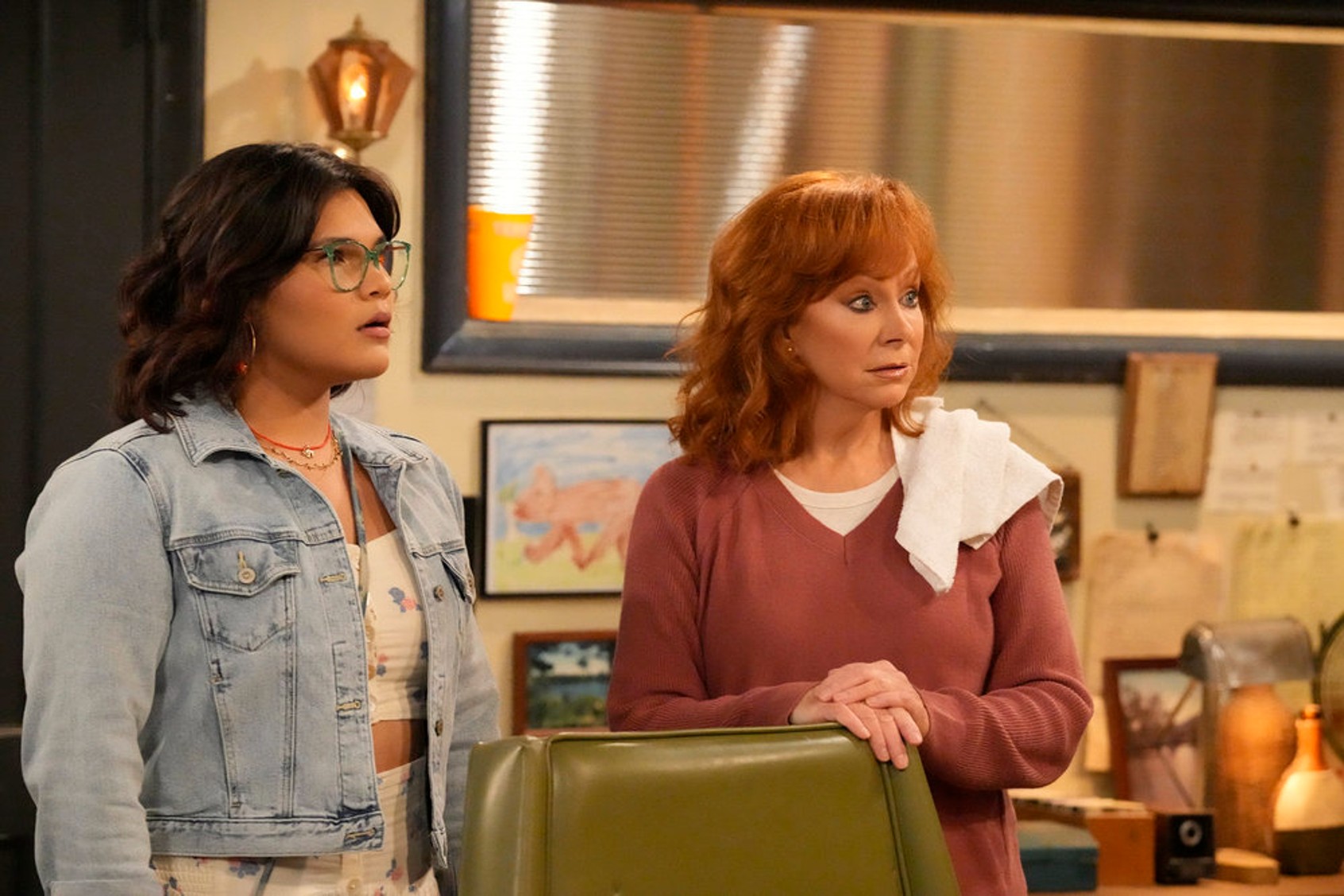
(l-r) Belissa Escobedo as Isabella, Reba McEntire as Bobbie in "Happy's Place" (Casey Durkin/NBC)Over on NBC, Reba McEntire and her “Reba” co-star Melissa Peterman are reuniting on “Happy’s Place,” which casts McEntire as Bobbie, a Tennessee tavern owner who is shocked to discover that Isabella, a 20-something kid who suddenly shows up her bar (Belissa Escobedo), is the half-sister her father never told her about.
Let’s rewind our collective memory to 2017 for a moment, when studio execs worried aloud about leaving ratings and ad dollars on the table by ignoring “real” America.

A year later, the midseason return of “Roseanne” pulled monster-sized ratings for ABC and led MAGA to claim it as theirs. The show even took swipes at its fellow ABC comedies during an episode's opener when Dan and Roseanne slept through primetime, and he remarks, “We missed all the shows about black and Asian families.” She curtly responds, “They’re just like us. There. Now you’re all caught up.”

All that was before Roseanne Barr went on a racist tirade on what was then known as Twitter, resulting in her firing and the show moving forward without her. The six-episode final run of “The Conners” is expected to debut midseason, and though its audience was modest, the series' modulation from partisan pandering to grounded storytelling carried it through seven seasons.

That means it also lived through a network comedy era that saw the end of “Last Man Standing” and the rise of “Abbott Elementary” and its success with telling hilarious stories about teachers and teaching in a lower-income community – “slice of life stories," as that show’s creator, Quinta Brunson, once described to the New York Times.

People tired of watching heated Twitter arguments invade their shows, Brunson observed while also noticing how much race became the focal point of shows like “Black-ish” and “Fresh Off the Boat.”

“The white shows got to just be white, but a lot of the shows with people of color were about the color of the people and not about stories of the people,” she said.

The “Abbott” difference is that while the cast is primarily Black, the show asks the audience to connect to its characters' quirks, hopes and challenges, most of which have to do with a lack of resources and the creativity it takes to accomplish anything worthwhile.

“Abbott” works because it’s about people whose social and economic class designation brought them to the same leaky vessel and challenged them to steer it. Something similar is at play with “Happy’s Place” and “The Pradeeps,” albeit with distinct variations.

We need your help to stay independent

In the opening moments of “Happy’s Place,” Bobbie counsels her best friend and bartender Gabby (Peterman in a classic “If it ain’t broke don’t fix it” casting) to remember that people come to Happy’s Place to leave their troubles behind, instructing to go out and show customers the smiles on their faces, “not the tears in our eyes.”

A person searching for dual meanings in every line of dialogue might interpret this as the show’s means of justifying its avoidance of the obvious – that Bobbie’s sainted father not only had a side kid but with a Brown woman.

Escobedo is a Latino actor, as is fellow ensemble player Pablo Castelblanco, who plays the bar’s accountant Steve. Peterman’s Gabby works beside Tokala Black Elk’s Takoda, the joint’s deadpan, sensible version of Woody from “Cheers.”

But “Happy’s Place,” co-created by Julie Abbott and Kevin Abbott, is initially more interested in mining the generational conflict between Bobbie and Isabella. That tests Bobbie’s patience for her new kid sister’s Gen Z sense of fairness and Bobbie’s assumption that things can and should only work as they always have.

Kevin Abbott, its showrunner, was an executive producer on “Reba” and “Last Man Standing,” the latter of which catered to a conservative audience. But aside from its star Tim Allen, "Last Man Standing" strived to present its comedy from all sides of the partisan spectrum. McEntire has made a career-long practice of publicly staying out of politics; viewers shouldn’t expect that to change now.

If this show gets picked up, its intentional camp-out on middle ground may be the reason. Writing quality is a more significant factor, of course; no celebrity’s star power is enough to blind viewers to a script’s humor deficit. (Fortunately the first two episodes of “Happy’s Place” are delightful.)

But, like the dearly departed previous of Bobbie’s bar said, there’s wisdom in offering a respite from the worries of the day by retraining the audience’s focus to appreciate the ways we’re alike instead of perceived differences.

Unless, we should say, those differentiations are superpowers, as they’re presented in “The Pradeeps of Pittsburgh.”

Sliding this new series into the paroxysmal dialogue over immigration and diversity would seem easy enough, except for the fact that Vijal Patel didn’t create the show as a clapback to current events. "The Pradeeps" is partly autobiographical and patterned after shows like “Black-ish” and “The Middle,” both of which Patel worked on. (It also has executive producers Sara Gilbert and Tom Werner in common with "Roseanne" and "The Conners.")

“The Pradeeps" plays with similar flavors. It is structured as a “Rashomon”-style whodunnit unfurling two years after their arrival, with each family member offering their perspectives to a pair of Immigration and Naturalization Service officers (Pete Holmes and Romy Rosemont) who suspect their involvement in a local crime.

It’s a fish-out-of-water comedy although, to Mahesh and Sudha, it is their neighbors who are backward and judgmental, especially Megan Hilty’s busty Janice Mills, the smiling, backstabbing conservative Christian next door.

It’s also an immigrant experience story that isn’t specifically about immigration or the uglier views shaping misperceptions about it. An early example shows Mahesh’s new landlord making a wisecrack that he might be a terrorist. Mahesh doesn’t let that pass but rather asks him to say why he’d think that. “Not all brown people are terrorists,” Mahesh tells him.

“But all terrorists are brown,” the man declares confidently.

“Not really,” Mahesh gently responds. “Let me show you. I’m going to draw you a Venn diagram.”

Patel and his writers don’t ignore prejudice, preferring to spin ignorance as something to be acknowledged and defeated with intelligence and understanding. Vee’s rendition of Sudha is hilarious because her mother is certain of her superior intelligence and constantly reminded that doesn’t matter in the land of assimilation, i.e. going along to get along.


Want a daily wrap-up of all the news and commentary Salon has to offer? Subscribe to our morning newsletter, Crash Course.


Mahesh manages better with Janice’s husband Jimbo (Ethan Suplee essentially reprising his “My Name Is Earl” role), and Bhanu’s hormones pull her toward their son Stu (Nicholas Hamilton), who happens to be the convenient combination of easy, dumb and within walking distance of her house.

In short, they are new neighbors figuring each other out and grappling with cultural clashes that don’t easily resolve without everyone giving each other the space to exist.

This show doesn’t demonize anybody – not the family or even Janice, whose cleavage hypnotizes Kamal in ways he can’t control. Not even the kid who bullies Vinod is portrayed as evil all the time. He’s an idiot, but one Vinod finds himself speaking to in a difficult moment with his other friends, and while his torturer is giving him a wedgie.

Neither does “Happy’s Place,” even as it flirts with making the youthful earnestness of Escobedo's character into a joke. Both introduce families of blood or choice into difficult scenarios or conversations that ask for grace and understanding, that are singular to their stories but also reflect a shared feeling.

“This place terrifies me,” says Kamal as he huddles in the dark, wishing he could go home. But the viewer and his family know that’s not going to happen, that the only direction is forward, and that their best chance is to figure out a common story.

All eight episodes of "The Pradeeps of Pittsburgh" are available on Prime Video and Amazon Freevee on Thursday, October 17. "Happy's Place" premieres at 8 p.m. Friday, Oct 18 on NBC. Episodes stream the next day on Peacock.

“Despicable”: McConnell has strong words for Trump in new biography despite endorsing him

Excerpts released to news outlets from “The Price of Power,” an upcoming biography of Senate Minority Leader Mitch McConnell, R-Ky., reveal that he privately said that former President Donald Trump was "stupid as well as being ill-tempered," a "despicable human being" and a "narcissist" after the 2020 election.

McConnell made those comments to the book's author, Associated Press deputy Washington bureau chief Michael Tackett, at the height of his public spat with Trump in the late 2020 months that culminated in the Jan. 6 insurrection.

The feeling between Trump and McConnell is mutual — the former president once called the Kentucky Republican "a dour, sullen, and unsmiling political hack." They reportedly did not speak for four years after early 2020, when McConnell and other senators found themselves besieged by a mob of Trump supporters convinced that the election was stolen.

But for all the personal acrimony between them, they've also advanced each other's political ambitions. As Senate majority leader from 2015 to 2021, McConnell helped Trump gain credibility in more established and moneyed Republican circles, and his blockade of former President Barack Obama's Supreme Court pick in 2016 may have strengthened the argument for skeptical conservatives to vote for Trump so that he could fill the seat. Trump, despite his fickle ties to GOP orthodoxy, pleased McConnell by sending hundreds of conservative judges, including three Supreme Court nominees, to the Senate for approval and supporting a massive tax cut for America's wealthiest earners.

After the passage of the 2017 tax cut, McConnell said: “All of a sudden, I’m Trump’s new best friend.” During their partnership, Trump reportedly admired McConnell's reputation as a wily and ruthless political operator, complimenting him for being "as mean as a snake" during a White House meeting.

In the end, despite an uncharacteristically fiery condemnation of Trump after the Jan. 6 insurrection, McConnell voted to acquit the outgoing president. And though McConnell reportedly hoped that Trump would fade away for other GOP hopefuls to step forward, the former president spent his years in exile successfully wresting control of the party away from McConnell and his allies. When it became clear that Trump would once again be the Republican nominee, a weakened and declining McConnell endorsed him for president.

"The Price of Power" is the third prominent biography of McConnell to be published, and will hit the shelves on Oct. 29. The first, titled "The Cynic," came out in 2014, on the eve of his ascension to Senate majority leader.  McConnell then wrote an autobiography in 2016 called "The Long Game." This unofficial trilogy of the McConnell canon effectively captures the arc of his career — that of a man who appeared to value power (and the money that buys it) above all else, who shrewdly used his first 30 years in the Senate to pave his way to the top and who is now leaving behind a Congress and a party that he can no longer control.

“Whatever the consequences”: Some pro-Palestinian voters willing to “let Trump win”

As the United States hurtles toward Election Day, Arab and Muslim Americans distraught by the escalating violence in the Middle East are increasingly indicating that they're willing to use their voting power to voice their displeasure with their presidential prospects.

The Arab American Political Action Committee on Monday announced it would not endorse either Democratic Vice President Kamala Harris or Republican former President Donald Trump over what it described as both candidates' "blind support" for Israel's wars in Gaza and Lebanon. The move marks the group's first time declining to support a presidential candidate since its founding in 1998.

Osama Siblani, the AAPAC's media director and the publisher of the Arab American News, said that after voting for President Joe Biden in an effort to defeat Trump in 2020, he and other members of his community have felt betrayed as the Biden administration's diplomatic and military backing of Israel has led to carnage in Gaza.   

"Look what Biden did in the last 12 months. Do I regret it? Absolutely. Am I gonna do it again? Of course not. We're not gonna do it again," he told Salon in a phone interview. "Let Trump win."

Siblani said that the PAC reached this conclusion after stalled talks with the Trump, Biden and then Harris campaigns throughout this year. The former president's policies made endorsing him a non-starter from the beginning, he explained. But seeing Harris propose a policy on Israel that resembled Biden's unconditional support except for her greater acknowledgment of Palestinian suffering and deaths left the PAC unwilling to endorse her either. 

While he does not and "will never support Trump," he said he feels his community will face the same outcomes they've seen under the Biden administration should they actively support the Harris campaign. "We're standing right now in front of the same [choice] that has been made. So do we make the same decision?" he said.

Instead, the PAC has encouraged Arab American voters to refrain from making a selection in the race when casting their ballots and focus their energy on voting for the slate of largely Democratic local and state officials it has endorsed. 

Muslim and Arab Americans have been critical members of the Democratic Party's base, boasting significant populations in key battleground states like Michigan, Wisconsin and Arizona that are far larger than Biden's margin of victory in those states in 2020. With polls indicating this year's presidential race will again be tight, it's possible their votes — or lack thereof — could sway the election results.

Trump has had low approval with the voting blocs because of past statements and his infamous "Muslim ban," which barred travel from multiple Muslim-majority nations during his presidency, according to Reuters. The former president has also been a vocal supporter of Israel and its prime minister Benjamin Netanyahu. 

"The community wants to hear that she will stop the bombs dropping on their loved ones."

Arab and Muslim Americans, however, overwhelmingly supported Biden in the 2020 election. His seemingly unconditional backing of Israel as it carried out attacks in the Gaza Strip over the last year has sunk his support among those groups. An early October poll from the Arab American Institute found that Arab American support for the Democratic Party has deteriorated in the face of the Biden administration's handling of the violence in Gaza. Respondents identified as Democrats at the same rate they identified as Republicans at 38%, which is down from the 40% who identified as Democrats in 2020 and 52% in 2016, undoing the traditional party identification that saw the community consistently favoring the Democratic Party. The poll saw Trump and Harris in a virtual tie, at 42% and 41% respectively, with 12% indicating their support for third-party candidates.

A majority of polled Arab American voters also indicated that Gaza greatly influences their vote. Sixty percent of respondents said that they would support Harris if she were to either demand an immediate ceasefire and unimpeded humanitarian aid to Palestinians or withhold diplomatic and military support from Israel until they implement a ceasefire. If Trump made the same demands, his share of the Arab-American vote would increase to 55%, the poll found. 

For her part, Harris has made efforts to regain footing with Muslim and Arab American voters, recouping some of the support Biden lost among the demographics since she became the presidential nominee. A number of Muslim and some Arab American officials and organizations have since endorsed her, including Minnesota Attorney General Keith Ellison, D, Muslim voter advocacy group Emgage Action, and Reps. Andre Carson, D-Ind. and Ilhan Omar, D-Minn. (Omar has remained critical of the Biden administration's handling of the war, in August calling out her colleagues for "refusing to recognize the genocidal war that is taking place in Gaza" and begging "Vice President Harris to not lose democracy by not changing her policy on Israel").   

Nasrina Bargzie, the Harris campaign's director of Muslim and Arab American outreach told Salon in a statement that the vice president has been working to earn every vote and unite the nation. She also emphasized Harris' "steadfast support" of the country's diverse Muslim community throughout her career. 

"She will continue working to bring the war in Gaza to an end in a way where Israel is secure, the hostages are released, the suffering in Gaza ends, and the Palestinian people can realize their right to dignity, security, freedom and self-determination," Bargzie said. "She is also working to address the suffering in Lebanon and bring about a diplomatic solution and ensure de-escalation and stability in Lebanon and the region.”

Still, a host of Muslim and Arab Americans have led a year-long charge in indicating they would refuse to cast a vote for the Democratic presidential candidate given Biden's handling of the war. In the process, they've met backlash from Democratic voters warning of a worse reality under Trump and accusations that they'd effectively be handing him the presidency.

Siblani rebuked those claims, arguing that the responsibility for the nation's ultimate choice for president should not fall solely on Arab Americans' shoulders.   

"First of all, America has to present better choices. Second, the American people should be blamed for who is going to be the next president — all of us, not Arab Americans," he said, calling arguments that a refusal to vote for Harris will beget another Trump presidency "pathetic."

"It's not [just] us who are going to get Trump. It's America," he added. "It's the Democrats who made us get Trump, so why don't they take some responsibility?"

We need your help to stay independent

The Biden administration's support for Israel also sparked the creation of the anti-war Uncommitted Movement earlier this year. The protest campaign, which began as a Michigan-focused effort, encouraged distraught voters to choose "uncommitted" or "no preference" when voting in their states' Democratic primaries to apply pressure on the Biden administration for an arms embargo and to press Israel for a permanent ceasefire.

By the end of the presidential primary races in June, the movement had amassed over 750,000 "uncommitted," "uninstructed" or "no preference" votes, including write-in and blank-ballot protests in states without such options.  

The movement sent some 30 delegates to the Democratic National Convention in August, which held a panel on Palestinian human rights for the first time. However, the delegates' relations with DNC leadership soured after the convention denied their request to allow a Palestinian-American to take the main stage. 

Democratic Georgia State Rep. Ruwa Romman, one of the Palestinian leaders recommended to speak at the DNC, said that the convention "felt like a massive vibe shift in the wrong direction." The shift away from the swell of excitement culminated in Harris' acceptance speech, which voiced support for a ceasefire and recognized Palestinian suffering but proclaimed the government would continue to support Israel and its right to defend itself under her administration, she argued. 

With just a few weeks ahead of the election, Romman told Salon in a phone interview she's still hearing from Arab, Muslim and organizing communities that they have no interest in casting a vote for Harris and may skip the election entirely. With Harris appearing to align her approach to handling the war with the Biden administration's, she has nothing to convince them otherwise.

"The reality of the situation is that I don't have anything to go to somebody and say, 'Hey, Vice President Harris said X, Y and Z, that will lead to the end of this genocide.' And that's what I've continued to ask of her campaign," she said. "That's what I've continued to call for, that's what I continue to advocate for."

"People are rightfully and understandably furious and upset and angry that for a year, they've watched dismembered bodies [and seen] shrapnel with our American flag on it next to those bodies," she added, emphasizing that she understands the stakes of the election. "Our government has, literally, in some cases, made up excuses and ignored reporting that would have forced us to stop sending those weapons that are dismembering their bodies."


Want a daily wrap-up of all the news and commentary Salon has to offer? Subscribe to our morning newsletter, Crash Course.


Israel's war in the Middle East has escalated over the last 12 months. Last month, the nation expanded its war to Lebanon for what it called a limited and targeted group operation against Hezbollah, an Iran-backed militant group.

An Israeli airstrike in a Christian town in northern Lebanon, Aitou, on Monday killed more than 20 people, prompting Hezbollah to fire rockets at Tel Aviv. Another bombing Wednesday of the municipal headquarters in Nabatieh in South Lebanon killed the mayor and at least five others. 

The violence has also continued in Gaza, with the territory's health ministry reporting that Israeli attacks have killed 65 people and wounded 140 during the latest 24-hour reporting period, according to Al Jazeera

Israel launched three separate attacks in Gaza on Sunday into early Monday. Israeli airstrikes killed four people taking refuge in a hospital courtyard in central Gaza and 20 people sheltering at a nearby school. The third bombing also killed five children playing on the street in Gaza City’s al-Shati camp, local health authorities said per The Guardian.

Videos of Palestinians being burned alive in the hospital compound fire circulated on social media in the aftermath, sparking more outcry and condemnation of the atrocities committed in the territory and the United States' role in providing the military aid that made it possible. 

Israel maintains it is defending itself following the deadly Oct. 7, 2023, Hamas attack that it estimated killed around 1,200 people, while 250 were taken hostage. It has denied allegations from the International Court of Justice that it is committing genocide. 

The Israeli state has since killed more than 42,000 Palestinians, according to the health ministry, displaced almost the entire population of Gaza and entrenched a hunger crisis. In Lebanon, more than 2,000 people have been killed, the Lebanese government said. 

What's top of mind as she witnesses the carnage of the last year is "a lot of just anger and frustration and sadness because it doesn't have to be this way," Romman said. "I think that has continued to just come back up over and over and over again. It does not have to be this way, and it is beyond maddening." 

Romman said that in order for Harris to make inroads with Muslim and Arab Americans at this point in the election cycle, she should push for the enforcement of U.S. and international war law and pursue an arms embargo that would stop the bombings. 

"I think if she says that, it would go a really long way because that's what the community wants to hear," Romman said. "The community wants to hear that she will stop the bombs dropping on their loved ones."

Siblani suggested, however, that he had less faith in the Harris campaign to commit to such action and turn the tide both because of her obligations to Biden as vice president and because she has not made clear whether she actually believes in Biden's policy.

"I said at the beginning … that we will wait, and we will listen, but there will be a time when we stop listening and we're going to start talking," he said, arguing that that time is now. "This time we are not listening to what they say. We're just going to decide what we're going to do. Whatever the consequences on November 5, we are ready to take."

This article has been updated with additional information and comment from the Harris campaign since it was first published. 

Big Mac vs. Big Beef: McDonald’s takes on beef powerhouses in legal showdown over meat prices

The journey of a McDonald’s burger patty doesn’t begin in the familiar din of the drive-thru, but on the sprawling expanses of sun-scorched pastures at calf-cow operations, the smaller farms and ranches that dot the American heartland. Typically, once calves reach six or eight months, they are weaned and sent to larger, industrial pastures to roam in vast herds, fattening on grass, though this pastoral interlude is a short one. 

The next stop is a feedlot, where cattle are fed an energy-rich diet of grains and corn, designed to make them grow as efficiently as possible. When they reach about 1,200 pounds, they are “finished” — or ready for slaughter. It’s at the sprawling, chilled processing plants of industry giants like Tyson Foods, National Beef, Cargill and JBS that cattle are transformed into beef. There, workers methodically dismantle carcasses into primal cuts: chuck, rib, loin, flank, shank. 

While some of those cuts will end up on supermarket shelves, nearly a billion pounds of beef each year are funneled into the McDonald’s supply chain, ground into the factory-precise patties that form the basis of its most iconic offerings. For a global giant like McDonald’s, the path from pasture to patty involves an intricate web of supply chains — essential, yet unseen in the final bite. But now, McDonald’s is suing a crucial link in that chain: the so-called “Big Four” beef producers, accusing them of inflating the price of wholesale beef.

It’s a legal battle that is set to send ripples through the American meat industry. 

The fast-food company alleges Tyson Foods, Cargill, JBS and National Beef conspired to artificially inflate the price of wholesale beef, driving up the costs for restaurants and consumers alike. At the heart of the case is the claim that these producers have engaged in price-fixing, using their control over the market to manipulate supply, all while smaller ranchers and end buyers bear the brunt of the financial strain. 

Smaller organizations have tried to take on the Big Four over allegations of price-gouging in the past, but those efforts have either failed or been settled out of court. Yet for McDonald’s — which, again, purchases nearly a billion pounds of beef annually — the implications of the lawsuit are already significant. The company is not only seeking financial restitution, but it is also raising questions about fairness and competition during a time when “greedflation” is a hot topic, both culturally and politically. 

According to a federal complaint filed in New York and reviewed by The Associated Press, McDonald’s alleges the meat-packers have been engaged in a conspiracy to charge “illegally inflated” prices for wholesale beef since at least 2015. The suit argues that the companies’ actions violate the Sherman Act, a cornerstone of U.S. antitrust law passed in 1890 that prohibits business practices that restrict competition, such as price-fixing and monopolistic behavior. 

While McDonald’s did not immediately respond to a request for further comment on Wednesday, the suit notes data from recent years shows that Tyson Foods, Cargill, JBS and National Beef combined control more than 80% of the U.S. beef market. “Conspiracies are easier to organize and sustain when only a few firms control a large share of the market,” the suit read. 

We need your help to stay independent

The Big Four of the beef industry have faced similar allegations of price-fixing in the past and have had several high-profile settlements, like when JBS agreed to a $52.5 million settlement in 2022 after grocers and wholesalers accused the meat-packer of anticompetitive behavior, though as the AP reported, “such settlements did not include admissions of wrongdoing

U.S. Sen. Chuck Grassley, an Iowa Republican who has advocated for more transparency surrounding how much beef processors pay ranchers, said the settlement was just a “spit in the ocean compared to JBS’ record profit throughout the pandemic.”

“If there were any doubt about the shenanigans big packers play to line their pockets at the expense of consumers and independent producers, look no further than JBS’ $52.5 million settlement in price-fixing litigation,” Grassley said, according to the Des Moines Register

"Conspiracies are easier to organize and sustain when only a few firms control a large share of the market."

In its lawsuit, McDonald’s is seeking a trial by jury, a move that could thrust the ongoing debate over “greedflation” back into the spotlight. The term, which refers to companies raising prices beyond the rate of inflation, has gained traction as consumers grapple with the soaring cost of groceries and everyday items. During the pandemic, the rising prices led to boycotts of companies accused of profiteering, and even Vice President Kamala Harris has promised to take on greedflation if elected — a stance that has already stirred controversy within the supermarket industry.

McDonald’s, too, has faced accusations of greedflation. Earlier this year, an uproar followed reports of a Big Mac meal selling for $18 at a Connecticut location — nearly double its usual price. The fast-food giant attributed the discrepancy to inflation and regional price variations, but the incident quickly became a flashpoint in the broader conversation about corporate pricing practices.

As the lawsuit unfolds, it has the potential to highlight the concentrated power of the Big Four and the hidden forces that shape the price of one of America’s most ubiquitous meals. So, at a time when public scrutiny is mounting over corporate profits and food prices, McDonald’s legal challenge could have far-reaching implications — not only for the meat industry, but for the fast food chain’s own reputation.

Trump will be campaigning at McDonald’s, where workers have fewer rights thanks to his presidency

McDonald's has become an unexpected issue in the 2024 campaign, as former President Donald Trump brands Vice President Kamala Harris' account of her summer job at the fast-food chain "fake" and prepares to take a fryer shift to highlight that he, too, can put his hands to work. But for Trump, putting the spotlight on McDonald's also risks drawing attention to some more damaging pieces of his record, including a concerted effort by his administration to suppress a push by McDonald's workers to raise their wages while also making it harder for them to seek accountability for legal violations.

While Trump has wrapped all three of his presidential campaigns in populist rhetoric, his administration largely sided with corporate management in its battles against workers and unions over pay, benefits and labor conditions. Much of Trump's policies, and actions to reverse those of previous administrations, went through the National Labor Relations Board (NLRB), which Trump stacked with appointees who had previously served in white-shoe law firms that consistently represented large corporations.

In a 2019 case, the GOP-controlled NLRB forced a settlement with McDonald's and its workers in a dispute over unfair labor practices, despite the objections of the workers and a previous ruling by an administrative law judge that rejected the settlement.

At the time, workers accused McDonald's of advising and coordinating with its franchisees to spy on union activity, circulate the names of pro-union workers and use illegal retaliation, including sudden firings, in its efforts to squash a union-organized campaign for a $15-an-hour wage. Bloomberg reviewed internal records that McDonald's was ordered to turn over to the NLRB, ultimately concluding that "corporate executives monitored developments as managers helped orchestrate a years-long anti-union response across the U.S."

Trump's NLRB, which was already overturning union-friendly rules and consistently siding with management in labor disputes, passed a decision that resolved allegations of wrongdoing by McDonald's and did not hold it legally liable as "joint employer" with its franchisees. Though the ruling also required McDonald's to issue back pay to its workers, the broader impact was to preserve McDonald's' business model of passing the buck to franchises that manage around 95% of its restaurants, keeping the company relatively asset-light and low-risk, while setting up barriers against workers seeking to hold it liable for violations committed by its franchisees. It's a model that has been adopted by many other large companies seeking the same advantages.

At the time, a spokesperson McDonald's Corp. said that it was "pleased" with the NLRB's decision, while officials from the Trump White House told Bloomberg that it fit within the administration's broader campaign to "unleash unprecedented economic and job growth" through deregulation.

The Fight for $15 campaign, meanwhile, accused the board of letting McDonald's walk away "with a get-out of-jail-free card after illegally retaliating against low-paid workers who were fighting to be paid enough to feed their families" in a statement posted on X.

We need your help to stay independent

The decision was further criticized by labor rights activists and legal experts over the fact that one of the board members, Trump appointee William Emanuel, did not recuse himself from the decision even though he had worked at a law firm that McDonald's hired to fight union organizers.

In 2018, the NLRB Inspector General had already dinged the board for Emanuel's involvement in an earlier decision that reversed an Obama-era rule empowering workers to pursue claims or collectively bargain against major corporations that don’t sign their paychecks. According to the report, Emanuel, whose law firm represented one of the companies involved in the original case, should have recused himself, and the failure to do so represented a “a serious and flagrant problem and/or deficiency” in the board's handling of conflict-of-interest issues.

This time, labor activists again lodged a formal petition with the board, which noted in its ruling that Emanuel's firm was not representing McDonald's or its franchisees in the specific NLRB case over McDonald's response to the Fight for $15 campaign.

Over the rest of Trump's term in office, the NLRB continued to pass rules that further consolidated McDonald's Corp. and other large corporations' power, including an early 2020 directive to shield parent companies from lawsuits by franchise employees. From the White House, Trump consistently opposed legislation that would meet the demands of union workers, such as raising the minimum wage, and slashed existing benefits for struggling Americans.

While Trump will be joining McDonald's workers behind the counter this Sunday "to see how it is," he will not be experiencing what it's like to live on McDonald's wages.

Trump again trying to buy Stormy Daniels’ silence, documents and recorded phone call suggest

Donald Trump has already been found guilty of crimes related to hush-money payments he made to actress Stormy Daniels, but new reporting suggests the former president is still try to buy the silence of the adult film star.

A recording of a phone call and documents obtained by MSNBC's Rachel Maddow suggest that Trump's legal team offered to adjust the amount of money Daniels owes the former president in exchange for her not making “public or private statements related to any alleged past interactions” with the Republican candidate. Daniels lost a defamation lawsuit she had filed against Trump and was ordered in 2023 to pay his legal fees.

Maddow said that, according to a letter sent in July that was displayed on-air, Trump's lawyers proposed to settle Daniels' $650,000 tab at $620,000 if she promised not to make any “defamatory or disparaging statements about him, his business, and/or any affiliates, or his suitability as a candidate for president.” Should Daniels refuse to sign a non-disclosure agreement, the price would be adjusted to $635,000. Daniels reportedly declined both offers.

In a recording also played by Maddow, Daniels' lawyer can be heard telling the actress on a phone call that "they want to cut some sort of deal where they silence you."

According to Maddow, the recording and documents indicate that Trump's lawyers “were apparently planning to launder the new hush money payment to Stormy Daniels through the payment of a legal judgment.”

The last time Trump tried to silence Daniels he was charged with directing his then-fixer, Michael Cohen, to falsify business documents to cover up his payments, which were made to cover up a sexual encounter he had with the actress soon after his wife Melania had given birth. A jury in New York found him guilty on 34 felony counts of fraud, with sentencing due to take place after the 2024 election.

Asked for comment by MSNBC, Trump campaign spokesperson Steven Cheung said that the “purported documents were attained as part of an illegal foreign hacking attack against President Trump and his team."

Trump libels Haitians and says January 6 was a “day of love” at Univision town hall

At a town hall with undecided Latino voters hosted by Univision on Wednesday, former President Donald Trump, facing tough questions over his words and deeds, continued to maintain that he had never uttered a falsehood or done anything wrong. For most of the event, Trump spoke to a stone-faced audience who did not appear enthusiastic over his defiance.

Ramiro Gonzalez, a construction worker and Florida Republican who is no longer registered to vote, gave Trump a chance to "win back" his support if he could explain his behavior during the Jan. 6 insurrection and COVID-19 pandemic.

"Your action, and maybe inaction, during your presidency and the last few years sort of … was a little disturbing to me. What happened during Jan. 6 and the fact that you waited so long to take action while your supporters were attacking the Capitol," he said. He added that he was concerned over how the public was "misled," that "many more lives could have been saved" during COVID-19, noting that many of Trump's former administration officials don't support him anymore, including former Vice President Mike Pence.

Trump, declaring that he "totally disagreed with what [Pence] did," said there was "nothing done wrong at all" by his supporters on Jan. 6, 2021, a "day of love," he said, where "nobody was killed." Gonzalez, tilting his head, appeared skeptical.

“You had hundreds of thousands of people come to Washington. They didn’t come because of me, they came because of the election,” Trump continued, ignoring his role in inciting them with false claims about the 2020 election being stolen and earlier promotion of the Jan. 6 date. “Some of those people went down to the Capitol — I said, ‘peacefully and patriotically.’ Nothing done wrong. At all. Nothing done wrong.”

The former president acknowledged that he "maybe won't" get Gonzalez's vote, "but that's OK too."

For other questions, Trump pivoted to blasting Democrats rather than address what had been asked. When quizzed about his role in persuading Republicans to kill bipartisan legislation this year that would have boosted border security, the former president simply said that "we like strong borders" before criticizing Democratic mayors and governors and then switching to foreign policy. He also declined to clarify whether he believed climate change as a hoax or stake out a position on abortion, though he bragged about his role in overturning Roe v. Wade.

When the topic turned to false claims that Haitian immigrants were eating pets, Trump, rather than backing down, hinted that there's even more to the story. “This was just reported. I was just saying what was reported,” Trump claimed, falsely. “And [they are] eating other things, too, that they’re not supposed to be.”

“The enemy within”: Trump trumps Trump

He’s vindictive, shallow, delusional and increasingly dangerous – but no one seems to care. Houston, we have a problem. Actually, we have many problems and Apollo 13 was flawless compared to this presidential race.

We are, of course, talking about Donald Trump. He danced like a nonplayer character, or NPC, in a computer game for 39 minutes at a town hall meeting the other night after taking a handful of questions. His dancing makes “Seinfeld”’s Elaine Benes look like she’s Fred Astaire and I only compare him to a fictional character because during his rambling statements, he once again referred to Hannibal Lecter, his favorite fictional friend he finds so quotable.

“Is Hannibal with us now Mr. Trump?” I want to ask at his necessary therapy session held inside prison walls.

The morning after his St. Vitus dance, in what was described as a “testy appearance” at the Economic Club of Chicago, he played off his incoherence as a sophisticated “weave” of multiple ideas that only a political genius would attempt. At this point, we need to check if Trump is wearing blue contact lenses. As my dad used to say, he’s so full of crap his eyes should be brown.

Among the ideas he tried to “weave” in that appearance is that his crowd in Washington on Jan. 6, 2021, was infused with “love and peace.” It was infused with something all right, but peace and love were not among them – not according to what I saw firsthand. This was not John Lennon and Yoko Ono doing a bed-in for peace singing “All we are saying is give peace a chance.” There were plenty, however, who believed that “Happiness is a Warm Gun.” 

By now, we are well-versed in Trump’s solipsistic universe. It’s a fetid, ugly place filled with nazis, racists, greedy venture capitalists, grifters, drifters, father stabbers, P Diddy lovers, mother rapers and father rapers, as Arlo Guthrie sang, sitting right there on the Group W bench. All kinds of horrible and ugly crime-type guys. Yes, Arlo might even write a song about it.

But kid, what we need to talk about is why this race is still close.

It’s easy to say that no matter how low the Republicans set the bar, the Democrats can barely crawl over it. We can say it and we’d be right. But we also have to recognize some of my least favorite people on the planet. These people are as transactional in their actions as Trump. They are as amoral as Trump’s vile army — and some of them have joined it. We have met the enemy and he is us. As George Carlin opined, our horrible politicians are brought up in American families, go to American schools, American churches, watch American television, read American newspapers, belong to American clubs and eat at American restaurants. Perhaps the problem isn’t just the politicians. Perhaps it is us. Garbage in and garbage out.

Which brings me to another part of the problem: us in the media.

Harris' sitdown interview with Fox News was an act of bravery Trump could never and never has pulled off.

If you read the headlines these days Trump is insane — or Harris is desperate. Headlines tell us Trump is in the driver’s seat for the election. Other headlines tell us Harris has it in the bag. JD Vance is a brilliant savant, according to some, while other headlines call him an idiot and leave out the “savant.” In short, part of the problem involves the press not understanding what is at stake — or at least not reporting it very well. 

We have been very good at pointing out Trump’s foibles. We have pointed out how Trump mocks the truth and how he shatters conventions. We have been excellent at showing the fool doing what the fool does best – acting like the biggest village idiot at a village idiot’s convention. We treat his lunacy as normalcy and criticize Harris for her indiscretions with equal aplomb. The false comparisons are because we have to investigate each candidate equally. Where we fail is in showing that both candidates are not equal in their transgressions. We present Trump’s and Harris’ transgressions side by side as if comparing them and without putting them in context. In doing so, we’re missing a bigger point. So, as we laugh, deride and decry Trump’s startlingly ignorant, angry, loathsome and insipid antics, and as we point out the lesser transgressions of Harris and her team, we do not point out the stakes of putting Trump back in office.

That’s the key point. 

There are people who support Trump (who don’t work for him) who still know what he is, but believe that Kamala Harris and the Democrats are worse. If you believe that this is a race between Harris and Trump, you’re not entirely accurate. And if you think that man who is an adjudicated rapist, convicted of 34 felonies, declared bankruptcy multiple times and has already been impeached twice is a better candidate than Harris, you’re misinformed — and we’ve misinformed you. 

We need your help to stay independent

Remember, Chief Justice John Roberts and the U.S. Supreme Court killed democracy this year. They gave the president unlimited immunity for official acts. Only the Supreme Court can decide what “official” acts are. That’s a star chamber – right out in the open. That’s not democracy. 

Trump has already said he’ll jail his opponents. That would be an official act, as defined by the U.S. Supreme Court. James Carville is one of the few people who recognize this and was laughed at in some circles for saying it recently. But he’s not the only one sounding the warning bell.

Former Joint Chiefs of Staff Chair retired Gen. Mark Milley called Trump “a total fascist,” according to excerpts from a recent book.

Then there’s Trump’s former fixer Michael Cohen. “He absolutely will do this,” Cohen warned me. “Don’t kid yourself. When he says he’ll rain fire down on his enemies, he’s not just talking about immigrants,” Cohen added. The kicker to this is Cohen is still embroiled in legal action against Trump regarding his First Amendment rights and that has gone underreported by a press that should know better. "After all," Cohen notes, "it’s everyone’s First Amendment right. And just think what will happen if Trump is back in power. Do you think he wants critics in the press pool? Do you think he’s going to allow you back in? He’s going to go after anyone who questions him and that’s why the press should be covering this issue more. And you aren’t.”

Carville is of the same opinion and urged reporters to look at what’s at stake here. “General Flynn is telling the truth when he says the gates of hell are going to rain on his enemies. We already know previously the things that he tried to do, how he tried to involve the military,” Carville said.

So understand. It isn’t Harris vs. Trump. It isn’t the Democrats vs. Republicans. It’s Democracy vs. new-age nazis. If you doubt that, then take a look at the recent flotilla of boats in the South where boaters were screaming “Make America White Again,” while flying nazi and Trump flags. 

Trump’s people are trying their best to avoid this issue and we in the press are doing a horrible job reporting it. Why are we still reporting about the immigration problems on the border when we know that Trump killed legislation that could help problems on the border – just so he could run on the issue? Brett Baier didn’t hesitate to ask Harris about immigration when she sat down for an interview with FOX News. I applaud her effort to reach Fox voters and I find Baier’s disingenuous question more campaign manure that shouldn’t be spread – after all too many are eager to lap it up as if it were filet instead of excrement.

In short, we still don’t get it. But Harris does get it. 


Want a daily wrap-up of all the news and commentary Salon has to offer? Subscribe to our morning newsletter, Crash Course.


At a recent rally in Erie, Pennsylvania, she played clips where Trump claimed that “the worst people are the enemy from within.” Or, “radical left lunatics,” and implied he’d take violent measures against them once he’s back in office.

Does that sound like peace and love to you? It is just more of Trump's bs. Trump has always been unstable and unhinged. His growing dementia is allowing those with the worst intentions and who are closest to him, to lash out should he return to office. This is real scorched earth stuff. 

Fox News, meanwhile, hammers the prosecutor hard, while giving the man still facing felony charges a pass. 

That Donald Trump is still in this race is a testament to the poisonous nature of American politics, the gullibility of the American electorate, the greed of those in power and the influence that the rich and informed have over the poor and misinformed. And it shows just how badly the media is doing its job.

Make no mistake. No one knows where this race is right now. Some say the more than 200,000 early votes in Georgia mean great things for the Democrats. There are those who say it means extraordinary things for Trump. But, I do know this; there are more registered Democrats in this country than Republicans. Trump has happily endorsed the Supreme Court taking away women’s healthcare rights. The Democrats have spent money on commercials reminding women that their vote is private and they don’t have to tell anyone how they voted — including their husband, father or boyfriend. 

The Democrats also came out of their convention thoroughly energized. Has Harris led the perfect campaign? Hell no. She’s the backup quarterback thrown into the game in the fourth quarter to pull out the win after the starter went down. 

She got to score against Fox News Wednesday, making sure to press Baier when he tried to cut her off, particularly when he began discussing “the enemy within.” Her sitdown interview was an act of bravery Trump could never and never has pulled off. As he is talking about jailing dissenters, she (pardon the football analogy again) took her ground game up the middle and scored. There is no doubt there will be Fox voters who will reconsider voting for Trump after comparing his recent efforts in paralysis on stage to the “fairly effective” effort Fox News' Dana Perino admitted Harris gave in her Fox News interview.

The reason for her sitdown is obvious; the race may be as close as it has always been, but Harris believes she can win some Trump voters to her side. I have a neighbor, a die-hard Trump fan who later confessed, “She’s not as bad as I thought she was.” Or, as famed First Amendment attorney Ted Boutrous tweeted this week, “The United States simply will not elect a felonious fascist president.”

Trump knows this. He knows he’s going to lose the vote which is why this week, as First Amendment advocate and attorney Nora Benavidez warned us, “The Next Big Lie is already underway: false claims about immigrants participating in voter fraud. It’s not even a documented problem & the rise of this lie is already having violent consequences,” in Ohio and elsewhere.

Do you honestly think Donald Trump will concede if he loses this election? He still hasn’t admitted he lost the last one. He’ll do anything he can, including the encouragement of riots and violence to obtain it — no matter how crazy it sounds. If Trump were to be declared insane today, his cult would still follow him, but the rest of us don’t have to — and shouldn’t. Or look at it another way; If you believe Joe Biden was unhealthy and too old and you believe Trump is vital and healthy, then you might just be a cult member. Or, as Green Day sang, you are part of the information age of hysteria. Just don’t be Trump’s American idiot. His 39-minute music performance at his town hall this week is just the latest reason why he needs to go gently into that good night – so the rest of us can get on with it – because we ain’t going back.

“He’s a hack”: Fox News’ Bret Baier called out for confronting Harris with deceptively-edited clip

In 2020, Fox News personality Bret Baier privately worried that his network was losing viewers to other outlets even more willing to air Donald Trump’s lies about an election that he’d lost, especially since his employer had been the first to call Arizona for President Joe Biden.

“I have pressed them to slow. And I think they will slow walk Nevada,” Baier assured Tucker Carlson in a text message, made public as part of Dominion Voting Systems’ defamation lawsuit over Fox News knowingly airing false claims about the last presidential contest.

It was no surprise, then, that Baier acted more like a Republican partisan than a legitimate journalist during Wednesday’s prime-time interview with Vice President Kamala Harris. As The New York Times put in a headline, the Democratic nominee “Arrived for a Fox Interview. She Got a Debate.”

From the start, Baier was not just adversarial — as would be expected and indeed appropriate: Harris, a grown woman seeking the most powerful office in the world, can answer a tough question or two — but acting as a “surrogate” for the Trump campaign, as one media critic put it. On immigration, he asked her to estimate how many asylum-seekers the Biden administration had released in the United States with court dates.

“Just a number: Do you think it’s one million? Three million?” he asked.

Baier then repeatedly interrupted her as she tried to discuss Democrats’ efforts to reform a “broken” immigration system.

“I was beginning to answer,” Harris said while Baier, in the words of USA Today, “spoke over the vice president.”

“Our focus has been on fixing a problem,” Harris continued as Baier quizzed her about a murder allegedly carried out by a man from Venezuela (studies have repeatedly shown that immigrants commit fewer crimes than native-born Americans).

The vice president then discussed efforts earlier this year to pass a bipartisan immigration bill that would have limited the ability to apply for asylum at the U.S.-Mexico border while also increasing funding to process those requests; the American Immigration Council, while critical of the asylum restrictions, described the legislation as “a serious attempt to acknowledge, and solve, some of the key problems with current border and asylum policy.”

"Let me just finish," Harris told Baier. "Donald Trump learned about that bill and told them to kill it because he preferred to run on a problem instead of fixing a problem,” she said, a claim confirmed by Senate Republicans.

We need your help to stay independent

In another notable exchange, Harris noted Trump’s call to turn the U.S. military on “the enemy from within.”

“An enemy within — talking about the American people,” Harris said, “suggesting he would turn the American military on the American people.”

“We asked that question to the former president today,” Baier interjected, airing a clip from Trump’s Fox News town hall. The clip Baier then aired was deceptively edited, omitting Trump doubling down on his rhetoric about “the enemy from within” and clarification that he is indeed talking about Democrats and others: “the Pelosis, these people, they’re so sick and they’re so evil.”

“I’m not threatening anybody,” Trump said in the clip Baier presented. “They’re the ones doing the threatening.”

“Bret, I’m sorry, and with all due respect, that clip was not what he has been saying about the enemy within, that he has repeated when he is speaking about the American people. That’s not what you just showed,” Harris responded, continuing:

“Here’s the bottom line: He has repeated it many times, and you and I both know that. And you and I both know that he has talked about turning the American military on the American people. He has talked about going after people who are engaged in peaceful protest. He has talked about locking people up because they disagree with him. This is a democracy and in a democracy, the president of the United States, in the United States of America, should be willing to be able to handle criticism without saying he would lock people up for doing it.”

Trump, in fact, cannot even handle a question from Baier: Earlier this month, he declined to join Harris in a debate that would have been moderated by the Fox News anchor and his colleague, Martha McCallum. “I’d love to have somebody else other than Martha and Bret,” Trump said last month, before rejecting the possibility of another showdown altogether.

On Wednesday, however, Trump was all praise for a man he’d previously called “soft” and “nasty.”

“Great job by Bret Baier in his Interview with Lyin’ Kamala Harris,” Trump wrote in a lengthy post on social media.

Others were less fawning.

“It immediately devolved into an embarrassing, bad-faith effort by a once respected host to play to an audience of one,” MSNBC anchor Mika Brezinski commented Thursday morning. "The host's constant, rude interruptions were designed to distract from the issues and facts that Trump and his acolytes try and twist and distort every day and, on Fox News, they try and avoid.”

Baier’s former Fox News colleagues were just as scathing.

“Baier showed, again, he’s not a ‘straight news’ anchor. He’s a hack,” an ex-Fox News producer told media reporter Justin Baragona, likening him to the network’s openly partisan anchors like Sean Hannity and Jesse Watters. As in 2020, “He bowed to the pressure from his MAGA fans because he doesn’t care as long as they don’t change the channel.”

Hurricanes Helene, Milton likely to join most costly list: report

Katrina, Sandy and Harvey are making room for Helene and Milton as some of the most costly hurricanes on record. 

The two recent storms are both estimated to rack up $50 billion in damages, a threshold that only eight other hurricanes have met, The Associated Press reported

Most of the damage in Helene and Milton was not insured, particularly from Helene, which made landfall in Florida in late September before flooding western North Carolina. Milton struck south Florida in early October.

Hurricane Andrew in 1992 ranked as the first $50 billion storm. The next was Hurricane Katrina in 2005, then Sandy in 2012. Hurricanes Maria, Ian, Ida and Irma have also topped the most costly list.

The estimates from Helene and Milton are still being tallied. Adam Smith, an economist and meteorologist at NOAA’s National Center for Environmental Information, told the AP he believes Helene and Milton have "a very good shot" of joining the $50 billion list.

Experts say climate change is only going to intensify the frequency and expense of claims going forward. Disaster losses along the coast are likely to escalate in the coming years, partly because of huge increases in development, said Loretta Worters, a spokesperson for the Insurance Information Institute.

"Losses related to natural disasters have increased tenfold," Worters told Salon.

The Institute's three-year economic analysis of the pandemic shows inflation related to homeowners' replacement costs rose 55% and continues rising, she said, adding to the price of insurance coverage.

We’re shopping more, but less interested in speedy delivery

FedEx Corp. and United Parcel Service, two of America’s largest private shipping giants, recently revised their projected earnings for 2024 — UPS in July, FedEx last week. Each company attributed their respective performance dips to at least one shared phenomenon: falling demand for priority shipping.

As shipping giants impacted by shifts in myriad industries, FedEx and UPS serve as unique bellwethers for broader consumer trends and behaviors. So it’s interesting that while both companies are recording declines in speedy shipping, Americans aren’t shopping less. In fact, they’re shopping more, with e-commerce sales up as much as 8% in August compared to a year prior.

At first, you might assume Americans are simply cutting back where they can. Sure, U.S. consumers are consuming just as much as usual, if not more, but they’re also looking to save amid high prices. That’s certainly part of the story, behavioral economists told Salon.

“People are starting to think through needs versus wants a little bit more,” Elizabeth Schwab, founding chair of The Chicago’s School’s graduate behavioral economics program, said. “I think we're getting better at delaying gratification.”   

But another novel consumer behavior is cutting into shipping giants’ bottom lines: shopping on Temu. 

If you haven’t shopped on Temu, you’re in an increasingly small minority of American shoppers: Nearly six in 10 U.S. consumers made a purchase on the global e-commerce platform in the past year. Pinduoduo, a Chinese e-commerce heavyweight, launched Temu in 2022 as its U.S. offering. Today, Temu sends an estimated 1 million shipments to the U.S. every day, according to The Wall Street Journal. 

Pinduoduo caters to China’s low-income households, offering direct-to-consumer shipping at steeply discounted prices. Temu, similarly, hawks steep discounts on pretty much everything: home goods, clothing, electronics, furniture, power tools, pet supplies and virtually any item the imagination could conjure. 

The discounts can be mind-boggling: $5 sneakers, $7 noise-canceling earbuds, a smartphone wall projector for $17. Temu can offer these prices by functioning as the digital connection point between online shoppers and Chinese manufacturers cheaply producing products based on real-time demand insights (provided directly by Temu).

We need your help to stay independent

And therein lies a catch for U.S. consumers: Because Temu specializes in shipping directly from the Chinese manufacturer, most Temu orders arrive at your doorstep within two weeks. Customers who shop on Temu can’t select FedEx Standard Overnight or UPS Next Day Air. And with a smaller portion of Americans’ online shopping translating into priority shipping sales, companies like FedEx and UPS are feeling the hurt.  

“What Temu is essentially doing is removing middlemen,” Turney McKee, director at the business research firm The Decision Lab, said. 

In UPS’s second-quarter earnings, executives noted shifts in consumer demand in line with Temu’s delivery model, with customers foregoing premium air services in favor of cheaper ground services and less expensive SurePost delivery, in which UPS couriers hand off packages to U.S. Postal Service offices for final delivery. 

In July, UPS reported quarterly net income of $1.41 billion, a 32% dip from $2.08 billion the same time last year. It also revised its projected 2024 revenue to be approximately $93 billion, down from its earlier prediction of as much as $94.5 billion. 

Meanwhile, in September, FedEx reported $1.21 billion in quarterly net operating income, down from $1.59 billion in 2023. It, too, cited declining demand for pricier shipping services. FedEx adjusted its projected per-share earnings, going from an earlier estimate of $18.25 to $20.25 per share, to between $17.90 and $18.90 per share, according to The Wall Street Journal.

“There are broader ramifications here,” McKee said. “If you frame shipping and logistics as the service shepherds goods from middleman to middleman, then the fewer of those that exist in the ecosystem, the worse for them.”

UPS and FedEx are processing many of Temu’s orders, albeit mostly outside their priority shipping offerings. UPS recently recorded its first positive uptick in shipment volume in two years, a trend analysts attributed to Temu’s surging shipments. 

The decline in priority shipping spending can’t solely be explained by Temu, though, behavioral economists say. It's worth considering how little control over their dollar many U.S. consumers feel in this current moment. Food prices are up, and housing costs are rising faster than incomes; in a 2023 survey from the American Psychological Association, 63% of U.S. adults cited money as “a significant source of stress” in their lives.

Online shopping, behavioral economists say, provides the rare opportunity for shoppers to control one element of the transaction: how much to spend on shipping. A $40 sweater can either cost $40 and arrive in several days, or arrive rather quickly but cost $55.

“There certainly have been times when things are like, one-click buy, and we're not in an environment where inflation and price are so salient,” Jeff Kreisler, head of behavioral science for JPMorgan Private Bank, said. “Every day we're bombarded with ‘things are expensive.’”  

"Every day we're bombarded with ‘things are expensive."

For consumers, that’s a tough message day in and day out. In a spending environment where we can often feel anxiety over the money we have to spend, cutting our shipping expenses — even while spending more online than we could or should — represents a small opportunity for shoppers to feel like they made a smart money move.

“I think what you're seeing in the data, and I actually think it’s a good thing, is that consumers are separating those as two different things,” Kreisler said of a product bought online versus its shipping speed. “In doing so, they're recognizing that they don't lose out on the thing they need, by not getting what they want.”

I’m lucky to be a cancer previvor. Here’s why

When Angelina Jolie announced that she had a BRCA1 mutation in a New York Times op-ed, I didn’t know that one day I would be able to relate. Five years after her op-ed, I found out that I also had a BRCA1 mutation, which means that I have a higher risk of developing certain kinds of cancer. It was a huge shock. I took the genetic test on a lark, only because I had heard that people with Ashkenazi Jewish heritage have a one in 40 chance of having a BRCA mutation. My grandmother had also died of ovarian cancer, which is strongly correlated with the BRCA1 gene.

Researchers now call this the “Angelina Jolie effect,” which led to a huge uptick in women getting genetic tests. And while I’m not happy to be part of this club, I’m glad to have this knowledge. It helped me understand that I’m a cancer “previvor,” as opposed to a survivor. 

A previvor is essentially someone who has a genetic predisposition to certain cancers, but who may or may not currently have cancer. BRCA1 and BRCA2 are some of the most well-known cancer mutations, but others include APC, ATM, CHEK2, PALB2 and more.

Being a previvor often means visiting the doctor a lot more than normal, especially if you’re opting for screening over preventative surgeries. As a BRCA1 previvor, my risk for breast, ovarian, pancreatic, peritoneal, fallopian tube and endometrial cancer is higher than normal. Men with a BRCA1 mutation have a higher chance of prostate and breast cancer.

What it means to be a previvor

Even before I found out about my BRCA1 status, I knew I would have the risk-reducing surgeries if it were ever an issue for me. It was a decision based on emotion, logic and, most surprisingly, finances.

I live with underlying anxiety about the future already, and knowing that I had a predisposition to cancer would have only increased my health anxiety.

Zina Kumok in hospitalZina Kumok in hospital (Photo courtesy of the author)I also quickly understood that the facts didn’t lie: my genetic counselor confirmed that I had a 81% lifetime chance of being diagnosed with breast cancer and a 54% lifetime chance of being diagnosed with ovarian cancer. If Vegas ever gave me those odds, I’d bet the house.

I remember meeting with one of my specialists early on in the process. One thing she told me has stuck in my mind for six years: “Once you get cancer, everything is different.”

What she meant was people who have cancer will always be at risk of it coming back, even if they’re in remission. There’s always a chance that cancer will return, spread and get worse. I didn’t want to wait until cancer became part of my reality, not just a fear.

"Once you get cancer, everything is different."

The third reason was money. I’ve been self-employed since 2015 and don’t see that stopping any time soon. And if you’ve ever had to buy health insurance through the Health Insurance Marketplace, you know it’s not cheap.

I figured that getting cancer would be expensive, especially since I don’t have access to employer-sponsored health insurance. Most people don't know this, but about 25% of cancer patients go bankrupt or lose their home, while 60% evaporate their savings. This is often due to a combination of being unable to work while accruing thousands or even tens of thousands in medical bills. Experimental or new treatments are often not covered by insurance, forcing patients to either pay out of pocket — or go without.

I didn’t want to lose my savings and everything I’d worked so hard for, especially when I knew that cancer was likely in my future. Being a previvor means I have the ability to make proactive choices. I can’t reduce all my cancer risk through surgery. For example, BRCA1 carriers have a higher risk of pancreatic and peritoneal cancer, neither of which have a reliable screening tool.


Want more health and science stories in your inbox? Subscribe to Salon's weekly newsletter Lab Notes.


Some counselors have said there may be a link between melanoma and BRCA mutations, but the jury’s still out. Either way, I get a skin cancer check every year.

I still meet with my gynecological oncologist and get my CA-125 levels tested and a vaginal ultrasound every six months. We also meet to discuss the latest research and if any new recommendations have come out for others with my mutation. Being a previvor is bittersweet in many cases.

“I feel so incredibly lucky to be a previvor,” Paige More, a previvor and founder of the support group The Breasties, told Salon. “It’s such a privilege to undergo genetic testing and have the knowledge and make preventive decisions, but being a previvor has its own set of challenges and intricacies.”

"I feel so incredibly lucky to be a previvor."

Some people try to discount what it means to be a previvor, especially once you’ve had some of the preventive surgeries. They say things like, “You’ve had surgery, so you don’t have to worry about cancer anymore.” But that’s not true. There are still plenty of cancers that I can’t prevent with surgery – so my risk never goes away. Speaking with experience as someone who has had most of my preventative surgeries, a lot of worry and anxiety still remains.

However, we’re also aware that being a previvor is a different reality than what cancer survivors face. Living with the reality of cancer is different from living with the threat of cancer — and no previvor tries to make that comparison.

“I don't think that the experience of a previvor is ever meant to be compared to a survivor or someone living with metastatic breast cancer,” More said. “They live a reality every day that we don’t, and it’s just not meant to be compared. It's a completely different experience.”

If you have cancer in your family, I recommend talking to your doctor about getting tested. If they don’t agree (like mine originally didn’t), I would advise getting a second opinion. My first primary care doctor said I didn’t have enough of a family history to need genetic testing, but I found a way around it.

If you do test positive for a mutation, I would also recommend joining Facing Our Risk of Cancer Empowered (FORCE), a support group I joined and now volunteer for. You won’t realize how much you need a support group until later.

Kamala Harris sparred with Fox News’ Bret Baier in a chat meant to sell us on … the interviewer

In an alternate universe, Vice President Kamala Harris’ first Fox News interview probably would have been conducted by Chris Wallace. A veteran of ABC, NBC and CBS News before his 18 years at Fox, Wallace was among the few debate moderators during the 2020 election to wrangle with former president Donald Trump with any measure of success.

“I think the country would be better served if we allowed both people to speak with fewer interruptions,” he told Trump in that long ago time when we expected presidential candidates to show up to multiple debates.

Wallace left Fox in late 2021 after he decided that “when people start to question the truth — Who won the 2020 election? Was Jan. 6 an insurrection? — I found that unsustainable,” he told the New York Times.

Not Fox News’ chief political anchor Bret Baier, though. And now that voters aren’t getting any more debates before the November election, we’re left with Baier trying to prove he can take on a coherent presidential candidate like a Real Journalist. Harris agreed to a pre-taped interview conducted by Baier that aired on Wednesday’s edition of “Special Report,” which we were assured aired unedited.  

Their chat began politely. Harris even played to Baier's vanity by saying, “I know you investigate, and you are a serious journalist.” Nearly everything that happened after that showed he is not, and she knew it. First came a boneheaded pop quiz: “How many illegal immigrants would you estimate your administration has released in the last three and a half years? Just a number. Do you think it's one million? Three million?” As Harris tried to speak, he eagerly talked over her. "I was beginning to answer you," she said after he promised he'd get to another version of the question he'd already asked.

Then came his demand that Harris confirm whether she will continue “using taxpayer dollars to help prison inmates or detained illegal aliens to transition to another gender” and attempts to goad Harris into 1) apologizing to mothers of women murdered by undocumented migrants and 2) calling Trump voters stupid.

The true high/low point came when Harris brought up Trump’s multiple references to “enemies from within” and his stated intent to turn the military on those who disagree with him.

Baier thought he was ready for her, throwing to a clip from a Fox town hall that aired earlier that conveniently edited out the section showing him saying those very things.

What he might not have expected was Harris calling out that fallacy.

“Bret, I’m sorry and with all due respect, that clip was not what he has been saying about ‘the enemy within’ that he has repeated when he is speaking about the American people. That's not what you just showed,” Harris said.

Baier insisted the clip was Trump’s response to a question about those statements, and Harris rightly countered, “You didn’t show that, and here’s the bottom line: He has repeated it many times, and you and I both know that. And you and I both know that he has talked about turning the American military on the American people.”

Baier absolutely knows that. Trump used the phrase on Maria Bartiromo’s Sunday morning program and at his rally in Aurora, Colo., on Friday. Baier discussed and tried to sane-wash Trump's usage of the phrase on his Oct. 15 show. But he also knows the typical Fox viewer won't fact-check him, especially if that would prove the evil liberals might be on to something.

Wednesday night’s face-off was never about Harris. It was meant to present Baier as a straight-shooting journalist despite ample evidence to the contrary.

Harris’ broadly-promoted Fox News interview is the latest must-watch event that has taken the place of additional debates. Most presidential candidates face each other three times, but Trump has refused to square off with Harris again. He's also pulled out of interviews with “60 Minutes” and CNBC, pitching instead to forums where he won't face harsh questions like Tuesday’s all-women Georgia town hall moderated by Harris Faulkner.

Its entirely female audience was overwhelmingly packed with supporters associated with local Republican women’s groups who, according to The Independent, were invited by Fox. CNN reports the network did not disclose that detail.

Meanwhile, Harris is engaging in her own media tour which included her own “60 Minutes” conversation.

Harris' campaign likely viewed a sit-down with Baier as an opportunity to prove she can withstand hostile questioning.

Regardless of her team's intent, Wednesday night’s face-off was never about Harris. It was meant to present Baier as a straight-shooting journalist despite ample evidence to the contrary.

Take the disclosures about Fox’s internal communications laid bare in the Dominion Voting Systems’ lawsuit filings, which revealed that after Fox became the first network to correctly call Arizona for Biden on Election Night in 2020, Baier suggested retracting the call out of fear of the Trump campaign’s wrath and that of his supporters.

“The sooner we pull it even if it gives us major egg. And put it back in his column. The better we are. In my opinion,” Baier wrote in an email message reported by the New York Times. Fox News did not pull the call, but did fire former political director, Chris Stirewalt and its DC managing editor Bill Sammon, the two figures that made its Decision Desk a formidable force in Election Night coverage.

And it subsequently slow-walked its Nevada call for Biden: “I have pressed them to slow,” Baier said in a text exchange with Tucker Carlson reported by The Daily Beast in 2023. “And I think they will slow walk Nevada. The votes don’t come in until tomorrow.”

Baier has since signed on to Fox News’ right-wing propagandizing, which showed through in his questions and the visuals backing them up.

To tee up his queries about the Biden administration's border policy failures, Baier played a clip of Alexis Nungaray, the mother of murder victim Jocelyn Nungaray, tearfully testifying before the House Judiciary Committee in a September hearing. Democrats on that committee characterized the hearing as an election season attack, citing the lack of related legislative proposals. 

We need your help to stay independent

It's a highly strategic framing: no candidate can ever look good by calling the testimony of legitimately grieving mothers a political stunt.

But to ask Harris, “So do you owe them an apology, is what I’m saying?” is disingenuous posturing by a so-called newsman. To follow Harris’ expression of sorrow for her loss with “…But do you want to answer her?” is needless grandstanding, not fact-finding pressure.

Not long after that, Baier asked Harris why she thought 50% of the population supported Trump. “So are they misguided, the 50%? Are they stupid?”

Inside the Fox News bubble, Baier’s chaotic swinging impressed the guys in the dugout. After the interview, he consulted his colleagues Dana Perino, Martha MacCallum, and “The Five” co-host Harold Ford Jr. on how he did. Each gave him a nice “Attaboy.”

“I think it is great that she did the interview with Fox, and I think that it was amazing that you were the interviewer. I think that was an incredible 30 minutes well-spent by both of you,” Perino said, before calling Harris’ answers, such as they could be with someone prattling over her, “thin.”

From the outside, the industry reviews aside from the usual right-wing amplifiers were not uniformly glowing.

Few were expecting the showdown to do much for Harris, although Fox’s rivals were shocked to amusement by Fox’s selectively edited Trump clip.

“Brett Baier just used a soundbite to try to clear Donald Trump of saying a thing in which he cut out the part where he says it!” said an animated Chris Hayes, before playing the full clip of Trump telling the town hall assemblage, “It is the enemy from within, and they're very dangerous. They're Marxists and communists and fascists and they’re sick.”  

Then he name-checks California Democratic congressional representatives Adam Schiff and Nancy Pelosi as “dangerous for our country, “so sick” and “so evil. “

“If you have a smart president, they can all be handled,” Trump says, before segueing into the relatively harmless section Baier played for Harris.

“You see what they did there? On their own network?” Hayes continued before snarkily pointing out the obvious: “We also have recording equipment here at 30 Rock, like a lot of other places, where you can just, you know, grab that.”

This matters, as Hayes cites, because Faulkner broached the question to give Trump a chance to retreat from his fascist rhetoric and he refused to take that hint.

Hayes and other MSNBC anchors aren’t taking shots at Baier and Fox News to defend journalistic sanctity, mind you. “Donald Trump has no choice but to come on MSNBC for an interview," Hayes declares at the end of the segment . . . which is hilarious to seriously insist and even more hysterical to imagine.  

But that is what we’re left with now at this point in the race – special fan service appearances disguised as journalistic exercises.

Baier pleased Trump and his base while fumbling the opportunity to venture beyond culture war claptrap to press Harris on issues with a real and direct bearing on the average American’s life.


Want a daily wrap-up of all the news and commentary Salon has to offer? Subscribe to our morning newsletter, Crash Course.


There were no inquiries about her plans to ease the housing shortage, remedy the rising cost of living or expand healthcare coverage. The only question about the economy was feelings-based and asked Harris to be either a psychic or a psychoanalyst: “Why do you think more people say they trust [Trump] on the economy than they trust you?

His foreign policy segment consisted of a trick question asking her opinion on who America’s greatest enemy is. (She answered Iran, when to the MAGA viewership, the correct answer is China . . . depending on what day it is.) Then – for fun, I guess? – Baier tried to get Harris to weigh in on whether, and when, she thought that President Joe Biden’s “mental faculties appeared diminished.”

It is telling that Baier played back clips from “The View” and “The Late Show with Stephen Colbert” to demand she address the question of what she would have done differently from Biden, as opposed to the same segment on “60 Minutes.”  Maybe the intended effect was to make his questions look harder-hitting than those posed by jovial entertainers. I shouldn’t have to point this out, but that’s a given for a network news anchor.

There’s also a difference between probing a candidate’s statements for weak points and showboating to please the man Baier was afraid to anger on election night 2020.

"I would like that we would have a conversation that is grounded in a full assessment of the facts,” Harris said at the conversation’s close. “…I think this interview is supposed to be about the choices that your viewers should be presented about this election and the contrast is important.”

Harris fulfilled her side of the bargain by showing up. Baier failed by neglecting to do anything rigorous or useful with that opportunity. And somewhere Wallace, who now has a CNN show, must be relieved to know his previous election season work set a journalistic bar that his old network's successors have yet to clear.

“We want fertilization”: Trump’s all-female Fox News town hall wasn’t for women, but his male base

Donald Trump is so scared of questions these days that he doesn't just cancel interviews, he will stand and sway to music for 39 minutes rather than answer the inquiries of his rally attendees. Still, in an odd choice for a campaign canceling interviews faster than they can book them, Trump's team did allow him to sit for an all-female town hall. His staff did everything they could to make it easy on the increasingly addled old man. They scheduled it on Fox News, rather than a legitimate news network. It was pre-taped and edited, unlike the unedited interview Fox News did with Vice President Kamala Harris. And the host, Harris Faulkner, has legitimately impressive skills at cutting him off and redirecting his attention without triggering a tantrum, suggesting she would be a crackerjack at handling the worst dementia patients at a care facility. 

It's about reassuring Trump's male base that they aren't misogynists, even though they back a sexual predator whose only real accomplishment in office was getting abortion rights taken away.

Right away, the town hall felt less like Trump trying to appeal to female voters, and more like his campaign trying to reassure the notoriously fragile candidate that women don't hate him. It was immediately obvious that audience members were chosen for their loyalty to Trump. One participant even joked that it's a "room full of women the current administration would consider domestic terrorists," which is to say they aren't just Republicans, but ready to volunteer for the next Jan. 6. This line drew gushing applause, because on Fox News, "feminism" is reminding viewers that women can be fascists, too. 

The next hour was built around Trump's main pitch to women — really, his only pitch: If they don't vote for him, they will be subject to rape and murder by dark-skinned immigrants. He argued at one point that immigrants have such allegedly superhuman strength that they are literally picking up refrigerators and walking out of stores with them, while cops, in his lurid fantasy, are standing by, forbidden by "woke" city leaders from stopping crimes in action. As usual with his bizarre lies, Trump claimed to have seen this on a video with his own eyes. Of course, since it's physically impossible, the fact-checking performs itself. 


Want more Amanda Marcotte on politics? Subscribe to her newsletter Standing Room Only.


At no point did host Faulkner mention that two separate juries have found that E. Jean Carroll was telling the truth when she said Trump raped her in the '90s. Nor was there any danger of this heavily curated audience of MAGA loyalists reminding viewers that Trump, statistically speaking, is far more likely to commit sexual assault than any random immigrant. After all, as Eric Garcia reported for the Independent, "the attendees in an intimate setting were from Republican groups around the area whom Fox News invited." 

In the real world, this election is shaping up to have the biggest voting gender gap in history. The Trump campaign's "outreach" to women has been anemic. Multiple experts have argued that the campaign has decided it's a waste of time to court female voters. Instead, Trump is focused on trying to turn out low-propensity male voters with a "bro"-centric strategy, to make up for his losses with women. 

In light of that, it is likely that this town hall was not meant for a female audience at all. Instead, it's about reassuring Trump's male base that they aren't misogynists, even though they back a sexual predator whose only real accomplishment in office was getting abortion rights taken away. This impression is reinforced by the fact that Faulkner deftly controlled Trump when he was threatening to go on rants about the 2020 election or other topics that are unpopular even with many Republican voters. But when Trump was being creepy to women, she didn't interfere. She did nothing to stop him from leeringly telling one participant that she has a "beautiful voice." She let him gush about how sexually attractive he finds Sen. Katie Britt, R-Ala. 

That Trump doesn't care about getting women's votes was made especially evident when, 50 minutes in, the town hall finally touched on the issue of reproductive rights. When asked about abortion, Trump rolled out a non-answer about how ending Roe was no big deal because, in some states, people are restoring abortion rights with ballot initiatives. Unsurprisingly, Faulkner did not push and ask him if he would sign a national abortion ban. As we learned during his debate with Harris last month, the answer is a big, fat yes. Nor does "leave it to the states" do much for women who are bleeding out in parking lots because their state banned abortions even in case of emergencies. 

But things truly got weird when a participant asked Trump about IVF, and Trump got both gross and punchy, like a weary toddler trying to eat spaghetti. "We want fertilization, and it's all the way," Trump said, which is disturbing to read but even more unsettling in his nasal tone which makes it sound like a threat. 

"I'm the father of IVF," Trump declared. Fact check: Sir Robert Edwards, a British physiologist, developed in-vitro fertilization in the 1970s, winning the Nobel prize for his research in 2010. But, of course, common sense tells us that Trump — a man who once suggested bleach injections to cure COVID-19 — is barely aware of how human biology works. He is not, as he pretends, a Nobel-level biologist.

We need your help to stay independent

Most tellingly, after implying he invented IVF, Trump then pivoted to admitting he didn't know what it was. He told the story of Britt calling him "emergency, emergency" when Alabama's highest court, following the lead of the Supreme Court's Dobbs v. Jackson Women's Health, banned the procedure earlier this year. "I said, 'Explain IVF, very quickly,'" Trump said of his conversation with Britt. "Within two minutes, I understood it," Trump added.

He does not, in fact, understand what IVF is. Listening to him in this interview, it was clear he still doesn't know what "IVF" stands for, even after months of being asked questions about it. But I do believe him when he recounts asking Britt to explain it to him. This brief admission of ignorance was perhaps the only true thing he said in an hour-long interview. But it also underscored how little Trump was actually trying to speak to female voters. The overall moral of his story was "Women keep yapping about it, so we'll promise they can have it to shut them up." But that promise is a lie. As Sen. Tammy Duckworth, D-Ill., pointed out on Twitter, Republicans were twice given the opportunity to vote for a bill to protect IVF access, and twice they voted against it. 

Women vote more than men, so it seems unwise of the Trump campaign to treat female voters like a joke. But it also seems like their candidate is congenitally incapable of viewing women as autonomous human beings. On the campaign trail, he frequently says things like, "I always thought women liked me. I never thought I had a problem. But the fake news keeps saying women don’t like me." It's not a surprise that most women loathe Trump, who bragged on tape about how he routinely commits sexual assault. But he is so unable to imagine women have minds that it simply doesn't register that women tend to dislike known sexual assailants. So whether they like it or not, the Trump campaign is stuck with a strategy of talking past women in hopes that enough men love the misogyny to get off their couches and vote. 

“Femiphobia” motivates MAGA males: Psychologist Stephen Ducat on the gendered tribalism of Trumpism

At this point, with fewer than three weeks until Election Day, warning the American people that the election is an existential matter for the future of their democracy and freedom is the equivalent of telling a person who has suffered for years with a chronic illness that they may be unwell. Such words are repetitive and have long lost the impact of the initial diagnosis. Instead, the Kamala Harris campaign and news media should be explicit and direct about the pain, suffering and horror that a second Trump regime will inflict on the American people.

The corrupt right-wing justices on the Supreme Court have decided that Donald Trump cannot be held responsible for acts in office under the law. The former president has vowed to be a "dictator" on "day one" regarding deregulation. 

He has promised to get revenge on his and the MAGA movement’s so-called enemies. Trump has also repeatedly threatened his “enemies” (which means anyone who dares to oppose him) with prison and death. During a Sunday interview, Trump told Fox Business News that he would use the military to crush “the leftists” and the “enemies within” the country (again, which means anyone who opposes Trump or that he does not like). Such an agenda would apply well beyond any hypothetical protests against Trump on Election Day if he were to somehow defeat Harris. Violence is a defining feature of dictatorships and other authoritarian regimes.

During a Tuesday interview with Bloomberg News at the Economic Club of Chicago, Trump refused to commit to supporting or participating in a peaceful transition of power following the 2024 election. Trump also told Bloomberg News that the Jan.6 attack on the Capitol by his MAGA followers “was love and peace.”

Trump will also devastate the American economy through mass deportations of millions of “illegal aliens.” Trump has signaled that other “enemies” would likely be stripped of their citizenship rights as Americans and deported as well. In all, Trump wants to “purify” the “blood” of the nation by purging it of all “undesirables” – as defined by his corrupt personal standards and fascist political vision.

Trump has many millions of followers. Public opinion and other research have shown that Trump and his propagandists have conditioned the MAGA people and other neofascists for violence against Democrats, liberals, non-white people and the other “enemies” of “real America.” CNN recently traveled to Brantley County, Georgia, which is a bastion of Trumpism. One man, who identifies as an independent voter, told CNN that his Trump-loving neighbors "[W]ould kill for him, I think.” Such a warning is much more than one Georgia man’s experience, it embodies the extreme national anxiety and the general mood of the Age of Trump and acutely so in the final weeks before Election Day.

Stephen Ducat is an author, political psychologist, psychoanalyst and former psychology professor in the School of Humanities at New College of California. His new book is “Hatreds We Love: The Psychology of Political Tribalism in Post-Truth America.” In this conversation, Ducat warns that racial fascists and authoritarians such as Donald Trump and the MAGA movement possess a deep desire to “purify” society by eliminating the Other through violence and other destructive means. He also connects Trump and the MAGA movement’s yearning for and compulsion to political and other forms of violence to white identity politics and hostile sexism and misogyny. At the end of this conversation, Ducat reflects on whether it is possible to stop the MAGA movement and American neofascism given their deep roots in the country’s history and the much larger societal problems and crises that spawned such a destructive and antihuman political vision.

This is the second part of a two-part conversation

Your new book is titled, “Hatreds We Love.” Please elaborate on and contextual that title.   

Hating outsiders can make it easier to love insiders. The putative “cuddle hormone,” oxytocin, has been found to not only facilitate group bonding but also, as a result, make killing those in enemy groups less troubling.

"He and his base live in a binary psychological world, in which all that is dirty and clean, bad and good, reviled and revered, criminal and virtuous, feminine and masculine, and non-white and white must be kept apart lest the former in these binaries contaminate the latter."

Those in out-groups can function like a psychological toilet. We attribute what we don’t want to see in ourselves to “them.” “They” come to embody pure evil, absolute filth and malicious intent. That helps us to see ourselves as containing unalloyed goodness, purity and virtue.

Killing off the complex humanity of our opponents in our minds makes it easier to kill them literally in the world. A glance at wartime propaganda posters from all nations makes that quite evident. Sam Keen gathered them in his 1991 book “Faces of the Enemy.” Warring nations depicted their opponents as vermin, insects, pathogens, monsters and predatory animals through those images.

Trump is continuing to escalate his Hitler-Nazi talk and threats. The mainstream media continues to treat this as mere hyperbole. Trump and his agents and followers are very serious. Why is the mainstream news media afraid to tell the obvious truth about Trump and his movement’s extreme danger to American society?

Mainstream journalism has long been grounded in two core values: non-partisan neutrality and objectivity. As we know, it has often failed to live up to those principles. It is common for partisan passions and selective fact-telling to shape reporting, sometimes consciously, sometimes unconsciously. However, in the era of MAGA post-truth, those two values have come into inexorable conflict. 

Now that lying has become the default mode of public communication for the new Trumpian GOP, it is no longer possible for journalists to be both politically neutral and tell the truth. While the “both sides” notion was always false, it is less tenable than ever to argue that the truth lies somewhere in the fictitious middle between partisan polarities. If journalism's “bias” is to report what is factual, that kind of “neutrality” in the age of Trump is rapidly becoming an anachronism of false equivalence. Real neutrality means calling out every party’s lies, even if they mostly come from one side.

We need your help to stay independent

Journalists sometimes try to manage that dilemma and stay above the partisan fray by limiting their role to stenography: “Today, Donald Trump announced to a cheering crowd that dark-skinned migrants are genetically predisposed to crimes like rape and murder, eat your cats and dogs and take all the hospital beds. In other news, the 2024 college football rankings are now in. Back to you, Bob, for the full story on that….”

Trump is obsessed with Hannibal Lecter and telling the lie that Black and brown "illegal aliens” are cannibalistic serial killers. He recently held a rally in Aurora, Colorado where he pledged an even more aggressive deportation and concentration camp plan by invoking the Alien Enemies Act. This law was used to put Japanese Americans in concentration camps. His other enemies will likely be deported or worse as well. Trump has also fantasized about a "bloody story" of mass deportations of non-white “illegal aliens.” He also expressed a desire to unleash violent police enforcers to rampage and kill at will. This is right out of the framework and argument of your book ‘Hatreds We Love.”

One of the key moral intuitions of right-wingers is “purity.” A moral intuition is a value that is not fully conscious and is the unexamined foundation of many seemingly distinct issues, such as immigration, gender and sexual beliefs and the need to censor. Trump is both embedded in that concern and effectively exploits it in his followers. According to reporting the Washington Post, when traveling, Trump prefers staying in Holiday Inns because they have light-color floors. Similarly, as noted on NBC News, the former president’s private plane is covered in a pale carpet. Both outlets note that those preferences are because they enable him to detect dirt. He is a well-known germophobe, which is also reflected in his dietary preferences. Prepackaged fast food seems cleaner to him, toxic industrial chemicals notwithstanding.

He and his base live in a binary psychological world, in which all that is dirty and clean, bad and good, reviled and revered, criminal and virtuous, feminine and masculine, and non-white and white must be kept apart lest the former in these binaries contaminate the latter. All that is repellent in oneself and one’s tribe is projected onto a devalued other. That is the mental correlate of Trump’s literal wall and the one he actually helped build. It is the fantasy of an impermeable barrier that allows one’s purity to remain unsullied. It is not hard to see a link between this psychological preoccupation and the eliminationists and other mass murder policies of genocidal leaders, including, for example, Hitler, Milosevic, ISIS, Putin and should he regain power, Trump. It is no accident that the term ethnic cleansing has endured as a descriptor of those atrocities. As crucial as purification is, the sadistic violence necessary to achieve it is just as gratifying.

The MAGA vision of mass deportation, along with migrant and dissident internment camps, share the end goal of the wall. But instead of a barrier to keep out the impure, they are means of removing it, of excreting all that “poisons the blood,” to use Trump’s Hitlerian metaphor.

Trumpism like today’s version of “conservatism”, is a form of white identity politics. Gender and a particular type of white masculinity are also central to Trumpism and “conservatism.” 

To understand MAGA males, we must take a bit of a detour into the psychology of conservative men more generally. In 2005, I wrote a book examining how men's fear of the feminine, inside and outside the self – what I called "femiphobia" – shapes their political attitudes and behavior. Titled “The Wimp Factor: Gender Gaps, Holy Wars, and the Politics of Anxious Masculinity,” it revealed how this femiphobia is a driving force in men’s choice of candidates, stances on a wide variety of political issues, their embrace of fundamentalist religions and support for wars of conquest. This fear has a profound negative impact on men's mental and physical health. In general, that anxiety shows up in the defenses against it through a wide variety of hypermasculine poses, declarations and enactments. To the extent that all males share similar socialization in mainstream masculinity to some degree, every man tends to struggle with it. However, my research found that femiphobia in conservative men has more of an impact on their social and political behavior than in liberal men.

In “Hatreds We Love,” I update my earlier analysis in light of the much starker partisan divisions that have emerged in the past decade and a half and show the increased role of femiphobia in forming and consolidating contemporary political tribalism. For example, the gender gap in candidate support and issue stances has grown significantly since my last book was published. Contemporary femiphobia is not confined to the answers people give to pollster questions but is also readily visible in the behavior of right-wing males. The defensive hypermasculinity on display among today's Republican men, especially at MAGA rallies and emanating from nearly every one of Trump's public communications and displays of body language, have been obvious and cringe-inducing for many observers.

The former president's unintentionally comical strutting, boasting and chest-beating have been emulated ad absurdum by his male followers and right-wing militia supporters. MAGA males seem to oscillate between shame and hubris. Shame is felt over the mortifying parts of the self that are experienced as feminine. Hubris is the defensive arrogance designed to eclipse, disavow and compensate for any perceived “feminine” weakness.

A major aim of conservative elites has always been to diminish class as a salient aspect of political identity. This goes back to America’s strata of wealthy enslavers who used white privilege as an incentive to squelch labor unrest among white males by giving them a group to dominate. Their message was essentially, “You may be a class bottom relative to us, but your status as white and male makes you a top in the world of zero-sum power relations.”

Trump went back to Butler, Pennsylvania, to hold a return rally. There was opera music. He was deified again. He is now presenting himself as some type of God King and Chosen One. His followers see him in those terms. This is especially true for the Christian authoritarians. How did you read Trump's second Butler rally?

Trump consistently frames his own murderous aggression as simple retaliation against being victimized by liberal persecutors. Trump seizes every opportunity to play the crucified Christ but one that will never turn the other cheek. His followers intuitively attached panty liners to their ears, donning the new MAGA crucifix to honor their savior’s survival of an attempted assassination. So, of course, Trump’s return to Springfield was his version of the resurrection – a demonstration of God’s intervention and preference for the GOP candidate. It was also designed as political theater to show his indestructibility.

Will mocking and making fun of Trump and his MAGA people and other followers have any constructive impact on stopping them and saving American democracy?

As challenging as it might be to communicate compassion for members of a racist and misogynist national lynch mob, it is vital to create a welcoming psychological pathway for cult followers to break their fusion with the cult leader and reenter a world not animated by contempt, bitterness and delusion. While they are victims, they are also agents. In my book, I discuss some possible strategies for speaking to that agency in a way that can shift their identity.


Want a daily wrap-up of all the news and commentary Salon has to offer? Subscribe to our morning newsletter, Crash Course.


Malignant but fragile cult leaders, like Trump, are another matter. Mockery has often been a useful tool among the many needed to deflate the posture of omnipotence that actual and aspiring autocrats like to adopt. For example, in the 1930s, we saw this put to effective use in the subversive anti-Nazi photomontage posters of the German resistance artist John Heartfield. Hitler had fits of rage over those comically deflating memes. Authoritarian, narcissistic leaders like Trump are profoundly brittle. This is why it is such a mistake to call them “strongmen,” which is how they long to be seen. Playful humiliation does not roll off their backs but can produce a defensive response that reveals their weakness. It is something Kamala Harris and her campaign have understood and deployed skillfully.

How do the white supremacist attacks by Trump and his agents on the Black Haitian community in Springfield fit with the “Hatreds We Love”?

JD Vance is undoubtedly far more educated and culturally sophisticated than Trump. During the debate, as with his xenophobic fantasies about Springfield’s Haitian immigrants, he has shown himself particularly adept at what Republicans have long turned into an art form – lying with conviction. More broadly, Vance has demonstrated the requisite moral squishiness, flexible principles and mercenary instincts to be the former president’s running mate. Politically, he raised himself up by billionaire Peter Thiele’s bootstraps. It is hard to divine Trump’s thinking in selecting Vance. I suppose he thought Vance would somehow capture younger conservatives, function as Thiele-donation bait, be the loyal soldier Pence failed to be when it came to ending democracy and play the role of MAGA mini-me that would gratify the former president’s narcissism.

Whatever Trump’s calculus, Vance turned out to be simply Trump times two – another misogynist, another contemptuous culture warrior, another opponent of democracy, another xenophobic and racist vilifier of immigrants,and another isolationist willing to surrender to Putin. One source of optimism for the pro-democracy coalition is that Vance’s old and tired ideas nullify any “youthfulness” his age was intended to represent. As a result, he has become the natural target of mercilessly satirizing memes by a newly empowered and enthusiastic Gen Z.

Can Trumpism, American neofascism and the deep cultural problems that birthed such a horrible machine be turned off? If so, how?

While the psychology of MAGA conservatives can’t be turned off, it may be possible to redirect it to different ends. In the book's final chapter, I show how bridges might be built between the moral intuitions of conservatives (purity, loyalty and sanctity) and those of liberals (fairness, equity and care). If those on the Left can present their concerns in the moral metaphors of the Right, addressing conditions that affect us all, like the rapidly worsening climate emergency, may be possible. In other words, we can present an appeal to reduce global warming in the moral categories that are meaningful to those on the Right. We can talk about reducing CO2 as a path to creating a purer world, one in which the sanctity of the environment is preserved and through which we can express love and loyalty toward our families and communities.

Trump has repeatedly said he will be a dictator on "day one." What will this mean for the "average American" and their day-to-day lives? 

In our tribally bisected nation, there is no longer an average American. There are those who comprise the broad multi-ethnic pro-democracy coalition and those who are either passively or actively aligned with the theocratic, ethnonationalist and authoritarian MAGA faction. It is pretty likely that if Trump manages to ascend to the White House for a second time, the former – folks like you and I – will have to watch what we say and to whom. Criticism of the regime will be met with brutal repression.

And it won’t be just a newly politicized police and military that will go after us; ordinary citizens of the MAGA “street” will, like in Nazi Germany or Stalin’s and now Putin’s Russia, feel compelled to rout out the liberal rabble and report the “crimes” of their neighbors. It could be a thoughtless joke, reading a banned book, harboring migrants marked for deportation, impeding untrammeled “drill-baby-drill” resource extraction, or attending an underground reproductive health clinic that sends us to the new Trump gulag. (My dystopian imaginings are based chiefly on what Trump has already promised to do.)

For nearly half the country that wants to see Trump crowned God-King, his assumption of absolute power will be felt as a glorious achievement, at least initially. It will mean the swarthy, rapacious, thieving, murderous, pedophilic, drug-addled, job-stealing filth of the planet will be kept out of their all-good, virtuous and White Christian nation. And those who have managed to infect the country will be removed or eliminated. The family will be restored to what God intended. The moral purity of children will be ensured by Bible lessons taught in public school, supplemented with whatever corporal punishment juvenile misbehavior mandates. Women will be returned to their rightful place on the honorable pedestals of motherhood and wifely servitude. Men will be granted the privileges to which their sex entitles them. Of course, Trump and his collaborators will be exempted from all religious proscriptions and mandates because whatever he does is, by definition, divinely ordained, which has always been the case for his followers.

Elections will be regarded as a relic of the bad old days since, when MAGA Republicans did lose them, Trumpian candidates always insisted they were stolen. Lastly, there will be little nostalgia for democracy, at least until the endless pursuit of purity marks even devout MAGA adherents as vectors of political or spiritual contamination, just like in the witch hunts of earlier times.

I do think there are two experiences both groups of ordinary Americans will share. First, the wealthy will be even more exempt from taxation, forcing the working and middle classes to endure more economic strain. Second, environmental deregulation, coupled with the transformation of health care into a luxury commodity, will have devastating health consequences for everyone.