Help keep Salon independent

Federal government rushes to replenish hospital IV fluids after Hurricane Helene disrupts production

U.S. officials are rushing to replenish dwindling supplies of IV fluids across the country, as a major supplier in western North Carolina remains knocked out of service by Hurricane Helene and the massive flooding it unleashed, The New York Times reported Wednesday.

The Baxter plant in North Carolina, together with a B. Braun plant in Florida, produces about 85% of the nation's IV fluid supply. The shortage caused by the Baxter plant's temporary closure has forced hospitals to postpone surgeries as a desperate measure to ration supplies for patients in the most critical condition.

Supplies are now being shipped in from overseas by the federal government, but the situation might further deteriorate as Hurricane Milton bears down on Florida and puts the B. Braun plant at risk as well, the Times reported.

The IV saline, dextrose and sterile water fluids provide hydration before surgery or childbirth, as well as provide life-support for babies born prematurely and for others with life-threatening conditions like sepsis, a dangerous blood condition. When mixed with other nutrients, they can also be administerd alongside chemotherapies, the Times noted.

Doctors and patients told the outlent that patients who rely on IV treatment at home and need the nutrition it provides to survive are particularly distressed.

Baxter, in anticipation of the emergency shipments, could increase its release of supply to 60%of normal levels on Wednesday, compared to 40% earlier this week. Crews are working to rebuild a bridge at the Baxter plant to remove and distribute truckloads of supplies left intact by the storm.

But it is not known yet when exactly the plant will be fully operational again. For now, the company says only that it will resume production in phases by the end of the year.

Kamala Harris thinks Maya Rudolph is doing a great job impersonating her on “SNL”

Way before the start of the 50th season of "Saturday Night Live" — which is now two weeks in — fans of Maya Rudolph's impersonations of Kamala Harris praised her ability to jump into the Converse of the veep turned presidential candidate so well and, now, having seen her in action, Harris is a fan as well.

During her appearance on "The View" this week, Harris watched a clip of Rudolph from the Sept. 28 episode of “SNL,” where the comedian says in a sketch, “I am so happy to be campaigning in whatever swing state I’m in, which I will just refer to as Wisconsi-Pensyl-Va-Georgia. Because I am going to protect your Va-Georgia.” And, thankfully for Rudolph, she thought it was great.

“Oh my God!” Harris said to Joy Behar and the rest of the show's co-hosts. “I hadn’t seen that! She’s so good. Maya Rudolph, she’s so good. She’s so good. She had the whole thing — the suit, the jewelry, everything. Wow, the mannerisms!”

In an interview with Variety, Rudolph spoke of her process when it comes to inhabiting the vibe of Harris, saying, "The fictional Kamala that we created tapped into her fun. And then [‘SNL’ producer] Steve Higgins said to me that his wife called her a ‘fun aunt,’ and we were laughing at how that sounds like ‘funt.’ We just went from there. That was the moment where you realize, ‘Oh, now I know how to do this.’”

Hurricane Milton: Category 4 storm set to pound Florida with 145 mph winds

Hurricane Milton is inching closer towards Florida's Gulf Coast and is expected to make landfall as "an extremely dangerous major hurricane" late Wednesday night or Thursday morning, according to the National Hurricane Center (NHC). 

The Category 4 storm is now about 160 miles southwest of Tampa and is moving at 17mph winds of 145 mph, which is down slightly from 160 mph early Tuesday morning, according to the latest NHC update.

"Tropical-storm-force winds are just offshore and now is the time to stay inside and away from windows," the update reads. "Listen for updates and be ready in case you lose electrical power. Keep a battery-powered radio, charged cell phone and flashlight handy."

Milton is expected to be the worst storm to hit the Tampa Bay region in over a century, with the storm surge estimated to be 10-15 feet above sea level. The hurricane has already produced several tornadoes across southern Florida, with more expected as the hurricane nears.

"If you are in the Storm Surge Warning area, this is an extremely life-threatening situation. The time to evacuate is quickly coming to a close," the NHC Storm Surge Center wrote on X Tuesday morning.

Throughout the week, millions of Floridians were urged to evacuate and warned that Hurricane Milton would put their lives at risk.

"I’ve said many times that if you want to pick a fight with Mother Nature, she’s winning 100 percent of the time," Tampa Mayor Jane Castor said in a press conference Tuesday. "And individuals that are in these, say you’re in a single-story home. Twelve feet is above that house. So, if you’re in it, you know, basically that’s the coffin you’re in."

The potentially record-breaking storm comes just weeks after Hurricane Helene struck Florida and other parts of the southeast United States, killing over 220 people.

“Abbott Elementary” has another lesson for us, and it’s a big swing

Abbott Elementary”'s strength rests in its insistent comfort, which its creator and star, Quinta Brunson, has understood as core to the broadcast sitcom’s mission.

Calling the show comfortable four seasons in isn’t the pejorative it might be if we referred to, say, “The Bear” in a similar fashion. Yes, that namedrop is intentional, and not merely because in arguments about what is and is not a TV comedy, “Abbott” tends to be cited as the classic half-hour standard bearer, down to its mockumentary format, because of its overt hilarity.

Through her second-grade teacher Janine Teagues, Brunson is capturing the essence of that one unforgettable instructor who made a difference in our lives. (Her fictional school is named for her favorite grade school teacher.) She’s a dauntless stand-in for the tireless souls who refuse to be deterred from inspiring young minds.

And while FX’s critical darling sustained some backlash in its third season for offering up some version of “more of the same,” the “Abbott” writers parlay its broadcast comedy predictability into an asset.

That matters as the show resumes with another school year at Willard R. Abbott Elementary. Four seasons in, Janine is no longer the awkward newbie, but not quite the equal of veteran Abbott teachers Melissa Schemmenti (Lisa Ann Walter) and Barbara Howard (Sheryl Lee Ralph).

Thanks to her detour into the underbelly of the educational administration machine, Janine better understands the challenges and limitations of working for a chronically underfunded public school in West Philly.

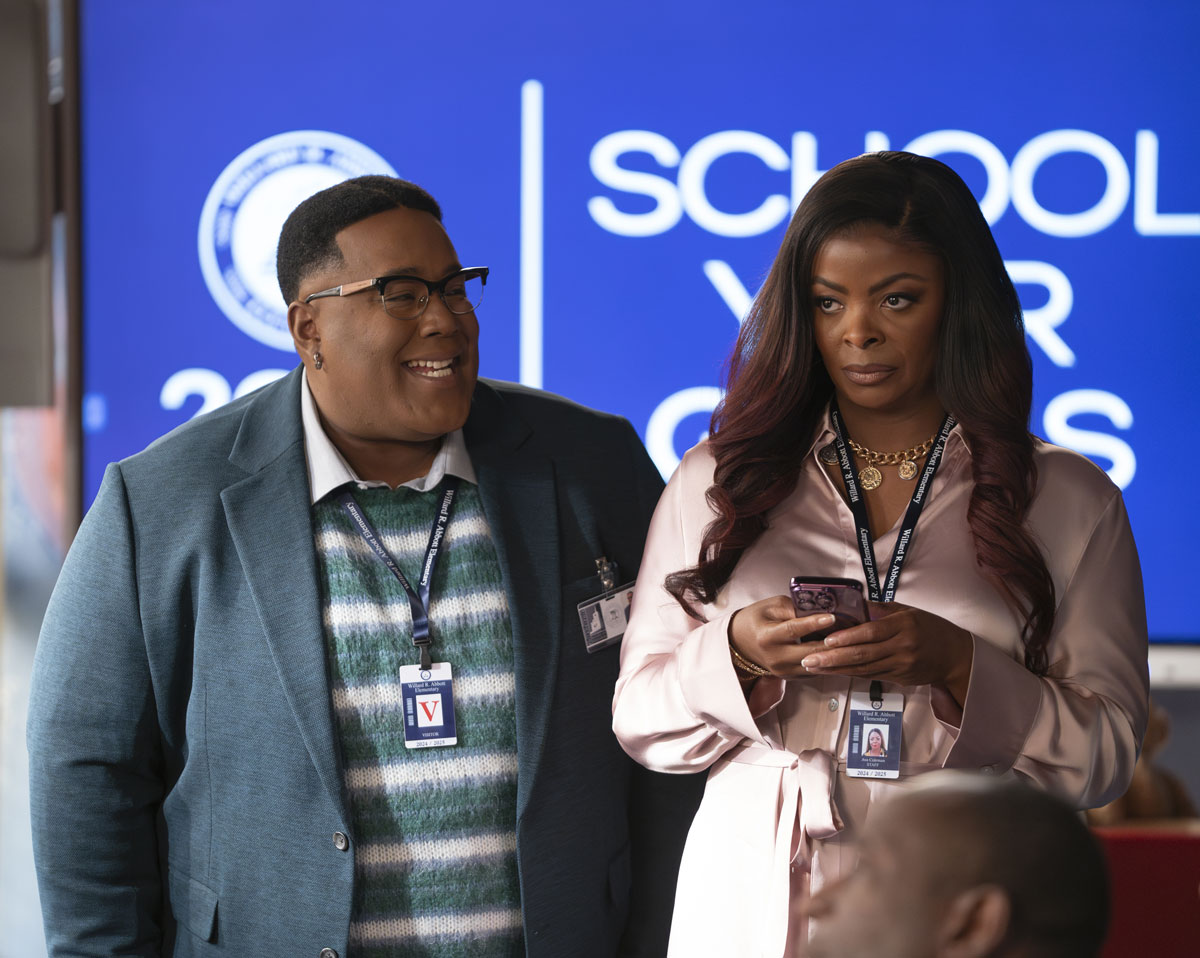
Overwhelming problems remain. One that cannot be fully fixed is Principal Ava Coleman's mismanagement – not that we’d want that. Janelle James’ portrait of ineptitude is the Teachers Appreciation Day gift that keeps on giving.

But even Ava doesn’t deter Janine from fulfilling her true purpose as a teacher, inspired by her fellow educators Jacob Hill (Chris Perfetti) and her sustained crush on Gregory Eddie (Tyler James Williams).

Like all great workplace sitcoms, the “Abbott Elementary” character ensemble is a family with a pair of characters dangling on the limb of the “will they/won’t they tree,” K-I-S-S-I-N-G in the third season finale.

The big question as "Abbott Elementary" returns is what became of Janine and Gregory's cliffhanger lip-lock. But that's never all there is. Two seasons ago Brunson used her show’s popularity to explore what charter schools mean to a community. That “Abbott” arc clarified those nebulous political talking points about school choice and vouchers by explaining how charter schools work against the public school system and communities who simply want their children to receive a solid education in a safe environment.

Season 4 digs into another thorny real-world class conflict without mentioning a certain dreaded word associated with it in the season premiere. But we quickly get what’s happening when Ava stumbles into her office and is met by a vision so unfamiliar that she thinks she’s seeing a ghost. It’s just a white kid whose parents recently moved to the area.

Janine explains that a big-time PGA golf course is under construction about 10 blocks from Abbott, and new homeowners are moving to the area so they can play here. “And while Tigers Woods is a notable golfer,” Janine says, “the demographic of most golfers is mainly…uh…”

Abbott ElementaryBen Onyx Dowdy and Janelle James in "Abbott Elementary" (ABC/Disney/Gilles Mingasson)

Yes. Thanks to this new golf course, gentrification is set to hit Abbott and its families more tangibly than it already has, starting with basic rolling effects like sudden water loss in the school building and an uptick in scuttling vermin.

Brunson never wanted “Abbott Elementary” to be about the Blackness of the school or most of its teachers, drawing the focus instead to the blend and crash of the individual personalities comprising the staff. That said, she is also unafraid to cash in the currency of affection we have for these characters to shed light on actual phenomena making life untenable for real working-class people.

We need your help to stay independent

The golf course subplot doesn’t show up in every episode. Next week’s episode doesn’t include a single mention, actually; a contagious outbreak has everyone's plate full enough.

But it mirrors a case unfurling in West Philly right now. Billionaire interests bigfooted the restoration of the Cobbs Creek Golf Course, located in a predominantly Black neighborhood whose residents weren’t consulted and are steadily being squeezed out by rising property prices and their accompanying taxes. Locals also consider this "restoration" to be environmentally irresponsible, clearcutting old trees in greenspaces local neighbors used for hiking and naturalists prized for their diversity.

One of the first things a kindly grinning Janine says in the pilot is that the city constantly tells its teachers that there’s no money to fund their school's needs, “but they’re doing a multimillion-dollar renovation to the Eagles stadium down the street.” 

Abbott ElementaryMatt Oberg, Chris Perfetti, Sheryl Lee Ralph and Lisa Ann Walter in "Abbott Elementary" (ABC/Disney/Gilles Mingasson)

Municipal disinvestment plagues communities across the country, not just big cities. The golf course development, though, offers a chance to depict for the show’s primetime audience the ways ballyhooed urban renewal projects impact longtime residents who didn’t have a say in the matter.

“Abbott” doesn’t go head-on into that aspect – not in the premiere, anyway. And you don’t have to know anything about the Cobbs Creek golf course development to recognize something is going very wrong in the show’s pocket of West Philly. A slick lawyer dangling penny-on-the-dollar payoffs before these extremely underpaid teachers is never up to any good. Even in that telltale “uh-oh” moment, the cast’s physical humor keeps the scene light, and the zingers hit their target without fail.


Want a daily wrap-up of all the news and commentary Salon has to offer? Subscribe to our morning newsletter, Crash Course.


We all want to watch whatever emerges from Janine and Gregory’s interlude, even those of us who hoped it wouldn't happen.

Paying attention to how these teachers and their resilient community contend with another well-funded menace promises to be worthwhile – a rarer commodity in broadcast primetime these days.

Few network comedies dip a toe into social commentary with much nuance, and without softening the landing in some way that defies reality. But the fact that “Abbott Elementary” is willing to wade into this class politics discussion with a hopeful smile on its face and loses none of its glee is an accomplishment.

Season 4 of "Abbott Elementary" premieres at 9:30 p.m. Wednesday, Oct. 9 on ABC. Episodes stream Thursdays on Hulu.

“The righteous hate what is false”: Mike Johnson betrays his faith by lying about immigrants voting

House Speaker Mike Johnson is a man of faith — a “Bible-believing Christian,” as he puts it, who by his own account does his best to reflect the fact that God is love, not hate.

“If you truly believe in the Bible’s commands,” the Louisiana Republican told Fox News last year, “and you seek to follow those, it’s impossible to be a hateful person because the greatest command in the Bible is that you love God with everything you had, and you love your neighbor as well.”

But Johnson is also a loyal ally of Donald Trump, a man who has repeatedly made false, outlandish and blatantly offensive claims in pursuit of political power, and has spent the last nine years blaming people born elsewhere for almost every problem facing America. But Johnson is far more than a modest disciple of a 78-year-old demagogue who hawks his own sacrilegious version of Christianity's sacred text, nor is he just another Republican who swallows his unease over the racist invective in order to get lower corporate taxes.

No, Mike Johnson is also in it for power. Like his party’s leader, he's given to self-aggrandizement (“entire industries,” he has claimed, are trying “to take down … effective political leaders like me”). In his uphill quest to preserve the Republicans' slender House majority and hold onto the speaker's chair, Johnson is participating — and even leading — a campaign of demonization directed at immigrants, one that he either knows is false or has somehow willed himself to believe is true. (Neither is an excuse, according to the dictates of Johnson's faith, that is likely to satisfy St. Peter).

Speaking to Politico while on the campaign trail in Texas, Johnson this week reiterated a false GOP talking point he has echoed many times before.

“We know that states are not requesting proof of citizenship … so there's going to be thousands upon thousands of noncitizens voting,” he claimed. “If you have enough noncitizens participating in some of these swing areas, you can change the outcome of the election in the majority.”

He made much the same fanciful claim in July, when the House passed legislation requiring states to ask for proof of citizenship from anyone filling out a voter registration form. To be clear, it's already a felony for any noncitizen to vote, but voting-rights advocates believe that requiring a passport or a birth certificate — documents many citizens do not possess — amounts to voter suppression. 

At the risk of tiresome repetition, these claims that thousands of noncitizens are voting are simply not true. Don’t take the liberal media’s word for it: Consider the audits of voter rolls conducted by Republican politicians.

In Georgia, Secretary of State Brad Raffenseperger found that, over 25 years, roughly 1,600 noncitizens had attempted to file voter registrations; none of the 65 or so who attempted it every year were successful. In Ohio, GOP Secretary of State Frank LaRose uncovered a grand total of 137 “suspected” noncitizens on the state’s voter rolls. In Kentucky, another red state with free rein to out any “illegals” voting in elections, Secretary of State Michael Adams was forced to concede, “We don’t really have a problem with this.” 

Donald Trump already had four years in the White House to address this allegedly massive issue, but rapidly disbanded his own “Presidential Advisory Commission on Election Integrity” after it failed to uncover any of the “millions” of illegal votes he claimed were cast in 2016.

We need your help to stay independent

It stands to reason, of course, that most people who are in the country without authorization would prefer to avoid deportation proceedings, and are not eager to jeopardize the lives they have built here in order to cast one of the 160 million or so ballots likely to be cast in this year's presidential election.

In the absence of literally any evidence, Johnson has invoked his gut feeling. At a press conference on the steps of the U.S. Capitol earlier this year, standing behind a podium with a sign declaring, “Americans decide American elections,” the speaker was asked by a reporter if he could estimate the scale of this so-called problem.

“We all know, intuitively, that a lot of illegals are voting in federal elections,” he replied. “But it's not been something that's easily provable. We don't have that number."

Salon asked Johnson’s office for any data that would support his "intuitive" insight into widespread illegal voting. His staff failed to provide any, but shared a report citing another Republican-drafted report based on sketchy anecdotes, including one from a 1996 congressional race in California, where defeated Republican incumbent Bob Dornan blamed "pervasive" fraud for losing his seat. In fact, while a GOP-led task force claimed to have uncovered several hundred illegal votes, Republican leaders at the time conceded it wasn't enough to change the results. 

The report from Johnson's office also alluded to a study that had concluded "the outcome in certain races was determined by the votes of noncitizens." That report was based on a small internet survey, however, and its author says that even if its findings are accurate, there's no possibility they could impact a presidential election. ("I can't quite account for the math being so badly wrong in their analyses," the author told Wired, when asked about Trump and his allies citing his work.)

The lack of hard data after all these decades of extravagant claims about massive fraud points toward an inescapable conclusion: “Illegal” voting is not a real issue but rather an attempt by Republicans to explain away their losses and delegitimatize any Democratic victories, past or future. A study by the nonpartisan Brennan Center for Justice found just 30 incidents of “suspected” noncitizen voting in 2016, which would account for 0.0001% of all votes cast (a finding backed by the libertarian-leaning Cato Institute).

Aaron Reichlin-Melnick, senior fellow at the American Immigration Council, told Salon that his own research suggests that noncitizen voting is a total red herring. Based on his own review of the evidence, including a database of alleged voter fraud put together by the right-wing Heritage Foundation, Reichlin-Melnick said that any noncitizen who votes "is highly likely to be a person with a green card making a good-faith mistake, as those account for the vast majority of criminal noncitizen voting cases brought in the past few decades."

Johnson, who has introduced legislation on this issue, is surely not ignorant of such data, and knows perfectly well that there is no evidence to support his own sweeping claims that America's elections are fraudulent (yet somehow, most recently, delivered a Republican majority in the House of Representatives). It’s possible he's a true believer in this nonsense, but Occam's razor suggests that when politicians tell lies they do so for their own benefit.  

Perhaps it's useful to turn to a text Mike Johnson undoubtedly knows well, and consider what it has to say about the relationship between truth and dishonor: “The righteous hate what is false,” Proverbs 13:5 tells us, “but the wicked make themselves a stench and bring shame on themselves.”

New documentary details Trump’s child-separation policy, but NBC won’t air it until December

MSNBC acquired Errol Morris' new documentary, "Separated," examining the family separation policy implemented by Donald Trump's administration, but NBC executives have decided to shelve it until after the election due to fears of offending the former president, according to journalist Oliver Darcy.

NBC News Studios acted as a producer for the possible Oscar contender, which is itself based on the 2020 nonfiction book “Separated: Inside an American Tragedy” by NBC correspondent Jacob Soboroff. MSNBC acquired it on Oct. 1, announcing the same day that it would air on December 7.

The late scheduling by NBC executives comes after MSNBC host Chris Hayes attended a screening and described the film as an "absolutely urgent" work "that truly shook" him. Sources familiar with the matter told Darcy that Rachel Maddow was also "so impressed by the documentary that she offered to play a key role in promoting it."

The decision to not air the documentary until December has rankled Morris, who had already made the rounds on the network to promote his work.

"Why is my movie not being shown on NBC prior to the election? It is not a partisan movie. It’s about a policy that was disgusting and should not be allowed to happen again. Make your own inferences," he wrote on X.

Darcy reported that Rebecca Blumenstein, president of editorial for NBC News, opposed airing “Separated” before the election because executives want Trump to agree to another presidential debate hosted by the network.

However, Stephen Labaton, NBCUniversal head of communications, maintained to Darcy that “the debate had nothing to do with the scheduling of this programming.”

The policy spotlighted by the documentary came as part of the Trump administration's "zero-tolerance" approach to border crossings and resulted in more than 5,000 children being forcibly separated from their parents. At least 2,000 children have yet to be reunited with their parents.

TikTok’s “Sandwich King” Owen Han knows the secret to making the perfect sandwich at home

Admittedly, I'm not a big TikTok guy. I know, I know, I'm missing out. The platform has just never captured me, to be honest since I'm a Twitter (oh, sorry, X) guy through and through. However, the remarkably popular Owen Han —who has become known as the platform's "King of Sandwiches" — is someone whose dishes might convince me to spend more time on the platform. 

Angling all of his videos through a sandwich-heavy lens, Han's staccato, ASMR-influenced TikToks have racked up millions and millions of views. Now, he's releasing a cookbook, fittingly titled "Stacked: The Art of the Perfect Sandwich."

Inspired by his Italian and Chinese heritage as well as cult-classic favorite sandwiches worldwide — and all across the interwebs — Han's channel capitalized on food that is immediately appealing to the TikTok audience in easily digestible (pun intended)  videos that, clearly, made a real mark on followers.

Han, who bills himself a "culinary content producer, social media celebrity and self-proclaimed professional eater," is not professionally trained, but his recipes are simple-to-follow while also incorporating unique aspects to help them pop. One great example is his Turkey Crunch Sandwich with Frico Crisps. Now, I might be a bit biased because frico — lacy, gossamer, uber-crispy cooked flats of parmesan cheese — is one of my favorite things on earth, but Han's inclusion is both simple and ingenious: The frico adds additional cheese flavor while also providing incredible texture.

"Ultimately, Stacked is an ode to my love for sandwiches and a collection of my favorites which differ from others," Han said.

Han spoke with Salon recently, touching on everything from food's importance in his upbringing to honoring his father, plus his goals for the future, his favorite sandwiches and much more.
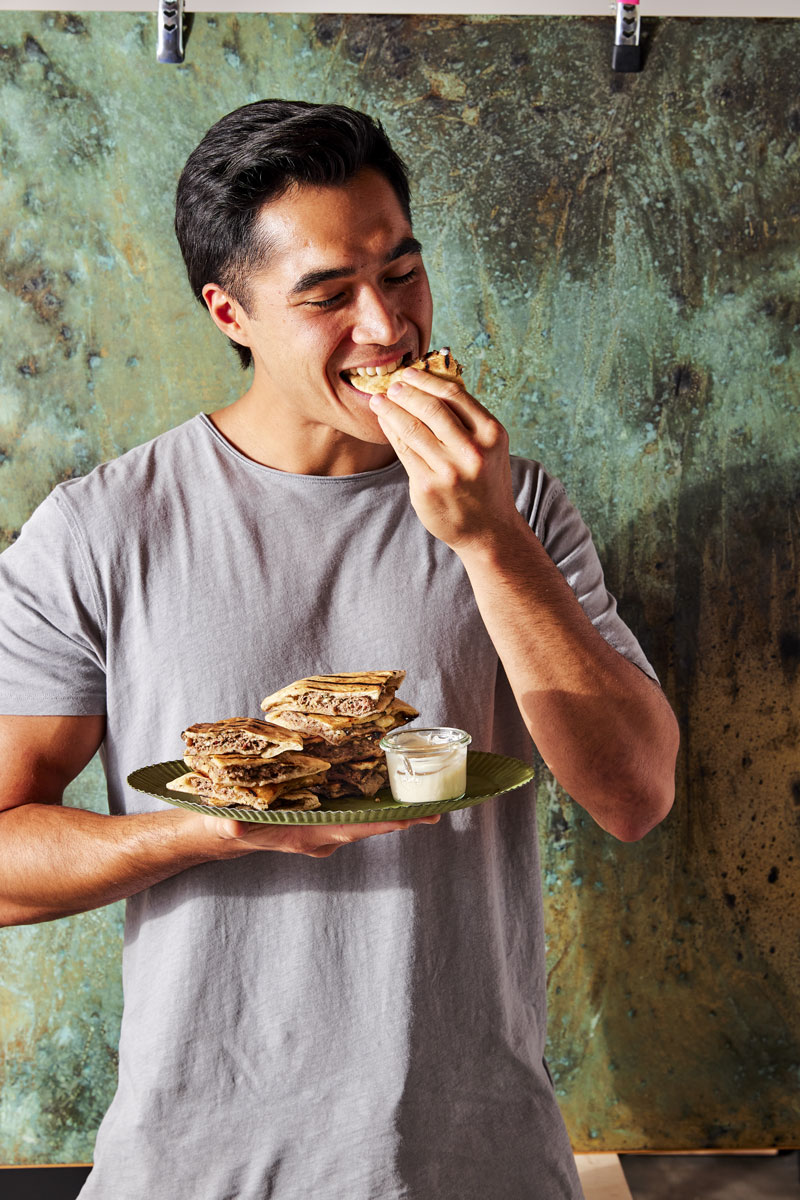
Lamb-Stuffed Pitas (Arayes)Lamb-Stuffed Pitas (Arayes) (Photo by Ren Fuller)

The following interview has been lightly edited for clarity and length. 

There's been such an influx of sandwich cookbooks on the market this year. How would you say that "Stacked" differentiates from the others? 

The author is more handsome? Kidding, kidding.

I have a lot of respect for any cookbook author and especially my fellow sandwich lovers. In terms of what makes Stacked special: the devil is in the detail. I’m drawing inspiration from my own heritage, upbringing and experiences in the kitchen to put some fun (and delicious) spins on the classics.

The recipes in "Stacked" may seem familiar at first glance, but when you dive in, you’ll notice there are endless fun tweaks to upgrade the classics making them truly unique. Ultimately, "Stacked" is an ode to my love for sandwiches and a collection of my favorites which differ from others.

How would you say your Chinese and Italian heritage imbues your cooking and recipes? 

My Chinese and Italian heritage are the foundation and inspiration for my cooking, use of ingredients and technique. Anyone who grows up with immigrant parents or grandparents are introduced to unique ingredients and cooking techniques that likely differ from that of their next-door neighbors in the US. 

Some examples from my life include my Chinese grandmother's shrimp toast recipe — a unique packed lunch for a 3rd grader living in Florida — or my Italian grandmother's technique for doing meatballs (she will roll them and add them directly to sauce to cook for supreme tenderness).

This might be a tricky one, but would you say you have a singular, absolute favorite sandwich in general? Or specifically from the book?  

Tricky indeed, but I came prepared!

For my favorite, I have to go with the Not So Classic Cheese Steak. In short, it’s my heritage in a recipe. When I was initially recipe testing to create a cheesesteak, I looked in my pantry and pulled out my staples: soy sauce, ketchup, Worcestershire, ginger, garlic, mozzarella, unsmoked provolone, Italian cherry peppers, etc. When they come together, you’ve got a sweet, spicy, fatty and acidic recipe that hits all the notes.

For years, it’s been the sandwich I most frequently crave. A recipe that has a little bit of Italian, Chinese and American (aka Owen) wrapped into one. 

Are there any unsung heroes in the sandwich world for which you have a special affinity? That could be a lesser-used bread, an under-appreciated condiment, a particular protein or cheese. 

There are two meats I have to shoutout and give some praise to here. First, is mortadella: I absolutely love it. I call it fancy baloney. Visually, I think it scares some people, but it has such a rich flavor, balanced fattiness, versatility and heritage and tradition to its use.

The second is bresaola. For some reason, you can’t find it in most American delis, but I think it’s a better tasting version of prosciutto we should all be in love with.

We need your help to stay independent

Before you appeared on TikTok, were you cooking a lot? Were you working in food? Or was starting a food-based TikTok account sort of just happenstance? 

Does delivering meals to hospital patients count as working in food? That was my first job out of college prior to entering into the foodie influencer space, though I’d be lying if I didn’t concede cooking and recipe development has been a lifelong passion for me that started when I was very young — growing up watching my grandma (or as I call her, Nonna) cook in her kitchen in a small village in Tuscany where I was born.

I would go on to grow up in the States where I honed in on my love of cooking through summer courses at The Institute of Culinary Education. I even hosted a pop-up restaurant out of what was basically a fraternity house at University of Southern California with my good friend (and fellow culinary content creator), H Woo Lee. H Woo is actually who introduced me to TikTok and urged me to start posting my recipes . . . it just so happened the first one I posted to really take off and go viral was a sandwich I made for lunch.

In short, my coming to TikTok was happenstance, but my love of food has been lifelong. 

Obviously, your ASMR, quick-hit style is your trademark and something that tends to do so well on TikTok, but I was wondering if you had any ideas for diversifying the video style in the future? I get "why fix it if it isn't broken" and clearly that rapid, staccato, uber-fast speed has done wonders for your traction and your followers. But selfishly, I’d love to see something — slower? 

I’m definitely operating under the “why fix it if it isn’t broken” mentality as it relates to short-form video — Instagram reels, TikToks and YouTube shorts. There’s just something really satisfying and viral-friendly for social media users to hear the sounds of a kitchen (the sizzling, frying, chopping, whisking, blending, etc.) while watching a recipe come together in a quick-cut format to create something delicious.

That being said, I am really excited to share I’ve begun posting longer format  — or in your words, "slower!" — videos on my YouTube channel. Currently, I’m releasing a series, entitled “Nonna Knows,” where I cook a recipe from my Nonna’s arsenal and then have her join at the end of the video to critique and rate it. She doesn’t hold back and isn’t afraid to critique, so it’s a fun watch and truly a dream come true to have her involved in my content.

The subhead of the book is "the art of the perfect sandwich." If you were to sum that up in a few sentences, what would it be? 

Admittedly, it’s hard to sum that up because it’s not one specific notion. The art of the perfect sandwich is something that will ultimately be unique to each reader based on personal preference but the book acts as a roadmap for finding it. Whether that be a breakfast, lunch, dinner or dessert sandwich, simple vs elevated, big vs small — there’s a perfect sandwich in "Stacked" for everyone. 
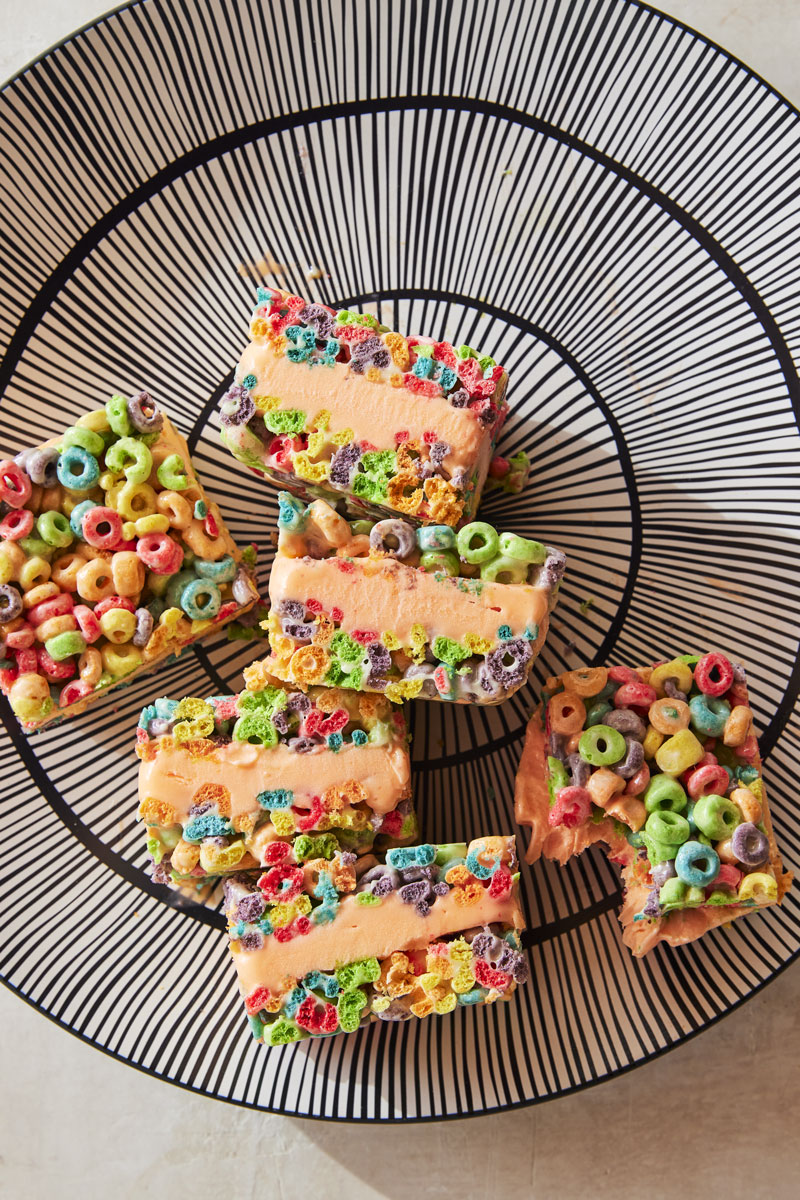
Frozen Fruity Sherbert BarFrozen Fruity Sherbert Bar (Photo by Ren Fuller)

The book is pretty evenly divided, encompassing breakfast, dessert, vegetarian and then all forms of protein-based sandwiches. Did you have a favorite section to work on? 

Definitely the desserts! Admittedly, I have never been much of a dessert person and would only occasionally post sweets recipes on social media. However, when I really dug in and started developing the dessert sandwich recipes for the book, I found myself walking away with a newly-grown sweet tooth and often crave them now. The desserts chapter truly transformed my palate, even if it means I work a little harder in the gym to sweat off the newfound calories! 

The book is dedicated to your dad. Can you speak a bit about his influence on you, both in regards to your palate and cooking, but also at large?

My father’s love of cooking and sharing food — with not just me, but also my brothers, extended family and any friends that happened to come by our house for a meal growing up — will forever be the basis of my passion for sharing my creations in the kitchen with the world. In terms of palate, I get my Chinese flair and frame of reference for ingredients in the kitchen from my father and his side of the family.

As you’ll read in the book, my father’s passing during a transitional period in my life — shortly after my graduation from USC — was also a large part of my wanting to find larger meaning in my day-to-day workings. There are a lot of family and friends I owe my career in food media to, but I wouldn’t have had the guts to even try making this happen if it weren’t for my father. Love you always, Pops. 

Is there a recipe in the book that you’d recommend as a good starter for someone who’s a bit of a novice in the kitchen? Alternatively, is there a good project recipe for a more advanced cook who might want to set some time aside on a weekend to really try to perfect it? 

Absolutely, there are recipes for cooks of all skill levels in the book. 

For the novice or beginner, I recommend taking a look at the cold cuts. Perhaps start with the Mortadella with Pistachio Pesto. The most challenging component of that is the pesto sauce but otherwise, it’s just assembling the sandwich. The overall combination of flavors is out of this world.. it’ll make you feel like a pro and hopefully motivate you to work your way up to the more involved recipes. 

If you have the entire weekend to really try and perfect a sandwich, I recommend taking a stab at the sandwich on the cover — the OG Steak Sandwich I spoke about earlier. If you can nail the cook on the skirt steak, caramelize the onions to perfection and do a flawless garlic aioli, you have a sandwich that you’ll crave for the rest of your life. 
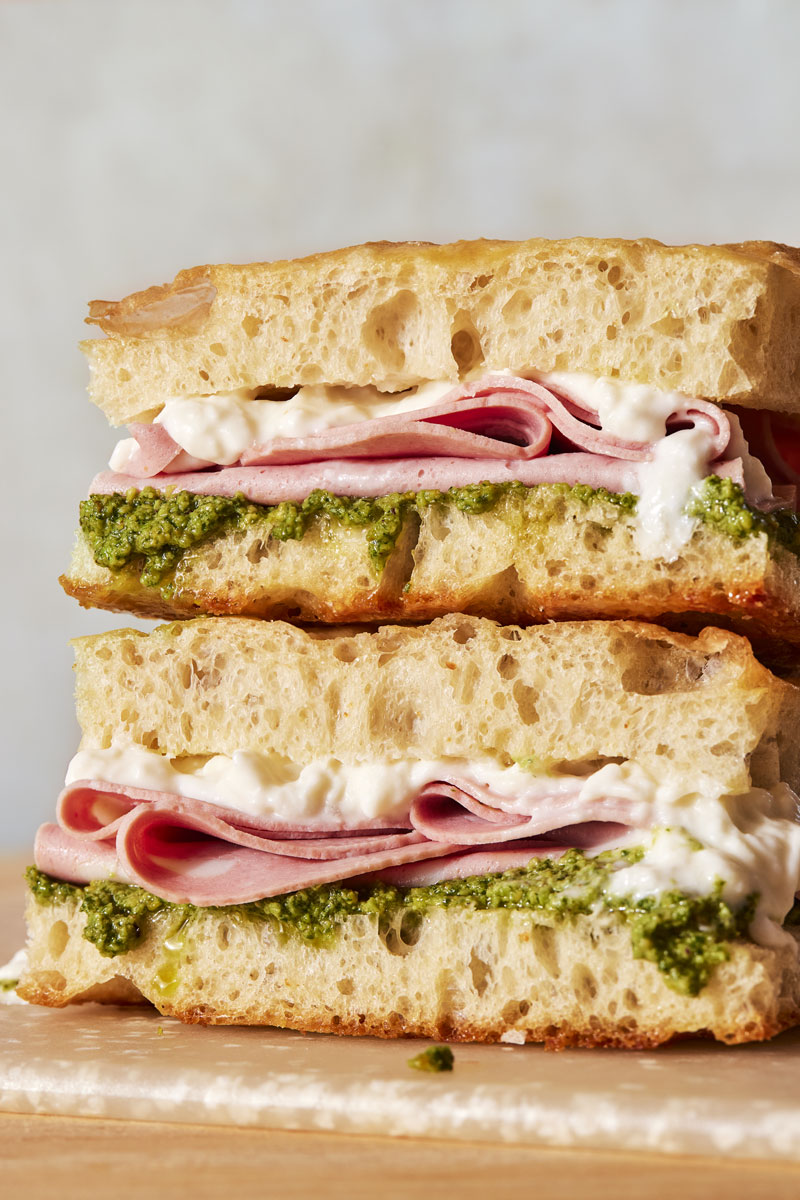
Mortadella with Pistachio Pesto on SchiacciataMortadella with Pistachio Pesto on Schiacciata (Photo by Ren Fuller)

What are your three favorite ingredients to work with?

In no particular order — Calabrian chilies, pickled onions and the freshest bread your local bakery can provide you with. Be sure to get there at opening!

What are your tips on mitigating food waste?

Like many of my culinary content creator colleagues, I cook a lot of food on a weekly basis — like a small restaurant’s worth. Thankfully, I’m a hungry man and don’t mind leftovers, so I always make sure my recipes find their way to a stomach, whether it be mine or a friend’s. Nothing gets thrown away. 

Why do you cook? 

That’s actually a tricky question. To be honest, the exact rationale for taking out my chef’s knife can change on a day-to-day basis and sometimes, multiple times throughout a single day. But whether I’m cooking for myself, sharing recipes far and wide on social media, developing a sandwich recipe for a brand sponsor, or testing my skills against others in a cooking competition: I can’t deny, at the end of the day, I’m just thankful I get to make a living doing something I’m truly passionate about.

Some people get excited about cars, travel, money. Cooking and the perfect bite are what genuinely excite me. When I boil it down — cooking pun! — that excitement and passion for discovering more of it is why I cook. 

What is an especially cherished food or cooking memory of yours? 

Growing up watching my Nonna cook in her kitchen in Tuscany. I still dream about it. I can literally close my eyes and envision it — the tastes, the smells, her refusal to ever measure ingredients, cooking by pure instinct. It’s a collection of memories that I’ll never forget. 


Want more great food writing and recipes? Subscribe to Salon Food's newsletter, The Bite.


How do you practice sustainability? 

Great question! Especially as more and more folks get into home cooking inspired by what they see on social media which often doesn’t include tips and tricks for sustainability. I try to minimize food waste, compost food scraps and buy local and seasonal produce.

What stands out for you as a formative moment that got you into cooking or food at large? 

I was inspired from a young age, watching both my Nonna and Father cook growing up. What you may find funny is that, until I was 12, I was more of an (admittedly chubby) audience member in the kitchen than help to both of them.

Tired of my uselessness in the kitchen, my Nonna reached out to a local restaurant owner-chef and asked that she allow her grandson the opportunity to receive some formal training in her restaurant. The chef in question was Chef Daniella of La Fonte, a local Italian/pasta restaurant. Chef Daniella agreed and off I went to learn from her.

Her teaching style emulated the charm of the tiny village of Pascoso where I was born: quiet, patient and caring. I owe Chef Daniella endless thanks for my earliest trainings in the kitchen. 
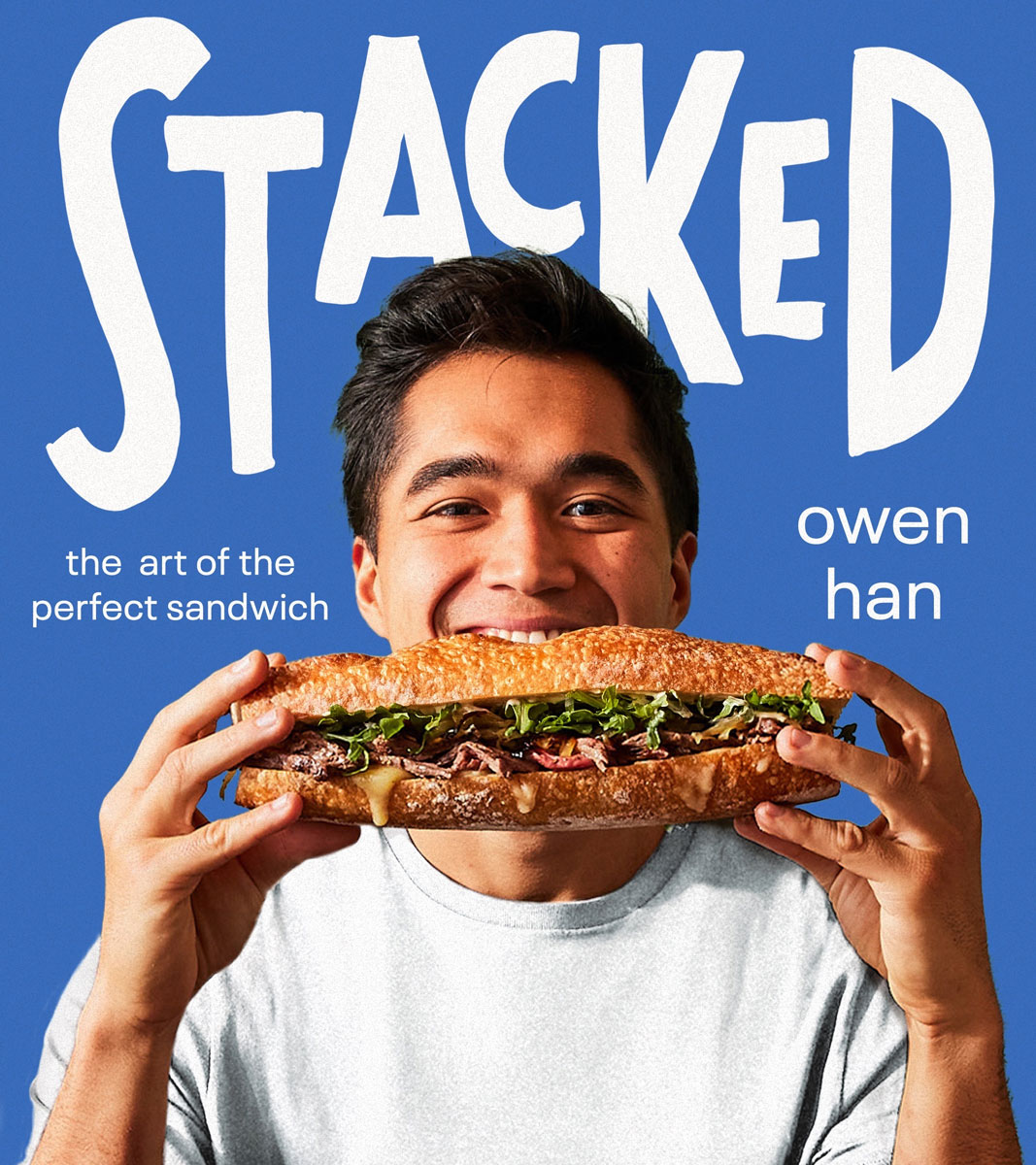
StackedStacked: The Art of the Perfect Sandwich by Owen HanStacked: The Art of the Perfect Sandwich by Owen Han (Courtesy of Harper Collins)

Outside of the sandwich realm, are you just as passionate about other foods, ingredients or dishes? 

Absolutely. Sandwiches have become what I’m known for, but they were really just the first recipes that really worked for the social media algorithms to help me get my foot into the door of the influencer space. I’m immensely proud of that but look forward to expanding my culinary horizons and the variety of recipes I share with my audience following this cookbook.

Are there any standout techniques throughout the book that differ from the usual approaches? 

There’s actually a full section on technique. One specific example is using my grated weights or cast iron to get an even toast on bread. Big Toaster might have it out for me if enough readers follow in my footsteps. 

Social media  and now cookbooks  have become your domain. What's next for you? Is food television possibly on the agenda? 

In the immediate term, I’m looking forward to producing longer-format video content for my YouTube page. I like having the freedom and flexibility to work with my amazing production company partner to create series for YouTube that aren’t bound by the limitations of regular TV programming.

That being said, I’m definitely open to finding the right television series in the food space for myself. After all, not everyone is glued to their phone or computer screens. I also have aspirations in the product space as well, but I’ll keep those plans secret until there’s something more formal to share, at which point I’ll hit you up! 

“Severely compromised”: Experts warn right-wing SCOTUS justices may “seek to intervene” in election

Supreme Court watchers increasingly worry that the 2024 election between former President Donald Trump and Vice President Kamala Harris might be decided in a courtroom rather than at the ballot box. 

This year has already seen an unprecedented level of litigation related to the election and the procedures by which the election will be administrated. Most experts, however, distinguish between cases likely to be resolved before the election and the deluge of cases they are expecting after the election.

The single case closest to being heard by the Supreme Court before the election arises out of Mississippi, according to Leah Tulin, the senior counsel at the Brennan Center’s democracy program. The case concerns the familiar election-year issue of whether to count mail-in ballots that are postmarked before Election Day but are received after Election Day.

Some 18 states have laws providing for the counting of ballots that would fall into this category, sometimes called “postmark” laws. Nevada is likely the most competitive presidential state with such a law this year, though New York and California could potentially decide control of the House and both states count ballots received after Election Day.

In the Mississippi case, the Republican National Committee and the state GOP sued to overturn the COVID-era postmark law, which would disqualify ballots received after Election Day, regardless of how they were dated. The case has drawn attention because it is the first challenge to a postmark law to be accepted by a court on its merits. However, the trial court ruled in favor of Mississippi, prompting Republicans to appeal the case to the Fifth Circuit.

“In general the Fifth Circuit has been on the cutting edge — and not in a good way — in terms of pressing a radical conservative vision of the law in a variety of areas,” Tulin said. “Anytime a case gets to the Fifth Circuit in terms of voting, advocates like us are concerned.”

A ruling by the court could see the case fast-tracked to the Supreme Court. However, at oral arguments, the attorneys for the Republicans indicated that they wanted the Fifth Circuit to send the case back down to the district court. According to Tulin, this unusual strategy could allow the GOP to use the decision to “sow chaos and doubt and confusion” around mail-in ballots both before and after the election.

“I don’t know if that’s what the strategy is but it at least looks like that could be part of the strategy,” Tulin said. “This is a broader theme we’re seeing in election litigation around the country.” 

If Republicans prevail in the case, there would likely be at least tens of thousands of otherwise viable ballots rejected across the country. In 2020, more than 50,000 ballots that arrived after Election Day were rejected even without making deadlines tighter, according to a Massachusetts Institute of Technology analysis

While the Mississippi case is the one most likely to end up before the court ahead of the election, there are other cases percolating that have the potential to end up at the high court, or at least to influence the election. For instance, challenges to new rules written by Georgia’s State Election Board are likely to be ruled on ahead of the election, even if they aren't fully resolved.

In Pennsylvania, there are multiple cases concerning what to do with mail-in ballots that arrive on time but are undated or misdated. In North Carolina, Republicans are suing to disqualify absentee ballots that arrive in envelopes that aren’t properly sealed. In Nevada, Republicans are suing to purge voters from the rolls who registered with the Department of Motor Vehicles when they were not yet citizens. 

In Michigan, three Black voters and the NAACP filed a suit against the Trump campaign alleging that it and the RNC’s attempt to overturn election results in 2020 were disenfranchisement and violated the Voting Rights Act and the Ku Klux Klan Act.

There will also likely be legal issues concerning how states handle voting in the wake of Hurricane Helene, Hurricane Milton and any other storms that disrupt voting procedures ahead of and during the election.

Sophia Lakin, the director of the American Civil Liberties Union's Voting Rights Project, told Salon that though many of the cases in lower courts are not yet poised to appear before the Supreme Court, some cases could be expedited.

“This is an existential moment for the court and it’s really put itself in this position."

“I think there is a possibility that any of these cases that are making their way through the state courts, of which there are quite a few, could find their way before the Supreme Court in the sense that someone could ask, the Supreme Court could weigh in,” Lakin said.

Lakin said that the ACLU is currently focused on two types of cases that could influence people’s ability to vote ahead of the election. The first type of case is efforts to conduct mass purges of the voter rolls, like in Nevada. The second is attempts to delay election certification, like in Georgia.

“It’s a warning shot to would-be election deniers that we’re watching,” Lakin said. “We’re trying to get ahead of it so it doesn’t happen on the backend.”

One issue, according to Lakin, is that the “rules of the game are unfortunately unclear” when it comes to what rules courts will and will not be willing to change ahead of Election Day.

Changes to election rules in the run-up to Election Day theoretically go against the Purcell Principle, a legal precedent that holds that courts should not change election laws in the period immediately ahead of an election in order to not cause issues or confusion about election administration.

“I think what we have been trying to accomplish is at least consistency and that is difficult where you are getting what often feels like inconsistent applications of this so-called Purcell Principle,” Lakin said. “That unexplainable application makes it very difficult to see what the court is looking at.”

Bill Yeomans, a former Justice Department prosecutor and counsel to the former Sen. Edward Kennedy, D-Mass., told Salon that the court has “been quite vigorous in applying that doctrine in racial gerrymandering cases, for example.”

“It will be very interesting to see if they also rely on the Purcell principle in regards to Trump trying to change the rules before the elections,” Yeomans said.

We need your help to stay independent

In Yeomans’ analysis, it’s not clear which, if any, election-specific cases make it before the Supreme Court ahead of the election. However, he noted that the Supreme Court has already actively shaped the contours of this year’s election in its rulings on abortion, presidential immunity and in ruling that only Congress can disqualify Trump under the insurrection clause of the 14th Amendment.

Yeomans said that he thinks that the court is “going to be asked to play an incredibly sensitive role in this election” and that “there will be efforts to get the court involved after the election.” He also indicated that he thinks at least two of the Supreme Court’s six conservative justices should recuse themselves from cases related to Trump’s potential re-election.

“I think at this point Justice Thomas and Justice Alito are both severely compromised. Both have refused to recuse from cases where they obviously should have,” Yeomans said. “Let’s not forget Ginny Thomas who was deeply involved in Trump’s post-election shenanigans.”

Ginny Thomas, Justice Clarence Thomas’s wife, was involved in communications with Arizona state lawmakers pressuring them to “ensure that a clean slate of Electors is chosen.” Martha-Ann Alito, Justice Samuel Alito’s wife flew an upside-down American flag, a longstanding symbol of distress, which was adopted by supporters of Trump in the wake of the 2020 election, according to the Washington Post. 

Yeomans indicated that he thinks people are underestimating both the potential post-election litigation and civil unrest in the event of a close election as well as the threat post-election litigation could pose to the Supreme Court as an institution. “I really think this is an existential moment for the court and it’s really put itself in this position," he added.

“I think that people are underestimating how messy this could get. I think that Trump will pull out all the stops to become president again,” Yeomans said. “There will be Roger Stone tactics but there will be things that go well beyond those kinds of things. We’ve seen how Trump can mobilize an armed militia and how he can mobilize a mob.” 

The senior vice president of the Campaign Legal Center, Paul Smith, told Salon, despite the myriad cases in the courts ahead of Election Day, he also suspects that “the really big cases, if they come, will probably come after the election.”

“If we have a very tight election in a determinative state, like in 2000, then all bets are off and there will be litigation all over the place,” Smith said. “If that situation arises it will be every bit as crazy as Bush v. Gore times if not worse.”


Want a daily wrap-up of all the news and commentary Salon has to offer? Subscribe to our morning newsletter, Crash Course.


Smith pointed to certification delays and challenges as the most likely type of post-election litigation, though he expressed confidence that lower courts would be able to handle those cases. 

Smith noted that Congress could also potentially attempt to disqualify Trump ahead of certifying the national results under the 14th Amendment. Smith also said that he could see litigation related to more perennial topics of dispute like ballot curing as a spark for a post-election legal blitz. While Smith said he used to think the court would take steps to avoid looking overtly political, he indicated that he’s not so sure in 2024.

“I would’ve said until this past term that people like John Roberts would have wanted to avoid having the Supreme Court looking political,” Smith said. “The case that gives me pause is the immunity case which suggests that they have a strong interest in protecting Mr. Trump from what they perceive as unfair prosecution.” 

The founder of the Supreme Court Integrity Project, Nan Aron, also suggested that some of the conservative justices “might well seek to intervene in an election.”

“The justices are hellbent on cementing their legacies,” Aron said. “It might well be that the president could appoint new justices and hundreds of lower judges.” 

In Aron’s opinion, the main deterrent from the Supreme Court intervening in the 2024 election would be the potential to “cause many to challenge the third branch of government.”

“It used to be that far-right lawyers and academics cared about the court,” Aron said. “It’s not just the Republican party but the nation as a whole is concerned about not just the ideological direction but ethical lapses.”

Trump, triggered by Harris interview, rages against “degenerates” on “The View”

Former President Donald Trump embarked on another Truth Social rant after taking issue with Vice President Kamala Harris' comments on "The View" that she would not have done anything differently from President Joe Biden over the last four years.

"Lyin’ Kamala, who is being exposed as a 'dummy' every time she does a show, just stated to the degenerates on The View that she would have done nothing different than Crooked Joe Biden, the WORST PRESIDENT IN THE HISTORY OF THE UNITED STATES," he wrote Tuesday. "The Lamestream Media doesn’t want to pick up the story, the dumb women on the show wish they never asked her the question that led to that Election Defying answer, but the Internet is going WILD."

Harris did say something to that effect during her appearance. Asked by the all-women panel if she would have done anything differently, she said that "there is not a thing that comes to mind in terms of — and I’ve been a part of most of the decisions that have had impact," before touting the administration's work in capping the cost of insulin at $35 for Medicare recipients.

Later, Harris added that, "you asked me what is the difference between Joe Biden and me — that will be one of the differences. I’m going to have a Republican in my cabinet." That was a reference to a promise she made in a CNN interview in August.

The vice president's cautious answers underscore the challenge of framing her role in an administration that has scored a number of legislative achievements and oversaw a recovering economy, but has also frustrated many Americans who still feel left behind and is led by an unpopular president.

Trump was decidedly less guarded in his review of the Biden administration in his Truth Social tirade. "For starters, THE BORDER DISASTER, WITH MURDERERS AND EVERYONE ELSE BEING ALLOWED TO INVADE OUR COUNTRY, WORST INFLATION IN HISTORY, THE UKRAINE DISASTER, OCTOBER 7TH WITH ISRAEL, LOSS OF ENERGY INDEPENDENCE, THE AFGHANISTAN DEBACLE, LOSS OF RESPECT ALL OVER THE GLOBE, AND MUCH MORE!" he listed as the administration's many perceived sins. "Her dumbest answer so far!"

FCC official accuses Ron DeSantis of “dangerous” effort to censor pro-choice campaigners in Florida

Florida Gov. Ron DeSantis is threatening to criminally prosecute Florida television stations that have run an pro-choice ad, The Miami Herald reported on Tuesday. 

The ad features a woman who was diagnosed with brain cancer while pregnant with her second child and would’ve lost her baby had she not gotten an abortion. She advocates for a November ballot initiative, Amendment 4, that would expand abortion access in the state.

“Florida has now banned abortion, even in cases like mine. Amendment 4 is going to protect women like me,” she says in the ad.

On Oct. 3, Florida’s Department of Health sent a letter to at least one local television station threatening criminal charges for airing the ad, journalist Jason Garcia first reported. The letter says the ad is “dangerous” and may confuse pregnant women seeking life-saving care, making it a “sanitary nuisance” in violation of state law.

Though companies have the right to air political advertisements under the First Amendment, the letter states “that right does not include free rein to disseminate false advertisements, which if believed, would likely have a detrimental effect on the lives and health of pregnant women in Florida.”

U.S. Federal Communications Chair Jessica Rosenworcel slammed DeSantis’ attempted censorship

"The right of broadcasters to speak freely is rooted in the First Amendment," Rosenworcel said in a statement. "Threats against broadcast stations for airing content that conflicts with the government’s views are dangerous and undermine the fundamental principle of free speech."

After the overturning of Roe v. Wade in 2022, Florida enacted a 15-week abortion ban, making it somewhat of a refuge for abortion-seekers in the south coming from states with near-total abortion bans. But in May 2024, DeSantis’ administration made it a felony to perform or participate in an abortion six weeks after gestation.

Amendment 4, the ballot initiative being advertised, would provide a constitutional right to abortion “before viability” and when  "necessary to protect the patient's health, as determined by the patient's healthcare provider."

DeSantis has thrown all his political power into fighting Amendment 4, which includes a tax-payer funded website against the bill and an investigation into signers of the bill’s petition. 

Floridians will vote on Amendment 4 when they head to the polls on Nov. 5.

“Daytime Revolution”: How John and Yoko brought counterculture to America’s living rooms

Directed by Erik Nelson, "Daytime Revolution" gives viewers a powerful window into the early 1970s. If there is such a thing as a time machine, Nelson has fashioned it via this marvelous, transformative documentary. As with his work on "The U.S. vs. John Lennon," "Daytime Revolution" absolutely brims with narrative energy and fascinating characters. And in its finest moments, Nelson’s time capsule-like approach manages to shed vital light on the way we live now.

The documentary draws its storyline from the extraordinary week in February 1972 when John Lennon and Yoko Ono hosted the uber-popular "Mike Douglas Show," which commanded a massive audience of some 40 million viewers per week. For the duration of that remarkable week, the counterculture paraded itself in America’s living rooms via John and Yoko’s moveable feast of guests, a roster that included political activist Ralph Nader, the Black Panthers’ Bobby Seale, and comedian George Carlin.

In a conversation with me last week, Nelson pointed out that this 52-year-old happening is not so different from today’s polarizing political atmosphere. “We're living in an incredibly divisive, apocalyptic election year,” he said, “and 1972 was equally fraught with Richard Nixon and George McGovern vying for the White House—two starkly different choices. And there on daytime television are John and Yoko offering a message of unity amidst all that divisiveness.”

Further, Nelson rightly contends that John and Yoko’s residency on "The Mike Douglas Show" is arguably even more transgressive than "Saturday Night Live"’s premiere in 1975, that the irreverent comedy show was secreted away in the wee hours, while John and Yoko were situated in the heart of a mainstream TV slot, where they could showcase the counterculture for legions of American homemakers. In many ways, the episode marked the beginning of Lennon’s fight to stay in the country. “John and Yoko were very political—East Village-political,” says Nelson, “and their appearance led to Nixon declaring war on them. Just before the show aired, Strom Thurmond told the president, ‘I’m nervous about this, Dick. They’re taking sides.’”


Want a daily wrap-up of all the news and commentary Salon has to offer? Subscribe to our morning newsletter, Crash Course.


John and Yoko’s "Mike Douglas Show" residency has also gone down in history because of Lennon taking the stage for the one and only time with rock ‘n’ roll pioneer Chuck Berry. To see such heavyweights performing together is one of the documentary’s greatest pleasures. But it also presented an opportunity for Nelson to right a wrong, given that history has often depicted Ono as encroaching on Berry’s performance with her husband, especially when she engages in avant-garde voice modulation during “Memphis, Tennessee.”


Love the Beatles? Listen to Ken's podcast "Everything Fab Four."


As Nelson points out, John and Yoko were performing during that era with Elephant’s Memory as their backing band. Ono was an integral member of the group, “so this idea that Yoko somehow encroached on Chuck Berry is false. In actuality, Chuck Berry encroached on John and Yoko’s band. When Yoko chimes in, that to me is the true rock ‘n’ roll moment of that whole appearance. We're still talking about that 50 years later!”

In addition to Berry’s bravura appearance that week, John and Yoko’s "Mike Douglas Show" residency is marked by spirited conversation among the Lennons and their guests about a host of issues ranging from feminism to the anti-war movement. As Nelson demonstrates via "Daytime Revolution," the couple’s efforts to preach unity in the face of that era’s deep acrimony is a lesson that we could sorely use today.

"Daytime Revolution" hits select theaters on October 9, in honor of John Lennon's birthday. 

Palling around with Putin: Trump’s mind-boggling outreach to the Russian dictator under scrutiny

Exactly eight years ago this week, the Obama administration formally accused the Russian government of hacking the Democratic National Committee (DNC) and many others for the intended purpose of interfering with the US elections. The government said, “We believe, based on the scope and sensitivity of these efforts, that only Russia’s senior-most officials could have authorized these activities." The assumption was that the administration was pointing the finger at Russian President Vladimir Putin himself. And because it was only the Democrats who were hacked it was obvious that the intended beneficiary of this interference was Donald Trump.

The suspicion had been out there for a while. Hillary Clinton even brought it up in the presidential debate and Trump denied it saying it could just as easily be “somebody sitting on their bed that weighs 400 pounds.” But this was an official acknowledgment that the Russian government was behind all the hacking and if it hadn't been for the fact that the press was hysterical that FBI Director James Comey had inexplicably announced that the agency was re-opening the inane email investigation, it would have been another scandal potentially derailing the Trump campaign.

As it was, just before the election, the New York Times ran a piece headlined Investigating Donald Trump, F.B.I. Sees No Clear Link to Russia and everyone went to the polls on Election Day believing that Hillary Clinton was caught up in a neverending scandal that would cripple her presidency. In contrast, Donald Trump was cleared of wrongdoing. That story should have been seen as an in-kind gift to the Trump campaign.

We all know what happened after that.

From the moment Trump received Clinton's concession and began his transition, he was weirdly and constantly involved with Russia in one way or another. It eventually led to the firing of his national security adviser over unauthorized communications with Russia, the subsequent firing of the FBI Director over his unwillingness to let that national security adviser off the hook and the massive special counsel investigation into the whole thing. There's no need to rehash all that now. We all remember it like it was yesterday, which it practically was.

It's one thing for former presidents to hobnob with foreign leaders, it's quite another for a former president who is also running for the office again to be secretly conversing with a major adversary without notifying or consulting with the current government.

One of the less discussed aspects of the whole Trump and Russia association is the fact that his first impeachment, brought on because he tried to coerce the Ukrainian president into announcing a bogus investigation into his then-top rival Joe Biden, stemmed largely from his sycophantic "friendship" with Russian President Vladimir Putin. The trained KGB operative Putin is a much more sophisticated and savvy judge of character than Trump, who simply loves anyone who loves him back, and he had Trump's number from the beginning. Their private "meetings with no notes" and Trump's embarrassing public genuflecting to the Russian leader over the years had been fully reported. The former president went out of his way to be accommodating to Putin, always against the advice of his national security expert advisers. But a new in-depth report by Mark Mazzetti and Adam Entous of the New York Times reveals that from the get-go, Putin had a plan to invade Ukraine — and he knew that Trump could be manipulated into helping him do it.

The Times reports that at the very first face-to-face meeting between the two men in Hamburg, Germany in July 2017, Putin began disparaging Ukraine and advised Trump not to send them any weapons. Trump listened to him and over time the push-back among the national security professionals became so urgent that Putin realized he needed to pull back a bit or risk blowing up his strategy. So he engaged a "network of proxies" to covertly advance his plot.

Trump already had built a bit of a grudge against Ukraine before the meeting happened, something which Putin no doubt already knew. During the 2016 campaign, Paul Manafort, Trump's campaign manager, had been forced to resign when a Ukrainian investigation showed that Manafort had received millions in undisclosed payments working for a pro-Russia party in the country. Trump was convinced that this was evidence Ukraine was working on Hillary Clinton's behalf. Every time he met with Putin, his beliefs were validated. He ended up being impeached because he'd become convinced that Ukraine was corrupt and subject to his blackmail.

We need your help to stay independent

The article goes into much more depth about Rudy Giuliani, Lev Parnas, the belief that the Ukrainians actually hacked the DNC and moved the server to Kyiv. But the point is that Putin had already invaded Crimea and received very little pushback for it. So he was softening up this naive, narcissistic US president to allow his move on the rest of Ukraine. Then the pandemic hit, Trump lost and Putin ended up invading in 2022, perhaps with the knowledge that Trump was planning to run again in 2024.

The new president, Joe Biden, didn't make it as easy for him as Trump would have done. We know that Trump would never have approved the same level of military support and would have actively worked to divide NATO, possibly even finding an excuse to withdraw from the alliance altogether. But if Trump happens to win next month, Putin's work will have paid off anyway. Trump promises to "end" the war on the day after he declares victory and while he hasn't personally said what he'll do, his running mate, JD Vance and Hungary's President Viktor Orban have shared that he will withdraw military support from Ukraine and "negotiate" a peace deal which, as Vice President Kamala Harris said during Ukrainian President Volodymyr Zelenskyy's recent visit, amounts to Ukrainian surrender.

The Office of Director of National Intelligence reported last month that Russian government operatives are once again attempting to interfere in the election and they are more sophisticated than in the past. And yes, they are trying to help Donald Trump win. You can see why. This is one reason why the revelations in Bob Woodward's new book "War" about Trump holding secret conversations with Putin since he's been out of the White House are alarming. It's one thing for former presidents to hobnob with foreign leaders, it's quite another for a former president who is also running for the office again to be secretly conversing with a major adversary without notifying or consulting with the current government. That the same former president has been indicted under the espionage laws for absconding with classified documents, many of which still have not been accounted for, makes it yet another mind-boggling threat to America's and its allies' security at the hands of Donald Trump. The Kremlin denies the two have regularly spoken since Trump left office, but a Kremlin spokesperson confirmed to Bloomberg that Trump secretly sent Abbott Covid-19 testing devices to Putin when the machines were in short supply. 

Considering the history I just outlined it's not hard to imagine what Trump and Putin are discussing in these little clandestine chats. How many lives have been lost and will be lost as these two pals plot the future of Ukraine and Europe? How many more will be lost if Trump manages to eke out another Electoral College win with the help of Vladimir Putin? It won't stop with Ukraine, we can be sure of that.

Trump is not women’s “protector”: New Brett Kavanaugh report shows MAGA protects predators

In a recent Pennsylvania stemwinder that raised eyebrows even by MAGA standards, Donald Trump declared himself the "protector" of women. "You will be protected, and I will be your protector," the GOP nominee droned, in a tone one online commentator compared to "talking through the locked basement door to the pregnant woman he's imprisoned." Trump promised to save women from ever feeling "abandoned, lonely, or scared," and insisted that "you will no longer be thinking about abortion."

This Kavanaugh report underscores how much Trump regards it as a personal mission to make sure men he views as members of his privileged class should never be held to account for sexual violence.

Dishonest on its surface, of course — it's not like the president can get you a date on Friday night — but also on a deeper level. As Vice President Kamala Harris pointed out to "Call Her Daddy" host Alexandra Cooper on Sunday, "This is the same guy that said women should be punished for having abortions." She also reminded listeners that Trump likes to call women "pigs" and "dogs." She didn't mention Trump was also found liable for sexual assault by a New York jury, though to be fair to Harris, Trump's list of misogynist transgressions is so extensive that she may have run out of time before getting to that point. 

Trump won't protect women, but on Tuesday, we were reminded of who he is determined to protect: Men he believes to be his fellow sexual assailants. Sen. Sheldon Whitehouse, D-R.I., released a years-long investigation into how the Trump White House responded when Christine Blasey Ford accused Justice Brett Kavanaugh of attempted rape during his 2018 confirmation hearing to the Supreme Court. Unsurprisingly, Trump's goal was to suppress evidence and silence anyone who could corroborate her story. Yet the details that show the extent of the cover-up are still shocking. 


Want more Amanda Marcotte on politics? Subscribe to her newsletter Standing Room Only.


Trump told the public at the time that the FBI had "free rein" to investigate the allegation and he wanted them "talking to everybody." This was a flat-out lie. As the new report outlines, the White House blocked the FBI from interviewing either Kavanaugh or Blasey Ford. Investigators were barred from interviewing corroborating witnesses. A "tip line" was set up, but tips were sent to the White House, which ignored them. It's important to remember there was a lot of corroborating evidence, including another woman who claimed Blasey Ford was abused by Kavanaugh in front of witnesses. As Whitehouse said on Twitter, the investigation "was a sham, controlled by the Trump White House, for political cover to Senate Republicans to put Judge Kavanaugh on track to confirmation."

Polls at the time showed most Americans believed Kavanaugh was guilty. The White House cover-up shows Trump and his staff also believed in Kavanaugh's guilt. If they thought Kavanaugh was innocent, they would have been eager to conduct an investigation to exonerate him. Instead, they ignored over 4,500 tips and prevented the FBI from doing basic background research. 

Trump loves to scare white women with threats that immigrants will rape them, but doesn't seem bothered by the exponentially more likely threat that a woman will be raped by someone she knows. As sociologist Nicole Bedera argued on the Electorette podcast last week, this isn't hypocrisy, but a sign of Trump's belief that privileged men have a prerogative to commit sexual violence. He wishes for certain, mostly white men to reserve the right to rape. This is true when looking at his own history of both committing and bragging about sexual violence. But, as the Kavanaugh example shows, it's also shown by Trump's eagerness to surround himself with his fellow abusers and protect them from facing any accountability. 

In August, Trump rehired his former aide Corey Lewandowski to his campaign. Whether on the payroll or not, Lewandowski has been at Trump's right hand for years, despite being videoed physically assaulting a female reporter, which Trump praised him for. Lewandowski has a laundry list of sexual harassment and abuse allegations. One of his accusers, a former GOP donor named Trashelle Odom, spoke out last week in outrage. She filed charges of stalking and assault against Lewandowski in 2021, which he got dismissed in exchange for community service. 

In Trump's world, these allegations are a resume-polisher, however. His close aide and co-defendant, Walt Nauta, was hired to be Trump's body man after Nauta was stripped of his Navy security clearance following repeated complaints of sexual harassment. Rudy Giuliani, Vince McMahon, Steve Bannon, Rob Porter: all close Trump allies, all accused of sexual or domestic violence. John McEntee, a close aide and architect of Project 2025, was recently outed by Wired for sending sexually explicit messages to teen girls, even as those girls said it made them uncomfortable. Behaving like a creep toward women is a common theme in Trump Land. 

Tech billionaire Elon Musk certainly seems to have grasped the message. He's been courting Trump's approval publicly for years, but made tremendous headway in the past couple of months. In August, Trump sat down for an "interview" with Musk that was really more a hard-to-follow discussion between two blowhards that went on for over two hours. Over the weekend, Musk leapt maniacally behind Trump at a Pennsylvania rally. But in the surest sign that Musk knows what it takes to be a MAGA leader in good standing, he sexually harassed pop star Taylor Swift for endorsing Harris instead of Trump. "I will give you a child and guard your cats with my life," this allegedly adult man tweeted. 

Former Secretary of State Hillary Clinton called the comment out as a rape threat, mocking "so-called masters of the universe in the technology world" who "can’t stand" that Swift is accomplished and stands up for herself. Musk's fans may wail that it's "just a joke," but Clinton is right. The "joke" only makes sense if the audience knows that Swift wants nothing to do with Musk. Her lack of consent is the punchline, making this a rape joke. As Bedera said on Twitter, the message is clear: "If you don’t vote the way we like, then prepare for sexual violence."

Or even if you do, I'd add. This Kavanaugh report underscores how much Trump regards it as a personal mission to make sure men he views as members of his privileged class should never be held to account for sexual violence, regardless of why they did it. During his deposition for his own rape case, he argued that the right to rape has belonged to wealthy men for "the last million years," adding, "fortunately or unfortunately." When pressed later about this on CNN, Trump clarified that he puts the right to rape in the "fortunately" category, but did allow it was unfortunate for the victims. Not that he cares, of course. Trump has shown us time and again that the only people he wants to protect are sexual predators like himself. 

Weaponizing tragedy for political capital: How Trump assassination attempts fuel MAGA

Donald Trump made a hero’s return to Butler, Pennsylvania, the site of the July 13 attempt on his life. In what has been widely lauded as an ingenious rhetorical ploy, he started his speech on Saturday by connecting his appearance with the July shooting: “As I was saying….” Trump then used his remarks to stoke the flames of political division that threaten this nation — and his life a few short weeks ago.  

This is all in keeping with what Trump has said and done many times, including after a second failed assassination attempt.  “When former President Donald Trump was shot in the ear at a campaign rally in July, he made an initial pitch for unity. It didn't last long,” ABC News notes. “And he's taken a decidedly different tack after a second apparent assassination attempt…at his Florida golf club.”

Trump and his cronies are trying to turn tragedy into political capital and stoke the flames of political division, all the while saying that it is the Democrats who need to take responsibility for their overheated rhetoric.

“Less than 24 hours later,” ABC News continues, “Trump laid blame for the political violence on Democrats, telling Fox News Digital the rhetoric of President Joe Biden and Vice President Kamala Harris was ‘causing me to be shot at,’ while also asserting they are "destroying the country — both from the inside and out."

His running mate, Ohio Sen. JD Vance joined in this dangerous blame game. "I think,” Vance said in the aftermath of the second assassination attempt, “it's time to say to the Democrats, to the media, to everybody that has been attacking this man and trying to censor this man for going on 10 years, cut it out or you're going to get somebody killed.”

The Republican ticket returned to this insidious and unfounded accusation at the second Butler rally. Vance left nothing to the imagination. He accused Democrats of using "dangerous inflammatory rhetoric" by calling Trump "a threat to democracy." He then charged that, "First, they tried to silence him. When that didn't work, they tried to bankrupt him. When that didn't work, they tried to jail him. With all the hatred they have spewed at President Trump, it was only a matter of time before somebody tried to kill him."

Eric Trump joined the pin-the-blame-on-Democrats chorus. 

“They tried to kill him….It’s because the Democratic  Party can’t do anything right.”

The former president took up the baton when it was his turn to speak. 

"Exactly 12 weeks ago this evening on this very ground,” Trump noted, “a cold-blooded assassin aimed to silence me and to silence the greatest movement, MAGA, in the history of our country," 

He continued: “Over the past eight years, those who want to stop us from achieving this future have slandered me, impeached me, indicted me, tried to throw me off the ballot, and who knows, maybe even tried to kill me.”

This effort to attribute the motive for the attempted assassination of a president or presidential candidate of the opposing party is as dangerous as it is unprecedented in American history. We’ve had our share of assassinations and assassination attempts, but until now they have never been a tool of combat used by the person who was almost killed or his political allies.

Trump’s charges are even more dangerous because there is no evidence to support them.

The FBI  so far has been unable to identify any motive in the first attempt on Trump’s life, calling Trump a “target of opportunity..” Thomas Crooks, who was responsible for that attempt, had, the FBI says, “no definitive ideology…either left-leaning or right-leaning,”

Ryan Routh, the man who last month planned to kill Trump on his Florida golf course, seems to have been moved by an array of policy grievances against the former president, but none of them had anything to do with the Democratic Party or what Democrats have said about Trump.

We need your help to stay independent

Politically motivated assassinations have been much more common in Europe and elsewhere than they have been in this country. Still over the course of our history, as The Washington Post reports, “There have been at least 15 direct assaults on U.S. presidents, presidents-elect and presidential candidates alone; five of them resulted in deaths…”

A few of them were carried out by people like Routh who had political reasons for trying to kill a president, though none of them were allied with or working for the political party opposed to their targets. Most of the others were the work of people suffering from a mental illness or who were looking to become a celebrity. None of them had any political affiliation or were inspired by things said by partisans.

For example, the first attempt on a president’s life occurred on Jan. 30, 1835 when someone the Post called “a troubled, unemployed house painter named Richard Lawrence armed himself that day with two pistols and hid behind a pillar in the U.S. Capitol to ambush President Andrew Jackson.”

The next assassination attempt happened thirty years later in 1865 when John Wilkes Booth, a devotee of the defeated Confederacy, shot and killed Abraham Lincoln. However, he was not acting as an agent of Lincoln’s partisan opponents.

As troubled as they were, Lincoln’s friends and colleagues did not try to blame members of other political parties. 

The man who killed President James Garfield, Charles Guiteau was, like Lawrence, mentally disturbed. He claimed to have shot Garfield out of disappointment at being passed over for appointment as Ambassador to France. 

Presidential candidates, like Trump, have also been targeted. Here too, people did not try to make hay out of assassinations or assassination attempts. 

The first attempt to kill a presidential candidate happened on October 14, 1912. On that date, Theodore Roosevelt, another former president campaigning for a return to the White House,  was shot by a mentally ill bar owner from New York City named John Schrank. According to the Washington Post, “Schrank died in a mental institution in 1943.”

Robert Kennedy was killed during the 1968 Democratic presidential nomination campaign by a Palestinian, Sirhan Sirhan, who “was angry over Kennedy’s support for Israel.” As shocking as Kennedy’s killing was to a nation deeply divided over the war in Vietnam, none of Kennedy’s allies tried to pin the blame on his political opponents. 

Four years after Kennedy’s assassination, segregationist George C. Wallace was, like Trump,  shot during a campaign appearance. The man who shot him, Arthur Bremer, was seeking fame, not trying to advance a political cause. Wallace, who was as divisive in his time as Trump is in ours, did not use the attempt on his life to discredit his opponents. 

How times have changed in American politics. 

Breaking from the past, Trump and his cronies are trying to turn tragedy into political capital and stoke the flames of political division, all the while saying that it is the Democrats who need to take responsibility for their overheated rhetoric. The former president and others in the MAGA orbit do us all a disservice by their effort to again turn American history on its head.

Why budgeting is terrible advice for lower-income people

Veronica Duke knew what it was like to grow up in poverty, and she wanted to create a better life for her children. She became a single mom the summer after graduating high school in 1983 after her baby’s father suffered a traumatic brain injury.

“Between the time [my daughter] was one and about six, I was in school. I decided that would be the best way to try to make things better for both of us and get out of poverty,” Duke told me in an interview for my book, "You Don’t Need a Budget."

Duke chose to work part-time while going to school and supplement her income with government welfare programs rather than look for a part-time job she knew would keep her just eking by for the rest of her life. The assistance she received was vital to her family, but it required careful monitoring to maintain eligibility. Social workers were supposed to help her navigate these systems, but she said they “would give me a pamphlet and tell me how to grow a garden, how to budget my money better. Not very practical.”

“And then when I went to the food pantry…again, I would have to go through that shame and being lectured about not budgeting my money,” she added.

This practice hasn’t changed since Duke’s days as a young mother. One former case manager wrote for Healthy Rich in 2022 about the standard practice in a shelter program of making families create a budget and check in on it weekly.

“I was sharing the knowledge from training and the wealth gurus of my time, and I didn't know the emotions and insecurities I was helping to grow,” she wrote.

“So many of the individuals that I work with have been directly harmed by normative financial advice that makes them feel bad for not adhering to some unexamined ideal,” said Sloane Ortel, chief investment officer at Ethical Capital.

What this common advice ignores is that people experiencing financial hardship are, in fact, “budgeting” their money. When you’re choosing between paying rent, having a car and feeding your children, there’s just not room to be a frivolous spender.

We need your help to stay independent

“Often the problem is just that there's not enough money coming in,” said Ortel. “And that can be for all sorts of reasons like disability, illness, caring for a family member or just plain bad luck. So it can kind of fall flat when someone recommends doing a bunch of spreadsheet work in order to solve a problem [that actually lies] with the income side of the household's financial equation.”

Duke shared that she cut costs any way she could when her daughter was young. “I did everything I could to save. I breast fed and used cloth diapers and made her baby clothes. I remember taking a calculator with me to the store because every penny counted. You could never buy anything that wasn’t a necessity.”

It’s cruel to tell someone to budget their money when what they really need is a livable wage and a viable social safety net — not least because budgeting doesn’t even work.

Despite a universal reliance on budgeting as the cornerstone of good money management, research into its effectiveness is sparse. I dove into this question for my book and was surprised to learn, after nearly a decade of writing about personal finance, that budgeting hasn’t been proven to improve your financial situation.

An analysis of multiple research papers and studies at the University of Minnesota noted: “Although budgeting is commonly recommended and many people do keep a budget, little systematic evidence exists on whether budgeting actually helps people achieve their financial goals over the long term.” The study found that budgeting reduces the enjoyment people experience while spending money, especially for people who already face financial constraints, like Duke.

Because there’s so little research on budgeting itself, I looked to similarities between budgeting and another restrictive practice — dieting —where research is much more comprehensive and conclusive.

We know dieting, like budgeting, is rarely sustained and typically doesn’t lead to its long-term goals. What’s less commonly known is that the restriction and shame associated with diets have the most detrimental impact on people experiencing food insecurity. One study found that participants with the highest levels of food insecurity met clinical criteria for an eating disorder at a higher rate than the general population. In other words, because of the effects of diet culture, people who lack access to food feel so much guilt when they overeat that they respond by further starving their bodies.

It’s not hard to see how a frugal mindset reinforced by years of poverty and shaming by our culture could yield the same mindset around money. The University of Minnesota study found a common restrict-and-splurge cycle in budgeters in the general population. Add financial insecurity to the equation, and that effect is likely to be even more severe when we prescribe restriction to people who are already struggling with money.

The trauma of that hyper focus on restrictive budgeting has stuck with Duke even as her financial circumstances have stabilized over the years. “You have that poverty mindset,” she said. “I think I still have it sometimes.”

All eyes on XEC: Why COVID sleuths are paying attention to this variant

Stop me if you’ve heard this one before. A new variant of SARS-CoV-2, the virus that causes COVID-19, suddenly breaks out like a horse from the gate, leaving the rest of the race behind. This time, it’s a variant called XEC (“Zek”), which is a recombinant — the result of two variants joining forces. 

“We controlled [the virus] a little bit initially, but then let it rip, and once you have an uncontrolled spread, it does mutate. And also it recombines, like when somebody has [been] infected with two different things, like in this case KS.1.1 and KP.3.3 recombined to form this XEC variant”, explained Dr. Raj Rajnarayanan, associate professor and assistant dean at the New York Institute of Technology, in an interview with Salon.

Rajnarayanan, a computational biologist, has studied the repurposing of old drugs for the treatment of viruses since the original SARS outbreak of 2002-2004, and he’s closely following the rise of XEC, which was recently added to the U.S. Centers for Disease Control and Prevention (CDC)’s variant tracker. By the end of last month, XEC commanded an estimated 4.7% share of the total number of variants globally (and 6% in the US, with a wide margin of uncertainty), but unlike KP.3.1.1, which still holds a 36.9% share (58.7 in the US), XEC is on the way up, and fast.

“It might start becoming the top circulating lineage,” Rajnaranayam said, predicting XEC will take the rest of October and early November to gradually outcompete KP.3.1.1 in the United States, becoming the dominant lineage over the winter 2024/25 season.

Rajnarayanan doesn’t believe we need to worry about XEC in the sense that it represents a substantially new form of SARS-CoV-2, as when the first Omicron appeared on the scene with new symptoms and vast number of new cases, spawning an entirely new branch on the virus’ evolutionary tree. Jerome Adams, who was Surgeon General during the Trump Administration and those terrible early days of the pandemic, sees vaccination as part of a routine that, if kept up, can protect many of us from the hospitalizations and deaths that COVID is still causing regardless of the variant. And it can protect from the increasingly-appreciated dangers of long COVID, in which the symptoms of the disease linger for months or even years.

XEC has sparked interest among experts, partly because it represents a bit of a mystery right now.

“We’ve been through this literally dozens of times since 2020,” Adams told Salon in a video interview. “There are going to continue to be different variants out there. Sometimes they’ve going to be more transmissible, sometimes they’ve going to be less, sometimes they’re going to cause more [severe] disease, sometimes they’ve going to be less severe. And we need to make sure we’re leveraging the tools that we have available to be able to live with the virus, masking when it makes sense, particularly in the midst of a surge, testing."

Adams said it’s really important that people understand they can order four free at-home COVID tests, emphasizing to seek treatment if you test positive.

“Vaccines and ventilation are the big tools that I want people to really think about,” Adams said. “And the new vaccines that are available, the newly released vaccines from Moderna, Pfizer and from Novavax.”

Adams says that a big concern is the very poor recent uptake in vaccination. Vaccines, which offer some short term protection against transmission, are far more important in their ability to reduce severity of acute COVID and incidence of long COVID. And in fact, as a recombinant — which likely evolved in an immunocompromised person infected for a very long time with the two parent variants — XEC is a variation on a recent theme for which the latest vaccines happen to be quite well-matched.


Want more health and science stories in your inbox? Subscribe to Salon's weekly newsletter Lab Notes.


“We compared people who got the updated vaccine last year versus people who did not, [and] we saw that there was a 60 plus percent, almost a 70% decrease in hospitalizations and death in people who got the updated vaccine last year,” Adams said. “There’s also increasing data out there that shows that you may decrease your chances of long COVID by up to 70% if you have an updated vaccine. So you’ve got something out there that can really help protect people from both acute and long term problems, but we’ve got very poor uptake, and I think it’s because, again, we keep going through these surges, and it’s become kind of background noise to a lot of people.”

Adams notes that many, many Americans who are actually at high risk and in need of updated vaccines (the original series no longer offer significant protection in the face of newer variants) simply don’t see themselves as being in a high risk category.

"We’ve been through this literally dozens of times since 2020."

“We know that seven out of ten adults in the United States actually have one or more risk factors for a negative outcome from COVID,” he told Salon. These factors not only include things like cancer or immune deficiency, but less obvious things like diabetes or pre-diabetes, high blood pressure, respiratory issues — even obesity.

Although typical symptoms of COVID infection have changed over time, we have more tools — vaccines, drugs like Paxlovid and so on — than before, and the risks associated with both acute disease and post-infection symptoms remain substantially the same as they have since we reached the point that most of the population had been exposed to the virus’ spike protein, whether by infection with COVID or by vaccination against it. 

“And so one of the things we need to do is to help people understand actually, the majority of U.S. adults have one or more risk factors for a negative outcome from COVID, one, and a negative acute outcome. But two, everybody is at risk for long COVID,” Adams stressed, even children.

Viral fitness

Despite all that has remained constant, XEC has sparked interest among experts, partly because it represents a bit of a mystery right now. To understand that, we need to look a bit closer at what goes on in viral evolution.

“There are three proteins we already always look at,” Rajnarayanan explained. These include the spike protein; 3Cl, a protease or enzyme necessary for viral replication (it’s the part of the virus that the antiviral treatment Paxlovid targets); and a protein called N, which stands for “nucleocapsid.”

Ryan Hisner, a teacher and co-author of several papers on variants, told Salon that where XEC is most surprising is in the third of these: N, the nucleocapsid. 

“I’m looking at [XEC’s spike protein], Hisner recalled, “and trying to figure out, well, I don’t really see why it is even growing faster. Usually if you have something come out and really start to spread internationally, and grow and take over, there’s some pretty apparent change that is conferring that kind of advantage to it. And it just didn’t really seem like there was anything obvious. And so I started looking through the rest of the genome.”

We need your help to stay independent

As Rajnarayanan’s list makes clear, the famous spike protein isn’t the only important part of SARS-CoV-2. The nucleocapsid protein is far and away the most abundant protein in the virus. In coronaviruses, including this one, N plays many roles, including allowing the virus to replicate. But another vital role for the average N protein is to package up the virus’ genetic material and tuck it inside the virion (the individual virus being assembled) during active infection. It does this by holding tightly to RNA, the single-stranded molecule that turns the genetic information encoded in DNA into proteins.

The original COVID variants were heavily phosphorylated — that is, they contained a lot of phosphate atoms attached to different amino acids making up the protein. All that phosphate reduced N’s ability to bind RNA. This seemed to represent a trade-off: the virus was good at evading immune responses from its hosts (humans but also other animals) and at making copies of its genetic material, but not very good at packaging them into new virions.

At least, not so good compared to the more recent variants we’ve seen.

That’s because, many variants ago (back in the days of B.1.1, to be precise), the COVID virus came up with a new trick: mutations in the nucleocapsid that truncated it, resulting in a shorter protein — basically, a nucleocapsid protein that is missing half its length. This shorter new nucleocapsid, called N* (pronounced “N star”) , was still able to replicate efficiently but was also really good at packaging or assembling virions, even though the missing part was the highly-phosphorylated part that binds RNA.

As Hisner put it in a Twitter thread, citing pre-print research from Nobel Prize in Chemistry laureate Jennifer Doudna and others, “with N*, the virus could have its cake and eat it too. It can go ahead and phosphorylate N a bit more, boosting RNA synthesis, without having to sacrifice as much assembly efficiency since little N* can take up the slack on that front.”

Variants with N* have typically produced higher viral loads and more severe disease in patients. Hisner notes that early on in the pandemic a common mutation that turned up in many variants right at or around the usually-highly phosphorylated N3 region of the nucleocapsid likewise decreased phosphorylation — just like the mutation that produced N* — and that this also appeared to produce more severe disease.

Clearly, reducing the phosphorylation of N and creating N* has offered benefits that have allowed this mutation to flourish among generations of variants.

“So N* was clearly a very advantageous mutation for almost the entire pandemic,” Hisner said, “And now there’s this mutation that destroys it, really."

It started with the recent ancestor of XEC, KP.3.3, which exhibits a mutation that undoes destroying the essential transcription region of N* so the N* protein can’t be produced. Surprisingly, this variant has done well, taking over in Japan, for example. And now KP.3.3’s descendant, XEC, has the same little mutation and is surging in the U.S. and elsewhere.

“It may be that somehow producing N* is now a detriment to the virus where it used to be beneficial,” Hisner told Salon. In fact, with XEC’s spike protein being pretty much the same as the currently leading variant, the explanation for its surprising growth seems to be that this time it’s a change in the nucleocapsid protein, not in the spike protein, that is giving it a relative edge.

Playing the game

About 450 Americans died of COVID in the last week of September (down from over 1200 in the last week of August). A further proportion — with wildly varying criteria and estimates ranging from around 2% to over 10% — will end up with post-COVID symptoms, which include long COVID but also things like heart attacks and strokes, and new-onset diabetes in adults and children. Cognitive impacts, which can be long-lasting or permanent, may occur after mild cases. Although COVID is known to have effects on the immune system and more infections correlate with greater risk of post-viral symptoms, past infection is not yet considered a pre-existing condition like others that increase the risk of such symptoms.

As a multisystemic vascular disease primarily transmitted through the respiratory system, masks — especially N95-style respirator masks, which use clever physics to filter particles as tiny as viruses — effectively prevent most transmission. However, cleaning air in shared spaces by improving ventilation and using air filters is likely the most effective way to make a dent in the availability of variants for evolution to do its work on, while offering numerous other benefits for health and cognition.

“It frustrates me,” Adams said, “because honestly, you get around the controversy of masking and of vaccinations and mandates when you just make the air cleaner for everybody […] I actually call it the biggest missed opportunity of the pandemic.”

Sure, XEC seems to have an advantage relative to other variants around at the moment, which is driving its increasing share of cases. But it’s no Omicron: unlike that gamechanger, XEC is prominent in a game that we know all too well by now.

Costco just introduced a new and “ginormous” meatball marinara deli sandwich

Costco’s latest food item is generating plenty of buzz online.

The big-box warehouse retail chain recently rolled out a brand-new deli sandwich, which comes with its fair share of fixings. According to Laura Jayne Lamb, the food influencer behind the viral @costcohotfinds Instagram account, the sandwich is served on artisan hearth bread and stuffed with beef and pork meatballs, slices of parmesan and provolone cheese and dollops of marinara sauce. 

Lamb describes the sandwich as “ginormous” and “over-the-top good.”

Costco’s sandwich is available cold and is best enjoyed heated in the oven. It can be found in the store’s deli section.

The sandwich is also available for $5.99 per pound — Lamb’s sandwich was $13.60, according to her Instagram reel. “Heads up! They’re $5.99 per pound. Not $5.99 per sandwich,” one user commented alongside a sandwich emoji under Lamb’s post.

On Reddit, several Costco fans complained about the sandwich’s ridiculously high price. “15 bucks seems a bit high [for] something that is mostly bread,” one user wrote. After crunching the numbers, some users argued that the price was actually a major steal. “Let's not forget it weighs two and a half pounds. $15 for a 2 lb sandwich is pretty good,” one user said.

As for the sandwich’s taste, a few Redditors said it was just okay. “Tried it tonight. It was actually . . . decent,” wrote one Costco consumer. “Not the best deal and not the best Costco entree, but in a pinch I'd probably buy it again. That being said, between this or Food Court pizza, pizza is hands down the better choice.”

“Just had it tonight. I thought it was just ok. Meatballs were kind of bland and [it's] VERY messy. Marinara sauce was good though,” wrote another.

Hurricane Milton’s severity is fueled by climate change, experts say

Hurricane Milton is shattering records, becoming the fifth-strongest storm in the Atlantic Basin's recorded history by barometric pressure, strengthening into a Category 5 storm in just 10 hours. It has become so severe that President Joe Biden has declared a state of emergency in the soon-to-be-affected areas — is now expected to make landfall in Florida on late Wednesday. The good news for residents of the Sunshine State is that experts anticipate it will weaken into a Category 3 storm by that time, meaning that it will likely have winds between 111 to 129 mph (180 to 210 kph) instead of in excess of 157 mph (252 kph).

Yet according to experts who spoke with Salon, Milton is still going to be quite dangerous — and Floridians need to prepare accordingly.

"Hurricane Milton is an exceedingly strong and dangerous storm, which is predicted to make landfall in the west coast of Florida and bring hazards of storm surge, rain-fed flooding and extreme winds/tornadic activity — people should take the warnings and recommendations from disaster managers very seriously," Gabriel A. Vecchi, a Princeton University professor of geosciences, told Salon. "This storm is likely to be much more dangerous than those that people have experienced in the Tampa area. Further, hurricanes have impacts far from their center and dangerous currents can linger for days after the passage of a storm — it is essential to heed the warnings and recommendations coming from disaster managers over the coming days."

Tom Knutson, a senior scientist at the National Oceanic and Atmospheric Administration's (NOAA) Geophysical Fluid Dynamics Laboratory, also urged ordinary people to follow the instructions of their local emergency managers. "If they, the emergency managers, say to evacuate, they should evacuate. That's the main point. Listen to the advice of your local emergency manager."

This sort of public emergency messaging has been complicated by conspiracy theories swirling on social media, especially X, previously known as Twitter, which has seen prolific spreading of antisemitic conspiracy theories blaming Jews for causing the storms and undermining confidence in local disaster management efforts.

"There’s no question in my mind that [X CEO Elon] Musk has taken part in criminal activity that endangers our country and our people," Dr. Michael E. Mann, a climatologist at the University of Pennsylvania, told Salon.

Not to be outdone, former President Donald Trump has also been spreading falsehoods about disaster response to Hurricane Helene, which devastated the southeast U.S. in late September, leaving more than 230 people dead, with some estimates of damages ranging from $30 to $47.5 billion. Trump has alleged the Biden Administration is intentionally withholding aid from the hurricane-impacted areas where Republicans live and that FEMA funds are being redirected to migrants.


Want more health and science stories in your inbox? Subscribe to Salon's weekly newsletter Lab Notes.


"There is growing evidence that hurricanes like Milton… are made more likely by the global warming to date, and will be more so with continued global warming."

Despite the flurry of false facts about how to respond to storm like Milton and Hurricane Helene, there are experts trying to provide useful tips for people to manage the crisis. Knutson elaborated that, although one cannot definitely say climate change was the sole or even primary cause of Hurricane Milton, certain scientific facts make it clear that climate change played an important role.

"It is exacerbating the effect of the storm surge because anthropogenic climate change contributing to the observed sea level rise, and that is leading to a greater risk of coastal flooding for any given hurricane," Knutson said, but added that it's very hard to confidently say humans caused this storm to get so intense because of decades of variability in the Atlantic Basin.

As Vecchi explained, while one cannot fairly say that this hurricane would never have happened without climate change, "there is growing evidence that hurricanes like Milton — a hurricane that rapidly intensified from a Category 1 to a Category 5 in a few hours — are made more likely by the global warming to date, and will be more so with continued global warming."

Vecchi also noted that the track of the hurricane likely would have occurred with or without climate change — it follows a standard model — but that one can better understand the impending devastation that will be wrought by the storm through the lens of global warming.

"As far as Milton's track goes, though, I don't think that there is a clear case based on the evidence to say that it has a large signature of climate warming in it," Vecchi said. "Milton's track (actual and predicted) is the type of track that can happen, but now due to a warmer Gulf of Mexico (in part due to human-induced greenhouse warming) Milton had a higher probability of rapidly intensifying and having larger peak rainfall."

Howard Stern endorses Kamala Harris during interview that touches on therapy, sexism and Trump

Vice President Kamala Harris has Howard Stern’s vote, he announced during her appearance on his Sirius XM radio show Tuesday. 

In one of several media appearances she has made this week, Harris sat for an interview on “The Howard Stern Show” to discuss her campaign with just one month left until November’s election. 

"I literally lose sleep, and have been, over what is at stake in this election," Harris told Stern, according to a pool report from The Guardian's David Smith, arguing that her opponent, Donald Trump, wants to be a dictator. “This election is about strength versus weakness. The weakness of someone who puts himself before the American people, who does not have the strength to stand for their needs and make sure we're a secure nation."

After discussing Harris’ border policy, Stern shifted the focus to Harris’ personal past, something she has rarely touched on in other interviews. 

Harris shared that she works out every morning and loves "Special K" cereal, something she shared with her late mother. In a rare moment of vulnerability, Harris said she misses her mother everyday. 

When Stern asked if Harris is allowed to go to therapy, she pointed to her supportive group of friends. "Choose not to have mean people in your life," she said.

Halfway through the show, Stern revealed to his over 20 million listeners that Harris has his vote.

“And yes, I’m voting for you, but I would also vote for that wall over there, rather than a guy who says he doesn’t support Ukraine… Why do my fellow Americans want this kind of chaos overseas?” Stern said.

The pair also talked about Harris’ running-mate, Minnesota Gov. Tim Walz, and President Joe Biden’s decision to step down as the Democratic nominee. Stern also asked Harris if she thought some people may not vote for her because she’s a woman.

"Listen, I've been the first woman in almost every position I've had. I believe that men and women support women in leadership,” Harris replied. “And that's been my life experience and that's why I'm running for president."

 In addition to The “Howard Stern Show,” Harris appeared on “The View” Tuesday and is set to tape” The Late Show with Stephen Colbert” Tuesday night. Earlier this week, she spoke on “60 Minutes” and “Call Her Daddy.”

Expert: Analysis shows Trump tax plan “taking money” from bottom 95% and “giving it” to richest 5%

Former President Donald Trump's proposed tax plan would create tax cuts for the nation's top 5% of earners while leaving the rest of Americans to shoulder tax increases by 2026, according to a new analysis.

The report, released Monday by the Institute on Taxation and Economic Policy (ITEP), found that enacting Trump's tax proposals would offer the richest 1% of earners an average tax cut of over $36,300, while the next highest 4% of earners would see average tax cuts of nearly $7,200. The remaining 95% of Americans, however, would see average tax increases, spanning from just over $600 to nearly $1,800 depending on where they fall in the country's income distribution. 

With just under a month left before Election Day, the ITEP analysis offers a comprehensive look at the combined impact on Americans of all the GOP nominee's tax proposals should he reclaim the White House and implement them. While Trump has boasted about these tax policies' money-saving potential in appeals to everyday Americans on the campaign trail — especially his broad-based tariff proposal — ITEP researchers concluded that the projected tax changes would hit working-class Americans the hardest while disproportionately benefitting the wealthy. 

"It does seem like there's a whole bunch of complicated proposals here to just make the rich a little bit richer and then make everyone else worse off," Steve Wamhoff, the analysis' lead researcher and ITEP's federal policy director, told Salon in an interview. "That's not the way we would make tax policy if we were rational."

When measured as a share of their incomes, the tax increases Americans would face under Trump's policies would increase as a family's income decreases, according to the analysis.

The middle 20% of Americans, who the report describes as earning between $55,100 and $94,100, would shoulder an average tax increase of $1,530, which amounts to 2.1% of their incomes, ITEP found. The poorest 20%, whose income the report says falls below $28,600, would face an average tax increase of around $800, which comes out to 4.8% of their incomes. 

Erica York, the Tax Foundation's senior economist and research director, told Salon that Trump's proposals generally rely on raising taxes that are "more regressively distributed" like tariffs and nixing taxes that are "more progressively distributed" such as individual and corporate income taxes.

"How each income group fares will depend on which combinations of tax and tariff ideas Trump ultimately pursues, and the higher tariffs could certainly outweigh the benefits of the reduced taxes for lower and middle-income groups," she said in an email.

York also noted that the "most accurate" method of understanding the distribution of tax burden is via the "percentage change in after-tax income," as opposed to looking at the dollar amount of a tax change or the share of a total tax change.  

ITEP researchers hinged their analysis on Trump's major tax proposals, which include extending most of the temporary provisions of his 2017 tax law, which is set to expire at the end of 2025, except for its cap on state and local tax deductions. 

Trump has also said he would reduce the corporate tax rate from 21% to 20% and further slash it to 15% for “companies that make their product in America;" repeal Biden administration tax credits incentivizing green energy production and use; create tax exemptions for certain types of income, such as overtime pay and tips; and impose a universal 20% tariff on all imported goods with an additional 60% tariff on all goods imported from China.

The former president has claimed that his proposed taxes on certain types of income would supplement the income of working-class families and encourage employers to hire more. He frequently lauds his proposed tariffs as beneficial to the nation, characterizing the plan as a way to siphon money from opposing countries during the presidential debate last month.

In a statement to Salon, the Trump campaign defended the former president's tax policy record and reiterated his plan to reimplement tax cuts if he returns to office.

“President Trump passed the largest tax CUTS for working families in history and will make them permanent when he is back in the White House in addition to ending taxes on tips for service workers and ending taxes on Social Security for our seniors," said Karoline Leavitt, the Trump campaign's national press secretary.

"If Americans want less taxes and more money in their pockets, the only option is to vote for President Trump," she added. 

We need your help to stay independent

The income tax exemptions, green-energy credit repeals and 2017 tax law extensions would broker marginal tax cuts for the bottom 95% of Americans' taxes, according to the ITEP analysis. But the tariff proposal, which would essentially operate as a sort of federal consumption or sales tax, is so regressive that its projected increases would eclipse any impact of those tax cuts on low- and middle-income Americans, according to Brendan Duke, the senior director of economic policy for Center of American Progress Action Fund.

The distributions of Americans' income and consumption are both unequal, but the distribution of consumption is less unequal than that of income, he explained, because "low- and middle-income people spend everything they've got, whereas higher income people save and invest a lot of it because they have more money."

If a tax policy cuts a flat income tax across the board, "you would expect low-income Americans to not get as large of a tax cut as consumption tax increased," he told Salon in an interview. But, given that wealthier Americans pay a higher share of their incomes in taxes and the government "prevents lower income families from paying taxes," the Trump tax cuts "do very little for low-income families."

"This is an enormously redistributive tax plan from low- and middle-income families to the wealthiest Americans. It's basically taking money from 19 out of 20 Americans and giving it to that last 20th," he said, adding: "Because this whole thing brings in less revenue, that's gonna mean spending cuts down the line to programs people rely on" like Medicaid and Social Security.

The tariff proposal and the proposed extension of Trump's 2017 tax law, the latter of which would cut taxes on average for all Americans across income groups, are the driving forces shaping the ITEP's projections.


Want a daily wrap-up of all the news and commentary Salon has to offer? Subscribe to our morning newsletter, Crash Course.


According to the think tank's analysis, the tariffs would raise taxes for the poorest 20% of Americans by an average of $930, amounting to 5.7% of their income, and increase taxes for the middle 20% of Americans by an average $3,370, a value equating to 4.6% of their income. The cuts provided by 2017 tax law extensions would only reduce taxes for those groups by an average of $110 and $1,020, which come out to 0.7% and 1.2% of their incomes, respectively. 

Though the tariffs would raise taxes for the top 1% and the following 4% by an average $42,050 and $12,420, respectively, those values only account for 1.4% and 2.3% of their incomes. The 2017 tax law extensions, on the other hand, would trim their taxes by an average $80,680 and $16,630, values that make up about 2.7% and 3.1% of their respective incomes. 

Overall, those highest earners would see a tax reduction from Trump's tax proposals that amounts to 1.2% to 1.3% of their incomes.

For the nation's top 5%, the projected changes from Trump's proposed tax policy are a "drop in the ocean," Wamhoff said. But for middle-income and low-income Americans, those tax changes are more likely to be noticeable in their day-to-day expenses. 

An increase in the prices of everyday goods — like bananas, the bulk of the nation's coffee and off-season fruits, which the United States imports from other nations — will likely be the biggest drawback from the implementation of Trump's tariff policy as the taxes on those goods will likely be "passed onto the consumer," he explained. Buying U.S.-made products won't alleviate the burning hole in Americans' pockets because the seller "is going to be able to charge you more as a result of the tariff."

Together, those changes, if enacted in a potential Trump presidency, could also encourage Americans to consume less, Wamhoff said, "and that's also a type of cost that people are going to bear."

Harris says on “The View” that Trump “lacks empathy” after falsehoods on hurricane disaster relief

In a sea of media interviews, Vice President Kamala Harris stopped by "The View" roundtable to talk hot topics: Donald Trump and the pressing issues this election cycle. Right off the bat, the vice president called out her opponent's "callousness" in his response to the hurricane and storms that have decimated much of the southeastern states.

On Tuesday morning, sitting alongside hosts Whoopi Goldberg, Sunny Hostin and Ana Navarro, the group of women discussed a wide array of topics pressing American voters like immigration, health care, President Joe Biden and the category 4 hurricane aiming to hit Florida in a matter of days.

Navarro pointedly said to Harris, "Let's talk about something you'd do differently than Donald Trump. Right now there is a monster storm barreling towards my state of Florida, a place that is still reeling from Hurricane Helene. Trump is lying, claiming the Biden Administration is intentionally withholding aid from the areas that Republicans live and that FEMA funds are being redirected to migrants."

Navarro continued, "Ironically, that's what he did in 2019. What do you think the effects of these lies are and why is he doing this?"

Harris responded, "It's profound and the height of irresponsibility and frankly callousness. Lives are literally at stake right now. I traveled to Georgia and North Carolina after Hurricane Helene."

The vice president continued to share a story about her meeting with survivors of Hurricane Helene in Georgia and North Carolina. She described, "In Georgia, I met a woman who, just days earlier, her husband was killed in their home by a fallen tree. Days later I met with her and her daughter. You can imagine the pain, the shock they are still in about what they experienced, what they witnessed. I mean we are talking about real human beings and their lives and them losing everything."

An impassioned Harris then criticized Trump for his role in perpetuating falsehoods about hurricane disaster relief, saying, "People are losing their homes with no hope of ever being able to reconstruct or return. The idea that someone could be playing political games for the sake of himself . . . but this is so consistent about Donald Trump."

She continued, "He puts himself before the needs of others. I fear he really lacks empathy on a very basic level. To care about the suffering of other people and then understand the role of a leader is not to beat people down, but to lift them up — especially in a time of crisis."

Harris was met with a question from Sara Haines about Florida Gov. Ron DeSantis' claims that she had not called him ahead of Hurricane Milton and previous storms, calling her moves "political." However, Harris claimed DeSantis has declined her calls, ultimately calling the governor "selfish."

Harris said in response, "First of all, I have called and talked with, in the course of this crisis, this most recent crisis, Democrat and Republican governors — called, taken the call, answered the call, had a conversation. So obviously, this is not an issue that is about partisanship or politics for certain leaders, but maybe is for others."

We need your help to stay independent

"This hurricane coming to Florida is predicted to be historic, in terms of how serious and devastating," Harris urged. "If they're telling you to evacuate, get your stuff and go. Floridians, tough folks, have been through a lot, but this is gonna be different than it has before. I know a lot of folks may think 'I've been through this. I grew up here. I've seen it all. I'll be fine.' This one is gonna be different."

Harris continued, "That's why I called the governor [about] what Florida has received in terms of impact. We have to have an agreement that at some point we all need to work together — especially federal, state [and] local resources — around these kinds of disasters. I think it's a shame that hasn't happened."

Navarro chimed in, "He'll take your call when you're president." 

"And when I'm president, I'll continue to call him to see what he needs for help," Harris concluded.

Ultra-processed foods also linked to risk of Type 2 Diabetes, new study reveals

The potential harms of ultraprocessed foods, or UPFs, have been well-documented in recent years. Most recently, a link between UPFs and Type 2 diabetes has also been found. According to a new study in The Lancet Regional Health-Europe in which 300,000 people were observed over a decade, over 14,000 Type 2 diabetes cases were identified over the years in conjunction with a 10% "increment of total daily food intake from UPF." 

According to Korin Miller with Food & Wine, for every 10% increase in the amount of a person’s diet made up of ultra-processed foods, "a person had a 17% higher risk of developing Type 2 diabetes," noting four particular types of UPFs that might be most harmful: savory snacks, ultra-processed meats, ready-to-eat meals and sweetened drinks. 

Savory snacks include chips and packaged snacks, which are often high in "unhealthy fats, salt and refined carbohydrates. Ultra-processed meats can involve cured meats as well as cold cuts, while ready-to-eat meals and sweetened drinks can both contain added sugars. 

Miller also notes that it's important to point out that the study was observational, "meaning the researchers can’t say for sure that having certain ultra-processed foods causes Type 2 diabetes. Instead, they simply found a link."

Sum 41’s Deryck Whibley alleges in memoir that he was sexually abused by former manager

"Walking Disaster: My Life Through Heaven and Hell," a memoir written by Sum 41's Deryck Whibley, reveals a painful secret that the frontman says he's kept hidden from his bandmates for years, alleging sexual abuse at the hands of the band's former manager at the height of his fame as a young man.

In an interview with The Los Angeles Times pegged to the October 8 release of the book, Whibley says “I don’t look at my life as anything worth reading . . . I’m just a guy who wrote some songs and had some success and went through a couple things. But then I thought, the idea of wrapping Sum 41 up [with a book] is a good way to move on from my past. I’m starting a new chapter."

The musician goes on to say that the manager, Greig Nori, had been a "hometown hero" to him at the time as he was a fellow musician in the band Treble Charger. Feeling lucky to have caught his attention, Whibley reveals that things took a dark turn when Nori began foisting drinks upon him, distancing him from family and, eventually, forcing himself on him in a sexual nature.

In one passage of the memoir, Whibley writes of a time in which Nori grabbed his face and “passionately” kissed him while drunk and high on ecstasy at a rave when the singer was only 18.

"He controlled everything in my life, but even the rest of the guys through the band," he furthers. "We were all under his wing. Me more, obviously. But he was such a controlling person.”

The band eventually fired Nori and Whibley kept the manager's predatory actions hidden, until now. The singer says the start of the Me Too movement helped him better understand the gravity of what happened to him, saying, "It all started to make sense.”

Pizza Hut announces the return of its iconic Book It! program, along with new deals and promotions

Pizza Hut's iconic Book It! reading program — which is celebrating its 40th anniversary this year  is making its long-awaited return to stores nationwide. In addition, Pizza Hut and Book It! will be giving away 1 million personal pan pizzas throughout October, which is National Book Month, as per Stacey Leasca with Food & Wine.

“I’m incredibly proud of what the Book It! program has achieved over the past four decades," Pizza Hut U.S President Carl Loredo told Food & Wine in a statement. "It’s inspired more than 70 million children to discover the magic of books, helping to build a lifelong love of reading. As we’re celebrating 40 years, we’re excited to invite readers of all ages to rediscover the joy of reading — one book (and pizza) at a time.”

Leasca adds that the program is also being expanded to "readers of all ages with its limited-time offer of a free Personal Pan Pizza, which you can get with an $8 minimum purchase." Pizza Hut is also going to be offering "digital reading logs and virtual classrooms to make it even easier for schools and families to participate" in this updated version of the iconic program. The program is free to join and you can sign up at Bookitprogram.com.

Pizza Hut will also be selling Book It! Bundles which will include multiple pizzas and breadsticks in one order and with each purchase, Pizza Hut will donate a portion of the proceeds back to the Book It! program.