Spring Sale: Get 1 Year, Save 58%

“We stand for truth”: Harvard sues Trump admin over federal funding freeze

The nation's oldest university is up for a fight.

Harvard filed a lawsuit against the administration of President Donald Trump on Monday, alleging that a funding freeze put forth by Trump's Department of Education was violating the institution's constitutional rights. 

The lawsuit is the latest salvo in a weeks-long battle between the school and the Trump admin. The Department of Education put a list of conditions on the university's federal funding— ones meant to give the school's faculty and curriculum a more conservative bent — and announced a $2.2 billion cut in grants when Harvard refused to comply. The lawsuit follows the announcement of another proposed $1 billion cut to the university's research funding. 

In a statement announcing the lawsuit, Harvard President Alan Garber said he planned to push back against "improper government intrusion."

"We stand for the truth that colleges and universities across the country can embrace and honor their legal obligations and best fulfill their essential role in society," he said.

The Monday filing says the Trump administration looked to impose "viewpoint-based conditions on Harvard’s funding" with the ultimate goal of chilling speech in universities.

“The tradeoff put to Harvard and other universities is clear: Allow the Government to micromanage your academic institution or jeopardize the institution’s ability to pursue medical breakthroughs, scientific discoveries, and innovative solutions,” the filing states.

Harvard's attorneys also rejected claims that the funding was stripped due to antisemitism on the university's campus.

“Under whatever name, the Government has ceased the flow of funds to Harvard as part of its pressure campaign to force Harvard to submit to the Government’s control over its academic programs. That, in itself, violates Harvard’s constitutional rights,” the filing states.

“Becoming a distraction”: White House looking to replace Hegseth at Pentagon, per reports

Defense Secretary Pete Hegseth may soon have to walk the path he laid for legacy media outlets: packing up his office and leaving the Pentagon.

That's according to a report from NPR, which shared that the chaos of Hegseth's tenure atop the military is becoming too much for President Donald Trump and that the administration is in the process of vetting a potential replacement.  The outlet cited an unnamed U.S. official who spoke on condition of anonymity.

The report comes after weeks of embarrassing stories from the executive branch's largest department. Hegseth leaked the details of planned strikes on Houthis in Yemen to the editor-in-chief of The Atlantic, who had been added to a Signal group chat in error. Over the weekend, the New York Times reported that Hegseth shared sensitive information about the operation in a separate chat that included his wife and brother.

That news capped off a chaotic weekend that began with the termination of several senior DoD officials, who called their unexplained termination "unconscionable" in a joint statement.

"We are incredibly disappointed by the manner in which our service at the Department of Defense ended," they shared. "Unnamed Pentagon officials have slandered our character with baseless attacks on our way out the door." 

Former Pentagon spokesperson John Ullyot said in an op-ed for Politico that Hegseth's tenure can best be described as "total chaos" and said that his own advisers might be ready to see him go. 

The White House has denied any plans to give the former Fox News host his walking papers. 

This [NPR] story is total FAKE NEWS based on one anonymous source who clearly has no idea what they are talking about," spokesperson Karoline Leavitt shared on X. As the President said this morning, he stands strongly behind [Hegseth]."

A bloody tragedy on “The Last of Us” is a familiar move for HBO

HBO’s strained and curious relationship with fathers dates back to 1999, when we witnessed Tony Soprano (James Gandolfini) reconcile his dueling identities of mob boss and family man on “The Sopranos.” 

Tony strives to be a present father and dutiful son to a bitter mother he blames for driving away his sainted father Johnny (Joseph Siravo). Only much later do we, and he, come to understand that the absent Soprano progenitor is more to blame for influencing his son’s behavioral shortcomings than Tony first imagines.

Balancing out that darkness is “Six Feet Under” and its genial undertaker, Nathaniel Fisher Sr. (Richard Jenkins), seen in the drama’s opening frames sneaking a smoke while driving to pick up his namesake eldest from the airport. 

This places Pedro Pascal’s “The Last of Us” protagonist Joel Miller in a noble crowd of flawed figures whose actions shaped the lives of everyone around them for better or worse. Initially, the emotionally closed-off Joel refuses to treat Ellie (Bella Ramsey), the girl he’s hired to transport across a country teeming with Cordyceps-infected zombies, like anything other than cargo. 

Five years after that journey, Joel and Ellie share a house in a safe community. They experience the emotional strain that's par for the course between a father and a daughter, made more confusing by Joel's knowing that Ellie isn’t his biological child. But like Nathaniel Sr. and Tony Soprano before him, we watch him come to terms with his mistakes while wondering what it will take for those he loves to forgive him. Sadly, he'll never receive that answer.

Our memories of the fathers on "The Sopranos" and "Six Feet Under" may have faded under the glaring, angry light of more recent lions. HBO's current take on patriarchal influence is defined by “Succession” and the cantankerous Logan Roy (Brian Cox), or perhaps “House of the Dragon” and the naïve yet wise Viserys Targaryen (Paddy Considine). 

His “Game of Thrones” descendant (or forebear, if we’re following the network’s premiere date chronology), Ned Stark, made more of a mark as the North’s lord paramount. Sean Bean, the actor who plays him, was the show’s biggest star in its first season.  

By now, you may recognize the trait these very different figures share. Not only are they all dead, but to a man, those deaths are undignified. 

This hero's death slices Pascal’s protective father typecasting by half.

Logan Roy, one of the richest men on the planet, shuffles off this mortal coil in his private jet’s toilet. Nathaniel Fisher Sr. is driving as he reaches for a cigarette he'd just lied to his wife about smoking, and cruises his car in front of an oncoming bus. The great Viserys rots into shreds of his former self.

Until the events of “Through the Valley,” the second “The Last of Us” episode of Season 2, the Stark paterfamilias' ignoble demise was the most agonizing turn of all. Honor shapes Ned's life, one that concludes with him confessing to a crime he didn’t commit before he’s beheaded for the enjoyment of snarling smallfolk he tried to protect. 

Joel doesn’t die so publicly or quickly, which would have been a mercy. Neither are we shown the presumed hours his executioner, Abby (Kaitlyn Dever), spends torturing him. But the lasting impact of the blow that kills him, witnessed by a wailing Ellie, is its own dizzying stab of awareness. 

Bella Ramsey in "The Last of Us" (Liane Hentscher/HBO). Joel and Ellie survived zombie hordes, cannibals and homicidal despots, only to have him be taken down by good intentions.

Abby and her loyal band of former Fireflies camp out in a mountain lodge near the Jackson, Wyoming fort where Joel lives. They’re at a loss as to how to extract him from the place until Joel delivers himself to them when he and Dina (Isabela Merced) save Abby from both a dangerous winter storm and a ravenous zombie horde.

More galling than that is knowing she accidentally awakens that herd, which chases her at first before pivoting towards Jackson, where tendrils of the mycorrhizal network, unifying whatever passes for the horde’s hive mind, have activated in the town’s sewers. 

The town's battle to survive the zombies’ overpowering assault is the main pulse-pounding action in “Through the Valley,” which, we should note, was directed by "Thrones" veteran Mark Mylod. Many of the townsfolk don’t make it, and their slaughter is but a prelude to Joel surrendering to the slow death Abby promises in the second season premiere. It’s tough to say what’s more heartbreaking — the killing itself, or the way Joel turns to glimpse Jackson burning in the distance before the gruesomeness starts, knowing he can’t do anything to stop it or save Ellie a second time. 

We need your help to stay independent

Despite myriad examples to the contrary, watching a show’s starring character die suddenly still knocks us sideways. Such moves announce the writers’ ruthlessness when it comes to their heroes, selling the looming possibility that no one is safe in their show, not even the audience’s darlings. 

Unlike other dramas, especially another TV zombie blockbuster, Joel’s death isn’t excruciating solely for its cruelty. Leading up to that scene, Ellie strives to establish her own hero identity by training in hand-to-hand combat with men twice her size and sharpening her sniping skills with a long gun. She believes she’s as capable as Joel to confront Cordyceps-infected monsters or undisciplined marauders, enemies she believes she knows. 

Joel arrived on TV with an expiration date, as anyone versed in the mythology of “The Last of Us” already knew.

But she’s unprepared to face Abby, a woman driven to avenge the loss of another great man cut down in a senseless murder – one that Joel committed and lied about to Ellie.

Ellie, being the only human immune to Cordyceps’ spores, carries the cure inside her body, specifically, her brain. To obtain a means for a cure, they'd have to remove the spores from there, which would kill her. Nobody tells Joel this before he delivers her to the strangers intending to end her life on an operating table in Salt Lake City. He could have sacrificed Ellie to save the world. Instead, he only did what any of us would do if we’d been tricked into handing over a loved one to their murderers. 

Kaitlyn Dever in "The Last of Us" (Liane Hentscher/HBO). That makes the action sequence showing Joel methodically gunning down armed men and women to retrieve his surrogate daughter thrilling and baleful because we are watching him write a check destined to come due. Between that moment and his last, Joel faces conflicts we don’t know much about, save for the fact that both his adopted daughter and his therapist, Gail (Catherine O’Hara), hate him. Possibly for similar reasons. 

Abby wants Joel dead because the doctor he shot in the head during his rampage was her father. 

If Abby’s motive were unreasonable, we’d view her as a simple villain. (She isn't, demonstrated in her agreement to sedate Dina instead of making her watch the marathon of agony she inflicts on Joel.) But making the main hero of "The Last of Us" the target of righteous vendetta invites viewers to reckon with the concept of justice long prescribed in Westerns. Joel could have let Abby's father go. He was, after all, armed with a scalpel while Joel held a loaded gun on him. 

Then again, Joel could have let Ellie go and possibly saved the world in that bargain. How would that have been wrong?

Gabriel Luna in "The Last of Us" (Liane Hentscher/HBO). This hero's death slices Pascal’s protective father typecasting by half. He's still raising a Force-wielding foundling on “The Mandalorian” for however long Disney+ keeps that title character alive and little Grogu dependent on him. 

Joel’s death is a gruesome finale for a good man cut down by a rage he didn’t realize he sowed with his extreme violence.

But Joel arrived on TV with an expiration date, as anyone versed in the mythology of “The Last of Us” already knew. That video game and “The Last of Us 2” were co-created by Neil Druckmann, who realized its TV adaptation beside fellow series creator Craig Mazin and, as we've seen, decided against deviating from the character's original arc.

Hence, our collective shock may be familiar to those “Last of Us” viewers who read George R.R. Martin’s “A Song of Ice and Fire” novels before watching the “Game of Thrones” episode that sealed Ned’s fate. Comprehending the way Martin set up Ned on the page to be the triumphant hero, only to pull the rug out from under his readers, is one matter. Watching Bean’s dutiful lord be torn apart, body and reputation, by a nest of vipers is an altogether different experience. Don’t TV shows find workarounds for popular characters? All the time. Except when they don’t.

If we shared Ellie’s hope that Joel would stand up and fight after being beaten to ground meat, think of that as a taste of what Joan Didion describes as magical thinking, only in TV terms. In the face of death or afterward, we want to believe in the impossible despite the cruel evidence before us.  


Want a daily wrap-up of all the news and commentary Salon has to offer? Subscribe to our morning newsletter, Crash Course.


The passage of great TV characters bequeaths to their survivors, including the audience, a rummage of questions that end up shaping their journey. Certain dad deaths, though tough, leave ponderous messes to straighten. Some are navigable, as we saw in “Six Feet Under.” Others, like Logan Roy’s on “Succession,” lay bare their parental arrogance through the actions of his dull-witted children.  

Joel’s death is a gruesome finale for a good man cut down by a rage he didn’t realize he sowed with his extreme violence, the type we’ve been taught in countless movies and series is excusable. Like other prestige dramas' unkindest deaths, it may serve a higher purpose.

As Ellie warned when she and Joel walked toward the Salt Lake City hospital where he signed his death sentence, there are no half-measures with this show. That knowledge may turn off those who were only watching for the Pascal-as-daddy factor – a small contingent, I’d wager. The rest may be curious to see what this moment kicks off, lending us a new appreciation for everything walking up to that frigid, terrible peak.

New episodes of "The Last of Us" air 9 p.m. Sundays on HBO and stream on Max. 

Signals of distress: Pete Hegseth’s Pentagon is a mess of his own making

I know it may be impossible to accept, but it turns out that a weekend cable news host with a long record of personal misconduct may not actually be capable of leading the most powerful military on earth after all. Unfortunately, it does appear that Defense Secretary Pete Hegseth is not living up to what the president and the entire Republican Party apparently believed was his vast potential based upon his "central casting" good looks and white supremacist tattoos. He's in trouble again and this time it's coming from inside the house.

Hegseth had already shown the recklessness and lack of judgment many of his former co-workers at Fox News, hardly a bastion of wokeness, said worried them when he was nominated. (He was known to have a very messy personal life with excessive drinking, affairs, baby mamas and even a rape charge.) He promised the GOP senators who confirmed him that he would not take a drink while serving as secretary of defense and there is no evidence he's broken it. But his judgment is even worse than his critics anticipated.

First of all, he appears to be obsessed with his Fox News culture war issues, particularly DEI, and spends an awful lot of time worrying about things like physical fitness rather than the big picture. His first act as defense secretary was to fire the top women and Black leaders in the chain of command, including the Chairman of the Joint Chiefs, whose record of accomplishment was stellar. His directives to purge the military of transgender people and every reference to race, sex or ethnicity have resulted in some extremely embarrassing misfires such as removal of baseball great Jackie Robinson's and the Navajo code-talker's web pages.

In fairness, as odious as Hegseth's eagerness to go about it might be, that agenda is Donald Trump's as much as his own. The problem is that he's so ridiculously underqualified for the real job of running the Pentagon that the whole place is starting to come apart — and it's happening at the hands of Hegseth's own closest allies who are apparently at each others' throats.

We all know about the Signalgate scandal in which Trump's National Security Adviser Mike Waltz put together a group chat on an unsecure app and accidentally added the editor-in-chief of the Atlantic, who naturally reported it. Aside from the idiocy of the move itself, one of the most egregious screw-ups on that chat was the defense secretary sharing imminent war plans. The administration tried to finesse it by saying that war plans aren't classified, which is pathetic, but they managed to quiet the calls for Hegseth to resign. But last night the New York Times reported yet another chat, this one at Hegseth's instigation, and it's even worse than the other one.

Reportedly, Hegseth had an ongoing group called “Defense | Team Huddle," which also chatted over Signal, with whom he also shared the war plans. Only this group included his wife, his brother and his personal lawyer, the latter two having been given some kind of make-work jobs at the Pentagon. And Hegseth used his personal phone this time to spill the beans.

Hegseth has been criticized for bringing his wife along to meetings with foreign military leaders where sensitive information was exchanged so it would seem that he considers her a top adviser. Why he thought it was appropriate to inform her, his brother and former personal lawyer about war plans is a mystery. Again, the man has a serious judgment problem.

You may wonder where the New York Times got this information. We don't know for sure but it's not too hard to guess. There has been a very puzzling purge of Hegseth's closest advisers over the last few days. Politico reported this week that former senior adviser Dan Caldwell, former deputy chief of staff Darin Selnick and Colin Carroll, the deputy defense secretary’s former chief of staff, were "under investigation for a series of leaks that included reports about Elon Musk’s visit to the Pentagon, military plans for the Panama Canal, a second carrier headed to the Red Sea, and a pause in the collection of intelligence for Ukraine." Caldwell, Selnick and Carroll all say that's not true and that they were not among those given polygraph tests.

We need your help to stay independent

You will note that they do not defend Hegseth, their former good friend, however. The scuttlebutt is that they clashed with Joe Kasper, Hegseth’s chief of staff. But he too recently left his position. Right now, Hegseth has no chief of staff, deputy chief of staff, or senior adviser, Politico reported:

“There is a complete meltdown in the building, and this is really reflecting on the secretary’s leadership,” said a senior defense official. “Pete Hegseth has surrounded himself with some people who don’t have his interests at heart.”

You might also say that Pete Hegseth can't manage his way out of a garbage bag. This turmoil is caused by his closest staff who are all at each others' throats. The buck should stop with Pete, don't you think?

Meanwhile, another of his close pals, a true blue MAGA follower named John Ullyot who formerly worked as the Pentagon spokesman, wrote an op-ed in Politico on Sunday night saying the Pentagon has been in total chaos for the last month and that it's hard to see how Hegseth survives. He claims more bombshells are on the way.

If you wonder how Hegseth has responded to all this, I think this says it all:

I recall that when Hegseth was confirmed there were some old hand types saying "good luck" when people would say he was going to come in and totally revamp the Pentagon in Trump's image. They pointed out that it's the biggest bureaucracy in the world with many decades of experience fighting bureaucratic battles. I can't speculate what happened here, but if I had to bet I'd bet on the Pentagon over Hegseth. Normally, this would bother me but in this case I'm afraid I have to hope that the Pentagon bureaucracy wins. Pete Hegseth is a monumental national security risk.

Pope Francis, Catholic Church’s first Latin American pontiff, has died at 88

Pope Francis died Monday in Rome at the age of 88, just weeks after he was released from hospital following a respiratory tract infection that developed into pneumonia.

His death, announced by the Vatican, came a day after his last public appearance on Easter Sunday, when he blessed thousands at St. Peter's Square, the Associated Press reported.

“Dearest brothers and sisters, with deep sorrow, I must announce the death of our Holy Father Francis. At 7:35 this morning, The Bishop of Rome, Francis, returned to the Father’s house. His entire life was dedicated to the service of the Lord and His church," declared the Vatican in a statement read by Cardinal Kevin Farrell. “He taught us to live the values of the Gospel with faithfulness, courage, and universal love, especially for the poorest and most marginalized."

Prior to his death, Francis had been battling a case of bronchitis. He was admitted to a hospital on Feb. 14, where he remained for weeks before being released in late March. Even while lying on a hospital bed, the Francis attended to pontifical duties, preparing an Ash Wednesday homily that a cardinal read on his behalf at Rome’s Basilica of Saint Sabina and calling a parish priest in war-torn Gaza, where 135 Catholics congregate at the Holy Family Church.

Born on Dec. 17, 1936 as Jorge Mario Bergoglio in Buenos Aires, Argentina, the pope was ordained a priest in 1969. He became the archbishop of Buenos Aires in 1998 and was created a cardinal in 2001 by Pope John Paul II. After Pope Benedict XVI resigned in February 2013, Bergoglio, at 76 year old was elected to be the first Jesuit pope as well as the first from the Americas and the Southern Hemisphere.

Bergoglio chose as his papal name Francis, after St. Francis of Assisi, who left his wealthy inheritance to live by vows of poverty and embraced all living creatures, human and animal alike, as brothers and sisters in Christ. The name appeared to set the tone for his leadership of a church that he declared should be "for the poor" and be defined by God's mercy to all.

Indeed, Francis was noted for his criticism of neoliberal capitalism, which he argued was a driving cause of poverty and human suffering, not its resolution.

“This system, with its relentless logic of profit, is escaping all human control," he said. "It is time to slow the locomotive down, an out-of-control locomotive hurtling towards the abyss. There is still time.”

His position has led some observers to suggest that Francis was sympathetic towards Catholic liberation theology, which emerged in Latin America and calls for liberating the poor from political and economic oppression. As a Jesuit leader in Argentina during a brutal military dictatorship in the 1970s and 1980s, he certainly enjoyed proximity to the movement, but did not consider himself a part of it and even faced allegations of not doing enough to oppose the regime.

We need your help to stay independent

Nevertheless, as pope, Francis rehabilitated and reconciled with several liberation theologians once exiled by his predecessors and seemed to share the goal of orienting the church more towards serving the oppressed. To that end he not only criticized capitalism, but also encouraged a more welcoming attitude toward the LGBTQ+ community, Catholic divorcees and women as leaders in the church, while stressing the need for addressing climate change and denouncing the Trump administration’s mass deportation of immigrants.

Though Francis pledged to tackle the church's ongoing clergy sex abuse crisis, some followers have criticized him for taking only half-hearted measures, or at worst, actively hindering some reforms. Others criticized the institution he led for being far behind the times in general.

Francis' positions had drawn backlash from some conservative parishioners, who objected to his suggestion that divorced Catholics could still receive the Eucharist, and more recently, his objection to Trump's deportation plans. Francis, for his part, said that his critics did not understand the difference between taking “tradition into account” and being “closed up inside a dogmatic box."

Francis not only defied members of his own church, but also a long history of health problems that included previous respiratory infections as well as surgeries for colon and abdominal issues. As a young man, he had part of his right lung removed.

A public viewing will take place in St. Peter’s Basilica, as it has for other popes who have died, The New York Times reported. A funeral and burial are expected in four to six days, per church rules. New rules allow a pope to be buried in a church other than St. Peter’s. Francis asked to be buried in the Basilica of St. Mary Major, a church in Rome he often visited to pray in.

Within 15 to 20 days, church rules call for the cardinals to gather in Rome to elect a successor.

The art of resistance: Trump’s attack on humanities triggers a blowback movement

Three weeks ago, the Trump government ordered the National Endowment for the Humanities (NEH) to cancel all the funding to the fifty State Humanities Councils, which until now played a vital role in stimulating cultural production and education across the land, including in the most remote and impoverished communities. This is only the latest chapter in the administration’s repeated attacks on the liberal and progressive cultural industries and media targeting agents of change who often promoted cultural inclusion. The already marginalized deep red rural America will be deeply affected. 

The arts and humanities organizations, led by visionary change agents, do much more than organizing cultural events: they play a crucial role in fostering social bonds, as well as community and local identity and pride. As such, they are vital to social resilience, especially in areas that lack in local resources, as a growing number of communities see essential organizations, such as banking institutions and grocery stores disappear, as indicated by the growing number of “banking deserts”  and “food deserts” across the south.  

These organizations are also vital to the economic revitalization and wellbeing of many rural communities which leverage them in their local economic development initiatives, ranging from tourism to automotive investment.  According to the Federation of State Humanities Councils, “humanities councils work, on average, with over 120 local partners each year and raise $2 in private investment for every $1 of federal support.” All in all, the creative sector generates over $150 billion in annual economic activity, according to Americans for the Arts (AFTA). 

AFTA maintains that arts funding from the NEH and the National Endowment for the Arts (NEA) is “especially vital for rural and underserved communities” as well as “communities seeking economic revitalization.” For instance, the National Endowment for Arts collaborates with the Departments of Defense and Veterans Affairs in its Military Healing Arts Network that provides art therapies to enhance the quality of life for  military and veteran populations in Arkansas, Kansas, Missouri, Nebraska, Oklahoma, and Texas.  Epicenter, in Green River, Utah, is “rural and proud” and a “creative initiative that combines art, architecture and rural investment in order to build a more resilient, equitable and vibrant local community.” For its part, Humanities Nebraska “partners with hundreds of organizations all across our state every year. If NEH funding goes away, rural areas will suffer the most, as it is more difficult to raise private funds for activities in small communities. We will need to significantly cut back on many different programs that reach people of all ages and walks of life.” 

Other organizations and programs that will be affected range from Alabama’s “Road Scholars” program which “helps libraries, schools, historical societies, cultural organizations, and other groups bring scholar-storytellers to their communities”; Tennessee’s “Southern Festival of Books” that for several decades has promoted literacy, writing, and literature throughout the region; North Dakota’s “We the People” program which provides civics education for teachers and students; to Alaska’s “Story Works” program which aims “to uplift youth voices, nurture resilience, and build essential writing and communication skills” in trauma-informed spaces connecting youth and educators. 

According to Humanities Arkansas, without  NEH funding “students’ literacy rates would suffer, the stories of Arkansas’s past and present would go untold, and nonprofits, schools, museums, and historical societies—particularly those in rural areas—would lose access to crucial programming and support.” What is more, the dismantling of the Department of Education would further erode education opportunities in rural America.  The American Federation of Teachers estimates that the six states of the Mid-America Arts Alliance service region stand to lose a total of some $60 million in education funds “for students enrolled in schools in rural communities.”

We need your help to stay independent

The dismantling of humanities councils in underserved rural areas will also have chilling effects future generations of art -based change agents, who are being trained and educated as budding “cultural entrepreneurs” in programs that are being shut down. These programs have played a vital role in fostering cultural vibrancy in underserved areas. Their work has been a venue for self-expression and self-realization for many young people, in a context where few economic opportunities are available. These change agents have also been acting as a source of hope and aspiration for young workers who face precarity and the drudgery of routinized work. It is the case not only in red states, but also in distant places such as the island of Saipan where we met with Leo Pangelinan the director of the Humanities Council for the Commonwealth of the Northern Mariana Islands. He described to us the crucial role this organization plays in supporting indigenous culture during the post-pandemic recession on this remote American Pacific Island.  Among its programs threatened by the cuts is the Council’s “community grant program” that funds “projects that cultivate thoughtful community engagement, build new audiences for the humanities, innovate new methods in the humanities, and advocate for the importance of the humanities in maintaining a robust democracy. The Council encourages projects to reach diverse audiences through a variety of methods – exhibitions and installations, discussion programs, oral history projects, and interpretive tours – that enable audiences to engage in critical reflection and preservation of human histories, cultures, values, and beliefs.”

In response to the abrupt challenges raised by the Trump administration, a national movement comprising rural Republican Congresspeople from Alaska, Idaho, Oklahoma, and Maine and Democratic Congresspeople, as well as arts advocacy, educators’ advocacy, civil liberties and civil rights organizations, and labor unions, has emerged to resist these culturally and economically counter-productive cuts. For instance, the National Education Association, the largest U.S. labor union and one with a membership base in small-town and rural America, has joined the NAACP in filing a lawsuit to stop the dismantling of the U.S. Department of Education.   Others joining the coalition include civil rights and school employees groups as well as families and students.  

Several national professional associations and public employee unions—organizations led by visionary change agents and whose memberships are spread across local communities in all regions—are together championing the generative role of the humanities in a participatory democracy and opposing the dismantling of federal agencies that support the humanities in local communities throughout the nation.  The American Library Association (ALA) and the American Federation of State County and Municipal Employees (AFSCME) have filed a lawsuit stopping the dismantling of the Institute of Museum and Library Services (IMLS), “the primary source of federal support for the nation's libraries and museums. We advance, support, and empower America's museums, libraries, and related organizations through grantmaking, research, and policy development. IMLS envisions a nation where individuals and communities have access to museums and libraries to learn from and be inspired by the trusted information, ideas, and stories they contain about our diverse natural and cultural heritage.” ALA President Cindy Hohl defended the IMLS and the lawsuit proclaiming that “libraries play an important role in our democracy, from preserving history to providing access to government information, advancing literacy and civic engagement, and offering access to a variety of perspectives. These values are worth defending. We will not allow extremists to threaten our democracy by eliminating programs at IMLS and harming the children and communities who rely on libraries and the services and opportunities they provide.” AFSCME President Lee Saunders stated that “libraries and museums contain our collective history and knowledge, while also providing safe spaces for learning, cultural expression and access to critical public resources. They represent the heart of our communities, and the cultural workers who keep these institutions running enrich thousands, of lives every day.”

In a lawsuit challenging the dismantling of the U.S. Department of Education, Democracy Forward teamed up with the American Federation of Teachers, the Service Employees International Union, and the American Association of University Professors to secure and maintain education opportunities for all (in line with the mandate given to the Department of Education when it was created in 1979 under President Jimmy Carte)r. As American Federation of Teachers President Randi Weingarten explained, “that’s what the ‘equal access’ provided for in the statute means. And over the last five decades, Congress has fulfilled this mission to help poor kids, kids with disabilities, first generation college kids, kids who want to work in a trade, and 45 million Americans with student debt. Now, wielding a sledgehammer, this president is destroying that promise for this and future generations.” Todd Wolfson, President of the American Association of University Professors put it this way, explaining that without the Department of Education “access to education for working class Americans will decrease. Funding for college education will be stripped away, programs for students with disabilities and students living in poverty will be eviscerated, and enforcement of civil rights laws against race- or sex-based discrimination in higher education will disappear.” 

Academic organizations are also contributing to the growing momentum of resistance. The American Council of Learned Societies, which has been advocating over the last seven decades in a bi-partisan coalition for federal support of the humanities, recently issued a statement decrying the federal cuts, stating that “we hold steadfast to the belief that sparked the creation of the NEH: that ‘the humanities are not merely our, but the world’s best hope’.”  The statement was co-signed by 25 professional societies, ranging from the American Folklore Society, American Musicological Society, American Philosophical Association, American Political Science Association, American Sociological Association, Association for Asian Studies, Association for the Study of African American Life and History, College Art Association, National Council of Teachers of English, to the Society of Biblical Literature. Joy Connolly, President of the  ACLS, denounced attacks on the production of knowledge by the Trump administration when she recently stated, “Over the past two weeks, the national landscape for humanistic knowledge has been savaged by slashes in federal support to the National Endowment for the Humanities, the Institute for Museum and Library Services, and the Department of Education. The Smithsonian, a consortium of 21 of the world’s greatest institutions of history, art, and science, was attacked by the president in an Executive Order that called telling the historical truth ‘divisive’ and ‘corrosive’.”  

Finally, citizens in local communities — rural, suburban, and urban — throughout the nation are also resisting the Trump administration’s reckless dismantling of federal agencies that support inclusive and humanistic participatory democracy.  Citizens were penning letters to the editor to defend their library during last week’s National Library – from Moultrie, Georgia to East Aurora, New York. A Utah state poet laureate pleaded his Republican senator, John Curtis, to protect funding for the arts. Retirees were reported to attending a demonstration in Johnson County, Kansas, armed with placards denouncing the Trump administration’s wide-ranging cuts to federal programs, including those targeting the arts and humanities. These efforts add to last week’s “Hands Off Protests” of April 5, including in red districts such as Tucson, Arizona. It is estimated that over three million people participated in over 1,000 protests

The Trump administration’s attack on the federally funded humanities and arts infrastructure has galvanized a resistance movement in local communities throughout the nation, in that swath of land running from deep red rural America to deep blue urban America.  The mobilization is urgent as the National Endowment for the Arts may be next on the chopping block —  its budget has been redirected away toward project that celebrate “America’s greatness.” As political scientists Erica Chenoweth and Maria Stephan have found,  mass mobilization signal disaffection toward the power that be and contribute to eroding its legitimacy. This is why ore of it is needed. Viva the visionary change agents who have arisen to secure and sustain the generative role of the arts and humanities in our inclusive and participatory democracy, our “land that was made for you and me,” as the Oklahoma bard once exclaimed! 

Too late for accountability

I’ve been involved in some of this century’s most controversial national security and human rights cases involving Americans fighting against government overreach and sometimes lawlessness – cases involving offshore torture, secret mass surveillance, drone strikes on innocent civilians, and the coverup of a friendly-fire death of a U.S. solidier. As a human rights attorney, I’ve seen some of the worst conduct by government employees, military officials, and private contractors – often done under the weighty guise of protecting the country from mythical ticking time bombs. My unfortunate niche is innocent Americans who were mistreated, maimed, or killed in the name of elastic, expansive, nebulous, and incendiary words like “terrorists,” “insider threats,” “enemies within,” “illegals,” and “traitors.” I am a first-hand witness to our nation’s decades-long descent into lawlessness. I know exactly how we got here.

President Obama’s decision to “look forward, not backwards” (an ethos also embraced by predecessors and successors alike) past the architects who carried out and covered up torture and other human rights atrocities paved the way for today’s lawless incursions on people’s fundamental constitutional due process rights and political freedoms. The shocking circumstances of Kilmar Ábrego García’s detention in an El Salvadoran gulag is the logical conclusion stemming from impunity for egregious government conduct.

After 9/11, American John Walker Lindh became the first U.S. prisoner in the Afghanistan war. Photos circulated worldwide of him naked, blindfolded, tied up, and bound to a board with duct tape by his American captors. It was our first glimpse of American-sponsored torture and we didn’t flinch; instead, we vilified Lindh. The few of us who objected to his treatment were disciplined, demoted, fired, or in my case, placed under a pretextual criminal investigation. Lindh’s case was a harbinger of what was to follow in post-9/11 America.

The George W. Bush administration went on to hold upwards of 800 men and boys in the U.S. military prison at the Guantánamo Bay naval base without charge, access to counsel, or judicial review. The Justice Deprtment meanwhile drafted secret internal justifications, later widely dubbed the “torture memos,” authorizing harsh interrogation techniques.

I witnessed cases where the government played word games with the now-abandoned label “enemy combatant” to strip due process rights for U.S. citizens like Jose Padilla and Yaser Hamdi so that their cases could transpire in harsh military tribunals that lacked the protections of civilian criminal courts. That’s why I cringe at Trump bandying about words like “MS-13” and “gang member.” At least back then, the verbal denigration was being done under the president’s war powers. Today, it’s under the power of Donald Trump’s ego and little else.

By 2004, techniques from Gitmo had migrated to CIA-run “black sites,” a clandestine extrajudicial detention network in torture-friendly countries like Afghanistan, Poland, Romania, and Thailand. Detainees were subject to forced nudity, waterboarding, mock executions, genital electroshock, anal rape (euphemistically called “rectal feeding”) and other horrors. Journalists eventually exposed the extent of the torture regime with the Abu Ghraib prisoner abuse scandal in Iraq, featuring hundreds of sadistic photos of naked prisoners stacked in a pyramid, a hooded prisoner with electrodes attached to him, a female soldier leading around an unclothed captive by a dog leash, and far worse. 

In 2009, Barack Obama declared an end to secret detention and harsh interrogation, admitting that, “We tortured some folks.” However, he also decided to “look forward, not backward” at the bad actors. No government officials were ever held accountable for designing, approving, or implementing the torture program. The only CIA officer to serve prison time in connection with the torture regime was my client John Kiriakou, blew the whistle on it. The head of the program, “Bloody” Gina Haspel, went on to direct the CIA. The U.S. Senate Intelligence Committee issued a “Torture Report” of over 6,700 pages, but a heavily-redacted “summary” was all that ever reached the public. Obama shut down civil lawsuits with the state secrets privilege, which Trump just invoked to refuse a federal judge information about the deportation of Venezuelan migrants to El Salvador. The worst actors were all promoted, went on to write books, or moved on to better paying gigs with defense contractors or corporations.

We need your help to stay independent

None of this dark history made the military think twice about holding U.S. Army whistlelower Chelsea Manning in a hot, dark cage in Kuwait in 2010, and later subjecting her to cruel, inhuman, and degrading treatment that was held to be torture. She suffered regular strip searches and nearly a year in solitary confinement. I was one of a only a handful of human rights attorneys to attend her court-martial and sentencing.

I hoped that during the next decade, the pendulum would swing back from 9/11 overreach and regain some semblance of equipoise. Instead, the U.S. brought more criminal cases against press sources than all previous presidential administrations combined. The defendants were all Americans, with extensive military and/or government service. Even more disturbing, the cases were brought under an antiquated World War I era law called the Espionage Act of 1917. The most disturbing part is that most of the defendants were whistleblowers (not spies or saboteurs) who had exposed government fraud, waste, abuse and illegality. It’s all the more jarring considering that Trump just used an even more ancient wartime authority, the Alien Enemies Act of 1798, to justify the deportations of some 238 Venezuelans to El Salvador a month ago with no due process and against a court order. (The judge just found probable cause to hold the Trump administration in criminal contempt of court for violating that order.)

The U.S. ignored criminal, civil, and humanitarian laws underlying many of the abuses I’ve discussed that occurred before the Ábrego García imbroglio. But once lawyers, journalists, and human rights/civil liberties/accountability organizations exposed the injustices – and judges weighed in to enforce legal and constitutional constraints  – the government obeyed court decisions to provide detainees their rights to counsel, due process, judicial review, and habeas corpus relief. 

The government ultimately dropped the “enemy combatant” label it had used to create a legal black hole for detainees. By January 2025, only 15 detainees remained at the notorious Gitmo facility, but Trump wants to expand it to detain 30,000 migrants. And now he has expansive executive authority, an enabling Justice Department, a slumbering Congress, and judges whom he is disobeying

The Supreme Court’s recent grant of presumptive presidential immunity from prosecution for all of a president’s official acts just further insulated unchecked extralegal conduct. Their “middle of the night” 7-2 decision this weekend granting the request in an emergency appeal to block further extradition flights may be too little too late. The same Supreme Court effectively insulated extralegal conduct as long as it has the imprimatur of being “official.”

The Ábrego García case seems to have crossed that line. But instead of line-crossing and then backtracking, Trump is doubling down on lawlessness and enjoying the bubbling constitutional crisis. History will justifiably excoriate the United States for this, whether our democratic republic survives or not.

Elon Musk’s baby mama drama matters

There is so much jaw-dropping weirdness in the Wall Street Journal report about Elon Musk's apparent baby-making fetish. Musk reached out to random women he's never met and asked to impregnate them. He bribed women to have babies with hints of massive paydays, but then reneged on the deal when they asked for normal father behavior, like acknowledging paternity. He demanded one baby mama have a C-section because he thinks vaginal delivery shrinks baby brains. He wanted to hire a fleet of surrogate mothers, so he could build a "legion" of children by keeping many women pregnant at once. And low-key what made me laugh hardest, Musk texted a right-wing influencer he'd knocked up with, "Men are made for war. Real men, anyway," which he followed up with, "I am in full war mode. Going to the front lines today. Must win PA." (He was referring to his speech at a campaign rally for Donald Trump.)

Musk's behavior is a symptom of a growing problem in the MAGA world: The obsession with masculinity, fueled by social media, is getting stranger.

But what struck me — and often strikes me in the coverage of Musk's spiral into a total crank — is how the richest man in the world seems lonely. He's alienated from normal human interaction, which unmoored him from reality. He's trying to build a compound in Austin, Texas, "where Musk imagined the women and his growing number of babies would all live among multiple residences," like he's a polygamist Mormon in the Warren Jeffs mode. But it seems he has few, if any, takers to live near him. His interactions with the women and their children seem mostly through lawyers and his financial manager. He keeps one small son around all the time, but calls him an "emotional support human," as if he's an object and not a child. Musk has over a dozen kids, but doesn't seem to have a family.

As many liberals predictably rushed forward to point out, it's hard to square Musk's behavior with his hero status on the Christian right. This hypocrisy is nothing new, from the same people who treat Donald Trump like he's a Christian prophet, despite his three marriages and chronic adultery. But by this point, it should be obvious these folks never cared about "family values," but rather male dominance. A rich guy paying scores of women to have his babies reads as "alpha male" by MAGA, so the Christian right is largely staying mum about it. In fact, there's already at least one would-be Christian influencer selling courses on "bibilical marriage," by which he means men get to have multiple wives. 


Want more Amanda Marcotte on politics? Subscribe to her newsletter Standing Room Only.


If anything, Musk's behavior is a symptom of a growing problem in the MAGA world: The obsession with masculinity, fueled by social media, is getting stranger. In the online competition for attention, people constantly seek attention with extreme and outlandish behavior. Combined with the hyper-focus on "proving" manhood on the right, it's resulting in a "top this" attitude that leads men to scale up their aggression, exaggerate their gender performance in cartoonish ways, and, of course, try to "win" at being the cruelest misogynist. In the process, these influencers are encouraging their audiences to act in ways that are harmful not just to others, but to themselves — often primarily to themselves. 

The most obvious manifestation is how the toxic masculinity of MAGA redefines "health" as comic book levels of muscularity, which can often only be achieved through risky means like steroid abuse and cosmetic surgery. For example, "fitness" influencer Brian Johnson — aka the "Liver King" — who pushes a meat-heavy diet to his nearly three million Instagram followers and, well, looks like this. 

It's the male version of the "Mar-a-Lago" face, where right-wing people distort their looks to exaggerate gender to the point of grotesquerie. The diet trends pushed in the "manosphere" would give any doctor a headache: mostly meat, very few vegetables, and often eating food raw, which is risking illness. Even a scrawny "manfluencer" like Jordan Peterson was claiming to eat a beef-only diet, which would destroy your bowels and is terrible for your heart. Trump's HHS Secretary, Robert Kennedy, mucks around in this world, unconvincingly claiming his over-muscled frame is merely due to diet and exercise and making ludicrous claims that frying food in beef tallow is good for you. 

Along with the body dysmorphia of MAGA social media comes the radical "advice" to male audiences about the proper relations between men and women. To compete for audiences, influencers keep trying to outdo each other with escalating demands of female submission that aren't just immoral, but unworkable in anything resembling a real human relationship. There's Andrew Tate, of course, who has built his audience by bragging about keeping a harem of submissive girlfriends that sounds quite a bit like sex trafficking, which he was eventually charged with, along with rape, in Romania. (Lucky for him, however, the Trump administration came to the rescue!) There's the disturbingly popular "Fresh and Fit" podcast, whose dating "advice" is shockingly misogynist. The hosts tell men that women will flock to them if they're hateful and abusive. And Sneako, who instructs viewers that "a woman’s worth is what she looks like and a man’s worth is your masculinity." Matt Walsh, meanwhile, lectures that a woman's place is as a "helpmate" and men don't — or shouldn't — want a partner who has money or a life of her own. 

This stuff is gross, but it's also about the worst possible advice you could give to men. Being a jerk doesn't win women over. It chases them away. Vera Papisova, describing herself as "Republican-curious," spent a year meeting men on a right-wing dating app and wrote about it for Cosmo. She told CNN, "They are the most insecure men I have ever sat down with. It was really difficult to have some of these dates because they were so insecure, because they don't really know who they are — and they don't know how to figure that out." 

We keep hearing about the male loneliness epidemic. It's not so surprising that some men have trouble connecting to women, making friends or doing well at work, when they're flocking in large numbers to online influencers telling them to behave like antisocial freaks. Musk's story is extreme, because his wealth means he never faces meaningful pushback for his erratic behavior. But what's disturbing is that Musk still has millions of fanboys worldwide. Musk famously treats everyone like garbage, comparing other people to the non-player characters in video games. He's rich, so he'll always have a supply of greedy people who put up with it in exchange for cash. Most men, though, will find that being like Musk means being alone. Hell, even with all his money, Musk is finding it hard to get women to acquiesce to his abusive behavior, which is why his longed-for "compound" sounds like it will be a ghost town.

Not that the MAGA male influencers care, of course. Angry, alienated men are their audience. They can't have men find romantic success and develop robust social lives. Then who would consume their content? 

“Get the f**k out of my face”: GOP Rep. Mace shouts at constituent who asked her about town halls

Town halls have not been going well for members of the GOP. So, we can see why the mere mention of speaking to constituents sets Rep. Nancy Mace's teeth on edge.

The Republican representative from South Carolina shared a video on Saturday, showing an argument she had with a constituent inside a beauty supply store.

"Some unhinged lunatic, a man, wearing daisy dukes, at a makeup store, got in my face today. Dems are nuts. So I went off – and I won’t be backing down," she captioned the post. "I hold the line 24 hours a day, 7 days a week, 365 days a year. Try me."

In the clip, Mace repeatedly dodges a question about upcoming town halls and asks when the man she's speaking to will stop "harassing" her. 

"I asked if you were doing any [town halls] this year. It was one simple question," he said.

The conversation takes a turn when Mace says, without prompting, that she "voted for gay marriage twice." The pair gets into a shouting match where Mace states that "people on the left" are "absolutely f**king crazy." She tells the man in the video to "get out of my f**king face" and repeatedly shouts "f**k you" across the store.

"You're going to be voted out so fast," the man says, leaving. 

"I'm not. I won by so much," Mace replies.

"You're a disgrace to this state," he says. "I asked you simple question and you…tell me f**k you?"

Mace was a minor figure in the House GOP, occasionally making headlines for misunderstanding Nathaniel Hawthorne and flip-flopping on COVID vaccines, before she decided to make anti-trans cruelty the center of her entire public persona. With the election of Rep. Sarah McBride, Mace went all-in on making the first transgender representative in Congress as uncomfortable as possible. She was a driving force behind rules that barred McBride from using the women's restrooms on Capitol Hill. 

Given her reaction to being approached by the CeraVe rack and her fear of town halls, Mace may think the only appropriate forum for accosting a representative is the hallway outside the bathroom.

Roasted rhubarb and sweet strawberry pair up for the perfect springtime sundae

Strawberries and rhubarb are such beautiful ingredients in both color and shape. Roasting them together with a touch of sugar is such a nifty way to cook them because they become soft and sweet without totally falling apart, and this also locks in their beautiful pink hue. Serving them with ice cream and a crunchy pepita topping makes for a delicious and elegant sundae that is reminiscent of a cozy crumble or crisp but with a bit more lightness.

This is the perfect make-ahead dessert because both the roasted rhubarb and strawberry mixture and the pepita crunch can be made up to 3 days ahead.

Roasted Strawberry and Rhubarb Sundae with Pepita-Sesame Crunch
Yields
4 servings
Prep Time
5 minutes
Cook Time
1 hour (plus cooling)

Ingredients

Strawberry-Rhubarb Mixture

8 ounces (227 g) rhubarb, cut into 1⁄2-inch (1 cm) irregular pieces

8 ounces (227 g) strawberries, hulled and halved

1⁄3 cup (67 g) granulated sugar

3 whole cardamom pods, crushed

1 star anise pod

1⁄2 vanilla bean, split and scraped

1 inch (2.5 cm) ginger, thinly sliced


Pepita-Sesame Crunch

1⁄2 cup (75 g) pepitas

2 tablespoons sesame seeds

2 tablespoons pure maple syrup

1 teaspoon Espelette (or Aleppo) pepper

Kosher salt, to taste


For Serving

Vanilla ice cream

1 batch Honeyed Whipped Cream

Extra virgin olive oil, for drizzling

Directions

  1. Preheat the oven to 350°F (180°C) with racks positioned in the upper and lower thirds. Line a sheet tray with parchment paper.

  2. Make the strawberry-rhubarb mixture: Place the rhubarb, strawberries, sugar, cardamom, star anise, vanilla (pod and all), and ginger in a small baking dish, and toss to combine. Cover with foil.

  3. Roast for 30 to 40 minutes, until the rhubarb and strawberries are soft and a beautiful pink syrup forms. Remove the foil, and let the mixture cool to room temperature. Remove and discard the large spices, vanilla pod, and ginger (see Note 1).

  4. Make the pepita-sesame crunch: Toss the pepitas, sesame seeds, syrup, pepper, and a good pinch of salt in a small bowl. Transfer to the sheet tray, spread into an even layer, and bake in the same oven as the rhubarb for 10 to 12 minutes, until lightly toasted.

  5. Let cool fully and then break up the pepita-sesame crunch into small pieces (see Note 2).

  6. To serve, divide the strawberry-rhubarb mixture among small serving bowls. Top with a scoop of ice cream, a dollop of the Honeyed Whipped Cream, a drizzle of olive oil, and some of the crushed pepita-sesame crunch.


Cook's Notes

1. You can refrigerate this mixture until you are ready to serve. It will last for up to 3 days in the refrigerator. Bring to room temperature before serving.

2. The pepita mixture will keep for up to 3 days stored in an airtight container at room temperature.

If you liked this recipe, consider picking up "By Heart: Recipes to Hold Near and Dear" by Hailee Catalano, which is now available. 

The best place for better snacks? Try the dispensary

Here’s the thing about eating high: Your palate doesn’t change, but your priorities do. You want crunch. You want color. You want novelty that doesn’t require effort. You want a snack that meets you where you are — and the best place to find that snack might just be the local dispensary.

Of course, this isn’t always the case. For all their branding around ease and indulgence, many dispensaries still carry the sterile energy of a hospital lobby — albeit one with a curated Spotify playlist and a plant wall. The lighting is too bright. The air smells faintly of printer toner and eucalyptus. And you're funneled through a labyrinth of retractable stanchions like you’re about to meet a costumed mouse at Magic Kingdom, not a budtender named Jade.

That’s why it’s always a joy to find a dispensary that encourages you to slow down and browse — even just a little. Which is exactly what happened the first time I visited Sunnyside in Chicago’s Wrigleyville neighborhood.

From the outside, it looks like your standard-issue corporate dispensary, largely because of where it is. Wrigleyville is easy to dismiss — it’s the epicenter of several of Chicago’s most predictable subcultures: exuberant Cubs fans, fraternity-adjacent revelers, women in weather-inappropriate dresses clustered around The Cubby Bear. There’s a pick-up-only Starbucks next to a pick-up-preferred Chipotle, and somehow that tells you everything.

And yet, I still adore it. It’s a neighborhood ruled by enthusiasm. It lives in the ripple effect of ballpark excess. It’s got proximity to the legacy grit of Belmont and just enough chaos to keep things interesting. It’s also home to Sunnyside’s playful snack selection.

“Our goal is to provide a fun assortment of SKUs that your everyday convenience store, your typical gas station, wouldn't normally carry in stock,” Nicholas Kerr, an accessories buyer for Cresco Labs, Sunnyside’s parent company, told me when we spoke the week before 4/20 — a date most dispensaries have circled in green, bracing for the Black Friday of buds.

It’s not just about edibles anymore. The munchies get a front-row seat too.

We need your help to stay independent

Amid the slim packs of pre-rolled cones, Edie Parker glassware and copies of “Broccoli Magazine,” Sunnyside stocks something else entirely: colorful bags of imported Skittles, tubes of entrée-flavored chips and instant noodles in bright, crinkly packs. The kind of finds that usually require a trip to a specialty market or a deep dive down the aisles of H Mart.

“We offer a unique assortment that you wouldn’t typically find elsewhere, and that’s exactly what our customers love,” said Christine Tran, a senior accessories buyer for Cresco. “They enjoy discovering flavors they’ve never seen before — or even ones with labels they can’t read, like in Japanese — but the packaging catches their eye. We’re also noticing a strong appreciation for nostalgic, old-school favorites.”

It’s part-nostalgia, part-novelty and exactly what your altered-state appetite didn’t know it was craving. “The customer is, I would say, very explorative in their flavor profile when it comes to our assortment of snacks,” Tran continued. “So, we really look to lean into that well.”

When legal dispensaries first opened in Chicago, novelty alone was often enough. The bar was low: just being open and selling weed legally was enough to make you a destination. But now, with 25 recreational dispensaries in the city (and nearly twice that when you count the nearby suburbs) competition is real. Standing out matters. And snacks are one way to do it.

According to Kerr, the snack assortment may not be the single make-or-break factor in a dispensary’s success, but it’s a key part of the experience, especially when you consider how much of retail, cannabis or otherwise, is about the story you tell through sight. “There’s a large group of people who eat with their eyes first,” he told me. “You want to see something that catches your attention, that sets a tone, sets a vibe. Packaging can help a product stand out, sure — but it also sets the stage for the store itself.”

Tran echoed that sentiment. While Sunnyside doesn’t control the packaging of the products it carries, she explained, visual appeal is still a deciding factor in what gets stocked and how it’s displayed. “We work really closely with our visual merchandisers to help tell a cohesive story,” she said. “It’s about making the product accessible and approachable. Just like the grocery store: chips with chips, candy with candy, chocolate with chocolate. From the line to checkout, the store is designed to match the customer journey.”

"We want to make sure customers have everything they need to enjoy or elevate their cannabis experience.Snacks are a big part of that. They’re baked into the culture, into the vibe."

This attention to detail keeps Sunnyside a true one-stop shop. “We want to make sure customers have everything they need to enjoy or elevate their cannabis experience,” Tran said. “Snacks are a big part of that. They’re baked into the culture, into the vibe. We’re always thinking about how to build on that and serve the community we’ve created here. It should feel like a place where you can come in and get whatever you need, all in one go.”

With 4/20, the stakes only get higher. “It’s not so much that customers gravitate toward one particular product,” Tran explained. “It’s that, this time of year, people just buy more of everything.” Think of it as the Super Bowl of dispensary shopping — a moment to showcase the full range of offerings. For Sunnyside, it’s an opportunity to put their snacks front and center, the grab-and-go essentials that perfectly suit the season’s “more is more” ethos.

“We really try to capitalize on that moment,” Tran said, “to show our customers what we can do with snacks.” But, as any seasoned buyer knows, 4/20 isn’t the time to read too much into consumer behavior. “It’s hard to get a read on what people are buying into because, honestly, they’re just buying everything,” she said, laughing. The season is less about trends and more about indulging in it all— sweet, savory and everything in between.

Kerr, for one, prefers to satisfy his sweet tooth. “I just tried some foreign Mont Blanc Kit Kats from Japan, delicious. If I’m going chocolate, I’m going Kit Kat, straight from the freezer. For candy, I’m all about sour—Sour Skittles, Warheads.” He paused, then added, “Next time you’re at Wrigley, pick up some Retro Sours tins. Tangerine’s my recommendation. I grew up on those, and they’re back now, hot commodity. We even did a special order to make sure we have them for 4/20. You’ve got to try them.”

Meanwhile, Tran is all about savory snacks. “I’m a savory woman,” she said, “so it’s always chips. We’ve got some wild flavors — pizza, steak — but I’m also all in on Samyang ramen noodles. That’s my jam. I could eat three packets of it. Yeah, it’s not great for you, but sometimes you’ve just got to have it.”

So next time the munchies hit, don’t settle for gas station beige. Find your Sunnyside — or whatever local dispensary stocks instant noodles with a cult following and sour candies that bite back. A good snack, like a good high, should feel a little bit like a secret and a little bit like a celebration. Go get yours.

“The Rehearsal” gets more ambitious—and less funny

Centering "The Rehearsal" is the ongoing punchline that every elaborate, unnecessary vision Nathan Fielder places before us is the result of HBO allegedly giving the actor carte blanche to do whatever he wants. In its first season, under the guise of helping a teacher come clean to his bar trivia team about a lie, Nathan constructs a detailed replica of the bar where he and his subject endlessly role-play as many possible turns an upcoming awkward conversation could take. 

In the case of a woman deciding whether to have kids, he rents a house in rural Oregon and hires an assortment of child actors pretending to be her son. But it isn’t simply the monetary cost that makes people snicker. It’s invasiveness Nathan pours into his exploits. Like Fielder’s long-ago Comedy Central series “Nathan For You,” every effort to solve a problem for the sake of the greater good ends up being about Nathan. The woman's curiosity about parenting becomes his, and eventually, one of the young actors can't understand why Nathan can't actually be his father. 

The layers-on-layers model Fielder pioneered over his career relies on an audience hungry for his extravagant brand of humor.

"The Rehearsal" is named for its star's insistence on planning for every variable in life, down to the way he greets someone. "A happy outcome doesn’t have to be left to chance,” Fielder’s character, whom we’ll refer to as Nathan, proposes in the opening season. Nothing in life (or this show) is ever so straightforward. The only guarantee is that each season's extensive setups will pay off in a series of grand messes.

This second round escalates Fielder’s ambitions while heightening the absurdity of the performer's inquiries. Now Nathan focuses on aviation safety, a risky topic considering recent plane crashes and near misses. A later episode clarifies that Fielder’s been working on this angle for several years; even if that weren’t the case, we can see why he'd select this little-considered subject as a launching point to stranger destinations.

Nathan prefers to gain insights by observing how others interact, or fail to, which he pinpoints as a major problem. After examining a slew of famous plane crashes, he concludes that a lack of rapport between pilots and co-pilots contributed to many, noting several turns where co-pilots failed to assert themselves for fear of losing their jobs. 

Simulations opening the season are presented with complete seriousness, each ending with their actors collapsing as footage of flames projects on the walls surrounding their fake cockpit.

Smack in the middle of each conflagration, observing everything with feigned disinterest, is Nathan. His artificial cockpit is a laboratory, and he’s a citizen scientist who employs the cabin’s close quarters to see how far his subjects allow him to push them.

You have to love this man. That’s no joke. The layers-on-layers model Fielder pioneered over his career relies on an audience hungry for his extravagant brand of humor. But that presumed familiarity constructs a major weakness into this second season, in that many stretches are geared more toward spectacle than getting a laugh. 

"The Rehearsal" (John P. Johnson/HBO)

“The Rehearsal” nods toward that possibility in the premiere after Nathan takes his entirely serious-sounding proposal to John Goglia, who formerly served on the National Transportation Safety Board and sees potential in his project. Whether Goglia is in on the joke or convinced this comic wanted to improve aviation safety is as much of a mystery as what this season is trying to achieve. 

The second season’s broader excursions sprawl beyond his control, with jokes dragging far beyond the zone of discomfort into blank boredom.

“I was given this money to create a comedy series. So far, I was failing,” Nathan says in his deadpan voiceover. “We were over 10 minutes into this episode with zero laughs. And therein lies my dilemma. I was both the best and worst person to solve this problem.”

Nathan presses onward, nevertheless, recruiting pilots and actors to shadow them. The show’s production designers erect a detailed replica airport terminal down to a fake Panda Express, purely for the sake of placing participants in an approximation of their natural habitat so their repartee will be more honest.  

Nathan coaxes a few captains and co-captains to serve as judges for a singing competition show purely to observe how each handles delivering unpleasant news. 

We need your help to stay independent

Spending time with his subjects and their doubles ignites more questions requiring Nathan to build out, quite literally, scenarios he hadn't previously considered. Is this show a set designer's dream or nightmare? Hard to say, since Nathan's odd musing leads him to engage entirely new subjects, employ more actors, and render additional full-scale recreations of homes and living rooms. 

"The Rehearsal" (John P. Johnson/HBO)

Eventually, he grapples with the concept of antisemitism and his Jewish identity by recreating one of his recent memories, complete with an actor playing him, for an entirely preposterous reason. Almost always, we see him peering at other performers through fake windows like a peeping Tom, or wandering nearby, laptop harnessed to his torso.
 
HBO has a history of rewarding auteurs with ample resources and limited creative oversight, yielding mixed results over the years. We should and have noted that this problem is almost entirely limited to male creatives. There are already plenty of barriers preventing women from rising to that status, thus, they face fewer such critiques.  

The latest arc of “The Rehearsal” is nowhere as egregious as past prestige TV time wasters sold on the strength of their creators’ brand names. Rather, its branched-off farce becomes the star’s creative adversary, chopping up his comedic flow. At his sharpest, Fielder’s Nathan makes a viewer want to curl up in a corner even as they’re laughing. But the second season’s broader excursions sprawl beyond his control, with jokes dragging far beyond the zone of discomfort into blank boredom.


Want a daily wrap-up of all the news and commentary Salon has to offer? Subscribe to our morning newsletter, Crash Course.


Part of what makes the show click despite its flaws is Fielder’s serious dedication to his form. Knowing he’s burning through a premium cable channel’s budget on ridiculous schemes is good for a few laughs by itself, along with the ramrod straightness of Nathan's demeanor, at first. He might linger for a moment amid flaming fake debris to ponder the severity of what he's agreed to take on. Then, and just as suddenly, the scene may cut to a clown. 

Certain devices lead nowhere, like the show within a show Nathan promotes as real and therefore decides to see through to its conclusion, just because. Other moments lean more heavily into experimental theater or performance art than comedy, as when he makes a whole-body leap into the life of Chesley “Sully” Sullenberger requiring, yes, more sets – and at this point, puppeteering. Beyond the usual weirdness that is Fielder’s stock-in-trade, those sequences hold an impressive beauty. 

You can watch them and conclude he’s made true art, much as he did with his fake gallery show in the 2014 “Nathan For You” episode that made him famous, “Dumb Starbucks.” If you've been watching Fielder since then, you may find whatever he does to be funny, including his mere presence. That could be enough to keep “The Rehearsal” in the air through a finale that is legitimately riveting while leaving us to debate what it is that we’re supposed to be laughing at. 

Season 2 of "The Rehearsal" premieres at 10:30 p.m. Sunday on HBO and streams on Max. 

“Love and sincerity”: Trump wishes Happy Easter to “lunatics” and “weak judges”

As his second-in-command was quickly meeting with Pope Francis, the most irreligious man in America was using the occasion of Easter to slam his political enemies. 

President Donald Trump rolled his kidney stones away and broadcast a message to his devout Truth Social followers early Sunday morning. To his evangelical true-believers, who no doubt spent a grip of similar Sundays learning about "doing unto the least of you" and being "strangers in Egypt," he shared a sermon of outright hate for immigrants and the judiciary.

"Happy Easter to all, including the Radical Left Lunatics who are fighting and scheming so hard to bring Murderers, Drug Lords, Dangerous Prisoners, the Mentally Insane, and well-known MS-13 Gang Members and Wife Beaters, back into our Country," he wrote. "Happy Easter also to the WEAK and INEFFECTIVE Judges and Law Enforcement Officials who are allowing this sinister attack on our Nation to continue, an attack so violent that it will never be forgotten!"

The screed from Trump comes after the Supreme Court issued a surprise order in the middle of the night to stay further deportations by the Trump administration. The unexpected command from the highest court is the latest volley in an ongoing battle between SCOTUS and Trump, who has responded to the judiciary's previous commands around deportations by ignoring them.

The opponents of his deportations were far from Trump's only targets. At a time when many Americans were attending church services, the president railed against his predecessor and resurfaced his (entirely untrue) theory that the presidential election in 2020 was stolen.

"Sleepy Joe Biden purposefully allowed Millions of CRIMINALS to enter our Country, totally unvetted and unchecked… He was, by far, our WORST and most Incompetent President, a man who had absolutely no idea what he was doing," he wrote. "But to him… and to all of the people who CHEATED in the 2020 Presidential Election in order to get this highly destructive Moron Elected, I wish you, with great love, sincerity, and affection, a very Happy Easter!!!"

Lamb isn’t a luxury. It’s a weeknight workhorse

Lamb is a singular, spectacular protein—rich, nuanced and remarkably versatile.

And yet, for many people, it’s a once-or-twice-a-year affair. On the other 363 days? It barely registers. That’s a disservice to one of the most distinctive meats out there.

It’s time we changed that.

I always liked lamb. I don’t eat it anymore, but I used to adore it. It was one of my mom’s favorite proteins, and she made it as often as possible—especially at Easter, but also on random Tuesdays, when she’d throw together lamb burgers in the air fryer in under 15 minutes. Let me tell you: the aroma alone was something else. Deeply savory, unmistakably lamb-y, and totally mouthwatering.

A lot of folks complain that lamb tastes "gamey," but I never bought into that. To me, it’s earthy—almost grassy—with a flavor that’s entirely its own.

So why not shake the notion that lamb is only for special occasions? It's far too good—and far too flexible—for that kind of limitation.

The many cuts of lamb

From racks and legs to shanks and crown roasts, lamb brings a certain sophistication that beef or pork just doesn’t. Some cuts benefit from slow braises or low-and-slow roasts, sure. But others? You’re looking at dinner in 20 minutes, flat.

Grill it, roast it, sear it on the stovetop, broil it — or yep, pop it in the air fryer. Many cuts of lamb are quick-cooking and wildly delicious.

Dress it up (or don’t)

Lamb has a bold enough flavor that it doesn’t need much. A drizzle of olive oil, a handful of chopped garlic, lemon zest, parsley — that’s dinner. Or go with a spice blend like ras el hanout, which plays beautifully with lamb’s richness.

It also stands up to big, punchy sauces. Think mint jelly, sure—but even better: chimichurri, salsa verde, charmoula or a spiced, herby yogurt sauce. Lamb’s not shy. It can handle the heat.

We need your help to stay independent

Easy weeknight moves

Beyond chops or racks, ground lamb is your weeknight secret weapon.

Use it anywhere you’d normally reach for ground beef, pork, or turkey—tacos, burgers, kebabs, pasta sauces. Lamb brings a depth that turns a simple dish into something memorable.

A few ideas:

  • Lamb stir-fry with crisp vegetables and sesame oil

  • Skewers or meatballs with tzatziki

  • Larb with herbs, lime, and fish sauce

  • Bolognese or ragu

  • Lamb meatloaf or sliders

  • Nachos or poutine with leftover braised lamb

Lamb pairs beautifully with bright, fruity notes — try pistachio-crusted chops with blackberry gastrique — or lean into smokier, spicier profiles with garam masala or harissa marinades.

Get creative

Why not reinvent surf and turf? Forget steak and lobster. How about ground lamb and clams? (It even rhymes.) Or lamb chops with mussels?

Yes, some dishes — like tagines, stews or braised lamb shoulders — take longer. But they’re worth every minute. The meat turns buttery, the sauces go deep, and the comfort factor is off the charts.

So sure, maybe you’re planning a holiday-worthy crown roast with all the fixings. But that doesn’t mean lamb can’t pull its weight on a Wednesday night, too.

Lamb’s flavor is so distinct, so satisfying, it deserves a spot in your regular dinner lineup. No pomp required.

Tonight, skip the special-occasion vibes. Instead, whip up some ground lamb tacos with dried apricots, shredded cabbage, and chipotle crema. You’ll be eating in 30 minutes — and wondering why you waited so long.

“They won’t admit it”: GOP Sen. Kennedy says Abrego Garcia deportation was a “screw-up”

Even in the decade of alternative facts, some truths are irrefutable. 

Sen. John Kennedy, R-La., had to stare down one during a visit to "Meet the Press" on Sunday, admitting to host Kristen Welker that Maryland man Kilmar Abrego Garcia was deported to El Salvador in error. 

The administration of President Donald Trump initially admitted that the 29-year-old father had been sent to the notorious Central American prison CECOT due to an "administrative error." They've since walked back that characterization, digging in their heels in ongoing court cases and throwing up their hands when ordered to facilitate Abrego Garcia's return. 

On Sunday, Kennedy was direct.

"This was a screw-up in my opinion, the administration won't admit it, but this was a screw-up," he said. 

While his statements were a break from the wider GOP, don't go welcoming the senator to the resistance just yet. Kennedy spent the rest of the interview extending sympathy to the Trump administration and refusing to admit that such a grave error might signal further sloppy work from the Department of Homeland Security.

"I don't see any pattern here. I mean, you know, someday pigs may fly, but I doubt it," he shared. "I understand why the administration is bowed up and said we won't admit it's a mistake because if they do they'll have their throats torn out. But it was a screw-up."

Watch the interview via NBC News.

Holy ghostwriter: The rise of AI sermons and the fight for the faithful’s trust

Hildegard of Bingen, a 12th-century abbess and mystic, wrote nearly 80 songs and sang them too, despite claiming never to have received formal instruction in music or composition—or, for that matter, in reading, writing, or theology.

"Underneath all the texts, all the sacred psalms and canticles, these watery varieties of sounds and silences, terrifying, mysterious, whirling and sometimes gestating and gentle must somehow be felt in the pulse, ebb, and flow of the music that sings in me," she wrote. "My new song must float like a feather on the breath of God."

Hildegard's musical gifts and her visions, apparently "reflections of the living light" breathed into her soul by God during her waking moments, have been regarded as affirmation that God spoke through even the meekest and most unlearned of his creations, as she often referred to herself. The idea that God's message could be delivered by any means, including those beyond our abilities of foresight or comprehension, has long formed a core aspect of Christian traditions steeped in defying the logic and temptation of crude and visible power.

But what if God's message was delivered, in part, by ChatGPT?

Like Hildegard, artificial intelligence tools do not undergo formal religious training. Whether they are touched by a divine spark, and to what degree they should be used in helping pastors write and deliver their homilies, is the subject of much more debate, confusion and ambiguity.

Our humanity “enables us to look at things with God’s eyes, to see connections, situations, events and to uncover their real meaning,” Pope Francis said last year. “Without this kind of wisdom, life becomes bland.”

"Such wisdom cannot be sought from machines," he added.

The necessity of effort, some pastors say, is what distinguishes ethical use of AI from unethical use, and it can be easy for a congregation to sense something amiss.

In December, the Vatican issued a set of guidelines concerning the use of AI in which they acknowledged that technology is “a gift of human creativity, which itself is a gift from God” — in essence, AI has theological virtue only by proxy. AI technology, of course, is both a creation in concept and its usual function relies on human input and a vast constellation of information humans have put on the internet. But that is not enough, according to the guidelines; humans must, by moral and spiritual imperative, ensure that AI development remains anthropocentric, or centered on the human mind and soul.

The necessity of effort, some pastors say, is what distinguishes ethical use of AI from unethical use, and it can be easy for a congregation to sense something amiss in what should be something more profound and emphatic than a sermon that can be generated by AI, even a particularly educational one in the most rote sense of the word.


Want a daily wrap-up of all the news and commentary Salon has to offer? Subscribe to our morning newsletter, Crash Course.


"AI by itself can certainly try to emulate human intelligence, but a lot of people would say that empathy can come only from humans," Braden Molhoek, a professor of science and religion at the Graduate Theological Union, told Salon. "For most texts longer than an abstract, the average person would be able to tell the difference roughly half the time."

Of course, simple ignorance by part of an audience is not proof that they're receiving the same value from an AI sermon as a human sermon — as frogs in the idiomatic frying pan know, it is always possible to miss something important without being conscious of the fact.

The advent of AI technology has raised questions, hopes and fears over all the potential ways it can be applied to human activity, from creating dinner menus to communicating with whales. For now, AI-friendly pastors have largely been using it to seek quick clarifications, check for grammar, or convey visual messages. But proximate to the easy lure of a theoretically all-obedient tool and the pressure of vocational demands, many religious leaders have expressed concerns that more innocuous uses of AI could rapidly escalate into a surrender of God's gifts into the custody of a machine. 

According to some pastors and theologians who spoke to Salon, using AI to write parts of a text, conduct extensive research, or otherwise shape a homily is not just a hypothetical, but also an emerging reality.

Many religious leaders have expressed concerns that more innocuous uses of AI could rapidly escalate into a surrender of God's gifts into the custody of a machine.

Julian DeShazier, the senior pastor at the University Church in Hyde Park, Chicago, told Salon that the sense he has from conversations with colleagues is that those who rely on ChatGPT don't have enough time for what they view as a "less important part of their job," at least compared to administering a church or leading charitable activities. While DeShazier agreed that those other responsibilities are meaningful in their own right, he also argued that a homily delivered in a Sunday service stands alone as an emotional sacrament that nurtures the souls of his congregants and rests on the absolute trust they put on their pastor — trust that can be deeply shaken by a pastor’s misuse of technology.

"When I share an insight on a particular text or situation happening out in the world and in their personal lives, I'm owning that," he said. "I'm owning that anger about a war that's happening, what's happening on campus to students, I'm owning all that as something that I'm willing to get behind. If you just run it through ChatGPT, on the other hand, it can become something like emotional manipulation because it's just a machine telling you what you should feel and how you should say you feel."

Concerns over ChatGPT texts amounting to plagiarism of sources trawled from the internet, along with the possibility of unbalanced perspectives or misinformation caught in the haul, occupy the forefront of ethical debates over its use in general. In the world of religion, the potential for AI technology to excise the soul from a text is refocusing attention on what a homily is at its essence.

We need your help to stay independent

"Sermons are not an academic lecture. They are about encounter with God, and also about encounter with the world and the world God loves and God's people mediated through this bridge of a text," Jerusha Neal, a professor of homiletics at Duke Divinity School, told Salon.

Allowing ChatGPT to act as a proxy for a human, she said, severs the connection between congregants and the voice of the risen Christ, because an AI text generator cannot ever truly know its congregation, let alone deliver a sermon as an act of love to them. Many Christians hold that because the word of God is infinite, even an ancient text like the Bible can be used to address problems and questions in the modern world and unto the end of time.

But even the infinite word of God cannot reach some people if its messenger is insensate to their needs. And when the connection is severed, some pastors argue, people will be deprived of spiritual and moral guidance, as well as their sense of communal meaning.

A church parishioner watches a laptop inside Liverpool Parish Church. (Peter Byrne/PA Images via Getty Images)"One of the sort of biblical touchstones of the work of Christ through the work of the Spirit is that it often happens in community and it happens in deep listening together," Neal said. "It's not just something that we do all by ourselves. And one of the things that worries me about AI is that it creates a sermon out of a context of that gathered group of people who are all bringing particular questions at a particular time, at a particular place, to the scriptural text."

Generally, pastors who regularly use AI to carry much of their homiletic burdens have not volunteered to speak with news outlets covering this phenomenon — one Texas pastor who did receive media attention for trying a completely ChatGPT-generated sermon in his church stressed that he would never do it again. While such reluctance might stem from concerns over privacy or damaging relationships with their congregations, experts have noted that AI is used especially frequently by novice pastors and seminary students who are not yet fully confident in their communication abilities or don't have an extensive background in divinity. 

In those cases, AI is a way to "make accessible difficult specialized knowledge," said Neal — though it's difficult to predict whether people using AI at the beginning of their vocation will become dependent on it in the long term.

 In the world of religion, the potential for AI technology to excise the soul from a text is refocusing attention on what a homily is at its essence.

On the other hand, there are plenty of pastors who openly praise using AI as a starting place or as a tool for specific kinds of aid, such as searching for a biblical quote to reinforce a chosen theme or translating a sermon into multiple languages in real time — the kinds of tasks usually assigned to an assistant, whether in the flesh or in code, in order to make life easier for busy people.

AI, rather than providing the text of the sermon itself, can potentially offer useful advice directly to the pastor, Molhoek told Salon.

"If you were able to feed all of your previously written sermons into an AI and train it, it could maybe give you a sense of what your own voice or what your own perspective is when looking at a new situation," he explained. "It could also be a sounding board in how to help you in the writing process, not to do the writing for you, but to maybe give insights and say, 'well, this is how you've talked about other things that might be related.'"

According to Jason Moore, a pastor who runs a technology-friendly ministry called Midnight Oil Productions, if the goal is to retain a human element in their product, then pastors unsure about how to approach AI tools within responsible limits should treat them "like humans rather than computers."

"The best interactions with AI are a conversation, not just a command or a query. So a command or a query is telling the bot, 'write me a sermon' — what we should be doing is telling it, 'I'm writing a sermon about this, and I would like to know what was happening in twenty-first century culture around this particular topic,'" he told Salon. "If you don't bring enough of your soul to the conversation, then you get soulless outputs from the technology, and it's easy to sniff out."

In some cases, though, it's fine for a part of the homily to smell distinctly like AI, as long as it's not the written material itself that's the source. Moore, a proponent of using digital tools in church services, says that in the same vein as AI merely helping a pastor fact-check rather than write a text, it can supplement an existing sermon by conveying visual messages if existing images do not work.

"The church has used images for a very long time through stained glass and other kinds of art. AI can provide a different canvas for each week and bring stories to life in a whole new way," he said, pointing to images that showed a variety of miracles, de-abstracted concepts and specific prompts like a Native American man shaping a clay bowl.

AI-generated images, however, can be considered a separate issue from the questions revolving around time-strapped pastors, because it does not actually reduce the amount of work — no one typically expects them to also be a painter or even to use visual aid at all. While there might not be a painless solution to this problem, Neal warns that trying to outsource too much of their homilitic duties might be the worst-case scenario.

A homily is not just a service provided for worshipers, she explained, but also a process by which pastors express their feelings, explore their own questions, and find company in the congregation to whom their text is addressed: "When you approach preaching as a sacramental act, it also begins to heal many of the other bruises that you get in ministry — the bruise of feeling lonely, or the bruise of feeling disregarded, or the bruise of feeling misunderstood, or the bruise of the kind of a brittleness of heart and instead, you find that the bread at the communion table is also for you."

No, she later clarified, ChatGPT does not know how to make sacramental bread.

The fascist moment is here: Have mainstream liberals heard the alarm go off?

This is pretty much it, I would say: This is the moment we have long feared — or, from another point of view, the moment we’ve all been waiting for. If you think you know what I mean by “this” being “it,” you’re probably right. This is the moment to bust out clichés and make them sound authentic, the moment for “Which side are you on?” or “What did you do in the war, Daddy?” to stop sounding like antique rhetoric out of earnest postwar melodrama.

Of course the moment has been more of a long, drawn-out process, and the premise that “it” can’t happen here has been slowly and gradually degraded and negated, somewhat the way Hannibal Lecter (“the late, great Hannibal Lecter,” as President Trump likes to say) keeps you alive and doped up on happy pills while he eats your brain. Still, though: Wasn’t there something like a moment for you? There certainly was for me.

The question of who understands the nature of the moment, and who does not, has been thrown into dramatic relief over the course of the last week or so — and boy howdy, have there been some surprises. This is too much of a generalization, but it’s an irresistible one: We are seeing a truly extraordinary transformation, something like the awakening of the mainstream conservatives alongside the continuing surrender of the mainstream liberals.

Yeah, I’m talking, for instance, about New York Times columnist David Brooks calling for mass action against the Trump regime and quoting "The Communist Manifesto," pretty much non-ironically. I don’t think anyone had that on their mainstream-media bingo card. I’m also talking about Michigan Gov. Gretchen Whitmer literally hiding her face from photographers in the Oval Office, and about California Gov. Gavin Newsom’s dramatic heel turn, which this week included describing the case of Kilmar Abrego Garcia, the man who by the government's admission was mistakenly deported to El Salvador, as the "distraction of the day" compared to truly important things like whether Trump’s tariff policy is "accountable to the markets." 

But before you "well, actually" me about any of that stuff, let’s get back to the singular moment that hit me hardest — and affected a lot of other people the same way — because I think it illustrates a much larger problem. It was that video, the one shot from somebody’s window in suburban Boston that shows a group of masked people in plain clothes seizing a young woman off the street and driving her away in an unmarked van. To be more specific, it was the video itself and also what happened — and did not happen — after the world saw it. 

What ultimately happens to Rümeysa Öztürk is, in a certain sense, beside the point. Indeed, the point has been made: Donald Trump's agents are free to remove people from society on any pretext they like, or none at all.

That woman’s name is Rümeysa Öztürk. She is a 30-year-old Turkish citizen who has lived in the U.S. for at least the last several years on a student visa. According to her LinkedIn profile (now deleted), she is a former Fulbright scholar who holds a master’s degree from Columbia University’s Teachers College. She is, or was, a PhD candidate in Child Study and Human Development at Tufts University. She has not been accused of any crime. The government says it revoked her student visa because she supports Hamas, but has produced no evidence beyond an op-ed she co-authored (with three other students) in the Tufts student newspaper last year. Since her arrest, although that word seems like a euphemism, she has reportedly been held in ICE detention centers in four different states.

On Friday, a federal judge ordered Öztürk returned from Louisiana to Vermont, where she was being held when her lawyers filed a habeas corpus petition demanding her release. Her arrest and detention “raised significant constitutional concerns,” wrote Judge William K. Sessions III. (No s**t, Sherlock.) That ruling represents a procedural victory, and begins to establish some semblance of due process — but you can feel the energy drain out of the conversation when we start to talk about this as a legal case, right? That’s how it works.

People generally use "Kafkaesque" as a metaphor, perhaps to describe an especially aggravating trip to the DMV. No longer: The Trump administration is making Kafka great again.

A woman was literally disappeared off a public street by government agents with no uniforms, no official vehicle and no visible identification because of her political opinions. No one is even pretending there is any other reason. But that fact has itself almost disappeared into a bottomless swamp of procedural questions and jurisdictional disputes and supposed contextual ambiguity, while the human being in question remains in ICE custody into the indefinite future.

People generally use "Kafkaesque" as an exaggerated metaphor, perhaps to describe the runaround you get from an insurance company or an especially aggravating trip to the DMV. But no longer: What happened, and is still happening, to Öztürk and Abrego Garcia and however many other people have been swept up into the ICE gulags, is precisely the situation described in Franz Kafka’s "The Trial," in which carelessness, bureaucratic incompetence and impenetrable legalism are just as damaging as outright cruelty. The Trump administration is making Kafka great again.

Judge Sessions’ ruling will of course be appealed to a higher court by some factotum of the Trump regime, and then that court’s decision on that appeal will be appealed as well. Öztürk has a bail hearing scheduled for May 9, and a hearing on her habeas corpus petition scheduled for May 22, a full month from now. It’s conceivable that one or another of those proceedings will lead to her release, but more likely that they will drag out for months, or possibly years, with no clear resolution. That’s a feature of our new fascist regime, and most certainly not a bug. 

What has not happened since we first saw the Öztürk video is anything approaching an admission that the policy that led to her abduction, or the way it was conducted, was a legal, moral or political mistake. Quite the opposite: Of course this individual’s fate should matter to all of us, but what ultimately happens to Rümeysa Öztürk is, in a certain sense, beside the point. The point, indeed, has been made: Trump’s agents are entirely free to remove people from society on any pretext they like, or none at all. Whether they can do this to U.S. citizens as well as non-citizens remains an unanswered question. (They will certainly try.) No one has made any serious effort to stop them, and they have faced no consequences beyond finger-wagging from judges and lectures from (ahem) the media.

To be entirely fair, I don’t believe that the range of responses to what is now happening in America has much to do with ideology, in the normal sense. It's more about whether you actually believe in something — and boy, oh boy, has the wheat been separated from the chaff in that respect. 

When we see Gavin Newsom and Gretchen Whitmer genuflecting before the Trump throne at exactly the wrong moment, we see people who have sucked on the crack-pipe of realpolitik for so long that, like all addicts, they have lost touch with everyday morality. 

It was certainly instructive to encounter David Brooks’ call to arms in the same week as another Times contributor, Bret Stephens — a staunch dispenser of anti-woke, pro-Israel right-wing conventional wisdom — described the Trump administration as “drowning” in policies he called “reckless, stupid, awful, un-American, hateful and bad.” It was also the week that Bill Kristol, onetime leading “New Right” intellectual, called for the abolition of ICE. 

Those three guys are not identical or interchangeable, but they are all non-MAGA or anti-MAGA conservatives who would tell you they believe in “liberal democracy,” more or less signifying an orderly society based in private property rights and political coalition-building. I might conclude that their views on democracy are somewhere between naive and noxious, but let’s give them credit: They have spoken out forcefully against a regime that imperils what they claim to cherish, including the so-called principles of conservatism.

When we see Democrats like Newsom and Whitmer — and Amy Klobuchar and John Fetterman and Chuck Schumer, the list goes on — triangulating themselves into oblivion and semi-genuflecting before the Trump throne at exactly the moment when the fascist regime has made its intentions clear and the American people and the world are beginning to push back, we see people who have sucked on the crack-pipe of realpolitik for so long that, like all addicts, they have lost touch with everyday morality. They believe in nothing except political survival, and that, they believe, depends on the discount-store, focus-group version of voter psychology sold to them by expensive consultants. Any principles beyond those have atrophied into invisibility.


Want a daily wrap-up of all the news and commentary Salon has to offer? Subscribe to our morning newsletter, Crash Course.


Newsom and Whitmer both hope to become president in 2029, and have placed their bets on a particular understanding of reality, beginning with the premise that there is no fascist moment. The second Trump presidency, in this view, will be an especially ugly form of normal politics, and then the pendulum will swing back in customary fashion. To win the next election, they need to define a “moderate” space halfway between MAGA-world and the progressive wokeness they believe destroyed the Democrats last year. 

In similar fashion, Democratic pollster Natalie Jackson protested that Abrego Garcia made a “bad poster child” for the anti-Trump cause because Republicans had dug up some fragmentary and unconvincing dirt on him, and journalist Matt Yglesias responded that “clinging to the due process rights of people making asylum claims” had become a political problem. Perhaps we should be generous, and assume that Yglesias wasn't suggesting that specific rights guaranteed by the Constitution to all persons in the United States, irrespective of citizenship or nationality, should be ditched in order to win elections. But again, no discernible principles are at work, only mock-jesuitical debates about what these people think the collective mind of the public will think, based on last week’s poll numbers.

Jackson eventually deleted her X post about Abrego Garcia, partway through Sen. Chris Van Hollen’s trip to El Salvador to visit him, which made worldwide headlines. The lesson here is not complicated: Van Hollen is about as much of a normie liberal white-guy Democrat as anyone could possibly be. But he believes in something — in mildly cringe ideas about democracy, no doubt — and he understands what time it is. 

“More and more cheating”: DOGE’s cuts to the IRS may have a big price tag

With tax day come and gone, the Internal Revenue Service is on track to collect less revenue this year than last. Former IRS employees blame cuts by billionaire Elon Musk and Republicans for the decline in revenue, which stands to expand the federal deficit ahead of a debt ceiling deadline this summer.

New weekly filing data from the IRS, released Friday, shows that the agency has received 1.7% fewer total tax returns compared to the same time period last year. The IRS notes a few reasons why the agency might be seeing fewer filings this year, including that multiple states are in a state of emergency and have had the tax deadline for their residents moved to May; other people may have filed for an extension as well.

However, a former IRS employee and the president of the National Treasury Employees Union, Doreen Greenwald, told Salon that, in her view, the reduction in filings and income is largely due to the dramatic cuts to the agency pursued by Musk and President Donald Trump.

“What we've seen is DOGE going to federal agencies across the board, them removing federal employees — federal employees who are trained and skilled in the work that they do to deliver for programs for the American people, they think,” Greenwald said. “Federal employees are an efficient way of doing business. So when you invest in a federal employee, let's say you invest $1 on average, the return is $8 back. If you invest in an auditor that does the complex audits, you see $12 back.”

Greenwald said that even if the Republicans replace some of the workforce with contractors, those contractors will be less efficient than federal employees and likely lack the expertise to conduct complex audits that are often required for higher earners. She added that contractors would also sacrifice the privacy Americans enjoy from IRS employees.

In March, The Washington Post reported that Treasury Department and IRS officials were anticipating a tax revenue decrease of around 10% when compared with the previous year. This decline would amount to an absolute decline in revenue of around $500 billion. Even by DOGE’s own estimates — estimates which the New York Times reports are vastly overinflated — the agency claims to have saved only around $155 billion, meaning that Musk’s agency, through its cuts to the IRS, is on track to cost the U.S. government billions more than it has purported to save.

The agency has been in turmoil since the beginning of Trump's term, and has had three acting leaders just in the past week, with Musk and Treasury Secretary Scott Bessent struggling for influence in the Treasury Department. As of Friday, Bessent's deputy, Michael Faulkender, is set to assume the role of acting head of the IRS.

According to reports in the Post and The New York Times, DOGE set out to cut around 20,000 jobs at the IRS at the beginning of the Trump administration, with the lion’s share of these jobs coming from the tax compliance department and taxpayer services. Around 22,000 IRS employees have signed up for the administration’s resignation offer, about one-fifth of the agency’s total workforce. Those losses could result in an even larger decline in tax revenues next year.

In the background of Musk's posturing on deficit reduction, The Wall Street Journal reported that actual federal spending has climbed under Trump, with an analysis of Treasury Department data indicating that the Republican administration has actually spent around$154 billion more than President Biden's administration over the same time period.

DOGE’s takeover of the agency, apart from potentially costing billions, has also included a mass scraping of taxpayer data, giving Musk and his team of young staffers access to taxpayers’ personal information, including Social Security numbers, incomes, banking and brokerage account numbers, potential medical expenses and immigration status.

We need your help to stay independent

The executive director of Americans for Tax Fairness, David Kass, told Salon that the cuts to staffing at the IRS will overwhelmingly benefit the richest Americans, who tend to have more complex taxes that require more effort to audit.

“We know that the very rich have complicated tax returns. They have partnerships and all kinds of fancy financial things. And so in order to make sure that they are complying with the law, you need people at the IRS who have the experience to be able to go through those things,” Kass told Salon.

Kass said that after the 2022 passage of the Inflation Reduction Act, which increased IRS funding, payments from the wealthiest Americans increased, with the agency collecting “hundreds of millions of dollars from multi-millionaires who were not paying their taxes.” Kass said that the sort of cuts Musk is ushering in at the IRS are exactly the sort that he personally stands to benefit from.

“If you're a billionaire, the last thing you want is the IRS to be able to audit you. So what a great system where you have these, all these billionaires who are in Trump's cabinet, who are working so hard, and particularly Elon Musk, to make sure that it the IRS doesn't have the capacity to audit them, and so it really leads to more and more cheating,” Kass said. 

While the current data doesn’t give the whole picture for taxes collected in this past year, the anticipated further decline in revenue likely means the U.S. will have to address the debt ceiling, the cap on the total amount of money the government is allowed to borrow, sooner than the expected date in August. Friday’s data also only concerns individual taxes and does not address corporate taxes. Many corporations also take extensions, meaning it will likely be May when a fuller picture emerges.

The ultimate comeback: the science of resurrection

I thank You God for most this amazing
day: for the leaping greenly spirits of trees
and a blue true dream of sky; and for everything
which is natural which is infinite which is yes

American poet e.e. cummings wrote this, apparently on Easter Sunday. He continues: "(I who have died am alive again today, and this is the sun’s birthday; this is the birthday of life and of love and wings."

Associating rebirth with cycles in nature isn't just a Christian or even religious thing. In temperate climates, especially, every year life that seems to die in autumn is resurrected in spring. Even where trees don't drop their leaves and the earth doesn't sleep under a blanket of snow, subtle changes may indicate a slowing, a retreat, a sense of suspended animation. And now, in the spring, as sap begins to flow, buds begins to form and shoots begin to sprout, life is resurrected. Animals emerge from hibernation, like Sleeping Beauty woken from her death-like 100-year sleep.

But some animals, and a few other organisms, take the analogy one step further: apparently dead, they then, it seems, come back to life. 

Take the weirdly cuddly-looking tardigrade — like a cross between a tank and a teddy bear, and renowned for its indestructibility. Under extreme conditions, tardigrades may engage in cryptobiosis, a process in which they may become completely dehydrated and roll up into a little ball called a "tun."

"Tardigrades form tuns by contracting their musculature and simultaneously expel water, which results in a decrease in overall volume," Derrick Kolling, chair of the department of chemistry at Marshall University and head of its tardigrade-focused Kolling Lab, told Salon.

We need your help to stay independent

The tardigrade is then said to be in the "tun state." It can stay like this for weeks before reviving under more favorable conditions. Some species have been shown to resurrect quite well (that is, a substantial proportion of studied individuals survived) when rehydrated after more than seven months of cryptobiosis. And after two weeks of exposure to the vacuum of low orbit space while in their dried-out state, tardigrades came "unambiguously" back to life (although after two years of that treatment, which also involves exposure to cosmic radiation, there was no resurrection). In another study, one species of tardigrade revived after 20 years as a dried-out little ball.

"One criterion for something to be considered living is metabolic activity," noted Kolling, "and even in the extreme case of a complete pause in metabolism, tardigrades still possess a network of enzymes that can catabolize and anabolize — in this situation, I would consider them alive. Would you consider a cryopreserved human ‘dead’?"

Keep breathing…

… Or don't. Naked mole rats are unique mammals in many respects. They have complex social lives, for example. They're eusocial, a description applied to animals — including bees, wasps, a few other insects, some snapping shrimp and these odd mammals — that have complex social organization involving overlap of generations, cooperative rearing of young, and non-reproducing worker castes. Their blood temperature fluctuates with the ambient temperature, a rare trait among mammals that they share with the sloth.

Perhaps most amazingly, they are able to — apparently — die for a little while when ambient oxygen levels are extremely low, or completely absent. That's right: In the tunnels in which naked mole rats spend their lives, humidity levels can approach 100% and carbon dioxide accumulates thanks to dozens of the wrinkly little guys exhaling in the already very low-oxygen environment. So naked mole rats are chronically oxygen-deprived, but in the lab researchers have confirmed that they can survive for a little while with no oxygen at all.

"In nature, naked mole rats are not exposed to anoxic (0% oxygen) [conditions], but when they were exposed to it in the lab, they did survive for 18 mins which in itself is very impressive! In their tunnels, it is debated whether they naturally experience hypoxic (low oxygen) conditions, but when they are exposed to these conditions in the lab, they do undergo metabolic rate depression," Hanane Hadj-Moussa said to Salon. Currently a research scientist at the Brabraham Institute in Cambridge, UK, where she studies the metabolic adaptations and advantages of ageing, Hadj-Moussa did her doctoral work at the extreme adaptation-focused Storey Lab at Carleton University in Ottawa, Canada, where she studied the metabolic adaptations animals make to cope with extreme environments. 

Reducing the metabolic rate and slowing the heart is an adaptation naked mole rats share with most resurrecting animals. But they also have a unique adaptation: switching their energy source from glucose to fructose. 

"This is an odd adaptation but allows them to perform anaerobic glycolysis," Hadj-Moussa explained. This means that during those low oxygen periods, they're able to generate energy from fructose without needing to use scarce oxygen to do so, as generating energy the usual way, from glucose, would require. "They activate neuroprotective and cardio protective mechanisms to limit damages."

Then, when it's time for resurrection, Hadj-Moussa explained, "they 're-animate' by reversing what they did to depress their metabolism, shift back to glucose metabolism, all while elevating levels of antioxidants."

Staying cool

As with the world that freezes in winter then thaws back to life, resurrection often involves the cold. Among these is the wood frog, a Canadian amphibian that freezes solid for eight months of the year.

"One of the main protective adaptations the frogs have is their ability to simultaneously dehydrate their cells while pumping them full of glucose to prevent and minimize ice crystal formation inside cells, which is much more dangerous than freezing their body water in their extracellular spaces," Hadj-Moussa, who studied wood frog freeze tolerance during her time in Ottawa, told Salon. Each molecule of glucose, she explained, surrounds itself with water molecules. The glucose prevents the water from forming cell-slashing ice crystals, lowering the temperature required for it to freeze. And since the cells have also been dehydrated, there is less water inside them. About 70% of the body water that gets frozen in the wood frogs is frozen outside their cells, in those "safe" extracellular spaces: inside the abdomen and in sheets between their skin and muscles.

The first ice crystal that forms on the wood frog's skin triggers a cascade of chemical signals that "prepares the frog to undergo freeze tolerance and metabolic rate depression. This cascade leads the liver to produce massive amounts of glucose, [adjusts] the heart rate to make sure the heart can pump the glucose-rich blood to all the cells that need it, and this starts to slow organs down and turn on protective mechanisms," Hadj-Moussa said. 

Some years after also working on the wood frog in Ottawa, another Storey lab alumna, Rasha Al-Attar, now works at Harvard Medical School and the Massachusetts General Hospital Center for Engineering in Medicine & Surgery, where she takes inspiration from nature to develop cryopreservation techniques for experimental model animals like zebrafish, or to preserve organs like human hearts.

The mechanisms animals use to hibernate or slow their metabolism during unfavorable seasonal conditions are similar to those used by resurrecting creatures, who are just rather more extreme about it. As Al-Attar and her M.Sc. supervisor, Ken Storey, wrote in a 2020 paper, "while there are many forms of metabolic rate depression, the underlying theory remains the same …energy expensive non-critical and or harmful cellular and metabolic processes … are greatly reduced and the finite amount of energy reserves available are allocated to promoting pro-survival processes" such as the wood frog's self-cryopreservation.

Little death

Enduring extreme conditions is one thing. Then there's thriving in them. When you can do that, you're called an extremophile. Extremophiles form another group of resurrectors. Many are bacteria or other microbes. Luis Andrés Yarzábal, a microbiologist at the Universidad Católica de Cuenca in Ecuador, described the surprising findings of Russian scientists studying ice cores extracted from pristine glaciers in Antarctica in the 1980s.

"When they started to look at them with a microscope, they discovered plenty of microbes. Many were dead, of course, but others were alive and reactivated very, very rapidly. Now we call this process of reactivation "resurrection," and this word is used on purpose because, in fact, they can be in a kind of sustained life state for millions of years. In fact, bacteria can remain frozen and alive for at least 3.5 million years, and they recover very rapidly, they reactivate," Yarzábal told Salon. "In fact, this is what we [as scientists] do to preserve our bacterial strains, we freeze them, in our ultra freezers at minus 80 degrees. So this is no surprise that microorganisms can remain not only alive, but viable, which means that they can start dividing again."

Organisms that can survive in this suspended, or anabiotic, state, Yarzábal explained, include not just extremophile bacteria but also viruses, fungi, protozoa and microscopic animals called nematodes. Salts dissolved in the water ensure a very tiny amount of water remains in a liquid state in the interface between ice crystals. Microorganisms can be displaced to this tiny space, where they avoid being injured by the crystals of ice and remain alive although their metabolic rate stays almost imperceptibly low, so they are expending practically no energy on life functions, instead biding their time until conditions improve.

For e.e. cummings, like earlier American transcendentalist poets like Ralph Waldo Emerson and Henry David Thoreau, paying attention was everything. And when nature's creations perform acts magical enough to be described as resurrection, there's so much wonder to attend to. This time of year invites us all, believers and atheists alike, to emerge from our own suspended animation or curled-up little balls, like cummings writes at the end of that poem:

now the ears of my ears awake and
now the eyes of my eyes are opened

White House Easter Egg Roll gets Big Tech sponsors

Tech giants that helped pay for President Trump's inauguration are among the sponsors of this year's Easter Egg Roll on the lawn of the White House.

The list includes Amazon and Meta, the parent company of Facebook and Instagram, according to a news release from Melania Trump's office. The companies donated $1 million each to Trump's swearing-in festivities as they sought to mend relations in his second term after high-profile clashes in his first.

The Easter Egg Roll has been privately funded for years, CNN reported. But the Trump administration's decision to seek corporate sponsors for the event, scheduled for Monday, is a first.

CNN reported in March that sponsorship costs range from $75,000 to $200,000. In exchange, sponsors receive naming rights, branded signage, Easter baskets and mentions by the Trump administration in press releases and on social media. The White House has said the revenue will go to the nonprofit White House Historical Association. 

Richard Painter, an attorney who served as President George W. Bush's chief counsel on ethics, told CNN the concept of corporate sponsorships "would have been vetoed in about 30 seconds in my day."

"We’re not running this like a football stadium where you get all logos all over the place for kicking in money," CNN quoted Painter as saying.

YouTube, another participant in this year's event, said its involvement has become "an annual tradition," NPR reported. The platform is partnering on a "Bunny Hop Stage," according to the news release. 

Amazon and Meta didn't respond to requests for comment, NPR reported. The news release listed a "Reading Nook" and a "Family Photo Opportunity Celebrating Reading," courtesy of Amazon, and an "AI-Powered Experience and Photo Opportunity," courtesy of Meta. The event also features a “Ringing of the Bell Photo Opportunity," courtesy of the New York Stock Exchange.

The American Egg Board is supplying 30,000 hard-boiled eggs and a “Garden Café for Tasty Treats," CNN reported. Other participants include The Toy Association, the International Fresh Produce Association, the National Confectioners Association, GALA and Signature Brands LLC.

With “The Shrouds,” cinema’s great body horror auteur goes for something a little lighter: grief

There’s something peculiar about the swathes of glowing, yellow celestial fabric that cascade over the opening credits of David Cronenberg’s latest film, “The Shrouds." Initially, these microscopic specks look like little more than space dust floating around the ether until they form almost human shapes. Their silhouette is so familiar it’s almost tangible, as though, if you reached through the screen and ran your hand through it, you’d feel a sensation you recognize and remember. But it would only be a memory.

Just as soon as viewers have settled into his ambient galactic atmosphere, the masterful auteur Cronenberg yanks us out and puts us into the literal mouth of Karsh (Vincent Cassel), a tech entrepreneur who’s at the dentist for a checkup. “Grief is rotting your teeth,” the dentist tells him. After spending time in the divine abyss, we’re back in reality, ripped from the stratosphere and placed into one of life’s most mundane torments: the hygienist’s chair. It’s a jarring, distinctly funny transition, one you might not initially expect from one of Cronenberg’s most personal films. “The Shrouds” is a meditation on grief, born from the passing of the director’s wife, Carolyn Zeifman, in 2017. And though the film is heavy, laden with reflections on the crushing indignity of surviving a loved one’s death, it’s also genuinely hilarious. Just like those specks of celestial dust that begin to look like human shapes, “The Shrouds” is not exactly what it first appears to be.

Though Cronenberg arrives at no formal solutions, his approach to the enigma of death feels more potently human than any grief allegory in recent years, simply because he’s unafraid to laugh and cry at the same time.

The film is both funny and achingly sad; difficult to get a handle on, as grief so often is. Cronenberg probes this dichotomy throughout the film, weaving humor and sorrow together to create the proprietary fabric he uses to construct the titular mourning garment — a funeral shroud reinvented for the digital age that lets people peek in on the dead for the right price. At the whims of his grief, Cronenberg succumbs to feeling, resisting the popular urge to mold grief into an allegory for horror. Over the last decade, especially, there has been no shortage of films that have tried something similar, and to varying success. Too often, the desire to unnerve audiences takes priority, resulting in the metaphor being muddled between jump scares and gore. When working in the context of something like grief, which is both universal and completely personal, too many filmmakers prioritize the former, opting for digestible entertainment and robbing grief of its teeth. How fitting, then, that grief is rotting Karsh’s teeth right out of his head.

In “The Shrouds,” Cronenberg has no desire to figure his grief out, much less turn it into a horror show. That’s not to say he shies away from the pain, only that he’s far more eager to take a different route than most, inspecting the uniquely funny ways that grief can affect and control our lives. Here, he’s done that in the most Cronenbergian of ways, honing in on eccentric characters who feel their emotions with their entire bodies. Their mourning has made them vessels who exist in service of their sadness, called to sheer absurdity as a means of dealing with the injustice of death. “What do I do about this grief thing?” Karsh asks the dentist as he pokes around at his teeth. Through Karsh, Cronenberg spends the rest of the film trying to figure that out. And though he arrives at no formal solutions, Cronenberg’s approach to the enigma of death feels more potently human than any grief allegory in recent years, simply because he’s unafraid to laugh and cry at the same time.

After Cronenberg’s previous film, 2022’s “Crimes of the Future,” went to great lengths to investigate the malleability of the human body, “The Shrouds” turns inward, focusing primarily on the mind and how seismic loss alters the way we think about ourselves and the world we live in. For Karsh, a former producer of industrial videos turned technology magnate, the loss of his wife Becca (Diane Kruger) proved she was an inextricable part of his existence, so tied to his happiness that he couldn’t bear to live without her. He describes watching her casket being lowered into the ground and feeling the overwhelming desire to jump into the hole to descend into the grave with her. “It wasn’t a literary or intellectual thing,” he says. “It was right here, pulling me.”

Vincent Cassel as Karsh and Guy Pearce as Maury in "The Shrouds" (Courtesy of Prospero Pictures/Saint Laurent Productions)

Karsh describes this sensation to his date, Myrna (Jennifer Dale), while sitting in a restaurant adorned with intimidating black cloaks. These cloaks are the shrouds, high-tech burial wrappings that allow a corpse to be scanned and modeled in a 3D image, ready to be viewed at any time in the GraveTech app — for a hefty sum, of course. Karsh co-created GraveTech, and he’s a part-owner in the restaurant the couple is dining in, which sits on the grounds of the GraveTech cemetery. Myrna confesses that she finds the whole situation a bit strange, but she’s curious about the man sitting in front of her. He’s puzzling yet almost frighteningly straightforward. She’s intimidated by him and his intense love for the late Becca, but even her hesitation doesn’t prevent her from agreeing to see what Karsh’s tech is capable of.


Want a daily wrap-up of all the news and commentary Salon has to offer? Subscribe to our morning newsletter, Crash Course.


Myrna expects that the screens on the tombstones in the cemetery will display a slideshow or digital photograph of the deceased loved one, perhaps a better method than cultures that paste or carve the image of their departed onto the grave. But when Karsh pulls up the handy dandy GraveTech app, she gets more than she bargained for: A front-row seat to Becca’s decomposing body, six feet underground. Cronenberg wisely lingers on this unexpected image without immediately cutting to Myrna’s reaction, a technique he repeats throughout “The Shrouds.” He lets the viewer take in the strange horror onscreen and the full insanity of it, at the same pace anyone would. When he finally cuts back to Myrna’s shock, it makes Karsh’s follow-up line even funnier. “The classic wide-angle view!” he says with a grin, proudly showing off the stream of Becca’s decaying cadaver glowing from his phone screen. 

It’s a cackle-worthy bit of dialogue, thrown out of nowhere so Cronenberg can establish a baseline for the film’s silliness. Here is this ostensibly brilliant, devilishly handsome, debonair man, touting his biotech voyeurism like he’s a kid showing off a painting he made in art class. After Becca’s death, Karsh has fallen completely out of touch with reality. One has to wonder what a man with his resources might do if he hadn’t landed on the GraveTech app. “It has drained away that fluid of grief that was drowning me, killing me,” he tells Myrna, who politely declines his invitation for a second date.

Diane Kruger and Vincent Cassel in "The Shrouds" (Courtesy of Janus Films)
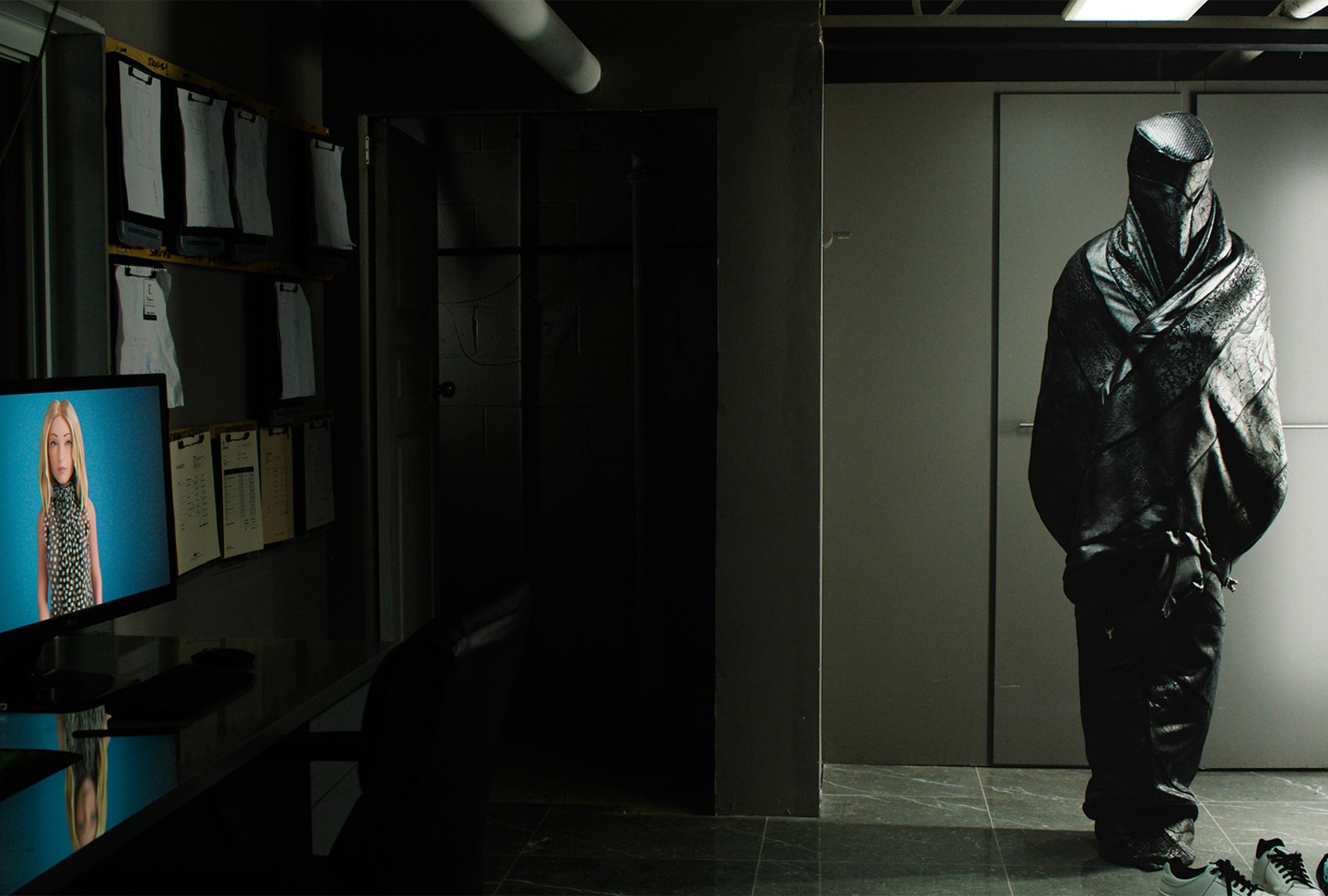
Early on, Cronenberg begins to juggle some fascinating ideas about our varied responses to grief, and in turn, the different forms grief can take. For Karsh, the loss of Becca was so totally consuming that it threatened to eat him alive, driving him to a kind of high-functioning, tech-forward lunacy. (It doesn’t seem like a coincidence that Cronenberg depicts him as a Tesla-driving conspiracist as the film goes on.) His approach to handling that grief might be strange, but is it so unrealistic that someone would go to such lengths to see their loved one again, even if in the most digitally distorted way possible? 

In “The Shrouds,” we’re witness to a more realistic depiction of grieving than most filmmakers allow us. The pain isn’t buried beneath gore or jump scares, it’s all out in the open. Like any visible wound, it’s hard to look at, but there’s no use in trying to turn away or cover your eyes. The agony will be there when you look back.

For Karsh, GraveTech is an art; it makes his love mean something. And for Cronenberg, “The Shrouds” is not dissimilar. It’s a film that tries to find meaning in despair, a significance that goes beyond the adage that the sadness that lingers after something is gone is a sign that you loved that thing while it was here. Death can’t just be the end, not for Cronenberg or Karsh. When you really think about it, isn’t the sheer refusal to accept something as mortal as death, that we see coming for our entire lives, just the slightest bit absurd?

Cronenberg understands that. He’s making a movie about the subject, after all. And he transmits the inanity to his characters, who speak, move and act as if they are all part of a stage play that would get laughed off Broadway before previews have even ended. As Karsh, Cassel is ludicrous, speaking English in his heavy French accent in a movie set in the middle of Toronto. If it weren’t for the voice, one would clock him as a dead ringer (pun intended) for Cronenberg himself, one who slots perfectly into the director’s signature left-of-center atmosphere. And then there’s Becca’s twin sister, Terry, also played by Kruger, a shaggy-haired dog groomer with an insatiable lust for conspiracy. The two of them feed off each other’s mounting discontent with life in the wake of Becca’s death. Eventually, Terry and Karsh begin to wonder if having sex will bring them closer to Becca in some twisted way.

"The Shrouds" (Courtesy of Janus Films)Then — gasp — GraveTech is vandalized, and Karsh’s proximity to his beloved wife via 24/7 livestream is taken from him. He begins having dreams about Becca, returning nude to their bedroom every night, each time with new scars or limbs missing. Quickly, Karsh’s love turns to possessiveness, and everyone around him becomes a suspect. That includes Terry’s ex, Maury (Guy Pearce), and Karsh’s AI avatar called Hunny (Kruger in a voice-only role), who kicks “The Shrouds” up to a new level of off-putting, sardonic comedy. Hunny pops in and out of the film, her crudely animated, blonde image the lovechild of Siri and Samantha Jones. When she appears to Karsh to deliver some bad news as a koala bear, he politely asks her to stop playing around. She obliges his request and turns back to a human avatar before adding, “I’m feeling a bit chilly without my fur coat!”

Cronenberg’s film pushes the boundaries of its ridiculousness to an almost uncomfortable place. Aren’t we supposed to be watching a movie about grief here? Yes, we are, and that’s precisely what conjures this discomfort. In “The Shrouds,” we’re witness to a more realistic depiction of grieving than most filmmakers allow us. The pain isn’t buried beneath gore or jump scares, it’s all out in the open. Like any visible wound, it’s hard to look at, but there’s no use in trying to turn away or cover your eyes. The agony will be there when you look back. And it will eat you alive if you’re not willing to give it at least one honest look. Karsh’s life is thrown out of whack by the sheer horror of losing the love of his life, leaving him alone in this world, vulnerable and in need. He is emotionally weakened to the point of subservience — to tech, to conspiracy, and humor; anything that will restore some meaning. He’s a man riddled with contradicting views and tones, as is “The Shrouds.” There is no containing death, no trapping the memory of someone in an app on your phone. Death will always be a force more powerful than us. It’s funny that we could ever be so arrogant to think otherwise.

"The Shrouds" is in theaters in New York and Los Angeles and expands nationwide April 25.

Supreme Court pauses deportations of Venezuelan migrants

The Trump administration can't move forward with plans to deport more Venezuelan migrants it has accused of being gang members, the Supreme Court said early Saturday. 

The administration had scheduled to fly more than 50 migrants from an immigration detention center in Texas to El Salvador, using the rarely invoked Alien Enemies Act, The New York Times reported. Justices temporarily blocked the plans as the case plays out in a federal appeals court in Louisiana, CNN reported.

“The government is directed not to remove any member of the putative class of detainees from the United States until further order of this court," CNN quoted the court as saying. No reason was given, and Justices Clarence Thomas and Samuel Alito Jr. dissented.

The order came after attorneys with the American Civil Liberties Union filed an emergency appeal on Friday, saying the migrants were not provided enough notice to challenge their deportation. 

"These men were close to spending their lives in a horrific foreign prison without ever having had any due process," The Times quoted A.C.L.U. attorney Lee Gelernt as saying. "The case has a long way to go. But for now, we are relieved that the court has not allowed the Trump administration to hurry them away in secret."

This is the second time the Supreme Court has considered Trump's use of the Alien Enemies Act, CNN reported. 

Last week the justices allowed Trump to use it but said migrants need to be notified of the act and given a chance for a federal court to review their cases. Only courts in the places where the migrants were being detained could review the cases, justices said. 


Couch potatoes no more: Stoners are using cannabis to help them exercise and reach a “runner’s high”

When Mark started jogging again at the height of the Covid-19 pandemic, he could barely run a mile. Soon, he signed up for his first-ever marathon, but getting there required the patience to clock in hours upon hours of training. Music helped break up the monotony some, but what really made time fly by was a hit of his vape pen or, sometimes, a cannabis edible.

A year and a half later, Mark, a father of two in his early 40s, ran his first-ever marathon — consuming a couple of gummies along the way.

“That was the longest race I’d done since the 400-meter dash when I was 18 years old,” Mark, who is using his first name only for privacy reasons, told Salon in a phone interview. “I definitely could have run the marathon without the marijuana, but I don’t know how easily I could have completed the training without it.”

Many people associate cannabis with couch time and Netflix, but the “lazy stoner” stereotype has actually been debunked. In fact, runners and gymgoers are increasingly getting high before their workout to enhance the effects. 

“Name an activity and someone's getting high and doing it,” said Dr. Whitney Ogle, a physiotherapist at Cal Poly Humboldt University. “From archery to water skiing, someone's getting high and doing that activity.”

Although studies show that cannabis use may reduce exercise performance, they also show that cannabis can help people enter the flow state and make exercise more fun, ultimately promoting physical activity. For Mark, it was a great way to avoid getting bored on long-distance runs.

“I just found it very enjoyable to zone out and have the right kind of music on and just sort of keep going,” Mark said.

Understanding the impact of cannabis on exercise is important for recreational athletes but also for professionals. The World Anti-Doping Agency (WADA) prohibits the use of cannabinoids, saying they “pose a health risk to athletes” and “violate the spirit of sport.” However, many have argued that it’s time to remove cannabis from this ban because it is based on false assumptions about the effect of cannabis on exercise and disproportionately targets athletes of color — similar to the criminalization of cannabis overall.

In general, research shows that cannabis does not help performance. Yet other studies have shown that cannabis users engage in more exercise and have a lower body mass index than nonusers. Whether cannabis use is influencing these outcomes or people with these health metrics tend to use cannabis more for one reason or the other is unclear. But it does suggest that cannabis does seem to have some relationship to physical activity. 

To look into this relationship, Dr. Angela Bryan, a psychology and neuroscience professor at the University of Colorado Boulder, conducted a study last year that compared various aspects of participants' runs when they were sober and when they had used cannabis before. These runners had all previously exercised while on cannabis.

What she found was that runners ran the same distance about 31 seconds per mile slower when they used cannabis compared to when they didn’t. In a 2023 study also conducted by Bryan, runners reported feeling like they exerted more energy when they ran while under the influence compared to when they were sober. However, they also reported that they enjoyed the experience more.

In the former study, runners also reported less pain and that they experienced the “runner’s high” phenomenon — in which people enter a state of euphoria after performing demanding exercise — more easily when they used cannabis.

“I think that when you are under the influence, you feel like you want to dial down the intensity and that might be part of why you’re enjoying it more,” Bryan told Salon in a phone interview. “But if you try to go the same pace that you’re used to, it will probably feel like a higher intensity.”

The runner’s high — which can occur with any form of exercise — was originally thought to be caused by the release of feel-good hormones called endorphins after a high intensity workout. However, more recent research has shown that the phenomenon actually involves the same endocannabinoid system that is targeted with cannabis products like tetrahydrocannabinol (THC). 

This system works to maintain homeostasis by balancing the body’s temperature, pain and immune response. The body naturally produces endocannabinoids that bind to the cannabinoid receptors in the brain and other parts of the body. THC targets the same receptors but typically at a far higher dose than what is naturally produced, said Dr. Hilary Marusak, an assistant professor of psychiatry and behavioral neurosciences at Wayne State University.

“When you get binding at that receptor, you get a lot of those euphoric properties,” Marusak told Salon in a phone interview. “It can also lower stress and anxiety.”

It’s unclear what part of exercise is activating the endocannabinoid system when a runner’s high happens. In small studies, endocannabinoid levels have been shown to be particularly elevated in hikers at higher altitudes and among choir singers, indicating that it could be caused by restricting the body’s oxygen to some degree, Marusak said.

“I think [it could be] this hypoxic state where you are taking in lower oxygen… or maybe doing some breathing that itself might actually modulate the endocannabinoid system,” Marusak said. 

Because of the endocannabinoid system’s role in mood, researchers are looking into whether they can create drugs that target it to treat psychiatric illness. The runner’s high, which targets this system, tends to boost one’s mood and well-being naturally. Some have theorized that this may be an evolutionary trait built in to provide humans with a reward for being able to outrun predators and stay fit. Cannabis use might be piggybacking on that natural system to produce a similar effect.

Still, too much activation of the endocannabinoid system could lead to health problems as well. Some research suggests that people who chronically use THC have less active endocannabinoid systems, suggesting that overstimulation could reduce the body’s ability to naturally produce or bind endocannabinoids.

Scientists also once thought obesity was in part caused by excess cannabinoids and designed a drug called rimonabant to block this system. However, this also ran into problems, and rimonabant was ultimately withdrawn from the market because people taking it experienced depression and suicidal thoughts.

The endocannabinoid system was discovered in the 1980s, roughly a century after many other parts of the brain had been identified. As such, there is a lot left to be discovered about the role it plays in the body. That includes a lot of unknowns about how cannabinoids are influencing the body and exercise.

Cannabis can have a wide range of effects on individuals, and this is influenced by the setting in which it is taken and the balance of cannabinoids — like THC vs CBD — in it. In one 2022 survey of cannabis users Ogle conducted, about a quarter of people reported experiencing something undesirable while using cannabis to exercise. The most common outcome was that they got “too high to be effective at exercise.” Some also reported their heartracing and feeling lightheaded. 

“While our participants felt they personally benefited from pairing cannabis and exercise, it may not be beneficial to all,” the study stated.

Still, many cannabis users are finding the benefits of using it for exercise outweigh any potential reductions in performance. Most people who use cannabis to exercise aren’t doing it for performance, anyways. In the 2022 survey, people reported hiking, doing yoga and aerobic exercises most commonly to help them focus and enjoy the experience.

Exercise in general has been shown to improve depression and reduce the risk of diabetes, cardiovascular disease and cancer. The important thing is that people exercise, so whatever gets them moving — be it a runner’s high, a cannabis high or something else specific to them — may be ultimately beneficial.

“If it's something that can get more people to exercise and to enjoy it, then that's definitely worth it,” Marusak said.

A conservative judge makes the case: Time is running out on American democracy

Not since the American Revolution, when Paul Revere rode through the streets of Boston and Thomas Paine published his famous Common Sense, have Americans received a more urgent wake-up call to the looming danger to their liberty than they did this week. This time, the alert came from no revolutionary, but a Ronald Reagan-appointed federal judge.

J. Harvie Wilkinson, a well-respected and deeply conservative judge on the United States Court of Appeals for the Fourth Circuit, wrote about the plight of Kilmar Garcia, who was mistakenly deported by the Trump administration last month. Despite court orders, the administration refuses to lift a finger to right that grievous wrong. 

Wilkinson said Garcia’s deportation threatens to “reduce the rule of law to lawlessness and tarnish the very values for which Americans of diverse views and persuasions have always stood.”

Pointing out its defiance of an order from the Supreme Court, Wilkinson reminded his readers that “the rule of law…(is) vital to the American ethos.” And he noted that Garcia’s case presents a “unique chance to vindicate that value and to summon the best that is within us while there is still time.” 

Time, Wilkinson warned, is running out on American democracy. His words call on his colleagues on the Supreme Court, Republican members of Congress, business leaders, law firms, universities, and citizens to demand Garcia’s return and stand up to the almost daily abuses of power by the Trump administration.

For decades, the eighty-year-old Wilkinson has been a darling of the conservative legal movement.  Appointed to the bench by President Ronald Reagan in 1983, he has a long track record as an opponent of abortion and judicial legalization of gay marriage. He was rumored to be on the shortlist to replace the late Chief Justice of the United States, William Rehnquist. Most importantly, he regularly has defended presidential power. 

In a 2003 case that has some eerie parallels to Garcia’s, Wilkinson wrote an opinion that the New York Times called “a major legal victory” for the administration of President George W. Bush. He ruled that “a wartime president can indefinitely detain a United States citizen captured as an enemy combatant on the battlefield and deny that person access to a lawyer.” The judge said, “It was improper for the federal courts to probe too deeply into the detention of Yasser Esam Hamdi, a 22-year-old American-born Saudi who was captured on the battlefield in Afghanistan and is now imprisoned in a military brig in Norfolk, Va.”

That brings us back to the Garcia case. 

Garcia entered this country illegally in 2011 and was granted temporary protective status in 2019, during Trump’s first term. On March 12 of this year, he was “pulled over while driving, his 5-year-old in the back seat. He was told his immigration status had changed.” Thirteen days later, without a trial of any kind, Garcia was flown to El Salvador and imprisoned as a terrorist member of the MS-13 street gang.

As New York Times columnist Ezra Klein explains, “There has been no evidence, anywhere, offered by anyone, that suggests Abrego Garcia poses a threat to anyone in this country.”

We need your help to stay independent

Lawyers for Garcia sued, seeking an order to return him to the United States. They alleged that the government had violated his right to due process of law and provisions of the Immigration and Nationality Act, the Administrative Procedure Act, and federal habeas corpus law. Federal District Judge Paula Xinis granted their request. She  directed the federal government “to facilitate and effectuate the return of Plaintiff Kilmar Armando Abrego Garcia to the United States by no later than 11:59 PM on Monday, April 7, 2025.” Since then, the Fourth Circuit and the Supreme Court have upheld Xinis’ order. 

A unanimous Supreme Court said that Xinis’s order “properly requires the Government to ‘facilitate’ Abrego Garcia’s release from custody in El Salvador and to ensure that his case is handled as it would have been had he not been improperly sent to El Salvador.” Leaving no doubt about its intention, the Court sent the case back to Xinis with the directive that “the District Court should continue to ensure that the Government lives up to its obligations to follow the law.”

When Xinis acted to implement that directive, the administration again appealed to the Fourth Circuit seeking an emergency stay to prevent her from doing so.

Enter Judge Wilkinson.

His opinion, turning down their request, is a masterpiece of legal writing, clear, free of unnecessary  jargon, and to the point. It is written both for the present moment and the future judgments of history.  

Wilkinson began by praising “the efforts of a fine district judge attempting to implement the Supreme Court’s recent decision.” In so doing, he pushed back against any Trump Administration effort to malign her.

Moreover, resisting the administration’s efforts to throw sand in the machinery of justice,  Wilkinson characterized Garcia’s case as easy and the court’s duty as “clear.” He explained, “It is difficult in some cases to get to the very heart of the matter. But in this case, it is not hard at all.” 

That is because “The government is asserting a right to stash away residents of this country in foreign prisons without the semblance of due process that is the foundation of our constitutional order. Further, it claims in essence that because it has rid itself of custody that there is nothing that can be done.” 

“This,” he continued, “should be shocking not only to judges, but to the intuitive sense of liberty that Americans far removed from courthouses still hold dear.” 


Want a daily wrap-up of all the news and commentary Salon has to offer? Subscribe to our morning newsletter, Crash Course.


Wilkinson insisted that the government defied the nation’s highest court by “do(ing) essentially nothing.” 

Quoting from the Supreme Court’s decision that the government has a duty to facilitate Garcia’s return, Wilkinson offered a simple grammar lesson. “Facilitate’ is an active verb. It requires that steps be taken as the Supreme Court has made perfectly clear."

He linked our fate to Garcia’s by reminding his readers that if the government gets away with denying him due process and making him disappear from this country, it may soon do the same thing to any one of us. In the end, as if leading us back to Paul Revere and Thomas Paine, Wilkinson said Garcia’s deportation threatens to “reduce the rule of law to lawlessness and tarnish the very values for which Americans of diverse views and persuasions have always stood.”

What Paine said in his time is also true today. “The present state of America,” he wrote, “is truly alarming to every man who is capable of reflection.” 

But in a time of peril, Paine continued, “instead of gazing at each other with suspicious or doubtful curiosity, let each of us hold out to his neighbor the hearty hand of friendship, and unite in drawing a line, which… shall bury in forgetfulness every former dissention.” 

Using words that have special meaning today, Paine asked his contemporaries to remember that in America, only “the law is king” and to be “virtuous supporter(s) of the RIGHTS of MANKIND.”