Spring Offer: Get 1 Year, Save 58%

Who’s afraid of David Pecker? Trump’s first criminal trial could hinge on testimony of former friend

Opening arguments in Donald Trump's criminal trial are scheduled to begin today and Trump isn't taking it well. He was posting late into the night on Sunday railing against well, everything. He's clearly feeling the stress of what he's about to face. And he's right to be nervous. The New York Times reports that the prosecution's first witness is going to be David Pecker, the former publisher of the National Enquirer and owner of its parent company AMI.

Pecker is a former close confidante of Trump's. The two men, who've known each other since the 1980s, have not spoken since Pecker was given immunity by federal prosecutors in the Michael Cohen case back in 2018 and testified that Trump was involved up to his neck. And yet, while Trump has crudely insulted everyone involved in that case, and his current one, he's never said a word against Pecker. That's curious, don't you think? 

Up until the moment the FBI searched Michael Cohen's home and office looking for evidence of this payoff scheme to silence various people during the 2016 campaign, there had been no greater cheerleader for Donald Trump than David Pecker. The National Enquirer had run hit piece after hit piece on Trump's political rivals, first in the Republican primary when they accused Sen. Ted Cruz, R-Tx., of having an affair and Dr. Ben Carson of medical malpractice, then the paper basically devoted every other front page during the general election to slamming Hillary Clinton as a raging succubus from hell. Once Trump got into the White House, Pecker used his paper to extol Trump's leadership as a combination of Mahatma Gandhi and Alexander the Great. But after one last cover calling Michael Cohen a traitor and a liar, the Trump stories stopped cold and the paper returned to its celebrity gossip roots. 

Nobody knows for sure what precipitated the change but the timeline certainly suggests that Pecker fairly quickly decided that he didn't want to go to jail for Donald Trump when the FBI came calling. He stuck an immunity deal with the federal prosecutors and told them what he knew. And what he knew was that back in 2015 when Trump had decided to run for president, he called Pecker up to his office in Trump Tower and asked him what he could do to help his campaign. Pecker told him that he could keep an eye out for negative stories and they could coordinate together to shut them down. Cohen would be the liaison. 

Pecker used the "catch and kill" method (pay for the story and then never run it) with former Playboy playmate Karen McDougal who said she'd had a months-long affair with Trump and paid off a doorman who claimed he had evidence that Trump had fathered a child with an employee. But according to the Wall St. Journal, when adult film star Stormy Daniels turned up (for a second time) Pecker refused to have the Enquirer pay her off because he had consulted with an election lawyer who informed him that it could be considered an illegal in-kind contribution. So Cohen made the deal with Daniels and ended up having to front the money himself with the understanding that Trump would reimburse him. 

Will Pecker testify that Trump knew that what they were doing was illegal?

Predictably, Trump took his sweet time in paying back Cohen who even had Pecker ask for it on his behalf. Trump told Pecker that Cohen had plenty of money. In the end, he reimbursed him, plus a bonus, but he lied about it repeatedly until shortly after the FBI raid on Cohen's office. Trump's involvement in the payments was first revealed by his newly hired attorney, Rudy Giuliani, on Fox News one night when he blurted out that Cohen had "funneled it through the law firm, and the president repaid him.” The next day Trump tweeted a long explanation that he'd paid off an extortionist and "money from the campaign played no roll [sic] in it." The move, which was the first of many harebrained strategies cooked up by Giuliani and Trump without input from people who know better, came as a complete surprise to his staff. “People in the White House are a little concerned about what looks like the roller coaster ride ahead," the Wall Street Journal reported: 

Election-law experts said Mr. Giuliani’s revelation places the president at the center of questions about possible campaign-finance violations. Mr. Trump’s reimbursement of his lawyer for the payment could violate election law, since Mr. Cohen likely would have been required to report the funds he spent upfront as an in-kind donation, if investigators determine the payment was made to help Mr. Trump win the election. Mr. Giuliani on Wednesday suggested it was.

Michael Cohen pleaded guilty to those campaign finance violations, saying in court that he did so at Trump’s direction. Pecker was given immunity and he corroborated Cohen's account that Trump was in on the scheme. Trump, identified as "Individual 1" in prosecution documents, was let off the hook even though it was clear that he was guilty of the same crimes for which Cohen was going to prison and Pecker was given immunity. 

We need your help to stay independent

Even Fox News analyst Judge Andrew Napolitano thought this was a clear cut case of criminal liability

According to then-US Attorney in charge of the case, Geoffrey Berman, who was later forced to resign, that happened because of interference from Attorney General Bill Barr who instructed them to "cease all investigations" into the matter. Berman wondered if Barr was trying to shield Trump from possible legal liabilities after he was out of office. It's certainly not a stretch to think so. 

In 2021, the FEC fined AMI $187,500 for unlawfully aiding Donald Trump’s presidential campaign in 2016 by making a $150,000 illegal campaign contribution in the Karen McDougal matter. Pecker, who no longer owns the company, was personally protected by his immunity agreement. Again, Trump was let off the hook despite the investigators' finding that he was liable as well.

There is no doubt that the scheme was illegal. It's just a matter of the Manhattan prosecutors proving that Trump's actions to hide the payments show that he was doing it to commit another crime. If the other crime is violating campaign finance laws, Pecker will be able to shed light on that issue. 

After all, Pecker had already made the mistake of paying off McDougal on Trump's behalf but refused to pay Stormy Daniels because he'd been informed by an attorney that he was crossing legal lines. What are the odds that he didn't call up his good pal Trump and say, "hey, Don, my lawyer tells me this plan we've got going might be illegal?" Maybe he was too scared to say anything but he sure wasn't scared to tell Cohen that he wouldn't play ball so I think that's unlikely. 

We know Pecker is going to testify that Trump asked him to help with the campaign and that he was in on the scheme to "catch and kill" any negative stories. Michael Cohen got Trump on tape talking about payments. Will Pecker testify that Trump knew that what they were doing was illegal? Will they be able to show that his fraudulent bookkeeping was in service of covering up his crime? Stay tuned. We're finally going to find out. 

“Devastating”: Legal experts say first Trump trial witness sitting on “dynamite evidence”

David Pecker, the former chairman of the National Enquirer’s parent company, is expected to be the first witness called at former President Donald Trump’s criminal hush-money trial, according to The New York Times and CNN.

Pecker played a key role in several “catch-and-kill” schemes to bury embarrassing stories about Trump and was a central player in the alleged scheme to cover up hush-money payments to adult film star Stormy Daniels ahead of the 2016 campaign.

Pecker contacted former Trump attorney Michael Cohen after being approached by an agent for Daniels in October 2016 about their alleged affair, which Trump has denied. Cohen then negotiated a deal to “purchase” her silence for $130,000, according to court filings.

Cohen is expected to be a key witness in the case but Trump’s team has attacked his credibility after he pleaded guilty in 2017 to making false statements while working for the former president. Pecker’s testimony could be critical to supporting some of Cohen’s testimony.

“Pecker can testify that Trump not only understood but heartily endorsed his publication’s offer to ‘catch and kill’ negative stories about him, especially as they pertained to Trump’s alleged extramarital affairs,” tweeted MSNBC legal analyst Lisa Rubin. “And given how few people outside Michael Cohen directly communicated with Trump about the scheme at issue, Pecker’s testimony could be critical in establishing Trump’s intent and knowledge.”

New York University Law Prof. Ryan Goodman predicted that Pecker “could be a key witness – in ways more devastating than Michael Cohen.”

Pecker’s testimony “should be strong proof of core allegation that the hush money scheme was geared toward influencing the outcome of the presidential election,” Goodman wrote, noting that Pecker met with Trump and Cohen at Trump Tower to set up the catch-and-kill election operation that “set the whole scheme in motion.”

We need your help to stay independent

Pecker will also likely testify in his involvement in a flurry of phone calls to buy and bury Daniels’ story a day after the “Access Hollywood” tape came out and subsequent conversations on the scheme to reimburse Cohen for the payments made to Daniels, Goodman wrote. He added that Pecker’s “likely dynamite evidence of nexus between hush money scheme and effort to influence election” included a visit to the White House in 2017 where Trump thanked the CEO for his “help during the campaign.”

Pecker is expected to testify after prosecutors present their opening arguments, which are set to begin on Monday morning.

“Smart move to start with him,” tweeted NYU Law Prof. Andrew Weissmann, a former federal prosecutor.

“The alternate reality Trump lives in is crumbling” with first criminal trial: ex-federal prosecutor

With a jury now impaneled, Donald Trump’s hush-money trial can finally begin in earnest. The outcome of the trial will impact not just Trump’s freedom but the outcome of the 2024 election and the future of the country’s democracy.

Per New York state law, no cameras are allowed inside the courtroom. The courtroom sketch artists have depicted defendant Trump as bored, sullen, hostile, occasionally happy, and with a look of contempt and disgust on his face. When sleeping in court, Trump looks very tired and drained of energy, his mouth open and his head fighting against gravity. Trump is reportedly quite upset at how he is being drawn, Rolling Stone reports. “Trump has also privately asked people close to him if they agree that the courtroom sketch-artist must be out to get him," sources told the outlet.

 Trump’s attorneys, meanwhile, are still trying to stop their client’s first criminal trial by filing appeals for a change of venue because of supposed “bias” against their client, a claim the court has rejected.

Trump, for his part, has repeatedly violated his gag orders by threatening the judges, prosecutors, district attorneys, witnesses, jury members, and other people who are trying to enforce the rule of law. Judge Juan Merchan has mostly been successful in trying to discipline the impudent former president, at one point commanding him to sit down in court like he was a disobedient dog.

In an attempt to better understand Donald Trump’s first criminal trial such as the ex-president's state of mind and what the larger strategy may be behind his acting out in court (Trump is likely attempting to get thrown in prison as a way of rallying his followers as a fake martyr), I recently spoke with Kenneth McCallion. He is a former Justice Department prosecutor who also worked for the New York attorney general's office as a prosecutor on Trump-related racketeering cases.

This conversation has been lightly edited for clarity and length.

Trump’s first criminal trial has finally begun. Where are we with the so-called “walls closing in” on Donald Trump?   

The alternate reality Trump lives in is crumbling. You can see it in his facial expressions and behavior. Donald Trump has been forced to partially subdue himself, which is not his natural instinct. He is not wired in such a way as to be able to remain quiet as a litany of accusations and evidence against him are presented. For example, the Sandoval hearing, which reviewed the numerous areas where the prosecution will seek to cross-examine Trump if he takes the stand, was very damning. It laid out not only the criminal and ethics charges against him in this case, but also the charges against him over the span of the last decade or two.

How does someone like a mobster or politician or businessman like Donald Trump – who is also of course a former president – react to hearing the charges read against them in court? 

Different people process a trial differently. I was an organized crime prosecutor for many years. Once they've been through the criminal process, and perhaps have done some prison time, you somewhat get inured to it. If you are a gangster, you are actually proud of having done some prison time. You are proud to be an outlaw; prison time gives you credibility.

Donald Trump is in a different psychological space, and a much more tenuous one. Trump is presenting himself to his followers as a victim, someone being persecuted. He obviously wants the world to remember and think of him as strong and resolute, and basically a good guy despite his personal peccadilloes. So, that self-image and definition of himself, which has been the basis for his popularity among many millions of Americans, is now being challenged. Moreover, Trump is in a setting that he cannot control. The judge and the legal process now have control over him. That is extremely frustrating for Trump. He's been stripped of his power. His diehard MAGA followers are still with him. But the optics of Trump in court are not playing well outside that die-hard group. To those people who are not in the MAGA movement, Trump looks like a mighty man who has fallen hard and will continue in a downward spiral.

What role does Trump’s psyche and concern about his legacy play here? 

"I think that Donald Trump is probably trying to get himself thrown into prison or in a soundproof plexiglass box in the courtroom. This would enhance the narrative of martyrdom he is promoting, which resonates with his base."

Trump lives in the present. But he is also very concerned about his legacy as an ex-president and more generally as a self-proclaimed successful developer. Throughout his life, he's been very vulnerable to ridicule. Donald Trump does not have a particularly thick skin. When he's been subjected to ridicule and laughed at, that is extremely emotionally and psychologically painful to him. Trump's ego is at risk now. This trial is over hush money and the cover-up regarding money he paid to reimburse his lawyer, Michael Cohen, for hush money payments to Stormy Daniels. The whole scheme is so amateurish. It was not particularly well thought out. It was executed poorly and there is a long paper trail. Not only do I believe that Trump will be convicted in this first trial, but he will also be extremely embarrassed. What Trump is accused of here is so obvious. It is the kind of white-collar crime that the Manhattan District Attorney's Office has sent many businesspeople to jail for.

This first trial is truly historic. It is the first time a former or sitting president has been charged with criminal offenses – in this case, felonies. How does that impact how the prosecution, the defense, and the judge and the court more generally are approaching the hush-money trial?

For the prosecutor, this is not uncharted territory. Yes, Trump is a former president. But, under the law, he is just an ordinary citizen at this point in time. Once the public fully realizes that the emperor has no clothes and that Trump is just a bombastic charlatan, then everything can turn against him very quickly. I don't know what the Republican Party is going to do if he implodes over the next few months, which is what I believe will likely happen. They don't have a plan B. The Republicans have put themselves in an untenable situation, politically and morally. They are in danger of becoming a permanent minority party for the next couple of decades, comprised of angry white folks seething in their own sense of victimhood.

Donald Trump is continuing to violate the gag order(s) placed on him by threatening and trying to intimidate the judges, prosecutors, district attorney, prospective jurors and other people involved in his trials. If he was a regular private citizen, he would likely be in prison by now. But could Trump’s behavior actually be part of a bigger strategy, where he actually wants to go to prison? Trump is very devious and was a student of master dirty trickster Roy Cohn. We can’t overlook that.

I think that Donald Trump is probably trying to get himself thrown into prison or in a soundproof plexiglass box in the courtroom. This would enhance the narrative of martyrdom he is promoting, which resonates with his base. Neither Trump nor most of his die-hard base want to confront the stark reality that the problems they face are largely of their own making, and the result of a series of terrible choices made along with way. In fact, he had an exchange during the civil trial in New York before Judge Engoron where he was basically daring the judge to put him in jail. The judge said, basically, “I know you want me to hold you in contempt and put you in jail, and at some point, I'm going to have to do that, but not now.” In the current hush money criminal trial, there is a gag order. Ultimately, if Trump keeps violating it, there will be severe consequences, financial if not otherwise. But it's difficult because you can't really try somebody on criminal charges in absentia from jail. The optics do not look particularly good for the country if we have a Nuremberg-type trial with a glass or plexiglass cage for Donald Trump. It would look too much like one of those political show trials for opposition leaders in the former Soviet Union that led to pre-ordained executions.

We need your help to stay independent

It's starting to dawn on Trump that this is all not going to end well for him. Trump may well just break out into a carefully calculated “unhinged” rant before the case goes to the jury. It reminds me of a basketball coach who gets himself thrown out of the game to inspire the players. If Trump was put in prison for contempt that would make his followers even more enthusiastic and loyal. It's a real tough call for a judge to make because you really need the defendant in the courtroom.

If Trump were put in prison because he continues to defy the gag orders and to be disruptive in court, what would that actually look like logistically?

Trump would be put in a gilded cage. He would be confined in Trump Tower or Mar-a-Lago because the Secret Service does have an obligation to protect him. Trump would not be put in the general population at Rikers Island. Alternatively, Trump could be put in some type of isolated confinement. The Manhattan Correctional Center (MCC), where Jeffrey Epstein ended his life, is only about 100 or so yards away from the courthouse in Manhattan where Trump’s trial is taking place. Trump could be confined there and participate in the trial through a video link.

Donald Trump is being very impudent and difficult in court. Sleeping. Glaring at jurors and witnesses. Muttering under his breath. He also had an exchange with Judge Merchan and had to be told to behave himself and sit down. Trump then stormed out of court. What are Trump’s attorneys likely telling him about his bad behavior?

Trump's lawyers must be saying that 'you are only hurting yourself by acting like a clown in court and childishly acting out.' He is making such a caricature of himself that it is looking more and more like a "Saturday Night Live" skit. But Trump is not going to change. His lawyers know that. These trials are a marathon, not a sprint. It really is amazing that Donald Trump can withstand such pressure without having a physical or emotional meltdown. Two weeks on trial is going to seem like an eternity to him.

Marjorie Taylor Greene’s “space lasers” show how the GOP gets away with escalating violence

Rep. Marjorie Taylor Greene sure knows how to get the attention she craves by saying something incredibly stupid.

"I’ve previously voted to fund space lasers for Israel’s defense," she tweeted Wednesday, demanding that the U.S. put this imaginary tech up for "defense for our border."

As every remaining liberal on Twitter and multiple journalistic outlets dutifully pointed out, there are no "space lasers." The tech that Israel is developing is ground-based. The recent Iranian attack on Israel was thwarted by a multinational alliance that mainly used old-fashioned fighter pilots to shoot down drones and missiles. But it's almost certain that Greene knows all this. "Space lasers" was a reference to one of her most famous idiotic comments, commonly called the "Jewish space lasers" conspiracy theory, involving false accusations that a wealthy Jewish family is secretly causing wildfires from space. 


Want more Amanda Marcotte on politics? Subscribe to her newsletter Standing Room Only.


Greene can be touchy when mocked about "Jewish space lasers." But she also knows that the best way to get her message out is to frame it in the dumbest terms possible. That ensures that the press covers it and liberals re-post it, while also engaging the MAGA audience that rushes forward to defend her from liberal "elites" making fun of her. (I call this the "stupid-victim cycle.") Most of the time, this is a win-win situation. Her followers get to feel victimized, news websites get some easy traffic, and liberals get more evidence to build the case that the GOP is beyond redemption. But in this case, what got overlooked was deeply troubling: Greene is encouraging the cold-blooded killing of asylum seekers, many of whom are children. 

It's this violent rhetoric that is causing a decline in media coverage.

In case that's not obvious, let me spell it out: Setting aside the factual errors, what Greene is saying is that tech used to shoot down drones and missiles should now be aimed at refugees who are entering the United States, to make use of their legal right to seek asylum. Now, the U.S. government will not do this, at least under President Joe Biden. It's both evil and violates all sorts of international law. But Greene's rhetoric is still dangerous. She's normalizing the idea of mass murdering unarmed civilians, and encouraging her supporters to enact the violence if the government won't. 

Perhaps one reason the grotesque violence of Greene's tweet went largely unmentioned is that we're just not shocked by this sort of thing anymore. Republicans have grown quite comfortable with advocating for terrorism and political violence, and the press has started to become dangerously indifferent to it. The number of examples from only the past week is frankly staggering.

We need your help to stay independent

Sen. Tom Cotton, R-Ark., appeared to encourage people to murder anti-war protesters. If protesters stop traffic, he tweeted, "take matters into your own hands to get them out of the way." This echoes not just many years of far-right rhetoric applauding vehicular homicide, but the 2017 murder of anti-racism protester Heather Heyer at the hands of a white supremacist. Cotton tried to clean up his statement by later claiming he just meant dragging protesters out of the way, which is still assault.

Conservative Supreme Court justices repeatedly made excuses for or downplayed the actions of the insurrectionists who stormed the Capitol, attacking police officers and threatening to kill Vice President Mike Pence and members of Congress for certifying President Joe Biden's 2020 electoral win. During arguments over a January 6-related case last week, Samuel Alito compared the Capitol riot to heckling a judge and Neil Gorsuch compared it to a peaceful sit-in. 

House Speaker Mike Johnson, R-La., oddly declared, "I regard myself as a wartime speaker." This is strange because Biden pulled the U.S. out of Afghanistan, making this the first time the U.S. has not been at war since 2001. As Steve Benen of MSNBC pointed out, Johnson — a far-right Christian nationalist who apparently believes dinosaurs rode Noah's ark — appears to be thinking in terms of a civil war. He not only brought up the actual Civil War but argued this is an "existential moment" and "Republicans want to save the country." This is the same rhetoric used to justify January 6. 

Jesse Watters used his Fox News show to blast enough information about a juror in Donald Trump's criminal trial that MAGA terrorists could identify her. He also falsely accused jurors of being plants, which Trump amplified by posting the video on Truth Social. The threat was heard loud and clear by the juror, who complained to the judge. He dismissed her to protect her from Trump loyalists. 

Finally, failed gubernatorial candidate and current Republican candidate for the Arizona Senate seat Kari Lake recently told a crowd, "We are going to put on the armor of God. And maybe strap on a Glock on the side of us just in case." She framed this violent threat, as fascists often do, as self-defense, claiming, "They’re going to come after us with everything." As counterterrorism expert Elizabeth Neumann explained on Greg Sargent's podcast, she's functionally telling MAGA crowds that it's okay to lash out violently if they lose electorally. 

This is hardly the first time Lake has made joking-but-not-really threats of violence. Last June, she told a crowd she had a "message tonight for Merrick Garland, and Jack Smith, and Joe Biden" and went on to warn: "Most of us are card-carrying members of the NRA. That's not a threat, that's a public service announcement."

But of course, it is a threat. It's not even a subtle one. Whether it's the due process of the justice system or the ballot-counting process of elections, Lake is consistent: If MAGA gets an outcome they don't like, they should try to force their will through violence. As these above examples show, she's not an outlier in the Republican Party. It's become routine in the GOP to speak positively of violence against innocent and unarmed people, for the "crime" of simply not bending to their will. 

The most immediate threat is that this daily pattern of violent rhetoric will cause real problems for the Manhattan courtroom where Trump is being tried for over two dozen felony indictments regarding fraud and campaign finance violations. Safety concerns have already led the judge to deny the defense access to the list of witnesses the prosecution hopes to call to the stand next week. There's also been a rise in domestic terrorism incidents in the past few years, due mostly to post-January 6 MAGA types acting out. As the election draws nearer and the threat of Biden getting re-elected looms, there are very real fears that Trump supporters will lash out violently against election workers, Democratic Party officials, liberal activists and people Trump doesn't want voting. 

Perversely, it's this violent rhetoric that is causing a decline in media coverage. When Republicans excuse or promote violence on a daily basis, it stops being "news," making it harder for news organizations to cover it. But it's this very process that makes it likelier that people will act on the violence. As we saw in the aftermath of the insurrection, many of the people who stormed the Capitol didn't even think they'd face legal consequences, because the Republican normalization of political violence made them think their actions were just fine and dandy. If the memory of the January 6 prosecutions fades, there's a very real chance that more people start feeling emboldened to act on violent talk like Greene and Lake's again. 

The power of Trump’s jury: 12 Americans can finally ensure criminal accountability

Donald Trump perpetrated a presidential crime wave, and opening statements in his criminal trial in New York begin today. It is the best chance yet to ensure some accountability for the former president and protect the country from further crimes. While it may not be as high-profile as the federal charges brought by special prosecutor Jack Smith, this trial matters — a lot.

It may no longer be at the front of most Americans’ minds, but there is real evidence that Donald Trump engaged in conduct that adds up to literally dozens of crimes during his run for the presidency, his time as president and the years since. These include, among others, possible crimes connected to obstruction of the investigation into Russia’s involvement in the 2016 campaign, trying to pressure the president of Ukraine to investigate a political opponent, mishandling and refusing to return highly classified documents, and of course trying to keep himself in power after losing the 2020 election, culminating in a violent insurrection.

It wasn’t one ambiguous instance of potential illegality. It was a pattern of repeatedly running through our laws, usually for the purpose of increasing his own political power and personal advantage. 

They can put into practice that no one, not even a former president, is above the law in the United States.

In many ways, it started with his repeated lying–on business documents and government forms–about hush money payments in order to keep information from voters right before the 2016 election. From these lies springs the heart of the New York criminal case brought by Manhattan District Attorney Alvin Bragg (not to be confused with the civil fraud case brought by New York Attorney General Letitia James in which Trump has been ordered to pay around $450 million).

The real accountability that this trial will bring is crucial because it is the first chance, not to mention the one we have right now, to ensure consequences for Trump’s crime spree. Consequences for repeated serious criminal activity by someone in our greatest position of power are essential to maintaining the rule of law in this country and to protecting American democracy. Unlike some of the other cases, Trump can no longer delay this one.

We need your help to stay independent

The facts in this case matter. Trump had his attorney, Michael Cohen, pay an adult film actress to be silent about an alleged affair. He repaid Cohen, then lied on business records that those payments were part of a legal retainer agreement when they were not. All of it was part of an effort to keep relevant information from the public right before an extremely close election.

You can’t lie on official records to help yourself politically. Doing so is a crime in New York for which others have been prosecuted and sent to prison.

But even more important is Donald Trump’s pattern of escalating lawlessness. He was willing to commit all manner of criminal activities, culminating in inciting a violent insurrection (which is a component of the conspiracy with which Donald Trump has been charged federally), in order to increase and maintain his own power. 

There is simply nothing more dangerous to the viability of a democratic system of government and to the rule of law than someone who is willing to break the law and commit crimes to keep themselves in power. If allowed to go unchecked, such a person will ultimately tighten their grip on power to the point that the law can no longer hold them accountable and stop them from additional abuses. Indeed, Donald Trump has made it abundantly clear that he will actively seek to undermine or reverse the prosecutions of himself and his supporters and to settle scores with perceived political enemies.

Despite the danger, institution after institution has passed on the chance to hold Trump accountable, from the Senate voting to acquit him after his impeachment for inciting an insurrection, to House Republicans blowing up a bipartisan commission to investigate those events, to the Supreme Court declining to enforce Trump’s disqualification under the 14th Amendment to the Constitution. Many are content to pretend that Trump’s dangerous abuses simply did not happen and that he is a normal politician.

That can stop with this trial. A jury of regular Americans will have the power to determine whether Donald Trump committed significant crimes affecting an American election. They can put into practice that no one, not even a former president, is above the law in the United States. Of course they should only convict if they determine Trump’s guilt is proven beyond a reasonable doubt. I believe the facts and the law will prove exactly that, but it will be up to the jury.

If they do find Trump guilty, they will not only be ensuring accountability for one particular set of offenses. They will be ensuring that Trump’s epic and dangerous crime wave finally draws consequences–and they will be taking a key step toward making sure it stops now.

Is Earth Day greenwashed and obsolete? Some climate experts argue its core message has been diluted

"Thinking about the planet for a day is a bit bizarre," says Prof. Martin Siegert, a glaciology professor at the University of Exeter and former co-director of Imperial College London's Grantham Institute for Climate Change. His sentiments are shared by many other climate experts when it comes to Earth Day, a holiday that is observed every April 22nd.

One might expect scientists who study the environment to be widely enthusiastic about an international event inaugurated in 1970 that has served as a PSA regarding human impacts on the planet. Today, Earth Day is celebrated by 1 billion people in more than 193 countries, with the official 2024 theme this year being "Planet vs. Plastics."

"I can't really see how turning the lights off tall buildings for an hour does much at all."

Yet some climate experts have dismissed the holiday, including Siegert and others who characterized Earth Day as being as little more than performative virtue signaling.

Not surprisingly, when Salon spoke to Kathleen Rogers — who is president of the holiday's founding organization EARTHDAY.ORG (previously Earth Day Network) and was previously an environmental attorney and advocate — she had a very different perspective.

"To be clear, we don't embrace celebrations or parties ever," Rogers said. "That's just not what we do. If we do any events at all, they're fundraisers, but everything we do is geared towards repairing the damage done [to the planet]."

Rogers discussed traveling to classrooms in 105 countries, both on Earth Day and under the Earth Day banner during the rest of the year, and her tone burst with enthusiasm as she recalled teaching children about environmental awareness. Rogers described Earth Day as being about encouraging activism, "taking action and volunteerism and signing petitions and doing all the other things,  such as the ordinary things that I do in my community. I do cleanups all the time."

She also described participating in reforestation efforts and educating the public about lesser-known environmental hazards like plastic pollution.

"Our job will never be finished because our mission is to diversify, educate and activate the environmental movement worldwide," Rogers said. "That's an incredibly purposeful mission statement that's focused on movement building, and so we have a staff that spends year round doing two things: bringing people into the movement, and keeping them there."

In terms of "substantive programs," Rogers listed initiatives including climate education, halting plastic pollution and reforestation. In contrast, Siegert is more skeptical that Earth Day achieves anything substantive.

"I don't think it really accomplishes much," Siegert said. "But the day itself has rather changed its meaning since the first in 1970, which was to place the world in the context of space — and now it's very much (to many) on climate and environmental damage. Perhaps more time is needed, but I can't really see how turning the lights off tall buildings for an hour does much at all."

Dr. Kevin Trenberth, a distinguished scholar at the National Center for Atmospheric Research, told Salon "There have been times when Earth Day has made a difference, but not so much recently."

"The state of the world in politics continues to go sharply downhill," Trenberth said. "Nothing seems to be going the right way. How does one get attention to long-term issues like climate change, biodiversity and plastics in this framework?"


Want more health and science stories in your inbox? Subscribe to Salon's weekly newsletter Lab Notes.


"It reminds me how far we have to go and in some ways, how little progress we've made."

Dr. Michael E. Mann, a professor of earth and environmental science at the University of Pennsylvania, said that Earth Day can be either substantive or performative "depending on how one treats it. I do know that it focuses attention on issues like climate change, and I can speak to this personally. I’ve had more opportunities to do more climate-themed media interviews on Earth Day and during Earth Week than at other times. So I do think it helps get the word out."

Similarly, when Mann was asked if Earth Day encourages the practice of greenwashing — that is, businesses paying lip service to environmental causes while still behaving unsustainably — he said that "bad actors will always seek to hijack any occasion for their own agenda. That shouldn’t deter us in our efforts to communicate the risks, challenges and opportunities."

Other expressed feeling extra climate anxiety around Earth Day.

We need your help to stay independent

"It reminds me how far we have to go and in some ways, how little progress we've made," Dr. Peter Kalmus told Salon. Kalmus is a NASA climate scientist who has previously emphasized that he speaks for himself, not for NASA or the federal government. He agreed with Mann that Earth Day provides environmental activists with "a sort of nucleation site around which they can coalesce. At its best it can be an entry event for people wanting to get off the sidelines and involved in the climate movement."

Yet Kalmus also said that Earth Day's messaging is outdated, "basically still stuck at the 'recycle harder' level, when where we need to be is at the 'sue and disrupt the fossil fuel industry out of existence and put the executives, lobbyists and politicians who have intentionally spread misinformation in prison, because billions of human lives and life on Earth is at risk' level."

Kalmus said greenwashing, though not directly caused by Earth Day, is an unavoidable byproduct of this being a holiday that exists in a capitalist system.

"Capitalism has largely co-opted Earth Day for its own purpose, to make profit by selling products," said Kalmus. "This is just what capitalism does."

Tracing the process from the days of colonialism to our current climate breakdown, Kalmus said that the main obstacle to progress in addressing climate change is the "system for wealth concentration, and that wealth co-opts political systems, media and information systems, the UN climate talks, and also Earth Day. The scrappy grassroots activists are our only hope. Earth Day is useful precisely to the extent that it helps them."

With friends like Robert Durst’s “The Jinx – Part Two” was probably inevitable

One of the oddest aspects of 2015's “The Jinx: The Life and Deaths of Robert Durst” is how badly Robert Durst wants to be known and understood. By the time he reached out to writer/director Andrew Jarecki, Durst was already a prime suspect in his wife Kathleen Durst's 1982 disappearance and two other homicides. He was also the oldest son of an extremely wealthy and influential New York real estate tycoon who handed the keys to the kingdom to his younger brother.

Jarecki’s 2010 film “All Good Things,” written by his "Jinx" co-producer Marc Smerling, was based on Durst's 2003 trial for the murder of his neighbor Morris Black, whom he admitted to dismembering. Durst may have never faced a Galveston, Texas jury if he hadn’t been caught trying to steal a grocery store sandwich while he was on the lam. He ended up being acquitted anyway. Late-night comedians had a field day with that verdict and the circumstances leading up to it.

Similarly, had he never suggested that Jarecki interview him in the first place, we might have never reaped the true-crime superbloom "The Jinx" initiated. Nine years after those original episodes aired, recalling that Durst told Jarecki in the 2015 series premiere, “I’m not interested in doing a true crime kind of stuff” is just short of hilarious.

But flattery will get you everywhere with some people. "All Good Things" cast Ryan Gosling as a character based on Durst and Kirsten Dunst as Kathleen's fictional double. That convinced Durst that Jarecki understood him. Referring to the bevy of salivating producers he’s brushed off in the past, he tells the filmmaker, “You know more about Robert Durst than any of those people do.” And how. By the sixth episode Jarecki has Durst dead to rights to such a degree that Durst excuses himself to the bathroom and, forgetting his mic is still hot, murmurs, “There it is. You’re caught.”

A few beats later he murmurs the words that knocked the collective wind out of the audience: “What the hell did I do? Killed them all, of course.”

“The Jinx” faded to black after that. Then the media cycle took over. Jarecki, his co-producers Smerling and Zac Stuart-Pontier, and their team had handed over their findings to authorities, who found and arrested Durst hours before the finale premiered in connection with his longtime friend Susan Berman's unsolved murder in 2000.

The subsequent national headlines provided the story's finale in real time; the epilogue being that Durst was tried and eventually convicted of killing Berman in 2021. Durst's acquittal precluded his retrial for Black's murder, and New York authorities charged Durst with Kathleen's death in 2021, although he died in 2022 before he could be tried.

Teasing out the perverse humor of this saga can’t be helped, and in some instances, there is no other choice.

That means “The Jinx — Part Two” lacks the urgency, necessity and cultural impact of those 2015 episodes. Durst is gone; his name condemned.  

But he was quite a character, an elderly man who looked like a librarian, as someone describes him, and whose lizard-like way of blinking invited amateur readings of every errant tic. In this time of franchise extensions we should be amazed that HBO and Jarecki took this long to wring what they could out of the trial stage of the story.   

“Part Two” picks up in the aftermath of his 2015 capture and plays as equal parts self-referential victory lap and effort to wrap up unfinished business. This time Jarecki sagely minimizes his on-camera presence in the four episodes made available for review, ceding the hero edit to L.A. Deputy District Attorney and cold case specialist John Lewin.

Lewin is avuncular without seeming overbearing, which is key in a story about a creepy yet bizarrely clownish killer. He’s aggressive in recorded conversations with uncooperative witnesses, but otherwise a steady hero wrangling a circus. Some of the entertainment is courtesy of twin law clerks Michael and David Belcher, two players on his team. Lewin and the producers validate their competence too, but the boyish delight they take in being assigned to the case and listening to Durst’s phone call recordings is infectious.

That is mainly what these episodes offer: a diversion for TV completists. Maybe that's the totality of what people expect from this sequel. Not many true crime titles fulfill a cultural need these days or, as the first six episodes did, result in justice finally being meted out to wrongdoers, although Durst's was thoroughly delayed. But these fresh installments are less concerned with him than investigating the people who abetted his crimes and kept his secrets. 

The Jinx – Part TwoLA Deputy District Attorney John Lewin in "The Jinx – Part Two" (HBO)Few people nearly get away with one murder by themselves, let alone three, which informs Jarecki’s direction. Paraphrasing Lewin, when you have a whole lot of money, people are willing to do things for you, including assist your flight from prosecution, in the hope that some of it might go their way.
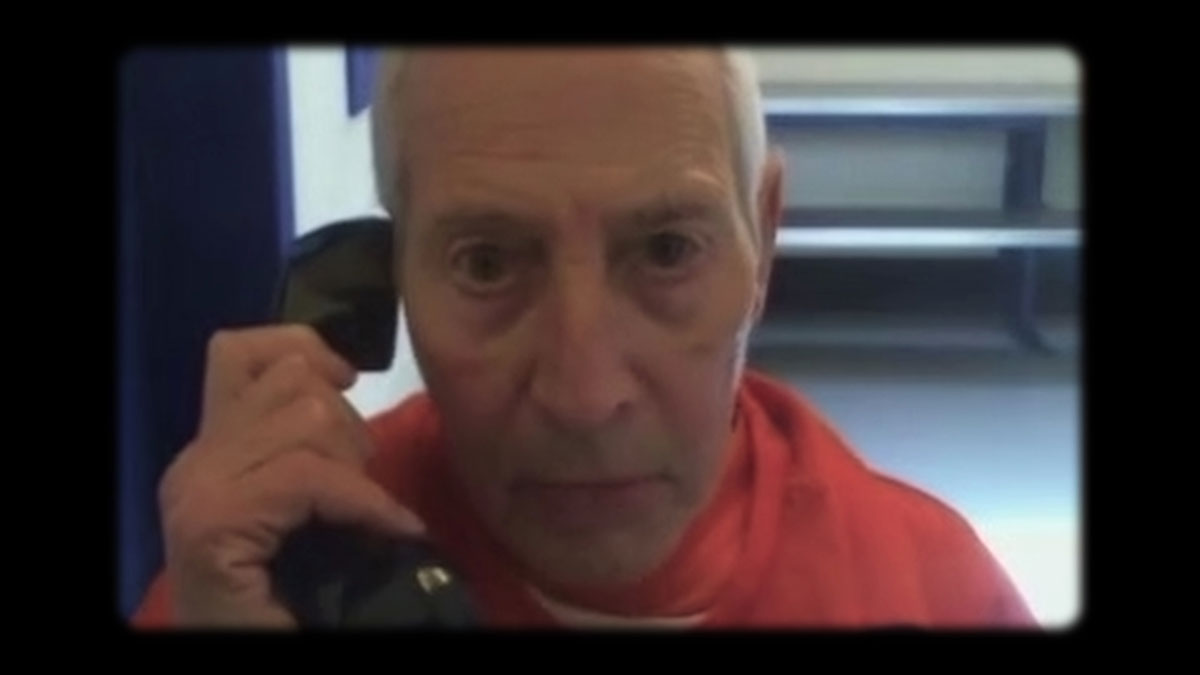
Some people did get a payday, like Durst's substantially younger longterm confidante Susan Giordano. She visits him in prison and giggles at his queasy flirtations. He instructs another friend to give her $150,000 to build a "love nest" where the two of them might canoodle after his release, which may have been news to his wife Debrah Charatan.

In 2015 "The Jinx" was something original, a crime docuseries striving to match the quality of HBO's highbrow scripted shows. Succeeding brought questions of journalistic integrity, particularly when the unadulterated recording of Durst's bathroom confession showed that the filmmakers had switched the order of those bone-chilling sentences. Since then, and because of "The Jinx," fewer people question a filmmaker's right to reorder the details to serve a show's dramatic power.

Then again, that casual approach to "true" storytelling relaxes the tension and makes the spots where Jarecki teases out the saga's perverse humor a bit discordant.

Some absurdity is inherent to this season, and there's simply no getting around it. One of the few witnesses who knows both Durst and Berman is their mutual friend Nick Chavin, who made a 1976 album called “Country Porn" that it's safe to assume escaped Billboard's record-keepers. (He treats us to a serenade of one of his colorful ditties with an X-rated title, so there's that to look forward to.)  Chavin remains loyal to Durst through his trials and other accusations, claiming that hearing his pal carved up a body with a bone saw “just didn’t have any impact on me."

Some of that nonchalance may be related to the fact that Durst got him a lucrative job in advertising.  “Friendships die hard," he says without a sliver of irony.

We need your help to stay independent

If this seems a bit Trumpian to you, you're not off base; the former president's frequent courtroom appearances may have played some part in HBO's decision to revisit "The Jinx." Granted, there isn’t much about our daily lives that doesn’t explain Donald Trump's hold on America and why his followers stand by him despite his felonious behavior. But it’s next to impossible to watch these new chapters without drawing parallels beyond noticing that both Trump and  Durst are New York real estate scions, failsons and narcissists dangling some reward before those who stroke their egos.

 When you have a whole lot of money, people are willing to do things for you in the hope that some of it might go their way.

“Part Two” shows Durst wheedling his friends to do his bidding from behind bars and expecting nothing less than absolute allegiance. Nearly all fall in line because of the very real fear that if they didn’t, he might have them killed.

They saw what happened to Berman, an author and mob boss' daughter. However, closer scrutiny of the victim's relationship with Durst doesn’t exactly make her more sympathetic in the bargain. Jarecki and Smerling intimated as much in  “All Good Things,” in which the character based on her was played by Lily Rabe.

Regardless of how venal Durst's friends and accomplices may be, the filmmakers protect a semblance of their humanity by demonstrating the dilemma of being the close ally of someone you know and trust who is credibly accused of murdering a mutual acquaintance. “What do you do when your best friend kills your other best friend?” one asks.

The Jinx – Part TwoRobert Durst in "The Jinx – Part Two" (HBO)Durst, as one might guess, was not a willing participant this time. He doesn’t have to be. All of his contact with others were recorded, and episodes heavily feature tapes of Lewin’s phone conversations with potential witnesses. Shuffled into interviews, the filmmakers have more enough material to soundly close out the story. 

Those put off by the questionable edits and creative license taken in the first six installments will find ample material to take issue with this time around as well. The media critic side of me wants to chastise Jarecki for prioritizing entertainment value over strictly ordered journalism. But the murder mystery addict in me appreciates the simple thrills offered in this continuation.


Want a daily wrap-up of all the news and commentary Salon has to offer? Subscribe to our morning newsletter, Crash Course.


Plus, Jarecki's style of dramatic re-enactments has become more commonplace in true crime than the practice was a decade ago. We are in the post-"Tiger King" and "Making a Murderer" era, after all. "The Jinx — Part Two" stars an elderly homicidal kook apprehended in New Orleans with a fake I.D. and a passport, a loaded firearm, a map to Cuba, a pile of marijuana, tens of thousands of dollars in cash and an expensive latex mask.

Wouldn't it be a missed opportunity, if not comedically irresponsible, not to show what that might look like? 

There’s enough organic weirdness to this story to make these flourishes befit the content; for instance, glimpses of a sane-looking Jeanine Pirro dating from when she was Durst’s nemesis are mindblowing by themselves, albeit markedly less so than the fact that this series came to exist in the first place.

Lewin himself can’t believe it. “I don’t get it,” he tells Durst as he’s sitting across from him in lockup in 2015 after revealing that he’d watched the series. “What made you talk to them?”

“Still sort of putting that together in my own mind,” Durst deadpans, in the voice of a man who realizes he mistook the nature of his relationship with the filmmaker who revealed who he really was to millions of viewers who otherwise wouldn't know his name.

"The Jinx — Part Two" premieres at 10 p.m. Sunday, April 21 on HBO and streams on Max.

Jodie Foster celebrates wedding anniversary and hand and footprint ceremony on same day

All smiles for Jodie Foster this Friday when she was honored outside the TCL Chinese theatre in Hollywood — five blocks from where she grew up — as part of the 2024 TCM Classic Film Festival.

Foster, who most recently starred in “True Detective: Night Country,” has been polishing her natural talents for what seems like forever. Rising to stardom in the 1976 version of “Freaky Friday,” she was honored at the ceremony by her best friend, Jamie Lee Curtis, who acted in the 2003 reboot of the movie.

Curtis listed particular curiosities about the actor that will soon appear alongside her name on Google. Highlighting that Foster loves holidays and caroling, hosts Christmas pageants in costume as Mary, wears foam cheese-heads in support of the Green Bay Packers, and compiles and sends out a researched list of her recommended candidates before elections.

“She is also soft, and funny, and romantic, and beautiful,” Curtis said, punctuating each adjective with an adoring look at her friend and colleague. “And I could and would go on and on and on and on, but the cement is ready.”

While prints of her hands and feet were plastered in cement, Foster was celebrating her 10th anniversary with her wife, Alexandra Hedison. During her speech, she thanked her for being “so generous” and “giving up” their special day for the ceremony, People reported.

"Like what are you thinking? How come we didn't say no?" Foster joked.

Watch here:


Jell-O, nostalgia and Nuka-Cola: The subtle genius of the food of “Fallout”

What should the ideal nuclear fallout shelter welcome basket contain? It’s a question that the residents of Vault 4 — a subterranean bunker safe beneath the surface of California, still teeming with nuclear radiation 219 years after the Great War of 2077 — had obviously considered. 

In the sixth episode of the Amazon Prime series “Fallout,” based on the video game franchise of the same name, travelers Lucy Maclean (Ella Purnell) and Maximus (Aaron Moten) are briefly taken in by the Vaulters. Lucy was raised in Vault 33, another shelter created by the Vault-Tec Corporation, so was familiar with the little luxuries of underground living, but for Maximus, a member of the military order The Brotherhood of Steel, it’s all new.

After being led to his room, Maximus is given a basket that contains, among other things: Sugar Bombs cereal, Salty Shack mixed nuts, BlamCo mac and cheese, Yum Yum Brand deviled eggs, CRAM canned meat, caviar and a tin of oysters. All that’s missing are a few icy bottles of Nuka-Cola. 

Attached to the bounty is a note from Birdie (Charien Dabis), a resident of Vault 4, with a tentative greeting: “Welcome home?” 

Sure, there’s something a little … off about the Vault and its citizens, many of whom possess curious physical malformations, like electric blue pupils, chin-tentacles and forehead-noses. And yes, it’s definitely alarming just how insistent overseer Benjamin (Chris Parnell) is about the new visitors avoiding Level 12 of the vault. But if you’d grown up in an irradiated wasteland where food and water are hard to come by and then suddenly you’re presented with popcorn kernels — and a seemingly safe place to pop them — wouldn’t you think about it, too? 

That’s part of the beauty of this first season of “Fallout,” which, based on both the tremendous finale cliffhanger and prompt news of a second season renewal, was obviously meant to set up a longer story arc. As our main characters are now set to head further and further into the wasteland, we’ve been thoroughly introduced to the world’s factions and their motivations — some of which are complicated, but many of which are as simple as figuring out what they are going to eat for the day without having to rely on finding some RadAway. 

Paying attention to the food of “Fallout” only helps further establish the haves and have nots of this dystopia, while making us question who we’d be (and what we’d eat) if we were thrust into the wasteland. 

We need your help to stay independent

For instance, in times of crisis, having the ability to feign normalcy is an immense privilege, and feigning normalcy just happens to be the specialty of the residents of Vault 33, Lucy’s home vault. They know that the world above them is absolute shambles, but they also think they are called towards something greater; the vault dwellers believe they are preparing for “Reclamation Day,” the moment when the residents of all 112 known vaults will return to the surface and rebuild America from its ashes, all while maintaining law and order. Or at least their version of it. 

The vault’s group values seem to fall somewhere on the spectrum between the scrappy patriotism of the World Wars and contemporary idealization of midcentury America, which is further reinforced by the food the vault dwellers produce and serve. For example, Vault 33 harvests corn and potatoes in a cavern designed to look like a family farm in Idaho or Illinois with set-decorations, fairy lights and video projections of crops swaying in the breeze (it’s endearing until the power is cut during a raid and the full Potemkin nature of the farm is revealed to viewers).

When they have something to celebrate, like Lucy’s ill-fated first episode wedding, it’s time for Jell-O cake, made with jiggly red, white and blue layers, topped with a plop of decadent whipped cream. And when Lucy’s brother asks a suspicious transplant from Vault 31 how the two bunkers differ, she provides the purposely bland and irritatingly evasive answer: “I guess the mashed potatoes were a little different.” 

The Vault dwellers’ diets, packed with sturdy Midwestern food and punctuated with the occasional pre-War treats, serve as a tremendous metaphor for how they view their reality, largely through the lens of nostalgia to avoid the harsh realities above. 

In the wasteland, however, there’s no time for nostalgia. Supermarkets are largely a thing of the past; the one grocery store Lucy comes across, the Super-Duper Mart near Santa Monica Boulevard, has been transformed into an organ-harvesting plant staffed by Snip Snip, a genteel robot voiced by Matthew Berry

Much like in the games, there’s a chance that much of what you forage and hunt has some level of radiation, and you can only consume so much before radiation poisoning completely takes over. Unless it’s in a can or a bottle, pretty much everything players eat is a calculated risk, something that was reflected in the series when Lucy finally has to drink irradiated water or risk severe dehydration. 

The second season of “Fallout” is rumored to come out in late 2025, which will further expand the world — and perhaps its culinary options? Regardless, there are no promises in the wasteland, so it’s best to pick up supplies when you can. 

Jell-O, nostalgia and Nuka-Cola: The subtle genius of the food of “Fallout”

What should the ideal nuclear fallout shelter welcome basket contain? It’s a question that the residents of Vault 4 — a subterranean bunker safe beneath the surface of California, still teeming with nuclear radiation 219 years after the Great War of 2077 — had obviously considered. 

In the sixth episode of the Amazon Prime series “Fallout,” based on the video game franchise of the same name, travelers Lucy Maclean (Ella Purnell) and Maximus (Aaron Moten) are briefly taken in by the Vaulters. Lucy was raised in Vault 33, another shelter created by the Vault-Tec Corporation, so was familiar with the little luxuries of underground living, but for Maximus, a member of the military order The Brotherhood of Steel, it’s all new.

After being led to his room, Maximus is given a basket that contains, among other things: Sugar Bombs cereal, Salty Shack mixed nuts, Blamco mac and cheese, Yum Yum Brand deviled eggs, CRAM canned meat, caviar and a tin of oysters. All that’s missing are a few icy bottles of Nuka-Cola. 

Attached to the bounty is a note from Birdie (Charien Dabis), a resident of Vault 4, with a tentative greeting: “Welcome home?” 

Sure, there’s something a little … off about the Vault and its citizens, many of whom possess curious physical malformations, like electric blue pupils, chin-tentacles and forehead-noses. And yes, it’s definitely alarming just how insistent overseer Benjamin (Chris Parnell) is about the new visitors avoiding Level 12 of the vault. But if you’d grown up in an irradiated wasteland where food and water that won’t actually kill you are hard to come by and then suddenly you’re presented with popcorn kernels, and a safe place to pop them, wouldn’t you think about it, too? 

That’s part of the beauty of this first season of “Fallout,” which, based on both the tremendous finale cliffhanger and prompt news of a second season renewal, was obviously meant to set up a longer story arc. As our main characters are now set to head further and further into the wasteland, we’ve been thoroughly introduced to the world’s factions and their motivations — some of which are complicated, but many of which are as simple as figuring out what they are going to eat for the day without having to rely on finding some RadAway. 

Paying attention to the food of “Fallout” only helps further establish the haves and have nots of this dystopia, while making us question who we’d be (and what we’d eat) if we were thrust into the wasteland. 

We need your help to stay independent

For instance, in times of crisis, having the ability to feign normalcy is an immense privilege, and feigning normalcy just happens to be the specialty of the residents of Vault 33, Lucy’s home vault. They know that the world above them is absolute shambles, but they also think they are called towards something greater; the vault dwellers believe they are preparing for “Reclamation Day,” the moment when the residents of all 112 known vaults will return to the surface and rebuild America from its ashes, all while maintaining law and order. Or at least their version of it. 

The vault’s group values seem to fall somewhere on the spectrum between the scrappy patriotism of the World Wars and contemporary idealization of midcentury America, which is further reinforced by the food the vault dwellers produce and serve. For example, Vault 33 harvests corn and potatoes in a cavern designed to look like a family farm in Idaho or Illinois with set-decorations, fairy lights and video projections of crops swaying in the breeze (it’s endearing until the power is cut during a raid and the full Potemkin nature of the farm is revealed to viewers).

When they have something to celebrate, like Lucy’s ill-fated first episode wedding, it’s time for Jell-O cake, made with jiggly red, white and blue layers, topped with a plop of decadent whipped cream. And when Lucy’s brother asks a suspicious transplant from Vault 31 how the two bunkers differ, she provides the purposely bland and irritatingly evasive answer: “I guess the mashed potatoes were a little different.” 

The Vault dwellers’ diets, packed with sturdy Midwestern food and punctuated with the occasional pre-War treats, serve as a tremendous metaphor for how they view their reality, largely through the lens of nostalgia to avoid the harsh realities above. 

In the wasteland, however, there’s no time for nostalgia. Supermarkets are largely a thing of the past; the one grocery store Lucy comes across, the Super-Duper Mart near Santa Monica Boulevard, has been transformed into an organ-harvesting plant staffed by Snip Snip, a genteel robot voiced by Matthew Berry

Much like in the games, there’s a chance that much of what you forage and hunt has some level of radiation, and you can only consume so much before radiation poisoning completely takes over. Unless it’s in a can or a bottle, pretty much everything players eat is a calculated risk, something that was reflected in the series when Lucy finally has to drink irradiated water or risk severe dehydration. 

The second season of “Fallout” is rumored to come out in late 2025, which will further expand the world — and perhaps its culinary options? Regardless, there are no promises in the wasteland, so it’s best to pick up supplies when you can. 

Jell-O, nostalgia and Nuka-Cola: The subtle genius of the food of “Fallout”

What should the ideal nuclear fallout shelter welcome basket contain? It’s a question that the residents of Vault 4 — a subterranean bunker safe beneath the surface of California, still teeming with nuclear radiation 219 years after the Great War of 2077 — had obviously considered. 

In the sixth episode of the Amazon Prime series “Fallout,” based on the video game franchise of the same name, travelers Lucy Maclean (Ella Purnell) and Maximus (Aaron Moten) are briefly taken in by the Vaulters. Lucy was raised in Vault 33, another shelter created by the Vault-Tec Corporation, so was familiar with the little luxuries of underground living, but for Maximus, a member of the military order The Brotherhood of Steel, it’s all new.

After being led to his room, Maximus is given a basket that contains, among other things: Sugar Bombs cereal, Salty Shack mixed nuts, Blamco mac and cheese, Yum Yum Brand deviled eggs, CRAM canned meat, caviar and a tin of oysters. All that’s missing are a few icy bottles of Nuka-Cola. 

Attached to the bounty is a note from Birdie (Charien Dabis), a resident of Vault 4, with a tentative greeting: “Welcome home?” 

Sure, there’s something a little … off about the Vault and its citizens, many of whom possess curious physical malformations, like electric blue pupils, chin-tentacles and forehead-noses. And yes, it’s definitely alarming just how insistent overseer Benjamin (Chris Parnell) is about the new visitors avoiding Level 12 of the vault. But if you’d grown up in an irradiated wasteland where food and water that won’t actually kill you are hard to come by and then suddenly you’re presented with popcorn kernels, and a safe place to pop them, wouldn’t you think about it, too? 

That’s part of the beauty of this first season of “Fallout,” which, based on both the tremendous finale cliffhanger and prompt news of a second season renewal, was obviously meant to set up a longer story arc. As our main characters are now set to head further and further into the wasteland, we’ve been thoroughly introduced to the world’s factions and their motivations — some of which are complicated, but many of which are as simple as figuring out what they are going to eat for the day without having to rely on finding some RadAway. 

Paying attention to the food of “Fallout” only helps further establish the haves and have nots of this dystopia, while making us question who we’d be (and what we’d eat) if we were thrust into the wasteland. 

We need your help to stay independent

For instance, in times of crisis, having the ability to feign normalcy is an immense privilege, and feigning normalcy just happens to be the specialty of the residents of Vault 33, Lucy’s home vault. They know that the world above them is absolute shambles, but they also think they are called towards something greater; the vault dwellers believe they are preparing for “Reclamation Day,” the moment when the residents of all 112 known vaults will return to the surface and rebuild America from its ashes, all while maintaining law and order. Or at least their version of it. 

The vault’s group values seem to fall somewhere on the spectrum between the scrappy patriotism of the World Wars and contemporary idealization of midcentury America, which is further reinforced by the food the vault dwellers produce and serve. For example, Vault 33 harvests corn and potatoes in a cavern designed to look like a family farm in Idaho or Illinois with set-decorations, fairy lights and video projections of crops swaying in the breeze (it’s endearing until the power is cut during a raid and the full Potemkin nature of the farm is revealed to viewers).

When they have something to celebrate, like Lucy’s ill-fated first episode wedding, it’s time for Jell-O cake, made with jiggly red, white and blue layers, topped with a plop of decadent whipped cream. And when Lucy’s brother asks a suspicious transplant from Vault 31 how the two bunkers differ, she provides the purposely bland and irritatingly evasive answer: “I guess the mashed potatoes were a little different.” 

The Vault dwellers’ diets, packed with sturdy Midwestern food and punctuated with the occasional pre-War treats, serve as a tremendous metaphor for how they view their reality, largely through the lens of nostalgia to avoid the harsh realities above. 

In the wasteland, however, there’s no time for nostalgia. Supermarkets are largely a thing of the past; the one grocery store Lucy comes across, the Super-Duper Mart near Santa Monica Boulevard, has been transformed into an organ-harvesting plant staffed by Snip Snip, a genteel robot voiced by Matthew Berry

Much like in the games, there’s a chance that much of what you forage and hunt has some level of radiation, and you can only consume so much before radiation poisoning completely takes over. Unless it’s in a can or a bottle, pretty much everything players eat is a calculated risk, something that was reflected in the series when Lucy finally has to drink irradiated water or risk severe dehydration. 

The second season of “Fallout” is rumored to come out in late 2025, which will further expand the world — and perhaps its culinary options? Regardless, there are no promises in the wasteland, so it’s best to pick up supplies when you can. 

House approves $61 billion in military aid for Ukraine, much to the chagrin of Russia

The U.S. House of Representatives approved $61 billion of military aid for Ukraine to help in its defense against Russia, after months of stalling. Billions were also allocated to allies like Israel and Taiwan.

In a bipartisan vote, 210 Democrats and 101 Republicans opted to support Ukraine, while a majority of GOP members, 112 Republicans, voted against it. This came about following Republican speaker Mike Johnson’s push for a series of bills, in the face of opposition from his own party— members of whom do not want to send any more money to Ukraine’s defense. 

“The House erupted into applause when the Ukraine bill passed, with the chair, Marc Molinaro of New York, admonishing members not to wave Ukrainian flags,” The Guardian reported

On Tuesday, the Senate will begin considering the House-passed bill, leaning on preliminary votes that afternoon. The final passage will be confirmed next week and be ready for President Biden to sign.

Ukraine has been struggling with ammunition and air defense shortages while Russia bore down with its advantage in firepower, all while Congress deliberated. Ukraine’s president, Volodymyr Zelenskyy, had recently claimed that his country “will lose the war,” without U.S. assistance.

Right after the bill passed, Ukraine’s president took to X to make a statement expressing his gratitude and personally thanking Johnson “for the decision that keeps history on the right track.”

The Kremlin, responding to the news with anger, warns that it will lead to the "deaths of even more Ukrainians." With Dmitry Medvedev, the former Russian president and current deputy chairman of Russia's security council, issuing a statement obtained from Newsweek saying, "I cannot, with all sincerity, not wish the United States to plunge into a new civil war as quickly as possible."


Lawmakers vote to ban TikTok, again — solidifying Congress’ stance by giving the company more time

The House passed legislation on Saturday that could ban TikTok in the United States if its Chinese parent ByteDance Ltd, doesn’t divest its ownership within the year. This doesn’t mean the app is going anywhere anytime soon. 

This is following the approval of a different bill in March that gave TikTok about six months to sell. According to this, should they fail, the app would be banned from U.S. app stores and internet services that support it. 

The House Republicans' decision to include TikTok in a larger foreign aid package has been a priority to President Biden with widespread congressional support for Ukraine and Israel. This fast-tracked the earlier version of the ban to a six-month deadline, that stalled in the Senate. 

The bill passed in March was passed by a bipartisan vote because both Democrats and Republicans had national security concerns with ByteDance Ltd. The recent modification that was announced on Saturday passed with a 360-58 vote and will now head to the Senate. This is after negotiations ensued about lengthening the timeline to give the company nine months to sell, with the possibility of 90 extra days should Biden deem significant progress was made in the sale. 

TikTok is not pleased with the legislation, lobbying aggressively against it through the app's (mostly young) 170 million U.S. users to call Congress. However, the pushback didn’t seem to help the app’s case, only angering the lawmakers in Washington, where a major concern remains about Chinese threats to the U.S. Plus, few lawmakers happen to use the platform themselves. 

“We will not stop fighting and advocating for you,” TikTok CEO Shou Zi Chew said in a TikTok video aimed at the app's users, AP News reported. “We will continue to do all we can, including exercising our legal rights, to protect this amazing platform that we have built with you.”


20 reasons why Donald Trump has been good for America: No, seriously

Irony being inherently ironic, it would be easy to dismiss as delusional or harebrained any argument to the effect that Donald Trump’s totalistically execrable behavior over time may have had positive effects on the American public. But let us not blind ourselves to the validity of this counterintuitive notion. By the same token, let us concede that Trump speaks and acts in many ways like other segments of the larger political class – only more extremely, dogmatically and unceasingly. While his hard-wired true believers may see him as a political and ideological Man on Horseback, to those outside his insular, tribal cohort, he is an apocalyptic horseman worthy only of scorn.  

Here are 20 examples of how Trump may have benefited America, or at least where Trumpian maleficence, malfeasance and malpractice have alerted us anew or reawakened us to ideas and practices we once cherished but perhaps have grown complacent about. (In some instances, we may find upon reflection that America’s founders left us holding the bag in the face of the regnant tyranny Trump represents today.) In this newfound “knowing,” the reasoned and reasonable among us may have unwittingly benefited in this Era of Trump.

1. Voting. The late Rev. Theodore Hesburgh, longtime president of the University of Notre Dame, characterized voting as a “civic sacrament,” a rite conferring divine grace on those who fulfill their obligation as citizens to register their choices for public office. Too many of us, let us admit, have come to take voting for granted as a free good that costs nothing, whether we exercise it or not. Thus do we account for America’s consistently low voter turnout rates over time. Trump has weaponized votes, voting and the electoral process in every conceivable way: by manipulating and attempting to negate vote counts; suppressing and disenfranchising voters; shamelessly perpetuating the Big Lie that his 2020 election loss was rigged and stolen; and, most recently, threatening blood in the streets if he loses in 2024. If this hasn’t reminded us of the sanctity of the vote, nothing will.

2. Rule of law. “Where-ever law ends, tyranny begins,” wrote John Locke in his Second Treatise of Government. This received truth, carved into the wall of the Department of Justice building, prefigured John Adams’ later claim that ours is a government of laws, not of men, one of two expressions of an unofficial American democratic credo — the other being that no man is above the law. As with voting, Trump has weaponized the law in every imaginable way: by circumventing it, using it to coerce and punish others, delaying and obstructing its application, discrediting it and slow-rolling it with claims of immunity and due process. By thumbing his nose at this time-honored precept, Trump has exposed our idealistic self-delusion in the face of the reality of wealth and power.

3. A free press. The press is the eyes, the ears and the voice of the people. “Without a free press,” said Justice Felix Frankfurter, “there can be no free society.” It is through the press that most of us get the information that, in theory, enables us to hold public officials accountable and gives the lie to the cynical observation once voiced by historian Henry Adams: “Practical politics consists in ignoring facts.” This is the good news, where it occurs. The bad news is that the press can be manipulated and discredited, as Trump has done unrelentingly, and it can let itself be a vehicle for bias, distortion and propaganda, as some elements of the press have chosen to do, whether in support of or in opposition to Trump. So it is that we dare not lose sight of Alexis de Tocqueville’s trenchant observation nearly two centuries ago: “To get the inestimable good that freedom of the press assures, one must know how to submit to the inevitable evil it gives rise to.” Where Trump goes, the press follows, sheep-like, elevating itself to new investigatory heights while, at the same time, dragging itself  down to new propagandistic lows.

Trump has weaponized the law in every imaginable way: by circumventing it, using it to coerce and punish others, delaying and obstructing its application, discrediting it and slow-rolling it with claims of immunity and due process.

4. Popular sovereignty. Ultimately, at least ostensibly, democracy vests final authority for governance in the people themselves. It’s an ideal, to be sure, but one worthy of continuing pursuit, especially in the face of contradictory reality. Note “We the People” in the preamble to the Constitution, legitimate governments “deriving their just Powers from the Consent of the Governed” in the Declaration of Independence and “government of the people, by the people, for the people” in the Gettysburg Address. Of course, even America’s founders included elitists like Alexander Hamilton, who argued that we need the selfless rich and wellborn (like him) to check the unsteadiness of the turbulent and changing masses (like the rest of us), who can’t distinguish right from wrong. Trump, his populist appeals notwithstanding, has reminded us in uncountable ways how much he represents arrogant elitism.

5. Checks and balances. America’s founders generally viewed power concentrated in the same hands as the very definition of tyranny. So they bequeathed us the separation of powers and the associated checks and balances ideally expected to counter such despotism. As Justice Louis Brandeis once observed: “The doctrine of the separation of powers was adopted by the Convention of 1787, not to promote efficiency but to preclude the exercise of arbitrary power. The purpose was not to avoid friction but, by means of the inevitable friction incident to the distribution of the governmental powers among three departments, to save the people from autocracy.” That was the ideal. It assumed that well-intentioned human beings, occupying public office for the common good, would fulfill their institutional responsibilities in accord with the founders’ design. Trump, the quintessential divider and conqueror, has led the way in falsifying that idealistic assumption, institutional loyalty consistently giving way to party and ideological loyalties. The result has been a resounding affirmation of George Washington’s cynical but telling assessment of political parties in his Farewell Address: “Let me . . . warn you in the most solemn manner against the baneful effects of the Spirit of Party, generally. . . . [The spirit of party] serves always to distract the public councils and enfeeble the public administration. It agitates the community with ill-founded jealousies and false alarms, kindles the animosity of one part against another, foments occasionally riot and insurrection.” 

6. Majority rule. Ours is a society diverse by nature and a polity pluralistic by choice: “E pluribus unum” (“Out of many, one”). Our efforts to find a comfortable medium between consensus and compromise — to forge unity from disunity — are guided in principle by majority rule: the many over the few. As presidential candidate Benjamin Harrison observed in 1888: “The bottom principle . . . of our structure of government is the principle of control by the majority. Everything else about our government is appendage, it is ornamentation.” America’s founders were appropriately deferential to this foundational principle, but they were also sorely concerned about majority tyranny riding roughshod over minority well-being. Thomas Jefferson noted in his first inaugural address: “Though the will of the majority is in all cases to prevail, that will to be rightful must be reasonable. . . . The minority possess their equal rights, which equal laws must protect, and to violate would be oppression.” Under Trump, abetted by his acolytes in Congress, the founders’ fears of majority tyranny have given way to a new reality of minority tyranny in which a small band of strident true believers aligned with Trump has effectively and persistently run government into an entropic state of dysfunctional misrule. This state of affairs, though obvious to all, has thus far eluded cure (or even rational diagnosis).

Under Trump, the founders’ fears of majority tyranny have given way to a new reality of minority tyranny in which a small band of strident true believers has effectively run government into an entropic state of dysfunctional misrule.

7. Civilian control of the military. It is an article of generally unquestioned faith that civilian control of the military is fundamental to a healthy democracy. It was at the heart of Abraham Lincoln’s relief of Gen. George McClellan, Harry Truman’s relief of Gen. Douglas MacArthur and, arguably, Barack Obama’s relief of Gen. Stanley McChrystal. At root, it is about the mutuality of political neutrality: the military’s obligation to be apolitical and the concomitant obligation of civilian officials not to politicize the military. That is the ostensible basis for mutual trust and respect among the parties to the social contract. Because Trump has regularly disparaged those in uniform who died in combat as losers and suckers, badmouthed “his generals” and sought to misuse the military for all manner of missions, from border security to domestic crowd suppression, we are prompted to ask, more pointedly than ever, whether long-standing prohibitions against dissent and disobedience by those in uniform ought still to prevail if he again becomes commander in chief.

8. The presidential oath. Ordinarily, most of us might consider the president’s constitutional oath of office (Article II, Section 1) to be a matter of little more than ritualistic import. Not so where Donald Trump is concerned. Consider the words: “I . . . will to the best of my Ability preserve, protect and defend the Constitution.” Making the president’s commitment to the Constitution contingent on his ability (and, by implication, his will or intention) represents a potentially meaningless obligation, especially in light of Trump’s mammoth inabilities on so many fronts. The president also swears (Article II, Section 3) to “take Care that the Laws be faithfully executed” (presumably as they were intended to be carried out). Given Trump’s unyielding efforts to circumvent and undermine the law in countless ways, this provision provides woefully little cause for confidence. Consider Trump’s excessive use of executive actions (894 of them) in lieu of laws and his unhesitating practice of pulling out of treaties, which are, as stipulated in the Constitution (Article VI, Clause 2), the supreme law of the land.

9. Federalism. The 10th Amendment to the Constitution specifies that “The powers not delegated to the United States by the Constitution, nor prohibited by it to the States, are reserved to the States respectively, or to the people,” while Article IV, Section 4 guarantees “every State in this Union a Republican Form of Government.” Thus, just as the founders expected horizontal checks and balances at the national level, they also bowed to the imperative for vertical checks and balances between the states and the national government. “This balance between the National and State governments,” said Alexander Hamilton, “ought to be dwelt on with peculiar attention, as it is of the utmost importance. It forms a double security to the people. If one encroaches on their rights, they will find a powerful protection in the other. Indeed, they will both be prevented from overpassing their constitutional limits by a certain rivalship, which will ever subsist between them.” Currently, there are 27 Republican governors and 23 Republican trifectas, where the Republican Party holds the governorship and a majority in both houses of the state legislature. Republicans control almost 55% of all state legislative seats nationally and hold a majority in 56 chambers. As with checks and balances at the national level, there are increasingly ample opportunities for Republican governors and legislators sympathetic to Trump to collude with him on matters worthy of more robust tension between state and national governments, such as abortion, voting integrity or the federalization of National Guard units. 

We need your help to stay independent

10. Civil liberties. Calvin Coolidge, not otherwise known for penetrating rhetoric, once observed: “Men speak of natural rights, but I challenge any one to show where in nature any rights existed or were recognized until there was established for their declaration and protection a duly promulgated body of corresponding laws.” This statement, a counterpoise to the natural-rights thinking of most of America’s founders, could pass as a reflection of Trumpian thinking yesterday, today and tomorrow. Trump, the lawgiver, the dispenser of rights, has made abundantly clear that, under a second Trump regime, we will have to fight to keep the civil liberties we regard as sacred. Free speech, freedom of the press and freedom of assembly, due process, unreasonable search and seizure, and habeas corpus, in particular, will all be up for grabs — especially for immigrants, people of color, those who are LGBTQ, environmentalists, the liberal media and even Democrats. Gone may be the days when we could accept the view once propounded by Justice Hugo Black as a given: “It is my belief that there are ‘absolutes’ in our Bill of Rights, and that they were put there on purpose by men who knew what words meant, and meant their prohibitions to be ‘absolute.’”

11. Impeachment. Thanks to a twice-impeached Donald Trump, we have come to know more about impeachment than we ever wanted to. Over the course of the country’s history, it has rightly been a rare political, pseudo-judicial act, reserved for only the highest of crimes and misdemeanors (well, except for the case of Bill Clinton). Article II, Section 4 of the Constitution specifies that “The President, Vice President and all civil Officers of the United States, shall be removed from Office on Impeachment for, and Conviction of, Treason, Bribery, or other high Crimes and Misdemeanors.” Trump’s two impeachments — the first for his strong-arming of Ukrainian President Volodymyr Zelenskyy to dig dirt on the Bidens; the second for his role in instigating the Jan. 6, 2021, riots on Capitol Hill — both resulted in acquittals by the Senate. This lent more than a modicum of weight to the observation once made by Thomas Jefferson: “Experience has already shown that the impeachment the Constitution has provided is not even a scarecrow.” Beyond that, though, with the now-dismissed impeachment of Homeland Security Secretary Alejandro Mayorkas and the now-stalled House inquiry of Joe Biden, impeachment has now been degraded from a matter of the utmost consequence to a hyper-politicized clown show that could become a routine occurrence. 

Under a second Trump regime, free speech, freedom of the press and freedom of assembly, due process, unreasonable search and seizure, and habeas corpus, in particular, will all be up for grabs.

12. Immigration. Have we in this country forgotten the fact that we are a nation of immigrants? The United States is home to more international migrants than any other country, and more than the next four countries — Germany, Saudi Arabia, Russia and the United Kingdom. Asked whether they think immigration is a good thing or a bad thing for our country today, roughly 70 percent of respondents to opinion polls have repeatedly said it’s a good thing. Yet we give every evidence of having grown numb to the incessant, mean-spirited anti-immigrant harangues of Donald Trump. He has openly expressed his contempt for subhuman vermin from s**thole countries poisoning the blood of our country. “Give me your tired, your poor, your huddled masses yearning to breathe free, the wretched refuse of your teeming shore. Send these, the homeless, tempest-tossed, to me” read the words of Emma Lazarus inscribed on the Statue of Liberty. We would be fully justified, were we not so casually indifferent, in repeating the question Eleanor Roosevelt posed over 85 years ago: “What has happened to us in this country? If we study our own history, we find that we have always been ready to receive the unfortunate from other countries, and though this may seem a generous gesture on our part, we have profited a thousandfold by what they have brought us.” 

13. Judicial review. “It is emphatically the province and duty of the Judicial Department to say what the law is.” These famous words of Chief Justice John Marshall in the landmark 1803 Marbury v. Madison case established the principle and practice of judicial review. This would have continued to be a normative good if not for Trump’s wholesale politicization of the judiciary through 274 federal judicial nominees, including three to the Supreme Court. Ideally, judicial nominees would be considered on the basis of meritocratic principles, especially since they serve lifetime appointments, largely unaccountable and with no realistic fear of being ousted from office. But in reality, ideological purity and political loyalty have become the overriding desiderata of the day. Certainly they were for Trump, abetted by loyalists in the Senate who forsook their institutional obligations, and we have been left to live with the consequences (e.g., the Dobbs v. Jackson decision that overturned Roe v. Wade, and the foot dragging of Trump-appointed Judge Aileen Cannon in the federal classified documents case against Trump). Jefferson warned us of the dangers of judges having the final call: “To consider judges as the ultimate arbiters of all constitutional questions is a very dangerous doctrine indeed, and one which would place us under the despotism of an oligarchy.” But the late, great Justice Robert Jackson spoke with characteristic wisdom when he stated in a later opinion: “We are not final because we are infallible, but we are infallible only because we are final.” Fallibility becomes the order of the day when those in judicial robes forsake their institutional duty to rule objectively in favor of political and ideological loyalties.


Want a daily wrap-up of all the news and commentary Salon has to offer? Subscribe to our morning newsletter, Crash Course.


14. Professionalism in public service. Title 5 of the Code of Federal Regulations specifies for all who serve in government the “basic obligation of public service”: “Public service is a public trust, requiring employees to place loyalty to the Constitution, the laws and ethical principles above private gain.” In contrast to the conditional presidential oath of office, all civil service and military professionals swear unconditionally to “support and defend the Constitution against all enemies, foreign and domestic.” These are the individuals whose loyalty, by design, is to the Constitution, not to an individual or an office. Trump, who demands nothing less than unconditional loyalty to himself alone, has inveighed vehemently and regularly against these disloyal members of the so-called deep state: “Either the deep state destroys America or we destroy the deep state,” he has said. His ill-concealed plan, accordingly, is to force as many of these public servants as possible out of government. It is a sad commentary that, currently, fewer than two in 10 Americans say they trust the government in Washington to do what is right “just about always” (1%) or “most of the time” (15%). This is among the lowest measures of public trust in the federal government in nearly seven decades of polling. There is every reason to doubt that such diminished trust is aimed at or the product of the work of public service professionals. Point the finger instead at the politicians the people elect. How little has changed since Tocqueville penned his 1835 masterwork, “Democracy in America”: “On my arrival in the United States I was struck by the degree of ability among the governed and the lack of it among the governing.”  

15. Civic engagement and civic virtue. Who would have thought that Trump’s antics and shenanigans would have the effect of energizing the civil society in this country — both those who oppose Trump and those who support him — that serves as the mediating mechanism between the public and private spheres of American life? In the words of one authoritative observer: “Many consider the Donald Trump presidency a detriment to the values of human rights and the international order. But there is a silver lining: Civil society engagement and interest in politics has increased exponentially.” It was Jefferson who believed so fervently in the existence of a natural aristocracy — an aristocratic class born not of wealth or heritage but of “virtue and talent.” Elsewhere, he would say or imply that the virtue he espoused, civic virtue, required and reflected an educated electorate: “I know no safe depository of the ultimate powers of the society, but the people themselves: and if we think them not enlightened enough to exercise their control with a wholesome discretion, the remedy is, not to take it from them, but to inform their discretion by education. This is the true corrective of abuses of constitutional power.” It somehow seems only logical that when Trump pontificates arrogantly, as he invariably does — “Nobody knows the system better than me, which is why I alone can fix it”; “I am the only one that can save this nation”; “I'm the only one that matters” in setting U.S. foreign policy; “I know more about ISIS than the generals do, believe me” — the natural reaction of the civically literate in our midst is active civic engagement.

Who would have thought that Trump’s antics and shenanigans would have the effect of energizing the civil society in this country — both among those who oppose Trump and those who support him?

16. "Emoluments." Article II, Section 1 and Article I, Section 9 of the Constitution prohibit the president in particular and public officials in general from receiving any emolument from domestic or foreign sources while in office. Emoluments, in constitutional law, are “any perquisite, advantage, or profit arising from the possession of an office.” Numerous suits for emoluments violations were filed against Trump during his stay in office, all of which were ignored by the courts. On Jan. 4, 2024, the Democratic side of the House Oversight and Accountability Committee issued a 156-page report, “White House for Sale,” showing that 20 governments, including China and Saudi Arabia, paid at least $7.8 million during Trump's presidency to Trump business entities, principally hotels. In almost every sense, starting with his refusal to divest his business interests while in office, Trump flouted these constitutional provisions and thereby set a new standard for unchecked presidential profiteering. As Rep. Jamie Raskin of Maryland notes in the foreword to the “White House for Sale” report: “We don’t have the laws in place to deal with a president who is willing to brazenly convert the presidency into a business for self-enrichment and wealth maximization with the collusive participation of foreign states. No other president had ever come close before to trying a rip-off like this simply based on vacuuming up foreign government money, which was the cardinal presidential offense and betrayal in the eyes of the Founders.” 

17. The 14th and 25th Amendments. Before there was Donald Trump, who among us had even the remotest clue what the 14th and 25th amendments to the Constitution were all about? Now, aside from what we have witnessed first-hand, we have statements from at least two dozen former Trump officials that he is demonstrably unfit for office. This complements polling results showing that roughly 60% of Americans share that view. Add to this the fact that three states, having officially ruled him an insurrectionist, have sought to remove him from their ballots. So, there is plenty of reason for us to pay attention to these two previously obscure amendments. The 14th Amendment was enacted in 1868 in the aftermath of the Civil War. Section 3 bars from public office government officials who have engaged in insurrection or rebellion against the United States, or given aid or comfort to the country’s enemies. The 25th Amendment, enacted in 1967, deals with presidential succession and disability. Section 4 provides for the removal of the president from office when the vice president and the heads of the executive departments collectively communicate to the Congress that he is “unable to discharge the powers and duties of his office.” Both amendments, having been the subject of serious scrutiny and debate during Trump’s time in office, open avenues of recourse and redress that are henceforth unlikely to escape notice in the face of another Trump-like presidential figure. Only two sticking points stand in the way: in the case of the 14th, proof of intent or conduct; in the case of the 25th, the courage to overcome supplicancy.

18. Electoral College. Donald Trump ascended to the presidency, let us recall, on the basis not of the popular vote, but of the electoral count. Then, of course, the subsequent manipulation of electors represented probably the central feature of Trump’s failed attempt to change the results of his 2020 election loss. Those two facts should endow any caring individual with a critical skepticism of the wisdom, or unwisdom, of America’s founders in establishing the Electoral College in the first place. The Electoral College idea was nothing more elegant or thoughtful than a compromise between the founders who thought the president should be elected by the Congress and those who favored the popular vote. Jefferson and Hamilton, bêtes noires on so many issues, framed the debate. From Hamilton the elitist, in Federalist 68: “The process of election [by the Electoral College] affords a moral certainty, that the office of President will never fall to the lot of any man who is not in an eminent degree endowed with the requisite qualifications.” From Jefferson the populist, much later: “I have ever considered the constitutional mode of election . . . as the most dangerous blot on our constitution, and one which some unlucky chance will some day hit.” The 2024 election will test again whether this inelegant compromise by the founders stands up to the assertion once made by Attorney General Ramsey Clark: “Most faults are not in our Constitution, but in ourselves.”

Thomas Jefferson literally warned us: “I have ever considered the constitutional mode of election . . . as the most dangerous blot on our constitution, and one which some unlucky chance will some day hit.”

19. Fake news and disinformation. The Oxford Dictionaries made “post-truth” the word of the year in 2016, thus officially anointing it a bona fide “thing” where objective facts are less influential in shaping public opinion than appeals to emotion and personal belief. Trump, more than any other single individual in recent memory, has single-handedly made post-truth discourse the defining element of our times. He viciously lambasts information he doesn’t like as fake, while flooding the zone with misinformation and disinformation he concocts to manage his image. Trump’s standard of truth and truth-telling owes much to Adolf Hitler’s conception of the Big Lie: The bigger the lie and the more often it is repeated, the more likely the simple-minded masses are to accept it as true. The 30,573 false or misleading claims Trump made as president, according to the Washington Post, attest to his belief that lying is the perfectly acceptable norm. “People want to believe that something is the biggest and the greatest and the most spectacular,” he has said. “I call it truthful hyperbole. It’s an innocent form of exaggeration, and a very effective form of promotion.” To have been exposed to Trump — and those who mirror his methods — is to leave forever unanswered the question of whether honesty and politics can coexist.

20. Presidential pardons. Article II, Section 2 of the Constitution grants the president unfettered, unilateral “Power to grant Reprieves and Pardons for Offenses against the United States, except in Cases of Impeachment.” Every president has issued them, many in the hundreds, some in the thousands. Obama granted 1,927, Lyndon Johnson 1,187, Dwight Eisenhower 1,157, Harry Truman 2,044 and Franklin D. Roosevelt 3,687. Trump, by comparison, granted only 237, but they included all manner of conspirators, obstructionists, robbers, murderers, drug and arms traffickers, tax evaders, money launderers and embezzlers, including Roger Stone, Paul Manafort, Steve Bannon and Michael Flynn. Now, though, in typical Trumpian fashion, he has upped the ante to new levels by raising the question of an eventual self-pardon, and threatening to pardon the Jan. 6, 2021, Capitol insurrectionists. Little wonder that George Mason, largely alone among our founders in this regard, was moved to observe in 1788: “The President ought not to have the power of pardoning, because he may frequently pardon crimes which were advised by himself. It may happen, at some future day, that he will establish a monarchy, and destroy the republic. If he has the power of granting pardons before indictment, or conviction, may he not stop inquiry and prevent detection?” 

Donald Trump owns all of the foregoing issues, along with their troubling consequences. Let us admit, though, that he isn’t the sole proprietor. Plenty of others before him and alongside him have made unhealthy mortgage payments and engaged in limited partnerships to undermine democracy. But he is the principal developer, whose maladroitness and misbehavior have alerted all who pay attention to the singular danger he alone represents. Just as the era of Joseph McCarthy came to bear the ignominious label of McCarthyism, so too, months and years hence, may the era of Trump come to be known as Trumpism, its defining characteristics including narcissism, arrogance, hatefulness, ignorance, intolerance and greed.

“So long as men worship the Caesars and Napoleons,” said Aldous Huxley with surpassing insight, “Caesars and Napoleons will duly rise and make them miserable.”

Undoing Zionism: “A way to honor my ancestors”

This Monday evening marks the first night of Passover, the Jewish festival celebrating the liberation of the Jewish people from slavery in Egypt. Jews all over the world will observe Passover with a seder, a ritual-laden meal that essentially recounts the origin story of the Jewish people. But for many American Jews, this Passover night will feel different from previous ones. 

The Passover seder includes myriad references to Israel and traditionally ends with the words, “Next year in Jerusalem!” Furthermore, depending on one’s politics, the seder offers countless opportunities to see one’s self in the role of the victim, or the oppressor. In the wake of October 7 and Israel’s bombardment on Gaza, gathering with family promises to be a fraught experience, particularly for Jews from Zionist families who no longer identify with Zionism. 

On the surface, it would appear that American Jews overwhelmingly support Israel and Zionism. A 2020 Pew poll found that "Eight in ten U.S. Jews say caring about Israel is an essential or important part of what being Jewish means to them." 

But a recent survey released by the Pew Research Center shows Israel’s six-month bombardment of Gaza does not enjoy universal support from U.S. Jews. The survey of Jewish Americans, conducted February 13 – 25th, found mixed views on support for Israel and its war on Gaza. According to Pew, 33% of Jewish Americans say the way Israel is carrying out its response to Hamas’ attack is unacceptable. Among the 18-34 year-old cohort, this number is 42%. 

The data suggests Israel’s war on Gaza may represent a turning point away from support for Israel and Zionism for some American Jews. To understand this experience I spoke to eight U.S. Jews who were raised Zionist but no longer identify as such. Some chose to be identified by their first name only because of concern for doxxing which has been used against people advocating for Palestinian solidarity. For one, October 7 represented a breaking point, however the others experienced their own moments of realignment at different points over the past six decades. 

“Zionist by Default”

Many of the Jewish Americans I spoke to are part of Jews for Racial and Economic Justice (JFREJ), a group to which I also belong. Many recount receiving messages about Israel early on from their families, synagogue communities, and Hebrew schools. Jay, a member of JFREJ and Jewish Voice for Peace-NYC (JVP) from Brooklyn who uses they/them pronouns, recalls “I was a Zionist by default in the way that a lot of American Jews are… In the same way that, you know, if you grew up in the U.S. and you go to school in the U.S., you're patriotic by default.”

A strong relationship to Israel was encouraged in part by associating the state with Jewish safety. “It was always connected with the narrative of the Holocaust,” Katie, another member of JFREJ and JVP from Brooklyn, says, “But then afterwards, I'd say there was sort of a happy ending to the story in that we Jews finally got a homeland, a place where they're safe. 

Jay also remembers being “taught that if we need to leave here for whatever reason, Israel will take you in no questions asked.” They add, “As someone who has pretty immediate family histories of real persecution and exile as I think a lot of American Jews do, that was very comforting.” 

At the same time, Israel was described not only as a haven, but as a source of Jewish strength and pride. Farrel Brody is an 86-year-old member of JVP-Central Ohio. “I had a little wooden rifle that I had been given for Hanukkah,” Brody remembers. “And I would go around with my little rifle pretending that I was a member of the Haganah [the Zionist paramilitary] and that's when I was 11, 12 years old.”

Robbie Liben, 64, a member of JVP-Montana says the founding of Israel was presented as “a heroic and triumphant story. It's like, ‘We're no longer oppressed. We have heroes now. We've had Jews who have created a whole country.’”

For Rabbi David Cooper, 72, rabbi emeritus and co-founder of Kehilla Community Synagogue in Piedmont, California, those founders were celebrated and honored in his Jewish classrooms in the same way Abraham Lincoln and George Washington might be in secular classrooms. 

Meanwhile, all of these narratives depended, implicitly or explicitly, on expunging Palestinians from the history and present of the land. Arielle, 33, a member of JFREJ and JVP from Astoria, Queens, says “I heard repeated the lie that it was a land without a people for people without a land.” This phrase was repeated by several others who shared their recollections of Zionist upbringings. 

When Palestinians were discussed, they were characterized as “anti Jewish” Cooper recalls. He was told that “They didn't want us there in Israel” and were “essentially evil [for] not making, allowing, or understanding our need to be in this place.”

The confluence of messages instilling pride, anxiety, and fear made for a powerful combination. But each person I spoke to eventually grew disillusioned by political and personal disruptions to their Zionist indoctrination.

“Cognitive Dissonance”

For several people, the Second Intifada which began in 2001, marked a turning point. Katie felt the events of the Second Intifada shook her understanding of Israel as a peace-seeking country. “I read about how Ariel Sharon went up on the Temple Mount, and it sparked these kind of violent protests,” Katie recounts. “Somehow it seems to me very clear from reading this, that he had done this on purpose to derail the peace process.” Sharon’s subsequent election as Israel’s prime minister combined with what Katie saw as a disproportionately violent response to Palestinian protests changed her outlook. “There was a lot of cognitive dissonance for me,” Katie says, “This was not the idea of Israel that I had. I thought of it as this country of people who want to make peace and yet it was not behaving like that.” 

The Second Intifada also affected Socket's understanding of Israel, a 47-year-old who uses they/they pronouns and lives in middle Tennessee. “I knew people who are Palestinian so I was hearing from people what was happening to them and I was like, ‘Oh, this is really really bad,’” Socket says. “It was just very clear to me that I had to be an anti-Zionist.” 

By 2001, Socket had been involved in radical leftist political activism for some time. That September, the World Conference against Racism in Durban, South Africa erupted in controversy over a draft statement equating Zionism with racism. The U.S. and Israel withdrew from the conference in protest. After the conference, Socket says their peers were “talking so casually, [saying] Zionism is racism. I didn't want to show that I didn't understand it.” Socket remembers calling their sister, feeling confused. “I just thought [Zionism] was this thing where it's like a socialist idea. I thought it was good and I thought it was about us having a place to be and so that was the beginning for me.” Afterwards Socket joined a group called Jews for a Free Palestine and embarked on a process of group and independent study about the history of Israel and Zionism. Socket says the period also began “a lot of hard conversations with my family members” that led to “not talking to them for months, if not years at a time.”

Arielle’s break from Zionism was a process that first began during Israel’s bombardment of Gaza in 2021. She remembers feeling very upset and confused and calling a Zionist friend for support. She told her friend, “This doesn't feel right. I don't think the Israeli side is right.” In response, her friend “implied that [Palestinians] were troublemakers. And I knew that was wrong.” In the wake of the racial justice protests of 2020, Arielle felt a disconnect between her commitment to antiracism and her Zionism. “I was like, I'm missing something. Like there's no way Angela Davis has it wrong.”

After October 7, Arielle says she read 12 books in a month. "I started studying the history that I had avoided, that I had held at arm's length because it made me so uncomfortable to really hold the cognitive dissonance of my family story and this other truth.”  She was especially struck by the racism of early Zionist founders. “It was doomed,” Arielle says she felt upon reading about the history of Zionism. “If it started racist, how was it ever going to stop being racist?”

“What About the People Who Lived There?”

For many former Zionists, it was firsthand experiences in Israel and occupied Palestine that reshaped their relationship with Zionism. Brody spent three years teaching English at an agricultural high school in northern Israel. He remembers learning that the families of Arab students who received scholarships were threatened. According to Brody, these families were told if they participated in any sort of anti-Israel action, “You will not only lose your scholarship and you will possibly lose your life.” 

Later, Brody was visited by a group of Israeli students who were upset because he awarded the highest score to an Arab student. He still feels outraged about the incident, “You're telling me I can't give an objective grade because I'm from the diaspora, and that here in Israel it has to be known that Arabs are lesser human beings? It hurt me. It hurt me deeply.”

Rabbi Cooper was 16 when he traveled to Israel right after the 1967 war. Israel had just occupied East Jerusalem, including the Jewish holy site of the Western Wall. “I had grown up going to synagogues,” Cooper explains, “And in Hebrew school, there was always a picture of the Western Wall on one of the walls.” Whether it was a painting or a photograph, Cooper always remembers the image of people praying against the wall. Behind them was a small street and a neighborhood. 

Cooper was excited to see this image come to life upon his visit to the wall. “I knew I was gonna walk right into that picture. And when we got there, it didn't look anything like it. It was the wall. And then it was like an open area. There were no buildings facing it.” Confused, Cooper asked his tour guide what happened to the neighborhood he saw in the pictures, “‘Didn't there used to be buildings facing over here? Did the Jordanians tear it down between 1948 and now?’ And he said, ‘No, no, we just did that.’” 

But Cooper’s confusion was not allayed, “I asked the obvious question. I said, ‘What about the people who live there?’ And he looks at me goes, ‘What does that matter?’” It was a defining experience for Cooper. “That was a sort of a weird moment for me as a kid,” Cooper retells, “because to me, it did matter. And it's mattered ever since in a sense.”

Liben spent some time traveling in Israel in 1988. “I'd read The Jerusalem Post every day. And I remember the headline of the Jerusalem Post one day said that like 80% of Israelis want to deport all Arabs.” He was shocked. “What? What? That was a little bit of reality that smacked me in the face.”

We need your help to stay independent

For Jay, a trip to Israel via Birthright in their 20s was formative in rethinking Zionism. “It was very clear even at the time that there is a security state that only applies to some people,” says Jay. Upset by what they witnessed as well as the reactions they faced when speaking up, “I asked a lot of questions and people jumped down my throat or shut me down,” Jay explained.”[B]eing there really opened my eyes to the assumptions I had made and how they were wrong.”

For Molly, a gap year trip to Israel held formative experiences. One Shabbat, Molly traveled with a friend to their cousin’s home in a settlement outside of Jerusalem. “We had to take a different kind of bus to get there, go through a checkpoint. And I just remembered… it feeling very sterile. And like it wasn't supposed to be there.” As a result, Molly says, “I was starting to understand that this whole place was built for me at the detriment of other people who are living there.

Overall, these personal experiences with Israel disrupted dominant Zionist narratives. They surfaced the Palestinians who were generally erased from Zionist stories, as well as the racism and oppression faced by Palestinian people. 

“Once I Let Go Of That, It Just Felt A Lot Easier.” 

For many former Zionists, reassessing their relationship with Zionism has felt painful at times, “This has been a very tough couple of months,” says Molly, “I do feel like I have been questioning a lot of things from my childhood and the propaganda that I received.” But the process has also opened up new possibilities regarding their relationship to their Jewish identity.

“I do resent that I was taught things that I feel were distortions,” says Katie. But meanwhile, leaving Zionism has relieved her of a feeling of internal conflict. “I had been trying to make things make ethical sense that didn't fit with my ethics. And suddenly once I let go of that, it just felt a lot easier.” 

For, Klatzker anti-Zionism is a chance to repair harm based on their family’s history as participants in early Jewish settlement in Palestine. “It’s my duty to undo what they did,” explains Klatzker. “They weren’t trying to be colonizers. They were participating in a moment where that was normalized and their safety felt like it depended on it. And they were wrong.” For Klatzer, their anti-Zionism is not in opposition to these ancestors, but rather a way to demonstrate respect: “I feel like as a white person that tries to disentangle from and be aware of how I benefit unfairly from whiteness I need to disentangle and look at how I benefit from Zionism and do as much undoing of it as I can as part of a way to honor my ancestors.”

Rabbi Cooper urges U.S. Jews who are considering rejecting Zionism to hold onto their relationship with Judaism: “I don't want people to resolve their dissonance by feeling that given the conflation of Judaism and Zionism so much that they feel that this is a failure of Judaism… If you're angry about what's happening in Gaza, be angry at Israel, be angry at Zionism, don't be angry at Judaism.”

Molly feels that questioning Zionism is innately Jewish. “It's okay to question things. That's one thing that I keep kind of bringing up when I'm talking to people is as Jewish people one of our values is that we question things.” She adds, “You're not betraying your Jewish identity. You're not betraying your Jewish values. The more you recognize people's humanity, the less cognitive dissonance you'll have.”

For Arielle, leaving Zionism has been an experience of “falling in love with Judaism for the first time in [her] life, because there is Judaism beyond Zionism, and it's beautiful. It is so much more expansive and holy and sacred.” 

It is worth noting that U.S. Jews do not make up the majority of U.S. Zionists. Christians United for Israel, the largest Christian Zionist organization in the United States, claims 10 million members alone. That is more than the entire Jewish population in the United States. Nonetheless, Zionism is the predominant ideology among American Jews, and especially dominates Jewish institutions such as synagogues, non-profits, schools, and summer camps. The horrific reality of more than 33,000 Palestinians killed by Israel’s attacks on Gaza, 14,000 of them children, may bring about a reckoning for Zionism for some portion of America’s Zionist Jews.

To other Jewish Americans rethinking Zionism at this moment, Arielle offers an invitation, “You will lose community but there is a whole other community waiting to welcome you.”

A short history of “kill lists,” from Nazi Germany to the CIA to Gaza

The Israeli online magazine +972 has published a detailed report on Israel’s use of an artificial intelligence system called Lavender to target thousands of Palestinian men in its bombing campaign in Gaza. When Israel attacked Gaza after the Hamas attack last Oct. 7, the Lavender system had a database of 37,000 Palestinian men with suspected links to Hamas or Palestinian Islamic Jihad. 

Lavender assigns a numerical score, from one to 100, to every man in Gaza, based mainly on cellphone and social media data, and automatically adds those with high scores to its kill list of suspected militants. Israel uses another automated system, known as Where’s Daddy?, to call in airstrikes to kill these men and their families in their homes.

The report is based on interviews with six Israeli intelligence officers who have worked with these systems. As one of the officers explained to +972, by adding a name from a Lavender-generated list to the Where’s Daddy? home tracking system, he can place the man’s home under constant drone surveillance, and an airstrike will be launched once he comes home.

The officers said the “collateral” killing of the men’s extended families was of little consequence to Israel. “Let’s say you calculate [that there is one] Hamas [operative] plus 10 [civilians in the house],” the officer said. “Usually, these 10 will be women and children. So absurdly, it turns out that most of the people you killed were women and children.”

The officers explained that the decision to target thousands of these men in their homes is just a question of expediency. It is simply easier to wait for them to come home to the address on file in the system, and then bomb that house or apartment building, than to search for them in the chaos of the war-torn Gaza Strip. 

The officers who spoke to 972+ explained that in previous Israeli massacres in Gaza, they could not generate targets quickly enough to satisfy their political and military bosses, and so these AI systems were designed to solve that problem for them. The speed with which Lavender can generate new targets only gives its human minders an average of 20 seconds to review and rubber-stamp each name, even though they know from tests of the Lavender system that at least 10% of the men chosen for assassination and familicide have only an insignificant or a mistaken connection with Hamas or PIJ.  

The Lavender AI system is a new weapon, developed by Israel. But the kinds of kill lists it generates have a long pedigree in U.S. wars, occupations and CIA regime change operations. Since the birth of the CIA after World War II, the technology used to create kill lists has evolved from the CIA’s earliest coups in Iran and Guatemala, to Indonesia and the Phoenix program in Vietnam in the 1960s, to Latin America in the 1970s and 1980s and to the U.S. occupations of Iraq and Afghanistan. 

Just as U.S. weapons development aims to be at the cutting edge, or the killing edge, of new technology, the CIA and U.S. military intelligence have always tried to use the latest data processing technology to identify and kill their enemies.

The Lavender AI system is a new weapon, developed by Israel. But the kinds of kill lists it generates have a long pedigree in U.S. wars, occupations and CIA regime change operations.

The CIA learned some of these methods from German intelligence officers captured at the end of World War II. Many of the names on Nazi kill lists were generated by an intelligence unit called Fremde Heere Ost (Foreign Armies East), under the command of Maj. Gen. Reinhard Gehlen, Germany’s spy chief on the eastern front. (See David Talbot's book "The Devil’s Chessboard," p. 268.)

Gehlen and the FHO had no computers, but they did have access to 4 million Soviet POWs from all over the USSR, and no compunction about torturing them to learn the names of Jews and Communist officials in their hometowns to compile kill lists for the Gestapo and Einsatzgruppen.

After the war, when 1,600 German scientists were spirited out of Germany in Operation Paperclip, the U.S. flew Gehlen and his senior staff to Fort Hunt in Virginia. They were welcomed by Allen Dulles, soon to be the first and still the longest-serving director of the CIA. Dulles sent them back to Pullach in occupied Germany to resume their anti-Soviet operations as CIA agents. The Gehlen organization formed the nucleus of what became the BND, the new West German intelligence service, with Reinhard Gehlen as its director until he retired in 1968.

After a CIA coup removed Iran’s democratically elected prime minister Mohammad Mosaddegh in 1953, a CIA team led by Maj. Gen. H. Norman Schwarzkopf — whose son would become the commander of Operation Desert Storm in 1991 — trained a new intelligence service known as SAVAK in the use of kill lists and torture. SAVAK used these skills to purge Iran’s government and military of suspected communists and later to hunt down anyone who dared to oppose the Shah. 


Want a daily wrap-up of all the news and commentary Salon has to offer? Subscribe to our morning newsletter, Crash Course.


By 1975, Amnesty International estimated that Iran was holding between 25,000 and 100,000 political prisoners, and had “the highest rate of death penalties in the world, no valid system of civilian courts and a history of torture that is beyond belief.”

In Guatemala, a CIA-sponsored coup in 1954 replaced the democratic government of Jacobo Árbenz Guzmán with a brutal dictatorship. As resistance grew in the 1960s, U.S. special forces joined the Guatemalan army in a scorched earth campaign in Zacapa, which killed 15,000 people to defeat a few hundred armed rebels. Meanwhile, CIA-trained urban death squads abducted, tortured and killed opposition-party members in Guatemala City, notably 28 prominent labor leaders who were abducted and disappeared in March 1966.

Once this first wave of resistance was suppressed, the CIA set up a new telecommunications center and intelligence agency, based in the presidential palace. It compiled a database of “subversives” across the country that included leaders of farming cooperativess and labor, student and indigenous activists, to provide ever-growing lists for the death squads. The resulting civil war became a genocide against indigenous people in Ixil and the western highlands that killed or disappeared at least 200,000 people.

This pattern was repeated across the world, wherever popular, progressive leaders offered hope to their people in ways that challenged U.S. interests. As historian Gabriel Kolko wrote in 1988, “The irony of U.S. policy in the Third World is that, while it has always justified its larger objectives and efforts in the name of anticommunism, its own goals have made it unable to tolerate change from any quarter that impinged significantly on its own interests.”

When Gen. Suharto seized power in Indonesia in 1965, the U.S. embassy compiled a list of 5,000 communists for his death squads to hunt down and kill. The CIA estimated that they eventually killed 250,000 people, while other estimates run as high as a million.

When Gen. Suharto seized power in Indonesia in 1965, the U.S. embassy compiled a list of 5,000 communists for his death squads to hunt down and kill. The CIA estimated that they eventually killed 250,000 people.

Twenty-five years later, journalist Kathy Kadane investigated the U.S. role in the massacre in Indonesia, and spoke to Robert Martens, the political officer who led the State Department-CIA team that compiled the kill list. “It really was a big help to the army,'' Martens told Kadane. “They probably killed a lot of people, and I probably have a lot of blood on my hands. But that's not all bad — there's a time when you have to strike hard at a decisive moment.”

Kadane also spoke to former CIA director William Colby, who was the head of the CIA’s Far East division in the 1960s. Colby compared the U.S. role in Indonesia to the Phoenix Program in Vietnam, which was launched two years later, claiming that they were both successful programs to identify and eliminate the organizational structure of America’s communist enemies.

The Phoenix program was designed to uncover and dismantle the National Liberation Front’s shadow government across South Vietnam. Phoenix’s Combined Intelligence Center in Saigon fed thousands of names into an IBM 1401 computer, along with their locations and their alleged roles in the NLF. The CIA credited the Phoenix program with killing 26,369 NLF officials, while another 55,000 were imprisoned or persuaded to defect. Seymour Hersh reviewed South Vietnamese government documents that put the death toll at 41,000

How many of the dead were correctly identified as NLF officials may be impossible to know, but Americans who took part in Phoenix operations reported killing the wrong people in many cases. Navy SEAL Elton Manzione told author Douglas Valentine ("The Phoenix Program") how he killed two young girls in a night raid on a village, and then sat down on a stack of ammunition crates with a hand grenade and an M-16, threatening to blow himself up, until he got a ticket home.  

“The whole aura of the Vietnam War was influenced by what went on in the 'hunter-killer' teams of Phoenix, Delta, etc.,” Manzione told Valentine. “That was the point at which many of us realized we were no longer the good guys in the white hats defending freedom — that we were assassins, pure and simple. That disillusionment carried over to all other aspects of the war and was eventually responsible for it becoming America’s most unpopular war.”

Even as the U.S. defeat in Vietnam and “war fatigue” in the United States led to a more peaceful next decade, the CIA continued to engineer and support coups around the world, and to provide post-coup governments with increasingly computerized kill lists to consolidate their rule.

Navy SEAL Elton Manzione told author Douglas Valentine how he killed two young girls in a night raid on a Vietnamese village, and then sat down on a stack of ammunition crates with a hand grenade, threatening to blow himself up, until he got a ticket home.

After supporting Gen. Augusto Pinochet’s coup in Chile in 1973, the CIA played a central role in Operation Condor, an alliance between right-wing military governments in Argentina, Brazil, Chile, Uruguay, Paraguay and Bolivia, to hunt down tens of thousands of their own and each other’s political opponents and dissidents, killing and disappearing at least 60,000 people. 

The CIA’s role in Operation Condor is still shrouded in secrecy, but J. Patrice McSherry, a political scientist at Long Island University, has investigated the U.S. role and concluded, “Operation Condor also had the covert support of the U.S. government. Washington provided Condor with military intelligence and training, financial assistance, advanced computers, sophisticated tracking technology, and access to the continental telecommunications system housed in the Panama Canal Zone.”

McSherry’s research revealed how the CIA supported the intelligence services of the Condor states with computerized links, a telex system and purpose-built encoding and decoding machines made by the CIA logistics department. As she wrote in her book "Predatory States: Operation Condor and Covert War in Latin America": 

The Condor system’s secure communications system, Condortel … allowed Condor operations centers in member countries to communicate with one another and with the parent station in a U.S. facility in the Panama Canal Zone. This link to the U.S. military-intelligence complex in Panama is a key piece of evidence regarding secret U.S. sponsorship of Condor.

Operation Condor ultimately failed, but the U.S. provided similar support and training to right-wing governments in Colombia and Central America throughout the 1980s in what senior military officers have called a “quiet, disguised, media-free approach” to repression and kill lists. 

The U.S. School of the Americas trained thousands of Latin American officers in the use of torture and death squads, as Maj. Joseph Blair, the SOA’s former chief of instruction, described to John Pilger for his film "The War You Don’t See":

The doctrine that was taught was that, if you want information, you use physical abuse, false imprisonment, threats to family members, and killing. If you can’t get the information you want, if you can’t get the person to shut up or stop what they’re doing, you assassinate them — and you assassinate them with one of your death squads.

When the same methods were transferred to the U.S. military occupation of Iraq after 2003, Newsweek headlined it “The Salvador Option.” A U.S. officer explained that U.S. and Iraqi death squads were targeting Iraqi civilians as well as resistance fighters. “The Sunni population is paying no price for the support it is giving to the terrorists,” he said. “From their point of view, it is cost-free. We have to change that equation.”

The U.S. sent two veterans of its dirty wars in Latin America to Iraq to play key roles in that campaign. Col. James Steele led the U.S. Military Advisor Group in El Salvador from 1984 to 1986, training and supervising Salvadoran forces who killed tens of thousands of civilians. He was also deeply involved in the Iran-Contra scandal, narrowly escaping a prison sentence for his role supervising shipments from Ilopango air base in El Salvador to the U.S.-backed Contras in Honduras and Nicaragua. 

We need your help to stay independent

In Iraq, Steele oversaw the training of the Interior Ministry’s Special Police Commandos, rebranded as National Police and later Federal Police after the discovery of their al-Jadiriyah torture center and other atrocities.

Bayan al-Jabr, a commander in the Iranian-trained Badr Brigade militia, was appointed interior minister in 2005, and Badr militiamen were integrated into the Wolf Brigade death squad and other Special Police units. Jabr’s chief adviser was Steven Casteel, the former intelligence chief for the U.S. Drug Enforcement Agency in Latin America. 

The Interior Ministry death squads waged a dirty war in Baghdad and other cities, filling the Baghdad morgue with up to 1,800 corpses per month, while Casteel fed the Western media absurd cover stories, such as that the death squads were all “insurgents” in stolen police uniforms.  

Meanwhile, U.S. special operations forces conducted “kill-or-capture” night raids in search of resistance leaders. Gen. Stanley McChrystal, the commander of Joint Special Operations Command from 2003 to 2008, oversaw the development of a database system, used in Iraq and Afghanistan, that compiled phone numbers mined from captured cellphones to generate an ever-expanding target list for night raids and air strikes. 

The targeting of cellphones instead of actual people enabled the automation of the targeting system, and explicitly excluded using human intelligence to confirm identities. Two senior U.S. commanders told the Washington Post that only half the night raids attacked the right house or person.

In Afghanistan, President Obama put McChrystal in charge of U.S. and NATO forces in 2009, and his cellphone-based “social network analysis” enabled an exponential increase in night raids, from 20 per month in May 2009 to up to 40 per night by April 2011. 

As with the Lavender system in Gaza, this huge increase in targets was achieved by taking a system originally designed to identify and track a small number of senior enemy commanders and applying it to anyone suspected of having links with the Taliban, based on their cellphone data. 

Increased killing of innocent civilians in night raids and airstrikes in Iraq and Afghanistan fueled already fierce resistance to the U.S. and NATO occupation and ultimately led to its defeat.

This led to the capture of an endless flood of innocent civilians, so that most civilian detainees had to be quickly released to make room for new ones. The increased killing of innocent civilians in night raids and airstrikes fueled already fierce resistance to the U.S. and NATO occupation and ultimately led to its defeat.

Obama’s drone campaign to kill suspected enemies in Pakistan, Yemen and Somalia was just as indiscriminate, with reports suggesting that 90% of the people it killed in Pakistan were innocent civilians. 

Yet Obama and his national security team kept meeting in the White House every “Terror Tuesday” to select who the drones would target that week, using an Orwellian, computerized “disposition matrix” to provide technological cover for their life and death decisions.    

Looking at this evolution of ever more automated systems for killing and capturing enemies, we can see how, as the information technology used has advanced from telexes to cellphones and from early IBM computers to artificial intelligence, the human intelligence and sensibility that could spot mistakes, prioritize human life and prevent the killing of innocent civilians has been progressively marginalized and excluded, making these operations more brutal and horrifying than ever.

One author of this article has at least two friends who survived the dirty wars in Latin America because someone who worked in the police or military got word to them that their names were on a death list, one in Argentina, the other in Guatemala. If their fates had been decided by an AI machine like Lavender, they would both be long dead. 

As with supposed advances in other types of weapons technology, like drones and “precision” bombs and missiles, innovations that claim to make targeting more precise and eliminate human error have instead led to the automated mass murder of innocent people, especially women and children, bringing us full circle from one holocaust to the next.

Crisis of consciousness: Christof Koch on abortion, AI and the reality in your head

For the average person, any explanation about philosophers and physicists warring over the nature of consciousness — no matter how colorfully described — would probably sound like an embarrassingly low-stakes Ivory Tower slap fight. Fair enough. After all, we’re in the middle of a mental health epidemic, a national fight to save abortion rights, and an artificial intelligence boom putting people out of work. What’s the use of listening to esoteric academic chatter about quantum physics and human brains? 

Christoff Koch answers exactly that in his forthcoming work “Then I Am Myself the World: What Consciousness Is and How to Expand It.” The famed neuroscientist and author reaches through the abstract realm of academic debates on consciousness by climbing down a richly biographical thread, connecting the high-minded with hard-and-fast reality. Koch’s fresh, politics-facing approach to the question of what human consciousness really is takes the debate out of the classroom and into our lives.  

In an interview with Salon, Koch discussed why the renewed fervor for that debate matters, and how his appealingly intimate book not only untangles the mess but stakes out new ground about how we might expand into new frontiers of consciousness. 

This interview has been lightly edited for length and clarity.

In the history of these debates over the nature of consciousness, the element of the subjective is often either dismissed as a casualty of empiricism, or downplayed as though it’s not as valuable. Yet, at the same time, research in clinical psychology always relies on a test subject’s personal, subjective experience. Why was it important to bring your personal, biographical experience into this work?

Because it's all about experience. It's not about black holes, or biases or brains. You have to go where the data is. And the data in this case is precisely my experience of the world … These feelings, the voice inside my head, the movie inside my skull — how does that come about? The primary data is our own human minds. What happens in conscious experience of the world, and what happens to us under normal everyday consciousness on these extraordinary unconscious experiences?

That's a raw material that we need to explain. That's the challenge that has always been the challenge of the Mind-Body Problem.

From an interdisciplinary approach, there’s a frustrating persistence to this physics-and-philosophy standoff in the conversation about consciousness. Humanities disciplines record humans’ near-universal experiences of expanded consciousness. Is it possible that modern physicists are simply not equipped with the language to cross that interdisciplinary bridge, and discuss concepts about subjective experiences which are observable? 

What you just said makes many philosophers very queasy, because they feel you're opening the back door. A back door full of ghosts and goblins to enter … it took us you know, the last millennia to get rid of ghosts and goblins…which I think is totally nonsense. I mean, if you look at Integrated Information Theory, there's nothing there about spirits. There's nothing there about God. Ultimately, it's all for the power (of material causality). 

But the fact of the matter is, we have conscious experience. We have to explain it. If science fails to explain why I love, how does love die? How does the love for my dog or my child or mum or my spouse — how does it happen then? Science is just inadequate to deal with a central aspect of all of our lives. I think science can do it, but you have to go out of the narrowly-construed.

"What I also learned over my lifetime, as well as what my predecessors learned … is this construction of reality is subject to my own beliefs and I can affect it for better or worse."

We are in our laboratories playing God with machine networks and not really having updated scientific language to describe the old ghouls and goblins. We’re also now faced with the same issues in describing the ghost in the machine. Is the intent of the book at all to confront that growing pressure for answers?

Yes, that's also why, as I describe in the book, now things like panpsychism or even good old idealism are coming to the forefront … These faint voices that used to be completely excluded from polite discussion in the 20th Century. No one in their right mind would discuss Dualism, panpsychism, idealism. Philosophy would say, “Well, that's ridiculous. We disproved that hundreds of years ago. Don't take us back.” So it's all materialism that's now sort of renamed physicalism. 

But these old and fainter voices, now come to the forefront because of the continuous challenge to explain inner experiences. And so now we have theories for the first time in our history — scientific theories, not just metaphysical theories, where we can test things well, and can predict certain things. And so that makes some people very nervous.

I hang out with a lot of quantum physicists, and they get excited about it because quantum physics, of course, also has this challenge to define what actually exists.

You talk in the book about the difference between consciousness in, say, a fully developed human brain and that of a fetus. And about your amicus brief to the Supreme Court, disputing certain fetal-consciousness theories. 

When we talk about human consciousness, what seems to be required is a cortex … And that needs to be connected to the thalamus, to the eyes, to the ears, to all the other sensors, as well as to the interior body. And that connection is probably made in the second stage or the second trimester, 20 to 24 weeks

That's not to say that a fetus might not be able to reflexively move in response to a painful stimulus … We know from doing experiments in animals that you can have responsiveness without there being meaning, just like when you sleep. Your partner tickles your foot — you might reflexively withdraw the foot without waking up and becoming conscious, right? So just because reflex is there, it means that the organism is alive but it doesn't mean that it's conscious.

We also have to be fair. Ultimately, it's very difficult to know in these liminal cases. When does consciousness first happen? That's a question that's rather difficult to address in a 100% conclusive way.

Let's say you have a massive car accident and have a massive traumatic brain injury. You come to the ER and three days later you're still unresponsive. You might moan or you might move your legs reflexively. But when I ask you “Please tell me, can you move your eyes? Can you move your fingers?” Then, if you can’t say anything, how do I know that you aren't conscious but unable to respond? And it turns out 20% of these patients are what's called “covertly conscious.” Yet, because they've been so grievously injured, they're unable to signal that. 

And again, those are sort of liminal cases where, you know, we can say the best evidence suggests that some of these are actually conscious. But right now we don't have precise enough tools to really be 100% sure of that. So I find that I have to be a little bit humble. 

"The fact of the matter is we have conscious experience. We have to explain it. If science fails to explain why I love, how does love die?"

You actually just described, literally, exactly what happened to my brother. Car crash, injury, unresponsive — all of it. I mean, there’s no way you could have known, of course. But these instances where abortion and end-of-life decisions depend on what counts as consciousness — as much as they may be liminal cases averse to core questions — they’re certainly flashpoints for people.

You mentioned earlier that some people think, “Well, all this philosophy and physics is sort of very ethereal and abstract.” But in cases like your brother’s that's a very concrete question. Is consciousness present? Yes or no? And, as you indicated, it's literally a life and death question.

Across the book’s biographical threads, you also go on to invite the reader to join you in this seemingly scary thing — expanding one’s consciousness, perhaps even through the use of psychedelics. In our current mental health epidemic, many people are looking for answers. And even reality is somewhat up for debate, according to science. Can you offer any thoughts on what makes the current cultural moment right for consciousness exploration? 

Losing yourself a little bit is good, for those of us who are highly anxious, realizing that our conscious experience is constructed by us. This goes back to Immanuel Kant and other philosophers. We don't see the things themselves — we see constructions. You can go back all the way to Plato in the shadows in the back of the caves. We construct a reality and so everything we perceive is a construction based on inputs. But I also learned over my lifetime, as well as what my predecessors learned … is this construction of reality is subject to my own beliefs and I can affect it for better or worse.

But it's also great news because … it means what I believe, good or bad, about the world and about my role in it can profoundly influence the way I perceive the world. And influence whether I'm anxious or whether I'm content, whether I emphasize the miracle of existence — the fact that there's anything, let alone this beautiful world that's out there — rather than focusing on a particular anxiety.

Embrace the world. That's what expands it: consciousness. And those people tend to be, on average, more content and happier than ever being fearfully enclosed, always worrying about the next thing. And this is what the wisdom literature — of all cultures and times — teaches us. It’s what you focus on and what you're conscious of, and how you approach it. You are the actor in this drama — the only drama that we ever get to experience. You are the director of it, to a certain extent. 

"Losing yourself a little bit is good for those of us who are highly anxious, realizing that our conscious experience is constructed by us… We don't see the things themselves — we see constructions"

You can't help it if you're born in Ukraine at the time when Russia invaded, right? So there's a lot of happenstance. And it's not a question: if you're at the wrong place at the wrong time, bad things can happen. But then how you respond to these events is partially your choice. How you choose to confront whatever pain and karma you have, and whether you accept and say, “Yes, this happened to me. It's bad, but I'll work through it and life will go on.”

It’s been astonishing to read some of the recent studies about psychedelics enabling access to peak consciousness, and how those states seem to offer a sort of healing malleability in a brain affected by trauma. Where do you see us going as far as the precipice that we're on right now with research into psychedelics and mental health? 

It’s a very complex question. So, I do experiments on scheduled substances like psilocybin, [the active drug in “magic” mushrooms.] And they have seemingly miraculous effects. But so far, with the exception of ketamine, there's not a single well-controlled study where people are totally blind to the intervention. It's very difficult to blind-test [subjects], and to take a trip such that you will not know.

I can blind you to whether you get a COVID vaccine or not, but I can't blind you to “did you get a magic mushroom or not?” The one study that was really well done out of Stanford was for ketamine. These were all depressed patients. [The study] showed that people who were under anesthesia in surgery — and it didn't matter whether or not you got the ketamine — as long as these people knew they were part of a ketamine study, that there was a 50% chance of getting ketamine during anesthesia when they were unconscious, it helped them. So that tells us at least in this case, in this one study, that the patency effect is incredibly powerful. 

That should really caution us to the extent to which any of these, including MDMA, should be approved. In MDMA-assisted psychotherapy, say for PTSD, to what extent is that the MDMA chemical and to what extent is it the belief that people given this drug will improve? 

Right now, everyone's excited, but there could also be serious blowback. And mind you, these practices are very powerful, right? And if you're a 19-year-old kid vulnerable to schizophrenia, it may well trigger you to go into your first big schizophrenia episode in your life, triggered by mushrooms. I had some of the most meaningful experiences in my life — but they're also very powerful, very much so for the wrong people and particularly for young people. We have to use them with a great deal of trepidation. 

Among the most important voices left out of the conversation about the commercialized psychedelic movement are Indigenous peoples’ — and there’s a question about what impact we risk in separating traditional medicine from its traditional environment and administration. A cup of Ayahuasca could be brewed perfectly and shipped directly to my door, but taking it at home with no shaman to guide me could be catastrophic. I'm wondering what your thoughts are on separating indigenous medicines from their indigenous administration?

I totally agree. On the other hand, if we want these substances to be available in the United States of America, or in Germany or in Japan, we have to work within the existing legal framework, the FDA [Food and Drug Administration.] And the FDA will not approve a ceremony involving shamans and chanting and all of that. They will approve a known chemical substance that can be synthesized — but that's just the way our system works. And yes, I totally agree with you, but you're not gonna get the formula unless you're part of an Ayahuasca church.

The candles and the fire and all of that — it's going to be that much more powerful of an effect on you in combination with the molecule. So I think it's always a combination. And it may differ from person to person. Is it more the molecule or more the belief or is it both? In people who've gotten a placebo, some have had full-blown, mystical experiences. It worked just as effectively when they got a sugar pill — but they believed it was magic mushrooms. It's rare. It's not that common, but if you really believe it's a magic mushroom, you can get a full blown mystical experience.

An earlier version of this article originally appeared in Salon's Lab Notes, a weekly newsletter from our Science & Health team.

Controversial surveillance law reauthorized by Senate hours before deadline

The Senate passed reauthorization of the controversial surveillance law known as FISA just hours before a midnight expiration deadline Friday. President Biden is expected to sign it urgently.

The Foreign Intelligence Surveillance Act, first passed in 1978, outlines how federal agencies can collect foreign intelligence on American soil. But critics are wary of the law, which provides authorities sweeping power, including warrantless searches, in certain cases.

A heavily redacted court ruling released in 2023 also found that the FBI, NSA, and CIA, misused FISA authority to search a database for private information from Americans. Some of the misuse stemmed from investigations into January 6 rioters and Black Lives Matter protestors. 

Senator Schumer kept the Senate in session late into Friday night to pass the controversial legislation and vote on six amendments. 

"Allowing FISA to expire would have been dangerous. It’s an important part of our national security toolkit and helps law enforcement stop terrorist attacks, drug trafficking, and violent extremism," Schumer said of the 60-34 vote. “I thank all of my colleagues on both sides of the aisle for their good work.”

The bill was pushed through the House of Representatives in a bipartisan vote despite Donald Trump’s message to Republican congress members to "KILL FISA" in a post on Truth Social. 

The two-year extension passed by both houses of Congress will allow agencies to freely collect digital communications from foreigners outside of the United States, including when they communicate with a U.S. citizen. 

Here’s why LeBron James, not Michael Jordan, is the GOAT

The effects and limits of time have no meaning to the vampire. In Bram Stoker’s classic novel, Dracula describes how “only a few days” make up a century. 

If he were not such a charitable man, it would seem appropriate to investigate whether LeBron James is a vampire. At 39 years old, in his 21st NBA season, he shows few signs of mortality. This season he averaged 25.7 points, 8.3 assists and 7.3 rebounds per game after playing 71 games in the 2024 season. 

The negation of LeBron James is not related to sports, rather it is a cultural stain.

Decades for LeBron, like centuries for Dracula, pass in mere days. It doesn’t feel like too long ago that LeBron James was 18 years old, straight out of high school in his rookie season, and dominating on the court against players 10 to 15 years older. As Edward R. Ward, the author of “Life in the Valley of Death: Some Aspects of Race in Men’s Basketball in the Missouri Valley Conference, 1959-60 – 1963-64,” recently said when assessing James’ unprecedented run of uninterrupted achievement: “He’s been the best the longest.”

Over his 21 years in the NBA, he has become the all-time scoring leader, breaking Kareem Abdul Jabbar’s record, which NBA analysts long considered unbreakable, has entered the Top 5 in all time assists, is in the Top 30 for all-time rebounds, and has led three different teams to four championship titles, appearing in 10 finals throughout his career. At 6 foot 9, 250 pounds, he is one of the strongest players to hit the hardwood, but also, astonishingly, one of the fastest. In a game-saving block during Game 7 of the 2016 NBA Finals – one of the most famous and celebrated moments of his basketball life – he ran 20.1 miles per hour to prevent a member of the opposing team from making a layup. 

James is statistically superior to any other player to ever wear an NBA uniform, with unprecedented achievements, and yet most of the sports commentariat, along with millions of fans on social media, are hostile to the notion that he is the greatest of all time (GOAT). 

The most prevalent position against LeBron James as GOAT is that he’s led his teams to only four titles. Stephen A. Smith, Skip Bayless and other sports pundits trot out this number in the service of the most popular candidate for greatest NBA player of all time: Michael Jordan. According to conventional wisdom, Jordan leading the Chicago Bulls to six finals, and winning all six, closes the case. 

Smith, Bayless and the chorus of Jordan worshipers act as if Jordan played only six seasons as a professional. Never do they mention the nine seasons that Jordan did not lead his respective teams to making the finals. His last two seasons, with the Washington Wizards, ended without even qualifying for the playoffs, and his teammates despised him so much that they refused to buy him a retirement gift.

The illogic of the Jordan partisans acts as a blacklight, making clear that what actually underlies the negation of LeBron James is not related to sports, rather it is a cultural stain. 

Shelby Steele, the preeminent Black conservative intellectual, argues in his book about Barack Obama, "A Bound Man," that for most of American history Black public figures, whether in politics or pop culture, performed one of two roles: bargainer or challenger. Citing Louis Armstrong as an example, Steele defines the bargainer as one who tells white America, “If you allow me to have a career, and amass wealth, I will not remind you of the shame of American racism.” Challengers, such as Miles Davis, proceed according to the presumption that American institutions are racist, and therefore, must meet an obligation to prove that they are acting according to egalitarian principles.

Michael Jordan, at his global peak of popularity in the 1990s, was the ultimate bargainer. No matter how egregious the injustice in the headlines – the acquittal of the police officers who beat Rodney King, the rise of racial profiling against Black commuters, the increasingly inflammatory rhetoric of key Republicans figures, like Newt Gingrich and Pat Buchanan – “Air” Jordan maintained an air of silence, rejecting the tradition of Black athletes, most notably Bill Russell, Muhammad Ali and Hank Aaron, of parlaying their sports stardom into effective activism. He never lent his instantly recognizable name or likeness to campaigns for social justice, and infamously refused to endorse any candidates for political office. 

Jordan’s self-serving desire to maintain neutrality calls to mind the Howard Zinn quip, “You can’t be neutral on a moving train.”

In 1990, the Democratic Party in Jordan’s home state of North Carolina had an opportunity to defeat one of the most vicious racists of the U.S. Senate, Jesse Helms. Harvey Gannt, Helms’ opponent, was a local civil rights leader and beloved mayor of Charlotte. If he defeated Helms, he would have become the first African American elected to the U.S. Senate in North Carolina. The Gannt campaign, and even Michael Jordan’s mother, begged Jordan to make a public endorsement, believing that any boost to the candidacy could prove crucial in a close race. Jordan refused, uttering to his disappointed teammates what has now become one of sports’ most notorious expressions of greed and narcissism: “Republicans buy sneakers too.” 

Jordan’s self-serving desire to maintain neutrality calls to mind the Howard Zinn quip, “You can’t be neutral on a moving train.” The MVP’s silence offered protection for the delusions of the 1990s, namely that racism was a trauma of the past, and that consumer culture was a ticket to shared prosperity, even a substitute for investment in the public interest. 

The only arena that Jordan dominated with equal force as the basketball court was the world of the television commercial. 

Throughout the 1990s, it was impossible to avoid Jordan’s charismatic smile alongside product placement. As social critic Michael Eric Dyson wrote in a 1993 essay for “Cultura Studies,” “Jordan eats Wheaties, drives Chevrolet, wears Hanes, drinks Coca-Cola, consumes McDonald’s, guzzles Gatorade, and of course, wears Nikes. He successfully produced, packaged, marketed, and distributed his image and commodified his symbolic worth, transforming cultural capital into cash, influence, prestige, status, and wealth.” Dyson correctly observes that for a period of several years, “Jordan was the quintessential pitchman of American society.” 

We need your help to stay independent

By eschewing the sociopolitical advocacy of sports legends like Jim Brown and Kareen Abdul-Jabbar, Jordan followed the map of O.J. Simpson’s design. Long before Simpson became known as a wifebeater and accused of murder, he became a pioneer at the intersection of athletics and business. He was the first Black athlete to land a gig as corporate spokesperson when he appeared in television ads for Hertz Car Rental. Many additional endorsement opportunities soon followed, and O.J. rose to unprecedented heights by adopting the omerta on any and all issues related to race, politics and inequality.

“Jordan lacks any sense of historical perspective about the struggles that made it possible for him to enjoy his incredible wealth and enormous opportunities,” Michael Eric Dyson concluded. It is unclear whether Jordan lacked perspective or merely feigned ignorance, striking a pose of impartiality that is as easy to sketch as his patented triangular, one-handed dunk – an image that now adorns the Air Jordan basketball shoe.

Just as the Air Jordan still sells out in every shopping center of America, the American public, most especially the captains of corporate culture, has an insatiable appetite for the bargain that trades political passivity for personal glory. The hunger was especially powerful in the 1990s when Americans wanted to believe that racial division, arguments over democracy and questions regarding social justice relics of previous eras. Francis Fukuyama, one of the world’s most influential intellectuals, announced “the end of history” after the fall of the Berlin Wall, and the election of Bill Clinton promised the triumph of “third way” politics that put an end to partisan rancor. 

The crass commercialism of “Republicans buy sneakers too” coupled with Jordan’s squeaky-clean image made him the perfect pitchman for a pre-WTO protest, pre-9/11, pre-Trump age of American optimism – the last days of faith that America could escape the clutches of history. Jordan lacked a historical perspective, just as Americans lacked historical interest. 

LeBron James signed a multimillion-dollar deal with Nike at the age of 18, partially due to Jordan’s company man counsel, and currently endorses Taco Bell, Pepsi and Louis Vuitton. Even if his corporate connections are similar to his adversary in the GOAT debate, his persona is markedly different. 

In his gripping and thoughtful biography, “LeBron,” veteran sports journalist Jeff Benedict chronicles how James ascended to NBA greatness, while also discovering an authentic sense of self, eventually amplifying an individual voice even while under corporate and cultural pressure. It was a transformation that, unlike his instant dominance on the court, took years to transpire. 

During the 2006-07 season, one of James’ teammates on the Cleveland Cavaliers wrote a letter for publication in the Cleveland PlainDealer condemning the Chinese government for complicity in the genocide of Darfur. Nike has a close relationship with China. Unlike other players on the Cavaliers, LeBron James refused to cosign the letter, claiming that he did not have “enough information” on the subject. 

Benedict writes that James was troubled with regret, and not only because the press, and former NBA legends who became social justice advocates, like former Senator and presidential candidate, Bill Bradley, ridiculed James’ cowardly apathy. James himself knew that his inaction was wrong. 

Since then, LeBron James has acted as a consistent force for racial equality and Democratic politics. He appeared alongside Barack Obama in 2008 and 2012, publicly endorsed Hillary Clinton in 2016 and supported Joe Biden in 2020. 

In 2014, he organized the Cavaliers to wear “I Can’t Breathe” t-shirts following the death of Eric Garner, and his repeated calls for police reform, have given him close association with Black Lives Matter. Calling participation in the sociopolitical commitment, “a walk of life,” he explained that “when you wake up, and you’re black . . . it shouldn’t be a movement. It should be a lifestyle.”

James is also one of the principal funders of More Than a Vote, a nonprofit organization dedicated to fighting voter suppression laws and registering young Black Americans to cast a ballot. He has referred to Donald Trump as a “bum,” and invited the scorn of Fox News’ Anita Bryant-impersonator, Laura Ingraham, who instructed James to “shut up and dribble.” James replied by remarking how her dismissive attitude, and racial double standard – she often celebrates white athletes who take political positions – is exactly why he feels the need to enter political debate.

Meanwhile, James is the founder of the Lebron James Family Foundation, which pays for four years of tuition at the University of Akron, in James’ hometown, for more than 2,000 students. Although recent test scores are discouraging, the elementary school that the foundation started, the I Promise School, specializes in serving at-risk children. 

Michael Jordan belongs on the Mount Rushmore of NBA legends, but LeBron James has performed at a higher level for a longer period of time.

Contrary to Jordan’s genuine or pretend historical illiteracy, James articulates an ethos of acknowledgement, gratitude and appreciation of lineage. During the first episode of the podcast that he cohosts with JJ Redick, James asserted the following as one of the three criteria for determining who are the greatest players in any sport: “Knowing the history of the game, knowing the ones who paved the way and knowing the reason why you’re actually having the ability to live out your dream – it doesn’t happen without the ones who came before you. It doesn’t happen without Bill Russell going through what he went through during the Civil Rights Movement. It doesn’t happen without Oscar Robertson going through what he had to deal with during those times. It doesn’t happen without them being pure, who they are and working to allow us to do what we do without care.” 

The conflict of ideology between Jordan and James manifests in their divergent of styles of gameplay and leadership. Business and leadership coaches use James as a model of an effective innovator of team-centric success. Because he focuses, first and foremost, on integrating his teammates into each play, he often faces criticism for passing too much. Many of current and former teammates have credited him as a mentor. Michael Jordan, displaying the opposite mentality, told a story during his NBA Hall of Fame induction speech of responding to a coach’s admonishment, “there is no ‘I’ in ‘team,’” by saying, “But there is in ‘win.” It is a challenge to find a teammate of Jordan’s who voluntarily admits to liking him. 


Want a daily wrap-up of all the news and commentary Salon has to offer? Subscribe to our morning newsletter, Crash Course.


As the “quintessential pitchman” without “historical perspective,” Jordan exemplified American individualism. LeBron James, while an individual of profound achievement, demonstrates a commitment to communal solidarity, on and off the court, that helps him sharpen an acuity of societal involvement. 

Michael Jordan belongs on the Mount Rushmore of NBA legends, but LeBron James has performed at a higher level for a longer period of time. Every statistical indicator, along with James’ 10 final appearances, confirms that James’ resume of achievement is untouchable, clearly qualifying him as GOAT.

The refusal to fully appreciate James, and the insistence on Jordan as superior, is a choice not of rational calculation, but nostalgia – nostalgia for an America independent of history; an America when the fantasy of political detachment was in full reverie, and an America when individualistic obsession with consumer culture came without consequence.

The reality is that not only is LeBron James a better basketball player than Michael Jordan, but that to “Be Like Mike,” as the Gatorade advertisement slogan of the ‘90s stated, inflicts damage. 

Jordan is fond of saying that he is not a “role model.” LeBron James provides a model for citizenship in an America without illusion. While Jordan lives in the air, head in the clouds of the past, James has his feet on the ground, marching into the future.

Self-immolator dies after dramatic scene outside Trump trial

The man who lit himself on fire outside of the Manhattan Criminal courthouse during Donald Trump’s criminal trial died Friday night after spending the evening in critical condition.

He was identified as Max Azzarello, a 37-year-old living in St. Augustine, Fla. who doused himself in a flammable substance and threw pamphlets into the air before self-immolating. 

Azzarello was active on a Substack account, on which he apparently posted a manifesto detailing a wide range of conspiracy theories involving cryptocurrency, Presidents Clinton, Bush, and Trump, and New York University, among others. Although authorities do not believe he was targeting Trump.

“This extreme act of protest is to draw attention to an urgent and important discovery,” he wrote on the blog, before outlining several conspiracy theories detailing a “totalitarian con” and “apocalyptic fascist world coup.”

“I heard this clattering, and it was those papers that he had flung up in the air," one witness told CBS News. "That caught our attention and — caught my attention, anyway . . . then he pulled out a can and he poured it over himself. And at that point, I thought, 'Oh … this is gonna be awful.'"

Azzarello reportedly became increasingly unwell in recent months, and posted about a three-day visit to a psychiatric care facility in August of last year. 

No delays or interruptions occurred inside the courthouse, and Trump’s criminal trial is expected to move forward on Monday.


You’ve never had tomato soup like this before

Tomato soup is one of those true emblems of comfort food. Typically a can of Campbell's tomato, a touch of water, a stove, a pot, a spoon and a bowl is all you need  plus maybe some Saltines or, of course, a grilled cheese.

There may be no other dish more singularly nourishing and reassuring.

For years and years, I’ve tried to make a homemade iteration that had the same essence as Campbell’s  to no avail.

After chasing and chasing that ephemera with umpteen attempts, I decided to go in a different direction and not attempt to mimic that cherished, perfect flavor, but instead embrace it and use that base to build on, to deepen and to further explore different flavors with.


Want more great food writing and recipes? Subscribe to Salon Food's newsletter, The Bite.


This soup takes no more than an hour, is perfect for a rainy day and will be fitting for practically anyone you serve it to: It’s devoid of dairy, gluten or any animal products. It does have coconut milk, so if you’re allergic and/or avoiding tree nuts, just leave that out or use a different milk alternative instead. 

So grab some sleeves of Saltines or crank up your skillet to cook up some grilled cheeses, because this soup is unmissable. Beware: You might lick the bowl clean.

Tomato soup with harissa and coconut milk
Yields
8 servings
Prep Time
10 minutes
Cook Time
45 minutes

Ingredients

Ghee, coconut oil, or neutral oil, such as safflower or grapeseed

2 onions, peeled and chopped

2 shallots, peeled and chopped

5 garlic cloves, peeled and minced

2 to 3 tablespoons tomato paste

4 to 6 tomatoes, cored and chopped

2 cans or boxes of pureed, strained or crushed tomatoes (26 ounce boxes or 28 ounce cans both work)

2 cups vegetable broth

3 to 4 tablespoons harissa

1/2 can coconut milk

Kosher salt, to taste

Freshly ground black pepper, to taste

Dried basil, to taste

Cumin, to taste

Sumac, to taste

Paprika, to taste

Sundried tomato oil, optional


Directions

  1. Heat a large pot over medium heat. Add cooking fat of your choosing, plus onions. Cook for 5 minutes, stirring, until tender.
  2. Add shallots and garlic and cook for a minute or two.
  3. Add tomato paste, stir well and let slightly caramelize for about 3 to 5 minutes.
  4. Add chopped tomatoes, stir and cook for another 5 minutes.
  5. Add canned or boxed tomatoes and vegetable broth, stirring well and raise heat to medium-high. Bring to a boil and reduce to simmer.
  6. Add harissa and coconut milk. Stir. Cook for 15 minutes.
  7. Carefully, transfer to a VitaMix, blender or food processor (possibly in batches, depending on size) and blend until smooth. Conversely, use an immersion blender.
  8. Return to pot.
  9. Add all seasonings, stirring, tasting until you've reached your desired consistency and flavor.
  10. Serve hot. 

We need your help to stay independent


Cook's Notes

-I used ghee, but if you want no animal product in your soup at all, then any oil will be fine.

-I used Roma tomatoes here but whatever tomato you can get your hands on should be A-okay.

-Harissa can have some real bite, so use some discretion. I am not a spicy person in any capacity, but I love harissa because it offers a bit more of a nuanced heat with some deep flavor. Feel free to omit if you're not a spice person at all.

-If you have nut sensitivities, try oat or almond milk (unsweetened, please) instead of coconut. 

The internet is obsessed with olive oil and sea salt on ice cream. It’s a trend that’s long existed

Every few months or so, TikTok discovers a new, often unconventional food combination that instantly becomes a trendy meal/snack/dessert to enjoy. Last summer, folks went gaga over ice-cream-and-Fruit-Roll-Ups, a sugary hack that entails tightly wrapping an unrolled Fruit Roll-Up around a generous scoop of vanilla or fruit flavored ice cream and eating it sandwich-style. There was also the McFlurry-hash-brown creation, in which McDonald’s Oreo McFlurry is slathered between two still-hot McDonald’s Hash Browns. And how can we forget about the feta craze — feta fried eggs and feta pasta became a popular comfort meal for many.

TikTok’s latest obsession is vanilla ice cream topped with two kitchen staples: extra virgin olive oil and flaky sea salt. The combination first made headlines after Dua Lipa, the Grammy-winning singer and “Barbie” star, said it’s her favorite way to eat ice cream during an interview with BBC Radio 1 last November. “I don't think chocolate ice cream is that good. But you know what I like? It's very simple: I take vanilla ice cream and put olive oil and sea salt on top,” the pop star revealed. “I've had so many people try it, and everyone has switched to the dark side.” Halo Top Creamery later used the audio in a TikTok video touting the brand’s own vanilla ice cream alongside the unique toppings. 

The combination has since elicited mixed reactions from folks online. Many were intrigued by the choice of toppings, but others felt the exact opposite, saying olive oil on top of ice cream (fat on fat) sounded far from appetizing. Sure, olive oil and sea salt aren’t commonplace toppings, well at least here in the States where ice cream shops typically offer chocolate syrups, caramel sauce and rainbow sprinkles. However, eating them in tandem with ice cream, although new on TikTok, is a classic treat that’s been around for a while.

While the exact origins of the dessert combination can’t be traced to one specific place, it’s said to have “roots in the rich traditions of Mediterranean cuisine,” per Texas Hill Country Olive Co. In Italy, gelato con olio e sale — which translates to ice cream with olive oil and sea salt — is a popular dessert. It was later introduced to the American public in the early 2010s when New York City’s Big Gay Ice Cream began serving it from its ice cream truck. The famed ice cream parlor, which made a name for itself serving innovative soft-serve concoctions, also inspired a dark chocolate ice cream bar topped with Fleur de Sel from Filipino frozen dessert company Sebastian’s Ice Cream.

Today, ice cream with olive oil and sea salt can be enjoyed at several restaurants in New York City. Chef Missy Robbins’ Lilia, located in Williamsburg, Brooklyn, serves up an ice cream sundae called the “Italian Job.” It’s vanilla soft-serve gelato with a generous drizzle of olive oil and a sprinkling of sea salt and fennel pollen. Massimo Leveglia and Nick Baglivo’s L’industrie, also located in Williamsburg, offers gelato con olio in addition to a lemon sorbetto with sea salt and spicy Chilean olive oil. Caffè Panna in Manhattan serves a gelato con olio that features vanilla ice cream with Sicilian extra virgin olive oil.

We need your help to stay independent

“It goes really well with sea salt and vanilla because the vanilla is like a canvas with just a little more complexity to let the spiciness of the olive oil come out,” Hallie Meyer, the creative genius behind Caffè Panna, told La Cucina Italiana, “In general, olive oil goes well on ice cream because it is a totally different kind of fat — the creamy, cold, dairy contrasting against something plant-y, green, and spicy!”

The richness of the olive oil also adds a hint of earthiness and fruitiness to the creamy, sweet flavors of vanilla ice cream. The flakes of salt enhance the flavor and add some variety to the texture. The final dessert is sweet but a tad bit savory, smooth but slightly crunchy. 


Want more great food writing and recipes? Subscribe to Salon Food's newsletter, The Bite.


It’s worth noting that olive oil, when cooled by the ice cream, thickens and deliciously coats the dessert in a layer of fat. Around 45-50 degrees Fahrenheit, the natural wax particles in olive oil precipitates out of the oil, thus making it appear crystallized, explained olive oil retailer Brightland. Around 35-40 degrees Fahrenheit, the olive oil will form a consistency that is akin to soft butter.

What’s so great about ice cream with olive oil and sea salt is that it’s simple yet elevated. If you’re looking for inspiration, be sure to check out Jamie Oliver’s recipe for the dessert, courtesy of his recipe book “Jamie's Italy.” There’s truly no right or wrong way to measure how much olive oil and salt you’d like in your sundae.

Bill Maher mocks Trump trial juror excuses

In a Friday night segment on HBO’s “Real Time with Bill Maher,” the host jokes of the unconventional excuses that jurors on Donald Trump’s criminal trial for hush money payments to Stormy Daniels have had to concoct. Bringing up the arduous process of juror selection, which wrapped up yesterday, and the various excuses jurors could craft to be dismissed.

“It’s a conflict of interest. I also sell my own bibles,” Maher quipped of one fictional juror, referencing Trump’s very real “God Bless the USA Bible,” which he is peddling for $60.

In reference to the Steele Dossier, Maher joked that one juror used the excuse: “I used to be a hooker in Moscow, and Trump peed on me.” 

In reality, jurors have been dismissed for coincidentally close connections to Trump world figures. On Tuesday, Trump lawyer Susan Necheles challenged one juror for having been a guest at her house in the past, and another potential juror shared that a family member was a close friend of Chris Christie, a once-ally of Trump.

Other excuses rattled off by Maher included: “I’m already on another Trump jury,” “I’m still grieving the death of O.J. Simpson,” “If Trump goes to jail, I don’t get deported, right?” and “Dad, it’s me Tiffany."

Watch here:

From California to Greece to China, excessive water use and urbanization is collapsing the ground

A recent study in the journal Science analyzed dozens of Chinese cities, revealing that they're slowly sinking. This phenomenon of the Earth's surface literally being pushed down — technically known as land subsidence — is not limited to the tens of millions who will be impacted in China. From California to Greece, human activity is making the land under our feet more prone to subsiding than ever.

"Our results underscore the necessity of enhancing protective measures to mitigate potential damages from subsidence."

The researchers behind the new paper, which was published in the journal Science, help illustrate this point. Using satellite observations taken from 2015 to 2022, the scientists analyzed land subsidence in 82 metropolises and found that 40% of the land is currently undergoing moderate to severe subsidence. This puts roughly one-third of China's entire urban population at significant risk of flooding.

"By 2120, 22 to 26% of China’s coastal lands will have a relative elevation lower than sea level, hosting 9 to 11% of the coastal population, because of the combined effect of city subsidence and sea-level rise," the authors predict.

In the supplementary materials accompanying the study, the authors acknowledge that their research has limitations. In particular, they acknowledged that all digital elevation models like the one they constructed for their research "inherently come with uncertainties." Nevertheless, the researchers were confident in asserting that 45% of the lands they examined are subsiding at a rate of faster than 3 millimeters per year (impacting 29% of the Chinese population), while 16% are subsiding at a rate of faster than 10 millimeters per year (impacting 7% of the Chinese population).

While that may not sound like much, Robert Nicholls, a subsidence expert at the University of East Anglia in England who was not involved in the study, told NPR that "this is a big problem. The scale is large. Without doubt, it brings home that this is not a local problem. This is a national, or even international, problem."

In his own recent study for the journal Nature on U.S. land subsidence, Nicholls analyzed 32 major US coastal cities and learned that — even when coastal defense structures were take into consideration — anywhere from 1,006 to 1,389 square kilometers of land is at risk by 2050 of subsiding and then flooding due to sea level rise. This will pose a threat to between 31,000 and 171,000 properties, impacting from 55,000 to 273,000 people.

Local authorities are starting to take notice. Earlier this month in California, state water officials put a farming region known as the Tulare Lake groundwater sub basin on "probation" to curb excess water use. Farmers over-pumping water caused land in the region to collapse faster than almost anywhere else in the country, although California's entire agriculture sector is at risk because of widespread land subsiding all over the state.

Yet if sinking land is one hardship, the alternative — expensive water fees to discourage overuse— can also be tough for farmers. And we do, after all, rely on them for food. One third-generation farmer with 700 acres in the basin described the situation as "dire," telling The Guardian that "I believe thousands of family farms and people who depend on groundwater will be displaced and homeless if we don’t take action on these excessive costs."


Want more health and science stories in your inbox? Subscribe to Salon's weekly newsletter Lab Notes.


"By 2120, 22 to 26% of China’s coastal lands will have a relative elevation lower than sea level… because of the combined effect of city subsidence and sea-level rise."

Across the Atlantic, Greece is also experiencing problems with land subsidence. In a 2023 study for the journal Remote Sensing, researchers found that the coastal cities of Messolonghi and Aitolikon suffered worsened flooding due to sea level rise and increased precipitation, with each municipality being more vulnerable because they were built on top of old stream deposits near the coast. In the case of both those cities and others that are built near coasts on comparatively flimsy foundations, the authors write that "the situation is expected to worsen over the next few years, considering the combined effect of the gradual subsidence of the sites and the intensification of the meteorological phenomena caused by climate change."

There are two possible solutions to the land subsidence problem. One method is aquifer recharge, which involves cities pumping water back into the ground to replenish that which has been depleted by overuse. When this was done in the Colorado River valley, land subsidence rates slowed by 50 percent to 75 percent in some areas.

We need your help to stay independent

“I’ve been working on land subsidence for a long time and we don’t really get too many good-news stories that we get to tell, but Coachella Valley is one of them,” Michelle Sneed, a hydrologist at the U.S. Geological Survey, told The Washington Post. “The water district there has just been really proactive in water management and land subsidence.”

Another option is deep soil mixing, in which soil is mechanically blended using a cementitious binder or other stabilizing agents. This can be done through either a so-called "dry" process or a so-called "wet" process, but the underlying concept in terms of land subsiding is straightforward: Much of aquifer recharge involved putting water back in the ground to replace what is being depleted, so too does deep soil mixing involve putting soil in the ground to replace what has been lost.

Regardless of what solutions are implemented, the recent series of studies about land subsidence make it clear that human activity is going to continue making highly populated lands uninhabitable unless regulations are put in place.

"Our results underscore the necessity of enhancing protective measures to mitigate potential damages from subsidence," the authors of the Science study write.