Spring Offer: Get 1 Year, Save 58%

Are you finally with her? The Hillary Clinton paradox

Once again, Hillary Clinton is absolutely correct.

During an interview last Monday on the "Tonight Show," host Jimmy Fallon asked Clinton the following question: “I mean, it's Biden versus Trump. What do you say to voters who are upset that those are the two choices?"

Clinton responded:

You know, it’s kind of like, one is old and effective and compassionate, has a heart and really cares about people; and one is old and has been charged with 91 felonies. I don’t understand why this is even a hard choice. Really. I don’t understand it. But we have to go through the election and, hopefully, people will realize what’s at stake because it’s an existential question: What kind of country we're going to have, what kind of democracy we're going to have [it is] pretty clear about what kind of country they want . . . Get out there and vote."

Clinton’s warning to the disinterested and fence-sitters, that they need to get in the fight and stop engaging in purity tests and searching for the non-existent perfect candidate regarding their decision to vote for President Biden, is still needed. A large number of Americans are politically disengaged and still refuse to understand (or perhaps even care) that Trump and his MAGA people and the larger antidemocracy movement are an extreme danger to the country. Even worse, there is a large percentage of Americans — Trump followers, “independents,” and undecided voters — who have convinced themselves that the horrible Trump presidency, with its mass death from COVID, ruined economy and coup attempt, was “the good old days” and yearn to return to them.

Greg Sargent explains in a recent essay at The New Republic:

Some new polling from a top Democratic pollster finds mixed news for Team Biden on this front: Large swaths of voters appear to have little awareness of some of Trump’s clearest statements of hostility to democracy and intent to impose authoritarian rule in a second term, from his vow to be “dictator for one day” to his vague threat to enact “termination” of provisions in the Constitution.

This is but the most recent example of Hillary Clinton telling uncomfortable truths about the existential danger embodied by Donald Trump and his MAGA coalition. She has personal experience with Trump and his allies’ capacity for skullduggery and evil. Trump has continued to publicly threaten Clinton’s safety. Given Trump’s promises to be America’s first dictator and his attraction to violence and other pathological behavior, Clinton knows that she must take him and his followers very seriously. (Never forget that Trump infamously threatened Clinton in 2016 with “2nd Amendment people.”)

Clinton’s warning to the disinterested and fence-sitters, that they need to get in the fight and stop engaging in purity tests and searching for the non-existent perfect candidate regarding their decision to vote for President Biden, is still needed.

To that point, as detailed by Gabriel Sherman in a new must-read article at Vanity Fair, Donald Trump is much closer to winning the 2024 election than many members of the news media and general public would like to admit.

Ultimately, this yearning for Donald Trump to become President of the United States for a second time is a symptom of a deep malaise and sickness in American culture and society where it appears that tens of millions (if not more) people have a collective compulsion towards self-destruction. This is very common behavior in a society that is experiencing multiple crises and does not have the maturity or capacity to process its death anxieties in a healthy and productive way.

We need your help to stay independent

As I try to make sense of this sick yearning and poisoned nostalgia, I have been returning to the work of the highly influential social psychologist and psychoanalyst Erich Fromm. In a 1973 essay in the New York Times about Fromm’s then-new book,The Anatomy of Human Destructiveness,” Sara Sanborn wrote the following:

Fromm covers much of this ground again, analyzing Heinrich Himmler and Josef Stalin as case studies of the sadist driven by the need to dominate. He also presents a new type of malignant character, the “necrophilous,” which is animated by a desire for sheer destruction. The sadist is not necessarily lethal; since his leading desire is for control, he will want to keep the victim alive. Nor will he necessarily inflict pain, which is merely the logical extreme…of the relationship. The necrophile, however, is driven by a love for all that is dead, destroyed or decaying—or, the author believes, in a modern departure—for what is unalive and purely mechanistic….

Thus American society stands broadly convicted of necrophilia — as opposed to biophilia. And Erich Fromm becomes the 10,000th American writer to remark the mechanization of deathdealing in Vietnam and to note that the selfdestructiveness of drug addiction is not surprising in the youth of lifedenying culture.

Some fifty years later, Fromm’s concerns speak directly to the Trumpocene and how the American people got here and hopefully can escape it before we run out of time.

When I am emailed or otherwise speak with people who tell me that they are principled liberals, progressives or “good lefties”, which in their minds means they cannot in good conscience support President Biden, I have a standard reply. I tell them to make a list of all the issues they purport to care about so much. Look very carefully at the list. There is not one real issue on that list that Donald Trump, his MAGA people and the Republican Party will address in a way that you would like. Moreover, they will make all those things far worse in ways you likely cannot even imagine. Thus, to convince oneself that not voting for Biden is a type of great strategic move and the long game where the Democrats will be forced to adapt after they are defeated in the 2024 election is silly talk to the extreme. Donald Trump will be America’s first dictator; he and his successors will not leave power; burning down the proverbial village in order to save it does not work.

So please listen to Hillary Clinton and the other alarm-sounders this time. They are trying to save the American people and American democracy. But in the end the American people will have to exercise the agency, intelligence, reason, and be responsible enough to save themselves.

From conspiracy theories to manifesting: How to navigate the age of “magical overthinking”

When you lose a loved one, grief and magical thinking go hand in hand. That is why it's easy to feel completely understood by Joan Didion's book, "The Year of Magical Thinking," after experiencing a loss yourself. Indeed, it's what I turned to when I lost my stepdad a few years ago. Like Didion, I found myself getting tangled up in knots of magical thinking. If I saw a specific sequence of numbers or heard his favorite song, I took it as a sign that he was saying hello from the other side. Admittedly, as time has passed on, so too have these curious occurrences.

Today, magical thinking is no longer reserved for the grieving. In the current culture, it has taken up more space. It has had the ability to influence politics, impact peoples' personal health decisions and even cloud celestial events such as this week's total solar eclipse. We're in what author Amanda Montell calls "the age of magical overthinking," which is appropriately the name of her new book, "The Age of Magical Overthinking: Notes on Modern Irrationality."

After investigating the cultish influences in our society, which are riddled with magical thinkers, Montell said she became equally as curious about the cognitive biases so many people experience in everyday life. "I couldn't help but notice how confirmation bias could explain the astrology attitudes I was seeing among some of my smartest friends," she said, "like using Mercury's position in the cosmos to dictate their behavior."

This led Montell to further investigate how cognitive biases, which are the errors in thinking that occur when people are processing information that affects decision-making, are clashing with the information age. Salon chatted with Montell to learn more.

This interview has been lightly edited for clarity and length.

How, exactly, do you define the age of "magical overthinking"? 

"Magical thinking," or the inclination to believe that your internal feelings, hopes and anxieties can affect external events, is an age-old human cognitive quirk. But I'm arguing that something called "magical overthinking" is sort of a new product of this era of information overload. We're living in a time when the answers to any question are available to us at the touch of a button. In theory, having access to more information should help the world make more sense. But, in fact, it seems to do the opposite.

In theory, having access to more information should help the world make more sense. But, in fact, it seems to do the opposite. 

I couldn't help but notice that so many of us in the past five to 10 years have had this shared juxtaposition of feeling a lot of pressure to know everything under the sun, yet at the same time, not always feeling empowered or emotionally quelled by facts or data, or what we believe are facts and data. And so I just really wanted to explore how this era of information overload is colliding with these mental shortcuts that we've been taking since the dawn of the human species.

I agree that it's a byproduct of all the excessive information we have at the moment. In your first chapter, you explore the cognitive bias called the "halo effect," which you describe as the "unconscious tendency to make positive assumptions about a person's overall character based on their impressions of one single trait."

We see this a lot with celebrity culture right now. As you say in the book, worshiping others is nothing new. There's nothing wrong with admiring people, but there's a dark side to the "halo effect," which we see a lot of today.

We've always looked to single role models for our survival. We've always jumped to quick conclusions about a person. But the difference is that in this era of parasocial relationships and intense fanaticism, we sometimes jump to conclusions about people who certainly can't aid in our survival or our direct identity formation.

When we go through cycles of intense selective worship, such as with Taylor Swift or Harry Styles, we are assuming that because we really connect with their music, they must care about us. When we go through these cycles and then also celebrity dethronement — when evidence surfaces that these people aren't the godlike figures that we built up in our heads — that can be very difficult. It can be a sort of lowercase "t" online trauma.

I came across this really fascinating research about our relationships toward celebrity worship: There's a correlation between those and our attachment styles to our own parents.

I came across this really fascinating research about our relationships toward celebrity worship: There's a correlation between those and our attachment styles to our own parents. People who don't encounter enough real-world positive stressors from their families, parental figures or communities can lose themselves in what's called the virtual trauma of a stan dynamic — and that is something that we're distinctly seeing right now. On the positive end, it can be very fulfilling for people, but on the negative end, it invites someone to descend into the worst times of magical thinking.

As we both know, "The Secret" has had a digital makeover, and there's a whole digital economy centered around helping people "manifest" what they want in their lives. We hear the phrase "the universe has your back" in so many spiritual and self-help circles. In the book, you say the universe having our backs is actually a conspiracy theory. Can you explain why to Salon's readers? 

That chapter addresses the phenomenon called "rationality bias," which is our proclivity to think that big events or even big feelings must have big causes. That is what seems to make sort of emotional sense to us. And so that is the cognitive bias underlying more hardcore conspiratorial beliefs that you might see in QAnon, for example, or these classic sort of ridiculous sounding conspiracy theories, such as the moon landing was faked. I argue in the chapter that anyone who's ever made an oversimplified conclusion about the cause of a huge life-altering event has a pinch of conspiracy theorist in them, and conspiracy theories can also be spun as a positive. Manifestation is one example of this. 

Do you think manifesting is a scam?

I don't want to say any kind of absolute, such as all forms of manifestation are scammy. Certainly, if you're at home collaging a vision board for fun with your friends, that sounds like a blast.

The easiest lies or scams to believe are the ones closest to the truth. It's true that your mentality can affect the way you move through the world. But anyone who attempts to weaponize and capitalize on the most sort of irrational form of manifestation? That can be pretty insidious. There are various implications there, that if you don't succeed or you don't find wealth, it's your individual fault, rather than the fault of the system or dumb luck. There's a lot of self-blame that can be inflicted.

We need your help to stay independent

Manifesting really seems to perpetuate individualism in our society.

The neatly-packaged-for-Instagram version of manifesting can absolutely encourage our existing individualism and can cause us not to have as much compassion for people who aren't #manifesting effectively. But I do think it's possible to engage in these practices in a more casual way.

In your book, you write that "theoretically, there is no psychological scenario too outlandish or high risk for confirmation bias." It seems like in any attempt to disprove something, the brain tries even harder to hold on to it. "More information doesn't fix the agitation," you say. But there's a legitimate reason confirmation bias exists, right?

Confirmation bias is probably the most famous cognitive bias. It's the first one that I ever heard of: this idea that we're more likely to seek out and cherry pick and remember facts that corroborate our existing beliefs. It sounds like there's no upside to this bias. Why should it even exist, right?

But I came across some research talking about how confirmation bias helps our social world align with our beliefs in a way that can help us make efficient decisions. If we were constantly overanalyzing every decision, we wouldn't be able to move through the world effectively. Am I wrong, for instance, about what I ordered for lunch? Or the political beliefs I've had for the past five years? Some decisions are worth interrogating, but we can't interrogate every single little tiny decision because it would be completely debilitating for us.


Want more health and science stories in your inbox? Subscribe to Salon's weekly newsletter Lab Notes.


As our culture becomes more pseudo hyper-connected, as we become exposed to more ideas than we ever had in the past, I think it's extremely important to be aware of confirmation bias. It's such a deep-rooted bias that we will automatically rely on it.

I came across this really haunting piece of research while writing that chapter: that science literacy doesn't actually make people better at identifying real facts. It just makes us better at defending our existing beliefs with facts. Confirmation bias is incredibly sturdy, and combating it entirely is not something that I really foresee happening. Changing other people's minds is practically impossible, but generating awareness of how your own mind works and trying to resist confirmation bias in small ways in everyday life is, I think, a really important challenge to take on.

What is the path out of the age of magical overthinking? Where do we go from here?

Well, all the reading I do is sort of aimed at the general mission of being more compassionate toward other people's irrationalities and skeptical of my own. The best place to start is to look inward.

It's not a self-help book by any means, but there are some little sprinklings of actionable data in the book. I think connecting with the physical world and sort of shrinking your world, if you can without being totally ignorant to global issues, it’s a balance. But being able to stomach the cognitive dissonance of life on Earth — and in the information age — is something that I think will help save us all.

Why the price of chocolate exploded: How climate change drives inflation

When you blend raw cocoa with sugar, it yields one of the most universally desired products on the planet, whether as part of a candy bar at the corner store or a high-end artisanal chocolate at a price point many times higher. But there's a problem: The cocoa beans indispensable to making real chocolate have become increasingly expensive, with the price rising by 136% between July 2022 and February 2024.

This is primarily about the large plantations of cocoa trees in West Africa that provide most of the global supply. As climate change causes increasingly erratic and extreme weather — especially heat waves, shifting rainfall patterns and other climate-related risks — becomes more common, the trees suffer and the harvest becomes unpredictable. The 2023-2024 season is expected to yield 374,000 tons less cocoa than usual, a big drop from the previous season, which was 74,000 tons below normal levels. 

While chocolate is a luxury good not essential to survival, it's nonetheless a major global commodity, and the ripple effects of a poor cocoa harvest will be significant. And that's just one example: Climate change is causing prices to rise rapidly for many of the things we buy. According to a recent study in the journal Communications Earth & Environment, the heat extremes caused by global warming will "enhance inflationary pressures" on a wide range of products.

Researchers studied more than 27,000 observations of monthly consumer price indices around the world, and then ran those figures through a fixed-effects regressions model to ascertain how climate change impacts inflation. They found that as temperatures increased, prices for food consistently rose as well with them, and determined that this inflation was persistent for over 12 months in both affluent and low-income countries.

"Our study looks at how the price of food responds to climate anomalies in historical data for over 121 countries between 1996 and 2020," Max Kotz, the corresponding author of the study and a post-doctoral research scientist at the Potsdam Institute for Climate Impact Research, told Salon. "Our main finding is that food prices increase in response to higher temperatures in places and seasons that are already warm. We find very similar responses across wealthy and less-developed countries."

Previous studies have identified links between rising temperatures and inflation using historical data, this study is unique in extrapolating about future inflation by analyzing historical data and applying that analysis to projections of future climate conditions.

"We find very robust evidence that future climate change will amplify inflation across all countries of the world," Kotz said. "Our central estimate is for impacts on food inflation of approximately 1.5 percentage points per year by 2035, on average, across the world." Although nations in the Global South will be disproportionately impacted, residents of higher-latitude countries in North America and Europe will still feel the hurt, especially during the increasingly warm summer months.


Want more health and science stories in your inbox? Subscribe to Salon's weekly newsletter Lab Notes.


"We look at how exceptionally hot summers such as that in Europe in 2022 impacted inflation, finding that food inflation was 0.67 percentage points higher and that this could be amplified by 30-50% due to future climate change by 2035," Kotz said. 

This is not the only recent study to link climate change and inflation. The Reserve Bank of India cautioned Monday that ongoing climate change could cause frequent inflationary shocks of inflation that might lead the Indian government to tighten monetary policy. Both rising average temperatures and more frequent extreme weather, the bank reported, have ripple effects on the economy throughout the country.

"Frequent and overlapping adverse climate shocks pose key upside risks to the outlook on international and domestic food prices," RBI governor Shaktikanta Das said in a policy statement accompanying the report.

"We see clear evidence that unmitigated climate change would cause even larger inflation impacts later in the century, and that reducing greenhouse gas emissions to keep within the Paris Climate Agreement would substantially reduce these impacts."

University of North Texas economist Alla Semenova published a paper in the journal Globalizations which found similar evidence that inflation will worsen as climate change-caused events — particularly heat waves, wildfires and severe storms — become more common. Semenova also argued that Green New Deal-type policies that attempt to mitigate the effects of climate change will not reduce this inflation, and that only "degrowth" (a term for sustainable economic policies not focused on increasing GDP) can prevent this from happening.

"Growth-based Green New Deal and related fiscal policies will be ineffective at mitigating climate change and reducing its inflationary impacts," Semenova writes. "Unless degrowth solutions are sought, climate change and its price effects will only intensify over time."

Kotz echoed Semenova's observations about the role of climate change in causing future inflation.

"We see clear evidence that unmitigated climate change would cause even larger inflation impacts later in the century, and by contrast that reducing greenhouse gas emissions to keep within the Paris Climate Agreement would substantially reduce these impacts," Kotz said. "We also show that adaptation could theoretically reduce impacts, but we do not see any evidence that this has occurred historically. "

One way to interpret these reports is that until governments and bankers can craft monetary policies that address or correct the inflationary impact of climate change, prices will continue to rise on numerous categories of goods, including chocolate. This disruption in the supply chain of the world's favorite sweet demonstrates “the importance for all consumers around the world that climate change is tackled, and that climate targets and climate change mitigation measures like nationally determined contributions are met,” said Rodrigo Carcamo, senior economist at the U.N. Conference on Trade and Development, in a press statement.

“They’ll have no credibility”: Experts say Trump lawyers may face “discipline” if they violated rule

Donald Trump secured a huge victory late last month when a New York court reduced his half-billion dollar bond to $175 million after his lawyers expressed difficulty with producing bond for the full judgment while he appealed. But the former president's lawyers may have made a crucial misstep in failing to disclose that a billionaire financier had offered to put up the full $464 million judgment, according to ProPublica, and legal experts say it could cost them. 

"It's unethical to either initially knowingly present false information or to fail to correct misinformation that's been provided to the court," Loyola Law School professor Laurie Levenson told Salon.

While lawyers don't always have "straight information" from their client, they do have an "ethical obligation" under the code of conduct to correct false statements and information, she explained, noting that if Trump's lawyers "at some point" knew they'd "made a misrepresentation" to the court, they had the "responsibility to clear that up."

"You have, first, a duty to push on your client to tell you the truth and find out what's really happening," Levenson said, adding that a potential ethics concern "shows the court that they just cannot trust Trump's lawyers" and incentivizes the court to "push harder for verification of the facts."

Prior to the appellate court's ruling, Trump's attorneys told the court it was a "practical impossibility" to obtain a surety for the full amount. The lawyers explained that around 30 firms Trump approached declined to cover him, either because they didn't want to take the risk or did not want to accept real estate as collateral. Those rejections made posting the total "an impossible bond requirement," they said. 

Before the appeals panel reduced the bond, however, a billionaire lender approached Trump's team about providing a surety for the full sum. In an interview with ProPublica, California billionaire Don Hankey said he contacted Trump's lawyers several days before the bond shrank, telling them he was willing to offer the full amount and use real estate as collateral. 

“I saw that they were rejected by everyone and I said, ‘Gee, that doesn’t seem like a difficult bond to post,’” Hankey told the outlet.

The appellate court ruled in Trump's favor as Hankey and representatives for the former president negotiated. The court did not provide an explanation for its decision, and Hankey later gave Trump a bond for the lowered amount.

Whether Trump lawyer Alina Habba and the rest of Trump's legal team were made aware of Hankey's offering to cover the full amount is unclear. Trump's lawyers did not respond to ProPublica's requests for comment. 

That uncertainty raises the question of whether they did violate the relevant ethics rule, Rule 3.3 (a)(1), according to Stephen Gillers, a New York University law professor specializing in legal ethics.

If Trump's legal team were aware their statement about meeting the bond was untrue, they violated the rule, Gillers told Salon. However, if it was not true but they thought it was before learning it was false, their statement would not amount to a violation though they would have been required to "correct the statement" upon learning of its "falsity."

"If the statement was true when they said it and then later events made it false, some may see the rule as ambiguous on whether the lawyers would be required to correct the statement," Gillers said, explaining that even in that instance, he believes "the lawyers would have had a duty to correct the statement."

At the time Trump's attorneys informed the court of their difficulty posting the bond, Hankey told ProPublica he had not yet contacted the Trump team.

Because of the timeline, the lawyers could claim "they didn't know whether he could support the full amount," according to Bennett Gershman, a Pace University law professor and former New York prosecutor, who noted that the legal team's "knowledge is critical."

"But what this episode demonstrates is that the failure of Trump’s lawyers to notify the court that was considering their motion shows their incompetence, indifference to ethical conduct, or just simply scorn for proper lawyer conduct," he told Salon.

We need your help to stay independent

Should the court find the Trump legal team violated the ethics rules, Gillers said they could be "referred for discipline" either by the court, the attorney general or a member of the public, or a disciplinary committee can pursue the issue without "the need for an outside complaint."

The disciplinary actions for such violations can take a number of forms, Levenson added. Though dependent on the jurisdiction and disciplinary body, the process would begin with a hearing and could result in a private or public reprimand. More "serious consequences" could be suspension or even disbarment, she explained.

Though she doesn't expect severe outcomes to occur should Trump's lawyers be found in violation of the rule, Levenson said a violation would be "at least, a blot on their record."

"First and foremost, they'll have no credibility, not only with this court, but frankly with other courts," she explained. "I mean, a judge can't trust lawyers who have previously made false representations and not tried to repair them."

"The appellate court may feel they were blindsided by Trump’s lawyers failure to at least notify them of the potential to obtain a surety for the full amount," Gershman added, noting it is an "embarrassing moment" for the court. "As the court may see it, the lawyers sat back and let the court make a difficult decision that, as it turns out, [it] didn’t have to make."


Want a daily wrap-up of all the news and commentary Salon has to offer? Subscribe to our morning newsletter, Crash Course.


The former president's bond scramble arose from the civil fraud case brought by the New York attorney general, who accused Trump and his co-defendants of defrauding banks and insurers by exaggerating his assets and net worth on financial statements. Trump had a month to post bond or risk having his properties seized and posted it last week after receiving a 10-day extension from the appellate court. 

Still, the former president is not quite out of the woods with his bond yet. In a brief court filing last Thursday, the New York attorney general asked Trump or Hankey's company to show the company had the means to fulfill the $175 million bond, ProPublica notes. The possibility that his lawyers failed to disclose relevant bond information to the court could also diminish Trump's victory, experts said. 

The court could change its decision and "impose a higher bond" after asking Trump's attorneys to explain themselves, Gillers said.

While Levenson thinks the court is "unlikely" to reexamine the surety and subsequently reset it, she said the appellate court could consider this information when deciding on any other issues regarding the bond that arise, such as if the government requests for it to be raised. 

"It always matters whether you've given true representations to the court," Levenson said. "It matters for the ruling on that issue. It's going to matter for the ruling on subsequent issues. It matters for your reputation. It matters for how other courts view you. It always matters."

“Breaking the Silence”: The biggest takeaways from the fifth “Quiet on Set” episode

Ever since it premiered last month, "Quiet on Set: The Dark Side of Kids TV," has continued to gain momentum. Investigation Discovery's multi-part docuseries — teeming with allegations of systemic workplace abuse at children's television channel, Nickelodeon — was so explosive, in fact, that directors Mary Robertson and Emma Schwartz decided to proceed with a fifth episode, which aired on Sunday. Moderated by award-winning journalist Soledad O'Brien, "Breaking the Silence" expounds upon the stark, harrowing revelations illuminated by the first four episodes, including abuse perpetuated by network creator, Dan Schneider, as well the sexual abuse Drake Bell endured by his former dialogue and acting coach at Nickelodeon, Brian Peck. Along with Bell, the latest "Quiet on Set" installment sees the return of "All That" cast members, joined by a new participant and fellow alum of the sketch-comedy show. 

Here are the most telling takeaways from the bonus episode of "Quiet on Set." 

01
None of the people who wrote a letter of support on behalf of Brian Peck reached out to Drake Bell ahead of "Breaking the Silence" premiere
O'Brien at one point during the episode underscored how "Boy Meets World" actors Will Friedle and Rider Strong discussed their support of Peck throughout his criminal trial during their podcast, "Pod Meets World," which prompted Bell to share that he had never received an apology from Friedle during the time they worked together on animated series, "Ultimate Spider-Man." He followed by noting how, of those who wrote letters of support for his convicted abuser, "nobody's reached out to me."
 
"Personally, no, not one person who's written one of those letters has reached out to me," Bell told O'Brien. Most recently, Bell on Friday shared on X/Twitter that he had "an amazing conversation" with Strong, adding that he has "nothing but love and forgiveness for him."

02
Soledad O'Brien addresses the tension between Bell's positive review of Dan Schneider and other abuse claims
At one point during O'Brien's conversation with Bell, she candidly addressed her surprise at Schneider's support of him throughout his ordeal, asking how it squared with "what basically everybody else said about their treatment" by the Nickelodeon creator. "It was really hard to watch," Bell said, "because I can only speak from my experience and I can't take away from anyone else's experience."
 
"You know, I can just say that during this time with Brian, Dan was really the only one from the network who that even made an effort to help me and make sure I was OK," he added. 
03
Drake Bell discusses "unique bond" with former "Drake and Josh" co-star, Josh Peck
Speaking about the ridicule Peck (unrelated to Brian Peck) faced in the wake of the docuseries' debut for his perceived silence on the matter, Bell shared that he understood what it is like to be lambasted by social media for "really nothing." Peck eventually took to his Instagram to share a personal statement, in which he expressed his support to those involved in "Quiet on Set." "Children should be protected," Peck wrote. "Reliving this publicly is incredibly difficult, but I hope it can bring healing for the victims and their families as well as necessary change to our industry."
 
"He had reached out to me and we've been talking," Bell clarified to O'Brien. "This is a really difficult thing to process. But at the end of the day, you know, we have such a close connection and this unique bond that's so rare in this industry that — I don't know, it's really special and he's a really great person."
04
Drake Bell's latest song and accompanying music video detail his abuse and the subsequent fallout
The actor shared music's therapeutic role in his life and healing journey, observing how it functions as "my diary or my journal." Bell continued by sharing how his latest song, "I Kind of Relate," was a product of the prolific writing he did following his participation in "Quiet on Set."
 
"After I did this doc, I started just writing even more and more and more and stuff started pouring out" he said. "And that's actually when I wrote the new song I just put out that addresses the abuse and other things that I've gone through in my life and the rehab. And it's kind of the most vulnerable, honest, self-reflective stuff that I've ever written."
 
05
"All That" actors address diversity issues on the show
Former "All That" cast members Giovannie Samuels and Bryan Hearne returned for the fifth installment to sit down with O'Brien and delve further into revelations made in the first four parts of "Quiet on Set"; chief among those topics was the issue of diversity that both Samuels and Hearne identified during their time at Nickelodeon.
 
Samuels and Hearne — as the only Black actors on "All That" — responded to the part of Schneider's apology video in which he claimed that "diversity has always been very important to me in my shows" with a fair amount of skepticism, alleging instead that they felt highly tokenized on the show. "If you go back to the first Nickelodeon show I ever made, that's very evident," Schneider says in the interview with former "iCarly" actor BooG!e also known as Bobby Bowman. "As it is in the second one, and then the first movie I ever made for Nickelodeon, which starred Kenan and Kel."
 
Hearne stated that his "gripe" with Schneider's response "is that the question itself was posed to him about us," but the reply was regarding how he launched the careers of two other Black Nickelodeon actors. "So they talked about us being overlooked, and then he overlooked us in his answer," Hearne said.
 
Later in the episode, while speaking to Hearne and another former "Quiet on Set" participant, his mother Tracey Brown, O'Brien aired a never-before-seen clip of "The Amanda Show" actor Raquel Lee Bolleau. Bolleau in the new footage shared a degrading experience in which she was spit on by Amanda Bynes. She described a sketch called "The Literals," in which Bynes would repeatedly spit in her face every time she prompted her to "spit it out."
 
“I was so mad that the director hurried and put me on the side of the set and was like, ‘Listen, Raquel. Breathe in, breathe out," Bolleau recalled in the clip. "'She’s the star of the show.’ He said, ‘Don’t make too much of a problem. I’m going to ask her not to spit in your face. But you have to keep your cool.’”
 
Upon seeing the previously unreleased footage, Brown said "That's racist, period.”


“That hit me really hard,” Hearne said. “To just be told you don’t matter in that moment you’re being spit on? And it’s like, this person matters more than you.”

06
Dan Schneider asked Giovannie Samuels for a "quote of support" before "Quiet on Set" was released
Samuels, who also appeared on Schneider's show "Henry Danger" after starring in "All That," recalled how Schneider contacted her ahead of the docuseries' premiere and asked if she would supply a quote of support for him. 
 
“I did come back to do [the series] ‘Henry Danger,’ which was some time later," Samuels said. "He was like, You had a good time on set, right?” she says. “I told him I was terrified of him. … I said, ‘You have the power to make people stars. And I was intimidated by you. I wanted to do a good job.”
07
Another "All That" alum came forward to share an inappropriate experience with Brian Peck
When asked by O'Brien why he elected to appear in "Breaking the Silence," former "All That" actor Shane Lyons said, "I think the only way we can change is to really evaluate the past. And I have some perspective to share on that and I felt like it was important."
 
Lyons went on to detail how Peck was a charismatic and charming member of the "All That" production, as an adult who was also a cast-member (Peck often played the role of "Pickle Boy" on the show.) Lyons also shared how "there were certainly some passes" made by the former Nickelodeon dialogue and acting coach, though he, then a young teenager, didn't realize it at the time. He recalled an incident in which Peck made a reference to "blue balls" to him, which he guilessly assumed was an allusion to racquetballs. 
 
“I just didn’t know what they were," Lyons told O'Brien. "And he goes, ‘Well, we know what blue balls are. Right, Shane? I said, ‘Yeah, like racquetballs. All right, I’m a kid. 13, 14. As I think back now, as an adult, as a 36-year-old, I would never have a conversation with a 13-year-old boy like he had with me. It makes absolutely zero sense.”

Trump sues judge in Stormy Daniels case, seeking to delay trial and move it out of Manhattan

Former President Donald Trump is suing the Manhattan judge overseeing the criminal case against him, according to a legal filing on Monday reported by The New York Times.

Trump, who is accused of falsifying business records to cover up a 2016 “hush” payment to adult film star Stormy Daniels, has spent weeks now railing against Judge Juan M. Merchan. One ex-prosecutor likened his attacks on Merchan — and Merchan’s daughter — to the behavior of a “mob boss.”

That behavior led Manhattan District Attorney Alvin Bragg to seek a revised gag order barring such attacks on the judge’s family. Now, with the trial set to begin April 15, Trump is again trying to stall the case against him, this time with a legal filing that directly targets Judge Merchan.

According to the Times, the filing constitutes an “Article 78”  action, a proceeding that can be used to challenge decisions by state officials and judges in New York. While it remains under seal, the former president has claimed that the gag order against him violates his right to free speech.

CBS News noted that Trump’s lawyers also on Monday asked a state appeals court to overturn the gag order against him and move the case out of Manhattan. Judge Merchan had previously denied Trump's efforts to push back the trial until after the Supreme Court rules on his argument that former presidents enjoy total legal immunity after leaving office.

Trump is accused of directing his personal attorney to make a $130,000 payment ahead of the 2016 election to buy the silence of Daniels, who claims she had an affair with the former president.

Michael Cohen, who made the payment on Trump’s behalf, himself received a three-year prison sentence in 2018.

What Beyoncé’s cover of the Beatles’ “Blackbird” means to Black history and music

There are levels to Beyoncé's "Cowboy Carter." 

After critics and racists questioned the artist's presence in country music after a controversial and fiery performance of her country song, "Daddy Lessons" with the Chicks at the 2016 CMA Awards, Beyoncé hit back with the Western epic 27-song album. The Texas pop diva even said that "Cowboy Carter" was born out of an experience where she did not feel welcome and "it was very clear that I wasn’t."

"But, because of that experience, I did a deeper dive into the history of Country music and studied our rich musical archive," she said. 

That's exactly what her eighth studio album explores in its themes of American identity, struggle and love — all the pillars of country music storytelling. This is especially felt in her delicate cover of the British rock band Beatles hit "Blackbird" from the 1968 "White Album." The musician takes what is a classic Beatles hit and transforms it into her Beyoncé-ified version featuring other emerging Black female powerhouses in country music: Tanner Adell, Brittney Spencer, Tiera Kennedy and Reyna Roberts. 

The original song, written by Paul McCartney, is reportedly an ode to Little Rock Nine's bravery in desegregating schools in Arkansas during the late '60s. He told GQ that "Blackbird" was just a symbol to represent Black women, specifically the Black girls in the Little Rock Nine. Melba Pattillo Beals, one of the members of the Nine, said to The Washington Post that the cover “awakens so much." About 67 years ago, she and eight other courageous teenagers courageously walked into school, cementing themselves in history as the firsts to desegregate schools in the South. "This is the story of my life," she told NPR.

But there are many different cultural and societal reasons why the song has resonated with so many Black artists and people even if it was written by McCartney, who is a white man. Katie Kapurch, an associate professor of English at Texas State University who teaches literature and media studies, and co-author of the book "Blackbird," told Salon the reason why the cover of "Blackbird" was the right fit for "Cowboy Carter" was because Beyoncé is "tapping into stories that McCartney has attached to the song. But she's also mobilizing the song in a tradition of Black artistry and Black storytelling." 

Furthermore, it's important to highlight that other Black artists like Sylvester, Ramsey Lewis and Billy Preston have covered the popular song. Kapurch said they have used the song to address and to "represent different ways of thinking about flight, especially in Black storytelling arts of the African diaspora that represent flight as means of a magic, imagining liberation out of oppression." 

When Beyonce centers other Black country female artists like Adell, Spencer, Kennedy and Roberts, she draws inspiration from artists like Sylvester and Preston, who incorporated other artists as "a community of singers on the song." Sylvester had two backup singers, Martha Wash and Izora Rhodes Armstead, in his live performance of the song 1979. This collaborative effort is not just about Black flight but also about "lifting up others as you go," Kapurch said.

At the end of the song, it's also crucial to note that the pop singer shares her lead vocals with Kennedy. Black female country singers are no longer in the shadows. They are not just backup singers.  

"That gesture is also really important," Kapurch said. 

The song's strong storytelling and musical elements stay the same in Beyoncé's version. This has led to blowback from listeners, some of whom have called the song boring, largely due to the lack of understanding of the song's political and historical context. Others have also altogether denounced Beyoncé's foray into country music in general. Kapurch noted that people may be responding to the song's familiar arrangement, "which is McCartney's own instrumental acoustic guitar and foot tapping." Kapurch said that forces listeners' attention to the voices. 

"So, in that way, you're both on stable ground but on unstable ground at the same time," Kapurch said. "So you can't put your feet in 1968. This is not a song for that time. But it's also using 1968 sounds for 2024."

In covering this song, Beyoncé is "transcending genres, she's transcending time."

Kapurch said the cover also forces listeners to recognize and remind themselves "that the Beatles were drawing heavily, really heavily on Black American artists themselves."

While not everyone may not understand or like the cover of the classic, McCartney — who again, wrote the original song — posted a statement singing Beyoncé's praises. He said her version "reinforces the civil rights message that inspired me to write the song in the first place" and urged his fans to listen in good faith.

Kapurch said McCartney's statement is "positive" and his "endorsement will quiet racist, ignorant criticism from his fans."

"McCartney is, though, also using Beyonce and the popularity of her major record to signal boost himself," Kapurch said. "Because she is, today, a much bigger and important artist than he is today. In other words, he needs her more than she needs him."

Research suggests that kombucha microbes may mimic the effects of fasting, without actually fasting

Turns out, you may be able to reap the benefits of fasting without actually fasting. According to a recent study from the University of North Carolina at Chapel Hill, a simple bottle of kombucha has the potential to alter human fat metabolism, sans any strict dietary changes, and lower fat stores.  

The study, published in the journal PLOS Genetics, explored an alternate method by which people can reduce fat accumulation and lower triglyceride (lipid) levels in the body. High levels of triglycerides, a type of fat in the blood, are associated with several serious health conditions, including liver and pancreas problems and cardiovascular diseases such as atherosclerosis, stroke, and heart failure. Making healthy lifestyle choices — like exercising regularly, limiting alcohol intake and consuming a diet that’s high in fibers and healthy fats — can greatly reduce triglyceride levels. But researchers stressed that it’s imperative to find new supplemental solutions, especially as modern diseases continue to be among the leading causes of early death.

“Investigation of functional foods that may directly improve lipid homeostasis during metabolic disease, or that could serve as a supplement to traditional therapeutic approaches, is paramount to identifying new strategies to support long-term health in the modern age,” Rob Dowen, PhD, professor of cell biology and physiology at UNC’s School of Medicine and lead author of the study, told Medical News Today.

Researchers looked at kombucha tea in particular because there’s “a striking lack of mechanistic information about how its consumption impacts the consumer,” Dowen explained. Kombucha, which has roots in Eastern traditional medicine, remains a popular choice of beverage amongst consumers today. Per Grandview Research, the global kombucha market is expected to grow at a compound annual rate (CAGR) of 15.6% from 2022 to 2030.

Kombucha is a fermented drink made from black tea and a symbiotic culture of bacteria and yeast, better known as SCOBY. SCOBY is rich in probiotic microbes — including species of Acetobacter, Lactobacillus and Komagataeibacter genera — which have been associated with numerous health benefits like lowering blood pressure, supporting weight loss and decreasing inflammation.

The intestinal effects of kombucha’s microbes were studied in Caenorhabditis elegans, a nematode roundworm. These microscopic nematodes feed on a variety of bacteria, making them a model organism for studying different molecular, biochemical and microbial-related mechanisms.

Once the microbes colonized the nematode’s gut, they created metabolic changes akin to those that occur during fasting, researchers discovered. The microbes essentially increased the formation of proteins needed to break down fat, while also decreasing the formation of proteins that help build triglycerides.


Want more great food writing and recipes? Subscribe to Salon Food's newsletter, The Bite.


“We were surprised to find that animals consuming a diet consisting of the probiotic microbes found in kombucha tea displayed reduced fat accumulation, lower triglyceride levels, and smaller lipid droplets — an organelle that stores the cell's lipids — when compared to other diets,” researchers noted. “These findings suggest that the microbes in kombucha tea trigger a 'fasting-like' state in the host even in the presence of sufficient nutrients.”

Although the study was conducted on a microscopic nematode — which unlike mammals, stores fat in droplets in their intestinal cells — researchers believe similar effects will also be observed in humans. Dowen told Medical News Today that much of the evidence is “anecdotal,” adding that a similar study must be conducted on mammalian model systems “to further inform how kombucha consumption impacts human physiology.” 

Kombucha remains a prime subject within medical research. Most recently, kombucha was found to be effective in reducing blood sugar levels. Additional studies also suggested kombucha may be a powerful inflammation-reducing antioxidant and an antibacterial.

Costco will offer prescriptions for GLP-1 weight loss drugs to eligible members

Costco is expanding its partnership with Sesame — an online telemedicine platform that connects medical providers nationwide with consumers — to offer eligible members exclusive pricing on prescriptions for GLP-1 weight loss drugs. Costco’s weight loss program is available “at the exclusive discount price of $179” for members who sign up through the Sesame marketplace, Sesame said in a press release.

The subscription includes three months of clinical consultation in which patients can select their own clinician, take part in an initial live video consultation and message their clinician outside of scheduled appointments. Patients will also receive a nutritional guide and recommendations. Based on their medical history and weight-loss needs, they’ll be guided to a clinically-appropriate treatment program that includes prescriptions for weight loss medicine like Ozempic or Wegovy.

“Individual patient eligibility for drug therapies available through Sesame are determined by the assessment of appropriateness of each therapy by the Sesame-listed provider, and are subject to availability,” Sesame explained. 

The cost of medication is not included in the program’s base price. Without insurance, GLP-1s can cost between $950 and $1,600 per month, Sesame warned on its website.

Costco’s latest initiative follows in the footsteps of rivals Amazon and Weight Watchers, which both offer similar weight loss services to members.

“We are witnessing important innovations in medically-supervised weight loss,” Sesame co-founder and CEO David Goldhill said in the press release. “Sesame’s unique model allows us not only to make high-quality specialty care like weight loss much more accessible and affordable, but also to empower clinicians to create care plans that are specific to — and appropriate for — each individual patient.”

All killer no filler: The Overlook Film Festival premieres some of the best horror films of 2024

Usually, at a festival of any size, a handful of truly strange things are bound to happen. But at this year’s Overlook Film Festival, held in New Orleans over the past four days, I didn’t witness a single person trip and fall down an escalator. Nobody puked during one of the slasher films, and the eccentric local we refer to as “the velvet suit guy” behaved himself, for the most part. Things went off without a hitch, and I have to say, I was a little disappointed. But maybe I should factor in that the world doesn’t go away whenever I shut my eyes and conclude that the weird stuff happened while I was still at home managing my stress-related alopecia, having hot flashes, and bleeding from the neck because I scratched a mole too hard. Wait. I see why I didn’t witness anything strange at the fest. I bring it with me.

As in previous years, The Overlook Film Festival — which first ran in Mount Hood, Oregon in 2017 and moved base to New Orleans starting the following year — is dedicated to all things horror, partnering with studios and filmmakers across the world, both big and small, to provide a massive selection of features and shorts, some of which are premiered months before anyone else gets to see them. And while leaving the house is historically difficult for me in a very "Grey Gardens" way, there’s only one thing that could move me to exit my front door four nights in a row, and that’s horror.

From big budget vampires to Canadian indie killers in the woods, here's a rundown of everything I saw at the fest this year, and everything you should make a point to see when released in the upcoming days and months.

"Cuckoo"
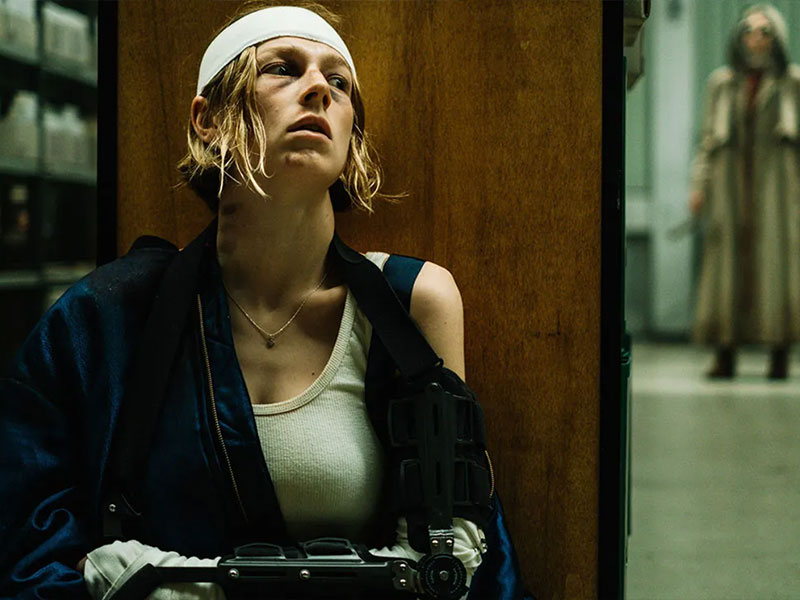
CuckooHunter Schafer as Gretchen in “Cuckoo” (Courtesy of Neon)
At the top of my short list of must-see features from this year's festival, "Cuckoo" stars Hunter Schafer ("Euphoria," "The Hunger Games: The Ballad of Songbirds & Snakes") in her first lead role in a feature film, playing a teen named Gretchen who, after the death of her mother, relocates from the U.S. with her estranged father and his new family, to live in a suspicious-from-the-jump resort in the Bavarian Alps. As one would guess, nothing good comes from this.
 
As Gretchen's father Luis (Marton Csokas) and his wife Beth (Jessica Henwick) settle in and confer with the resort's owner, Mr. König (Dan Stevens), who has employed them to redesign the interior of the property — although there is, of course, much more at work here than that — Gretchen quickly notices that König is latching on to her 8-year-old half-sister, Alma (Mila Lieu), in an obsessive way. From here, viewers catch on to the relevance of the film's title and Gretchen gets a painful — both physically and mentally — crash course on the breeding systems of cuckoos, a species of bird that König is attempting to preserve by way of a loosely-explained human/avian cross-breeding that involves shrieking noises that lead to seizures and time loops, eating fistfuls of goo, and puking all over the place. 
 
Notes taken on my phone in the dark theater of the screening I attended at the festival will neither spoil the delightfully creepy surprises of the film, or do much to add further context, but I'm putting them here now, because they're funny:
 

Gretchen is moving in with her dad after the death of her mom.


Gets offered job working at resort. Guest starts randomly barfing everywhere.


Gretchen finds comfort in listening to music and playing music.


Gretchen’s father’s youngest daughter doesn’t speak. She absorbed her twin in the womb. Heard shrieking noise in woods and has a seizure of sorts. Time seems to loop. She scratches Gretchen’s face.


Gretchen meets cool lady named Ed (Àstrid Bergès-Frisbey). During their first conversation another lady starts puking everywhere.


Riding bike home and woman runs very fast behind her. Owner of resort seemed to be calling the fast running woman with a little flute.


Gretchen stabs a cuckoo.


**** what ever happened to their dog?

Being that this is only director Tilman Singer's second feature and Schafer's first big film role, "Cuckoo" is a wild ride from beginning to end and chaotic in the best possible way, with only a few vague and/or dropped plot points that don't detract from the fun of the whole. In one scene, Gretchen and Alma make a big production out of letting their dog out of the back of the family car, only for that dog to never been seen or mentioned again. But, really, it's easy to excuse things like that when you're focused on human cuckoo monsters just looking to make a family for themselves and villains blowing creepy little flutes into the woods. Ask yourselves, when has a flute ever been an indicator of good things to come? Outside of the Renaissance fair.
 

Add to all of this that the film is beautifully shot on 35mm with a fantastic soundtrack to boot — featuring a singing credit from Schafer, who learned how to play bass for the role of an angsty music-lover — and it's safe to make the call that this will be a standout within the horror genre. You'll never look at birds the same again. 


Watch the official trailer for "Cuckoo" here, and see it when it hits theaters in the U.S. on August 9, distributed by Neon.

"In A Violent Nature"
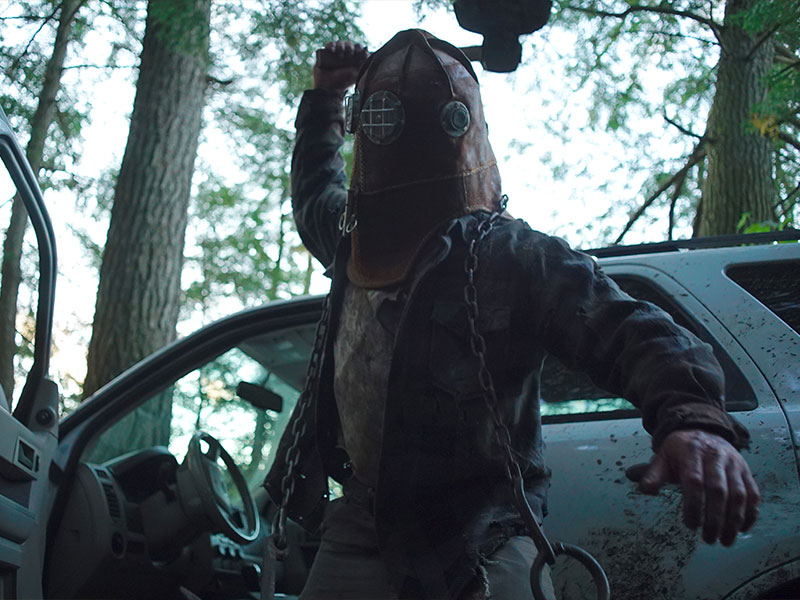
In A Violent NatureRy Barrett as Johnny in “In A Violent Nature” (Courtesy of Pierce Derks/IFC Films & Shudder Release)
Prior to the start of the screening of "In a Violent Nature" that I attended on the second night of The Overlook Film Festival, one of the fest's organizers described it as being one of the most soothing horror films ever. Going on to say that we'll leave the theater feeling as though we'd all had deep tissue massages. Riffing off of that, director Chris Nash gave his own introduction, joking that during the Q&A afterwards he won't be able to answer questions as to how long we snoozed through it. And I'm glad he stated in advance that he wouldn't be monitoring that because I did, in fact, doze off a few times. But that's more a me thing than an "In a Violent Nature" thing. If I don't get a full sleep each night, I'm hurting. And this review is evidence that I stayed up past my bedtime two nights in a row. There's no telling what shape I'll be in for the next screening. Maybe I'll fall flat in the theater like a fainting goat.
 
The uniqueness of this Canadian slasher — set in the Ontario wilderness — is layered. There's the soothing element mentioned above. Which is experienced through numerous almost comically long shots of a masked killer named Johnny (Ry Barrett) trudging through the woods at a glacial pace, racking up a body count along the way. And there's the freshness of it being shot via the killer's perspective. A creative choice that I don't believe I've seen utilized, to this degree, in a horror movie prior to this one. 
 
At the start of the film, we first meet Johnny as he resurrects himself from the muck, deep within the woods he was buried in after being killed years ago at the hands of angry locals. This process of clawing his way out of his lonely grave takes about two minutes, but watching it feels like twenty. Not because it isn't interesting, but because we're not used to long shots with no dialogue in this current bang bang, go quick, never stop talking ADHD cinematic climate. I found it to be quite nice. Maybe not deep tissue massage nice. But better than leaving a theater feeling like someone just screamed in my face for two hours.
 
As funny as it is gory, timing and ambient sound run a strong rope back to front here, making it so that a running  #1 motherf**ker gag, a solid "What are you waiting for!?!?" "I Know What You Did Last Summer" reference, and the grossest, most elaborate kill-scenes I've ever seen in my life all fit seamlessly, where in other films a similar hodgepodge could fall flat amidst the chaos. This feels classic and completely new all at once. Don't sleep on it.
 
Watch the official trailer for "In a Violent Nature" here, and see it when it hits theaters in the U.S. on May 31, distributed by IFC Films. Or watch it streaming on Shudder sometime later this year.
"Abigail"
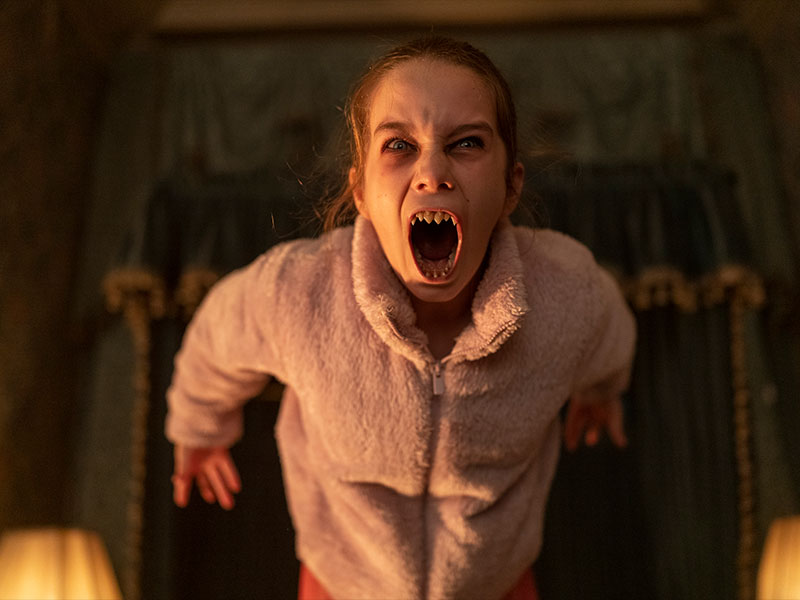
AbigailAlisha Weir as Abigail in “Abigail” (Bernard Walsh/Universal Pictures)
During each Uber ride to the screenings I attended for this festival, there seemed to always come a time when I was asked to break down the plot of the movie I was about to see. Quiet rides aren't really a thing in New Orleans, as the people who live here are naturally curious about people and the many things to experience at all times of the day and night here. For "Abigail," I enthusiastically rattled off a synopsis while inching through a packed French Quarter on a Saturday night, saying it's about a group of criminals who kidnap a little girl and then come to find that they made a big big mistake when they learn that she's not actually a child. She's an ancient vampire who also happens to love ballet. He thought this was funny, but also said it sounded really cool. And he was right on both counts.
 
One of the bigger gets for the festival, I wasn't able to take notes on my phone for this one because it was the world premiere. We were issued a firm warning to put away our devices, and studio executives from Universal Pictures were on hand to eyeball the theater, making sure we all took that warning seriously. Turns out I didn't need to jot down reminders for myself anyway because Alisha Weir, who plays Abigail in her first big role following "Matilda the Musical," would be hard to forget.
 
In an interview with Collider, directors Tyler Gillett and Matt Bettinelli-Olpin — the filmmaking team behind "Ready or Not," 2022’s "Scream," and "Scream VI," who operate under the moniker Radio Silence — describe the casting of Weir in this project, which is so outside of anything she'd done before, saying, "She’s one of those prodigal talents that, when you get to know them as an actor – and this is so much a part of this collaborative approach — when they tell you what they’re good at, you have to listen. We showed up and Alisha was a great singer, a great dancer, and very funny, and could do literally 99% of the stunts in this movie." And although she definitely steals the show, Weir is one of several slam-dunks in terms of casting here. Putting that big studio money to use, "Abigail" is rounded-out by Dan Stevens (AKA, "creepy flute guy" from the "Cuckoo" review above), Giancarlo Esposito ("Parish," “Breaking Bad”), Melissa Barrera — who made headlines after being ousted from the "Scream" franchise following a series of social media posts in support of Palestine — and Angus Cloud ("Euphoria") in one of his last projects filmed prior to his death in 2023. During a Q&A at the festival, Gillett and Bettinelli-Olpin spoke of working with the late actor, saying, "It was so fortunate to have had his breeze blow through both of our lives."
 
A take on "Dracula's Daughter," "Abigail" has humor, action and lots and LOTS of blood. It's hard to stand out in a red sea of vampire movies, but this one does it.
 
Watch the official trailer for "Abigail" here, and see it when it hits theaters in the U.S. on April 19, distributed by Universal Pictures. 

Want a daily wrap-up of all the news and commentary Salon has to offer? Subscribe to our morning newsletter, Crash Course.


"I Saw the TV Glow"
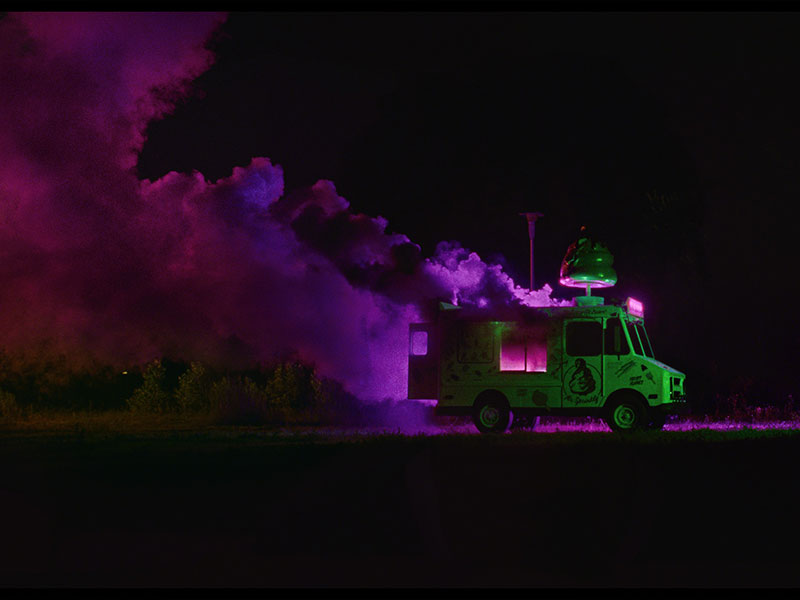
I Saw the TV GlowI Saw the TV Glow (Zoey Kang/A24)
As I'm writing this review, North America is collectively pumped about a total solar eclipse where, as The New York Times dramatically describes it, "the moon will materialize and eat into the yellow orb of the sun, casting a shadow over a swath of Earth below, causing a total solar eclipse and reminding all in its path of our planet’s place in the cosmos." And this is perfect because that's exactly how I felt after walking out of "I Saw the TV Glow" for my grand finale screening at The Overlook Film Festival last night: like something had cast a shadow over my personal swath, leaving me shaking on a street corner while waiting for my ride home, furiously vaping and darting my eyes around, feeling completely out of this world.
 
I've been following director Jane Schoenbrun since the 2021 release of their debut feature, "We're All Going to the World's Fair," and have been feeling thrilled for them and the world at large after it was announced that their second feature would be distributed by A24. A true trophy for filmmakers. Getting the chance to see it early at this festival felt like creative vitamins. Like it has quite possibly added years to my life. And I'm already curious to see who will agree, as those people will fall into the category of "my people," and everyone else . . . will not.
 
Leaving the screening last night, rattled to my core, I overheard a woman behind me say, "I'm on the fence about that one." And I had to physically restrain myself from whipping around and shouting, "Well then you're a fool!" Her comment, mixed in with exclamations of "What??" from certain members of the audience throughout the film, tells me that the heady, LGBTQIA+ to the max nature of this one will be a hard pill to swallow for some. Well then, choke on it. I say. This is, quite literally, one of the best movies I've ever seen in my entire life.
 
To hear Schoenbrun describe the premise for the film themself: "It's about two lonely teenagers who find each other through their shared love of a strange, kind of scary, kind of sweet TV show [called 'The Pink Opaque.'] They get together every week to watch it, but when their obsession kind of gets out of hand, their entire sense of reality kind of gets called into question." And, yes, that's a perfect blanket synopsis, but a whole world lives within those words that you have to see play-out on screen (preferably a big one) to understand. And even then, it's more felt than understood. Similar to watching any of David Lynch's films.
 
"The Pink Opaque," the fictional TV show mentioned above that characters Owen (Justice Smith) and Maddy (Brigette Lundy-Paine) obsess over together, contains heavy nods to "Buffy the Vampire Slayer," with targeted intention. Anyone well-versed in the BTVS universe who felt ten times gayer the further Willow Rosenberg (Alyson Hannigan) and Tara Maclay (Amber Benson) fell in love will be be hooting and grinning to see the Double Lunch — this world's version of The Bronze, with Phoebe Bridgers and King Woman as nightly performers — and nearly jump out of their seat when Benson herself shows up in a cameo as the mom of one of Owen's friends in his real, verging on unreal, life. 
 
As Maddy wishes for her life to be more like "The Pink Opaque" and makes it so, Owen struggles with his gender identity and the pull between choosing his authentic self over the "easier" path of humdrum suburban life where we see him working at a children's adventure center, making his family home his own after the death of his mom (Danielle Deadwyler) and a-hole father, played by a sinister Fred Durst. In one scene, a now elderly Owen, still working at the same job he's had nearly all his life, has a breakdown while tasked with singing "Happy Birthday" to a child, along with his younger-seeming co-workers. "I"m dying right now!" Owen yells out, running to the bathroom to compose himself via cutting into his chest and letting the light of "The Pink Opaque" escape. After this, we see him walking the floor of the adventure center telling customers as they pass, "Sorry about before." And in a memorable shot towards the end of the film, "There is still time" is written in neon chalk on the road. A reminder to us all to not live and die scared of being who we are.
 
Watch the official trailer for "I Saw the TV Glow" here, and see it when it hits theaters in the U.S. on May 3, distributed by A24.

Tackling social isolation could be more effective than healthy eating for obesity

People with obesity are commonly urged to lose weight by eating more healthily, cutting down on calorie intake and exercising more – but that advice overlooks a crucial problem.

It overstates individual agency – putting the person at fault because of poor lifestyle choices – and doesn't take into account all the factors contributing to the obesity crisis. For instance, research has found that there are significant social determinants of obesity, such as poverty, stigma and loneliness.

A recent study of people in the UK has suggested that one way to keep obese people alive for longer is to encourage them to interact more with other people.

Why exactly might this be?

The study came to its conclusion using something called hazard ratios, a measure of how often a particular event happens in one group compared to how often it happens in another group, over time. It found that people who're less socially isolated have a reduced hazard ratio of death from any cause (known as all-cause mortality). This means that people who're more socially connected are less likely to die prematurely from any cause.

This is even more significant in people with obesity. Isolation has a  bigger affect on the risk of death in people with obesity than those at a healthy weight. Those with obesity showed a four times greater reduction in mortality risk than people without obesity when their levels of social isolation fell.

We also know obesity leads to a higher risk of social isolation, which in turn has mental and physical health implications. So it's not surprising that reducing social isolation amongst among people who are obese would reduce the risk of mortality.

However, the degree of change is perhaps unexpected. It means that tackling social isolation could make a bigger difference to those with obesity than other contributing factors. In fact, the study found a reduction in social isolation more associated with decreased risk of death than any other factor, including a healthy diet, physical activity, alcohol consumption, depression and anxiety.


Relationship between social isolation and obesity

Obesity is a medical condition where people have excessive body fat, as measured by their body mass index. Growing rates of obesity means some studies predict around 20% of the global adult population will be obese by 2030.

And the problem is worse in high income countries. Around 25%  of adults in the UK are already considered obese, and the rate in the US could become as high as 45% by 2035.

This rise is intertwined with growing levels of social isolation and loneliness. Both increased during the COVID pandemic and and both are linked with a greater risk of mortality, just like obesity.

There is a two-way relationship between obesity and social isolation. In an attempt to escape feelings of isolation, people may consume more food and drink than usual, or eat more unhealthy foods such as chocolate, cake, biscuits – so called comfort foods.

Being isolated and feeling lonely can also lead to a reduction in exercise. Both excessive eating of unhealthy food and a lack of exercise will inevitably lead to weight gain.

On the other hand, obesity can lead to social isolation and loneliness, as people experience stigmatisation, rejection, discrimination, bullying, self-blame and reduced self-esteem. It can also engender a loss of trust in others, and a perception that social situations pose a threat, so are best avoided.

We also know obesity is associated with poorer mental health, especially in women.

Unsurprisingly then, obese people are more likely to isolate themselves, avoid spending time in public places and interacting with others. This can include an avoidance of health care settings, preventing those struggling with weight gain from getting the necessary support.

The most recent study demonstrates the significant damage that social isolation can have on those with obesity. The findings should not be interpreted as a signal that the sole answer to health risks of obesity is making social connections. However, the study should prompt a rethink of attitudes and approaches to obesity that focus exclusively on the individual's diet and exercise. Research has shown that the traditional  "eat less, move more" advice is simplistic and outdated.

Healthy eating and exercise should not be prioritized in obesity treatment at the expense of all other factors. To reduce the mortality risk of obesity, social isolation must be taken into account alongside healthy eating and physical activities. Tackling obesity, then, should include group activities and opportunities for regular social interaction in safe welcoming environments.

Andrea Wigfield, Professor Applied Social and Policy Research; Director, Centre for Loneliness Studies, Sheffield Hallam University

This article is republished from The Conversation under a Creative Commons license. Read the original article.

Former government lawyers say we need to limit the president’s ability to deploy U.S. troops at home

A bipartisan group of former national security officials and lawyers is calling for new restrictions on a president's ability to deploy troops on U.S. soil, arguing that existing law is "antiquated" and grants too much power to one person.

The group convened at the invitation of The American Law Institute to examine the Insurrection Act of 1807, which former President Donald Trump has threatened to invoke should he return to the White House, ostensibly to address what are now-declining rates of crime in major cities.

In a statement, Bob Bauer, who served as White House counsel under former President Barack Obama, argued that the Insurrection Act itself is “poorly drafted" and full of "vague or obsolete language." It "has been clear for decades that this antiquated law needs serious revision," he said.

As it stands, the Insurrection Act permits the president to deploy U.S. armed forces domestically in response to outbreaks of violence, including rebellion against federal or state governments. It was last used by former President George H.W. Bush in 1992 in response to riots in Los Angeles sparked by the acquittal of police officers in the Rodney King case.

Jack Goldsmith, who served as an assistant attorney general under former President George W. Bush, said in a statement that he agrees the law “gives any president too much unchecked power." He and others in the group would like to see Congress eliminate outdated language, such as references to "obstructions" and "assemblages," that could be cited to justify another deployment; they would also like to see deployments subject to a statutory limit of 30 days, with any extension requiring lawmakers' consent.

Included among those calling for reform is a former member of the Trump administration. John Eisenberg, who served as a lawyer for the National Security Council under Trump, told The New York Times that the Insurrection Act, as currently written, should alarm Democrats and Republicans alike.

“This is something of great importance regardless of what party you are in because, obviously, it is an area that can abused,” Eisenberg said. “If the triggers, for example, are too vague, the risk is that it can be used in circumstances that do not really warrant it. So it is important to tighten up the language to reduce that risk.”

“10 Things I Hate About You” turns 25: How Kat Stratford inspired a generation of angry girls

Let’s face it, we all wanted to be Julia Stiles' Kat from “10 Things I Hate About You," the '90s teen movie based on Shakespeare's "The Taming of the Shrew." Like the play, the story centers on two sisters, Kat and Bianca Stratford (Larisa Oleynik).

The eldest, Kat is abrasive, rude and has one friend  — unlike Bianca, who is seemingly popular, obsessed with her Prada bag and yearns to start dating. There's just one problem: The girls' strict doctor father (Larry Miller) forbids Bianca from dating until Kat dates, too. This kicks off a variety of string-pulling scenarios that ultimately end up pushing Kat into the path of local Australian bad boy Patrick Verona (Heath Ledger), while Bianca debates between empty-headed Joey Donner (Andrew Keegan) or nerdy new kid, Cameron James (Joseph Gordon-Levitt).

Outside of the fluttering romance plot and teen hijinks, Kat’s anarchist vibe was bitingly cool, self-assured and unyielding in her feminism and beliefs. As such, she was labeled as her high school’s resident freak, and while her interests in “feminist prose and angry girl music of the indie rock persuasion” were too jarring for the movie’s Seattle high school suburbanites, they resonated with teen girls in real life — and have continued to do so for decades. 

As "10 Things I Hate about You" turns 25, it's worth looking back at how the 1999 film never domesticated its 18-year-old protagonist and instead, through Kat's character and the movie's overall riot grrrl sensibilities, laid the groundwork for Kat and other angry girls to be just that — angry. 

Before the film’s inception, in the early '90s, an underground punk feminist movement was born in Olympia, Washington that helped launch third-wave feminism into the stratosphere. As the birthplace of '90s punk, Seattle was a hub for male-centered rock and grunge and the riot grrrl movement — which was centered on a bedrock of feminism, punk music and radical politics — was founded as a response to the hypermasculine music scene. Essentially, women and girls wanted to use music to express their unbridled anger, rage and frustration. 

It opened the door for women to air out their grievances, just like male rockers (and often, these grievances were born from the patriarchal system). 

Riot grrrl bands ranged from Raincoats to Bikini Kill and Bratmobile. They sang songs about empowerment, rape culture and supporting and uplifting women. As a decentralized movement, the musicians and activists made art and zines; they organized protests and performances; and they did it while also sitting around and talking, elevating their listeners' consciousness of the issues about which they sang, the New York Times reported. 

These punks also revolted against what it meant to be a stereotypical girl, rejecting the push of hyper-consumerist, capitalistic ideals projected onto women. This included throwing a middle finger at the dominant culture’s standards of beauty. Riot grrrls didn’t care much about fashion for its aesthetics or seemingly superficial purposes. They cared about fashion because it could mean they could make a statement with their bodies and clothes. 

In many ways, Kat is the perfect example of what it meant to be involved in the riot grrrl movement in the late ‘90s. She is the school’s outcast because of her politics and sheer rage at the system. She doesn’t date boys because she detests them, only reads feminist literature and truly loves female-centered punk music. In class when her male English teacher, Mr. Morgan (Daryl Mitchell) suggests reading Ernest Hemingway, she questions why they don’t read any women. These are the “oppressive patriarchal values that dictate our education,” she said. “[Hemmingway] was an abusive, alcoholic misogynist who squandered half of his life hanging around Picasso trying to nail his leftovers.”

Instead, she suggested they should read Sylvia Plath, Simone de Beauvoir or Charlotte Bronte. After getting sent to the office for disrupting class, she tells the guidance counselor Ms. Perky (Allison Janney), “Expressing my opinion is not a terrorist action."

Outside of class, Kat's riot grrrl tendencies can be observed in her extracurriculars and her fashion sense. While attending a Letters to Cleo concert, she lets her emotional steel armor fall as she slips into a crowd filled with other women punk fans who understand her. 

Kat's fashion, which leans more masculine with feminine statement pieces, looks particularly personal and lived-in. By the end of the film, she ditches her oversized cargos and baby tees for a delicate blue prom dress with a matching shawl after Patrick pleads with her to attend the dance. As her character further breaks free from her emotional armor, she pulls her hair back in a wispy French braid and adorns a flowy, feminine white top – the first time she wears white in the movie.

However, this makeover isn't indicative of Kat losing her principles, as is sometimes the case in films in which love changes a woman; it's indicative of her coming into herself. 

This version of Kat never wavers in “10 Things” because of its clever writing duo, Karen McCullah and Kirsten Smith. They did not allow Kat to be turned into a submissive girl because she fell in love. They cut off the misogynistic trope of “taming the shrew” by its ankles before it could walk. Instead, they choose to transform the hedonistic and chauvinist Patrick. Before Patrick is propositioned to take Kat out, he is portrayed as scary, lonely and unapproachable. Sounds a bit like Kat. 

The character’s deviance from all authority and especially male authority lives in her feminism, her clothes and her music taste. She knows that “in this society, being male and an a*****e makes you worthy of our time.” So in turn Kat fights back. She fights back by not being “what people expect. Why should I live up to other people's expectations instead of my own?” She even defies her father when he tries and fails to guilt trip her into not going to Sarah Lawrence. She tells him, “I want you to trust me to make my own choices and I want you to stop trying to control my life just because you can't control yours!”

We need your help to stay independent

When Kat finds out about Patrick's whole gimmick around dating her, he then buys her a guitar. While Kat says he can’t buy a guitar every time he messes up, he jokes and tells her he can buy her drums, a tambourine and other band instruments. Earlier in the film, Patrick also publicly humiliates himself for Kat by singing Frankie Valli's song, "Can't Take My Eyes off You" in front of the whole school. He softens for Kat and it's precisely because of her sincerity in her values and strength in personhood. 

Ultimately, he's the shrew who gets tamed — I mean, c'mon, he even gives up smoking cigarettes for her.

In "10 Things," Kat proved to the world and media that women should never be tamed. The importance of autonomy and choosing to be angry can be a fruitful and healthy emotion for women. The shrew label never worked on her because her unabashed confidence and conviction were always painted as her strengths. 

While the character learns how to soften herself and allow space for vulnerability, it never takes away from who she is at her core – it just adds to her greatness. In this depiction, Kat paved the way for characters like PJ (Rachel Sennott) and Josie (Ayo Edebiri) from “Bottoms” or even the leads in the Showtime drama “Yellowjackets.” Like writers McCullah and Smith said in an interview with Decider, “a lot of teenage girls saw themselves [in Kat] for the first time—or a version of themselves they wanted to be: Someone who’s unafraid to say what she thinks and do what she wants.”

Trump claims credit for state abortion bans even as he denies seeking a federal prohibition

On Monday, former President Donald Trump sought to distance himself from an unpopular federal ban on abortion, even as he rightly took credit for the fact that more than a dozen states now have severe restrictions on reproductive freedom.

In a video posted on Truth Social, Trump boasted that he was responsible for Roe v. Wade being overturned, even as he appeared defensive about the 2022 Supreme Court decision, falsely asserting that the overturning of a 50-year precedent — enabled by justices he nominated — was “something that all legal scholars wanted and in fact demanded.” He also tossed red meat to his anti-choice supporters, bizarrely claiming that Democrats support "execution after birth."

But Trump, who previously suggested he would support a ban on abortion after 15 weeks of pregnancy, claimed Monday that he would leave the issue entirely to the states.

“The states will determine by vote or legislation, or perhaps both, and whatever they decide must be the law of the land. In this case, the law of the state," Trump said in the video. He also sought to reassure voters that he would not pursue an unpopular ban on in vitro fertilization (IVF) and the "miracle of life" it offers.

Towards the end of the video, Trump hinted at the likely reason why he's now trying to distance himself from the anti-choice policies favored by so many members of his own party. “You must follow your heart," he told viewers, "but you must also win elections in order to restore our culture  and in fact save our country which is currently, and very sadly, a nation in decline.”

“Safety crisis”: Food delivery’s simmering violence problem

Over the past few years, the posts on r/UberEats, a subreddit dedicated, in part, to couriers’ working conditions, have increasingly centered on the threats of violence delivery drivers face. For instance, one driver posted an expletive-laced screenshot in which a customer threatened to kill them if they didn’t cancel an order-in-progress. “He called and said he was on his way to Wendy’s and looking for my car to murder me,” the courier wrote. 

Another shared an experience in which they accidentally delivered a bag of McDonald’s takeout to the wrong building within a New York City apartment complex at 2 a.m.; after informing the customer of the mistake and assuring them they’d help get a refund, the customer shouted from their second-floor window that the driver deserved “a light beating.” 

In a post from last year, titled “In regards to the uptick in recent posts related to courier drivers being assaulted/murdered,” one subreddit member asked other members to stop posting stories like that because they were depressing. “It's very discouraging to come here and see post after post about someone being killed, or assaulted,” they wrote. “If you guys want to discuss that, that's fine, but we can do it in one centralized thread, and not taint the overall environment of this subreddit.” 

Instead of complying, users in the comments began a conversation about how drivers are keeping themselves safe. One wrote: “I keep a gun on me at all times while doing deliveries … There are horrible people out there just waiting for someone like me, a woman, alone, doing deliveries in the middle of the night. Not on my watch fool.” 

This isn’t just an UberEats problem; as the rate of online food delivery has increased over the last five years — a trend that was then supercharged by the pandemic — new research shows that couriers are incredibly vulnerable to threats of violence, some of which have evolved into tragic national headlines. Now, some of the major food delivery providers are rolling out new technology intended to curb the rate of harassment, but will it be enough? 

"He called and said he was on his way to Wendy’s and looking for my car to murder me."

In a 2023 study from Georgetown University, which was based off of in-depth interviews with 41 DC-based food delivery workers, researchers found that 41% of the workers had experienced verbal harassment or physical assault while on the job. In total, 51% of the workers with whom researchers spoke indicated “they have felt unsafe or feared for their physical well-being while engaged in delivery work.” Additionally, workers who are Black, Hispanic or Asian were more likely than white workers to share experiences of assault and harassment. 

Many couriers also reported inaction from their employers in the face of harassment. 

For instance, in 2022, Vanessa, a full-time delivery driver interviewed by Georgetown’s research team, survived a carjacking while picking up an order from a restaurant. She was attacked from behind, but was able to get free. However, before she called emergency services, Vanessa signed into the UberEats app to un-assign herself to the delivery order because she was concerned the platform would penalize her in the future. She didn’t tell the company that she had been assaulted. 

We need your help to stay independent

“I don’t think there would have been a point to report it,” Vanessa said. “I don’t think they would have done anything.” 

The researchers noted in their report that they had heard this refrain over and over again about a lack of faith in delivery companies to help workers experiencing emergencies. “We find that many workers believe, as Vanessa does, that the companies will penalize them for disrupted or incomplete orders, even if the reason for the interruption is a verbal or physical assault,” they wrote. “A recent study shows that this fear is not unfounded for the sister industry of ride-hail: Drivers are often deactivated (or fired) after they report physical assaults or verbal abuses by passengers.”

Underpinning many couriers’ concerns about threats of violence are several high-profile murder cases in which food delivery workers have been killed while on the job. Last April, for instance, an UberEats driver was slain and dismembered while making a delivery in Florida. That same month, a DoorDash delivery driver was shot and killed after an argument in Akron

In May 2023, the activist group Gig Workers Rising released a report that said, according to their research, 80 app-based workers have been “victims of homicides while on job between 2017 and 2022.” The majority were ride-hailing drivers, but at least 20 delivery workers were also killed, according to the report, which relied on press accounts, court records and police reports.

“Corporations like Uber, Lyft, DoorDash and Instacart have transformed transportation and meal delivery, but too many of them have done so by exploiting their workers on the job,” they write. “Their growth-at-all-costs model has repeatedly failed to adequately address the most tragic human cost of their business: loss of life.” 

They continue: “After a worker’s tragic death, the corporations for whom they worked often send ‘thoughts and prayers’ through news reporters, but do not consistently support families with basic protections like workers' compensation.This behavior is consistent with too many app corporations' core business model: cutting costs by avoiding compensation and protection of their workers. App workers are shut out of safety net programs like workers compensation and, despite how dangerous the work is, too often workers are left on their own to figure out strategies to protect themselves.” 

To help address some of these concerns, DoorDash added an AI chat feature to its app to detect harassment between workers and customers. While DoorDash has implemented safety measures before, including an “emergency button” for drivers in 2022 and an earlier version of this harassment detection technology, this new feature, SafeChat+, is more adept at detecting the nuance of messages rather than simply relying on keyword detection.

"App workers are shut out of safety net programs like workers compensation and, despite how dangerous the work is, too often workers are left on their own to figure out strategies to protect themselves."

“If SafeChat+ detects an inappropriate or abusive conversation between a consumer and Dasher, Dashers will be given the option to quickly cancel the order without impacting ratings,” DoorDash wrote in a release. “If the order is already completed, the feature will automatically end any further chat to help prevent the situation from escalating. If a Dasher uses inappropriate or abusive language with a customer during a delivery, the customer can reach out to support via chat or phone to report the incident and receive assistance.” 

However, many gig workers believe this is the very least these companies can do for employees who are often putting their lives on the line — literally — to deliver $15 worth of food. For instance, Gig Workers Rising maintains that while “murder is the extreme, the norm is exploitation.” 

As such, the group issued a set of demands that go beyond in-app support, including compensation, no forced arbitration in the case of lawsuits, transparency about the rate of worker deaths and violent incidents and the ability to unionize. 

“That this safety crisis is allowed to continue unabated is a function of too many corporations' business model — cutting costs by displacing cost and risk on to workers, and leaving families and workers on their own, even in the extreme case of workers being murdered on the job,” they write. 


Jonathan Majors sentenced to probation for assaulting ex-girlfriend

Actor Jonathan Majors will not see jail time for harassing and assaulting his ex-girlfriend, Grace Jabbari.

Majors, who faced up to a year in jail following his December misdemeanor assault conviction, was instead sentenced to 52 weeks of domestic violence programming by Judge Michael Gaffney in Manhattan criminal court on Monday. The charges against Majors, which were brought by the state of New York, stemmed from a domestic dispute in which Jabbari claimed that he attacked her in the backseat of a taxi. 

The "Creed III" actor's burgeoning career took a major hit after being found guilty — formerly a Marvel star for his role as Kang the Conqueror in "Loki" and "Ant-man and the Wasp: Quantumania," Majors was swiftly dropped from the MCU after being convicted. Majors also starred in HBO's "Lovecraft Country" and 2019 film "The Last Black Man in San Francisco."

In February, Majors faced new abuse allegations after two of his former girlfriends told the New York Times that the actor had previously physically assaulted them as well. 

“As he eagerly anticipates closing this chapter, he looks forward to redirecting his time and energy fully toward his family and his art,” Majors' attorneys said in a statement last week after losing their bid to see his conviction tossed, per the AP.

“Incomprehensible”: Experts say Trump’s $175 million bond makes no sense

Former President Donald Trump’s effort to challenge his massive civil fraud conviction itself appears to rely on deception, The Daily Beast reported Monday.

Last week, Trump posted a $175 million bond to appeal his $454 million fraud conviction in New York — this, after his lawyers claimed he was unable to find anyone willing to guarantee he would actually pay the full amount. In order to post that bond, the former president turned to Knight Speciality Insurance Company, led by billionaire Don Hankey, described by MSNBC legal analyst Lisa Rubin as the “king of subprime car loans.”

But according to former regulators and other legal experts, the bond is highly irregular. Per a legal filing, it amounts to little more than a promise that Trump himself could pay the full cost of the bond if he ultimately loses his appeal, The Daily Beast reported, noting that such an arrangement effectively negates “the whole point of an insurance company guarantee.”

It does not appear that Knight Specialty Insurance Co. could even cover the bond if it wanted: according to a court filing, the company has financial reserves of just $138 million. And while a related corporate entity claims a financial surplus of $1 billion, the court filing does not explicitly state that it would be liable.

“Based on the financial statement provided, Knight Specialty is providing a bond that is one-third of its total assets and greater than its surplus, which is incomprehensible for a carrier to underwrite,” Maria T. Vullo, a law professor at Fordham University who previously served as New York’s top financial regulator, told the publication.

Indeed, experts who reviewed the bond filing said it appears to state that it is "Donald J. Trump" who "shall pay" any bond, an arrangement that is far from normal.

We need your help to stay independent

"This is not common," N. Alex Hanley, CEO of the civil bond company Jurisco, told the outlet.

New York Attorney General Letitia James also has questions about the bond and its issuer’s ability to pay it, stating in a legal filing last week that she “takes exception to the sufficiency of the surety to the undertaking.” A hearing on Trump’s bond and the potential issues with it is scheduled for April 22.

Hankey, for his part, in a recent interview with Reuters insisted that he had accepted collateral for the $175 million bond. But he added that he was not sure exactly what the source of it was.

"I don't know if it came from Donald Trump or from Donald Trump and supporters," he said, adding that he now regrets only charging a Trump a "low fee" for his services.

“His enemies are America’s enemies”: Trump is getting help preparing his revenge list

Are you better off than you were four years ago?

That question is circulating on social media and cable news every day now in response to the Trump campaign foolishly asking it, apparently expecting that everyone is mathematically illiterate and won't look back to the spring of 2020 when thousands of people were dying in the COVID pandemic. You'd think the last thing they'd want anyone to remember is Donald Trump appearing on television every day yelling at reporters and telling people to take snake oil cures or inject disinfectant. It was a nightmare from which the country has not yet fully recovered and his abominable performance during that horrific crisis marked the worst days of his presidency. You'll remember that he was careening madly from day to day, completely out of his depth, making everyone even more frightened and nervous than they already were.

We know from reporting in real time, and later from books and interviews, that Trump was really only concerned about how the pandemic was going to affect his reelection campaign and as a result he tried various PR approaches, from denying it was happening to demanding that we stop testing because it was making "his numbers" look bad to declaring that less than a hundred thousand deaths from the virus would be a big win. (The American death toll stands at well over a million.) One of the more inane attempts to shape the narrative was when he tried to adopt the mantle of "wartime president" to rally the country around the commander-in-chief and send him to a second term by acclamation. As Bob Cesca wrote for Salon at the time:

As of the past several days, Trump's been marketing COVID-19 as an "invisible enemy." He can't stop repeating the bellicose platitude that America is at war against the virus, even though he spent the first two months of this catastrophe telling us it was no big deal. 

Yet during the Sunday edition of the Trump Show, the president said, "In a true sense we're at war." On top of not understanding the definition of "war" or "true," Trump is also struggling to present himself with a patina of unity and cooperation (which he and his people routinely contradict with obnoxious cracks and tweets about his political opponents), while conspicuously thanking "first responders," as in the days and weeks following 9/11.

Someone even wrote some inspiring words for Trump to say about it:

Every generation of Americans has been called to make shared sacrifices for the good of the nation. … Now it's our time. We must sacrifice together, because we are all in this together, and we will come through together. It's the invisible enemy. That's always the toughest enemy, the invisible enemy.

No one bought that line because it was clear that he was in over his head. Once Trump made the most infamous gaffe of his presidency — suggesting to scientists that perhaps humans could inject or ingest disinfectant to kill the virus — he stopped appearing at the daily White House briefing. But despite the fact that he loves to fatuously portray himself as the "peace president," he clearly liked the idea of being a wartime leader and thought it would be useful to his campaign. The only war he's ever been interested in waging, however, is the culture war.

At the height of the pandemic, Trump launched an all out attack on former president Barack Obama with a convoluted conspiracy theory he called "Obamagate" (original as always). It had something to do with the Russia investigation, which nobody could ever figure out. Trump demanded that Obama be jailed for his alleged crimes. He even had his attorney general, Bill Barr, assign U.S. Attorney John Bash to look into the matter. Sen. Lindsey Graham, R-S.C., agreed to hold hearings on the Senate Judiciary Committee, although he didn't follow Trump's orders to subpoena Obama to appear. Nothing ever came of it because it was nonsense but it did distract for a time from Trump's miserable failure to lead the country through the pandemic. 

Recall that he also launched a series of assaults on blue states demanding that governors would have to "negotiate" for aid by giving up sanctuary cities. As I wrote at the time:

He and Senate Majority Leader Mitch McConnell even cooked up a plan to deny pandemic aid to liberal-leaning states, literally calling it "No Blue State Bailouts." Republican governors are now following his lead and doing the same with the Democratic mayors of major cities. After years and years of bellowing about "local control," they are now overruling mayors' stay-at-home orders in an effort to force people back to work.

This wasn't entirely new. He'd been hostile to sending aid to Puerto Rico after Hurricane Maria and California for its devastating wildfires, but he really cranked it up in advance of his re-election effort in 2020. Essentially, Trump declared war on his political opponents in 2020. It wasn't successful for him at the time but that's not stopping him from giving it another go — and this time it's scorched earth.

We need your help to stay independent

Over the weekend, Trump shared a video by Tom Klingenstein, a very wealthy financier and the chairman of the conservative Claremont Institute. In 2021, Klingenstein took up the banner when Trump went into exile at Mar-a-Lago and started a SuperPac to fight what he calls the “Woke regime.” He characterizes it as a cold civil war in which the so-called woke regime is winning because the right is too afraid to fight. 

Until now, his work has mostly been focused on the idea itself but now he's taken it to a new level, presenting Donald Trump as the only man who can lead us with a piece he calls "Trump's Virtues." The former president shared it on Truth Social to a rapturous reception. Leni Riefenstahl wouldn't be impressed with the aesthetics but her subject would certainly admire the message. Here is a small sample:

We shouldn’t much care whether our commander-in-chief is a real conservative, whether he is a role model for children or says lots of silly things, or whether he is modest or dignified. What we should care about is whether he knows we are in a war, knows who the enemy is, and knows how to win. Trump does.

[…]

His policies are important, but not as important as the rest of him. Trump grasps the essential things. He understands that the group quota regime is evil and will not stop until it destroys America. He is a fighter—bold, brave, and decisive—who has confidence in himself and his country.

[…]

His enemies hate him with an indescribable fierceness. “Another Hitler,” they say, “elect him and he will be a dictator.” We should take this hysteria as reason for hope. The America-haters rightly fear that he and his party are on the threshold of a successful counterrevolution.

[…]

Trump hates his enemies every bit as much as they hate him. His enemies are America’s enemies.

Those enemies are everyone who doesn't support Trump and they must be destroyed.

The man who made that video surely believes all this and Trump's followers appear to love the message and are inspired by it. The rest of us are simply left stunned by the idea that any of this could possibly be defined as "virtuous."  

Trump lawyers claimed no one would give him bond. Then he got a lifeline, but they didn’t tell court

ProPublica is a Pulitzer Prize-winning investigative newsroom. Sign up for The Big Story newsletter to receive stories like this one in your inbox.

Former President Donald Trump scored a victory last week when a New York court slashed the amount he had to put up while appealing his civil fraud case to $175 million.

His lawyers had told the appellate court it was a “practical impossibility” to get a bond for the full amount of the lower court’s judgment, $464 million. All of the 30 or so firms Trump had approached balked, either refusing to take the risk or not wanting to accept real estate as collateral, they said. That made raising the full amount “an impossible bond requirement.”

But before the judges ruled, the impossible became possible: A billionaire lender approached Trump about providing a bond for the full amount.

The lawyers never filed paperwork alerting the appeals court. That failure may have violated ethics rules, legal experts say.

In an interview with ProPublica, billionaire California financier Don Hankey said he reached out to Trump’s camp several days before the bond was lowered, expressing willingness to offer the full amount and to use real estate as collateral.

“I saw that they were rejected by everyone and I said, ‘Gee, that doesn’t seem like a difficult bond to post,’” Hankey said.

As negotiations between Hankey and Trump’s representatives were underway, the appellate court ruled in Trump’s favor, lowering the bond to $175 million. The court did not give an explanation for its ruling.

Hankey ended up giving Trump a bond for the lowered amount.

It’s unclear if Trump lawyer Alina Habba or the rest of his legal team were made aware that Hankey reached out about a deal for the full amount. Trump’s legal team did not respond to requests for comment.

After ProPublica reached out to Trump’s representatives, Hankey called back and revised his account. He said he had heard “indirectly” about ProPublica’s subsequent inquiries to Trump’s lawyers. In the second conversation, he said that accepting the real estate as collateral would have been complicated and that he wouldn’t have been able to “commit” to providing a bond in the full amount “until I evaluate the assets.”

Legal ethics experts said it would be troubling if Trump’s lawyers knew about Hankey’s approach and failed to notify the court.

New York state’s rules of professional conduct for lawyers forbid attorneys from knowingly making false statements to a court. At the time Trump’s lawyers told the court that meeting the bond would be impossible, Hankey said he had not yet reached out to the Trump team.

But the rules of conduct also dictate that lawyers must “correct a false statement of material fact or law previously made” to the court.

“If that deal was on the table for the taking, the representation from the earlier time would be untrue, and the lawyer would have an obligation to correct,” said Stephen Gillers, a legal ethics professor at New York University Law School.

In the rules of conduct for lawyers, the failure to update an important piece of evidence would fall under what’s referred to as the “duty of candor to a tribunal,” said Ellen Yaroshefsky, a professor of legal ethics at Hofstra Law.

“Any judge is going to be furious that this wasn’t corrected,” she said.

Scott Cummings, a legal ethics professor at UCLA’s law school, agreed that there was a potential ethical failure but said Trump’s lawyers could argue that they were not obligated to alert the court.

“A very narrow reading of this rule would be there is no obligation to report because it wasn’t a false statement at the time,” Cummings said.

The need for the bond arose from a case brought against Trump by the New York attorney general, who accused him of fraudulently inflating his net worth to get favorable loans and other benefits. A judge agreed and ordered Trump and the other defendants to pay $464 million.

Trump had a month to come up with the sum or risked having his properties seized.

When a defendant loses a civil case in New York, the creditor — in this case the attorney general — can immediately go after the defendant’s assets to collect the judgment. The defendant can protect his assets while pursuing an appeal by posting a bond. Typically obtained from an insurance company for a fee, the bond is essentially a promise that the company will guarantee payment of the judgment if the appeal fails.

In his first interview with ProPublica, Hankey said that when he heard Trump was having trouble getting a bond, he reached out to Trump’s camp, several days before the bond was reduced, with an offer to help.

Hankey, who took a break from a game of bocce to speak to ProPublica, is rated by Forbes as one of the 400 wealthiest people in the world with an estimated net worth of more than $7 billion. He made much of his fortune with high-interest car loans to risky borrowers, and he is chairman of a Los Angeles-based network of companies across a range of industries, including real estate, insurance and finance. He has said he supports Trump politically but would have wanted to make the deal no matter his politics.

Hankey told ProPublica that during the talks he came to the conclusion that Trump’s “got the liquidity” and was confused why others would have rejected him, speculating that some may have wanted to avoid political backlash: “If you’re a public company, maybe you don’t want to offend 45% of the population.”

Hankey said he informed Trump’s camp that he was willing to work with them, and “they said they had the collateral.” The two sides went over the assets that had to be pledged, and it was up to Trump “if they wanted to do it.” (In his second call, Hankey said making a deal would have been “difficult.”)

But, he said, the deal for the larger amount was dropped during a large Zoom call between the two sides, when Trump’s camp got a call informing them that the bond was reduced.

“They thanked us for trying to help: ‘Maybe next year, we’ll try to do business again,’” Hankey recalled them saying.

But several days later, Hankey said, they called back, hoping to make a deal for the reduced bond, and Hankey agreed.

The bond saga is not over. In a brief court filing on Thursday, the New York attorney general asked Trump or Hankey’s company to show that the company has the financial means to fulfill the $175 million bond.

Men punching random women in NYC: A desperate last gasp of the male rage fueling MAGA

Men are punching random women on the streets of New York City. As usual with these kinds of diffuse and chaotic stories, there's much that is unknown, including how often this is happening, how many people are involved, or whether it's at all coordinated. But what we do know is already alarming. CNN reports that dozens of women have discussed being victims on social media, and formally interviewed six of them. NBC News reports there have been at least 3 arrests. CBS News reports that NYPD released images last week of a fourth man wanted for allegedly punching a woman in Union Square. Even reality TV star Bethany Frankel says she's been victimized

Women report being assaulted by men of different races and ages. Still, across the different stories, a couple of similarities pop out: The alleged victims are mostly young and pretty, and most of them say they were minding their own business when they were attacked. Some were on their phones or reading on tablets. Others were speaking to friends or daydreaming. Whatever they were doing, they were just living their lives, and that, it seems, is what enraged their assailants. 

The alleged victims are mostly young and pretty, and most of them say they were minding their own business when they were attacked.

Whatever the scale of this problem eventually turns out to be, it's not surprising that these stories have gone viral and captured the public's imagination. While it rarely turns to violence, most women who spend much time walking around in public have experience with men who berate them for paying attention to something other than the man who is now, often out of nowhere, spewing invectives. In our modern era, that often manifests with men who are infuriated at women for looking at their phones. But I'm old enough to remember when I would get yelled at for reading books in public.


Want more Amanda Marcotte on politics? Subscribe to her newsletter Standing Room Only.


Whatever the excuse the angry man concocts, the impetus is always the same: The eyes of a woman are directed at someone or something that is not him, and he is indignant over it. So he will make sure she has no choice but to look at him, either by getting in her face or — in these alarming New York cases — punching her. If he cannot capture her adoring gaze, well, he will make her stare at him in fear. 

These stories resonate, as well, because the nation is having a moment of increasingly unhinged male fury at women for daring to have lives that are centered around something other than catering to a man's every whim. Unleashed by Donald Trump and the MAGA movement, there's an upswell of loud male entitlement shouting at us from every corner. 

We see it in the male fans of Jordan Peterson, who clamor to his events to hear him croak out a just-so story about how lobsters justify their faith in male dominance. Or the rise of "tradwives" online who make a living pretending they're unemployed and housebound. Or Ben Shapiro setting fire to a Barbie doll because he can't stand that a blockbuster comedy starring a woman is about anything but her quest for male affection. Or MAGA pundits telling lies about birth control, in hopes of tricking women into having babies before they're ready. Or conservatives writing op-eds that blame women for male loneliness, telling women they must self-sacrifice to relieve male pain by marrying Donald Trump voters. Or right-wing men yelling because Taylor Swift has cats or because she dates a hunky, vaccinated NFL player instead of, I dunno, having babies with a guy in ill-fitting cargo shorts. 

The word "backlash," in reference to the famous Susan Faludi book that chronicled the dramatic recession of women's rights and status in the 80s, which erased much of what was gained by the second wave of feminism, gets thrown around a lot. And these things indeed tend to be cyclical. The late 90s/early 2000s was another backlash period, as the rise of Limp Bizkit, George W. Bush, and trucker caps eclipsed the relatively feminist mid-90s. 

We need your help to stay independent

But there's one big difference between the male tantrum we're experiencing now and the backlashes of old: This time, women aren't really playing along. A few, maybe, especially if they can get a piece of that sweet "tradwife" income. But, in the past, backlashes tended to draw large numbers of women along, or at least convince them to silence their opinions, lest they be labeled a "man-hater." In the more conservative parts of the country in the early 2000s, it manifested as widespread shaming of women for having sex before marriage, from abstinence-only "education" to purity rings. But it wasn't great in more liberal areas, where women put up with hipster sexism to get the prize of being called a "cool girl." 

Now, there just seems to be much less interest among women in placating men by silencing ourselves or "compromising" on basic rights. All the male bellyaching about "Barbie" and Taylor Swift did nothing to dent ticket sales. Roe v. Wade was overturned and instead of scaling back our claims to our own bodies, women revolted, organizing ballot initiatives around the country to protect abortion rights. Polls show that while young men might be backing Trump in large numbers, young women have not been browbeaten out of voting for Democrats. Just last week, a women's college basketball game between LSU and Iowa became the highest-rated college basketball game in ESPN history. 

The rise of MAGA is fueled by misogyny. But it's less a backlash than a tantrum, a rage explosion by men who want to restore their dominance but fear that, this time, women won't buckle to their bullying. This rash of men punching women in New York City captures this moment in a dark way. We don't even need to know their names or faces to know that men who do this are losers, lashing out because they've learned that actually, women don't owe them anything just because they're men. It's also true that women aren't just suffering in silence, but telling their stories without shame or self-blame. There's something nakedly pathetic about punching women, as scary as it is for the victims. It's not like the cat-calling or groping of old, which disguised male aggression as a mere over-exuberance of lust. This is a last gasp of men who, unable to justify their sexism in any way, must resort to brute force. Yet even then, they're unable to shut women up. 

Obama’s pollster on the Republican voters Trump should fear: “Wild enough to threaten his chances”

Public opinion polls show a 2024 election that, at this point, is very close. President Biden appears to be ahead in several key battleground states. However, other polls have consistently shown that Donald Trump is leading Biden, both nationally and in the battleground states. As politics experts know, there is always the qualifier and truism that public opinion polls are a snapshot in time and are not predictive – unless they turn out to be correct in retrospect on Election Day.

The polls and focus groups also show that many Americans across the political divide are tired, exhausted, and would prefer that neither Biden nor Trump be their respective party’s presidential nominees. Many Americans are in their own self-curated self-reinforcing information echo chambers and closed episteme(s) that make finding a common ground regarding the facts and the truth even more difficult.

"For Biden, 2024 must be a referendum on Trump — not a choice."

In an attempt to make better sense of the 2024 election in this tumultuous and confusing time, I recently spoke with Mike Kulisheck, who is Managing Director of BSG, a consulting and strategic research firm that worked as Barack Obama's pollsters during his 2012 presidential re-election campaign.

In this wide-ranging conversation, Kulisheck explains how the 2024 election is uniquely and highly volatile. He also shares his concerns and warnings about how the many Americans who view Trump’s time in office through a distorted lens as “the good old days” and plan to punish President Biden on Election Day. Kulisheck highlights how, contrary to the dominant news media narrative, Trump’s support among Republicans is not as strong as many observers believe. Those voters, he tells me, could be the wildcard that derails the corrupt ex-president’s quest to take back the White House and become America’s first dictator.

This interview has been lightly edited for length and clarity

Public opinion polls and other data about voter attitudes and behavior are a type of story. Where are we in the story that is the Age of Trump?

I like the idea of data as a story. BSG fielded a poll of 1,001 likely voters last month that highlights the complexity of the moment. In our survey, two-thirds of voters say things in the U.S. are off on the wrong track, three-quarters say America is in decline, and two-thirds say they are worried or fearful about the November election for president. In addition, 7-in-10 voters rate the U.S. economy as only fair or poor and 4-in-10 say their family’s finances are getting worse. Yet, despite deep-seated negativity, the incumbent president trails the former president by just two points. The race for president is essentially a tie.

For me, the story in these numbers is that 2024 is not going to be the straightforward pocketbook election that it looked like when experts were predicting recession and steep inflation. It’s not a ‘just the economy, stupid’ election. The economy will by a factor in November, but for the slice of voters who will decide the election, the story in the polls is going to be about how they weigh the importance of different policy issues, their feelings about the economy and the country, and their thoughts about specific candidates as they make their decision. 

What are the dominant narratives so far from the mainstream media in terms of the election? But what is the data telling us?

There is a narrative these days that the contours of the 2024 race are set in stone. This narrative emphasizes the things that, in retrospect, feel inevitable, like Trump and Biden capturing their respective parties’ nominations. 

"The best polling this cycle will tell us about what is driving voters’ preferences and how events and new information shape voters’ election calculations."

I believe the 2024 race is actually very fluid and uniquely up for grabs. Just about anything could decide our next president – Latinos shifting right, young people staying at home, RFK, Jr. siphoning votes, Trump’s indictments, the age of both candidates, etc. Rather than set in stone, this race wiggles like Jello. 

The Trump regime was only a few years ago and was one of the most disastrous in American history. Yet, there are huge swaths of voters either yearning for Trump to return or somehow are misremembering that disaster nostalgically. Help me make sense of such madness.

Donald Trump is benefitting from voters looking backward through rose-colored lenses. Their memories of the Trump administration have recovered and are remarkably upbeat. Three years after the Jan. 6 insurrection and the second Trump impeachment, a 52% majority of voters in our March poll say they approve of the job Trump did as president. This is a huge improvement from when Trump was president and his job approval never cracked 50% and averaged in the low-40s.

President Biden will lose if voters choose between faded memories of Trump and their current thoughts about Biden. Voters feel the world was safer (+10%) and America was stronger (+11%) when Trump was president. When Trump was in the White House, voters say they were more positive about the future (+5%), prouder to be an American (+4%), and that the economy was better (+19%). Voters acknowledge that the Trump administration was more corrupt (+9%) and chaotic (+9%) than the Biden administration and that America was more divided when Trump was president (+10%). But head-to-head, voters will likely put up with chaos and division if it means a strong America with a growing economy. 

Biden needs to flip the 2024 narrative so that it is about what Trump actually did in office – not based on rose-colored memories. He needs to call out the effects of Trump’s actions on the lives of everyday Americans and the ongoing dangers Trump poses to America. For Biden, 2024 must be a referendum on Trump — not a choice.

How are third-party candidates impacting the 2024 election?

Donald Trump holds a razor-thin 42% to 40% lead over Joe Biden in our March poll, with 11% supporting third-party candidates. If third-party voters stay where they are now, they will swing the election to Donald Trump. 

It is important to note, however, that in an election cycle defined by hyper-partisanship, support for third-party candidates is interestingly soft and up-for-grabs. Only one-fifth of third-party voters are very certain they will end up voting for their candidate, compared to 7-in-10 Biden and Trump voters. 

While third-party voters are not fans of Joe Biden or Donald Trump, our data suggest that they would rather have Biden in the White House than Trump. When asked to choose between the two leading candidates, third-party voters opt narrowly for Biden over Trump 32% to 23%, with 45% undecided or possibly not voting. But 67% of third-party voters believe Biden is the lesser of two evils compared to Trump, and compared to Biden, third-party voters describe Trump as more authoritarian (79%), dangerous (76%), and corrupt (69%). 

We need your help to stay independent

Leaning toward Biden is not the same as voting for him. Biden and the Democrats need to raise the stakes about 2024 and convince these third-party voters that defeating Trump means voting for Biden.

The Republican Party belongs to Donald Trump. But what about the Republican voters?

Trump’s hold on Republican voters in a general election is looser than conventional wisdom suggests. Donald Trump has fully tamed the party, but a bloc of Republican voters remains wild enough to threaten his chances in November.

In our poll, 62% of Republicans identify as Trump or MAGA Republicans and they are solidly in Trump’s corner. Among these Republicans, 94% are favorable toward Trump, 96% approve of the job he did as President, and 98% say they are voting for him in 2024.

The 38% of Republicans who do not identify with Donald Trump or MAGA are a different beast. Just 58% of these Republicans are favorable toward Trump, and while 71% say they will vote for Trump, half say they are voting against Biden rather than for Trump. 

For Trump, even a small dip in his base could cost him the election. In 2020, Trump lost just 6% of Republicans according to exit polls.  In 2024, if he holds on to 98% of the Trump/MAGA wing of the party and keeps 71% of ‘questioning’ Republicans, he will have lost 11% of Republicans, a scenario that makes his re-election very difficult, even in a multi-candidate race. 

What are you and your colleagues at BSG focusing on that others may not be?

I was talking to my colleague Patrick Toomey, a partner here at BSG, about how he’s looking at the data and opportunities for Biden and the Democrats. Here is what he told me:

Much of the conversation about women voters in this election has centered on abortion and reproductive rights, but in my polling, I frequently see women voters expressing more concerns about the cost of living than men. I’m particularly interested in the degree to which women end up prioritizing one over the other. Of course, Biden and the Democrats have strong arguments about making life more affordable, but many women swing voters are torn between voting for the candidate they know will protect abortion rights and the one whom they associate with (wrongly in my view) a lower cost of living.

Social scientists and other experts have repeatedly shown that time feels faster because of how dominant the perpetual crisis frame has become since the 1960s. From your perspective and experiences, how do you feel about “hyper-politics”? What does the data tell us?

News cycles are faster, but the effect of news on public opinion is slower and more muted. The overwhelming majority of voters are sorted into partisan camps. When news stories pop up – no matter how salacious or shocking – they are viewed through a partisan lens. Big stories hit, stories that would have knocked older politicians on their heels, and they barely make a dent in public opinion. Current events can reset feelings about candidates over time, but the ability of a single story to change public opinion is less than in the past because of rigid partisanship.

What do we know about Trump’s trials and how the so-called “walls closing in” will impact his electoral chances?

In our March poll, we asked voters about Trump’s conviction and fine in the New York civil fraud case. One-quarter of voters told us that Trump’s conviction made them less likely to vote for him, one-quarter said more likely, and half of voters said it didn’t make a difference either way. 

"The danger for Trump is less the outcome of his trials, than the storyline that emerges from the trials."

The danger for Trump is less the outcome of his trials, than the storyline that emerges from the trials. For example, in the New York civil case, Trump not being able to make his bond payment was potentially more damaging to him politically than the actual verdict. The possibility that State Attorney General Letitia James would seize Trump's properties or force him to sell would have undermined Trump’s core identity as a rich and successful businessman. Whether or not Trump is convicted in the election interference cases will likely matter less than the story that comes out about him during the trials. 

That said, voters would like to see Trump’s legal issues addressed before the election. Three-quarters of voters in our poll say that his cases should be resolved before the November election, including 59% of Republicans. 

What is the overall state of polling today? 

I believe polls are capturing the mood of the country quite accurately these days: We are divided, in a foul mood, and worried about the future. 

When it comes to the 2024 election for president, polls show an extremely tight race. Though it can be used as a crutch for pollsters, the race is in the margin of error. Meaning, a poll reporting Trump +2 should be interpreted as a toss-up. I don’t mean this to be a get-out-of-jail card for pollsters, but the best polling this cycle will tell us about what is driving voters’ preferences and how events and new information shape voters’ election calculations.

I am less confident about the ability of individual polls to capture the attitudes among key subgroups like voters of color and Gen Z voters. Across polls, there is persuasive evidence that these subgroups are wobbly on Biden and the Democrats, but it is less clear where they are going between Trump and third-party candidates. Looking at individual polls, it is difficult to get large, representative samples of these subgroups, and results need to be interpreted with care.

What about focus groups?  

I’m a big fan of qualitative research like focus groups. A focus group cannot be interpreted as representative of anything more than the handful of people in the room. However, a handful of people talking about current events can clarify how everyday Americans interpret complicated issues and make tough choices. Quantitative polling gets at ‘what’ voters think and want. Qualitative focus groups let pollsters ask ‘why’ voters think the way they do. 

Focus groups can be a tip-off to larger findings. I was involved with focus groups for state senator Barack Obama in his 2004 campaign for Senate. The focus groups revealed the degree to which Obama was capturing the zeitgeist with his message of hope and change. The focus group setting drew out this insight.

Right now, given what we know, would you rather be Donald Trump or President Biden in terms of the polls and what they are suggesting about Election Day?

Narrowly, I would rather be President Biden.

Donald Trump is coming out of a long stretch during which news about him was about winning. He vanquished Ron DeSantis and Nikki Haley and consolidated the core of his party around MAGA. The campaign has now shifted to the general election. Biden and the Democrats are getting much more aggressive with Trump. Trump’s legal cases are gaining steam. And the Democrats’ money advantage has not yet been fully activated.

Biden faces his own set of vulnerabilities, but Donald Trump is in a weaker spot than it seemed even six weeks ago.

“Regime” creator on a fitting end for Kate Winslet’s dictator: “I feel like that could happen”

For a brief window of time — no more than a crack — it looked as if Elena Vernham (Kate Winslet) might get what was coming to her. The finale of "The Regime'" finale opened with the middle-European dictator and her psychotic ex-military lover Herbert Zubak (Matthias Schoenaerts) on the run through barren fields, trying to hide in the bombed-out ruins of her cuckolded husband's poetry center — Elena still in her red silky holiday gown, Herbert with a sad service pistol. Eventually they squeezed into a hovel before being discovered by a turncoat cabinet member.

Will Tracy, the series' creator, is amply aware that this is how things usually end for autocrats and strongmen. Elena, however, demanded a separate denouement — one where she lived on as a puppet leader boxed in by Western interests who prop up her rule and pull the strings.

Twenty years worth of reading about dictators for pleasure, along with knowing how the world works and writing for shows like "Succession," told Tracy that was the right ending for this limited series, he says. While much of the final hour is inspired by the 1989 flight and capture of Romanian dictator Nicolae Ceaușescu and his wife Elena (coincidence, I'm sure?), Tracy believes he had good reasons for sparing Winslet's charismatic leader from the same fate. For one, powerful people with billionaire pals tend to evade consequences.

Tracy says he sees Elena as the kind of authoritarian who might well be successful if she rose to power.  

"She's so aware of the optics of 'strong woman leader,' Tracy told Salon in a Zoom interview, "that I think someone like that could come along, who's actually quite repressive, and have quite a bit of success in winning the general political approbation of America and the West, much as Ceausescu tried to do.

"She'd be seen as, ‘Oh, she may be somewhat of an authoritarian but she's one of the good authoritarians.' Someone who could do all the same terrible, repressive things, but put in that perfect glass box with the perfect hair and the perfect dress and [could] say all the right things at the right junctures to evade any sort of reprisals from the international community — I feel like that could happen."

That time may not be far away. Tracy mentioned Italian Prime Minister Giorgia Meloni (who isn't a fascist, she swears!) and leading French presidential contender Marine Le Pen as examples of what such a figure might look like. rather than pointing closer to home.

Tracy doesn't pretend there aren't parallels to be found between his fake nation's politics and ours, which we discussed — along with the show's uncategorizable tone and the surprising genre that inspired Elena's character arc — in this pre-finale conversation.

This transcript has been lightly edited for length and clarity.

When we picture the ways autocracies end and, more specifically, how dictators end, the greatest hits to mind. You know, your Saddam Husseins, your Muammar Gaddafis — and Hitler, of course — strongmen who lived large and died in bunkers or spider holes or in some other ignominious way that comforts us into thinking justice was served. None of that happens to Elena. Was that ending always your plan? Do think she's received her just deserts?

When I was originally conceiving what the ending would be — especially because the last episode, in many ways, fairly closely tracks the end of the Ceaușescu regime in Romania, I had imagined it would end like it did for him, where, you know, the rebels bring him into some sort of hastily convened tribunal, and he’s shot or hung in the town square. 

But a certain point – well, two things. The long life of many of these regimes is one of their notable features, because they know what waits on the other end. It's either the Hague or you’re hung in the town square. And so it becomes all about survival. 

Once I had landed on the idea of survival being really her only animating impulse, then I just tried to remind myself that she's useful. She actually begins the series as a useful state agent of the U.S. It felt too easy or expected or, in some ways, also too just, in a way that didn't feel like the real world, for her to get her just deserts. She would still be of use to the U.S. in whatever this new Cold War is with China, because of her position in the region and because of her resources and what she can offer in that conflict. 

She would go for that immediately if it was offered to her. Unfortunately, all of what I just said comes at the expense of the relationship at the heart of the show – the love story, if you will, if you want to call it that. 
The RegimeThe Regime (HBO)

You also have the symmetry of her in the glass box, speaking to her people, and then him in a glass box, shall we say, elsewhere.

Even though she's kind of made it out, she is in some ways in that box, right? She's a prisoner of this kind of geopolitical deal that she's accepted. By the end, she's been reduced to a very small box, as powerful as she is. It's a very small box. 

You’ve talked about the fact that Elena is an amalgamation of different dictators. But given everything that's going on right now, with the presidential election, did you kind of step back and say, "I wonder what kinds of similarities people are going to see.” Did that ever cross your mind? 

No. It’s a very reasonable question, and there could have been interesting opportunities, had I allowed my mind to go there. I tried not to go there because I'm always a little afraid of feeling like it's going to mirror anything that is happening. I tried to shut out as much of that real-world anxiety about the election here as possible. Hopefully, you know, if people find that parallel, they can find it. But you become a hostage to the news cycle if you're thinking about that while writing it. Because you can get in real trouble trying to predict what's going to happen in a year's time and being very wrong and looking very silly. 

Hopefully, it lands in a place where it might not have as many resonances now as it does in a few years. That's what you hope for, at least.

We need your help to stay independent

Between what you wrote for “The Regime,” and your studies to prep for the show and create this character, do you see any similarities to the current political climate? 

Yeah. I mean, I've said this a few times, but one parallel that I see amongst a lot of kind of autocratic or authoritarian-leaning figures is that when they first arrive on the scene, there's something off about them. They look funny or they sound funny or they're not plausible, in some way, as a head of state. I think we can think of someone that might remind us of. 

What happens, though, is they use that sort of implausibility, the fact that they’re so odd or off or different, and they weaponize it and that becomes their superpower. Right? 

They’re the "outsider."

Exactly. They use that to catapult themselves, or they have some sort of strange, uncanny charisma that is so unlike what we think of as the charisma of a politician. They use that to become more and more powerful, but they never forget that they used to laugh at me, right? That becomes the animating thing that drives them, even when they've reached the heights of power. It's somehow not enough. They need more power and the people who tried to keep them from power need to be punished even more harshly. 

Of course, the more powerful you become, the more out of touch you become. Also the more laughable you become and the more ridiculous you become, so the problem just compounds itself. I don't need to put too fine a point on the parallel, but I think it's there if you want it.

Understood. I also wanted to ask about the specific choice of having Elena address her constituents as “my loves” and rhapsodize about “our love.” 

It comes up quite a bit. I think there are versions of real love in the show, and then there's also that kind of on-camera love, that kind of fakey “my loves” sort of address. And then there's also wishing it to be true fairytale love. 

"It's very studied, how she uses whatever her idea of femininity is. Sometimes it's strangely sexual, sometimes strangely maternal, depending on who she's talking to and what kind of message she's trying to get across."

Part of it probably comes back to my choice to make the character a woman. It's rare, maybe, to have that type of authoritarian woman leader in modern times, and I think she's the one who weaponizes that. It's very studied, how she uses whatever her idea of femininity is. Sometimes it's strangely sexual, sometimes sort of strangely maternal, depending on who she's talking to and what kind of message she's trying to get across. 

Sometimes, it's sort of the weird maternal, infantile and sexual all combined all at once, like when she's singing “Santa Baby.” It's all a little bit confused, but it's all serving something, it's of a purpose. She's trying to convey a sense of warmth and connection that's maybe different from what you would get from your typical strongman, even though she ended up being just as repressive and strong, in that sense, as any male authoritarian would.
The RegimeThe Regime (HBO)

I also come back to that image of her in the glass box. It reminded me of the pope —

Yes. That’s right. And it’s also a little bit like a doll still in its packaging.

That’s exactly what I was going to say. She looks like the very special collectible doll that someone would get for Christmas.

I think that some part of her thinks of herself like that and uses that while, at the same time, that is her insecurity, deep down, hardwired from childhood: “You are just a doll in a box and you're not really a serious figure.” That is, I think, her great insecurity, which is also her weapon.


Want a daily wrap-up of all the news and commentary Salon has to offer? Subscribe to our morning newsletter, Crash Course.


Now that “The Regime” has come to an end, I’m looking at it as part of a through-line: You wrote for “Succession,” and you co-wrote “The Menu.” These, along with “The Regime,” address people in power and our relationship with them. We see average characters being in relationships with these figures of massive power, but there’s also how the audience reacts to them.

People love the Roys, even though they are terrible. The same is true of Elena and “The Menu," where  the person who's not meant to be there is the only person to get away. You almost want to cheer at the end when everybody gets whatever justice the chef believes is due to them. What do you see people reacting most here — and what draws you to these stories about power differentials?

In terms of the first question, I try not to look at too much of what anyone is saying. But what I looked at the most and what everyone who worked on the show was focused on was that central relationship, which both follows the contours of — not romantic comedy necessarily, but kind of a romance movie, or even a real-life romance: The way they meet, the sort of intensity of those early episodes, where you kind of get ahead of yourself emotionally, and it means everything. Suddenly, you've convinced yourself, “Oh, maybe I'm a completely different person.”

 And then at some point, the person who you're with sees the real person, who you really are, and you see who that person really is, and it becomes quite real. There's sort of a fracture, and then we basically have them break up. Then, during the breakup, he finds a rebound, if you will, and the rebound tells him everything that his former partner did to hurt him. 

Everything is true, that this rebound person is saying. And yet they just don't have that thing that the old person has, right? And so they kind of get back together, and they convince themselves it's going be different: "Now we're going to be self-actualized adults.”  

"The long life of many of these regimes is one of their notable features, because they know what waits on the other end. It's either the Hague or you’re hung in the town square."

I think the reason why it doesn't work, and this is getting to your second question is that they're starting from a point — his pain and his trauma is not only different from her pain and her trauma, but they are at direct odds with each other, because his pain is that he's a product of the system in some ways, and the system was created by her. Her pain is the insecurity hardwired by her father that we spoke of earlier, but also the fact that her brain has been warped by the unchecked adulation of millions of people like him. 

They're never going to get to a point where they can be at an equitable level in their romance. And so it becomes unsustainable.

I liked telling that story as a larger kind of political allegory, because while their love story is going through its ups and downs, there's the parallel story of what's happening with her and her own people. I guess anything I wanted to say about how power works was being communicated by the contours of that love story.

When people think about rom-coms, this is not the kind of story that comes to mind. But that brings up another point: I think when people were watching this, it was initially digested as a comedy, but there's something very uncomfortable about it. Did you envision a genre label for this? 

No. I have a long comedy background, so when I wrote it I thought, somewhat naively, “Oh, this will be a nice change of pace. Finally, I've written something that’s not a comedy!” I mean, I'm not an idiot. I realize the bits that I wrote that are meant to be funny. 

But all these little bits are lightly adapted from the real-world lives and the real-world palaces of these leaders. A lot of that stuff is just straight from the research. It wasn't me trying to put in a big funny joke. I think what that shows is that there's something inherently absurd about a world where someone has that kind of unchecked power, and everyone around them has to pretend that their version of reality is reality. I would find it very hard to write that without it being, in some way, darkly funny. The self-serious version of that would feel totally wrong to me.

All episodes of "The Regime" are streaming on Max.

Ancient Chinese climate change whispers a warning to the world’s green-energy leader

To survey the vast body of Chinese archeological and cultural antiquities is to forget every fragmented parchment record you’ve ever seen tucked behind European museum glass. Shifting in territorial shape and political contour, China’s 3,500 years of written history trails behind it like a magnificent bridal train across the sweep of human civilization in a marriage to the land which has outlasted the rise and fall of Byzantine, Incan and Ottoman empires. Before the first Roman levee was ever fortified against the Tiber River, a Chinese sage-king had already so artfully tamed the ravaging waters of the Yangtze that he became known as Yu the Engineer.

Most recently, Chinese researchers have unearthed evidence that the country’s relationship to climate change has been fatal to not only many of its dynasties but to the cross-border Silk Road itself — shifting the borders of commerce for the entire early world, shaping the path we now see among its cities and kingdoms. Climate change didn’t stop there, of course. Further studies have shown that climate change from 4,000 ago in the country prompted mass civil disruptions — a discovery hinting at current global protest — and that a Venice-like Chinese city built on a sprawl of canals was yet another victim.

Yet, within the grand tapestry of this legacy, China’s greatest historical foe — responsible for the collapse of dynasties from 9th Century Tang to those of present day industrial princes — has returned. Threatening to unravel not only the country but the world itself, the merciless forces of climate change now bear down on China without restraint, and have called it into what could become the nation’s final battle. But amid the roaring devastation of the elements which now rip through the country’s people and homes, a chorus of voices sing out from the pages of China’s history. And above the din of modern political clamor, we can hear them — shouting from the literal rooftops — issuing a warning which there is still time to heed, and a hope for ingenious resolve for which there are new reason to believe. 

These are terrifying numbers. Which is why the similarly extreme measure of China’s green-energy heroics are enough to raise the hairs on the back of your neck.

Last year, brutal weather extremes dogged China, as destructive events rose in frequency and intensity through the hottest year on record. Relentless heatwaves swept through the country, with catastrophic floods leaving more than a million people displaced, bringing provinces to their knees and the nation itself to a tipping point on climate change action. 2024 is poised to be a watershed year for climate change in a country which now risks suffering the economic chaos of a 3% climate-driven GDP loss as heatwaves bite into its powerful supply chains. China stands at a tense and terrifying crossroads, singularly equipped to become either the world’s greatest climate hero — or its most dangerous foe.


Want more health and science stories in your inbox? Subscribe to Salon's weekly newsletter Lab Notes.


Our most recent hint at which way it will tilt came March 11. The official report from China’s annual lianghui or “two sessions” government meeting has perplexed climate scientists and activists at the country’s radically mixed messages about green energy plans. Leaders failed to meet critically important 2023 targets for reducing the amount of energy consumption per unit of GDP, blaming it on surging economic growth. They also announced a disappointingly ambitious goal for 2024 — setting a benchmark for a meager 2.5% energy intensity reduction — much lower than the yearly 6% it needs in order to meet its 2025 target of a 13.5% energy-demand drop. And the 18% drop in carbon intensity others say it needs to meet by the same year. These numbers seem so tiny — but China produces more greenhouse gasses than any other country in the world. At that scale, every half-percent could make or break its plan. 

The Biden administration has been pushing the country to ditch coal quicker, despite China’s decision to keep it in the energy mix. China reportedly has more coal power capacity than the rest of the world combined, worsening the near-term outlook when coupled with its plan to expand oil and gas drilling. China’s coal-burn rate has dropped 70% since 2011, but coal plants still account for around 2.7 million jobs in the country where plant-construction is a common way to boost local economies (whether the plants ever get used).

These are terrifying numbers. Which is why the similarly extreme measure of China’s green-energy heroics are enough to raise the hairs on the back of your neck.

We need your help to stay independent

For instance, that 2023 energy-goal failure offers an extraordinary reason: 40% of China’s voracious economic growth last year was in the clean energy sector. Meanwhile, the world’s renewable energy capacity overall only grew 36% (I say “only” — but that’s breaking the record for 22 years in a row). That also means China more than doubled its renewable energy capacity last year, compared to 2022 increases.

Its solar power capacity alone in 2023 was as much as the entire world’s in 2022, with Chinese companies now making 90% of the world’s solar cells — plus 60% of the world’s lithium-ion batteries for the world’s electric vehicles (which it now makes 50% of, with exports hitting a new high and 77% year-over increase.) Meanwhile, China’s wind power capacity reportedly rose by 66% year-on-year. Known as the “new three” in China, the above green energy manufacturing products accounted for 4.5% of the country’s total 2023 exports. This is driving down consumer costs and Chinese consumption is surging — which is fantastic.

The modern re-balancing of mercantile scales in China — shifting the weighty duty of economic-production from one energy sector to another — is a precarious moment for the entire world.

The clock is ticking, though. And just as it did in ancient times, weather extremes driven by climate change are again threatening to destroy the Silk Road today, where some of the world’s greatest art and architecture rely on modern leaders to protect it. Perhaps even more pointedly, climate change threatens to destroy the very parts of China which offer some of its most potent wisdom for weathering climate, which tell the story of the country’s resilience through the ages — as rising waters now creep into heritage sites.

The modern re-balancing of mercantile scales in China — shifting the weighty duty of economic-production from one energy sector to another — is a precarious moment for the entire world. Leaders must act with potentially market-rattling speed, ingenious precision and, above all, unflinchingly altruistic discipline. This is, after all, an existential crisis.

But if anyone can turn the fight into a win, it’s not going to be the U.S., nor the European Union. Only China is positioned to lead the world’s charge — either into the safety of a flourishing green-energy economy, or straight over the burning edge. I’m not the only one who sees it, and new research is arriving every week offering strategies on how China can own the moment like the world so needs it to.

In doing so, it stands to teach the U.S. and everyone else how a nation which deeply tenders its history may stand on the shoulders of it, that its children might reach high-ground. But whether or not China answers the world’s cry, it’s already teaching America a harder lesson. If we don’t learn from our history on climate change, we aren’t doomed to repeat it — that would be the luxury of a second chance we no longer have. This time it’s for keeps. We learn from our history or we lose it altogether. 

An earlier version of this article originally appeared in Salon's Lab Notes, a weekly newsletter from our Science & Health team.

The internet is having a blast with these photos of Melania Trump looking peeved at a fundraiser

On Saturday, Melania Trump made a rare appearance, joining husband Donald Trump at a fundraiser in Palm Beach held at the home of billionaire investor John Paulson; and people are having a lot of fun with the resulting photos.

Absent at a fundraiser at Mar-a-Lago on Friday, where she was to be honored with a "Child Advocacy Award" — which Trump accepted on her behalf — her decision to show up for the event the following day prompted some to weigh-in with observations that she appeared less than thrilled about it, as though she was "checking the clock."

"Melania looks like she’s in a hostage video tonight. Blink twice if you need help," writes Ron Filipkowski, Editor-in Chief of MTN, in a post to X (formerly Twitter) along with a clip from the fundraiser.

"Melania Trump looks thrilled as ever to be with Donald Trump at his fundraiser in Florida last night," writes Mike Sington, Senior Executive at NBCUniversal, in a post of his own to social media, sharing a photo of the Trumps from the event.

According to ABC News, Saturday's fundraiser was one of only two public appearances made by Melania on Trump's campaign trail this election year, but it seems to have paid off, raking in over $50 million for the Trump campaign.

"It took three Democrat presidents to raise $25 million and one president to raise over $50 million, Donald J. Trump," Trump campaign spokesperson Danielle Alvarez said in a statement.