Spring Offer: Get 1 Year, Save 58%

A post-strike SAG Awards lets it all hang out, partying like the Golden Globes used to

The Screen Actors Guild Awards aren't on most must-watch lists during Oscar season. Past telecasts ran on TNT and TBS, treated as temporary departures to their standard lineups of basic cable butchered movies and sitcom repeats.

Last year’s shifted over to Netflix’s YouTube channel without much notice, except among those watching for clues as to how well the streamer’s ultimate plan of airing them live on its platform might work. Saturday night’s 30th Annual SAG Awards gave the answer: Its live stream went off without a hitch once it was up and running, and as soon as the production's sound engineers struck the proper balance between the musical swell and the actors’ mics. Michael Cera, Colman Domingo, Hannah Waddingham and Idris Elba walked us into the festivities at the Shrine Auditorium & Expo Hall with a seamless relay where they listed their career highs and lows before saying their names and finishing with, “And I am an actor.”

This is what the Golden Globes were supposed to be.

Elba then opened the host-free ceremony with a bit of banter and a warning: There would be no commercial breaks for the next two hours. “So settle in,” he said. “And for those of you who were smart to bring a flask, remember: Sharing is caring.”

On cue, the camera cut to Rhea Perlman passing her silver flagon to Lisa Ann Walter, who took a swig. Walter then offered it to a slack-jawed Sheryl Lee Ralph, who declined while shaking her head. Was she acting? Read the show's title. And the room.

Whether by intent or through sheer luck, that impishness set the tone. Setting up a “Devil Wears Prada” reunion of Meryl Streep, Emily Blunt and Anne Hathaway to present the statue for best male actor in a comedy series, Streep rolled onstage solo and clunked into the mic, nearly knocking it over.

She claimed to have forgotten the envelope and her glasses. On cue, Blunt brought out the stationery, while Hathaway strode out with the spectacles. It was an adorable and seamless pulled-off bit that established a momentum that continued when Melissa McCarthy pretended to be flustered by Billie Eilish and had her sign her forehead. Eilish nearly broke; McCarthy did not.

These moments set up the telecast’s unexpected thrills, the most memorable and perhaps meme-able being Pedro Pascal’s best male drama actor upset over the "Succession” nominees, including his (fake) awards season rival Kieran Culkin.

Nobody expected that — Pascal least of all. “This is wrong for a number of reasons,” he said onstage. “I’m a little drunk. I thought I could get drunk. I’m making a fool of myself, but thank you so much for this!” Then, after he thanked his family, his co-workers and HBO, the internet’s favorite bachelor daddy stammered, “I’m going to have a panic attack, and I’m going to leave.”

Yes. Yes. This is what we’ve been missing on the runway leading to the Oscars. This is what the Golden Globes were supposed to be.

The meaning of the SAGs

For TV actors, the Screen Actors Guild Awards are a feather in their caps, in that they have no bearing on the Emmys but are meaningful laurels nevertheless, as they’re voted on by the 160,000-plus members of SAG-AFTRA, their peers.

That means Pascal’s win has a bit of a homecoming king flavor to it, since Culkin beat him to win an Emmy and Globe for his superb “Succession” run and, at one point, jokingly told “The Last of Us” star to “suck it” from the stage. Pascal’s SAG win, then, is both validating and completes the gag. A vote for Pedro made our dreams come true.

For film nominees, however, the SAGs are a crucial bellwether for the Academy Awards acting categories. The Globes divide the individual nominations between comedy and drama, but the Oscars place both contenders in the same race for best actor and actress. After the SAGs, the actor race looks tilted in favor of “Oppenheimer” star Cillian Murphy over Paul Giamatti, who won a Globe for “The Holdovers.”

Giamatti’s co-star Da’Vine Joy Randolph has achieved a nearly clean sweep this awards season, picking a supporting female actor statue on Saturday. The best actress race is still up for grabs; “Killers of the Flower Moon” star Lily Gladstone won the SAG and the Globe, but “Poor Things” lead Emma Stone snagged a BAFTA.

This is why the SAGs have a reputation for being the show for scorekeepers and Oscar diehards, while the Globes used to be the show where the stars misbehaved because everyone left their Fs and sobriety at home. Not this time.

Slightly unhinged but never entirely out of control
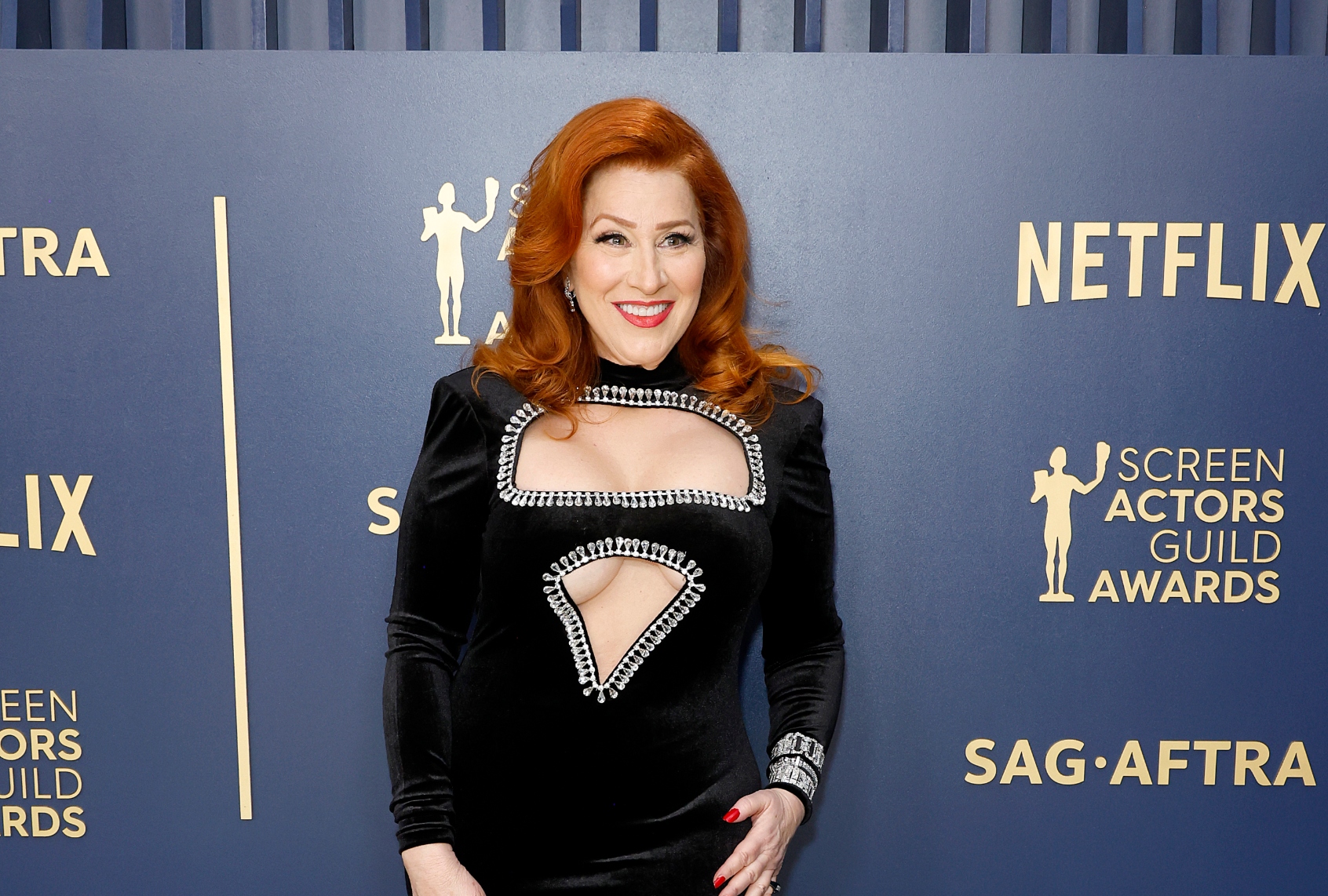
Lisa Ann Walter attends the 30th Annual Screen Actors Guild Awards at Shrine Auditorium and Expo Hall on February 24, 2024 in Los Angeles, California (Frazer Harrison/Getty Images)Appropriate to a show following a strike that lasted nearly four months after the actors guild joined the Writers Guild of America on the picket lines, the 2024 SAG awards were more celebratory than ceremonial, more casual and unforced than earnest and a good deal tipsier. For goodness’ sake, Elizabeth Debicki took the stage barefoot to accept her Actor for her work on “The Crown.”

Victories that catch the winners by surprise are the reasons live TV still excites. Pascal is effortlessly charming when he’s called on to be so — and even more appealing when he’s flummoxed. A later bit featuring Walter recording her banter with attendees while secretly mic’d felt giddy and good-natured.

We need your help to stay independent

A few past awards show traditions didn’t entirely return, however. Lifetime Achievement Award honoree Barbra Streisand delivered a heartfelt acceptance that walked a fine line between politics and industry glad-handing with a speech subtly pleading for a more humane approach to immigration and embracing the “other” without specifically using those terms.

The men we know as Samuel Goldwyn, Louis B. Mayer and the Warner Brothers, Streisand said, were all fleeing prejudice they faced in Eastern Europe, simply because of their religion. “[T]hey were dreamers too, like all of us here tonight,” she pointed out. “And now I dream of a world where such prejudice is a thing of the past."

A post-strike victory lap

Fran Drescher photographed during the 30th Screen Actors Guild Awards in Shrine Auditorium and Expo Hall in Los Angeles, CA, Saturday, Feb. 24, 2024 (Robert Gauthier / Los Angeles Times via Getty Images)SAG-AFTRA president Fran Drescher came to the stage with a sharper spear, praising members for facing down what she described as “a seminal moment in our union’s history” by being “not afraid, but brave; not weak, but in power; not peons, but partners.”

Drescher also used her moment to deliver a warning. “AI will entrap us in a matrix where none of us know what's real. If an inventor lacks empathy and spirituality, perhaps that's not the invention we need,” she said. “Dystopia stories can also become a self-fulfilling prophecy. We should tell stories that spark the human spirit, connect us to the natural world and awaken our capacity to love unconditionally."

“What does female leadership look like to women and girls?” she added. “We don't have to emulate male energy, but rather lead with intellect, compassion, wisdom and still rock a red lip.”

Greta Lee and Troy Kotsur speak onstage during the 30th Annual Screen Actors Guild Awards at Shrine Auditorium and Expo Hall on February 24, 2024 in Los Angeles, California (Matt Winkelmeyer/Getty Images)Yes, these are actors, but this is also the product of Netflix tapping Baz Halpin, whose production company is behind Taylor Swift’s Eras Tour and Usher’s Super Bowl halftime performance, to wrangle its first live-streamed awards telecast. The two-hour ceremony ran around 15 minutes over but rarely felt bogged down.

Credit the performances — and a few great votes — but give the producers their due, too. Several choices made the telecast feel more audience-inclusive than merely self-congratulatory, such as “CODA” star Troy Kotsur joining "Past Lives" star Greta Lee to present their award while using American Sign Language, which Kotsur carried through by signing out the winner’s name, Steven Yeun, before Lee said it.


Want a daily wrap-up of all the news and commentary Salon has to offer? Subscribe to our morning newsletter, Crash Course.


This was one way that the award show’s scripting outshone standard broadcast teleprompter blather, as if the producers crafted bespoke bits tailored to the presenters' specific talent instead of playing to the category or title in which they were featured.

As the "Breaking Bad” cast gathered to read the nominees for best ensemble, it was honestly refreshing to question whether Bob Odenkirk and Bryan Cranston, a pair of comedy naturals, led them in going rogue from what was shaping into absolute Teleprompter cornpone. (Though Jonathan Banks asking, “Where’s Giancarlo?” before the nominee reel kicked in was clearly unplanned — and voiced what many viewers must have been wondering.)

Give us some breaks

Bob Odenkirk, RJ Mitte, Anna Gunn, Bryan Cranston, Aaron Paul, Jonathan Banks, Betsy Brandt and Dean Norris on stage at 30th Annual Screen Actors Guild Awards at Shrine Auditorium and Expo Hall on February 24, 2024 in Los Angeles, California (Matt Winkelmeyer/Getty Images)Though Netflix’s SAG production was mostly a success, one patch worth considering for the next award livestream is a better solution for breaking up the two-hour marathon than making the audience suffer through Tan France’s nervous backstage prattle.

France may know style, but suffering through his attempts to engage "The Bear" stars Jeremy Allen White and Ayo Edebiri made me miss those wonderful advertisements with the actors cheerfully singing about a cure for upset stomach and diarrhea. Alas, the “Queer Eye” star’s interruptions weren’t sufficient breaks or supplemental but rather proved that red carpet interviewing is something few people do well. Sometimes, it’s better to let an award show’s energy flow instead of stopping it up.

Luckily, some genius had the good sense to haul over Pascal, who took control and recounted the tale of how his friendship with Culkin developed through respectful expressions of admiration for each other’s work. Addressing how he’d handle winning instead of the “Succession” star, Pascal joked, “I’m going to make out with Kieran tonight. That’ll be my revenge.”

Maybe he should emcee the backstage frivolity next time.

The 30th Annual Screen Actors Guild Awards are streaming on Netflix.

After two grueling years of bloodshed, it’s time for peace in Ukraine

As we mark two full years since Russia invaded Ukraine, Ukrainian government forces have reportedly withdrawn from Avdiivka, a town they first captured from pro-Russian forces in the Donetsk region in July 2014. Situated only 10 miles from Donetsk city, Avdiivka gave Ukrainian government forces a base from which their artillery bombarded Donetsk for nearly 10 years. From a prewar population of about 31,000, the town has been depopulated and left in ruins.

The mass slaughter on both sides in this long battle was a measure of the strategic value of the city to both sides, but it is also emblematic of the shocking human cost of this conflict, which has degenerated into a brutal and bloody war of attrition along a nearly static front line. Neither side made significant territorial gains in the entire 2023 year of fighting, with a net gain to Russia of a mere 188 square miles, or 0.1% of Ukraine.

And while it is the Ukrainians and Russians fighting and dying in this war of attrition, with more than half a million casualties, it is the United States, along with some of its Western allies, that has stood in the way of peace talks. This was true of talks between Russia and Ukraine that took place in March 2022, one month after the Russian invasion, and it is true of talks that Russia tried to initiate with the U.S. as recently as January 2024. 

In March 2022, Russian and Ukrainian officials met in Turkey and negotiated a peace agreement that should have ended the war. Under that agreement, Ukraine would become a neutral country between east and west, on the model of Austria or Switzerland, giving up its controversial ambition for NATO membership. Territorial questions over Crimea and the self-declared republics of Donetsk and Luhansk would be resolved peacefully, based on self-determination for the people of those regions.

But then the U.S. and U.K. intervened to persuade Ukrainian President Volodomyr Zelenskyy to abandon the neutrality agreement in favor of a long war aimed at driving Russia out of Ukraine and recovering Crimea and Donbas by force. U.S. and British leaders have never admitted to their own people what they did, nor tried to explain why they did it. 

It has been left to everyone else involved to reveal details of the agreement and the U.S. and U.K.’s roles in torpedoing it: Zelenskyy’s advisers; Ukrainian negotiators; Turkish foreign minister Mevlüt Çavuşoğlu and Turkish diplomats; then-Israeli Prime Minister Naftali Bennett, who was another mediator; and former German Chancellor Gerhard Schröder, who mediated with Russian President Vladimir Putin for Ukraine.

The U.S. sabotage of peace talks should come as no surprise. So much of American foreign policy follows what should by now be an easily recognizable and predictable pattern, in which our leaders systematically lie to us about their decisions and actions in crisis situations. By the time the truth is widely known, it is often too late to reverse the catastrophic effects of those decisions. Thousands of people have paid with their lives, no one is held accountable, and the world’s attention has moved on to the next crisis, the next series of lies and the next bloodbath, which in this case is Gaza.

But the war grinds on in Ukraine, whether we pay attention to it or not. Once the U.S. and U.K. succeeded in killing peace talks and prolonging the war, it fell into an intractable pattern common to many wars, in which Ukraine, the U.S. and the leading members of the NATO military alliance were encouraged, or we might say deluded, by limited successes at different times into continually prolonging and escalating the war and rejecting diplomacy, in spite of ever-mounting, appalling human costs for the people of Ukraine.

U.S. and NATO leaders have repeated ad nauseam that they are arming Ukraine to put it in a stronger position at the “negotiating table,” even as they keep rejecting negotiations. After Ukraine gained ground with its much celebrated offensives in the fall of 2022, Gen. Mark Milley, chairman of the Joint Chiefs of Staff, went public with a call to “seize the moment” and get back to the negotiating table from the position of strength that NATO leaders said they were waiting for. French and German military leaders were reportedly even more adamant that that moment would be short-lived if they failed to seize it. 

They were right. President Biden rejected his military advisers’ calls for renewed diplomacy, and Ukraine’s failed 2023 offensive wasted its chance to negotiate from a position of strength, sacrificing many more lives to leave it weaker than before.

We need your help to stay independent

On Feb. 13, 2024, Reuters Moscow bureau broke the story that the U.S. had recently rejected a new Russian proposal to reopen peace negotiations. Multiple Russian sources involved in the initiative told Reuters that Russia had proposed direct talks with the U.S. to call a ceasefire along the current front lines of the war. 

After Russia’s March 2022 peace agreement with Ukraine was vetoed by the U.S., this time Russia approached U.S. officials directly before involving Ukraine. There was a meeting of intermediaries in Turkey, and a meeting between Secretary of State Antony Blinken, CIA Director William Burns and national security adviser Jake Sullivan in Washington, but the result was a message from Sullivan that the U.S. was willing to discuss other aspects of U.S.-Russian relations, but not peace in Ukraine.  

And so the war grinds on. Russia is still firing 10,000 artillery shells per day along the front line, while Ukraine can only fire 2,000. In a microcosm of the larger war, some Ukrainian gunners have told reporters they were only allowed to fire three shells per night. As Sam Cranny-Evans of the U.K.'s RUSI military think tank told the Guardian, “What that means is that Ukrainians can’t suppress Russian artillery anymore, and if the Ukrainians can’t fire back, all they can do is try to survive.”

Russia is still firing 10,000 artillery shells per day along the front line, while Ukraine can only fire 2,000. Some Ukrainian gunners have told reporters they were only allowed to fire three shells per night.

A March 2023 European initiative to produce a million shells for Ukraine in a year fell far short, only producing about 600,000. U.S. monthly shell production in October 2023 was 28,000 shells, with a target of 37,000 per month by April 2024. The U.S. plans to increase production to 100,000 shells per month, but that will take until October 2025.

Meanwhile, Russia is already producing 4.5 million artillery shells per year. After spending less than one-tenth of the Pentagon budget over the past 20 years, how is Russia able to produce five times more artillery shells than the United States and its NATO allies combined? 

RUSI’s Richard Connolly explained to the Guardian that while Western countries privatized weapons production and dismantled “surplus” productive capacity after the end of the Cold War in the interest of corporate profits, “The Russians have been… subsidizing the defense industry, and many would have said wasting money for the event that one day they need to be able to scale it up. So it was economically inefficient until 2022, and then suddenly it looks like a very shrewd bit of planning.”

President Biden has been anxious to send more money to Ukraine — a whopping $61 billion — but disagreements in Congress between bipartisan Ukraine supporters and a Republican faction opposed to U.S. involvement have held up the funds. But even if Ukraine had endless infusions of Western weapons, it faces a more serious problem: Many of the troops it recruited to fight this war in 2022 have been killed, wounded or captured, and its recruitment system has been plagued by corruption and a lack of enthusiasm for the war among most of its people. 


Want a daily wrap-up of all the news and commentary Salon has to offer? Subscribe to our morning newsletter, Crash Course.


In August 2023, the government fired the heads of military recruitment in all 24 regions of the country after it became widely known that they were systematically soliciting bribes to allow men to avoid recruitment and gain safe passage out of the country. The Open Ukraine Telegram channel reported: “The military registration and enlistment offices have never seen such money before, and the revenues are being evenly distributed vertically to the top.”

The Ukrainian parliament is debating a new conscription law, with an online registration system that includes people living abroad and with penalties for failure to register or enlist. Parliament already voted down a previous bill that members found too draconian, and many fear that forced conscription will lead to more widespread draft resistance, or even bring down the government.

Oleksiy Arestovych, Zelenskyy’s former spokesman, told the Unherd website that the root of Ukraine’s recruitment problem is that only 20% of Ukrainians believe in the anti-Russian Ukrainian nationalism that has controlled Ukrainian governments since the overthrow of the Yanukovych government in 2014. “What about the remaining 80%?” the interviewer asked

“I think for most of them, their idea is of a multinational and poly-cultural country,” Arestovych replied. “And when Zelenskyy came into power in 2019, they voted for this idea. He did not articulate it specifically but it was what he meant when he said, ‘I don’t see a difference in the Ukrainian-Russian language conflict, we are all Ukrainians even if we speak different languages.’” 

U.S. war policy in Ukraine is predicated on a gradual escalation from proxy war to full-scale war with Russia, unavoidably overshadowed by the risk of nuclear war.

“And you know,” Arestovych continued, “my great criticism of what has happened in Ukraine over the last years, during the emotional trauma of the war, is this idea of Ukrainian nationalism which has divided Ukraine into different people: the Ukrainian speakers and Russian speakers as a second class of people. It’s the main dangerous idea and a worse danger than Russian military aggression, because nobody from this 80% of people wants to die for a system in which they are people of a second class.”

If Ukrainians are reluctant to fight, imagine how Americans would resist being shipped off to fight in Ukraine. A 2023 U.S. Army War College study of “Lessons from Ukraine” found that a U.S. ground war with Russia — which the U.S. may be preparing to fight — would involve an estimated 3,600 U.S. casualties per day, killing and maiming as many U.S. troops every two weeks as the wars in Afghanistan and Iraq did in 20 years. Echoing Ukraine’s military recruitment crisis, the authors concluded, “Large-scale combat operations troop requirements may well require a reconceptualization of the 1970s and 1980s volunteer force and a move toward partial conscription.”

U.S. war policy in Ukraine is predicated on just such a gradual escalation from proxy war to full-scale war between Russia and the United States, which is unavoidably overshadowed by the risk of nuclear war. This has not changed in two years, and it will not change unless and until our leaders take a radically different approach. That would involve serious diplomacy to end the war on terms on which Russia and Ukraine can agree, as they did on the March 2022 neutrality agreement.

Unearthing tension: Sand runs the world, but most don’t realize the conflict it generates

As William Blake famously wrote, "To see a World in a Grain of Sand / And a Heaven in a Wild Flower" is to "Hold Infinity in the palm of your hand / And Eternity in an hour." But as innocuous, ubiquitous and just plain mundane sand can be, it can also be the source of significant conflict and violence while often being extracted to the detriment of our planet.

When the term "conflict mineral" is used, people often think of precious stones like rubies or valuable fuels like coal. Certainly the industry of mining those rocks is fraught with controversy and peril, yet even the most seemingly ubiquitous minerals can serve as the source of conflict. But is sand really in the same category as cobalt and blood diamonds?

"Whilst not normally listed as a conflict mineral, the extraction of sands and gravels in some countries clearly has characteristics of being such."

According to a 2022 United Nations report, sand is the second-most consumed resource on Earth, surpassed only by water. And just like water, humans are consuming sand at an unsustainable rate — increasing by 6 percent every year, to be exact. As they do, they leave behind a wake of polluted rivers, severe droughts, shrinking aquifers and flooded communities. One statistic especially stands out: China alone has used more construction sand in the last few years than the United States used in the entire 20th century.

Even worse, sand is so valuable that it frequently becomes the source of tension. This is partially due to the fact, as corporations dredge up sand from the sea, they start altering local geography such as the shape of coastlines and the presence of small islands. Because sand miners are often unregulated, their activities can destroy local ecosystems, contaminate potable water for nearby communities and destroy entire agricultural sectors.

If all of this seems like a whole lot of ado over a common substance, guess again.

There is a reason why sand provokes violence: Like so many other minerals extracted from the ground, it is quite valuable.

"In some regions, illegal sand and gravel mining is associated with crime syndicates, coercion and violence, and many other related social impacts," James Leonard Best, a professor of sedimentary geology at the University of Illinois Urbana-Champaign, told Salon by email, adding that there have even been reported of so-called "sand mafias." "Whilst not normally listed as a conflict mineral, the extraction of sands and gravels in some countries clearly has characteristics of being such."

This is because, quite simply, every human being alive today relies on products that are at least in large part made from sand. Most people reading this article are doing so with the help of sand.

"Sand is used in many products such as smartphone screens, glass bottles and many other products but sand is predominantly used in the construction industry," Jakob Kløve Keiding from the Geological Survey of Denmark and Greenland (GEUS) told Salon by email. "Aggregates (sand, gravel and rocks) are a granular material used in construction in many ways such ready mixed concrete, precast concrete, asphalt products, and structural (unbound) materials. Aggregates have superior mechanical properties, good durability and are low cost products compared to many other materials that could potentially be used instead."

Best further elaborated on sand's multifaceted properties.

"Sand is a key ingredient of concrete globally, and in addition is a major material used for landfill and reclamation: many areas on which urbanization proceeds require infill of low/wet areas in order for construction to proceed," Best explained. "Dredged sands along coasts are also used in coastal protection works, construction of flood defenses and schemes to mitigate coastal erosion."

Best also pointed out that high-quality silica sands are widely used to manufacture glass for products like medical vials, microchips and glass panels. "As such, sand and gravels underpin our modern economies, and also are key in many aspects of the UN Sustainable Development Goals," Best said.


Want more health and science stories in your inbox? Subscribe to Salon's weekly newsletter Lab Notes.


"Sand and gravels underpin our modern economies."

Yet precisely because sand can be used for so many things, it is particularly vulnerable to being overused. As Keiding explained, even though sand may seem like a limitless resource to anyone who has hiked through a desert, it is in fact quite finite. Even worse, human beings have barely scratched the surface of mapping our sand allocations on a global level.

"It is important to stress that the aggregates sector is by far the largest amongst the non-energy extractive industries," Keiding told Salon, "so the demand is really massive and sand is occurring in different qualities. So when we talk about shortage, it is demand of certain high quality types — for instance used in concrete — that is critical and where there is scarcity." Keiding added that "the resources are unevenly distributed, so certain areas and regions can locally have significantly problems with the availability of enough resources (transportation of sand and gravel is very costly)."

Sand also leads to conflict because it can be mined from a diverse range of locales. Even though one would think finding useable sand is as easy as wandering through the Arabian desert, the unfortunate reality is that Arabian desert sand is too fine to be easily used for construction and other commercial endeavors.

In contrast, sand found in shallow marine environments and rivers has rougher edges and therefore can be properly used for construction (although as Best warned, sand acquired from shallow marine environments can be problematic when it comes to making strong concrete because of the high salt concentrations). Sand extracted from ancient geological reserves like sand quarries has likewise not been smoothed out by exposure to wind and the elements.

In short, while only certain types of sand possess the correct physical properties to be commercialized, that type of sand can be found in a wide range of locations. That in turn increases the environmental damage that can be caused by sand mining, as well as the conflicts that inevitably ensue when large groups of humans seek profit from a natural resource.

"Market price can dictate that use of local sands is far more feasible than those from further away, and thus in areas that are experiencing rapid economic growth, and especially urbanization, the demands for sand has increased greatly," Best wrote to Salon. "This can create scarcity in some areas, drive up the price of sand, which then feeds back to increase the economic feasibility of mining sands in modern environments and ancient sediments. Excessive sand mining can cause a range of environmental impacts to rivers and coasts, with a wide range of socio-economic issues associated with this (ranging from degradation of environments, to human migration, to poverty, crime and gender issues)."

We need your help to stay independent

If there is any hopeful edge to this story, it is that the sand crisis is not unsolvable. Best referred to a 2019 paper he co-authored for the journal Nature, one that included a so-called "agenda for sand." It entailed requiring sustainable sources of sand to be sought and certified, encouraging national and local governments to use alternatives to sand, reusing sand-based materials whenever possible and reducing the amount of concrete used in structures. The paper also called for multinational regulation of sand use, constant public education about the dangers of sand mining and a global monitoring program to assess when there have been ecological catastrophes related to sand mining.

"We have to take a holistic approach that centrally involves the stakeholders – those who lives are affected by sand mining (both positively and negatively) — and base our approach on the sustainable needs of communities, as well as the need to safeguard the environment to help mitigate harmful change," Best told Salon. "This demands approaches that are multidisciplinary and integrate the human and physical landscapes, to tackle the many issues of sand mining (across many different spatial scales – the issues of mining vary greatly between countries and continents), and how these issues will change in the coming decades as populations grow, technologies evolve and the demands for sand shifts spatially across the globe."

As Keiding put it, "The use of sand/aggregates is faced with two major challenges; one is related to the availability of high-quality resources addressed in my previous comments; the other is the environmental/climate impact of sand exploitation."

Barbra Streisand reflects on the way things were while being honored at the SAG Awards

Dressed in black and gold with prepared notes confidently held in her gloved hands — knowing well enough to not trust the teleprompters — Barbra Streisand delivered a speech after being honored with the SAG Life Achievement Award that brought theater kid Anne Hathaway, among many other celebrities in attendance, to tears.

Reflecting on her early days growing up in Brooklyn, where her mother advised her to learn how to type as she didn't feel she had the looks of someone who could make it in Hollywood, Streisand said "she didn't listen," which worked out for the best, for all of us.

"And somehow, someway, it all came true," she continued in her reflection on that leap that began it all, mentioning William Wyler, the director of her first film, "Funny Girl," and his cinematographer Harry Stradling as being her earliest champions who had no problem working with a woman who had opinions and who never, ever put her down.

Saying she prefers the world of movies over that of reality, she gave thanks to the privilege of being able to be a part of an industry that allows people to sit in a theater and escape their troubles for a few hours.

"I can't help but think back to the people who built this industry," she said. "Ironically, they were also escaping their own troubles. Men like Szmuel Gelbfisz, who changed his name to Samuel Goldwyn. Lazar Meir, who became Louis B. Mayer. And the four Wonsal brothers, who became Warner Brothers. They were all fleeing the prejudice they faced in Eastern Europe, simply because of their religion. And they were dreamers too, like all of us here tonight. And now I dream of a world where such prejudice is a thing of the past."

Listen to her full speech here.

Trump compares migrants to Hannibal Lecter in bizarre CPAC rant

Speaking at the Conservative Political Action Conference (CPAC) on Saturday, Donald Trump spent a good chunk of time weaving a narrative wherein American citizens are to be made aware of droves of killer migrants right out of a horror movie, which he fears are being deposited into the United States by the millions.

Vowing to "shepherd in the largest deportation of migrants in American history" should he be re-elected, he unfolded the foretold scenario, which would honestly make for a good A24 or Blumhouse script, if they were in the market for something racist.

"It’s migrant crime. It’s a new category of crime. And I wanted to call it Biden Migrant Crime. But it’s too long. So we just call it migrant crime. We have a new category, Migrant Crime," Trump said, as outlined in coverage by Mediaite.

"And it’s going to be more severe than violent crime and crime as we knew it, because we have millions and millions of people, and they came from prisons and jails. They came from mental institutions and insane asylums. No, they’re not the same. An insane asylum is a mental institution on steroids, Ok? It’s 'Silence of the Lambs,' Ok?. You know that. Hannibal Lecter! They’re all being deposited into our country. And then you have terrorists, and then you have drugs, and then you have human traffickers, and they’re coming over at levels never seen before. We’ve never seen anything like this."

In response to this, the Biden campaign posted from the Biden-Harris HQ account, “Trump, who just sabotaged the bipartisan deal to secure the border, claims Democrats want 'open walls.'"

Watch here:

Amy Schumer says that internet trolling led to Cushing Syndrome diagnosis

While making the rounds to promote the second season of "Life & Beth," Amy Schumer became inundated with internet trolls coming out of the woodwork to comment on her appearance, tripping over themselves to point out what they referred to as her "puffy face."

In a post to Instagram on February 15, Schumer fired back at this, writing, "Binge both full seasons of @lifeandbethhulu and thank you so much for everyone’s input about my face! I’ve enjoyed feedback and deliberation about my appearance as all women do for almost 20 years. And you’re right it is puffier than normal right now. I have endometriosis an auto immune disease that every woman should read about. There are some medical and hormonal things going on in my world right now but I’m okay. Historically women’s bodies have barely been studied medically compared to men." But after consulting with her doctors further, Schumer learned of a new diagnosis.

In Friday's edition of Jessica Yellin's "News Not Noise" newsletter, Schumer reveals that the comments on her face led to the discovery that she has Cushing syndrome, a condition that occurs when too much cortisol (the primary stress hormone) is inside one's body for a long time, according to the Mayo Clinic.

"While I was doing press on camera for my Hulu show, I was also in MRI machines four hours at a time, having my veins shut down from the amount of blood drawn and thinking I may not be around to see my son grow up. So finding out I have the kind of Cushing that will just work itself out and I'm healthy was the greatest news imaginable," said Schumer, adding, "It has been a crazy couple of weeks for me and my family. Aside from fears about my health, I also had to be on camera having the internet chime in. But thank God for that. Because that's how I realized something was wrong."

Watch here:

https://www.instagram.com/p/C3tNHt-uQbj/?hl=en

“The Traitors” and the lying liars who make it the reality treat of our time

Some reality shows take a season or two to become their best selves. Remember the first season of “Big Brother”? Unless you’re a superfan, probably not. How about this: Who won the very first “RuPaul’s Drag Race” pageant? Trick question – technically BeBe Zahara Benet is correct, but the answer we're looking for is the Vaseline-coated camera lens.

“The Traitors,” Peacock’s breakout reality hit, is the newest inductee to this late bloomers club, a Scotland-set murder mystery competition hosted by international delight Alan Cumming. You might have heard about its first season last year and shrugged it off, assuming that if you’ve seen one of these shows, this can’t be much different.  

Half of its contestants were normies, half reality show alumni, and somewhat predictably, a “Survivor” contestant won it all. For its second go-round, the producers took notes and leveled up. This cast is a murderer’s row of reality all-stars whose egos overrule good sense. Almost everybody has watched at least some of each other’s shows or has shared a season with someone.

Just as importantly, we know these characters or the environments that produced them. You don’t have to have seen “Survivor” in years to know the whole point is to outwit, outplay and outlast by any means necessary including betrayal. It was mainly reality competition alumni who made it the farthest in Season 1. Kate Chastain, the “Below Deck” life of the party, was the exception.

The first season featured but one of the “Real Housewives,” a franchise that thrives on fake friendships, backstabbing and alliances of convenience. Season 2 has four of them, including one, Larsa Pippen, who brought along her boyfriend Marcus, Michael Jordan’s son. There’s a “Bachelor” and two players from “Love Island,” popularity contests where potential dates sow doubt with their quarry, wondering aloud if rivals are there for the right reasons.

Reality TV runs on the reputation of the shows and the personalities populating them. But the central thrill is in watching how well these people can lie. The Scandoval season of “Vanderpump Rules” became a hit because a giant, life-altering deception came to light before the season aired and got messier as each new episode debuted, allowing audiences to see what shams two longstanding and supposedly close relationships turned out to be.

Bravo’s various windows into the lifestyles of the striving and ostentatious, “Big Brother” players and “Survivor” contenders, even Bachelors and Bachelorettes all have to lie convincingly whether they want to or not.

All that sauces the magnificence of “Traitors,” especially in Season 2. Extensive knowledge of reality TV isn’t a prerequisite, thank goodness, because the producers cast archetypes. You can discern “Survivor” and “Big Brother” contestants from Bravo’s flora and fauna based on the amount of makeup they’re wearing and the height of their heels. Another early standout is Johnny “Bananas” Devenanzio, a graduate of MTV University, the party school of the unscripted world.

Reality TV runs on the reputation of the shows and the personalities populating them. But the central thrill is in watching how well these people can lie.

Above all, you must appreciate the way it makes lying a virtue and belief or lack thereof a loyalty indicator, two concepts we all recognize and understand.

We live in a time when seditionaries are considered patriots by one of the top candidates for the presidency. Dishonesty is prevalent and powerful enough to make a frightening percentage of Americans believe absolute idiocy over common sense, and horse paste over hard science.

The TraitorsAlan Cumming on "The Traitors" (Euan Cherry/PEACOCK)One wonders if this show could have thrived before the pandemic, when one could not risk to breathe the same air as strangers, or before Donald Trump’s influence necrotized every corner of common discourse. We’ll never know that answer, only that “The Traitors” is tailored to this moment – and makes us feel better somehow, by adding an air of aristocratic elegance.

Cumming, a two-time Tony winner who also has a BAFTA, an Emmy, and a Laurence Olivier Award, delights in playing up that idea. He hosts PBS’ “Masterpiece Mystery!,” making his “Traitors” role somewhat on brand. As the fictional laird of Ardross Castle, Cummings is a heightened version of himself, making daily entrances in an assortment of traffic-stopping bespoke getups, speaking in a high-and-mighty tone meant to remind everyone how powerless they are as he promises banishments and "murr-durr."

We need your help to stay independent

In a place that’s lousy with “Real Housewives” and cast members from “Shahs of Sunset” and “Bling Empire,” showing who’s boss is crucial. They’re joined by familiar faces from “The Challenge,” “Real World: Las Vegas,” a “Dancing with the Stars” coach and Peppermint, a "Drag Race" contestant.

Pro boxer Deontay Wilder and Jordan are about as average as the Joes in this cast get, although more American viewers may know their names than the ones who would pick John Bercow out of a line-up. He’s the Former speaker of the U.K.’s House of Commons.

You may see this as a more even mixture between competitive contestants and, people who are just being themselves or, in Bercow’s case, a living “Monty Python” character.  

This crew is abysmal at discerning friend from foe.

“Traitors” ostensibly places them on a level playing field with a premise similar to the rules of Mafia, Werewolf or Among Us, a popular virtual escape during pandemic lockdowns. Out of the 22 people summoned this season, most are innocents, dubbed Faithfuls. But in the first episode, Cumming selects two to be secret Traitors, who privately meet each night to plot who they’ll murder and, in the first episode, recruit another to join them.

Every morning the cast wakes up to one fewer person and a roomful of shocked faces and “so sad!” gasps. Then the paranoia sets in. Players spend their days working together to win challenges, increasing their prize pot. Some can score shields, blocking them from attempted homicides. Every evening they sit down to a round table and accuse their fellow players of being treacherous, backstabbing bastards.

Then the vote to banish someone who, on their way out, reveals whether they are a Traitor or a Faithful. If they root out all Traitors, the remaining Faithfuls split the winnings. But if even one Traitor remains, that person takes it all. And . . . this crew is abysmal at discerning friend from foe. The stakes have intensified as the Faithfuls have dwindled, mainly due to their impressive talent for misreading the smallest twitch or Freudian slip as evidence of deceit. One player can't take it and bows out, leaving room for Chastain's return to enliven the party.

Watching the survivors revert to their familiar personas has been the real treat, though. In recent episodes, Bercow’s oratorial prowess came into full flower, as he belched forth merciless diatribes that made several bystanders go cross-eyed.

The TraitorsChris 'C.T.' Tamburello and Phaedra Parks on "The Traitors" (Euan Cherry/PEACOCK)Meanwhile Phaedra Parks, the shrewdly entrepreneurial dominatrix of “The Real Housewives of Atlanta” and “Married to Medicine,” has stealthily run circles around her housemates.
Cumming tapped her to be a Traitor from the get-go, a choice the producers engineered with the full knowledge of her capabilities. Parks is a charming, colorful bird of paradise who seems trustworthy and diplomatic and raves about the breakfast spread, especially after a hard night of cackling through a delectable homicide. While others are faux weeping over “slain” housemates, her main concern is whether smoked salmon is available.

Somehow she's made it through nine episodes, even surviving a direct assault from a fellow Traitor who tried to offer her up in his place. Parks responded with her version of three-dimensional strategy famously ascribed to Trump's mentor in trickery Roy Cohn: she did not surrender. She both counterattacked and counter-accused. And she refused to admit defeat. The turncoat was not only defeated but humiliated. It was a terrifying beauty to behold.


Want a daily wrap-up of all the news and commentary Salon has to offer? Subscribe to our morning newsletter, Crash Course.


Her nemesis, “Bachelor” Peter Weber, has become the crusader, banding together with the house’s “underdogs” to root out Parks’ other partners in crime by setting traps. Furthering the theory of “The Traitors” as a societal microcosm, the remaining players have gone partisan, inspiring Cumming to drop a Frankie Goes to Hollywood lyric in keeping with the show’s gleeful marriage of highbrow and lowbrow.

On one side is Bravo folks, along with remaining “Survivor” and two-time victor Sandra Diaz-Twine; “Housewives” and the “Shahs of Sunset” love a winner. On the other are the remainders – the gamers, the “Real World” guy and that “Bachelor,” who devised a strategy that led to them rooting out two Traitors. The more effective Weber is, the more his teammates suspect he’s a liar. Typical politics!

This week’s cliffhanger leaves us in suspense as to who is banished. Without naming names, the pertinent qualities of each candidate are these: one makes a living as a commercial airline pilot, an occupation requiring them to be unerring and trustworthy enough to take dozens of lives in their hands every day.

The other is a lawyer.

Remember what season we’re in and place your wagers accordingly.

New episodes of "The Traitors" stream Thursdays at 6 p.m. PT/ 9 p.m. ET on Peacock. 


The “bowlification” of fast casual dining is ruining the authenticity of cultural cuisines

Earlier this month, Emma Beddington wrote a biting opinion piece for The Guardian about her distaste of bowls. The “bowl,” in this case, isn’t just a mere dishware — it’s a specific style of meal, neatly composed of grains, protein, greens and some kind of sauce.

Beddington’s criticism was geared towards the bowl’s “joyless refueling” that’s akin to dorm-room foods, existing purely to provide sustenance and nothing more: “Let’s simplify and streamline it into an efficient nutrient delivery system, ensuring macros are checked off, and requisite kilocalories delivered to fuel eight more hours of programming or equations or whatever.” 

The bowl, Beddington said, is devoid of pleasure. It simplifies the art of eating and reduces food to an overused formula. Remember the MyPlate plan from the United States Department of Agriculture? It’s essentially a visual reminder of the five food groups necessary for a balanced diet: fruits, vegetables, grains, protein and dairy. That’s what the bowl epitomizes. I say that not to discredit the importance of healthy eating, but to show how run-of-the-mill bowl eating is.

Four days after Beddington’s piece was published, readers responded with strong feelings about eating food by the bowl, now known in some pockets of the internet as “bowlification.” Some argued that bowled food is “affordable, delicious and filling,” while others claimed that such food represents just a sliver of the American restaurant scene. In the last decade, “bowlification” has become a growing — and persevering — trend within fast-casual dining. Chipotle unwrapped its burritos and reimagined them as burrito bowls. Sweetgreen, which writer Jia Tolentino described “feels less like a place to eat and more like a refueling station,” packaged an assortment of nutrient-dense, plant-forward foods into brown recycled paper bowls. And Cava handpicked Mediterranean ingredients to compile customizable salads and greens-and-grains bowls.

Bowls certainly have their benefits. They allow consumers to try a little bit of everything, as opposed to just one or two large dishes, explained food and travel writer Catherine Rickman for Food Republic. They allow consumers to be in charge of what they want to eat, which is great for those with dietary restrictions and picky eaters. They also allow chefs to introduce non-mainstream dishes to the public in a manner that’s more familiar and less daunting.  

Much of bowl eating centers on international cuisines (think about it, when have you ever seen American fare be presented in bowl form?). Unfortunately, a major downside of the bowl is that it gentrifies such cuisines, stripping them of their authenticity in an attempt to make them more palatable for the majority white consumers. Bowl eating is a subset of fast casual meals, which are increasingly popular in the American work week diet. White-collared employees, in particular, are in search of cohesive meals that are 1) easy to eat while sitting in front of a computer, answering phone calls or participating in meetings and 2) satisfying, mainly for the belly. 

“We’re notoriously known for work, work, work, work,” Leora Halpern Lanz, assistant dean of Boston University School of Hospitality Administration, told Boston.com. “I don’t know too many people that take a real lunch break. Usually it’s a working lunch, or it’s something quick at your desk.”

We need your help to stay independent

While bowl eating is efficient for consumers, it’s not at all authentic. Major franchises that claim to celebrate authentic flavors and spices in their meals are often doing so in an attempt to appease to a white consumership. The resulting concoction is often a hodgepodge of traditional dishes that are meant to be enjoyed on their own, not in tandem with each other. 

A local example that comes to mind for me is RASA, a popular Indian fast-casual eatery with locations across Maryland, Virginia and Washington, D.C. RASA’s CEO’s, Sahil Rahman and Rahul Vinod, explained that growing up, many of their friends in the states “either hadn't tried Indian food or had misperceptions about it.” The duo often heard stuff like “I don't like curry!” and “Isn't it all spicy?” — common hesitations raised by those not too familiar with the cuisine, namely white folks.

"The resulting concoction is often a hodgepodge of traditional dishes that are meant to be enjoyed on their own, not in tandem with each other."

Thanks to social media, the stereotype of “white people food” has become a joke, a meme and a running gag. “White people food” is bland, unseasoned, unappetizing and “so flavorless it could make you cry,” wrote Bon Appétit’s Jenny G. Zhang. The opposite of “white people food” is foods that are filled with seasonings, spices and a copious amount of rich flavors. On this spectrum, the middle ground is cultural foods that are seasoned just enough, so that it has flavor but not too much that it will deter white taste buds (or have folks reaching for their water glass every few seconds). I’d argue that this is still “white people food” but with added pizzazz. It’s “Americanized” renditions of international cuisines made for those who aren’t blatantly culturally insensitive, but aren’t keen on trying — or capable of handling) authentic, unfiltered traditional dishes.


Want more great food writing and recipes? Subscribe to Salon Food's newsletter, The Bite.


When it comes to Indian dishes, popular non-traditional, “Americanized” foods include butter chicken, tandoori chicken, chicken tikka masala, palak paneer and samosas. No hate to these dishes, but they don’t accurately represent Indian cuisine, or even South Asian cuisine. But RASA’s menu is filled with these dishes — lemon turmeric rice and something called “sexygreens,” chicken tikka and tandoori paneer are protein options, and spiced chickpeas and roasted lentils are additional toppings. Not to mention that there’s also mango salsa, which isn’t even remotely South Asian.

“When dishes from other cultures and countries go mainstream in the U.S., they tend to go from deli to delicacy in a heartbeat, with rising prices often cutting off access to the people who popularized the dish in the first place,” wrote Rickman. “They can also decontextualize dishes, leading to a warped understanding in the public opinion of what exactly a dish is.”

Bowl eating isn’t going away anytime soon. As of 2023, the fast-casual market is expected to grow by 10% over the next five years, per LinkedIn

Beddington said it best when it comes to summing up bowlification: “It’s perfectly edible, but spookily soulless, like eating with all the sensual pleasure, surprise and joy extracted. Which is exactly what it is: you leave full, but also empty.”

Oklahoma senator calls LGBTQ+ people “filth” while commenting on death of Nex Benedict

During a legislative forum in Oklahoma on Friday sponsored by the Tahlequah Area Chamber of Commerce, Sen. Tom Woods, R-Westville, commented on the death of 16-year-old nonbinary student Nex Benedict following an attack that took place on February 7 at Owasso High School, saying, "I represent a constituency that doesn't want that filth in Oklahoma," meaning gender fluidity, not apparent murder.

Joined by other area lawmakers in addressing the tragic event that is still under investigation, Woods said in an earlier statement that his "heart goes out, in that scenario, if that is the case," in reference to allegations that brute force on the part of three older girls who ganged up on Benedict in a bathroom at the school and banged their head against the floor may have caused them to black out and, ultimately, die in a local hospital a day later.

According to reporting by The Daily Press, Woods' comments came after a woman in attendance at the forum asked, "Why does the legislature have such an obsession with the LGBTQ citizens of Oklahoma and what people do in their personal lives and how they raise their children?” To which he responded with the above, along with, "We are a Republican state and I’m going to vote my district, and I’m going to vote my values," emphasizing the moral and Christian fortitude of the Republican way of life in Oklahoma that he aims to represent. 

State Rep. David Hardin claimed to have no knowledge of what happened with Benedict at all, saying, “That’s horrible. I don’t know about that case but I’ll check into it.”

On Wednesday, the Owasso Police issued a statement on Benedict's death saying, "While the investigation continues into the altercation, preliminary information from the medical examiner’s office is that a complete autopsy was performed and indicated that the decedent did not die as a result of trauma. At this time, any further comments on the cause of death are currently pending until toxicology results and other ancillary testing results are received. The official autopsy report will be available at a later date." But the child's mother, along with many others who are following the case, are not in alignment with that statement.

In a text exchange with Popular Information, Sue Benedict, Nex's mother, said she considered the Owasso Police statement a "big cover" and believed it was only released as "something to calm the people." 


Want a daily wrap-up of all the news and commentary Salon has to offer? Subscribe to our morning newsletter, Crash Course.


In newly released bodycam footage of a school resource officer's interview with Nex and their mother at the hospital following the attack at the school, a first-hand account is given of what took place on the day in question, resulting in the last story that Nex will ever tell. 

"I got jumped," Nex tells the officer.

And when asked why they didn't report the incident to school officials, Nex says, "I didn't really see the point."

Swarms of AI “killer robots” are the future of war: If that sounds scary, it should

Yes, it’s already time to be worried — very worried. As the wars in Ukraine and Gaza have shown, the earliest drone equivalents of “killer robots” have made it onto the battlefield and proved to be devastating weapons. But at least they remain largely under human control. Imagine, for a moment, a world of war in which those aerial drones (or their ground and sea equivalents) controlled us, rather than vice versa. Then we would be on a destructively different planet in a fashion that might seem almost unimaginable today. Sadly, though, it’s anything but unimaginable, given the work on artificial intelligence and robot weaponry that the major powers have already begun. Now, let me take you into that arcane world and try to envision what the future of warfare might mean for the rest of us.

By combining AI with advanced robotics, the U.S. military and those of other advanced powers are already hard at work creating an array of self-guided “autonomous” weapons systems — combat drones that can employ lethal force independently of any human officers meant to command them. Called “killer robots” by critics, such devices include a variety of uncrewed or “unmanned” planes, tanks, ships and submarines capable of autonomous operation. The U.S. Air Force, for example, is developing its “collaborative combat aircraft,” an unmanned aerial vehicle, or UAV, intended to join piloted aircraft on high-risk missions. The Army is similarly testing a variety of autonomous unmanned ground vehicles, or UGVs, while the Navy is experimenting with both unmanned surface vessels, or USVs and unmanned undersea vessels or drone submarines). China, Russia, Australia and Israel are also working on such weaponry for the battlefields of the future.

The imminent appearance of those killing machines has generated concern and controversy globally, with some countries already seeking a total ban on them and others, including the U.S., planning to authorize their use only under human-supervised conditions. In Geneva, a group of states has even sought to prohibit the deployment and use of fully autonomous weapons, citing a 1980 U.N. treaty, the Convention on Certain Conventional Weapons, that aims to curb or outlaw non-nuclear munitions believed to be especially harmful to civilians. Meanwhile, in New York, the U.N. General Assembly held its first discussion of autonomous weapons last October and is planning a full-scale review of the topic this coming fall.

For the most part, debate over the battlefield use of such devices hinges on whether they will be empowered to take human lives without human oversight. Many religious and civil society organizations argue that such systems will be unable to distinguish between combatants and civilians on the battlefield and so should be banned in order to protect noncombatants from death or injury, as is required by international humanitarian law. American officials, on the other hand, contend that such weaponry can be designed to operate perfectly well within legal constraints.

However, neither side in this debate has addressed the most potentially unnerving aspect of using them in battle: the likelihood that, sooner or later, they’ll be able to communicate with each other without human intervention and, being “intelligent,” will be able to come up with their own unscripted tactics for defeating an enemy — or something else entirely. Such computer-driven groupthink, labeled “emergent behavior” by computer scientists, opens up a host of dangers not yet being considered by officials in Geneva, Washington or at the U.N.

Neither side in the debate on "killer robots" has addressed the most potentially unnerving aspect of using them in battle: sooner or later, they’ll be able to communicate with each other without human intervention.

For the time being, most of the autonomous weaponry being developed by the American military will be unmanned (or, as they sometimes say, “uninhabited”) versions of existing combat platforms and will be designed to operate in conjunction with their crewed counterparts. While they might also have some capacity to communicate with each other, they’ll be part of a “networked” combat team whose mission will be dictated and overseen by human commanders. The Collaborative Combat Aircraft, for instance, is expected to serve as a “loyal wingman” for the manned F-35 stealth fighter, while conducting high-risk missions in contested airspace. The Army and Navy have largely followed a similar trajectory in their approach to the development of autonomous weaponry.

The appeal of robot “swarms”

However, some American strategists have championed an alternative approach to the use of autonomous weapons on future battlefields in which they would serve not as junior colleagues in human-led teams but as coequal members of self-directed robot swarms. Such formations would consist of scores or even hundreds of AI-enabled UAVs, USVs or UGVs — all able to communicate with one another, share data on changing battlefield conditions and collectively alter their combat tactics as the group-mind deems necessary.

“Emerging robotic technologies will allow tomorrow’s forces to fight as a swarm, with greater mass, coordination, intelligence and speed than today’s networked forces,” predicted Paul Scharre, an early enthusiast of the concept, in a 2014 report for the Center for a New American Security. “Networked, cooperative autonomous systems,” he wrote then, “will be capable of true swarming — cooperative behavior among distributed elements that gives rise to a coherent, intelligent whole.”

Full realization of the swarm concept would require advanced algorithms that enable autonomous combat systems to communicate with each other and “vote” on preferred modes of attack.

As Scharre made clear in his prophetic report, any full realization of the swarm concept would require the development of advanced algorithms that would enable autonomous combat systems to communicate with each other and “vote” on preferred modes of attack. This, he noted, would involve creating software capable of mimicking ants, bees, wolves and other creatures that exhibit “swarm” behavior in nature. As Scharre put it, “Just like wolves in a pack present their enemy with an ever-shifting blur of threats from all directions, uninhabited vehicles that can coordinate maneuver and attack could be significantly more effective than uncoordinated systems operating en masse.”

In 2014, however, the technology needed to make such machine behavior possible was still in its infancy. To address that critical deficiency, the Department of Defense proceeded to fund research in the AI and robotics field, even as it also acquired such technology from private firms like Google and Microsoft. A key figure in that drive was Robert Work, a former colleague of Paul Scharre’s at CNAS and an early enthusiast of swarm warfare. Work served from 2014 to 2017 as deputy secretary of defense, a position that enabled him to steer ever-increasing sums of money to the development of high-tech weaponry, especially unmanned and autonomous systems.

From Mosaic to Replicator

Much of this effort was delegated to the Defense Advanced Research Projects Agency, the Pentagon’s in-house high-tech research organization. As part of a drive to develop AI for such collaborative swarm operations, DARPA initiated its “Mosaic” program, a series of projects intended to perfect the algorithms and other technologies needed to coordinate the activities of manned and unmanned combat systems in future high-intensity combat with Russia and/or China.

We need your help to stay independent

“Applying the great flexibility of the mosaic concept to warfare,” explained Dan Patt, deputy director of DARPA’s Strategic Technology Office, “lower-cost, less complex systems may be linked together in a vast number of ways to create desired, interwoven effects tailored to any scenario. The individual parts of a mosaic are attritable [dispensable], but together are invaluable for how they contribute to the whole.”

This concept of warfare apparently undergirds the new “Replicator” strategy announced by Deputy Secretary of Defense Kathleen Hicks just last summer. “Replicator is meant to help us overcome [China’s] biggest advantage, which is mass. More ships. More missiles. More people,” she told arms industry officials last August. By deploying thousands of autonomous UAVs, USVs, UUVs and UGVs, she suggested, the U.S. military would be able to outwit, outmaneuver, and overpower China’s military, the People’s Liberation Army. “To stay ahead, we’re going to create a new state of the art. … We’ll counter the PLA’s mass with mass of our own, but ours will be harder to plan for, harder to hit, harder to beat.”

To obtain both the hardware and software needed to implement such an ambitious program, the Department of Defense is now seeking proposals from traditional defense contractors like Boeing and Raytheon as well as AI startups like Anduril and Shield AI. While large-scale devices like the Air Force’s Collaborative Combat Aircraft and the Navy’s Orca Extra-Large UUV may be included in this drive, the emphasis is on the rapid production of smaller, less complex systems like AeroVironment’s Switchblade attack drone, now used by Ukrainian troops to take out Russian tanks and armored vehicles behind enemy lines.

At the same time, the Pentagon is already calling on tech startups to develop the necessary software to facilitate communication and coordination among such disparate robotic units and their associated manned platforms. To facilitate this, the Air Force asked Congress for $50 million in its fiscal year 2024 budget to underwrite what it ominously enough calls Project VENOM, or “Viper Experimentation and Next-generation Operations Model.” Under VENOM, the Air Force will convert existing fighter aircraft into AI-governed UAVs and use them to test advanced autonomous software in multi-drone operations. The Army and Navy are testing similar systems.

When swarms choose their own path

In other words, it’s only a matter of time before the U.S. military (and presumably China’s, Russia’s and perhaps those of a few other powers) will be able to deploy swarms of autonomous weapons systems equipped with algorithms that allow them to communicate with each other and jointly choose novel, unpredictable combat maneuvers while in motion. Any participating robotic member of such swarms would be given a mission objective (“seek out and destroy all enemy radars and anti-aircraft missile batteries located within these [specified] geographical coordinates”) but not be given precise instructions on how to do so. That would allow them to select their own battle tactics in consultation with one another. If the limited test data we have is anything to go by, this could mean employing highly unconventional tactics never conceived for (and impossible to replicate by) human pilots and commanders.

The propensity for such interconnected AI systems to engage in novel, unplanned outcomes is what computer experts call “emergent behavior.” As ScienceDirecta digest of scientific journals, explains it, “An emergent behavior can be described as a process whereby larger patterns arise through interactions among smaller or simpler entities that themselves do not exhibit such properties.” In military terms, this means that a swarm of autonomous weapons might jointly elect to adopt combat tactics none of the individual devices were programmed to perform — possibly achieving astounding results on the battlefield, but also conceivably engaging in escalatory acts unintended and unforeseen by their human commanders, including the destruction of critical civilian infrastructure or communications facilities used for nuclear as well as conventional operations.


Want a daily wrap-up of all the news and commentary Salon has to offer? Subscribe to our morning newsletter, Crash Course.


At this point, of course, it’s almost impossible to predict what an alien group-mind might choose to do if armed with multiple weapons and cut off from human oversight. Supposedly, such systems would be outfitted with failsafe mechanisms requiring that they return to base if communications with their human supervisors were lost, whether due to enemy jamming or for any other reason. Who knows, however, how such thinking machines would function in demanding real-world conditions or if, in fact, the group-mind would prove capable of overriding such directives and striking out on its own.

What then? Might they choose to keep fighting beyond their preprogrammed limits, provoking unintended escalation — even, conceivably, of a nuclear kind? Or would they choose to stop their attacks on enemy forces and instead interfere with the operations of friendly ones, perhaps firing on and devastating them (as Skynet does in the classic science fiction "Terminator" movie series)? Or might they engage in behaviors that, for better or infinitely worse, are entirely beyond our imagination?

Autonomous weapons might jointly elect to adopt combat tactics none of the individual devices were programmed to perform — conceivably engaging in acts unintended and unforeseen by their human commanders.

Top U.S. military and diplomatic officials insist that AI can indeed be used without incurring such future risks and that this country will only employ devices that incorporate thoroughly adequate safeguards against any future dangerous misbehavior. That is, in fact, the essential point made in the “Political Declaration on Responsible Military Use of Artificial Intelligence and Autonomy” issued by the State Department in February 2023. Many prominent security and technology officials are, however, all too aware of the potential risks of emergent behavior in future robotic weaponry and continue to issue warnings against the rapid utilization of AI in warfare.

Of particular note is the final report that the National Security Commission on Artificial Intelligence issued in February 2021. Co-chaired by Robert Work (back at CNAS after his stint at the Pentagon) and Eric Schmidt, former CEO of Google, the commission recommended the rapid utilization of AI by the U.S. military to ensure victory in any future conflict with China and/or Russia. However, it also voiced concern about the potential dangers of robot-saturated battlefields.

“The unchecked global use of such systems potentially risks unintended conflict escalation and crisis instability,” the report noted. This could occur for a number of reasons, including “because of challenging and untested complexities of interaction between AI-enabled and autonomous weapon systems [that is, emergent behaviors] on the battlefield.” Given that danger, it concluded, “countries must take actions which focus on reducing risks associated with AI-enabled and autonomous weapon systems.”

When the leading advocates of autonomous weaponry tell us to be concerned about the unintended dangers posed by their use in battle, the rest of us should be worried indeed. Even if we lack the mathematical skills to understand emergent behavior in AI, it should be obvious that humanity could face a significant risk to its existence, should killing machines acquire the ability to think on their own. Perhaps they would surprise everyone and decide to take on the role of international peacekeepers, but given that they’re being designed to fight and kill, it’s far more probable that they might simply choose to carry out those instructions in an independent and extreme fashion.

If so, there could be no one around to put an R.I.P. on humanity’s gravestone.

“The Sopranos” finale made Journey hot again — and the timing couldn’t have been worse

On June 10, 2007, less than a month after Jeff Scott Soto’s last performance with Journey, HBO aired the final episode of the popular Mafia TV show "The Sopranos," one of the most celebrated, and debated, endings in television history. Set in northern New Jersey, the series follows a modern-day “godfather,” Tony Soprano, in his travails as the leader of a secondary Italian crime family in decline. While not a comedy per se, much of the plot was comedic, starting with the premise that the lead character would be in treatment with a classic Freudian psychoanalyst (not unlike a contemporary Mafia comedy film, "Analyze This," starring Robert De Niro and Billy Crystal). Over six seasons, the protagonist gets deeper into his own angst even as the world of the American Mafia is fading.

In the final scene, Tony, actively hunted by rival gangs, the Federal Bureau of Investigation, and possibly even members of his own “crew,” sits in a diner in Bloomfield, New Jersey. Joined first by his wife, then by his son, while his daughter struggles with parallel parking outside, various people whose presence seem ominous enter the diner; one of them, in a long-outdated Members Only jacket, heads to the men’s room, in a nod to a murder scene from "The Godfather."

Through it all, Tony’s jukebox selection plays. Thumbing through the options, which include Sawyer Brown’s version of the Oak Ridge Boys’ “Somewhere in the Night,” Heart’s “Who Will You Run To” (written by Diane Warren of Bad English’s “When I See You Smile”), and Tony Bennett’s version of “I’ve Gotta Be Me,” he settles on Journey’s “Don’t Stop Believin’.” The scene concludes to the sound of Steve Perry singing his eighth or ninth “Don’t stop,” and the screen goes black, leaving the viewer to wonder what— if anything—happens next.

The choice of “Don’t Stop Believin’” spoke volumes. "The Sopranos" existed in a postindustrial suburban world. The song had been written for fans like the fictional Tony, the teenagers of the late 1970s and early 1980s, not necessarily future mafiosi but youngsters similarly trying to find their place in a world where the opportunities that had propelled their parents into middle-class jobs seemed to be vanishing. Tony Soprano represented those fans who saw Journey at the Capitol Theater in Passaic, New Jersey, in 1978, rhythmically slapping the stage to demand another encore. Now in middle age, they faced new crises, having abandoned cities like Passaic (or Newark, in Tony’s case) for the suburbs and finding them culturally wanting. The song, like the band that performed it live, appealed to a nostalgia for a mythical time before the concerns and challenges of either adolescence or middle age.

The song, like the band that performed it live, appealed to a nostalgia for a mythical time before the concerns and challenges of either adolescence or middle age.

Watching at home in San Diego, Steve Perry knew what was coming. While the episode was in the final stages of editing, producer David Chase approached him for permission to use the song. Initially the singer refused, “concerned that this could be a finale bloodbath or a [St.] Valentine’s [Day] massacre.” He demanded to be told how the scene would play out, but Chase did not want to let the secret slip; the actors and crew were contractually kept from “spilling the beans,” but Perry was not. Ultimately Perry convinced Chase that he would keep quiet, and the producer relented. Cowriters Neal Schon and Jonathan Cain had already given their permission for the song to be used, and Perry’s permission came on Thursday, June 7, only three days before airtime. Once Perry learned of the ending, he agreed that it was “just perfect” and stayed true to his promise.

The series finale of "The Sopranos" brought Journey once again into the cultural zeitgeist, even as it confirmed their status as a “nostalgia act.” The day before the show aired, “Don’t Stop Believin’” was downloaded on iTunes 1,000 times; the day after, 6,531 times, rising to number 17 for the week. "Journey’s Greatest Hits" “also cracked the Top 20.” And according to Nielsen, radio airplay of the song “increased 192 percent Monday through Thursday over the first four days of the previous week.” Before long “Don’t Stop Believin’” had become “the bestselling digital track from the 20th century,” as one reporter put it, and remains so as of this writing. “Not Michael [Jackson]. Not Bruce [Springsteen]. Not Whitney [Houston]. But the rock band that still has us holding on to that feelin’.”

Schon had taken a big risk firing Jeff Scott Soto, the sort of move he liked to call “ballsy.” But it was his move to make. Herbie and Perry had destroyed each other fighting over the band’s leadership. Herbie’s replacement, Irving Azoff, ran a multiclient organization that provided support for the band’s operations but little guidance or direction.

For better or worse, it was Schon’s band now. And with “Don’t Stop Believin’” featured on the "Sopranos" finale, Journey was more popular than ever.

But without a lead singer, they were dead in the water.

Joe Biden gives the media a desperately needed lesson about Donald Trump

The most disturbing thing I’ve ever heard a president say did not come from Donald Trump.

It came from Joe Biden. Speaking with reporters in California on Thursday, the president said this about Donald Trump. “Two of your former colleagues not at the same network personally told me if he wins, they will have to leave the country because he’s threatened to put them in jail,” Biden told Katie Couric. “He embraces political violence,” Biden said of Trump “No president since the Civil War has done that. Embrace it. Encourages it.”

Perhaps I should have been shocked at the revelation that Trump, should he return to power, would jail reporters. I wasn’t of course. I had to fight him (and beat him) three times in court during his first administration to keep my White House press pass. I had already privately heard Trump’s threats. It was just disturbing to hear Joe Biden confirm it publicly.  

I have already been jailed four times trying to defend my First Amendment rights when I covered a criminal case in Texas years ago.  I spent a total of about two weeks in jail for that and do not want to repeat my experience. I am not alone. There are at least a dozen reporters in this country who’ve done the same thing: gone to jail to protect their rights.  We call ourselves the First Jailbirds Club. 

A few years back we got together at the National Press Club to speak about our experience. The group had never gathered before. We found that while our experiences were very different, we all shared one thing in common: Those who demanded we go to jail, whether they were with a city, county, state or federal government agency,  claimed to support the First Amendment. They just didn’t think it applied in our case.

The fate of Alexei Navalny in Russia reminds us of the most extreme example of what can occur when members of the government don’t respect free speech or, for that matter, political opposition. But, the fate of Julian Assange is also a reminder that it isn’t just Trump who is an enemy of the free press. Biden’s Department of Justice could drop the prosecution of Assange picked up under the Trump administration yet  has not done so. The Wikileaks founder has been languishing in prison for five years and has been battling extradition and felony charges in the U.S. for nearly 13 years for publishing classified government documents based on the idea that the public had a right to know.

How long shall we tolerate politicians who are so hungry for power that they will risk destroying us all to get it?

Imagine if Assange were extradited back to the U.S. prior to the November election. Trump would accuse Biden of persecuting journalists while being guilty of the crime himself.

It boils down to this: For a reporter to trust what any politician says is not only foolish but dangerous. Some won’t jail you. They all will lie to you.

I have always had a mistrust of authority, since I was a young child and saw our next door neighbor, a police officer, harass and confiscate illegal fireworks from neighbors on the Fourth of July, only to bring them to his house and light them off.

“My contempt of authority … made me an authority myself,” Albert Einstein said. I know of what he speaks. Experience is the ultimate teacher and only those who have it can understand.

As an example, as often as I would preach to my oldest son when he was young that he should not stick his finger in a Christmas tree light socket, he didn’t really understand until he suffered the consequences of doing it. He soon became an authority on that subject.

My experience tells me that Donald Trump means exactly what he says, and there are plenty of politicians who would do the same if they had the chance. Worse, in covering the Hamas war, a record number of reporters have been murdered in an attempt to silence those of us who risk it all to inform others. Those in power do not want us to inform everyone else about what is going on. To do so would be to risk losing control over the masses. 

We need your help to stay independent

How long shall we tolerate politicians who are so hungry for power that they will risk destroying us all to get it? 

The press, of course, are rascals in their own right. But the difference is we cannot do anything but report vetted facts, although many times we do that poorly – often because of government intervention – directly and indirectly. We remain trapped by the politician who owns the pulpit and can operate the levers of power. The politician can jail the reporter. The reporter cannot jail the politician. We also remain trapped by the public who’ve been manipulated by the government into thinking we’re the problem.

To be a reporter you must either have a thick hide if you wish to do your job correctly, or a limited intellect or lack courage if you do not. You can avoid being pilloried, but only if you either play the game with those who wield the power, or are too stupid to understand the game being played. 

While standing outside of President Biden’s appearance at a library in Culver City, California on Wednesday, I saw a protester screaming “Genocide Joe has to Go!” I approached the protester who carried a bullhorn and asked “why do you call him Genocide Joe?” It was a simple question and an obvious one to ask. Instead of answering it, the person I asked became angry and accused me of being stupid, a Zionist, a racist, a CIA operative, and several other choice invectives that caused me to chuckle. 

Shortly before Thanksgiving last year, I ran into a protester waving an Israeli flag outside of the White House. He was shouting that all Palestinians were Hamas terrorists. I asked, “Do you really think everyone in Gaza is a terrorist?” I had to ask for obvious reasons, but I was told then I was an anti-Zionist, a Hamas supporter and probably a terrorist. 

I’ve also been called a Trump supporter for asking someone if they thought Biden was old. And called a communist, a fascist, and a Biden supporter for simply pointing out the fact that Trump lost the 2020 election. I can’t help but chuckle at it all. 


Want a daily wrap-up of all the news and commentary Salon has to offer? Subscribe to our morning newsletter, Crash Course.


Since none of those who have said these things about me, or any other reporter, actually knows us, I cannot take the insults seriously. But I do take the emotion behind them seriously.

America is suffering from a disease. While we can only hope, as Einstein did, that the present crisis can lead to a better world, so far we’ve seen very little evidence of that possibility. We’ve only seen the psychic distemper brought about by excessive nationalism and the equally violent response to it. 

The extremists at both end of the political spectrum are contributing to a lack of trust of the press, but make no mistake, Trump’s intentions are beyond misunderstanding. He is the catalyst and the driving force behind the disharmony. Remove him and while there may not be a cessation of the stupidity, there will be a calming of the waters.

That is why the world cannot see Trump back in the White House. He knows nothing but divisiveness. And Biden was right to point out that Trump wants to jail reporters.

Trump supporters don’t care. But I’ve eaten Texas jail food, so I do.

When Einstein fled Germany he fled the poison of nationalism and longed for a country of civil liberty and tolerance. The closest he found was here in the United States. Where is it today? More importantly, where will it be after the November general election?

“Devastasting”: Ripple effects being felt as Alabama halts in vitro fertilization

When Brittany Stuart and her husband weren’t having success trying to conceive, they started to explore their options. From adoption to in vitro fertilization (IVF), they decided to embark on the process of the latter in the state of Alabama where they were living at the time. 

Stuart describes herself as one of the “lucky” ones, even though the process of IVF is often long, emotionally and physically taxing, and expensive. It begins with ovarian stimulation, where a woman injects herself with hormones for weeks, all while attending various appointments for ultrasounds and bloodwork. Then, she has to go through the egg retrieval procedure. From there, each egg is fertilized by injecting a sperm into the egg, or mixing it with the egg in a petri dish. This fertilized egg is then transferred back to the uterus with the hope of creating a viable pregnancy. 

It is common for multiple eggs to be transferred and fertilized because not all transferred embryos turn into viable pregnancies, just like how in a natural conception there’s never a guarantee that the fertilized egg will implant and turn into a fetus weeks later. First-time success rates for IVF often fall between 25 to 30 percent for most IVF patients. In that context, Stuart was lucky. Her first transfer succeeded. She became pregnant, and gave birth to her daughter in 2019. 

Since then, she’s moved to Virginia. But she left two fertilized eggs in storage in Alabama to keep the option of having another child in the future. In 2022, she and her husband decided to give IVF a try again. This time the preparation process looked a bit differently. It included booking flights and hotels to go to Alabama for the procedure. Sadly, the transfer didn’t stick. Today, the 39-year-old has her last embryo in Alabama, and now she’s not even sure if and how she’ll be able to go through the process again. Instead, she’s fraught with questions since the Alabama Supreme Court said that frozen embryos are “extrauterine children.”

“Are they saying that I murdered a child?” Stuart in phone call with Salon, referring to how the second embryo transfer was unsuccessful. “My kid is a tax deduction. Is the embryo?”

“Are they saying that I murdered a child? My kid is a tax deduction. Is the embryo?”

IVF patients usually have a few options for their fertilized eggs that haven’t been transferred: to discard them, donate them to research, donate them to another couple, or keep them for a future pregnancy. When it comes to the IVF process, Stuart said, so much is out of your control. There is never guarantee that all the effort will result in a live infant. 

“And one of the few things I could control, I thought, was what happens to those embryos,” she said. “I didn't have any plans to transfer that last embryo tomorrow, but it's being told that you can't do something that's just hard to swallow.”

The clinic she’s a patient at has currently paused transferring frozen embryos.


Want more health and science stories in your inbox? Subscribe to Salon's weekly newsletter Lab Notes.


The Alabama Supreme Court ruling came from a pair of wrongful death cases brought by couples whose frozen embryos were destroyed in an accident at a fertility clinic. The majority opinion said that an 1872 statute allowing parents to sue for the wrongful death of a minor applies to “unborn children” — and that there is no exception for “extrauterine children,” such as frozen embryos. In Chief Justice Tom Parker’s concurring statement, he cited the Book of Genesis. It’s the first time Alabama applied legal personhood rights to an embryo outside of a pregnant person’s uterus. But the state has a history of trying to control reproductive rights in the state. Alabama has a near-total abortion ban with no exceptions for rape and incest.

Since the ruling, multiple fertility clinics in Alabama have paused IVF treatments due to concerns about how and if embryos can be discarded, and what happens if transfers fail. In an emailed statement to Salon, the University of Alabama at Birmingham’s (UAB) fertility clinic said they were “saddened” to pause IVF treatment and by how it will affect their patients. Infertility affects at least 10 to 15 percent of couples who want to get pregnant. It's also often used as a means to have children for people who are in same-sex relationships.

“But we must evaluate the potential that our patients and our physicians could be prosecuted criminally or face punitive damages for following the standard of care for IVF treatments,” UAB said in a statement, noting that only IVF treatment is paused. “Everything through egg retrieval remains in place; egg fertilization and embryo development is paused.”

Dr. Daniel Stein, the consulting medical director WIN, the nation's leading family-building and family well-being benefit company, told Salon via email that this ruling will certainly alter the practice of fertility medicine in Alabama, which is already in crisis due to a litany of factors

"My doors are open, move your embryos immediately."

“Fertility practices might be forced to stimulate far fewer eggs as a result, thereby dramatically lowering the chances of a successful outcome for thousands of couples,” he said. Lower success rates of IVF will force more couples to undergo more cycles, which not everyone will be able to afford. “Many couples would be unable to meet the rising costs and would remain childless; in a country with a diminishing birth rate, the economic effects of childlessness are potentially devastating.”

Betsy Campbell, chief engagement officer of RESOLVE: The National Infertility Association, told Salon she’s very worried about the impact this will have on families trying to conceive via IVF right now, adding that embryos are “microscopic cells” that cannot be seen “by the naked eye.” Saying that they are “live children,” she said, “flies in the face of everything we know about human reproduction.”

“If the embryo does not develop, will this now be considered wrongful death?” she asked. “Will families be facing criminal charges?”

Campbell said this decision is creating a lot of fear and confusion among the family-building community.

“We're hearing from patients who are very scared, who might have frozen embryos already in storage or are concerned if they've lost control of their own embryos,” she said, adding this journey is already very difficult before adding in “this kind of legal quagmire.” “They've already gone through a lot, physically, emotionally, and financially, and then for everything to come to a halt is just crushing.”

Dr. Aimee Eyvazzadeh, a reproductive endocrinologist based in the San Francisco Bay Area, told Salon she’s feeling the impact in her practice in California. She’s received emails from patients in Alabama asking for her help.

We need your help to stay independent

“And I said ‘My doors are open, move your embryos immediately,’” she said. “You can still cycle and do IVF in other states.”

Her own patients in California have sent her emails expressing empathy for those being directly impacted in Alabama, and anger. 

“It's causing people a lot of stress when life is already stressful enough,” she said. 

And then there are fears around not only what this means for the future of IVF in Alabama, but reproductive rights across the country. Alexa Kolbi-Molinas, deputy director of the ACLU Reproductive Freedom Project, emphasized this didn’t just happen because of the Alabama Supreme Court ruling — and it didn’t start with overturning Roe v. Wade, either. 

“There has been a concerted effort in Alabama and elsewhere for years to give legal rights to embryos and fetuses,” Kolbi-Molinas said. “Extremist politicians see decisions like this as part of the building blocks to force the U.S. Supreme Court to eventually say that not only are states permitted to ban abortion, but if embryos and fetuses have legal rights the same way as people, then states must ban abortion.”

“Uncommitted” Michigan Dems want to stop Biden from “handing” presidency to Trump with Gaza policies

A progressive-led campaign encouraging voters to check "uncommitted" in Michigan's upcoming Democratic primary in protest of President Joe Biden's response to Israel's war in Gaza has received a flurry of support since its launch earlier this month — and that has Democrats worried.

Biden's staunch military backing of the Israeli government and its retaliatory attacks in the Gaza Strip, which have killed tens of thousands of Palestinians, has left a massive divide on the political left across the United States, sparking threats from progressives since early October that he'll lose their vote in 2024's presidential contest if he doesn't change course.

"It seems that the President has been ignoring us thus far," Abbas Alawieh, a Democratic strategist involved with the "uncommitted" effort, told Salon before referring to the primary protest. "I think it'd be harder for him to ignore us when we lean into our own political power as civically engaged people."

In key battleground state Michigan, where Biden won by around 150,000 votes in 2020, some Democrats have expressed concerns that the president's campaign is overlooking the extent that Arab American, Muslim American and young voters in the state feel alienated from the party over his Israel policy, Politico reports. They also fear that next week's protest vote won't be enough to push Biden's campaign to pay better attention.

“I’m still surprised that they’re not taking this more seriously,” state Sen. Darrin Camilleri, who supports a permanent ceasefire, told Politico, declining to state how he’ll vote in Tuesday’s primary.

“I feel like this is 2016 all over again,” Camilleri continued, referring to former President Donald Trump's win in Michigan that year. “It feels like our national party is not listening to our issues on the ground. If the president doesn’t change course, I would not be surprised if Biden loses the state [in November].”

A Michigan Democratic strategist and supporter of Biden echoed those concerns, telling Politico that the party is "in trouble" because “every day, as violence in Gaza continues, getting those voters back becomes more of a challenge for Biden.”

Anti-war activists in Michigan are hoping to rouse enough disaffected constituents to check the "uncommitted" box on the primary ballot and send Biden a daunting message in Tuesday's Democratic primary: pressure the Israeli government to call for a permanent ceasefire and change your approach, or risk losing our support.

The "Listen to Michigan" campaign is spearheading the election protest, aiming to draw thousands of registered voters to the cause. Layla Elabed, the campaign's manager, told Politico the group wants to see "20,000 or more votes" on Tuesday to put "pressure on the Biden administration."

Alawieh, a campaign spokesperson and ex-top staffer of Rep. Rashida Tlaib, D-Mich., told Salon that many Michigan residents are "extremely frustrated" and feel "fundamentally betrayed by a president who they helped put into office" because he "seems to be taking a policy approach to Israel and Palestine that is virtually indistinguishable from Netanyahu's genocidal campaign." 

A failure to make strides toward the policy changes discontented Americans seek puts fault for a potential November 2024 defeat squarely on Biden's shoulders, Alawieh argued.

"What we know here in Michigan is that President Biden has lost significant support precisely because of his support for the genocide of Palestinian people and that, unless he takes a radically different approach, then not only will more Palestinians be killed shamefully, but also, he would be handing the Oval Office back to Donald Trump and his white supremacist buddies," Alawieh said. "Both of those things are horrifying prospects." 

In addition to demanding the president publicly call for a ceasefire, the campaign wants the Biden administration to stop vetoing United Nations ceasefire resolutions and cut military funding to the Israeli government or, at minimum, implement conditions on that military aid. Only in accomplishing that "bare minimum" will Biden be able to "restart the conversation" to win back disillusioned Michigan voters, Alawieh said. 

We need your help to stay independent

Broader American support for Biden's handling of the latest outbreak of violence in Gaza has also been on a decline. Just 31 percent of respondents to a Wednesday Quinnipiac poll indicated approval of Biden's approach, while 62 percent disapproved. By comparison, a November Quinnipiac poll saw 42 percent of respondents stating approval, 46 percent saying they disapprove and 12 percent opting against offering an opinion. 

Though Michigan's uncommitted vote campaign is unlikely to pull enough votes to siphon a win from the president in the state's primary, the traction it gains will be the first litmus test of how much pressure disaffected voters in battleground states could apply on Biden's reelection bid in what is expected to be another close presidential contest in November.

Who ultimately wins the race will be decided by "thin margins," coming down to a few key areas within a few battleground states, according to Hahrie Han, the director of Johns Hopkins University's SNF Agora Institute, an academic and public forum on global democracy, civic engagement and inclusive dialogue.

While it's not uncommon for an incumbent candidate to face this form of internal partisan pushback for his record, Han told Salon, the voter protest effort exposes a "vulnerability" in Biden's campaign strategy.

The president's "sparse" ground operation in battleground states — leaving most field outreach to third-party groups, as previously reported by Axios — makes his campaign more susceptible to these kinds of "attacks" because it lacks a designated set of organizers dedicated to building relationships with voters and reinterpreting the oppositional narratives, she said.

The Biden campaign is sure to be paying attention to the volume of "uncommitted" voters generated from the protest "and trying to see how many people are they able to actually turn to make this choice," said Han, who is also a professor of political science at Johns Hopkins. "Even if it's not going to be a number that's going to be definitive enough to turn the election, it still is going to give them a sense of how strong their support is and where it's distributed across the state."

"From the perspective of the people who are running the uncommitted campaign, the more that they can show greater support across key districts across the state, the more it elevates their ability to influence the election overall," she added.


Want a daily wrap-up of all the news and commentary Salon has to offer? Subscribe to our morning newsletter, Crash Course.


Groups like "Listen to Michigan," however, face an uphill battle in actually exacting change in Biden's platform because "they feel captured by the party," according to Nicholas Valentino, a professor of political science at the University of Michigan.

"They can't vote for the other party because the other party is not going to do a better job — or at least, this is the argument," Valentino said. "And so their needs are not addressed by the in-party, because they know that the in-party knows that they can't actually vote for the other party. That would be even worse."

For his part, Biden has made strides to bridge the gap between his campaign and protesters. He has publicly criticized Israel's response in the Gaza Strip as "over the top" and cautioned against the government launching a ground invasion of the southeasternmost city, Rafah, according to Politico, where millions of Palestinians are sheltering after being told to evacuate to the area. The president also imposed sanctions on Israeli settlers to punish those who attacked Palestinians in the occupied areas of the West Bank and sent officials to meet with Arab American leaders in Dearborn, Michigan earlier this month.

The visiting senior aides spoke of "missteps" in the administration's handling of and messaging about Israel's attacks in Gaza, Alawieh, one of the invited leaders, told Salon. But the attempt at outreach and reconciliation, coming more than 120 days into the war, he felt rang "wholly inadequate."

In Michigan, losing a portion of the progressive vote raises the risk that Biden loses the state, Politico noted. The 200,000 Muslim registered voters in the state recorded by Muslim-American advocacy group Emgage eclipses the 150,000-vote margin Biden captured in 2020. Young voters in the state also mobilized in high numbers in 2022, assisting Democrats in winning control of Michigan's government and reelecting Democratic Gov. Gretchen Whitmer.  

But for Alawieh, Tuesday's protest vote is not about the primary or the general election. It's about "achieving a ceasefire," he said.

"Biden has lost people in Michigan, and we're trying to make sure that those people who feel betrayed by the president, who feel disillusioned by his support of genocide, register that disapproval at the ballot box," Alawieh said, noting later that many voters in the state have lost more than 10 family members as a result of the war.

The Israeli government's monthslong bombardment of Gaza — prompted by militant group Hamas' deadly Oct. 7 attack killing 1,200 Israelis and seizing 240 hostages — has killed nearly 30,000 Palestinians and injured nearly 70,000, including more than 10,000 children, according to the Gaza Health Ministry. Thousands more Palestinians are missing beneath the rubble Israeli Defense Force bombs have left behind, with most presumed dead. 

While Alawieh is concerned with ensuring Trump doesn't reclaim the White House in November, right now he is more concerned with the lives of "Palestinian children who are being killed using our taxpayer funding," especially as a survivor of the 2006 war in Lebanon himself, he explained. 

What balance the "Listen to Michigan" effort and uncommitted voters will strike in pressuring Biden while not offering windfall to Trump by the 2024 election is "the real question," Valentino said. "Can they protest and put pressure on Biden to change his posture on this conflict, but also then not fail to mobilize the community in the fall to vote for the candidate that is closer to them" on a host of issues?

Last weekend, the "Listen to Michigan" campaign received the endorsement of Rep. Tlaib, the only Palestinian American in Congress and the sister of the group's campaign manager. 

"This is the way you can raise our voices. Don't make us even more invisible. Right now we feel completely neglected and unseen by our government. If you want us to be louder, then come here and vote uncommitted," said Tlaib, who was censured by her colleagues in Congress in November for supporting a controversial pro-Palestinian phrase.

The effort has also received support from more than 30 other current or former elected officials at the local, state and federal levels, including former U.S. Rep. Andy Levin, D-Mich.

A community event in Detroit Tuesday night saw over a dozen volunteers with the group call Democratic voters to ask if they wanted to "send a message to President Biden" about advocating for a ceasefire, Politico reported, noting "Listen to Michigan" has made nearly 50,000 phone calls so far. 

That outpouring of support makes Alawieh hopeful that the group can successfully apply pressure on Biden, taking it as a sign that there are more people than the president realizes willing to demand, through their political power, he change his policy.

"The Democratic Party and President Biden really ought to look in the mirror and ask themselves: Do they want to continue demeaning or ignoring this mass movement of people who [are] against the war, who [are] led by young people, who include key voters in states like Michigan, where Arab American, Muslim American voters helped deliver Biden the presidency?" he said. "Do they want to continue to alienate this movement?

"Or — and I think this will be the wiser choice — do they want to break away from their embrace of Netanyahu and his murderous policies, and engage with this movement productively," Alawieh added, "engage with us on a better policy that not only saves lives of children in Gaza, but also saves our democracy here at home?"

The taboo against menstruation has serious health consequences

The Middle Ages scientific authority Pliny the Elder wrote 2,000 years ago that hailstorms, whirlwinds and lightning could be “scared away” by a woman “uncovering her body while her monthly courses are upon her.” 

In the 1800s, a renowned Harvard professor, Edward H. Clark, said college was too taxing for women when they were menstruating because gravity would pull too much blood from their brains.  

Although some parts of the world revere menstruation, ripples of this stigmatizing language historically associated with periods have persisted into the 21st century. As a result, today, periods are shrouded in taboos, and people who menstruate are sometimes even hesitant to talk about it with their doctors. That has serious implications for health and gender equity.

However, some of these taboos have started to unravel in the past decade, says Alma Gottlieb, a professor emeritus at the University of Illinois at Urbana-Champaign and author of “Blood Magic: The Anthropology of Menstruation.”

“The feminist movement is challenging all sorts of taboos and the so-called menstrual taboo has been one of the last ones to be challenged,” Gottlieb told Salon in a phone interview. “There is now a global movement for what some people are calling menstrual rights, and it hasn’t yet taken hold at the popular level the way the #MeToo movement has, but it’s inching in that direction.”

In recent history, menstruation has gone by one of hundreds of stigmatizing euphemisms, including menstruators being “on the rag” or “in season.” Others call menstruation “the curse,” which can be traced back to the Biblical books of Genesis and Leviticus, in which menstruation and childbirth are depicted as the divine “curse” bestowed upon Eve, Gottlieb said.

“In plenty of instances, menstruation was seen as sacred or as or as coinciding with a time of rest."

“Christians liberally took parts from the Hebrew Bible in crafting what became the New Testament, and after that, Muslims also took liberally from the Hebrew Bible in crafting what became the Quran,” Gottlieb said. “These three religions — Judaism, Christianity and Islam — collectively account for a good portion of the world’s population, but even for people who don’t consider themselves Jews, Muslims or Christians, the impact of this ideology has really been global because of colonial expansion and accompanying missionary activity.”

In some corners of the world, periods are celebrated, says Kate Clancy, a biological anthropologist and author of “Period.” Certain ancient cultures saw menstrual blood as a gift from the gods. With etymological roots in the Latin word “mensis” (month) and the Greek word “mene” (moon), menstrual cycles were (and still are, to some) seen as a divine connection to the lunar cycle. 


Want more health and science stories in your inbox? Subscribe to Salon's weekly newsletter Lab Notes.


Today, in Ghana, family members bring gifts to menstruating young girls, who await them under ceremonial umbrellas. For the Beng, a group in the Ivory Coast, menstrual blood among humans is compared to a plant producing a flower: a sign of fertility that is nothing to be embarrassed about.

“In plenty of instances, menstruation was seen as sacred or as or as coinciding with a time of rest,” Clancy told Salon in a phone interview. “Or it was something that was a sign of a type of power that should be concentrated, and caring for the menstruating person was a way of caring for the entire community.”

That’s not the case in much of the U.S. Twenty-one U.S. states still charge additional sales tax on period products like pads, tampons and menstrual cups by classifying them as luxury items, whereas “essential” products like contact lenses and over-the-counter medications are sold tax-free. Where period products are sold, they’re usually marketed to be as discreet as possible, indicating periods are something that should be hidden away and not talked about.

Period taboo is detrimental to health. In one 2018 survey, nearly 80% of young girls who responded reported not talking to adults about period problems because they felt like it was something that should be kept under wraps. It even influences doctors: In one 2020 survey of pediatricians published in the International Journal of Adolescent Medicine and Health, fewer than half of respondents knew when the first period typically occurs and one-third didn’t discuss periods with teens who had already started theirs.

In a 2022 study published in Women’s Reproductive Health, adults surveyed reported feeling misunderstood when sharing concerns about their menstrual cycle. As a result, they were reluctant to go to health facilities, said study author Renske Mirjam van Lonkhuijzen, a menstruation researcher at Wageningen University in the Netherlands.

“[Historically,] living in a male-dominated society made it something private for women not to talk about and which men didn’t want to know about,” van Lonkhuijzen told Salon in a video call. “I think we’re still dealing with the consequences of that.”

This taboo is part of the reason why women wait six years, on average, to be diagnosed with certain conditions like endometriosis — because it’s still unclear what “normal” menstruation looks like and when to seek help.

“If people don’t talk to each other about how much they bleed, they don’t know if their experience is normal or abnormal,” Clancey said. 

Menstruation cycles vary from person to person, but the average menstruating person will have about 500 of them throughout their lifetime. It’s already a full plate to handle physical menstrual symptoms, the economic burden of paying for products and the stressors associated with having “abnormal” periods. The energy it takes to conceal menstruation on top of that is excessive for a lot of people who could be putting that energy elsewhere, van Lonkhuijzen said. 

“Women in our study went to great lengths to conceal their menstruation because discovery would lead to stigmatization,” van Lonkhuijzen said. “I talked to women about menstruation and the stigma surrounding it, and it was during those interviews women realized how big the stigma was but also how much energy they were putting in to not only manage their menstruation but also conceal it from others.”

This taboo is part of the reason why women wait six years, on average, to be diagnosed with certain conditions like endometriosis.

People who are menstruating are often operating in settings that weren’t designed for it, which creates a sense of “otherness” that also contributes to stigma. While menstrual symptoms can be debilitating in their own right, a lack of support during menstruation can also be detrimental to careers, physical health and mental health. Some have recently argued the case for “menstrual leave," where workplaces offer accommodations for people menstruating. The idea is to provide additional time to rest or seek healthcare for people who menstruate to improve overall reproductive health.

“People do less physical activity, they go to the gym less and they go out less because our fast-paced life was not set up to accommodate things like menstruation, lactation and disabilities,” Clancey said. 

For transgender men and intersex or nonbinary people, who may menstruate but not identify as women, these issues are often compounded by health disparities that make it difficult for them to access products, muddied by exclusive language that overlooks their unique experiences. Part of the menstrual equity movement is focused on ensuring people in prison and people who are experiencing homelessness have access to period products just as easily.

Gynecology, in general, is rooted in a racist history in which white men performed operations on unanesthetized Black women. Then, they took credit for “discoveries” about the female body that midwives caring for women had already been practicing for decades, if not longer. 

Research for conditions that primarily affect women receives only a portion of the funding allotted to research for other conditions, which manifests into health disparities, especially for people of color, who have historically been excluded from such research.

Examples include endometriosis, which impacts 10% of women and requires invasive surgery to diagnose because it is still not completely understood. Bacterial vaginosis, in which bacteria in the vagina get thrown out of whack, affects 25% of women. However, the standard treatment of antibiotics doesn’t work for the majority of people, and few further treatment options leave women with pain and discomfort that can last for years. 

Historically, many medications were designed for males without taking into account differences in the female body — like menstruation — that could change how they affect the body. One 2020 study in the Biology of Sex Differences looking at how 86 common drugs affected men versus women found women were often being overmedicated and were twice as likely as men to suffer adverse side effects from prescription drugs like antidepressants or cardiovascular medications. 

Products used to control periods and keep them hidden can introduce new risks for people who menstruate as well. In the 1970s, tampons were made so absorbent that they were effective in preventing leaks but created bacterial environments that caused toxic shock syndrome, a potentially fatal infection. Various analyses have found vaginal douches as well as pads, menstrual cups and period underwear contain phthalates and per- and poly-fluoroalkyl substances (PFAS), or “forever chemicals,” which disrupt the endocrine system.

“The industry is affected by menstrual stigma is the one producing our products, and they are hearing people want the most effective product around,” Clancy said. “They are going to worry less about safety and whether pads should be off-gassing VOCs [volatile organic compounds], and yet we’re placing these things on or in our very thin genital skin.”

Evolutionarily, it has always been taught that the purpose of menstruation is to shed old uterine linings in the absence of a fertilized egg. This is often described as a “failed” attempt at reproduction, in which the body is “expelling” the “debris” of the uterine lining. However, competing hypotheses argue that menstruation may also occur to rid the body of pathogens and conserve energy. 

“I suspect the reason it was so easy to accept the ‘useless’ hypothesis and reject the ones arguing for menstruation’s functionality has to do with the common refrain through the history of anthropology: female bodies and behavior are boring,” Clancey wrote in her book. “This is what happens when you just keep building upon a scientific foundation that used to think women were a secondary version of men and that vaginas were inverted penises.”

We need your help to stay independent

Although some argue society is in a “period positivity” era, there is a lot more work to be done before menstruation equity is achieved. When 21 states banned abortions after the overthrow of Roe v. Wade in 2022, it illuminated just how many are still fighting to restrict reproduction-associated bodily processes.

Still, the menstrual equity movement is gaining speed. Spain, Japan, Indonesia and a handful of other countries now offer menstrual leave. Scientists are breaking away from period taboos in research, and have turned to period blood itself to solve unanswered questions about endometriosis. Some early data in animal models suggests menstrual blood might have healing properties that can even repair tissue. 

“The genie is out of the bottle now,” Gottlieb said. “Once these taboos are challenged, you can’t re-taboo them fully, and there’s a whole new generation now of young women who are really comfortable speaking about their periods.”

Ex-NRA chief funneled millions of dollars into his own pockets, according to an NYC jury

A little over a month after announcing his resignation from the National Rifle Association, which he ran for more than three decades, Wayne LaPierre — along with John Frazer, the NRA’s corporate secretary and general counsel, and Wilson “Woody” Phillips, former treasurer and CFO — came out the losing end of a civil corruption trial stemming from a lawsuit filed in 2020 by New York Attorney General Letitia James.

After five days of deliberation, a NYC jury ruled that LaPierre and his executives "engaged in a yearslong pattern of financial misconduct and corruption," according to The New York Times, and that LaPierre funneled millions of the NRA's charitable funds into his own pockets, which he then spent on lavish vacations for himself and his family members. Of the $5.4 million spent, he has repaid a portion, but still owes $4.35 million in restitution. Phillips has been ordered to repay $2 million.

In a post to X (formerly Twitter) celebrating her win, James writes, "In a major victory, my office won our case against the NRA and its senior leadership for years of corruption and greed. Wayne LaPierre and a senior executive at the NRA must pay $6.35 million for abusing the system and breaking our laws . . . In New York, you cannot get away with corruption and greed, no matter how powerful or influential you think you may be." 


Fox News cuts into footage of Trump’s speech in South Carolina to point out inaccuracies

During a broadcast of Donald Trump's speech at a "Get Out the Vote" rally in Rock Hill, South Carolina on Friday evening, Fox News host Neil Cavuto cut into the footage to point out inaccuracies in what was being said by the former president and 2024 Republican frontrunner.

Taking issue with Trump claiming credit for the market going up while, in the same breath, blaming Biden for inflated gas prices and whatever else, Cavuto said, "We'll continue monitoring the president's remarks and I mean no offense to him or some of you who might want to continue to hear him, but I did have to say that even though the former president is entitled to his opinions, he's not entitled to his own set of facts."

Making mention of the fact that the market is indeed going up, but that it has nothing to do with Trump, Cavuto went on to shoot down his claim that gas prices are at $6 a gallon, sourcing the real price as being an average of $3.26 a gallon.

Ending on Trump's usual song and dance about the 2020 election being stolen from him, Cavuto reminded viewers that the issue has been investigated by everyone and their uncle, even by some judges appointed by Trump himself, and that there's been no evidence found to back his claim on that.

Watch here:


Trump’s lawyers dug up phone records that could disprove DA Willis and Nathan Wade’s timeline

In the latest attempt to poke holes in DA Fani Willis and prosecutor Nathan Wade's testimony relating to when they began a romantic relationship and if it presents a conflict in their involvement in the election interference case against Donald Trump, his lawyers have presented new evidence in a push to have them booted.

In a court filing on Friday, Trump’s lawyers presented an affidavit in Atlanta that details phone records obtained through a subpoena showing that Willis and Wade exchanged over 2,000 phone calls and roughly 12,000 text messages in the first 11 months of 2021, aiming to prove that the two began their relationship before 2022, as stated under oath. According to The New York Times, the affidavit of Charles Mittelstadt, an investigator hired by the Trump lawyers, also details cellphone location data indicating that on at least 35 occasions Wade’s phone was connected “for an extended period” to a cell tower near a condominium where Willis was living.

Wade was officially hired by Willis in November 2021 to serve as lead prosecutor in Trump's case, so this could all shake out to be evidence of a working relationship at that time, and nothing more, but that depends on how its interpreted by the judge.  

“This is science”: “The View’s” Sara Haines and Sunny Hostin spar over frozen embryos

Sara Haines and Sunny Hostin of "The View" found themselves locked in a tense debate over frozen embryos on Friday. The discussion stemmed from a decision made by the all-Republican Alabama Supreme Court this week that stated frozen embryos could be considered children under state law. Hostin, an attorney and an openly devout Catholic, acknowledged during the show that her beliefs aligned with the ruling, which has led to a pause on some IVF treatments in Alabama. 

"It has no organs, it is not a life yet, it is not viable until it is 24 weeks," Haines said. 

"There are at least 50 percent of Americans believe that a human embryo is a baby. I'm one of those," Hostin, who's also had her own IVF journey, hit back.

"No. This is science, Sunny. This is science," Haines retorted, adding, "Let me just check you again on the terminology . . .  An embryo is an embryo until 10 weeks when it becomes a fetus. A fetus is not viable until it's 24 weeks. If we're going to use science, let's use scientific terms, that's what that is."

“An embryo is the beginning of human life," Hostin countered. 

Check out the full discussion below, via YouTube.

In June of 2022, shortly after the Supreme Court overturned Roe v. Wade, Hostin during an episode of "The View" said she did not support abortion under any circumstance. “I don’t believe in abortion, at any time. I don’t believe in any exception to it,” Hostin said, confirming she wouldn't make exceptions for incest either. “That’s considered very radical for many people, and it’s because I’m Catholic and that’s my faith."


“Significant evidence of criminal behavior”: Expert says self-declared “victim” Trump is no Navalny

The death of Russian dissident Alexei Navalny, announced on Feb. 16, 2024, lays bare to the world the costs of political persecutions. Although his cause of death remains unknown, the 47-year-old died while serving a 19-year sentence in a Siberian penal colony.

“Three days ago, Vladimir Putin killed my husband,” said Navalny’s widow, Yulia Navalnaya, in a Feb. 19 video.

As an anti-corruption activist turned opposition leader, Navalny shone a light on the brutal excesses of President Putin’s regime. Like Navalny, Putin’s political opponents are routinely subjected to sham investigations, detained without due process and often die under suspicious circumstances. Navalny survived poisoning in 2020.

Not a week since the death and former President Donald Trump already compared himself favorably to Navalny. “The sudden death of Alexei Navalny has made me more and more aware of what is happening in our Country,” Trump wrote on social media. Prosecutors, the courts and his political opponents, including President Joe Biden, were “leading us down a path to destruction” in “slow, steady progression.”

Facing four criminal indictments encompassing 91 felony counts, Trump has often declared that he is the victim of political persecution. His Republican allies in media and government parrot this refrain.

Is there merit to Trump’s claim that the U.S. legal system is little more than the puppet of Putin-like machinations, in which courts are hijacked to knock out political rivals?

I am a scholar who studies the prosecutions of political leaders globally. It is true that such prosecutions have become increasingly common in the past two decades. Often, distinguishing good faith proceedings from bad faith “witch hunts” is not a fact-based exercise, especially for the targets of investigations and among their supporters.

But the law and evidence help to elucidate some themes that lead any reasonable observer to categorically differentiate Navalny – and other victims of bona fide maltreatment – from Trump.

A screenshot of a social media post by Donald Trump that says in part, 'The sudden death of Alexei Navalny has made me more and more aware of what is happening in our Country.'

After Alexei Navalny’s death, Trump compared his situation being prosecuted with the fate of Navalny. Screenshot Truth Social

Insulating justice

Legitimate prosecutions involve the rule of law applied, without fear or favor, to alleged violators of statutes or constitutional provisions. Persecutions involve the illegitimate use of law against one’s opponents to gain partisan advantage, also called “lawfare.”

Current and former leaders in democracies with a strong rule of law, including the U.S., have little to fear of persecution, even if more are subject to prosecution.

In corruption trials ranging from former French president Nicolas Sarkozy to Israel’s Prime Minister Benjamin Netanyahu and South Africa’s Jacob Zuma, democracies young and old have proved capable of conducting robust investigations, trials and even detentions of leaders, without officials overstepping constitutional restraints or generating cycles of recrimination.

Whether this world-wide uptick in prosecutions is due to an increasing propensity for executives to commit criminal acts, or reflects improved tools for judicial investigations, matters little. In these cases, as in Trump’s, there was significant evidence of criminal behavior. To ignore that would have undermined, not upheld, the rule of law.

There are safeguards unique to democracies to ensure the impartial application of law, even to current or former heads of government. Under many common law and civil law systems, judicial members are non-partisan and enjoy independence from the political – executive and legislative – branches.

Most democracies allow constitutional review by the courts of executive and legislative actions across different jurisdictions and appellate levels. These reviews guarantee checks and balances between branches but also within the judiciary to prevent any one prosecutor or judge from running amok.

Some prosecutors or judges are elected in the U.S. But criminal indictments can be issued by grand juries, as in Trump’s cases.

Democracies are also self-correcting. In Brazil, then-former president Lula da Silva was tried after leaving office in 2011 on corruption allegations and subsequently jailed. But the Supreme Court annulled the sentence because they determined a prosecutor in the case demonstrated political bias. Lula was released from prison and won re-election in 2022.

Advantages to facing prosecution

Politicians in democracies who are prosecuted will no doubt cry foul and play the victim card. This helps to shore up political muscle, as seen with Lula’s 2022 victory and Trump’s 2024 polling among Republicans and early primary victories.

But for the same reasons, it makes little political sense for their incumbent rivals to weaponize prosecutions. If enough voters think Biden is using prosecutions to sideline Trump, they will surely punish Biden in November.

This is one reason Biden has not spoken about the details of Trump’s cases even as he campaigns against Trump as a threat to democracy.

Similarly, Lula is not commenting about, or intervening in, prosecutors’ investigation of former President Jair Bolsonaro’s alleged involvement in the 2023 insurrection to prevent the transfer of office to Lula.

But prosecutions can certainly become persecutions in settings where the rule of law is weak, democracy has not taken root or an autocratic ruler feels threatened.

What persecution looks like

A police car outside a house.

A patrol car of the Ugandan police on Jan. 20, 2021, stationed outside the compound of Ugandan opposition leader Bobi Wine, who was under effective house arrest. Sumi Sadurni/AFP via Getty Images

Today’s world features many petty tyrants of Putin’s ilk, who use the tools of the state to persecute their perceived enemies. Consider Uganda, the focus of the Oscar-nominated documentary “Bobi Wine: The People’s President,” which tells the story of Robert Kyagulanyi Ssentamu, known by his stage name “Bobi Wine.”

Wine is a pop star and anti-corruption activist who uses music to rail against the autocratic rule of President Yoweri Museveni, who has been in power since 1986.

Uganda’s elections have long been marred by intimidation, violence and fraud against the opposition. Nonetheless, after winning a seat in parliament, Wine ran for president against Museveni in 2021.

Public officials acting at Museveni’s behest targeted Wine and his voters through arbitrary detentions, physical abuse and even attempted assassinations. Unsurprisingly, Museveni won an unprecedented sixth term in 2021. Wine has been put under house arrest since.

Like Navalny, Wine is the subject of actual political persecution. It is hard to take seriously the contention by Trump and his allies that Trump is similarly a victim. There is simply no evidence that Biden and prosecutors are engaging in lawfare. Even while under arrest on federal, New York and Georgia charges, Trump can campaign freely.

What should trouble Americans are Trump’s repeated threats in the current campaign to do just what he accuses others of doing: “retribution” against perceived enemies should he prove victorious in 2024.

Whether Trump wins and follows through on promises of lawfare remains to be seen; but if so, that would undoubtedly risk moving the U.S. away from its established rule of law and closer to Russia and Uganda by opening the door for political persecutions.


James D. Long, Professor of Political Science and Co-founder of the Political Economy Forum, University of Washington

This article is republished from The Conversation under a Creative Commons license. Read the original article.

Bipartisan Wisconsin ethics commission refers Trump PAC for felony prosecution over alleged scheme

A bipartisan ethics commission in Wisconsin on Friday recommended felony charges against one arm of Donald Trump's fundraising operation and other Republicans for a scheme they say was intended to skirt campaign finance laws and take down a powerful Republican lawmaker who distanced himself from the former president, the Washington Post reports. The referrals for prosecution, first reported by WisPolitics, were made public Friday and mark another legal trouble for Trump, who currently faces nearly 100 felony charges in four cases in state and local jurisdictions. 

The Wisconsin Ethics Commission's investigation revolves around the 2022 primary race between Assembly Speaker Robin Vos, one of the state's most powerful Republicans, and political newcomer Adam Steen, who allied with the former president.

The commission this week found probable cause that Trump's Save America leadership PAC and several state and local GOP officials, committed felonies, alleging that Steen, Steen's campaign and three county Republicans attempted to circumvent campaign finance laws by funneling individual donors' money through one of the county parties to his campaign or vendors, records released Friday show. Wisconsin state law permits individuals and political entities to donate up to $1,000 each to candidates for the state Assembly but allows arms of political parties to give unlimited sums. Save America gave $15,000 to the country parties, donating $5,000 each to the Chippewa, Florence and Langlade county GOP.

The ethics commission, composed of three Republicans and three Democrats, also recommended a number of district attorneys investigate and prosecute the group, according to the records. The district attorneys have up to 60 days to act on the recommendation. At that point, the commission will have the authority to refer its prosecution request to Democratic Attorney General Josh Kaul. 

“Io Capitano” and migrant reality: “There is a lot of violence, but there is also a lot of humanity”

The powerful drama, “Io Capitano,” which is nominated for the best international film Oscar, traces the arduous journey of two Senegalese teenagers, Seydou (Seydou Sarr) and his cousin, Mousa (Moustapha Fall), who leave home to go work abroad. Italian director and co-writer Matteo Garrone (“Gomorrah”) humanizes these immigrants and tells their story in ways that illuminate and devastate. 

These two naïve young men are warned repeatedly about the dangers of leaving and that “Europe is nothing like Africa.” However, having saved up for six months, they take off — not even telling their mothers — because they believe they have “no choice.” They may feel guilty, but they also feel empowered to take control of their own destinies.

Of course, Seydou and Mousa face many challenges and encounter passport forgers, shady drivers and guides who take them through the desert. Everyone, from the Libyan mafia to the police, are quick to shake them down for any cash they have. There are also some kind strangers, like Martin (Issaka Sawadogo), who helps Seydou out of a difficult situation, and the extended solidarity of a community of Senegalese immigrants looking out for one another as they travel from point to point hoping to reach Italy.

Garrone depicts this world of human trafficking and illegal border crossings with an authenticity, while the film is beautifully lensed by Paolo Carnera (“The White Tiger”).  He also includes a few moments of magical realism that offset some of the more harrowing scenes, such as a torture chamber. 

“Io Capitano” benefits immensely from Sarr’s expressive performance as a resilient teenager whose experiences are indicative of many immigrants making this perilous journey. Seydou has a morality and a sense of responsibility as well as a sense of hope that keeps him (and viewers) from despairing over the course of this intense film. 

Garrone spoke with Salon about making “Io Capitano.”

This story is so topical, and your film seeks to provide an understanding of the lives of these African immigrants who feel they have no choice but to leave home in search of a better life in Europe. Can you talk about why you wanted to tell this story and tell it in the way you did? It takes viewers along for a very bumpy ride. 

We decided to do this because in Italy, we are used to seeing only the last part of the journey — when the boat arrives. We don’t see what happens before. In the last 10 years, 30,000 people have died on this journey. It is a dark page of our contemporary history. We tried to humanize the numbers and put the camera on the other side — to make a reverse shot and see this story from the point of view of the contemporary hero and the people who have this adventure. 

What fascinates me about your film are the underground economies and networks that you depict that are designed to exploit these immigrants — the fake passport guy, the desert guide (in Mexico they are known as “coyotes,”) and everyone else Seydou and Moussa encounter during their journey. Can you talk about the research you did to make this immigration drama authentic?

There was only one way to make this movie — to listen to the immigrants’ stories and write the script together. All the extras on the set were real migrants, and they helped me recreate this world. Sometimes they were codirecting because they recreated something from their past. They were very proud to finally show to the world what it means to have this adventure. We worked for a year and a half on the documentation and research. We took a lot of videos and photos, and spoke to migrants who told us their stories. I am an intermediator. I put my experience at the service of their story to give voice to people who usually don’t have a voice.

We need your help to stay independent

What surprised you in your research and how did you respond to all you learned and saw? 

I watched a lot of videos. I saw video of torture in Libya. Unfortunately, you can find that on the internet, and it is very tough to watch. We wanted to recreate that and tell the story from the perspective of this migrant who is a victim of the system but remains human to the end. There is a lot of violence in the film, but there is also a lot of human solidarity. We showed there is light, not just darkness. It was very important not to lose the joy they have. They have this incredible desire to discover the world. Their energy and positivity in situations where there is suffering makes them brave. Sometimes they are naïve. But I like this aspect.

The film presents many harrowing sequences. Seydou, who is 16 and naïve, is always hopeful and moral, despite all his despair. A moving scene has Martin telling Seydou to “keep your courage.” Can you talk about his character? 

It’s a coming-of-age story of a boy who becomes a man. He passes through moments that are tough and violent, but there are also moments that are very sweet, like when he says goodbye to Martin. We wanted to keep this humanity in the story because it exists. I wanted to be faithful to the real story; every part is based on truth. These immigrants follow their dreams and are ready to risk their lives for a dream that we know is sometimes an illusion. 

We know how life is, and it often is different from what they thought. It’s not a story of a refugee escaping from war, it is a migrant that is poor, but they see our [European] world on social media. We create the possibility for them to live in our world virtually. It’s understandable when you are young that you want to discover the world. You think you are invincible. If you succeed, and arrive there, you can be richer, help your family and have a better life. We know this is an illusion sometimes, but how can you judge them? We did the same when we were younger. For us it was easier — you can take a plane — but they risk their lives. There is a system that is unjust. Some people can move and some cannot. The right to move should be for everybody. We want to give the audience an emotional experience without giving them an answer to a complex problem. That is what the cinema should do — bring the audience in another dimension and through the eyes of the actor. You, the viewer make the journey with them. 

There are many astonishing sequences in your film, not the least of which is a chaotic episode near the end of the film on a crowded boat. What observations do you have about recreating this ripped-from-the-headlines image? 

We did a lot of research on documenting that. We worked hard to make the boat look like what we saw on the news. We had the privilege of working with migrants who really had that adventure in the sea. Sometimes, I was not the director, but the spectator because they recreated something they lived through. That was completely unexpected. I worked in an atmosphere that was like a documentary; I felt like I was filming something happening in the moment that I didn’t create.

Io CapitanoSeydou Sarr and Moustapha Fall in "Io Capitano" (Cohen Media Group)This film connects with your other films, “Dogman” and “Gomorrah,” in that it shines a light on a world populated by dark characters. The hero in “Io Capitano” is optimistic, but he meets so many bad people. Why do you find yourself drawn to these stories in which decent characters are confronted with violence and evil?

I felt making this film there were a lot of things from “Gomorrah” in it, and also a lot of things from “Pinocchio.” It’s a fairy tale — Seydou is naïve, like Pinocchio, and at the same time there are moments that are very [realistic] like in “Gomorrah.” We wanted to show this journey without losing its violent and inhumane qualities. But Seydou remains innocent and pure and human to the end. This in an important lesson. It’s a road movie through Africa, and we show that in Africa there is a lot of violence, but there is also a lot of humanity.

The tone is optimistic, and hopeful. There is determination despite the violence. 

We know the reality is even more violent than the movie. If you do the research, you see that the people passing through the desert or on the boat are often dying. The landscape is a character in the film; it is so big and so lonely. It’s epic. This may be why the film is having a positive response in the States, because they are all migrants or descended from migrants, looking for a better life. They are familiar with the epic story and journey of a hero. That may be why we got an Oscar nomination.


Want a daily wrap-up of all the news and commentary Salon has to offer? Subscribe to our morning newsletter, Crash Course.


What are your thoughts about the film getting an Oscar nomination?

We are very happy and proud. It’s a great opportunity for the film to be seen and get more attention. We hope things go well. But we are happy to be one of the five nominees. The Oscar gives incredible visibility to the film, and when you make a film about migrants that is not easy to watch, anything that helps the film to be seen is a gift. That’s why we made the movie — to show it to the largest audience possible. 

“Io Capitano” opens in select theaters nationwide Feb. 23.


Wendy Williams won’t be silenced yet

Three years ago Wendy Williams declared herself “the queen of ‘I don’t care.’” She was responding to a Los Angeles Times reporter asking if there was anything she said in the 2021 documentary “Wendy Williams: What a Mess!” that she wished she could have rephrased.

Once you’ve seen that movie – which you should; it’s streaming on Hulu – you may understand why the interviewer was compelled to ask that question. By the standards of most no-holds-barred authorized portraits, “What a Mess!” was the truth equivalent of a below-the-belt bludgeoning, with nearly all the blows targeting Williams’ ex-husband and former manager Kevin Hunter.

Hunter did not participate in that project, a decision that might have something to do with the surfeit of photographic evidence of his years-long affair with a woman for whom he bought a house and a very nice car with Williams’ money. Little to none of this was news to her loyal audience, with whom she’d shared enough personal details about her life over 14 years of “The Wendy Williams Show” to seemingly obliterate the border between her private and public selves.

What they may not have known can’t have shocked them, like Williams’ admission that she drove to the home of Hunter’s mistress, spray-painted a message on her door and sealed her mailbox shut with Gorilla Glue before painting it pink. Essentially she’s a real-life, free-range Bravo-style Housewife, only better — until now, she's had full control over how she’s edited.

Long after we’ve sorted through Williams’ overflowing drawer of personal dramas, health crises, and fodder for Hot Topics, we might fully appreciate her as one of our era’s foremost experts in fame and parasocial relationships. She understands how much we're dying to know famous people as opposed to merely knowing about them.

And she applies that proficiency most abundantly and strategically to herself.

Williams’ candor about her struggles with Graves' disease, lymphedema and substance abuse highlighted her humanity; her on-air instances of rape victim blaming, including defending R. Kelly, along with saying she was sick of #MeToo and much more, underlined the extent of her unfiltered thoughtlessness.

But Lifetime's “Where is Wendy Williams?” may provide the most breathtaking view of her yet, one that she didn’t and couldn’t fully plan for.

The four-and-a-half-hour, two-night event is the final entry in a three-project deal Williams signed with Lifetime, preceded by “What a Mess!” and “Wendy Williams: The Movie,” both of which premiered on the same weekend in 2021.

Williams has long understood why people love gossip and equally adore and abhor gossips: they cause controversy, and sometimes force a public, corrective response.

Production began in August 2022, shortly after Williams’ long-running daytime hit was canceled. Similar to those other Lifetime movies she executive produced, “Where is Wendy Williams?” was intended as an image-burnishing behind-the-scenes chronicle of Williams’ comeback as a podcaster. It should have been a natural transition for Williams given her rise in radio before her TV reign and sustained popularity during the 12 seasons she spent with her viewers.

(The 13th and final season of “Wendy Williams” was steered by guest hosts, the most popular of which was Sherri Shepherd. She launched her self-titled show in the fall of 2022.)

But soon the crew, which includes two of Williams’ co-executive producers –Tara Long, and Mark Ford, who worked with her on “What a Mess!” – noticed something was off.  

According to a summary from Lifetime, their cameras captured the 59-year-old star’s “delicate state of mind, erratic behavior and declining health.” In one clip Williams's driver admits, “I think she’s losing memory."

Producers also filmed what Williams’ life is like under a court-issued financial guardianship about which her family had no say. This also happened in 2022, when representatives of Wells Fargo successfully petitioned to have her placed under one in response to allegations that she was of “unsound mind.” 

Filming stopped in April 2023 when Williams entered a facility to treat “cognitive issues,” according to People

We need your help to stay independent

Lifetime only provided review screeners to select parties, including People and “The View,” where on Thursday co-host Sunny Hostin observed that Williams seemed confused, disoriented and was drinking heavily. “Her mental and physical health seems to be very concerning,” she said.

At the end of “The View” segment, co-host Whoopi Goldberg shared a statement from Williams’ team that she’s been diagnosed with primary progressive aphasia and frontotemporal dementia.

“The View” hosted her niece Alex Finnie, who shared that Williams’ family was excluded from the guardianship decision, and hasn’t been able to contact her — she can only reach out to them, Finnie explained. At this, the hosts asked the obvious question: does Williams realize what she looks like?

According to Finnie, yes. “She was adamant that she wanted to control the narrative of her story,” Finnie said, adding, “Despite conversations that I had with her, this was what she wanted to do. . . .[H]er ultimate decision was that ‘Everybody's telling my story, no matter how painful it is, I want to tell it.’”

(A statement from Williams' team, whoever that consists of, backs this assertion. "Wendy is still able to do many things for herself,” it says in its diagnosis announcement. “Most importantly she maintains her trademark sense of humor and is receiving the care she requires to make sure she is protected and that her needs are addressed.")

Another role Williams’ docuseries may play, however coincidentally, is to enable her to have some version of a last word at a stage when her voice is failing her. 

Docuseries like this can be cultural hammers breaking walls of silence and ringing alarm bells motivating action to be taken against injustice. Lifetime's sustained examination of R. Kelly’s string of unpunished sexual assaults and the abetting forces in the music industry and justice system allowing him to remain free finally led to charges, trials, and convictions.

FX and The New York Times’ look at Britney Spears’ exploitative conservatorship spurred a public outcry that eventually helped secure her emancipation. Hostin observed that Williams’ predicament resembles that of Spears, a conclusion at which “Where is Wendy Williams?” may arrive.

Another role Williams’ docuseries may play, however coincidentally, is to enable her to have some version of a last word at a stage when her voice is failing her. 

Another star to go public with their aphasia diagnosis is Bruce Willis, a revelation to which the culturati responded with respectful ponderings about the cruel irony of such an ailment befalling a man whose career was built on nimble dialogue delivery.

I'd wager fewer folks would mourn Williams' situation if she hadn’t insisted on “Where is Wendy Williams?” moving forward, and for reasons that have nothing to do with our opinion of her. The wider public doesn't tend to go looking for famous Black women who suddenly stop turning up on their TVs.  


Want a daily wrap-up of all the news and commentary Salon has to offer? Subscribe to our morning newsletter, Crash Course.


Millions of folks sat down with Williams every day for more than 14 years, hooting and hissing as she spilled the tea as if she were in their living rooms with them. She was a cultural force denied a proper send-off by fate and illness. Even if you didn't love her, the idea that she's been muted by a court-appointed guardian whose identity isn’t even known to her loved ones is a type of cosmic offense.

Granted, there are plenty of people who wished for Williams to be denied a platform long before her health problems took her off the air.

Williams has long understood why people love gossip and equally adore and abhor gossips: they cause controversy, and sometimes force a public, corrective response. They say what they suspect, often correctly, what people are thinking about richer and more famous people. They’re also a little tacky and too much, like mixing hot Doritos with caviar.  

Last Week Tonight With John OliverLast Week Tonight With John Oliver (HBO)In the main, though, she’s won over plenty of respectable fans including John Oliver, for “ascend[ing] to a level of f**ks not given’ that no human has ever achieved before,” as he raved about the 2020 pandemic episodes of her show.

This exercise is the opposite of a zero Fs situation, though – she very much cares about the final glimpse the public has of Wendy Williams. And after years of flaunting ostentatious success and being denied her phoenix survivor era, “Where is Wendy Williams?” might give her that, along with a purpose beyond retribution, redemption or self-aggrandizement. She may get what she needs to end up where and how she wants, and prove that nobody arrives at that place by fading away quietly.

"Where is Wendy Williams?" airs from 8 p.m. to 10 p.m. Saturday, Feb. 24, and 8 p.m. to 10:30 p.m. Sunday, Feb. 25 on Lifetime. An encore of "Wendy Williams: The Movie" airs at  8 p.m. Friday, Feb. 23 following by a re-airing of "Wendy Williams: What a Mess!" which is also streaming on Hulu.

Dolly Parton congratulates Beyoncé for hitting No. 1 on the Billboard Hot Country chart

Legendary country musician Dolly Parton took the opportunity to support Beyoncé after the singer's new single, "Texas Hold 'Em," debuted in the No. 1 spot on Billboard's Hot Country list. The chart-topping song also solidified Beyoncé as the first Black woman or woman known to be biracial to have topped the list, according to Billboard. “I’m a big fan of Beyonce and very excited that she’s done a country album,” Parton wrote on her Instagram on Thursday. “So congratulations on your Billboard Hot Country number one single. Can’t wait to hear the full album!”

https://www.instagram.com/p/C3rDaAGOmu4/?utm_source=ig_embed&ig_rid=8a07ccd9-d173-446b-82d4-644dc1337848

Houston-born Beyoncé teased her forthcoming album, "Renaissance Act II," in a Verizon commercial during Super Bowl LVIII, announcing, "OK, they ready — drop the new music. I told y’all the ‘Renaissance’ is not over." A teaser trailer for the new album followed, as did the release of "Texas Hold 'Em" and "16 Carriages," another new song that nabbed the No. 9 spot on the Hot Country chart. This is not Queen Bey's first foray into country music, as she previously recorded the country song "Daddy Lessons" for her 2016 album, "Lemonade."