Spring Sale: Get 1 Year, Save 58%

Ron DeSantis wants to “make America Florida”: That’s a dire threat

Ron DeSantis has turned Florida into a laboratory for fascist cruelty and authoritarian oppression. Last week, DeSantis finally announced that he hopes to take this experiment nationwide by seeking the presidency.

“American decline is not inevitable,” he said. “It is a choice. And we should choose a new direction, a path that will lead to American revitalization. We must restore sanity to our nation.”

DeSantis’ long-expected announcement was made during a special interview on Twitter with the site’s owner, Elon Musk. To say that it didn’t go all that well would be a dramatic understatement: The “Twitter Spaces” broadcast repeatedly crashed and had numerous other technical problems.

To many media observers, this appeared emblematic of a candidate and campaign that are already floundering. DeSantis has fallen far behind Donald Trump, widely seen as the presumptive Republican nominee, in the polls.

As an acerbic statement from the Lincoln Project directed at DeSantis put it, he is “going to get absolutely destroyed”:

Your awkwardness, disdain for people, and general disgust with the process, won’t help while you’re shaking countless hands in distant diners or standing in the middle of a fair posing for pictures with a butter cow.

You think you are owed a win, but you’ve never been attacked like Trump will wreck you. Your height, your recent and sudden weight loss, your terrible political judgment, the bad advice from domineering advisors, will all be fair game to Trump. He’s going to go through you like fingers through pudding. You’re too weak and afraid of Trump and his MAGA cult members to fight him to win.

Donald Trump is already boasting about the horrible things he plans to do to DeSantis as he crushes the Florida governor into rubble and lifts himself back to the White House.

Liberal schadenfreude undoubtedly feels good to those who indulge in it as they celebrate DeSantis’ incompetent campaign launch. But in reality, outside the pundit and journalist class as well as other overly online people, DeSantis’ initial failure will mean little or nothing for prospective voters and campaign donors.

No matter how individual journalists may feel about DeSantis, his campaign announcement is unquestionably good news for the media industry. Our endless culture of campaigns and elections is closely akin to the Oscars or the Super Bowl; those spectacles generate enormous amounts of money and make media careers. In the wake of DeSantis’ announcement, the 2024 Republican primary is now a dramatic contest between the main villain and protagonist — Trump, of course — and those who hope to stop him or succeed him as leader of the Republican Party and the larger white right.

Journalists may mock Ron DeSantis for his failure to launch, but his campaign is good news for their industry. Now they’ve got a dramatic contest between the main villain and those who want to replace him.

The mainstream news media will default once again to its obsolete approaches to covering politics in the Trump era: Horse-race coverage of who’s up and who’s down, an obsession with minute variations of public opinion polls, scenes at diners and county fairs, soft-focus personality profiles, town halls and debates, pundits ready to pounce on “gaffes” and “self-inflicted wounds,” gossip and rumors, and all the other bad practices associated with “both-sides-ism,” “objectivity” and “balance” that have collectively normalized the entire Republican fascist movement.

As media critic Jay Rosen and other experts have repeatedly pointed out, in a time of democracy crisis the news media’s primary responsibility is to speak truth to power by explaining, in clear and direct terms, how a given policy or a decision by a political actor will affect the daily lives of real people. So what will it mean if Ron DeSantis gets his way and is able to “Make America Florida”?

We know the answers: Women will have their reproductive rights and freedoms taken away through forced pregnancy and forced birth. Many will suffer grievous physical and emotional harm from being unable to terminate their pregnancies or receive other reproductive health care. In short, when women’s reproductive rights and freedoms are taken away, more women die.

The LGBTQ community, especially transgender people, will be terrorized on a national scale. Gender nonconforming people will literally be at risk of imprisonment (or worse) because of their identities and personhood. Nowhere in America will be safe for LGBTQ people, their families and the people they care for and love.

We will see a new Jim and Jane Crow regime of voter suppression, voter nullification, intimidation, threats and other harassment — including the criminal prosecution of imaginary “voter fraud” — to prevent black and brown people from voting and exercising their other civil rights.


Want a daily wrap-up of all the news and commentary Salon has to offer? Subscribe to our morning newsletter, Crash Course.


Florida’s Orwellian thought-crime laws barring certain subjects from discussion and barring certain kinds of books will become the norm across the country. Teachers, librarians and other educators who violate these perverse and arbitrary laws will face fines and possible prison sentences. 

High-quality public and even private education at all levels will be aggressively attacked and undermined, with the goal of replacing it with right-wing, “patriotic” indoctrination. The inevitable result will be that Americans become even more ignorant, poorly informed and unable to engage in the types of critical thinking and creativity demanded of a healthy democratic society. What the Republican fascists, neoliberal gangster capitalists and Christian fundamentalists want are compliant citizens, mindless consumers and subservient flocks of churchgoers.

The law will be further weaponized in service of the “conservative” campaign to end multiracial pluralistic democracy, in the interest of a tyrannical minority.

America’s already weak gun safety laws will be gutted entirely. Carrying concealed firearms without a permit will become an unquestioned “right.” (The nearly unbelievable term for this, worthy of Orwell’s Newspeak, is “constitutional carry.”) Approximately 50,000 Americans die each year from gun violence. Under President DeSantis, that number will reach new highs year after year. 

As a function of its obsessive horse-race coverage, the mainstream news media will exaggerate (or create) differences between the two leading Republicans. Those differences are largely cosmetic.

DeSantis has further shredded the social safety net in Florida. Poverty kills and shortens lives. As the Rev. William Barber II summarized in a recent press release, “DeSantis may want the attention he’s getting from attacking ‘woke’ culture, but those of us who know the harm that DeSantis’ policy violence has inflicted on everyday people across Florida should not let his tactics deflect from what’s happening…. The truth is DeSantis is weaponizing racism to hide behind his dangerous policies … that only further the cycle of poverty statewide, harming Floridians of all races.”

Like Trump, DeSantis has said he would pardon many, if not all, of the Jan. 6 terrorists. This means there will be more right-wing terrorism if he becomes president. In that same interview, DeSantis also said he would seriously consider pardoning Trump for his federal crimes.

As a function of obsessive horse-race coverage, the mainstream news media will exaggerate (or create) differences between the two leading Republicans. Those differences are largely cosmetic. In reality, today’s Republican Party is a fascist, revanchist, white supremacist organization as well as a de facto criminal enterprise, to this point still led and controlled by Donald Trump.

Whether Trump is the 2024 nominee or not, the party will continue to reflect those values and policies. Writing at the American Prospect, Harold Meyerson explains:

Just as cosmic inflation propels the stars away from each other with ever-expanding speed, so Democratic and Republican states are also moving away from each other at an accelerating pace — the Democrats toward a more humane future; the Republicans borne back ceaselessly into a nightmare version of the past.

In an essay for Daily Kos, Mark Sumner argues that “America is spiraling toward a ‘Florida Man’ primary,” and it won’t be pretty:

[W]hat we’ve seen of the coming storm makes one thing clear: The most extreme right-wing authoritarian candidates ever to hold office in the United States intend to run their primary by finding new ground on the right of their opponents. … They’re not going to go there. DeSantis is trying to run to the right of Trump. Trump is trying to run to the right of DeSantis. Both may momentarily agree, but only on issues where they can’t think of a more extreme position. But these two guys have a real instinct for the awful, so they won’t be pinned down for long.

If America is lucky, the result will destroy the Republican Party for a generation. But no matter what, everyone is going to get hurt…. Remember all those stories in the past about “the Overton window” and the steps by which the Republican Party worked to make radical ideas more acceptable to the public? Forget them. Overton was defenestrated years ago. Trump and DeSantis will simply stake out new positions that are more and more (and more, and more, and more) awful. Then they’ll turn around and sneer at the other one for failing to be sufficiently horrific.

Maybe this game of authoritarian leapfrog will lead the GOP off a cliff. It seems a likely conclusion. But it’s just as likely to leave behind a long list of positions, and millions of Americans to support them, that are so much worse than anything already expressed, that we can’t imagine them from our warm, comfy place here in the oh-so-stable and reasonable 2023.

This “Florida Man” primary is going to hurt. Pray that the ones it hurts most are Trump and DeSantis.

Ron DeSantis has been terrible for the people and state of Florida — even if many people in that state don’t yet understand that — and he will be even worse for America as a whole. That’s the story. If the American news media were acting as real guardians of democracy, they would be explaining that reality to their audience on a daily basis.

In the end, a choice between DeSantis and Trump is like an executioner asking a condemned prisoner if they want to be shot or hanged. Either way, the outcome is the same.

The debate around DEI has got it all wrong

The culture wars have taken a wrong turn. Last week, just ahead of announcing a run at the Republican Presidential nomination, Florida Gov. Ron DeSantis signed a bill seeking to eradicate DEI programs and critical race studies (CRT) in public universities statewide. Positioning himself as a champion of American values battling against a “woke mob” determined to undermine them, he explained his position to a roundtable back in March:  “I believe that state universities should be focused on teaching students how to think, not what to think.” Platitudes aside, the irony should be lost on no one: DeSantis is talking about freedom of thought while advocating for state-mandated censorship. 

But more than that, he is creating a false equivalency between very different concepts. This is more than just rhetorical sleight of hand. It’s an attempt at reupholstering the fabric of U.S. public education. Diversity, Equity, and Inclusion (DEI) describes an approach to organizational culture. Critical race theory is an approach to contextualizing our understanding of race. They are both tied to notions about how power functions in America. But they are not the same thing.

DeSantis’ followers have admitted as much. As Chris Rufo, one of the chief ideologues leading the offensive against DEI in Florida, once put it: “The goal is to have the public read something crazy in the newspaper and immediately think ‘critical race theory… We have decodified the term and will recodify it to annex the entire range of cultural constructions that are unpopular with Americans.” What Rufo is talking about is a classic bait-and-switch — cutting and pasting a polemic from one place into another for a strategic advantage. That may be effective political maneuvering, but it’s not a basis from which we should determine our educational policy.

I’m an educator, entrepreneur, and activist in the field of neurodiversity. I used to think this sort of thing was out of my wheelhouse. I was wrong. 

Neurodiversity and DEI

For the past year, I’ve served as president of the ICCTA, a consortium of community colleges in the state of Illinois working with over 700,000 students. Last fall, we successfully ratified a Neurodiversity Inclusion Charter as part of our DEI strategy. This charter inspired similar legislation in the form of HR 219, which was formally adopted on May 19 by the Illinois General Assembly

DEI is about creating a bigger tent where more people are included in the conversation — it is not about pushing people out. 

The need is there. Neurodivergent people — an umbrella term that encompasses learning differences such as autism, ADHD and dyslexia among others— make up something like one in seven of the U.S. population; around 30 to 40 percent of this community is unemployed. Neurodivergent students also largely begin the higher education journey through the U.S. community college system. 

Expanding access to education should be a no-brainer — at least I thought it was until we started encountering pushback. “Inclusion statements are slippery slopes,” we were told; “DEI is about vilifying normal Americans,” I heard more than a few times; “Critical race theory and DEI are exclusionary, grievance-based practices being used to indoctrinate our youth.” If you think this sounds familiar, you’re right. Reading objections to our neurodiversity inclusion statement was like scanning the transcript of an affirmative action debate from the 1990s, with some of the terminologies switched out. That is on purpose — and by shoehorning CRT into the picture, critics of DEI have been able to send Americans scrambling to the same old battle lines ahead of the presidential primaries. 

The conversation has moved on. Today, something like 80% of Generation Z sees DEI as a priority when looking for jobs. And while DEI shares some roots with the affirmative action movement, it has since evolved to encompass broader concepts of inclusivity of people from a range of backgrounds and perspectives, including race, ethnic and cultural background, religious affiliation, disability, gender and sexual orientation and unique cognitive perspectives that fall underneath the neurodiversity umbrella. This means whoever you are, you’ll find the support you need. 

DEI has also changed substantively, setting its sights on practices and inclusive organizational cultures where more people feel welcomed in schools and the workplace as opposed to a preoccupation with quotas and superficial training. This shift cannot be overemphasized. DEI is about creating a bigger tent where more people are included in the conversation — it is not about pushing people out. 

“Structural” doesn’t have to be scary

There can be a tendency to label any structural perspective on American society as necessarily anti-American. But all that ‘structural’ means is looking beyond the individual to how ideas, institutions and policies create a reality and the consensus surrounding it. Thomas Kuhn’s seminal book, “The Structure of Scientific Revolutions,” offers a framework for how even the seemingly objective principles of scientific research can be informed by a structural perspective. For Kuhn, previous ways of doing things never make much sense after new discoveries, which is why we can find ourselves looking at the past crook-eyed. It goes without saying that if you apply this approach towards any history — American included — things can get uncomfortable. But there is consolation, too, because that is the telltale sign things have changed. The gulf between “then” and “now” is usually what we call progress.

DEI seeks to take that structural perspective and use it to push down barriers toward inclusion and belonging. It does this by asking the straightforward question of: How? That might sound abstract, but what it means in practice is that DEI is a series of “process-based” initiatives. In the context of neurodiversity, that might mean asking how we can make our admissions and interview processes more responsive to people from different cognitive backgrounds. It could mean revisiting practices that might inadvertently exclude students from participation in higher education — for neurodivergent students, that might be the provision of quiet rooms on campus, which can be tremendously helpful, especially for individuals prone to auditory sensory overload. And it definitely means thinking about how to create the kind of feedback loops that adjust to people’s changing needs. Because, at the end of the day, schools are there to serve their students. 


Want a daily wrap-up of all the news and commentary Salon has to offer? Subscribe to our morning newsletter, Crash Course.


Some critics are often quick to point out that DEI foregoes equality of opportunity in an attempt to engineer equality of outcome. My response to this is always the same — there is a difference between wanting all your students to pass and wanting them all to get the same grade. Others allege that an emphasis on “inclusion” instead of “belonging” pits students and personnel from different groups against one another. My reply is usually a variation on — “Good point, let’s keep talking.” 

One of the biggest misconceptions about DEI is that it is a discrete policy agenda. It’s not — it’s a set of initiatives and practices that are handled in vastly different ways according to different needs and circumstances and it’s also changing as we speak. What unites them is the belief that facilitating broader dialogue and inclusion is better for everyone. As for the critics who say it’s a form of indoctrination, I’m a firm believer that there is only one good response given the current political climate: DEI does not have a role in determining the content of school curriculums — that’s what teachers are supposed to do.  

A dangerous precedent

I’ve been in education in some shape or form for a long time. After finishing my undergrad, I did a series of master’s degrees before going on to do a doctorate in cognitive science at Oxford. I’ve been working in the neurodiversity space ever since. When I moved back to Illinois, I had three children of my own and decided to take things one step further and get involved with some of my local school boards. A couple of years earlier, I took in a beautiful 6-year-old autistic boy as a foster parent. Today, I find myself looking at the neurodiversity question from both ends of the spectrum — as a parent wanting the best for her child, and as a public servant looking for solutions that are actually feasible. 

When I was elected as president of the ICCTA, I made it my mission to try and make the community colleges in our state accessible for as many students as possible. The adoption of our neurodiversity inclusion charter was a part of this, and its ratification by the Illinois General Assembly has been heartening — it’s amazing how fast attitudes can change over a couple of years. 

But traffic moves two ways. And what I see happening in Florida — and increasingly in other states as well, such as Iowa, Missouri, South Carolina and Texas — worries me enormously as both a parent and an educator. It’s a top-down, slash-and-burn policy toward education with little regard for the teachers, administrators, and communities responding to realities on the ground. Leveraging the power of the state to make proclamations about what can and cannot feature in school curricula sets a dangerous precedent.

I think of the students who will be affected. Many from marginalized backgrounds may have been on the fence about attending higher education in the first place. The withdrawal of administrative support sends the message to those already there that their voices are less important; and to those who have yet to apply, that maybe that is how things should stay. Our children deserve better. 

A bigger tent

“I believe that state universities should be focused on teaching students how to think, not what to think” — DeSantis’ turn of phrase keeps ringing in my ear. And that’s because any educator worth their salt would agree with it, in theory. With the raft of technological and social changes confronting our students, they will need to have the right critical thinking skills to navigate the choppy seas ahead. One thing is for sure, though — that won’t be achieved through censorship. It will be achieved by fostering organizational cultures that openly embrace better questions over unquestioned answers and experimentation over conformity. DEI done right does just that. 

Democracy means a lot less if you’re not invited to the table where collective decisions are made. We all know that education is the primary engine of social mobility in this country. It’s the very substance of positive freedom, and we would do well to start thinking of it in those terms.

My son’s future is our future. What he and millions of others like him represent is an opportunity to include more people in our national conversation. This poses a question — do we want that conversation to be broader, more articulate and more creative? The answer must be yes. Because it’s also the very definition of a healthy democracy.

Pentagon leaker Jack Teixeira is nothing like Edward Snowden: He’s more like Donald Trump

Defense lawyers for Jack Teixeira, the Air National Guardsman accused of leaking classified documents using the online gaming site Discord, recently argued that he should get bail because he was no Edward Snowden. Their arguments were misleading at best, and easily contradicted by a simple Google search. They claimed, for example, that “Mr. Snowden fled the [United States] prior to any arrest” and was already in China at the time his documents were leaked to the media.

Snowden didn’t “flee the country.” When he traveled to Hong Kong on May 10, 2013, there were no criminal charges against him. There was no arrest warrant. He had a valid U.S. passport. He left the United States a free man.

Another glaring, but overlooked, difference between Teixeira’s leaks and Snowden’s is the question of how each man viewed his actions. Teixeira bragged about breaking the rules, the sensitivity of what he had access to, and the “f**k ton of information” he possessed about U.S. intelligence on countries considered among America’s greatest enemies, such as Syria, Iran and China.

Snowden, in contrast, was concerned about the U.S. breaking its own rules through mass domestic surveillance and bulk collection of Americans’ phone records — a concern later vindicated by an appeals court. Snowden did not boast about his disclosures or seek credit for them. That’s why he initially blew the whistle anonymously under the pseudonym “Citizenfour.” 

The most significant differences, however, are that Snowden made his disclosure to independent journalists who could vet the information, not to gamer buddies he was trying to impress, and that Snowden’s revelations were clearly in the public interest.

The cruel irony here is that whistleblowers like Snowden continue to be derided as deviant misfits who are out for fame, profit, revenge or self-aggrandizement. In reality, they often end up bankrupted, blacklisted, broken and, in the worst case scenario, imprisoned. Just ask Chelsea Manning, John Kiriakou, Jeffrey Sterling, Reality Winner and Daniel Hale. Their disclosures revealed gross government misconduct hidden from the public, which makes them far from traitors, and arguably more dedicated to our democracy than the many government officials who knew about the misconduct yet chose to stay quiet.


Want a daily wrap-up of all the news and commentary Salon has to offer? Subscribe to our morning newsletter, Crash Course.


Perhaps Teixeira’s lawyers should push back on how someone with their client’s disturbing background obtained a security clearance and held on to it — at a time when such clearances have been weaponized to retaliate against disfavored intelligence employees and contractors. Or perhaps they should ask why, barely five years after the worst data breach in CIA history (“Vault 7”), the Pentagon yet again failed to lock down — or even notice the disappearance of — a large trove of its most closely-held, valuable, top secret intelligence.

In the end, the alleged leaker whom Teixeira most resembles is actually former President Donald Trump. They share a combustible blend of narcissism, insecurity, troubled interpersonal relationships and grudges, along with the narcissistic belief that “I can do whatever I want.” Both had been admonished about mishandling classified information. Trump’s former White House counsel warned Trump in late 2021 that it was unlawful to retain documents, especially classified ones. The National Archives and Justice Department repeatedly warned Trump that his retention of the documents was unlawful and a potential threat to national security. Teixeira’s superiors likewise admonished him multiple times during the past year over his “concerning actions” with regard to classified information.

History: An inconvenient truth

Publishers are plain scared. No that’s unfair. They are terrified. In our bizarre age of disrupters and those who prefer to ‘repurpose’ inconvenient truths like history, some readers might think that burning books or garnishing our histories with falsehoods is cool. History as taught in books doesn’t matter, right? In the United States, rewriting history is taking place on an unprecedented scale from the left and right. Be it Spielberg’s edit of the twentieth anniversary edition of E.T., which is not “history” although it is his film’s history, or “restricting” previous book publications, we are rapidly losing our collective pasts. Libraries are poorer and so are we. The novelist and screenwriter Sidney Sheldon called libraries the storehouse that “fuels the imagination. They open up windows to the world and inspire us to explore and achieve and contribute to improving our quality of life.” 

So, how can we understand human development if we erase its past? Rewriting, oh pardon me, repurposing Roald Dahl’s books is just the thin edge of the wedge. Last year, according to the American Library Association some 2,571 books have been listed as “objectionable” compared with 223 books two years earlier. Another 1,586 books have bans or restrictions already in place according to PEN America which focuses its activities on free speech and literature. Top ranking States banning or restricting books in schools (in order of bans or restrictions) are Texas, Pennsylvania, Florida, Oklahoma, Kansas, and Tennessee. Still, Tennessee has put forward legislation to make it a criminal offense for publishers to provide books to schools that the state wants banned. Among the restricted or banned books in these states are biographies of Rosa Parks, Nelson Mandela, and Dr. Martin Luther King, Jr. No wonder fear saturates publishing. Do people really want their children to attend a school where these pivotal figures who stood up against the excesses of racism and bigotry are not taught in the context of their times? Pandering to book banning or restrictions infringes on the education system’s ability to teach appropriate material for each age group. That includes material that underlines the history of how we became more civilized.

And that’s my gripe. As a historian and biographer, I know the past matters. History matters. But most significantly context matters. E.T. was one of the greatest films ever made for family viewing. Tell me please why the police pointing guns at Elliot and E.T. is scarier than the gun violence over 300,000 American school children have endured since Columbine? Oh, silly me, that’s an inconvenient truth. Why should we know the fact that more Americans have died of gun violence from 1968 to 2015 (1.53 million) than in all U.S. wars from 1775 to 2017 (1.2 million) according to NBC News? And what does that fact say? Context matters. History matters.

How can we understand human development if we erase its past?

None of us recalls the furor caused by Darwin’s Origin of the Species. The 1925 Scopes Monkey Trial is infamous for the state of Tennessee suing high school teacher John Thomas Scopes for teaching the theory of evolution against Tennessee’s Butler Act, which prohibited teaching any theory contrary to the Bible’s book of Genesis. Back then, the trial was considered an argument between fundamentalists and modernists — but there was debate. Scopes had his day in court and although he was found guilty and fined $100, Tennessee did not come out of the trial unscathed. Today, there is no day in court, just a treacherous cancellation in social media and special interest groups.

If Nazi Germany had succeeded in obliterating all the “un-German” books, ideas, and people it had wanted to, we’d be ignorant of all that Albert Einstein, Sigmund Freud, Steven Spielberg, Bob Dylan, Joseph Heller, J.D. Salinger, Noam Chomsky, Philip Roth, Herman Wouk, Franz Kafka, Gary Kasparov, Saul Bellow, George Gershwin, Gustav Mahler, Felix Mendelsohn, the Marx Brothers, Moses, Jesus, and so many others have given to the world. 

Some might think, so what? No loss. That is precisely what the enablers and influencers of Hitler believed when they rallied to his Beerhall Putsch 100 years ago on November 9, 1923. The Nazis didn’t like inconvenient truths either. Hitler blamed all Germany’s woes on political enemies, the church, freemasons, and especially the Jews. He was able to draw on mythic lies and label them the “truth.” It is one thing for a leader — any leader — to declare himself above the rule of law, it is quite another for a free press, educators, and business leaders to bow to it and promote uniform and dangerous ideas that lead to demagoguery and suppression of free speech. Yet it continues everywhere.

Changing history and facts as Vladimir Putin has done regarding Ukraine is the latest example of why history matters. I am thankful I can still disagree without fear about Putin’s disruptive worldview and fabricated history. (My own Ukrainian grandfather was enslaved by the Romanov Russian Czar Nicholas II.) Putin has become our problem. Undemocratically-minded world leaders have decided that they can change the past by denying it. Others believe they can simply cancel opposing views to their own. Since when has America given up on the right to free speech for all? Canceling voices that disagree with our own as writers or leaders of thought and opinion is a weaponization of the fears and even the hopes of those who listen. It works a deceitful magic on the minds of individuals and enablers that kills informed debate and creates an unfair and unbalanced society. It promotes ignorance, too.

Democracy matters. Facts matter. History matters. Let us learn to respect knowledge.

Let’s learn from our past mistakes and triumphs and not color them with some wicked paintbrush to convince others we’re right, ignoring the facts. Let’s not reinvent definitions for existing words that are diametrically opposed, calling the “truth” a “lie” or we shall never become better people and live healthier, happier lives, and leave a less fractious and safer planet behind us for our children and grandchildren. 

“We must stand up for working families”: Bernie Sanders to hold trio of $17 minimum wage rallies

On the heels of launching an effort to raise the federal minimum wage to $17 an hour over five years, US Sen. Bernie Sanders, I-Vt., on Monday announced upcoming rallies to demand the pay hike in three states, where he will be joined by Bishop William Barber II.

Barber — Repairers of the Breach president, Poor People’s Campaign co-chair and founding director of the Center for Public Theology and Public Policy at Yale Divinity Schoo — plans to join Sanders to “make the moral case for raising wages.”

Sanders and Barber are first headed to Durham, N.C., where they are set to be joined by Democratic Durham County Commissioner Nida Allam — who worked for the senator’s 2016 presidential campaign — for a 7:00 p.m. ET rally at the Hayti Heritage Center on June 1.

The pair then plans to visit the Henderson A. Johnson Memorial Gymnasium at Fisk University in Nashville at 7:00 p.m. CT on June 2. State Rep. Justin Jones, D-52, who gained national attention earlier this year for being expelled by GOP legislators over a protest demanding gun control, only to be promptly reinstated by Nashville’s Metropolitan Council, is expected to join them.

A third rally hosted by the International Longshoremen’s Association Local 1422 at their union hall in Charleston, S.C., is scheduled for 4:00 p.m. ET on June 3. State Rep. Wendell Gilliard, D-111, plans to join the event, in partnership with the South Carolina AFL-CIO.

A longtime advocate of increasing the US minimum wage, Sanders and labor leaders announced their push for $17 per hour earlier this month. Though several states have set higher minimums, the federal rate of $7.25 hasn’t changed since 2009.

“At a time of massive and growing income and wealth inequality and record-breaking corporate profits, we must stand up for working families — many of whom are struggling every day to provide a minimal standard of living for their families,” Sanders — who chairs the Senate Health, Education, Labor and Pensions (HELP) Committee — said Monday.

“There are too many Americans trying to survive and raise families on $9, $10, or $12 an hour. It cannot be done. This injustice must end,” he added. “Low-income workers need a pay raise and the American people want them to get that raise.”

The progressive think tank Data for Progress last week released polling results that show 76% of likely voters across party lines would support a $17 hourly minimum wage — and 74% would support $20.

The survey, conducted in early May, also revealed that all likely voters believe Americans need to earn $26.20 per hour “to have a decent quality of life (that is, the ability to afford basic necessities such as groceries, rent or mortgage payments, transportation and other essential bills without struggling).”

Plans for the rally series come after researchers at the University of California, Berkeley kicked off May by putting out a working paper that shows significant minimum wage increases can have positive effects on earnings and employment — countering claims from corporate lobbying groups that oppose such pay hikes.

While Sanders has the power to ensure his panel takes up the issue, legislation to increase the minimum wage nationwide is unlikely to reach President Joe Biden’s desk given the Republican-controlled House of Representatives and a Senate that still includes Democrats who partnered with the GOP in 2021 to block a measure that would have mandated a $15 hourly rate.

Texas GOP passes bills allowing Abbott appointee to take over Democratic county’s elections

Harris County Judge Lina Hidalgo on Sunday warned that Republican state legislators had made a “shameless power grab” by passing a pair of bills aimed at allowing the state government to take control of elections in the Democratic stronghold, which includes Houston.

Senate Bill 1933 passed on Sunday as the state’s legislative session came to a close, with lawmakers sending to GOP Gov. Greg Abbott’s desk a bill that could give Secretary of State Jane Nelson — who was nominated by the governor and confirmed by the state Senate — the authority to run elections under circumstances in any county with more than 3.5 million residents.

The legislation was passed two days after Senate Bill 1750, which also applies to counties above that population threshold and would abolish the nonpartisan county elections administrator position.

Harris County, which President Joe Biden won by 13 points in 2020, is the only county in Texas with a population above 3.5 million, making both bills apply only to its elections.

Hidalgo denounced the legislation as two “election subversion bills” and warned that they will set a “dangerous precedent” for Republican governors who wish to take control of voting in heavily Democratic counties.

“These bills are not about election reform,” Hidalgo said at a press conference last week, as the legislation was advancing. “They’re not about improving voters’ experience. They are entirely about suppressing voters’ voices. The reasoning behind these bills is nothing but a cynical charade.”

Hidalgo and other officials said at that event that they plan to file a lawsuit against Abbott’s administration if the governor signs the bills into law. The Texas Constitution bars state lawmakers from passing laws that apply only to specific jurisdictions, but Republicans’ use of a population threshold instead of naming Harris County itself in the legislation may be used at their defense if the lawsuit moves forward.

S.B. 1750 requires Harris County to change how its elections are overseen starting Sept. 1, when Houston will be two months away from voting for its next mayor. Harris County Clerk Teneshia Hudspeth and County Assessor Ann Harris Bennett will oversee elections in the county starting in September.

If, after Hudspeth and Bennett take over, Nelson finds “good cause to believe that a recurring pattern of problems with election administration or voter registration exists in the county,” the secretary of state would be permitted to take legal action to remove the two women from office and to install members of her staff in the county’s election offices.

Republicans have said Harris County didn’t have enough poll workers in the March 2022 primary, and that polling locations opened late and ran out of ballots during the November 2022 general election.

“The fact of the matter is, there has not been a single successful lawsuit that proves that there were any kind of problems,” Hidalgo said on Sunday. “And I hope that anybody talking about this understands that you are amplifying exaggerations and rumors when you repeat the excuses that these folks are using.”

The legislation was passed two-and-a-half months after Abbott’s administration announced its takeover of the Houston Independent School District, which has made recent improvements in academic performance that were achieved despite chronic underfunding.

“Houstonians,” Emily Eby French, a staff voting rights attorney at the Texas Civil Rights Project, said last week, “will soon live in a different Texas than the rest of us.”

Poor unfortunate souls: False feminism and criticism of Disney’s “Little Mermaid”

It is a truth universally acknowledged that a great character does not need to be a good role model. Stories require conflict, and in order to be compelling, that conflict should come from the flawed people within them. But when the character in question is in a children’s story, conversation takes a turn. If we tell stories to children to impart moral lessons, and the protagonist of such a story isn’t someone to admire, has the storyteller failed? Disney has been grappling  with this question for decades, perhaps its entire existence, because Disney is a brand. They don’t just tell stories, but also market the characters in those stories  as aspirational to children and admirable to parents with money to spend. 

In the years that followed the wildly successful Disney Renaissance, online discourse took a razor-sharp critique to their lineup of protagonists as a series of think pieces separated wheat from chaff, “good role model” from failure. As a result, certain characters have been weighed, measured and found wanting. Perhaps the most chastised has been “The Little Mermaid” protagonist Ariel, called anti-feminist because, of course, as many point out, “She gives up her voice for a man.” 

Ariel is put in a terrible situation, and like so many young people put in terrible situations, she’s led to believe that she has no choice.

These criticisms clearly matter to Disney, as the months leading up to the live-action remake of “The Little Mermaid” filled with news about “woke” changes to lyrics, plot and theme as part of the movie’s marketing. And let’s be clear: this was marketing, plain and  simple. Disney has pitched many of their live-action remakes as responses to  popular criticisms of the original films, and “The Little Mermaid” is no exception. When director Rob Marshall was interviewed in Empire Magazine, he both pointed out the achievements of the original film, “A lot of people forget how  modern [Ariel] was, especially at that time in 1989,” but also echoed this same critique in praising his version of the story, “She doesn’t give up her voice for a  guy – that’s something that was sort of baked into that original.”

Now that the update has hit theaters, it’s worth looking at the choices it makes alongside the  original film and exploring if this most common, and insidious, critique of Ariel was ever relevant in the first place. 

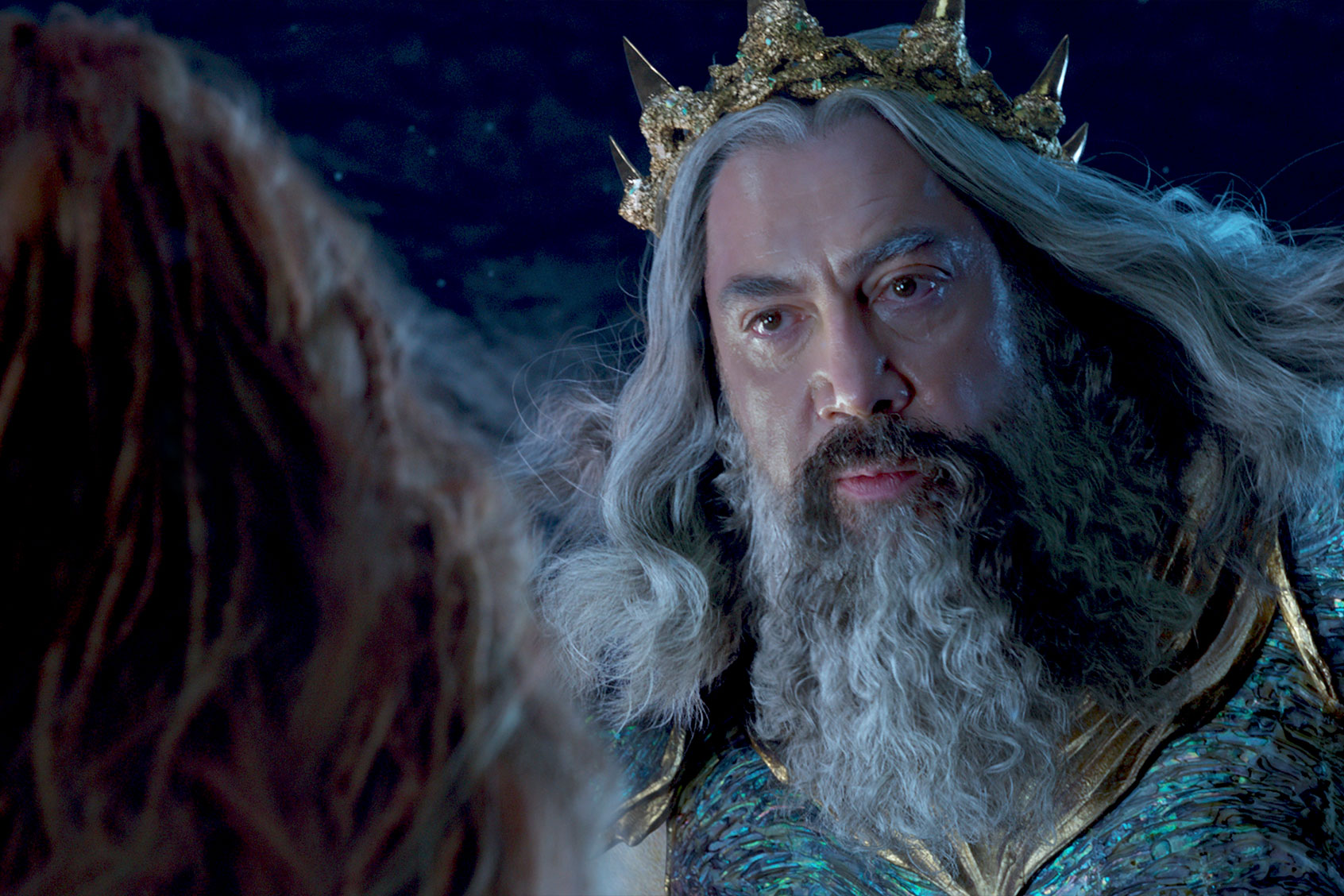
The Little Mermaid, 2023The Little Mermaid, 2023 (Disney)Ariel’s overbearing antagonists

Disney’s original interpretation of “The Little Mermaid,” the 1989 film that revived the  company’s animation department and led to its current success, follows a girl in love with another world. Ariel, the 16-year-old daughter of Mer-King Triton, skips family obligations and risks her health and safety to learn all she can about the world above the ocean. These explorations lead her to spy on a ship, fall in love with the prince onboard and save his life in the ensuing storm. All throughout, she is chastised by her protective father, who fears that if Ariel gets too close to the human world, it will kill her. When he discovers her secret grotto full of human artifacts, he turns violent, destroying her possessions, including the statue of the prince she loves. 

This drives Ariel to our villain Ursula, a sea witch who promises the mermaid anything she wants . . . with a price. Once Ariel crosses the threshold into Ursula’s lair, the sea witch leads her every step of the way and twists Ariel’s desires into something that can be bought and sold. Ursula is the one who offers Ariel legs, Ursula is the one who makes “true love’s kiss” the condition for winning the life Ariel wants, and Ursula is the one who sets Ariel three days to complete the task. When the young mermaid hesitates because becoming human will separate her from her family, Ursula dismisses the concerns, and her eels gag Ariel’s friends when they caution her against signing the contract. 

The 1989 film uses the medium of animation to its fullest extent and communicates entire plot points through, to quote the original Ursula, “body language.” For all the discussion of Eric bypassing Ariel’s ability to consent during “Kiss the Girl,” very few people mention Ursula’s imposing presence during “Poor Unfortunate Souls.” Ursula towers over Ariel, screams at her, wraps her in tentacles and intimidates her with explosive magical spells that look just like Triton’s. Ariel is put in a terrible situation, and like so many young people put in terrible situations, she’s led to believe that she has no choice

By the time we reach “Poor Unfortunate Souls” in the remake, the audience has also been privy to two monologues from Ursula, explaining her motivations and her plans for Ariel. This falls in line with the movie’s pattern of lengthy expository dialogue, leaving little storytelling for visual language to accomplish and no room for interpretation. 

The Little Mermaid, 2023The Little Mermaid, 2023 (Disney)

The new Ariel cannot be allowed to make a mistake, when the whole point of the original is that she might have.

While the live-action film hews close to the original version of “Poor Unfortunate Souls,” it also dilutes much of its tension and complexity. Here Ursula directly lures Ariel to her grotto, instead of Ariel seeking out help of her own volition, and when they negotiate, Ursula misleads Ariel by telling her she is giving up her “siren song” – not her “voice.” Therefore, it’s a surprise to Ariel when she reaches the surface and cannot speak. She’s been tricked.

Furthermore, Ariel has also been bewitched into forgetting that she must earn a kiss from Prince Eric in three days’ time. This script goes to pains to ensure that this Ariel doesn’t “give up her voice for a man,” but it robs her key decision of any ambiguity in the process, as if the new Ariel cannot be allowed to make a mistake, when the whole point of the original is that she might have.

The narrow-minded criticisms that informed these changes still have a choke hold on popular culture, and they do far more harm than influencing a mere movie script. It’s no accident that intense criticism of the Disney princesses coincided with the rise of what’s come to be called girlboss feminism, a kind of feminism in name only that reduces progress to a series of individualistic goals, oppression diluted into obstacles to be “overcome,” while offering nothing to combat the systems that keep them in place. It is still with us today, in so many soundbites: Lean in. Be the boss. Get your man. Keep your name. Forget beauty standards.  Love yourself. Have it all. Invocation after invocation of what girls “should” do, without any understanding of what’s keeping them from these goals. This philosophy leaves so many women behind, and those it doesn’t, it makes beholden to the system of oppression itself. 


Want a daily wrap-up of all the news and commentary Salon has to offer? Subscribe to our morning newsletter, Crash Course.


The people peddling these ideas see themselves as heroes, but they are far more like Ursula – setting young women near impossible tasks with the promise that they will be easy to accomplish for anyone strong enough . . . or anyone willing to purchase whatever they are selling. Let’s not forget that in both versions of “The Little Mermaid” Ursula interferes when Ariel grows too close to success. As the remake takes pains to explain, three days to earn true love’s kiss was a trap. Ariel was never meant to succeed. And neither are you. 

Girlboss feminism has become a punchline in progressive circles for good reason, yet it still has a hold on how popular stories are told. And that’s damaging. You cannot clearly see a person or their accomplishments without also seeing their circumstances. The creative team behind the new “Little Mermaid” kept the smart, nuanced source material close to their heart, and wanted  to make a heartfelt successor to the original animated film, but were bogged down by the task of explaining to bad faith critics why the movie they adapted was always great. 

We can only hope that this tired reading of Ariel dies away in the wake of this new version of her story, that popular opinion swings again towards seeing fictional merfolk as fully human, and using their stories to see ourselves that way, too. 

And perhaps Disney may someday learn their own lesson, with or without the stacked deal with a sea witch. While it’s difficult to pity a multimedia conglomerate as large and powerful as Disney, as long as they feel themselves beholden to the likes of Ursula, they are unfortunate indeed.


Astrophysics and stale beer: What life is like working at the South Pole

Ice began hundreds of miles ahead of the continent, great chunks floating closer and closer together until I peered through the portholes of a C-17 cargo transport plane onto a white so white it made my eyes ache. When we began our descent to the sea ice off Ross Island’s coast, I glimpsed long fractures, snow-packed ridges, and pockmarked blue ice blown barren by the polar wind.

We landed in late afternoon at McMurdo Station, the last long layover before my flight to the South Pole. Fifty of us, dressed in red parkas, bunny boots and ski goggles, stepped onto the Ross Ice Shelf at 77.51 degrees south latitude. Snow feathered its way to crystalline horizons; sea and land merged with sky, dancing together in bloodless miasma.

The thermometer read 18 degrees below zero; cold sunlight circled the southern sky. A mile away, station buildings sprawled — tan and green, stark and industrial — up the smoking side of Mt. Erebus. Along the distant shore, where the Victoria Range jutted out of McMurdo Sound, the only color came from black volcanic rock and the atmosphere’s pallid blue arc.

Standing on Antarctic ice for the first time, I felt like an intruder. It was if I had departed from earth. To simply survive here was to live a post-apocalyptic existence. To feel and smell the reality of 12.4 million square miles of frozen expanse, to place upon a scale the fathomless weight of that much ice pressed upon the earth, left me winded. The land — and my mind — felt as if they had been flipped upside down.

Even as a kid, I was obsessed with Antarctica. I grew up reading Scott’s journals, I traced routes from Palmer Station to Queen Maude Land on a map, and I stared for hours at photographs of calved glaciers in the Minnesota Science Museum. I would spread a map across my bedroom floor and trace my finger along the coast. I memorized the names — the Gamburtzev Mountains, Vostok Station, the Pole of Inaccessibility, the Dry Valleys, the Queen Maude Mountains, the Mertz Glacier, Casey Station, Vinson Massif — and always, before I folded it along worn edges, I traced the longitudes to their intersection. South Pole, it read, labeled in bold.

The land — and my mind — felt as if they had been flipped upside down.

So, when Raytheon Polar Services hired me as a General Construction Assistant for a season of work at South Pole Station, even though I knew I was a glorified snow shoveler, even though I understood that the job would be thankless, I still imagined I had joined ranks with those explorers who came south in search of glory, greatness and some inner sense of worth that continued to elude me. I expected to feel lost in an untried landscape. I expected the wind and cold and the glare of never-ending sun. I expected that the people I worked with would be the sort who fell naturally to the fringes of the map. But I never guessed that the bottom of the world would be quite so — weird.

*

The Antarctic Plateau doesn’t warm enough to land a plane on it until the end of October, and the early flights tend to be irregular and dangerous. I lived in limbo while I waited for several days for a flight to the Pole.

Workers and scientists filtered through McMurdo, a summer populace spreading across the continent, and my desire to escape McMurdo grew strong. The station had nearly a thousand inhabitants, bars, yoga classes, seals and penguins, but I wanted more cold and fewer people. I wanted endless white space and a spinning compass. McMurdo acted as the last outpost on the edge of the map, but I hadn’t yet fallen off the bottom.

Stuck waiting for flights, my friend Emily, another Pole-bound worker, and I skied out one day onto the Erebus Glacier. We stopped at the fire station, checked out a radio for emergencies, and glided across the ice. Every ten feet, red and blue flags jutted up from the Styrofoam snow, and zigzags of black ribbon denoted hidden crevasses. Halfway up, a bulbous hut, stocked with food, sleeping bags, and stoves, served as a survival shelter.

On the glacier, Emily looked out at the Ross Sea along the distorted horizon and said, “My favorite color is white. Once you’ve seen ice like this, white never seems plain…there are so many different kinds of white it blows my mind.”

*

The largest scientific project in Antarctica, ICECUBE, attempts to quantify and trace an unfathomably small subatomic particle — the neutrino.

Finally, I arrived at the bottom of the world. My job was simple. Every winter, blowing snow consumes any place left open to the elements — every hole, every ventilation duct, every place where even a screw works loose. Mountains develop between the massive sub-ice fuel storage tanks. Drifts obliterate entire buildings. Each summer season, a mile of storage materials, organized in rows called “the berms,” must be uncovered. Raytheon hires a small army of workers to uncover the buried station and help with odd jobs.

For four months, I dug out boxes of station garbage, uncovered four-meter tall stacks of random metal pipe, shoveled off sheeting and L-brackets, bales of wire, old tires, lumber, t-shirts and frozen lobsters. I spent a week tucked under the floor of the station’s storage arch, bolting shelving to the floor by hand. Temperatures in the crawlspace where I worked never fluctuated — they remained a constant 40 degrees below zero. The outside air temperatures often weren’t much better. We dug deep channels into the icecap and ran hundreds of meters worth of cable, we used chainsaws to cut blocks of ice that had encased the station’s pillar supports. I shoveled out telescopes, wind generators, latrines and forgotten military rations, all — as we reminded ourselves again and again — in the name of science.  

Scientific research at the South Pole is, for the most part, pretty esoteric. Telescopes measure ions in the upper atmosphere; meteorologists study weather behaviors in order to predict global climate changes.  Those who support these projects, “Polies,” as we are called, are meant to believe that this research places us on the brink of scientific discovery. The entire station becomes, in many ways, imbued with the sense that some larger thing is at work here.

We cannot perfectly describe the experience of a world where earth and sky are indistinguishable, but we may be able to measure it. The largest scientific project in Antarctica, ICECUBE, attempts to quantify and trace an unfathomably small subatomic particle — the neutrino. A grant from the National Science Foundation has built a kilometer square telescope buried a mile and a half into the ice. 5,000 basketball sized sensors measure the rare reactions of these particles and trace them to their origins in galactic nebulae.

By use of a scientific method we might discover the divine

What little we know of neutrinos makes their potential all the more powerful. They are among the most abundant particles in the universe. A German scientist explained to me that, “Every second, a billion neutrinos pass through the nail on my pinkie finger, but across an entire lifetime, they may only react once in the space of a living room.” One day at dinner this German researcher admitted to me his hopes for the project — that with ICECUBE, we might pinpoint the Big Bang’s location in the universe. And a visiting physicist after a talk one evening, said, “The statistical improbability of the Big Bang having actually occurred on any sort of universe forming level of explosive photonic reactions, is so remote that nothing but divine influence could explain its existence.”

These opinions, that by use of a scientific method we might discover the divine, and that the ICECUBE project places us on the cusp of this discovery, seems a uniquely Antarctic sentiment. Here the lines between theory and reality become blurred, perhaps because we do not yet understand this polar landscape. We have experienced the physicality of the Antarctic for less than a century, and it remains difficult for us to believe that an entire landscape exists where the only perceivable entities are imprecise—there must be more than simply ice and light.

I assisted in installing the wires for the ICECUBE telescope. For a week, we used an ancient snowmachine to drag nearly $30 million worth of cable from the cavernous holes they had been lowered into, each hole drilled with pressurized water, consuming 7,500 gallons of jet fuel to dig deep enough, to the two-story computer room that would monitor the reactions.

I spent two days in the fetal position while the cables, a thousand feet long and as big around as my arm, were positioned. As snow blew around in unctuous gusts, ten people heaved these cables through a drainpipe to the second story balcony of the computer building. Once, a tug rope broke, and sent a dozen people tumbling backwards into the pooling drifts of snow. We almost destroyed the entire computer system.

*

Those who live and work at the South Pole, whether dishwasher or astrophysicist, approach the ice with a sense of awe that borders on religious conviction. I met architects who had quit high-paying jobs to load cargo, SCUBA instructors hired to clean toilets, and a poet who drove a forklift. One woman, who had grown up as a bear hunting guide on the Alaskan Peninsula dated a lobster fisherman from New England. They both put up siding on the station.

Around Christmas, we gathered to watch the arrival of the annual fuel traverse. Fuel use at the South Pole in the summertime exceeds 20,000 gallons per week and requires an expensive type of jet fuel called AN-8. Used only in Antarctica, the fuel is purchased and transported either via cargo plane or by Caterpillars that drive 1,100 miles from McMurdo, towing giant gut sacks of gas on giant sledges.

Occasionally, skuas, Antarctica’s aggressive scavenger gulls, will follow the traverse all the way to the pole, where they circle for days, disoriented, desperate and unable to escape, before succumbing to exhaustion. Along with Amundsen’s flag, they are buried by the snow, entombed by ice for the next 100,000 years. Life here can only be buried.

Nobody could quite figure out why, when the only illumination came from the Aurora Australis, he spurned even the glow of a light bulb

A strange mythology has worked its way into the South Pole Station’s culture. Each season workers uncover dozens of objects that reinforce an odd respect for the brief history of the station. For example, one day we found a stash of bacon bars left over from when the Navy had managed the station in the 1970s. After much debate, we tore open the packages and ate them in homage to the station’s history. They were salty, basically bacon bits pressed into the shape of granola bars. A pipe insulator and weightlifter named John, who had worked at South Pole for more than 17 seasons, remembered when boxes of these bacon bars had filled whole shelves in the old station.

One day a dozer operator broke through the upper crust of snow and fell, machine and all, into the dining room of the original station. The structure had been abandoned and buried since 1959 and had migrated fifty yards from its original location in those decades. After the operator, Josiah, had been rescued, he told his story over curried chicken dinner.

“It was crazy. There were still plates of half-eaten food on the tables and coats on the benches. If we heated the steaks back up, they’d be edible,” he said. Two days later, they retrieved the bulldozer and filled the hole, entombing those stories in the old dining room forever. 

A former winter-over worker shared a story about the psychological effect of the South Pole without sunlight. After two months, one employee began compulsorily turning off every light in the station. When he started shutting off the dining hall lights while people were eating, a group of co-workers responded by installing flashbulbs in front of his bedroom door. The man took his meals in his room and refused to speak to anyone until the sunlight returned. Nobody could quite figure out why, when the only illumination came from the Aurora Australis, he spurned even the glow of a light bulb. 

During a flight that tested the ability to airdrop supplies in the event of a winter emergency, a box of bread flour, my boss claimed, failed to deploy its parachute and exploded over the snow. After work, I went out to search for the location. I glimpsed a speck near the horizon I thought might be the shattered crate. A friend and I trudged across the flat landscape toward this lone blemish. After two kilometers, we arrived to find only a sastrugi ridge, pockmarked wind deformations in the icy crust. The box had been covered, the flour sifted into the atmosphere and dispersed across the continent.

*

A strange mythology has worked its way into the South Pole Station’s culture

Our stories mimic the heroics of the early explorers here. Like Scott, it does not matter that we are at best unprepared, overzealous amateurs. We want to believe that our myths are true, that an Australian actually did die after drinking glycol filtered through a sock (supposedly, he’d heard the Russians at Vostok Station made vodka that way), or that someone did spend two months walking around the station turning off lights in order to keep the sun from returning. We want to believe these stories are truth, and they may be. Certainly, strange things do occur here, but it is the provable moments that come to feel most important.

The axis of our world shifts several meters each year, a slight defect at the pivot point of the planet.  And so, every New Year’s Day the words of Amundsen and Scott, inscribed as epitaphs at the geographic South Pole, are ceremonially moved to the newly measured, precise bottom of the earth. The station manager and perhaps a visiting explorer recite the triumphs of humans over landscape and embed a marker, newly commissioned each year, on the new site. It is a reorientation of the indiscernible.

The South Pole smoker’s lounge is famous for wild parties and thirty years of un-dissipated cigarette haze. The lounge comes complete with a stocked bar, a handful of regulars and a stripper pole for when parties get wild. At one such party, a naked electrician used a plumber as a snowboard and rode him down a pile of excavated snow outside the doorway.

In that liminal space between danger and desire, I shoveled snow.  

We drank beer which had sat in cans for half a decade. Our chefs gave up jobs at world renowned restaurants to deep fry tasteless vegetables stored for a decade. On clear days, halos and sun dogs encircled the ever-present sun. A tourist from China flew in for a one-day visit and developed heart palpitations upon his arrival. A group of us who held mostly-expired First Responder and EMT certifications monitored his vitals in shifts for 24 hours before airlifting him out. He had departed from Puntarenas, Chile. When he awoke, his plane was bound for New Zealand.

The lack of bacterial life sucks odor from the air, and after four months of sweating in bunny boots, the only smell they emanate comes from spilled jet fuel. To get drinking water, a steam drill melts ice 50 feet below the surface.

This same water, reprocessed as waste, is dumped into hewn ice caverns. Giant stalactites of graywater stab up from the cavern floor, the crystallized shit of an entire station, buried into the icecap.

The mean annual temperature is -57 degrees Fahrenheit. The mean annual temperature at the North Pole is just -18 degrees Fahrenheit.  The coldest ever temperature at the South Pole was recorded June 23, 1982: it dropped to 117 degrees below zero, and even in summer, the temperature never rises above zero degrees. In the wintertime, a sort of impromptu club forms. To gain entrance, one must turn the station’s sauna temperature to 200 degrees Fahrenheit and endure the searing heat for several minutes; then, on a particularly cold day, pull on shoes, dash for the pole, touch it, and return to the sauna. The sprint is clothing-optional, and those who succeed enter the “300 club,” for having survived the effort.

The view in Antarctica relies on a skewed perception. Moisture on breath turns instantly into ice crystals, but it is not simply that you can see the steam. Exhalations seem to suspend in the rarified air, and on sunny days, the atmosphere shimmers with a million microscopic flashes, a hoarfrost with nothing to cling to but exposed skin and hair. Occasionally, the crystals linger long enough to glimpse a flash of rainbow. Once, deep in the tunnels under South Pole, I controlled my breathing while holding a cupped hand under my chin. In the beam of my headlamp, I watched the vapor hover in the still air for a moment, then fall in visible shards onto my glove.

One of my favorite paintings is a work by the artist Xavier Cortada, on display at South Pole Station. It depicts the bust of Sir Ernest Shackleton, wearing dirtied yellow suspenders, his face benevolent and tough, but blurred by the thickness of the paint on canvas. In the top right corner are the coordinates of the most southerly point the explorer reached. The materials for the work were gathered on the continent and include crystals from Mt. Erebus, seawater from McMurdo Sound, and soil from Ross Island and the Dry Valleys. How fitting to our conceptions that these natural materials depict a constructed and foreign object to the Antarctic landscape, that the image is displayed in the place that eluded its subject for a lifetime.


Want more health and science stories in your inbox? Subscribe to Salon’s weekly newsletter The Vulgar Scientist.


We trickle south in search of a perception unachievable elsewhere. For decades historians have been obsessed with an alleged recruitment ad for Shackleton’s 1912 Endurance expedition that advertised a “hazardous journey, small wages, bitter cold, long months of complete darkness, constant danger and small chance of success.” Supposedly, more than five thousand people applied, and Shackleton spent months selecting his crew from the pool.

That the story is most likely a fabrication says a lot, I think, about our collective conception of Antarctica. By mythologizing those who venture into those strange southern latitudes, we skirt the threshold between imagination and reality. Consider: Recently the US government sent me a civilian service medal as commendation for the work I did in Antarctica. On the back of the medal are inscribed the words “Courage, Sacrifice, Devotion.” In that liminal space between danger and desire, I shoveled snow.  

Perhaps for some—the intrepid and legendary explorers and today’s possessed polar workers — the inexplicable pull of the pole stems from the sufferance of a magnetic drive. I still, on occasion, long to return to the icy continent, and I still wonder: if a life’s meaning is found atop of 9,301 feet of ice, how will I ever find a place where it feels like I belong?

*

Working each day in the cold and wind, I became accustomed to the lifelessness. Scientific presentations, musical concerts and a visit from Sir David Attenborough and his documentary film crew, distracted me from the tedium of an imageless landscape. Only when I arrived back in New Zealand did I understand how the deficient nature of the polar world had affected me. To emerge from a place that belies understanding is to realize its importance. Antarctica, it would seem, contains that kinetic potential which can connect us to the imagined desires and landscapes of our souls.

For me, the unfamiliar and harsh desolation a was strange solace. I have sought it elsewhere, but never quite felt the pure release of spirit associated with the Ice.

Only the Southern Polar plateau offers an absolute nothing. In seeking a clearing of the mind, Antarctica’s interior offers the sole opportunity for the known landscape to share in scouring clean our excesses. I remember the night before I flew back to New Zealand, in the bright 3 a.m. sun, a moment when the bulldozers, snowmachines and airplanes, the wind and snow even, fell silent. This glimpse of such complete serenity brought me to my knees; I realized the potential of ice, and it crushed me to a humbled speck.

To emerge from a place that belies understanding is to realize its importance. Antarctica, it would seem, contains that kinetic potential which can connect us to the imagined desires and landscapes of our souls.

Antarctica demands to be spoken of differently. The Terra Incognita of our minds is like blowing whorls of snow, perpetually altering itself to fit the progressively shifting frontiers of human awareness. We must be reminded that there is as much value in what Antarctica promises to teach as there is in what we have come to learn of the place. These paltry striated spaces, the organized human outposts of Antarctica, are defined by latitude and longitude, by meteorology and scientific measurements. Today, the continent is understood not through the glorious mythos of explorers, but through the quantifiable strictures of science. Yet Antarctica remains a perpetual frontier, and despite what we understand, the frigid beauty of that ice-shrouded world feels as mythical as ever.

One day, when most workers were asleep, I sat alone in the sauna until the heat had worked deep into my organs. Then with a whoop, I crashed through the storm doors into the everlasting daylight. In seconds, my skin was a sheen of frost, every hair grasping to retain the warm moisture, lest it escape to the dried plateau. My feet pounded the Styrofoam snow, needle points stabbing my heels, crystals froze my eyelids shut. A bulldozer had manipulated the surface into a gradual hill, and with a leap, I rolled downward. My sides and legs chafed against the ice, rubbed raw as if they’d seen sandpaper. Before I returned to the safety of the station, I scooped a handful of blown powder to my face and rubbed the ancient elements into my hair. 

Turkey’s marginalized “deeply afraid” as Erdoğan wins presidential runoff

As supporters of Turkish President Recep Tayyip Erdoğan at home and abroad celebrated his win of Sunday’s runoff election, human rights defenders and marginalized people, including Kurds and LGBTQ activists, voiced deep fears about how their lives will be adversely affected during the increasingly authoritarian leader’s third term.

Turkey’s Supreme Election Council confirmed Erdoğan’s victory over Kemal Kılıçdaroğlu on Sunday evening. Erdoğan, the 69-year-old leader of the right-wing Justice and Development Party who has ruled the nation of 85 million people since 2014 and dominated its politics for two decades, won 52.18% of the vote. Kılıçdaroğlu, a 74-year-old social democrat who leads the left-of-center Republican People’s Party, received 47.82%.

Erdoğan — who was seen handing out cash to supporters at a polling station in an apparent violation of Turkish election law — mocked his opponent’s loss outside the president’s home in Istanbul, saying, “Bye, bye, bye, Kemal” as the winner’s supporters booed, according to Al Jazeera.

“The only winner today is Turkey,” Erdoğan declared as he prepared for a third term in which his country faces severe economic woes — inflation has soared, and the lira is at a record low against the US dollar — and is struggling to recover from multiple devastating earthquakes earlier this year.

However, in Turkish Kurdistan — whose voters, along with a majority of people in most of Turkey’s largest cities favored Kılıçdaroğlu — people expressed fears that the government will intensify a crackdown it has been waging for several years.

Ardelan Mese, a 26-year-old café owner in Diyarbakir, the country’s largest Kurdish-majority city, called Sunday’s election “a matter of life and death now.”

“I can’t imagine what he will be capable of after declaring victory,” Mese said of Erdoğan in an interview with Reuters.

After initially courting the Kurds by expanding their political and cultural rights, Erdoğan returned to the repression that has long characterized Turkey’s treatment of a people who make up one-fifth of the nation’s population while intensifying a war against the Kurdistan Workers’ Party (PKK), a far-left separatist group that Turkey, the United States and other nations consider a terrorist organization.

“Erdogan’s victory will consolidate one-man rule and pave the way for horrible practices, bringing completely dark days for all parts of society,” Tayip Temel, the deputy co-chair of Turkey’s second-largest opposition party, the center-left and pro-Kurdish Peoples’ Democratic Party (HDP) — which backed Kılıçdaroğlu — told Reuters.

Human rights defenders — many of whom have chosen or been forced into exile — also sounded the alarm over the prospect of a third Erdoğan term.

“If the opposition wins, there will be space, even possibly limited, for discussions for a common future. With Erdoğan, there is no civic or political space for democracy and human rights,” Murat Çelikkan, a journalist who founded human rights groups including Amnesty International Turkey, said in an interview with Civil Rights Defenders just before Sunday’s runoff.

Çelikkan called Erdoğan a “very authoritarian, religious, pro-expansionist conservative.”

“Turkey, according to judicial statistics, has the largest number of terrorists in the world because the prosecutors and judges have an inclination to use anti-terror laws arbitrarily and lavishly,” he continued. “There are tens of thousands of people who are being trialed or convicted by anti-terror laws. Thousands of people insulting the president.”

“Nowhere in Turkey you can make a peaceful demonstration and protest,” Çelikkan added. “The security forces directly attack and detain you. The minister of interior targets and criminalizes LGBTI+ people on a daily basis.”

LGBTQ Turks voiced fears for their future following a campaign in which Erdoğan centered homophobia in his appeals to an overwhelmingly Muslim electorate and repeatedly accused Kılıçdaroğlu and other opposition figures of being gay. During his victory speech Sunday evening, Erdoğan again lashed out at the LGBTQ community while excoriating Kılıçdaroğlu for his campaign pledge to “respect everyone’s beliefs, lifestyles and identities.”

Erdoğan vowed in his speech that gays would not “infiltrate” Turkey, and that “we will not let the LGBT forces win.” At one point during his address, an Al Jazeera interpreter stopped translating a 45-second portion when the president called members of the opposition gay.

Ilker Erdoğan, a 20-year-old university student and LGBTQ activist, told Agence France-Presse that “I feel deeply afraid.”

“Feeling so afraid is affecting my psychology terribly. I couldn’t breathe before, and now they will try to strangle my throat,” he added. “From the moment I was born, I felt that discrimination, homophobia and hatred in my bones.”

Ameda Murat Karaguzu, a project assistant at an unnamed pro-LGBTQ group, told AFP that she has been “subjected to more hate speech and acts of hate than I have experienced in a long time.”

Karaguzu blamed Erdoğan’s government for the increasing hostility toward LGBTQ Turks, adding that bigots are keenly “aware that there will be no consequences for killing or harming us.”

Ilker Erdoğan struck a defiant tone, telling AFP that “I am also part of this nation, my identity card says Turkish citizen.”

“You cannot erase my existence,” he added, “no matter how hard you try.”

Can “stanning” be a form of recovery? Healing and trauma in fandom communities

At a decibel so loud it creates seismic tremors in the steel support beams of Reunion Arena, a crowd of 19,000, mostly female preteens and 20-somethings, let out animalistic cries of adoration. I’m one of the frenzied bodies.

Head thrown back, fist in the air, my hips gyrate to the beat like a nimble metronome. Beside me, the 50-year-old mother of my fandom-made friend, a woman I’d only met two hours ago, leans her shoulder against mine as we sing. Digital getdown!

Twenty-three years later, I don’t remember her name and scarcely what she looked like, but we sang the lyrics to a song about cybersex together like the very best of friends.

It had been the digital world that brought me to the arena in Dallas that night in June 2000 to see ‘N SYNC. The woman’s daughter, Becky, who I can still remember, was the reason I was there. Becky told me that she and another friend had managed to get floor seats, and she offered me an available one. The catch was I’d have to sit with her mom. 

It was five days before my 20th birthday. We’d survived Y2K. The No Strings Attached Tour had sold a million tickets on the first day of sales. On the brink of my 20s I felt the optimism of having the rest of my life ahead of me which felt infinite. It was a new feeling for someone who had so often thought of ending her life.

The previous fall, a boyband and its fans had saved it.

Becky was one of the visitors on my ‘N SYNC message board hosted by Angelfire. She’d found my site through a webring, a grouping of amateur sites with a centralized theme. I was a part of multiple ‘N SYNC fanfiction webrings from 1999 to 2001.

I hadn’t set out to become a fanfic writer or to host a website.

N Sync at Rose Bowl No Strings Attached tourPop sensation ‘N SYNC perform at the Rose Bowl June 9, 2000 to promote their new album, “No Strings Attached” in Pasadena, Ca. (Steve Grayson/Online USA, Inc/Getty Images)The major life transition of leaving home for college and feeling isolated in my dorm room was a dry brush ahead of a growing wild fire. I wandered the campus cafeteria solo and sat down steeped in the awkwardness of a sort of self-imposed, public solitary confinement. When I got to college, I no longer had the distractions of overachievement I had in high school. I had to be alone with myself, physically and mentally, something I’d avoided since I was five years old. That’s when the sexual abuse by one of my relatives first began, when I wanted perfection or death.
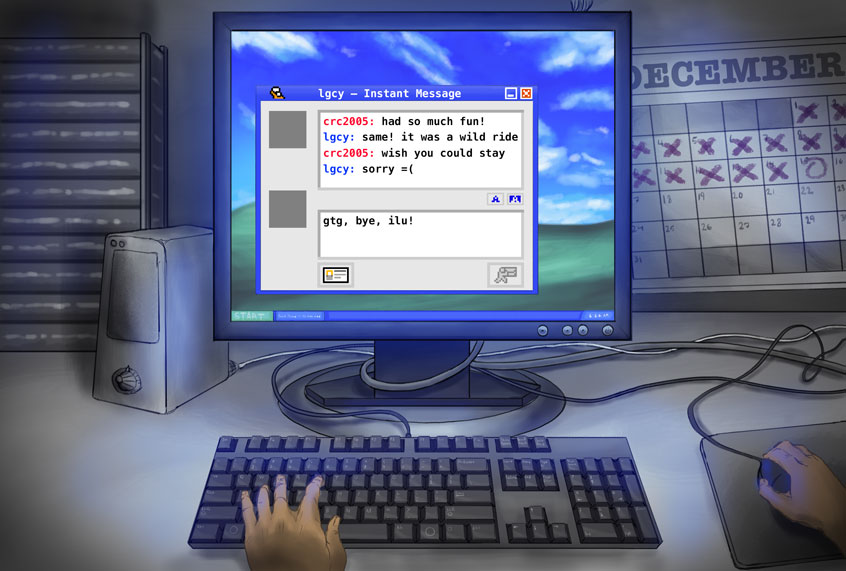
In one of those lonely bouts, I went to the ‘N SYNC official website one night. Supposedly, you could email the band members through the site. When no reply came, I searched Netscape for some other means to connect with anyone associated with the band.

What I found were fan sites.

* * *

At the time, depression and mental health weren’t as widely discussed as they are today. Three decades before #metoo, neither was sexual abuse. Oh sure, we’d sat through school trainings on good touch and bad touch, but I didn’t know one single person who said they had been molested. I thought it had only happened to me. I was on survivor island, party of one. I couldn’t stand to look at myself in the mirror. I stopped brushing and combing my hair and began to pull it back into an increasingly tangled bun every day. I brushed my teeth with my eyes cast down at the sink. It would be another two years before I entered therapy and was diagnosed with severe depression. That was the only diagnosis available to me then. Now, we know what I was struggling with is Complex Post Traumatic Stress Disorder. 

According to the DSM, PTSD can develop if someone has experienced or witnessed a traumatic event that involved “actual or threatened death, serious injury, or sexual violence.” In 1999, most of the general public thought of PTSD in terms of soldiers returning from battle and not survivors of sexual trauma.

Even when I was hurting the most I could count on those in the fandom and their stories to pull me back from the ledge.

It was because of a friend that I made through the ‘N SYNC fandom that I was encouraged to make my outcry of sexual abuse. Thanks to her, in the fall of 1999, I used AOL’s Instant Messenger to tell my mom about the years of molestation.

My fingers could type what my lips had trained themselves to never say. Technology provided my voice.

My parents put me in therapy. I would be placed on an antidepressant by a psychiatrist and attended sessions with a psychologist once a week. 

Even when I was feeling better, I never left the fandom or my friends online. It was because of one of them that I was beginning to heal.

Old School AOL Instant MessengerOld School AOL Instant Messenger (Salon/Ilana Lidagoster)What I found on the first message board that night in 1998 were other girls like me, enamored with the band and wanting to connect with other fans.
At its most basic definition, fanfiction (fanfic) is stories written by fans that are based on previously existing characters, worlds and situations from a TV series, film, book, comic or video game that are then used to create new plots. (Caitlyn Carson, Dalhousie University, What is Fanfiction and Where to Find it: Definitions and Fan Archives

Fan creations have expanded beyond written words to artwork, comics, fancams and compilation videos. When I clicked on the fanfiction link at NSYNCworld.com, I found a place where writers were treated like the Jane Austens and Stephen Kings.

“I’m going to post a new chapter tonight!” Someone would post, and a dozen comments underneath it would follow.

“I.cannot.wait.”

I read a handful of other stories before I was motivated to write one. The plot was a love triangle trope. It was an angsty, melodramatic mess written by someone who had never even had a boyfriend at that time in my life, but I was proud of it. When I printed the completed fanfic, I had almost 300 pages and 52 chapters. 

“Engaging in fantasy is an escape that can be a really healthy coping strategy when it’s used the right way.”

I was buoyed to continue writing and posting by the feedback from users with names like iluvlance and babybluegirl. Even when I was hurting the most I could count on those in the fandom and their stories to pull me back from the ledge.

I soon built up a following, made friends and created my own site. No one in my real life knew I wrote fanfiction. I’d kept the secret of my abuse for years because of the stigmas of being a survivor: guilt, shame, and blame. Fanfiction became another secret, for many of the same stigmas.

* * *

Julie (a pseudonym she asked me to use to protect her work) is a 30-year-old licensed professional counselor in New York. Julie writes fanfiction. She believes many of the stigmas that keep the writers of fanfic in clandestine operations on spaces like Tumblr is fear of judgment from those outside of fandom and elitism in the literary world.

“Unfortunately, that stigma has spread to me,” she said. “I think there is some belief that fanfiction is something that only people with no life do. Maybe it’s associated with nerds or geeks, people who don’t engage with the real world. Maybe, also, if you’re somebody who really, really likes literature and you do a lot of reading, you might feel like fanfiction is the poor man’s book. ‘Why would you want to read or write fanfiction when there’s so much original content out there?’ So, I think that could be why people are afraid to admit it to others.”

It is estimated that more than 100 million people online read or write fanfiction.

Wattpad had 94 million registered users in July 2022. AO3 (Archive of Our Own), another fanfiction platform, was home to over 185,000 stories in October 2022.

Many studies have been conducted on fanfiction and who writes it, but the demographics are ever changing in large part because of online platforms that make posting to a specific audience easier. However, a 2013 census survey of AO3 participants contained 10,005 responses: 77.2% were between 16 and 29. Mid-teens to late 20s now seem to comprise the majority of fans that participate in fanfiction on AO3.

Still, writers of fanfiction can often be reluctant to talk about their stories and sometimes, it’s because of where and how it started.

Feeling socially awkward in middle school, Julie found the bonding glue with other girls was being a fan of “High School Musical,” although she said it was a bit embarrassing to look back on it now.

“We all really loved the movie. We spent a lot of time talking about it,” Julie reminisced. “But once we took it to the internet it became a whole new world.”

A friend told her about Fanfiction.net. The site, founded in 1998, has survived the collapse of other tech platforms. Today, Fanfiction.net reportedly has more than twelve million registered users and publishes fan content and hosts stories in forty different languages.

“It started with reading and commenting. I’m not sure how long that went before I decided I was going to take it up as a writer myself.”

She says discovering fanfiction and community in fandoms helped her to cope with being an awkward tween with social anxiety and scoliosis. 

“I guess in a similar way that was me growing up a little more, but still playing pretend. I was engaging in fantasy but I was making friends through that. Since you’re able to find an online community, if you feel like there are people you don’t connect with in your day to day life, whether it be in your household or at school, your peers, there’s just more options there. You can feel like you’re seen or understood … I find that engaging in fantasy is an escape that can be a really healthy coping strategy when it’s used the right way and in moderation,” she said. “But when it comes to writing fan fiction, you can imagine worlds, settings, characters in whatever way that serves you.”

Julie said she often created female main characters that possessed confidence in their day to day lives or sexuality that she found herself to be struggling to express in her own life.

“Technology can be very positive for those seeking connection.”

Brenda McBride, a licensed clinical social worker with the 1 in 3 Foundation said,  “Coping mechanisms can be adaptive or maladaptive, and whereas certain coping mechanisms like alcohol or drug use are unhealthy, it isn’t always easy to discern. Sometimes the reason we start a behavior is not always the reason we continue the behavior. Any coping mechanism taken to an extreme or as the ‘only tool in the toolbox’ can be unhealthy. Even exercise, which is healthy, if the only tool or used in extreme, can be unhealthy or fuel an eating disorder. I think it is important to have a toolbox of coping skills that can be utilized in balance.”

McBride says red flags to note about fanfiction is the impact on the writer’s general life. “The most significant warning sign would be if a coping mechanism begins to isolate us, interfere with our work/home/relationships, or result in shifts in our mood, health, eating and sleep pattern.”

McBride also cautioned over fandom turned obsession as well through the development of a parasocial relationship

“Technology can be very positive for those seeking connection. Particularly for people in isolated or rural areas. Depression can impact a person’s sleeping and motivation, and if someone is awake at 2 a.m., there’s not a therapist open, but online support is.”

It is from a deep fixation with a celebrity, media or public figure that the term “stan” was created. Rapper Eminem’s 2000 slow and haunting song about an overzealous fan has morphed into a term more closely associated with superfans like Swifties and the BTS Army. In some cases, these fandoms have been accused of social media attacks against anyone who posts commentary or what is perceived as a negative critique of the artists. 

However, Julie believes that sometimes in the people fans idolize, they see something they aspire to be, which can be a positive.

“Although that character or person they idolize doesn’t have the same kind of relationship back with them, it can feel so validating to either find a public figure or a real person, whether it’s a celebrity or an influencer, whatever the case may be to say, ‘Oh that person kind of reminds me of me,” Julie said. “Or, maybe, ‘I want to be a little bit more like that person or I strive to be like that or follow the message that they put out there.'”

SupernaturalSupernatural (CW)Julie has seen this effect in the “Supernatural” fandom.

“While [the ‘Supernatural’ fandom] can be intense at times, it is filled with fans who unite over a message of ‘Always Keep Fighting,'” she said. “This message was promoted by not only the themes of the series but also the cast of actors who have also shared their own mental health challenges with the fans. It’s a fandom where you will find a lot of fans crediting a TV show for saving their lives.”

As a mental health care provider, Julie says she has not had many people in her office that have openly admitted to writing fanfic, but in some cases where a client has strong interest in a particular topic, she has suggested it.

“I think fanfiction as an outlet is just like a branch off of creativity and creative writing as an outlet,” she said. 

“G” (a nickname she asked to use) is a 21-year-old Swiftie, but it was following the music of My Chemical Romance (MCR) in her teens that started it all.

“I was only 14 when I was sexually assaulted,” G explained. “Up until that point, I had never really needed to be truly angry about anything before. (MCR) allowed me to explore my anger in a healthy way, and helped me feel like I wasn’t just damaged goods . . . The song that really got me through everything as a teen was ‘I Never Told You What I Do For a Living.’ I don’t think I could realistically put into words how important that song is to me. I was recently able to see them live for the first time at their reunion tour, and to my complete and utter disbelief they actually played it! I literally fell to my knees, sobbing uncontrollably. It felt like an amalgamation of all my healing over the years.”

Rocket Raccoon in Guardians of the GalaxyRocket Raccoon (voiced by Bradley Cooper) in “Guardians of the Galaxy, Vol. 3” (Disney)G is an artist whose drawings and comics have been sold in online auctions. Her most frequent drawing muse is Rocket Racoon from Marvel’s “Guardians of the Galaxy.” G says she connected deeply with film director James Gunn’s depiction of the traumatized lab animal with human traits. In the Marvel Cinematic Universe, Rocket’s backstory is one deeply rooted in trauma and rage.

“MCR was what I needed as a young teenager navigating my sexual trauma, and Rocket is what I need as an adult navigating my sexual trauma. The difference in perspective that you gain from being an adult looking back on everything is astounding. You have to grieve when becoming a grown-up under these circumstances. It’s hard to navigate. To me Rocket is a spot-on representation of how it feels. If I can get across that feeling to even one person looking at my art, it’ll all be worth it.”

Having grown up with technology as a Gen-Zer, G says she’s become a citizen of a digital community where she is free to share her art and express herself.

“I’ve always connected with people through my art. It’s definitely my love language, which is one of the reasons I love doing fanart so much. It lets me meet people who love the same things that I do, and I get to make them happy in the process . . . Some of my closest friends live on the complete other side of the planet.”


Want a daily wrap-up of all the news and commentary Salon has to offer? Subscribe to our morning newsletter, Crash Course.


I’m writing about us

“Fandom reflects back something inside someone.”

I text Ipsi, my friend from Boston. We met online on a baseball message board in 1999. She loved Nomar Garciaparra of the Red Sox. I loved the Yankees Derek Jeter and Seattle’s Alex Rodriguez. We both loved NSYNC. Almost a quarter of a century later, we still text each other when there is baseball news of interest from our favorite players.

An Indian-American immigrant, her path crossed with mine during a difficult period in both our lives.

Ipsi says, “I think your friendship was meant to be. I was a teenager, having just lost my father. I didn’t know how to handle it. I wanted an escape from the dark, so I turned to things that would pull me out from time to time.”

We have celebrated and supported each other through breakups, matrimony, motherhood and many baseball seasons. We have never met in person.

Ipsi moved from the baseball message board to my own and followed my writing. We would chat on AIM for hours, or interact with other gossiping fans.

The day after the concert in June 2000, I logged on to tell her all about the show. 

A moment I will never forget came during NSYNC’s performance of “I Want You Back.” My seat next to Becky’s mom was just rows from stage left and an elevated platform. JC ran up that platform to the rail. He was right in front of us. Everyone around me, including my friend’s mom, hurried to grab their cameras — film cameras and disposable cameras. When the spotlight hit JC, I kept right on dancing and singing, and he pointed at me, mimicked my dancing and ran off to the other side of the stage. After the shock wore off, I remember Becky’s mom shaking me and screaming. It took me several breaths to find my own scream. Less than a year after my outcry, during one of my most difficult summer’s back at home, I floated on that moment garnered through fanfiction forums until I returned to college in August.

Reunion Arena has been demolished. Angelfire went extinct with Netscape. ‘N SYNC went on an indefinite hiatus in 2002. But so many friendships that started with fandom have remained.

“Fandom to me is multifaceted,” Ipsi texts. “It’s not cookie-cutter, when you like this thing, you’re a fan, then you can’t like anything else. Fandom reflects back something inside someone. Aren’t we all more than one thing?”


These elevated, sweet-but-not-too-sweet strawberry and rhubarb shortcakes taste just like summer

“Sensually perfect” is how Salon Food columnist Bibi Hutchings describes the food of Rebecca Barron, her friend and the James Beard Award-nominated chef who now works as culinary director for Chef Daniel Lindley’s restaurants in both Nashville and Chattanooga, Tennessee.

In a recent interview with Barron — which covered everything from her culinary inspirations to how the industry has changed for female chefs — Hutchings acknowledged that her praise may sound “contrived or overly ebullient.” 

“But believe me — this is no exaggeration,” she wrote. “From the visual to the flavors and aromas, I had never seen such exquisite, delicate art plated and presented as food. And to then taste amazing on top of that? I couldn’t see how it was possible.”

But, indeed, it was possible. 


Want more great food writing and recipes? Subscribe to Salon Food’s newsletter, The Bite.


Looking to try out a composed dessert by way of Chef Rebecca this long weekend or sometime this summer? This surefire winner is a great bet.  

You can enjoy Chef Rebecca’s food by visiting Alleia in Chatanooga, Tennessee or 5th & Taylor in Nashville, Tennessee.

Strawberry Rhubarb Shortcake with White Chocolate Whipped Cream

Strawberry Rhubarb Shortcake served with White Chocolate Whipped CreamStrawberry Rhubarb Shortcake served with White Chocolate Whipped Cream (Chef Rebecca Barron) 

Strawberry Rhubarb Shortcakes with White Chocolate Whipped Cream
Yields
12 servings
Prep Time
30 minutes
Cook Time
25 minutes

Ingredients

For the shortcake

115g butter, soft. (1/2 cup)

191g powdered sugar (1 1/2 cup)

3 large (120g) egg whites, room temperature

1 large egg, room temperature

170g all-purpose flour (1 cup is 125g, so 1 3/8 cup)

2 teaspoons vanilla paste or extract

1/4 teaspoon salt


For the strawberry-rhubarb compote: 

1 cup orange juice mixed with ½ tbsp cornstarch

2.5 cups sugar

1 tablespoon vanilla paste

1 teaspoon chopped fresh Basil

2 teaspoons chopped fresh mint

1 sprig of thyme

Pinch ground clove

1/2 oz campari

1 quart Rhubarb slices (¼-1/2 in pieces)

2 quarts Strawberry quarters


For the white chocolate whipped cream:

125 grams white chocolate (2.5 oz)

1.25 sheets leaf gelatin

70 grams heavy cream, heated to a boil (5 Tbsp)

1 tablespoon + 1 teaspoon powdered sugar

Pinch of salt

495 grams cold heavy cream (2 cups)


For serving: 

Raspberry sorbet, optional

Fresh strawberries

Powdered sugar

Directions

  1. Make the shortcakes: Preheat oven to 350°F. In a large bowl, cream together the softened butter and powdered sugar until light and fluffy and there are no lumps. Slowly add in the egg whites and mix until smooth.
  2. Add the remaining whole egg and mix until fully incorporated. If the mix curdles, don’t worry, just give it a good whisk to bring it back together.
  3. Once combined, add the flour, vanilla, and salt and mix until it just comes together. Do not overmix. The batter will be somewhat soft.
  4. Scoop into small nonstick cake molds that have also been sprayed with nonstick spray using a blue portion scoop (2 oz) Place in oven and bake for approximately 10-15 minutes or until golden brown.
  5. Once cooled, store in an airtight container for up to 7 days. 
  6. Make the compote: Bring all ingredients except the strawberries and rhubarb to a boil. Then add the rhubarb. Cook for 1 minute.
  7. Remove from heat, then add the strawberries. Remove the thyme before cooling.
  8. Make the whipped cream: Bloom the gelatin in cold water, and discard the water. Off the heat, add the gelatin to the heated cream and whisk in the white chocolate. Make sure mixture is smooth and all chocolate is melted completely. Go back over low heat as needed to finish melting.
  9. Strain through a fine mesh strainer and cool to about 95 degrees.
  10. In a stand mixer, with a chilled bowl and whisk attachment, pour in the 495 grams of cold cream, add the powdered sugar and salt and whip to soft peaks.
  11. With the mixer on low, pour in the white chocolate mixture and continue whipping until you have medium peaks. Place in the cooler and let set. 
  12. To serve: Plate with the compote on the bottom, top with a cake, raspberry sorbet, white chocolate whipped cream and some fresh sliced strawberries. (We use local strawberries from Hancock family farm and they are divine!)

Ken Paxton impeachment fight exposes deep fissures among Texas Republicans

Sign up for The Brief, The Texas Tribune’s daily newsletter that keeps readers up to speed on the most essential Texas news.


The impeachment of Attorney General Ken Paxton exposed long-simmering and bitter divisions within the Texas Republican Party — infighting that has hindered the ability to unite behind a single vision for the state’s future despite a generation of political dominance.

Just this legislative session, Republicans were unable to find agreement on property taxes, school choice, stricter immigration laws and other conservative priorities that could have given Texas bragging rights as a conservative hothouse, on par with Florida.

To be sure, the Legislature did succeed in enacting significant conservative priorities in its 88th Legislative Session, which ends Monday. It banned puberty blockers and hormone treatments for people under 18, a significant blow for transgender youths and their families. It rolled back labor protections and other pro-worker legislation enacted by Texas cities, many of them led by Democrats. It removed discretion from local prosecutors over crimes like marijuana possession. On Saturday, negotiators also agreed on legislation that would ban diversity, equity and inclusion offices at Texas public universities, making Texas the second state to do so, after Florida.

Still, an array of social conservatives’ priorities — posting the Ten Commandments in public school classrooms and banning tenure at public universities — died in conference committees. And while the Legislature agreed to ban sexually explicit performances from taking place in front of children, it’s unclear what practical significance, if any, the law might have, since most drag performances do not involve children and the law’s definition of what is sexually explicit is likely to face court challenges.

Nowhere was the GOP chasm more apparent than the fight over Paxton’s future. Hard-line conservatives fought to protect one of their own, criticizing the impeachment process as an effort to overturn the will of voters. Former President Donald Trump also entered the fray, blasting “Republicans in name only” for targeting a patriot and calling out Gov. Greg Abbott for failing to protect Paxton.

It wasn’t enough. About 70% of House Republicans voted Saturday to impeach — 60 of the 85 Republicans in the 150-seat chamber. That included a coalition of center-right and conservative Republicans who defied their party’s far right and heeded the call to protect the state from a public official who had abused his office and power for personal gain.

That division will continue to fester as the Senate takes up Paxton’s impeachment trial, with continued pro-Paxton pressure likely to come from Trump, US Sen. Ted Cruz and Republican Party Chair Matt Rinaldi.

The gap between the far right’s most ambitious legislative agenda and the reality that emerged on Monday is partly the result of genuine policy differences.

The Republican Party’s center-right faction favors a traditional pro-business, low-regulation agenda. The more conservative wing is skeptical of “woke” corporations and more concerned with protecting gun rights, restricting immigration (which is largely the purview of the federal government), making sure abortion remains illegal and curbing LGBTQ influences.

Often, members of that wing express skepticism that House Speaker Dade Phelan‘s is truly committed. In the run-up to impeachment, their common attack line was to paint Phelan as a liberal or soft Republican who allowed Democrats to lead the charge.

Paxton himself pounced on that skepticism Saturday night.

“Phelan’s coalition of Democrats and liberal Republicans is now in lockstep with the Biden Administration, the abortion industry, anti-gun zealots, and woke corporations to sabotage my work as Attorney General,” he wrote in a statement after the impeachment vote. Trump has called Phelan a RINO.

But that characterization ignores that the House has moved to the right in some ways during Phelan’s still fairly new tenure. In 2021, his first legislative session, the chamber was involved in passing what was at the time the most restrictive abortion law in the country. And his chamber led the charge on a bill to allow people to carry handguns without a state-issued permit.

Still, in the Legislature, the House and Senate usually stand as proxies in the ideological fray, with the House representing the center-right and the Senate the conservative wing. This session, as in the last, the Senate, under Lt. Gov. Dan Patrick‘s leadership, rapidly passed a conservative wish list as early as possible. Some gained traction in the House, such as limits on transgender medical care and the ban on DEI offices. Other ideas find a chilly reception — a school voucher-style program and the abolition of tenure for university professors — and were ultimately doomed.

This session’s tensions reached a denouement Saturday as the House approved 20 articles of impeachment against Paxton, laying the first glove on a political leader who was reelected twice despite long-standing criminal charges of securities fraud and a federal investigation into allegations that he used the powers of his office to help a friend and political donor.

During Paxton’s reelection campaign last year, US Sen. John Cornyn called the attorney general’s laundry list of legal problems “an embarrassment.” Paxton fired back, calling Cornyn a squishy conservative who compromised with “radical Senate Democrats in D.C.”

Sensing vulnerability, three well-known Republicans — then-Land Commissioner George P. Bush, former state Supreme Court Justice Eva Guzman and then-U.S. Rep. Louie Gohmert — challenged Paxton in the GOP primary, arguing that his legal entanglements were a distraction and made him unfit for office.

But Paxton almost won the primary outright and went on to blow away Bush in the runoff, then decisively defeated Democrat Rochelle Garza in November.

Republican voters rewarded Paxton for launching a series of legal challenges on abortion and Democratic policies on immigration and the environment — dealing a blow to the party’s center-right faction by rebuffing Bush and Guzman.

The House’s impeachment of Paxton is another battle in the continuing war between the party’s factions.

“If ‘Star Wars’ had ‘The Empire Strikes Back,’ this is ‘The House Strikes Back,'” said Mark Jones, a political scientist at Rice University. “Dade Phelan and the House Republicans have been on the defensive all session. This is a chance for them to strike a blow against the conservative wing of the party that’s been criticizing them and attacking them the entire session.”

Before the impeachment vote, the 85 Republicans in the House were hounded by conservative political groups that were backing Paxton. Defend Texas Liberty PAC spent the days and hours before impeachment sending text blasts asking voters to urge their elected officials to support Paxton. The group received an added boost when Trump cast his lot with Paxton, giving Defend Texas Liberty ammunition to use in follow-up messages.

In the end, 60 Republicans pushed past those efforts to vote for Paxton’s impeachment. But with a Senate impeachment trial not yet scheduled, senators can expect additional pressure from groups on both sides of the impeachment question.

“It’s going to be a lot more difficult for the senators,” Jones said. “Because Phelan kept this under wrap until the end, there wasn’t a lot of time for Paxton’s defenders to react. Now, they’re going to have a few weeks.”

Paxton has already said he expects the Senate to be “fair and just.”

Trump, Cruz and other conservative stalwarts may play a more significant role heading toward a Senate trial, Jones said.

“What Cruz and Trump do is they provide political cover for those Republican senators who want to vote for Paxton but don’t want to be seen as backing a corrupt official who’s committed a number of illegal acts,” Jones said. “They can say, ‘I’m with Trump and Sen. Cruz.'”

Other Republican officials in the state, like Abbott, who has been silent on impeachment, will also be put in the uncomfortable position of weighing in on the matter.

Late Saturday, Trump called out Abbott specifically, declaring that Abbott was “MISSING IN ACTION!”

Throughout his time as governor, Abbott has moved to the right along with the GOP base, but he is frequently criticized by the party’s conservative wing as insufficiently conservative.

“Abbott is not one who’s out there in front being aggressive, and risk-taking has never been Abbott’s style,” Jones said. “This is one of those situations where whatever you do, you’re going to alienate somebody.”

On the political front, House Republicans face an election every two years and will have to explain their impeachment votes to a GOP primary base that has stuck by Paxton.

“Phelan, as well as some of his leadership team, will now have to face primary challengers that they most likely would not have faced had they not gone this route of trying to impeach Paxton,” Jones said.

Many of the Republicans who voted in favor of impeachment portrayed their decisions as nonpolitical, including Rep. Briscoe Cain, R-Deer Park, one of the most conservative members of the House.

“I understand my vote will elicit both praise and criticism from different quarters,” Cain said. “However, my role as a representative is not to prioritize popularity but to act according to what I believe is right.”

If two-thirds of senators decline to support impeachment, Paxton opponents can find themselves in a more difficult position, Jones said.

“Because they’ll have a sitting attorney general who’s angry with them and a Republican presidential candidate in Trump who will be campaigning in Texas and probably campaigning with those primary challengers,” Jones said.

Disclosure: Rice University has been a financial supporter of The Texas Tribune, a nonprofit, nonpartisan news organization that is funded in part by donations from members, foundations and corporate sponsors. Financial supporters play no role in the Tribune’s journalism. Find a complete list of them here.


Tickets are on sale now for the 2023 Texas Tribune Festival, happening in downtown Austin on Sept. 21-23. Get your TribFest tickets by May 31 and save big!

This article originally appeared in The Texas Tribune at https://www.texastribune.org/2023/05/28/ken-paxton-impeach-republican-infighting/.

The Texas Tribune is a member-supported, nonpartisan newsroom informing and engaging Texans on state politics and policy. Learn more at texastribune.org.

The COVID pandemic may be “over” — but the pandemic of loneliness is getting worse

On May 11, the CDC terminated its emergency declaration for COVID-19, marking an official end to the pandemic in America. After more than three years of lockdowns, masking, social distancing, sickness and mass death — with more than a million people perishing in the U.S. alone — the outbreak that brought American society to a screeching halt is finally “over.”

Yet another pandemic rages on, one that consumed many Western countries, including the U.S., long before the first cases of COVID-19 appeared in late 2019. I’m referring to the “pandemic” of loneliness, that anguished feeling of being alone, isolated and forgotten in the world. As the psychologist Benedict McWhirter defines it, loneliness is “an enduring condition of emotional distress that arises when a person feels estranged from, misunderstood, or rejected by others and/or lacks appropriate social partners for desired activities, particularly activities that provide a sense of social integration and opportunities for emotional intimacy.”

The sad truth is that an unprecedented number of people today are lonely, and studies show that the percentage of folks who feel alone, have no one to talk to and lack any close friends has skyrocketed in recent decades. According to a 2018 survey, more than half of respondents in the U.S., or 54%, said they always or sometimes “feel as though no one knows them well.” Another 47% reported feeling “left out,” 46% are “sometimes or always feeling alone,” 43% “say they lack companionship” and “are isolated from others” and 39% are “no longer close to anyone” at all. In Australia, a 2016 study found that a staggering 60% of people “often feel lonely,” while in the U.K., loneliness has become so widespread that former Prime Minister Theresa May established a “minister of loneliness” in 2018. Consequently, some commentators have noted that we may well live in the loneliest societies in all of human history.

Unsurprisingly, the COVID-19 pandemic made this situation much worse. For example, one study found a seven-point jump in the prevalence of loneliness between 2018 and 2019, from 54% to 61% of Americans who said they feel alone in the world. The data, however, reveals that loneliness has been steadily rising in some Western countries at least since the 1990s. According to one survey, only 3% of Americans had no close friends in 1990, while 33% said they had 10 or more. Compare this to 2021, when a shocking 12% reported having no close friends at all, with just 13% saying they have 10 or more. As the American Survey Center writes, “many Americans [now] do not have a large number of close friends,” adding that “the number of close friendships Americans have appears to have declined considerably over the past several decades” (italics mine).

A broader historical perspective suggests that the loneliness trend started long before this, going back to the 19th century. Why this period? There are several reasons, the most obvious being secularization: That was when Christianity began to decline in the Western world, due in part to scientific breakthroughs like Charles Darwin’s theory of evolution, which offered a radical new perspective on our origins and place within the universe. That dealt a major blow to traditional religion, and by the end of the 19th century many intellectuals no longer saw Christianity, at least in its conventional forms, as a tenable belief system. As the philosopher Friedrich Nietzsche famously declared in 1882, “God is dead! God remains dead! And we have killed him!” (Nietzsche was a passionate atheist, but his point was less about whether God existed than about the fact that our confidence in his existence could no longer be justified.)

The connection between loneliness and secularization is that if one believes that God is omnipresent, always there watching over us, in a personal capacity as our lord and savior, how could one possibly feel lonely? If we take this worldview seriously, we are forever in the presence of God, and hence no one is ever alone. Secularization undermined this eternal source of comfort, which enabled the new “emotion” of loneliness to arise.


Want a daily wrap-up of all the news and commentary Salon has to offer? Subscribe to our morning newsletter, Crash Course.


Another contributing factor was capitalism and its associated ethos of individualism, which facilitated a reconceptualization of ourselves as independent, isolated agents in perpetual competition with others. Capitalism, in effect, tore apart the family: Adult children moved away from their parents, and spouses spent a growing portion of their waking lives separated from their significant others and children, occupied by the endless grind of work in the factory or cubicle. Society became atomized and alienated, as illustrated by the rise of the modern suburban neighborhood: Whereas in the past, towns and villages tended to be organized around a common space such as a town square, the suburb replaced these concentric designs with more linear arrangements or amorphous sprawl, which is far less conducive to a shared sense of community. The resulting isolation created a novel situation: It now required more effort to connect with others than to be alone, whereas in the past the opposite was true, and it took more effort to be alone than connected.

Loneliness is a uniquely modern phenomenon, and in some sense did not exist before the 19th century. The word rarely appears in English earlier than that, and its modern meaning as a feeling of dejection only dates to 1814.

Hence, as many historians have argued, loneliness is a uniquely modern phenomenon. The experience of that “enduring condition of emotional distress,” in McWhirter’s phrase, is not something that most people would have experienced before the 19th century, and in some sense did not exist. Linguistic analyses support this contention. For example, although the word “lonely” was certainly used in English prior to the 19th century, it meant something like “being physically away from others.” It didn’t necessarily connote or imply a state of psychological unease. To be lonely was to be only by oneself.

Or consider that the noun “loneliness” rarely appears in English prose before 1800. As the Google Ngram Viewer results below indicate (tracking the frequency of words across time), however, it became far more common throughout the 19th century. According to the Online Etymology Dictionary, our current sense of “loneliness” as the “feeling of being dejected from want of companionship or sympathy” dates back to 1814 — it’s just over two centuries old.

image1.png

This brings us back to the 20th century, when loneliness became a widespread social and cultural phenomenon, especially after the Second World War. In their 1966 song “Eleanor Rigby,” the Beatles captured the resulting sense of unease when Paul McCartney sang: “All the lonely people/ Where do they all come from?” followed a line later with “Where do they all belong?” In the previous decade, one of the most influential philosophers of the century, Hannah Arendt, broached the topic in her famous book “The Origins of Totalitarianism,” arguing that “what prepares men for totalitarian domination in the non-totalitarian world is the fact that loneliness, once a borderline experience usually suffered in certain marginal social conditions like old age, has become an everyday experience of the ever-growing masses of our century.”

Yet the full-blown pandemic of loneliness that has emerged since the 1990s hasn’t affected every demographic in the same way. It’s not a “borderline experience” largely confined to the elderly, but an ailment that has hit Generation Z and marginalized groups especially hard. One recent study, for example, found that Gen Z individuals are “significantly more likely than any other generation to say they experience” feeling “alone, isolated, left out, that there is no one they can talk to” and so on. Another survey from 2022 reports that an incredible 75% of Hispanic adults and 68% of Black adults in the U.S. suffer from loneliness, compared to the total average of 58%.

This is alarming not just because the experience of being lonely causes psychological anguish, but because social isolation is “associated with about a 50% increased risk of dementia,” a “29% increased risk of heart disease, and a 32% increased risk of stroke.” Anxiety, depression and suicide are also linked to loneliness, and while suicide rates actually dropped during the pandemic, alcohol and drug-related deaths in the U.S. increased by 20% in just the first year, resulting in “the highest number of substance misuse deaths ever recorded for a single year.”

In fact, the situation is even worse than those statistics suggest. Many of the people we count within our circle of “friends” are not especially dependable in times of need or personal crisis. They are not what most of us would call “true” friends, but are instead more like fair-weather companions who take what they can and leave when it suits them. Perhaps capitalism is partly to blame, since it promotes a transactional model of interpersonal relations, whereby friendship becomes, essentially, a business venture and cost-benefit analyses determine the extent of one’s engagement with others. As Marx and Engels write in “The Communist Manifesto,” referring specifically to families and finances, “the bourgeoisie [capitalist class] has torn away from the family its sentimental veil, and has reduced the family relation to a mere money relation.”

Capitalism may be partly to blame for the decay of friendship: It promotes a transactional model of interpersonal relations, whereby friendship becomes a business venture and cost-benefit analyses drive our engagement with others

I think there’s something to this, and indeed I personally discovered the limits of friendship after becoming seriously ill some time ago: Although many friends rushed to my aid, some of the people I loved and cared about the most in the world simply vanished — yet another modern phenomenon called “ghosting.” When I mentioned this heartbreaking experience on social media, I was surprised by the number of people who reported similar experiences. One person wrote: “I got diagnosed with cancer a while back and entering that world made me see just how many people get abandoned during medical crises. … My spouse was dependable, but I lost several lifelong friendships because of it.” Another noted that their long-term partner left after they developed bipolar disorder, adding that “I don’t think people understand how extreme the multiplicative effects of (having serious illness) x (losing a main support system) can be.” Others spoke of friends and even family deserting them as they struggled with mental health, medical and substance abuse issues — precisely those moments in life when a robust social infrastructure is most desperately needed.

My own line of work — I have the cheerful job of studying global catastrophe scenarios, including human extinction — only underlines how disastrous the loneliness pandemic can be. Consider the fact that climate change will devastate the world. More than one billion people will be displaced, resulting in huge migrations of desperate climate refugees. Ecosystems will collapse. Food insecurity will rise. Large swaths of the U.S. will become arid land. Our economic and political systems will be thrown into unprecedented turmoil. Only last week came the announcement that there’s a greater than even chance that global surface temperatures on Earth will exceed the 1.5℃ threshold within the next five years. According to the 2015 Paris climate accords, keeping global temperatures below this threshold is crucial to “avoid the worst impacts of climate change.” Yet humanity — thanks specifically to nations like ours in the Global North — is well on its way to crossing that dire threshold before this decade is over.

As the world undergoes radical transformations unlike anything our species has encountered over the past 12,000 years, we will need each other more than ever before. The climate crisis and the loneliness pandemic are a perfect storm, with profound implications for our mental and physical health. I do not know how to fix this deplorable predicament — perhaps other countries, in addition to the U.K., need a “Minister of Loneliness.” In the meantime, expressions of care, compassion and kindness can go a long way. I’ve made it a habit over the years to send friends random messages simply asking how they’re doing, and to foster relationships where people I care about know that, no matter what personal crises might arise for them, I will be a dependable friend — offering them a shoulder to cry on or a hand to hold, no matter what. Much more of that, I believe, will be necessary not just to survive our secular, capitalist era, but to navigate the catastrophes that inevitably lie ahead.

Farmers face a soaring risk of flash droughts in every major food-growing region in coming decades

Flash droughts develop fast and when they hit at the wrong time, they can devastate a region’s agriculture.

They’re also becoming increasingly common as the planet warms.

In a new study published May 25, 2023, we found that the risk of flash droughts, which can develop in the span of a few weeks, is on pace to rise in every major agriculture region around the world in the coming decades.

In North America and Europe, cropland that had a 32% annual chance of a flash drought a few years ago could have as much as a 53% annual chance of a flash drought by the final decades of this century. The result would put food production, energy and water supplies under increasing pressure. The cost of damage will also rise. A flash drought in the Dakotas and Montana in 2017 caused US$2.6 billion in agricultural damage in the U.S. alone.


How flash droughts develop

All droughts begin when precipitation stops. What’s interesting about flash droughts is how fast they reinforce themselves, with some help from the warming climate.

When the weather is hot and dry, soil loses moisture rapidly. Dry air extracts moisture from the land and rising temperatures can increase this “evaporative demand.” The lack of rain during a flash drought can further contribute to the feedback processes.

Under these conditions, crops and vegetation begin to die much more quickly than they do during typical long-term droughts.


Global warming and flash droughts

In our new study, we used climate models and data from the past 170 years to gauge the drought risks ahead under three scenarios for how quickly the world takes action to slow global warming.

If greenhouse gas emissions from vehicles, power plants and other human sources continue at a high rate, we found that cropland in much of North America and Europe would have a 49% and 53% annual chance of flash droughts, respectively, by the final decades of this century. Globally, the largest projected increases would be in Europe and the Amazon.

Slowing emissions can reduce the risk significantly, but we found flash droughts would still increase by about 6% worldwide under a low-emissions scenario.


            Charts show the amount of cropland experiencing flash droughts today in Africa, Asia, Australia, North America, South America and Europe, and project how flash drought exposure will increase based on greenhouse gas emissions that drive global warming.
Climate models indicate that more land will be in flash drought in every region in the coming decades. Three scenarios show how low (SSP126), medium (SSP245) and high (SSP585) emissions are likely to affect the amount of land in flash drought. In some regions, rising global emissions will bring more extreme rainfall, offsetting drought. Jordan Christian


Timing is everything for agriculture

We’ve lived through a number of flash drought events and they’re not pleasant. People suffer. Farmers lose crops. Ranchers may have to sell off cattle. In 2022, a flash drought slowed barge traffic on the Mississippi River, which carries more than 90% of U.S. agriculture exports.

If a flash drought occurs at a critical point in the growing season, it could devastate an entire crop.

Corn, for example, is most vulnerable during its flowering phase, called silking. That typically happens in the heat of summer. If a flash drought occurs then, it’s likely to have extreme consequences. However, a flash drought closer to harvest can actually help farmers, as they can get their equipment into the fields more easily.

In the southern Great Plains, winter wheat is at its highest risk during seeding, in September to October the year before the crop’s spring harvest. When we looked at flash droughts in that region during that fall seeding period, we found greatly reduced yields the following year.

Looking globally, paddy rice, a staple for more than half the global population, is at risk in northeast China and other parts of Asia. Other crops are at risk in Europe.

Ranches can also be hit hard by flash droughts. During the huge flash drought in 2012 in the central U.S., cattle ran out of forage and water became scarcer. If rain doesn’t fall during the growing season for natural grasses, cattle don’t have food and ranchers may have little choice but to sell off part of their herds. Again, timing is everything.

It’s not just agriculture. Energy and water supplies can be at risk, too. Europe’s intense summer drought in 2022 started as a flash drought that became a larger event as a heat wave settled in. Water levels fell so low in some rivers that power plants shut down because they couldn’t get water for cooling, compounding the region’s problems. Events like those are a window into what countries are already facing and could see more of in the future.

Not every flash drought will be as severe as what the U.S. and Europe saw in 2012 and 2022, but we’re concerned about what may be ahead.

A flash drought developed in the span of a few weeks in 2019. NASA Earth Observatory


Can agriculture adapt?

One way to help agriculture adapt to the rising risk is to improve forecasts for rainfall and temperature, which can help farmers as they make crucial decisions, such as whether they’ll plant or not.

When we talk with farmers and ranchers, they want to know what the weather will look like over the next one to six months. Meteorology is pretty adept at short-term forecasts that look out a couple of weeks and at longer-term climate forecasts using computer models. But flash droughts evolve in a midrange window of time that is difficult to forecast.

We’re tackling the challenge of monitoring and improving the lead time and accuracy of forecasts for flash droughts, as are other scientists. For example, the United States Drought Monitor has developed an experimental short-term map that can display developing flash droughts. As scientists learn more about the conditions that cause flash droughts and about their frequency and intensity, forecasts and monitoring tools will improve.

Increasing awareness can also help. If short-term forecasts show that an area is not likely to get its usual precipitation, that should immediately set off alarm bells. If forecasters are also seeing the potential for increased temperatures, that heightens the risk for a flash drought’s developing.

Nothing is getting easier for farmers and ranchers as global temperatures rise. Understanding the risk from flash droughts will help them and anyone concerned with water resources, manage yet another challenge of the future.

Jeff Basara, Associate Professor of Meteorology, University of Oklahoma and Jordan Christian, Postdoctoral Researcher in Meteorology, University of Oklahoma

This article is republished from The Conversation under a Creative Commons license. Read the original article.

“Enormous policy failure”: States throw hundreds of thousands — including children — off Medicaid

With a green light from the federal government, states across the US have thrown hundreds of thousands of low-income people off Medicaid in recent weeks. And many have lost coverage because they failed to navigate bureaucratic mazes — not because they were no longer eligible.

More than a dozen states, including Florida and other Republican-led states that have refused to expand Medicaid under the Affordable Care Act, have begun removing people from Medicaid as part of the “unwinding” of a pandemic-era federal policy that temporarily barred governments from kicking people off the program.

In a bipartisan deal late last year, Congress agreed to cut off the pandemic protections, giving states 12 months to redetermine who is eligible for the health care program that covers tens of millions of Americans.

The process differs in each state, but Medicaid enrollees are typically required to complete paperwork verifying their income, address, disability status and other factors used to determine eligibility for the program.

While some states have undertaken public outreach campaigns to ensure Medicaid recipients understand what they need to do to continue receiving benefits, most enrollees across the country “were not aware that states are now permitted to resume disenrolling people from the Medicaid program,” according to new survey data from the Kaiser Family Foundation (KFF).

As a result, The New York Times reported Friday, “many people lost coverage for procedural reasons, such as when Medicaid recipients did not return paperwork to verify their eligibility or could not be located.”

“The large number of terminations on procedural grounds suggests that many people may be losing their coverage even though they are still qualified for it,” the newspaper added. “Many of those who have been dropped have been children.”

Early data released by the state of Florida, for example, shows that more than 205,000 people in the state lost coverage for procedural reasons after April eligibility checks.

“We knew this was coming. But we still treat these burdens like they’re unavoidable natural disasters,” Pamela Herd, a professor of public policy at Georgetown University, said. “We need to be much more explicit about these failures because we’re making a choice to allow this.”

Joan Alker, executive director of the Georgetown Center for Children and Families, said she is “very worried about Florida.”

“We’ve heard the call center’s overwhelmed, the notices are very confusing in Florida — they’re very hard to understand,” Alker said.

In a recent letter to Republican Gov. Ron DeSantis, a 2024 presidential candidate, more than 50 advocacy groups demanded a Medicaid redetermination pause, pointing to “reports of Floridians being disenrolled from Medicaid without having received notice” from the state’s Department of Children and Families (DCF).

“One of these individuals is a 7-year-old boy in remission from Leukemia who is now unable to access follow-up — and potentially lifesaving — treatments,” the groups wrote. “Families with children have been erroneously terminated, and parents are having trouble reaching the DCF call center for help with this process. Additionally, unclear notices and lack of information on how to appeal contribute to more confusion.”

“We are deeply concerned about those with serious, acute and chronic conditions who will continue to lose access to their lifesaving treatments during this time, along with people who risk substantial medical debt, or even bankruptcy, as a result of coverage loss,” the groups added.

The Times highlighted the situation in Arkansas, which is led by Republican Gov. Sarah Huckabee Sanders — a supporter of Medicaid work requirements and other attacks on the program. (Work requirements were briefly tried in Arkansas in 2018 and 2019, with “harmful effects.”)

“In Arkansas, more than 1.1 million people — over a third of the state’s residents — were on Medicaid at the end of March [2023],” The Times noted Friday. “In April, the first month that states could begin removing people from the program, about 73,000 people lost coverage, including about 27,000 children 17 and under.”

An Arkansas law requires the state to complete its Medicaid eligibility reviews in six months instead of 12.

In a Wall Street Journal op-ed earlier this month, Sanders wrote that her state is booting people from Medicaid at “the fastest pace in the nation” and claimed those being removed are “ineligible participants” — ignoring evidence that many being stripped of coverage were technically still eligible.

The US Health and Human Services Department has estimated that upwards of 15 million people nationwide could lose Medicaid coverage during the redetermination process.

“This is such an enormous policy failure — profoundly cruel and will contribute to furthering inequities,” Dr. Cecília Tomori, a public health scholar at Johns Hopkins University, wrote Friday.

While some who lose Medicaid will be able to access insurance through an employer or the Affordable Care Act marketplaces, KFF found that more than four in 10 people with Medicaid as their only source of healthcare “say they wouldn’t know where to look for other coverage or would be uninsured” if they were removed from the program.

“This is about to happen to a lot of people,” Larry Levitt, KFF’s executive vice president for health policy, warned.

The Times pointed to the case of 54-year-old Arizona resident Debra Miller, who “lost Medicaid coverage in April after her roughly $25,000 annual salary as a Burger King cook left her ineligible.”

“Ms. Miller, a single mother with diabetes and hypothyroidism, worked with an insurance counselor at North Country HealthCare, a network of federally funded health clinics, to enroll in a marketplace plan with a roughly $70 monthly premium,” The Times reported.

Miller told the newspaper that the new plan is a “struggle” both because of the new monthly payment and because it doesn’t include the vision coverage she needs and now may not be able to afford.

The Congressional Budget Office estimated earlier this week that states’ Medicaid eligibility checks will likely leave 6.2 million people without any insurance at all.

Why more foam makes for the best beer-drinking experience — and always has

What makes for the ultimate beer drinking experience? Some like theirs in a frosty glass, others with a wedge of lime. But when it comes to froth — or the head as it’s commonly known — what’s the best amount and how can it be achieved?

Too much froth and you’re left with a smear of bubbles across your face and hanging from your nose as you desperately try to get at the beer beneath. But too little will cause problems in your stomach.

You see, if there’s no foam the CO2 stays dissolved in the beer. If you then eat something, the foam erupts in your stomach rather than the glass, causing beer bloat. That’s why tipping a glass to avoid a frothy head is a rookie error.

Hoping to solve this issue, a company in Japan has designed a beer can with two pulls, which control the level of foam produced by opening the can, resulting in the perfect amount of froth.

This is just the most recent development in beer technology. Humanity has been chasing the perfect pint since beer’s inception, which evidence suggests was roughly 13,000 years ago near Haifa, Israel — the oldest known record of human-made alcohol.


Under pressure

Beer consumption has evolved through the ages.

Those first producers and consumers of beer in Israel were the Natufian people, a group of hunter-gatherers in the eastern Mediterranean. Their beer would have been unfiltered, which made it look like thin porridge.

This led to the invention of beer straws around the fifth to the fourth millennium in Iran and Iraq, which featured a filter on the tip that held back the beer solids. These straws were similar in design to a modern bombilla (a yerba mate tea straw used for at least four centuries in South America).

The next significant leap in brewing was not the glass bottle, but another airtight closure: the barrel.

Advances in cooperage (the making of wooden casks and barrels) during the Middle Ages meant that the CO2 produced by yeast during fermentation remained in the solution within the container, rather than dissipating and giving it the porridge-like consistency of previous beers. This meant beer could be held and dispensed under pressure for the first time. This inexorably altered the appearance and flavor of beer, as it became effervescent and foamy when served fresh.

Foam was a vital component of proper beer because it showed its freshness.


A good head

The foamy head was at one time called a “collar” — a term that first appeared in print in John Steinbeck’s 1945 novel Cannery Row. There seems to be no origin story attached to the monicker. And sadly, there seems less need to apply a name to beer foam since society has strayed from proper beer pouring techniques.

Traditionally, beer was allowed to foam up so much as it was being poured that a “foam scraper” (also known as a “foam flipper” or “head cutter”) was needed to shave the excess off the glass rim. A large head was achieved by pouring the beer in an upright glass and encouraging excessive foaming. This technique dissipates the trapped CO2 and brings positive flavour elements to the forefront.

These days you’ll notice that glasses are tipped while beer is poured. This is done to minimize foam but leads to a less pleasurable, gaseous experience instead of a creamy, toasty sip.

Next time you order a pint you should ask your bartender to pour the amber stuff into an upright glass. This is all to say, don’t fear the foam, it’s integral to your enjoyment.

Anistatia Renard Miller, PhD in History, University of Bristol

This article is republished from The Conversation under a Creative Commons license. Read the original article.

Does immigration really increase crime? Here’s what the science says

One of the primary bad faith arguments against immigration is that it drives an increase in crime, a concern that tops many survey results regarding undocumented immigration. Given the sharp rise in migrations over the years, due to reasons such as climate change, economic instability and war, it’s clear that the issue is becoming more severe. And crime is generally a reasonable concern: No one wants to be the victim of violence or theft, nor do they want to live in fear of such things.

But despite the level of heated rhetoric around this issue — especially the xenophobic or racist messages that spew forth from across the political spectrum — there’s no hard data suggesting that immigration actually correlates with a rise in crime. In fact, immigration may even be associated with reductions in certain types of crime.

Take Chile, for example. Sure, it’s not the United States, but this South American country, with a population of nearly 20 million people, has its share of natives who aren’t keen on immigrants, listing crime as the primary reason. A 2018 nationally representative survey of Chileans asked about immigration concerns ranked bringing new diseases into the country as second to “drug trafficking and crime with immigrants.”

Like many countries, Chile has been experiencing an influx of immigrants in recent years. In 1990, immigrants made up just 1% of the country’s population, according to a report last year from the Migration Policy Institute (MPI). By 2020, 1.5 million immigrants in Chile accounted for nearly 9% of the country’s population. That year, the majority of these individuals traveled from Venezuela, Haiti and Peru.

Chileans have responded by installing electric fences, buying security dogs and passing laws that tighten immigration. One piece of legislation enacted in April 2021 “adopts the language of human rights protections but nonetheless enhances the government’s power to expel migrants and restrict their access to protections,” according to the MPI report.

Immigration may even be associated with reductions in certain types of crime.

Yet a recently published study in the American Economic Journal found “null effects” on crime from immigration, after pulling data from 2008 to 2017 from official databases on immigration, homicide and victimization surveys. “Our results suggest that while immigration does not increase crime in equilibrium, it does trigger crime-related concerns and behavioral reactions among the population,” the authors wrote. The research, led by Nicolas Ajzenman, an economics professor at McGill University, found that people who live in areas with more immigrants were more likely to rank crime as their biggest concern.

“Yet, we find no effect of immigration on crime. We analyze all relevant crimes included in the survey — robbery, larceny, burglary, theft, assault and vehicle theft — as well as homicides and observe no significant effect for any of the individual types of crime or for total crime,” Ajzenman and his coauthors wrote. Furthermore, it wasn’t clear if behavioral responses, such as installing alarms, did anything to actually reduce crime.

This research is in line with numerous other studies that have reached similar conclusions, including one published last year in the journal Economic Research which looked at three decades of data from 30 countries covering 1988 to 2018. The economist authors reported that “no statistical evidence exists to relate an increase in the number of immigrants to the rise of any kind of crime. If there is we found a significant negative association between immigrants and only one of the six kinds of crime studied,” which included homicide, serious assault, kidnapping, burglary, theft and car theft.

The authors reached this conclusion by looking at data from the United Nations Office on Crime and Drugs, which collects statistics related to criminal justice and world development. It covered countries including Australia, Austria, Chile, France, Japan, Mexico, South Korea, Spain and the US. None of them experienced an increase in crime over that period from immigrants. That isn’t to say that immigrants never commit crimes — only that the level of “delinquency,” as the authors put it, isn’t outside the normal rate for any group of humans.


Want more health and science stories in your inbox? Subscribe to Salon’s weekly newsletter The Vulgar Scientist.


It also doesn’t matter if immigrants are undocumented or not. A 2020 study used comprehensive arrest data between 2012 and 2018 from the Texas Department of Public Safety, comparing the criminality of undocumented immigrants to legal immigrants and native-born US citizens. “We find that undocumented immigrants have substantially lower crime rates than native-born citizens and legal immigrants across a range of felony offenses,” the authors reported in the Proceedings of the National Academy of Sciences.

Nonetheless, the perception that immigration attracts crime persists, perhaps because it’s politically convenient, especially for the alt-right. If you want to get super technical, almost every nation on Earth is made of immigrants because humans originated in Africa and spread outward. Such a fact, of course, doesn’t erase the centuries of culture and history that have shaped collective identities. But if there’s one thing humans do that is universal, it’s our proclivity to move around.

As the climate continues to swing between extremes, making famine and war more likely, the number of refugees and migrants is expected to climb. People will need places to survive and may show up on the doorstep of privileged countries. The individuals who live there can greet these individuals with compassion and science, instead of fear.

“It’s my real life”: Nagi Maehashi on everyday meals, amazing chicken and her Chief Executive Dog

It’s a dream common to almost every avid home cook — start a blog, share your recipes, turn your passion into a community and a full-fledged career. Nagi Maehashi made it a reality, ditching her corporate job and going from two site visitors to millions all across the world. The secret? “A lot of hard work,” Maehashi told me from her home near Sydney, Australia. That, and going all in on  “my number one love.”

Now, Maehashi brings the trademark blend of exuberance and meticulousness to her first cookbook, “Recipetin Eats Dinner,” creating “fast everyday meals” meant for real world kitchens. “I’m not a chef,” Maehashi said, “I’m a home cook.: A home cook with a flair for unlocking the secrets of crispy Chinese eggplant, crusty homemade bread, and a roast chicken she promises “blows my mind.”

Maehashi opened up on how she built RecipeTin Eats from the ground up, as well as the joy of embracing mistakes and fighting food waste, and whether she and dog Dozer ever have creative differences. Watch the “Salon Talks” episode with Nagi Maehashi here or read our conversation below.

This conversation has been lightly edited for clarity and length.

You started it with two visitors, yourself and your mom, and now you’ve got millions. But this is not some fluke. You really had a plan. How did you make it happen?

A lot of hard work. There’s definitely no college that you can go to for this kind of thing. It’s quite interesting when I look at social media courses and things like that that I see cropping up online. It’s so difficult to say that that would actually apply to anything that I’ve done. It’s a new world out there, so a lot of it has just been testing the waters and figuring things out for myself and self-teaching as well. 

“I always say, I’m not a chef, I’m a home cook.”

The main thing I say to people is that, when I went into this, I didn’t go into it as a hobby. It is my number one love, and I do adore everything about what I do. I definitely went into it as a business, and so I treated it like you would if you were starting a new business. I did a business plan and did my due diligence and figured out where my weaknesses were, which was everything, by the way, except the eating part. Very good at the eating part and cooking part already. But everything else, hopeless. Photography, videos, writing, what is a website? I didn’t know how to start a website. 

When you asked yourself, “What am I going to bring to the table that nobody else does?” What was the answer?

There were two things. When I first started, I felt that there was a real lack of good recipes online for quick and easy Asian food. The Chinese takeaway favorites, think Panda Express, but a whole lot less oil and a whole lot less sugar and tastes nicer too. Just really good, quick and easy stir fries and Asian takeout favorites. The other thing was recipes that were actually properly tested and would work. I myself have fallen into the trap so many times of the perfect photo online, that photo that catches your eye when you’re searching for something, and then you make it only to find that the epic Easter centerpiece you were hoping for was a complete fail. 

You’re also self-taught.

For everything. Even the cooking, because my mom didn’t even teach me to cook. Everything is self-taught: photography, videos, writing on the website, how to start a website, didn’t even know what a blog was when I first started. 

And the cooking. And the baking. People go to school for any one of those things.

I know, but I always say, I’m not a chef, I’m a home cook. I think I’m a little more persistent than most home cooks. If I make a bread or any dish that I do, A, I want it to come out and taste right, but B, if it’s what I consider to be a bit of a trickier recipe or there’s a little trick to it to get something particularly right, then I’ll test it a lot to get it right.

What advice would you give to other people who want to do a new thing and are afraid of leaving their safety net?

“Raw kale is really dull, and that’s pretty much the only thing we don’t eat.”

It definitely was scary. I would say definitely do research beforehand and be honest with yourself about what your weaknesses are or areas of development are. You’ve got to have the passion because if you don’t have the passion, you just won’t have the drive to do it. Because for me, it was always about the food, so that was the fuel, if that makes sense. Everything else was around how I was going to get there. 

So yeah, [you’ve] got to have the passion, but do the research. And you don’t need to go all in like I did. I was a little bit crazy. I left a good corporate job to do this full-time, but you don’t have to do it full-time. You can start small and see if there’s potential, and then gradually move into a full-time position.

Out of the hundreds and hundreds of recipes that you’ve already created, how did you curate this book?

That was the hardest part. There were so many. We were down to a final list of three hundred recipes or something, and it was trying to come down to that last 150. To be honest, I ended up actually turning to my audience. I said to them, “Help! What do you want this cookbook to be? I’m thinking of this angle.” It very much went down to my sweet spot, which is dinner, and I really wanted to make sure it was mainly the quick and easy, as well as just a handful of those special occasion dishes and a couple of unique sections, sort of master recipes. There’s a chapter called “What I Do With …”

It’s the basic, what I do with a piece of steak. Here’s how I cook it, and here are my ten go-to steak sauces. What I do with a piece of salmon. Here’s how I make crispy skin, and here is my favorite ways to serve it. It links back to master sauce recipes in the book.

One of the things I appreciate about your recipes is that you keep them accessible from ingredients to techniques to equipment. What are your absolute ride-or-die hero ingredients that you think somebody should always have in their kitchen as the foundations of a good dinner?

Garlic, butter and wine

Those three in the pan is the best smell in the world.

Exactly. If you’ve got those three ingredients, no matter what you’ve got in the cupboard, whether you’ve just got mushrooms or you’ve got some dried noodles in the pantry, or a packet of pasta or a piece of chicken, whatever you’ve got, you can have dinner on the table if you’ve got butter, wine, and garlic, and that’s all you need.

I also really appreciate that this book talks about leftovers, because realistically, food doesn’t just magically, perfectly end in the meal. Tell me about about eliminating food waste and why that’s an important part of your food writing. 

“Whatever you’ve got, you can have dinner on the table if you’ve got butter, wine, and garlic, and that’s all you need.”

Every single recipe, I was adamant we had to deal with leftovers and explain to people whether it was freezable or how long it would last in the fridge. That’s really important to me because food waste, it’s a bit of a gripe of mine. Most recipes are very accessible ingredients you can get from any everyday grocery store. But the ones where I do ask people to go to an Asian store and get a jar of something, there’ll be another recipe in there that says, I’ll use the leftovers for this recipe. In fact, there’s a handful of recipes in there that came about using leftover ingredients from another recipe in the cookbook. It was just this ongoing cycle of using the same ingredients over and over. 

What do you recommend we do to put ourselves more at ease and feel more comfortable in the kitchen and more comfortable with the people we’re feeding?

Firstly, my response is just to laugh, because I bet I make way more mistakes than you, honestly. Most days, I have more failures than successes, and that’s just the nature of what I do.  I always encourage people not to put too much pressure on themselves. And it’s great to,   first, read a recipe from start to finish, but  push yourself a little bit out of your comfort zone if that’s what you want to do. But don’t put so much pressure on yourself. For me,  I can’t think of a single recipe where even if it doesn’t go right, it’s not going to be edible. It’ll still be nice. It might just not be exactly perfect, that we’re striving for, but they’re still tasty.

Here’s something really embarrassing. I had a big deal TV show here in Australia come to my house to film a segment here. The whole TV segment was about the hostess decorating this Easter cake. There was a lot of airtime on that, and we had so much fun decorating it, and then the big moment came to cut a slice. It was really dense, and I completely stuffed up the cake because I got the ingredient wrong.I pulled it out, and the camera’s there.

Maehashi’s “Juiciest, Easiest” roast chicken (ROB PALMER / COUNTRYMAN PRESS)

Everybody has advice on how to make the perfect roast chicken, and you promise the juiciest, easiest roast chicken. Nagi, what’s the secret?

It’s a very big call, isn’t it? Easiest, juiciest roast chicken without faffing around with brining the day before or all these fancy tricks. It’s really, really easy. It’s pot roasted because it just seals in the juices, so it’s semi-steamed. It’s an old-school chicken. It does sound a little bit nana-ish to say pot roasted chicken, so I just called it a roast chicken because really that’s what it is. You don’t braze it in liquid, so it’s roasting it inside a pot that’s covered, and then uncovering it to get some color on it.

Then the other thing is you stand it upright when you’re resting it. Resting any meat once you cook it is essential. But with the chicken, if you put it upright so the breast is facing down, then gravity takes care of all the juices in the chicken, settling in what is normally the dry breast. When you cut it open and you can watch me do it in the video in the QR code that’s on that recipe, you literally have chicken juices just squirting out of it. It’s so ridiculously juicy. Every time I make it, it blows my mind.

You’re such an ambitious cook, you have such beautiful recipes. Is there any recipe that you still feel like I just haven’t cracked it yet?

Oh, yes. And we have made it so many times. My team and I — I’ve even got a professional chef in my team and he hasn’t even been able to crack it — Portuguese tarts at home.

“Food waste, it’s a bit of a gripe of mine.”

I literally don’t know that it’s possible in a home oven. There’s so many recipes online that promise the perfect outcome, and I’ve probably made everything on Google pages one and two. I’ve got my chef working on it, I’ve had a pastry chef in France who’s my pastry teacher, she’s had a crack at it. I don’t know that it’s possible, but I’m determined because I love them and can’t afford to keep buying them to feed my obsession.

Is it the heat?

It’s the heat. It’s getting the pastry crispy without the custard overcooking and getting that beautiful brown spots on the surface. But that’s a really good example of even when say it’s a fail, it’s because the pastry’s not quite crispy enough, or the custards a bit overcooked, it’s still perfectly edible. And there are many people happy to take the leftovers of the Portuguese tarts.

Your whole mission in life is feeding people, teaching us to feed ourselves. You also are involved in feeding people who are dealing with food insecurity. Talk to me about that, because this is something that millions of us all around the world are facing, people who we may not think of and who may not look like they’re hungry. 

“It’s definitely the thing I’m most proud of and something I secretly hoped I’d be able to do one day when I started my website.”

I have a food bank called RecipeTin Meals, which I started during the pandemic because it was very clearly an increasing amount of food insecurity in my area. A lot of the food banks around here rely on restaurants to provide leftover ingredients and meals. As you know, during the pandemic, most of the restaurants around the world shut down for a period, and that was certainly the case here. 

I had an opportunity with a catering company that had shut down as a result of the pandemic to take over their kitchen, and so I decided to set up a food bank there. I have a team of three full-time chefs in there, and they make home-cooked meals every day, and we send them to a place that distributes them to people in need. It’s definitely the thing I’m most proud of and something I secretly hoped I’d be able to do one day when I started my website. Really excited that I can do it. Most important part of my business, as I always say. 

If something happens in the kitchen, and we do have dramas like there’s a blackout or something, or a big grocery run wasn’t delivered, my team are very clear that no matter what else we have on in the business, everyone has to drop everything to get in there and help out if we need to to make sure we get the promised meals out every single day. We’ve never missed a delivery except one day when we had floods in Sydney so bad we literally couldn’t drive to do the delivery. We had a car full of hundreds of meals and couldn’t get the food to the people in need.

Maehashi’s dog, Dozer (ROB PALMER / COUNTRYMAN PRESS) When you talk about your team, a lot of us have a favorite member of your team.
The CEO.

The CED,  Chief Executive Dog. Dozer is such a big part of your connection with your audience. Was that something that was always intentional? 

Honestly, it was a very organic thing.  I’m not a professional writer, so when I write and I put photos in of my life or whatever’s going on, it really has to be organic. It’s just my real life. I just can’t make it happen. So I started dropping in photos of him taste testing food, going, “Oh, I made this.” And yep, Dozer approves. It was a bit of a joke at first, but then people started getting really upset if there was a recipe I put out without a photo of him in there.

Then there was one day when I got more comments about him than I did on the recipe. I realized that, oh, okay, so Dozer’s become a bit of a thing. Then I even created a button on the website, so when you open a recipe, you can jump straight down to see him, because the number of comments I get saying, “I’m so sorry. I’m sure the recipe’s really nice, but I’ve got five minutes, so I just came here to see what Dozer is doing.”

Do you and he ever have creative differences?

Oh, no, because we both agree raw kale is really dull, and that’s pretty much the only thing we don’t eat.

Hope and loss on Memorial Day: It’s been a rough year since Buffalo

I believe in the power of dates and remembrances. In a time such as America’s (and the world’s) democracy crisis and other great troubles, when people are being buffeted by so many forces at once, those dates, remembrances and accompanying rituals help to ground us and give us strength to endure and hopefully triumph.

Dates and rituals and remembrances are even more important for the heirs to the Black Freedom Struggle and other impaired citizens; they help us to locate ourselves in the continuities of history and to draw continued strength and wisdom from it. Our history and its truths and lessons take on even more importance when the likes of Donald Trump, Ron DeSantis and the other Republican fascists are literally trying to erase them.

I reread Frederick Douglass’ “What to the Slave Is the Fourth of July?” each year on that day.

Likewise, on Dr. Martin Luther King Jr.’s holiday I read several of his speeches and essays. I always finish with “I’ve Been to the Mountaintop” for its lessons and example about how best to meet one’s destiny.

On this Memorial Day, I will continue with my tradition of reading about how newly freed Black people established that holiday in 1865 by burying war dead of the Union Army. The Washington Post explains:

Memorial Day developed from many springtime rituals, known interchangeably as either Decoration Day or Memorial Day, created to commemorate the Civil War dead. Although many towns across the United States from Arlington, Va., to Waterloo, N.Y., claim to have held the “original” Memorial Day, the holiday probably had dozens or hundreds of origins and diffused across the country.

One possible “first” observance of the holiday was the ceremony organized by the recently freed Black community of Charleston, S.C., in 1865. As historian David Blight documents, Black Charlestonians organized a burial of Union prisoners of war who had died in a Confederate war prison. They built an enclosure for the burial ground, established rows of graves and set an archway over the entrance gate inscribed “Martyrs of the Race Course.” Ten thousand people attended, mostly formerly enslaved people. They sang hymns and the national anthem, read Bible verses and decorated graves with flowers, followed by speeches, picnics and Union troop marches that included Black units. As Blight wrote, Black Americans who celebrated Memorial Day “converted Confederate ruin into their own festival of freedom.” Over time, some of that celebration of emancipation may have been subsumed by Juneteenth, the anniversary of slavery’s end in the United States.

Time Magazine article adds further details:

About 10,000 people, mostly black residents, participated in the May 1 tribute, according to coverage back then in the Charleston Daily Courier and the New York Tribune. Starting at 9 a.m., about 3,000 black schoolchildren paraded around the race track holding roses and singing the Union song “John Brown’s Body,” and were followed by adults representing aid societies for freed black men and women. Black pastors delivered sermons and led attendees in prayer and in the singing of spirituals, and there were picnics. James Redpath, the white director of freedman’s education in the region, organized about 30 speeches by Union officers, missionaries and black ministers. Participants sang patriotic songs like “America” and “We’ll Rally around the Flag” and “The Star-Spangled Banner.” In the afternoon, three white and black Union regiments marched around the graves and staged a drill.

The New York Tribune described the tribute as “a procession of friends and mourners as South Carolina and the United States never saw before.” The gravesites looked like a “one mass of flowers” and “the breeze wafted the sweet perfumes from them” and “tears of joy” were shed.

What Black Americans did on Memorial Day 1865 in Charleston, reflects a much larger history of our gifts and sacrifice and generosity toward a society and country that for much of its history, viewed us as subhuman property. Instead of responding with hatred and violence, Black Americans instead “built a nation under our feet,” not just for ourselves but for the benefit of all. Black people in America have been singled out for white violence and other assaults precisely because we are both symbols of America’s democratic potential and also its most stalwart defenders.

Memorial Day 2023 takes on even more power and poignancy (and resonates so very loudly and uncomfortably) because it marks a year of resurgent and escalating white supremacist violence and anti-Black hatred in a society where the Trumpist, fascist fever dream continues to endure no matter how many commentators (most of them overly optimistic white people) declare it all but vanquished.


Want a daily wrap-up of all the news and commentary Salon has to offer? Subscribe to our morning newsletter, Crash Course.


Last May, a white supremacist terrorist shot and killed 10 Black people at a supermarket in Buffalo. During the year since Buffalo, Republican fascists and their forces have continued to escalate their attacks against the civil and human rights of Black and brown people.

So-called conservatives are imposing Orwellian thought-crime laws across red states and even in other parts of the country. These laws are targeting books written by Black, brown, LGBTQ, Muslim and other marginalized writers that are deemed to be “unpatriotic,” “divisive,” “pornographic” or “woke.” The real problem, of course, is that books that confront the complex and often painful realities of America’s past and present offend the sensibilities of some white people.

As we saw on Jan. 6, 2021, when the Confederate battle flag was triumphantly carried through the halls of the U.S. Capitol by Donald Trump’s terrorists, the Republican fascists and larger white right are leading a revolutionary project to end multiracial democracy, and nothing about that project has slowed down. If anything, it has been accelerated with the Republican Party’s control of the House of Representatives, the U.S. Supreme Court and numerous state and local governments, as well as with Donald Trump’s 2024 presidential campaign.

Trump, DeSantis and the other leading Republican fascists may be conducting a power struggle among themselves, but they have also become even bolder in their embrace of white supremacy and racial authoritarianism. This campaign of right-wing radicalization has proven highly effective: For example, public opinion polls show that a majority of Republican and Trump voters actually believe in the false “great replacement” conspiracy theory and its absurd claims that white people are the real victims of racism and discrimination in America, rather than Black and brown people.

Undeterred by the $787 million settlement in the Dominion Voting Systems defamation lawsuit, and by what it revealed about the network’s inner workings as a propaganda operation, Fox News and the larger right-wing echo chamber continues to circulate and amplify white supremacist messaging. America’s police continue to kill unarmed and innocent Black and brown people. The massive protests of 2020, in response to the police murder of George Floyd, have not resulted in substantive police reform. American society is so sick with racism and white supremacy that one of the worst recent high-profile incidents of political thuggery against a Black person was committed by a group of Black police officers in Memphis.

The FBI, DHS and other law enforcement and national security agencies continue to warn that white supremacists and other right-wing extremists represent the greatest threat to America’s domestic safety and security.

Several weeks ago, President Biden issued this warning during a commencement speech at Howard University, the nation’s most prestigious historically Black university:

White supremacy … is the single most dangerous terrorist threat in our homeland. … And I’m not just saying this because I’m at a Black HBCU. I say this wherever I go. … Fearless progress toward justice often means ferocious pushback from the oldest and most sinister of forces…. That’s because hate never goes away. … It only hides under the rocks. And when it’s given oxygen it comes out from under that rock. And that’s why we know this truth as well: Silence is complicity. We cannot remain silent.

Before this weekend, a cadre of Republican fascists sought to hold Biden and the American people hostage by threatening to default on the country’s debt payments. We still do not know the details of the alleged compromise Biden has made with Republican House Speaker Kevin McCarthy, but whatever budget cuts have been extracted are nearly certain to disproportionately affect Black and brown people and other vulnerable Americans. Such an outcome is not coincidental. It is an act of structural violence as well as systemic racism.

The cycle of white supremacist terrorism and violence continues: Approximately a year after the white supremacist attack in Buffalo, an apparent neo-Nazi killed eight people at a mall in Allen, Texas.

On Memorial Day, I continue to feel battered and weathered by America’s enduring and undefeated white supremacist culture. I know that I am not alone in these feelings of frustration, exhaustion and growing futility. Where are we to find hope to keep on fighting?

A few weeks ago, we lost a titanic hope warrior in Harry Belafonte, a legendary singer, actor, activist and truth-teller. I few days after his death, I asked the writer Jeff Sharlet, during an interview for Salon about his new book “The Undertow,” what he had learned from his conversations with Belafonte. “Today is a poignant day to explore that,” Sharlet said, noting that his book begins with Belafonte:

I opened the book with him, even knowing that it would cost me readers and sales. Harry Belafonte? To start a book on the Trumpocene? Huh? I needed to start the book with some beauty and some hope. We needed to explore the beauty of the man and the beauty of his anger — and that endures.

The hope that Belafonte gives is not some type of cheap grace. We are not going to beat Trumpism at some appointed time that is close in the future. That is not how the real world works; the struggle is going to be long.

Harry Belafonte, 96 years old, on his death day, knew that he got defeated. Harry Belafonte knew and understood that, more than most people, he was a man who was so essential to the civil rights movement. He hated the Hollywoodization of the movement. He would tell me, “We dreamed of some things, we fought, and they killed a lot of us.” When I was talking to Mr. Belafonte, he would address Martin Luther King, in the present tense, like a ghost that was with him.

The struggle is long. Too many people want a happy ending.

Nope.

I also recently asked biographer Jonathan Eig what he had learned about hope and progress, resistance and struggle, from writing his epic new biography of Dr. King. In the full historical analysis, did King win or lose his long battle? Eig cautioned that the answer is not yet clear:

It sure looks like he got [beat]. But we don’t know because history changes. History is a living thing. And right now, it feels like everything he warned us about, he was right. We are more divided than ever. Income inequality, racism, antisemitism, they’re all terrible right now. But we don’t know what King’s final impact is, because it’s ongoing. It’s up to us to continue the story.

Activists and historians speak of the “long” Black Freedom Struggle for a reason. On this Memorial Day we are reminded by its origins among Black Americans at the end of the Civil War that democracy must be an active verb, not a passive noun. It is something we do and something we must fight for. America’s multiracial democracy is now, as it has always been, a work in progress. It is contingent and vulnerable — a thing dreamed of, but not yet achieved.

A devastating end to “Succession” wakes up to the truth about the Roys: “We’re nothing”

Succeeding in business is all about the right relationships, we’ve heard. If that is true, then we should have known Kendall, Roman and Shiv were never going to pull out a victory at the end of “Succession,” whether individually or as a team.

Jesse Armstrong dangled the possibility of either scenario in front of our noses many times throughout the final season, which made for a fetching distraction and a whole lot of empty betting about who would “win” the twisted competition to inherit Daddy’s company Waystar Royco.

Logan (Brian Cox) coaxed Roman (Kieran Culkin) back to his fatherly embrace one more time before croaking; then Roman weaseled his way into the newsroom, seemingly to tilt the election in favor of an autocratic bigot. But he cracked in the presence of his father – his embalmed dad, certainly, but more than that, the heart of his legacy, spelled out by his uncle Ewan (James Cromwell). Standing in the presence of a giant, Rome caved with a whimper, as he always does.

Shiv (Sarah Snook) was always kept out of company business, ensuring that nobody would take her seriously, not to mention her opposing political viewpoint to her father and brothers. To Logan she was always Pinky, a nickname that’s loving and belittling in equal measure; to her brothers, she was always someone to be easily manipulated, then dismissed.

But Kendall (Jeremy Strong) – sad, pathetic Kendall, was the son who his father most closely molded in his image and the one who took the brunt of Logan’s self-hatred, psychologically speaking. One of the saddest moments in series finale “With Open Eyes” is when Kendall, on the verge of losing the board vote, bleats, “I’m the eldest boy.” It’s his final argument to a sister he never respected and a brother he claimed to love but always subdued when he had the chance.

By that point, even Roman was done with the pretense of family unity and claiming that blocking Waystar’s sale to GoJo and Lukas Matsson (Alexander Skarsgård) was about anything other than Kendall’s quest for meaning and importance. He and Shiv remind Kendall that he killed someone, a fact Kendall conveniently and unconvincingly decides that he made up.

So it is appropriate that Roman – and Culkin, closing the book on a stellar performance – delivers the line that sums up the entire tragedy of “Succession” and the Roy siblings.

“We are bulls**t,” he tells Kendall. “. . . We’re nothing.”

“With Open Eyes” would be an appropriate title for the series finale if the phrase weren’t lifted from “Dream Song 29,” ending a tradition stretching back to the first season of naming every finale after a part of the John Berryman poem. “Dream Song 29” is about guilt and the subject’s inability to perceive reality as it is, which would make it seem directly related to Kendall. (Part of the work references hacking up a body and hiding the pieces.)

But the literal meaning of the title speaks plainly, in that Shiv and Roman are, at long last, done playing their father’s game. Some of this comes from a place of emotional defeat and fatigue, and some of it stems from their realization that they are separately and together a lost cause. Kendall’s ex-wife can’t stand him. Shiv’s marriage is a disaster. And all the dad promises in the world can’t prevent them from backstabbing each other.

“I love you. Really, I love you,” Shiv tells Kendall moments before she kills his dream of attaining absolute power. “But I cannot f**king stomach you.”

The Roys were not raised to win.

At an hour and 35 minutes, “With Open Eyes” is the longest “Succession” episode and one that operates as a victory lap and a nostalgic farewell for the fans, and the cast. A long sequence in Barbados, where Roman disappears after the funeral and his street beating, gives him, Shiv and Kendall one more chance to jockey for dominance only to realize mid-argument that they were all screwed.

Only this time it isn’t their mother Caroline (Harriet Walter), who invites them there for an alleged “air-clearing,” but Matsson and a few wobbly board members doing the thrusting.  

Johannes Haukur Johannesson, Alexander Skarsgard, Nicholas Braun and Matthew Macfadyen in “Succession” (HBO)
The day before the board vote, Matsson is still letting Shiv believe that she’d be his choice for GoJo’s American CEO, the odds of which seem a lot slimmer once a magazine prints a piece about the impending deal accompanied by an illustration of Shiv holding his puppet strings.

He claims not to mind but, predictably, once Shiv locks up the board votes for him and jumps on a jet to win over Roman, Matsson begins courting other contenders, all of them men.

When she gets wind of this – through Kendall, who gets a heads-up from Greg (Nicolas Braun), standing by listening to Matsson and his right hand discuss the betrayal in Swedish while holding a language translator on his phone – she’s infuriated. Kendall uses her fury, in the same way their dad always did, to win her back on his and Roman’s team. And then, with a bit of beachside emotional manipulation, Kendall gets his little brother and sister to agree that he should be the sole CEO.

Their bittersweet midnight celebration in Caroline’s kitchen is goofy and giggly, a scene that looks as much like a laugh-filled break enjoyed by the actors as it looks like three estranged family members finding a way back to being kids again. Only here, Shiv and Roman make a disgusting smoothie made of rotten odds and ends from Caroline’s miserly fridge – “a meal fit for a king,” they claim. Kendall takes a hearty gulp, and they dump the rest on his head.

Kieran Culkin, Sarah Snook and Jeremy Strong in “Succession” (HBO)
The second rare moment of tenderness is not in person but via tape, seen the next day when the three return to New York and their father’s old place, where Connor (Alan Ruck) and Willa (Justine Lupe) are organizing what he sells as an equitable (yet needlessly complex) means of dividing up Logan’s personal items. No trinket is worth more than a video of Logan joining Karl in singing “Green Grow the Rashes” around the dinner table, which moves all his children to tears.

Not even that can be a purely loving moment, however, since Tom (Matthew Macfadyen) is nearby and has already had the conversation with Matsson that cements him as the Swede’s man and cannot resist telling Shiv that he’s taking the throne she envisioned for herself. (Intensifying the sting of that news is that Shiv had sold Tom to Matsson by assuring him “Tom will honestly suck the biggest d**k in the room.”)

So, with all that in play, when the vote takes place and the split is deadlocked at six for and six against the sale, the deciding vote falls to Shiv – who decides, in essence, that no Roy should run Waystar Royco.

She tips her hand in the Caribbean when she, Roman and Kendall realize Logan has told each of them at various times that they were his successor, and without anyone to witness him saying it.

“I don’t think he wanted to give it to any of us,” Shiv says, finally landing on the truth of the matter. 

The victory of “Succession” is as airless as the tomb that is Shiv and Tom’s marriage, as clammy as Roman’s gin-soaked grin, and as dead as Kendall’s spirit.

Thus in the long-awaited board meeting, it is Shiv who fulfills Daddy’s wishes with one last suicide takedown. Logan raised those three to get in each other’s way. She’s merely doing his bidding. Roman doesn’t stop her. But he does slow down Kendall who, before the meeting, hugs his wavering little brother so hard that the stitches on his forehead pop and bleed.

The Roys were not raised to win. They weren’t even reared to fight particularly well, playing out Armstrong’s main thesis: all the money and political power in the world does not guarantee that those who inherit that power are equipped to wield it. 

And who knows that better than Tom Wambsgans?

Tom, that very pliable corporate matter who, by his own wife’s report, is “also a highly interchangeable corporate part,” is precisely what Matsson wants. He confirms this when Matsson asks Tom to “soft pitch” him on himself and Tom answers like a dutiful cipher. He’s such an empty suit that when Matsson admits to Tom that he’s soured on Shiv, mainly because he doesn’t like how smart she is and the fact that he wants to sleep with her, Tom doesn’t blink.

He’s so good at failing upward and so entirely mercenary that even when Greg sells Tom out, leading the two of them to exchange punches, Tom ends up welcoming Greg back to his side when he grovels before the newly crowned king. Better to keep a turncoat close than let him run wild.

Roman returns to be the martini-drinking rich kid good for little more than hanging out at bars. Kendall is left adrift, slack-jawed and wandering the city with no purpose. He warns Shiv that if he didn’t get the CEO position he might die. And while we don’t see that happen in the very last scene, it’s obvious that his soul is no longer in his body.

Matthew Macfadyen and Sarah Snook in “Succession” (HBO)
Shiv, though, may have the saddest final frame in the show. Following a torturous conversation where Shiv asks Tom if “there are any positives about the nightmare we’ve shared” – as in, their marriage, Tom says he honestly doesn’t know. He is a man who endured the woman he loved trying to negotiate an open marriage on her wedding night, a wife who was willing to send him off to prison to appease the father who never cared for her.  

“You don’t like to fail a test, do you Siobhan?” he tells Shiv after sarcastically laughing that she’s finally falling in love “with our scheduling opportunities.” 

Once he’s the king of the world, he invites Shiv to join him in his car and isn’t surprised to find her there waiting. He places his hand palm up on the armrest between them, and she rests hers on his – not holding, but hovering.


Want a daily wrap-up of all the news and commentary Salon has to offer? Subscribe to our morning newsletter, Crash Course.


If you wanted “Succession” to go out with a blazing revelation or a gasp, “With Open Eyes” may have disappointed you. The performances were outstanding, no question. Structurally the episode is heavy on remembrance and sweetness, which is of course meant to soften us up for the awful truth of how this story was always going to close. 

But since there were never meant to be any winners here, the denouement is depressing. 

Not even Tom has truly won. He’s a guy who earned a highly paid job by failing upward, knowing that his ultimate purpose is to be a human shield. His only solace may be in knowing he’s brought Shiv to heel. For the first time, she may not be worthy of him.

Hence, “Succession” continues HBO’s prestige drama tradition of disabusing fans of all the notions they invested in all season long. “Who’s going to end up on the Iron Throne?” Answer: nobody. “Will Tony Soprano live or die?” Answer: Cut to a black screen and let people fight over what that means for years.  

The victory of “Succession” is as airless as the tomb that is Shiv and Tom’s marriage, as clammy as Roman’s gin-soaked grin and as dead as Kendall’s spirit. These people were always bulls**t. But damn if they weren’t stupendous at getting us to dance to their piano jingle for a good long while.  

“Yellowjackets”: Eat or be eaten? It’s called being a team player

Could you trust someone who ate your friend?

The question haunts the surviving characters on “Yellowjackets,” Showtime’s hit series about a high school girls’ soccer team surviving in the Canadian wilderness after their plane crashes. Loosely inspired by the real life Uruguayan Air Force Flight 571 tragedy and “Lord of the Flies,” the show has always teased its descent into cannibalism. But as much as it’s a story about gore, it’s also about its consequences. Once you get a taste for flesh in the dead of winter with no food nearby (aside from your teammates), the lingering question is not about what’s next —  but who.

“Yes, we will still eat each other. We exist.”

Eating soccer team member Jackie (Ella Purnell) was, for all intents and purposes, like breaking the seal. Once you’ve done it, the floodgates are open. Season 2 commenced with the team cracking the gates. Now, as it reaches its climactic finale, the anticipation for a second helping, which has been rising throughout the season, is reaching its peak. This is tacitly understood by the Yellowjackets, as their relationships to each other shift since understanding that anyone could be dinner. It is, after all, Jackie’s best friend, Shauna (Sophie Nélisse) who first voices that they should eat her.

Yes, we are teammates and perhaps still close friends who are intimately bonded by going through a traumatic experience together, the characters seem to agree. Yes, we will still eat each other. We exist.

No one can blame them for having trust issues that extend well into their adult lives, growing wary of friends and strangers. Though their fear of others is prompted by a situation of extremes, it’s an anxiety that is realistic, even persistent today — and it’s what undergirds the horror of their cannibalism.

In “Qui” we get a grim reminder about fraying trust. The fantasy sequence after Shauna gives birth spends time recounting the agony of not being able to breastfeed. With Shauna at her wit’s end, the baby finally latches but the victory makes the crew’s decision to eat the newborn, knowing he now had a chance of survival, that much more horrific. It doesn’t help that the bloody scene lives up to the show’s gruesome reputation or that the paranoia built steadily throughout the season with Shauna’s mistrust of Lottie (Courtney Eaton) getting too close to the baby. Despite the baby-feeding being a dream, the nightmare attests to how Shauna subconsciously knows it’s possible and, indeed, continues to see flashes of her friends eating her son after waking.

YellowjacketsSarah Desjardins as Callie Sadecki, Melanie Lynskey as Shauna and Peter Gadiot as Adam in “Yellowjackets” (Kailey Schwerman/SHOWTIME)In the present timeline, the characters don’t trust any easier, especially when it comes to strangers like Walter (Elijah Wood), who raises Misty’s suspicions when he wants to spend time with her. Poor Adam (Peter Gadiot) knows this all too well, entering into an affair with Melanie Lynskey’s adult Shauna only to end up dead with his hands, feet, head and tattoos severed off because she can’t trust his desire is authentic. Instead, she mistakes the man who devoted canvas upon canvas to capturing her beauty as her blackmailer in place of her actual blackmailer, her husband Jeff (Warren Kole). Surrounded by betrayals and about-faces, it’s no wonder that Shauna and the rest of the survivors are quick to fear thy neighbor.
It took cannibalism and surviving the wilderness for the Yellowjackets to arrive where we are today: wary of each other, opting for individualism rather than mutuality.

But so, too, do we. According to a Pew Research survey, 58% of Americans know only some or none of their neighbors. In fact, a 2022 survey found that one in four homeowners admit to spying on their neighbors via surveillance technology. This is a significant change from the days of yore when one-third of Americans in the ’70s reported spending time with neighbors twice a week. The pandemic — which is when the show first aired to a whopping 5 million weekly viewers — heighted and complicated these emotions when people themselves posed a danger, potentially carrying the virus, not masking or refusing to vaccinate. Since COVID-19, only 27% of Americans think community is important, down 33% from 2019, according to a poll by the Wall Street Journal and NORC at the University of Chicago. It took cannibalism and surviving the wilderness for the Yellowjackets to arrive where we are today: wary of each other, opting for individualism rather than mutuality.

The horror genre has taught us that monsters are more than their on-screen visualization; they are psychological fears. “Yellowjackets” showrunner Jonathan Lisco makes this clear, telling Screenrant, “The show is not about if cannibalism, it’s about why cannibalism and how cannibalism.” If eating humans wasn’t incorrigible enough, the show employs the genre to tap into our deeper fear of each other and community where close proximity is forced.

By invoking it, characters justify crime. In “It Chooses,” Misty defends killing private investigator Jessica Roberts (Rekha Sharma) because it was “for the good of the group.” Of course, this same principle also justifies the show’s most horrific act: cannibalism. Let us hunt you down, kill you and then eat you because it ensures the survival of the rest of the team. It’s called being a team player.  

(L-R): Nuha Jes Izman as Teen Crystal, Samantha Hanratty as Teen Misty, Alexa Barajas as Teen Mari, Sophie Nélisse as Teen Shauna, Courtney Eaton as Teen Lottie, Nia Sondaya as Teen Akilah, Sophie Thatcher as Teen Natalie, Jasmin Savoy Brown as Teen Taissa, Steven Krueger as Ben Scott and Liv Hewson as Teen Van in “Yellowjackets” Season 2. (Kailey Schwerman/SHOWTIME)

In “It Chooses,” when the Yellowjackets decide to eat a second person, the scene teeters between upholding and breaking community. The teens pick cards, just like they would when divvying up chores, and the lucky person to pick the queen (which, in this case, is Natalie) gets to be dinner. The anxiety and anticipation is even greater than the first time because it’s premeditated. To participate in the game is to consent to be potentially eaten or eat a friend. For the sake of collective survival, the teens resort to cannibalism. By breaking the sacred community oath of not turning on one another, that cannibalism becomes even harder to stomach.


Want a daily wrap-up of all the news and commentary Salon has to offer? Subscribe to our morning newsletter, Crash Course.


The Yellowjackets cannibalize community, and perhaps how the genre taps into this fear that made it so popular in the last two years, from “Bones and All” to “Dahmer” to “The Last of Us.” But if the show captures our anxieties of the collective, it also critiques it. Lack of community kills. The team’s entire survival hinges on the fact that they can work together and share their various skills: Misty the quasi-doctor, Natalie the hunter and Lottie the morale director.

Ironically, what brings the team together is cannibalism. It’s the threat of being found out as cannibals that brings Misty, Natalie, Shauna and Taissa together in Season 1. In “Edible Complex,” when the girls barbecue Jackie’s body and finally eat her, they are transported to a fantastical scene, surrounding a hearty dinner table as if everything is right in the world. It makes sense; nothing brings people together quite like breaking bread (or bones).


Universities aren’t doing enough for climate. Here’s what a real sustainability plan would look like

My university just announced that it has “begun the collaborative and consultative work to create [its] first institutional Sustainability and Climate Action Plan!” (Exclamatory emphasis theirs). If all goes according to plan, in 20 years we’ll have reduced our scope 1 greenhouse gas emissions by 166 kilotons. That’s about 0.2 percent of our state’s emissions, and 0.003 percent of the country’s.

It is 2023. You probably know the stats. CO2 in our air is at 421 ppm, up 50 percent since we started treating the atmosphere like a sewer. The planet has warmed at least 1.1 °C (1.9 °F).

But do you know the trends? In the last 30 years we have emitted more CO2 into the atmosphere than in the rest of human history. In 2022 alone, CO2 emissions from burning oil and coal increased 3 percent and 2 percent, respectively, while annual government subsidies to fossil fuel corporations doubled, to $1.1 trillion. The trajectory of our greenhouse gas emissions (GHG) and their warming effects are indistinguishable from the no-policy, business-as-usual, avoid-at-all-costs, of-course-this-is-ridiculous-we-would-never worst-case scenario trends imagined for decades. The long-predicted effects of anthropogenic climate change are emerging with the dread of knowing we could have avoided them and the fear that we may fail to avoid much worse to come.

I’m sorry if this increases your climate anxiety, but this is not about serving up hope. It is about responsibility, outrage and what universities could and should be doing

The hard work of individuals reducing operational carbon footprints of institutions is commendable. But universities could do better in responding to students’ demands for action than helping them install campus recycling and compost bins, build a community garden and lead sustainability tours. That said, I’m sure those efforts would be lauded by the companies that sold us the view that climate change is both much bigger than we are and yet also our own fault, so the best we can do is attend to our own virtue and carbon footprint. These are the companies that include Saudi Aramco, the $1.7-trillion company responsible for more than 4 percent of GHG emissions since 1965, whose greenwashing campaign includes ongoing discussions with my own department for an endowed professorship to help maintain their ability to treat the planet as if it were a business liquidating its inventory and cash out as fast as possible. 

As institutions connecting public and private interests and supposedly serving societal good through education, research and community engagement, universities have a unique obligation and pivotal role to play in addressing the grand challenge of climate change and environmental sustainability. Our ability to solve problems and educate citizens may be the best hope society has to actually change systems — including business, policy, economics, law, engineering and technology — that are keys to the collective action we need. But unfortunately, at least on its own, a campus operational sustainability plan is a kind of greenwashing distraction from the responsibility that my — and indeed most — universities have to address the existential crisis facing not only humanity but all the other life and systems with whom we share the planet.

The long-predicted effects of anthropogenic climate change are emerging with the dread of knowing we could have avoided them

A real sustainability plan would engage the gears of a university’s power. We would reconfigure academic structures and strategic plans to provide our students courses, degrees and experiences to change systems and change the power structures that are destroying their future. We would pivot at least some of our energy and experience to use-inspired research and engagement to explore solutions, not just resigned adaptation and “resilience” band-aids to business-as-usual. We would build and incentivize partnerships with governments, private capital, industry and foundations who are shifting their own priorities and resources to find climate and sustainability solutions.

University leaders should be asking what deans and department heads are doing to build initiatives to address the grand challenge and promote our institutions’ and students’ ability to contribute. We should be putting our students front-and-center in all of this, integrating systems thinking and design approaches into what and how we teach, and providing them the skills to propagate positive change in their fields, institutions, corporations, and communities.

In my own area of geosciences, we should stop prioritizing outdated formulaic skills serving oil companies and provide students with experience needed to understand human forcing of Earth systems and creation of a sustainable and responsible resource economy involving critical element production, negative carbon emissions, and subsurface and ocean management.

In history, we should be analyzing the rhetoric and tactics of climate denialists, deflectors, and delayers.

In law, we should be building cases to define and defend communities’ and individuals’ common interests and litigate against private profit off destruction of the environment that sustains us.


Want more health and science stories in your inbox? Subscribe to Salon’s weekly newsletter The Vulgar Scientist.


In English, we should be equipping students with the inspiring intelligent irreverence of Solnit, Stanley-Robinson, Oreskes and Abbey and the power to transform their anger into persuasive action.

In engineering, the opportunities to solve crucial technical problems of low and negative carbon energy, infrastructure, cleantech and the circular economy are almost limitless and well supported by venture capital and federal investment.

In space we should be designing satellites to monitor and report emissions and collect data that point toward solutions, not just fundamental observations, as valuable and disturbingly accurate as those have been for prediction.

In business we should be researching and equipping our students with knowledge of threats and opportunities of climate change in corporate behavior, financial markets, insurance and banking, in the context of the terrifyingly probability the “tragedy of the horizon” is much closer than business (as usual) realizes.

A real sustainability plan would engage the gears of a university’s power.

We should be engaging with Indigenous communities to help promote sovereignty and responsible conservation of land and water, as well as general understanding of perspectives of the natural systems of which we are a part. We should be teaching students how to effect social change through rallying communities and disrupting business as usual. And we should be divesting from the fossil fuel industry that is laughing at our inability to stop their record profiteering from destruction of what remains of our common resources and environmental security.

You might say that solving climate change and environmental destruction is not the purpose of universities. After all, there certainly are other pressing grand challenges out there: poverty, health, justice, inequality. And clearly direct work on those crucial issues is a key part of the public good that universities must provide. But it is also well documented and increasingly understood that, through its exacerbating effects, anthropogenic climate change is potentially the greatest threat to those qualities of societal wellbeing. Destabilization of fisheries, agriculture, fresh water supplies and other natural systems and ecosystem services are, as we are already seeing, fast paths to conflict, mass migration of unmanageably larger numbers of desperate people, hunger, injustice and creeping eco-fascism.

There are many possible reasons why universities have been slow to respond to the climate change and environmental crisis. Stewart et al.’s (2022) treatise Re-Purposing Universities for Sustainable Human Progress is an excellent source of insight and pathway for change. As with climate change itself, responsibility for the inertia preventing us from rising to the challenge is broad. It includes leaders and faculty hewing to traditional and familiar paths of teaching and scholarship and a sense of entitlement to the sacred singular pursuit of “pure” curiosity-driven research, wherever that may lead. But the rate at which climate change and environmental destruction are pulling the rug out from under everything we rely on is too fast and the stakes are too high, for business as usual.

We are doing our students and society a tremendous disservice by greenwashing our obligations with operational sustainability plans and then sticking to the traditional academic script. Nowhere is this clearer than how climate change is affecting those least responsible for it. Recently, a First Nations Chief whose traditional territory is crossed by several fracked methane gas pipelines and was devastated by a huge mega-fire five years ago told a group of us that “universities teach students to destroy the world.” If we cannot figure out how to use our expertise, skills, experience, perspective, and sense of responsibility to help lead society to a sustainable future, what good are we?

“Terrible policy”: Jayapal says White House still has to worry about CPC’s debt ceiling deal support

Rep. Pramila Jayapal said Sunday that the Biden White House should be concerned about securing the Congressional Progressive Caucus’ support for the newly announced debt ceiling agreement, given that the deal includes work requirements for aid programs and other provisions sure to infuriate the Democratic Party’s left flank.

Jayapal (D-Wash.), the chair of the Congressional Progressive Caucus (CPC), told CNN she is “not happy with some of the things” she’s hearing about the tentative agreement but emphasized that she still needs to see legislative text, which is expected to be released Sunday afternoon.

Asked whether the White House and Democratic leaders still have to worry about whether the CPC—which has 101 members in the House—will support the final agreement, Jayapal responded, “Yes, they have to worry.”

While noting that the spending cuts in the deal aren’t nearly as large as the House GOP wanted, Jayapal raised concerns about the new work requirements for some recipients of Supplemental Nutrition Assistance Program (SNAP) benefits.

The White House-GOP agreement would reportedly impose work requirements on adult SNAP recipients who are up to 54 years old and have no children—up from the current age ceiling of 49. Under current law, as the Center on Budget and Policy Priorities explains, “non-elderly adults without children in their homes can receive benefits for only three months every three years, unless they are working at least 20 hours a week or can document they are unable to work.”

The broadening of work requirements would sunset in 2030, according to the White House, and SNAP eligibility would be expanded for veterans and people who are homeless.

Jayapal said Sunday that SNAP work requirements are “absolutely terrible policy,” adding that “we have seen reams of data that show that, when you put these work requirements in, they’re really just administrative red tape that prevent the people who need help from getting help.”

“I told the president that directly when he called me last week on Wednesday that this is saying to poor people and people who are in need that we don’t trust them,” Jayapal said, noting that people on SNAP receive an average of $6 per day in benefits. “I think it is really unfortunate that the president opened the door to this.”

Outside advocates and economists have vocally condemned the debt ceiling agreement’s real-term spending cuts, attacks on aid programs such as SNAP and Temporary Assistance for Needy Families (TANF), and cuts to IRS funding, but progressive lawmakers have been largely quiet since details of the tentative deal began emerging Saturday night.

House Minority Leader Hakeem Jeffries (D-N.Y.) wrote in a “Dear Colleague” letter on Sunday that Republicans will release legislative text at some point in the afternoon and top Biden administration officials will brief the Democratic caucus on the deal at 5:00 pm ET.

Politico reported Sunday that “Democrats are pissed that Republicans got a briefing on the deal last night—and that they won’t get the same until 5:00 pm tonight.”

One unnamed senior Democrat told Politico that rank-and-file lawmakers are “furious that they will learn about [the details of the deal] from Republicans and Sunday talk shows.”

Some members of the far-right House Freedom Caucus, meanwhile, have responded angrily to the tentative agreement, which would lift the debt ceiling until January 1, 2025 and put spending caps in place for 2024 and 2025.

Rep. Ralph Norman (R-S.C.) called the deal “insanity,” complaining that it wouldn’t cut spending aggressively enough.

During a press briefing Sunday morning, House Speaker Kevin McCarthy (R-Calif.) downplayed the Freedom Caucus outrage, saying he’s confident that a majority of House Republicans will vote for the agreement.

The Treasury Department warned Friday that the U.S. government will run out of money to pay its obligations on June 5 unless Congress lifts the debt ceiling.

Why we should all be eating more fish this year — and a recipe for a delectable seafood stew

First things first: I know the term “fish stew” doesn’t sound great. It’s not whetting your appetite. It’s not immediately appealing. You’re not reading this and running to tell your pals, “Hey, let’s make fish stew this weekend!” I get it.

I wracked my brain to come up with an alternate title, which I did eventually land on, but truthfully — this is a fish stew. Why pretend it’s anything but?

So, in an act of radical defiance, I think it’s only fair to brand this terrifically delicious bowl of aromatics, vegetables, fish and a truly scrumptious white wine and clam-laced broth a “fish stew.”

This calendar year, I’ve tried to make a conscious effort to add lots of fish to my diet.

I’ve written about loving fish before, but I’ve also noted that while I could eat tuna sandwiches, shrimp scampi or clams oreganata by the bucket (abbondanza truly is my life’s ethos, if you haven’t noticed), I rarely ever would buy and cook cod, monkfish or halibut fillets, even though I love ordering those items when I’m out at a restaurant. I also love ordering crudos with fluke or hamachi, but I generally don’t often tackle raw preparations at home.

Since eschewing red meat about two years ago, however, I realize I cannot subsist on produce, poultry, cheese and bread alone. Fish is wonderful! 

Fish stew with shrimp, grouper and potatoesFish stew with shrimp, grouper and potatoes (Michael La Corte)


Want more great food writing and recipes? Subscribe to Salon Food’s newsletter, The Bite.


I know, I know. It can feel intimidating, it can feel overwhelming, it can cause thoughts of “I’d rather just go to Red Lobster,” but at the end of the day, seafood is healthful, cooks in no time and can make for an excellent meal that won’t take up lots of time or call for an inordinate amount of ingredients.

We should all strive to cook and eat more fish. So find a fish market, purchase your body weight in lobster, crab, scallops and swordfish, and let’s all get fishy (sorry!) this summer, starting with this stellar stew. 

“Fish Stew”: Shrimp and grouper soup with fennel and white wine 

Bowl of fish stew with breadBowl of fish stew with bread (Michael La Corte) 

Yields
08 servings
Prep Time
10 minutes
Cook Time
45 minutes

Ingredients

Extra virgin olive oil

2 to 3 fennel bulbs, cored and trimmed, finely chopped, fronds reserved 

1 large yellow onion, peeled and finely chopped

4 garlic cloves, peeled and minced

1/2 cup dry white wine

2 to 3 tablespoons clam juice

1 1/2 to 2 cups seafood stock (conversely, use water, or. mix, enough to cover all of the stew ingredients)

1/2 bag Yukon Gold small potatoes, washed or scubbed and halved

Kosher

Freshly ground black pepper

1 to 2 teaspoons paprika or Old Bay 

Touch of cream, optional

1/2 pound large shrimp, peeled and deveined

1 to 2 fillets grouper or other white fish, such as halibut or cod, cut into 1 to 2-inch chunks 

Other, additional seafood, such as clams or mussels, cleaned and prepped (beards removed, if using mussels), optional

Crusty bread, sliced

Softened, whipped butter, flavored with kosher salt and orange zest


Directions

  1. In a large Dutch oven or comparable pot, warm olive oil over medium-low heat. Add fennel and onion and cook until translucent, about 5 minutes, stirring often. Try to not get any color on the vegetables.
  2. Add garlic and cook for about 30 seconds or until fragrant. Stir well.
  3. Add wine, raise heat to medium and reduce until the pot is nearly dry, about 5 minutes.
  4. Add clam juice, seafood stock or water, and potatoes. Cover and cook 20 minutes or so, stirring occasionally, until potatoes are fork-tender. Season with salt, pepper and paprika or Old Bay. If using, add cream now. 
  5. Note: You can, at this point, turn the heat off, let the soup cool and then puree it, if you’d prefer a thick, rich texture with large pieces of seafood instead of a thin broth with vegetable pieces and large pieces of seafood. Up to you!
  6. About 8 to 10 minutes prior to your being ready to serve, add your white fish chunks and let cook about 5 minutes. Add shrimp, let cook 3 to 4 minutes and remove. You can add the seafood directly to the broth to cook or conversely, you can lower the seafood into the broth in a strainer of sorts, removing the fish as soon as it’s cooked through. Do not overcook.
  7. If you’re adding or using any additional seafood or shellfish, add them now and cook until their shells have opened.
  8. To serve, ladle stew into warm bowls, garnish with reserved fennel fronds, and serve with a slice of crusty bread that has been “buttered” with the orange zest-salt compound butter.