Spring Sale: Get 1 Year, Save 58%

House Democrats erupt in laughter after MTG calls for “decorum” while presiding over chamber

House Democrats erupted in laughter after Rep. Marjorie Taylor Greene, R-Ga., called for decorum while presiding over a session on Wednesday. 

The far-right conservative was presiding over the House while Majority Leader Steve Scalise, R-La., discussed the debt-ceiling debacle between Republicans and the Biden Administration when another lawmaker yelled something.

In response, Greene banged her gavel and called for order in the chamber.

“The members are reminded to abide by decorum of the House,” she said a moment after Scalise made the request.

The legislators burst into unbridled laughter and heckling while Greene intermittently banged her gavel.

“The House will be in order,” she said again amid the cackles. The Democrats’ reactions lasted approximately 30 seconds.

Greene, who has gained popularity and power among MAGA Republicans, has spouted antisemitic conspiracy theories, derided mass shootings as false flag attacks and lent her voice to white supremacist events, according to The Guardian. As a result of that behavior, Democrats stripped Greene of her House committee assignments in 2021 before she was reinstated in January after the GOP won control of the chamber.

The Georgia congresswoman also garnered attention for booing and jeering President Biden during his last two State of the Union Addresses in the chamber. She joined Rep. Lauren Boebert, R-Colo., in heckling the president last year and shouted that he was a “liar” this year.

Greene has also harassed other Democratic congresspeople, including Rep. Alexandria Ocasio-Cortez, D-N.Y.

Just last week, Greene and Rep. Jamaal Bowman, D-N.Y., got into a heated exchange outside the Capitol. Greene later made what Bowman said were racially targeted claims about his mannerisms. Bowman said her statements were “reckless” and “dangerous” and called out her behavior in Congress.

House Democrats and political pundits took to Twitter on Wednesday to further mock the right-wing representative’s calls during the session.


Want a daily wrap-up of all the news and commentary Salon has to offer? Subscribe to our morning newsletter, Crash Course.


Rep. Jimmy Gomez, D-Calif., joked that “@RepMTG calling for decorum is like Leonardo DiCaprio telling people to date people their own age.” 

“I haven’t laughed this hard in a while,” added Rep. Adam Schiff, D-Calif.

“Irony died today on the House Floor, but comedy triumphed as the GOP chose MTG as their keeper of “decorum,” tweeted Rep. Jared Huffman, D-Calif.

MSNBC analyst David Corn also called out Greene’s previous behavior toward Democrats.

“This is rich,” he said. “Coming from someone who amplified calls for the assassination of Barack Obama and Nancy Pelosi.”

“Talented women are making their names known”: A James Beard nominee on the chefs who inspired her

I first met Chef Rebecca Barron in 2018, the year before she became a semi-finalist for the James Beard Award for Best Chef in the Southeast. At that time, she was executive chef at St. John’s, a beautifully appointed, chic, fine-dining restaurant located in the heart of Chattanooga, Tennessee in the former St. John’s Hotel flatiron building. The building was originally constructed in the early 1900s, then brilliantly renovated in the 1990s by a local preservationist and architect.

The first time my husband and I went to St. John’s, the place itself swept me off my feet. The mile-high, cathedral ceiling, the elegant, gleaming wood bar and sweeping staircase arching up to second floor dining all set the stage for what was to be the meal that I would go on to judge all other restaurant meals against for years.

Sensually perfect may sound contrived or overly ebullient, but believe me — this is no exaggeration. From the visual to the flavors and aromas, I had never seen such exquisite, delicate art plated and presented as food. And to then taste amazing on top of that? I couldn’t see how it was possible. I had not even ordered something specific from the menu; I had asked our waiter if I could have only vegetables as my entree. What arrived was stunning and sublimely delicious.

On our third visit to St. John’s, I had to meet the chef.

At the risk of sounding sexist, I shared my prediction with my husband that I believed the chef had to be a woman, that only a woman could create the specific kind of beauty and layered, nuanced, harmonious flavors of this magical food for which I had become so obsessed. I was correct — and when she graciously came out to our table and introduced herself, I was starstruck. She was charismatic and charming; I babbled on like a teenager meeting an onscreen idol.

She put me at ease with her laid-back warmth and easy way of talking, relieving me somewhat of my adolescent giddiness and then something wonderful happened: As fortune would have it, she was signed up and registered for a three-day chef’s competition in Orange Beach, Alabama, which just happens to be across a bay and around a bend from our house. Before she left our table that evening, phone numbers were exchanged and it was decided that she and her assistant would cancel their rental accommodations and come stay with us!

Since that fateful time, Rebecca’s life has taken many unexpected turns. She is currently living in Nashville with her gifted hand in two restaurants, both Daniel Lindley’s restaurants: 5th and Taylor in Nashville and Alleia in Chattanooga, with a third scheduled to open in Chattanooga next year. She became a mom in 2019; in fact, she was on maternity leave when she found out she had been nominated for the James Beard Award.

What a fortuitous day it was when I made that reservation for two at St. John’s back in 2018. I love that I now call that superstar chef, who blew me away with her incredible smile and culinary talent, my friend; and I cannot wait to talk with her and share with you how she came to be the chef she is today, who inspired her and how she continues to create such magical food while single-handedly raising her daughter, Ruby.

The following interview has been lightly edited for clarity and length.

Did you always want to be a chef and cook professionally? Were you inspired by any family members growing up?

Oh my God, YES! I am the eldest of five kids and was always shopping, cooking and planning meals. I grew up watching Julia Child, Jacques Pépin and Ming Tsai, then later all of Anthony Bourdain’s shows.

I was inspired by my mom who is German and cooked from  family recipes handed down from her mother and grandmother. I am now the fourth generation (at least) using these recipes; my mom’s buttermilk pancakes and German potato salad are two of my favorites. My father is Jewish and his grandmother, my great grandma Eleanor, made a great matzo ball soup that is still a favorite of mine.

I know you are from Milwaukee. Did growing up there influence your cooking style or taste preferences?

I’ve lived in the South for over twenty-five years, so I claim it. Don’t hate on me, Northerners! I still love it up there, but Tennessee is home. Are grits better than cheese curds? Possibly.

Chef Rebecca BarronChef Rebecca Barron (Courtesy of Chef Rebecca Barron)

Tell me about your training, education and/or mentorships. How did you get started in the business?

I have never been to school a day in my life and I am thankful for my mom who taught me how to think for myself. She was a SAHM (stay-at-home mom) who homeschooled me.

I am forever grateful to Chef Mike [Chef Michael McCullen], who was executive chef at The Walden Club in Chattanooga who graduated from the Culinary Institute of America and gave eighteen year-old me a chance when I had no idea what I was doing. In fact, he let me f**k up his knives! I’m so sorry, Chef! (I can’t believe that’s been twenty years ago.)

My next big influence was Hiroshi who taught me so much of what it means to be a chef and introduced me to so many amazing Japanese ingredients. I only knew him as Hiroshi and no one seems to know where he ended up, like he was a figment of my imagination.

Chef Derek Hensen, executive chef and owner of Bellagio and then later Table 2, both in Chattanooga, taught me how to eat great food. His tasting menus were out of this world. He gave me invaluable critiques of my own food. He is so knowledgable, just really gets it and is never wrong about flavor.

Chef Daniel Lindley taught me about the whole business. He was my boss at St. John’s until I took over in 2014 and now I am working for him again as his Culinary Director for multiple locations. He, himself, has been nominated for the James Beard Award multiple times and he has an amazing eye for detail. He has pushed me more than anyone else and I would not be where I am today without him.

Tell me more about being Culinary Director. What does that entail?

I oversee the chefs, help create dishes and refine existing dishes and manage food cost and inventory. I am also part of a support system for the chefs, helping them manage their kitchens efficiently and stepping in when someone is out sick or on vacation. I have also been known to tape a leaking pipe in the dish pit or fix an appliance, so there’s that.

What I don’t do is schedule kitchen staff or open and close the restaurant; therefore, I am able to focus on the big picture and have space to handle emergencies and things that come up in the moment.

I am a jack of all trades in this position and it’s super fun, albeit kind of crazy sometimes. But such is restaurant life! Most importantly, the hours are flexible, so I am able to be home with my daughter, Ruby, most evenings and be available for her when unexpected things arise with her.


Want more great food writing and recipes? Subscribe to Salon Food’s newsletter, The Bite.


There was a time when it seemed all the great chefs were men as men dominated in the profession. Has that changed some since you’ve been in the business?

It’s true that when I was younger, there weren’t a lot of female chefs, but that has changed some. I love Dominique Crenn, Mashama Bailey and Katie Button and it has been so cool to watch their careers. When I was nominated for the James Beard Award in 2019, it was incredible to see my name alongside Mashama Bailey who won the award that year. Talented women are making their names known these days, that’s for sure . . . and I’m happy to see that they are receiving recognition.

Heirloom Tomato and Blackberry Salad
Prep Time
10 minutes
Cook Time
0 minutes

Ingredients

For the red wine vinaigrette:

½ cup red wine vinegar

1 teaspoon Dijon mustard

1 1/2  to 2 cups canola oil

Salt and white pepper to taste

Diced cucumber, optional

Minced shallots, optional 


For the salad: 

The best heirloom tomatoes you can find, sliced in different shapes (We use Hancock family farms for the tomatoes and blackberries!)

Fresh ripe blackberries

Fresh basil “tips”

Fresh ciliegine (cherry-size mozzarella balls)

Red wine vinaigrette (see recipe) 

Borage flowers (they taste like cucumbers!)

Maldon sea salt


Directions

  1. Make red wine vinaigrette: Place vinegar and mustard in blender. Turn blender on medium low and slowly emulsify the oil into the blender. Season with salt and white pepper to taste. (should yield about 2.5 cups; you will not use it all in this recipe) 

  2. Build the salad like a beautiful picture, using the tomatoes, blackberries and mozzarella.

  3. Season lightly with Maldon salt and top with some vinaigrette.

  4. Arrange basil tips and borage flowers and serve.

“Boneheaded”: Legal experts trash Trump lawyers over “foolish” DOJ letter whining about Hunter Biden

Legal experts slammed Donald Trump’s lawyers on Wednesday after his legal team sent a letter to the Department of Justice requesting a meeting about special counsel Jack Smith’s investigations into the former president. 

Trump lawyers John Rowley and James Trusty requested the meeting with Attorney General Merrick Garland on Tuesday to “present arguments that Trump should not be charged in the investigation related to his alleged mishandling of classified documents,” sources familiar with the situation told ABC News.

In the letter, which the former president shared on Truth Social, Rowley and Trusty argued that Trump is “being treated unfairly.” 

“Unlike President Biden, his son Hunter, and the Biden family, President Trump is being treated unfairly,” the letter says. “No President of the United States has ever, in the history of our country, been baselessly investigated in such an outrageous and unlawful fashion. We request a meeting at your earliest convenience to discuss the ongoing injustice that is being perpetrated by your Special Counsel and his prosecutors.”

Reactions to the letter mounted on Wednesday with legal experts criticizing the Trump attorneys’ arguments and even dubbing the letter a ploy to curry favor from Trump’s base of supporters.

“As ever, Team Trump foolishly mixes law and politics,” tweeted former U.S. Attorney Harry Litman. “If you have one point to make to get a meeting with the AG, comparing Trump to ‘Hunter and the Biden family’ is not the way to go. The letter was written for public consumption.”

“The letter requesting a meeting w/ Garland was a boneheaded way to try to talk the DOJ out of indicting but it tells us what Trump’s line of response/attach will be,” he added.

Litman expanded on his comments during an appearance on MSNBC Wednesday evening, explaining that “it’s unlikely” the attorney general will agree to meet with Trump’s team.

“I have seen it happen if they want to show they’re giving them all the process in the world, but, of course, it’s clearly a charade,” he said. “The way the letter is written nobody is expecting — It’s obviously not a real appeal to think things through.”

He told host Joy-Ann Reid that Garland could go either way with Trump’s lawyers’ request, but will likely instruct them to speak with Smith first.  

“It’s not that the request is outlandish. It’s that the request is so nasty, polemical and such a sort of PR move, so it’s certainly not designed to succeed,” Litman said. 

When Reid asked if the letter was either a sign of Trump’s lawyers’ panic over his possible indictment or an attempt to raise money from his supporters, Litman explained that he thinks it was both.

“They certainly, I think, believe that the hammer is coming down on them and soon. Not that they think they’ll talk Garland out of it, but you take any shot you can,” he said. 

“The weird thing here is it doesn’t seem like the defense lawyers wrote it.” he continued. “It seems like Trump dictated it, and that’s not a good way to get a meeting or to succeed in a meeting.”


Want a daily wrap-up of all the news and commentary Salon has to offer? Subscribe to our morning newsletter, Crash Course.


Former U.S. Acting Solicitor General Neal Katyal echoed Litman’s sentiments during another appearance on MSNBC.

“It’s very clear that Trump is trying to do this last ditch effort,” he told host Nicolle Wallace. “It’s the kind of thing you do right before you think you’re about to be indicted, and it is likely — almost certainly — going nowhere.”

Katyal broke down the regulations of the special counsel, explaining that they ensure that an independent party is selected to conduct investigations into “high-level presidential wrongdoing” to prevent bias. He said that the regulations require that Smith have “day-to-day independence” and that the attorney general consider his decisions with “great weight.”  

“The attorney general can overrule it, but there’s a very high standard,” he said. 

He added that he expects Garland to take a hands-off approach to Smith’s investigation and only step in if he finds something is “egregiously wrong,” citing the attorney general’s similar approach during Special Counsel John Durham’s recent probe. 

“I also think that’s what Donald Trump himself is thinking,” Katyal said before returning to the letter. “If you were a serious lawyer and you wanted to have a meeting with the attorney general, the way to do it is not write this letter which is all about Hunter Biden and being treated unfairly and then giving it to the press right away.”

“That’s not conducive to the kind of serious Justice Department meeting that would otherwise take place,” he concluded.

Details of Texas AG Ken Paxton’s long-running scandals and legal battles spill out in public

Texas Attorney General Ken Paxton, the state’s top lawyer and one of its most powerful and controversial Republicans, has faced criminal investigations, legal battles and accusations of wrongdoing for years. Still, he’s remained popular with Texas voters and in 2022 was elected to serve a third four-year term.

But after Paxton asked state budget writers to spend public money on a proposed $3.3 million settlement to end a lawsuit by former staffers who accused him of on-the-job retaliation, the Texas House General Investigating Committee launched a secret probe into the attorney general’s behavior. In a stunning public hearing on May 24, House investigators publicly detailed allegations of a yearslong pattern of misconduct and questionable actions by Paxton.

The committee could recommend the House censure or impeach Paxton, who has long served under clouds of scandal while also positioning himself as a champion of conservative policies.

As attorney general, Paxton is the state’s top lawyer

Attorney General Ken Paxton leads an office responsible for representing the state in civil litigation and legal matters. These duties include defending the state in lawsuits, as well as filing or participating in lawsuits against the federal government, corporations or others on behalf of the public.

The attorney general can also issue written opinions on legal questions. The opinions are not rulings and are frequently nonbinding, but they can be followed and cited by others, such as local governments and attorneys.

The attorney general’s office also enforces child-support orders and open-government laws and can investigate consumer and Medicaid fraud. The office can also provide support in criminal investigations and prosecutions if requested by local officials.

Paxton has fought criminal securities fraud charges for most of his tenure

In July 2015, less than a year after Attorney General Ken Paxton was sworn into office, he was indicted on felony securities fraud charges for allegedly persuading investors to buy stock in McKinney-based Servergy Inc. without disclosing that he would be compensated for it.

The case has been delayed multiple times over several rounds of appeals, including unsuccessful efforts by defense lawyers to dismiss the charges against Paxton and ongoing efforts by prosecutors to fight to keep the trial in Harris County instead of moving it back to Collin County, where Paxton has lived.

Paxton has denied wrongdoing and asserted that the case is politically motivated. He faces up to 99 years in prison if convicted.

In 2016, the U.S. Securities and Exchange Commission also sued Paxton over alleged securities fraud related his actions on behalf of Servergy. A federal judge dismissed that lawsuit a year later.

Top employees accused Paxton of bribery and abusing his office

In 2020, senior officials in Ken Paxton‘s office asked federal law enforcement to investigate allegations of improper influence, abuse of office, bribery and other potential crimes by their boss.

The officials said they believed Paxton broke the law by using the agency to serve the interests of political donor Nate Paul, an Austin real estate investor. According to the accusations, Paxton tapped his office to investigate Paul’s adversaries and help settle a lawsuit. In return, they said, Paul helped Paxton extensively remodel his Austin house and gave a job to a woman with whom Paxton allegedly had an affair.

An FBI investigation of the allegations was taken over by the U.S. Justice Department in February 2023.

Whistleblowers sued Paxton, claiming he retaliated against them

Former employees who were fired after reporting Attorney General Ken Paxton to federal authorities filed a whistleblower lawsuit in 2020, arguing that Paxton and his agency improperly retaliated against them.

In February 2023, Paxton reached a $3.3 million settlement with the whistleblowers, but state lawmakers in both chambers have been wary of approving taxpayer dollars to pay for the settlement, and House Speaker Dade Phelan has said he opposes it.

Paxton tried to overturn 2020 presidential election results in other states

Throughout his time in office, Ken Paxton has been a loyal ally of former President Donald Trump and cast false doubt on election security in the aftermath of the 2020 election. No evidence has been found of widespread misconduct that would have impacted election results.

After the presidential election, Paxton asked the U.S. Supreme Court to overturn Democrat Joe Biden’s electoral victories in four swing states. The court tossed out Paxton’s petition four days later.

In May 2022, the State Bar of Texas sued Paxton, arguing that he engaged in professional misconduct by making dishonest claims when he told the Supreme Court that Texas had uncovered proof of substantial voter fraud in the four states. Paxton’s bid to toss out the lawsuit is awaiting action by the Dallas-based 5th Court of Appeals.

On Jan. 6, 2021, hours before pro-Trump rioters stormed the U.S. Capitol, Paxton spoke in Washington, D.C., at the Stop the Steal rally. And after the attack unfolded, Paxton falsely blamed the violence on antifa, a left-wing, anti-fascist movement, and claimed Trump supporters weren’t responsible for the insurrection.

Election experts have raised concerns about the impact Paxton could have on future contested elections. The attorney general’s office is in charge of defending and enforcing the state’s election laws and of bringing lawsuits, such as ones that allege voter fraud.

The attorney general is a champion for conservative causes

As attorney general, Ken Paxton has wielded power and championed conservative priorities while in office by routinely suing the federal government to block or overturn actions taken under Democratic presidents.

Paxton led several attempts to end Obama-era initiatives, including the Deferred Action for Childhood Arrivals program, which granted tens of thousands of undocumented immigrants in the state protection from deportation, and the Affordable Care Act, a landmark health care law.

Such efforts haven’t always been successful but have led to long legal battles, including some that have gone as far as the U.S. Supreme Court. In 2021, the high court tossed a lawsuit against the ACA from Texas and other states. Federal courts paused new DACA applications while a lower court reviewed the Texas-based lawsuit against the program, a move that Paxton has appealed, seeking to completely halt the program.

Paxton has also pursued cases against illegal voting in the state. Many of those cases have unraveled because the state’s highest criminal court has ruled the state constitution forbids the attorney general from unilaterally pursuing election-related criminal charges.

In May 2023, he launched inquiries into Texas hospitals over how they provide transition-related care to transgender minors. Those probes came before Texas lawmakers passed a bill to formally ban such care for transgender kids.

Voters have backed Paxton amid numerous scandals

Despite accusations of wrongdoing, Ken Paxton has continued to win over voters.

In 2018, three years after he was charged with felony securities fraud, he faced no Republican primary challenger in his first reelection bid.

Four years later, amid accusations of bribery and retaliation, he faced challengers for the Republican nomination, including then-Land Commissioner George P. Bush, former Texas Supreme Court Justice Eva Guzman and then-U.S. Rep. Louie Gohmert. Buoyed by Trump’s endorsement, he handily defeated Bush in the primary runoff, then beat Democrat Rochelle Garza by nearly 10 points in the general election.

His wife, Angela Paxton, has also enjoyed consistent success with voters. She was elected to the state Senate in 2018 and reelected in 2022.

There is no law preventing someone from running for office while under indictment. State election code says only that an eligible candidate must “have not been finally convicted of a felony from which the person has not been pardoned or otherwise released from the resulting disabilities.”

Disclosure: The State Bar of Texas has been a financial supporter of The Texas Tribune, a nonprofit, nonpartisan news organization that is funded in part by donations from members, foundations and corporate sponsors. Financial supporters play no role in the Tribune’s journalism. Find a complete list of them here.

This article originally appeared in The Texas Tribune at https://www.texastribune.org/2023/05/24/ken-paxton-attorney-general-investigations-lawsuits/.

The Texas Tribune is a member-supported, nonpartisan newsroom informing and engaging Texans on state politics and policy. Learn more at texastribune.org.

Joe Biden on the brink: Will the disastrous White House comms bring us a second Trump term?

There is nothing more frustrating in politics than watching someone fail in their attempt to communicate, unless it is watching someone who needs to communicate fail — by refusing to do so.

The ongoing debt-ceiling crisis has exposed both sides of that coin. The Republican Party, led by House Speaker Kevin McCarthy, has used the sticks outside the West Wing, news shows, social media, the halls of Congress and probably the lemonade stand run by McCarthy's next-door neighbor's children to accuse the Democrats of the very demagoguery of which the Republicans are most guilty. Watching McCarthy's blundering efforts is both frustrating and comic.

Meanwhile, the president of the United States has the bully pulpit, and more importantly, the 49-seat James Brady Briefing Room a mere 60 feet away from him, which is hard-wired and ready to roll. From there the president can speak live to the world at a moment's notice. He hasn't visited it once during this supposed crisis to explain anything, communicate anything, deny anything or frame any argument. 

Indeed, Joe Biden has been curiously absent from the public eye even as he claims the debt ceiling crisis is a dire moment for our democracy. McCarthy, on the other hand, has been free to push a narrative many of us know is false — although the press has been slow to hold him accountable for his false claims and has also been totally ineffective at getting Biden to step up to the plate and take questions.

My dad used to have a saying: Finding a competent politician is like finding a virgin in a cathouse. There is only one universal experience with politicians: disappointment. 

That sentiment is felt far and wide as we begin the run-up to the 2024 presidential election, which now includes several Republican political dwarfs, one Republican has-been president and the sitting Democratic president.

Among the Republicans (at least those who support the aforementioned has-been president) there is a surging confidence that Trump may actually be able to win back the office he falsely claimed he lost by fraud in 2020, despite his ongoing monumental legal struggles. The GOP dwarfs, his rivals, are hedging their bets that he won't. There is a surging fear among the Democrats that indeed Trump could win — and a disbelief that he could do so amid all his legal problems. There is a surging inaction (how's that for a contradiction in terms?) among reporters who have to cover this miasma. We seem frozen. It's almost as if the press corps is collectively saying, "You've got to be kidding."  Republicans are happily cheering Trump's "revenge tour" while Democrats are saying, "What do we have to do to beat this guy again? Catch him robbing a bank?"


Want a daily wrap-up of all the news and commentary Salon has to offer? Subscribe to our morning newsletter, Crash Course.


What this situation requires is understanding. What it lacks is communication. That begins and ends in the White House and Biden's administration. From top to bottom, this administration cannot frame an argument, does not engage the press and, for reasons unknown, doesn't even appear to want to do either.

Some communication staffers say the White House is content to work with its "influencers" and push the presidential agenda via social media. That is laughably ignorant, if true. "Influencers" are not part of the donor class and regular voters are not always exposed to those influencers. But what's worse for the Biden administration is not its dubious choices about where to tell its story, but its inability to tell that story at all. On this, the president has failed miserably.

Communication staffers say the White House is content to work with "influencers" and push Biden's agenda via social media. That is laughably ignorant, if true.

Biden has a story worth listening to, but for damn sure the American public hasn't heard it. Whether the story is about infrastructure, the economy, the debt ceiling, Trump or anything else, the Biden administration cannot frame the narrative or push it out. Take, for example,  Vice President Harris' recent trip to Los Angeles. As John Bennett, former White House correspondent and current editor at large at CQ Roll Call, mentioned on my podcast "Just Ask the Question" this week, Harris has been criticized for staging events in L.A., in an apparent effort "to get her home for the weekend."

But the important thing was that while Biden was at the G7 summit, Harris took part in an L.A. event that could have been extremely important to voters in the five or six swing states likely to make a difference in the next election.

She showed up at a nonprofit business in Los Angeles that supplies diapers and other baby essentials to mothers in poverty who are struggling to provide basic care to their newborns.

This is a real "family values" issue. 

From top to bottom, the event was a bust. Visually, it was dull: Harris visited two or three locations in the warehouse, surrounded by large brown boxes. I was told there were grateful mothers with infants there to meet the vice president, but the public never saw Harris with them. The press never got to see the "politician kissing the baby" shot — you know, actual human interaction with the people who are benefiting from the program. 

In other words, the vice president of the United States conducted a tour that looked like it had been staged by a city councilman, not by the person a heartbeat away from the presidency. 

We did get a brief Q&A session with the VP at the end of the tour. But she was poorly lit, had no podium and no microphone and only took two questions. I was the pool reporter on hand. I asked the questions.

The first one was about the event itself. Communication had been minimal as to why we were even visiting there, but Harris explained that the federal government is partnering with Baby2Baby, the nonprofit that provides needed supplies to more than a million families across the country, in a pilot program targeting Arkansas, New Mexico and Louisiana. At first Harris said that one of the states involved was Oklahoma. A  staffer said later she had misspoken. It was Arkansas, not Oklahoma.

I actually laughed out loud when I learned that. I know who the governor of Arkansas is — former Trump White House press secretary Sarah Huckabee Sanders — and despite her constant rants against "socialism," the Razorback State constantly takes advantage of federal social programs.

So in that sense, the vice president buried the lede. Worse yet, she missed the point. I asked if there was a concerted effort to reach out to red states in particular. Harris said, "Well, no, but … we recognize the high rates of need there."

I won't argue that. But If you're trying to swing voters and you don't mention how you're actually helping them, then you are screwing yourself. Imagine if the Republicans were helping out blue states in some way. We would never hear the end of it: The Biden administration had screwed up royally and now Republicans are here to lend a hand to average Americans.

Vice President Harris' recent trip to L.A. could have been extremely important to swing-state voters, and ended with a made-to-order TV spectacle. The White House fumbled it from beginning to end. 

This stuff is especially important because of the mechanics of the coming election. Donald Trump didn't win the popular vote in either 2016 or 2020, and most analysts agree he can't do it in 2024 either. He was impeached twice, he's under felony indictment in New York, under felony investigation in Georgia and he was found by a civil jury to have committed sexual assault, followed by defamation of the woman he assaulted. He's an "adjudicated liar," as Dahlia Lithwick put it on Mary Trump's podcast. And those are but a few of the reasons why so many people are fed up with the guy. 

But in case you haven't noticed, you don't win presidential elections by capturing the most popular votes. You win them by getting a majority of the electoral votes. So the same swing states that decided the 2020 election could determine the outcome all over again in 2024. Pennsylvania, Wisconsin, Michigan, Georgia, Arizona and maybe Nevada are all worth watching. And in all those states, a few thousand votes could make the difference.

Joe Biden knows this, and it would behoove his administration to try and reach out to those states, along with a few others where MAGA voters are teetering, or at least could be.

My second question to Harris was about the debt ceiling negotiations. Three times during her trip I tried to ask about that issue and got cut off. That was important because the vice president had attended Oval Office talks earlier in the week. McCarthy had put them on "pause," saying he couldn't negotiate with Biden's "very capable" team — of which Harris was a member. He wanted to wait until Dad got home. Harris sidestepped that question, and allowed McCarthy's framing of the events — that the White House would be responsible for a default — to stand. There was little or no pushback. I tried to follow up, but she walked away.

Later Harris made a "surprise" stop at Crypto.com Arena (an unbelievably lousy name) for the Los Angeles Sparks' opening game of the WNBA season against the Phoenix Mercury. It was also the first time Mercury star Brittney Griner took the court since her return from a Russian prison on a trumped-up cannabis charge. The visual of Harris walking out onto the court to thunderous applause from thousands of fans looked great on ESPN, but the story was mishandled by the administration, in typical fashion, and few outlets picked it up. The story should have been that Joe Biden brought an American hero home. Here was the perfect ending and they simply fumbled it.

The funniest part of the whole vice-presidential trip involved a driver in the Harris motorcade who managed to wreck one of the staff vans by turning a corner too tightly, and then was involved in two or three other minor accidents during the course of the day. I watched that particular driver nearly back into the EMS van and the press van.

The VP's troubles didn't end there. According to the CQ Roll Call newsletter, a few days later Harris was on a Zoom briefing with reporters when technical difficulties kicked her out for several minutes.  

That's a microcosm of everything wrong with the Biden administration. They'll do things that will actually help people, but won't bother or can't manage to tell anyone that they are doing it. Worse, it turns into a fender-bender when they do. There is simply nothing this administration has done that hasn't come with a communication problem attached. As everyone in politics knows, for many voters, appearance is reality.

If you're a liberal voter and think this isn't true, you are delusional. If you're voting for Trump, you are delusional. So this coming election could boil down to a contest between competing delusions. 

But this epic failure of communication is honestly to be expected from an administration where the president has set the bar down on the floor when it comes to press interaction.

Evidently, every low-level press wrangler in the Biden administration has attended a class where they are taught to scream "Thank you, thank you," whenever a reporter asks a question, in an effort to drown us out. Then the president and vice president can turn and walk away, ignoring us with a regal continence which is supposed to represent their authority but actually denotes weakness. 

At some point you might think they'd catch on that their inability to take or answer questions is problematic, but apparently they cannot connect the dots. As president, Donald Trump hit you over the head daily with his misdeeds and "alternative facts." His people were on television, in the press room, on "Pebble Beach" (the TV news camp on the North Lawn of the White House), or anyplace else there was a camera. Because of that, millions of people to this day continue to support him and continue to believe he's right. More importantly, Trump and his mindless minions are still at it.

The Biden administration says little, tells us nearly nothing and then wonders why people don't believe them. I'd refer to a Rob Reiner movie written by Aaron Sorkin and remind them that some people drink sand because they don't know the difference between sand and water, but an infamous Republican has already tried to use that movie, so I can't be bothered.

The Trump administration hit you over the head daily with its misdeeds and "alternative facts." The Biden administration says little, tells us nearly nothing and then wonders why nobody believes them.

At the end of the day, the debt ceiling crisis is another indication of how fractured American politics has become. For millions of Americans, politics is a binary operation. Either you're for me or against me: What I say is right and what my opponent believes is vicious anti-American lies. Biden's godawful communication, coupled with the dangerous disinformation from his Republican opponents, has exacerbated the problem.

But there is more nuance in life than the binary choice we seem to face. Each candidate deserves criticism, but not the same criticism. Here are a few facts. If Donald Trump is the Republican nominee in 2024 — and that is not a foregone conclusion — then the Republicans will nominate a man who has all the black marks on his record I mentioned above and also quite likely faces multiple additional felony charges for a wide variety of purported crimes. While in office, he cut taxes for the wealthiest Americans while his party cried about the enormous deficit they created. He openly defies the Constitution, still won't admit he lost the last election, and lies so often and so flagrantly that many have grown numb to it. 

In the other corner is an octogenarian president. His administration has made some good decisions and some bad ones, but he has no idea how to frame an argument, cannot get out in front of any issue and has been one of the worst communicators ever to reside at the White House. The last time he appeared in the Rose Garden he even stacked the deck with a pre-authorized question from a reporter willing to play along. 

If Donald Trump is the Republican nominee and if he wins a second term in office — and those are both pretty big "ifs" — it will be no one's fault but Joe Biden's.

And the world will suffer as a result. 

“Astoundingly humiliating”: DeSantis brutally mocked after Twitter launch ends up a big “mistake”

Florida Gov. Ron DeSantis’ widely hyped presidential campaign launch on Twitter quickly turned into a punchline after the platform repeatedly crashed and the event went off the rails.

DeSantis was set to announce his campaign in an audio-only Twitter Space discussion with Twitter owner Elon Musk that was moderated by tech investor David Sacks. The Twitter Space was shut down after about 20 minutes of technical failures and relaunched shortly after.

Sacks tried to spin the platform’s inability to broadcast to several hundred thousand people, claiming that “so many people here that I think we are kind of melting the servers.”

DeSantis finally announced his presidential bid after the event was relaunched with a smaller audience of around 200,000 users, railing about the border and “woke” culture.

DeSantis, Musk and Sacks later discussed COVID, federal spending and modern media, listing a litany of right-wing complaints.

But by the time DeSantis was finally able to speak, the damage had been done and his nascent presidential bid quickly drew a flood of mockery.

Fox News’ website quickly labeled the launch a “disaster.”

DeSantis spoke with Fox News host Trey Gowdy, the former Republican congressman, following the botched Twitter event.

“I can’t promise you that I won’t crash, but Fox News will not crash during this interview,” Gowdy told DeSantis.

DeSantis blamed the failure on the “huge audience.”

“It was the biggest they had ever had,” he said. “It did break the Twitter Space, and so we are really excited with the enthusiasm, but ultimately it’s about the future of our country.”

Former President Donald Trump, who holds a large lead over DeSantis in virtually all Republican primary polls, mocked his opponent’s entry into the race on Truth Social.

“‘Rob,’ My Red Button is bigger, better, stronger, and is working (TRUTH!), yours does not! (per my conversation with Kim Jung Un, of North Korea, soon to become my friend!),” he wrote.

“Wow! The DeSanctus TWITTER launch is a DISASTER! His whole campaign will be a disaster. WATCH!” he continued.

Trump also posted a bizarre fake video depicting DeSantis holding a Twitter Space with Adolf Hitler, The Devil, former Vice President Dick Cheney, liberal donor George Soros and other perceived MAGA enemies.

“DeSantis is making JEB! look high energy right now,” tweeted Donald Trump Jr.

“Glitchy. Tech issues. Uncomfortable silences. A complete failure to launch. And that’s just the candidate!” a Trump spokesperson texted reporters after the event.

Longtime Trump ally Steve Bannon called the event a “clown show” on his podcast.

“This is a historic screw-up,” he said.


Want a daily wrap-up of all the news and commentary Salon has to offer? Subscribe to our morning newsletter, Crash Course.


DeSantis drew mockery from all sides after the Twitter failure as “#DeSaster” trended on the platform.

“This link works,” tweeted President Joe Biden, sharing a fundraising page for his campaign.

MSNBC host mocked DeSantis’ team for their pitch that the Republican is “Trump but competent.”

“I’m sorry but this is an ASTOUNDINGLY HUMILIATING degree of incompetence. Unspinnable failure. Total and complete. Fully public,” wrote fellow MSNBC host Chris Hayes.

“The guys who can’t run a conference call should definitely run the country,” quipped New York Magazine reporter Olivia Nuzzi.

“It was bold. It turned out to be a mistake,” right-wing radio host Erick Erickson said in an email to supporters.

“‘Failure to Launch’: The Ron DeSantis story,” joked former George W. Bush speechwriter David Frum.

“As presidential announcements go, this is the three stoned guys who couldn’t get a date in their dorm room on Saturday night version,” tweeted Stuart Stevens, a Never Trump former Republican strategist.

Musk, whose team reportedly made no preparations ahead of the event, defended the disastrous Twitter Space by refuting media outlets who branded it a “fiasco,” a “meltdown,” and “horrendous.”

“I call it ‘massive attention,'” he wrote. “Top story on Earth today.”

Gasoline use isn’t falling fast enough. Targeting ‘superusers’ could help

Given America’s penchant for gas-guzzling pickup trucks and SUVs, you might be surprised to learn that the country’s gasoline usage is going down, maybe for good. Even though only about 1 percent of cars on the road today are electric, some say the United States has already passed “peak gasoline” — the pivotal moment when the fuel’s use finally begins a permanent decline after a century of growth. 

Gasoline consumption has not fully bounced back to levels seen before local governments began lockdowns in the face of the COVID-19 pandemic, when millions of people stopped driving to work every day. Back in the pre-pandemic year of 2018, Americans burned an average of 392 million gallons of gasoline, more than one gallon every day for every person in the country. Since that annual peak, a combination of remote work, high gas prices, and fuel economy standards that require that new cars get better gas mileage have diminished demand. To stay profitable, oil refiners have cut back on production.

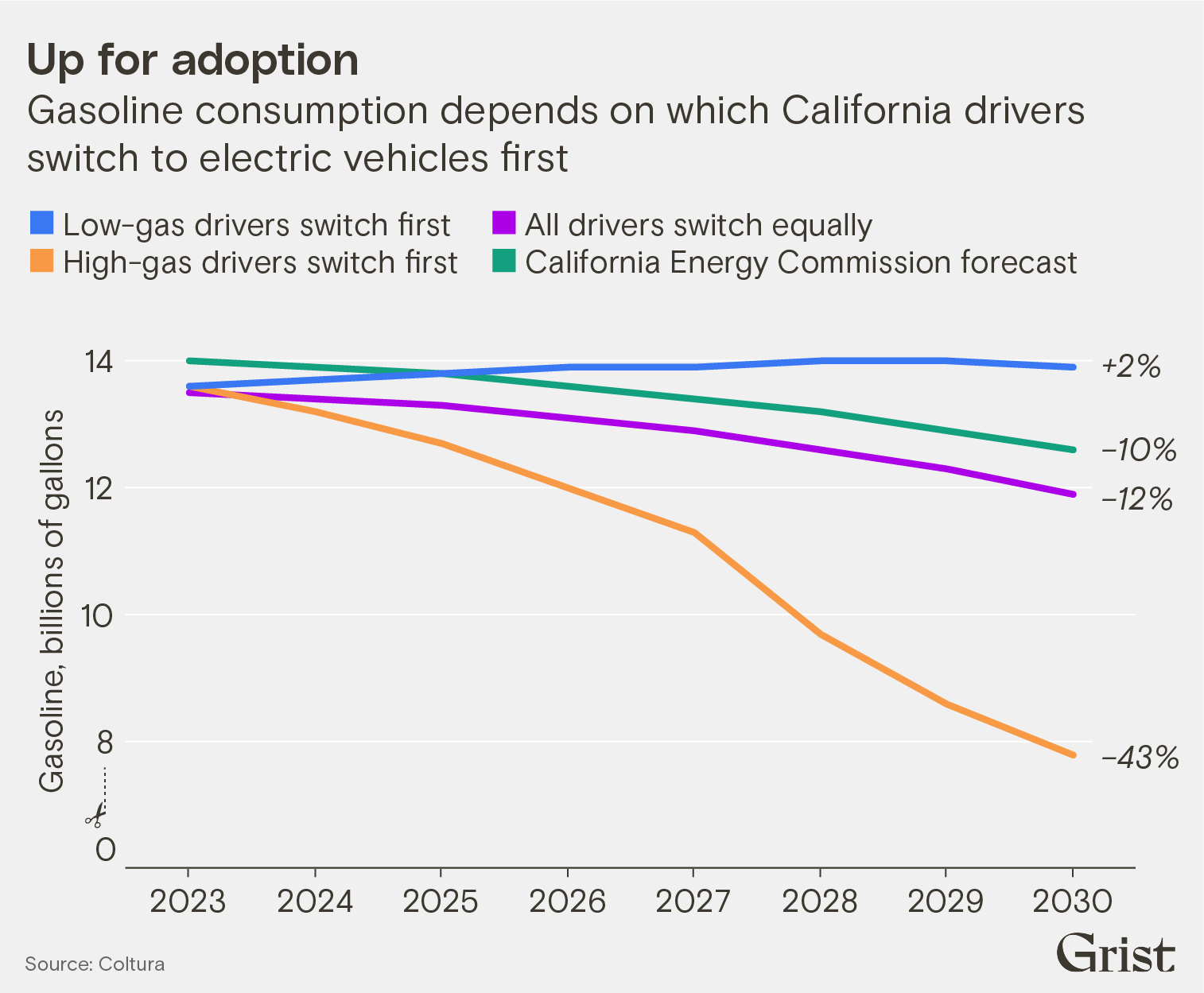
Demand for gasoline this year could end up at around 366 million gallons per day, down 7 percent from 2018, according to analysis provided to Grist by the Rocky Mountain Institute, a clean energy research and advocacy nonprofit. With recent policies like the Inflation Reduction Act offering a tax credit of up to $7,500 for an electric vehicle and the Biden administration’s new emissions rules — which require two-thirds of new passenger vehicles be electric by 2031 — gasoline demand could decrease almost a quarter by 2030, according to the research group, compared to current levels.

That’s still not fast enough to hit important targets to slash greenhouse gases, says Janelle London, the co-executive director of Coltura, an organization advocating for the end of gasoline. “Scientists are saying that we have to cut emissions from all sources in half by 2030 to avoid the worst impacts of climate change, and gasoline use just is not on track,” she said. The majority of the country’s transportation-related carbon emissions come from burning gasoline in cars, trucks, and SUVs. And transportation is currently the country’s largest source of pollution. London says that the fastest way to cut consumption is to target electric vehicle incentives toward “gasoline superusers”: the 10 percent of population that drives the most and guzzles nearly a third of the country’s gas. 

That’s not who’s buying electric vehicles right now. The typical EV driver is likely to be among those who drive the least, London said. “The only way we’re going to solve this near-term problem is to get the biggest gasoline users to switch to EVs, like, now, as soon as possible.” California, for instance, is on track for a 10 percent cut in gasoline use by 2030, far from its goal of halving gasoline use by the end of the decade. If superusers in California bought electric vehicles before everyone else, it would result in a steep, 43 percent drop that would move the state much closer to its climate goals.

A line chart showing forecasted gasoline consumption over time in California. If high-gas drivers switch to EVs first, gas consumption is forecasted to drop 43 percent by 2030.

Grist / Clayton Aldern

London says that federal tax credits in the Inflation Reduction Act “could be much better designed,” and she’s not the only one who thinks so. Ashley Nunes, director of federal climate policy at the Breakthrough Institute, an environmental research center, says the credits aren’t necessarily prompting people to give up their gas-powered cars. They’re just adding another vehicle. An estimated 44 percent of households with an electric vehicle have at least two other cars, if not three — nearly all of which run on gas. “First and foremost, I think that electric vehicle incentives should not be given to people who are not turning in their gasoline-powered car,” Nunes said. “We’re not paying for you to add another car in your garage.” 

The majority of the country’s transportation-related carbon emissions come from burning gasoline in cars, trucks, and SUVs.

In a study published Wednesday in the journal Sustainable Cities and Society, Nunes and other researchers found that offering blanket subsidies for electric vehicles isn’t an economically effective way of reducing carbon emissions. Targeting subsidies at households with only one vehicle and toward taxi or Uber drivers produces more bang for the federal buck. “You want to target people who drive their cars a lot, because that’s where you see the real emission benefits associated with EVs,” Nunes said.

In some states, there’s new interest in getting frequent drivers to switch to EVs. A bill in Vermont, for instance, would allow the Burlington Electric Department to use funds to help gasoline superusers buy electric vehicles. It passed through the state legislature this month and is headed to Republican Governor Phil Scott’s desk. If signed, it’ll be the first legislation in the country to offer EV incentives specifically to “superusers,” a term coined by Coltura two years ago.

Coltura makes the case that converting the biggest gasoline users into EV owners means less money for gas stations and more for power providers. “Utilities have a huge interest in getting these superusers to switch to EVs,” London said. “Suddenly, they’d be using a lot of electricity, right?” Someone who uses 1,000 gallons of gasoline a year, if switched to an EV, would use about 9,000 kilowatts of extra electricity each year, according to Coltura. Using the average cost of gasoline and electricity in February 2023, that means they’d spend about $1,150 on electricity instead of $3,390 on gas, saving roughly $2,000 a year.


Want more health and science stories in your inbox? Subscribe to Salon’s weekly newsletter The Vulgar Scientist.


There’s another effort underway in California that would allow superusers to receive more funding, in addition to federal tax credits, to switch. Assembly Bill 1267 would have directed the California Air Resources Board to institute a program that maximizes the reduction in gasoline — and thus the climate impact — for each dollar spent on incentives for superusers. After passing unanimously through two committee hearings this spring with bipartisan support, the bill died last week. (London said that it will likely be reintroduced next year.) The state already has a hodgepodge of programs that help lower-income residents buy electric cars — including one that offers grants of up to $9,500 to replace a gas guzzler with a cleaner vehicle — though they have suffered from a lack of funding.

The superusers who make less than the state’s median income wind up spending 10 percent of their income just on putting gas in their car. “People say you can’t afford an EV,” London said. “If you’re a superuser, you can’t afford to keep paying for gasoline.” 

The average price of an electric car is about $59,000, higher than the $48,000 average for all cars. But London says that average EV cost is “irrelevant” since there are cheaper options on the market. “The question is, is there an EV at the price point that I can afford one?” she asks. While the cheapest EV model, the Chevy Bolt, is being discontinued, a new Nissan Leaf starts at just under $30,000, and tax credits can knock the price down further.

Clayton Stranger, a managing director at the Rocky Mountain Institute, said that there was a “compelling” economic case to target superusers with EV incentives, though the savings alone might not be enough to make people switch: The infrastructure needs to be built in rural places to make people feel comfortable driving an electric car, giving them confidence there’s a place to charge if they need it.

And then there’s the other aspect of ending the gasoline era: getting Americans out of their cars and into buses and trains, and onto bike lanes and sidewalks. “We also need to significantly reduce the amount of driving that is done,” Stranger said. “EVs alone don’t get us all the way there.”

This article originally appeared in Grist at https://grist.org/transportation/peak-gasoline-superusers-electric-vehicle-incentives/.

Grist is a nonprofit, independent media organization dedicated to telling stories of climate solutions and a just future. Learn more at Grist.org

Biden administration pauses copper mining project on Oak Flat, a sacred Apache site

The Biden administration has put a pause on plans to erect a copper mine in Arizona on land known as Oak Flat, a site sacred to the San Carlos Apache and other Indigenous nations in the area. 

The U.S. Forest Service has told a federal court it is not sure when an environmental impact statement could be approved, an action which would set off the land swap allowing Resolution Copper, a British-Australian company owned by Rio Tinto and BHP, to continue with the development of the mine. The statement had been promised for this spring, but the agency now doesn’t have a set timeline. 

The Biden Administration and the Forest Service will be using this time to further consult with the San Carlos Apache and other tribes that have voiced opposition to the project.

Located about 40 miles from Phoenix, Oak Flat sits atop the third-largest deposit of copper ore in the world. The mine could produce up to 40 billion pounds of copper over 40 years and provide 1,500 jobs and millions in tax revenue and compensation.

For nearly a decade, tribal leaders in Arizona have fought to save Oak Flat and keep the ceremonial grounds free from mining projects and other disturbances. Local Indigenous peoples and religious organizations have filed briefs in support of The Apache Stronghold, a coalition of Apaches and their allies. 

Their argument: The mining industry is infringing upon the religious freedoms of Indigenous peoples in the area who look to Oak Flat, or Chi’chil Bildagoteel, as holy land.

The initial 2014 federal legislation that would have transferred Oak Flat from the Tonto National Forest to Resolution Copper stipulated that 60 days after the environmental impact statement was completed, the land swap would occur no matter what the statement results indicated.

In 2022, the Forest Service asked the Bureau of Land Management to review the environmental impact statement. Suggestions from the BLM included incorporating more robust information about the effects the mine would have on groundwater, and the stabilization of the tailings dam in Skunk Camp, a river located southeast of the mine.

According to E&E news, Joan Pepin, a Department of Justice attorney representing the Forest Service, wrote in a letter last week to the 9th Circuit Court of Appeals that the agency is conducting a “thorough review of the consultation record, and environmental and other associated documents, to ensure compliance with the applicable laws, regulations and policies.”


Want more health and science stories in your inbox? Subscribe to Salon’s weekly newsletter The Vulgar Scientist.

The mining industry is infringing upon the religious freedoms of Indigenous peoples in the area who look to Chi’chil Bildagoteel as holy land.


Ismail Royer, a director at the Religious Freedom Institute, an organization that stands with the Apache Stronghold, said the Biden administration needs to officially stop the land transfer and respect the religious freedoms of Indigenous peoples.

“Our concern is that they continue to stand by some very wrong interpretations of the Religious Freedom Restoration Act and the First Amendment, which do not fully acknowledge the right of people to practice their religion and they do not fully acknowledge the harm to the religious rights of the Apache tribe,” he said.

Oak Flat has been used as a religious site to connect Indigenous peoples to their faith, families, and the natural world since before colonization and European contact. Royer said he believes the current administration needs to not only stop the mining project for good, but acknowledge the violation of human rights he and the Apache Stronghold say occurred.

“We would like to see a formal acknowledgement and repudiation of their constricted understanding of human rights, which is implicated here,” Royer said. “There’s billions of dollars involved here, and the last thing that any of these people care about are the human rights of the Native American people.”

This article originally appeared in Grist at: https://grist.org/indigenous/biden-copper-mine-arizona-put-on-pause-oak-flat/

Grist is a nonprofit, independent media organization dedicated to telling stories of climate solutions and a just future. Learn more at Grist.org

Meatball in the machine: Ron DeSantis learns a tough lesson about depending on Elon Musk’s Twitter

Ron DeSantis saw the official launch of his campaign to be the 2024 GOP nominee for president begin the way it will invariably end: an abject but hilarious failure. It was announced with great fanfare on Tuesday that the Florida governor, who is desperate for some buzz as his once-promising campaign has faltered before it even began, would ditch the traditional announcement strategy complete with adoring supporters gathered for a big speech in favor of a Twitter Spaces conversation with Elon Musk, the CEO of Tesla-turned-alt-right troll. During the actual event Wednesday night, much was made about the “historic” nature of the announcement — right before it crashed. And then crashed again. And then again. 

It was hard to picture what was more darkly funny: How the notoriously ill-tempered DeSantis was reacting, as Musk’s failures stepped all over his big moment, or how quickly Donald Trump would race to Truth Social to gloat in his usual illiterate style about it. 

Of course, this was all very predictable. Anyone who has been following the news is well aware that Musk has spent the last year exposing the lie that was his “genius” reputation. When he’s not blowing up rockets, he’s blowing up Twitter, the social media company he dramatically overpaid for. That this would completely fall apart before DeSantis even had a chance to speak was overdetermined. 

But of course, DeSantis overlooked Musk’s now-infamous incompetence for one single reason: Meatball Ron has a mind totally pickled by MAGA propaganda.

Even before it turned into a fiasco, “Twitter Spaces interview with Twitter CEO Elon Musk” was a weird idea. DeSantis only went there because Musk has become a MAGA hero. And it’s not because Musk is talented or smart, but because MAGA is desperate for any validation. If it comes in the form of a charmless dork out of revenge for all the cool kids who aren’t impressed by his money, so be it. To compound the strangeness, DeSantis and Musk were joined by venture capitalist David Sacks, an authoritarian nitwit whose definition of “woke” is so expansive that he assigns the insult to those who disapprove of Russia’s unprovoked invasion of Ukraine. 

During the actual event Wednesday night, much was made about the “historic” nature of the announcement — right before it crashed. And then crashed again. And then again. 

We did get to hear Sacks repeatedly open up the event by raving about Musk’s fictional devotion to “free speech,” an especially trollish choice when the candidate he’s introducing is mostly famous for being an enthusiastic book-banner. It definitely set the tone: This would be as reality-based as any of the conspiracy theories Musks feverishly hypes. 

It’s not hard to see how Musk talked DeSantis into this trainwreck. The two have so much in common: A lack of charisma. A belief that they deserve to be worshipped like gods, coupled with a wet cat-style petulance when people decline to kneel before them. Plus, both clearly overestimate the number of people still bitter about being that one debate team kid who didn’t get to make out with anyone on the bus. Musk is learning the hard way that such a small population cannot make his “Twitter Blue” subscription program profitable. DeSantis is going to learn that they certainly aren’t numerous enough to win a primary, much less a general election. 

Trump may be a moron, but he knew well enough that he needed more than the Musk fanboy crowd to win. His coalition is what you need to win a GOP primary: overgrown frat boys, sanctimonious church ladies, illiterate racists, and a seemingly endless sea of elderly white suburbanites who assume “cancel culture” must be why their kids don’t visit. DeSantis was the one who empowered the woman who forced a Miami school to yank “The Hill We Climb” by Amanda Gorman. But you can bet that book-banner is still going to vote for Trump. 

If the goal was indeed to convince Trump that Twitter is a happening place where he needs to be, then this went about as well as a Tesla catching fire on the freeway. 

DeSantis, of course, fears speaking Trump’s name in public, even on those occasions when he can speak into a functioning amplifying technology. But Trump’s presence was almost as keenly felt as the myriad tech failures. Despite press chatter about Musk “aligning” himself with DeSantis, I don’t really think this happened because Musk is trying to chain himself to DeSantis. On the contrary, this seems like just the latest maneuver in Musk’s endless, pathetic campaign to get Trump’s attention — and get Trump back onto Twitter. Musk has also been claiming support for Sen. Tim Scott, R-S.C., who announced his presidential run earlier this week. It’s all very much like someone who, desperate to get their crush’s attention, tries flirting with other people. 

Musk didn’t even really hide it. The event with DeSantis was barely over before Musk was back to unsubtly begging Trump to return to Twitter:

If the goal was indeed to convince Trump that Twitter is a happening place where he needs to be, then this went about as well as a Tesla catching fire on the freeway. 


Want more Amanda Marcotte on politics? Subscribe to her newsletter Standing Room Only.


As Heather “Digby” Parton noted on Wednesday morning, DeSantis appeared to have snubbed Fox News in order to give this big ol’ news event to Twitter. This is doubly insulting since the Fox News-fired host Tucker Carlson has made hay out of starting a show on Twitter, which we can all hope goes as well as DeSantis’s campaign launch did. 

Twitter did eventually get the thing running, but after losing much, if not most, of the potential audience. Those who stuck around got to hear how DeSantis is the great savior of “freedom” because he let COVID-19 run rampant over his state. People who actually read history, which used to be legal in Florida, would question whether Gov. Book Banner has read the Constitution he loves to drone at length about. 

Or maybe I’ve got this all wrong and Musk really is a genius. Since DeSantis first got press hype about his presidential prospects, those of us unfortunate enough to have heard him speak were skeptical. Trump is fingernails-on-chalkboard annoying, sure, but DeSantis is somehow worse. He’s even whinier than Trump and has a tendency to react to human contact like most people do to dog poop. Keeping DeSantis’ voice out of people’s ears was probably the best gift Musk could have ever given the Great Meatball Hope. 

Violence is the new Republican grift

Carl Schmitt was a German legal philosopher and political theorist, a critic of democracy and liberalism, and a rabid antisemite who served as the chief legal adviser to the Nazis and the Third Reich. One of his main arguments was that a leader (“the sovereign”) who has been given legitimacy and power by the people (preferably “homogenous”) can decide to create a “state of exception” in response to some type of “crisis”. In essence, a leader can use the law (or work outside of it) as he sees fit in the interest of the public good — as he defines it. Schmitt also believed that violence was the basic essence of politics and power, and that political decision-making should be structured by the distinction between friend and enemy (meaning the Other).

For obvious reasons, Schmitt’s theories about a state of exception, violence, totalitarianism, and nationalism were highly appealing for the Nazis and other such antidemocratic and illiberal movements and leaders.

Steve Bannon, Trump’s former advisor, a Jan. 6 coup plotter and insurrectionist, a self-described “Leninist” who is also a neofascist that wants to tear down “the existing order”, most certainly has a deep familiarity with Carl Schmitt. Michael Flynn, the now disgraced former United States Army general, a key figure in the Jan. 6 coup attempt, and an expert in counter insurgency and psychological operations and regime change, most certainly knows Carl Schmitt’s work and theories. The members of the right-wing brain trust that inhabit such places as the Federalist Society, the Claremont Institute, and the various other think tanks, research institutes and Koch-funded university departments and professorships who are doing the intellectual and legal work of undermining America’s multiracial pluralist democracy most certainly also know Carl Schmitt.

Most Republican and other right-wing elected officials and members of the political class and media machine likely do not know who Carl Schmitt is. That is most certainly true of Donald Trump, a man who is proudly ignorant and does not read. It is almost certain that the average Republican voter, and other rank-and file-members of the MAGA movement do not know who Carl Schmitt is. But that does not matter because they are most certainly compelled to embrace Schmitt’s arguments in favor of violence against some type of “enemy” such as Black and brown people, Muslims, the LGBTQ community, Democrats, liberals, progressives, and others deemed to not be “real Americans.” 

In all, violence in its many forms (which includes random violence, terrorism, hate crimes, intimidation, and vigilantism) is central to the Republican fascists and larger white right and “conservative” movement’s project to end America’s multiracial pluralistic democracy by gutting the rule of law and the country’s democratic and other societal institutions.

Trump’s greatest appeal is how he gives his followers and others in the MAGA movement’s orbit permission to be their worst true horrible selves. Violence bonds members of a social group together; this is especially true of political personality cults such as the Trump MAGA movement. Healthy democracies discourage and outlaw political violence because it is antithetical to normal politics with its rules-based deliberation and collective decision-making and other ways of attempting to be legitimate sources of authority among the governed.

Trump continues to valorize the Jan. 6 terrorists as “heroes” and “political prisoners” who are victims of the deep state and the Biden administration.

The coup attempt on Jan. 6 was part of a much larger strategy of using violence, threats, and intimidation to undermine American democracy and to create a space for Trump-GOP fascist MAGA movement and larger white right to expand their power and influence. To that point, the Republican Party and its voters have not disavowed political violence as seen on Jan. 6 and beyond. In fact, public opinion polls and other research show the opposite: A significant percentage of today’s Republican voters increasingly see right-wing political violence up to and including a coup to remove President Biden from office and/or a sustained insurgency or second Civil War as legitimate means of getting and keeping political power.


Want a daily wrap-up of all the news and commentary Salon has to offer? Subscribe to our morning newsletter, Crash Course.


Republican-controlled legislatures and state houses are continuing to pass laws that encourage (and make it “legal”) for drivers to run over protesters (as applied in red state America this legal violence can generally only be used to maximum effect against black and brown people and others who are deemed to be “un-American” because they are too “Woke”, members of “the left” or otherwise not sufficiently “patriotic” because they dare to exercise their civil rights such as free speech and freedom of assembly.

Republican legislators in Texas are creating a type of “militia” that will be empowered to patrol the Southern border. If created, members of this “militia” would be granted immunity from civil or criminal prosecution. Given how Texas has historically treated Hispanics and Latinos and other non-whites, human rights organizations have warned that these militias will be de facto death squads.

Trump continues to valorize the Jan. 6 terrorists as “heroes” and “political prisoners” who are victims of the deep state and the Biden administration.

Republican lawmakers push for national concealed carry and expanded “stand your ground laws.” Based on what is known about how the easy access to guns and the encouragement to use them irresponsibly directly correlates to an increase in gun violence (including suicides and mass murders), the American right wing is trying to create a Hobbesian state of nature where violence and fear of death is everywhere and the rule of law is increasingly meaningless.

Social psychologists have repeatedly shown that the political decision-making of conservative-authoritarians is largely motivated by fear and death anxieties. The Republican Party’s opposition to effective gun control is a strategic decision because they know that more death and more killing from guns and other causes (such as COVID) enhances their power and control over their public  – including support for a fascist leader or other demagogue such as Donald Trump.

The Republican Party’s and “conservative” movement’s policies are deeply unpopular with the American people. Thus, the Republican fascists and larger white right and “conservative” movement have increasingly concluded that violence is a necessary and required (and legitimate) way for them to impose their will on the American people in the name of “defending traditional values” and “real America” (which is not subtle code for “White America” and “White Christianity”).

To that end, the Republican fascists and “conservatives” and the larger white right possess a deep attraction to and affinity for vigilante and other extra-legal and illegal violence as committed most recently by the likes of Daniel Penny (who choked a mentally ill homeless black man to death on a New York subway), Kyle Rittenhouse aka “the Kenosha Kid”, George Zimmerman (who killed a black teenager Trayvon Martin for the “crime” of walking home and refusing to comply with a wannabe cop’s orders) and too many others. Police officers who kill unarmed and otherwise vulnerable Black and brown people are also valorized by the American right wing.

Ultimately, right-wing vigilantism and other violent acts are encouraged by a vast right-wing machine that makes such people into stars and heroes and then lavishes them with money. At the New York Times, Jamelle Bouie issues a warning about the American right wing’s increasing “blood lust” for vigilante violence in the Age of Trump and the country’s worsening democracy crisis:

It’s the same language, the same tropes, the same ideas. In listening to conservative fans of Rittenhouse, Perry and Penny, you would never know that there were actual people on the other side of these confrontations. You would never know that those people were, in life, entitled to the protection of the law and that they are, in death, entitled to a full account of the last moments of their lives, with legal responsibility for the men who killed them, if that’s what a jury decides.

What you would know is that some Americans are “heroes” and “law-abiding citizens” and others are not. You would know that those Americans get the benefit of the doubt. And you would learn that to be seen as a problem by one of these law-abiding citizens is to be in jeopardy and even, potentially, to forfeit your claim to life. We see this in the worst of the discourse around Neely, who is framed not as a citizen with rights worth respecting but as a dangerous nuisance who deserved his fate.

One last point. DeSantis called Penny a good Samaritan. We also saw that language used in defense of Rittenhouse during his trial.

As media watchdog group Media Matters reports, there is a political machine that protects, funds, and elevates these right-wing vigilantes to hero and cult status:

With this wave of promotion — including personal donations from right-wing commentators Tim Pool, Candace Owens, and Tammy Bruce — Penny’s defense fund has raised over $2 million on GiveSendGo, a Christian fundraising site previously used by January 6 rioters. …

Penny is far from the first vigilante killer to receive the full backing of conservative media. After Kyle Rittenhouse shot three people, killing two, at an August 2020 Black Lives Matter protest in Kenosha, Wisconsin, right-wing media figures similarly jumped to his defense, soliciting donations and painting him as a victim who engaged in justified self-defense. Drew Hernandez — a frequent Tucker Carlson guest who has worked with Turning Point USA, Steve Bannon, and Infowars — even served as a witness for Rittenhouse’s defense.

Since the Kenosha shooting, Rittenhouse has turned into a conservative icon and used his new platform to advocate for other vigilantes. Appearing on Tucker Carlson Tonight in April, Rittenhouse and Carlson petitioned Texas Gov. Greg Abbott to pardon Daniel Perry, another right-wing media darling who was found guilty of murdering a Black Lives Matter protester in July 2020 after prosecutors revealed a history of messages in which he called protesters “monkeys” and threatened to kill them.

With a campaign of support behind him, Penny has joined the ranks of George Zimmerman, Travis and Gregory McMichael, Andrew Lester, Byron Smith, and various vigilante patrols and right-wing militias whose extrajudicial violence has been excused by conservative media.

The above is reflective of how American society, historically and to the present, has a deep and pathological appetite for violence both at home and abroad. America is truly “exceptional” in that way as one of most violent societies on the planet.

Public health researchers and other experts have shown in great detail how violence spreads across communities and broader society like a pathogen or virus, that in many ways is preventable and can otherwise be contained and treated.

Today’s Republican Party and “conservative” movement and its forces want the American people to be sick and terminally ill with such violence and all the misery and death it causes. It is that sickness and death which the Republican fascists, the “conservatives” and the larger white right and their forces see as a pathway to unlimited power for all time and their dream-nightmare of a new American plutocracy. 

Gun violence survivors struggle with long-term trauma — and experts say we’re not doing enough

When President Joe Biden referred to an “epidemic” of gun violence on the anniversary of the Uvalde shooting, he was not simply using a rhetorical flourish. A recent KFF poll found that one out of five Americans say they have been personally threatened with a gun (the figure is one out of three for Black Americans), while one out of six say they have personally witnessed someone being shot. More than half of American adults say that either they or a family member has had a direct violent encounter with guns, and this is consistent with the documented rise in mass shootings since 2020.

Now a recent study in the journal Annals of Internal Medicine highlights an under-recognized consequence of all this gun violence: The long-term mental trauma inflicted upon the most immediate survivors, those who are actually injured by guns.

By looking at data from 87 adults who had been injured by guns and visited trauma centers in midwestern cities, the researchers found that patients experienced heightened symptoms of post-traumatic stress disorder (PTSD) and depression. In particular, these survivors had a markedly worse quality of life than individuals who had not undergone those experiences. As the authors wrote in the study, “Patients’ health-related quality of life” had been poor at the outset, remained poor 6 months after the incidents and had remained “well below scores reported in previous studies of both injury populations and the general population.”

“Our study provides evidence that firearm violence survivors report higher PTSD symptoms that remain high 6 months later.”

“This study provides a picture of what the mental health experience is for firearm violence survivors early after being injured,” Sydney Timmer-Murillo, PhD, a Health & Trauma Psychology Fellow at the Medical College of Wisconsin, told Salon by email. “Our study provides evidence that firearm violence survivors report higher PTSD symptoms that remain high 6 months later. Additionally, their ‘health-related quality of life,’ or the impact that physical health has on their daily life, is poor after gun violence and continues to be poor.”


Want more health and science stories in your inbox? Subscribe to Salon’s weekly newsletter The Vulgar Scientist.


“There is little research on mental health after firearm violence, despite the growing number of firearm violence survivors in our country.”

This is not to say that the study is perfect, as the authors admit that they had to rely on a small convenience sample of individuals who could easily participate and lacked more thorough data about patients’ medical histories. Nevertheless, the authors also feel that their data proves an important point about how America’s health care system is under-performing — namely, that it is not assisting survivors of gun violence as they try to move on with their lives in a happy, healthy manner.

“This preliminary study highlights the needs to better understand and manage the mental health consequences of firearm injury,” the authors write. “Early screening and comprehensive care may improve outcomes in this at-risk population.”

Timmer-Murillo explained there is little research on mental health after firearm violence, despite the growing number of firearm violence survivors in our country.

“Research should look at what increases mental health issues or poor quality of life after firearm violence,” she said. “This should also include a focus on the social or community factors that may be influencing recovery such as community violence.”

The rash of mass shootings occurring throughout the United States shows no sign of stopping, and experts have performed extensive research on how to not only help survivors, but reduce the violence itself. Studies have consistently found a correlation between specific gun control laws (including mandatory waiting periods and prohibiting firearms to those associated with domestic violence) and reductions in violent crime rates. Similarly, they found that mandatory waiting periods and child-access prevention laws were linked to reductions in suicide rates. By contrast, concealed-carry laws and stand-your-ground laws were both correlated to increases in violent crime rates.

The gun violence epidemic can also be understood in terms of recent events in American history, with a recent paper in the journal Homicide Studies by University of Illinois Springfield political science associate professor Magic Wade finding that the COVID-19 pandemic had worsened existing trends toward gun violence. Describing the event as “fuel on the fire” of the pre-existing gun violence epidemic, Wade told Salon that “fatal and non-fatal firearm injuries both spiked dramatically in 2020, but the broader trend toward more cities experiencing heightened gun violence preceded the pandemic as evidence of this, so on and so on.”

In a sense, the new study on trauma and gun violence broadens the larger gun control conversation by moving from how to stop the spike in gun violence to how to provide long-term care for the survivors. As Timmer-Murillo summed it up to Salon, “practically, our study suggests that we need to screen for mental health issues soon after injury. We also need to provide support early that addresses both mental and physical health needs of firearm violence survivors.”

CORRECTION: An earlier version of this story incorrectly reported KFF as Kaiser Family Foundation. KFF is not affiliated. The story has been updated.

“Bama Rush”: The 7 biggest revelations from Max’s University of Alabama sorority rush documentary

There are a lot of things that go viral on TikTok, only to be left forgotten in a week, two weeks’ time. But not Bama Rush, the elaborate sorority recruitment process at the University of Alabama, tht arose as a cultural phenomenon thanks to its popularity on the app in 2021.

Regardless of what your “For You Page” on TikTok looked like, you probably came across a few videos of college-aged women documenting their journey to find the perfect sorority to be in — their new forever home. To many, the entire process may sound incredibly silly and frivolous. But in actuality, it’s extremely competitive and, at times, even soul-crushing.

When #BamaRush went viral on social media for the second year in a row in 2022, more people became invested in the elaborate antics, including film director Rachel Fleit. Fleit, who’s best known for the documentary “Introducing, Selma Blair,” attempts to showcase the entire process and cover its racist, complex history in her titled doc “Bama Rush.” Making the film, however, was not an easy feat for Fleit. Amid filming, Fleit received criticism, scorn and online threats from a controversial secret society that has ties to Bama’s frats and sororities.

The documentary itself follows four aspiring sorority pledges: Shelby, a high school senior from Quincy, Illinois; Isabelle, a high school senior from Rancho Cucamonga, California; Holliday, a Bama freshman from Orange Beach, Alabama, who’s looking to rush again after being blacklisted by her ex-sorority sisters; and Makalya, another Bama freshman from Leeds, Alabama. There are also interviews with Bama alumni, journalists and experts in the field of Greek life.

Here are the seven biggest revelations from “Bama Rush”:

01
The competitive nature of rush at Bama
Bama RushBama Rush (Photo courtesy of Max)

“Rush at the University of Alabama traditionally has kind of a bad rep,” said Trisha Addicks, a rush consultant. “It’s kind of a cutthroat process. It’s just uniquely Alabama.”


The entire process consists of four highly competitive rounds: Open House, Philanthropy, Sisterhood and Preferences. Sororities vote on their top potential new members (also known as PNMs) while PNMs vote on their preferred sororities in hopes of finding the perfect match. Multiple sorority sisters will first talk to one PNM before casting their votes on her. If the PNM gets high enough votes, she’ll be asked to return to talk to more sorority sisters. 


Eventually, the PNMs will return to fewer and fewer sororities as they determine which sororities are the best fit for them. They also are judged on the basis of first impressions, conversation, values and academics. If the PNMs don’t meet a certain criteria, they will be dropped promptly.


After the final round, PNMs choose their top sororities and the sororities in turn choose their new members, or pledge class. It’s a dramatic and emotional affair that leads to bid day, when PNMs receive formal invitations from the sororities they’ve been invited to join. Afterward, PNMs run to their sorority to meet their new sisters.

02
Bama is the blueprint for Greek life
Delta Kappa Epsilon Historic marker at the University Of Alabama in Tuscaloosa, Alabama on July 5, 2018.Delta Kappa Epsilon Historic marker at the University Of Alabama in Tuscaloosa, Alabama on July 5, 2018. (Raymond Boyd/Getty Images)

Greek life is a staple at Bama and has long influenced Greek life across university campuses nationwide. As for sororities, Alabama began admitting female students in 1893 and enacted its first sorority homes 12 years later. The oldest active sorority on campus is Kappa Delta, the Zeta chapter, which was formed in 1904. Coming in second is Alpha Delta Pi.


“I remember when we were going through recruitment at Georgia, we would all be looking at what Alabama was doing,” said Sloan Anderson, a rush consultant, in the documentary. “Yeah, they’re just the trendsetters. I think that’s why so many out of state decide to go to the University of Alabama and rush. It’s just this beast, because Greek life is everything at Alabama.”

03
Sororities are “ranked” based on fraternity influences
Phi Gamma Delta Theta Chapter House at the University Of Alabama in Tuscaloosa, Alabama on July 5, 2018.Phi Gamma Delta Theta Chapter House at the University Of Alabama in Tuscaloosa, Alabama on July 5, 2018. (Raymond Boyd/Getty Images)

Bama sororities are deemed top, middle or bottom-tiered houses according to rankings from on-campus fraternities.


“I think a lot of the time people like to rank — and by people, I usually mean fraternity boys or boys in general,” said Anderson. “I feel like they’re like, ‘Oh, this house has the hottest girls, so they’re a top house. These freshman are the hottest freshmen, so they’re going to be considered a top house.'”


Anderson continued, “They have a social calendar, and they get to mix with certain sororities, but it’s only a limited amount. And the fraternities want to be mixing with the hottest sororities, of course, because they’re 20-year-old males. So that’s kind of where the ranking system comes from. They want to make sure the girls who are wearing their letters are up to their standards.”


Those in “top-tier” sororities also enjoy more benefits — be it academic or social — compared to those who are in lower-tiered homes. Rian Preston, an active member of Sigma Kappa, which is allegedly a “bottom-tier” sorority explained the perks in great detail:


“There are a lot of things that you’re entitled to when you’re in a top-tier sorority. You’re entitled to test banks that are going to help you on your exams. You’re entitled to people in your sorority that have better connections, whether their parents are richer or more connected. You’re entitled to a male gaze that might be a little more beneficial to you.” 


Preston added, “So being in a ‘bottom-tier’ sorority, I have to understand that at some point, there’s nothing I can do to change institutionalized rankings.”

04
PNMs must stay away from discussing “The Five B’s”
Bama RushIsabelle and Sloan Anderson from “Bama Rush” (Photo courtesy of Max)

Anderson explained that PNMs must refrain from discussing five topics, also known as “The Five B’s,” amid the recruitment process.


The first is “Boys,” namely fraternity boys. “If they bring it up, it’s OK to talk about it, just you don’t want to initiate that conversation,” Anderson advised Isabelle. The second is “Booze.” The third is “Bible,” meaning PNMs shouldn’t inquire about religion or ask what church the sisters go to. The fourth is “Bucks,” or money and wealth. And the final ‘B’ is “Biden,” which just means politics.

05
Bama’s not-so-secret controversial society is still prevalent today
A sculpted Elephant, Alabama Crimson Tide's mascot stands outside the Rose Administration Building at the University Of Alabama in Tuscaloosa, Alabama on July 5, 2018.A sculpted Elephant, Alabama Crimson Tide’s mascot stands outside the Rose Administration Building at the University Of Alabama in Tuscaloosa, Alabama on July 5, 2018. (Raymond Boyd/Getty Images)

Known as The Machine, the underground organization at the university consists of representatives from the school’s top sororities and fraternities who control everything from on-campus politics to the Student Government Association (SGA) and Homecoming elections. The Machine, a chapter of the national fraternity Theta Nu Epsilon, was founded in 1914 to decide on campus affairs in private. It is made up of 28 predominantly white fraternities and sororities who pay at least $850 per semester to fund the organization, per a 2011 report by UA’s student-run newspaper The Crimson White.  


“The Machine systematically made sure that a minority group on campus of elite people who got special treatment, lived in special homes, who came from the most affluent and powerful families got an advantage on everyone else,” said John Archibald, a journalist and Bama alum. “It’s a way better teacher of how to do nefarious things for power than you could ever get in a political science class.”


“And I think it’s a threat to people’s hopes and dreams that they may not be able to fit into the crowd and maybe the tax bracket they want to fit into,” Archibald added. “I think the danger is not belonging — it’s not being one of the chosen people.”


When asked about The Machine, students were reluctant to talk about the organization and instead said, “We shouldn’t talk about that.” Considering how much power The Machine holds over Bama’s student population, it’s understandable why many current Greek life participants avoid discussing the infamous society.


Alex Smith, a Phi Mu alum and former Machine student senator, said that “something just felt really dark and ugly about” The Machine. Smith later penned an essay for The Crimson White titled “Why I’m leaving the Machine,” in which she exposed what the organization did behind closed doors.


Prior to the release of “Bama Rush,” online critics alleged that The Machine was coming for Fleit, HBO and all the participants in her doc. Fleit clarified that they were all rumors.

06
Bama Greek life has a troubling history of racism
Women chatting outdoorsWomen chatting outdoors (Getty Images/Maria Taglienti-Molinari)
The documentary delves into Bama’s tense past between UA Panhellenic sororities and Black students. In 1986, the Theta Sigma chapter of Alpha Kappa Alpha, a Black sorority part of the “Divine Nine,” had a cross burned in the yard of their sorority house. The incident fueled a bitter racial divide within Bama’s Greek life — which persisted till 2013, when Alabama ended segregated sororities. 


″It was a threat. It was a way of saying, ‘Black people can clean our houses, but they can’t move in next door,‴ said Reginald McCall, the then president of the National Pan-Hellenic Council (NPHC), in a 1986 Associated Press report.


Bama alum and former homecoming queen Deidra Chestang Lane, who was a member of Alpha Kappa Alpha, recalled the incident, saying, “We were terrified, and anger crept in later after we got beyond the shock and dismay of the entire situation.”


She continued, “I grew up in Alabama, so hearing that crosses were being burned is something that I grew up hearing about, but I’d never personally seen a cross being burned, and once you see that, you can’t unsee it. And it sticks with you for a lifetime.”


Makalya also explained that race remains a touchy subject amongst Bama students today: “Everyone here thinks I’m everything but Black. Like I’m white and Black. They think I’m everything.”


“If I’m too white, I’m whitewashed, but if I act too Black, then I’m not white enough,” she said. “Like, what am I supposed to be because I’m both races? Why can’t I just act myself? I’m not acting a race — you can’t act a race.”

07
Rushing at Bama comes with a huge cost
Money flying off stack of billsMoney flying off stack of bills (Getty Images/PM Images)

In addition to having their own rush consultants, PNMs are expected to drop between $4,170.03 to $4,978 in new member fees per semester. The hefty cost includes a chapter meal plan, local chapter fees along with one-time fees for pledging and initiation.


The documentary also notes that the average annual cost for new members of a sorority at Alabama is $8,300. Living in-house fees per semester range from $7,465.17 to $9,445, per The Birmingham News. Living out-of-house fees per semester range from $3,621.52 to $4,575.


Whether it’s societal pressures or financial pressures, the rushing process is daunting to many at Bama. So much so that some PNMs will drop out of the process halfway through rush week. At the end of the documentary, it’s revealed that Shelby gets into Phi Mu, a widely considered top-tier house. Isabelle gets into her first choice sorority, Alpha Delta Pi. Both Holliday and Makalya decide to not rush.

“Bama Rush” is currently available for streaming on Max. Watch a trailer for it below, via YouTube:

Simply the best: Tina Turner has died but leaves a legacy of endurance and resurgence

When Tina Turner hit her stride with the release of her 1984 hit album “Private Dancer,” MTV had barely been around for three years, which placed the bulk of the generation it influenced in its adolescence. Turner was 44 years old, an age at which most women in entertainment experience a career recession if they aren’t pushed toward early retirement.

But to an audience still in awe at seeing their radio stars’ hits come to life on TV screens she was just getting started. Turner became one of the first Black artists to be featured on MTV after “Private Dancer” went on to be certified five-time Platinum in the United States, yielding her only No.1 hit on the Billboard 100, “What’s Love Got to Do With It.”

A year after its release she played to stadiums on a world tour that drew audiences of all ages. Turner also became an action star, playing the regal, daunting Aunty Entity in 1985’s “Mad Max Beyond Thunderdome.” When she retired from touring after headlining the highest-grossing rock roadshow of 2000, she was 60.

These achievements are not the sum of Turner’s 83 years, a rich life defined by resilience, stamina and a refusal to be defined by the hardship and abuse by which others sought to measure her legacy. But in a world that still obsesses over what constitutes a woman’s prime, Turner lived and leaves an unrivaled blueprint. Nobody but Tina Turner decided when she was done.

Turner, who died Wednesday after a long illness in her home in Küsnacht near Zurich, Switzerland, was the rare rock icon who meant something to Generation X and their parents in their youths, and adulthoods, up until the day she left us. Her musical style merged soul traditions with a wiry jolt of rock n’ roll, making her one of the few Black women to claim her spot, and an especially bright one, in a firmament that primarily venerates white men.

Turner was a force of aerobic power, belting her way through covers of John Fogerty’s “Proud Mary” and Sly Stone’s “I Want to Take You Higher” as her limbs churned away with precision and in double time. And her voice, a supernatural approximation of molten honey and rough sugar, earned her the role of the Acid Queen in the 1975 film version of the Who’s “Tommy.”

Nobody but Tina Turner could decide when she was done.

In the 1980s she transformed into an entirely different type of rock star than the fireball powering the Ike & Tina Turner Revue in the 1960s and 1970s – all leg muscle, lion’s mane wigs, sparkle, and an afterburner of a voice that could melt you slowly in one moment and blast you with hot diamond dust in the next, with an inhale’s space between.

“Private Dancer” yielded some of its decades’ defining hits, including “Better Be Good to Me” and its title track. Singles from the albums that followed remain nearly as popular, including “Typical Male, “I Don’t Wanna Fight” and her cover of Bonnie Tyler’s “The Best.” But she also made the “Mad Max” end-credit banger “We Don’t Need Another Hero (Thunderdome)” that summer’s power ballad to beat, winning a best female rock performance Grammy in 1985 for another single off the movie’s soundtrack, “One of the Living.”

Tina TurnerTina Turner wearing silver attire in a scene from the film ‘Mad Max Beyond Thunderdome’, 1985. (Warner Brothers/Getty Images)
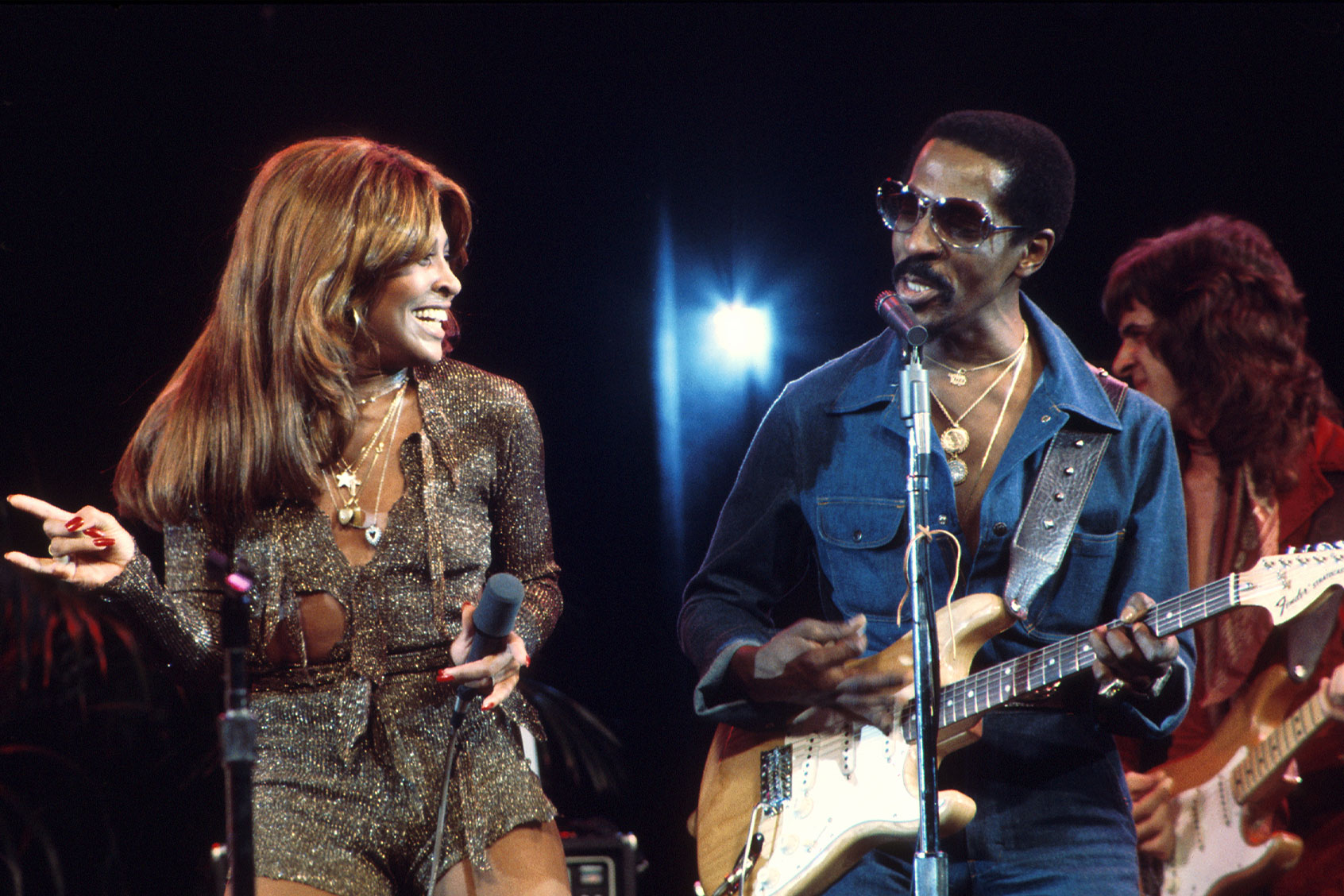
Over the years Turner stunned video viewers, taking her place within the ranks of rock royalty on the famous “We Are the World” charity single and performing in Live Aid. Her personal story inspired a Tony Award-winning Broadway musical and made her an inspiration for people born a few meters behind the starting line or knocked down by circumstance.

Much of her notoriety as a survivor grew out of her choice to go public with details of her abusive marriage to Ike Turner in her 1986 autobiography “I, Tina,” which was adapted into the 1993 movie “What’s Love Got to Do With It.”  

“It’s hard to wrap your head around that the worst parts of your life have been an inspiration,” she admits in the 2021 HBO documentary “Tina,” which showed the toll that years’ worth of reporters’ questions about her ex-husband’s abuse took on her.

Although those revelations shadowed her for years, her talent for reinvention and insistence on maintaining the excellence she reached the height of her solo career eventually won out.  Her authorized 2021 documentary, designed to serve as her final farewell, establishes this. Turner racked up 11 Grammys throughout her career and shared stages with the Rolling Stones, Chuck Berry, Rod Stewart, and, at the 2008 Grammy Awards, Beyonce.

She was also honored by the Kennedy Center in 2005 and inducted into the Rock & Roll Hall of Fame twice – once in 1991, alongside her ex-husband Ike Turner, and again, deservedly, as a solo act in 2021, placing her in a rare category of female double inductees that includes Stevie Nicks and Carole King.

Turner was born Anna Mae Bullock on Nov. 26, 1939, in Brownsville, Tennessee and raised in Nutbush, as memorialized in her song “Nutbush City Limits.” Her parents were sharecroppers who often traveled to work, leaving Turner and her older sister Ruby Aillene on their own.  

Ike And Tina TurnerIke and Tina Turner performing with the Ike And Tina Turner Revue on the American TV music show, ‘Don Kirshner’s Rock Concert’, recorded in Los Angeles, California and aired on 12th March 1976. (Michael Ochs Archives/Getty Images)

She was 18 when she met Ike Turner in East St. Louis when he was the 26-year-old bandleader of Kings of Rhythm. Their partnership was launched in 1957 when the band’s drummer Eugene Washington handed Anna Mae the microphone during an intermission. She wound up singing with the band for the rest of the performance and became its featured vocalist. Her first studio recording credit is on Ike Turner’s “Boxtop” was released in 1958; she listed as “Little Ann.”

Turner lived and leaves an unrivaled blueprint.

After a record label executive suggested to Ike Turner that he make the young singer the star of his show, he renamed her Tina Turner, inspired by “Sheena, Queen of the Jungle.” She was thusly reintroduced to the public as the duo got their first major Billboard hit in 1960 with “A Fool in Love,” inspiring Ike Turner to create the Ike & Tina Turner Revue. They married in Tijuana, Mexico, in 1962.

But he never designed their partnership to be equal. Ike Turner trademarked Tina’s name so that if she were to leave him and the band, he could simply replace her with another singer he’d call Tina Turner. The sheer brightness of her made it impossible for audiences to see the Revue’s singer as anything but the main star and the one and only Tina.


Want a daily wrap-up of all the news and commentary Salon has to offer? Subscribe to our morning newsletter, Crash Course.


The performer fled her ex-husband’s violent abuse for the last time in July 1976, hours before a scheduled concert in Dallas, Texas, and with only 36 cents and a gasoline card to her name. When their divorce was finalized in 1978, she ended up with a few physical possessions, rights to songwriter royalties on compositions she had written, and, central to her astronomical revival in the 1980s, the sole right to her stage name.

Two decades into her career’s second wind Turner became a beacon of possibility for people who grew up with her and those who grew older with her. In the era of her fame where she co-starred in, among other things, a Pepsi commercial with David Bowie, that king of seemingly ageless changelings, she proved that rock stardom has no time limit, becoming the oldest female solo artist to top Billboard’s Hot 100 at the age of 44.

A few years after admitting to her biography co-author Kurt Loder that “I have not received love almost ever in my life . . . I have had not one love affair that was genuine and sustained itself. Not one,” she found what had long eluded her when she met German music executive Erwin Bach, a man 16 years younger than she was, in 1986.

They married in 2013 after spending 27 years together, the same year that she became a citizen of Switzerland and relinquished her American citizenship. That year Turner also spoke with Oprah Winfrey (of course) to mark that occasion, who asked her what the legacy of Tina Turner is.

The star’s answer? “Endurance,” she says, adding, “My legacy is that I stayed on course from the beginning to the end because I believed in something inside of me that told me that it can get better, or you can make something better and that I wanted better.”

Turner concludes, “So my legacy is a person that strived for wanting it better and got it.”

“Tina” is available to stream on Max.

“The liberation of Taco Tuesday begins”: Taco Bell fights to free “Taco Tuesday” from trademark

In 1989, the Wyoming-based taco chain Taco John’s kickstarted a seasonal “Taco Twosday” campaign, during which customers could get two tacos for 99 cents. The promotion was so popular that the company decided to make it a key part of their marketing strategy and, after shifting the final wording just slightly to “Taco Tuesday” they trademarked the phrase. 

And for the last three and half decades, Taco John’s has maintained that trademark, even as the concept of “Taco Tuesday” has grown in cultural popularity across the country — but now, another taco chain is arguing that the phrase  “should belong to all who make, sell, eat, and celebrate tacos.”

On May 16, Taco Bell released a statement titled “The Liberation Of ‘Taco Tuesday’ Begins: Taco Bell Fights To Cancel Existing Trademark Registrations.” It read, in part: 

How can anyone Live Más if they’re not allowed to freely say “Taco Tuesday?” It’s pure chaos. Taco Bell seeks no damages or trademark rights in “Taco Tuesday.” It simply seeks common sense for usage of a common term. In filing the legal petitions, Taco Bell is honoring people’s right to come together and celebrate the joys of tacos, on Tuesdays and every other day. 

The chain — which has 15,638 United States locations to Taco John’s 360 — also launched a new commercial starring Los Angeles Lakers legend Lebron James titled “Taco Bleep.” 

“No more trademarks, no more beeps, starting right now,” James says in the commercial, which debuted on Monday along with a petition launched by Taco Bell called “Freeing Taco T***day.” It currently has around 2,300 of the brand’s desired 2,500 signatures. 

As NBC Los Angeles reported, “Taco Bleep” takes on an extra delicious layer of irony when you remember that Lebron James’ once attempted to trademark the phrase “Taco Tuesday,” but was “denied by the U.S. Patent and Trademark Office, which ruled it to be a ‘commonplace term.'” According to the publication, a spokesman for James told ESPN’s Dave McMenamin at the time that the application was filed “to ensure LeBron cannot be sued for any use of ‘Taco Tuesday.'”

Taco John’s has 40 days to respond to Taco Bell’s petition. In the meantime, however, they seem to be taking the legal challenge/publicity stunt in stride. The company has launched a “two tacos for $2″ Taco Tuesday deal and their CEO, Jim Creel, responded to Taco Bell’s lawsuit last week.

“When it comes right down to it, we’re lovers, not fighters, at Taco John’s®,” Creel said in a statement. “But when a big, bad bully threatens to take away the mark our forefathers originated so many decades ago, well, that just rings hollow to us. If ‘living más’ means filling the pockets of Taco Bell’s army of lawyers, we’re not interested.”

Investigators detail years of alleged misconduct by Texas AG Ken Paxton in stunning hearing

Sign up for The Brief, The Texas Tribune’s daily newsletter that keeps readers up to speed on the most essential Texas news.


A Texas House committee heard stunning testimony Wednesday from investigators over allegations of a yearslong pattern of misconduct and questionable actions by Attorney General Ken Paxton, the result of a probe the committee had secretly authorized in March.

In painstaking and methodical detail in a rare public forum, four investigators for the House General Investigating Committee testified that they believe Paxton broke numerous state laws, misspent office funds and misused his power to benefit a friend and political donor.

Their inquiry focused first on a proposed $3.3 million agreement to settle a whistleblower lawsuit filed by four high-ranking deputies who were fired after accusing Paxton of accepting bribes and other misconduct.

View a livestream of the Texas House

Many of the allegations were already known, but the public airing of them revealed the wide scope of the committee’s investigation into the state’s top lawyer and a member of the ruling Republican Party. The investigative committee has broad power to investigate state officials for wrongdoing, and three weeks ago the House expelled Bryan Slaton, R-Royse City, on its recommendation.

In this case, it could recommend the House censure or impeach Paxton — a new threat to an attorney general who has for years survived scandals and been reelected twice despite securities fraud charges in 2015 and news of a federal investigation into the whistleblowers’ claims in 2020.

Erin Epley, lead counsel for the investigating committee, said the inquiry also delved into the whistleblowers’ allegations by conducting multiple interviews with employees of Paxton’s agency — many of whom expressed fears of retaliation by Paxton if their testimony were to be revealed — as well as the whistleblowers and others with pertinent information.

According to state law, Epley told the committee in a hearing at the Capitol, a government official cannot fire or retaliate against “a public employee who in good faith reports a violation of law … to an appropriate law enforcement authority.”

The four whistleblowers, however, were fired months after telling federal and state investigators about their concerns over Paxton’s actions on behalf of Nate Paul, an Austin real estate investor and a friend and political donor to Paxton.

“Each of these four men is a conservative Republican civil servant,” Epley said. “Interviews show that they wanted to be loyal to General Paxton and they tried to advise him well, often and strongly, and when that failed each was fired after reporting General Paxton to law enforcement.”

Epley and the other investigators then walked the committee through the whistleblowers’ allegations, including help Paxton gave Paul that went beyond his normal scope of his duties.

“I ask that you look at the pattern and the deviations from the norm, questions not just of criminal activity but of ethical impropriety and for lacking in transparency,” investigator Erin Epley told the committee. “I ask you to consider the benefits [for Paxton].”

After hearing three hours of testimony from the investigators, the committee met privately to discuss the information shortly after 11 a.m.

Minutes into the hearing, Paxton called into a Dallas radio show and blasted the investigation as unprecedented. As for the settlement, Paxton told host Mark Davis that his office always knew it would be the Legislature’s decision whether to authorize taxpayer money for it.

“So this is a level that is shocking to me, especially from a Republican House,” Paxton said. “This is what they have time to do as opposed to some of the important things like school choice or fixing the fact that the Court of Criminal Appeals struck down my ability to prosecute voter fraud.”

Paxton was referring to Gov. Greg Abbott‘s priority proposal this legislative session to divert taxpayer dollars to let parents take their kids out of public schools. The proposal has encountered stiff resistance in the House and remains one of the big pending issues before the session ends Monday.

As the hearing unfolded, Public Citizen, a consumer advocacy nonprofit, called on Paxton to resign.

“If he refuses to go willingly, the Texas Legislature must act to remove him,” Adrian Shelley, Public Citizen’s Texas director, said in a statement. “A running series of scandals and an alleged pattern of corruption have clouded Paxton’s entire time in office. The people of Texas simply can’t trust that he is working for their interests, not his.”

The hearing capped a whirlwind 24 hours at the Capitol where Paxton unexpectedly called on Speaker Dade Phelan to resign, alleging the Beaumont Republican recently presided over the chamber while drunk. Hours later, the investigative committee revealed it was looking into Paxton, and Phelan dismissed the attorney general’s request that he step down as a “last ditch effort to save face.”

Committee investigators said their probe involved Paxton’s actions to help Paul, who contributed $25,000 to Paxton’s campaign in 2018.

The relationship between Paxton and Paul was the basis of whistleblower complaints to state and federal authorities, alleging that Paxton had used his office to benefit his friend. That sparked an FBI investigation in November 2020.

The committee introduced a team of five investigators, including multiple attorneys who had served as prosecutors specializing in white collar crime and public integrity cases.

The team included Epley, a former prosecutor for Harris County and Ryan Patrick, a Donald Trump-appointed U.S. attorney for the Southern District of Texas and Lt. Gov. Dan Patrick’s son; Terese Buess, a veteran prosecutor with the Harris County district attorney’s office; Mark Donnelly, who served 12 years as a prosecutor for the U.S. attorney’s office for the Southern District of Texas and served for two years as that office’s fraud division chief, specializing in white collar crimes; Donna Cameron, a career prosecutor in various Texas counties with experience prosecuting public officials; and Brian Benken, a former prosecutor with the Harris County district attorney’s office with more than 30 years of legal experience. The group also worked with a former Houston Police Department officer in its investigation.

Murr said the team made up more than 120 years of legal experience.

The investigators interviewed 15 employees for the attorney general’s office, including Joshua Godby, who worked for the open records division when Paxton pressured the division’s staff to get involved in a records fight to benefit Paul in a lawsuit.

Out of the 15 people, investigators said, all except one expressed concern about retaliation from Paxton for speaking on the matter. The investigators also interviewed a special prosecutor, Brian Wice, in a separate securities fraud case that has been ongoing for eight years, as well as representatives for the Mitte Foundation, an Austin nonprofit involved in a legal dispute with Paul.

The investigators outlined the alleged favors Paxton did for Paul. In exchange, Paul helped with a “floor to ceiling renovation” of Paxton’s Austin home and employed a woman with whom Paxton was allegedly in a relationship. Paxton is married to state Sen. Angela Paxton, R-McKinney, who learned of the affair in 2019, leading to a brief hiatus before it resumed in 2020, Epley told the committee.

The investigative committee has broad power to investigate potential wrongdoing by House members as well as officials and departments throughout state government. It can subpoena witnesses and records and recommend the impeachment of state officials.

This session, the committee’s three Republicans and two Democrats have demonstrated they take this oversight role seriously. The committee quickly investigated allegations that Slaton had an inappropriate sexual relationship with a 19-year-old aide in his office and also provided her alcohol. The committee’s report found these claims to be true, and the House on May 9 expelled Slaton based on its recommendation.

Only the Texas House can bring impeachment proceedings against state officials, which would lead to a trial by the Senate. Removal requires two-thirds support in both chambers. This has only happened twice in Texas history, to Gov. James Ferguson in 1917 and District Judge O.P. Carrillo in 1975.

Even though the regular legislative session will end on May 29, the House investigative committee can meet whenever it pleases. A special session to consider impeachment can only take place, however, with the permission of the governor, the House speaker and 50 members, or a majority of all House members.

Patrick Svitek contributed reporting.


Tickets are on sale now for the 2023 Texas Tribune Festival, happening in downtown Austin on Sept. 21-23. Get your TribFest tickets by May 31 and save big!

This article originally appeared in The Texas Tribune at https://www.texastribune.org/2023/05/24/ken-paxton-abuse-power-house-investigation-texas/.

The Texas Tribune is a member-supported, nonpartisan newsroom informing and engaging Texans on state politics and policy. Learn more at texastribune.org.

“His lawyers are feeling desperate”: Experts say Trump’s own attorneys expect him to be charged

Donald Trump’s legal team on Tuesday asked to meet with Attorney General Merrick Garland regarding the work of special counsel Jack Smith, who is handling investigations into the former president. 

Trump’s lawyers John Rowley and James Trusty sent the letter so that they “could present arguments that Trump should not be charged in the investigation related to his alleged mishandling of classified documents,” sources familiar with the matter told ABC News.

“As I read this letter, it’s a sign that Trump is about to be charged on the Mar-a-Lago classified documents case and that his lawyers are feeling desperate about it,” Norman Eisen, a senior fellow at the Brookings Institution and CNN legal analyst, told Salon. “I think they are also attempting to start ticking up a fuss to alert Trump’s followers for political and fundraising purposes.”

The letter, which Trump posted to Truth Social, argued that Trump is “being treated unfairly” unlike President Joe Biden’s family.

“No President of the United States has ever, in the history of our country, been baselessly investigated in such an outrageous and unlawful fashion,” the letter said. “We request a meeting at your earliest convenience to discuss the ongoing injustice that is being perpetrated by your Special Counsel and his prosecutors.”

Garland, who appointed Smith as a special counsel last November, assigned him to oversee two investigations by the Justice Department. The first pertains to Trump’s involvement in the Capitol attack on January 6th and the second examines Trump’s retention of classified documents at Mar-a-Lago after leaving office.

Recent reports indicate that Smith is in the final stages of concluding the latter investigation, for which he managed to obtain testimony from various individuals with close ties to the ex-president. Among them is Evan Corcoran, the attorney who falsely claimed in a letter last summer that there were no remaining classified materials at Mar-a-Lago.

“The whole idea of appointing the Special Counsel was to take the investigation of Trump — a political rival of President Biden – out of the hands of Biden’s Department of Justice,” said Faith Gay, former federal prosecutor and founding partner of Selendy Gay Elsberg. “For Attorney General Garland to interfere now with Special Counsel Smith’s work now would fly in the face of the rationale of separating the investigation of a candidate for president from supervision by the appointee of his political rival.” 

Legal experts have also suggested that the letter indicates that Trump is concerned that he will soon be facing an indictment as Smith wraps up his investigation into Trump’s handling of classified documents.

“The language of the letter, referring to Hunter Biden and complaining about perceived unfairness, is clearly written for the public,” former U.S. Attorney Barb McQuade, a University of Michigan law professor, told Salon. “But it suggests to me that Trump’s lawyers believe an indictment is coming soon. Lawyers often request a meeting at this stage to try to negotiate some resolution, but Trump’s lawyers may feel the need to talk tough to project strength and avoid any appearance of conciliation.”

Trump’s legal team did not indicate in the letter the specific investigation they wanted to address nor did they include any specific accusations of misconduct against Smith and his team. 

“It also seems to me that Garland would likely tell Trump’s lawyers they need to meet with the special counsel, not Garland. Smith may want to meet with Trump’s lawyers to see whether they can offer any new information or explore a resolution,” McQuade said. “DOJ is interested in justice, not conquest.”

The former president has continued to attack the investigation, claiming that it is part of an alleged Democratic scheme to prevent him from serving as president again. 

Trump criticized Smith and referred to his team as a “group of thugs” at a CNN town hall earlier this month and said he “had every right to under the Presidential Records Act” to take documents from the White House after he left office.


Want a daily wrap-up of all the news and commentary Salon has to offer? Subscribe to our morning newsletter, Crash Course.


The Justice Department has been conducting an investigation into the retention of sensitive records since last year after the National Archives found 15 boxes of materials from when Trump served as president. 

The FBI eventually carried out a search of Mar-a-Lago last August and found over 100 documents that were labeled as classified at Trump’s Mar-a-Lago residence.

Since the search, Trump and his legal team have found additional classified documents and have received more subpoenas.

Trump’s close associates are “bracing for his indictment and anticipate being able to fundraise off a prosecution,” The Wall Street Journal reported on Tuesday.

“The desire to meet with DOJ when your client is about to be charged is standard, but what’s unusual here is that the potential defendant is a former president who has tens of millions of very active supporters,” Eisen said. “The fact that the letter is posted on Truth Social shows that he is yet again, trying to tap into their political and financial and emotional support upon which he relies.”

Price inflation: 5 ways stronger UK supply chains can help reduce rising food costs

Annual price inflation has recently fallen below double digits, but food costs are still rising rapidly. Official UK figures show food prices rose by 19.1% in the year to April 2023.

To prevent further increases, the UK needs to face up to the deep and fundamental relationship between the rising cost of food and how it is supplied nationally.

At Downing Street’s recent Farm to Fork summit for the UK food industry, at least eight key commitments were made relating to supporting innovation, skills and labor, farming schemes, fair supply chains, exports, water and energy security and cutting red tape.

These are fair and wise areas to address, but action speaks louder than words. Food producers, retailers and other supply chain actors all have a role to play in shaping policy and practice to improve UK supply chains and reduce food prices.


Why do we have inflated food prices?

The UK should not be in this position in 2023. This is part self-inflicted, as well as down to historical events and external influences. In 2022, the Ukraine war caused hikes in gas, wheat and sunflower oil prices due to product unavailability.

More recently though, the root cause of food price inflation is reportedly less event-driven and more business-derived. “Greedflation” or profiteering by companies, is increasingly being blamed for high prices.

Whatever its cause, the Resolution Foundation thinktank says:


Food price shock is about to overtake the energy price shock as the biggest threat to family finances.


This price inflation also needs to be brought under control. To make this happen, the food supply chain must promote UK food security, which means access to food at affordable prices. But there are at least five fundamental issues that require attention before the government’s latest pledges can be enacted and realized.


1. Feed, fertilizer and fuel costs

As Ash Amirahmadi, head of UK dairy company Arla Foods, has repeatedly pointed out, a major driver for food price rises and wholesale food price inflation hitting almost 20% is the rise in feed, fertilizer and fuel costs. Managing these costs where possible within the supply chain and identifying where government subsidies can be introduced, will contribute to a decrease in food prices.


2. Retailer profits

Here in the UK, supermarkets have rigid contracts. During shortages and prices hikes, rising costs can be passed on to consumers. But in a highly price sensitive environment, such as during supply shortages, supermarkets may not want to charge customers more and so costs are absorbed by farmers and their suppliers instead.

Food retailers, shops and supermarkets have to keep running their businesses. The prices these companies sell their products for incorporate the costs of production, transport and also additional profits.

Supermarkets such as Tesco and Sainsbury’s calculate profit margins at an average of between 3.1p and 4.1p in the pound. Releasing at least a penny or two from this margin would enable a reduction in the final cost paid by the consumer. Sainsbury’s says it has spent £560 million keeping prices low over the last two years, but have customers actually seen this in their daily shop?


3. Wage increases

Food supply chains are highly interconnected — including the pay element. Workers need national minimum wage rises as part of a wholesale improvement to tackle employability and improve job market prospects. These increases also have a positive impact on cost of living concerns, of course.

But labor costs also eat into the profit margins of food retailers and suppliers and contribute to the total cost of food. Reviewing pay for those in the food sector may be very challenging or simply not possible given cost of living pressures on households at the moment. Employees need and deserve salary increments — but when and by how much should be considered in the overall context of price inflation, alongside manufacturing, logistics and other costs.


4. Labor shortages

General labor shortages in the logistics and supply sector are directly affecting the supply of food. There are simply not enough drivers, logistics, procurement, shipping and warehousing staff nationally to meet existing — let alone future — demand. Finding, funding and facilitating workforce skills development to get the chain moving is critical to supply chain performance and overall costs.


5. Food prices

Food prices are generally set well in advance, through production planning horizons and futures contracts on perishable food staples. These factor in the forecast cost of energy and fertilizer, which have also been rising sharply.

Predictions of inflation reduction in 2023 have already been refuted as food prices continue to rise. This highlights the complex set of issues rooted in the engagement, involvement, interests and economic behavior of chain actors. For the UK, this is enacted on a local level through growers, manufacturers, distributors and retailers.


What are the next steps to promote food security?

Lack of access to consumer products is not a new phenomenon. Major events such as Brexit and the COVID pandemic have already taken their toll on UK supply chains. We are still seeing shortages in many vital products such as medicines, semiconductors and lithium for batteries — often for the same reasons as the shortages in our food supply chains.

As international conflict, energy and climate crises unfold and continue into the future, food supply chains must work within these constraints to ensure
food security. Coordinated agreement for change is a must. And market makers such as food producers, distributors and retailers need to consider absorbing more corporate risk, in the form of reduced profits, “for the greater good”.

Amir M. Sharif, Dean of the Faculty of Management, Law and Social Sciences and Professor of Circular Economy, University of Bradford; Kamran Mahroof, Associate Professor, Supply Chain Analytics, University of Bradford, and Liz Breen, Director of the Digital Health Enterprise Zone (DHEZ), University of Bradford, Professor of Health Service Operations, University of Bradford

This article is republished from The Conversation under a Creative Commons license. Read the original article.

From “Class of ’09” to “Black Mirror” Kate Mara loves her range of roles: “The magic is still there”

Kate Mara has built a career playing complicated characters. She has been a scorned lover turned vindictive ghost on “American Horror Story,” a calculating, ambitious reporter on “House of Cards” and a predatory educator on “A Teacher.” And in her new FX limited series “Class of ’09,” she gets to play three incarnations of the same woman at different phases of her FBI career, from a career-jumping nurse to a futuristic veteran with a difficult past — and a robotic eye.

Yet, Mara says she didn’t set out to specifically take on dark, secretive roles. “Sometimes you just need a job because you haven’t worked in a while and you’ve got kids to feed,” she told me on “Salon Talks.” “Or you’re antsy and just need that creative outlet, or you are looking for something really specific, or if you’ve had an experience that wasn’t so good and you want a palate cleanser.” (She may have been alluding here to filming 2015’s “Fantastic Four,” which she’s referred to as “a horrible experience.”)

Now, as Ashley Poet on “Class of ’09,” Mara gets to transform from a “naive and hopeful” young recruit to a woman who develops “a lot of other layers” over time, all while working in a field increasingly dominated by surveillance and AI. “It does feel like these themes are very relevant,” she said, “which is pretty scary.”

Mara also opened up about her upcoming role on “Black Mirror,” the acting roles that have been the toughest to shake off, and what getting killed off in multiple projects has taught her about playing dead. And although she admits that as an actor “we have to do some really ridiculous things,” she still treasures the job she knew she wanted from the age of nine. “The magic is still very much there for me,” she said, “when I get to do what I love.” Watch Kate Mara on “Salon Talks” here.

This conversation has been light edited for clarity and length.

Tell me about Poet when we get to know her in her first incarnation.

When you first meet our characters in ’09, we are all at Quantico, so we’re having to go through all the steps that one does in order to become an FBI agent. When I was reading the scripts and also just in general, I think that’s a really interesting thing that people go through. I love that aspect of learning about the real FBI agents, the training they go through and all of the tests. There are so many things that I wasn’t aware of that they actually have to do and learn. 

“Once I get home, there are too many people there who don’t care about what you were just doing the last 13 hours.”

Poet is one of those students. Everybody excels in different ways at that point in their lives. She was a nurse before she was recruited to attempt to become an agent. That’s where we meet her.

The show, especially the part in the future, couldn’t be more apt for the moment we’re living in right now because so much of it is about AI and surveillance. What did you know about AI before you came into this, and has it changed your understanding of what’s going on in the world around us now?

I didn’t really know much about it. Obviously the story that we tell is not true, but clearly it feels like a cautionary tale, what happens to human beings and our world if we do let AI and technology take over in a lot of ways. There’s a lot that’s happening now in our world. We filmed the show a year ago, and it does feel like these themes are very relevant, which is pretty scary. It’s not something that I really was paying attention in my regular life. It freaks me out, and now I think it’s even more concerning. The idea was what would happen if AI took over, in the future anyway, our law enforcement, and how would that affect us all?

This show takes place over three different time periods: 2009, the present day, and then the future. Was there a time period that you most liked doing?

I definitely preferred the present and the past. The future was hard because we did with the older age makeup and everything. There was prosthetic work that took a while to perfect, as it always does. It was just a longer amount of time in the hair and makeup chairs. And then also just the themes of the future episodes or the future scenes, I should say, are more complicated. It’s fun to play a character who’s more naive and hopeful, and then the present day I also enjoyed because she is undercover as a police officer. There’s a lot of other layers there to play with.

I’m interested in how you as a cast and collaborators work to keep that kind of consistency and change throughout the different time periods.

A lot of it is in the scripts as is, so you can’t really take that much credit for it. But there are obvious characteristics and themes for each character, even in the first episode I read. Poet romanticizes her career, and her career is her everything, and that stays really true for the past, present and future. It complicates her life, her friendships, her love life, and all of that stuff. That is definitely something that stays with her for a lot of her life, no matter what time period that she’s in.

Take me back to 2009 Kate. What was she like?

“The magic is still very much there for me.”

Because I have kids and they really do keep you present, there’s not a lot of time to think about 10 years from now or 10 years before. My life was very different 13 years ago mainly because I wasn’t a mom yet, but I’d been acting. The one constant for sure that I know that hasn’t changed and I feel really grateful for, it has always been my passion for my job. I was lucky because I knew from the age of nine that I wanted to be an actor, and that I haven’t gotten at all jaded by it. The magic is still very much there for me when I get to do what I love. I feel really lucky in that. That feels still really obvious to me that that’s what I want to be doing.

You asked your mom to help you find an agent when you were nine?

I did. She laughed and she said, “I don’t know how to do that, honey,” but then she started asking around. I was in the community theater, theater arts programs and things like that. I think once she recognized that I was really serious about it and very ambitious about it, she started talking to the other moms. 

There was another girl who was already doing Broadway at nine. She was in “Les Mis,” which was one of my favorite shows. Her mom gave us the address of an agency and said, “Just send her picture and a cassette tape of her singing a jingle,” because I was a singer back when I was a kid, “and her resume.” My resume was consisted of a few community theater plays. That was it. We sent it in and we got a call back saying, “We’d love to meet you.” That’s how it happened, which is so funny to me now in the age of, no one really sends mail anymore. It’s all emails. That just wasn’t a thing. It felt very much like it was meant to be.

I saw your Super Bowl ad from 1998 where people were sending faxes and talking on telephones.

I remember that very clearly, those days of getting a fax.

When you were younger, you sang the national anthem at a Giants game. You talk about not having any fear then. Doing this show where you play a character at different stages in your life, did you tap into that part of yourself, that had that kind of bravery? 

“There’s something really amazing to be said about the younger versions of ourselves.”

Yeah, I think there’s something really amazing to be said about the younger versions of ourselves, certainly in the show as well. My character is quite fearless when she’s trying to get through Quantico and taking a lot of risks. When we’re younger, you’re trying to prove yourself, trying to find your way. I definitely think that I try and remember what that feels like or what that felt like when I was a kid. 

Our jobs can be pretty embarrassing. We have to do some really ridiculous things. But I think a lot of that is one of the reasons why I love it. You really have to let your guard down and you just have to go for it and embarrass yourself in order to find these stories that we tell and the characters that we try and create. I think it’s really amazing when people can be less self-conscious and in our heads about things. When we’re younger, I think it’s easier to do that.

You play these very morally complicated women. Do you look for that? Is this now something where people say like, “This person, that’s a Kate Mara type?”

I don’t know if people say that. Hopefully not, because I think one of the goals is to not to have a specific type. It’s much more fun to play all different kinds of roles, but it depends. It depends on where I am or where I think anyone is in their lives or careers. Sometimes you just need a job because you haven’t worked in a while and you’ve got kids to feed, or you’re antsy and just need that creative outlet, or you are looking for something really specific, or if you’ve had an experience that wasn’t so good and you want a palate cleanser, and so you’re just looking for something really creatively fulfilling.

I feel like it really does shift with life and where I am in the world. The goal for me has always been to try and play different characters, but that doesn’t always happen because we don’t always have a choice depending on where we are in the entertainment world at that point.

You have been in a lot of dark things. Has there been a character that has stuck with you that was hard to leave behind at the end of the day?

I think playing real people. I’ve done that a few times where it’s a true story or based on a true story. I think those are particularly hard to forget or they stay with you I think longer.

Like “Chappaquiddick”?

“Sometimes you just need a job because you haven’t worked in a while and you’ve got kids to feed, or you’re antsy and just need that creative outlet.”

That was brutal, for sure. I did a movie called “Megan Leavey,” and that character definitely stayed with me in a lot of ways because I met the real Megan Leavey, and we spent a lot of time together. She is inspiring. And also my experience with the dog specifically was really amazing.

Because of my home life, because of what’s happening there, I don’t usually have a hard time shaking off the day’s work. Once I get home, there are too many people there who don’t care about what you were just doing the last 13 hours. I think that’s helpful.

You’ve also died a couple of times in your career. Is there a secret to dying well? Have you learned over the years how to die?

No. It’s particularly hard to hold your breath when you know the camera’s on you. The hardest one was “Chappaquiddick.” There’s a scene in the movie where I’m in the water and the water was freezing cold. We filmed it in Mexico, and it was the wintertime. It was freezing. They had to pull me out of the water, and I was obviously meant to not be shivering or moving, and that was an interesting test. I have no secrets. We just did it a bunch of times and somehow it worked, but it was really hard.

You’re also in the upcoming season of “Black Mirror.” I know people can never say much. Can you say anything?

All I can say is the experience that I had on it was one of the best experiences I’ve had making something. It was very short. It was a very quick shoot. I was also six months pregnant when I filmed it, and I wasn’t meant to be pregnant. That was special because my now son was there in every scene. I’m sure as you could see in the trailer, none of those episodes are particularly light, but it was a very magical experience and I absolutely loved my director John Crowley. He was just a dream to work with. I’ve always loved “Black Mirror,” so it was fun to be a part of that. 

“Class of ’09” airs on FX and Hulu.

John Roberts breaks silence amid Clarence Thomas scandal — but offers no new ethics rules

Chief Justice John Roberts came to the defense of the Supreme Court amid ethical misconduct concerns and declining public approval in his first televised public appearance since the pandemic, ABC News reports.

Roberts addressed the growing concerns over the justices’ handling of potential conflicts of interest in their personal lives for the first time during his speech at the American Law Institute gala, where he was awarded the Henry J. Friendly Medal for law contributions, in Washington, D.C on Tuesday.

“I want to assure people that I am committed to making certain that we as a Court adhere to the highest standards of conduct,” he said.

“We are continuing to look at things we can do to give practical effect to that commitment, and I am confident there are ways to do that, that are consistent with our status as an independent branch of government under the constitutions, separation of powers,” he added.

Roberts did not elaborate on what steps the Court could take to regain the public’s confidence or when it may do so.

His remarks come after ProPublica revealed that Justice Clarence Thomas failed to disclose his exorbitant financial ties to GOP megadonor Harlan Crow. The billionaire reportedly funded lavish, international trips for the conservative justice for years, purchased real estate from Thomas and his family, and footed the tuition for Thomas’ grandnephew. Thomas has denied any wrongdoing.

In the wake of the revelations, Democrats have renewed calls to establish an ethics code that the justices must follow to increase transparency, while some Republicans defended Thomas against the reports. 

All nine justices seem to oppose Democrats’ suggestions, co-authoring an April statement that articulates their ethics and standard practices.

“The undersigned Justices today reaffirm and restate foundational ethics principles and practices to which they subscribe in carrying out their responsibilities as Members of the Supreme Court of the United States,” they said in the memo titled “Statement on Ethics Principles and Practices.”

“This statement aims to provide new clarity to the bar and to the public on how the Justices address certain recurring issues, and also seeks to dispel some common misconceptions,” they continued. “The justices, like other federal judges, consult a wide variety of authorities to address specific ethical issues.”


Want a daily wrap-up of all the news and commentary Salon has to offer? Subscribe to our morning newsletter, Crash Course.


Amid its controversy, Americans’ approval of the Court has taken a hit since the start of the year, according to a new Marquette Law School poll released Wednesday.

Though the public’s views of the high court have “oscillated” since 2020, CNN reports, the Marquette poll, conducted in the first half of this month, found that 41% of U.S. adults approved of the Court, while 59% did not.

These results mirror those of a similar poll Marquette conducted in July 2022, days after the Supreme Court overturned Roe v. Wade, but demonstrate a decline from more recent iterations of the survey. In January, it found that 47 percent of Americans approved of the court, while 53 percent did not.

Democrats and Republicans were divided in their opinions of the Supreme Court with Democrats clocking in a 24% approval rating and Republicans bearing a 60% approval rating.

The survey also found that among people who pay attention to politics “most of the time,” 60% of them had “heard a lot” about Thomas’ financial disclosures. Among those who pay attention to politics “less often,” 18% said they had heard a lot about Thomas’ annual reports.

Target accused of “selling out the LGBTQ+ community to extremists” after pulling Pride merchandise

Target will pull some of the LGBTQ merchandise from its annual Pride Month collection after receiving threats and backlash, the company announced Tuesday.

Target, one of the largest retailers in the country, said it had offered Pride-positive products, including rainbow shirts for men and a children’s book about pronouns, around June for decades, according to The Washington Post. But this year, spokeswoman Kayla Castañeda said in a statement, the pro-LGBTQ collection sparked backlash and threats against staff safety.

“Given these volatile circumstances, we are making adjustments to our plans, including removing items that have been at the center of the most significant confrontational behavior,” she said.

Though the company did not specify which items were being removed or changed, recent misinformation around children’s bathing suits that were falsely labeled “tuck-friendly” has circulated among conservative groups and media. The Associated Press clarified that Target’s tuck-friendly swimwear, which offers extra coverage for trans women and non-binary people without gender-affirming operations to conceal their genitalia, only came in adult sizes.

The conservatives who took issue with the swimsuit reportedly escalated their vitriol and directed it toward company CEO Brian Cornell, calling him a “pervert groomer” and falsely claiming that the retailer is “destroying our kids” by selling the bathing suits to toddlers.

Some right-wingers also called for a boycott of Target because of its sale of certain items from U.K.-based brand Abprallen, which they allege touts Satanist designs. The brand’s pieces include a sweatshirt with an image of a snake and a line that reads “Cure transphobia, not trans people,” as well as a messenger bag embellished with the phrase “We belong everywhere.”

An earlier Instagram post conservative media flagged from the Abprallen designer reads: “Satan respects pronouns,” explaining that Satanists only invoke Satan as a symbol of passion rather than believing in the figure.

According to Reuters, Abprallen’s disputed products will be removed from Target’s U.S. stores and website.

A spokesperson for Target told The Daily Beast that despite the removal and review of some LGBTQ Pride merch, “our focus now is on moving forward with our continuing commitment to the LGBTQIA+ community and standing with them as we celebrate Pride Month and throughout the year.”


Want a daily wrap-up of all the news and commentary Salon has to offer? Subscribe to our morning newsletter, Crash Course.


Daily Wire podcaster Matt Walsh, a leading voice in the right-wing anti-trans campaign and one of the media personalities fueling the online backlash, attempted to take credit for the merchandise takedown in a Wednesday morning tweet.

“The goal is to make ‘pride’ toxic for brands. If they decide to shove this garbage in our face, they should know that they’ll pay a price,” he said. “It won’t be worth whatever they think they’ll gain. First Bud Light and now Target. Our campaign is making progress. Let’s keep it going.”

In April, conservatives boycotted Bud Light for weeks after it partnered with trans actress and influencer Dylan Mulvaney, resulting in a drop in sales for the beer company and prompting its CEO to release an open letter.

Democratic California Gov. Gavin Newsom criticized Target’s CEO for “selling out the LGBTQ+ community to extremists” online Tuesday, mocking the action as a “real profile in courage.”

“This isn’t just a couple stores in the South. There is a systematic attack on the gay community happening across the country,” he continued. “Wake up America. This doesn’t stop here. You’re black? You’re Asian? You’re Jewish? You’re a woman? You’re next.”

The hosts of “The View” also hammered the retailer on Wednesday.

“I’m sick of people telling me that my friends are different because you don’t understand them. I’m sick of it. This is America. You’re supposed to be able to be whoever you are. You know, stop with all this stuff. You want to talk about snowflakes? Who are the snowflakes really?” said host Whoopi Goldberg.

“We need good corporate citizens,” she added. “I’m very disappointed that a chain like Target couldn’t stand their ground and instead put the LGBTQ+ community in the back of the bus.”

AOC blasts Lauren Boebert’s claim that it’s “cheaper to have a kid” than buy birth control

Rep. Alexandria Ocasio-Cortez, D-N.Y., scoffed at Rep. Lauren Boebert’s, R-Colo., statement that she opted not to purchase birth control because it was too expensive, pointing out online that Boebert voted against increasing access to it.

During a Tuesday congressional hearing, Boebert recounted an experience she had attempting to get birth control, according to Insider.

“I went to get birth control, and I was there at the counter and went to pay for it, and the price was very, very high,” she said.

The conservative abortion opponent explained that she had asked the pharmacist if the birth control prescription was for three months or six months, but was informed that it was for one month only. 

Boebert said she told the pharmacist that it was “cheaper to have a kid” and left the prescription at the counter.

“And now I have my third son, Kaydon Boebert, and so it actually turned out to be a really great thing,” she added.

Ocasio-Cortez took to Twitter on Tuesday to criticize Boebert’s comment, seemingly referencing the failed Right to Contraception Act that she co-sponsored in the last Congress.

“And then she voted against the right to contraception so she could double this problem and give it to the next person,” she said.

Boebert was among the 195 Republicans who voted against the bill. Though the House passed the bill, it was killed by Senate Republicans. If made law, it would have protected a person’s ability to use and access contraceptives while ensuring their to access information about contraception.


Want a daily wrap-up of all the news and commentary Salon has to offer? Subscribe to our morning newsletter, Crash Course.


Others joined Ocasio-Cortez in mocking the hardline Republican online Tuesday evening.

“Today’s episode of “Are you smarter than a 5th grader?” Rep. Ilhan Omar, D-Minn., captioned Boebert’s anecdote in a quote tweet Tuesday night. 

“You know, birth control is readily available at Planned Parenthood, but they don’t want to talk about that…” The Lincoln Project tweeted.

MTG ripped for spending $100K on Kevin McCarthy’s used Chapstick while “country teeters on default”

House Republicans took a brief hiatus from a closed-door Tuesday meeting about spending cuts and raising the debt ceiling to auction off Speaker Kevin McCarthy’s, R-Calif., used cherry Chapstick.

The auction, which was meant to bolster the House GOP’s campaign funds, came to a close when Rep. Marjorie Taylor Greene, R-Ga., offered up $100,000 dollars once McCarthy stated he would attend a dinner with the highest bidder and whichever donors and supporters they brought in tow. 

“I’m honored to be able to donate $100,000 to the [National Republican Congressional Committee] to help Republicans increase our majority in 2024 and defeat the Democrats. My constituents will be honored to host a visit with Speaker Kevin McCarthy, who we all think is doing a great job,” the GOP congresswoman said in a statement.

Politico reported that Rep. Aaron Bean, R-Fla., led the auction, while the bidding pool included Reps. Cathy McMorris Rodgers, R-Wash.; Stephanie Bice, R-Okla.; and Jason Smith, R-Mo.

Politico reporter Olivia Beavers shared an image of Bean and Greene with said chapstick, which was branded for Bean’s congressional campaign.

The auction comes at a fraught moment in time, given that the U.S. Treasury has indicated that the hard deadline to raise the debt ceiling is June 1. 

“They [are] doing this insane chapstick shit while the country teeters on default. Wild,” tweeted Rep. Ilhan Omar, D-Minn.

“Spending $100,000 on chapstick while working overtime to gut the programs that working families rely on. GOP priorities in a nutshell,” Rep. Nydia Velazquez, D-N.Y., wrote. 

Rep. Sean Casten, D-Ill., also blasted the House GOP, saying, in “today’s Democratic caucus meeting, we discussed how devastating a default would be for American families and what we can do to get the GOP to take this seriously. In the House GOP meeting, they auctioned off Kevin McCarthy’s used chapstick.”

embed: https://twitter.com/RepCasten/status/1661020965244145664


Want a daily wrap-up of all the news and commentary Salon has to offer? Subscribe to our morning newsletter, Crash Course.


“MAGA Republicans are paying $100,000 for Speaker McCarthy’s chapstick while holding Social Security checks and retirement benefits hostage unless we cut food benefits for seniors, Medicaid funding, and childcare/preschool for low-income Americans,” tweeted Rep. Jennifer McClellan, D-Va.

Greene caught some heat from the right as well for using her donor money for the purchase.

“Is this your personal money or PAC/campaign money @MTG?” questioned Grace Chong, the CFO of MAGA ally Steve Bannon’s War Room podcast. “You came on WarRoom asking MAGA for more money, which a lot are struggling financially.”

At Lutèce, Chef Isabel Coss blends abuela-inspired tradition with elevated French pastry-making

Back in April, I visited a restaurant in the Georgetown neighborhood of Washington, D.C. (one of my favorite food and restaurant cities in the country) that knocked my socks off.

There, I had one of the most outrageous desserts I’ve ever had, which combined some of my favorite things (aged cheese, honey and semifreddo, which is a “semi-frozen” Italian dessert that is basically an un-churned approximation of ice cream).

This dessert was beguiling and has truly been dancing in my head ever since.

Mind you, the rest of the meal was sensational, as well — but the semifreddo just really tickled my fancy (which I’m sure you’ve deduced by now). I couldn’t recommend it enough.

I was so taken with the dessert that I decided I must speak with the genius behind it. Chef Isabel Coss is the award-winning pastry chef at Lutèce, which is a New York Times 2022 Best Restaurant and is also spoken highly of by Michelin. We spoke about her favorite dishes growing up, her ascension in elite kitchens at top restaurants, her current position at Lutèce and what she’s looking forward to in the future.

The following interview has been lightly edited for clarity and length.

You learned to bake from your abuela  can you tell me more about that?

I didn’t learn to bake from her, but cooking with her when I was younger definitely inspired me to get into the food world. She is an amazing cook that is very proud of her tomato red rice, her mole made with burnt chiles (not too sweet and not too spicy, just perfect!) and her tamales “canarios,” which is a sweet corn paste and rice flour that feels more like a vanilla cake than a traditional tamal. What I loved most about cooking with her was the incredible pride and love she shows in her dishes, whether she’s cooking something simple or making a sauce over the course of three days.

Isabel CossIsabel Coss (Maureen Evans)

When or how did baking/pastry go from a “hobby” to a potential career?

I started cooking in Mexico City. My first job was in the kitchen of Pujol as a bread baker when I was just 18 years old. I was so young and inexperienced and I honestly had no idea why they hired me or what I was doing! I was just following recipes someone else made. With some luck, repetition and lots of hard work I started grasping how bread worked, how temperature affected it and how to transform flour into something fluffy, crunchy and very addictive! It was a rewarding process and suddenly yeast became a friend and not an enemy. I was hooked and I couldn’t imagine doing anything else. I fell in love with kitchens and I understood that cooking was a language for me. Food was my creative force.


What are some of the biggest differences between Mexican baking techniques vs. French pastry-making?

Mexican baking started with the wheat brought by the Spanish, followed by techniques that arrived with French invasions in Mexico in the 1800s. The funny thing is, that conflict became known as “The Pastry War” because a French baker started it by searching for reparations after his bakery in Mexico was ransacked. It led to 30 years of conflict between Mexico and France.

So, historically, the techniques between the two nations’ pastries are not very different. The key and magic in the technique is under the indigenous hands that with different ingredients and creativity can invent a delicious new type of baking, with hundreds of new shapes and new flavors. For me, Mexican baking has the French techniques as a base but is constructed and presented in a more fearless, colorful, way.

Lutece exteriorLutece exterior (Photo courtesy of Isabel Coss)

Prior to Lutece, where else have you worked?

After living in Mexico City, I moved to New York City to cook. I worked under Lauren and Alex Stupak, both pastry geniuses at Empellon. That’s where I learned most of what I know about baking–they sparked my creativity and taught me how to be a pastry chef. 

After Empellon, I joined the team at Agern, a Danish restaurant with an amazing Icelandic chef named Gunnar Gilson. He taught me the Icelandic and Nordic way, how to translate your own culture and food into a delicious setting while respecting the region you are in. 

After working at Agern I became the executive pastry chef of Cosme, an incredible Mexican restaurant that was led by the super talented Chef Daniela Soto-Innes. It was one of the most difficult and most rewarding jobs I ever had. Daniela taught me how to be a chef, how a restaurant is a home and that nurturing and investing in the team is the best way to build a culture of care and love around us. 

After those incredible 12 years in New York City, I moved to DC following love and joined the beautiful Georgetown neo-bistro called Lutèce with my husband Matt Conroy as the Executive Chef. 


Want more great food writing and recipes? Subscribe to Salon Food’s newsletter, The Bite.


Comte grated over semifreddoComte grated over semifreddo (Rey Lopez)

I had a stunning dessert at Lutece a month ago: the honey semifreddo with comte and honeycomb. Could you tell me about the recipe development of that dessert? (also the cod with farro, clams and green garlic was the best fish dish I’ve had in years *and* the non-alcoholic drink was truly stupendous, so cheers all around!)

I’m glad you had a great time. What we do at Lutèce is a combination of talented humans that all communicate best through food and drink.

The honeycomb semifreddo is a revisitation of a traditional French cheese plate with honey and cheese. We all know that combination, but now you can see it through my eyes, with a Mexican influence that adds a fun, delicious and new twist.

The honeycomb semifreddo is made with honey from an Amish farm in Pennsylvania that is just as precious as the 18-month aged comte cheese from France that we shave on top of it. This combination creates a sweet, savory dish that is technically fun but super approachable to all. 


What would you love to see as your next steps?

I just want to make beautiful desserts and tacos all day! Haha 


Do you have a favorite Mexican dessert or conversely, a favorite French pastry?

TOO MANY! Lately I’m obsessed with bolillos, a savory bread used in everyday life or for tortas — it’s the equivalent of a French baguette. But my all-time favorite has to be a tres leches cake garnished with peaches or berries — I can eat that any day of the week. 

Fig Leaf TartFig Leaf Tart (Photo courtesy of Isabel Coss)

What is the dessert you’ve conceived that you’re the most proud of? 

Right now, I’m very proud of the honeycomb semifreddo. I don’t think I can take it off the menu as it has become a guest favorite too and I don’t want to start a “Pastry War” all over again!


What are some simple, beginner-friendly Mexican or French desserts that someone interested in pastry or baking might want to try out? 

A French dessert that is very underrated but really easy to prepare and make it your own is a Financier. It is a small cake baked in the shape of a rectangle like a gold ingot that uses brown butter and flour (which you can easily substitute for a hazelnut flour or coconut flour instead). After folding in some egg whites, you can bake the batter and it will create a soft cake full of flavor.


What is your dessert ideology? What do you think makes for a truly special sweet offering or ending to a meal?

Desserts need to tell a story. Sometimes they tell my own, sometimes they tell historical stories like grains that travel with immigrants around the world or the story of a farmer’s hard work in growing the delicious fruits you are eating. 

Desserts need to be technical, too, whether it be a hand roll puff pastry, a dehydrated tuile or a beautifully-cut strawberry

Above all, desserts need to be fun and delicious and make you want to smile and share with your loved ones.

You can visit Lutèce at 1522 Wisconsin Ave. NW, Washington, DC.

Coffee, brought to you by bees: How restoring habitat is a win-win for forests and farmers alike

Bees are crucial for producing many of our beloved foods and beverages. Coffee is one crop that benefits from bee pollination.

Unfortunately, pollinator numbers are falling worldwide. Many are facing extinction. This decline is due in part to ever-expanding farmland covered by a single kind of crop plant — agricultural monocultures.

Restoring pollinators’ habitat is essential, both to stop their decline and to maintain food production. Calls for large-scale restoration, such as the UN Decade of Restoration, are ambitious and may compete with other land uses. In addition, restoration often has an upfront cost, while its benefits could take time to obtain.

However, our new research shows that coffee farmers who restore patches of forest across their properties can nearly double their profits with just a 15% increase in natural habitat over five years. The benefits, a result of higher pollinator numbers, continue to increase for both farmers and forest over the long term (40 years). This is the first study that assessed such benefits in the long term and at a large scale.


Finding a sweet spot

Planting trees without planning that takes all factors into account may lead to poor conservation or economic outcomes. For instance, tree planting in unsuitable arid areas of China ultimately led to further environmental degradation, although the aim was to combat desertification.

For our study, we set up two clear objectives:

  1. to maximize coffee profitability
  2. to maximize restoration of forest that pollinators could use.

We used Costa Rica as a case study because of the wealth of information on pollination services for coffee in this region. One study found forest-based pollinators increased coffee yields by 20% within 1 kilometer of forest. So the presence of a healthy population of pollinators has a big impact on farmers’ revenue.

A common practice to increase profits is to expand cropland by clearing forest. Therefore, restoring coffee lands to forest may involve trade-offs. To account for this, we considered two different planning contexts:

  1. only restoration and no agricultural expansion
  2. a mix of restoration and agricultural expansion.

We also compared multiple scenarios to assess the trade-offs between focusing solely on coffee profitability (objective one) versus giving more priority to restoring habitat for bees (objective two) and everything in between. Our mathematical modeling then selected the best locations to restore habitat (or expand agriculture) for each scenario.

There was a sweet spot between both objectives when practicing only restoration. We found coffee farms can increase economic benefits by 98% after five years by increasing forest area by 15%. After 40 years, the economic benefits increase by about 109% with a 19% increase in forest area.

We also found that if farmers restore habitat without expanding agriculture, profits are steadier. When farmers restore and expand at the same time, this adds an element of volatility.


Small or big patches?

We found restoring many small patches throughout the farmed area maximized pollination services. Bees can only travel fairly short distances, ranging from 40 meters to three kilometers. Dispersed forest patches allowed the bees to reach more coffee plants.

However, while smaller patches are generally suitable for pollinators, other species have different needs. Restoring large areas is important for species that travel longer distances, such as the jaguar (Panthera onca) or for forest specialists that need dense forest to thrive.

However, having only a big patch of restored forest in an area of farmland may isolate species that have a large home range. In contrast, restoring small patches of land can provide important corridors for mammals.

In our study, we found other solutions that restored a mix of big and small patches at the same time. These solutions can still can deliver good economic and restoration outcomes. Having a mix is important because it allows biodiversity conservation and farming to co-exist.

Ideally, farmers who have large patches restored on their land would receive financial compensation. This could make up for the farmers’ upfront and ongoing costs, such as sapling cost and labor to maintain plants throughout some years. At the same time, neighboring farms will benefit from bees traveling to and pollinating their crops, even if habitat isn’t restored on this land.

Importantly, these findings support solutions for farmers with different environmental outlooks. Some farmers may be generally supportive of conservation, leading to more proactive restoration actions and no clearing of forest. Other farmers may place a high importance on expanding agricultural production to improve their livelihoods.

Our study takes into account both contexts. Our findings show strategic habitat restoration for pollinators produces win-win outcomes for farming and the environment in both cases.

Sofía López-Cubillos, Postdoctoral research fellow, The University of Melbourne and Rebecca K. Runting, Senior Lecturer in Spatial Sciences and ARC DECRA Fellow, The University of Melbourne

This article is republished from The Conversation under a Creative Commons license. Read the original article.