Spring Sale: Get 1 Year, Save 58%

Why the woman who sued Subway over its “fake” tuna wants to drop the case — for now

The California woman suing Subway after claiming its tuna salad was “made from a mixture of various concoctions” wants to end her lawsuit against the sandwich chain. This has prompted Subway to demand her lawyers be sanctioned for bringing a frivolous case — one that has already taken a big bite out of their business, according to a new report by Reuters

Nilima Amin was one of two original plaintiffs, initially alongside Karen Dhanowa who has since dropped out, who filed a class action suit against the chain on the basis that the chain fraudulently advertised their tuna subs. Amin claimed that she had eaten at least 100 meals from Subway containing their tuna before suing. 

“In truth, the products do not contain tuna as [an] ingredient. On the contrary, the filling in the products has no scintilla of tuna at all. In fact, the products entirely lack any trace of tuna as a component, let alone the main or predominant ingredient,” the women claimed in their lawsuit filed in the Northern District of California. 

But now, two years after the initial lawsuit, Amin is now pregnant with her third child and is suffering from “debilitating” morning sickness and health conditions as she prepares for the birth. She says she is “unable to proceed with the obligations as plaintiff.” Amin wants the court to dismiss the case without prejudice, which would allow her to resume the lawsuit at a later date if she chose to do so. 

However, according to Reuters, Subway thinks that Amin’s seven lawyers actually just realized they would not get the “windfall settlement that they hoped to get by constructing a high-profile shakedown.” 

Amin’s case has been met with pretty healthy skepticism since the beginning. As San Francisco Chronicle reporter Soleil Ho wrote at the time, the lawsuit itself was kind of a non-story as the plaintiffs and their attorneys repeatedly declined to specify what was found in an analysis of the tuna salad. 

Ultimately, last year, U.S. District Judge Jon Tigar in San Francisco let Amin’s case continue as he ruled that it would be premature to take Subway at its word that any non-tuna DNA found in the tuna salad was definitely just from the mayonnaise. 

“Although it is possible that Subway’s explanations are the correct ones, it is also possible that these allegations refer to ingredients that a reasonable consumer would not reasonably expect to find in a tuna product,” Tigar wrote in the July 7 filing.  

However, the judge balked at Amin’s argument that customers would expect “100% tuna and nothing else” on their tuna salad sandwiches. 

“Consumers understand that tuna salad is usually mixed with mayonnaise and that a tuna sandwich will contain bread,” Tigar wrote in his ruling. “Without an affirmative misrepresentation, the Court will not suspend logic and find that a reasonable consumer would be misled by the mere fact that Subway’s tuna products include any ingredients beyond tuna.” 

In light of Amin’s desire to end her lawsuit, Subway wants Amin’s proposed class action permanently dismissed, and for her legal team to pay at least $618,000 of its legal bills.

Senate Finance Chief blasts Clarence Thomas’ billionaire friend for obstructing gift probe

The Democratic chair of the Senate Finance Committee said Tuesday that billionaire GOP megadonor Harlan Crow is trying to obstruct the panel’s investigation into his gifts to Supreme Court Justice Clarence Thomas, who is facing growing calls to resign for failing to disclose luxury vacations and other largesse from an individual with business before the high court.

Sen. Ron Wyden, D-Ore., had asked Crow to provide the Senate Finance Committee with a “full accounting” of the gifts he provided to Thomas and the justice’s family, but the billionaire made clear this week that he does not intend to voluntarily comply with Wyden’s investigation.

In a letter to Wyden earlier this week, an attorney for Crow claimed that the Senate finance chief’s April request for detailed information about the gifts to Thomas raise “substantial separation of powers concerns”—an argument that Donald Trump’s legal team used in its ultimately unsuccessful effort to stop Congress from obtaining years of the former president’s tax returns.

Crow’s lawyer also insisted that the Senate Finance Committee has no legislative purpose for its probe, again echoing the Trump team’s case.

“I was disappointed but unsurprised by billionaire Republican activist Harlan Crow’s refusal to respond to my questions about the gifts he’s lavished on Justice Clarence Thomas and his family over the bulk of Thomas’ tenure on the Supreme Court,” Wyden said in a statement Tuesday. “Mr. Crow is relying on the same baseless arguments that failed Donald Trump in his attempt to stonewall congressional oversight.”

“I have used my chairmanship of the committee to shine a bright light on tax schemes undertaken by the ultra-wealthy, including untaxed transfers of wealth,” the Oregon Democrat continued. “The assertion that the Finance Committee lacks a legislative basis for an investigation of the abuse of gift taxes by the wealthy is simply preposterous.”

Wyden said Crow “takes this position to an even more absurd level” in his response to the finance panel, suggesting that “the specter of public corruption created by his own unreported gifts to Justice Thomas somehow insulates the details of those gifts from congressional investigation.”

“This argument is, on its face, a joke,” said Wyden, arguing that Congress “needs to evaluate compliance with the gift tax” and strongly consider “stiffening reporting requirements for gifts given to public officials.”

“The bottom line is that nobody can expect to get away with waving off finance committee oversight, no matter how wealthy or well-connected they may be,” Wyden added. “I will send a full response to Mr. Crow’s attorney in the coming days. I’m also going to discuss with my committee colleagues how best to compel answers to the questions I put forward last month, including by using any of the tools at our disposal.”

As Politico noted Tuesday, the finance committee’s “next steps could include subpoenaing Crow for the requested records or using a section of the tax code that vests the chairs of Congress’ tax committees with the authority to obtain a private citizen’s tax returns directly from Treasury—a power that House Democrats used last year to publish the taxes of former President Donald Trump.”

Wyden’s response to Crow came amid an ongoing firestorm over what experts and lawmakers have described as Thomas’ blatant ethics violations and unabashed corruption.

Since reporting last month that Thomas “has accepted luxury trips virtually every year from the Dallas businessman without disclosing them,” ProPublica has revealed that Crow covered private-school tuition for Thomas’ grandnephew and purchased property from the justice and his family, heightening calls for Thomas’ resignation or impeachment.

On Tuesday, Citizens for Responsibility and Ethics in Washington (CREW) sent a letter to Thomas urging him to step down for “likely violat[ing] civil and criminal laws and… creat[ing] the impression that access to and influence over Supreme Court justices is for sale.”

“We know of no other modern justice who has engaged in such extreme misconduct,” said Noah Bookbinder, the president of CREW. “Justice Thomas’ actions are so far beyond what most would consider acceptable, that by continuing to sit on the highest court in the land, Thomas does nothing but further diminish the court’s credibility.”

“To help life flow”: Mark Dacascos reflects on his strong, flavorful and action-packed career

Mark Dacascos has a supporting role in the action-packed “Knights of the Zodiac,” based on the hit anime/manga series. Thirty years ago, Dascacos would have likely played the hero, Seiya (Mackenyu), an MMA fighter who learns to harness special powers as he tries to protect Sienna (Madison Iseman), who will become the Goddess, Athena, from Guraad (Famke Janssen) and her henchmen, Cassios (Nick Stahl) and Nero (Diego Tinoco).  

Dacascos’ character, Mylock, is a wise, older man who guides Seiya, and can crack wise while driving backwards as he escorts Seiya to safety after a cyborgs attack. Mylock also has talents flying a plane and shooting his way out of a sticky situation. While “Knights of the Zodiac” is chock-full of dazzling special effects, Dacascos seems to be the real deal. 

The actor has had a long career doing martial arts-inspired films from the capoeira-themed “Only the Strong,” and the French period adventure, “Brotherhood of the Wolf,” to his sole directorial effort, “Showdown in Manila,” a low-budget action film, and the Hollywood blockbuster “John Wick Chapter 3 – Parabellum.” Dacascos also delivers the fun in his role as “The Chairman” in the hit series “Iron Chef” where he is often “hungry for battle.” 

The actor chatted with Salon about “Knights of the Zodiac,” making action movies, and the worst thing he has ever eaten on “Iron Chef.” 

“Knights of the Zodiac” is a hit manga/anime series. Were you familiar with or a fan of the series?

No, I was not. This was new for me. I met my wife years ago during “Crying Freeman.” I did not know of Seiya-san. When they invited me, they sent source material and clips from the original shows from Japan, and the script. What I liked about it was that, in the end, it’s hopeful and inspiring. 

The film is very special effects-driven, with balletic battle scenes. Your style of martial arts seems more grounded in technique. I remember seeing you in “Only the Strong.” Your few actions scenes seem to rely more on your athletic ability than CGI. Can you talk about that?

Thank you for mentioning “Only the Strong.” That film was a long time ago, but it is still very dear to my heart. Without giving spoilers, I can say that my character is grounded because he’s, um, how to say it . . . mortal. [laughs]. Our wonderful Andy Cheng and his team choreographed things that my mortal character would be able to do and that I could do. I love it because it’s a really nice contrast to the “balletic battles” as you call them, that are more CGI-driven, and more fantastical. My fight scenes are grounded in human flesh and blood. My parents are both kung fu teachers, and I’ve grown up around martial arts. I feel comfortable doing the movements. I had a blast. I wish I could have done more.

You fight, fly and drive in “Knights of the Zodiac.” How much of your own stunts did you get to do? 

In term of the fight scenes, I am trying to think if my stunt double had to do anything. Possibly a couple of shots, but I did most of it. The driving and piloting — we did that in the studio. I flew all my parts and I drove all my parts. They were done with green screen. The flying machine was on hydraulics with a CGI screen running so we had movement without the danger. I didn’t actually fly anything. The driving as well was on hydraulics. 

This role seems to be a natural progression in your career, having developed a niche in this action film genre. Can you talk about your interest in making fight films, what the genre means to you and your investment in the genre?

Because of my parents, I grew up with martial arts. Yes, I have done a lot of action movies. It wasn’t planned. I just wanted to be an actor and still study my acting and practice my martial arts. I try to progress in the different arts I do. It just happens a lot of my work is with action movies. I suppose having been punched and kicked for real gives me a certain experience and knowledge to play that on screen because I’ve felt the pain. I’ve been swept to the floor. All these things I can feel. I know as an actor, having that real-life experience helps me play it. To me, martial arts on camera is physical dialogue. It informs the audience of who the characters are by the way they move or kick. You see their lives in their movement as much as we understand from what they say, maybe even more.

What do you think has changed over the years in the genre of action films? 

“Only the Strong” was very capoeira-based. It was about that art form and how people relate to it and in it. “John Wick” was a hyper-reality, and a super-reality in terms of hand-to-hand combat. And “Knights of the Zodiac,” because of the superpowers and trying to bring anime to live action, it is very different. I grew up with Bruce Lee and Jet Li and Jackie Chan. Their films still hold up and they are still inspiring. I’m in awe of their athleticism and expertise. But yes, with “Knights of the Zodiac” and other movies with CGI, they work because it is in the context of the story and the characters and the powers they have. I think growth and progress and evolution is unstoppable. You see that in the movies, and I think there is space and place for all types. 

A few years back, you directed an action film, “Showdown in Manila.” Do you have plans to work behind the camera again? 

I am considering it. I have to find a story — it’s very difficult with all the different elements. The great things about having directed is that you get a better insight into how challenging directing really is. As an actor, you focus on your part and consult with the director or actor. It’s collaborative in that respect, but you get off-time. But directors are working 24/7. They work with every department, all the actors, script and camera. It’s non-stop. I love that aspect, but I have to make sure I have the support of producers and that we have the same vision. I found it challenging because there were some people who had different ideas about how the story should go. 

What observations do you have about being The Chairman on “Iron Chef?” You seem to be having fun and even get a bit goofy on the show, which is a nice change of pace from some of these action films. How do you approach that character? 

The food, as you can imagine, was amazing. Amazing! When they invited me to the show, I made sure everyone understood that I am not a professional food critic or have gone to culinary school, but I have the utmost respect for chefs who have risen to the top and work so hard to become experts. They wake up early, and shop, run the restaurant, and it is so much work.  And you get to see that on “Iron Chef” as they create amazing meals in an hour.  The energy in the kitchen stadium is palpable. I was not competing, and even I was nervous. I could feel the electricity. Iron Chef Morimoto-San would come in and slap his legs like a sumo wrestler, and even he was nervous!

The way I approached the character was that he is the nephew of the Iron Chef Chairman in Japan. He is so in love with and passionate about the art of cooking, and to see these Iron Chefs go at it. He’s excited about broccoli and asparagus and fish and secret ingredients. It’s very Shakespearean. Every moment is the best moment. To see this is the best thing in the world. When I am there, it was all that — it was exciting and electric. The producers and director say, “Go as eccentric and crazy as you want, and if we have to pull you back, we’ll pull you back.” 

What is the best/worst thing you’ve eaten on the show?

Worst. It has nothing to do with the cooking, more with the ingredients. We had Battle Offal—all the innards, bits and pieces. One of the chefs presented a course that was a wrapped-up paper cone and inside looked like onion rings. I love onion rings. I was very excited. Except something did not smell right. I picked a ring up, put it in my mouth, and started chewing it. It didn’t smell right, or taste like an onion ring, and then lo and behold, he explained that he fried up some pork sphincter. And, of course, we were on camera, and he is very proud of this. And a lot of people like it. I don’t know if I did like it. The idea of eating it was very rough for me. 

The Best, I couldn’t single one out. In 12 seasons and with over 200 different battles . . . I’ll just say one battle was with Morimoto-san, and it was a fish battle. I’ve never had five fish dishes back-to-back that were as incredible as his. He did a sushi roll that looked like stained glass. He is an artist through and through. It looked amazing, and tasted amazing, and smelled great. I had so many great meals.


Want a daily wrap-up of all the news and commentary Salon has to offer? Subscribe to our morning newsletter, Crash Course.


There is a line in the “Knights of the Zodiac,” “All men, no matter how tough, have something they fear.” What do you fear? 

I have a fear of being a coward, of not being able to do something I need to do when it’s time to do it. That haunts me. I don’t want to be a coward. 

The film also talks about the characters having a purpose. Given the breadth and depth of your career, what would you say your purpose is? 

I feel like it’s like Bruce Lee says, and I’m going to paraphrase, “To self-actualize ‘Who is Mark?'” To distill and find our essence so it is more flavorful and stronger and powerful. My purpose is to find who I am and be the best who that is and then inspire and help and teach and learn and teach what I’ve learned to help life flow.

“Knights of the Zodiac” opens in theaters nationwide on May 12.


“It was really bad”: Two ex-aides say they witnessed Trump’s sexual harassment in the White House

Two former White House aides said that they witnessed former President Donald Trump’s inappropriate behavior towards women employees at the White House and reported it to senior officials.

The two women appeared on CNN on Tuesday in two separate segments, detailing their accounts of Trump’s alleged improper behavior.

Former White House Communications Director Alyssa Farah Griffin told Jake Tapper she saw “countless cases” of Trump’s “impropriety” in the White House and reported it to the former president’s chiefs of staff, including Mark Meadows.  

She added that former White House Press Secretary Stephanie Grisham had also witnessed Trump “behaving inappropriately with women,” as Tapper described it.

Grisham, who published books containing examples of Trump’s alleged White House harassment, confirmed Farah’s claims in an interview with anchor Eric Burnett later that evening. 

The former White House aide recounted the specific lewd remarks Trump allegedly made about one particular staffer, whom Grisham said she felt she had to protect from his advances.

“He one time had one of my other deputies bring her back so that they could look at her ass, is what he said to him,” she told Burnett. “I sat down and talked to her at one point, asked her if she was uncomfortable. I tried everything I could to ensure she was never alone with him.”

Grisham said that Trump would also comment on people’s physical appearances and speculate about cosmetic surgeries they could have undergone. “But with this one staffer, it was really bad, to the point that I was extremely uncomfortable,” she added.


Want a daily wrap-up of all the news and commentary Salon has to offer? Subscribe to our morning newsletter, Crash Course.


She said that she feared what could happen to the unnamed staffer, taking measures to ensure that the woman didn’t go on trips with Trump and staying with her when she was left alone with him.

Grisham, who some have criticized for not taking stronger actions and writing a book about the allegations afterward, echoed Farah’s earlier statement, saying that she informed White House chiefs of staff of Trump’s behavior to no avail.

“I think, at the end of the day, what could they do other than go in there and say, ‘This isn’t good, Sir’?” she said. “Donald Trump will do what Donald Trump wants to do.”

The former staffers’ comments came hours after the historic verdict in E. Jean Carroll’s battery and defamation case against Trump, where the jury found him liable for sexual battery for the mid-1990s attack and defamation for comments he made about the allegations decades later.

The jury awarded Carroll $5 million in damages. 

“That jury’s a joke”: GOP Trump defenders say sexual abuse verdict is “not a disqualifier”

Republican legislators are flocking to the defense of former President Donald Trump following the verdict in E. Jean Carroll’s sexual battery and defamation lawsuit on Tuesday.

The Manhattan jury found Trump liable for sexual abuse in the 1996 attack and determined that he had defamed the advice columnist in calling her allegations a “con job.” The court awarded Carroll a total of $5 million in damages.

In the aftermath of the decision, Senate Republicans expressed their support for the GOP 2024 frontrunner, some of them even calling into question the credibility of the jury according to HuffPost.

“That jury’s a joke. The whole case is a joke,” Sen. Marco Rubio, R-Fla., reportedly said on Tuesday. “If someone accuses me of raping them and I didn’t do it, and you’re innocent, of course you’re going to say something about it … it was a joke,” he added, regarding the defamation findings.

Sen. Tommy Tuberville, R-Ala., told Huff Post that the verdict makes him “want to vote for [Trump] twice.”

“They’re going to do anything they can to keep him from winning. It ain’t gonna work … people are gonna see through the lines; a New York jury, he had no chance,” he continued.

Another ally of Trump, Sen. Rick Scott, R-Fla., echoed Trump’s denial of wrongdoing.

“I don’t know the facts. It’s a New York jury, too,” he said when asked if he could support someone found liable for sexual battery.

Carroll’s attorney Roberta Kaplan pointed out on Wednesday that only two of the jurors were from the city while the other seven were from suburbs.

Some Republicans hesitated to defend Trump but stopped short of retracting their support of him in the 2024 general election. 

“You never like to hear a former president has been found in civil court guilty of those types of actions,” Sen. Mike Rounds, R-S.D., said, adding that he “would have a difficult time” supporting someone else in Trump’s position. 

Sen. Kevin Cramer, R-N.D., told reporters he would “rather have a president that isn’t found liable for battery,” but didn’t rule the former President out. “It’s not a disqualifier, but it’s certainly not a check in the plus column,” he said.

Former Vice President Mike Pence similarly did not express if the court’s decision impacted his view of Trump, The Washington Post reported, saying in an interview with NBC News that it’s “a question for the American people.”

“I would tell you, in my four-and-a-half years serving alongside the president, I never heard or witnessed behavior of that nature,” said Pence, who has moved toward entering the presidential race.


Want a daily wrap-up of all the news and commentary Salon has to offer? Subscribe to our morning newsletter, Crash Course.


Several Republican longshot presidential candidates have come to bat for Trump following the verdict, The Daily Beast reports, including entrepreneur Vivek Ramaswamy, who claimed the decision was just another attack on Trump.

“This seems like just another part of the establishment’s anaphylactic response against its chief political allergen: Donald Trump,” he said.

Right-wing talk radio host Larry Elder, another prospective candidate, dismissed the court’s decision on Twitter Tuesday, deflecting attention to sexual assault allegations against President Joe Biden. 

“Was Tara Reade available for comment?” Elder wrote in reference to the former staffer in then-Senator Biden’s office.

In 2020 Reade claimed that Biden sexually assaulted her in a Capitol Hill office building in 1993. At the time the allegations went public, The Associated Press reportedly refused to publish a story on it after allegedly discovering inconsistencies in Reade’s story.

Some Republicans, however, did criticize Trump’s actions and legitimacy as a presidential candidate to varying degrees.

Former Arkansas Gov. Asa Hutchinson, who is also running for president, said that the jury’s verdict is “another example of the indefensible behavior of Donald Trump.” 

“I have seen firsthand how a cavalier and arrogant contempt for the rule of law can backfire,” Hutchinson, the state’s former attorney general, said of his more than 25 years of experience in court.

Sen. Mitt Romney, R-Utah, a prominent Trump critic, was also one of the few to call Trump’s candidacy into question and the only one to call for the GOP to turn away from Trump.

“The jury reached their decision and I hope the jury of the American people reach the same conclusion: we need a different nominee to be the nominee for president,” he said. “He is in no position to be the president of the United States.”

The icy ginger Americano that inspired my adventures in at-home espresso

When I recently asked Erin Hoang, co-owner with sister Gigi Hoang of First Sip Cafe in Chicago’s Uptown neighborhood, to share a summery coffee drink, she hesitated before offering up the cafe’s spicy, refreshing — and blessedly two-ingredient — Ginger Americano. A variation on the espresso tonic that’s shaping up to be the coffee drink of summer, First Sip’s photogenic iteration blends two ounces of espresso with about 6 ounces of ginger beer. 

“It looks really beautiful when you pour it, because the espresso sits on top of the ginger beer,” Hoang told me as she passed me the two-toned sipper across the bar of her charming, plant-filled cafe. 

Hoang’s main concern when I requested the recipe was that most readers wouldn’t be able to make espresso at home. (The manual makers available to most of us lack the intense pressurized steam of those glossy industrial machines, which is responsible for the intensity and concentrated flavors of the real deal.) She’s right, of course, but I’m sharing her glorious recipe anyway.

But first, let’s unpack espresso. Real espresso is not a bean blend or a roast color; it’s a brewing method, in which highly pressurized hot water is forced over tamped coffee grounds to produce a concentrated coffee drink with a robust flavor and luscious, almost syrupy texture. It’s equal parts chemistry and art, the product of a precise balancing of temperature, grind, pressure and barista know-how. 

The first espresso machines were developed in the late 19th and early 20th century as a means to reduce coffee brewing times. More modern machines have vastly improved consistency and quality via computerized measurements and technical and pneumatic innovations. Still, the main components generally consist of the following: a steam generator boils water to create steam, a group head collects and pressurizes said steam, and a portafilter contains the basket that holds the grounds. To brew espresso, a combination of hot water and steam is pumped into the pressure chamber above the screen, which is then compressed to eight to 10 times that of normal atmospheric pressure, at a temperature just below boiling. The hot water is forced through a metal screen dotted with fine holes before it enters the puck of ground coffee, where it picks up the coffee;s flavor. The liquid passes through another set of small holes before it is finally funneled into the cup.

I’ve read that if I insist on replicating espresso at home without a machine (But why would anyone? They collectively say) the manual espresso maker is a good bet. Unfortunately, I’m a little afraid of the beautiful aluminum Bialetti Moka Express maker that was gifted to me some years ago. I dusted it off for our purposes, using my finicky stove and the instructions from the brand itself. 

  1. Pour room-temperature water into the base until it reaches the safety valve.
  2. Fill the funnel generously with finely ground, high-quality coffee (I used an herby, chocolatey seasonal blend from Groundswell Coffee Roasters, my local roastery) without pressing down on it.
  3. Put the Moka on the stove, and set the flame to low.
  4. When you hear the gurgle, the coffee’s ready. Remove it from the heat and pour.

The first batch came out burnt, mostly because my crappy gas range doesn’t really have a “low” setting. The second was serviceable enough, but lacked the concentrated, syrupy punch of the real thing. I cleaned the Moka and set it back on its high shelf, in clear view of any guests who might question whether I’m cultured. 


Want more great food writing and recipes? Subscribe to Salon Food’s newsletter, The Bite.


The truth is, I’m a French press coffee maker on most days. When I want a cappuccino, I go to my neighborhood coffee shop, where they pull a far better espresso than I ever could. Hence how I ended up researching whether I could brew passable espresso with a French press. Since I have no intentions of becoming a coffee chemist, I figured this would suffice for a homemade iced coffee drink.

“We only recommend [brewing espresso in a French press] as a last-resort option,” chided Atlas Coffee Club, before divulging their method, which doesn’t stray far from a standard French press brew, aside from the smaller grind size and lower water-to-bean ratio. I adapted the following method from bloggers and cookbook authors A Couple Cooks

  1. Grind a scant ½ cup of high-quality coffee beans to a medium-fine grind (I used sweet and melony Intelligentsia Black Cat, which complements ginger beer nicely).
  2. Heat ¾ cup + 3 tablespoons filtered water to hot but not boiling (200 to 205 degrees F).
  3. Add the ground coffee to the French press. Pour about a tablespoon of the hot water over your grounds to bloom the coffee—or release the flavor notes of the beans. Let the grounds soak for about 30 seconds.
  4. Top the bloomed grounds with the rest of the hot water and stir. Set a timer and wait 4 minutes.
  5. Place the lid on the French press, and press the plunger about halfway down using slow, steady pressure. Raise the plunger back up to the top, then plunge all the way down using the same even pressure. 

Does it come close to the real, viscous, deeply concentrated thing? No. But in a pinch, it works just fine for making a very concentrated cup of coffee — which is just what I needed for Ginger Espresso. On that note, the most important element when making these ill-advised forms of espresso is to freshly grind coffee from high-quality beans you genuinely enjoy the flavor of. 

Ginger Americano from First Sip in ChicagoGinger Americano from First Sip in Chicago (Maggie Hennessy)

Now that you’ve come all this way for this two-ingredient coffee drink, I (finally) present First Sip’s Ginger Americano, a lightly sweet and prickly refresher with bitter-edge roundness from the coffee and residual heat from the spicy ginger. It’s the ideal bright-eyed lift on a sticky summer day.

Ginger Americano

From First Sip Cafe 

Yields
1 servings
Prep Time
5 minutes
Cook Time
0 minutes

Ingredients

Ice, as needed
Scant ½ cup (about 40 grams) of your favorite whole coffee beans
6.8 ounces ginger beer (or 1 bottle Fever Tree ginger beer)


Directions

  1. Fill a glass with ice.
  2. Brew 2 ounces of espresso using your preferred method.
  3. Pour the espresso over the ice. Add the ginger beer.
  4. Pause to enjoy its two-toned beauty. Stir, and sip.

Salon Food writes about stuff we think you’ll like. While our editorial team independently selected these products, Salon has affiliate partnerships, so making a purchase through our links may earn us a commission. 

Trump’s CNN town hall is rigged

“May you live in interesting times.” Those words are not a blessing, they are a curse.

The Trumpocene and this fascist fever dream most certainly qualify as those “interesting times.” Trump and his MAGA movement have cursed the American people and their country by empowering even more racism, white supremacy, bigotry, hatred, death, suffering, sickness, violence, fascism, authoritarianism, conspiracism, greed, anti-intellectualism, misery, loneliness, religious fanaticism, collective unwellness and pathology and other great troubles and problems. Of course, Trump’s MAGA cultists believe such a horrible state of affairs is a type of blessing.

Are we closer to the end of this fascist nightmare than we were before? I doubt it. A new Washington Post/ABC poll shows President Joe Biden lagging behind Donald Trump.

Whatever the outcome, escape or remaining lost and in limbo, stuck in an interregnum, on Tuesday the traitor former ex-president Donald Trump added one more “distinction” to his ignominious list of “accomplishments” and “firsts.” Trump was the first president to attempt a coup to end American democracy. He was the first former president to be arrested and charged with a felony. Now he is the first president to be deemed liable by a jury in civil court for committing acts of sexual abuse and defamation.

Salon’s Gabriella Ferrigine summarizes:

A Manhattan jury on Tuesday rejected E. Jean Carroll’s rape allegation against former President Donald Trump but found him liable for sexual abuse in the 1996 attack.

The jury reached its verdict after less than three hours of deliberations, finding that Trump sexually abused but did not rape Carroll, according to the Associated Press. The jury awarded Carroll $2 million in damages.

The jury also found that Trump defamed the longtime columnist by calling her allegations a “con job,” awarding Carroll another $3 million in damages, bringing the total damages to around $5 million.

Carroll walked out of the courthouse smiling.

“We’re very happy,” Carroll’s attorney Roberta Kaplan told reporters.

Trump raged over the verdict in an all-caps post on Truth Social.

“I HAVE ABSOLUTELY NO IDEA WHO THIS WOMAN IS THIS VERDICT IS A DISGRACE – A CONTINUATION OF THE GREATEST WITCH HUNT OF ALL TIME!” he wrote.

Carroll, who accused Trump of raping her in the dressing room of a Bergdorf Goodman department store in the late 1990s, sued Trump for defamation for dismissing her allegation and later also sued the former president for sexual assault under a new New York law that allows survivors to file civil claims in cases where the statute of limitations has long expired.

Following the jury’s decision in her favor, E. Jean Carrol released this statement: “I filed this lawsuit against Donald Trump to clear my name and to get my life back. Today, the world finally knows the truth. This victory is not just for me but for every woman who has suffered because she was not believed.”

Will the E. Jean Carroll decision negatively impact Donald Trump at the polls and derail his 2024 presidential candidacy? Writing at Just Security, Norm Eisen and Ryan Goodman are hopeful that it may:

The unanimous jury verdict that has turned Donald Trump from an alleged sexual assaulter into a proven one may create political shockwaves if recent history is any guide. As numerous empirical studies have shown, the American public has come to view sexual assault as a form of abusing power that can disqualify a perpetrator from holding public office. Trump may suffer significant political damage from this new majoritarian understanding….

With #MeToo translated into the political arena, many Americans have shown they are not willing to support a candidate for elected office who has committed sexual assault – with the understanding that such a severe abuse of power is simply disqualifying for holding a position of public trust. Time will tell if the E. Jean Carroll sexual assault verdict has the effect that a large majority of Americans said they wanted in 2017, namely, to deny the presidency to Trump if the allegation that he had engaged in such abominable conduct was proven. It now has been.

I am much less sure: Trump’s many public examples of hostile sexism and misogyny and other horrible behavior have made him more popular with his voters and not less (the most notable example being the “hot mic” recording of him bragging about sexually assaulting women) and helped him to win the White House in 2016. The conviction may actually be a form of bragging rights for Donald Trump as part of his fake victimhood narrative where he is supposedly being “persecuted” by a vast imaginary conspiracy comprised of the “deep state” and the Democrats and his other “enemies.”

I have described the Age of Trump and the Trumpocene as being a book or a type of elaborate computer simulation that has endless chapters. In this story, suspension of disbelief was shattered years ago. The story is overwritten, too densely plotted, and thus unbelievable. If someone wrote the Trumpocene – Age of Trump story or screenplay no reputable publisher or studio would have purchased it. Alas, we, the Americans are stuck living in it. There are so many moments where it does feel like the author or computer programmer who is running the simulation is having a grand time tormenting us.

The conviction may actually be a form of bragging rights for Donald Trump as part of his fake victimhood narrative where he is supposedly being “persecuted.”

In the newest dramatic twist, Trump is set to appear on a CNN “town hall” special tonight, just one day after the decision which found him liable for sexual assault and defamation.

CNN’s special has been widely — and deservedly so — criticized for allowing the disgraced former president a platform to spread more of his lies, disinformation, and other political effluence and foulness before a potential viewing audience of many millions of people.

The format for the town hall is also rigged in Donald Trump’s favor.


Want a daily wrap-up of all the news and commentary Salon has to offer? Subscribe to our morning newsletter, Crash Course.


CNN (and the mainstream news media, more broadly) is committing the same errors that helped to normalize Donald Trump and his neofascism movement in 2016 – and then willfully continuing with those same errors and obsolete practices throughout his regime and beyond.

In the end, CNN made the decision to provide Trump with a platform because money and ad revenue are more important than democracy and a healthy society and political culture. In a recent interview, Bill O’Reilly correctly summarized the dynamics at work in Donald Trump’s CNN appearance:

It’s not a matter of high stakes. It’s a matter of high drama. So, Trump is smart. I mean, he’s going to get a big audience. CNN will quadruple its usual delivery…Trump gets to say what he wants because the audience in the town hall are Republicans or those leaning to the right. So, he’s got no threat….Jeff Zucker ruined the network, there’s no doubt he did. I mean, there’s only so much ‘hate Trump’ stuff you can do and then when Trump disappears, who are you going to hate,… So, Zucker got axed and now they’re trying to rebuild it. CNN is smart going this way….This civil case in New York City against Trump by E. Jean Carroll could be in play, because closing arguments were today. The verdict could come in tomorrow or Wednesday. That puts CNN in very difficult position….The Trump people don’t care….No one knows how he’ll react.

On Monday, conservative pundit Charlie Sykes told MSNBC’s Joy-Reid that: “Let’s be clear about this: This is not journalism, this is entertainment. In journalism, you will control the questions, the answers and you’ll have some sort of a filter for misinformation.”

In a healthy society, we would all be disgusted by Donald Trump and what he represents and would turn away from him on TV in protest.

Ultimately, Donald Trump is a monster. CNN knows this. CNN needs and wants the money that Trump’s destruction, chaos, bad behavior will bring to them. Such a decision is also shortsighted: if Donald Trump returns to power in 2025 he will escalate his attempts to end the free press and free speech in America. CNN will not be spared – despite how much they may try to earn Trump and his regime’s favor. 

What version of Donald Trump will appear on CNN’s town hall tonight? Even more importantly, what version of Donald Trump will his followers choose to see? Trump is first and foremost a showman. On his Truth Social disinformation platform, Trump made this announcement on Tuesday:

I’ll be doing CNN tomorrow night, LIVE from the Great State of New Hampshire, because they are rightfully desperate to get those fantastic (TRUMP!) ratings once again. They made me a deal I couldn’t refuse!!! Could be the beginning of a New & Vibrant CNN, with no more Fake News, or it could turn into a disaster for all, including me. Let’s see what happens? Wednesday Night at 8:00!!!

The deep power and appeal of Donald Trump are that for his followers and other true believers, he is a symbol and a performance more than a human being and a politician who is ruled by or constrained by facts and reality. To them, Trump is Jesus Christ, a martyr, a savior, a warlord, an avenging force, a sadist, a destructor, hero, role model, lover, parent, a platonic ideal, friend, and so many other things all at once. Such is the allure and power of the strongman leader and demagogue fake right-wing populist. At its core, the personality cult is bound together by emotions and passions and desires and ideation for the Great Leader and the Movement and not reason and intellect. Those who believe in normal politics and “small d” liberal democracy are, even seven years into the Age of Trump and ascendant American neofascism, largely still unable to and refuse to accept that fact – which is why, in the end, they will be defeated.

I was not going to watch Trump’s CNN town hall either live or after the fact. He and they do not deserve my or anyone else’s attention in that way. Because of professional obligations, I would have read the transcript later. But now, like many other millions of Americans, I will be watching Trump on CNN, perhaps not transfixed, but certainly very curious and interested in what will happen one day after the decision in the Carroll case.

Will Trump rage and lash out? Will he be cowed and disordered, broken as his niece Dr. Mary Trump has suggested, by finally being held somewhat responsible for his antisocial and other malevolent behavior in the E. Jean Carroll case, the New York hush money case, and by the other far more serious criminal indictments looming over him in Georgia and from the Department of Justice for stealing top secret documents? Will we get “low energy” Trump or “high energy” Trump tonight on CNN? Both? Neither?

Whatever happens tonight on CNN with Trump and his town hall, it will be a spectacle and type of political rubbernecking. What has the Age of Trump and the Trumpocene and this fascist fever dream done to us (or more precisely “liberated” us to be)? In a healthy society, we would all be disgusted by Donald Trump and what he represents and would turn away from him on TV in protest. CNN would be boycotted for providing a traitor, coup plotter, and now-confirmed sex predator a platform to spread his poison.

Instead, many millions of Americans will watch CNN tonight. A third of us (or more) will be hoping to see Trump implode and his power dissipate. Another third will be watching to cheer on their champion and Great Leader. And the rest are either undecided or indifferent and are just watching for the show and entertainment value.

In so many ways, we, the Americans, are an unserious people who have amused ourselves to death, and by doing so trapped ourselves in this never-ending fascist nightmare dreamworld known as the Trumpocene.

Lilly Singh is making “Muppets Mayhem”: “No matter where you are in life, they mean so much”

It seems unthinkable that a person as animated as Lilly Singh grew up without knowing much about the Muppets. But it’s true – the former late-night host was unaware of how beloved they are until she let people know she was starring in “The Muppets Mayhem.”

“The amount of times I’ve been talking to someone, whether I just met them or whether they’re an old friend of mine, and I’d go ‘Yeah, I’m in the new Muppet show,’  [and] their face does. . . it’s a switch,” she remarked in a recent interview with Salon. “Suddenly, they’re in the palm of my hand. They want to know every detail. And it’s just so special.”

Singh is in a particularly special situation as the human star of the Disney+ series “The Muppets Mayhem” in that she is both a witness to the giddy sway they hold over multiple generations and, now, a part of the Muppet lineage.
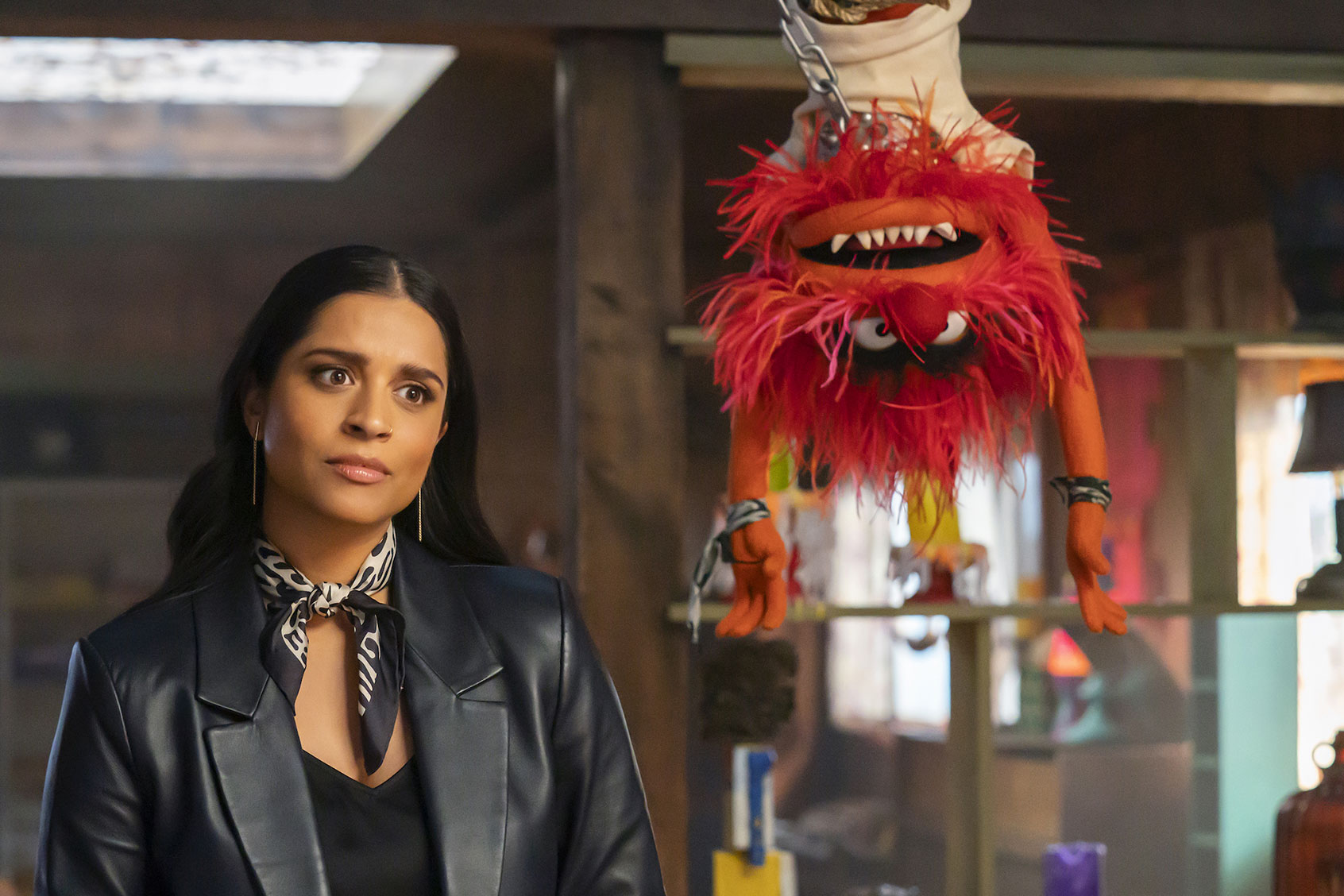
The Muppets MayhemLilly Singh and Animal in “The Muppets Mayhem” (Disney/Mitch Haaseth)

“The Muppets Mayhem” joins a universe that extends back to 1969, with the debut of “Sesame Street.” In the 1970s, the late Jim Henson was determined to establish his creations’ appeal to adults as well as their children, which he achieved by earning a slot in CBS primetime in 1976 with “The Muppet Show.”

That vaudeville-style variety show is how America became familiar with the show’s house band Dr. Teeth and the Electric Mayhem, consisting of the down-to-Earth Floyd Pepper on vocals and bass, hippie-chick Janice on vocals and lead guitar, the eternally sunglasses-wearing saxophonist Zoot, mumblebum trumpet player Lips and the band’s breakout favorite drummer, Animal.

The Muppets have starred in theatrical releases and shows every decade since their introduction, but “The Muppet Show” is the show to inaugurate the difference between the educational, just-for-kids versions of the puppet characters and their ready-for-primetime versions. The 1975 “Muppet Show” pilot in which the Electric Mayhem debuted, for instance, is teasingly titled “Sex and Violence.”

The episode’s content is scandal-free, but the point was made – the band, like the show, is both family-friendly and adult-targeted. Dr. Teeth, inspired by the late New Orleans musician Dr. John, is equal parts sage and artist, George Clinton to the Electric Mayhem’s funkadelic vibe.

“I promised myself after coming out of late night that I was really going to work on projects where I could be super proud of the outcome,” said Singh.

In “The Muppets Mayhem” they’re on a never-ending tour that draws loyal superfans like Moog (Tahj Mowry) and counts among their admirers Ryan Seacrest, Lil Nas X, Billy Corgan, and Tommy Lee. Enter Singh’s Nora, a record executive at a small label – dying, really – who, like the actor playing her, knows little to nothing about them. Nora realizes that the Electric Mayhem owes her employer a studio album, and since they’ve never laid down a track, bets the sales from any official recording she can wrangle out of them would reverse her company’s financial misfortunes.

To make that happen, she must spend time with the band, who coaxes Nora to reassess her life in the bargain.

Playing Nora taps into Singh’s recent adventures with the Hollywood machine. American broadcast audiences were introduced to her as the host of “A Little Late with Lilly Singh,” which replaced “Last Call with Carson Daly” in 2019.  

Singh found fame as a YouTube star before drawing NBC’s attention; she had been creating videos since 2010 in which she played an array of characters and appealed to a younger audience. But “A Little Late” only lasted for two seasons, after which Singh published her second book, “Be a Triangle,” where she spoke about the lessons she took away from that experience and her overall career.
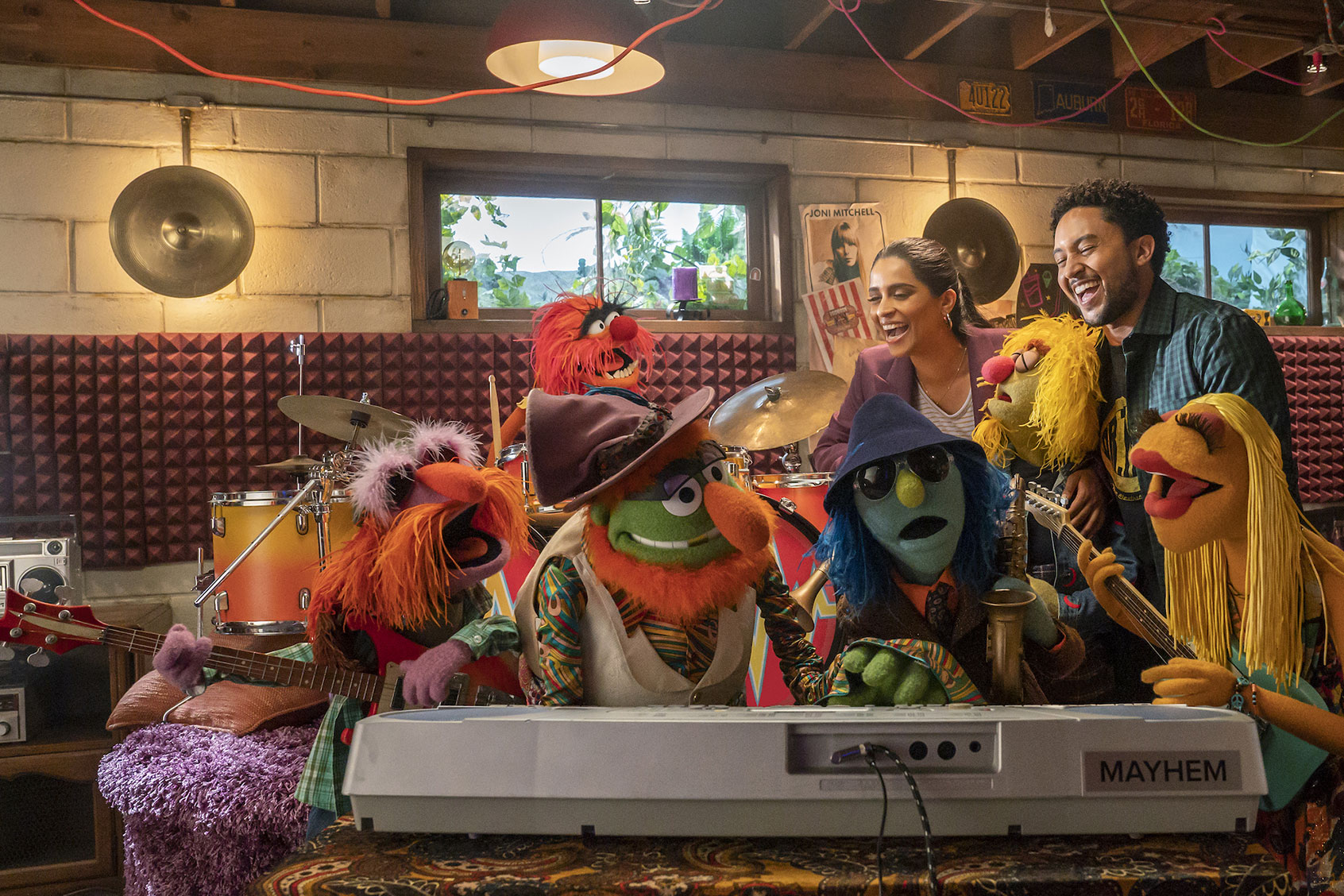
The Muppets MayhemLilly Singh and Tahj Mowry in “The Muppets Mayhem” (Disney/Mitch Haaseth)

“It taught me so much. And I’m so grateful for it,” she stressed, before continuing, “I promised myself after coming out of late night that I was really going to work on projects where I could be super proud of the outcome, or I could be creative, and I could make something I was so happy to refer people to.”

This, she says, is the primary reason she signed on to “The Muppets Mayhem.” “I can say on this show, not a single corner was cut, whether it’s with dialogue, whether it’s with a set, whether it’s with the Muppets wardrobe, whatever it may be . . . just the attention to quality and detail was such a breath of fresh air for me. And again, one isn’t right and one isn’t wrong. It’s just me as an artist, I really gravitate towards the version where you’re like, let’s take our time and make this something that’s just so meaningful.”

“Everyone turns into a four-year-old child and starts fangirling over the Muppets,” Singh said.

As a YouTube creator who singlehandedly mounted her own video production for the better part of a decade, working on this Muppet show became part of Singh’s continuing education in the business. “We are on stages that are four feet in the air, that have holes in them,” she marveled. “The technicalities of how to shoot the show, whether it’s how the camera has to move, how the Muppets have to move, how we have to interact with each other– it’s just phenomenal. It is a science.”

Nora’s character development also drew her to the “Mayhem,” Singh said, citing what she refers to as “a journey of unlearning” that’s sure to be relatable in this age of existential reassessment.

“This is the first time where she’s putting herself in the center of the spotlight. And she has to unlearn all these instincts she’s had to survive,” the performer explained. “That really, honestly relates to me as a person. I feel like I have some of those survival instincts.”

Singh also points to the common lesson of learning “that you can let go and kind of follow the universe whenever it’s gonna take you. And so that’s what The Electric Mayhem kind of does for [Nora]. They teach you to let go and to just go with the flow and just trust your instincts and show her a different way of doing things.”

The performer touches on a central magnet hidden at the heart of “The Muppets Mayhem” that harkens back to the spirit of “The Muppet Show,” in the way it hooks into everyone’s inner child without being childish. Part of this is the series’ appreciation of musical artistry; if old songs like “Can You Picture That?” weren’t expertly crafted pop pieces they wouldn’t have held up for decades.

Having the participation of artists such as Kesha, Zedd, and Deadmaus further burnishes its music cred and dangles other lures for viewers to grab onto, even those who aren’t kids and don’t have them.

“No matter how big of a Muppets fan you are, you’re still going to be brand new in this show,” she said. And I think that’s what is so special, because . . . it’s the first time everyone is going to genuinely meet the Electric Mayhem.”

She’s not overstating that. An entire episode covers Dr. Teeth’s origin story and the nascency of his relationship with Floyd Pepper while amusingly delving into the ways his parental drama informs his creative source. (You have to watch.) In another, a sisterly fight between Nora and her sister Hannah (Saara Chaudry) necessitates some healthy, new-age personal time with Janice.
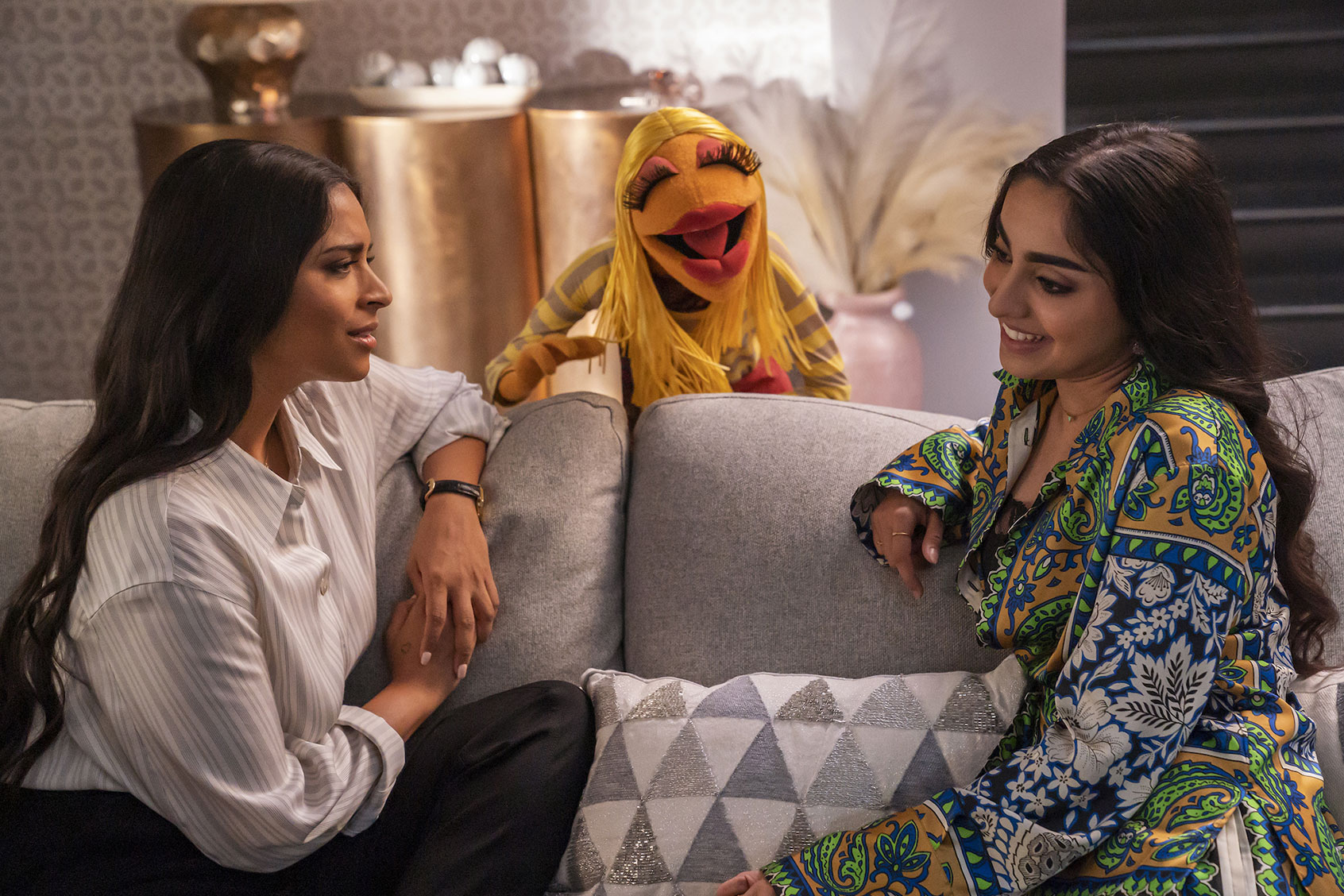
The Muppets MayhemLilly Singh and Saara Chaudry in “The Muppets Mayhem” (Disney/Mitch Haaseth)

Hanging with “The Muppets Mayhem” may also inspire a person to look back at those old episodes of “The Muppets Show.” In doing so you may notice that Singh and Chaudry are the first South Asian Canadian actors to co-star with the Mayhem. What guest lists can be found don’t list any Asian guest stars on the original ’70s primetime show. The Muppets welcomed its first Asian-American character, seven-year-old Ji-Young, in 2021.

The fact that they and Maury are the main humans featured in the series expands the inclusive world of the Muppets, Singh points out.  “It’s exciting to me, it means a lot to me, but it’s also just so much more than that,” she said.  “The thing about the show is that me and Saara just happened to be two brown girls, but it’s not the fabric of the show. It’s just who we are, and then there’s the show.”

Singh continues, “I think there are moments where it’s really important to dissect culture, and then there are moments where it’s just like, we exist, and we’re taking up space. And that’s what I love about this show, that it just happened to be we’re brown and we’re both from Toronto, but we’re just playing these sisters.”

The part she no longer has to act her way through, however, is the legitimacy of her Muppet fandom. She’ll joyfully nerd out over the production details too, but from what she calls “a spiritual point of view,” she has a new level of understanding. “So look, there’s a lot of famous people in the show – you got Morgan Freeman, you got Kesha, you got so many people. And everybody has the same reaction to seeing the Muppets. Everyone turns into a four-year-old child and starts fangirling over the Muppets. And it’s so special to see that no matter where you are in life, they mean so much to you. That is just across the board.”

She includes herself in that crowd too. “Growing up, my parents never really introduced me to the Muppets,” Singh said. “But now I can say that I will fight someone for them.”

All episodes of “The Muppets Mayhem” stream Wednesday, May 10 on Disney+.

CNN ripped for Trump town hall after jury verdict — but allies fear he’s “walking into an ambush”

Former President Donald Trump is slated to appear on CNN on Wednesday night for a town hall in New Hampshire, one day after being found liable for sexually abusing and defaming magazine columnist E. Jean Carroll. 

During Wednesday’s town hall, which will be moderated by CNN anchor Kaitlan Collins, Trump will field “questions from New Hampshire Republicans and undeclared voters who plan to vote in the 2024 GOP presidential primary,” per CNN.

The network has been slammed in recent weeks since announcing it would be hosting Trump at St. Anselm College, with many critics arguing it was a blatant ratings grab.

The New York Times reported that MSNBC’s Joy Reid ripped the town hall as “a pretty open attempt by CNN to push itself to the right and make itself attractive and show its belly to MAGA.” 

Criticism of town hall has only increased since Tuesday’s verdict was handed down by a Manhattan jury. 

“Is @CNN still going to do a town hall with the sexual predator twice impeached insurrectionist former president @realDonaldTrump?” tweeted Alexander Vindman, an Army colonel who was a witness in Trump’s first impeachment trial. “I’m not watching it. I think it’s absurd for a major news network to normalize Trump,” he added. 

Former Capitol Police officer Michael Fanone, who now works as a pundit at CNN, blasted the network for hosting “a guy who tried to get me killed.”

“Putting him onstage, having him answer questions like a normal candidate who didn’t get people killed in the process of trying to end the democracy he’s attempting to once again run, normalizes what Trump did,” he wrote in a Rolling Stone op-ed. “It sends a message that attempting a coup is just part of the process; that accepting election results is a choice; and that there are no consequences, in the media or in politics or anywhere else, for rejecting them.”


Want a daily wrap-up of all the news and commentary Salon has to offer? Subscribe to our morning newsletter, Crash Course.


But some Trump allies are concerned the town hall could backfire on the former president. The Daily Beast reported that a former Trump adviser feels the ex-president is “walking into a complete ambush.”

“If I were on his communications team, I would be shitting my pants right now,” the advisor continued, claiming that the verdict “could not have come at a worse time for them, so I think this thing takes on a whole new dynamic. Majorly.”

One New Hampshire state GOP member told The Daily Beast that she was approached by a CNN representative who asked her to pose a question at the town hall because “they’re having a bit of an issue with women.”

“I said to her, ‘What do you think that tells you?’ Because they’ve lost a lot of the female vote,” she said, adding that most of the questions submitted for the event were from men. Trump might have had the chance to pander to suburban women voters, a group he has lost in the past, “but he spent 70-some-odd years saying the things he does say about women and to women,” the Republican added. “It’s too late for him to walk that back.”

The event will mark Trump’s first appearance on CNN since 2016. The Times reported that much has changed at the network since then — namely, CNN’s new chief executive, Chris Licht, “pledged to broaden the network’s appeal.” Licht is supported by Warner CEO David Zaslav.

“The U.S. has a divided government; we need to hear both voices,” Mr. Zaslav said last week on CNBC when questioned about the town hall. “When we do politics, we need to represent both sides. I think it’s important for America.”

“President Trump is the Republican frontrunner, and our job despite his unique circumstances is to do what we do best,” a CNN spokesperson said in a statement. “Ask tough questions, follow up, and hold him accountable to give voters the information they need to sort through their choices. That is our role and our responsibility.”

George Santos arrested on charges including fraud, money laundering and theft of public funds

Serial liar Rep. George Santos, R-N.Y. is in custody after turning himself in to authorities at the federal courthouse in Long Island on Wednesday, The New York Times reports.

The first-term congressman was charged with seven counts of wire fraud, one count of theft of public funds, three counts of money laundering and two counts of making materially false statements to the House of Representatives, the latter of which is related to two financial disclosure forms he filled out as a candidate.

The first lie to Congress, according to the indictment, occurred in 2020, when Santos allegedly overstated his income from one job while failing to report his salary from another. The second stems from Santos’ second campaign for office in 2022, when prosecutors say he lied about earning $750,000 in salary and between $1 million and $5 million in dividends from his company, the Devolder Organization. 

The indictment, which was sealed on Monday, further outlines the other two schemes Santos was charged with: a fraudulent solicitation scheme and an unemployment insurance fraud scheme. In the former, prosecutors accuse Santos, alongside a Queens-based political consultant, of convincing donors to give money to an LLC he headed and then using the money to pay for personal expenses. In the latter, they say Santos applied for New York government assistance in June 2020 during the height of the COVID-19 pandemic despite being employed by a Florida-based firm and bringing in $120,000 annually. 

If convicted of the charges, the U.S. attorney’s office for the Eastern District of New York told The Times, Santos could face up to 20 years in prison on the top count. 

Santos has denied the more serious allegations against him, though he has admitted to making misleading statements about his education, financial status and work history, according to CNN

Amidst the controversy, several Democrats and some New York Republicans have called for the freshman congressman’s resignation over the allegations, and those who haven’t have expressed their frustrations with the situation.

On Tuesday House Speaker Kevin McCarthy, R-Calif., said that while Santos’ position is safe for now, a conviction could lead to his ouster. 

“Just like we had before with Jeff Fortenberry, he had the same ability, I removed him from committees, but he was found guilty and then I told him he needed to resign. That is my policies and principles on this,” he said.

Rep. Nicole Malliotakis, R-N.Y., took a stronger stance on Santos’ potential resignation in a statement to Axios.

“We are waiting to see the charges, but we all knew this was where things were heading,” she said. “The sooner he leaves, the sooner we can win the seat with someone who isn’t a liar.”

Rep. Marc Molinaro, R-N.Y., doubled down on the calls for his resignation, implying that the controversy is detracting from more pertinent issues currently on the table for Congress.

“You have the president calling into question the very Constitution … leadership trying to negotiate during both a debt and a budget crisis, a border crisis. And here we are, yet again, talking about somebody who just shouldn’t be a member of Congress,” he said, adding, “The day we no longer have to discuss George Santos as a member of Congress will be a good day for America.”


Want a daily wrap-up of all the news and commentary Salon has to offer? Subscribe to our morning newsletter, Crash Course.


Attorney George Conway told MSNBC on Wednesday morning that Santos’ falsehoods coming back to bite him was inevitable, according to Raw Story

“My guess is that he’s known he’s been under investigation for a while, at least since all the information started coming out about him,” Conway said during the segment. “There’s just no way he hasn’t had to respond to subpoenas of his campaign finance information and so on and so forth. There’s so much to choose from here. We saw the disclosures where it was charging the cash maximum of $199.99 or something like that, charging that amount in cash for payments to a restaurant, a single restaurant, every meal cost $199.99 — that’s clearly fraudulent.”

“You have the money you don’t know where the money came from,” he added. “You have the story about him ripping off the fund for the poor, sick dog — so much to choose from. It’ll be interesting to see what the feds have on him. But there’s going to be something when you lie that much. You’re going to lie on a piece of paper that actually matters for something or lie about something involving money, and that’s going to get you into state or federal trouble, and for some people it takes longer — like our friend in Florida — but some people really get there faster, and I guess that’s Mr. Santos.”

Santos is also under investigation by the House Ethics Committee for potentially failing to properly fill out financial disclosure forms, violating federal conflict of interest laws or engaging in other illegal activity while on the campaign trail. He faces a second criminal case in Brazil for check fraud in 2008, which he confessed to in 2010 but escaped the legal ramifications of when police and prosecutors were unable to locate him following his move back to the U.S.

He is scheduled to be brought before federal judges for his latest indictment at 1 p.m. on Wednesday.

Trump melts down at E. Jean Carroll in late-night Truth Social rant — and he could be sued again

Former President Donald Trump spent Tuesday night raging on Truth Social after a Manhattan jury found him liable for sexually abusing and defaming longtime columnist E. Jean Carroll.

The jury on Tuesday awarded Carroll $5 million in damages. Trump fumed over the verdict on his social network.

“I HAVE ABSOLUTELY NO IDEA WHO THIS WOMAN IS THIS VERDICT IS A DISGRACE – A CONTINUATION OF THE GREATEST WITCH HUNT OF ALL TIME!” he wrote.

Trump called Judge Lewis Kaplan, who oversaw the trial, “A TRUMP HATING, CLINTON APPOINTED JUDGE, WHO WENT OUT OF HIS WAY TO MAKE SURE THAT THE RESULT WAS AS NEGATIVE AS IT COULD POSSIBLY BE.” Trump also claimed that the jury was “FROM AN ANTI-TRUMP AREA WHICH IS PROBABLY THE WORST PLACE IN THE U.S. FOR ME TO GET A FAIR ‘TRIAL,'” referring to the city where he was born and raised.

The former president previously demanded to have his hush-money case moved from Manhattan to Staten Island, where he received more than 60% of the vote in 2020 while losing Manhattan 85-15.

Trump, who elected to not attend the trial in person and falsely claimed that he had not been allowed to “speak or defend” himself, continued to rant on Truth Social into the early hours of morning hours on Wednesday. 

He argued at 12:34 a.m. that the “partisan” judge and jury “should be absolutely ashamed of themselves for allowing such a travesty of Justice to take place.” He added that Carroll was “racist” for using a slur to refer to her ex-husband, John Johnson, who is Black.

“The ‘Dress,’ which played such a big roll [sic] early on as a threatening bluff, but which ended up being totally exculpatory, was not allowed into the trial as evidence,” Trump wrote. “Nor was her cat’s name, ‘Vagina,’ the racist name she called her Black husband, ‘Ape,’ getting caught in a lie on the political operative paying for this Hoax, & much more!”

Trump’s reference to a political operative appears to be a reference to Reid Hoffman, the LinkedIn founder and Democratic donor who reportedly funded Carroll’s lawsuit.


Want a daily wrap-up of all the news and commentary Salon has to offer? Subscribe to our morning newsletter, Crash Course.


Around 1:30 a.m., Trump once again lashed out at Kaplan in a post, writing that the judge hated him “more than humanly possible.”

“He is a terrible person, completely biased, and should have RECUSED himself when asked to do so. He quickly refused!” he wrote. “This case should never have been allowed to be tried in this completely partisan venue, perhaps the worst for me in the Nation! The whole Rigged Hoax is yet another TRAVESTY OF JUSTICE, a continuation of the greatest political Witch Hunt of all time!!!”

“It was unclear what, if any, repercussions Mr. Trump’s after-action comments might incur,” according to The New York Times, which noted that Kaplan issued a warning about his rhetoric during the trial before a jury awarded Carroll $3 million in damages after Trump called her a liar.

“Presumably he can be sued again,” The Intercept’s Ryan Grim tweeted, “it’s not like Reid Hoffman is out of money.”

Tucker Carlson’s takeover and the dramatic decline of Twitter

On Monday, Variety reported that Fox News is experiencing a burst of new advertising sales in the hour formerly held by the recently fired Tucker Carlson. He had had the distinction of having cable news’ top ratings for his time period while scaring away most respectable companies from buying time on his show. So it’s possible that despite the ratings slump the primetime slot has been experiencing since his departure, the network won’t actually suffer any more losses than they already did in their epic $787 million settlement with Dominion voting machines.

They may also be saving a few dollars if it turns out that Tucker Carlson’s latest move results in his breaching the reported non-compete clause in his contract worth $25 million. He posted a video on Tuesday announcing that he’s going to resume his show on Twitter as a way of striking a blow in favor of free speech against all the rest of the lying media. If you haven’t seen it, here is the video reveal in all its glory:

Since we know that Carlson is interested in money more than anything else on Earth (I wrote about that here) it stands to reason that the second richest man in the world, who also happens to own Twitter, Elon Musk, must have offered him a bundle to give up 25 million dollars. However, after Carlson made his announcement, Musk tweeted:

On this platform, unlike the one-way street of broadcast, people are able to interact, critique and refute whatever is said. And, of course, anything misleading will get @CommunityNotes.

I also want to be clear that we have not signed a deal of any kind whatsoever. Tucker is subject to the same rules & rewards of all content creators. Rewards means subscriptions and advertising revenue share (coming soon), which is a function of how many people subscribe and the advertising views associated with the content.

I hope that many others, particularly from the left, also choose to be content creators on this platform.

Carlson’s announcement came shortly after it was reported that he had filed suit against Fox for fraud and breach of contract, which Axios argues positions him “to argue that the non-compete provision in his contract is no longer valid — freeing him to launch his own competing show or media enterprise.” Apparently, the belief is that he can make the case that Fox breached the contract before Carlson did when they failed to protect his good name as they supposedly promised to do. But be that as it may, considering his intense avariciousness, it seems unlikely that Carlson would make this big announcement without some assurance that he will be paid big bucks for using Twitter as the base for his future blatherings. 


Want a daily wrap-up of all the news and commentary Salon has to offer? Subscribe to our morning newsletter, Crash Course.


Obviously, nobody really knows what’s going on with Tucker Carlson in the wake of his firing. The endless speculation about just what it was that broke Rupert Murdoch’s back runs the gamut of the geriatric patriarch being upset that his former fiance said Carlson was a messenger from God to Carlson sending racist and misogynistic emails to his firing being a secret condition of the Dominion settlement. (Both Fox and Dominion deny that.) None of it sounds particularly convincing and it’s not clear that even Carlson knows the real reason.

He must be struggling emotionally a bit and it shows. After all, he has now officially been fired by every cable news network and according to Nicholas Confessore’s in-depth profile of Carlson in the New York Times, the earlier firings left painful scars that led him to the almost desperate lurch to the extremist right he took once he landed his 8pm slot on the last network that would have him. Just this week there were more emails released in which Carlson whined about Trump’s election lies and lamented “it’s so sad. He’s going to break some s***. He already is. Wish I knew where to run. But I’ll die here.” He didn’t even get that dubious privilege.

The D-list right-wing news channels all want him of course. Newsmax has even offered to change its name to his. (The Tucker Network?) And there are half a dozen possibilities in the podcasting and streaming realm that do bring in serious cash. But Carlson reportedly doesn’t want to do any of those things, at least not yet, and seems to be intrigued by the idea that Musk, the great entrepreneurial genius that he is, is going to create a new television experience on Twitter and nobody will ever be able to fire him again.

As Ben Smith at Semafor pointed out, however, that’s easier said than done.

“Musk continues to race through discarded Twitter business models as he seeks to reinvent the platform,” Smith notes, adding that he was involved in an earlier version of this at Buzzfeed and it showed promise but ultimately failed because the Twitter platform is just not conducive to this kind of engagement:

A former Twitter employee who worked on it told me today that the core issue with attempting to shift Twitter toward television is the contrast between the requirement that you sit still to watch a show and the basic Twitter experience of scrolling.”It’s doomscrolling versus doomstaying,” the former Twitter employee said. The notion that Carlson could build a significant video business on Twitter, he said, was “stupid.”

As far as Musk’s dream is concerned, it might be reassuring that Musk says he wants “content creators” from the left to contribute, but his own political preferences are obvious and they are not just right-wing, they are downright conspiratorial, so I wouldn’t get my hopes up for a “let a hundred tweets bloom” campaign to take off. His idea of free speech is to allow the worst people in the world to intimidate anyone they choose so the platform is unlikely to be more than yet another annex in the right-wing echo chamber before too long. Tucker Carlson being a marquee attraction can only hasten its descent.

Carlson’s lawsuit and announcement sound an awful lot like someone else we know, the so-called “demonic destroyer” himself: Donald Trump. Filing angry lawsuits claiming that everyone is lying about everything and then taking to a social media platform to keep the brand alive until the next move is right out of old number 45’s playbook. Trump, however, always had his next chapter planned out from the moment he launched his pathetic little cult channel. He knew he was going to run for president again. Tucker Carlson has said he has no intention of doing that and he’s run out of real television networks so all he really has left is something like this.

And as new media journalist Kara Swisher quipped a couple of weeks ago when Carlson tweeted an earlier video from what she called his Wayne’s World basement studio: “he looks astonishingly smaller now.” Indeed he does. 

Tucker Carlson accuses Fox of fraud as he reportedly snubs $25 million to flee to Twitter

Former Fox News host Tucker Carlson on Tuesday accused the network of breaching his contract and announced plans to re-launch his show on Twitter.

Carlson announced that he would bring his show to Twitter two weeks after he was ousted from Fox.

“Starting soon we’ll be bringing a new version of the show we’ve been doing for the last six and a half years to Twitter,” he said in the video. “We bring some other things too, which we’ll tell you about. But for now we’re just grateful to be here. Free speech is the main right that you have. Without it, you have no others.”

The move would appear to violate Carlson’s contract with Fox. The network wants to keep paying Carlson to prevent him from starting a competing show until his $25 million-a-year contract expires in January 2025, according to Axios.

Carlson’s legal team tried to get ahead of any contractual disputes on Tuesday, firing off a letter accusing Fox of fraud and breaching Carlson’s contract themselves.

Carlson lawyer Bryan Freedman argued in the letter to Fox executives Viet Dinh and Irena Briganti that Fox employees, including “Rupert Murdoch himself,” broke promises to Carlson “intentionally and with reckless disregard for the truth.”

The lawyers accused Murdoch and Dinh and making “material representations” to Carlson that were intentionally broken, constituting fraud, according to Axios.

The letter accused Fox of breaking an agreement with Carlson to not leak his private messages and not to use them “to take any adverse employment action against him.”

Carlson’s lawyer also accused Fox of breaking promises not to settle with Dominion Voting Systems “in a way which would indicate wrongdoing” by Carlson and not take any actions in a settlement that would harm Carlson’s reputation.

Carlson was told by a member of the Fox board that he was ousted as part of the Dominion settlement, two sources told Axios.

“These actions not only breached the covenant of good faith and fair dealing in the Agreement, but give rise to claims for breach of contract, and intentional and negligent misrepresentation,” the letter said.

A Fox News spokesperson told Axios that it was “categorically false” that Carlson was ousted as part of the Dominion settlement.

“Dominion did not insist on them firing Tucker Carlson as part of the settlement,” an attorney for Dominion told the outlet.

Carlson also accused Briganti, the longtime Fox PR chief, of seeking to “undermine, embarrass, and interfere” with Carlson’s future business prospects.

“Make no mistake, we intend to subpoena Ms. Briganti’s cell phone records and related documents, which evidence communications with her and all media, including, but not limited to The New York Times,” the letter said.


Want a daily wrap-up of all the news and commentary Salon has to offer? Subscribe to our morning newsletter, Crash Course.


The letter added that Carlson is considering litigation against the network and said Fox News must take immediate steps to “preserve all existing documents and data” related to the company’s relationship with Carlson.

The terms of Carlson’s move to Twitter are unclear. Twitter CEO Elon Musk, who reportedly spoke with Carlson before the announcement and appeared on one of his last episodes on Fox, denied that he and Carlson “have signed a deal of any kind whatsoever.”

“Tucker is subject to the same rules & rewards of all content creators,” he wrote, adding that users can flag any misleading information.

“On this platform, unlike the one-way street of broadcast, people are able to interact, critique and refute whatever is said,” he wrote. “Rewards means subscriptions and advertising revenue share (coming soon), which is a function of how many people subscribe and the advertising views associated with the content,” he added. “I hope that many others, particularly from the left, also choose to be content creators on this platform.”

Nora Benavidez of the progressive non-profit advocacy group Free Press told NPR that Carlson’s move to Musk’s platform “is not even surprising.”

“It’s just the latest in a long line of dangerous actions Musk takes to erode open discourse and public trust surrounding the platform,” she said. “Twitter is becoming a fringe network which places hyper-partisanship, lies, and hate over application of corporate policies and robust trust and safety.”

Prosecutors rejoice! Trump’s rape trial shows “Teflon Don” is not immune from justice

I’ll admit it: I was floored by how quickly the jury in the E. Jean Carroll trial came back — and with a $5 million verdict, no less. It’s not because I had any doubts about the strength of the evidence for Carroll’s claim that Donald Trump sexually assaulted her, likely in the spring of 1996. As anyone following the case closely could tell you, Carroll’s lawyer, Roberta Kaplan, rolled out about as airtight a case as could be expected. She also had the benefit of Trump as a defendant. He not only is on tape bragging about how he likes to “grab them by the pussy,” during his taped deposition for this case, he radiated contempt for laws against sexual assault. He even used the word “fortunately” to describe “a million years” of carte blanche the privileged have to commit acts of sexual violence. It’s unsurprising his lawyer elected not to have Trump testify, not that Trump would ever have the courage to do it. Trump’s obvious pride in being a sexual predator may have led to a blurted confession on the stand. 

No, my anxiety was built around a single question: Would some MAGA juror tank the case?

As I noted in Tuesday’s Standing Room Only newsletter, that’s the unspoken question haunting every legal case and investigation against Trump. The former president was just indicted in Manhattan for campaign finance fraud and hush money payments. He faces another possible indictment in Georgia over his efforts to steal the 2020 election. The investigation into stolen classified documents found at Mar-a-Lago continues. And, of course, there is the granddaddy of them all, the federal investigation run by special prosecutor Jack Smith into Trump’s role in inciting the January 6 insurrection. 


Want more Amanda Marcotte on politics? Subscribe to her newsletter Standing Room Only.


Turn on cable news on any night and you’ll hear a chorus of legal talking heads explain that these legal cases have to be “rigorous” and “deliberate,” because the privileged position of a former president makes the evidentiary bar super high. If you are watching with me, you will hear me making “pffft” noises in response.  That Trump is guilty of more crimes than we can imagine is no longer actually a question in the minds of reasonable people, just based on the public evidence alone. The real concern that all this talk of presidents and privilege is pointing at is the very serious threat that Republicans on juries will simply refuse to convict because they would rather break the law than admit a liberal was right about Trump. 

Getting a judgment against anyone is hard in these cases, which tells you a lot about how slam dunk this case was against Trump.

Well, we’ve had our first test case of a jury hearing about Trump’s crimes. The result is heartening. The jury spent less than three hours deliberating, which is about as fast a decision as I’ve ever heard in a case such as this. Yes, they only found that Trump sexually abused and defamed Carroll, taking a pass on the charge of rape. But it’s really not the jury’s fault that the law still has antiquated notions that treat forced penetration by penis and fingers as categorically different. What matters here is simple: The jury did not feel hamstrung by politics to deny the obvious truth in what Carroll was saying about her experience with Trump. 

As ugly as rape cases can get, there’s a silver lining in the fact that this was, in fact, a case centered around gendered violence. As any expert in violence against women can tell you, obtaining any kind of justice for sexual violence is nearly impossible, not because of lack of proof, but because of plain old sexism. Any random jury of 9 or 12 people is highly likely to have a person or two — if not more — who still subscribes to a myriad of rape myths that pin the blame on the victim for not being “pure” or “innocent” enough. Subsequently, perpetrators see jail time in only 2.5% of sexual assault cases. Getting a judgment against anyone is hard in these cases, which tells you a lot about how slam dunk this case was against Trump.

It does feel a little safer going forward with faith that juries can handle the immense responsibility of trying a past president with an open mind and respect for facts. 

If a juror had wanted to let Trump off the hook, Trump’s lawyer, Joe Tacopino, offered a grab bag of rape myths they could use to justify pretending not to believe Carroll: That she was only in it for the money. That she had it coming for flirting with Trump and/or for teasing him in an emasculating way. That being sexually assaulted is not as bad as women make it out to be, which Tacopino drew out by harping on how Carroll continued to live her life after the assault. (Never mind that, by her own reckoning, she never had sex again.) There’s significant overlap between believing these rape myths and voting for Trump, so it’s not a reach to see something like this happening on the jury. 


Want more Amanda Marcotte on politics? Subscribe to her newsletter Standing Room Only.


Instead, Carroll got a fair trial and a just and unanimous verdict. The jury listened to the evidence and came right back with what was the only correct conclusion: Carroll told the truth and Trump lied. Justice is possible. Not that MAGA saboteurs aren’t a future possibility, but it does feel a little safer going forward with faith that juries can handle the immense responsibility of trying a past president with an open mind and respect for facts. 

It’s sad that this feels like such a momentous victory, but it is. We live in an era of sustained abuse of the very concept of truth, much of it led by Trump himself. To this day, nearly two-thirds of Republican voters espouse the Big Lie. Most don’t really believe it, I suspect, so much as they feel the need to say they do, out of partisan loyalty. But, in courtroom after courtroom, we’re seeing a hard limit on the power of such disinformation efforts. The Proud Boys were convicted. So were the Oath Keepers. Alex Jones keeps losing in court. Fox News had to pay $787.5 million in a settlement to avoid what they knew would be shellacking by a jury in their Big Lie case. 

Granted, the odds were in reality’s favor, in a city where President Joe Biden got 87% of the vote. Still, this resounding judgment serves as a reminder that not all hope is lost. Plus, most of the other locales Trump could be tried in just happen to be big blue cities. This was a swift and resolute victory for the truth. It should raise hopes that other such victories are possible. 

US support for nuclear power soars to highest level in a decade

A Gallup survey released in late April found that 55 percent of U.S. adults support the use of nuclear power. That’s up four percentage points from last year and reflects the highest level of public support for nuclear energy use in electricity since 2012. 

The survey found that Republicans are more likely to favor nuclear energy than Democrats, consistent with previous Gallup polls. Experts say that partisan divide is particularly visible at the state level, with more pro-nuclear policies adopted in Republican-controlled states than left-leaning ones. But Democratic support for nuclear energy is on the rise, and advances in nuclear technologies and new federal climate laws could be behind the broader shift in public opinion toward nuclear energy.

Nuclear energy has historically been a source of immense controversy. A series of high-profile nuclear accidents and disasters, from Three Mile Island in 1979 to Chernobyl in 1986 to Fukushima in 2011, have raised safety concerns — even though the death toll from fossil fuel power generation far outstrips that of nuclear power generation. Several government nuclear programs have also left behind toxic waste that place disproportionate burdens on Indigenous communities.

But nuclear power doesn’t produce carbon emissions, and it’s more consistent and reliable than wind and solar energy, which vary depending on the weather. For these reasons, the Biden administration has identified nuclear energy as a key climate solution to achieve grid stability in a net-zero future. The administration is pushing for the deployment of a new generation of reactors called “advanced nuclear”: a catch-all term for new nuclear reactor models that improve on the safety and efficiency of traditional reactor designs. 

In a recent report, the Department of Energy found that regardless of how many renewables are deployed, the U.S. will need an additional 200 gigawatts of advanced nuclear power — enough to power about 160 million homes — to reach President Joe Biden’s goal of hitting net-zero emissions by 2050. 

Gallup has tracked several swings in public opinion since first asking about nuclear in 1994. From 2004 to 2015, a majority of Americans favored nuclear power use, with a high of 62 percent in support in 2010. But in 2016, the survey found a majority opposition to nuclear power for the first time. Gallup speculated that lower gasoline prices that year may have “lessened Americans’ perceptions that energy sources such as nuclear power are needed.” In recent years, views on nuclear power had been evenly divided until the latest poll, conducted between March 1 and 23.

The new poll found that 62 percent of Republicans support the use of nuclear power, compared to 46 percent of Democrats. The support from Republicans is likely driven by “a focus on energy independence, supporting innovation, supporting American leadership globally, and supporting American competition with folks like China and Russia specifically in terms of the nuclear space,” said Ryan Norman, senior policy advisor at the center-left think tank Third Way.

Matt Bowen, a senior research scholar on nuclear energy at Columbia University, points out that those political differences in public opinion have played out at the state level. As he puts it, conservative states tend to have “a much more supportive environment” for nuclear energy policies. 

In Tennessee, for example, Republican Governor Bill Lee announced a plan in February to allocate $50 million in the state budget to support nuclear power-related businesses. In 2021, Wyoming Governor Mark Gordon welcomed the arrival of a planned advanced nuclear reactor site in his state, set to be one of the first advanced reactors to operate in the country. And last February, West Virginia repealed the state’s ban on construction of nuclear power plants. 

Many of the states passing laws to enable nuclear infrastructure have experienced major job losses as a result of a declining coal sector, Norman observes.

Meanwhile, states that have placed restrictions on the construction of new nuclear power facilities are largely Democratically controlled. Those 12 states include Democratic strongholds like California, Connecticut, and Massachusetts. 

On a national level, Norman from Third Way emphasized that the recent Gallup poll reflects growing support from people of all political backgrounds. 

Democratic support for nuclear power jumped up 7 percent this year, up from 39 percent in 2022. Recent studies on decarbonization pathways and the Biden administration’s climate goals have spotlighted nuclear power as a potential clean energy solution — a possible reason for the uptick.

In addition to the Department of Energy’s modeling, the International Energy Agency’s Net Zero by 2050 scenario found that in order to fully decarbonize the global economy, worldwide nuclear power capacity would need to double between 2022 and 2050. 

In Congress, nuclear power has enjoyed some rare moments of bipartisan support. Lawmakers from both sides of the aisle have joined forces to pass a few successful pro-nuclear laws. The 2021 bipartisan infrastructure law injected $6 billion toward maintaining existing nuclear power plants. And while the 2022 Inflation Reduction Act was an entirely Democratic effort, it included a technology-neutral tax credit for low-carbon energy that can be used for nuclear power plants. The climate spending law also allocates millions in investments for advanced nuclear research and demonstration.

Bowen credits Democratic lawmakers’ newfound openness to nuclear power to the increasing urgency of addressing climate change. As he put it, nuclear could be one answer to a question policymakers are increasingly asking themselves: “How do you achieve these deep decarbonization scenarios, especially since we have less and less time?”


This article originally appeared in Grist at https://grist.org/energy/us-support-for-nuclear-power-soars-to-highest-level-in-a-decade/.

Grist is a nonprofit, independent media organization dedicated to telling stories of climate solutions and a just future. Learn more at Grist.org

The James Webb Telescope eyes a new asteroid belt — in another star’s solar system

Stars can be seen with the naked eye, but planets orbiting other stars are incredibly difficult to see, even with the most powerful telescopes ever made. It wasn’t until 1992 that astronomers imaged an exoplanet, meaning a planet in another solar system; prior to that, some astronomers thought our solar system may be unique, and thought planets were perhaps rare. 

By the 2010s, however, exoplanet discoveries were so frequent as to become quotidian; now, there are over 9,000 likely or confirmed exoplanets, according to NASA. Because of a selection bias that favors large bodies that are close to their parent stars, many of these planets are larger than Jupiter. Smaller bodies are much harder to see — and when it comes to bodies smaller than planets, like moons or asteroids, there are candidate bodies though none that are actually confirmed. 

That makes the discovery of an astroid belt orbiting the star Fomelhaut all the more exciting. Thanks to new observations made using the James Webb Space Telescope (JWST), we have a good sense of the nature of the solar system around the star Fomelhaut, which appears as one of the brightest stars in the Southern Hemisphere night sky and which sits some 25 light years away from Earth. Indeed, while astronomers expected to see a lot of similar intricate details between our solar system and the Fomalhaut star system, they were surprised to find that it is more complicated than previously thought, in part because they discovered it has an unexpectedly convoluted asteroid belt.

The observations were officially published in a report on May 8 in Nature Astronomy. Previously, the Hubble Space Telescope and Herschel Space Observatory, as well as the Atacama Large Millimeter/submillimeter Array (ALMA), have taken detailed images of the outermost asteroid belt in the Fomalhaut star system. Thanks to JWST, astronomers are now able to see the inner belts for the first time, revealing a slew of surprises.

In an interview with Salon, András Gáspár, lead author of the paper and an astronomer at the University of Arizona in Tucson, said there is “so much to unpack” from this one observation.

“We originally assumed that we would see a very narrow asteroid belt,” Gáspár said. But instead they found three nested belts that extend out for around  23 billion kilometers (14 billion miles), which is 150 times the distance between the Sun and Earth. “There likely aren’t any gas giants orbiting close,” he added, noting that in solar system there’s Jupiter and Saturn. “But we do see a gap, much further [out], but that corresponds to our Neptune’s orbit roughly …  it’s a good sign that there could be an ice giant orbiting there.”

“We originally assumed that we would see a very narrow asteroid belt.”

Harvard astronomer Avi Loeb, who was not involved in the study, called the observation “exciting.”

“[They show] for the first time three nested belts in the dusty debris disk around a young hot star beyond the scale of our own planetary system,” Loeb said. “The dust particles in the belts are most likely shepherded gravitationally by embedded planets that had not been seen as of yet.”

Loeb said the situation in space is similar to noticing waves “on the  surface of a muddy pond” on Earth, which would indicate the existence of fish “hidden from view under the water.”

Indeed, our own solar system’s asteroid belt is considered to be a “failed planet” of sorts; there are multiple small spherical bodies that make up the asteroid belt, including Ceres, Vesta, and Pallas. But none has enough gravity to coagulate into a larger planet. That process of planetary formation, in which debris slowly accumulates enough to accure and then clear its orbital lane, is believed to be what took place during the formation of all other planets in our solar system. 

Yet our own asteroid belt is influenced by planets, including as the slew of asteroids that orbit in Jupiter’s shadow, which are known as trojans. Astronomers believe that the debris disks outside the Fomalhaut star system are likely shaped by unseen planets, too. 

Gáspár told Salon that this star system is “really chaotic” with a lot of “dynamical activity going on.”

“We definitely didn’t expect the more complex structure with the second intermediate belt and then the broader asteroid belt,” said Schuyler Wolff, another member of the team at the University of Arizona, in a media statement. “That structure is very exciting, because any time an astronomer sees a gap and rings in a disk, they say, ‘There could be an embedded planet shaping the rings!'”

Part of JWST’s mission is to peer into distant corners of the universe, and survey the atmospheres of Earth-like exoplanets — or at the very least, identify them. When it comes to Fomalhaut, there are lessons to be learned regarding how our own solar system and its planets formed.

Gáspár told Salon that, based on JWST’s observations, this star system is “really chaotic” with a lot of “dynamical activity going on.”


Want more health and science stories in your inbox? Subscribe to Salon’s weekly newsletter The Vulgar Scientist.


“We see this inner disc that’s slightly angled away from the other one, so these are all signs [that] the system’s dynamically very active,” Gáspár said. “Similarly for our solar system, there are hypotheses that early on in its life, roughly at the same age, it also underwent some dynamical reorientation causing a lot of heavy bombardment happening — so it could be an analogue to what happened in the solar system early on.”

One of the biggest takeaways, Gáspár said, is that the early stages of planetary formation can be a violent time that can last billions of years.

“And that’s interesting, because some life evolved on Earth after the first billion years,”Gáspár said. 

In other words, if there’s still a lot of chaotic activity late in a planetary system’s evolution, it could inhibit the ability of life to form. 

Loeb said the next step is to take a more detailed image of the star system, and see if the hidden planets creating the nested belts can be identified.

“The planetary system is likely very different from the solar system, because it is likely to have more than one giant planet,” he said.

Texas mall mass shooter: A familiar tale of the misogyny-to-fascism pipeline

Police in Allen, TX were terse in their admission that the killer in the latest mass shooting, at an outlet mall outside of Dallas over the weekend, had white supremacist beliefs. It is unsurprising, of course, that police in a suburban county that voted for Donald Trump might be less than enthused talking about how the shooter embraced an ideology that’s been fired up by the sympathies of the current GOP leader. Unsurprising, as well, that journalists who followed up found that the situation was far uglier than these law enforcement hints were allowing. 

The excellent team of far-right investigators at NBC News got the grim details of what Mauricio Garcia, 33, was up to online. His social media profile was a smorgasbord of every flavor of fascist subgroup that dwelled in the bowels of the internet, and now on Elon Musk-led Twitter. Garcia was into neo-Nazi stuff. He repeated all the incel garbage. He posted photos of himself wearing a “Right Wing Death Squad” patch, which was worn by at least one of the Proud Boys who participated in the January 6 insurrection. He was a fan of Nick Fuentes, dining companion of Donald Trump and an admirer of Hitler.  

But for a security guard who died trying to save people, the victims fit the profile of the kind of people now-fired Fox News host Tucker Carlson loved to demonize regularly with the “great replacement” conspiracy theory: Three members of a Korean-American family. An immigrant from India. Multiple Latino people, two of whom, at least, were little girls. 


Want more Amanda Marcotte on politics? Subscribe to her newsletter Standing Room Only.


There’s no timeline available of Garcia’s radicalization process, and with the chaotic nature of the internet, it’s unlikely there ever will be. So it’s not entirely clear what his entry point into the world of fascist politics was. Still, the prominence of incel rhetoric in his feed is a crucial reminder of how central misogyny and male insecurity are to far-right recruitment strategies. When a man buys into the mythology of toxic masculinity but also feels he’s falling short of his own macho ideals, he’s the perfect mark for fascists online looking to grow their numbers. 

Once these guys get caught in the misogynist online underworld, they also become easy marks for white supremacists and other neo-Nazi recruiters.

As I wrote about last year, the “masculinity” influencer Andrew Tate, who is currently under house arrest in Romania on rape charges, is the clearest example of how this works. He puts out videos and other social media that purport to offer advice to young men on how to get laid and make money. But really, it’s a bait-and-switch. He doesn’t offer substantive advice at all, but instead bamboozles young men into believing that the pathway to ladies-and-riches is being a misogynist jerk. Of course, the opposite is true, as both women and employers back away from guys who are parroting Tate’s rhetoric. That works to Tate’s benefit. By keeping his followers in a state of failure and insecurity, Tate can keep squeezing them for money on more useless “lessons.” Standard cult practice, really. 

Once these guys get caught in the misogynist online underworld, they also become easy marks for white supremacists and other neo-Nazi recruiters. Once you buy into the idea that men are the “real” oppressed class, it’s really not much of a leap to start believing that white men are especially oppressed.

White supremacists also know how to appeal to the deep insecurities of men who are caught up in toxic masculinity. The world of white nationalism is awash in the imagery of male overcompensation: Heavy weaponry, tactical gear, ugly tattoos, fighting poses. It’s all about appealing to men who are feeling inadequate and want to play at being tough guys.

Researchers looking at Garcia’s social media postings have flagged the centrality of misogyny and masculine insecurity, which is typical enough on the far-right. The team at the Southern Poverty Law Center writes:

Garcia also posted lengthy misogynist tirades to his Odnoklassniki account, often using derogatory terms for women, including “sandwich maker” and “baby factory,” along with more typical slurs. He reposted content from a forum popular among incels using the words “foid” and “Stacy,” terms incels use to dehumanize and stereotype women. One post that appears to be written by Garcia was titled “Nymphet,” a term coined by Vladimir Nabokov in his novel Lolita and favored by his pedophile protagonist to sexualize young girls.

Garcia’s “Nymphet” post begins, “I hate women. Their [sic] I’ve said it.”


Want more Amanda Marcotte on politics? Subscribe to her newsletter Standing Room Only.


Gross, but typical for incels or other men who have been soaking in “men’s rights” rhetoric. As with white supremacist chatter online, both the frequency and ugliness of the rhetoric have grown worse in the Trump era, because they’re getting so much validation from sources like Fox News and GOP leadership. When Texas’ Republican governor Greg Abbott ships immigrants out of the state to “dump” them like they’re trash, that emboldens white supremacists to double down on their hateful language. When Trump insults the various women who have accused him of sexual abuse by saying they’re not sexy enough to rape, that’s a go sign for online misogynists to ratchet up their own nasty rhetoric. 

Once you buy into the idea that men are the “real” oppressed class, it’s really not much of a leap to start believing that white men are especially oppressed.

Garcia’s last name and apparent ethnic identity have been the source of a lot of confusion online about how it is that he was a white supremacist. Much of that “confusion” is bad faith trolling by other racists, who are trying to muddy the waters about the direct line from their ideas to mass murder. But there are some well-meaning folks who get legitimately confused. Historian Kathleen Belew, author of “Bring the War Home: The White Power Movement and Paramilitary America,” tried to clear up some of this confusion on Twitter, by pointing out that many Latinos consider themselves “white” and white supremacists opportunistically recruit anyone they can, even those who are considered “people of color.”

The misogyny angle to this should also shed some light on how this works.

It’s not for nothing that some of the most prominent MAGA extremists that are Latino or Black found their entry point into fascism through misogyny.  Enrique Tarrio, who was recently convicted of seditious conspiracy for his role in the January 6 insurrection, led the Proud Boys, a group whose name and primary recruiting strategies center around pretending men are an oppressed group. Nick Fuentes of America First, who the shooter was a big fan of, also explicitly targets very young virginal men by appealing to their sexual insecurities. Most famously, rapper Kanye West went off the deep end and started hanging out with overt white nationalists only after he had fully immersed himself in the world of “men’s rights,” in response to his marriage to celebrity influencer Kim Kardashian falling apart. 

The various warnings of an impending civil war miss the point. As Salon’s Chauncey DeVega argues, “America is actually in a slow civil war.”

For years, there’s been an urge in the mainstream media to treat various right-wing ideologies as separate and distinct buckets of thought: the anti-abortion people. Or the racists. Or the anti-LGBTQ people. Or the “men’s rights” people. Or the people who want the Bible taught in biology classrooms. But in truth, these groups have always been intertwined and overlapping, to the point where many of these distinctions are without difference. Turns out the Christian right isn’t just sexist and homophobic, but also incredibly racist. Turns out that white supremacists also have rigid views about “traditional” gender roles. The enemy of fascism is never just one group of marginalized people, but anyone who steps outside of their strict ideas about racial, ethnic, religious, and gender hierarchy. 

The army we don’t see: The private soldiers who fight in America’s name

The way mercenary leader Yevgeny Prigozhin and his private army have been waging a significant part of Vladimir Putin’s war in Ukraine has been well covered in the American media, not least of all because his firm, the Wagner Group, draws most of its men from Russia’s prison system. Wagner offers “freedom” from Putin’s labor camps only to send those released convicts to the front lines of the conflict, often on brutal suicide missions.

At least the Russian president and his state-run media make no secret of his regime’s alliance with Wagner. The American government, on the other hand, seldom acknowledges its own version of the privatization of war — the tens of thousands of private security contractors it’s used in its misguided war on terror, involving military and intelligence operations in a staggering 85 countries.

At least as far back as the Civil War through World Wars I and II, the Korean and Vietnam Wars, and the first Gulf War, “contractors,” as we like to call them, have long been with us. Only recently, however, have they begun playing such a large role in our wars, with an estimated 10% to 20% of them directly involved in combat and intelligence operations.

Contractors have both committed horrific abuses and acted bravely under fire (because they have all too often been under fire). From torture at Abu Ghraib prison in Iraq to interrogations at the Guantánamo Bay detention camp, from employees of the private security firm Blackwater indiscriminately firing on unarmed Iraqi civilians to contractors defending a U.S. base under attack in Afghanistan, they have been an essential part of the war on terror. And yes, they both killed Afghans and helped some who had worked as support contractors escape from Taliban rule.

The involvement of private companies has allowed Washington to continue to conduct its operations around the globe, even if many Americans think that our war on terror in AfghanistanIraq, and elsewhere has ended. I tried looking for any kind of a survey of how many of us realize that it continues in Iraq and elsewhere, but all I could find was pollster Nate Silver’s analysis of “lessons learned” from that global conflict, as if it were part of our history. And unless respondents were caring for a combat-wounded veteran, they tended not to look unfavorably on sending our troops into battle in distant lands — so scratch that as a lesson learned from our forever wars. 

None of this surprises me. American troops are no longer getting killed in significant numbers, nor are as many crowding the waitlists at backlogged Veterans Affairs hospitals as would be the case if those troops had been the only ones doing the fighting.

At points during this century’s war on terror, in fact, the U.S. used more civilian contractors in its ongoing wars than uniformed military personnel. In fact, as of 2019, according to Brown University’s Costs of War Project, which I co-founded, there were 50% more contractors than troops in the U.S. Central Command region that includes Afghanistan, Iraq, and 18 other countries in the Middle East, as well as Central and South Asia. As recently as December 2022, the Pentagon had about 22,000 contractors deployed throughout that region, with nearly 8,000 concentrated in Iraq and Syria. To be sure, most of those workers were unarmed and providing food service, communications aid, and the like. Even more tellingly, roughly two thirds of them were citizens of other countries, particularly lower-income ones.

In 2020, retired Army Officer Danny Sjursen offered an interesting explanation for how the war on terror was then becoming ever more privatized: the Covid-19 pandemic had changed the Pentagon’s war-making strategy as the public began to question how much money and how many lives were being expended on war abroad rather than healthcare at home. As a result, Sjursen argued, the U.S. had begun deploying ever more contractors, remote drones, CIA paramilitaries, and (often abusive) local forces in that war on terror while U.S. troops were redeployed to Europe and the Pacific to contain a resurgent Russia and China. In other words, during the pandemic, Washington placed ever more dirty work in corporate and foreign hands.

(Not) Counting Contractors

It’s been a challenge to write about private security contractors because our government does anything but a good job of counting them. Though the Defense Department keeps quarterly records of how many civilian contractors it employs and where, they exclude employees contracted with the Central Intelligence Agency or the State Department.

When Costs of War first tried to count contractor deaths by searching official government sources, we came up short. The spouse of a gravely wounded armed contractor directed me to her blog, where she had started to compile a list of just such deaths based on daily Google searches, even as she worked hard caring for her spouse and managing his disability paperwork. She and I eventually lost touch and it appears that she stopped compiling such numbers long ago. Still, we at the project took a page from her book, while adding reported war deaths among foreign nationals working for the Pentagon to our formula. Costs of War researchers then estimated that 8,000 contractors had been killed in our wars in the Middle East as of 2019, or about 1,000 more than the U.S. troops who died during the same period.

Social scientists Ori Swed and Thomas Crosbie have tried to extrapolate from reported contractor deaths in order to paint a picture of who they were while still alive. They believe that most of them were white veterans in their forties; many were former Special Forces operatives and a number of former officers with college degrees).

Limited Choices for Veterans

How do people of relative racial, economic, and gendered privilege end up in positions that, while well-paid, are even more precarious than being in the armed forces? As a therapist serving military families and as a military spouse, I would say that the path to security contracting reflects a deep cultural divide in our society between military and civilian life. Although veteran unemployment rates are marginally lower than those in the civilian population, many of them tend to seek out what they know best and that means military training, staffing, weapons production — and, for some, combat.

I recently spoke with one Marine infantry veteran who had completed four combat tours. He told me that, after leaving the service, he lacked a community that understood what he had been through. He sought to avoid social isolation by getting a government job. However, after applying for several in law enforcement agencies, he “failed” lie detector tests (owing to the common stress reactions of war-traumatized veterans). Having accidentally stumbled on a veteran-support nonprofit group, he ultimately found connections that led him to decide to return to school and retrain in a new profession. But, as he pointed out, “many of my other friends from the Marines numbed their pain with drugs or by going back to war as security contractors.”

Not everyone views contracting as a strategy of last resort. Still, I find it revealing of the limited sense of possibility such veterans experience that the top five companies employing them are large corporations servicing the Department of Defense through activities like information technology support, weapons production, or offers of personnel, both armed and not.

The Corporate Wounded

And keep in mind that such jobs are anything but easy. Many veterans find themselves facing yet more of the same — quick, successive combat deployments as contractors.

Anyone in this era of insurance mega-corporations who has ever had to battle for coverage is aware that doing so isn’t easy. Private insurers can maximize their profits by holding onto premium payments as long as possible while denying covered services.

A federal law called the Defense Base Act (1941) (DBA) requires that corporations fund workers’ compensation claims for their employees laboring under U.S. contracts, regardless of their nationalities, with the taxpayer footing the bill. The program grew exponentially after the start of the war on terror, but insurance companies have not consistently met their obligations under the law. In 2008, a joint investigation by the Los Angeles Times and ProPublica found that insurers like Chicago-based CAN Financial Corps were earning up to 50% profits on some of their war-zone policies, while many employees of contractors lacked adequate care and compensation for their injuries.

Even after Congress called on the Pentagon and the Department of Labor to better enforce the DBA in 2011, some companies continued to operate with impunity visàvis their own workers, sometimes even failing to purchase insurance for them or refusing to help them file claims as required by law.  While insurance companies made tens of millions of dollars in profits during the second decade of the war on terror, between 2009 and 2021, the Department of Labor fined insurers of those contracting corporations a total of only $3,250 for failing to report DBA claims. 

Privatizing Foreign Policy

At its core, the war on terror sought to create an image of the U.S. abroad as a beacon of democracy and the rule of law. Yet there is probably no better evidence of how poorly this worked in practice at home and abroad than the little noted (mis)use of security contractors. Without their ever truly being seen, they prolonged that global set of conflicts, inflicting damage on other societies and being damaged themselves in America’s name. Last month, the Costs of War Project reported that the U.S. is now using subcontractors Bancroft Global Development and Pacific Architects and Engineers to train the Somali National Army in its counterterrorism efforts. Meanwhile, the U.S. intervention there has only helped precipitate a further rise in terrorist attacks in the region.

The global presence created by such contractors also manifests itself in how we respond to threats to their lives. In March 2023, a self-destructing drone exploded at a U.S. maintenance facility on a coalition base in northeastern Syria, killing a contractor employed by the Pentagon and injuring another, while wounding five American soldiers. After that drone was found to be of Iranian origin, President Biden ordered an air strike on facilities in Syria used by Iranian-allied forces. Defense Secretary Lloyd Austin stated, “No group will strike our troops with impunity.” While he later expressed condolences to the family of the contractor who was the only one killed in that attack, his statement could have more explicitly acknowledged that contractors are even more numerous than troops among the dead from our forever wars.

In late December 2019, a contractor working as an interpreter on a U.S. military base in Iraq was killed by rockets fired by an Iranian-backed militia. Shortly afterward, then-President Trump ordered an air strike that killed the commander of an elite Iranian military unit, sparking concern about a dangerous escalation with that country. Trump later tweeted, “Iran killed an American contractor, wounding many. We strongly responded, and always will.”

I can’t believe I’m saying this, but Trump’s tweet was more honest than Austin’s official statement: such contractors are now an essential part of America’s increasingly privatized wars and will continue to be so, in seemingly ever greater numbers. Even though retaliating for attacks on their lives has little to do with effective counterterrorism (as the Costs of War Project has long made clear), bearing witness to war casualties in all their grim diversity is the least the rest of us can do as American citizens. Because how can we know whether — and for whom — our shadowy, shape-shifting wars “work” if we continue to let our leaders wage an increasingly privatized version of them in ways meant to obscure our view of the carnage they’ve caused?

40 editors at a scientific journal just resigned in protest of their publisher’s “greed”

Academic publishing is the bedrock of modern science: a published paper in a respected, peer-reviewed journal is the mark of scientific advancement, the hinge point upon which most technological, medical and social advances rely. Yet the sanctity of the scientific enterprise is suffering due to “greed,” according to a growing chorus of voices in the scientific community.

The massive forum of scientific and medical journals known as “the literature” is primarily how researchers and doctors have shared their work for several centuries, allowing others to interpret, build, critique, recontextualize and hypercharge how we understand reality through science and data. The process of peer-review, in theory, holds scientific examination accountable while editors at these publications can curate credible archives of intellect and understanding.

Being published in the journal costs money — a fee known as an article processing charge, which comes in at $3,450 for NeuroImage. 

But access to these archives remains an unobtainable threshold for many people, according to a growing number of voices who have grown disillusioned with at least some aspects of this model. Critics say that modern scientific publishing is structured in a way that funnels money to multi-billion dollar corporations. That has far-reaching ramifications for scientific progress — not to mention public understanding and trust in science.

This came to a boil on April 17, when more than 40 scientists resigned from their editorial positions at a journal called NeuroImage — one of the world’s leading publications concerning brain imaging. Founded in 1992, the journal publishes around 1,000 articles per year with an impact factor of 7.4, which is a metric for how often the journal’s research is cited by others. NeuroImage has been open access since 2020, a mode of scientific publishing that eschews paywalls, allowing anyone to read the research, share it and build upon it.

Nonetheless, to be published in the journal costs money, a fee known as an article processing charge (APC), which comes in at $3,450 for NeuroImage. The editors requested last June that this fee be reduced to below $2,000, but Elsevier, the journal’s parent company, didn’t budge. So the editors quit — all 42 of them — and started their own non-profit open access journal, Imaging Neuroscience, which is being published by MIT Press.

“We value very highly our editors and are disappointed with the decision of the NeuroImage Editorial Board to step down from their roles, especially as we have been engaging constructively with them over the last couple of years as we transitioned NeuroImage to become a fully open access journal,” an Elsevier spokesperson told Salon in an email. The Dutch publishing company owns many journals, including Cell, The Lancet and the ScienceDirect collection, among others. “In line with our policy of setting our article publishing charges competitively below the market average relative to quality, the fee that has been set for NeuroImage is below that of the nearest comparable journal in its field,” the spokesperson said.

The company emphasized its commitment to “advancing open access to research,” noting that nearly all of its more than 2,800 journals enable open access publishing, including 700 journals that are fully dedicated to removing paywalls in science.

The editors, who come from universities across the globe including in China, Canada, The Netherlands, France and the U.S., said in a press release that profits aren’t necessarily the problem. Instead, it’s that they are so high that they are “unethical and unsustainable,” as they put it. The parent companies’ profit margins can be as high as 40 percent for some publications. The state of the whole industry was once described as a “catastrophe” by Peter Suber, director of the Harvard Office for Scholarly Communication and director of the Harvard Open Access Project, which advocates for open-access scholarly papers.

“Scientists and funders increasingly feel that it is wrong for publishers to make such high profits, particularly given that the publishers do not fund the original science, or the writing of articles, or payments to reviewers, and pay minimal editorial stipends,” the former NeuroImage editors wrote in a statement. “As a result, authors and reviewers are increasingly refusing to work with high-profit journals.”


Want more health and science stories in your inbox? Subscribe to Salon’s weekly newsletter The Vulgar Scientist.


The rogue NeuroImage editors’ new journal Imaging Neuroscience claims to have already signed up 1,000 peer reviewers, and state they they are planning to be ready for submissions by mid-July. They aim to make fees as low as possible, with a target article fee less than half of the current NeuroImage APC or even lower. They also plan to waive the fee completely for submissions from scientists in low or middle-income countries.

This is far from the first time that scientists have quit in protest of major scientific publishing companies, including Elsevier. In 2001, all 40 members on the editorial board of Machine Learning, a journal in publication since 1986, quit in protest of high fees.

“None of the revenue stream from the journal makes its way back to authors, and in this context authors should expect a particularly favorable return on their intellectual contribution,” the Machine Learning editors wrote in a letter over two decades ago that mirrors the rhetoric of the current Hollywood writers strike. “We think that many will agree that this is an agreement that is reflective of the modern Internet, and is appealing in its recognition of the rights of authors to distribute their work as widely as possible.”

Those editors went on to form a new open access publication, the Journal of Machine Learning Research, which is still publishing today.

Five years later, the The Cost of Knowledge protest took place, in which nine editorial board members of the mathematics journal Topology resigned, citing the pricing policies of their publisher, Elsevier as having “a significant and damaging effect on Topology’s reputation in the mathematical research community.” Their boycott grew momentum, at one point amassing 9,000 signatories that promised not to publish their research in a journal owned by Elsevier. At the time, some called the move an “Academic Spring,” in reference to the Arab Spring.

Despite the momentum of these editorial rebellions at their time, it is unclear if anything has changed in the industry since then.

“This all seems analogous to the current situation where energy providers are making massive, largely unearned, undeserved profits,” Stephen Smith, a professor at Oxford University, the former editor-in-chief at NeuroImage and now EIC at Imaging Neuroscience, told Salon in an email. “They defend their prices as being driven by ‘market forces’ — but they could just agree that the huge profit margins are wrong, and reduce them.”

“Too many publishers are making too much, largely unearned, profit — from research and writing that they did almost nothing to help produce.”

The driving force behind all of this is pressure put on scientists, especially those at universities, to constantly be publishing, as their careers depend on it. In academia, the aphorism “publish or perish” refers to this plight; and this perverse incentive forces researchers to compete for funding based on the number of articles they have published, prompting some to give prominence to insignificant results or distort them entirely.

Smith says there was a very strong consensus between he and the other editors who quit, a decision that came about after numerous discussions. “Everyone agreed that the APC was unethical and unsustainable,” Smith told Salon, but emphasized that the choice was made with a mix of regret and complex emotions.

“We really didn’t want to see NeuroImage disappear — it has been the top journal in our field,” Smith explained. “The editors had dedicated years to making NeuroImage the leading journal, with most of us publishing our own best work there. But, at the end of the day, change is needed — too many publishers are making too much, largely unearned, profit — from research and writing that they did almost nothing to help produce.”

International court expert: Putin may not outrun the warrant for his arrest

The Russian government, U.S. President Joe Biden and mainstream Western media are among the observers who all responded to Russian President Vladimir Putin’s arrest warrant for war crimes with a shrug.

In March 2023, the International Criminal Court announced the warrant for Putin and his commissioner for children’s rights, Maria Lvova-Belova, because they allegedly directed the abduction of Ukrainian children. The court says that these charges amount to war crimes.

While Biden said the arrest warrant was “justified,” he also noted that the International Criminal Court “is not recognized by us either.”

The skeptics have a point – the ICC, based in the Hague, Netherlands, does not have its own police force to execute its orders and must rely on other countries’ police to arrest the people it indicts.

Indeed, there are a number of barriers potentially preventing Putin’s arrest.

One is that Russia, like the United States, is not a member of the court – so as long as Putin does not set foot in a country that is a member of the court, he is safe from arrest. Putin also remains popular within Russia and is unlikely to soon be overthrown and turned over by his successor.

But it still would be rash to assume that Putin is safe from the court’s grasp.

I am a scholar of criminal justice who specializes in international courts and the creativity that prosecutors show in catching their targets, often under very difficult political circumstances.

History shows that it would require a little bit of good luck for prosecutors – and a few bad decisions by Putin – for the Russian autocrat to end up in handcuffs. But it’s far from impossible.

The silhouette of a phone shows the words, 'Situation in Ukraine: ICC judges issue arrest warrants against Vladimir Vladimirovich Putin and Maria Alekseyevna Lvova/Belova' against a white, blue and red stripped backdrop, with a man's face on the right side of it.

The ICC’s arrest warrant for Vladimir Putin is seen in a news release in March 2023. Jonathan Raa/NurPhoto via Getty Images

How international courts work

A group of 60 countries established the International Criminal Court in 2002 to prosecute people who commit the worst crimes, including genocide and wartime sexual violence, that violate international law. The court is part of a long line of international criminal tribunals going back to the military tribunal the U.S. and allies set up to prosecute Nazis at the end of World War II, as part of the Nuremberg Trials.

There are other international criminal courts that prosecute war crimes, but the ICC is the largest and arguably most influential, since 123 member countries fund the court and abide by its rulings.

Since its inception, the ICC has issued 38 arrest warrants, arrested 21 people, convicted 10 and acquitted four. Other suspects, like Putin, remain at large or have had their charges dropped.

Yet there are a number of options for prosecuting war crimes outside of the ICC that have been used in the past.

There are also other, smaller tribunals similar to the ICC that countries have helped set up to focus on specific conflicts. In other cases, individual countries can use their own courts to prosecute international criminals who have evaded arrest abroad.

In the case of the Ukraine war, Ukrainian President Volodymyr Zelenskyy has called for a new international tribunal to prosecute war crimes committed by Russia during the conflict. Others have argued that Putin could be prosecuted in a Ukrainian court specifically designed for this purpose.

A Black man in a grey suit looks at the camera, surrounded by someone in a judge's black robe and what appear to be security guards in navy outfits.

Former Liberian President Charles Taylor appears in court in July 2006 in the Netherlands. Rob Keeris/AFP via Getty Images

Lessons for Putin

There have been several long but ultimately successful efforts to arrest fallen political leaders and mass murderers.

For example, Charles Taylor, the former president of Liberia who helped instigate a civil war in neighboring Sierra Leone in the 1990s, is now serving a 50-year prison sentence in the United Kingdom.

Prosecutors from an international tribunal set up in Sierra Leone announced Taylor’s indictment when he was in Ghana in 2002, forcing him to quickly flee a political conference and head home for safety. But Taylor then fell from power in 2003, in the midst of a rebel insurgency. He then fled to Nigeria.

Eventually, Nigerian authorities arrested Taylor and handed him back to Liberia, which quickly passed him off to Sierra Leone for trial in 2006. He was then convicted in 2012.

Slobodan Milošević, the late president of Yugoslavia, was indicted by an international tribunal that addressed the Balkans wars – along with two of his cronies, Ratko Mladić and Radovan Karadžić –- for crimes committed against civilians during the wars in the 1990s.

They, too, initially evaded jurisdiction – Milošević initially remained in power, while Mladić and Karadžić went into hiding. Serbian authorities ultimately handed Milošević over to the International Criminal Court in 2001, months after he stepped down from his post in 2000. Serbian police arrested Mladić and Karadžić about a decade later.

All three faced trial in the Hague. Milošević died while on trial in 2006. Mladić and Karadžić are now serving life sentences.

And in Finland, former Sierra Leone rebel group leader Gibril Massaquoi is facing trial for war crimes he committed during Sierra Leone’s civil war from 1991 to 2002.

Prosecutors at a Sierra Leone tribunal granted Massaquoi immunity in 2009 in exchange for his testimony against other rebels. He then relocated to Finland under a witness protection program.

But that did not stop Finnish prosecutors, who arrested Massaquoi in March 2020. His trial is currently under appeal in Finnish court system following Massaquoi’s acquittal by a lower Finish court in 2022.

Even without prosecution, life won’t be good

There are people such as Omar Al-Bashir, the former president of Sudan, who have so far avoided extradition to an international court. The ICC issued an arrest warrant for Al-Bashir in 2009 for allegedly committing genocide in the Darfur region of Sudan. Al-Bashir remains in Sudan and has continued to avoid the ICC’s arrest warrant. But with the current civil war in Sudan, the warring powers may yet conclude that they’re better off with Al-Bashir in the Hague and away from Sudan.

But even if Putin isn’t prosecuted, his life will probably get much more difficult as a result of the arrest warrant.

When the late Chilean dictator Augusto Pinochet left office in 1998, he declared himself “Senator for Life,” ensuring under Chilean law that he would never be prosecuted for the tortures, killings and disappearances of leftist political opponents that took place on his watch.

But while Pinochet was receiving care for a back injury in London, a Spanish judge requested his extradition to Spain, and he was arrested by British police in 1998.

After over a year of legal limbo, the British government declared that Pinochet was mentally unfit for extradition and returned him to Chile. By then, he was a very diminished man and the target of many lawsuits before his death in 2006.

Putin may ultimately elude prosecution, but not the effects of the charges against him.

History shows that prosecutors are willing to wait for years for their targets to either fall from power or make that crucial mistake that exposes them to arrest, such as a medical emergency abroad or a visit to a country that is willing to cooperate with international prosecutors.


Aaron Fichtelberg, Associate Professor of Sociology and Criminal Justice, University of Delaware

This article is republished from The Conversation under a Creative Commons license. Read the original article.

Florida GOP’s anti-immigrant bill will open the “floodgates for racial profiling”

Florida Gov. Ron DeSantis is poised to sign a sweeping anti-immigration bill that would enact the most punitive policies for undocumented workers in any state in the country.

SB 1718, which passed the Florida legislature last week, would bar local governments from contributing money to organizations that create identification cards for undocumented people, ban the use of legally issued out-of-state driver’s licenses to noncitizens, and prohibit undocumented immigrants who were part of the Deferred Action for Childhood Arrivals (DACA) program from practicing law in the state.

The law also strengthens employment requirements, increases penalties for anyone who “knowingly and willfully transports into this state” undocumented immigrants from outside of the country, and mandates that hospitals that receive state and federal Medicaid reimbursement report “the costs of uncompensated care for aliens who are not lawfully present in the United States.”

The ACLU of Florida has denounced the bill, saying that it will exacerbate racial profiling by law enforcement and that it amounts to an “abuse of state power.”

“In a state as diverse as Florida, this bill puts many people at risk,” said Kirk Bailey, the political director of the ACLU of Florida. “It incentivizes racial profiling of a breadth of Floridians and creates a ‘show me your papers’ environment. It actively seeks to criminalize Floridians, hurts businesses and our economy, and undermines our public health system.”

More than one in five Florida residents is an immigrant, according to the American Immigration Council and the Migration Policy Institute. The institute estimates that more than 770,000 immigrants in the state are undocumented, making the bill one of the most far-reaching and harmful anti-immigrant measures in the country.

“Nearly 20 percent of Floridians are immigrants — a bill that directly harms a fifth of our population has no place in our state. Plainly put, this bill is disgraceful,” said Bailey.

The Florida Immigrant Coalition (FLIC), which has issued a travel advisory for the state, has warned that the bill will open “the floodgates for racial profiling and abuse of power.”

“DeSantis and his legislature are leading the way in turning back the clock on human rights and descending us into a truly draconian state where residents live in fear of a government that overreaches into every corner of their lives and divides to conquer,” FLIC said in a statement.

The bill also includes a measure that would authorize $12 million in funding for the “Unauthorized Alien Transport Program,” a program under the Division of Emergency Management that transports immigrants to sanctuary cities in what many observers have denounced as “cruel” and “heartless” political stunts. Last September, Governor DeSantis authorized the program to fly 48 migrants from San Antonio, Texas, to Martha’s Vineyard under false pretenses, prompting a lawsuit by immigrant-advocacy groups. The lawsuit was later dropped after the case was mooted by a change in the state budget that had funded the program.

Claudia Navarro, the co-executive director of WeCount!, a South Florida organization that advocates for better working conditions for undocumented workers, told Prism that the bill’s passage has prompted concern that lawmakers will introduce similar laws across the country.

“We know that with legislators that are anti-immigrant across the country, they do look to other states for leadership to see what can be possible,” said Navarro. “I have no doubt that legislation is going to start being introduced if it hasn’t already been across the state, across the country. And I think what we’ve been hearing, first and foremost, is a hesitation to even be visible.”

Those concerns were echoed by an attorney with the Southern Poverty Law Center (SPLC) Action Fund.

“SB 1718 will push hundreds of thousands of people into the shadows — documented, undocumented; inspected, uninspected; authorized, unauthorized. It’s detrimental to public safety,” said Paul Chávez. “[The bill] is frankly astonishing and represents an unprecedented attack on Florida’s immigrant community.”

Here are our 6 favorite budget recipes from Ina Garten

If you’ve ever watched an episode of Ina Garten’s “Barefoot Contessa,” you’re probably familiar with Ina’s welcoming kitchen, which is well-stocked with fully ripened fruits, aromatic herbs and vibrant veggies, all hand-picked from her home garden. You’re also probably familiar with her simple yet comforting recipes, which include everything from truffled mac and cheese to carrot cake with ginger mascarpone frosting.

Turns out, you don’t need to live in an East Hampton estate or drive a Mini Cooper to cook like Ina. Most of her recipes are incredibly budget friendly, making them perfect for the most frugal home cook. All you need on hand are fresh produce, some spices and a few cuts of meat or fish to cook these dishes from the comfort of your own home.


Want more great food writing and recipes? Subscribe to Salon Food’s newsletter, The Bite.


From Panko-Crusted Salmon to Cacio e Pepe Roasted Asparagus, here are six budget friendly recipes from the one-and-only Ina:

In the same vein as peanut butter and jelly, tomato soup and grilled cheese is a match made in heaven. Ina takes the classic combo one step further by transforming a plain ol’ grilled cheese into croutons — which are basically cut up cubes of the sandwich. Her rendition of grilled cheese only calls for three ingredients: country white bread, melted unsalted butter and grated Gruyère cheese. As for the tomato soup, Ina spruces it up with saffron threads, freshly ground black pepper, orzo, homemade chicken stock (don’t worry, store bought is also OK) and heavy cream. Bon appétit!
If you’re looking for new ways to enjoy salmon, Ina has got you covered with her beginner-friendly recipe for Panko-Crusted Salmon. Honestly, you should be enjoying all your fish roasted and covered in breadcrumbs, which gives it that extra delicious crunch factor.
 
In addition to salmon filets, you’ll need panko (Japanese dried bread crumbs), minced fresh parsley, grated lemon zest, salt, ground black pepper, olive oil (Ina asks that you use “good” olive oil, of course), Dijon mustard and vegetable oil. Enjoy the salmon with rice and roasted veggies, like asparagus, squash or zucchini.
Ramen sometimes gets a bad rep for being a cheap, college meal. But it doesn’t have to solely be that — it can also be a hearty, weeknight dinner.
 
Ina’s chicken ramen-noodle soup calls for two split chicken breasts and plenty of veggies, like onions, sliced carrots, fresh ginger, minced garlic, baby bok choy and scallions. This is a great soup to enjoy year-round when you’re craving something warm and soothing. If you’re looking for a meal that feels like a warm, snuggly hug, this is it! 
You can never go wrong with roasted chicken, especially when it’s served on a bed of roasted garlicky potatoes. Ina’s recipe calls for four large bone-in, skin-on chicken thighs that are marinated in salt, pepper and buttermilk before being further seasoned with Dijon mustard, dry white wine, thyme and Hungarian paprika. Yum! There’s also a pound of medium Yukon Gold potatoes, which are cooked in the same oven-safe cast-iron skillet, with minced garlic and more salt and pepper.
You’ve heard of Cacio e Pepe, but have you heard of Cacio e Pepe Roasted Asparagus? If not, prepare to be blown away by Ina’s recipe for roasted asparagus spears that are generously coated in butter, salt, pepper, Pecorino, Parmesan, lemon and fleur de sel. Enjoy the asparagus on their own or alongside Ina’s Skillet-Roasted Chicken and Potatoes or her Panko-Crusted Salmon.
Considering that many of the recipes in this list call for both potatoes and Gruyère cheese, it’s only fair to include a recipe that incorporates them both into a rich dish that’s perfect for lovers of cheesy starch!
 
In addition to the potatoes and Gruyère — which are mixed with cream, salt and pepper — Ina’s Potato-Fennel Gratin includes two fennel bulbs that are sliced and sautéed in olive oil and butter. The potatoes along with the fennel are baked together for a little over an hour, until the mixture is evenly browned and bubbly.

Jury finds Trump sexually abused and defamed E. Jean Carroll — orders him to pay $5 million

A Manhattan jury on Tuesday rejected E. Jean Carroll’s rape allegation against former President Donald Trump but found him liable for sexual abuse in the 1996 attack.

The jury reached its verdict after less than three hours of deliberations, finding that Trump sexually abused but did not rape Carroll, according to the Associated Press. The jury awarded Carroll $2 million in damages.

The jury also found that Trump defamed the longtime columnist by calling her allegations a “con job,” awarding Carroll another $3 million in damages, bringing the total damages to around $5 million.

Carroll walked out of the courthouse smiling.

“We’re very happy,” Carroll’s attorney Roberta Kaplan told reporters.

Trump raged over the verdict in an all-caps post on Truth Social.

“I HAVE ABSOLUTELY NO IDEA WHO THIS WOMAN IS THIS VERDICT IS A DISGRACE – A CONTINUATION OF THE GREATEST WITCH HUNT OF ALL TIME!” he wrote.

Carroll, who accused Trump of raping her in the dressing room of a Bergdorf Goodman department store in the late 1990s, sued Trump for defamation for dismissing her allegation and later also sued the former president for sexual assault under a new New York law that allows survivors to file civil claims in cases where the statute of limitations has long expired.

During Monday’s closing arguments, Kaplan argued that the ex-president is effectively “a witness against himself,” given that Trump has chosen not to attend the trial.

“He didn’t even bother to show up in person,” Kaplan said. “He knows he sexually assaulted E Jean Carroll.”

Michael Ferrera, another of Carroll’s attorneys, echoed Kaplan while rebutting the Trump team’s arguments.

“He just decided not to be here. He never looked you in the eye and denied raping Ms. Carroll,” Ferrara told the jury.

“You should draw the conclusion that that’s because he did it,” the lawyer added.

Kaplan also reminded jurors that during a video deposition last October, Trump mixed up Carroll with his ex-wife Marla Maples, who he was married to from 1993 to 1999.

“Mr. Trump pointed to Ms. Carroll, the woman he supposedly said was not his type,” Kaplan observed. “He only corrected himself when his own lawyer” pointed out his mistake,” she added. Trump “did [what] he always does,” Kaplan said — “He made up an excuse,” claiming that it was “blurry.” 


Want a daily wrap-up of all the news and commentary Salon has to offer? Subscribe to our morning newsletter, Crash Course.


The New York Times reported that Trump’s lead lawyer, Joe Tacopina, refuted the claims, arguing that there was no need for the former president to show because the allegations were fabricated.

“Amazing. Odd. Inconceivable. Unbelievable,” Tacopina said. “Everything in this case is one of those things.”

Tacopina also framed Carroll’s motivations in taking the case to trial to be politically motivated, per The Wall Street Journal.

“If the defendant’s name were anything but Donald J. Trump, you know we wouldn’t be here today,” he said.

Last week, two key testimonies pushed to prove Trump’s guilt. Lisa Birnbach, Carroll’s friend whom she reportedly called directly after the sexual assault, recounted the phone call between her and the columnist. 

“I said: ‘Jean, he raped you. You should go to the police,'” Birnbach testified. “She said: ‘No, no. I don’t want to go to the police.'”

Jessica Leeds, a former stockbroker, also testified at the trial that Trump had groped her on an airplane in 1979. 

“There was no conversation. It was like out of the blue. It was like a tussle,” Leeds testified, according to The Associated Press. “He was trying to kiss me, trying to pull me towards him. He was grabbing my breasts. It was like he had 40 zillion hands. It was like a tussling match between the two of us.”

Carroll’s legal team, which will not be requesting a specific damage award, is more focused on getting the writer’s “name back,” Kaplan said Monday.

What’s the latest on GMOs and gene-edited foods — and what are the concerns?

Advances in genetic engineering have given rise to an era of foods — including genetically modified organisms (GMOs) and gene-edited foods — that promise to revolutionize the way we eat.

Critics argue these foods could pose risks to human health and the environment. Proponents point to their potential for enhancing yields, reducing food waste and even combating climate change.

What are GMOs and gene-edited foods? And how are they shaping the future of our food systems?


GMOs and gene-edited foods aren’t the same

GMOs are organisms whose genetic material has been artificially altered by inserting a piece of foreign DNA. This DNA may be synthetic in origin or sourced from other organisms.

Gene editing involves making precise changes to an organism’s genome without the integration of foreign DNA elements. Using techniques such as CRISPR/Cas, scientists make precise “cuts” in the DNA to create new genetic variation. Unlike with GMOs, this introduces only minor modifications, which are indistinguishable from natural mutations.

Although GMOs and gene-edited foods have been in circulation for almost three decades, research in this space continues to deliver breakthroughs. These technologies are being applied to provide a range of benefits, from improved nutrition in food, to reduced food waste and increased crop tolerance against climate stresses.


What are the concerns?

The major criticisms of GMOs are related to the overuse of specific herbicides.

GMOs are mainly used to produce crops that are herbicide-resistant or produce pesticides. Farmers can then use herbicides on those crops to control weeds more effectively, without the plants themselves dying. This leads to higher yields on less land and often with less chemicals used overall.

However, these crops rely on the use of said lab-made chemicals. And although the government regulates them, ethical and safety debates continue. People raise concerns over potential long-term health impacts, impacts on biodiversity and ecosystems and the increased corporate control over agriculture.

Concerns generally aren’t related to the actual manipulation of the plants’ DNA.


Is genetic modification itself unsafe?

When it comes to the food we eat, how much do we really know about its DNA? Even among experts with genome-sequencing information, most have only one or a few sequenced “reference” varieties and these often aren’t the same as the plants we eat.

The fact is, we don’t really understand the genomes of many plants and animals we eat. So there’s no reason to suggest tweaking their gene sequences will make consumption harmful. Moreover, there’s currently no evidence regulator-approved GMOs or gene-edited foods aren’t safe for human consumption.

In regards to food safety, one valid concern would be the potential creation of new allergens: proteins within the crop the body recognizes and creates an immune response to.

But it’s important to remember many foods we eat are already allergenic. Common examples include wheat, peanuts, soy, milk and eggs. Some common foods are even toxic if consumed in large quantities or without appropriate preparation, such as rhubarb leaves, raw cassava, raw kidney beans and raw cashews.

Ironically, researchers are using gene editing to work towards eliminating proteins that cause allergies and intolerances. Gluten-free wheat is one example.


GMOs and gene-edited foods are widespread

Due to inconsistent rules about labeling GMOs and gene-edited foods around the world, many consumers may not realize they’re already eating them.

For example, the most widely used enzyme in cheese-making, rennet, is produced from a GMO bacterium. GMO microbial rennet produces a specific enzyme called chymosin, which helps coagulate milk and form curds. Historically, chymosin was extracted from young cow stomachs, but in the 1990s scientists managed to genetically engineer a bacterium to synthesize it.

GMOs and gene-edited cereal and oilseed products are also widely used in stockfeeds. There is ongoing research to improve feed through enhanced nutrition and produce crops that will decrease methane emissions from cattle.

When it comes to modifying animals themselves, ethical considerations must be balanced alongside potential benefits.

In Australia, about 70% of cattle are genetically polled (hornless). Having polled cows improves meat quality through less injury to meat and is considered better for animal welfare. In the US, fast-growing genetically modified salmon has been approved for consumption.

In a horticultural context, the genetically modified rainbow papaya stands out. It was developed in the late 1990s in response to a ringspot virus outbreak that nearly wiped out the global papaya industry. Researchers created the virus-resistant “transgenic” papaya, which now makes up the majority of papayas consumed worldwide.

In terms of boosting nutritional content, “golden rice” biofortified with Vitamin A (GMO) is being cultivated in the Philippines, as are tomatoes biofortified with Vitamin D (GE) in the United Kingdom and GABA-enriched tomatoes (GE) in Japan.

Research is also being done to create non-browning mushrooms, apples and potatoes. A simple gene edit can help inhibit the browning oxidation reaction, leading to a longer shelf-life and less food waste.


Regulation in Australia and New Zealand

So why don’t you see non-browning mushrooms at your local supermarket?

In Australia, the Office of the Gene Technology Regulator regulates GMOs. It has approved four GMO crops for cultivation: cotton, canola, safflower and Indian mustard. However, many more are imported for food ingredients (including modified soy, cottonseed oil, corn and sugar beet) and stockfeed (canola, maize and soy).

Gene-edited foods can be cultivated without any regulatory restrictions or labeling in Australia. The Gene Technology Act 2000 deregulated these products in 2019.

On the other hand, New Zealand’s Environmental Protection Authority has maintained regulatory restrictions on both gene-edited foods and GMOs. Divergent definitions have led the bi-national agency Food Standards Australia New Zealand (FSANZ) to adopt a cautious approach, regulating gene-edited foods and feeds as GMOs.

The lack of alignment in definitions in Australian has confused producers and consumers alike. FSANZ has said it will continue to monitor developments in gene-editing technology and will consider reviewing its regulatory approach.


Responsible research

Both GMOs and gene-edited foods offer great promise. Of course there are valid concerns, such as the potential to create new allergens, unintended consequences for ecosystems and growing corporate control over food. But these can be addressed through responsible research and regulatory frameworks.

Ultimately, the development of future foods must be guided by a commitment to sustainability, social justice and scientific rigor.

Karen Massel, Research Fellow, Centre for Crop Science, The University of Queensland

This article is republished from The Conversation under a Creative Commons license. Read the original article.