Spring Sale: Get 1 Year, Save 58%

“Environmental disaster”: Ohio train disaster spews toxic chemicals after years of GOP deregulation

Progressives are demanding that U.S. Transportation Secretary Pete Buttigieg improve rail safety regulations in response to the unfolding public health disaster in East Palestine, Ohio—the site of a recent fiery train crash and subsequent “controlled release” of toxic fumes that critics say was entirely avoidable.

“The Obama administration attempted to prevent dangerous derailments like the one in East Palestine by mandating better brake systems on freight trains,” Jeff Hauser, executive director of the Revolving Door Project, said Tuesday in a statement. “But this effort was watered down thanks to corporate pressure, first by writing in many exemptions to the proposed rules and then, under [former President Donald] Trump, by repealing the requirement altogether.”

Recent reporting from The Lever revealed that Buttigieg’s Department of Transportation (DOT) “has no intention of reinstating or strengthening the brake rule rescinded under Trump,” said Hauser. “Additionally, The Lever reports that the train was not being regulated as a high-hazard flammable train, despite it clearly being both high-hazard and flammable. These types of failures to protect the public are invited by perpetual lax enforcement and laziness toward even getting back to the too-low regulatory standards under Obama.”

“Now, all eyes are on Secretary Buttigieg,” he continued. “For too long he has been content to continue the legacy of his deregulatory predecessor, Elaine Chao, rather than immediately moving to reverse her legacy upon becoming secretary.”

“Norfolk Southern’s environmental disaster is the latest in a long string of corporate malfeasance committed right under the secretary’s nose,” Hauser observed, referring to the company that owns the derailed train. “As I’ve warned before, corporations do not respect Buttigieg as a regulator.”

Noting that “Chao justified letting trains run without proper brakes because the safety requirement failed a so-called cost-benefit analysis,” Hauser cautioned that “this type of analysis is invariably weighted against fully accounting for the health and environmental benefits a regulation provides.”

“Buttigieg should call out the brake rule repeal for the horrendous decision it was, start working to implement a new rule, take Norfolk Southern to task, and push back on corporations deciding how the DOT regulates them,” he added. “Anything short of that only signals to the railroads that this type of incident will be tolerated.”

Hauser was joined Tuesday by environmental activist Erin Brockovich, who tweeted, “The Biden administration needs to get more involved in this… train derailment now.”

“We are counting on you to break the chain of administration after administration to turn a blind eye,” she added. “STEP UP NOW.”

After Buttigieg made his first public statement on the East Palestine disaster on Monday night—10 days after dozens of train cars careened off the tracks and burst into flames—The Lever‘s David Sirota issued a reminder that the transportation secretary is actively considering an industry-backed proposal to further weaken the regulation of train braking systems.

Sirota also urged people to sign his outlet’s open letter imploring Buttigieg “to rectify the multiple regulatory failures that preceded this horrific situation,” including by exercising his authority to restore the rail safety rules gutted by Trump at the behest of industry lobbyists.

Rep. Ilhan Omar, D-Minn., wrote Monday night on social media that the freight train crash and ensuing chemical release “will have a significant negative impact on the health and well-being of the residents for decades.”

“We need [a] congressional inquiry and direct action from Pete Buttigieg to address this tragedy,” added the progressive lawmaker.

Following the February 3 derailment of a 150-car train carrying hazardous materials—described by an inter-union alliance of rail workers as the predictable result of Wall Street-backed policies that prioritize profits over safety—officials ordered emergency evacuations before releasing chemicals into a trench and burning them off to prevent a catastrophic explosion.

It was already known that vinyl chloride, of particular concern to state health officials because exposure to the volatile gas is associated with higher cancer risks, had been released from several cars, and that other dangerous toxins such as phosgene and hydrogen chloride were emitted in large plumes of smoke.

However, citing a list of the derailed car contents that Norfolk Southern provided to the U.S. Environmental Protection Agency (EPA), ABC Newsreported Monday night that several more toxic substances were released into the air and soil following the crash than originally thought, including ethylene glycol monobutyl ether, ethylhexyl acrylate, and isobutylene.

As the outlet noted:

Contact with ethylhexyl acrylate, a carcinogen, can cause burning and irritation of the skin and eyes, and inhalation can irritate the nose and throat, causing shortness of breath and coughing, according to the Centers for Disease Control and Prevention.

Inhalation of isobutylene can cause dizziness and drowsiness as well, while exposure to ethylene glycol monobutyl ether can caused irritation in the eyes, skin, nose, and throat, as well as hematuria, or blood in the urine, nervous system depression, headache, and vomiting, according to the CDC.

The U.S. EPA said Monday night that it “has not yet detected any concerning levels of toxins in the air quality that can be attributed to the crash since the controlled burn was complete,” ABC News reported. The agency continues to screen individual homes in close proximity to the site.

Meanwhile, The Independent reported Tuesday that the Ohio EPA has confirmed the presence of chemicals, including butyl acrylate, in the Ohio River basin, potentially affecting up to 25 million people.

Contaminants reached the river from an initial spill caused by the derailment, but officials said they “were in low enough level that the river diluted them and said that downriver communities would not be at risk,” the outlet reported. The state agency “has been monitoring water quality throughout the region and has not found contaminant levels at any levels they’ve deemed concerning.”

Nevertheless, the Ohio Department of Natural Resources has revealed that at least 3,500 fish have died in Columbiana County, home to East Palestine, since the derailment.

As the full ecological fallout of the disaster continues to come into view, many of East Palestine’s roughly 4,700 residents fear that the air and water in the rural town they have been told is safe to return to remains hazardous to their health. At least 2,000 residents have returned, however, due in large part to a lack of viable alternatives owing to their limited resources and incomes.

Norfolk Southern, which reported record-breaking operating revenues of $12.7 billion in 2022, has offered to donate just $25,000 to help affected residents, amounting to roughly $5 per person.

The corporation announced a $10 billion stock buyback program last March and has consistently increased its dividend, rewarding shareholders while refusing to provide its workers with basic benefits such as paid sick leave.

“Rather than spending money to upgrade safety and staffing, Norfolk Southern engaged in stock buybacks and laid off employees,” Rep. Jim McGovern, D-Mass., tweeted Tuesday. “Union workers were ignored. The train went up in flames and toxic chemicals are causing a colossal environmental catastrophe. There must be accountability.”
89-year-old Dianne Feinstein will retire in 2024, bringing a groundbreaking career to a close

Democrat Dianne Feinstein, the 89-year-old senior senator from California, announced on Feb. 14, 2023, that she will retire from the Senate rather than run for a sixth term when her current term expires at the end of 2024.

This will bring an end to an extraordinary political career, one that began when Feinstein won her first election only a few months after Neil Armstrong walked on the Moon.

In recent months, several prominent California Democratic politicians, including Barbara Lee, Katie Porter and Adam Schiff, still uncertain about Feinstein’s plans, had announced their interest in running for her Senate seat. Both Schiff and Porter formally declared they were running recently. With today’s announcement, the race is on in earnest.

Some may remember what happened the last time Feinstein announced her retirement from politics – on a day that changed Dianne Feinstein and her hometown of San Francisco forever.

On Nov. 27, 1978, Feinstein, then the 45-year-old president of the San Francisco Board of Supervisors and two-time failed mayoral candidate, greeted reporters at City Hall by telling them she would not seek reelection to the Board of Supervisors, San Francisco’s equivalent to the city council.

This was understood to mean she was leaving politics when her term expired. The resignation of one person from the 11-member board earlier that month had given Mayor George Moscone an opportunity to put a progressive on the board, tipping the balance to 6-5 against Feinstein in her bid to retain leadership.

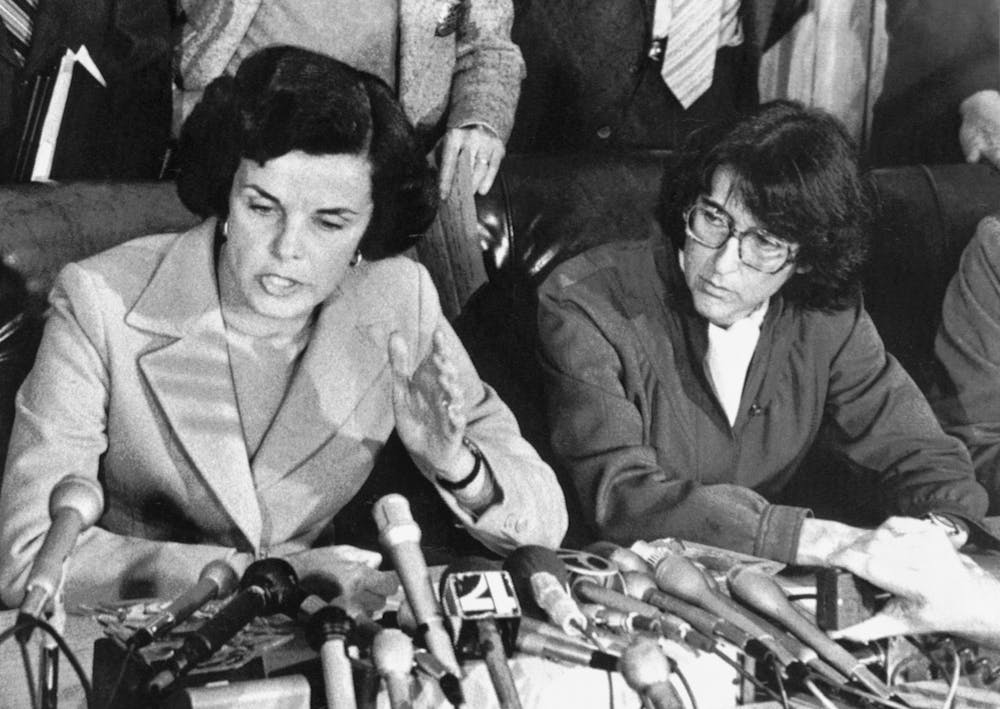
Feinstein’s plan didn’t last long. By the end of the day, she was the mayor of San Francisco, and had the dreadful responsibility of telling the city that both Moscone and Supervisor Harvey Milk had been assassinated – by a former member of the board.

“It is my duty to make this announcement,” she said, looking straight into the camera, amid audible gasps and screams, adding, “The suspect is Supervisor Dan White.”

Dianne Feinstein announced the shooting deaths at City Hall.

Feinstein handled this tragic announcement with poise – a quality that would characterize the nine years she went on to spend as San Francisco’s first female mayor and, later, as California’s first woman senator.

Feinstein has been in the U.S. Senate for 30 years, and is retiring in the face of concerns about whether she is still mentally sharp enough to continue in her current position.

This issue has been raised not by Republicans seeking to score political points, but by Democratic colleagues and congressional staff. There is also a possibility that Feinstein will not finish her current term, which runs through 2024, because there may be increased pressure for her to resign. This would allow California Gov. Gavin Newsom, who considers Feinstein a mentor, to appoint her successor.

Over the next months, that pressure may increase and the campaign to replace her will grow more heated. But before that happens, it is worth looking back on Feinstein’s extraordinary career and her place in California, and more notably, San Francisco, history.

Senator from San Francisco

Feinstein’s tenure in the Senate, which began in 1992, made her a national figure. But San Francisco was always her home, even after three decades in Washington.

“When you become mayor because of an assassination and the horrific events that catapulted Feinstein into the mayor’s office, you will be forever linked to that city,” says Corey Busch, Moscone’s press secretary and an advisor on Feinstein’s campaign when she ran for mayor in 1979.

Feinstein is not from the San Francisco of hippies, new tech wealth, radical politics or LGBTQ activism. She was born to an affluent Jewish family and attended the Convent of the Sacred Heart, the city’s elite Catholic girls school. Feinstein’s mother was emotionally distant, according to her biographer Jerry Roberts, but she was close with her father, a prominent doctor who encouraged her ambition.

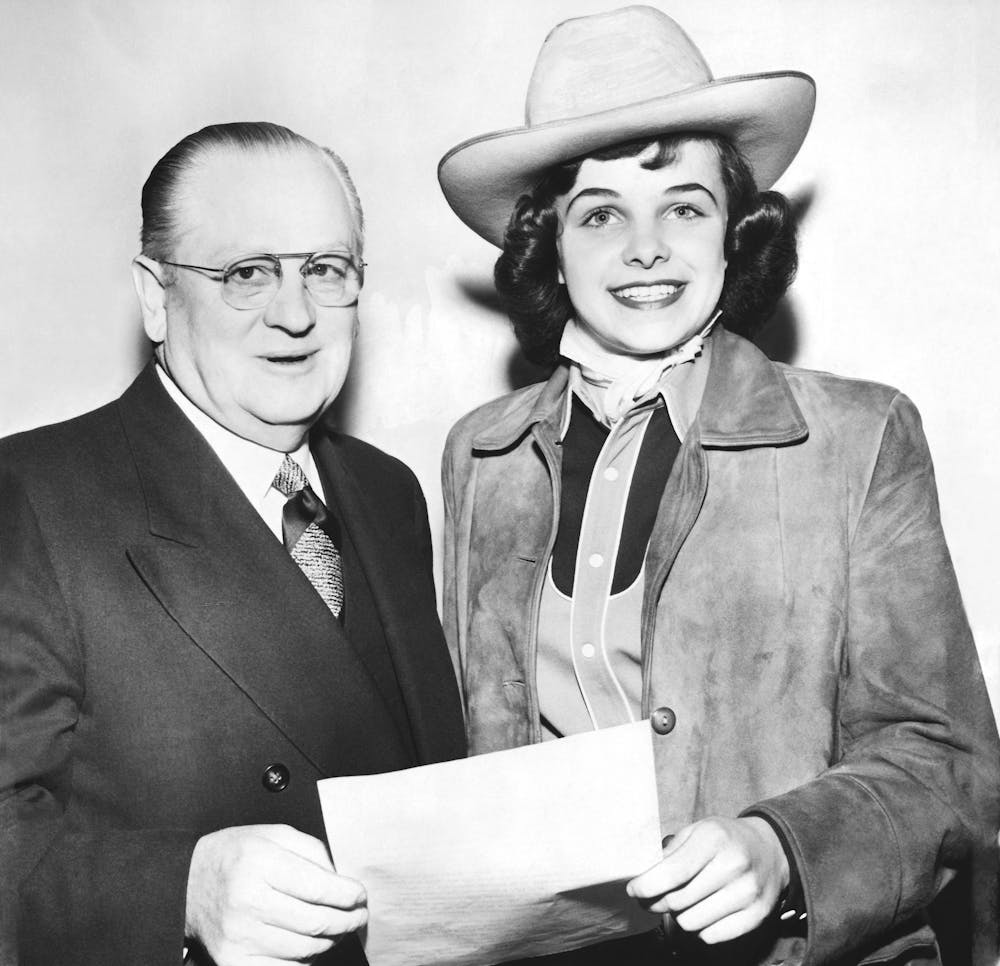
Black and white image of a young Feinstein in a cowboy hat standing next to an older man

Dianne Feinstein, then Dianne Goldman, with San Francisco mayor Elmer Robinson in 1950, when she was in high school. Underwood Archives/Getty Images

Feinstein won her first election to the Board of Supervisors in 1969 after serving several years on the state women’s parole board. She remained on the board until that dreadful day in November 1978.

As mayor, living primarily in tony Pacific Heights and Presidio Heights, Feinstein led the city through a tumultuous time of change. The period between 1978 and 1987 included Mayor Moscone’s assassination, the horrors of a mysterious plague – HIV/AIDS – cutbacks in state and federal funding and a panoply of urban problems like crime, traffic, homelessness and rising rents.

During that same period, San Francisco went from being a somewhat typical American city to becoming a major politically progressive hub. That transformation left the city deeply divided. Feinstein was able to govern it by combining social liberalism with strong support for business, development and real estate.

This kind of urban governance – later exemplified in Michael Bloomberg’s 12-year mayorship of New York City – is pretty common now. But Feinstein was one of the first politicians to embrace it, and her leadership from the center frequently angered San Franciscans who believed she was not doing enough about AIDS, or was too close to real estate interests, or just wasn’t sufficiently progressive.

“Feinstein was very supportive of gay people that she knew,” Art Agnos, the mayor after Feinstein, told me, “but struggled to relate to LGBTQ equality as an abstract civil rights issue.”

In lefty San Francisco, “a lot of people think that Dianne is more suited as a moderate Republican than as a Democrat,” says Busch, Feinstein’s former campaign advisor.

For me, as Feinstein’s teenage constituent, it was her crackdown on the punk music scene – which frequently included allowing the police to harass punks attending shows at venues like the Mabuhay Gardens, which was usually called the Mab – that bothered me. When I was 16, I climbed the flagpole in front of her stately and expensive house to amuse my friends. There’s a photo of this caper in my high school yearbook.

Mayor Feinstein’s generally conservative demeanor was also a target of our teenage derision – and other people’s as well. The legendary San Francisco columnist Herb Caen occasionally called her “Princess Di,” a reference to Feinstein’s formal, even imperious style.

Black and white image of Feinstein speaking into several microphones, seated

Dianne Feinstein at a press conference following the City Hall shootings, which occurred steps from her office. Bettmann/Contributor via Getty

Feinstein’s legacy

After leaving the San Francisco mayor’s office in 1987, Feinstein ran for governor of California in 1990. She lost to Republican Pete Wilson, but in 1992 won a special election to the U.S. Senate.

As senator, Feinstein’s moderation sometimes frustrated progressives in the Democratic Party, as it had her hometown constituents.

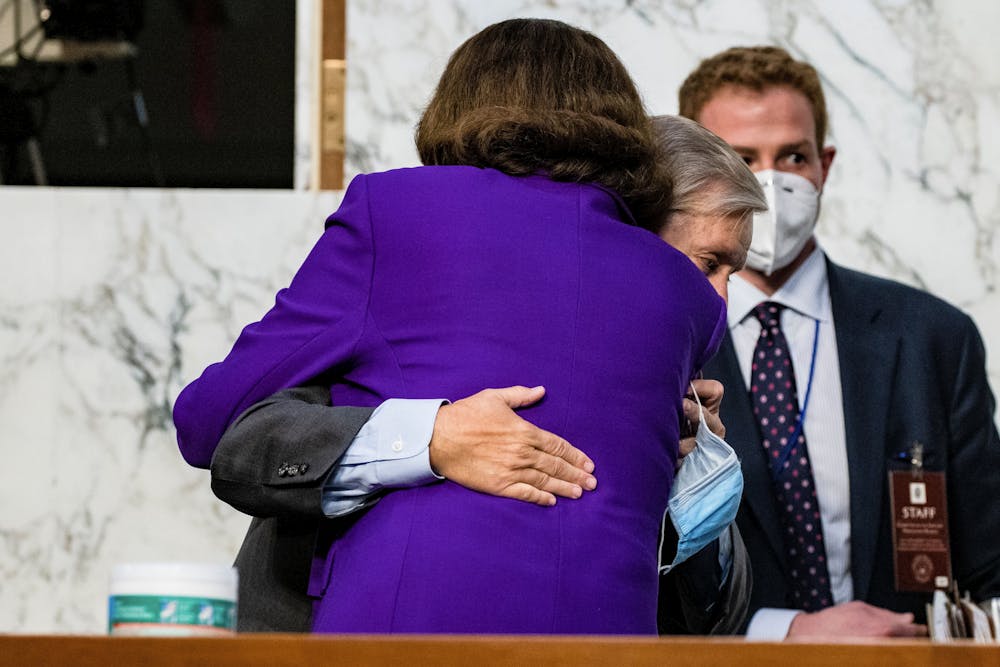
She voted for the war in Iraq in 2002 and for George W. Bush’s major tax-cutting legislation in 2001. In 2020, she literally embraced the Republican Sen. Lindsay Graham of South Carolina at the conclusion of Amy Coney Barrett’s Supreme Court confirmation hearings.

Feinstein's back as she hugs Graham

Dianne Feinstein hugs Republican Senator Lindsay Graham after the Amy Coney Barrett hearings, Oct. 15, 2020. Samuel Corum / POOL / AFP via Getty

But Feinstein was well liked, an electoral powerhouse and a generally reliable Democratic vote on major legislation long before California took on its current political shade of deep blue. She supported the Affordable Care Act, voted against Donald Trump’s tax bill in 2017 and opposed all three of Trump’s Supreme Court nominees. She has also been a committed fighter for California’s economic interests, from winemaking to desert conservation.

In her last reelection to the Senate, in 2018, the 85-year-old Feinstein brushed off the kind of progressive primary challenge that felled other moderates in her party to win her fifth full term in office.

Feinstein is a trailblazer and one of the most successful women in American political history, but not one of its greatest senators. Feinstein has never been connected to a singular important issue, as the late Ted Kennedy was with health care. Nor has she authored any landmark legislation, as John McCain and Russ Feingold did with their namesake 2002 campaign finance reform bill. Her greatest legislative accomplishment remains her work on the assault weapons ban in 1994.

After almost 50 years in public office, her leadership after the City Hall killings remains Feinstein’s finest moment in politics – the one that made her long career possible. For San Franciscans of a certain age, she will forever be known as the woman who stepped in at one extraordinary and tragic moment and helped us believe our city would survive.


Lincoln Mitchell, Associate Adjunct Research Scholar, Arnold A. Saltzman Institute of War and Peace Studies, Columbia University

This article is republished from The Conversation under a Creative Commons license. Read the original article.

“Evidence of a crime”: Expert says special counsel filing shows Trump lawyer is “hostile witness”

Special counsel Jack Smith’s team is seeking to compel Trump attorney Evan Corcoran to testify under the crime-fraud exception, which allows the prosecutors to pierce attorney-client privilege claims when they have reason to believe that an attorney is helping to further a crime.

Prosecutors have asked a federal judge to grant the crime-fraud exception, according to The New York Times and other outlets, which suggests former President Donald Trump or his allies may have used Corcoran’s services to further a crime.

Corcoran handled Trump’s discussions with the Justice Department, meeting with investigators in May and turning over 30 documents in response to a subpoena. Another Trump attorney, Christina Bobb, signed a statement affirming that a “diligent search” determined that Trump no longer had any classified documents before the FBI discovered more than 100 additional classified documents during its August search of Mar-a-Lago.

Bobb has told investigators that Corcoran drafted the statement, according to the Times.

Corcoran was recently interviewed before a grand jury in D.C. but is believed to have asserted attorney-client privilege, according to the report. After his appearance, he received a notice that the DOJ would seek to use the crime-fraud exception to pierce the privilege claims. It’s unclear what crime the DOJ cited in invoking the crime-fraud exception in its motion to Judge Beryl Howell, who has repeatedly ruled in favor of the DOJ.

“The crime-fraud exception to attorney-client privilege is clear. If the client seeks to use the attorney to commit a crime the privilege is gone,” tweeted Richard Painter, a former Republican White House ethics lawyer.

“This is an aggressive move by Jack Smith,” wrote former federal prosecutor Renato Mariotti. “It suggests Corcoran is a hostile witness despite his own potential liability for writing a false statement to law enforcement in the Mar-a-Lago matter. It would be significant if DOJ is able to use crime-fraud to compel his testimony.”

Former federal prosecutor Andrew Weissmann, who served on special counsel Bob Mueller’s team, added that it is “not unusual” for Smith to argue that communications between Corcoran and Trump are not covered if “Trump were doing it to further a crime,” noting that the judge previously ruled in favor of the DOJ on this issue in the Paul Manafort case, which he oversaw.


Want a daily wrap-up of all the news and commentary Salon has to offer? Subscribe to our morning newsletter, Crash Course.


Smith’s team has increasingly targeted Trump’s attorneys and legal advisers. Prosecutors have interviewed Bobb, fellow Trump attorney Alina Habba, and Jesse Binnall — an attorney close to Trump — and asked questions about Boris Ephsteyn, a longtime Trump adviser who has coordinated lawyers in multiple investigations targeting the former president. Ephsteyn connected Corcoran with Trump, according to the report.

Investigators have asked witnesses about discussions between Ephsteyn and others about establishing a “possible common-interest privilege” in the case, which creates a kind of umbrella privilege for lawyers and clients to communicate confidentially, according to the Times. Investigators are interested in whether Ephsteyn was “trying to improperly influence witness testimony.”

A Trump spokesman told CNN that Smith’s latest move was “nothing more than a targeted, politically motivated witch hunt against President Trump, concocted to try and prevent the American people from returning him to the White House.”

But some legal experts have long expected that the DOJ would target Trump’s attorneys.

Trump is a “walking, talking crime-fraud exception,” conservative attorney and Trump critic George Conway wrote in a resurfaced tweet in October. “He has ZERO attorney-client privilege on ANY of this.  His lawyers are going to be the witnesses who put him in jail.”

Conway added on Tuesday, “this tweet seems to be aging well.”

Trump is preparing for more American carnage

When Donald Trump took office in 2017 he was determined to best Barack Obama in every way and, as absurd as it was, he was especially determined that he should win the Nobel Peace Prize as Obama had done in his first year in office. Trump even went so far as to ask then-Japanese Prime Minister Shinzo Abe to nominate him (which he dutifully did). At times he also went around saying that because a couple of right-wing European randos had also nominated him, he’d actually won it, claiming that he was bringing world peace and so deserved it.

This ruse played into Trump’s cultivated image as some sort of peacenik, despite the fact that he is one of the most bloody-minded public figures in American history. Sure, he managed to avoid getting into a major war during his term but that was mostly a combination of luck and adversaries who knew a sucker when they saw one. But it was always clear from his history and his rhetoric that Donald Trump had a very violent imagination. Recall his repeated retelling of assaults by undocumented immigrants and gang members, mesmerizing his followers with explicit, lurid details. Here’s one from the 2018 midterm campaign:

Trump is a big believer in summary execution. One of his other favorite tales during that campaign was the account of Bowe Bergdahl, a soldier in Afghanistan who had wandered off and was captured by the Taliban who then brutally tortured him for nearly five years before he was returned to the United States. The right called him a deserter and stated that five years of torture wasn’t bad enough. Trump said repeatedly that back in the good old days, “when we were strong,” Bergdahl would have been summarily executed, at which point Trump would pantomime committing a killing, to huge cheers from his supporters.

His worst was this apocryphal horror story:

They were having terrorism problems, just like we do. And he caught 50 terrorists who did tremendous damage and killed many people. And he took the 50 terrorists, and he took 50 men and he dipped 50 bullets in pigs’ blood — you heard that, right? He took 50 bullets, and he dipped them in pigs’ blood. And he had his men load his rifles, and he lined up the 50 people, and they shot 49 of those people. And the 50th person, he said: You go back to your people, and you tell them what happened. And for 25 years, there wasn’t a problem. Okay? Twenty-five years, there wasn’t a problem.”

Again his supporters cheered madly.

It was always clear from his history and his rhetoric that Donald Trump had a very violent imagination.

This was the essence of what they loved about Trump. He was refreshingly open about his grisly anti-social fantasies in a way that validated their own. He unleashed their primitive beast.

Trump was particularly in love with the idea of imposing the death penalty for drug crimes. Early in his term, he shocked his foreign policy advisers by inviting Philippine President Rodrigo Duterte to the White House, complimenting him on his brutal and deadly drug policy. Trump told him, “I just wanted to congratulate you because I am hearing of the unbelievable job on the drug problem.” That job was “a bloody extermination campaign against suspected drug dealers and users, which has included open calls for extrajudicial murders and promises of pardons and immunity for the killers.” Throughout his term Trump came back to the idea of quick executions of drug dealers, often telling his staff “you know the Chinese and Filipinos don’t have a drug problem. They just kill them.”

Trump didn’t make as much of that sort of thing in 2020 but it looks like he’s reviving his ghastly homicidal rhetoric for the 2024 campaign.

A new campaign video in which Trump promises to “wage war” on drug cartels by “deploying all necessary military assets” including special forces and cyberwarfare capabilities was just released. In it, Trump is reprising his commitment to “quick trials and immediate execution” of drug dealers. At his recent rallies, he’s said that they will then “send the bullet to the family and have them pay for the bullet.” (No mention if it will be dipped in pig’s blood.) 

Furthermore, Rolling Stone is reporting that Trump is “still committed to expanding the use of the federal death penalty and bringing back banned methods of execution” such as firing squad, hanging, and “possibly even by guillotine.” He has “mused about televising footage of executions, including showing condemned prisoners in the final moments of their lives” and is also intrigued by the idea of group executions.


Want a daily wrap-up of all the news and commentary Salon has to offer? Subscribe to our morning newsletter, Crash Course.


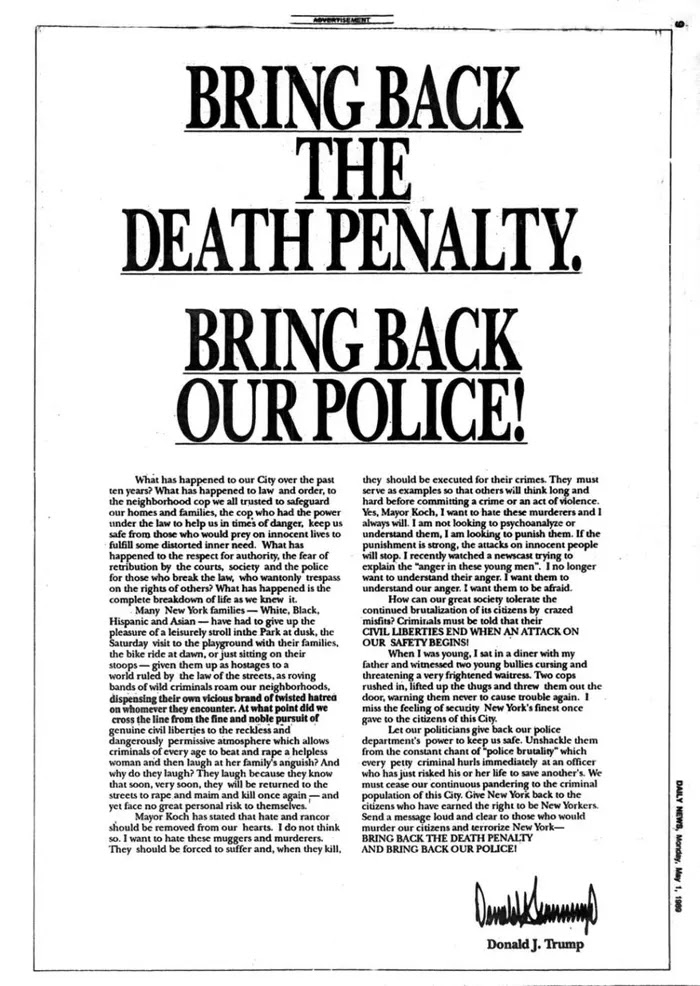
Trump has long been a huge fan of the death penalty, making one of his earliest forays into politics when he took out that famous full-page ad back in 1988:

He refused to apologize after the Central Park Five were exonerated, suggesting they weren’t actually innocent.

As it happens, Trump did get his chance to “bring back the death penalty” when he and then-Attorney General Bill Barr removed the federal moratorium and went on a killing spree in the final months of his presidency, executing 13 people. He had pardons for his cronies and war criminals but didn’t spare the time to even look at reports from the Office of the Pardon Attorney recommending clemency. 

Trump’s bloodlust knows no bounds.

Ron DeSantis may be running as hard as he can to capture the right wing with his war on “woke”. He’s banning books and curbing voting rights and humiliating LGBTQ kids and parents in order to suck up to the people who think the biggest threat to America is drag shows and a gender neutral Potatohead doll. Trump has something else in mind altogether: he’s going to go even further to the right than DeSantis by running a savage, bloodthirsty campaign against crime with proposals to crack down hard with the full force of the law and even vigilantism if necessary. He will paint a portrait of America that is so dangerous and chaotic that only he can put it straight: American carnage, redux.

Trump was always a warmonger, it’s just that his war was always going to be waged against his enemies at home. Can DeSantis beat that by fighting teenage trans kids? 

Republicans would rather kids be shot than let them read books

Republicans know exactly what they believe is the greatest threat to American students: books.

In Florida, the possibility of a student choosing a book to read was deemed so threatening that teachers were ordered to lock up all the books until they could be — slowly, painfully — combed over by censors. Now, as the censors make their way through the books at a snail’s pace, word of what has been officially banned from shelves thus far is starting to trickle out. Unsurprisingly, in a state controlled by a retentive fascist like Gov. Ron DeSantis, the books deemed too dangerous to read mostly involve ideas like “gay couples exist” and “there was once a civil rights movement.” As Tom Fontaine of Trib Live reports

PEN America, a New York-based nonprofit that works to defend free expression, reported the district had removed at least 176 titles from classrooms. They include works such as “My Two Dads and Me,” “My Two Moms and Me,” “Celebrating Different Beliefs,” “The Gift of Ramadan,” “The Berenstain Bears and the Big Question” and books about Rosa Parks, the Underground Railroad and Japanese internment camps during World War II.

Also removed was “Roberto Clemente: The Pride of the Pittsburgh Pirates,” a 2005 book by Dormont’s Jonah Winter.

The 32-page book references racism Clemente sometimes endured.

Republicans are also deeply worried that a child might enjoy a drag queen story hour, in which drag performers use their skills at entertaining a crowd to get kids excited about reading. The threat that a funny person in a flashy costume might make a child happy is such that Republicans in state legislatures are considering bans so draconian that they could criminalize merely being a trans person in public or wearing makeup on a stage. 

Of course, considering the Republican hostility to children reading, the “story hour” may be as offensive to them as the “drag” part. 


Want more Amanda Marcotte on politics? Subscribe to her newsletter Standing Room Only.


On this fifth anniversary of the school shooting in Parkland, Florida, we’re once again reminded that there is a very real threat to young people — one most Republicans don’t care about: gun violence.

The nation woke on Tuesday to familiar news that doesn’t get any less disturbing, despite being painfully common. There was another mass shooting, this time at Michigan State. A gunman left three dead and five more critically injured. This is in a year where there has been an average of more than one mass shooting a day. At least one of the survivors of this latest shooting also survived a mass shooting 14 months ago at Oxford High School. 

At this point, the Republican callousness to the carnage is so baked in that it barely feels worth remarking upon. Nor is this just a matter, as so many claim, of Republicans being too “afraid” of the NRA to stand up for meaningful gun safety laws. As I’ve written about before, there’s plenty of reason to believe that the reason Republicans block most efforts to prevent mass shootings is that they benefit politically from both the feelings of helplessness and social decay that such shootings sow in the public. 

“Please don’t tell me you care about the safety of children if you are not willing to have a conversaion about keeping them safe in a place that should be a sanctuary,” Democratic Rep. Elissa Slotkin, who represents the Michigan district the shooting happened in, said during an emotionally raw press conference Tuesday morning. She didn’t need to elaborate on who claims to “care” about children but certainly does not. 

We’ve been subject to a yearslong effort to ban books and gut the rights of LGBTQ people, all justified by GOP claims to be “protecting” children. The College Board, under pressure from DeSantis and the larger Republican establishment, has even gone so far as to remove books by renowned writers and poets like bell hooks, June Jordan, and Ta-Nehisi Coates from an African-American studies course. The excuse is that the fragile self-esteem of white students cannot withstand learning about the realities of racism. 

It’s about control, not protection.

But while Republicans fret and moan over the supposed damage done to students’ minds by learning that racism happens or LGBTQ people exist, the much more real danger that comes from a bullet tearing through a body is not considered a priority. In the Republican imagination, a high school or college student is too delicate to read about the Holocaust or slavery, but should also be tough enough to stand up to an armed madman mowing down kids with a semiautomatic weapon. And if such kids do survive the kind of graphic violence that Republicans believe they’re too sensitive to read about, then such kids are also expected to be tough enough to endure members of Congress like Rep. Marjorie Taylor Greene, R-Ga., denying the violence ever happened and harassing those who survived it. 


Want more Amanda Marcotte on politics? Subscribe to her newsletter Standing Room Only.


After last year’s shooting in Uvalde, Texas — which left 19 kids and two teachers dead — a handful of Republicans decided it was becoming politically untenable to maintain the “thoughts and prayers, but nothing can be done” position that has characterized the party for so long. So 15 Republican senators crossed the aisle to vote for a gun safety bill last June. The Beltway media, longing for a narrative of bipartisan comity, swooned rapturously over this supposed evolution away from sociopathic disregard towards gun violence towards something more humane. 

This feigned constitutional absolutism on gun control is ridiculous on its face. It’s even more obviously a lie in the context of GOP enthusiasm for book banning.

But, at the cost of sounding overly cynical, the whole thing was probably more of a ploy to get people off their backs than anything else.

For one thing, for every Senate Republican who did vote for the bill, there were more than two who refused. Second, while there were some good items in the law that President Joe Biden signed last summer — especially closing the “boyfriend” loophole that let domestic abusers buy guns — the legislation stops well short of what’s needed to keep guns out of the hands of unhinged people who want to shoot up nightclubs, schools, and shopping malls. 

To make it worse, what little Republicans are willing to do in Congress is in real danger of being dismantled by Republicans in the federal courts.

The same week Congress passed their watered-down gun safety bill, the six Republican Supreme Court justices overturned a New York state law that is over 100 years old, which restricted who can carry guns in public. As Slate’s legal expert Mark Joseph Stern wrote at the time, the decision rests on “a maximalist opinion by Justice Clarence Thomas that renders most of the nation’s gun control laws presumptively unconstitutional.”

Sure enough, other Republican-controlled federal courts took note. Earlier this month, the Fifth Circuit used Thomas’s decision as a pretext to rule against a law barring domestic abusers from owning guns. This law not only protects the lives of women who are being stalked by former partners, but it’s useful in preventing mass shootings. Over half of mass shooters had a known history of domestic violence. Sadly, many of them were able to commit their crimes by taking advantage of the pro-gun, anti-woman views of local Republican politicians, who won’t enforce existing gun laws. That appears, for instance, to be the case in the Club Q shooting in Colorado Springs in December. The suspect had been previously arrested after a reported domestic violence incident involving his mother, but the right-wing sheriff who had bragged about being a gun rights absolutist did not enforce a law allowing the government to take the shooter’s guns from him. 

When faced with the carnage that their gun fanaticism inflicts on our nation, Republicans will often pretend that their hands are tied by the constitution. The GOP cowards who rule against the ban on wife beaters owning guns used this excuse. The court claimed there is no “historical tradition of firearm regulation” regarding domestic violence and that therefore they are forced — forced I tell you! — to believe the Second Amendment’s language about a “well-regulated militia” somehow covers unregulated, non-militia wife beaters. 

This feigned constitutional absolutism is ridiculous on its face. It’s even more obviously a lie in the context of GOP enthusiasm for book banning. Unlike the Second Amendment, which puts strong limits (“well-regulated militia”) on the right to bear arms, the First Amendment grants Americans expansive rights to free speech. It very clearly states that there should be “no law…abridging the freedom of speech.” That’s without caveat, unlike the Second Amendment. And there are certainly no exceptions for “unless it offends the bigoted sentiments of Ron DeSantis.”

Most of all, of course, this exposes how Republicans are only interested in controlling students, not protecting them. The threat of the targeted books is not to students, who will only benefit from learning more about the world around them. The threat is to the fragile egos of the right-wing bigots who make up the Republican base. This focus on control also explains the GOP’s disinterest in doing anything to save students from mad gunmen. They may be saddened by a dead child, but they aren’t threatened by them. A murdered child, after all, is unlikely to think for themselves, much less grow up to vote against Republicans. And ultimately, that’s all the GOP is really worried about when they talk about “the children.” 

Ron DeSantis’ hypocrisy is his secret weapon

On Feb. 1, 2023, the start of Black History Month, a New York Times headline read: “The College Board Strips Down Its A.P. Curriculum for African American Studies.” In a seeming reaction to Gov. Ron DeSantis of Florida, a Republican, banning the earlier version of this course, the College Board removed from the core curriculum any examination of critical race theory, the study of contemporary topics like Black Lives Matter, and the works of scholars like Columbia and UCLA law professor Kimberlé Crenshaw, Yale professor Roderick Ferguson, Ta-Nehesi Coates and bell hooks.

            After public outcry, the College Board claimed that these changes were in the works before the DeSantis administration banned the course. The Board has also expressed regret for not denouncing the Florida Dept. of Education’s “slander” that the course “lacks educational value.” Florida officials, meanwhile, have continued to gloat that their criticism led to the course changes.

            Whether the College Board’s revisions were a reaction or not, it’s clear that DeSantis and other conservatives have castigated what they believe was the “ideological” content of the initially planned course. This is the sort of double-speak that conservatives are so fond of: What they believe is “non-ideological” but anything they disagree with is “ideological” and un-American. Of course, this is hypocritical nonsense, but as Yale historian David Blight has observed, hypocrisy has always been a tool of racism.

            History, stated the critic Walter Benjamin, is the tale of the victors. In part, he meant that those who win wars, those who have the power, are the ones who get to tell history. In this, the telling of history is always ideological, is always a struggle for power. And DeSantis and his ilk know this; that is why they are trying to suppress the teaching of African American history—from the point of view of African American writers and scholars.

As I state The Stories Whiteness Tells Itself, from its very beginnings America had two irreconcilable goals. One was to seek equality, freedom, and democracy. The other was to maintain white supremacy and the domination by white people over any people of color. White America is fine with telling our tale through the lens of the first goal. But it is still decidedly not fine with telling the second story of America’s treatment of people of color and America’s desire to maintain white supremacy. All the recent ridiculous distorting, disparaging, and damning of Critical Race Theory are just the latest manifestation of this repression. 

Hypocrisy has always been a tool of racism.

Instead, this second tale, the tale of BIPOC America, is regarded as un-American, unpatriotic, a smear on the past, an abomination to the present—or at best, a minor element. According to some, this story can never be integrated with the story of America’s noble pursuit of its ideal goals. And this is an essential way white America has lied to itself: it has denied the voices of people of color as an essential and defining part of America’s tale; it has denied their validity as Americans; it has denied that their history is also the history of white America—however white America wants to deny that fact.


Want a daily wrap-up of all the news and commentary Salon has to offer? Subscribe to our morning newsletter, Crash Course.


In essence what Gov. DeSantis and conservative groups like Moms for Liberty are saying is this: The problem is not that white America has been abusing Black America throughout our history and into the present, but that Black Americans keep remembering this history and telling it to white people—which somehow victimizes white people. My verb choice here is deliberate: This is the psychology of the abuser.

DeSantis is not a scholar; he hasn’t, I’m sure, made an extensive study of African American history and theory. But he knows he can critique with impunity the work of African American historians and scholars. He can do this by relying on a foundational premise of Whiteness as an ideology and practice: White knowledge is always considered valid, objective, true and official, while Black knowledge is always suspect, subjective, false and unofficial—unless Whiteness approves of it.

That DeSantis relies on this foundational principle of white supremacy is actually evidence of systemic racism, a term he wants to ban from any mention in Florida schools.

The telling of history is always ideological and is always a struggle for power. DeSantis and his ilk know this.

For indeed, white suppression of the history of African Americans has been systemic since the start of this country. It was there in the forbidding of slaves to read and write and the banning of their African languages. It was there in the suppression of any vocalized expression by slaves against their enslavement. It was there in the creation of the myth of The Lost Cause, which stated that the true causes of the Civil War were Northern aggression and the attack on state’s rights and not slavery, since slavery was a benign institution and a natural condition that treated slaves well.

In the early twentieth century, the North began to adopt this myth as part of the reunification of Northern whites with Southern whites. The films Birth of a Nation and Gone With the Wind are both examples of this white supremacist history. What they demonstrate is that history can be easily falsified by those in power. Moreover, history is not simply events, but the ways those events are interpreted and contextualized — not in the past, but in the present.

It is clear that DeSantis and other conservatives object to the ways writers like Crenshaw, Ferguson, Coates and hooks interpret and contextualize both our history and our present. For example, Crenshaw’s concept of intersectionality proposes that our history of race should be integrated with understanding race through other categories such as gender, orientation, class, etc. But of course, DeSantis is also against feminist studies, gay studies, and any true examination of class in American history like, for instance, how racism has been used to distract and mollify the discontents of working class white people. This move can be seen as far back as the reaction to Bacon’s rebellion in 1676 since it was after this white working class rebellion that the white elite institutionalized the privileges and rights of Whiteness in contrast to the category of Blackness. But such historical teachings would then cause students to question how race is still used to distract and mollify the white working class in the present. 

As I point out in my book, when it comes to the issues of racial equality, Black America has always been on the right side of history; the majority of white Americans, at any point, have been on the wrong side of history. And yet white America has never turned to Black America and said, “We got it wrong every time in our history and you got it right. So now, we’re going to follow your lead in the present.”

It’s no wonder why we need an African American history month. Gov. DeSantis and so many white Americans are still not ready to hear how Black Americans would tell our history and to recognize how we cannot understand white American history without the truth embodied in the experiences, narratives and scholarship of African Americans.

In short, we still have not given up the stories Whiteness tells itself.

Republicans like to talk tough on crime — but they’re the ones with a real crime problem

Republicans like to talk tough about crime. But they have a crime problem of their own that they want to keep under wraps.

A new study of homicide by the nonpartisan advocacy group Third Way reveals a fact that Republicans don’t want to acknowledge: Rates of violent crime, especially murder rates, are higher in red states than in blue states. 

That has been true for years, yet Democrats have said almost nothing about this startling fact or about Republicans’ evident incompetence in actually doing something about crime.

Crime is an American problem, touching the lives of people in cities, suburbs and rural areas. Yet for all its talk about crime, the Republican Party has not delivered an effective strategy to fight it.  

Of course, you would never know that from listening to Republican politicians or the public officials who represent red states. They take every opportunity to try to convince voters that crime is a problem made worse by “liberal” policies, and that it runs rampant in cities and states where Democrats are in charge

Consider the charges in an op-ed written by House Republican Whip Steve Scalise, R-La., and Rep. Scott Fitzgerald, R-Wis.. for the Fox News site in the run-up to the 2022 election.

“Over the last few years,” they wrote, “we have seen the consequences of leftist Democrats’ embrace of the radical ‘Defund the Police’ and ‘No Cash Bail’ movements. By slashing police budgets, ending cash bail, and allowing violent offenders back onto our streets, radical Democrats nationwide have made our communities less safe.”

Violent  crime, they said, was out of control in “every Democrat-run city and state across the country.” 

Echoing Scalise and Fitzgerald, Kevin McCarthy, the recently installed Republican speaker of the House, bluntly claimed that “Democrat politicians defunded police, raised money for rioters, and pushed policies that are soft on crime. They own this crime wave.”


Want a daily wrap-up of all the news and commentary Salon has to offer? Subscribe to our morning newsletter, Crash Course.


Looking back at the 2022 midterm elections, CNN reported that “Over the first three weeks of October (2022), GOP candidates and committees spent $64.5 million on ads focused on crime – nearly one-quarter of all the money they spent on ads over that period….. Many of those ads accused Democrats of supporting the ending of cash bail or efforts to defund the police.”

Wisconsin Sen. Ron Johnson’s re-election campaign provides one example of this attempt to pin the soft-on-crime label on Democrats. Johnson ran a series of ads attacking his Democratic opponent, Mandela Barnes, for advocating an end to cash bail. 

The ads ended with the tagline, “Mandela Barnes, not just a Democrat, but a dangerous Democrat” and a racially charged image of Barnes superimposed over a picture of several Democratic women of color who serve in the House of Representatives and are known as the “Squad.” Johnson wound up winning that race by an exceedingly narrow margin, just 26,000 votes out of more than 2.6 million cast.

Not surprisingly, a 2022 Gallup Poll found that “partisanship plays a significant role in shaping Americans’ assessments of crime.” 

Gallup reports that “since 2000, supporters of the president’s party have typically been less likely than those who identify with the opposition party to say that crime has increased. Before that, during both George H.W. Bush’s and Bill Clinton’s presidencies, partisans held similar perceptions of the crime problem.”

Gallup also found that “Last October, with Joe Biden in the White House and after the FBI released its 2020 crime statistics showing a sharp increase in murders in the U.S., the percentage of Republicans who said there was more local crime increased from 38% to 67%. Independents’ perception that local crime was worse also edged up, while Democrats’ view was essentially unchanged.”

But Republicans’ hypocritical exploitation of the crime issue isn’t just an election-year phenomenon. 

Last month they went on the attack when Washington, D.C.’s Democratic City Council overrode Mayor Muriel Bowser’s veto of the Revised Criminal Code Act of 2022. The city ordinance modernized the District’s criminal laws, which had not been overhauled for more than 100 years.

It was designed to “expand eligibility for the Second Look Act from youthful, convicted violent offenders to people of all ages;… expand the right to a jury trial for those charged with misdemeanors but facing jail time; and…  reduce maximum criminal penalties for violent crimes like carjacking and robberies.”

Republicans quickly pounced, using the accusation that Democrats are soft on crime in a successful effort to get the House of Representatives to exercise its constitutional authority to override the D.C. law.

Americans’ perception of crime is now a partisan issue, driven by which party holds power. But Republicans’ hypocritical exploitation of crime is no longer just an election-year phenomenon.

One local news story quotes Rep. James Comer, R-Ky., chair of the House Oversight and Accountability Committee, as saying that, “There’s a crime crisis in America’s capital city. According to the D.C. Metropolitan Police Department, carjackings in the District have increased by 90% compared to this time last year. Total property crime is up 31%, and homicides are up 29%.”

But, following the usual Republican playbook, Comer wasn’t content to recite those facts. 

“The radical D.C. Council,” he continued “has chosen to prioritize legislation that will turn this crime crisis into a catastrophe. The D.C. Council’s progressive soft-on-crime legislation eliminates almost all the mandatory minimum sentencing requirements for violent crimes, and it drastically reduces the maximum penalties allowable to the courts.” 

While Republicans talk about the crime rate in Democratic run cities like Washington, they won’t own up to their own problems in dealing with crime. These problems were highlighted in a 2022 Los Angeles Magazine article which pointed out that murder rates in “mid-sized cities with Republican mayors have actually fared far worse than big cities with Democratic mayors.”

For example, the homicide rate in Bakersfield, California — the principal city in Kevin McCarthy’s district — was more than twice as high as that of San Francisco, represented in the house by former Speaker Nancy Pelosi.  

This brings us back to the Third Way report, which points out that what is true in California is true across the nation. The report meticulously documents the Republicans’ hidden crime problem.

“The murder rate in Trump-voting states,” the Third Way report says, “has exceeded the murder rate in Biden-voting states every year this century. Cumulatively, overall murder rates since 2000 were on average 23% higher in Trump-voting states.” It continues:

For the past 21 years, the top 10 murder rate states have been dominated by reliably red states, namely Louisiana, Mississippi, Alabama, and Missouri. And when we removed the county with the largest city in Trump-voting states (and kept them in for Biden-voting states), murder rates were still significantly higher in these red states. 

While media reports give the impression that murder rates are skyrocketing in blue areas, murder rates have actually increased at far higher rates in Trump-voting states over the past two decades, widening the Red State murder gap from a low of 9% in 2003 and 2004 to a high of 44% in 2019, before falling to 43% in 2020. Since 2000, murder rates have increased 39.4% in red states and just 13.4% in blue states. 

It’s time for Democrats to make these facts known, and stop giving Republicans a free pass on the crime issue. They need to expose Republican cynicism, hypocrisy and incompetence in dealing with crime — and remind voters of these failings at every opportunity.

As Jim Kessler, Third Way’s executive VP for policy puts it, “Republicans seem to do a much better job of talking about stopping crime than actually stopping crime.”

Experts sound the alarm on the “merger mania” in the military-industrial complex

It’s early in the new Congress, but lawmakers are already hotly debating spending and debt levels. As they do so, they risk losing track of an important issue hiding in plain sight: massive Pentagon waste. At least in theory, combating such excess could offer members of both parties common ground as they start the new budget cycle. But there are many obstacles to pursuing such a commonsense agenda.

Pentagon waste is a longstanding issue in desperate need of meaningful action. Last November, the Department of Defense once again failed to pass even a basic audit, as it had several times before. In fact, independent auditors weren’t even able to assess the Pentagon’s full financial picture because they couldn’t gather all the necessary information to complete an evaluation. In some ways, that should have been devastating, the equivalent of a child receiving an incomplete on an end-of-year report card. No less alarming, the Pentagon couldn’t even account for about 61% of its $3.5 trillion in assets. Yet the last Congress still approved $858 billion in defense programs for fiscal year 2023, a full $45 billion more than even the Biden administration requested.

Spending levels aside, poor financial management has a serious negative impact on both service members and taxpayers. Last month, for example, the Government Accountability Office (GAO) revealed that the Pentagon can’t account for at least $220 billion worth of its property, including such basics as ammunition, missiles, torpedoes, and their component parts. For its part, Congress (and so the average taxpayer) doesn’t have the faintest idea how much it’s spent on weapons or their components distributed to contractors for maintenance and upgrades. Worse, the GAO reports that the $220 billion in unaccounted-for equipment and parts is “likely significantly understated.”

Such irresponsible financial management also applies to Pentagon weapons purchases, creating another set of problems. The Department of Defense commits staggering numbers of taxpayer dollars to new weapons programs without doing its due diligence, all too often resulting in dysfunctional systems. The GAO has reported on this issue for 20 years and yet there’s been little discernible change in Pentagon behavior.

There is a better way, though. For example, in its most recent Annual Weapons Systems Assessment Report, the GAO notes that obtaining basic information at critical points in the weapons-buying process produces better cost and delivery outcomes. In defense-speak, this is called “knowledge-based acquisition.” Of course, requiring crucial information about a program before proceeding to its development stage should be a no-brainer. Yet the Pentagon has wasted untold billions of dollars on ill-functioning weaponry like the F-35 combat aircraft by proceeding to the development stage without faintly adequate information. 

And the status quo guarantees future disasters like the F-35. According to the GAO, more than half of the major defense-acquisition programs it reviewed in fiscal year 2022 “did not demonstrate critical technologies in a realistic environment before beginning system development.” That’s like buying a house without checking whether the water pressure is adequate or the roof leaks — or, in the case of the F-35, a few thousand houses. An independent assessment of that fighter jet in fiscal year 2021 found more than 800 unresolved deficiencies, six of which are so serious that they may cause death or serious injury to those operating the plane, or critically restrict its capabilities in a combat setting. In the 20 years since the program began, the Pentagon has yet to approve that deeply deficient, wildly expensive plane for full production. Put another way, it has already spent nearly $200 billion on a system that may never actually be fully ready for combat.

Aside from the fact that the F-35’s engine doesn’t work, the main reason the Pentagon hasn’t gone full speed ahead on production is that even its manufacturer, Lockheed Martin, can’t assess the aircraft’s performance. Why? Because the company hasn’t finished developing the simulator required to properly test it. Still, the money keeps flowing and, by current estimates, the program’s lifecycle cost will exceed $1.7 trillion, making it one of the most expensive weapon programs in Pentagon history.

Looking Down from the (Capitol) Hilltop

Pentagon waste is, of course, nothing new. Still, the need to trim the fat only grows more urgent as this country faces mounting security challenges ranging from the increasing devastation of climate change to strategic competition with other powers. The war in Ukraine is already straining the Pentagon’s buying system in striking new ways. As the need to get weapons out the door quickly becomes its number one priority, its penchant for wasting taxpayer dollars will undoubtedly only grow worse.

Still, there are reforms that could quickly improve the situation. There’s no need for Congress or the Pentagon to reinvent the wheel, since the steps toward making weapons-buying more accountable have been clear for years — as have the roadblocks along the way.

One of the biggest obstacles to reform is that so many lawmakers have vested interests in a hands-off approach to the Pentagon budget. As a start, striking numbers of them have instant conflicts of interest with respect to the defense industry, since they own stock in major weapons-making firms. Those companies make major campaign contributions to keep the lawmakers in their camp. Open Secrets.org, a group that tracks money in politics, reported, for instance, that, in the 2020 election cycle, the arms sector contributed $50 million to political candidates and their committees.

To mask such obvious conflicts of interest and their wasteful consequences, lawmakers generally prefer to change the subject. When the Pentagon budget is threatened with even modest reductions, they routinely trot out tired arguments about how such enormous sums create jobs, jobs, and more jobs. Forget that the data shows education spending produces more than twice as many jobs, while clean energy and healthcare generate 50% more. In short, taxpayers would be far better off if Congress repurposed significant amounts of Pentagon spending for more productive endeavors.

Beyond long-overdue campaign finance reform and a congressional stock-trading ban, lawmakers have a lot of ground to cover when it comes to making Pentagon spending more accountable. The GAO has clear recommendations for ways to mitigate the risks and challenges of prospective weapons programs before making investment decisions. It has also recommended developing significantly better ways of assessing “military readiness” (the fitness of units to engage in combat). Too often, an alleged lack of readiness is used as another excuse to further pump up the Pentagon budget. The Congressional Research Service has, however, pointed out that Congress doesn’t even have a standard definition of military readiness, so how can legislators begin to evaluate the real-world impact of the hundreds of billions of dollars they routinely authorize for the Department of Defense?

The bottom line is simple enough: Congress needs to cut the Pentagon budget dramatically. It’s not only outrageously oversized, but some parts of it are genuinely dangerous. Take, for instance, the newest intercontinental ballistic missile (ICBM) now being prepared by Northrop Grumman for a prospective $264 billion over its lifetime.  Such missiles will only increase the risk of an accidental nuclear war because a president will have just minutes to decide whether to launch them in a crisis (and once they’re launched, you can’t take them back). 

Unfortunately, lawmakers have proven remarkably unwilling to address the issue of Pentagon waste. Take the chair of the House Defense Appropriations Subcommittee, for example. The new incumbent Ken Calvert (R-CA) recently offered this boilerplate response on the subject:

“Despite various reports on budget numbers, while I support reforms that will yield cost savings in any government program, I do not support cuts to national security that would negatively impact readiness or slow our ability to deliver capability to the warfighter.”

Never mind that Congress can’t assess military readiness, his statement obscures the fact that he undoubtedly intends to press for even higher budgets, while threatening to make the search for “waste” a modest sideshow.

Such an approach, of course, directly benefits politicians like Calvert. After all, he was the second-highest recipient of defense-industry contributions in Congress between 2021 and 2022 at $415,850. Only current House Armed Services Committee Chairman Mike Rogers (R-AL) received more. So don’t expect either of them to go after the F-35, despite its cost overruns and dismal performance, or any other major weapons system.

In fact, last December, Rogers said all too bluntly that his priority this year would be “no cuts whatsoever to defense spending.” In January, he turned around and told Defense News reporter, “We’re going to start meeting right away about what I see as threats and challenges that we’ve got to meet… because we intend to do some cutting. There’s some legacy systems and fat. There’s a lot that can be taken out.” Count on one thing, though, as with Calvert, Rogers’ idea of what can be “taken out” will not include spending on any of the Pentagon’s costliest weapons programs. 

Still, these days even retiring some old weapons programs would count as a modest victory in Washington. Rogers and Adam Smith (D-WA), the ranking Democrat on the armed services committee, do appear to agree on the importance of dumping outmoded systems, so maybe they’ll actually trim a little fat.

Thankfully, there are a number of lawmakers across the ideological spectrum who are genuinely interested in broader Pentagon spending cuts. While some progressive Democrats press for a smaller Pentagon budget and refocusing “national security” on people, not corporations, a few on the Republican right argue for military cuts with the debt ceiling in mind. Unfortunately, supporters of such reductions are fighting an uphill battle.

Contractors First, Taxpayers Last

Members of Congress routinely favor major weapons makers over the needs of taxpayers and military personnel. As lawmakers fight for military contracts that will generate revenue in their districts or states, they have become remarkably complicit in the consolidation of the industrial part of the military-industrial complex, which threatens actual national security, in part by reducing corporate competition.

For decades, Congress stood by while weapons companies gobbled each other up through mergers and acquisitions. The result: the five largest contractors — Lockheed Martin, Boeing, Raytheon, General Dynamics, and Northrop Grumman — have, in recent years, split a staggering $150 billion-plus in Pentagon funding annually, often in “sole-source contracts” that virtually guarantee overcharging and cost overruns.

In 2015, for instance, Lockheed Martin, the world’s largest weapons manufacturer, acquired Sikorsky aircraft for $9 billion. At the time, the Pentagon expressed some concern about the impact of corporate conglomeration, without actually opposing the deal because, as the Justice Department decided, Sikorsky wasn’t a direct competitor. It manufactured helicopters and Lockheed didn’t. The Justice Department later rebuked Frank Kendall, a Pentagon official who expressed concerns about the deal, while pushing back on his calls for a more formal Pentagon role in potentially blocking such mergers.

Three years later, Northrop Grumman acquired Orbital ATK, then the biggest manufacturer of rocket motors in the country. The Federal Trade Commission (FTC) imposed guardrails on the deal because Northrop also made missiles and acquiring a company that produced motors for its missiles could give it an unfair advantage over other missile manufacturers. Still, the merger went through.

In 2019, L3 Technologies and the Harris Corporation combined in a “merger of equals” to create L3Harris, the sixth-largest defense contractor. Both companies were the sole suppliers of critical components for the military’s night-vision equipment. As a result, the Justice Department concluded that the merger would monopolize that technology and required Harris to sell its night-vision business. The company is now, however, trying to acquire Aerojet Rocketdyne, the last remaining independent supplier of missile propulsion systems in the United States. Senator Elizabeth Warren (D-MA) recently called on the FTC to block the deal, arguing that it would decrease competition in rocket motors.

In 2020, Raytheon and United Technologies combined in the biggest defense merger in decades, valued at about $121 billion. The resulting company, Raytheon Technologies, now an aerospace conglomerate, has established itself as a global supplier of everything from jet engines to missiles. As this country’s second-biggest weapons contractor, only Lockheed Martin outdoes it in annual defense revenues.

It is, of course, long past time for Congress to push back against such merger mania in the arms industry and the wild Pentagon overspending, waste, and poor weaponry that goes with it. Reducing the political clout of the major weapons makers would do more than just save billions of tax dollars. It just might prompt a broader debate about the purpose of a Pentagon budget now rising toward the trillion-dollar mark annually, a sum that would undermine the very concept of defense.

Maine tribes left out of Native resurgence by 40-year-old law denying their self-determination

Hundreds of the 574 federally recognized Indian nations in the U.S. now routinely provide their citizens with the full array of services customarily expected from state and local governments, from tax collection to environmental protection regulations. At the same time, many tribes are becoming the economic engines of their regions.

All this has happened over the past several decades under federal policies that, unlike previous policies, support tribal self-determination through self-government.

The progress has not been uniformly outstanding, nor is it close to complete. Tribes have long histories of disempowerment and consequent deprivation to overcome. Nonetheless, per capita incomes in Indian Country have grown more than 60% since the start of genuine tribal self-government in the late 1980s. This growth far outstrips the 17% growth in personal income experienced by the average U.S. citizen over the same period.

The self-determination era has finally, after centuries, brought sustained economic growth to Indian Country. The tribal economic boom is not all about casinos. Certainly, the forays into gaming by many tribal governments – in competition with state government lotteries and state-authorized casinos – have been a boon for tribes located near major population centers.

But the spread of economic development across both urban and rural tribes is now coming from a diverse mix of municipal service provision, natural resource companies, manufacturers, health clinics, retail stores, financial services firms, restaurants, hotels, construction companies and enterprises in many other sectors.

Yet in our recent study, we found the Wabanaki Nations in Maine – Maliseet, Mi’kmaq, Passamaquoddy and Penobscot – and their 9,546 citizens have been left out of this progress.

The average Wabanaki income per person has grown only 9% since the late 1980s. This is dramatically less than the 61% growth experienced by tribes in the other Lower 48 states. Moreover, employment in all four Wabanaki Nations is only one-quarter to one-third as large as that of similarly sized tribes in similarly populous regions.

What explains Wabanaki underdevelopment?

Indian self-determination policy

Past policy experiments, including federal administration of reservation affairs, privatizing reservation land and disbanding tribal governments altogether, did not produce Indian prosperity.

The research of the Harvard Project on American Indian Economic Development repeatedly finds that enabling tribes to govern themselves is the key to improving tribal economies.

Local self-rule over the past several decades has meant that tribes have the power to make their own choices. This shifts accountability from Washington, D.C., to the individual tribal governments and puts the risk and reward on local decision-makers, who are best positioned to understand tribal needs, values and opportunities.

Like other nations in the world, Native nations can falter while trying to exercise powers of self-government. But the ones that develop robust governing systems of their own design are leading the Native renaissance. In the process, tribes are showing the world that building vibrant societies does not require Western-looking institutions.

Governing bodies such as the Haudenosaunee Clan Mothers and the Council of Principales at Cochiti Pueblo, located in what is now New York and New Mexico, respectively, support the rule of Indigenous law in their nations. In the process, they make clear that, where culturally resonant and stable governments are built, tribes take off.

Yet the federal Maine Indian Claims Settlement Act of 1980, known as MICSA, distinguishes the Wabanaki Nations from other tribes in the U.S. It resolved a contentious ownership battle between the Wabanaki Nations, the state and private landowners.

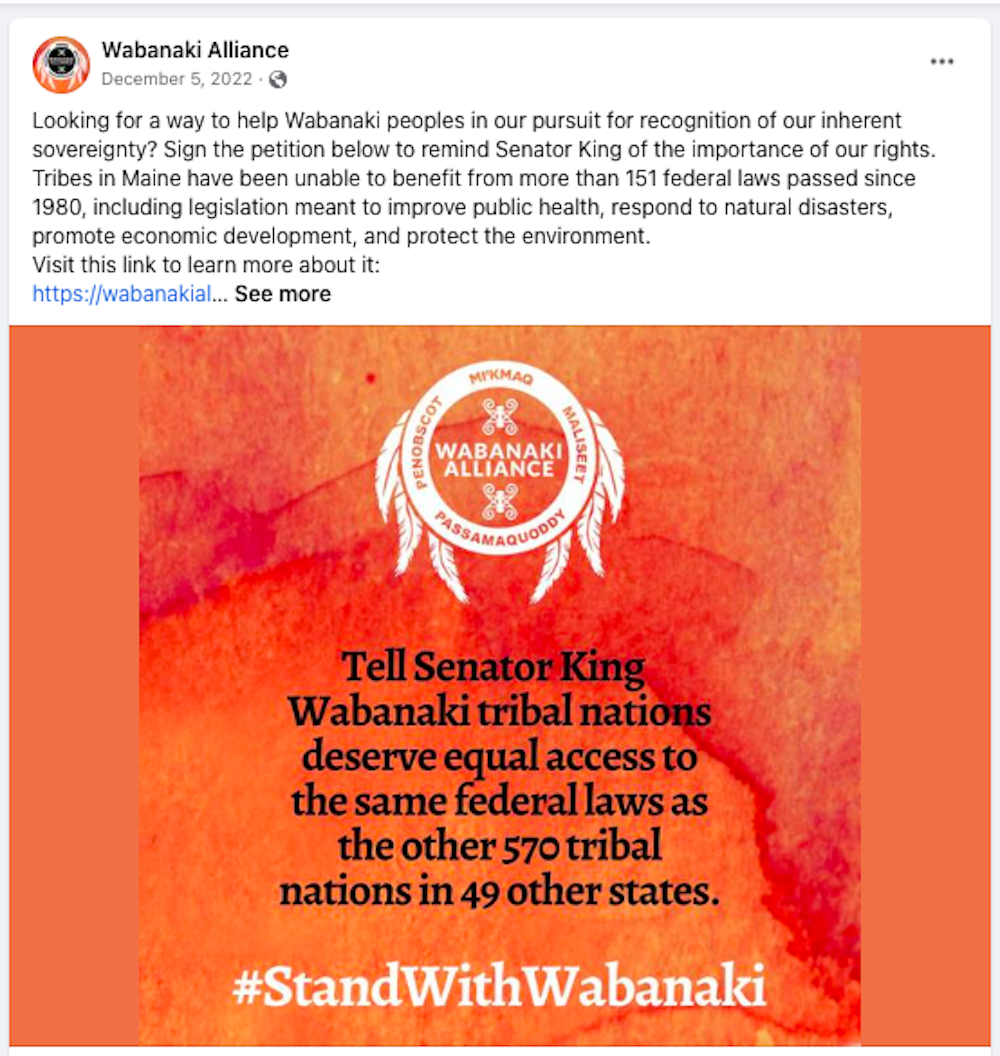
A screenshot of a Facebook post from Dec. 5, 2022, by Maine tribal rights advocate The Wabanaki Alliance.

A Facebook post from Dec. 5, 2022, by Maine tribal rights advocate The Wabanaki Alliance. Facebook The Wabanaki Alliance

MICSA empowers the state of Maine to block the applicability of virtually all federal Indian self-determination policy unless Congress explicitly says otherwise and overrides the federal law.

Passage of MICSA meant Maine can block or threaten to block the tribes any time the state feels the laws of Maine would be “affected or preempted” by Wabanaki exercise of federally provided powers. Maine’s power to do this hangs over – and stifles – tribal investment in potentially controversial actions.

Roadblocks and lawsuits

In more than 40 years, a federal override has occurred only once: in the 2022 reauthorization of the Violence Against Women Act.

During those four decades, whenever Maine felt its sovereignty was threatened by Wabanaki action, the Wabanaki encountered administrative roadblocks or litigation. The mere construction of a water well on Passamaquoddy land with federal money required hammering out a memorandum of understanding with Maine – a step not necessary in other states.

The Penobscot Tribe had advocated for passage of Title IX, the Safety for Indian Women provision, of the 2013 amendments to the Violence Against Women Act. But Maine killed the tribe’s effort to become a pilot tribe in this program, cutting off millions in federal funds the program would have provided to the tribe.

Only after nine years of Penobscot advocacy and expense did the 2022 Violence Against Women Act reauthorization make Wabanaki authority in this arena clear. Over and over, Maine’s powers under MICSA generate costs and uncertainty that effectively stunt the development of the Wabanaki Nations.

For tribal citizens in Maine, removing MICSA restrictions would offer few risks and much in the way of payoffs. This applies not just to the Wabanaki but to the Maine state government, Maine’s nontribal citizens and Maine’s economy.

Money and jobs left on the table

Across the other Lower 48 states, tribal economic development demonstrably spills over into neighboring nontribal communities, improving the abilities of tribes and state and local governments to serve their citizens.

For example, the Hualapai, Winnebago and Fort Belknap tribes – located in Arizona, Nebraska and Montana, respectively – rank among the top employers of their counties and regions. Tribal economic growth routinely supports intergovernmental investments in highway off-ramps, water-treatment systems and cross-deputization of police.

But because of MICSA, Maine is leaving thousands of jobs, hundreds of millions of dollars of gross state product and tens of millions of dollars of state and local government revenue on the table.

It is reasonable to ask whether freeing the Wabanaki from MICSA’s restrictions would result in increased conflict between the tribes and Maine’s state and local governments. The overall experience outside of Maine has been that increasingly capable tribal governments improve state-tribal relations by enabling both parties to come to the table with mature capacities to cooperate, government to government. Against these potential benefits for Maine is a status quo that already produces conflicts, litigation, recrimination and mistrust.

The last Congress considered, but ultimately rejected, amending MICSA to relieve the burden it imposes on the Wabanaki Nations. We believe it is legislation worth reconsidering.


Joseph Kalt, Ford Foundation Professor of International Political Economy, Emeritus, Harvard Kennedy School; Amy Besaw Medford, Research Affiliate with the Harvard Project on American Indian Economic Development, Harvard Kennedy School, and Jonathan B. Taylor, Research fellow at the Harvard Project on American Indian Economic Development, Harvard Kennedy School

This article is republished from The Conversation under a Creative Commons license. Read the original article.

Experts aren’t entirely sure why humans evolved orgasms

“Did you get there?” may be one of the most commonly asked questions in the bedroom. When an individual climaxes, they experience one of the truly blissful elements of being human. Why, then, is defining an orgasm not an easy task?

Modified, the old adage often applied to censoring pornography would go, “I know it when I feel it.” This speaks to the fact that only an individual can ever really know what an orgasm means to them. It’s a highly subjective experience.

Sex researchers are still figuring out what an orgasm is exactly. While the answer is more complex than it may seem, one of the fundamental questions about the orgasm is why humans evolved this trait in the first place, especially in women. Moreover, it’s not clear that other animals experience orgasms. Humans may be special in that regard.

It may seem obvious why humans gained this ability. An orgasm feels good, so a little reward during or after sexual reproduction would presumably encourage mating, increasing the chances of passing down one’s genes. This is the basis of evolution in a nutshell: advantageous traits that help us survive and keep our DNA-based game of telephone going are more likely to stick around in our genome.

But orgasm phenomena — not to mention evolution — are a lot more complex than an oversimplified model of gene flow. Orgasms may have evolved as a means of encouraging mating, but this alone isn’t enough to guarantee their persistence in our genetic histories. However, they have clearly impacted us in a profound way, considering the orgasm’s elevated place in our culture and our health. Where, then, did this feature even come from?

Experts aren’t entirely sure, but attempts to understand begin by defining the orgasm, which can be thought of as the penultimate intersection between the body and the mind. On one level, the orgasm is like a reflex not unlike a sneeze: a complex, automatic response to certain stimuli, especially (or exclusively) something sexually arousing.


Want more health and science stories in your inbox? Subscribe to Salon’s weekly newsletter The Vulgar Scientist.


A good orgasm can be an intensely pleasurable experience followed by a release of sexual tension. It can involve a suite of involuntary pelvic contractions in the bony structure near the base of the spine, while also flushing the body with hormones and neurotransmitters like serotonin and dopamine, which help cells send signals to one another.

Orgasms are really good for human beings. Their role in pain and stress relief, promoting sleep and social bonding is beneficial to human health. Yet, despite these basic facts, researchers continue to debate what, precisely, an orgasm is. Humans seem to be unique in the animal kingdom when it comes to this capacity for bliss.

Clearly, many male animals ejaculate — that is, if the creature has a penis, it can spew its sperm in a way that launches it great distances, increasing the chances of successful reproduction. The term “ejaculate” comes from the Latin verb “ejaculari,” which means “dart out,” combined with “jaculari,” which is related to the word “javelin,” or “to throw.” 

(Just a quick note on sex and gender: Animals don’t have gender, so referring to them as male or female refers to sex and simply means what kind of genitalia and chromosomes it has.)

Just because an animal ejaculates does not mean it orgasms.

Some animals do more shooting than others. A species of spiny anteater called short-beaked echidnas (Tachyglossus acelatus) has a penis with two heads that resembles a bivalve showerhead. Ejaculation alternates between each one, giving the echidna maximum “sperm motility,” which is the ability for its swimmers to move through the female reproductive tract.

But just because an animal ejaculates does not mean it orgasms. Both are related but distinct physiological processes, and as many people already know from experience, there’s a big difference. For example, one 2009 study in the International Journal of Impotence Research gave a handful of healthy male volunteers a drug called silodosin, which made it so they couldn’t ejaculate but still orgasm. Plenty of people also orgasm or ejaculate without one being connected to the other.

It’s much harder to study subjective experiences in animals. While some experts theorize that certain animals like rabbits may orgasm, it hasn’t been definitively proven. And yet, we don’t know how to reliably set them off in humans either.

“I always joke, if I knew how [an orgasm] was triggered, I wouldn’t be here. I’d just be rich somewhere with my device I sold to trigger that anytime you felt like it,” Dr. Nicole Prause, a neuroscientist and sexual psychophysiologist who founded Liberos, a sexual biotech company in Los Angeles, told Salon. “We still don’t know how orgasms are triggered. We can trigger them with some reliability with spinal cord stimulation. But these are implants — this isn’t something you can do from the outside reliably.”

“I always joke, if I knew how [an orgasm] was triggered, I wouldn’t be here. I’d just be rich somewhere with my device I sold to trigger that anytime you felt like it.”

Given rampant sexism in science and medicine, it isn’t surprising that the male orgasm is better studied than the female orgasm. The question of why it evolved in women is especially perplexing to some researchers. It was originally thought the contractions that occur during orgasms could help siphon semen into the uterus. This is known as uterine upsuck theory.

“The uterine upsuck theory was the idea that when women had an orgasm, the cervix would dip into the seminal pool that was in the vagina, and therefore, suck the semen up. That would catapult it towards the egg,” Prause said. “And people actually tested this — they put tracers in the pool in the vagina and found it does not upsuck.”

Now, a common theory is that orgasms in women or people with vaginas are just a byproduct of our evolution like wisdom teeth. It’s a vestigial leftover, something not useful for reproduction or survival, such as wings on flightless birds.

“The byproduct theory is women were never meant to have climaxes,” Prause said. “It’s just that our clitori are similar enough to the penis that we can manage it sometimes, depending on what the particular anatomy or physiology is of different women.”

In the end, these are all only theories. More evidence is needed to answer the many outstanding questions surrounding orgasms. Because of Western culture’s puritanical roots and a lack of robust sex education, orgasms are often depicted as gross or shameful.

Regardless of one’s strong opinions about these euphoric incidents, they’re a normal part of human health. For better or worse, most people wouldn’t be here without an orgasm, and we could stand to give them a little more credit.

Orgasms aren’t simply something that feels good to make us reproduce. They relate to so much more about human health and identity.

“Do football, not wokeness”: Conservatives angered over Black national anthem sung at the Super Bowl

Sheryl Lee Ralph stole the show prior to Super Bowl LVII with an impassioned performance of the hymn “Lift Every Voice and Sing,” but not everyone was a fan.

On Sunday, the “Abbott Elementary” and Broadway star became the first to perform the song, also known as the Black national anthem, from within the Super Bowl stadium. This was followed by Babyface with his rendition of “America the Beautiful.” Also joining in the pre-game entertainment just before kickoff was country superstar Chris Stapleton singing “The Star-Spangled Banner,” while “CODA” Oscar winner Troy Kotsur interpreted in ASL.

Ralph took to social media to share what being asked to sing “Lift Every Voice and Sing” meant to her.

“It is no coincidence that I will be singing the Black National Anthem, Lift Every Voice and Sing at the Super Bowl on the same date it was first publicly performed 123 years ago (February 12, 1900). Happy Black History Month!” the actor wrote online.

While many offered their praise for her performance, several Republican lawmakers and critics slammed the NFL’s decision to include two separate anthems — “Lift Every Voice and Sing” and the official national anthem — claiming that it served to further “divide” the country:

“America only has ONE NATIONAL ANTHEM,” wrote Rep. Lauren Boebert. “Why is the NFL trying to divide us by playing multiple!? Do football, not wokeness.”

Similarly, Arizona Republican gubernatorial candidate Kari Lake was seen sitting during the playing of the Black National Anthem, later tweeting, “I’m just here for THE National Anthem.”

Ex-Black Lives Matter activist Xaviaer DuRousseau also tweeted, “‘Black National Anthem’ is an oxymoron. We are ONE nation under God. If you think otherwise, you’re in support of segregation. It’s that simple,” while author and biblical counselor Darrell B. Harrison wrote, “The NFL is making a huge mistake, in my humble opinion, by having ‘Lift Every Voice and Sing,’ what has traditionally been referred to as the ‘black national anthem,’ sung at the #SuperBowl. What more divisive message could be sent than to suggest we’re a nation of two anthems.”


Want a daily wrap-up of all the news and commentary Salon has to offer? Subscribe to our morning newsletter, Crash Course.


The song’s rich history

“Lift Every Voice and Sing” was written by James Weldon Johnson, a civil rights activist and leader of the National Association for the Advancement of Colored People, in 1900. It was later set to music by Johnson’s brother J. Rosamond Johnson, a composer and singer during the Harlem Renaissance.      

Johnson’s tune was written as a source of empowerment for Black Americans after the American Civil War and the 1896 ruling of Plessy v. Ferguson, in which SCOTUS upheld “separate but equal” segregation. The song’s lyrics feature “allusions to the transatlantic slave trade, the Jim Crow system, as well as the signing of the Emancipation Proclamation,” per Insider.

Here’s the first verse of the hymn:

Sing a song full of the faith that the dark past has taught us;
Sing a song full of the hope that the present has brought us;
Facing the rising sun of our new day begun,
Let us march on ’til victory is won.

“Lift Every Voice and Sing” continued to hold the same power, message and impact in the following years. In 1919, 12 years before “The Star Spangled Banner” was declared the official national anthem, the NAACP named “Lift Every Voice and Sing” the “national anthem” for Black Americans.

The song recently returned to the spotlight in 2020, during nationwide protests over the murder of George Floyd. It was also mentioned in Joe Biden’s plan for tackling racial disparities, called “Lift Every Voice: The Biden Plan for Black America.”   

As for its inclusion in the NFL, “Lift Every Voice and Sing” was first featured during the 2020 season and has appeared in every pre-game ceremony since. Last year, gospel duo Mary Mary performed the song, and in 2021, Alicia Keys became the first to perform the song ever during the Super Bowl broadcast in a pre-recorded clip.

The Victorian origins of the heart-shaped chocolate box

This article is a part of Chocolate Week — seven days of recipes and stories, all chocolate — presented by our friends at Guittard. A fifth-generation family business, Guittard has been crafting an array of chocolate offerings (like top-quality baking chips, cocoa powder, and baking bars) in San Francisco since 1868.


Around this time each year, I find myself craving boxed chocolates from the corner store. I’ve gone to plenty of small-batch chocolate factories, tasted many carefully curated single-origin chocolate bars, and, for a time, snobbishly refused to eat any confection under 70% cocoa. Those chocolates all have their place, but sometimes the heart wants what the heart wants, and my heart wants cellophane-wrapped, caramel-filled consumer history packaged in a pretty little heart-shaped box.

A romance for the ages

Originally celebrated as an early springtime Christian feast day honoring the eponymous Roman martyr, St. Valentine’s Day (or Valentine’s Day) became a cross-cultural excuse for public displays of affection as early as the fourteenth century. The subsequent centuries were lousy with Valentine-related poetry and literary references — including the well-known “roses are red” line, which scholars trace to an epic poem by Edmund Spenser. The candy-coated holiday as we know today really found its stride with the Victorians and their obsession with two things: romance and industrialization.

By the late 1840s, much of the English-speaking world knew about Valentine’s Day. After centuries of trade and colonization, commercially produced chocolate had spread far from the equatorial “cocoa belt,” and was newly available to cultures around the globe. The Industrial Revolution, which wrapped up around the start of the Victorian era, produced all manner of machines, inventions, and infrastructure that made commercially produced chocolates and factory-printed Valentine’s Day cards — amongst many other everyday items, like shoes and matches — more accessible to consumers. Once painstakingly produced by hand, patents for emulsification methods, grinders and refiners, molds and forms, and assembly operations turned chocolate into its own industry by the end of the nineteenth century.

Photo by Mark Weinberg

The English affair 

While elaborately decorated boxes of chocolates had existed for at least a century, it was a sentimental Englishman who first connected them to Valentine’s Day. Richard Cadbury (yes, that Cadbury), chocolate-maker, philanthropist, and (I’m going to go ahead and assume) hopeless romantic, is credited with inventing and marketing the first heart-shaped box of chocolates in 1868. A few years earlier, he and his brother took over the family business, which got its start selling tea, coffee, and what Victorians called “drinking chocolate” (aka hot cocoa).

In addition to narrowing the company’s focus to chocolate, the brothers also introduced a line called “Fancy Boxes” that used a novel method for processing cocoa. This process, imported from the chocolate-obsessed Netherlands, ground the cacao nibs into finer, less noticeable pieces and better separated the cocoa butter, resulting in a more palatable “eating chocolate.” Aware of the average Victorians’ affinity for ornamentation, Cadbury designed the boxes himself with sentimental scenes including idyllic landscapes, delicate flowers, and, reportedly, drawings of his own cherubic children. After eating the chocolate, consumers could then use the heart-shaped containers to hold other beloved objects.

Unfortunately for Cadbury, he failed to see his own genius and opted not to patent his heart-shaped box. The concept became a gift to chocolatiers everywhere, including those across the pond in America where lower transportation costs broadened the sweet’s consumer base even further. Despite our nation’s very famous break-up with the monarchy, nineteenth-century Americans were heavily influenced by Victorian-era cultural practices and European food trends, such as gifting chocolates and other confections to one’s valentine. Well-established American chocolate companies — including Baker, Ghirardelli, Whitman’s, Schrafft’s, and later Russell Stover — already produced chocolate-covered candies, but jumped at the opportunity for a new seasonal rebrand of their own assorted box offerings.

Variety is the spice of life (and chocolates)

Were you to open a box of nineteenth-century chocolates, you would likely recognize many of the flavors hiding within: chocolate ganache, orange, fruity creams, and marzipan. Some of these ingredients endured, but over time, changing cultural tastes — on both sides of the Atlantic — influenced a variety of new chocolate fillings.

In the late 1800s, as the price of sugar dropped, American candy makers developed boiled sugar caramels that could be made cheaply and in bulk. In fact, Milton S. Hershey (the guy with his name on a chocolate bar) first found success with caramel-making; he later sold his business to the American Caramel Company monopoly, but kept his subsidiary, Hershey Chocolate Company, which had grown in popularity thanks to his chocolate-covered caramels.

A rarer find in contemporary boxed assortments, chocolate cherry cordials trace their origins to a French chocolate-coated confection called griottes (the French word for sour cherry). Early American versions soaked the cherries in sweetened alcohol, but the twentieth-century temperance movement campaigned hard for the bright red, booze-free Maraschino variety and the substitution stuck.

In 1876, Connecticut-based inventors Edward Smith and E. Chapman Maltby debuted a machine for shredding coconut at the Philadelphia Centennial Exposition. Consumer demand for the tropical fruit increased over the next decade, drawing the interest of several businessmen including Leopold Schepp (later known as the Coconut King of New York) and Franklin Baker (founder of the retail brand Baker’s Coconut). Now flush with shredded coconut, these brands were eager to locate new uses for their product and found hungry customers through targeted recipe book promotions. The new ingredient was an affordable hit and found its way into our heart-shaped chocolate boxes soon after.

Photo by Mark Weinberg

The ever-changing sampler 

After American soldiers returned from fighting in World War I, demand for milk chocolate skyrocketed and led to a variety of new bar-style and covered candy varieties. Today’s assorted boxes and samplers reflect America’s long-standing love affair with the lighter chocolate while incorporating darker options for renewed consumer interest that peaked again in the early 2000s. Today, there’s truly something for everyone with fillings such as nut clusters, maple fudge, buttercreams and truffles, molasses chews, toffees and nougats, all types of fruit-studded creams, as well as the classics. After polishing off the coconut rounds in my own box this year and convincing my children that the vanilla creams would taste horrible, I sampled an oblong-shaped “brownie batter,” a twenty-first century flavor that warms even my chocolate history-loving heart.

Why do we love “Abbott Elementary” star Janelle James for being bad? It’s simple: “I’m hilarious”

Janelle James is not Ava Coleman.

As the “Abbott Elementary” star and Screen Actors Guild nominee prepares to resume doing stand-up on a limited basis, she’s hoping that more people will realize that.

To be clear, she absolutely loves playing Ava, diehard Philadelphia Eagles fan and Willard R. Abbott Elementary School outrageously self-absorbed principal. Most public school educators and administrators can’t afford Prada, but that doesn’t stop the impeccably-dressed Ava from playing the devil with a grandiose, “me-first” egocentrism.

That also means James gets some of the best lines in the show. Typing “Abbott Elementary” and Ava quotes into any search engine yields a trove of one-liners and comebacks no other current TV show can match. But the real magic is in the way James delivers those lines, along with physicalizing a kind of confidence learned from music videos and punctuating her sentences with careless laughter.

James makes Ava a heightened version of the worst manager you’ve ever had, which only adds to her performance’s realism. And it’s a show that earned her nominations for a Primetime Emmy Award for Best Supporting Actress in a Comedy (which was won by her co-star Sheryl Lee Ralph) along with nods for a Golden Globe Award, an Independent Spirit Award, and others.

So she understands why the public is inclined to view her as her character. Having said, “I’m interested to see everyone’s reaction to Janelle James, not Ava Coleman,” James said in our recent “Salon Talks” episode. “And as you know… some of Ava is in me, so they get a little bit of each.”

James may be new to primetime broadcast audiences, but her stand-up career extends back to 2009 when she had her first gigs in Champaign, Ill. A few years later she opened for Chris Rock’s live tour in 2017 along with joining the writing staffs of BET’s “The Rundown with Robin Thede” and Showtime’s “Black Monday.”

However, now that production on “Abbott” has ended for the season, James plans to return to stand-up on a limited basis. “I’m going to do 10 or 12 dates, maybe get something new on wax too,” she said. “I don’t put out a lot of material because I like it to be good. I see people demanding, tweeting at HBO and Netflix …It’s not a matter of them giving me [a special], it’s about me not being ready yet, for myself, because I like to do quality material and I like to mark different stages of my life with standup.”

For now, James was happy to chat about the public’s embrace of Ava, the reasons she’s such an appealing figure despite her awful behavior, and the chemistry she shares with the rest of the “Abbott Elementary” cast.

Watch the “Salon Talks” episode here or read a transcript of our conversation below:

The following conversation has been edited for length and clarity.

First of all, congratulations on your SAG nomination. You have had a very busy award season with the Emmys and the Globes. I watched your most recent stand-up on Netflix that you recorded in 2021 and you were talking about just how different it is to go out in the world. …Has all that changed drastically since “Abbott” has begun?

It’s changed things for me professionally in that I don’t really do stand-up anymore. I don’t have the energy or the time. Now that we’re wrapped, I’ll start again. I hadn’t really done much while we were taping and that just ended three days ago. I did pop out and do one date that I owed to the club that was booked before this show took off. That was my first time selling out a full weekend, which is five shows, so that was cool. 

The way that changed is most people are there to see Ava. A lot of people didn’t know that I was a standup before this, and then they saw and maybe thought I was doing a character performance, a character appearance as Ava. So it’s been different and also cool to see people realize that I am a real person that’s not this character and that she is also funny. That’s a challenge and I like that.

Yeah, your comedy has a kind of brilliant darkness to it. Since I’d seen you before seeing Abbott and seeing you as Ava, I kind of recognize a little bit of that. But if you’re not familiar with it, did you surprise a lot of people?

I’m not a shock comic, so I’m hoping that I’m not shocking people, but I know they probably are expecting me to talk about the show more and being Ava more or teachers or kids. And my stand-up doesn’t cover the show or this character at all, so that’s probably surprising. But I just try to be as funny as possible and I think after 10 minutes, I get them. 

“I’m interested to see everyone’s reaction to Janelle James, not Ava Coleman.”

I’m not for everybody, so maybe I don’t get everybody and I wouldn’t have gotten them before the show either. But most people, yeah, once they figure out what’s happening and they’re laughing, it’s fine. So I like seeing people confused at first and then coming around. But that was before the show, because I am pretty dark.

I don’t mean to make you sound like Wednesday Addams or something, but you know what I mean.

Yeah, I talk about real stuff. Like you said, I did that special right after quarantine. It actually wasn’t even. We were open for two weeks and then we went back in. So I hadn’t even had a chance to practice. I hadn’t done sets in over eight months. I hadn’t been around people much less a whole production. I was pretty manic and feeling everything and so, I mean, I’m glad to have it on wax, that period of my life, but that was definitely a singular experience to have to do a special in those circumstances.

Let’s take it the other way around: What parts of your stand-up do you think that you bring to playing Ava?

I am a confident person. This isn’t something that I’ve always been, it’s something I’ve worked on. It’s something I’m proud to be finally, and so I bring that to this character. She is supremely confident, but for different reasons. She’s confident because she’s oblivious to everything and I’m confident because I feel like I’ve earned it. She also feels like she earned it, but she hasn’t really, that’s the difference.

So I bring my confidence, I bring commanding, like when you do stand-up, you have to command attention because you’re just one person standing with a microphone, and that’s like the oldest form of entertainment I can think of. Just a person and words. Same thing with Ava. So I’m trying to, when she speaks, everybody’s listening. When she enters the room, it’s a force of power. I’m trying to convey a power and a confidence in her that is the same that I bring to my stand-up.

Have you gotten any feedback from teachers, from parents, or maybe even some principals who are like, “I feel seen”?

Oh definitely. I mean, when people come up and forcibly hug me, they tell me very close in my ear that they’re a teacher or their daughter’s a teacher or they’re a principal. Mostly for my character, it’s less, “Hey, I feel seen.” More, “You’re so funny. I know an administrator just like you. You’ve made what could have been a super broad character feel like someone that I know and feel like a real person.” All those things, all those comments like that, is what I enjoy. ‘Cause Ava could have been super silly, you know what I mean? 

Through the writing of Quinta and other writers and what I’m hopefully bringing to the performance, I’m trying to make her a real person. This is a person that does exist. This is a person that exists in the world and in school settings. It’s not made up so no matter how people might try to say that she is, this person exists. I get that reinforced all the time when people tell me, I know who this person is and I knew who she was when I read it as well. I was like, “Oh, I’ve met this person before.” Not in a school setting, but in an administrative setting. As a boss, as a manager, and you’re just like, “How did you get this job?” Those people exist a lot, unfortunately.

Besides the fact that you are talented and make her hilarious, one of the reasons that people love Ava so much is that she reminds them in the best way possible of some of the worst managers they’ve ever had. There is a term that you’ve used that applies now in this age of quiet quitting, which is “toxic positivity.” Can you talk about how you define that in terms of how you imbue that feeling into Ava?

Well, I feel like the best example of toxic positivity on our show is Janine. She’s doing an optimistic version of it and I’m doing a negative version of toxic positivity. My version is, I’m saying very awful things with a smile on my face. And that’s just the cues and how we read each other. It makes you confused because you’re just like, “Well, she’s smiling. Why do I feel like this?” It’s a form of abuse, actually. So that’s what she’s doing. And making it feel as if it’s your fault, why you feel aggrieved or upset by what she’s saying. And I’m hilarious. So why would you feel upset? And when I leave, just get on to whatever I told you to do, whatever awful thing or fix whatever I messed up. And so that’s how a lot of bad bosses are, actually.

Why’d you think that bad bosses think that this is a good way to manage people? 

Probably a couple sociopaths in there, I mean, I’m just guessing, who don’t know how to read social cues. A couple of manipulators, a couple of social climbers. These are just characters and personalities that exist in the world and these people find their way into high up positions in a lot of different fields.

Let’s talk about actual positivity. One of the reasons that this show works so well is that the cast seems to be very bonded both behind the scenes, but also that chemistry comes across in each episode as you’re working together. Did you all immediately find a bond or is it something that developed over time?

What is even more than this mythical bond is we’re all very well cast for our roles, and the show is written so well that we have to mesh together. Every interaction is written so well that it comes across real. All these characters are so well fleshed out that you really believe that they would be in this situation together. They would be saying these things together and then everybody’s bringing their A game to their acting. So I think that’s what people are feeling. 

“It’s been different and also cool to see people realize that I am a real person … That’s a challenge and I like that.”

As far as us meshing well when we first got together, when we first started taping, it was during quarantine. We couldn’t go anywhere else. These were the only people that I was interacting with besides my family at home. And so that’s definitely a sped-up get to know each other situation.

Then beyond that, everybody’s mad cool. There’s no monsters or sociopaths like I mentioned earlier, and we’re all just very invested in making a good show. I know I am. So that kind of cuts through any b******t that you might find in a production. I couldn’t ask for a better work environment. I’ve had **t jobs as we all have. 

I think that’s what people are feeling. The show is just very well cast. And anytime I hear Chris Perfetti who plays Jacob do his lines or I watch the show, even if we aren’t in the scene together and I watch the show and he has a scene, I’m like, he is perfect. I know this person. Same with Barbara, same with… Everybody’s just doing their job so well. 

Yes, and each of you has had more opportunities to work together in different capacities. For instance, one of my favorite episodes was this recent one where Ava and Barbara were selling candy and something that might be seen as more Ava hijinks and scamming turned out to be her teaching the kids how to make money for themselves.

I thought that was an ingenious way to show more of Ava’s character, give her a little backstory and also peel away some of Barbara, Sheryl Lee Ralph’s, perfectness as well. So again, credit to the writing that it wasn’t done in a very special episode and no one cried. It was still passionate, comedic, she learned a lesson, but nobody was really right. It showed how to view circumstances from different angles. We both can be right. You never know where people come from or what they’ve been through, and you meet them in the middle. So it’s just all these things that you still learn as adults. Then to be in a school setting, it’s like, oh, we’re also learning too. So I thought that was great. And then to have to act against Sheryl Lee Ralph and hopefully a hold my own was amazing as well.

Yeah, that was an amazing scene. I want to go back a few scenes before when you were with the boy that you were helping. He’s outgrown his pants and you were just cracking jokes, getting punchlines out, slinging it. Are those moments pre-written or do you have a chance to improvise?

I don’t remember. The writers, as we’ve gone along and especially for season two, I’ve noticed, are definitely writing more to us as individuals as well as our characters now. I am that person. I will crack on a kid. I will crack jokes in that way. And so they’ve been writing me more like myself, which is a mind F-word. And so why I say I don’t remember is because it’s like, even when I’m saying the lines, I’m speaking as me in some ways and I don’t, in the midst of it, try to remember what I said and what was written. I don’t remember. So I don’t know how to honestly answer to that. 

“We’re all very well cast for our roles and the show is written so well that we have to mesh together.”

Sometimes things are written and we’ll say it how it’s written and it doesn’t hit, and me and Quinta will come up with it on the spot. What would you say differently? What really happened? And then we’ll say it at that time, but by the time the show comes out, I don’t remember what was on the script and what we came up with, and nor am I trying to get credit for it. So not like, “That was me!” So I never remember exactly what was [improvised] or not. But we do have the opportunity and option to do that. And we do, especially now as we go along. First season I was less likely to give my input, but now I’m like, okay, I get in and I’m more comfortable remixing things in my own way. 

Part of the reason I think that Ava has become so beloved and people already liked her immediately… 

Not everyone, but that’s great.

I don’t know a single person who doesn’t, and I will put up my dukes for Ava.

Appreciate that.

In the second season we’ve gotten to see more of her, and like you said, she means well. She may be incompetent and she may still do things like try and sell face masks to make an extra buck on the side … but she also wants to use her talents for good within the school, especially when it helps out the kids. And I’m wondering…whether there is any kind of limit with her, where the writers are saying, “Okay, we can only have her go so far.” 

The sweetness is always still wrapped in the self-centeredness and the wittiness and the jerk face stuff that I say. Because that would be boring, and also Ava’s grown. Nobody really changes after a certain age. I truly believe that, that people don’t change.

I do too. They do evolve. 

Evolve, right. But personality, their main motivation, which Ava’s is herself, will never change. So like you said, if she happens to help someone along the way of helping herself, then that all works out. But I don’t think she’s ever going to just become Barbara. That wouldn’t track. The writers are making it very realistic. Yeah, the writing for this character is very realistic to me. So I like that.

I don’t think that people would want her to change, honestly. 

Most of the conflict comes from even Janine trying to fix something and messing up, or Ava just breaking things at the start. So I don’t know what the show is if she all of a sudden becomes this nice selfless person.

Michigan State student who survived Sandy Hook a decade earlier rejects “thoughts and prayers”

Hours after a man opened fire on Monday night at two locations at Michigan State University, killing at least three students and injuring at least five, a 21-year-old student at the school posted a TikTok video to share that this was not the first mass shooting she’d survived.

“Ten years and two months ago I survived the Sandy Hook shooting,” said Jackie Matthews, describing crouching in a corner with her classmates while a gunman fatally shot 20 first-graders and six adults at Sandy Hook Elementary School in Newtown, Connecticut.

“I am 21 years old,” Matthews said. “The fact that this is the second mass shooting that I have now lived through is incomprehensible.”

Matthews described the physical manifestation of the trauma left by surviving the Sandy Hook massacre, one of the deadliest mass shootings in U.S. history.

“I now have a full-blown PTSD fracture [in my lower back] that flares up any time I am in a stressful situation,” she said.

Time reported that a number of other students on campus were survivors of a 2021 shooting at Oxford High School in Oxford Township, Michigan. U.S. Rep. Elissa Slotkin, D-Mich., who visited the campus, told the magazine that she had seen a number of students wearing shirts that read, “Oxford Strong,” which were given to them after the shooting.

“I’ll forever be Sandy Hook Strong,” said Matthews, “and I’ll forever be Spartan Strong.”

The Michigan State shooting followed the recent release of a study by gun control advocacy group Everytown for Gun Safety about survivors of gun violence.

Fifty-nine percent of U.S. adults now report that they or someone they know have experienced gun violence in their lifetime. More than 40% of those who have had personal experiences with gun violence say they have trauma as a result.

“The impact of gun violence extends beyond those who are wounded or killed,” said Everytown. “The families, communities, and anyone with a personal experience of gun violence in their lifetime are also survivors of gun violence.”

Matthews expressed solidarity with the families and friends of the three people who were killed Monday night at the school.

“But we can no longer just provide love and prayers,” she said. “There needs to be legislation. There needs to be action. It’s not okay. We can no longer allow this to happen. We cannot longer be complacent.”

After a mass shooting in Buffalo, New York last year, President Joe Biden signed the first major gun safety legislation passed by Congress in nearly three decades. The law incentivized states to pass “red flag laws” that would help law enforcement to take guns away from people deemed a threat to others or themselves, and expanded background checks on gun purchasers between the ages of 18 and 21.

The law did not include universal background checks, which have the support of more than 90% of Americans, or a ban on assault weapons.

“We’ve let down generations of children by letting this continue,” said progressive advocacy group Indivisible Michigan in response to Matthews’ video. “We must act NOW.”

NASA’s James Webb telescope discovers new galaxy that “mirrors the early Milky Way”

Astronomers believe the Milky Way is an estimated 13.51 billion years old. Yet many details of its life remain unclear, such as what happened during its infancy and what the galaxy was like as a so-called newborn.

This week, research published in Monthly Notices of the Royal Astronomical Society, provided astronomers with new details about a recently discovered galaxy, nicknamed “The Sparkler,” which can be found in the constellation of Volans in the southern sky. The new observations have scientists comparing this younger galaxy, which is around 9 billion years ago, to our own when it was that age. In other words, this newly-discovered galaxy could have characteristics very similar to the Milky Way when it was merely a baby galaxy.

 “We appear to be witnessing, first hand, the assembly of this galaxy as it builds up its mass – in the form of a dwarf galaxy and several globular clusters,” said lead researcher Duncan Forbes in a statement. “We are excited by this unique opportunity to study both the formation of globular clusters, and an infant Milky Way, at a time when the Universe was only 1/3 of its present age.”


Want more health and science stories in your inbox? Subscribe to Salon’s weekly newsletter The Vulgar Scientist.


As Forbes mentioned, the new galaxy is only 3 percent the mass of the Milky Way. But astronomers believe that it will grow to match the Milky Way’s mass in the future. The European Space Agency first released an image of LEDA 2046648, which is the galaxy’s scientific name, as its Picture of the Month on January 31, 2023. 

LEDA 2046648The field of stars and galaxies surrounding the spiral galaxy LEDA 2046648. (ESA/Webb, NASA & CSA, A. Martel)What led astronomers to compare The Sparkler to The Milky Way is that they discovered it’s located in a system of ancient star clusters — known as globular clusters— and is essentially swallowing these stars as it grows, which is what the Milky Way has done. However, overall, globular clusters are a mystery to astronomers.

“We were able to look back 9 billion years ago at this galaxy, and we could see, even 9 billion years ago they were already old, almost as old as old as the universe.”

“The question is, ‘Well, how did they get there?” co-author of the study, Aaron Romanowsky, told Salon.

“Is there some kind of exotic, early primordial form of star formation before the main part of our galaxy forms? This is a question that we’ve had for decades and there have been a lot of different ideas of answers to the question, but we haven’t been definitively sure how these things formed.”

Globular clusters are highly concentrated collections of around a million stars. Through the brightening effect of gravitational lensing — which is when light from a galaxy is diverted by a massive object en route to Earth — scientists were able to conclude that they were seeing The Sparkler around 9 billion years ago, which would be nearly 4 billion years after the Big Bang. Through this observation, Romanowsky said it was a “surprise” to see that the globular clusters were still really old in this young galaxy.

“We were able to look back 9 billion years ago at this galaxy, and we could see, even 9 billion years ago they were already old, almost as old as old as the universe, so that’s a puzzle that’s kind of come out of this work is that they’re intriguingly old,” Romanowsky said.

“Our galaxy is middle-aged right now, you could say we understand it’s young adulthood, we understand it’s adolescence, but it’s really childhood we don’t know much about and that’s where the globular clusters come in.”

However, as the James Webb Telescope collects more data it’s likely that we’ll have more answers. Indeed, one of the Webb telescope’s primary goals is to explore what happened during the very early universe. By peering back into time, astronomers anticipate they’ll have a better understanding of how our galaxy got to its current form today.

But for now, researchers remain perplexed. 

As Romanowsky notes, discovery tends to lead to more questions. “When we get these kinds of observations, and that kind of feeds back into more ideas to request a turn of a telescope to keep looking or look at something different, there are lots of plans to pull this up and get more data on this type of object.”

“Business as usual”: Study shows how corporations deceive the public to “greenwash their brand”

A detailed study published Monday finds that the climate pledges of some of the world’s largest companies are often highly misleading, lack transparency, and fall well short of what’s necessary to avert catastrophic warming, casting further doubt on the viability of global emission-reduction plans that depend on voluntary corporate action.

The latest edition of the Corporate Climate Responsibility Monitor, released by the NewClimate Institute for Climate Policy and Global Sustainability and Carbon Market Watch, closely examines the climate commitments of two dozen large global companies, from Apple to Walmart to Mercedes-Benz to Samsung.

While such companies often tout their net-zero-emissions commitments and support for the Paris climate accord as proof that they’re helping lead the way to a more sustainable future, a closer look shows that their plans are “wholly insufficient and mired by ambiguity,” the new study argues, spotlighting the misleading tactics that businesses deploy to make their pledges appear more ambitious than they are.

“Overall, we find the climate strategies of 15 of the 24 companies to be of low or very low integrity,” the analysis states. “We found that most of the companies’ strategies do not represent examples of good practice climate leadership. Companies’ climate change commitments do not add up to what their pledges might suggest.”

“Their combined emission-reduction commitments,” the study continues, “are wholly insufficient to align with 1.5°C-compatible decarbonization trajectories; targets and potential offsetting plans remain ambiguous; and the exclusion of emission scopes severely undermines the targets of several companies.”

According to the new research, companies’ stated emission-reduction targets for 2030 can’t be trusted because they “address only a limited scope of emission sources, such as only direct emissions (scope 1) or emissions from procured energy (scope 2), and only selected other indirect emission categories (scope 3),” even though the last category accounts for more than 90% of the greenhouse gas pollution for most of the examined corporations.

“For the 22 companies with targets for 2030, we find that these targets translate to a median absolute emission-reduction commitment of just 15% of the full value chain emissions between 2019 and 2030,” the study estimates.

One of the report’s authors, Thomas Day of the NewClimate Institute, said in a statement that “in this critical decade for climate action, companies’ current plans do not reflect the necessary urgency for emission reductions.”

Sabine Frank, the executive director of Carbon Market Watch, told the Wall Street Journal that “at a time when corporations need to come clean about their climate impact and shrink their carbon footprint, many are exploiting vague and misleading ‘net zero’ pledges to greenwash their brand while continuing with business as usual.”

The report, which offers an in-depth examination of the 24 companies’ climate pledges, points specifically to “offsetting” as a tactic companies use to overstate the scope of their climate action.

Offsetting involves making up for carbon emissions by funding carbon pollution cuts elsewhere. According to the new study, Nestlé, PepsiCo, and other prominent corporations are guilty of using offsetting to make it appear as though they’re on track to meet their 2030 emission-reduction commitments.

As the NewClimate Institute and Carbon Market Watch explain:

Half of the companies we assessed—including Apple, Deutsche Post DHL, Google, and Microsoft—make carbon neutrality claims today, but these claims only cover 3% of those companies’ emissions on average.

The vast majority of emission sources are excluded from these claims, but this critical information is not clear in the marketing materials displayed to consumers. At least three-quarters of the companies we assessed plan to heavily rely on offsetting through forestry and land-use-related projects in the future.

This is problematic for two key reasons: the non-permanence of biogenic carbon storage makes such projects fundamentally unsuitable for offsetting emissions; and the scale of carbon credit demand implied by these companies’ plans would require the resources of 2-4 planet Earths, if followed by others.

Lindsay Otis, a policy expert at Carbon Market Watch, said that “by making such outlandish carbon neutrality claims, these corporations are not only misleading consumers and investors, but they are also exposing themselves to increasing legal and reputational liability.”

“Instead, they should implement ambitious climate plans to reduce their own emissions, while financing action outside of their own activities, without claiming that this makes them carbon neutral,” said Otis.

The report concludes that, based on the growing evidence of deceptive corporate practices, regulators can’t “rely on existing voluntary initiatives to ensure compliance with the necessary standards for credible and transparent corporate climate action.”

“Companies’ plans for the period up to 2030 fall far short of the efforts needed in this crucial decade for climate action to stand a reasonable chance of limiting global warming to 1.5°C,” the report states. “Forthcoming regulation, for example the E.U.’s Corporate Sustainability Reporting Directive entering into force in 2023, will introduce tighter requirements for corporate climate strategies, but their final implementation will need to be closely monitored to ensure a high standard of compliance.”

So, should you wash your chicken or not?

The first time my future spouse saw me rinse a raw chicken, he was appalled. "But Julia Child says to!" I'm pretty sure I argued, to his disgust. Soon after, I found myself similarly horrified when he came in from a supermarket run and took the kitchen sponge to wipe down every can and every carton before putting the food away. That sponge, I reasoned, had to be way filthier than whatever Key Food grime had been lingering on the Coke I was about to bring to my lips. We want to practice safe, hygienic food handling for the obvious reasons — we don't want to ingest anything that could make us sick. But over the years, I've learned that the when, how, and even if of food washing evokes strong, often contradictory opinions — and even more questions. Do some people really wash eggs? Isn't just peeling an orange sufficient? And what, exactly, am I supposed to do with these dirty mushrooms? 


Want more great food writing and recipes? Subscribe to Salon Food's newsletter, The Bite.


This January, Suggest ran a feature by writer Dana Hopkins with the provocative title "Don't Wash Your Produce First: These 6 Bad Refrigerator Habits Could Be Costing You (Or Even Make You Sick)." The story stopped me dead in my tracks. For years, I have carried the offhanded wisdom of a Food Network icon who advised to wash all your produce before you put it away, so you have less prep work when you're ready to cook. I haven't actually always done it, because I am lazy, and have certainly never applied the rule to strawberries. But a fridge full of perfectly clean vegetables nevertheless always remained my platonic ideal. As Hopkins writes in Suggest, however, "Excess moisture could lead to bacterial growth which in turn could lead to illness." 

Texas A&M agrees. Its Tri-State Fruit and Vegetable Safety Consortium advises that whether you're keeping your produce on the counter or the refrigerator, "Do not wash whole fruits and vegetables before storing them."

If, however, you have strong feelings about not putting unwashed produce away, just be sure to wash and dry. Nancy Mitchell, a registered nurse and a contributing writer at Assisted Living, says, "The issue isn't necessarily with washing produce, but in your method of care and storage afterward. Bacteria thrive in moist environments, like the wet surfaces of fruits and vegetables. If you don't dry your produce thoroughly after washing, it could increase the risk of microbial growth and heighten your chances of transmitting some infection. Timing is key. If you aren't in the business of drying foods after washing them, consider washing them just before you eat. And be sure to store them in cool, dry areas."

What about herbs, though? Bon Appétit specifically recommends you clean them and then "roll them up in damp towels and store them in a plastic bag. You want to keep some moisture in there, so they stay fresh," and Serious Eats does too, saying, "Surface debris and bacteria on the herbs can cause more rapid decay." 

As for mushrooms, Salon's Michael La Corte advises to keep them out of the water. "Don't put the mushrooms under running water or throw them into a colander for a wash," he writes. "Because mushrooms are uber-porous, they'll soak up lots of that now-dirty water. Simply clean the mushrooms with a slightly dampened paper towel or cloth, removing as much grit, soil and grime as possible."

Where I get particularly baffled is over things you eat the insides of. I'll rinse a lemon if I'm using the zest, but I have never washed an orange or an avocado in my life. Yet the CDC advises that because "Sometimes, raw fruits and vegetables contain harmful germs such as SalmonellaE. coli, and Listeria," you should wash all fruits and vegetables, "even if you do not plan to eat the peel." 

Eggs, however, usually don't need to be washed. Lisa Steele, a "5th Generation Chicken Keeper" from Fresh Eggs Daily, says, "Store bought eggs have already been washed, so they need to be refrigerated when you get home, but don't need to be washed before eating and in fact its recommended they not be washed because the water and any bacteria can be pulled into the egg through the pores in the eggshell."

But, she says, "Farm fresh eggs from your own backyard, a neighbor, farmers market or local farm that haven't been washed don't need to be refrigerated, and can be left out on the counter at room temperature. Just before using, they should be rinsed in warm water and any dirty spots rubbed off with the fingers or a soft towel. (Cool water can pull any bacteria on the outside of the egg into the egg itself). Eggshells can have traces of bacteria such as e.coli or salmonella on them, so washing is a good idea."

After reading up and weighing the safety issues, I stopped washing my chickens years ago. Kelly Johnson-Arbor, a medical toxicology physician and director at National Capital Poison Center, says, "Many people think that washing or rinsing chicken or other types of meat can clean off bacteria from the surface of the meat. However, this process can actually lead to microscopic transfer of germs from the meat to sinks, countertops, utensils, and other kitchen surfaces. In one study of people who washed raw chicken, 60% were found to have residual bacteria in their sink after washing the meat. These bacteria can cause serious, and sometimes life-threatening, infections. Because of this, the FDA and USDA recommend that people do not wash their chicken or meat products prior to refrigeration or food preparation."

Kam Talebi, CEO of The Butcher's Tale restaurant in Minneapolis, similarly advises, "Never wash meat. All it does is splatter the juices from the meat all over your sink and the rest of the kitchen. Plus you want anything that you are about to cook to be dry for the best crust, bark, or outer texture."

But feelings on the subject run strong, and food is deeply personal. A 2022 Dutch survey revealed that a quarter of respondents wash their chickens. Cordell Robinson, a chef and creator of the food blog A Delicious Experience, says, "I wash my food, and to be more specific, I wash my chicken because there are a lot of impurities and unwanted fat that you get rid of. I know the argument is that it is not safe because salmonella will be splashed all over the place. That is simply not true. Washing most proteins in a bowl of clean water, squeezed limes, and distilled vinegar is very efficient."

Robinson further says, "Culturally, I can speak from a Jamaican American experience. Many of the locations where meat is processed and/or sold can be extremely unsanitary. When we got home from the markets you would wash the meat after seeing the environment it was in when you purchased it. Still today, the processing plants are filthy in the inner cities and working-class neighborhoods. Consumers know the meat is packaged poorly and it is not washed so we do what we have to do to survive. In my culture we continue to wash our food because it's more than tradition, it's our way of life and a precaution that gives us comfort."

Individual food storage and washing practices may vary, but it's common sense to err on the side of hygiene, and take it seriously if you feel off after eating something. 

One of the most effective yet often unspoken aspects of food safety isn't the cleanliness of the food itself. "The first best practice for healthy food washing is to always wash your hands before and after handling food," says Michael Murdy, a food scientist, beer brewer, chef, and founder of Robust Kitchen. "The hands should be washed thoroughly for at least 20 seconds with warm, soapy water. This reduces the risk of cross-contaminating newly prepared food with bacteria from unwashed hands." And you know to keep washing your hands throughout the food preparation, right? Don't go directly from trussing a chicken to chopping a carrot. 

Also, keep your surfaces clean and avoid cross-contamination. Don't cut your carrot on the board you just trussed the chicken on either. Then, keep things clean. "I advise sanitizing all kitchen surfaces and utensils after washing them," says Murdy. "This is especially important when prepping or storing food for longer periods of time. Different surfaces require different cleaning techniques. Wood cutting boards should be washed with warm, soapy water, while non-porous surfaces like stainless steel and plastic should be disinfected with a solution of 1 tablespoon of bleach per gallon of water."

Individual food storage and washing practices may vary, but it's common sense to err on the side of hygiene, and take it seriously if you feel off after eating something.

"If people have questions about food poisoning, they can always contact poison control for expert advice," says Kelly Johnson-Arbor, "online at poison.org or by phone at 1-800-222-1222. Both options are free, confidential, and available 24 hours a day." And while my spouse and I still disagree about wiping off milk cartons, we know that keeping our hands and food surfaces clean is the smartest day-to-day strategy for staying safe — even if I'll never stop drinking from unwiped soda cans and eating unwashed oranges. 


“Showed her true colors”: Knives out in TrumpWorld after Nikki Haley announces 2024 presidential bid

Nikki Haley, the former South Carolina governor and United Nations ambassador, officially announced her candidacy for president on Tuesday, becoming the first major challenger to former President Donald Trump for the 2024 Republican nomination.

Haley in the video announcement called for new leadership in her party and acknowledged that it had repeatedly failed to capture the popular vote in recent presidential elections.

“Republicans have lost the popular vote in seven out of the last eight presidential elections,” Haley said. “That has to change. Joe Biden’s record is abysmal, but that shouldn’t come as a surprise. The Washington establishment has failed us over and over and over again. It’s time for a new generation of leadership.”

Haley’s announcement has been expected for months even after she said nearly two years ago that she would not challenge Trump for the 2024 election if he decided to run. But that didn’t deter her from laying the groundwork for a campaign and ultimately plunging into the race weeks after Trump’s announcement. 

Haley is best known on the national stage for pursuing Trump’s foreign policy agenda while serving as a UN ambassador for two years. But during her campaign announcement, she vowed to take on adversaries both foreign and domestic.

“Some people look at America and see vulnerability,” Haley said. “The socialist left sees an opportunity to rewrite history. China and Russia are on the march. They all think we can be bullied, kicked around. You should know this about me: I don’t put up with bullies. And when you kick back, it hurts them more if you’re wearing heels.”

She is the first candidate in a long line of Republicans who are expected to launch 2024 campaigns in the next few months. Among them are Florida Gov. Ron DeSantis, former Vice President Mike Pence and former Secretary of State Mike Pompeo.

If elected, Haley would be the nation’s first female president and the first president of Indian descent. 

Her campaign announcement has already received criticism from other Republicans, including those who worked closely with her. 

Former Trump adviser Steve Cortes went after Haley for providing her campaign video exclusively to the news outlet Axios. 

“What ‘conservative’ would give the exclusive on their campaign launch to…Axios??? Haley the ‘political weather vane’ shows her true colors. She’s trying to impress the corporations and oligarchs. Former Boeing board member can’t change her stripes,” Cortes said on Twitter


Want a daily wrap-up of all the news and commentary Salon has to offer? Subscribe to our morning newsletter, Crash Course.


Trump’s former national security adviser John Bolton suggested on Meet the Press NOW that Haley is “really running for vice president” ahead of her anticipated 2024 campaign announcement. 

“I think Nikki is really running for Vice President,” Bolton said. “That’s my sense. I think she has a problem because she first said she wouldn’t run if President Trump ran and her justification for changing was that a lot of things have changed, which I don’t think is very convincing. I think people know where I stand on Trump.”

Other Trump-aligned figures, like Fox News’ Tucker Carlson, have also weighed in on her record on immigration, race and crime.

Carlson earlier this month said on his show: “It wasn’t that long ago that Nikki Haley explained immigrants are more patriotic than you are. She also endorsed the BLM riots. She said George Floyd’s death needs to be painful for everyone.” 

He even invited Haley’s former aide, Justin Evans, who predicted that Haley would drop out before the first caucus is held. 

“She just walks away when times get tough. She’s never finished a job,” Evans said, referencing Haley’s exits as governor and UN ambassador. 

Another Republican Stuart Stevens, a former political consultant, wrote an opinion piece for the New York Times, claiming that Haley threw away all the “unlimited potential” she had as the first woman governor of South Carolina, the first Indian American ever elected to statewide office there and the youngest governor in the country.

“I look at Ms. Haley now, as she prepares to launch her own presidential campaign, with sadness tinged with regret for what could have been,” Stevens wrote. “But I’m not a bit surprised. Her rise and fall only highlights what many of us already knew: Mr. Trump didn’t change the Republican Party; he revealed it. Ms. Haley, for all her talents, embodies the moral failure of the party in its drive to win at any cost, a drive so ruthless and insistent that it has transformed the G.O.P. into an autocratic movement. It’s not that she has changed positions to suit the political moment or even that she has abandoned beliefs she once claimed to be deeply held. It’s that the 2023 version of Ms. Haley is actively working against the core values that the 2016 Ms. Haley would have held to be the very foundation of her public life.”

“Closure is a myth”: 5 years after Parkland, psychologist says “normalcy is elusive” for survivors

Whenever a school shooting takes place, school officials often arrange for grief counseling services to be made available for whoever needs them. But what exactly do those services entail?

To answer that question, The Conversation reached out to Philip J. Lazarus, a school psychology professor at Florida International University who counseled students and educators affected by the shooting at Marjory Stoneman Douglas High School, which took place in Parkland, Florida, on Valentine’s Day, 2018.

Below, Lazarus recounts some of the experiences he had as he provided grief counseling. He also offers insights on what students and educators need as the nation confronts record levels of shootings with higher and higher death tolls.

Shattered sense of security

A few days after Parkland, a seventh grade boy at a nearby school told me his plan for how to make schools safer.

“We need to have a conveyor belt to check all kids for guns, then we need to have bulletproof windows on the outside, then we need to have bulletproof closets that we can all run into in case a shooter enters the building,” the boy told me at the time. “We need to put up a 10-foot barbed wire fence outside the playground, and more police.”

I wondered if this is the future we as a society want. Five years later, more elements of that future are now here.

In Newport News, Virginia, for example, officials decided to install 90 walk-through metal detectors in schools across the district. The measure comes in response to one of the most shocking cases of a school shooting – one in which a first grader reportedly shot and wounded his teacher, Abigail Zwerner, at Richneck Elementary School in Newport News on Jan. 6, 2023.

In Texas, tens of millions of dollars were spent on providing schools with ballistic shields for school police officers. Some schools have installed bulletproof “safety pods” to protect students against active shooters.

When tragedies like the ones in Parkland, Newport News and Uvalde, Texas, take place, they don’t just affect the school itself – they affect surrounding schools as well. Which is why, when I returned a few days after the Parkland shooting, from the National Association of School Psychologists convention in Chicago to Broward County, where I live and where the Parkland shooting took place, I connected with Frank Zenere, one of my former students, an adjunct lecturer at Florida International University and the crisis coordinator for Miami-Dade County Public Schools, as well as a team from Nova Southeastern University and another team of school psychologists from Volusia County to provide psychological intervention.

These interventions included debriefing students, which means students talking about their reactions to the horrific event, short-term individual and group counseling, and consultation with school leaders and parents about how to handle children’s grief and how best to open reopen schools.

Fears and uncertainty

One thing all school-based mental health providers learn in crisis intervention is that all students have a story to tell, even if they have problems articulating their thoughts.

The job of the mental health provider is to listen. However, listening is often not enough. After Parkland, some students in the surrounding area were afraid to enter their own schools. A few were concerned that they would be attacked by a copycat killer. Some students emotionally broke down.

One sixth grade boy I met at a nearby charter school was afraid to go into his school building, and I was contacted by the principal to help. The boy just stood outside. So, I walked up to him and started talking and asked him why he did not walk home if he was so afraid. He told me that his parents drove him to this charter school, and he lived more than 10 miles away. I asked him if I walked right next to him and did not leave his side if he would be willing to go inside the building. He agreed. We talked for about 30 minutes. He said, “My body does not feel well. It doesn’t feel right, it feels crazy inside, and I cannot describe it.”

I told him that his feelings were normal. Then he was asked to rate his level of well-being from 1 to 10 from when he arrived at school to now, with 1 meaning feeling great to 10 meaning feeling terribly scared and anxious. He responded that when he entered my temporary office in the school, it was an 11, and now after about 30 minutes of recounting his experiences, reactions and feelings with me, he was at a 5 or 6.

He told me that he was taking yoga classes, and I worked with that to his advantage. I taught him how to imagine yoga music reverberating through his body to help him calm down. I taught him how he could make the music go faster or slower, louder or softer, and how to regulate his breathing. This provided him a sense of control over his internal feelings. Through a series of other techniques, such as using deep breathing, he learned how to enter a highly relaxed state. He reported by the end of our 90-minute meeting that he was now a 2.

I asked him to practice what he had learned at least three times before he came to school the following day. The next day he saw me and rushed up and said, “I’m a 1.”

Normalcy is elusive

Sadly, as my colleague Frank told me, for many others the interventions will not be as easy or the responses as quick.

For example, young people directly affected by a tragedy, especially those in classrooms where students were killed, will require deep understanding, empathy and guidance from family, friends, teachers, religious leaders and mental health professionals as they struggle to cope. Some may require years of therapy.

Closure is a myth. The trauma and grief may never go away. Yet young people can learn lessons from the past and move forward with help from their friends, families, faith, communities and mental health providers. For all those affected, their lives will never be the same, but with care and understanding from others and by focusing on the future, they can recover and thrive.


Philip J. Lazarus, Associate Professor, Counseling, Recreation and School Psychology, Florida International University

This article is republished from The Conversation under a Creative Commons license. Read the original article.

Being a stray is no laughing matter: Experts say abandoned dogs experience genuine PTSD

Comedians Will Ferrell and Jamie Foxx voice adorable canines in the upcoming summer comedy “Strays.” As the title suggests, “Strays” is the story of a pack of dogs who decide to get revenge against one of their former owners (Will Forte) for abandoning them. While I won’t dare spoil the method that those dogs select as an appropriate punishment, it should not be a spoiler to reveal that the underlying subject matter behind “Strays” is far from comical. Scientists agree that dogs feel love for their human companions; when dogs and cats are abandoned, they are left with a psychological trauma that can never fully heal.

“Dogs, to a great extent, mirror the stress level of their owners.”

There were roughly 85.8 domestic cats and 78 million domestic dogs in the United States as of 2015-2016, according to the American Pet Products Association (APPA). Within that group, approximately 6.3 million enter U.S. shelters every year — 3.1 million dogs and 3.2 million cats. Roughly 920,000 of these shelter animals are euthanized (390,000 dogs and 530,000 cats), although roughly 810,000 animals are returned to their owners (710,000 dogs and 100,000 cats). Millions of other dogs and cats are given new homes (roughly 2 million dogs and 2.1 million cats), but these statistics are just the tip of the iceberg. No one can say for sure how many stray animals exist overall, but as of 2017 experts at the World Health Organization estimated that there were roughly 200 million abandoned dogs throughout the world. On any given day in the United States, there are 70 million dogs and cats that are homeless.

Life for these stray animals is extremely difficult. They are vulnerable to diseases and infectious parasites, will be attacked by both humans and other animals, and are frequently run over by cars. In addition to being vulnerable to the elements like hot and cold weather, these animals are also prone to accidentally harming themselves by eating and drinking substances that are dangerous to them. 


Want more health and science stories in your inbox? Subscribe to Salon’s weekly newsletter The Vulgar Scientist.


In addition to the physical hardships, dogs endure a terrible emotional toll after being abandoned. Scientists writing for the journal Scientific Reports in 2019 found that “long-term” stress levels were “synchronized” between dogs and their owners, at least when it came to cortisol levels in dogs’ hair follicles and those in humans.

“They imply the development of a particular communication into human–cat dyads that relies upon experience.”

“Human personality traits [like] neuroticism, conscientiousness, and openness significantly affected dog hair cortisol concentrations,” the researchers wrote in their study. “Hence, we suggest that dogs, to a great extent, mirror the stress level of their owners.” 

Similarly Japanese researchers in 2015 found that the hormone oxytocin increases when humans and their dogs interact — particularly when they gaze into each other’s eyes — even though this was not true with wolves, even those who had been raised by humans. The hormone oxytocin, often called the “love” hormone, helps reinforce bonds between humans and other living creatures. It has even been proved that dogs shed tears of joy when they are reunited with their human companions.

Cats are similarly emotionally bonded to their human companions. While cats are not innate pack animals like humans, domesticated cats have evolved to seek human friendships and appreciate human interactions. For example, a 2022 study in the journal Animal Cognition revealed that cats can specifically tell when a human who they know is speaking to them. This is distinguished from how cats react when they hear “their human” talk to a different cat or to another human. The study demonstrates that cats can distinguish between individual human beings and develop a special and instinctive bond with humans in their “families.”

“These findings bring a new dimension to the consideration of human–cat relationship, as they imply the development of a particular communication into human–cat dyads, that relies upon experience,” the authors of the study concluded.

When a bond between a dog and human or cat and human is suddenly broken, it does more than ruin the life of the pet in question. Humans also frequently suffer from emotional distress after abandoning an animal, even in situations when they have no choice (such as the consequences of the COVID-19 pandemic).

“It can push the owner and their family into an emotional crisis,” writes Four Paws, a 501(c)(3) organization that focuses on animal welfare for species that interact with humans. “Especially children suffer when their pet is suddenly taken away from them. Many people who have surrendered their animals to animal shelters feel guilty and ashamed as if they had failed and betrayed their pet, who depended on and trusted them.”

The key change that must occur in society to end the problem of abandoned animals is for humans to think carefully before acquiring a pet.

“It’s really important before even getting into taking on that responsibility to consider, ‘What will happen if I lose my job? What will happen if I have to move? What will happen?'” Teresa Chagrin, animal care and control issues manager at Peta Prime, told Salon in 2021. “Make sure that you have arrangements set up or don’t get an animal.”

Sanders-Warren plan would tax the rich to increase Social Security by $2,400 a year

As congressional Republicans threaten to cut Social Security and other key federal programs, progressive Sens. Bernie Sanders and Elizabeth Warren led a group of lawmakers Monday in unveiling legislation that would increase Social Security benefits by at least $200 per month and prolong the program’s solvency for decades by finally requiring wealthy Americans to pay their fair share.

The Social Security Expansion Act, introduced by Sanders, I-Vt., and Warren, D-Mass., in the Senate and by Reps. Jan Schakowsky, D-Ill., and Val Hoyle, D-Ore., in the House, would put an additional $2,400 in beneficiaries’ pockets each year and ensure the program is fully funded through 2096.

The bill would accomplish this by lifting the cap on the maximum amount of income subject to the Social Security payroll tax—a change that would not raise taxes on the 93% of U.S. households that make $250,000 or less per year, according to an analysis conducted by the Social Security Administration at the request of Sanders.

Currently, annual earnings above $160,200 are not subject to the Social Security payroll tax, which means that millionaires will stop contributing to the program later this month. The legislation proposes lifting this cap and subjecting all income above $250,000 per year to the Social Security payroll tax. If enacted, the bill would have raised more than $3.4 billion from the nation’s top 11 highest-paid CEOs alone in 2021, including $2.9 billion from Tesla and Twitter executive Elon Musk.

“At a time when nearly half of older Americans have no retirement savings and almost 50% of our nation’s seniors are trying to survive on an income of less than $25,000 a year, our job is not to cut Social Security,” Sanders said in a statement.

“Our job is to expand Social Security so that every senior in America can retire with the dignity that they deserve and every person with a disability can live with the security they need,” the chair of the Senate Committee on Health, Education, Labor, and Pensions continued. “The legislation that we are introducing today will expand Social Security benefits by $2,400 a year and will extend the solvency of Social Security for the next 75 years by making sure that the wealthiest people in our society pay their fair share into the system.”

“Right now, a Wall Street CEO who makes $30 million pays the same amount into Social Security as someone who makes $160,000 a year,” the Vermont Independent added. “Our bill puts an end to that absurdity which will allow us to protect Social Security for generations to come while lifting millions of seniors out of poverty.”

As Sanders’ office noted:

Before 1935, when it was signed into law by President Franklin D. Roosevelt, about 50% of the nation’s seniors were living in poverty, as well as countless Americans living with disabilities and surviving dependents of deceased workers. Nearly 90 years later, the senior poverty rate is down to 10.3% and in 2021 alone, during the onslaught of the Covid-19 pandemic, Social Security lifted 26.3 million Americans out of poverty, including more than 18 million seniors.

Despite this long legacy of combatting poverty, more must be done to strengthen the program, not cut it. While the average Social Security benefit is only $1,688 a month, nearly 40% of seniors rely on Social Security for a majority of their income; one in seven rely on it for more than 90% of their income; and nearly half of Americans aged 55 and older have no retirement savings at all.

Schakowsky warned that “instead of working to protect Social Security, my Republican colleagues are plotting to cut benefits and raise the retirement age.”

Contrary to the claims of GOP lawmakers who are clamoring to slash benefits and postpone eligibility, the latest annual Social Security trustees report showed that the program has a $2.85 trillion surplus in its trust fund, enabling it to pay 100% of promised benefits through 2035, 90% for the next 25 years, and 80% for the next 75 years.

“While House Republicans are willing to put Social Security on the chopping block, we are fighting hard to protect Americans’ hard-earned benefits and expand coverage,” said Hoyle. “With the rising cost of living, it’s time to modernize and expand the program.”

In addition to lifting the tax cap to boost benefits by $200 each month for all recipients, the Social Security Expansion Act would increase Cost-Of-Living-Adjustments by adopting a more accurate measure of inflation, improve the Special Minimum Benefit to help keep low-income workers out of poverty, and restore student benefits up to age 22 for children of disabled or deceased workers.

Endorsed by 56 labor unions and progressive advocacy groups, the legislation is overwhelmingly popular among voters, who have consistently expressed opposition to cutting or privatizing Social Security.

According to polling results published Monday by Data for Progress, 78% of likely voters support the Social Security Expansion Act, including 85% of Democrats, 75% of Independents, and 72% of Republicans. The survey, commissioned by Social Security Works, was conducted online from January 27 to January 30.

“Social Security Works is proud to endorse the Social Security Expansion Act,” the group’s executive director, Alex Lawson, said in a statement. “This bill is the answer to any politician or pundit who claims we ‘can’t afford’ Social Security. It protects and expands benefits, and it is fully paid for by finally requiring the wealthy to contribute their fair share.”

“During the State of the Union, nearly every member of Congress stood and clapped for protecting seniors,” Lawson noted. “They should prove it by passing this bill into law.”

MSU survivors have heartbreaking responses to mass shooting. For some, it wasn’t their first

A gunman killed three people and wounded five others at Michigan State University on Monday before dying of a self-inflicted gunshot wound, police said Tuesday.

Anthony McRae, a 43-year-old man with no affiliation with the university, was confronted by police about five miles off-campus early Tuesday morning before dying of a self-inflicted gunshot, campus police said. 

The shooting began at an academic building before the gunman moved to a nearby student union. Students sheltered in place for about four hours as police hunted for the shooter.

“This truly has been a nightmare we’re living tonight,” said Chris Rozman, the interim deputy campus police chief. “We have no idea why he came to campus to do this tonight. That is part of our ongoing investigation,” he added.

Student Dominik Molotky told ABC News that he and other students heard gunshots outside their classroom after 8 pm.

“I was ducking and covering, and the same with the rest of the students. He let off four more rounds and when it went silent for about 30 seconds to a minute, two of my classmates started breaking open a window, and that took about 30 seconds to happen. There was glass everywhere,” he said. “After that, we broke out the window and I climbed out of there, and then I booked it back to my apartment.”

Fellow student Ryan Kunkel told the Associated Press that he and about 13 other students turned off the light in their classroom and “nothing came out of anyone’s mouth” for over four hours.

“I wasn’t ready to accept that this is really going on next door,” Kunkel said. “This is supposed to be a place where I’m coming, learning and bettering myself. And instead, students are getting hurt.”

Student Ted Zimbo told the AP he was walking to his dorm when he saw a woman with a “ton of blood on her.”

“She told me, ‘Someone came in our classroom and started shooting,'” Zimbo told the outlet. “Her hands were completely covered in blood. It was on her pants and her shoes. She said, ‘It’s my friend’s blood.'”


Want a daily wrap-up of all the news and commentary Salon has to offer? Subscribe to our morning newsletter, Crash Course.


At least one student who survived the shooting survived another school shooting just 14 months earlier, when four students were killed and seven others were wounded at a shooting at Oxford High School.

“She said, ‘Mom, I hear gunshots … What’s going on?'” the freshman’s mother, Jennifer Mancini, told the Detroit Free Press. Mancini asked the outlet not to use her daughter’s name.

Mancini said her daughter was across the street from the student union when the gunshots began.

“I can’t believe this is happening again,” she told the Free Press. “She said that she had PTSD. She said she can’t believe this is happening again.”

Mancini said that her daughter’s other friends from Oxford who also attend MSU were able to quickly leave East Lansing but her daughter could not because she was too close to the shooting.

“She’s in the heart of it and can’t get out. She said, ‘Mom I just want to come home, I want to hold you,'” Mancini recalled. “I told her, turn all the lights out, lock the door, turn your ringer off on your phone and just be quiet until this is over.”

Other students also expressed frustration and heartbreak over the persistent threat of being shot in school.

“It’s far too late for this to be called a wake-up call,” Ben Finkelstein, a senior at MSU, told the Lansing State Journal. “The sad truth is I doubt we’re going to be the last.”

Jordan Palmer, another senior, told the Detroit Free Press that she did not expect gun violence to break out at MSU.

“I was really scared. I mean, it’s something that I think is a huge problem in this country continues to be a pattern over and over again. And it’s just kind of like, you always hope that it’s not going to be here and you always say like, ‘Oh wow, that’s close to home,’ but like this is home,” she said.

The MSU shooting came on the eve of the five-year anniversary of the Parkland school shooting.

“Every single shooting could be one of the last,” Parkland survivor David Hogg wrote Monday night. “Instead we continue the endless debate that drives the inaction which brought us here. Until we start making our response to these shootings finding common ground and acting like we did after Parkland- this won’t end.”

The real social media crisis: Teen mental health, not Hunter Biden’s laptop

Teen girls are facing record levels of sexual violence and suicide risk as online harassment and bullying trends persist, according to a damning new survey from the Centers for Disease Control. Meanwhile, data brokers are buying and selling patient mental health data with nearly zero oversight — putting kids’ privacy at greater risk as AI-enabled tools outpace federal regulation, and drive new and disturbing forms of online harassment.

With mounting pressure to act, both Democrats and Republicans in the Senate hope to craft new legislation to tackle threats to kids’ online privacy and rein in the risks to mental health posed by social media. (Whether the Senate is remotely equipped to address such a thorny subject, rife with both privacy and free speech concerns, is a different question.) Their counterparts in the GOP-led House, however, have been busy — but not with anything related to the present-tense well-being of America’s young people. Instead, the Oversight Committee continues its relentless crusade against former Twitter executives over the site’s short-lived efforts to block circulation of a New York Post story about Hunter Biden’s laptop. 

Social media and mental health

The CDC’s findings echo the repeated warnings of previous research on the negative impact of social media on children’s mental health, and also reflect advocacy group warnings on the rise of child exploitation material across social platforms. The CDC reported that nearly one in five teen girls suffered sexual violence in the past year, while a record 30% considered suicide and 20% were bullied online.

A February report from the White House on mental health research priorities also spotlights the role of social media — not only as an arena where harm can happen, but as a primary way to reach at-risk kids and get resources in their hands. In a Jan. 29 appearance on CNN, Surgeon General Vivek Murthy drew attention to the role of social media in young teens’ developing mental health.

“I, personally, based on the data I’ve seen, believe that 13 is too early” for extensive social media engagement, Murthy said. “It’s a time where it’s really important for us to be thoughtful about what’s going into how they think about their own self-worth and their relationships and the skewed and often distorted environment of social media often does a disservice to many of those children.”

Both reports offer context to President Biden’s remarks in his State of the Union address, promising to take action to protect kids’ online privacy — a stance that’s received early bipartisan support from lawmakers. The remarks follow Biden’s Jan. 11 op-ed in the Wall Street Journal, calling on both political parties to move on the issue. 

“As I said last year in my State of the Union address, millions of young people are struggling with bullying, violence, trauma and mental health,” Biden wrote. “We must hold social-media companies accountable for the experiment they are running on our children for profit.”

In a January letter to Attorney General Merrick Garland, Senate Judiciary Chair Dick Durbin, D-Ill., urged the Justice Department to review Twitter’s handling of child exploitation material. Durbin also questioned Twitter CEO Elon Musk in December when Musk disbanded Twitter’s Trust and Safety Council, responsible for addressing child exploitation — the same entity at the center of the House GOP’s investigations into Hunter Biden’s laptop. 

Senate may take action — but no one knows what

On Tuesday, Durbin will chair the Judiciary Committee’s hearing on how to protect children online. The committee is expected to hear from a number of advocacy groups at the forefront of current research. 

Ahead of the Senate hearing, Sen. Richard Blumenthal, D-Conn., met with child safety advocates who are urging Congress to act on online protection measures. Blumenthal and Sen. Marsha Blackburn, R-Tenn., are again sponsoring the Kids Online Safety Act, though the measure is expected to get some retooling. More than 90 digital rights advocacy organizations signed a letter opposing KOSA in 2022, arguing that its overly broad provisions could allow regulators to go too far.


Want a daily wrap-up of all the news and commentary Salon has to offer? Subscribe to our morning newsletter, Crash Course.


Similarly, a 2023 reboot of last year’s COPPA 2.0 bill — an update to the 1998 Children and Teens’ Online Privacy Protection Act — is expected, sponsored by Republican Sen. Bill Cassidy of Louisiana, and Democratic Sen. Ed Markey of Massachusetts.

At its Tuesday meeting, Judiciary Committee members will hear testimony from a range of experts and child advocates. Josh Golin, head of child advocacy nonprofit Fairplay, is among those slated to appear.

“When Facebook launched in 2006, the only law protecting kids online was already eight years old. Since then, Congress has failed to enact any meaningful protections for young people on the internet, all while Big Tech competed in a race to the bottom to monopolize children’s attention. The results of 25 years of inaction have been devastating. Congress must act now to create the internet American kids and families deserve,” Golin said in a statement ahead of the hearing. 

The committee will also hear from Dr. Mitch Prinstein, chief science officer of the American Psychological Association, who will testify on social media and youth mental health.

At least 20 state legislatures have begun tackling online privacy rights in the absence of federal action, with a variety of bills that have been either introduced or passed. Whether any of these bills will have any effect on the rapidly evolving online universe, which has so far defied all regulatory efforts, remains to be seen.

Elon Musk’s latest Twitter tantrum is an attempt to amplify propaganda

The cartoonish villainy of Tesla CEO Elon Musk leveled up again last week after he fired an engineer for the high crime of telling him the truth.

Musk, whose social media addiction clearly motivated the otherwise baffling decision to waste billions of dollars buying Twitter, was mad that his personal account wasn’t getting more likes and retweets. The obvious reason for this is that Musk’s tweets are boring. They’re often sub-replacement-level right-wing trolling or failed attempts at humor. It’s not a surprise that, once the furor over Musk buying Twitter subsided, so did attention to his dumb tweets. He’s just not that interesting to people who aren’t being paid to pretend to like him. 

Musk didn’t want to hear that truth, however. So instead, he fired the engineer, as it’s still technically illegal even for billionaires to pull a Darth Vader and murder henchmen who dare say true things to them. For this, Musk got rightly and roundly mocked on his own platform for being a big old baby. 


Want more Amanda Marcotte on politics? Subscribe to her newsletter Standing Room Only.


While Musk’s ego is a big factor in his insistence that his unpopularity must be a conspiracy against him, his tantrum is part of a larger Republican strategy of using false accusations of social media “bias” against the right as leverage to pressure the companies into disseminating even more right-wing propaganda — often to people who didn’t ask for it. The goal is to create the illusion that far-right ideas are more popular than they actually are, helping normalize and mainstream the MAGA movement’s war on democracy. 

It’s the same “working the referees” tactic that has long worked to tilt the mainstream media into a pro-Republican bias that often veers into outright disinformation. For decades, Republicans have used false claims of “liberal bias” to bully journalists into minimizing negative coverage of the right, while elevating often baseless stories about the left. It’s how a nonsense story about Hillary Clinton’s emails ended up dominating 2016 election coverage, while genuinely troubling stories about Donald Trump’s long history of crime, from sexual assault to tax fraud, received only a fraction of the coverage. It’s why the media currently conflates a real scandal regarding Donald Trump stealing and hiding classified documents with a nothingburger about President Joe Biden turning over accidentally filed documents without a fuss. 

This tactic has manifested in the social media age in a way that befits the conspiracy theory-obsessed right in the MAGA era: A delusional insistence that conservatives are subject to imaginary “shadowbanning.”

Having far-right opinions crop up more often will have a subconscious effect. It will make those ideas seem more popular, more normal, and more reasonable than they are.

Now, shadowbanning is a real practice, in which social media companies toggle your account’s presence in an algorithm so that far fewer people see it. It’s been used to reduce the spread of hate speech and disinformation. But there’s absolutely no evidence that it’s being used to suppress right-wing opinions based on political ideology. On the contrary, study after study shows that social media is biased toward right-wing opinions, and toward spreading false information, despite the half-baked efforts to stop it.

“Right-wing populism is always more engaging,” a Facebook executive told Politico, because it appeals to “primitive emotion,” instead of the more cerebral left-leaning content. Right-wing trolls don’t just appeal to other right-wingers, either. By being provocative, they bait liberals into responding, driving up clicks and engagement

But the myth of shadowbanning does serve a purpose on the right: It’s a pretext to pressure social media companies to favor right-wing content, and even to go so far as to push it into the feeds of people who have not sought it out. When Musk fired an engineer, it was about more than punishing an employee for telling him the truth. It sent a signal to the rest of the staff: find some way to elevate Musk’s tweets, and right-wing content in general, far beyond organic traffic. 

In this, Musk is reflecting the pressure campaign he’s been subject to from Republicans who want the system to boost their visibility beyond what their actual popularity gets them. As Kaitlyn Tiffany of the Atlantic discovered last month, Musk’s takeover of Twitter did little to quell the false accusations from right-wing tweeters that they are “shadowbanned.” On the contrary, though Musk went out of his way to restore neo-Nazis, bigots, and other hate-tweeters, MAGA bloggers continued to bellyache about totally imaginary blacklisting. To make things worse, congressional Republicans like Rep. Lauren Boebert of Colorado, have started to whine about non-existent “shadowbans,” as well, often solely because they think they should be getting more retweets than they’re getting. Musk, always eager for the good opinions of the worst people online, said he would look into it. 

It’s the same “working the referees” tactic that has long worked to tilt the mainstream media into a pro-Republican bias.

If the story about firing an engineer is an indication “looking into it” means, then the answer is simple: Pressuring the few remaining Twitter employees to rewrite the software so that it’s serving right-wing propaganda up to people who didn’t subscribe to it. This theory got another boost on Sunday when Musk tweeted about a “Long day at Twitter HQ with eng team,” which sounds very much like an employee torture session on what is supposed to be a weekend. Musk used a lot of jargon to explain what he browbeat his staff into doing, but it’s not hard to read between the lines. He told his staff to stop penalizing accounts that have a lot of blocks on them, due to being right-wing trolls, from being served up on the “recommended” page. He also demanded an “increased # of recommended tweets.”

In other words, they’re being told to tweak the algorithm so that a bunch of right-wing trolls get regularly plugged into the feeds of people who don’t follow them. You may have carefully cultivated your follow list to avoid being served fascistic propaganda on Twitter, but too bad. Through pages like “for you” on Twitter, expect to see these people anyway. (Indeed, Musk’s tweets were served to me on my “for you” page today, even though I do not follow Musk or retweet him ever.) 

But what’s troubling isn’t even that some liberals who don’t want to read these right-wing trolls will get a full blast of it anyway. Hardened progressives will usually not be swayed by right-wing lies, just annoyed. The real concern is that tweaking the algorithms so that more authoritarian propaganda is visible will impact the heavily overlapping groups of gullible people and members of the mainstream press. Having far-right opinions crop up more often will have a subconscious effect. It will make those ideas seem more popular, more normal, and more reasonable than they are. It will open up more people to radicalization and cause the mainstream press to take preposterous GOP nonsense more seriously than they would have otherwise. 

All of which is no doubt the point. The same day Musk used jargon-laden tweets to hint at a more right-leaning and disinfo-laden site, he showed up in a box seat next to Fox News owner Rupert Murdoch at the Super Bowl. Murdoch, of course, has spent years using the trappings of cable news to create the illusion of credibility for right-wing propaganda. He did so by claiming right wing lies were necessary as “balance” to the mainstream media. Musk’s presence by his side was a clear signal that Musk has similar goals for using social media to whitewash repugnant lies. The good news is that his overall poor management of Twitter has caused a stampede of advertisers out the door. The company may not be around long enough to do the damage Musk is hoping for.