Spring Sale: Get 1 Year, Save 58%

Why so many medieval manuscripts feature doodles – and what they reveal

To “doodle” means to draw or scrawl aimlessly, and the history of the word goes back to the early 20th century. Scribbling haphazard words, squiggly lines and mini-drawings, however, is a much older practice and its presence in books tells us a lot about how people engaged with literature in the past.

Although you wouldn’t dare doodle on a medieval manuscript today, squiggly lines (sometimes resembling fish or even elongated people), mini-drawings (a knight fighting a snail, for instance), and random objects appear quite often in medieval books. Usually found in the flyleaves or margins, doodles can often give medievalists (specialists in medieval history and culture) important insights into how people in earlier centuries understood and reacted to the narrative on the page.

It was commonplace to write in margins, underline and annotate, use blank spaces for recipes and handwriting practice, and even color in images. Given the skills and specialization required for writing in the Middle Ages – the training, level of literacy, access to materials, for example – doodles in manuscripts were rarely thoughtless or accidental.

The history of doodling

The origins of doodling in the Middle Ages are hard to pinpoint, but they probably started with pen trials. When we see images of scribes (people who made written copies of documents) writing, they are often depicted with a pen and knife in hand.

The knife was used for a variety of purposes, such as pricking and correcting errors by scraping the parchment. It was also used for gently holding the parchment in place so that the scribe could avoid resting their hand on it, which would risk leaving fingerprints or natural oil from their skin on the surface of the page.

Importantly, the knife was used to adjust the nib of the writing instrument when it became dull after much use. After trimming the nib, the scribe would usually test the pen on a blank piece of parchment or flyleaf to make sure that his letters were legible. Doodles from pen trials were never meant to be seen by the future reader as the flyleaf would later be glued to wooden covers.

Now, though, with modern technology, medievalists can uncover all sorts of messages that lie behind the pages of these ancient books. These types of doodles – an odd name here and there, modest works of art or even a line of music – are important because they give us a rare glimpse into the real day-to-day life of these medieval scribes and what they really thought about the books they were scribing.

We see this in a manuscript catalogued as Cotton Vespasian D. vi, which is currently held in the British Library in London. The scribe has written the Latin words “Probatio Penn[a]e,” which means “pen test.”

Sometimes, though, the scribes were a little bit bolder and wrote more emotively about their work. In Aelfric’s 11th-century Old English De termporibus anni, a concise handbook of natural science, the scribe finishes with:

Sy þeos gesetnys þus her geendod. God helpe minum handum.

Thus, let this composition be ended here. God help my hands.

This scribe was obviously not enjoying their work.

Pen trials such as these show that scribes were not just passive processors of the text, but active participants in making the text.

Marginalia

Doodling in medieval books also brings us into the world of play as readers and scribes then, as now, surrendered themselves to the urge to interrupt empty spaces on the page.

Doodles in the margins – properly known as marginalia – offer the reader some respite from the labors associated with concentrated reading, but also tell us something about how readers reacted to and engaged with the literary world on the page.

For example, although Sir Thomas Malory’s “Le Morte Darthur” contains relatively few marginalia compared with other medieval manuscripts (80 throughout the 473 surviving folios, by my count), they often mirror the action happening in the narrative in unique ways and demonstrate that the scribes weren’t merely mechanical copiers. Rather, their copying habits are highly sophisticated and provide an example of how, in this case, 15th-century scribes played a role in shaping the reception of literary texts by their contemporary audiences.

Books in the Middle Ages were much more valuable than they are today because of the time, skill and expense it took to make them. Besides being regarded as an object of permanence, to be retained, saved and used as a repository for eternity, medieval books were also public spaces owned by groups of people, institutions or generations of owners (up to today).

Doodles, annotations, marks, commentaries and additions become public declarations. Coupled with the book’s status as an enduring object, it makes sense that readers felt drawn to write their names or doodle in the margins and flyleaves of these books. Through making their mark, they – as ephemeral beings – were inscribing themselves into the book’s eternal living history.

Madeleine S. Killacky, PhD Candidate, Medieval Literature, Bangor University

This article is republished from The Conversation under a Creative Commons license. Read the original article.

How a legendary Harvard swim coach became an international fugitive

Strap on your goggles for the wild, and until now untold, story of an iconic but now disgraced Harvard University swim coach named Joe Bernal. He mentored legendary swimmer David Berkoff, inventor of the revolutionary “Berkoff Blastoff” underwater backstroke start. Bernal himself was on U.S. Olympic team staffs in 1984 and 1988, and was inducted into three Halls of Fame — all this before his lifetime achievement honors were rescinded after he was banned by USA Swimming for multiple episodes of sexual abuse.

On Oct. 1, Bernal reportedly died in Florida at age 82. In some corners of the anti-abuse activist community, there was speculation that his death had been faked for complicated business reasons. We’ll get to that, but at this point the speculation seems unfounded. It’s true that there’s a record of a call from Bernal’s phone four days after his reported death. As of this writing, there is no evidence that a death certificate has been filed, as funeral homes in Florida are required to do within 96 hours. A source told Salon through an intermediary, however, that he saw a body that appeared to be Bernal’s in a casket at the wake held for the former coach in Boca Raton.

Joe Bernal reportedly died in Florida on Oct. 1. But no death certificate has been filed, and a call was made from his cell phone four days later.

The reputational demise of Joe Bernal is yet another chapter in global competitive swimming’s tawdry, tangled tale of coaches, whether famous or obscure, who prey on youth athletes.

Bernal’s chapter proves at least one other thing: Shakira isn’t the only Colombian expatriate with cross-border legal problems. Salon’s investigation shows that Bernal fled to the South American nation for, at minimum, a 13-month period in 2015 and 2016, using a newly acquired Colombian passport under the name Hugo Bernard Calderon. He disclosed as much to a Florida court five years ago, explaining that was also the name on his Colombian birth certificate.

Bernal goes to his apparent grave as the central figure in baroque litigation surrounding his former USA Swimming age-group team in Waltham, Massachusetts, once known as Bernal’s Gator Swim Club and now just as Gator Swim Club. An ex-swimmer named Kimberly Stines, who was sexually abused by Bernal, is suing in federal court in New York to recover damages from various Bernal and post-Bernal corporate entities. That case turns on the technical issue of whether, when Bernal sold his club’s brand and assets in the wake of his scandal, he unloaded only the assets — or whether his successors also assumed financial liability for Bernal’s malfeasance.

With Bernal’s Ivy League pedigree and his peregrinations throughout the Western Hemisphere, his saga also offers disturbing new context to the widespread but little-noticed phenomenon of abusive coaches who globetrot their way out of trouble. The catalog of bad-actor coaches who have fled one country for another to escape consequences — and in some cases resumed their coaching careers — are too numerous to list in a single article. But here are a few.

Alex Pussieldi, a Brazilian, moved to Florida, where he had a successful high school and club coaching career and forged connections that landed him a side gig running the Kuwait national team. After he was finally busted for human-trafficking teen swimmers from Latin America to Florida — and peeping at some of them through a hidden camera in a bathroom — Pussieldi returned to Brazil and became an Olympic TV commentator on the country’s ESPN-like sports network.

In 2001, Danny Chocron jumped a $250,000 bail while facing 14 charges of molesting both female and male athletes he coached at the USA Swimming club and school team at the exclusive Bolles School in Jacksonville. His USA Swimming administrative hearing — which resulted in a lifetime ban — was overseen by a young lawyer named Travis Tygart, who is now CEO of the U.S. Olympic Committee’s “independent” drug-policing arm, the U.S. Anti-Doping Agency. (Tygart also happened to be a Bolles alum and former employee of the school, during the period before public pressure forced USA Swimming to publish the names of all banned coaches.) Chocron fled back to his native Venezuela by way of Spain and continued coaching. In 2017, the Venezuelan aquatic sports federation suspended Chocron for a year on the basis of reports at my website, Concussion Inc.

George Gibney, two-time Irish Olympic swimming head coach and arguably the most notorious at-large sex criminal in sports history, fled to the U.S. by way of Scotland following a controversial 1994 ruling by the Irish Supreme Court, which vacated his indictment on dozens of counts of illicit sex with minors. (The statute of limitations had expired.) After his 2010 U.S. citizenship application was rejected (because he’d lied about his Irish past), Immigration and Customs Enforcement nonetheless declined to revoke his green card. In connection with his 2016 ruling in a Freedom of Information Act suit (brought by this writer), federal judge Charles Breyer noted that the American Swimming Coaches Association seemed to have “greased the wheels for Gibney’s relocation,” and added, “We’re not a refuge for pedophiles.” Though long out of coaching, Gibney, after a peripatetic tour through three regions of the country, lives in retirement in Altamonte Springs, Florida, where he has reportedly been supported by the Catholic fraternal order the Knights of Columbus, as well as by Opus Dei, the semi-secret church organization made famous by “The Da Vinci Code.” 

*  *  *

Joseph Worthington Bernal’s alter ego as Colombian native Hugo Calderon surfaced in his 2017 elder abuse lawsuit in Florida circuit court — filed against his son, Craig J. Bernal.

Joe’s complaint claimed that Craig — described as a drug abuser who was in and out of rehab, had fathered at least one child out of wedlock and sponged off his mother and “the girlfriend of the moment” — was trying to control his father’s finances and convert his property to his own use after the “elderly, sick and vulnerable” Joe was diagnosed with prostate cancer in 2014.

In his court narrative, Joe Bernal reviewed his Olympic coaching credentials and his stints coaching at Fordham University from 1966 to 1978, and then at Harvard from 1977 to 1991 (where he was a seven-time Ivy League coach of the year). He also noted that he founded the Waltham club in 1979.

Radiation treatments and chemotherapy drugs had left Joe Bernal “physically fatigued, emotionally unbalanced, depressed and mentally confused at times, and experiencing hot flashes and memory problems,” his lawyer told the court.

Joe Bernal’s Ivy League pedigree and his peregrinations throughout the Western Hemisphere offer disturbing new context to a widespread but little-noticed phenomenon: abusive coaches who globetrot out of trouble.

Joe claimed that his son Craig took over his home in Waltham, and this is where things get really weird. Already a member of New York’s Metropolitan City Hall of Fame and of Fordham’s Athletic Hall of Fame, Joe Bernal was named to the American Swimming Coaches Hall of Fame in September 2015. Days later, however, he was informed by USA Swimming that he was under investigation for sexual misconduct. He was added to swimming’s banned list in 2016. By then, as the Boston Globe reported in a lengthy feature headlined “Without a Trace,” he had already disappeared from the neighborhood where he had lived for more than two decades. “Multiple sources who knew Bernal before the ban said they have heard that he moved out of the country,” the Globe reported.

In the 2017 lawsuit against his son, Bernal said he “felt as if his identity and livelihood he had ever known for his entire adult life [sic] had been stripped from him because of one allegation in a 44 year career.”


Want a daily wrap-up of all the news and commentary Salon has to offer? Subscribe to our morning newsletter, Crash Course.


Joe said Craig pushed on him the idea that the press and police in Waltham would be “hounding him” every day at the front door of his house, and “that he was at risk of losing all his money because of the investigation, and further that there was going to be a global revolution and an ensuing economic collapse, that the U.S. economy was unstable and in danger of collapsing, that the real estate market was going to collapse, that banks were not safe, and Plaintiff needed to put his money into gold/precious metals or risk losing everything.”

Joe said Craig packed his belongings and drove him to New York, from where he flew to Mexico. Craig allegedly concocted a scheme for Joe to acquire an Ecuadorian passport and ultimately move to Ecuador. However, the “passport could not be obtained as quickly as defendant CRAIG wanted,” so he convinced Joe “to obtain a Colombian passport under Plaintiff’s Colombian name of Hugo Bernard Calderon, the name that appears on Plaintiff’s Colombian birth certificate.”

The Colombian passport was issued on Oct. 22, 2015, according to this account. “Plaintiff traveled to Colombia on October 27, 2015, and remained in Colombia until November 16, 2016, only returning to the U.S. or the Cayman Islands at the behest of defendant CRAIG.”

*  *  *

David Berkoff, Joe Bernal’s most famous swimming protégé, is a unique and controversial figure in the sport’s history of sexual abuse. Without a doubt, Berkoff was an early whistleblower, whose outspokenness about the widespread abuse of young athletes led to USA Swimming’s early studies, ad hoc committees and task forces meant to address the problem.

Berkoff won a combined two gold medals, one silver and one bronze at the 1988 and 1992 Summer Olympics. In 2010 he was elected to the USA Swimming board of directors as a reform candidate. Once in office, though, he disappointed some activists with public statements that were not as full-throated as those he had made as an outsider. Some branded him a turncoat or an apologist.

At the 2012 Olympic Trials, an abusive coach from the Washington, D.C. area, Rick Curl, who had fled to Australia, was seen back coaching in the U.S. When Curl’s abuse victim from decades earlier, a woman formerly known as Kelley Davies, spoke out about her experience and USA Swimming’s cover-up in a Washington Post story, Curl was arrested, banned by the group, criminally prosecuted and sent to prison in Maryland. Berkoff, who now practices law in Montana (where he also coached a swimming club until 2016), did an interview for a newspaper there in which he said he’d had no idea that Curl had been in Omaha for the trials.

Berkoff also swore out a defensive court declaration for USA Swimming after my reporting partner Tim Joyce and I acquired a massive tranche of the organization’s internal documents, with dossiers on abuse accusations against scores of coaches. This stash had been filed under seal in a California lower court on orders of the state Supreme Court late in 2012, and was subpoenaed by the FBI field office in Campbell, California. (To be clear, Berkoff was not the party who leaked the files to us.)

David Berkoff, Joe Bernal’s most famous swimming protégé, is a unique and controversial figure in the sport’s history of sexual abuse: an early whistleblower and then, to some, a turncoat.

At the same time, Berkoff made at least one important contribution to the anti-abuse cause: One of his first acts on the USA Swimming board was to circulate a lengthy memorandum in which he compiled information on numerous bad-actor coaches, including those who had been credibly accused of abuse but never banned for various technical or jurisdictional reasons. This document, which I published in full here, is the closest thing to what insiders call the “flagged list” — a secret compendium of names held by top USA Swimming executives that includes coaches who have been unofficially blocked from sanctioned positions but not publicly banned.

While denouncing abuse in the sport, Berkoff has found himself in the awkward position over the years of speaking loyally and fondly about his own coaches — who have included, before Bernal, his coach at the Germantown Academy outside Philadelphia, Dick Shoulberg. In 2003, Shoulberg infamously emailed fellow members of a USA Swimming task force: “I would hate to see our organization ever in the predicament of the current Roman Catholic Church — protecting child molesters!” Yet the record would show that Shoulberg’s own Germantown program did just that, and in 2013, with at least one major abuse lawsuit hanging over it, the school pushed him out.

With respect to Bernal, Berkoff told the Boston Globe that the credible allegations against his former coach were “not characteristic of what I saw as an athlete in his program. I was surprised. It’s not something I saw when I was on the team. It was very difficult for me to hear of this ban.”

Earlier this year in North Carolina, Berkoff testified at a jury trial of a former swimmer, Sydney Mizelle, who was suing USA Swimming for damages over the sexual abuse by her former coach, Nathan Weddle. Berkoff’s testimony was considered important and helpful to Mizelle’s attempt to pierce the national organization’s protection against liability for abuses by member coaches and clubs. In the course of recounting his long history with swimming and this issue, Berkoff noted that his own coach, Bernal, was on the banned list. Berkoff also said that while he was on the board (which he left in 2014), other officials confirmed to him the existence of the flagged list.

*  *  *

Michelle Sweeney, Joe Bernal’s daughter, did not respond to Salon’s request for comment for this story. In 2016, Sweeney reached out to me after the Globe story about Bernal’s disappearance to express her feeling that she was being unfairly maligned on social media for the sins of her father. We spoke on the phone but she didn’t want to be quoted. The report at my website Concussion Inc. summarized it this way: “She is upset that the Globe made no effort to reach her for its story — all while referencing her and soliciting comments from Bernal’s former neighbors and others. Sweeney said this had the effect of making it appear that she might be in cahoots with her father, and she is not. Sweeney said the [Globe] article is accurate and that she supports the ban on Bernal, though she has no special information on the background or circumstances of it.”

“They are both lying”: Claire Denis on creating ambiguous tension between her “Stars at Noon” lovers

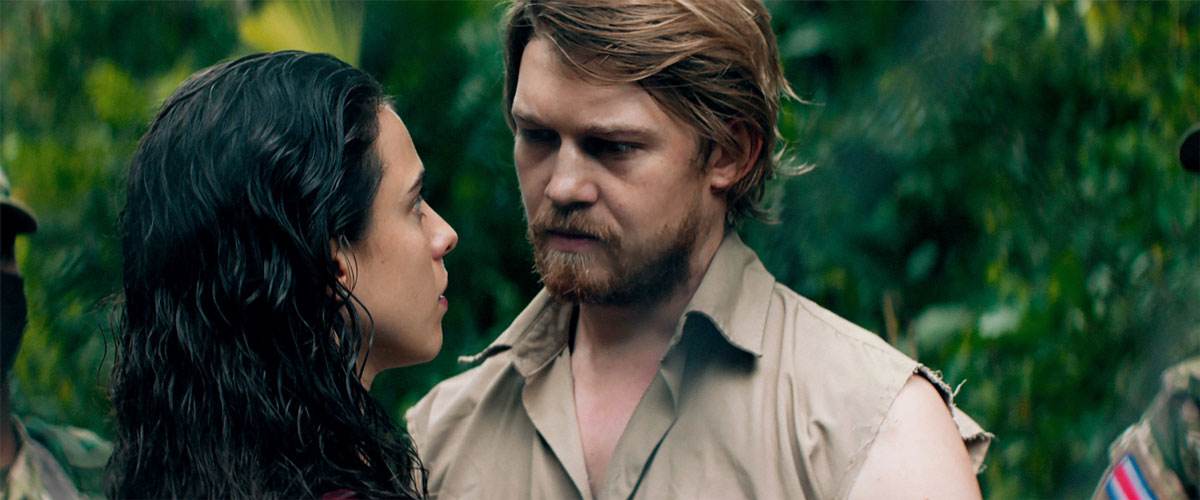
Claire Denis‘ moody romantic thriller, “Stars at Noon,” which won the Grand Prize at the Cannes Film Festival this year, features copious sex and shadowy politics. The film, adapted from the late Denis Johnson‘s 2000 novel, has Trish (Margaret Qualley), an American, posing as a journalist in present-day Nicaragua. She sidles up to the Intercontinental hotel bar to flirt with Daniel (Joe Alwyn), a British businessman working with an oil company. He takes her back to his hotel room where she has sex with him for $50 American.

“Abuse of power is what I am most of afraid of since I was a child. Being afraid all the time is my life.”

Trish sees Daniel as someone who can help her get out of the country. Daniel, it turns out, needs Trish to help him navigate things as he gets involved in some shady business. (Trish identifies a man (Danny Ramirez) that Daniel meets with as a Costa Rican cop.) As the couple try to cross the border, they encounter various obstacles, including a CIA Man (Benny Safdie).

“Stars at Noon” may address topics ranging from political hegemony and influence — there is a suggestion Daniel has interests in a local election — but the film is more about creating a vibe that shifts from seductive to sinister than generating excitement. (The fabulous, jazzy soundtrack by Denis’ longtime collaborators, Tindersticks, and the frequent rain adds to the low-key film’s atmosphere.) Denis lets scenes percolate and simmer, using close-ups to create a real intimacy. And there is an ambiguity about the characters that keeps viewers wondering: can they be trusted? 

At the recent New York Film Festival, Denis spoke with Salon about making “Stars at Noon.”

This film, like many of your films, addresses abuses of power. Can you talk about that theme in your work?

Abuse of power is what I am most of afraid of since I was a child. Being afraid all the time is my life. 

The film takes place in the COVID era, even though the novel was set in 1984. What observations do you have about the parallels between then and now in Nicaragua? 

When I read the novel, I loved it and Denis Johnson’s style. I met with him and told him I would like to adapt that specific novel. He said, “This was my first novel. I was in Managua during the civil war. When I wrote it, I wanted to be a journalist, but I couldn’t publish any pieces.” Back in America, he wrote the book. It was a sad memory for him. I understood what he meant. So, I went to Nicaragua and Managua, and I realized it was impossible to go back to the Managua of 1984 and the time of civil war. Too many years had passed. Daniel Ortega, the president, transformed the city and so did an earthquake. To recreate a revolution like 1984 in the new Managua would not only cost a fortune but also would offend the Nicaraguan people who were part of the revolution. Then COVID came, and by the time we did the location scouting, Ortega was trying to get reelected. It had become a very dangerous place, and I could not hope to film in Nicaragua, so I had Plan B, which was Panama. 

What parallels did you find regarding American/European hegemony? The film’s themes about hegemony are still timely.

“They don’t want to depend on each other. They know they are lonely.”

It’s true that oil companies all over the world [have influence] where the oil is — except in the Arabic Peninsula because they own their oil. In Nigeria, French and Dutch oil companies are pumping. It is the same with mineral and oil and everything we need and don’t have we go and take. It’s a very old story. In Central and South American, there is the story of gold and the Spanish there. 

Stars at NoonJoe Alwyn in “Stars at Noon” (A24)

“Stars at Noon” is a love story of sorts and it is a political thriller. The tone shifts even though the mood remains relatively low-key. Can you talk about your approach to the material? You create a vibe that draws viewers.

A lot of that came from my meeting with Denis before he died. There was this melancholy in him. The style of his dialogue and his poetry is as if he was always missing something — as if as a writer and human being he was not sure he was getting the point exactly. There was always a sort of regret. This I understand very well because I am a little bit like that. I feel it is hard to be over-satisfied with my moves. I try to be fair, but I don’t think it’s easy. I’m constantly asking myself: What should I think? We are living in a world with climate change and some countries are dying with dryness, some are going under water. There are wars in Ukraine and Syria. I was born and grew up in the 20th century and I thought that the war was in the past and best was in the future. But at turn of the 21st century, we realized it’s not like that. Planet earth is fragile, and it is a dangerous place.

I liked how much of the film was so intimate from the close-ups on Trish and Daniel’s faces and bodies. Many scenes felt claustrophobic or isolated. Like all of your films, it is a very palpable, tactile, atmospheric film — the rain is a real character. What informs your distinctive visual style?

The rain was a very real, very tactile character in Panama. I always organize myself and with the cinematography to know exactly what we are going to do and then, as we start shooting, we know which lens to use, the format, and the location. Making a film, then, is really to enter with the character into the film with the camera and me — to intrude the space of the story. For me, that’s direction.

Trish can be seen as selfish, desperate but also determined. Daniel is said to be dangerous. They are ambiguous characters, and what intrigued me is never really knowing the truth. How did you view the characters?

They are both lying. They don’t want to abandon themselves to each other. That’s the meaning of the dance scene. He leans into her and then — no, no, no, I shouldn’t. The dance scene is the [heart] of the film; they want to abandon themselves to each other, but no. It was like that in the script — they were ambiguous. When Trish says [sleeping with Daniel is like] “f**king a cloud,” it says a lot. And it says that she doesn’t want him to take advantage of her. And, on the other hand, she is protecting herself from her attraction to him as much as he is attracted to her, and they fight against that. They don’t want to depend on each other. They know they are lonely.

“Stars at Noon” is told mainly from Trish’s perspective. I was very conscious of how Trish was presented. Likewise, I was struck by Juliette Binoche‘s characters in your recent films, “Both Sides of the Blade” earlier this year, and “Let the Sunshine In.” What decisions do you make when you portray your female protagonists? 

I think they are as vulnerable and fragile as I am, but on the other hand, they are very strong. They are survivors. They have a fragility that could only exist if you have a strong will to exist. Otherwise, they don’t want to surrender. 

You have made films in many different genres, eras, locations and topics. Each one is different, but they are all very distinctive. What is it that drives you to make a particular film and invest all the time and energy into a project?

I don’t wake up and think let’s go to Panama and make a film there. It’s because I read Denis Johnson’s novels and fell for this novel. That is why I decided to visit Nicaragua and thought adapting this novel into a film. What attracted me to the novel is maybe like in all my films, how difficult it is to be attracted to someone, and fall in love with someone, and to be afraid to fall in love, to try to resist that, to maybe feel there is a weakness in the falling. And it’s dangerous. This theme is in all my films. 

How did this film, allow you to grow as a filmmaker? 

Probably the fact that I couldn’t shoot in Nicaragua and had to relocate the story using Panamanian locations forced me to reconsider the script, but it did not change my relationship to the characters. I was lucky that I met Margaret when I saw Tarantino’s movie. I knew that I wanted her for the film. It took a longer time to meet Joe, but I knew the film could exist in Panama or elsewhere. The film was in that space between them and that was reassuring for me. They trusted me. That was very important.


Want a daily wrap-up of all the news and commentary Salon has to offer? Subscribe to our morning newsletter, Crash Course.


Early in your career, you worked with Wim Wenders, Jim Jarmusch, and other filmmakers. Do you mentor filmmakers now? 

There is a young woman, Alice Diop [director of “Saint Omer”]. We are good friends, and we share our experiences. It is good example of a relationship between filmmakers like it was with me and Jim or Wim. It’s a question of finding an equal in another director’s work. As soon as I saw Alice Dop’s short films and documentary, I knew that we had something in common. It is strange — because she is much younger that I am — and from Senegal, that we could share something with her as easily as I could with Wim. With Jim Jarmusch, it was a little bit difficult to work with him. His humor and spirit, I feel dumb next to him.

“Stars at Noon” is in theaters and on demand Oct. 14. It streams on Hulu beginning Oct. 28. Watch a trailer via YouTube.

Effort to recover Indigenous language also revitalizes culture, history and identity

When the federal government set up boarding schools in the 19th century to assimilate Native American children into American culture, one of the objectives was to get them to turn away from the use of their native languages. In recognition of Indigenous Peoples’ Day in the U.S., The Conversation turned to Daryl Baldwin, a citizen of the Miami Tribe of Oklahoma who is a leader in Native American language and cultural revitalization and a member of the National Council on the Humanities, for insight into a tribal community’s efforts working with a university to help bring languages back.

How were Indigenous languages lost?

Many actions throughout history put pressure on tribal communities to abandon the use of their languages. This included the forced assimilation that resulted from the Indian Civilization Act of 1819. This act established Indian boarding schools to teach subjects such as math and science while suppressing the use of Indigenous languages and cultures.

Boarding schools lasted until the mid-20th century, and their effect was devastating for Indigenous communities and their languages. Linguists have estimated that prior to European settlement, there were 300 Indigenous languages spoken in what is now the United States. Communities are struggling to pass these languages on to a younger generation.

These affected communities include the Miami Tribe of Oklahoma, of which I am a citizen. The Miami Tribe lost the last speakers of the Myaamia language during the mid-20th century in part due to these assimilation efforts. Additionally, the forced relocation of the Tribe from its homeland in the Ohio-Indiana region to Kansas, and eventually Oklahoma, during the 19th century caused the community to become fragmented due to some families remaining behind or being exempt from relocation.

These factors also increased the stress on the community to simply survive. Many tribal members and elders from this time have recounted how they didn’t pass the language on to their children for fear of discrimination.

Why bring the languages back?

Simply put, our languages help make us whole again. When we empower our cultural selves through speaking our languages, we begin to undo the damage caused by years of cultural and linguistic oppression.

For the Miami Tribe of Oklahoma, language and cultural revitalization is a priority. We contribute significant time and financial resources into educational programs that help tribal citizens reconnect to their cultural heritage.

When we engage in revitalization activities, we are weaving strands of knowledge, cultural practices and other ways of being into our lives so we may draw on them as a source of community strength. Today, this encompasses all aspects of our lives, including art, games and food, as well as song and dance. For many of us, our Myaamia language is central to this process.

Since 1972, Miami University has been an important partner in this process of language and cultural revitalization. The Myaamia Center – the tribe’s research arm – directly supports the Myaamia Heritage Program. The program provides Miami Tribe students with tuition waivers and a unique opportunity to engage with their cultural heritage while earning a college degree.

What practical uses do these languages serve?

Language was an important aspect of my home when my four kids were young. Being able to say teepaalilaani – “I love you” – and to sing bedtime songs to my children – kiilhswa neewaki kiilhswa neewita . . . – “I see the moon, the moon sees me . . .” – in my native language was important to me.

Speaking my language connects me to our ancestral homelands of what are now parts of Ohio and Indiana. And doing so strengthens my relationship with my immediate family who also speak the language, and allows me to communicate in a way that is unique to my culture. My language may not be practical in holding a mainstream job or getting around in the world, but it is important to my identity as a Myaamia person. I feel grounded when I can speak my language with other members of my family and community.

The Myaamia Center’s Nipwaayoni Acquisition and Assessment Team has evaluated programs since 2012 and found that Myaamia students regularly comment on how important speaking their language is to their identity.

Jenna Corral, a Myaamia student who graduated in 2021, described her experience: “Learning our language has been one of the best ways to make me feel connected to my identity and tribal community. Being able to learn and speak the language that was developed by my ancestors was something I never thought I would do. I am forever grateful for all I have learned about my heritage and culture and the positive impact it has had on my life.”

How do students benefit from learning these languages?

Myaamia tribal youth who participate in language and cultural revitalization programs are more engaged in tribal activities, internal assessment research shows. Participation has continually risen over the past 20 years, in part due to increased tribal enrollment encouraged by language and cultural revitalization. Engagement is increasing because people want to be involved and participate in what is happening. We have gained approximately 1,000 citizens in the last five years, boosting our enrollment to 6,780 today. This is a significant development because we view youth engagement as important to future growth of the tribal nation.

Myaamia students have been enrolled at Miami University since 1991. Students who attended before the creation of the Myaamia Heritage Course, which allows students to explore their Myaamia heritage, had a graduation rate of 56%. Since the addition of the course in 2003, our six-year graduation rate has increased to 92% – more than double the national six-year graduation rate of 41% for Native Americans – and 106 Myaamia students have earned degrees from Miami University.

We believe growth of tribal programs developed by the tribe’s Cultural Resources Office, the creation of the Myaamia Center and further development of the heritage program are at the core of what has driven this dramatic increase in our graduation rate.

How will these languages be preserved going forward?

Just as the boarding school era was designed to remove language and culture, our tribal efforts can put back what was taken.

But these efforts require financial resources. Some people feel that the federal government holds a degree of financial responsibility in the revitalization of these languages. This is because significant federal funding was used historically to eradicate these languages. The federal government spent US$2.81 billion – adjusted for inflation – to support the nation’s Indian boarding schools, but only a fraction of that amount for Indigenous language revitalization today.

Partnerships between tribes and universities can be powerful in building a response to inequalities that have emerged through our recent history. Yes, language is an important part of what we do, but in the end it’s about knowledge, who holds that knowledge and how it’s expressed through our unique language and culture. Our partnership with Miami University is one such model.

Daryl Wade Baldwin, Executive Director, Myaamia Center, Miami University

This article is republished from The Conversation under a Creative Commons license. Read the original article.

How the Beatles electrified the Bacon Brothers

The fun and fabulous Bacon Brothers joined host Kenneth Womack to talk about their songwriting parallels with the Beatles and more on the latest episode of “Everything Fab Four,” a podcast co-produced by me and Womack (a music scholar who also writes about pop music for Salon) and distributed by Salon.

Kevin Bacon, the veteran actor known for such hit movies as “Footloose,” “A Few Good Men” and “Apollo 13,” among many others, and his older brother Michael, a music professor and award-winning composer with hundreds of credits to his name, have been performing as the duo the Bacon Brothers since 1995. But their musical roots actually go back to childhood, as they grew up in a family of six siblings who all brought various tastes into the house.

Kevin, the youngest Bacon child, had the good fortune of being exposed to popular music by his four older sisters in addition to his brother Michael, who was old enough to remember the initial backlash to the Beatles in the family’s hometown of Philadelphia (something guest John Oates also mentioned on our show). But the two grew to love the music of the Fab Four, particularly connecting with the “Rubber Soul” and “Revolver” albums. “Once I got hip to the Beatles,” says Kevin, “I was hooked.”

LISTEN:

Subscribe today through Spotify, Apple Podcasts, GooglePodcasts, Stitcher, RadioPublic, Breaker, Player.FMPocket Casts or wherever you’re listening.

Michael, who started playing cello as a child before moving to guitar and banjo, tells Womack that he was “a complete folkie until I discovered the Beatles,” particularly being blown away by the song “Eleanor Rigby” and crediting producer George Martin for his “orchestral point of view.” And Kevin recalls collecting the loose change that would fall from their father’s jacket after work in order to buy the “Sgt. Pepper” album when it was released, being mesmerized by the cover and calling it “music that was also sort of this other world….their talent just seemed so out of reach.”

In terms of their own songwriting, such as with the newer tune “Dark Chocolate Eyes,” Kevin explains that he tends to hear music in his head, then sing it to Michael, who can help turn it into a full composition. Michael describes Kevin’s talent as “meaningful simplicity,” and that he himself connects with songs that are “confessions rather than impressions.”

As for the Beatles, Kevin says that “they were such good songwriters, they could have just kept writing straight-up pop love songs. But then they could write the weirdest shit….and people still love it.”

Listen to the entire conversation with the Bacon Brothers on “Everything Fab Four,” including their differing views on the “Get Back” documentary, and subscribe via SpotifyApple PodcastsGoogle, or wherever you’re listening.


Want a daily wrap-up of all the news and commentary Salon has to offer? Subscribe to our morning newsletter, Crash Course.


“Everything Fab Four” is distributed by Salon. Host Kenneth Womack is the author of a two-volume biography on Beatles producer George Martin and the bestselling books “Solid State: The Story of Abbey Road and the End of the Beatles” and “John Lennon, 1980: The Last Days in the Life.” His latest project is the authorized biography and archives of Beatles road manager Mal Evans, due out in 2023.

Why are security questions so dumb?

Right near the end of a long recent afternoon in a drab cubicle in a local branch of one the largest banking systems in the world, I entered another dimension. My spouse and I had been endlessly signing forms and proffering photo identifications to open a new account we’d needed. The woman on the other side of the desk had been briskly typing phone numbers and addresses. Then she said she just needed to ask a few security questions. What was the name of the street I grew up on? What was my mother’s maiden name? I suddenly got the uneasy feeling I’d been transported into a retro-tinged Florence Pugh movie. Who grows up on one street any more? Whose mother was a maiden? Had I — a woman who shared children with the man sitting next to her but did not share his name — ever been one?


Want more health and science stories in your inbox? Subscribe to Salon’s weekly newsletter The Vulgar Scientist.


“Maiden” exists right up there with the somehow still-popular “co-ed” and “love child” in the pantheon of phrases nobody should be using any more. It’s the 21st century and lots of women go to college; unmarried people have babies, and not everyone has a straight, cisgender mother who absorbed a husband’s nomenclature when her father handed her off to him along with her bride price.

These are not novel developments. As Kate Tuttle wrote for Salon back in 2015, the concept of maiden names “reminds us of one thing: that marriage as an institution once demanded a virgin bride who was handed from her father’s house to her husband’s, and that the name she had worn since birth was discarded along with her virginity upon the occasion of her wedding day.”

Roughly 20 to 30% of women in the United States retain their birth names when they marry. That’s millions of women, many of whom are or will be someone’s mother. One third of American children are currently living with a single parent. Between 2 and 3.7 million American children under 18 are being raised by at least one LGBTQ parent. Even among those of us who do or did have mothers who had traditional maiden and married names, not everybody wants a reminder of their parents or grandparents when they’re just trying to fill out some forms. “Maiden name” is increasingly obsolete concept.

Other standard security questions seem nearly as outdated and strange. How does someone who moved several times in childhood — as both my spouse and I did — pick a street they grew up on? How does someone who’s never owned a car name the “model of first car”? How would someone homeschooled name an elementary or high school? Or how would a person of any number of financial, religious or cultural backgrounds provide an assumed “first concert”?

It’s true that some bank’s extremely random and possibly nineties-era security system isn’t going to be first place one turns for a nuanced grasp of modern identity and family dynamics. But what makes it all the more unnerving is that these breezy and, for many, unanswerable, security questions aren’t even truly secure.

In 2008, a man named David Kernell waltzed right in to then vice presidential candidate Sarah Palin’s Yahoo email account by using the system’s password recovery system and answering a few easily searchable security questions, like her date of birth and where she had met her spouse. Soon after, he posted on 4chan that “It took seriously 45 mins on wikipedia and google to find the info.” [sic] These are the same questions your bank or social network may likely still be asking you today, all these years later.

Maybe if you’re not the governor of Alaska, you may think your personal information is not as accessible or tantalizing to others. But do a little creative Googling on yourself some time and see just how scary easy it is to find your schools, prior addresses and probably even your first concert and the name of your first pet. Then consider that your money, your credit information, anything you can imagine about yourself, may all be tucked away behind — and this is an actual security question — your oldest sibling’s middle name. (Firstborns and onlies need not reply, I guess.)

In 2016, Yahoo admitted to an earlier hack that had compromised the personal information of approximately 500 million users. As the Guardian reported, “Yahoo did not encrypt all the security questions it stored, and so some are readable in plaintext. While it may be irritating to have to change a stolen password, it is somewhat worse to have to change a stolen mother’s maiden name.”

If it’s that simple for a stranger to figure out how to crack your security, imagine how much simpler it could be for someone who knows you. An eye opening 2015 white paper out of Stanford called “Secrets, Lies, and Account Recovery: Lessons from the Use of Personal Knowledge Questions at Google” revealed that “Users’ answers may be easily available to partners, friends, or even acquaintances.” A cited study showed that even acquaintances “could guess 17% of [security] answers correctly in five tries or fewer,” and that “Using a single guess an attacker would have a 19.7% success rate at guessing English-speaking users’ answers for the question ‘favorite food.'” The white paper concluded, unsurprisingly, that “Secret questions generally offer a security level that is far lower than user-chosen passwords.”

Knowing how easily exploited these security questions are, why then are some of the biggest businesses in the world still asking them? Part of it is that these answers are supposed to be easy for you to remember. When you’ve bombed out on your password for the tenth guess, dear old mom or a beloved pet still ought to be easily summoned from the memory vault.

But Ric Hawkins, a former financial advisor who currently writes on AI software, SEO, content marketing and investing, explains that these questions aren’t just intentionally simple for our benefit. “For one thing, they are relatively cheap and easy to implement,” he says. “They do not require any specialized hardware or software, and business owners do not need to worry about training their employees on how to use them. In many cases, it comes down to a lack of creativity. With so many accounts to keep track of, it’s easy for businesses to default to the same few questions over and over again. As a result, hackers can easily find the answers to these questions by doing a little digging.”

So what are we supposed to do when presented with these ridiculous options? Lie. Steve Weisman, a security expert and author of “Identity Theft Alert: 10 Rules You Must Follow to Protect Yourself from America’s #1 Crime,” says, “There is no reason that you need to answer a security question honestly. Therefore the answer to the question as to your mother’s maiden name can be ‘firetruck.’ It is so silly that you will remember it and no hacker will ever guess it.”

One can and should circumvent these security questions by inventing (and remembering!) alternative ones. But it also would be neat if we all moved along into the 21st century. It should not just be on me as a consumer to come up with more untraceable answers. It should be up to banks and businesses to start inventing better security systems.

Slowly, that is starting to happen. More secure options like two-factor authentication are becoming more the norm. And when it comes to the mother’s maiden name question, “I honestly don’t see it used much these days,” says Chris Fletcher, Senior VP of National Accounts at Crest Capital, “except for credit card companies, and I suspect they will be phasing it out if they have not already.” Fletcher notes, “It’s become irrelevant today. It’s from a bygone era when we assumed ‘everyone’ was from a stereotypical nuclear family, even if they really weren’t. All of these security questions have some stereotypical assumption. First car, first pet, first concert… they all ‘assume’ a middle class life with concerts, pets, and cars.” And that, he says, “is a problem.”

I have the same last name I was born with — the name of the man my mother was married to for three whole months of her pregnancy with me. It’s not my maiden name; it’s just my name. It’s also the third most common last name in America, so if you want to take a crack at anybody’s mother’s maiden name, mine is a pretty good guess. Perhaps that’s why my daughters find those questions about their “mother’s maiden name” so strange. When I sat next to my 18 year-old in August as she opened up a new bank account, she briefly shot me a puzzled look when the query was posed. Then she wisely gave her grandmother’s instead.

Beating a dead horse: Jan. 6 committee has proved what we all knew. Does it even matter?

The House Jan. 6 committee, bless its heart, went through it all again on Thursday:

  • All the lawsuits Trump filed, and lost, attempting to overturn election results in the battleground states, including excerpts of judges’ decisions slapping down 61 of the 62 suits. (No. 62 was a minor technical issue that didn’t change anything.)
  • The pressure campaign by Trump on elected officials and legislators in battleground states trying to coerce them into helping him overturn the election, including the infamous hour-long phone call four days before the Jan. 6 insurrection to Georgia Secretary of State Brad Raffensberger when Trump asked him to “find” enough votes so he could carry the state. “I just want to find 11,780 votes, which is one more than we have,” Trump pleaded.
  • Pressure on the Department of Justice to investigate allegations of election fraud, which resulted in Attorney General William Barr telling Trump that all his charges of fraud were “bullshit” just before he went public in an AP interview and resigned.
  • A continuing campaign of pressure on the acting attorney general who replaced Barr, Jeffrey Rosen, and his underlings, aimed at persuading the Justice Department to intervene with state legislatures to help Trump overturn the election.
  • The two-month tsunami of lies told by Trump after Election Day, claiming that the election was “stolen” when he knew perfectly well he had lost. The committee included video of Trump repeating stories about “suitcases of votes” and Dominion voting machines, claims that he had been told were false by aides and other officials, including Barr. The committee presented new information that Trump’s team had plans, months before Election Day, that Trump would declare victory on election night whether he won or not, a lie he has repeated relentlessly ever since.
  • Trump’s conspiracy with an outside lawyer, John Eastman, and the chairs of state Republican parties around the country to submit slates of fake electors they hoped would confuse or delay the count of electoral votes, or even throw the election into the House of Representatives, where Trump knew he had the votes and would be declared winner of the 2020 election by constitutional fiat.
  • A powerful reminder of the “Sunday night massacre,” when Trump’s attempted appointment of DOJ underling Jeffrey Clark as acting attorney general ended only after other officials at Justice and Trump’s White House counsel, Pat Cipollone, threatened to resign in protest. 
  • More details about Trump’s plan, which began weeks before Jan. 6, to send an angry mob to the Capitol after his speech on the Ellipse. He and his aides knew the mob would be armed and equipped with military equipment such as Kevlar vests, tactical helmets, riot shields, handguns and rifles.
  • New information was presented from recordings, texts and emails finally given up by the Secret Service and Homeland Security after months of stonewalling. All the information backed up testimony the committee had already received from White House aides about the predictions of violence and the firearms the Secret Service knew were in the crowd at the Ellipse. Some of the new texts and emails contradicted sworn testimony by Trump aides like Jason Miller, who had previously told the committee that he knew nothing about the potential for violence on Jan. 6. The committee uncovered texts that showed he knew exactly what right-wing groups like the Proud Boys and Oath Keepers were planning. The committee announced that it is “reviewing” previous testimony, with an eye toward charging anyone found to have lied.

And finally, the headline: The committee voted unanimously to issue a subpoena to Trump, calling on him to provide documents and testify before the committee.


Want a daily wrap-up of all the news and commentary Salon has to offer? Subscribe to our morning newsletter, Crash Course.


Good luck with that. The chances of getting Trump before the committee are almost nil, with Republicans likely to take over the House majority in January. In fact, it will take luck or a miracle for the entire enterprise of this select committee to have any effect on Trump’s seeming death grip on the Republican Party. After more than 20 hours of testimony in nine hearings held over the course of five months, the committee’s work hasn’t even budged the needle of Trump’s approval ratings.

More than 20 hours of testimony and evidence in nine hearings, over the course of five months. Trump’s guilt is clear. Has that demolished his popularity? Not exactly.

According to the polling aggregator FiveThirtyEight, Trump’s average approval rating was at 42.7 percent at the beginning of the hearings early in the summer. It stood at 40.4 percent when the hearings ended on Thursday. A Monmouth University poll at the beginning of the hearings found that 29 percent of Americans (and 61 percent of Republicans) believed that Joe Biden only won the 2020 election because of voter fraud. The exact same proportion believed the same thing at the close of the hearings. In fact, the Monmouth poll found that when the hearings began, 42 percent of Americans held the former president “directly responsible” for the Jan. 6 assault on the Capitol. That number went down to 38 percent by last month, with the final hearing still to come. 

As these congressional hearings have proceeded, a powerful department over in the executive branch has been assembling a criminal case against the former president for his theft and mishandling of government documents after he left office. The Department of Justice has been investigating Trump for his apparently illegal removal of thousands of documents and other materials from the White House when he left office. Some of the documents bear the highest classification markings intelligence agencies can use and were found in Trump’s office and residence in Mar-a-Lago, when the FBI searched the premises in August. 

That DOJ investigation has tracked the House hearings almost month by month. In June, the month of the first committee hearing, the DOJ sent officials, including the leader of its counterintelligence division, Jay Bratt, to Mar-a-Lago to retrieve an envelope containing 38 classified documents that Trump asserted was the sum total of all the government-owned materials he had stored at Mar-a-Lago. One of Trump’s lawyers signed an official statement to that effect, a sworn affidavit that was proved false when the FBI discovered 11,000 more government-owned documents, including another 100 folders of highly classified documents, during its August search.

I have written in these pages about the travails of the DOJ investigation in court over the last few months as a Florida federal judge, Aileen Mercedes Cannon, has done her best to impede the government’s investigation of the man who appointed her to the bench, Donald Trump. Those travails appeared to come to an end on Thursday when the Supreme Court rejected Trump’s emergency plea for the court to stay part of an order by the 11th Circuit Court of Appeals that removed the 100 or so folders of classified documents from the special master appointed by Judge Cannon to review the entire Mar-a-Lago trove for possible attorney-client privilege and executive privilege. 

Trump incited an armed mob to attack the Capitol. He stole classified documents. He could end up in prison. But 40% of the public is just fine with all that.

So, with just three weeks left until the midterm elections and two years before the next presidential election is held, that’s where we stand. Donald Trump’s stranglehold on 40 percent of the electorate looks unassailable, since it hasn’t been affected by the House committee hearings or a steady drumbeat of news about the DOJ investigation of Trump for possible serious felonies, including violations of the the Espionage Act, which is intended to prosecute spies against the United States.

The select committee has proved to the public, or at least to those who were watching, that Donald Trump conspired to overturn the 2020 presidential election in multiple ways, including inciting an armed mob to attack the seat of federal government. He knew his vice president’s life was in danger. He watched the insurrection on TV in the White House and listened to reports that Capitol and Metropolitan police were being attacked by his supporters, and he did nothing. The Department of Justice is amassing evidence of crimes that could end up with Trump being indicted. A conviction could send him to prison.

And here’s the thing: Forty percent of the country is apparently just fine with all that. They will try to vote him back into office if he decides to run for president again. Given that Trump may end up convicted of a felony that could bar him from holding any federal office, the words “constitutional crisis” come to mind. So do the words, we’re fucked.

Alzheimer’s might not be primarily a brain disease: new theory suggests it’s an autoimmune condition

The pursuit of a cure for Alzheimer’s disease is becoming an increasingly competitive and contentious quest with recent years witnessing several important controversies.

In July 2022, Science magazine reported that a key 2006 research paper, published in the prestigious journal Nature, which identified a subtype of brain protein called beta-amyloid as the cause of Alzheimer’s, may have been based on fabricated data.

One year earlier, in June 2021, the U.S. Food and Drug Administration had approved aducanumab, an antibody-targeting beta-amyloid, as a treatment for Alzheimer’s, even though the data supporting its use were incomplete and contradictory. Some physicians believe aducanumab never should have been approved, while others maintain it should be given a chance.

With millions of people needing an effective treatment, why are researchers still fumbling in this quest for a cure for what is arguably one of the most important diseases confronting humankind?

Escaping the beta-amyloid rut

For years, scientists have been focused on trying to come up with new treatments for Alzheimer’s by preventing the formation of brain-damaging clumps of this mysterious protein called beta-amyloid. In fact, we scientists have arguably got ourselves into a bit of an intellectual rut concentrating almost exclusively on this approach, often neglecting or even ignoring other possible explanations.

Regrettably, this dedication to studying the abnormal protein clumps has not translated into a useful drug or therapy. The need for a new “out-of-the-clump” way of thinking about Alzheimer’s is emerging as a top priority in brain science.

My laboratory at the Krembil Brain Institute, part of the University Health Network in Toronto, is devising a new theory of Alzheimer’s disease. Based on our past 30 years of research, we no longer think of Alzheimer’s as primarily a disease of the brain. Rather, we believe that Alzheimer’s is principally a disorder of the immune system within the brain.

The immune system, found in every organ in the body, is a collection of cells and molecules that work in harmony to help repair injuries and protect from foreign invaders. When a person trips and falls, the immune system helps to mend the damaged tissues. When someone experiences a viral or bacterial infection, the immune system helps in the fight against these microbial invaders.

The exact same processes are present in the brain. When there is head trauma, the brain’s immune system kicks into gear to help repair. When bacteria are present in the brain, the immune system is there to fight back.

Alzheimer’s as autoimmune disease

We believe that beta-amyloid is not an abnormally produced protein, but rather is a normally occurring molecule that is part of the brain’s immune system. It is supposed to be there. When brain trauma occurs or when bacteria are present in the brain, beta-amyloid is a key contributor to the brain’s comprehensive immune response. And this is where the problem begins.

Because of striking similarities between the fat molecules that make up both the membranes of bacteria and the membranes of brain cells, beta-amyloid cannot tell the difference between invading bacteria and host brain cells, and mistakenly attacks the very brain cells it is supposed to be protecting.

This leads to a chronic, progressive loss of brain cell function, which ultimately culminates in dementia — all because our body’s immune system cannot differentiate between bacteria and brain cells.

When regarded as a misdirected attack by the brain’s immune system on the very organ it is supposed to be defending, Alzheimer’s disease emerges as an autoimmune disease. There are many types of autoimmune diseases, such as rheumatoid arthritis, in which autoantibodies play a crucial role in the development of the disease, and for which steroid-based therapies can be effective. But these therapies will not work against Alzheimer’s disease.

The brain is a very special and distinctive organ, recognized as the most complex structure in the universe. In our model of Alzheimer’s, beta-amyloid helps to protect and bolster our immune system, but unfortunately, it also plays a central role in the autoimmune process that, we believe, may lead to the development of Alzheimer’s.

Though drugs conventionally used in the treatment of autoimmune diseases may not work against Alzheimer’s, we strongly believe that targeting other immune-regulating pathways in the brain will lead us to new and effective treatment approaches for the disease.

Other theories of the disease

In addition to this autoimmune theory of Alzheimer’s, many other new and varied theories are beginning to appear. For example, some scientists believe that Alzheimer’s is a disease of tiny cellular structures called mitochondria — the energy factories in every brain cell. Mitochondria convert oxygen from the air we breathe and glucose from the food we eat into the energy required for remembering and thinking.

Some maintain that it is the end-result of a particular brain infection, with bacteria from the mouth often being suggested as the culprit. Still others suggest that the disease may arise from an abnormal handling of metals within the brain, possibly zinc, copper or iron.

It is gratifying to see new thinking about this age-old disease. Dementia currently affects more than 50 million people worldwide, with a new diagnosis being made every three seconds. Often, people living with Alzheimer’s disease are unable to recognize their own children or even their spouse of more than 50 years.

Alzheimer’s is a public health crisis in need of innovative ideas and fresh directions. For the well-being of the people and families living with dementia, and for the socioeconomic impact on our already stressed health-care system coping with the ever-escalating costs and demands of dementia, we need a better understanding of Alzheimer’s, its causes, and what we can do to treat it and to help the people and families who are living with it.


Donald Weaver, Professor of Chemistry and Director of Krembil Research Institute, University Health Network, University of Toronto

This article is republished from The Conversation under a Creative Commons license. Read the original article.

What’s in a name: Kurdish martyr Jîna Amini and the struggle for culture and history

“Life.” That’s what Jîna Amini’s name meant in Kurdish, her native language. But after her death at the hands of Iran’s “morality police” last month, the world began to know Jîna by what she considered her government name, Mahsa. 

Protests have erupted across the Middle East and the rest of the world for women’s liberation with the rallying cry “Women, Life, Freedom” or “Jin Jiyan Azadi.” But what many people don’t know is that this phrase originated with a movement called Kurdistan Women’s Liberation in Turkey in 2006. 

More than 16 years later, the phrase is being adopted by activists, fashion brands and news outlets, but few understand the historical context behind the chant, or the significance of centering Kurdish women in this movement. A chant that was intended to universalize the Kurdish struggle to women’s democratic movements worldwide has been watered down. It was a specific phrase with important historical context, and that should not be forgotten.

More than 25 million Kurdish people live without a formal state across Turkey, Iraq, Iran and Syria. Although they are among the oldest ethnic groups to inhabit the Middle East, they constantly face persecution, and sometimes literal erasure, within the nations where they live today. 

Amini’s Kurdish identity has been little noticed, and sometimes entirely ignored, in reports of her death. She is frequently only described as an Iranian woman, and her regime name, Mahsa, is almost exclusively used in the media. Many reports also fail to mention that she was only in Tehran that day to visit family, but actually came from Saqqez, in the province of Kurdistan. 

The erasure of Jîna Amini’s Kurdish identity is purposeful: Iran has a long history of discrimination and genocidal violence against the Kurdish people.

This is purposeful: There is a long history of Iranian state discrimination against Kurds, exacerbated by Ayatollah Khomeini’s 1979 fatwa that authorized the massacre of the Kurdish people of Rojhelat. He called the Kurdish forces “the party of Satan,” and named them traitors to Islam; over the next few months, hundreds of Kurds were wounded and killed by Iran’s Revolutionary Guards. 

To this day, Kurds make up almost half of Iran’s political prisoners. There is a widespread ban on Kurdish given names, which forces many families, like the Aminis, to register their children under official non-Kurdish, Islamic names. This creates an internal dichotomy where Kurds have an “official” and “unofficial” identity, with the apparent goal of gradually erasing their culture and history. 

For many years, Turkey banned specifically Kurdish letters from the nation’s official alphabet, and although this law was lifted in 2013, Kurdish first names are still not permitted. For example, Yılmaz Baysal, a 30-year-old Kurdish man raised in Turkey, discovered his official name differed from his one at home. He told a local Turkish news outlet that his parents wished to call him Rêber, but the civil registration office chose Yılmaz, a familiar Turkish name. 


Want a daily wrap-up of all the news and commentary Salon has to offer? Subscribe to our morning newsletter, Crash Course.


As Jîna has become the face of this movement, it is no accident that her true identity has been altered or concealed. A name is one of the most powerful indicators of a person’s background and family history, and hers has been criminalized even in death. 

In 2019, actress Medalion Rahimi made history as the first hijab-wearing series regular on the “NCIS” TV franchise. As an Iranian-American, Rahimi frequently visited her homeland as a child, which was when her family was first told her American name wasn’t appropriate in the Islamic Republic. 

Her unique name was chosen by her parents after what they described as her glowing birth. It was seen as too “Western” or non-Muslim for Iran, so for official purposes her father named her Fatimah, after the Prophet Muhammad’s daughter. 

“Fatimah” was approved and is the name on her Iranian passport, but Rahimi doesn’t think of it as her true name. “Both of my parents are fully Iranian, both Muslim,” she said in an interview. “So it’s interesting that [the government] wouldn’t accept my birth name. It’s as if it wasn’t nationalistic enough.”

In the past few weeks, Rahimi has helped the Iranian Diaspora Collective raise more than $350,000 to buy billboards all over the U.S. and help mainstream news outlets cover the current women’s liberation movement in Iran. She has taken to social media to spread the word, and feels it’s necessary to use Amini’s legal name, Mahsa, in order to gain traction. 

“We use the hashtag #mahsaamini is because it’s the most used one,” she said. “We have to use whatever resources and tactics that we can to make this case more mainstream and reach more audiences, especially the Western world.”

It’s also important, Rahimi adds, to continue spreading awareness on the ethnic cleansing of Kurds in the region. “A lot of us are also adding #jinaamini as an alternate hashtag, and I think it’s important to include that in the narrative. We should honor Jîna’s true heritage and we should bring awareness to what’s happening to Kurds in Iran, because they are a part of us.” 

Names are a central part of one’s identity, which is why they are often the first to be stripped away in acts of genocide, ethnic cleansing or “assimilation.” 

In the summer of 2015, for example, the first administrative order banning Islamic names in Hotan, China, was issued. Included in the “List of Forbidden Names” were Arafat, Hüsein, Nesrulla, Sadam, Muslime, Fatima and others branded as “extremist.” That law seven years ago was one of the first signs that the Uyghurs, a Muslim Turkic ethnic group, were going to be targeted by the Chinese government.. 

“The most intimate parts of people’s private lives — from their daily attire to names given to children to the length of their beard — are controlled,” said Ilshat Hassan, president of the Uyghur American Association in 2017. 

In the summer of 2015, China published a list of “forbidden” Islamic first names. It was among the first signs that the Uyghur people would be targeted for ruthless ethnic cleansing.

What started as a simple name change can turn into something much more insidious, as researcher Rachel Harris found in the Uyghur “re-education camps” in Xinjiang, China. “Before meals, inmates chant, ‘Thank the Party! Thank the Motherland! Thank President Xi,’ and sing revolutionary songs such as ‘Without the Communist Party, there is no New China,'” she writes. “They must apologize repeatedly for wearing long clothes in Muslim style, praying, teaching the Quran to their children. Those who refuse to do so are punished with solitary confinement, beatings and food deprivation.”

Chinese officials have denied they are practicing ethnic cleansing — at least most of the time. One religious affairs official wrote on a Xinhua Weibo page, however, that the government’s aim was to “break [Uyghur] lineage, break their roots, break their connections, and break their origins. Completely shovel up the roots of two-faced people, dig them out, and vow to fight these two-faced people until the end.”

According to Human Rights Watch, the Chinese approach to “breaking Uyghur roots” involves forcing them to learn Chinese, forbidding them from speaking their native tongue and rewarding those who regurgitate state propaganda. Chen Quanguo, the former Communist Party chief, also instructed authorities to take down all Arabic signage, mosques and murals.

India has also participated in acts of erasure, especially with the rise of Hindu nationalism under current Prime Minister Narendra Modi. In 2018 his party changed the name of the city long known as Allahabad to Prayagraj, the name of a Hindu pilgrimage site. 

This practice goes back even further: After British colonial forces left India in the late 1940s, right-wing Hindu nationalist leaders replaced many Anglicized place names with Hindu ones. Bombay became Mumbai, Madras became Chennai, Calcutta became Kolkata, Bangalore became Bengaluru. The aim was to restore India to its “rightful” Hindu identity — but in the process, the histories of Muslims, Christians, Jews, Buddhists and other groups who have lived on the subcontinent for centuries began to be erased. There were also forced conversions of Christians and Muslims who belonged to the Dalit caste (traditionally the lowest social stratum), in an act called “ghar wapasi” or “returning home” — a Hindu nationalist term that supposes all religious minorities in India are simply Hindus who have lost their way. 

When Hindu nationalists changed Anglicized place names in India, they began to erase the histories of Muslims, Christians, Jews, Buddhists and others.

“The nationalist project of the present ruling party is based on the idea of making invisible and subjugating an entire population to keep the majority in a permanent state of dominance,” says Apoorvanand Jha, a professor at Delhi University. “This renaming is part of a cultural genocidal project.”

The United States certainly has a long history of renaming and cultural genocide as well. When enslaved Africans were brought to America, their names were usually identifiers of their families and homeland, and were rapidly stripped away and forgotten. “To refer to a person by their given name is to recognize the individual as a person,” wrote University of Kentucky librarian Reinette F. Jones. Slave owners saw Black people as commodities or livestock, and typically forced slaves to adopt their last names as a form of property insurance, even a brand. After emancipation, many Black people chose the surname Freeman or Freedman — a significant identifier. Others, as in the famous case of Frederick Douglass, adopted new names from stories or myths, or simply made them up.

Revolutionary activist Malcolm X rejected his legal surname, saying he refused to be called by his “slave name.” The “X” stands in place of his unknown African name, lost through the Atlantic slave trade.

In 2002, Berdan Acun, the father of a Kurdish boy who was forced to change his son’s name in Turkey, said, “There is no more basic human right than to name your child as you wish.” When we ignore the power and meaning found in someone’s name, we participate in cultural erasure, very often with no awareness we are doing so. If we remember Jîna Amini by the name her family used, rather than the one that was forced upon her, we honor her life, her death and the future she should have had.

Van Gogh soup stunt sparks criticism

A pair of climate activists tossed a couple of cans of tomato soup on one of Vincent van Gogh’s famous glass-protected paintings at a London museum on Friday, renewing a debate about the effectiveness of some of their group’s strategies.

Phoebe Plummer, 21, and Anna Holland, 20—who glued their hands to the National Gallery wall after dousing the $84.2 million “Sunflowers” in soup—wore Just Stop Oil (JSO) T-shirts. The U.K.-based group shared footage of the action and their motivations on social media.

“Is art worth more than life? More than food? More than justice?” Plummer said in a statement. “The cost-of-living crisis is driven by fossil fuels—everyday life has become unaffordable for millions of cold, hungry families—they can’t even afford to heat a tin of soup.”

“Meanwhile, crops are failing and people are dying in supercharged monsoons, massive wildfires, and endless droughts caused by climate breakdown,” the activist added. “We can’t afford new oil and gas, it’s going to take everything. We will look back and mourn all we have lost unless we act immediately.”

The National Gallery and Metropolitan Police confirmed that “there is some minor damage to the frame but the painting is unharmed.” The latter added that the protesters “have been arrested by Met police officers for criminal damage and aggravated trespass.”

Some in the art and climate activism communities expressed support for the action.

French visual artist and environmental activist Joanie Lemercier declared that “art is absolutely pointless on a dead planet” and highlighted that the painting was not damaged by the protest.

Scottish historian and human rights activist Craig Murray initially said that “I support Just Stop Oil’s direct action, especially the blocking of roads and refineries. It is needed to wake people up. But this is stupid vandalism, and counterproductive. This beautiful painting has no negative environmental impact.”

However, Murray later added that “I was wrong about this. The painting is behind glass and unharmed. In which case, this is a very effective bit of campaigning for publicity.”

Hyperallergic editor-in-chief and co-founder Hrag Vartanian said in a video that the ultrarich who are “buying and selling Van Goghs” are “the same people” who are on the boards of major polluting companies and “who are being feted by these museums.”

While right-wingers worldwide seized the opportunity to paint the JSO activists as “crazy” vandals, other critics suggested that the soup stunt could damage efforts to bring more people into the global movement to combat the fossil fuel-driven climate emergency.

“They sure know how to get attention. And while their passion is admirable, their tactics are repugnant,” said Mother Jones senior editor Michael Mechanic.

Two-Spirit Tuscarora (Haudenosaunee) television and musical writer Kelly Lynne D’Angelo said that “this is why y’all need to sit the f*ck down and listen to Indigenous people when it comes to climate activism.”

The co-creator of the musical Starry about Theo and Vincent van Gogh, D’Angelo added that “destroying art—an extension of our humanity—is not the way. The piece is fine. But the damage to the spirit of it isn’t. Ignorance wins.”

American comic book artist Jamal Igle stressed that “this is not how you make your point. Luckily, the painting is covered in glass, so nothing was damaged and they’ll probably be charged with trespassing. All you did was anger the very people you’re trying to appeal to.”

YouTube vegetarian chef Jerry James Stone had a similar message for the activists: “What a horrible way to express an important cause. This is beyond stupid, immature, and alienating. Grow the fuck up.”

Social media content creator Matt Bernstein tweeted, “girl I’m down with the cause but Van Gogh was a broke, mentally ill painter considered a failure until his death, like what does he have to do with this,” and contrasted Friday’s stunt with some “effective” art-related actions.

Dana Fisher, a University of Maryland sociology professor who studies protest movements, explained to The Washington Post that actions like throwing soup at a multimillion-dollar painting are a form of “tactical innovation” to attract media attention.

According to the Post:

The media gets accustomed to particular types of activism; a march or a sit-in that once commanded attention soon gets written off as old news. Climate protesters, Fisher explained, started by gluing themselves to artworks, which initially made a small news splash. Now that attention for that has cooled down, they have moved on to at least the appearance of defacing artworks, in an attempt to attract more eyes.

The action in the National Gallery did make prominent headlines across U.K. newspapers and around Europe; by late afternoon, one video of the incident on YouTube had been viewed 13.3 million times. At least to the activists involved, the fact that the protest had gone viral was probably viewed as a success. The climate issue—which at times is buried by geopolitical, economic, and celebrity news—was back in headlines once again.

But as tactics escalate, protesters risk turning off people who may otherwise be sympathetic to their cause. “Research shows that this kind of tactic doesn’t work to change minds and hearts,” Fisher said. Someone prevented from commuting to work—or someone who believes that irreplaceable artworks are being harmed—might be turned off by the climate movement for some time, if not permanently.

“It’s working to get attention,” Fisher said. “But to what end?”

Al Jazeera noted Friday that “experts have predicted acts of so-called ‘climate sabotage’ will increase as extreme weather events such as droughts, wildfires, and storms proliferate and the urgency to act grows.”

Daniel Sherrel, author of Warmth: Coming of Age at the End of the World, warned that such sabotage “would be a gift to the right-wing opponents of climate action, who would use it, leverage it for all its worth to accelerate their creeping fascism, make the issue politically toxic for moderate voters, arrest a generation of young climate activists, and sow division in the climate movement itself.”

Damien Gayle reported from the museum Friday that “alienating people from their cause was a concern, said Alex De Koning, a Just Stop Oil spokesperson, who spoke to The Guardian outside the gallery after the room was cleared.”

“But this is not The X Factor,” the spokesperson said. “We are not trying to make friends here, we are trying to make change, and unfortunately this is the way that change happens.”

Gayle also noted that “the canvas of the painting is protected with a glass screen, a factor Just Stop Oil said they had taken into account.”

Writing for The Ecologist in July, Chris Saltmarsh—co-founder of Labour for a Green New Deal and author of Burnt: Fighting for Climate Justicenoted other recent cases of JSO activists “disrupting high-profile sporting events and cultural institutions,” including gluing themselves to the frames of other prominent pieces of art.

As Saltmarsh detailed:

Targeting cultural institutions is not new within the climate movement. Since 2004, the Art Not Oil coalition has campaigned (with some notable successes) against oil sponsorship, taking creative protest to institutions including the British Museumthe Tate, and the National Portrait Gallery.

Just Stop Oil differs, though, in that their demand is generic and aimed towards the U.K. government rather than the subject of the protest.

Although Just Stop Oil is formally a distinct organization, this approach of general social disruption comes out of Extinction Rebellion. Initially, XR blocked roads and key junctions to maximize disruption. However, although they exist within the same tendency of the environmental movement, Insulate Britain and Just Stop Oil now represent a strategic divergence with XR.

“Since its founding, XR strategy has evolved to target those directly complicit in driving climate change (e.g., fossil fuel firmsthe Murdoch press, and financial institutions),” Saltmarsh wrote. “On the other hand, Insulate Britain and Just Stop Oil have respectively applied the approach of general social disruption to motorways or sport and culture.”

“Some have criticized Just Stop Oil and Insulate Britain for alienating ordinary people from supporting radical climate demands,” he added. “There’s no evidence that this is actually the case. However, the real limitation of Just Stop Oil’s strategy is that it tends towards marginality rather than building the power and mass movement we need.”

“You guys are so insane,” says Ted Cruz after being ridiculed for sharing fake news story

Sen. Ted Cruz (R-Texas) is facing scrutiny for his latest attempt to criticize Democrats. Although he claimed “The Left is beyond parody,” his attack fell flat when he was slammed for sharing a fake article that was photoshopped with reporter Abby Ohlheiser’s old byline.

Blogger Parker Molloy has taken to Twitter with a series of fiery arguments laying out the case against Cruz and offering the Republican lawmaker a timeline for Ohlheiser, who is currently with The Washington Post — not The Atlantic.

“So, someone created a fake story, slapped [Abby Ohlheiser]’s byline on it even though they haven’t worked at The Atlantic since 2014, which has led to a bombardment of harassment, and now a U.S. Senator is sharing said fake article,” Molloy tweeted.

The writer went on to further expound on the context of the fake story. “And when I say ‘fake story,’ I mean that the story literally does not exist,” Molloy explained. It’s just a mock-up that some right-wing troll made, and now these f***ing ghouls and liars like Ted Cruz are spreading it. ‘Beyond parody,’ Cruz says about something that isn’t even real.”

The writer added, “Before Cruz tweeted it out, [Abby Ohlheiser] was already being smeared with antisemitic, transphobic BS from people insisting that the article was real. Cruz (who had FINALLY deleted his tweet) is only making it worse.”

“One thing that’s interesting, however: in their attempts to find a “real” article to smear [Abby Ohlheiser] with, they DID find a real headline… but because it was written by Conor [Friedersdorf] their conservative buddy, they changed the byline in their photo edits,” Molloy also tweeted.

“Also, this isn’t even necessarily photoshop,” the writer explained. “Anyone can go in and create mock-ups of articles in their own browser, with the correct fonts and everything. Look, I did this on my phone. It’s easy. It’s fake.”

Although Cruz appears to have removed his tweet, screenshots are still circulating.

Herschel Walker scolded by debate moderator for using a prop

After Friday’s debate with Democratic Sen. Raphael Warnock, Herschel Walker can now relate to what it felt like when I was ridiculed by my entire fifth-grade class after bringing my great grandmother’s onyx ring to school and telling everyone that I was a witch and the ring was, somehow, proof.

Mid-way through their one and only debate before November’s midterm elections, which took place in Savannah, Walker produced what many are calling a “fake” or “toy” police badge from where it was kept inside his blazer. Wielding the badge, Walker was met with both laughter from the debate’s attendees, and a tongue lashing from the moderator.

“One thing I have not done, I’ve never pretended to be a police officer,” said Warnock during the debate. “And I’ve never threatened a shoot-out with the police.”

That comment made by Warnock was in reference to a 2001 incident in Irving, Texas where police received a call from Walker’s therapist alerting them to the fact that Walker was “armed and scaring his estranged wife at the suburban Dallas home they no longer shared,” according to Huffington Post. When police arrived at the scene they reportedly ordered Walker out of the home and stated that he’d made comments about “having a shoot-out.” Walker’s wife filed for divorce months later.


Want a daily wrap-up of all the news and commentary Salon has to offer? Subscribe to our morning newsletter, Crash Course.


“I have to respond to that,” Walker said during Friday’s debate, reaching into his coat to pull out his prop. “You know what’s so funny? “I am work with many police officers [sic].” 

At this point the moderator intervened to remind Walker that the use of props is against the rules at debates.

“Excuse me, Mr. Walker,” the moderator said. “Please, out of respect, I need to let you know . . . you are very well aware of the rules tonight; and you have a prop. That is not allowed sir. I ask you to put that prop away.”

“It’s not a prop,” Walker said. “This is real.”

“Holy s**t. Senator Warnock pointed out that Herschel Walker lied about being a police officer and Walker pulled out an “honorary deputy badge” on stage, insisting he is a cop. Walker is not well,” Tweeted political podcaster Brian Tyler Cohen

According to the Atlanta Journal-Constitution, Walker has made several previous claims about being in law enforcement and that “he majored in criminal justice during his time at the University of Georgia and was an honorary deputy in Cobb County along with three other Georgia counties.” The Cobb County Police Department state, per AJC’s reporting, they have no record of involvement with Walker. 

Manhattan congressional candidate Mike Itkis releases sex tape in push to legalize sex work

As though presented with the challenge to say he’s pro-sex work without actually saying he’s pro-sex work, Manhattan congressional candidate Mike Itkis released his own sex tape in support of legalizing what is likely the world’s only recession-proof business.

The video, which stars Itkis and porn performer Nicole Sage, is called “Bucket List Bonanza” and could have tanked his campaign as, historically, congressional candidates have teams that work around the clock to prevent such tapes from being made public; but in this case, the unconventional effort is well-received as a prime example of a politician putting actions above rhetoric.

“If I would just talk about it, it wouldn’t demonstrate my commitment to the issue,” Itkis said to City & State. “And, the fact I actually did it was a huge learning experience, and it actually influenced items on my platform.”

Itkis is a third-party candidate up against Rep. Jerry Nadler (D-NY) for a seat in the 12th Congressional District and his main deal so far has centered on legalizing sex work, ending adultery laws and defining consent.


Want a daily wrap-up of all the news and commentary Salon has to offer? Subscribe to our morning newsletter, Crash Course.


“You gotta do what you gotta do,” says Nadler’s Republican opponent, Mike Zumbluskas. “The media ignores everybody that’s not a Democrat in the city.”

Elsewhere on the internet, namely on Twitter, folks are having a bit of fun with Itkis’ bold move.

“I think this may be the first time a candidate has leaked a sex tape with the hope of it helping his campaign,” Tweets writer Parker Molloy.

“Anthony Weiner walked so Mike Itkis could run,” quips writer Timothy Kudo.

“If Mike Itkis wanted to start an only fans, he should’ve just said that,” jokes another person on Twitter

Monkeypox didn’t become a pandemic. Are we celebrating too soon?

The summer of 2022 might be remembered as a moment when the proverbial canary in the coal mine sang a few false notes. In July the World Health Organization (WHO) declared a global health emergency after more than 16,000 monkeypox infections were confirmed in 75 countries all over the globe. By early the following month, California, Illinois and New York had also declared public health emergencies, and some experts believed a new pandemic had already begun in the United States. On Aug. 4th American officials declared a national public health emergency, prompting millions to fear that they would catch a disease that was notorious for causing pustules to emerge all over your body.

That was only two months ago. As of today, the seven-day average for new monkeypox infections is one-seventh of what it was at its early August peak. Why?

“We caution that a declining outbreak can be the most dangerous outbreak, because it can tempt us to think that the crisis is over and to let down our guard.”

There is not a singular reason for monkeypox’s decline, though the vaccines that exist played a starring role. Indeed, the two vaccines that already existed for the virus proved to be effective. Moreover, the virus primarily spreads through close contact, meaning it did not have the easy transmissibility of the SARS-CoV-2 virus (which causes COVID-19).

n addition, because the virus primarily impacted gay and bisexual men with multiple partners, its spread was reduced when individuals in those communities began to take more safety precautions — and a vaccination drive played a huge role. Similarly, as Pride Month celebrations subsided, there were fewer instances of casual sex to facilitate spread of the disease.


Want more health and science stories in your inbox? Subscribe to Salon’s weekly newsletter The Vulgar Scientist.


Not all experts agree with the rosier assessments about monkeypox’s future. Indeed, some experts are warning that celebrations of a non-pandemic may be premature.

Speaking at a press conference in Geneva on Wednesday, WHO Director-General Dr. Tedros Adhanom Ghebreyesus noted that their organization has recorded more than 70,000 monkeypox cases and 26 deaths. Although cases are declining globally, 21 countries saw an increase the previous week — and 90% of those countries were in North or South America.

“This isn’t something that we’re going to see go away in a matter of weeks or months, but it’s something that if we keep the pedal to the metal, as it were, we should be able to get to a point where we have really potentially good outbreak control…”

“Once again, we caution that a declining outbreak can be the most dangerous outbreak, because it can tempt us to think that the crisis is over and to let down our guard,” Ghebreyesus explained. “That’s not what WHO is doing. We are continuing to work with countries around the world to increase their testing capacity, and to monitor trends in the outbreak.”

American policymakers are equally cautious about premature declarations of triumph. Demetre Daskalakis, the White House’s national monkeypox response deputy coordinator, told reporters in September that this is a “long game” situation.

“This isn’t something that we’re going to see go away in a matter of weeks or months, but it’s something that if we keep the pedal to the metal, as it were, we should be able to get to a point where we have really potentially good outbreak control and the ultimate goal being that we do not have endemicity in the U.S. But that means investing,” Daskalakis explained.

To protect yourself from monkeypox, the Centers for Disease Control and Prevention (CDC) urges people to thoroughly clean their homes, avoid allowing their pets to be in close contact with people who have monkeypox, and only engaging in safe sex. The CDC also urged people to obtain monkeypox vaccinations if they have not already done so. The monkeypox vaccine is also effective in fighting smallpox, which is a similar disease.

Backfire: Sheriff says migrants in DeSantis stunt are victims of a crime — eligible for special visa

Bexar County Sheriff Javier Salazar on Thursday certified that 49 migrants who were flown to Martha’s Vineyard by Florida Gov. Ron DeSantis last month were victims of a crime. The move clears a pathway for those migrants to get a special visa to stay in the country that they otherwise would not have received.

Rachel Self, a Massachusetts attorney working with the migrants, told radio station WGBH that the move by Salazar is a key part of the migrants’ applications for a “U visa,” which is reserved for victims of crime or people who witnessed a crime. In a statement, Salazar said his office had submitted documents with the federal system “to ensure the migrants’ availability as witnesses during the investigation.”

Attorneys like Self are seeking the visas for the migrants on the grounds that they were taken to Martha’s Vineyard under false pretenses.

“Based upon the claims of migrants being transported from Bexar County under false pretenses, we are investigating this case as possible Unlawful Restraint,” Salazar said in a statement.

Salazar said his office has identified witnesses in the case but could not release their names because the investigation is ongoing.

DeSantis’ office did not immediately respond to a request for comment. Salazar’s statement hinted that no action would be taken against the Republican governor, saying that “only those who were physically in our jurisdiction at the time of the offense are considered suspects.”

Migrants said they were convinced to board the airplanes by a woman known only as “Perla” who offered them jobs, housing and education if they went to Massachusetts.

The ACLU of Massachusetts has been working with nine people who were flown to Martha’s Vineyard and are now seeking U-Visas.

“We are grateful for Sheriff Salazar’s recognition of the gravity of these events. These certifications are an acknowledgment of the wrongs done to our clients and a crucial step in helping them to chart their path forward,” Carol Rose, executive director of the ACLU of Massachusetts, said in a statement. “Immigrants are human beings, not political props. We are proud that Massachusetts received these immigrants with compassion, and look forward to continuing to work with our clients as they begin their lives in our community.”

Texas Gov. Greg Abbott has also sent migrants to Democrat-run cities like Washington, D.C., New York and Chicago as he spars with federal officials about the large number of migrants coming across the southern border.

But in a Sunday interview with Spanish-language Univision news, he emphasized that Texas’ program is different because migrants agree to board buses to those cities. Abbott and DeSantis are both potential Republican presidential candidates in 2024, and the Florida flights were seen as an attempt by DeSantis to one-up Abbott’s busing strategy, which had been in place since April but had ramped up in August.

“The way that we do it is we receive written authorization from everybody who gets on that bus that they fully authorize the state to transport them to whatever location it is that they’re going to,” Abbott said. “And so, this is done willfully, knowingly. And they are provided food and beverages and other things on the trip. And so, it’s just done completely differently.”


This article originally appeared in The Texas Tribune at https://www.texastribune.org/2022/10/13/bexar-county-sheriff-migrants-marthas-vineyard-visas/.

The Texas Tribune is a member-supported, nonpartisan newsroom informing and engaging Texans on state politics and policy. Learn more at texastribune.org.

Jamie Lee Curtis “leads by example”: “Halloween Ends” star Andi Matichak on playing alongside Laurie

Andi Matichak tells me a spoiler that I’m not allowed to print. But I asked, and she tells me out of the kindness of her heart. Matichak is like that: gregarious, open and full of genuine excitement for the horror film she’s here to discuss, a film that, while noted for its gore, seems also to be marked by great love. 

We’re talking about “Halloween Ends,” the third installment of the Michael Myers trilogy from director David Gordon Green. Beginning with 2018’s “Halloween,” Green envisioned a straight sequel from the 1978 original film, which ignores the many movies in between. Jamie Lee Curtis reprises her role as Laurie Strode in Green’s films, the babysitter role that launched her lauded career. In Green’s 2018 film, Laurie is a grandmother, dealing with PTSD and all that can come along with it, including hypervigilance, paranoia, substance abuse and estrangement from her family; in other words, what might really happen if one had been terrorized as a teen by a serial killer.

Matichak plays Laurie’s granddaughter, Allyson, in the films. In the first one, she tries to maintain a relationship with her grandmother, despite the difficulties this causes her mother, Karen (Judy Greer), but the three women come together across generations to try to kill Michael. You know how that goes. In the second film “Halloween Kills,” Michael is back and sets off on a highly murderous spree. With Laurie in the hospital, Allyson again joins the fight to help and is saved from Michael by her mom Karen, who doesn’t make it out of the 2021 film. 

Set four years after the last movie, “Halloween Ends” finds Laurie writing her memoir (would read), Allyson working as nurse and trying to date, and everyone in general trying to move on with their lives after Michael. But Michael — or Michael’s kind of evil — isn’t over.

“Halloween Ends” is being billed as, well . . . the end, at least of this installment of the murderer’s saga. It’s also rumored to be the last appearance of Curtis as Laurie, a scream queen and one of the original, and best, final girls. Green’s trilogy has allowed Laurie to do what most final girls never get to in the movies: grow up, and Curtis, more than anyone, understands what this means to real trauma survivors. On Instagram, she posted a moving, black and white image of herself holding a photo of her as Laurie in 2018 holding a photo of Laurie as a teen girl. “This is of course is really a photograph of everyone who has survived their lives,” she wrote.

https://www.instagram.com/p/CjpycGWrQk5/?hl=en

Matichak understands that too. We talk the day after the “Halloween Ends” premiere. In the morning, she attended Curtis’ imprint ceremony at the TCL Chinese Theatre, which she found surprisingly moving, to be able to be there for Curtis, the person Matichak calls “so authentic, through and through. She never tries to tailor herself for anyone else. It’s not a persona she adopts and puts on. It’s her . . . ‘Say what you mean, mean what you say, and don’t say it mean,’ is what she always says.”

Matichak says what she means to Salon about Curtis, “Halloween Ends” and becoming a scream queen in her own right.

This interview has been lightly edited for clarity and condensed. 

What was it like for you first joining this story that has such a big history and place in horror? You’re part of this trilogy forever. You’ll always be a part of the “Halloween” legacy. 

It just boiled down to the simplicity of putting one foot in front of the other and learning to live in accordance with your trauma and pain.”

It is a once in a lifetime opportunity that I got to do three times. I didn’t just get to step into a movie or a beloved franchise but like the franchise and the horror and the film that has Laurie Strode, Jamie Lee Curtis and John Carpenter involved as the heavyweights. Blumhouse, Miramax and Universal were really pioneering the game of horror and it’s the place to step in. I cannot believe it. You would think that I would be better at articulating it after living this for four years, but it’s difficult to really comprehend and speak on because it’s so special. 

How is your character different in this film? We first see Allyson in the trilogy as a young girl. She loses her father, loses her boyfriend. But in this film, she’s older and she has her own life and career as a nurse. How has she changed?

Because of a time jump of four years, you really have a space to explore what happens in that time and really craft it. We put in a lot of effort and care into figuring out how she goes from “Halloween Kills,” after losing virtually everybody she loves, to where we find her in “Halloween Ends.” Even though you don’t see all the work that we did, you see it in the story, the way things play out and the relationships you see Allyson in. She’s just at the end of the day simply and honestly a girl trying to live a life and wake up every day and feel fulfilled and happy. And be loved and love. I think that’s what makes her relatable to everybody. It just boiled down to the simplicity of putting one foot in front of the other and learning to live in accordance with your trauma and pain as opposed to bumping up against it.
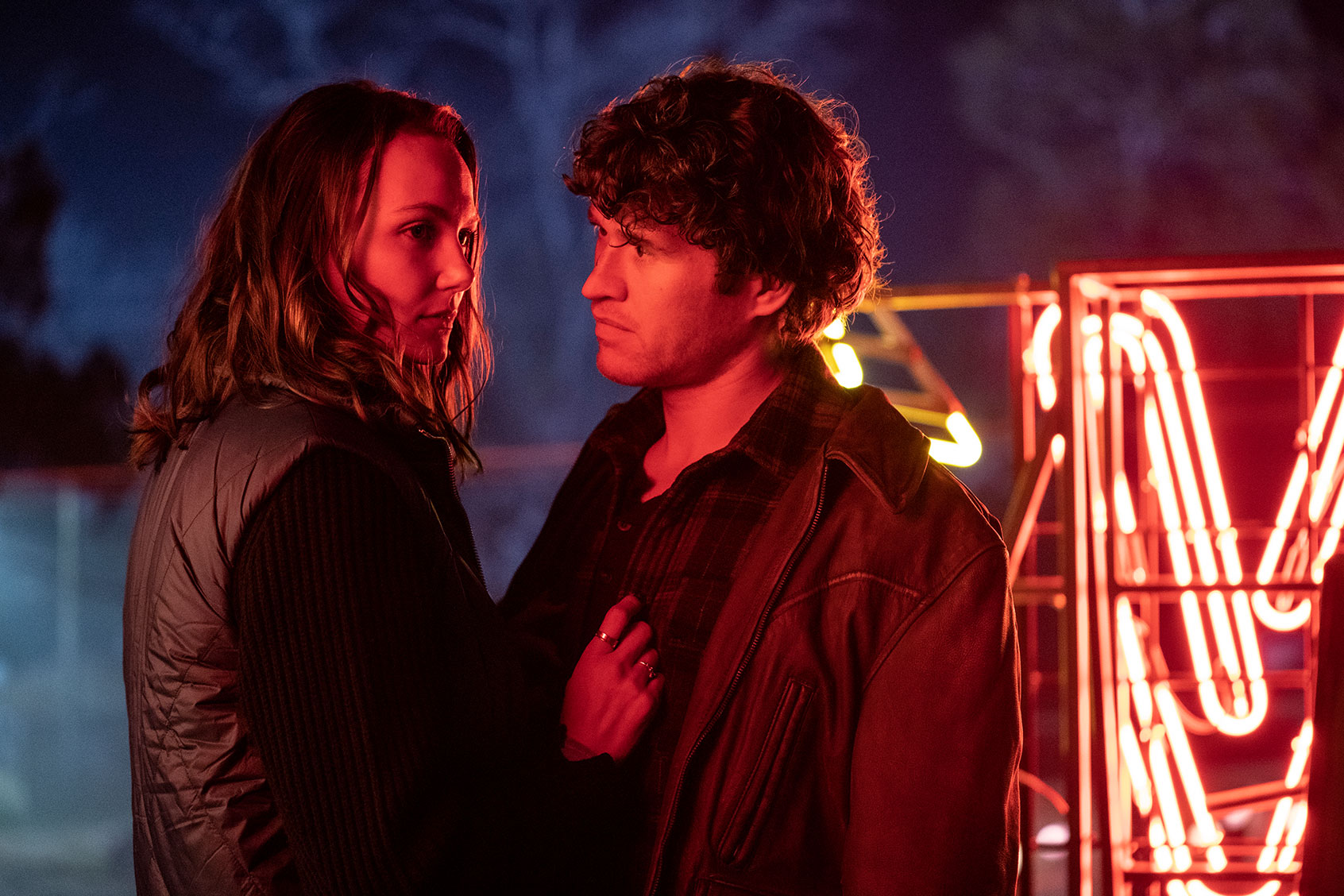
Halloween EndsAllyson (Andi Matichak) and Corey (Rohan Campbell) in Halloween Ends, co-written, produced and directed by David Gordon Green (Ryan Green/Universal Pictures)We always think of trauma associated with Laurie, like she’s been through this for years and years. But has trauma manifested in Allyson’s life as well?

Any moment in my life that I’m feeling uneasy, I just literally hear Jamie Lee Curtis.”

Definitely, I mean, trauma and pain, you can’t pretend it doesn’t exist. You can’t bundle it up, put it in a drawer, lock it away, throw away the key — it doesn’t work like that. It lives in your body. It lives with you all the time. And if it’s going to rear its head, especially at an anniversary time, especially when, you know, we meet Allyson at this moment in her life, where to the community, she’s maybe put on a pedestal and looked at as this kind of stoic survivor. But that pain, that trauma, all of that, is underneath. And when she’s presented with new characters, new relationships, it starts to put cracks in the surface and you get to see into it, to lift up and look underneath and explore that space. And David really allowed for a space to explore how it manifests in Allyson. You go on a ride with her just trying to figure it out, and remain open and not broken.

That’s one of the things I love about this trilogy, too, is that there is the space, like you say, to explore trauma. It’s not just that these horrible, inexplicable murders happen, but we talk about it, and we see it working through these characters’ lives over decades.

You don’t get that often in these movies.

I mean, I’m a huge horror fan. But you know, I want to see ramifications too. I want to see the aftermath. 

Exactly. And I think that those moments, those intimate moments, those quiet moments, allow for the gore. It allows for when the ceiling starts crashing in, it makes it more hard-hitting when you allow for quiet moments to take place. And for the exploration to try to understand because you’re more invested. 

Halloween EndsStrode in Halloween Ends, co-written, produced and directed by David Gordon Green (Ryan Green/Universal Pictures)Were there lessons that you took from working with Jamie Lee Curtis in the “Halloween” films?

She leads by example every day and anyone who comes in contact with her really feels that. The one that I go back to probably once a week, and I just hear her voice in my head say it when I need the reminder, is “Be where your feet are.” She said that to me once. I was panicked about something that was happening in a couple of days, and she just grabbed me by the shoulders like hey, “Be where your feet are.” Be here. Be here now. Be present. If not, you’re going to take it for granted and you’re going to not live in an honest way. So, just be here.

That’s really good. I need to remember that too.

I know. I hear her voice all the time. Just like, “Be where your feet are, be where your feet are.” Any moment in my life that I’m feeling uneasy, I just literally hear Jamie Lee Curtis.

Halloween EndsLaurie Strode (Jamie Lee Curtis) and Michael Myers (aka The Shape) in Halloween Ends, co-written, produced and directed by David Gordon Green (Ryan Green/Universal Pictures)You also worked with Judy Greer for the first two movies, who played your mom. Did you take lessons from her as well? And was it difficult not having your mother character there anymore?

It was very difficult not having Judy there for the third film, Judy, Jamie and I are all very close . . . Not having her — there was definitely a hole in in the process. If Jamie and I felt that way between us, the set felt that way, the crew felt that way. Judy is just a walking light and energy. She makes everybody smile and makes everybody better just by being around them. I learned so much from her every day, a lot about the industry and how things work and, how to approach certain things. She’s been a great friend and a mentor to me. 

I can only imagine. Your character goes through the grieving process and you must feel the loss on some level as an actor as well.

Jamie and I just kind of looked at each other, hugged and sat there for a couple minutes just taking it in and realizing that this was kind of it.”

We started this journey together. And it only feels right to finish it together, in a way. I think that we honor Karen well in this film, to the best we can, but there’s definitely a hole. That also informs a lot of the relationship you see between Allyson and Laurie. Tension and things that have never been said — that probably should have been said at some point — boil to the surface . . . Losing everybody, but Karen in particular, that is what brings these two women together in a sense, but also really makes them clash.

What are some of the scenes in “Halloween Ends” that were most memorable for you? And the scenes that you’re most excited for people to see?

I’m so excited for you to see honestly the entire film because it is such a bold movie. It is so unexpected, and so daring, and it’s a huge swing. It has a huge payoff. It is David Gordon Green personified in a movie, top to bottom, very, very cool and fun. One of the scenes that I had the best time ever filming was at a party, a dance sequence — and you’ll know what I’m talking about when you see it. You’ll understand why it was so fun. We had a really good time with that. 

One memory that sticks out is a final scene between Laurie and Allyson that is toward the end of the film. It has a quietness and an intimacy to it that was really palpable. We finished filming that scene and Jamie and I just kind of looked at each other, hugged and sat there for a couple minutes just taking it in and realizing that this was kind of it.
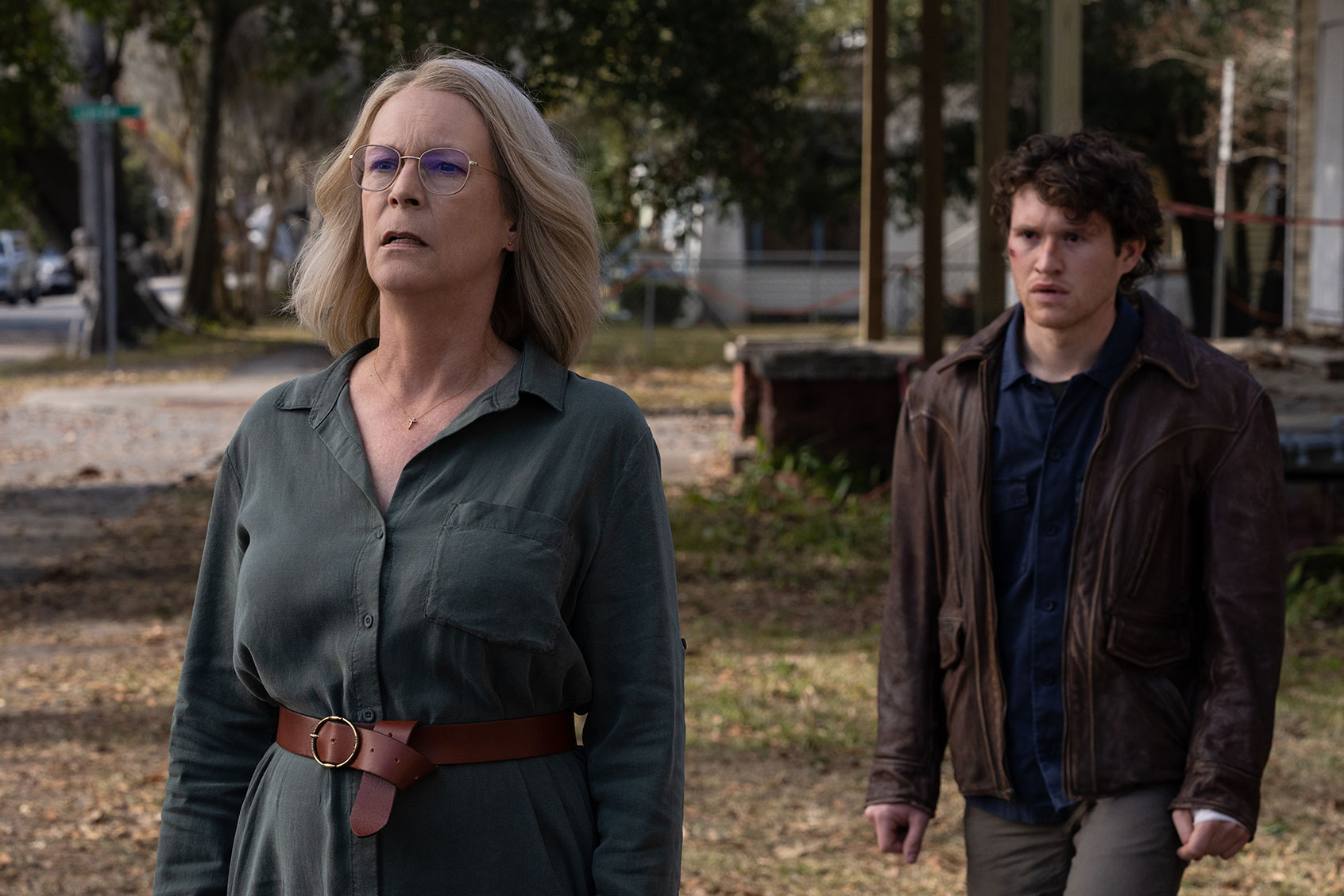
Halloween EndsLaurie Strode (Jamie Lee Curtis) and Corey (Rohan Campbell) in Halloween Ends, co-written, produced and directed by David Gordon Green (Ryan Green/Universal Pictures)That goes back to what we were talking about with the emotion of a gory film, that it needs to have intense emotional beats as well. As a horror actor, do you get scared? Are there things that scare you when you’re filming, or scare you about horror in general?

Totally. It’s so funny, I was such a little baby last night [at the premiere]. I’ve seen it twice and I was still screaming and cursing and jumping and covering my eyes. Luckily, I knew the parts to cover my eyes this time. Even reading the script, it doesn’t get old when it’s done well. So yes, I definitely still get scared. When I’m making [films], not as much because a lot of it is quite technical . . . it’s more when James Jude Courtney is just wearing the mask in between takes and not taking it off and lurking in the shadows off to the side.

Yeah, that would do it. That would scare me.

That’s more what sticks in your brain.

Are you drawn to horror as a performer? You’ve done a few thriller films: “Assimilate” and “Son,” which is very scary, I think.

“Son” is the type of horror that terrifies me to the core. I remember, in the finale, I conjure the devil essentially. And [the director, Ivan Kavanagh] was like, here’s your chant. And I said, OK, so if I conjure a demon, I’m bringing you down with me, just so you know.

Good luck!

We’re in this together now! That type of like cult, demonic world is for me the scariest. I was never really a huge fan of horror until I booked [“Halloween”] “2018” because honestly, they scared me too much. I was, though, exposed to the community and the culture around these films. The community really drew me in because it’s such a unique community of horror fans, and you realize that there are just so many subgenres within this genre. There really is something for everybody. And it’s an incredibly cathartic experience. Horror is similar to comedy in the way that it’s communal when you watch it. It elicits a reaction right away. So, it’s really fun when you find [horror] that is making you jump and scream and laugh and cry and all these things. I do enjoy horror now. 

From an acting standpoint, it’s been what I have had the opportunity to do mostly so far. Which I’m very grateful for because I’ve learned an incredible amount on all these films about filmmaking, setup, a lot of technical things that I otherwise wouldn’t have been really privy to if it was just a straight drama, probably. It’s something that just kind of happened by chance, but I feel like the universe puts things in your life for a reason. So, I feel it’s gonna probably inform the rest of my career, everything I’ve learned.


Want a daily wrap-up of all the news and commentary Salon has to offer? Subscribe to our morning newsletter, Crash Course.


If your life was a horror movie, do you think you’d be a final girl?

I would like to think so.

I mean, you have a final girl name. 

I do. It’s in the blood. I’m ready.

Halloween Ends is out in theaters and streaming on Peacock. Watch the trailer via YouTube below:


14 members of Nevada Republican Adam Laxalt’s family endorse his Democratic opponent

“As a proud Nevada family, we are honored to endorse Catherine Cortez Masto for the prestigious national role of U.S. senator for Nevada.”

“Her entire career demonstrates years of bold actions that she has taken as an authentic advocate of Nevada.”

That’s the final line of a three-page letter signed by 14 relatives of Republican Senate candidate Adam Laxalt, who is challenging Cortez Masto, the first-term Democratic incumbent. The document was first reported Wednesday by The Nevada Independent.

The endorsement comes as Laxalt and Cortez Masto are locked in what some pollsters and reporters consider the tightest U.S. Senate race—one that will help determine which party controls the chamber for the final two years of President Joe Biden’s first term.

The contest has highlighted a debate raging among Democrats about the effectiveness of strongly focusing on abortion rights in the wake of the U.S. Supreme Court reversing Roe v. Wade and not paying enough attention to the broader economic struggles of working-class voters.

The Laxalt family letter—which does not mention the GOP candidate by name—praises Cortez Masto on multiple fronts while stressing that she “clearly identifies with the world of the Nevada worker.”

“From a young age, Catherine grew up understanding the daily realities of dogged hard work. Like us, the backdrop of an immigrant experience was always within a very close reach,” the letter states, noting her journey from public education to law school.

“Catherine also understands what it means to be a fighter—especially when it comes to her home state of Nevada. Her years of public service are evidence of this,” the letter continues, recalling her time as state attorney general, a position Laxalt also later held.

The Laxalt family wrote that “as our U.S. senator, she has fought for Nevada families by working to bring down the high costs of prescriptions. She has even gone to battle in holding oil companies accountable for price-gouging Nevada citizens at the gas pump. Catherine has expertly defended her Nevada constituents.”

“Catherine’s unwavering support of the rights of Nevada women is historic,” the family asserted, acknowledging rights that are now “horrifically in peril.” They also noted the Democrat’s dedication to Nevada industries and lands.

“In closing, we are proud to support our fellow Nevadan Catherine Cortez Masto for reelection to the United States Senate,” they wrote. “Her entire career is not a simple ‘sound bite’ that merely speaks of supporting Nevada. Rather, her entire career demonstrates years of bold actions that she has taken as an authentic advocate of Nevada.”

The new letter, as The Recount and MSNBC pointed out, is part of a trend:

In 2014, seven of Laxalt’s family members endorsed Democrat Ross Miller, writing in the Las Vegas Sun that he was “the most qualified candidate to be our state’s attorney general.”

Laxalt won the AG contest but lost a 2018 race for governor. During that campaign, a dozen of his relatives wrote for the Reno Gazette Journal that “we… feel compelled to protect our family name from being leveraged and exploited” by the GOP candidate—a move that prompted 22 other family members to publicly respond and defend his candidacy in the same newspaper.

Though he was raised by a single mother, Michelle Laxalt, it was revealed in 2013 that Adam Laxalt is the son of Pete Domenici, a Republican who served in the U.S. Senate alongside her father, Paul Laxalt—who was a GOP governor of Nevada before being elected to Congress.

In response to his relatives’ latest rejection of his political ambitions, Adam Laxalt tweeted Wednesday that “it’s not surprising that once again a handful of family members and spouses, half of whom do not live in Nevada, and most of whom are Democrats, are supporting a Democrat.”

“They think that Nevada and our country are heading in the right direction. I believe Nevadans don’t agree with the Biden/Masto agenda of high gas prices, soaring inflation, rising crime, and an open border,” he added. “I look forward to representing Nevadans in the U.S. Senate in January.”

Cortez Masto, meanwhile, welcomed the support of her opponent’s relatives.

“As a third-generation Nevadan and your senator, I’m committed to fighting for every single family in our state,” she said Thursday. “I’m proud to have the endorsement of the Laxalt family in this race.”

Park Chan-wook’s mesmerizing “Decision to Leave” is a dreamy seduction that plays with our trust

Park Chan-wook (“Stoker“) justly won Best Director at Cannes this year for his mesmerizing romantic thriller, “Decision to Leave.” What starts out as a typical detective drama, soon becomes an involving tale of amour fou as a police investigation shifts from the professional to the personal.

The story begins with the death of Ki Do-soo, who lies at the base of a mountain he climbed. (There is a fantastic shot, from the deceased’s point of view, of an ant crawling on his face). Hae-joon (Park Hae-il), the Busan police force’s youngest inspector, is assigned to investigate, and he has to determine if Do-soo fell, died by suicide or was murdered. There are DNA traces found under Do-soo’s fingernails, which prompts Hae-joon to question the victim’s enigmatic widow, Seo-rae (Tang Wei, of “Lust, Caution“), a Chinese woman whose Korean is “insufficient.” At times, Seo-rae laughs when she has “no confidence” in Korean, a trait that actually charms Hae-joon. 

Seo-rae also occasionally records her remarks in Chinese for translation in Korean. There is a wonderful moment, later in the film, where Hae-joon overhears Seo-rae talking to a cat in Chinese and asks the animal to “Bring me the head of that kind detective.” When Hae-joon asks her about this, she claims he misheard; she said, “heart,” not “head.” Such is the dreamy seduction going on between suspect and inspector. 

Hae-joon falls under Seo-rae’s spell almost as soon as he starts to surveil her. He stakes her out at her job working as a caregiver for an elderly woman. The scene is shot brilliantly, playfully, with Hae-joon, leaning in closer with his binoculars from the driver’s seat of his car as if to get a better view only to literally be positioned in the same room with Seo-rae. He watches her behavior, sniffs the air, and is “caught” by her when she looks at the camera. 

When Seo-rae is brought in for questioning, she and Hae-joon talk and share a fancy sushi dinner. It feels more like a date than an interrogation. But as Hae-joon comes to accept if not downright believe her alibi, he also learns that Seo-rae has a dark incident in her past that doesn’t help her case. Moreover, as they continue to meet, Hae-joon cooks for Seo-rae one night. Later, Seo-rae helps the inspector get some sleep — he suffers from insomnia. Hae-joon’s interest in Seo-rae quickly crosses into the dangerous territory of attraction, and it is hard not to wonder: Is she playing him? “Decision to Leave” deliciously, and judiciously, never tips its hand. 

Decision to LeaveDecision to Leave (MUBI)

Adding another layer to the inappropriate behavior is the fact that Hae-joon is married. He has a “weekend relationship” with his wife (Lee Jung-hyun), who lives in Ipo. And during the couple’s regular lovemaking, he thinks more about the investigation than his wife. (In another terrific visual, Hae-joon fixates on an x-ray during sex. The skeletal hand curls into a fist, morphing into the same movement Hae-joon is making in bed. The film is chock-full of such stylish images.)

“Decision to Leave” takes a slow-burn approach to Hae-joon and Seo-rae’s game of cat-and-mouse, and the central narrative get interrupted from time to time. A subplot involving another investigation prompts an exciting high-speed foot chase that curiously features a voiceover history lesson about Seo-rae’s grandfather, who fought Japanese colonizers in the 1930s. Another terrific sidebar, later in the film, has Hae-joon distracted and chasing after stolen soft-shell turtles, which generates an amusing sight gag.

Park Chan-wook is masterful when it comes to such layering, playing with viewer’s expectations as various details are revealed. Is Seo-rae hiding something when she removes photographs from Hae-joon’s cases and burns them? Is Hae-joon blinded by desire when he discovers what may be a critical piece of information that could implicate Seo-rae in murder? As Hae-joon studies Seo-rae, his obsession may be a case of his feeling sorry for her. What is more, it may be his undoing. In one of the film’s most striking emotional moments, Hae-joon is “completely shattered” by what has transpired between him and Seo-rae. 

Yet this pivotal episode happens around the film’s midpoint. Park then cuts to 13 months later with Hae-joon is now living in Ipo with his wife. They eventually run into Seo-rae with her new husband, Im Ho-shin (Park Yong-woo) who have moved there. The two couples have a slightly awkward exchange. When Ho-shin dies — as evidenced by a gorgeous shot from below of blood in a pool — Seo-rae becomes a murder suspect yet again. Is she a black widow? How things play out will keep viewers on tenterhooks until the final moments.

“Decision to Leave” — the title refers to that moment when someone makes their mind up to end a relationship — plays up issues of truth and trust as Hae-joon and Seo-rae dance around their attraction. The ambiguity of what is really going on is what makes the film so tantalizing. 


Want a daily wrap-up of all the news and commentary Salon has to offer? Subscribe to our morning newsletter, Crash Course.


The performances by Park Hae-il and Tang Wei are incredibly subtle; his hand on her face, or her hand on his, convey so much unspoken feeling, longing, and emotion. But it is also Park Chan-wook’s stunning images that make the film so extraordinary. A fabulous shot of Seo-rae’s face framed by Hae-Joon’s crooked arm is a perfect metaphor for their relationship. 

“Decision to Leave” is a stunning achievement that ends by deliberately raising more questions than it answers.

“Decision to Leave” opens in New York and Los Angeles  on Oct. 14, expanding in theaters nationwide in the following weeks. It will be available later on MUBI. Watch a trailer via YouTube.

“Less than truthful”: Jan. 6 committee members call out Secret Service “inconsistencies”

The Secret Service was warned as early as Dec. 26, 2020 that former President Donald Trump’s supporters were planning to storm the Capitol on Jan. 6, according to messages revealed in Thursday’s congressional hearing. 

Agents in charge of risk management surrounding the protests were aware of online chats on pro-Trump websites that promised armed violence at the Capitol and threatened to kill then-Vice President Mike Pence. 

More than a week before the riot, Secret Service agents received a tip that extremist groups like the Proud Boys were going to storm the Capitol with the intention of killing people. “They think they will have a large enough group to march into DC armed and will outnumber the police so they can’t be stopped,” the tipster wrote.

The tipster urged the agents to listen and take action immediately. “Their plan is to literally kill people,” the message read. “Please, please take this tip seriously and investigate further.”

Politico also reported that the Secret Service received information related to “January 2021 warnings about chatter on social media about bringing weapons and warnings that right-wing groups were establishing ‘quick reaction forces’ in Virginia and ‘standing by the ready should POTUS request assistance.'”

The newly revealed messages come after news that several national security agencies — including the FBI, Pentagon, and Capitol Police — had advance notice of the attack but failed to take action to prevent it.

“As we have seen, the Secret Service and other agencies knew of the prospect of violence well in advance of the president’s speech at the Ellipse,” said Jan. 6 committee member Rep. Adam Schiff, D-Calif.

“The Secret Service had advance information—more than 10 days beforehand—regarding the Proud Boys planning for January 6th,” Schiff said on Thursday. “We know now that the Proud Boys and others did lead the assault on our Capitol building.”

“Despite this, certain White House and Secret Service witnesses previously testified that they had received no intelligence about violence that could have potentially threatened any of their protectees on January 6th, including the vice president,” he added. “Evidence strongly suggests that this testimony is not credible.”

Secret Service Deputy Director Faron Paramore released a statement saying that the agency is not a part of the “Intelligence Community” and that it did share relevant information. 

“In the weeks leading up to Jan. 6, Secret Service was in constant communication and sharing information with our law enforcement partners in the Washington, D.C. area regarding available protective intelligence and open-source information concerning potential violence,” Paramore said.


Want a daily wrap-up of all the news and commentary Salon has to offer? Subscribe to our morning newsletter, Crash Course.


Thursday’s hearing also revealed a post on a pro-Trump site threatening to bring a sniper rifle to the Capitol. In another Dec. 30 email, one Secret Service agent shared more online threats towards Pence claiming that the U.S. Marshals Service was “seeing a lot of violent rhetoric directed at government people, entities, in addition to our protected persons.” 

“Intelligence about this risk was directly available to the U.S. Secret Service and others in the White House in advance of the speech, in advance of the march to the Capitol,” Schiff explained.

Rep. Adam Kinzinger, R-Ill., one of the two Republicans on the panel, told CNN’s Jake Tapper “I don’t know what’s going on in the Secret Service.”

Kinzinger also expressed concern about “inconsistencies” from the agency that still haven’t been cleared up, pointing to anonymous sources at the Secret Service that disputed Cassidy Hutchinson’s statements. He added that Secret Service official Tony Ornato, who was invoked by Hutchinson, vowed to testify to the committee but “never came in.”

“They didn’t come in to talk to us. There are a lot of inconsistencies that we’re going to continue to investigate, from things people have said, to evidence that we have gotten,” he said. “That will be either explored in the future or definitely in the report.”

Rep. Cheri Bustos, D-Ill., also shared her concerns about the lack of swift response from law enforcement.

“You know what’s going through my mind is what about the Capitol Police who were having to fight for their lives to protect us and another branch of law enforcement knew what was going to happen? It just leads to a lot more questions,” Bustos told Raw Story outside of the congressional committee hearing room.

Bustos said that the Secret Service’s warnings of the attack in the weeks before were a “bombshell” for her during the hearing.

“There’s a million more questions,” she said. “How could a branch of law enforcement had known this was going to happen and not done anything to stop it, proactively?”

Bustos was in the Capitol on Jan. 6 and shared her indignation for the former president.

“[Trump] owes the American public answers,” she said. “He owes the police officers who fought for their lives, he owes the families of the police officers who lost their lives answers, he owes all of us who were there on Jan. 6 answers.”

When asked if Ornato and other Secret Service agents were lying about their lack of knowledge, Rep. Pete Aguilar, D-Calif., responded that they were “less than truthful.” 

“I think that they should come in and talk to the committee again. We said we would recall a number of witnesses. I think I’ll leave it at that,” Aguilar told CNN.

Aguilar also stated that the committee’s report will be released before the end of the year. While this is the last of the planned hearings, he added, “some things could change, as the committee always maintains the ability to have hearings and call witnesses based on information in front of us. Clearly with this step of subpoena to the former president, we are open to activity in the near future.”

After years of experience covering the Secret Service, Pulitzer-Prize winning journalist Carol Leonnig told MSNBC that she knows their protective intelligence unit takes “every threat with the utmost seriousness. Every threat.” Leonnig summarized that on Jan. 6, “the entity that’s responsible for the protection of our government officials kinda shrugged.”

“Is this a dropping of the ball or is it more of an intentional grounding?” asked Frank Figliuzzi, former FBI assistant director for counterintelligence. On MSNBC, Figliuzzi posited that Secret Service agents likely dismissed the threats, asking themselves “should we allow it to happen, or not?”

“Under any other circumstances,” Figliuzzi claimed, “this would have been shut down.”

“Trump is losing it on Truth Social”: Trump has a lot to say after getting hit with Jan. 6 subpoena

Former President Donald Trump raged on Truth Social over the subpoena issued by the House Jan. 6 committee on Thursday.

Trump responded to the committee’s subpoena with a barrage of so-called “truths” and issued a 14-page letter laying out his criticisms of the committee, pushing repeatedly debunked lies about his 2020 election loss. The letter falsely claimed that a majority of American citizens as well as “the entire Republican party” felt that “the Election was Rigged and Stolen.”

“This memo is being written to express our anger, disappointment, and complaint that with all of the hundreds of millions of dollars spent on what many consider to be a Charade and Witch Hunt, and despite strong and powerful requests, you have not spent even a short moment on examining the massive Election Fraud that took place during the 2020 Presidential Election, and have targeted only those who were, as concerned American Citizens, protesting the Fraud itself,” Trump wrote. 

Despite publicly claiming that he won, Trump privately admitted he lost the election, according to former White House officials who testified to the panel. Still, he continued to forge a campaign to overturn the election. 

New testimony from Cassidy Hutchinson, the former top aide to White House chief of staff Mark Meadows, revealed anecdotes of Trump acknowledging he had lost the election. 

“He had said something to the effect of, ‘I don’t want people to know we lost, Mark, this is embarrassing, figure it out, we need to figure it out, I don’t want people to know that we lost,'” Hutchinson said.

Former White House Communications Director Alyssa Farah also recalled a moment when the former president accepted his loss. 

“I popped into the Oval just to give the president the headlines and see how he was doing. And he was looking at the TV and he said, ‘Can you believe I lost to this f***ing guy,'” she said. 

Trump did not mention the threats and violence that unfolded at the Capitol in the letter but continued to call the investigation a “Witch Hunt of the highest level”, adding that the committee has “not gone after the people that created the Fraud, but rather great American Patriots who questioned it, as is their Constitutional right. These people have had their lives ruined as your Committee sits back and basks in the glow.”

He also blamed ​​D.C. Mayor Muriel Bowser and House Speaker Nancy Pelosi, D-Calif., for not deploying troops, claiming to have ” fully authorized” this request before Jan. 6. 

“Had even a small percentage of National Guard or fencing been there, there would have been no problem, January 6th would have been just another date,” Trump wrote.  


Want a daily wrap-up of all the news and commentary Salon has to offer? Subscribe to our morning newsletter, Crash Course.


New footage from the hearing revealed Pelosi and Senate Majority Leader Chuck Schumer, D-N.Y., negotiating with governors and defense officials trying to get the National Guard to the Capitol while sheltering two miles from the Capitol on the day of the attack. 

“There has to be some way,” Pelosi told colleagues. “We can maintain the sense that people have that there is some security or some confidence that government can function and that you can elect the president of the United States.”

But the deployment of the guard was delayed for hours while Trump stood by doing little to stop the violence his supporters carried out at the Capitol, former officials said.

On Truth Social, Trump continued to make false claims about telling Pelosi to call out the troops before Jan. 6. 

“Why didn’t Crazy Nancy Pelosi call out the ‘troops’ before January 6th,  which I strongly recommended that she do. It was her responsibility, but she ‘didn’t like the look.’ Crazy Nancy failed the American People!”

Trump also shared a barrage of links on his feed.

“Trump is losing it on Truth Social. All of these were posted in the last hour,” reporter Aaron Rupar tweeted along with a video showing Trump’s posts.

Prior to the insurrection, the Secret Service became aware of expected violence and online threats made against then-Vice President Mike Pence. One threat included that Pence would be “a dead man walking if he doesn’t do the right thing,” Rep. Adam Schiff, D-Calif., said. 

He added that on Dec. 26, the FBI received a tip from a source about right-wing extremist group Proud Boys planning to march into D.C. with weapons. 

“The committee has shown evidence that President Trump was aware of the risk of violence,” Schiff said. 

Previous hearings have also addressed that a crowd of rioters on Jan. 6 was heavily armed and wouldn’t enter into the Ellipse because they would have to go through magnetometers, which Trump was aware of.

His communication adviser, Jason Miller, also boasted to Meadows about getting “the base FIRED UP,” days before the attack, according to a new text message presented by the committee.

In the message Miller sent to Meadows on Dec. 30, 2020, he appeared to take credit for amplifying violent rhetoric online and shared a link to a pro-Trump webpage that included threatening comments about killing lawmakers, with one saying: “Our ‘lawmakers’ in Congress can leave one of two ways: 1. in a body bag 2. After rightfully certifying Trump the winner.” 

Yet Trump did not acknowledge any of the threats made against lawmakers and continued to make false claims of “massive voter fraud” the center of his social media meltdown. 

“The Unselect Committee knowingly failed to examine the massive voter fraud which took place during the 2020 Presidential Election – The reason for what took place on January 6th,” he wrote.

While Trump did not mention anything about the subpoena in the letter he sent out, he questioned why the committee waited until the last hearing to ask him to testify. 

“Why didn’t the Unselect Committee ask me to testify months ago?” he wrote. “Why did they wait until the very end, the final moments of their last meeting? Because the Committee is a total ‘BUST’ that has only served to further divide our Country which, by the way, is doing very badly – A laughing stock all over the World?”

Despite an onslaught of posts, Trump has not said whether he will comply with the subpoena. He has privately told aides that he would comply with a subpoena to testify before the Jan. 6 committee — but only if it is broadcast live, according to Maggie Haberman of The New York Times.

Dr. Oz comforted Black woman at “community discussion” on crime. Turns out she was a “paid staffer”

Dr. Mehmet Oz, a Pennsylvania Senate Republican candidate, is at the center of a new controversy for using a Black campaign aide as part of a publicity stunt.

The photo circulating is said to have been taken at a “community discussion” held back in September. In the photo, Oz appears to be comforting a Black woman, identified Sheila Armstrong, who is billed as a supporter of his campaign. It was also portrayed this way in the initial report published by The Associated Press.

According to HuffPost, “Oz spoke with Sheila Armstrong, who had shared a photo identifying her as a campaign aide in June, and comforted her as she described the shooting deaths of her brother and nephew.”

Although she initially seemed like just a member of the community, new developments have confirmed that she was, in fact, a paid member of Oz’s campaign staff.

Per the news outlet: “Brendan McPhillips, the campaign manager for Oz’s Democratic opponent, Lt. Gov. John Fetterman, tweeted this week that the AP story didn’t note that Armstrong was ‘a paid staffer.'” The Intercept also said, “that records with the Federal Election Commission back up his assertion that the Oz campaign paid her.”

McPhillips also tweeted a photo of Armstrong’s campaign business card to provide more context. Armstrong also admitted that she served as one of the organizers for the event and managed RSVPs for it. Back in September, she took to Instagram with a post promoting the event.

“As a woman that has personally experienced the loss of loved ones (brother & nephew) from the violence in our streets…,” she wrote on Instagram. “It has ALWAYS been important to me to help find solutions to a problem. For this reason, I’m organizing a ‘Safer Streets’ Conversation with Dr. Oz for U. S. Senate because gun violence affects everyone REGARDLESS of their political party!”

According to Federal Election Commission (FEC) records, Armstrong “was on the campaign’s payroll, earning more than $2,000 at the end of June.”

The Associated Press has also released a statement confirming that its initial report has been updated. “As soon as AP learned of Armstrong’s campaign affiliation and confirmed it, we updated our story,” an AP spokesperson told The Intercept.

“Not even Clarence Thomas”: Trump judge Aileen Cannon “humiliated” after Supreme Court rebuke

Reacting to the Supreme Court wanting nothing to do with Donald Trump’s latest appeal while he is under investigation on multiple fronts, MSNBC’s Joe Scarborough said the rebuke not only was a shot back at the former president but also a major rebuke of Trump-appointed Judge Aileen Cannon.

On Thursday they declined to take up Trump’s full complaint about the special master looking at the government documents the former president took with him to Mar-a-Lago.

That led former RNC head Michael Steele to sum up their refusal as a curt: “Hell, no. Go back home. This isn’t going to work”

According to MSNBC legal analyst Ken Dilanian, the Supreme Court’s decision to not intervene, combined with the 11th Circuit Court of Appeals’ constant rebukes of Judge Cannon, are not good signs for Trump and his handpicked judge.

“This is about as strong a rebuke as you can imagine,” he told the panel. “A one-sentence order, not a single justice, not even Clarence Thomas finding any reason to put any stock in the arguments made by Trump’s lawyers, and remember, that was an 80-page brief, full of extraneous arguments, none of which persuaded any Supreme Court justice.”

“I have read some of the rulings to see how conservative they are and they’re really conservative,” host Scarborough offered. “Like things that were just, –but again, I think what Michael said bears repeating. There are outliers, there are always outliers, and Judge Cannon has humiliated herself and does seem to be the aberration here.”

Watch the video below or at this link.

Debate audience laughed at Republican Ron Johnson’s claims — and it only got worse from there

Republican Sen. Ron Johnson repeatedly faced laughter and boos from the audience gathered at Marquette University on Thursday for the final debate between the two-term GOP incumbent and Democratic challenger Mandela Barnes in Wisconsin’s key U.S. Senate race.

With less than a month to go before the November midterms, Barnes — Wisconsin’s lieutenant governor — took Johnson to task over his opposition to abortion rights, support for cutting Social Security and Medicare, and 2017 vote in favor of former President Donald Trump’s deeply unpopular and regressive tax cut for the rich and large corporations.

“When Senator Johnson talks about making Social Security discretionary spending, that means he’s coming for your retirement,” Barnes said Thursday night, referring to the Wisconsin Republican’s comments during a recent radio interview.

Barnes also spotlighted Johnson’s opposition to raising the $7.25-an-hour federal minimum wage, which hasn’t seen an increase in more than a decade even as costs-of-living have soared. During last week’s debate, Johnson went as far as suggesting the federal minimum wage shouldn’t exist, arguing the “marketplace” should “take care of it rather than government.”

“It’s odd that you can make the argument about inflation and how costs are increasing and not support raising the minimum wage,” Barnes said Thursday.

During his time on the debate stage Thursday night, Johnson attempted to counter Barnes’ criticism of his long record of opposing abortion rights by doubling down on his call for a state referendum that would ask Wisconsin voters, “At what point does society have the responsibility to protect the life of an unborn child?”

Wisconsin Republicans recently rejected Democratic Gov. Tony Evers’ push for a reproductive rights referendum in the state, where an abortion ban from 1849 is currently in effect following the U.S. Supreme Court’s June ruling in Dobbs v. Jackson Women’s Health Organization.

In his pitch for another term, Johnson declared that he has “honored” his promises to always tell the truth and never conduct himself with reelection in mind — remarks that drew laughs from the audience.

Johnson was also booed when he asked why Barnes has “turned against America” in response to moderators’ invitation for the candidates to express what they find admirable about their opponent.

Wisconsin is one of a handful of battleground states where Democrats are hoping to flip Senate seats in their push to retain and increase their majority in the upper chamber.

Jake Spence, Wisconsin state director of the Working Families Party, which is supporting Barnes, said in a statement late Thursday that the final debate offered “a glimpse into Ron Johnson’s America — an America where there’s no minimum wage, where no one has access to abortions, where violent insurrectionists are protected by law, while Americans dependent on Social Security and Medicare are tossed aside.”

“Trump Republicans like Johnson are good at just two things: restricting freedoms, and raking in millions of dollars for himself and his donors at the expense of working families,” Spence added. “As senator, Mandela Barnes will go to the mat for working people, whether it’s defending abortion access or ending bad trade deals. It’s clear from tonight’s debate and it’s clear from everything we’ve heard at the doors—Mandela Barnes is the right choice for Wisconsin’s working families.”

Trump-backed special counsel John Durham turns on his own witness for undercutting his narrative

Special counsel John Durham lashed out at his own witness during the trial of a Russian-born businessman who was a key source in Christopher Steele’s dossier.

Senior FBI intelligence analyst Brian Auten, who oversaw part of the bureau’s early investigation into Donald Trump’s ties to Russia, helped prosecutors by testifying that Igor Danchenko withheld information from investigators about his dossier sourcing that would have helped authorities, but things changed after defense lawyers cross-examined him, reported CNN.

Auten focused on the analyst’s previous testimony years ago to the Justice Department inspector general and the Senate Judiciary Committee, in which he told that he considered Danchenko “truthful” and helpful to the FBI’s Russia probe, and he said securing him as a source was beneficial to the agency.

That contradicted the heart of Durham’s indictment, which alleges that Danchenko repeatedly lied to the FBI and impeded investigators trying to corroborate the Steele dossier.

Auten testified that he stood by that previous testimony, and he also told the court that Durham misleadingly cherry-picked material that he wrote.

Durham returned for a final round of questioning of his own witness, but he sounded angry at times and elicited sometimes hostile testimony from Auten, who conceded that he had been recommended for suspension by the FBI’s internal auditors — which could undercut the credibility of the special counsel’s witness.

He then admonished Auten for claiming that George Papadopoulos was a “high-level adviser” to Trump’s 2016 campaign, when in fact he was a low-level foreign policy aide.

Durham also tried but failed to get Auten to agree the FBI was more concerned about Papadopoulos’ links to the Middle East than Russia, but the FBI analyst said they were worried about both.