Spring Sale: Get 1 Year, Save 58%

Where have all the soldiers gone? Military’s shortage is about America’s dysfunction

The American military is now having trouble recruiting enough soldiers. According to the New York Times, its ranks are short thousands of entry-level troops and it’s on track to face the worst recruitment crisis since the Vietnam War ended, not long after the draft was eliminated.

Mind you, it’s not that the military doesn’t have the resources for recruitment drives. Nearly every political figure in Washington, including House Speaker Nancy Pelosi and Senate Minority Leader Mitch McConnell, invariably agrees on endlessly adding to the Pentagon’s already staggering budget. In fact, it’s nearly the only thing they seem capable of agreeing on. After all, Congress has already taken nearly a year to pass a social spending package roughly half the size of this year’s defense budget, even though that bill would mitigate the costs of health care for so many Americans and invest in clean energy for years to come. (Forget about more money for early childhood education.)

Nor is the Pentagon shy about spending from its bloated wallet to woo new recruits. It’s even cold-calling possible candidates and offering enlistment bonuses of up to $50,000.

As it happens, though, its recruiters keep running into some common problems that either prevent young people from enlisting or from even wanting to do so, including the poor physical or mental health of all too many of them, their mistrust of the government (and its wars) and the recent pandemic-related school closures that made it so much harder for recruiters to build relationships with high school kids. Many of these recruitment issues are also all-American ones, related to the deteriorating quality of life in this country. From a basic standard of living to shared values or even places where we might spend much time together, we seem to have ever less connecting us to each other. In a nation where friendships across socioeconomic classes are vital to young peoples’ access to new opportunities, this ought to trouble us.

Playing alone

When I arrived to pick my kids up from camp recently, an elementary school classmate playing basketball with them was yelling “This is for Ukraine!” as he hurled the ball towards the hoop. It promptly bounced off the backboard, landing on a child’s head just as he was distracted by a passing bird. Another mother and I exchanged playful winces. Then we waited a few more minutes while our kids loped back and forth between the hoops, not really communicating, before taking our charges home.

By the time I had gotten my young kids signed up for a camp so that my spouse, an active-duty military officer, and I could continue our work lives this summer, basketball was all that was left. The sun often baked the courts so that less time was spent outside playing and more time talking, while trying to recover from the heat. Though our children were new to group activities, having largely engaged in distance learning during the height of the coronavirus pandemic, they did find a couple of things to talk about with the other kids that reflected our difficult world. “Mommy,” said my seven-year-old when we got home one day, “a kid said Russia could nuclear-bomb us. Could they?” On another occasion, he asked, “Is Ukraine losing?”

“Mommy,” said my seven-year-old when we got home from camp one day, “a kid said Russia could nuclear-bomb us. Could they?” On another occasion, he asked, “Is Ukraine losing?”

They know about such subjects because they sometimes listen in on nighttime discussions my spouse and I have. We might typically consider Russian President Vladimir Putin’s elusive nuclear red line and how close the U.S. will dare creep to it in arming Ukrainian forces. As a therapist who works with active-duty military families, I’m all too aware that kids like ours often worry about violence. Similarly, it’s my experience that military kids tend to wonder whether some kind of repeat of the Jan. 6 attack on our Capitol by Donald Trump’s armed mob could, in the future, involve our military in conflicts at home in which our troops might either kill or be killed by their fellow citizens.  

Such violence at home and abroad has become routine for daily life in this country and been absorbed by troubled young minds in a way that left them attracted to video games involving violence. Those can, under the circumstances, seem like a strangely familiar comfort. It’s a way for them to turn the tables and put themselves in control. I recently had a perceptive neighbor’s kid tell me that playing the military game “Call of Duty” was a way of making war fun instead of worrying about when World War III might break out.

My family is fortunate because we can afford to be home in our spacious yard long enough to let our kids play outside with one another, delighting in nature. I also watch them play “war” with sticks that they reimagine as guns, but that’s about where their militarism ends.

I know that military spouses are expected to encourage their children to join the armed forces. In fact — don’t be shocked — some 30% of young adults who do join these days have a parent in one of the services. But I guess I’m a bit of an odd duck. Yes, I married into the military out of love for the man, but I’ve led a career distinct from his. I even co-founded the Costs of War Project at Brown University, which played a vital role in critiquing this country’s wars in this century. I also became a therapist with a professional as well as personal view of the health care deficits, internal violence and exposure to tough work conditions that military life often brings with it.


Want a daily wrap-up of all the news and commentary Salon has to offer? Subscribe to our morning newsletter, Crash Course.


To take one example, my spouse and I have been waiting for months to get care for a life-threatening condition that those with comparable insurance coverage in the civilian population would often have access to in weeks or less. A host of related health conditions are no less poorly treated in our all-too-well-funded military these days.

As we plan to wind down our family’s stint in the military, it’s hard to ignore how little of our fat military budget with its ever-fancier weaponry goes to help Americans in those very services. A line from the new film “Top Gun: Maverick comes to mind, as the title character’s commanding officer warns him: “The future is coming. And you’re not in it.”

Capitalism’s military marriage

Thanks in part to growing wealth inequalities in this country and what often seems to be a perpetual stalemate in Congress regarding social spending, the next generation of would-be fighters turn out to be in surprisingly rough shape. It’s no secret that the U.S. military targets low-income communities in its recruitment drives. It has a long record, for instance, of focusing on high schools that have higher proportions of poor students. Recruiters are also reportedly showing up at strip malls, fast food joints and even big box stores — the places, that is, where many poor and working-class Americans labor, eat or shop.

So, too, has the military and the rest of the national security state piggybacked on an American love of screens. The alliance between Hollywood and military recruiters goes all the way back to World War I. After the attacks of Sept. 11, 2001, however, the government stepped up its efforts to sell this country’s latest wars to the public, presenting them as a ticket to greater opportunities for those who enlisted and, of course, a patriotic fight against terrorism. The smoke had barely cleared from the site of the Twin Towers when Pentagon officials began meeting with Hollywood directors to imagine future war scenarios in which the U.S. might be involved. Present at those meetings were the directors of movies like “Delta Force One,” “Missing in Action” and “Fight Club.”

It appears that those efforts had an effect. A 2014 social-science study found, for instance, that when it came not to the military directly but to the U.S. intelligence community, 25% of the viewers of either “Argo” or “Zero Dark Thirty” changed their opinions about its actions in the war on terror. Who knew that with the help of stars like Jessica Chastain, waterboarding and sleep deprivation could be made to look so sexy?

Some kids were more likely than others to pick up such messages. On average, low-income children have more screen time daily than higher-income ones do. And many teens increased their screen time by hours during the pandemic, particularly in poor families, which grew only poorer compared with wealthy ones in those years. As a result, in a country where basic services like school and health care have been harder to access due to COVID-19, the few spaces for social interaction available to many vulnerable Americans have remained saturated with violence.

A frayed social safety net and the military

In such communities, it turns out that the military might no longer be able to promise opportunity to that many young people anymore. After all, our government has done an increasingly poor job of providing a basic safety net of food security, a decent education and reasonable health care to our poorest citizens and so seems to have delivered many of them to adulthood profoundly unwell and in no condition to join the military.

Annually, the proportion of young people who are mentally and physically healthy has been shrinking. As a result, roughly three-quarters of those between the ages of 17 and 24 are automatically disqualified from serving in the military for obesity, a criminal record, drug use or similar reasons.

Our government has done an increasingly poor job of providing a basic safety net of food security, a decent education and reasonable health care to our poorest citizens, leaving them profoundly unwell and in no condition to join the military.

To take one example, obesity among kids has skyrocketed in recent years. During the pandemic, in fact, it began rising a stunning five times faster than in previous years. While obesity may not always disqualify young people from serving in the military, it usually does, as do obesity-related diseases like diabetes and high blood pressure. While its underlying causes are complicated, two things are clear: It’s far more prevalent among the lower- and middle-income segments of the population and per capita it’s strongly linked to wealth inequality.

Legislation like the Healthy Food Access for All Americans bill, which has the potential to expand access to less fattening foods through tax credits and grants for grocers and food banks, was introduced in the Senate more than a year ago. You undoubtedly won’t be surprised to learn that it has yet to pass.

The casualties of not caring for our own in this way are high. According to the National Institutes of Health, an estimated 300,000 deaths each year are due to this country’s obesity epidemic. Unfortunately, deadly as such a phenomenon might prove to be, it doesn’t make for the sort of gripping plots that popular movies need.

Similarly, the military’s recruitment efforts suffer because of poor mental health levels among young people. One in five young women and one in 10 young men experience an episode of major depression before turning 25. Meanwhile, the suicide rate in this country is the highest among wealthy nations and now — thanks, in part, to all the weapons flooding this society — it’s also the second-leading cause of death among 10-to-24-year-olds. Worse yet, poor kids are significantly more likely to die by suicide. Globally, wealth- and race-based inequalities are key determinants of mental health, in part because people who sense that the world they live in is deeply unfair are more likely to develop clinical mental-health disorders.

A 2019 UN report suggested that, in order to improve mental health, governments ought to focus on investing in social programs to support people who have experienced trauma, abuse, and neglect at home or in their neighborhoods. It seems unlikely, though, that our elected representatives are ready for such things.

This is for democracy

The human frailties that hinder enlistment are symptoms of something more sinister than a military lacking bodies. The threat that is guaranteed to further undermine any American readiness to face life as it should be faced in this discordant 21st century with its ever more feverish summers is the dismantling of our democratic system.

A recent survey ranked the U.S. only 26th globally when it comes to the quality of its democracy. And that’s sad because functional democratic systems are better at creating the conditions in which people can help each other and be involved in public service of all sorts, yes, including in the military.

In a true democracy where the peaceful transition of power is a given, the kinds of emergencies that necessitate a strong military and law enforcement response are much less likely, which is why the Jan. 6 insurrection was so ominous.

Democracies are also better at educating people and generally have more efficient health care systems, in part due to the lesser likelihood of corruption. Ask anyone who has sought care in an autocracy like Russia and they’ll tell you that even being rich doesn’t guarantee you quality care when bribery and political retaliation infuse social life.

Democracies have less criminal violence and less likelihood of civil war. In a true democracy where the peaceful transition of power is a given, the kinds of emergencies that necessitate a strong military and law enforcement response are much less likely, which is why the Jan. 6 insurrection at the Capitol was so ominous. Worse yet, investing in weapons rather than human livelihood is guaranteed to have costs that are not only far-reaching, but hard to predict. One thing is certain, though: War and ever greater preparations for more of it do not lay the groundwork for a good democracy.

All this is to say that our government ought to stop using movie screens and strip malls to sell its bloody practices overseas. It ought to stop investing in the national (in)security state and the corporations that support it in a way that has become unimaginable for the rest of society. It ought to develop a truly functional social support system at home that would include the Americans now not quite filling the Pentagon’s tired ranks.

Unraveling the interplay of omicron, reinfections, and long COVID


The latest COVID-19 surge, caused by a shifting mix of quickly evolving omicron subvariants, appears to be waning, with cases and hospitalizations beginning to fall.

Like past COVID waves, this one will leave a lingering imprint in the form of long COVID, an ill-defined catchall term for a set of symptoms that can include debilitating fatigue, difficulty breathing, chest pain, and brain fog.

Although omicron infections are proving milder overall than those caused by last summer’s delta variant, omicron has also proved capable of triggering long-term symptoms and organ damage. But whether omicron causes long COVID symptoms as often — and as severe — as previous variants is a matter of heated study.

Michael Osterholm, director of the University of Minnesota’s Center for Infectious Disease Research and Policy, is among the researchers who say the far greater number of omicron infections compared with earlier variants signals the need to prepare for a significant boost in people with long COVID. The U.S. has recorded nearly 38 million COVID infections so far this year, as omicron has blanketed the nation. That’s about 40% of all infections reported since the start of the pandemic, according to the Johns Hopkins University Coronavirus Research Center.

Long COVID “is a parallel pandemic that most people aren’t even thinking about,” said Akiko Iwasaki, a professor of immunobiology at Yale University. “I suspect there will be millions of people who acquire long COVID after omicron infection.”

Scientists have just begun to compare variants head to head, with varying results. While one recent study in The Lancet suggests that omicron is less likely to cause long COVID, another found the same rate of neurological problems after omicron and delta infections.

Estimates of the proportion of patients affected by long COVID also vary, from 4% to 5% in triple-vaccinated adults to as many as 50% among the unvaccinated, based on differences in the populations studied. One reason for that broad range is that long COVID has been defined in widely varying ways in different studies, ranging from self-reported fogginess for a few months after infection to a dangerously impaired inability to regulate pulse and blood pressure that may last years.

Even at the low end of those estimates, the sheer number of omicron infections this year would swell long-COVID caseloads. “That’s exactly what we did find in the UK,” said Claire Steves, a professor of aging and health at King’s College in London and author of the Lancet study, which found patients have been 24% to 50% less likely to develop long COVID during the omicron wave than during the delta wave. “Even though the risk of long COVID is lower, because so many people have caught omicron, the absolute numbers with long COVID went up,” Steves said.

A recent study analyzing a patient database from the Veterans Health Administration found that reinfections dramatically increased the risk of serious health issues, even in people with mild symptoms. The study of more than 5.4 million VA patients, including more than 560,000 women, found that people reinfected with COVID were twice as likely to die or have a heart attack as people infected only once. And they were far more likely to experience health problems of all kinds as of six months later, including trouble with their lungs, kidneys, and digestive system.

“We’re not saying a second infection is going to feel worse; we’re saying it adds to your risk,” said Dr. Ziyad Al-Aly, chief of research and education service at the Veterans Affairs St. Louis Health Care System.

Researchers say the study, published online but not yet peer-reviewed, should be interpreted with caution. Some noted that VA patients have unique characteristics, and tend to be older men with high rates of chronic conditions that increase the risks for long COVID. They warned that the study’s findings cannot be extrapolated to the general population, which is younger and healthier overall.

“We need to validate these findings with other studies,” said Dr. Harlan Krumholz, director of the Yale New Haven Hospital Center for Outcomes Research and Evaluation. Still, he added, the VA study has some “disturbing implications.”

With an estimated 82% of Americans having been infected at least once with the coronavirus as of mid-July, most new cases now are reinfections, said Justin Lessler, a professor of epidemiology at the University of North Carolina Gillings School of Global Public Health.

Of course, people’s risk of reinfection depends not just on their immune system, but also on the precautions they’re taking, such as masking, getting booster shots, and avoiding crowds.

New Jersey salon owner Tee Hundley, 43, has had COVID three times, twice before vaccines were widely available and again this summer, after she was fully vaccinated. She is still suffering the consequences.

After her second infection, she returned to work as a cosmetologist at her Jersey City salon but struggled with illness and shortness of breath for the next eight months, often feeling like she was “breathing through a straw.”

She was exhausted, and sometimes slow to find her words. While waxing a client’s eyebrows, “I would literally forget which eyebrow I was waxing,” Hundley said. “My brain was so slow.”

When she got a breakthrough infection in July, her symptoms were short-lived and milder: cough, runny nose, and fatigue. But the tightness in her chest remains.

“I feel like that’s something that will always be left over,” said Hundley, who warns friends with COVID not to overexert. “You may not feel terrible, but inside of your body there is a war going on.”

Although each omicron subvariant has different mutations, they’re similar enough that people infected with one, such as BA.2, have relatively good protection against newer versions of omicron, such as BA.5. People sickened by earlier variants are far more vulnerable to BA.5.

Several studies have found that vaccination reduces the risk of long COVID. But the measure of that protection varies by study, from as little as a 15% reduction in risk to a more than 50% decrease. A study published in July found the risk of long COVID dropped with each dose people received.

For now, the only surefire way to prevent long COVID is to avoid getting sick. That’s no easy task as the virus mutates and Americans have largely stopped masking in public places. Current vaccines are great at preventing severe illness but do not prevent the virus from jumping from one person to the next. Scientists are working on next-generation vaccines — “variant-proof” shots that would work on any version of the virus, as well as nasal sprays that might actually prevent spread. If they succeed, that could dramatically curb new cases of long COVID.

“We need vaccines that reduce transmission,” Al-Aly said. “We need them yesterday.”


KHN (Kaiser Health News) is a national newsroom that produces in-depth journalism about health issues. Together with Policy Analysis and Polling, KHN is one of the three major operating programs at KFF (Kaiser Family Foundation). KFF is an endowed nonprofit organization providing information on health issues to the nation.

Subscribe to KHN’s free Morning Briefing.

Back to school in America: 8 new crackdowns on students, teachers and academic freedom

It is back to school time in America and the 2022-2023 school year undoubtedly is shaping up to be like no other, as right-wing attacks on academic freedom and public education grow rampant and get bolder.

Here is a list of some examples from across the nation as students returned to classes this week:

01
English teacher forced to resign after sharing access to books with students

A Norman, Oklahoma teacher resigned this week after being reprimanded for sharing a QR code with her students linking to the Brooklyn Public Library’s Books Unbanned site, which provides digital and audio access to censored books, after covering up the shelved books in her class upon guidance from the district which warned against exposing students to unauthorized literature. 


“For the 2nd year in a row, students at Norman High will be without a certified English teacher for a substantial amount of time,” the English teacher told Vice. “The fault for that lies with Governor Stitt and Republican state leadership.”

This comes as the state’s new anti-CRT laws have already resulted in Tulsa Public Schools—the state’s second-largest district—and Mustang School District seeing their accreditation downgraded. “The evidence,” free speech advocacy group PEN America argues, “underscores that neither school district actually violated the requirements of HB 1775.”


02
Kansas teacher fired for rallying for abortion rights

In Kansas, a music teacher was fired after the Catholic school she works at found out that she led a rally in support of abortion rights ahead of this month’s special election. On Aug. 2, Kansan voters roundly defeated 59% to 41% a constitutional amendment to allow the Kansas legislature to ban abortion rights.


“My politics outside school is not their business,” the music teacher told local reporters. “I think this is what they want. We’re seeing so many conservative attacks on teachers.”

03
Texas students walkout in protest

Texas reporter Steven Monacelli explained that after four conservative members on the Grapevine-Colleyville Independent school board voted on Monday to pass a series of new policies, 72 hours after they were publicly released, over a hundred students at ​​the North Texas Grapevine High School walked out of classes Friday in protest of the new restrictions like the so-called don’t say Trans policy which prohibits teachers from addressing students by their chosen pronouns. 


The district’s new rules follow Republican Gov. Greg Abbott‘s February directive to the Texas Department of Family Protective and Services to investigate parents who provide their transgender children with gender-affirming care.

04
Nebraska school board shutters student paper for Pride edition

A Nebraska school board closed a 54-year-old high school newspaper after students ran an editorial criticizing Florida’s don’t say gay law. Students on staff say they were also reprimanded in April after publishing preferred pronouns and names in bylines and articles.


One school board member complained of the paper’s PRIDE edition that “there were editorials that were essentially, I guess what I would say, LGBTQ.”

05
Missouri school district brings back corporal punishment
Missouri school board votes to return to corporal punishment — which is illegal in 19 states —bringing back a “physical force” measure it resorted to decades ago for “correcting student behavior.” In Missouri, nearly 2,500 students were beaten as punishment in schools during the 2017-2018 school year, according to the Department of Education’s Office for Civil Rights. Under the new policy, teachers and administrators at The Cassville School District in Southern Missouri will be allowed to punish students using a paddle.
06
Florida school district rejects dictionaires

The Sarasota Herald-Tribune reported this week that hundreds of dictionaries are gathering dust after district officials declined a Rotary Club’s donation for fear it would violate Republican Gov. Ron DeSantis’ new law cracking down on “indoctrination” in schools. The club has donated more than 4,000 dictionaries to Sarasota elementary schools for nearly 15 consecutive years. The newly passed law, however, requires all reading material in schools — regardless of whether it is purchased or donated — to be “selected” by a certified education media specialist. The district doesn’t currently have any working in its schools, so the dictionaires are collecting dust as the school year starts. 

07
Ron DeSantis fires liberal school board members
After Florida’s Republican governor saw massive success with his endorsed school board candidates in Tuesday’s elections, Ron DeSantis ended the week by suspending four school board members, all Democrats, in liberal. Broward County. DeSantis appointed four Republicans to replace the suspended board members. 
 
“What Governor DeSantis did is un-American and undemocratic. He doesn’t care about democracy and he overturned the will of the voters,” the school board’s ousted chairwoman complained. “What country is this?”
08
Teachers go on strike
Teachers in Colombus, Ohio spent the first week of school on strike for the first time in decades. While students are expected to return to classes on Monday, one of the central issues causing the strike was a yearslong battle to get classrooms outfitted with air conditioning. Experts have found that children “are more susceptible to heat-induced illness than adults” and require special protections from high temperatures.  


Alan Dershowitz grilled on massages at Jeffrey Epstein’s house

In late August, law professor Alan Dershowitz appeared on HillTV’s “Rising” to promote his new book, “The Price of Principle: Why Integrity Is Worth the Consequences.” But Dershowitz grew angry and defensive when HillTV interviewers Ryan Grim, Emily Jashinsky, and Robby Soave asked him about his connection to Jeffrey Epstein, the wealthy financier who was facing federal sex trafficking charges involving minors when he was found dead in his cell on August 10, 2019.

HillTV noted that December 2000 travel records found on Epstein’s plane mentioned a “massage” that was scheduled for “AD.” Dershowitz told HillTV, “That was in my wife’s calendar. My wife scheduled a massage.”

Sounding increasingly angry, Dershowitz continued, “If you think my wife scheduled a massage with an under-age sex slave, then you’ll believe anything.”

When an interviewer started to calmly speak, Dershowitz angrily told him, “Let me finish. Let me finish. Let me finish. Let me finish. I was a visiting scholar at NYU. My wife had a professional masseuse. We have checks, canceled checks proving that the massage occurred, when it occurred, who it occurred with. And I’ve had very, very few massages in my life — one at Jeffrey Epstein’s house by a middle-aged woman who gave me a shoulder and neck massage, which I hated. I called up my wife and complained about it immediately.”

Dershowitz continued, “No, I’ve done nothing wrong. If you want to put me on trial here, you have to give me an opportunity to fully explain. You will not be able to make just charges against me.”

MSNBC’s Mehdi Hasan, posting video of the interview on Twitter, quoted the “Let me finish. Let me finish” part.

Watch the video below:

Marjorie Taylor Greene tells Biden to “go to hell”

Rep. Marjorie Taylor Greene (R-GA) told President Joe Biden to “go to hell” on Friday. The MAGA Republican made the comment following the Aug. 24 reveal from the White House that Greene had $183,504 in PPP loans forgiven.

Greene made the remark on Twitter and also shared a video of Biden saying that he did not respect MAGA Republicans. “I don’t respect these MAGA Republicans,” said the president in the clip. Greene responded by accusing Biden of allowing drugs into the country by leaving the border “wide open,” arming the Taliban and supporting the genital mutilation of children.

“I don’t respect you for leaving our border wide open allowing an invasion & deadly drugs in daily,” she whined. “Arming the Taliban, wrecking our economy, killing our energy independence, & supporting killing the unborn & genital mutilation of children. Go to hell Joe.”

Journalist Aaron Rupar shared the entire clip of Biden’s comments in which Biden said that he respected conservative Republicans but that he did not respect MAGA Republicans.

“There are not many real Republicans anymore,” said the president. “By the way, your sitting governor, he’s a Republican you can deal with … I respect conservative Republicans. I don’t respect these MAGA Republicans”

According to NBC News, Biden was speaking at a Democratic fundraiser in Bethesda, Md. when he made the comments. The president also noted that the MAGA philosophy is “like semi-fascism.”

“What we’re seeing now is the beginning or the death knell of an extreme MAGA philosophy. It’s not just Trump, it’s the entire philosophy that underpins the — I’m going to say something, it’s like semi-fascism,” said Biden.

Greene has repeatedly attacked Biden after the president announced this week that most Americans trying to pay off university loans will get $10,000 forgiven.

The official Twitter account for the White House responded on Thursday, noting that the congresswoman “had $183,504 in PPP loans forgiven.”

Donald Trump Jr. shares meme of his dad’s crotch

In the hours following the Justice Department’s release of a partially redacted version of the affidavit that kicked off the FBI’s raid on Mar-a-Lago, Trump and key figures in his circle sounded off reactions. 

Trump himself took to Truth Social to rant “Affidavit heavily redacted!!! . . . Nothing mentioned on ‘Nuclear,’ a total public relations subterfuge by the FBI & DOJ, or our close working relationship regarding document turnover – WE GAVE THEM MUCH.” And then later, “The political Hacks and Thugs had no right under the Presidential Records Act to storm Mar-a-Lago and steal everything in sight, including Passports and privileged documents . . . They even broke into my safe with a safecracker – Can you believe?”

While Trump relied heavily on Truth Social to air his grievances in writing, Trump Jr. let a photo do the talking by sharing a meme depicting his dad with a black bar covering the length of his crotch along with the caption “Redact this!”

https://www.instagram.com/p/Chvai95vAAU/?utm_source=ig_web_copy_link

Bouncing from Instagram over to Twitter, where he’s still allowed to post, Trump Jr. fired off a few more passionate responses.

“They tell you with a straight face that they want ‘transparency’ knowing that their media lackeys will run with it as though it’s a fact. Then they release this. Transparency my ass!!!,” Jr. said in a tweet along with a share of fully redacted pages.


Want a daily wrap-up of all the news and commentary Salon has to offer? Subscribe to our morning newsletter, Crash Course.


As is often the case with memes, people took the share of Trump’s crotch photo and ran with it. Many adaptations were mushroom related, in reference to a past comment made by Stormy Daniels in which she said his member looked like a “tiny mushroom.”

The elaborate Manti Te’o girlfriend hoax, its aftermath and where he is now

In January 2013, Manti Te’o became one of the most disgraced players in college football history – but it wasn’t for his performance on the field.

Te’o, who was once hailed as Notre Dame’s star linebacker, quickly garnered media attention during the beginning of his career. His heartfelt backstory, which centered on faith, football and family, was seen as admirable and so were his athletic talents, grit and strict sense of discipline.

Everything was going well for Te’o — until it wasn’t. On September 12, 2012, he announced that he had lost both his grandmother and girlfriend, Lennay Kekua, on the same day.

Despite the tragedies, Te’o persevered and received public support and national acclaim. He refused to miss a single game and successfully finished his season, thus fulfilling a promise he made to Kekua before her passing.

But things took a turn for the worse just a few months later, when it was revealed that Lennay was not a real person. In fact, she never was.

The bizarre yet heartbreaking tale is revisited in Netflix’s latest documentary, “Untold: The Girlfriend Who Didn’t Exist.” The hour-long feature spotlights Te’o himself along with his family, friends and the one individual who was behind this entire girlfriend hoax.

Here’s a closer look at the hoax and its outcome:

How the “relationship” started

Lennay Kekua was a fake persona created by Naya Tuiasosopo – who at the time didn’t realize she was a transgender woman – and had gotten in contact with Te’o cousin, Shiloah Te’o, using the same alias. Additionally, the pictures that were used for Kekua’s Facebook profile were of Diane O’Meara, a former high school classmate of Tuiasosopo.  

In the documentary, Tuiasosopo explained that she created Kekua while struggling with her own gender identity and sexuality. Although she knew that what she was doing was wrong, Tuiasosopo continued her catfishing, saying it was the only way she could escape from her current hardships.

“I knew what was right and wrong, but I was too far in love with being looked at in this way,” Tuiasosopo explained. “Yes, it was completely selfish, but it was what made me happy. It was what I wanted to be a reality.”

Tuiasosopo and Te’o became Facebook friends in 2009, during his first year as a football player at Notre Dame. For Te’o, conversing with Kekua was comforting because she was the first, real connection he made after moving to South Bend, Indiana. The pair routinely communicated on the app and grew closer after Kekua revealed that her father was sick. 

“I felt like I was helping her and that made me feel good as a person. I really fed off of that,” Te’o said in the documentary. “We would talk often. . . . Through those conversations, I started to get to know who Lennay is and what she stands for, what her values are, and I’m like, ‘I like that.'”

Although Te’o and Kekua never saw each other in-person — or over video calls because Tuiasosopo did everything she could to keep her own identity a secret — the pair developed a strong bond that was influential in his career.

“I remember telling him, ‘You have to see the bigger vision. You have to focus, you have to get your mind right . . .You have to start holding yourself to this standard and be prepared,'” Tuiasosopo said of one poignant conversation she had with Te’o . That conversation eventually motivated Manti to continue playing football for Notre Dame during his senior year, even though he qualified for the 2012 NFL Draft.

The girlfriend hoax unravels

Almost a year later, Te’o received news from Kekua’s brother (another fake persona created by Tuiasosopo) that Kekua had been in a car accident. Te’o was also told that Kekua was placed on life support and had been diagnosed with leukemia.

Tuiasosopo said the elaborate scheme was an attempt to halt the pair’s relationship and prevent it from progressing any further. Although Te’o grew more emotionally invested in Kekua — oftentimes staying on the phone with her for long hours — a few of his friends and family members grew skeptical of the relationship. One of his close friends, Robby Toma, recalled that he found no records when he tried to look up Kekua’s accident.

On September 12, 2012, Manti received news that his grandmother had died at the age of 72 and later, received news that Kekua had also passed away.

“I just broke,” Te’o said, reflecting on that moment. “I walked out of the locker room, and I remember everything kind of came crashing down at that time.” He later disclosed the news to media outlets after a game against Michigan State and commended the support he received from both his family and his so-called girlfriend’s family.

Following Kekua’s death, Te’o continued to stay in touch with Kekua’s family, who were also entirely fabricated by Tuiasosopo. However, his own suspicions grew when he learned that Kekua was not dead during a December 2012 phone call.

“My uncle immediately said, ‘I think you’re getting catfished,'” Te’o recalled. “And that was the first time that somebody ever brought up the term ‘catfish.’ I didn’t know what catfishing was. Even when he explained what it was, I still couldn’t understand what that even entailed.”

The girlfriend hoax was publicly exposed in January 2013 after “Deadspin” reporters Timothy Burke and Jack Dickey published the story, “Manti Te’o’s Dead Girlfriend, The Most Heartbreaking and Inspirational Story of the College Football Season, Is a Hoax.” In the report, Burke and Dickey claimed Kekua is not a real person and revealed Tuiasosopo as the catfisher in question.

Tuiasosopo came forward almost a month later and revealed herself as the ringleader in the entire hoax. As for Te’o he became a laughingstock online as people made fun of him for falling victim to a lone catfisher. Others accused him of organizing the hoax as an attempt to bring more attention to himself and his career.

Manti Te’o today

Following the premiere of “Untold: The Girlfriend Who Didn’t Exist,” Te’o took to Instagram to respond to the outpouring of support he has been receiving:

“As I sit here and think about the journey that it has been to come to this point, I am extremely humbled. I want to publicly thank everyone who has been a part of my journey because you all have played a vital role into me getting to where I am today. To all the people that have supported me and have stood up for me, this one is for you. Thank you for your unwavering love and support. You have no idea what that has meant to me the past 10 years. . . . Thank you for the good people throughout the years that have reached out to show love and support when it was not the most popular thing to do.”

Today, Te’o is an NFL free agent, per USA Today, and is enjoying a quiet life with his wife, Jovi Nicole Engbino, who he married in 2020, and their children. He also recently joined Transcend, a telehealth provider that works with athletes.

https://www.instagram.com/p/CEhzp-nhlMM/?utm_source=ig_embed&ig_rid=3da4033e-4880-4243-ab56-6b7d9e37f215

https://www.instagram.com/p/ChKWptTumon/?utm_source=ig_embed&ig_rid=041bd43a-1002-42b2-bb9e-e820596c3441

“Untold: The Girlfriend Who Didn’t Exist” is currently streaming on Netflix. Watch the trailer below, via YouTube:

“The Sandman” retrofits an old story into a cautionary fable about opportunistic “male feminists”

“Calliope,” the second story in the 11th episode of “The Sandman,” takes us back to August 2020 and a reception for novelist Richard Madoc’s acclaimed sophomore effort “. . . And My Love, She Gave Me Light.”

Madoc breezily retrieves a cocktail and eavesdrops on the guests’ appraisals of his latest, ranging from envious to gushing. Then he sits down on his couch and hands the drink to a besotted woman.

“I was saying how much I loved your characterization of Eileen,” she tells him.  “There aren’t enough strong female characters in fiction, not even fiction written by women.”

“I agree,” Richard says. “And I know it’s fashionable at the moment to say that only women can write authentically about the female experience, but uh . . . well, I do tend to regard myself as a feminist writer.”

“And where does that voice come from in you, the female voice?” his guest asks.

He replies, “From the women in my life.”

It’s fun to imagine Catherine Smyth-McMullen, the episode’s writer, concocting this exchange while wearing a wry grin, spurred on by knowing what type of man announces himself as a feminist unbidden, especially in 2020. By then we were well into the post-#MeToo era and understood the term to be the verbal equivalent of Rohypnol, a little something con men slip into conversation hoping of breaching a woman’s defenses.

Then, after he treats her like trash, maybe she’ll question her judgment or, worse, her worthiness to call herself a feminist. If he has power, as several infamous entertainers did (and still do) he can destroy her career. And supposedly wiser people, mainly men, will simply tell her she should have known better.

All of this informs Smyth-McMullen’s take on “Calliope,” a much-changed version since it was first published in 1990 as part of a collection of “Sandman” issues titled “Dream Country.” (That collection also includes “A Dream of a Thousand Cats,” an animated adaptation that opens the episode.)

In Netflix’s take, Richard Madoc (Arthur Darvill) authors a blockbuster (and changes his nom de plume to the highly pretentious Ric) by mimicking the female gaze. Like the guest at his reception, his women readers adore the way he gets them.

The SandmanMelissanthu Mahut as Calliope in “The Sandman” (Courtesy Of Netflix)
None of them know that literary voice belongs to a mythological Muse who he has imprisoned in his home, and from whom he compels divine inspiration by abusing her, including rape.

This “Sandman” story transforms from merely a sexist savior’s tale into a story of mass violation.

Neil Gaiman originally wrote Calliope as a device enabling Dream to play the hero by punishing a crime no good man would countenance. Dream and Calliope used to be married and had a son, Orpheus, whose tragic death inspired another myth on top of precipitating their breakup.

His choice to save her demonstrates one way that his imprisonment makes him more understanding than he used to be. This lent a flattened clarity to his role and Calliope’s, and to Richard’s, who has no qualms about assaulting Calliope as long as it gets him what he wants.

None of this would play well in any modern adaptation of the story, regardless of who took on the task. But it absolutely matters that Gaiman tapped Smyth-McMullen to write this updated version and Louise Hooper to direct it. Through them, this “Sandman” story transforms from merely a sexist savior’s tale into a story of violation on a massive scale.

Richard is introduced as a reasonably decent man who degrades his soul, and a goddess, out of desperation: he’s long overdue to deliver his second novel to his publisher and stalled out by writer’s block.

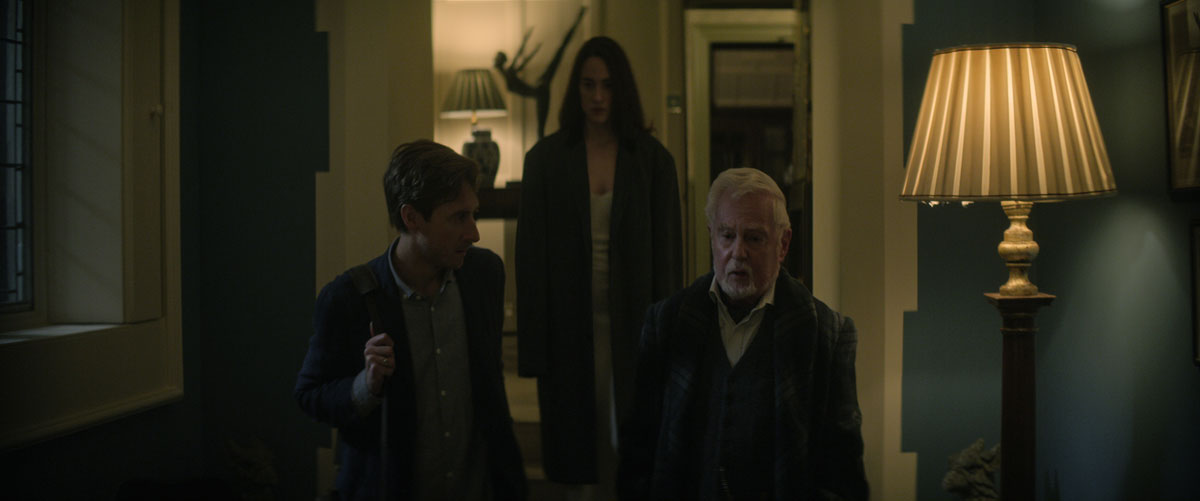
Still, he recognizes the deal that brings him Calliope (played by Melissanthu Mahut) is criminally exploitative. Richard trades a bezoar made from a clump of hair to obtain Calliope from acclaimed author Erasmus Fry (Derek Jacobi), who captured Calliope in 1927.

Fry is at the end of his life and has stripped all the wealth and fame he wants from Calliope’s powers, and hands her over as if she were a piece of used-up livestock. “They say one ought to woo her kind, but I must say I found force most efficacious,” Fry says before adding, as if to soothe Richard, “Oh don’t be fooled – she’s not human. She’s thousands of years old. She was created for this. This is her purpose: to inspire men like us.”

Nevertheless, Richard tries the kinder way first, showering Calliope with flowers, chocolates, perfume, and other luxuries to wrest the smallest thread of an idea from her. But she insists she won’t comply until he frees her and then offer supplication. He still refuses, then attempts his version of a prayer: “I am drowning, Calliope. Please. I am begging you.”

“Ask me again when I am free,” she replies gently.

Every written and visual update to the story reflects the perspective of women who have their version of a Richard Madoc encounter to tell, or many, whether experienced first or second-hand, whether physical or emotional.

Casting Arthur Darvill as Richard further augments the horror of the character’s crimes: Darvill is best known for playing the “Doctor Who” companion Rory Williams, the man who loved his fiancée enough to stand guard over her for 2,000 years. Rory is the ideal man: devoted, smart, courageous and loving.

Richard resembles a certain TV series creator-turned-director who built his career on a reputation for writing supernaturally strong women.

Richard, on the other hand, stares at a blank computer screen after this painful talk before coming to a decision. Hooper keeps the camera trained on the empty digital page as we hear Richard knock on Calliope’s door and say her name . . . before the scene cuts to black and silence. When the story resumes, “Ric”  is tapping his computer’s keyboard with wild satisfaction. His shirt is unbuttoned past his sternum and on his cheek is a fresh, still-bloody scratch.

Whether intentional or not on the part of Smyth-McMullen, Richard resembles a certain TV series creator-turned-movie-director who built his career on a reputation for writing supernaturally strong women.

You may recognize the outline of his features in Richard’s party banter or a subsequent phone conversation with his agent where he demands that his film production’s cast and crew be made up of at least 50% women and people of color. Then he tells him to be sure to publicize that, because he wants his fans to know what a fantastic guy he is. Especially women.

He also has a lot in common with the comic who made a public show of his allyship with female comedians, only to be outed for his habit of forcing other women to watch him masturbate when he got them alone. Really, though, Richard could be any number of famous men who crow about their feminism in magazine profiles and red carpet interviews while abusing women in their private lives.

Finding out the truth of who these men are constitutes a bone-deep betrayal for some fans who believed in the false image they cultivated. This is especially true of the ones who, as Richard tells Calliope, designed their art to inspire people – women, specifically – instead of simply entertaining the public.

The SandmanArthur Darvill as Richard Madoc, Melissanthu Mahut as Calliope and Derek Jacobi as Erasmus Fry in “The Sandman” (Courtesy Of Netflix)

“Writers are liars, my dear,” Fry pompously tells Calliope after she reminds him that he agreed to free her at the end of his life. Richard repeats it to her later, when he’s long past the point of needing her to survive and has simply decided he wants more of everything – fame, wealth, and worship.

Smyth-McMullen reshapes Calliope into a goddess who was trapped but not resigned to her exploitation. She takes every step possible to free herself from Richard until, finally, Dream (Tom Sturridge) answers her call.

Then “Calliope” turns into a vengeance story: Dream castigates Richard for holding Calliope captive and orders him to free her. He whines that he needs her. “Hold your tongue,” Dream growls. “She has been held captive for more than 60 years. Demeaned. Abused. Defiled. And you will not set her free because you need ideas?”

In response, Dream gives Richard Madoc what he wants, and it ruins him even after he frees the imprisoned Muse.

A few social media posts questioned whether a story centered on a woman’s violent sexual exploitation should be featured in “The Sandman” at all, regardless of its changed context.

Want a daily wrap-up of all the news and commentary Salon has to offer? Subscribe to our morning newsletter, Crash Course.


But this episode is everything that “Games of Thrones” – along with every other show that treats rape as a narrative device designed to stir up a man’s rage or add complexity to a woman’s story – is not. Hooper doesn’t show her physical suffering. She doesn’t need to. No director ever did. If we appreciate Calliope’s fortitude, rage and, ultimately, her grace in the aftermath of her ghastly confinement, it is because of her dignified righteously angry way she carries herself when Richard isn’t in her presence. Mahut and her writer never let us forget that she’s a living goddess, not a possession.

It’s also clear that Dream respond to Calliope’s entreaty from a place of empathy, which is an unfamiliar concept for an Endless. But none of his siblings spent decades in a box, having been swindled by a cheap man whose talent level might be described at best, as middling. Neither did they come to his aid. He knows Calliope’s plight because he lived it. Helping someone he used to love makes him better than those who failed him.

In this way, “Calliope” indicts men like Richard Madoc while granting benediction to everyone who feels swindled by those like him, figures who owe whatever image burnishing they gain to pilfered power. Some writers, comics, and other artists, may indeed be liars. But “The Sandman” defeats this trickery with an inspired view of a woman’s truth . . .  even if that tale began as a flawed product of a man’s imagination.

All episodes of “The Sandman” are streaming on Netflix.  


How “House of the Dragon” subtly set up another “Game of Thrones” spinoff

The series premiere of “House of the Dragon” is here, and it’s a doozy. The first ever successor series to “Game of Thrones” has gotten off to a resoundingly good start for HBO, already becoming the most successful premiere ever for the network. That’s nothing to sneeze at, considering just how long HBO has been in the premium television game.

Yet while “House of the Dragon” is wowing critics and audiences (or scarring them beyond belief, depending on how you reacted to that one horrifying scene), it’s already doing a bit of legwork to help set up the greater “Game of Thrones” cinematic universe. It’s no secret that HBO has numerous spinoffs in development based on the works of George R.R. Martin. While “House of the Dragon” may end up being a good way to gauge audience appetites for more Westeros, it’s already laid some very subtle groundwork for a future show.

There will be very mild spoilers below for the House of the Dragon series premiere, “The Heirs of the Dragon.”

“House of the Dragon” teases another “Game of Thrones” spinoff

The series premiere of “House of the Dragon” introduces us to two of the show’s main characters: heir apparent Rhaenyra Targaryen (Milly Alcock), and her best friend and daughter of the Hand of the King, Alicent Hightower (Emily Carey). Both Rhaenyra and Alicent are complex characters, with shades of Arya or Sansa or Cersei depending on how you squint at them. Their relationship will be at the core of this show.

During the premiere, the two girls are hanging around the Godswood in King’s Landing while Alicent quizzes Rhaenyra on her histories. Specifically, Alicent is asking Rhaenyra questions about the Princess Nymeria, who sailed 10,000 ships away from her homeland by the River Rhoyne and eventually landed in Dorne. This is a fascinating easter egg because we know that one of the other “Game of Thrones” spinoffs that HBO has in development — working title” “10,000 Ships” — is about Nymeria and her odyssey.

Nymeria is a prominent historical figure in George R.R. Martin’s world, and this mention on “House of the Dragon” isn’t the first time she’s been alluded to on screen. Back on “Game of Thrones,” Arya Stark named her direwolf after the Rhoynish princess, and there were a handful of tiny mentions of the warrior princess at various points.

However, “House of the Dragon” is the first time that Nymeria’s history was laid out so plainly for viewers. Here’s Rhaenyra’s accounting:

Princess Nymeria led her Rhoynar across the Narrow Sea on 10,000 ships to flee their Valyrian pursuers. She took Lord Mors Martell of Dorne to husband, and burned her own fleet off Sunspear to show her people that they were finished running.

Whether this was inserted into “House of the Dragon” to intentionally pave the way for “10,000 Ships” or it’s just a fun easter egg because Rhaenyra is the sort of rebellious teenage girl who might look up to Nymeria, it still lets viewers know about this tale. Should HBO end up going through with “10,000 Ships,” no doubt this scene will take on a much deeper meaning for fans.

“House of the Dragon” premieres new episodes every Sunday on HBO and HBO Max. As for the other “Game of Thrones” spinoffs, our watch continues.

Doug Mastriano says it’s “disgusting” to discourage conversion therapy for LGBTQIA+ kids

Doug Mastriano, Republican nominee for Pennsylvania governor, was Thursday’s guest on conservative talk radio station 103.7 FM and spent a good portion of his segment talking about conversion therapy for LGBTQIA+ youths. 

In response to the news that current Pennsylvania Governor, Tom Wolf, and Democratic gubernatorial nominee Josh Shapiro are against the practice — which uses different methods to “cure” a person of sexual identities outside of heterosexuality — Mastriano made a passionate case to the contrary.

“This is disgusting to me, where bureaucrats and Tom Wolf — and Josh Shapiro — think it’s okay to come in and threaten parents and therapists because their kids might be confused,” Mastriano said to radio host Michele Jansen. 

On August 16, Governor Wolf signed an executive order to protect the LGBTQIA+ community from state agencies who offer conversion therapy, but no part of that contained any such “threatening” of parents and therapists.

“Conversion therapy is a traumatic practice based on junk science that actively harms the people it supposedly seeks to treat,” said Wolf on the order. “This discriminatory practice is widely rejected by medical and scientific professionals and has been proven to lead to worse mental health outcomes for LGBTQIA+ youth subjected to it. This is about keeping our children safe from bullying and extreme practices that harm them.”


Want a daily wrap-up of all the news and commentary Salon has to offer? Subscribe to our morning newsletter, Crash Course.


Josh Shapiro, who is ahead in the race for governor against Mastriano according to Huffington Post, echoes Wolf’s views saying “As Governor, I’ll pass nondiscrimination in Pennsylvania, ban conversion therapy practices for minors, and invest in mental health resources for youth . . . LGBTQ+ rights are human rights.” 

Circling back to Gov. Wolf’s newly signed order to crack down on conversion therapy, he highlights in it that “researchers found that when they accounted for the harms caused by conversion therapy – including negative mental health outcomes and substance use – conversion therapy costs our nation $9.23 billion each year.”

Shia LaBeouf refutes “Don’t Worry Darling” firing claims, says he “quit” – and found God

The behind-the-scenes “Don’t Worry Darling” buzz continues apace, and this time Shia LaBeouf is weighing in.

The “Transformers” actor has refuted claims that he was fired from “Don’t Worry Darling” and allegedly he has the receipts. LaBeouf was originally going to play the role of Jack, before it was recast with musician-turned-actor Harry Styles.

In the upcoming Olivia Wilde-directed psychological thriller, set in the 1950s, Jack and his wife Alice (Florence Pugh) move to company town Victory, California – a picture-perfect place full of Jack’s peers and their wives. When Alice becomes curious about Jack’s project and begins to snoop around, tensions rise as she realizes that their idyllic life is not what it seems.

The rather challenging material – both physical and emotional – that Pugh would have to tackle is why Wilde intimated that she had decided to let LaBeouf go in the first place.

In a Variety cover interview to promote the film, Wilde said, “I say this as someone who is such an admirer of [LaBeouf’s] work. His process was not conducive to the ethos that I demand in my productions. He has a process that, in some ways, seems to require a combative energy, and I don’t personally believe that is conducive to the best performances. I believe that creating a safe, trusting environment is the best way to get people to do their best work.”

Wilde added, “For our film, what we really needed was an energy that was incredibly supportive. Particularly with a movie like this, I knew that I was going to be asking Florence to be in very vulnerable situations, and my priority was making her feel safe and making her feel supported.”

Variety categorized the dismissal of LaBeouf as Wilde’s decision.

LaBeouf’s side of the story

It’s that narrative that prompted LaBeouf to speak up. He emailed Variety Thursday and claimed he was not fired from “Don’t Worry Darling” but instead on August 17, 2020 he “quit the film due to lack of rehearsal time.” LaBeouf also reportedly forwarded the trade publication two emails that he had sent Wilde after the cover story came out, in which he writes, “You and I both know the reasons for my exit. I quit your film because your actors and I couldn’t find time to rehearse.”

LaBeouf also sent Variety a series of screenshots of text messages he allegedly sent to Wilde and ones he claims to have received from the director. In the text messages, the two appear to be going back and forth as to whether or not he is going to take the film role. According to Variety, in one text message allegedly sent by the director after the two had met in person to discuss the film, Wilde wrote, “I’m gutted because it could have been something special. I want to make clear how much it means to me that you trust me. That’s a gift I’ll take with me.”

In his letter allegedly sent to Wilde, which Variety published in full, LaBeouf wrote, “Firing me never took place, Olivia. And while I fully understand the attractiveness of pushing that story because of the current social landscape, the social currency that brings. It is not the truth. So I am humbly asking, as a person with an eye toward making things right, that you correct the narrative as best you can.”

Meanwhile, LaBeouf is currently involved in a lawsuit. His former partner, musician FKA twigs, is suing him over claims of sexual battery, assault and inflicting emotional distress. The trial date is set for the spring of 2023. 

News of the lawsuit came out shortly after LaBeouf departed “Don’t Worry Darling.” The following month, LaBeouf left his agency and entered an inpatient facility for treatment of an unknown origin, though he later alluded to alcohol abuse issues.

The actor has a history of emailing news publications; when the lawsuit became public, LaBeouf emailed The New York Times, who broke the lawsuit story, and wrote, “I’m not in any position to tell anyone how my behavior made them feel. I have no excuses for my alcoholism or aggression, only rationalizations. I have been abusive to myself and everyone around me for years. I have a history of hurting the people closest to me. I’m ashamed of that history and am sorry to those I hurt.”

It appears that these developments may have affected Wilde, who told Variety, “A lot came to light after this happened that really troubled me, in terms of his behavior. I find myself just really wishing him health and evolution because I believe in restorative justice.”

LaBeouf finds God

After taking a hiatus from acting in 2020, LaBeouf is acting again. He’s been making the rounds promoting his upcoming film, the Italian-German biographical drama “Padre Pio” by Abel Ferrara (“The Bad Lieutenant”). The actor stars as the real-life priest who was known for exhibiting stigmata and was subsequently beatified and canonized by Pope John Paul II. Watch an exclusive trailer, via Variety.

During the course of filming the movie, LaBeouf converted to Catholicism, as he explained to Bishop Robert Barron in a lengthy YouTube interview. LaBeouf described his recent experiences, including the lawsuit, as a wake-up call.

“I didn’t want to be alive anymore when all of this happened,” he said. “Shame like I had never experienced before — the kind of shame that you forget how to breathe. You don’t know where to go. You can’t go outside and get like, a taco, you don’t want to go anywhere. But I was also in this deep desire to hold on.”


Want a daily wrap-up of all the news and commentary Salon has to offer? Subscribe to our morning newsletter, Crash Course.


For the film, LaBeouf — who famously claims to have an intense, possibly destructive acting process — was asked by the director to research, including spending time at a Catholic seminary, where he started to read the Bible. “I know now that God was using my ego to draw me to Him,” LaBeouf said. “Drawing me away from worldly desires.”

Both “Don’t Worry Darling” and “Padre Pio” will premiere at the Venice Film Festival in September.

“See” Season 3 release schedule: When do new episodes of “See” Season 3 come out?

See” season 3 arrives Aug. 26 to the Apple TV+ streaming platform, are you ready for it? The Jason Momoa series left fans to deal with a huge cliffhanger after an action-packed duel. Needless to say, we can’t wait to see what happens next! How many episodes will be in “See” Season 3 and when will each episode be released? We have all the details for you here!

From the Maghra reveal to the battle with Baba Voss, it was all super exciting (and also stressing), but we’re ready for it all to continue. Not to mention, this upcoming season is the final one in the series! How will is all end? There’s only one way to find out. But before we dive into the “See” season 3 episode schedule, let’s check out the teaser trailer.

“See” Season 3 episode release schedule

Season 3, just like the first two seasons, will include eight episodes. Now, for being the final season to conclude all events, I was expecting more episodes, but I’ll take what I can get. It’ll be an exciting eight weeks, that’s for sure. Here is when each episode of “See” season premieres:

  • Episode 1, Aug. 26
  • Episode 2, Sept. 2
  • Episode 3, Sept. 9
  • Episode 4, Sept. 16
  • Episode 5, Sept. 23
  • Episode 6, Sept. 30
  • Episode 7, Oct. 7
  • Episode 8, Oct. 14

As you can see (no pun intended), the episode titles have not yet been revealed. We should learn the titles soon enough as we get closer to the premiere. Also, you’ll notice that only the first episode will be available to stream on Aug. 26 when Apple TV+ (and a few other streaming services) typically release the first two-three episodes of a series. For “See” Season 1, the first two episodes became available on premiere night, but Season 2 only gave us one and season 3 will follow.

The Apple TV+ series stars Jason Momoa, Alfre Woodard, Sylvia Hoeks, Here Hilmar, Christian Camargo, Nesta Cooper, Dave Bautista and more.


Amy’s Kitchen wants to “heal” the planet. Some of its workers allege harassment, unsafe conditions

Amy’s Kitchen, a privately held company run by the Berliner family, has been a staple in the organic and vegetarian sections of supermarkets since the late ’80s. Amy’s website features a mix of photographs of its now-iconic products — like frozen macaroni and cheese and vegetable-packed canned soups — as well as blog posts about how the company wants to “heal” the planet and the ways in which it supports workers. 

“We are so very proud of where Amy’s Kitchen is today, and we sincerely thank every employee and every person who eats our food for helping us get here,” wrote Andy Berliner, the company’s chief executive officer, in an Aug. 18 blog post

He continued, “We also know in some ways the journey has only just begun, particularly as we strive to maintain our values as a family-owned company while we continue to grow. We are committed to always learning, listening and improving. And, as we remain committed to cooking quality, healthy and organic food for you and your family.” 

Over the past year, however, Amy’s has been plagued by a series of workplace complaints, including allegations of unsafe conditions and union-busting tactics. Most recently, the company has been accused of mishandling sexual harassment allegations in a new report from Eater. 

In an Aug. 24 article by Eater staff writer Jaya Saxena, workers at the former San Jose Amy’s plant outlined an alleged “pattern of sexually inappropriate behavior and claimed that HR did not sufficiently act on complaints of harassment.”

According to employees — some of whom spoke anonymously or used pseudonyms — a line supervisor at the plant allegedly fondled himself while speaking to younger female employees.


Want more great food writing and recipes? Subscribe to Salon Food’s newsletter, The Bite. 


“He puts his hand inside [his coat] and talks to the girls, [we] can see that he’s touching himself,” one worker told Eater via a translator.

However, employees said “their complaints were either dismissed or they received retaliation for speaking out.” Some told Eater that managers allegedly filed their own complaints against workers who had reported inappropriate behavior.

Salon Food reached out to Amy’s Kitchen for comment, but didn’t receive a response as of publication. In a statement to Bon Appetit, the company said: “While we believe our processes have been followed, the allegations that have been raised are deeply concerning and do not reflect the safe, supportive work environment we intend to create.” 

This ongoing series of complaints stands in contrast to the wholesome public image Amy’s Kitchen has long cultivated.

This ongoing series of complaints stands in contrast to the wholesome public image Amy’s Kitchen has long cultivated. 

In January, NBC News reported that a group of factory workers alleged production lines had “steadily increased in speed over the years without corresponding increases in pay or better resources to prevent injuries.” Some claimed to have sustained injuries from the repetitive motions involved with working on the line while having few breaks. As a result, one worker, Ines De La Luz, said she had to put her arm in a brace. According to De La Luz, her position was eliminated shortly after “she learned she was a candidate for surgery to treat her arm injury.”

Just a few weeks later, as Eater San Francisco reported, an employee filed a formal complaint with the California Division of Occupational Safety and Health (OSHA) claiming that workers had not been given access to the bathroom or drinking water during shifts at a Santa Rosa production facility for Amy’s Kitchen. 

This sparked an investigation that led California regulators to fine Amy’s Kitchen nearly $25,000 for more than a dozen health and safety violations, three of which were deemed “serious” because of “the risk of severe injury or death to workers.” 

“The fact that there were no reported worker injuries from these safety hazards at the time of the inspection indicates the employer was lucky, not safe,” said Garrett Brown, a retired compliance safety and health officer who reviewed the OSHA findings for KQED. “These are real safety hazards which can have real adverse consequences on people’s health and safety.”

“The fact that there were no reported worker injuries from these safety hazards at the time of the inspection indicates the employer was lucky, not safe.”

In addition to the allegations of unsafe working conditions, leadership at Amy’s Kitchen has also been accused of behavior that some classify as “union busting.” Earlier this year, the company closed its San Jose plant, citing rising production costs amid inflation. However, some allege that Amy’s Kitchen actually shuttered the plant because workers were discussing unionization. 

Major companies, including Starbucks, have been accused of this common union-busting tactic. 

Lauren T. Ornelas, founder and president of the Food Empowerment Movement, subsequently called for a boycott of Amy’s Kitchen products.

“If [Amy’s] wants us to believe that the damage they’ve done in the lives of these workers, the damage they’ve done to San Jose, my community, had nothing to do with these workers trying to get just some basic rights for themselves, then I hope the company proves it,” Ornelas said in a statement to Paste.

She continued, “And that they prove it by making sure that all the workers at all the other facilities that work for Amy’s know that they are fine with them unionizing, they will not interfere and that they’re going to let go of their union-busting lawyers.”

I’ve studied what happens to women when they are denied abortion — and it’s not good

In its decision to overturn Roe v. Wade — which means abortion may now be banned in almost half the country — the Supreme Court made a catastrophic decision. As someone who studies the effects of access to abortion, I can say that denying someone a wanted abortion causes real, lasting harm to them and their families.

I led the Turnaway Study, a nationwide study of what happens to women when they receive or are denied an abortion. Over a decade, my colleagues and I interviewed nearly 1,000 women who sought abortions from 30 facilities around the country. Based on these findings, we know not having control over the timing and circumstances of birth changes the whole trajectory of that person’s life, making it harder, and for those who are already struggling, even worse. 

Consider, first, the economic impact. Many people seeking abortions are already experiencing financial hardship. Given the rising costs of raising a child in the United States, it is perhaps no surprise that we found that women who received abortion care were more likely to be employed and more likely to be able to pay for basic living needs such as food, housing and transportation than women who were denied abortions. They were also less likely to have household incomes below the federal poverty line years later, be evicted, or declare bankruptcy.

As one woman profiled in our study told researchers: “It is very, very difficult to find a job when you’re pregnant, to keep a job when you’re pregnant, and to find or maintain a job with a baby.” Being denied a wanted abortion and having a child, she said, “sent my life completely off the rails.”

By contrast, another woman profiled in the study told our research team that if she hadn’t been able to raise funds for her abortion, “I might not be here today, or my kids might be in foster care.”

The majority of women seeking abortion care are already parents—and many are trying to do what’s best for their kids. Children of mothers who are able to obtain abortions are less likely to live in poverty and more likely to achieve developmental milestones. This extends to future children too: Women who are able to receive wanted abortions are more likely to have an intended pregnancy under better circumstances later.

We know not having control over the timing and circumstances of birth changes the whole trajectory of that person’s life, making it harder, and for those who are already struggling, even worse.

While it has long been argued that having an abortion places people at risk of psychological harm, we found that being denied an abortion — not receiving one — was associated with short-term elevated levels of anxietystress, and low self-esteem. People with a history of mental health conditions, trauma and abuse, and those who felt people close to them looked down upon them for seeking an abortion, were at greatest risk of experiencing adverse psychological outcomes post-abortion seeking.

For those turned away from abortion, many women faced life-threatening complications as their pregnancy developed. Two women in the study died as a consequence of being denied an abortion and going on to give birth. The medical literature shows that people are 14 times more likely to die from childbirth than from abortion. The maternal mortality and morbidity crisis in the United States means that women, especially Black and American Indian women, face the risk of serious pregnancy complications. The greater physical health risk doesn’t end at childbirth. We found that those forced to continue with their pregnancy reported more chronic head and joint pain and worse overall health for years after.


Want more health care and reproductive rights stories in your inbox? Subscribe to Salon’s weekly newsletter The Vulgar Scientist.


One of the most important things I learned from the Turnaway Study is that people are thoughtful about their decision to end an unwanted pregnancy. They understand their current responsibilities and aspirations. The outcomes we found for women who were denied an abortion closely reflect the reasons women gave for not wanting to carry a pregnancy to term in the first place. They foresaw the consequences of having a child when they were not emotionally or financially ready, when they were not in a healthy relationship, and when they were struggling to take care of their existing children. Five years after obtaining care, 95% of those who did have an abortion said that it had been the right decision for them.

The United States was founded on principles of economic freedom and personal fulfillment, as embodied in the “life, liberty and pursuit of happiness” phrase in the Declaration of Independence. Roe was a step toward realizing this vision. Now that the Supreme Court has stripped people of the right to make their own decisions about their bodies, their children and their families, the harms to women and their families we found in the Turnaway Study will be multiplied manyfold. We will see a future in America that betrays the principles and progress of its past.

Tips for packing a zero-waste school lunch

For parents with young kids, it has already begun: the messaging onslaught from the advertising machine, telling you that you need to buy everything new, that a new school year requires new supplies. Well, don’t believe the hype! For those of you who pack your kids’ lunch, now is the time of year to start thinking about lunchboxes, containers, etc. But they do not need to be new. Our family definitely doesn’t do it that way.

If you’re like us and you’d rather cut down on waste and trash and instill your children with values around reducing waste from both packaging and food, here are my tips and tricks for packing a zero-waste lunch.

Assess what you have

I start every August with assessing what lunch supplies we already have in stock, making sure everything is in clean, useable shape and that zippers still work, there are no holes, rips or tears. If there are things that are broken, we mend them in both undetectable and visible ways. I don’t believe in coaxing a kid into being more excited about school by buying them a whole new shiny sparkly set of everything.

For at least three years we’ve been operating at 85% reuse. My kids know that reusing is better for them and the planet, and we save our money for things that truly cannot function anymore. My advice is to, if you can,  buy higher quality items in the first place, since it will save you money and waste less in the long run. We will also spend on things like shoes, which we all know kids grow out of at double-pace during the summer — and if they’re still in good condition, they’ll be passed on to someone who’s feet they fit.

Green supplies

Here are some ideas for the best supplies for packing a zero-waste lunch.

Lunch boxes

Before running out to buy a reusable lunch box, first assess what you have at home. Scope out the kitchen for candy, tea or cookie tins. Reusing a cookie tin is not only eco-friendly, it’s also comical to roll up at your cafeteria table and have your classmates think for a moment that “yes, in fact I AM eating an entire tin of butter cookies for lunch and I’ll do it every day for the rest of the school year, just you watch!”

Why not get double-usage from things your kids are already into? Pokemon card tins are great for snack-sized meals. You may have an extra Lego basics tub that you can empty out and transform into a useful carrier. Shoeboxes and other household containers may be a possibility, too, and if you’ve exhausted your search and found nothing, I recommend stopping by your local second-hand shop or a neighborhood listserv to see if anyone else might be parting with gently-used options they no longer need. If all else fails, the last stop is to buy a new good-quality lunch box and use that for as many years as possible. I suggest picking a style/type that will age well with your kid, from elementary age through middle and high school/college usage.

Sandwich and snack bags

We are a household that does have a few plastic snack bags in it and we rinse and clean them out for multiple use; it’s been years since I purchased any. An Irish neighbor of mine once told me that when she went home from the US to visit family, she brought them a box of resealable plastic bags; when she came back the next year with another box, her family asked her why on earth she would bring another one, since they were still happily using — via washing and cleaning out — the first ones she gave. Use what you have until the proverbial hubcaps fall off, and if you do find yourself in a position to replace, consider some of these ideas and options:

  • silicone bags
  • bundled bandanas
  • reusing small containers your grocery items come in; i.e. even small things like small metal candy/mint tins can house small snacks.

Extend the life of supplies you have

Just because your reusable supplies start to break, does not mean they need to get thrown out. If a lunch bag zipper starts to malfunction, you may be able to fix it!  If that doesn’t work, you can still squeeze a little more life out of it by using an elastic band or two to hold it shut. Make your own (I’d recommend a wide elastic with a sewn-in hook-and-loop closure so you could belt the bag through the carrying handle) or look around your house and repurpose a couple of fun elastic headbands you might have lying around in a drawer. If you’re handy with sewing and replacing the zipper proves futile, you might refashion a spare tea towel or pillow case into a fitted drawstring slip cover that you can slide over the insulated lunch bag, keeping the inside yummies cool and in place. Make a couple and use them alternately to make for a fun weekly opportunity to switch up the overall lunch box look.

Include your kids

I decided early on to indoctrinate my kids into my ethos of low waste, so they would understand why we do what we do, and take the lead when possible. I coached my kids early to bring home every single thing they take to school in their lunch bags, from utensils to food scraps. This training involved a few years of gentle reminders, numerous trips to national parks and camping sites (following instructions to take out what you bring in) and their own observations that some school cafeterias provided no compost or recycling options to students. In such cases, they learned to be self-reliant, seeing that their extra effort to bring it all home meant that we could compost, reuse and recycle containers for the next day.

The Hmong farmers who feed the Twin Cities’ farmers markets

Shortly after arriving in Minnesota in 1995, William Thao’s Hmong parents began farming their new home land just like many Hmong refugees do. While the soil and climate are different from the hills and mountains of Laos and Thailand that they’re used to, Thao’s parents brought and adapted their traditional subsistence and small-scale agriculture practices to the state, growing lilies and peonies alongside vegetables like Brussels sprouts, corn, asparagus and tomatoes. The larger Hmong immigrant community that they’re a part of has introduced Minnesotans to treats like bitter melon and various Thai chili peppers.

In the decades that have followed, Hmong farmers have found a natural match in the almost 70 farmers’ markets that dot the Twin Cities metro area. Today, Hmong farmers make up roughly 50% of the growers at metro markets. Despite their critical role in local food production, the challenges that all growers contend with tend to hit Hmong farmers harder. Language barriers keep the group from accessing resources more readily available to English-speaking farmers while their elemental approach to growing can leave them ill prepared to weather catastrophes like the major drought that hit the state last year.

Yet, despite these challenges and more, Hmong farmers like Thao’s parents continue to persist through the difficulties that have faced them and are poised to enjoy a farmers’ market season that, if the weather cooperates, will hopefully return to pre-pandemic levels.

The history of Hmong farms in Minnesota

Hmong farmers came to Minnesota in droves in the ’70s and ’80s after the CIA recruited the minority group to assist the US in the Vietnam War. After the war ended, the US eventually offered the Hmong people refugee status. Local and statewide agencies in Minnesota stepped up to welcome the group. Today the Twin Cities have the highest metro concentration of Hmong people in the country.

Both a desire to stay connected to home as well as a lack of experience with a post-industrial society drove many Hmong Minnesotans to farming, revitalizing the Twin Cities’ farmers’ market scene in the process. In the canned food frenzy that characterized the decades leading up to the arrival of Hmong Americans, “farmers’ markets were starting to fail,” explains David Kotsonas, director of operations at the Hmong American Farmers Association (HAFA), a nonprofit cooperative dedicated to the prosperity of Hmong farmers in Minnesota.

Farmers’ markets were shrinking and falling out of favor with consumers. “We were losing produce growers until the Hmong farmers came in and really revitalized the numbers. They found a home within our farmers’ markets and an avenue for sustainability,” Kotsonas says, just as immigrant communities have across the country, from California to Pennsylvania.

In the years since, Hmong farmers have grown accustomed to selling produce they harvest from small, often rented plots of land at several Twin Cities farmers’ markets throughout the season. Selling at up to eight or nine markets a week isn’t uncommon for Hmong growers — and the local community and its tastes have adapted to their ubiquitous presence.

Hmong farmers “are a very strong anchor for produce diversity and availability at [farmers’] markets,” explains Mao Lee who previously managed the Minneapolis Farmers Market before recently starting a new role managing a suburban market. “They support a wider community and customer base because there are some customers who come to the market looking for certain things like bitter melon or Asian mustard greens that aren’t offered by grocery stores or traditional white farmers.”

Recent challenges

Naturally, the pandemic and the restrictions and shut downs it brought was especially hard on Hmong farmers, but, in some ways, last summer’s major drought was even more challenging. By August 2021, most of Minnesota was blanketed with severe, extreme, or even exceptional drought conditions — the first time that any part of the state had made it to the most severe level of drought in the 21-year history of the US Drought Monitor. For some parts of the state this was the worst drought seen in 40 years when Hmong people began arriving in the US.

Thao’s parents’ farm in Hampton, Minnesota some 36 miles south of Minneapolis, has just one water hose to satiate their thirsty crops, and it doesn’t even reach the farthest corners of their fields. “Without irrigation, you can only water one section at a time and that takes a long time,” Thao says. The result was the loss of one-third of their crops at a loss of roughly $10,000 on produce alone, leaving the family with only enough to sell at two markets per week instead of their usual six. “My parents couldn’t do anything about [the drought] because they don’t have irrigation,” Thao says, which is common among Hmong farmers.

“Such a large percentage of Hmong farmers still rent the land they farm,” explains Lee. “So installing such a permanent operating system like irrigation is either not allowed or why would they want to pay to install something on property that’s not theirs? It’s challenges like that that made it very, very hard for Hmong farmers to make it through that drought.”

Even when there is aid available for farmers, whether it’s for last summer’s drought or the COVID-19 pandemic, language barriers keep many Hmong farmers from taking advantage of the programs available to them or even hearing about them in the first place.

That’s where organizations like HAFA come in. During the pandemic the group helped its dozen or so farmer members, who sublet plots on HAFA’s 155-acre farm property, to pivot to a CSA program that now allowed them to sell their produce online when visitation to farmers’ markets tanked. “We can do wholesaling and CSA as a group, where individual farmers might not be able to,” Kotsonas says. But the benefits of HAFA aren’t relegated to just its members. Thanks to grants, HAFA “has created a lot of workshops, trainings and seminars on how to be better growers and grow more efficiently and sustainably,” he adds. “They can then be shared with other organizations throughout the country that are similar to HAFA.”

While HAFA’s farmers were far from impervious to the impact of last summer’s drought, the two wells that flank the organization’s farm property and the irrigation system that laces it helped soften the blow. This year, HAFA has been helping their farmers apply to a drought relief program offered by the state’s department of agriculture. “As soon as I find out about things like [this program], we get the information out to everyone so they can prepare. For those who want to take advantage of it, we hold open office hours to help them with the application,” Kotsonas explains.

Hmong growers also show up for each other outside of organizational support. Last summer, “everyone just called each other to talk about how their stuff was doing, how they’ve been keeping crops alive. Everyone shared tips,” Thao recalls. Despite a late start to the growing season thanks to a cold, wet spring, this year’s season is beginning to show the promise of something of a comeback after several trying years.

While drought and other extreme weather events are never one-time events thanks to climate change, so far this year precipitation levels have been circling average rates. But the dip in farmers’ market attendance from COVID seems to be over. For Minneapolis’ Mill City Farmers Market at least, traffic numbers are on track with their pre-pandemic 2019 rates. “The 2021 market season allowed [growers] to implement, improve and change,” Lee says. “2022 is the year to reset and do it all over again.”

DOJ affidavit reveals a “significant number of civilian witnesses” flipped on Trump: ex-prosecutor

The newly unsealed Department of Justice affidavit shows investigators relied on evidence from multiple sources to justify their search of Mar-A-Lago.

MSNBC’s Joyce Vance said the heavily redacted document, which the FBI used to obtain their search warrant for Donald Trump’s private resort, revealed their concerns that witnesses could face threats as part of an effort to obstruct their investigation of classified documents improperly removed from the White House.

“One very interesting tidbit we get from the legal memo that DOJ submitted to unseal the redacted version of the affidavit is what I think is the first effort to quantify the number of cooperating witnesses that DOJ had when they obtained this search warrant,” said Vance, a former U.S. Attorney. “They’re talking about the need to protect their witnesses from any sort of potential harm, and they say that there are a significant number of civilian witnesses. So we don’t know — is that five? Is that 10?”

“But I think it’s important to realize here that DOJ was not just relying on one or two witnesses,” she continued. “Likely this is, as they say, a significant number of civilian witnesses as well as people in law enforcement who need to be protected as this investigation moves forward, and that puts into context what we’re looking at here.”

“We’re talking about a former president of the United States who’s clearly taken with him when he left office materials, whether they’re classified or not, that could do grave damage to our national security if they’re disclosed in an inappropriate fashion, and not only is that former president resistant to returning those documents, also DOJ has legitimate reasons to believe that there are risk to witnesses who are helping complete this investigation,” Vance added. “That should be a sobering moment for us to realize we’re in this situation with former President Trump.”

Government lawyers had opposed the release of the affidavit but the judge ordered it unsealed with redactions the Justice Department said were necessary to protect an ongoing investigation involving national security.

FBI agents raided Trump’s Mar-a-Lago estate in Palm Beach, Florida on August 8, seizing boxes containing a large amount of highly classified documents that Trump had not returned to the government despite multiple requests and a subpoena to do so.

The unredacted version of the affidavit likely explains in detail what the department is investigating in relation to Trump and could possibly reveal sources.

But Judge Bruce Reinhart accepted Justice Department arguments that there was a “compelling” need to mask significant portions of the document.

Reinhart had ordered the release of the redacted affidavit by noon (1600 GMT) on Friday — and the fevered anticipation surrounding its publication caused the federal court website to crash.

Trump launches Truth Social attack on judge after DOJ releases partial Mar-a-Lago affidavit

The Justice Department on Friday released a partially redacted version of the affidavit that prompted the FBI’s raid on Mar-a-Lago.

The legal affidavit, which was used to secure the search warrant on Mar-a-Lago, suggested that human source intelligence, Foreign Intelligence Surveillance Act and signals intelligence and other highly sensitive documents were found among boxes of documents stored at former President Donald Trump’s residence.

Agents found 184 documents, 25 of which were marked “top secret” and 92 of which were marked “secret.” Another 67 were marked “confidential,” the lowest level of classification. Some of the documents contained what appeared to be Trump’s “handwritten notes.”

The FBI received information that classified documents were located in a storage room, Trump’s residential suite, his office and other spaces around Mar-a-Lago, according to the affidavit. “Probable cause exists to believe that evidence, contraband, fruits of crime, or other items illegally possessed” in violation of multiple laws related to classified documents will be found at Mar-a-Lago, the affidavit said.

The FBI asked for the affidavit to be sealed because the agency has “not yet identified all potential criminal confederates no located all evidence related to its investigation.”

Key parts of the document were redacted after the Justice Department said that the investigation was still ongoing. In a separate filing on Friday, the DOJ defended the redactions to protect witnesses.

“If witnesses’ identities are exposed, they could be subjected to harms including retaliation, intimidation, or harassment, and even threats to their physical safety,” the DOJ said. “Information in the affidavit could be used to identify many, if not all, of those witnesses,” the filing added.

The filing also said that revealing certain information could “severely disadvantage the government as it seeks further information from witnesses.” It argued that these concerns are not “hypothetical,” noting the “FBI agents who have been publicly identified in connection with this investigation have received repeated threats of violence.”

Trump seized on the redactions in the affidavit, arguing that the document does not mention information related to nuclear secrets that the FBI searched for, according to the Washington Post.

“Affidavit heavily redacted!!!” Trump wrote on Truth Social. “Nothing mentioned on ‘Nuclear,’ a total public relations subterfuge by the FBI & DOJ, or our close working relationship regarding document turnover – WE GAVE THEM MUCH. Judge Bruce Reinhart should NEVER have allowed the Break-In of my home. He recused himself two months ago from one of my cases based on his animosity and hatred of your favorite President, me. What changed? Why hasn’t he recused himself on this case? Obama must be very proud of him right now!”


Want a daily wrap-up of all the news and commentary Salon has to offer? Subscribe to our morning newsletter, Crash Course.


Trump also lashed out at the Justice Department ahead of the release.

“The political Hacks and Thugs had no right under the Presidential Records Act to storm Mar-a-Lago and steal everything in sight, including Passports and privileged documents,” he claimed. “They even broke into my safe with a safecracker – Can you believe? This Act was created for a very good reason, and it works. We are right now living in a Lawless Country, that just so happens to be, also, a Failing Nation!”

But legal experts said even the redacted affidavit appears damning for the former president.

“I have seen enough, folks. Donald Trump will be indicted in the classified documents matter,” tweeted national defense attorney Bradley Moss. “The Trump team was incompetent enough to think this affidavit would be good for them,” he added.

“All of it is bad, but Trump having documents derived from human intelligence (i.e. spies) floating around Mar-a-Lago is about the worst imaginable offense in this space,” wrote former Justice Department official Matthew Miller.

Presidential historian Michael Beschloss marveled at the revelations.

“No other ex-president has ever pulled something like this,” he wrote. “We need to discover, if we can, exactly who was given information from these highly classified documents,” he added. “Were they foreign nationals?  Were they enemies of the United States?”

See the full redacted affidavit below:

Mar-a-Lago affidavit by Igor Derysh on Scribd

Blondie’s mind-blowing “Against the Odds” box set includes the fan’s Holy Grail of archival songs

We live in the great age of box sets. Career-spanning retrospectives, classic album deep-dives, state-of-the-art remixes. Repackaged for resale. A dime a dozen. You name it, we’ve got it. Which is why a compilation like Blondie’sAgainst the Odds, 1974-1982” gives a listener pause.

As with most box sets, “Against the Odds” arrives in multiple configurations, sporting the usual titles — “Super Deluxe,” “Deluxe,” et al. But the important takeaway here, as always, is the music. And Blondie’s box set absolutely rocks. If you’re a completist, I’m delighted to report that the collection includes everything.

Naturally, the band’s original studio albums are in evidence, supplemented by 52 rarities and outtakes. Of particular note are the group’s breezy, unreleased “Mr. Sightseer” and — as the Holy Grail of Blondie’s unreleased archives — a long-rumored cover version of the Doors’ “Moonlight Drive.” For the latter, Blondie amps up the Doors’ bouncy original version with the sizzle and crack of New Wave-era gusto.

If you enjoy geeking out to your favorite bands, “Against the Odds” doesn’t disappoint. The Super Deluxe edition weighs in at an incredible 17 pounds, featuring two separate hardcover books — one of which includes Erin Osmon’s extensive liner notes, as well as commentary from the band members and essays by Richard Gottehrer and Mike Chapman. A second volume affords listeners with a lavishly illustrated discography.

But the real standouts are the remastered versions of Blondie’s first six studio albums, including “Blondie,” “Plastic Letters,” “Parallel Lines,” “Eat to the Beat,” “Autoamerican” and “The Hunter.” There is a depth and immediacy inherent in the remastered LPs. Casual fans and aficionados alike will revel in the opportunity to embark on an aural journey across the band’s career, listening intently as the group refines their sound in advance of pumping out smash hits like “Heart of Glass,” “One Way or Another,” “Dreaming,” “Call Me,” “The Tide Is High” and “Rapture.”

And what a journey it was, as Blondie eclipsed their genre, crackling with energy and lording over the New Wave era in unforgettable style. Clocking in with a mind-blowing 124 tracks, the box set was remastered by Michael Graves, who retains the band’s original sound, while affording their songs with greater separation and definition — an aspect that should be music to the ears of audiophiles the world over.

In a veritable sea of box sets, “Against the Odds” manages to succeed where so many others have fallen short. Chock-full of surprises and extras, the anthology never strays from the reason we all originally tuned in to the ragtag band of New Yorkers in the first place — the music.


Love deep dives into musicians’ careers? Listen to Ken’s podcast “Everything Fab Four.”


Biden finally busts out the F-word: MAGA is “semi-fascism” — the only problem is the use of “semi”

One can already hear the crying and gnashing of teeth: Thursday night, President Joe Biden called the MAGA ideology “semi-fascism.”

As researcher Parker Molloy noted on Twitter, Fox News has been desperate for a repeat of Hillary Clinton’s (entirely accurate) description of Donald Trump voters as “deplorables,” and will not be able to resist the bait. The mainstream media’s gaffe obsession will likely slot this comment into a “he slipped up” framework, unable to imagine that a Democratic politician might, once in awhile, say something truthful about the red hats on purpose. Hands will be wrung. Statements will be issued. The Republican National Committee has already described this moment of truth-telling “despicable,” a word they notably did not use after Trump sent a violent mob to the Capitol to overthrow democracy. 

It’s all noise. Strapped to a lie detector, everyone would have to admit the only problem with Biden’s statement is he overloaded it with caveats. First in the use of the term “semi,” but also in limiting his remarks to “MAGA,” as if that’s a separate category from Republicans in general. In reality, the number of Republicans who won’t support Trump in another run is, as the last election showed, frighteningly small.


Want more Amanda Marcotte on politics? Subscribe to her newsletter Standing Room Only.


There is no need to dance around the subject: Trump is a fascist, as evidenced by his Mussolini-style effort to overthrow the U.S. government and install himself illegally in power. Everyone who supports him is therefore also a fascist. Fascism, like punching someone in the face, isn’t one of those things that we define by examining the unknowable heart of a person. We look at the action. Are you planning to vote for a fascist? Do you give money to a fascist? Do you participate in gaslighting propaganda on behalf of fascists? Congrats: You’re a fascist!

As former Republican Max Boot recently wrote in the Washington Post,  “the most apt phrase for this American authoritarianism is the New Fascism, and it is fast becoming the dominant trend on the right.”

The first step to getting people to wake up is chipping away at the wall of denial that fascism could happen in America.

Nor should anyone mistake Biden’s comment for a “gaffe.” Unlike Clinton’s “deplorables” remark or Barack Obama’s “bitter clingers” remark — both true, yet turned into faux outrages by the media — Biden’s full quote sounds quite a bit like someone choosing their words with deliberation. 

“What we’re seeing now is either the beginning or the death knell of an extreme MAGA philosophy,” the president told attendees at a Maryland fundraiser Thursday night. “It’s not just Trump, it’s the entire philosophy that underpins the — I’m going to say something — it’s like semi-fascism.”

“I’m going to say something.” Biden was clearly signposting that he is aware that his comment could set off a firestorm. 

Coming off a series of big political wins on gun control, climate change, and student loan forgiveness, Biden seems to be going into the fall with a lot more fight in him than we usually expect from a politician who spent years carefully crafting an image of bipartisan chumminess. On the same day as the “semi-fascism” remark, the White House Twitter account issued a legitimate sick burn on Rep. Marjorie Taylor Greene, R-Ga., after the born-wealthy congresswoman whined about student loan forgiveness. 

Even with all the heavy caveating, it’s smart for Biden to get that word “fascist” out there. It’s crucial for getting Americans to truly understand the threat we’re facing from Trump and his fascist goons. 

Democrats have largely been conservative in their language to describe the threat, hoping to get through to people who will stop listening the second they hear the word “fascism.”

Trump’s best weapon is the unwillingness of Americans to accept that fascism can, in fact, happen here. For the past year and a half, Trump and his propagandists have sought to spin the events of January 6 as something other than the fascist insurrection it clearly was. There’s been a lot of lies about how it was a “peaceful protest” and attempts to blame the unmistakable violence on imaginary FBI and “antifa” infiltrators. These efforts have been disturbingly successful, due to a widespread myth that the United States is somehow immune to the same fascist politicking that has, at various points in time, conquered other democracies around the globe. The mainstream media has only made it worse with an unwillingness to disturb this myth by leveling with their audiences about the threat we face


Want more Amanda Marcotte on politics? Subscribe to her newsletter Standing Room Only.


To be fair to everyone who has danced around the F-word, the myth of American exceptionalism means that properly labeling Trump causes a lot of people, even those who really should know better, to dismiss you as hysterical. Subsequently, Democrats have largely been conservative in their language to describe the threat, hoping to get through to people who will stop listening the second they hear the word “fascism.” So instead you hear rhetoric like “democracy is on the ballot,” disconnected from blunt explanations about why that might be. 

The problem with such pussyfooting is that its very carefulness means that it won’t drive the public conversation.

In April, Ezra Klein of the New York Times hosted political strategists Sean McElwee and Anat Shenker-Osorio and they hammered this point repeatedly, that hyper-caution backfires. “[T]he media likes conflict,” McElwee underscored, and will therefore slide past stories that don’t center conflict. On motivating voters, Shenker-Osorio noted, “What we find activating is tapping into that F-U sort of spirit, rather than, I’m going to go cower in the corner.”

Another round of January 6 hearings will no doubt reinforce Biden’s use of the word “fascism” to describe Trump and his MAGA crowd. 

It’s a major reason that Trump — with his actual lies and hyperbole — manages to exert so much control over what people are talking about in both political and social media. He will throw provocations out there, which will both delight his followers and get the media to cover him more. Biden is now doing the same thing — but with honesty. A lot of pundits will likely spend the weekend quarreling on cable news about the definition of “fascism” and whether Trump meets it. Many of them will annoyingly use academic-sounding caveats to deny, on some technicality, that Trump is a full-blown fascist, ignoring his obvious longing to meet that gold standard. But whatever. At least they’ll be talking about it and, crucially, using the word “fascist.”

The first step to getting people to wake up is chipping away at the wall of denial that fascism could happen in America. Just hearing the word used a lot in respect to American politics will help whittle away that defensive head-in-the-sand reaction. 

Biden’s gambit is well-timed. It’s on the heels of the first round of January 6 committee hearings and in anticipation of another round, promised for the fall. Anyone who watched the hearings cannot, in good faith, ignore that the evidence points to Trump leading a deliberate plot to overthrow an election, and using mob violence to do so. Indeed, as former White House aide Cassidy Hutchinson’s testimony indicates, Trump fully imagined himself leading the mob to confront Congress, an image that, befitting a reality TV star, owes more to cinematic myths of fascist takeovers like Mussolini’s March on Rome than reality. Trump, remember, has a lot of fantasies about how awesome it was to be a fascist leader. Another round of January 6 hearings will no doubt reinforce Biden’s use of the word “fascism” to describe Trump and his MAGA crowd. 

Having this debate about fascism, in the ordinary people public and not in the pages of the New Yorker, is necessary. Yes, a lot of Republicans are not personally invested in a fascist ideology but are merely conservatives who go along with Trump to maintain their own power. Certainly, this seems to describe people like Senate Minority Leader Mitch McConnell or House Minority Leader Kevin McCarthy, both of whom have chafed at times under Trump’s leadership but ultimately help him to protect their own power. That is always the case when fascists rise to power. They always depend on powerful conservatives who will side with fascists instead of progressives. But this is a distinction without a difference, once conservatives accept fascists as their leaders and work for them. Getting Americans to understand that means talking about it. And talking about it means using the F-word. 

“The lawyering is so bad”: Legal expert calls out Trump attorneys’ staggering “incompetence”

CNN’s Elie Honig absolutely shredded former President Donald Trump’s legal team on Friday when discussing their stumbles in trying to defend their client in court.

While talking with CNN host John Berman, Honig went through Trump lawyers’ recent request to have an independent third party go through all the documents seized by the FBI at Mar-a-Lago earlier this month to determine if any of them are covered by executive privilege.

Honig said that the request itself was not remarkable — but that the Trump team’s incompetence in trying to make it was.

“The problem is Trump’s legal team just blew it,” he said. “The filing is a mess. Procedurally, the lawyering was so bad it was hard to look at, it made my teeth hurt.”

Honig then explained how this wasn’t just his personal opinion alone, as the judge who reviewed the filing threw it back in the Trump lawyers’ faces.

“The judge… rejected it!” he said. “She basically said why now, this motion is coming too early, why me, why not the other judge and what exactly do you want? I think they were fairly clear about what they wanted. The judge said, ‘Go back to the drawing board, do it right this time, file by Friday.'”

Watch the video below or at this link.

RNC leak: Megadonor urges Republicans to claim tax hikes on billionaires like him hurt workers

Leaked audio obtained this week by Politico revealed that billionaire casino magnate and GOP megadonor Steve Wynn recently offered Republicans a bit of messaging advice as they attempt to win back control of the Senate: Amplify the lies about Democratic tax policies.

During a Wednesday conference call hosted by the Republican National Committee, which is seeking to wrangle big-money donors amid internal concerns that the party’s Senate chances are dimming, Wynn recommended “hard-hitting” ads with scripts warning ominously: “They’re coming after you if you’re a waiter, if you’re a bartender, if you’re anybody with a cash business… they’re coming after you.”

Wynn, a once highly prominent figure who has been accused of sexual assault and illegal lobbying, didn’t specify which Democratic tax policies he was referencing. But Steve Rosenthal, a senior fellow at the Tax Policy Center, told the Washington Post Thursday that Wynn’s suggested messaging resembles GOP attacks on increased funding for the Internal Revenue Service, which Republican lawmakers have systematically deprived of resources for years—a major boon to rich tax-dodgers and large corporations.

“The lack of resources prevents the IRS from ensuring that large and sprawling operations pay their full tax bill,” Rosenthal said in an interview with the Post‘s Greg Sargent and Paul Waldman. “The point of increased enforcement is to pursue these businesses.”

Wynn’s advice came after the GOP had already launched hysterical attacks on the $80 billion in IRS funding included in the newly enacted Inflation Reduction Act, which passed both chambers of Congress this month without a single Republican vote. In floor debate over the package, House Republicans falsely claimed the funding would enable “robbery” by gun-wielding IRS agents.

In reality, the money will go toward ensuring the agency is capable of mundane tasks—such as answering phone calls—as well as giving it the capacity and resources to audit ultra-rich taxpayers whose returns have gone under-examined for years.

Earlier this year, the Transactional Records Access Clearinghouse published an analysis showing that the IRS audited low-income wage earners at a rate five times higher than everyone else in Fiscal Year 2021, a trend the agency has blamed on the higher costs of auditing wealthier taxpayers.

In a letter to the IRS chief earlier this month, Treasury Secretary Janet Yellen specifically instructed the tax agency to use the new funding from the Inflation Reduction Act to “increase equity in the tax system by enforcing the tax laws against those high-earners, large corporations, and complex partnerships who today do not pay what they owe.”

As Rosenthal put it to the Post, “Wynn is trying to push Republicans to scare the little fish into thinking the IRS is targeting them, when in fact the IRS has pledged to target the big fish.”

Sargent and Waldman argued in a column Thursday that “it’s pretty revealing for Wynn to be urging Republicans to attack those policies by arguing that their real victims will be waiters and bartenders.”

“Democrats should jump on this,” they wrote.

According to Politico, the 36-minute conference call also featured Republican National Committee Chairwoman Ronna McDaniel begging rich donors to inject funding into Senate races as GOP leaders openly raise doubts about the party’s prospects of retaking the upper chamber in November.

Recent polling in the key battleground states of Pennsylvania and Wisconsin, for example, shows that Democratic candidates John Fetterman and Mandela Barnes have opened up leads against their Republican opponents.

“Please help us invest in these Senate races specifically,” McDaniel told donors on the call. “Give to any of these Senate candidates, all of these Senate candidates if you can, so all of them can be on TV.”

Politico reported that Wynn “asked whether there are any dark-money nonprofits that contributors could give to.”

Donors, he said, “are self-conscious for reasons that are personal to them, business people and folks like that.”

“Women were always crying”: Leaked video exposes Amy Coney Barrett’s secretive Christian group

Leaked video of a recent event hosted by People of Praise, a secretive Christian sect to which Supreme Court Justice Amy Coney Barrett belongs, shows one of its leaders admitting the group’s teachings drove women into tears.

The video from the group’s 50th anniversary celebration shows Dorothy Ranaghan, wife of founder Kevin Ranaghan, telling members that women who first made a “covenant” to join People of Praise in the 1970s cried intensely in response to teachings about their roles in relationships with men, reported The Guardian.

“Some of the women – who are still in my women’s group, as a matter of fact – were wearing sunglasses all the time, because they were always crying and would have to hold on to their chairs every time somebody started teaching, because ‘What are we going to hear this time?'” Ranaghan said. “But it all worked out just fine in the end.”

The video was leaked to The Guardian by a source who wished to remain anonymous, and it’s the first time a statement from the group has been issued about women’s response to teachings about men’s “headship” of the family and dominance over women.

Barrett lived with the Ranaghans when she attended law school at Notre Dame, although she has never publicly disclosed or discussed her membership in People of Praise, where her father served in a leadership role and she served as a “handmaid,” saying only that she is a devout Catholic and her faith would have no bearing on her duties as a judge.

A former group member stated in a sworn affidavit filed in the 1990s that Kevin Ranaghan exerted almost total control over her when she lived in the family’s household and made all decisions about her dating relationships and finances.

Republicans, gobsmacked by abortion backlash, furiously backpedal in a struggle to rebrand

A couple of months ago it was widely accepted conventional wisdom that the Democrats were toast in November. There was endless blather about historical precedent, presidential approval ratings, gas prices and backlash leading to a “Red Tsunami” that would bring the Republicans a huge new congressional majority. Everyone could just take the summer off and reconvene in the days before the election to witness the glorious GOP victory.

But a funny thing happened on the way to the drubbing.

Democratic voters were aroused from their torpor by various events that seem to have mobilized them in unexpected numbers. This analysis by Austin Sarat and Dennis Aftergut in Salon points out that voters are concerned with a number of issues that were not thought to be on the ballot, particularly the assault on democracy they saw illustrated by the January 6th Committee hearings and the bold attacks on voting systems they are observing all over the country. This was not supposed to be a voting issue according to the jaded beltway CW, certainly not as long as people had pecuniary interests at stake. (The assumption is always that the American people care about nothing but their own pocketbooks.)

Democratic voters have good reason to believe that maybe their chronically underwhelming party is actually capable of accomplishing something.

The mass shootings this summer have also had an effect. The country was particularly horrified by the elementary school shooting in Uvalde, Texas which killed 19 fourth graders and two teachers in their classrooms. That event even spurred Congress to enact a minor bipartisan federal gun law, the first in many years, showing that there may be cracks in the pro-gun proliferation movement at long last.

In fact, the substantial list of somewhat miraculous legislative achievements coming out of this very narrow congressional majority has given Democratic voters good reason to believe that maybe their chronically underwhelming party is actually capable of accomplishing something, The big Inflation Reduction Act came as a huge surprise after months of dizzying negotiations. It delivering such a surprisingly good climate change package was the icing on the cake. This week’s announcement on student loan forgiveness will likely make it even sweeter.

Nonetheless, the issues that are driving the turnout are mainly based upon concerns about the right’s dangerous unwillingness to confront the existential problems we face and its relentless quest to turn back progress and roll back fundamental rights. As analyst Ron Brownstein points out, the latest NBC poll shows that Democrats have a very different view of what matters in this election than Republicans.

And I haven’t yet mentioned the biggest issue that is stimulating Democrats to get out and vote: abortion. 


Want a daily wrap-up of all the news and commentary Salon has to offer? Subscribe to our morning newsletter, Crash Course.


Salon’s Sophia Tesfaye wrote about the latest evidence of its salience citing the bellwether special election in New York’s 19th district this week in which Democrat Pat Ryan beat his Republican rival by putting abortion rights at the top of his agenda. In races around the country this summer, Democrats are outperforming expectations, and first-time women voters are registering in big numbers. Tesfaye notes:

In Michigan, a poll conducted this month discovered that abortion is now tied with inflation and rising prices as the most important issue to voters — and Democrat Gretchen Whitmer is leading in the gubernatorial race. Nationally, nearly two-thirds of Americans said the end of Roe represented a “major loss of rights” for women, according to a Washington Post-Schar School poll conducted last month. A Pew poll released on Tuesday found that 56% of registered voters said the issue of abortion will be very important in their midterm vote, up from 43% in March. “Virtually all of the increase has come among Democrats,” Pew wrote

It turns out that Americans don’t like their rights being taken away from them. Go figure.

Republicans are scrambling to deal with this. Apparently, they believed they could just ride the red tsunami without having to lift a finger. Even aside from the terrible candidates they have put on offer, mostly thanks to Donald Trump, it appears they have dropped the ball in numerous other ways. Florida Senator Rick Scott is in hot water for floating on a mega-yacht in the Mediterranean while headlines blare about his poor management frittering away tens of millions of dollars as the chairman of the Republican Senate Campaign Committee. The Republican National Committee (RNC), meanwhile, is having to send out distress signals to their big donors because Donald Trump is hoarding all the small donor cash and the party is left desperate for funds.

Even more revealing is the fact that Republicans have belatedly discovered that their medieval approach to reproductive rights isn’t a big winner, even with many of their own voters. After years of portraying abortion as murder, pushing “fetal personhood” and lately deciding that it should be banned even in cases of rape, incest and the health of the mother, it turns out that these archaic ideas are the kiss of death in swing states.

Republicans allowed their fanatical anti-choice base to run wild for years under the assumption that they would never have to face voters with their outrageous claims because of Roe v. Wade.

For instance, Nevada’s Republican candidate for Senate, Adam Laxalt, previously supported a ban on abortion after 13 weeks and, as state attorney general, supported restricting access to birth control. Now he doesn’t want to talk about any of that saying that the right to abortion is “settled law” in Nevada. (Anyone who trusts those words coming out of the mouth of a self-described “pro-life” Republican after what the Supreme Court Justices just did is a fool.)

An even better example is Blake Masters, the GOP nominee for Senate in Arizona. On Thursday he scrubbed his campaign website of his far-right anti-abortion rhetoric, now claiming that he’s the “common sense” candidate who supports abortion up to 15 weeks. This is a man who endorsed every fanatical anti-abortion idea the right-wing came up with, including granting “personhood” to a fertilized egg and promoting the grotesque notion that abortion is genocide:

https://youtu.be/nbJn6iroegc

No amount of backtracking can erase that sentiment. Democrats should just run that ad as is.

The Republicans have a problem, a big one. They thought they had an easy win on their hands and they could get right to business impeaching Joe Biden and shutting down the government for shits and giggles but it appears they have a real race on their hands instead. But their problem is actually more serious than just this midterm election. The abortion issue is going to haunt them for the foreseeable future, over and over again as one state after another grapples with the mess they made for themselves. They allowed their fanatical anti-choice base to run wild for years under the assumption that they would never have to face voters with their outrageous claims because of Roe v. Wade. Now they do and it’s not going well for them. There’s a bigger lesson in that if they would care to learn it.