Spring Sale: Get 1 Year, Save 58%

Is Austin Butler really singing in the movie “Elvis”?

Elvis is now playing in theaters and the movie has it all. An amazing soundtrack, a carefully stitched story, and impactful performances. For starters, what a talent Austin Butler has proven to be! But is he really the one singing? Is Austin Butler really singing in the movie Elvis?

We have to give a shout to the young Chaydon Jay, who plays the role of a young Elvis Presley. This star is going places, be on the lookout for him in future projects! Jay masterfully portrays Elvis as a kid, from his emotions to some killer dance moves.

As audiences see Elvis grow, Austin Butler takes over and continues the passion in music that Jay helped install. And as if Butler’s performance wasn’t enough, there’s also the fact that he sings, too!

Note: If you haven’t seen the movie in theaters just yet, there are no spoilers ahead so read on.

Yes, that is Austin Butler is singing in Elvis

As Entertainment Weekly shares, Butler is the one singing in the first performances in the movie. As Elvis becomes more famous and develops, Butler’s voice is “blended” with that of Elvis’.

So which songs feature Butler’s voice? Here’s a quick list, first shared by Variety:

  • “I’ll Fly Away”
  • “That’s All Right”
  • “Baby, Let’s Play House”
  • “Blue Suede Shoes”
  • ” Heartbreak Hotel”
  • “Working on the Building”
  • “Hound Dog”
  • “Are You Lonesome Tonight?”
  • “Trouble”
  • “Crawfish”
  • “Here Comes Santa Claus”
  • “If I Can Dream”
  • “Suspicious Minds”
  • “Can’t Help Falling in Love”

Yeah…what a talent! Did you know Austin Butler was singing or did you assume it was all the King of Rock and Roll?

Will you be watching the movie in theaters or are you waiting until Elvis becomes available on stream? Also new this weekend: Marcel the Shell with Shoes On (limited release), Love and Gelato (Netflix), and The Black Phone (theaters).

We asked experts how they make fireworks that explode into shapes

Fireworks have come a long way since they were first discovered in 200 B.C.in China.

Historians believe that fireworks were created by accident when bamboo was tossed into fire. Then, around 800 B.C., an alchemist allegedly mixed sulfur, charcoal, and potassium nitrate in a search for eternal life— instead, the mixture led to gunpowder.

RELATED: The life of a pyrotechnician

Gunpowder was used in early wars, but it didn’t take long for people to notice that the mixture being shot into the night sky also led to something reminiscent of what looks like fireworks today. Flash forward to Europeans immigrating to America, the tradition of launching fireworks to commemorate Independence Day dates back to a letter John Adams wrote to Abigail Adams in 1776. In it, he wished for future generations to observe the day with “Shews, Games, Sports, Guns, Bells, Bonfires and Illuminations from one End of this Continent to the other from this Time forward forever more.” The first official Fourth of July fireworks reportedly occurred the following year.


Want more health and science stories in your inbox? Subscribe to Salon’s weekly newsletter The Vulgar Scientist.


Today, firework shows are quite the spectacle. And the fireworks themselves don’t always look like wilting willow trees or shooting stars in the sky. Instead, they come in various shapes and sizes— from animals to flowers to written text. Known as “patterned fireworks,” these types of fireworks are relatively new to the fireworks world. We asked pyrotechnician Mike Tockstein, a licensed pyrotechnic operator in California, and owner and operator of Pyrotechnic Innovations, more about how these fireworks work.

How long have these existed?

Pattern shells have been around since at least the 1990s in the United States, but it’s hard to say they were not used before that in other countries or even further back in time. Recall that fireworks were invented in China in the 9th century, so that is a long time to think of new ways of doing things.

How does it work? Is it newer technology?

I would certainly call it old technology. They don’t differ much at all from your standard peony shell, which is the most basic of all aerial fireworks being a round shell which breaks in a large spherical pattern in the sky. Notice what I did there? “Pattern.” That’s right, a spherical shell will break symmetrically due to a number of well-known principles in physics; such as conservation of momentum which says momentum before and after the explosion must be equal, therefore the momentum of the material moving in one direction has to equal that of the material moving in the exact opposite direction. 

Now it’s obviously more complicated than that and there are other physics at play, but if a shell is built properly and the casing fails in a uniform fashion, a spherical shell will break in a spherical pattern. Now that we understand that, the only thing you have to do is lay the stars out inside the shell in the same pattern you want to see in the sky, it’s literally that simple.

What shapes exist?

Pattern shells started with simple shapes such as hearts, but now-a-days you are only limited by your imagination.  Happy faces, rings, cubes, stars, spirals, alphanumeric letters, Saturn shells which look like a planet with a ring around it, I think I even saw a Bozo the Clown face one time. Here is a video of a few Jelly Fish shells, where you can clearly see the cap and tentacles.

Could someone request a custom, complicated shape, e.g. an @ sign? How complicated is it for these kinds of fireworks?

Yes, if far enough in advance, a custom pattern shell could be made in most cases.  An @ sign would be fairly simple since it is a simple 2D spiral shape.  More complicated shapes could take longer to figure out, fabricate, and test.

How are they designed so that they explode in a manner that the shape is visible from the ground?

Given that a smiley-face is 2D, presumably if it exploded such that its plane were perpendicular to the viewer, it would appear to look like a straight line.

They are designed as a 2D shape, so the orientation they explode in the sky is important to being able to see the pattern. The shells themselves cannot orient themselves a certain way when shot out of a mortar. To overcome this, whenever we do a happy face or other pattern shell “look” during a show, we send multiple shells up so that statistically one or more will likely break with the proper orientation to the audience.

Are they more expensive than normal fireworks or more complicated?

Not in a significant way. It’s not much more difficult to make a happy face shell than it would be a standard peony and that would go for most 2D shapes. When you get into the more complicated patterns, or 3D shapes, then you would likely see a price bump.

Read more about fireworks

The “Stranger Things” season 4 finale gives Metallica’s “Master of Puppets” the Kate Bush push

The “Stranger Things” season 4 finale can best be described as “metal as hell,” and its use of Metallica’s “Master of Puppets” will likely thrust the time-honored metal band into the same viral streaming surge that Kate Bush‘s “Running Up That Hill” still runs (and runs and runs and runs) up. 

In the finale, Eddie Munson (Joseph Quinn) performs what he calls “the most metal concert ever” in the Upside Down during an attempt to help his friends vanquish the Big Bad of the season, a demon named Vecna. 

Quinn, a new addition to the cast with his role as Eddie, a Dungeons & Dragons playing high school super-senior, spoke to Entertainment Weekly about the pivotal scene in the finale, and his experience playing guitar, saying “I wouldn’t consider myself a brilliant guitarist, but I can play it.”

The actor, who has played guitar since he was seven years old, went on to tell EW that when the season 4 scripts made the rounds at some point during the pandemic, he did start “practicing pretty furiously” to gear up for his big scene in the Upside Down. 

“I listened to a lot of heavy metal,” Quinn says. “That was my . . . God, it’s impossible to not sound pretentious when you say it, but, yeah, that was my way in.”


Want a daily wrap-up of all the news and commentary Salon has to offer? Subscribe to our morning newsletter, Crash Course.


Watch the fairly spoiler-free scene featuring Quinn as Eddie playing Metallica’s “Master of Puppets” below:

“Master of Puppets” is the title track of Metallica’s 1986 album and is featured on the official soundtrack for “Stranger Things” season 4 alongside Kate Bush’s “Running Up That Hill,” off of her 1985 album, Hounds of Love. Reaching a whole new level of popularity after being featured in part one of “Stranger Things” season 4, “Running Up That Hill” broke three world records, landing at the top of the UK’s Official Singles Chart for the first time in over 36 years. 

Read more

about this topic

How to make homemade pizza muffins, a super kid-approved dish

Learn to make easy pizza dough with an array of toppings such as marinara sauce, pepperoni, basil leaves, shredded mozzarella, and parmesan cheese for lots of savory gooeyness.


Watch this recipe

Pizza Muffins

Yields
12 servings
Prep Time
3 hours
Cook Time
1 hour 55 minutes

Ingredients

  • 3/4 cup warm water (110°F to 120°F)
  • 1 1/2 teaspoons active dry yeast
  • 1 teaspoon granulated sugar
  • 2 cups all-purpose flour, plus more for the work surface
  • 1/3 cup extra-virgin olive oil
  • 1 1/2 teaspoons kosher salt
  • Softened butter, for the pan


Directions

  1. In the bowl of a stand mixer with the dough hook attached, combine the water, yeast, and sugar. Let stand until foamy, about 3 minutes. Add the flour, olive oil, and salt and knead the dough until it is smooth and stretchy, 5 to 10 minutes. Scraped down the sides of the bowl, form the dough into a neat ball, cover, and let rise until doubled, about 1 1/2 hours.
  2. Butter a 12-cup muffin pan or add liners. On a lightly floured surface roll the dough out to about a 7×15-inch rectangle. Spread the sauce evenly over the surface. Sprinkle with pepperoni and basil. Top with mozzarella and Parmigiano Reggiano. Starting from the long end, carefully roll the dough up and pinch the seam closed.
  3. Slice the dough into 12 equal pieces and transfer to the prepared pan. Cover with plastic and let the dough puff one more time, about 30 minutes. Heat the oven to 375°F.
  4. Top with a bit more sauce and cheese. Bake until the muffins are set in the center and golden brown, 20 to 30 minutes. Transfer the tin to a rack and let cool for 5 minutes then use an offset spatula to remove the muffins to a serving plate. Serve immediately with more warm sauce for dipping.

Why are there so many ancient fountains featuring little boys peeing?

Spend enough time studying classical art, and you might start to notice a lot of urine. Specifically, little boys’ urine. Wander through an art museum for just a few minutes and you’re bound to come across a lovingly rendered depiction of a little lad relieving himself, like a Renaissance-era version of the peeing Calvin bumper sticker. A European city would almost feel incomplete without a fountain blasting water from the tiny penis of a cheeky sculpted boy. But why?

Oddly, a peeing boy can represent opposing things. On the one hand, there’s a childlike innocence to seeing a youngster whimsically widdling without a care in the world. On the other hand, there’s some ultra-masculine virility involved. 

Modern guidebooks offer nearly a dozen different explanations for why Brussels’s famous peeing-boy statue, the cheerfully named Mannekin Pis (which translates to “little man pee”) is relieving himself. These include several almost certainly apocryphal incidents: An infant Duke Godfrey III of Leuven peeing on enemy soldiers; a toddler putting out a fire that would have engulfed the city; a tiny tinkler extinguishing an explosive charge that would have killed thousands — nobody really knows.

There are plenty of peeing fountains of larger men which lack this ambiguity: A statue from Pompeii of the perpetually erect god Priapus, pouring forth endless fluid from his forearm-sized penis, was clearly not meant to symbolize childlike innocence. Similarly, a style of statue known as Hercules mingendating from Roman times, of a drunken Hercules happily taking a leak, was unambiguously celebratory.

It’s thought that the peeing-boy trope might have come about in the Renaissance era in the mistaken belief that it was a common Roman motif. While Roman art featured plenty of little boys, often in cherub form, few were draining their main vein. The Renaissance revival of classical styles and themes somehow brought with it torrents of urine. The motif is known as puer mingens, translating literally as “peeing boy,” but also carrying a euphemistic meaning referring to ejaculation.

In their 2020 paper “The Problems of Meaning and Use of the Puer Mingens Motif in Fountain Design 1400–1700,” Cambridge architects James Campbell and Amy Boyington point out the frustratingly unclear meanings of endless tinkling toddlers, writing: “As a natural bodily function, often carried out more publicly in the past than it is now by both sexes, urination was no doubt viewed differently in the Renaissance and Baroque, but exactly how and why it was used as a motif in painting and in fountains remains puzzling and the object of continuing debate.”

In some depictions, it’s clear what is meant to be conveyed. Lorenzo Lotto’s painting Venus and Cupid, dating from the 1520s and hanging in the Metropolitan Museum of Art in New York City, was painted as a wedding gift and clearly represents fertility, albeit in a very silly way. In Michelangelo’s Children’s Bacchanal, the Renaissance great’s drawing of a group of incredibly drunk toddlers, one of whom is peeing into a bowl about to be given to his pal, it’s all about the joy and freedom of excess. But in other works, it can be incredibly difficult to tell. 

With fountains, in particular, there are only so many places it makes sense for water to emerge from on a human figure. There are statues of women where water gushes from the breasts, endlessly lactating, but these are rarer. Sometimes a weeing boy accompanies a lactating woman, as seen in Caritas Fountain in Copenhagen’s Old Square, which is meant to be symbolic of both love and charity. 

Ultimately, when it comes to peeing boys, all bets are off. It could basically mean anything. There’s pretty much no consistency, even when it comes to individual body parts: While most depictions are as lightly endowed as one would expect given both the art world’s proclivity for small penises and the reality of small children’s bodies, the 16th-century Fontaine des Pisseurs in Laucane, France, features four urinating boys with penises that could easily be used to rob a bank. 

These Renaissance artists really take the piss.

Younger voters agree with Democrats — but don’t trust them. Here’s how to fix that

New polling suggests that the Supreme Court’s recent decision overturning Roe v. Wade has the potential to drive a pro-choice majority to the polls, perhaps saving both houses of Congress for the Democrats and defying the normal loss of seats in a midterm, even in the face of Joe Biden’s erosion of support, which has been especially among younger voters. This makes some sense in term of Teen Vogue’s “Mid-Term Vibe Check,” conducted by Change Research, which showed that younger voters trusted Democrats over Republicans on abortion rights by a 31-point margin (52% to 21%), and also found 73% support for protecting abortion rights. Higher turnout among these voters could very well make the difference in November.

But that’s just part of the larger landscape illuminated by the poll. Amid the somewhat justified atmosphere of short-term panic, this survey of the under-35 electorate paints a picture of potential long-term Democratic dominance, if — and it’s a big if — the party decides to wake up and fight for its base, and the broader welfare of the American people. 

That 73% support for abortion rights is typical of a wider range of attitudes found in the poll, including support for fighting climate change (80%), Medicare for All (73%) and more. Another Supreme Court decision this term, undermining the EPA’s ability to fight climate change only serves to raise the stakes. Democrats have an opportunity to own the future if they respond to what younger Americans actually want, and get over the short-term conventional wisdom that has them caving to figures like Sen. Joe Manchin of West Virginia, who’s about as popular as the bubonic plague (6% approval). 

“To put it bluntly: Young voters think the United States’s economic and political institutions aren’t working for them and they don’t trust the powers that be to correct the course,” Fortesa Latifi reported for Teen Vogue. “Seventy-one percent of respondents say they feel mostly pessimistic about the future and 90% said the country as a whole is ‘on the wrong track.'” 

But in fairness, the poll shows a lot more than that. There are two big take-aways:

  1. Young voters overwhelmingly align with Democrats on a broad range of key agenda items, sometimes by a ratio of three to one or even more. 
  2. But they are deeply pessimistic about their future — about raising a family, owning a home and being able to retire — because of what they perceive as a rigged system that neither party can be trusted to fix.

Given this, the solution should be obvious: Take vigorous action to fight the rigged system, in order to gain power and use it to create real change. By doing that, Democrats could secure the allegiance of a whole generation of voters at levels similar to those of the New Deal era. Genuine populism would take the wind out of the GOP’s phony populism — not overnight, perhaps, but over time, as life-altering policies take effect.

To flesh out that first point, there’s more than three-to-one support on protecting the right to join a union (81%), fighting climate change (80%), a pathway to citizenship for Dreamers (79%), and raising taxes on the wealthy and corporations (78%). There’s only slightly lower support for canceling student debt (74%), protecting abortion rights (73%) and Medicare for All (73%). There’s even overwhelming support for the supposedly toxic issue of “defunding the police” (65% to 30%), when framed in terms of what a handful of cities, such as Los Angeles, have actually done: “reallocating some money currently spent on police and policing to other programs, like hospitals, social workers and schools.” 

In the so-far-imaginary universe where Democrats stood strong and delivered on these issues, they could establish rock-solid majority support for decades into the future — a far cry from the politics that younger voters have grown up with. 

In the so-far-imaginary universe where Democrats stood strong and delivered on key issues, they could establish solid majority support on a level not seen since FDR and the New Deal.

At the moment, Democrats have a 14-point advantage in party identification among younger voters (35% to 21%), which grows to 20 points among “leaners” (51-31). But voters are net negative on both parties, and while Democrats are trusted more on climate change, abortion rights and protecting LGBTQ rights, their advantage is very slim on immigration and nonexistent on the absolutely critical issue of fighting the corrupting influence of money, where neither party is trusted by the vast majority of  voters. 

So while abortion may be crucial to Democrats’ midterm fortunes, this last point must be seen as key in the long run. Younger voters believe they face a bleak future: In addition to the general climate of pessimism, they are worried about basic life benchmarks first made possible by Democrats during the New Deal and its aftermath, but which have become increasingly problematic. For instance, 74% said the “American dream” was once true but is no longer a reality, 73% agreed that “a college degree isn’t really worth it anymore,” 71% don’t expect to retire at a reasonable age and 67% worry that “I won’t be able to purchase a home during my lifetime.” Shockingly but not surprisingly, 83% agreed with the statement, “My generation is so burdened by the high cost of college, student loans, rent, and medical care that it is hard to think about being financially capable of raising a family.”  


Want a daily wrap-up of all the news and commentary Salon has to offer? Subscribe to our morning newsletter, Crash Course.


It bears repeating that it was Democrats, between the New Deal and the 1960s, who created 30-year mortgages, minimum wage laws, Social Security, workers’ right to organize, the GI Bill and Medicare, among numerous other social reforms.  All of these and more were products of massive Democratic majorities, and had some degree of Republican support, at least until the election of Ronald Reagan, who galvanized a right-wing electoral majority by declaring the federal government the enemy. Once Bill Clinton infamously declared, “The era of big government is over,” neither party was reliably committed to ensuring that these benchmarks were still in reach for most Americans. Supposedly, the free market would provide — which was effectively what Herbert Hoover believed when he did nothing to fight the Great Depression. 

The pessimism expressed in the Teen Vogue poll is the natural result of Democrats’ abandonment of those New Deal commitments. It’s no wonder young voters aren’t confident Democrats can deliver a better future, as noted in a Twitter commentary by the Revolving Door Project, which began: “They’re sending a clear message: If you want our votes, unrig our politics.” After that, specifics followed: 

While young voters trust Dems more overall on most policy issues, they rank both parties equally dismally on “Money In Politics” and nearly equally on “Corporate Greed.” There is near-zero faith that mainstream parties will ever represent the people instead of the wealthy elite…

That’s also reflected in who young voters trust. Of the seven prominent Democrats identified in the survey — Sen. Bernie Sanders, Rep. Alexandria Ocasio-Cortez, Joe Biden, Donald Trump, Vice President Kamala Harris, House Speaker Nancy Pelosi and Sen. Joe Manchin — only the two progressives, Sanders and Ocasio-Cortez, were viewed more favorably than not (54% to 34% and 44-33, respectively) while, as mentioned above, Manchin was in single digits.

Conventional wisdom still holds that bipartisan cooperation is the holy grail. But neither party is what it used to be — and neither can be trusted to resist the power of wealthy elites.

Conventional wisdom in Beltway media holds that polarization is the great evil in our politics today, and that bipartisan cooperation is the lost virtue. That may have been true 50, 60 or 70 years ago, when bipartisan cooperation was near an all-time high, with the interstate highway system established under Dwight Eisenhower, a coalition of Northern Democrats and Republicans voting to pass the Civil Rights Act and Richard Nixon signing legislation to created the EPA — all examples of big government action that significantly improved American life. In those days, there was competition to meet broadly-shared middle-class and working-class needs. But it didn’t last. Neither party is what it was then, and neither can be trusted to restrain wealthy elites. If both parties are so deeply distrusted, why trust their cooperation? If and when they cooperate, who is most likely to benefit? The Revolving Door commentary continues

young voters think THE BIGGEST ECONOMIC CHALLENGE THEY FACE is “The system is rigged for the rich and corporations.”

Not inflation.

Not healthcare costs.

Corruption.

Their conclusion was obvious:

So if the economy is the most important issue, and the biggest economic challenge young people face is a rigged system, then unrigging the system is paramount.

Of course, the system is also rigged institutionally — the unrepresentative Senate, exacerbated by the Jim Crow filibuster, the Electoral College, the Supreme Court, self-perpetuating state-level autocracies producing a heavily gerrymandered House of Representatives — which urgently needs addressing as well. But the Teen Vogue poll tells us that younger voters already understand that the economic system is rigged, so it makes sense to focus on that first, and use that fight to raise awareness of the larger institutional rigging of the political system.

Even with congressional action stymied, Biden could do a lot with executive actions, “as we’ve been urging him to for years now,” the Revolving Door Project wrote, linking to a January 2022 article, “What Biden’s Message Should Be.” Messaging is difficult in today’s fragmented media market, the article argued: “But one thing that all media creators do want is conflict. Conflict is at the root of all storytelling.” Based on poll-testing research with Data for Progress the project found a broadly popular fight for him to pick:

Put simply, our analysis shows that Biden is in desperate need of a villain, and what that should translate into is a corporate crackdown. Biden needs to take the fight to the elite villains who are screwing the American people. He needs to tell the public who the villains are, and he needs to fight them on the people’s behalf.As President, Biden has unique powers that could let him generate conflict on his terms—federal investigation, prosecution, regulation, and more. These policy tools are also powerful messaging opportunities.

Here, then, is the challenge for Biden: He needs villains whom he can credibly identify to the public as his adversaries and then pursue under longstanding law. He, and frontline Democrats down-ballot, need to know and believe they will be well-liked for pursuing these villains.

There’s strong support for a populist agenda, grounded in perceived injustice: 

Our polling finds voters agree with the following statements: “Wealthy people and corporations are regularly not punished for breaking the law” and “The criminal justice system unfairly targets poor people over rich people,” by margins of +67 and +48 percentage points respectively. 

Even majorities of Republicans agree, supporting “providing more funding to federal agencies which investigate corporate lawbreaking.” More specifically, the project noted that without passing any new laws, Biden could:

[C]rack down on the cottage industry of union-busting legal consultants employed by many of the most abusive firms; prosecute Mark Zuckerberg and Facebook for rampant fraud; indict ex-Boeing CEO Dennis Muilenberg for the hundreds of deaths in the 737 MAX tragedy that occurred on his watch; prosecute big banks for decades-worth of flagrant lawbreaking (an extremely popular prospect).

These suggestions represent just a fraction of the possibilities within Biden’s power to  act, as set out before the 2020 election in “The Day One Agenda” developed by the American Prospect under executive editor David Dayen. Writing about it here in December 2020, I quoted from Dayen’s introduction:

Without signing a single new law, the next president can lower prescription drug prices, cancel student debt, break up the big banks, give everybody who wants one a bank account, counteract the dominance of monopoly power, protect farmers from price discrimination and unfair dealing, force divestment from fossil fuel projects, close a slew of tax loopholes, hold crooked CEOs accountable, mandate reductions of greenhouse gas emissions, allow the effective legalization of marijuana, make it easier for 800,000 workers to join a union, and much, much more. 

Biden has failed to take those kinds of decisive big-ticket actions, and has failed to make such actions central to his presidency. As a result, he has allowed his first term to be defined by battles shaped by others, and by the accumulated problems left unaddressed by his predecessors — the problems so keenly felt by younger voters. 

This spring, the Congressional Progressive Caucus issued an “Executive Action Agenda” for the administration, developed “with input from the progressive grassroots movements who were key to delivering Democrats the majorities in both chambers and the White House.” (Full list here.) It’s precisely this combination — decisive executive action informed by grassroots movements in touch with younger voters’ lived experience — that holds the key to realizing the potential for long-term Democratic dominance. 

Very little can be done immediately to counter the overturn of Roe, and Democrats and progressives must be honest about that. But taking action on this broader range of issues can help secure a broader majority that can codify abortion rights and do much more, including expanding or reforming the Supreme Court so it no longer represents out-of-touch minority opinion, as it so often has throughout its history. There is an overwhelming untapped majority in favor of such a future. Is anyone in the White House listening?

Read more on the Democratic Party and its troubles:

Seals, the chunky Einsteins of the ocean, are dying painfully due to plastic pollution

They called the sea lion Blonde Bomber.

As Adam Ratner shared the plucky marine mammal’s story with Salon, his voice welled up with affection. Blonde Bomber’s story is just one among many in which a pinniped has nearly lost its life to plastic pollution, but it was clear that Blonde Bomber struck a special chord.

“Pier 39 is a place in basically downtown San Francisco that is kind of a mass tourist attraction,” Ratner, the associate director of conservation education at The Marine Mammal Center, told Salon. Sea lions will often pop up to the delight of tourists – but in Blonde Bomber’s case, they also noticed that he had some kind of plastic strap stuck around his neck. He needed help, and people reached out to The Marine Mammal Center because they cared.

RELATED: Gray seals clap back (and forth): surprising footage reveals gray seals talking through claps

“We sent a team out there, and it takes a lot of training to try and rescue these animals,” Ratner explained. Yet Blonde Bomber was clever and (appropriately enough for a seal) quite slippery. This was a problem, since he did not want to be caught. “Even though he had a piece of plastic caught around his neck, he was still very active,” Ratner told Salon. “When we tried to rescue him, he swam away.” It was only with a “real commitment of the community letting us know where they saw Blonde Bomber” that the team was able to save the hapless animal’s life.

“I think with people, we view intelligence being how similar they are to people,” Ratner told Salon. “Seals and sea lions have this whole different world. They live under the waves.”

“Fortunately we were able to rescue him off of Pier 39,” Ratner told Salon. “We brought him to the hospital, and it turned out to be a plastic packing strap, something that goes around boxes to help you carry on that you think about on a ream of paper you might see at a business. “It took a quick surgery for our veterinarians to cut that piece of plastic loose and kind of treat the wound. It was only a couple of days that Blonde Bomber was actually at the hospital before he was healthy, happy an ready to head back out to the ocean with a second chance at life. But if he wasn’t found or he didn’t get treatment . . .”

Ratner trailed off for a moment.

“Those were life-threatening injuries,” the conservation expert added.


Want more health and science stories in your inbox? Subscribe to Salon’s weekly newsletter The Vulgar Scientist.


Sadly, most of the stories involving seals and plastic pollution do not have a happy ending like Blonde Bomber’s. Dr. Kim Warner, a senior scientist at Oceana, co-authored a report in 2020 that analyzed how sea turtles and marine mammals alike are suffering because of plastic pollution all along the coast of the United States since 2009.

“What is really sad is that a lot of these species that we were studying are threatened with or vulnerable to extinction under the Endangered Species Act,” Warner explained. “These are besides all the dangers they face from other threats to their survival. It’s an added stressor and sometimes the cause of death for these animals that are either ingesting or becoming entangled with plastic.”

Like Ratner, Warner had heartbreaking stories to share. There was a seal in Massachusetts that washed ashore in 2012 with a stomach inflamed by all of the plastic it had swallowed; northern fur seals that had micro plastics in their guts in 2015; a young stellar sea lion in 2018 that was found in the Gulf of Alaska with a packing strap stuck around its neck; a juvenile gray seal that in 2019 was found in New York with a plastic sandwich bag wrapper around its neck; and on and on.

There was a seal in Massachusetts that washed ashore in 2012 with a stomach inflamed by all of the plastic it had swallowed.

While this kind of animal cruelty would be upsetting even if it happened to a simpler species, it is particularly notable here because pinnipeds — i.e., semi-aquatic and fin-footed carnivores like walruses, seals and sea lions — are very smart. One might even call them the chunky Einsteins of the ocean. The key to understanding their intellect, however, is to not anthropomorphize the nature of “intelligence.” You may not find a seal that can master science like Sir Isaac Newton or write a Joni Mitchell-quality song, but pinnipeds are incredibly impressive when it comes to performing the tasks that nature has assigned for them. As far back as the first century, Roman natural philosopher Pliny the Elder wrote that seals “are capable of training, and can be taught to salute the public with their voice and at the same time with bowing, and when called by name to reply with a harsh roar.”

This is not to say that all of the research has pointed in that direction. One recent study seemed to contradict conclusions about seal intelligence by finding that they only have an 18-second short term memory. Yet for every study that throws cold water on the idea of seal intelligence, there are others that reach the opposite conclusion. A 2016 article in the paper Frontiers in Neuroscience found that pinniped vocalizations are phylogenetically much closer to humans than to birds, and that they are indeed more vocally flexible than primates.

“I think with people, we view intelligence being how similar they are to people,” Ratner told Salon. “Seals and sea lions have this whole different world. They live under the waves. They’re incredibly smart adapted creatures. So we think about how sea lions in some parts of the world have actually learned to work together and cooperatively hunt for fish like tuna, that are these really top predators and really quick. We’ve seen the diving abilities and feeding abilities of animals like seals and sea lions, where I feel sea lions get this kind of reputation as these really cute furry animals that live around, but they really are top predators.”

Ratner noted that these pinnipeds can even eat small sharks and rays. “That’s what stands out to me. I think the most with these animals, they’re big, they’re strong and they really have figured out a way to be a top predator out in the ocean,” Ratner explained.

For more Salon articles on seals and plastic pollution:

Summer Movies: 11 movies in theaters and streaming in July 2022

It’s summer movies season! Many of us are taking a vacation, some time from work to spend with family and friends. Not to mention, school is out! Which movies are you looking forward to watching this summer? Here are 11 movies in theaters and streaming in July 2022.

From “Minions: The Rise of Gru” to “Nope,” “The Gray Man,” and more, this summer season has something for everyone — and many of these upcoming movies will be available on a streaming platform, either right away or shortly after its theatrical release. That said, you don’t have to leave the house to enjoy a new movie.

Now, we know that not every movie coming out this month is worth watching. Hidden Remote’s Ricky Valero recently shared a list of which movies to watch and which to skip. But in this post, we’ll simply list every movie coming in July.

11 movies in theaters and streaming in July 2022

  • “Minions: The Rise of Gru,” only in theaters on July 1

  • “The Princess,” streaming on Hulu July 1

  • “Thor: Love and Thunder,” exclusively in theaters on July 8

  • “The Gray Man,” streaming on Netflix July 15

  • “Don’t Make Me Go,” streaming on Prime Video July 15

  • “Zombies 3,” streaming on Disney+ July 15

  • “Mrs. Harris Goes to Paris,” only in theaters on July 15

  • “Where the Crawdads Sing,” in limited theaters on July 15

  • “Nope,” exclusively in theaters on July 22

  • “DC: League of Super Pets,” only in theaters on July 29

  • “Vengeance,” in limited theaters on July 29

And there you have it! From this list, which movies will you be watching in July? In our humble opinion, “Minions: The Rise of Gru,” “Thor: Love and Thunder,” “The Gray Man,” “Nope,” and “DC: League of Super Pets are must-see movies in theaters and streaming.

For starters, if you’re a parent, there’s no way your kids will let you forget to take them to watch the new Minions movie. As for “Thor” and “League of Super Pets,” these look way too much to skip! If you’re a Marvel fan, you’re especially excited about “Thor: Love and Thunder. “Oh, and “Nope”? We’ve been excited about it since it was first announced.

It’s the perfect moment for a clean-energy future: But war and greed are getting in the way

Thursday’s Supreme Court decision, which sharply curbs the EPA’s authority under the Clean Air Act to regulate pollution from U.S. power plants, comes at a surprising moment. Even the utilities being regulated begged the court not to throw out the EPA’s flexibility. 

This would seem like the perfect moment for even conservatives to embrace a decarbonized energy sector and accelerate the shift from coal, oil and methane to wind, sun and other clean technologies. Hundreds of millions of people in South Asia just endured the hottest April in 120 years, 10 degrees higher than normal, on the verge of making human survival outdoors impossible. Crop failures have already afflicted millions on the Horn of Africa, in Yemen and in Afghanistan. Now Ukraine, the world’s breadbasket, has been cut off from global markets by a Russian invasion bankrolled by fossil fuels. Spiking prices of oil and gas, caused in large part by the war, are making affordable fertilizer for the rest of the world an even more distant dream.

RELATED: “Cataclysmic”: Conservatives on Supreme Court rule against EPA’s plan to combat climate change

At the same time, the pocketbook cost of clinging to fossil fuels is soaring. Gasoline in rural California is more than $7 a gallon. Household gas costs in Europe have risen tenfold since 2019. In Asia, countries like Pakistan are facing prices for imported coal 400% higher than when they started building power plants that depended on it.

Controlling for inflation, the costs of onshore and offshore wind power, utility-scale and rooftop solar, electric vehicles and the batteries that power them are predicted to keep falling. 

Even conservatives should embrace a shift away from fossil fuels: Renewables are more profitable. But the momentum toward clean energy is stalling out, thanks to Russia’s war in Ukraine.

Nonetheless, the momentum toward building a decarbonized, clean energy economy that emerged from the Glasgow climate summit remains in danger of stalling. The Economist recently proclaimed that clean energy in the U.S. “is going bust.” In the face of Russian aggression, Europe is looking for oil in all the wrong places. High prices have pumped up investment in new coal mines in India, Africa and Indonesia. Russia is making more money, selling less oil, because of rising prices.  

In response, UN Secretary-General António Guterres has warned, “We must end fossil fuel pollution and accelerate the renewable energy transition before we incinerate our only home. … Time is running out,” and launched a five-point program to get renewable energy back on its growth trajectory. 

Guterres’ initiative will fail if climate defenders don’t recognize that the global struggle to replace fossil fuels with clean energy has entered a new phase. Nations are no longer agonizing about who is going to pay the bills for clean energy. Instead, the world community has embarked on a dangerous (if predictable) squabble over how to divide the profits and manage the transition. That requires new responses from climate advocates.


Want a daily wrap-up of all the news and commentary Salon has to offer? Subscribe to our morning newsletter, Crash Course.


In most energy markets, the availability and affordability debate has already ended. There’s plenty of solar and wind to be captured, and it costs less than coal, oil and gas. Cars, buildings and, increasingly, even factories cost less and work better when converted to use renewable power instead of burning coal, oil or methane. If clean energy weren’t already outcompeting fossil power, the Commerce Department wouldn’t be investigating whether imported solar panels were actually Chinese but being routed through Vietnam. If renewable power weren’t already cheaper than coal and gas, there wouldn’t be a queue of 1,300 gigawatts of new wind and solar projects waiting for access to the U.S. grid, and Spain wouldn’t have nine times as many wind projects waiting permit approval as it has under construction. 

Fossil fuel producers understand this. If clean energy wasn’t clearly understood to be the future, even in the executive suites of Houston and Riyadh, oil producers would be rushing to step up their drilling pace, especially considering today’s $100-plus per barrel crude prices. 

Today’s policy battles over renewable electricity, storage and transmission or electric vehicles are focused on how to manage change, not affordability. Current examples include debates over how much domestic content to require in advanced batteries, whether and how to tax electric cars or add new charges to rooftop solar, and how to regulate which customers should pay for the transmission of cheap wind energy to distant load centers. 

In one sense, these problems are themselves signs of hope. The world is at risk of failing to accelerate the deployment of solar panels, wind turbines and advanced batteries fast enough to avert climate catastrophe, even though those technologies are profitable, because we are fighting over sharing the risks and dividing the spoils of progress we haven’t yet made.

The old environmental attitude that slowing down decision-making and change was best for the future has become dangerous; we need the “fierce urgency of now.”

The climate movement must shift its primary energy from preventing unwise fossil fuel development into accelerating clean energy momentum. Old habits die slow. Seeing dirty energy as the enemy and clean energy as an afterthought remains the default setting in both media coverage and climate advocacy. A world of very expensive capital for new oil and gas fields, but only a dribble for batteries and transmission is not a green world — it is a high-carbon disaster. 

The old environmental attitude that slowing down decision-making and change was good for the future needs to be replaced by a new version of Dr. Martin Luther King Jr.’s maxim about the “fierce urgency of now.” It’s important to get the next wind turbine in place today, because we need another one tomorrow. We need to look at a proposed battery factory not just for its local footprint, but for the larger benefits of the oil wells that won’t be drilled,  and the clean air that won’t be polluted by the cars it powers. 

Finally, climate advocates are nowhere near engaged enough in creating an energy ecosystem that includes and meets the needs of all. Latest reports show that instead of the clean energy revolution spreading to the entire world — which wind, sun and rain make possible — progress is increasingly focused in rich countries that need it least. The British government just diverted funds toward arms for Ukraine that were supposed to support climate action in the developing world. Republicans in Congress just tried to strip away U.S. funding for global climate progress. Only a broadly shared and broadly distributed clean-energy future can lead to climate survival; otherwise the struggle over who benefits from the new economy may prove fatal. Guterres has taken a critical, if largely unnoticed, step forward by putting these issues on the table. Understanding and joining the global battle for a shared decarbonized future is a steep challenge for the climate movement — but an absolutely essential one.

Read more on the transition to clean energy:

Biden administration advances offshore oil and gas drilling

Late Friday, just before the start of the July 4 holiday weekend, the Biden administration published a draft proposal that could allow new oil and gas drilling in federal waters off the coast of Alaska and in the Gulf of Mexico, a move that environmentalists warned would further endanger marine life and exacerbate the climate crisis.

If implemented, the plan released by the Interior Department would permit up to 11 new oil lease sales over a five-year period, adding to the significant lease sales that have already taken place under the Biden administration despite the president’s campaign promise to ban all “new oil and gas permitting on public lands and waters.”

The proposal in its current form would bar all new offshore drilling in the Atlantic and Pacific oceans.

Recent research estimates that fossil fuel extraction on public lands and waters is driving roughly a quarter of all U.S. carbon dioxide emissions.

“The new draft five-year leasing plan is a stark betrayal of President Biden’s climate promises and the communities who will suffer the brunt of this drilling,” said Collin Rees, the United States program manager at Oil Change International. “We can’t transition away from fossil fuels by locking in five more years of deadly extraction, and Biden can’t claim to care about environmental justice while forcing oil and gas projects on already burdened communities.”

“This is the third time since November the Biden administration has announced new oil and gas leasing plans on the Friday before a holiday,” Rees noted. “They’re ashamed, and they should be. Biden is choosing to stand with Big Oil and Gas rather than the voters who elected him and who overwhelming want a swift transition to renewable energy.”

On the Friday before Thanksgiving weekend, the Interior Department unveiled its proposed changes to the U.S. oil and gas leasing program. And on the Friday before Easter, the U.S. Bureau of Land Management announced it would restart oil and gas lease sales on public lands.

If administration officials were hoping to dampen backlash by dropping the new draft plan Friday evening, they were surely disappointed as leading climate organizations and Democratic lawmakers roundly panned the proposal, which came just a day after the U.S. Supreme Court sharply curtailed the federal government’s authority to regulate power-plant emissions.

“Holding any new offshore oil and gas lease sales over the next five years is a lose-lose for Americans,” Rep. Raúl Grijalva (D-Ariz.), chair of the House Natural Resources Committee, said in a scathing response. “It will do nothing to help lower prices at the pump, and it will make our emissions goals virtually impossible to achieve.”

“Adding any new lease sales to that equation while the climate crisis is unfolding all around us is nonsensical,” Grijalva added.

Despite repeatedly promising to treat the climate crisis as an existential emergency, the Biden administration approved more permits for oil and gas drilling on public lands during its first year than its predecessor.

The administration is currently facing lobbying from the fossil fuel industry, Republican lawmakers, and right-wing Democrats to ramp up domestic production as major oil companies exploit Russia’s war on Ukraine to drive up prices at the pump, boosting their bottom lines at the expense of U.S. consumers.

Sen. Joe Manchin (D-W.Va.)—a top oil and gas ally in the Senate—and industry groups such as the National Ocean Industries Association welcomed the administration’s draft but urged Biden to expand drilling further.

“Our allies across the free world are in desperate need of American oil and gas,” declared Manchin, who has obstructed his party’s renewable energy proposals. “I am disappointed to see that ‘zero’ lease sales is even an option on the table.”

Just this past week, the Washington Post notes, the Interior Department’s Bureau of Land Management “netted $22 million by offering about 130,000 acres for drilling across seven states.” Environmental groups are taking legal action in an attempt to stop the administration from moving ahead with the sales.

“President Biden has called the climate crisis the existential threat of our time, but the administration continues to pursue policies that will only make it worse,” said Wenonah Hauter, executive director of Food & Water Watch. “In an attempt to score short term political points, this plan sacrifices communities in the Gulf of Mexico and Alaska to years of toxic pollution and climate disasters.”

“The oil and gas giants are cynically exploiting runaway gas prices to press for more drilling,” Hauter warned. “President Biden campaigned on a pledge to stop new oil and gas drilling on federal land and waters, and so far he has fallen well short of that goal. It is now up to climate and environmental justice activists to push for a stronger plan that protects our coasts, our water, and our climate future.”

Donald J. Trump, meanest of mean girls: He so doesn’t want to be our friend anymore

Testimony before the House Jan. 6 committee has often been cringeworthy, primarily because what Donald Trump was actively trying to do — his steadfast intent, in the face of all evidence and most of the advice from the approximately sane people around him — is abundantly clear to anyone who has an open mind. 

But it gets especially excruciating when we have to hear accounts of Trump getting all hissy and hurt, his tantrums turning to vindictiveness, like an immature, petulant high school student. (Most likely a ninth-grader with emotional problems.)

None of that behavior is surprising, because Donald John Trump has always shown everyone around him — and indeed everyone, period — precisely who he is, a shameless man-boy who lies and cheats to get ahead and takes pleasure in bullying others, all the while bleating about how others treat him unfairly because they accurately point out that he’s a liar, cheat and bully. 

RELATED: Did “surprise witness” Cassidy Hutchinson save America from Trump’s comeback?

He’s a human Möbius strip of misdirection, misinformation and misappropriation of funds from his supporters. 

We’ve always known that Trump was happy to encourage violence among his followers, so while it was shocking to hear about him reportedly throwing White House lunches and dinners against the wall or onto the floor, or about his henchmen’s alleged efforts to influence witnesses, mob-style, it wasn’t exactly surprising.

Everybody’s talking about Cassidy Hutchinson’s bombshell testimony — but let’s go back to the Jan. 5 session when Trump tried to browbeat Mike Pence.

In its sessions so far, the Jan. 6 committee has covered a lot of ground. While everyone and their uncle is talking about former White House aide Cassidy Hutchinson’s bombshell testimony during the surprise hearing on June 28, let’s not forget the session that focused on Trump’s relationship with his fanboy vice president, whom we now know Trump was willing to see hanged in front of the Capitol by the armed mob he had summoned to Washington and whipped into a fury.

In meeting with Mike Pence and John Eastman — the attorney full of imaginative schemes who later on just wondered about that pardon — on Jan. 5, 2021, the eve of You Know What, Trump reportedly pressed the veep to do his bidding in his usual mature manner: “You can either go down in history as a patriot, or you can go down in history as a pussy.” (We don’t know whether any of the White House china wound up on the floor during this encounter.)

When Pence correctly responded that he had no constitutional authority to stop or reject the certification of the electoral votes, according to the account in “Peril,” by Bob Woodward and Robert Costa, Trump tried to appeal to some untapped adolescent side within the pious Hoosier, asking him: “But wouldn’t it almost be cool to have that power?”


Want a daily wrap-up of all the news and commentary Salon has to offer? Subscribe to our morning newsletter, Crash Course.


While it’s a bit of a stretch to call Mike Pence a hero, his backbone had apparently been stiffened by conversations with former Vice President Dan Quayle and retired federal judge J. Michael Luttig (man of exceedingly slow answers), and he continued to resist. That was when Trump pulled out his big guns, threatening Pence with the horror of taking away his friendship:

When Pence did not budge, Trump turned on him.

“No, no, no! Trump shouted, according to the authors. “You don’t understand, Mike. You can do this. I don’t want to be your friend anymore if you don’t do this.”

One is reminded of the queen bee character played by Rachel McAdams in Tina Fey’s spot-on 2004 film “Mean Girls.” She wouldn’t have been so pathetically direct about it, but manipulating others by leveraging her “friendship” was certainly how she rolled.

But that wasn’t the final card pulled by Mean Girl Trump in the climactic Pence meeting. When the vice president refused to play along with Trump’s plot to subvert the Constitution and undo the outcome of a legitimate election, Trump called on his public, via social media and speeches and anything else he could think of, to “tell on” Pence and ramp up the pressure for him to “do the right thing.” What’s more, he kept that up well after he had to know that Pence was in real physical danger at the Capitol.

People inside the White House, including the former president’s daughter Ivanka, have testified that Trump phoned Pence on the morning of the insurrection and during a final heated conversation called him a “wimp” and a “pussy.”

Trump’s deepest fear, through all this, was that he might wind up being thought of as a loser. As reported by the New York Times, the day before Trump and his many co-conspirators — in the West Wing, in the “war room” at the Willard hotel and in the Capitol itself — kicked off the insurrection for real, he admitted as much to people around him:

The president has told several people privately that he would rather lose with people thinking it was stolen from him than that he simply lost, according to people familiar with his remarks.

That is so, so high school. And there it is again, the knowledge that what he was doing was based on a lie (in case “Just say the election was corrupt and leave the rest to me and the Republican congressmen” wasn’t enough for you). Trump always planned to say the 2020 election was stolen if he didn’t win. He started undermining the process in the eyes of his supporters back in the 2016 primaries and then when he lost the popular vote to Hillary Clinton by nearly 3 million.

As we have learned from the committee hearings, Trump also understood that his Big Lie about election fraud presented him another opportunity for grift. He reportedly brought in some $250 million from his supporters for a nonexistent election defense fund (which was supposed to investigate nonexistent election fraud), emailing his small-dollar donors dozens of times a day.

People of my generation are always hoping that members of the younger generation will step up and save us from ourselves. Cassidy Hutchinson, a well-spoken 25-year-old, did just that. It was remarkably brave of her to do the right thing, to tell the truth about what she saw and heard in the mob social club of the Trump White House. (It’s also reasonable to ask what she thought she was doing there in the first place.)

The ultimate lesson of these hearings so far is clear: The former president of the United States still thinks it might be “cool” to destroy democracy, and if you don’t want to go along with that he definitely won’t be your friend anymore — and might just encourage his followers to string you up. 

As Salon columnist and longtime White House correspondent Brian Karem noted recently, if our democracy is to survive, this dangerous mean girl must finally face the consequences of his actions. Seeing Trump and his enablers prosecuted would only be a first step toward our national recovery, but a vitally important one. It might make sure that future presidents don’t emulate his example — and remind them that “being our friend” isn’t actually part of the job.

Read more on our 45th president and the Jan. 6 committee:

Facebook swift to respond to Roe fallout with abortion censorship

Facebook and Instagram, both owned by Meta, have begun mass-deleting posts that provide information about accessing abortion pills in the wake of the Supreme Court’s decision to overturn Roe v. Wade, the 1973 case that established America’s constitutional right to abortion.

Such content removals, first reported by Vice and the Associated Press, occurred immediately after the ruling was handed down. Much of the material in question reportedly contained information about how to obtain abortion pills by mail without breaking state laws. 

“DM me if you want to order abortion pills, but want them sent to my address instead of yours,” one of the since-deleted posts read, according to the Associated Press. 

“I will mail abortion pills to any one of you. Just message me,” another user wrote, reports Vice. 

Both posts were immediately taken down by the site.

RELATED: Supreme Court strikes down Roe v. Wade with Dobbs decision

The Associated Press tested how long it would take for one of its own reporters’ posts to be scrubbed. “If you send me your address, I will mail you abortion pills,” they wrote in a post that was taken down within a minute. Further, the account which published the post was reportedly put on a “warning” status for violating the platform’s guidelines related to “guns, animals and other regulated goods.”


Want a daily wrap-up of all the news and commentary Salon has to offer? Subscribe to our morning newsletter, Crash Course.


When the reporter substituted the phrase “abortion pills” for “guns” and “weed,” their post remained on the site, even though weed distribution is expressly prohibited by federal law and delivering the drug across state borders is likewise a federal crime. Abortion pills, meanwhile, can be legally distributed via mail by certified doctors, as the Associated Press noted. 

Most abortion pills consist of two drugs: mifepristone and misoprostol. The first halts the production of a hormone, progesterone, that helps facilitate the early stages of pregnancy. The second drug induces the uterus to empty itself of pregnancy tissue.

Asked about their sudden abortion-related content removal, Meta told the Associated Press that it prohibits users from selling certain firearms, alcohol and pharmaceuticals. 

Meta spokesperson Andy Stone affirmed this policy over Twitter, adding that the company has  “discovered some instances of incorrect enforcement and are correcting these.”

RELATED: Facebook bans Trump for two years, as social media giant changes controversial moderation rules

Just after the mass-deletions were flagged, the Intercept reported that Meta had secretly designated Jane’s Revenge, an abortion rights group, as a terrorist organization. The classification reportedly stems from an act of vandalism the group led against an anti-abortion group in May, which “consisted of a small fire and graffiti denouncing the group’s anti-abortion stance.” According to The Intercept, Jane’s Revenge has been put on “Tier 1” status speech restrictions, on par with drug cartels and mass murderers. 

“This designation is difficult to square with Meta’s placement of the Oath Keepers and Three Percenters in Tier 3, which is subject to far fewer restrictions, despite their role organizing and participating in the January 6 Capitol attack,” Mary Pat Dwyer, academic program director of Georgetown Law School’s Institute for Technology Law and Policy, told the Intercept. “And while it’s possible Meta has moved those groups into Tier 1 more recently, that only highlights the lack of transparency into when and how these decisions, which have a huge impact on people’s abilities to discuss current events and important political issues, are made.”

Historically, the vast majority of abortion-related violence has been carried out by anti-abortion groups against pro-choice doctors and clinics, as the Intercept noted. This trend, according to Axios, has continued into the present day, with “assaults directed at abortion clinic staff and patients” having “increased 128% last year over 2020.” Despite this, only two names associated with anti-abortion violence reportedly appear on Meta’s list of Dangerous Individuals and Organizations, which was obtained by the Intercept last October. 

RELATED: Facebook is killing democracy with its personality profiling data

Despite Facebook’s apparent effort to crack down on abortion access and abortion rights advocacy, Meta has told its staff that it would cover travel expenses for employees who have to go out of state for an abortion, according to CNBC.

Watergate prosecutor explains statute that could keep Trump from running for office

On MSNBC Friday, Watergate prosecutor Jill Wine-Banks revealed the statute she believes would be most appropriate for punishing former President Donald Trump for encouraging the January 6 attack on the U.S. Capitol.

Specifically, she argued he could be prosecuted under 18 U.S.C. § 2383 — the crime of “rebellion or insurrection” against the United States — because the penalty for this crime goes further than prison time.

“Putting aside, maybe, how some of us personally feel about whether or not he should be indicted, do you think based upon what you have heard so far through the course of these hearings, that there will be an indictment of Donald Trump for at least obstruction?” asked anchor and former prosecutor Katie Phang.

“I will try to put aside what I think should be the case, and just talk about what I think are the best crimes to indict him for and whether he should or shouldn’t, I will leave to other people,” said Wine-Banks. “But I think it would be horrible not to act on what is now blatantly obvious to anyone who is watching the hearing. My favorite crime would be 2383, not the seditious conspiracy which is 2384. The reason is that the penalty for 2383 is not just jail, it is being barred from ever holding federal office again. And for me, that would be a more important goal than jailing the former president.”

However, Wine-Banks noted, there are a variety of other statutes the former president could be vulnerable to charges under.

“There is, of course, as you mentioned, obstruction of Congress, obstruction of justice, witness tampering, so many things just based on Cassidy Hutchinson’s testimony, just hers, for those few hours laid out all of those crimes,” said Wine-Banks. “And then you have many more besides that.”

Watch below:

The lure of “Stranger Things”? It’s not the ’80s – it’s forgotten childhood freedom

Anyone who writes or reads stories involving children knows a key component: get the parents out of the way. Growing up, my favorite stories were about orphans. From “Anne of Green Gables” to “Jane Eyre,” children can’t get in trouble, an essential part of fiction, if parents are there, solving everything. Or, if Google is there. Or, cell phones.

Stranger Things,” the beloved Netflix hit now wrapping up its fourth season, circumvents these issues easily by setting the stories of Hawkins, Indiana in the 1980s. And initially, the time period seemed to be an aspect that viewers adored most of all. The synthesizer soundtrack! The Starcourt Mall! Eleven’s scrunchies! Will’s bowl cut! Even the elements of the age that were less than pleasant (see: bowl cut) felt endearing, doted over in thinkpieces, replicated in fashion lines where everything old became new or at least briefly cool again — so endearing, some critics began to wonder if the story relied too heavily on nostalgia.

But longing for the past is not what makes “Stranger Things” such an emotional watch. It’s longing to escape. It’s not the ’80s we’re responding to, that era which also brought us Just Say No, the me generation and New Coke. It’s the freedom kids like Mike, Dustin, Will, Lucas and Max have, freedom that just isn’t possible today.

RELATED: From “Stranger Things” to TikTok: Kate Bush speaks to lonely kids. Here’s why

“Stranger Things” is part of a long line of stories of kids doing stuff alone, preferably top secret dangerous stuff. From the crime-solving, adventure-seeking kids of “The Hardy Boys,” “Nancy Drew,” “Scooby-Doo,” “Goonies” and “The Boxcar Children” to the intrepid teens and tweens of “Buffy the Vampire Slayer,” “Locke & Key” and “Yellowjackets” – kids work better solo, no adults to harsh their buzz, discredit their theories, interrupt their breaking and entering, or make them go to bed.

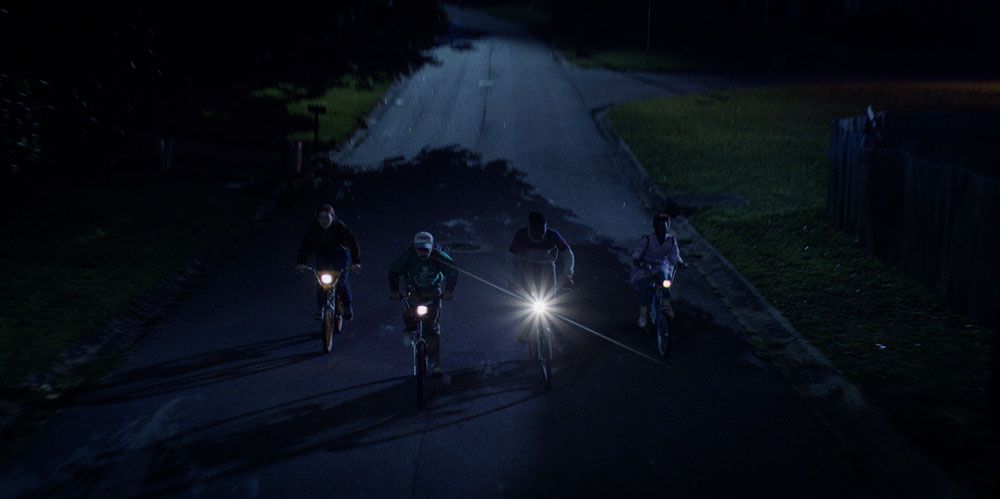
Forget helmets. We didn’t even have kickstands. We rode standing up down the hills, the playing cards in our wheel spokes slapping and the streamers on our handlebars flying.

The kids of “Stranger Things” live in a time and a world that is not ours. It’s not exactly the ’80s (at least, not technically perfect, historically speaking), but it’s also a world far away from the lives most children live now. The Hawkins kids have bikes, which mean freedom, a kind of breezy effortlessness that has been missing a bit in recent seasons as beloved anti-hero Steve and now the lovable Argyle have real wheels and can drive everyone around. 

Stranger ThingsSadie Sink as Max Mayfield, Gaten Matarazzo as Dustin Henderson, Caleb McLaughlin as Lucas Sinclair, and Priah Ferguson as Erica Sinclair in “Stranger Things” (Netflix)As a child in the ’80s and ’90s, a bike meant independence. I cut through the hedges separating my lower middle-class neighborhood from my best friend’s wealthy neighborhood of new McMansions and chemical green lawns. It was like shortcutting into Narnia. Forget helmets. We didn’t even have kickstands. We rode standing up down the hills, the playing cards in our wheel spokes slapping and the streamers on our handlebars flying like hair. There were no bike lanes. If we fell, we were fine. We rarely told our parents what happened to us, be it bike wreck, harassing teenagers or demodogs.  

The parental units of “Stranger Things” have, for the most part, no idea. About anything.

Like most kids of those eras, I spent much of my childhood blissfully unsupervised. I had to return home at dark; our neighborhood had no streetlights to flicker on and warn us. No one wore a watch, and without cell phones, there was no way for any parents to contact or find us. Who knew where we were, what we were doing (discovering a shed full of forgotten fireworks, going into a huge drainage tunnel looking for killer clowns). 

This lines up with the parental units of “Stranger Things” who have, for the most part, no idea. About anything. Ted Wheeler, Nancy and Mike’s dad, doesn’t even realize his wife is basically having an affair, and neither of the Wheeler parents know escaped human experiment Eleven crashes in their basement. In this season, mom Joyce has gone to Russia, assuming everything is fine back at home. (It’s not, it never is, and the kids aren’t even there.)

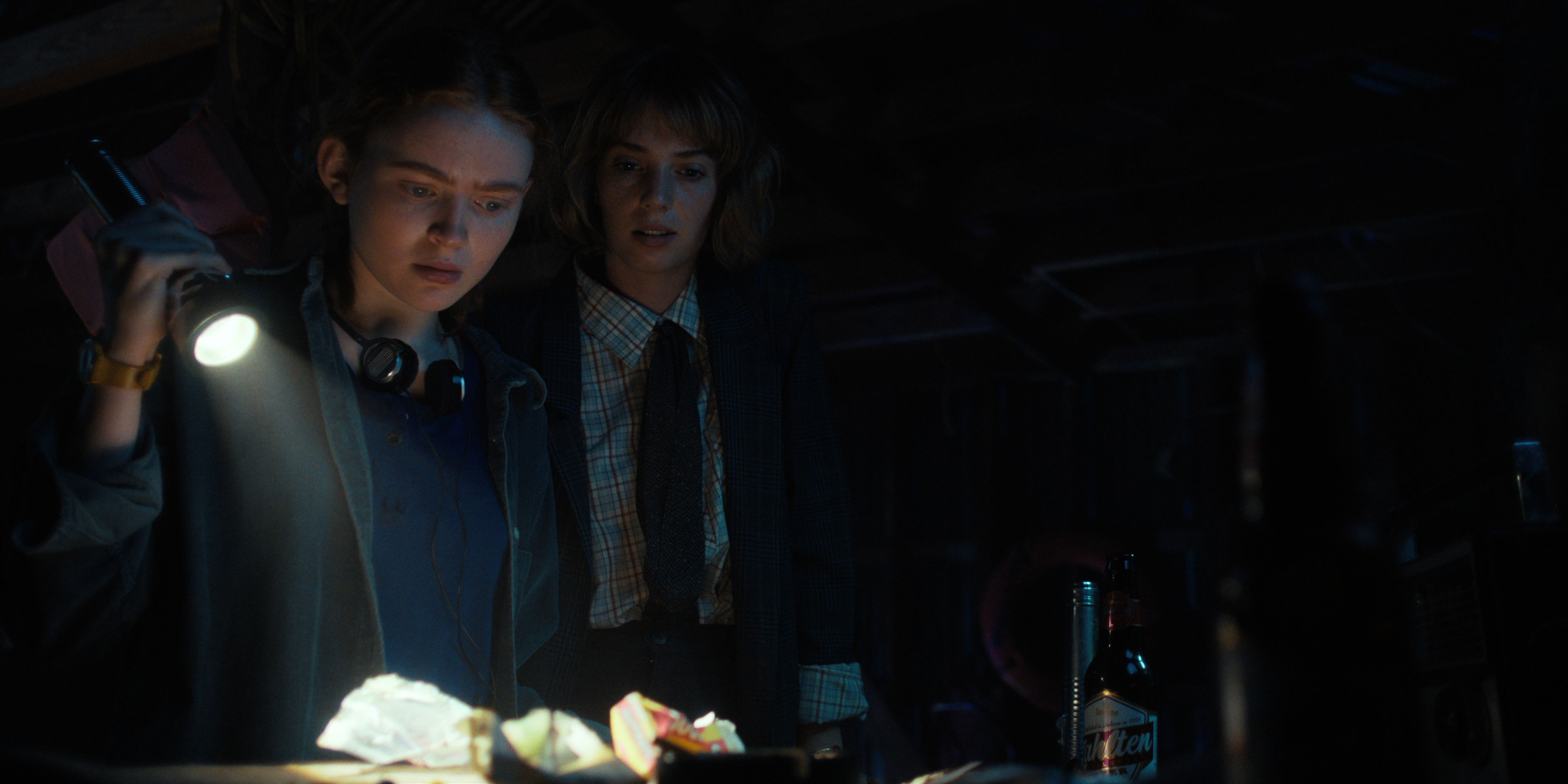
Stranger ThingsSadie Sink as Max Mayfield and Maya Hawke as Robin Buckley in “Stranger Things” (Netflix)My friend group, made up of kids from the neighborhood, those classic childhood friendships of location, location, location, invented elaborate scenarios not unlike that of the Hawkins crew. The only difference is: their fantasies are actually real. We thought a man who lived in the woods was a Russian spy; it was the time for it, after all. We thought the trees were full of ghosts, the pond was full of drowned souls (still, we went ice skating on it).

Growing up, we were unreachable. The world was unknowable. 

Without the internet, we didn’t know a lot of things. There is darkness and sadness to not knowing — one of my best childhood friends, who is gay, said he would have been a lot happier a lot sooner if he had known he wasn’t alone. 

On the positive side, there is the excitement of mystery, of making it all up or figuring it all out yourself because you have to. Google would have ended multiple “Stranger Things” subplots in a heartbeat. Were the story to be set now, there would be countless TikToks of Vecna sightings, long YouTubes mansplaining the Mind Flayer or the kill count of the Upside Down. 

Without the internet, we were bored. And boredom gave rise to its own kind of magic, magic we had to make ourselves. I became a writer in part because I was left alone, in part because of that boredom. I had to make my own world in childhood. So, I did.

Stranger ThingsMaya Hawke as Robin Buckley, Joseph Quinn as Eddie Munson, Natalia Dyer as Nancy Wheeler, and Joe Keery as Steve Harrington in “Stranger Things” (Netflix)This is different, much different, than the constant entertainment we have now with our phones — pocket computers — always in reach. So too are we always in reach. We know what time is it. We know what year “Running Up That Hill (A Deal with God)” was released. We can watch anything, listen to anything, figure out everything. We know it all, and so maybe we don’t dream as much. Maybe we don’t guess or create. 

It’s not stranger danger in “Stranger Things.” It’s monster danger — and I feel like we can take them.

Our children are always only a text away. “Stranger Things” has fallen back a lot this season on walkie talkies and ham radios, something that was not a staple of my childhood nor, I’m guessing, many others — at least not good walkie talkies with that kind of distance. But for the most part, growing up we were unreachable. The world was unknowable. And that isn’t the case for my Gen Z son, or likely even most Millennial children before him. 

I was a latchkey kid. He is a child who, like many of his friends, received a smartphone earlier than I’d planned, at the start of a deadly pandemic that both separated him from school, relatives and a social life as well as provided him even more ways to be digitally connected: Discord, Zoom. Alone in our houses we stare at our screens while outside the world turns ever darker. 

“Stranger Things” is scary and in its latest season, more gruesome and tonally dark than ever. But it’s nothing compared to the world. The horror of the show is a respite. Sucked into the Upside Down, given the Cruciatus curse by Vecna, or attacked by demodogs, those still seem to pale in comparison to mass school shootings, to abuse, to children taken from their parents. It’s not stranger danger in “Stranger Things.” It’s monster danger — and I feel like we can take them.

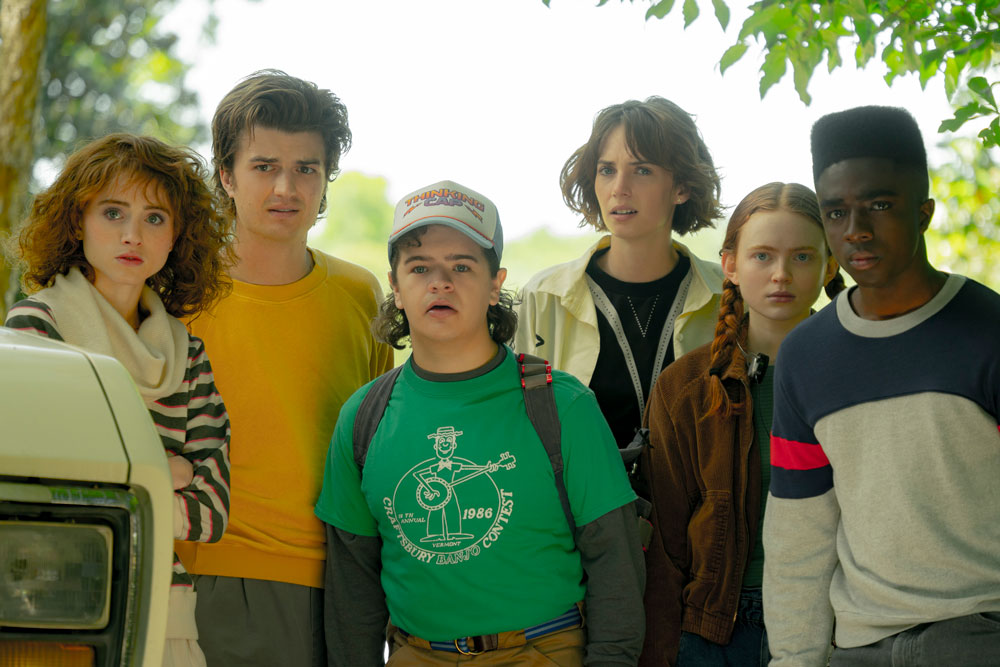
Stranger ThingsNatalia Dyer as Nancy Wheeler, Joe Keery as Steve Harrington, Gaten Matarazzo as Dustin Henderson, Maya Hawke as Robin Buckley, Sadie Sink as Max Mayfield, and Caleb McLaughlin as Lucas Sinclair in “Stranger Things” (Tina Rowden/Netflix)Despite the reaching claws of the dusty Upside Down, the kids of “Stranger Things” run out into the night. Their parents let them – and that’s just not a freedom kids know now. They haven’t known it for years. They simply can’t without a parent accused of negligence, without something terrible happening, especially for families of color. Halloween remains my and my son’s favorite holiday because it’s the one night out of the year you can still venture into the dark somewhat unsupervised, in a costume, holding out your arms for joy. 


Want a daily wrap-up of all the news and commentary Salon has to offer? Subscribe to our morning newsletter, Crash Course.


It was hard for me to say goodbye to my freedom when I became a teenager with a summer job, then an adult with my own kid, jobs, rent — those tenants of adulthood you can’t just abandon, you can’t just run away from. It was hard for my son to say goodbye when we moved from a small, rural town to a major city: his bike was stolen our first week here; we don’t know our neighbors and the radius where he can play is drastically small. And it’s going to be hard to say goodbye to “Stranger Things” and the childhood freedom it invites us to remember. 

Because I want my son to be able to get on that bike and ride into the sunset with his friends: no phone, no cares, only magic and the hope of a mystery to solve. I still remember that feeling. I wish I could ride off too.

More monster danger

“My face looked wrong”: What it’s like living with body dysmorphic disorder

The problem started with the mirror. 

As I was doing my hair one morning before work, I studied my face in the mirror. Something just looked… wrong. I moved my head closer, swiveled from side to side, and was immediately flooded with alarm. The face that stared back at me  looked crooked and malformed in a way I’d never noticed. I ran to another mirror in the house, hoping for a different result, but to no avail: no matter where I looked, the same thing. Overwhelmed with anxiety, I checked and re-checked my face  for six hours. Engulfed in a desperate need to fix the problem, I started making calls to plastic surgeons.

Six months later, emerging from surgery for a chin implant and rhinoplasty, I was more devastated than ever. I hated the results, and immediately wanted the implant removed. I was having debilitating panic attacks accompanied by around-the-clock obsessing. I struggled to go to work and take care of my young daughter. I was in deep psychological pain, but had no insight into what was happening. 

The plastic surgeon told me I needed to give it more time — that it could take months to see the actual results, but I didn’t know how I’d make it through the day, much less the unforeseeable future. Neither of us had any insight into the real issue. 

I desperately wanted to ask my parents for help, but I’d kept the surgery a secret from everyone, including them.  I didn’t want them to worry or to question me about the loan I’d taken out for the surgery — which we both knew I couldn’t afford to pay back.  I was ashamed and didn’t want to draw additional attention to my new appearance.

Then came the night of my parents’ anniversary, where our family gathered at their favorite restaurant for a celebration. Halfway through the evening, as the table was bursting with laughter and conversation, I struggled to share in the revelry; rather, I felt anxious and terrified. My mother noticed and shot me a concerned look. “I need to go to the hospital,” I whispered.

Soon, I found myself in the emergency room, and then, a day later, in the office of a psychiatrist. I listened as he diagnosed me with a mental illness I had never heard of: body dysmorphic disorder.

“He constantly peers in the mirror, feels his forehead, measures the length of his nose, examines the tiniest defects in his skin, or measures the proportions of his trunk and the straightness of his limbs.”

As defined in the DSM-V, the so-called bible of psychiatric diagnosis, body dysmorphic disorder (BDD) is classified as an obsessive-compulsive disorder involving a preoccupation with one or more perceived defects or flaws in physical appearance that are not observable to others; or, if they are, they appear inconsequential. The preoccupation causes significant distress or impairment in social, occupational, or other areas of functioning. Untreated, BDD can lead to devasting effects, including major depression and suicidal ideation.

The condition was first coined by Italian psychiatrist Enrico Morselli in 1891, when he described his patient’s excessive worry over imagined defects as “dysmorphophobia” — a Greek word meaning misshapenness. In a paper published by Morselli, he wrote, “The condition consists of the sudden appearance and fixation in the consciousness of the idea of one’s own deformity.” He reported the typical behavior of one of his patients: “He constantly peers in the mirror, feels his forehead, measures the length of his nose, examines the tiniest defects in his skin, or measures the proportions of his trunk and the straightness of his limbs.”

Later, Sigmund Freud and American psychologist Ruth Mack Brunswick treated patient Sergei Pankejeff, also known as the “Wolf Man” after a childhood dream he had in which he was confronted by wolves. Pankejeff was obsessed with his nose, which he believed was deformed. According to Brunswick, Pankejeff “neglected his daily life and work because he was so engrossed, to the exclusion of all else, in the state of his nose.”

Now, we live in a world in which images of strangers’ and celebrities’ bodies flicker constantly across our social media feeds, inviting critique and mockery, self-absorption and obsession over minutiae. Social media’s celebration of the self has spawned an industry around body- and face-altering filter,  some with algorithms so subtle that they appear real and thus leave viewers feeling inadequate in comparison. 

An estimated 3.6 billion people use social media, meaning that it has a concomitant social effect on about half of the human population — including how we view ourselves. Continuous exposure to unrealistic images through various interfaces has a significant effect on body image. Cosmetic surgeons often see the results of this in their practices, such as when  patient bring in highly-edited images of themselves and ask for surgery to make them look more like the photos. 

Plastic surgeons are trained to change appearance, but for the BDD patient, that change might not match what they see when they look in the mirror.

Patrick Byrne, the Director of Facial Plastic and Reconstructive Surgery at John Hopkins University School of Medicine told USA Today his patients are requesting “absurd and unrealistic” body alterations based on images altered by Snapchat filters.

Plastic surgeons are trained to change appearance, but for the BDD patient, that change might not match what they see when they look in the mirror.  As a result, plastic surgeons and other cosmetic professionals should be aware of  body image issues and take special care to talk with their patients prior to performing any body altering procedures. 

Mathew Schulman, a plastic surgeon in New York, says that filters are having a trickle-down effect on the plastic surgery industry. “Patients have been coming in with Snapchat filtered selfies to show what they want done to their body,” he told me. Studies have found that continuous exposure to unrealistic images creates pressure to change the body which can contribute to body dysmorphia. (How Social Media Contributes to Body Dysmorphic Behavior, Alyce Adkins).

According to Katherine Miller, MD., BDD expert and author of “The Broken Mirror, Understanding and Treating Body Dysmorphic Disorder,5 to 10 million people are diagnosed with BDD every year in the United States.  Yet the numbers are believed to be much higher due to a lack of reporting. Though the exact cause of BDD is unclear, several factors are thought to have an impact, including a family history of BDD or a similar mental disorder, abnormal levels of brain chemicals, personality type, and life experiences.

Celebrities are not exempt from BDD, and many have come forward to talk about their struggles with body dysmorphic disorder. Singer Billie Eilish opened up about her diagnosis in an interview with Rolling Stone. She described the point when her preoccupation with her appearance reached a breaking point. “I couldn’t look in the mirror at all,” she said. “That was the peak of my body dysmorphia.”

Actor Reid Ewing, who played Dylan on the popular TV show “Modern Family,” penned an article for the Huffington Post chronicling his struggles with BDD. “My looks were the only thing that mattered to me,” he wrote. Unhappy with his appearance, he underwent his first cosmetic surgery in 2008 after a plastic surgeon recommended he get cheek implants. When Ewing, then 19, saw the results of the procedure, he was horrified and wanted another surgery to fix it. When the doctor refused to operate, he found another doctor who would. Several surgeries later, Ewing wrote, “all the isolation, secrecy, depression, and self-hate became too much to bear. I vowed I would never get cosmetic surgery again even though I was still deeply insecure about my looks.” 

Those who have BDD often labor under the misconception that surgery or another cosmetic procedure will cure BDD. In an interview, two BDD experts from Harvard and Massachusetts General Hospital — Dr. Sabine Wilhelm, the Director of OCD and Related Disorders Program, and Hilary Weingarten, a Clinical Fellow in Psychology —  stated that “76.4% of individuals with BDD seek cosmetic treatment, and 66% of adults with BDD obtain cosmetic treatments.”  (Phillips, Grant, Siniscalchi, & Albertini, 2001).  But for those with BDD, “cosmetic treatments rarely (i.e., in only 2.3% of cosmetic surgeries or procedures) improve BDD symptoms in the long term.” Hence, they advise against cosmetic surgeries or procedures as a BDD treatment.

Understanding that BDD is a mental illness and not simply a desire to be more attractive is critical in recovery. A young Korean-American man who suffered for years with what he believed was his “hideous” appearance wrote of his personal struggle for the Massachusetts General Hospital: “To understand BDD as a psychological disorder was essential for me to finally shed the blinders that the illness had put on me that kept me from knowing what my values were, what activities made me happy, and putting myself out there to love and be loved,” he wrote.

Though there is no cure for BDD, cognitive behavioral therapy (CBT) and medication have been shown to decrease symptoms, helping individuals to live fuller, happier lives. CBT is a type of talk therapy (psychotherapy) where negative patterns of thought are challenged by the therapist. It is based on the premise that psychological problems arise from faulty thoughts that lead to unhealthy  behavior and psychological suffering. Therefore, CBT focuses on changing thought patterns. 

After his BDD crisis that ultimately brought him to therapy, the aforementioned pseudonymous young man said that this type of therapy was what really helped him recover. “It was through CBT that I discovered how far-reaching of an influence my BDD had, and it was through CBT that I was able to radically alter my life. Undergoing CBT, I learned very tangible skills to properly address my anxiety and my BDD.”

Cognitive Behavioral Therapy was part of my treatment as well. After my trip to the emergency room and subsequent visit with a psychiatrist, I started therapy sessions twice a week along with taking a prescribed low-dose SSRI (selective serotonin re-uptake inhibitor) — a medication shown to be effective in helping control negative thoughts and repetitive behaviors in BDD patients. Two months later, my panic attacks and obsessing had decreased, but it would be another two years before I stabilized.

Over those two years, as I inched towards recovery, I did extensive self-work. I read dozens of self-help and mental health books seeking out information and practices that might be helpful. One technique I found particularly helpful was known as the Circle of Influence and Control, as described in Stephen Covey’s “The 7 Habits of Highly Effective People.It is also  a technique also used in psychotherapy. The practice involves focusing our energy on what we can control as a means to increase our ability to affect those areas outside our control. With BDD my life felt out of my control, but when I worked on my circles of influence and control I was able to shift my mindset from, “I am a victim of mental illness” to “I am an active participant in my recovery.” The simple practice was invaluable in my recovery.

I started meditation after reading the work of mindfulness experts like Jon Kabat-Zinn and Richard Davidson, whose research clearly demonstrated the benefits of meditation on mental health. Though meditation has been used for centuries, we now have science to back up what has long been suspected: meditation decreases anxiety, rumination, and depression, and increases feelings of calm, self-worth, and emotional well-being. 

Specific to treating BDD, which is classified as an obsessive-compulsive disorder (OCD), meditation helps by placing our attention in the present moment and interrupting the obsessive cycle. Most exciting is the newest research that demonstrates how mindfulness meditation can physically change our brains by reprogramming them and creating new patterns of thinking. 

Though meditation didn’t initially come easy to me, it got better with time. More importantly, I started to see the benefits. Disciplining my mind to stay present helped me remain calm throughout the day when intrusive thoughts threatened to send me spiraling.

Over two decades of living with body dysmorphic disorder, I’ve encountered many setbacks, but none as debilitating as the onset. Though my anxiety and obsessive thoughts occasionally resurface, they are manageable. Most of the time, I live from a place of peace and acceptance. Through therapy, medication, and self-work, I have learned that healing can only be found in addressing my emotional well-being, and not in fixing my face.

Read more

about self-perception and dysmorphia:

GOP-backed federal abortion ban would increase maternal deaths by 24%: study

New research published Thursday by experts at the University of Colorado Boulder estimates that a nationwide abortion ban of the kind Republican lawmakers are intent on pursuing would increase maternal mortality in the United States by 24%.

Released just days after the U.S. Supreme Court ended the constitutional right to abortion—triggering total bans in a number of GOP-led states—the analysis uses newly available data from 2020 to show that the “increased exposure to the risks of pregnancy” caused by a federal abortion ban “would cause an increase of 210 maternal deaths per year (24% increase), from 861 to 1071.”

The researchers stress that their estimate, which has not been peer-reviewed, is conservative—it only takes into account the higher mortality risk of continuing pregnancy to term.

“We find that increases in some states would be as great as 29%, while in others, because of already extremely low abortion rates and numbers, less than one additional death would be expected,” they note. “Banning abortion will likely change maternal mortality in ways beyond exposing more people to the existing risks of maternal death; any increase in maternal mortality due to these changes would be in addition to our estimates.”

The U.S. already has the highest maternal mortality rate among rich nations. A recent study by the Commonwealth Fund found that “although most are preventable, maternal deaths have been increasing in the United States since 2000.”

“In 2018, there were 17 maternal deaths for every 100,000 live births in the U.S.—a ratio more than double that of most other high-income countries,” the study noted. “In contrast, the maternal mortality ratio was three per 100,000 or fewer in the Netherlands, Norway, and New Zealand.”

Amanda Jean Stevenson, assistant professor of sociology at the University of Colorado Boulder and the lead author of the new analysis, told the Denver Post on Thursday that “pregnancy shouldn’t kill people—in fact, in other rich countries it very rarely does.”

“The arithmetic truth our findings reveal is simple: reducing abortions increases maternal deaths,” Stevenson and her colleagues write. “The additional maternal deaths we estimate here could be avoided if we help people get wanted abortions, if we make pregnancy and birth safer—particularly for Black people—and, of course, if we do not ban abortion in the first place.”

Survey data released both before and in the wake of the Supreme Court’s decision in Dobbs v. Jackson Women’s Health Organization indicates that a majority of U.S. voters would oppose a nationwide abortion ban.

But public sentiment doesn’t appear to be deterring far-right groups and their anti-abortion allies in Congress. As the Washington Post reported in May, “Leading anti-abortion groups and their allies in Congress have been meeting behind the scenes to plan a national strategy” in anticipation of the Supreme Court’s ruling.

“A group of Republican senators has discussed at multiple meetings the possibility of banning abortion at around six weeks, said Sen. James Lankford, R-Okla., who was in attendance and said he would support the legislation,” the Post reported. “Sen. Joni Ernst, R-Iowa, will introduce the legislation in the Senate, according to an antiabortion advocate with knowledge of the discussions who spoke on the condition of anonymity to discuss internal strategy.”

Days after the Washington Post published its story, Senate Minority Leader Mitch McConnell, R-Ky., signaled that the Republican Party could attempt to enact a federal abortion ban if it retakes Congress in November.

“We know that the so-called ‘pro-life’ movement has nothing to do about saving lives, it’s about control,” former Ohio state Sen. Nina Turner tweeted Thursday, citing the new University of Colorado Boulder research.

“There is no time to waste,” Turner added. “The Senate must abolish the filibuster to codify Roe.”

“Radical power grab”: New Supreme Court case could allow right-wingers to ignore voting right laws

As SCOTUS-watchers scrambled to stay abreast of a rush of rulings affecting climateimmigrationIndigenous rights, and other policy areas, the nation’s highest court on Thursday said it would hear oral arguments this October in a case involving a controversial legal theory that one advocacy group says is “threatening the future of voting rights.”

The case, Moore v. Harper, involves North Carolina’s congressional map, which was drawn by the Republican-controlled state Legislature and which the state Supreme Court struck down as racially discriminatory.

In March, the U.S. Supreme Court rejected requests by Republican officials in North Carolina and Pennsylvania to restore GOP-rigged maps in a 6-3 ruling in favor of replacement maps. The North Carolina replacement map was drawn by a nonpartisan panel of experts and gives Democrats and Republicans six likely “safe” seats while two will be more competitive.

“Today’s news from the U.S. Supreme Court makes one thing clear: This fall, the future of multiracial democracy is at stake, Allison Riggs, co-executive director and chief counsel for voting rights at the Southern Coalition for Social Justice, said in a statement.

At issue is the “independent state legislature theory” (ISLT), which the Brennan Center for Justice describes as a “baseless” concept “making the rounds in conservative legal circles” that posits congressional elections can only be regulated by a state’s lawmakers, not its judiciary—or even its constitution.

Prominent purveyors of former President Donald Trump’s “Big Lie” that the 2020 presidential election was “stolen”—most notably, Ginni Thomas, a right-wing activist and wife of Justice Clarence Thomas—have invoked the dubious theory when pushing state lawmakers to help overturn President Joe Biden’s Electoral College victory.

“In Moore, North Carolina lawmakers argue they essentially get a ‘free pass’ to violate state constitutional protections against partisan gerrymandering when drawing districts which undeniably hurt voters,” said Riggs. “We will vigorously fight these claims and instead advocate on behalf of North Carolinians to prove what the ‘independent state legislature theory’ has been all along—a fringe, desperate, and anti-democratic attack by a gerrymandered legislature.”

Joshua Douglas, an election law professor at University of Kentucky, called Moore an “extremely dangerous case in that it could take away state constitutional limits on state legislatures when they enact restrictive voting rules.”

Bob Phillips, executive director of Common Cause North Carolina, a plaintiff in the Mooresaid in a statement that “in a radical power grab, self-serving politicians want to defy our state’s highest court and impose illegal voting districts upon the people of North Carolina.”

“We must stop this dangerous attack on our freedom to vote,” he added.

The U.S. Supreme Court’s decision to hear oral arguments in Moore comes one day after the justices voted 6-3 to temporarily block a federal judge’s ruling that Louisiana’s new congressional district map was racially discriminatory.

“After overturning abortion rights, striking down gun safety laws, and hamstringing the federal government’s efforts to protect our air and water, the Supreme Court teased what nightmare it has in store for us next,” Brett Edkins, managing director for policy and political affairs at the pro-democracy group Stand Up America, said in a statement.

“The far-right supermajority of the Supreme Court announced that it will take up a case that could upend state supreme courts’ ability to rein in out-of-control, partisan state legislatures,” he continued. “Among other things, the case could pour gasoline on partisan gerrymandering, giving politicians the last word on drawing electoral maps, obliterate state courts’ authority to uphold voter protections embodied in state constitutions, and potentially let state legislators reject presidential election results that they don’t like.”

“This endangers the very fabric of our democracy,” Edkins added. “We must pass the Judiciary Act to restore balance to this out-of-control Supreme Court and ensure they uphold long-standing precedents—not their own radical political agenda.”

Co-sponsored by U.S. Reps. Hank Johnson, D-Ga., Jerrold Nadler, D-N.Y., and Mondaire Jones, D-N.Y., the Judiciary Act would increase the size of the U.S. Supreme Court from nine to 13 justices.

While noting that there “strong originalist arguments that might persuade some of the justices not to adopt such a radical reading” of state legislative power, Richard L. Hasen, a professor of law and political science at the University of California, Irvine, said “it’s hard to overstate the danger” of Moore.

ISLT, he wrote for Slate, “if taken to its extreme, could help foment election subversion. How so? Suppose a state court or agency interprets state rules to allow for the counting of certain ballots, and doing so favors one candidate. If the leaders of the legislature are from the other party, and they say that the interpretation does not follow the views of the legislature, it’s impermissible and the results need to flip.”

“This is essentially the argument that Chief Justice William Rehnquist and Justices Antonin Scalia and Clarence Thomas accepted in their concurrence in the 2000 Bush v. Gore case, ending the 2000 presidential election and handing it to Bush,” notes Hasen.

“Buckle up,” he added. “An extreme decision here could fundamentally alter the balance of power in setting election rules in the states and provide a path for great threats to elections.”

The best ways to store your summer fruits, from fresh berries to mangoes, melons and more

One of the many perks of summer is the return of local farmer’s markets, where fresh, seasonal fruits are always available in abundance. Rows of fresh berries, neatly arranged in blue-colored cartons, can be found alongside hefty melons and juicy cherry tomatoes. And baskets of stone fruits, from fuzzy peaches to miniature sugar plums, fill the surrounding air with their sweet, syrupy aromas.   

Simply put, summer fruits are enticing and buying them in bulk is the best way to enjoy all the flavors this season has to offer. But warm weather — and intense humidity — also mean that your purchases are at risk of going bad quickly, especially when they are stored incorrectly.    

RELATED: You should be roasting your summer fruit

To help keep our summertime fruits fresh and delicious, we spoke with Ann Ziata, chef-instructor of Health-Supportive Culinary Arts at the Institute of Culinary Education (ICE). Ziata breaks down which fruits should be kept in the refrigerator, on the countertop, in the pantry or in hybrid environments.

Here are her tips for storing each specific type of fruit:   

Berries

Ziata says berries, like strawberries, blueberries, blackberries and raspberries, should be stored in the fridge because they can go bad quickly due to their small size and delicate nature. She also recommends not washing berries until they are ready to be eaten.

“Don’t wash them ahead of time…because they will get extra water on the surface and that water will make them mold more quickly,” Ziata explains. “So keep them in the container [and] right before you eat them, just give them a little rinse and they are good to go.”

She adds that berries can also be stored in their original plastic containers or cartons, which allow some ventilation and won’t expose the fruits to any humidity. If you are not a fan of the original packaging, you can also store berries in any closed containers. Just make sure they aren’t airtight as those containers will cause moisture to build up inside.  

Stone fruits

Peaches, plums, nectarines and other fruits that have a hard pit or “stone” in the center will stay fresh in room temperature environments, like on countertops, in fruit bowls or inside the pantry.

“You can store them at room temperature, especially if you would like them to ripen a bit more, because they will continue to ripen after they are picked,” Ziata explains.

But stone fruits can also be stored in the fridge. It all depends on how firm and ripe the fruits are, Ziata says.

“Judge them on how they look. If they are a little firm or if you know that you are going to eat them pretty soon, definitely keep them at room temperature. If they are slightly overripe or you think you have more than you are going to eat at a time they get too ripe, then go ahead and put them in the fridge.”

Cherries

Although they contain a hard seed in the center akin to stone fruits, cherries should be stored just like berries because they ripen slowly after they’ve been picked. Thus, cherries are best kept in the fridge and should only be washed right before eating.

According to Ziata, cherries taste better when they are stored in the plastic bags they are sold in. The bags are breathable, allowing the fruits to stay fresh for longer.  

Melons  

Watermelons, cantaloupes and honeydews are best kept in room temperature spots, preferably on a kitchen countertop that is away from both the oven and stove.

“If you chill them, because they have a lot of water content, it might change the texture and become a little unpleasant,” Ziata says of melons that are stored in the fridge. The only time she recommends putting whole melons in the fridge is if they were kept chilled at the time of purchase.

On the other hand, freshly sliced melons should be placed in the fridge at all times to prevent spoilage.  

Avocados

Unripe and firm avocados can be stored at room temperature. To increase their ripening process, especially in preparation for making avocado toast or guacamole, Ziata recommends storing avocados in a brown paper bag. They can also be stored next to fruits that produce high levels of ethylene gas, like bananas or apples or peaches, which will help them ripen faster.

Once a ripe avocado is cut, it should then be placed into the fridge where it will stay fresh and “hold it’s ripening stage for about three days,” Ziata says.

Mangoes

Similar to avocados, mangoes should be ripened at room temperature and transferred to the fridge once they are ready to eat and cut into. Ziata adds that half-eaten or overripe mangoes freeze really well and can be used later to make smoothies, baked goods or preserves.  

Pineapples

Ziata says unripe pineapples are best kept at room temperature and should be stored standing straight up, with the top facing the ceiling. Pineapples that are kept on their sides run the risk of being bruised, which ruins both the quality and taste of the fruit.

Like mangoes, cut-up pineapple will stay fresh and tasty when stored in the fridge. They can also be kept in the freezer for later use.  

Papayas

In the same vein as mangoes and pineapples, unripe papayas will stay fresh in room temperature environments. Once the fruit is ripe and cut into, it should be popped into the fridge.   

Grapes

Ziata says grapes are quite unique because they are small, delicate and can absorb the flavors of more pungent foods. Grapes are best kept in the coldest part of the fridge, but not directly near where the cold air blows out.

“If it’s placed where the cold air blows out, sometimes grapes will dry out more quickly,” Ziata explains. She recommends storing the fruit in a Crisper drawer, which is a cool and isolated area.

Because grapes are also really sensitive to strong flavors, they should not be stored alongside onions, garlics and other bold tasting food items. The last thing you want is to have sweet grapes that taste and smell funky.  

More fruit-themed stories you might enjoy:

Concerns over witness tampering after Trump PAC offered to pay Jan. 6 witnesses’ legal fees

On Thursday, The New York Times reported that “more than a dozen” of former President Donald Trump’s allies are being offered a free ride on legal fees by a key political action committee associated with the former president, as the January 6 Committee’s investigation continues to probe the events of the Capitol attack.

“The arrangement drew new scrutiny this week after Cassidy Hutchinson, a former aide in his White House, made an explosive appearance before the House panel, providing damning new details about Mr. Trump’s actions and statements on the day of the deadly riot,” reported Luke Broadwater, Maggie Haberman, Annie Karni, and Alan Feuer. “She did so after firing a lawyer who had been recommended to her by two of Mr. Trump’s former aides and paid for by his political action committee, and hiring new counsel. Under the representation of the new lawyer, Jody Hunt, Ms. Hutchinson sat for a fourth interview with the committee in which she divulged more revelations and agreed to come forward publicly to testify to them.”

According to the report, it is unclear whether firing the Trump-recommended counsel cleared the way for Hutchinson to testify — although some members of the committee are suspicious that that is what happened.

“According to financial disclosures, in May alone, Mr. Trump’s ‘Save America’ political action committee paid about $200,000 to law firms,” said the report. “That including $75,000 to JPRowley Law, which represents Cleta Mitchell, a pro-Trump lawyer who has filed suit to try to block the committee’s subpoena, and $50,000 to Silverman, Thompson, Slutkin & White, which has represented Stephen K. Bannon, a close ally of the former president who refused to meet with the panel and has been charged with criminal contempt.”

“It was not immediately clear whether those payments were for covering legal fees connected to the Jan. 6 inquiry, but people familiar with the matter said the PAC has paid for the representation of several former officials and aides in the investigation, including some high-profile ones such as Stephen Miller, who served as a senior adviser to Mr. Trump,” the report noted.

Hutchinson gave bombshell testimony in a surprise interview earlier this week, including that Trump knew the rioters were armed and demanded they be allowed to march to the Capitol anyway because “they’re not here to hurt me,” and that the former president got into a physical altercation with a Secret Service agent after being told he couldn’t visit the scene of the riot. Another Trump official, Tony Ornato, has denied this sequence of events, although other officials have accused him of a track record of dishonesty.

How to pan-fry tofu 2 ways, according to chef Lucas Sin of Junzi Kitchen

My friends are obsessed with the seared tofu dish at Congee Village that I never really thought twice about. It’s soft/silken tofu that’s seared golden brown and doused in a red onion/scallion soy sauce. It’s simple, it’s served hot and photographs well, but the magic is in the golden crust on the outside and the improbably tender inside.

I see this recipe as an answer to the age-old adage of tofu being a meat substitute; I’m specifically referring to firm tofu, pressed between kitchen towels, marinated with soy sauce, and pan-fried to look like chicken. I think that approach fails to acknowledge the textural wonder that is this product.

To do this, we’ll approach tofu with two traditional techniques: The first is just to fry silken tofu, which when done patiently, creates a delicate texture that is surprisingly hard to break up in a sauce. The second is to freeze firm tofu, which helps extract the moisture of tofu without having to go through the process of pressing the tofu. — Food52

Watch this recipe

Pan-Fried Tofu, Two Ways from Lucas Sin

Yields
2 servings
Prep Time
3 hours 15 minutes
Cook Time
15 minutes

Ingredients

  • 1 packet (16 ounces) firm tofu OR silken tofu, drained
  • Kosher salt
  • Neutral oil
  • 1 shallot, sliced thinly cross-wise
  • 3 cloves garlic, sliced thinly length-wise
  • 1/2 Thai red chile or similar, sliced thinly
  • 2 scallions, cut into 2-inch segments, making sure white and green parts are separated
  • 2 tablespoons light soy sauce
  • 2 teaspoons abalone sauce
  • 1 teaspoon rice wine (Mijiu or Shaoxing wine)
  • 1/2 teaspoon granulated sugar
  • 1/2 teaspoon MSG or mushroom powder
  • 1 tablespoon potato starch


Directions

  1. If working with FIRM TOFU: Remove the firm tofu from the packaging and drain well. Place tofu in a sealed container or on a tray wrapped with plastic and freeze for at least 3 hours and up to 6 months. When fully frozen, the tofu will turn a darker shade of yellow/brown and become slightly translucent.

    When ready to cook, fully thaw the tofu, at least 3 hours at room temperature or 8 hours in the fridge. Gently squeeze the tofu between your palms to express as much water as possible without damaging it. Cut tofu into 10 equally sized pieces.

  2. If working with SILKEN TOFU: Remove the silken tofu from the packaging and drain well. Cut tofu into 10 equally sized pieces and lay the pieces flat side down on a tray. Season the tofu with 1/2 teaspoon salt and let sit for at least 15 minutes to extract some of the water.

    When ready to cook, drain well.

  3. To cook either kind of tofu: Heat a flat-bottomed non-stick skillet over medium-high heat. Add 1 tablespoon of neutral oil and heat until barely smoking. Carefully slide drained pieces of tofu into the pan, one by one. Turn the heat down to medium-low. Using a spatula, gently press on each piece of tofu to ensure even searing. Let the tofu sear until a golden crust is formed, about 3 min. Using a fish spatula or a thin rubber spatula, carefully flip each piece of tofu over so both sides are seared well. Remove and set aside.
  4. In a small bowl, combine the light soy sauce, abalone sauce, rice wine, white sugar, MSG, and 1/4 cup water to form a sauce. Stir until the white sugar and msg are dissolved.
  5. Prepare a starch slurry by combining potato starch and 1 tablespoon water in another small bowl and stirring well to dissolve.
  6. In the same pan you used to sear the tofu, add another 2 teaspoons of neutral oil and heat at high heat until barely smoking. Add shallots, garlic, chiles, and scallion whites. Stir fry until aromatic, about 30 seconds. Return the tofu to the pan. Pour over the combined sauce. Mix the ingredients together by swirling the pan. Simmer until the flavors have melded, about 3 minutes. Add more water if the sauce is drying up. Carefully remove the tofu from the pan and plate. Thicken the remaining sauce with the potato starch if necessary until the sauce coats the back of a spoon. Taste and adjust the seasoning with salt, sugar, and MSG. Pour the finished sauce over the tofu and serve warm with rice.

GOP Rep. Mike Kelly has a meltdown over Ron Johnson’s accusation on false electors

Sen. Ron Johnson, R-Wis., recently alleged that a bogus slate of pro-Trump electors, which one of his aide’s tried to have former Vice President Mike Pence install during the 2020 election certification ceremony, was given to him by Rep. Mike Kelly, R-Penn. But Kelly is again adamantly denying his fellow Republican’s claims. 

“I have never had a conversation with Sen. Johnson,” Kelly said in a Thursday interview with New Castle News. 

Johnson’s allegation came during a radio interview last month on the “The Vicki McKenna Show,” according to audio captured by Democratic Super PAC American Bridge. In the interview, Johnson attacked the January 6 select committee for revealing text messages between Johnson Chief of Staff Sean Riley and one of Pence’s legislative aides, who Riley asked to hand off a slate of partisan electors to the former vice president. 

“We found out now this [slate] came from Pennsylvania Congressman Mike Kelly’s office,” Johnson claimed

RELATED: “I can see your screen”: Ron Johnson busted after saying he’s on the phone to avoid Jan. 6 questions

Johnson also referenced a Just the News report alleging that Donald Trump had enlisted the help of Kelly’s office to gin up a cohort of new electors who would be willing to overturn President Biden’s win. According to the report, Kelly asked for help from Wisconsin lawyer James Troupit, then a Trump campaign counsel. Troupit was also one of the leading attorneys in a legal challenge against Trump’s loss in the Badger State, as Politico noted.

“Need to get a document on Wisconsin electors to you the VP immediately,” Troupis reportedly texted Johnson at 11:36 a.m. on January 6. “Is there a staff person I can talk to immediately. Thanks, Jim T.”


Want a daily wrap-up of all the news and commentary Salon has to offer? Subscribe to our morning newsletter, Crash Course.


Shortly thereafter, Riley reportedly texted the Pence aide, “Johnson needs to hand something to VPOTUS.” Pence’s aide refused the offering, the texts indicate.

Johnson, for his part, has called the entire affair a “non-story.” 

“My office’s entire involvement in this thing lasted 70 minutes. My involvement was probably seconds, maybe a minute or two,” he said, according to Politico.

Still, his latest denial passes the buck over to Kelly, who up until this point was not directly implicated in Trump’s failed scheme to replace the 2020 election’s duly-appointed cohort of electors.  

RELATED: Ron Johnson “must resign”: Wisconsin senator implicated in fake elector scheme

Kelly’s press secretary, Matt Knoedler, first denied Johnson’s claims.

“Senator Johnson’s statements about Representative Kelly are patently false,” Knoedler told Insider. “Mr. Kelly has not spoken to Sen. Johnson for the better part of a decade, and he has no knowledge of the claims Mr. Johnson is making related to the 2020 election.

Then this week, Kelly spoke for himself. 

“I think that there have been several variations of what the senator said,” Kelly noted in reference to Johnson. “But I’ve had no conversation with him at all.” 

“Nobody’s giving us any answers”: Uvalde parents plead for shooting details as officials stonewall

“Nobody’s giving us any answers”: Uvalde families demand details of shooting investigation at City Council meeting” was first published by The Texas Tribune, a nonprofit, nonpartisan media organization that informs Texans — and engages with them — about public policy, politics, government and statewide issues.

Sign up for The Brief, our daily newsletter that keeps readers up to speed on the most essential Texas news.


UVALDE — At an emotional City Council meeting Thursday, families of the Robb Elementary School shooting victims demanded the mayor release details from the investigation. Mayor Don McLaughlin told them he didn’t have any new information and the city can’t share anything with the public because of the ongoing investigation.

“Nobody’s giving us any answers, it’s been over a month, you have no idea how frustrating that is. We’re sitting here, just listening to empty words,” said the sister of Irma Garcia, one of two teachers who was killed in the May 24 massacre along with 19 students. She didn’t identify herself by name when she addressed the City Council.

Tina Quintanilla-Taylor, whose daughter survived the shooting, also made a plea to state leaders who have details of the investigation and haven’t shared them with the community: “Show your face. Answer our questions, now,” she said, facing TV news cameras.

Some family members also demanded to know why Pete Arredondo, a City Council member and school district police chief whose actions during the shooting have brought withering criticism, failed to show up to his second consecutive City Council meeting. According to the city charter, the City Council could vacate the seat if Arredondo misses a third consecutive meeting.

McLaughlin told family members that if city officials released details about the shooting investigation, they could be prosecuted, citing letters from the Texas Department of Public Safety and Uvalde County District Attorney Christina Mitchell Busbee requesting that no information be released until the investigation is complete.

The shooting is being investigated by the Texas Rangers, who are part of DPS, and the FBI.

In the letter dated June 8, Busbee does not mention prosecuting anyone, but says that “Any release of records to that incident at this time would interfere with said ongoing investigation and would impede a thorough and complete investigation.”

Busbee didn’t return a phone message from The Texas Tribune seeking comment Thursday.

The shooting by an 18-year-old Uvalde man — who was killed by law enforcement after they waited more than an hour to confront the shooter — is the worst K-12 school shooting in the country since a gunman killed 20 children and six adults at Sandy Hook Elementary School in Newtown, Connecticut, in 2012.

The aftermath has brought anguished questions from parents and residents who are demanding answers, as well as finger-pointing between state and local officials over what most law enforcement experts agree was a botched response by police as children were being slain inside the school.

During the council meeting, family members discussed the idea of starting an effort to recall Busbee. McLaughlin also offered to resign if Uvalde residents felt he wasn’t doing his job

“I’m not a quitter. But if this community feels like I haven’t done a good job as mayor and they want me to resign, I’d be happy to,” he said.

The meeting came as a state House committee held its second straight day of private interviews as part of an investigation of the shooting. The committee, which is chaired by state Rep. Dustin Burrows, R-Lubbock, heard testimony from the mayor, teachers and Uvalde police and state police officers.

Burrows has said he believes witnesses would give more candid testimony away from the public eye.


Join us at The Texas Tribune Festival, happening Sept. 22-24 in downtown Austin, and hear from 300+ speakers shaping the future of Texas including Joe Straus, Jen Psaki, Joaquin Castro, Mayra Flores and many others. See all speakers announced to date and buy tickets.

This article originally appeared in The Texas Tribune at https://www.texastribune.org/2022/06/30/uvalde-shooting-investigation-city-council/.

The Texas Tribune is a member-supported, nonpartisan newsroom informing and engaging Texans on state politics and policy. Learn more at texastribune.org.

Jan. 6 panel members: Trump pal who disputed Hutchinson testimony has major “credibility problems”

On Thursday, POLITICO reported that Tony Ornato, a Trump administration official who has disputed several key points made by Cassidy Hutchinson at her surprise January 6 hearing earlier this week, has himself come under sharp scrutiny from the House Select Committee.

“Ornato, a Secret Service official who served a year as a political appointee in Trump’s White House, has reportedly signaled a willingness to contradict a high-profile element of Hutchinson’s testimony: that Ornato told her former President Donald Trump lunged toward the head of his detail on Jan. 6, 2021, in a push to be driven to the Capitol and join his supporters trying to disrupt Congress,” reported Kyle Cheney.

“But several members of the select panel say Ornato, not Hutchinson, is the one with credibility problems — and have moved to publicly preempt any doubts he might raise,” noted the report. “‘There seems to be a major thread here… Tony Ornato likes to lie,’ Rep. Adam Kinzinger, R-Ill., tweeted Thursday after another former Trump White House official, Alyssa Farah, questioned Ornato’s honesty. Rep. Stephanie Murphy, D-Fla., another Jan. 6 committee member, said in a Wednesday interview with NBC that Ornato ‘did not have as clear of memories from this period of time’ as Hutchinson did.”

Hutchinson made a number of bold claims about the former president in addition to the Secret Service incident, including that Trump knew his supporters were armed as they marched to the Capitol and demanded they be let in anyway — in violation of all security rules — because “they’re not here to hurt me.”

“Ornato, a veteran Secret Service agent of more than two decades with stints in the presidential protection division under former Presidents George W. Bush and Barack Obama, was detailed to the White House by Trump in late 2019 and appointed deputy chief of staff, an unusual arrangement for a law enforcement official,” noted the report. “He has interviewed twice with the select committee — once in January and once in March, according to two people familiar with his appearances.”

Reporters, too, have thrown suspicion on Ornato’s testimony, with Carol Leonnig telling MSNBC that he is “a Trump acolyte.”

“Extremely disturbing”: Texas educators want to refer to slavery as “involuntary relocation”

State education board members push back on proposal to use “involuntary relocation” to describe slavery” was first published by The Texas Tribune, a nonprofit, nonpartisan media organization that informs Texans — and engages with them — about public policy, politics, government and statewide issues.

Sign up for The Brief, our daily newsletter that keeps readers up to speed on the most essential Texas news.


A group of Texas educators have proposed to the Texas State Board of Education that slavery should be taught as “involuntary relocation” during second grade social studies instruction, but board members have asked them to reconsider the phrasing, according to the state board’s chair.

“The board — with unanimous consent — directed the work group to revisit that specific language,” Keven Ellis, chair of the Texas State Board of Education said in a statement issued late Thursday.

The working group of nine educators, including a professor at the University of Texas Rio Grande Valley, is one of many such groups advising the state education board to make curriculum changes. This summer, the board will consider updates to social studies instruction a year after lawmakers passed a law to keep topics that make students “feel discomfort” out of Texas classrooms. The board will have a final vote on the curriculum in November.

The suggested change surfaced late during its June 15 meeting that lasted more than 12 hours. Board member Aicha Davis, a Democrat who represents Dallas and Fort Worth, brought up concerns to the board saying that wording is not a “fair representation” of the slave trade. The board, upon reading the language in the suggested curriculum, sent the working draft back for revision.

“For K-2, carefully examine the language used to describe events, specifically the term ‘involuntary relocation,'” the state board wrote in its guidance to the work group.

“I can’t say what their intention was, but that’s not going to be acceptable,” Davis told The Texas Tribune on Thursday. In 2015, Texas attracted attention when it was discovered a social studies textbook approved for use in the state called African slaves who were brought to the United States, “workers

In this case, the group proposing these second grade curriculum revisions was given a copy of Senate Bill 3, Texas’ law that dictates how slavery and issues of race are taught in Texas. The law states that slavery can’t be taught as part of the true founding of the United States and that slavery was nothing more than a deviation from American values.

“They were given Senate Bill 3, so that had to have influenced their mind with that being a document given to them right before they had to perform this review,” Davis said.

Ellis’ statement pointed out that slavery is currently not included in social studies instruction to second graders.

“The topic of slavery is not currently addressed in the 2nd Grade curriculum; this work is meant to address that deficiency,” he said.

Stephanie Alvarez, a professor at the University of Texas Rio Grande Valley and a member of the group, said she was did not attend the meetings when the language was crafted because of personal issues, but that the language was “extremely disturbing.” She would not comment any further because of her role in the work group, she said.

Part of the proposed social studies curriculum standards outlines that students should “compare journeys to America, including voluntary Irish immigration and involuntary relocation of African people during colonial times.”

Annette Gordon-Reed, a history professor at Harvard University, said using “involuntary relocation” to describe slavery threatens to blur out what actually occurred during that time in history. There is no reason to use the proposed language, she said.

“Young kids can grasp the concept of slavery and being kidnapped into it,” Gordon-Reed said. “The African slave trade is unlike anything that had or has happened, the numbers and distance.”

If language like what the group of Texas educators propose is accepted and taught to children, it means the country is moving in the wrong direction, she said.

“Tell children the truth. They can handle it,” she said.

Texas is in the process of developing a new curriculum for social studies, a process that happens about every decade to update what children should be learning in Texas’ 8,866 public schools.

This process comes as the state’s public education system has become heavily politicized, from lawmakers passing legislation on how race and slavery should be taught in schools to conservative political action committees pouring large amounts of money to put more conservatives on school boards who promise to get rid of curriculum and programs they consider divisive and make white children feel bad.

Gov. Greg Abbott and Lt. Gov. Dan Patrick have made parental rights a priority as they both seek reelection in November. Patrick has also vowed to push for a “Don’t Say Gay” bill in Texas, mirroring Florida’s conservative push to limit classroom discussions about LGBTQ people.

Last year’s SB 3 doesn’t mention critical race theory by name, but the bill was designed to keep the teaching out of secondary schools — even though it is not taught in K-12 Texas public schools. Critical race theory is a university-level field of study based on the idea that racism is embedded in legal systems and not limited to individuals. It has become a common phrase used by conservatives to include anything about race taught or discussed in public secondary schools.

The work group that proposed the language change in referring to slavery is one of several groups presenting their drafts to the state education board, which has the final say on whether to accept or reject them.

Some drafts of new curriculum standards are published on the agency’s website, but this was not, Davis said.

“I don’t like it because it’s a personal belief. I don’t like it because it’s not rooted in truth,” she said. “We can have all the discussions we want, but we have to adopt the truth for our students.”


Join us at The Texas Tribune Festival, happening Sept. 22-24 in downtown Austin, and hear from 300+ speakers shaping the future of Texas including Joe Straus, Jen Psaki, Joaquin Castro, Mayra Flores and many others. See all speakers announced to date and buy tickets.

This article originally appeared in The Texas Tribune at https://www.texastribune.org/2022/06/30/texas-slavery-involuntary-relocation/.

The Texas Tribune is a member-supported, nonpartisan newsroom informing and engaging Texans on state politics and policy. Learn more at texastribune.org.