Spring Sale: Get 1 Year, Save 58%

“Carry-On,” Taron Egerton: There’ll be peace when you are done (with this TSA “Die Hard” wannabe)

“Carry-On” is a decent little thriller that delivers enough action and suspense to keep folks engaged for two hours. 

The plot, which is reminiscent of films like “Phone Booth” and “Red Eye,” is simple. Traveler (Jason Bateman) wants a carry-on bag containing something deadly to get aboard a plane flying out of LAX on Christmas Eve. He enlists the help of an unwitting TSA agent, Ethan Kopek (Taron Egerton), via earpiece. If Ethan does what he is told — “All you have to do is nothing,” Traveler instructs — Ethan’s pregnant wife, Nora (Sofia Carson) gets to live. 

The film is best during its action sequences.

But Ethan, who is angling for a promotion at work, is uncomfortable helping a terrorist. Ethan, who has been rejected from the police academy — which is why he works as a TSA agent — has a strong moral compass; he is not the unambitious worker Traveler assumes him to be. But given that Traveler wants Ethan to let Mateo (Tonatiuh) get the dangerous bag through security without incident, he will morally compromise Ethan’s ethics throughout the day to achieve his goal. 

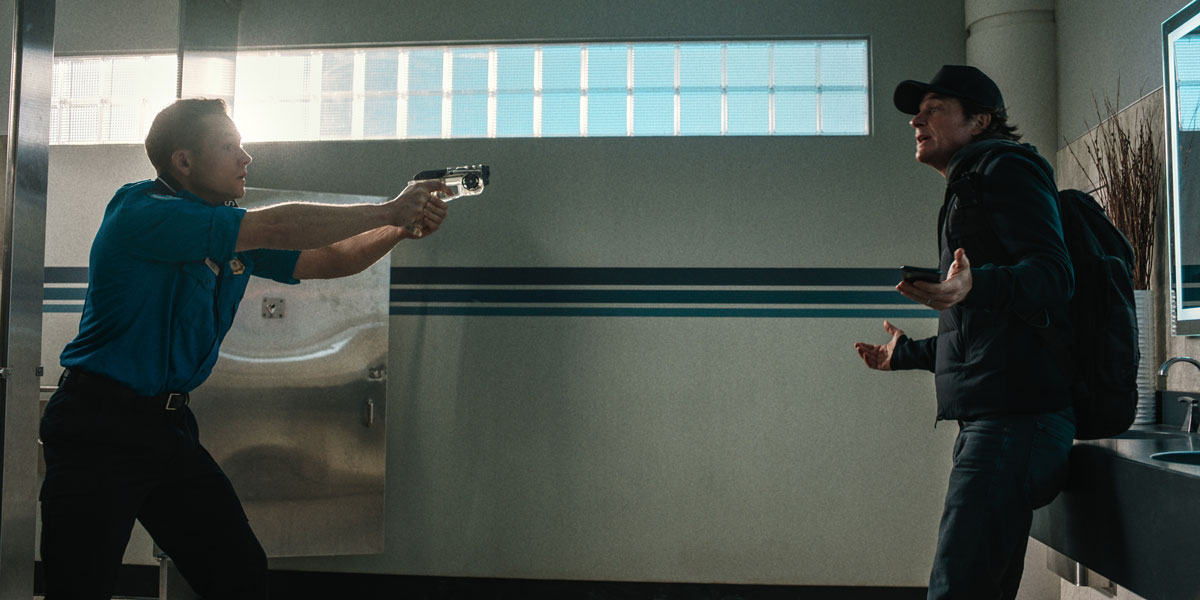
This cat-and-mouse relationship generates tension in episodes where Ethan is forced to make split-second decisions — as when Traveler orders Ethan to shoot his boss (Dean Norris) who is attempting to search Mateo’s carry-on. However, sometimes the action strains credulity as when Ethan manipulates things so he can take over his friend Jason’s (Sinqua Wells) position on a security detail as Traveler demands. 

Ethan must hide his intentions so as to not arouse suspicion, but his behavior is highly irregular, and folks who know him notice. The film even tries to play this for comedy as when Ethan meets Nora for lunch while Traveler talks to him in his earpiece, influencing and critiquing Ethan’s responses to his wife, which create awkwardness between the couple. 

Carry-OnTaron Egerton and Jason Bateman in "Carry-On" (Netflix)Meanwhile, the B story has Elena Cole (Danielle Deadwyler), a police officer, investigating the strange death of two Russians, and learning about Novichok, a deadly toxin that is in Traveler’s carry-on bag. She pursues Ethan as a key to more information. 
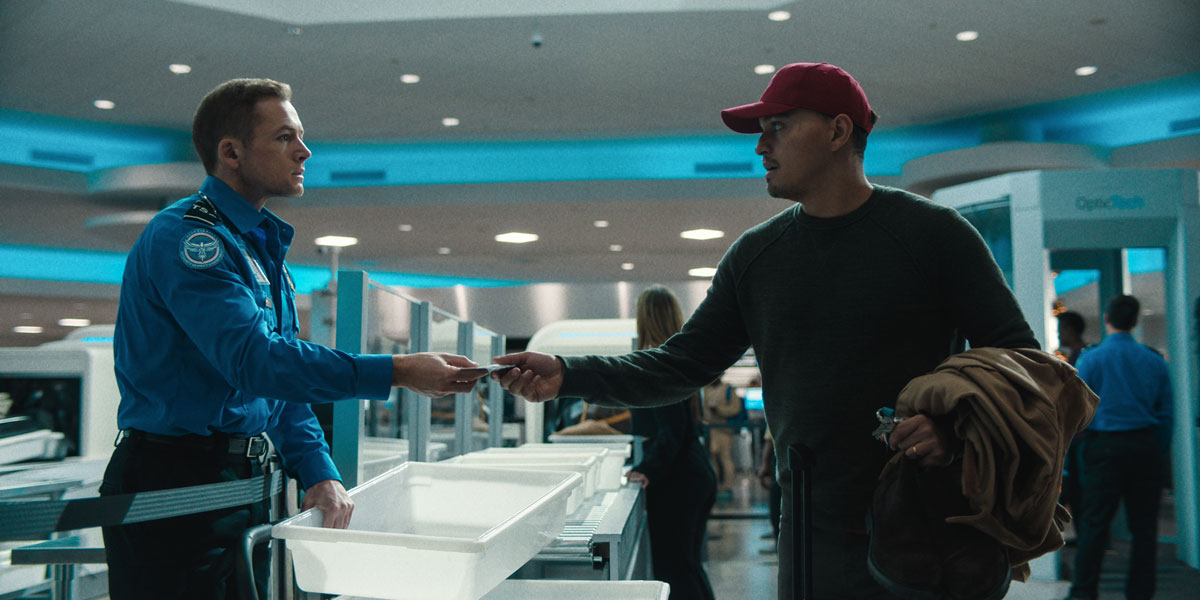
“Carry-On” does not focus much on why Traveler is endangering lives. Once the nefarious plan is revealed, it is both unsurprising and unexciting; the idea that lives are at stake is greater than whose lives are at stake. The film is more about Ethan working to reduce the threat and deaths. Various supporting characters are killed or injured along the way — illustrating that Traveler means business — but even as the film briefly pauses to acknowledge these loses, they feel like collateral damage. The story quickly moves on to the next big problem or action set piece. Director Jaume Collet-Serra has made a mindless action flick that just wants to box its characters, good and bad, into tight corners and delight as they work their way out of trouble. 

“Carry-On” is also keen to pay tribute to TSA employees.

The film is best during its action sequences. A knock-down, drag-out fight that Ethan has with Mateo on the baggage belts is rousing and not just because the characters are both pawns in someone else’s dangerous game. Likewise, there is an extremely intense sequence involving two characters physically fighting in a car — while one of them is driving. These set pieces are highlights, in part because they feature double crosses, and inject the film with some energy.

Most of the drama involves Ethan and Traveler going back and forth about who has the upper hand. The thrills in “Carry-On” are modest, and Taron Egerton delivers a mostly interior performance as he reacts to Traveler’s commands or makes a fateful decision. The physical stuff mostly involves Ethan running and running through the airport like O.J. Simpson in those classic Hertz commercials (Ethan was a high school track star). He engages in fisticuffs when the situation requires it. Viewers may laugh at the ease in which Ethan can race around the terminal or wonder why sections of LAX during one of the busiest days of year are devoid of workers. 

There are several scenes in “Carry-On” that raise questions. How can Ethan have a running commentary with Traveler without attracting attention from bosses, coworkers and others? What happened to the dead body in a closed room? And exactly how does Ethan speed across the tarmac and get into the baggage compartment of a moving plane without anyone noticing? The makers of “Carry-On” seem to want viewers to just go along with the ride, and for those who put their minds in neutral, the film is satisfying. 

“Carry-On” is also keen to pay tribute to TSA employees, and the indignities and harassment these workers experience as they try to keep things “moving and safe” for passengers. There is an amusing gag that has the TSA agents playing Contraband Bingo, where the employee score points for every weapon or dildo they recover from carry-on bags, and a cute montage has several passengers getting upset at being stopped.

Carry-OnTaron Egerton and Tonatiuh in "Carry-On" (Netflix)

There are also episodes when the TSA has to shut down the security line, and these should feel like a “Stop the Presses!” moment in a newspaper film, but they don’t, which feels like a missed opportunity. 

Another drawback is Bateman’s unconvincing efforts to make his villainous character coolly sinister. Traveler may just be a middleman trying to accomplish a task for money, but Bateman never comes across as especially threatening. The tête-à-têtes between Ethan and Traveler should crackle, but they feel flat. At least there is a droll exchange when Ethan scolds his nemesis for trying to teach him the meaning of Christmas. 

In contrast, Traveler’s colleague, Watcher (Theo Rossi), who has a man bound and gagged in his van – is far more menacing as he repeatedly tries to dispatch Nora. 

In support, Deadwyler is enjoyable to watch as Elena, and she holds her own trading barbs with colleagues or in her action scenes. However, Carson as Nora, is given little to do, and barely succeeds. Her dialogue feels as stilted as her delivery. 

“Carry-On” may not be a Christmas movie classic, like “Die Hard,” but it is undemanding entertainment.

“Carry-On” is available on Netflix Dec.13.


Christopher Wray’s cowardly exit: What’s left when the FBI director acquiesces to Trump in advance?

One of the most famous episodes in the Watergate saga 50 years ago was when CBS News reporter Daniel Schorr got a hold of Richard Nixon's "enemies list" and read it cold on the air, only to find himself listed at number 17.

The Nixon White House actually committed dozens of abuses that came to light during the investigations spawned by the Watergate break-in and one of them was the use of the FBI to investigate Nixon's enemies list. After discovering the full extent of former FBI Director J. Edgar Hoover's overwhelming misuse of the bureau for decades, including blackmail, harassment and persecution, Congress erected some strong guardrails designed to prevent such things from happening again. The Senate Judiciary Committee report explained:

The purpose of the bill is to achieve two complimentary objectives. The first is to insulate the Director of the Federal Bureau of Investigation from undue pressure being exerted upon him from superiors in the Executive Branch. The second is to protect against an FBI Director becoming too independent and unresponsive.

They added, "it is the great value of the FBI as a criminal investigative agency as well as its great potential for infringing individual rights and serving partisan or personal ambition that makes the office of FBI Director unique.” Indeed it is, as the decades of abuse by Hoover so amply demonstrated.

The main constraint they devised was one ten-year term and a requirement that a president has good cause to fire a director before that term is up. All presidents since the law was enacted have had to deal with an FBI director that was chosen by his predecessor and every single one of them, no matter who appointed him, has been a Republican. The idea that any FBI director or the institution itself is some bastion of woke liberalism is absurd.

There have only been two firings over that half-century. The first was when Bill Clinton, following an investigation by the George H.W Bush administration, did so due to the director's ethical lapses. The second was when Donald Trump fired James Comey using the eye-rolling excuse that his public pronouncements regarding the Clinton email investigation were the reason. (As if that wasn't Trump's favorite thing about him.) But it was, as we subsequently found out, done because Comey refused to pledge his personal fealty to Trump and gave the go-ahead for the Russia investigation.

It has long been assumed that Trump would probably fire Comey's successor Christopher Wray as well if he won the presidency even though he was the one who appointed him in the first place. He was angry with Wray almost from the beginning when he resisted GOP House efforts to declassify a memo that claimed the Russia investigation was politically motivated. Wray rode that out but it soured Trump on him permanently.

Trump was also, as we know, very worked up over the George Floyd protests in 2020 and he blamed Wray for failing to uncover the "funding" of the alleged ANTIFA movement which he believed was responsible for them:

He probably would have fired Wray if he'd won in 2020 but it was during his exile in Florida that he came to truly despise him. Trump complained bitterly about the classified documents search and blamed Wray for it, telling NBC News' Kristen Welker on "Meet the Press" this week that Wray "invaded my home, he invaded Mar-a-Lago." (The fact that they found hundreds of classified documents being held in a bathroom, a crime that would have had anyone else hauled off in handcuffs, is irrelevant.) And he was livid at Wray for his testimony before Congress about the assassination attempt last summer. Wray said:

There’s some question about whether or not it’s a bullet or shrapnel that hit his ear. As I sit here right now, I don’t know whether that bullet, in addition to causing the grazing, could have also landed somewhere else.

Trump told Welker:

I certainly cannot be happy with him. Take a look at what’s happened. And then when I was shot in the ear, he said, maybe it was shrapnel. Where’s the shrapnel coming from? Is it coming from heaven? I don’t think so.

The FBI did confirm that Trump had been hit by the bullet but I think Wray's comment clinched it for him. Failing to be properly reverent about Trump's wound is akin to treason in MAGA world.

We need your help to stay independent

We knew it was actually happening when Trump posted on Truth Social a couple of weeks ago that he planned to name Kash Patel as the Director of the FBI.

Considering all that history and Wray's reputed veneration of the FBI, it was expected that he would make Trump fire him in order at least to uphold the idea of the independence of the Bureau. He had three years to run on his term and Trump does not have any just cause to fire him as he is required to do under the law. To allow him to dismiss yet another FBI Director because he doesn't feel he is loyal enough to him personally is an affront to the rule of law and the agency Wray reveres.

So naturally, Wray politely announced that he plans to resign this week in order to make it easier for Trump to break both the spirit and the letter of the law — again. Trump was his usual gracious self, declaring on Truth Social that his resignation is a great day for America:

"The resignation of Christopher Wray is a great day for America as it will end the Weaponization of what has become known as the United States Department of Injustice," Trump wrote on Truth Social. "I just don't know what happened to him. We will now restore the Rule of Law for all Americans."

There is no doubt that Wray understands the threat that Trump and his henchmen pose to the country and the world. He's seen him up close and probably knows a lot more than the rest of us do. He should have put up a fight even knowing that he would lose. There is great value in people like him standing up for the law and making Trump break it openly rather than facilitating it for him.

As James Fallows wrote in his Breaking the News newsletter this week:

One of Donald Trump’s main tools, as the GOP has collapsed into subservience, is the perception of un-stoppability. He’s going to get his way in the end. So why waste your time standing up to him? Thus Lindsey Graham, Nikki Haley, “Little Marco,” and countless others have etched their role in history.

By making it slower and harder for Trump to get his way with the FBI, Director Wray might have protected the institution itself, and its dignity, and its commitment to continued leadership through changes of administration, for that much longer. Crucially, he might have slowed down Donald Trump on other fronts, by inflicting on him another “loss.”

Right now Trump is busily flooding the zone, threatening people, making it seem as if he is a juggernaut who can't be stopped and any opposition is impotent. That's just not true. Yes, he has the trifecta and he's threatening any of his own party who might stand in his way. But there is no reason for people to make it easy for him. Anyone in a position to do so should delay everything they can, fight on any front, and make him work for every single abuse he's planning to inflict.

Christopher Wray let the country down with this namby-pamby exit. He was in a position to expose Trump's disregard for the institution he purports to love and demonstrate his disrespect for the law and the Constitution. And he didn't do it. Let's hope we see more passive resistance coming from the rest of the federal employees.

Yes, I know it won't stop him. But it will slow him down and it won't be long until he's officially a lame duck and all those Republicans will have to face the voters again. Then there will be a chance to deprive him of congressional power and reset our system of checks and balances.

Why homeownership is rougher for millennials than Gen Z

Homeownership has long been an aspiration; however, that goal may need to be revised if today's younger generations are to reach it. With millennials coming of age during the Great Recession in 2008 and Gen Z grappling with soaring housing costs, each faces unique and formidable challenges in purchasing a home.

Millennials, born between 1981 and 1996, started their adult lives on a tougher path to homeownership than Gen Z. They came of age during the worst economic downturn since the Great Depression, facing high unemployment and sharply declining home values that severely impacted their financial prospects, as highlighted by a 2020 Pew Research study.

The housing market crash left a lasting impact on millennials, setting back their home-buying ambitions as they worked to overcome major financial setbacks and gain traction in a sluggish job market. The challenge of high student debt has been a major obstacle for millennials, hindering their ability to save up for a down payment — a problem that hasn't hit Gen Z as hard. Gen Z — born between 1997 and 2012 — has entered adulthood with slightly more stability, learning from the financial hardship lessons imposed on the previous generations. 

Ellen Flowers, editor of  The Perennial Style, said, "[Millennials] entered the market during economic instability, making it harder to save for a down payment. Now, we're dealing with the aftermath of years of rising interest rates. The road to homeownership has been tougher for both generations, but millennials had to contend with additional financial obstacles during our prime buying years."

Sergio Aguinaga, owner and founder of Michigan Houses For Cash, agrees: “Millennials have it even worse since they dealt with the 2008 financial crisis, low wage growth, and now face soaring home prices. They entered the market when there were fewer homes available and more competition which makes it tough to find affordable properties and build wealth.”

Then there are the additional downstream impacts, as Joe Muck, Realtor at J Muck Realty, described: "While conditions of high interest rates, low housing inventory and high housing prices impact other generations, millennials have the added psychological trauma of having seen their parents and others go through foreclosure and other negative experiences."

We need your help to stay independent

While spared the brunt of this initial economic meltdown, Gen Z now contends with the lingering aftermath — skyrocketing rents and an ever-increasing cost of living that has failed to decrease even as the market gradually recovers.

Following the 2008 financial crisis, stringent regulations to prevent future catastrophes inadvertently created new barriers for millennial homebuyers. Stricter lending rules and elevated credit requirements have made securing a mortgage considerably more difficult. Life events that typically lead to buying a home, such as getting married or starting a family, have been postponed, pushing back their entrance into the housing market. 

Millennials' monetary tightrope 

According to a recent report from Case-Schiller National Home Price Index, U.S. home prices have spiked by 47% since 2020.

The rental market also provides little relief. Consumer Price Index data from the Bureau of Labor Statistics shows that renters across the U.S. have seen the average rent rise 18% over the last five years, outpacing inflation.

The number of Americans aged 25-34 living with their parents has jumped over 87% in the past two decades

Many millennials are saddled with substantial debt and lethargic incomes, causing them to become financially disadvantaged. According to the latest U.S. census data, the number of Americans aged 25-34 living with their parents has jumped over 87% in the past two decades.

Nick Janovsky, global real estate adviser at Premier Sotheby's International Realty is unsurprised.  “[Millennials] have confronted rising prices and stagnant wages. Balancing debt with the costs of homeownership makes it increasingly difficult to acquire ideal homes. Persistent increases in insurance costs and artificially inflated mortgage rates leave millennials far behind property ownership, compared to boomers of our age.”

Tim Choate, founder and CEO of RedAwning.com, Inc., added: "Millennials have faced more prolonged economic obstacles, meeting with rapidly increasing home prices over the past decade. This generational delay in wealth accumulation has been exacerbated by the recent surge in interest rates, pushing a sizable number of millennials to pursue secondary income through property management or rental platforms as a buffer."

58% of Gen Z renters spend more than 30% of their income on housing, classifying them as "rent burdened"

Gen Z's housing hurdles

Gen Z faces similar financial issues as their predecessors. According to a Zillow analysis of the U.S. Census Bureau's 2022 American Community Survey, 58% of Gen Z renters spend more than 30% of their income on housing, classifying them as "rent burdened." This heavy financial load makes it difficult to save enough for a down payment. The non-stop rise in rents and slow wage growth further worsen their challenges. As housing prices continue to climb, many in Gen Z find themselves locked in a cycle of renting, unable to break into the increasingly competitive housing market.

The urban squeeze 

The allure of city life comes at a steep price for both generations. Urban centers, home to coveted job opportunities and cultural attractions, have seen living costs soar, placing an ever-tightening squeeze on younger residents. According to a Zillow study, in cities like San Francisco, where the median home price has surpassed $1.3 million, even high earning millennials find themselves priced out of the market.  This urban affordability crisis has also contributed to a troubling rise in homelessness among younger generations, according to U.S. Housing and Urban Development Study Point-in-Time Studies from 2017 and 2022.  

The path forward

President-elect Donald Trump's pledges of lowering taxes, cutting regulation and reducing interest rates lead his supporters to believe these measures will increase the housing supply due to increased investment in housing development. They also feel these same policies could increase disposable income, raising housing demand. Trump’s critics are quick to argue that his proposed tariffs will raise consumer prices and reduce disposable income.  

It will be up to lawmakers to address the unique challenges each generation faces with the goal of reviving the dream of homeownership for younger Americans and strengthening the overall health of the U.S. economy.

Moving to Europe for health care was the best decision I ever made

In the spring of 2021, I noticed a new ache in my left hip. Being of a certain age, I didn’t think much of it and chalked it up to simply growing, ahem, older. I was 50. At my next physical I brought it up to my doctor who dismissed it and suggested yoga.

So I took up yoga, but the pain was getting worse. I went back to the doctor who then suggested I lose ten pounds. OK, done. Pain still there and worsening. I decided to visit a chiropractor, a young slim man who tugged and turned and cracked my entire body. I visited him weekly for three months. Still, no relief from the pain. From the little information I found online, I pieced together a self-diagnosis or perimenopause-related aches and pains. Growing old it is.

Fast forward three years and I have made the bold decision to relocate my family, two school aged sons, three cats and a dog, to southern Italy — a decision I did not take lightly. I traveled to Italy many times in the past, beginning in college with my parents, then a few times with my late husband, then again with kids in tow. After the sudden death of my husband in 2020 at a young age, 48, I began questioning everything from the meaning of life, to happiness, to religion, and everything in between. While mired in grief, I had several friends staying with me helping out with the kids and animals and my general sanity. 

During one of our nightly talks which inevitably ended with me sobbing, we discussed the future. Our futures. My future. I knew I didn’t want to stay where I was in suburban coastal Connecticut, but I wasn’t sure where I wanted to land. I assumed somewhere in Europe. A trip to Italy was soon planned. My good friend Karen has family in the Abruzzo region of Italy and suggested we visit there. I was immediately sold and put an offer on a house on the spot. My thought was, I’ll have an investment property which I can use with the kids, friends and family and when my sons get out of school I will go there full time. Better food, better climate, friendly locals, breathtakingly beautiful scenery, and of course, universal health care, all factored into my decision to buy.

But not just universal health care — far superior health care. Longer life expectancy, even. After two years of visiting Italy back and forth, amid a growing concern for the political direction in which the United States was headed, I made the decision that life was too short to bide my time waiting to be where I knew I should be. Where I felt a belonging I hadn’t felt in a long time. I packed up and moved to Italy.


Want more health and science stories in your inbox? Subscribe to Salon's weekly newsletter Lab Notes.


After settling into life in the country, complete with the initial culture shock and irritating bureaucracy, I felt more and more like a local. I was a legal resident with all the benefits that entails, including the coveted “tessera sanitaria," the Italian health care card. It wasn’t long after my move that the pain in my hip grew increasingly worse and it deteriorated quickly. My Italian boyfriend suggested I get an MRI for my hip. Utter nonsense, I thought. MRIs are several thousand dollars and are reserved for life or death scenarios or people like Beyoncé. He assured me it is different in Italy, so the appointment was made. Three days later I was in the clinic getting an MRI.

The following week I picked up my results — in Italian naturally — and made an appointment with an orthopedic surgeon to decipher the results. He took one look at them and the accompanying images and declared “oh, you need complete hip replacement surgery." And I was put on the schedule three weeks after my visit.

In total, from the suggestion of getting an MRI from my boyfriend, to the scheduled date of surgery was less than a month. I was flabbergasted. I had been living my life for nearly four years with no cartilage in my hip, bone scraping bone, bone spurs forming and joint thickening. I can still hear my physician in Connecticut say “try yoga."

My doctor gave me a brief description of what I was to expect from surgery: three days in the hospital, followed by 22 days in a rehabilitation center with twice daily physical therapy and meals designed for optimal nutrition. And the best part, my doctor said smiling, “brace yourself: this is all free. I know you’re not used to that as an American.” Boy, that was the understatement of the year.

We need your help to stay independent

I went through surgery with flying colors. I was in the hospital for two days with a morphine drip — gotta love the European attitude towards pain management — followed by my stay in the rehab center. I had a private room, which did cost extra, to the tune of 80 euros per day. I requested a private room in New York City when I had my oldest son and was told it would be upwards of $2,000 dollars a day. Needless to say I had a shared room with another screaming baby and new mother in New York.

In light of the current French Revolution-type of discontent with the health care industry, I am grateful I made the bold decision to move to Italy and enjoy the benefits of free health care. In the United States, hip replacement is often an outpatient procedure which after having endured it myself, I find preposterous. We need time to heal, not the boilerplate: "you’re as well as you’re insurance will pay for, good luck at home and don’t forget to do your excersises that we printed slightly askew on a piece of paper with fading ink." I am fortunate to be living la dolce vita here in Italy — which happens to include a genuine concern for the well being of its citizens. I consider it one of the best decisions I ever made.

Democrats face America’s new self-evident truths

In a perfect world, Democrats would have a leader who lives and leads by the principle that “the buck stops here.” Unfortunately for the Democrats, no such leader currently exists for them.

The Democratic Party’s leaders have decamped back to their respective quarters to process their defeat by Donald Trump and his MAGA Republicans. As widely reported, many remain in denial about what happened on Election Day.

Trump and his propagandists were able to connect with the MAGA and other voters by validating their experiences and subjective realities (what social theorists describe as “life worlds”) in ways that the Harris campaign and the Democrats failed to match.

Kamala Harris and the Democrats lost because they were fighting the last war. By comparison, Trump and his MAGA movement won because they were (and are) fighting a war for the future. This error is encapsulated by the Democrats’ failed branding and media strategy and their inability to dominate the information space and “news” environment in an evolving era of social media, podcasts, “influencers" and algorithms. During the campaign, such nontraditional outlets served as a type of force multiplier for Trumpism during a time when elites and their institutions were viewed by large portions of the public as illegitimate.

As Paul Krugman laments in his farewell New York Times column, “[P]eople were feeling pretty good about the future when I began writing for this paper. Why did this optimism curdle? As I see it, we’ve had a collapse of trust in elites: The public no longer has faith that the people running things know what they’re doing, or that we can assume that they’re being honest."

In this postmortem-analysis of the 2024 election, the New York Times noted that each podcaster courted by Trump "was cited by name during the televised Trump victory celebrations":

Eight years later, the media ecosystem has become increasingly fractionalized. Mr. Trump took advantage of that. He declined to participate in a second debate with Ms. Harris, and then pulled out of a planned interview with “60 Minutes,” the country’s most popular news program, which has hosted the two major-party candidates since the late 1960s. Mr. Trump’s team complained that CBS wanted to fact-check his interview, the kind of basic accountability that is often absent from podcasts that are focused on entertainment.

Mr. Trump’s recent approach to media tracks the shifting ways that Americans consume news. A recent Pew Research Center study found that more than half of adults sometimes get news from social media. Facebook and YouTube outpace other social media platforms as news sources and Instagram and TikTok have seen gains over the last four years, the study said.

And, last month, trust in traditional mass media reached a new low, Gallup reported.

In service to its divide-and-conquer strategy while simultaneously building a multiethnic MAGA coalition of rage and resentment, the Trump campaign and its surrogates very skillfully used disinformation and propaganda to confuse and demobilize potential Harris voters. The Washington Post details how:

Muslims in Michigan began seeing pro-Israel ads this fall praising Vice President Kamala Harris for marrying a Jewish man and backing the Jewish state. Jews in Pennsylvania, meanwhile, saw ads from the same group with the opposite message: Harris wanted to stop U.S. arms shipments to Israel.

Another group promoted “Kamala’s bold progressive agenda” to conservative-leaning Donald Trump voters, while a third filled the phones of young liberals with videos about how Harris had abandoned the progressive dream. Black voters in North Carolina were told Democrats wanted to take away their menthol cigarettes, while working-class White men in the Midwest were warned that Harris would support quotas for minorities and deny them Zyn nicotine pouches….

The project, funded with anonymous donations, micro-targeted messages across the battleground states, often with ads that appeared to be something they were not — a tactic the organizers sometimes referred to internally as “false positives.”

With digital spots, direct mail, text messages, influencer marketing and mobile billboards, the overall project was a high-tech experiment in misdirection — an old political tactic that has been sharpened in recent decades with increasingly precise targeting techniques.

Ads tested better if Muslims felt they were seeing a message meant for Zionists, “Bernie bros” felt they were hearing from the far left, and “Zyn bros” felt they were hearing from activists who wanted “a world without gas-powered vehicles,” a ban on fracking and affordable housing for undocumented Americans — policies Harris did not actually support during her campaign.

Trump’s campaign was expert in how it took advantage of what Nathan Heller describes in his excellent New Yorker essay as the “ambient information” environment. As detailed below, Trump and his propagandists were able to connect with the MAGA and other voters by validating their experiences and subjective realities (what social theorists describe as “life worlds”) in ways that the Harris campaign and the Democrats failed to match. Here, truth and empirical reality are secondary to emotions, perceptions and lived experience:

Of all the data visualizations that were churned out in the hours following the election, the one that struck me most was a map of the United States, showing whether individual areas had voted to the left or to the right of their positions in the Presidential race in 2020. It looks like a wind map. And it challenges the idea that Trump’s victory in this cycle was broadly issues- or community-based. The red wind extends across farmland and cities, young areas to old, rich areas to poor. It is not the map of communities having their local concerns addressed or not. It’s the map of an entire nation swept by the same ambient premises.

In a country where more than half of adults have literacy below a sixth-grade level, ambient information, however thin and wrong, is more powerful than actual facts. It has been the Democrats’ long-held premise that access to the truth will set the public free. They have corrected misinformation and sought to drop data to individual doors. This year’s contest shows that this premise is wrong. A majority of the American public doesn’t believe information that goes against what it thinks it knows — and a lot of what it thinks it knows originates in the brain of Donald Trump. He has polluted the well of received wisdom and what passes for common sense in America. And, until Democrats, too, figure out how to message ambiently, they’ll find themselves fighting not just a candidate but what the public holds to be self-evident truths. 

Heller offers this intervention and warning about the country’s overall media environment and a culture that is immature, anti-intellectual, hostile to expertise and earned knowledge, has a very short attention span and where, to borrow from media theorist Neil Postman, too many Americans are amusing themselves to death.

The Democrats didn’t look past national-scale audiences — Harris sat with both Fox News and Oprah. But she approached that landscape differently. The campaign, it was often noted, shied away from legacy-media interviews. It instead used a national platform to tune the affect, or vibes, of her rise: momentum, freedom, joy, the middle class, and “BRAT” chartreuse. When she spoke to wide audiences, her language was careful and catholic; one often had the sense that she was trying to say as little as possible beyond her talking points. The meat and specificity of her campaign — the access, the detail, and the identity coalitions — were instead concentrated on coalition-group Zooms, and on local and community audiences. Harris micro-targeted to the end.

Donald Trump did the inverse. He spoke off the cuff on national platforms all the time. He said things meant to resonate with specific affinity or identity subgroups, even if they struck the rest of listening America as offensive or absurd. …

Trump’s speeches at rallies, many people noticed, had a curious background-music quality: they went on forever, aimlessly, and people would come and go at will. The actual speeches didn’t seem to matter; they existed simply to set a vibe and keep certain broad suggestions (immigration big problem! Biden Administration so corrupt!) drifting into the ether. Trump seemed to think that much of the voting public couldn’t be bothered with details — couldn’t be bothered to fact-check, or deal with fact checkers. (“Who the hell wants to hear questions?” he asked at a town hall in October before deciding to dance and sway to music for more than half an hour.) Detail, even when it’s available, doesn’t travel widely after all. Big, sloppy notions do.

Planting ideas this way isn’t argument, and it’s not emotional persuasion. It’s about seeding the ambience of information, throwing facts and fake facts alike into an environment of low attention, with the confidence that, like minnows released individually into a pond, they will eventually school and spawn.

We need your help to stay independent

How should the Democrats – and those Americans more broadly who believe in a multiracial pluralistic democracy – plan for the next political battle(s) and war?

Of course, there are big changes such as improving access to high-quality public education, reinvigorating unions, the labor movement and other civil society organizations. Progressives would be wise to build a parallel news media ecosystem that fully integrates legacy news media and new digital media and culture(s) to meet voters and the mass public where they are, countering right-wing disinformation and misinformation, finding new ways to fund local news organizations that speak to the day-to-day experiences of their communities and advance a progressive political and social agenda. Leveraging how political power is often downstream from cultural power, Democrats must take the initiative by shaping the public’s mood and beliefs instead of passively responding to them. The party's branding and message discipline, as well as how it spends campaign dollars, needs a major overhaul. Perhaps most importantly, Democrats need to create a strategic plan for victory that looks beyond the next two, four or six years of the election cycle and instead focuses on a decades-long vision for protecting and expanding the country’s social democracy.

In a series of essays at The Washington Post, Jennifer Rubin has offered the following action plan for Democrats:

Simply put, only a certain stratum of Americans prioritize learning about politics. That poses a problem for Democrats who love to flash their policy credentials and often rely on substantive arguments (e.g., tariffs are effectively the same as a sales tax). Democrats are missing a large and increasingly critical segment of voters….

Still, Democrats can do a much better job of reaching less politically engaged voters. For starters, they need to reduce and simplify the values that define the party (e.g., protecting the little guy, letting you choose your own life) and pound away at them for years, using every medium available (podcasts, nonpolitical TV shows, social media, etc.).

Second, Democrats would be wise to frame Trump and Republicans in direct, clear terms, which they can emphasize daily (e.g., the culture of corruption, the party of fat cats, reckless with your health and security). Each time Trump and his Republican acolytes do something that fits into one of these categories, Democrats must highlight their behavior and amplify it (requiring more facility with online influencing and new media).

And finally, Democrats must be scrupulous in tying Republicans to the consequences of their policies. Controlling the White House and both houses means Republicans will not have the luxury of blaming others (although they will try). If voters do not understand how bad policy choices are impacting their lives, they will have no reason to hold Republicans accountable.

In the end, the best practical advice for the Democrats about what they should do going forward as they rethink their approach to political warfare may be from Lucian Truscott, a contributing writer here at Salon and a West Point graduate. In a recent essay, Truscott advised:

Trump has gone to war against the America we have known. We don’t need to ask ourselves what this country has done to deserve the war Trump has planned against us. Biden needs to deploy his pardon power as a weapon in that war, and the Democratic Party needs to start recruiting not only followers but fighters. This is going to be an ugly four years, and it is way past time to prepare ourselves.

The Democratic Party’s leaders (and their news media and other surrogates) must decide whether to continue fighting the last war and losing or if they will instead listen to the advice of voices like Lucian Truscott and improvise, adapt and overcome as they plan for the next political battle and war against Trumpism and the larger antidemocracy movement. Trump and his MAGA movement are not going to allow the Democrats the luxury of time as they ponder and regroup. Trump’s shock and awe campaign is moving very quickly. He has the momentum and the forces to assert his will with little resistance from the Democrats (or the small group of insurgent Republicans).

This reporting from The New York Times about Trump’s growing coalition of forces should be a huge kick in the butt for the Democratic Party and its complacency:

The working-class voters Vice President Kamala Harris’s presidential campaign needed were not moved by talk of joy. They were too angry about feeling broke.

For decades, Democrats had been the party of labor and of the working class, the choice for voters who looked to government to increase the minimum wage or provide a safety net for the poor, the old and the sick. But this year’s election results show how thoroughly that idea has collapsed even among Latino, Black and Asian American voters who had stuck by the party through Donald J. Trump’s first term….

The Trump campaign reached nonwhite working-class voters in both unconventional and familiar ways.

It worked with rap artists, podcasters popular on YouTube, Ultimate Fighting Championship stars and evangelical pastors. And in the campaign’s final days, Mr. Trump held rallies in heavily Hispanic cities.

At one in Allentown a week before Election Day, a heavily Latino crowd signaled the strength of Mr. Trump’s gains, but there were glimpses, too, of an even broader coalition potentially in the making: a red-white-and-blue kaffiyeh worn in solidarity with Palestinians. Korean and Japanese flags held aloft.

And everyone chanting: “Trump, Trump, Trump.”

With their defeat in the 2024 election did the Democrats “just” lose a very important battle or did they actually lose the war and not realize it? The Democrats and the American people will find out the answer very soon — and in all probability to their great detriment.

Mike Johnson’s Meta problem

Social media is killing children, but House Speaker Mike Johnson, R-LA, is refusing to meet with their grieving parents to pass legislative safeguards to protect other kids. Each day the speaker refuses to act is another day that more kids could meet the same fate as Nylah Anderson, a 10-year-old from Pennsylvania, who died after she decided to try a choke challenge that a TikTok algorithm recommended to her on its “For You” feed, or Carson Bride, a 16-year-old from Oregon, who died by suicide after classmates incessantly bullied him anonymously over Snapchat and other instant messaging apps. While their stories are some of the most notorious, they are far from alone, with a 2023 survey showing that one in three teenage girls had recently considered suicide. 

Yet, Speaker Johnson recently called the Kids Online Safety Act (KOSA) — the most promising path to curbing the harms of social media on young people — “very problematic” just a few short weeks before a new Meta artificial intelligence center was announced in his district. The connection between these two events is potentially notable given that the Senate passed the bill in a nearly unprecedented 91-3 vote in July and given public opinion on this issue is nearly unanimous. A recent poll by Issue One, ParentsSOS, and Fairplay found that nearly nine in 10 Americans across party lines said that Congress should pass laws to protect kids’ online safety, a level of support well above that for regulating or prohibiting similarly dangerous tobacco products. Donald Trump Jr. on Sunday called on the House to take up the stalled Senate bill and Trump’s incoming vice president, Ohio Sen. JD Vance, is a co-sponsor of the bipartisan legislation.

Big Tech’s products are addictive and dangerous.

While Speaker Johnson issued a statement on Monday saying he looks forward to “working with the Trump Administration to get the right bill into law,” he hesitated to echo an endorsement of the legislation from Trump ally Elon Musk. "There's still some concern about the free speech components of that, and whether it might lead to further censorship by the government of valid, you know, conservative voices, for example. So we're working through all that," Johnson told reporters Monday. 

Johnson’s resistance looks like cooperation with Big Tech to actively conceal information about how much their addictive products hurt young people like Big Tobacco has done with nicotine products for decades. Just like with tobacco, we believe that the industry’s lobbyists are whispering into the ears of House leadership to block the popular and meaningful safeguards included in KOSA. We implore that House leadership instead prioritize kids over tech companies’ money. The House should work with the Senate to include this bill in a must-pass package before the end of the year and do what is right for our children and our democracy. 

We need your help to stay independent

Issue One’s latest Big Tech lobbying report reveals that the industry is desperately trying to preserve a status quo where they can’t be held accountable. As of October, they had spent more than $51 million on lobbying, with Meta deploying one lobbyist for every eight members of Congress and ByteDance (TikTok’s parent company) deploying one lobbyist for every 10. Following public scrutiny over their continued deception and lack of transparency, these two companies spent more on lobbying in the first nine months of 2024 than any other year since they began employing lobbyists. 

These lobbying efforts have been tailored to target both Democrats and Republicans. The platforms have told the left that KOSA will harm vulnerable LGBTQ+ communities, while simultaneously advancing censorship concerns that resonate with the right. These are many of the same talking points that they deployed to thwart the American Privacy Rights Act (H.R. 8818) earlier this year, in some cases copy-pasted word for word, and they highlight the power and influence these multibillion-dollar companies have in Washington. 

Make no mistake: The social media platforms will spare no expense to block reasonable safeguards that will protect users, even those supported by a broad bipartisan coalition of policymakers and the public. The fact that Big Tech can thwart legislation with near universal support gives the impression that Congress works on behalf of wealthy special interests, not voters. 

Beyond their immense lobbying power in Washington, tech companies continue to use other tools to stifle commonsense guardrails. They have sued to try to block basic protections for children in state after state across the country. They offer false promises and gimmicky new product designs in a cynical attempt to show lawmakers they have the best interest of children at heart. Notably, these attempts often come just before congressional scrutiny. It is because these companies think that if one reform passes, more will follow. This will eventually result in a new paradigm that favors consumers and protects children over tech companies’ profits.  

Big Tech’s products are addictive and dangerous. They are taking the lives of children like Anderson and Bride, leaving irreplaceable holes in our families and communities. No matter what they say publicly, these companies will always prioritize their profits above Americans’ health and safety. We hope Speaker Johnson will reconsider his position on KOSA and allow it to be included in a must-pass package to start establishing a national baseline for regulating tech companies and holding them accountable for the harms that they have caused. Our children deserve better. 

Is the public’s support of Luigi Mangione a symptom of empathy fatigue?

This week, Pennsylvania police arrested a person of interest, Luigi Mangione, in connection with the fatal shooting of UnitedHealthcare CEO Brian Thompson. The arrest came after police received a tip from a McDonald’s employee who recognized the man from circulating photos. Instead of a majority of the public applauding the end of a multi-day manhunt where an alleged murderer was on the loose, the McDonald’s in Altoona, Pennsylvania — where he was arrested — has been flooded with negative reviews with people vaguely complaining about “rats.”

The sequence of events encapsulates a broader trend that has emerged since the death of the health insurance CEO: people expressing a lack of sympathy for Thompson, and instead hailing the alleged killer as a folk hero. It’s a notable contrast from how the American public reacted just a few months ago after Donald Trump survived an assassination attempt at a campaign rally near Butler, Pennsylvania. Despite some people likening the once and future president to malevolent dictators, after the attempt many people publicly expressed — seemingly sincerely — their “thoughts and prayers” to the Trump family, saying that they’d never condone the death of human life, no matter how much they didn’t like them, disagreed with them, or loathed what they represented. 

Over the last two decades, social psychologists have warned that Americans care less and less for others. Call it the empathy gap or empathy deficit, a landmark study of college students highlighted the issue in 2010 when it found a steep decline in empathy among young people between 1979 and 2009. Empathy is the ability to share and understand the feelings of another person.

More recently, an update from that same research team has shown that the tide is changing and empathy might be slowly increasing among Americans again. At the same time, narcissism has been on the rise.

According to the New York Times, Thompson was known in his Minnsetoan community as a “devoted” father to his two sons. He reportedly kept a low profile, attended his son’s lacrosse games, and maintained a love for golf. On his LinkedIn, according to the Times, he even expressed a desire to make health care more accessible. Is the public’s reaction to Thompson’s killing a reflection of Americans reportedly struggling with empathy, or could it be a symptom of empathy fatigue, specifically as a consequence of America’s for-profit health care system? 

That's precisely what Newsweek chalked the issue up to, quoting Nicole Paulie, the mental health clinical lead at Spectrum Life, who said social media's "reactive nature often rewards engagement, whether through shock value, humor, or outrage over reflection or empathy. As a result, it becomes easier for users to focus on the systemic implications of a tragedy rather than on the real people and grieving families at its center." Less precisely, Gizmodo quoted an Instagram post that read "My empathy is out of network for this one.”

"What looks like an empathy crisis toward a specific person might actually reflect the public’s moral judgments about who deserves empathy."

According to the Cleveland Clinic, empathy fatigue is when a person is unable to care for another as a result of repeated exposure to stressful or traumatic events, like the COVID-19 pandemic. It can manifest emotionally or even physically, such as lacking energy to care about things around you or not being able to relate to others. Empathy fatigue is known in the health care industry as something that can frequently affect health care workers, a profession that is constantly exposed to stressful and traumatic events. But researchers say it’s affecting everyone in America as a result of the constant stream of crises from climate change to the erosion of reproductive rights. 

Dr. Sara Konrath, the author of the groundbreaking empathy study and the director, of the Interdisciplinary Program for Empathy and Altruism Research at Indiana University, told Salon via email it’s important to note that it’s incorrect to assume empathy is on the decline, as research has been signaling otherwise. However, even if empathy is rising in America, Konrath said it can be “context-specific and selectively applied.”


Want more health and science stories in your inbox? Subscribe to Salon's weekly newsletter Lab Notes.


“It’s possible for empathy to be increasing overall, and also selectively applied to those who are seen as victimized, rather than those who are seen as causing harms,” Konrath said. “What looks like an empathy crisis toward a specific person might actually reflect the public’s moral judgments about who deserves empathy.” 

Konrath added it’s possible for people to have compassion for both, but empathy often gets applied to those “in need, more than those with power.”

From this perspective, it makes sense that in an ever more polarized society, many people are out of patience with being asked to have compassion and empathy for someone like Thompson, who represents a vastly unequal system in which health care is not a human right. Or in other words, some people might say he profited off the suffering of others. Research shows through a process called “moral typecasting,” that it’s common for people to see so-called “villains” as people who cannot feel pain. In other words, people like Thompson are not seen as human. 

Carla Marie Manly, a clinical psychologist, told Salon the “range of responses” to Thompson’s murder is a reflection of “humanity’s multiplicity.”

“Although the public’s response to a murder is generally empathic, feelings of empathy tend to dwindle if the victim is viewed in a negative light.” Manly said. “On a symbolic level, many people see Thompson as a representative of the unfeeling, avaricious corporate culture, and, if they cannot detangle Thompson as an individual — a loving father and husband — from his role as a high-earning CEO for a major insurance company, they may herald the murderer as a ‘force of good.’”

Manly pointed out this isn’t the first time frustrated people and masses have taken deadly action against those who symbolize privilege.

We need your help to stay independent

“And, although frustration and anger at the insurance companies’ business model is understandable, cheering on murderous actions signals both a loss of empathy and humanity,” Manly said.

Of course, not everyone is casting the alleged killer as a hero.

“In America, we do not kill people in cold blood to resolve policy differences or express a viewpoint. I understand people have real frustration with our health care system, and I have worked to address that throughout my career," Pennsylvania Governor Josh Shapiro said Monday at a press conference. As Jia Tolentino asked in the New Yorker, “Are we really so divided, so used to dehumanizing one another, that people are out here openly celebrating the cold-blooded murder of a hardworking family man?”

Manly offered some final advice: “In situations such as this,” she said, people are “well-served to stoke the embers of empathy rather than the flames of anger.” 

“Blocking out the noise”: WNBA’s Caitlin Clark fires back at Megyn Kelly in ongoing privilege debate

WNBA star Caitlin Clark broke the record for assists in her rookie season. And even in the offseason, she can't help but feed the trolls.

Clark shot back at conservative commentator Megyn Kelly while accepting a Time magazine award for “Athlete of the Year” on Wednesday.

"I think my best skill is just blocking out the noise, and hopefully it continues to be, because with the way things are going and where the WNBA is going, you want that attention, and you embrace it, and that’s what makes this so fun,” Clark told broadcaster Maria Taylor, per Time.

Clark attracted right-wing scorn when she opened up on Monday about her sense of privilege, celebrating the Black athletes who came before her in a Time interview about the honor.

“I want to say I’ve earned every single thing, but as a white person, there is privilege,” Clark said, adding that the “league has kind of been built on” Black players. Kelly took issue with Clark’s suggestion, claiming Clark was “apologizing for being white” in a post to X.

“She’s on the knee all but apologizing for being white and getting attention,” the former Fox News host said. “Condescending. Fake. Transparent. Sad.”

It's not the first time the rookie of the year has had to navigate thorny issues of race and right-wing grievance. The Indiana Fever guard had to condemn far-right trolls earlier this year for using her race to tear down Black WNBA stars. Clark called the hateful narratives “disappointing” back in June after colleagues pushed her to more strongly combat them.

“People should not be using my name to push those agendas,” Clark told ESPN. “Treating every single woman in this league with the same amount of respect, I think, it's just a basic human thing that everybody should do.”

New Jersey Rep. Gottheimer blames his kids for fake Springsteen Spotify Wrapped

A New Jersey gubernatorial candidate fessed up to editing his Spotify Wrapped to exaggerate his fandom for Garden State legend Bruce Springsteen.

Fourth-term Rep. Josh Gottheimer shared the stats, which show Spotify users their most listened-to artists and songs, last week. The doctored image boasted “Thunder Road,” “Glory Road,” and three other Springsteen cuts in his top five tracks.

Eagle-eyed followers and reporters quickly noticed some discrepancies between Gottheimer's "screenshot" and other users' end-of-year lists.

Gottheimer quickly admitted to fabricating the post but brooked no argument over his Boss bona fides.

“I wasn’t here for business baby, I was only here for fun. So just relax. This was a fun holiday tweet. It’s a joke to question my Springsteen creds, just ask my dog named Rosalita!” Gottheimer said on X. “Since everyone is dying to know, I’m actually a real Springsteen fan. The biggest surprise here is I managed to listen to more music than my kids this year.”

The allegedly authentic screenshot in his X post showed Gottheimer’s top artist was Springsteen, but the Bergen County Democrat’s kids were able to lock the “Born in the U.S.A.” singer out of his top five tracks. Gottheimer threw them under the bus in an interview with NJ.com.

“This would be my Spotify Wrapped if I didn’t share my account with my 12- and 15-year-old kids,” he told the paper.“While it’s Springsteen all day for me — don’t get me wrong, I still love listening to Taylor Swift!”

Wallen will spend a week in a DUI facility after pleading guilty to reckless endangerment

Morgan Wallen has made a career out of pop-country songs that explore the after-effects of drinking too much. Now, the chart-topper will have a week to reflect on his foggiest nights in a DUI education center.

Wallen was sentenced to a week in the facility on Thursday after pleading guilty to two misdemeanor charges of reckless endangerment. The charges stemmed from an April arrest after Wallen threw a chair off the roof of a fellow country singer Eric Church's bar in downtown Nashville.

Wallen's conditional plea deal avoided the felony charges he originally faced. He was also sentenced to two years' probation and ordered to pay $350 in fines.

His attorney, Worrick Robinson, said Wallen would be eligible for full expungement of the charges upon the completion of the DUI program and probation.

“Mr. Wallen has cooperated fully with authorities throughout these last eight months, directly communicating and apologizing to all involved. Mr. Wallen remains committed to making a positive impact through his music and foundation,” Robinson said in a statement to The Tennessean.

Following his arrest, Wallen apologized in a post to X, noting, “I'm not proud of my behavior, and I accept responsibility.”

The country singer is no stranger to controversy. His use of racial slurs led his record label to suspend him in 2021 for several months. He claimed to have entered rehab following that incident. Still, he topped country best-of lists that year.

The chair-throwing arrest similarly didn't slow Wallen's success. He's nominated for two 2025 Grammy Awards and clocked in at fourth on Spotify’s list of top-streamed artists in the U.S. this year.

South Carolina legislators try again on bill that would classify abortion as homicide

South Carolina GOP lawmakers are once again attempting to classify abortion as homicide in the state, opening up abortion recipients to the death penalty.

The state already boasts one of the strictest abortion bans in the nation, barring the procedure after six weeks with very few exceptions. The new bill would redefine personhood in state law to include an “unborn child at every stage of development from fertilization until birth.” As such, any abortion carried out in the state would be homicide.

The controversial bill was first introduced in January 2023. It garnered nationwide attention and backlash over the possibility of draconian punishments for abortion recipients and quickly lost about a third of its cosponsors. State Rep. Rob Harris reintroduced the proposal earlier this month, pre-filing it ahead of the state assembly reconvening in January. The new bill boasts six sponsors already.

Critics of the initial bill, which is nearly identical to Harris’s reintroduced text, argued that it would callously and excessively punish women for pregnancy terminations, even medically necessary ones.

“Not content with banning abortion, the sponsors of [the bill] want to charge women with murder and sentence them to the death penalty,” Vicki Ringer, Director of Public Affairs at Planned Parenthood South Atlantic, said in early 2023 on social media. “The end of the pregnancy establishes a crime. You have to prove innocence.”

The new bill does have one key change that carves out an exception for miscarriages. Still, the bill specifies that a patient who experiences a miscarriage may be required to prove to prosecutors that the loss of pregnancy was natural and not induced.

Texas Republicans championed a party platform earlier this year that included defining abortion as a homicide, per the Guardian. With very few exceptions, abortion is effectively illegal in the state, and abortion providers can face up to life in prison for flouting the ban.

“Delay, deny, depose”: Florida woman arrested for echoing UHC shooter in claim call

A Florida woman was arrested for invoking words reportedly found at the scene of the fatal shooting of United Healthcare CEO Brian Thomas in a phone call with her insurance provider.

42-year-old Briana Boston was arrested on Tuesday and charged with threatening to conduct a mass shooting or act of terrorism after she allegedly said, “Delay, deny, depose, you people are next” while on the phone with representatives of BlueCross BlueShield.

Thompson’s killer inscribed bullet casings with the words “defend,” “deny” and “depose,” law enforcement said last week, a reference to the playbook insurance companies run to keep claim rejection rates high.

The call was referred to Lakeland law enforcement by the FBI and treated as a threat due to the phrase “directed against insurance companies,” police told local outlet WFLA.

Boston told police at her home that she did use the phrase but that she “was not a danger to anyone” and didn’t own any weapons.

“Healthcare companies played games and deserved karma from the world because they are evil,” she reportedly told officers, adding that she used the phrase “because it’s what is in the news right now."

Still, a judge set her bond at $100,000, citing "the status of our country at this point." She is currently being held at the Polk County jail.

While Boston is one of the first individuals arrested for allegedly making copycat threats, a grip of “wanted posters” appeared in New York City this week threatening other health insurance executives, NBC News reported. Some execs have beefed up their security details, worried they might be future targets, per CNBC.

A suspect has been charged in Thompson’s killing: Luigi Mangione, who was reportedly apprehended with a manifesto alleging insurers were “parasites [who] simply had it coming.”

“Condolences are pouring in”: UnitedHealth CEO pushes customer “messages of support” to employees

UnitedHealth Group CEO Andrew Witty is trying again.

The head of the corporation that includes insurer UnitedHealthcare has been pushing back against the public backlash against his company unleashed by the killing of CEO Brian Thompson last week. Witty previously denounced the “negative” and “frankly offensive” public response to Thompson’s killing, much of which has centered on corporate policies that critics say have lined shareholders’ pockets at the expense of United customers. He recently followed that up with a memo to employees at the insurance titan, sharing “messages of support" from supposed customers.

According to Witty’s memo, obtained by journalist Ken Klippenstein and reportedly sent out on Wednesday, not all customers feel slighted by the insurance provider with its notoriously high denial rates. Some are even grateful. He said that "condolences, gratitude and encouragement are pouring in" in the wake of Thompson's killing.

“I'm thankful to UHC and everyone there who works within a broken system to help as many people as they can,” one customer shared, per Witty.

“I just wanted to express to UHC my condolences to everyone for the loss of your CEO. He was a fair-minded leader whom I appreciated very much!” another said.

Others expressed surprise at the sheer public disaffection with United.

“I don't know why somebody did that … but prayers going up, and y'all just keep going cause you guys got good customer service, and I like your healthcare, so I'm not going to switch,” one customer said.

Klippenstein previously published a manifesto that he claims came from Luigi Mangione. Mangione was arrested in Altoona, Pennsylvania, earlier this week and is the prime suspect in Thompson's fatal shooting. The short screed calls healthcare CEOs "parasites" and says that people like Thompson "had it coming." It goes on to say that companies like UnitedHealth "continue to abuse our country for immense profit because the American public has allowed them to get away with it.”

Witty's carefully assembled set of unattributed customer sentiments come as some politicians point to the shooting and the public anger it has revealed as a wake-up call.

“The visceral response from people across this country who feel cheated, ripped off, and threatened by the vile practices of their insurance companies should be a warning to everyone in the health care system,” Massachusetts Sen. Elizabeth Warren told the Huffington Post on Tuesday, calling it a warning against “push[ing] people hard enough.”

Trump’s tariffs: Ontario to restrict electricity to U.S.

Ontario warned on Thursday that the province would restrict electricity exports to the U.S. if President-elect Donald Trump imposes tariffs on Canadian products.

Ontario, Canada's most populated province, is a major exporter of electricity to Michigan, Minnesota and New York, according to The Associated Press, powering 1.5 million homes in 2023. Canada altogether exports more to the U.S. than any other country — making up about 60% of crude oil imports and 85% of electricity imports.

Trump has threatened to impose a 25% tariff on Canadian and Mexican imports if the countries fail to reduce the flow of migrants and drugs into the U.S.

Doug Ford, the premier of Ontario, said Ontario is considering restricting electricity to the three U.S. states. The move is a “last resort," he said, and would make electricity unaffordable for many Americans.

“We’re sending a message to the U.S.,” Ford said at a press conference. “If you come and attack Ontario, you attack the livelihoods of people in Ontario and Canadians, we are going to use every tool in our tool box to defend Ontarians and Canadians. Let’s hope it never comes to that.”

When CNBC asked Trump for a response, he said, “That’s OK if he does that. That’s fine.”

“The United States is subsidizing Canada and we shouldn’t have to do that,” Trump said, repeating claims that the U.S. subsidizes billions for Canada annually. “And we have a great relationship. I have so many friends in Canada, but we shouldn’t have to subsidize a country.”

On Monday, Canadian Prime Minister Justin Trudeau said he will retaliate against tariffs as the country did during Trump's first administration. 

“Love Is Blind” contestants are considered employees, says labor board

"Love Is Blind" is in hot water with a federal government agency, which could have a major effect for the reality television world.

Netflix's hit reality dating show is based on the premise that its participants can build lasting relationships and marriages by getting to know another person "sight unseen" – just by talking to them. That hasn't always worked out, which is where the messy entertainment comes in. This time, however, it isn't the show's drama that is at the center of attention. The National Labor Relations Board is putting "Love Is Blind" and its production companies, Kinetic Content and Delirium TV on notice for allegedly engaging in unfair labor practices and violating labor laws, it said in a statement Wednesday.

The complaint is arguing that the reality show's contestants are employees, which could lead to pathways to cast unionization efforts and treatment in line with labor practices. However, the production companies have emphasized that the show's participants are not employees.

This is the labor board's first complaint dealing with reality television, pushing forward efforts led by other former reality television stars who talked of unionization efforts during the industry-wide strikes that halted Hollywood last year.

It also follows numerous complaints from contestants who have accused the show and its producers of isolating them for hours "with no access to a phone, food, water or any other type of contact with the outside world," in addition to claims of strict confidentiality and noncompete clauses. The show's boss Chris Coelen and his production company Kinetic Content have steadfastly denied these allegations.

However, those same lawsuits have opened doors for the labor board to investigate "Love Is Blind's" practices. Former contestants submitted their grievances to the agency, which found that "Love Is Blind" intentionally labels its cast members as "participants" instead of employees so that they do not engage in "collective action to improve their wages and working conditions." The agency said the show also uses this language to deprive the cast of protections from the National Labor Relations Act.

Another practice the board found unlawful is a participant agreement the cast members sign before appearing on the show. The contract includes a noncompete clause that bars cast members from giving interviews or media appearances on their own for one year after their last episode airs. Another term in contestants' contractual obligations enforces a $50,000 fine if the contestant leaves the show without "legitimate" approval from production. However, Coelen said in an interview with Variety last year that the penalty had never been implemented.

We need your help to stay independent

Additionally, the board said the show threatens "employees with legal action in retaliation for their protected concerted activity." One case of this is the show's legal dispute with contestant Renee Poche, who sued the show for allowing her to be engaged to someone "who was unemployed with a negative balance in his bank account.” However, the show accused her of violating her nondisclosure agreement for discussing the matter and sought $4 million in damages, which the board found to be "unlawful."

The New York Times reported that an attorney representing the production companies declined to comment. While Netflix was not named in the complaint, a representative for the streaming platform did not respond to a request for comment.

However, the lawyer representing Poche said in a statement on Wednesday, “Cast members are stripped of fundamental rights, gagged from speaking out, denied legal recourse, paid virtually nothing, subjected to the ever-present threat of ruinous liquidated damages and prevented from working elsewhere,” he said. “These practices must stop.”


“It will cost lives”: Trump says he’ll talk with RFK Jr. about discouraging childhood vaccines

In an interview with TIME Magazine published Thursday, President-elect Donald Trump said that he would discuss ending child vaccination programs with Robert F. Kennedy Jr., the anti-vaccine activist he has nominated to lead the Department of Health and Human Services.

Asked if he would approve of any decision by Kennedy to end vaccination programs — insofar as he has that power, which is largely delegated to the states — Trump cited autism as a reason why he might. "We're going to have a big discussion," he said. "The autism rate is at a level that nobody ever believed possible. If you look at things that are happening, there's something causing it."

His administration would get rid of some vaccinations if "I think it's dangerous, if I think they are not beneficial," Trump added.

Trump and Kennedy have long invoked a connection between autism and vaccines, even though studies continue to show there is none; most experts believe there are statistically more autistic individuals now than before because of improved diagnostic practices. Many of the claims that vaccines cause autism can be traced back to a retracted 1998 study in The Lancet that has been widely discredited by subsequent research.

Their debunked views on a range of medical topics — and Trump's promises to listen to Kennedy's counsel — have alarmed the scientific community over the possible implications on people's health and safety. After Kennedy embarked on an anti-vaccine misinformation campaign in Samoa, vaccination rates dropped precipitously. A measles outbreak one year later infected 57,000 Samoans and killed 83 of them, mostly young children.

Now Kennedy will not only have an even larger platform, but all the levers of the federal government to enact his vision. Former Trump FDA commissioner and current Pfizer board member Scott Gottlieb told CNBC in an interview that, if Kennedy follows through on his pan to end vaccine mandates, "it will cost lives in this country.”

"For every 1,000 cases of measles that occur in children, there will be one death. And we are not good in this country at diagnosing and treating measles,” Gottlieb said.

Elton John thinks that legalizing marijuana was a bad move

In his autobiography "Me" and various interviews, Elton John has openly discussed his past struggles with addiction, detailing how his use of cocaine and alcohol in the '70s and '80s negatively affected his life and relationships. Having sought treatment, he's been sober since 1990, becoming a vocal advocate for addiction recovery and turning his back on substances in such a way that has led him to view even marijuana as something that shouldn't be messed with.

In a recent interview with Time magazine, John veered off from his "Icon of the Year" coverage to speak out against the legalization of weed in parts of the U.S. and Canada, calling it "one of the greatest mistakes of all time."

“I maintain that it’s addictive,” he said. “It leads to other drugs. And when you’re stoned—and I’ve been stoned—you don’t think normally.”

Throughout the interview, John talks about efforts he's made to help other artists struggling with addiction like Eminem, Robbie Williams and George Michael, who died of heart and liver disease in 2016 at the age of 53.

“It’s tough to tell someone that they’re being an a**hole, and it’s tough to hear,” John said of his time spent trying to help Michael sober up. “Eventually I made the choice to admit that I’m being an a**hole.”

Some ultraprocessed foods may be stopping the body from fighting cancer cells, new study finds

Certain ultraprocessed foods high in omega-6 fatty acids may be preventing the body from fighting off colorectal cancer cells, a recent study published in the British Society of Gastroenterology has found. An abundance of omega-6 fatty acids like linolenic acid (LA) — commonly found in canola oil, soybean, corn and peanuts — has been strongly linked to “chronic inflammation and colorectal cancer (CRC) development and progression,” the study explained.

The Western diet tends to be rich in omega-6 fatty acids and low in omega-3 fatty acids, the healthy fats that help reduce the risk of heart disease, stroke and joint inflammation. Foods high in omega-3 fatty acids include fish (salmon, mackerel, albacore tuna, trout and sardines), walnuts and chia seeds.

“There are mutations every day in the GI (gastrointestinal) tract, and normally they’re quashed right away by the immune system with the help of molecules or mediators from omega-3s,” Dr. Timothy Yeatman, a senior co-author of the study, told CNN Health.

He continued, “But if you have a body subjected to years of a chronic inflammatory milieu created by an imbalance of omega-6s, the type commonly found in ultraprocessed and junk foods, I believe it’s easier for a mutation to take hold and harder for the body to fight it.”

Several experts told the outlet that the issue isn’t omega-6 fatty acids — it’s the overall lack of omega-3 fatty acids. “It’s a leap to say that omega-6s from ultraprocessed foods are the cause,” Dr. Bill Harris, a professor of internal medicine at the University of South Dakota's Sanford School of Medicine who was not involved in the study, told CNN. He added that most Americans “dislike” the taste of fish rich in omega-3s and, as a result, are more susceptible to developing serious health conditions.

Researchers found that an increase in omega-6s within colorectal cancer tissue led to a decrease in two types of omega-3 fatty acids: eicosapentaenoic acid (EPA) and docosahexaenoic acid (DHA). The way to combat this issue? Eat more foods high in omega-3s, namely fatty fish, oysters and mussels, which are high in EPA and DHA. 

“Her wait is over”: Sexual assault suit against former WWE head McMahon can proceed

A civil lawsuit accusing former WWE CEO Vince McMahon of abuse, sexual assault and sex trafficking will proceed, attorneys for the plaintiff shared on Thursday.

Former WWE employee Janel Grant alleges that McMahon coerced her into sex with the promise of employment, shared private and explicit pictures of her with others and sexually assaulted her. Grant filed the lawsuit in January but the Department of Justice asked Grant to stay her suit for 6 months as it pursued a criminal case against McMahon. That stay expired earlier this month.

An attorney for Grant celebrated the lawsuit moving forward in a statement to The 19th.

“We are pleased that prosecutors for the Southern District of New York have concluded that they can continue their criminal investigation while we bring forward new evidence in our civil case about the sexual exploitation carried out by Janel Grant’s abusers,” Ann Callis said. “For the last six months, Ms. Grant has patiently waited to hold Vince McMahon, [WWE executive] John Laurinaitis, and WWE accountable for the sex trafficking and abuse she endured at the company on a near daily basis. Her wait is over, and we now look forward to sharing Ms. Grant’s story.”

McMahon faces a string of other sexual misconduct allegations. He left his role as CEO of WWE in 2022 when the first stirrings of those accusations began to circulate. He stepped away completely from WWE's parent company earlier this year after Grant's suit was filed. He has denied the allegations against him.

Grant’s suit is separate from a lawsuit alleging McMahon and his wife Linda McMahon, President-elect Donald Trump’s pick for education secretary, covered up rampant sexual abuse of minors within the WWE in the 1980s. 

That suit was paused earlier this month as Maryland’s Supreme Court deliberates on a law eliminating the statute of limitations in cases of minor sexual abuse, CBS News reports.

Angelina Jolie and Cynthia Erivo compare notes on holding grace through suffering

Angelina Jolie and Cynthia Erivo gave it their all this year — both on screen and off — tapping into their inner strength via the extensive work that went into pulling off their roles in "Maria" and "Wicked," two of 2024's biggest hits which landed them Golden Globe nominations for their stunning performances.  

In a 30-minute "Actors on Actors" conversation for Variety, Jolie and Erivo discussed their experience with holding grace through suffering, which they can relate to as people and used to flesh out their portrayals of Maria Callas and Elphaba, respectively.

Complimenting Jolie's embodiment of an end-of-career Callas, Erivo says, "She never feels sorry for herself," which is an observation that Jolie thanks her for noticing.

"That's what breaks your heart, you know? Because she's still fighting," Erivo says. "And it's really beautiful to watch that because we don't get that very often in our woman characters. We want them to falter a little."

"There's a push to . . . you're a good woman if you're apologizing . . . some people see it as just strength but it's not," Jolie says. "It's holding your grace as a woman. It doesn't mean you're not suffering . . . but you're not leaning on the self-pity."


Want a daily wrap-up of all the news and commentary Salon has to offer? Subscribe to our morning newsletter, Crash Course.


Going more into the similarities between their two characters in relation to holding grace through suffering, Jolie and Erivo went into a touching back and forth about how both Callas and Elphaba lacked the warmth and support of a loving mother.

"Maria didn't have a mother that loved her and told her that she was enough as she was," Jolie says. "Both of our characters come from being alone since they were little. Feeling a little different."

"And never expecting that anyone would give anything freely . . . love freely," Erivo added to this.

"Just no trust. A lot of just you and you alone," Jolie continued on the topic. "And that at the end of the day, it's only gonna be you. And so any little kindness means everything."

"I think there's this wonderful comparison of understanding the loneliness they both have to experience," Erivo says. "Because of that, they somehow have a really big capacity to love. So when it comes to them, they're both really open to it, however it needs to be reciprocated."

"I think it's true for a lot of strong women," Jolie adds. "I think there's the idea that we don't want care and kindness and softness and love, and it's so much the opposite. It's just that it has to be proven to be true."

Elsewhere in their discussion, Jolie talks about finding her voice again while learning how to belt out Callas' music, and there's a lot in the subtext of that statement. Still dealing with a divorce from Brad Pitt that's seen her in and out of court for nearly a decade, there's the sense that owning the screen in "Maria" helped her to own herself again. 

Watch their full discussion here:

Overdraft fees to be limited under new federal rule

The Consumer Financial Protection Bureau has passed a rule limiting overdraft fees banks can charge, continuing the Biden administration's crackdown on junk fees that affect consumers on everyday purchases.

Overdraft fees occur when a bank loans a consumer money after their balance dips below zero, expecting the amount to be repaid with an additional fee. In some cases, according to The Associated Press, the consumer is expected to repay the bank more than the original amount charged. For example, a $3 coffee could end up costing more than $30.

Under the new policy, banks can choose between one of three options to replace their old overdraft rate, which could have been as high as $35. Banks may charge a flat fee of $5, a fee that covers the bank’s costs and losses or they can charge any fee — as long as the terms of the overdraft loan are disclosed like any other loan.

“For far too long, the largest banks have exploited a legal loophole that has drained billions of dollars from Americans' deposit accounts,” Rohit Chopra, director of the Consumer Financial Protection Bureau, said in a statement. “The CFPB is cracking down on these excessive junk fees and requiring big banks to come clean about the interest rate they're charging on overdraft loans.”

However, the Consumer Bankers Association warned the new rule may reduce the availability of overdraft services, describing them as a “critical safety net” for consumers.

“Overdraft services are a vital lifeline for millions of consumers — including the one in five Americans who lack access to credit,” a spokesperson for the CBA said in a statement. “The CFPB’s rule jeopardizes access to overdraft services when hardworking Americans face unexpected expenses, leaving them with worse alternatives like payday loans and pawnshops.”

Overdraft fees disproportionately affect consumers with low savings, according to the CFPB, with around 70% of overdrafts charged to customers with account balances between $237 and $439.

The agency estimates that consumers will save around $5 billion a year under the new overdraft rule, set to go into effect on Oct. 1, 2025.

President-elect Donald Trump, who takes office in January, has not tapped anyone yet to lead the CFPB under his administration. His allies, including Elon Musk, have called for the agency to be eliminated. 

Americans spend more years sick than the rest of the world, study finds — and women have it worse

Americans spend more time on average living with diseases compared to people in other countries, according to a recent study from the American Medical Association. Published in the journal JAMA Network Open,  the retrospective study found that Americans live with diseases on average for 12.4 years. The main diseases with which individuals live long-term in the United States are mental illness, substance use disorder and musculoskeletal conditions.

To determine this, the authors studied what’s known as the healthspan-lifespan gap, a ratio of the number of years lived with disease or disability, as opposed to simply one’s overall lifespan. It is considered an important metric for measuring the holistic health of individuals members in a society.

Using data from all 183 member states of the World Health Organization, the researchers report that the overall the healthspan-lifespan gap has increased across the world within the last twenty years. . The average healthspan-lifespan gap was 9.6 years, while the United States had a gap of 12.4 years,the largest within any country. This can be explained by a rise in noncommunicable diseases.

The authors also discovered a larger healthspan-lifespan gap in women than men, “associated with a disproportionately larger burden of noncommunicable diseases in women.”

“A sex difference was observed with women presenting a mean healthspan-lifespan gap of 2.4 (0.5) years wider than men,” the authors wrote. “These results underscore that around the world, while people live longer, they live a greater number of years burdened by disease. To identify drivers of the healthspan-lifespan gap, associated demographic, health, and economic characteristics need to be investigated by geography.”

“The Lord of the Rings: The War of the Rohirrim” is another barrel-scraping twist on Tolkien

For all “Lord of the Rings” fans disappointed by the “Game of Thrones”-ification of their favorite franchise with Prime Video’s middling “Rings of Power” series, the announcement of a new feature-length film based on J.R.R. Tolkien’s work, “The Lord of the Rings: The War of the Rohirrim,” produced a faint glimmer of hope. Part of why Peter Jackson’s “Lord of the Rings” trilogy is so beloved — at least on a narrative storytelling level — is because none of the films apologize for their protracted runtimes. Theatrical cuts stretched beyond three hours, while some extended video versions raced past four. Jackson’s films mimicked the feeling of reading Tolkien's novels, more focused on spinning a yarn than structuring a story for the necessary constraints of television. And all the better for fans, this film would be a franchise first: anime. 

"Rohirrim" feels rich with distinct mythos, and it’s not at all difficult to follow, even for a "Lord of the Rings" novice.

“The Lord of the Rings: The War of the Rohirrim” is set 183 years before the events of Jackson’s films, but takes place in a location that will no doubt be familiar to fans. “Rohirrim” documents the history of Helm’s Deep, a gorge in Middle-earth where a pivotal stretch of Jackson’s “The Two Towers” was set. The film explores the history of Helm’s Deep and its massive stone fortress Hornburg, protected by the king of Rohan, Helm Hammerhand (Brian Cox), and his people. The mythology of the story itself is extracted from the appendices of Tolkien's original tomes, where he wrote detailed chronicles of Middle-earth and its beings to flesh out the story for ravenous fans. 

While the story at the core of “War of the Rohirrim” is frequently engaging, it lacks the undeniable grandeur of Jackson’s movies. The film’s screenwriters try their hardest to broaden what was essentially a single page in Tolkien's mound of text, plopping in enough action sequences to keep the viewer from noticing a behind-the-scenes scramble. To their credit, “Rohirrim” feels rich with distinct mythos, and it’s not at all difficult to follow, even for a “Lord of the Rings” novice. But there is never a moment where “Rohirrim” fully comes into its own. And though it’s finely animated, the film is plagued by the nagging feeling that it exists merely to extend Warner Bros.’ copyright — a practical business decision gussied up with a brand new look to distract viewers from the fact that “Rohirrim” is ultimately a heaping dose of prequel slop.LOTR: War of RohirrimHéra voiced by Gaia Wise in New Line Cinema’s and Warner Bros. Animation’s epic anime adventure “Lord Of The Rings: War of Rohirrim” (Warner Bros. Pictures)The primary giveaway on that front is the film’s flat character writing. Helm Hammerhand’s daughter Hèra (Gaia Wise) has all of the expected characteristics of a fantasy heroine. She’s headstrong, often against the will of her family and the kingdom’s people, with a penchant for battle that is balanced by her innate benevolence. While these traits make her interesting enough to carry the film, there’s nothing particularly remarkable about her to help her stand out from any other “Lord of the Rings” character, let alone any other animated, bow-and-arrow-wielding redhead. At the very least, she is more compelling than any other member of the Rohan, making her a believable enough springboard for the movie’s central conflict.

Freca (Shaun Dooley), a lord from Dunland — whose people, the Dunlendings, are sworn enemies of the Rohan and its esteemed horsemen, the Rohirrim — requests that Hèra be married to his son, Wulf (Luca Pasqualino). When Helm Hammerhand denies his bid, the two engage in a lethal brawl, killing Freca and radicalizing Wulf. This all happens within the film’s first 10 minutes, and “War of the Rohirrim” stays planted in the rather comical ensuing clash for the next two hours.LOTR: War of RohirrimHelm Hammerhand voiced by Brian Cox in New Line Cinema’s and Warner Bros. Animation’s epic anime adventure “Lord Of The Rings: War of Rohirrim” (Warner Bros. Pictures)

"Rohirrim" is ultimately a heaping dose of prequel slop.

While Hèra is complex enough to hold the story on her back, Wulf fails to be much more insidious or menacing than your average cartoon villain. Wulf consults his war advisor General Targg (Michael Wildman) as he plans attacks on Helm’s Deep before immediately turning around and bypassing Targg’s advice entirely to do the exact opposite. While this disregard keenly illustrates Wulf’s inexperience and burgeoning madness, it dulls the intensity of the movie’s action sequences. Luckily, Cox’s strong voice performance does a good chunk of the heavy lifting in that department, conveying the perils of war with all of the theatrical dramatics of a Middle-earth Macbeth. 

If you’ve seen Jackson’s original trilogy of films, you won’t have to guess how “War of the Rohirrim ends,” and there are some direct connections to that story shoehorned into this film’s screenplay. Most fans will enjoy “Rohirrim” merely as an extension of the brand, and director Kenji Kamiyama does manage to put an exciting, memorable stamp on the franchise. Kamiyama merges a more contemporary three-dimensional art style with traditional two-dimensional animation to evoke classic anime of the ’70s and ’80s, updated for modern audiences. LOTR: War of RohirrimWulf voiced by Luke Pasqualino and General Targg voiced by Michael Wildman in New Line Cinema’s and Warner Bros. Animation’s epic anime adventure “Lord Of The Rings: War of Rohirrim" (Warner Bros. Pictures)Anime was certainly the right choice for “Rohirrim,” as the style allows for hyper-intricate imagery appropriate for Tolkien's massively detailed world. The medium lends itself nicely to “Lord of the Rings,” given how many anime fans are loyal to brand extensions within the style’s subgenre, curious to follow an anime franchise wherever it may go. Kamiyama’s filmography has proven that already, with the director helming several recent iterations of the “Ghost in the Shell” series, itself a 35-year-old property, adapted from the original manga into films and television series. When it all boils down, it’s admirable that New Line Cinema and Warner Bros. opted to make “Rohirrim” an innovative new visual take that “Lord of the Rings” hasn’t seen before, tapping someone skilled enough to take on such a well-known franchise.
That does not, however, cloud the knowledge that the film is keeping “Lord of the Rings” in both the cultural conversation and the hands of its copyright holders. Early press releases vowed to “fast track” the film, presumably so New Line and Warner Bros. could retain their copyright. (Rights to further live-action “Lord of the Rings” have been under dispute.) Instead of making a movie that can stand on its own, with enough narrative thrust worthy of Tolkien's adored work, “War of the Rohirrim” is content to simply please shareholders and appease fans. And though it could be the spark of further anime entries, it’s a tepid continuation of this “Lord of the Rings” era whose big, glaring message is to leave a good thing alone.

"The Lord of the Rings: The War of Rohirrim" is in theaters Friday, Dec. 13.

“No Good Deed” is a funny, poignant tour of the stress and despair that comes with house shopping

A central draw of “No Good Deed” is its curb appeal. There’s the fantasy house at the story’s heart, a 1920s Spanish-style villa proudly peacocking on a quiet street in Los Angeles’ Los Feliz neighborhood. There’s the pairing of reverenced sitcom stars Lisa Kudrow and Ray Romano as empty nesters Lydia and Paul Morgan.

It bears “Dead to Me” creator Liz Feldman’s emblem, hinting there’s more to this seemingly light-hearted story about four families hopelessly attaching their hearts to this place – three as buyers, and one that’s not quite ready to sell but needs to.

Feldman says in a Netflix promotional video that her search for a house inspired “No Good Deed,” but the jockeying between couples who want it for themselves either to create their own family memories or for the status feels relatable.

Kudrow . . . shakes off the ghost of “Friends” entirely in her rendition of Lydia.

Thanks to the proliferation of true crime, so does the specter of death and grief invisibly haunting the place. The Morgans, you see, didn’t lose all of their children due to the inevitability of growing up. Lydia barely hangs on to her sanity with hands too shaky to play her priceless piano, a family heirloom. And Paul is hunched under the weight of it all.

Highlighting the Morgans’ pain as a mystery the neighbors treat as juicy gossip – or worse, an excuse to demand a discount – lends a cynical tang to all the amusement.

As with her previous Netflix series, “No Good Deed” balances expectation and surprise, starting with its star power. Joining Romano and Kudrow are Linda Cardellini and Luke Wilson as trophy wife Margo Starling and soap star JD Campbell, the strivers living across the street in a garish hyper-modern nightmare. 

Once the listing goes up, Margo is the first of the curious neighbors to show up to the open house (and the most noticeable, given her head-to-toe swaddling in Gucci logos). Also on the tour are Sarah (Poppy Liu) and Leslie Fisher (Abbi Jacobson), the type of doctor-lawyer power couple real estate agents live to attract. 

No Good DeedLisa Kudrow, Abbi Jacobson and Poppy Liu in "No Good Deed" (Netflix)Matt Rogers’ over-the-top agent Greg, by the way, might be this show’s not-so-hidden gem of a special feature, combining flamboyant, mercenary Angeleno excess with sharklike effectiveness and an over-affection for tasteless puns. (“They’re out-schwitz,” Greg tells Lydia of a buyer pulling their offer. “And I can make that joke. I’m a quarter-Jewish.” “Don’t love that math, but . . .” Lydia replies.)
But they’re also up against a novelist, Dennis (O-T Fagbenle), and his very pregnant new wife Carla (Teyonah Parris), for whom the place exceeds their wildest vision of a dream home – and the limits of their bank account.

Of course, the house itself may end up being the most coveted celebrity in the show since nobody can stop talking about it. Feldman understands that an expensive home is part and parcel of TV fantasy, one of those details nobody questions until, say, the real building where your favorite fake family lives hits the market and you find out it’s worth way more than the average family of six could afford.

That was more of a shocker in, say, 2016, when the San Francisco Victorian whose exterior is featured in “Full House” sold for $4 million than in 2024 when the same house was offered again at $6 million.

Other details “No Good Deed” really gets right are how emotionally predatory house shopping can be, along with the way real estate is a layered wealth indicator. If you can afford to buy a house, there are the attendant matters of keeping and maintaining it.

Those may be doable, but what if you want a bigger place or to move to a better school district – are you well-off enough to afford those life upgrades? And if you have the means, how far would you go to get what you want?

We need your help to stay independent

People tend to keep these concerns to themselves, especially hiding them from the neighbors and family like Paul’s brother Mikey (Denis Leary), an ex-con fresh out of the clink who also drops by and demands hush money to keep from the details of something he helped him with.

No Good DeedRay Romano and Denis Leary in "No Good Deed" (Netflix)Over eight episodes that tension expands as the competing buyers find out more about what happened in the Morgans house, which is a scandal to the public and an intensely sorrowful, intimate tragedy to Paul and Lydia.
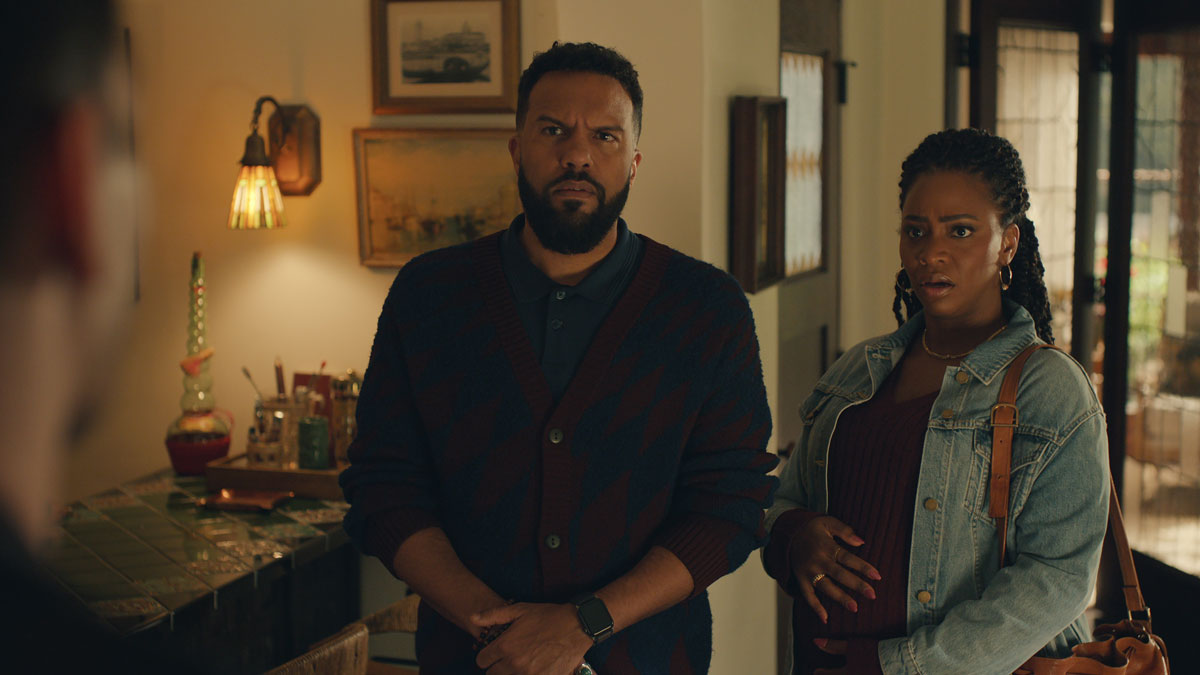
That friction also brings out superb dramatic performances in its leads – especially Kudrow, who shakes off the ghost of “Friends” entirely in her rendition of Lydia, whose psychological trauma ended her career as a celebrated concert pianist.

Romano escaped the shadow of “Everybody Love Raymondlong before this,  including anchoring “Men of a Certain Age.” But shades of Phoebe Buffay pop up in much of Kudrow’s work, even her dramatic roles, in ways that simply don’t show up here.

When Lydia and Paul implode in a later scene the viewer can truly appreciate how much Kudrow and Romano have been hinting at and holding back since the story’s opener.  

How far would you go to get what you want?

Their performances are the soulful bass line anchoring a lilting farce spiced and spiked with personalities that harmonize and clash with the main duo. Leary is plausible as ever as the dirtbag brother screwed over in the family will; he’s the oldest son but his parents left the family home to Paul, who became a contractor while Mikey slipped into criminality.

Cardellini’s Margo may be the ensemble’s most commanding figure, as one would expect of a top Feldman alumnus. Shallow and conniving, Margo is evocative of the new money in this neighborhood that assumes the Morgans have the life and the house she wants. Cardellini enticingly plays up her shabby amorality to a point that no amount of designer-label lacquer can camouflage it.  


Want a daily wrap-up of all the news and commentary Salon has to offer? Subscribe to our morning newsletter, Crash Course.


Of the two other couples played by Liu and Jacobson and Fagbenle and Parrish, the latter’s Dennis and Carla benefit from more overt comedy offered by Anna Marie Horsford’s meddling mother-in-law Denise and her slurry of guilt-tripping, smothering and genuine concern.

No Good DeedOT Fagbenle and Teyonah Parris in "No Good Deed" (Netflix)Linda Lavin and Kate Moennig recur as minor figures in this bidding war, with Moennig essentially recreating Shane from “The L Word” with a different name and career. Not that this is worthy of complaint

A major humor vein that “No Good Deed” taps reminds us that everyone has dirty closets and hidden rooms, although as Feldman demonstrated in her last Netflix series only a couple register as significant or delectable. Most are the narrative equivalent of adhesive or plausible excuses to cross or join storylines and keep the action moving.

This isn’t an overwhelming mark against it; it’s mostly worth citing to say a cleverer work would be better at hiding its seams. Aesthetic distractions notwithstanding, “No Good Deed” succeeds as both an aspirational open house and a thoughtful gaze inside the emotional walls of a home, especially the memories, funny and forlorn, that hold everything in place.

"No Good Deed" is streaming on Netflix.