Spring Sale: Get 1 Year, Save 58%

Pandemic lessons for the rest of us

Martin Luther King, Jr., offered this all-too-relevant comment on his moment in his 1967 speech “Where Do We Go from Here: Chaos or Community?”:

“The contemporary tendency in our society is to base our distribution on scarcity, which has vanished, and to compress our abundance into the overfed mouths of the upper classes until they gag with superfluity. If democracy is to have breadth of meaning, it is necessary to adjust this inequity. It is not only moral, but it is also intelligent.”

King concluded that American society was degrading human life by clinging to old thinking rather than turning to bold, visionary solutions — words that (sadly enough) ring even truer in our day than in his.

In late October as the coronavirus pandemic raged, the Economic Policy Institute released a study showing that it isn’t just morally right but an economic necessity to deal with poverty in this country and fast. “If America does not address what’s happening with visionary social and economic policy,” as that study put it, “the health and well-being of the nation are at stake. What we need is long-term economic policy that establishes justice, promotes the general welfare, rejects decades of austerity, and builds strong social programs that lift society from below.”

Even as, almost two months later, we remain trapped in an unprecedented crisis of spreading illness, there is increasingly clear evidence that, were those in power to make other choices, we would no longer need to live burdened by the social ills of old. Oddly enough, because of the Covid-19 crisis, we’re being reminded (or at least should be reminded) that, in reality, solutions to many of the most pressing issues of our day are readily at hand if those issues were prioritized and the attention and resources of society directed toward them. In a moment overflowing with lessons, one of the least discussed is that scarcity is a lie, a political invention used to cover up vast reserves of capital and technology facilitating the enrichment of the few and justifying the pain and dispossession of so many others. Our present reality could perhaps best be described as mass abandonment amid abundance.

Indeed, the myth of scarcity, like other neoliberal fantasies, is regularly ignored when politically expedient and conjured up when the rich and powerful need help. The pandemic has been no exception. Over the last nine months, the wealth of American billionaires has actually increased by a thirdto nearly $4 trillion, even as tens of millions of Americans have filed for unemployment and more evictions loom than ever before in U.S. history. Now, politicians in Washington are haggling over a “compromise” relief billthat offers little in the way of actual relief, especially for those suffering the most.

At the same time, with the health of everyone, not just the poor and marginalized, at risk, the government has proven itself remarkably capable of mobilizing the necessary resources for decisive and historic action when it comes to producing a Covid-19 vaccine in record time. That the same could be done when it comes to protecting the most vulnerable and abolishing poverty should be obvious, if only the nation saw that, too, as a crisis worthy of attention.

Where there’s a will, there’s a way

In 1918, with an influenza pandemic raging in the United States, cities closed down and doctors prescribed painkillers like aspirin as a national debate (remarkably similar to the present one) raged over the necessity of quarantine and masks. At that time, the country simply had to wait for those who were infected to die or develop immunity. Before it was over (in a far less populous land), at least 675,000 Americans perished, more than in every one of our wars since the Civil War combined.

A century later, when the Covid-19 pandemic exploded this March, the country ground to a similar terrifying halt, but under different conditions: for one thing, the shutdown was accompanied by the promise that the government would invest billions of dollars in a potentially successful vaccine produced far faster than any ever before. Nine months later, after the Trump administration had funneled those billions into research and had guaranteed the manufacture and purchase of viable vaccines (radically reducing the business risk to pharmaceutical companies in the process), it appears that we are indeed there. Last month, multiple companies released trial data for just such vaccines that seem to be nearly 95% effective; and Great Britain has, in fact, just rolled out the first doses of the Pfizer/BioNTech vaccine with the U.S. not far behind. On Friday, the Food and Drug Administration authorized Pfizer’s vaccine for emergency use. 

A long list of grave questions remains when it comes to the oversight of, and accountability of, those private companies that now hold the health of the world in their hands. Already, the British government has granted Pfizer, which stands to earn billions by beating the competition to market, legal indemnity from any complications that may arise from its vaccine, and the Trump administration has made similar agreements. Much also remains uncertain when it comes to how American-produced vaccines will be fairly distributed, here and across the world, and whether they will be safe, effective, and free. (I recently signed onto a public letter to the incoming Biden administration calling for a “people’s vaccine.”)

Still, it does seem that the historic speed with which this novel virus could eventually be curbed by just such a vaccine (or set of them) is likely to prove astonishing. Historically, on average, successful vaccines have taken 10 to 14 years to develop. Until now, the fastest effective one ever produced was the mumps vaccine and that took four years. Nearly as remarkable is how so many people have received the news of the coming of those coronavirus vaccines as if it were the norm. If anything, in a time of constant, rapid technological revolution, there’s a noticeable impatience, stoked by Donald Trump and others, that it’s taken this long.

The Covid-19 vaccine experience does show one thing, however — what can be done when the resources of this country are marshalled to immediately address a crisis-level issue. Imagine if the same approach were taken when it came to systemic racism, climate change, or the poverty that has only deepened in the midst of the pandemic crisis. Indeed, if the political will were there, Americans could clearly tackle massive problems like hunger and homelessness no less effectively than developing a vaccine, instead of spending millions of dollars on cruel attempts to drive the homeless away by redesigning park benches and other urban architecture to repel those with nowhere to stay. After all, in cities like San Francisco, where homelessness is rampant, there are more vacant houses than there are homeless people.

Although the politics of austerity generally reign supreme on both sides of the aisle in Congress (especially when it comes to antipoverty programs like welfare), it’s also true that public spending is regularly and abundantly martialed to solve issues that affect certain parts of society — namely, the private sector and the military. From subsidies to major companies like big agriculture to critical R&D expenditures for Silicon Valley to public university research that benefits private industry, funding from the state is often the invisible backbone of American business operations and advances. Likewise, spending on the military makes up more than half of the federal discretionary budget, funding everything from the 800 American military bases that circle the planet to expensive and risky new technologies and war machines.

Lessons from the pandemic

Back in March, the writer Arundhati Roy spoke of the pandemic as “a portal.” She was perhaps suggesting that the widespread suffering caused by Covid-19 could open a doorway into a future in which we humans might begin to treat ourselves and the planet with greater devotion. In another sense, however, the pandemic has also been a portal into our past, a way of showing us the conditions that have laid the groundwork not just for the devastation that now consumes us but for possibly far worse to come.

No one could have expected this exact crisis at this exact moment in exactly this way. Yet, before Covid-19, society was already teetering under the weight of poverty and inequality, and a sober look at history offers clues as to why the United States now has the highest Covid-19 case tally and death tollin the world. Too many have died because our country’s preexisting conditions of systemic injustice have gone untreated for so long and those in power never seem to learn the applicable lesson of this moment: pandemics spread along the fissures of society, both exposing them more and deepening them further.

Before Covid-19, there were already 140 million people in this country who were poor or a $400 emergency — one job loss, accident, illness, or storm — away from poverty. Across America that meant close to 80 million peoplewere uninsured or underinsured, 60 million people had zero (zero!) wealth other than the value of a family car, more than a million people were defaulting on federal student loans annually, and more than 62 million workers were making less than $15 an hour, with more than two million in Florida alone making only $7.25 an hour, the federal minimum wage. And that’s just to begin down a nightmarish list.

For Pamela Sue Rush and about 1.5 million other people, it meant a lack of access to piped water and sewage systems. Before Pamela, who is Black, contracted Covid-19 and died in July, she lived in a mobile home in Lowndes County, Alabama, where human waste festered in her backyard because she didn’t have proper plumbing, and in a state that still hasn’t expanded Medicaid, and in a country that has no federal guarantee of either healthcare or clean water. Covid-19 may have been the immediate cause of her death, but the underlying one was racism and poverty.

During these pandemic months, a popular notion has been that the virus is a great equalizer because everyone is susceptible. Yet the human and economic toll has been anything but equal across society. It will take more time to find out just what the mortality rate among the poor has been, but it’s already clear that those of us with compromised immune systems, disproportionately poor and people of color, are at greater risk of hospitalization and death from the coronavirus, and early reports suggest that poorer counties have higher death rates. An unsurprising but alarming new study found that more than 400,000 Covid-19 cases are associated with the lifting of eviction moratoriums, forcing people out of the safety of their homes; such numbers will only worsen this winter as evictions continue, if such moratoriums aren’t extendedinto the new year.

Beyond the toll of the virus itself, the economic fallout has been devastating for the poor. Between six and eight million people have fallen below the federal poverty line since March (although that measure is an old and broken standard). The true numbers are undoubtedly far higher. The last 38 weeks have seen unemployment claims greater than the worst week of the Great Recession of 2007-2008. Some economists are now talking about a possible quick bounce back once the virus is controlled and yet the long-term damage is only beginning to reveal itself. After all, 10 years after the Great Recession, a time when little in the way of long-term relief was provided, the majority of workers had still not recovered from it. That this crisis is already significantly deeper and wider should give us pause as we consider what the next decade will look like if this country doesn’t alter its bleak course.

The fissures in our society were vast before Covid-19 hit and they’ve only broadened. A vaccine will address the most visible of them, but we as a nation will continue to stumble from crisis to crisis until we learn the most important lesson this moment can teach: that our yet-to-be-United States will only heal as a society when every person’s needs are met. In a pandemic, one person without food, water, healthcare, or housing puts everyone at risk. The same is, in fact, true in non-pandemic times, for a society riven by poverty and deprivation will always be unstable and vulnerable.

Martin Luther King once told a crowd in St. Louis that “we must learn to live as brothers or perish together as fools.” Today, the balance is tipping perilously toward the latter category, as Congress painfully debates a thoroughly anemic relief bill that promises little for most Americans and sets a dangerous precedent for the coming months. In a recent letter to Joe Manchin, the self-proclaimed “centrist” senator from West Virginia, Reverend William Barber II (my co-chair on the Poor People’s Campaign) wrote:

“I am ashamed of this nation. I know you want to do the right thing, and Republicans are tying your hands, but please don’t call this a ‘centrist plan.’ It’s more cynical than centrist. It’s damn near criminal that millions are hurting, billionaires are getting richer, sick people are dying, poverty is expanding, and the Senate can’t do the right thing.”

Indeed, the most important things to note in the coming stimulus bill are these: it protects corporations (that have not protected their workers) from any accountability or legal responsibility; it continues to bail out the rich, not the rest of us, with no provisions for stimulus checks and insufficient funding to states and municipalities; it lowers unemployment benefits to $300 per week (based on wages of $7.50 an hour) rather than $600 per week (based on $15 an hour); it is not only significantly less than the nation needs, but less than what was on offer months ago. The cynicism of this relief bill lies in the way it diminishes life for political gain and corporate profit and in the false contention that this is the most that’s available to us, the best the nation can do.

The Ghosts of Christmas Present

Call it a cruel stroke of history that Congress should be deliberating on the welfare of millions only a few weeks before Christmas, especially since so many of the key players call themselves “Christians.” This holiday season and the winter beyond it promise to be a long, dark portal to who knows where, as temperatures drop, Covid-19 cases continue to rise, and poverty and homelessness are transformed into so many more death certificates. The timing of Congress’s new “relief” bill is particularly wicked if, as a Christian, you were to remember the details of Jesus’s birth in that manger in Bethlehem.

After all, he was born a homeless refugee to an unmarried teenage mother and had to flee to Egypt with his family as a baby because the ruling authorities already deemed that this poor Palestinian Jewish boy would grow up to be a threat to the established order of injustice. But the powers and principalities of his day were never the only ones who mattered. There were always those who recognized in his birth that, to right the wrongs of society, to protect the lives of countless innocent victims, another way was possible, if society started with the poor and marginalized, not with those already full to the brim.

It’s too bad that some of the congressional representatives who call themselves Christian are so unwilling to take a moment to consider the homeless revolutionary who was long ago sent to lead a moral movement from below. They should remember that the story of Christmas celebrates the birth of a poor, brown-skinned leader who, in the Gospel of Luke, is born to “scatter those who are proud, bring down rulers from their thrones, but lift up the humble. He fills the hungry with good things but sends the rich away empty.”

In a time when more children are on the brink of being born into poverty, homelessness, and state-sanctioned violence, rather than, as Martin Luther King, Jr. said, “compress our abundance into the overfed mouths” of the wealthy and corporations, Americans would do well to recognize that scarcity could vanish and that it’s time to address systemic inequality.

Copyright 2020 Liz Theoharis

To stay on top of important articles like these, sign up to receive the latest updates from TomDispatch.com here.


How socialism made the COVID-19 vaccines possible

The coronavirus pandemic has had its deadliest days yet in December 2020, but the arrival of COVID-19 vaccines from Pfizer, Moderna and others offer hope that life might start returning to some degree of normal in 2021. Journalist Leigh Phillips, in an article for the democratic socialist website Jacobin, praises the arrival of the vaccines but expresses strong concerns about the ways in which they will be distributed.

“A jaw-dropping marvel of science, economic planning and selfless, humanist cooperation by thousands of researchers around the globe, the development of this and other vaccines hot on Pfizer’s heels has taken a mere nine months since the discovery of the disease, rather than the years or even decades such medical research and development (R&D) normally takes,” Phillips explains. “They offer a glimpse of how much more an egalitarian, rationalist world could produce and achieve, freed from the fetters of profit.”

Phillips argues that the COVID-19 vaccines from Pfizer and Moderna shouldn’t be hailed as a “triumph for capitalism,” as the companies relied heavily on “years of public-sector funding.” The companies, Phillips notes, “relied on state shepherding and bankrolling of the vaccine development process.”

Phillips adds that distribution of the vaccines will underscore the harsh inequalities in the U.S. and other countries.

“Before we get out the champagne and toast our genuinely heroic scientists and clinicians,” Phillips writes, “we have to recognize that while these vaccines are indeed a light at the end of a very long tunnel, that same tunnel will be yet longer than it needs to be, thanks once again to the irrationality, inefficiency and injustice of capitalism. It will be especially unfair for those in the developing world — and even in many poorer, less populous parts of the developed West, there will be cruelties for those who live outside the metropolitan core, as there already have been throughout 2020 in the United States especially.”

Phillips wraps up the article by stressing that the public sector will be crucial in fighting future pandemics.

“Looking beyond the horizon of COVID-19, the threat of future pandemics — and among them will be ones nowhere near as forgiving as this coronavirus — requires, at some point, a serious discussion of how global democracy can be constructed from the bottom up, and how in such a democracy, worldwide economic planning can tame the inefficiencies, irrationalities and injustices of markets,” Phillips writes. “Because no one is safe until we are all safe.”

Will Ferrell’s “Eurovision Song Contest” movie is the laugh we need this holiday

If you missed the Netflix debut of “Eurovision Song Contest: The Story of Fire Saga”, there are reasons to watch it now that go beyond being inspired to keep up fashionable appearances through a winter in COVID-19 lockdown or dreaming about travelling to beautiful Icelandic landscapes.

The movie starring, co-written and produced by the hilarious Will Ferrell, is about the most popular song contest in the world that is watched across Europe and beyond. Although many in North America only learned recently of Eurovision, it has been an all-consuming obsession for many Europeans since 1956.

The film is a popular exploration of what I have examined as an education researcher: “pop-up pedagogy” — when a person doesn’t plan to take part in educational activities but ends up gaining knowledge unexpectedly anyway. This type of learning through popular art forms and media isn’t any less meaningful to people than what’s gained through formal education.

As I learned as a young person who immigrated to Portugal in my early youth, the televised song contest suggests the ways that sharing song and media in popular culture can be accessible ways of inviting people into new artistic, musical and cultural forms across borders and might even prompt changes in how we relate.

Origins of the contest

In 1956, the European Broadcasting Union, an alliance of public broadcasters from different countries, first ran Eurovision Song Contest as a way to promote co-operation among countries.

Since that time, 52 countries, not all from Europe, have entered original songs that end up being heard by millions of people around the world during the yearly live show.

Despite much of the media coverage of the contest falling on its over-the-top fashion, its unusual performances and stage props, Eurovision’s enthusiastic showcase of diversity is a great way to learn about cultural traditions and languages from different countries.

At Eurovision, every year, there are entries sung entirely or partially in languages other than English. Of course, a person isn’t going to learn a new language just by watching Eurovision (although they might be inspired to), but research shows that when a person is exposed to multiple languages they are able to learn a new one more easily.

Researchers have linked learning about diverse perspectives with improved critical thinking and creativity. More importantly, exposure to different cultures can lead to interacting with people from different backgrounds in more positive ways and increased openness to differences.

Language and community preservation

Some of the songs showcased through Eurovision have presented opportunities to learn about history and language preservation. For example, Breton, a Celtic language spoken in northwestern France, was heard at the 1996 Eurovision contest, when guitarist Dan Ar Braz of Brittany with L’Héritage du Celtes performed a song called Diwanit Bugale.

Breton is a language that has seen a decrease in speakers over the years. When Dan Ar Braz performed on a world stage, it was an opportunity for people to not only hear Breton but to learn about the struggle to keep the language alive.

More recently, Norway’s 2019 entry by the band KEiiNO showcased the Sámi language spoken by the Sámi, an Indigenous people of the northern part of the Scandinavian Peninsula and the Kola Peninsula in the far north west of Russia. KEiinO is a trio that includes Sámi rapper Fred Buljo. Their song also featured joik, a traditional form of Sámi music that is part of the traditional culture that earlier generations were prohibited from practising.

With an audience of 182 million tuning in in 2019, many people had an opportunity to learn about an Indigenous language through a song presented at Eurovision.

Bringing people together

On the surface, this comedy is not about the political transformation that can happen through exposure to new cultural exchange; it’s rather about the small personal changes that can shift through being open to new dimensions of relationships and seeing ourselves in new ways.

But let’s not forget the movie also offers a kind of meta-commentary on the Donald Trump years in the United States.

This comes in hilarious doses such as when we see (the American) Ferrell in role as an Icelander screaming at American tourists: “Go home and build your wall!” Ferrell learned about Eurovision through his wife, Viveca Paulin, who is Swedish.

Traditional education has begun to recognize how learning opportunities provided by the Eurovision Song Contest are vast. The University of Melbourne has offered a course where students learn about the history of Europe through Eurovision and the University of Chicago has also offered a course on the famous song contest.

For those who prefer a more informal approach to learning, the Eurovision Song Contest returns in May 2021, but don’t worry if that’s too long to wait.

The movie is on Netflix along with all of its wackiness, like Ferrell running in a gigantic hamster wheel while singing Euro-pop in a flashy, silver outfit. Frankly, if you’re in Canada, facing three more months of dark, cold days along with COVID-19 restrictions, this sort of humour may be just what the doctor ordered.

Anna Augusto Rodrigues, Faculty Development Officer, Teaching and Learning Centre, Ontario Tech University

This article is republished from The Conversation under a Creative Commons license. Read the original article.

On screen and on stage, disability continues to be depicted in outdated, cliched ways

The #MeToo and Black Lives Matter movements have forced Hollywood and other artists and filmmakers to rethink their subject matter and casting practices. However, despite an increased sensitivity to gender and race representation in popular culture, disabled Americans are still awaiting their national (and international) movement.

“Disability drag” — casting able-bodied actors in the roles of characters with disabilities — has been hard to dislodge from its Oscar-worthy appeal. Since 1947, out of 59 nominations for disabled characters, 27 won an Academy Award — about a 50% win rate.

There’s Eddie Redmayne’s performance as Stephen Hawking in “The Theory of Everything“; Daniel Day-Lewis’ portrayal of Christy Brown, who has cerebral palsy, in “My Left Foot“; and Dustin Hoffman’s role as an autistic genius in “Rain Man” — to mention just a few.

In recent years, however, we’ve seen a slight shift. Actors with disabilities are actually being cast as characters who have disabilities. In 2017, theater director Sam Gold cast actress Madison Ferris — who uses a wheelchair in real life — as Laura in his Broadway revival of Tennessee Williams’ “The Glass Menagerie.” On TV and in movies, disabled actors are also being cast in roles of disabled characters.

Despite these developments, the issue of representation — what kind of characters these actors play — remains mostly unaddressed. The vast majority of characters with disabilities, whether they’re played by actors with disabilities or not, continue to represent the same outdated tropes.

As a professor of theater and media who has written extensively on the elements of stage drama, I wonder: Are writers and directors finally poised to move beyond these narrative tropes?

Breaking down the tropes

Typically, the disabled characters are limited to four types: the “magical cripple,” the “evil cripple,” the “inspirational cripple” and the “redemptive cripple.”

Magical cripples transcend the limitations of the human body and are almost divinelike. They make magical things happen for able-bodied characters.

In many ways, the magical cripple functions like “the magical Negro,” a term popularized by director Spike Lee to describe Black characters who are usually impoverished but brimming with folk wisdom, which they selflessly bestow on existentially confused white characters.

Like the magical Negro, the magical cripple is a plot device used to guide the lead character toward moral, intellectual or emotional enlightenment. The magical cripple doesn’t learn anything and doesn’t grow because he already is enlightened.

In film, examples include Frank Slade, the blind army colonel who guides young Charlie through the perils of teenage love in 1992’s “Scent of a Woman.” Marvel’s Daredevil character is a perfect example of a magical cripple: A blind person imbued with supernatural abilities who can function above and beyond his physical limitations.

Evil cripples represent a form of karmic punishment for the character’s wickedness. One of the most well-known is Shakespeare’s Richard III, the scheming hunchbacked king.

In a 1916 essay, Sigmund Freud pointed to Richard as an example of the correlation between physical disabilities and “deformities of character.” The trope of the evil cripple is rooted in mythologies populated by half-man half-beasts who possess pathological and sadistic cravings.

More recent examples of the evil cripple include Dr. Strangelove, Mini-Me from “Austin Powers: The Spy Who Shagged Me” and Bolivar Trask in “X-Men: Days of Future Past.”

Then there are inspirational cripples, whose roles equate to what disability rights activist Stella Young calls “inspiration porn.” These stories center on disabled people accomplishing basic tasks or “overcoming” their disability. We see this in “Stronger,” which retells the story of Boston Marathon bombing survivor Jeff Bauman.

In the inspirational narratives, disability is not a fact of life — a difference — but something one has to overcome to gain rightful sense of belonging in society.

An offshoot of the inspirational narrative is the redemptive narrative, in which a disabled person either commits suicide or is killed. In movies like “Water for Elephants,” “Simon Birch” and “The Year of Living Dangerously,” disabled characters are sacrificed to prove their worth or to help the protagonist reach his goal.

These characters serve as dramaturgical steppingstones. They are never partners or people in their own right, with their own drives and ambitions. They are not shown as deserving their own stories.

The persistence of these tropes underlies the urgent need to reevaluate the makeup of writers and production teams. Who writes these parts is perhaps more important than who acts them.

Beyond the hero’s journey

There’s a reason these formulaic roles are so prevalent.

For much of the past century, Hollywood storytelling has operated according to the hero’s journey, a dramatic structure that places the white male able-bodied character at the center of the story with atypical characters serving as “helpers” to support his goals.

This narrative model has conditioned audiences to see the helpers as purely functional. The tropes based on this framework define the categories of belonging: who is and who isn’t human, whose life is worth living and whose isn’t.

The one narrative journey that historically allowed the disabled to play a central role depicted them as working toward the symbolic reclamation of their dignity and humanity. In tragic narratives, this quest fails, and the characters either die or request euthanasia as a gesture of love toward their caretakers.

Million Dollar Baby” and “Me Before You” are two good examples of films in which disabled characters choose voluntary euthanasia, communicating the socially internalized low value of their own lives.

But what if disabled characters already had dignity? What if no such quest were needed? What if their disability weren’t the thing to overcome but merely one element of one’s identity?

This would require deconstructing the conceptual pyramid of past hierarchies, one that has long used disabled characters as props to illuminate conventional heroes.

Carrie Mathison in the series “Homeland” can be thought of as representing this new approach. Carrie, played by Claire Danes, struggles with mental illness, and it affects her life and her work.

But it is not something to overcome in a dramatic sense. Overcoming the disability is not the central theme of the series — it’s not the main obstacle to her goal. Carrie’s disability does give her some insights, but these come at a price and are not magical.

“Homeland” further breaks the mold by giving Carrie a helper who is an older white male — Saul Berenson, played by Mandy Patinkin.

As we move towards greater gender and race inclusivity at work and in the arts, disability should not be left behind. More complex, more sophisticated stories and representations need to replace the simplistic, outdated and cliched tropes that have been consistently rewarded at the Oscars.

Magda Romanska, Associate Professor of Theatre and Dramaturgy, Emerson College

This article is republished from The Conversation under a Creative Commons license. Read the original article.

The rise and fall of Tab — after surviving the sweetener scares, the iconic diet soda gets canned

Tab, the Coca-Cola company’s original diet soda brand, is headed to the soda graveyard, joining retired brands such as Like, Leed and Limette.

Coca-Cola has announced that it is discontinuing Tab after 57 years on the market, and fans of the drink will have until the end of December to purchase their last can of nostalgia.

From the beginning, Tab’s story has been one of perseverance. The brand survived initial low sales, the artificial sweetener scares of the 1960s and 1970s, lukewarm enthusiasm for the product at the corporate level and intermittent consumer availability to become — for a brief period — the most popular diet soda in America. Then, of course, Diet Coke came along.

While it never regained its lofty status as the top diet soda, loyal Tab fans kept the brand alive.

Meant for diabetics, downed by dieters

While some might think Tab was the first diet soda, that honor actually belongs to a beverage called No-Cal, which was developed by beverage industry pioneer Hyman Kirsch in 1952. Kirsch wanted to create a soda for diabetics and people with cardiovascular problems, so he used cyclamate, which was discovered in 1937 by a graduate student working at a University of Illinois chemistry lab after he licked some of the substance and found that it tasted sweet. About 30 times sweeter than sugar, cyclamate isn’t metabolized, making it ideal for people who need to avoid sugar.

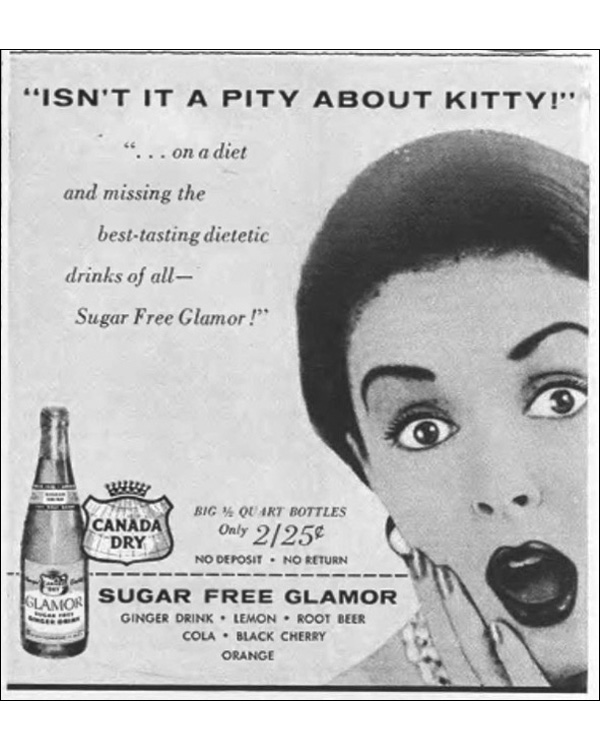
But from the start, No-Cal was popular with a different type of consumer: dieters. Actress Kim Novak became the brand’s slim celebrity spokesperson. Canada Dry followed soon after with a line of diet sodas called Glamor, marketing it to women trying to lose weight.

Diet soda really took off with the introduction of Diet-Rite Cola by the Royal Crown Cola company in 1958. Like No-Cal, Diet-Rite initially targeted diabetics and was often placed in the over-the-counter medicine section of grocers. But it soon became clear that the real market was dieters. By 1960, Diet-Rite was the fourth-best-selling soft drink in the country, trailing only Coca-Cola, Pepsi and 7 Up.

Soda giants caught flat-footed

Coca-Cola and Pepsi, finding themselves behind the ball, scrambled to come up with their own diet soda offerings.

Coca-Cola’s foray into the diet cola market — dubbed Project Alpha — was an ambitious one. It wanted to come up with a soda that tasted good, had a proper mouthfeel — sugar adds not only sweetness but also viscosity — and was attractive to women, the presumptive market. It also needed a catchy name.

For the name, Coke executives had one directive: Even though its taste was engineered to mimic Coke’s, it couldn’t be called Diet Coke. Because most early diet sodas didn’t taste that great, strategists warned against associating their brands with drinks that might taint their tremendous value.

So an early IBM mainframe computer generated more than 600 candidates with the parameters that the name be three or four letters and not offensive in any foreign language.

Tabb, which was eventually shortened to Tab, eventually won the battle of market testing. Stylized as “TaB,” it was introduced to the world in a series of ads with the tagline “How can just one calorie taste so good?”

For a company that ordinarily has such excellent marketing instincts, Coca-Cola wasn’t sure how to fit Tab into its portfolio. Bottlers resisted the product, fearing it would undercut their profitable sugar-based sodas. By the end of its first year, it had only 10% of the diet soda market, an unusual predicament for a brand backed by the No. 1 soda company in the world.

Coca-Cola wasn’t subtle about targeting dieting women.

Later in the 1960s, Coca-Cola introduced the grapefruit-flavored diet soda Fresca, which was a much bigger hit with consumers and further sidelined Tab.

Emerging from the sweetener scares

Artificial sweeteners were riding high in the 1960s as Americans wanted to enjoy their sweets without paying the caloric price. But danger was lurking in the form of the Delany Clause in the Food Additives Amendment of 1958, which prohibits food additives that have been found to cause cancer.

In 1969, the Food and Drug Administration banned the sweetener cyclamate after lab studies indicated that large doses of the sweetener led to bladder cancer in animals. While Tab contained two artificial sweeteners — saccharin and cyclamate — cyclamate was the more important of the two. Saccharin is 300 to 400 times sweeter than sugar, but in high concentrations it gives products a bitter, metallic aftertaste. However, when it’s combined with cyclamate, the bitterness goes away.

After the cyclamate ban, Tab was forced to reformulate and ended up deciding to use saccharine as its primary sweetener. Then in a second blow, follow-up research on potential health problems associated with artificial sweeteners focused on saccharin, leading the FDA to require warning labels on products using the sweetener.

Despite these obstacles, Tab still ended up becoming the bestselling diet cola of the 1970s and 1980s. People, it seems, were willing to turn a blind eye to potential health problems as long as they were able to continue to get their diet soda. And Tab, for a brief period, was apparently the favorite of the bunch.

In 1982, Tab was reformulated yet again to include Nutrasweet, also known as aspartame. But Tab drinkers protested the change to the drink’s flavor profile, and the company dropped aspartame from the recipe.

Enter: Diet Coke

After Pepsi entered the diet cola market with Patio, it rebranded the product as “Diet Pepsi” within a year. Consumers embraced the new drink and a string of celebrity endorsers only enhanced its popularity.

This lesson was lost on Coca-Cola, which didn’t bring a diet drink using the Coca-Cola name onto the market until 1982, when it introduced Diet Coke.

Contrary to the company’s original fears, Diet Coke was an immediate hit. Even though the flavor of the new beverage was not a carbon copy of the sugar-sweetened version, customers took to it. And the main victim of Diet Coke was not the original Coke, but Tab. Over the years, Tab’s market share dwindled; by 2019, its sales made up only about 1% of the Coca-Cola portfolio.

Yet the drink managed to retain some passionate devotees, even as rumors of its impending doom circulated on and off over the years. A Tab shortage in 2018 caused self-described Tab-aholics to stockpile their favorite beverage, and petitions to save the drink were circulated and sent to the company.

They couldn’t stop the inevitable. Coca-Cola is trying to cut underperforming brands, and even modern ones like Odwalla juice and regional sodas like Delaware Punch are poised to fall prey to the cost-cutting guillotine. The company says more than half of the 500 brands it currently markets will disappear in the near future.

[Deep knowledge, daily. Sign up for The Conversation’s newsletter.]

Tab lovers might have less time than they think to load up; serious Tab fans have begun snapping up any six-packs that might still be lurking on store shelves.

It won’t be long until the only cans left will be in the basements of Tab-aholics.

Jeffrey Miller, Associate Professor, Hospitality Management, Colorado State University

This article is republished from The Conversation under a Creative Commons license. Read the original article.

Best of 2020: George Floyd and the white gaze

I don’t know who George Floyd is yet, but I am already angry. It is Wednesday, May 20th, eleven weeks into America’s full consciousness of a worldwide pandemic that even with its rising slope of fatalities has this country divided across racial lines. In my trendy and high-rent Houston community white women with baby carriages stroll with other white women, and men in close proximity to me jog by. In a nearby park children play as if they reside in an alternate universe. None wear masks. On the other side of the country, for the same behavior, Black folks are criminalized. A stranger paces back and forth, talks loudly in the lobby of the post office around the corner from my apartment. I yell at her— tell her to put on a fucking mask. [1] I am wrong, but truth is, I’m not sorry. Later, I convey the incident to my younger sister, who is 1,300 miles away, and she reminds me of my place. You are Black. You live in Texas, she says. My sister is articulating the story of America which positions the white gaze towards Blackness. Whether right or wrong, and no matter how innocuous “the wrong,” Blackness, under the watchful eye of whiteness, is forever suspect — the consequences of which are most always negative and oftentimes fatal.

* * *

My sister and I often go through the world with opposing beliefs — it’s an opposition grounded in different modes of handling growing up in a dysfunctional family. My sister believes in the sanctity of family, that blood is thicker than water. Close friends have been important anchors for me. Like everyone in my family, my sister is religious. When injustice happens, she finds solace in the Bible. I go to pen and paper. I’m a tad left of center on the liberal scale. My sister is on the right with a firm sense of right and wrong. As such, when my sister rang on three separate occasions in one day following the death of George Floyd, I refrained from answering. Of Floyd’s death, I knew anger would be my sister’s response, but I was in no mood to hear the word that gets much traction when poor people of color — not companies or politicians influencing policy — steal and destroy. There was little vocal outrage from those in my personal and professional communities when personal protective equipment purchased by various states was looted from the American government during this pandemic. Not a peep of outrage reached my ears, therefore I had little capacity to now hear, from my sister or anyone else, who was wrong, why they were at fault, and how these events were distractions. I needed the gaze to focus and remain on the public servant who felt the need to restrict the breathing of man handcuffed and held to the ground by three other public servants.  I answer when the phone rings again Sunday. We exchange terse pleasantries. But before the call comes to an end, and not anticipating the response, I address the elephant in the room with the question, What do you think about George Floyd? On the other end is a lengthy silence. Then a deep sobbing. What you need to know is that my younger sister is stronger than I am. Though she is young, emotionally she is built like the elder women in most Black and other ethnic families, which is to say she is matriarch material and vulnerability is not in the matriarch lexicon. Matriarchs shed tears only for their own blood. When the sobbing ends, my sister shares the story of my nephew, who is six years old. How the young boy watched the video of a policeman, a training policeman, kill a man begging for air in broad daylight in Minneapolis. She wants to know how to explain this archive of Black death insistent on his inclusion. [2]

* * *

The burden of the racialized experience is shifted onto the white reader in Claudia Rankine’s “Citizen: An American Lyric,” which features documentary vignettes showcasing the dangerous banality of American racism. In the collection, Rankine relies on second-person point of view to force her white reader to embody the precarious terrain that is Blackness in America, and as such, to confront their own complicity:

You tell your neighbor that your friend, whom he has met, is babysitting. He says, no, it’s not him. He’s met your friend and this isn’t that nice young man. Anyway, he wants you to know, he’s called the police.

Your partner calls your friend and asks him if there’s a guy walking back and forth in front of your home. Your friend says that if anyone were outside he would see him because he is standing outside. You hear the sirens through the speakerphone.

Rankine’s reliance on second-person point of view is grounded in Toni Morrison’s assertion that the focus on the Black body as a racialized subject must be shifted toward a critique of whiteness. In “Playing in the Dark: Whiteness and the Literary Imagination,” Morrison interrogates knee-jerk approaches to the literary study of race that insist on approaching “racialism in terms of its consequences on the victim.” A more comprehensive and accurate account of race in literary study, Morrison suggests, must focus on racism and “its impact on those who perpetuate it.” If we re-situate Morrison’s concern with the white gaze from the realm of literary theory and into the streets; if we situate this gaze inside the bedrooms, inside vehicles, near broken down vehicles, on tennis courts, inside superstores, at subway stations, on the side of the road hitchhiking, at recreation centers, on tax-payer funded city streets, inside places of worship, and the various other environments for which the presence of the Black body equates to danger, then we should question responses to this particular kind of tragedy that position the gravity of race back onto the object of said racial violence. This might mean news outlets resist the trafficking and commodification of Black death and grief with its assembly line of civil rights lawyers, Black community leaders and distraught families of the dead, and instead focus on querying white people from all walks as to why these actions persist with regularity and impunity.

* * *

Forgive the inclusion of this petty rant directed at mostly well-intentioned liberal white people. There is more than one way to approach a problem, however the promotion of social justice syllabi and lectures given from the podium of wokeness may not be the most effective means rhetorically. Doing so only illustrates a tendency for liberal whites to distance themselves from other whites when the gaze falls on them. With liberal whites the enactment of racism is always the purview of someone less educated, someone conservative, someone poorer, someone richer, someone rural, someone religious, someone old, someone from the South. It is never them. Even in our racial lexicon, white distancing is present. For example, the word ally, which grates my last nerve, is woefully inadequate to describe white people and their relationship to racism; ally implies one’s ability to join or equally sever an alliance; but how does one “join” a problem they are inextricably part of? [3] We hear this language of detachment when fathers give themselves props for babysitting. Nah dawg, this is your child and it’s your job.

* * *

The post office. The stranger. An individual and communal yell is uncomfortable to expose, but is necessary work offered in an attempt to resist a kind of social justice performativity that positions the protester without real flaws. Five days before I learned the name of George Floyd I drove to the post office around the corner from my apartment. I was tired and angry, my body attempting to process previous hurt. When I drove to the post office, my mind was still in Puerto Rico where the American government left brown people to die in the wake of Hurricane Maria. I was tired and angry and still attempting to process that an Arab journalist residing in the U.S. and employed by an American newspaper was killed and American leaders acted as if a foreign government had simply stepped on their toe. I was tired and angry that in response to a worldwide pandemic disproportionately affecting some Native populations, the Seattle Indian Health Board requested medical supplies from state and federal agencies and instead were “mistakenly” sent body bags. I was tired and angry because Breonna Taylor and Ahmaud Arbery were the most recent names added to some sinister catalogue. The object of my brief tirade could have taken her phone and dialed 911. She could have walked to her vehicle and retrieved a gun. Instead, and luckily for me, she walked to her truck, reached in, and —voilà — pulled out a face mask. In that brief moment of individual protest I felt seen and heard, but more importantly, I hope this stranger felt some responsibility for the we supposedly foundational to We the People.

There are difficult conversations to be had, but we must engage in this work with family, with friends, and with ourselves. [4] Our fear of this work is overblown as these discussions will always fail to push the limits of the uncomfortable. Eric Garner engaged in a literally uncomfortable conversation. Philando Castile engaged in a literally uncomfortable conversation. Sandra Bland engaged in a literally uncomfortable conversation. Botham Jean was denied the opportunity to even talk. On the holiday set aside to honor those who lost their lives for a freedom owed to all of us, George Floyd engaged in an uncomfortable conversation. This litany of death has me asking the question Lucille Clifton asks in her poem “Jasper, Texas 1998”: “who is the human in this place, / the thing that is dragged or the dragger?” As a child, I would retreat to a corner in our house and refuse to eat and socialize when I felt I had been mistreated. There is no corner deep enough for me to insert myself at this moment. We carry so much of much.

Notes

  1. I could walk around with a placard noting that I have asthma, Type A blood which is more conducive to COVID-19, and that six years ago a pulmonary embolism, the consequence of a routine ankle surgery, nearly took my life — three blood clots in the right leg, one in each lung — but these facts should be beside the point, hence the endnote.
  2. I’m grateful for smartphone technology and the courage of bystanders who record these crimes, but there is a savage correlation between videos of Blacks killed by whites and lynching postcards. Grace Hale, in her Washington Post article, “The link between the video of Ahmaud Arbery’s death and lynching photos,” offers a brief historical prospective. When I visit the George Floyd shrine in Houston’s Third Ward, families gather with their children as they’re photographed in front of his mural. The families come to pay their respects, but Floyd’s face flanked by angel wings makes for a backdrop with a history so somber I couldn’t bring myself to take a picture though I wanted to.
  3. The vocabulary surrounding Derek Chauvin’s crime is suspect as well. In the hours following Floyd’s death, several news outlets, including ABC, NBC, CNN, and FOX, ran headlines noting that the police officer knelt or was kneeling on Floyd’s neck. Children kneel by their bedsides to pray. Someone buys a ring, kneels, and asks for their lover’s hand in marriage. In these headlines, the media resist language that centers criminality onto Chauvin.
  4. I’m not suggesting a kind of cruel optimism that believes racism in America can be eradicated. Cruel optimism is Lauren Berlant’s term for desires that are not at all realistic or attainable. Real talk and the checking of one’s own complicity is an important step in creating accountability and safer environments for people of color. A more effective but least likely approach, would be a fully supported divestment of funds from corporations and other agencies supportive of racism via policy, hiring practices, etcetera. I leave this discussion to those versed in the topic.

In defense of persimmons, winter’s misunderstood and underappreciated fruit

In Korean folklore, there is a story of a tiger and a baby and a persimmon. Basically, a fearsome tiger comes into a village to find some food, while a baby in the village endlessly cries. In an attempt to quiet the child — who is completely unfazed by the mother’s warnings of the beasts that may hear them — she promises kkotgam, or dried persimmon. The baby quiets immediately, and the tiger, who overheard everything, turns tail, mistaking “kkotgam” as a beast scarier than a tiger, the threat of which must have finally hushed the baby.

In this tale, I am the baby. Those whole, dried persimmons, smashed to sweet, soft, flat, powdery pucks, have been one of my favorite snacks for as long as I can recall. Once, unable to find them where I live in Louisville, Ky, I carried a box in my luggage from an H-Mart in Austin, Texas, like precious cargo. I rationed those dozen to stretch for months — I’m down to my last three.

Ripe, the texture is like a mango and the taste is sweet and mild like honey, with a richness underneath, not quite nutty. The taste is versatile and fits well with a cider as much as it does a nice goat cheese or a pour of bourbon. Despite growing across many parts of the United States, persimmons have just not widely caught on.

Not a “weird little tomato”

Each year, as the cold-weather fruit makes an appearance in grocery stores and gift baskets — Chrissy Teigen’s recent Instagram stories have featured boxes of gifted persimmons and the fruit included in a massive 12-foot charcuterie board —  I see a flurry of posts on social media about bad experiences with mouth-puckering persimmons or unfamiliarity with the fruit that looks like a weird little tomato.

The act of trying a new, foreign food without knowledge or context — and upon having a negative experience, deciding it is bad — is something that columnist Noah Cho would describe as “bad kimchi,” one of many interpretations of the phrase that he describes in his essay series for Catapult. 

Earlier this year, he gave an example — a woman binged on shirataki noodles marketed as “Better Than Pasta” for their low-carb count — and ended up with an impacted mass in her gastrointestinal tract. 

“That’s bad kimchi,” Cho stressed then. I heard his voice a year later when I read a Facebook post asking people to describe the taste of persimmons. In the comments below, I saw a variety of descriptions, from nutty to fruity, and accounts of traumatic attempts to eat them

You see, Asian persimmons come in basically two varieties — the flat-bottomed fuyu can be consumed pretty much as soon as you buy them and taste the way they’re supposed to. The hachiya variety, which is shaped more like a cartoon heart, is full of bitter tannins that, if eaten before the fruit reaches ripeness — that is, soft, almost squishy ripeness — is incredibly astringent and an overall awful culinary experience.

How to eat persimmons

Los Angeles-based Chef Luke Reyes — a winner of Food Network’s “Chopped” who opened 9th Street Ramen in Downtown L.A. earlier this year — recommends educating yourself at the market or before you shop for the winter fruit.

“Like anything else, I think people will eat a persimmon and not really know what they’re getting into.” Reyes said. “If you’re cooking with a persimmon or eating it raw, you should know if it’s ripe. Talk to someone at the market — Do due diligence.” 

As for how to eat them, Reyes has served the fruit in many ways over the years. He points to a time when he had it on a menu as a more savory dish: Roasted with brown butter with sage, rosemary and garlic and served with burrata, pan-roasted in the mix and topped with salmon roe.

Growing up, I didn’t know that the ever-present persimmons in our kitchen each winter were an idiosyncrasy of growing up in an Asian American home and that the fruit that was a staple for us was one that most of my peers had never tasted. And it had never occurred to me that the fruit could be cooked or combined into a savory meal.

It’s been in recent years that I’ve let my affection take new life, adding the fruit to cocktails or cutting it up into a salad, appreciating it outside of my own culture and in a wider culinary experience. Now, I see an abundance of options, from persimmon pudding, to jam, to roasted and combined with pancetta, risotto and goat cheese.

With each negative post I see about persimmons — overwhelmingly, they are about eating an unripe one — I want to beg the writer to try one of the precious kkotgam I have left in my stash, or walk them through their misstep in the produce aisle, asking them to give the fruit one more try.

Biden can restore the EPA, but it will require steadfast effort

There is ample evidence that the U.S. Environmental Protection Agency suffered a clear loss of focus, a sharp drop in morale among its career staff, and disastrous policy reversals during the Trump administration. Remedying these setbacks will take sustained and persistent effort — more akin to priming a pump than flipping a light switch. Nonetheless, if the Biden administration persistently pursues several steps, it can go a long way toward restoring the effective EPA Americans need and deserve.

First, the agency’s full-time equivalent workforce is overdue for a significant increase — well beyond reversing the reductions enacted under Trump. Ideally, any staff augmentation will be phased in prudently to allow ample time for recruiting and training new employees, and to account for all new EPA obligations that may arise with respect to curbing climate change.

A restored EPA will also need to rebuild its foundation of scientific expertise. A new administration will do well to restore the agency’s prior emphasis on mitigation of and adaptation to the climate crisis. The EPA must also be part of an administration-wide push for comprehensive legislation to reduce the nation’s greenhouse gas emissions. And the Trump administration’s attempts to censor sound science — by falsely purporting to improve transparency in order to unreasonably limit the application of legitimate scientific findings — must be promptly reversed.

In a deliberate and legally sound way, a revived EPA also needs to reverse specific Trump administration actions and policies that have weakened critical protections of public health and the environment, such as its attempt to narrow the reach of the Clean Water Act by narrowly defining the statutory term “waters of the United States,” and its drastic weakening of automobile emission standards. In fact, there are potentially hundreds of Trump era regulatory changes that need to be reversed, so this won’t be an easy task. The new administration should assign a team of agency scientists to survey the prior administration’s regulatory changes at EPA to promptly and identify Trump-era regulations that do the most environmental harm. That set of regulations should receive priority attention for “rolling back the rollbacks.”

Finally the EPA’s new leadership must give high priority to restoring its traditional emphasis on a deterrent approach to enforcement. As I wrote earlier this year, EPA enforcement fell to a 20-year low under the Trump administration. It is crucial that EPA’s new leadership announce and continually reiterate its unwavering support — both publicly and internally — for a vigorous enforcement effort.

And in keeping with one of my previous recommendations, the EPA’s enforcement programs greatly need an influx of skilled new personnel — particularly criminal investigators, lawyers and engineers. Those new employees may be used to increase the number of plant inspections completed by the agency and the overall number of criminal, civil and administrative enforcement cases it pursues.

It should also foster deterrence by extensively publicizing its enforcement work, which it can accomplish by routinely distributing public announcements regarding specific enforcement case initiations and resolutions. These will serve as warnings to other companies while increasing public confidence in the agency’s efforts.

The road back from the EPA’s decline under Trump may be slow and arduous. Nonetheless, with persistent effort, strong encouragement from a new cohort of agency leaders, and unwavering support from the White House, it can be restored as a diligent protector of the nation’s health and environment.

The opinions expressed above are those of the author and do not necessarily reflect those of The Revelator, the Center for Biological Diversity or their employees.

The best TV shows of 2020 that made staying at home bearable

Remember when everybody worried that we were going to run out of TV in 2020? Yeah . . . that didn’t happen. Yet. One of the very few benefits of spending most of our time at home is that this became the year that we collectively realized how much television content is out that we haven’t seen yet. That goes for old shows that passed us by in the busier before-times and this year, when production schedules may have slowed down, delayed or ceased altogether. TV still yielded enough excellence to make it very difficult to narrow a year-end list of Best TV Shows down to 10.

“So why not expand it to 20?” you may ask? To that I answer, “Have you not lived through this year? Dammit, I’m exhausted.”

The usual caveats apply here, starting with the admission that no single critic can watch or review every show that’s on, including a few great ones. (I hear “How to With John Wilson” is superior. Haven’t seen it yet, but I’ll get to it. Promise!) If you don’t see your favorite show on this list, it doesn’t mean it’s not fabulous. It probably means I haven’t seen it – but hey, we can disagree too. That’s fine!

Second, this is one person’s take on the best TV of the year, and while it includes a number of shows that made other critics’ year-end lists I also selected a couple that I watched for pleasure and not for work. As always, other worthy series aren’t mentioned here because you’re going to watch them with or without any critic’s thumbs up. “The Mandalorian” is an example: love it; does not need anyone’s help!

Lastly, there are many, many more shows that are well worth your time, the best of which (in my opinion) I included in my list of runners-up.

  1. I May Destroy You,” HBO

    None of us entered 2020 expecting to negotiate trauma in its various definitions. Michaela Coel guided us through her version when she invited us inside of her heroine’s mind, making her confusion our own with humor and tenderness while challenging common questions about consent and responsibility as she navigates the aftermath of a sexual assault. Coel’s series defied expectations for summertime viewing, resolving its complicated story in a manner than can only be described as revolutionary.
     

  2. Better Call Saul,” AMC 

    Jimmy McGill died in a desert this year. Saul Goodman came out of that parched marathon, corrupting everyone around him . . . including the otherwise upstanding Kim Wexler. The penultimate season of the AMC hit drama sets up many inevitable crashes and plummets and what will likely be a stunning conflagration between Tony Dalton’s mercurial Lalo and Giancarlo Esposito’s Gus Fring. We know which one makes it to the “Breaking Bad” era, but the superior storytelling left us excited to see the how of it, which is even more important.
     

  3. Better Things,” FX

    Every season of Pamela Adlon’s series improves upon the previous, which was already one of the best things on TV. The show’s 2020 episodes lent a hominess to an anxiety-ridden year defined by quarantine and reminded us in the joy in the littlest moments spent with Sam Fox and her girls. But then, the big sweeps like Sam’s boozy trip to New Orleans and coincidental meeting with an old hookup were pretty damn satisfying too. In all, this show reminds us that for all its flaws the world is still a wonderful place – and that includes the part of it that’s right there in our living rooms.
     

  4. Ted Lasso,” Apple TV+

    In a year that set new definitions for awfulness this comedy arrived relatively quietly and offered 10 episodes of pure, unfiltered good feeling. Jason Sudeikis’ football coach is an ebulliently upbeat inspirational person, but he’s also wise, thoughtful, caring and clever. Joining him on his journey to build a sorry soccer team into happier people, if not winners, gives us the latitude to forgive ourselves, dare to happy and above all, be curious.
     

  5. P-Valley,” Starz

    In a medium where strippers typically show up as background dressing Katori Hall’s electrifying drama makes her exotic dancers the centerpiece, exposing the extent of their toil, determination and intelligence in as much detail as the parts of their bodies that make dollars rain down. An extraordinary cast and crisp writing makes this series one of the year’s best surprises – and the gutsiness of Uncle Clifford’s wardrobe alone is worth the price of admission.
     

  6. What We Do in the Shadows,” FX

    As Americans struggled with the realities of quarantine, vampire trio Lazlo, Nadja and Nandor, and their familiar Guillermo demonstrated the flying highs and grave pitfalls of sequestering oneself with family and frenemies over long periods of time. Fortunately for us they were equally skilled at it, and terrible, but at their best when they interacted with the outside world (at a Superb Owl party, or as regular human bartender Jackie Daytona) and realized their lair is where the heart is. However, this season’s MVP award goes to their other roommate Colin Robinson, an energy vampire who gave us life in an episode where his power surged and he drained an entire office dry. Working from home isn’t so bad after all,  is it?
     

  7. PEN15,” Hulu

    Middle school life only gets harder the further in that awkward best friends Maya and Anna venture. But as they feel their way through that cave they allow us to vicariously relive the worst of puberty right along with them, and that made us feel better somehow. The second half of the season is coming in 2021 but it has already achieved a few stunning artistic triumphs, the most memorable being a quiet and magical choreographed sequence created to capture the wonder of a school play. This series still knows how to break our hearts, but it is even better at patching them up afterward.
     

  8. Mrs. America,” FX

    Dahvi Waller takes us back to the rise of second wave feminism and the woman-led backlash that surged to meet it in the form of Phyllis Schlafly, whose supporters took issue with how Cate Blanchett portrays her. Nevertheless, Blanchett’s nuanced and humane performance is undeniably riveting, as is Uzo Aduba’s portrayal of Shirley Chisholm (who, it must be said, deserved more screen time). One measure of this limited series’ effectiveness is that it commanded attention in a year dominated by a mountain of competing stories in the media, reminding us of the cyclical nature of social justice movements and political change.
     

  9. The Good Lord Bird,” Showtime

    If Ethan Hawke’s wild-eyed abolitionist didn’t grab you from the first episode, Daveed Diggs’ glorious portrayal of Frederick Douglass as a ladies’ man and a pragmatic politician surely should have. Together with the rest of the cast and buoyed by a witty, energetic script, Hawke’s fire-and-brimstone performance takes us inside the determination of man who knows that certain evils cannot be undone with polite rebuke – which coincidentally supports one of the main arguments about the validity of civil rights protest tactics we witnessed this year.
     

  10. Insecure,” HBO

    As surely as we missed our real life friends, fans of this show missed Issa and Molly fiercely – but that also made watching their breakup all the more compelling. As Rae and the series’ writers persuasively progress their friendship’s deterioration, the story also establishes this development as a natural part of moving forward in life, something every adult faces at some point or another. Tough as it was to watch, and heartening as it was to see the possibility that the two could mend their bond, this development kept me on edge and waiting for each new episode.

Hey, Watch These: Lovecraft Country,” “Normal People,” “Devs,” “Never Have I Ever,” “Brockmire,” “City So Real,” “Little America,” “Cherish the Day,” “Warrior,” “Star Trek: Picard.”

Ski resorts work to stay open as COVID cases snowball

TELLURIDE, Colo. — The day after Thanksgiving, Dr. Jana Eller and Dr. Shiraz Naqvi were seated beside an outdoor fire pit at the base of Telluride Ski Resort, taking a short break from skiing.

The two physicians from Houston had driven more than 18 hours to get here for the holiday weekend, and they were staying (and preparing meals) in a rented home. They traveled with another couple and their kids, colleagues they’ve been “bubbling” with in Houston.

“We got a COVID test prior to leaving and will get another when we return,” Naqvi said.

The skiing itself doesn’t feel much different during the pandemic, Eller said, but “the après ski scene is just gone.”

In March, at the beginning of the pandemic, Colorado Gov. Jared Polis issued an executive order requiring the state’s ski resorts to close in response to COVID-19, which had hit the state’s ski towns early and hard. Now, as the resorts enter their busy season, the state has taken pains to avoid blanket closures even though cases of COVID-19 are reaching their highest levels yet.

How to stay open amid the pandemic is an issue resorts across the U.S. are facing. Mandatory face coverings have become the norm, but other COVID mitigation efforts vary by site. Vermont resorts ask skiers to certify their compliance with rules governing interstate travel during the pandemic when buying a lift ticket, and in Colorado’s Pitkin County (home to Aspen), visitors will be required to confirm they’ve had a negative COVID test result within 72 hours of travel or pledge to quarantine for 14 days after arrival or until they obtain a negative test result.

Telluride is an internationally renowned destination trying to operate safely while protecting the 8,000 or so permanent residents in the area. Located in a remote southwestern part of Colorado, its economy depends on tourism, and the resort posts as many as 6,500 visitors on its busiest days.

On Nov. 25, with its COVID case numbers skyrocketing and its positivity rate hitting 4.6%, San Miguel County, which includes Telluride, closed its bars and restricted its restaurants to takeout and outdoor dining only. Signs posted throughout the resort remind visitors of the “five commitments of containment” — wear a mask, maintain 6 feet of physical distance, minimize group size, wash hands frequently and, when you feel sick, stay home and get tested.

How bad would things have to get to close the resort? That’s hard to gauge, said Grace Franklin, public health director for the county. People are going to do what they will regardless, she said.

“If we shut down the ski resort, how many people will take to the backcountry and get injured or trigger avalanches where the impact is greater? It’s a ‘damned if you do, damned if you don’t’ situation,” Franklin said.

Instead, Franklin said, the question becomes “How do we create safer, engineered events so people have an outlet, but we minimize as much risk as possible?”

Skiing itself poses relatively little risk, said Kate Langwig, an epidemiologist at Virginia Tech. “You’re outside with a lot of airflow, you’ve got something strapped to your feet so you’re not in super close contact with other people, and most of the time you’re riding the lift with people in your group.”

Gathering in the lodge or bar is by far the biggest COVID risk associated with skiing, said Langwig, who grew up skiing in northern New York. “In my family, one of the things you do after a day of skiing is connect with friends and have a beer in the lodge,” and it’s this social aspect of skiing that’s too risky right now, she said.

In an effort to discourage tourists and residents from congregating, local governments, medical facilities and the ski resort released a co-signed letter in November urging people to cancel any plans to gather with those outside their immediate household and celebrate the holidays solely with people from their own household. Keeping the resort open will require everybody to do their part, said Lindsey Mills, COVID public information consultant for San Miguel County.

“We are not telling anybody not to come, at least not yet,” said Todd Brown, Telluride’s mayor pro tem. But local officials are broadcasting a strong message to everyone in the area — “Chill out. Don’t have the big party with five families.”

Officials aren’t worried only about coronavirus transmission; they’re also concerned about overtaxing their medical facilities. San Miguel County has an urgent care center but no hospital, and its medical center experienced a 22% staffing shortage at the end of November, mostly because so many employees are in quarantine. Hospitals in nearby Mesa County reached their ICU capacity last month, and other hospitals in the region are also pinched.

“We can’t have a situation where people break their legs on the slopes and we can’t get them care,” said Franklin.

The resort has taken steps to facilitate physical distancing among visitors. Reservations aren’t required at Telluride, but lift tickets must be purchased in advance, and the resort can restrict ticket sales if necessary, said Jeff Proteau, vice president of operations and planning at the Telluride Ski Resort. Gondolas are operating with the windows open and each load is restricted to members of the same household.

To reduce contact in and around the lifts, workers have created “ghost lines” of empty space to ensure a 6-foot distance between groups while they wait in lift lines. People from the same household can stand in line together and ride the two- to four-person lifts next to one another, Proteau said, but when riding a lift with someone from another household, guests are asked to leave a vacant seat between them.

Langwig was a children’s ski instructor for many years and worries about ski school. “You interact pretty closely with the kids,” she said, noting that runny noses are common. “You spend a lot of time getting kids bundled up and to and from the bathroom.” This could be especially challenging if indoor spaces are closed, she said. “Hot chocolate breaks are one of the ways you get kids through the day, and that’s not safe anymore.”

In anticipation of visitors needing to take breaks to warm up, the resort has installed six temporary structures around the mountain with insulated ceilings and heated panels. When the sides are rolled up, they’re considered outdoor spaces, Proteau said, but they can be closed into confined spaces with limited occupancy as needed, especially on a blustery day.

The risk for most employees on the mountain should be relatively minimal, Langwig said, at least at work. “Lift attendants are outside wearing thick gloves and a mask most of the time. Compared to someone who works in a restaurant, their risk is pretty low.”

Employees are generally assigned to work in small groups that can be quarantined, if necessary, without wiping out a whole department, Proteau said. There’s also contact tracing in place for resort employees.

Arizona native Joey Rague moved to Telluride last year and works as a ski valet on the mountain. He said there’s a huge incentive among employees to keep the resort open. With affordable housing sparse in Telluride, “all of us are struggling seasonally to be able to pay rent.”

So far, he said, most visitors have been respectful and conscientious of the rules.

“It seems as though people understand that if we want to stay open, we have to come together,” he said.

Kaiser Health News (KHN) is a national health policy news service. It is an editorially independent program of the Henry J. Kaiser Family Foundation which is not affiliated with Kaiser Permanente.

A day of reckoning for Big Pharma: The elegy that Appalachia really needs

The movie adaptation of “Hillbilly Elegy” recently debuted on Netflix, and in true 2020 fashion, the movie has inspired – or perhaps just revealed – disagreement and frustration over some of the same questions that arise from the book and its unexpected success in post-election 2016. 

The movie omits a lot of the book’s commentary about the working class and “hillbillies,” thankfully, and firmly places it in Vance’s Ohio hometown, which keeps the movie firmly out of Appalachia (even the Kentucky scenes, ironically, were filmed in Georgia). But in the book, Vance makes it clear that his perception of Appalachia is based on childhood experiences there, and both his hero-worship and critiques of his uncles derives from time spent with them in early childhood at occasional events, like family reunions and funerals. Few of us would lay claim to a cultural identity by virtue of our grandparents having been born in the region. Even fewer of us would purport to write an elegy – a “lament for the dead” – for that culture, and paint its unflattering portrait in such broad strokes. 

Like many natives, I have a deep love for Appalachia even as I struggle to reckon with its complexities. I have some outlandish (and true) stories that may impress at a dinner of white-collar elites – particularly, my great-grandfather’s moonshining exploits and friendship with Al Capone, and perhaps my father’s gunfight outside my bedroom window.  

Other stories I know not to tell at fancy dinners, just as I’ve learned over the years how not to out myself as white trash. I wouldn’t explain how my family didn’t have clean drinking water and instead consumed a whole lot of pop (or soda, depending on where you’re from) that rotted my baby teeth. I wouldn’t tell them how I grew up learning the names of prescription pills. The most popular ones in my father’s vocabulary were Percocet and Oxycontin. Lortabs were “the poor man’s cocaine.” I wouldn’t tell them about the time my father spelled a word by saying, “V – V as in Valium.” My adult son still laughs at that, and I savor the rare instances of humor that briefly lighten what has otherwise been a source of constant loss and heartache. 

There wasn’t a lot to laugh about when I was a kid, though. In his younger years, my father terrorized our family. Sometimes he beat our dogs, and I ran to our back door often, hearing gunshots blast from our yard and bounce off the hills of our holler. I never knew who or what might get hurt next. In some ways, my life perfectly fit the stereotype of Appalachia that is so often depicted in popular culture, though never explored in depth. 

A lot of negative responses to both the film and book versions of “Hillbilly Elegy” claim that it misrepresents Appalachia and perpetuates stereotypes. Other Appalachians acknowledge that they relate to the story and are grateful to see it told. What we have in common is that all of us – even my gun-toting, pill-addicted father – are more complex than what “Hillbilly Elegy” would have you believe. 

This might be the kind of nuanced observation that results from immersion in culture, rather than something that can be discerned by looking in from the outside. There may be value in having outside perspectives contribute to the conversations about what a culture and region needs, but the people living within Appalachia are actually the experts on what it takes to survive here. We know a lot about what we need, though few politicians have shown any interest in hearing our input for decades. Academics, social critics, and consumers all have a duty to recognize the seduction of the outsider’s gaze, and it is past time to accept the fact that the outsider’s gaze is never fully informed, never in possession of the magic answer to someone else’s problem.

* * *

When I wrote my memoir, I wrestled with one of the same questions Vance raises: At what point do we hold people responsible for their behavior, and how much of it can be attributed to their circumstances?

Like him, I grew up as the “forgiving child” – I always wanted to believe my father when he apologized to our mother, and at least once, we returned to him after escaping his control because he cried on the phone to me. As an adult, I’ve gone years without talking to my father because to talk to him almost always involves him asking me things like, “Why won’t you come see me? You think you’re too good?” 

My father’s pill addiction was evident to me sometime around the late 1980s. Another relative from his generation had a taste for Valium. In the mid-2000s, multiple family members from my generation either overdosed or were incarcerated for narcotics, and mostly prescription opiates. When the formula for OxyContin was changed in 2010, making it impossible to crush and snort, I heard of more and more people starting to use heroin. Opiate addiction became a national problem at that point, as it began to affect the shrinking middle class, and I wondered at how it had ravaged my family and community for thirty years before it made the news.

I didn’t really have to wonder, though. 

The history of Appalachia is largely untold – it is certainly not told on the national level, and I had to go to college before I learned much about it myself. I was a freshman when I learned about the Battle of Matewan and how coal companies hired private agents to terrorize, beat, and even murder the miners who tried to organize and strike for better wages. I already knew that coal mining had always been a dangerous job, but I learned that the coal companies owned every bit of the towns they built to support their mining operations – they owned the schools, the hospitals, and the stores. Miners were often paid in “scrip” (or “script”) that held value at the company-owned facilities, and nowhere else. When the coal dwindled or became too costly to mine, the companies left, taking everything with them. Gone were the jobs, the stores, the hospitals, and the schools. There was no way to build generational wealth out of scrip, no way to save for the future.

These former coal towns are abundant throughout Appalachia – abandoned by the people who grew wealthy from their resources, leaving behind environmental disasters and, thanks to politicians who supported the wealthy owners, very little tax revenue to build anything new. There are other types of languishing towns in Appalachia, too – largely, those that sprung up around river ports and the railroad lines that bustled when our timber and coal were transported out of the region. When the natural resources were finally extracted to the point where profitability waned, and as the world’s transportation network evolved, those who could leave, did. And those who stayed, struggled.

* * *

I was truly shocked by the Justice Department’s recent $8.3 billion settlement with Purdue Pharma. As the makers of OxyContin, I have never blamed them for my father’s personal decisions, but I have always known someone was getting rich off of his weakness, and the vulnerabilities that made it so easy for much of my community to turn to pills. 

Canadian psychologist Bruce K. Alexander introduced the concept of “Rat Park” in the early 1980s. Rat Park explored the popular theories about addiction that dominated the conversation in the 1970s, and which still persist. Previous studies placed rats in cages and gave them the option to drink plain water or water laced with morphine, heroin, or cocaine. The rats chose the drug-laced water and consumed it over and over, until they overdosed and died.

Alexander created Rat Park, which gave rats the same drinking options, but also provided them with options to play, socialize, and explore. The rats occasionally chose the drug-laced water, but they never overdosed, and they largely preferred the plain water. While the experiment can’t be replicated in humans, as Alexander states, “there have been countless natural experiments in which people have been alienated from their societies in every possible way or had their cultures crushed. Addiction often follows these tragic events.”

I think about Appalachia and our generations of economic hardship. Many white Appalachians trace their ancestry to Scots-Irish. Vance attributes his grandparents’ clannish and protective behavior to those roots. I grew up being told that my paternal ancestors are Irish. With names like Conn and McKenzie, I’m sure they are from that same region. 

How can I distinguish, though, between the way those familial roots have passed through generations – even crossing an ocean – to turn my father into the kind of man who will have a gunfight with his own brother, and due to family loyalty, drop the legal charges soon after? 

What kind of responsibility does he bear for being a drug addict, when the place he was born into has seen economic strife since the beginning of its statehood? Before Kentucky was a state, it was a difficult place to physically survive. For many reasons, that truth has remained unchanged. The same mountains that rendered this region rich with coal have created a terrain that is difficult to travel. Barriers of all kinds – both seen and unseen – have made this land achingly beautiful and yet sorrowful. 

Violence is more prominent when a community or a family occupies a lower socioeconomic status, and the risk of domestic violence is higher when the family is in poverty. Children who grow up in poverty are more likely to suffer from health issues, developmental delays, behavioral problems, lower academic achievement, and unemployment in adulthood. In other words, being poor sets children up to fail as adults, and they often follow that trajectory, creating a new generation of poorly-equipped humans in the course of their struggle.

That’s not to say we are all fated to generational cycles. Like Vance, I managed to create a much better life for myself – and my children – than I ever anticipated as a child. I was able to obtain a college degree due to the generosity of strangers who support the mission of Berea College and the institution itself, similar to how Vance credits Pell grants and Yale’s financial aid for low-income students for his success. But rather than the Marines teaching me that my choices matter, I chose to have a child when I discovered I was pregnant at the age of 22, with one year of college left. I thought long and hard about what it might mean to have a baby, and I decided to commit myself to that baby. I decided to be a better parent, and a better person, than I actually knew how to be.

But, what about the members of my community who don’t test high enough for scholarships or just don’t want to go to college? What about the women and girls who find themselves pregnant but can’t muster resolve and determination, and are only faced with the overwhelming anxiety I often battled as an unprepared and unsupported parent? I found a job in Lexington right out of college and over the course of the next twenty years, I clawed my way out of poverty. I was lucky. So was Vance. Most people aren’t.

It was critical for me to take responsibility for my life, just as it was for Vance. Writing my memoir gave me the opportunity to fully explore my history, and figure out a way to still claim agency over my present and future. But I have plenty of loved ones who can’t write a memoir, who haven’t had one of those variables play out in their favor to fill them with determination and hope for the future. Many of my loved ones are still struggling against the burdens they have inherited.

This story is not ubiquitous across Appalachia, and that is part of why so many Appalachians have taken exception to “Hillbilly Elegy.” Many of our grandparents – crucial to our well-being – conducted themselves with dignity and were neither abusive nor apparently mentally ill (evidenced in Vance’s descriptions of his grandmother’s hoarding, at the very least). There are plenty of stable families in Appalachia, with lifelong marriages, generational wealth, and emotional nurturing to boot. Our contributions to the arts and the enrichment of America are vast. But, I write about my family and my experience because ours is the scenario that has been presented to the rest of the world as some sad example for what the region has become. 

Personally and collectively, moving forward isn’t about blame – it’s about understanding, and taking appropriate action. Purdue Pharma has admitted culpability for exploitative marketing campaigns, for courting more than 100 healthcare providers whom they believed were diverting opioids into the black market and misleading the DEA. One of the most sickening statements from the U.S. Department of Justice reads: “Purdue learned that one doctor was known by patients as ‘the Candyman’ and was prescribing ‘crazy dosing of OxyContin,’ yet Purdue had sales representatives meet with the doctor more than 300 times.” Purdue sales representatives specifically marketed to healthcare providers they knew were prescribing the opiate “for uses that were unsafe, ineffective, and medically unnecessary” – cruelly, under the direction of the marketing program called “Evolve to Excellence.” The charges Purdue has admitted to range from May 2007 to “at least” March 2017. 

My generation of Appalachians can attest that their unscrupulous and insidious greed affected us long before that. 

It’s one thing to put a rat in a cage with nothing but water and drug-laced water. It’s another thing to reward doctors who put the drugs in the water. Appalachia has struggled culturally due to the many decades of economic pressure and outright theft that our people have endured. Our people grapple with the social and personal instability that have resulted from that economic reality, but that struggle takes place within a paradise on earth. Some of us have family bonds that transcend anything the outside world has to offer. 

J.D. Vance – who has never lived in Appalachia but had the pleasure of visiting for long weekends and “lazy summers” – admonishes Appalachians that “These problems were not created by governments or corporations or anyone else. We created them, and only we can fix them.” He thinks the answer to this region’s problems is that “hillbillies must wake the hell up.” But history tells us something different, and Purdue Pharma’s admission of guilt in fueling the opioid epidemic is just the latest in a series of thefts that have damaged this region’s economic and social stability. 

Vance claims that public policy won’t improve any of the problems in Appalachia, but in truth, public policies have allowed (and encouraged) companies to outsource U.S. jobs; public policies allow predatory companies like Purdue Pharma to exploit loopholes and manipulate data, at the expense of vulnerable populations; and public policies have long favored the robber barons who plundered this region, investing nothing in its future.  

Blame our Scots-Irish ancestors or the modern hillbilly – blame my own “white trash” family if you want. But the solution to this region’s problems do not rest in any proverbial bootstraps. Most of us have learned how to survive against all odds, and our problems have not sprung forth from some vacuum, born only of our own moral failures. Those of us who have found our voice are trying to tell you. If you truly want to understand what’s “wrong” with eastern Kentucky and Appalachia at large, listen to those of us who have lived it.

Historian Anthony Harkins on the real story of white poverty and “Hillbilly Elegy”

J.D. Vance’s 2016 memoir “Hillbilly Elegy,” with its tale of white poverty in Appalachia, self-uplift and the author’s escape from those origins to Yale Law School, and then to America’s elite business and political class, is a cultural phenomenon.

Vance’s book has sold more than a million copies, and “Hillbilly Elegy” was recently adapted into a Netflix film by Oscar-winning director Ron Howard, featuring acclaimed actresses Amy Adams and Glenn Close. While some critics have condemned the film as melodramatic shlock — the Atlantic declared “Hillbilly Elegy” to be one of the worst films of the year — the public appears to reject those judgments: “Hillbilly Elegy” is one of the most popular films on Netflix.

For a country and world struggling to understand the power of Trumpism and its enduring hold over the “white working class,” “Hillbilly Elegy” was embraced, in part, as a Rosetta Stone for decoding the incomprehensible ascent of Donald Trump. Despite Trump’s 2020 defeat by Joe Biden, the proto-fascist Trumpian movement continues to grow in power and influence. As such, “Hillbilly Elegy”, both the film and the book, will continue to cast a long shadow over America’s understanding of Appalachia, white rural poverty and the famed white working class. Deserved or not, J.D. Vance will continue to be a singular figure among the country’s opinion leaders.

But “Hillbilly Elegy” has a foundational problem: It may be one man’s story, but that does not make it valid sociology or revealing of greater truths about Appalachia as a whole. In many ways, “Hillbilly Elegy” is an example of poverty porn designed to appeal to the same type of (white) viewer who may believe they understand “urban poverty” because they watched HBO’s “The Wire.”

As sociologist C. Wright Mills observed in “The Promise of the Sociological Imagination,” a distinction must be made between “personal troubles and public issues” if one is to possess a sophisticated understanding of society, power and politics. Applying Mills’ wisdom, “Hillbilly Elegy” is a personal story that does not sufficiently account for the ways institutions and broader social structures impact life outcomes.

How does the “Hillbilly Elegy” story (meaning the overall narrative of the film and book) misrepresent Appalachia and the variety of experiences and people who live there? In what ways do stereotypes about the “hillbilly” complicate Americans’ understandings of race, class and poverty? Why has Vance’s memoir been so successful given its many faults? 

In an effort to address these questions, I recently spoke with Anthony Harkins, a professor of history at Western Kentucky University and editor (along with Meredith McCarroll) of “Appalachian Reckoning: A Region Responds to ‘Hillbilly Elegy’.” Harkins’ previous book is “Hillbilly: A Cultural History of an American Icon.”

What do people outside of Appalachia not understand about the region and its people? What role has the mass media played in this misunderstanding?

They essentialize the region far too much. The region is presented from a very narrow viewpoint, focusing on coal miners, for example. The coal miner becomes the model, when in fact they are just a tiny percentage of the workforce in the region — and becoming smaller all the time, for a variety of reasons. The number of coal miners has been decreasing for 50 years, but the idea of a hardworking white male working-class coal miner dominates the popular imagination.

Also, for a long time Appalachia has been presented as somehow outside of American culture, history, society. It is this land apart, the mountains have frozen it in time and space, it is a different world, with a different language and different rules, etc. Of course, that narrative hides the way that Appalachia is in so many ways completely integrated into American society. What is new with the “Hillbilly Elegy” vision is that it is reframing Appalachia not so much as completely apart from America but as a quintessential example of the problems that the country is facing. Moreover, Appalachia is framed as facing those problems much more intensely because it is imagined as being monocultural, all white and all working class.

But again, that is not true. There has always been diversity in Appalachia. Certainly the coal mines have always been diverse, and there is an increase in diversity in urban Appalachia as well. That increasing diversity includes gender, race and sexual orientation. The “Hillbilly Elegy” book presents the white, male, working-class story of Appalachia as the definitive one. In these discussions of Appalachia, the range of attitudes, experiences and openness to alternative political perspectives held by the people living there is often lost.

What type of political and social work is being done by the image of the “hillbilly” in the American popular imagination?

My earlier book, “Hillbilly,” examined the construction of that stereotype. One of the main points I tried to make in that book was that the hillbilly is a type of dualistic image. That dualism has helped to make the image and idea appealing and relevant and enduring. On the one hand, the hillbilly is an image of whiteness which can be celebrated as some continuation of “our” heroic ancestors who tamed the wilderness, carved out civilization and maintained their old-fashioned values about religion and culture.

The other side of that image is that the hillbilly and their culture are a problem that “civilization” has to eradicate. The hillbilly can easily become the wild savage. Family and community, which are good things, can then be distorted into aberrant relationships with family members and inbreeding. If the hillbilly archetype is imagined as being self-sufficient and able to survive on their own, then those traits are turned into violence and aggressiveness.

The hillbilly is a type of white Other in that imaginary. They are white people but they are also imagined as having characteristics that are similar to people of color such as Native Americans or Black people. The hillbillies are violent, lazy, oversexed, isolated, primitive and ignorant. All those stereotypes about nonwhites can be transferred to hillbillies as the white Other.

The image of the hillbilly in the mass media could be Jed Clampett or “Deliverance” on one extreme and then J.D. Vance on the other end. A common theme across those examples is the idea of a dysfunctional community that a person has to rise above in order to be successful.

With the rise of Trumpism, there was a renewed interest in the so-called white working class as well as the white poor in regions such as Appalachia. The popularity of “Hillbilly Elegy” reflects that.

One of the things we tried to do in “Appalachian Reckoning” was to emphasize photos of the real Appalachia, with the diversity of the people there — the political activism, the idea of simply being children and a celebration of life, rather than this vision of death and despair. That is a contrast with the cover of “Hillbilly Elegy,” which is an abandoned farm next to an empty dirt road. Appalachia is a space of difficulty and hardship, for sure, but also one of vitality and resilience.

How have conservatives used the idea of poor white Appalachians (and poor and struggling whites more generally) to further their agenda?

The white voters in Appalachia are solid Trump voters. Conservatives can rely on them for support. There is also the claim that by helping racial minorities it comes at the expense of white people. And there is the racial fear that whites are becoming a minority population in America.

The discourse around “hillbillies” shifts according to the country’s mood. How is the economy tied to this?

We see this in during times of economic difficulties and crisis such as the Great Depression. We also saw a resurgent focus on the image of the hillbilly during the 1960s and the War on Poverty.

During times of economic uncertainty, the hillbilly takes a more central place in America’s narrative because many people fear that they too could become hillbillies if the economic problems continue: “We will have to live off of the land because we don’t have money or food. We modern, city-dwelling people won’t be able to survive.” The deeper overall fear is that the hillbillies and other people at the bottom of the social hierarchy will be able to survive the economic disaster and those in the middle class for example will not.

Why was “Hillbilly Elegy” so popular?

For many people, the Trump phenomenon seemed to come out of nowhere. They were desperate for answers and explanations. “Hillbilly Elegy” seemed to provide some of those answers. Part of the popularity of the book is also driven by how the lives of the white working class are imagined as being so difficult that they were desperate for new possibilities and Trump represented that hope to them. Vance’s book is also popular because of its dramatic narrative.

In my opinion, it is not particularly well-written. However, it is a compelling story of someone overcoming hardship. “Hillbilly Elegy” is very much a Horatio Alger story. Through luck and pluck, Vance pulls himself up. The book, of course, really understates the role of the state in his achievement.

“Hillbilly Elegy” was popular with the pundit class because Vance had become associated with that very same class of people. By the time Vance writes the book he is in San Francisco working for Peter Thiel. Vance went to Yale. He is connected with real elites. In many ways these factors came together to make Vance into a legitimate spokesman — at least for a certain audience — for a white working class that he is in fact no longer a member of.

“Hillbilly Elegy” is a memoir. It is a story, one that by its very nature obscures, embellishes and omits certain facts and details. It is an interesting story, but it is not a sociological text — despite how many people wish it to be one. For example, where is the evidence for the claims that Vance is making in the book?

The subtitle of the book is “A Memoir of a Family and Culture in Crisis.” The idea of a memoir of a culture is one of the things that got people upset who live here in the region and who also study Appalachia. Vance’s approach is presenting his personal story as the story, the one and only Appalachian story. By doing that, all the other stories about Appalachia are erased. That is a very anti-intellectual approach.

“Hillbilly Elegy” cites very few sources. Some of the information in the book is quite wrong and Vance does not seem to really care. His use of “hillbilly” is done without context for how such language has been used in other ways. What is appealing about the book for many people is that Vance does not get bogged down in the details. For example, the book does not acknowledge the differences of life experience and how race, class and gender impact people in a range of ways.

The biggest issue is that in “Hillbilly Elegy” Vance does not acknowledge the larger systemic factors and forces that shape and limit people’s lives. Much of the book is just about how people are too lazy to find work. Or he suggests that if people can just overcome their drug and other dependencies, they will succeed in life. Vance does not recognize in the book how larger economic and social forces impact people lives, and how people find themselves in the challenging situations that he is describing and critiquing. Except for his grandmother and a few other people, “Hillbilly Elegy” is a story about one individual rising up from his circumstances, rather than seeing his experience as being part of a collective community.

What would a more nuanced story about Appalachia look like?

There are strong progressive forces at work in Appalachia. The history of unions for example. One of the other elements missing in Vance’s book is that it is such a male-focused story that it hides, denies and limits the experiences of women, gays and lesbians, and other marginalized groups. With “Appalachian Reckoning,” we are trying to do something quite different from what Vance did with “Hillbilly Elegy”. Our point is not to deny J.D. Vance the right to his own story, but rather  to argue that we need to many stories which reflect the diverse range of experiences in Appalachia. In many ways, the appeal of “Hillbilly Elegy” is to frame the region in very limited racial terms. Ultimately, the problem is that Appalachia has been defined too much by the idea of one single story or narrative. There should be multiple voices and multiple perspectives.

John Kerry, Biden’s climate czar, talks about saving the planet

Last month, President-elect Joe Biden said he would demonstrate his administration’s prioritization of the climate emergency by appointing former Secretary of State John Kerry to a high-profile role as the nation’s climate czar, a new position on the National Security Council that will report directly to President Biden, and through which Kerry will elevate the climate crisis in both the nation’s international diplomacy and its domestic policymaking.

Since the election, Kerry has said little about what he will do first, or what he believes a Biden administration’s highest priorities should be.

Earlier this fall, in the course of reporting for an in-depth series about a great global climate migration, I spoke with Kerry twice about the current state of the climate crisis, and its implications for the United States and for global security. In our conversations — the first streamed for the public on Sept. 10 through Kerry’s climate-focused organization World War Zero, and the second a private on-the-record interview Sept. 30 — we discussed his outlook on climate policy, the potential for warming to drive a mass global migration, his thoughts on immigration policy and what a new Biden administration might begin to do about it all.

Kerry spoke about the climate threats in unusually frank terms, portraying a crisis of catastrophic proportions demanding an urgent response. The following is a portion of our conversations, woven together and edited for clarity and brevity.

What’s the connection between climate change and human migration? You’ve been talking about this since you were secretary of state in 2015.

They’re integrally intertwined. I mean, this is not some pie-in-the sky future dilemma that we may face that people are talking about hypothetically, it’s already happening, and it has been happening for some period of time, and the linkage could not be more clear. We had 130 degrees in some communities in Pakistan last summer, also in the Middle East. We had 130 degrees in Death Valley in the United States. If places keep getting hotter like that, and fires keep devouring communities and so forth, places are going to become unlivable and people will migrate, period. And so people are going to move to places where they think they can live. They’ll fight over places that they want to move to. We will have millions, tens of millions of climate migrants.

In Syria, this was not the cause of the Arab uprising, and it was not the cause of the Civil War, but it contributed very significantly to the intensity of the war when a million plus people moved in from the desert where they no longer could raise their livestock, they no longer could live. They came into Damascus, and anyone will tell you that that contributed very significantly to the capacity for the unrest and insurgency that followed. I personally thought that the pressure of migration on Europe during the Syrian crisis was the great warning sign for everybody. That’s one country’s upset. The one group of people being relatively managed in their dislocation. But if it’s a massive movement of people, all of a sudden?

You can have wars that come from this migration as people fight for waterholes, as they fight for a homestead. You will have massive pushback by people in various countries that can amount to genocide. I think it is very clear that if we’re going to try to reestablish a means of managing the affairs of state and of the planet and dealing with global issues, we’re going to have to deal with this.

The pressure on borders, then, will be immense.

It could be very tense. Without proper leadership and without a lot of forethought and without an inclusivity to a process where people feel they are being heard, this could be a really, really messy process. I mean borders will be challenged. Societies will be challenged. There will be the nationalistic populism we see today, it will raise its ugly head in various countries and who knows where it goes? Remember what happened in Rwanda. If people are thrown together, all of a sudden that can get pretty ugly if it isn’t managed.

Climate has already been a driving factor for migrants coming to the United States. What are the implications of a future with even more people, as the climate warms, and how do you think a Biden administration would approach it?

The United States is a country — and I believe will remain a country — that will continue to welcome people to our shores through legal immigration. And legal immigration is the key. We’re having a huge political battle over that now. We’ve been stalemated on this issue, polarized for years, and we’ve seen how divisive and dangerous it is to our own country. We’ve had vigilantes — people going down as part of so-called national militia and reinforcing our border. You can imagine if 30 million people are trying to move in. I don’t think that’s going to happen because I think we’ll have a sensible policy between us and Latin America.

When Joe Biden was vice president and I was chairman of the Foreign Relations Committee, we were very involved with the Central American presidents of countries to help deal with the problem, particularly of child migration, which was coming about because of the violence, because of the lack of opportunity, because of the lack of education and so on. So we put together a plan, not unlike the plan we once put together called Plan Colombia, where we put a billion dollars on the table and managed to pull Colombia back from being a failed state. You can’t just talk about it, you can’t just exploit the idea of the emotions that go with it, and the building of a wall, which Donald Trump has done. You have to do something about it. And doing something is not just building a wall or trying to build a wall, it’s helping to provide an alternative life for those folks, helping to provide alternatives where millions of people will make a different decision. That’s critical to what we have to do.

But if we’re going to grow as a nation and our economy is going to continue to grow, we’re going to continue, I think, to have legitimate immigration, because that’s been the staple of our economy. The folks who come in beginning at the bottom of the ladder are the ones who have helped to build America in the best sense of the word, and they do a lot of jobs that other people just won’t do.

Are you saying you’re for open borders?

It’s a really important question. Democrats have been, I think, not as thoughtful as we might be in the language we’ve chosen and the ways that we approach this. I believe in borders. If you don’t have borders, you don’t have nations.

Now, that doesn’t mean you shut down immigration, you shut people out. You’ve got to deal with it so that people know they can legitimately find a way to be able to immigrate, and that we have a legitimate control of the border. You do have to have border enforcement. That said, you also have to have a humane and fundamentally fair system where people who came here 30 years ago, the dreamers, many of them, they played by the rules, they paid their taxes, they haven’t been arrested, some of them doing better for our country paying into Social Security and other things than other citizens.

So we have to stop exploiting the issue and get that pathway to citizenship that gives everybody a sense that the system is fair. And it doesn’t become an incentive for more people to break down the door and come in illegally. I think you can balance that.

All right. And you were saying, this is about more than North America.

The solution is not going to come by just dealing with this problem of people from Central America. This is a global problem. Eighty-five percent of all the emissions in the world are coming from 20 countries. Over 50% of all the emissions of the world are coming from three entities; the United States of America, the EU and China. Over 50%. So those are the countries, frankly, that have the greatest responsibility to move rapidly to do something. And we did that in the context of the Obama administration where we had what we call the Major Emitters group and we came together to talk about what we need to do.

But here’s the problem. Despite Paris, despite all the best intent, it’s just not happening. If you did everything that we laid out that we needed to do in Paris, we would still be rising 3.7 degrees centigrade. That’s catastrophic. But we’re not doing everything we laid out in Paris, so we’re going way beyond 3.7 degrees right now. We’re heading to 4.1 or 4.5 degrees. That is just such a catastrophic impact on our biosystem and on our planet that it’s hard to even describe to people.

So the United States has to step up again. We have to do what President Obama licensed me to do, which was go to China, sit down with President Xi and talk about mutual interests. Now, China is about to bring 21 gigawatts of coal fired power online. India is poised to do slightly less, but similarly huge amounts. That’s going to kill us. That’s going to kill the efforts to deal with climate. If we don’t get China on board to help us lead all development efforts over the next years, and then India and Brazil and a group of other countries, we’re not going to get this done. I’m just telling it like it is.

What’s the geopolitical long view? Do you see countries moving strategically to try to benefit from climate change?

Yeah. That’s manifested in the Arctic where you see competition for rare minerals and mineral exploitation, as well as claims being made about the opening of the Northwest Passage. Russia and China are beginning to get very aggressive in their hunt for commodities for the long term. That plays out differently as land mass changes its accessibility or its usability. [Migration, then] follows that. You’re going to have a bunch of nation states that are going to disappear over the course of this century. Who’s going to welcome them? What countries will they go to?

It’s possible, then, that the climate crisis writ large just becomes a new political wedge?

Some are already exploiting it. The greater threat is that if you don’t deal with climate, soon, rapidly, you will have a whole bevy of politicians who are exploiting the negative consequences of not having done so. So it’s not that you’re suddenly going to turn around and everybody will sing “Kumbaya” and respond to go get the job done. Don’t just blame China, or blame Brazil, or blame somebody else. We will have a nationalistic populace rising which will, I think, obscure much of the real debate that people need to have about health care and education and opportunity, and so forth. It will really get, I think, into an exploitative period.

The solution to climate change is energy policy, and energy policy is opportunity. If we will get about the business of being the world’s greatest innovator and the world’s greatest creative entity. This is our modern-day race to space.

Let’s talk about Asia for a moment. The U.S. relationship with China is increasingly adversarial. But China is key to solutions on climate.

Part of the increasing tension between our countries is created by President Trump. I think China is having a lot of difficulty figuring out his approach to trade. He just went straight to tariffs and straight to a trade war. I think the Chinese have very little use for our president, frankly. I think China is going to be, like it or not, one of the most important relationships that we work on over these next 10, 15, 20 years or longer. The point is, you’ve got to talk to people. You can’t run around the world bashing people and behaving like all you have to do is tell them what to do. So we’re going to have to reach out, build up, but also be absolutely firm about things that we disagree with.

What about Russia? Putin has said he wants to use climate to become a food-producing superpower, and he might need a lot of climate migrants to do it. China has been aiding these efforts, apparently eager to strengthen a new climate-era axis of Eastern power.

If Russia thinks that climate is going to benefit it, they haven’t done their calculations about Siberia and permafrost and tundra thawing and what the impact of methane is going to be on damaging the rest of the planet. That’s just not a thought-through concept.

Is there a competitive or security interest that the U.S. has in how Russia approaches the challenges of climate and migration?

Of course. I mean there are major security interests in what Russia decides to do. I mean how Russia responds to the challenge of climate is going to be critical. One of the great challenges is that Russia is an extraction-based economy, whether for fossil fuels or for minerals. The question looms large as to how serious Russia is prepared to be about contributing to resolving the final crisis. As long as the agriculture they’re employing, they grow and harvest it with sustainable and regenerative practices, that could be terrific. I mean there’s not exactly a surplus of food for lots of populations in the world.

Bring us back to the United States. We’ve seen record heat, fires and hurricanes this year, and early signs that climate change is displacing people here, within the United States. Do you think this nation will look different in a warmer world?

Yes, it will. There’s going to be some measure of disaster in that transformation, because various places will not be habitable. Smaller cities may become bigger, we may wind up with better, more modern design; Our school systems, transportation, et cetera. This is an opportunity to build sustainably for the long term. I don’t see it as all tragedy at all. I mean, yes, there will be tragedy associated with it. It’ll be hard for some people to give up homesteads and move away. But there are some farmers who just can’t survive where they are now already. So yes, life will be different, but it doesn’t have to be worse.

So what happens next? And how do you believe a Biden administration would take on these challenges?

We can manage much of this. If we get ahead of the curve and getting ahead of the curve means building out infrastructure that adapts and mitigates. It means helping populations to harden their physical structures, to be able to manage whatever the transformation is. It involves really trying to take seriously what the scientists have said.

The scientists gave us 12 years three years ago. We’ve squandered those three years. We had 70 degrees in Antarctica. If we don’t take those warnings, we’re doomed.

ProPublica is a nonprofit newsroom that investigates abuses of power. Sign up to receive our biggest stories as soon as they’re published.

In battle against “the Highway Disease,” traffic safety agency attacked as asleep at the wheel

Former President Lyndon Johnson was probably not the first, nor certainly the last, to note that more Americans have died on the nation’s roads than in all of its wars combined. He called it “the highway disease” in a speech in 1966, when he signed legislation that aimed to curb the slaughter.

At the time, more than 50,000 Americans were dying annually in traffic crashes. A new highway safety bureau, later named the National Highway Traffic Safety Administration, or NHTSA, was created to set vehicle safety standards, oversee recalls of defective cars and trucks, conduct safety research and consumer education, and distribute traffic safety grants to states — all helping to reduce the body count. 

But lately NHTSA, which turns 50 this month, has been asleep at the wheel, safety advocates say, playing its part in the Trump administration campaign to cut business regulations. The agency, part of the Department of Transportation, has scaled back key activities even as progress against “the highway disease” appears to have stalled. After traffic deaths hit an all-time low of 32,479 in 2011, they began climbing and in recent years have ranged between 36,000 and 38,000. 

“It’s a total do-nothing agency now,” complained Joan Claybrook, who headed NHTSA from 1977 to 1981.  NHTSA “continues to take a back seat to whatever the industry wants,” said Jason Levine, executive director of the Center for Auto Safety, a nonprofit advocacy group.

NHTSA officials declined to be interviewed for this story, but said in an email that a key safety metric, the fatality rate — measured by traffic deaths per total miles driven — “has improved steadily” since 1970. “We will continue to work to fulfill the agency’s mission of saving lives on our roads and highways,” the email said.

Automakers, including Ford, General Motors, Fiat Chrysler, Toyota, Honda and Hyundai, did not respond to requests for comment.

Records and interviews show that NHTSA has failed over the past four years to complete safety standards that could increase the chance of people surviving, or avoiding, a crash. President Donald Trump set the tone within days of taking office with an executive order directing federal agencies to rescind two rules for each new one they issue. 

One consequence is that NHTSA is years late in meeting Congressional deadlines to finalize a host of safety measures. In place of enforcible rules, the agency has favored guidelines and voluntary agreements with automakers on implementing new safety technologies and developing self-driving cars. 

NHTSA did push hard on one rule — to weaken mileage standards for cars and trucks in the fuel economy program it jointly manages with the Environmental Protection Agency.

In April, the agencies issued a final rule to relax the targets set by the Obama administration for 2021 to 2026 models, which even some automakers opposed. At the same time, the rule stripped California and other states of the power to set their own tougher standards, a move the states are challenging in court.  NHTSA defended the action as a major safety advance, saying it will hold down vehicle prices and encourage motorists to replace older models with newer, safer ones. 

NHTSA also has resisted for more than three years an order to raise penalties on automakers for violations of mileage standards. A 2015 law requires inflation adjustments so the impact of penalties doesn’t weaken over time. NHTSA’s claim that the law doesn’t apply to the fuel economy program triggered lawsuits by 13 states and environmental groups. The agency lost the latest round in August when a federal appeals court rejected its position. 

Civil settlements with automakers, dealers and component manufacturers for such offenses as hiding safety defects and delaying recalls also have declined sharply under Trump, a FairWarning review of NHTSA records shows. 

NHTSA imposed 49 civil penalties totaling $685,079,550 during the eight years of the Obama administration, including 17 multi-million dollar fines against Toyota, Honda, BMW, General Motors, Ford, Fiat Chrysler, Hyundai and others, FairWarning found.

The agency has levied a total of seven penalties for $231,270,000 during Trump’s four-year term. Nearly the whole amount was what NHTSA described as a record-breaking penalty of $210 million against Hyundai and Kia over their handling of recalls sparked by engine fires — though $81 million was the actual fine, with the rest to be deferred or invested in safety improvements. [For a breakdown of penalty settlements by year, click here]

NHTSA has also reached a dubious milestone, going an entire presidential term without a permanent head. Heidi King was nominated as NHTSA administrator and served on an acting basis for more than a year, but resigned in 2019 after the Senate failed to confirm her.

Yet critics acknowledge that the agency, and its safety mission, have long suffered from neglect no matter who is in office. 

“NHTSA is a chronically underfunded and over-politicized agency, and those two combined can make it very hard for it to do its work,” said David Friedman, NHTSA’s deputy administrator from 2013 to 2015 and now vice president for advocacy at Consumer Reports.

Road crashes are the leading cause of death for Americans ages one through 19.  About 100 people perish daily, the equivalent of a fully-loaded Boeing 747 crashing every three or four days. Fatalities aren’t the whole story. Well more than 2 million people a year are injured in the U.S., according to NHTSA estimates, and health care and other financial costs annually run into the tens of billions of dollars. 

Yet while Americans are sensitive to many lesser risks, the cruel arithmetic doesn’t appear to fully register with politicians or the general public. That may be why, despite road crashes causing 95 percent of U.S. transportation deaths, NHTSA’s budget is about one-sixteenth that of the Federal Aviation Administration. 

NHTSA currently has 620 full-time staff and a 2020 budget of $989.3 million, about two-thirds of it passed along to state and local governments as traffic safety grants.  The agency counted a staff of about 900 before the Reagan administration imposed drastic budget cuts in 1981. Its staff has mostly ranged from 600 to 650 ever since, as Republican and Democratic administrations have been consistent about one thing: never giving NHTSA that much to work with.

“It’s not hard to see that doubling, tripling, quadrupling the workforce would allow NHTSA to save more lives — a lot more lives,” said Friedman. “It would allow the agency to put more standards on the books, update consumer information  in ways that get more innovative safety technology into the hands of consumers, and increase enforcement around defects.” 

Larry Hershman was at NHTSA from 1999 until 2017, most of the time in the agency’s Office of Defects Investigation, which reviews safety complaints and oversees recalls of defective vehicles. “We were always understaffed,” Hershman told FairWarning. “You’re going up against a company like General Motors or Toyota or Ford, and they have a product liability or safety group with dozens or hundreds of engineers and tons of lawyers. And generally, we would have maybe a couple of investigators working on a particular product area or manufacturer.”

“Certainly, the staffing levels could have been much better to level the playing field,” Hershman said. “I think we did a pretty good job considering the limitations.”

Hershman recalled his irritation when lawmakers bashed NHTSA for lapses and delays. “They really rip into the agency for not doing this or that. But where’s the money?” he said. “Come on, you can’t have it both ways.”

Perhaps feeling picked on by lawmakers, safety advocates and the auto industry, NHTSA is something of a fortress agency. Interview requests are rarely granted, and in dealing with journalists NHTSA can be gun-shy and stingy with information.

It has repeatedly run afoul of the federal Freedom of Information Act (FOIA), which requires agencies to disclose public records. Since 2007, NHTSA has been the target of at least nine successful FOIA lawsuits (Full disclosure: FairWarning has a pending FOIA suit against NHTSA involving records requested a year ago.) 

Among NHTSA’s courtroom opponents has been Randy Whitfield, a statistician with Quality Control Systems Corp., a consulting firm. Whitfield told FairWarning that NHTSA currently is sitting on two FOIA requests for data from the Fatality Analysis Reporting System, a database on crash deaths used by researchers. According to Whitfield, the agency used to routinely release this sort of information, but now withholds it.

“Am I going to have to go to court to get the FARS data, for God’s sake?” Whitfield said.

NHTSA over the years has issued dozens of safety standards, from seat belt, airbag and child seat requirements that have saved tens of thousands of lives, to less-familiar rules on the performance of everything from tires, headlights, brakes, door latches and roofs.  But its rulemaking efforts were strongest in earlier years. More recently, the agency has focused more energy on campaigns to encourage safe driving and supervising recalls. 

Adopting safety standards is, by design, a drawn-out process that has become more laborious over time. It requires years of procedural steps, including an exhaustive analysis of the proposed rule’s monetary costs and benefits — always with the knowledge that the industry can go to court to tie up regulations it doesn’t like. 

David Strickland, NHTSA’s administrator from 2010 to 2014, said that completing a rulemaking in four years “is crazy fast.” And once a standard is issued, manufacturers typically have several more years to implement the change in all new models — creating an opportunity to market the safety feature as a pricey add-on before it becomes standard. In the long period of gestation, people are injured and killed who would have been spared had things moved more quickly. 

Consider the long struggle over backup cameras to cut the toll of backover accidents, which were causing thousands of injuries and over 200 deaths annually — mostly of small children or elderly people. The horror of parents killing their own children led Congress to pass the Cameron Gulbransen Kids Transportation Act of 2007, named for a 2-year old whose father, a pediatrician, backed over the toddler in their driveway on Long Island in New York.

The original timeline called for a final rule by 2011, with cameras in all new vehicles by 2015. But NHTSA kept pushing back the deadline, reflecting criticism from the White House Office of Management and Budget of a lopsided comparison of costs to install cameras against the far lower dollar values assigned for lives saved.

Fed up with the delays, consumer groups and parent-activists eventually sued to force adoption of the standard. In March, 2014, a day before a federal appeals court hearing, NHTSA caved and issued the standard. By then, most new vehicles already had cameras, though manufacturers still had until 2018 to install them in all models.  

Other safety rules ordered by Congress, but years behind schedule, have triggered an investigation by the Government Accountability Office. 

The overdue rules were ordered in transportation bills passed in 2012 and 2015. One standard sought by Congress aimed to improve the structural integrity of long-distance buses after a series of deadly wrecks. Others involved child seat protections in side-impact crashes; a mandate that recall notices be sent to vehicle owners by text or email; and a requirement for seat belt reminders in back seats, where many passengers fail to buckle up. That would be “an easy, simple, low-hanging fruit change” that could save lives, remarked Janette Fennell, founder of the advocacy group KidsAndCars.

None of these rules has been completed.

The delays led Sen. Edward Markey, D-Mass., to rebuke Heidi King, then NHTSA’s acting administrator, at a 2018 hearing. “It’s on our regulatory agenda as ‘in progress’,” King responded at one point. “I appreciate your support for all the public safety regulations that we’re working on,” she said another time. 

The list of blown deadlines “goes on and on,” Markey complained. “The agency has to do its work, finish these rulemakings,” he told King. “The longer this goes. . ., the more endangered the public is.”

Asked about the delays, NHTSA told FairWarning in its written response that safety rules can’t be issued without first being adequately researched. “Regardless of statutory deadlines, if the underlying research does not exist, it needs to be developed and performed.”

In October, the GAO agreed to investigate the delays at the request of members of the House Energy and Commerce Committee. They asked the GAO to determine if funding constraints or unfilled positions were keeping NHTSA from doing its job. 

“These safety mandates cannot save lives if they are not carried out,” said the letter to the GAO from Energy and Commerce chairman Frank Pallone, D-N.J., consumer protection subcommittee chair Jan Schakowsky, D-Ill., and member Lisa Blunt Rochester, D-Del.

“This blatant disregard for Congressional directives not only endangers the lives of all who travel on our roads,” the letter continued, “but also suggests that NHTSA may face institutional challenges that hinder its ability to fulfill its safety-critical mission.” 

NHTSA has also come under attack for failing to set rules for autonomous features that advocates say could save thousands of lives, but currently are not required in vehicles nor covered by minimum performance standards. This includes standards for fully self-driving cars and for autonomous features already found in many new models. 

recent analysis by Consumer Reports found that 11,800 lives could be saved annually if four of these features — automatic emergency braking, pedestrian detection systems, and blind spot and lane departure warnings — were in use fleetwide.

Automatic braking systems, intended to reduce rear-end collisions, are supposed to be installed in all new models by September, 2022, under a voluntary agreement between automakers and NHTSA. Because this and other advanced features aren’t required, nor subject to performance standards, you could have one manufacturer “rolling out a wonderful system” while another’s advanced features are faulty, so that consumers “don’t know what they’re buying,” said Cathy Chase, president of the safety group Advocates for Highway and Auto Safety.

NHTSA defended the use of voluntary measures. “The rulemaking process. . . is time-consuming and lengthy,” it said, quoting from a recent speech by deputy administrator James Owens. “On the other hand, voluntary cooperation allows us to implement new programs and information sharing in a matter of months, as compared to years.”

Critics also bemoan the sinking value of the NHTSA star ratings that for decades have guided car shopperswhile also teaching the industry that safety sells. Formally known as the New Car Assessment Program, or NCAP, it awards up to five stars to new cars and trucks, based on how they hold up in crash tests.

But the system has not been updated to differentiate vehicles with advanced safety technologies, though a growing number have them. Moreover, 98 percent of new cars and trucks get either a 4-or 5-star rating.  “There is no comparative value in the system anymore,” Jason Levine of the Center for Auto Safety told FairWarning

“It’s the equivalent of handing out candy at Halloween: Everybody gets some.”

Updates to NCAP could help to address an alarming trend: as vehicles have become safer, resulting in fewer deaths for vehicle occupants, people on the outside — pedestrians and bicyclists — have suffered a rising toll. While total crash fatalities rose 9 percent from 2010 to 2019, according to one analysis, pedestrian deaths increased 44 percent.

Some have called for including pedestrian safety in the star ratings–for example, by crediting vehicles with systems to detect and brake for pedestrians when the driver doesn’t see them.

NHTSA spent nearly two years working to update and refine the NCAP program during the Obama administration, but didn’t finish. Under Trump, NHTSA abandoned the work.   

Then in October 2019 the agency announced it was reviving the effort, saying it planned “to propose significant updates and upgrades to the New Car Assessment Program in 2020.”

It hasn’t happened yet.

From race to incels, the modern “Bridgerton” twists hold a mirror up to today’s shortcomings

Poets and songsmiths attribute various powers to love: spinning Earth on its axis, acting as a miracle panacea . . . and apparently on “Bridgerton,” un-whitewashing society. 

It’s perhaps no surprise that Shondaland’s Regency-era adaptation of Julia Quinn’s romance novels takes an inclusive approach, creating a far more colorful cast of characters than the source material or Jane Austen – the grand dame of the Regency subgenre – ever penned. But what sets the show apart from other color-conscious period casting is that this has been written into the fabric of the show, making it part of the alternate history or canon of “Bridgerton.”

Inspired by claims that the real Queen Charlotte maybe, possibly (who can really say?) had a Black ancestor, “Bridgerton” runs with this idea and casts its Queen Charlotte (Golda Roshuevel) as mixed. In turn, she uses her influence and the indulgence of her husband King George III to raise the status of people of color in society or at least make them tolerably fashionable.

The show drops this expository tidbit during a key scene between two Black members of the nobility. Midway through the series, Lady Danbury (Adjoa Andoh) tells Simon, the Duke of Hastings (Regé-Jean Page), “We were two separate societies divided by color until a king fell in love with one of us. Love, Your Grace, conquers all.” 

How race colors the show

“I don’t call it a colorblind cast,” series creator Chris Van Dusen (“Scandal”) told Salon. “I think that would imply color and race aren’t considered; color and race are a part of the show’s conversation. Queen Charlotte, being a queen of mixed race, was able to open up the world for us and allow us to explore stories and characters of color in a way that makes sense.”

People of color have existed long in England’s history – despite what period dramas often show – although not necessarily in the highest ranks or mixing with their white peers. Therefore, the storytelling device that “Bridgerton” utilizes allows for a deliberate integration without blithely ignoring a less integrated past.

In particular, this affords the show a more nuanced insight into one character’s motivation this season. In the books, Simon’s father is obsessed with appearances and lineage to the point that his relentless demands for a ducal heir are thought to have killed his poor wife in childbirth. And later, he’s emotionally abusive with his son because of Simon’s stuttering. On the show, race becomes a factor that brings an extra pressure to new nobility. 

“The queen used her power to elevate other people of color in society and granted them titles and lands and dukedoms, and that’s where the Hastings line, Simon’s lineage was born,” said Van Dusen. “Simon’s father instilled in him this sense of having to be twice as good at everything to be perfect because he’s not how a duke traditionally looks. We were only able to expand on Simon’s backstory in that way because Simon was himself a person of color.”

It’s one of the smartest uses of the show’s storytelling license. On the flip side, however, this inclusivity also draws attention to who’s getting left out in a way that, say, Autumn de Wilde’s faithfully white retelling of “Emma” does not. It’s true that characters of color are the richest, most powerful people on “Bridgerton,” as evidenced by the Queen, Lady Danbury, and the duke. But if you look more closely at those characters, there’s a uniformity to them that Salon’s TV Critic Melanie McFarland noted in her review: they’re all light-skinned. 

This is of course, one of the first hurdles when it comes to increasing diversity – understanding that representation isn’t just a physical presence on the screen but about the quality of the representation. When one looks at who gets to be a hero, desirable, noble, and influential on “Bridgerton,” they all tend to hew closer to white initially. Characters with darker skin, and those from Middle Eastern or Asian descent are left on the fringes (such as the South Asian wife of a tertiary character) or worse, made into villains. It’s much the same when media starts to introduce queer or disability storylines.

Who is allowed a happy ending

Although people of color have more autonomy on “Bridgerton,” the plight of women and queer people is still relatively authentic to the period, which is to say, abysmal. This season on “Bridgerton,” Daphne Bridgerton (Phoebe Dynevor), the eldest daughter of the show’s eponymous clan, laments that marriage is all that she has been bred for, and yet, she dutifully falls in line with polite society’s gender expectations.

When Daphne makes her debut on the marriage mart, her eldest brother, the Viscount Anthony Bridgterton (Jonathan Bailey) is the one shepherding her around the ballroom and brokering the deal for her hand – and he’ll do the same for his three other sisters. His three brothers, presumably, don’t need his approval or supervision.

Almost any action or behavior can lead to scandal and ruination for a gently bred lady who doesn’t follow society’s ridiculously strict rules of etiquette. Only marriage can save a lady from ruin, and that may not even stop the wagging tongues, depending on the circumstance.

“A lady’s reputation is really hanging on by a thread,” said Van Dusen. “If they make one slip, one bit of impropriety, they are ruined – whether it’s a lingering glance, a passing touch, a kiss.”

It’s classic, patriarchal purity culture. Women don’t have autonomy and are at the mercy of men for their happiness and sexual safety, a mindset that in turn encourages predatory behavior. Fortune hunter Nigel Berbrooke (Jamie Beamish) first uses physical violence and then later the threat of scandal to try and force Daphne into wedding him against her wishes. In the books, Nigel was Daphne’s rather foolish yet benign suitor, whereas on the show he’s far more aggressive and callous, bent on acquiring Daphne as some sort of brood mare and for her sizable dowry.

“We refer to Nigel as a Regency version of an incel,” said Van Dusen, adding that the character change was made so that the show could “explore things like sexism and misogyny and the way women have been treated for centuries.” 

Since Anthony fails at his appointed cockblocking, it’s up to the sympathetic women around Daphne to, as Van Dusen describes it, “strategize ways to assert themselves.” They utilize one of the few weapons allowed women at the time: information. Daphne’s mother schemes to speak to servants and learn gossip that they can use against Nigel. In a society built on reputations, they’re able to leverage his secret misdeeds against him, and it’s why the anonymous author of the gossip sheet Lady Whistledown (voiced by Julie Andrews) holds such power. 

While Daphne is saved from Nigel, she still slips up. One impassioned kiss – witnessed by Anthony – leads to her having to wed the Duke of Hastings. The couple eventually falls in love, and while this turns out well for the upper-class Daphne, not everyone else gets the option of such a happy fate even in such a fantasy world as “Bridgerton.” 

Marina Thompson (Ruby Barker) is one such unfortunate, a pregnant but unmarried lady who endures physical and emotional pain for her condition, and whom the Featheringtons treat alternately as a burden and a pariah. She ends up in a loveless marriage, wed to her dead lover’s brother who takes her on as a duty . . . and that’s framed as a fortunate outcome. The women who are seen working, such as the modiste Madame Delacroix (Kathryn Drysdale) and opera singer Siena Rosso (Sabrina Bartlett), aren’t deemed fine enough for a proper marriage, and are dependent on the men who take them as mistresses. And “Bridgerton” doesn’t even deign to focus on the servants or the lower class who live outside of the sparkling social whirl of the London season.

Then there’s Sir Henry Granville (Julien Ovenden), a man who befriends Benedict Bridgerton (Luke Thompson) and introduces him to an underworld of artists and orgies. Granville is also a closeted gay man, who has a wife for a beard. Behind closed doors at the sex parties he throws are the only time that he and his lover can be together. In the Regency era, homosexuality was considered illegal and was punishable by death.

Van Dusen said that he wanted Benedict’s friendship with Henry to reflect “tolerance in an intolerant time.” He added, “Underneath the beauty and the glamour and the decadence of this this gorgeous escapist world, we do have a running modern commentary about how in the last 200 years, everything has changed, but nothing has changed.”

On “Bridgerton,” such misogyny and homophobia can be addressed in a softer way, but it’s clear that despite making strides in the past two centuries, modern audiences can still relate. It’s damning to see such familiar inequities, and yet at the same time challenges us to question what it will take to effect real change. Or 200 years from now will our world be treated depicted in a frothy period drama with depressingly stagnant social ills?

Unmasking Lady Whistledown and Season 2

The most intriguing character on the series is a persona: the notorious and observant scandal sheet writer Lady Whistledown. Eloise Bridgerton (Claudia Jessie) notes that as a woman, Lady Whistledown isn’t given the opportunities that men have but she’s carved out her own niche and created her own power in the world, albeit anonymously. She’s also clearly a woman of means and leisure; as one housekeeper points out, she’s too busy earning her keep to write about other people’s lives.

Lady Whistledown is more than just a quippy observer of London high society, but drives the action in the series. Both Eloise and Queen Charlotte are inspired to learn the author’s identity, with the latter even setting a trap to catch her outside of the printer’s office. In the end, however, she remains elusive . . . except to the audience who learns in the last minutes of the show that Lady Whistledown is none than Eloise’s good friend and neighbor Penelope Featherington (Nicola Coughlan, of “Derry Girls” fame). 

It’s a bold move to reveal her true face so early, even if the show’s characters are still unaware. Much like the snarky and omniscient blogger who narrated “Gossip Girl,” Lady Whistledown’s identity is a delicious mystery in Quinn’s novels and only revealed halfway through the eight-book series (one volume dedicated to the love story for each Bridgerton sibling). Why do it now?

Although the TV series has already tipped its hand about Whistledown, Van Dusen defends the move, hoping that this sets up more intrigue (and seasons) to come.

“It was time after spending a season watching Eloise on Whistledown’s trail,” he said. “I think that it sets up a really interesting storyline for a hopeful second season. In success, I would love the show to continue and I would love to be able to explore stories and romances for all the Bridgerton siblings. There are eight books, so that’s no secret.”

50-year study of tax cuts on wealthy shows they always fail to “trickle down”

A study of 50 years of tax cuts found that “trickle-down” economics — a concept pushed by Republican lawmakers to justify slashing taxes on the wealthy — have only benefited the rich and worsened economic inequality while failing to decrease unemployment or grow the economy.

Republicans have touted the idea popularized by Ronald Reagan that tax cuts for the wealthy and corporations would inevitably “trickle down” to workers, despite ample evidence showing that wealth has accumulated at the top while worker wages have barely budged for decades. A new working paper from researchers at the London School of Economics and Kings College’s London, which looked at the effect of five decades of tax cuts for the wealthy in 18 developed countries, shows that the concept has always been flawed.

“Major tax cuts for the rich increase the top 1% share of pre-tax national income in the years following the reform. The magnitude of the effect is sizeable; on average, each major reform leads to a rise in top 1% share of pre-tax national income of 0.8 percentage points,” researchers David Hope and Julian Limberg concluded.

While the tax cuts for the top 1% have obviously benefited the wealthiest taxpayers, they have failed to “trickle down.”

“The results also show that economic performance, as measured by real GDP per capita and the unemployment rate, is not significantly affected by major tax cuts for the rich,” the authors wrote. “The estimated effects for these variables are statistically indistinguishable from zero.”

The findings, they said, add to the growing body of research showing that “cutting taxes on the rich increases top income shares, but has little effect on economic performance.”

The study looked at the effects of tax cuts in the United States, as well as countries like Australia, Canada, Germany, Denmark, France, Italy, Japan, Norway, and the United Kingdom, among others. Unlike past studies, the authors looked at various taxes like the estate tax and capital gains taxes whereas most past research has focused on a single type of tax.

“Our research shows that the economic case for keeping taxes on the rich low is weak,” Hope, a visiting fellow at the London School of Economics’ International Inequalities Institute, said in a statement. “Major tax cuts for the rich since the 1980s have increased income inequality, with all the problems that brings, without any offsetting gains in economic performance.”

Limberg, a public policy expert at King’s College London, said he hopes the findings influence coronavirus relief policy since they imply that lawmakers “should not be unduly concerned about the economic consequences of higher taxes on the rich.”

Paul Caron, a tax law expert at Pepperdine University, sought to add some context to the findings, noting that tax reductions for the rich “tend to happen at the same time as economic booms” and in some cases have included reforms that made the tax system more progressive. “It’s also worth pointing out that tax increases on the rich also don’t significantly affect economic growth and unemployment,” he added.

But Hope and Limberg argued that the findings show that political rhetoric used to advance policies like President Donald Trump’s 2017 tax cuts for the wealthy is highly overblown and largely driven by their beneficiaries.

“This is particularly pertinent in this case,” the authors wrote, given the power of the rich and business interests to “shape public policies” in their favor.

Other data shows that Trump’s tax cuts have overwhelmingly benefited the richest taxpayers and corporations. The tax cuts did not pay for themselves, as he claimed they would, failed to stimulate economic growth, and did not spur significant business investment, though they did trigger massive stock buybacks.

The authors also looked beyond recent events at tax cuts pushed by the Reagan administration as well as similar cuts in the UK.

“Falling taxes on the rich have coincided with a period of rising inequality,” the authors wrote. “This trend has been most severe in the Anglo-Saxon countries. The US really stands out, with over one-fifth of pre-tax national income now going to the richest 1% of individuals.”

While the analysis of five decades of tax cuts found a significant increase to the income share of the richest 1%, “gross domestic product per capita and unemployment rates are nearly identical after five years in countries that cut taxes on the rich and in those that did not.”

The authors made the case for an increased tax on the wealthy, who have seen their wealth hit record highs amid the pandemic while millions of Americans fell into poverty. US billionaires have seen their collective wealth grow by $1 trillion since mid-March, according to research from Americans for Tax Fairness. The pandemic has only exacerbated decades of growing inequality. Data from the Census Bureau showed last year that income inequality was at its worst in at least 50 years.

It is not just Republicans who have advanced policies that have led inequality to skyrocket since the 1980s. The top tax rate has been cut six times in the past four decades, often with support from Democrats, noted The Washington Post’s Christopher Ingraham. In fact, 40% of lawmakers who supported Reagan’s 1981 tax cut, which lowered the top tax rate from 70% to 50% were Democrats. Democrats provided the majority of votes for Reagan’s 1986 tax cuts that lowered the top tax rate even further to 28%.

Though those cuts were partially rolled back in subsequent administrations, income inequality continued to skyrocket. America’s richest billionaires now pay a lower effective tax rate than the bottom 50% of earners, according to an analysis by economists at the University of California at Berkeley. The tax rate for the bottom 50% has barely changed for decades while the effective tax rate for the top 400 richest families in the country fell from 56% in 1960 to 47% in 1980 to 23% in 2018. The Trump tax cuts alone dropped the effective tax rate paid by the top 0.1% by 2.5 percentage points.

The British researchers wrote in a piece at The Conversation that their data “suggests there is a strong economic case for raising taxes on the rich to help repair public finances following the pandemic.”

President-elect Joe Biden has vowed to raise taxes on corporations and those earning over $400,000 per year. Leaders in the United Kingdom and Germany have also called for higher taxes on the wealthy to help fund the pandemic recovery. Argentina recently passed a one-off “millionaire tax” to pay for the country’s pandemic response. The tax, which will affect fewer than 1% of taxpayers, is expected to raise up to $3.78 billion.

Dozens of American millionaires signed a letter in July calling for a tax increase on the richest Americans to pay for the coronavirus recovery.

“We can ensure we adequately fund our health systems, schools, and security through a permanent tax increase on the wealthiest people on the planet, people like us,” said the letter, which was signed by Disney heiress Abigail Disney and Ben & Jerry’s co-founder Jerry Greenfield.

But Congress’ latest coronavirus deal includes a wide variety of tax breaks that will overwhelmingly favor the rich while slashing relief to the poor and unemployed. Democratic strategist Max Burns argued in a Business Insider op-ed that the 50% cuts to the enhanced federal unemployment benefits coupled with a payroll tax cut were “just another tax cut for the wealthy in disguise.”

In COVID hot zones, firefighters now “pump more oxygen than water”

As a boy, Robert Weber chased the blazing lights and roaring sirens of fire engines down the streets of Brooklyn, New York.

He hung out at the Engine 247 firehouse, eating ham heroes with extra mayonnaise, and “learning everything about everything to be the best firefighter in the world,” said his wife, Daniellle Weber, who grew up next door.

They married in their 20s and settled in Port Monmouth, New Jersey, where Weber joined the ranks of the more than 1 million firefighters America calls upon when stovetops, factory floors and forest canopies burst into flames.

Weber was ready for any emergency, his wife said. Then COVID-19 swept through.

Firefighters like Weber are often the first on the scene following a 911 call. Many are trained as emergency medical technicians and paramedics, responsible for stabilizing and transporting those in distress to the hospital. But with the pandemic, even those not medically trained are suddenly at high risk of coronavirus infection.

Firefighters have not been commonly counted among the ranks of front-line health care workers getting infected on the job. KHN and The Guardian are investigating 1,500 such deaths in the pandemic, including nearly 100 firefighters.

In normal times, firefighters respond to 36 million medical calls a year nationally, according to Gary Ludwig, president of the International Association of Fire Chiefs. That role has only grown in 2020. “These days, we pump more oxygen than water,” Ludwig said.

In mid-March, Weber told his wife he noticed a new pattern in the emergency calls: people with sky-high temperatures, burning lungs and searing leg pain.

Within a week, Weber’s fever ignited, too.

“This job isn’t just meatball subs and football anymore”

Snohomish County, Washington — just north of Seattle — reported the first confirmed U.S. COVID case on Jan. 20. Within days, area fire departments “went straight into high gear,” Lt. Brian Wallace said.

Within weeks, the Seattle paramedic said, his crew had responded to scores of COVID emergencies. In the ensuing months, the crew stood up the city’s testing sites “out of thin air,” Wallace said. Since June, teams of firefighters have performed over 125,000 tests, a critical service in a city where over 25,000 residents had tested positive as of late October.

Wallace calls his team a “public health workforce that’s stepped up.”

Firefighters elsewhere did, too. In Phoenix’s Maricopa County, which is still notching new peaks in COVID cases, firefighters each shift receive dozens of emergency calls for symptoms related to the virus. Since March, firefighters have registered over 3,000 known exposures — but “that’s just the tip of the iceberg,” said Capt. Scott Douglas, the Phoenix Fire Department’s public information officer, “this job isn’t just meatball subs and football anymore.”

In Washington, D.C. — with over 24,000 COVID cases tallied since March — firefighters have been exposed in at least 3,000 incidents, said Dr. Robert Holman, medical director of the city’s fire department.

They’ve helped in other ways, too: Firefighters like Oluwafunmike Omasere, who serves in the city’s poverty-stricken Anacostia neighborhood, have bridged “all the other social gaps that are killing people.” They’ve fed people, distributed clothes and offered public health education about the virus.

“If it weren’t for us,” Omasere said, “I’m not sure who’d be there for these communities.”

“We’re going in completely unarmed”

For the more than 200 million Americans living in rural areas, one fire engine might cover miles and miles of land.

Case in point: the miles surrounding Dakota City, Nebraska. That’s steak country, home to one of the country’s largest meat processing plants, owned by Tyson Foods. And it’s on Patrick Moore, the town’s first assistant fire chief, to ensure the plant’s 4,300 employees and their neighbors stay safe. The firehouse has a proud history, including in 1929 buying the town’s first motorcar: a flame-red Model A.

“We made a promise to this community that we’d take care of them,” Moore said. COVID-19 has tested that promise. By the time 669 employees tested positive at Tyson’s plant on April 30, calls to the firehouse had quadrupled, coming from all corners of its 70-square-mile jurisdiction. “It all snowballed, so bad, so fast,” Moore said.

Resources of all kinds — linens, masks, sanitizer — evaporated in Dakota City. “We’ve been on our own,” Moore said.

Ludwig, of IAFC, said firefighters have ranked low on the priority list for emergency equipment shipped from the Strategic National Stockpile. As stand-ins for “the real stuff,” firehouses have cobbled together ponchos, raincoats and bandannas. “But we all know these don’t do a damn thing,” he said.

In May, Ludwig sent a letter to Congress requesting additional emergency funding, resources and testing to support the efforts of firehouses. He’s been lobbying in D.C. ever since. Months later, the efforts haven’t amounted to much.

“We’re at the tip of the spear, yet we’re going in completely unarmed,” Ludwig said. It’s been “disastrous.”

As of Dec. 9, more than 29,000 of the International Association of Fire Fighters’ 320,000 members had been exposed to the COVID virus on the job. Many were unable to get tested, said Tim Burn, the union’s press secretary. Of those who did, 3,812 tested positive; 21 have died.

Moore, in Dakota City, got it from a man found unconscious in his bathtub. The patient’s son told the crew he was “clean.” Yet three days later, Moore got a call: The man had tested positive.

Within days, Moore’s energy level sunk “somewhere between nothing and zero.” He was hospitalized in early June, recovered and was back on emergency calls by Independence Day. He couldn’t stand for long, so he took on the role of driver. Moore said he’s still not at full strength.

As the virus has pummeled the Great Plains, calls to Moore’s department are up nearly 70% since September. Only a handful of his guys are still making ambulance runs, and most have gotten sick themselves. “We’re holding down the fort,” he said, “but it ain’t easy.”

It’s the same story inside firehouses across the nation. In Idaho’s Sun Valley, Chief Taan Robrahn — and one-fifth of his company — contracted COVID after a ski convention. In New Orleans, Aaron Mischler, associate president of the city’s firefighter union, got it during Mardi Gras — as did 10% of the force. In Naples, Florida, almost 25% of Chief Peter DiMaria’s members got it. And in D.C., Houston and Phoenix collectively, over 500 firefighters tested positive — while an additional 3,500 were forced into quarantine.

Quarantining, of course, can put loved ones at risk too: Robrahn’s wife and their three-year-old twins got it. “Mercifully,” Robrahn said, the family recovered.

DiMaria, whose 18-year-old has a heart defect, has been spared so far. But after Big Tony, a close colleague under his command, died of COVID-19 — and after spending months resuscitating people with heart attacks and respiratory distress induced by the virus — he’s as concerned as ever.

“For the first time in my life,” DiMaria said, “I questioned my career choice.”

“It weighs heavy”

The distress of these emergency calls resounds in gasps, wailing, tears.

Some departments — including Houston and Dakota City — have taken on another burden: removing the bodies of those killed by the virus. “You can’t unsee this stuff,” said Samuel Peña, chief of Houston’s department, “the emotional toll, it weighs heavy on all of us.”

Into winter, firefighters have endured a second surge. “We’re battle-weary,” Peña said, “but there’s no end in sight.”

Meanwhile, Mischler said, tax revenue is plummeting, forcing budget cuts, layoffs and hiring freezes, “at the very moment we need the reinforcements more than ever.” And in the volunteer departments, which constitute 67% of the national fire workforce, recruitment pipelines are running dry.

So people like Robert Weber filled the gaps on nights and weekends, which for the New Jersey firefighter proved disastrous.

On March 26, the day after his fever rose, Weber was hospitalized. His was an up-and-down course. On April 15, his wife got a call: Come immediately, the doctor said.

Weber died before she pulled into the hospital parking lot.

* * *

This story is part of “Lost on the Frontline,” an ongoing project from The Guardian and Kaiser Health News that aims to document the lives of health care workers in the U.S. who die from COVID-19, and to investigate why so many are victims of the disease. If you have a colleague or loved one we should include, please share their story.

Subscribe to KHN’s free Morning Briefing.

Few kidney patients can access palliative care or hospice. Why?

The phone call came on a sunny spring afternoon earlier this year. When Becky Swain answered, it was one of her husband’s fellow police officers. Bob was okay, but he had been in an accident, Becky was told, and he was currently at Scotty B’s, a local diner in Tenino, Washington known for its down-home cooking and milkshakes.

It wasn’t until Becky pulled into the parking lot that she realized her husband had crashed into Scotty B’s itself. His police cruiser sat crumpled against the side of the diner. Bob had passed out behind the wheel on his way home from the police station — something that had never happened before, although he had long battled diabetes and high blood pressure. A battery of tests at the local hospital couldn’t determine precisely why Bob had lost consciousness, but they did reveal something else: His kidneys were well on their way to failing completely.

At the rate he was declining, a nephrologist told him that he would be in crisis by the end of the year, and that to survive longer than that, he’d need dialysis and — eventually, if he was lucky — a kidney transplant. The only hitch, Becky said, was that Bob wanted none of it. Faced with what seemed a lifelong gauntlet of blood drawing, catheters, restricted diets, and other interventions — and weighing the uncertainty of a transplant ever becoming available against the battery of other health problems he faced — Bob declined dialysis and instead chose hospice, so that he could live out however many days remained to him at home with his wife and his 130-pound Great Dane, Badge.

He survived through the summer before finally succumbing to complications of his kidney disease at the age of 60. “He was one of the most amazing men I’ve ever known,” Becky said. “He had true calling to be police. He lived his whole life devoted to people, without really caring about himself. And that played out in his decision.”

Bob Swain, who died from complications of his kidney disease, on the beach this summer with his dog, Badge. “He lived his whole life devoted to people, without really caring about himself,” Becky Swain said.
Visual: Courtesy of the Swain family

Individuals dying from cancer and, to a growing extent, circulatory and neurological conditions, have increasingly opted for hospice care at the end of life rather than pursuing a cure to the bitter end. Between 2000 and 2012, hospice spending by Medicare skyrocketed more than 400 percent, going from $2.9 billion to $15.1 billion. By 2018, that figure had reached $19.2 billion. Palliative care, which focuses on helping those with serious illness improve their quality of life by alleviating their symptoms, has also seen substantial growth, according to Diane Meier, a palliative care specialist at Mount Sinai Hospital in NYC and director of the Center to Advance Palliative Care.

“Patients with a disease are not just that organ system, or that coronary artery,” Meier said. “That individual issue is surrounded by a whole person.”

Bob Swain’s experience, however, was unusual in that meaningful hospice and palliative options are rarely made available in kidney disease care. Jane Schell, a physician at the University of Pittsburgh who is board certified in both nephrology and palliative care, says that’s partly due to the fact that it still remains hard for nephrologists to predict a patient’s prognosis with any degree of certainty. In addition, few nephrologists have received the kind of training that makes them comfortable helping their patients navigate complex end-of-life decisions. This combination means that many physicians find themselves avoiding these discussions until someone is already at death’s door. As a result, nephrologists often default to starting even their extremely elderly and frail patients on dialysis, the dominant tool of the U.S. kidney care system, despite research suggesting that the process may not actually let them live significantly longer.

“What we have learned, and that patients are teaching us, is that not every patient will get the benefits that they hope for with dialysis,” Schell said.

This hasn’t yet resulted in a significantly greater utilization of hospice care for these patients, however. According to an August 2020 report from the National Hospice and Palliative Care Organization, only 2.3 percent of the 1.55 million Medicare patients enrolled in hospice in 2018 were diagnosed with kidney failure. Research shows that this reluctance to refer these patients to hospice care makes it more likely they’ll be subject to costly and often painful interventions at the end. A 2018 study in JAMA Internal Medicine found that only 20 percent of Medicare patients on dialysis utilized hospice; of those that did, 41 percent were in hospice for three days or fewer before death, resulting in outcomes little different than those who never entered hospice at all. Patients who used hospice for 15 days or more, however, were less likely to undergo invasive procedures or be admitted to the intensive care unit, and had lower medical costs in the last week of life.

Complicating matters even further is the fact that Medicare rules classify dialysis as a “life-extending” treatment, meaning it is not typically covered under Medicare’s hospice benefit. This means that for Medicare-dependent individuals, choosing to continue dialysis often prevents them from also receiving hospice care, says Vanessa Grubbs, a nephrologist at the University of California, San Francisco.

Grubbs and Schell are part of a growing movement of nephrologists pushing for the incorporation of palliative care, advanced care planning, and other person-centered approaches in routine kidney disease treatment. Schell, along with colleague Amar Bansal, opened one of the country’s first combined renal and palliative care clinics in 2012 to treat all chronic kidney disease patients at the University of Pittsburgh Medical Center. The goal is to provide care that the physicians consider more aligned with patient values and preferences, including for those who want to manage their condition with medications and lifestyle changes instead of dialysis.

“The focus is often on living, on decisional support — helping somebody make a decision that’s right for them,” Bansal said. “It helps align what choices they face with kind of the person that they are. And that’s sort of where the joy really is.”

* * *

The medical profession has long imagined itself in a battle against death, with an arsenal of increasingly powerful surgeries and therapies at its disposal. When physician Eric Cassell was practicing in the 1970s, however, he began to see the collateral damage from this unceasing duel with mortality. After all, medicine was ultimately doomed to lose.

What Cassell couldn’t ignore was what he perceived as the avoidable suffering this Sisyphean battle created. What his patients nearing the end wanted — what they said they needed — Cassell recalls, was a physician who saw beyond their metastasizing cancer cells or failing organs and treated them as the full individuals that they were: human beings with hopes and dreams and preferences and foibles who also happened to be dying. This was the dawn of palliative care, a movement which extended the principles of hospice care beyond the dying to anyone with life-limiting disease. This includes patients diagnosed with everything from chronic obstructive pulmonary disease, to neurodegenerative conditions, to heart disease and cancer, according to Sara Davison, a palliative care physician at the University of Alberta in Canada.

“People hear ‘palliative’ and they think end of the road, nothing more we can do, end of life terminal care, but it’s not,” she said.

In 2006, palliative medicine was recognized as a medical subspecialty in the U.S., much to Cassell’s dismay. To him, palliative care would ideally become part of standard medical care rather than a field unto itself. “My idea was that what was going to happen was that we would be very successful in the care of the dying, and the idea would spread to the rest of medicine,” Cassell said.

Whether that might one day happen is difficult to say, but what’s clear is that this type of holistic care runs distinctly counter to how most physicians continue to be trained, says Ann O’Hare, a nephrologist at the University of Washington and the Veterans Affairs Puget Sound Health Care System. The biomedical model of health that she and other physicians were taught in medical school focuses on specialization, channeling doctors to develop expertise in diseases related to specific organ systems in the body. Cardiologists treat heart disease. Nephrologists focus on the renal system.

It’s a powerful model, O’Hare says, and life-saving treatments like dialysis and transplantation wouldn’t exist without it. But it works by putting the person as a whole in the background, and teaching physicians to be responsible for just one part of a patient’s body. “What happens under this model is the person gets lost and fragmented,” O’Hare said. “And it can be very difficult, if not impossible, to put the person back together.”

Palliative care, she says, is one way to start making patients whole again, and its increasing influence has paralleled the rise in hospice care. Both types of treatment, which were pioneered in oncology departments, according to Meier, seek to consider people not just as cases of disease, but as impacted individuals, each with their unique tapestry of interests, experiences, and values. These models emphasize, for example, collaboration between patients and physicians in determining not just the best course of treatment for fighting the disease to stave off death for as long as possible, but the course that best preserves the patient’s ability to engage in the activities that are meaningful to their lives and well-being.

At her first meeting with a new palliative care patient, Meier begins by introducing herself and saying that she and her team are there to help the patients with their care. But before she can help, she tells them she needs to understand who they are as a person and invites them to share. Then, she says, “I stop talking.”

Through this exchange, palliative physicians like Meier can gain an understanding of what makes patients tick and what to them makes their lives worth living. For some patients, attending religious services may be a priority; for others, it could be spending time with children and grandchildren. Different types of dialysis have different risks and benefits. So does kidney supportive care, an alternative course of treatment that employs diet changes, exercise, and medication to manage the disease.

A kidney patient receiving palliative care might experience fatigue and severe itching known as pruritis while on dialysis. A renal palliative care specialist like Schell would be looking out for these symptoms, and she might prescribe a medication called gabapentin to relieve the itching, while also adjusting the timing and duration of dialysis to lessen the feelings of fatigue. For those who are using supportive care, also known as conservative care, Schell will review their medications to determine if adjusting the timing, dosage, or particular prescriptions might make the patient feel more energetic, which is particularly important at a time in their lives when they need that energy most.

Patients can transition to hospice care once a physician believes that they will live for less than six months if their illness is allowed to take its natural course. Kidney failure patients on hospice care who stop dialysis can experience fluid build-up that makes it difficult to breathe, along with severe pain and nausea. Schell says that opioid analgesics are useful for alleviating shortness of breath and pain in hospice patients, while other medications can reduce nausea. Simply using pillows to elevate the head can also make it easier to breathe.

University of Pittsburgh physician Jane Schell is board certified in both nephrology and palliative care, and helps patients navigate complex end-of-life decisions in the context of kidney disease. “What we have learned, and that patients are teaching us, is that not every patient will get the benefits that they hope for with dialysis,” Schell said.

As the use of palliative and hospice care grew in oncology, health policy researchers were able to show that their use not only increased a patient’s quality of life, but also often allowed them to survive longer. A landmark 2010 study of individuals newly diagnosed with metastatic lung cancer who received palliative care at diagnosis died an average of 11.6 months after diagnosis, compared to 8.9 months who received standard care.

In the last decade, palliative medicine has also begun to make inroads into caring for those with serious heart and lung disease, Meier said, as cardiologists and pulmonologists began to recognize the specialty’s benefits to cancer patients.

“Despite all of our advances in science and sub-specializations, we were kind of losing the forest for the trees, meaning we were not taking care of whole people in the context of families and societies,” Meier said.

A major exception to this growth has been in the treatment of adults with kidney disease and kidney failure, the 9th leading cause of death in the U.S., according to the Centers for Disease Control and Prevention. In a 2019 study of 5.23 million hospitalizations in kidney failure patients from 2006 to 2014, only 1.5 percent involved palliative care.

One reason, argues a 2018 paper in the American Journal of Kidney Disease, is simple lack of access, particularly in rural areas of the country. (A recent report found that less than 20 percent of rural hospitals with 50 or more beds have a dedicated palliative care department, and most physicians with this training are concentrated in large urban centers.) The researchers also note that the time-intensive nature of dialysis treatment, which typically involves going to a clinic for a few hours three times a week, can make it hard for patients to add in yet another medical appointment.

Echoing Schell, Keren Ladin of Tufts University says that physicians struggle to predict how long a patient is going to live. This lack of prognostic indicators makes it hard to begin discussions around end-of-life care and hospice until much later in the process, she said. As a result, discussions of kidney failure treatment tend to center around dialysis, even in patients who research has shown will struggle with this form of therapy.

Ladin says that nephrologists often frame the issue as “this patient will die if they don’t start dialysis” — which implies that their death is imminent. While that may be true for some patients, it isn’t always the case, Ladin says — and the research backs her up. A 2015 meta-analysis of 89 studies published between 1976 and 2014 showed that 71 percent of patients treated with supportive care were still alive after one year, compared to between 73 percent to 78 percent of dialysis patients.

Despite these results, the message doesn’t always make it down to patients. When Grubbs interviewed 15 kidney failure patients over 65 years of age and their families, she found nearly all believed that dialysis was the only form of treatment for kidney failure. They also didn’t have a good understanding of the complicated realities of what it meant to be on dialysis, according to the study she published in 2019 in Kidney Medicine.

“Dialysis has a lot of negative side effects,” she said.

At the University of Rochester in New York, nephrologist Fahad Saeed saw many of his patients make this same misjudgment about dialysis so frequently that he began to use a specific term to describe it: dialysis regret. It often occurred in his very elderly kidney failure patients with a host of co-occurring conditions like diabetes, heart disease, and cancer. To study the phenomenon, Saeed and colleagues administered a 41-question survey to 397 dialysis patients asking them about their decision to start dialysis. Over one in five of the respondents said they regretted beginning dialysis. Those that said they had started dialysis to please doctors or family were twice as likely to have dialysis regret. Factors like having a living will and discussing life expectancy with doctors dramatically reduced that risk.

“Currently, the way we’re making decisions, we’re not giving patients enough autonomy to make choices informed by their own values and preferences,” Saeed said. “Input is important, but it should be supportive not directive.”

To O’Hare, these types of discussions with physicians are important because they help patients begin the mental adjustment to life on dialysis and the prospect of a shorter lifespan. “The biggest challenges for patients are often existential challenges, the massive adjustments that they have to make to their ongoing illness, to life on dialysis, and then kind of confronting their own mortality,” she said.

Bob Swain was faced with just such a decision this summer. After being discharged from the hospital, his nephrologist told him his kidneys had a year or two left before they completely failed. If he wanted to live beyond that, he would need dialysis. The conversation never went much further, his wife Becky said, because it seemed so far in the future. More immediately, Bob was trying to manage complications from his diabetes and high blood pressure. Chronic high blood sugar from his diabetes damaged the nerves in his legs and feet, a condition known as neuropathy that left him with a fierce burning sensation.

He also had a pressure sore on his foot that refused to heal. Bob’s podiatrist monitored his wound weekly and, several months after his car accident, decided it was starting to show signs of infection. The doctor wrote a prescription for antibiotics in July, which Bob dutifully took. The drugs, however, destroyed the limited kidney function Bob had left. He needed to make a decision about dialysis immediately.

But Bob’s doctors never really discussed conservative or supportive kidney management, Becky said. It was basically dialysis or bust. Bob talked to his doctors about what dialysis would entail, and Becky said that as soon as he heard that home dialysis meant that he would have to keep his dog, Badge, out of the bedroom at night to prevent infection, she could see he had made up his mind.

When Bob Swain was diagnosed with kidney failure, he was also dealing with high blood pressure, diabetes, and neuropathy. Dialysis seemed a long way off.
Visual: Courtesy of the Swain family

Bob and Becky Swain outside of their previous home in Lacey, Washington. Conservative or supportive kidney management was never really discussed by Bob’s doctors, Becky said. 
Visual: Courtesy of the Swain family

Faced with the drawbacks of what would likely be long-term dialysis, Bob declined the treatment. Of his remaining time, he told his wife: “I want quality versus quantity.” 
Visual: Courtesy of the Swain family

“The doctors said, ‘Are you sure? Are you sure?’ But he never wavered,” Becky said.

It wasn’t just being deprived of his four-legged sleeping companion. Bob’s doctor also explained that the dialysis wouldn’t improve his neuropathy pain and would mean abrupt and serious restrictions on his food and water intake. The nephrologist also didn’t think Bob would be able to keep working.

To Bob, it just wasn’t worth it. Instead, he opted for hospice care so he could spend his last days at home. “Dialysis would prolong his life, but it would not cure the things that he struggled the most with,” Becky said. She says she told her husband, “The most honorable thing to do as your spouse is to let it be your decision.”

She said that Bob replied, “You will never know how much that means to me. I want quality versus quantity.”

* * *

Swain’s choice of hospice care was unusual, even for a middle-aged White professional man with access to good health care like himself. As a young resident in the ICU, Nwamaka Eneanya, now a nephrologist at the University of Pennsylvania, found that many of the renal patients she cared for were “blindsided” by the need to discuss end-of-life issues as no one had previously broached the topic with them.

“The patients that were on dialysis — particularly Black patients — and their families had never had those discussions before,” Eneanya said.

She recalled a 2010 paper published in the New England Journal of Medicine that found the early integration of palliative care — including developing goals of treatment, managing symptoms, and shared decision-making — in the treatment of metastatic lung cancer allowed patients to have a better quality of life and left them less likely to experience symptoms of depression. The patients randomly assigned to the palliative care group also lived an average of 2.7 months longer, despite having less aggressive end-of-life care. To Eneanya, this showed the advantage of including palliative care for the treatment of all kidney failure patients, not just those nearing death.

Having those discussions at all can be challenging, Eneanya says, but it can be even more so for patients with low health literacy, who have a harder time reading prescription labels, developing relationships with doctors and nurses, managing disease symptoms, and attending regular appointments and checkups. A large national survey conducted in 2003 found that 58 percent of African Americans had low health literacy, compared to only 28 percent of Whites. Racial and ethnic minorities also tend to show a preference for more aggressive end-of-life treatment, something that one 2016 study showed might be the result of low health literacy. Whatever the cause, an August 2020 report from the National Hospice and Palliative Care Organization shows that White people are overrepresented among Medicare enrollees in hospice, while African Americans and Hispanics are underrepresented.

University of Pennsylvania nephrologist Dr. Nwamaka Eneanya, pictured here in her downtown Philadelphia home. Eneanya found that many of the renal patients she cared for were “blindsided” by the need to discuss end-of-life issues — no one had previously broached the topic with them.

Eneanya’s own work in patients with severe kidney disease showed that Black patients are less familiar with hospice than their White counterparts and were less likely to have talked about their preferences for end-of-life care with their physician. Eneanya suspects that physician bias may be playing a role here. Nephrologists may assume that since so few of their minority patients broach the subject, they just aren’t interested, and so they simply don’t bother to ask, she says. Alternately, physicians may be describing hospice in a way that is off-putting or offensive to minority patients.

Other researchers have shown that those with kidney failure are hungry for information about their prognosis, even when their time left is limited. A 2018 study by Ladin and colleagues showed that less than 30 percent of dialysis patients understood common terms used in end-of-life care planning, such as prognosis, hospice, quality of life, and intervention. To Eneanya, this represented a crucial opportunity for her to help her patients, especially those with low health literacy, learn more about their kidney disease so that they can both better understand their prognosis and make more informed decisions about their treatment. This, in turn, will help patients discuss their end-of-life wishes with their treatment teams and family members in the earlier stages of kidney failure rather than at the end.

Understanding a patient’s end-of-life preferences is especially important as they get older. In the 1960s, when dialysis first became available, only 8.1 percent of those starting dialysis were age 55 or older, but, according to the American Association of Kidney Patients, the average age of someone who starts dialysis in the U.S. is now 64 years. Before flattening out over the past decade, the increase in rates of kidney failure over the previous three decades had been sharpest in those age 75 and older, many of whom also have diabetes, high blood pressure, and other chronic diseases.

These trends are evident in the survival rates of patients with chronic kidney disease. Of the 300,000 people receiving in-center dialysis on January 1, 2006, 60 percent survived less than five years and 20 percent survived more than 10 years. However, O’Hare and colleagues found in a 2019 study in JAMA Internal Medicine that the patients they surveyed routinely overestimated their life expectancy on dialysis. And when UCSF’s Grubbs and her colleagues asked older kidney failure patients what they thought about their treatment options for the 2019 Kidney Medicine paper, many said they felt dialysis was their only choice.

What jolted her understanding of a patient’s potential dissatisfaction with dialysis was when an elderly Chinese-American woman Grubbs had treated briefly before she started on dialysis died by suicide. Grubbs had wanted to tell the patient and her family about supportive kidney management for her renal failure as an alternative, but when Grubbs tried to bring up the subject with the patient and her granddaughter, they reacted negatively. It was almost like they felt Grubbs was trying to kill the woman, so Grubbs dropped the subject. After she learned of her patient’s suicide, Grubbs dedicated much of her career towards preventing this kind of distress in other patients.

“She supposedly had all this support around her, and she felt no other way out,” Grubbs said. “And I had been in a position where I could have, I should have, maybe done something different.”

Grubbs realized that even patients who likely had less than a year to live were treated with the same aggressive dialysis prescription as an otherwise healthy 30-year-old waiting for a transplant. They had to spend the same amount of time hooked up to a machine and follow the same restrictive diet to have their dialysis be considered “adequate.” Grubbs wanted to change this mindset.

“Instead of so much being focused on the disease and making all the lab tests pretty and meeting all the guidelines for maximum payment, that instead we shift the focus to ‘What does this person need to have the rest of their time be as good as possible?'” she said.

If that meant accepting a higher blood phosphorous level so that person could have an ice cream, so be it. If that meant shorter times hooked up to the dialysis machine or fewer sessions per week, no problem. Grubbs called this palliative dialysis, and she thought it provided the perfect solution for her kidney failure patients who, in other circumstances, would have qualified for a hospice diagnosis. But she immediately ran into a huge hurdle: The “life-extending” designation of dialysis by Medicare for people with kidney failure.

To access the hospice benefit through Medicare, a person has to stop their normal coverage and enroll in the hospice benefit. Although the payments are still technically coming through Medicare, the hospice benefit only covers pain relief and symptom management interventions. In most cases, this means that individuals depending on Medicare can’t receive dialysis and hospice care simultaneously — even if a hospice patient might be given several more months to live if they stayed on dialysis.

It’s one of the major reasons why only around one in five dialysis patients make use of hospice care, and Grubbs has made it her personal mission to change that statistic through the use of palliative dialysis. And that means changing how health care measures dialysis success.

“People talk about survival, but we don’t talk about quality of life,” she said.

At the University of Pittsburgh Medical Center, Schell and Bansal have spent the last several years building a renal palliative care clinic, one that combines the ability to use palliative dialysis, along with supportive kidney management. Importantly, they are part of an experimental pilot program with Medicare that allows patients to enroll in hospice and continue dialysis through a nonprofit dialysis clinic where Schell is also medical director. To her, providing better care means first understanding your patient.

“In palliative care, we don’t often know the right answer,” she said. “At the end of the day, it’s our job to be a guide for our patients and families. Ultimately, they make the decision with our guidance and our help, and it may be different than what we expected or what we might choose for ourselves.”

The first difference Bob Swain noticed when he began hospice care was that his pain management improved. When a nurse placed a lidocaine patch on Swain’s left leg to control his unrelenting neuropathy pain, “all of a sudden, the pain went away,” Becky said. After Swain was discharged in late August, hospice nurses visited the house multiple times a week to evaluate Swain’s condition and monitor his pain levels. Becky says that Badge, Swain’s Great Dane, nursed him when his official team wasn’t at the house.

Becky and the 2-year-old Great Dane, Badge. Bob opted for hospice care instead of dialysis so he could spend his last days at home with his loved ones. Badge has now taken over the chair Bob used to rest in every morning.

Despite everyone’s hopes and efforts, Swain’s condition declined rapidly. Within a week, he was spending most of his time asleep or unconscious. Fluid began to build up in his body, giving him a swollen, puffy appearance. Breathing became a struggle. High doses of morphine and other painkillers, however, kept Swain comfortable, as did the constant notes of Swain’s favorite Pandora station based around MercyMe, a contemporary Christian music group. Becky says she’s comforted by how at peace her husband was with his decision, and how little he suffered in his last days.

Not long after he was discharged from the hospital in August, he sat with Becky in his truck in the parking lot of the local Hobby Lobby after one of his many medical appointments. Becky says he turned to her and told her that she had brought his life great love. He noted that he had enjoyed a 40-year career in a job that he was passionate about. His kids were grown and in a good place, the grandchildren were thriving, and his relationship with his God was a good one, he said. He was confident that he knew where he’d be going when he died. “My life,” Becky recalled him saying, “is complete.”

And on Sept. 20, 2020, it was.

This story was produced in partnership with Scientific American.

* * *

This series was supported in part by the National Institute for Health Care Management Foundation.

Carrie Arnold is an award-winning freelance science journalist based in Virginia. In addition to Undark, her work has appeared with Scientific American, STAT, National Geographic, Wired, and The New York Times, among other publications.

Larry C. Price is a two-time Pulitzer Prize-winning documentary photographer and multimedia journalist based in Dayton, Ohio. He previously produced award-winning photography and video footage for Undark’s Breathtaking series on air pollution, which won a George Polk Award for Environmental Reporting in 2018.

This article was originally published on Undark. Read the original article.

The most distant galaxy is upending our model of the universe’s history

Looking out into the universe with a telescope means looking back in time, as the speed of light is so slow that even the light of nearby stars in our own galaxy takes years or millennia to reach us. As such, the very distant galaxies also offer humans a peek into the universe’s past — which is what makes the discovery of the most distant galaxy ever found also the most ancient. 

According to a new study published Dec. 14 in the journal Nature Astronomy, astronomers have confirmed the most distant galaxy in our universe. Named GN-z11, the galaxy is so distant that it is believed to make up the boundary of the universe at 13.4 billion light years, or 134 nonillion kilometers, from Earth, meaning that the light we see from it left 13.4 billion years ago — only 400 million years after the Big Bang.

Nobunari Kashikawa of the School of Science at University of Tokyo, a co-author of the study, explained to Salon that the current designation for GN-z11 as the “oldest” galaxy might be short-lived, as telescopes continually scan the skies.

“GN-z11 is the most distant galaxy we know today, so far, and maybe tomorrow we’ll find a more distant galaxy,” Kashikawa wrote via email.

Though the distant galaxy was originally spotted by the Hubble Space Telescope in 2016, Kashikawa and his team used the Keck I telescope in Hawaii to confirm its age and distance. At the time of its discovery, astronomers estimated that it was 13.4 billion light years away, based on the discovery of what appeared to be a break, known as the “Lyman break,” in the “spectrum characteristic of distant galaxies,” Kashikawa explained.

Trying to spot such a distant, faint galaxy pushed the Hubble Space Telescope to its technological limit.

“Our spectroscopic observations reveal the galaxy to be even farther away than we had originally thought, right at the distance limit of what Hubble can observe,” Gabriel Brammer, author of the 2016 study, said in a statement.

Astronomers measure the distance of a galaxy by determining its redshift, which is a measurement of how fast it is moving away from Earth. Since the universe is expanding, every object in the sky that is not gravitationally bound to our own galaxy is receding from Earth; as they do so, these objects’ light stretches into longer and therefore redder wavelengths. The farther the galaxy, the greater the redshift.

To determine how far GN-z11 was from Earth, Kashikawa’s team studied its spectral features, since examining the observations made by the Hubble Space Telescope were limited.

“Even the Hubble cannot resolve ultraviolet emission lines to the degree we needed,” Kashikawa said in a statement. “So we turned to a more up-to-date ground-based spectrograph, an instrument to measure emission lines, called MOSFIRE, which is mounted to the Keck I telescope in Hawaii.”

Kashikawa told Salon it was “difficult” to determine if there was really a break in the spectrum or not. Specifically, the team pivoted to look at ultraviolet light to find the redshifted chemical signatures. What it boiled down to was having the right equipment to confirm and identify the spectral break.

“Since its wavelength cannot be measured accurately, the accuracy of determining the distance to the galaxy was uncertain,” Kashikawa told Salon via email. “Once we believe that the carbon and oxygen emission lines we detected at this time are real, it is not so difficult to calculate the distance from them.”

Even though this galaxy is far, far away, astronomers are hopeful that it holds information that we can learn about our own galaxy and the universe.

“The detected light of carbon and oxygen suggests special physical conditions not found in present-day galaxies,” Kashikawa told Salon. “The age of GN-z11 is estimated to be only 70 million years and the estimated mass of a billion times that of the Sun (the stellar component) suggests that this young galaxy was born and grew rapidly.”

Kashikawa added: “The fact that carbon and oxygen were found in GN-z11 indicates that this galaxy is not the first (metal-free) galaxy in the universe.” Since elements heavier than hydrogen and helium are only forged in massive stars, the presence of heavier elements like carbon indicate that the stars in the galaxy are at least second-generation, meaning one generation of large suns has already lived and died, expelling their metals into the galaxy.

This means, Kashikawa said, that the first galaxies in the universe are still “in a more distant universe unknown to mankind.”

Next year will be a big year for astronomy, especially in terms of how we better understand the universe.

“The frontier of the farthest reaches of space is expected to expand dramatically,” Kashikawa said.

And that’s in part because the James Webb Space Telescope is scheduled to launch on October 31, 2021, from French Guiana, and will build on the legacy of the Hubble telescope. Specifically, it will observe the infrared universe and detect light from distant, old galaxies. Infrared light cannot be detected well from Earth due to interference from the atmosphere, and thus probing the universe in infrared requires a space-based telescope. 

“The [James Webb Space Telescope] observatory will detect light from the first generation of galaxies that formed in the early universe after the big bang and study the atmospheres of nearby exoplanets for possible signs of habitability,”  Eric Smith, NASA Webb’s program scientist at the agency’s headquarters, said in a statement previously.

Are we finally at a tipping point in the defeat of fossil fuels?

As Donald Trump gave in to the demand that the transition process to the Biden years officially begin, the administration and its fossil-fuel allies doubled down on their efforts to implement destructive environmental policies that President Biden might try to reverse. Those initiatives have included a campaign to jump-start oil drilling in the pristine Arctic National Wildlife Refuge; the approval by the U.S. Army Corps of Engineers of the long-delayed Enbridge Line 3 tar sands pipeline in Minnesota; and a push by utility companies to obtain funding and permits for the construction of 235 gas-fired power plants, each with a 30-year life expectancy.

In response, horrified progressives have sought to pressure the president-elect to appoint officials committed to blocking these and other similar projects. But the strategy of pressuring leading Democrats hasn’t worked particularly well for environmentalists in the past and doesn’t seem to be working now. Despite the movement’s full-court press for a real environmentalist presence in the administration, Biden designated Congressman Cedric Richmond as his “liaison” with that very movement. Richmond voted in favor of the Keystone XL pipeline and, among Democrats in the House, he was the fifth-largest recipient of fossil-fuel cash.

Fortunately, a more promising strategy for defeating new fossil-fuel projects has been quietly bearing fruit, even in the Trump era. Climate and Indigenous organizers have been attacking Big Energy companies and their investors, using economic pressure, boycotts, lawsuits, and disruptive direct-action tactics to impede drilling, interrupt the transportation of oil and gas, and choke off the flow of financing to, and insurance for, such projects. This multipronged strategy has been so surprisingly successful that the companies themselves — especially their sources of funding — have begun divesting from fossil-fuel extraction and infrastructure. As our desperately overheated planet continues setting records, understanding the largely unnoticed success of recent resistance movements is crucial if we hope to prevent total ecological collapse.

Why the fossil-fuel industry is vulnerable, but the end of fossil fuels isn’t inevitable

The fossil-fuel industry and its champions in Congress recently complainedthat financial institutions were “discriminating against America’s energy sector.” Specifically, banks were “folding to activist environmental groups’ pressure” by adopting “policies against investing in new oil and gas operations.” Trump’s Office of the Comptroller of the Currency (OCC) responded by trying to force Wall Street to fund drilling in the Arctic Refuge and undertake other new fossil-fuel initiatives.

Why have the banks suddenly become so unwilling to invest in a longtime favorite sector of theirs? One reason is that easy-to-access fossil fuels are getting scarcer. In this era of “extreme” energy, companies have found themselves investing striking amounts of Wall Street capital (and wreaking environmental devastation) to find, extract, and transport hydrocarbon deposits from deep oceans, the Arctic, oil sands, and shale. At a time when oil prices were reliably above $80 per barrel, such projects were enormously profitable. But the fracking boom of the Obama years burst that bubble, with oil prices dropping as low as $40 per barrel by 2015 and remaining well under $80 during the first three years of the Trump administration. Meanwhile, renewable energy sources (especially wind) were growing cheaper by the month and siphoning off investment capital, further reducing the demand for carbon-based power.

The global spread of Covid-19 tanked energy demand, turning the drop in oil prices into a nosedive. The pandemic itself, the economic lockdowns, the lack of travel that went with them, and a Saudi-Russian price war drove oil to a calamitous low of $19 per barrel in April 2020. The result was widespread bankruptcies among shale producers and weakening viability among major banks saddled with $300 billion in shaky hydrocarbon loans. To prevent further losses, those banks started to withhold funding for new projects, while oil companies wrote down the value of their reserves, implicitly acknowledging that many of them may never be extracted. A number of experts are now predicting that the “fracking revolution” has entered a period of terminal decline.

This potentially dire situation helps explain the latest Trump initiatives. In order to lock in the next generation of major fossil-fuel projects, the industry’s partisans must convince the major oil companies to borrow and invest the many billions of dollars needed to complete them. They must also convince or coerce increasingly reluctant banks to fund the projects and induce insurers to underwrite ventures that are enormously risky.

This is a daunting but not impossible undertaking. The history of capitalism is strewn with the carcasses of major industries that fell into terminal crisis and were overtaken by new competitors. When it came to manufacturing, water power was replaced by electric power, just as fossil-fueled transportation replaced horses. But history is also littered with industries that somehow survived the challenge of apparently superior substitutes. The nuclear power industry, for instance, has survived despite its monumental costs, poor performance, and the environmental catastrophes associated with it. The reason: the U.S. government invested vast resources in it, forced other institutions to do the same, and suppressed political and economic resistance to it.

The same thing could happen with fossil fuels. The major carbon corporations wield so much power and remain so deeply embedded in the U.S. economy that they can call on governments for subsidies to keep them afloat, no matter the economic (let alone environmental) irrationality of continued fossil-fuel production. Trump’s gambit in the Arctic Refuge, like his entire energy policy, has been anchored by attempts to increase such subsidies and so prolong the fossil-fuel era. The industry giants are also using the current crisis to acquire bankrupt competitors at low prices and consolidate production into a ruling oligopoly. The survivors could emerge even more powerful and so potentially even more capable of demanding handouts from the public.

Why fossil fuels might be defeated

Ironically, the Trump administration’s latest initiatives on behalf of fossil fuels also reveal how the industry can be defeated. Because investors are increasingly reluctant to fund troubled extraction and infrastructure projects, the industry has enlisted the U.S. government to force them to do so. The Arctic Refuge, a pristine wilderness area in Alaska where the Trump administration’s OCC and the industry have, absurdly enough, invoked anti-discrimination law (alleging discrimination against both fossil-fuel producers and Indigenous Alaskans) to try to compel the banks to invest, is the most obvious case of this.

Their desperation reflects just how effective the resistance to fossil-fuel projects has been in recent years. All across the U.S. and Canada, climate and Indigenous organizers have successfully raised the level of risk attached to such investments. The industry is highly vulnerable to delays in both drilling and the construction of the transportation infrastructure necessary to deliver oil and gas. Delays raise production costs, while creating long-term uncertainty about the competitiveness of fossil fuels. Green resistance movements have created a credible threat of chronic delays to and interruptions of such projects, leading major lenders to begin shifting from reluctance-to-invest to outright refusal.

The OCC’s efforts to strong-arm lenders are based on its recent finding “that some of the nation’s largest banks had stopped doing business altogether with one or more major energy industry categories.” As Alaskan lawmakers put it grimly, the banks were increasingly “folding to activist environmental groups’ pressure.”

Why has that pressure worked? By obstructing drilling and the construction of infrastructure (especially pipelines and power plants), the green movement has added to the industry’s operating costs in increasingly bad times, while leaving investors fearing the risks now associated with those projects. In this way, it’s won victories, even in a moment when the Trump administration was aggressively promoting fossil fuels, when a far-right majority controlled the Supreme Court, and when most congressional Democrats were sitting on their hands.

The movement has applied four mutually reinforcing strategies that, together, have often succeeded in blocking or at least delaying such projects and, in doing so, have rendered them ever less viable.

First, resistance groups mounted disruptive protests at extraction sites and along the routes of proposed oil and natural gas pipelines. Actions against the Keystone XL and Dakota Access (DAPL) pipelines, led by Indigenous communities seeking to protect their lands from devastation, have been the most visible examples of this. In addition to forcing months of delays in construction, these on-site protests inspired a broader movement against fossil fuels and gave added impetus to demands for regulators, judges, and politicians to intervene.

Second, the movement targeted regulators in an effort to prevent or postpone the issuing of permits for the projects. Even during the Obama era, federal regulators had mostly acted as “rubber stamps” for new fossil fuel projects. But the Standing Rock Sioux campaign against DAPL successfully pressured the Army Corps of Engineers to announce a new environmental review of the pipeline, delaying it until Trump took office.

Third, the movement has filed lawsuits based on industry violations of the 1969 National Environmental Policy Act (NEPA) and other laws. Such suits often challenged the validity of permits already issued, which slowed down industry operations and provided the movement with an alternative choke point when regulators and politicians proved unresponsive.

Finally, it targeted the “money pipeline,” pressuring banksinsurers, and other large institutions to divest from fossil fuels. Initially, this strategy was largely symbolic, but no longer. It’s now adding to the financial difficulties of Big Energy. Shell Oil Company, for instance, recently labeled the divestment movement a “material risk.” In the case of the Arctic Refuge, the movement’s pressure on Wall Street has made big loans harder to obtain and also led investment firms to put pressure on insurance companies to steer clear of projects there.

This four-pronged strategy has yielded many victories and now poses a credible threat to future fossil-fuel projects. In July 2020, for instance, the business media announced a cascade of ominous news affecting four important pipelines:

  • A federal judge ruled that the DAPL permit was in violation of NEPA and ordered a time-consuming full environmental review. Though the pipeline had been successfully built in North Dakota despite much resistance, it is now at risk of being permanently closed anyway.
  • An Indigenous landowners’ lawsuit arguing that a second North Dakota pipeline, Marathon Oil’s Tesoro High Plains line, illegally trespassed on their territory led the Bureau of Indian Affairs to order its closing after 67 years of operation. 
  • The U.S. Supreme Court upheld a ruling by a Montana district court judge that had stopped construction of the Keystone XL pipeline.
  • Dominion Energy and Duke Energy cancelled their Atlantic Coast pipeline project “after years of delays and ballooning costs.”

In response to that last cancellation, Secretary of Energy Dan Brouillette complained that “the obstructionist environmental lobby has successfully killed the Atlantic Coast Pipeline.” His attitude reflected a growing exasperation among industry leaders who have recently decried the “rising tide of protests, litigation, and vandalism” against pipelines and warned that the movement is reaching a new “level of intensity” with “more opponents” who are “better organized.”

Indeed, the resistance has increased pessimism among industry executives and their investors. According to Bloomberg News, typically a gauge of Wall Street sentiments, the core big energy companies are ever more often concluding that “the mega-projects of the past are no longer feasible in the face of unprecedented opposition to fossil fuels and the infrastructure that supports them.”

A tipping point?

The July decisions on the two North Dakota pipelines were especially significant since they threatened already operating projects. As one former pipeline executive put it, this meant that even projects that successfully weathered a storm of protests and secured the necessary permits to operate remained vulnerable and might be shuttered long before repaying their immense debts. With that prospect, “I think it’s going to be incredibly difficult for anybody to invest in any kind of [fossil-fuel] infrastructure.” Echoing his view, North Dakota Governor Doug Burgum warned that the DAPL ruling might be “a tipping point, which actually could really cripple production in North Dakota.”

Even if the industry ultimately wins some of its current battles, it might not be able to keep investors on board. The prospect that some future judicial decision could imperil their existing investments deprives them of “certainty from the government,” as one industry lobbying group warned in March. This threat is compounded by the prospect that, in the Biden years to come, other parts of the government may finally begin taking action to stop climate destruction, which could leave fossil-fuel assets “stranded.”

If the green movement can continue to disrupt the certainty that investing in oil fields and pipelines will return big profits, count on this: capitalists will begin to desert fossil fuels big time. Billionaire investment strategist Jeremy Grantham predicts a tipping point in the near future. He expects that investors will respond to the mounting threats to the fossil-fuel industry “very slowly” for a while and then “all at once.” The point of resistance, then, is to increase the delays, closures, and disruptions that make fossil fuels a risky investment, therefore ensuring that the “all at once” tipping point arrives before humanity crosses the threshold of irreversible catastrophe.

What does all this mean for the current movement to win a Green New Deal? Electing pro-GND candidates has helped place it on the legislative agenda, but the movement must avoid the trap of investing all its energy and resources in electoral campaigns and lobbying. The Democratic Party leadership, including President-elect Biden, has mocked the Green New Deal and committed itself instead to a dangerous “all of the above” energy policy that includes plenty of oil, gas, and nuclear power. Even if Democrats were to win a Senate majority from the two January run-off elections in Georgia, Green New Deal legislation would remain a hard lift at best.

The environmental movement can, however, still move this country closer to a Green New Deal through the very same strategy that brought it victories during the Obama and Trump eras. By obstructing fossil-fuel projects at every turn, it can deprive the industry of the Wall Street investments it needs and lead private investors to view renewables, ever cheaper to produce, as a safer option. The government itself will be forced to invest in renewables in order to meet society’s energy needs and provide jobs to replace those lost when fossil-fuel projects are blocked, as the climate movement has long demanded. Direct resistance to fossil fuels is the shortest and surest path to a renewable energy transition. When you make the building of more pipelines and gas-powered plants so much harder, you also make the Green New Deal and a livable planet so much more possible.

Richard Lachmann is professor of sociology at the State University of New York, Albany, and author of First-Class Passengers on a Sinking Ship: Elite Politics and the Decline of Great Powers (Verso, 2020). Michael Schwartz is distinguished teaching professor of sociology (emeritus) at the State University of New York, Stony Brook. Kevin Young is associate professor of history at the University of Massachusetts, Amherst. Schwartz and Young are the co-authors, with Tarun Banerjee, of Levers of Power: How the 1% Rules and What the 99% Can Do About It (Verso, 2020).

Copyright 2020 Richard Lachmann, Michael Schwartz, and Kevin Young

To stay on top of important articles like these, sign up to receive the latest updates from TomDispatch.com here.
Mark Meadows has skeletons in the closet — dinosaur skeletons, to be precise

Last week, Lin Wood, a right-wing Georgia attorney who has recently inserted himself into Donald Trump’s failed crusade to rewrite the results of the election, attacked White House chief of staff Mark Meadows for reportedly shooting down a number of harebrained, illegal strategies to hijack victory floated in an Oval Office meeting last weekend. (Wood also represents Kyle Rittenhouse, the young man accused of shooting three people, killing two of them, during a Black Lives Matter protest in Kenosha, Wisconsin.) 

“Someone needs to do a deep dive on @MarkMeadows,” Wood wrote on Twitter. “I have heard there are some serious skeletons.”

In a sense, Wood is correct about skeletons — as well as about digging deep. Meadows, a former Republican congressman from North Carolina, had since at least 2018 apparently failed to disclose a loan and monthly income of $11,000 related to the sale of a deed to a Colorado fossil park dedicated to promoting the creationist fiction that humans coexisted with dinosaurs.

Though Meadows has not been cited for this apparent violation, it would not be his first breach: The House Ethics Committee sanctioned Meadows in 2018 for failing to respond appropriately to sexual harassment allegations made against his former chief of staff, and for paying the alleged harasser more than $40,000 in taxpayer money when the staffer was no longer employed in Congress.

Further, Salon reported earlier this year that Meadows appears to have misused congressional funds again in 2020, this time to help a friend of his wife raise money for her failed campaign to fill Meadows’ congressional seat. Additionally, the government watchdog group Citizens for Responsibility and Ethics in Washington has filed a complaint accusing Meadows of campaign finance violations, based on a previous Salon report.

But at the time of the dinosaur-park purchase, first reported last year in The New Yorker, Meadows was still just a restaurateur and aspiring real estate baron, devoted to teaching his home-schooled children the tenets of fundamentalist Christian creation science. Not only did Meadows score the real estate deal, he also appeared in a documentary about what turned out to be a fake discovery of a real allosaur, which is currently on display at a creation science museum as a purported piece of scientific evidence that the Big Bang never happened.

In May 2002, Meadows, who is a fundamentalist Christian, took his family on a dinosaur fossil hunt for homeschoolers, with the intent to “discover what the Bible says about dinosaurs and the Great Flood.” The expedition was organized by a group of self-identified “creation scientists” who contend that dinosaurs walked the earth with human beings, and that their extinction was caused by the great flood of Noah’s time, which was no more than a few thousand years ago.

The Meadows family joined a group of about 30 other homeschoolers on the expedition, which traversed a nearly 100-acre park in Dinosaur, Colorado, owned by creation scientist Dana Forbes — property that Meadows himself would purchase just five months later. The trip was led by two creation science groups, who had each promoted the event as a recruiting tool.

The first group, Creation Expeditions, was a family-run operation out of Florida, headed up by patriarch Pete DeRosa, who had a contract with the landowner to carry out six such tours a year. According to its now-defunct website, Creation Expeditions held to the belief that “God created in six literal consecutive 24-hour days, the heavens, earth, and all that is within them. We believe in a young earth that is not more than 6,000 years old.”

Creation Expeditions marketed the expedition as “the Dragon’s Den Dig,” an allusion to the creation-science contention that all dinosaurs are dragons (although, strangely enough, not all dragons are dinosaurs). Promotional materials promised that participants would work with “a professional excavation team” in “the famous Dinosaur Triangle,” a nickname bestowed on the fossil-rich Colorado region by actual paleontologists. 

The second expedition was headed by Doug Phillips, president of Vision Forum, a San Antonio-based group that published a popular online and print catalog of books and videos aimed at homeschoolers. The catalog had promoted the 2002 fossil hunt — priced at $995 per person — next to a book entitled “The Great Dinosaur Mystery Solved” by Ken Ham of the Creation Museum and Ark Encounter, who would go on to purchase the deed to the dinosaur park from Meadows. (Ham’s concerted campaign to undermine modern archaeology was documented in a Salon report from August 2005, published the day the levees broke in New Orleans.)

Julie Ingersoll, a religious studies professor at the University of North Florida, told Alabama.com for a 2017 article on then-Senate candidate Roy Moore that Phillips and Vision Forum were “extreme and far outside the mainstream of organized religion.” Moore had faced scrutiny that year for his connections to Phillips, including for participating in a 2011 textbook which argued that Christians are morally bound not to vote for women, and that women should not work outside the home or vote, among other activities.

(Phillips resigned from Vision Forum after confessing to an affair with a girl who later alleged in a lawsuit that Phillips began grooming her when she was fifteen.)

The documentary was Phillips’ idea. The movie, “Raising the Allosaur: The True Story of a Rare Dinosaur and the Home Schoolers Who Found It,” was intended to show homeschool students discovering an allosaur skeleton, believed to have lived about 150 million years ago, which the children would then “scientifically” prove had actually died 6,000 years ago in the Biblical flood.

Meadows and his family, including his wife, mother and two children, make appearances throughout the video, but Meadows nabbed a pivotal role. On the final day of the dig, the narrator (identified as “Winston MacArthur,” but really Doug Winston Phillips, who also plays himself in the film) laments that it appears the troupe will not find an allosaur — but a voice comes over Phillips’ walkie-talkie: “Hey Doug, we’ve got a claw up here!”

Phillips rushes to the discovery site, where he finds future White House chief of staff Mark Meadows and his daughter Haley, then 9, whom a Vision Forum press release would later credit for the find: “Nine-year-old home schooler Haley Meadows was dusting away dirt with her brush when she found the claws to a 100-foot Sauropod, presently believed to be of the rare Ultrasaurus variety.”

Phillips and Meadows then engage in a dialogue.

Phillips: Mark, I understand that we found a little something here.

Meadows: We did

Phillips: Tell me what happened.

Meadows: Well, my daughter Haley and I, we were working towards the end of the day here, just trying to get just one last bit of rock out before we finished. And so she was back-digging, and we were taking the brush and trying to take some of the sand out and all the sudden we spotted a little bit of bone, we thought, and we found a claw.

Phillips: Pretty exciting. Haley, is this the very first behemoth claw you’ve found?

Haley Meadows: Yes.

Phillips: Do you think you’ll be finding others?

Haley: Yes.

Phillips: Good, I like that. Hey, that must have been very exciting.

Meadows: It has been exciting. This has been the trip of a lifetime.

The narrator then explains that the discovery has changed the course of the excavation, delivering a “resurgence of hope” that rallies the diggers to find the allosaur’s skull. The group turns to prayer, beseeching Jesus to “bring forth the skull for the glory of God,” so that they may shatter “the lies of evolution.”

In no time the skull is found, and along with it “deposits of partially fossilized and unfossilized organic material,” according to the narrator, the existence of which “clearly points to a recent deposition.”

The narrator concludes: “The search for the allosaur is over, but God has answered their prayers and given them yet another devastating evidence for rapid burial, recent deposition and the Biblical Flood Model.”

Vision Forum posted “Raising the Allosaur” for sale just in time for Christmas. It cost $15. Meadows was apparently impressed enough by the operation that he bought the set itself, shelling out $250,000 and entering into a ten-year, $1,000 per-year commercial lease with Creative Expeditions.

“Raising the Allosaur” was successful enough that it spurred Phillips to create the San Antonio Independent Christian Film Festival in 2004. Just before the festival opened, however, Phillips had to yank the film: It turned out that the skeleton had not in fact been discovered by Haley Meadows, but had been uncovered two years earlier by Dana Forbes, the landowner who eventually sold the site to Meadows. A paleontologist named Joe Taylor had identified the skeleton as an allosaur in May 2001, a year before Meadows’ trip. When these facts were exhumed they mired Phillips’ documentary in controversy.

This led to a bitter dispute over who owned the dinosaur. Before the conference, Phillips sent out a letter to attendees that said “a series of ethics-based issues have been brought to our attention,” leading him to suspend sales of his film “pending a season for Creation Expeditions to appropriately address the aforementioned issues.”

Creation Expeditions posted a note to its website claiming that its ministry had “endured an outrageous attack.”

“This doesn’t surprise us, as we know the wiles of the evil one is to try to thwart the Kingdom advance,” the post said.

The allosaur eventually found its way to the Creation Museum in Petersburg, Kentucky, which is owned by Answers in Genesis. That group received the skeleton as a donation in May 2014 from a charity group that had bought the fossil from Taylor, the paleontologist.

“It was a bad deal that we had to accept,” Taylor told the New Yorker, who said the dispute mediation with Creation Expeditions would have left him nearly $100,000 in debt and destroyed his business. He sold the fossils for about $125,000 to a Christian foundation, which eventually donated them to the museum. At that time the estimated market value of the allosaur was about $450,000.

It’s unclear if any additional dinosaur fossils were ever found on Meadows’ land. In 2016, he sold the property to Answers in Genesis for $197,000, taking a deed of trust for $192,000, which had a 4.5% interest rate and monthly installments of about $11,000. That deed was released in 2018, and Meadows presumably would have collected the $11,000 payments for the following 18 months, which he never reported.

In December 2019, Meadows announced he would not seek re-election to Congress. In fact, he resigned before the end of his term after President Trump appointed him chief of staff in March. And while Lin Wood’s tweet was cryptic, it would appear that Meadows long ago escaped the reach of House ethics investigators.

Trump administration has awarded border wall contracts on land in Texas it doesn’t own

LA GRULLA, Texas — The federal government said it needed Ociel Mendoza’s land on the outskirts of this tiny Texas town — and it couldn’t wait any longer.

Each additional day of delay was costing the government $15,000 as contractors waited to begin construction on the border fence slated to go through Mendoza’s ranch, the Department of Justice argued in court filings. By Nov. 24, the tab for the delay had reached nearly $1.6 million, the land acquisition manager for U.S. Customs and Border Protection said in an affidavit.

More than a year earlier, CBP had awarded a contract then worth $33 million to a New Mexico-based company to build four miles of fencing in Starr County. The county is one of the top targets of President Trump’s administration for a border wall and a place agents have called the most volatile stretch in the nation. Construction was slated to begin in November 2019, the agency announced.

There was one problem: The government had awarded the contract before obtaining the land it needed, including Mendoza’s. This September, after more than a year without getting that land, CBP had to suspend the contract to Southwest Valley Constructors, accruing “substantial” charges along the way, according to court documents.

An investigation by ProPublica and The Texas Tribune has found that the government’s strategy of awarding contracts before acquiring titles to the land in Texas has led to millions of dollars in costs for delays, according to calculations based on statements made by CBP officials in court filings. On at least two dozen occasions, the agency has used the argument, often successfully, to convince even dubious federal judges to immediately seize land from property owners fighting their eminent domain cases.

The situation could become even more complicated if President-elect Joe Biden makes good on his promise to stop border wall construction.

Mendoza, an entrepreneur, said the government’s latest offer, which he said was about $136,000, fell short of the $200,000 he was seeking. The ranch is especially personal. It’s a piece of land he vowed to own after he crossed the border illegally over the property as a teen more than 40 years ago.

“It represents a dream to me,” said Mendoza, who became a permanent resident in the 1980s. “The American dream.”

Since 2017, the federal government has awarded at least a dozen contracts in South Texas worth more than $2 billion prior to obtaining all the land it needed for the projects. The agreements are to build 146 miles of border wall and install nearly three dozen gates.

But very little construction has been completed. Out of the 110 miles the administration planned to build in the Rio Grande Valley, where most of the land is privately owned, 15 miles had been finished as of mid-December.

The Army Corps of Engineers generally requires land to be acquired prior to awarding contracts, but the policy allows exceptions if approved by high-level officials, said Grace Geiger, an agency spokeswoman.

While posing greater risks for the government, she said the practice doesn’t have to lead to greater costs as, depending on the situation, the government may still be able to acquire the land before the contractor needs to enter the site.

Contract experts say the practice violates principles of sound procurement.

“It sounds like a formula for waste, or worse, to make the construction contract first and only acquire the land months or years later,” said Charles Tiefer, a University of Baltimore contracting expert.

Austin Evers, the executive director of American Oversight and a senior counsel for the State Department during President Barack Obama’s second term, said the practice should be investigated by federal watchdogs.

“The government is arguing that it has to seize these lands right now because it is being penalized under the contract it already signed,” Evers said. “In plain English, what that means is that American taxpayers are seeing their money thrown away for no purpose because the government signed the contract before it could execute the project.”

Federal judges hearing CBP’s eminent domain cases in South Texas also have expressed frustration with the government’s legal argument for immediate possession in Starr County. In recent weeks, a segment of border fencing has quietly gone up in a remote area near Mendoza’s ranch.

While the government gets the title to the property as soon as it files what’s called a “declaration of taking” and deposits the amount it deems reasonable with the court, it can’t begin construction until a judge approves an order to possess the land. U.S. District Judge Micaela Alvarez, a George W. Bush appointee, blasted government attorneys’ request to take immediate possession of Mendoza’s ranch, arguing that the agency has had the funds to acquire private land in Starr County for nearly two years.

“The United States’ delay until November 2020 to file its motion for possession is not within the Court’s control. . . and (does) not create an emergency for this court,” she wrote Dec. 17. “The Court has repeatedly expressed its dissatisfaction with the United States’ requests for expedited relief. The United States is not entitled to expedited relief, and should cease requesting such relief without good cause.”

However, Alvarez said that under the Declaration of Taking Act, she had little option but to grant the government’s request to take possession of Mendoza’s land, noting that Mendoza had not responded in time and that the government had filed the correct documentation and deposited what it estimated it would pay for the land seizure.

Even as government attorneys continue to cite the growing costs of delays to judges, the agency has downplayed the issue outside the courtroom.

“CBP will not know if there are any associated delay costs due to real estate until the end of the contract, as the Contractor may be able to make up any potential delays incurred,” CBP spokesman Matthew Dyman told ProPublica and the Tribune on Friday. Dyman declined to clarify the statement, citing the ongoing litigation.

CBP also insists that awarding contracts without first obtaining land is efficient.

“Once the border wall system design is approved by the Government, and sufficient real estate is acquired by the Government, construction activities can begin,” wrote Roger Maier, a spokesman for CBP.

The government has been here before. A decade ago, CBP learned that building in this part of the border would be especially challenging, between acquiring the land — which in some cases took more than two years — and flooding concerns. Under the Bush and Obama administrations, several border wall fence projects, also awarded before the government obtained the land, died because the agency couldn’t get them built before funding dried up.

The Trump administration’s legal efforts have only intensified, with nearly 40 new eminent domain lawsuits filed in the Southern District of Texas since Election Day.

All of which leaves the incoming Biden administration and hundreds of Texas landowners in a web of title and compensation disputes, multimillion-dollar contracts and a string of unfinished — and disconnected — projects all along the Rio Grande.

Biden has said he will cease wall construction and drop all the lawsuits on day one. His transition team didn’t respond to a request for comment as to how exactly the administration would go about canceling existing contracts nor what it would do with land it now owns as part of the eminent domain push. Biden could save up to $2.6 billion if he halts construction, according to Army Corps of Engineers documents reviewed by The Washington Post.

This will not be the first time Biden confronts this issue. Last time he was in the White House, the Obama-Biden administration allowed the lawsuits and contracts to proceed. By the end of their first term, 54 new miles of border fence had been built in South Texas.

Starr County

One of CBP’s toughest fights over eminent domain centers on Starr County, a poor, mostly rural county where family properties date back to original Spanish land grants issued 250 years ago, well before the Rio Grande served as an international boundary.

For more than a decade, residents and county officials have resisted the agency’s push to build a border wall in Starr County, which the government has said in court filings is the No. 1 county for narcotics seizures across the entire southern border of the United States.

Starr and neighboring Hidalgo and Cameron counties are part of the agency’s Rio Grande Valley sector, which accounts for 40% of immigrant arrests and 43% of the marijuana seizures along the southwest border.

Under the Trump administration, Starr has become one of the agency’s top priorities for the border wall. Hidalgo and Cameron counties already have about 60 miles of border fencing, built upon concrete levee systems.

But Starr County, which lacks a levee system, had no wall before the Trump administration first proposed building there in 2017. Three years later, CBP has awarded contracts for 55 miles, but only about 5 miles have been built, mostly on U.S. Fish and Wildlife refuge land in remote corners of the county.

As it was a decade ago, the government’s effort is once again mired in complicated eminent domain legal battles that have so far prevented construction on the remaining miles.

Of 70 condemnation cases filed by the government since September in South Texas, 53 are in Starr County, where the government has only accelerated legal action since Election Day (25 lawsuits have been filed in this county since Nov. 3).

In one case filed at the end of November, the government is seeking to seize a triangle of land smaller than two acres in the county. Despite the tract’s small size, there are more than 30 individuals with possible ownership rights, scattered across Texas and as far away as Washington state, according to court records.

Lawyers say that as land has passed through the generations, many partitions have not been documented properly in official records, resulting in a thicket of potential land ownership that the government has struggled to unravel.

“The title issues in Starr County seem to be far more complicated and difficult than what we’ve seen in the other border counties,” said Roy Brandys, an Austin-based eminent domain attorney who represents border residents in these cases. “On several of the cases we’ve been working on in Starr County, one of the reasons they have not progressed even faster is because the government and frankly, we as the landowners’ representatives, are trying to work out the title issues before they move forward.”

According to a recent Government Accountability Office report, title issues in Starr have slowed construction timelines considerably. “Some counties in South Texas, such as Starr County, do not have the infrastructure or funding to maintain recordkeeping systems,” the report says.

But where the federal government sees as a maze of legal hurdles, local officials see a reflection of the region’s heritage.

“For many, the land has been in their families for generations,” said Joel Villarreal, mayor of the Starr County seat of Rio Grande City. “We have a large number of residents that own land and they are proud of that heritage to own land. They speak of it as something to be cherished, the idea of having land.”

Fight over land

On a recent morning, Mendoza, 60, stood in front of his ranch as orange survey markers fluttered in the wind around him.

At regular intervals, he has built steps into his own mesh and metal tube fencing, allowing would-be border crossers to climb over. He said Border Patrol agents have asked him why he built them. “I tell them for one, I was undocumented when I came here,” he explained. “And two, so they don’t break down my fence!”

The ranch holds a special place in the heart of Mendoza, who owns several businesses and properties in Starr County. In 1979, he crossed the border as an undocumented immigrant, passing through the same piece of property on his way to a new life in Houston. Thirty years later he bought the ranch when it came up for sale, and he is loath to lose it.

If the wall comes through the front of his ranch as proposed, Mendoza said he would have to move the fence and an expensive front gate, as well as the corral for the 40 or so cattle he raises on the land. Worse, he said, the wall would render the ranch virtually worthless by placing it almost entirely behind the barrier.

“It won’t have any value afterwards,” he said. “Anything could happen on the other side of the wall. I won’t be protected inside there.”

The government first made Mendoza an offer to buy his land in April, according to court documents. Five months later, federal prosecutors sued to take part of his ranch, depositing about $93,000 with the court as a “just compensation.”

The government claimed in Mendoza’s case that the cost of suspending work was about $15,000 per day. In other cases, the government contended that delays have added as much as $100,000 per day, depending on the size of the contract, according to a review by ProPublica and the Tribune. The expenses came from what officials called de- and re-mobilization and from having equipment and crew on standby beyond the date construction was scheduled to begin.

In four Rio Grande Valley projects alone, where the government has detailed the costs of delays in court filings, the total is nearly $9 million, as of the date the court granted the order for immediate possession, which is when work can begin.

Despite not having been able to break ground in 18 months, the original $33 million contract to Southwest Valley Constructors is now worth $42 million thanks to contract options the government has exercised. An earlier review of federal spending data by ProPublica and the Tribune found modifications to contracts have increased the price of the border wall by billions, costing about five times more per mile than it did under previous administrations.

Francis Rooney, a Republican U.S. representative from Florida and longtime real estate developer, called the practice “ridiculous.” From a contractor point of view, he said, there’s the risk of inflation and rises in labor or material costs, for instance, as work on those sites is delayed.

“That sounds a little reckless to me, but I’m not surprised given some of what this administration has done,” he said, in reference to Trump declaring a national emergency and using military funding to accelerate border wall building.

ProPublica and the Tribune reached out to the companies with contracts in the Rio Grande Valley awarded under the practice. Most didn’t respond and Kiewit Infrastructure West, an affiliate of Southwest Valley Constructors, referred questions to the Army Corps of Engineers.

Raini Bruni, another spokeswoman with the Corps, said border wall contracts are written in a way that puts much of the risk on the contractor, who can request compensation in cases where there’s a delay or suspension, approved on a case-by-case basis.

But beyond the risk to the government and contractors, the practice can lead to a loss of protections to landowners, experts said.

Due process is at the heart of the government’s power to take private property, said Evers of the nonpartisan watchdog American Oversight. But it is being ignored by rushing things through based on emergencies of the administration’s own creation, he added, “which runs counter to basic American values.”

Beyond the fight over the value of his land, Mendoza doesn’t believe the wall will achieve its goal. “The people won’t stop,” he said. “It wouldn’t have stopped me, I would have jumped over.”

“They use the legal system as a threat”

About 20 miles upriver from Mendoza, the Muñiz family is also fighting the government’s attempt to seize its land in a case that shows the pressure government agents have put on local landowners, especially in the final months of 2020.

On Sept. 1, the government sued Noelia Muñiz and offered to pay $5,500 for about an acre of land. According to court documents, she felt harassed by constant phone calls that she said were taking a toll on her health.

“They call every day, they threaten that if you don’t show your face they will take you to court,” said her brother Noe Muñiz Jr., 63, outside their home. “They use the legal system as a threat. … It’s very stressful for her.”

Usually the government first tries to settle with landowners but sues when they can’t reach an agreement or it’s unclear who owns the land.

Since the beginning of the Trump administration, the government has filed 193 lawsuits — three-fourths just in the past year — asking Texas landowners to relinquish, temporarily or permanently, more than 5,800 acres, according to information provided by the Texas Civil Rights Project and court documents.

Noe Muñiz Jr. said the family has been going through the process without an attorney because it can’t afford to pay one. “We have no support at all,” he said. “If you want support it takes money and no one has money. . . . I’m pretty sure they wouldn’t do this in a place where the majority of people are white. Here you have Mexican people and they are poor, so come on.”

In a normal condemnation case there would be safeguards in place such as environmental reviews, hydrology reports prior to starting the project, said Brandys, who has represented border residents under the current and previous administrations.

But due to what he calls the politicization of border wall construction, the U.S. attorney and those building the wall are under significant pressure from Washington to get as much done as possible. All of which can significantly impact the landowners, he said, adding, “Unfortunately in some of those situations you won’t know until the wall is built and the projects are up and we see what the effects are.”

The Department of Homeland Security has a record of abusing the eminent domain process to build border barriers.

In 2017, a ProPublica-Tribune investigation found DHS had cut unfair real estate deals, secretly waived legal safeguards for property owners and ultimately abused the government’s power to take land from private citizens. In some cases, the DOJ bungled hundreds of condemnation cases, taking property without knowing the identity of the owners and condemning land without researching facts as basic as property lines.

Under the George W. Bush administration, the federal government filed more than 360 eminent domain lawsuits along the U.S.-Mexico border as part of an effort to build up to 700 miles of fencing by December 2008. Along the Rio Grande, the agency built 50 miles in disconnected strips and seized a total of 564 acres for which it paid $18.2 million, ProPublica and the Tribune reported.

There are still 20 cases pending in South Texas from that era, involving about 440 owners, according to the DOJ.

While lawyers and residents say some things have improved, such as the government providing more details about the property it is trying to take, the pressure on landowners has not eased.

Daniel Villarreal, a 56-year-old bail bondsman in Rio Grande City, said government negotiators told him earlier this year he either had to accept their offer or they would take it anyway.

But following Biden’s victory, he is starting to feel pangs of regret about selling about an acre of his riverfront property to the government.

He didn’t want to say how much he agreed to but said it’s not life-changing money. “They say they gave me market value, but how long is that going to last? A year or two?” he said. “And then what you’re left with is a monument to a man I don’t even like.”

The wall would also cut Villarreal off from the beauty of the river’s edge, a fear echoed by other property owners.

Growing up, Noe Muñiz said he and his siblings swam daily in the river. As he grew older, the river offered respite after a long day of working in cantaloupe and onion fields. He still fishes there but worries that after a wall is built, the river would become too dangerous to visit inside the no man’s land that would be created south of the barrier.

Even though the Muñiz family will likely lose the battle to keep its land, it is trying to get what it considers just compensation, he said, and holding onto hope that Biden will cancel the wall contract in the area. “You can’t give up on the land. It’s not the government’s land,” he said. “It’s hard to let go.”

Lexi Churchill contributed to this report.

This article is co-published with ProPublica, a nonprofit newsroom that investigates abuses of power.

The Texas Tribune is a member-supported, nonpartisan newsroom informing and engaging Texans on state politics and policy. Learn more at texastribune.org.

Trump proposes “$2000 + $2000” stimulus checks while blaming China for pandemic

President Donald Trump continued to negotiate via tweet while on vacation at Mar-a-Lago on Saturday.

“President Trump on Saturday continued to demand changes to the $900 billion stimulus deal that Democrats and Republicans approved on Dec. 21, raising the odds that the government could shut down on Tuesday and the economy could suffer a devastating shock in the final days of his presidency,” The Washington Post reported. “His demand for $2,000 stimulus checks is a direct rejection of the $600 checks that Treasury Secretary Steven Mnuchin had personally proposed and negotiated with Democrats and Republicans. Now, Trump’s rejection of the deal has confounded many leaders on Capitol Hill because they had thought Mnuchin negotiated the package on behalf of the president. The treasury chief’s standing with many lawmakers is now in tatters just days before a full-blown crisis is set to occur.”

Trump has been making his demands on Twitter.

On Saturday night, however, he may have attempted to double the amount he was seeking.

In battle against “the highway disease,” traffic safety agency attacked as asleep at the wheel

Former President Lyndon Johnson was probably not the first, nor certainly the last, to note that more Americans have died on the nation’s roads than in all of its wars combined. He called it “the highway disease” in a speech in 1966, when he signed legislation that aimed to curb the slaughter.

At the time, more than 50,000 Americans were dying annually in traffic crashes. A new highway safety bureau, later named the National Highway Traffic Safety Administration, or NHTSA, was created to set vehicle safety standards, oversee recalls of defective cars and trucks, conduct safety research and consumer education, and distribute traffic safety grants to states—all helping to reduce the body count. 

But lately NHTSA, which turns 50 this month, has been asleep at the wheel, safety advocates say, playing its part in the Trump administration campaign to cut business regulations. The agency, part of the Department of Transportation, has scaled back key activities even as progress against “the highway disease” appears to have stalled. After traffic deaths hit an all-time low of 32,479 in 2011, they began climbing and in recent years have ranged between 36,000 and 38,000. 

“It’s a total donothing agency now,” complained Joan Claybrook, who headed NHTSA from 1977 to 1981.  NHTSA “continues to take a back seat to whatever the industry wants,” said Jason Levine, executive director of the Center for Auto Safety, a nonprofit advocacy group.

NHTSA officials declined to be interviewed for this story, but said in an email that a key safety metric, the fatality rate—measured by traffic deaths per total miles driven—”has improved steadily” since 1970. “We will continue to work to fulfill the agency’s mission of saving lives on our roads and highways,” the email said.

Automakers, including Ford, General Motors, Fiat Chrysler, Toyota, Honda and Hyundai, did not respond to requests for comment.

Records and interviews show that NHTSA has failed over the past four years to complete safety standards that could increase the chance of people surviving, or avoiding, a crash. President Donald Trump set the tone within days of taking office with an executive order directing federal agencies to rescind two rules for each new one they issue. 

One consequence is that NHTSA is years late in meeting Congressional deadlines to finalize a host of safety measures. In place of enforcible rules, the agency has favored guidelines and voluntary agreements with automakers on implementing new safety technologies and developing self-driving cars. 

NHTSA did push hard on one rule—to weaken mileage standards for cars and trucks in the fuel economy program it jointly manages with the Environmental Protection Agency.

In April, the agencies issued a final rule to relax the targets set by the Obama administration for 2021 to 2026 models, which even some automakers opposed. At the same time, the rule stripped California and other states of the power to set their own tougher standards, a move the states are challenging in court.  NHTSA defended the action as a major safety advance, saying it will hold down vehicle prices and encourage motorists to replace older models with newer, safer ones. 

NHTSA also has resisted for more than three years an order to raise penalties on automakers for violations of mileage standards. A 2015 law requires inflation adjustments so the impact of penalties doesn’t weaken over time. NHTSA’s claim that the law doesn’t apply to the fuel economy program triggered lawsuits by 13 states and environmental groups. The agency lost the latest round in August when a federal appeals court rejected its position. 

Civil settlements with automakers, dealers and component manufacturers for such offenses as hiding safety defects and delaying recalls also have declined sharply under Trump, a FairWarning review of NHTSA records shows. 

NHTSA imposed 49 civil penalties totaling $685,079,550 during the eight years of the Obama administration, including 17 multi-million dollar fines against Toyota, Honda, BMW, General Motors, Ford, Fiat Chrysler, Hyundai and others, FairWarning found.

The agency has levied a total of seven penalties for $231,270,000 during Trump’s four-year term. Nearly the whole amount was what NHTSA described as a record-breaking penalty of $210 million against Hyundai and Kia over their handling of recalls sparked by engine fires—though $81 million was the actual fine, with the rest to be deferred or invested in safety improvements. [For a breakdown of penalty settlements by year, click here]

NHTSA has also reached a dubious milestone, going an entire presidential term without a permanent head. Heidi King was nominated as NHTSA administrator and served on an acting basis for more than a year, but resigned in 2019 after the Senate failed to confirm her.

Yet critics acknowledge that the agency, and its safety mission, have long suffered from neglect no matter who is in office. 

“NHTSA is a chronically underfunded and over-politicized agency, and those two combined can make it very hard for it to do its work,” said David Friedman, NHTSA’s deputy administrator from 2013 to 2015 and now vice president for advocacy at Consumer Reports.

Road crashes are the leading cause of death for Americans ages one through 19.  About 100 people perish daily, the equivalent of a fully-loaded Boeing 747 crashing every three or four days. Fatalities aren’t the whole story. Well more than 2 million people a year are injured in the U.S., according to NHTSA estimates, and health care and other financial costs annually run into the tens of billions of dollars. 

Yet while Americans are sensitive to many lesser risks, the cruel arithmetic doesn’t appear to fully register with politicians or the general public. That may be why, despite road crashes causing 95 percent of U.S. transportation deaths, NHTSA’s budget is about one-sixteenth that of the Federal Aviation Administration. 

NHTSA currently has 620 full-time staff and a 2020 budget of $989.3 million, about two-thirds of it passed along to state and local governments as traffic safety grants.  The agency counted a staff of about 900 before the Reagan administration imposed drastic budget cuts in 1981. Its staff has mostly ranged from 600 to 650 ever since, as Republican and Democratic administrations have been consistent about one thing: never giving NHTSA that much to work with.

“It’s not hard to see that doubling, tripling, quadrupling the workforce would allow NHTSA to save more lives—a lot more lives,” said Friedman. “It would allow the agency to put more standards on the books, update consumer information  in ways that get more innovative safety technology into the hands of consumers, and increase enforcement around defects.” 

Larry Hershman was at NHTSA from 1999 until 2017, most of the time in the agency’s Office of Defects Investigation, which reviews safety complaints and oversees recalls of defective vehicles. “We were always understaffed,” Hershman told FairWarning. “You’re going up against a company like General Motors or Toyota or Ford, and they have a product liability or safety group with dozens or hundreds of engineers and tons of lawyers. And generally, we would have maybe a couple of investigators working on a particular product area or manufacturer.”

“Certainly, the staffing levels could have been much better to level the playing field,” Hershman said. “I think we did a pretty good job considering the limitations.”

Hershman recalled his irritation when lawmakers bashed NHTSA for lapses and delays. “They really rip into the agency for not doing this or that. But where’s the money?” he said. “Come on, you can’t have it both ways.”

Perhaps feeling picked on by lawmakers, safety advocates and the auto industry, NHTSA is something of a fortress agency. Interview requests are rarely granted, and in dealing with journalists NHTSA can be gun-shy and stingy with information.

It has repeatedly run afoul of the federal Freedom of Information Act (FOIA), which requires agencies to disclose public records. Since 2007, NHTSA has been the target of at least nine successful FOIA lawsuits (Full disclosure: FairWarning has a pending FOIA suit against NHTSA involving records requested a year ago.) 

Among NHTSA’s courtroom opponents has been Randy Whitfield, a statistician with Quality Control Systems Corp., a consulting firm. Whitfield told FairWarning that NHTSA currently is sitting on two FOIA requests for data from the Fatality Analysis Reporting System, a database on crash deaths used by researchers. According to Whitfield, the agency used to routinely release this sort of information, but now withholds it.

“Am I going to have to go to court to get the FARS data, for God’s sake?” Whitfield said.

NHTSA over the years has issued dozens of safety standards, from seat belt, airbag and child seat requirements that have saved tens of thousands of lives, to less-familiar rules on the performance of everything from tires, headlights, brakes, door latches and roofs.  But its rulemaking efforts were strongest in earlier years. More recently, the agency has focused more energy on campaigns to encourage safe driving and supervising recalls. 

Adopting safety standards is, by design, a drawn-out process that has become more laborious over time. It requires years of procedural steps, including an exhaustive analysis of the proposed rule’s monetary costs and benefits—always with the knowledge that the industry can go to court to tie up regulations it doesn’t like. 

David Strickland, NHTSA’s administrator from 2010 to 2014, said that completing a rulemaking in four years “is crazy fast.” And once a standard is issued, manufacturers typically have several more years to implement the change in all new models—creating an opportunity to market the safety feature as a pricey add-on before it becomes standard. In the long period of gestation, people are injured and killed who would have been spared had things moved more quickly. 

Consider the long struggle over backup cameras to cut the toll of backover accidents, which were causing thousands of injuries and over 200 deaths annually—mostly of small children or elderly people. The horror of parents killing their own children led Congress to pass the Cameron Gulbransen Kids Transportation Act of 2007, named for a 2-year old whose father, a pediatrician, backed over the toddler in their driveway on Long Island in New York.

This video was produced for the advocacy group KidsAndCars in 2011, as part of a campaign to speed a requirement for rear cameras in new vehicles.

The original timeline called for a final rule by 2011, with cameras in all new vehicles by 2015. But NHTSA kept pushing back the deadline, reflecting criticism from the White House Office of Management and Budget of a lopsided comparison of costs to install cameras against the far lower dollar values assigned for lives saved.

Fed up with the delays, consumer groups and parent-activists eventually sued to force adoption of the standard. In March, 2014, a day before a federal appeals court hearing, NHTSA caved and issued the standard. By then, most new vehicles already had cameras, though manufacturers still had until 2018 to install them in all models.  

Other safety rules ordered by Congress, but years behind schedule, have triggered an investigation by the Government Accountability Office. 

The overdue rules were ordered in transportation bills passed in 2012 and 2015. One standard sought by Congress aimed to improve the structural integrity of long-distance buses after a series of deadly wrecks. Others involved child seat protections in side-impact crashes; a mandate that recall notices be sent to vehicle owners by text or email; and a requirement for seat belt reminders in back seats, where many passengers fail to buckle up. That would be “an easy, simple, low-hanging fruit change” that could save lives, remarked Janette Fennell, founder of the advocacy group KidsAndCars.

None of these rules has been completed.

The delays led Sen. Edward Markey (D-Mass.) to rebuke Heidi King, then NHTSA’s acting administrator, at a 2018 hearing. “It’s on our regulatory agenda as ‘in progress’,” King responded at one point. “I appreciate your support for all the public safety regulations that we’re working on,” she said another time. 

The list of blown deadlines “goes on and on,” Markey complained. “The agency has to do its work, finish these rulemakings,” he told King. “The longer this goes…, the more endangered the public is.”

Asked about the delays, NHTSA told FairWarning in its written response that safety rules can’t be issued without first being adequately researched. “Regardless of statutory deadlines, if the underlying research does not exist, it needs to be developed and performed.”

In October, the GAO agreed to investigate the delays at the request of members of the House Energy and Commerce Committee. They asked the GAO to determine if funding constraints or unfilled positions were keeping NHTSA from doing its job. 

“These safety mandates cannot save lives if they are not carried out,” said the letter to the GAO from Energy and Commerce chairman Frank Pallone (D-NJ), consumer protection subcommittee chair Jan Schakowsky (D-Illinois) and member Lisa Blunt Rochester (D-Delaware).

“This blatant disregard for Congressional directives not only endangers the lives of all who travel on our roads,” the letter continued, “but also suggests that NHTSA may face institutional challenges that hinder its ability to fulfill its safety-critical mission.” 

NHTSA has also come under attack for failing to set rules for autonomous features that advocates say could save thousands of lives, but currently are not required in vehicles nor covered by minimum performance standards. This includes standards for fully self-driving cars and for autonomous features already found in many new models. 

recent analysis by Consumer Reports found that 11,800 lives could be saved annually if four of these features—automatic emergency braking, pedestrian detection systems, and blind spot and lane departure warnings—were in use fleetwide.

Automatic braking systems, intended to reduce rear-end collisions, are supposed to be installed in all new models by September, 2022, under a voluntary agreement between automakers and NHTSA. Because this and other advanced features aren’t required, nor subject to performance standards, you could have one manufacturer “rolling out a wonderful system” while another’s advanced features are faulty, so that consumers “don’t know what they’re buying,” said Cathy Chase, president of the safety group Advocates for Highway and Auto Safety.

NHTSA defended the use of voluntary measures. “The rulemaking process…is time-consuming and lengthy,” it said, quoting from a recent speech by deputy administrator James Owens. “On the other hand, voluntary cooperation allows us to implement new programs and information sharing in a matter of months, as compared to years.”

Critics also bemoan the sinking value of the NHTSA star ratings that for decades have guided car shopperswhile also teaching the industry that safety sells. Formally known as the New Car Assessment Program, or NCAP, it awards up to five stars to new cars and trucks, based on how they hold up in crash tests.

But the system has not been updated to differentiate vehicles with advanced safety technologies, though a growing number have them. Moreover, 98 percent of new cars and trucks get either a 4-or 5-star rating.  “There is no comparative value in the system anymore,” Jason Levine of the Center for Auto Safety told FairWarning

“It’s the equivalent of handing out candy at Halloween: Everybody gets some.”

Updates to NCAP could help to address an alarming trend: as vehicles have become safer, resulting in fewer deaths for vehicle occupants, people on the outside—pedestrians and bicyclists—have suffered a rising toll. While total crash fatalities rose 9 percent from 2010 to 2019, according to one analysis, pedestrian deaths increased 44 percent.

Some have called for including pedestrian safety in the star ratings–for example, by crediting vehicles with systems to detect and brake for pedestrians when the driver doesn’t see them.

NHTSA spent nearly two years working to update and refine the NCAP program during the Obama administration, but didn’t finish. Under Trump, NHTSA abandoned the work.   

Then in October 2019 the agency announced it was reviving the effort, saying it planned “to propose significant updates and upgrades to the New Car Assessment Program in 2020.”

It hasn’t happened yet.