Spring Sale: Get 1 Year, Save 58%

Russian operatives behind fake Pennsylvania ballot destruction video, feds say

A fake video of Pennsylvania ballots for Donald Trump being destroyed was created and spread by Russia, U.S. officials concluded on Friday.

The video, amplified throughout right-wing social media this week, was quickly debunked on Thursday by local election officials, but that didn’t stop the post from garnering hundreds of thousands of views, per NPR.

“This video is fake,” Bucks County election officials shared. “The envelope and materials depicted in this video are clearly not authentic materials belonging to or distributed by the Bucks County Board of Elections.”

American intelligence confirmed that the videos were manufactured by Russian actors seeking to influence the election.

“Russian actors manufactured and amplified a recent video that falsely depicted an individual ripping up ballots in Pennsylvania,” a joint statement from the FBI, Office of the Director of National Intelligence, and CISA read. “This Russian activity is part of Moscow's broader effort to raise unfounded questions about the integrity of the U.S. election and stoke divisions among Americans.”

The video comes weeks after federal prosecutors unraveled a massive Russian propaganda operation involving payouts to American conservative content creators, with the Kremlin giving at least $10 million to pro-Trump Tenet Media and hosts like Tim Pool and Dave Rubin.

Experts warn that fabricated or deepfake videos are becoming increasingly prevalent in elections. In July, X owner Elon Musk shared an AI-edited video an AI-edited video of Vice President Kamala Harris saying misogynistic and racist remarks.

“Are you going to present it ever?”: Trump stunned by Rogan’s ask for evidence of voter fraud

Former President Donald Trump found a new microphone to share claims that the 2020 election was rigged, but was shocked when he received a bit of pushback.

In a three-hour sit-down on “The Joe Rogan Experience,” Trump gave a last-minute pitch to voters on the country's most listened to podcast, talking immigration, RFK Jr. and election fraud. Things took a turn toward the confrontational when Rogan brought up Trump’s claims that he was “robbed in 2020.” 

“What I’d rather do is, we’ll do it another time,” Trump said, promising he could bring in pages of evidence despite his failure to produce any in the four years since his loss.

“Are you going to present this ever?” Rogan finally asked, leaving Trump momentarily speechless.

The former president attempted to redirect the conversation to Hunter Biden, claiming that stories around Biden’s laptop cost him votes. In a brief slip, Trump suggested he lost the 2020 election.

“They say I lost by like – I didn't lose – but they say I lost, Joe, they say I lost by 22,000 votes,” Trump said, drawing a laugh from Rogan.

Trump also raged about CBS and ABC’s purported mistreatment of him, suggesting the presidential debate’s moderators “David Muir and that woman” weren’t fair to him because they fact-checked his claims.

“That’s their job, unfortunately,” Rogan responded.

The appearance, which racked up over 13 million views in its first 14 hours, is part of a wider push in non-traditional media from both Trump and Kamala Harris. Both campaigns have worked aggressively to meet young voters where they are, with Harris appearing on "Call Her Daddy" and "Club Shay Shay" in recent weeks.

Scott Speedman embraces his fandoms, from “Felicity” to “Teacup”: “I never want to run from that”

Scott Speedman is in it for the tingle. The 49-year-old actor has racked up dozens of roles in long-running series like "Animal Kingdom," "You" and "Grey's Anatomy," as well as fan-favorite appearances in hit films like the "Underworld" franchise. And along the way, he's had a few moments where he's felt something a little extra.

He says he felt it for his new Peacock thriller series, "Teacup," where he plays a complicated father and husband whose family is thrown into a terrifying do-or-die mystery. "When I first read these scripts, I had a bit of a tingle," he said during a recent "Salon Talks" conversation, comparing the experience to the gut feeling that led to his memorable roles as a terrorized homeowner in the cult classic "The Strangers" and as the Y2K generation's dream boyfriend on "Felicity."

Embracing what he calls "the madness" of "Teacup" represents a more sedate kind of madness for Speedman, who talked with us about his "intense" years of early fame on "Felicity," why he thinks horror is "family drama," and how becoming a dad made him wish he could redo some of his earlier performances.

And though he's currently juggling a pivotal recurring role on "Grey's" and is hopeful for more seasons ahead for "Teacup," he knows that on some level, he'll never stop being the guy who made America chose Team Ben all those years ago. "I have a theory that whatever the thing that hits is what people remember," he explained. "You can't run from it. It's going to be there, and you've got to enjoy it."

The following conversation has been lightly edited for clarity and length.

Stephen King recently said that "Teacup" is "All killer, no filler." Not bad.

Not bad at all. He doesn't do that a lot. So when I saw that, I was very happy and very happy for our showrunner. He was really excited too. 

The buzz has been good. 

It's going well. You never know how these shows are going to go. When I first read these scripts, I had a bit of a tingle that happens [with] some of the other stuff I've done, like "The Strangers" and "Felicity." I thought this could connect with an audience. Maybe we'll do multiple seasons, and I think over time it'll build into something people connect with. 

For those who haven't seen it, you don't want to give too much away. What does the word "teacup" mean to you about this show? What does that represent? 

I know the writer well, and I knew there was a meaning behind it. I didn't want to ask, and he didn't want to even talk about it to me when I got the first three scripts. He was like, "Just let it be. You'll figure it out in the end." So for me, I don't know what I would say because I'll give it away. It's a metaphor for something and containment of some kind. Containment, that's what I'll say. 

You're playing the head of this family that is in jeopardy, but very quickly it becomes apparent that this is a complicated guy who has existed in a morally gray area. We, as viewers, may not necessarily be rooting for you. What is it like to play someone who has to win us back, and also his family?

That was interesting to me. Earlier in my career, I probably would've been a little scared off by that, of starting the character where we do, where he stepped out from his family. He's cheating on his wife. He's revealed it off-camera before we meet the family. He's talking about leaving the family for another woman to be with her. You don't see any of that. You don't know the whos and the whats and the whys of how we came to be and how our relationship fell apart to get us to that point. You're just jumping in with these characters, what [series creator and writer] Ian [McCulloch] did there as a writer was challenging. I thought, "Wow, this could be challenging for me as an actor to start there, knowing that they're going to hate me or not be with me, and then spending the next six, seven, eight episodes trying to win my wife back and win the audience back."

"When I think back to playing multiple dads in different shows and movies, I want to go back and redo all those performances."

I actually like the idea of doing it that way, and not having the pre-requisite two episodes where you get to know the characters and the family, and just jumping in. He's not at the most balanced part of his life. I think he's probably a failed writer of some kind. He's an English teacher at the local high school, and he's not all the way there, but through the series, he finds his way back to his family. 

And the metaphor of the show, which resonates on multiple levels, is a story about trust. 

That starts with me and Yvonne [Strahovski]'s character, Maggie, obviously, and then descends into the madness of the show. You can't trust anybody. Can you trust your neighbors? There is very much that aspect and that metaphor comes to light. Can you trust the people in the same room with you? Can you trust the people you live with every day? Who knows? We'll see. 

You have played parents before in the past, but now, you are a dad. You have a young daughter, you have a brand-new baby. How does that change how you play these characters? Because you have said that parenthood is scary.

For me, it really was. The idea of having kids in my twenties and thirties just seemed crazy to me. I was not ready to give up that part of my life to be a dad. I am very happy that I had kids later because I'm bored of myself at this point and all the neuroses that go into everyday life. When I think back to playing multiple dads in different shows and movies, I want to go back and redo all those performances because you know so much more now innately, just having these kids running around. When I'm with my two-year-old, the heartstrings pull. She was just the flower girl at a wedding in San Diego the other night, and watching that, you know so much about fatherhood just doing that. It's a pretty crazy experience. 

"Some of the movies that I grew up watching that I loved and scarred me were horror movies. I probably was too young to be watching those"

It lends itself in a unique way to the genre of horror for you. 

I think a lot of thriller horror movies, and a lot of action movies too, when they're done well, they're family-based. The threat to family, I think everybody can relate to it, and you're rooting for them to solve the problem of the kids being in danger. It's a pretty easy one, but it's a tried-and-true thing, and I think it works well. If you respect the family dynamics and write towards it in a very earnest way, you can have something very exciting.

You've talked about getting that tingle when you were presented with this script. What is "the tingle" for you? 

It's, "Wow, I think an audience could connect with this. This is an earnest telling." A lot of times you read genre things and they're rushing. "Let's get through the relationship, the family, the character, to get to the things people are going to be excited by." But with "The Strangers," I remember thinking, "This relationship jumps off the page here, and if we can get that tone and feel on screen, the horror elements are going to be terrifying." For whatever reason, I connected with it in that way. And I think it's the same thing here with "Teacup." 

Ian McCulloch, the showrunner, I know his writing well from previous work, and we've written something else together on the side before this. I heard he was doing something in the horror space, and I immediately called my agent. I wanted to read what he was doing in that space because he writes these character-driven westerns, interesting dramas. I thought that could be a really beautiful marriage of the two things — somebody who's not necessarily into horror, writing a horror series. I had a feeling his style was going to merge well with [executive producer] James Wan's style, and it did. 

You have said this is a family drama. 

It is. It begins and ends there. I felt like if we could get the right time and space to have those scenes play out with what was on the page, we were going to be in business.

It's a family drama with horror moments that make you go, "Oh, damn." Were there times on set, even though you know how the literal sausage gets made, where you just are like, "Oh, oh, no, peace out"? 

Yeah. I think there's been this pullback to practical effects, which I love. I was weaned on those movies, and I just resonate much more with that type of horror. So when I got to set here, we had actual things to look at, not just a tennis ball and a tripod, which was fun for me. I think it just made it all the more real for the cast and crew, and it just was easier to do. 

You have been in so many different horror projects. You clearly have an affinity for this genre. What is it about horror that connects with you as a fan? 

Some of the movies that I grew up watching that I loved and scarred me were horror movies. I probably was too young to be watching those, and they've stayed with me a long time. There's something about that genre when it works, and it's an earnest movie. Some of the greats have made incredible horror movies. They just jump off the screen at audiences. We like to go to the theater and watch these things and be scared together. I think that's a huge part of the theater-going communal experience. As much as things are changing theatrically, I think those movies that still work are in the horror space. I watched "Midsommar" recently, and I love that. I'm always trying to find stuff like that, that we can all watch together. 

Is there a horror movie that you think, "I wish I could go back and be in that one," or "If there was a remake of it, I'd do it in a heartbeat."? 

"The Shining," in that way, again, the father dealing with going insane at this hotel. Stanley Kubrick and the gravitas of that movie was intense for me to be watching as a 12-year-old. When I go back and watch it now, I'm like, "What were you doing watching that movie as a 12-year-old?" Or "The Exorcist." I watched that recently too, and it's just got such a power. It's just such a big, big dense movie. It's intense. 

You don't just stay in the horror lane, you have been recurring on "Grey's Anatomy." To come into this institution that is "Grey's," fans are looking at you. What is it like to enter that world? 

When I first started, there was no social media. There were not these fandoms that we think about today. So when I got into that show, I didn't really think about it. As a younger actor, I would've been bowled over by the fan reaction, for better and worse. Now, it's kind of fun to not worry about it and just go, and they write these great scripts for me. They're very welcoming to me. They have this amazing family atmosphere over there. I live very close to the set. I can walk there. I never do, but I could walk there in Los Angeles. It's great. I love doing it, and some of the fan reaction, they're so passionate about the Meredith Grey character. It's fun for me, it's been fun to see where I started four years ago and where I've come with the fans a little bit. I think they're a little more accepting of me now than they were, but I love it. I love doing the show with her. It's been great to me. 

You talk about that fan reaction and coming into a space where people are still very heavily Team Derek. He's been gone for ten years, people are still very attached.

But that's the whole show. You're not getting around that. The show's been on for 21 seasons based on many things, but a huge part of it was their chemistry and what those people started in 2005. That's a nice place. Getting bad reviews, they're very freeing in a certain kind of way. You can say, "Okay, well, is that the worst it can be?" You can go and be yourself and do what you can do and just have fun with it. 

To me, you were among the first group of actors on a show where fans became "Team this, Team that." I don't think I ever saw anything like that until "Felicity." What was it like for you? When did you realize that this was a thing? 

Pretty early. That show was a whirlwind. I sent a videotape down from Toronto. Three days later, I was on a plane down to Los Angeles. I'd never been there. Shot the pilot, stayed for the summer. The show got picked up. But when I read that script, I'm telling you, I knew nothing. I was a dumb kid at that point. I was a young actor. I had no idea, but I was like, "This is going to be something." I don't know why I thought so, I just did. Of course, it took off and when that all started, it was pretty intense. 

I think for Keri [Russell], it was super intense with that fan reaction. There's no school preparing you for what can happen when a show hits. I see these shows coming out now with these kids, and it's times a thousand with social media. We didn't have that, thankfully. It was intense. I put my blinders on and just tried to get through it on that level. Now, I'm much more able to do this. I really ran from press back then. It was a different time for me. 

You have managed to curate an entire career for yourself for 25 years now, making choices where you are constantly zigging and zagging. Is it based on, "I don't always want to be that guy from "Felicity"?

I have a theory that whatever the thing that hits is what people remember, and you're always going to have that. You can't run from it. It's going to be there, and you've got to enjoy it. I got to do a show with Keri Russell, Matt Reeves' first show, J.J Abrams' first TV show. It's magic. You don't know how good you had it. I never want to run from that. It was a great time in my life. I loved it.

Doing "Grey's" is sort of a callback to that. The way they used to shoot that show was very similar to "Felicity." So there are some similarities there that it's been nice to go back and do that. That's part of it too. 

You did not start out dreaming of being an actor. You were a swimmer, but you got injured. Would you say that was one of the good things that's happened in your life? Or do you still think, "I wish I'd been in the Olympics"? 

It's complicated, but it was one of the best things that ever happened to me. It also took me a long time to get over that. My mom was a big-time runner, actually, more successful than I was. She was very close to the Olympics and she ran at a very high level. We went to the Olympics together. I took her to Paris. We still have all of that, and we were very emotional when we were there. It was a beautiful trip. 

That's my family's thing. My mom and dad met at a track meet. My mom's father was steeped in athletics, in the culture. He was a coach. Swimming for me was very important. I was lucky to be at a special high school for gifted athletes and gifted artists, and when I got injured, I fell in love with the dancers, started hanging out with all the crazy artists, and that just pulled me real quick. I was very lucky to be in the right place at the right time. Not just big breaks — I'm talking about that immersion in that school was what brought me here. When I think about lucky breaks, being at that high school was the big one. 

“Shrinking” champions Gen Z mental health with care and empathy, not condescension

Nobody covets growing up in this day and age. 

The pandemic radically aged the brains of teenage girls. Unregulated social media poses a hindrance to the development of young people. The planet's burning up and wars are raging. So do young people these days actually get to be young

The Apple TV+ comedy series "Shrinking" answers some of these concerns through its resident young person, Alice (Lukita Maxwell). In the therapy-forward half-hour comedy, Alice is the teen daughter of a grieving therapist, Jimmy (Jason Segel). When the show kicks off, Alice and Jimmy are left reeling from the emotional fallout of their mother and wife, Tia's (Lilan Bowden) sudden death from a car accident. While Jimmy sinks in his grief, Alice keeps him afloat by becoming a parentified child, even though she is gasping for air too.

In season two of "Shrinking," after much-needed healing, Jimmy is fully back in the father role. He has gained some of Alice's trust back after working to mend the father-daughter relationship in the first season. So Alice relinquishes caretaking her father out of his grief. But the show doesn't shy away from Alice's slight concerns about her father's flakiness while also allowing the teen to grieve her mother in light-hearted, poignant moments. "Shrinking" gives its audience a raw glimpse of a young person's grief and mental illness and handles it with delicate sincerity and sometimes a little mess.

When the audience is first introduced to Alice, she's dejected. The teenager is an expert at hiding her pain because there is no space for it in her home, due to her father being steeped in his grief. He is partying hard, hooking up with sex workers and has all but given up on life. They live two separate existences, with one being a lonely, singular experience of grief. She tells him in the first season that washing her soccer jersey when it's dirty or serving her blueberries isn't enough to mend what's been broken. She explains, "You've been walking around for so long acting like it only happened to you, but it happened to us. It happened to me and I've been dealing with it on my own because I had to." It's evident that her mental health hasn't been a priority for her father. The audience sees fragments of Alice's depression and impulsive decision-making in season one, but she's ultimately still the kid who had to grow up too fast.

"Shrinking" ditches Alice's chronic worry for other people and takes her straight to the core of the teenage mess and angst.

However, her words prick something in Jimmy. He has altogether abandoned his teen daughter in the midst of both of their losses. His lack of emotional availability pushes her closer to their nosey neighbor Liz (Christa Miller), her husband, Derek (Ted McGinley) and Paul (Harrison Ford), a senior therapist and colleague of her dad. Despite the help from her community, she's stuck feeling like she's not a normal teenager. When her friend asks her to underage drink under a bridge, she begrudges teenagers to Paul because "they all act so immature." He explains to her that not everyone young has been through grief like she has. Paul pushes her to revel in her youth, saying, "Are you gonna let your grief drown you?"

So she doesn't. But it's not long into the second season where all of Alice's defense mechanisms come crumbling down. She is seemingly in a better, healed space. Alice and Jimmy's relationship has become healthier. But with progress, comes growing pains. During their mini-therapy sessions, she admits to Paul that she's been watching her dad sleep because "she can't stop thinking he's going to go back to the way he was after mom died." Alice is still taking care of Jimmy even when he doesn't realize it. It's a dynamic that is a result of what she's been through, Paul tells her. But by the first couple of episodes, "Shrinking" ditches Alice's chronic worry for other people and takes her straight to the core of the teenage mess and angst. 

One of these teen stressors is passing her driver's license exam, which she obviously takes in a car. It's not lost on the audience that the very thing that caused Tia's death is something Alice has to master. The teen even begins to have vivid memories of her mom driving her to soccer practice. It's like she's haunted by her mother's love and the brevity of her life. Her grief unfairly colors what is supposed to be a normal, teen experience for her. 

In contrast, Jimmy is confronted by a harsh reality — Louis, the drunk driver who killed Tia, played by "Shrinking" writer/producer Brett Goldstein. It's a destabilizing development, but the show handles it with care. Jimmy struggles to tell Alice and in a darkly humourous moment, blurting out, "Speaking of cars, do you remember what happened to your mom in one? Godd**nit!"

Alice seems to handle the news well, despite saying "Lately I just feel like my brain's about to explode."

"You ruined my life you piece of s**t. Eat my a**!" she writes in a letter to Louis.

We need your help to stay independent

Alice even shows Paul the letter, and he says, "Quite a letter. A lot of F-bombs." To which she replies "Well, it's not to my Congress person. It's to the guy who killed my mom!" Her ability to process these swallowing emotions with grace is a sign she's doing the therapy process the way she's supposed to, but that doesn't necessarily mean it's working, or maybe it's too slow at fixing what feels irretrievably broken. With her new driver's license in hand, she does what is impulsive and probably the wrong thing to do. She goes to see the guy who killed her mom — twice.

Alice recklessly goes to Louis' workplace and confronts him against Paul's warning to see him again. Immediately, Alice goes in hot and he attempts to de-escalate by telling her he can imagine how she's felt. She screams out in the coffee shop, "Shut up! Shut the f**k up! F**k you!" It's unnerving when she slams her hands against a table and storms out. Alice is completely emotionally undone and seeks comfort in Liz's son, Connor, who is also in love with Alice and her best friend's boyfriend.

In true teen fashion, Alice's rashness led to bad decision-making but "Shrinking" never scolds her for her pain or choices. Instead, the writing chooses to humanize her as the young person she is — the young person she really hasn't been able to be through her grief. It is a refreshing look at how a young person has grappled with an insurmountable trauma. In a young generation so rife with mental health struggles, Alice is just like every other 17-year-old girl. She's just dealing with what feels like the weight of the world on her shoulders the best way she can.

“Surprising and disappointing”: Woodward and Bernstein respond to Bezos blocking WaPo endorsement

Two of the most famed reporters to ever work for the Washington Post are sounding off on owner Jeff Bezos' decision to squash any presidential endorsement from the paper.

Bob Woodward and Carl Bernstein, the duo that broke the Watergate scandal for the paper and brought down the presidency of Richard Nixon, called Bezos' move "surprising and disappointing" in a joint statement. 

"We respect the traditional independence of the editorial page, but this decision 11 days out from the 2024 presidential election ignores the Washington Post's own overwhelming reportorial evidence on the threat Donald Trump poses to democracy," they shared. "Under Jeff Bezos’s ownership, the Washington Post’s news operation has used its abundant resources to rigorously investigate the danger and damage a second Trump presidency could cause to the future of American democracy and that makes this decision even more surprising and disappointing, especially this late in the electoral process."

The statement comes after the paper broke with tradition and declined to endorse either candidate in the upcoming presidential election. The eleventh-hour move — which reportedly came at the direction of owner Jeff Bezos after an endorsement of Harris had already been written — rankled the rank-and-file of the paper and led to a high-profile resignation

Opinion columnists at the Post responded to the move in a joint column on Friday evening, calling the move a "terrible mistake."

"It represents an abandonment of the fundamental editorial convictions of the newspaper that we love. This is a moment for the institution to be making clear its commitment to democratic values, the rule of law and international alliances, and the threat that Donald Trump poses to them — the precise points The Post made in endorsing Trump’s opponents in 2016 and 2020," the group of 17 opinion columnists wrote. "An independent newspaper might someday choose to back away from making presidential endorsements. But this isn’t the right moment."

Anti-immigrant crusader Musk illegally overstayed visa when moving to U.S.

Anti-immigrant immigrant billionaire Elon Musk illegally lived and worked in the United States while founding his first American business venture, a report alleges.

According to the Washington Post, Musk planned to enroll in a Stanford University PhD program to obtain a student visa while cofounding tech company Zip2, but dropped out days before classes began. Legal experts told the paper that the move invalidated his right to work in the country.

“If you do anything that helps to facilitate revenue creation, such as design code or try to make sales in furtherance of revenue creation, then you’re in trouble,” DOJ immigration litigator Leon Fresco told the Post. 

Musk’s status led some investors to question his status and demand he obtain a proper visa.

“Their immigration status was not what it should be for them to be legally employed running a company in the U.S.,” then-Zip2 board member Derek Proudian told the Post.

The Tesla chief executive previously characterized his visa status during the period as a “gray area,” while his brother Kimbal Musk described him and Elon as “illegal immigrants” in 2013. 

Though it’s not clear whether Musk lied to American authorities, legal experts noted that had Musk told immigration officials that he illegally overstayed, subsequent visas and citizenship applications would have been at risk.

Now the world’s richest man, Musk has tossed his full-throated support and tens of millions of dollars behind Donald Trump’s 2024 presidential bid, citing illegal immigration as a top concern. Musk has personally amplified violent conspiracy theories against Haitians and Venezuelans living within the U.S. and vocally backed Trump’s scheme for a “bloody” mass deportation.

The climate stakes of the Harris-Trump election

Helene and Milton, the two massive hurricanes that just swept into the country — killing hundreds of people, and leaving both devastation and rumblings of political upheaval in seven states — amounted to their own October surprise. Not that the storms led to some irredeemable gaffe or unveiled some salacious scandal. The surprise, really, may be that not even the hurricanes have pushed concerns about climate change more toward the center of the presidential campaign.  

With early voting already underway and two weeks before Election Day, when voters will decide between Vice President Kamala Harris, who has called climate change an “existential threat,” and former President Donald Trump, who has called climate change a “hoax,” Grist’s editorial staff presents a climate-focused voter’s guide — a package of analyses and predictions about what the next four years may bring from the White House, depending on who wins. 

The next administration will be decisive for the country’s progress on critical climate goals. By 2030, just a year after the next president would leave office, the U.S. has committed to reduce greenhouse gas emissions by 50 to 52 percent below 2005 levels, and expects to supply up to 13 million electric vehicles annually. A little further down the line, though no less critical, the country’s climate goals include reaching 100 percent carbon-free electricity by 2035 and achieving a net-zero emissions economy by 2050.

As you gear up to vote, here are 15 ways that Harris’ and Trump’s climate- and environment-related policies could affect your life — along with some information to help inform your vote. 

Your energy mix

Over the last year or so, utility companies across the country have woken up to a new reality: After two decades of flat growth, electricity demand is about to spike, due to the combined pressures of new data centers, cryptocurrency mining, a manufacturing boom, and the electrification of buildings and transportation.

While the next president will not directly decide how the states supply power to their new and varied customers, he or she will oversee the massive system of incentives, subsidies, and loans by which the federal government influences how much utilities meet electricity demand by burning fossil fuels — the crucial question for the climate. 

Trump’s answer to that question can perhaps be summed up in the three-word catchphrase he’s deployed on the campaign trail: “Drill, baby, drill.” He is an avowed friend of the fossil fuel industry, from whom he reportedly demanded $1 billion in campaign funds at a fundraising dinner last spring, promising in exchange to gut environmental regulations. 

Vice President Harris is not exactly running on a platform of decarbonization, either. In an effort to win swing votes in the shale-boom heartland of Pennsylvania, she has reversed course on her past opposition to fracking, and she has proudly touted the record levels of oil and gas production seen under the current administration. Despite the risk of nuclear waste, the Biden administration has also championed nuclear power as a carbon-free solution and sought to incentivize the construction of new reactors through subsidies and loans. Although Harris says her administration would not be a continuation of Biden’s, it’s reasonable to expect continuity with Biden’s overall approach of leaning more heavily on incentives for low-emissions energy than restrictions on fossil fuels to further a climate agenda.


Gautama Mehta Environmental justice reporting fellow


Your home improvements

In 2022, the Biden administration handed the American people a great big carrot to incentivize them to decarbonize: the Inflation Reduction Act, or IRA. It provides thousands of dollars in the form of rebates and tax credits for a consumer to get an EV and electrify their home with solar panels, a heat pump, and an induction stove. (Though the funding available for renters is slim, it is also out there.) In 2023, 3.4 million Americans got $8.4 billion in tax credits for home energy improvements thanks to the IRA.

If elected, Trump has pledged to rescind the remaining funding, which would require the support of Congress. By contrast, Harris has praised the law (which, as vice president, she famously cast the tie-breaking vote to pass) and would almost certainly veto any attempts by Congress to repeal it. As a presidential candidate, she has not said whether she would expand the law, though many expect she would focus on more efficient implementation.  

But while repealing the IRA might slow the steady pace of American households decarbonizing, it can’t stop what’s already in motion. “There are fundamental forces here at work,” said Gernot Wagner, a climate economist at Columbia Business School. “At the end of the day, there’s very little that Trump can do to stand in the way.” 

For one, the feds provide guidance to states on how to distribute the money made available through the IRA. More climate-ambitious states are already layering on their own monetary incentives to decarbonize. So even if that IRA money disappeared, states could pick up the slack. 

And two, even before the IRA passed, market forces were setting clean energy on a path to replace fossil fuels. The price of solar power dropped by 90 percent between 2010 and 2020. And like any technology, electric appliances will only get cheaper and better. It might take longer without further support from the federal government, but the American home of tomorrow is, inevitably, fully electric — no matter the next administration.


Matt Simon Senior staff writer focusing on climate solutions

Your home insurance premiums

Whether they know it or not, many Americans are already confronting the costs of a warming world in their monthly bills: In recent years, home insurance premiums have risen in almost every state, as insurance companies face the fallout of larger and more damaging hurricanes, wildfires, and hailstorms. In some states, like Florida and California, many prominent companies have fled the market altogether. While some Democrats have proposed legislation that would create a federal backstop for these failing insurance markets — with the goal of ensuring that coverage remains available for most homeowners — these proposals have yet to make much headway in a divided Congress. For the moment, it’s state governments, rather than the president or any other national politicians, that have real jurisdiction over homeowner’s insurance prices.

Near the end of the presidential debate in September, when both candidates were asked about what they’d do to “fight climate change,” Harris began her response by referring to “anyone who lives in a state who has experienced these extreme weather occurrences, who now is either being denied home insurance or is being jacked up” as a way to counter Trump’s denials of climate change. 

Traditional homeowner policies don’t include flood insurance, and the Federal Emergency Management Agency runs a flood insurance program that serves 5 million homeowners in the U.S., mostly along the East Coast. Homeowners in the most flood-prone areas are required to buy this policy, but uptake has been lagging in some particularly vulnerable inland communities — including those that were recently devastated by Hurricane Helene. Project 2025, which many experts believe will serve as the blueprint to a second Trump term (though his campaign disavows any connection to it), imagines FEMA winding down the program altogether, throwing flood coverage to the private market. This would likely make it cheaper to live in risky areas — but it would leave homeowners without financial support after floods, all but ensuring only the rich could rebuild.


Jake Bittle Staff writer focusing on climate impacts and adaptation

Your transportation

The appetite for infrastructure spending is so bipartisan that the Infrastructure Investment and Jobs Act, signed in 2021, has become more widely known as the bipartisan infrastructure law. But don’t be fooled. A wide gulf separates how Harris and Trump approach transportation, with potentially profound climate implications.

Harris hasn’t offered many specifics, but she has committed to advancing the rollout out of the Biden administration’s infrastructure agenda. That includes traditional efforts like building roads and bridges, mixed with Democratic priorities including union labor and an eye toward climate-resilience. The infrastructure law and the 2022 Inflation Reduction Act include billions in spending to promote the adoption of electric vehicles, produce them domestically, and add 500,000 charging stations by 2030. They also include greener transportation efforts aimed at, among other things, electrifying buses, enhancing passenger rail, and expanding mass transit. That said, Harris has not called for the eventual elimination of internal combustion vehicles despite such plans in 12 states.

Trump has also been sparse on details about transportation — his website doesn’t address the issue except to decry Chinese ownership. During his first term and 2020 campaign, he championed (though never produced) a $1 trillion infrastructure plan. It focused on building “gleaming” roads, highways, and bridges, and reducing the environmental review and government oversight of such projects. He has favored flipping the federal-first funding model to shift much of the cost onto states, municipalities, and the private sector. Ultimately, Trump seems to have little interest in a transition to low-carbon transportation — the 2024 official Republican platform calls for rolling back EV mandates — and he remains a vocal supporter of fossil fuel production.  


Tik Root Senior staff writer focusing on the clean energy transition

Your health

Rising global temperatures and worsening extreme weather are changing the distribution and prevalence of tick- and mosquito-borne diseases, fungal pathogens, and water-borne bacteria across the U.S. State and local health departments rely heavily on data and recommendations on these climate-fueled illnesses from the federal Centers for Disease Control and Prevention, or CDC — an agency whose director is appointed by the president and can be influenced by the White House

In his first term, Trump tried to divorce many federal agencies’ research functions from their rulemaking capacities, and there are concerns that, if he wins again in November, Trump would continue that effort. Project 2025, a sweeping blueprint developed by right-wing conservative groups with the aim of influencing a second Trump term, proposes separating the CDC’s disease surveillance efforts from its policy recommendation work, meaning the agency would be able to track the effects of climate change on human health, like the spreading of infectious diseases, but it wouldn’t be able to tell states how to manage them or inform the public about how to stay safe from them. 

Harris is expected to leave the CDC intact, but she hasn’t given many signals on how she’d approach climate and health initiatives. Her campaign website says she aims to protect public health, but provides no further clarification or policy position on that subject, or specifically climate change’s influence on it. Over the past four years, the Biden administration has made strides in protecting Americans from extreme heat, the leading cause of weather-related deaths in the U.S. It proposed new heat protections for indoor and outdoor workers, and it made more than $1 billion in grant funding available to nonprofits, tribes, cities, and states for cooling initiatives such as planting trees in urban areas, which reduce the risk of heat illness. It’s reasonable to expect that a future Harris administration would continue Biden’s work in this area. Harris cast the tie-breaking vote on the IRA, which includes emissions-cutting policies that will lead to less global warming in the long term, benefiting human health not just in the U.S. but worldwide. 

But there’s more to be done. Biden established the Office of Climate Change and Health Equity in the first year of his term, but it still hasn’t been funded by Congress. Harris has not said whether she will push for more funding for that office.


Zoya Teirstein Staff writer covering politics and the intersection between climate change and health

Your food prices

Inflation has cooled significantly since 2022, but high prices — especially high food prices — remain a concern for many Americans. Both candidates have promised to tackle the issue; Harris went so far as to propose a federal price-gouging ban to lower the cost of groceries. Such a ban could help smaller producers and suppliers, but economists fear it could also lead to further supply shortages and reduced product quality. Meanwhile, Trump has said he will tax imported goods to lower food prices, though analysts have pointed out that the tax would likely do the opposite. Trump-era tariff fights during the U.S.-China trade war led to farmers losing billions of dollars in exports, which the federal government had to make up for with subsidies.

Trump’s immigration agenda could also affect food prices. If reelected, the former president has said he will expel millions of undocumented immigrants, many of whom work for low pay on farms and in other parts of the food sector, playing a vital role in food harvesting and processing. Their mass deportation and the resulting labor shortage could drive up prices at the grocery store. Meanwhile, Harris promises to uphold and strengthen the H-2A visa system — the national program that enables agricultural producers to hire foreign-born workers for seasonal work. 

In the short term, it must be emphasized that neither candidate’s economic plans will have much of an effect on the ways extreme weather and climate disasters are already driving up the cost of groceries. Severe droughts are one of the factors that have destabilized the global crop market in recent years, translating to higher U.S. grocery store prices. Warming has led to reduced agricultural productivity and diminished crop yields, while major disasters throttle the supply chain. Even a forecast of extreme weather can send food prices higher. These climate trends are likely to continue over the next four years, no matter who becomes president. 

But the winner of the 2024 election can determine how badly climate change batters the food supply in the long run — primarily by controlling greenhouse gas emissions.


Frida Garza Staff writer focusing on the impact of climate change on food and agriculture


Ayurella Horn-Muller Staff writer focusing on the impact of climate change on food and agriculture

Your drinking water

“I want absolutely immaculate, clean water,” Trump said in June during the first presidential debate this election season. But if a second Trump presidency is anything like the first, there is good reason to worry about the protection of public drinking water. 

During his first term in office, the Trump administration repealed the Clean Water Rule, a critical part of the Clean Water Act that limited the amount of pollutants companies could discharge near streams, wetlands, and other sources of water used for public consumption. “It was ready to protect the drinking water of 117 million Americans and then, within a few months of being in office, Donald Trump and [former EPA administrator] Scott Pruitt threw it into the trash bin to appease their polluter allies,” former Sierra Club Executive Director Michael Brune said in a press release

While in office, Trump also secured a conservative majority on the Supreme Court, which last year tipped the court in favor of a decision to vastly limit the Environmental Protection Agency’s power to regulate pollution in certain wetlands, forcing the agency to weaken its own clean water rules. 

A Harris administration would likely carry forward the work of several Biden EPA measures to safeguard the public’s drinking water from toxic heavy metals and other contaminants. For example, in April, the EPA passed the nation’s first-ever national drinking water standard to protect an estimated 100 million people from a category of synthetic chemicals known as PFAS, or “forever chemicals,” which have been linked to cancer, high blood pressure, and immune system deficiencies. Enforcing the new standard will require the agency to examine test results from thousands of water systems across the country and follow up to ensure their compliance — an effort that will take place during the next White House administration. 

“As president,” Harris’ website says, “she will unite Americans to tackle the climate crisis as she builds on this historic work, advances environmental justice, protects public lands and public health, increases resilience to climate disasters, lowers household energy costs, creates millions of new jobs, and continues to hold polluters accountable to secure clean air and water for all.” Project 2025, the policy plan drawn up by former Trump staffers to guide a second Trump administration’s policies, indicates that a future Trump administration would eliminate safeguards like the PFAS rule that place limits on industrial emissions and discharges. 

Just this month, the EPA issued a groundbreaking rule requiring water utilities to replace virtually every lead pipe in the country within 10 years. With funds from Biden’s bipartisan infrastructure law, the agency will also invest $2.6 billion for drinking water upgrades and lead pipe replacements. Harris has previously spoken out about the dangers of lead pipes, stating at a press conference in 2022 that lead exposure is “an issue that we as a nation should commit to ending.” 

The success of these and other measures will rely on a well-staffed EPA enforcement division, which may end up being one of the most insidious stakes of this election for environmental policies. Budget cuts and staff departures during the first Trump administration gutted the EPA’s enforcement capacity — a problem that the agency has spent the past four years trying to mend. Project 2025 “would essentially eviscerate the EPA,” said Stan Meiburg, who served as acting deputy administrator for the EPA from 2014 to 2017. 


Lylla Younes Senior staff writer covering chemical pollution, regulation, and frontline communities

Your clean air

President Biden’s clean air policy has been characterized by a spate of new rules to curb toxic air pollution from a variety of facilities, including petroleum coke ovens, synthetic manufacturing facilities, and steel mills. While environmental advocates have decried some of these regulations as insufficiently protective, certain provisions — such as mandatory air monitoring — were hailed as milestones in the history of the agency’s air pollution policy. Former EPA staffer and air pollution expert Scott Throwe told Grist that a Harris- and Democratic-led EPA would continue to build on the work of the past four years by  enforcing these new rules, which will require federal oversight of state environmental agencies’ inspection protocols and monitoring data. 

Project 2025 proposes a major reorganization of the EPA, which would include the reduction of full-time staff positions and the elimination of departments deemed “superfluous.” It also promotes the rollback of a range of air quality regulations, from ambient air standards for toxic pollutants to greenhouse gas emissions from coal-fired power plants. 

What’s more, a growing body of research has found that poor air quality is often concentrated in communities of color, which are disproportionately close to fossil fuel infrastructure. Conservative state governments havepushedback against the Biden EPA’s efforts to address “environmental justice” through agency channels and in court — efforts that will likely enjoy more executive support under a second Trump administration.


Lylla Younes Senior staff writer covering chemical pollution, regulation, and frontline communities

Your public lands

Under the Antiquities Act of 1906, a national monument can be created by presidential decree. The act can be a useful tool to protect important landscapes from industries like oil, gas, and even green energy enterprises. Tribal nations have asked numerous presidents to use this executive power to protect tribal homelands that might fall within federal jurisdiction. During his first term, Trump argued that the act also gives the president the implicit power to dissolve a national monument.

In 2017, Trump drastically shrunk two Obama-era designations, Bears Ears and Grand Staircase-Escalante in Utah, in what amounted to the biggest slash of federal land protections in the history of the United States. At the time, Trump said that “bureaucrats in Washington” should not control what happens to land in Utah. While giving back local control was Trump’s stated rationale, tribes in the area, like the Diné, Ute, Hopi, and Zuni, had been working for years to protect the two iconic and culturally significant sites. Meanwhile, his decision opened up the land for oil and gas development. While not all tribal nations are opposed to oil and gas production, tribal environmental advocates are worried that a second Trump term will erode federal environmental regulations and commitments to progress in the fight against climate change. 

Since 2021, the Biden administration has put more than 42 million acres of land into conservation by creating and expanding national monuments. This includes the Baaj Nwaavjo I’tah Kukveni, a new monument spanning a million acres near the Grand Canyon — the kind of protection that tribal activists for years had worked to prevent industrial uranium mining. And just this month, Biden announced the creation of the Chumash Heritage National Marine Sanctuary — a 4,500-square-mile national marine sanctuary to be “managed with tribal, Indigenous community involvement.” 

But Harris might not continue that legacy. While she has remained silent about what she would do to protect lands, she has been vocal about continuing the U.S.’s oil and gas production as well as a push for more mining to help with the green transition — like copper from Oak Flat in Arizona and lithium from Thacker Pass in Nevada — both important places to tribal communities in the area. Tribes have been subjected to the adverse effects of the energy crisis before — namely dams that destroyed swaths of homelands and nuclear energy that increased cancer rates of Southwest tribal members — and without specific protections, it’s easy to see green energy as a changing of the guard instead of a game changer.


Taylar Dawn Stagner Indigenous affairs reporting fellow

Your next climate disaster

Congress controls how much money the Federal Emergency Management Agency receives for relief efforts after catastrophic events like hurricanes Helene and Milton, but the president holds significant sway over who receives money and when. A second Trump administration would likely curtail some of the climate-focused resiliency projects FEMA has pursued in recent years, such as cutting back money for infrastructure that would be more resilient against hazards like sea level rises, fires, and earthquakes. Republican firebrands, like Representative Scott Perry from Pennsylvania, have decried these projects as wasteful and unnecessary.

Under the Stafford Act, which governs federal disaster response, the president has the power to disburse relief to specific parts of the country after any “major disaster” — hurricanes, big floods, fires. In September, Trump suggested that he might make disaster aid contingent on political support if he returns to office, promising to withhold wildfire support from California unless state officials give more irrigation water to Central Valley farmers. Harris has not given an explicit indication of how she would fund climate-resiliency or disaster-response programs, though she has boosted FEMA’s recovery efforts following Helene and Milton.


Jake Bittle Staff writer focusing on climate impacts and adaptation

Your understanding of climate change

The United States has long been a leader in research essential to understanding — and responding to — a warming world. The government plays a key role in advancing climate science and providing timely meteorological data to the public. Neither Trump nor Harris address this in their platform, but history yields clues to what their presidency might mean for this vital work. 

Trump has consistently dismissed climate change as a “hoax” and downplayed scientific consensus that it is anthropogenic, or driven by human activities. As president, he gutted funding for research, appointed climate skeptics and industry insiders, and eliminated  scientific advisory committees from several federal agencies. Thousands of government scientists quit in response. (In fact, still reeling from Trump’s attacks, new union contracts protect scientific integrity to combat such meddling.) His administration censored scientific data on government websites and tried to undermine the findings of the National Climate Assessment, the government’s scientific report on the risks and impacts of climate change. If reelected, Trump would almost certainly adopt a similar strategy, deprioritizing climate science and potentially even restructuring or eliminating federal agencies that advance it.

Harris has long supported climate action; she co-sponsored the Green New Deal as a senator and, as vice president, cast the deciding vote to pass the Inflation Reduction Act, which bolstered funding for agencies that oversee climate research. As part of its “whole of government” approach to the crisis, the Biden administration created the National Climate Task Force, with the EPA, NASA, and others to ensure science informs policy. Although Harris hasn’t said much about climate change as a candidate, climate organizations generally support her campaign and believe her administration will build on the progress made so far.


Sachi Kitajima Mulkey Climate news reporting fellow

Your electric bill

A lot goes into calculating the energy rates you see on your monthly electric bill — construction and maintenance of power plants, fuel costs, and much more. It’s pretty tough to draw a direct line from the president to your bill, so if you’re worried about your energy costs, you’d do well to read up on your local public utility commission, municipal electric authority, or electric membership cooperative board.

What the president can do, though, is appoint people to the Federal Energy Regulatory Commission, or FERC — the board of up to five individuals who regulate the transmission of utilities across the entire country. As the U.S. continues to shift away from fossil fuels, a fundamental problem stands in the way: The country’s aging and fragmented grid lacks the capacity to move all of the electricity being generated from renewable sources. In May, FERC, which currently has a Democratic majority, approved a rule to try to solve that issue; it voted to require that regional utilities identify opportunities for upgrading the capacities of existing transmission infrastructure and that regional grid operators forecast their transmission needs 20 years into the future. These steps will be essential for utility companies to take advantage of the subsidies offered in the IRA and bipartisan infrastructure law. 

The rule is facing legal challenges, which like much else in U.S. courts, appear to be political. So even if Harris wins November’s election, and maintains a commission that prioritizes the transition away from fossil fuels, the oil and gas industry and the politicians who support it will not acquiesce easily. If Trump wins, he’d have the chance to appoint a new FERC chair from among the current commissioners and to appoint a new commissioner in 2026, when the current chair’s term ends. (Or possibly sooner.) Although FERC’s actions tend to be more insulated from changes in the White House because commissioners serve five-year terms, a commission led by new Trump appointees would most likely deprioritize initiatives that would upgrade the grid to support clean energy adoption. Trump’s appointees supported fossil fuel interests on several fronts during his previous term, for instance by counteracting state subsidies to favor coal and gas plants.


Emily Jones Regional reporter, Georgia


Izzy Ross Regional reporter, Great Lakes

Your trash

Some 33 billion pounds of plastic waste enter the marine environment globally every year, and the problem is expected to worsen as the fossil fuel and petrochemical industries ramp up plastic production.

Perhaps the most important step the next president could take to curb plastic pollution is to push Congress to ratify and implement the United Nations’ global plastics treaty, which is scheduled to be finalized by the end of this year. The Biden administration recently announced its support for a version of the treaty that limits plastic production, and, though Harris hasn’t made any public comment about it, experts expect that her administration would support it as well. Meanwhile, a former Trump White House official told Politico this April that Trump — who famously withdrew the U.S. from the Paris Agreement in his first term — would take a “hard-nosed look” at any outcome of the plastics negotiations and be “skeptical that the agreement reached was the best agreement that could have been reached.”

The Biden administration has also taken some positive steps to address plastic pollution domestically, including a ban on the federal procurement of single-use plastics. Experts expect that progress to continue under a Harris administration. In 2011, as California’s attorney general, Harris sued plastic bottle companies over misleading claims that their products were recyclable. As a U.S. senator, she co-sponsored a Democratic bill to phase out unnecessary single-use plastic products.

Trump, meanwhile, does not have a strong track record on plastic. Although he signed a 2019 law to remove and prevent ocean litter, he has taken personal credit for the construction of new plastic manufacturing facilities and derided the idea of banning single-use plastic straws. And Trump’s “drill, baby, drill” agenda could increase the extraction of fossil fuels used to make plastics.


Joseph Winters Staff writer covering plastics, pollution, and the circular economy

Your votes

After decades of failed attempts to tackle the climate crisis, Congress finally passed major legislation two years ago with the Inflation Reduction Act. Not a single Republican voted for it. 

Elections aren’t just important for getting the legislative power needed to enact climate policies — they’re also important for implementing them. The IRA and the bipartisan infrastructure law, another key climate-related law, are entering crucial phases for their implementation, particularly the doling out of billions of dollars for clean energy, environmental justice, and climate resiliency. Trump, having vowed to rescind unspent IRA funds if elected, seems poised to hamper the law’s rollout, slowing efforts to get the country using more clean energy.

But it’s a mistake to imagine that only federal elections matter when it comes to climate change. Eliminating greenhouse gases from energy, buildings, transportation, and food systems requires legislation at every level. In Arizona and Montana, for example, voters this year will elect utility commissioners, the powerful, yet largely ignored officials who play a crucial role in whether — and how quickly — the country moves away from fossil fuels. State legislators can also open the door to efforts to get 100 percent clean electricity, as happened in Michigan and Minnesota after the 2022 election. Even in a state like Washington with Democratic Governor Jay Inslee, who once campaigned for the White House on a climate change platform, votes matter — climate action is literally on the ballot in November, when voters could choose to kill the state’s landmark price on carbon pollution.

Depending on what happens with the presidential and congressional races, state and local action might be the best hope for furthering climate policy anyway.


Kate Yoder Staff writer examining the intersections of climate, language, history, culture, and accountability

Your global outlook

During his first term, Trump pulled the U.S. out of the Paris Agreement, a global commitment to reduce the burning of fossil fuels in an effort to curb the worst impacts of climate change. “I was elected to represent the citizens of Pittsburgh, not Paris,” he said from the Rose Garden of the White House in 2017. Trump didn’t entirely abandon global climate discussions; his administration continued to attend global climate conferences, where it endorsed events on fossil fuels.

The Biden administration rejoined the Paris Agreement and pledged billions of dollars to combat climate change both domestically and abroad, but a second Trump administration would likely undo this progress. Trump says that he would pull out of the Paris Agreement again, and reportedly would also consider withdrawing the U.S. from the United Nations Framework Convention on Climate Change, a 1992 treaty that’s the basis for modern global climate talks. Harris is expected, at least, to continue Biden’s policies. Speaking from COP28 in Dubai last year, an annual United Nations climate gathering, she celebrated America’s progress in tackling the climate crisis and petitioned for much more to be done. “In order to keep our critical 1.5 degree-Celsius goal within reach,” she said, “we must have the ambition to meet this moment, to accelerate our ongoing work, increase our investments, and lead with courage and conviction.” 

But both the Trump and Biden administrations achieved record oil and gas production during their time in office, and Harris opposes a ban on fracking. In order to make a dent in the climate crisis, whoever becomes president would have to reject that status quo and put serious money behind global promises to mitigate climate change. Otherwise, climate change-related losses will just continue to mount — already, they are expected to cost $580 billion globally by 2030. 


Anita Hofschneider Senior staff writer focusing on Indigenous affairs


This article originally appeared in Grist at https://grist.org/politics/the-climate-stakes-of-the-harris-trump-election/.

Grist is a nonprofit, independent media organization dedicated to telling stories of climate solutions and a just future. Learn more at Grist.org


The “Bake Off” guide to loaf cakes: Secrets from a pastry professional

Making a cake at home — from scratch! — can certainly be an anxiety-inducing thought. While your cake might turn out superb, there’s always the chance it could go the other way entirely. Baking a show-stopping, multi-layer cake can feel like biting off more than you can chew — but a loaf cake? That’s much more doable.

While the bakers on “The Great British Bake-Off” may have mastered the loaf cake, Salon reached out to chef-instructors at the Institute of Culinary Education (ICE) to get their best tips and tricks for making your most delicious loaf cake yet. We spoke with Kierin Baldwin, chef-instructor of Pastry & Baking Arts at ICE's New York City campus (my alma mater!).

Without further ado, let’s get into the nitty-gritty.

What’s a loaf cake, exactly?

Is a loaf cake simply a standard cake batter baked in a smaller, uniquely shaped tin? Baldwin says yes — with a bit more nuance. 

 "Loaf cakes are cakes that have been baked in a loaf pan,” Baldwin said. “They are more commonly fat-based cakes that do not require an egg foam, which makes them rich, moist and dense. But in reality, you could get away with putting any type of cake in a loaf pan and slapping the name on it. Any cake can be baked in any pan with the right adjustment to the oven temperature and bake time.”

When asked about pan specifics, Baldwin explained, “There are many different sized loaf pans, from small ones to large Pullman pans. But again, any cake can be baked in just about any pan with the right adjustment to bake time and temperature.”

Loaf cake basics

I was curious if there was a typical go-to formula for loaf cakes, and Baldwin confirmed that "fat-based cakes made using mixing methods like creamed butter, high-ratio or liquid-fat” are the most common for loaf cakes. But, she added, “you could get away with putting any type of cake in a loaf pan and slapping the name on it.” 

When it comes to ingredients, Baldwin advises not to focus too much on specialty items like grass-fed or organic products, though they can impact flavor. “For instance, swapping out high-fat European butter for regular American butter will not give you a better outcome if the recipe was written for American butter." Good to know! (But if you have European butter on hand, it certainly won’t hurt.)

Avoiding the “dreaded soggy bottom”

Fans of GBBO might be familiar with the term “soggy bottom.” But Baldwin assures that it’s usually not something to stress over in loaf cakes. "I don’t usually worry too much about soggy bottoms on cakes since these are generally moist cakes anyway,” she said. “It’s only when there’s a lot of fresh fruit that the bottom tends to get sopping wet.” 

Baldwin continued: “A normal pound cake will likely not have that problem though. If you are worried about it, let your cake cool in the pan for 10 to 15 minutes and then gently remove it from the pan and let it cool the rest of the way on a cooking rack. This way the steam is able to escape as it cools."


Want more great food writing and recipes? Subscribe to Salon Food's newsletter, The Bite.


Troubleshooting common loaf cake issues

For cakes that stick stubbornly to the pan, Baldwin suggests “saddling” the loaf pan to prevent sticking. “Cut a piece of parchment that is as wide as the long sides of the loaf pan, spray the pan with a bit of nonstick spray and then put the parchment paper into the pan, leaving it just long enough to come a bit over the sides of the pan.” 

When the cake is ready to come out of the pan, bakers can run a knife along the short sides of the pan and then gently lift it out by holding the parchment..

If you’re dealing with a dry or crumbly cake, Baldwin’s first guess is over-baking. “Lower your bake time the next time you make it,” she said. “To fix one that is already fully baked, soak it with a bit of syrup and then glaze or frost the top. The syrup will add some extra moisture and the glaze or frosting will help to hold it in. "

When it comes to loaf cakes riddled with cracks, should frustrated bakers cover them with icing?  "If it’s going to be served in a Michelin-starred restaurant, perhaps not,” Baldwin joked. “But if it’s just a snack cake to enjoy at home and is still moist and delicious, I wouldn’t worry too much about cracks.”  

That said, bakers might want to lower the temperature of the oven a bit next time they try the recipe. 

“Lots of cracks are a sign that the outer layer may have cooked through too quickly, forcing it to crack in order to make room for the cake to expand as it bakes." she said. “If it seems like the cake is fine otherwise, you may want to try piping a very thin line of soft butter down the center of the cake. This allows it to stay moist there and it will leave you with an even central crack in your cake where all the expansion happened.”

Baking time is a guideline

Baldwin emphasizes that bake times are merely guidelines. "One thing I stress to the students I teach in Pastry & Baking Arts at the Institute of Culinary Education is that the bake times in a recipe are just a guideline and are based on whatever oven the recipe writer was using, not the one you are using,” she said. “If a student asks me how long something bakes, the only answer I give them is, ‘Until it’s done.’”

And how do you know it’s done? "I like to look for signs that a bake is done and not follow a number in a book,” she said. “So no, you probably did not do anything wrong if the end result is baked through but not dry,”

We need your help to stay independent

Favorite flavors and toppers

I also asked Baldwin about her favorite loaf cakes. “You can apply absolutely any flavor profile to a loaf cake, but my favorite is still a plain one with lots of lemon zest and a little lemon juice added for flavor,” she said, before adding, “Also, carrot cake is delicious as a loaf.” 

When it comes to toppings, Baldwin shared that “for something like banana bread, just some sugar in the raw or a bit of crumble topping is nice. For a lemon pound cake, I like a tart glaze. I don’t generally like to soak loaf cakes in syrup though. Since they tend to be fat-based cakes that are already quite moist and dense, I don’t tend to think they need it. "

So, with Baldwin’s insights, saddle a loaf pan (or a few!) and dive into a new recipe this weekend for one delicious, perfectly baked loaf cake.

“I’m here as a mother”: Beyoncé throws support behind Harris at Houston rally

Beyoncé threw her support behind the campaign of Kamala Harris during a packed rally in the pop star's hometown of Houston on Friday.

The 32-time Grammy winner praised Vice President Harris' campaign for promoting unity and its commitment toward protecting reproductive rights. 

"I am not here as a celebrity. I'm not here as a politician. I'm here as a mother," she told the crowd. "A mother who cares about the world our children live in, a world where we have the freedom to control our bodies, a world where we are not divided."

Beyoncé hammered home the historic opportunity to elect the first woman president.

"Imagine our daughters growing up seeing what's possible with no ceilings," she said. "Imagine our grandmothers, imagine what they feel right now, those who have lived to see this historic day."

Beyoncé has factored heavily into Harris' campaign. The vice president's first ad after taking over at the top of the Democratic ticket was soundtracked by Beyoncé's 2016 barnburner "Freedom." At the rally on Saturday, Bey struck an optimistic note that was a stark contrast from the theme of America's downfall that has run through many Donald Trump rallies. Where the former president called the country a "garbage can," Beyoncé focused on the "dignity and opportunity" of life in the United States. 

"It’s time to sing a new song," she said before introducing Harris. "The old notes of downfall, discord, despair no longer resonate."

Beyoncé is the latest in a long-line of music A-listers to support Harris at her rallies. Her Texas stop included a performance from country music legend Willie Nelson and Bruce Springsteen entertained crowds at a recent Atlanta rally. 

Watch Beyoncé's full speech below:


Emails reveal how health departments struggle to track human cases of bird flu

Bird flu cases have more than doubled in the country within a few weeks, but researchers can’t determine why the spike is happening because surveillance for human infections has been patchy for seven months.

Just this week, California reported its 15th infection in dairy workers and Washington state reported seven probable cases in poultry workers.

Hundreds of emails from state and local health departments, obtained in records requests from KFF Health News, help reveal why. Despite health officials’ arduous efforts to track human infections, surveillance is marred by delays, inconsistencies, and blind spots.

Several documents reflect a breakdown in communication with a subset of farm owners who don’t want themselves or their employees monitored for signs of bird flu.

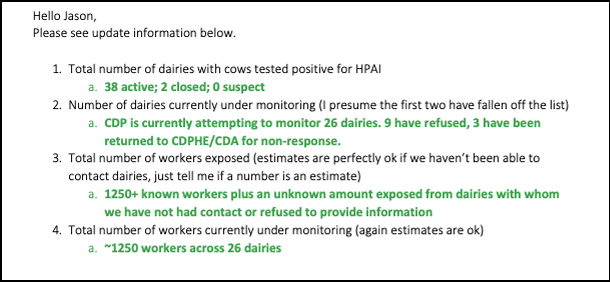
For instance, a terse July 29 email from the Weld County Department of Public Health and Environment in Colorado said, “Currently attempting to monitor 26 dairies. 9 have refused.”

A July 29 email reflects the absence of information when some farm owners don’t wish to correspond with public health departments about potential cases of bird flu, also called HPAI, for “highly pathogenic avian influenza.” This email was obtained through Freedom of Information Act records requests from KFF Health News to the Weld County Department of Public Health and Environment in Colorado. (Screenshot by KFF Health News)
The email tallied the people on farms in the state who were supposed to be monitored: “1250+ known workers plus an unknown amount exposed from dairies with whom we have not had contact or refused to provide information.”

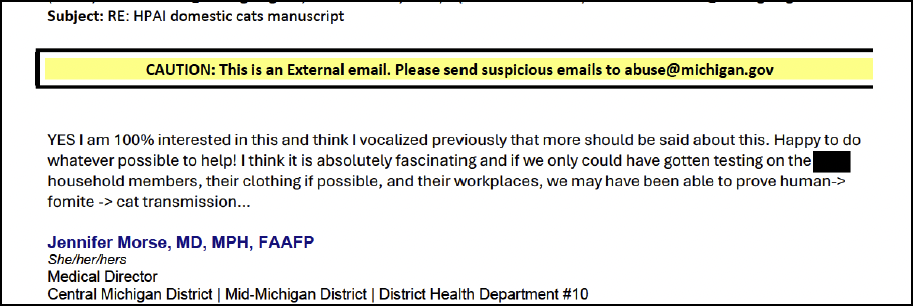
Other emails hint that cases on dairy farms were missed. And an exchange between health officials in Michigan suggested that people connected to dairy farms had spread the bird flu virus to pet cats. But there hadn’t been enough testing to really know.

Researchers worldwide are increasingly concerned.

“I have been distressed and depressed by the lack of epidemiologic data and the lack of surveillance,” said Nicole Lurie, formerly the assistant secretary for preparedness and response in the Obama administration.

Bird flu viruses have long been on the short list of pathogens with pandemic potential. Although they have been around for nearly three decades in birds, the unprecedented spread among U.S. dairy cattle this year is alarming: The viruses have evolved to thrive within mammals. Maria Van Kerkhove, head of the emerging diseases unit at the World Health Organization, said, “We need to see more systemic, strategic testing of humans.”

Refusals and Delays

A key reason for spotty surveillance is that public health decisions largely lie with farm owners who have reported outbreaks among their cattle or poultry, according to emails, slide decks, and videos obtained by KFF Health News, and interviews with health officials in five states with outbreaks.

In a video of a small meeting at Central District Health in Boise, Idaho, an official warned colleagues that some dairies don’t want their names or locations disclosed to health departments. “Our involvement becomes very sketchy in such places,” she said.

“I just finished speaking to the owner of the dairy farm,” wrote a public health nurse at the Mid-Michigan district health department in a May 10 email. “[REDACTED] feels that this may have started [REDACTED] weeks ago, that was the first time that they noticed a decrease in milk production,” she wrote. “[REDACTED] does not feel that they need MSU Extension to come out,” she added, referring to outreach to farmworkers provided by Michigan State University.

“We have had multiple dairies refuse a site visit,” wrote the communicable disease program manager in Weld, Colorado, in a July 2 email.

Many farmers cooperated with health officials, but delays between their visits and when outbreaks started meant cases might have been missed. “There were 4 people who discussed having symptoms,” a Weld health official wrote in another email describing her visit to a farm with a bird flu outbreak, “but unfortunately all of them had either already passed the testing window, or did not want to be tested.”

Jason Chessher, who leads Weld’s public health department, said farmers often tell them not to visit because of time constraints.

Dairy operations require labor throughout the day, especially when cows are sick. Pausing work so employees can learn about the bird flu virus or go get tested could cut milk production and potentially harm animals needing attention. And if a bird flu test is positive, the farm owner loses labor for additional days and a worker might not get paid. Such realities complicate public health efforts, several health officials said.

An email from Weld’s health department, about a dairy owner in Colorado, reflected this idea: “Producer refuses to send workers to Sunrise [clinic] to get tested since they’re too busy. He has pinkeye, too.” Pink eye, or conjunctivitis, is a symptom of various infections, including the bird flu.

Chessher and other health officials told KFF Health News that instead of visiting farms, they often ask owners or supervisors to let them know if anyone on-site is ill. Or they may ask farm owners for a list of employee phone numbers to prompt workers to text the health department about any symptoms.

Jennifer Morse, medical director at the Mid-Michigan District Health Department, conceded that relying on owners raises the risk cases will be missed, but that being too pushy could reignite a backlash against public health. Some of the fiercest resistance against covid-19 measures, such as masking and vaccines, were in rural areas.

“It’s better to understand where they’re coming from and figure out the best way to work with them,” she said. “Because if you try to work against them, it will not go well.”

Cat Clues

And then there were the pet cats. Unlike dozens of feral cats found dead on farms with outbreaks, these domestic cats didn’t roam around herds, lapping up milk that teemed with virus.

In emails, Mid-Michigan health officials hypothesized that the cats acquired the virus from droplets, known as fomites, on their owners’ hands or clothing. “If we only could have gotten testing on the [REDACTED] household members, their clothing if possible, and their workplaces, we may have been able to prove human->fomite->cat transmission,” said a July 22 email.

A July 22 email suggests that people might have infected their domestic cats with the bird flu, also called HPAI, for “highly pathogenic avian influenza,” but epidemiologists couldn’t determine how it happened because the animals’ owners had not been tested. This email was obtained through Freedom of Information Act records requests from KFF Health News to the Mid-Michigan District Health Department. (Screenshot by KFF Health News)

Her colleague suggested they publish a report on the cat cases “to inform others about the potential for indirect transmission to companion animals.”

Thijs Kuiken, a bird flu researcher in the Netherlands, at the Erasmus Medical Center in Rotterdam, said person-to-cat infections wouldn’t be surprising since felines are so susceptible to the virus. Fomites may have been the cause or, he suggested, an infected — but untested — owner might have passed it on.

Hints of missed cases add to mounting evidence of undetected bird flu infections. Health officials said they’re aware of the problem but that it’s not due only to farm owners’ objections.

Local health departments are chronically understaffed. For every 6,000 people in rural areas, there’s one public health nurse — who often works part-time, one analysis found.

“State and local public health departments are decimated resource-wise,” said Lurie, who is now an executive director at an international organization, the Coalition for Epidemic Preparedness Innovations. “You can’t expect them to do the job if you only resource them once there’s a crisis.”

Another explanation is a lack of urgency because the virus hasn’t severely harmed anyone in the country this year. “If hundreds of workers had died, we’d be more forceful about monitoring workers,” Chessher said. “But a handful of mild symptoms don’t warrant a heavy-handed response.”

All the bird flu cases among U.S. farmworkers have presented with conjunctivitis, a cough, a fever, and other flu-like symptoms that resolved without hospitalization. Yet infectious disease researchers note that numbers remain too low for conclusions — especially given the virus’s grim history.

About half of the 912 people diagnosed with the bird flu over three decades died. Viruses change over time, and many cases have probably gone undetected. But even if the true number of cases — the denominator — is five times as high, said Jennifer Nuzzo, director of the Pandemic Center at Brown University, a mortality rate of 10% would be devastating if the bird flu virus evolved to spread swiftly between people. The case fatality rate for covid was around 1%.

By missing cases, the public health system may be slow to notice if the virus becomes more contagious. Already, delays resulted in missing a potential instance of human-to-human transmission in early September. After a hospitalized patient tested positive for the bird flu virus in Missouri, public health officials learned that a person in the patient’s house had been sick — and recovered. It was too late to test for the virus, but on Oct. 24, the CDC announced that an analysis of the person’s blood found antibodies against the bird flu, signs of a prior infection.

CDC Principal Deputy Director Nirav Shah suggested the two people in Missouri had been separately infected, rather than passing the virus from one to the other. But without testing, it’s impossible to know for certain.

The possibility of a more contagious variant grows as flu season sets in. If someone contracts bird flu and seasonal flu at the same time, the two viruses could swap genes to form a hybrid that can spread swiftly. “We need to take steps today to prevent the worst-case scenario,” Nuzzo said.

The CDC can monitor farmworkers directly only at the request of state health officials. The agency is, however, tasked with providing a picture of what’s happening nationwide.

As of Oct. 24, the CDC’s dashboard states that more than 5,100 people have been monitored nationally after exposure to sick animals; more than 260 tested; and 30 bird flu cases detected. (The dashboard hasn’t yet been updated to include the most recent cases and five of Washington’s reports pending CDC confirmation.)

Van Kerkhove and other pandemic experts said they were disturbed by the amount of detail the agency’s updates lack. Its dashboard doesn’t separate numbers by state, or break down how many people were monitored through visits with health officials, daily updates via text, or from a single call with a busy farm owner distracted as cows fall sick. It doesn’t say how many workers in each state were tested or the number of workers on farms that refused contact.

“They don’t provide enough information and enough transparency about where these numbers are coming from,” said Samuel Scarpino, an epidemiologist who specializes in disease surveillance. The number of detected bird flu cases doesn’t mean much without knowing the fraction it represents — the rate at which workers are being infected.

This is what renders California’s increase mysterious. Without a baseline, the state’s rapid uptick could signal it’s testing more aggressively than elsewhere. Alternatively, its upsurge might indicate that the virus has become more infectious — a very concerning, albeit less likely, development.

The CDC declined to comment on concerns about monitoring. On Oct. 4, Shah briefed journalists on California’s outbreak. The state identified cases because it was actively tracking farmworkers, he said. “This is public health in action,” he added.

Salvador Sandoval, a doctor and county health officer in Merced, California, did not exude such confidence. “Monitoring isn’t being done on a consistent basis,” he said, as cases mounted in the region. “It’s a really worrisome situation.”

KFF Health News regional editor Nathan Payne contributed to this report.

Healthbeat is a nonprofit newsroom covering public health published by Civic News Company and KFF Health News. Sign up for its newsletters here.

KFF Health News is a national newsroom that produces in-depth journalism about health issues and is one of the core operating programs at KFF—an independent source of health policy research, polling, and journalism. Learn more about KFF.

Subscribe to KFF Health News' free Morning Briefing.

What the election teaches us about the economy

I started this story with what I thought was a simple premise: What would the economy look like under the respective proposals of Vice President Kamala Harris or former President Donald Trump? I made a tidy spreadsheet, which would compare the two presidential candidates’ specific proposals for affordable housing, families, small businesses, etc. The plan was to enlist the help of experts to extrapolate what the long-term economic impacts would be.

My first stop was Nobel-prize winning economist Claudia Goldin of Harvard, who told me I was essentially sweeping the sand off the beach: Most of what I was looking for “would require considerable effort and a major-league econometric model.” She added, “Of course, Congress is the elephant in the room.”

She's correct: Hardly any economic proposals that become laws are enacted with the snap of a president’s fingers. It’s an effort that requires finagling from committees in the House and Senate. (Here’s a fun quiz from the IRS about the order of the process.) So however important a presidential race is, the down-ballot race is also critical for moving the needle.

After checking in with several economists and trying to peek beyond the talking points, I’ve realized that three main elements are critical when comparing platforms.  

Everything is connected 

General equilibrium” refers to trying to manage opposing forces to achieve stability—imagine the sides of a teeter-totter trying to balance but never quite straightening out. We know there’s a correlation between a strong labor market and higher consumer prices, but we also need to think more holistically beyond that.

Tyler Schipper, associate professor of data analytics and economics at University of St. Thomas University in St. Paul, Minnesota, uses housing as an example of this. “One of the big places where we could improve on that is with respect to affordable housing,” he said. “There is a ton of research out there that says that if you can get housing right, people are better able to engage with the labor market, they are less likely to have mental health problems. They are less likely to have problems with addiction, and so you solve — or at least make progress — on lots of other issues that our country faces.”

We need your help to stay independent

Another example: The cost of borrowing money affects nearly everyone, and that’s determined by interest rates. Schipper explained that with lower interest rates (set by the Federal Reserve, not the president), mortgage rates decline. But as more people take advantage of lower rates, the housing market tightens and prices rise. “If mortgage rates fall, there are other things that happen before people just have more money in their pockets,” he said. “I wouldn’t expect there’s going to be a big surge in inflation … I think that's something the Federal Reserve is taking into account when they slowly take their foot off the brakes,” Schipper said.

Trump has signaled he would like more control over the Federal Reserve, which means he could affect inflation on a whim. “International economic research has found that independent central banks help keep inflation rates more stable. They sometimes need to make difficult short-term decisions that politicians are not incentivized to do, such as raise interest rates,” said Chris Clarke, an assistant professor of economics from Washington State University. “Vice President Harris plans to maintain central bank independence.”

"Mass deportations will disrupt our supply chain, decreasing our economy and increasing costs, which lead to higher inflation."

Trump’s proposed mass deportation of 15-20 million immigrants would also have a ripple effect. “Every economic textbook will show reducing the population decreases both supply and demand together. Immigrants purchase goods and services, but they also produce them. Mass deportations will disrupt our supply chain, decreasing our economy and increasing costs, which lead to higher inflation,” Clarke said.

This principle of general equilibrium works under either a Harris or Trump presidency — or anyone else’s. And that’s why it’s critical to examine policies and their ripple effects. You can see line items for both candidates’ budgets at the Committee for a Responsible Federal Budget website.

Consumers bear the brunt of tariffs

Tariffs are 10 to 20% surcharges placed on imported goods that go to our government but are passed on to the buyer — and there is usually retaliation from the country of supply for American-made goods, discouraging foreign buyers. Trump’s tariffs on steel and aluminum sparked a trade war with China in 2018 and expanded to semiconductors, solar panels and electric vehicles from China, Schipper said.

Trump has positioned tariffs as punishment for other countries and to incentivize buying American goods, but tariffs act more as a harness on consumer purchasing power. Even American-made items often require components from China, so the cost of the tariff is being passed on. Whether you’re in the 10% of the wealthiest Americans or in the bottom 10%, if you’re buying a $1,000 refrigerator you’re still paying the same $150 tariff (in addition to sales tax) on it. A wealthy person can shoulder that burden more easily. 

The conservative-leaning nonprofit Tax Foundation, which analyzes and advises on tax policy, concluded “the Trump administration imposed nearly $80 billion worth of new taxes on Americans by levying tariffs on thousands of products valued at approximately $380 billion in 2018 and 2019, amounting to one of the largest tax increases in decades.” The Foundation (and other analyzing organizations) said these would result in higher household costs of nearly $4,000 per year. The Biden administration continued those tariffs and added $18 billion more.

Trump’s promise of further tariff hikes gets a thumbs-down from the Foundation. “We estimate that if imposed, his proposed tariff increases would hike taxes by another $524 billion annually and shrink GDP by at least 0.8%, the capital stock by 0.7% and employment by 684,000 full-time equivalent jobs. Our estimates do not capture the effects of retaliation, nor the additional harms that would stem from starting a global trade war.”

Harris says she would instead use a higher tax rate for corporations (28% from 21%) and individuals making more than $400,000 a year to shift the burden from lower and middle-income taxpayers and consumers. The Tax Foundation doesn’t like that either, saying the higher taxes will slow development, complicate the tax code and not improve housing affordability.  

Still, there’s consensus that Harris’ plans will result in a stronger, less chaotic economy overall with less impact on the budget deficit (which increases under both candidates’ plans), according to the Wall Street Journal, the CBRF, Goldman Sachs, 16 Nobel Prize-winning economists and others.

Tax credit impacts

Everyone loves a tax credit to shrink what they owe at tax time or puff up the return check, and both candidates favor them to some degree. But a tax credit can't buy sneakers for a kid who needs them, or make up a shortage in rent money or buy groceries when an EBT card runs dry.

The Harris campaign learned something from the pandemic and how Trump distributed checks, which is to try and make the Child Tax Credit show up as a check or a deposit regularly,” Schipper said. “I would certainly argue, too, that the people that most need that tax credit would also be the places where we get our most kind of societal 'bang for our buck' in terms of reducing poverty and increasing the future outcomes of those kids.”

The Child Tax Credit is on the table for both candidates, but Trump’s version extends it only to wealthier families who owe taxes. Harris’ version is aimed at reducing poverty by providing reliable monthly income.

What is government for?

Finally, there’s something that gets lost when we talk about the economy, and that’s whose economy it actually is. Government is for people, paid for by the people — a service to us. When we vote, we’re deciding where we want our dollars to go, but also the culture, opportunities and protections that money buys. 

“Fake campaign”: Expert says alleged “Republican plant” exposes vulnerability of third parties

In New York, the state’s Working Families Party is embroiled in a fight to maintain its ballot line, a struggle that provides insight into the squeeze smaller parties have been put under this year to maintain relevance and exert influence despite the fact that an increasing number of Americans say they would support another political party.

In New York, minor parties must maintain 2% support in elections in order to keep their ballot line. This provision was passed as part of a package that also provided public financing for campaigns. In practical terms, this means the Working Families Party needs to convince 130,000 voters to vote for Vice President Kamala Harris, on the Working Families Party line, Row D, instead of under the Democratic Party line.

The Working Families Party is what political scientists would call a “fusion party,” a third party that normally nominates the same candidate as a major party and essentially acts like an interest group within that larger party. The Working Families Party in New York almost always nominates the same candidates as the Democrats. Likewise, the state’s Conservative Party normally nominates the same candidate as the Republicans.

Fusion parties stand in contrast to a more traditional third party, like the Green Party or the Libertarian Party, which normally nominate their own candidates. This year the Green Party nominated Jill Stein and the Libertarians nominated activist Chase Oliver. While third-party nominees are ostensibly in the race to win, they’ve historically had the biggest impact when they are able to present a real threat of acting as a spoiler to major parties.

Bernard Tamas, a political scientist at Valdosta State University and the author of “The Demise and Rebirth of American Third Parties,” told Salon that this strategy is known as the “sting like a bee” strategy.

“The idea is that the purpose of a third party is to pick an issue or some set of issues that people feel is being ignored and to attack one or both of the major parties on this,” Tamas said. “As much as they like to say ‘we’re not spoilers’ the strategy is threatening to spoil them. If they’re successful then the major parties will co-opt whatever issue the third party was campaigning on.”

A classic example of this is the Progressive Party or the Bull Moose Party of the early 20th century. Tamas said that the party was able to pressure the Republican Party into adopting anti-child labor laws and other progressive positions that made a major impact in American life. 

In recent history, however, there hasn’t been a credible threat like that of the Progressive Party, according to Tamas. The most recent example was with the Reform Party, led by businessman Ross Perot in the 1990s. Since then, Tamas said, there hasn’t been a third party with enough voting power to really impact an election. 

This year, Robert Kennedy Jr., who was mounting an independent bid for the presidency, saw his support collapse and dropped out of the race well before Election Day, endorsing former President Donald Trump, apparently in exchange for a chair position on a proposed vaccine commission.

In the absence of a credible “sting like a bee” strategy, third parties have fallen into two categories, parties like the Working Families Party and parties like the Green Party.

Ana Maria Archila, the co-director of the New York Working Families Party, told Salon that this year, she sees voting on the Working Families Party line as a way “for voters in New York state who want to defeat Trump but are frustrated by the continuing bombing of Gaza to send a message.” 

“Having a ballot line is a way for voters in New York State to have a more expressive vote,” Archilla said. “We enter this year with a commitment to defeat Trump, to defeat the MAGA Republicans who enable his agenda here in New York and to work hand in hand with Democrats to flip congressional districts.”

The Working Families Party says that [Anthony] Frascone is a Republican plant, intended to spoil the race for the Democratic nominee.

In many ways, Tamas noted, the Working Families Party operates more like an interest group or a labor union, except instead of delivering money or the votes of union members, it delivers manpower for activism and a bloc of progressive voters. So far this method had allowed the Working Families Party to maintain its ballot line in a state in which the fusion party system was explicitly designed to stamp out third parties, dating all the way back to former President Franklin Roosevelt’s re-election campaigns, when Democrats feared labor parties could play the spoiler.

“They came in with the attitude that ‘we need to be practical’ when they first developed the party,” Tamas said “They refer to this as an inside-outside party and so what the Working Families Party claims to do is if they like a Democratic candidate they'll co-nominate them and try to support that candidate but if they don’t like the third party candidate they’ll run their own against them. They almost never nominate their own candidate.”

This year, the most high-profile candidate on the Working Families Party line is congressional candidate Anthony Frascone, who is running in New York’s 17th. Frascone, however, did not receive the party’s endorsement and the Working Families Party says that Frascone is a Republican plant running a "fake campaign" intended to spoil the race for the Democratic nominee, former Rep. Mondaire Jones, D-N.Y., who is facing Rep. Mike Lawler, R-N.Y.

Tamas noted that this sort of maneuver is something third parties are particularly vulnerable to and part of the reason why a party running fusion candidates is typically on its last legs. Tamas noted, however, that the Working Families Party has been unusually durable, even if it is acting mostly as an interest group in the Democratic coalition.

“I’ve long been skeptical of the Working Families Party but I’ll have to say after watching how deeply ineffective the Greens and Libertarians have been this year at least they have a seat at the table,” Tamas said.

We need your help to stay independent

The other strategy, embodied by the Green Party this cycle is to try to build a political infrastructure fully independent of the two major parties. 

“Building power is an interesting way to put it because we are in a position in NYS where we have been officially repressed,” said Peter LaVenia, a New York Green Party co-chair. “When you don’t have a ballot line it’s very difficult to run candidates.”

LaVenia said that the Green Party is trying to get its party line back this year with Stein as a presidential candidate but that it’s an uphill battle. He added that the party was increasingly skeptical even of the traditional “sting like a bee” strategy of picking an issue to try and force a major party to adopt, saying “this idea of policy concessions, that’s liberalism, that’s reformism and that’s not what the party is about.”

“I don’t see on any level, neither Biden nor Kamala Harris, are making any overtures on any level,” LaVenia said. “What ends up happening typically is that if they seize on any of these issues is to avoid any real change.”

LaVenia said that the party’s current strategy is “the idea that working people and people that think we need a radical change in this country need their own organization and it’s a harder road to walk.” 

“We’ve been hit with election law and a public that’s very skeptical of smaller parties,” LaVenia said. “Our legitimacy — it’s difficult for people to see it.”

In terms of whether any third-party effort in the United States is operating effectively this year, Elain Kamarck, a senior fellow for governance studies at the Brookings Institution, says she’s “unimpressed.”


Want a daily wrap-up of all the news and commentary Salon has to offer? Subscribe to our morning newsletter, Crash Course.


“Structurally with third parties you have to be skeptical of their intentions because they're not doing a very good job of building a party. If they were they would be running candidate for county commissioner,” Kamarck said. “There’s a Republican county committee in all 3,000 counties in America, how many Green Party county committees are there? How many Conservative party county committees are there?”

Kamarck said that, generally when a third party is relatively successful they will get absorbed into a larger party, like with the Reform Party, and when they fail it tends to be because of a lack of grassroots support. She used the Uncommitted movement this year as an example of an organization that did its best to try to affect policy but ultimately “fizzled” because it could only win 37 delegates to the Democratic National Convention.

“They had a good idea, they got a fair amount of attention for it, they build as good as they can, but ultimately they didn’t have the votes,” Kamarck said.

What the Uncommitted movement did understand, in Kamarck’s analysis, is that, structurally, primaries are the time to have the sorts of policy and ideological fights many sympathetic to third parties want to have. 

“If you look at The Squad, these are people that got themselves elected to Congress. They have influence and people listen to what they say. Similarly, look at the Freedom Caucus and the Marjorie Taylor Greenes of the world. In fact the Republican Party is essentially split,” Kamarck said. “Primaries are the place to do it, you’re never going to get anywhere with a third party.”

To win, Kamala Harris must handle tough questions: Here are the answers

On Wednesday, Kamala Harris held a televised town hall meeting on CNN. She should do one every day for the rest of her campaign, but differently.

Voters in focus groups say over and over they want two things from Harris: direct answers to questions and a better explanation of how she’ll fix problems they face in their daily lives. She should indulge them.

The good news is that her campaign doesn’t need a gut rehab — it only needs to focus. Yes, it’s late in the game, but Donald Trump didn’t utter the words "Drain the swamp" until Oct. 17, 2016, just in time to flip the industrial Midwest and, with Vladimir Putin’s and James Comey’s assistance, steal the presidency.

To avert another such disaster, Harris must answer every question as clearly and specifically as she can. The doubts voters express pertain to her character as well as her vision. Nothing conveys character quite like answering a question.

At some point — I’m not sure exactly when, but long before Harris — Democrats stopped explaining things. Their reluctance arose partly from a desire to please their big donors, who don’t mind the truth so long as it’s served up in endlessly vague and amendable terms. It also reflects the advice of consultants — most of whom also work for the donors — who are obsessed with "message," which they confuse with policy. 

Democrats obsessed with message engage in an endless search for the perfect meme, theme or slogan. Their quest ignores a basic truth: Policy precedes message; first, figure out what you believe, then how to tell people about it.

Democratic candidates tend to have a style voters find grating. They ignore questions put to them, instead launching spiels that most voters are tired of hearing. They don’t bother to refute charges or engage their opponents’ best arguments. Rather than explain new proposals, they lazily name-check old favorites.    

To beat Trump, Harris must tell the truth as boldly and relentlessly as he lies. Providing clear answers to "tough" questions is one way to start. She may find that the answers actually favor her, and that some are political gold. Here are some examples:

Are we better off now than we were four years ago?

Answer: Some of us are, but too many of us aren't. The question is, why?  We brought the economy back from COVID and Trump. Markets are at record highs, unemployment is near record lows. GDP growth leads developed nations. Inflation, interest rates and even gas prices are coming down. Yet for millions of Americans the answer to your question is still no. That's because, in America today, even when the economy soars, the middle class barely scrapes by.

To beat Trump, Harris must tell the truth as boldly and relentlessly as he lies. Providing clear answers to "tough" questions is one way to start — and the answers favor her.

We see record corporate profits, but working families haven't had a real raise in 50 years. That didn't start with Joe Biden, or even with Donald Trump.  Our economy stopped working for all of us a long time ago. The system is broken and I’m the only one in this race with a plan to fix it.

Trump's plan is more tax cuts for billionaires. Mine is to end food-sector price gouging, have Medicare cover home health care, help new small businesses and first-time home buyers. And that's just for starters. I'm running to bring back the American middle class. Trump just wants to bring himself back.

Could the choice be any clearer? Do we really think piling up debt so billionaires can live tax-free helps America? We can fight for a fair share for working families or let Trump give it all to his rich pals. That's the choice on the ballot Nov. 5.

We need your help to stay independent

Illegal immigration spiked on your watch. Why should we trust you to fix it?

Answer: Do I wish we’d moved faster on immigration? Yes, I do. But after 20 years of failure and frustration — and Donald Trump was president for four of those years — our administration was the first to put a tough bipartisan bill in front of Congress. Trump killed it because he’d rather exploit an issue than solve a problem. He betrayed us all. Do not pretend it didn’t happen or doesn’t matter.    

I will secure and defend our borders — but I will also stop consigning many who are here to a permanent underclass. Did you know that undocumented immigrants pay $96 billion a year into a Social Security system from which they get no benefit? Without them, Social Security would collapse. Our immigrants are one reason why, during the pandemic, our economy outpaced the entire developed world. Rounding them by the millions and dumping them in internment camps would bring our economy to its knees. They harvest our food, staff our restaurants and care for our elders. They also design new technologies and discover new medicines. I won’t spread lies; instead, I’ll fix a broken system we should have fixed decades ago so it works for all of us.    

You have been vice president for four years. Why didn’t you fix the economy then?

Answer: Before Donald Trump came along, I never heard anyone say that vice presidents made policy. Just ask Mike Pence — and maybe JD Vance should have called him before taking his current gig. We passed more major bills than Trump even introduced, and ours actually helped: Chips, infrastructure, the Inflation Reduction Act. Everybody knows that what we achieved was remarkable. The only reason we didn’t do much more was because almost no Republican had the guts to pitch in and help.

Democrats engage in an endless search for the perfect meme, theme or slogan. Their quest ignores a basic truth: Policy precedes message; first figure out what you believe, then how to tell people about it.

Trump’s biggest campaign promise was to build a border wall that Mexico would pay for. Congress had to give him $25 billion for it, and he left office with less than 10% of it completed. He never even drafted the “beautiful” health care and “huge” infrastructure bills that he lied about nonstop. And exactly what do you think he did for the economy? Was it the tax cuts for the rich or the mountain of debt? Was it all the golf he played, all the TV he watched, all the name calling? The mob he unleashed on the U.S. Capitol?    

For the record: It was Barack Obama’s economy. Trump just inherited it. You may recall that, as a businessman, he blew through a multimillion-dollar inheritance and filed six bankruptcies. Then a book he didn’t write made him famous and he found his true calling: branding things he didn’t build. That's exactly what all he did to Obama’s economy; He didn’t build it, he just named it after himself. 

*  *  *

There are answers as good or better to every "tough" question out there, from the war in Gaza to transgender youth to Joe Biden’s infirmities. I’d be happy to supply them on request, but with any luck, someone on Harris’ staff already has them.

Democrats seek the center blindly, often mistaking Washington’s perceived middle ground for America’s, although the two don’t look anything alike. Harris now looks to Hillary Clinton for advice, and looks for the so-called center on Wall Street and in Silicon Valley.


Want a daily wrap-up of all the news and commentary Salon has to offer? Subscribe to our morning newsletter, Crash Course.


Clinton courted Wall Street. She outraised Trump two to one, $1.2 billion to $600 million. As it turns out, money isn’t everything. Clinton unleashed a blizzard of policy proposals, but none of them made an impression with voters. Getting too close to your donors, like listening too hard to your consultants, often ends up diluting or blurring your message.

By contrast, everybody remembers Trump’s 2016 platform: Revoke the trade deals, fortify the borders, drain the swamp. After that election, I began asking Clinton supporters to tell me what core issues she ran on.  No one could, and that should serve as a cautionary tale.

Democrats blindly seek the "center," often mistaking Washington’s perceived middle ground for America’s. The two don’t look anything alike.

Trump’s 2024 platform is global tariffs, mass deportation and internment and raw authoritarianism.  Harris is running on the threat of Trump and her own blizzard of proposals, which are a lot like Clinton’s, though even less detailed.

To be clear, Harris’ platform, whatever its flaws, is worlds better than anything Trump has on offer. Next to his bonkers plan for a disastrous regime of tariffs, her $50,000 tax deduction for business startups reads like the Marshall Plan. The threat Trump poses to democracy, and to the global environment, is existential. That should be enough for Harris to eke out a win — but it might not be.  

This is the clearest, most important choice we as voters have ever been privileged to make. When I imagine Harris speaking to the plight of working families with the clarity and passion she brings to reproductive freedom, I imagine her winning.

Penile fillers are on the rise. But is enhancing one’s manhood like this safe?

The first time Steven signed up to inject his penis with filler in 2019, he was afraid he would permanently mutilate it. There wasn’t a lot of reliable information about the procedure online, and he had come across a few horror stories about doctors injecting silicone into penises, causing their patients to lose sensation. 

Still, he had wanted his penis to be bigger for years and was finally approved for a circumcision in Canada, where he lives. This, he had read, reduced some of the risks associated with the penile filler procedure, in which a solution — anything from silicone to hyaluronic acid (HA), a natural substance found in the eyes and joints — is injected into the penis to adjust its girth and shape. With few options nearby at the time, he booked a flight to Mexico, where he had found a clinic that seemed to be reliable.

“I remember sitting on a plane … and being absolutely terrified — like, is this going to be a nightmare experience that’s going to ruin my life?” Steven, who is using a pseudonym to protect his privacy, told Salon in a phone interview. “You get scared.”

There’s not a central database that tracks the number of these procedures done, but the rise in penile augmentation in recent years has been described as a “boom,” and doctors interviewed for this story said they have been seeing a rise in the demand for it. 

"You name it and someone has put it in their penis, or tried to."

Besides HA, doctors have injected several products into the penis. Permanent fillers like silicone or paraffin have been used but are not recommended, as they have been associated with long-term complications like necrosis and deformities. Other semi-permanent solutions like polymethylmethacrylate (PMMA) microspheres or fats are often used as well, although they can also cause lumps that may be harder to remove than less permanent solutions like HA.

“You name it and someone has put it in their penis, or tried to,” said Dr. Amy Pearlman, a urologist at the Prime Institute. “People are talking about [penile augmentation] and certainly a lot of patients are asking providers about it.”

In the research that has been published on these procedures, several studies show the risks are relatively low for injecting HA, which can be dissolved. However, the more permanent the filler, the higher the risk for complications and the lower the chances of being able to get it fixed, Pearlman said. Without clear guidelines on the procedure, many doctors are left to figure out best practices on their own, although Pearlman argued the evidence for using HA for penile augmentation was relatively solid at this point. 


Want more health and science stories in your inbox? Subscribe to Salon's weekly newsletter Lab Notes.


“We make a lot more clinical decisions based on way less robust data than we do with using hyaluronic acid for the penis,” she told Salon in a phone interview.

Dr. Luis Cassavantis, a dermatologist and the Medical Director of Avanti Derma in Mexico, says between 2008 and 2021, when he partially retired, he performed more than 5,000 penile augmentations. In a 2016 study of 729 of his patients, published in the Journal of Sexual Medicine, three patients had to have a nodule PMMA filler removed surgically, and about half of some 200 patients who responded to a questionnaire said they felt they were left with irregularities in their penis.

“The main complication that we face is irregularities,” Cassavantis told Salon in a phone interview. “Just a few of them, especially when they are uncircumcised, developed a serious deformity, but that was not only related to the lack of circumcision but also to the skills of the injector.”

"Most of my guys say it’s very addictive and they keep coming back to top it off."

Steven’s procedure was performed with PMMA in Mexico, where he had volunteered to be one of the first patients of a new practitioner training to do the procedure. He didn’t experience medical complications from the experience, but he wasn’t entirely pleased with how his penis looked afterward. A few years later, the procedures had gotten more popular and he found a doctor closer to home offering HA injections. Again, he opted to have a procedure done. Since his first visit with the new doctor in mid-2022, he has returned about a half-dozen times to get re-upped.

“I’m confident that if I’d gone down [to Mexico] for probably another one to two sessions, I would have been happy with the aesthetics overall,” Steven said. “It wasn’t bad, it just wasn’t what I wanted.”

When people first started doing these procedures around the '80s and ‘90s, many people who weren’t medical professionals were performing penile injections using baby oils, silicone and paraffin, Cassavantis said. As the years went by, doctors started offering less permanent penile augmentation options and best practices were shared to reduce the risk of complications, he said.

We need your help to stay independent

“Things are getting better and people are more open to talk about it, but in the early years, this was a procedure that was kind of dark,” Cassavantis said. “The number of complications that we saw in the early years were really bad.”

What drives most men to try penile augmentation is similar to what drives people to get any other cosmetic procedure done: They are unhappy with a part of their body and want to change or enhance it. In a survey of men who got the procedure, the most common reason they did it was to improve self-confidence, followed by wanting to increase sexual function. 

Social media and its proliferation of unrealistic beauty standards have been shown to impact the mental health and self-esteem of girls and young women. Of course, these standards affect everyone’s perceptions of body image and self-esteem — including men.  

Research suggests around half of men are unhappy with their penis size. Some studies have identified a form of body dysmorphia called penile dysmorphic disorder that causes long-term anxiety in a small fraction of men, though this is not a diagnosis that has been separated out from body dysmorphia disorder in the Diagnostic and Statistical Manual of Mental Disorders (DSM-5).

“If the first thing someone does in the morning is go to the bathroom and pee, that’s the first thing they see to start their day, and they’re unhappy with that part of their body, it’s going to impact their mental state throughout the day,” Pearlman said.

Many men looking to change their penis size through these procedures also have to pay a steep price. Because it’s an elective procedure, it usually costs thousands of dollars per session out of pocket. How long the temporary fillers last depends on a number of factors, like level of sexual activity, said Dr. John Leonardo, an anesthesiologist who performs the procedures. He uses a hybrid product that combines HA with Radiesse, a cosmetic filler. It’s common for patients to come back to re-up their filler before it has naturally broken down, he added.

“Most of my guys say it’s very addictive and they keep coming back to top it off,” Leonardo told Salon in a phone interview.

Some medical organizations have addressed penile augmentation as the demand for it continues to increase but don’t provide best practices for what is still considered an “experimental” procedure. The American Urological Association issued a position statement on fat injections for penile augmentation, indicating that there is not enough evidence to suggest the procedure is safe or effective. In April, the Sexual Medicine Society of North America released a position statement concluding that there wasn’t enough accurate research conducted in penile augmentation to make recommendations, although it did recommend against permanent injections like silicone.

“Specifically, without accurate information, it is not possible for clinicians or patients to make an appropriate judgment as to the true risks and benefits of a therapy,” it states. “As such, informed consent is limited, which contributes to the recommendation that some of the therapies be considered experimental at the present time.” 

Some have called for the development of national guidelines to ensure the procedure, which is increasing in prevalence, is performed safely. In one letter to the editor published in the journal Urology, a urology resident likened the lack of knowledge surrounding penile augmentation in the specialty to “a plastic surgeon [being] unfamiliar with a ‘Brazilian Butt Lift.’”

Without said guidelines, providers who want to perform these procedures are left to seek training on their own, Pearlman explained. Plus, there are no products that are approved for this use by the Food and Drug Administration (FDA). Although it’s common for doctors to use things off-label, it could improve the safety of the procedure to have a product specifically designed for penile augmentation.

“Even though a lot of people would consider the urologist to be the expert in the penis, we don’t really have much dedicated to the cosmetic aspect of that,” Pearlman said. 

Regardless, men are electing to have these cosmetic procedures to increase the size of their penises. 

“It's kind of a taboo subject, and it's not something that anybody talks about,” Steven said. “I feel like it would be better if there were more information out there for guys.”

Israel launches airstrikes against Iran in escalation of conflict

Israel has launched airstrikes against Iran in a massive escalation of the conflict between the two countries.

“In response to months of continuous attacks from the regime in Iran against the State of Israel – the Israel Defense Forces is conducting precise strikes on military targets in Iran,” IDF spokesperson Nadav Shoshani confirmed in a post to X.

A statement from the Israeli military said the attacks on early Saturday morning local time were in retaliation to an strike earlier this month on Israel by Iran. Those airstrikes were themselves a response to Israel's attacks on Hezbollah in Lebanon.

Israel warned Iran on Saturday that its “offensive and defensive capabilities are fully mobilized.” Iranian state media described strong explosions that were heard near the city of Tehran.

The move comes as the Biden administration seeks to prevent an expansion of conflict in the region, with Israel and Lebanon exchanging airstrikes last week. 

While CBS News reported that American officials had ​​advanced warning of the attacks, it's unclear whether Israel’s strikes were limited in scope, as President Joe Biden demanded they be.

“We listen to the opinions of the United States, but we will make our final decisions based on our national interests,” Israel's Prime Minister Benjamin Netanyahu’s wrote in mid-October in response to the Biden administration’s plea not to strike nuclear or oil sites and risk further intensification.

Following Israel’s killing of Hamas leader Yahya Sinwar and Hezbollah leader Hassan Nasrallah, American officials including Biden and Vice President Kamala Harris suggested an off-ramp in tensions could be near, but Israel’s latest attack will likely complicate peace efforts. 

“Let her talk”: Biden defends pro-Palestine protester, adds killing “has to stop”

President Joe Biden encouraged a crowd to listen to a pro-Palestinian demonstrator during a speech on Friday, adding that the killing of innocent people "has to stop."

The interruption during a historic apology from Biden over the federal government’s long-term practice of sending Native American youth to boarding schools, an overt attempt at ethnic cleansing that sought to strip the indigenous Americans of their culture and language. Biden called the schools, which operated for more than a century, a "sin on our soul."

“The federal government has never formally apologized for what happened until today. I formally apologize,” Biden said during his speech to the Gila River Indian Community in Arizona.

“What about the people of Gaza?” a woman shouted during Biden’s remarks. “It’s an empty promise toward our people. How can you apologize for a genocide while commiting a genocide in Palestine?”

“Let her talk,” Biden pleaded with someone seemingly trying to eject the demonstrator. “Let her go. There's a lot of innocent people being killed and it has to stop.”

Biden’s administration has been the subject of protests over its continued military support of Israel more tha na year into the war in Gaza. Israel's Prime Minister, Benjamin Netanyahu, has slow-walked U.S.-brokered attempts at a ceasefire, reportedly taking cues and calls from political ally Donald Trump.

The president’s response marks a willingness to hear perspectives in opposition to the Israeli military operations. Biden and Vice President Kamala Harris both said Israel should take the recent killing of Hamas leader Yahya Sinwar as an “opportunity to end” the war.

“Appalling”: Ginsburg family denounces pro-Trump RBG PAC ads

A Donald Trump-supporting group is spending millions in dark money to claim the candidate would defend reproductive rights while brandishing late Supreme Court Justice Ruth Bader Ginsburg’s name.

The RBG PAC spent nearly $20 million to boost Trump’s campaign, per FEC filings revealed on Friday.

“He’s been clear– he does not support a federal abortion ban,” an ad from the group claims, despite the former president's refusal to commit to vetoing a national ban. 

Tenuous claims on Trump’s abortion positions aside, the group is also using Justice Ginsburg’s name and likeness without permission from her family. 

“The RBG PAC has no connection to the Ginsburg family and is an affront to my late grandmother’s legacy,” abortion rights attorney and Ginsburg’s granddaughter Clara Spera said in a statement to the New York Times. “The use of her name and image to support Donald Trump’s re-election campaign, and specifically to suggest that she would approve of his position on abortion, is nothing short of appalling.”

Ginsburg herself publicly denounced Trump in an interview with the New York Times prior to his first term. 

I can’t imagine what this place would be — I can’t imagine what the country would be — with Donald Trump as our president," she said at the time. "For the country, it could be four years. For the court, it could be — I don’t even want to contemplate that."

Trump installed three conservative justices to the Supreme Court during his time in office, replacing Ginsburg as well as Antonin Scalia and Anthony Kennedy. That swing toward a conservative 6-3 majority led directly to the axing of nationwide abortion rights established in Roe v. Wade. He has also said he will vote against a ballot measure in his home state of Florida that would enshrine abortion protections in the state constitution.

Trump’s campaign has sought to toe the line on abortion policy, aiming to appease his religious fundamentalist base while simultaneously duping pro-choice voters, while Kamala Harris has hit Trump hard on abortion, a key issue for voters.

Stevie Nicks says a good way to avoid having rivals is to stay off the internet

Rock legend Stevie Nicks has long put Fleetwood Mac to rest.

In a lengthy interview with Rolling Stone, the star spoke of her greatest career highlights but also mentioned the new and intriguing aspects of her solo musical career. The two-time Rock and Roll Hall of Fame inductee reiterated that "there is no more Fleetwood Mac now," due to the death of band member Christine McVie in 2022 and falling out with ex-boyfriend and band member Lindsey Buckingham. Unable to say goodbye to her lifelong bandmate, Nicks spoke of the pain she experienced every time she sang "Landslide" on her solo tour this year, saying, "I cry every single night."  

Personally, Nicks isn't really worried about her mortality though.

"I’m not afraid of dying, but what I am afraid of is not getting everything together, because I’m so busy. And that’s why I’m really glad this tour’s over, so that I can go and work on an album," she shared.

She predicted, "I’ll probably live to be hatefully 95 years old. I’ll have an electric scooter, and I will be raging and I will keep dancing."

These days, since the musician is on the last leg of her North American stadium tour, she is deeply inspired to write and release new music. She shared with Rolling Stone, "I have so many ideas for songs that I want to do."

The musician shared a little more about her new music, saying, "I’ve written a song called 'The Vampire’s Wife,' which, I think, is one of my best songs I’ve ever written. Because it’s like 'Rhiannon,' a story of a character. Who knows, I might call this next album 'The Vampire’s Wife.'"

Nicks also revealed she has been dealing with a health condition called wet macular degeneration that colors her vision. Not ready to retire quite yet like other rock legends, Nicks said her illness has pushed her to pursue and finish her creative projects like poetry, drawings and songs. In the imagined Nicks album, a new version of the Fleetwood Mac classic song "The Chain" would be featured. Nicks said, "And it will blow people’s minds because it’s a very different song. And yet, it flows right into its chorus, which is 'The Chain' chorus."

Recently, Nicks released the song "The Lighthouse" from this untitled project. Nicks wrote the women’s rights anthem right after the fall of Roe v. Wade in 2022. Nicks herself is someone who had an abortion in 1978. She said she could "remember being so happy when [Roe] came into being in 1973. It was like we were safe." The singer performed the song on "Saturday Night Live" for her first performance on the sketch show in 40 years. 

As a large proponent for women's rights, Nicks has endorsed Vice President Kamala Harris and encourages women to vote for her in this election cycle, saying, "You have to vote. You have to."

We need your help to stay independent

In the interview, she admits that she had never voted prior to the age of 70 because she "wasn’t at all political," calling that a "big regret."

The 76-year-old musician sees herself as a "lighthouse," saying, "I am the wisdom and I have the stories. We are the women that can tell all these young women from 15 up to 45 . . . We are that light that goes out, and we bring the ships in so they don’t crash. We save lives every day. The way I feel about this upcoming election is that Kamala Harris is the lighthouse, too."

Hilariously, the unfiltered star also shared an encounter she had with Katy Perry regarding the toxicity of online fandoms.

In that exchange, Perry questioned Nicks on who her rivals were, since she wasn't online to beef with anyone. 

"I just looked at her. It was my steely look. I said, 'Katy, I don’t have rivals. I have friends. All the other women singers that I know are friends. Nobody’s competing. Get off the internet and you won’t have rivals either,' Nicks said.


“America deserves better”: Harris cans Trump for calling U.S. “trash”

Vice President Kamala Harris condemned Donald Trump’s suggestion that the United States had become a “garbage can for the world,” saying the former president has a responsibility to do better. 

“It’s just another example of how he really belittles our country,” Harris said in a press conference on Friday. “This is someone who is a former president of the United States, who has a bully pulpit. And this is how he uses it? To tell the rest of the world that somehow the United States of America is trash?”

Trump's garbage comments are of a piece with his recent anti-immigrant rhetoric. In addition to claims on Thursday that the United States had become a "dumping ground," he's floated the idea that immigrants have “bad genes” and are “poisoning the blood of our countryd of our country.” These public statements, as well as what they heard from Trump in private, have led several former Trump advisers to liken him to a fascist.

Trump previously called the United States a “nation in decline” at the Republican National Convention. Harris has taken a more optimistic tone in her campaign.

“The President of the United States should be someone who elevates discourse and talks about the best of who we are – and invests in the best of who we are,” Harris said. “Not somebody like Donald Trump who is constantly demeaning and belittling who the American people are. America deserves better.”

Trump doubled down on the claim that immigrants had reduced the country to “garbage” during a Friday rally in Texas, adding that the remark “just came out” before repeating it.

Washington Post editor-at-large quits after Bezos ends paper’s presidential endorsements

Jeff Bezos’s reported decision to block the Washington Post from endorsing presidential candidates has triggered a high-profile departure.

The paper's editor-at-large Robert Kagan is stepping down following the announcement that the Post wouldn’t endorse a candidate in the race for the first time in decades, per Semafor’s Max Tani. Kagan's exit comes after Post publisher William Lewis announced that the paper would no longer throw in behind candidates on Friday.

Lewis said he knew that some readers would view the enforced neutrality as an "abdication of responsibility" before painting it as a return to the paper's mission.

"We don’t see it that way. We see it as consistent with the values The Post has always stood for," he wrote. "We also see it as a statement in support of our readers’ ability to make up their own minds." 

WaPo staffers reported that an endorsement of Vice President Kamala Harris had already been drafted and that Bezos himself interfered with its publication. 

Kagan isn’t the only Post staffer to express displeasure over the pressure from Bezos. Editorial board members were reportedly enraged at the move, with several “contemplating what action to take, ranging from resigning, quitting the board, or a statement,” per Tani.

The Post Guild, a union representing over 1,000 journalists and other staff at the Post, said in a Friday statement it was “concerned that management interfered with the work of our members in Editorial.”

“​​We are deeply concerned that The Washington Post — an American news institution in the nation's capital — would make the decision to no longer endorse presidential candidates, especially a mere 11 days ahead of an immensely consequential election,” the Guild’s statement read. “This decision undercuts the work of our members at a time when we should be building our readers’ trust, not losing it." 

The move was also roundly condemned by former top Post editor Marty Baron, who called the move "cowardice."

Kagan’s exit and the editorial board fervor come just days after the Los Angeles Times’ billionaire owner blocked that paper from endorsing Harris. Editorials editor Mariel Garza quit after that decision, claiming the non-endorsement “undermines the integrity” of the editorial section.

“This is who he is”: 13 Trump admin officials cosign Kelly’s “fascist” warning in letter

Former Trump administration officials backed up former White House Chief of Staff John Kelly’s stark warnings against Donald Trump and a "fascist" second term.

“This is who Donald Trump is,” read the letter shared by Politico on Friday. “The revelations General Kelly brought forward are disturbing and shocking. But because we know Trump and have worked for and alongside him, we were sadly not surprised by what General Kelly had to say.”

The letter was signed by former White House press secretary Stephanie Grisham, former senior counselor to Kelly Kevin Carroll, former assistant secretary of homeland security Elizabeth Neumann, and 10 other Trump administration officials.

Kelly alleged in a series of interviews in a series of interviews with the Atlantic and the New York Times published this week that Trump had repeatedly praised Adolf Hitler and wished he had "the kind of generals" that served under the leader of Nazi Germany.

The officials warned voters to heed Kelly’s warning, explaining that they were coming out to defend his allegations because they saw Trump act in similar ways.

“We applaud General Kelly for highlighting in stark details the danger of a second Trump term. Like General Kelly, we did not take the decision to come forward lightly,” they wrote. “We are all lifelong Republicans who served our country. However, there are moments in history where it becomes necessary to put country over party. This is one of those moments.”

Trump fired back at Kelly’s testimony on Wednesday, calling former chief of staff a “total degenerate” and “lowlife” in a Truth Social post denying some of his allegations.

“The story about the Soldiers was A LIE, as are numerous other stories he told,” Trump said.

Dozens of Trump officials have come out against the ex-president in recent days. Trump's Joint Chiefs of Staff Chair Gen. Mark Milley called Trump "fascist to the core and Trump's Vice President Mike Pence said he “cannot in good conscience” endorse his one-time partner.

“We All Shine On” unmasks the turbulence behind John Lennon’s iconic music

In one of his last interviews, John Lennon reminded legions of fans that when it comes to his work with The Beatles—and, by extrapolation, his solo efforts—the music will always be the thing that matters most. Indeed, it will be Lennon and The Beatles’ musical achievements that go down through the centuries. The rest, frankly, is just noise.

With "We All Shine On: John, Yoko & Me," author and publicist Elliot Mintz fashions a heartbreaking portrait of Lennon’s life and times beyond the recording studio. In so doing, he explores the reality behind the effort that it required for artists such as Lennon to find their mettle as musicians. In this sense, Mintz’s memoir is not for the faint of heart. The psychological toll of Lennon’s addictions is palpable, as is the personal toil that was required for him to will yet another album into being. As Mintz’s book makes indelibly clear, the cost that it exacted upon the songwriter’s relationships was considerable.

As a California DJ and television personality in the early 1970s, Mintz found himself in Lennon’s orbit during an era in which rock ‘n’ roll was gingerly feeling its way after the majesty and tumult of the 1960s. Not surprisingly, there is an inherent sadness behind Mintz’s memories regarding Lennon and his wife Yoko Ono—and not merely because of Lennon’s senseless murder in December 1980 at age 40. As "We All Shine On" reveals so powerfully, Lennon struggled for years to define himself under the bright lights of The Beatles’ particular brand of superstardom. 

In one of the book’s most despairing instances, Mintz finds himself as the object of Lennon’s wrath during his infamous Lost Weekend. Readers will understandably recoil at the musician’s callousness, especially given Mintz’s sublimation of himself in the service of Lennon and Ono. “I believe that, in a sense, I was married to John and Yoko,” Mintz admits. Eventually, this observation takes on remarkable proportions as their lives subsume his own after he begins handling their public relations concerns.


Want a daily wrap-up of all the news and commentary Salon has to offer? Subscribe to our morning newsletter, Crash Course.


But as history well knows, all of their lives would be torn asunder by Lennon’s assassination. As this absorbing book reveals, the tragic ramifications of that heinous act would echo for years afterward. In the immediate aftermath of Lennon’s death, Ono tasks Mintz with taking an inventory of the fallen artist’s possessions. Later, he will broadcast "The Lost Lennon Tapes," an overview of Lennon’s unreleased recordings, as well as Mintz’s finest contribution to our understanding of the ex-Beatle’s creative legacy.


Love the Beatles? Listen to Ken's podcast "Everything Fab Four."


Yet for Mintz, his complicated life with Lennon and Ono finds him invariably reflecting back on the moment he first met the couple on his radio show in 1971. “If only I had learned to say no—if only I’d had the strength to resist the undefinable magnetic pull both of them had on me for so many years,” he writes, “I might have discovered a very different destiny for myself. I might have ended up living a more balanced, traditional existence. I might have married, had children, or even made some ordinary friends who didn’t hold extraordinary secrets I had to keep from the prying eyes of the entire world. If friends are even the right word for John and Yoko.”

As "We All Shine On" makes resoundingly evident, Mintz has devoted a lifetime to contemplating the hypotheticals, the “what ifs” that characterize our existence.

“Power play”: Freedom Caucus head urges North Carolina to grant Trump electoral college votes

A high-ranking Republican congressman outlined a scheme to preempt the will of voters and award North Carolina’s 16 electoral votes to former president Donald Trump before ballots are tallied in that state.

Maryland Rep. Andy Harris argued on Thursday that the devastation of Hurricane Helene in North Carolina, and the potential voting challenges in the deepest-red counties that remain, should push the state's legislature to award Trump their electoral college votes.

The chair of the far-right House Freedom Caucus, said that a plan to deliver Trump the state without an election “makes a lot of sense.”

“You statistically can go and say, ‘Look, you got disenfranchised in 25 counties. You know what that vote probably would have been,’” Harris argued. “Which would be — if I were in the Legislature — enough to go, ‘Yeah, we have to convene the Legislature. We can’t disenfranchise the voters.’”

The move was suggested during a Republican dinner in Talbot County, Maryland. Harris was responding to keynote speaker Ivan Raiklin’s plan to use GOP-controlled legislatures in multiple swing states to award electors to Trump regardless of election outcomes.

“It looks like just a power play,” Harris conceded about Raiklin’s scheme. “In North Carolina, it’s legitimate. There are a lot of people that aren’t going to get to vote and it may make the difference in that state.”

North Carolina Republican Rep. Patrick McHenry told Politico that he hadn’t heard about the plot, but dismissed the idea.

“It makes no sense whatsoever to prejudge the election outcome. And that is a misinformed view of what is happening on the ground in North Carolina, bless his heart,” McHenry said. “I’m confident we’ll have a safe and fair election in North Carolina, and then everyone that wishes to vote will have the opportunity.”

North Carolina has been in the cross-hairs of GOP operators since Hurricane Helene ravaged the area. Trump and his acolytes have spread the conspiracy theory that government officials are slow-walking recovery efforts in the area because of a supposed Republican bent. Officials on both sides of the aisle have debunked these claims repeatedly.

North Carolina election officials have intensified efforts to ensure voting is accessible in the state’s hardest-hit regions. A near-unanimous vote on Thursday in the state legislature gave the elections board resources to expand voting sites across the state.

Billionaires have broken media: Washington Post’s non-endorsement is a sickening moral collapse

The shocking decision by The Washington Post not to make an endorsement in the presidential election — breaking with a decadeslong tradition — is an extremely powerful statement. A non-endorsement says Donald Trump is a reasonable choice.

It says: We are so terrified of a Trump presidency that we are bending the knee in advance. Most importantly, it makes clear that owner Jeff Bezos doesn’t want to lose government business in a second Trump administration.

These institutions are not just succumbing to authoritarianism, they are advancing it.

I can’t imagine statements any more inappropriate from the newspaper of Watergate, the newspaper I spent 12 years working my ass off for. It’s heartbreaking. It makes me sick to my stomach.

To be clear: Every self-respecting journalist on both the news and opinion sides should be sounding the alarm about a possible second term for Trump. He poses a threat to democracy and a free press. On the news side, that requires brutally honest coverage of the threats Trump presents, with no false equating of the two parties — one of which has rejected reality and democratic values. The Post newsroom is hit or miss on that count. But on the editorial page, this shouldn’t have been a close call (and reportedly wasn’t, until Bezos got involved).

The very opposite of sounding the alarm is throwing up your hands and saying “well, you decide.”

Oligarchs as owners has been a disaster

The Post’s decision Friday comes just days after the Los Angeles Times also decided to forgo an official endorsement. This is no coincidence. Both papers are owned by billionaires whose business and personal interests are paramount. 

“I think my fear is, if we chose either one, that it would just add to the division,” the billionaire owner of the LA Times, Patrick Soon-Shiong, told Spectrum News this week.

This makes it more clear than ever: You cannot be a truly independent news organization if you are owned by an oligarch. 

Bezos’ business interests are so vast that he is one gigantic conflict of interest. As I wrote for the Columbia Journalism Review in 2022, the only way for the Post to regain its independence is for Bezos to transfer ownership to a non-profit. 

For a while there, many of us in the newspaper business thought that benevolent billionaires were a plausible savior for news organizations like the Post and the LA Times. We were wrong. Just as these oligarchs are a plague on society, they are a plague on the news business. They have now ruined – possibly for good – two of our most treasured news organizations. 

Will anyone quit?

Over at the Los Angeles Times, the editorial editor, along with two other members of the editorial board, have – admirably — resigned in protest.

We’ll see what happens at the Post. Robert Kagan — whose title was editor at large, but who was not a member of the editorial board — has resigned so far. But I’m not optimistic that we’ll see similar acts of heroism there, certainly not at the top. Bezos intentionally hired lickspittles as publisher and editorial editor. The Bezos-installed publisher, a morally challenged former Murdoch henchman and Tory lord named Will Lewis, took credit for the decision on Friday, claiming this shattering of decades of precedent is a statement of independence. Lewis wrote: 

We recognize that this will be read in a range of ways, including as a tacit endorsement of one candidate, or as a condemnation of another, or as an abdication of responsibility.  That is inevitable.

He got that right. Then he continued: 

We don’t see it that way. We see it as consistent with the values The Post has always stood for and what we hope for in a leader: character and courage in service to the American ethic, veneration for the rule of law, and respect for human freedom in all its aspects. 

We need your help to stay independent

But the values the Post has always stood for include truth-telling and love of democracy and speaking truth to power. Pursuing accountability in Washington has been its core brand ever since Watergate. And here it lets Trump escape accountability, once again

The editorial editor, David Shipley, was installed by Bezos after proving his loyalty to another oligarch, Mike Bloomberg, whose views he dutifully reflected in his editorials. Indeed, Shipley, along with his deputy Tim O’Brien, even left their jobs at Bloomberg Opinion to work (briefly) on their boss’ disastrous presidential campaign. So Shipley is not going to balk – especially after telling disgruntled editorial staffers that he “owned” the decision on Friday, according to NPR

Nor, I fear, will any other members of the board, who include Charles Lane, Stephen Stromberg, Mary Duenwald, David E. Hoffman, James Hohmann, Mili Mitra, Eduardo Porter, Keith B. Richburg and Molly Roberts. I hope to be proven wrong.

Anticipatory obedience is the point

An overarching theme here is that the moves by the Post and the LA Times reflect what Timothy Snyder, the author of “On Tyranny,” calls “anticipatory obedience.” As Snyder wrote in his book: 

Most of the power of authoritarianism is freely given. In times like these, individuals think ahead about what a more repressive government will want, and then offer themselves without being asked. A citizen who adapts in this way is teaching power what it can do.

The non-endorsements from the Washington Post and the Los Angeles Times would certainly seem to fit the bill. 


Want a daily wrap-up of all the news and commentary Salon has to offer? Subscribe to our morning newsletter, Crash Course.


So, frankly, would the New York Times’ decision to bury its own scoop on Trump’s former chief of staff Marine Gen. John Kelly outing Trump as a Hitler-admiring fascist. I can't think of a good reason why they didn't banner it on the front page, can you? Or why they’ve been so listless in their coverage of Trump’s threats to sic the military on the “enemy within”? 

As former Washington Post editor Marty Baron put it on Twitter, “This is cowardice” 

Columbia Journalism professor Bill Grueskin wrote:

Here’s the thing about these LAT/WPost non-endorsements. They’re unimportant politically; few votes would be swayed. But the billionaire owners are (intentionally or not) sending a signal to the newsrooms: Prepare to accommodate your coverage to a Trump regime.

And that’s the even greater fear: That these institutions are not just succumbing to authoritarianism, they are advancing it.

Woe unto us.