Spring Sale: Get 1 Year, Save 58%

The final blonde: My ongoing journey to decolonizing Barbie from my dress-up

For Halloween last year, I dressed as Barbie and planned the costume way in advance: a pair of pink bike shorts, a tank top with the Barbie logo splayed on the front, and a pink cardigan with faux fur trim that I found on sale. I made a trip to Claire’s and bought a little plastic pink purse, some play jewelry, cheap pink makeup and a pink and gold locket that I put two tiny pictures of Ken inside. I even wore the most push-up bra I owned, which I hadn’t worn in years, all in an attempt to become Barbie.

“I want yellow hair like Barbie.”

And finally, the last piece of the puzzle: the hair. I pinned my own hair up and put a little mesh cap over it before fitting the cheap, synthetic, blonde wig I bought at Spirit Halloween over my head. It was big and itchy and gave me a headache by the end of the night, but it was all worth it to fully embody the icon that is Barbie.

Growing up, I was obsessed with Barbie.

At age five, my mom picked me up from kindergarten, letting me sit in the front seat of her silver Mitsubishi because it was the ’90s, and parents were a little less concerned about car safety.

“What did you do today?” my mom always asked as we made our way home. I’d usually tell her the banal details of my life, which my five-year-old self thought was gripping. But on this particular day, I had another notion in mind.

“I want yellow hair like Barbie,” I said.

My hair was dark and curly, and by the end of every day, I’d come home with my frizzy tendrils filled with knots. I looked nothing like Barbie, with her long, perfectly straight, blonde hair, shiny like no one’s hair has ever been before. Barbie and I were different in every way. For starters, she was white, while I was an Egyptian American girl with brown skin and black hair, and I never felt perfect — not like Barbie.

I had a giant bin full of Barbies at home — doctor Barbie, shopping mall Barbie, gymnast Barbie, a Barbie whose hair you could cut and Velcro back on, and the list continues. I created an unending number of storylines with the dolls, my own little soap operas starring Barbie, Ken and the gang. My dad even used to bribe me with Barbies. When I refused to see “Star Trek” in theaters with him, all he had to say was, “I’ll get you a Barbie” to get me to come along.

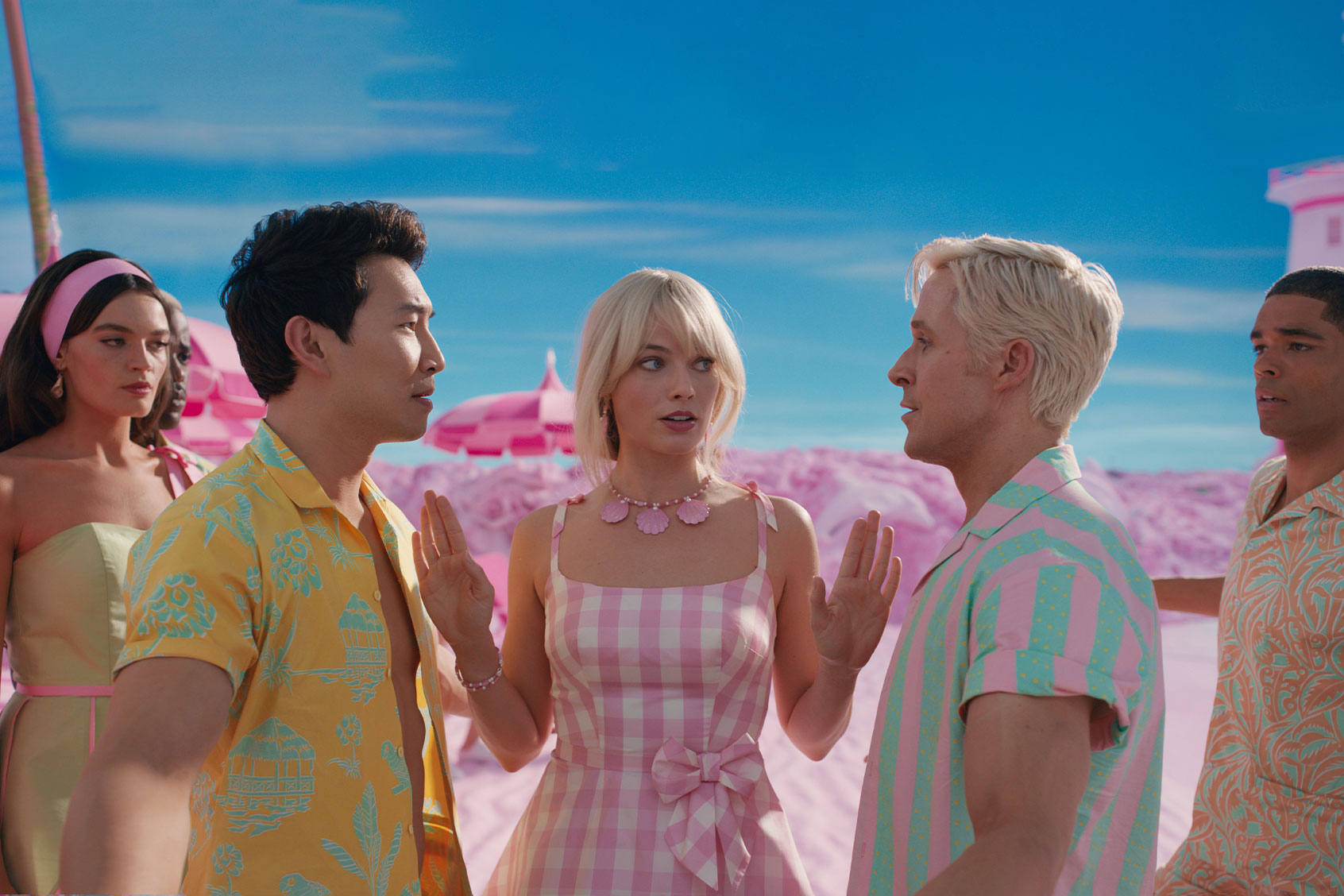
“Barbie is everything,” reads the “Barbie” movie poster, with a photo of Margot Robbie laying on her side, her blonde hair perfectly coiffed over a pink backsplash.

To me, Barbie was everything and brought me happiness in a lot of ways. I was an only child until the age of 10, and Barbie was how I entertained myself. She unlocked my creativity, allowing me to craft my own little stories before I even knew I wanted to be a storyteller. In the world I’d created, shopping mall Barbie was the coolest and most popular of the gang because she had the softest hair and chic-est accessories. Gymnast Barbie was her best friend, and there was always drama with Ken, as mermaid Barbie, with her tangled hair, would swoop in from her ocean life and try to steal Ken away from shopping Barbie, who of course would always win in the end.

BarbieMargot Robbie as Barbie in “Barbie” (Courtesy of Warner Bros. Pictures)Barbie is everything, but that encompasses both good and bad. Ever since her inception in the 1950s, Barbie was the epitome of beauty and femininity, even though no one actually looked like her. She embodied what women were supposed to want — skinniness, whiteness, blonde hair, blue eyes, tiny nose, big boobs, feet permanently molded for heels. These colonial and patriarchal ideas of beauty and femininity seeped into my brain.
We need your help to stay independent

Barbie Halloween was not the first year I dressed as a blonde.

To me, she represents something both nostalgic and insidious. Even though I loved Barbie, she made young girls everywhere believe they weren’t everything, myself included. Unrealistic beauty standards were everywhere — in magazines, on television, on billboards — and Barbie indoctrinated children all over the world with an idea of beauty and femininity that centers whiteness, and those ideas were reinforced by every single type of media we consumed.

To this day, I sometimes hate everything about myself, wondering if I’m pretty enough or interesting enough or smart enough or fun enough. Of course, I don’t compare myself to Barbie anymore, but Barbie was likely the inception of my insecurities. And as an anxious Egyptian kid growing up in America in the ’90s and early 2000s, I often hated everything about myself. My hair was too frizzy; I wore glasses; I was too shy. I didn’t even realize it then, but those thoughts permeated my mind, America’s toxic ideals taking over. So it made sense that I wanted to look like Barbie.

* * *

Interestingly enough, Barbie Halloween was not the first year I dressed as a blonde. It’s actually become a running joke among my friends, and every year they ask if I’m planning on wearing another blonde wig. More often than not, my answer has been yes.

In the past 10 years, I’ve dressed as Sookie Stackhouse from “True Blood,” Robin Sparkles (the blonde, pop star version of Robin) from “How I Met Your Mother,” Angelica from “Rugrats,” Taylor Swift, Eleven from “Stranger Things” when she wears a blonde wig, Uma Thurman’s character from “Kill Bill” and then, the final blonde: Barbie. Maybe all of those other costumes were leading up to her, a slow transformation into the ultimate blonde. 

Barbie is everything that I’m not. I hardly have any pink in my wardrobe, and I almost never wear heels. After getting my nails done neon pink the day before Halloween weekend, I went to a friend’s birthday party and made sure to tell anyone I met, “This isn’t me,” ensuring them that my pink nails were for Halloween only. But in becoming Barbie, I fully separated from myself, embodying a new persona altogether. For one night only, I could turn into everything I wanted to be when I was five.

But the difference is, I wasn’t five anymore, and I didn’t actually want to look like Barbie. As I grew up, the world started to change. People began to call out the media and corporations for pushing these old ideals of whiteness, thinness and unattainable perfection onto us. Of course, for me, the change was gradual. I didn’t suddenly wake up one day with a burst of confidence. For years, without even realizing it, I worked to remain in proximity to whiteness. I flat-ironed my hair after every wash, keeping it sleek and straight, just like the white girls I knew. I can still hear the sizzle of my flat iron, and every once in a while, maybe at a salon, I’ll smell the familiar scent of burnt hair, transporting me right back to high school and college.

But slowly, my desire to fulfill these colonial beauty standards began to subside. The change occurred alongside my increased interest in politics and social issues. I started to pay attention in a way I hadn’t been before, and as a result, I grew disgusted with wanting whiteness. I was angry at myself for ever wanting to look like the rich white girls I went to college with, and I started to express pride in my culture, my hair, and all the ways I differed from those girls. Eventually, the idea of wanting “yellow” hair or proximity to whiteness at all seemed comical, though looking back, I still feel sad for the five-year-old version of me who didn’t have a template for beauty outside of whiteness.

BarbieEmma Mackey as Barbie, Simu Liu as Ken, Margot Robbie as Barbie, Ryan Gosling as Ken and Kingsley Ben-Adir as Ken in “Barbie” (Courtesy of Warner Bros. Pictures)Nowadays, Barbie makes more of an effort to be inclusive. We have Barbies with different skin tones and hair colors/textures, Barbies with disabilities, and even Barbies with different body types (although most are still pretty skinny) in an attempt to show that anyone can look like Barbie. Though in reality, nobody looks like Barbie. While Margot Robbie’s Barbie is beautiful and as close to the original as anyone can look, even she doesn’t fit, not perfect enough for the world in which she exists, as her feet become flat, and her consciousness wakes up to the fact that she lives in a fantasy. Barbie herself realizes she isn’t real, just like the ideas of beauty and femininity she once promoted aren’t real.
* * *

When I dressed as Barbie for Halloween, I wasn’t making an attempt at perfection or beauty. To some extent, my costume was a tribute to Barbie, because even though she’s toxic in so many ways, she’s also iconic. But at the same time, my costume showed how laughable it was that Barbie ever represented beauty and the ideal of femininity in the first place. My outfit was tacky, and my jewelry was purposefully childish. The blonde hair looked ridiculous on me, and that was the point. While I wasn’t exactly subverting Barbie’s look, the outfit made it apparent to everyone that Barbie as the template for beauty was a joke. 

I went to three nights of Halloween parties last year, and on the last night — Halloween — I decided to switch up my costume because by then, that perfect Barbie look started to get boring. I took the pristine white and pink Barbie shirt and splashed fake blood all over it. I changed my makeup, adding dark circles under my eyes, scars on my face done with eyeliner, and fake blood that dripped from my nose and mouth. I tousled the hair on my blonde wig and became Zombie Barbie, destroying the image of perfection that she once represented. I turned her beauty, her blondeness, her perfection, into something ugly and monstrous. In some ways, by becoming a zombie version of Barbie, I effectively killed the classic, blonde beauty, decolonizing her not only in my mind, but also by subverting the costume for all to see. 

Next Halloween, I don’t want to be another blonde. I’ve already planned out a costume in my head — Trinity from “The Matrix” — a character that could be seen as the opposite of Barbie. Now that I’ve dressed as the ultimate blonde and turned her into something else, the journey feels complete.

Of course, there is something to be said about the fact that I’ve mostly dressed as white characters for all of my life. Am I really participating in any form of decolonization if I continually pay tribute to white characters? Sometimes, though, it feels like I don’t have many other options. Up until last year when “Moon Knight” came out, introducing an Egyptian superhero, who else could I have dressed as? Cleopatra? Princess Jasmine? I’d done both of those already as a kid. The media I consume is often dominated by whiteness, and when it isn’t, the characters still aren’t my ethnicity. Therefore, no matter what costume I consider, I’m still reminded that the process of decolonization for myself as well as the world we live in, is ongoing.

Untangling the deep and troubled roots of democracy can help define its future

Thirty years ago, after the fall of the Berlin Wall, there was a widespread belief that democracy would rapidly spread to envelop the whole world. Now we’re worried about whether democracy can survive, The Varieties of Democracy or V-Dem project, involving thousands of experts, typifies the current focus of the last few decades on what is called the “third wave of autocratization.” But what if something important is being missed by not taking a longer view? A new book co-authored by a group of social scientists and data scientists, “The Deep Roots of Modern Democracy,” argues that there is. 

“The past is never dead. It’s not even past.” That famous quotation from Faulkner opens the book, which is ambitious in scope but modest in multiple other ways: It’s mindful of the limitations of available data, open to other possibilities and reluctant to preach. Its fundamental lesson, perhaps, is that democracy today is not the same as it was or as it will be, but its past will always be with us. It is our choice how to understand and interpret that history, and how to use it to create a future. Any informed democratic debate about democracy itself will benefit greatly from the lessons gathered and drawn in this book.

The authors of “Deep Roots” are very much aware of the contradictions embedded in the history of democracy. Direct democracy was common in the pre-modern world, but that isn’t the subject here: The authors identify two principal roots of what they deem modern representative democracy. First is the presence of natural harbors, which facilitate trade and enable open societies. The second is more controversial and requires clear explanation: the proportion of European ancestry in a given society, which reflects the development of representative bodies and major European states, and the subsequent colonial expansion that spread such bodies around the world. To say that the role of European ancestry is complicated is to put it mildly. In many cases, this meant states and societies dominated by colonial settlers — an insider club template of sorts — where the alleged ideals of democracy were compromised by racism and slavery, and where Indigenous populations were largely wiped out or displaced. It’s unacceptably naive to call democracy a gift to the world, given that context. It’s more like a fragile mechanism of political progress that has been unevenly wrestled into something that applies far more broadly than it did at first.

Of course the contradictions at the heart of American democracy are part of a much bigger picture. The combination of quantitative and qualitative data brought together in this book provides an invaluable framework for working through those contradictions we live with still. To explore “The Deep Roots of Democracy” more fully, I recently spoke with lead author John Gerring, a professor of government at the University of Texas, Austin, and a principal investigator at V-Dem. This interview has been edited for length and clarity.

There’s been a great deal of attention paid to democratic development, and more recently to democratic backsliding. But your book takes a much longer view. Why did you think that was important? 

This is a very hot issue now. There’s an understandable but in some ways obsessive focus on very small changes that have occurred over the past several decades, and that tends to obscure the longer-term continuities. If you look at the countries that were first to democratize, almost without exception they’re the most democratic countries today. And if you look at the number of transitions, there’s been a general trend toward more democracy over the past 200 years. Nobody disagrees over that. But the relative order of different countries does tend to follow this long-established practice, which kind of corroborates our view that in order to understand democracy today, we need to understand its its deep roots. 

The title of your book raises two sets of basic questions: First, since democracy is a contested concept, what do you mean by it? And what do you mean by “modern democracy”

“If you look at the countries that were first to democratize, almost without exception they’re the most democratic countries today. And if you look at the number of transitions, there’s been a general trend toward more democracy over the past 200 years. Nobody disagrees over that.”

Democracy is defined in many different ways. In another project, Varieties of Democracy, we wrestle with that question. In the book, we take the conventional approach in political science, and more broadly on the policy world, which is to focus on multiparty elections as the critical institution in democracy. Other things are reflected in the indices we use, so it’s not just about elections. But elections seem to be at the core of of democracy as it’s realized through representative institutions in the modern era. 

That leads to your second question about what we mean by modern. Here we take what I guess historians would regard as a standard definition: things that happened after the French Revolution. That’s the modern era, and that’s also the era in which representative democracy really comes comes to the fore. So there’s a fit, I think between the concept and and the historical era. 

OK, and the next question is: What do you mean by “deep roots,” and why do they matter? 

In the book, there are these two deep roots, if you will. One is is quite a bit deeper than the other. The first is the existence of natural harbors. We have a methodology by which we identify natural harbors based on the configuration of the coastline, which doesn’t require a lot of artificial construction to dock sizable ships. These parts of the world were more connected to the world in the first place, because they had this readily available technology. It bears emphasis that there really was no way to get around the world aside from ships prior to the advent of airplanes in the mid-20th century. So the role of natural harbors is immense in democracy, we argue. 

Any port is a natural point of focus for trade and for migration of people, and for this agglomeration of things that seem to be important for more advanced economies. And so it’s no surprise that a lot of major cities were founded on ports because of their unique access to global or regional markets. In the Mediterranean, that goes back to antiquity. And if you buy the standard story that economic development is propitious for democracy, that pathway is fairly well established. 

Then there’s the less obvious point that if you’re a territory with a lot of ocean exposure, you have to develop a strong navy. There’s really no other way that you can retain your access to global trade and also defend against potential incursions, because the port is is your most vulnerable and most valuable site. By contrast, if your territory is located inland or there are no natural ports, your investment in military infrastructure is likely to be centered on a land army. This has all sorts of consequences if you believe, as we do, that a navy is just more propitious for democracy. A land army is a great tool if if you want to stage a coup, if you want to control populations, if you want to have a coercive mechanism to extract taxes and keep people under the thumb of the state. But a navy doesn’t serve well to do that: Your people are at sea, and you don’t have nearly the manpower that you do in a standing army. 

Then comes the well-established argument about state-building, which is that cities constrained the growth of states in Europe and elsewhere. Where you have a lot of cities, you’re going to have smaller states. Where you have smaller states, it’s much harder for governments to exercise repression and to control the spread of ideas, and we’re more likely to see the development of institutions at the forefront of representation. So if ports are formed the basis for cities and cities form the basis of small states, at least in the premodern era, then you can see that third pathway from ports to democracy.

The fourth criterion, “openness,” is somewhat more general. It’s easier for immigrants and emigrants to come and go. It’s harder for the state to control the flow of people and capital. If merchants — who are generally the most important players economically, oftentimes as lenders of money to the state — can easily pick up shop and moved to the next court, then they have a lot more bargaining power with rulers. This again builds on a long series of work on European history that suggest that the mobility of capital leads to more open political structures.

You explain in the book how you went about creating models to test that claim. It’s pretty technical but also quite convincing. But what other geographic arguments did you consider? And what did you find? 

Good question. To the extent that our arguments are convincing, it really does depend to a large extent on the number of alternative hypotheses being tested. It’s easy to find a correlation, but to determine whether that’s causal or not depends upon measuring all the other things that are geographic in nature and might in some way impact the development of democracy. So we looked at equatorial distance, we looked at whether a region was in the tropics are not, its annual temperature, the number of frost days, the degree of precipitation, the irrigation potential, soil quality, agricultural suitability, caloric variability, the fish that are found there natively on onshore, the degree to which the terrain is rugged and whether or not it’s an island. 

Among all of those we found only two that seem to have any promise in terms of predicting democracy in the present: the natural-harbor distance variable and also the distance from the equator. These are independent variables, by the way. They don’t disturb each other’s impact. But distance from the equator is so highly correlated with the share of Europeans in a country that its effect is obliterated or fully mediated by the second factor.

Right, let’s talk about that. You are aware that your argument about European ancestry is complicated and potentially controversial. You make clear that it is not a racial argument, and what was initially spread by Europeans is not what we would call “modern democracy” today. But there is no doubt that there was something different about Europe, and that it was the birthplace of parliaments. Could you start by laying out the argument in broad terms?

This is a familiar argument for those who have followed recent work in economic history and long-term development. There’s a well-known series of articles by a group of economists building on the work of Johnson and Robinson, in which they argue that there is a long-term impact from the colonial era to the present and the impact flows through good institutions. They don’t really measure democracy per se, but we can say that maybe democracy is a good institution. So in some respects we’re following in that tradition of looking at the era of imperialism as a kind of founding moment with long-lasting influence. 

“Where Europeans formed a majority, or a substantial minority, they could control the outcome of the democratic process. That allowed them to effectively exclude specific groups of people: Indigenous people, slaves and the descendants of slaves could not vote. Women could not vote.”

There is also a a strand of research that looks at Protestantism, another European import that is supposed to be related. We found some corroborating evidence for that view, that Protestant countries are more democratic in broad and general terms. So we’ve got colonialism and we’ve got Protestantism. Our contribution is to say that, actually, the share of Europeans found in a country turns out to be a better predictor of democracy throughout the modern era than these other things. Of course then you ask about the reasons for this, and the reasons are a little hard to establish. 

Here’s the argument we make. For whatever set of reasons — it may have something to do with natural harbors or some other historical conjuncture — this idea of representative democracy was developed first in Europe. I want to be clear that there are lots of examples of direct democracy around the world in the pre-modern era. One might even argue that was the most common method of governance: people getting together in a small group, let’s say tribal leaders, and deciding on what course of action the group wanted to take. 

So when we say democracy was invented in Europe, we are referring to one specific form of democracy that involves the selection of representatives through some electoral process. It’s that set of institutions that seems to have been proven useful for governing very large organizations like nation-states. And that’s why it’s come to overshadow direct democracy in our thinking about democracy. 

So why did Europeans serve as agents of diffusion for this idea? Well, of course, they came up with it. So they knew what it was about, they knew how to establish it and how to practice it. But it also served their interests, in the sense that where Europeans formed a majority, or a substantial minority, they could control the outcome of the democratic process. That allowed them to coordinate amongst themselves and effectively to exclude people who were in the minority or who were specifically excluded. So Indigenous people, slaves and the descendants of slaves could not vote. Women could not vote, of course. And these exclusions were not unique to to the developing world. They were common in Europe as well. 

So where you have neo-European Indigenous populations who were wiped out through disease and conquest and forcible removal, Europeans could establish the same institutions that they were familiar with in this new territory. Where Europeans were minorities, they were, as you can imagine, more circumspect, because establishing democratic institutions that they couldn’t control did not bode well for their for their position in society and would certainly have led to major redistribution of wealth.

You can see in the Caribbean, for example, that British and other settler populations actively resisted independence. They wanted to retain their connection to the metropole because they saw the combination of representative institutions and independence as the death-knell of their preeminence and their control over property. So the argument is that where Europeans predominate you get this strong relationship with democracy, but where they are in the minority you get much less democracy, either because Europeans aren’t interested, and in some cases actively oppose the spread of democracy, or because the idea simply isn’t common and understood the first place. 


Want a daily wrap-up of all the news and commentary Salon has to offer? Subscribe to our morning newsletter, Crash Course.


So it’s not like democracy was this great gift of civilization, right? At first it was what’s called “Herrenvolk democracy,” with limited or no access to real power for non-Europeans until they managed to secure it, one way or another. That’s a process we’re still in the middle of in the United States, arguably. That may help explain why support for democracy is waning among so-called conservatives like the Trump-era Republican Party. Would you agree?

That’s right. As a general proposition, one can’t think about democracy (or any other political institution, for that matter) as being neutral across all social groups and interests. In the book, we show how democracy was championed by Europeans where they constituted a majority or a sizable minority, such that they could retain the levers of power, because it served their interests. It was European-style democracy designed for Europeans.

One can see this playing out today in the rules for citizenship, voting and other mechanisms that serve to define and delimit participation in democratic politics. And yes, it doesn’t seem too farfetched to see current struggles over ballot access, in which descendants of Europeans resist wider participation by non-European groups, as a continuation of that primordial struggle. 

“One can’t think about democracy or any other political institution as being neutral across all social groups and interests. We show how democracy was championed by Europeans where they could retain the levers of power, because it served their interests. It was European-style democracy designed for Europeans.”

So how did you test this hypothesis about the proportion of Europeans and European ancestry in a population?

We had another data-gathering challenge, in some ways much more difficult than measuring natural harbors. We had to collect and collate records from surveys and very early censuses and casual reports from the colonial office reports to estimate the number of Europeans present in all the colonies throughout the world, and subsequently in independent states so we could get a more or less comprehensive measure. That took a long time and we drew from many different sources, but ultimately we were able to put together a data set that reflects a plausible account of the change in the share of Europeans throughout the world from 1600 to the present, with the important caveat that Europeans are being defined by whoever’s taking that survey or census. It’s a malleable category, so we’re really just registering what some researchers would call a constructivist idea of “European”: Who identified as European, and who was allowed to identify as European. 

In addition to that, you take a specific qualitative look at the different spheres of colonial influence, most extensively the British Empire. I found that a fascinating supplement to your argument. What was involved there, and what did you find?

That was one of the fun and really interesting parts of the project. We wanted to look at this pre-independence period, and it turned out that there are some data collection efforts that have located the existence of elections or representative assemblies in British colonies in particular. We see a relationship between the number of people from the metropole and the degree to which democracy was allowed to develop. Those parts of the New World with more Europeans within the British Empire, for example, like North America, were more likely to develop and sustain democratic institutions like parliaments, with restricted suffrage of course. 

I thought the example of the Caribbean colonies was particularly instructive, because there you have a wide variation in the percentage of Europeans in places with very similar geography. 

Yeah. That was that was one of my “aha” moments when you look at the British Caribbean. There are four islands with a substantial share of European settlers, mostly British: the Bahamas, Barbados, Bermuda and the Cayman Islands. And those were the only ones that established an elective colonial assembly that was allowed to continue through independence. 

You write that these deep causes all appear to have peaked in the mid to late 20th century. Why did that happen, and how does it fit with your theory? 

That’s another intriguing part of the story, and it kind of fit with our expectations. If you think about the role of natural harbors, that flows through ships. What good is a harbor without ships? The role of shipping in the international economy has in some ways continued to grow, but as a mechanism of transport shipping has declined since the mid-20th century and has really been eclipsed by the airplane. So the high point of shipping, in terms of its impact on cultures and societies and politics, is probably the middle of the last century. So it wouldn’t be surprising if the relationship between natural harbors and democracy begins to attenuate toward the end of the 20th century. 

Likewise, if you think about Europeans as a force in the world, in terms of the spread of their overall geopolitical and cultural influence, that also probably peaked sometime in the mid 20th century. We’re accustomed to saying that Europeans — meaning Europe itself, as well as its transplants, like the majority population in the U.S. — are less dominant, thankfully, than we used to be. So the idea that there would be some attenuation of the correlation of Europeans and forms of democratic political institutions fits with our commonsense view of of the world. 

In your last chapter, you advance the idea that connectedness promotes democracy, with four complementary explanations. You summarize that by saying that, collectively, this constitutes a connection between globalization and democracy. What’s the elevator-pitch version of this argument, and how does it relate to your main findings?

This is a very speculative chapter, as many conclusions are. But we conjecture that although the role of harbors and Europeans may be declining, and probably will continue to decline over the course of this century, there may be a more general phenomenon that we can call globalization that has been present throughout the history of democracy and will continue in the future.

“The same institutions, the same technologies, that can allow for the flow of ideas that empowers democracy can also allow for the repression of ideas. Which way this is going to go is something I don’t know the answer to.”

If you think about democracy as depending on the free flow of ideas and people, insofar as people and ideas and capital can move across borders, and that this in some way reinforces democracy and constrains the power of leaders, well, this is a phenomenon that in some ways we’re experiencing now. The caveats here are important, because the same institutions, the same technologies, that can allow for the flow of ideas can also allow for the repression of ideas. And which way this is going to go is something that I don’t know the answer to. But I think it will be critical to the future of democracy. If we think about the internet as a tool of free expression or of surveillance, who’s going to win that technological war? 

The last chapter does seem to offer grounds for optimism, as you just said. But representative democracies have been suffering recently, and I wonder how much you’ve thought about proposed countermeasures, such as citizens’ assemblies (Salon story here), or other innovative developments that you think might evolve.

This is a head-scratchier, because everyone can see that the seemingly inexorable rise of democracy has at best taken a pause. The institutions of representative democracy that people in my field of political science were uniformly optimistic about a couple of decades ago have now led to some consternation. We’re seeing these same institutions used as tools for populist leaders with rather antidemocratic agendas. So, does democracy contain the seeds of its own destruction? That is the question we have to be asking ourselves. 

I’m not necessarily meaning to portray a pessimistic narrative, but the fact that we’re having this conversation at all indicates that maybe we need some kind of reboot, maybe we need to consider alternatives to these long-established institutions. I can’t say too much about these kind of deliberative assemblies, the James Fishkin model of democracy (Salon stories here). I know about that, but I haven’t studied it, and I am a little dubious about how much legitimacy these assemblies might have. Are ordinary citizens going to regard their decisions as more legitimate, let’s say, then the elected assembly? I think that’s the crucial question, because governance by lot does have something to recommended it, but only if people believe that they’re a source of authority.

Other than that, I think we do need to do some collective head-scratching. I think there may be some improvements that we haven’t come across or haven’t tried or haven’t been given a fair chance, and that those need to be considered. 

“Barbenheimer” cheesecake brownies are the darkest, pinkest treat of the summer

It took weeks of tense negotiations, but earlier this week, my daughters reached an agreement regarding the when, where and how for their planned shared “Oppenheimer” and “Barbie” experience. I told them to bring snacks.

The counterprogramming of a bleak Christopher Nolan biopic about the father of the atomic bomb and Greta Gerwig’s bubblegum pink fantasia about an iconic doll has already become one of the greatest mashups in pop culture history. It has spawned t-shirts, mock trailers and endless memes. Naturally, I wanted to get in on the action the best way I know how — by baking something. But while Barbie on her own has been a muse for plenty of sweet, pink-themed summer treats, the Barbenheimer pickings have been disappointingly slim. 

In search of something that would satisfy the criteria of equal parts darkness and pinkness, I considered doing a rosy variant on the New York City classic, the black and white cookie. What I really wanted, however, was something that truly captured the vibe, the harmony and the tension. What I wanted was the greatest treat ever invented — cheesecake brownies.

The cheesecake brownie is quite possibly. And while I have on more ambitious occasions made mine entirely from scratch, I see no reason not to get a nice head start here with a mix and then just plonk in a simple cream cheese filling, tinted in honor of the Mattel superstar. I have also mixed in a little espresso powder to the brownie mix to amp up intensity and the color, but it’s not a dealbreaker if you don’t keep in on hand.


Hungry for more great food writing and recipes? Subscribe to Salon Food’s newsletter, The Bite.


These are sweet but not too sweet, dark but beautifully dark,  a combination of two equally compelling yet dramatically different experiences. In other words, they’re everything that Barbenheimer juggernaut proves we all need right now. In other words, they’re everything. Anything else is just Ken.

* * *

Inspired by  Betty Crocker and Recipes by Nora

Barbenheimer cream cheese brownies
Yields
 8 – 12 servings
Prep Time
 10 minutes 
Baking Time
 35 – 40 minutes

Ingredients

  • 1 box of your favorite brownie mix, plus the ingredients required (I like Ghirardelli, which calls for 1 egg and 1/3 cup of vegetable oil)
  • Optional: 1/2 teaspoon of espresso powder
  • 1 8-ounce package of cream cheese, softened to room temperature
  • 1/4 cup of white sugar
  • 1/2 teaspoon of vanilla extract
  • 1 egg yolk (Save the white for  meringues)
  • Red food coloring
  • Flaky sea salt

Directions

  1. Preheat your oven to the temperature recommended on the box. Line an 8″ x 8″ baking pan with parchment paper, and lightly oil it.

  2. Prepare the brownie mix according to instructions. For extra darkness, add the espresso powder.

  3. With a hand mixer in a separate bowl, mix the cream cheese, sugar, vanilla extract and egg yolk. While continuing to mix, add the food coloring, one drop at a time, until you reach desired pinkness.

  4. Pour the brownie batter in your pan.

  5. Add the cream cheese mixture, a tablespoon at a time, across the top of the brownie mixture. With a knife, swirl through it gently to marbleize.

  6. Bake according to package directions. (I like to pull the brownies out a minute or two early to assure they’re fudgy.) Cool, and then let’s go party.


Cook’s Notes

You could of course use your own favorite homemade brownie recipe here, and just add the cream cheese mixture.

Salon Food writes about stuff we think you’ll like. While our editorial team independently selected these products, Salon has affiliate partnerships, so making a purchase through our links may earn us a commission.

DeSantis refers to Kamala Harris’ criticism of Black history curriculum as “chirping”

In a series of statements leading up to the weekend, Vice President Kamala Harris let her opinions be known regarding the work that Florida Gov. Ron DeSantis is doing to pointedly curate Black History curriculum in the state he oversees. During her keynote address on Thursday at Delta Sigma Theta Sorority Inc.’s national convention in Indianapolis, Harris brought up recent moves to this effect, saying, “Just yesterday in the state of Florida, they decided middle school students will be taught that enslaved people benefited from slavery. They insult us in an attempt to gaslight us, and we will not stand for it.”

During a Friday campaign stop in Utah, DeSantis fired back at Harris, calling her criticisms “absolutely ridiculous,” further describing them as “chirping.”

“These are the most robust standards in African-American history probably anywhere in the country,” he said in a quote obtained from Axios. On the subject of Harris expressing her views in his state after her stop in Indianapolis, he snipped, “She’s going to come down to the state of Florida and try to chirp and … try to demagogue.” 

Playing “Twist and Shout” with a former Beatle: Rock ‘n’ roll fantasies can come true — at camp

There’s a 2007 “South Park” episode that, at the time, seemed to be a harbinger of bad tidings to come. In the show, the boys are obsessed with the “Guitar Hero” video game, so much so that when Stan’s father Randy breaks out an actual electric guitar and plays Kansas’ “Carry on My Wayward Son,” they give him the cold shoulder, preferring their game controllers over a bona fide instrument.

Fast-forward a few decades — say, to 2023. “South Park”‘s cynical prophecy didn’t come true. Instrumental performance has enjoyed a remarkable comeback. It turns out that Millennials and Gen Z prefer authentic experiences over the hollow simulacrum of push-button plastic guitars. At a certain level, we have School of Rock and multitudinous other music academies to thank for this resurgence. And somewhere in there, too, is the long-running Rock ‘n’ Roll Fantasy Camp.

Founded in 1997 by David Fishof, the interactive musical experience has succeeded in inspiring and elevating the rock ‘n’ roll chops of thousands upon thousands of attendees. The idea, of course, finds its roots in baseball fantasy camps. But Fishof’s programs aren’t mere nostalgia trips designed for middle-aged men to run the bases with their bygone heroes. While Fishof’s camps welcome students — er, campers — of all skill levels, the four-day event involves hours of rehearsal, live performance and studio recording. In short, the campers engage in the lived experience of a working rock ‘n’ roll star.

And judging from the campers at the July 2023 iteration of the Rock ‘n’ Roll Fantasy Camp, it’s not for the faint of heart. Held at New York City’s Smash Studios, the camp featured plenty of star power in the likes of Pete Best, the Beatles‘ original drummer; Rolling Stones bassist Daryl Jones and Tom Hamilton, Aerosmith’s bassist and the songwriter behind “Sweet Emotion.” Not surprisingly, the campers relish the opportunity to jam with the guest stars. To a person, they were grinning ear to ear when given the chance to sit in with Best on such numbers as “Love Me Do” and “Twist and Shout.”

But the real stars are the camp counselors. This time around, the counselors included such stalwarts as the Firm’s Tony Franklin, Guns ‘n’ Roses’ Bumblefoot, and Black Sabbath’s Vinny Appice, among a host of others. At the beginning of the camp, attendees are divided into a series of bandmates who will rehearse together in advance of the weekend-ending showcase at Midtown’s Cutting Room. A veteran of 22 camps, Franklin never tires of observing his campers as they grow as players. “It’s always inspiring,” he told me, “to watch people building community, playing with folks they’ve never even met before.”

Best’s memories of John Lennon were especially poignant. At one point, he visibly choked up when discussing his lost bandmate.

As the camp’s musical director, Britt Lightning, the bassist for the band Vixen, shares Franklin’s passion for the difference that the experience makes in the campers’ musical lives. “To see the difference between day one and day four is astounding,” she said. “People put away their phones, forget about their jobs, and concentrate on their music. Some people have never played anywhere outside of their bedroom, and now they’re rehearsing on stage with others and playing onstage for the first time. It’s quite a transformation.”

In addition to the chance to concentrate on improving their musical chops, the campers savored the opportunity to learn from the industry’s finest practitioners. Camper Doug Wolfberg counts his work in the studio with celebrated producer Jack Douglas as “the greatest musical day in my life, and I’ve been playing for 45 years.” Wolfberg and his fellow campers dubbed their band For Pete’s Sake in honor of the event’s guest of honor. When they took their turn sitting in with Best, Wolfberg took up the harmonica during For Pete’s Sake’s performance of “Love Me Do” with the erstwhile Beatles drummer. As their counselor, Franklin marveled at the band’s improvement during their rehearsal of the Rolling Stones’ “Sympathy for the Devil,” for which Wolfberg played a sizzling electric guitar solo.

When the campers weren’t rehearsing, they took a break for an intimate conversation with Best. Best was interviewed by Billy Amendola, who has co-hosted the camp with Fishof for more than 25 years. One of the bright lights of the New York City music community and a gifted drummer in his own right, Amendola approaches each camp with the generosity and patience of a great teacher.  

As Amendola gently prodded him with questions, Best kept attendees spellbound with stories about the Beatles’ early days. He recalled learning to play the drums on the kitchen table using forks and knives as his drumsticks—much to the chagrin of his mother Mona, who is the unsung heroine of the Merseybeat sound, having founded the influential Casbah Coffee Club.

Best made a special point of noting how the Beatles’ Hamburg residencies shifted the band’s fortunes. “We were very mediocre, a lightweight band,” said Best. But “after playing 50 hours a week, we were phenomenal. Hamburg made the difference.” Best’s memories of John Lennon were especially poignant. At one point, he visibly choked up when discussing his lost bandmate. “John was a comic buffoon, on one side, and tender-hearted and loving, on the other,” Pete remarked. “He had it all.” And for four unforgettable days at Smash Studios, so too did Fishof and Amendola’s campers, who generated a lifetime’s worth of inspiration and memories.

Atomic truth: Unraveling the reality behind “Oppenheimer” and nuclear weapons

As the Russian invasion of Ukraine rages on, there is an ever-growing risk of a nuclear war or Chernobyl-like catastrophe breaking out. Similarly, as artificial intelligence technology (AI) grows more sophisticated, critics warn that it could lead to a nuclear mishap akin to the plot of the “Terminator” film series. In fact, the growing threat of nuclear calamity is such that director James Cameron, who made the first two “Terminator” movies, has already given his version of an “I told you so.” Fellow movie director Christopher Nolan has done Cameron one better: He made a film about J. Robert Oppenheimer (in theaters now and titled, simply, “Oppenheimer”), the brilliant scientist widely regarded as the father of nuclear weapons.

“His contribution to history is a pretty complex one.”

Oppenheimer’s story is relevant on its own merits simply because of the man’s most famous invention, which changed history. His story is all the more important, though, because Oppenheimer spent his remaining years opposing the militarization of the very weapons he invented. In the process, he destroyed himself.

Early in the immense three-hour running time of “Oppenheimer,” there is a quiet little moment that captures the essence of this epic movie about the invention of nuclear weapons. Theoretical physicist J. Robert Oppenheimer (Cillian Murphy) is discussing physics with psychiatrist and Communist reporter Jean Tatlock (Florence Pugh), who notes that Marxists and physicists alike seek knowledge of the laws that govern the universe. They pursue economic laws for moral and political ends in the former case, and immutable scientific laws to acquire knowledge in the latter.

As Oppenheimer and Tatlock spar and flirt, figurative sparks fly that are no less real than the literal ones we see as Oppenheimer leads a team that develops the world’s first atomic bombs. It is a fitting metaphor for the movie as a whole: “Oppenheimer” unpacks the delicate balance between science and ideology, between wonderful ideas and their oft-devastating real-world consequences.

For such an ambitious endeavor to work, however, scientific and historical accuracy are key. Fortunately for fans of both, “Oppenheimer” delivers in telling the truth about the story of the Manhattan Project, at least as much as can be expected of a Hollywood blockbuster. To learn the reality about the man and the science behind “Oppenheimer,” Salon spoke with experts on both.

The first important detail that the film gets right is that Oppenheimer, for all of his undeniable brilliance as a theoretician, is ultimately best remembered for practical achievements rather than intellectual ones.

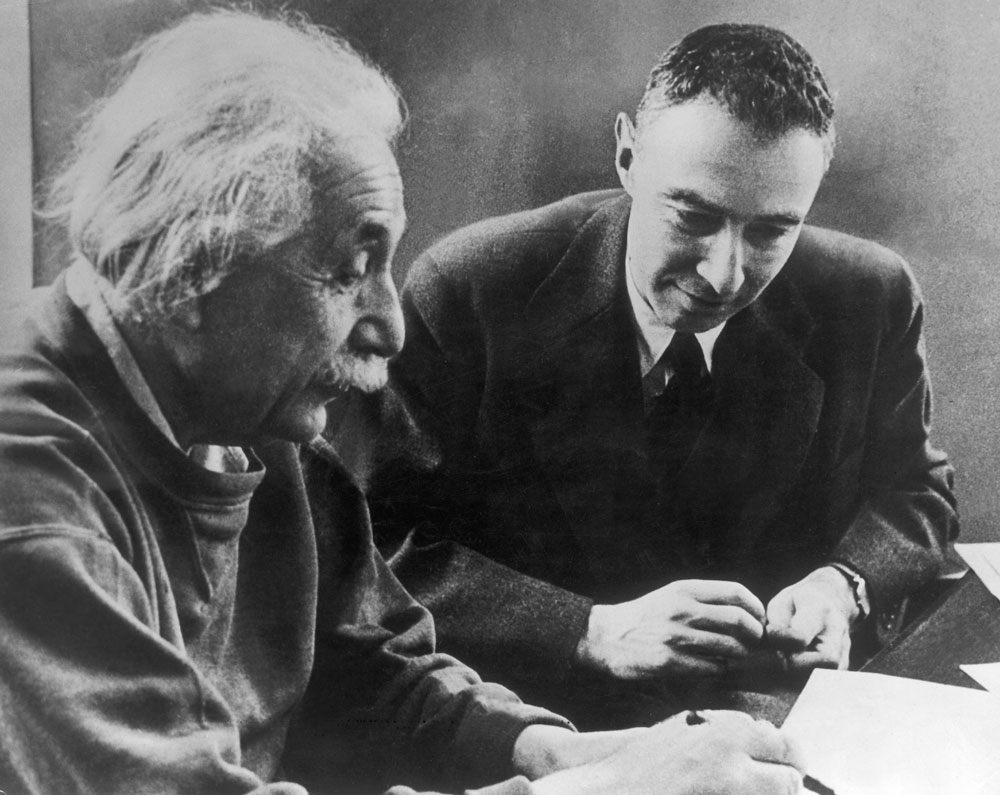
Albert Einstein And J. Robert OppenheimerAlbert Einstein And J. Robert Oppenheimer In 1947 (Keystone-France/Gamma-Keystone via Getty Images)
Oppenheimer’s lifelong left-wing ideals caught up with him, compelling him to make peace with his conscience over creating a weapon that could destroy mankind

“If Oppenheimer hadn’t become scientific director of the Manhattan Project, he would possibly be remembered as someone who contributed towards getting the United States more ‘on the map’ as a place to get a theoretical physics education,” Alex Wellerstein, science historian at the Stevens Institute of Technology and expert on the history of nuclear weapons, told Salon by email. “He did not spend enough effort on his other scientific contributions to really develop them into their full forms — others did, and some of them became pretty important, but he never seemed interested in that.”

Instead, Oppenheimer’s chief legacy is as “a key leader in the early nuclear age,” particularly in developing the world’s first atomic bombs. Later on, as the movie also accurately depicts, Oppenheimer’s lifelong left-wing ideals caught up with him, compelling him to make peace with his conscience over creating a weapon that could destroy mankind. They also caught up with him in a more threatening sense, as Oppenheimer’s past ties with Communists puts him in the government’s cross-hairs during the Red Scare.

“When his security clearance was stripped from him in the 1950s, he became a very different sort of symbol about the relationship between security and science in the Cold War,” Wellerstein pointed out, touching on another theme, martyrdom, also broached in the movie. “His contribution to history is a pretty complex one. It is hard to exactly define his ‘scientific’ contributions — it is not so much about any particular discoveries or scientific insights he had (again, he was considered quite brilliant, but not focused enough), so much as it is about his role in the changing context of how science was done in this country.”

Author and journalist Jennet Conant, who has written seven books about World War II, including “109 East Palace: Robert Oppenheimer and the Secret City of Los Alamos,” elaborated on this point. Conant wrote to Salon that Oppenheimer’s chief legacy was in “sounding the alarm about the danger of a nuclear arms race and dedicating himself, at great personal and professional cost, to trying to implement international control of the terrifying destructive power he had helped to unleash.”

Echoing a remark by Nolan, who observed that scientists in the 2020s are warning about AI much as they warned about nuclear weapons in the 1950s, Conant added that Oppenheimer “imposed this great moral obligation on himself to teach the world about the economics of destruction and it was a great lesson to scientists that they must have a voice in the treatment of their inventions.”


Want more health and science stories in your inbox? Subscribe to Salon’s weekly newsletter The Vulgar Scientist.


“He imposed this great moral obligation on himself to teach the world about the economics of destruction.”

Yet even though Oppenheimer tried to warn the world that it could not allow nuclear weapons to be used to fight wars, even as a remote possibility, Conant ruefully noted that the threat of nuclear war is “greater now than at any time since the hair-trigger era that followed the Soviet’s first detonation of an atomic bomb in 1949.”

“In addition to the terrible hazard posed by the escalating power, speed and accuracy of the nuclear weaponry of the U.S. and Russia, China is assembling an ever-greater arsenal and of the other six countries with nuclear capability — Britain, France, Israel, India, Pakistan, and North Korea — not all have judicious and trustworthy leaders,” Conant explained. “The proliferation of portable nuclear weapons, so-called ‘suitcase bombs’ and tactical nuclear weapons with smaller yields that are compact enough to be carried in a backpack, present a new kind of threat in the war in Ukraine, where it is feared Putin might deploy them to force a settlement.”

While all of this talk of war is sobering, it would be a mistake to assume that “Oppenheimer” is entirely dour. Quite to the contrary, the film reaches moments of ecstatic joy when it is allowed to slough off politics like a snake shedding unwanted dead skin, and instead focus on pure science. There are scenes in “Oppenheimer” that could be edited out and used in high school science classes for instruction: Explaining how all of the universe is composed of atoms, how every atom has a nucleus in its center and how atomic weapons release massive amounts of energy by destroying those nuclei. Nuclear weapons can break apart those nuclei or smash them together, using nuclear fission and nuclear fusion, and there is an eerie, hypnotic parallel to life’s human-caused drama as Oppenheimer’s physics insights flash across the screen in the form of sparks and explosives.

Even while celebrating the intrinsic love of knowledge that comes with pure scientific exploration, however, “Oppenheimer” includes ugly and necessary reminders of their real-world consequences. Take how a simple scientific theory — the possibility that the chain reaction wrought when humans start smash nuclei against each other never stops, igniting the atmosphere and destroying all life on Earth — winds up becoming a plot point. Indeed, “plot point” may be the wrong phrase; that simple scientific concept is practically a full-blooded antagonist, an idea breathing down the characters’ necks as ominously as if it was an actual slimy, scaly, malevolent movie monster.

Nuclear weapons can break apart those nuclei or smash them together, using nuclear fission and nuclear fusion, and there is an eerie, hypnotic parallel to life’s human-caused drama as Oppenheimer’s insights flash across the screen in the form of sparks and explosives.

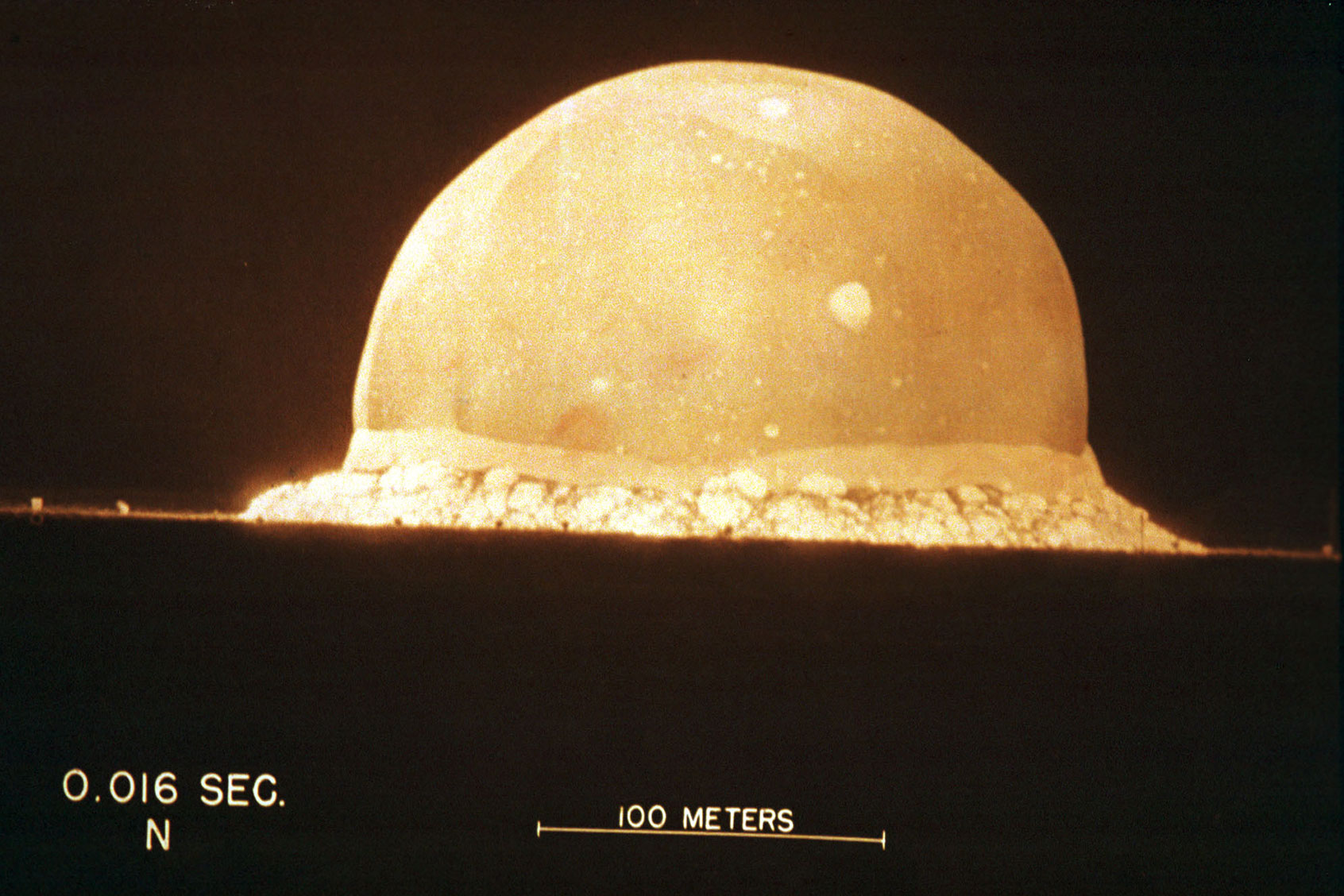
That specific threat has since been disproven, but many other hazards related to nuclear’s destructive potential remain. Eliana Johns, a Research Associate with the Nuclear Information Project at the Federation of American Scientists (an organization that Oppenheimer was intimately involved with in real life), told Salon by email that “while it has only recently become a common topic since the end of the Cold War, the threat of nuclear weapons has remained ever since the Trinity test and the subsequent bombings of Hiroshima and Nagasaki in 1945.” Yet unlike the 1940s, today “the warheads and delivery systems available in modern nuclear arsenals are exponentially more powerful,” as well as more accurate, destructive and widespread.

“The legitimate threat of nuclear weapons is greater now since the end of the Cold War, but there is also a misconception that nuclear weapons don’t cause any harm unless used against an enemy,” Johns added. “In reality, communities around the world have been negatively impacted by the building, testing and use of nuclear weapons since their conception.” This includes consequences that ensued as a direct result of the Manhattan Project.

Manhattan Project first atomic bomb test 1945A photograph on display at The Bradbury Science Museum shows the first atomic bomb test On July 16, 1945, at 5:29:45am, at Trinity Site in New Mexico, U.S.A. (Getty Images/Bradbury Science Museum/Copied by Joe Raedle)“Navajo uranium miners in Colorado and Congolese miners in the Belgian Congo were relied upon for providing fissile materials for the Trinity test and were exposed to deadly amounts of radiation without warning in the process,” Johns pointed out. “Downwinders and victims of nuclear testing in the southwestern United States, Kazakhstan, the Marshall Islands and Algeria were not informed of the nuclear testing in their areas and are still facing the consequences of exposure to radiation generations after the incidents. These are just some examples of the impacted communities who suffered and whose families continue to bear the burden of nuclear testing.”
We need your help to stay independent

Did Oppenheimer know about all of these things? He definitely knew about some of the impact that his testing would cause (the movie alluded, among other things, to his expressed wish to return the Los Alamos National Laboratory to Native American communities), but it is hard to say for sure whether he understood all of the details of what was happening so he could build his bombs. Some long-term consequences would have obviously been inconceivable for him.

Even if he did not know certain things for sure, though, it is difficult to believe that a man as savvy and well-educated as Oppenheimer didn’t at least strongly suspect that marginalized communities were suffering in countless ways while he busily went about proving his genius. The man who spent his last years denouncing the hubris of scientists was, without question, a scientist who readily flew too close to the Sun himself.

“He is a very hard person to ‘read’ historically, and every historian has their own ‘Oppenheimer’ in a way,” Wellerstein noted. “He was not some inadvertent dove who got accidentally caught up in the matter of making and using atomic bombs. He was a very active participant, despite having a very nuanced view of the use of the weapons and their long-term potential. He does not easily fit into the modern categories that people often want to impose on the issue of nuclear weapons.”

Perhaps it all goes back to that scene of dialogue between Oppenheimer and Tatlock. There are two sets of laws that govern the universe, the solid scientific ones studied by Oppenheimer and the nebulous moral ones discerned by Tatlock and others like her. In an ideal world, those who pursue scientific truth and those who seek moral truth would always work together in harmony. Unfortunately, just like the atoms used in nuclear weapons, scientific and moral truths in our real world often crash against each other, all too often with explosive results.

Anna Delvey curates country song used as theme for house arrest podcast

Anna Delvey (real last name Sorokin) has partnered with TikTok celebrity and up-and-coming country singer, Brooke Butler, for the release of a song called “What the Hell?” that will be used as the theme for Delvey’s podcast, “The Anna Delvey Show,” created while under house arrest. The track features audio recorded while Delvey was incarcerated on Rikers Island for a long run of bounced checks, fake wire transfers and unpaid stays at lavish hotels around the world — a glamorous grift dramatized in the Netflix miniseries, “Inventing Anna,”(staring Julia Garner).

Jared Gutstadt, CEO of AudioUP, co-wrote the song with Butler and country songwriter Scarlett Burke, crediting Delvey not only as “curator,” but as the name that will do the heavy lifting in terms of getting the track heard. “Songs are songs, I’ve written lots of them,” Gustadt said in a quote obtained from NBC News. “But without a sort of brand where people could latch on to, you’re competing with hundreds of millions of new songs coming out every year on Spotify. Adding that, “Typically you have to work really, really hard at radio to get on there. … I think her name captures some people’s imagination and attention.” 

Listen here:

“A king’s ransom”: SAG-AFTRA’s Fran Drescher calls out “maniacal” Hollywood CEOs for their “greed”

Studio executives “ended up offering us basically bupkis,” Fran Drescher, SAG-AFTRA president, told Salon just over a week after the union made up of 160,000 members announced it would strike. Since then, thousands of actors have formed picket lines in New York, Los Angeles and across the county, in hopes of reaching an agreement for increased minimum pay, protections against artificial intelligence (AI) and residuals aligned with the industry’s current structure that relies heavily on streaming.

In a video interview for “Salon Talks,” Drescher, the creator and star of “The Nanny,” called out the CEOs in charge of the corporations represented by the Alliance of Motion Picture and Television Producers (AMPTP), which includes Amazon, Apple, Disney, NBCUniversal, Netflix, Paramount, Sony and Warner Bros. Discovery.

“They are living in this dystopia. For the CEOs, they consider it entertainment. For the people with boots on the ground, they’re living it — and they’ve had enough,” Drescher said. “As my mom always said, ‘You get s**t on enough, you begin to notice it stinks around here,’ and that’s where we’re at.

Drescher called reports from the summer camp for billionaires “tone deaf” and pushed back against Netflix CEO Ted Sarandos’ recent statement that he’s “super-committed” to reaching an agreement soon. “We called him — he didn’t call us. We wanted to urge him to see that we are his partners, and we need to have a piece of the subscriptions because that’s where the money is in this new business model,” Drescher said. “It’s not going to go away by just saying ‘no’ over and over again, or pleading poverty when you, my friend, are making a king’s ransom.”

With Hollywood writers also being on strike, the motion picture and television industries are feeling the impact. Studio productions have halted, promotions for the summer’s biggest blockbusters like “Barbie” and “Oppenheimer” have all but ceased and fall TV schedules are being rearranged to accommodate more reality and unscripted shows. (Salon’s unionized employees are represented by the WGA East.)

Watch Fran Drescher’s “Salon Talks” interview here, or read the conversation below to hear more about the deliberations leading up the strike, why concerns about AI and residuals are a huge part of actors’ frustrations and how Drescher has been “standing on the side of the underdog” since a 1994 episode of “The Nanny” called “The Strike.”

The following interview has been lightly edited for clarity and length.

One hundred sixty thousand SAG-AFTRA members are on strike right now. What impact is this having across the entertainment industry?

Essentially, it’s going to stop being able to promote movies with my members and stop production and force the industry executives to reevaluate why we’re in this position and how they can pivot toward making the very foundation of their entire business model — namely the performers — feel respected and honored and part of what is really a partnership and a collaborative art form.

What has it been like to see actors from all levels of the industry coming out?

“We don’t want to be out of work. This is our chosen craft and livelihood.”

It’s extremely gratifying. We’re all in the same boat, and many of the things that we’re fighting for and striking over are for the journeyman working actor who really is just trying to make a living to put food on the table and pay their rent.

There are a very, very small minority of people who are at the very top of the heap, and those are the very famous people who really fuel the engine. They’re the reasons why people go to the movies and turn on the TV. They, too, are threatened by an AI situation whereby their likeness will not be protected.

It’s a very dangerous time that we live in because as performers — our likeness, our behavior, the way we act, the way we move, the way we speak — that is what we sell to make a living. And if there’s artificial intelligence that can rip that off without the proper barricades for consent and compensation, then we’re going to find ourselves out of work. And we don’t want to be out of work. This is our chosen craft and livelihood. I think that there’s some lacking of empathy, lacking of a long vision of how AI is going to negatively impact all of us. By putting people out of work, that never is a good thing. People need to work. People need to have purpose in their life. If you think it’s OK to do that, then you should not be in leadership because you’re not a people person.

We’re here because the industry has changed in so many ways. You brought up AI. Can you talk about the other ways that you’ve seen the industry change?

Streaming has had really a very huge impact on the business model of our industry, which used to be predicated on the longevity and success of a series. Now, it’s whether or not the series can do the heavy lifting to gain subscribers. The algorithms indicate how long a series has to be on to do that before it begins to plateau, and how many episodes per season it needs to have on before it begins to plateau. That is, on average, two-thirds less than what the old contract was predicated off of, so there’s no way you can make the money that you used to make with the long tail of initial run on network television and then syndication and cable and foreign sales.

“I have nothing against making money, but money at the expense of everything of true value is maniacal.”

There was a long tail of revenue that everybody up and down the ladder from the smallest one-liner to the star would benefit from, and we would have years and years of residuals, which was a form of revenue sharing because the studios continued to make money off of the project that we all put together. Now, with streaming, we’re in a box, and that box is a vacuum with no tail and very short episode buys and very limited buys. That’s no longer a fruitful place to get the kind of revenue sharing that allows us to make a living.

We have to go into the pocket where the revenue is because now the name of the game is subscriptions. And we need to get into that pocket, but we were completely stonewalled. They said “no,” and there was no conversation about it. You’re asking for a strike with that kind of an attitude. I don’t think they expected us to analyze the business model and see the change in the system and what was required in the contract to change it to complement the new business model, but we did see it and we presented a very reasonable proposal that made sense.

We didn’t change the business model — they did. They foisted it upon us. I don’t know if it ever occurred to them that well, “Wait a minute, this is going to seriously impact the economics of the performer.” Or they did think of it, and they said, “Ooh, goody, we won’t have to pay as much.” Whatever it is, they now understand that this is the cornerstone upon which we have to set up a new fresh negotiation and contract structure.

Stars like Mandy Moore revealed that they’ve received checks for as little as one cent for residuals. Sean Gunn expressed frustration with Netflix streaming “Gilmore Girls” without fair compensation. Help our viewers understand why that matters.

We can’t be squeezed out of making a livelihood. They should know better, and they should not encourage that. They should support the performer because we are the center of the wheel, and we’re the very foundation upon which they’ve built an entire business. We need people with more character and more courage to change their culture from trying to squeeze and screw the performer out of every last nickel so that the CEO can get his bonus because he’s doing right by shareholders.

SAG-AFTRA has been on strike for a week. The Writers Guild of America has been on strike for more than two months. With two major strikes happening across the entertainment industry, what do you think it says about this moment?

I said to them in the negotiating room, “Why do you think everybody is up in arms? You did this. You disemboweled the industry as it was, which was inclusive to all of the above-the-liners, and you foisted this upon us. And you’re surprised that everybody is pushing back and saying, ‘Wait a minute. This new business model squeezes us out of our livelihood.’ What were you thinking?”

When you are blinded by a determination to screw the performer and that’s your job, it’s very difficult. We’re talking to people that say things like, “We want to break the WGA. If people lose their homes, that’s a necessary evil.” Really? They are punishing us. They don’t want to speak to us because we exercise our legal right to strike when they wasted the entire unprecedented 12-day extension and ended up offering us basically bupkis. We were forced into that next step. It’s not something that anybody relishes because most of the people that are in my union can’t even make the $26,476 threshold to be able to get medical insurance, so obviously to strike is a very big deal for us. It’s something that’s going to impact us much faster than these mega-salaried CEOs.

Disney’s CEO Bob Iger said that some of your asks weren’t “realistic,” and former media studio head Barry Diller suggested that top actors take cuts to share the wealth that way. What do you think the business side doesn’t understand about working actors?

First of all, I’m not looking to take money away from the few actors who, as I said before, are what makes the engine run. Those are the people that sell the tickets, so don’t look to them. Look to the ogres, pardon me, the Igers. That was so tone-deaf from the billionaires camp [in Sun Valley], where they all came off their private jets in their designer clothes. They probably said to everybody else, “Better we just put statements in writing,” which is all that’s happened subsequent to that.

Netflix CEO Ted Sarandos recently said he’s “super committed” to ending the strike. What is your response to that?

“Most of the people that are in my union can’t even make the $26,476 threshold to be able to get medical insurance.”

We spoke to him on the phone. We called him — he didn’t call us. We wanted to urge him to see that we are his partners, and we need to have a piece of the subscriptions because that’s where the money is in this new business model. It’s not about the mechanism, and it’s not about the number. We made that very clear. But you have to sit down and talk to us about that because it’s not going to go away. It’s not going to go away by just saying “no” over and over again, or pleading poverty when you, my friend, are making a king’s ransom.

What has been the most surprising thing during the negotiations?

Well, I think that the lack of respect was apparent, even in the negotiating room. Whenever I spoke — and I’m the president — they didn’t even make eye contact with me. They had their noses in the computers. The only one that was possibly looking at me was Carol Lombardini, who was the president of the negotiating group. But everybody else? Not looking, on the computers, going in one ear and out the other or talking to each other or multitasking or whatever. Complete disrespect.

SAG-AFTRA has been on strike for a week. What can we expect next? When will you go back to the table?

That’s up to them. We wanted to go back to the table the minute the clock struck midnight on the 12th and continue talking. But true to their attitude about us, now it’s time to punish us. So, they’re not going to talk to us — and they made that very clear.

Salon covered the strikes in New York City and talked to actors on the picket line. A strike can take a toll. How would you suggest that actors stay motivated in the midst of not working?

They motivated us. They didn’t want us to have the extension even because they are living in this dystopia. For the CEOs, they consider it entertainment. For the people with boots on the ground, they’re living it — and they’ve had enough. As my mom always said, “You get s**t on enough, you begin to notice it stinks around here,” and that’s where we’re at.

Before the strike, we talked to actress Dominique Fishback from “Transformers” and “Swarm,” and she spoke about the misconceptions people have about celebrities. She talked about demanding schedules, missing important family moments and just how quickly the money gets divided up. What don’t fans understand about working actors?

Most of us have to go up on dozens of auditions before we get one little job. Most of us are just working-class people and background people, stunt people, people that are on the edges of life in every scene that comes to reality and makes it believable for you, the viewer at home, who are being squeezed out of their livelihood. It’s not right. It’s not fair. I never ever live my life that way.

“You have to be able to say, ‘No, that’s not right,’ and do the right thing, even if it means a little less money.”

I have nothing against making money, but money at the expense of everything of true value is maniacal — human beings, other life, the planet, all of it. It all has one systemic core issue — and that’s greed. You have to be able to say, “No, that’s not right,” and do the right thing, even if it means a little less money because you can’t take it with you. That’s not what this journey is all about. This journey is for each of us to develop into more refined versions of our self with a capital “S.” That’s our true being by our creator. If we don’t try and practice that each and every day, we’re missing the opportunity of what this journey is all about. Now you may think, “Wow, I give to my clergy and I’m good to my family and I don’t cheat on my wife.” But if you compartmentalize that and then you go to work and your whole objective is to screw hardworking people with families of their own, then you’re living from a false truth.

In the light of your role leading this strike, a clip from an episode of “The Nanny has resurfaced where your character refuses to cross a picket line. What’s it like to look back on that episode?

I love it. I’m glad. There’s also something from “The Beautician and the Beast” where I galvanize a union, and I think it’s great. I created “The Nanny,” and I actually created that episode of the strike. It was called “The Strike,” and I think standing on the side of the underdog, always going to the mat for those being marginalized is my modus operandi. And I wish it were everybody — the world would be a much better place.

The Big Why: What’s behind Donald Trump’s apparent self-sabotage?

Here’s a guy, he’s in his late 20s, maybe early 30s, he owns a big hotel in midtown Manhattan, he’s a millionaire many times over, he’s in the papers so much that he’s famous just for being who he is, he can have anything he wants in life, he can have any woman he wants. He’s on a cross-country flight from L.A. to New York seated in first class next to an attractive woman. So what does he do after they have the first-class dinner service seated side by side?

He leans over, and without asking or even saying a word, he starts kissing her on the mouth and groping her breasts. When he takes his hand and starts reaching up her skirt, the woman picks up her purse and flees through the drawn curtains into the coach cabin.

When several years later he sees the woman at a big charity event in Manhattan, what does he do? Does he turn away and try to avoid her for the rest of the evening? Does he leave the event? No, he strides right up to her and with people all around them in their evening finery, he calls her a “cunt.”

He was Donald Trump, of course.

It was the late 1970s. He had a wife and children. He owned real estate all over the New York City boroughs of Queens and Brooklyn. He owned the Miss Universe pageant, where dozens of beautiful young women competed for his attention. If he wanted to be unfaithful to his wife, he could simply pick up the phone and have, as it was said, any woman he wanted. With all his money, all his fame, all the attention he got on a daily basis for doing ordinary things like having dinner at a restaurant or appearing at a nightclub or even walking down the street, why did a man who didn’t know the woman sitting next to him on a commercial airplane, in full view of the other passengers and flight attendants, grab her breasts and then attempt to grab her “pussy,” as he would later describe the same act when speaking to a reporter for a major television program?

We need your help to stay independent

Years later, while running for the presidency of the United States, 25 other women would accuse him of similar behavior. He knew only one of them personally, his ex-wife, who accused him of marital rape. The others he either didn’t know or were casual acquaintances. Many of the acts of sexual assault, like his rape of E. Jean Carroll in the dressing room of a Manhattan department store, were committed either in full view of other people or in public places.

Why?

He has to know that the only effects of his personal attacks will be negative.

That has always been the question about this man, hasn’t it? We’re going to get into what might be called The Big Why in a moment – why he has risked his own freedom by allegedly committing multiple felonies trying to overturn an election he knew for a fact that he had lost, why he took hundreds of classified documents from the White House when he left office and mishandled them and then tried to cover it all up from the FBI and the Department of Justice (DOJ). But for right now, let’s consider these other why’s, because he did the same thing he did on the airplane again and again throughout the decades that followed. They were sexual assaults, and he’s alleged to have committed most of them in public.

In a New York nightclub in the early 1990s, Trump put his hand up the skirt and touched the vagina of the woman sitting next to him. He wasn’t talking to her at the time, and she didn’t even realize it was Trump who was sitting next to her until he assaulted her.

At his club, Mar-a-Lago, also in the early 1990s, he pushed a woman who was working for him against the wall and forcibly kissed her and put his hand up her skirt and groped her.

In the late 1990s, Trump groped and forcibly kissed a woman who was sitting in his VIP box at the U.S. Open tennis tournament and held her arms and body so tightly, he prevented her from leaving the box and getting away from him. The next year, in the parking lot of the same tennis tournament, Trump approached a woman he didn’t know and groped her as she was waiting to be picked up by a car.

In the early 2000s, Trump grabbed a guest at his Mar-a-Lago New Year’s Eve gala and pulled her behind a set of curtains and forcibly kissed and groped her breasts and grabbed her pubic area.

In 2005, Trump took a reporter for People Magazine who was interviewing him into an empty room at Mar-a-Lago and forcibly kissed and groped her and told her he wanted to have an affair with her.

Every person with his or her head screwed on right has an instinct for self-preservation — but not Trump.

We could go on. It was the same thing again and again, sexual assaults of women he either didn’t even know the name of or was casually acquainted with, like the People Magazine reporter or the guest in his U.S. Open VIP box. And the question is the same: Why?

It’s not good enough to speculate that he had an excess of testosterone or an elevated sex drive.  Lots of men have both of those things and do not commit sexual assaults. And almost none of the sexual assaults described by any of the women ended with an actual act of copulation. The assault was the point, not the sex. So, is he just a serial sexual assaulter, like a serial rapist who can’t stop himself from committing the same crime over and over?

I don’t think so. How do you explain his association or friendship or whatever it was with Jeffrey Epstein? Trump didn’t have an apparent fascination with or attraction to underage girls. Several of the women he assaulted were middle-aged. He didn’t need Epstein to provide him with targets  Women to assault were all around him. His habit was to just pick one and assault her right there on a plane or in a nightclub or follow her until he could get her in another room or behind a curtain or, in the case of E. Jean Carroll, in a public dressing room, where he assaulted them.

The only pattern was repetition. He explained on the “Access Hollywood” tape that “when you’re a star, they let you do it. You can do anything.” But they didn’t let him do it. He did it without asking. They were not sexual approaches, or sexual flirtations, or sexual seductions. They were sexual assaults.


Want a daily wrap-up of all the news and commentary Salon has to offer? Subscribe to our morning newsletter, Crash Course.


There is a “because I can” aspect to the attitude he evinced on the “Access Hollywood” tape, and that attitude permeates more about his life than his sexual assaults. Trump did things just because he could all the time. He bought the Plaza Hotel in 1988 because he could. He took out loans to do it, of course, and that purchase would go on to lose him about $400 million. Other gambits he engaged in, like his Atlantic City casinos, would cause him to declare six bankruptcies, so it was the banks who lost money, not Trump.

For many years, he got away with what amounted to a series of financial crimes because he could, at least until Manhattan District Attorney Alvin Bragg indicted him in April on 34 counts of falsifying business records stemming from the hush-money payments to Stormy Daniels all the way back in 2016. Those charges, while they don’t address the rest of Trump’s business scams, such as underestimating property values for insurance purposes and overvaluing them when seeking to use property to secure loans, are serious enough that he goes to trial on the New York charges on March 25, 2024. That trial will follow a second trial for damages in a follow-up lawsuit filed by E. Jean Carroll set to take place in December of this year, and it will precede by two months the trial date set on Friday by Judge Aileen Cannon on the 31 count indictment charging Trump with violating the Espionage Act for the removal of classified documents from the White House, as well as six counts of conspiracy to obstruct justice in the same matter.

And so we find ourselves asking — again — The Big Why.

Why did Trump allegedly commit so many crimes trying to overturn an election he had been told by his own campaign that he lost, that his loss of 61 trials challenging the election results proved that he lost, and that he apparently knew himself that he lost, at least according to reports of prosecutors’ interviews with witnesses close to Trump in November of 2020 right after the election had been called for Joe Biden? The whole “stop the steal” business was law breaking based on lies that he knew were lies. If he knew he had lost the election, why risk getting caught for breaking the law so many times? And yet like a serial killer who escalates his crimes over the years in frequency, brutality and risk, Trump forged ahead with one scheme after another. It was, in the end, law-breaking for the sake of law-breaking. 

Imagine yourself in the Oval Office with Rudy Giuliani, John Eastman and Jeffrey Clark. Would you listen to the likes of those three?  Jeffrey Clark, who ran the DOJ environment division, was made fun of in front of the president by his DOJ superiors, who told Clark something like, we’ll ask your advice when we have problems with a farm pond. Remember Eastman’s get-up on Jan. 6 when he addressed the crowd at the Ellipse near the White House, in some kind of louche cowboy hat and silk scarf? How about New York City mayor turned Trump adviser Rudy Giuliani with hair dye running down his face? They were absurd characters. Listening to them was like taking a tip from a tout to bet on a lame horse.

And now that he is already under indictment by special counsel Jack Smith on the documents case, Trump has kept up with his attacks on Smith, calling him “deranged” in a statement about the target letter he received from the office of the special counsel. Trump cannot think the personal attacks on the man prosecuting him on one indictment will get him anywhere with potential charges for his attempts to overturn the election. He has to know that the only effects of his personal attacks will be negative. 

Then why? The theory that his real defense against the charges against him is to win the election for president doesn’t account for the fact that he will go on trial in the documents case next May, and there is a strong possibility that he will be charged in Georgia and face a trial in that state before next November. Nothing Trump is doing is helping him or his lawyers in his defense against any of the charges he faces.

Every person with his or her head screwed on right has an instinct for self-preservation — but not Trump. Every door he opens leads not to a dead end but to a worse place. The motion to dismiss the latest case filed by E. Jean Carroll just gave the judge the chance to write a 59-page decision calling him a liar and a cad and explaining that despite the verdict in the last case, Trump raped Carroll. So why does he keep testing fate?  

Ego?  

Self-hatred?  

The juvenile instinct to do something bad in order to get caught?

Armchair psychoanalysts and real ones both have been trying to read this guy’s synaptic tea leaves for years and still the question, why, is unanswered. The fact that he has not until now faced consequences for so many of his actions, from sexual assaults to financial crimes to two impeachments for violations of the Constitution, certainly explains at least some of his serial crimes. It’s tempting to think that he has become more irrational as he feels the law’s grip, but when you think back to a cross-country flight in the early 1970s and what he did to the random, innocent woman seated next to him, you realize that measuring the level of his irrationality is like measuring his girth: It just grows and grows.

“They’re hypocrites”: Republicans now funding the same voting methods they demonized under Trump

Former President Donald Trump and his Republican allies, who have long baselessly linked mail-in voting and so-called ballot harvesting to voter fraud, are now building programs that encourage these same practices.

Republicans with close ties to Trump are now attempting to raise hundreds of millions of dollars to develop robust initiatives that promote voting practices, similar to the ones employed by Democrats, that they once vilified after experiencing poor election outcomes in 2020 and 2022, according to The Washington Post.

“The big takeaway is that they’re hypocrites who will do anything to try to hold on to power,” Colorado’s Democratic Secretary of State Jena Griswold told Salon. “At this point, for years, the extreme right has launched a coordinated assault on democracy, on voting rights – all to create doubt in voters’ minds so that they can tilt elections in their favor, to set up the atmosphere to try to steal elections, and that has been their playbook.”

Now, the same Republicans are trying to undo the damage they have done by promoting falsehoods about early voting methods. Instead, they are trying convince GOP supporters that such efforts are reliable to increase voter turnout. 

Several individuals engaged in these efforts previously held positions in Trump’s administration or worked with Trump-affiliated organizations during the last election. Some of them even propagated the belief that the 2020 election was fraudulent. But now, at least five initiatives led by prominent Trump allies or former advisors and strategists, are looking for donors and backing in this new initiative. Notably, all of them seem to have emerged within the past year, according to the Post.

“Trump and extremist Republicans have spent years lying to the American people about elections and to see them hypocritically now embrace what they formally have denounced, I think, tells everything,” Griswold said. 

Undoubtedly, the rise of such groups dedicated to early voting marks a significant change for Republicans, who have long criticized such efforts and pushed out false claims alleging voter fraud. Their messaging has damaged GOP confidence in the vote count. The Associated Press-NORC Center for Public Affairs Research poll found that only 22% of Republicans have high confidence that votes in the upcoming presidential election will be counted accurately compared to 71% of Democrats.

Despite running for the White House for a third time, Trump has continued to promote the baseless assertion that the election was stolen. His rhetoric has resulted in a surge of new legislation in Republican-led states. These laws imposed additional voting restrictions, mainly targeting mail voting, shortening windows for returning mail ballots and placing constraints or bans on ballot drop boxes. Conspiracy theories concerning voting machines have led several Republican-led local governments to consider replacing machine tallies with hand counts.

“There have been over 300 bills just this year alone to suppress the vote, undermine elections and take away Americans’ ability to make their voices heard,” Griswold said. “What they do is lie to try to steal elections, that has not stopped.”

Falsehoods about mail ballots and legal ballot collection are being used as a justification for political violence, for voter suppression and for inciting an insurrection, she added.

“You actually see lawmakers cite this information as they pass voter suppression laws,” Griswold said. “Voter suppression bills predominantly target people of color.”

She pointed to the example of Georgia in 2020, which saw a historic voter turnout that led the state to turn blue for the first time in decades. The state’s Republican-controlled Legislature quickly responded by passing a new law to impose numerous voting access restrictions, which will have a major impact on Black voters, who form almost one-third of the state’s population and vote overwhelmingly Democratic.

“So the lies go hand in hand with classic voter suppression. Classic voter suppression is about keeping away people of color and blue-collar people,” Griswold said. 

We need your help to stay independent

Despite generating skepticism around voting by mail for Republican voters, these falsehoods have also made their way into mainstream messaging, discouraging minority voters from casting their ballots by mail.

“The [shorter] deadlines and misinformation about that has kind of deterred Black voters and Brown voters from using vote by mail, in addition to the historical fear of voting by mail,” said Mitchell Brown, a senior attorney at the Southern Coalition for Social Justice.

If Republicans carried out the same efforts in North Carolina and encouraged voters to cast their ballots by mail, this could be helpful to the movement of helping Black and Brown voters have access to the ballot box, Brown added.

For many years, North Carolina has experienced a push to eliminate early voting and voting by mail, which has created resistance to this very idea, Brown said.

But just because the Republican National Committee and Trump are now agreeing to the use of mail ballots, does not mean that this will happen all across the nation nor does it mean that every American will have access to the same opportunities, Griswold said. 

“You can’t undo the lies overnight,” Griswold said. “The far-right’s assault on American democracy has not stopped. The very fact that they use the term ‘ballot harvesting’, which is a conspiracy made popular by the far-right and Donald Trump shows that that this isn’t about making sure that every eligible American can vote and choose their elected officials. They’re continuing down the path of making sure that the people they want to vote are the people that get to vote, and that is undemocratic. It’s unAmerican and these people who are trying to steal elections should be held accountable and never should serve in office.”

Historically, Democrats have performed better in early and mail-in voting while Republicans have generally done better in in-person voting on Election Day. Now, a majority of the new GOP initiatives are primarily concentrating on early voting efforts as conservatives have pushed out the idea that the party suffered from discouraging voting before Election Day, the Post reported. 

“One of the first lessons we have to take from the midterms is the power of early voting,” tweeted conservative firebrand and founder of Turning Point Action Charlie Kirk last year.

In another tweet, he said, that telling everyone to vote in person on Election Day opens you to “traffic jams and machine malfunctions like what happened in Maricopa County.” When that happens, “there’s no rewinding time to change your strategy. You’re at the mercy of the courts and voters’ own schedules.”


Want a daily wrap-up of all the news and commentary Salon has to offer? Subscribe to our morning newsletter, Crash Course.


This represents a significant departure from the party’s stance since 2020 when Trump consistently cast doubt on mail voting and urged his supporters to vote in person on Election Day. 

Until last year, Republican activists promoting the stolen election narrative advised GOP voters with mail ballots to keep them and submit them at their polling place on Election Day, rather than using mail or drop boxes.

But now, even Trump is urging donors to contribute to his “ballot harvesting fund,” emphasizing in a fundraising email that “Either we ballot harvest where we can, or you can say goodbye to America!”

Turning Point Action has also launched an initiative, aiming to reinvent how Republicans engage with infrequent voters, taking inspiration from Democrats and liberal groups that have stationed full-time community organizers in key battleground states, according to the Post.

They’re “raising money to hire 500 full-time organizers in Arizona, 800 in Georgia and 350 in Wisconsin, at a cost of $99 million to compensate each staffer at a $60,000 salary, according to the fundraising materials,” the Post found. 

This endeavor has sparked substantial criticism from some members of the Republican Party, who argue that Turning Point Action’s budget is inflated and that the organization lacks the necessary tools to execute such an extensive operation, the report added.

The GOP’s renewed effort to embrace vote by mail could hold significant importance, particularly in Arizona, with about 89% of Arizona voters casting ballots early, mostly by mail, in the 2020 general election, according to the Arizona Mirror.

Now, Kari Lake, the Republican candidate who lost the Arizona governor’s race to Democrat Katie Hobbs by about 17,000 votes, is also echoing a similar message.

In May, she announced that she would launch “the largest ballot chasing operation in our nation’s history.” Lake is considering running for the U.S. Senate next year.

In Georgia, a county party launched an effort called “Unite the Right,” aiming to promote early and mail voting among Republicans and to ensure ballot counting through tracing and “curing” procedures, the Post reported. Lumpkin County GOP chair Katherine James said the party is also in the process of developing customized scripts to engage various voter groups, including college students and churchgoers.

“It is important to understand that just because Donald Trump and people like the RNC chair decided ‘oh, maybe it’s a bad idea to tell my voters not to vote in the most accessible and secure way possible,’ does not mean that the country can make a 180 overnight,” Griswold said. “They have done tremendous damage to this nation through voter suppression, the insurrection, the killing and the political assassination of police officers on January 6, and the violence that has just taken over the country against election workers.”

“I have something to say”: JFK’s grandson rips RFK Jr. in rare public statement

In a rare public statement, JFK’s grandson, Jack Schlossberg — son of Caroline Kennedy Schlossberg  — is sounding off against RFK Jr., using the opportunity to officially endorse Joe Biden in the 2023 presidential election.

In a video posted to Instagram, Schlossberg drops the C-Word (Camelot), all but casting his anti-vaxx, conspiracy theorist of a relative out of the kingdom. Read his full statement below:

President John F. Kennedy is my grandfather, and his legacy is important. It’s about a lot more than Camelot and conspiracy theories. It’s about public service and courage. It’s about civil rights, the Cuban Missile Crisis, and landing a man on the moon. Joe Biden shares my father’s vision for America, that we do things not because they are easy, but because they are hard. And he is in the middle of becoming the greatest progressive president we’ve ever had.

Under Biden, we’ve added 13 million jobs, unemployment is at its lowest in 60 years. Biden passed the largest investment in infrastructure since the New Deal and the largest investment in green energy ever. He’s appointed more federal judges than any president since my grandfather. He ended our longest war. He ended the COVID pandemic, and he ended [former President] Donald Trump. These are the issues that matter. And if my cousin, Bobby Kennedy Jr., cared about any of them, he would support Joe Biden too.

Instead, he’s trading in on Camelot, celebrity conspiracy theories and conflict for personal gain and fame. I’ve listened to him. I know him. I have no idea why anyone thinks he should be president. What I do know is his candidacy is an embarrassment. Let’s not be distracted again by somebody’s vanity project. I’m excited to vote for Joe Biden in my state’s primary, and again in the general election. And I hope you will too.

Celebrities mourn the loss of Tony Bennett, dead at 96

World-renowned singer, Tony Bennett, died on Friday at the age of 96 and a wealth of celebrities who grew to have a deep appreciation for his work, and for him as a person, have been releasing heartfelt remembrances. 

Sharing photos of the two of them performing together, Mariah Carey grieved the loss of the performer on Twitter writing, “Rest in Peace Tony Bennett. It was such an honor to work with one of the world’s most beloved, respected and legendary singers of the past century. We will miss you.” Christina Aguilera, who has also performed with Bennett, shared photos of her own along with a statement saying, “Saddened by the loss of a true music icon, Tony Bennett. Tony’s immense contributions to the industry will forever resonate with us all. Cherishing the memories of our personal collaborations. His voice, his talent, and his passion for music will never be forgotten.” Billy Joel joined in with his memories on Twitter, saying, “Tony Bennett was the one of the most important interpreters of American popular song during the mid to late 20th century. He championed songwriters who might otherwise have remained unknown to many millions of music fans.” Countless others have flooded social media with their own goodbyes, but the one everyone is waiting for is Lady Gaga, who formed a close friendship and working relationship with Bennett over the years, singing with him during his last public appearance in 2021 at Radio City Music Hall in New York City.

Bennett was diagnosed with Alzheimer’s disease in 2016. No specific cause of death has been given at this time.

Ron DeSantis not convinced that Jan. 6 was an insurrection

During an appearance on comedian Russell Brand’s podcast on Friday, Florida governor and 2024 presidential hopeful, Ron DeSantis, made statements to the effect that he’s not sold on that fact that the events of Jan. 6 make it an insurrection.

According to AP News, DeSantis told Brand that the idea that Jan. 6 “was a plan to somehow overthrow the government of the United States is not true, and it’s something that the media had spun up.” Elsewhere in the interview, he doubled-down on his statements saying, “If somebody is honestly doing an insurrection against the U.S. government, then prove that that’s the case and I’ll be happy to accept it, but all you’re showing me is that there were a lot of protesters there and it ended up devolving, you know, in a way that were unfortunate, of course. But to say that they were seditionists is just wrong.”

Pegging his opinions to something that’s costing the U.S. government unnecessary resources, he said it was “ridiculous” how much money was being provided for the U.S. Capitol police following the attack.


“We’re done with the cover up”: House UFO hearing set, Rep. Burchett to chair

On Wednesday, July 26, the House Oversight Committee’s national security panel will hold its first much-anticipated hearing on UFOs — now called Unidentified Anomalous Phenomena (UAP) by the government, denoting inclusion of non-flight events and non-object entities. In a Thursday press conference, subcommittee chair Rep. Tim Burchett (R-Tenn.) and panel member Rep. Anna Paulina Luna (R-Fla.) told reporters that the panel’s efforts to investigate claims of a Defense Department UAP retrieval program — made recently by whistleblower and former intelligence official David Grusch — were stymied by Pentagon officials and high-ranking military members who “stonewalled” them. Grusch is one of several witnesses of deep credibility that are slated to testify at the hearing. 

“We’ve had a heck of a lot of pushback about this hearing. There are a lot of people who don’t want this to come to light,” Burchett told reporters Thursday. “We’re gonna get to the bottom of it, dadgummit. Whatever the truth may be. We’re done with the cover-up.”

The hearing is the first of several expected on the matter — which representatives said they would hold at military bases with press access granted should Pentagon officials continue pushing back on investigative efforts. New bipartisan legislation has also recently been filed that would give Congress access to UAP-related documents, with additional legislative efforts have also been supported by the leaders of both the House and Senate. Despite brushing off questions from reporters about UAPs in recent weeks, White House officials said Tuesday that UAP events pose a national security concern as they impact pilots.

Why criminalization of drugs doesn’t prevent overdoses

For more than a decade, the United States has been rocked by a record-breaking overdose epidemic. Over 100,000 Americans are losing their lives to preventable drug overdose each year. 

Many state legislatures are attempting to stem this tide by criminalizing new substances and increasing penalties for drug crimes and classifying overdose death as homicide. For decades, the War on Drugs has been our most widely supported policy response to substance use. But what if this approach causes more harm than good? That’s what our new research suggests. 

My colleagues and I set out to explore the correlation between drug seizures by Indianapolis Municipal Police and overdose in the surrounding community. Our new report, published in the American Journal of Public Health, provides strong evidence that law enforcement intervention is not just ineffective but counterproductive in preventing overdose.

Using two years of administrative data from Marion County, we compared the time and location of drug seizures logged by local police to clusters of fatal overdoses, nonfatal overdoses, and naloxone administrations by first responders. If seizing illegal drugs protected public health, we would expect overdose rates to decline after each seizure.

But, in the days immediately following an opioid drug seizure, within a few hundred meters of that seizure, overdoses doubled

In the days immediately following an opioid drug seizure, overdoses doubled

Many mistakenly perceive illicit drugs to be deadly because they are so potent. In truth, illicit drugs — especially opioids — are so risky because there is little room for error. A minor mis-dosing could have life-threatening consequences. Fluctuations in the illicit drug supply increase the likelihood of a mis-judged dose.

Previous research demonstrates how drug seizures expose people to an unpredictable supply. People who sell drugs have to alter their supply to meet steady demand with less product than they had before. People who use drugs may have to seek different products from unfamiliar suppliers if their trusted source is unavailable or their drugs are suddenly taken away. The impacts of even small disruptions can spiral quickly out of control. We have entire federal agencies whose sole purpose is to pursue that disruption


Want more health and science stories in your inbox? Subscribe to Salon’s weekly newsletter The Vulgar Scientist.


For years, my colleagues and I have heard the same refrain from public health professionals, first responders, and people who use drugs: drug interdiction drives overdose. Our research provides the most damning evidence to date that this growing consensus is correct: criminalization creates many of the harms we associate with substance use, harms which are then leveraged to justify harsher criminal responses.

It is critical that policymakers understand the implications of this growing body of research. While the War on Drugs might be “status-quo,” it is becoming increasingly clear that they are not effective mechanisms for protecting public safety and could actually increase overdose risk.

We need your help to stay independent

So, what can we do? We can start by making gold-standard addiction treatments more accessible and channeling public dollars into low-barrier, affordable housing. We can invest in proven, compassionate and community-oriented solutions to reduce overdose, like drug checking, syringe services programs and overdose prevention centers. Decades of research show that these programs (including the two overdose prevention centers in New York City) are far more effective at saving lives and linking people with health care services and addiction treatment than any other program model we’ve tried in the United States.

Our research provides the most damning evidence to date that criminalization creates many of the harms we associate with substance use, harms which are then leveraged to justify harsher criminal responses

We can ensure that naloxone, the opioid overdose antidote, gets into the hands of people who use drugs by supplying it to harm reduction programs. Additionally, the U.S. Food & Drug Administration can take steps to extend over-the-counter designation to generic intramuscular naloxone — the most common and the cheapest form of this life-saving medication.

Moreover, we can take a long, hard look at what drug prohibition has truly delivered. Our study demonstrates a strong correlation between drug seizures and overdoses in the following days, but other troubling findings suggest that any criminal justice response, from arrest to incarceration, drives up overdose risk.

And what about drug-induced homicide? These laws are ostensibly enforced to honor those who have lost their lives to overdose. Could treating overdose deaths like homicides also cause more overdose? Research already suggests that it does.

We deserve solutions that work. And we know what works. We need leaders to make those solutions a reality.

Saved from extinction, “Minx” is back with an even richer and more complicated second season

Nightmares don’t lie. Two of them pop up early in the second season of “Minx” involving red carpets. One shows the magazine’s founder Joyce Prigger (Ophelia Lovibond) traipsing before a press line, laughing merrily as she strides underneath a marquee announcing her as a billionaire pornographer.

The other is essentially the same, except this time Joyce isn’t the one stepping out of a Rolls Royce to wild cheers and flashing bulbs. That pleasure goes to Bottom Dollar CEO Doug Renetti (Jake Johnson), the smut publisher who launched her dream of publishing a serious feminist periodical, albeit one incorporating full-frontal male nudity.

At his side is his longtime partner, lover and business manager Tina (Idara Victor), who joins him for the ride along with their other Bottom Dollar employees Bambi (Jessica Lowe), who claims the title of CFO — Chief Fun Officer — and Richie (Oscar Montoya), now BDP’s art director, “which is an actual title,” he clarifies. Joyce arrives much later and is all business, ignoring the press and marching into the theater with little joy in her step.

That probably has something to do with the event announcing the relaunch of her magazine – it’s a screening of the 1970s’ most notorious skin flick, one that’s only feminist in its loosest possible interpretation.

Welcome to the crotch of the sexual revolution, i.e.1973 or so. It was a hazy daze of an era when the feminist firebrands had yet to figure out that selling liberation would be a lot easier if they could convince the oppressed that their side was having a lot more fun. We still haven’t quite grasped that, but as Season 2 Joyce has made an uneasy peace with her mainstreaming progressive ideas by serving of peen beside the polemics.

Doug handed Minx’s ownership back to Joyce, but as an old-school nudie mag chief, he hasn’t entirely accepted ceding his power over to a woman. Especially this one.

Here’s the thing – one of those bad dreams isn’t a dream at all. It’s a scene from their real life that makes some ecstatic and others question everything they stand for. Each also foreshadows what’s in store for Doug, Joyce and everybody touched by Joyce’s topsy-turvy world.

Every dream has a price. The challenge is picking the right pocket. Joyce accepts overtures from multiple publishing companies, all headed by white men delivering the same pitch placing her in the same league at two or three dead famous women and Jackie O. In the end, she goes with another legendary woman who’s also filthy rich and has zero publishing experience: Constance Papadopolous, played by Elizabeth Perkins.

MinxMinx (Starz)With Constance backing Doug and Joyce, their odd couple partnership blooms anew, albeit with major thorns this time, mainly related to ego. Scrambling to pay their bills and stay two steps ahead of the forces trying to put them out of business, including cops and conservative politicians, made the Minx team a killer creative combo.
But everyone who isn’t Joyce begins to wonder if they’re getting everything they deserve. And Joyce, a Vassar graduate, has a pedigree that Constance recognizes, but she also sees potential in the other scruffy underdogs — save, maybe, for Doug.

We need your help to stay independent

Johnson’s rumpled delivery extends the mileage of what becomes an extended joke that stops being funny after a point, which is Doug’s knack for sniffing out goldmines but just missing the X with his pickax. One moment happens as he’s desperately trying to squeeze money out of a potential investor by pitching him on the potential of a periodical about a new fitness craze sweeping the nation. And what would it be called? Runner’s World, maybe? Men’s Health? Nope. “Joggin’!” Doug says. “No G!”

Although Joyce, Doug and the rest of the “Minx” team strive to be on the leading edge, the conceptual arc of this season is the familiar scenario in which the underdogs are suddenly pushed to the front of the pack by a tsunami of money and influence. In success, even when their gains appear to be equally distributed, resentment always sprouts. You can almost see where this new leg of the journey is going to derail. Almost.

Still, what prevents Ellen Rapoport’s funky period piece from tripping over its good intentions is the crisp humor and the writers’ refusal to make anyone the easy hero or predictable villain.

Speaking of nightmares – not Perkins, to be clear; her casting was a divine stroke of insight – knowing a  second season of “Minx” almost didn’t happen probably caused a few. This scrappy gem was nearly a casualty of the Max title purge before Starz came to its rescue. It’s a good thing the premium cable channel appreciated what Warner Bros. Discovery did not, because as good and satisfying as “Minx” was before, it is firmly hitting its rhythm in this second go-round.

Season 2 barrels through the impossible quest to match one’s idealism with capitalist realities.

Every actor amps up the personalities they establish in the first season. Lovibond still plays Joyce as a physical contradiction, a woman whose passionate devotion to the liberation of her sex is genuine but who can’t quite bring herself to loosen the seams and buttons of her pantsuit. She could learn from Tina’s confidence in her power, and Victor reminds us of that every time she’s in frame, giving one of the best performances of the ensemble. Added to the sheer joy Lowe and Montoya bring, they convey the sense that the energy is more evenly spread around the full troupe.

MinxMinx (Starz)Lennon Parham also delivers as Joyce’s sister Shelly. who awakens Joyce to the untapped market and libidos of suburban housewives in Season 1. The latest episodes explore what it means for Shelly to be fully plugged into her erotic self, pulling her husband Lenny (Rich Sommer) along in a subplot that makes the highest use of Parham comedic talent while expanding her character’s dimensionality. 
And Shelly’s chemistry with Lowe’s Bambi, Bottom Dollar’s former in-house fluffy bunny, also grows more complex. Constance, the newcomer with the most power, should eat all of these people and has a history that says as much.

Against those expectations, and thanks to a place Perkins lands on that sits somewhere between ferocity and pragmatism, Constance is supportive and assertive, molding Joyce into a power player instead of simply a writer.


Want a daily wrap-up of all the news and commentary Salon has to offer? Subscribe to our morning newsletter, Crash Course.


Through its performances and dialogue that gaily bubbles, simmering in the appropriate places, watching “Minx” is less about marveling at its period accuracy that witnessing the joy congress between well-rounded characters and a freewheeling mood. A few special appearances by a few superstars of 1970s intelligentsia cements its sense of place and Joyce’s new place in the world, including a multi-starship crash involving Carl Sagan, Annie Leibovitz  — shooting for Rolling Stone — and Linda Ronstadt.

The flip side is that this still remains a story told from Joyce’s perspective, shining lesser light on the struggles Tina faces as a Black woman in this mostly white, straight world. Where the second season does a better job of highlighting the inconsistent support feminists lend to other groups is through Richie’s professional journey, which leads him to ask whether he’s outgrown a company that publishes titles like “Feet, Feet Feet.” More than this, he starts to question whether Joyce’s progressive stance also includes supporting equal rights for Minx’s LGBTQIA readership.

Alongside the costumes and cinematography soaked in California sunshine and cigarette smoke each 30-minute episode flies by. I hate to say that the inability to binge this season may not do it justice, especially the first two episodes, which are best viewed as a pair..

But maybe this slower pacing is a good thing. Otherwise Season 2 barrels through the impossible quest to match one’s idealism and values with capitalist realities, something each “Minx” persona grapples with differently. “When the world is knocking at your door,” Joyce observes, “it’s very hard not to put up a wall. With spikes.” Nothing so intimidating is in the way of finding this show – and for a good time, more people should.

The second season of “Minx” premieres at 9 p.m. Friday, July 21 on Starz. 


Trump spending so much donor cash on lawyer bills there’s “not a lot left” to fund actual campaign

As former President Donald Trump’s legal woes mount, the line between his criminal defense and his 2024 presidential campaign is blurring, a political and financial muddying that The Washington Post projects will only worsen as multiple prosecutions continues to dominate his time, resources and messaging. 

Trump’s appeals to stay out of prison on social media, in rally speeches and in interviews have become a mainstay of his candidacy, as evidenced by his frequent claims online that the criminal investigations against him are “witch hunts” that constitute election interference. His criticism of his indictments and the agencies investigating him have subsequently drawn the support of much of the Republican base despite — and, in some cases, because of — the severity of his charges. 

“What is likely to come is a campaign like the country has never seen before: A candidate juggling multiple criminal indictments while slashing the Department of Justice and his opponents, shuttling between early primary states for rallies and courtrooms for hearings, and spending his supporters’ money on both millions of dollars’ worth of campaign ads and burgeoning legal bills,” according to the Post.

Many of Trump’s aides have also been placed in challenging positions because they could also be called as witnesses against him in trials. Whether Trump, who announced on Tuesday that he received a target letter from special counsel Jack Smith in the federal probe of Jan. 6, wins or loses the 2024 race could determine whether he really could face prison time. 

“I didn’t know practically what a subpoena was and grand juries and all of this — now I’m like becoming an expert,” Trump said during a Tuesday speech to the Linn County Republican Party in Cedar Rapids, Iowa. “I have no choice because we have to. It’s a disgrace. If you say something about an election, they want to put you in jail for the rest of your life.”

Just over half the money Trump raised last quarter went to a campaign-affiliated political action committee that is covering his legal bills. According to the latest report to the Federal Election Commission, of the more than $35 million raised between March and June, the campaign received $17.7 million. The remainder went to the Save America PAC, which will report its latest finances on July 31 but had reportedly been spending millions on attorneys for Trump and his allies amid his bevy of ongoing cases, FEC disclosures show.

“A lot of money is going to legal and people who don’t do much, and not a lot is left over to do marketing and advertising,” one anonymous Trump advisor told the Post. “A lot of the money we’re raising is just going to legal.”

Trump campaign spokesman Steven Cheung reasoned that the political and legal efforts are merging because Trump and his supporters perceive the prosecutions as a President Biden-led move to block him from the Oval Office. 

“They see another political indictment or target letter and they know this is just the weaponized Biden Justice Department going after President Trump,” Cheung said. “It solidifies in their mind what the President has been saying for all these months. So much of the legal messaging is political messaging and so much of political messaging is legal messaging.”

Biden, however, has denied the claims, saying that he “never once, not one single time, suggested to the Justice Department what they should do or not do relative to bringing a charge or not bringing a charge.”

Trump’s personal fortune has notably remained untouched when it comes to his legal ordeals: His latest financial disclosure indicated he earned roughly $1 billion during a period covering most of his time since leaving office.

“Trump’s supporters are being taken advantage of by having to foot the bill for Trump’s legal troubles,” Ken Cuccinelli, an advisor to the super PAC supporting Florida Gov. Ron DeSantis, told the Post.

We need your help to stay independent

The Trump campaign’s manner of committing funds to legal fees is unusual among Republicans and noteworthy, according to rival political operatives. Chip Saltsman, the national campaign chairman for former vice president Mike Pence, assured the Post that “we have not spent a lot of money on legal fees.”

Advisors said Trump has been zeroing in on polling, the electoral implications of his charges and how to defend against prosecutors. The former president and his advisors often cite polls that show his popularity among Republican voters, and they recognize that winning the 2024 election is the clearest way for Trump to skirt his charges. Several advisors described to the Post a concerted effort to paint Trump as martyr-like and affirmed that he intends to keep campaigning.

“He just sort of accepts this is his life now, and he’s got to win,” one advisor said.

Trump could be forging ahead in his campaign while facing four separate trials connected to a number of criminal charges: a New York indictment accusing Trump of issuing a hush money payment to an adult film star ahead of the 2016 election; special counsel Jack Smith’s June indictment related to Trump’s handling of classified materials; a potential indictment from Smith’s office into Jan. 6 and Trump’s efforts to subvert the 2020 election; and a potential indictment from an Atlanta-area district attorney’s investigation into alleged attempts to overturn election results in Georgia.


Want a daily wrap-up of all the news and commentary Salon has to offer? Subscribe to our morning newsletter, Crash Course.


Advisors said the campaign anticipated the Georgia case to strike next and was surprised when Smith sent Trump a target letter Sunday. In contrast with the documents case, which Trump’s team expected would yield charges, many did not anticipate any to come from the Jan. 6 case. The campaign is now preparing for a possible indictment as early as next week, anonymous aides told the Post, with plans to respond with a speech, fundraising appeals and taped videos.

“This was nothing that anybody even anticipated for making a speech, and a very good speech,” Trump said Tuesday in an interview with Doug Wagner on WHO NewsRadio 1040, in reference to a speech he gave on Jan. 6 that included false claims about the election. “Most people are very surprised that this was ever even brought … They want to try to bloody up so you can’t beat Biden.”

Longtime Trump advisor Jason Miller told the Post that fundraising has already been kicked into “overdrive” and the campaign is “prepared politically for any scenario that the deep state throws at us.” 

He added that Trump is used to being the subject of “witch hunts,” citing his two impeachment trials, the Jan. 6 committee and now the array of criminal probes. Advisors said that Trump’s supporters donate the most when they believe him to be under attack.

“It starts to all blend together,” Miller said. “People get and understand the fact that these legal attacks are nothing more of an insurance policy to try and stop him from getting back to the White House.”

As a result, the campaign has taken a frank and direct approach with supporters regarding the resources put toward Trump’s legal defense, even contextualizing calls for fundraising around the investigations. One Tuesday message read, “Please make a contribution to show that you will NEVER SURRENDER our country to tyranny as the Deep State thugs try to JAIL me for life.”

In the aftermath of Trump’s June federal indictment, the campaign said it had raised over $4.5 million online in addition to another $2.1 million generated at an extravagant event.

The campaign is also loosening the boundaries between Trump’s political and legal teams as it acknowledges aides’ involvement in discussions about the cases could later prompt their own subpoenas or legal liability. The defense’s court arguments are also echoing Trump’s statements on the campaign trail, “emphasizing the prosecution of a leading opposition candidate by the incumbent administration” as the legal team signals its aim to delay Trump’s trials until after the election, the Post noted.

“You have essentially the two right now leading candidates for the presidency of the United States squaring off against each other in the courtroom,” Trump lawyer Chris Kise said at a Florida hearing in the documents case on Tuesday.

“The fact that we’re talking about the volume of discovery, the schedules that we have, and the schedule of President Trump, we’re not asking for special treatment. That’s the reality,” Todd Blanche, another attorney for Trump, added at the Florida hearing. “I’m not making that schedule up, I’m not making up any facts here.”

Judge Aileen Cannon, the Trump-appointed federal judge overseeing the classified docs case, scheduled the trial to begin in May 2024 in a Friday ruling. The New York trial was preliminarily set for March of next year but those dates often change.

Despite much of the recent buzz around Trump revolving around his criminal cases, his team has enjoyed his volume of media attention. In particular, aides reportedly were happy to see the updates about Trump’s target letter interrupt the CNN broadcast of the network’s interview with DeSantis. 

The Florida governor was one of several Republicans who came to Trump’s defense this week, suggesting he shouldn’t be prosecuted for his conduct on Jan. 6. His critical rivals — former New Jersey Gov. Chris Christie and former Arkansas Gov. Asa Hutchinson — shared predictions that, in following with the pattern, another indictment would boost Trump’s standing in the primary.

“I expect his poll numbers to go up again,” said Hutchinson, who has called on Trump to suspend his campaign. “Over the long term you have to believe that people are under going to understand the seriousness of it, you’re going to see the challenge of being a president or even being a candidate with multiple indictments against you, and that is going to jeopardize us winning in 2024.”

“His batting average is zero”: Expert says Trump has lost “every single executive privilege” claim

As the federal grand jury hears evidence in the Justice Department’s Jan. 6 probe, former President Donald Trump’s legal team is alleging to federal courts that calling his former White House special assistant, William Russell, who was with him on the day of the Capitol attack, to the stand is a breach of executive privilege. But Trump has tried and failed to use executive privilege to shield himself from investigations before, and will likely fail again this time around, former federal prosecutor Elie Honig told CNN’s Anderson Cooper and Kaitlan Collins Thursday.

During the “AC360” segment, Cooper and Collins speculated that Russell could corroborate aspects of White House aide Cassidy Hutchinson’s testimony before the House Jan. 6 committee and even testify to Trump’s frame of mind on Jan. 6. Honig agreed: Prosecutors are “trying to get those conversations. And I should note, Donald Trump has challenged a lot of testimony on executive privilege. I think his batting average is .000. He has lost every single executive privilege argument that he has brought. I’m sure he’ll lose this one,” he said.

“And also, to Kaitlan’s point, sometimes the boldface names aren’t the most important witnesses,” Honig added. “We’re very focused understandably on Mark Meadows, Rudy Giuliani, what are these folks doing. But Cassidy Hutchinson was unknown until she stood up a year ago in Congress, and it turned out she had really important testimony. We shouldn’t discount someone perhaps because they are a low-ranking aide or a bystander. Sometimes they have the best testimony.”

Co-host calls out Jesse Watters out for accidentally “advocating for Roe”

Fox News’ Jessica Tarlov called out co-host Jesse Watters on Thursday, thanking the anchor newly installed in Tucker Carlson’s slot for “advocating for Roe” during a heated conversation about Robert F Kennedy Jr.’s anti-vaccine sentiments on air, HuffPost reports. “The Five” co-hosts ignited a fierce debate when Watters came to Kennedy’s defense the same day the Democratic presidential candidate defended himself before a House subcommittee regarding his recent antisemitic and anti-Asian comments related to COVID-19.

Watters questioned why Tarlov was “so upset” about Kennedy’s anti-vaccine beliefs, to which Tarlov interjected that Kennedy’s sentiments are “dangerous.” As Watters continued to dismiss Tarlov’s concerns about the danger in the conspiracy theorist’s attitude toward vaccination, he revealed that he had vaccinated his children per their doctor’s recommendations before defending the individual right to determine whether to get a vaccine. “It’s actually kind of weird that you’re so upset about what one Democrat thinks about vaccines,” Watters told Tarlov. “You can do whatever you want with your body, you can do whatever you want with your kid’s body, your doctor can decide with you what to do with your body. What does it have to do with RFK Jr?” Tarlov retorted, “Thanks for advocating for Roe.”

How “The Bear” paid homage to John Hughes and the dark heart of the Chicago suburbs

When director John Hughes released “Uncle Buck,” a 1989 comedy starring John Candy as the titular character, it was met with mixed reviews. The story follows Buck as he gets called out from the city to the Chicago suburbs to care for his brother’s three kids — played by Jean Louisa Kelly, Gaby Hoffman and Macaulay Culkin — while their parents are out of town. Like most of Candy’s characters, Buck is big-hearted and pretty lovable, but Hughes, who also wrote the film, gave him a bit of an edge that unnerved some viewers.  

He’s a hard-drinker, weighed down by horse-racing debt and the seeming inability to commit to a job or to Chanice, his long-term girlfriend (Amy Madigan). “The movie is filled with good intentions and good feelings, but they seem to conceal another side of Uncle Buck,” wrote critic Roger Ebert at the time. “A side that makes the movie feel creepy and subtly unwholesome.” 

He continued, writing: “Hughes is usually the master of the right note, the right line of dialogue, and this time there’s an uncomfortable undercurrent in the material.” 

But in rewatching the movie three and a half decades later, Buck, with his rough-around-the-edges appeal, isn’t really what is disconcerting about the film, which has become something of a cult classic. Like much of Hughes’ work, the story of “Uncle Buck” was propelled by the inherent tension contained in the picturesque neighborhood where it was set. Yes, the houses are beautiful, but it takes Buck just a few days (and a run-in with a drunk party clown and Bug, his niece’s skeezy boyfriend) to realize that the kids are not alright. 

Over and over again, Hughes demonstrated how isolation and family dysfunction can not just hide, but also thrive in the quiet darkness of the suburbs — which is why it it was no surprise to see that this season of FX’s “The Bear” took some cues from the director in its own exploration of the neighborhoods bounding Chicago. 

Addiction and abuse are recurring themes in Hughes’ films.

Some of the nods are a little more obvious, like in the case of the fifth episode of the second season, “Pop.” In it, Carmy (Jeremy Allen White) and his crush, Claire (Molly Gordon) head up to Winnetka, a northern Chicago suburb, to drop off a piece of mail. While in the area, Claire invites Carmy to a party a friend of hers is having. 

The needle drops, and “Pretty in Pink” by the Psychedelic Furs (produced for the 1986 film of the same name, which Hughes wrote) begins to play as Claire leads Carm into her friend’s kegger. The rest of the episode feels a bit like a coming-of-age movie in the best of ways; it’s evident that, despite Carmy’s real-world restaurant chops, when it comes to personal relationships, he’s experienced a bit of arrested development. Tonight is about overcoming some of his shyness. 

The party gets rowdier and rowdier around the pair — in a way that nods to the carnage left behind by the drunk party guests in “Sixteen Candles” — who ultimately decide to head back to the city and towards a fade-to-black first kiss as “Can’t Hardly Wait” by The Replacements (first released in 1985) plays. But before they do that, Carmy compliments how Claire handled her wasted, heartbroken friend. “In college, everyone used to come back to my house after parties, and I think I got really good at managing sad, drunk people,” Claire says. 

“Yeah, I know that feeling,” Carmy says. 

There’s a beat of silence before Claire carefully replies: “I know you do.” 

We need your help to stay independent

The next episode, “Fishes” plunges viewers into the exact dysfunction to which Carmy and Claire are alluding. Set on Christmas Eve years prior to the present season, we learn that Carmy’s mom, Diana (played with ferocity by Jamie Lee Curtis), is a narcissistic, emotionally abusive alcoholic whose moods and unmedicated outbursts dictate family holidays.

The BearJeremy Allen White, Abby Elliot and Jon Bernthal in “The Bear” (Chuck Hodes/FX)
Her three kids have their own way of dealing: Carmy got out of the country for work and, now that he’s back stateside, spends most of his time back at home dissociating; his sister, Sugar (Abby Elliot) constantly checks in on her mother, who, in turn, lashes out at her; meanwhile, their brother Mikey (Jon Bernthal) now struggles with addiction himself. 

“The Bear” creator Christopher Storer was raised in Park Ridge, a Chicago suburb that borders the northwest side of the city, and, in this episode in particular, really uses that familiar, serene landscape surrounding the Berzattos to magnify the chaos inside their home. From the outside, it’s a beautiful house on a beautiful street decorated for a beautiful dinner. 

Mikey and Richie both have that distinct John Bender “f**k you” energy.

Inside, the Berzatto kids are bracing for another tumultuous holiday. Little do they know that this one will end with Diana ramming her car through the front door. 

Addiction and abuse are recurring themes in Hughes’ films. In “Pretty in Pink,” Harry Dean Stanton plays Jack Walsh, Andie’s (Molly Ringwald) father who struggles with alcoholism and depression after his wife walks out on the family. Cameron (Alan Ruck) insinuates in “Ferris Bueller’s Day Off” that his father is emotionally, if not physically, abusive. And in “The Breakfast Club,” John Bender describes his dad as an alcoholic who beats him and calls him a ” stupid, worthless, no good, goddamn, freeloading son of a b***h.” 

The BearSarah Paulson and John Mulaney in “The Bear” (Chuck Hodes/FX)
The holiday chaos isn’t just coming from Carmy’s mom, though. His brother and cousins (and John Mulaney, who is also originally from the ‘burbs, playing a weird in-law) stoke tensions when they tell Carm that they ran into Claire and passive-aggressively put in a good word for him. 

It’s not lost on me that Claire was also the name of Molly Ringwald’s character in “The Breakfast Club.” And like Ringwalsd’s character, Claire of “The Bear” is positioned as something of a princess, too. She’s smart, she’s beautiful, she volunteers with sick kids and she’s on her way to becoming a doctor. But when the guys are describing how she’s “grown up” to Carm, they’re all a little gross about it, especially Mikey and his cousin, Richie (Ebon Moss-Bacharach). 

Mikey and Richie both have that distinct John Bender “f**k you” energy that does feel undeniably Chicago in many ways. Yet as much as they both want to present themselves as tough-as-nails outsiders who don’t need validation, this season showed how much they simultaneously crave acceptance and success. Those seemingly dichotomous desires often erupt as bad behavior, like the kind that landed Bender in detention — and Richie out on the sidewalk in front of an Alinea-esque restaurant getting chewed out about his poor work ethic as a fork polisher. 

By the way, that lecture very much sounded like what Ringwald’s Claire said to Bender: “See, you’re afraid that they won’t take you, you don’t belong, so you have to just dump all over it.” 

In the end, Richie ends up being the character who grows the most this season after he realizes that the only thing stopping him from belonging is his own fear of failure, something Mikey didn’t get the chance to do. It’s a satisfying turn and one that makes me think that John Bender could’ve really found himself in a decent restaurant kitchen. 

During “friends and family” night at Carmy’s new restaurant, which is when Richie really steps up, Diana comes into the city from the suburbs; Sugar and Carmy don’t see her because she opts not to come inside. She doesn’t know how to say she’s sorry. Before she goes, however, Sugar’s husband Petey lets it slip that the couple is expecting their first child. 

The BearThe Bear (Chuck Hodes/FX)One of Sugar’s lingering concerns throughout this season is that she won’t know how to be a good mom because she didn’t have a good mom — and I have a feeling that if the show gets another season, that will be a major point that’s explored. The house the show creators chose for Sugar and Petey supports that. 

Some of the shots of the couple’s home were actually filmed at a real home in Evanston, another suburb north of the city. Gilbert Morales, the show’s assistant location manager, told the local paper that while the series doesn’t mention specifically where Sugar lives “it was meant to be outside the city of Chicago.” 

It’s a subtle choice, but one that reiterates an important point: Before either of them can start a new chapter, the Berzatto kids will first have to deal with the trauma they experienced in their childhood home, and it looks a lot like staring into the dark heart of John Hughes’ suburbs.


Experts: Judge Cannon just set the “worst possible” Trump trial date for the Republican Party

Judge Aileen Cannon, the Trump-appointed federal judge in Miami overseeing the former president’s Mar-a-Lago documents case, on Friday set a trial date for next May after Trump sought to delay it until after the 2024 election.

The timeline of the case became a point of contention for federal prosecutors, who wanted to start the trial as soon as December, and defense attorneys, who argued that Cannon should not set a trial date at all due to Trump’s presidential campaign.

Cannon heard arguments from both parties on Tuesday and said she would decide promptly. On Friday, she scheduled the date for the jury trial in the Fort Pierce Division of the U.S. District Court in Southern Florida to start in the two-week period that begins May 20, 2024.

According to Politico, Cannon has also labeled the case “complex,” despite the Justice Department arguing that, as a legal matter, the case isn’t especially complicated and, thus, does not need to be drawn out. 

The former president is the current frontrunner for the 2024 Republican nomination, which “means any trial that takes place before the election will likely resonate across the campaign trail,” according to The Washington Post. His defense argued that the trial should be postponed until after the election because the vote will make it more challenging for an impartial jury to be seated and suggested the trial could impact the course of the election.

Cannon’s ruling, however, sets the trial late in the Republican primary schedule, just weeks before the 2024 Republican National Convention.

“This is the worst possible outcome for the Republican Party. Great for Trump though,” Georgia State Law professor and political scientist Anthony Kreis wrote of the trial date on Twitter.

“This basically allows Trump to snag the nomination before the most easily damning case comes to trial,” he added.

Trump’s attorneys also noted, in addition to his campaign schedule, Trump will be embroiled in other legal battles in the near future. He is facing criminal charges in Manhattan in connection to hush money payments made to an adult film star with a trial slated for that case in March 2024, and civil lawsuits scheduled to go to trial in New York this fall and next year. He’s also the subject of two other criminal investigations — one in Georgia and the other a federal probe — in connection to his alleged efforts to overturn the results of the 2020 presidential election.

Prosecutors, however, pushed for beginning the trial as early as December, acknowledging that the date would present an “aggressive” timeline but dismissing calls for delay. They argued that their proposed schedule would give Trump’s attorneys plenty of time to review evidence from the discovery period. Prosecutors also recognized that jury selection in this case could be lengthy but cited that as a reason why proceedings should begin sooner rather than later. 

We need your help to stay independent

Some legal experts conceded that Cannon’s Friday decision on a timeline for the trial was a good one, arguing that it falls in a sweet spot between being rushed and drawn out.

“The 5/20/24 trial date that Cannon just set is about as extended as it could be without seeming ridiculous,” former U.S. Attorney Harry Litman said in a tweet.

“May was the perfect choice, actually. Not so soon that it’s unachievable. Yet early enough that even some additional postponements would still allow the case to be tried before next fall,” lawyer George Conway added. “Good for Judge Cannon.”


Want a daily wrap-up of all the news and commentary Salon has to offer? Subscribe to our morning newsletter, Crash Course.


Other experts, however, expressed concern that, despite being a reasonable timeline now, the trial date could be pushed further due to potential delays from the defense.

“[B]ig win for Jack Smith on trial date. But the key is making this schedule stick,” NYU Law professor Andrew Weissmann, who served as a senior prosecutor on special counsel Robert Mueller’s team, wrote on Twitter.

“Here’s the thing—in a case like this, plenty of opportunity for Trump to manufacture delay & if this date slips, it makes it far less likely trial happens before the election,” former U.S. Attorney and federal prosecutor Joyce Vance tweeted, adding that “setting it in Fort Pierce with its tiny courtroom & no cameras allowed is a disservice to democracy.”

Trump and his longtime aide, Walt Nauta, were indicted last month on a total of 38 counts. Trump is accused of illegally retaining classified documents after leaving office and obstructing the government’s efforts to retrieve them, while Nauta is alleged to have assisted Trump in his efforts to hoard sensitive materials and making false statements to the government. Both pleaded not guilty to all charges.

Trump-appointed judge orders marshals to “fetch” special counsel prosecutor over lawyer’s lateness

A Trump-appointed federal judge on Thursday was so upset about his court being delayed by special counsel Jack Smith’s grand jury probe that he delayed it further by demanding U.S. Marshals “fetch” one of the special counsel’s prosecutors to explain himself, according to MSNBC

According to Politico, U.S. District Judge Trevor McFadden summoned federal prosecutor Thomas Windom from the grand jury room after attorney Stanley Woodward, who represents a host of Trump associates, arrived 25 minutes late to the hearing for Jan. 6 rioters accused of violence against Capitol police, Federico Klein and Steven Cappuccio, the former of which is Woodward’s client. Windom arrived during McFadden’s verdict reading and was called to the bench for a six-minute sealed conversation obscured by a white noise “husher.” Windom then returned to the grand jury room up the hall and McFadden continued reading the verdict.

The incident stemmed from Woodward’s explanation for his tardiness, which the attorney initially asked to disclose in private due to grand jury secrecy rules. After McFadden said he absolved Woodward of the rules and demanded his reasoning, Woodward revealed that he had a client before the grand jury who was being asked questions that implicate “executive privilege.” He said prosecutors assured they would stop the proceedings in time for his appearance at the verdict, but when they did not, he felt obligated to remain by the grand jury room. McFadden said the government had also assured him and criticized the Justice Department. “Talking about obstructions of official proceedings,” McFadden responded. “The government has not acted as I required.”

Following sky-high food inflation, USDA launches partnership with states to protect consumers

On Wednesday, the U.S. Department of Agriculture (USDA) partnered with bipartisan attorneys general in 31 states and the District of Columbia in an effort to protect consumers in the food and agricultural markets, including in grocery, meat and poultry processing. The department explained in an official announcement that the recent deal “will assist state attorneys general in tackling anti-competitive market structures in agriculture and related industries that are raising prices and limiting choices for consumers and producers.”

Food prices reached an all-time high last summer, with a 13.5% annual increase in August 2022. Although inflation fell to 3% in June, offering consumers some relief from recent price hikes, food prices at the grocery stores are still quite hefty at a 4.7% increase. 

“The Biden-Harris Administration is committed to addressing corporate consolidation and its negative effects on the U.S. economy, such as unfair competition and increased prices,” said Agriculture Secretary Tom Vilsack. “By placing necessary resources where they are needed most and helping states identify and address anticompetitive and anti-consumer behavior, in partnership with federal authorities, through these cooperative agreements we can ensure a more robust and competitive agricultural sector. I’m pleased to see that a bipartisan group of states have committed to joining USDA in better protecting the fair and competitive markets that are a critical cornerstone of the American economy.”


“Series of crimes”: Georgia DA reportedly has evidence to bring “sprawling” racketeering indictment

Fulton County, Ga. District Attorney Fani Willis has amassed enough evidence in the investigation of former President Donald Trump’s efforts to overturn his 2020 election loss to charge a “sprawling racketeering indictment” next month, according to The Guardian.

Willis previously said she was considering racketeering charges but the report adds new details about the scope of the charges prosecutors are expected to seek early next month.

Georgia’s racketeering statute requires prosecutors to show the existence of an “enterprise” and a pattern of racketeering activity predicated on at least two “qualifying” crimes,” The Guardian’s Hugo Lowell explained. In the Trump probe, Willis has evidence to pursue a racketeering indictment predicated on statutes related to influencing witnesses and computer trespass, two sources briefed on the matter told the outlet.

The state’s racketeering statute is more expansive than the federal one because “any attempts to solicit or coerce the qualifying crimes can be included as predicate acts of racketeering activity, even when those crimes cannot be indicted separately,” Lowell explained.

It’s unclear what evidence may be used but the charge related to influencing witnesses could include Trump’s call to Georgia Secretary of State Brad Raffensperger asking him to “find” enough votes to reverse his loss.

The computer trespass charge, where prosecutors would have to show that defendants improperly used a computer or network to interfere with a program or data, could include a breach of voting machines in Coffee County, the two sources told The Guardian.

A group of Trump operatives funded by former Trump lawyer Sidney Powell accessed the county’s voting machines and copied sensitive data. The data from the Dominion Voting System machines was then uploaded to a site that allowed election deniers to download the materials in an effort to prove Trump’s debunked election fraud conspiracy theories.

We need your help to stay independent

Though Coffee County is outside of the Fulton DA’s jurisdiction, the racketeering statute would allow prosecutors to charge Trump operatives over the matter by showing it was part of a larger conspiracy to keep Trump in power.

Texts obtained by CNN showed that operatives hired by Powell also sought to use the data to try to decertify other statewide elections.

Former federal prosecutor Michael Zeldin told CNN in April that the texts suggest violations of multiple state and federal laws.

“What we have here is unauthorized access to this privileged computer data,” Zeldin said at the time. “There is a conspiracy to acquire and improperly distribute that data. There is probably a crime of interfering with the rights of the people of Georgia to have a free and fair election. And this is a series of crimes, a pattern of criminal activity, then it could possibly violate the Georgia RICO statute, which criminalizes a series of criminal activities by the same person or group of persons, so there’s a lot at stake here.”

He added that the texts may be even “more damning” than Trump’s call to Raffensperger.


Want a daily wrap-up of all the news and commentary Salon has to offer? Subscribe to our morning newsletter, Crash Course.


Willis’ investigation has spanned more than two years. A special grand jury in Atlanta heard evidence for seven months and recommended charges against more than a dozen people, the forewoman told media outlets earlier this year. Willis is now presenting evidence to a regular grand jury that has the power to hand down indictments.

Charges from Willis are expected to come in late July or early August.