Spring Sale: Get 1 Year, Save 58%

Legal expert: Trump lawyer’s habit of dictating notes could come back to bite him at trial

Special Counsel Jack Smith’s team obtained dozens of pages of dictated notes from Donald Trump’s lawyer Evan Corcoran, which may be central to the investigation in the classified documents case, according to legal experts. 

The recordings provided insight into Corcoran’s first meeting with the ex-president last year when he advised Trump to comply with the Justice Department subpoena seeking the return of all classified materials in the former president’s possession, a person familiar with the matter told The New York Times.

“Corcoran’s notes will likely be another critical building block of Jack Smith’s case against former President Trump because the notes could ease a core burden for Smith – showing Trump’s intent,” Temidayo Aganga-Williams, partner at Selendy Gay Elsberg and former senior investigative counsel for the House Jan. 6 committee, told Salon.

The notes also included information on a search that Corcoran conducted last June in response to the subpoena for any relevant records being kept at Mar-a-Lago.

He recounted several Trump aides telling him to search the storage room, located in the basement of the property. They had informed him that all the materials brought from the White House at the end of Trump’s presidency were stored there, The Guardian reported

Corcoran ended up handing 38 documents over to Justice Department officials that he found during his search and drafted a letter to the department stating that a diligent search had been conducted and he hadn’t found any more documents.

But a few months later, the FBI seized 101 classified documents from Mar-a-Lago, and found the most highly classified documents in the office, where Corcoran wasn’t advised to search for material, The Guardian reported. It’s unclear who dissuaded Corcoran from searching for classified documents elsewhere at Mar-a-Lago.

“If President Trump gave Corcoran false information about the sought-after documents in order for Corcoran to pass that information to DOJ officials, that would be a crime and Corcoran would be a critical witness against President Trump,” Aganga-Williams said.

Corcoran testified that Trump did not mislead him about where to search the documents, but also acknowledged that he did not suggest he look anywhere else, The Times reported earlier this month. 

As Smith’s probe into the former president appears to be nearing its end, one of the key aspects of the investigation has focused on who moved boxes into and out of the storage room before Justice Department officials came with FBI agents to collect classified material at Mar-a-Lago.

Prosecutors have recently focused on two employees, who assisted with moving the boxes of documents. Trump’s longtime valet, Walt Nauta, was seen on camera moving boxes at Mar-a-Lago both before and after the May subpoena.

Smith’s investigators are trying to determine whether Trump or people close to him attempted to obstruct justice in response to the grand jury subpoena requiring the return of classified documents, or if they lied about what happened.


Want a daily wrap-up of all the news and commentary Salon has to offer? Subscribe to our morning newsletter, Crash Course.


The special counsel’s team is also examining whether there were any efforts to interfere with the government’s attempts to obtain security camera footage from Mar-a-Lago, according to the Times.

While it is highly unusual for government investigators to gain insight into a lawyer’s confidential interactions with their clients due to protections offered by attorney-client privilege, a federal judge pierced this privilege after prosecutors persuaded her that Trump may have used Corcoran’s legal advice in furtherance of a crime, a lawyer briefed on the case told The Guardian.

Judge Beryl Howell ruled in favor of applying the crime-fraud exception, allowing prosecutors to sidestep protections afforded to Trump’s lawyer through attorney-client privilege. 

“Prosecutors almost never get direct access to a lawyer’s private communications with their client or that lawyer’s work product reflecting those communications,” Aganga-Williams said. 

He added that Corcoran’s notes could provide the special counsel further insight into “Trump’s intent to either violate the Espionage Act or to obstruct justice,” which would be relevant to the DOJ’s decision to charge Trump and could be used as evidence in any criminal trial.

Arsenic contamination of food and water is a global public health concern

Arsenic is a naturally occurring element found in the Earth’s crust. Exposure to arsenic, often through contaminated food and water, is associated with various negative health effects, including cancer.

Arsenic exposure is a global public health issue. A 2020 study estimated that up to 200 million people wordwide are exposed to arsenic-contaminated drinking water at levels above the legal limit of 10 parts per billion set by the U.S. Environmental Protection Agency and World Health Organization. More than 70 countries are affected, including the United States, Spain, Mexico, Japan, India, China, Canada, Chile, Bangladesh, Bolivia and Argentina.

Since many countries are still affected by high levels of arsenic, we believe arsenic exposure is a global public health issue that requires urgent action. We study how exposure to toxic metals like arsenic can lead to cancer through the formation of cancer stem cells.


Arsenic water contamination predominantly affects communities of color in the U.S.


Arsenic contamination of food and water

Your body can absorb arsenic through several routes, such as inhalation and skin contact. However, the most common source of arsenic exposure is through contaminated drinking water or food.

People who live in areas with naturally high levels of arsenic in the soil and water are at particular risk. In the U.S., for example, that includes regions in the Southwest such as Arizona, Nevada and New Mexico. Additionally, human activities such as mining and agriculture can also increase arsenic in food and water sources.

High levels of arsenic can also be found in food and drink products, particularly rice and rice-based products like rice cereals and crackers. A 2019 Consumer Reports investigation even found that some brands of bottled water sold in the U.S. contained levels of arsenic that exceeded the legal limit. Alarmingly, multiple studies have also found that several popular baby food brands contained arsenic at concentrations much higher than the legal limit.


Arsenic and cancer stem cells

Chronic exposure to arsenic increases the risk of developing multiple types of cancer.

The mechanisms by which arsenic causes cancer are complex and not yet fully understood. However, research suggests that arsenic can damage DNA, disrupt cell signaling pathways and impair the immune system, all of which can contribute to cancer development.

            Microscopy images of ovarian epithelial cells before and after chronic arsenic exposure
The image on the left shows ovarian epithelial cells under normal conditions. The image on the right shows the cells after three weeks of chronic arsenic exposure at 75 parts per billion. Cristina M. Andrade-Feraud/Azzam Laboratory at FIU, CC BY-NC-ND
           

Scientists have also linked chronic arsenic exposure to the development of cancer stem cells. These are cells within tumors thought to be responsible for cancer growth and spread. Like normal stem cells in the body, cancer stem cells can develop into many different types of cells. At what stage of cellular development a stem cell acquires the genetic mutation that turns it into a cancer stem cell remains unknown.

Our research aims to identify what type of cell arsenic targets to form a cancer stem cell.  We are currently using cell cultures obtained from the same organ at different stages of cellular development to examine how the origins of cells affect the formation of cancer stem cells.

Preventing chronic arsenic exposure is critical to reducing the burden of arsenic-related health effects. Further research is needed to understand arsenic-induced cancer stem cell formation and develop effective strategies to prevent it. In the meantime, continued monitoring and regulation of this toxic metal in food and water sources could help improve the health of affected communities.

Cristina Andrade-Feraud, Ph.D. Candidate in Environmental Health Sciences, Florida International University and Diana Azzam, Assistant Professor of Environmental Health Sciences, Florida International University

This article is republished from The Conversation under a Creative Commons license. Read the original article.

“The Idol” tests HBO’s devotion to toxic auteur worship – and ours

If HBO were a cult, it would have to be one of the most successful ones going. What other entity hurls barges of money at certain creators simply because they say they want to make something, then waits for the praiseworthy recruits to shower them with adulation and reverent podcast breakdowns?

The channel’s executives have a long history of doing this, trusting a series of men with oodles of cash simply because they created a hit at some point. 

Euphoria” nightmare weaver Sam Levinson is the latest beneficiary of the premium channel’s largesse, reportedly having set somewhere between $54 million and $75 million on fire in the tortured process of getting his latest show, “The Idol,” into circulation.

According to a March report in Rolling Stone, Levinson, who shares co-creator credit with Abel Tesfaye, aka The Weeknd, stepped in after the series’ first director Amy Seimetz suddenly exited. He scrapped the existing content to start from scratch. The reason? Seimetz injected too much of a “female perspective” for Tesfaye’s tastes.

Other projects contending with a similar level of disarray might employ an editor to go at it with a scalpel, filling in the blanks with reshoots. Not this one. Rolling Stone describes a full overhaul of “The Idol” that included recasting and an entire rewrite, transforming what the story’s sources describe as “a layered narrative that was driving home a message about the trappings and exploitations of fame” into “Euphoria Season Three with pop stars’.” 

Forget the scalpel — switchblades are cooler. In the premiere, “Pop Tarts & Rat Tales,” Tesfaye’s character uses one to slice a hole in the lingerie he’s using to suffocate the starlet who has invited him over to her house under the auspices of teaching her how to sing like she knows how to, um, grind. (Prince’s “Darling Nikki” plays moments afterward.) We see this after she’s watched Sharon Stone flirt with Michael Douglas in “Basic Instinct” and are to understand that all of it is foreplay. She wants to be destroyed. How sexy.

If there’s no such thing as bad press, “The Idol” might as well be triumphantly arriving on a litter.

“The Idol” begins with scenes that sell the notion that pop stars like Jocelyn (Lily-Rose Depp) are commodities molded and maintained by their labels with little agency of their own. Jane Adams solidly personifies this concept as record label exec Nikki, who co-signs some of the photo shoot’s worst ideas. Various characters explain, sans empathy, that the death of Jocelyn’s mother has left her emotionally adrift. When someone suggests that photographing Depp’s pop sensation with breasts exposed while wearing a hospital bracelet, suggested to be a remnant of the singer’s recent nervous breakdown, Nikki nonchalantly replies that mental illness is sexy.

Further shaken by a viral selfie of her with semen on her face posted online without her consent — I hated typing that as much as you hate reading it, I assure you — Jocelyn crosses paths with Tesfaye’s charismatic nightclub owner Tedros. For reasons that escape notice, she’s immediately drawn to him. Later he’ll persuade Jocelyn that he’s the one who can lift her out of her creative malaise. What he doesn’t say is that the lever will be his junk.

Her relationship with Tedros quickly turns deranged and controlling, making him less of a mentor and producer than a sadist. But, much like the main character in The Weeknd’s “Can’t Feel My Face,” Jocelyn likes it about as much as she enjoys parading her nipples in public. When her assistant tells her that Tedros is “so rapey,” Jocelyn’s response is, “Yeah, I kinda like that about him.”

Lily Rose DeppLily Rose Depp (Photograph by Eddy Chen/HBO)

HBO did not release review screeners to critics ahead of the first two-episode debut at the Cannes Film Festival. Scanning the horrified anti-ovation that emerged from that screening a week and a half ago, we can see why.  

“It makes you wonder if in trying so hard to be transgressive, the show ultimately becomes regressive,” The Hollywood Reporter generously observes in its summary.

“The double-dose the festival screened felt nasty, brutish, much longer than it is, and way, way worse than you’d have anticipated,” warns Rolling Stone’s critic.

The Daily Beast nicknames it “Rape Culture: The Show.”

If that’s not enough of a “yikes!” for you, how about this description in Variety: “Picture “Blonde” as [“Showgirls” scribe] Joe Eszterhas might have written it, but with better music.”

If there’s no such thing as bad press, “The Idol” might as well be triumphantly arriving on a litter carried by nude models groaning under the weight biting into their shoulders – while proclaiming to love the pain and want more!  

Whenever a discourse-humping piece of sparkle trash like this arrives on a platform that should, like Jocelyn,  value itself and its audience at a higher level than such a misfire, know that its airing is not a mistake.

Don’t forget, Warner Bros. Discovery vaulted other nearly finished productions costing about the same as “The Idol” was rumored to have set the company back pre-overhaul. So the fact that we’re seeing it leads a person to conclude that the conglomerate wants to send us a message about celebrity deification: “We glorify the auteur, no matter how feckless. And since we do, so should you.”


Want a daily wrap-up of all the news and commentary Salon has to offer? Subscribe to our morning newsletter, Crash Course.


Seimetz is no novice in the storytelling arena in which “The Idol” was set. As the co-creator, co-writer and director of the first two seasons of “The Girlfriend Experience,” one imagines she would have approached the story’s original intent with thought and care, and without losing sight of its hidden message intermingling the energies of fandom and cult worship.

Alas, Seimetz is not Levinson – a male nepo baby (he’s director Barry Levinson’s son) and the brains behind one of the few buzz-generating series on the channel that doesn’t have a dragon in it. Levinson instead turns to the reliable titillation of toplessness and rough sex – his go-to, swaddled in atmosphere, when narrative substance fails him.

In “The Idol” that collapse conveys a more dangerous message than the one embedded in “Malcolm & Marie,” in which he employs John David Washington‘s character, an artsy director, as his stand-in so he can rail against the culturati. That was self-serving. This validates toxic male fantasies concerning abuse, sexual aggression and, bizarrely, creative vitality. An entire sequence at the top of the episode played for laughs involves Hank Azaria’s Chaim, one of Jocelyn’s managers, maneuvering an intimacy coordinator into a bathroom and locking him inside so that the singer can let her areolas fly free. Safety monitors are such boner killers, right?

Da Vine Joy RandolphDa Vine Joy Randolph (Photograph by Eddy Chen/HBO)
Tesfaye’s Tedros fits the original story’s supposed examination of the cultish nature of fandom and the industry’s ruthlessness in transforming that devotion into revenue.  The rewrite changes Jocelyn’s relationship with him into a “romantic awakening,” as if Tedros were the Kevin Federline to Jocelyn’s Britney Spears.

I’ve been in this game long enough to be cornered by several generations’ worth of dweeby HBO loyalists who justify the horse-killing on “Luck,” the crunchy woo-woo of “Here and Now,” and the continued existence of “Curb Your Enthusiasm.”  I can’t wait to hear about from such a mansplainer about how I, and others, just don’t get it. 

“The Idol” is that guy’s dream. It gives them a reason to wax intellectual about watching Johnny Depp’s daughter finger-blast herself with one hand while strangling herself with the other, only to later get erotically asphyxiated by a guy she’s recent met and is drawn to for reasons we don’t notice, all without having to worry about clearing their web browsers’ history. 

Those guys will gladly hand their cable fees over to a Prestige TV Leader, Levinson and The Weeknd. The rest of us in HBO’s subscriber flock are better off averting our eyes, until the second coming of the sex-positive and fully in charge of herself Samantha Jones. Same church, different service.

Greg Abbott signs legislation barring trans youth from accessing transition-related care

Sign up for The Brief, The Texas Tribune’s daily newsletter that keeps readers up to speed on the most essential Texas news.


Gov. Greg Abbott signed into law Friday a bill that bars transgender kids from getting puberty blockers and hormone therapies, though the new law could face legal challenges before it takes effect on Sept. 1.

Senate Bill 14‘s passage brings to the finish line a legislative priority for the Republican Party of Texas, which opposes any efforts to validate transgender identities. Trans kids, their parents and LGBTQ advocacy groups fiercely oppose the law, and some have vowed to stop it from going into effect.

Texas — home to one of the largest trans communities in the U.S. — is now one of 18 states that restrict transition-related care for trans minors.

“Cruelty has always been the point,” said Emmett Schelling, executive director of the Transgender Education Network of Texas. “It’s not shocking that this governor would sign SB14 right at the beginning of Pride [Month]; however this will not stop trans people from continuing to exist with authenticity — as we always have.”

Authored by New Braunfels Republican state Sen. Donna Campbell, the law bars trans kids from getting puberty blockers and hormone therapies, treatments many medical groups support. Children already receiving these treatments will have to be “weaned off” in a “medically appropriate” manner. The law also bans transition-related surgeries for kids, though those are rarely performed on minors.

Those who support the law claim that health care providers have capitalized on a “social contagion” to misguide parents and push life-altering treatments on kids who may later regret their decisions. SB 14’s supporters have also disputed the science and research behind transition-related care.

“Children in Texas are officially protected from harmful, experimental medical and surgical treatments for gender dysphoria,” Rep. Tom Oliverson, R-Cypress, the author of SB 14’s companion bill in the House, said in a statement on Twitter. Oliverson said the bill was written anticipating court challenges and he maintained confidence the law would not be overturned.

Trans kids, their parents and major medical groups say these medical treatments are important to protecting the mental health of an already vulnerable population, which faces a higher risk of depression and suicide than their cisgender peers. At the same time, doctors say cutting off these treatments — gradually or abruptly — could bring both physical discomfort and psychological distress to trans youth, some of whom have called it forced detransitioning.

In response, the American Civil Liberties Union, the ACLU of Texas, Lambda Legal and the Transgender Law Center pledged on May 18 to fight SB 14 in court. They have yet to file a lawsuit.

“Transgender people have always been here and will always be here,” Ash Hall, policy and advocacy strategist at the ACLU of Texas, said Friday. “Our trans youth deserve a world where they can shine alongside their peers, and we will keep advocating for that world in and out of the courts.”

This legal threat is not new; some of these groups have sued several other states over their restrictions. Earlier this year, the Department of Justice also joined the legal fight against Tennessee’s ban.

While the lawsuits are tailored to each state, Sasha Buchert, a senior attorney at Lambda Legal and the director of its Non-Binary and Transgender Rights Project, told the Texas Tribune last month that a major common challenge to the laws hinges on the 14th Amendment’s Equal Protection Clause and the argument that these laws are stopping trans kids from accessing the same medical treatments that are still available to their cisgender peers.

Buchert added that the lawsuits’ immediate goal is generally to get a preliminary injunction to stop these laws from taking effect, a tactic that has seen some success.

“It’s one thing to see some of the things that state legislators do, but it’s a completely different thing when you’re under the white-hot spotlight of judicial scrutiny,” she said.

And prior to SB 14, the ACLU and Lambda Legal successfully sued Texas last year to halt state-ordered child abuse investigations of parents who provide their trans kids with access to transition-related care. Impeached attorney general Ken Paxton later appealed the decision in March, but the 3rd Court of Appeals has yet to issue a ruling on it.

“It’s a privilege to be able to fight,” Buchert said about the ongoing court challenges that Lambda Legal is involved in.

Disclosure: The ACLU of Texas has been a financial supporter of The Texas Tribune, a nonprofit, nonpartisan news organization that is funded in part by donations from members, foundations and corporate sponsors. Financial supporters play no role in the Tribune’s journalism. Find a complete list of them here.


Go behind the headlines with newly announced speakers at the 2023 Texas Tribune Festival, in downtown Austin from Sept. 21-23. Join them to get their take on what’s next for Texas and the nation.

This article originally appeared in The Texas Tribune at https://www.texastribune.org/2023/06/02/texas-gender-affirming-care-ban/.

The Texas Tribune is a member-supported, nonpartisan newsroom informing and engaging Texans on state politics and policy. Learn more at texastribune.org.

“Incredibly dishonest”: Nikki Haley ripped for blaming teen suicides on trans kids in locker rooms

Republican presidential candidate Nikki Haley drew backlash for seemingly blaming rising suicide rates among teen girls on transgender girls using locker rooms.

Haley, the former United Nations ambassador and South Carolina governor, was asked about her definition of the term “woke” during a CNN town hall moderated by Jake Tapper and immediately went on a rant about transgender kids.

“There’s a lot of things. You want to start with biological boys playing in girl sports. That’s one thing. The fact we have gender pronoun classes in the military now. All these things that are pushing what a small minority want on the majority of Americans, it’s too much,” Haley said.

“The idea that we have biological boys playing in girls’ sports, it is the women’s issue of our time,” she claimed. “My daughter ran track in high school. I don’t even know how I would have that conversation with her. How are we supposed to get our girls used to the fact that biological boys are in their locker room? And then we wonder why a third of our teenage girls seriously contemplated suicide last year.”

A study published earlier this year by the Centers for Disease Control and Prevention found an increase in suicide ideation and attempts among teenage girls between 2019 and 2021. But research from The Trevor Project found that transgender students are at the highest risk, with more than half of transgender and nonbinary youth seriously considering suicide in the past year.

“Trans teens statistically face heightened risks of suicide attempts,” tweeted Politico’s Sam Stein. “In the answer below, it is the attempted accommodation of them that is being pinpointed as a cause for contemplated suicide.”


Want a daily wrap-up of all the news and commentary Salon has to offer? Subscribe to our morning newsletter, Crash Course.


“This is so incredibly dishonest, teenage girls aren’t killing themselves because of girls sports. These people don’t care about teenage girls, except if they can use them to beat up trans kids,” tweeted columnist Molly Jong-Fast.

“Maybe it’s because they see fascists taking away their rights every day, the existential climate crisis, the crushing student debt many will take on, and seeing kids get mowed down in their schools,” wrote Rep. Maxwell Frost, D-Fla.

“Nikki Haley suggesting that 1/3 of American teenage girls are contemplating suicide because of the existence of trans people is an unserious, untrue, and hateful thing to say. But hate is the point, isn’t it?” added author Chasten Buttigieg, the husband of Transportation Sec. Pete Buttigieg.

“Gun violence is the leading cause of death for kids and teens,” noted author Keith Boykin. “School shootings have doubled in recent years. We just had 2+ years of Covid-related social disruption. And college has become unaffordable. Trans kids are not the problem. It’s demagogic politicians like Nikki Haley.”

‘Good soup is one of the prime ingredients of good living’: a (condensed) history of soup

Hot soup on a cold day brings warmth and comfort so simple that we don’t think too much about its origins. But its long history runs from the Stone Age and antiquity through to modernity, encompassing the birth of the restaurant, advances in chemistry and a famous pop art icon.

The basic nature of soup has a fundamental appeal that feels primordial — because it is.

Archaeologists speculate the first soup might have been made by Neanderthals, boiling animal bones to extract fat essential for their diet and drinking the broth. Without the fats, their high intake of lean animal meats could have led to protein poisoning, so stone age soup was an important complement to primeval nutrition.

The fundamental benefit of these bone broths is confirmed by archaeological discoveries around the world, ranging from a gelatin broth in Egypt’s Giza plateau, to Shaanxi Province in China.

The widespread distribution of archaeological finds is a reminder soup not only has a long history, but is also a global food.  

Today, our idea of soup is more refined, but the classic combination of stock and bread is embedded in the Latin root of the verb suppāre, meaning “to soak”.

As a noun, suppa became soupe in Old French, meaning bread soaked in broth and sowpes in Middle English. This pairing was also an economical way of reclaiming stale bread and thickening a thin broth. 
Wealthier households might have toasted fresh bread for the dish, but less prosperous diners used up stale bread that was too hard to chew unless softened in the hot liquid.


From rustic to creamy

New ideas about science and digestion in 17th century France promoted natural flavors and thick, rustic preparations gave way to the creamy and velvety smooth soups we know today.

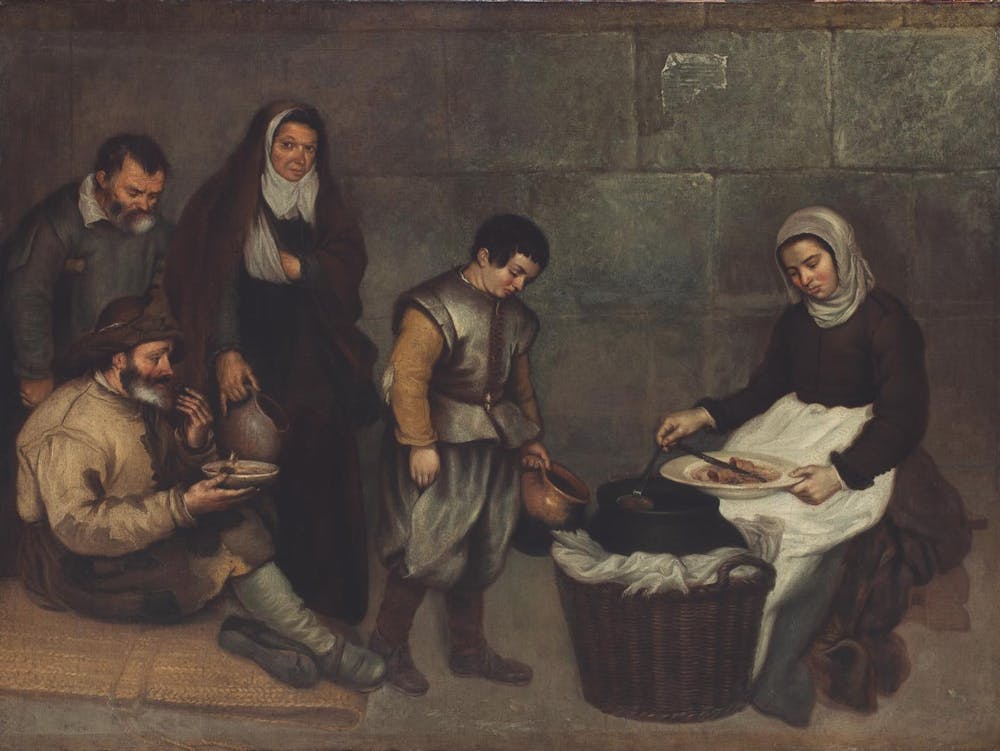
            People line up for soup
The Soup Kitchen, Antonio de Puga, ca. 1630. Museo de Arte de Ponce
           

New versions of the liquid food were developed by early modern European chefs, such as the seafood bisque, extracting flavor from the shells of crustaceans.

The first restaurant as we understand them today opened in Paris in 1765 and was immortalized for a simple broth, a clear soup made from bone broth and fresh herbs.

Mathurin Roze de Chantoiseau, the original French restaurateur, created a new type of public space where weary diners could regain their lost appetites and soothe their delicate nerves at all hours.

It may appear to be a contradiction that the first restaurant specifically catered to clients who had lost their appetites, yet it seems perfectly natural soup was the cure.


Easy and affordable

Soup was not destined to be limited to fancy restaurants or the long simmering stock pots of peasants. Modern science made it convenient and less expensive for home cooks.

In 1897, a chemist at the Campbell soup company, John Dorrance, developed a condensed canned soup that dramatically reduced the water content. The new method halved the cost of shipping and made canned soup an affordable meal anyone could prepare.


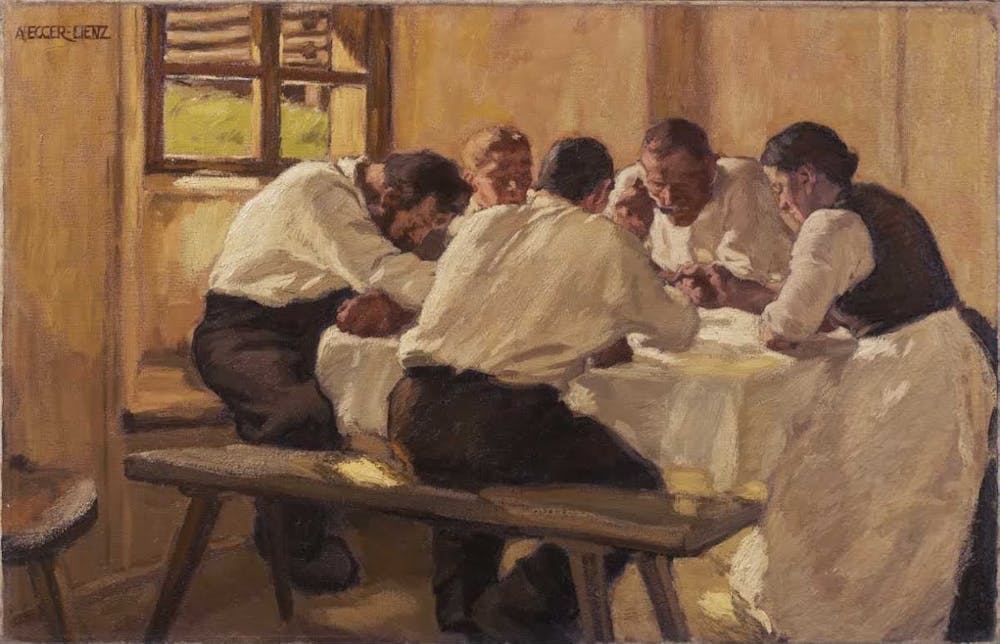
            Painting of men at a table
Lunch (The Soup, Version II), Albin Egger-Lienz, 1910. Leopold Museum, Vienna
           

This revolutionary achievement was recognized at the 1900 Paris Exposition, winning an award for product excellence. Winning the prize was an achievement considering the competition at the world fair. The other technological advances exhibited at the turn of the century included the diesel engine, “talking” films, dry cell batteries and the Paris Metro.

The bronze medallion from 1900 still appears on the iconic red and white label, made famous by pop artist Andy Warhol’s 32 Campbell Soup Cans (1962).

In his work, Warhol appropriated images from consumer culture and the media ordinary people would instantly recognize, from Coca-Cola bottles to Marilyn Monroe. In his famous soup painting, 32 canvases — one for each flavor of soup — are lined up like cans on a supermarket shelf.

Some interpretations consider this a commentary on the link between art and consumerism, emphasizing the ordinary quality of the everyday object. The artist may also have been influenced by his personal eating habits — he claimed he had soup for lunch every day for 20 years.


‘One of the prime ingredients of good living’

A steady diet of soup is not guaranteed to inspire famous art, but its appeal is universal. Soup can be humble or fancy, cutting across cultures and classes.

Deceptively simple, the warmth and comfort of soup provide a temporary refuge from the winter chill, comforting the diner from the inside.

The French chef Auguste Escoffier, famous for enshrining the five basic “mother sauces” in French cuisine, raised soups to perfection in the early 20th century, developing refined preparations that remain classics today.

Escoffier, known as “the king of chefs and the chef of kings”, had very high standards for soup, claiming “of all the items on the menu, soup is that which exacts the most delicate perfection”.

An Austrian apprentice of Escoffier, Louis P. De Gouy, was chef at the Waldorf Astoria for 30 years and wrote 13 cookbooks.

He summed up the appeal of soup in a volume dedicated to the dish with over 700 recipes:


Good soup is one of the prime ingredients of good living. For soup can do more to lift the spirits and stimulate the appetite than any other one dish.


From Neanderthal broth to pop art icon, this humble pantry staple has a rich and vibrant history, giving us both nourishment and food for thought.

Garritt C Van Dyk, Lecturer, University of Newcastle

This article is republished from The Conversation under a Creative Commons license. Read the original article.

Reclaiming rice cakes: How revisiting ‘90s diet staples is helping heal my relationship with food

I remember the taste of my first diet: milk chocolate and metal

That would've been the year or so after my body catapulted itself into puberty and I grew increasingly mortified by the ways in which it was changing. I made the decision in the locker room at the local skating rink as I gently ran my fingers along the elastic waistband of my glossy, putty-colored tights. 

The older girls had always joked about how one of the coaches — a five-foot-two blonde named Barbie whose voice had the distinctive rasp of a lifelong smoker — would threaten them with more cardio if she "could pinch an inch" of fat anywhere on their bodies. I felt the way the new soft curves of my body were constricted by the tights, especially around the stomach. 

I wasn't sure if there was quite an inch of flesh, but there was more than the year prior and that alone seemed like too much.

Falling into a crash diet was really easy. It was the late '90s or early 2000s, so I just raided my mom's stash of SlimFast shakes and used them to replace two meals a day, typically breakfast and lunch, just as the company itself recommended. The shakes were supposed to taste like chocolate, and they did — while I was drinking them. However, they left this film on my tongue that tasted like wet pennies, which I'd promptly cover by chewing sticks and sticks of sugar-free gum. 

Within a few days, I was running on fumes. I'd get woozy when I'd lift my head too fast and gasped for air when lapping the skating rink, but I noticed that both my tights and my plaid, pleated school uniform skirt were looser. So I finally let myself eat until my body felt full, confident in my newfound knowledge that I could just lose the weight again.

Falling into a crash diet was really easy.

But then from that moment on, I was always losing weight for something — and there was always a new diet food to help me get there. 

My best friend's older sister, a volleyball player with her eyes on a college scholarship, doled out tips that she had picked up from sneak-reading supermarket tabloids. 

"Freeze grapes," she once sagely decreed. "It's what Posh Spice does. She eats them instead of candy." 


Want more great food writing and recipes? Subscribe to Salon Food's newsletter, The Bite.


When I was 15, I shifted from figure skating to ballroom dancing and was told I needed to "lean out" to look uniform with a more slender partner. I turned to plain cottage cheese topped with a ludicrous amount of ground black pepper, paired with hours of walking uphill on the treadmill, because that's what I had heard the contestants on "The Biggest Loser" did off-camera. 

When I was 17, it was lightly salted rice cakes, eaten so I could fit into a wedding dress I never actually wore. Then, when I was in college, it was dry, plain chicken breasts eaten under the guise of "meal prepping." 

When I finally got help for disordered eating in my 20s, there was a long list of foods that dieting had kind of tainted for me. As I healed my relationship with nourishing my body, I tended to avoid them. I mean, there are infinite options beyond rice cakes, so why bother returning to them? 

I didn't think there was a reason to do so until about a year ago when my doctor recommended I cut out certain foods to address a few health issues that had been nagging me. This left me in the bread aisle of my local supermarket looking for some gluten-free toast options late on a Sunday night. 

The shelves hadn't been restocked after what had apparently been a busy weekend, so the selection was pretty limited. I turned to Google: "Gluten-free toast alternatives." After sifting through a few lists of brands my market didn't carry, I saw that someone recommended rice cakes. They're crunchy and naturally devoid of gluten. I grabbed a bag off the shelf, lightly grimacing at the "guilt-free!" label on the bag, and added it to my cart along with some good almond butter

The next morning, I was determined to put on my "food writer hat" and make something decent out of them. I coated one with a thick layer of almond butter and topped it with alternating rows of thinly sliced strawberries and blueberries because I had seen a teen on TikTok do something similar and thought it was cute. I drizzled the berries with a little agave, some orange zest and a sprinkle of smoked salt. It was the most unnecessarily dressed-up rice cake I had ever encountered — and it was delicious. 

Honestly, there was and is something incredibly rewarding about revisiting old diet foods and "reclaiming them"

Honestly, there was and is something incredibly rewarding about revisiting old diet foods and "reclaiming them," preparing them in new ways that speak to their potential as ingredients rather than a shortcut to deprivation. 

In recent months, I've fallen in love with chicken breasts again, this time through rich, supple Hainanese chicken rice topped with tangy chili sauce. Cottage cheese has gotten a glow-up, too. As Amiel Stanek wrote in his defense of the dairy product for Bon Appetit

What is cottage cheese but yogurt with more texture, or ricotta with more character? We giddily tear apart juicy wads of burrata and garnish them with all manner of peak-season produce. But how different, I ask you, is humble cottage cheese from the creamy, curdy stracciatella inside these fancy-sounding dairy balls?

And the thing is, he's right. Cottage cheese topped with market-fresh cherry tomatoes, basil and a drizzle of good olive oil is an excellent summer lunch. Even rice cakes have maintained a place in my regular rotation, most often these days as a vehicle for soy-smoked salmon, sliced avocado and yuzu furikake. 

That said, SlimFast can stay in the '90s. 

“I 100% support a challenge to MTG”: Knives out in MAGA World over Greene’s betrayal

Former Trump adviser Steve Bannon and other MAGA Republicans are turning on far-right Rep. Marjorie Taylor Greene, R-Ga., for allying herself with House Speaker Kevin McCarthy, R-Calif.

Greene, one of the most outspoken MAGA diehards in Congress, drew heat from the right for voting in favor of McCarthy’s debt ceiling deal with President Joe Biden last week and flipping on her support for the public release of Jan. 6 surveillance footage that she said could “put the security of the Capitol at risk.”

Greene said she agreed with some of her MAGA colleagues’ criticisms of the debt bill but ultimately defended it against an onslaught of right-wing backlash.

“If you have to eat a shit sandwich, you want to have sides, OK? It makes it much better,” Greene told reporters just outside McCarthy’s office last week. “So what I’m looking for is, I’m looking for some sides and some desserts.”

Bannon, who has frequently hosted Greene on his podcast, took to the right-wing platform Gettr to call for Greene to face a primary challenge from “Real MAGA.”

Other right-wingers quickly joined in.

“I 100 percent support a challenge to MTG, and look forward to meeting and helping a serious challenge to her,” right-wing host Stew Peters told The Daily Beast.

Trump ally Laura Loomer, who has repeatedly lost congressional bids in Florida, is even considering moving to Georgia so she can primary Greene.

“She took a job from me when she publicly accused me of being crazy… and told Trump not to hire me. I think it’s only fair that I get a shot at taking her job, too,” Loomer told The Daily Beast, adding, “You know what Donald Trump always says? An eye for an eye.”


Want a daily wrap-up of all the news and commentary Salon has to offer? Subscribe to our morning newsletter, Crash Course.


Greene in a text message to Rep. Matt Gaetz, R-Fla., that was obtained by the outlet complained that she was getting more heat than other Republicans who backed the bill, including right-wing Rep. Thomas Massie, R-Ky.

“I have almost the same identical voting record as Thomas Massie, the most fiscally conservative member of Congress. And I voted with him on this bill,” Greene wrote. “And Bannon, who was senior counsel to Trump in the WH and responsible for the first debt ceiling increase bc Bannon is reckless and no where near fiscally responsible, is now telling everyone I should be primaried.”

But Greene said she is not worried about the attacks.

“Steve, Loomer, and any other POS attacking me will not beat me,” she wrote. “Because of that people have been reaching out to me because they don’t like what Steve is doing to me… I’m at a place in my life where removing toxic and bad people out of my life makes me very happy.”

Greene sent Gaetz a warning for Bannon.

“Steve and I aren’t getting back together,” she wrote. “And if he keeps it up I’ll take the house and kids. I hope you send it to Steve. Because I’m done.”

Trump melts down on Truth Social over reports that special counsel “wants to indict me”

Former President Donald Trump fumed on Truth Social over reports that special counsel Jack Smith may be nearing an indictment in the Justice Department investigation into Trump’s handling of classified documents.

The federal grand jury hearing evidence in the Mar-a-Lago probe is set to reconvene this week after a hiatus, according to NBC News, fueling speculation that the panel may soon vote on an indictment. The news comes after reports that Smith’s investigators obtained a recording of Trump admitting he had a classified document about Iran that he was not allowed to show to others.

“Reports are the Marxist Special Prosecutor, DOJ, & FBI, want to Indict me on the BOXES HOAX, despite all of the wrongdoing that they have done for SEVEN YEARS, including SPYING ON MY CAMPAIGN,” Trump wrote on Truth Social, repeating a debunked claim that the FBI spied on his campaign.

“Biden Crimes go unpunished, including that he had Boxes in Chinatown, in his garage by the ‘Corvette,’ & 1,850  Boxes in Delaware that he won’t allow anyone to see. That is real OBSTRUCTION!” Trump wrote, even though Biden’s handling of documents is also under investigation by the DOJ. Biden’s case is vastly different than Trump’s since his attorneys turned the documents over as soon as they found them. The DOJ dropped a similar inquiry into former Vice President Mike Pence last week. Trump, meanwhile, defied a grand jury subpoena to return the documents after rejecting multiple requests.

“They seek retribution for Republicans looking into Biden’s CRIMES!” Trump added. “I HAVE DONE NOTHING WRONG. ELECTION INTERFERENCE!”

“Looks like someone has received some very bad news from his legal team,” MSNBC legal analyst Katie Phang tweeted in response to Trump’s post.

But CNN legal analyst Norm Eisen cautioned that while Smith is likely to indict Trump, the former president is not a reliable source of information.

“Just be careful, remember his head fake on the timing of the Bragg charges,” he wrote. “Trump fooled everyone by setting up a false deadline & then creating a fuss when it was not met. Yes I think Smith will charge & soon — on his schedule not Trump’s.”


Want a daily wrap-up of all the news and commentary Salon has to offer? Subscribe to our morning newsletter, Crash Course.


Eisen and other legal scholars last week published a model prosecution memo finding that Trump “should — and likely will — be charged” in the documents probe.

“There is sufficient evidence to obtain and sustain a conviction here, if the information gleaned from government filings and statements and voluminous public reporting is accurate,” the scholars wrote. “Indeed, the DOJ is likely now, or shortly will be, internally circulating a pros memo of its own saying so.”

Neurotypicals: What makes them tick, and how can autistic people better understand them?

Speaking with Salon last month, autistic comedian Fern Brady decided to put neurotypicals on blast.

For the uninitiated: A neurotypical is a person who does not display autistic or other neurologically atypical behaviors. Traditionally, when commentary is made about autism, neurotypicals are the humorists, and neurodivergent people (those on the autism spectrum) are the targets. Yet Brady upended that dynamic by commenting, “This is most autistic people’s experience: In jobs or in in group settings, they’ll say their own thing and they don’t know why everyone’s offended at what they’ve said.” Autistic people are so frequently misunderstood and excluded by neurotypicals that, both figuratively and literally, “autistic kids are like the one person in their class to not be invited to a birthday party, and then people wonder why the suicide rate for autistic people is so sky high.”

“Autistic kids are like the one person in their class to not be invited to a birthday party, and then people wonder why the suicide rate for autistic people is so sky high.”

Although Brady is not a scientist, her observation is similar to one made by Dr. Lawrence Fung, director of the Stanford Neurodiversity Project. Speaking with Salon by email for this article, Fung observed, “Most neurotypical people do not understand the world of the neurodiverse people, and vice versa.” Because of this lack of empathy for common autistic behaviors like poor eye contact and social awkwardness, the 80% of the population that is neurotypical regularly imposes on the 20% that is neurodivergent “poor outcomes in both educational and employment settings.”

Countless volumes have been written in attempts to understand the neurodivergent one-fifth, but the observations of those like Brady and Fung raise an intriguing question: What are the defining characteristics of that four-fifths which can be labeled as “neurotypical”?

For one thing, neurotypicals in a very real sense use a different language from people who are neurodivergent. A 2021 study in the scientific magazine Journal of Autism and Developmental Disorders found that autistic individuals struggle to identify angry facial expressions when they are conveyed at a speed that neurotypical people find “normal.” That finding reinforces what scientists already know about the so-called “double empathy problem,” or the fact that neurotypical people rely heavily on style, tone and other non-verbal aspects of communication that go right over the heads of many autistic individuals.

PhD researcher Connor Keating, the lead author of the study, elaborated on this issue in an email to Salon at the time. Keating explained that empathy involves both how one instinctively expresses emotions and how one develops certain expectations based on previous social interactions. Since these experiences can be very different for autistic people. this leads to a communication breakdown.

“The double empathy problem was conceptualized by Damian Milton, an autistic academic,” Keating explained. “Many autistic individuals over the years have endorsed the double empathy idea, agreeing that it matches their own experiences.” His study helped demonstrate that “a difficulty recognizing moving, rather than still, angry expressions is associated with autism.”

Building off of Keating’s study and others like it, one can partially define neurotypicals as being individuals whose neurological “language” is that of the majority. If you conceptualize communication styles as existing on a chart, that graph would be shaped like a bell curve, and neurotypicals are the people who rest on the meaty section in the middle.


Want more health and science stories in your inbox? Subscribe to Salon’s weekly newsletter The Vulgar Scientist.


Neurotypicality is also characterized by (to again quote Fung) how their “abilities in different domains of intelligence” tend to be similar to each other.

“When we talk about neurodiversity, we refer to the diversity of brain functions and behaviors of all people, neurodiverse and neurotypical,” Fung wrote to Salon. “Neurodiverse people represent a large spectrum of presentations. If you know a neurodivergent person, you know only one neurodivergent person.”

After explaining that roughly 20% of the world’s population has neurodivergent conditions “such as autism, attention deficit hyperactivity disorder, dyslexia,” Fung elaborated that “more and more neuroscience findings have found that specific behavioral traits in a given neurodiverse condition are controlled by brain regions distinctly different from neurotypical people.” As one example, neurodivergent children tend to use brain regions that neurotypicals utilize to process faces in order to solve mathematical problems. This helps illustrate how, to return to the bell curve analogy, “We speculate that there is ‘typical’ neurobiology for neurotypical people who represent the middle part of the bell-shaped curve. The neurobiology of the neurodiverse people represents more of the extremes of the bell-shaped curve.”

At the same time, there is more to being neurotypical than not being a statistical outlier. Neurotypicality is also characterized by (to again quote Fung) how their “abilities in different domains of intelligence” tend to be similar to each other. “For example, the verbal IQ and non-verbal IQ (which assess visuospatial, mathematical, and logical abilities) for a neurotypical person tend to be relatively uniform,” Fung observed. “However, neurodiverse people have distinctly different levels of abilities in various domains,” so that for instance “an autistic individual can be superior in non-verbal IQ and below average in verbal IQ.” Additionally, there are intellectual abilities that cannot be measured by IQ tests “such as athletic, naturalistic, intrapersonal, interpersonal, existential abilities. Some autistic individuals may struggle interpersonally, while they can be very good in science and mathematics.”

Perhaps the best way to sum up what it means to be neurotypical is the definition by Dr. Catherine Lord, the George Tarjan Distinguished Professor of Psychiatry and Education at UCLA’s Semel Institute of Neuroscience and Human Behavior.

“I think neurotypicals just means anyone who doesn’t have identify or hasn’t been identified as having whatever identity is being focused on within neurodiversity,” Lord wrote to Salon. “Though I don’t have autism, and probably would be referred to as neurotypical by some people, I think other people would call me all kinds of things!”

It seems to be best to allow each person who learns about autism spectrum disorders to — based on their own honest self-appraisals — determine for themselves the exact nature of their own neurology. As Brady put it when explaining why she wrote her book “Strong Female Character,” “Very early on I learned it’s not really safe to talk to most neurotypical people about autism.” She noted that for autistic people to be better understood and better treated by society, “All the progress and change that’s happening is gonna come from autistic people themselves.” Similarly, for neurotypicality to be better understood, individuals who do not fall on the autism spectrum will need to better familiarize themselves with the nature of the unique neurological language that they speak.

Per the 2021 study from the Journal of Autism and Developmental Disorders: “It may not be accurate to talk about autistic people as having an ‘impairment’ or ‘deficit’ in recognizing emotion — it’s more that autistic and non-autistic faces may be speaking a different language when it comes to conveying emotion.”

“Fasten your seat belts”: Experts on Trump “indictment watch” as Jack Smith grand jury reconvenes

Reports that the federal grand jury hearing evidence in special counsel Jack Smith’s investigation of former President Donald Trump’s handling of classified documents will reconvene this week sparked speculation that Trump may soon be indicted.

The grand jury’s activity has “slowed” in recent weeks after months of evidence and witness testimony but the panel is set to reconvene this coming week, according to NBC News.

It’s unclear whether prosecutors will seek an indictment at this point, according to the report. Trump would be the first former president charged with a federal crime if he is indicted. He already became the first former president charged with a state crime related to his hush-money case in New York.

Trump’s legal team could meet with Justice Department officials this week in connection to the classified documents case as well, according to CBS News, which is often the last move before an indictment.

“The obvious inference-not the only one but the most obvious— is they’re reconvening to vote out an indictment. Fasten your seat belts,” tweeted former U.S. Attorney Harry Litman.

“What can we expect?” tweeted CNN legal analyst Norm Eisen. “Charges! (If not this week, soon).”

But former federal prosecutor Renato Mariotti cautioned that the report “doesn’t tell us much about the timing of a potential indictment.”

“The grand jury could be considering a proposed indictment, but prosecutors could just be presenting evidence to the grand jury,” he wrote.

Trump on Truth Social fumed over reports, repeating his false claim that the FBI spied on his campaign and accusing President Joe Biden of mishandling documents, even though Biden’s were immediately turned over when they were found while Trump did not comply with a grand jury subpoena, leading to a court-authorized FBI raid on his residence. Biden’s handling of documents remains under investigation by the DOJ, though it dropped a similar probe last week into former Vice President Mike Pence’s handling of documents.

The news comes after reports that prosecutors obtained a recording of Trump admitting he had a classified document about Iran that he was not allowed to show to others and damaging notes from his attorney that were turned over after a judge sided with prosecutors’ argument that Trump likely used his services in furtherance of a crime.

“The case is so strong. You cannot imagine his getting away with this,” former Watergate prosecutor Jill Wine-Banks told MSNBC on Sunday. “I’m wearing a toast pin today because I think he’s toast.”

Wine-Banks predicted that the grand jury already heard the recording.

“There’s nothing as compelling as hearing a defendant in a criminal case say words that show his criminality,” she said. “And these words certainly show that he knew that he hadn’t declassified documents that he still retained.”

Despite multiple criminal investigations, Trump remains the frontrunner for the 2024 Republican presidential nomination.

“It looks like the Republicans will likely nominate someone who is under serious criminal investigation, is indicted, and who knows where that’s going to lead us,” former FBI Director Jim Comey told MSNBC on Sunday.


Want a daily wrap-up of all the news and commentary Salon has to offer? Subscribe to our morning newsletter, Crash Course.


“I mean, it’s this crazy world that Donald Trump has dragged this country into, but he could be wearing an ankle bracelet while accepting the nomination at the Republican convention,” Comey said. “You would be rejected if you put it in a script for a show, but you could have a president who is potentially incarcerated when he is elected president.”

Any potential trial would likely be delayed by motions and continuances until peak primary season.

“The timing scares me a little bit,” former prosecutor Glenn Kirschner told MSNBC.

“What keeps me up at night is the case is still pending against Donald Trump and hasn’t gone to trial; Donald wins the White House and now, what?” he said. “He orders his own prosecution dismissed. Now courtesy of the Office of Legal Counsel memo we now cannot prosecute a sitting criminal president. That is the stuff of nightmares and fiction novels.”

The other threat to Democracy

All the GOP presidential candidates (except for Donald Trump who apparently had some urgent hysterical posting and golfing to do) converged on Iowa last weekend for Sen. Joanie Ernst’s Roast and Ride gathering. They gave speeches in front of haystacks and wandered around in dad jeans pressing the flesh. Florida first lady Casey DeSantis sported a black leather jacket with the words “Where Woke Goes to Die” emblazoned on the back and Mike Pence donned a leather vest and rode around on a Harley trying desperately to imitate a regular guy. It was a magical time.

There were a lot of speeches but one stood out among all the rest:

“… we will fight the woke in education, we will fight the woke in corporations, we will fight the woke in the halls of Congress, we will never ever surrender to the woke mob! “

As you can see, Florida Governor Ron DeSantis is fashioning himself as a wartime leader, aping Winston Churchill’s most famous speech given June 4, 1940 after the miraculous rescue of tens of thousands of British troops at Dunkirk. The German military had overrun France and in just over a month, the bombing campaign known as the Battle of Britain began, killing more than 40,000 British civilians. You can see why DeSantis would think it appropriate to draw rhetorical parallels between Britain’s dire straits in 1940 to the threat American faces from “the woke.” In fact, our war is even more daunting since nobody can even define what or who the enemy actually is.

Even DeSantis, the undisputed Supreme Commander of the anti-woke army, couldn’t adequately explain it in terms that voters who aren’t tuned in to the far-right fever swamp can grasp:

 It’s a form of cultural Marxism. It’s about putting merit and achievement behind identity politics, and it’s basically a war on the truth. And as that has infected institutions, and it has corrupted institutions. So, you’ve got to be willing to fight the woke, we’ve done that in Florida, and we proudly consider ourselves the state where woke goes to die.

He really has the common touch doesn’t he?

If you don’t know what woke means you almost certainly have no clue what “Cultural Marxism” is. The term has an ugly antisemitic, conspiracy theory pedigree with all kinds of kooky far-right connections that’s finally made its way into the Republican mainstream. But to average Republicans he sounds like some pointy-headed perfesser. If “woke” means commie, well, just come right out and say it! (Trump would…)

“You may think his ‘war on the woke’ is silly but if DeSantis has done nothing else, he’s shown that he is deadly serious about it.”

And anyway, isn’t it mostly about Dr. Seuss and critical race theory and “tuck friendly” swimsuits and cat boxes in classrooms and whatever other phony culture war outrage they can drum up to keep the rubes stimulated? Yes, of course. The culture war rages on. But DeSantis has opened a new front that goes way beyond the outrage of the day.

He’s been cosplaying as a wartime leader for quite some time. Recall his notorious campaign ad from last year:

In that ad he’s taking on the corporate media, which I assume falls under the definition of “the woke” as well. Then there was the infamous “And God made a fighter” ad” which seemed to imply that he is the second coming. (Never let it be said that his team is overly modest.)

But let’s remember that while DeSantis’ model, Winston Churchill, was fighting a foreign enemy that had rolled over Europe and was coming for him next, DeSantis has declared war on fellow Americans he simply believes have the wrong ideas. And he’s not being subtle about what he plans to do about it.


Want a daily wrap-up of all the news and commentary Salon has to offer? Subscribe to our morning newsletter, Crash Course.


He has, of course, made clear that he will leave “woke ideology on the dustbin of history” but he has recently added another flourish that broadens his declaration beyond the nebulous “woke.” On Memorial Day, he did an interview on Fox News in front of a naval warship:

How do you suppose he plans to do that? How do you destroy an entire ideology? There certainly are historical attempts to look at, some of which Churchill was very familiar with. Certain countries in South America had some experience with attempting to “destroy leftism” as well. It has a name. It’s called “eliminationism.” It makes you wonder just how far DeSantis is prepared to go.

I’m not ready to say that he’s backing the wholesale arrest of “leftists” or that he plans to decree a 1933 German-style enabling act but it’s not unreasonable to consider what kind of mechanisms he would use to fulfill his goals. We’ve seen what he has done in Florida, with book bans, speech bans, state intrusions on family, education, health, private business and more. His war on “the woke” has been aimed at racial minorities, LGBTQ citizens, immigrants, women and progressives. That is the “leftism” he aims to destroy.

While his speeches have been filled with this vague “fight the woke” rhetoric, we do have some idea of what he has in mind if he becomes president to “re-constitutionalize” the government. He plans to withdraw many benefits for federal employees and move their agencies out of Washington which will further his other goal of purging the civil service, and filling the jobs with right-wing ideologues.

He wants to “clean out” the Centers for Disease Control and Prevention, National Institutes of Health, Food and Drug Administration, no doubt opening the door for the banning of abortion drugs and gender-affirming hormones and the like. We can assume that his choices to head these agencies will be on par with his choice for Florida Surgeon General, an anti-vax doctor known to have altered scientific studies to fit his ideological agenda.

He’s pledged to fire the FBI director and clear out all employees who he believes aren’t devoted to “the truth” (and you know what that means.) He defends Trump against the “partisan” investigations and has indicated that he might pardon January 6 insurrectionists. He would almost certainly pardon Trump as well.

He seems to be thinking of adopting the modern authoritarian style of Hungary’s Viktor Orban who has skillfully used the power of the state to degrade and dismantle liberal institutions, including the media and higher education and created a political environment that assures his hold on power without having to resort to violence. But the American right is a bloodthirsty lot and Ron DeSantis is not a patient guy so it’s hard to know if he could resist a crackdown on what would be sure to be a massive resistance.

As we watch Trump and DeSantis start to go at it in earnest, it’s easy to get caught up in the theatrics and the spectacle. Both of them provide tons of fodder for late-night comics and partisan punditry. But I cannot understand why people insist that DeSantis would be better than Trump because he would never obstruct the peaceful transfer of power or attempt a coup. I honestly don’t know why they believe that.

You may think his “war on the woke” is silly but if DeSantis has done nothing else, he’s shown that he is deadly serious about it. He believes he has to save the country from leftism. Is it so hard to imagine that he would usurp democracy to do it?  

UPS is making record profits — while workers like me are falling further behind

The price of almost everything has gone up. Whether you’re shopping at the grocery store, in line at the gas station or paying rent, we all have sticker shock. 

Like so many workers across the country, everyone in my family is feeling the strain of rising prices. But one thing hasn’t gone up — hourly wages for millions of working people. 

I work for UPS, a global package delivery company. As a “preloader,” I prepare packages for the brown trucks that you see on the road every day. I help children get their presents on time and businesses get critical goods that keep our economy running. If you clicked online to order a package, I likely helped get it to your door.

I take pride in my work, as do my co-workers. But our compensation doesn’t reflect the work we put in for this company. I’ve been with UPS for 12 years and make $21 an hour. The starting rate for part-timers like me is only $15.50.

It shouldn’t be like this, and it doesn’t have to be. UPS pocketed more than $13 billion in profits last year. This company can afford to pay us a living wage and provide better working conditions. 

The benefits and protections we have at UPS were not given to us. They are only thanks to our struggles as a union over the years to gain them. UPS never wanted to pay us more and freely improve our health care and retirement contributions. We had to fight to get those things.

I’m proud to be one of 350,000 workers at UPS who are members of the Teamsters Union. Our newly elected general president, Sean M. O’Brien, is also from Boston, where he started as a truck driver. He’s a militant leader who is fighting — for us and with us — across the table from UPS management on a new five-year deal. Our current contract with UPS expires July 31, and if we do not have a solid agreement by that date, we are united and prepared to strike. A strike is completely avoidable, and all it will take is UPS delivering us the contract that we deserve.

Thanks to our hard work, UPS made record-breaking profits over the last five years. We put our health and safety on the line during the pandemic to get packages to doorsteps. Demand for package delivery exploded, and we worked — and continue to labor — harder than ever. Meanwhile, UPS was more concerned with enriching its shareholders and executives than they were about us. 


Want a daily wrap-up of all the news and commentary Salon has to offer? Subscribe to our morning newsletter, Crash Course.


I’ve worked at UPS for more than a decade, but the company hired new workers off the street and paid them more than me and my co-workers. Talk about infuriating. UPS called it a “market rate adjustment.” When the company couldn’t attract new workers, they started offering higher pay to entice people to work for them in certain parts of the country, including Boston. But once UPS brought new workers on board, it wasn’t long before they lowered their pay, too. If UPS doesn’t sign our pay increases on the dotted line of a contract, we know anything they give us can be taken away.

More than 27 million people in the U.S. work part time. The majority of us are women. About half of UPS’s workforce consists of part-timers, yet we often feel ignored by the company. 

While pay is important, our contract fight is about more than that. We need more full-time job opportunities, freedom from surveillance, safety improvements, an end to harassment from our supervisors and respect for our hard physical labor.

It’s not an easy job. I wake up at 3 a.m. to start my workday at 4. Around the holidays, when demand increases, UPS shifts my hours. Sometimes I start as early as midnight. It’s impossible to plan life or get the rest I need between shifts. Quality of life is a big issue for UPSers, whether we work in warehouses or out delivering packages, whether we’re full-time or part-time. 

I’m sharing my story because what happens for us in this contract fight is bigger than UPS. We’re not just calling for the best possible contract for ourselves — we want to set the standard high for everyone who works in this industry. 

We’re not asking for handouts. We are asking for a fair return on our work. It’s time UPS listens.

Ron DeSantis is dry and dull — yet still more dangerous than Donald Trump

Republican Florida Governor Ron DeSantis has, after much anticipation, finally entered the 2024 presidential race. Last week he announced his mission as “American decline is not inevitable…It is a choice. And we should choose a new direction, a path that will lead to American revitalization. We must restore sanity to our nation.”

Donald Trump is salivating at the prospect of facing DeSantis in a battle for the Republican Party’s presidential nomination. And given what we know about Trump’s mind, he is likely imagining himself gobbling DeSantis up and then boiling his bones for soup.

Although he is intelligent, Ron DeSantis lacks charisma, is socially awkward, and possesses neither verbal dexterity nor quick wit. As seen at political rallies and other such events where he has to interact with “regular people”, DeSantis’s attempts to be “folksy” and “down to earth” appear to have had the opposite effect: people are left more uncomfortable and unsure of his sincerity.

By comparison, Donald Trump is a political cult leader and a fascist demagogue who possesses a deep well of dark charisma, which he uses to enthrall his MAGA followers and bind them to him. Trump also uses those same powers to intimidate and threaten his opposition. As with other fascist leaders, Donald Trump is much more than a man, he is a symbol. 

To say that DeSantis is outmatched by the force of Trump’s personality (and shamelessness, sense of humor and professional wrestling heel persona) would be an understatement in the extreme.

Because of its commitment to horse race journalism, bothsidesism and other obsolete and dangerous frameworks for covering politics and current events in a time of democracy crisis and ascendant neofascism, the mainstream news media is desperate to create a competitive contest between the two men. Why? Beyond bad habits and institutional laziness, the mainstream news media needs a competitive match in order to generate ad revenue and other income.

Their solution? Like someone fixing a horse race (or a professional wrestling booker), the mainstream news media are going to make the match appear more competitive than it is by exaggerating DeSantis’ chances against Donald Trump in the primaries. Thus, their use of language such as how the GOP primary is going to be a “fight” and a “brawl”, “combative” and “pugilistic”, and an “intense” “rivalry and “competition.”

Republicans are “trapped by their own cowardice.”

In what is the second of a two-part series, I asked a range of experts for their insights and predictions about Ron DeSantis’s candidacy, his prospects for defeating Donald Trump, and what this all means for the American people and their imperiled democracy.

These interviews have been lightly edited for clarity and length.

Joe Walsh was a Republican congressman and a leading Tea Party conservative. He is now a prominent conservative voice against Donald Trump and the host of the podcast “White Flag with Joe Walsh.”

I know Ron DeSantis. He’s a cruel, intolerant authoritarian like Trump, minus any of Trump’s personality or charisma. Trump is the original cult leader. It’s almost impossible to replace the original cult leader. DeSantis enters this race very weakened. In fact, he did not want to get in this soon. But his soft launch over the past few months has sent his polling numbers down and Trump’s numbers up. His entry is a reminder though that there is only one lane in this Republican race for president: The Trumpy/cruel/intolerant/bully/authoritarian” lane. That’s the ONLY lane. There is no “sane” lane. There is no “NeverTrumper” lane. There is no “Not Trump” lane. Only the Trumpy lane and both Trump and DeSantis are in that lane. Which is why only those two candidates have registered in the polls the past year or so. Nobody else has registered in any poll, and no other GOP candidate is capable of filling that only lane. That is the only lane because that’s what the GOP base wants. DeSantis won’t wear well. He’s thin-skinned, he’s not quick on his feet, he has a glass jaw, he’s not nice, and he’s weird with people.

I don’t think DeSantis will do well. Too much of the base is “Trump or die.” Also, DeSantis is trapped in the same way every other Trump challenger is trapped. To compete with Trump, they have to echo Trump’s most dangerous bullshit. When Trump says the 2020 election was “stolen,” his challengers have to agree and say the same or they are toast with the base. When Trump is indicted again, he’ll scream “witch hunt,” and his challengers will have to yell “witch hunt” too or they will be toast with the base. They’re trapped by their own cowardice. Also, when DeSantis says the 2020 election was stolen, stolen from who? And if it was stolen from Trump, well then Trump must be the nominee in 2024 as the ultimate act of retribution. By echoing Trump’s lies, his GOP challengers are actually making the case for Trump to be the 2024 nominee. Finally, DeSantis’s candidacy as the clear #2 makes crystal clear that the GOP is a fully authoritarian party. No other candidate besides an authoritarian would have a shot.


Want a daily wrap-up of all the news and commentary Salon has to offer? Subscribe to our morning newsletter, Crash Course.


More candidates are getting in because they sense how weak DeSantis is. So, they will all compete with him to be the #2. But NONE of these candidates, including DeSantis, actually believes they can beat Trump. In fact, none of them are trying to beat Trump. They’re all just hoping our justice system takes Trump out. And that’s been the story of these cowardly Republicans these past 7 yrs. They all know Trump is dangerous and unfit, but they’ve all been afraid to say that publicly. They’ve always hoped someone or something else would make Trump go away because they’ve been too afraid to do that themselves. The same thing will go on with these 2024 “challengers.”

David Rothkopf is a columnist for the Daily Beast and USA Today, host of “Deep State Radio” and author of many books on politics and foreign policy. His new book is “American Resistance: The Inside Story of How the Deep State Saved the Nation.”

I think DeSantis is a lousy candidate. What he lacks in personality he makes up for with an absolutely terrible track record as governor. I think he would lose to Trump were it not for the impact Trump’s legal problems will have on Trump. As a consequence, I think DeSantis will lose to someone one else—a surprise candidate in the GOP field.

As for what DeSantis symbolizes? It is the most actively fascistic wing of the MAGA movement—which is saying something.

Norm Ornstein is emeritus scholar at the American Enterprise Institute and contributing editor for The Atlantic. He is also co-author of the bestselling books “One Nation After Trump: A Guide for the Perplexed, the Disillusioned, the Desperate, and the Not-Yet Deported.”

I am a deep skeptic about Ron DeSantis, and his chances of winning a Republican nomination. First, he is a deeply flawed personality, somebody who has little ability to relate to others. He is simply a sociopath. Granted, Donald Trump is even more of a sociopath, actually closer to a psychopath. Trump has the ability to garner deep personal support from cult members, something DeSantis does not. And while DeSantis is a Trumpist at heart, there is little reason for primary voters to accept an uncharismatic alternative to Trump himself. Second, the deeply authoritarian and mean-spirited methods DeSantis specializes in that seem to work well in Florida do not translate well to the rest of the country. And while Republican primary voters are not going to shrink back in horror at these methods and policies, I think there will be a pragmatic judgment by many that he can’t win in the general election.

“None of them are trying to beat Trump. They’re all just hoping our justice system takes Trump out.”

Let me add that the sentiment I have seen among some that DeSantis is less of a threat to the country and democracy than Trump is misguided.

It is true that Trump’s approach in a second term will be retribution and blowing up our alliances to favor, Russia, and other dictators. DeSantis would aim to completely undermine our democracy by turning us into an American version of Orban’s Hungary. He is a clear and present danger to the Constitution and fundamental freedoms.

To those who say, wouldn’t you rather have DeSantis than Trump, it is the same as saying, wouldn’t you rather have Putin than Idi Amin?

Dr. Justin Frank is a former clinical professor of psychiatry at the George Washington University Medical Center and the author of “Trump on the Couch: Inside the Mind of the President.”

The difference between Trump and DeSantis is ultimately a simple one: Trump loves the uneducated because he can fool them. The most dangerous fascist is a smart and well-educated one. That is DeSantis.

The men around Hitler were very cultured and smart. While I’m not sure of DeSantis and culture, I am clear how well-educated he is. People like him are more dangerous. He has already done things in Florida that Trump only promises to do. His promises mean nothing as my findings in “Trump on the Couch” reveal. He never followed through on anything except tax cuts for his friends. DeSantis has already changed the climate in Florida, gotten books banned, restricted teachers from teaching Black history. It’s not clear where DeSantis gets his strength from, but Trump remains unconsciously someone full of sound and fury and signifying nothing.

Federico Finchelstein is a professor of history at the New School for Social Research and Eugene Lang College in New York. He is the author of several books, including “From Fascism to Populism in History.” His most recent book is “A Brief History of Fascist Lies.”

After many months of strategic hesitation, DeSantis entered the race without a single original proposal. Although he wants to believe that he is a Trump without the baggage (ie. nepotism, scandals, etc) he is not. He has his own history of mixing his persona with the state. What is true is he is Trump without charisma; A cult leader without followers. He wants to represent a Trumpism without Trump but this is not easy to accomplish in the current context. History is not kind to these imitators that try to be a better version of the cult’s leader. This is very hard to do when the leader is still alive. Followers of the cult are hard to convince that the new apostle is better than the sacred leader. For example, in Argentina after Juan Domingo Peron’s fall in 1955, but he was still alive and there were many failed proposals for a Peronism without Peron. Peronism with Peron eventually returned to power in the 1970s. DeSantis wants to be accepted by the extreme MAGA followers as well as by those in GOP that are somewhat lightly tired of the leader, and this is very hard to do. He ends up looking like a fake vessel for whatever looks good for him.

“He’s trying to win the primary by presenting himself as an authentic and successful culture warrior.”

In my opinion, unless the context radically changes, it seems he will do badly against Trump. He cannot symbolize a post-Trumpism when he insists so much that he is even more MAGA than Trump himself. In truth, he is a symbol of the state of a GOP which is embedded in the hatred, the intolerance, the violence, and the anti-democratic ways of Trumpism. The GOP cannot be something different unless it rejects the dictatorial ways of Trumpism. In contrast, DeSantis is profoundly authoritarian.

DeSantis is a contradiction in terms. He cannot be extremism light. He is only an extremist candidate, and in ideological terms it is hard to see the difference between him and Trump.

Jennifer Mercieca, professor of communication at Texas A&M, and author of “Demagogue for President: The Rhetorical Genius of Donald Trump.”

The DeSantis campaign rollout has been awkward. Launching on Twitter Spaces was an odd choice by the standards of traditional political communication in that it was audio-only and the potential audience was comparatively small. However, by the standards of infowarrior politics it makes more sense: Twitter is the location of the extremely online political conversation and DeSantis is running a campaign targeted at extremists (both in policy and communication practices). Throughout his campaign launch, he spoke in code about “woke” and used phrases and talking points that wouldn’t make sense to the majority of the nation. He’s trying to win the primary by presenting himself as an authentic and successful culture warrior, as opposed to Trump who he portrays as inauthentic and unsuccessful.

I’m not sure who will ultimately win the Republican nomination (Trump’s many legal troubles may disqualify him from office, but he’s currently way ahead of the rest of the field). Yet, the DeSantis campaign rollout has already succeeded in launching an internal war within the extremist wing of the Republican Party (at least on Twitter). We’ll watch that war play out over the next six months until primary voters choose their candidate. DeSantis doesn’t have Trump’s charisma, but he also doesn’t have his baggage. There isn’t much difference between them otherwise—they occupy the same lane in the Republican primary field.

Reece Peck is an associate professor at the Department of Media Culture at the College of Staten Island and author of the book “Fox Populism: Branding Conservatism as Working Class.”

The current discussion around DeSantis reminds me of how the commentariat was hyping up Marco Rubio’s presidential chances back in 2015 and 2016. People forget that before Trump joined the race and sucked all the oxygen out of the primary, Rubio was being discussed as the future of the Republican Party. He was seen as a good-looking, well-spoken candidate that could effectively package hard-right positions with a youthful, cheery tone and sunny narratives akin to Ronald Reagan and his Morning in America themes. But Trump exposed Rubio as being a typical DC, political robot, and I believe Trump will do the same to DeSantis for the same reason.

Now, DeSantis has made moves to avoid the fate of his fellow Florida Republican by copying elements of Trump’s much darker vision of America. For example, DeSantis has adopted Trump’s far-right positions on immigration, and more than anything, he has leaned into Trump’s culture war crusades against “wokeness,” CRT, and trans rights. But because DeSantis lacks Trump’s entertainment wrestling style of politics, his culture war rhetoric has no populist edge to it. As such, it comes across as esoteric and overly online. Right-wing culture war rhetoric packs its hardest punch when it is connected to deeper cultural divisions between the college-educated and the non-college-educated, divisions Trump intuitively understands as a tabloid media savant.

The only way in which DeSantis has tried to distinguish himself from Trump is to paint himself as a pragmatist that gets things done and who isn’t obsessed with media celebrity. Whether merited or not, DeSantis’s counter-lockdown approach to Covid-19 did positively reinforce his self-branding as a non-ideological, pragmatist. His dominant showing in the 2022 gubernatorial election and his current poll numbers and popularity in Florida also help reinforce this image. But the DeSantis as a “drama-free” pragmatist messaging strategy has an essential flaw: it assumes the conservative base cares more about policies and legislative wins than style and identity conflict. But this theory of Republican partisanship has been proven wrong election after election, generation after generation. No matter how hard he tries to emulate Trump at the level of rhetoric and talking points, DeSantis’s style is hopelessly Magoo and middlebrow. He represents a boutique faction of the conservative movement, whereas Trump is worshipped and adored by the non-college-educated electoral majority.

The fact that DeSantis waited this long to enter the race doesn’t make much sense either. If he were going to take the mantle from Trump and become the new figurehead of the Republican Party, he should have attacked Trump at his lowest points. For example, right after January 6 or after Trump’s indictment. These were opportune moments to draw the contrast DeSantis desires to make, he’s a competent institutionalist, Trump is chaotic and ineffective. But he, like every other major Republican leader, kowtowed to Trump, fearing the wrath of his loyal supporters.

In political time, November 2024 seems like eons away. So much can happen in this span. If DeSantis wins the Republican nomination, it will likely be due to something Trump did to inflict harm on himself as opposed to some sort of proactive move DeSantis will make. Trump’s re-nomination feels inevitable, which is a sad indication of how moribund our political culture has become, that a politician in the United States could organize and carry out a full-blow coup d’é·tat in broad daylight while the whole world watched and is somehow still allowed to run for president again. It is crazy, but here we are.

Brynn Tannehill is a journalist and author of “American Fascism: How the GOP is Subverting Democracy.” 

DeSantis may have missed his moment. His best polling came right after the November 2022 election when Trump’s hand-picked wackadoodles mostly lost their state elections, and DeSantis carried Florida easily. As a candidate, he’s firmly committed to the “anti-woke” schtick, and I call it that deliberately. He’s going to make it his number one election theme. DeSantis is not even pretending to take policy seriously: when asked about the war in Ukraine he pivoted to saying he’d fix the US military by eliminating “wokeism” (by which he means kicking out trans people, and maybe removing women from combat roles). This isn’t an answer to Ukraine, and it’s not even a serious answer to addressing military readiness and he knows it, having been in the military himself. So either it’s a schtick, or the man has had his brain completely addled by using his own supply.

I think DeSantis is looking like Ted Cruz in 2016 right now. He’s running a culture-war conservative campaign against a guy whose base of support comes from white evangelicals. Trump has anywhere between 40-60% of the vote already in the bag. DeSantis is making the same mistake Cruz (and others) made in 2016, which is that they’re leaving Trump mostly alone, and trying to steal everyone else’s voters. Their hope is that as long as they don’t attack Trump directly, Trump will concentrate on attacking other, more vocal critics of the former president. The problem is, the math doesn’t add up: If Trump gets 50% of the vote, everyone else is just fighting for second place. If DeSantis wants to win, he has to steal Trump voters, and I don’t think you can do that without throwing some haymakers at the kingpin. But, all the Republicans in the field are afraid to do that.

I think DeSantis is indeed a true believer. He’s an arch-Catholic who genuinely despises LGBT people, birth control, abortion, and people who think there are still racial disparities in the US caused by our own history of slavery and racism. He can’t get rid of women and Black people, but he’s doing his best impression of Victor Orban by banning college curricula, trans people, abortion, letting his proxies ban books en masse, ban speech by political opponents, etc… DeSantis differs from Trump in that he is a dedicated ideologue, rather than more broadly just giving his base whatever they want. Trump is selling a product; DeSantis is on a crusade to remake the US in his trad-Cath image. If he becomes President (which is thankfully unlikely given his primary strategy of avoiding conflict with Trump), he will either succeed in turning the US into a competitive authoritarian hellhole like Russia or Hungary or in breaking the Union.

The press cluelessly fan the flames of fascism

Can we call it fascism yet?” 

Discussing the meaning of the taboo F-word in relation to Donald Trump’s past behavior and future plans should he get back into the White House, former U.S. Attorney Joyce Vance wanted to know: “Can we call it fascism yet?” 

As a simple and working definition of fascism, and one way to call out fascist politicians and political parties for what they are, I recommend using the Britannica dictionary: “a way of organizing a society in which a government ruled by a dictator controls the lives of the people and in which people are not allowed to disagree with the government.” 

Think about Gov. Ron DeSantis of the Republican-controlled state of Florida. The “anti-woke” governor epitomizes a legalistic fascist without the benefits of the First Amendment. 

As far back as December 2015 people were asking whether Donald Trump was a fascist. At the time, eight experts weighed in and Vox determined: “Call him a kleptocrat, an oligarch, a xenophobe, a racist, even an authoritarian. But he doesn’t quite fit the definition of a fascist.” 

At the time, and even after Trump took the reins of power in 2017 and held it through Jan. 20, 2021, Trump and his followers may have been anti-immigrant, anti-Black, and chauvinistic.  Back then and now, Trump and company may also have been refusing to denounce the violence of the MAGA extremists or domestic weapons of mass terrorism. However, the anti-fascist labeling folks of the media were giving Trump a pass as a fascist because he has never been in charge of or led a fascist government. 

Not yet, at least. But only if the government or people can stop Trump because the former president and leading GOP candidate for the Republican nomination in 2024 has been doing everything in his power to pull off his dictatorship of the “alt-right” body politics. At this point in time, I am relying most heavily on criminal prosecutors Alvin Bragg, Letitia James, Jack Smith, and Fani Willis rather than the American electoral system to get the job done.   

For the past eight years, Trump has used fascist political and legal tactics to bring about an anti-democratic government, or to “deconstruct the state apparatus” in the words of Steven Bannon. This entails breaking the democratic rules or systems of law and order in order to establish a hyperpartisan tyranny of a politically controlled minority. The majority of Republican elected officials, so far, and the Trumpian Republican Party as a whole are all in with anti-democratic authoritarianism, if not, fascism per se as elected representatives have been busy proposing and passing as fast as they can “fascistic” legislation in every red state across America.

I think that the reluctance of the body politic and mass media to use the f word goes well beyond semantics. It is about the American psyche.

Nothing exemplifies this fascism more than their Trumpian attacks on the IRS, FBI, DOJ, prosecutors, judges, and anyone else trying to enforce the rule of law against him or his loyal followers. Not to mention the Trumpian Republican efforts to suppress the vote and to overturn the rules of democratic elections statewide for the purposes of nullifying the will of the people.  

Some contend that this failure to call a fascist a fascist has to do with your definition of fascism. I think that the reluctance of the body politic and mass media to use the f word goes well beyond semantics. It is about the American psyche and our real or imagined identities of what Americans truly are, and the 4th estate’s ideologies about delivering “balanced” political news coverage — even when there is no symmetry whatsoever between the two adversarial sides.


Want a daily wrap-up of all the news and commentary Salon has to offer? Subscribe to our morning newsletter, Crash Course.


For example, the negotiated debt-ceiling bill that staved off a catastrophic default is being celebrated as a bipartisan deal without: (1) acknowledging that the bill should never have had to be negotiated (or “extorted”) in the first place; (2) examining the contents and the negative consequences for the global environment, taxpaying non-billionaires, and student debt just to mention three obvious examples; and (3) underscoring that the deal itself regardless of the content establishes a terrible precedent for the future where contradictory or nonproductive debt ceiling deals like this one will be passed again and again.

The news media ignores the fact that neither the Democrats nor the Republicans could afford politically to be viewed or held accountable for a calamitous default. They had no choice but to pass the “bad” deal for the American people. What seems to have mattered to the media was primarily that the Senate approval vote was 63 to 36 and that more than 300 House of Representatives voted affirmatively for the bill. Hence, the existing experiment in American democracy and bipartisanism is still working, blah, blah, blah. 

Unfortunately, the mass media has been preoccupied with the newsmaking bipartisan-negotiated “let’s make a deal” thing. As the rhetoric goes, nobody gets everything they want, blah, blah, blah, emphasizing that the partisan extremes at both ends of the imaginary political spectrum were not happy with the deal — as if that makes it some type of a good deal. This type of rhetoric of reification is always defended by the bromide that this is how “tyrannies of a minority” rather than “tyrannies of a majority” are supposed to work. 

Once again, it is always about “form” without regard to “content.” Never mind that the agendas of the “left extremists” or the Progressive caucuses in Congress are about expanding democracy, individual rights, social equity, and political inclusion and the “right extremists” or the Freedom caucuses in Congress are about contracting democracy, individual rights, equity, and political inclusion.  

The fundamental differences can be characterized as the Democrats as a whole, moderate or progressive, are pro-democratic and the Republicans as a whole, moderate or reactionary, are antidemocratic or fascist as a whole.

Bill Hader gives “Barry” his made-for-TV movie hero wish

Before human beings used cameras to tell their stories, before books and bards and cave paintings, probably, there was the movie of the mind, the never-ending picture starring . . . you. One can be at their lowest and still get top billing; our egos can’t help it. The world around us is the picture and we are the auteur, moving through, telling the story of ourselves.

Bill Hader solidifies this message throughout  “Barry” and within its ending by flexing the directing skills he’s nurtured since the show’s launch.

Hader’s hitman was never one for flowery dialogue. It’s not that Barry Berkman is unfriendly, or even a man of few words. But “Barry” has taught us that what he says is meaningless next to what he does. In his best moments, Barry shows us how he wishes the world would see him. In his worst, he’s a fiend.

When the show starts, Barry is a hollowed-out gun for hire and a traumatized veteran hovering on the psychological brink, and decides to start fresh in Los Angeles by learning, in a drama class, how to be human again.

But even the community he gravitates towards in L.A. is as morally bankrupt as he is. Like him, they are acting.

Sally Reed (Sarah Goldberg), the most gifted performer in the class, is an abusive narcissist who believes pain is the pathway to brilliance. By the time we reach the finale season she can’t help inflicting damage on others. In Hollywood that snags her a job as a coach on a movie set. She decides she’d rather run away with Barry after he breaks out of prison, and together they disappear into the roles of a lifetime: Clark and Emily, pious parents living on a blank plain in parts unknown, where Sally is always bewigged, drinks heavily and hates every moment of her life.

These people are small. It’s the pictures “Barry” painted that made them bigger.

Barry and Sally’s actor mentor Gene Cousineau (Henry Winkler) tasted fame and claims to be over it, only to compromise his soul in bits and pieces to gain it again. He achieves his downfall through a willingness to sell out the memory of the woman he loved if it meant the public would see him as a self-sacrificing protagonist. When Gene tells his side of the stranger-than-fiction story of Barry Berkman, he can’t simply speak it. He has to express it through a sweaty one-man show for a Vanity Fair reporter. (Acting! Brilliant! Thank you.)

BarryStephen Root in “Barry” (Photograph courtesy of HBO)
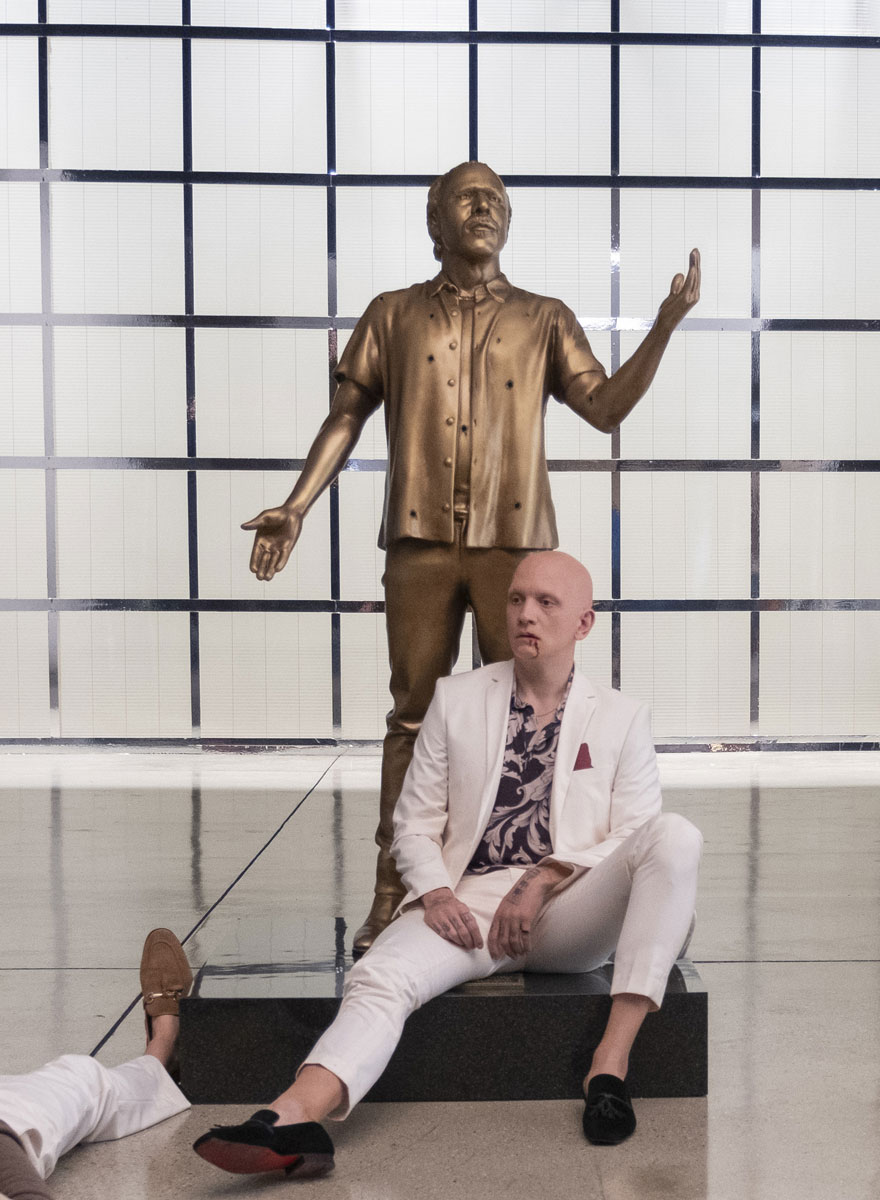
Barry’s former handler Fuches (Stephen Root) spends most of the show as a soft weasel whose jealousy makes him turn on Barry. He creates a mysterious figure called The Raven who reveals Barry’s hits in whispers to the friends and family of the murdered, making Barry a hunted man before they both land in prison. But when Barry escapes, leaving the schlubby Fuches to rot, he goes a different direction – he gets hard, assembles a “flock,” and emerges from the clink a sexy, confident death machine.

Out of everyone in Barry’s circle, Chechen mobster NoHo Hank (Anthony Carrigan) may be the most honest about who he is, ending up in an office as brightly lit as his smile, opposed by the sunburnt grittiness of Fuches’ hacienda where he housed his “family.”

Next to “The Raven” Hank is naturally hilarious and ridiculously flashy, making him the most adorable cold-hearted crime lord in all of television. A real character, some might say.

But they all are, as Hader underlines in the way he directed these cinematically rich eight episodes.

A seamless time jump midseason allowed Hader to create a surreal visual fugue composed of Barry’s desires and the director’s inspirations. His liberal incorporation of bleeds between past and future, exteriors and interiors, and between waking life and hallucination, or imagination, or dreaming, recalls Hitchcock, Scorsese, Wes Anderson, Terry Gilliam and modern horror greats. All of it coalesces the sad moral of the story: these people are small. It’s the pictures “Barry” painted that made them bigger.

In the penultimate episode Hank kidnaps Sally and John (Zachary Golinger), the son she shares with Barry, and offers them to Fuches as a goodwill gesture to halt the massive death wrought by their blood feud, including the off-camera beheading of the “four ultimate badass killers,” known as the FUBAKs, that traumatized the woman Fuches loved and her daughter.

BarryAnthony Carrigan in “Barry” (Photograph courtesy of HBO)

They were nice boys, and they’re all dead now. So is Hank – in part because of his inability to admit that he is the reason the love of his life Cristobal (Michael Irby) was killed, a truth Hank hides from himself by building a “legitimate” business around a golden idol of his lover’s likeness.

The truth of who Barry, Sally, Fuches, Cousineau and Hank are, and were, is wildly farfetched and far more anguish-inducing than the diluted made-for-TV drama makes them out to be.

But what is supposed to be a simple handoff degenerates into a shoot-out, leaving Fuches alive to deliver John to Barry, and Sally to frantically call for her son in Hank’s office lobby.

The truth of who Barry, Sally, Fuches, Cousineau and Hank are, and were, is wildly farfetched – much bloodier, funnier in their heartless brutality, and far more anguish-inducing at their low points than the diluted made-for-TV drama makes them out to be.

But the ominously titled “The Mask Collector” is the means by which a teenage John (Jaeden Martell) discovers who his father “really was.”

John knew Barry as Clark, a veteran and a hero, an everyday Superman. Clark was a good Christian, prayerful and protective of his family. Barry’s also born again, in another effort to shed his past and absolve himself of his sins. But when Hank kidnaps his family Barry reverts to his old ways, finding validation in liberal interpretations of scripture that assures him that in some instances, murder is OK. 

BarryJaeden Martell in “Barry” (Photograph courtesy of HBO)

The staid movie versions of Barry’s life, made by others and nestled within another time-jump from the day of his death to a future where Sally and John live in a snowy town, may have come off as flat for a series whose seasons tend to end with extreme violence.

In contrast, the death Sally experiences is slow and metaphorical; she’s rotting away in her mousy version of an ever-after that may not be entirely happy. She’s playing a devoted mom and high school drama teacher. She keeps everyone around her safe . . . from her. This is simply another role. Maybe she’s killing it.


Want a daily wrap-up of all the news and commentary Salon has to offer? Subscribe to our morning newsletter, Crash Course.


But if we understand Hader’s storytelling through his acting, and now his lens, it’s an apt final act. Hader, who directed every episode of the last season and several of the best installments before that (a peak being last year’s “710N”) keeps the setup simple, and allows angles of perspective to tell the tale. He was king of that technique this season – not just showing a character sinking into a sand trap “It Takes a Psycho” but submerging the camera with him to vicariously inflict his asphyxiation on us.

In “The Wizard” he constructs a nightmare of invasion when the flimsy walls of his and Sally’s manufactured home are assaulted by local thugs. But we don’t see them attack her. Instead, we experience Sally’s terror as the world is knocked askew by a truck lifting her bedroom off its foundation while she’s inside it.

Much calmer, and shocking in its own right, is Barry’s death at Gene’s hand in the broken acting teacher’s nicely appointed living room. Barry has just announced his intent to take responsibility for the crimes Winkler’s tragicomic thespian is being accused of, but it’s too late.

The first bang is a bullseye to the heart, surprising Barry more than anyone. That is all the poetry Barry Berkman is afforded in his final moments, along with the bonus of knowing, maybe, that he’s being shot down with a gun gifted to Gene by Rip Torn.

BarryLouisa Krause and Jim Cummings in “Barry” (Photograph courtesy of HBO)

All he can manage is blurting, “Oh wow,” before the second bullet hits him between the eyes.

Barry’s demise in “The Mask Collector” is far more dramatic, taking place onstage at a mythical version of Gene’s acting school. The movie makes him a Machiavellian puppeteer with a villainous mug and a British accent, and Barry and Sally small-screen handsome. The climactic rescue plays out like a cross between a low-budget action flick and a Lifetime movie.

Its sanitized lie draws a firm boundary around the reality of these terrible people viewers came to love, and the fantasy hero Barry never was but always wished he could be. A killer couldn’t ask for a better legacy to bequeath to a son who loves the idea of who he might have been if he were good.

All episodes of “Barry” are streaming on Max.

Scholars may have an authentic manuscript of a medieval comedy show — and it’s pretty funny

Troubadours, jesters, minstrels, bards: Whatever you choose to call them, these wandering entertainers captivated medieval Europeans for centuries. Medieval bards possessed imaginations so fertile, and wits so sharp, that Westerners still remember them long after their jokes and tall tales have faded from memory. Indeed, as Cambridge University and Girton College historian Dr. James Wade writes in his recent paper, published in The Review of English Studies, most of the words actually used by these troubadours have been forever lost; for instance, no one has found “a single medieval English manuscript with plausible connections to an actual medieval minstrel.”

These comedians had “the instinct to self-ironize, to use crude bodily humor, to use slapstick and situational comedy, and the willingness to make the audience the butt of the joke.”

Yet if Wade’s new paper is correct, there is a collection of newly discovered texts at the National Library of Scotland that may shed some light into this dark corner of the past. In addition to containing the earliest known example of the expression “red herring,” this late 15th-century booklet, known as the Heege Manuscript, appears to record the repertoire of an entertainer from that period. If so, denizens of the 21st century can rest assured of at least one thing — six centuries ago, comedians had very similar senses of humor.

“A surprising conclusion is that medieval minstrels were offering comic performances, rather than the kinds of material we usually associate with medieval minstrelsy, such as Robin Hood ballads, tales of chivalry, and accounts of great battles,” Wade told Salon by email. He later added that these comedians had, “the instinct to self-ironize, to use crude bodily humor, to use slapstick and situational comedy, and the willingness to make the audience the butt of the joke.”

Wade compared the comedy from the Heege Manuscript to the work of modern British comedians like Monty Python, and in particular troupe member Terry Jones, who “was a great scholar of the Middle Ages, and he knew medieval humor very well. My other thought was Bill Bailey, who has a decent sketch in Middle English, about drunkenness and revelry.”

When asked if there are any important differences in the comedy styles of medieval England compared to those which are common today, Wade could not think of any. Quite to the contrary, he was impressed by the skill and craftsmanship that went into the medieval jokes — however crude the content itself might have been.


Want more health and science stories in your inbox? Subscribe to Salon’s weekly newsletter The Vulgar Scientist.


“The picture that emerges is one of a performer’s willingness to poke fun of audiences across the spectrum of estates hierarchy within individual performance pieces.”

“Another interesting conclusion is that this minstrel is not only very funny, but also capable of performing good poetry and crafting clever and rhetorically sophisticated stories,” Wade observed.

In fact, that very absurdity is precisely why these verses were recorded, Wade speculates. Because the performers used absurdist humor, it might have been difficult to remember everything perfectly, so a written record could serve both as a script for the material’s creator and as guidelines for future minstrels to follow. Wade also notes that, based on some of the notes and wording, it appears the Heege Manuscript included material meant to be delivered at large feasts and other events — often with audiences from a wide range of social classes.

After all, like the best comedians today, minstrels targeted everyone from the clergy and aristocrats to the peasants. While many of the references would have been topical and therefore have lost their meaning to present audiences, much of the humor is still relatable. Take “The Hunting of the Hare”: The joke is that a group of peasants are trying to course a rabbit but get distracted by petty nonsense and fight each other instead (the wives ultimately have to show up to collect the dead and wounded).

“The violence here is pointless and the comedy is crude – jokes about incontinence, for instance,” Wade writes. The locale is also nondescript enough that the performers could set the tale anywhere, including if necessary (and safe) at the very community where they were performing it.

There is also a parody sermon that gave royals a similarly unflattering treatment, one that seems to be a forebear of Monty Python’s controversial “Mr. Creosote” sketch. In that fake sermon, the tale is told of three kings eating so much that their bellies burst open and 24 oxen come out, “playing at þe sword and bokelar, and þer wer laft no moo on lyve but .iij. red heyrynges.”

Those three “reyd heryngus” are the first ever literary reference to “red herrings.” The booklet even included a story called “The Battle of Brackonwet” that included Robin Hood as well as anthropomorphic pigs, bumblebees and bears. Like much modern comedy, the humor used by medieval bards seems to utilize silliness, grossness and even grotesque violence in clever ways. The minstrels clearly did not shy away from being offensive — or from being intelligent and subversive even as they cavorted around like children.

The text does not clear up all mysteries. For instance, it is notable that the performers who used the material in this manuscript could have been either professional travelers or local amateurs. While Wade can make informed speculations as to the author(s)’ identity, he cannot know for sure. It could be one — or both.

“A ‘professional’ minstrel might have a day job and go gigging at night, and so be, in a sense, semi-professional, just as a ‘traveling’ minstrel may well be also ‘local,’ working a beat of nearby villages and generally known in the area,” Wade writes. “On balance, the texts in this booklet suggest a minstrel of this variety: someone whose material includes several local place-names, but also whose material is made to travel, with the lack of determinacy designed to comically engage audiences regardless of specific locale. In functional and structural ways, then, these texts seem especially suited to the trade of minstrelsy.”

If nothing else, the study proves that minstrels did more than share dramatic epics like Robin Hood or those of chivalrous royalty and knights.

“Of course, this is not to question the prospect that medieval minstrels performed romances, or drama, or Robin Hood ballads, but rather that the witnesses preserved by Heege expand the parameters of a performance repertoire beyond what we have hitherto deemed conventional, to include prose as well as verse; to include the satiric, ironic, and nonsensical; the topical, the interactive, the meta-fictional and meta-comedic,” Wade writes. “The picture that emerges is one of a performer’s willingness to poke fun of audiences across the spectrum of estates hierarchy within individual performance pieces.”

Need to cut your coffee budget? Here’s the ultimate guide to making cafe quality drinks at home

If you’re an avid coffee drinker like me, you understand the importance of a morning cup of joe. Coffee, for us, is a necessity and a vital part of our daily routine — in the same vein as brushing your teeth or getting dressed.  

Whether it’s just one cup or multiple cups of coffee per day, fueling your caffeine addiction is certainly gratifying. But it can also get quite pricey pretty quickly. Just think about it: One tall sized latte at Starbucks is $3.45. So, if you were to purchase one drink every single day for a year, you’d be spending approximately $1,259.25 in total. Of course, that cost will increase if you order non-dairy milk or add extra sweeteners and syrups.

The easiest way to save money on coffee is to make it at home. Don’t fret though, making coffee on your own doesn’t have to be a daunting or arduous task! The secret is to choose an efficient coffee maker and good quality coffee supplies, whether that’s instant coffee, ground coffee or whole coffee beans. 


Want more great food writing and recipes? Subscribe to Salon Food’s newsletter, The Bite.


Here at Salon Food, we’re always on the lookout for the best ways to save money while still enjoying all our favorite foods and beverages. To help cut down your coffee budget, we consulted the trusty folks on Reddit along with online experts, who shared their tips for making cafe quality drinks at home. 

Let’s get into a few tips and tricks:

Choose your coffee maker wisely

Making coffee is an art and a skill. If you want good quality coffee at home, you have to invest in a good quality coffee maker. Luckily, good quality doesn’t equate to expensive — there’s plenty of makers that are affordable and get the job done.

Per the New York Times’ Wirecutter, the best cheap coffee maker that reliably brews hot, strong coffee is Ninja’s 12-Cup Programmable Coffee Maker CE251.

“The Ninja CE251 consistently brewed the best-tasting coffee among the machines we tested, whether we used pre-ground or freshly ground beans,” Wirecutter wrote. “It was the only model we tried that reliably brewed at a hot enough temperature to extract good flavor from the beans and make a pot that was pleasingly hot to drink.”

The Ninja coffee maker is also easy-to-use and customizable — there’s a scoop, a removable water reservoir and dials for brewing a richer or a smaller batch. On Amazon, the coffee maker is available for $80.

Wirecutter also recommended Cuisinart’s DCC-1200, if you’re looking to splurge a little. The coffee maker has an adjustable hot plate and a self-clean function. Similar to the Ninja maker, the Cuisinart maker is incredibly customizable. There’s user control of the hot plate’s holding temperature and a small-batch option.

Don’t shy away from instant coffee

Instant coffee tends to get a bad rap for tasting too acidic or bitter. But not all instant coffee brands are atrocious when it comes to taste. They’re also a great cheap option for making homemade coffee, especially if you don’t want to spend extra moolah on a coffee maker. To make instant coffee, all you need is your preferred coffee and water (hot or cold)!

Wirecutter suggested Mount Hagen’s Organic Fair Trade Instant Coffee, which is also my personal favorite brand of instant coffee. Unlike your Folgers or Nescafe, Mount Hagen’s Instant Coffee tastes quite similar to a cafe-style espresso. It’s smooth and velvety and has a more robust flavor the longer you let your coffee sit. Mount Hagen’s Organic Fair Trade Instant Coffee is priced at about $9 for 25 packets, or 36 cents per serving, although, personally, I think the brand’s 3.53-ounce jar of coffee is more bang for your buck.

Other great options include Waka’s Coffee Quality Instant Coffee, which is priced at $30 for 24 packets, or $1.25 per serving. There’s also Café Altura’s Instant Organic Coffee, which is available for about $22 for two 3.53-ounce jars, or about 18 cents per serving.     

Ice your coffee with coffee ice cubes

Summer is just around the corner, meaning it’s time to enjoy your favorite iced coffee beverages. The tricky part about making iced coffee, however, is figuring out how much ice to add to your drink without making it too watery.

Ren Doughty, the outreach and customer support coordinator at Batdorf & Bronson Roasters, told Salon that it’s best to brew your coffee a little stronger than you typically would if you were going to drink it out of the pot and let it come to room temperature before stashing it in the refrigerator in an airtight container.

If you’re looking to save money and time, Doughty recommends icing your coffee with coffee ice cubes. All you have to do is pour some of your room temperature coffee into an ice cube tray. Then, when it’s time to make your iced coffee, add these cubes to your cold coffee or blend them in with your preferred milk and sweeteners. The finished product is an at-home Frappucino that’s so good, you’ll never run to Starbucks again.

Invest in a Moka Pot (seriously, you won’t regret it!)

Looking to up your espresso game and enjoy bold flavored coffee on the daily? Then it’s time for you to invest in a Moka Pot — a stove-top coffee maker that brews coffee by using pressure to force hot water through a filter basket filled with finely ground coffee.

The best Moka Pot out there is arguably Bialetti’s Moka Espresso Maker, which is available on Amazon for around $30. There’s also Primula’s Classic Moka Espresso Maker, which is available on Amazon for $17, and OonlyoO’s Aluminum Italian Espresso Machine, which is available on Amazon for $22.

While the Moka Pot may be easy to use, there’s still a few tricks to follow that will transform a mediocre cup of coffee into a delicious one. Per Reddit user u/chas2354, “There’s a lot of sediment in a moka pot and pouring [slowly] helps keep most of it out of your brew. Also, it may be tempting to pour every last drop into your cup but I like to leave a little bit behind since that last bit is full of sediment.”

Other users recommended adding an aeropress filter in between the top of the coffee grounds and the gasket. The filter helps eliminate fine coffee grounds in your cup of coffee. It also intensifies the flavor of your espresso and cuts down on some of its bitterness.  

It’s worth noting that the Moka Pot is incredibly portable, meaning you can take it with you while traveling. You can also use it while camping!

Abe Lincoln, pig torturer? While he admitted to incredible cruelty, the answer isn’t that simple

Abraham Lincoln referred to it as "the ludicrous incident of sewing up the hogs eyes."

"As a youngster he shot a wild turkey and was so disgusted he claimed he never again raised a weapon to kill an animal."

The story comes from a short autobiography that the future president co-authored for his 1860 election campaign. Lincoln had spent his young manhood working on river boats and — it seems reasonable to assume — was trying to share a "folksy" anecdote to highlight his working-class background and beliefs. Certainly he did not intend to come across as cruel, especially toward helpless animals. Yet by his own account, when he and his business associates struggled to drive "thirty odd large fat live hogs" into their boat, one of them "conceived the whim that he could sew up their eyes and drive them where he pleased. No sooner thought of than decided, he put his hands, including A. [Lincoln himself] at the job, which they completed."

The plan did not succeed in accomplishing their primary objective. Whatever issues the men had encountered herding the pigs while they were healthy, those problems had now been compounded by their blindness. "In their blind condition they could not be driven out of the lot or field they were in," Lincoln recalled. "This expedient failing, they were tied and hauled on carts to the boat."

Lincoln biographer Harold Holzer, who won the 2015 Gilder-Lehrman Lincoln Prize, wrote to Salon that modern readers should hesitate before judging the Great Emancipator too harshly. While he acknowledged that Lincoln's story "of course sounds grotesque," the man himself was a product of early 19th-century American prairie life. People from that background were raised to have a very callous attitude toward animals, particularly livestock. "Animals might be pets (Lincoln preferred cats to dogs), but more often were either living 'investments' or dangerous prey," Holzer explained. "Farm animals were raised to produce dairy products (milk and eggs) and/or to be slaughtered for food. I don't think Lincoln or his contemporaries attached any romance or sympathy to the beasts they owned or hunted."

Analyzing his actions from this vantage point, one sees that Lincoln and the others on his flatboat crew "suddenly found their load of frightened live pigs on the run through a stream and into the nearby community" and decided that "the only way to retrieve the valuable payload and drag the poor animals back to their raft was to disable their ability to watch their own recapture." It seems unlikely that this plan came out of nowhere; more likely, "one or all of them knew that this was the accepted way of dealing with such situations. The idea makes our skin crawl today, but we can't — at least we shouldn't — expect young Lincoln, barely old enough to vote, to rise to the standards of a Gen Y PETA sympathizer. That would be historically unrealistic for a youngster raised to farm labor."

Ingrid Newkirk is President of PETA (People for the Ethical Treatment of Animals), and Salon contacted her about the Lincoln anecdote. She noted that there were animal rights advocates from Lincoln's time such as William Wilberforce, who had helped found the Royal Society for the Prevention of Cruelty to Animals (RSPCA) in 1824. As such, the notion of being kind to pigs was not entirely foreign to the young Lincoln.

At the same time, "Many people had a lot to learn about empathy, including the employer who apparently ordered a young Abraham Lincoln to sew frightened pigs' eyes shut in a painful process that — completely unlike a human getting a tattoo or a piercing — they couldn't possibly understand or consent to." That is how Lincoln could be cruel to those pigs even though, as Newkirk also noted, his "overall legacy is one of compassion, including to animals." Newkirk cited Lincoln's decision not to accept a gift of elephants from Thailand's King Mongkut because they would struggle to adapt to America's climate. (She also mentioned a popular apocryphal story, dating back to the early 20th century, of Lincoln trying to rescue a pet pig from being slaughtered when he was six; Holzer says this story — along with an equally prevalent one of Lincoln as a lawyer dirtying his suit before appearing in court to rescue a stuck pig — should be taken "with a grain of salt.")


Want more health and science stories in your inbox? Subscribe to Salon's weekly newsletter The Vulgar Scientist.


"Even very principled and decent people like Lincoln thought it was fine to be cruel to animals, and even entertaining."

Describing Lincoln's overall philosophy of compassion, Newkirk observed "that's what PETA encourages everyone to emulate." Like Newkirk, Holzer agreed that Lincoln had compassion for animals, although he added that Lincoln was complex and his actions toward animals could seem contradictory.

"Lincoln did not like blood sports or even hunting for food," Holzer explained. "As a youngster he shot a wild turkey and was so disgusted he claimed he never again raised a weapon to kill an animal. Yet others said that as a boy he engaged in such horrific 'sport' as placing hot rocks on turtles' shells to see how they relieved themselves of the destructive burdens."

Lincoln was surrounded by animals, and as such interacted with them in a wide spectrum of ways: Sometimes he used them for food, clothing, transportation or entertainment; on other occasions, he would do things like desperately attempt to rescue a horse trapped in the White House's burning stables, although this may have been partially motivated by the horse being regularly used by his late son.

In light of these wildly conflicting attitudes toward animal rights, it is unclear what precisely Lincoln meant with his anecdote about sewing shut pigs' eyes — if, in fact, the tale was meant to be taken seriously at all.

David J. Kent, the president of Lincoln Group of DC and author of "Lincoln: The Fire of Genius: How Lincoln's Commitment to Science and Technology Helped Modernize America," wrote to Salon, "There is some question as to whether Lincoln was just trying to be funny writing about his flatboat trip from 30 years before, but assuming he was accurately relating the incident it does sound shocking to 21st century ears." Like Holzer, Kent added that in the 1830s the incident would not have seemed jarring at all because of common attitudes toward animals at the time. Additionally, like both Newkirk and Holzer, Kent pointed to stories of Lincoln's kindness toward animals.

"Lincoln certainly cared more about animal welfare than most people of his time," Kent argued. "In Springfield he had a dog named Fido. In the White House he had horses, donkeys, and two goats that were pets for his youngest sons. He was the first to pardon the Thanksgiving turkey because his son Tad didn't want any more killing during the Civil War. Lincoln was also enamored of cats. One story has him feeding the pet cats at the White House dining room table with the gold cutlery. When [First Lady Mary Todd Lincoln] complained, he replied that 'if the gold fork was good enough for [previous president James] Buchanan, I think it is good enough for Tabby.'"

"Many people still eat pork chops and hot dogs without a thought for the terrified pigs whose teeth and tails are cut off without painkillers and whose throats are slit in slaughterhouses."

Perhaps it is this intrinsic tension in Lincoln's personality — the undeniable reality of his compassion for animals contrasted with his own admission of extreme cruelty — that makes his story so fascinating. It illuminates not just Lincoln's Janus-faced character, but the much broader story of humankind's complex relationship with the animal world.

"Even very principled and decent people like Lincoln thought it was fine to be cruel to animals, and even entertaining," explained Katy Barnett, a professor at Melbourne Law School and author of the animal law book "Guilty Pigs: The Weird and Wonderful History of Animal Law," in an email to Salon. "This was the prevalent view everywhere, in pretty much all cultures and places until the 19th century." Animals only had one protection in most areas of American society during this time — against being victims of sexual assault. Yet even on those occasions, animals would usually get victimized again.

"The main prohibition in U.S. society at this time was not against cruelty, but against bestiality (see Leviticus 18:23-24) and usually the animal was punished as much as the person for engaging in it," Barnett wrote. "In our book, we recount a 1641 case from Connecticut where George Spencer and the sow with whom he had been alleged to have committed bestiality were put to death, as stipulated by Leviticus 20:15." Animal rights as humans imagine them today — namely, the idea that it should be illegal to be cruel to animals without cause — had only just been conceived as a viable political idea.

"The laws against animal cruelty started in the United Kingdom, when two statutes were passed in 1822 and 1849 respectively: An Act to Prevent the Cruel and Improper Treatment of Cattle (1822) and An Act for the More Effectual Prevention of Cruelty to Animals (1849)," Barnett told Salon. "The Royal Society for Prevention of Cruelty to Animals was formed in England in 1824. Cock-fighting was only ruled as cruel to animals in the UK in Budge v Parsons, in 1863. The seminal case on animal cruelty (a case about de-horning cattle under the 1822 statute mentioned above) Ford v Wiley, did not occur until 1888."

If there is any teachable moment to be gleaned from Lincoln's pig torturing story, it is that humans' attitudes toward animals have improved very, very slowly. Consequently humans who are living at any given point in time may be guilty of actions toward animals that future people will regard as horrifying — or even downright evil. Whenever such a shift in consciousness occurs, it is because we allow our sense of compassion to see in ways in which once it did not. Just as Lincoln painfully forced close the eyes of his pigs, humans have for millennia been figuratively sewing our own eyes shut when it comes to the suffering we inflict on the animals around us.

"The anecdote should reflect only the culture of the time — the total disregard for animal rights, especially animals who were raised to be slaughtered and consumed; not Lincoln's insensitivity," Holzer wrote to Salon. "Besides, I'm not sure pigs or cows or horses led to slaughter by the tens of thousands today fare much better than the herd Lincoln and his pals mistreated (by our standards) in the 1830s."

Newkirk, not surprisingly, agreed.

"That need for empathy still exists today — many people still eat pork chops and hot dogs without a thought for the terrified pigs whose teeth and tails are cut off without painkillers and whose throats are slit in slaughterhouses," Newkirk told Salon.

Saturate the season’s best strawberries with black pepper, sugar and balsamic

For about three quarters of the year, I make do with merely passably flavorful frozen berries that I deploy to chuck into smoothies and brighten up my oatmeal. Then June rolls around, and those first beautiful, dark fresh strawberries hit the farmer’s market, and I remember how strawberries are actually supposed to taste. It’s a heady time in my home, one marked by the constant presence of teal containers brimming with bright red fruit.

Typically, I’d be thinking a lot right now about pies and crumbles and shortcakes. But my older daughter was recently diagnosed with a gluten intolerance, so I’m trying to be supportive in any non-cake and crust ways I can. And when a warm wave of recent days made it all the easier to resist baking, I found myself looking at the strawberries on the kitchen counter and thinking of a classic that grabbed me from the first time I read Nigella Lawson’s “How to Eat.

The pairing of strawberries and balsamic vinegar — as zingy partners for each other either in a crisp salad or sophisticated dessert — isn’t new. But the way Nigella wrote about it, noting that “The balsamic vinegar seems to make the red of the strawberries against it shine with the clarity of stained-glass windows,” made a simple formula seem like a downright spiritual experience. She was, as usual, correct.

For years, I’ve unquestioningly leaned on “How to Eat’s” easy formula of steeping sliced berries in vinegar and sugar, and then adding a warming flourish of cracked black pepper that I picked up from a clever dinner party host years ago. 

But revisiting Lawson’s words this week, I was struck by her note on the vinegar — urging the reader to use “the best you can afford.” Frankly, “the best I can afford” lately, especially after plunking down a queen’s ransom for in season strawberries, is not very much at all. And while I know that what passes for balsamic vinegar in most supermarket aisles is not real, aged Italian vinegar but a cheap facsimile, I’m not in a place in my life where I can splurge a hundred or so dollars on the good stuff from Modena.


Hungry for more great food writing and recipes? Subscribe to Salon Food’s newsletter, The Bite.


Instead, however, I can take a few minutes to make a slick, syrupy cheat’s vinegar that takes my strawberries, and everything else, to the next level. America’s Test Kitchen has a brilliant recipe for “instant aged balsamic vinegar” that involves simmering the vinegar with sugar and port until it resembles something you’d see dribbled on your cheese course at a very expensive restaurant. I don’t keep port on hand, so I skipped it altogether here and the results were still strikingly, palate deceivingly good. I also scaled far back on the sugar for the macerated berries, letting the vinegar play a more starring role.

What I wound up with was a beautifully complex dessert that was at once sweet and tart and spicy. It also happened to be gluten-free and vegan. Best of all, though, it made me feel that for the rest of this fleeting, magical strawberry season, the best I can afford is the best, period.

* * *

Inspired by America’s Test Kitchen and “How to Eat” by Nigella Lawson

Balsamic syrup and black pepper strawberries
Yields
 2-4 servings
Prep Time
 5 minutes 
Cook Time
 10 minutes

Ingredients

  • 2/3 cup balsamic vinegar
  • 4 tablespoons sugar
  • Optional: 2 tablespoons of port or red wine
  • 1 pint of large, washed strawberries 
  • Fresh black pepper

Directions

  1. Combine the balsamic vinegar and 2 tablespoons of sugar in a small saucepan over low heat. Add the port or red wine if using. Simmer until it’s thickened and reduced by half. It will take just a few minutes, so keep an eye on it. Remove from heat and let cool.

  2. Remove the tops of the strawberries and slice them in half. If you’re feeling ambitious you can hull them. Put them in a nonreactive dish or bowl.

  3. When the vinegar has cooled, pour it over the strawberries. Sprinkle the remaining two tablespoons of sugar over them. Stir gently to coat the berries.

  4. Cover with plastic wrap and refrigerate 3 or more hours.

  5. To serve, portion out the strawberries and top with a generous grind of fresh black pepper. If you want to round out the experience, you could accompany your strawberries with some whipped ricotta or vanilla ice cream.


Cook’s Notes

This recipe makes a very tart marinade for the strawberries. If you’d like a sweeter ride, add another tablespoon of sugar.

Salon Food writes about stuff we think you’ll like. While our editorial team independently selected these products, Salon has affiliate partnerships, so making a purchase through our links may earn us a commission.

Donald Trump and his evangelical followers are back for more: I know how to beat them

As I predicted in a previous article for Salon, Donald Trump and his evangelical following are back with a vengeance. Unfortunately, with recent polling showing declining confidence in Joe Biden and surprisingly strong numbers for Robert F. Kennedy Jr. — Biden’s only significant Democratic opponent — the political algorithm points, for the moment, toward a possible Trump victory. For this reason alone, it is clear enough that those Republicans who stand against Trump now, and the evangelical leaders who have been silent about Trump to this point, will ultimately rally to his side. Victory and political power are more important to them than preserving American democracy and following the genuine doctrines of Christianity.  

So what can be done?

As your semi-official evangelical insider — and current pastor to anyone outside the church who is tired of organized religion and willing to accept an authentic, flawed and failed sinner as minister — I have a few thoughts on what to do about these God-believing voters.  

The first thing is to expose the so-called shepherds as the anti-Christians and anti-American hypocrites that they are. The issues they choose are supposed to leave them looking spotless of sin as they convince their sheep to hate all the wrong people.  

It is not supposed to be the church’s job to force particular lifestyle choices individuals. First of all, the theology that has arisen claiming that Jesus would be opposed to the LGBTQ community is incredibly flawed. Even if it weren’t, the church has no right to declare how a family should be formed. It is a waste of time and resources, not to mention against the most basic principles of both Christian faith itself and American individual freedom.  

There is nothing in the Bible that directly touches the issue of abortion, and it was not part of evangelical doctrine or evangelical politics until relatively recently, yet billions of dollars have been spent to promote this as a core item of the evangelical agenda. Selective passages from scripture have been used in an effort to control women in American homes, in the American workplace and in American society overall.

Evangelical leaders have even constructed theological excuses for tax breaks to corporations and billionaires. That seems politically unnecessary and profoundly un-Christian, considering what the Bible actually says about wealthy people.

Stranger still, these false leaders have even constructed theological excuses for providing tax breaks to big corporations, billionaires and millionaires. This seems unnecessary, not to mention profoundly un-Christian. The Bible is abundantly clear that the wealthy are not God’s favorite people, yet evangelical leaders are going out of their way to help them. I recognize that extracting tithing from a millionaire is more materially fruitful than getting it from a poor person. Did that mean that evangelicals really needed to sell their soul to get in bed with the wealthiest in this country?

In the bigger picture, these core evangelical issues ignores the needs of most of the American public, working people and seemingly everyone in need of help. They are attacks on virtually all people outside the church and are especially harsh on the poor, the sick, the foreigner and the disenfranchised — effectively on everyone Jesus Christ commanded his followers to serve.  

The second thing that can be done is that Democratic leaders, liberal activists and media talking heads should focus on what most people need in life. We want to be seen and heard, and considered good. In the brilliant Netflix show “Beef,” this idea is strongly conveyed. Hardworking and self-sacrificing people all too often live and die by a code of service, love, forgiveness and self-improvement, all while feeling internally angry, depressed and resentful about the things we have never achieved and about our sense that the good karma we have put out into the world has never been returned.    


Want a daily wrap-up of all the news and commentary Salon has to offer? Subscribe to our morning newsletter, Crash Course.


Politicians are so caught up in talking points, raising money and winning elections that most have forgotten the reason they exist: to be of service. I believe that my own story is a fair representation of far too many other stories in this country, and can be seen as an example of sorts that our leadership needs to address.

I can barely remember a time in my life when I did not have two jobs. I am 46 years old and have poured my heart and soul into every job I worked, even when I was delivering newspapers a couple of years back. Like many people of my generation, I believed that if I pursued an education, worked hard and believed in myself, I could share in the American dream. That dream has not been realized, and I know that is true for millions of others, many of whom have worked harder jobs and faced more difficult challenges than I have. 

As members of Generation X, we were the first in this country’s history to take a significant step backward in economic terms. We own less wealth, owe more debt and work more hours than our parents’ generation did, generally speaking. In all probability, our overall life expectancy will be lower. Our families are more fractured, our kids are more depressed and our hearts — in many cases, and I am sorry to say this — feel empty of hope. (People don’t call me the minister of depression for nothing!)

If millions of working-class and middle-class people continue to be devastated by personal failures — whether we believe that is their “own fault” or not — then this country cannot thrive economically, spiritually, politically or in any other way. This perspective is too often ignored by Democratic leaders and members of the media elite. 

All the Republicans can come up with in educational policy is “school choice,” an illusory freedom falsely branded as liberation that changes nothing about the system.

Most of the working class feels trapped in a sort of economic and social algorithm. I have worked in education for 20-plus years, working primarily with first-generation and low-income students, and our deeply troubled educational system is a perfect example of the failure of political leadership. All the Republicans can come up with in terms of educational policy is “school choice,” an essentially consumerist concept that changes nothing about the system itself. It is an illusory freedom falsely branded as liberation, which in fact could summarize nearly all Republican policy ideas. Too many Democrats, on the other hand, simply refuse to admit there is anything wrong with the public school system that budgets cannot solve.

In fact, in every measurable way, our educational system has failed over the last 50 years. It has failed at teaching basic skills of reading, writing and arithmetic, and it has spectacularly failed at reducing inequality. This failure includes a dramatic class discrepancy, visible to all. If you attend a “good” school in a wealthy neighborhood, you are overwhelmingly likely to go on to a “good” college and have a rich future. If you go to a “bad” school in a poor district — whether that’s in a big city or the rural heartland — your future is likely to involve working at the local grocery store or a call center, if you’re lucky.

It’s time to start listening to the working class, and I don’t just mean the semi-mythical “white working class” who voted for Trump. It is time to listen to those who lose more than they win. It is time to listen to the people who build your homes, fix your cars, cut your lawns, remove your trash, clean your floors and deliver your packages.  

In my ministry, I have the mission of pushing two messages forward, guided by my Christian faith. The first of these is to expose religious hypocrisy, which I try to do in writing articles like this one. The second is to lift up the voices of the poor, the working class and the blue-collar people of this beautiful country. The secret to a successful and bright future for America is found in remembering and understanding that people need to be seen and heard — and most important of all, to be valued. If the Democratic Party can figure this out, then Donald Trump will finally be history, and our country can finally turn the page on this dark chapter.

It’s more than just a parasocial relationship: BTS and their impact on my mental health

2018 was one of the worst years of my life.

I was in my second semester of college, which was supposed to be part of the “best years of your life,” but for me was anything but. I was severely depressed and could barely get myself out of bed to eat — let alone show up to my classes and do my homework. I felt isolated and lost. 

And then I found a love for K-Pop boy group BTS.

BTS, who you’ve likely heard of by now, consists of seven members — RM, Jin, SUGA, J-Hope, Jimin, V and Jungkook. When I got invested in BTS, they had just started blowing up in the west the year before. 

When I watched a video of one of their live performances of “Answer: Love Myself” for the first time, I started sobbing.

And despite what people often think, they weren’t important to me because of how handsome they are or because Jungkook is boyfriend material. It wasn’t because of the fashion and the dyed hair, or even because of the elaborate choreography and jaw-dropping performances. 

While those are pretty valid reasons to love K-pop, and definitely helped grab my attention, the reason BTS became so special to me is less surface-level. 

I had heard of them before. In high school, my best friend loved K-pop, especially BTS, and I had listened to and liked some of their songs. But as a Korean adoptee growing up in Vermont, one of the whitest states in America, I wasn’t eager to make myself come across as any more Asian than I already was.

When we both went away to college, we kept texting. Sharing details of our day, talking about how hard things were.

Even though my mental health was declining, I was also beginning to come to terms with what being Korean American meant to me. It had always made me uncomfortable, made me feel “other,” but I wanted to know more now.

And when BTS came up again in conversation, I decided to finally really look into them. 

Discovering the Bangtan Boys

I started with reading translations of the lyrics as I listened. Then I watched all their music videos. Soon, I was making my way through every live performance and every interview I could find and even going down the rabbit hole of watching fan-made compilation videos on YouTube. 

When I watched a video of one of their live performances of “Answer: Love Myself” for the first time, I started sobbing. I didn’t even need to understand all of the lyrics — just hearing the crowd sing, “You’ve shown me I have reasons I should love myself,” along with the seven of them on stage struck me. 

I was struggling to like myself enough to take care of myself in the simplest ways, but soon enough I was singing along:

I’m looking for myself again
But I don’t wanna die anymore
Me, who used to be sad
Me, who used to be hurt
It’ll make me more beautiful

BTS was not only my connection to the culture I had resisted and ignored my entire life, but also became a light for me when everything else felt bleak. 

At first, I might not have believed it when I was singing along to Jin’s solo song “Epiphany” and declaring:

I’m the one I should love in this world
Shining me, precious soul of mine
I finally realized, so I love me
Not so perfect but so beautiful

But I began to. 

It sounds corny, but they helped me through that extremely difficult period of my life in a way that nothing else really could. Listening to BTS didn’t cure my depression, but the openness in their lyrics provided me with a sense of comfort and reassurance that I desperately needed. 

The song that made the biggest impact on me, and still does, is from RM’s 2018 solo mixtape “mono.” In “지나가 (everythingoes),” RM repeats over and over “It all passes, someday, for sure, certainly / It passes (Everything goes).” 

But instead of being a message of toxic positivity, he goes on to say that rather than using “unclear words saying to have strength” and “instead of the lies that it’s all just the way things are,” he prays that “like the winds it will pass.” 

BTSV, Suga, Jin, Jungkook, RM, Jimin, and J-Hope of BTS performs during the iHeartRadio KIIS FM’s Jingle Ball show at the Forum on December 06, 2019 in Inglewood, California. (Toni Anne Barson/WireImage)I was still feeling miserable. But I sat in my bed, AirPods in, volume maxed out and let RM’s lyrics reassure me that someday, for sure, certainly, I’d be alright.
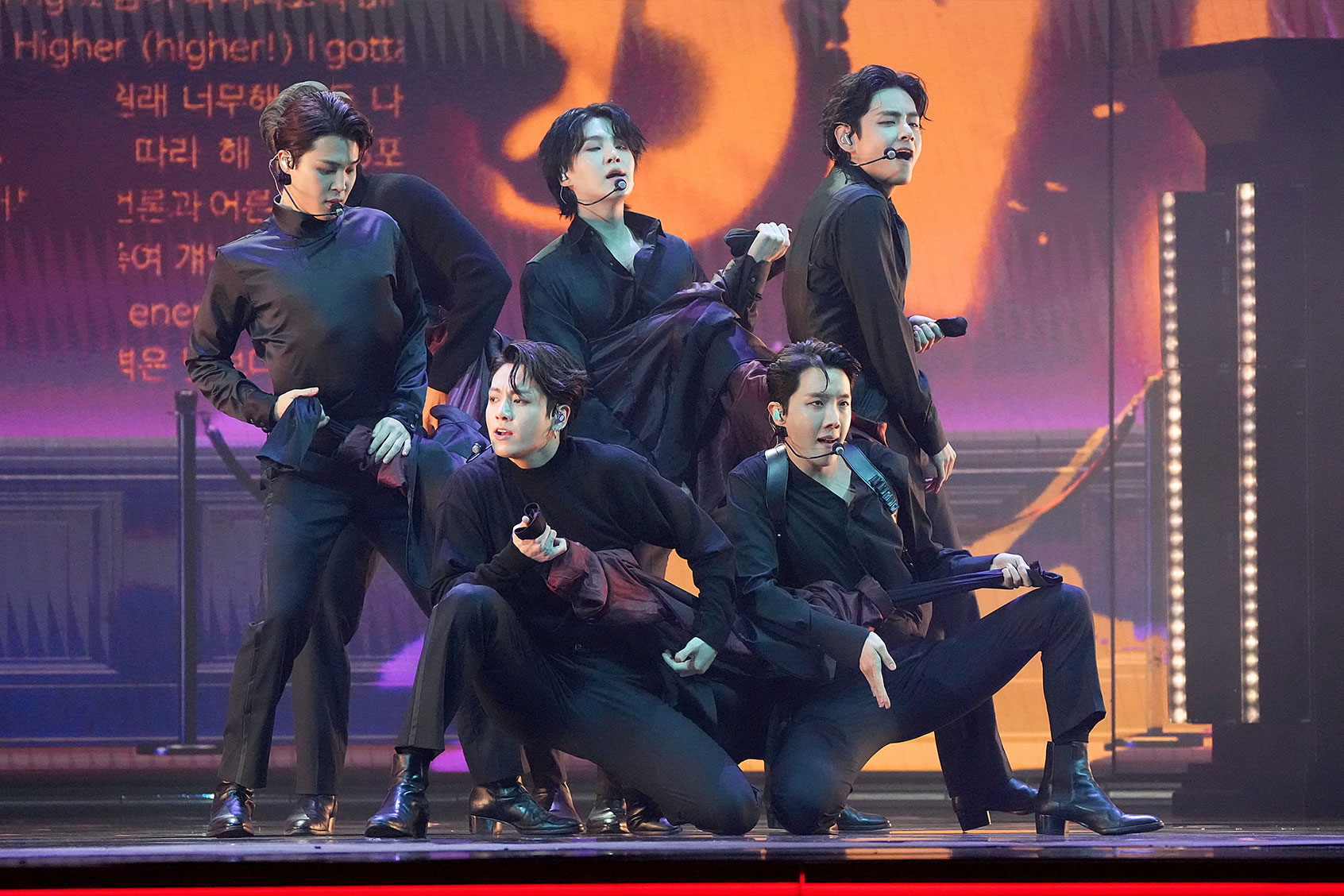
It may be hard to understand why BTS fans are so ride-or-die for them, but moments like that are part of the reason why. It’s not just me who’s been affected by them this deeply — seeing their impact is as easy as searching “BTS Answer: Love Myself reaction” on YouTube or googling “how BTS changed my life.” 

Embracing the community

I first saw the widespread impact they’ve had when I rejoined Twitter and rebranded as a stan account. 

BTS was not only my connection to the culture I had resisted and ignored my entire life, but also became a light for me when everything else felt bleak.

At the time, the BTS members didn’t have their own individual Instagram accounts, and Twitter was the place for updates, selfies and personal posts from each of them. Their Twitter account currently has 48.4 million followers and a quick scroll through will show you stan account after stan account dedicated specifically to them, with edited photos of one of the members as the icon and a handle that references their lyrics. 

It may appear that those accounts are faceless and impersonal, but when I was feeling isolated at a new school, I found a community there. There are countless examples of how toxic stan Twitter can be, but it doesn’t always have to be. I joined group chats to talk about favorite albums, rehash the latest performance and dissect lyrics, and I ended up making friends across the world. 

It’s easy to look at all of this and only see how it contributes to what we’ve come to know as the parasocial relationship between celebrities and their fans. Especially within the K-pop community, when fans do things like spend thousands of dollars on albums for a short video call, stay up all hours of the night to catch a livestream and even buy expensive and elaborate gifts for their bias on their birthday. 

While this certainly exists within BTS’ fanbase, what sets the band apart is that they’ve consistently shared their personal struggles and journey to self-love throughout their career, in their music but also in interviews, livestreams and letters to fans. 

In 2016, SUGA released a solo mixtape under his alter ego Agust D in which he details his struggles with depression and OCD and how he’s gotten treatment for it. 

In 2017, RM put out his song “Always” on SoundCloud that contains the lyrics:

One morning, when I opened my eyes
I wished that I was dead
I wish someone killed me
In this loud silence
I live to understand the world
but the world has never understood me, why

In a 2019 interview with Entertainment Weekly, SUGA emphasized the importance of open dialogue about mental health. “I think for not just us but other celebrities, if they talk about it openly — if they talk about depression for example like it’s the common cold, then it becomes more and more accepted if it’s a common disorder like the cold,” he said. “More and more, I think artists or celebrities who have a voice should talk about these problems and bring it up to the surface.”

BTSJimin, Jungkook, Suga, J-Hope, and V of BTS perform onstage during the 64th Annual GRAMMY Awards at MGM Grand Garden Arena on April 03, 2022 in Las Vegas, Nevada. (Kevin Mazur/Getty Images for The Recording Academy)In 2020, on his birthday, Jin surprised fans with his single “Abyss,” along with a letter in which he admitted to struggling with imposter syndrome and feeling burnt out, and shared that he received counseling to help him work through it. RM shared in a live that the idea for “지나가 (everythingoes)” came after he had spoken with a counselor, too. 

The members’ willingness to speak about their own mental health struggles and counseling is not only important because it normalizes it for their fans, but because it sheds a light on mental health in Korea and within the K-pop community. 

According to The Korea Times, South Korea has held the highest suicide rate of OECD nations for almost 20 years, with a suicide rate of 24.1 deaths per 100,000 people as of 2021. 

Just this April, 25-year-old ASTRO boyband member Moon Bin passed away by suicide. This comes after other losses that have hit the K-pop community, like SHINee’s Jonghyun who was only 27 when he passed in 2017. In 2019, 25-year-old former f(x) member and actress Sulli also passed away from suicide, with 28-year-old Goo Hara from Kara following just weeks after.

With far too many examples of young people in the K-pop industry, and Korea in general, taking their own lives, it just makes publicly speaking to these issues even more important. Especially when it’s being communicated to a fanbase like BTS’ that consists of so many young people.

As much as I love K-pop, I can see how damaging the industry can be. It’s rightfully criticized for setting impossibly high beauty standards, highlighting issues with fatphobia and colorism, and for the immense pressure put on idols to be “perfect” both while they’re performing and when they’re offstage. 

With these kinds of standards, BTS being willing to acknowledge that they’re human — that they struggle, question themselves and sometimes need help to get through it — is essential. At the height of fame, with the eyes of the world on them, they choose to be vulnerable and show others that they can do the same. 

The flaws in the industry still exist, but there’s no doubt that BTS will leave a lasting impact.

If you are in need of help, call or text 988 to reach the Suicide and Crisis Lifeline. Hours of operation are 24/7 and it’s confidential.

Is the COVID-19 vaccine ready to move on from the original strain?

This fall season could usher in another round of COVID-19 vaccines. But unlike before, it might be the first time people are injected with a dose that doesn’t target the original strain of the novel coronavirus that led to worldwide shutdowns in 2020 in the first place.

True to its name, the current bivalent vaccine protects against both the original strain of the virus and omicron variants from BA.4 and BA.5 lineages. While people who were vaccinated early on in the pandemic received the monovalent Moderna and Pfizer-BioNTech COVID-19 vaccines, those are no longer authorized for use because data showed that the bivalent Moderna and Pfizer-BioNTech COVID-19 vaccines provided better protection against severe illness and hospitalization as the virus mutated.

While the U.S. Food and Drug Administration (FDA) is still working on a plan for what the next generation of COVID-19 vaccines will look like, and when they will be available, a World Health Organization’s (WHO) advisory group recently released recommendations suggested that the vaccine should next only target descendants of the predominant XBB.1 strain. In other words, targeting the original strain is no longer a priority.

The recommendation is sparking debate on whether or not bivalent shots were effective in the first place — and if the world is ready to move on from boosting immunity against the original strain.

“The bivalent booster did not seem to be very effective for preventing severe disease among those who are 18-64 years old in this large Finnish study, although there was protection for those who are older than 65 against hospitalization for approximately 3 months,” Dr. Monica Gandhi, an infectious disease doctor and professor of medicine at the University of California–San Francisco, told Salon via email. “I agree with the WHO that new booster shots should target XBB subvariants as these will be the most prevalent subvariants in the next booster campaign.”

“The bivalent booster did not seem to be very effective for preventing severe disease among those who are 18-64 years old.”

The changing landscape of the COVID-19 vaccines has been in motion for some time now. Earlier this year, an FDA advisory panel agreed that moving forward, COVID-19 vaccines should be given on a yearly basis and target whatever variant is seen as the biggest threat, similar to how the influenza vaccine works. Soon, on June 15, FDA advisers will discuss which strains should be part of the vaccine so companies can move forward with production.

To date, the COVID-19 vaccines have only undergone one modification when the bivalent version was introduced in September 2022. According to the CDC, only 17 percent of the U.S. received the booster. There has been some chatter that while well-intended, keeping the original strain in the bivalent booster did more harm than good. Indeed, one study found no significant difference between the two vaccines and neutralizing COVID-19.

L.J. Tan, chief policy and partnerships officer at Immunize.org, told Salon he thinks it’s difficult to make a definitive statement that the bivalent boosters weren’t as effective as the monovalent ones.

“It’s very hard to tease that apart because the bivalent was launched when immunity was already pretty high,” Tan said. “It’s cherry picking data, you can say, ‘Oh, we did the bivalent and it doesn’t prevent as many infections as it used to,’ but it’s hard to tease out what the impact of obviously pre-existing immunity has to do with someone that, and I think it’s tricky to say that monovalent versus bivalent, that one’s better than the other.”


Want more health and science stories in your inbox? Subscribe to Salon’s weekly newsletter The Vulgar Scientist.


As pediatrician Paul Offit explained in an op-ed in the New England Journal of Medicine, what could be cast aside as a failure could have actually been a result of “imprinting.”

“The immune systems of people immunized with the bivalent vaccine, all of whom had previously been vaccinated, were primed to respond to the ancestral strain of SARS-CoV-2,” Offit wrote. “They therefore probably responded to epitopes shared by BA.4 and BA.5 and the ancestral strain, rather than to new epitopes on BA.4 and BA.5.”

Currently, the latest omicron variant XBB is fueling a resurgence in COVID-19 cases in China. Is this more evidence that the FDA should move forward with approving XBB-only vaccines?

“I also think turning towards whole virus vaccines (like Covaxin in India) can circumvent some of the immune evasiveness we are seeing in our current boosters that only contain the spike protein, since the spike protein changes so frequently in the new variants or subvariants,” Gandhi said.

“”I think omicron represents the endpoint of the evolution of the virus for its fitness.”

Tan said he agrees that a monovalent is best, in part because it’s easier to produce and will be more accessible in countries of lower socioeconomic status. However, he did say there is a little bit of data to suggest that vaccinating against both the original strain and omicron “creates a little bit more cross reactivity against potentially new strains that arise.”

“I can see both sides and hence you see me jumping back and forth a little bit, but the truth of the matter is, I think the viral inflammation is slowing down and I think we’re going to be seeing mostly omicron subvariants,” he said. “If we’re going to think about the fact that it’s global environment and what happens in China is going to come out, and it’s already out and it’s happening elsewhere, it makes sense that our boosters should be focused on XBB variants.”

Indeed, while there have previously been fears that the virus could keep mutating into something worse — that could possibly evade the immunity built up around the world — Tan said he doesn’t expect that to happen.

“I think omicron represents the endpoint of the evolution of the virus for its fitness,” he said, referring to the virus’s ability to transmit and evolve. “I think if it mutates further it’s going to lose its fitness.”

Lauren Boebert says she skipped debt ceiling vote intentionally because she was “ticked off”

Failing to cast her vote in the debt ceiling deal that was finalized this week and signed off on by President Biden, Rep. Lauren Boebert, R-Colo. posted a video to Twitter on Saturday explaining her absence.  

Vocal in her apprehension towards the deal that pushes off the U.S. government’s $31.4 trillion debt, calling the bill “a bunch of fake news and fake talking points that will do nothing to reign in out of control federal spending,” per USA Today, Boebert now states that she forfeited the opportunity to officially move against it with her vote of opposition for a reason.

“No excuses, I was ticked off they wouldn’t let me do my job, so I didn’t take the vote,” she said. “Once again, Washington’s power machine shoved a multi-trillion-dollar bill down our throats, refused to allow debate or amendments, disregarded everything we fought for in January to actually allow representatives to do their jobs.”


Want a daily wrap-up of all the news and commentary Salon has to offer? Subscribe to our morning newsletter, Crash Course.


As Newsweek points out, Boebert’s vote “would not have made a difference in the outcome, as the debt limit bill passed 314-117,”  but her failure to effectively “put her vote where her mouth was,” raised eyebrows.

“In the last week, Colorado Rep. Lauren Boebert tweeted or retweeted 23 times about disliking the debt ceiling deal. Yet, she still ‘narrowly missed the vote, running up the steps right as they gaveled,’ said KRDO reporter Spencer Soicher in a tweet on May 31. 

In Boebert’s new video, she claims there was no “missing” the vote. It was “a protest.”

“They served us up a cr*p sandwich,” Boebert said. “Call it a no-show protest, but I certainly let every one of my colleagues and the country know I was against this garbage of a bill.”