Spring Sale: Get 1 Year, Save 58%

Stay strong, cat ladies! After Trump’s first month back, personal defiance matters more than ever

A month into the second term of the president they view as the second coming, MAGA social media users coalesced upon a singular talking point. No, not a defense of Elon Musk's rampage through the federal government that is destroying scientific research, threatening people's Social Security checks and may very well lead to a major economic crash. Nor were they super keen to talk about Donald Trump's baseless claim that Ukraine "started it" when Russia invaded. Instead of focusing on how congressional Republicans plan to pay for rich people's tax cuts by taking away ordinary people's health care, or how Trump's tariff threats and games will likely lead to more inflation, or the soaring price of eggs and the rising fears of bird flu, MAGA marked the one-month anniversary of Trump's return to office by rehashing a recycled and easily debunked "study" to dunk on liberal women. 

"New poll shows liberal women the most unhappy, lonely" declared a triumphant Fox News headline. This story was blasted across the channel, repackaged in multiple formats, and shared throughout right-wing media outlets like the New York Post and the Daily Mail. MAGA users on social media went nuts, gloating and congratulating themselves, mostly without bothering to read the article they were so excited about. If they had, they might notice this is the same "data" that gets resurfaced in both conservative and (shamefully) mainstream press every few months. They might even see the flaws in this "research," which depends on self-reporting and doesn't control for the pressure on conservative women to "keep sweet" even when they feel miserable. Or that liberal women probably aren't more depressed, just more willing to get treatment for it. 

The timing of this not-new and not-reliable "information" is sure helpful to MAGA leaders, who need to distract Trump voters from the disaster that is Trump's first month in office. The best way to quell any nagging doubts in the rank and file is to remind them of why they went MAGA in the first place: to stick it to the liberals. Telling each other a fairy tale where liberal women will pay for their sins of self-respect and independence is a good way to soothe themselves. More importantly, they can pretend all this destruction was worth it, if they can force women back into the kitchen. 


Want more Amanda Marcotte on politics? Subscribe to her newsletter Standing Room Only.


This is why it's so important for liberals to respond with two raised middle fingers and an invitation to the culture warriors to kiss our collective rear ends. Most Trump voters didn't want the decimation of social services they depend on, economic chaos or the rising threat of all-out war in Europe. They just wanted to make all those queer people, feminists, big-city book readers, Black Lives Matter activists and people who got the jokes in the "Barbie" movie bend the knee. Fascism was supposed to bring them their Hallmark movie, to make the prodigal liberal daughter give up her career to marry the pickup-driving lunkhead next door. It was supposed to pull Taylor Swift off the Billboard charts, and turn her into a "tradwife" instead

As Rebecca Traister wrote in New York this week, since the election there's been an almost-gleeful flood of scolding from centrist pundits, telling the "woke" left to tone it down and change who we are. Trans people have been especially singled out for blame, but the larger gripe about progressive acceptance of difference is not hard to miss. "Columnists and consultants were sure that distaste for explicitly feminist, LGBTQ+-friendly and anti-racist politics was potent," Traister writes. Liberals celebrate individuality and non-conformity, and, the hand-wringers insist, this is what hurts them. Drag queens, cat ladies, immigrants, and Super Bowl halftime featuring hip-hop artists: The carousel of MAGA hate offers up targets of various degrees of seriousness, but what they have in common is that they don't fit the hyper-white, conservative Christian, straight, sexist and bland image of what Americans are "supposed" to be. But, as Traister shows, Democrats won in 2018, 2020, and 2022 while engaging in a "woke" celebration of diversity, so it is likely not why they lost in 2024.

They can pretend all this destruction was worth it, if they can force women back into the kitchen. 

To be certain, the left does need to relearn how to be more fun and less focused on language policing. "Do better" is a phrase that needs to be retired forever from social media, for instance. But that urge towards leftist conformism will not be solved by giving in to right-wing conformism. There's no electoral value in acceding to this pressure to get rid of your piercings, pretend that "YMCA" is not a gay song and get married to a dull-witted former high school bully who won't let you play Chappell Roan. The smarter move is remembering how fun it can be to be the ones who stand up for the god-given right of every American to be as weird as they want to be. 

Denying Republican voters what they want — liberals giving in and conforming to the soulless MAGA milieu — isn't just satisfying, but strategically wise. This is simple behavioral psychology. You don't give toddlers cookies because they tantrum, or they will tantrum more. It's also crucial in helping illustrate how Trump is not their savior and cannot give them what they want. He cannot make that cute liberal girl abandon her career to marry some bitter incel. He cannot make queer people stop reminding MAGA voters of the sexual freedom they deny themselves. He can't get reggaeton off the radio or make people standing in line speak English. He can't make mermaids or hobbits white. He can't make Tom Hanks stop making jokes about how MAGA is racist. All Trump can do is make Americans poorer, sicker, and less safe — including his own voters. 

We can already see the first inklings of how the liberal refusal to submit is frustrating the right and making them even more whiny than usual. As the blogger Scarlet at Dialects of Decline noted earlier this month, the online right isn't acting like they won the election. "They are crybabies of the highest order," she notes, bellyaching non-stop because liberals continue to hold them in contempt. "They also need you to like them," she mocks, pointing out how MAGA men online "openly cry about no one wanting to sleep with them" and "have mental breakdowns if you boo them." The election was supposed to bring about their cultural ascendance. Instead, it's just increased the eye-rolling from the left and the realization the fun girls will never think they're cool. So they're freaking out. Good. Keep at it, liberals, and soon we'll have every flavor of MAGA in a "why won't you be as lame as me?!" meltdown. 

There's a lot of anxiety about the lack of more meaningful resistance to Trumpism, especially as the second term, in the grand tradition of sequels, is both louder and more terrible than the first go-round. No one seems to know what to do. Democratic leaders are hamstrung by the lack of meaningful power to disrupt Trump. Ordinary citizens feel like street protests are a waste of time and energy. The legal strategies deployed last time are running up against an administration that has declared it has no obligation to follow this law. No one seems to know what to do, and it's paralyzing. 

I hope more creative solutions for organized opposition emerge soon, but it has only been a month. The one thing we can all do right now and every day is refuse to cooperate with the cultural pressure to conform. On the contrary, there's no time like the present to get even weirder in MAGA eyes. Wear what you want. Sleep with whatever consenting adult you want. Dye your hair whatever color you want. Read "queer" books and support the local drag shows. Post on social media about how much fun you have being childless and single. Eat vegan fusion while sipping craft cocktails. Ride a bike instead of driving. Once I land on a design, I'm getting another tattoo.

The beauty of this plan is that everyone can act on it in whatever esoteric way they want. Go out and have fun in the kookiest, most "woke" way possible. It's not just that living well is the best revenge. As the serious material implications of Trump's far-right agenda hit his voters in their pocketbooks and doctors' offices, it offers a daily reminder that Republicans didn't get the one thing they wanted, which was to strip us of our joy and our pride. Give 'em liberal defiance, not liberal tears. 

What food scientists really think of the ultra-processed foods panic

Dr. Matt Teegarden likes to compare apples to apples. Or, at the very least, he wants studies on ultra-processed foods to compare apples to applesauce—not just apples to orange juice. That distinction, he argued in a Wednesday seminar hosted by the Institute of Food Technologists, is crucial in parsing the nutritional complexity of modern food processing. As it stands, many of the most-cited studies on the topic conflate categories in ways that obscure rather than illuminate the role of processing in nutrition.

The conversation around ultra-processed foods (UPFs) has accelerated in recent years, with public health advocates and consumers alike turning to the NOVA classification system to decode the complexities of modern food production. But Teegarden, a food scientist and chemist, alongside Dr. Susanne Bügel, a professor at the University of Copenhagen, suggests that the system is oversimplified, failing to account for the nuances of nutrition, formulation and processing methods.

The NOVA system —  which was developed in the early 2000s by researchers at the University of São Paulo, led by Brazilian nutritionist Carlos Monteiro — classifies foods into four categories: unprocessed or minimally processed foods, like fresh fruit and vegetables; processed culinary ingredients, like oils and sugars; processed foods, such as canned vegetables or tinned fish; and ultra-processed foods, which include packaged snacks, sodas and flavored yogurts. The issue, Teegarden pointed out, is that the system treats vastly different foods as nutritionally equivalent simply because they undergo a similar level of processing.

A loaf of whole wheat bread, for instance, can be classified as either a category 2 or a category 4 food, depending on the production method. The same goes for yogurt and canned beans.

“If beans are just canned in water and a little bit of salt, that would be group three,” Teerfarden said. “But if maybe they have EDTA [ethylenediaminetetraacetic acid] added for color retention, that would be seen as a cosmetic additive, and they would be group four, even though they’re virtually the same product.”

We need your help to stay independent

Bügel is leading an initiative aimed at refining this approach. Her team is working on a classification system that integrates processing methods with nutritional content, providing a more holistic view of a food’s health impact. She points out that foods like mass-produced packaged breads, breakfast cereals and fruit yogurts are classified as ultra-processed under the NOVA system, yet despite this classification, these products still offer significant nutritional value.

“It’s very difficult to use [the NOVA system], both for the professionals and for the consumers,” she said. “For the professionals, we have to guess whether people are eating bread bought in a supermarket or bread bought in a bakery. It’s absolutely not based on scientific evidence.”

The oversimplifications of the NOVA system become even more apparent when examining epidemiological studies linking UPFs to negative health outcomes. Many rely on dietary recall data, a notoriously unreliable metric, and don’t necessarily track food consumption with processing levels in mind.

“Importantly with NOVA, the data that’s been collected in a lot of the studies that have been published thus far, the data is not necessarily collected with processing in mind,” Teergarden said. “In fact, a lot of the data was collected before NOVA was even invented. We have a lot of historical data here. So the processing levels of the foods in these dietary surveys are actually implied.”

That imprecision, coupled with the broad category definitions, has led to some dubious findings. One study, Teegarden pointed out, found a correlation between UPF consumption and accidental death — a statistical oddity that likely indicates residual confounding rather than causation. “So be careful if you’re eating a candy bar and walking under an air conditioning unit,” he joked.

Other studies, while more rigorous, still struggle with the challenge of isolating processing as an independent health factor.

In contrast, the gold standard for nutritional research is the randomized controlled trial, which allows scientists to isolate specific dietary variables. Only a handful of such studies exist on UPFs, but they do suggest that ultra-processed diets may encourage overeating. However, Teegarden argues that even these studies lack crucial nuance.

“My issue here as a food scientist is that we’re not testing whether or not making something ultra-processed is causing these effects.”

Take, for instance, a recent study conducted in Japan. On the first day, participants assigned to the ultra-processed diet were given fried chicken, biscuits and a giant bowl of sweetened yogurt. Meanwhile, the minimally processed diet featured rice, vegetables and lean protein.

“My issue here as a food scientist is that we’re not testing whether or not making something ultra-processed is causing these effects,” he said. “We’re testing these overall dietary patterns. So we’re missing the buck a little bit here because we’ve controlled for nutrient content, but we haven’t controlled for food type.”

The idea that all ultra-processed foods are inherently unhealthy ignores an inconvenient truth: Some UPFs contribute meaningfully to a balanced diet. Fortified cereals provide essential micronutrients, plant-based milks cater to those with dairy intolerances and some packaged breads offer whole grains that many people wouldn’t otherwise consume.

The goal, according to both Teegarden and Bügel, shouldn’t be to demonize processing as a concept, but rather to refine how we assess its impact on health. A smarter classification system — one that accounts for processing, formulation and nutrition — could help public health officials provide more accurate dietary guidance.

Until then, the conversation about ultra-processed foods remains muddied, shaped more by broad-strokes panic than by the scientific precision it deserves. And if we want to truly understand the role of processing in modern diets, we need to move beyond comparing apples to orange juice — and start comparing apples to applesauce.

Trump’s America without DEI? A return to the racial caste system

Underscoring the backwards meaning of “Make America Great Again,” the Trump administration is touting the president’s executive order terminating diversity, equity, and inclusion (DEI) initiatives in the federal government as the “most important federal civil rights measure in decades.” The saying “history repeats itself” is particularly fitting in our current moment, because the reality is Trump’s war on DEI is reminiscent of Jim Crow era efforts to subjugate Black people. Make no mistake, the goal is to destroy the multiracial democracy that was painstakingly built in the 1960s. 

These blatant attempts to usurp decades of civil rights gains call for a coordinated resistance.To structure such a resistance, we can turn to the very history that shaped it — the Black freedom struggle. By looking to the Civil Rights Movement, we find a blueprint that outlines how, today, we can mobilize our communities, advocate for change, and use state power to initiate progress. 

The fight for Democracy must be waged on all fronts

The Black freedom struggle was a success because it never relied on a single approach. Instead, it waged battles across the legal, political, and social fronts. Activists filed lawsuits, lobbied elected officials, staged mass protests and built grassroots coalitions that made their demands impossible to ignore. Today, as Trump and his allies work to undermine democracy, activists must adopt a similarly comprehensive strategy. Legal challenges to voter suppression and racial discrimination must be paired with mass mobilization. Civil society organizations must hold corporations, universities, and local governments accountable for their commitments to racial justice. Every institution must be engaged in the fight because every institution is at risk. If multiracial democracy is to survive in America, the resistance movement cannot be confined to election cycles — it must be relentless and multifaceted.

Confront power with moral clarity

The Civil Rights Movement did not wait for favorable conditions to act—it created them. Protesters faced brutal opposition, including violence, imprisonment, and even assassination attempts. Yet they persisted, disrupting the status quo and forcing the nation to reckon with injustice. Their courage inspired millions, transforming a struggle that once seemed impossible into an undeniable political force.

We need your help to stay independent

Trump’s rise has been fueled by apathy, cynicism, and fear. Many Americans feel powerless in the face of growing authoritarianism. But history proves that mass mobilization can break through even the most entrenched systems of oppression. Democracy cannot be defended through symbolic gestures alone. Activists must consistently hold politicians accountable, challenge unjust policies and energize those who might otherwise remain on the sidelines. Power concedes nothing without demands, and those demands must be persistent. Those demands must also frame the struggle in the clear language that Donald Trump’s attempts to reconstitute the racial caste system are wrong. 

Activists must use federalism to their advantage 

One of the Civil Rights Movement’s most overlooked strengths was its ability to forge strategic partnerships. The federal government, motivated by Cold War-era concerns about its global image, intervened against segregationist Southern states. While this partnership was not always consistent or altruistic, it was instrumental in dismantling Jim Crow laws.

Today’s activists must recognize that federal leadership is no longer a reliable ally. This means that advocates must push state and local governments to take bold action. Blue-state governors and legislatures must be held accountable on efforts to protect voting rights, expand racial justice initiatives, and resist authoritarian encroachments. Strategic partnerships with progressive policymakers are necessary to counteract reactionary forces at the national level.

The fight for democracy Is now

The battle for American democracy is not abstract—it is happening in real time. Black history teaches us that democracy is not self-sustaining; it requires vigilance, sacrifice, and strategic organizing. The Civil Rights Movement demonstrated that when activists fight on all fronts, confront power with moral clarity, and use the federal system to their advantage, even the most oppressive regimes can be overturned. We need to marshal these lessons in our current moment to preserve the multiracial democracy that so many died to build.

“They’re not working”: Trump accuses federal workers of slacking after he spent the day golfing

President Donald Trump took a shot at federal workers’ industriousness after spending the day at his golf course in Miami.

While speaking at the FII Priority Summit on Wednesday, Trump decried telecommuting in the federal workforce. Though Trump himself had spent the day hitting the links, he said that remote federal workers were likely spending their workdays playing tennis and golf.

“All federal workers must once again show up to work. Show up to work in person like the rest of us. It doesn’t work when you don’t show up,” he said. “You can’t work at home. They’re not working. They’re playing tennis, they’re playing golf or they have other jobs. But they’re not working or they’re certainly not working hard. You could never build a company or a country with that. So, we have a very strong policy and if they don’t show up to work they get fired.”

Trump has reportedly spent 9 days golfing in the first month of his second term.

Trump issued a memo on his first day in office instructing the “heads of all departments and agencies in the executive branch” to “take all necessary steps to terminate remote work arrangements and require employees to return to work in-person at their respective duty stations on a full-time basis.”

A 2024 report from the Office of Management and Budget found that only 10% of the federal workforce is fully remote. Per the report, More than half of the federal workforce works completely in person. The report found that telework-eligible federal employees still spend more than 60% of their working hours either in-office or at work sites.

Trump’s attack on remote workers is part of a wider disdain for federal workers. The president and his adviser, Elon Musk, have focused on slashing the federal workforce in the first month of his second term.

“Long live the king”: Trump crowns himself while celebrating potential end of NYC congestion pricing

Donald Trump's list of titles includes reality television star, WWE Hall of Famer and two-time president of the United States, but that doesn't mean he's satisfied. The commander-in-chief gave himself one more honorific while gloating over the potential end of New York City's congestion pricing: king. 

Trump crowned himself in a celebratory post to Truth Social, in which the outer-borough-born mogul prematurely announced that tolls for traveling by car into the busiest parts of Manhattan were dead.

"CONGESTION PRICING IS DEAD. Manhattan, and all of New York, is SAVED," he wrote. "LONG LIVE THE KING!"

That announcement was also posted by the official White House account on X, adding an image of the president in front of the New York skyline with a crown on his head.

The post follows similarly concerning statements from Trump earlier this week, in which the president seemingly declared himself above the law

The crowing came after Secretary of Transportation Sean Duffy sent a letter to New York Gov. Kathy Hochul, announcing that an agreement allowing the tolls between the state and the Federal Highway Administration had been rescinded. Duffy called congestion pricing "a slap in the face to working-class Americans" and "backwards." 

"Commuters using the highway system to enter New York City have already financed the construction and improvement of these highways through the payment of gas taxes and other taxes. But now the toll program leaves drivers without any free highway alternative, and instead, takes more money from working people to pay for a transit system and not highways," he wrote. "Every American should be able to access New York City regardless of their economic means. It shouldn't be reserved for an elite few."

Hochul initially shared a message stating simply that the toll cameras were "staying on." In a subsequent press release and press conference, the governor rejected Trump calling himself a king and said that the Trump administration was attacking the state's sovereignty.

"New York hasn’t labored under a king in over 250 years and we sure as hell are not going to start now," Hochul said. "We are not subservient to a king or anyone else out of Washington." 

New York City's Metropolitan Transit Authority — the agency responsible for public transit in the city — immediately sued the Trump administration over their attempt to kill congestion pricing. At a press conference on Wednesday, MTA head Janno Lieber defended the program.

"We tried gridlock for 60 years. It didn't work," he said. "It cost our economy billions. But you know what's helping our economy? What's making New York a better place? Congestion pricing."

“Dictator”: Trump slams “modestly successful comedian” Zelenskyy as peace talks continue

Donald Trump may be pushing for peace between Russia and Ukraine in the real world, but he's bringing a sword on social media. 

The president blasted Ukrainian President Volodymr Zelenskyy on Wednesday, calling the leader a "dictator without elections" and a "modestly successful comedian" in a withering post to Truth Social.

"He refuses to have Elections, is very low in Ukrainian Polls, and the only thing he was good at was playing Biden “like a fiddle.” A Dictator without Elections, Zelenskyy better move fast or he is not going to have a Country left. In the meantime, we are successfully negotiating an end to the War with Russia, something all admit only “TRUMP,” and the Trump Administration, can do."

Trump's heated post came after Zelenskyy accused the U.S. president of being under the spell of Russian leaders. The Ukrainian head of state who took office in 2019 said that Trump was "caught in a web of misinformation." 

The back-and-forth is playing out as the United States and Russia hold peace talks to end the war without representatives of Ukraine present. On Monday, Zelenskyy said he wasn't informed of the talks taking place in Riyadh, Saudi Arabia this week and rejected any outcome of the summit.

“Ukraine regards any negotiations on Ukraine without Ukraine as ones that have no result, and we cannot recognize…any agreements about us without us,” he shared.

Zelenskyy was far from the only target of Trump's tirade, as he took several shots at former President Joe Biden and his handling of the years-long war. Trump questioned U.S. involvement in the conflict, noting that "we have a big, beautiful ocean" between the U.S. and Ukraine. He added that Biden was "played…like a fiddle" by Ukrainian leadership.

"I love Ukraine, but Zelenskyy has done a terrible job, his Country is shattered, and MILLIONS have unnecessarily died," Trump said in closing.

Gabby Petito’s case reveals how easily domestic violence warning signs can be overlooked

In July of 2021, Gabby Petito and her fiancé, Brian Laundrie, set out on a van-life adventure, hoping to document their travels and launch Petito’s YouTube career. The young Florida couple downsized their belongings and hit the road, ready to embrace a nomadic lifestyle, but their dream trip ended in tragedy.

Domestic disputes between Petito and Laundrie escalated, leading to Petito’s disappearance and sparking nationwide interest in her case. A federal investigation was launched to find the missing 22-year-old. Weeks later, Laundrie, the prime suspect, died by suicide, leaving behind a note admitting he had harmed his fiancée. Ultimately, Petito’s body was found in Grand Teton National Park in Wyoming.

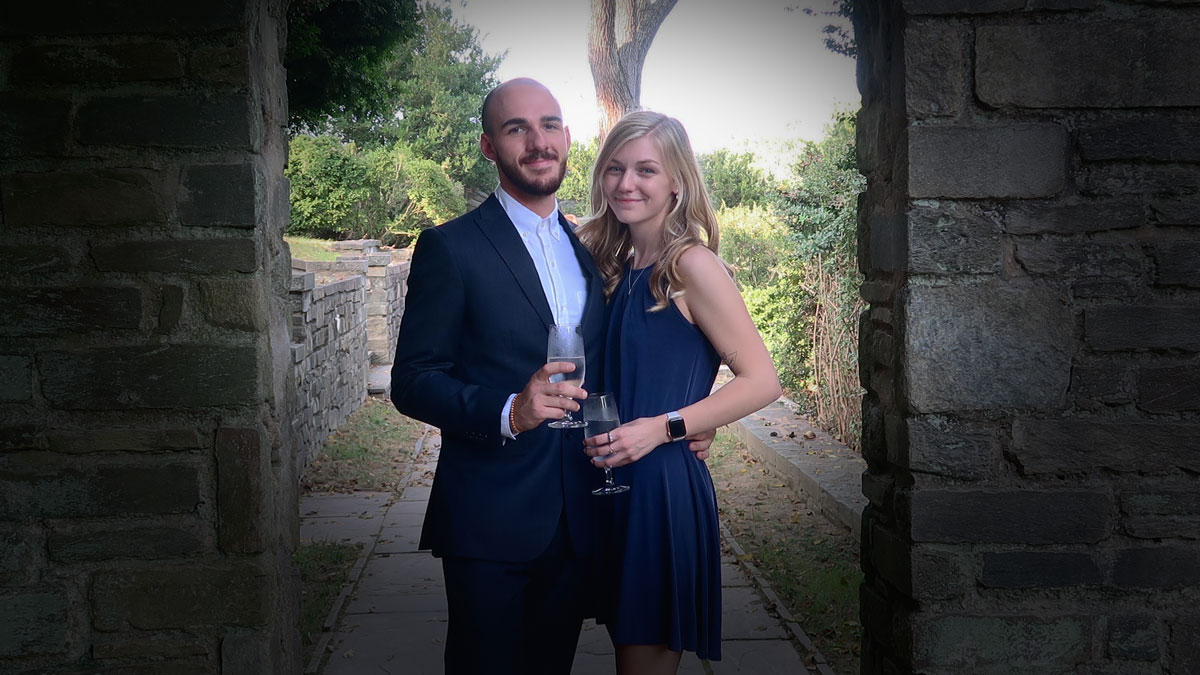
Netflix’s new docuseries, "American Murder: Gabby Petito," dismantles the social media illusion of Petito and Laundrie’s seemingly perfect relationship. Through never-before-seen footage, texts, journal entries and personal accounts from Petito’s friends and family, the series chronicles the couple’s tumultuous dynamic and highlights warning signs of domestic abuse that were overlooked by her loved ones and law enforcement.

Petito and Laundrie began dating in 2019 and got engaged in 2020. According to Petito’s friend, Rose Davis, Laundrie exhibited controlling behavior early on. Before a night out, an inconsolable Petito told Davis that Laundrie had stolen her ID. Davis recalled, "Brian admitted he stole it because he didn’t want her to go out."

Despite his volatility, Laundrie would attempt to make amends. Davis explained, "Brian would give her a bunch of things. She’d get so upset with the way he treated her, but then he’d do this amazing, sweet thing, and she’d say, ‘No, I’m lucky. I don’t deserve him.’"

To fund their cross-country trip, Petito took a job at Taco Bell. Laundrie objected, saying he felt "neglected" and eventually became possessive. Texts between the couple revealed that Laundrie berated her for working there, calling her "disgusting." He later admitted his anger stemmed from fear, telling her, "I worry you’ll leave. It’s just that I couldn’t have my life without you."

Davis described a relentless cycle in which Petito would blame herself for Laundrie’s anger. "She’d say, ‘I don’t deserve him. I’m hurting his feelings. I’m a bad person,’ and he wanted her to feel that way. He enjoyed her feeling that way because then she depended on him again."

American Murder: Gabby PetitoBrian Laundrie and Gabby Petito in "American Murder: Gabby Petito" (Courtesy of Netflix)Before their trip, Petito had started recognizing Laundrie’s controlling tendencies. In her journal, she wrote, "Brian, you know how much I love you. Just please stop crying and stop calling me names. You in pain is killing me."
She also texted Laundrie: "Don’t try to control me because it only makes me mad. I love you so much, but it’s the way you speak to me that hurts me most."

Davis noted that as Petito became more independent, Laundrie "isolated her." Shortly after these arguments, Petito quit her job, and the couple embarked on their van-life journey. Even in Petito’s footage, tension between them is evident—she often rolls her eyes or scoffs at Laundrie’s comments.

The National Domestic Violence Hotline lists several warning signs of an abusive partner, including demeaning or insulting behavior, extreme jealousy and efforts to isolate a partner from friends or family. Petito’s experiences align with these red flags. Her decision to work at Taco Bell and spend time with friends triggered Laundrie’s controlling tendencies.


Want a daily wrap-up of all the news and commentary Salon has to offer? Subscribe to our morning newsletter, Crash Course.


Their dynamic came to a head in Utah. Just weeks before Petito’s death, a 911 caller reported seeing a man in a white van slapping a woman. When local police pulled them over, Laundrie appeared calm while Petito was visibly distraught. Laundrie told officers he pushed Petito away in self-defense, resulting in scratches on his face. He built rapport with police, even jokingly calling Petito "crazy." Meanwhile, Petito recounted that they had spent the morning arguing after Laundrie locked her out of the van.

Despite her visible distress, officers labeled Petito the aggressor when she admitted she had hit Laundrie first. They separated the couple for the night, taking Laundrie to a hotel. But the pair reunited against police orders and drove hours outside of Utah.

We need your help to stay independent

In the docuseries, Petito’s parents and friends question how law enforcement missed the apparent power imbalance in the couple’s relationship. Public sentiment echoes these concerns: Why was Petito painted as the aggressor? How was Laundrie perceived as the victim?

New research from the University of East Anglia highlights a fundamental misunderstanding of covert abuse. The study notes that subtle forms of abuse can be "mixed with other positive behaviors or performed in a positive way, making them easily excused and normalized in a relationship."

Recognizing these behaviors requires identifying patterns — such as undermining a victim’s perception, shifting their attention away from their own needs, and creating emotional dependence on the abuser.

Domestic abuse is pervasive and often difficult to detect, especially when signs are subtle. Petito’s story is a cautionary tale, one that many survivors of abusive relationships understand all too well. The challenge remains: Are we paying attention and reading between the lines?

If you are experiencing domestic violence, call the National Domestic Violence Hotline at 1-800-799-7233, or go to thehotline.org.    

Head of FDA’s food division resigns following 89 “indiscriminate” staff layoffs

Jim Jones, head of the food division at the US Food and Drug Administration (FDA), has officially resigned, Bloomberg News first reported. Jones’ departure comes just a few days after the Trump administration fired thousands of federal workers, including several recently hired employees who work in the agency’s centers for food, medical devices and tobacco products.

In his resignation letter, obtained by Bloomberg News, Jones cited “indiscriminate” layoffs to 89 staff members, including key technical experts. “I was looking forward to working to pursue the department’s agenda of improving the health of Americans by reducing diet-related chronic disease and risks from chemicals in food,” Jones wrote.  

Jones became head of the FDA’s food division in 2023. He oversaw several major initiatives, including the Biden administration's ban on Red No. 3 dye and the FDA’s investigation of applesauce contaminated with elevated levels of lead and chromium.

In response to Jones’ resignation, White House press secretary Karoline Leavitt told NBC News in a statement, “There are a number of bureaucrats who are resistant to the democratic process and mandate delivered by the American people.”

“President Trump is only interested in the best and most qualified people who are also willing to implement his America First Agenda on behalf of the American people,” Leavitt said. “It’s not for everyone, and that’s okay.”

At this time, "it’s unclear whether Health and Human Services Secretary Robert F. Kennedy Jr. has an immediate replacement for Jones," NBC News’ Berkeley Lovelace Jr. reported.

Michael Jackson’s estate says sale of unreleased songs is “sad attempt” to “mislead the public”

Michael Jackson's estate is fighting to block an auction house from selling the singer's unreleased music.

According to Complex, sourcing intel first reported on by TMZ, the auction house Gotta Have Rock and Roll is auctioning off two unreleased cassette tapes containing 12 previously unheard tracks from the late pop star. However, Jackson's estate has condemned the sale, calling it a "sad attempt by an auction site to mislead the public."

The tracks were recorded in the late '80s and early '90s, prior to the release of Jackson's "Dangerous" album, in collaboration with music producer Bryan Loren, who provided the tapes for the auction. The bidding starts at $85,000, but the auction house estimates that the final sale price could range from $150,000 to $200,000.

However, the estate told TMZ that the cassettes are not originals but recordings of the masters that the estate owns. This means the buyer cannot publically share the music due to the estate's ownership. Jackson's estate called the tapes, “a long-outdated format.”

Gotta Have Rock and Roll’s president, Dylan Kosinski, said that the “cassettes are more valuable because they can't be reproduced or released to the public.”

Kosinski emphasized that the auction is a "bigger deal" because the estate still owns the original masters.

Despite the estate's objection, the auction house and Kosinski will continue with the sale on Wednesday, Feb. 19.

Last December, unreleased tracks from Jackson were discovered in a storage unit in the San Fernando Valley. The Jackson Estate said that they did not claim ownership of the tape but whoever purchases the recordings or compositions does not own the copyright, the estate does.

“Grow up”: Kevin Spacey responds to Guy Pearce’s allegations, disputing claims of targeting

Kevin Spacey has responded to former co-star Guy Pearce's allegations that he "targeted" him on the set of their 1997 film "L.A. Confidential," telling Pearce, "You are not a victim."

In a video statement posted to X on Tuesday, Spacey pushed back against the claims, saying, "If I did something that upset you, you could have reached out to me."

He also noted that a year after "L.A. Confidential" was filmed, Pearce had flown to Georgia "just to spend time with me."

"I mean, did you tell the press that too, or does that not fit into the victim narrative you have going?" Spacey added.

"I apologize that I didn't get the message that you don't like spending time with me. Maybe there was another reason, I don't know, but that doesn't make any sense. That you would have just been leading me on, right? But here you are now on a mission, some 28 years later, after I've been through hell and back," he said.

Spacey stated he was open to a conversation with Pearce because he's "got nothing to hide."

"But Guy – you need to grow up. You are not a victim," he concluded.

During Pearce's conversation with The Hollywood Reporter’s “Awards Chatter” podcast, the "Brutalist" actor opened up about how other sexual misconduct allegations against Spacey during the MeToo Movement gave him clarity on what had transpired on set.

“I heard these stories about Kevin, sort of officially as news stories,” Pearce said. “And I was in London working on something, and I heard [the reports], and I broke down and sobbed, and I couldn’t stop. I think it really dawned on me—the impact that had occurred and how I had brushed it off, shelved it, or blocked it out. That was a really incredible wake-up call.”

Pearce had previously called Spacey "a handsy guy" in a 2018 interview.

Spacey has denied all allegations of sexual assault and misconduct. The actor has been cleared of all sexual assault charges in two separate trials in the U.S. and U.K., including a lawsuit from actor Anthony Rapp, who accused Spacey of assaulting him as a minor.

Faster, smarter, unprecedented: Inside the new $34M women’s basketball league, Unrivaled

In "The Last Dance," ESPN’s 10-part documentary on Michael Jordan and his historic run with the Chicago Bulls, episode eight drops a fascinating detail about how Jordan kept his competitive edge in the off-season. While filming "Space Jam," Warner Bros. built him a custom basketball court—dubbed the “Jordan Dome”—so he could train between takes. NBA legends like Reggie Miller, Charles Barkley, Patrick Ewing, and Dennis Rodman joined him for high-intensity three-on-three games that players described as being as grueling as real NBA matchups. Packed with drills, shooting contests, and fierce competition, those three-on-three games allowed Jordan to feel out his competition and start the 1995-1996 NBA season ready to go, on day one. That year he led his team to a record-breaking 72-win season. 

Fast forward to January 17, 2025, and the launch of the Unrivaled Basketball League feels like the formalization of Jordan’s off-season strategy—except this time, it’s not just about staying in shape. It’s a full-fledged business designed to make sure the best players in women’s basketball are treated and paid accordingly. 

Founded by WNBA greats Napheesa Collier and Breanna Stewart, the league already has a leg-up on other alternate leagues like the Big3 because it is made by players, for players. The start-up raised $34M from the likes of Warner Bros. Discovery, Megan Rapinoe, Ashton Kutcher, Mila Kunis and Michael Phelps to bring Unrivaled, comprised of six club teams (Laces, Lunar Owls, Mist, Phantom, Rose and Vinyl), to life for an eight-week run in Miami. 

“We had a search party to visit four, five different cities before landing on Miami and it was the heavy favorite among athletes on where they would want to spend their winters,” says league President Alex Bazzell. “We're grateful for the immense support we've gotten from Miami and we're thrilled to have been able to bring professional women's basketball back to the city for the first time in over 20 years."

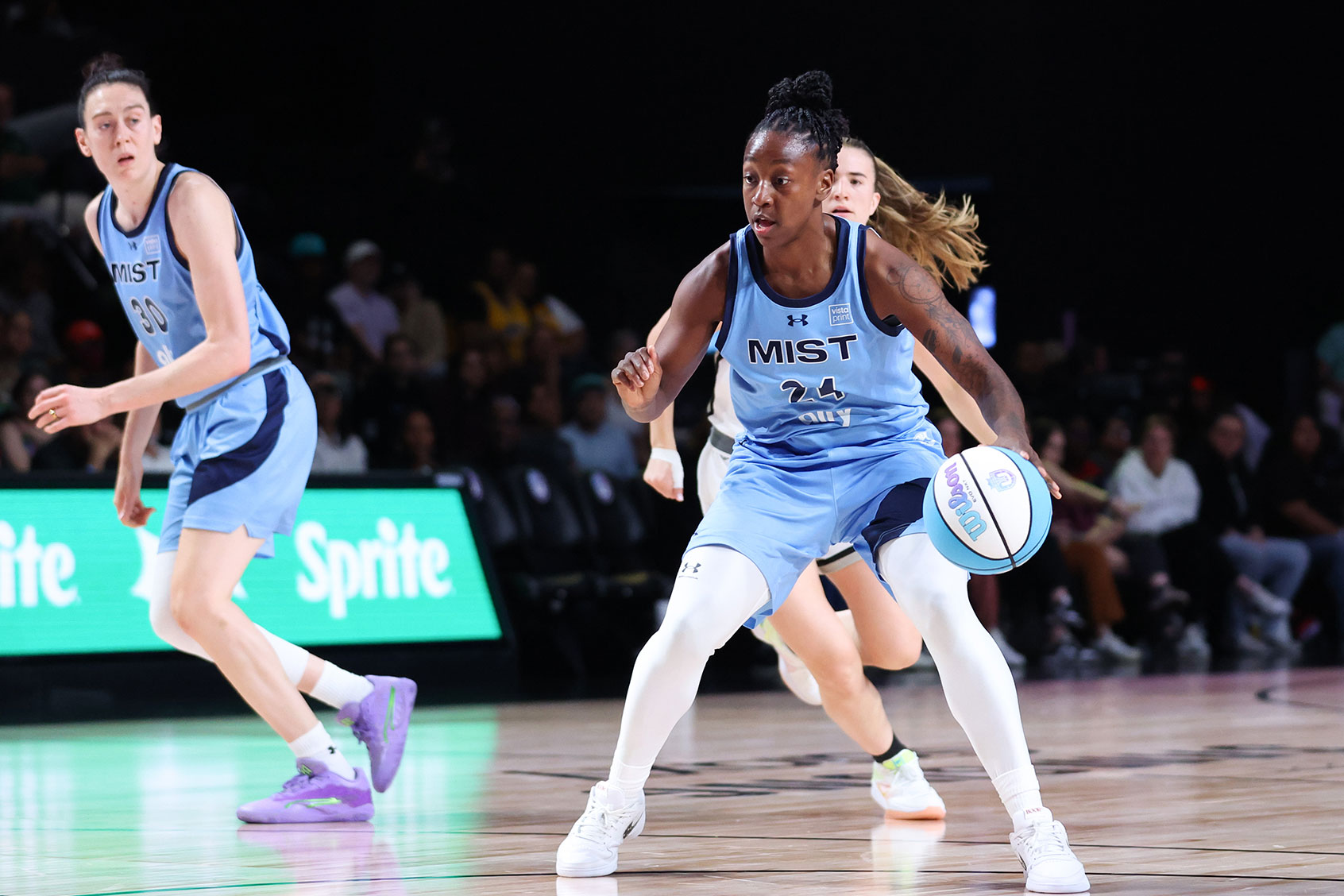
Jewell LoydJewell Loyd #24 of the Mist dribbles the ball against the Phantom during the second quarter of the game at Wayfair Arena on February 03, 2025 in Medley, Florida. (Megan Briggs/Getty Images)Salaries aren’t being publicly disclosed but with a salary pool of $8 million, estimates put each player at receiving no less than $200,000—the WNBA’s highest salary for a veteran player is $252,420. Players also split a 15 percent revenue pot. In this league, all players receive equity (based on several factors like how many years they are signing on to play) and all currently play in the W (unlike other leagues that feature former WNBA players). A big flex considering in 2024 the WNBA delivered its most-watched regular season in 24 years, finished with its highest attendance in 22 years and set records for digital consumption and merchandise sales.


Want a daily wrap-up of all the news and commentary Salon has to offer? Subscribe to our morning newsletter, Crash Course.


“We're revolutionizing the game, and the standard of what it means to be a women's athlete,” says Collier. “It feels like we're doing that one day or one weekend at a time with these games.”

Take for example the Sprite one-on-one tournament, happening at the mid-point of Unrivaled seasons. The knock-out style tournament has the winner taking home a $200,000 prize with $10,000 going to each of her five teammates, the runner-up receiving $50,000 and the semi-finalists going home with $25,000 each. The only prizes outside of regular WNBA play are during All-Star games where a $2,575 bonus is given for being selected for the squad and the MVP is awarded $5,150.

Games are faster than what fans are used to seeing in the WNBA. With a smaller court, shorter quarters and one-shot fouls with a weighted scoring system based on the penalty, this is an agile game with a new set of rules designed to keep plays moving. 

Chelsea GrayChelsea Gray #12 of Rose controls the ball against the Vinyl during the second half at The Mediapro Studio on January 17, 2025 in Medley, Florida. (Carmen Mandato/Getty Images)There’s excitement among players to get to spend the off-season stateside and it’s resulting in head-spinning trades. They’re growing their game and collective power during the off-season that’s sure to make the WNBA even more competitive than ever before. 

And players aren’t the only ones excited about spending winter in a sunny and warm destination. Fans from cities like Chicago, Milwaukee and New York City are skipping town (and freezing temps) to catch a game. The fan experience begins the moment tickets are scanned. A series of outdoor activations line the entrance into Wayfair Arena (where Bazzell says the league will stay for “at least the next two years.") A throne of Wilson basketballs, an Unrivaled step-and-repeat, and a life-size pop-a-shot (where fans can win merch) are some of the activities people can choose from before taking their seat in the 850-seat arena. With McDonald’s launch of the "The Angel Reese Special," with Breanna Stewart and Lisa Leslie in the graphic, all three of whom are part of the league, it’s clear the game and demand for it are growing, and its effect will reverberate across business, sports and travel. 

It’s an ambitious project its founders and front office staff hope to take on the road one day. But for now, it’s a pretty big deal that they were able to get it off the ground to begin with, changing the landscape for what’s possible for women in sports and in the workplace. This kind of bold ambition isn’t new in sports, but seeing it take shape in real-time is something different. Collier, Stewart and every player in Unrivaled is betting on themselves, and being an athlete is what’s given them the confidence to do so. 

“Just being in athletics, having that fight mentality where, if you feel like you're not getting what you deserve, to be able to fight for that,” says Collier on what allowed her to pursue this endeavor. “I'm surrounded by really powerful women who are not afraid to speak up for what they want and I feel like that empowers me. Coming into the WNBA and being surrounded by all those powerful people and what we were able to do with social justice and things there has led to this. It gives you the confidence to be like, ‘Yeah, I can start my own league. I can do whatever I want.’”

“Intentional cruelty”: Trump administration accused of “disappearing” immigrants at Guantánamo

The Trump administration has whisked away at least a hundred Venezuelan immigrants to the notorious Guantanamo Bay Naval Base detention camp, where they are in the custody of military guards and completely isolated from the outside world — a blatant violation of their civil rights, according to lawyers and advocates who spoke to Salon.

In interviews, they said Trump administration authorities had refused to grant their requests for access to the detainees or to even identify them; the federal government is also refusing to provide basic information, such as exactly how many people have been deported to the island prison since President Donald Trump took office.

"It's an attempt to disappear these individuals; to make it harder to communicate with them, harder to observe and monitor what is happening to them, and also done for the purpose of terrorizing them," J. Wells Dixon, an attorney at the Center for Constitutional Rights, told Salon. 

lawsuit recently filed by CCR, the American Civil Liberties Union and other groups accuses the government of preventing immigrants detained at Guantánamo Bay from "accessing legal assistance to understand their rights and to challenge their transfer and detention or conditions of confinement." The lawsuit was filed on behalf of all detained at Guantánamo, including three named prisoners — Tilso Ramon Gomez Lugo, Yoiker David Sequera and Luis Alberto Castillo Rivera — who were recognized by their relatives in photos that the government published flaunting the arrival of immigrants at the military prison camp.

After the Feb. 12 filing, authorities allowed the plaintiffs to communicate with those three men, but no one else.

"We know that the government can logistically make it possible for us to have access to the detainees, and the fact that we've already talked to three of the detainees reinforces that," the ACLU's Lee Gelernt, the lead attorney on the case, told Salon.

The prison in Guantánamo, an offshore facility previously reserved for foreign terrorism suspects and later also for immigrants caught at sea (but not on U.S. soil), has become a byword for the U.S. imperial state at its most unaccountable and oppressive, with inmates held in secrecy and often subjected to inhumane treatment, which critics say has been tantamount to torture. Now, Guantánamo is also housing Venezuelan immigrants who Trump administration officials have claimed, without evidence, are especially dangerous criminals, "the worst of the worst," including alleged gang members and pedophiles.

The Trump administration has signaled that as many as 30,000 immigrants could ultimately be detained at the prison camp.

Relatives of those held there already insist they have been falsely accused and advocates say there is no reason to believe the government's blanket assertions. In a statement to Salon, the Department of Homeland Security refused to provide any evidence supporting the government's claims, saying: "We cannot give out personal identifying information." DHS did not respond when asked why that is the case.

"We do not plan on trusting the Trump administration's characterization of who is being sent to Guantánamo. We believe we have a right, and the American public has a right, to find out for ourselves who has been sent there," Gelernt said. "Based on our own investigation, we do not believe that everyone being sent there has a serious criminal history, and notwithstanding the Trump administration's hyperbole, we also want to emphasize that even someone with a criminal history would have certain rights and should not be sent to Guantánamo."

News outlets also ran background research on the three named detainees in the lawsuit and could find no violent criminal record.

We need your help to stay independent

Relatives of Sequera and Castillo told news outlets that authorities must have took their tattoos as a sign that they were part of the Tren de Aragua gang, and used them as "guinea pigs" for Trump's mass deportation program. That interpretation comes after ICE said that it viewed tattoos as “one of many indicators” that an individual belongs to the gang.

Independent experts have said that they could find no real connection between gang membership and tattoos, a popular adornment for Venezuelans and nearly one-third of Americans.  

"Tattoos are greatly meaningless unless they are combined with other factors, like prison history or known criminal associations,” Pablo Zeballos, a Chile-based expert on organized crime, told the Washington Post.

Dozens of other transferred detainees have also been recognized since the photos were released, with their friends and relatives expressing horror and confusion that such punishment should befall people they have known as a friendly barber (in the case of Sequera), soccer teammate or loving father.

"I suspect that, as in the past, when we have access to these individuals, the truth will be that they are far from 'the worst of the worst,'" Dixon said. "I'm sure many of them were not ever charged, let alone convicted of crimes. I think it's important to remember that some of these individuals may have entered the United States legally seeking political asylum or other refuge under US and international law."


Want a daily wrap-up of all the news and commentary Salon has to offer? Subscribe to our morning newsletter, Crash Course.


Previously, federal authorities have kept immigrants, typically those caught at sea, at Guantánamo for "processing" that could sometimes take more than a year to complete. But the Trump administration's plan to pack an offshore detention facility with thousands of people detained on American soil — and therefore entitled to constitutional protections, whatever their legal status — is unprecedented.

Even when Guantánamo was housing only a small population, officials from the International Refugee Assistance Project found in 2023 that detainees were still being "held in dilapidated facilities with faulty plumbing, rodents, and a lack of potable water," according to Kimberly Grano, Litigation Staff Attorney at the International Refugee Assistance Project.

"This administration's attempt to send thousands of people from the United States there all but guarantees that conditions will be even worse," she told Salon.

While many prisons run by the United States have faced scrutiny for mistreating its prisoners, Guantánamo, a "legal black hole" where people disappear without normal due process and evoking images of blindfolded prisoners prostrate before heavily armed guards or being threatened with snarling dogs, has an especially dreadful reputation.

The cruelty, Dixon told Salon, is exactly the point.

"What could be worse and more terrifying and more torturous than being told you're going to be sent to Guantánamo Bay?" he said. "They're doing this in order to strike terror in the minds of undocumented individuals in the United States. This is all about intentional cruelty towards non-citizens. It's not about law or policy or anything like that. It's purely performative."

Meghan Markle’s brand-new lifestyle brand officially has a new name

Meghan Markle took to Instagram on Tuesday to announce the name of her brand new lifestyle brand.

“Some of you may have heard whispers about what I’ve been creating. In two weeks, my series on @netflix launches — but there’s something else I’ve been working on,” Markle wrote in a recent video post. “I’m thrilled to introduce you to As Ever — a brand that I created and have poured my heart into.”

She continued: “‘As ever’ means ‘as it’s always been’ or some even say ‘in the same way as always.’ If you’ve followed along since my days of creating The Tig, you’ll know this couldn’t be truer for me. This new chapter is an extension of what has always been my love language, beautifully weaving together everything I cherish — food, gardening, entertaining, thoughtful living, and finding joy in the everyday.”

Markle’s brand was originally called American Riviera Orchard, which pays homage to Santa Barbara, the California town where Markle and her husband Prince Harry currently reside with their two children.

“Last year, I thought American Riviera, it’s such a great name, it’s my neighborhood, it’s the nickname for Santa Barbara. But it limited me to things that were manufactured and grown in this area,” Markle said about the name change, per Elle.

Markle said she was able to obtain the new name — “As Ever” — in 2022.

401(k) plans are more available. So why aren’t we using them?

For advocates of the 401(k) retirement plan, there is good news: About 70% of America’s private-sector employees are now able to access it, compared to 60% 10 years ago, according to the latest data from the U.S. Labor Department

But even as access rises, a significant part of the workforce, 40%, isn’t saving enough for retirement, according to research by Boston College’s Center for Retirement Research, compiled by the Wall Street Journal. 

American workers simply don’t have enough money to invest, a recent YouGov report shows. And when they do, they turn to crypto and riskier investment options over traditional retirement accounts, signaling millennials and Gen Z could face more financial trouble as they age.

Wage growth in the U.S., which slowed in 2024 compared to 2023, hasn’t kept up with inflation, so more Americans are struggling to invest whether through their employer’s plans or on their own. A recent survey of over 1,000 American workers by Resume Now showed that just 6% of respondents are saving, with 73% of workers only able to afford basic living expenses.

“Federal and state minimum wages have not kept pace with inflation, affecting overall wage trends,” Keith Spencer, a career expert at Resume Now, told Salon, noting this trend is expected to continue in 2025. “Many corporations have prioritized profit margins, stock buybacks and executive compensation over raising worker pay.”

We need your help to stay independent

Millennial investors are more likely to own cryptocurrency (36%) than invest in a retirement account (34%), according to a new report from YouGov.

“Despite 83% of investors aware of cryptocurrency viewing it as a risky investment, an increasing number of Americans are investing in Crypto,” YouGov researchers found. “This is especially true among Gen Z investors, who are nearly 4x more likely to own cryptocurrency than have a retirement account.”

Millennial investors are not far behind: They are also more likely to own cryptocurrency (at 36%) than have a retirement account (34%), the January report showed.

Rising inflation

Almost half, or 46%, of U.S. investors cite financial constraints as their main barrier to investing, while only 5% attribute their hesitation to past negative experiences, YouGov found. 

"Recession risks have risen slightly since the election"

While economists are split on whether President Trump’s policies will lead to an economic recession, they say his aggressive tariffs are adding to the overall uncertainty and could potentially slow economic recovery.

Dante Deantonio, senior director of economic research at Moody’s Analytics, told Bankrate the tariffs alone aren’t likely to push the economy into a recession, but they add to the overall risks.

“Recession risks have risen slightly since the election,” he said. “The threat of higher tariffs and changes to immigration policy will raise inflation and weaken overall economic growth.”

The strain on consumers’ wallets is likely to continue this year, as inflation hit a seven-month high of 3% last month, while consumer prices saw their biggest month-to-month increase since August 2023.

“Given the recent surge in inflation and the rising cost of living, real wage growth will likely remain stagnant," said Keith Spencer.

DNC intervenes in North Carolina Supreme Court fight, accuses GOP of trying to “steal an election”

The Democratic National Committee is getting involved in the legal battle over a North Carolina Supreme Court seat and Republicans’ efforts to toss out more than 60,000 votes, filing a brief with the state's highest court as part of an effort to preserve Democratic incumbent Allison Riggs' narrow victory last November.

The DNC's intervention comes as GOP candidate Jefferson Griffin, a state appellate court judge, has sought to discard ballots that he argues were cast by voters with incomplete registrations, including missing driver's license or Social Security numbers, and voters he alleges never resided in the state. The election, after multiple recounts, was decided by just 734 votes; a legal victory for Griffin would almost certainly result in the outcome being overturned.

“For months, North Carolina Republicans have attempted to steal an election in plain sight, seeking to throw away some 60,000 lawful votes cast in the race for North Carolina Supreme Court justice, and now, could affect all other state and local races as well,” DNC Chair Ken Martin said in a statement. “While Republicans attempt to suppress the votes of their constituents, the DNC is fighting everywhere — in both state courts and federal — to protect the will of North Carolina voters and the sanctity of North Carolina elections.”

The Wake County Superior Court earlier this month ruled against Griffin and sided with the state Board of Elections, which had certified Griffin's loss and rejected his effort to toss out tens of thousands of ballots. But, following the ruling, Griffin appealed the decision to the state Court of Appeals, where he himself sits as a judge (he has since recused himself). At the same time, the state Board of Elections has filed a bypass petition to push the matter straight to the state Supreme Court. 

Riggs has expressed support for that petition, while Griffin has indicated he opposes it. That, according to Democracy Docket, is likely due to the Court of Appeals being viewed as "a venue more favorable" to Griffin; if he wins there, Republicans are more likely to ultimately prevail, even if the state Supreme Court issues a split decision.

Further complicating the case, Riggs has argued that the question of whether or not to toss some 60,000 votes is one that should rightly be decided in federal court. The Fourth Circuit initially ruled earlier this month that it could take up the case to address any lingering federal legal issues — but only after state courts addressed the matter.

In the brief filed Tuesday, the DNC argues that the state Supreme Court let the earlier Wake County Superior Court decision stand. "Voters may not be retroactively disenfranchised based upon technical defects in their voter registration," the brief states. Republicans, it continues, "have provided no evidence that any of the voters they challenge are not qualified to register and vote, so this Court should uphold its long-established precedents rejecting challenges to eligible voters' ballots based on technical defects in their registration, consistent with federal and state law prohibiting retroactive disenfranchisement of voters."

We need your help to stay independent

Separately, the DNC also filed a brief in the federal court system, echoing the North Carolina State Board of Elections in arguing that federal judges have the right to protect voters in the state should they be disenfranchised.

In a statement accompanying Tuesday's legal filings, Reyna Walters-Morgan, DNC vice chair for civic engagement, portrayed the legal fight as part of a nationwide battle to protect democracy.

“I am appalled by the attempts of the Republican Party to overthrow a free and fair election won by Allison Riggs, and to attack the results in hundreds of other races that were certified months ago," Walters-Morgan said. “What’s happening in North Carolina could happen anywhere and the DNC is fighting to ensure that the voices of my friends, family, and neighbors are heard."

Trump’s delusional path to peace: Handing over Ukraine to Russia

President Trump took some questions on Tuesday as he finished yet another round of golf and wound up another long weekend at his Florida resort. Elon Musk was a big topic, which appeared to get on Trump’s nerves, especially when a reporter wanted to know what position the multi-billionaire actually held now that the White House has said he is not actually running the DOGE department after all. He responded, “So, you know, you could call him an employee, you could call him a consultant, you could call him whatever you want… but you know what? Ukraine’s a bigger deal.”

He sounded quite irritated that they were asking him about such trivialities when he is the one who has world leaders quaking in their boots as he re-makes the whole world in his image. He’s obviously delegated the wrecking of the federal government to Musk, to which he’s only peripherally paying attention, so that he can concentrate on wrecking the world order. Both men are doing a bang-up job so far.

Trump may think he’s the King of the World, but I think we know who the real winner is in all this.

Trump’s still planning on threatening allies and adversaries alike with draconian tariffs virtually designed to destabilize a fragile world economy only recently recovered from pandemic lockdowns. He’s being advised by his fellow convicted felon Peter Navarro, who is reportedly pushing Trump to go fully maximalist under the assumption that they will force foreign manufacturers to completely move their operations to the United States in order to avoid them. Yes, they really seem to think that will happen.

But Trump’s real interest these days is as the creator of a new American Empire, the prince of peace and prosperity who will end all wars simply by exercising what he believes to be his infinite power to force the people of the world to pay up.

He’s quite serious about annexing Canada, buying Greenlandinvading Mexicoseizing the Panama Canal and “owning” the Gaza strip to turn it into a shopping mall. As unlikely as those all are, there is one plan that looks as though Trump may pull off — and it’s absolutely terrible. Trump is now in the process of selling out Ukraine and Europe to Vladimir Putin for which he thinks he’ll win the Nobel Peace Prize.

You’ll recall that he vowed to end the war within 24 hours of being elected and then immediately after the inauguration, neither of which happened, of course, because they were daft promises. He has also always said that the war never would have happened if he were president, by which I think most of us assumed he meant that Putin would never have had the nerve to invade in the first place. But his comments in recent days indicate something quite different. He holds Ukraine responsible for the war and apparently thinks that had he been in office when Putin invaded they would have followed his orders to surrender immediately.

Just yesterday, he excoriated the Ukrainians saying they never should have started the war, that they could have “made a deal.”

He also claimed that they need to have elections because Ukrainian President Vladimir Zelenskyy is at a 4% approval rating ( He is actually between 50% and 60%, which better than Trump) saying, “I like him personally, but it is the leadership that allowed the war to go on.” As always, never a bad word to say about Vladimir Putin.

We need your help to stay independent

Trump’s angry comment was in reaction to the fact that Zelenskyy expressed his unhappiness that the U.S. and Russia have decided that they are now going to negotiate a deal without any input from Ukraine or Europe, the two parties who have the biggest stake in the outcome. He said, quite rightly, that there can be no deals without Ukraine at the table.

It’s pretty clear how this is going to go and it’s very bad news for Ukraine, Europe, NATO and global stability in general. It started with Trump’s triumphant phone call with Putin a week ago in which Putin clearly made Trump feel all tingly inside because he’s had a glow about him ever since.

He dispatched his Secretary of Defense Pete Hegseth and Vice President JD Vance to Europe for meetings last week where both of them embarrassed the United States almost as much as Trump usually does. Hegseth blathered on about “hard power,” sounding more like a 70s adult film star than a defense secretary and gave away most of America’s leverage by saying outright that Ukraine would have to give up territory and would never be allowed to enter NATO. (I’m fairly sure Trump told him to do that — since that part of the deal’s already in the bag.)

Vance, meanwhile, was expected to speak about Ukraine but instead lectured the Europeans on their culture and values and told them they should be nicer to Nazis. He did meet with Zelenskyy for the purpose of getting him to promise to pay the U.S. $500 billion for the United States’ support over the last three years. (The U.S. has not spent even a quarter of that and most of it went to American military contractors.) The proposed deal included no security guarantee and included not only the rare earth minerals that Trump’s all excited about, but ports, infrastructure, oil and gas. Zelenskyy politely declined.

The conservative British paper the Daily Telegraph described the proposed deal this way:

If this draft were accepted, Trump’s demands would amount to a higher share of Ukrainian GDP than reparations imposed on Germany at the Versailles Treaty, later whittled down at the London Conference in 1921, and by the Dawes Plan in 1924. At the same time, he seems willing to let Russia off the hook entirely.


Want a daily wrap-up of all the news and commentary Salon has to offer? Subscribe to our morning newsletter, Crash Course.


They point out that Trump has said publicly on Fox News that unless Ukraine agreed, the country would be handed to Putin, saying “they may make a deal, they may not make a deal. They may be Russian someday, or they may not be Russian someday. But I want this money back.” Spoken like a true mob boss.

A mineral deal was actually proposed by Zelenskyy last September in the hopes that the U.S. would be more likely to continue to protect it as an asset. The idea has recently been pushed by S. Carolina GOP Senator Lindsey Graham, who thinks he’s very clever at manipulating Trump like a three-year-old by giving him a financial incentive to continue backing Ukraine. But Zelenskyy will not turn over all the resources of the country in perpetuity or turn it into an American colony. And Trump clearly has no intention of continuing to support Ukraine militarily. He sees this deal as payback for services already rendered.

As for the future, the Financial Times reported that Trump is now considering withdrawing U.S. troops from the Baltics and perhaps even further west. At the meeting on Tuesday in Saudi Arabia between the U.S., represented by Secretary of State Marco Rubio and Russian Foreign Minister Sergei Lavrov the focus was more on the ecstatic reconciliation between the U.S. and Russia than any potential cease fire or peace deal in Ukraine. There was lots of talk about “economic opportunities” which would obviously include the lifting of sanctions.

All of that comes with the understanding that Russia gets to keep whatever territory they’ve taken, the growing disdain for Europe by the U.S. government, the slow dissolution of NATO and absolutely no demand for anything from Russia in return. Vladimir Putin must be a very happy man indeed. Trump may think he’s the King of the World, but I think we know who the real winner is in all this.


Trump’s plan to avert a constitutional crisis: “Put pressure on the courts to make some concessions”

Donald Trump is fully acting like America’s first elected autocrat and aspiring dictator. In his mind and that of his followers and allies, he is the State. The law is what Trump deems it to be on any given day. The president's whims, desires, beliefs, moods and plans are to be followed without question. The United States of America is to be The United States of America under Trump.

In the most recent example of Trump's tyrannical aspirations, he proclaimed that "He who saves his Country does not violate any Law." In the context of a years-long pattern of similar statements, Trump truly believes that he is some type of American Caesar or Napoleon above the law. Trump's statement is a direct rejection of the basic norms of democracy, the Constitution and the rule of law in the United States.

In the face of such gross corrupt power and rapidly escalating dictatorial moves and aspirations, America’s democracy and the so-called Resistance continue to be weak and ineffective. The Democrats’ pathetic response is exemplified by House Minority Leader Hakeem Jeffries, who asked reporters during a recent press conference, "What leverage do we have? They control the House, the Senate and the presidency; it's their government." Here is a suggestion: Jeffries and the other senior Democrats need to ask themselves, "What would Mitch McConnell do if he were in our position?" They should then do that — times ten. Leaders must meet the demands of the moment and crisis. In total, the Democratic Party is failing to rise to the challenge.

The courts, however, are attempting to stop Donald Trump and his administration’s plainly unconstitutional and likely illegal acts. Judges have issued orders against Trump's attempt to nullify the 14th Amendment to the Constitution and cut off the federal government’s loans and grants and other spending, which is a power exclusively reserved for Congress. However, the Trump administration is refusing to fully comply with these court orders. If the Trump administration continues to defy the courts, it will, in all probability, force a constitutional crisis. This is likely their plan.

Last year, the right-wing extremist justices on the Supreme Court basically decided that Trump is a king who can do anything he wants as long as he claims that he is acting in an "official capacity" in accordance with his “constitutional authority.” Such a ruling is the ultimate appeal to power for Donald Trump. The courts can tell Trump to stop his executive orders and other diktats and all he has to do is invoke how they are extensions of his “presidential authority” and are thus “legal.”  

What of the American people? What of their outrage and disgust at the Trump administration? Public opinion polls show wide support for President Trump and many of his actions — support that is not limited to Trump’s MAGA diehards. America’s democracy is very ill and getting much worse every day.

"The veiled threats against the judiciary and its authority may reflect an effort to put pressure on the courts to make some concessions to the administration to avoid the direct conflict between the branches and the potential constitutional crisis that might come with ruling fully against them."

In an attempt to make better sense of President Trump and his administration’s use of executive orders and their legality and power, if a constitutional crisis is imminent, and what, if any, role the states have to play in substantively resisting the Trump administration’s shock and awe campaign against the Constitution and rule of law, I recently spoke with Douglas Keith. He is senior counsel at the Brennan Center’s Judiciary program, which works to promote fair, diverse and impartial courts. Keith is also a founding editor of State Court Report, a Brennan Center publication focused on state courts and state constitutional law.

This is the second of a two-part conversation.

Donald Trump has issued dozens of executive orders and other edicts. What power and legal authority do executive orders really have in the American system of law and democracy?

It depends on the executive order. Some executive orders have real teeth and legal effect. The president is the head of the executive branch. As chief executive, the president has the authority to direct any number of agencies in their work and specifically to tell them how to do their work. There are limits to what executive orders can do. For example, executive orders cannot void acts of Congress. There are executive orders that are little more than glorified press releases. The power of a given executive order ultimately depends on what authority the order claims to rest on, with that authority still very much constrained by the Constitution.

Many court cases have been filed against Trump's executive orders and other edicts. For example, judges have put a pause on his attempts to freeze federal loans, grants and other funding because it violates Congress' exclusive "power of the purse." A judge has also put a hold on Trump's attempts to overturn the 14th Amendment of the Constitution. Trump and his mouthpieces, including Vice President JD Vance, are signaling, if not explicitly stating that they will likely refuse to follow the court orders they disagree with. What enforcement powers do judges have if such a nightmare scenario occurs?

First, it should be clear that obeying a court order is not just a norm, it's the law. Since the Civil War, presidents have followed court orders. Presidents of both parties have understood and obeyed the bedrock principle that presidents follow court orders even those they disagree with. Trump followed this precedent as well during his first term. For example, when the courts enjoined the travel ban that he issued back in 2017, President Trump complained on Twitter, but he complied with the order. President George W. Bush asserted broad presidential powers in the war on terror, and the Supreme Court said that detainees in Guantanamo Bay could challenge their confinement, he said that he'd abide by the court's decision, even though he disagreed with it.

Going back further in time, President Truman issued an executive order to seize the country's steel mills in the middle of a war, the Supreme Court said that was unconstitutional, and he backed down. The last time we've really seen any broad refusal by elected officials to follow court orders was after Brown v. Board of Education when Southern governors refused to desegregate schools and President Eisenhower, who didn't love the Brown v. Board of Education decision by the way, nonetheless sent in federal troops to enforce the decision. When Southern governors refused to desegregate schools during Jim Crow is now widely understood as one of the most shameful periods in our history.

We need your help to stay independent

This wide range of examples demonstrates how strong the assumption is that elected officials are supposed to follow court orders, even those they disagree with.

In terms of what happens if a court order is not obeyed, there are a number of tools that judges have access to for enforcement purposes. Judges have contempt power and can issue fines or even arrest individuals who refuse to comply with a court order. Judges do this all the time with people appearing before them. A given judge may be more reluctant to do that when it comes to an executive branch official, but it would not be the first time that a judge held an executive branch official in contempt. These tools have been given to judges in our system of law because there's an understanding that the parties involved are not always going to follow their orders and judges need tools to enforce their orders.

What of President Jackson's likely apocryphal rebuttal of the power of the courts, that they don't have an army to make him follow their rulings? Vice President Vance recently invoked that argument about the courts' supposed lack of real power and authority over the executive branch.

Judges have the tools I described to enforce their orders. But there are limits to these powers. If you have individuals or a president who does not want to follow the orders or respond to the sanctions that come next, it will then be of paramount importance that any American who cares about maintaining our constitutional democracy remain vigilant and speak out in defense of the rule of law. Defending American democracy is the responsibility of a range of stakeholders across American society, not just the courts. Those stakeholders cannot and should not tolerate any refusal by a president or other member of the executive branch or government more broadly to comply with the constitution.  

Who are these "stakeholders?" Specifics matter here. 

When we're talking about the "stakeholders" in our legal system and our democracy, that should mean everyone. Everyone in the United States should be invested in our government continuing to function as a democracy. Specifically, some of those stakeholders include judges, lawyers and advocates, both specifically involved in a given case, but also the legal community more broadly. There are businesses that depend on functional courts for the stability of the economy. There are, of course, interest groups and/or individuals who anticipate needing to rely on courts for the protection of their rights. But when the question is, who does the rule of law matter to? The answer is everyone.

What role do the states play in pushing back against President Trump's executive orders and other edicts?

The states are involved in bringing some of the lawsuits you alluded to. But because these cases involve questions of federal law, and the budget and spending are fundamentally questions of federal law that will play out in federal court rather than state court. There could still be litigation playing out in state court because of actions from the Trump administration, but that will more likely be in response to specific things happening in a particular state. For example, you might see lawsuits in a state where schools or advocates are saying that the schools are inadequately funded without this federal funding being delivered to the state anymore and that the state needs to deliver more funding to make up for the gap created by the federal government’s actions.

There is much public concern about a doomsday scenario where the US Supreme Court decides against Trump's executive orders and he and his administration refuse to obey that ruling(s). This would constitute a constitutional crisis, perhaps the worst since the Civil War. Your thoughts?

Some of this litigation will end up at the United States Supreme Court. The administration has already said they're appealing one district court decision to an appeals court, which is the next step before appealing to the U.S. Supreme Court, and that appeal could come pretty quickly. Some of the Trump administration's current actions clearly appear to be unconstitutional or illegal under current law. But the administration may be anticipating that the US Supreme Court will read the law differently than it has in the past. Recent decisions coming out of the Supreme Court have expanded the executive branch’s power. That being said, I do not believe that there is any outcome in the Supreme Court that is inevitable when it comes to these cases. In the end, the public may be surprised to see some of the decisions coming out of the Supreme Court, even though the court has been so significantly shaped by President Trump during his prior administration.

The Trump administration and its agents know that they are likely not going to get everything they want in terms of their executive orders and other attempts to push, if not break, the boundaries of the rule of law and the Constitution. But the Supreme Court can still issue a ruling(s) that gives the Trump administration some of what they want, thus effectively expanding the boundaries of presidential power and authority.

Yes. As part of its political and legal strategy, the Trump administration may indeed be trying to advance theories and claims it knows will not be fully successful. Their thinking may be that the court will grant some of the additional power that it wants even if it doesn’t give them everything they ask for. It is also worth asking whether some of the threats to not follow court orders are part of the same strategy. The veiled threats against the judiciary and its authority may reflect an effort to put pressure on the courts to make some concessions to the administration to avoid the direct conflict between the branches and the potential constitutional crisis that might come with ruling fully against them.

During this tumultuous time here in the United States, what, if anything, gives you hope?

What gives me the most hope is the number of people I see who are deeply committed to preserving our democracy even in the face of the real dangers to it in America right now.

What a $2 million per dose gene therapy reveals about drug pricing

Reporting Highlights

  • A Record Price: The gene therapy Zolgensma helped children born with a fatal disease, spinal muscular atrophy, grow up to run and play. But the cost was stunning: $2 million per dose.

  • Cashing In: While taxpayers and small charities funded the drug’s early development, executives, venture-capital backers and a pharma giant have reaped the profits.

  • Priced Out: The drug’s cost adds to the nation’s ballooning bill for prescription drugs and puts Zolgensma out of reach for kids in many low- and middle-income countries.

These highlights were written by the reporters and editors who worked on this story.

Vincent Gaynor remembers, almost to the minute, when he realized his part in birthing the breakthrough gene therapy Zolgensma had ended and the forces that turned it into the world’s most expensive drug had taken over.

It was May 2014. He and his wife were sitting in the cafeteria at Nationwide Children’s Hospital in Columbus, Ohio.

Elsewhere in the hospital, an infant — patient No. 1 in a landmark clinical trial — was receiving an IV infusion that, if it worked, would fix the genetic mutation that caused spinal muscular atrophy, a rare, incurable disease. At the time, children born with the most severe form of SMA swiftly lost their ability to move, to swallow, to breathe. Depending on the disease’s progression, most didn’t live to their second birthdays.

The Gaynors’ daughter Sophia had been diagnosed with SMA five years earlier. Since then, they’d raced to fund research to save her. Their charity, Sophia’s Cure, was covering a substantial portion of the costs of the trial.

They’d helped raise about $2 million for a program at Nationwide run by Brian Kaspar, a leading researcher. Gaynor, a New York City construction worker, had forged a tight bond with Kaspar, speaking frequently with him by phone, sometimes deep into the night.

But their relationship had started to fray when — with success in sight — Kaspar became part owner of AveXis, a biotech startup that had snapped up the rights to his SMA drug. Billions of dollars were at stake.

When Kaspar walked into the cafeteria that day, Gaynor said, the scientist didn’t acknowledge him or his wife before sitting down a short distance away. Neither did the man with him, the startup’s CEO.

“It was like they didn’t know us,” Gaynor recalled.

When Zolgensma hit the market five years later, it was hailed as a miracle drug. Some babies treated with it grew up able to run and play. It helped reduce U.S. death rates from SMA, long the leading genetic cause of infant mortality, by two-thirds.

That leap forward came at a sky-high price: more than $2 million per dose, making Zolgensma then the costliest one-time treatment ever.

How did a drug rooted, like many, in seed money from the U.S. government — that is, American taxpayers — and spurred by the grassroots fundraising of desperate parents, end up with such a price tag?

The story of Zolgensma lays bare a confounding reality about modern drug development, in which revolutionary new treatments are becoming available only to be priced out of reach for many. It’s a story that upends commonly held conceptions that high drug prices reflect huge industry investments in innovation. Most of all, it’s a story that prompts, again and again, an increasingly urgent question: Do medical advances really have to be this expensive?

ProPublica traced Zolgensma’s journey from lab to market, from the supporters there at the beginning to the hired guns brought in at the end to construct a rationale for its unprecedented price.

"It just became an opportunity for a bunch of people to make transformative, generational wealth."

We found that taxpayers and private charities like Sophia’s Cure subsidized much of the science that yielded Zolgensma, providing research grants and opening the door to federal tax credits and other benefits that sped its path to approval.

Yet that support came with no conditions — financial or otherwise — for the for-profit companies that brought the drug over the finish line, particularly when it came to pricing.

Once Zolgensma’s potential was clear, early champions like the Gaynors were left behind as the private sector rushed in. AveXis’ top executives and venture-capital backers made tens or hundreds of millions of dollars apiece when the startup was swallowed by the pharmaceutical giant Novartis AG in 2018.

Wall Street analysts predicted Novartis’ new prize drug would be the first therapy to smash the million-dollar-a-dose mark. The Swiss colossus crafted a sophisticated campaign to justify more than double that amount, enlisting a team of respected academics, data-modelers and pricing strategists to help make its case.

“This was a case where the charities and the government did everything to get this thing commercialized, and then it just became an opportunity for a bunch of people to make transformative, generational wealth,” said James Love, director of the public advocacy group Knowledge Ecology International.

In a statement to ProPublica, Novartis said Zolgensma’s price reflects its benefits to children with SMA and to society more broadly.

“Zolgensma is consistently priced based on the value it provides to patients, caregivers and health systems,” the company said, adding that the drug may reduce the burden of SMA by replacing “repeat, lifelong therapies with a single treatment.”

Zolgensma’s price quickly became the standard for gene therapies. Nine of them cost more than $2 million. A tenth, approved in November, is predicted to run about $3.8 million, just shy of the most expensive, also approved last year, which costs $4.25 million a dose.

“Drug companies charge whatever they think they can get away with,” said David Mitchell, the founder of Patients For Affordable Drugs. “And every time the benchmark moves up, they think, ‘Well, we can get away with more.’”

Parents of children with SMA say their concerns about costs pale in comparison to the hope offered by such cutting-edge therapies. “I mean, it’s a child’s life,” said Hailey Weihs, who battled her health plan to get Zolgensma for her daughter. “Anybody would want that for their own child.”

The seven-figure costs of Zolgensma and other gene therapies add to the nation’s ballooning bill for prescription drugs, absorbed by all Americans in the form of rising insurance premiums and taxes for public programs like Medicaid.

Breakthroughs like Zolgensma are often framed as wins for all: Patients get life-saving new therapies. Drug companies and biotech investors make enough money to incentivize even more breakthroughs.

But not everyone’s a winner, Gaynor noted.

No one wanted Zolgensma to succeed more than he did, or understands better what it has meant for families like his. Yet his years behind the scenes of the drug’s development left him and his family disillusioned.

“I learned it’s all about money,” Gaynor said. “It’s not about saving people.”


When Vincent and Catherine Gaynor started their married life in 2006, they knew one thing for certain: They wanted children.

They learned well into Catherine’s 2008 pregnancy that they were both carriers for SMA, meaning there was a 25% chance their child would be born with the muscle-wasting disorder.

They were concerned but clung to the larger chance the baby would be born healthy.

When Sophia was born in late February 2009, at first they just marveled at her sweet disposition and bright, expressive eyes. How she loved being snuggled. How she sighed after she burped.

But it didn’t take long for Vincent, who’d grown up with younger siblings, to sense something was off. Sophia didn’t lift her legs. They flopped outward like a frog’s when he changed her diaper.

"It’s all about money … It’s not about saving people."

Their pediatrician assured them Sophia was fine. Then a different doctor suggested testing her for SMA. While they waited for the results, the family went to a nearby park, and Catherine pushed Sophia’s stroller around a pond. “I remember walking behind her with the video camera and knowing in my heart this was the last day we were all going to be happy,” Vincent recalled.

After Sophia’s diagnosis, Catherine quit her office job to care for the baby full time. Vincent started gulping down studies and going to conferences, desperate to find a way to save his daughter.

At the time, there were no treatments to slow or stop SMA. By the time Sophia was 4 months old, she needed a machine to help her breathe overnight. At 6 months, she could no longer take a bottle and needed a feeding tube. Each time she lost ground, their urgency to find a treatment grew.

The Gaynors didn’t have deep pockets or wealthy friends. He was a steamfitter with Local 638, from a family of steamfitters. They began raising small amounts of money by hosting golf tournaments and throwing Zumba parties. As the volume of donations grew, they founded Sophia’s Cure, emerging as serious players in the small world of SMA charities.

Vincent met Brian Kaspar at a cocktail hour for high-yield fundraisers. Kaspar was among the small group of top researchers working to find treatments for SMA, competing fiercely for recognition and funds. (Kaspar declined an interview request from ProPublica and didn’t respond to written questions.)

Because his drug was a gene therapy, public grant money and private philanthropy played an especially central role, with the National Institutes of Health alone putting over $450 million into science related to SMA. Drug companies at the time approached these treatments with more skepticism, waiting longer to invest and letting universities and academic hospitals do the heavy lifting, said Ameet Sarpatwari, an assistant professor at Harvard Medical School who studies the pharmaceutical industry.

Drug companies sponsored only 40% of the U.S. gene therapy trials active in January 2019, according to a study Sarpatwari co-authored.

“The narrative of industry is, ‘We’re doing the hard, expensive part of drug development,’ and, at least for cell and gene therapies, the most risky part is actually being done by public or federally supported labs,” Sarpatwari said, calling Zolgensma a “poster child” for the study’s findings.

By the time of the cocktail party, Kaspar had turned early research into a promising drug therapy that he was beginning to test on animals — the precursor to a human trial. Gaynor remembered him as humble and almost classically nerdy, happy to spend hours on the phone explaining how motor neurons work.

More established SMA charities tended to hedge their bets, spreading money around to multiple programs. But Sophia was already around 18 months old, and Gaynor had no time for that. In September 2010, when Sophia’s Cure won a $250,000 grant from the Pepsi Refresh Project by amassing votes online, he steered the money to Kaspar’s program. The following June, the charity signed an agreement promising Kaspar up to $1 million more, for which it had launched a drive to recruit 200 people to raise $5,000 apiece.

As the money flowed in, Gaynor and Kaspar became close friends. The Gaynors stayed overnight at Kaspar’s house on their drive to an annual charity event. Kaspar did a Q&A for the Sophia’s Cure YouTube channel from the Gaynors’ dining room and proofread posts Vincent wrote for the charity’s website.

Gaynor said they often talked about how getting the drug through the development process would require way more money and muscle than the various SMA charities could muster. Kaspar shared his conversations with venture capital firms and even asked Gaynor to talk to a potential investor.

Yet Gaynor said he was blindsided when Kaspar told him he’d formed a relationship with a Dallas startup called BioLife Cell Bank that had been focused on stem cell research.

The CEO, John Carbona, then 54, had run medical device and equipment companies, but he had no background in drug development. In an interview, Carbona told ProPublica that he took the reins at BioLife in the aftermath of his mother’s death, determined to do something “significant” to fulfill her hopes for him. After an associate’s twins were born with SMA, he said he became convinced that Kaspar’s gene therapy was the answer.

Carbona remade BioLife into AveXis: Av for adeno-associated virus serotype 9, the engine of Kaspar’s drug; ve for vector; X for the DNA helix; and Is for Isis, the goddess of children, nature and magic.

Still, for much of the next year and a half, money from charities and more than $2.5 million from the National Institutes of Health remained Kaspar’s bread and butter. In late 2012, Sophia’s Cure agreed to provide another $550,000 for a Phase 1 clinical trial. The Nationwide Children’s Hospital Foundation, an affiliate of the hospital, agreed to match it.

Kaspar singled out Sophia’s Cure for the extent of its support in a Nationwide press release.

“Sophia’s Cure Foundation has been the lead funder of this program and their incredible investment in this lab has accelerated our program by many years,” he said.

"They all have their hearts in the right place, but they’re being run by people who are looking for a return on investment."

The trial protocol called for Kaspar’s therapy to be tested on infants up to 9 months old. It was a pragmatic decision: The company had limited funds and capacity to produce the test doses, which would be smaller for children who weighed less. Plus, the youngest children were likely to show the most dramatic results since they’d be treated before SMA inflicted its worst damage.

That left out Sophia, as well as most of the kids whose parents made up Gaynor’s fundraising network.

Gaynor’s dream of saving his daughter had tapered into determination to stop the disease’s progression and preserve the strength she had left. Sophia could no longer move her whole hand, but she could still tap with her right pointer finger. She could use an eye-gaze computer to click open screens and attend school remotely. She could communicate a bit, blinking once for yes and twice for no.

Early on, Gaynor said, Kaspar had promised a trial for older kids. But Gaynor felt Kaspar’s commitment wavered as his ties to AveXis grew and his reliance on funding from Sophia’s Cure diminished.

Carbona struck a deal with Nationwide Children’s in late 2013, getting AveXis the exclusive right to develop an SMA treatment using the hospital’s inventions, including Kaspar’s, in exchange for stock. A few months later, Kaspar signed a contract that granted him an even larger stake in the company. The company also landed its first major investor, Paul Manning of PBM Capital.

Over this period, Gaynor said, the phone calls and updates from Kaspar slowed. The Gaynors were invited to Nationwide Children’s for the start of the clinical trial by the family of the child receiving the first dose.

After the initial awkwardness in the cafeteria, the Gaynors said, Kaspar and Carbona eventually came over and sat with them. Carbona remembers it differently, saying that he recalled seeing the Gaynors that day and the mood was friendly, even celebratory.

Tension surfaced two months later when they all converged in Lancaster, Wisconsin, for Avery’s Race, an annual SMA fundraiser benefiting Sophia’s Cure.

The event brought together dozens of families from across the country for an awareness walk, an auction and a rubber ducky race in a nearby creek. In the finale, parents posed questions to Kaspar, Gaynor and Carbona, almost all of them about the clinical trial.

In video footage captured by a documentary filmmaker, Catherine Gaynor asked bluntly whether testing the drug only on infants meant the FDA would approve the treatment only for the youngest patients while “everyone else is left hanging out to dry.”

Kaspar acknowledged this was possible. He described expanding the treatment to older children as “step two” but made clear that funds for testing would have to come from Sophia’s Cure.

That’s what the money raised at Avery’s Race would support, Vincent Gaynor said, adding pointedly that his nonprofit would focus on the work others would avoid “because it’s not going to push stock prices up.”

Neither Kaspar nor Carbona responded directly to the dig. Carbona, noting the company had other funding needs, said they would expand testing when they had proof the drug worked.

At 20 months, all 15 children who’d been treated remained alive, and none relied on a ventilator to breathe.

By early 2015, AveXis had raised millions from deep-pocketed biotech investors, adding members of several venture-capital funds to its board. Their participation would be critical in bringing the drug to market, paying for licenses to patented technology needed to make and administer it, for example. It also meant that Zolgensma had to do more than save lives — its promise had to make AveXis’ investors a profit.

Almost immediately, Carbona said, the board pushed to take the company public.

“I mean, they all have their hearts in the right place, but they’re being run by people who are looking for a return on investment,” he said.

As AveXis moved toward an initial public offering, some on the board questioned whether Carbona should continue running it, he said. He’d been accused years earlier of fraud and breach of fiduciary duty by a former employer, who won a $2.2 million court judgment against him. Carbona had denied any wrongdoing and the judgment was reversed in part and reduced on appeal, but the case left lasting damage. “It hurt me immensely,” he said.

Later that year, the board replaced Carbona with a new chief executive, Sean P. Nolan, who had a decadeslong record at pharmaceutical and biotech companies.

In September, a company representative offered the Gaynors a meeting with Nolan, saying Kaspar had stressed how instrumental Sophia’s Cure had been to the work on the drug. The Gaynors traveled into Manhattan for the meeting at a hotel bar. They told Nolan about their concerns, including that older kids wouldn’t have access to Kaspar’s drug since it hadn’t been tested on them. They said Nolan was cordial but never followed up. (Nolan didn’t respond to emailed questions from ProPublica.)

Early the following year, AveXis went public. Nolan celebrated by ringing the NASDAQ opening bell as Kaspar, other company executives and members of the board whooped and clapped.

The IPO and subsequent stock sales raised hundreds of millions of dollars, but little of the money went toward additional trials on Zolgensma, an analysis by KEI, the public advocacy group, concluded.

The drug’s trials were small, often involving two dozen patients or fewer. AveXis, and later Novartis, spent less than $12 million up to the point of the drug’s approval — surprisingly little — to prove the therapy was safe and effective, the group estimated, based on information obtained through Freedom of Information Act requests, from studies and in Securities and Exchange Commission filings. (Novartis did not respond to questions from ProPublica about trial costs.)

The companies spent more than 10 times that amount to license intellectual property from others, KEI found. It’s not the clinical trials, Love, the director, said, that “makes developing gene therapies more expensive than it has to be.”

By the time of AveXis’ IPO, the Gaynors had decided to wind down Sophia’s Cure and step back from the SMA community. In 2015, Sophia began having seizures that became more frequent over time. She was 6 years old and growing weaker. Her SMA had progressed too far for Kaspar’s drug to help her.

Vincent’s sense of failure was crushing. In September 2016, after years of pent-up anger, he took a last stab at getting Kaspar and AveXis to acknowledge that the charity and its donors had essentially been a partner in developing Zolgensma.

Sophia’s Cure sued Kaspar, Carbona, Nolan, AveXis, Nationwide Children’s Hospital and its affiliated research institute and foundation for breach of contract. They’d relied on the charity’s money to advance the treatment, the lawsuit alleged, then violated the terms of donation agreements by cutting it out of credit and ownership rights once the drug was headed for success. The suit sought damages of $500 million.

Many larger disease foundations have launched venture philanthropy programs that invest in biotech companies and projects, getting royalties and other financial considerations if their gifts help fund new treatments. In court filings, Nationwide Children’s called the notion that the tiny Sophia’s Cure had any right to the drug “simply not true, or even plausible,” and AveXis called it “wholly unsupported.”

Carbona said he was “disappointed and surprised” by the lawsuit. Nationwide didn’t respond to questions about the matter.

In November 2017, as the litigation went on, the results of the clinical trial that the charity helped fund were published.

They were remarkable. At 20 months, all 15 children who’d been treated remained alive, and none relied on a ventilator to breathe. Eleven of 12 infants who received a higher dose of the therapy were able to sit unassisted, speak and be fed orally. Two could walk on their own.

Based on preliminary trial data, the FDA had designated Zolgensma a breakthrough therapy, one of three special designations that helped it race from human trials to regulatory approval in five years. Once the full trial results came out, AveXis became a red-hot acquisition target.

In April 2018, Novartis beat out another bidder, agreeing to buy the company for $8.7 billion.

The sale delivered massive windfalls to those with the biggest stakes in AveXis.

Kaspar alone took in more than $400 million. He swapped his longtime family home in New Albany, Ohio, for a 9-acre estate in San Diego County, California, that had been listed for just over $8 million. It featured a dine-in stone wine cellar, a horse ring and stables.

Nolan, who’d led AveXis for less than three years, walked away with over $190 million; according to a financial filing, his payout included a golden parachute worth almost $65 million. Manning, the startup’s first big investor, made more than $315 million, multiplying his original investment by about 60. (Manning didn’t respond to calls or emailed questions from ProPublica.)

Carbona, too, made a bundle — he declined to say how much. Since he’d already left the company, his payout wasn’t disclosed in SEC filings. “It didn’t matter,” he said of the money. The 20-hour days he’d put into AveXis had helped advance a lifesaving drug. “This was a significant impact on humanity.”

After watching AveXis’ executives and investors cash in, the Gaynors were dealt another painful setback. In early 2019, a U.S. district court judge in Ohio dismissed Sophia’s Cure’s lawsuit against all parties, concluding there had been no breach of contract.

Their last hope for recognition of the charity’s role in bringing Zolgensma to the world was extinguished.

Once Novartis acquired AveXis, it turned to setting a price for its much-anticipated gene therapy.

Unlike other nations, the United States allows companies to charge whatever they want for new drugs. This often means Americans pay the world’s highest prices, particularly during the period when only the original manufacturer can market a drug. Research by PhRMA, the trade group for drug companies, suggests unfettered pricing buys Americans faster access, as long as insurers will pay: New medicines most often launch first in the U.S.

Novartis’ deliberations took place at the end of a decade in which launch prices of new drugs had risen exponentially, drawing ire from patient advocacy groups and Congress. The median annual launch price for a new drug jumped from about $2,000 in 2008 to about $180,000 in 2021, one study found.

In part, the increase reflected that a growing proportion of new drugs treated rare diseases. Drug companies have argued these therapies should cost more because their markets are smaller, making it harder to recoup expenses.

Cell and gene therapies also drove prices higher. The first three such treatments were approved in 2017, launching at prices of $370,000 or more. Luxturna, a gene therapy for a rare disorder that causes vision loss, costs $425,000 per eye.

Industry insiders assumed Zolgensma would cost more than Luxturna. But how much?

How drug companies pick prices for their products is among their most closely held secrets.

Beyond its statement, Novartis didn’t respond to questions from ProPublica about how it set or justified Zolgensma’s price. We reached out to more than three dozen people who were at the company or consulted for it at the time; most didn’t respond or declined to comment. A couple said they were bound by nondisclosure agreements.

The most visible portion of Novartis’ work was an effort to put a dollar value on how much Zolgensma would extend and improve SMA patients’ lives and offset the costs of caring for them.

This approach, known as value-based pricing, was originally championed by insurers and consumer watchdogs hoping to rein in drug prices. Other nations use economic assessments to decide whether to cover drugs and at what price, often paying far less than the U.S. for the same treatments.

But pharmaceutical companies have learned to use these techniques to their advantage.

Novartis brought together experts from academia and top consulting firms to work with its internal health economics team to publish research framing Zolgensma as a good value even at a high price.

One of the academics was Daniel Malone, then a professor at the University of Arizona’s College of Pharmacy. The target audience was mainly insurers, he said in an interview.

“We’re trying to influence the thousands of pharmacy and therapeutics committees around the country that are going to be looking at this therapy and whether they are going to provide it,” he said.

At the company’s direction, Malone said, their model mainly compared Zolgensma to the only other SMA treatment then on the market, a chronic treatment called Spinraza. It, too, was pricey, costing $750,000 in the first year and $375,000 every year after; over a decade, the tally would come to more than $4 million. (This was hypothetical; the FDA had approved Spinraza in December 2016, so no one had ever taken it for that long.)

A paper Malone co-authored concluded that Zolgensma, at prices up to $5 million, was a better buy than its rival, delivering more therapeutic benefit at a similar cost.

Company executives publicly floated multimillion-dollar prices for Zolgensma using data points from Malone and others.

“Four million dollars is a significant amount of money,” Dave Lennon, then president of Novartis’ AveXis unit, told Wall Street analysts on a call in November 2018. But “we’ve shown through other studies that we are cost-effective in the range of $4 million to $5 million.”

Such talk normalized “prices that would’ve been inconceivable a generation ago,” said Peter Maybarduk, director of access to medicines at the nonprofit consumer advocacy group Public Citizen. “It has a desensitizing effect.”

Novartis’ team of experts also helped the company prepare for Zolgensma’s evaluation by the Institute for Clinical and Economic Review, a nonprofit that assesses whether drugs are priced fairly.

Unlike agencies in Europe that do similar evaluations to set drug prices for national health systems, ICER’s recommendations aren’t binding, but they’ve become increasingly influential among public and private payers when it comes to coverage decisions.

Dr. Steven D. Pearson, the nonprofit’s founder, said that as ICER began its review, he was aware that investors were pushing for a big number.

“There was what I would call pressure from Wall Street,” he said. “This was going to set a precedent. Investors wanted to see a high price here.”

At first, it looked like ICER would resist. Its December 2018 draft report said Zolgensma would be overpriced at $2 million.

Novartis pushed back. Another consultant, University of Washington professor emeritus Louis Garrison, submitted public comments echoing a forthcoming AveXis-sponsored journal article he’d co-authored. It argued that drugs like Zolgensma, which treat rare, catastrophic conditions, deserved higher prices, in part to “incentivize appropriate risk taking and investments” by their developers.

Garrison said AveXis reviewed the article prior to publication, but he had the final say on its content. “I thought I could make a value-based argument that they would welcome and that I believe in,” he said. He said he was not directly involved in the company’s pricing decision.

Nonetheless, ICER’s final report in April 2019 concluded Zolgensma would need to be priced under $900,000 to be cost-effective, though it acknowledged the drug was still being tested on infants who hadn’t yet shown symptoms of SMA. If they also benefited, the report suggested the drug’s value might increase.

On May 24, the FDA approved Zolgensma to treat children under 2 with all forms of SMA.

Novartis finally revealed the treatment’s U.S. launch price, $2.125 million, framing this as a 50% discount on Spinraza and what the company’s research showed the gene therapy was worth.

It also pocketed yet another taxpayer-funded benefit: a voucher from the Food and Drug Administration redeemable for accelerated review of another drug. Such vouchers — designed to encourage companies to invest in pediatric rare-disease treatments — can be sold, typically bringing prices of around $100 million apiece.

That same day, ICER released an update. New data showing Zolgensma’s substantial benefits for presymptomatic children made the drug cost-effective at prices up to $1.9 million by one benchmark and up to $2.1 million by another, it said.

Pearson acknowledged the scale and timing of the switch were unusual, but said it was driven by the data, not outside pressure. “We weren’t trying to fit into somebody’s preexpectation of where the number would be, believe me,” he said.

He immediately caught flak from insurers.

“I got a lot of phone calls saying, ‘Why on earth did you say $2.1 million was a fair price? How could that possibly be the case? We’re going to get swamped with this,’” he recalled.

The Gaynors, linking to news coverage on Zolgensma’s launch, wrote on the Sophia’s Cure Facebook page that they were “ecstatic” for children newly born with SMA, but that helping create the world’s most expensive drug “is certainly not what we had in mind.”

Malone said he thought it was mostly the potential for blowback that had prevented Novartis from demanding even more for Zolgensma. He’d recommended charging the full $5 million.

“Obviously it didn’t stick,” he said. “They decided not to price the product there, I think, because of the political backlash they would’ve gotten being the first out of the gate at that price point.”

In the months after Zolgensma hit the market in the U.S., parents of children with SMA frequently ran into resistance from health insurers that refused to pay for it.

Between late 2019 and mid-2022, Chicago attorney Eamon Kelly represented at least seven parents battling health plans across the country, helping them appeal denied claims or representing them at state Medicaid hearings.

Hailey Weihs came to Kelly when her insurer, a Medicaid-managed care plan in Texas, wouldn’t pay for Zolgensma for her infant daughter Aniya. As the coverage dispute dragged on, Aniya developed tongue tremors and lost the ability to bear weight on her legs.

Kelly won the case, as he had all the others, but Aniya’s five-month wait to get the drug was terrifying. “Every day kids with this disease lose motor neurons,” Weihs said. “When you lose them, you cannot get them back.”

Now state Medicaid programs and most employer health plans cover Zolgensma, but they often limit which patients get access. Some require doctors to get approval in advance before providing the treatment or impose restrictions on who’s eligible that go beyond what’s on the drug’s label, such as requiring an SMA specialist to prescribe it.

Though fewer than 300 American children are born each year with SMA, treatments for the disease annually rank among the top 20 drug classes for Medicaid spending. From 2019 through 2022, Medicaid spent $309 million on 208 Zolgensma claims, an average of almost $1.5 million per claim. (Under federal law, Medicaid doesn’t pay list price for drugs, getting substantial rebates; other payers also negotiate discounts.)

Globally, more than 4,000 children have been treated with Zolgensma, Novartis said. The drug topped $1 billion in annual sales in its second full year on the market. Through 2024, the company had reported over $6.4 billion in revenue from Zolgensma sales.

Novartis is working to expand use of the drug in older children, in part by seeking approval for a second version of the drug, administered by spinal injection, for children with less severe SMA.

“We are unwavering in our commitment to the SMA community and will continue to advance efforts to ensure access to Zolgensma for SMA patients who may benefit from this transformative, one-time gene therapy,” the company said in its statement.

Still, more than five years after Zolgensma’s approval in the U.S., the drug remains out of reach for children in many low- and middle-income countries.

Love, KEI’s director, said he’s heard from families in countries like India and South Africa, where it’s a struggle to obtain not only Zolgensma, but also other SMA treatments available in the U.S.

“It’s maddening to me,” he said.

After setting aside their charity work, the Gaynors refocused their energy on Sophia and her two younger siblings, who don’t have SMA.

They’ve taken the clan to Disney World and to the Bahamas to swim with dolphins. Their youngest, who’s 8, lies beside Sophia on her bed and watches movies with her.

Now 15, Sophia had her longest-ever hospitalization in early 2024 when a virus caused her blood sugar to plummet and triggered frequent seizures. She didn’t wake up for two weeks. Since then, she’s been weaker, her affect flatter.

Her parents say they don’t think about the future. “Our focus is that she’s happy, that there’s love all around her,” Catherine said. “It’s just day to day.”

The Gaynors have taken solace in the idea that, through Sophia’s Cure, their daughter has made a difference for all the children with SMA who came after her. “That was kind of our consolation prize,” Catherine said.

One of those kids turned out to be her cousin, Vincent’s sister’s son, who was diagnosed with SMA in 2023 and then treated with Zolgensma. He walked at 10 months and now races around. “That helped me, in part, feel better about what we did,” Vincent said.

He still bristles at the drug’s price, which he blames on the payouts hauled in by those at AveXis and now Novartis.

“All those people, they all came in at the 12th hour once the trial was funded and you had the breakthrough,” he said. “Once it was taken from us, it was all about greed.”

Trump reverses decades of civil rights advances

Title VII of the Civil Rights Act of 1964 made it illegal for employers in the United States to discriminate in “any term, condition of privilege of employment” based on “race, color, religion, sex or national origin.” The term “affirmative action” was first used in 1961 as part of a series of presidential executive orders with the foremost being President Johnson’s issuance of Executive Order 11246 in 1965 requiring all government contractors and subcontractors with contracts over $50,000 to develop written affirmative action policies and programs, now known as DEI (Diversity, Equity, Inclusion) initiatives. It is those executive orders that Donald Trump seeks to
reverse. His administration’s recent rollback efforts include a Feb. 14 letter from Craig Trainor, Acting Assistant Secretary for Civil Rights, to the Department of Education that calls for a swift end to DEI programs in schools and threatens the withdrawal of federal funds for any institution that does not comply.

Affirmative action was defined as “any measure, beyond simple termination of a discriminatory practice, adopted to correct or compensate for a past or present discrimination from recurring in the future.” Initial efforts in the late 1960’s usually meant that employers would add the terms “equal opportunity employer” to their hiring documents and job announcements but seldom took further steps to correct patterns of discrimination evident in their companies. In March of 1972 Congress amended Title VII to give the Equal Employment Opportunity Commission (EEOC) direct access to the courts to enforce civil rights employment laws. Legal sanctions, combined with the requirement that all employers of 100 or more employees had to file an annual hiring report with the EEOC, led many major firms and state and local governments to take positive steps to ensure that hiring was done in a fair and non-discriminatory manner.

Employer based affirmative action gradually became a combination of several activities that were initiated and practiced by many large firms and government employers throughout the United States in the early 1970’s. These employer-based efforts for equal employment opportunity focused in three broad areas:

The first, large firms and governments started extensive recruitment and specialized outreach to underutilized populations throughout their labor market areas. This process had two significant effects on hiring practices.  First, extensive recruitment added hundreds of new applicants to the employers’ labor pool requiring significantly more time to process, and secondly, a proportionately higher number of women and minority applicants participated making traditional white male hiring patterns difficult to maintain. 

We need your help to stay independent

 Second, firms and government agencies conducted a full review of the minimum qualifications for all jobs to ensure that only bona fide job-related requirements were used, and the hiring process was monitored to ensure that interviewing and testing procedures did not disproportionately screen out women and minorities. For example, The State California used to require that all Highway Patrol officers (CHP) had to be a minimum of five feet ten inches in height. There was no bona fide rational for this height requirement and it was discriminatory towards women and certain minorities. Current requirements for CHP officers have no height requirement but candidates are tested for physical abilities of being able to do 19 push-ups in one minute, 25 sit-ups in one minute, 300-meter run in 70 seconds, and 1.5-mile run in 15 minutes.

Third, efforts were made to eliminate overt racial and gender discriminatory practices by staff and managers and to create a positive social environment free of ethnic bias, sexual innuendo, racist statements, offensive jokes, and other cultural insensitivities. These efforts required sensitizing all employees to their own personal prejudices and offending practices. 

All large firms and government entities did not willingly proceed with affirmative action efforts in a timely or non-oppositional manner. Numerous employers resisted implementing these efforts either because of an unwillingness to commit funds or a reluctance to discontinue familiar practices. However, well publicized suits by EEOC prompted compliance by most employers, as fines became greater than the expense of implementing the changes.

It should be noted that hiring quotas based on race or gender were not then and are not now part of affirmative action employment programs in the United States. Employment selection based on race or gender quotas is a direct violation of Title VII of the Civil Rights Act and illegal. Hiring quotas were only legal when court ordered due to prior proven discrimination of a specific class of people by a particular employer. 

A specific case that demonstrates prior proven discrimination was a 1985 suit against Lucky Stores Inc. in California. Lucky Stores was the second largest supermarket chain in the state. Between 1975 and 1983 Lucky Stores hired 3,600 employees into good paying $30,000 (equivalent to $110,000 in 2025 dollars) jobs to work in their San Leandro distribution warehouse. Only 16 women were hired during this period, when there was no legitimate reason for not hiring women. It was estimated by the court that 3,000 to 4,000 women were turned down or discouraged from applying during this period. Lucky Stores was ultimately required to implement a quota program whereby 30 percent of all new hires had to be women. The quota was limited to several years and men were still being hired during this time. By using a 30 percent quota, women as a class of people were granted relief from prior proven discrimination. 

The Reagan administration took an early lead attacking affirmative action as a quota-based program. It was during the mid-1980’s that a campaign, partially orchestrated by the conservative Heritage Foundation, was undertaken by right wing elements in the United States to conceptually link affirmative action to racial quotas. 

DEI and affirmative action have been strongly eschewed by conservatives who believed white-based urban legends that reported tales of gender and minority preferences and the passing over of better qualified white applicants for jobs or promotions. It is these urban myths that underly Donald Trump’s efforts to suppress all DEI. There is a desire by many businesses to deregulate government interference with a company’s hiring practices and Donald Trump is the ideal president to oversee such efforts. As a country we cannot allow a reversion back to Jim Crow racism and discrimination. We must stand firm in support of affirmative action and DEI efforts and resist Trump’s racist policies.  

RFK’s plan to make America healthy again? Send people with mental health conditions to farms

Robert F. Kennedy Jr.'s "make America healthy again" motto is meant to convey that he is sincerely interested in helping Americans avoid getting sick in the first place. During his Senate confirmation hearing for Health and Human Services (HHS) Secretary, all Kennedy and his newfound Republican supporters could talk about was how in love he is with "prevention." "We should be moving to value-based care, which includes prevention," Kennedy confidently declared. The committee chair, Sen. Mike Crapo, R-Idaho, described Kennedy as "passionate" about "preventing and managing chronic disease, improving health outcomes, and reducing health costs."

It should have always been self-evident that Kennedy is not pro-prevention, since he built his career as a vaccine denialist. Yet much of the press seems to have been snookered. So it's especially noteworthy that Kennedy kicked off his new role with a broad attack on drugs people use to prevent depression, diabetes, and other such conditions.

Instead of letting people have drugs that keep them healthy, Kennedy's "solution" looks very much like punishing them for perceived personal failures by putting people into labor camps, which he euphemistically calls "wellness farms."

On Thursday, President Donald Trump signed an executive order that echoes Kennedy's lie that he wants to "make America healthy again." HHS is ordered to "assess the prevalence of and threat posed by the prescription of selective serotonin reuptake inhibitors, antipsychotics, mood stabilizers, stimulants, and weight-loss drugs." But it's clear from the context that no good faith assessment is intended, as the order repeatedly cites a preordained conclusion that there is an "over-utilization of medication" and an "over-reliance on medication and treatments."

Kennedy has long had it out for these drugs, and repeatedly argues that the only prevention most people need is better willpower. Kennedy occasionally tosses a red herring about "environmental" causes of illness, but mostly he frames the issue as a matter of personal failing, focusing on people's diets and exercise habits as the "root causes" of nearly all illnesses. He regards anti-depressants as an "addictive drug," falsely claiming people have "a much worse time getting off of SSRIs than they have getting off of heroin." 


Want more Amanda Marcotte on politics? Subscribe to her newsletter Standing Room Only.


Instead of letting people have drugs that keep them healthy, Kennedy's "solution" looks very much like punishing them for perceived personal failures by putting people into labor camps, which he euphemistically calls "wellness farms." As Mother Jones reported in July, people would be relegated to these "farms," where they would be denied their prescription medications. They would also be barred from having cell phones, computers, or other means to contact the outside world. They would be put to work full-time, presumably for little or no pay, growing organic food. He claims this process would "reparent" supposedly broken people, again framing mental health issues as not a medical issue, but a personal failure. 

The racism underlying this vision of labor camps isn't just vibes, either. Kennedy has explicitly argued that Black kids need to "get reparented," ideally in a "rural area" where they are denied most contact with family and friends. 

"Treating" Black youth by making them do unpaid agricultural work isn't exactly subtle, as far as racist fantasies go. This is why it's so frustrating to see mainstream journalists, as Reuters did Friday, blithely argue there's a "clash" between Kennedy's "long to-do list" and Trump's alleged eagerness to cut back on federal spending. When it comes to Trump's fascist inclinations to "purify" a country he repeatedly describes as having "bad genes" and "poison" in its "blood," price is no object. Trump has been bragging about his plans to create a concentration camp in Guantanamo Bay for immigrants he wishes to purge. While money is being illegally slashed from research, foreign aid, and regulatory agencies, Trump openly seeks to boost funding and other resources to his plan to deport millions of immigrants, both documented and undocumented

Trump is hyper-focused on the racial "purity" aspects of his fascistic vision, but Kennedy's contempt for people he views as physically unfit fits well with the larger MAGA agenda. Fascism is always an ideology based on the belief that modern society has become weak and degenerate, and that the cure is purging certain people. Along with racialized minorities, fascists typically target queer people, so-called cosmopolitans who have feminist or socially liberal views, and people with disabilities. Kennedy doesn't even bother to hide his dehumanizing view of those he deems "unhealthy," a group he estimates is over half of Americans. "A healthy person has a thousand dreams," he declared during his hearing. "A sick person has only one," he added, reducing those with diabetes or depression to people who have no lives. He didn't call people with imperfect health the "Untermenschen," but the implication lingered throughout the hearing, as he repeatedly framed them as ignorant, lazy, and parasitical. As Rebecca Traister pointed out in New York Tuesday, "The administration has even added an 'A' to its DEIA code, indicating 'abilities' for extra-eugenicist oomph."

Kennedy's ugly attitudes keep getting sane-washed by the press as merely an interest in "promoting" healthy eating, which is nonsense on every level, starting with his belief that beef tallow is somehow better for your heart than olive oil. But it's also important to put his views in the larger context of what is increasingly looking like an all-out assault by the Trump administration on the lives of people they view as "weak" members of society.

Over the weekend, tech billionaire and shadow president Elon Musk launched a full-blown attack on Social Security. He and his "Department of Government Efficiency" are demanding access to the private records of all Americans held by Social Security offices. Musk claims Social Security is "the biggest fraud in history," and is pushing false claims that millions of people are drawing checks illegally. This is both obviously false and has been repeatedly debunked, but Musk persists, making it unavoidable that this is a lie instead of mere confusion. The purpose of the lie isn't too hard to suss out, either. Musk is building up a pretext to stop payment on checks that many elderly people need to survive. Characterizing their identities as "waste" and "fraud" works like Kennedy's disparagement of disabled people: It dehumanizes anyone fascists view as sapping the "strength" of American society. This goes hand-in-hand with Musk's obsession with raising birth rates and his fixation on the neo-Nazi "Great Replacement" theory. It's like Musk took a bunch of ketamine, watched nothing but Leni Riefenstahl film reels of blonde musclemen marching in parades to illustrate Aryan fitness, and mistook that for a reality he could will into being. 

There's no need to take Kennedy's banal chatter about "healthy food" at face value, and not just because every American is educated in the concept of a "balanced diet" from well before they can eat solid food. Scratch the surface even a millimeter, and it's evident Kennedy has a hostile, even eliminationist attitude towards anyone he has decided doesn't meet his esoteric standard of physical fitness. The food gambit is so that, when health care is taken from people, he can say it's their own fault for not taking his "advice" on how unpaid farm labor is the cure for bipolar disorder. It's fascist rhetoric rebranded as "wellness." 

What the UN’s ruling on abortion in Ecuador and Nicaragua means for the rest of the world

The United Nations Human Rights Committee issued a ruling last month with the potential to expand reproductive rights in Ecuador and Nicaragua. Although it’s unclear how each country will implement the UN mandates handed down, the ruling is a step forward for a growing reproductive rights movement working to decriminalize abortion in Latin America.

In 2016, Planned Parenthood Global, Amnesty International, and other Latin American activism groups came together to form the “Son Niñas, No Madres” (Girls, Not Mothers) movement. They have filed legal cases before the UN Human Rights Committee against Ecuador and Nicaragua, representative of a regional pattern of girls forced to become mothers due to sexual violence and a lack of access to reproductive health services like abortion in 2019.

The ruling issued last month found the countries in this case responsible for violating the human rights of three girls who became mothers after being raped and were denied access to an abortion. As a part of the ruling, the UN committee mandated that these countries amend legislation to ensure access to abortion, especially in cases involving sexual violence and other health risks. It also said the countries must implement reparation measures to the girls involved in the cases. Both countries are expected to report back on their progress within six months.

“These rulings are a global victory for the feminist fight for reproductive autonomy, in this case, on behalf of girls who are survivors of sexual violence,” said Catalina Martínez Coral, the regional vice president for Latin America at the Center for Reproductive Rights, which is one of the co-litigating organizations within the movement, in a statement. “When forced to become mothers, these girls are not only re-victimized, but their health and life plans are also put at risk. Abortion is an essential health care service and must be guaranteed as such.”

Over the past decade, the “Marea Verde” (Green Wave) movement in South America has advocated for abortions to be legalized up to 14 weeks of pregnancy in Argentina, Mexico and Colombia. In Ecuador, the National Just Freedom movement has pushed for similar reform by bringing a case to the constitutional court to decriminalize abortion.


Want more health and science stories in your inbox? Subscribe to Salon’s weekly newsletter Lab Notes.


Ecuador has some exceptions to its criminalization of abortion, but in practice, it is extremely difficult for women, especially from marginalized communities, to have access to an abortion there, said Dr. Alicia Yamin, director of the Global Health and Rights Project at the Petrie-Flom Center for Health Law Policy, Biotechnology and Bioethics at Harvard Law School.

International rulings like the one issued last month by the UN can bolster these movements on the ground to push for reform, and may embolden other organizations to take similar cases to international committees like this. However, it is not very likely that a ruling like this will have enough staying power to make significant change at the constitutional level on its own, said Dr. Camilla Reutersward, who studies abortion politics in Latin America in the Department of Government at Uppsala University in Sweden.

“These rulings are a global victory for the feminist fight for reproductive autonomy.”

“We need to be very cautious in interpreting this as something that will translate into changes in domestic law,” Reutersward told Salon in a phone interview. “Though, of course, this type of ruling does set a precedent.”

Sometimes, several of these rulings can pile up before change is enacted. In 2002, for example, the UN Human Rights Committee issued a ruling against Peru mandating legislative changes that ensured women have access to safe and legal abortions. A similar case involving a woman who was the victim of rape came before the UN Committee on the Elimination of Discrimination in 2009, and the committee also ruled that Peru should amend its law to allow women access to abortion in cases of sexual violence. In 2023, a third case was filed to the UN Committee on the Rights of the Child by the Son Niñas No Madres movement.

“When there are coordinated rulings from several human rights bodies in some parts of the world, particularly Latin America, it tends to have what I would call an ecological influence,” said Alison Brysk, a human rights scholar at the University of California, Santa Barbara. “There is no direct authority relationship, but when the findings pile up from several different levels, they trickle down through Latin American legal institutions and open up space for domestic reform.”

Peru did change its laws to allow for therapeutic abortions, in which a pregnancy involves serious health risks, but access on the ground remains restricted, just like in Ecuador.

“That took years and years to develop that therapeutic abortion protocol in Peru, which excludes pregnancy as a result of rape, and is for life and serious threats to the health of the woman,” Yamin said.

In Nicaragua, abortion remains fully illegal. There is little data reported from Nicaragua on how many women have been affected by this ban, although in El Salvador, where women can also be charged with aggravated homicide for seeking an abortion, at least 180 women have been prosecuted. Many more have faced serious health consequences.

“Nicaragua has basically eviscerated the rule of law and separation of powers and I think changes in legislation are going to be very unlikely,” Yamin said. “I think this group will likely bring some other report back and there might be more dialogue and some more pressure … But it’s going to be an uphill battle.”

Nicaragua is one of four countries that has rolled back abortion rights since 1994, along with El Salvador, Poland and the United States. Across the world, nearly 60 countries have improved abortion access since then, although some of those changes have been incremental.

We need your help to stay independent

“About half or more of the countries in the world are liberalizing reproductive rights, but we have some major examples of backlash, regression and stagnation in reproductive rights,” said Brysk, who has published a book about this backlash.

These movements working to increase abortion access in Latin American countries could influence reproductive rights movements across the world, including in the U.S. As this ruling in Ecuador and Nicaragua recognized, forced motherhood infringes upon a woman’s right to a dignified life, and perpetuates gender stereotypes and intersectional discrimination.

“When abortion rights are on the line, democracy is on the line, and the best way to defend abortion rights is to defend democracy,” Brysk said. “That’s true throughout the world and throughout the Americas.”

Guy Pearce says he “broke down and sobbed” after gaining clarity on Kevin Spacey experience

Guy Pearce is opening up about his experience working with Kevin Spacey on the 1997 film “L.A. Confidential,” revealing that he “broke down and sobbed” years later after fully processing what had transpired.

The “Brutalist” actor previously described Spacey as a “handsy guy” in a 2018 interview. But in a recent conversation on The Hollywood Reporter’s “Awards Chatter” podcast, Pearce delved deeper into his experience with Spacey and the sexual misconduct allegations against him.

“I just try to be more honest about it now and call it for what it is,” Pearce said.

He recalled initially dismissing Spacey’s behavior, explaining, “I did that thing where you brush it off and go, ‘Ah, that’s nothing. No, that’s nothing.’ And I did that for five months. Really, I was sort of scared of Kevin because he’s quite an aggressive man. He’s extremely charming and brilliant at what he does — really impressive, etcetera. He holds a room remarkably. But I was young and susceptible, and he targeted me, no question.”

However, Pearce emphasized that his experience was minor compared to what other alleged victims endured.

“Even though I probably was a victim to a degree, I was certainly not a victim by any means to the extent that other people have been to sexual predators,” he said.

During “L.A. Confidential’s” production, Pearce said he only felt “safe” when Spacey redirected his attention to their co-star Simon Baker.

It wasn’t until allegations against Spacey emerged during the #MeToo movement that Pearce fully processed his own experience. He recalled having “a couple of confrontations with Kevin post-that that got ugly.”

“I heard these stories about Kevin, sort of officially as news stories,” Pearce said. “And I was in London working on something, and I heard [the reports], and I broke down and sobbed, and I couldn’t stop. I think it really dawned on me—the impact that had occurred and how I had brushed it off, shelved it, or blocked it out. That was a really incredible wake-up call.”

Since the first accusations in 2017, Spacey has struggled to secure significant roles in film and television. However, he has been cleared of sexual misconduct and assault in two trials in the U.S. and U.K., as well as a lawsuit from actor Anthony Rapp, who accused Spacey of assaulting him as a minor.

Last year, Spacey told NewsNation that the #MeToo movement had “swung very, very far in the direction of unfairness.”

Tupac Shakur shooting suspect attempts to delay trial on claims of new witness testimony

The man charged in the 1996 shooting death of Tupac Shakur is seeking to delay his March 2025 trial, arguing that new witness testimony is needed for a fair proceeding.

Attorneys for Duane “Keffe D” Davis filed a motion Friday in a Nevada court, stating that Davis’ defense has identified witnesses who can testify that he was not present at the shooting, despite his alleged self-implication in his memoir, “Compton Street Legend,” KSNV reported.

“This case involves decades-old allegations, and with every new piece of evidence, it becomes increasingly clear that critical facts have yet to be fully examined,” Davis' attorney, Carl Arnold, said.

The motion also claims that new evidence could point to another suspect potentially involved in Shakur’s killing. A hearing is set for Tuesday, Feb. 18, to determine whether the trial will be postponed.

Davis, a former gang leader, has pleaded not guilty to first-degree murder in Shakur’s death near the Las Vegas Strip. He has been held without bail since his 2023 arrest.

Shakur, a central figure in 1990s Los Angeles hip-hop, was killed in a drive-by shooting after a car pulled up next to him and Death Row Records founder Marion “Suge” Knight.

Former Clark County District Attorney David Roger alleged to KSNV that Davis "provided the gun to his nephew and told him to go ahead and shoot. They're rolling down Flamingo Boulevard after a Mike Tyson fight. They see Tupac waving his hands out the window — he’s got an entourage and a caravan following him to a nightclub — and his nephew shoots, grazes Suge Knight’s forehead, and kills Tupac.”

Davis has denied all allegations. In January, his legal team also sought to have the charges dismissed, arguing that “the prosecution has failed to justify a decades-long delay that has irreversibly prejudiced my client,” Arnold said.

YouTube at 20: The video platform transformed screen entertainment. Now it could change a lot more

The Peabody Awards recognized YouTube in 2008, a little over three years after Chad Hurley, Steve Chen and Jawed Karim launched it on Feb. 14, 2005. I remember this because I was on the board that debated whether it was too early to award a website that, as former NBC anchor Brian Williams put it at that year’s Peabody ceremony, “changed the very meaning of electronic communication.”

At that time, YouTube’s boast that 15 hours of video were uploaded to the site every minute was staggering, along with the hundreds of millions of views it drew from around the world. But its long-term impact on so-called legacy media, TV and movies was still unknowable.

One colleague viewed the possibility of YouTube eroding the resilience of the feature film and television markets as distant at best. Why? Because YouTube was mainly a distraction for mobile phone and computer users, he declared confidently. Besides, he added, “Who wants to watch a movie on their phone?”

Twenty years later, the answer to that is . . . nearly everyone.

YouTube is the biggest video service on the planet, although precisely how big – as in, the count of videos housed under its umbrella – is data that Google, its parent company, holds close to the vest. A recent BBC report cites an estimate by Ethan Zuckerman, director of the Initiative for Digital Public Infrastructure at the University of Massachusetts at Amherst, placing the total number of videos on the site somewhere around 14.8 billion in 2024.

But there is no question that YouTube is also by far one of the most widely adopted social media platforms in the United States, with around 83% of adults reported as having used it, according to the Pew Research Center; among adults 18 to 29, that number sits at 93%.

YouTube is elated to broadcast some numbers underscoring its dominance, including its recent report that viewers worldwide stream more than a billion hours of content on their TVs every day. That’s televisions, not handheld devices or computers — which one would assume drives that number a lot higher.

Long before Instagram and TikTok injected jet fuel into influencer culture, YouTube democratized screen-based entertainment and opened the star-making pipeline to the world.

Maybe not, though. In his annual letter released on Tuesday, Feb. 11, CEO Neal Mohan bragged that TV is now the primary device for YouTube viewing in the U.S. by watch time. It has held the top position in streaming watch time in the United States for two years, according to Nielsen.

Mohan also emphasized podcasts’ popularity on YouTube, where users watch their favorite podcasters instead of simply listening to episodes. And in the realm of cord-cutting, YouTubeTV is the biggest threat to conventional providers; it is now the fourth-largest pay-TV service in the country with more than 8 million subscribers.

Long before Instagram and TikTok injected jet fuel into influencer culture, YouTube democratized screen-based entertainment and opened the star-making pipeline to the world.

Many of the biggest names in pop culture parlayed their popularity on the platform to cut a pathway into its established system. Academy Award nominee Ariana Grande owes her recording career to a friend sending videos of her song covers to a record executive. Megan Thee Stallion, Dua Lipa, Chloe and Halle Bailey, Charlie Puth and Justin Bieber all introduced themselves to the world on YouTube.

So did “Insecure” creator Issa Rae, whose first series “The Mis-Adventures of Awkward Black Girl,” premiered there in 2011. Bo Burnham, Lilly Singh, “Adam Ruins Everything,” “Hot Ones,” “Broad City” and “Letterkenny” are but a handful of the many performers and series that built their fandoms on YouTube – along with the recently concluded “Cobra Kai,” the crown jewel of YouTube Red, the platform’s short-lived foray into original scripted productions.

Over the years, the platform has come to favor creators with the means to make professional-looking content shot on sleek sets and using high production values. They are the reason Mohan brags in his 2025 letter that “YouTubers are becoming the startups of Hollywood,” and established media companies have their sights on YouTube-cultivated talent.

According to a report in The Ankler, Netflix is angling to secure deals with some of YouTube’s top creators. One of the biggest so far may be Amazon’s reported $100 million deal with Jimmy Donaldson, better known as MrBeast, to create the recently introduced Prime Video competition series “Beast Games” involving 1,000 players competing for a $5 million cash prize.

The crossover exposure on Prime Video coincides with Donaldson’s YouTube channel subscriber base growing from more than 240 million to 362 million. (“Beast Games” also drew negative publicity and a lawsuit filed on behalf of five unnamed contestants against MrBeast and Amazon in Sept. 2024, Variety reported. This happened after Rolling Stone and the New York Times reported contestants’ claims of inadequate food or medical care, and crew members’ allegations of an unsafe working environment.)

We need your help to stay independent

YouTube presents a generous earnings model for creators. But that also incentivizes politically skewed content masquerading as news and information. In 2017, technology columnist John Herrman described in a New York Times story the ascension of right-wing content creators as an underexamined development, with implications akin to the conservative movement’s takeover of AM radio in the late ’80s and ’90s. Herrman drew contextual political parallels to “the value [YouTube] places on personalities; its reliance on monologue and repetition; its isolation and immunity from direct challenge; its promise to let listeners in on the real, secret story.”

“Comparing YouTube to talk radio is also a useful reminder of how potent a medium can become while still appearing marginal to those who don’t care for it or know much about it,” Herrman added.

YouTube presents a generous earnings model for creators. But that also incentivizes politically skewed content masquerading as news and information.

Today we may view that observation as something akin to informed precognition. Although YouTube has community standards forbidding “pornography, incitement to violence, harassment, or hate speech,” calling those open to interpretation in our retrograde cultural atmosphere is putting it mildly. Ask any extremely online “Star Wars” or Marvel fan.

You might also notice many stories about red-pilled young men tumbling into the racist, sexist manosphere referencing YouTube as one of its major gateways. (Salon reached out to Google’s press department with a request to speak with a representative about this and other aspects of YouTube’s operations and did not receive a response.)

With younger consumers obtaining most of their news from podcasts, TikTok and, yes, YouTube, the field has never been more fertile for slanted disinformation brokers to mold the public’s perception of policies and cultural trends to suit the whims of the highest bidder.

Pew reported that in 2024, around 32% of adults got their news from YouTube, slightly edged out by Facebook’s 33%.

Traditional news organizations also have a robust presence on the platform – as does PBS, whose extensively researched history, culture and science documentaries live on its dedicated channel. But each organization’s popularity is dwarfed by the most popular podcasters’ dedicated audiences.

With podcasts serving as the new talk radio gathering space, YouTube reports that its users watch some 400 million hours of podcasts monthly from their living rooms. The data point called out the company’s year-end culture and trends report for 2024 wasn’t Joe Rogan but the 528 million views for Shannon Sharpe’s ascendant Club Shay Shay with more than 83 million of that total racked up by its wild Katt Williams episode.

But Rogan’s popularity, especially related to the politicians he platformed or did not, is part of the reason Business Insider dubbed the 2024 presidential contest “the YouTube” election.


Want a daily wrap-up of all the news and commentary Salon has to offer? Subscribe to our morning newsletter, Crash Course.


For all these reasons, when Mohan declares that YouTube will remain the epicenter of culture, he’s not bluffing. “For over a decade our mission has been to give everyone a voice and show them the world,” he wrote. “That means we provide a platform for free speech and creative expression unlike any other.”

In his Feb. 13 article, BBC technology journalist Thomas Germain offers another way of looking at the service’s worldwide ubiquity. “For all practical purposes,” he writes, “one of the most powerful communication systems ever created – a tool that provides a third of the world’s population with information and ideas – is operating in the dark.”

YouTube’s founders originally intended it to be an online dating service, only to abandon that goal upon discovering its true utility in its user-friendly upload interface.

What inspired them was that they couldn’t find the infamous 2004 Super Bowl wardrobe malfunction online. More than two decades later, along with several documentaries and a short-lived social reckoning, you can find several versions of that clip on the service and elsewhere. That, along with video essays and reactions interpreting what it meant.

Today I have more empathy than ever for that colleague from long ago who trusted in the permanent certainty of theater screens and long-established TV studios. In the same way that the caveman staring up at the night sky could not possibly conceive of how Galileo Galilei would transform our relationship with modern physics, there was no way anyone could know what YouTube would become.

Twenty years into its existence, nobody can predict the extent to which it will remake ours in the years and decades ahead. But we should try. That starts with paying closer attention to how it is shaping and employing its cultural influence instead of simply marveling at what’s trending.