Spring Sale: Get 1 Year, Save 58%

Nashville attack renews calls for assault weapons ban – and expert says the data supports it

The shooting deaths of three children and three adults inside a Nashville school has put further pressure on Congress to look at imposing a ban on so-called assault weapons. Such a prohibition would be designed cover the types of guns that the suspect legally purchased and used during the March 27, 2023, attack.

Speaking after the incident, President Joe Biden issued his latest plea to lawmakers to act. “Why in God’s name do we allow these weapons of war on our streets and at our schools?” he asked.

A prohibition has been in place before. As Biden has previously noted , bipartisan support in Congress helped push through a federal assault weapons ban in 1994 as part of the Violent Crime Control and Law Enforcement Act.

That ban was limited – it covered only certain categories of semiautomatic weapons such as AR-15s and applied to a ban on sales only after the act was signed into law, allowing people to keep hold of weapons purchased before that date. And it also had in it a so-called “sunset provision” that allowed the ban to expire in 2004.

Nonetheless, the 10-year life span of that ban – with a clear beginning and end date – gives researchers the opportunity to compare what happened with mass shooting deaths before, during and after the prohibition was in place. Our group of injury epidemiologists and trauma surgeons did just that. In 2019, we published a population-based study analyzing the data in a bid to evaluate the effect that the federal ban on assault weapons had on mass shootings, defined by the FBI as a shooting with four or more fatalities, not including the shooter. Here’s what the data shows:

Before the 1994 ban:

From 1981 – the earliest year in our analysis – to the rollout of the assault weapons ban in 1994, the proportion of deaths in mass shootings in which an assault rifle was used was lower than it is today.

Yet in this earlier period, mass shooting deaths were steadily rising. Indeed, high-profile mass shootings involving assault rifles – such as the killing of five children in Stockton, California, in 1989 and a 1993 San Francisco office attack that left eight victims dead – provided the impetus behind a push for a prohibition on some types of gun.

During the 1994-2004 ban:

In the years after the assault weapons ban went into effect, the number of deaths from mass shootings fell, and the increase in the annual number of incidents slowed down. Even including 1999’s Columbine High School massacre – the deadliest mass shooting during the period of the ban – the 1994-2004 period saw lower average annual rates of both mass shootings and deaths resulting from such incidents than before the ban’s inception.

From 2004 onward:

The data shows an almost immediate – and steep – rise in mass shooting deaths in the years after the assault weapons ban expired in 2004.

Breaking the data into absolute numbers, from 2004 to 2017 – the last year of our analysis – the average number of yearly deaths attributed to mass shootings was 25, compared with 5.3 during the 10-year tenure of the ban and 7.2 in the years leading up to the prohibition on assault weapons.

Saving hundreds of lives

We calculated that the risk of a person in the U.S. dying in a mass shooting was 70% lower during the period in which the assault weapons ban was active. The proportion of overall gun homicides resulting from mass shootings was also down, with nine fewer mass-shooting-related fatalities per 10,000 shooting deaths.

Taking population trends into account, a model we created based on this data suggests that had the federal assault weapons ban been in place throughout the whole period of our study – that is, from 1981 through 2017 – it may have prevented 314 of the 448 mass shooting deaths that occurred during the years in which there was no ban.

And this almost certainly underestimates the total number of lives that could be saved. For our study, we chose only to include mass shooting incidents that were reported and agreed upon by all three of our selected data sources: the Los Angeles Times, Stanford University and Mother Jones magazine.

Furthermore, for uniformity, we also chose to use the strict federal definition of an assault weapon – which may not include the entire spectrum of what many people may now consider to be assault weapons.

Cause or correlation?

It is also important to note that our analysis cannot definitively say that the assault weapons ban of 1994 caused a decrease in mass shootings, nor that its expiration in 2004 resulted in the growth of deadly incidents in the years since.

Many additional factors may contribute to the shifting frequency of these shootings, such as changes in domestic violence rates, political extremism, psychiatric illness, firearm availability and a surge in sales, and the recent rise in hate groups.

Nonetheless, according to our study, President Biden’s claim that the rate of mass shootings during the period of the assault weapons ban “went down” only for it to rise again after the law was allowed to expire in 2004 holds true.

As the U.S. looks toward a solution to the country’s epidemic of mass shootings, it is difficult to say conclusively that reinstating the assault weapons ban would have a profound impact, especially given the growth in sales in the 18 years in which Americans have been allowed to purchase and stockpile such weapons. But given that many of the high-profile mass shooters in recent years purchased their weapons less than one year before committing their acts, the evidence suggests that it might.


Editor’s note: This is an updated version of an article originally published on June 8, 2022.

Michael J. Klein, Clinical Assistant Professor of Surgery, New York University

This article is republished from The Conversation under a Creative Commons license. Read the original article.

How climate change made the Mississippi tornadoes more likely

A recent study is disrupting the conventional wisdom that there is no connection between climate change and deadly tornadoes, such as the ones that tore through Mississippi over the weekend. 

Researchers at Northern Illinois University looked at data from the past 15 years, which compared different types of supercell storms. They concluded that these storms, which are precursors to tornadoes, will increase in frequency and intensity as the planet warms.  

The scientists also concluded that tornadoes will shift eastward, from Tornado Alley in the Great Plains, where the storms have been the most active for decades.This comes after a series of lethal twisters made their way through Mississippi, leveling towns like Rolling Fork and Silver City, and severely affecting people in the capital city of Jackson. 

The study showed an overall increase in supercell storms across the United States, but a greater increase in storms across the South, particularly around the mid-South region which encompasses Arkansas, Louisiana, Mississippi, Tennessee, Kentucky, Alabama and Missouri. 

An association between tornadoes and climate change was previously difficult to establish, unlike the connection between climate change and hurricanes. Tornadoes are smaller and harder to measure than hurricanes, but the main impediment to linking tornadoes to climate change is that the latter weakens winds in the atmosphere while tornadoes require stronger winds.

The latest research, however, demonstrates that even with weaker winds, other factors resulting from climate change can make tornadoes more intense. 

 “That added ingredient of more heat and moisture is going to be the big thing that will influence what happens and we can expect potentially worse tornado outbreaks,” said William Gallus, a professor of meteorology at Iowa State University.  

Gallus said that despite the fact that there could be fewer days of tornadoes, those days could feature stronger or multiple tornadoes. 

Additionally, a geographic shift eastward could spell ongoing trouble for residents of the region, where housing stock is seen as less secure and the area is more densely populated.

“It’s not just the simple idea that the bullseye of most tornadoes is moving east,” said Gallus. “What’s bad is it’s moving into a part of the country where people tend to [be] more vulnerable to tornadoes. So the risk of injury and death is higher in those areas.”


This article originally appeared in Grist at https://grist.org/article/scientists-link-climate-change-extreme-tornadoes/.

Grist is a nonprofit, independent media organization dedicated to telling stories of climate solutions and a just future. Learn more at Grist.org

It’s not just oceans that are rising. Groundwater is, too

Beneath our feet there is an invisible ocean. Within the cracks of rock slabs, sand, and soil, this water sinks, swells, and flows — sometimes just a few feet under the surface, sometimes 30,000 feet below. This system of groundwater provides a vital supply for drinking water and irrigation, and feeds into rivers, lakes, and wetlands. Across the globe, it contains 100 times as much fresh water than all of the world’s rivers and lakes combined.

As Earth warms, groundwater — long seen as an immutable resource — is in flux. Most often, climate change is associated with a decrease in groundwater, fueled by worsening drought and evaporative demand. But in some areas, this water is actually creeping higher, thanks to rising sea levels and more intense rainfall, bringing a surge of problems for which few communities are prepared.

Places in the United States where the water table is inching higher — along the coasts, yes, but also inland, in parts of the Midwest — are already beginning to experience problems with infrastructure. Cracks in aging and poorly maintained pipes are being inundated, leaving plumbing unable to carry away stormwater and waste. Pavement is degrading faster. Trees are drowning as the soil becomes soupier, starving their roots of oxygen. During high tides and when it rains, groundwater is even reaching the surface and forming temporary ponds where there never used to be flooding.

This phenomenon — groundwater rise — could also have dire effects on people’s health, exposing them to new or unearthed pollutants. In the San Francisco Bay Area, rising groundwater threatens to spread contamination that can evaporate and rise into the air inside homes, schools, and workplaces. In Beaufort County, South Carolina, it is flooding septic systems, leaching raw sewage into nearby waterways. Along the Vermilion River in Illinois, it is seeping into unlined pits containing coal ash — a hazardous waste — and carrying heavy metals into drinking-water aquifers.

These three communities, profiled below, demonstrate the risks that other parts of the country may soon face as climate change alters a system long taken for granted.

West Oakland, California

Oceans do not stop where the sea meets the shore. Along the coasts, saltwater creeps through porous soil and rock, creating an underground saltwater table that can extend miles inland.

Many Americans are familiar with sea-level rise. As we crank up the planet’s thermostat, the melting of glaciers and ice sheets and the thermal expansion of seawater mean the oceans are rising and intruding farther and farther inland — both on top of the land and underneath it.

Few regions expect an inundation from below, explained Kristina Hill, a professor at the University of California, Berkeley, who studies rising groundwater in urban coastal areas. “They think that building a levee is going to protect them from rising seawater. But, of course, a levee doesn’t affect much about the way that groundwater rises behind it.”

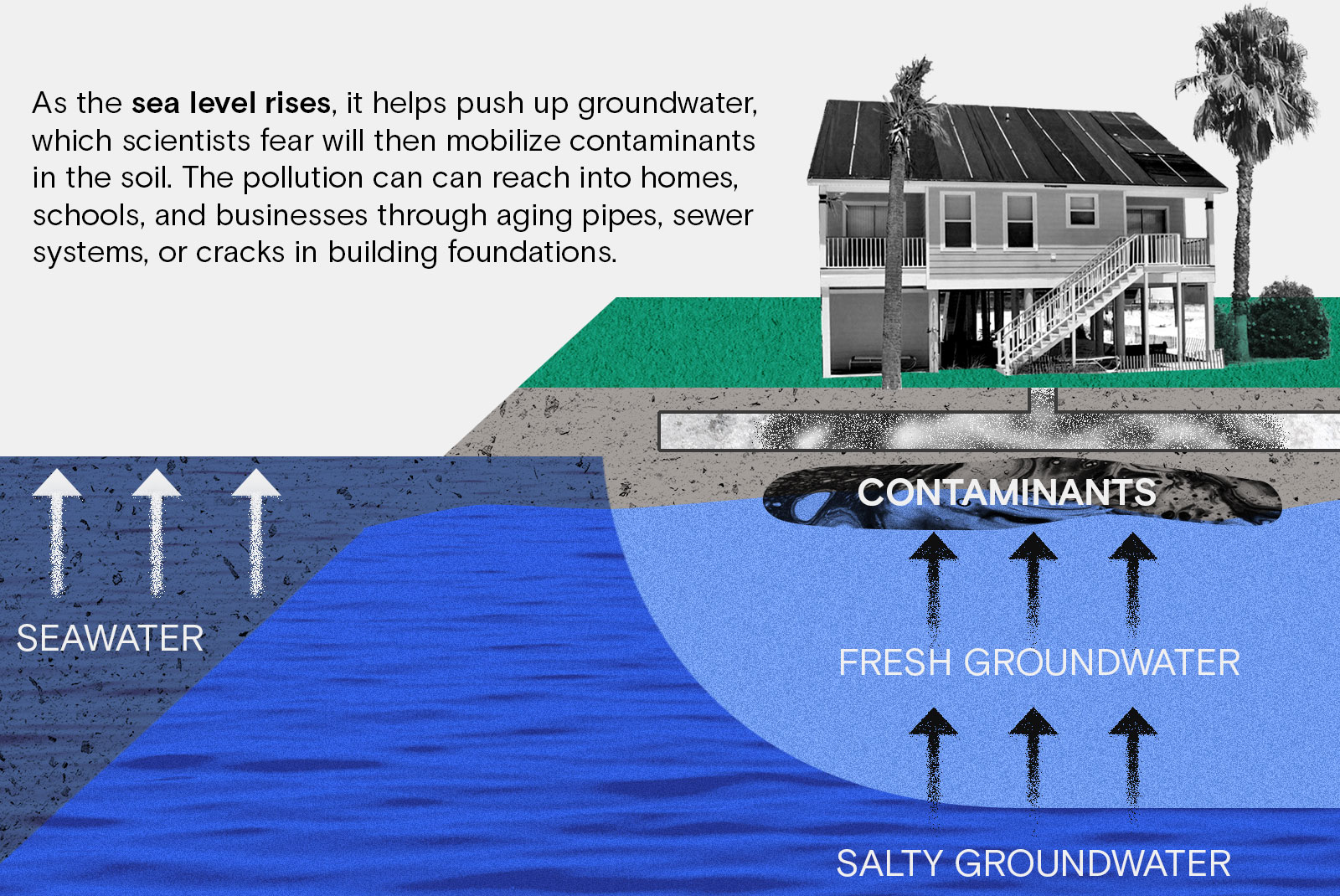
One of many concerning possibilities is that rising groundwater will mobilize contaminants that have been lurking in the soil for years, left behind by industrial and military sites, and allow them to spread, unnoticed, beneath our feet. 

Grist

Phoenix Armenta has been working to educate communities around the San Francisco Bay Area about this threat for years. In February 2020, McClymonds High School, which is not far from where Armenta lives in West Oakland, was forced to close for several weeks after a cancer-causing chemical called trichloroethylene, or TCE, was found in the groundwater below the school. 

West Oakland — a once-thriving Black community decimated by racist urban-planning practices — has been the site of shipyards, car manufacturers, metal smelters, and a former Army base, and is close to a major port and several highways. It’s unclear where the TCE in the groundwater below McClymonds High School migrated from, but NBC Bay Area reported that the industrial solvent could have come from any or all of five polluting sites within a half-mile of the school, including a metal-finishing shop and a former dry cleaner. 

Armenta, who was working for a local environmental justice organization at the time, was deeply concerned, but not surprised, by the news. “That entire school is surrounded by toxic sites and toxic contaminants,” they said. 

Hill said that rising groundwater could have played a role in transporting the TCE from a contaminated site to below McClymonds High School. U.S. Geological Survey modeling shows that groundwater levels in West Oakland are already climbing, meaning more contamination is likely on the move in parts of the city. But it’s difficult to link specific instances, like what happened at McClymonds High School, to changes induced by rising seas — that would require more monitoring wells to track groundwater levels at a granular level and to map the flow of contamination. 

Contaminants that have a gas component, like petroleum products and solvents, are particularly dangerous because they can wind up in the air people breathe. These substances can enter sewage systems through cracked pipes, evaporate, travel up into buildings, and then seep into homes, schools, and workplaces. They can also enter directly through cracks in building foundations.

The California Department of Toxic Substances Control conducted testing and found that TCE was not present in the air inside McClymonds High School. Eventually, the agency allowed the school to reopen, but that doesn’t mean the risk has gone away. As groundwater in West Oakland continues to rise, scientists and activists warn that more contamination will spread, and the risk of hazardous substances seeping into homes, schools, and businesses will grow. “It’s likely to be a hot spot where these things will happen early,” Hill said.

The communities most at risk are disproportionately people of color and people with low incomes. Racist housing policies, including redlining, have pushed Black Americans, in particular, into low-lying areas that flood frequently and neighborhoods surrounded by refineries, factories, and other sources of pollution. “Now those areas have both polluted soil from military or industrial activities, [and] they also have rising groundwater,” Hill said.

Armenta wants to see better monitoring, and they also want to see the toxic sites remediated. “The businesses that have been polluting in this community should be cleaning it up,” they said. If the sites are left unaddressed, rising groundwater will continue to spread contamination and people will get sick.

Beaufort County, South Carolina

Everywhere you look in Beaufort County, South Carolina, there is water. The low-lying coastal county, which sits at the bottom of the state, is laced with streams and rivers, and flanked by marsh and barrier islands. Sea-level rise is obvious here, according to Larry Toomer, who owns an oyster market and restaurant in Bluffton, a fast-growing town in the southern part of the county. On sunny days, water pools in parking lots, and during the full moon, the high tide overtakes roads. 

But Toomer worries about the water he can’t see. 

Similar to San Francisco Bay, sea-level rise in this part of South Carolina is pushing water not only up, but inland, raising groundwater levels miles away from the coast. For the rural communities that dot Beaufort County and rely on residential septic systems, this creep spells trouble. As the water table climbs, it can infiltrate and impair septic systems, from the pipes to the leach fields, causing raw sewage — and the viruses, bacteria, and nitrogen it potentially contains — to spill into nearby waterways. It’s an existential problem for a town like Bluffton, where shellfish harvests fortify the economy and residents spend days on the water and nights roasting oysters over the fire. “Without good water quality, you won’t have good seafood,” said Toomer, who serves on the Bluffton town council as mayor pro tempore.

A working septic system depends on the distance between its underground tank and the groundwater below. Waste flows from homes into a tank, where solids sink to the bottom to be eaten by bacteria and liquids flow into a nearby field. There, the wastewater seeps through the earth, where it’s filtered by soil and digested by bacteria. Eventually, clean water trickles into the groundwater. 

When rising seas narrow the gap between a septic tank and groundwater, waste can’t be properly treated. Toilets back up, and raw sewage oozes into yards, where it can be washed into surrounding waterways. The fumes can cause respiratory problems, while nitrates may spur algal blooms.

Grist

Bluffton is bisected by the May River, which isn’t a river at all, but more like a river-shaped bay, fed by the tides of the Atlantic. In recent decades, extreme rainfall and booming development have eroded the river’s water quality. In 2009, high levels of fecal coliform, bacteria like E. coli associated with human and animal waste, led the state to halt shellfish harvests on the upper third of the river. While fecal coliform aren’t always dangerous, they’re considered an indicator for water quality. 

Kim Jones, Bluffton’s watershed resilience manager, said the city has surveyed septic systems, looking for failing tanks. As of last summer, they’ve only found five. “But we continue to get these positive hits,” Jones said, indicative of bacteria being swept into the river when tides below ground encounter groundwater.

Around one in five households in the U.S. rely on septic systems to treat wastewater, meaning they’re not connected to a central public sewer. Rising groundwater will challenge systems up and down coastal areas, particularly lower-elevation states like Florida and Virginia. Communities need to plan for this now, said Molly Mitchell, a coastal researcher at the Virginia Institute of Marine Science. “Houses built today, in 30 years, will be in a very different environment,” she said. “Being aware of it could help reduce a lot of future impacts.”

Bluffton is in the process of phasing out septic systems and constructing a community sewer system — a major investment that requires building sewer lines and hook-ups to each home. But many communities can’t afford such projects, or residents may not be willing or able to pay new monthly bills on top of connection fees. Other alternatives — like community septics or above-ground systems — aren’t cheap, either.

Meanwhile, an effort is underway to assess how sea-level rise affects groundwater throughout Beaufort County. Scientists are measuring the height of the water table and how it changes with the tides. That can be used to model what will happen as oceans keep rising or rainfall intensifies. Already, residents complain of pumping out waterlogged leach fields. Alicia Wilson, a project scientist from the University of South Carolina in Columbia, expects that will only become more frequent. “The question is,” she said, “when do things fall apart?”

Such data collection isn’t widespread but will be crucial for helping towns prepare for the future. Rising groundwater is “out of sight, out of mind,” Jones said. But the tides underfoot shape the health, economy, environment, and very essence of her town. “It’s going to be an increasing issue for a lot of communities.”

Vermilion River, Illinois

Inland, far from America’s coastlines, climate change is driving a rise in groundwater levels through an increase in rainfall. Heavy precipitation — particularly when it comes over a short period of time — can cause lakes and rivers to flood and saturate the ground directly. That excess water then percolates down through the soil, raising the groundwater below, explained Mark Hutson, a geologist who previously worked for the Illinois Environmental Protection Agency. 

In the Midwest, this change is already underway. As the climate has warmed, the frequency of extreme rainfall events in the region has doubled since the early 1900s. In some places, the resulting rise in groundwater levels from this extreme rainfall — known as “groundwater flooding” — is temporary, receding once the earth is able to absorb the extra moisture. Elsewhere, like in the Great Lakes, steadily rising water levels — which could be up to 17 inches higher on average by 2050 — can permanently change the depth of the water table. 

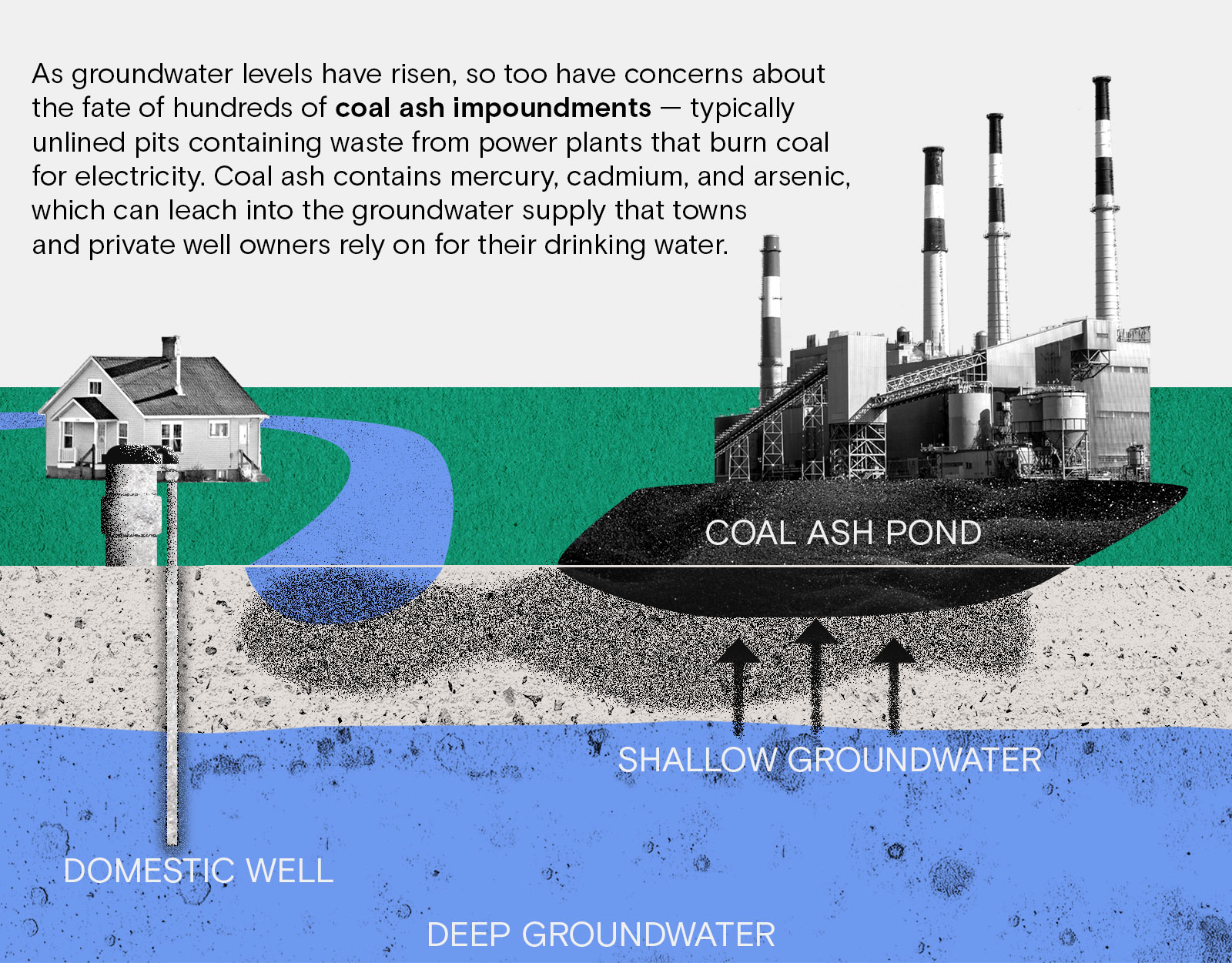
As groundwater levels have risen, so too have concerns about the fate of hundreds of coal ash impoundments — typically unlined pits containing waste from power plants that burn coal for electricity. 

Though these dump sites are scattered around the country, they’re concentrated in the Midwest and South. Coal ash contains contaminants like mercury, cadmium, and arsenic, which can leach into the groundwater supply that towns and private well owners rely on for their drinking water. It can also pollute nearby waterways, poisoning plants and wildlife. A 2019 investigation by the Environmental Integrity Project and Earthjustice, which examined 265 coal-fired power plants that monitored the environment around their coal ash dump sites, found that more than 90 percent had already contaminated nearby groundwater with these heavy metals. 

Grist

At the Vermilion Power Station in central Illinois, which was operated by the Texas-based Dynegy corporation until its closure in 2011, three unlined ponds contain over 3 million cubic yards of coal ash, which has already contaminated the groundwater with boron, arsenic, and sulfate, testing by the Illinois EPA found. And that groundwater has already begun leaching toxins into the nearby Middle Fork Vermilion River; according to a 2018 report by the Illinois nonprofit Prairie Rivers Network, “the riverbank nearest the coal ash is stained brightly orange and has an oily sheen.” The organization has pointed out that groundwater flooding after heavy rains in this region could carry even more pollution from the Vermilion site.

In 2015, hoping to address concerns about groundwater pollution, the U.S. Environmental Protection Agency adopted new regulations that required most of the country’s coal plants to stop sending waste to unlined pits and begin closing them entirely. (New coal ash waste has to be sent to lined sites that don’t cut into the aquifer). 

That usually meant capping them with a hard shell to prevent rainfall from getting in — but the rules said nothing about the threat from below, said Andrew Rehn, a water resources engineer with the Prairie Rivers Network. 

“If you have an ash pond, and it’s got a cap on it, and it starts raining, that cap does prevent that rain from getting in the ash,” Rehn said. “And then you say, ‘Oh, look, it works.’ [But] you’ve ignored groundwater.” 

The rules also exempted hundreds of coal ash sites that weren’t actively receiving new waste, but which contain as much as half of the coal ash ever produced in the U.S. Groups like Earthjustice have sued the EPA to force the agency to regulate these so-called “legacy” impoundments. 

Under the Biden administration, the EPA has started to look more closely at how groundwater affects coal ash sites. Last year, the agency created a list of 163 coal ash sites with waste potentially located below the water table. Nearly half of these are located in just four states: Illinois, Missouri, Iowa, and Indiana. 

Dealing with the problem would require moving coal ash to a landfill that’s “high and dry,” Rehn said. But sites like the coal plant in Waukegan, Illinois, plan to cap and monitor the coal ash instead, despite protests from local communities. 

“​​This is a very urgent issue, because the closure is required, the closure is happening,” said Jenny Cassel, an attorney with Earthjustice who worked on coal ash cases. “And in some places, it’s happening in ways that are not going to alleviate the problem.”

Across the United States

This slow-moving crisis is popping up in communities across the U.S., but there are some common steps that can be implemented anywhere to help stem the spread of contaminants through climate-driven groundwater rise. Hill said one of the most important for government agencies and municipalities to take is simply more monitoring — in particular, at “maximum groundwater moments,” such as a few days after a heavy rain or at a high tide. Currently, sampling tends to be so infrequent that it doesn’t catch the movement of the contamination. 

“There are ways that we could be sampling and trying to catch the maximum risk, instead of kind of smoothing it all over with sampling that isn’t related to rain events or tide events,” Hill said. “Ideally, we’d help local people be involved in that sampling so that they know what’s happening in their own neighborhoods.”

Understanding, though, has to be paired with action. Along with taking broader steps to address climate change and its impacts, agencies need to ensure polluters clean up toxic sites, rather than just capping them and hoping for the best. 

Mitchell, the coastal researcher in Virginia, hopes that officials will use such data sets to more proactively address groundwater rise. 

“I think sometimes when we talk about issues related to changing environments, it can seem overwhelming or depressing,” she said. “But I really think the important thing is that when we have good information about the future, we make better decisions.”


This article originally appeared in Grist at https://grist.org/article/what-it-means-groundwater-is-rising/.

Grist is a nonprofit, independent media organization dedicated to telling stories of climate solutions and a just future. Learn more at Grist.org

Expect a “scorched-earth defense”: Legal experts weigh in on Trump indictment

As news of former President Donald Trump’s indictment spread across the media landscape early on Thursday evening, a swarm of legal analysis began buzzing steadily on every available social media platforms. Though Trump has reportedly been indicted on felony charges by a Manhattan grand jury over his payment of hush money to porn star Stormy Daniels, the charges remain under seal by prosecutors from the office of Manhattan D.A. Alvin Bragg, and we may not learn their exact nature for several days.  

With so many questions at play, the scholars, analysts and attorneys who haunt #LegalTwitter jumped into action nearly as quickly as the press. As Law Dork’s Chris Geidner summed it up: 

Bragg’s investigation is one of many into Trump activities, of course. And in his legal analysis of this one for The Nation, Elie Mystal advises prudence. 

“This isn’t getting Al Capone for tax evasion; this is getting Al Capone for illegally serving alcohol at his underground poker game. It’s minor, but it’s also obvious,” Mystal writes. He cautions that “Bragg appears to be arguing that the statute of limitations paused while Trump was president and living out of state. That’s… a theory, but not necessarily a good one, and certainly not one that has been tested enough to know how it’s going to hold up in the courts.”

A.G. Hamilton, a pseudonymous attorney who writes for National Review, echoed Mystal’s caution, adding that a relatively weak charge with no certainty of conviction may end up helping Trump politically. 

“The NY case is by far the weakest one that Trump faces. An indictment for something minor and that he is likely to beat is obviously a gift to Trump. It will help fundraising, rally support, and make people more skeptical of the other cases,” Hamilton wrote in a Thursday tweet. 

In an appearance on MSNBC, Former federal prosecutor Joyce Vance hinted at likely strategies to emerge from Trump’s camp. 

“We are all so familiar with Donald Trump’s tactics — with his belief that he’s above the law, with his admonition to people that they should not respect the law when it’s his own personal fortunes that are at stake,” Vance said. 

As several legal experts pointed out, Trump’s defense team will likely seek drag the process out for months before any potential trial begins, and will of course pursue any possible avenues to get the charges dismissed. 


Want a daily wrap-up of all the news and commentary Salon has to offer? Subscribe to our morning newsletter, Crash Course.


In the meantime, as pointed out by NBC News legal analyst and former federal prosecutor Glenn Kirschner, “what we do know is that never again can anybody say ‘there’s no precedent to indict a former president of the United States for his crimes,’ because now there is. And that, my friends, is a good thing.”

In his column for MSNBC on Thursday, Kirschner predicted more indictments to come. 

“Trump’s legal team undoubtedly will wage a scorched-earth defense. And outside the court of law, we can expect Trump loyalists to wage battles in the court of public opinion, most likely deploying both facts and alternative facts. America cannot yet breathe easy, as justice is still well off on the horizon,” he wrote.

“Another likely consequence of this precedent-setting indictment is that it increases the odds that additional indictments will follow.”

Gwyneth gets a dollar: A Utah jury concludes Paltrow is not liable, ending skiing collision trial

Where is Billy Eichner when we need him most?

After more than a week of testimony from medical experts, eyewitnesses, associates of the plaintiff and, most brilliantly of all, the defendant, an eight-person jury decided that actor, vajayjay candle merchant and Goop CEO Gwyneth Paltrow is not liable for the $300,000 in damages sought by retired optometrist Terry Sanderson related to a 2016 skiing collision at a Utah resort.

Additionally, jurors deemed Sanderson to be “100 percent” at fault in the crash, awarding Paltrow damages in the amount of – let’s yell it together for Billy – A DOLLAR, as the defendant requested, plus attorney’s fees.

The glamorously ridiculous Sanderson v. Paltrow, which has been live-streamed daily since it began on March 21, provided a diversionary glimpse into the lifestyles and fashion sense of the rich and famous and the not-so-rich but in some ways perhaps equally entitled.

The verdict ends a litigious odyssey that began in February 2016, when Paltrow and her children, along with then-boyfriend Brad Falchuk and his children, were vacationing at the exclusive Deer Valley resort. While enjoying a lesson on the beginners’ Bandana ski run, Paltrow collided with Sanderson.

He alleged that she plowed into him, causing several broken ribs and a concussion. But the jury sided with Paltrow’s account, in which she insisted that, in her words, he skied “directly into [her] f**king back.”

“I apologize for my bad language,” she told the court during her testimony last week.

Sanderson originally brought the suit in 2019, claiming that slamming into Paltrow caused him “permanent traumatic brain injury, four broken ribs, pain, suffering, loss of enjoyment of life, emotional distress and disfigurement.” He originally sought $3.1 million in damages from the actor, the resort and one of its ski instructors, Eric Christiansen.

A year later, in 2020, a state judge dismissed nearly all of the original claims save for the accusation that Paltrow had been negligent. Sanderson’s legal team reduced the sought damages to $300,000.

However, according to CNN, on Thursday his attorney asked the jury to consider awarding Sanderson $3.2 million in consideration of his brain injury and life expectancy. As a reminder, the defendant previously claimed to no longer take joy in wine tastings and “is no longer charming.”

It took jurors two and a half hours to be like, “Nah,” and order Sanderson to hand over a crisp Washington to Apple’s mother as she apparently whispered in his ear, hopefully as the golden talisman that we imagine hangs around her neck preternaturally glowed,  “I wish you well.

Thus concludes what may end up being the most fabulously dumb legal spectacles we’ve enjoyed in a long while and one of the best things to ever happen to the recently resurrected Court TV.

“Part of him will always be on that mountain,” Sanderson’s attorney told the jury. Us too, friend. Us, too.

“Communist-level s**t”: Trump and followers freak out over indictment; Dems celebrate

Former President Donald Trump was indicted on felony charges on Thursday afternoon by a Manhattan grand jury over his payment of hush money to porn star Stormy Daniels, as reported by the New York Times and numerous other media outlets. The charges, filed by prosecutors from the office of Manhattan District Attorney Alvin Bragg, are not yet known but should be revealed in coming days. 

Reactions to the news quickly poured out across Twitter, with Republican outrage and Democratic celebration erupting late in the day. Within minutes of the news breaking, Trump posted a lengthy statement on his Truth Social account, which appeared to have been written in advance. The ex-president described the indictment as “political persecution and election interference” and suggested it would help him win the 2024 presidential election.

“Our movement and our party — united and strong — will first defeat Alvin Bragg, and then we will defeat Joe Biden,” Trump wrote

Trump’s audience didn’t seem to hear him, though. 

“I’m standing outside the Manhattan D.A.’s office in New York City right now and there is literally no one here except police and the media. No protesters. No Trump supporters. Pretty much silence. Watch this depressing crowd size below,” tweeted Biden delegate Victor Shi. 

As noted by NBC News’ Ben Collins, Donald Trump Jr. took to his podcast when he heard the news.

“Apparently, Soros-backed Manhattan D.A. Alvin Bragg is indicting my father. Let’s be clear folks: This is Communist-level shit. This is stuff that would make Mao, Stalin, Pol Pot blush,” the younger Trump said.

Republicans on the House Judiciary Committee immediately lamented Trump’s arrest on the panel’s official Twitter account. 

“This happened in America. Sad day for our country,” the committee said.

Sen. Thom Tillis, R-N.C., reportedly called the indictment into question, telling Fox’ Chad Pergram, “This is the same district attorney who is notorious for letting violent criminals off the hook.” (In fact, violent crime remains near historic lows in New York City.)

Even Fox News hosts appeared shocked at the announcement. Audible gasps could be heard during the program as word reached those in the studio. 

As first observed by Media Matters’ Alicia Sadowski, Fox host Jesse Watters took an ominous tone reacting to the news.


Want a daily wrap-up of all the news and commentary Salon has to offer? Subscribe to our morning newsletter, Crash Course.


“I’m angry about it. I don’t like it. The country’s not going to stand for it. And people better be careful, and that’s all I’ll say about that,” Watters told audiences. 

Rep. Ted Lieu, a California Democrat and former Air Force prosecutor, called on others to allow the judicial system to do its job. 

“Indicting a former President is a horrible precedent; the only precedent worse than that is to not indict Donald Trump if there is evidence that he committed crimes,” Lieu said in a tweet. 

Meanwhile, the advocacy group Citizens for Responsibility and Ethics in Washington pulled no punches, calling Trump the “most corrupt president in American history.”

Look at him: Why can’t straight guys acknowledge male beauty without freaking out?

Straight guys have a hard time when women evaluate men’s appearance.

I’m all for directing an eye roll at the rich-old-dude-lands-much-younger-woman currency exchange, which Rhonda Garelick explores in her recent New York Times piece on 92-year-old Rupert Murdoch‘s bartering of his wealth and power for the (relative) youth and beauty of a woman 26 years his junior, Ann Lesley Smith. (Nothing against Smith, but as 66-year-old women go, I’m not sure how one could improve on recent Murdoch dumpee Jerry Hall.) Garelick points out that reversing the genders in this equation would be fairly unthinkable. But there’s another, related double standard lurking just outside the frame. It’s not just that men’s appearance isn’t weighted as heavily as women’s; it’s that the subject of men’s looks is so often off the table.

Some months back, while I was noodling around at YouTube indulging a long overdue (I’m in my 50s) obsession with Pink Floyd, I came across this year-old exchange in the comments section of a video about the David Gilmour-Roger Waters battle royal.

Reese Morgan: Waters got much better looking the older he got. Gilmour aged OK, but it’s kind of odd that Waters now looks much more appealing. Years ago Gilmour was the pretty one. I’m a shallow person.

Professor K: Yeah seems like it . . . it’s not going to get you very far in life. I bet your [sic] alone now . . [.] if not, you will be. Being like the way you are . . . smh.

Blade: Who the f**k is talking about looks and who cares.

Tony B: Definitely agree with that last part.

After I read this exchange, my first thought was, Wow: I’d been thinking the same exact thing as Reese Morgan! (Possibly shallow remark: How is it that I hadn’t noticed until recently how beautiful the young David Gilmour was? And how unfair is it that rancorous Roger is the one who got to keep his hair?) My second thought was, Hey, Professor K: Isn’t your level of righteous indignation a little out of balance with the matter at hand? I mean, why cut Reese Morgan to the quick when she already self-deprecated herself (“I’m a shallow person”) out of a reprimand?

I’m going to assume that Reese Morgan is a woman based on her Witherspoon-conjuring first name and her inclination to self-deprecate, and I’m going to assume that Professor K is a straight man based on his radioactive overreaction to Reese Morgan’s comment. If I’m right, this reinforces something that I’ve long suspected: generally speaking, straight guys have a hard time when women evaluate men’s appearance.

Evan DandoEvan Dando (Ebet Roberts/Redferns/Getty Images)
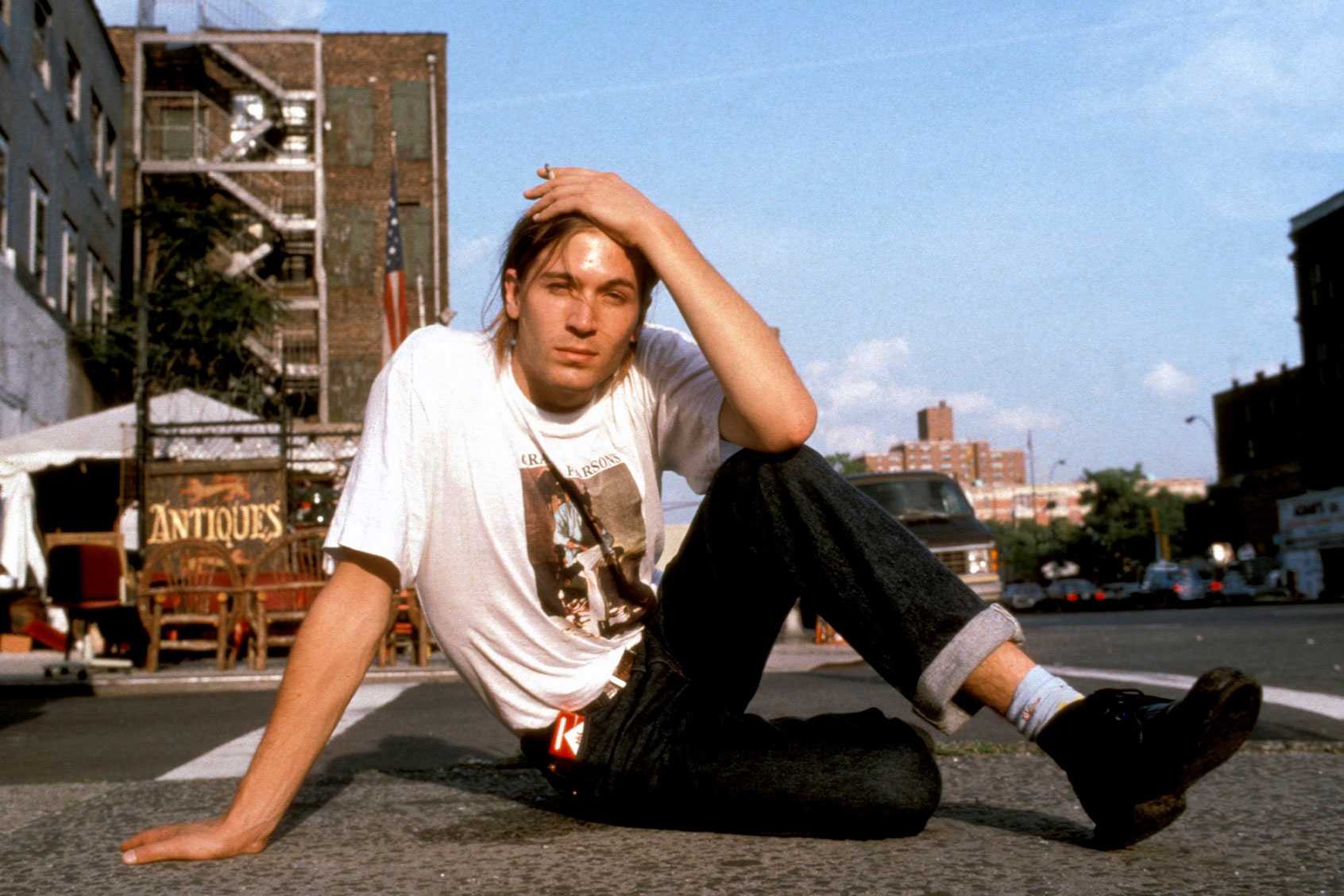
Maybe you’re old enough to remember how much grief Evan Dando – the Lemonhead with the young-Gilmourian looks and locks – got from men during his brief cheesecake period in the 1990s. Jeff Fox, who created the zine “Die Evan Dando, Die,” recalls in his 1994 essay “I Accidentally Made a Popular Zine” that in its pages, “I quipped that ‘Come on Feel the Lemonheads’ was actually a milestone for the music industry, ‘as it marked the first time that an album had been marketed exclusively on the merit’s [sic] of a band member’s cheekbones.'” Oh, I think albums had previously been marketed exclusively on the merit’s merits of a band member’s cheekbones, provided the band member was female.

The sudden achievement of female beauty isn’t the punch line; it’s the money shot. 

Aside from the odd scene filmed in a girls’ school bathroom for a teen movie, I count no examples of straight young women pillorying beautiful women for their looks. Why not? Because at the dawn of time, it was apparently decided that there’s poignancy, not yuks, to be found in a woman’s sincere attempt to make herself more attractive. Think of every female-centered fairy tale, makeover show and sitcom in which a skittish librarian type finally ditches her glasses and lets her hair down. The sudden achievement of female beauty isn’t the punch line; it’s the money shot. 

This just isn’t so with men. I was recently in New Orleans, where I was on a walking tour with a woman and her husband; he was wearing a T-shirt that read, “It’s not easy being my wife’s arm candy.” He was actually a pretty good-looking guy, but the joke worked because of the implicit humor in a man having a purely decorative function. If an equally attractive woman had worn a shirt that read, “It’s not easy being my husband’s arm candy,” it would have come across as bragging, no?

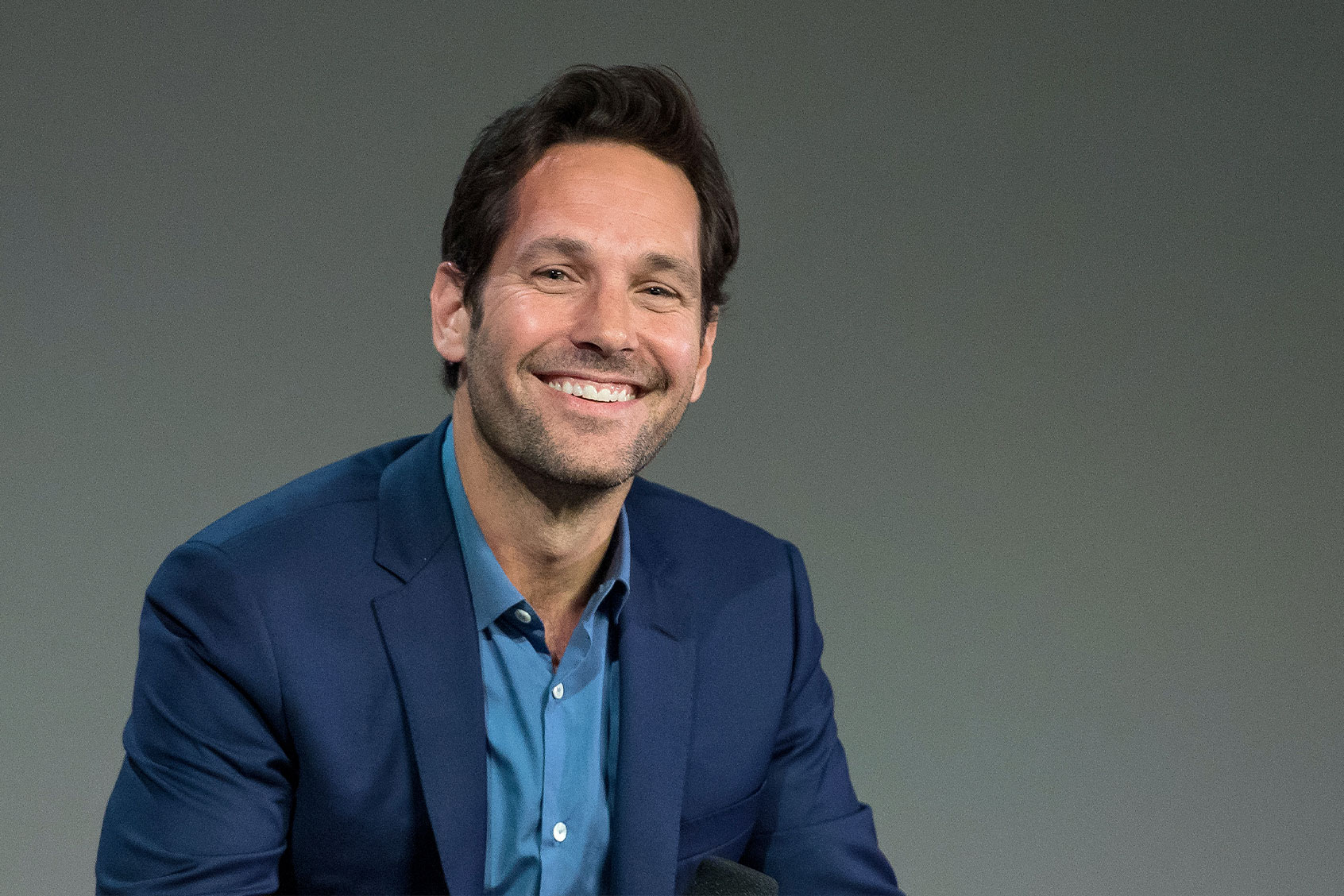
Likewise, a year or so back Stephen Colbert did a skit with Paul Rudd — People’s Sexiest Man Alive of 2021 — about what it takes to make it to No. 1. The bit was funny enough, but I was aware while watching it that it wouldn’t have worked at all if Colbert had been putting a comely actress through the paces. This time the implicit humor was the prospect of a guy (Rudd) auditioning for the sexiest-man job with a straight face — the face of someone fighting for a distinction that he believed had meaning. When women win beauty contests, it’s not considered amusing; it’s considered, you know, normal.

Actor Paul RuddActor Paul Rudd (Mike Pont/WireImage/Getty Images)


Well, of course straight men are going to want to laugh at the prospect of fetching actors like Paul Rudd and Chris Evans, People’s most recently crowned Sexiest Man Alive, being sex magnets for women: if Rudd’s and Evans’s quest for beauty is declared risible, then they’re not a threat, right? I suspect this is why Reese Morgan’s comment rankled Professor K so much: he couldn’t laugh at Gilmour and Waters – they weren’t posing for dips**t People magazine; they were just going about their lives – so he was forced to face the truth, which is that straight women, like straight men, register beauty in the opposite sex, and like men, we usually do it without cracking up.


Want a daily wrap-up of all the news and commentary Salon has to offer? Subscribe to our morning newsletter, Crash Course.


It’s hard to imagine a woman belittlingly decorating her office with pictures of a nonagenarian Rupert Murdoch in a bathing suit, as Garelick reports that Tucker Carlson has allegedly done with pictures of a swimsuit-clad House Speaker-era Nancy Pelosi. But let’s suppose, in a different approach to demolishing the double standard surrounding male and female appearance, we could get straight men, like gay men, to confront male beauty without smirking (while also somehow reassuring them that this won’t make everyone think they’re gay). Might this be their path to understanding the female experience of being eternally physically compared? Until that happens, here’s what I most want to say to Professor K and anyone else who is appalled when women share their thoughts on a man’s appearance: Make like a woman and toughen the f**k up. As for you, Reese Morgan: Keep the comments coming. It’s going to get you very far in life, being like the way you are. Also: Your You’re not alone.

Trump indicted in Manhattan over Stormy Daniels hush-money payment

According to multiple media reports, a Manhattan grand jury has voted to indict Donald Trump on charges related to the 2016 hush-money payment to adult film actress Stormy Daniels. Trump will become the first former president in American history to be formally charged with a crime.

Though the specific charges filed against Trump are not yet known, the felony indictment was filed by prosecutors with the Manhattan district attorney’s office shortly before 5 p.m. Eastern time on Thursday. Shortly after 7 p.m., a spokesperson for Manhattan District Attorney Alvin Bragg confirmed the indictment — filed under seal — and said the DA’s office had begun negotiating Trump’s surrender. 

“This evening we contacted Mr. Trump’s attorney to coordinate his surrender to the Manhattan DA’s Office for arraignment on a Supreme Court indictment, which remains under seal. Guidance will be provided when the arraignment date is selected,” the spokesperson said in a Thursday tweet.

In the days ahead, Trump will likely be compelled to appear for arraignment at the Criminal Courts Building in lower Manhattan.

Thursday’s apparent indictment follows a years-long investigation into former Trump fixer and lawyer Michael Cohen’s $130,000 wire payment to Daniels amid the 2016 presidential campaign. Cohen later testified that Trump reimbursed him for the payment. The investigation began under a previous Manhattan DA, Cy Vance, and has continued under Bragg, who has at times been the object of speculation that he was reluctant to seek a criminal indictment.

Now that the indictment has been filed, and Bragg’s office has begun taking steps toward Trump’s surrender and arraignment, it is likely that special consideration will be extended to such a high-profile defendant, But the specifics remain to be seen. Trump may or may not be handcuffed during the arrest process, and may or may not be briefly incarcerated after his arrest. Throughout the process, he will be continuously accompanied by armed Secret Service agents, who are required to protect him at all times. Since these charges clearly involve nonviolent felonies, Trump will likely be released on his own recognizance while awaiting trial.

This indictment has been widely anticipated, although its timing comes as a modest surprise. Many observers believed the Manhattan grand jury was likely to adjourn for several weeks without voting on an indictment. Trump himself declared on Truth Social earlier this month that he would soon be arrested and called for his supporters to “protest” the indictment. Critics quickly drew comparisons between Trump’s call for protest to his rhetoric ahead of the deadly Jan. 6 Capitol riot. On his Truth Social platform, Trump pushed back on calls from allies for his supporters to remain “peaceful,” accusing Bragg and the “radical left” of destroying the country.

Bragg’s strategy in the case has prompted some concern among legal experts. Falsifying business records, as Trump allegedly did by reporting the payment to Cohen as a legal expense, is a misdemeanor in New York, but prosecutors may escalate to felony charges if they can show “intent to commit or conceal a second crime,” in this case a violation of New York campaign finance laws. But legal experts say the legal theory is largely untested and that charges could be struck back down to a misdemeanor at a pretrial hearing.

Vance, the previous district attorney, launched the probe into the hush-money payment to Daniels before it sprawled into a larger investigation of Trump’s business practices. After taking over the office, Bragg initially appeared to back off the hush-money probe as he successfully prosecuted the Trump Organization and its longtime CFO Allen Weisselberg for tax crimes. Bragg restarted the hush-money probe and empaneled a new grand jury after the conviction.

Trump could face up to four years in prison if he is convicted of a felony. 

Trump’s attorney Joe Tacopina has argued in television appearances that the payment was intended to avoid embarrassment for Trump and his wife Melania and was unrelated to the campaign. He has also claimed that Trump was the “victim” of an “extortion” attempt by Daniels. Trump attorneys have also attacked Cohen’s credibility, citing his false claims about the payment while he still worked for Trump.

Some legal experts have expressed doubt that Bragg can convict Trump in the case.


Want a daily wrap-up of all the news and commentary Salon has to offer? Subscribe to our morning newsletter, Crash Course.


“This case is a joke, frankly, and I’ve litigated against that office for 33 years,” longtime New York criminal defense attorney Jeffrey Lichtman, who once represented Mexican drug lord El Chapo, told Rolling Stone. “I don’t think that case is winnable.”

Randy Zelin, a former criminal defense attorney and prosecutor, also told the outlet he does not believe the “felony charge will stick.”

“I think that the district attorney’s office in New York County is running a great risk of diluting the strength of other potential cases brought by other prosecutors, because this is a weak case — legally, it is a weak case,” he said.

But other legal experts pushed back on that argument. 

“It doesn’t make it a weak case if you look at it from the perspective of a prosecutor — you bring your case when it is ready,” former U.S. attorney Chuck Rosenberg told MSNBC. “So it would be a political decision to bring it too soon for some other purpose or to wait for some other purpose. If the case is ready, and as the elected prosecutor in Manhattan, you believe it is an appropriate charge, you bring it. It may be less serious than the other cases out there, but that doesn’t make it weaker.”

Terri Gerstein, a former prosecutor in Bragg’s office, office, said that Bragg would never bring the case unless he expected to win.

“Alvin is not someone who would bring a weak case,” Gerstein told Vanity Fair. “He follows the law and the facts without fear or favor.”

How abortion bans are impacting pregnant patients across the country

Nine months after the Supreme Court overturned Roe v. Wade, ending nearly 50 years of federal protection of abortion rights, the impact of the landmark ruling known as Dobbs v. Jackson Women’s Health Organization continues to ripple across the nation.

In Dobbs, the Supreme Court voted 6-3 that the U.S. Constitution does not confer a right to abortion.

The ruling essentially divided the nation into two territories: states where people have access to abortion care and states where most or all people are unable to obtain an abortion, even if their lives are at risk. An estimated 23 million Americans live in states that tightly restrict access to abortion. A few states, such as Tennessee, outlaw the procedure with no exceptions, forcing doctors to choose between risking their freedom and saving a pregnant patient’s life.

Since the Dobbs ruling on June 24, ProPublica has chronicled the nationwide fallout. Our stories have explored new concerns about data privacy, battle lines between blue and red states and the increasing popularity of civil lawsuits that seek to punish people for obtaining abortions.

A recent investigation by reporter Kavitha Surana explored the complicated story of a Tennessee woman who faced a life-threatening pregnancy after doctors decided they couldn’t risk prosecution to provide an abortion. ProPublica has also explored the harm created by parental involvement laws, on the books in many states long before the Dobbs ruling.

In a series of live events, ProPublica has also interviewed the nation’s top legal and medical experts about what they are seeing on the ground following the Dobbs ruling and what they expect going forward.

Last week, ProPublica talked to two leading experts on how the battle over abortion is impacting people in the most restrictive states and how legal challenges are likely to play out across the country. More than 1,400 people signed up to hear our live discussion with law professor Mary Ziegler and Tennessee OB-GYN Dr. Nikki Zite.

Ziegler is the Martin Luther King Jr. professor of law at the University of California, Davis School of Law. She is one of the world’s leading historians of the U.S. abortion debate and the author of six books on the law, history and politics of reproduction in the United States. Zite lives in Tennessee and is professor and vice chair of education and advocacy in the department of OB-GYN at the University of Tennessee Graduate School of Medicine.

Ziegler and Zite presented their personal perspectives on this issue during our discussion, and their thoughts do not reflect the positions of their institutions. This interview was edited for length and clarity.

Wyoming recently became the latest state to outlaw medication abortion. How do you see the criminal legal landscape playing out?

Ziegler: We’ve seen a rising trend within the anti-abortion movement of people who identify themselves as abolitionists. And they essentially argue that if the movement is serious that a fetus or an unborn child is a rights-holding person, then it would be logical to punish women too. The most recent manifestation that people may have heard about was in South Carolina. There were over 20 lawmakers sponsoring a bill that would treat abortion as murder and potentially subject women to the death penalty for having abortions. So far, the mainstream consensus within the anti-abortion movement that punishing women is a bad idea politically and morally is holding up, but it’s fragile.

We have the wrongful death lawsuit in Texas, in which a man is suing three women for allegedly helping his now-ex-wife obtain an abortion. Nikki, could you tell us about your experience in Tennessee?

Zite: The way our law is written, ending any pregnancy is illegal. Immediately, several of our outpatient abortion clinics closed. That not only had the effect of making abortion more challenging to access for people who needed that care, but it also made it harder for those of us who teach abortion to the next generation of OB-GYNs. Then we had all the unintended consequences: the cases like ectopic pregnancy, the cases of inevitable but not complete miscarriage, the cases of that ambiguous “How close to death does she need to be for it to meet the standards of protecting or saving her life?” It became this complicated legal situation where physicians not only felt like they had to make medical decisions, they then had to run it by hospital legal or a criminal attorney. We’ve lost a lot of physicians, and we don’t know whether or not medical students will want to train in states where they’re going to have restrictions on the type of care that they can learn.

I guess you’d call it a brain drain of doctors in this field who are leaving states like Wyoming?

Zite: There’s only a couple of OB-GYNs in some of those states. So if they leave, you really have these OB deserts.

Mary, you’ve mentioned fetal personhood laws. Does establishing fetal personhood make a pregnant person who has an abortion a murderer under the law?

Ziegler: There are proposals emerging on the right that we need to make birth free [of charge]. Georgia has its anti-abortion law requiring certain forms of child support during pregnancy. Then on the other hand, you have people saying if equal treatment is really the name of the game, then that requires murder prosecutions for people who have abortions.

So far it’s mostly been emerging in state legislators up to a point. We’ve seen it in the wrongful death lawsuit you mentioned. One question you might have is: Why bother with a wrongful death lawsuit? They wanted to say that if you provide someone else with abortion pills, you’re an accomplice to murder or you are a murderer, and that’s a personhood argument. We’re going to see it crop up more, and eventually the end game is a case brought to the U.S. Supreme Court. Whether they lead to prosecutions of women or just to nationwide abortion bans remains to be seen.

Nikki, you’ve been part of working on a bill to modify Tennessee’s law to create clear exceptions for maternal health care. Can you tell us about that effort and where it stands now?

Zite: Not in a good place. We were sticking with the things we could all agree on. The amendment passed 8 to 2 out of committee. Immediately, the right-to-life got all their members to call legislators and started threatening the legislators with losing their “ranking.” Unfortunately, we now have a very watered-down amendment. I don’t think that physicians are going to feel that it gives them much more leeway to provide lifesaving care without being criminalized.

What are the problems with policymakers trying to determine what constitutes a medical emergency?

Zite: The idea that it has to be a medical emergency is the first problem. We should be able to prevent an emergency, not just treat an emergency. The overwhelming evidence for most of these cases is that it doesn’t improve the outcome for the pregnancy to wait. That’s why laws for abortion have been liberalized in places like Poland, South and Central America and Ireland. Women died because they were made to stay pregnant until there was no longer a heartbeat and they got infected or bled. We don’t want to go back to that in the United States. Legislators don’t seem to understand that’s the inevitable outcome of what they’re forcing us to do.

I have had a question about that as a journalist. How are we going to know whether more people are dying or suffering measurable harm in states that have banned abortion?

Zite: And how long is it going to take us to get that data? When we look at the state and maternal mortality reports, they’re not always that accurate, and these reviews usually were two or three years behind.

Mary, you recently wrote that the court does not get the final word even on the meaning of its own important decisions. Can you talk about that?

Ziegler: I think what we saw with Roe, the judges pretty clearly thought that they were settling this and that Roe was going to mean abortion was a thing between a doctor and a woman. I think the court in Dobbs is trying to say the same thing: that history and tradition, in the court’s view, would not have recognized the right to abortion in the 19th century, and that’s the end of it. We’re already seeing Dobbs emerging as a symbol of things the Supreme Court didn’t want it to be. We’ve seen a lot of poll data documenting a really precipitous decline in trust of the Supreme Court and Dobbs being the most visible symbol of that decline. I think the court often holds itself out as having the last word on these constitutional struggles when it can’t.

One of our readers asks: What can people who live in states that still protect abortion rights do to safeguard maternal health for themselves and others in states that ban abortion?

Zite: I’m feeling pretty discouraged, frankly. I think it’s going to take ballot initiatives. We don’t have that option in Tennessee, but there are other states that do. Normally you say state elections are important, but when they’ve been gerrymandered so much, I don’t see things getting better in Tennessee for decades. I’m focusing at a federal level.

Ziegler: Based on what’s going on now in the federal courts, if you’re living in a state where abortion is legal, you should not take for granted that that will remain the case. The mifepristone case we’d been talking about in Texas could, depending on how the FDA responds, make it impossible for people in a state like California to have a medication abortion. We’ve seen some voices emerging essentially saying, “Look, even if you define yourself as pro-life, do you really want to spend a lot of taxpayer money enforcing criminal abortion laws?”

There’s a notion that medical exceptions to abortion bans give people appropriate access to the medical care they need. Nikki, can you talk about that a little bit?

Zite: I think that a lot of people think, well, if we add an exception, that’s going to get access for some. But access for some is not actually helping the majority. The type of care I provide in a hospital setting is less than 1% of abortion care. Without abortion care, we’re going to see maternal mortality go up. We’re going to see people stay in abusive relationships.

Dr. Zite, how are medical schools deciding what procedures are taught, and what is their legal standing?

Zite: Currently about half of the residency training programs are in banned states. It is a requirement to graduate from a residency and become a board-certified OB-GYN to be able to perform abortion care. We’ve been struggling in Tennessee to figure out how we’re going to get that training for our residents. Will it actually make it harder to become board-certified?

So you have some doctors leaving these states, training that is difficult to access and people who will be coming to emergency rooms needing abortion care in an emergency?

Zite: That’s the situation that I think is very poorly understood. I had a resident when I first got to the University of Tennessee that had opted out of all abortion training before I arrived. About three months before she finished training, we were called down to the trauma bay and a young woman who was about 16 weeks pregnant had been in a very bad car accident. There was still a fetal heartbeat. We did the case together, and afterward the resident had this moment of realizing “I’m going to be on my own in three months.” What happens if this patient comes into my ER? I am the person who should be able to save her life. We need to be able to train doctors to do these procedures.

Turnips: How Britain fell out of love with the much-maligned vegetable

Environment secretary Thérèse Coffey’s recent suggestion that Britons should turn to turnips following tomato shortages did not go down as she might have hoped.

In trying to revive interest in local produce, Coffey could not have chosen a less glamorous root vegetable. But why do we now look down on the faithful turnip — was it always so unloved?

It’s not clear when turnips were first eaten in Britain, but they didn’t always have a bad reputation. The Old English word neep — a name now only seen in Scotland alongside tatties and haggis — goes back to at least the 10th century, but turnip (“turn-neep”) is only about 500 years old.

Historically, the word “turnip” didn’t only refer to the round purple root, but root vegetables of various shapes, colors and sizes. Sixteenth-century botanist John Gerard was particularly keen on “small turneps“, which he said were much sweeter than the large kind and grown in a village called Hackney outside London.

Around the same time, physician Thomas Moffett was eager to write about the blood red turnips he had eaten in Prague, which were so “delicate” that the emperor himself grew them.

 A drawing of a mostly white turnip and its leaves on a plain background.
 Colored etching of a turnip by Magdalena Bouchard (1772). Courtesy of the Wellcome Collection

Importing new kinds of fruit and vegetables from Europe was all the rage with the early modern rich, who loved to show off their connections and turnips were no exception. Writers of the time weren’t much interested in where their “ordinary” or “garden” turnips came from, but they were still happy to eat them.

Another botanist, John Parkinson, wrote in 1629 that thanks to their sweetness, turnips were: “much esteemed, and often seen as a dish at good men’s tables”. In response to Coffey, chef Thomasina Miers’ suggested caramelizing turnips in butter. This is just the sort of sweet dish turnips were once appreciated for.

Early modern authors also praised their medical uses. Turnips were considered nourishing, restorative and generally good for the body — even if they did sometimes cause wind.

From human to animal fodder

So what took the turnip off “good men’s tables”? Historians Frances Dolan and Mark Overton point to animal feed and crop rotations. Turnips have been used to feed animals since antiquity, although Roman naturalist Pliny the Elder stressed that they were just as good for human consumption.

            A woman standing, another sitting and a man lying down in a field of turnips
Turnip hoeing graphite by Brian Hatton (1906). © The Trustees of the British Museum, CC BY-SA

Even as Gerard praised his Hackney turnips, he also noted that “poore people in Wales” were forced to eat them raw in times of hardship. Up to this point, the root could be both the food of the rich and the poor. But from the end of the 17th century, growing winter turnips to feed livestock became more common and systematic crops rotations started to take off, which used turnips as one of the main nutrient providing plants.

Rotting turnips could feed animals and make great compost, but this didn’t exactly endear them to aristocrats. At the same time, new root vegetables were coming in from the Americas, with potatoes and sweet potatoes proving very popular.
            A group of hares recovering after a fight, one of them taking another's pulse and another eating a turnip.
Lithograph showing hares enjoying turnips after being hunted, by WBT (1859). Courtesy of the Wellcome Collection
 

Other now obscure but once favored root vegetables — skirrets and eryngoes — gradually fell out of British diets and parsnips and carrots were used less in sweet dishes partially thanks to the rapid increase in sugar production.

The global food chains that are at the heart of our current salad shortages mean that British consumers no longer need to eat (or individually produce) crops like turnips out of necessity.

It’s not surprising turnips couldn’t quite stand up to the huge changes in agriculture and food choice over the last three centuries. What their history does show, however, is that they have managed to survive despite it all, even if today’s consumers today aren’t really sure what to do with them.

Serin Quinn, PhD candidate, Department of History, University of Warwick

This article is republished from The Conversation under a Creative Commons license. Read the original article.

Texas judge who previously tried to overturn Obamacare just blocked major preventive care provision


A federal judge in Texas on Thursday struck down a key provision in the Affordable Care Act that mandates insurers provide preventive services for free, including those for cancer screenings.

The ruling from U.S. District Judge Reed O’Connor in Fort Worth zeroes in on the makeup of the U.S. Preventive Services Task Force, the panel charged with enforcing provisions of the ACA.

O’Connor found that preventive care recommendations issued by the panel do not have to be followed because he found their volunteer members, who are 16 medical professionals and scientists charged with issuing the recommendations, do not have to be appointed by the president nor confirmed to their posts by the Senate.

As it stands, the ACA, sometimes known as “Obamacare,” mandates that insurers have to cover more than 100 preventive health services, as directed by the task force.

Thursday’s ruling now means that insurance companies are no longer required to cover the preventive services spelled out in the decision. This includes screenings for various forms of cancer like breast cancer and lung cancer, screenings for diabetes, interventions for those who are pregnant and other preventive forms of care.

This could affect more than 150 million Americans who hold private insurance with preventive services covered via the ACA, according to January 2022 data by the Department of Health and Human Services.

O’Connor did leave the contraceptive provision in the ACA untouched by Thursday’s decision.

The case was brought against the federal government by a Christian dentist, John Kelley, and Braidwood Management, a group operated by conservative Texas activist, Steven Hotze. The lead attorney for the plaintiffs is Jonathan Mitchell, one of the architects of Texas’ 2021 abortion restrictions.

Mitchell did not immediately return The Texas Tribune’s call for comment.

The order follows a previous ruling made by O’Connor in September that HIV prevention drugs do not have to be covered by the ACA, siding with a group of Christian conservatives that argued it violated their religious freedom. And in 2018, O’Connor ruled that the ACA was unconstitutional. His ruling was later struck down by the U.S. Supreme Court.

The Biden administration will likely appeal Thursday’s decision. Insurance coverage contracts typically last through the end of the year, meaning there will not likely be changes to insurance policies and what they can cover ahead of 2024.


We can’t wait to welcome you Sept. 21-23 to the 2023 Texas Tribune Festival, our multiday celebration of big, bold ideas about politics, public policy and the day’s news — all taking place just steps away from the Texas Capitol. When tickets go on sale in May, Tribune members will save big. Donate to join or renew today.

This article originally appeared in The Texas Tribune at https://www.texastribune.org/2023/03/30/texas-aca-preventive-care/.

The Texas Tribune is a member-supported, nonpartisan newsroom informing and engaging Texans on state politics and policy. Learn more at texastribune.org.

“He’s the guy following the money”: Ex-prosecutor says Weisselberg could be gold mine for DA — or AG

Allen Weisselberg, the former Trump Organization chief financial officer, is no longer being represented by two lawyers who were paid by the former president’s company.

Weisselberg, who was sentenced to five months in the Rikers Island jail after pleading guilty to 15 felony counts relating to a tax evasion scheme carried out by the Trump Organization, cut ties with his attorneys amid a grand jury investigation into the 2016 hush-money payment to porn star Stormy Daniels. The change sparked speculation that Weisselberg may have “flipped” on Trump.

“There’s an entire spectrum of reasons as to why somebody could be making a counsel change, but one of them could certainly be, he’s decided to cooperate,” said William “Widge” Devaney, former assistant U.S. attorney in the District of New Jersey. 

The Trump Organization paid New York City lawyer Nicholas Gravante to represent Weisselberg, who pleaded guilty last August. Gravante is one of the city’s top criminal defense lawyers and helped Weisselberg secure a plea deal that helped him avoid a long sentence in state prison. 

But Weisselberg may be concerned his previous lawyers were too closely tied with the Trump organization, Devaney added. He may be getting a new lawyer to work a “cooperation angle for him”.

“If internal team members are turning on Trump, it’s a signal the case against the former president is narrowing,” Brandon Rottinghaus, a political science professor at the University of Houston, told Salon. “The deeper into the layers of the onion prosecutors get, the more powerful evidence they can use for the case against Trump.”

The Trump Organization executive testified at the tax fraud trial of the Trump Corporation and Trump Payroll Corporation as part of his deal. Weisselberg said he had no incriminating evidence to offer about Trump.

But if he decides to now fully cooperate with the Manhattan District Attorney’s office, this could potentially be “troublesome” for Trump since the former CFO has been by his side “for decades”, Devaney said.

“If there’s anybody who knows where the bodies are buried, it’s Weisselberg,” he added. “If the government were to flip Weisselberg that could open up a whole trove of potentially troublesome and incriminating information for Trump and the organization.”

So far, prosecutors have secured the cooperation of Michael Cohen, Trump’s former personal lawyer, who turned on him and pled guilty to criminal tax evasion and campaign finance violations.

Cohen paid $130,000 to adult film star Stormy Daniels in an effort to keep her from speaking publicly about her alleged affair. He was later reimbursed by Trump.


Want a daily wrap-up of all the news and commentary Salon has to offer? Subscribe to our morning newsletter, Crash Course.


While Weisselberg’s cooperation with the D.A.’s office could offer some insight into Trump being potentially aware of the hush-money payment, he could more valuable in another ongoing investigation. New York Attorney General Letitia James found that the Trump Organization fraudulently manipulated the valuations of properties owned by the company to obtain better terms on loans and insurance and to lower their tax burdens.

“Weisselberg could be instrumental in helping to put together that particular prosecution,” Devaney said. “He’s the guy following the money in the Trump Organization. While there’s some valuable information he may or may not be able to supply on Stormy Daniels because that really comes down to a couple of checks. When you’re looking at how the entire organization is evaluating its properties, how they’re moving money through the organization, there’s a potential treasure trove of information out there for prosecutors.”

Defense lawyer Seth L. Rosenberg, who previously served as chief of the Rackets Bureau at the Manhattan DA’s office, is now representing Weisselberg, according to The Daily Beast.

While it’s unclear whether the Trump Organization is still paying the fees for Weisselberg’s new lawyer, it “wouldn’t be the most unusual thing in the world” if the organization’s former CFO decided to cooperate against the organization, Devaney said. But there is “less of a chance” of that happening.

Lauren Boebert husband’s past comes back to haunt her amid public urination fixation at hearing

Far-right Rep. Lauren Boebert, R-Colo., on Wednesday focused on public urination during a House hearing on crime in Washington D.C.

Boebert asked whether a new criminal code approved by D.C. lawmakers was now law — and was quickly reminded that Congress had already overturned it earlier this month. She then moved on to a fixation on whether the code would have decriminalized public urination.

Charles Allen, a city councilman, was the chair of the D.C. judiciary committee considering revisions to the code. On Wednesday, Allen was brought in as a witness at the House’s “Overdue Oversight of the Capital City” hearing.

He and D.C. Council Chair Phil Mendelson, along with chief financial officer Glen Lee and Greggory Pemberton of the D.C. Police Union, faced intense questioning from Republicans regarding policing and crime. However, Boebert diverted attention away from the issue at hand, as she kept asking inflammatory questions about public urination.

“You led the charge to reform DC’s crime laws. Is that correct?” Boebert asked Allen, to which he said yes. 

“You led the charge, yes sir,” she confirmed. “And these changes are now law here in DC. Correct?”

“You mean the revised criminal code? No, those are not the law,” Allen replied.

When Boebert appeared confused, Mendelson tried to remind her that the code was rejected, but she cut him off to further grill Allen.

“Did you or did you not decriminalize public urination in Washington D.C.? Did you lead the charge to do so?” she asked.

“No,” Allen said. “The revised criminal code left that as a criminal.”

“Did you lead the charge to decriminalize public urination in Washington D.C.?” Boebert continued to ask. Allen simply said “no, ma’am.”

“Did you ever vote in favor of decriminalizing public urination in Washington D.C.?” she asked again, refusing to acknowledge the repeated fact-checks he provided.

“The revised criminal code that was passed by the council kept it as a criminal offense,” Allen explained.


Want a daily wrap-up of all the news and commentary Salon has to offer? Subscribe to our morning newsletter, Crash Course.


“Did you ever support this criminal offense status?” Boebert questioned. Allen said that he did vote for it.

“You voted to keep it as a criminal offense?” Boebert continued.

“That’s correct,” Allen replied. “The full council did.”

The pro-Trump lawmaker then claimed to “have records” proving that Allen favored “allowing public urination”.

When he tried to refute those claims, she cut him off, asking if that is “something you intend to pursue in the future?”

“No. The legislation you’re referring to came from the criminal code reform commission that changed public urination from a criminal to a civil offense,” Allen explained. “The council then changed that, to maintain it as a criminal offense at the request of the mayor.”

Boebert then yielded her time.

Rep. Becca Balint, D-Vt., criticized the back-and-forth instigated by Boebert.

“Rather than addressing a number of serious concerns our constituents have, [Republicans] are choosing to waste our time talking about public urination,” she said. “Do you have anything additional you want to say about public urination?”

Boebert replied, “I do.”

“No, not you,” Balint said to Boebert. “It’s not your time. It’s a question to these people.”

Rep. Jamie Raskin, D-Md., the ranking Democrat on the panel, slammed Boebert for her line of questioning. 

“This has been a degraded, tawdry discourse today, with obsessive questioning about public urination,” he said. “I hope the public doesn’t see this hearing and regard all of it as an episode of public urination in which the people of Washington are the ones getting rained on.”

Comedian Jimmy Kimmel in his nightly monologue on Wednesday mocked Boebert — whom he referred to as former President Donald Trump’s “dumbest impersonator” — for grilling a D.C. council member “over what has to be one of the most important issues facing this fractured nation today.”

“Whenever Lauren Boebert opens her mouth it should count as public urination and be a criminal offense,” Kimmel joked. “I don’t know what she’s getting at, but it’s an interesting line of questioning from someone whose husband did jail time for exposing himself to a teenager at a bowling alley.”

“But with our children being shot at their schools, I have to say I thank God every day that we have people like Lauren Boebert representing the good people of Colorado,” Kimmel said, before finishing the segment with a clip of her denouncing Tic Tacs after a hearing on TikTok.

Zach Braff on Florence Pugh singing and the “Garden State” Easter egg in his new movie

It’s been an intense few years for Zach Braff. In fairly short order, the actor and director lost his father, his sister and his best friend.

“I have experienced a lot of grief and loss in the last four years,” he admitted during a recent “Salon Talks” conversation. Yet while his new film “A Good Person” explores the impact of tragedy on the lives of two very different survivors (played by Florence Pugh and Morgan Freeman), the story also brims with a delicacy and wry humor you’d expect from the director of “Garden State.” “I wanted to explore this,” he explained, “but find a way to do it with humor.”

Braff talked to me about the lessons he learned from “Scrubs” in balancing comedy and darkness, the challenges of writing about grief while we’re all still in the thick of it, and why he was eager to write and direct for his former partner Pugh, who he calls “one of the finest actors there is.” Watch the “Salon Talks” episode with Zach Braff here or read a Q&A of our conversation below.

The following interview has been lightly edited for clarity and length.

The plot of “A Good Person” is not taken from your life, but a lot of the experience and the emotion of it is. Talk to me about the inspiration for this story.

You’re right. The plot itself is fiction, and I made it up. But the inspiration for what I wanted to explore came from my own life. I have experienced a lot of grief and loss in the last four years. I lost my sister and I lost my father. Then in the pandemic, my best friend got COVID, and he was living with me and died. He was 41 years old. He left behind his wife and a young baby.

All of this was at the forefront of my mind, standing up from my own grief, and then also watching my friend Amanda Kloots and just feeling shattered for her and wondering how she was going to start over again. When I sat down in the lockdown to write something, this is just what was on my mind. I wanted to explore this, but find a way to do it with humor so it wasn’t too maudlin. That’s what I set out to do. I also wanted to write for Florence [Pugh] because I think she’s one of the finest actors there is. That was really the genesis of it.

The dynamic that she and Morgan Freeman have together is just electric. Even though you had worked with him before, you’ve said you didn’t think you would be able to get him.

I directed Morgan on a big studio heist comedy called “Going In Style.” Morgan’s incredible, it goes without saying, but he doesn’t traditionally do zero-budget or low-budget indies. When I was asking him to do it, the movie wasn’t even financed yet. He also doesn’t usually sign up to do movies that don’t even financing yet.

But we did have a relationship, and we do have a friendship. He just really responded to the script. He read it right away. He called me, and he said, “I see myself on every page of this script.” I was like, “Does that mean, yes?” So then he said, “Yes,” and he came aboard. 

“I pictured Florence, this young ingenue that the world is so excited about [… ] opposite some older, amazing legend.”

When I was writing it, I didn’t know that I’d get someone like Morgan. But I pictured that diner booth scene. I pictured Florence, this young ingenue that the world is so excited about, that people who love movies are just really excited about, and I pictured her opposite some older, amazing legend. That was already interesting to me. I didn’t know who it was going to be.

Then when it became Morgan, I was like, “Oh my God, that’s really cool.” Picturing the two of them going toe-to-toe in the film just felt fascinating to me because they’re both the highest level actors that we have. It just felt like a really interesting pairing.

You wrote Florence’s part for her and even put certain quirks and attributes that she has into this character. What’s it like writing when you have one character you’re writing for the actor, and then another character that you’re really inventing whole from cloth?

It wasn’t too much tweaking, but because I know Morgan pretty well, I also went back once we got him and tailored it a little bit to him, just because not only do I know him from all the movies I love that he’s been in, but we made a film together. I know him and the way he talks, and we all love his voice so much. I went back and tailored it a little bit and made it a little more bespoke for Morgan.

But Florence, even down to the fact that she sings and writes music and often does it as a means of therapy for herself — she said it’s almost like journaling for her — I folded that into the film. Florence actually wrote the two songs that her character performs in the film.

When I first heard the voice — you don’t see that it’s her singing at first — I thought, “Who is this?”

I know. I keep hearing that people are Shazamming the track, and it’s not coming up, although it is going to come up soon because Florence recorded it and it will be Shazam-able. But at these early screenings, it’s not up yet. I love hearing that people are like, “What is this?” And it’s her.

Music is such an integral part of the way that you tell stories. There are so many different musical beats in this movie and well-timed and really delightful and surprising musical cues in it. How does that come together for you?

Well, it’s funny, back in the “Garden State” era, I copied another writer who did this thing where he would put the musical cues into the script and then he provided a CD with the script. He’d say, “OK, when you’re listening to this scene, play Track 2.” I did that actually with “Garden State.” They weren’t ultimately the exact same cues that ended up in the film but I thought it was a really clever thing that I took from this other writer.

“In the script it would say something like ‘A killer song kicks in.'”

Nowadays, in the script, it would say something like, “A killer song kicks in.” I didn’t specify because I knew from experience that you can love a song so much, but until you watch it to picture and this magical alchemy happens that causes the little hairs on your arm to rise, you just don’t know. I create playlists and stuff. Playlists like “songs that would be awesome in a movie.”

Florence had ideas, and I had a music supervisor that had great ideas. So it’s a complete collaboration. My editor, Dan Schalk, and I just try things and we play with them. It isn’t until the hairs are standing on your arms that you go, “OK, well, that’s definitely a candidate. That’s doing something to me.”

I think that might have started just [from] loving musicals. I grew up going to musicals with my father. He loved them. It was a very early education in the power of song in storytelling. I think I just had 10,000 hours of being moved by music in storytelling so that by the time I made “Garden State,” I knew how to do it.

The title of this film “A Good Person,” is a loaded term. People use that phrase in the movie. What does it mean for these characters? And what does it mean for this story?

I don’t want to answer that directly because I think that’s up for interpretation. I’m just one person with a take on it and I don’t want to have everyone take my take on it. I’ll just say that they’re both pontificating on what it means to be a good person and who is a good person. 

Florence’s character, Allison, actually brings it up herself when she’s talking about her father who abandoned her family and how as a child she wrestled with thinking it might have been her fault. She says to Zoe Lister-Jones‘s character, “I started to think that maybe just some people aren’t good.” 

“I don’t think that many people have processed what this trauma did to us.”

In addition to the time that Morgan mentions it, she does too. They’re both wrestling with that idea. I think when trauma hits and horrible things happen to us and to our friends and to our loved ones, it’s just a very human response to be like, “Why me? I’m not a bad human being. Why has this horrible thing happened to me?”

This horrible thing that happened to my friend Amanda and her son Elvis, who survived Nick Cordero’s death, why them? She’s an angel. She’s just the sweetest, kindest person you ever met, who happens to be, for what it’s worth, a very religious person. Why her? She’s a good person. That was the impetus for putting it as the title.

The film explores this idea of how entitled we believe we are to feel grief, and what happens when we feel like we’re not allowed to because someone else has lost more than we did. That felt like something I have not seen before in a story.

I would add to what you’re saying, and for me, the whole thing is a bit of a metaphor for experiencing the pandemic. I don’t think that many people have processed what this trauma did to us as a species, as a country, certainly to all of our psyches. I don’t know that we have enough distance yet to see how we’re all standing back up  from what happened to us. We’re just moving on. Maybe it’s too soon to really glance at it with any perspective.

I finished this movie in the middle of last year, I watch it now with a little bit of perspective and going, “Wow, that writer’s really writing about a couple things.” But also to me, it reeks of coming out of the pandemic.

It also takes on the issues of addiction and the opioid epidemic. Certain scenes are shot from inside this perspective of addiction or substance use. How did you compose that as a director to tell this story of addiction?

A lot of adult audience members can relate to having drunk too much or maybe smoking too much pot. Not everyone, sadly more and more, but not everyone has the experience of being an opioid addict. The challenge was to put the viewer into that mind space. How could I visually and with sound and with, obviously, Florence’s incredible acting, and the editing choices, show what it would feel like? Both Florence and I consulted with a woman who had survived a horrible addiction to opioids and talked to lots of people. That’s what we did with the cinematography in those moments and with the editing and Florence’s amazing performance was try to just give the audience a real kinesthetic experience of what it’s like.

This film also has a great deal of humor in it. It has comedic actors in it like Molly Shannon and Zoe Lister-Jones. How do you walk that line? Anybody who’s familiar with “Scrubs” knows that show that did that so beautifully. I wonder if that was part of your education in finding that tension between the sorrow and the high comedy?

“I wanted to write for Florence because I think she’s one of the finest actors there is.”

Certainly, although obviously on the other side of the spectrum. “Scrubs” was a comedy with drama. I would say this was more of a drama with comedy. I was blown away. I would read those scripts sometimes in “Scrubs,” where Bill Lawrence and his genius team of writers, they’d go from some insanely surreal, broad comedy fantasy to the next page, to talking earnestly with someone about their death. I would always think, “That’s such a hairpin turn. That is not going to work.” And he would make it work. He’s the grand master of that. If you look at “[Ted] Lasso” and “Shrinking,” he continues to be so skilled at that.

Bill is definitely a mentor to me, and I learned so much from him. But it’s also just our same taste. It’s what we both love. It’s like James Brooks movies. I’m so drawn to a drama that will also have some humor. “Garden State” was about very serious things, but it’s also, hopefully, quite funny. I guess it’s just in the spirit of making what you want to see. I just make what I’m drawn to.

As a New Jersey native, I know that you shot this movie in a lot of your hometown. To me, this movie exists in the same cinematic universe as “Garden State.” I believe these characters may know each other.

I did a funny, tiny Easter egg that no one’s going to get, except for people I tell probably. But there’s a moment when Florence pulls the little CB microphone off the train table, and Morgan’s character has clearly used Velcro to attach it. When we were in the sound mix, I was like, “Should we make that really, really quiet?” So in the cinematic universe, Morgan’s character has used the silent Velcro. I guess if Morgan bought silent Velcro, then yeah they exist. Maybe not at the same time, but the same world.

Democrat Stacey Plaskett throws document back in “mansplaining” Republican’s face during hearing

Democratic Virgin Islands Del. Stacey Plaskett slammed Rep. Mike Johnson, R-La., after he tried to “mansplain” a document during a hearing by the House Select Subcommittee on the Weaponization of the Federal Government.

During a House Judiciary Committee hearing, Johnson tried to enter a letter into the record from Louisiana Attorney General Jeff Landry in which he decried “political violence.” 

“Another thing we can’t examine because he’s not here,” Plaskett said in frustration after Jordan came under fire from Democrats for refusing to let them question witnesses.

“You can examine it. It’s a document,” Chairman Jim Jordan, R-Ohio, told Plaskett.

“No, examine him for what he wrote and the intent behind it,” Plaskett replied.

Johnson then walked over to Plaskett’s chair to hand her the letter. She was visibly shocked at the gesture and immediately walked over to return the document to Johnson, almost throwing it at him.


Want a daily wrap-up of all the news and commentary Salon has to offer? Subscribe to our morning newsletter, Crash Course.


“Wow. A Republican Congressman just [tried] mansplaining Del. Stacey Plaskett during a hearing by giving her a document & she literally walked it back over to him,” tweeted Democratic pundit Victor Shi. “Stacey Plaskett isn’t holding back any punches with Republicans & it’s absolutely glorious.”

“She basically wants a new life”: Ivanka reportedly “no longer” helping Trump amid Stormy mess

Former President Donald Trump’s daughter Ivanka Trump is continuing to stay away from him and his scandals as a grand jury prepares to vote on whether to indict him over an alleged hush-money payment made to porn star Stormy Daniels in 2016.

“Even though Ivanka loves her dad, she knows how impossible he can be,” a social source told People. However, another person close to Ivanka Trump says there is no tension between her and her father, but that she is simply focusing on raising her children in Miami. 

The initial source says that she “is recreating her business life and raising her children which are her priorities. She is through with politics.”

This aligns with the statement she put out when her father launched his third bid for president, making it clear that she would not be involved in any official capacity like she was in his earlier campaigns. 

“I do not plan to be involved in politics. While I will always love and support my father, going forward I will do so outside the political arena,” she said in a statement hours after Trump announced his candidacy.

The initial social source says she is trying to ignore the negativity around her. 

“She misses her active social life in New York, but is enjoying Miami and all that it has to offer,” the source told the outlet. “She has started over and pursues interests in business, design, and being involved in the lives of her children.”


Want a daily wrap-up of all the news and commentary Salon has to offer? Subscribe to our morning newsletter, Crash Course.


Ivanka is also aware there is nothing she can do to help her father’s legal troubles, according to the report.

“Donald does what he wants, and she can’t help him now,” the source said. “His help is in the hands of his lawyers and advisers. She is no longer working in that capacity.”

“She basically wants a new life to compensate for what she lost when she spent four years in her father’s Washington,” another source, who ran in the same social circles in New York and Florida as the former-first daughter, told People. “She misses her active social life and group of friends.”

Along with her husband Jared Kushner, Ivanka Trump served as the senior adviser to her father during his term from January 2017 to 2021. Since her father’s presidential loss in 2020, the couple, along with their three children, have sought to start a new life in Surfside, Florida, about 90 minutes from Mar-a-Lago.

Your honor, she’s serving: Gwyneth Paltrow’s most buzzworthy trial outfits

If we’ve learned anything from Gwyneth Paltrow’s ongoing ski trial, it’s that she knows how to put on a show — and steal the spotlight. This is Gwyneth Paltrow, of course: the founder of “Goop,” the hawker of a $15,000 sex toy and the inspiration behind the infamous “This Smells Like My Vagina” candle. So, it’s only fair that her appearance is a bit gaudy and, yes, downright ridiculous. 

The Oscar-winning-actor-turned-wellness-guru is currently standing trial for allegedly crashing into a retired optometrist at the Deer Valley Ski Resort near Salt Lake City, Utah, in 2016. Per court documents, plaintiff Terry Sanderson claimed Paltrow “skied out of control” and hit him in the back on beginner’s slopes, “knocking him down hard, knocking him out, and causing a brain injury, four broken ribs and other serious injuries.” Sanderson is suing for $300,000 in damages (after initially asking for $3.1 million in 2019), and Paltrow is countersuing for $1.

It’s hard to discern the seriousness of the legal showdown due to a series of unintentional gags that have arisen from the trial. There’s the fact that Paltrow is “shrinking” despite being just under 5’10.” There’s the fact that Paltrow isn’t good friends with pop star Taylor Swift. And, most importantly, there’s Paltrow’s luxe court style, which continues to generate online buzz. She’s an expert when it comes to dressing like a “low-key rich b***h” (think chunky knits, fitted blazers and plenty of neutrals), a style dubbed by fashion writer Max Berlinger.

From her camel-hued Celine boots and gray tweed suit set to her gold jewelry and oversized eyewear, here are Paltrow’s most buzzworthy ski trial outfits, arranged in order of appearance:

01
Green with envy
Gwyneth PaltrowGwyneth Paltrow is seen leaving court on March 21, 2023 in Park City, Utah. (MEGA/GC Images/Getty Images)
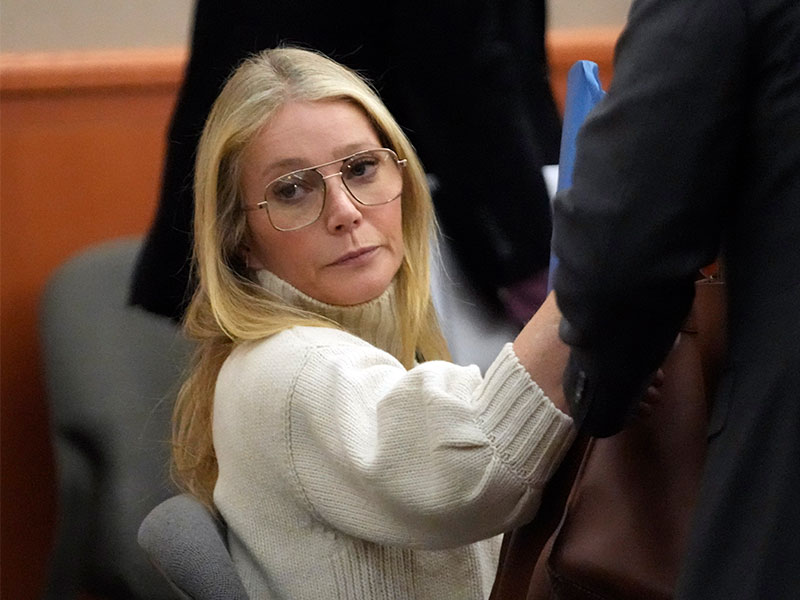
Paltrow strolled into the first day of court wearing an olive green wool coat, which Véronique Hyland, ELLE’s fashion features director, wrote is reminiscent of her Donna Karan green two-piece from “Great Expectations,” the 1998 adaptation of Charles Dickens’ classic coming-of-age story.


The complete look, which included camel-hued Celine boots and brown bottoms, also channeled the old-money aesthetic that’s been made popular by TikTok and “Succession” in recent years. It’s the same aesthetic that was once adopted by Carolyn Bessette-Kennedy and Princess Diana.


“In an era of watered-down luxury, there’s a fascination with the idea of an innate style that you can’t buy,” said Hyland. “And Paltrow is its embodiment.”


Additionally, keen watchers of the trial noticed that Paltrow was sipping on green juice only a few days later. So perhaps, the earth-toned look was really just an ode to Paltrow’s favorite liquid lunch — green juice and bone broth!

02
Specs fit for a serial killer
Gwyneth PaltrowActress Gwyneth Paltrow looks on before leaving the courtroom, where she is accused in a lawsuit of crashing into a skier during a 2016 family ski vacation, March 21, 2023, in Park City, Utah. (Rick Bowmer-Pool/Getty Images)
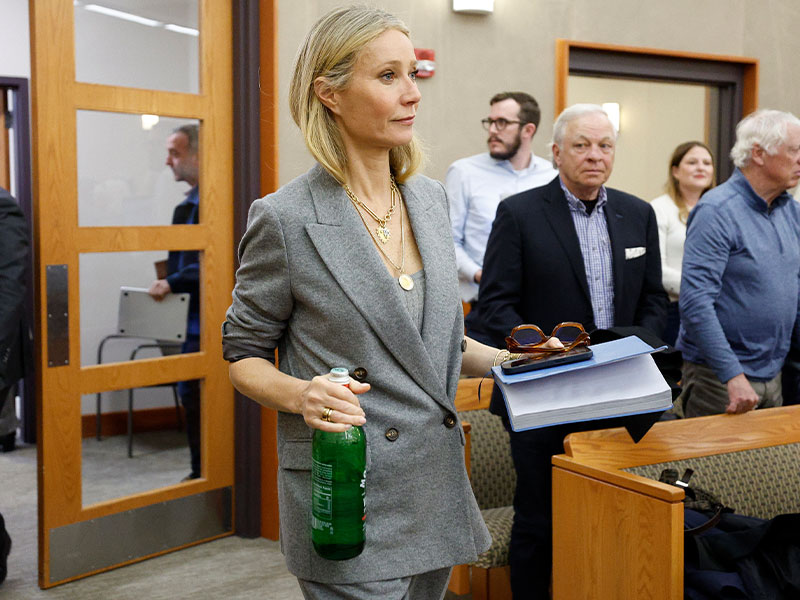
The internet went crazy for Paltrow’s pair of oversized aviator glasses, which earned her comparisons to ’70s era dads and even the newly popular Jeffrey Dahmer (thanks, Ryan Murphy!).


“Gwyneth Paltrow looks like she’s going to a Jeffrey Dahmer-themed all-you-can-eat-buffet,” wrote one user on Twitter, who referred to the glasses worn by the serial killer in his mugshot after he was arrested in 1991.


“Gwyneth Paltrow going to court dressed as Jeffrey Dahmer was not on my bingo card for 2023, but here we are,” another user tweeted. “Must be all that bone broth.”


One user commented, “She looks like she’s on trial for either killing her husband for the insurance money or scamming a bunch of investors with her magic medical equipment.”


Others noted the ridiculousness of Paltrow sporting a pair of vintage-inspired glasses in light of her courtroom opponent:


“These are exactly the kind of 1980s aviator specs you should wear when being sued by a retired optometrist,” said one user.

03
A pricey blue accessory
Gwyneth PaltrowActress Gwyneth Paltrow enters the courtroom after a lunch break on March 23, 2023, in Park City, Utah. (Jeff Swinger-Pool/Getty Images)
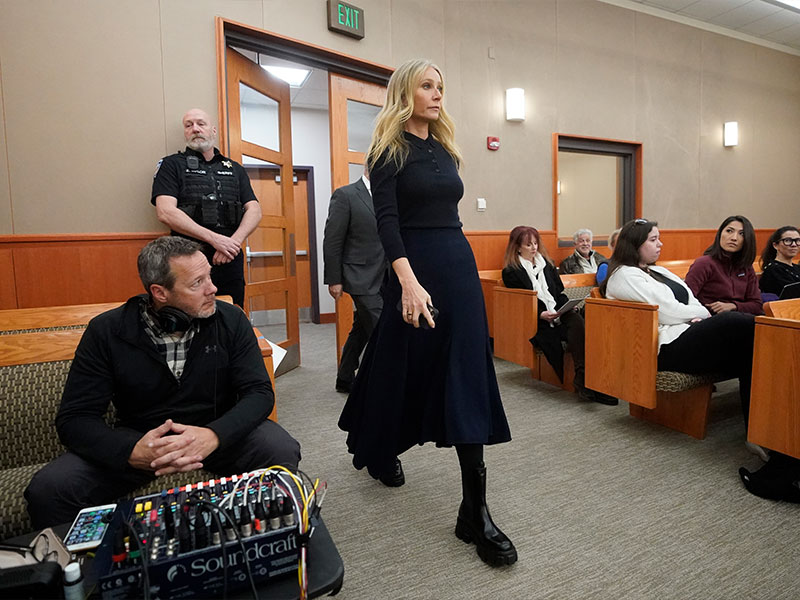
It wasn’t Paltrow’s gray tweed suit set or her Foundrae brand jewelry that caught people’s eye. Instead, it was her $250 blue, leather Smythson Portobello notebook, which she also used to shield her face from the courtroom paparazzi.


The expensive accessory was loved by many stationery enthusiasts on Twitter:


“GP bringing her monogrammed notebook to court is a big step forward for stationery girl representation,” wrote Senior Vanity Fair correspondent and author Delia Cai.


“As a station[e]ry girlie, I can’t stop thinking about Gwyneth Paltrow’s blue notebook,” tweeted another user.


One user questioned the notebook’s absurd price: “Gwyneth Paltrow took notes on a $250 notebook in court. How on earth can a notebook be worth that?!? Even if you have the money, how could you spend that on a notebook?”

04
Prada from head to toe
Gwyneth PaltrowActress Gwyneth Paltrow enters the courtroom for her trial on March 24, 2023, in Park City, Utah. (Rick Bowmer-Pool/Getty Images)

On the day she testified, Paltrow wore a long navy skirt with a collared long sleeve top, chunky black boots and a pair of square-framed glasses.   


“It’s an outfit that’s clearly not at all courtroom-specific, and would work beautifully at a cozy library study session, or at a fancy dinner, or if you wanted to be the most put-together girl at a vaguely sketchy after-hours party — literally wherever,” wrote The Daily Beast’s Helen Holmes. 


Sarah Spellings, fashion news editor at Vogue, also told The Daily Beast, “There is something transitional about the wardrobe. If I were going into court, I would have a very specific outfit that I wore to attend that wouldn’t wear in many other situations, and I think it’s probably a celebrity specific-thing, to have outfits that can take you from court, to dinner to, you know, aprés-ski, and that just adds to the deliciousness of watching it.”


Several critics on Twitter admired Paltrow’s sleek outfit. One user described her look as “a modern Salem witch hunt fit.” Another user commented that Paltrow’s quiet yet bold accessories, like her boots, “subtly say it’s — WAR, minus the cannibalism.”

05
Wednesday Addams goes to court!
Gwyneth PaltrowActor Gwyneth Paltrow sits in court during her civil trial over a collision with another skier on March 27, 2023, in Park City, Utah. (Rick Bowmer-Pool/Getty Images)

Earlier this week, Paltrow wore a white button down with a black cardigan (courtesy of Goop!) and a matching skirt.


“Paltrow took part in the long tradition of famous ladies wearing white to appear as defendants — the color of lambs, lilies, snow, doves and other notable symbols of peace, purity and innocence — like Ryder, Cardi B and Naomi Campbell before her,” wrote The Washington Post’s Ashley Fetters Maloy.


On Twitter, one user compared Paltrow’s look to Rory Gilmore’s infamous outfit for her court date. Another user pointed out Paltrow’s coffee mug, which she carried while making her courtroom appearance:


“I dunno why but the coffee mug is sending me. Like she popped by on her way to get the morning paper.”


“This is Wednesday Addams coded lmao,” wrote one user while another wrote, “this outfit is almost identical to what I wore to my grandmother’s funeral.”

“Bad for business”: Fox News CEO scolded reporter for fact-checking Trump’s lies in “stunning” email

Fox News CEO Suzanne Scott warned that the network could face a financial crisis if it fact-checked former President Donald Trump’s election lies in 2020, according to messages revealed on Wednesday. 

In one email sent on December 2, 2020, Scott told Meade Cooper, the executive vice president of prime-time programming that the fact-checking “has to stop now.”

The message came after correspondent Eric Shawn came on Martha MacCallum’s show to fact-check statements made by Trump and a guest on Sean Hannity. 

“This is bad for business and there is a lack of understanding what is happening in these shows,” Scott added in the email. “The audience is furious and we are just feeding them material. Bad for business.”

A spokesperson for Fox News told CNN that Scott was not frustrated with fact-checking, but that the issue revolved around “one host calling out another.”

In another email, Scott slammed correspondent Kristin Fisher for what she described as a “dismissive tone” in November 2020. Scott also disclosed that the company had “lost 25k subs from FOX NATION,” the network’s streaming service.

A Fox News spokesperson told Salon, “This is about the tone and delivery of the correspondent, it has nothing to do with fact checking.”

The email came to light as a part of Dominion Voting Systems’ $1.6 billion defamation lawsuit against Fox News. It had previously been redacted in earlier court filings but was included in a hearing last week in Delaware. 

Per a court order, Dominion publicly released their full presentation on Wednesday. Fox News, which has denied any wrongdoing, accused Dominion of cherry-picking emails. 

“These documents once again demonstrate Dominion’s continued reliance on cherry-picked quotes without context to generate headlines in order to distract from the facts of this case,” a Fox spokesperson said in a statement. “The foundational right to a free press is at stake and we will continue to fiercely advocate for the First Amendment in protecting the role of news organizations to cover the news.”

Other emails show network producers talking about putting Trump lawyers Rudy Giuliani and Sidney Powell — who were spreading debunked conspiracy theories about Dominion — on the air because it boosted ratings. 

“Any day with Rudy and Sidney is guaranteed gold!” wrote a producer for host Lou Dobbs’ show. In another email obtained by CNN, another Dobbs producer wrote, “to keep this alive, we really need Rudy or Sidney.”

Fox Corporation Chairman Rupert Murdoch admitted that Trump’s election lies were the cause of the Jan. 6 attack on the US Capitol, saying it was “pretty much a crime,” according to an email that became public Wednesday. 

“Trump insisting on the election being stolen and convincing 25% of Americans was a huge disservice to the country,” Murdoch wrote to Scott and his son, Lachlan, on Jan. 20, 2021. “Pretty much a crime. Inevitable it blew up on Jan 6th.”

He then advised the two on how to approach the situation to protect the network while maintaining ratings. 

“Best we don’t mention his name unless essential and certainly don’t support him,” Murdoch wrote. “We have to respect people of principle and if it comes to the Senate don’t take sides.”

Murdoch also admitted in his deposition that he did tell Scott to stop allowing Trump on the air. “At some time, I certainly said that,” Murdoch said.

Texts also show Tucker Carlson calling former Powell a “crazy person” and “psychopath” among other sexist expletives. 

Another email shows that Fox News was likely aware they were promoting lies on their network, as a staffer sent fact-checks to the production staff early on.

“On November 13, Fox ‘Brain Room’ employee Leonard Balducci circulated fact-checks from Dominion and the AP debunking various claims about the company,” Gertz wrote with an image of the messages.

In a text chain, Carlson also said election denier Mike Lindell was “definitely crazy,” but admitted that his advertising “bailed us out loads of times when no one else would.”

Jeanine Pirro’s executive producer emailed Fox executives to say her pre-tape “is rife w conspiracy theories and bs and is yet another example why this woman should never be on live television.”


Want a daily wrap-up of all the news and commentary Salon has to offer? Subscribe to our morning newsletter, Crash Course.


An internal review confirmed that parts of her monologue were incorrect or unconfirmed, and that the network chose to air it anyway. Pirro was shortly promoted to co-host of the network’s live panel show, The Five. 

In an appearance on the 11th Hour with Stephanie Ruhle, former federal prosecutor and MSNBC legal analyst Glenn Kirschner said Fox was “intentionally selling lies to the American people because they want the revenue to continue flowing into Fox’s coffers.”

CNN anchor Anderson Cooper said Wednesday that it was “stunning” to see the network’s CEO trash fact-checking.

“Not something you would expect from a leader of a purported news network, right? There’s just more fallout every day,” said media reporter Oliver Darcy. 

“I mean, it’s incredible!” Cooper exclaimed.

The case is scheduled to go to trial next month, with jury selection set to start on April 13. 

“They say they have good legal arguments against Dominion, and we will see what happens if this case does go to trial in a few weeks,” Darcy said. “We’re still waiting to hear from the judge whether they are going to rule on those summary judgment motions, which basically, Dominion is asking FOX to declare themselves the winner. FOX is saying we should be declared the winner without a trial. That’s unlikely to happen from the legal experts I’ve spoken to. It’s a very high bar.”

AOC says GOP energy bill may as well have been written entirely by Big Oil

House Republicans are preparing to pass a sweeping energy bill that Democrats, including Rep. Alexandria Ocasio-Cortez, N.Y., have condemned as nothing more than a Big Oil wish list that would pilfer the public’s pockets to pad corporate profits.

H.R. 1, dubbed the Lower Energy Costs Act, is a combination of several Republican energy and climate proposals that would roll back provisions of Democrats’ Inflation Reduction Act (IRA) while expanding the ability of fossil fuel companies to mine and drill with even fewer regulations than they currently face.

In a speech on the House floor on Tuesday, Ocasio-Cortez said that the bill’s title is misleading and that it contains basically no provisions to lower energy costs.

“The central argument and logic of this bill is that if you give big oil everything they want, then perhaps they will lower our gas prices. It’s a form of trickle-down fantasy that just will not make life easier for everyday Americans,” Ocasio-Cortez said.

She pointed out that, when Democrats put forth bills that would have directly addressed Big Oil price gouging and returned the industry’s profits to the public, Republicans opposed the suggestions — allowing ExxonChevron and others to post record profits in 2022.

Oil and gas companies “already have thousands of unused permits on public lands and yet they want even more. This is not a problem of supply, it is a problem of greed and abuse of market power,” said Ocasio-Cortez.

The bill reads “as if you gave a pen to an oil lobbyist and wrote down everything that they’d want,” she continued.

Indeed, H.R. 1, which Democrats have dubbed the “Polluters Over People Act,” is full of provisions that powerful oil organizations have lobbied for, in some cases for years.

The bill would repeal a methane reduction program created by the IRA, claw back funding from an Environmental Protection Agency (EPA) fund aimed at reducing greenhouse gasses and repeal the IRA’s reforms to the oil and gas leasing program. It would significantly water down the National Environmental Policy Act — a longtime foe of the fossil fuel industry and the nation’s oldest major environmental law — by placing strict limits on timelines for public input of proposed projects like pipelines or oil exploration.

Senate Majority Leader Chuck Schumer, D-N.Y., has said that the bill would be “dead on arrival” in the Senate and President Joe Biden has vowed to veto the bill if it reaches his desk. But the bill sends a strong message that the Republican Party is making a massive giveaway to the fossil fuel industry their top priority; notably, the Democratic equivalent to “H.R. 1,” passed around this time in 2021, was a sweeping pro-labor bill.

Other Democrats and climate advocates have spoken up against the bill, saying that it is absurd in its reach to destroy what few environmental regulations exist in the U.S.

“My residents are already hurting. H.R. 1 would devastate their lives even more,” said Rep. Rashida Tlaib, D-Mich., on the House floor. “This bill is nothing, nothing more than a cheap political stunt to pad the profits of the same greedy oil and gas companies that are price gouging our residents at the pump and poisoning the air they breathe and the water they drink.”

Numerous climate groups have condemned the bill, with Sierra Club Executive Director Ben Jealous voicing his fierce opposition to the proposal in a letter to House leaders on Monday.

“Under the banner of ‘permitting reform,’ the broad suite of bills included in H.R. 1 advances a dangerous agenda to expand oil and gas development, undermine environmental review of pipeline projects and other fossil fuel infrastructure, silence public engagement, fast track approval of LNG export facilities, and loosen vital standards for mining operations on public land,” Jealous wrote.

“Together, these controversial policies will exacerbate the climate crisis, perpetuate environmental injustices, and undermine U.S. economic and national security by extending our country’s reliance on risky and volatile energy sources,” he continued.

The 15 best dishes to make for an at-home brunch extravaganza

If — unlike my colleague Maggie Hennessy — you are indeed a brunch adherent, look no further: This rundown of our top brunch items is sure to create a spread that’ll satisfy even the pickiest eater.

As Salon staff writer Joy Saha puts it, “The portmanteau of ‘breakfast‘ and ‘lunch’ was first coined in 1895, thanks to Guy Beringer, a British writer who penned an article titled ‘Brunch: A Plea‘ in Hunter’s Weekly. Beringer envisioned brunch to be a time for good food — eggs, coffee and sweet desserts, just to mention a few — and good company. Essentially, it would be a meal that sparked nothing but joy.” 

And it has certainly done just that, providing sustenance (and varying degrees of intoxication) for many. Restaurants that serve brunch are often chockfull of carousing patrons, happily sipping on the customary brunch libations while the line cooks are falling apart due to drudgery. Nonetheless, brunch retains its hold on the youngsters — and non-youngsters — throughout the land.

If, however, you’re more into the idea of enjoying a brunch at home, then we have some wonderful options for you.

Without further ado . . . 

Pancakes In PlatePancakes In Plate (Getty Images/Akira Watanabe/EyeEm)Image_placeholder

This recipe features an especially gussied-up box of pancake mix, complete with a terrific sauce consisting of burst blackberries, orange zest, vanilla and cinnamon.
 
Trust us, it’s the perfect pancake topper for anyone not especially fond of maple syrup.
Turkish eggsTurkish eggs (Mary Elizabeth WIlliams)Image_placeholder

Turkish eggs take the usual egg breakfast dishes and amp the simple protein up to new levels. Rich with a garlic-studded yogurt sauce, the warmth of aleppo pepper or smoked paprika and bright lemon to liven up the dish, the breadth of flavors and consistencies is truly something special.
 
The eggs themselves are poached, but you can feel free to prepare yours however you see fit. 
Overnight oats with blueberries in jarOvernight oats with blueberries in jar (Getty Images/Westend61)Image_placeholder

This is one of the simplest items on this list.
 
Prepare this the night before and let it set overnight in the fridge, then just pull it out and serve it as-is as you make finishing touches on the other dishes you’re cooking. 
 
It’s sure to be a real crowd-pleaser. Use whichever berries you have on hand as garnish! 
 
Cacio e pepe strataCacio e pepe strata (Ashlie Stevens)Image_placeholder

Cacio e pepe is an iconic, storied Italian dish. Almost like a mix between a frittata and bread pudding, this strata (which takes its base flavors from cacio e pepe itself) is unbelievably flavorful with different textural and consistency notes that’ll make each bite all the more exciting.
 
Boasting eggs, cream, bread and lots of cheese (along with fresh herbs, if you’d like), this unique dish might steal the spotlight at your brunch affair.
Crab Holding EggsCrab Holding Eggs (Photo illustration by Salon/Getty Images)Image_placeholder
While a crab omelet may not be the first thing you think of when it comes to egg preparations or cookery, there may be no better iteration. Buttery, saline crab is the perfect protein pairing for a classic omelet.
 
Amazingly simple and consisting of nothing other than eggs, green onions and crab (plus some salt and butter), this dish is so much more than the sum of its parts.
 
It should be said, though: You can get wild and add some cheese, too, if you’re really feeling reckless. 
 
Creamy oatmeal bowl with banana, blueberries, mulberries and sesame seedsCreamy oatmeal bowl with banana, blueberries, mulberries and sesame seeds (Getty Images/OatmealStories)Image_placeholder
Courtesy of yours truly, this unique oatmeal preparation is genuinely A+. 
 
I would venture to say that when it comes to homemade oatmeal, there may be no better way to prepare it. Making oatmeal in your rice cooker takes away lots of the guess work and allows your rice cooker to do some “work” for you beyond just making your rice perfectly. The soft, toothsome oatmeal will, of course, also act as a perfect bed for whatever garnishes or toppings you have in mind. 

Want more great food writing and recipes? Subscribe to Salon Food’s newsletter, The Bite.


Raw bacon strips in tray ready to bakeRaw bacon strips in tray ready to bake (Getty Images / Arina Habich / 500px)Image_placeholder

If you have carnivores on your guest list (or anyone, frankly, since lots of bacon made from other plants or other animals is also now on the market), be certain to use this preparation to make your bacon
 
Lacquered with miso and maple syrup, this oven-only bacon cooking method is really the only way you should be making your bacon
Breakfast saladBreakfast salad (Mary Elizabeth Williams)Image_placeholder

Breakfast and salad may seem like disparate components, but let us reassure you: A breakfast salad, chockfull of a wide range of ingredients, may be one of the prime manners of feeding yourself in the mornings. 
 
Featuring chopped nuts, orange, avocado, lime, radishes and greens, plus a simple dressing, this salad is a gem. Your brunch visitors are certain to eat this with vigor. 
 
 
Tropical fruit salad on a trayTropical fruit salad on a tray (Getty Images/Claudia Totir)Image_placeholder

Fruit salads add a bright, raw essence to the brunch spread. With minimal cookery and fresh ingredients, fruit salads offer a blank template to work with: Use whatever fruits you like best or have on hand, dress with whatever syrups or garnishes or additions you prefer.
 
You really can’t go wrong with fruit salad. 
Toasted sourdough bread with sauteed mushroom and hard goat cheeseToasted sourdough bread with sauteed mushroom and hard goat cheese (Getty Images/haoliang)Image_placeholder

These toasts take the essence of avocado toast and instead swap in a roasted garlic spread with gruyere and mushrooms; they are deep, rich and immensely flavorful.
 
Stock the mushrooms up as high as they can go and serve this with a fork and knife . . . your guests won’t want to miss any of this when it inevitably falls off the toast. 
A plate with gnocchi, spinach, pine nuts and shredded cheeseA plate with gnocchi, spinach, pine nuts and shredded cheese (Getty Images/Annabelle Breakey)Image_placeholder

While gnocchi may not be the customary noodle thought of when it comes to pasta salads, you’ll soon change your mind about that. This salad is outrageous!
 
With greens, peas, pine nuts and a bright, acidic vinaigrette, you’ll be amazed by the flavor and distinct consistency: The chewiness of the gnocchi, the freshness of the greens and peas, the snap of the pine nuts . . . it all adds up to something amazing. 
French 75French 75 (Maggie Hennessy)Image_placeholder

Of course, for many, brunch is essentially an acceptable masquerade for “allowing” you to drink during the day. If your guests (or you!) are especially looking forward to the alcohol component of your big brunch event, perhaps columnist Maggie Hennessy’s French 75 will do the trick? 
 
With gin, lemon juice, simple syrup, sparkling wine and some lemon peel for garnish, it’s a classy, uncomplicated libation to sip on throughout the brunch.
Rice pudding with pine nuts, fresh figs and maple syrupRice pudding with pine nuts, fresh figs and maple syrup (Getty Images/Claudia Totir)Image_placeholder

For vegans and vegetarians in attendance, this might be the smash hit of the brunch event (or perhaps even for the carnivores).
 
With rice made tender with coconut milk and an easy garnish made of avocado, radish, pumpkin seeds and scallions, the amazing diversity of flavors, colors and textures is A+.
Gaspacho soupGaspacho soup (Getty Images/Fascinadora/500px)Image_placeholder

Gazpacho is genuinely a perfect brunch dish. 
 
This version, with tomatoes, red peppers, onions, cucumber and anchovies, is an excellent iteration. It’s obviously totally delicious, but the best part? You can make it in advance, pop it in the refrigerator to chill and pull it out whenever you’re ready to serve.
 
Pour into bowls, top with garnishes and drizzles of oil, serve with bread — and you’re good to go!
 
 
Prosecco jellies (Brett Stevens/Getty Images)Image_placeholder
A real blast from the past, this boozy dessert might become an automatic go-to at all future brunches. Perfectly sweet and light, the dish is made with only five ingredients, is a breeze to put together, has some retro appeal and couldn’t be more delicious.
 
It’s yet another “make ahead” dish, too, so that the dessert component of your brunch meal could be as easy as pie (or should we say “as easy as wine jelly?”)

“Out-negotiated by Mickey Mouse”: DeSantis’ board reveals Disney quietly stripped them of power

The group of conservatives handpicked by Florida Gov. Ron DeSantis to oversee Disney World’s government services is now preparing for a legal battle over a 30-year development agreement that they say will leave the board powerless in managing Disney’s future in Central Florida. 

The five-person Central Florida Tourism Oversight District was introduced by DeSantis in February, replacing the Reedy Creek Improvement District — a board that allowed Disney to run as a self-governing authority in Florida for more than 50 years. 

The Republican governor lashed out at Disney after the company opposed his so-called “Don’t Say Gay” law, which banned the discussion of sexual orientation and gender identity in elementary school classrooms. 

The board members on Wednesday revealed that their predecessors signed an agreement leaving them effectively powerless. Disney and Reedy Creek struck an agreement on Feb. 8 that gave away control of the district’s developmental rights and special privileges to the company. This was just before DeSantis set up his new oversight organization on Feb. 27. 

That agreement means that the new board members chosen by the Republican governor cannot take any significant action without getting approval from the media conglomerate first. 

“I cannot tell you the level of my disappointment in Disney. I thought so much better of them,” said board member Ron Peri on Wednesday, according to WKMG.

“This essentially makes Disney the government. This board loses, for practical purposes, the majority of its ability to do anything beyond maintain the roads and maintain basic infrastructure,” he continued.

The board members were not aware of the agreement before being appointed and say they will be hiring counsel to challenge it. 

“We’re going to have to deal with it and correct it,” board member Brian Aungst said. “It’s a subversion of the will of the voters and the legislature and the governor. It completely circumvents the authority of this board to govern.”

The agreement also states in a “declaration of restrictive covenants” that the district is banned from using the Disney name or “fanciful characters such as Mickey Mouse,” on anything without gaining the company’s approval. 

It also allows Disney to build projects at the highest density, with the board unable to regulate the height of buildings — as the agreement spells out that this is under the Federal Aviation Administration’s authority. 

Disney and their affiliates own the vast majority of the land in Central Florida, and other companies can only operate there with their permission.

The corporation has the right to sell or assign developmental rights to other district landowners without the board’s approval, a presentation by the district’s new special legal counsel confirmed.

The board’s predecessors even agreed to let Disney have authority over their own buildings, according to the declaration which states Disney must review any exterior changes to the district’s buildings to ensure consistent “theming” with Disney World.

The pact between Reedy Creek and Disney could potentially last for decades because of the inclusion of a rare royal lives clause. The deal would therefore remain valid until “21 years after the death of the last survivor of the descendants” of King Charles III.


Want a daily wrap-up of all the news and commentary Salon has to offer? Subscribe to our morning newsletter, Crash Course.


Bridget Ziegler, the co-founder of the conservative advocacy group “Moms for Liberty,” and a board member slammed the company on Twitter for their “arrogance.”

“From ignoring parents and allowing radicals to sexualize our children, to now ignoring Florida taxpayers by sneaking in a last minute sweetheart development agreement, Disney has once again overplayed their hand in Florida,” Ziegler wrote.

“We won’t stand for this and we won’t back down,” she continued. “If unlawful actions were taken, this development agreement will be nullified.”

However, Disney World maintains that it did nothing wrong by signing the agreement with Reedy Creek.

“All agreements signed between Disney and the district were appropriate and were discussed and approved in open, noticed public forums in compliance with Florida’s Government in the Sunshine law,” the company said in an unsigned statement obtained by the Orlando Sentinel.

The governor’s office said in a statement that they would be supportive of the board’s attempt to challenge the agreement.

“The Executive Office of the Governor is aware of Disney’s last-ditch efforts to execute contracts just before ratifying the new law that transfers rights and authorities from the former Reedy Creek Improvement District to Disney,” said DeSantis spokeswoman Taryn Fenske.

“An initial review suggests these agreements may have significant legal infirmities that would render the contracts void as a matter of law,” she said. “We are pleased the new governor-appointed board retained multiple financial and legal firms to conduct audits and investigate Disney’s past behavior.”

According to the Orlando Sentinel, board members have now approved the hiring of four outside law firms with the chairman, Martin Garcia, stating that they need “lawyers that have extensive experience in dealing with protracted litigation against Fortune 500 companies.”

One of the firms they have signed with is Cooper & Kirk, a Washington D.C.-based law firm that has received more than $2.8 million in legal fees and contracts from the DeSantis administration. The governor has sought their help in the past to defend a controversial social media law, a ban on “vaccine passports” for cruise ships, and restrictions on felons seeking to vote. 

Some of Cooper & Kirk’s lawyers include failed Senate candidate Adam Laxalt, a former roommate of DeSantis at the Naval Justice School in 2005. Senators Ted Cruz, R-Texas, and Tom Cotton, R-Ark., have also worked at the boutique law firm. 

Garcia says they are seeking outside legal help to fight the vast resources that Disney has at their disposal. 

“What it looks like to me [is that] because Disney has the Magic Kingdom, they thought they could be king for a day,” he said in a statement obtained by the Orlando Sentinel.

Former Florida lawmaker Carlos Guillermo Smith, the first openly LGBTQ+ Latino to be elected to the state legislature, wrote in a Twitter thread that DeSantis has officially lost his “woke” war with Disney. 

“Ron DeSantis’ entire political brand is centered around his story of how he took on ‘woke’ Disney and won!” Smith wrote. “The ‘corporate kingdom has come to an end,’ he bragged. Turns out, that story was a fairytale — Ronnie lost and was just stunningly outmaneuvered by the Mouse.”

“Ron DeSantis invested nearly everything into promoting his narrative of how he stuck it to Disney for having the temerity to oppose his agenda,” Smith continued. “He wrote op-ed’s about it, bragged on Fox News, and made it a central focus of his new book. That House of Cards is now collapsing…”

DeSantis’ anti-LGBTQ+ push came ahead of a potential 2024 matchup against former President Donald Trump. The Trump campaign quickly dunked on DeSantis over the news.

“President Trump wrote ‘Art of the Deal’ and brokered Middle East peace,” a Trump campaign staffer told Florida Politics publisher Peter Schorsch. “Ron DeSantis just got out-negotiated by Mickey Mouse.”

Basking in the soothing Goop that is the Gwyneth Paltrow ski trial

While taking in all the rigorous fashion analysis and ludicrous testimony highlights related to the Gwyneth Paltrow ski trial, note what’s missing: tension. Your shoulders are relaxed, your gut unperturbed, yes? Are you sitting down? Bet your bottom cakes are nowhere near your seat’s edge.

Rich white people riching. Content we can all get behind.

That’s because Sanderson v. Paltrow isn’t merely a low-stakes case in terms of its impact on culture and society. Unlike the scandals related to the Alex Murdaugh case, it contains no shocking reminders of how easily corruptible our legal system is.

Compared to toxic media circuses surrounding the coverage of Depp v. Heard and the Megan Thee Stallion shooting trial, this is a Sundance Film Festival cocktail reception. Rich white people riching. Content we can all get behind.

The outcome contains virtually no jeopardizing implications in terms of setting a damaging legal precedent or traumatizing victims of violence or abuse. Rather, there’s a throwback gratification to this business – it’s been a while since a megastar’s outsized presence in a courtroom was, in fact, the whole show.

Gwyneth PaltrowActor Gwyneth Paltrow sits in court during her civil trial over a collision with another skier on March 27, 2023, in Park City, Utah. (Rick Bowmer-Pool/Getty Images)

Everyone is amply aware that Paltrow – Academy Award-winning actor turned woo-woo influencer queen – does not live like you and me. But neither does 76-year-old retired optometrist Terry Sanderson, the man seeking $300,000 in damages for claims of negligently causing injury related to a skiing accident that occurred at Deer Valley Ski Resort in February 2016. Paltrow may be incredibly wealthy, but Sanderson is well-off enough to vacation at a Park City spot where season passes cost just shy of $3,000.  

Seven years ago – that’s a full Trump presidency, along with parts of an Obama administration and Biden’s – both Sanderson and Paltrow were chilling at Deer Valley when Sanderson alleges the Lady of Goop slammed into him from behind on a bunny slope. Then, he claims, she imperiously scooted away from the scene with nary a care in the world. Sanderson says he sustained broken ribs, a concussion and permanent brain damage from the collision.

Paltrow is countersuing for a symbolic $1 in damages along with costs related to her attorney’s fees, alleging that Sanderson bumped into her and ruined her ski day with her children Apple and Moses, her eventual husband Brad Falchuk and his children. Closing arguments are scheduled for Thursday, after which the case will go to the eight-person jury for deliberation.

Performing arts connoisseurs will tell you that tension is drama’s backbone. Yet its utter absence from the trial coverage slaloming through our newsfeeds adds to its diversionary value.

Paltrow is the celebrity equivalent of the oatmeal cashmere capelet.

There’s no shortage of analysis related to the lawsuit, but very little of it has to do with whether Paltrow is more believable than Sanderson because ultimately, that doesn’t matter. Neither Paltrow nor Sanderson is especially likable or unlikeable.  Both ski, for crying out loud, a pastime with patrician associations, like equestrian sports or loudly firing the help. 

Paltrow is the celebrity equivalent of the oatmeal cashmere capelet: she’s a utility piece that makes anything look expensive but aside from her occasional spikes of pointlessness (which mainly consist of praising pseudoscientific hooey such as vaginal steaming) doesn’t give us much to get excited about one way or another.

By and large, she’s a bone-broth-sipping Hollywood fixture whose main calling seems to be promoting better orgasms and intermittent fasting. If the jury finds in favor of Sanderson, nobody would be surprised if Paltrow turned to her assistant and deposited a still-warm jade egg in their hand, instructing them to overnight it to Sotheby’s with emphasis on its provenance, all to secure the funds to pay the damages.

Gwyneth PaltrowActress Gwyneth Paltrow looks on before leaving the courtroom, where she is accused in a lawsuit of crashing into a skier during a 2016 family ski vacation, March 21, 2023, in Park City, Utah. (Rick Bowmer-Pool/Getty Images)

Sanderson was a private citizen before this, which means we don’t really know whether he’s the underdog in this situation or a litigious man who saw an opportunity to pad his retirement accounts when he realized he’d come into close contact, albeit forcefully, with a woman whose net worth is estimated to be around $200 million.

Central to Sanderson’s case is his legal team’s allegation that injuries Sanderson sustained in the crash caused changes to his personality, that the “outgoing, gregarious person” he was before the fateful day he crossed planks with Paltrow was replaced by a man who is “no longer charming,” as one of his lawyers put in in his opening statement. His girlfriend broke up with him, he says.

A neuroradiology specialist testified that the active, hobby-driven person Sanderson used to be pre-Gwyneth vanished after the accident, robbing him of the ability to take pleasure in the delights he once did, including wine tasting.  

Her choice to embrace and play up her rich bitch image may end up being a winning gambit

Somehow his debilitating condition didn’t stop him from hiking up steep hills, scuba diving, biking along the canals in Amsterdam, or appreciating the Yves Saint Laurent museum in Marrakech, as seen in Wednesday’s slide show displaying Sanderson engaged in all of these activities after the crash.

This may inform the decision of Blythe Danner’s daughter to show up to court instead of settling with Sanderson. If he wanted a show, he chose the wrong person to audition against.


Want a daily wrap-up of all the news and commentary Salon has to offer? Subscribe to our morning newsletter, Crash Course.


Since the trial began on March 21, Paltrow has sashayed into the courtroom serving “this is beneath me” face, gold jewelry, eyewear borrowed from the wardrobe department of “Monster: The Jeffrey Dahmer Story,” and enough couture knits to keep the internet’s aspirational fashionistas eating good every day. Sanderson’s lawyer Kristin VanOrman was demonstrably entranced if not entirely enchanted.

“May I ask how tall you are?” VanOrman inquired in a now-famous exchange from last Friday.

“I’m just under 5-foot-10,” Paltrow responded, “I think I’m shrinking though.”

“You and me both!” VanOrman commiserated. “I am so jealous. I have to wear four-inch heels just to make it to 5-foot-5.”

“Oh! They’re very nice,” said Paltrow kindly, reminding us of why she’s racked up so many industry nods. Maybe that’s mean since the compliment did seem genuine . . . which makes our point.

Despite what some armchair legal strategists say, Paltrow’s choice to embrace and play up her rich bitch image may end up being a winning gambit. If nothing else, the woman is sickeningly self-aware; she has to know that it’s pointless to try to gain the jury’s sympathy. Instead, she’s aiming for their respect.

That theory may explain why Paltrow has comported herself in a way that conveys she views the situation as, at best, a challenging switch-up from her daily regimen of infrared saunas, dry brushing and light travel, and at worst, an inconvenience visited upon her by an opportunistic herb.

In summary, even if Paltrow loses this lawsuit she still comes out ahead. She will have given the internet labels to research and price tags to gag over (the $250 notebook! the $9,000 private ski lessons!) and, crucial to her pudenda-empowering brand, she will have upstaged a gauche old white guy who blames her for his loss of dating swagger. A well-to-do person will win no matter what happens, but in a change from recent world events, none of us regular people will lose. What absurdity. What a relief.


Credit Suisse complicit in “massive” conspiracy to help rich Americans dodge taxes: Senate report

The Senate Finance Committee on Thursday published the results of a two-year investigation showing that the scandal-plagued Swiss bank Credit Suisse has been complicit in a “massive, ongoing conspiracy” to help wealthy U.S. citizens dodge taxes.

Spearheaded by Sen. Ron Wyden, D-Ore., the chair of the Senate panel, the probe found that Credit Suisse violated the terms of a 2014 plea agreement with the U.S. Department of Justice (DOJ) that required the bank to crack down on tax dodging by its U.S. clients.

As part of the 2014 deal, according to the Justice Department, Credit Suisse admitted to “knowingly and willfully” helping U.S. clients hide offshore assets and income from the Internal Revenue Service (IRS).

The Senate Finance Committee report states that it obtained “voluminous records detailing the role Credit Suisse employees played in assisting U.S. businessman Dan Horsky in concealing over $220 million in offshore accounts from the IRS.”

“The committee’s investigation also uncovered almost two dozen additional large, potentially undeclared accounts held by Credit Suisse belonging to ultra-high net worth U.S. persons,” the report continued. “In 2022, Credit Suisse disclosed to the committee that in connection with its ongoing cooperation with DOJ, it had identified 10 additional large client relationships involving U.S. persons, with each client holding accounts in excess of $20 million.”

Wyden said in a statement Wednesday that “at the center of this investigation are greedy Swiss bankers and catnapping government regulators, and the result appears to be a massive, ongoing conspiracy to help ultrawealthy U.S. citizens to evade taxes and rip off their fellow Americans.”

“Credit Suisse got a discount on the penalty it faced in 2014 for enabling tax evasion because bank executives swore up and down they’d get out of the business of defrauding the United States,” the Oregon senator continued. “This investigation shows Credit Suisse did not make good on that promise.”

The report was published days after the Switzerland-based investment banking giant UBS agreed to purchase Credit Suisse for more than $3 billion as the latter firm faced growing questions about its financial health amid fears of a broader banking crisis.

Wyden said Wednesday that Credit Suisse’s “pending acquisition does not wipe the slate clean,” urging the U.S. Justice Department to follow through on its pledge to “crack down on corporate offenders, particularly repeat offenders like Credit Suisse.”

“In addition to a significant penalty for the bank, the individual bankers involved in these schemes must also face criminal investigation,” Wyden added. “It simply makes no sense to allow the bankers who have their hands on these hidden accounts and enable tax evasion to get away scot-free. Finally, the cases detailed in this investigation are textbook examples of why Democrats gave the IRS new funding for enforcement. Republican budget cuts have decimated the IRS’s ability to root out this kind of offshore tax evasion scheme, but Democrats are committed to stepping up enforcement against wealthy tax cheats.”

In total, the Senate Finance Committee said it found evidence that Credit Suisse helped potentially more than two dozen American families hide upwards of $700 million at the bank after the 2014 plea agreement with the Justice Department.

Citing two former Credit Suisse employees, CNBC reported Wednesday that “although the bank did disclose and close many American accounts after its 2014 plea agreement, some bankers worked with high net worth clients to keep certain Americans at the bank, by changing the nationalities listed on their accounts and ignoring evidence that the account holders were Americans.”

“In other cases, they helped American clients move money to other banks, without reporting those transfers to U.S. authorities,” the outlet added.

A brief history of throwing food and drink on people as protest

Last weekend, anti-trans campaigner Kellie-Jay Keen-Minshull, better known as Posie Parker, arrived to speak at a rally in Auckland, which was surrounded by supporters of trans rights. During this rally and counter-protest, Keen-Minshull was doused in tomato juice, while other reports claim eggs were also thrown at her.

Many people made connections with other incidents where controversial (often racist or homophobic) figures were hit with food in public. This included when American anti-gay campaigner Anita Bryant was hit in the face with a cream pie on television in 1977, Australian far right politician Fraser Anning was egged in 2019 and the Brexit Party’s Nigel Farage was “milkshaked” while campaigning in the UK during the 2019 European Union Parliament elections.

The juice tipped over Keen-Minshull is part of a long legacy of politicians and controversial public figures being hit with food stuffs during protests against them.

A delicious symbol of protest

As Ekaterina Gladkova has written, food has long been a potent symbol for protest. Writing about food riots in the 18th century, social historian E.P. Thompson suggested that food formed part of the “moral economy” and food prices were central to lower class protest in England.

Food is also used in protest as a symbol of moral rejection, with eggs, tomatoes and other soft and sticky food stuffs thrown at public figures. Often soaking or staining the figure in question, the purpose of throwing food is not to hurt them, but to humiliate them. To make disagreeable figures into those of ridicule and to demonstrate people’s moral objection to their presence in public.

 
Anita Bryant, an outspoken opponent of gay rights, ran a campaign to repeal a local ordinance in Florida in 1977 that prohibited discrimination on the basis of sexual orientation. (Wikimedia, CC BY)

Throughout the 20th century, many different groups flung food at people in protest, particularly at politicians. In 1910, the British suffragette Ethel Moorhead threw an egg at Winston Churchill when he was home secretary. This was in response to the treatment of suffragettes in prison, including the force-feeding of hunger strikers.

In 1960, then-US Vice President Richard Nixon was pelted with eggs and tomatoes while campaigning in Chicago. In Britain during the 1970s and 1980s, visits by right-wing politicians on university campuses saw several incidents of food stuffs hurled. Sir Keith Joseph, one of Margaret Thatcher’s earliest supporters, had flour bombs and eggs thrown at him at Essex University in 1977. Home Office minister David Waddington was covered in beer in December 1985 when he visited Manchester University. The following year, Enoch Powell was hit with a ham sandwich during a speech at Bristol University.

A nice egg in this trying time

Australian politicians have also fallen victim to eggings over the decades. One of the most infamous eggings was of Prime Minister Billy Hughes in 1917 in Queensland. Hughes, campaigning to introduce conscription during the first world war, responded by calling for the launch of the Commonwealth Police Force (the predecessor to the Australian Federal Police).

In the late 1970s and early 1980s, then-Prime Minister Malcolm Fraser was egged on several occasions. In 1979, activists protesting against unemployment threw eggs at Fraser, reportedly shouting, “Feed the rich!” In 1981, students protesting against fees launched tomatoes and eggs at him when he arrived at Macquarie University.

Throwing food stuffs has been a particular means of protesting the far right over the years, too. In Britain during the 1930s, anti-fascists threw various foods at Oswald Mosley’s British Union of Fascists at different meetings. At the legendary Battle of Cable Street in London in 1936, there are various accounts of eggs, flour and rotten food being chucked at fascists and the police.

After the war, Mosley still attracted protests involving food. When speaking at the Cambridge Union in 1958, he was hit in the face with a custard pie. Speaking to the same union two years later, Mosley was slapped with a jelly across the face. The Cambridge student newspaper, Varsity, reported the protester shouted, “have a jelly my friend”, as he thrust the green jelly towards the fascist leader.

The milkshake: the anti-fascist cultural symbol

In more recent times, the British National Party’s Nick Griffin was egged as he tried to hold a press conference in 2009. In France, the Front National’s Marine Le Pen, once a close ally of Griffin, has been egged several times on the campaign trail, including in 2017 and 2022. In 2019, former English Defence League leader Tommy Robinson, UKIP candidate (and YouTuber) Carl Benjamin and Nigel Farage all become casualties of milkshaking, with the milkshake briefly becoming an anti-fascist cultural symbol

Australia’s far right has also been of the receiving end of food being thrown by anti-fascists. When National Action attempted a public action in the Melbourne suburb of Brunswick in 1994, protesters heaved eggs, tomatoes and horse manure at them. It was reported that their leader, Michael Brander, was hit in the mouth with an egg, leading to Channel Nine to replay footage under the caption “hole in one”.

And, of course, former far right Senator Fraser Anning had an egg cracked over the back of his head by a teenage boy in 2019.

Humiliation, not violence

Some in the past have complained that eggings and milkshakings are a form of political violence. However, defenders of those who have thrown food at public figures have argued that these are non-violent forms of protest.

As numerous incidents demonstrate, the flinging of food is designed the humiliate, not injure. Compared with the prospect of violence from the far right, immersing political opponents in sticky and smelly food is relatively minor. The tossing of food at politicians and other controversial figures is symbolic of a moral objection to their politics and presence in public spaces.

After the egging of Nick Griffin, Gerry Gable, the long-time editor of the UK anti-fascist magazine Searchlight, wrote that while seeing foodstuffs being dumped over Griffin’s head “certainly brought a smile to many people’s face,” it was “going to take more than a few well-aimed eggs and worthy placards to finish the BNP for good”.

This is certainly the case, but the throwing of food is an act of protest that demonstrates disgust at the target. In the age of social media, where protest actions can be shared by millions, lobbing an egg, tomato or milkshake can be a feat of defiance against politicians, bigots and other objectionable characters.

Evan Smith, Lecturer in History, Flinders University

This article is republished from The Conversation under a Creative Commons license. Read the original article.