Spring Sale: Get 1 Year, Save 58%

Republicans’ “baseless attempts” to overturn a loss in North Carolina could drag on for months

After a state court hearing on Friday, the attempt by North Carolina Republicans to toss out more than 60,000 ballots and overturn the election victory of Allison Riggs, a Democrat and state Supreme Court justice, looks poised to drag on for weeks if not months.

In the case, the Republican candidate, appellate court judge Jefferson Griffin, is ultimately seeking to have the GOP-led state Supreme Court hand him a victory by retroactively invalidating around 65,000 voters. Last November, Griffin lost by 734 votes, a defeat confirmed by two recounts.

At the hearing Friday, attorneys for Riggs, Jefferson and the state Board of Elections argued their cases at trial. A ruling is expected in the coming days, which will open the door to an appeal at the state level, with the state Supreme Court being the ultimate authority. 

According to Griffin, tens of thousands of ballots should be thrown out because of incomplete voter registration records; in some cases, registrations lacked either a driver’s license number or Social Security number, in part due to bureaucratic errors. In separate protests, Griffin has claimed that some military and overseas voters either were never North Carolina residents or lacked voter identification.

In Wake County court Friday, an attorney for Riggs, Raymond Bennet, said that Griffin’s challenge is a “kind of retroactive disenfranchisement." He described it as "fundamentally unfair," arguing that "it's anti-democratic and it violates state law.”

“Judge Griffin concedes that not a single voter was ineligible based on the rules that were in place at the time of the election,” Bennett said. “Now he wants to change those rules.”

An attorney for Griffin, Craig Schauer, argued that their choice of which votes they would challenge in court was not a political decision. Griffin chose only to challenge the ballots of voters who had missing data in their voter file and who voted early or by mail, as opposed to challenging the voters of all voters with missing data. However, those who vote early and by mail tend to favor Democrats in North Carolina, whereas day-of voters tend to favor Republicans. 

Earlier this week, Riggs and the state board of elections argued that the case would be rightly resolved in federal court, saying that tossing the votes of tens of thousands of voters is a federal legal issue. However, the Fourth Circuit ruled that the case should be litigated in state court first and that federal courts could take up the case if any federal legal issues were outstanding. This means the case could potentially play out through the court system, before being taken to federal court, paving the way for months of litigation. 

The three-judge panel at the Fourth Circuit wrote: “if the [election] Board prevails in Wake County on the state law issues, the resolution of the federal claims may not be necessary." That effectively means that a victory in state court for Griffin could still result in a federal case, further delaying a final outcome.

In a statement after Friday's hearing, Riggs said she is determined to fight on. "I’m committed and honored to stand up for the rights of all North Carolinian voters, whether or not they voted for me," she said. "Today, my counsel and counsel for the North Carolina State Board of Elections exposed Judge Griffin’s challenges for what they are — baseless attempts to overturn an election that he lost and and in doing so, undermine North Carolina voters’ fundamental freedoms," Riggs said.

Griffin's campaign did not respond to a request for comment.

Chris Shenton, an attorney working with the Southern Coalition for Social Justice, a group that has filed amicus briefs in opposition to Griffin's attempt to toss votes, said he believes the legal battle will continue for some time.

“I think the conclusion from today is the same as it was before: there are going to be more steps in this litigation," Shenton told Salon. “The only way for this to end quickly is for Judge Griffin to admit that these voters did nothing wrong, and North Carolinians simply did not choose him to serve on their Supreme Court. Unfortunately, it seems like Judge Griffin refuses to accept their word and intends to litigate this until he’s out of options or out of courts to appeal to. It is a brazen disregard for the democratic process.”

In the case, voting rights organizations like the Southern Coalition for Social Justice have highlighted insufficiencies in Griffin’s argument, as well as the fact that “the voices of the thousands of challenged voters themselves have been glaringly absent.”

We need your help to stay independent

“Stunningly, Judge Griffin fails to allege any evidence that even a single one of these voters is actually ineligible to vote in North Carolina — only that they should have anticipated his unprecedented challenges and followed an alternative hypothetical set of rules, never provided to them by the state, when casting their ballot,” wrote attorneys for the Southern Coalition for Social Justice in an amicus brief. “This failure to allege, let alone prove, that any of the challenged voters is actually ineligible to vote in North Carolina is a sufficient, independent ground to reject Judge Griffin’s protest.”

In an affidavit, Cindy Oats Anthony, a Gaston County resident whose ballot has been challenged, explained that she “presented her driver’s license when she voted early in the November 2024 General Election.”

“She learned that her name was on the list of voters challenged by Judge Griffin from a member of her church, and contacted the Jackson County Board of Elections to confirm that she did provide her driver’s license number on her registration form,” the statement reads. “If her ballot were discarded, she would feel like a fundamental right were taken away, and she would wonder what this means for all of the elections that have occurred.”

Anthony isn’t the only voter who voted with her driver's license either. Amy Grace Bryan, a physician in Durham, said that she “used her North Carolina driver’s license to vote without any complications.”

When she found out the Republican was challenging her vote, “She initially thought that it was junk mail because it was addressed to ‘Amy Bryan or current resident.”

“She eventually found her name on this list of voters whose registration was being questioned by Judge Griffin’s campaign. Dr. Bryant has reached out to the Griffin campaign and has not received any response,” her statement reads. “Bryant believes this entire process is unfair and that to cancel her vote along with the 60,000 others would be a blow to our democracy.”


“He was sooooo fresh”: Ye praises Hitler in series of antisemitic social media posts

Ye has apparently reached the "going door-to-door trying to shock people" stage of his career. 

The rapper formerly known as Kanye West went on a tear on X early Friday morning, sharing praise for Adolf Hitler and other antisemitic remarks while bragging about his freedom from consequences. 

"ANY JEWISH PERSON THAT DOES BUSINESS WITH ME NEEDS TO KNOW I DONT LIKE OR TRUST ANY JEWISH PERSON," he wrote around 7 a.m. ET, echoing comments that he's made and apologized for in recent years.

The rapper's outburst was far from over. He went back to the well, offering praise for the leader of Nazi Germany and saying he was "sooooo fresh." Ye went on to say that antisemitism did not exist and shared an old photo of himself in an anti-Nazi t-shirt with the caption "I used to be woke too."

Ye's contributions to the history of rap music are undeniable. Still, since the release of "The Life of Pablo" in 2016 he's been far more likely to make headlines for online antics and provocative stunts than anything he's made in a recording studio.

He recently unfollowed everyone on Instagram except for Taylor Swift, an artist with which he has a long, complicated history. His appearance at the Grammys (more specifically, his wife Bianca Censori's sheer outfit) drew outsized attention to the artist who hasn't released a full-length solo album in nearly four years. 

Ye's clearly come down from those rushes and was swinging about wildly to cause a social media stir, returning to the bright-red Nazi in his brain that has to be somewhat faded with use.

“I say bring him back”: JD Vance says avowed “racist” should get a second chance at DOGE

Vice President JD Vance endorsed reinstating a 25-year-old white supremacist inside the Treasury Department, claiming “stupid social media activity” shouldn’t keep him out of high-level federal payment systems.

Marko Elez, an ex-SpaceX employee, stepped down on Thursday from his position in the Department of Government Efficiency — sometime between when a federal judge gave him the green light to continue accessing Treasury payment data and when the Wall Street Journal published an article outlining his history of racist social media posts.

“You could not pay me to marry outside of my ethnicity,” Elez posted along with other racist statements in the weeks before his installation at the Treasury Department, the Journal reported. "Just for the record, I was racist before it was cool," he posted in another. Elez deleted his X account before taking his post, but the White House announced he stepped down when asked about the posts.

On Friday, DOGE boss and South African billionaire Elon Musk took to X to poll support for reinstating the admitted fan of “eugenic immigration policy." At that point Vance chimed in.

“I obviously disagree with some of Elez’s posts, but I don’t think stupid social media activity should ruin a kid’s life. We shouldn’t reward journalists who try to destroy people,” the veep wrote. “So I say bring him back. If he’s a bad dude or a terrible member of the team, fire him for that.”

Vance did not comment on any of Elez’s specific comments, including his claim last fall that the U.S. needs to “normalize Indian hate." That post came just weeks after Vance, who is married to an Indian-American woman, Usha Vance, joined the Trump ticket.

Not every Trump-Musk supporter is so keen on bringing Elez back.

In a Friday broadcast, Fox News contributor Nicole Saphier said “with caution” that Musk’s staffers should in fact be vetted.

“At least one of those who has been ‘doxxed’ has been flagrantly racist on social media,” Saphier said. “They may be the smartest, they may be good with the calculator, but they need to be good people, too, if they’re working on this."

The secret to the simplest, crispiest wings? Your air fryer

Wings often get all the fanfare for game-day enjoyment—and for good reason. They’re portable, ultra-crispy, endlessly customizable and can cater to even the pickiest eaters. (Plus, in addition to being gluten- and dairy-free, they’re actually somewhat healthful.)

But once you try air frying wings, there’s no turning back. The magic of the air fryer lies in its ability to create the perfect crispy exterior without the mess or added fat of deep frying. Unlike baking, which can leave wings unevenly crisp, air frying ensures that each wing — crispy to the last bite — receives a uniform golden crunch. Wings cooked in the air fryer come out with a perfect, restaurant-worthy crispness in just a fraction of the time.

Once you’ve tasted the difference, traditional baking or deep frying might feel like a distant memory.

Heat, texture and the perfect bite

You won’t see me on “Hot Ones” anytime soon. When I go to Thai restaurants, I say “zero spice.” My brother has mocked me for years, claiming black pepper is too spicy for me. (He’s not wrong.)

And yet, when it comes to wings, I’m all about the heat — not just for heat’s sake, but because Frank’s RedHot adds a flavorful, savory note. Plus, I’m obsessed with the interplay: the super-crispy wing against the creamy richness of ranch or blue cheese, the cold crunch of carrot or celery contrasting with the warmth of the wing and sauce. I love texture and temperature differentiation, so it’s no surprise I’m a wings proponent.

A local bar near me serves “double-fried” wings, which have become my go-to — the only wings I regularly eat when I’m not making my own.


Want more great food writing and recipes? Subscribe to Salon Food's newsletter, The Bite.


The at-home "double-fry" method

There are countless ways to cook wings, but my favorite method involves an air fryer. Here’s what I do:

  1. Buy your own wings (so cheap!).
  2. Cook them in the air fryer for double the time, at the highest temperature your fryer offers (I aim for 400 degrees) — essentially mimicking a double fry.
  3. Shake the fryer basket frequently to ensure every surface crisps up as much as can be.
  4. Toss the wings in a large bowl with just enough sauce. I go for a Frank’s RedHot and butter combo, but use whatever you love — bottled sauce, dry rub or even just (more) salt and pepper.

We need your help to stay independent

Tips and tricks

  • Don't oversauce. You didn’t work for perfectly crispy wings just to make them instantly soggy. There’s a paradox here: painstakingly crisping wings only to drench them in sauce and then dunk them in more sauce — but hey, it works.
  • Sauce preferences. I’m a blue cheese person, but if you prefer ranch (or no dip at all), that’s your call. The only non-negotiable? Carrots and celery. The cold, raw crunch next to a saucy, cheesy, hot wing is arguably my favorite part of the whole shebang.
  • Crispiness is key. I care more about crunch than juicy meat. A slightly dry wing is a fair trade-off if it means maximum crisp.

Wing prep essentials

  • Cornstarch? Optional. Some swear by it, but I find that well-dried, salted wings crisp up beautifully on their own in the air fryer. If you like using cornstarch, go for it! No cornstarch? Try baking powder.
  • Drying time? Meh. Some recommend letting wings dry on a rack in the fridge, but I don’t think it’s necessary.
  • Don’t overcrowd the air fryer. If your air fryer is small (like mine), cook in batches. Overcrowding equals soggy wings.
  • Cook time. Aim for 22 minutes, shaking the basket frequently. Want maximum crisp? Go for a full 30.

Time to eat — immediately

When a recipe says “serve immediately,” some people take their time. With wings? Don’t. They go from perfectly crispy to sad and soggy in a blink. And only cook what you plan to eat. Wings don’t make great leftovers.

Yes, there’s some trial and error involved, but when every variable aligns, you get one of the most satisfying cooking (and eating) experiences imaginable. And no matter how your team fares — win, lose or blowout — a plate of really, really good wings can make everything better.

Musk staffer takes top role at Treasury Department with control over federal payment system

A DOGE staffer has just been given even more power within the Treasury Department.

Tom Krause, chief executive at Cloud Software Group who Elon Musk’s DOGE installed at Treasury last month, has been named the financial assistant secretary of the Treasury Department, making him the bureaucrat in charge of the government’s largest payment system, per The Washington Post.

Its previous administrator, David Lebryk, left the department after a feud with Musk’s lackeys over access to the sensitive and secure systems. Musk’s team demanded access to the system behind federal paychecks, Social Security and Medicare benefits, tax refunds and federal contracts — access Lebryk, a career civil servant, was unwilling to grant.

With the appointment, Krause will take control of the massive federal payment system at the heart of the dispute amid what some Democrats have called an illegal data breach by Musk and his associates. 

It’s unclear what DOGE intends to do with the Treasury data, though the group has been tied to an effort to freeze payments to USAID and a scheme to feed sensitive Department of Education data into an experimental AI model.

Krause had reportedly been serving as a “special government employee” and was one of just two DOGE workers cleared by a federal judge to continue accessing Treasury payment systems. The other, Marko Elez, resigned on Thursday after the Wall Street Journal uncovered a series of racist posts he made on Musk's website, X.

Just hours before Elez’s firing, Treasury Secretary and Musk ally Scott Bessent defended the two DOGE agents as “highly trained professionals” in an interview with Bloomberg. Bessent clarified that he personally interviewed the two and that they maintained “read-only” access to the payment service.

“This is not some roving band running around doing things,” Bessent said, adding that the cost-cutting operation was “operational,” not “ideological.”

“What second chances mean”: Ke Huy Quan’s career love story as a sidekick no more

“Hey Dr. Jones, no time for love!”

That line, uttered by irrepressible sidekick Short Round in 1984’s “Indiana Jones at the Temple of Doom,” has endured, even if it didn’t end up being true. See, love never died for Ke Huy Quan, who portrayed Indy’s precocious sidekick. One might even say the actor’s famed Hollywood return could be considered a second chance romance.

Much like the plot of his Oscar-winning comeback “Everything Everywhere All at Once,” it’s a story that spans time and place, across generations and identities. Both of Quan’s ’80s film roles — Short Round and then gadget-inventing Data in “The Goonies” — made an indelible mark on the psyches and hearts of young audiences, especially those of Asian descent.

His career comeback took on the breakneck momentum of a runaway mine cart.

“Over the years, so many people have come up to me, especially the AAPI community, telling me what Short Round and Data mean to them,” Quan told Salon in an interview at the Beverly Hills’ Four Seasons hotel. “A lot of them told me that these characters were the very first characters with an Asian face that they’ve seen up on the screen. I’m very proud of that because they felt seen.”

This is true of Filipino American Jonathan Eusebio, the director of Quan’s action comedy-romance “Love Hurts.” For the former “John Wick” and “Fall Guy” fight coordinator, putting grown-up Short Round through his paces was an unvoiced desire that was finally realized.

“I watched ‘Indiana Jones and the Temple Doom’ thousands of times because I saw something that I could relate to,” said Eusebio. “He kind of looks like me, he has black hair . . . I can relate to this character in this movie.”

Despite a short stint as a gifted student on school sitcom “Head of the Class” and an appearance in caveman comedy “Encino Man,” the young Quan largely disappeared from our screens, if not our memories. As soon as he reemerged as the fanny pack-wielding Waymond Wang in the Daniels’ 2021 multiverse-hopping actioner “Everything Everywhere All at Once,” however, his career comeback took on the breakneck momentum of a runaway mine cart.

Falling in love with Quan all over again was not just a matter of sepia-toned Gen X or Millennial nostalgia; rather, that affection was fueled by a fierce sense of righting a wrong for our childhood screen buddy. He had been forced into early acting retirement by a Hollywood machine that lacked the imagination and willingness to cast a mature Quan, who then subsequently moved behind the scenes to become a stunt actor and coordinator. It wasn’t until seeing 2018’s all-Asian rom-com “Crazy Rich Asians” that he considered returning to his first career love at the tender middle age of 48. Two weeks after calling up an agent friend, he auditioned for “Everything Everywhere All at Once.”

A well-deserved Oscar followed, along with a supporting role in Disney’s “American Born Chinese” adaptation, as the voice of a pangolin in “King Fu Panda 4” and as the MCU’s Ouroboros in “Loki.” Somehow, Quan made his victory lap feel communal as his undeniable enthusiasm and gratitude for his renewed career sparked intense good will. While his comeback story carried a whiff of mourning for what could have been, Quan chose never dwell on the past with bitterness. Instead he’s tackled his comeback with the same gusto we see in his bear hug reunions with old co-stars (Indy! Goonies!) and his giddy, open-mouthed selfies pointing to other celebrities.

This golden retriever optimism has rolled into his first leading role in “Love Hurts,” in which Quan plays a peppy realtor who bakes heart-shaped cookies for his colleagues. Buried beneath this sunshiny exterior, however, is a killer. Turns out the blazer-wearing Marvin once was a hitman with a body count that rivals his sales numbers.

“What I love about this character is the recognization and the acceptance of what he has done in the past is something that he really regrets,” said Quan. “We see him trying to redeem himself and to have this new life, this normal life, where he’s not destroying homes, but creating homes.

“A lot of people understand what second chances mean. I understand his headspace, that he wants to be a better man. He’s someone who’s not afraid to wear his emotions on his sleeve.”

The Lover

Ke Huy Quan in “Everything Everywhere All at Once” (A24)“Love Hurts” is also ostensibly a romantic comedy, as Marvin is pulled back into his hitman past by his old flame Rose (woefully underutilized fellow Oscar winner Ariana DeBose). With this prosciutto-thin premise, the movie spends more time demonstrating how Marvin is a more passionate realtor than he is a lover. It’s a shame since as a leading man in a Valentine’s Day-pegged film, Quan could’ve capitalized on the smoldering potential he had shown in the portion of “Everything Everywhere All at Once” inspired by “In the Mood for Love” filmmaker Wong Kar-wai. (Quan had worked as an assistant director on the director’s “2046.”)

Beyond that, not much has been seen of Quan’s amorous side – although he did have an onscreen makeout session as a teenager on “Head of the Class.” But as Eusebio points out, love doesn’t need to present itself strictly as the romantic variety.

“Love Hurts” could’ve been the title of Quan’s Hollywood experience.

“Love is a very multifaceted emotion, right?” he said. “It could be the best feeling in the world; it could be the worst. . . . I wanted to show it in its many forms. The most important thing at the end of the day is if [Marvin] loves himself enough to be secure in who he is, and then that love will emanate. You can really love other people if you really love yourself.”

With this broader definition of love for self and fellow human, Quan’s past roles gain new dimension. In “Goonies,” Data and his friends care for their community by saving their homes from demolition. And Short Round is the real beating heart (whether inside or outside a chest) of “Temple of Doom.” Not only does he help free fellow child laborers from slavery, but he also saves the life of his friend and mentor Indiana Jones (Harrison Ford) several times, once even tearfully declaring, “I love you, Indy!” in a heartbreaking scene.

“Love Hurts” could’ve been the title of Quan’s Hollywood experience. Witnessing his unwieldy, unfeigned appreciation for his revitalized career drives home just how strong his passion for acting is . . . and how crushing his disappointment must have been for the industry that had turned its back on him.

Perhaps that’s why like his ’80s characters before him, Quan appears to consistently care about others, not just himself. Having toiled decades behind the scenes and now as a newly minted No. 1 on the call sheet, Quan bore the unspoken responsibility to establish the tone on set.

“I’ve seen it happen where people would have a really good time when the No. 1 is nice and friendly and welcoming. I’ve also been on set to where if you have a bad producer or a bad No. 1, then everybody just feels like they’re just there for the paycheck, and obviously a horrible feeling to have working on a movie.

“So this time coming into ‘Love Hurts,’ I knew how important it is, and I wanted to make sure that that the entire cast, no matter what position they are in, what job they have, that everybody feels like part of a big family, and that everything they do is just as important as what I bring to the table.”

The Fighter
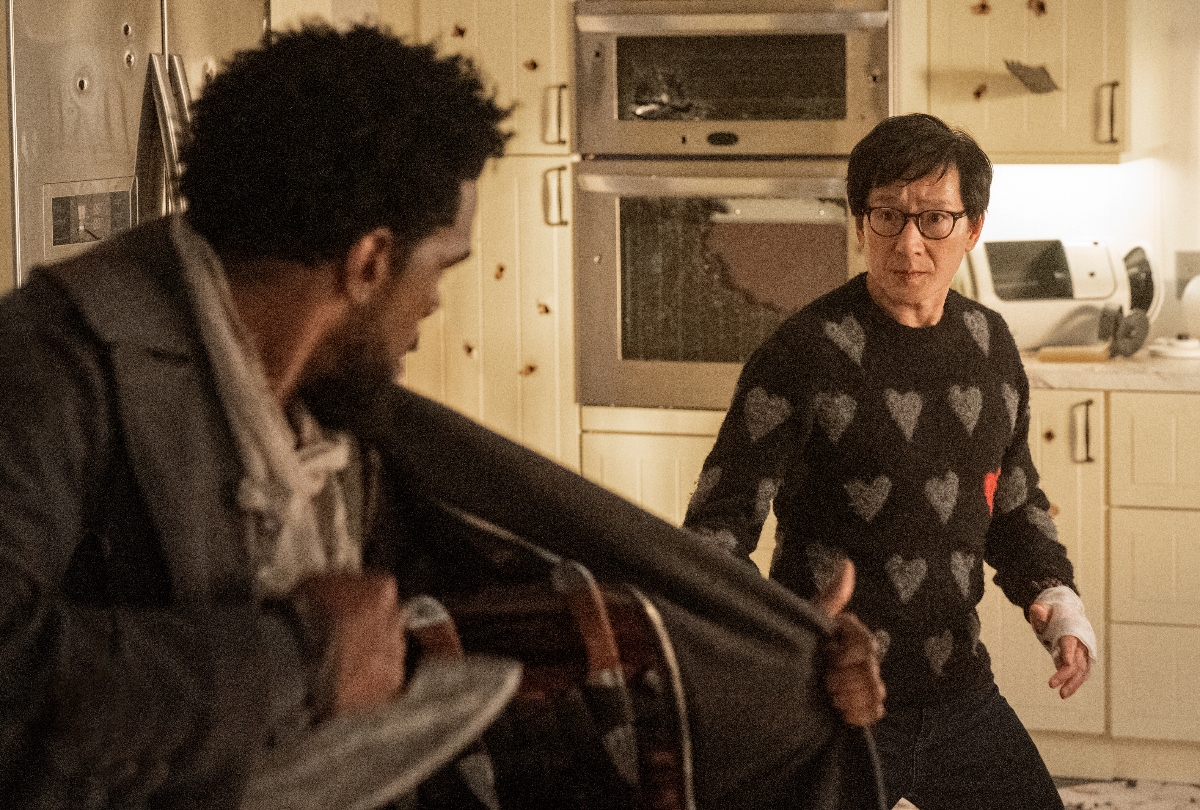
Mustafa Shakir as The Raven and Ke Huy Quan as Marvin Gable in “Love Hurts” (Universal Pictures)In the ’80s, it was the Hollywood Asian’s lot in life to be expected to perform martial arts onscreen. After playing Short Round, Quan embraced the skill by pursuing taekwondo lessons, eventually achieving the rank of second-degree black belt. The detour into stunt work in the U.S. and Hong Kong kept his skills sharp, and the Daniels showcased his expertise with the fanny pack fight in “Everything Everywhere All at Once.”

In ways, “Love Hurts” echoes his scrappy fighting history –  both physically and metaphorically in his career — taking on the big guy, or in this case, Hollywood’s perceptions of who he could embody.

“This is a different kind of action hero,” Quan said. “It’s not something that that we have seen the last few decades. This is an action hero who doesn’t look threatening at all, but not until the situation calls for it, do we understand, ‘Wow, he’s truly a bada**.’  That was something that was really intriguing to me.”

“Even though I didn’t always continue to practice martial arts, one thing that I did do over the years was continue to stretch and be flexible.”

As with “Temple of Doom,” his new film plays off of Quan’s shorter stature, pitting him against physically more imposing fighters. This lends itself to the physical comedy in which Quan delivers Jackie Chan-like antics using everyday objects as impromptu weapons while also inspiring more creative choreography that emphasizes his speed and maneuverability.

“I don’t know why, but every actor they cast who is fighting me is, like, over 6 feet tall,” said Quan with a laugh. “It’s very different when you’re fighting somebody your size versus fighting somebody like Mustafa [Shakir], who played The Raven, who’s 6-foot-4. It takes a lot of creativity to choreograph that first scene [where Marvin fights Raven in the realtor’s office] but also to make it so that the audience believes that somebody the size of Marvin Gable is able to take on somebody like Raven or Marshawn Lynch, for example.”

Quan carries off the multiple full-scale, acrobatic fight scenes with spry, loose-limbed ease, even though onscreen, Marvin progressively collects wounds as casually as if they’re Pokemon. It would be a brutal undertaking for any performer, and taking into account that Quan shot this well after passing his 50th birthday, it’s one that few action stars would have taken on as they’ve aged.

“Even though I didn’t always continue to practice martial arts, one thing that I did do over the years was continue to stretch and be flexible,” he confided. “Flexibility is a big thing when you do fight sequences like we did for ‘Love Hurts’ because the type of choreography that we were trying to do, it was important to be able to do them without getting hurt.

“It’s muscle memory, but you need to get yourself in shape to do that. So I trained with our action team –– some weights, a lot of cardio, and also constantly working after choreography and making sure I knew them. When you do an action movie like this, it’s both not only physically demanding, but also mentally as well too, because knowing the moves is just as important as anything.”

The Achiever

Marshawn Lynch as King and Ke Huy Quan as Marvin Gable in “Love Hurts” (Universal Pictures)Asian characters from the ’80s didn’t always have to be kung fu masters; sometimes they were nerds who played into the model minority stereotype. Quan’s natural effervescence, however, gave his characters an energy and spirit that defied the expectation that these geeks had to be timid or socially awkward. Data screamed till his voice was hoarse alongside his fellow Goonies, and in “Head of the Class,” Jonathan Kwong revealed his hormonal humanity beyond academic prowess.

Quan continued this trend with “Loki,” in which his smart-mouthed, tech-savvy character Ouroboros is “a variant of Data from ‘The Goonies,'” according to his interview with Gold Derby. And now with “Love Hurts,” Marvin channels his overachieving tendencies into his second career, earning the title of Regional Realtor of the Year — with the framed certificate to prove it.

Throughout the film and its many skirmishes, Marvin clutches that award to him for dear life, like a cat with a kicker toy. Bodily harm is nothing compared to the invigorating proof that Marvin has found approval and success with his chosen career. It’s an attitude that was inspired by Quan’s own groundbreaking Academy Award win.

“That was written in for [Ke] because he was explaining about how much the Oscar meant a lot to him,” said Eusebio. “For days, he wouldn’t let go of it when he first got it because he couldn’t believe it.”

Quan added, “We added into the script how much Marvin Gable cares about that certificate. And even though it’s just a piece of paper, it’s a validation of his new life.”

On Feb. 3, the actor had a grander and more permanent monument as evidence of his accomplishment: his handprints immortalized in cement at Hollywood’s TCL Chinese Theatre. Before the event, Quan told Salon, “I remember when I got that email from my publicist sharing that incredible news with me, I had to read it two times because I thought I was being invited to somebody else’s ceremony. Then on the second read, I realized, ‘Oh my gosh, it’s me. They’ve given me my own ceremony.'”

Quan can be forgiven for his repeated disbelief — that he was offered the lead role, that he had won an Oscar, that he would be honored in cement. After all, Tinseltown did deny him his dream for decades. But long before this imposter syndrome set in, a piece of Hollywood lore may have given him some reassurance.

According to The Raider, since the character Indiana Jones was named for George Lucas’ dog, the “Temple of Doom” screenwriting couple Willard Huyck and Gloria Katz decided to name Indy’s sidekick after their own dog Short Round. The unusual naming convention even made its way to official “Indiana Jones” canon when in “The Last Crusade” it’s revealed that the true name of Harrison Ford’s character is Henry, Jr. He had adopted the name Indiana from the family dog.

Thus, in a way, Quan’s story isn’t one of an outsider who proved himself, but rather someone whose earliest signature role shares the same baked-in origins as one of the most iconic characters in screen history. It turns out the love and belonging was there all along, but as with many second chance romances, it just took the right timing and change in circumstances to recognize it.

“Love Hurts” is currently in theaters. Quan next appears in Netflix’s “The Electric State,” as the voice of a snake in “Zootopia 2” and was recently cast to play a serial killer in the thriller “Bad Boy.”

In “Severance,” everything means something—and the meticulous detail has revived the TV fan theory

Reddit is not a place I typically like to be, and lately, I’ve landed on a couple of important reasons why. On one hand, the posts on the forum site often come dangerously close to conspiracy for my taste. And on the other hand, I am exactly the kind of gullible bozo who’s liable to find himself up to his neck in those very conspiracies. Whether a user is speculating that Crumbl cookies is in cahoots with Big Pharma or hypothesizing about Troye Sivan being an old Victorian doll that came to life to make people gay — I am, unfortunately, very interested.

"Severance" is television made with both grand vision and minute intention, a multi-genre mystery that walks in step with the greats.

Because I am of weak will and feeble mind, I had to delete the Reddit app from my phone altogether a few weeks back. It wasn’t just because being prone to falling into Reddit holes is at odds with my goal to free myself from the prison of my phone in the new year; I deleted Reddit because I knew “Severance” Season 2 was right around the corner, and I wanted to preserve the watch experience for myself as much as possible. Maybe that’s a funny thing to say as a critic who could binge the whole season at will (and trust me, I know how completely obnoxious and haughty that sounds). But because I have to watch things for my job, I know how deeply dire the television landscape has become. Really, when was the last time a show was this delicious to savor from week to week?

“Severance” sets itself apart from the pack of by-the-numbers intrigue dramas not just because its production value is infinitely higher than most streaming shows, but because it actually seems to care about its story being an immersive experience for everyone watching. It’s television made with both grand vision and minute intention, a multi-genre mystery that walks in step with the greats like “Twin Peaks,” “Lost” and “Buffy the Vampire Slayer.” These were all shows whose writers knew how to keep viewers on the hook by giving them small tastes of the biggest secrets, with the occasional gulp of a major reveal. The second season of “Severance” has wasted no time doing the same. This season has unspooled a few new plotlines already, but it has also tied a few up and made major leaps toward answers to its largest riddles. In “Severance,” everything means something, and fans are gathering to study every microscopic detail to prepare themselves for what might be yet to come. 

But perhaps you’re a casual watcher or haven’t yet been inducted into the Lumon Industries workforce. (If so, congrats on having way more resolve than most of us.) That might mean that you’re confused about why the show has become such a hyperfixation for viewers, but it’s really quite simple: “Severance” cares about its audience as much as it cares about the story it’s telling. 

That story — about a man named Mark (Adam Scott) who leads a team of office workers whose minds have been surgically divided between their work selves and their personal selves — has been carefully constructed to fascinate fans from the jump. The show’s chilly atmosphere complements the icy stares of all of the non-severed employees at Lumon — that is, those who retain all of their memories whether they’re at work or not. Mark heads up the Macrodata Refinement (or MDR) team, which consists of Helly R. (Britt Lower), Dylan G. (Zach Cherry) and Irving B. (John Turturro). What MDR does exactly is just one of the show’s many mysteries. All we know is that the team sorts random numbers into boxes on their computers based on how the groups of numbers “feel.” We also know that Mark is preternaturally great at refining.


Want a daily wrap-up of all the news and commentary Salon has to offer? Subscribe to our morning newsletter, Crash Course.


But how do we know this exactly? There are some allusions to Mark’s skill in the show. At the end of Season 1, the “Innies” — the severed employees at Lumon — stage a coup of sorts that allows their work personalities to emerge outside of work hours. This throws whatever is at play at Lumon entirely out of whack and threatens the public’s already uncertain perception of the company. In Season 2’s first episode, we learn that Lumon is desperate to get Mark to return to work. According to his ex-boss Harmony Kobel (Patricia Arquette), who got the axe after the Innie coup, Mark is “the only person who can finish Cold Harbor.” 

Ah, another layer of another mystery. What exactly Cold Harbor is isn’t entirely clear yet, either, but we do know it’s a major MDR project with implications that are above the Innies’ pay grade. But why is it only Mark who could finish work that seemingly any person with two functioning eyes and a brain could pull off? Well, Mark is a refinement whiz, and we know that not only because the writers imply it given how badly Lumon wants him back at work, but because there are details hidden in plain sight. A scene from Season 1 features mixed-down audio of Dylan G. telling Helly R. about Mark’s expertise. The vocal was buried beneath a voiceover track until it was isolated by a viewer and posted online. Where did this user post it? Take one guess.

SeveranceAdam Scott and Britt Lower in "Severance" (Apple TV+)

Reddit has become the premier source for all things “Severance.” Users have developed a shared way of talking about color and speech patterns, and use the shorthand of a lowercase letter to refer to Innies and Outies (iMark, OMark) with expediency. They’ve parsed meaning behind everything from a companion book written for the show to Easter eggs that the average viewer might not normally catch, not to mention oodles of speculation behind the goats that live in the bowels of Lumon’s severed floor. The forum features a deluge of fan theories, which users can upvote and discuss as episodes air. Some are wildly convoluted, while others are so plausible that it seems inevitable that they’ll be revealed in the show somewhere along the way. Given how many fan theories have already come to fruition, even ones that seem preposterous — like this theory about a deliberate connection to “The Office” — seem reasonable once you consider how much detail is embedded into every frame of the show.

It helps, of course, that the “Severance” writers are actually interested in details at all. Too many contemporary television shows give the impression of mystery and tout the alleged existence of multi-season, overarching plots. But when you look a little closer, all they really are is weird for weirdness’ sake. 

The "Severance" writers have been so scrupulous because they want viewers to use their minds in ways that the streaming model has slowly discouraged. They don’t want the show to just exist, or be “content”; they want you to enjoy it.

Take “Yellowjackets,” a series that had an incredible first season because, like “Severance,” it understood how to use its talented ensemble cast to slowly dole out drama and intimate deeper mysteries along the way. Viewers followed a group of teenage girls who survived a plane crash and were forced to fend for themselves deep in the Canadian woods, as well as their adult counterparts in a future timeline, who are still dealing with the trauma of that harrowing experience. Season 1 of “Yellowjackets” implied that there were supernatural forces at play somewhere in that forest and that whatever power the girls came into contact with followed them through the decades. It was a brilliantly fresh amalgamation of thorny themes and plot points from hit shows of the past — until it fell apart. 

Season 2 of “Yellowjackets” spun its wheels and spun out of control. From week to week, I hoped for the best and prayed that the show’s writers knew where they were headed, only for them to kill off the show’s most sympathetic character in the season finale, seemingly for nothing other than shock value. But the real unforgivable sin was that it all but abandoned the central mystery it so carefully built in the first season in favor of useless dream sequences and dead-end asides. I hadn’t seen a show fly off the rails that quickly in some time, and it often seemed like its writers were more intent on servicing the fandom who invested in the characters than the viewers who actually cared about where the show itself was headed. Watching people talk onscreen is not inherently interesting, especially when the dialogue exists to fill time instead of moving the plot forward.

While “Yellowjackets” is a more unique case, there are plenty of television shows that have had trouble figuring out how to keep a viewer’s attention. You’d think that would be easier, given that almost all modern series have truncated seasons, down from the 20+ episodes that your average television season used to have before streaming outmoded that model. But streaming presents its own problems that keep fans from getting the chance to invest their time and their minds into the show. Streaming shows either make all of their episodes available to watch at once — making theorizing completely unnecessary when you could simply keep watching to see what happens — or, they are made so quickly and written so haphazardly that any theorizing is a waste of time. There’s no use in spending your time contemplating a deeper meaning that doesn’t exist in the original text at all. That’s what fanfiction is for. A few days back, professor and historian Erik Baker joked that “‘Severance’ is succeeding by rediscovering the forgotten ancient knowledge that audiences enjoy it when things happen on the TV shows they watch.” Baker has a great point. “Severance” is so good because, like other notable television shows of the same ilk, it is meticulous. Even when it seems like nothing major is happening, and the actors are left to hold it down with their marvelous performances, the next week’s episode reveals that everything that happened in the previous installment actually had a purpose. While viewers had to wait three whole years for the second season to premiere, it has already been so worth the wait that I’d happily endure another three if it meant that this enjoyment could be found again, further down the line. 

More than just giving viewers another way to enjoy “Severance,” its fan theories have emboldened its audience. The show’s writers have been so scrupulous because they want viewers to use their minds in ways that the streaming model has slowly discouraged. They don’t want the show just to exist, or be “content”; they want you to enjoy it. Netflix creates television that allows you to scroll on your phone while you watch its programming. “Severance” forces you to put your device down, or risk missing an integral detail that will enhance your enjoyment of the show tenfold. This series has moved beyond being merely another streaming TV show — it’s a springboard for viewer creativity. Maybe watercooler television is a thing of the past, but that doesn’t mean that the media we spend our time with should isolate us even further. Reddit might suck you into its theories for hours on end, but at least it’s bringing people together instead of pulling them apart.

“It may be too late”: Inflation fears spike as Trump pushes tariffs

American consumers are growing increasingly worried about how President Donald Trump’s tariffs could affect inflation that has persisted into his second term. 

University of Michigan consumer survey for February showed that respondents expect the inflation rate a year from now to be 4.3%, a 1 percentage point jump from January and the highest level since November 2023, CNBC reported

Consumer sentiment, which measures how people feel about the health of the economy, dropped to 67.8 from January's 71.3, in line with expectations from economists polled by Reuters. 

Trump threatened 25% tariffs on most imports from Canada and Mexico before postponing them on Monday. He tacked an additional 10% on existing Chinese tariffs on Tuesday, prompting retaliatory tariffs from China. 

Companies often pass the extra costs of tariffs on to consumers, which means American shoppers could end up paying more for everything from groceries and vehicles to gas and furniture. Trump has said the tariffs are needed to stop undocumented immigrants and fentanyl from coming to the U.S. 

"WILL THERE BE SOME PAIN?" Trump posted on social media Sunday. "YES, MAYBE (AND MAYBE NOT!) BUT WE WILL MAKE AMERICA GREAT AGAIN, AND IT WILL ALL BE WORTH THE PRICE THAT MUST BE PAID." 

Consumers' concerns in the survey were reflected across all demographics, across age and wealth groups and political parties, the survey reported. 

Joanne Hsu, the survey’s director, told CNBC this was only the fifth time in 14 years they’ve recorded such a significant jump in inflation expectations. Hsu said the collective decline in consumer sentiment, current economic conditions and consumer expectations reflected “a perception that it may be too late to avoid the negative impact of tariff policy.”

“Higher prices from tariffs are the number one financial concern for Americans, as the weight of inflation is still oppressive to family budgets, especially among those with lower incomes,” Robert Frick, corporate economist at Navy Credit Union, told CNBC. “Even slight increases in prices, especially in top pain points such as food, shelter, and transportation, would be acutely felt by millions.”

How tailgating — and tailgating cuisine — got its start

Tailgating season is upon us in anticipation of Super Bowl Sunday. Guy Fieri will host his third annual “Guy’s Flavortown Tailgate,” which invites over 10,000 fans on Game Day to enjoy good food, music and entertainment in New Orleans. Similarly, Smirnoff is introducing “The Longest Tailgate,” which promises a 60-foot truck filled with ice-cold cocktails, grilling stations and a performance from pop star Flo Rida.   

“Tailgating isn't just a pre-game ritual — it's a time-honored tradition where NFL fans rally together, no matter who they root for,” the brand said in a Tuesday press release. “And for football's biggest weekend, the Official Vodka of the NFL is going bigger, bolder and longer than ever before.”

Indeed, the tradition of tailgating has been a staple in American football culture for years. But interestingly, the pre-game party doesn’t have roots in the States. Instead, they can be traced back to the fall harvest celebrations of Ancient Greece and Rome.

According to Tonya Williams Bradford, who co-authored a 2015 cultural analysis of tailgating published in the Journal of Consumer Research, such early celebrations were filled with activities commonly associated with tailgating today.

“The notion of people gathering around food is not new—when contests emerged for entertainment, it was natural for food to be part of the gathering,” Bradford, an associate professor of marketing at the University of California at Irvine, told The HISTORY Channel. “For practical reasons, people would travel to watch and would bring meals. This turned into more festive gatherings, transforming the pragmatic into part of the overall experience. So, we find a strong connection between early gatherings and what we observe in modern times.”

The first-ever American tailgate took place on July 21, 1861. However, it wasn’t a pre-game function. Instead, residents of Washington travelled via carriages and buggies to Virginia, where they convened and enjoyed a hearty feast while watching the first major battle of the American Civil War: the First Battle of Bull Run. Some spectators even yelled out words of encouragement to their preferred side. All of this occurred far from the battlefield, of course.

Per The HISTORY Channel, Union Captain John Tidball reportedly saw a “throng of sightseers” and peddlers “in carts loaded with pies and other edibles.” According to the American Battlefield Trust, the food was less for celebratory purposes and more a necessity, considering that the spectators travelled more than seven hours by carriage to Manassas Junction. Still, the gathering was filled with much rumpus as spectators also drank copious amounts of wine and whiskey.

Eight years later, the first football game was played in America, where fans were believed to have dined from a wagon while watching Rutgers and Princeton battle it out on the field. More than a decade later, fans were reportedly sipping on champagne while watching the annual Yale-Princeton Thanksgiving game in New York from horse-drawn coaches parked on the sidelines.

The term “tailgating” wasn’t in the English lexicon at the time, but football fans nationwide were certainly partaking in its festivities. Football’s rise occurred at the same time as the automobile age. In fact, the first, real pre-game tailgate was believed to have taken place before the Harvard-Yale game in 1906 because automobile registrations were at a record high for the first time since its inception. “The open field about the grounds were simply black with machines parked together in such a hopeless mass as to make it seem impossible for one ever to find his own once more,” The New York Times reported. Those who could afford motorized vehicles were also met with jealousy. The outlet noted that opposing fans who traveled by bus or train “gazed with envious eyes as they neared the field at small parties of automobilists eating tempting viands that had been brought in hampers spread out in picnic fashion on a table cloth laid upon the ground.”

As for when tailgating became a word itself, that information is a bit unclear. 

“Some sources credit former Yale SID [Sports Information Director] Charley Loftus with coining the term [tailgating],” Rich Marazzi, author of “A Bowl Full of Memories: 100 Years of Football at the Yale Bowl,” told Vice in 2014. “However, in my opinion, it is not definitive, although I do believe that in his writings and promotions he at the very least popularized the term.”


Want more great food writing and recipes? Subscribe to Salon Food's newsletter, The Bite.


Tailgating officially took off in the 1950s with the mass production of portable grills and plastic coolers. Following World War II, suburban grilling culture became a major part of modern Americana along with automobile ownership, which went up from 28 million in 1946 to an astounding 56 million in 1957. NFL teams caught onto this trend and began constructing larger stadiums with significant amounts of parking. Same with collegiate football teams, like Michigan and Ohio State.

The most famous (and intense) tailgating party arguably occurs before the annual game between the Florida Gators and Georgia Bulldogs. In 1958, Florida Times-Union columnist and editor Bill Kastelz described the festivities — which start on a Wednesday and end on Saturday — as “The World’s Largest Outdoor Cocktail party.” The nickname even became the game’s slogan until 1988. It was later dropped due to several alcohol-related college campus incidents.

Today, tailgating remains a core part of American football culture — more so at the collegiate level but at the professional level too. Not much has changed since the earliest parties. At its core, tailgating fosters a sense of community amongst hardcore football fans who love a good game with equally good food and drinks.

Job market might be losing momentum

Just 143,000 jobs were added to the U.S. labor market in January, a number that fell short of forecasts and signaled a slowdown in the pace of hiring.

Job creation declined from the 261,000 jobs added in November and the 307,000 in December, The Associated Press reported

Joblessness was down in January, with the unemployment rate edging down to 4%. But the numbers suggest those still looking for jobs may find it more challenging as the labor market cools from its two-year hiring streak.

"Employers are really maintaining their workforce, but they are not hiring significantly, nor are they laying off,’" Gregory Daco, chief economist at consulting firm EY Parthenon, told The Associated Press. "Any hiring decision is going to be judicious, because the cost of talent is still elevated.’"

Despite the decline, experts said that there should be "no cause for concern about the strength of the economy." Average hourly earnings rose by 4.1% over the past year, according to NBC News, as minimum wage hikes took effect in 21 states last month.

However, the numbers also mean the Federal Reserve will be in no rush to cut interest rates again, after three cuts in 2024

“Today’s jobs report has likely taken a March rate cut off the table,” Seema Shah, chief global strategist at Principal Asset Management, said in a statement Friday. “Aside from a slightly disappointing headline payrolls number, the broader picture is still one of labor market resilience and sustained wage pressures.”

Democrats decry “authoritarian regime” after security bars them from entering Education Department

Congressional Democrats were barred from entering the Department of Education's headquarters on Friday morning as they tried investigate billionaire Elon Musk’s “DOGE” takeover of sensitive data within.

Rep. Maxwell Frost, D-Fla., shared a video of an unidentified, non-uniformed individual preventing a delegation of elected officials from entering the building in Washington, DC. Inside the building a group of men linked to Musk's DOGE operation are reportedly accessing student data, ostensibly to suggest spending cuts.

ELON IS ALLOWED IN THE DEPARTMENT OF EDUCATION. NOT YOUR ELECTED REPRESENTATIVES OR STUDENTS & PARENTS. I WILL BE BACK.

[image or embed]

— Maxwell Frost (@maxwellfrost.bsky.social) February 7, 2025 at 10:40 AM

“They’ve called armed federal officers to the scene. We aren’t dangerous. We are here to represent our people. To defend public education,” Frost wrote in another post to Bluesky. “This is an authoritarian regime.”

The salvo is the latest in Congressional Dems’ quest to intervene in Musk’s unprecedented and broad access to sensitive government systems and the Trump Administration’s potentially illegal attempts to shrink the federal bureaucracy.

On Wednesday, Democratic lawmakers penned a letter to acting Secretary of Education Denise Carter demanding answers on Musk’s reported takeover and the Trump administration’s apparent intent to shutter the cabinet-level department without congressional approval.

Earlier this week, Democrats were similarly denied access to the U.S. Treasury Building, outside of which a group gathered to protest Musk’s actions.

In addition to the in-person oversight effort from House Democrats, the University of California Student Association is suing the Department of Education over DOGE staffers’ access to sensitive federal aid information. A complaint filed Friday in federal court accuses DOGE of “feeding sensitive data from ED’s systems into artificial intelligence systems maintained by third parties and subject to significant security risks,” per Bloomberg.

“Apple Cider Vinegar” may explain how “The Whole Pantry” fraud was a step on the path of RFK Jr.

We may never hit peak true crime, but when we struggle to tell one TV series’ fraudster apart from another, we may have reached white girl scammer saturation. To wit: three entirely unrelated people I know mistook Kaitlyn Dever, the star of “Apple Cider Vinegar,” for the actor who played Anna Delvey.

Inventing Anna” star Julia Garner and Dever look nothing alike; also, anecdotes are sloppy, unreliable data. Still, you can see it, right? That’s no fault of Dever's but rather, a matter of the mind’s eye making twins of Delvey and Australian wellness fraudster Belle Gibson, whose story inspired “Apple Cider Vinegar.”  Or triplets, maybe, once you throw in Elizabeth Holmes.

They are of a kind — charismatic golden girls who talk their way into expert status in areas that require extensive training, education and research experience. Once their lies are exposed, we see their real proficiency is in deflecting accountability, wilting tragically under pressure, or squeezing out rivers of tears to buy sympathy.

A show like “Apple Cider Vinegar,” based on “The Woman Who Fooled the World,” by the journalists who eventually punctured Gibson’s illusion, gives us a close-up of how this particular flavor of con artist kombucha was brewed.

The show is a work of fiction, a different character reminds us as each episode begins. If its creator Samantha Strauss took a few liberties with Gibson’s story, so what? Gibson fooled people into believing she had cancer when she didn’t.

Apple Cider VinegarKaitlyn Dever in "Apple Cider Vinegar" (Courtesy of Netflix)

What she had, the series posits, was a yearning for validation and a marketable app concept. “The Whole Pantry” preached diet as a cornerstone of health, including the power to manage her non-existent brain tumor. It shot to the top of Apple’s popular downloads list, netting her a cookbook deal, Insta-celebrity, and an eventual stunning downfall.

Don’t blame the player, blame the scams. Many offer something we’re craving or claim to have the solution to an unmet need. What if a drop of blood could be accurately tested to diagnose an array of maladies? What if an incurable condition could be managed with fresh juice and coffee enemas?

Dever’s Gibson is one of the few characters in "Apple Cider Vinegar” series going by the actual name of the person their character is based on. Aisha Dee‘s Chanelle is another, or at least she shares many traits with another figure from Gibson’s life, her ex-friend Chanelle McAuliffe, who eventually shared what she knew with The Age, the Australian newspaper that broke the story that exposed Gibson’s fakery.

But Milla Blake (Alycia Debnam-Carey) is reportedly an amalgam of wellness influencers, although her history bears many similarities to that of Australian blogger and “Wellness Warrior” Jessica Ainscough, Gibson’s contemporary.

“Apple Cider Vinegar” hammers across – subconsciously, granted — the notion of shared culpability between the medical profession and snake oil wellness peddlers.

Like Milla, Ainscough was diagnosed with an aggressive type of epithelioid sarcoma in her forearm. Milla’s doctors prescribe amputation, but she voices her determination to try alternative methods instead – she did her own research, you know. Her findings take her to a Mexican wellness resort based on an actual ineffective protocol called Gerson Therapy.  

Milla’s perceived success with that treatment, combined with her conventional attractiveness, makes her an Internet celebrity. Dever’s Bell tries to hitch herself to Milla, and when she’s rebuffed, borrows Milla’s tragedy to whip up a false story about battling brain cancer. Faking a health crisis was a genius marketing strategy, winning her around 200,000 Instagram followers – an impressive count in the platform’s earliest days.

Apple Cider VinegarAlycia Debnam-Carey and Aisha Dee in "Apple Cider Vinegar" (Courtesy of Netflix)

Guess where this map leads. Milla’s evangelism brings her true believers and an income, but she's also honest with her fans when her cancer aggressively returns and her diagnosis is terminal. Belle, though, becomes such a presence that when her followers who are legitimately battling cancer begin to question her story’s validity it all unravels in 2015.

That’s where the moral of the story kicks in. For five of its six episodes “Apple Cider Vinegar” hammers across – subconsciously, granted — the notion of shared culpability between the medical profession and snake oil wellness peddlers. We aren’t shown a single doctor with a sympathetic bedside manner. (Curiously, it’s a female nurse who hops right to selling a wacky supplement to a character while they’re holding their stillborn baby.)

Maybe, then, we can understand how the Millas of the world came to flourish. In one scene, she faces a table of medical professionals and has to demand that her oncologist look at her, not her father, while discussing her health. He condescendingly calls her “young lady” while attempting to impress on her the seriousness of her mortality risk. When she consents to a localized chemotherapy treatment, the doctor turns narrator and shares that, for Milla’s type of cancer, amputation would have given her a survival rate of close to 90%, whereas the three-month response rate to her type of cancer hovered around 37%.

“[B]ut I’m not an attractive young woman,” he shares, “and it’s not my arm.”

Apple Cider VinegarMark Coles Smith and Tilda Cobham-Hervey in "Apple Cider Vinegar" (Courtesy of Netflix)

Every trained physician is about as pleasant, including the cancer specialist attending Lucy (Tilda Cobham-Hervey), a breast cancer patient who falls under Belle’s spell. Her husband Justin (Mark Coles Smith), a journalist for The Age, correctly suspects that Belle is a fraud but is mainly acting from a concern about his wife pausing drastic but vital therapies to place her trust in The Whole Pantry app and its beetroot burgers. But Lucy’s scowling doctor doesn’t help Justin’s case when he pleads with her.

Granted, it is not a doctor's job to entertain their gravely ill patients into following their advice. Doctors have a right to be ticked off at influencers giving dangerous health advice they aren't qualified to dole out. If Milla's oncologist seethes at having his medical advice pushed aside so she can try "mistletoe therapy" (!) he's entitled to it.

But this willful belief in a smiling, sunny lie leads vulnerable people to embrace that mirage rather than face facts they need to swallow but won't enjoy tasting. Once Justin and his colleague finally publish their scoop, they’re attacked by Belle’s followers, who choose to believe her instead of considering that their angel of love and light, kiss-kiss, might be lying to them. This being fiction, the online tide turns in a matter of hours. About-faces rarely occur as quickly in reality.

We need your help to stay independent

Embracing a pretty deception is much easier. Strauss, who also adapted “Nine Perfect Strangers,” transforms Gibson's story into a fast-paced, funny and illuminative parable that, in its unique way, explains how fringe disinformation became our reality, and how the ludicrous became plausible.  

Each episode opens with actors, in character, reciting as much of the production’s very real legal, C.Y.A. boilerplate as they choose. The part they don’t mess around with is an assurance that Gibson hasn’t been paid for her story.

 If we were to put a face to the nation’s mass abandonment of science and reason, it would be Kennedy’s, not Gwyneth Paltrow’s.

Watching a talent like Dever (who people may recognize from "Dopesick") play someone like Gibson grants some insight into the psychology of these monstrous Tinkerbells. We shouldn’t discount the venal draw of a show like this, which is that plenty of Gibson’s followers probably still believe in her, although they might not admit it openly. After all, wasn’t some of what she said true? Not the cancer part, or the charity bilking, but if the recipes weren’t good, the app wouldn’t have been such a hit, right?

Take a wider lens to that and you can understand why women claiming to be health obsessives comprise the backbone of Robert F. Kennedy Jr.’s public support for his bid to run the Department of Health and Human Services.

Kennedy has no medical expertise and peddled a range of harmful quackery as a private citizen, including anti-vaccination rhetoric and the benefits of chugging raw milk. Strauss named “Apple Cider Vinegar” after the wellness industry’s compulsion to tout solutions in bottles of everyday consumables the medical industry “doesn’t want you to know about.” If we were to put a face to the nation’s mass abandonment of science and reason, it would be Kennedy’s, not Gwyneth Paltrow’s.

The resilience of these “based on a true story” series remains intact because so many of these fraudsters resemble the “Goop” founder, and got away with playing dress-up as part of the 1%. Gibson is not Gwyneth but, bless her heart, she was trying to be.

How convincingly Dever plays Gibson, then, is secondary. (Not for nothing, but she does a stunning job down to her spot-on Aussie accent.) What matters more is the series’ effectiveness in revealing why we’re so vulnerable to scams when life feels increasingly out of control.


Want a daily wrap-up of all the news and commentary Salon has to offer? Subscribe to our morning newsletter, Crash Course.


What would sour-faced doctors and scientists proclaiming what must and can’t be done know about our bodies and our intuition? Why should we trust experts with decades of training and research experience to look out for our health when a man with a famous name and no medical training knows how to do a better job? That’s what we’re assuming because he said he could.  

In the middle of Episode 3’s opening recitation of “This is a true-ish story based on a lie,” Phoenix Raei, the actor playing Hek, a PR crisis manager, starts to rattle off, “Some names have been changed and characters invented which is…” before halting to stare through the fourth wall instead of just talking to it.

“Do you care? Should you?” Then Hek recites all the weak points in our logical firewalls that allow conspiracies and swindles to find purchase: Fake news. Post-truth. Our arrogance, “where we f**k facts and cherry-pick what science we want to believe in,” he says.  

He continues rattling off his nihilistic list until he lands on the reason for this drug-fueled rant. “We’ve become incapable of objective thought,” he concludes.

Not many will come away from “Apple Cider Vinegar” with the impression that this is its point. But if we stab to the truth of it, most won’t care. It’s a crazy tale we’ve enjoyed before and will see again in some form, including in the real world and in real time. The scam is too good to let go.

"Apple Cider Vinegar" is streaming on Netflix.

Applebee’s highly coveted Date Night Passes are coming back, just in time for Valentine’s Day

Applebee's is bringing back its popular Date Night Passes in anticipation of Valentine’s Day.

Last year, the passes caused quite a frenzy on social media after they sold out almost immediately once they were released. Applebee's is hoping that won’t happen this year and will release a total of 3,000 Date Night Passes for a handful of lucky customers.

The passes were first introduced last February and allowed customers to score discounts on food and non-alcoholic beverages at participating restaurant locations nationwide for the whole year. This year’s passes will offer customers a total of $50 off, once a month, from March 1, 2025, through Feb. 28, 2026, USA Today reported. The passes can be used when dining in or for to-go orders. 

“We don’t just make meals for our guests, we make memories. From first dates to birthdays, anniversaries, and everything in between, there’s always an occasion to celebrate at Applebee’s,” Joel Yashinsky, Applebee's marketing executive, said in a statement obtained by the outlet. “Our exclusive Date Night Pass is the perfect way to keep the celebrations going every month over the course of the year with an incredible value.”

Applebee's Date Night Passes are slated to go on sale next week. They will be available only to Club Applebee's members. Members have until Wednesday, Feb. 12 at 11:59 p.m. ET to register for a chance to secure the pass for  $100. Winners will be notified by Valentine's Day if they are randomly selected.

The chain is also offering couples the chance to win the “ultimate” date night experience at any Applebee's location of their choosing. To enter, they must use #ApplebeesDateNightChallenge and #Sweepstakes in their social media posts starting March 1.

Twelve winners will be randomly selected each month to receive a $100 gift card for their Applebee’s date night.

Trump refuses to disperse EV transportation funds, deepening concern over constitutional crisis

In apparent defiance of court orders, the Trump administration is refusing to release congressionally authorized spending for electric vehicle infrastructure, Politico reported.

On Thursday, the Trump administration halted $5 billion in funding allocated via the National Electric Vehicle Infrastructure program, appearing to violate the 1974 Impoundment Control Act as well as multiple court orders requiring the Trump administration to halt its unilateral funding freeze.

According to a letter from a Federal Highway Administration official, Emily Biondi, the administration is halting “new obligations” under the electric vehicle infrastructure program while allowing states to receive reimbursements for “existing obligations.”

While the move from Trump immediately disrupts work on the infrastructure projects, it also calls into question whether Trump and his administration are violating the orders of two separate federal courts, which have directed the administration to halt its efforts to freeze federal spending without congressional approval. Under the Constitution, it is Congress, not the president, that authorizes spending decisions.

Andrew Rogers, a deputy administrator for the FHWA under President Joe Biden, told Politico that the move from Trump “appears to ignore both the law and multiple restraining orders that have been issued by federal courts.”

With billionaire Elon Musk acting to disassemble entire federal agencies authorized by Congress, namely the United States Agency for International Development, both legal experts and conservatives alike have questioned whether the Trump administration will abide by court orders that stand in the way of his power grab.

As a White House lawyer for former President George W. Bush, Richard Painter, told Salon: “At the end of the day, there's only one branch with control of an army and that's the executive branch and the president.”

“A very dangerous precedent”: Debanking dispute politicizes financial system

Everyone needs a bank, right? Seems easy enough to agree on, unless you're on Capitol Hill.

But in a rare show of bipartisanship, Republicans and Democrats agreed this week on the perils of debanking — the notion of banks refusing to work with certain industries, individuals or political groups. Banks have denied this happens. 

The allegations, described in hearings conducted by the GOP-controlled Senate Banking Committee on Wednesday, came from the cryptocurrency industry that bankrolled Donald Trump's reelection. Some told the committee they've had trouble opening basic checking accounts, while others claimed banks have refused service without providing evidence of fraud or systemic risks.

Their complaints stem from an industry-wide collapse in 2022 that sent crypto bosses to prison for defrauding customers and prompted President Joe Biden's administration to warn banks of working with digital assets. Trump, a crypto skeptic in his first term, has pledged a more friendly approach since embracing crypto and investing in it

Some senators took issue with the hearings' focus on the Biden administration as well as crypto taking on the role of victim — leaving out people of color that have been historically discriminated against by the banking sector. 

And if banking has indeed become politicized, the Trump administration's pro-crypto approach raises the prospect it will escalate. Operations have been frozen at the Consumer Financial Protection Bureau, a federal watchdog that investigates financial wrongdoing, including debanking. Trump's team has floated eliminating the agency, along with banking regulators like the FDIC.

We need your help to stay independent

"We're in a situation where under Democratic administration, banks are pressured to debank conservatives, and then under Republican administration, banks are under pressure to debank liberals. This is a very dangerous precedent that can easily cut both ways,” Omid Malekan, an adjunct professor at Columbia Business School, told Salon.

“And it's not hard for me to foresee situations where conservative people in Washington or even at the state level could start pressuring banks to debank abortion clinics, for example," Malekan added. "What we don't want is for banks to be the arbiter — to do the dirty work of the government." 

Debanking is a "real problem," Sen. Elizabeth Warren, D-Mass., told the Senate committee. 

But, she noted, the CFPB has halted ongoing enforcement investigations and paused litigation against banks and other financial institutions accused of legal violations, including debanking.

This means "more Americans across the country will be unfairly debanked, and they will lose the one agency that is working to help them,” Warren said. 

GOP lawmakers appear to be aligned with Trump in a mission to legitimize crypto's debanking claims. The U.S. House Financial Services Committee, also controlled by Republicans, held a hearing on Thursday. 

“We’re looking for directed evidence where bank supervisors have, verbally or in writing, encouraged their banks to not do business with a company that in any other terms, legally, financially, stability-wise, would be perfectly fine to have as a customer,” said Arkansas Rep. French Hill, a Republican who chairs the committee.

Is debanking happening?

Prior to the Senate hearings, FDIC acting chairman Travis Hill released documents that show federal regulators strongly encouraged banks in 2022 to minimize their involvement with crypto activities until further notice. But the full scope of debanking is difficult to determine. 

"What we don't want is for banks to be the arbiter — to do the dirty work of the government"

Marc Andreessen, a billionaire venture capitalist who backed Trump's reelection bid, raised eyebrows when he told podcast host Joe Rogan last year "we’ve had like 30 founders debanked in the last four years." He did not provide evidence to back up his claim.

"Basically, it’s a privatized sanctions regime that lets bureaucrats do to American citizens the same thing that we do to Iran: kick you out of the financial system," Andreessen said. 

Some of the biggest names in the crypto universe share his view, including Tyler Winklevoss, co-founder of the Gemini crypto exchange. 

"Yes. I was debanked because I’m in crypto, as was @Gemini," he said in a post on X. "The number is probably much larger than 30, that's just in the 16z portfolio alone. They also assassinated several banks because they banked crypto companies. Totally unlawful, evil behavior."

Speaking at the recent World Economic Forum, Trump accused Bank and America and JPMorgan Chase of being unfair to conservatives. 

“I hope you start opening your bank to conservatives because many conservatives complain that the banks are not allowing them to do business within the bank, and that included a place called Bank of America,” Trump told the CEOs at the event, according to CNBC.

Bank of America said it "would never close accounts for political reasons," Business Insider reported.

No consensus on solutions

While common ground can be found on the concept of debanking, there is less agreement on how to address it. The crypto industry sees it as an opportunity to relax regulations and allow the industry to grow and operate freely.

To that end, Trump has appointed pro-crypto leaders of departments that regulate financial institutions and cryptocurrencies: The CFPB's acting director is Treasury Secretary Scott Bessent. Trump's commerce secretary pick, Howard Lutnick, has deep ties to crypto and has been tapped to join Trump's crypto task force to develop government policies for the industry. Paul Atkins is a crypto advocate poised to lead the Securities and Exchange Commission following its Biden-era crackdown. 

Critics of the crypto industry warn their products are highly speculative and require consumer protections

Coinbase, one of the main players in the industry, is lobbying for banks to be allowed to "offer crypto [credit and equity] services either directly or through established third parties" and to "remove unlawful, inconsistent impediments for C&E service providers to partner with banks," according to Faryar Shirzad, chief policy officer at Coinbase.

Critics of the industry, however, warn their products are highly speculative and require consumer protections like FDIC deposit insurance that protects Americans' money in the event of a bank failure.

"For nearly a century, FDIC deposit insurance has been trusted by Main Street Americans, who have not lost a penny of insured funds since the FDIC was created," said Shayna Olesiuk, director of banking policy at the Better Markets, a nonprofit group that supports stronger regulation. "In recent years, though, crypto firms and other fintech companies have endangered this trust by claiming that funds customers place with them are also FDIC insured, when in fact they are not."

She acknowledged changes can be made to existing regulations to allow for more transparency.

"The current banking rules put limits on the amount of information on the reasons for a bank account closure that can be shared publicly," Olesiuk said. "If banks were required to specify the reason for an account closure, however, there would be less chance of misunderstanding or jumping to conclusions about malicious intent or discrimination when an account is closed."

Malekan, of Columbia Business School, suggested other regulations should be revised as well, such as those requiring financial institutions to help prevent and detect money laundering. 

"We need to revisit laws like the Bank Secrecy Act and the Patriot Act, because it probably [has] become too strict, and they probably deputized the banking industry to do the work of law enforcement," he said.

“Dystopian and authoritarian”: Project 2025 architect Russ Vought confirmed as head of OMB

President Donald Trump’s pick to head up the Office of Management and Budget was confirmed in a party-line Senate vote Thursday night, enabling Project 2025 architect Russell Vought to pursue his goal of putting federal employees “in trauma.”

Vought is a key proponent of the “unitary executive” theory, a formerly fringe doctrine that claims Trump has the power to control federal spending absolutely. That view of unchecked executive power has guided Elon Musk and DOGE’s assaults on various federal agencies.

Trump, who appointed Vought to the OMB post during his first term, had claimed on the campaign trail that he had “no idea who was behind” Project 2025.

“I know nothing about Project 2025,” Trump wrote in a summer 2024 post on Truth Social. “Anything they do, I wish them luck, but I have nothing to do with them.”

Though Trump repeatedly disavowed the wildly unpopular Heritage Foundation-drafted platform, he enacted many of its major goals via executive order in his first weeks in the White House and previously named top contributors to his administration.

Vought is the latest Project 2025 contributor to join the administration, but FCC chair Brendan Carr, CIA head John Ratcliffe and “border czar” Tom Homan all also worked on the policy mandate ahead of joining the Trump White House.

Last month, the White House once again claimed Trump had “nothing to do with Project 2025” in a statement to Axios. But Democrats are highlighting the inconsistency.

Rep. Rosa DeLauro, D-Ct., ranking member on the House Appropriations Committee, said that Trump’s distance from the playbook “was a lie.”

“Project 2025’s architects, including Russ Vought, are taking positions within Trump’s inner circle to carry out their agenda of demolition,” DeLauro said in a statement.

Gerry Connolly, D-Va., ranking member on the House Oversight Committee, also noted Vought's ties to Project 2025 in a statement on the confirmation.

“This is a man who has referred to a ‘post-constitutional’ era, and has bragged about wanting to traumatize our dedicated public servants,” Connolly said. “Senate Republicans have not only endorsed Mr. Vought — they have also endorsed the dystopian and authoritarian Project 2025 agenda.”

Trump FCC threatens radio station for reporting on ICE raid, expanding assault on press freedom

The Federal Communications Commission is investigating a San Francisco news outlet over its coverage of an ICE raid in San Jose, California last month, reviving concerns that the license-granting body could chill free speech under President Donald Trump.

Fox News host Brian Kilmeade accused Bay Area broadcaster KCBS of sharing the “live locations” of ICE officers carrying out deportation raids, going on to read a portion of the broadcast alerting listeners that agents were “on the east side of town… in unmarked vans.”

In an interview with Kilmeade, FCC chairman Brendan Carr called the actions “concerning."

“We have sent a letter of inquiry, a formal investigation into that matter, and they have just a matter of days left to respond to that inquiry and explain how this could possibly be consistent with their public interest obligations,” Carr told Kilmeade. 

Kilmeade also tied George Soros to the reporting, condemning the “Soros-backed” station’s broadcast (the billionaire is frequently invoked in antisemitic conspiracy theories). Carr previously floated reversing a committee decision that enabled Soros to purchase a network of radio stations.

Earlier this month, the FCC successfully coerced CBS into releasing the full transcripts and videos of an interview with former Vice President Kamala Harris, the network turning over protected work product after Trump cautioned that the commission could “take away” its broadcasting license. 

Carr has also launched investigations into NPR and PBS, suggesting in a letter that his ultimate intention is to give Congress a pretext to eliminate funding for the public broadcasters.

Carr also authored the Project 2025 chapter on the FCC, in which he said the commission should take a heavier hand in pushing social media companies to promote right-wing speech, including by interpreting federal law in a way that would allow them to be sued over moderation decisions.

Free press advocates worry that Carr’s apparent weaponization of the FCC could spook reporters nationwide.

David Loy, legal director for the First Amendment Coalition, told San Francisco station KQED it was “very troubling” that the FCC would go after news definitively in the public interest.

“It’s an intimidating exercise. The process is the punishment,” Loy told KQED. “Even if charges are never filed, people have to look over their shoulder to wonder, is the government going to come after me because I report something that the government doesn’t like me to say?”

Uncle O’Grimacey is making a grand comeback with the return of McDonald’s Shamrock Shake

McDonald’s is bringing back one of its iconic seasonal milkshakes and an equally iconic McDonaldland character.

The fast-food chain announced Tuesday that it’s reviving the Shamrock Shake in anticipation of St. Patrick’s Day. To help promote the drink, McDonald’s is recruiting Uncle O’Grimacey, Grimace’s Irish uncle who hasn’t made a public appearance in over 40 years. Uncle O’Grimacey was first introduced by the chain in 1975 to promote the then-newly released Shamrock Shake. This time around, he’s coming out of retirement to reunite with his nephew “for the first time in decades,” according to McDonald’s. 

“This Shamrock Season celebration came to life when Grimace stumbled upon his family’s original Shamrock Shake recipe,” McDonald’s wrote in a press release obtained by TODAY. “That discovery sparked Grimace to reconnect with his vibrant, joyful, and generous uncle, Uncle O’Grimacey.”

Both Grimace and Uncle O’Grimacey are anthropomorphic characters but unlike his nephew, Uncle O’Grimacey is green in color and sports a top hat. A McDonald’s spokesperson told Fast Company that Uncle O’Grimacey “resides on a small island off the coast of Ireland called Sham Rock. Back home in Sham Rock, Uncle O’Grimacey spends his time going on nature walks, bowling in his local league, and attending the Sham Rock Street Fair and Music Festival (he plays the bagpipe!).” His favorite color is green (unsurprisingly), his nickname is "Uncle O" and he’s a Pisces.

During his heyday in the ‘70s, Uncle O’Grimacey was featured in several old-timey adverts for the Shamrock Shake, including one alongside his nephew and Ronald McDonald. After about a decade of doing promotions, Uncle O’Grimacey took a step away from the McDonald’s spotlight in the mid-1980s. Rumor has it that the character’s disappearance took place after an actor playing the mascot in Philadelphia made comments in support of the Irish Revolutionary Army (IRA). However, there’s no evidence to support that claim. The most logical explanation is that Uncle O’Grimacey, along with other popular McDonaldland characters (like Mayor McCheese, the Hamburglar, Birdie the Early Bird, and Captain Crook), was given the boot when McDonald’s rebranded its restaurants in the '90s. 

Despite his hiatus, the green, furry icon was never forgotten. Uncle O’Grimacey earned his own merch line, called the Uncle O'Grimacey collection, which includes Shamrock Season pins, a crewneck and, even, a plain white tee that says “Who’s your uncle?” alongside an image of the uncle himself.

Uncle O’Grimacey’s return comes after McDonald’s released the Grimace Birthday Meal in June 2023. The meal comes with the choice of a Big Mac, 10-piece Chicken McNuggets, fries and a berry-flavored milkshake called the Grimace Shake. Inspired by Grimace’s purple hue and love for purple beverages, the shake went viral on TikTok with the macabre #GrimaceShake trend. Though the milkshake and Grimace garnered much online vitriol, the increased exposure helped boost McDonald's summer sales. According to the fast food giant’s quarterly earnings report at the time, net sales were up 14% and net income increased to $2.31 billion, compared with $1.19 billion in 2022.


Want more great food writing and recipes? Subscribe to Salon Food's newsletter, The Bite.


The return of the Shamrock Shake and Uncle O’Grimacey could help McDonald's improve traffic to its restaurants and boost its sales, CNBC reported. The milkshake will be back at restaurants on Feb. 10., which is the same day that McDonald's is expected to report its fourth-quarter results. McDonald’s sales have recently taken a major hit after the Centers for Disease Control and Prevention (CDC) traced the chain’s Quarter Pounder burgers to a deadly E. coli outbreak. The burgers were temporarily removed from some locations before they made a comeback, albeit without slivered onions. Quarter Pounders without onions returned to restaurants in Colorado, Kansas, Utah and Wyoming. The menu item also returned to restaurants in parts of Idaho, Iowa, Missouri, Montana, Nebraska, Nevada, New Mexico and Oklahoma.

This year, McDonald's Shamrock Shake will celebrate the 50th year of Ronald McDonald House Charities (RMHC). McDonald’s franchisees will donate 25 cents to RMHC for every Shamrock Shake purchased from Feb. 10 to March 23.

Pam Bondi’s Department of Justice seeks Trump’s revenge

While President Trump flamboyantly signs executive orders banning young trans girls from playing softball and celebrates his inane order to have the Army Corps of Engineers dump millions of gallons of water into a California flood plain, man Friday Elon Musk and his cyberpunk gang have taken a sledgehammer to the federal government. Systematically infiltrating one agency after another (the latest being the Social Security Administration!), Musk and his crew are fulfilling the Project 2025 blueprint to smash everything they come in contact with.

It's only been two and a half weeks and they've already accessed the Treasury Department and are fooling around with the computer system that pays America's bills. They've destroyed the Office of Personnel Management and USAID. Now they are reportedly working on Medicare and Medicaid, the Environmental Protection Agency, the Energy DepartmentNational Oceanic and Atmospheric Administration (NOAA) and the Department of Education. There are surely more on the menu that just haven't come to light yet. The boys are working with no supervision other than Musk and a handful of henchmen, allegedly under the authority of the addled president who spends his days screaming at clouds.

Bondi and her henchmen are turning the Justice Department into Trump's personal law firm.

Meanwhile, the Senate on Thursday confirmed the original mastermind of this slaughter, Russell Vought, as the director of Office Management and Budget. Vought was the main author of the Project 2025 plot to annihilate the federal government and turn the country into a Christian Nationalist paradise. That he somehow got two wealthy libertines to do his dirty work for him is a true testament to the power of his vision. He's been "advising" behind the scenes already so it shouldn't make too much difference now that he'll be in the office. In any case, Musk has been given the go-ahead to wreck whatever he can get away with. The only thing that might stop him are judicial orders — but, since everything is so secretive, we really don't know if they're following them.

Still, for all of Vought's and DOGE's ability to feverishly slash and burn, they really can't do it all. Luckily for them, they don't have to.

The Senate this week also confirmed Pam Bondi, Donald Trump's former defense attorney at his first impeachment trial, as the attorney general of the United States. At the swearing-in ceremony, led by Supreme Court Justice Clarence Thomas (of course), Trump said: "I'm supposed to say she's going to be totally impartial when it comes to Democrats but I'm just going to say that she'll be as impartial as a person can be," so that was reassuring.

Adopting the patented Trump-Musk shock and awe technique, Bondi hit the ground running. Working with her two top deputies, former Trump personal criminal defense lawyers Emil Bove and Todd Blanch, she has issued a flurry of orders demonstrating that she is on a mission from Dear Leader. The Washington Post reported that on her first day:

Despite pledging during her confirmation hearing that “politics will not play a part” in her decision-making, Bondiwithin hours of taking office,created a “Weaponization Working Group” to review instances of what she described as “politicized justice” — starting with the federal criminal cases brought against Trump by special counsel Jack Smith.

She also ordered an examination of what she alleged was federal cooperation in the criminal and civil investigations of Trump in New York — even though they were carried out by state authorities, Manhattan District Attorney Alvin Bragg and New York Attorney General Letitia James.

She wrote, "these steps are required because, as President Trump pointed out following his second inauguration, ‘[t]he prior administration and allies throughout the country engaged in an unprecedented, third-world weaponization of prosecutorial power to upend the democratic process.'" She added, “No one who has acted with a righteous spirit and just intentions has any cause for concern about our efforts to root out corruption and weaponization." I'm sure that was very reassuring.

We need your help to stay independent

At least one employee almost surely is very happy with this edict. The acting U.S. attorney for the District of Columbia Ed Martin, a former Stop the Steal lawyer, is so committed to ending partisan weaponization that he posted the following letter on X addressed to Musk. "Dear @elon, Please see this important letter. We will not tolerate threats against DOGE workers or law-breaking by the disgruntled," Martin wrote.

Martin has a very bright future in the Trump Justice Department.

Chris Geitner at Lawdork reported on another Bondi memo effectively ending any remaining norm that the Department of Justice would operate as an independent arm of the government, answerable only to the law and the Constitution. Bondi demanded from federal prosecutors "zealous advocacy" of Trump's agenda and threatened that dissent would not be tolerated:

“Any attorney who because of their personal political views or judgments declines to sign a brief or appear in court, refuses to advance good-faith arguments on behalf of the administration, or otherwise delays or impedes the Department’s mission will be subject to discipline and potentially termination, consistent with applicable law"

She issued yet another order titled, “Ending Illegal DEI and DEIA Discrimination and Preferences" and ordered a report from the Civil Rights Division on the private sector's "illegal" use of DEI for potential criminal investigation. (This tracks with a group of red state attornies general, led by Texas Attorney General Ken Paxton, threatening COSTCO for keeping its DEI policies in place.)

There's more. Trump has long advocated the repeal of corruption laws pertaining to bribery of foreign players, so it's unsurprising that one of Bondi's first moves was to scale back "enforcement of laws governing foreign lobbying transparency and bribes of foreign officials.") But the real tell is the announcement to end the Kleptocracy Asset Recovery Initiative started in 2010 to end international corruption and return the ill-gotten gains to victims, as Rolling Stone reported:

The former Florida attorney general and legal counsel to President Trump during his first impeachment trial, who spent the last several years as a corporate lobbyist, also closed the KleptoCapture task force, created under AG Merrick Garland in 2022 to target Russian oligarchs violating U.S. economic sanctions imposed because of Russia‘s invasion of Ukraine. Through the initiative, the DOJ has prosecuted frauds worth billions, recovering embezzled funds and seizing assets like megayachts and luxury condos.

That's got to make some of the world's oligarchs very happy. In fact, one might even call it the first legal foreign bribe under the new Trump administration. One can only wonder if anyone's getting something in return.

All in all it's been a very productive week so far for the new attorney general. She's yet to weigh in on the anticipated purge of the FBI, but I think we can be assured that she's for it.

After Bondi's deputy, Emil Bove, fired the Jack Smith prosecutors, on Trump's personal order, and put a number of others on notice that they were to be demoted if they refuse to resign, it's very clear that Bondi and her henchmen are turning the Justice Department into Trump's personal law firm. Since all three of the top officials have actually been Trump's defense attorneys, that makes a lot of sense. He's finally got his Roy Cohn. 

Your questions about bird flu answered by experts

The increasing threat of bird flu is becoming too big to ignore as it continues to spread to an unprecedented number of species around the world, affecting egg prices as huge swaths of poultry are infected and killed with the virus. This week, police in Pennsylvania even reported 100,000 eggs were stolen from a distributor with an expected value of $40,000.

Although the Centers for Disease Control and Prevention (CDC) maintains the risk of bird flu to be low for the general population, H5N1, the virus responsible, continues to expand its range and the number of species it infects, concerning many that a recombination event will occur and it will turn into a full-blown pandemic like COVID-19

As of this writing, two strains of highly pathogenic avian influenza (HPAI) have been responsible for millions of cow and poultry deaths in the United States. One strain called B3.13 spreads mostly in cows, and a strain called D1.1 spreads mostly in birds

However, this week, the U.S. Department of Agriculture (USDA) announced that dairy herds in Nevada had been infected with the strain that most commonly infects birds, which was also associated with a severe infection in a Canadian teenager and the one human death from bird flu that occurred in Louisiana last month. All together, these strains have infected dozens of different species, including at least 67 humans, in an unprecedented spread. 

With the world still recovering from the COVID pandemic, most would agree the last thing it needs is another pandemic. Although many have criticized the Biden administration’s response to bird flu as doing too little, too late, others are more concerned that the Trump administration, including Robert F. Kennedy Jr., who is undergoing confirmation to serve as health secretary, could make things worse.

Nevertheless, there are things you can do to understand your risk and protect yourself. Salon asked experts to unpack some common questions that can help you navigate bird flu.

01
Understand your risks

Can you get it from eggs or raw milk?

The pasteurization process and safety standards set by the Food and Drug Administration (FDA) are designed to kill viruses like bird flu, so pasteurized egg and milk products are safe to consume. However, bird flu has been detected in raw milk, and the agency does not recommend people drink raw milk, not just for the potential spread of bird flu but also for other diseases like Salmonella or E. Coli. Raw milk laced with bird flu has killed cats that have consumed it.

“We know that when we have infected cows, the virus concentrates at extremely high levels in the mammary tissue and the milk is teeming with virus,” said Dr. Shira Doron, chief infection control officer for Tufts Medicine in Boston and hospital epidemiologist at Tufts Medical Center. “Luckily for the most part, pasteurization kills the virus, but raw milk would be expected to be absolutely loaded with the virus.”

How can you tell it apart from normal flu if you have symptoms? What should you do if you're infected?

There are not yet readily available tests for the general public to distinguish between regular influenza and bird flu, which may share common symptoms like fever, cough and sore throat. This has made the growing crisis difficult, as seasonal influenza is surging lately and symptoms can sometimes overlap.

One distinctive feature of bird flu in many of the human cases in farmworkers has been conjunctivitis, or pink eye, though to occur when excretions from an infected farm animal (i.e. milk) hit their face.

If you think you have some kind of flu, it is recommended to get tested, as bird flu will be detected on traditional flu tests that can then be funneled through a national surveillance system designed to catch human bird flu cases.

“If you come in ill and have a backyard flock of chickens, we’ll want to get specimens from you to get the virus and send it to the state laboratory, where they will then do molecular fingerprinting,” said Dr. William Schaffner, infectious disease doctor at Vanderbilt University. “The average person and the average doctor in the average hospital can't tell whether you have bird flu and would have to send that specimen off for more sophisticated testing, but the chance of that happening is pretty darn low.”

02
Owning chickens and other backyard birds

If you have or live near a chicken coop should you be worried? Can your pets get it?

The H5N1 virus is so prevalent in nature that experts advise everyone to avoid dead or sick birds and call the local health department if you come across them in your yard or elsewhere outside. It’s important to keep your pets away from dead birds as well, as the virus has been shown to transmit to cats and dogs. Raw pet food should also be avoided as it carries a risk.

If you have backyard chickens — which about 13% of U.S. households do — they could be at risk if a migratory bird with H5N1 comes into contact with them. If you are spending time with backyard birds or even spend a lot of time around bird feeders, it’s a good idea to practice the classic protocol for keeping viruses at bay, including washing your hands frequently, wearing gloves and a mask when handling them, and monitoring closely for any signs of sickness.

If any pet chickens do show signs of illness or die, call your local health department for guidance. Experts maintain that the risk of infection is low, although the Louisiana patient, an older individual with underlying health conditions, did die from bird flu that originated from a backyard flock of sick birds.

“This can occasionally happen, but there was no transmission from him to anyone else, and the instances of infection in the U.S. have been pretty few and largely confined to people who work in the poultry or dairy industry,” Schaffner told Salon in a phone interview. “Other infections have been mostly mild so far, and this is not a virus that can readily infect humans — at least not yet.”

On Thursday evening, the New York Times reported that the CDC posted data — that was then abruptly deleted — that found cats infected with bird flu might have spread the virus to humans in the same household and vice versa. It's not clear why the data was removed. "At least 85 domestic cats have been infected since late 2022, according to the U.S. Department of Agriculture. But there had not previously been any documented cases of cats passing the virus to people," the Times reported.

03
Treatment and immunization

Is there a vaccine? Will flu drugs work against it?

The U.S. stockpiled a bird flu vaccine in 2014 and 2015, but those vaccines were designed with another outbreak in mind that doesn’t quite match what is happening now. However, earlier this month the USDA announced it would begin building another stockpile with vaccines that were updated to the current virus strains circulating.

“Right now, we have farmworkers at a significant risk but acquiring mild disease, and we don’t vaccinate against mild disease,” Doron told Salon in a phone interview. “One trigger [to vaccinate farmworkers] could be if, for example, this Nevada situation ends up causing severe disease.”

One of the best things to do to prevent a bird flu pandemic is getting a regular flu shot because it prevents someone from being infected with both bird flu and seasonal influenza, which could swap genes within the infected person to produce a more deadly or infectious strain of bird flu.

The available data from human bird flu infections shows that regular flu drugs should work against it. However, like with any virus, those who are immunocompromised, older or with underlying conditions could be more at risk to a serious infection, and the earlier a treatment is started the higher its chance of success.

“Tamiflu works for bird flu. It’s not a super powerful drug for regular flu, so it’s probably not going to be a wonder drug for the bird flu,” said Dr. Melanie Ott, a virologist at UC San Francisco. “But if you take it early, it can blunt the worst symptoms and shorten the disease.”

04
Understanding the severity of bird flu

How deadly is bird flu? Should you mask in public?

Since H5N1 first infected humans in 1997, its overall mortality rate among 954 confirmed cases globally has been reported to be about 50% — much, much higher than the death rate of seasonal influenza or COVID. However, this percentage might not be capturing many undetected cases of bird flu, making it an overestimate. Additionally, most of these deaths have historically occurred in rural areas among farmworkers working closely with livestock who might not have access to health care and treatment.

Thus far, one death out of roughly 70 cases in the U.S. would suggest the fatality rate is far lower. However, the concern is that the virus could mutate to become more contagious and dangerous. At population scales, deaths occurring for every 1 in 70 people would still be massive. Death isn't the only negative outcome, of course. Even if people only became mildly sick, the economy could take a major hit as tons of people miss work. The Vancouver teen that was hospitalized by bird flu was on life support and in the hospital for two months. If infections were to occur in a major city or across the country, hospitals could be overrun with patients. While we could be inching closer to such a scenario, we haven't reached that point yet — but should still take it seriously, experts caution.

“We have had more than one seriously ill person, including a child, so I would not underestimate this infection, as it has shown in the past to be very dangerous,” Ott told Salon in a phone interview.

Because person-to-person spread of bird flu has not yet been detected, things are not at a point where mask-wearing has been recommended. However, it could help reduce the spread of other viruses, like COVID and normal flu, which are far more prevalent right now.

05
Prevention and surveillance efforts

What is the federal government doing to stop it? Will it become a pandemic?

Several government agencies have a role to play in protecting the public from bird flu, including the CDC, the USDA, and the FDA. The CDC has a national surveillance system to track the spread of bird flu in humans and can help local health departments investigate potential exposures, while the FDA monitors egg and milk products to make sure they are safe for consumption.

The USDA performs surveillance on wild birds to help understand how the virus is spreading along migratory pathways and also tests dairy and poultry farms for bird flu. In the case that it is detected, the agency can use federal funding to kill a flock and reimburse farmers. However, there are gaps in this system where some farmers don’t report illness, and dairy cows, for example, are only required to be tested when crossing state lines.

Many have argued that these agencies should be doing more to test people and farm animals to understand how the virus is circulating as each infection is essentially another chance for bird flu to evolve into something more dangerous. 

We need your help to stay independent

The Biden administration pumped $306 million into the bird flu response before leaving office, but the Trump administration has yet to roll out a plan on how to address bird flu. It remains to be seen if the mutations necessary to make bird flu a pandemic will occur, but in its current state bird flu still remains a complex threat that involves several different federal agencies’ response.

“Any influenza can become a pandemic at any time, but that doesn't mean it will,” Doron said. “It would have to be way more contagious, meaning it would have to really mutate from its current forms to be more readily transmissible between humans to cause a pandemic. And it's just not at all there yet.”

Why the “President Elon Musk” mockery doesn’t seem to bother Donald Trump

In response to billionaire Elon Musk's unlawful takeover of the Treasury Department, about 1,000 citizens and elected Democrats gathered in Washington on Tuesday to protest. Demonstrators waved signs blasting "President Musk" or "King Elon," noting that no one had elected the Trump adviser to serve as the power behind the throne. This meme of "President Musk" has also spread rapidly on social media, with even Kamala Harris' former running mate, Gov. Tim Walz of Minnesota, joking, "Elon Musk is a terrible president."

Elon Musk is a terrible president.

— Governor Tim Walz (@governorwalz.mn.gov) February 3, 2025 at 5:34 PM

Unfortunately, Musk gets a kick out of this, because the man is a Bond villain minus the intelligence and coolness. Yet the narrative persists, in part, as an effort to raise awareness about what looks very much like a coup, but also in the misguided hope of driving a wedge between Musk and the man who technically is the president, Donald Trump. He may be the only man in the world whose snowflake-fragile ego surpasses Musk's. By pointing out that Musk is overshadowing him, the goal is to provoke narcissistic injury in Trump, causing him to lash out and kick the billionaire video game cheater out the door

To understand Trump's indifference, it helps to look back at the happiest time in his life: a reality TV stint pretending to be a successful businessman on NBC's "The Apprentice."

It's a smart theory, one based on basic psychology. Yet after months of taunting Trump with the "President Musk" meme, it doesn't seem to be working. It has forced Trump to do some ego protection work, like unpersuasively insisting, "Elon can’t do and won’t do anything without our approval." However, Trump seems mostly content to step back and let Musk run rampant. Trump even runs interference for Musk, making excuses and propping up distractions, like his trolling claim that he wants to occupy Gaza. Headlines claiming that Trump is restricting Musk's antics are misleading. Sure, a court ordered Trump to rein Musk in, but that's no guarantee he'll do it.

So why isn't the notoriously thin-skinned Trump more upset at the younger, richer Musk for stealing his thunder?


Want more Amanda Marcotte on politics? Subscribe to her newsletter Standing Room Only.


To understand Trump's indifference, it helps to look back at the happiest time in his life: a reality TV stint pretending to be a successful businessman on NBC's "The Apprentice." Before becoming a reality TV host, Trump tried to make it as a real businessman, of course, but failed so spectacularly and often that he may qualify as the biggest business failure of all time. Leaked tax records show that he blew through the half-billion he inherited from his father, sold off huge chunks of his father's genuinely successful real estate business to pay off debts and went bankrupt multiple times. 

Real business is hard for normal people, but for someone as lazy and dumb as Trump, it was impossible. Pretending to be a businessman on TV, however, was all gravy. As biographer Ramin Setoodeh and former "Apprentice" producer Bill Pruitt have carefully detailed, Trump did no real work on the hit show. As Pruitt recalls, producers and writers constructed the character of a successful businessman by "carefully misleading viewers about Trump," an act Pruitt calls a "fraud" and a "con." Trump breezed in for a few hours during the extensive taping to read lines, and little more. For his efforts, he was awarded almost another half-billion dollars, but because he's an epically terrible businessman, he was soon deep in debt again. 

Trump learned a valuable lesson from this: It's way more fun to be the facsimile than the real thing. He barely showed up at the office in his first term, and clearly hated every minute of actual work. Whether they've explicitly discussed it or not, it appears he and Musk have a deal: One will do the annoying dirty work of illegally smashing up the federal bureaucracy, while the other pretends to be a president for the cameras and fanfare. Trump gets to sign papers and get his picture taken. He gets to do fun reality-TV villain stuff, like threatening tariffs but mostly not enacting them, because that would create consequences he doesn't want to deal with. As with being a fake businessman on "The Apprentice," being a fake president is much better than the real thing. He gets all the ego-fluffing and attention, while not having to think about stuff, much less do any work. 

Of course, it's not just Trump who is content to hand all this power over to Musk, in exchange for a shorter workday. Congressional Republicans seem downright pleased to give all their constitutional power of the purse to a private citizen with zero legal authority to make spending decisions. Some of them may be scared of crossing Musk, but on the whole, the likelier explanation is this is just another sign of how the entire GOP has been remade in Trump's image. Like Trump, most of the GOP members of Congress want all the benefits of office — TV spots, flattery, access to the Senate gym — without having to deal with those annoying responsibilities. Trump's superpower is bringing out the worst in everyone, and congressional Republicans are a prime example.

As with being a fake businessman on "The Apprentice," being a fake president is much better than the real thing.

To be clear, there used to be plenty of Republicans who relished working and exercising power, even if they did it for terrible ends. Sen. Mitch McConnell of Kentucky is a classic example. A man who was downright tireless in his constant scheming to use power in all its destructive glory, he's now old and nearly retired. The current congressional GOP is better represented by Sen. Ted Cruz of Texas, who would rather spend his time hosting his podcast and trolling on social media than the tedious work of governance. Many Republicans have absorbed the lesson of Trump's example: Playing the part is easier and more fun than actually doing your job. 

To be certain, Musk is cut from the same cloth. As "Some More News" laid out in painstaking detail Wednesday, Musk's reputation as a "genius" is created with the same carnival barker nonsense as Trump's reputation as a "businessman." In reality, Musk pays other people to do his work and takes the credit, even going so far as to build up his video game stats by paying other people to play for him. Musk spends all day bragging on X that he's hard at work, even though a person actually working hard doesn't have time to spend on social media all day. But he has put together his army of barely legal sycophants, and they do seem to be expending time and effort harassing federal employees and getting into computer systems to steal classified information and otherwise mess with government operations. People are not getting the federal money they're owed, which shows someone is doing the evil work while Musk tweets. 

But that Musk is just another layer of fraud is neither here nor there. What matters is that Trump and Republicans show no embarrassment over having handed over both their power and responsibilities to a bunch of college-aged Musk acolytes who have no legal right to wield that power. Republicans have embraced Trump's view that work is for chumps. As long as they have their fancy titles and all the honors that go with them, why should they care if a group of bandits lays waste to the government they've been elected to take care of?

Study finds microplastics in our brains are accumulating, with unknown outcomes on our health

Dr. Matthew Campen, a professor at the University of New Mexico College of Pharmacy, has been searching the brains of dead people to find something virtually all of us have polluting inside our skulls: Tiny particles of plastic known as micro and nanoplastics. But despite the ubiquity of microplastics in the human body, they’re not always easy to find.

Microplastics have been found everywhere in the human body, including blood, breast milk, testicles, heart tissue, lung tissue and various other organs. So it’s not entirely a surprise that these “shard-like fragments” have made their way into our brains as well. But the authors of a recent study in the journal Nature Medicine are the first to actually visualize these particles, as well as help document their cumulative effect on human health. A big issue is that the amount of plastics in our brains seems to be growing.

To demonstrate this, Campen’s colleague Dr. Eliane El Hayek figured out how their research team could visualize these cerebral  nanoplastics. Through analysis of more than 20 years of brain, kidney and liver tissue, they found that these tiny plastic particles systematically accumulate. Their discovery has significant implications for human health, since most of these plastics contain unregulated chemicals which have been linked to dangerous health outcomes.

Indeed, the authors of the study found that an “even greater accumulation of [micro and nanoplastics] was observed” among the dead brains of dementia patients, particularly within the cerebrovascular walls and immune cells. This presents a potential health issue for everyone, since “plastic concentrations in these decedent tissues were not influenced by age, sex, race/ethnicity or cause of death” — although patients who died in 2024 tended to have higher concentrations compared to those who died in 2016. If there is a frustrating aspect to this news, it is that experts are only just beginning to grapple with the full scope of this pollution. Yet plastic pollution has been linked to (though not causally proven related to) plummeting sperm counts, childhood cancer, organ lesions and heart disease, among other ailments.

"We were having trouble seeing them in the brain, and we said, 'Well, they're probably just nanoscale.' They're too small to be seen with light."

Still, more research is needed to fully understand how detrimental all this is to our health. This study only looked at 52 brains, and the researchers couldn’t rule out independent variables that could be contributing to disease. Salon spoke with Campen about his recent study about the challenges of visualizing nanoplastics, why eating meat might be a primary source of microplastic contamination and why it matters that we seem to be increasing the level of plastics on our brains.

This interview has been lightly edited for clarity and length.

What does your research tell us that wasn’t known before?

I think the big thing is the increase in body tissues over time. That's the most crucial thing. There have been a lot of studies showing microplastics in different organ systems of the body, but they've been relatively cross-sectional [studies with data from many individuals over a single point in time]. This is the first one where we've taken a look across over 20 years of samples. We have very tight data comparing 2016 and 2024, and in the kidneys, in the liver and in the brain. These concentrations are increasing in that timeframe by a measurable amount.

What challenges did you overcome in this research?

What has come out of this is that we are working in a world with no textbook. It's been sort of purifying for the lab — for the boss, that's me, to say "We're going to entertain all hypotheses and we're going to test things and we're going to accept the fact that I'm going to be wrong a lot!" That's really been great. It's opened up the world for the postdocs and graduate students to ask challenging questions, to take my ideas and go to the lab and show that I'm wrong and throw it in my face and say, "Dr. Campen, you're wrong!" I think it's been a good learning environment.


Want more health and science stories in your inbox? Subscribe to Salon's weekly newsletter Lab Notes.


One of the most poignant moments of this was when we were having trouble visualizing the plastics using a light microscope.

We were having trouble seeing them in the brain, and we said, "Well, they're probably just nanoscale." They're too small to be seen with light. You need to just assume they're there, though. And Dr. Elian El Hayek, one of our co-authors, said, “If you're going to say ‘nano,’ you better see ‘nano.’ And it really challenged us to try different approaches. We used transmission electron microscopy [and] we were eventually able to visualize these things. I think that's probably going to be the most impactful part of all of this: It is seeing these things, these little tiny nanoscale particles that are polymers. For the first time we've pulled them out and visualized them from the human brain.

What can ordinary people do to protect themselves from microplastics and nanoplastics? For that matter, what kind of symptoms of nanoplastic contamination should they look out for?

I don't think we have a lot to offer there. There is a lot of advice online about avoiding microplastics that is really not based on what we are seeing, which are these nano-sized things. I hope that there are opportunities to avoid plastics. Right now, our best advice is to limit meat in your diet. We think that there's a bit of a bio-magnification that happens with livestock. We don't suggest completely eliminating or having dramatic changes to your diet, but certainly being conscientious about not overeating meat, because we do think diet in general is the source.

As for symptoms right now, we don't have strong evidence that plastics are really driving any pathology or any disease. It's important to keep in mind that we're still at the beginning of this science. People have known about microplastics since Richard Thompson described them in 2004 in the oceans. We've learned a lot about their spread around the planet in the last 20 years, but it's only in the last three or four years that people have started showing them in the human body, and just showing them is a long way away from proving that they do anything. We're still just at the tip of this iceberg.

We need your help to stay independent

Let’s talk about this from a policymaking standpoint. President Donald Trump and his various appointees to science-related positions are openly vocal against  regulation. What are your thoughts on how deregulatory policies make it easier or harder for humanity to get a hold of this problem?

I think there's a huge opportunity for the President of the United States, as well as for leaders of other countries, to establish truly revolutionary, highly beneficial, durable policies that are protective of human health related to plastics, but also friendly to industry and commerce. In 1970, a Republican president of notoriety, Richard Nixon, signed into law the Clean Air Act. Over the past 54 years, we've had incredible improvements in air quality in the United States, and that has been a model for countries all over the world.

At the same time, our gross domestic product has continued to increase. We drive more miles than we ever have. We have a tremendous functioning economy in this country, and it has to do with a sensible policy in the Clean Air Act. I've spoken with [Herbert Fisk Johnson III], who's the CEO of S. C. Johnson & Son. They make Ziploc bags and other household products. They're highly dependent on plastics. He agrees 100% that policies to help regulate industry and allow industry to make good decisions for the environment are really needed right now. So I feel that Donald Trump and his team, [new EPA head] Lee Zelden and other folks, have an amazing opportunity to do something existentially and generationally impactful, for not just our country, but for the entire planet. So I'm trying to be optimistic.

Women’s financial power is rising. But it’s still a man’s world, right?

It’s a surreal time for American women. On the one hand, the United States just installed a president found liable for sexual abuse; who previously appointed three Supreme Court justices to end federal abortion protections, sending mortality rates for pregnant people skyrocketing; and who halted the Equal Employment Opportunity Commission’s collection of equal pay data during his first term. 

On the other hand, a new report says women’s economic gains have outpaced men’s over the past few years. The report from Bank of America, titled "What’s the Power of a Woman’s Wallet?" analyzed internal customer accounts and federal wage data to glean some macroeconomic insights on men’s and women’s workforce participation, wages and spending habits.

Many seem like wins for women. The report says that in five of the last six years, women are spending a greater share of their earnings on nonessential goods like clothes, dining out or entertainment. This "discretionary spending" accounted for 69% of consumers' overall spending last year. 

Those gains were boosted by above-average pay growth that took place in female-dominated sectors during that period, the report said — counseling, social services, childcare, health services, education and retail stores, to name a few. The number of women in the workforce has been growing steadily, too: Among workers ages 25-54, women’s labor force participation rate grew twice as fast as men’s in 2024, the report found.

This is being driven in large part by the share of women graduating college compared to men; in the 2021-2022 academic year, women earned most of the degrees issued by U.S. colleges: 63% of master’s degrees, 59% of bachelor’s degrees and 57% of doctoral degrees.

Still, behind many of these gains are glaring inequalities that make it difficult to conclude that women wield the same financial power as men. 

A persistent pay gap

For one, women typically hold lower-paying jobs than men, and many female-dominated fields experiencing strong pay growth still pay far less than industries dominated by men, such as finance (54% male), medical surgery (75% male) and the legal industry (61% male). 

Elementary and middle school teachers — roughly 77% of whom are womenearn $1,042 per week, while software developers, roughly 3 in 4 of whom are men, are paid $1,920 per week. Both jobs require bachelor’s degrees, and around half of public school teachers have master’s degrees, compared to roughly 1 in 5 software developers. 

And even within those female-dominated industries, women are still often disadvantaged. Male teachers, for example, make an average of $1,161 per week, an 11% premium over women’s pay. 

One study from Cornell University, published in 2016, even found that when women enter a given industry, wages in that sector tend to fall. Between 1950 and 2000, the field of recreation — those working in parks or camps — shifted from mostly men to mostly women. During that period, wages fell 57%, the New York Times noted. Ticket agents also were primarily women during that period; their pay fell by 43%. And when more women became designers, housekeepers and biologists, their pay fell accordingly.

Computer programming, the report noted, was once a female-dominated industry and seen as a relatively menial role. "But when male programmers began to outnumber female ones, the job began paying more and gained prestige," The New York Times said of the study.  

Women were earning an average of 62% of men’s wages in 1979; by 2019, that figure had risen to 82%

Lower-wage salaries among women are rising faster than the top salaries, so the wage gap is shrinking. But the gap remains: Women were earning an average of 62% of men’s wages in 1979; by 2019, that figure had risen to 82%. In 2022, Black women earned 70% as much as white men, while Hispanic women earned 65% as much. Asian women were "closer to parity with white men," the Pew Research Center noted, earning 93% as much as white men that year.   

Finally, while women’s discretionary spending might be rising, men still outspend women when they decide to splurge, spending around 40% more on average, a 2023 Deloitte study found. When asked to describe a splurge purchase, women said they spent around $28, while men’s splurges cost an average of $39. 

Women do spend more money than men in some categories such as clothing. However, "that also isn’t necessarily by choice," Marketplace observed, noting a 2016 study that showed the strong correlation between perceived attractiveness and income. 

"Controlling for personal grooming eliminated the beauty wage gap in women, meaning practices like daily makeup and hair maintenance significantly correlate to increased income for women," Marketplace reported. "The same was not true for men, the study found."

Why are men not OK?

As women continue to narrow the gap, overcoming systemic discrimination and disadvantages, American men are experiencing a notable social and economic decline, recorded across virtually every meaningful measure of social success. In recent years, scores of men have dropped out of the workforce entirely, and fewer are entering four-year universities, with even less graduating. Female students make up around two-thirds of college enrollees today; in the 1980s, the ratio was evenly split. 

In elementary school, high school and college, boys and men are lagging behind girls and women in academic performance. And in recent years, more men than women are overdosing, dying from alcoholism-related diseases, dying earlier and dying by suicide. 

"Nobody predicted that women would overtake men so rapidly, so comprehensively, or so consistently around the world"

In his 2022 book, "Of Boys and Men," British-American inequality researcher Richard V. Reeves argues that the decline of the American man is linked directly to women’s financial liberation, and our global shift to economies geared "toward brains and away from brawn." He writes that many men fear "cultural redundancy," with their status as the dominant provider threatened by women’s economic gains. 

"As far as I can tell, nobody predicted that women would overtake men so rapidly, so comprehensively, or so consistently around the world," Reeves writes in the book.

To some men, it appears that losing that status as "provider" feels existentially threatening, a sledgehammer in their carefully constructed identities built on maintaining financial power. "While this was never explicitly stated, one of Donald Trump's most obvious campaign promises to his mostly-male fan base was that he could bring American women to heel," Salon senior politics writer Amanda Marcotte observed in December

To be clear, conservatives have long supported policies that push women out of the workforce, but there's a newfound brazenness that calls for American women leaving the workplace to have and raise families. "Let me say very simply: I want more babies in the United States of America," said Vice President JD Vance, who’s also advocated for giving more votes to people with children. Republicans have also been pushing to end no-fault divorce laws, which women’s advocates say would be dangerous for victims of domestic violence and make it harder for women to leave abusive marriages. 

Similarly, attacks on DEI workplace policies represent a blow to the financial advancement of those who aren't white men — a sobering reminder that while some conservatives say they support the advancement of women and people of color, that support tends to dry up when those groups knock on the door of real economic power.

“This is evil”: USAID will reportedly be gutted by Trump administration

President Donald Trump is hoping to slash more than 97% of the United States Agency for International Development's workforce, according to reports shared by multiple news outlets.

No cuts have been made to the aid agency as of this writing. However, the New York Times reports that the Trump administration hopes to keep just 290 or so of the agency's staffers after downsizing. USAID currently employs more than 10,000 workers coordinating U.S. global aid efforts.

USAID Assistant Administrator Atul Gawande shared an email that appeared to be from acting USAID Deputy Chief of Staff Joel Borkert on social media. A chart within the email seemed to corroborate the Times’ claims of massive staffing cuts.

Gawande slammed potential mass layoffs in a series of social media posts, saying that the Trump admin's "utter indifference" to the consequences of their actions is "evil."

“These people worked selflessly for their country in some of Earth's most impoverished or dangerous places under GOP and Dems alike,” he wrote. “The utter indifference to loss of life, our people abroad, America's standing, and American security, caused by unchecked, reckless power, is evil.”

Trump officials have launched multiple assaults on the agency behind crucial and popular global civilian aid initiatives in the opening days of the new administration.

Late last month, the State Department froze most international aid funding indefinitely, as billionaire and Department of Government Efficiency head Elon Musk claimed the department needed to be shut down.

In an interview with Fox News, Secretary of State Marco Rubio alleged that employees at USAID were “completely uncooperative” with the administration’s planned changes to the agency.

“The goal was to reform it, but now we have rank insubordination,” Rubio said on Monday. “We had no choice but to take dramatic steps to bring this thing under control.”

On Thursday evening, the American Federation of Government Employees and American Foreign Service Association sued to stop the USAID cuts, calling actions to “systematically dismantle” the agency “unconstitutional and illegal.”

“They have cost thousands of American jobs. And they have imperiled U.S. national security interests,” the complaint alleges. “Not a single one of defendants’ actions to dismantle USAID were taken pursuant to congressional authorization.”