Spring Sale: Get 1 Year, Save 58%

As Hurricane Ian ravages Florida, don’t forget: Ron DeSantis leads the GOP war on green energy

In the era of worsening climate change, record-setting weather events have become less shocking, but remain as gut-wrenching as ever. So it is with Hurricane Ian, which made landfall as a category 4 hurricane and ripped through Florida Wednesday with 150 mph winds and flood waters engulfing numerous beachfront communities. As the Washington Post reports, this is “one of the strongest hurricanes ever to strike the United States.” But of course, worse-than-ever is the new normal in the 21st century, when the Earth’s average surface temperature is already 1.51°F above the 20th-century average. 

Florida’s Republican Gov. Ron DeSantis loves to hog the headlines as one of America’s most aggressive culture warriors, with stunts like censoring acknowledgment of LGBTQ identities in school and luring a group of asylum-seekers to Martha’s Vineyard with false promises. But as the floodwaters rise, he’s temporarily reskinned himself as a responsible steward of his people’s safety, thanking President Biden for his help and saying, “We all need to work together, regardless of party lines.”


Want more Amanda Marcotte on politics? Subscribe to her newsletter Standing Room Only.


But let’s not forget that before Ian ravaged his state and knocking out electrical power for more than 2 million Florida residents, DeSantis led the GOP charge to undermine Biden’s signature legislative achievement, one that might potentially benefit Florida more than any other state in the country: The Inflation Reduction Act. Despite the bill’s midterm-friendly name, it’s in fact the largest climate-change legislation ever enacted in the U.S. Through a series of tax credits and low-cost loans, the IRA aims at supercharging investment in green technology, which would not only lower carbon emissions in the U.S. but create pathways for the rest of the world to go green at lower costs. 

Deeming the investment in green energy to be “woke capital,” DeSantis has become the figurehead of Republican efforts to undermine Biden’s climate agenda. He and other Republican governors are using state power to punish companies who want to redirect money away from fossil fuels and towards the green technology that Biden’s bill aims to boost.  

“DeSantis acts like a maverick, but his war on ‘woke’ capitalism is plain old crony capitalism,” Kathleen Brophy, the climate finance senior strategist at the Sunrise Project, told Salon. DeSantis and other Republican governors are “weaponizing the power of the state to force the market to favor the very companies causing the climate crisis.”

How this all works is more than a bit wonky — bear with me. The world of corporate investment has created this concept called “environmental, social and governance” (ESG) guidelines. On the climate front, that means moving money away from fossil fuel companies and into the green technologies Biden’s bill is helping beef up. That, in turn, threatens the oil and gas industries to which Republican politicians are so beholden. So red-state governments are punishing investment firms that divest from dirty energy to go green. 


Want more Amanda Marcotte on politics? Subscribe to her newsletter Standing Room Only.


On the same day that Senate Democrats announced the Inflation Reduction Act, DeSantis signed an executive order barring Florida’s pension funds from using ESG guidelines in their investment decisions. It’s an effort to lock $240 billion of investments into oil and gas, and keep the money away from the green investment that the Biden bill is likely to make far more lucrative. Other red states have even gone so far as to ban their governments from doing business with firms — including many major banks — that use ESG ratings in their investment decisions. 

Yes, I know: Readers’ eyes may be glazing over from all this financial industry jargon, which is a big reason why this story is mainly being covered in the business press and places like Politico Pro, rather than in outlets aimed at general audience. Whether investment strategy leans toward fossil fuels or green energy seems like a topic too deep in the weeds, with little relevance to daily life. Ron DeSantis understands this perfectly, which is why he tries to generate more media juice for his war on green investment by using right-wing grievance terms like “woke” to describe this capital investment strategy. He also tried to hype his actions by declaring funds that use ESG ratings are practicing “fraud.” In reality, Matthew Winkler at Bloomberg writes, “woke” investment is actually smarter, in purely financial terms, because it’s about backing industries with far more long-term growth potential than the declining oil and gas business.

“Sophisticated investors today recognize” that climate change poses “outsized risks to sustainable long-term value creation — and that solving them creates extraordinary opportunities as well,” Eli Kasargod-Staub of Majority Action, a nonprofit that helps develop ESG standards, told Salon. This is especially true with Biden’s bill goosing the economic incentives behind green investment. 

Shifting business strategies to attack climate change is also politically popular. Gallup polling shows that while most Americans may not know what “ESG” means, they emphatically support the goals. Three-quarters of survey respondents agree that impact on the environment should be a factor in consumer decisions. 

The main takeaway is this: Oil and gas companies are having a harder and harder time competing with green energy for investment capital, so they want DeSantis and their other loyal Republican clients to rig the game in their favor. In doing so,  Brophy argued, Republicans are piling “economic suffering on top of the human and social toll that catastrophes like Ian bring,” by putting “the life savings of Florida pensioners and retirees at immediate risk, and obstructing the economic transition necessary if we are to have any hope of remaining resilient in the face of climate change.”


Want more Amanda Marcotte on politics? Subscribe to her newsletter Standing Room Only.


“DeSantis’s short-sighted crusade against modern investing is nothing but an attempt to curry favor with the far right and fossil fuel interests, to the detriment of Florida’s pensioners, companies and public,” added Kasargod-Staub. 

This past year has offered numerous ugly reminders of both the economic and environmental danger of relying on fossil fuels. Russia’s war on Ukraine sent gas prices to dizzying heights, fueling an inflation crisis. Disasters like Hurricane Ian and the floods in Kentucky make abundantly clear that climate change isn’t just a threat to human life, homes and communities, but a major economic disaster. Despite all the hyperbolic accusations of “Marxism” flung by the right, the banal reality is that Biden’s climate change bill is as much about saving capitalism as it is saving the climate. Oil companies have made record profits while the world’s economy is in a tailspin. Hurricane Ian will depart from Florida on Thursday leaving a path of devastation in its wake, and Ron DeSantis will go right back to doing what he did before: Protecting the profits of fossil-fuel company that are literally destroying the planet, while ignoring the economic and human disaster caused by his bogus anti-“woke” crusade. 

“Cowardly” Republican candidates scrub references to abortion and ties to Trump from campaign sites

President Richard Nixon famously complained that Republican candidates were expected to show how conservative they were in GOP primaries only to feel obligated to make a dramatic run for the center in the general election. The irony is that in 2022, GOP primaries are way to the right of where they were in Nixon’s day; Republicans who were considered arch-conservative during the 1960s and 1970s would be too far to the left for today’s far-right MAGA movement.

Nonetheless, one does see, in 2022, a similar pivot among some Republicans in swing states and swing districts; now that they’re in the general election, they are trying to downplay how pro-Donald Trump and anti-abortion they were in their primaries. And according to the Daily Beast’s Sam Brodey, it’s no coincidence that pro-MAGA and anti-abortion messages have disappeared from their websites.

Brodey cites some specific examples in an article published by the Beast on September 28. One of them is Bo Hines, a former college football player who is running for a U.S. House of Representatives seat in North Carolina’s 13th Congressional District.

“Right after Bo Hines won a crowded primary for Congress in North Carolina, a visitor to the Republican hopeful’s campaign website would immediately find his declaration that he was ‘100 percent Pro-Life’ and ‘100 percent Pro-Trump,'” Brodey explains. “Just a click away was a section focused on ‘life and family’ issues, which professed Hines’ position that ‘life begins at conception’ and his commitment to ‘protect the rights of the unborn.’ Naturally, the first thing greeting any visitor to the site was the grinning face of Donald Trump — and his endorsement of Hines’ campaign. Today, all of that is gone.”

Brodey continues, “As Hines faces stiff competition from a Democratic rival in a swing suburban district, all but one of the images and invocations of Trump previously on his site have been removed, as have all references to abortion. Trump only appears in a photoshopped image with Hines in his site’s section on border security.”

According to the Beast reporter, the familiar tactic of “pivoting to the general” is “being pushed to its limits for Republicans running in 2022.”

“Trump remains as popular as ever among the GOP base and is as unpopular as ever outside of it,” Brodey observes. “The Supreme Court’s move in June to overturn abortion rights is a dream come true in the GOP base — but a nightmare to many more outside it. Stuck between their past posturing and their current campaigning, a growing cohort of Republican candidates have turned to a simple solution for reconciling it all: just delete it.”

Brodey continues, “According to a review of archived internet pages by The Daily Beast, at least five House GOP candidates in battleground districts wiped mentions of Trump or the 2020 election from their websites or social media after winning their primaries. And at least seven removed or significantly modified language about abortion on their web sites over the summer.”

Brodey cites Mehmet Oz in Pennsylvania, Blake Masters in Arizona and Tiffany Smiley in Washington State as three examples of Republican U.S. Senate nominees who “have scrubbed their online pages of Trump or 2020.” And Adam Laxalt, the Republican U.S. Senate nominee in Nevada, and Masters, according to Brodey, have done “the same for abortion.”

Ken Spain, a GOP strategist, believes it is “kind of silly at this stage” for Republican nominees to be scrubbing their websites of their own positions.

Spain told the Beast, “Unfortunately for all candidates, the internet lives forever. At this point, it’s too late to run away from who you are.”

Tommy Garcia, a Democratic National Committee (DNC) spokesperson, believes it is disingenuous for Republicans to downplay their positions.

Garcia told the Beast, “MAGA Republicans have made their extreme positions clear — there is no going back just because they have all of a sudden realized that they are out of touch with voters. Voters know exactly who these cowardly candidates are.”

Trump nearly fired Ivanka and Jared in a tweet: Haberman book

On multiple occasions, former President Donald Trump reportedly threatened to remove his daughter, Ivanka Trump, and his son-in-law, Jared Kushner, from their senior roles as White House advisors, a new book reveals.

Trump’s threats were detailed in a new book, titled “Confidence Man.” Written by New York Times reporter Maggie Haberman, the book recounts multiple incidents where Trump mulled over firing the couple.

Per HuffPost: “Trump repeatedly gave instructions ‘to essentially fire the pair’ during meetings with Kelly and then-White House counsel Don McGahn, said Haberman.”

Another incident highlighted Trump’s thoughts about taking to Twitter to announce the couple’s departure from the White House. Per Haberman, Trump was “‘about to write on Twitter’ that they’d left their unpaid jobs.”

John Kelly, who was serving as White House chief of staff at the time, reportedly talked Trump out of posting the tweet telling him, per HuffPost that “he should explain to the family members what he was planning to post first.”

Trump agreed to take Kelly’s advice but, according to Haberman, he “never followed up with the conversation.” The couple is said to have been unaware of his disapproval.

Although Trump repeatedly gave orders to Kelly and McGahn, the two refused to adhere to the request amid fears that “he would not back them once his daughter and son-in-law pushed back.”

Although Ivanka Trump and Kushner did not take paychecks for their White House roles, they still made eight to nine figures in profits from outside ventures while working for the Trump administration.

Marjorie Taylor Greene’s husband files for divorce, says marriage “irretrievably broken”: report

On Wednesday, The Daily Beast reported that Perry Greene, the husband of far-right Rep. Marjorie Taylor Greene, R-Ga., has filed for divorce.

“The petition stated that the Greenes’ 27-year marriage was ‘irretrievably broken’ and indicated that the couple, who wed in college, had been separated for some time,” reported A.J. McDougall. “Perry Greene motioned to have the divorce filed under seal, arguing ‘that the record will contain sensitive personal and financial information, the public disclosure of which would negatively impact the parties’ privacy interests.'”

The congresswoman provided a statement on the matter to The Daily Beast, which declined to reveal any further details of the divorce other than that to suggest the marriage was ending amicably.

“Marriage is a wonderful thing and I’m a firm believer in it,” said the statement. “Our society is formed by a husband and wife creating a family to nurture and protect. Together, Perry and I formed our family and raised three great kids. He gave me the best job title you can ever earn: Mom. I’ll always be grateful for how great of a dad he is to our children. This is a private and personal matter and I ask that the media respect our privacy at this time.”

“This will only piss Dearie off”: Trump got his handpicked special master — now he’s objecting

Former President Donald Trump’s attorneys pushed back on a request to back up his “planted” evidence claims from the special master tasked with reviewing thousands of documents seized from Mar-a-Lago.

Longtime federal Judge Raymond Dearie, who was selected by Trump-appointed Judge Aileen Cannon from a list proposed by the former president’s legal team, asked Trump’s lawyers to submit a sworn declaration on whether they believe the government’s inventory list of items seized at Mar-a-Lago is accurate, essentially challenging them on Trump’s repeated public claims that the FBI may have “planted” evidence during the search.

Trump’s lawyers in a letter to Dearie listed objections to the request. The letter argued that Dearie does not have the authority to require them to make such a statement because Cannon only required the government to confirm the accuracy of the inventory list and not Trump. His lawyers also argued that they could not verify the accuracy because they do not have access to documents that were marked classified.

The letter also objected to Dearie’s handling of Trump’s privilege claims and his request for a briefing on legal questions around Cannon’s order.

Trump’s lawyers also submitted a second letter revealing the scope of the materials seized from Mar-a-Lago. The Justice Department earlier this week revealed that none of their proposed vendors to digitize the documents agreed to work with Trump. Trump’s lawyers said in the letter that it was because they only recently learned from DOJ lawyers that the 11,000 documents seized from Mar-a-Lago actually contain about 200,000 pages.

Trump’s lawyers argued that the vendors declined because the DOJ was not forthcoming about the number of pages and that Dearie had set unrealistic timelines.

“The problem is compounded by the fact that when Plaintiff’s counsel referred to either 11,000 pages or even 11,000 documents during the status conference (we are still awaiting the transcript), the Government chose not to interject with an accurate number,” Trump’s lawyers wrote. “In conversations between Plaintiff’s counsel and the Government regarding a data vendor, the Government mentioned that the 11,000 documents contain closer to 200,000 pages.”

Both Trump’s team and the DOJ asked Dearie for an extension.

“That estimated volume, with a need to operate under the accelerated timeframes supported by the Government, is the reason why so many of the Government’s selected vendors have declined the potential engagement,” Trump’s lawyers wrote. “In short, seasoned IT professionals who routinely work on large-scale document productions with the Government cannot meet the Government’s proposed schedule.”

The DOJ said it could find a vendor more quickly but still expects Trump to pay for the costs.


Want a daily wrap-up of all the news and commentary Salon has to offer? Subscribe to our morning newsletter, Crash Course.


The DOJ in its letter pushed back on Trump’s objections to the process laid out by Dearie, writing that the former president “bears the burden of proof” in the proceedings.

“If he wants the special master to make recommendations as to whether he is entitled to the relief he seeks, plaintiff will need to participate in the process” the letter said.

Trump’s lawyers accused the DOJ of making “antagonistic comments” in response to their objections.

“DOJ continues to mistake itself as having judicial authority. Its comments are not argument, but proclamations designed to steamroll judicial oversight and the plaintiff’s constitutional rights,” Trump’s lawyers wrote.

Andrew Weissmann, a longtime former federal prosecutor who served on special counsel Bob Mueller’s team, warned that Trump’s letter to the judge may rub him the wrong way.

“The tone of this letter and skewed fact presentation is going to only piss Dearie off,” he tweeted. “He’s a fan of decorum and honesty. Go figure.”

Legal reporters also noted that the letters raised questions about the state of Trump’s legal team. Some of Trump’s lawyers may face their own legal jeopardy in the case and Trump struggled to find an elite attorney to represent him in the case. He made headlines earlier this month when he hired Chris Kise, a former Florida solicitor general who once represented an official in Venezuelan President Nicolás Maduro’s government. Trump used $3 million in donor money to his PAC to pay Kise an eye-popping advance in the case but CNN reported this week that Kise was already “sidelined from the Mar-a-Lago documents investigation less than a month after he was brought on to represent Trump in the matter.” Kise and a Trump spokesman denied the report but, as Politico reporter Josh Gerstein noted, “Kise does indeed appear to have disappeared from filings.”

Nuking the hurricane: Biden isn’t to blame for Putin and Trump — but he needs to outlast them

This time around, the squeaking of a nearby crane did him in.

Guests and members of the press gathered on a cool fall afternoon in the Rose Garden Tuesday to hear President Biden talk about health care for seniors and the price of insulin.

But as is typical with anything Biden says of late, the message got drowned out. This time literally, as well as figuratively. Bob Parant, a Medicare beneficiary with type 1 diabetes, spoke about all the good things the Biden administration has done for the elderly before introducing the president, but a construction crane on the North Lawn began squeaking so loudly that it not only drowned out Parant’s speech, but a good portion of Biden’s as well.

TV and sound technicians grimaced at the loud interruption, so I asked a nearby press wrangler if they could “shut that shit off,” since, you know, the president was talking. The wrangler shrugged his shoulders and said there wasn’t much that could be done. I didn’t expect that answer.

That serves well enough as a metaphor for most of Biden’s time in office and his communication woes. His message consistently gets drowned out by the din of a world that’s divided and stressed — or by a crane no one will shut up while he delivers a speech meant to reach the elderly, many of whom aren’t thrilled with his actions in office. As usual, his communications staff couldn’t do anything about it. 

Hurricane Ian also drowned out the festivities, and Biden had to shift gears and speak about that issue first, leading many of the assembled reporters to ask why we were even gathered in the Rose Garden in the first place. Shouldn’t we be talking about the impending natural disaster? It seemed like yet another misstep by this administration. Over the last year and a half, chief of staff Ron Klain has taken most of the heat for the president’s comms problems — and for good reason. He runs the show. He sets the agenda. Radio, TV and newspaper executives, as well as some reporters, have complained that Klain has no love for the press and thinks we’re a bunch of fools. Some have talked of heated disagreements with Klain.

Joe Biden’s biggest problems have been caused by external factors: Ukraine, Donald Trump, inflation, hurricanes, the rise of fascism. But his administration has been most adept at stepping on its own feet.

But the biggest problems facing this presidency have been brought about by external factors, not by an ill-tempered or short-sighted chief of staff. The war in Ukraine, the constant daily drama surrounding Donald Trump, inflation, hurricanes, the rise of fascism in Italy and other national and international stories have diminished Biden’s message. His administration has seemed most adept at stepping on its own feet, with ill-advised corrections, ill-advised appearances and a flat-footed approach both inside the briefing room and in the real world.

Consider the Russian invasion of Ukraine. While Biden’s biggest critics have pounded him on most issues, when it comes to Ukraine they often silently and sullenly nod their heads and admit he has done a “decent if not a damn fine job” in dealing with the biggest existential threat to the world we have faced since the end of the Cold War.

That war has helped to wreck economies around the world, increased the fear of nuclear war, and is fundamentally responsible for the inflation spiral and the threat of global recession. War is bad for business, but Vladimir Putin doesn’t care. He’s on a mission.

So is Biden. And as one Republican senator explained, “He seems to be at his best when things are at their worst.” Or, as a Pentagon source put it, “We’ve been fundamentally sound in our measured response to Putin. We’ve done a good job at trying to contain it.” 


Want a daily wrap-up of all the news and commentary Salon has to offer? Subscribe to our morning newsletter, Crash Course.


This week the threat of nuclear war — particularly the potential use of tactical nukes on the battlefield — has re-emerged as Putin has said he’s not bluffing about it. “If the territorial integrity of our country is threatened, we will without a doubt use all available means to protect Russia and our people. This is not a bluff,” Putin said. Since he just staged a fake referendum and now claims that large areas of Ukrainian territory are now officially part of Russia, he has a built-in justification for using tactical nukes on the battlefield, or even perhaps larger nuclear arms somewhere else —  if Ukraine refuses to accept the results of this referendum.

As has been reported in the Atlantic and elsewhere, this an indication of the desperation Putin now feels as he loses manpower and territory in Ukraine. A sham referendum “is what Putin wanted and needed to make it seem legitimate,” the Pentagon source told me, “but he’s fooling no one.” 

Since Putin now claims that large chunks of Ukraine are now part of Russia, he has a built-in justification for using tactical nukes on the battlefield.

Indeed, Putin continues to threaten the use of nukes even after an official in his own government said they weren’t on the table. “We are aware of these threats and we’re monitoring them,” a Pentagon source told me, “but so far they haven’t led to us changing our approach to Ukraine.” In other words, there’s no evidence that the Russians are moving nuclear weapons to the battlefield. The threat is real, however. Putin is “not backing off. He’s doubling down,” said the source. “He shows no sign of wanting to negotiate,” and thus the pressure builds.

Putin has reportedly called up 300,000 reservists to throw them into the fight, but that isn’t going so well either. Reports inside Russia show people refusing to go or even fleeing the country however they can. This week, the State Department warned anyone with dual U.S./Russian citizenship to get out of Russia or face possible conscription into the military. Putin’s war is starting to look absurd.

Meanwhile, the Russian leader is losing his international mojo. Both India and China have recently given him the cold shoulder, further isolating him. His failures in the Donbas region and in southern Ukraine have further exacerbated the situation. He is like a cornered sewer rat who can become infinitely more dangerous through fear. 

“The nuclear threat is as real as it gets,” a Defense Department source explained on background. The question is, are we in the press reporting it rationally or hyperbolically?

Former Russian president Dmitry Medvedev, a leading figure in Putin’s inner circle, said the West would not intervene even if “Russia is forced to use the most fearsome weapon against the Ukrainian regime,” because “demagogues across the ocean and in Europe are not going to die in a nuclear apocalypse.”

According to U.S intelligence sources, as reported by the BBC, Russia has about 2,000 tactical nuclear weapons they could bring to the party in Ukraine. But using any of those would raise the stakes toward all-out nuclear war, would contaminate vital farmland, and would threaten further action against Putin in his own country. 

Putin is “not backing off. He’s doubling down,” said my Pentagon source. “He shows no sign of wanting to negotiate,” and so the pressure builds. The threat is all too real.

The nuclear threat has put everything under a microscope when it comes to Russia. Apparent sabotage of the Nord Stream pipeline this week led several European countries to point the finger at Russia. After three days of methane gas pouring into the Baltic Sea, no one has been identified as the perpetrator, nor is there clear evidence of sabotage. Russia has suggested the U.S. is to blame — Russia helped build the pipeline, after all — and the EU’s foreign policy chief has said that the damage is “utterly unacceptable and will be met with a robust and united response.” No one has even suggested a plausible motive for sabotage. 

Meanwhile, the Independent reports that Chinese and Russian naval warships were seen 75 miles from Alaska’s Aleutian Islands, prompting a host of articles about the supposed incursion. “Look, this isn’t atypical,” I was told by my Pentagon source. “They’ve operated near Hawaii before. Seventy-five miles isn’t that close. We’ve operated closer [than that] to Russian and Chinese territory.” 

So while there are rational concerns, so far there’s nothing to show that Putin is doing more than trying to scare people and take advantage of that fear. His actions serve as a reminder that we’re all in this together and the world is an increasingly small place. 

Divisive politics around the world are increasingly damaging our chances for peace and prosperity. Nothing brought that home more than Tuesday’s press briefing. FEMA administrator Deanne Criswell spoke directly to those who were upset that President Biden had not yet spoken to Florida Gov. Ron DeSantis about hurricane Ian. 

I asked Criswell whether that has impeded efforts by FEMA or the federal government to implement plans in Florida. Her response was straightforward: “We do not bring politics into our ability to respond to these disasters. We’re going to support whatever Gov. DeSantis asks of us.” 

I pressed her again: “So the communication between the president and the governor has no impact on how you all operate?” 

She answered. “Zero.”

By Wednesday, Biden had finally spoken to DeSantis, and the Florida governor actually said the president was helpful. Even in the political climate of the United States, there are still times when we can put aside our differences. There’s a global lesson to be learned here as well.

On Tuesday, Biden’s health care initiative pep talk ended with standard stump-speech material about giving people “breathing room” and how the United States needs to remember who we are. Then he began shaking hands among the many people — not many of them senior citizens — who had assembled to hear him. 

I climbed up a ladder abandoned by a photographer and watched President Biden glad-hand and take selfies with his supporters. Music blared from the half-dozen or so speakers set up on the South Lawn. I tried to time my shouted question as one song ended and before another began.

“Are you concerned about Russia using tactical nukes in Ukraine?” I asked. Biden caught the question and looked squarely at me, while standing some 30 feet away. But the music began again and blared from a speaker a foot from my right ear. I could barely hear myself. Biden squinted and waved at me to ask again. But as loud as I can be as a former football coach, I couldn’t pierce the music. Biden gave up and walked away.

There’s a metaphor for this administration as well. The cacophony of competing questions about the economy, the stock market, COVID, Trump, misogyny, racism, health care, public education and infrastructure all battle for his attention.

Meanwhile, the existential threat of a nuclear conflagration remains — unable so far to pierce the ring of fire that our divisive politics have become.

But there’s hope. After all, if Biden and DeSantis can come together, even for a moment, then anything is possible.

Is abortion murder? Doug Mastriano thinks so — and a lot of other Republicans agree

This week, an old interview surfaced of Republican Pennsylvania gubernatorial nominee Doug Mastriano calling for people who have abortions to be prosecuted for murder. The comments came from a 2019 radio interview in which Mastriano was asked whether a “fetal heartbeat” bill he’d sponsored in the state Senate, which would have banned abortion after six weeks, would mean that anyone who obtained abortion after that point in pregnancy should be charged with murder. 

“Let’s go back to the basic question there,” Mastriano replied. “Is that a human being? Is that a little boy or girl? If it is, it deserves equal protection under the law.” When the  interviewer asked whether that meant he was calling to prosecute abortion as murder, Mastriano removed all doubt, saying, “Yes, I am.” 

Mastriano’s candidacy is increasingly seen as somewhere between a long shot and a lost cause, as he has fallen far behind his Democratic opponent, state Attorney General Josh Shapiro, in recent polls. And Shapiro’s campaign eagerly responded to reports of Mastriano’s resurfaced comments, with a spokesperson telling the New York Times this week that Mastriano’s willingness “to prosecute women for murder for making personal health care decisions” meant that he “has the most extreme anti-choice position in the country.” 

That may or may not be true, but Mastriano certainly isn’t the only Republican who’s raised the possibility of charging women who have abortions with murder. And not all those Republicans mirror Mastriano’s far-right track record or his lengthy association with extreme elements of Christian nationalism.

In May, just days after news broke about the Supreme Court draft opinion that would ultimately overturn Roe v. Wade, Republican state legislators in Louisiana advanced a bill out of committee that would have classified abortion as homicide, allowing prosecutors to charge anyone who obtained one with murder. The so-called “Abolition of Abortion” act would have “ensure[d] the right to life and equal protection of the laws to all unborn children from the moment of fertilization by protecting them by the same laws protecting other human beings.” In other words, the laws and criminal penalties that apply to homicide would be extended to fetuses as well.

That language, and the title of the bill, reflect the rhetoric of the “abortion abolition” movement, which has introduced bills in multiple states since 2018 calling for classifying abortion as murder and, in some cases, punishing those who obtain abortions with life in prison or even the death penalty. As Cloee Cooper and Tina Vasquez reported at Political Research Associates in 2020, T. Russel Hunter, the founder of an abortion “abolitionist” group called Free the States, said his movement was “call[ing] for the total and immediate criminalization of abortion as murder” rather than attempting “to simply regulate or reduce abortion by treating it as healthcare.” 

On its website, Free the States states this plainly: “While many who call themselves pro-life agree with us that abortion is murder, abortion has not been opposed by the pro-life establishment in a manner consistent with its being murder.” And as CNN’s Blake Ellis and Melanie Hicken recently reported, when Louisiana’s bill was debated in the state House in May, Hunter was there, declaring at a rally outside the chambers that the legislation was “a righteous bill that punishes those who choose to murder their children.” 

Founder of the abortion “abolitionist” group Free the States puts it directly: His movement believes “those who choose to murder their children” should be punished.

The bill’s sponsor, state Rep. Danny McCormick, echoed this language, saying that even though it’s “a thorny political question,” women who have abortions should face the same criminal liability as those who kill their children after birth. “Abortion is murder,” McCormick said, “and as lawmakers, we have a responsibility to end it.” McCormick’s bill also sought to preemptively void any future federal laws or court rulings that allowed abortion and to provide for the impeachment of any judge who blocked the bill’s enforcement.

Ultimately, that bill failed, thanks largely to the strenuous opposition of fellow Republicans and the state’s leading anti-abortion groups. A representative of Louisiana Right to Life told local news station WAFB that the group’s “long-standing position” was to view abortion-seeking women as victims of “the abortion industry” and to press for penalties for abortion providers instead. A fellow Republican representative, Alan Seabaugh, who had supported the bill at first, subsequently recanted, saying, “We’re on the precipice of the most significant pro-life victory in this country in 50 years…We should not be at each other’s throats over a bill that is blatantly unconstitutional, makes criminals out of women, and, as far as I can tell, was only presented to give a couple of misguided people a platform.” 


Want a daily wrap-up of all the news and commentary Salon has to offer? Subscribe to our morning newsletter, Crash Course.


This fight reflected the standing position of most major anti-abortion groups around the country, which have generally avoided any suggestion that women seeking abortions should face criminal charges. In 2016, when then-candidate Donald Trump suggested that “there has to be some form of punishment” for people who have abortions, national anti-abortion groups quickly moved to correct him, with one declaring him “completely out of touch with the pro-life movement.” This May, more than 70 such groups signed an open letter arguing that efforts to punish women who obtain abortions are “not pro-life.” 

If nothing else, that stance certainly reflects prevailing public opinion. According to a mid-May Economist/YouGov poll, fewer than a third of people living in “trigger-law” states supported the idea of charging people who have abortions with murder.

Yet the fall of Roe has also been accompanied by increasingly strident calls for criminal penalties — sometimes severe penalties — for those who have abortions. As CNN noted, “This year, three male lawmakers from Indiana attempted to wipe out existing abortion regulations and change the state’s criminal statutes to apply at the time of fertilization. In Texas, five male lawmakers authored a bill last year that would have made getting an abortion punishable by the death penalty if it had gone into law. A state representative in Arizona introduced legislation that included homicide charges — saying in a Facebook video that anyone who undergoes an abortion deserves to ‘spend some time’ in the Arizona ‘penal system.'”

And sometimes the suggestion of criminalizing abortion has come from supposedly moderate precincts of the GOP. Although this has flown largely under the radar, in the last two weeks Michigan Democrats have highlighted comments from incumbent Republican state Rep. Mark Tisdel that seem to indicate he’s open to declaring abortion a felony. 

At a sparsely-attended June candidate forum hosted by the League of Women Voters, Tisdel — who has largely run as a moderate, and whose campaign website omits almost all reference to abortion except for his endorsement by Right to Life Michigan — responded to an audience question about where he stood on a 1931 state law in Michigan that defines abortion as manslaughter. The old law was invalidated decades ago by Roe v. Wade, but faced with Roe’s imminent reversal, Michigan lawmakers were then discussing whether it would become active again. (Earlier this month the law was declared unconstitutional by a state court, though that ruling could be appealed by Michigan Republicans.)

In his answer to the question, Tisdel said he was “not a fan of the 1931 law,” which he thought needed to be “modernized.” But his “biggest problem with the law,” he continued, as that “it refers to abortion as manslaughter.” He continued: 

The legal definition — and I might actually slaughter this a little myself — the legal definition of manslaughter is killing a human being without malice aforethought. Now if in fact the fetus is a human being, there’s certainly malice aforethought in that, so I don’t think that manslaughter is the right felony to put on that. And so there are several questions here: At what point does the fetus become a human being? If it is defined legally as a human being, then terminating the life of a human being except in self-defense is murder. And then if you want to go into murder, then you have to decide to what degree.

After a Democratic primary candidate also present at the forum challenged Tisdel over the remarks, he attempted to walk them back. “I did not suggest that murder should be the penalty,” Tisdel said. “What I did say is that the current 1931 law has in it manslaughter and that refers to the death of a human being. And so if it is legally decided that the fetus is a human being, this is not a community discussion, this is a legal discussion. If the court overturns Roe v. Wade, this will be a legal discussion and it will be a call for legislative action.” 

In a Sept. 19 press release, Michigan Democratic Chair Lavora Barnes seized on the remarks, saying, “Republicans like Mark Tisdel are actively working to drag the state back 91 years to a dark and dangerous time when abortion was a crime, even in cases of rape and incest.” This week, the Michigan Democratic State Central Committee began running a campaign ad on Facebook that charges, “Extremist Mark Tisdel wants to ban abortions, with NO exception for rape and incest. Tisdel even suggested charging women and doctors with murder for seeking abortion care.” 

Tisdel did not immediately respond to a request for comment from Salon. 

In the larger national picture, women are already being prosecuted for murder and other felonies, both for abortions and for other pregnancy outcomes, including miscarriages and stillbirths. 

“Unfortunately we don’t need to criminalize abortion to charge women,” said Purvaja Kavattur, a research and program associate at National Advocates for Pregnant Women, who said that the success of the “fetal personhood” movement — which holds that embryos and fetuses should have the same rights as “already born” people — has led to a sharp increase in prosecutions related to pregnancy. 

“We’re going to see a massive uptick in murder charges and the criminalization of pregnancy. … But when you make abortion murder, it opens things up to make all pregnancy outcomes murder.” 

In documenting “all the arrests and detentions of pregnant people” from Roe’s passage in 1973 until 2020, NAPW found a clear before-and-after picture. From 1973 until 2005, the group found around 400 arrests; from 2006 to 2020, they found over 1,300, which they believe is an underestimate. The vast majority of those cases, said Kavattur, are not related to abortion, but rather to live births where mothers are arrested or charged with crimes — from child abuse and neglect to murder — for things like using drugs, including prescription medications, but also things like getting into a fight that resulted in possible harm to the fetus, falling down the stairs while pregnant or even having HIV. 

“It’s only more recently, with Roe off the books, that politicians are starting to say, ‘OK, we can treat abortion as murder,'” Kavattur said. 

One prominent recent example was the initial murder charge brought against a Texas woman for a self-induced abortion — charges that were later dropped, after sparking alarmed nationwide coverage. In response to stories like this, as a Pew Trust report found in early May, some Democratic-leaning states, including California and Colorado, have moved to prevent such prosecutions, following states like Illinois and New York that had already enacted provisions barring fetal homicide laws from being applied to pregnant people. (Nonetheless, as Jia Tolentino noted in the New Yorker this summer, “Even in states such as California, where the law explicitly prohibits charging women with murder after a pregnancy loss, conservative prosecutors are doing so anyway.”)

“I think we’re going to see a massive uptick in murder charges and the criminalization of pregnancy,” said Kavattur. “You’re probably going to see an increase in people who are charged for abortions. But when you make abortion murder, it also opens things up to make all pregnancy outcomes murder.” 

And that could lead to a dire chain of consequences. After Tennessee passed a “fetal endangerment law” in 2014, according to a study in the Georgetown Law Review last year, there was a statistically significant effect on fetal and infant health, as people became fearful of accessing prenatal health. In 2015 alone, the study found, Tennessee’s law led to 20 more fetal deaths and 60 more infant deaths. 

“Overall, the significance is, we are making pregnancy — something that usually leads to interaction with the health care system — instead something that leads to interaction with the criminal-legal system as well,” said Kavattur. “It creates a hospital-to-prison pipeline, and people are going to be afraid to go to the doctor, because they’ll worry that any sort of pregnancy loss could lead to criminal charges.” If conservative lawmakers “are serious about improving maternal health outcomes,” she concluded, “they really shouldn’t be introducing things that discourage people from seeking prenatal care.” 

Yes, Italy’s new prime minister is really a fascist: The old-fashioned kind

BOLOGNA, Italy — The first woman to hold the office of prime minister in Italy is a fascist. This is not hyperbole or metaphor, or some headline-grabbing device used to smear a conservative. No. The fact is that Giorgia Meloni, leader of the largest party after Italy’s recent elections, is fascist to her core. The old-fashioned, last-century, Roman salute-in-public kind of fascist.

This fact is clear enough in Italy, even if Meloni, in order neither to admit nor deny that she is a fascist, performs semantic acrobatics, such as stating that fascism is now “consigned to history.” Whatever that is supposed to mean.

I watched this disaster unfold here in the center of northern Italy, one of the nation’s leftist strongholds. There was a resigned awareness creeping through the city, a feeling that we were about to experience an occupation.  

Meloni entered politics at age 15 as an activist in the youth section of the Movimento Sociale Italiano or MSI, a party created in 1946 by veterans of the Italian Social Republic as a home for those nostalgic for the defeated Fascist regime. Its founder, Giorgio Almirante, an editor at the pseudoscientific racist journal La Difesa della Razza during the Mussolini dictatorship, never disavowed his political beliefs.

Giorgia Meloni joined the party’s youth section, Azione Giovani (Youth Action), first as a militant member and then as a leader. From the beginning, she identified herself with the most fervently nationalistic stream in that movement. She closely adhered to the path of classical Roman fascism, the same path taken in the 1970s by young neofascist hooligans known as “sluggers,” who interacted with unionists and communists using iron bars.

The section of Azione Giovani that kept the young Meloni busy handing out leaflets, posting bills and organizing assemblies was known as the most active in Rome, in the neighborhood called Colle Oppio, a stone’s throw from the Colosseum. That area is still the main outpost of the far right in Italy’s capital. For a Roman to say, “I’m from Colle Oppio” still speaks volumes.


Want a daily wrap-up of all the news and commentary Salon has to offer? Subscribe to our morning newsletter, Crash Course.


In 2004 she was elected president of Azione Giovani, becoming the first female president of a right-wing youth organization. Perhaps we should have understood where she was going. Her career continued in Alleanza Nazionale (National Alliance), the right-wing party that evolved from the MSI. In 2011, after the dissolution of Polo delle Libertà, the coalition led by three-time prime minister Silvio Berlusconi — which Alleanza Nazionale had joined — she co-founded a new party, Fratelli d’Italia (Brothers of Italy), whose agenda is rooted in populist positions found all over the European far right, including skepticism (if not outright hostility) toward the EU and hard-line opposition to immigration.

Also joining Fratelli d’Italia was Meloni’s old friend Ignazio La Russa, who proudly said that in their party, “We are all heirs of Il Duce.” Meloni hasn’t exactly said that; her public statements lean into bromides about God, fatherland and family. She has called abortion a “tragedy” and is openly hostile toward expanded LGBTQ rights, threatening to place same-sex unions — legal in Italy since 2016 — under review. She opposes adoption by same-sex couples, as well as by unmarried or single people. Since her days as president of Youth Action, she has waged battles against the abortion pill, same-sex civil union bills, cannabis legalization and expedited divorce proceedings.

Meloni’s old friend Ignazio La Russa, who helped found Fratelli d’Italia in 2011, proudly said that in their party, “We are all heirs of Il Duce.”

In last Sunday’s national election, Fratelli d’Italia received nearly three times the vote of Lega Nord (known in English as the League), which, along with Forza Italia, is expected to join the far-right coalition government led by Meloni. Lega is led by the overtly racist and xenophobic Matteo Salvini, while Forza Italia is the resurrected remnant of the once-formidable party led by the immovable Silvio Berlusconi, who at age 85 resembles a plastic-surgery-enhanced caricature of himself.

Meloni’s jobs plan is focused on tax cuts for business owners who hire new workers, but she opposes introducing a minimum wage and has promised to drop the “Citizens Income,” a sort of social welfare that provides a conditional and non-individual guaranteed minimum income. She has talked instead about vague alternatives that would aid those who “cannot work,” but would exclude “potential workers sitting on the sofa.”

Her entire program is less a coherent set of policies than a bunch of populist slogans that play to the well-known feelings of insecurity of both the struggling middle class and the hitherto dominant class of middle-aged white males who feel increasingly threatened and destabilized in a multicultural and globalized society world. If some of that sounds distinctly familiar to Americans, it should.

That fringe group, in patriarchal and chauvinistic Italy, would certainly have preferred a male leader. Unfortunately for them, Salvini has proven time and again that he is simply too clueless to be an effective political leader. Meloni, it appears, can be just as macho as any man. She has exploited the sexist and boorish references to her surname, which translates literally as “melons” — and carries the same grade-school sexual innuendo and connotation as it does in English. (She posed for a TikTok video holding two cantaloupes in front of her chest.)

The political plan of Brothers of Italy and its allied isn’t much different from that of the extreme right everywhere: a permanent state of emergency, justified by inflammatory rhetoric; stoking fear against immigrants and refugees; endless descriptions of a country in shambles and social-moral decay. (“Italian Carnage” wouldn’t be far off the point.)

In her victory speech, Meloni sought to present herself as non-divisive, saying she wanted to lead the whole country and cares about the needs of all citizens. But holding Italy together under these conditions will not be an easy job, and her words of appeasement cannot be taken at face value.

Within a few days, this intermediate post-election phase will end, and the most right-wing Italian government since the death of Benito Mussolini will be formed. The House and Senate will seat large numbers of new fascists, who until now have only been names on the ballot, largely unknown to most of  the public, but now set to form the most right-wing political army in Western Europe. It is through those new names and their programs that we will see the true face of Brothers of Italy.

While half of Italian society is toasting the victory of a previously unpalatable right-wing party, the other half is experiencing genuine political trauma. The first demonstrations in opposition to this government may bring violence back to the streets, where fascists and antifascists confronted each other with ferocity during the “porphyry years” of the 1970s, a reference to the Roman stones sometimes pulled from the ground and thrown at opponents.

But Meloni and Brothers of Italy did not descend from another planet; Italy, the nation that codified modern fascism, has chosen it once again.

While that happened, the Italian left largely stood and watched, immobilized in its pointless search for a nonexistent center. This pattern is not limited to Italy, but can be found everywhere in Europe where the hard right is rising. In Sweden, Spain and Portugal, for starters, far-right parties have made remarkable gains. 

One dark possibility is that under Meloni, Italy will seek to form an axis with Hungary and Poland on a number of key issues, starting with those related to the rule of law. Polish Prime Minister Mateusz Morawiecki exulted in Meloni’s victory, and a congratulatory tweet from Balázs Orbán, a key adviser to Hungarian leader Viktor Orbán, explicitly called for such an axis: “In these difficult times, we need more than ever friends who share a common vision and approach to the challenges of Europe.” The leader of Spain’s Vox party, Santiago Abascal, chimed in: “Tonight millions of Europeans are pinning their hopes on Italy. Giorgia Meloni has shown the way for a proud, free Europe of sovereign nations.”  

Within this framework, paradoxically, the United States in recent years seems to have discovered the possibilities of socialism, whether known by that name or not. Discarded and repudiated on the continent of its birth, the socialist idea may yet grow back in the so-called New World, where until recently it has never borne fruit. Or at least this is what Europeans must hope for in this dark moment.

Highland Park victims sue gun-maker Smith & Wesson

Calling this summer’s Independence Day parade massacre in Highland Park, Illinois “predictable and preventable,” the families of three people who were killed joined several people who were injured in filing a lawsuit against several parties, including gun-maker Smith & Wesson, on Wednesday.

Along with the company—which plaintiffs argue violated a consumer protection law—the families and victims sued online retailer Bud’s Gun Shop, local gun store Red Dot Arms, shooting suspect Robert Crimo III, and Robert Crimo, Jr., the suspect’s father.

The “shooter was the type of a young consumer susceptible to Smith & Wesson’s deceptive and unfair marketing, and was enabled by his father,” reads the lawsuit.

The two gun stores should not have sold Crimo—who also faces criminal charges—the Smith & Wesson firearm he is accused of using, the lawsuit argues, as his billing address clearly showed he lived in Highland Park, where assault weapons are prohibited.

The families also argue that Crimo’s father “enabled the shooter’s thirst for violence by sponsoring his [Firearm Owners Identification] application, despite his knowledge that the shooter was disturbed and threatened violence.”

According to Brady Legal, one of the firms representing the plaintiffs, Smith & Wesson should be held “liable for unlawful marketing and advertising of its M&P 15 assault rifle,” which Crimo allegedly used to kill seven people and wound 48 people on July 4th.

“Smith & Wesson’s marketing campaigns specifically targeted adolescents, who are drawn to the risk-taking associated with militaristic weapons and combat missions, such as young players of violent first-person shooter video games like Call of Duty, which prominently features variants of the weapons designed and manufactured by Smith & Wesson,” said Brady Legal.

The lawsuit argues the company is guilty of violating the Illinois Consumer Fraud and Deceptive Practices Act by promising prospective gun buyers that they can “experience real-life first-person shooting with the Smith & Wesson M&P rifle” and “experience more adrenaline” with their products.

Elizabeth Turnipseed, the lead plaintiff in the suit, was shot while attending the parade with her husband and three-year-old daughter. A bullet hit her major organs and her injuries “will require lifelong medical treatment.”

“You don’t expect to go to your child’s first parade and leave with something other than happy memories, but instead, I left with shrapnel permanently lodged in my body,” said Turnipseed. “This lawsuit will hopefully keep other families and other communities from suffering the same way that we and the Highland Park community have suffered.”

Victims of a synagogue shooting in Poway, California in 2019 also sued Smith & Wesson over its advertising practices; that case is still underway. Gun manufacturer Remington settled a similar case with the families of victims of the 2012 Sandy Hook Elementary School shooting in Newtown, Connecticut, agreeing to pay a reported $73 million.

Through such lawsuits, Erin Davis, senior counsel for trial and appellate litigation at Brady, told Vanity Fair, “products get safer, marketing stops being deceptive, and the gun industry will stop profiting off of loss of life.”

Kellyanne Conway ridiculed for grouping marijuana into same category as opioids

Democratic Pennsylvania Lt. Gov. John Fetterman, who is competing with Republican celebrity doctor Mehmet Oz in the state’s 2022 U.S. Senate race, has made no secret of his view that marijuana should be fully legalized nationwide for consenting adults. When Republican strategist and former Donald Trump adviser Kellyanne Conway appeared on Fox News on Monday night, September 26, she attacked Fetterman’s pro-marijuana views while emphasizing that Pennsylvania has a severe opioid crisis. And following that interview, Conway has been brutally mocked on Twitter for conflating marijuana use with fentanyl.

Conway said of Fetterman, “He put the marijuana flag up. He thought that was funny. He’s trolling his opponent. He thinks that’s funny. Here’s what’s not funny: that there’s been a doubling of overdose deaths in Pennsylvania while he’s been in office from 2015 to 2021. Fentanyl is rankling every corner of this state.”

Pennsylvania does have a drug crisis, but it has nothing to do with marijuana. The troubled Kensington section of Philadelphia is infamous for attracting countless addicts, many of them homeless; however, the tragedy in Kensington, Fetterman’s Philly-based supporters have pointed out, isn’t because of marijuana, but because of fentanyl, crack, heroin and other hard drugs.

One of the people who slammed Conway on Twitter for conflating marijuana and fentanyl is former GOP strategist Steve Schmidt, a Never Trump conservative who has been a key player in the anti-MAGA Lincoln Project. On September 27, Schmidt tweeted, “I thought @JohnFetterman put it up to protest the abject stupidity of the US Govt spending $50 billion in taxpayer money on a marijuana crusade that is riddled with hypocrisy. Who gets locked up? Black people. Marijuana and Fentanyl have as much to do with each other as Coors.”

Schmidt also posted, “It’s all nonsense. Cannabis is legal in many states and has never killed anyone. @KellyannePolls has less credibility than Trump and may be the only American who stands as a true peer of his when it comes to lying. She sold out America for fame and power. Not credible.”

Schmidt, ironically, is on very friendly terms with Conway’s husband, conservative attorney George Conway —another Never Trumper who has been active in The Lincoln Project. While Kellyanne Conway was a staunch defender of Donald Trump during his four years in the White House, her husband has been one of Trump’s most scathing critics on the right.

Another conservative Never Trumper, Cheri Jacobus, also lambasted Kellyanne Conway on Twitter, writing, “If marijuana deaths were doubled, the number would still be zero, you gaslighting cartoon.”

Twitter user Lori Sirianni, @4AnimalLife, “If weed caused overdoses, Canadians would be dropping like flies bc it was legalized nationwide in 2018. There’s cannabis stores everywhere plus provincial govts sell it online, like Ontario’s.”

In Pennsylvania’s U.S. Senate race, Oz has claimed that Fetterman, as lieutenant governor, hasn’t been doing enough to combat Pennsylvania’s drug crisis. But Oz has drawn vehement criticism from Philadelphia residents for his wildly misleading comments about the city’s drug crisis.

Oz, on August 29, told a crowd in Monroeville, Pennsylvania near Pittsburgh, “Go down to Downtown Philadelphia — I see a little bit in Pittsburgh now too, but more in Philadelphia — there are whole blocks, multiple blocks and areas you can’t go. There are addicts walking like zombies into the street with needles sticking out of their necks.”

But Philly residents were quick to point out that Oz obviously wasn’t describing Center City, Philly’s very gentrified and pricy downtown area, but rather, Kensington — which is several miles away. In Center City, there are no “whole blocks, multiple blocks” that have been overtaken by drug addicts. Fetterman’s allies have said that Oz’s comments in Monroeville show how little he knows about the largest city in the state that he wants to represent.

Polls released during the second half of September have found Oz trailing Fetterman by 3 percent (Fox 29/Insider Advantage), 7 percent (Marist) or 5 percent (Morning Call).

“Reservation Dogs” ends a high-spirited second season with a California dream and cinematic realism

We’re all trailed by ghosts. The trick is figuring out how to coexist with them. “Reservation Dogs” has been digging into that idea since Bear (D’Pharaoh Woon-A-Tai) met William Knife-Man (Dallas Goldtooth) in the pilot. William is an all-purpose visitor, showing up to advise Bear and other folks in his community out of a sense of cultural pride and obligation, but mostly because his version of the afterlife is boring.

He’s not directly connected to Bear and his friends Elora Danan (Devery Jacobs), Willie Jack (Paulina Alexis), and Cheese (Lane Factor) by blood, friendship, or local community member, giving him more of a license to prod and annoy. Throughout the recently ended second season, however, the four friends and the folks around them confront and are confronted by the spirits of some of their nearest and most dearly departed loved ones.

Elora’s disquietude with her life calms somewhat after a failed attempt to run away to California with her one-time sworn enemy Jackie (Elva Guerra) brings Elora home in time to say goodbye to her grandmother Mabel. Her passing kicks the ghostly chatter into high gear.

Part of growing up is figuring out where you’ve been before you can map out where you’re going. At the beginning of “Reservation Dogs,” the plan is for the four friends to escape together to California. The second season finale finally sees that mission fulfilled, inspired by their shared desire to fulfill their deceased friend Daniel’s dream.

Of course, this isn’t an end but a starting point for the next journey, one FX has guaranteed we’ll enjoy by picking up the show for a richly deserved Season 3.

Reservation DogsElva Guerra as Jackie and Devery Jacobs as Elora Danan in “Reservation Dogs” (Shane Brown/FX)
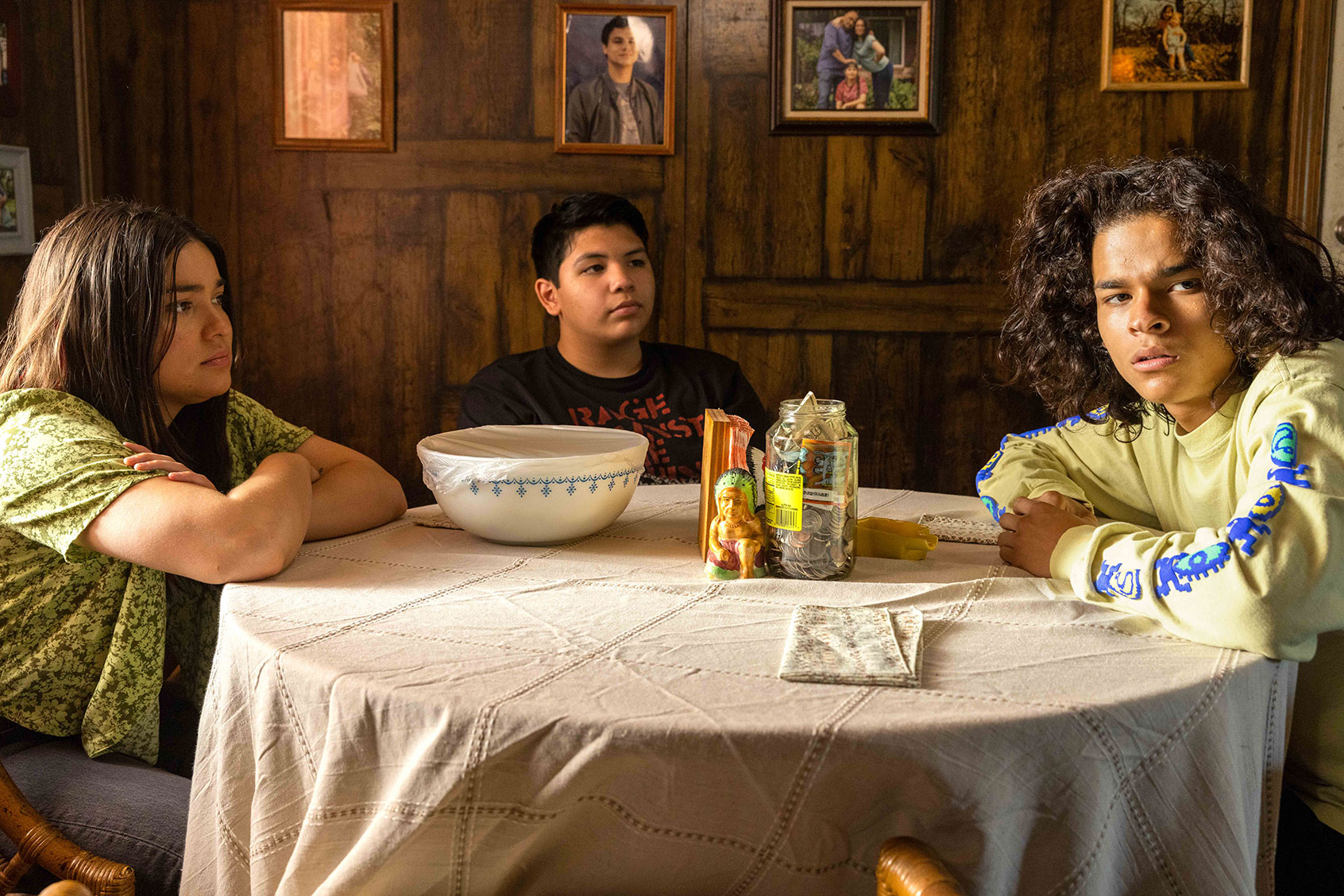
Getting there takes us on a route through which the series ascended to its next level of greatness. Season 2 is surer in its execution than the already excellent first season. Many have said this, but it is a crime that this show hasn’t received more awards recognition, especially at this point.

That fact also proves the gripe that most awards juries don’t legitimately sit with most of the shows they’re tasked with honoring. The frustrating part about even that, though, is that “Reservation Dogs” is one of the easiest and most inviting shows to spend time with.

To watch the show is to understand and appreciate the many ways that its creator Sterlin Harjo plays with the concept of spirits, ancestors, and legend as a creatively dominant theme. Even so, that isn’t the story’s sole driver or its most influential. Primacy still belongs to Harjo’s and his writers’ love of American coming-of-age movies, and movies they enjoyed while he was growing up.

The show’s fluency in the common language of ’80s and ’90s cinema and cinematic trends enable each episode to effortlessly dance between comedy and drama.

Each character’s swim through memory, legend and nostalgia brings forth an assortment of ancestral forces living, dead, and culturally metaphorical that form the weave of the stories they tell themselves about themselves, and the stories defining who they are to the people around them. Taken together, this season lands with an important epiphany: sometimes it’s the quietest spirits that need the most attention.

Reservation DogsDevery Jacobs as Elora Danan, Lane Factor as Cheese and D’Pharaoh Woo-A-Tai as Bear in “Reservation Dogs” (Shane Brown/FX)
Not every second season episode of “Reservation Dogs” connects to a ghost story. One of the season’s best, “Wide Net,” follows Bear’s mother Rita (Sarah Podemski) her co-worker and Jackie’s aunt Bev (Jana Schmieding), and a couple of their other childhood friends on a crazy weekend disguised as a work trip. It eventually turns into a deep examination and critique of cultural roles foisted upon women, and the choices and consequences of accepting those prescribed expectations or rejecting them. Mainly, though, their aim is to get laid.

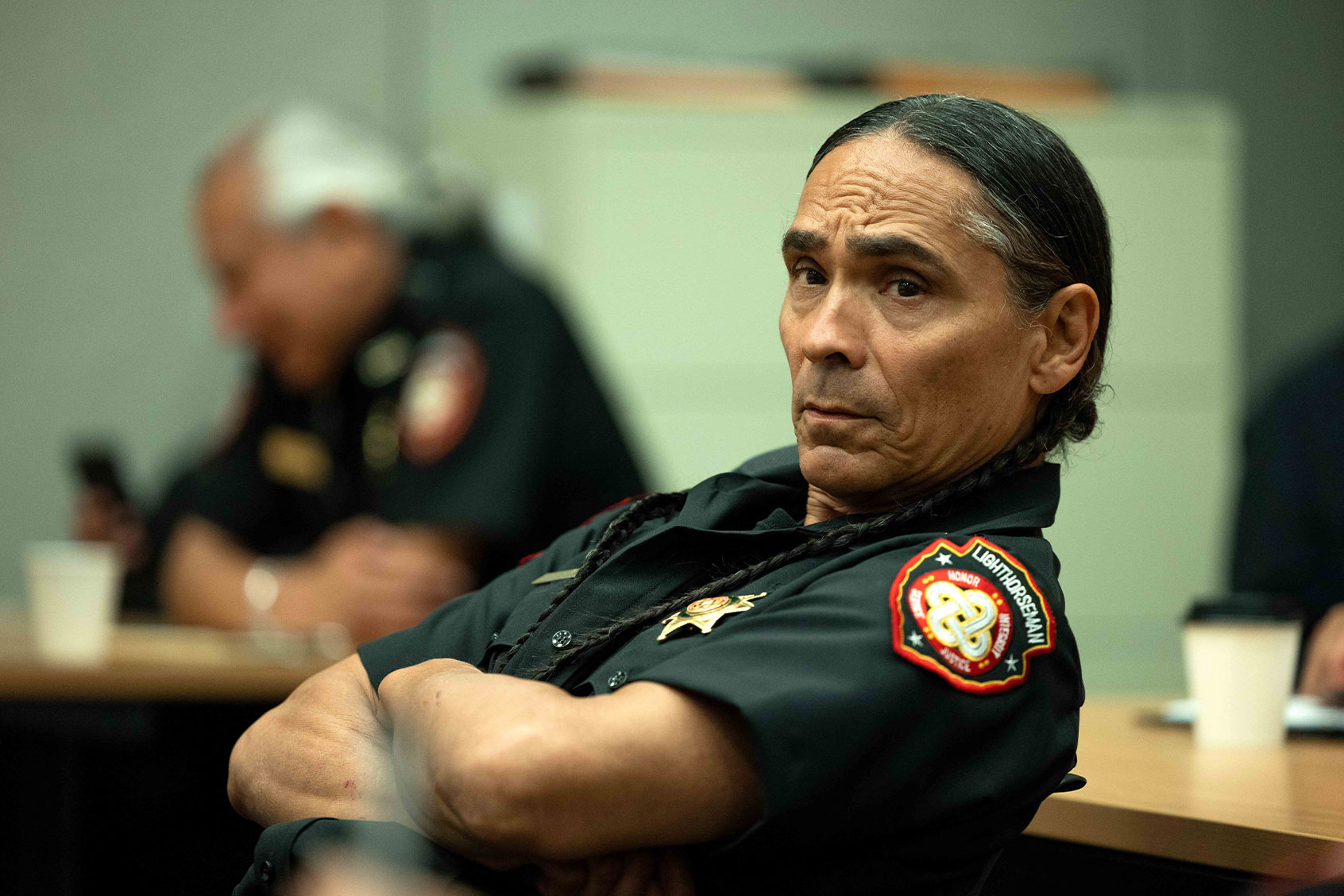
Another stellar half-hour, “This Is Where the Plot Thickens,” stars local lighthorseman Big (Zahn McClarnon) teaming up with crooked salvage yard operator Kenny Boy (Kirk Fox) in an odd couple/buddy cop mash-up that ends with them busting a ring of secret society fish fornicators that includes the governor. Oh, and did we mention the good guys did it all while tripping balls?

Reservation DogsZahn McClarnon as Big in “Reservation Dogs” (Shane Brown/FX)

Even that episode ties into the season’s larger theme of accepting the part we all play in the collective lineage of our families and communities. The girl’s trip takes place after Mabel’s farewell vigil, which brings the community together to swap stories about her and inevitably leads to remembering the daughter and sister who isn’t there to say goodbye: Elora’s deceased mother Cookie.

The emotional climax of Big’s episode reveals that he blames himself for failing Cookie when she needed him – a pang of guilt that earns him the mercy and protection of another famous spirit, the Deer Lady (Kaniehtiio Horn), who turns out to also be a fan of Kenny Boy’s.

Memories are the body’s home movies, ever-shifting and constantly edited. And in this memory-heavy season, where major characters are featured in episodes influenced by familiar movies or cinematic genres, “Reservation Dogs” reasserts its strength as a love letter to cinema while reminding us that it is still a show about chosen families – the kind seen throughout TV, especially in sitcoms.

Bear, Elora, Willie Jack, and Cheese finally get to California only to find themselves stranded, friendless, and without options, leaving them no choice but to accept guidance from America’s spiritual mascot, White Jesus.

Since it’s California, White Jesus might be real or a collective hallucination. But he’s a generous soul who guides them as far as they need him to and appears to abandon them in a moment of crisis. Along with emphasizing ancestry and spirits this season, the writers enjoy winking at white America’s stereotypes about Indigenous spirituality.


Want a daily wrap-up of all the news and commentary Salon has to offer? Subscribe to our morning newsletter, Crash Course.


If you’re familiar with that corny “Footprints in the Sand” poem frequently spotted in Christian grandmothers’ powder rooms, you may recognize this as a well-earned bit of turnabout. If you’re familiar with ’80s vampire flicks, you’ll recognize the wild scene White Jesus navigates the foursome through a scene lifted out of “The Lost Boys.” (The finale episode, by the way, is titled “I Still Believe” and features a relevant cameo during the end credits.)

It tempts one to theorize what this episode and the season as a whole are saying about America’s current struggle with itself over the truth of our shared history and experiences. But that spell of intellectualizing is quickly broken when Cheese, standing in the ocean and saying a prayer for Daniel, cites a scene in “The Neverending Story” shortly after Willie Jack, asked to sing a hymn for their friend, offers up a few mangled bars of “Free Fallin'” by Tom Petty and the Heartbreakers, as their uncles did before them.

“We just wanted this moment to be significant, like in the movies,” Cheese explains to the spirits, and us, and we get exactly what he means. That’s a universal struggle we can only win on occasion, a victory “Reservation Dogs” clinches in its sophomore outing.  Whenever that happens, it’s worth celebrating.

All episodes of “Reservation Dogs” are streaming on FX on Hulu.


Pineapple haters are wrong: You should eat even more fruit on your pizza

When many people think of fruit on pizza, one particular image likely comes to mind: slices of pie speckled with briny, muted cubed ham, black olive slivers and canned pineapple chunks. While I know some view pineapple-topped pizzas as an affront to culinary sense, I was a little more apathetic — largely, I think, because of those pineapple chunks.

I mean, they were never really very good, right? The fruit was always a little syrupy from the canning process, and its flesh had lost any discernible snap quite a while back. After being tossed on a cheap delivery crust and baked, the chunks were rendered even more saccharine and flabby. In a world of sausage and green peppers and mushrooms, why would I reach for that? 

But earlier this year, I ordered a pie that changed my mind. It came from Milly’s Pizza in the Pan in Chicago’s Uptown neighborhood. Launched during the pandemic by Robert Maleski — who was an out-of-work waiter at the time — the deep dish joint started as a one-man ghost kitchen that offered delivery and pickup.

It was an immediate hit. The business sold out nightly — it often still does — and made the Chicago Tribune’s 25 Best Pizzas list in 2020 only a few months after opening. In January, Maleski shifted to a brick-and-mortar shop, which I could see from my living room window if I really craned my neck. After trawling Milly’s website for a coveted pick-up “reservation,” I finally scored a Thursday night slot at 6:45 p.m. 

Then came the big decision of what to order. I decided on two pies: the Updog, topped with Kumato tomatoes, spinach, red onions, pepperoni, sausage, olives, sweet peppers and fresh mozzarella, and the Que Suerte, topped with crispy bacon, jalapeño, cherry tomatoes and pineapple. 

They were both beautiful, but especially the Que Suerte. To be honest, I still have a picture of my boyfriend taking a picture of the pizza on his phone. It was slightly caramelized along the tips of the bacon bits, as well as along the seams where the cheese met the crust. The cherry tomatoes had burst, the seeds glistening like little jewels. And then there was the pineapple — just a few taut, golden-yellow rings scattered across the top of the pie. They were sweet, a little acidic and a perfect complement to the inherent heaviness of deep dish. 

“This is what pineapple pizza should taste like,” I texted her. “I want to eat all the fruit on pizza now.”

I sent a picture to my sister. “This is what pineapple pizza should taste like,” I texted her. “I want to eat all the fruit on pizza now.” 

Since then, I’ve been pretty successful in that effort. This spring, I ate a beautiful pizza topped with ricotta, pea shoots and preserved lemon slices. Over the summer, I had one topped with sharp blue cheese, peach slices and hot honey. Now that it’s fall, it’s officially fig-topped pizza season, preferably with some prosciutto and possibly some arugula. When I sat down to write this story, I was eating a bowl of dried cherries and contemplating if they could work on a pizza. I think so — if paired with some smoky gouda, caramelized shallots and spinach

Is this maybe stretching the definition of “pizza”? Perhaps, but I also think that both fresh and dried fruit are criminally underutilized as pizza toppings. Fruit and cheese are a natural pairing, of course, and if you start from a good combination of the two, it’s hard to go wrong. 


Want more great food writing and recipes? Subscribe to Salon Food’s newsletter, The Bite.


Take blackberries, for instance, which are absolutely delicious with crumbly goat cheese. Crumbly goat cheese and blackberries are even better with a little rosemary. With all that in mind, why not top a pizza with goat cheese, a few dollops of a blackberry-rosemary jam and some crumbled spicy Italian sausage? 

There are a few fruits I’d personally stay away from. For example, you won’t catch me topping pizza with banana slices, but follow your heart here. Mine led me back to pineapple, after all. 

Hurricane Ian is going to flood out Florida — and this is a constant climate change problem

As Hurricane Ian rapidly intensifies and barrels toward Florida and the American southeast, public officials are warning that much like Hurricane Fiona in Puerto Rico, the storm will cause severe flooding. Tampa Mayor Jane Castor, D-Fla., warned of “unprecedented flooding” with “18-20 inches of rainwater” while Gov. Ron DeSantis, R-Fla., informed residents in many southern counties that the storm “is going to have major, major impacts in terms of wind, in terms of rain, in terms of flooding.” The state’s most populous city, Jacksonville, is already reporting flooding and power outages, while the flooding is reportedly severe in the Florida Keys.

The scientists who spoke to Salon about the tropical storm agreed that there is going to be a lot more flooding as Hurricane Ian continues to make landfall. Indeed, as climate change continues to worsen, more and more regions of the country will experience flooding — and the many public health crises that accompany it. 

“Apart from physical damages to infrastructure, freshwater lagoons and reservoirs may get contaminated by salt water,” Dr. Ali S. Akanda — an associate professor at and graduate director of the Civil & Environmental Engineering Department at the University of Rhode Island — told Salon by email. “Areas with damaged water/sanitation services would be at high risk of waterborne infections.”

Dr. Michael E. Mann, a climate scientist and director of the Center for Science, Sustainability and the Media at the University of Pennsylvania, warned that regions hit by the hurricane may experience water quality problems similar to those recently endured in Jackson, Mississippi. In that southeastern city, roughly 150,000 people were left without safe drinking water because the unprecedented rainfall overwhelmed a key pump at the local water treatment plant. Despite water pressure being restored, residents in affected areas are still being urged to boil their water.


“Jackson, Mississippi provides one example of the devastating consequences that come with worse flooding events, which can have detrimental impacts on water quality and human health,” Mann wrote to Salon.

Dr. Kevin Trenberth of the National Center for Atmospheric Research (NCAR) pointed out by email that “too much rain overwhelms treatment systems and floods them with contaminated water as rainwaters flow over land surface rather than filter through sand and soils.” He added that, in heavily agricultural areas, local contaminants like cattle droppings can also become an issue.

“Too much rain overwhelms treatment systems and floods them with contaminated water as rainwaters flow over land surface rather than filter through sand and soils.”

Climate change is expected to cause increased flooding through tropical storms for the foreseeable future, but this anticipated surge in floods will not be limited to hurricane season. After historic flooding occurred at Yellowstone National Park in June, experts pointed out that climate change leads to warmer air that in turn holds more water vapor; which is why climate change leads to more extreme weather events. This means that, even in landlocked areas like the state of Wyoming, one can expect high levels of flooding even where they were never a regular occurrence.

“Every flooding event is unique and it can be difficult to relate trends in flooding to trends in extreme precipitation,” Michael Wehner, a senior scientist in the Computational Research Division at the Lawrence Berkeley National Laboratory who extensively studies climate change data, told Salon by email. He pointed out that some rivers have been engineered to control floods, while others have not. “That being said, it is clear to me that the ‘100 year flood maps’ based on historical data and often used for insurance mandates are generally out of date if they do not take climate change into account.”


Want more health and science stories in your inbox? Subscribe to Salon’s weekly newsletter The Vulgar Scientist.


Even when extreme weather does not lead to flooding, climate change will still cause flooding through more anodyne processes. As ice sheets continue to melt and sea levels rise more generally, hundreds of millions of people who live in coastal areas will be flooded out of their homes. This will happen either because the newly-elevated sea levels will literally put their communities permanently underwater, or they’ll simply experience more frequent flooding events.

As flooding becomes more common and more severe, there are basic steps that everyone can take to protect themselves.

“We know in Florida that we have rural/low-income communities, immigrant communities, and communities of color that are low income that live in coastal areas that are both susceptible to extreme weather and flooding events now and even more so in the future.”

“There are a lot of things that people can do to protect themselves from hurricanes, which are always communicated by associated agencies – make sure your resources are stockpiled for a few days, make sure you have enough things like medications, pet food, water, batteries, a generator, etc,” Dr. Alison E. Adams, an assistant professor of Community & Environmental Sociology at the University of Florida, told Salon by email.

She added that her own research focuses on helping particularly vulnerable communities prepare for these floods.

“We know in Florida that we have rural/low-income communities, immigrant communities and communities of color that are low income that live in coastal areas that are both susceptible to extreme weather and flooding events now and even more so in the future,” Adams explained. “And some of these communities are facing impending in-land or other migration to be safe from issues like sea level rise and increased hazards from coastal climate change environmental hazards.” Individuals in these situations will need quality infrastructure and effective outreach efforts “to help these vulnerable communities protect themselves in these scenarios.”

“Blonde”: Marilyn Monroe and viewers deserve better than this unsubtle mess of sex and suffering

Here’s a hot take: “Blonde” is the worst Netflix entry in the tragic icon genre since “Diana: The Musical.” Andrew Dominik‘s insufferable NC-17 adaptation of Joyce Carol Oates’ novel of the same name is to Marilyn Monroe what cubic zirconia are to diamonds. One only has to look — hard as that may be — at a laughable, ersatz recreation of Monroe’s classic musical number from “Gentlemen Prefer Blondes” to get a whiff of how bad this stinker is. 

One of the major problems (and there are many) is that Monroe is portrayed by a woefully miscast Ana de Armas, who only barely captures Monroe’s breathy voice, often talking in a whisper to simulate it. And she doesn’t quite look like Monroe either, other than the signature blonde mane. Viewers might even expect the beauty mark on her face to disappear whenever she cries, which is often. 

But most importantly, de Armas never makes viewers feel for her tragic Monroe. The film is meant to get in her mindset, but mostly, one feels for de Armas, whose body is exploited in numerous gratuitous nude scenes, and one excruciating oral sex sequence with “The President” (Caspar Phillipson), who forces her to go down on him while he is on a call about various accusations. It is typical of “Blonde” to feature Monroe achieving an orgasm with her two lovers Cass (Xavier Samuel) and Eddy (Evan Williams) fondling her nether regions while she is in a crowded theater watching herself cry out in fear during a trailer for her film, “Niagara.”

When Cass (Charlie Chaplin‘s son) and Eddy (Edward G. Robinson’s son) first seduce Monroe, she acts like she doesn’t know what’s going to happen, but then she becomes part of a threesome that hits the gossip sheets. Their sex scene is shot in a dreamy, stylized way that is so bizarre it feels like something out of a 1960s Radley Metzger soft-core porn film. 

Dominik is hardly subtle, and “Blonde” is not meant to be a proper biopic. It is billed as a “fictionalized chronicle of the inner life of Marilyn Monroe” and certainly an examination of the celebrity culture that ate Monroe up and spit her out. There are scenes of paparazzi, throngs of fans, and standing ovations that celebrate the awe the actress generates, but these moments have no impact — and they should. 

BlondeAna de Armas as Marilyn Monroe in “Blonde” (Netflix)

Dominik emphasizes Monroe’s abandonment as the child Norma Jeane (played by Lily Fisher) in 1933, when her mom Gladys (Julianne Nicholson) tells her about her absent father before going mad and getting abusive. Gladys is institutionalized, and Norma Jeane is dropped off at an orphanage. 

Monroe, therefore, is always looking for daddies in her work and her personal life. Cue Monroe’s song “Every Baby Needs a Da-Da-Daddy.” Her relationships with both The Ex-Athlete, Joe DiMaggio (Bobby Cannavale), and the Playwright, Arthur Miller (Adrien Brody), are depicted crudely, as is her longing to be a mother and her painful abortions. 

“Blonde” concentrates largely on Monroe’s career years, starting with a clip from “All About Eve.” When she auditions for a leading role in “Don’t Bother to Knock,” she draws on her memories for the screen test only for the director to react by fixating on her ass. (An earlier scene had her sodomized by an executive during a meeting; Dominik focuses on her ass in that scene, too.) Later in the film, the famous scene in “The Seven Year Itch” is recreated, and it features her billowing skirt and Monroe claiming, “Isn’t it delicious?” (referring to the ventilation from the subway.) Her then husband DiMaggio is incensed by this display, but viewers never learn how Monroe feels about this “Seven Year Itch” moment, which may be the most interesting aspect of that famous scene. DiMaggio later obtains some nude photos of his wife and abuses her. 

BlondeAna de Armas as Marilyn Monroe in “Blonde” (Netflix)

Monroe suffers considerable psychological, physical, and sexist abuse throughout “Blonde,” and yet the film holds no cumulative power. Watching Monroe haunted by her demons and wandering nude around a house, reveals nothing more than the actor’s body. (Dominik shifts back and forth between color and black and white throughout the film to irritating effect). She has a horrific abortion in a sequence that is meant to be shocking but comes off as a campy nightmare. And her difficulties on the set of “Some Like It Hot,” while very real — she resents being called “Jell-O on springs” — leads to her taking drugs and succumbing to addictive behavior. A scene where a drugged-up Monroe vomits directly into the camera twice may be the film’s nadir.   

“Blonde” is all over the place but goes nowhere. And at 2 hours and 47 interminable minutes, it should offer some insight for the investment of time and energy. Dominik and de Armas struggle to illuminate Monroe’s character, as well as her conflicts about her career and her well-being. The film just repeatedly underscores that Monroe only wanted her father and features her reading letters he sends her that hold her interest only. 

The film’s overarching point is that Monroe was misunderstood and underestimated. When she namedrops Chekhov and Dostoyevsky, folks, including Arthur Miller, are impressed that she reads(!) which is insulting. But even when she talks about wanting to have a good, simple life, and a family, it, too, feels hollow. Yes, Monroe wants to be taken seriously, but “Blonde” never feels sincere. 

“Blonde” is currently in theaters and now streaming on Netflix. Watch a trailer via YouTube.

UPDATED: Unarmed teen girl in possible kidnap case killed in shootout with California cops

An unarmed 15-year-old California girl who had been reported as a possible kidnap victim was killed on Tuesday in a shootout with sheriff’s deputies, apparently while running toward them. 

After 45-year-old Anthony Graziano, Savannah’s father, shot and killed his wife on Monday, authorities issued an Amber Alert out on Monday warning that he had kidnapped his daughter and was on the run. Police now say, however, they are not sure whether Savannah was abducted or went with her father willingly. She had reportedly been living with him.

According to police, Graziano killed his estranged wife, 45-year-old Tracy Martinez, near an elementary school in Fontana, California, about 45 miles east of Los Angeles. The area was locked down and Graziano apparently fled the scene with Savannah.

The next morning, a witness spotted Graziano’s Nissan pickup truck in a rural desert area near Barstow, California, and notified police, leading to an extensive chase and shootout on Interstate 15 near Victorville around 11:15 a.m.

Sheriff’s deputies involved in the pursuit said that Graziano was shooting at them “constantly” through his rearview window and police responded with gunfire of their own.

Graziano was killed in the shootout. Savannah apparently attempted to flee the vehicle and was running toward the deputies when she was shot. The San Bernardino County Sheriff’s Department said she was wearing “tactical gear” and that deputies did not recognize her. She was later transported to a hospital, where she was pronounced dead around noon.


Want a daily wrap-up of all the news and commentary Salon has to offer? Subscribe to our morning newsletter, Crash Course.


During a news conference on Tuesday, San Bernardino County Sheriff Shannon Dicus said the investigation was in its beginning stages and emphasized that all information is preliminary. Dicus did not confirm who had fired the shot that ultimately killed Savannah, saying that there were “indications” that she had been involved the shooting and may have “[fired] back at the deputies.” Both the sheriff’s department and the state of California are now investigating this incident.

New book exposes Trump’s shocking private anti-LGBTQ comments — and obsession with aides’ sexuality

New York Times reporter Maggie Haberman described former President Donald Trump’s decades-long history of sexist, homophobic and transphobic behavior in her upcoming book, “Confidence Man: The Making of Donald Trump and the Breaking of America.”

Trump often tried to guess whether people were gay, or speculate about their genitalia, Haberman wrote in an excerpt published by The Daily Beast

A week before Trump’s second debate in St. Louis in 2016, his close adviser Reince Priebus asked whether he would support a female transgender student using the girl’s bathroom. 

“Cocked or decocked?” was Trump’s immediate response.

The audience listening to the debate preparation were stunned, offering up a “blank stare.” Confused, an unidentified individual in the group said “decocked?”

The former president proceeded to make “a chopping gesture,” and repeated his original question: “with cock or without cock?” Trump’s advisers realized he was referring to bottom surgery and questioned what difference it would make in regards to Priebus’ question. 

He explained it would change his decision. “What if a girl was in the bathroom and someone came in, lifted up a skirt, and a schlong was hanging out,” Trump said.

In another section of the book, Haberman describes how in the 80s, Trump would often call reporters that he had met and shook hands with in New York City to see if they were gay and had AIDS. 

Conversations with Trump in his early years as a businessman would also usually revolve around sexually explicit topics in “lurid detail.”

“Those who heard him speak were often struck by the fact that he appeared to be trying to shock,” Haberman writes. Former Trump employees also shared that he would frequently show pictures of women he had been intimate with as proof of his “masculinity.”

“They also recalled Trump mocking gay men, or men who were seen as weak, with the words ‘queer’ or ‘faggot,'” Haberman revealed. Former Trump Organization executive Alan Marcus added that he would “belittle” an executive he believed was gay and bragged about paying him less. 

Trump seems to have had a strange fascination about whether the people in his inner circle were gay, the book reveals. During a meeting with spokesman Jason Miller at the beginning of his administration, Trump confirmed that Miller “likes the ladies.”

“You know how sometimes someone turns out to be gay later and you knew? This guy, he isn’t even like one percent gay,” Trump said of Miller.


Want a daily wrap-up of all the news and commentary Salon has to offer? Subscribe to our morning newsletter, Crash Course.


Haberman’s book is far from the first time Trump has been called out for his homophobic behavior. While he sometimes showed a willingness to publicly align himself with members of the LGBTQ+ community, his choice of Vice President Mike Pence, a staunch conservative who rolled back transgender protections from the Obama administration, was an early signal of his administration’s anti-LGBTQ bent. 

It was also during his administration that transphobic policies emerged all across the federal government, including a ban on transgender individuals from serving in the military, an end to protections for transgender people in prison, and bans on students choosing the bathroom they feel most comfortable using in school.

Trump’s administration often propped him up as “the most pro-gay president in American history.” However, the National Center for Transgender Equality described his “nonstop onslaught against the rights of LGBTQ people” in a list of more than 60 harmful policies carried out during his administration, proving the dire consequences of his supposed “locker room talk.”

Special master rebukes Trump judge that appointed him for order that “made no sense”

When former President Donald Trump went to court against the Justice Department to stall the federal investigation into classified documents at his Mar-a-Lago resort in Palm Beach, Florida, a district judge he appointed, Aileen Cannon, granted Trump everything he asked for, appointing a special master to review the documents for executive privilege even though no legal precedent grants a former president privilege over national security documents, and effectively blocking the DOJ from conducting a national security review until the special master’s work is complete.

Now, the special master himself, Senior Judge Raymond Dearie of Brooklyn, is rebuking Cannon for a decision that hamstrings a key function of the job she assigned him to do, in a filing published by Just Security. Specifically, he is taking issue with her rescinding his authority to issue interim reports as he conducts his review — and saying her reasoning for this made no sense.

“In the original Appointing Order, the Court directed that ‘the Special Master shall submit interim reports and recommendations as appropriate. Upon receipt and resolution of any interim reports and recommendations, the Court will consider prompt adjustments to the Court’s orders as necessary,'” said the filing. “However, the Court later struck that language as part of its order implementing an unrelated ruling by the Eleventh Circuit. As the language quoted above as to interim reports and adjustments to prior orders is consistent with the Eleventh Circuit’s ruling and the efficient administration of the Appointing Order as amended, the undersigned respectfully recommends that the Court issue an order reinstating that language.”

This comes after a three-judge panel of the Eleventh Circuit, two of whom were also Trump appointees, reversed the portion of Cannon’s order blocking the DOJ from access to documents that were marked classified. The special master review will continue for the unclassified documents.

Dearie was mutually agreed to as the best choice of special master by Trump and the DOJ. According to previous reports, Trump was hoping that because Dearie previously served on the Foreign Intelligence Surveillance (FISA) court, and because that court was at the center of a long-running Fox News talking point about the FBI supposedly abusing power in the Russia investigation, that Dearie would automatically view the FBI and DOJ as corrupt and be a sympathetic to him.

So far, however, Trump’s hopes haven’t panned out. At the first special master hearing, Dearie aggressively pushed Trump’s legal team to take a position on the former president’s repeated claims he can declassify top secret documents without telling anyone — and made clear he takes the DOJ at its word that documents labeled classified are, in fact, classified.

Did Trump pretend to be a reporter on call to Rep. Debbie Dingell?: Haberman book raises questions

After Rep. Debbie Dingell, D-Mich., said she was voting to impeach former President Donald Trump in 2019, she received a call from an unknown phone number with the person on the other end claiming to be a Washington Post reporter — but she suspects it was Trump all along, according to a new book by New York Times reporter Maggie Haberman.

“When she answered, the man on the other end identified himself as a Washington Post reporter, and said he knew her husband from his investigations in Congress. The name he gave was not one she recognized,” Haberman wrote in her new book “Confidence Man,” according to an excerpt published by The Washington Post. “The man asked Dingell if she was looking for an apology from Trump. No, she replied, merely that people could be civil to one another. As the man talked, Dingell couldn’t shake the idea that his voice sounded like that of the forty-fifth president.”

Haberman details Trump’s early career and his tumultuous four years in office, revisiting his history of racism, describing his interactions with world leaders and members of Congress and unveiling the chaos that consumed his administration.

One of his ambitious ideas included bombing drug labs in Mexico after one of his leading public health officials advised that such facilities should be handled by putting “lead to target” to stop illicit substances from entering into the United States.

“He raised it several times, eventually asking a stunned Defense Secretary Mark Esper whether the United States could indeed bomb the labs,” the book says, adding that Trump was confused by Assistant Secretary for Health Brett Giroir, who often wore his dress uniform. “The response from White House aides was not to try to change Trump’s view, but to consider asking Giroir not to wear his uniform to the Oval Office anymore,” Haberman wrote.

Then there are his erratic interactions with world leaders. The first time Trump met then-British Prime Minister Theresa May, Haberman writes, he brought up the topic of abortion saying that “some people are pro-life, some people are pro-choice. Imagine if some animals with tattoos raped your daughter and she got pregnant?” He pointed to then-Vice President Mike Pence and described him as the “tough one” on abortion.

When describing some leaders, he used profane language to express his disdain, referring to German Prime Minister Angela Merkel as “that b—-,” the book highlights, according to The Washington Post. He praised others for their strength, like Russia’s President Vladimir Putin, and laughed when aides grew angry that Trump tweeted a proposal for a joint cyber unit with Russia that would have “effectively let the Russians into the U.S. investigations of hacking.” 


Want a daily wrap-up of all the news and commentary Salon has to offer? Subscribe to our morning newsletter, Crash Course.


When the coronavirus pandemic surfaced, Trump was appalled by the sight of face masks and told his aides to remove them in his presence. He even discouraged them from addressing the topic because he viewed it as a problem that negatively impacted his presidency. On the other hand, he wanted credit for vaccines, but informed aides that he could not do so because of the “radical right,” referring to his own supporters.

His interactions with staffers provide insight into how he viewed people of color. When the newly inaugurated president held a reception at the White House to meet with top congressional leaders, Trump turned to a group of racially diverse staffers for Senate Democratic Leader Chuck Schumer, D-N.Y., and House Speaker Nancy Pelosi, D-Calif., and asked them to retrieve the canapes, the book highlights. In the same meeting, he told Schumer and Pelosi that the only reason he had lost the 2016 popular vote to Hillary Clinton was due to ballots cast by “illegals”.

Other parts of the book demonstrate that casual racism was a part of Trump’s life long before he entered the White House. During his relationship with Kara Young, a model who had a Black mother and a white father, Trump joked that she had inherited her good looks from her mother and her intelligence “from her dad, the white side,” Haberman reports. 

As president, he fixated on how people who represented him appeared. He complained about the way his ambassador to the United Nations Nikki Haley looked on television asking, “can’t we do better lighting or give her better makeup?” according to the book. 

Trump also had plans to have Jared Kushner and Ivanka Trump fired, Haberman writes. In meetings with then-White House Chief of Staff John F. Kelly and White House Counsel Don McGahn, “Trump gave instructions to essentially fire the pair. Kelly and McGahn resisted, expressing their fear that he would not back them once his daughter and son-in-law pushed back.” At one point, the former president was ready to tweet that his daughter and son-in-law were leaving the White House, but was stopped by Kelly since he had not talked to them directly. He never followed up with a conversation. 

Trump’s inability to deal with serious matters did not stop there. When Trump lost his 2020 election, he refused to acknowledge the results and claimed widespread voter fraud. 

“I’m just not going to leave,” Trump told one aide, according to Haberman’s book.

Ted Cruz only GOP senator to object to bipartisan bill to prevent another Jan. 6 in key vote

U.S. Sen. Ted Cruz, R-Texas, broke from his own party in voting against a bipartisan bill that would bar him from singlehandedly objecting to presidential election results, as he did on Jan. 6, 2021.

The bill, dubbed the Electoral Count Reform and Presidential Transition Improvement Act, aims to prevent a constitutional crisis like the one that nearly occurred on Jan. 6, 2021. It clarifies procedural ambiguities that former President Donald Trump tried to exploit in an attempt to overturn the results of the 2020 presidential election.

Sens. Joe Manchin, D-West Virginia, and Susan Collins, R-Maine, sponsored the bill, and it has the support of Democrats and Republicans alike. Senate Minority Leader Mitch McConnell, R-Kentucky, came out support on Tuesday, raising the likelihood of passage. But during a Senate Rules Committee vote on the bill, Cruz objected, saying the bill undermines states’ constitutional autonomy in running their elections and therefore opens the door for voter fraud.

“This bill is a bad bill. This bill is bad law. It’s bad policy and it’s bad for democracy,” Cruz said at the meeting.

“I understand why Democrats are supporting this bill,” he continued. “What I don’t understand is why Republicans are supporting it.”

The bill clarifies that the vice president’s role in certifying Electoral College votes is completely ceremonial. It also raises the threshold for objecting to election results from a single member in each chamber to one-fifth of each chamber, essentially making Cruz’s Arizona objection vote meaningless.

It also clarifies the emergency situations that allow a state to extend voting periods, allows courts to force a governor to certify electors and stops state legislatures from creating their own slate of electors.

Cruz was the only Republican on the committee to oppose the bill Tuesday, with 14 other senators on the committee, which includes both parties’ Senate leaders, voting to advance it. The bill now heads to the full Senate, where it will likely meet overwhelming bipartisan support.

Cruz played a key role on the day of the insurrection. Both he and Republican Sen. Josh Hawley of Missouri led campaigns to encourage members to object to the certification of the election results.

Meanwhile, Trump and his allies were also pressuring Vice President Mike Pence, who presided over the Senate, to refuse to certify the results, whipping protesters stationed outside of the Capitol into a frenzy until they ultimately broke through a line of police and stormed into the building.

Even after the attack, Cruz voted against certifying the election results in Arizona, repeating Trump talking points that cast doubt on the state’s results.

The rest of the Senate overwhelmingly voted against Cruz’s objection, and the votes were certified.

Sen. John Cornyn, Texas’ senior Republican senator, voted to reject Cruz’s objection on Jan. 6. But most Texas Republicans in the House voted with Cruz at the time.

Sen. Shelley Moore Capito, R-West Virginia, was part of the working group for the bill and said it was the product of weeks of negotiations and consultations with legal experts. McConnell said he was “proud to vote for it and help advance it.”

“The chaos that came to a head Jan. 6 of last year strongly suggests that we find careful ways to clarify and streamline the process,” he said.

The House passed its own version of the bill last week, which included more stringent guardrails, including a one-third minimum threshold for members to object to election results. The differences between the versions have been a source of tension between the two chambers, with McConnell saying the Senate version “is the only chance to get an outcome and make law.”

Cruz aside, all other members of the Senate committee praised one another for reaching a bipartisan solution. The meeting closed to applause.

“This isn’t just another vote at another markup. This vote is about living up to our oath of office,” Sen. Alex Padilla, D-California, who previously served as California’s secretary of state, said during the meeting. “That includes working to ensure an insurrection, that an attack on our democracy never occurs again.”


This article originally appeared in The Texas Tribune at https://www.texastribune.org/2022/09/27/ted-cruz-insurrection/.

The Texas Tribune is a member-supported, nonpartisan newsroom informing and engaging Texans on state politics and policy. Learn more at texastribune.org.

Ex-Mueller prosecutor: Trump is “quiet-quitting” special master case after realizing his “blunder”

Former general counsel of the FBI Andrew Weissmann explained why he thinks Donald Trump is “quiet quitting” his special master case.

Weissmann, alongside former Deputy Assistant Attorney General Harry Litman was interviewed by MSNBC’s Lawrence O’Donnell.

Special master Raymond Dearie ordered Trump’s lawyers to secure a document vendor, but in a Tuesday legal filing, the Department of Justice said none of the five major firms want to work for Trump, so the federal government guaranteed payment.

“I think there is something we can take away from what seems like a small potatoes kind of thing,” Weissmann said. “I think what Donald Trump is doing is quiet quitting. He brought this case and he realized he is worse off from having brought this case.”

Weissman noted reports attorney Chris Kise left only weeks after being paid $3 million.

“I wouldn’t want to work on this either,” he said.

“So he really strategically made a terrible blunder,” Weissmann concluded.

Watch below or at this link:

Trump’s legal troubles mount as Oath Keepers plan to throw him under the bus at sedition trial

With Hurricane Ian bearing down on Florida, it’s completely understandable why the House committee investigating the January 6 insurrection postponed Wednesday’s scheduled hearing. No new date has been scheduled, though it will be coming soon and is likely to be another doozy of a hearing. As Heather “Digby” Parton, notes, the word is that the committee will focus heavily on the role of long-time Donald Trump confidante Roger Stone, and the role he played in planning and executing the Capitol riot. 

But even without the January 6 hearing to provoke Trump’s ravings on social media, Trump has a lot of legal problems to sweat this week. That’s because jury selection began for the trial of Oath Keepers head Stewart Rhodes and four other members of his far-right militia. The Oath Keepers, as with the Proud Boys, are both heavily linked to Stone and both were central to the Capitol insurrection.


Want more Amanda Marcotte on politics? Subscribe to her newsletter Standing Room Only.


The Department of Justice has a treasure trove of evidence against the Oath Keepers. Two of the members charged with seditious conspiracy have already struck deals, pleading guilty and cooperating with prosecutors. In addition, the government has a mother lode of text messages between group members that not only showcases their planning but also their links to Stone and other people in Trump’s orbit. Unable to deny that they were up to their necks in seditious conspiring, the five Oath Keepers are going to trial with a novel defense: Blaming Trump for telling them to do it. 

“They intend to tell the jury that when armed teams of Oath Keepers made plans to rush into Washington from Virginia on Jan. 6, 2021, they believed they would be following legal orders from the president himself,” the New York Times reports. Because they claim to have been acting on orders from Trump, the defendants plan to argue they believed the insurrection was legal. 

While it’s questionable they actually thought secretly planning a deadly assault on the Capitol was legal, there’s a mountain of public evidence already that the Oath Keepers, as well as the Proud Boys, had every reason to believe they were acting on Trump’s orders. Trump did go on national television, during a 2020 debate with Joe Biden, and instruct the Proud Boys to “stand by.” Newly released video footage shows Stone raving on the day before Election Day, “F**k the voting, let’s get right to the violence.” The Oath Keepers kept steady contact with Stone and knew full well that he was in regular contact with Trump, who commuted Stone’s sentence for previous crimes committed in defense of Trump. Former White House aide Cassidy Hutchinson testified that on January 6 Trump showed every sign that he planned to join the Oath Keepers and other insurrectionists, and was only stopped by a Secret Service agent.

Already, the DOJ and Attorney General Merrick Garland are finding it harder than ever to avoid the topic of a Trump indictment.

So far, no evidence has been made public that Trump directly instructed the Oath Keepers or Proud Boys, or used a conduit like Stone to offer direct instructions. It would certainly bolster the Oath Keeper case if such communications existed. But, as Trump’s former fixer Michael Cohen testified to Congress in 2019, Trump is very talented at making his desires known to his followers without giving direct orders which could be used against him in court. Like Cohen, the Oath Keepers may be another group of Trump sycophants who intuited what he wanted and acted on his implied command, without realizing it means they could go to prison while Trump skates away scot-free. 


Want more Amanda Marcotte on politics? Subscribe to her newsletter Standing Room Only.


Still, there’s no universe in which it looks good for Trump to be accused in court of giving those instructions, either directly or through implication. Especially not if the January 6 committee, once they finally have a chance to reconvene, recommends the DOJ formally prosecute Trump himself for leading a seditious conspiracy. 

Already, the DOJ and Attorney General Merrick Garland are finding it harder than ever to avoid the topic of a Trump indictment. He refused for months to return classified documents he illegally took from the government until the FBI was forced to raid Mar-a-Lago to retrieve them. Then Trump and his legal team decided, as is Trump’s habit, to hit back as hard as possible against the DOJ, making unsubtle threats of violence and filing lawsuits to impede the DOJ’s work. 

At first, it seemed like it might work, with a Trump-appointed judge in Florida, Aileen Cannon, blocking the investigation and forcing the DOJ to agree to a “special master” to review the documents before letting the DOJ repossess them. But the Trump team celebrations didn’t last long. The appeals court threw out Cannon’s decision, with harsh words for her shoddily argued legal reasoning. On top of that, the “special master,” Brooklyn judge Raymond Dearie, isn’t actually helping Trump’s case. He has shot down most of Trump’s arguments that he has a right to hold onto these documents and has demanded evidence for Trump’s false accusations that he’s being framed. 


Part of the issue is that Trump is a nightmare client, but he also has a reputation for not paying his legal fees.

CNN reported Tuesday that Trump has already sidelined his top lawyer, former Florida solicitor general Chris Kise. Kise was hired with great fanfare just a few weeks ago, a seeming rebuttal to widespread reports that Trump has been scraping the bottom of the legal barrel for representation. Part of the issue is that Trump is a nightmare client, but also — and likely, more importantly — he has a reputation for not paying his legal fees. Kise fixed that problem by reportedly collecting $3 million upfront, which Trump likely paid without too much fuss because he’s found a way to use his leadership PAC to pay his legal bills

Pushing Kise off the legal team handling the classified document scandal is a strong sign that Trump thinks things are not going well for him. And yet he seems fully committed to the strategy of filing baseless legal objections to slow down the process. As Charlie Savage of the New York Times reported, this can be inferred by the DOJ’s very public responses to even more Trump team filings.

Clearly, he is trying the patience of Justice Department leadership. Trump’s signature move — being a relentless headache — is meant to convince Garland and other federal prosecutors to fold. But angering them is a risky strategy; it might just make them more motivated to get their man. Doubly so as outside forces — namely the Oath Keepers and the January 6 committee — keep arguing that Trump was the main instigator of the January 6 insurrection. Trump still projects confidence, but his increasing reliance on his most delusional supporters suggests he, at least, is starting to worry that his lifetime supply of impunity may be hitting its limits.  


Angry senators from both parties sink Manchin’s “dirty” side deal after his power play backfires

Climate campaigners and people on the frontlines of the planetary emergency celebrated Tuesday after Sen. Joe Manchin requested that his fossil fuel-friendly permitting reforms be stripped out of a stopgap funding bill.

“People power has won the day,” said Protect Our Water Heritage Rights Coalition (POWHR) organizer Grace Tuttle. “Thank you to everyone who rallied together to stop this bill. We will keep fighting alongside you. Our letters, calls, rallies, and grassroots activism secured this victory.”

“We recognize that the fight is not over, and we stand with all frontline communities from the Gulf Coast to Alaska facing fossil-fueled injustices,” Tuttle vowed. “Our movement to stop the Mountain Valley Pipeline is bigger and stronger than ever. We will keep fighting to end the era of fossil fuels and for the future we deserve.”

Food & Water Watch executive director Wenonah Hauter declared that “tonight’s turnaround represents a remarkable, against-all-odds victory by a determined grassroots climate movement against the overwhelming financial and political might of the fossil fuel industry and its Senate enablers.”

Senate Majority Leader Chuck Schumer, D-N.Y., agreed to hold a vote on permitting reforms in exchange for Manchin, D-W.Va., supporting the Inflation Reduction Act. However, a growing number of lawmakers indicated in recent days that they would oppose an urgent government funding bill if it included the “dirty deal,” which would fast-track fossil fuel projects.

Given the mounting opposition to his Energy Independence and Security Act, Manchin on Tuesday evening asked Schumer to cut out his proposal.

“While the campaign against polluting oil and gas is far from over,” said Hauter, “this repudiation of Sen. Manchin’s so-called permitting reform bill marks a huge victory against dirty energy—and also against dirty backroom Washington deal-making.”

“This victory would not have been possible without the coordinated efforts of hundreds of national and grassroots organizations, along with concerned Americans from coast to coast, working together for the health and safety of frontline communities and a livable future for the planet,” she stressed.

Russell Chisholm, a frontline organizer against the Mountain Valley Pipeline—which Manchin specifically included in the bill—similarly said that “what we just witnessed is the power of frontline communities united against a threat to our people and planet.”

“Let the downfall of this bill be a lesson to Sen. Manchin, his fossil fuel cronies, and allied politicians: We will no longer be sacrificed for your corrupt interests,” he added. “We are united against all fossil fuel projects and we will ensure the livable and just future that we deserve. Join us or step aside.”

Collin Rees, United States program manager at Oil Change International, also highlighted the movement that opposed the bill, saying that “Sen. Manchin’s dirty deal went down in flames today because Indigenous and frontline communities raised their voices and fought back.”

“This legislation would have had deadly consequences for communities and the climate, and we applaud all members of Congress who stood with frontline communities and boldly opposed it. That’s real climate leadership,” he said, noting the need for “building out clean, renewable energy” rather than more fossil fuel infrastructure.

“Manchin’s ‘permitting reform’ is far from dead, and we will remain vigilant against any attempts to gut bedrock environmental laws by attaching this dangerous package to other must-pass legislation before the end of the Congress,” Rees added. “But Manchin’s withdrawal of the bill is a powerful victory for the climate movement and communities threatened by fossil fuel expansion.”

Neither Schumer nor Manchin gave any indication they are fully giving up on the effort, with the West Virginian saying that “it is unfortunate that members of the United States Senate are allowing politics to put the energy security of our nation at risk.”

“A failed vote on something as critical as comprehensive permitting reform only serves to embolden leaders like [Russian President Vladimir] Putin who wish to see America fail,” Manchin added. “For that reason and my firmly held belief that we should never come to the brink of a government shutdown over politics, I have asked Majority Leader Schumer to remove the permitting language from the continuing resolution we will vote on this evening.”

Schumer, for his part, blamed Republicans—who want permitting policy to go even further in favor of polluters.

“Because American families should not be subject to a Republican-manufactured government shutdown, Sen. Manchin has requested, and I have agreed, to move forward and pass the recently filed continuing resolution legislation without the Energy Independence and Security Act of 2022,” he said. “Sen. Manchin, myself, and others will continue to have conversations about the best way to ensure responsible permitting reform is passed before the end of the year.”

According to Hauter, Schumer and other Democratic leaders “would be wise to heed the large and growing chorus of voices demanding an end to the fossil fuel era, and put Manchin’s permitting plan down for good.”

Sen. Bernie Sanders, I-Vt., a leading opponent of Machin’s bill, swiftly congratulated the more than 650 groups “who made clear that, in the midst of the horrific climate crisis that we face, the last thing we need is a side deal which would build more pipelines and fossil fuel projects that would have substantially increased carbon emissions.”

“This is a victory for the survival of the planet and a major loss for the fossil fuel industry,” said Sanders. “The United States and the rest of the world must move away from our dependence on authoritarian regimes, like those in Russia and Saudi Arabia, for our energy. We must now go forward in creating millions of new jobs by transforming our energy system away from fossil fuel toward energy efficiency and sustainable energy.”

In addition to recognizing the efforts of frontline activists and Sanders, Indivisible national advocacy director Mary Small thanked Sens. Cory Booker, D-N.J., Ben Cardin, D-Md., Tammy Duckworth, D-Ill., Ed Markey, D-Mass., Jeff Merkley, D-Ore., Chris Van Hollen, D-Md., and Elizabeth Warren, D-Mass., as well as Rep. Raúl Grijalva, D-Ariz., and dozens of other House Democrats.

“In the wake of this win and over the next few months, we urge leadership to focus on a winning legislative agenda that unifies the Democratic caucus,” Small added. “As we have seen with this fight, attaching controversial policies to must-pass vehicles is a recipe for infighting and failure.”

DeSantis appointee to manage predominantly Black county resigns over KKK photo

Gov. Ron DeSantis is facing a scandal as Hurricane Ian approaches Florida.

“Gadsden County religious leaders are demanding a local commissioner and Gov. Ron DeSantis ‘come forward’ to address allegations that the commissioner resigned last Friday after a photo surfaced purportedly showing him wearing a Ku Klux Klan robe and hood at what could have been a Halloween party years earlier,” the Tallahassee Democrat reported. “Jeffery Moore, a Havana resident and former Department of Revenue employee, was appointed by DeSantis in late July and abruptly resigned from the post in Florida’s only predominantly Black county after the photo began circulating in the local community.”

Moore is the past chairman of the Gadsden Soil and Water Conservation District.

Moore also ended his re-election campaign.

“The local clergy will hold a press conference in front of the Gadsden County Courthouse, 10 E. Jefferson St., at 11 a.m. Wednesday to ask Moore and DeSantis to own up to the photo or deny it,” the newspaper reported.

Moore did not list a reason for quitting in his resignation letter.

“Moore did not respond to questions about his resignation, the photo or the KKK outfit. In an email to the Tallahassee Democrat, he said he was “in the middle of hurricane preparations” and would be in contact on Tuesday afternoon or Wednesday morning,” the newspaper reported. “As of late Tuesday afternoon, he has not replied.”

Read the full report.

Roger Stone, Donald Trump and the Jan. 6 coup: Is a major bombshell coming?

If there is one prominent through-line connecting the two most corrupt presidents in U.S. history, Richard Nixon and Donald Trump, it would have to be the person of Roger Stone. The man has been at the heart of every election scandal for the past 50 years and he’s still at it, even today. It’s quite a legacy for the guy who has Richard Nixon’s face tattooed on his back. It’s lucky he left his chest clear for his last great cause, Donald Trump. Stone’s work on Trump’s behalf provides the perfect coda to a legendary career as a political dirty trickster and world-class black-ops conspiracy-monger.

Stone has had his fingerprints on every nefarious deed the Republicans have pulled in the last half-century, starting when he was a kid working on Nixon’s re-election campaign in 1972, and given the job of spying on rival campaigns and finding devious ways to embarrass them in the press. He has said that during the day he was a scheduler but at night, he was “trafficking in the black arts.”

In 1977, at age 24, Stone was elected president of the Young Republicans with the help of his buddy Paul Manafort, after they had reportedly compiled “whip books,” or files of personal information, on all 800 delegates to the convention. He went on to work on all of Ronald Reagan’s presidential campaigns doing what he does best. Stone has claimed, for example, that he served as a go-between when Roy Cohn — the infamous mob lawyer and mentor to Donald Trump — got liberal Republican John Anderson on the New York general election ballot as a third-party candidate in 1980, splitting the vote and allowing Reagan to win the state. Stone has hinted that he delivered a suitcase full of money to a lawyer to make that happen.

Stone then teamed up with Manafort, Charlie Black and the infamous Lee Atwater to form a lobbying and consulting firm that became known as “The Torturer’s Lobby” for its willingness to represent the world’s most infamous dictators, along with such right-wing luminaries as Rupert Murdoch. He worked with Trump for years, as an adviser and lobbyist for his gambling interests and later as manager of Trump’s brief campaign for the Reform Party’s presidential nomination in 2000.

Yes, Stone was deeply involved in the 2000 Florida recount, taking credit for the famous “Brooks Brothers riot” that delayed the vote count long enough for the Supreme Court to intervene (others have disputed that he was actually behind that). Throughout the 2000s he perpetrated underhanded dirty tricks in various campaigns, including the formation of an anti-Hillary Clinton group in 2008 called Citizens United Not Timid, purely for the fun of using the crude acronym to own the libs. By 2015 he was egging on his old pal Donald Trump to run for president again, for real this time. He worked for the Trump campaign, at first in an official capacity and then off the books to practice his “dark arts.”

Hurricane Ian has forced postponement of the Jan. 6 committee’s next hearing. But it looks like the storm is coming for Roger Stone.

You may recall that in 2019 Stone was convicted on charges relating to his alleged coordination with WikiLeaks aimed at sabotaging Hillary Clinton’s 2016 campaign. But Attorney General Bill Barr rode to his rescue, overruling the career prosecutors and recommending a light sentence, which Trump then commuted. All four prosecutors withdrew from the case in protest. That was the closest call of Stone’s career, and the only time anyone has ever seriously tried to hold him liable for his toxic influence on American politics. (Trump eventually pardoned him, which Stone no doubt knew would happen. He knows where all the Trump bodies are buried.)

The Jan. 6 House select committee had to postpone Wednesday’s scheduled public hearing, with a major hurricane descending on Florida and dominating the news. But as with previous hearings, the committee teased some of its revelations earlier this week, and we know that Stone’s involvement in the Trump coup plot and the Jan. 6 insurrection will feature heavily in their presentation. Some incriminating clips from an unreleased documentary about Stone shot during the 2020 election campaign and its aftermath have already been released.


Want a daily wrap-up of all the news and commentary Salon has to offer? Subscribe to our morning newsletter, Crash Course.


In an interview with CNN, the Danish filmmakers have said that committee lawyers had flown to Copenhagen to see what they had regarding interactions between Stone, the Trump White House, the Proud Boys and the Oath Keepers. Reportedly they identified around eight minutes of relevant footage. Even what we’ve seen so far is startling. In July 2020, the documentary crew captured Roger Stone saying:

What they’re assuming is the election will be normal. The election will not be normal. “These are the California results.” Sorry. We’re not accepting them. We’re challenging them in court. If the electors show up at the — at the Electoral College, armed guards will throw them out. “Fuck you. I’m the president. Fuck you. You’re not stealing Florida. You’re not stealing. I’m challenging all of it.”

And the judges we’re going to. Our judges. “I appointed you. Fuck you. You’re not stealing the election.” That’s what — that basically what Bush did to Gore.

So, you know, if they want to run a bunch of fake ballots, we’ll have an investigation. We’ll say, “These ballots are fake. Your results are invalidated. Goodbye.” That’s the way it’s going to have to look. It’s going to be really nasty. But you cannot count on, we’re not going to get an honest election.

So, let’s say that Trump is a little behind right now, which he probably is. That doesn’t bother me. But even if he wins an honest election, we’re not going to have an honest election. They’re going to steal it. They’re stealing this blindfolded right now. So, you know, it’s not the first time it’s happened in this country and it happens around the world.

So, he’s going to have to — he’s going to have to fight for the presidency in the courts. Our next election will be decided in the courts. Because they cheat and we don’t cheat. We’ve never cheated.

Setting aside the unbelievable fatuousness of Stone’s proclamation that “we’ve never cheated,” which is deeply absurd coming from him, this pretty well lays out the conspiracy to overturn the election, three months before it was executed. He knew Trump was behind and likely to lose. The question before the House committee now is  whether or not Roger Stone and Donald Trump were plotting this together and whether Stone was colluding with the violent extremists with whom he associated to start the insurrection on Jan. 6, 2021.

If there is anyone in American politics who’s capable of doing such a thing, it’s Roger Stone. It would be the ultimate dirty trick of all time, the crowning achievement of a storied rat-fucking career.