Spring Sale: Get 1 Year, Save 58%

GOP voters in JD Vance’s Ohio hometown not convinced on Election Day

Voters still aren’t sold on J.D. Vance in his own hometown just hours before polls open for Ohio’s primary election.

The venture capitalist and “Hillbilly Elegy” author picked up Donald Trump’s endorsement, however clumsily, but voters in Middletown, where Vance grew up, don’t seem terribly impressed by the former president’s imprimatur, reported “The Daily Beast”.

“We’re still not sure,” said one woman at Swire Tavern in the Rust Belt town. “To be honest, we kind of like Mike Gibbons.”

Gibbons, a businessman who had consistently led the GOP pack until recently, has fallen out of the top three candidates for U.S. Senate behind Vance, former state treasurer Josh Mandel and state Sen. Matt Dolan, and the group of four Middletown lifers at Swire Tavern explained what they liked about him.

“He’s not a politician,” the first woman’s husband said of Gibbons.

“Well, Vance isn’t either,” another man said.

But the first woman said the Yale-educated Vance came across differently than Gibbons.

“Yeah, but you know, the way he is,” the woman said. “He seems practiced, in a way that he seems like he’s a politician.”

The second man agreed, adding that he didn’t expect to be saddled with Gibbons for as long if he won the election.

“He’s old,” the man said. “He’ll die. Then we can get him out and get someone else in.”

The group agreed that Mandel, who previously ran for U.S. Senate in 2012 and 2018 and served in the state legislature, was too polished.

“He’s a politician,” the first man said.

In the end, they couldn’t talk themselves into backing Vance, despite his Trump approval.

“We love the book though,” said the second woman.

“The book and the movie,” the first woman added.

The delicate evolutionary dance of dinosaurs and ancient plants

Sixty-six million years ago, an asteroid or comet struck Earth on what is now Mexico’s Yucatán Peninsula, resulting in the mass extinction of countless dinosaurs. This event, known as the Cretaceous–Palaeogene (K-Pg) extinction, did more than inspire Hollywood to create a blockbuster franchise about resurrecting the so-called “terrible lizards.” It fundamentally altered the course of evolution. Every type of life needed to find its own way — plants as well as animals.

This wasn’t as simple as it might seem. The balance of life on Earth was dramatically upset by the extinction event. Though many surface plants and trees died, their seeds did not, and soon after the extinction event the Earth was once again verdant. Yet the large land animals who fed on Earth’s plants and trees did not. It would take tens of millions of years before those evolutionary niches were filled again. 

In the meantime, Earth’s plants and trees would have to manage things on their own, without any evolutionary pressure from large animals consuming them. This troubling period of time for Earth’s plant life is known as the “Palaeocene megaherbivore gap” — a term that refers to the evolutionary niche that suddenly disappeared, that of large herbivores who feasted on grasses and leaves, all of whom perished in the mass extinction event.

This is where a recent study, published in the journal Proceedings of the Royal Society B Biological Sciences, comes into play.

RELATED: Scientists just discovered a dinosaur so massive it is literally named “one who causes fear”

Researchers led by iDiv and Leipzig University were curious how plants evolved in the span of time without megaherbivores (or any herbivore that weighs more than 1000 kg such as brontosauruses), who vanished for 25 million years after the mass extinction.  Preivously, scientists knew very little about the paleobotany of the period between the last group of megaherbivores and their mammalian successors in the Late Eocene. With the advent of sophisticated genetic technology, however, that was no longer the case.

And the researchers were stunned by what they learned.

“It was thought that fruits during this time were generally small, and that dinosaurs with their large gape sizes (‘mouths’) were therefore unlikely dispersers of the fruits and seeds of flowering plants (‘angiosperms’, which originated during the age of the dinosaurs),” Dr. Renske Onstein, from the German Centre for Integrative Biodiversity Research (iDiv) and first author on the paper, told Salon by email.

The hypothesis regarding fruit size was just one of many scientists had about the relationship of animals and plants, and how they evolve together. On Earth today, there are many plants that have evolved to cater their fruit to specific animals that help spread their seeds; likewise, there are other plants that have evolved defenses, like thorns and toxins, to ward off hungry leaf-eaters. Yet in the absence of large herbivores, the selective pressure for these adaptations would disappear accordingly over thousands or millions of years.

Thus, researchers started by studying both fossilized palms and their living counterparts today, observing how these plants evolved as a result of the Palaeocene megaherbivore gap.

“We show that at least in palm trees, fruits were probably very large during this time, and they may have been so large because of the dinosaurs exerting evolutionary selective pressures on fruit size, so that they were big and contained enough nutrients for a dinosaur diet,” Onstein told Salon.


Want more health and science stories in your inbox? Subscribe to Salon’s weekly newsletter The Vulgar Scientist.


Onstein added that the scientists also learned that spines and other plant defense structures had probably existed in the palmy vegetation prior to the extinction event. This was perhaps to ward off dinosaurs from browsing their leaves. These defensive characteristics subsided immediately after the extinction event, however, and only returned when mammalian megaherbivores like mammoths appeared on the scene.

“We therefore challenge the previous assumption that dinosaurs and angiosperms did not really influence each other’s evolution and ecology, as was previously thought,” Onstein explained. The bottom line was that, as a result of the loss of megaherbivores, there was “a lower speciation rate, meaning the slower rise of new plant species. It also led to palms losing their spines. And it led to even further increases in fruit sizes.”

In addition to providing scientists with more information about the age of dinosaurs and its aftermath, the research has sobering implications for Earth today. Scientists have already confirmed that humans are causing mass extinctions at a rate not seen since the K-Pg extinction event. Climate change is one of the chief culprits, but it is not alone: Big game hunting often targets megaherbivores like elephants, and the destruction of natural habitats further pushes these species down the path toward extinction. As iDiv explained in its news release, “The ongoing extinction of large animals due to human hunting and climate change may thus also affect trait variation in plant communities and ecosystems today and in the foreseeable future.”

This is not to say that the entire process of learning about dinosaur extinction and plant evolution was a bleak one. When asked if the researchers ever had an “a ha” moment, Onstein talked about the moment when they learned that fruits became larger.

“This last result – that we found those fruits to become larger, was a bit of a ‘a ha’ result,” Onstein told Salon, adding that in retrospect this discovery actually made sense.

“Generally, it is well known from the fossil record that angiosperms started to evolve large, fleshy fruit during this time, and palms simply followed the same pattern,” Onstein told Salon. “These large fruits did probably not evolve in response to large dispersers after the dinosaur extinctions, but rather because of increasing warm climates and the expansion of tropical forests.”

Read more Salon stories on dinosaurs:

The photograph that showed us the horrors of illegal abortion

When you spend a lifetime invested in reproductive rights, you see a lot of photographs of fetuses. Perhaps you, too, were at some point forced to watch the notorious anti-abortion propaganda film “The Silent Scream“; or had a picture of fetal remains shoved into your face while you were walking in to your local Planned Parenthood. Maybe you’ve had the trolls on your social media blast you with bloodied images in response to you stating a feminist opinion. In my time, I have seen hundreds and hundreds of just such pictures. Yet I can remember only one that vividly showed me the horrible price of restricting abortion access, only one exemplary piece of evidence of the vicious hypocrisy of the phrase “pro-life.”


Want more health and science stories in your inbox? Subscribe to Salon’s weekly newsletter The Vulgar Scientist.


It’s a police photograph of a woman face down on the floor next to the unmade bed, her knees curled up to her armpits. There is a towel crumpled up under the part of her body she’s been bleeding extensively from. It is June 8, 1964, and she is naked and dead in a Connecticut motel room from an illegal abortion.

Even in black and white, the image is vivid and shocking. It communicates the suffering the woman endured, the desperation that drove her to an action so extreme. And it conveys the profound apathy of a society that would leave a woman to die alone in such circumstances, to be discovered later by a surprised motel maid.

The photograph is brutal in its bleak anonymity. Yes, it’s clearly a young white woman with curling dark hair. But it could be any woman. It could be your wife, your best friend, your sister, your daughter, your mom.

Nine years after the woman’s death, the Supreme Court issued its ruling on Roe v. Wade in January of 1973. In April of that year, the fledgling Ms. magazine ran the photograph of the unnamed woman in a story about the “visible evidence of butchery” it represents. The headline accompanying it read, “Never again.” The photograph, along with that steely vow of “Never again,” quickly became a lightning rod for the abortion rights movement. It became a placard in protests, a rallying cry against complacency.

RELATED: Adoption means abortion just isn’t necessary, SCOTUS claims: That’s even worse than it sounds

In the nearly fifty years that women in this country have held on to a modicum of reproductive freedom, that photograph has lost none of its power, but it has diminished a great deal in its ubiquity. If you don’t know about that chilling photo and have never seen it, it might be harder to conceptualize the harrowing consequences of restricting our rights to safe, legal abortions. It might be easier to slide further and further from the promise of “Never again.” Until we find ourselves here, today.

The photograph is brutal in its bleak anonymity. Yes, it’s clearly a young white woman with curling dark hair. But it could be any woman. It could be your wife, your best friend, your sister, your daughter, your mom. It could be you. To look at that lifeless body in that grim motel room is to bear witness to an atrocity that could befall almost any one of us, or any one we care about. That’s what makes it such an effective symbol.

But the photograph is also devastating in its specificity. That blood smeared corpse is not some nameless composite, not an emotion stirring anecdote in a debate. It’s the body of a real woman, whose untimely death was hurried along by cruelty and cowardice of a system that catered to the men who betrayed her.

It was her sister Leona Gordon, who had a subscription to Ms., who recognized her.

Santoro’s sister and her surviving daughters — who were initially told their mother had died in a car accident — have spent decades grappling with the effects of the world sharing in Gerri’s devastating last image.

Gerri Santoro was 28 years old. She was a mother of two daughters. She was a survivor fleeing a husband that physically abused her and her children. In 1964, she was six months pregnant by a married coworker, and had learned her estranged spouse was coming to town to visit. Afraid of what he would do when he saw her, Gerri saw the limited options before her. So she and checked in to a motel room with her lover under an assumed name, armed with a catheter and a textbook. The man fled when she started hemorrhaging. All she left behind, as one person hauntingly puts it in Jane Gillooly’s 1995 documentary “Leona’s Sister Gerri,” was “two kids and a purse.”

Santoro’s sister and her surviving daughters — who were initially told their mother had died in a car accident — have spent decades grappling with the effects of the world sharing in Gerri’s devastating last image. But in 2004, her daughter Joannie Santoro-Griffin, along with her own daughter and her aunt Leona, attended their first March for Women’s Lives. “I can’t change what happened to my mother,” she told the Washington Post at the time. “But I can help change what’s happening to our laws and make sure this doesn’t happen to anyone else.”

Back in 1964, just weeks before Gerri’s death, Leona was trapped in a bad marriage and her sixth pregnancy. She was fortunate to have survived her own illegal abortion. That’s the risk that women take when they are cornered like that. In a 2006 blog post on the anniversary of her death, Santoro-Griffin recalled simply that her mother had “put her life on the line for my sister and me, and for herself – and she lost.”

The World Health Organization notes that “Inaccessibility of quality abortion care risks violating a range of human rights of women and girls, including the right to life” and estimates that “each year, 4.7 – 13.2% of maternal deaths can be attributed to unsafe abortion.” As they note: “In developing countries alone, 7 million women per year were treated in hospital facilities for complications of unsafe abortion.”

Gerri Santoro’s life mattered. Her death matters, today as much as ever. “Never again” was never a promise; it was just a dream. So look at that image of her body, if you can bear it, (The graphic image is included in Santoro’s Wikipedia entry) and remember that this is the price that our current conservative justices and their sadistic flunkies feel okay with women paying. Remember that they know full well that lip service to “safe havens” is meaningless to the domestic violence victim, to the teenage incest survivor, to any woman, who for any reason, needs to terminate her pregnancy in safety. And know that these ghouls have told us clearly their answer to the question that one man asks in “Leona’s Sister Gerri.” “Is it the one-inch tissue we are concerned about? Or is it the dead woman, on the motel floor?”

More reproductive rights news: 

From suffrage to abortion access: A brief, subversive history of women baking for liberation

In the fall of 2016, the people began to bake. There were sturdy layered creations coated in sprinkles and iced with phrases like “Abortion is Healthcare” and “Pussy Grabs Back.” There were lavish sheet cakes inspired by Tina Fey’s turn on “Weekend Update” in which the former “Saturday Night Live” star ate her feelings about the election live on-air (#sheetcaking). There were delicately decorated cakes that quoted the foul, foul things Donald Trump had said about women alongside baby pink frosting rosettes. 

While some of these items were made to simply share on social media as a statement, many bakers — as well as bakeries, cafés and restaurants — sold their goods and donated the proceeds to organizations like Planned Parenthood in anticipation of an administration that would obliterate reproductive rights.

After a draft Supreme Court majority opinion indicating that we face the imminent reversal of Roe v. Wade leaked last night, it’s likely the people will start baking again. 

RELATED: Leaked majority opinion says Supreme Court is set to overturn Roe v. Wade

There’s a long history of commodifying domesticity in the name of women’s liberation — a fact that’s equal parts grim, subversive and empowering. 

In 1886, “The Woman Suffrage Cookbook” was compiled by a group of women in Massachusetts to be sold at the Boston Festival and Bazaar. As the New England Historical Society wrote, “the cookbook raised money for the Woman Suffrage Association. It included recipes from famous suffragists, Boston Brahmins, a governor’s wife and prominent women doctors, ministers and journalists.” 

“The Woman Suffrage Cookbook” was intended to show that women’s traditional roles were not in conflict with politics. Between recipes for traditional Boston dishes like fish chowder and Parker House rolls were sidebars about suffrage and what the right to vote would mean. 

RELATED: War protesters turn to bake sales, supper clubs and restaurant reviews to support Ukraine

According to the Historical Society, the publication of this book inspired at least a half dozen other similar cookbooks. 

There were inherent class politics at play here, of course. The women who were able to participate in these types of fundraising often came from middle- and upper-class backgrounds and had the leisure time (and often domestic help of their own) to invest in causes that furthered their own independence. That largely left women without financial means, or who were immigrants or women of color, disenfranchised from the movement. 

The tradition continued and broadened through time, however. 

“The Civil Rights movement, not explicitly a women’s issue but nonetheless important to intersectionally marginalized Black and brown women, was funded by numerous bake sales, perhaps most notably Georgia Gilmore’s sweet potato pies,” said food historian and baker KC Hysmith. “After second-wave feminism and renewed efforts to extend the deadline for the ratification for the Equal Rights Amendment, women organized bake sales to mobilize voters and spread awareness about an issue that had been languishing in Congress for decades.” 


Want more great food writing and recipes? Subscribe to “The Bite,” Salon Food’s newsletter.


Since 2016, Hysmith said, home and professional bakers across the nation have hosted digital bake sales and pop-ups benefitting various women’s rights organizations. However, the bakes are far more explicit in their messaging than the desserts sold by women throughout history. 

“Suffragists used food and baking to convince the voting population — i.e. men — that if granted the vote, women would maintain their ‘womanly duties’ of the home and hearth,” Hysmith said. “These intentional optics were employed time and again to maintain the gendered connection between women and domesticity creating a kind of culinary alibi that allowed women to use the food labor they were already performing at home or in other women’s kitchens but for bigger purposes beyond that night’s dessert. Women can’t be rebelling if they’re busy baking, right?” 

Now, women’s rebellion isn’t cloaked behind buttercream frosting and pie crust. Instead, those tools are used to communicate their politics. It’s a practice that, in our current climate, has no signs of slowing down. 

When I spoke with Hysmith, she had just finished speaking with Lindsay Meyer Harley of Still We Rise, an aid group that fundraises for organizations, including the Southern Poverty Law Center, the World Central Kitchen and the National Abortion Network.

“I’ve baked two announcement cakes for their fundraisers over the past couple of years, and we just talked about me doing another one in the coming weeks,” Hysmith said. “And I wrapped up a bake sale with my local Carolina Abortion Fund just a few weeks ago. So, the tradition is definitely alive and well.” 

Read more on reproductive rights in the United States:

Megyn Kelly pushes back after Bill Barr suggest SCOTUS leaker could be criminally prosecuted

SiriusXM host Megyn Kelly on Tuesday pushed back on claims made by Donald Trump’s onetime attorney general Bill Barr, who suggested that whoever recently leaked a Supreme Court opinion draft on abortion could be charged with obstruction of justice. 

The exchange came just a day after Politico published a leaked copy of the Supreme Court’s majority opinion draft on Roe v. Wade, the landmark 1973 case that enshrined America’s constitutional right to an abortion. 

During her interview with Barr on SiriusXM’s The Megyn Kelly Show, Kelly questioned if and how the person who leaked the document could be prosecuted. 

“Is this a crime? It’s clearly unethical. And if they’re a lawyer, they should be disbarred immediately,” she said. “What crime could this possibly be?”

RELATED: Samuel Alito’s leaked anti-abortion decision: Supreme Court doesn’t plan to stop at Roe

“Well, it could be obstructing the administration of justice, the due process of justice,” Barr responded. 

“That’s a stretch, though, no?” Kelly asked.

“Well, no,” Barr said. “Obstruction means you’re attempting to influence through some kind of wrongdoing.


Want a daily wrap-up of all the news and commentary Salon has to offer? Subscribe to our morning newsletter, Crash Course.


On Tuesday, the Supreme Court ordered a formal investigation into the leakage of its draft shortly after confirming its veracity. According to Chief Justice Roberts, the Marshall of the Court will be spearheading the probe. 

“This was a singular and egregious breach of that trust that is an affront to the Court and the community of public servants who work here,” Roberts said. “We at the Court are blessed to have a workforce — permanent employees and law clerks alike — intensely loyal to the institution and dedicated to the rule of law. Court employees have an exemplary and important tradition of the Court.”

RELATED: Why the right-wing is having a complete meltdown over the Supreme Court’s leaked anti-abortion draft

Jonathan Turley, a George Washington University law professor who specializes on the Supreme Court, told the Washington Post that the leak was the “greatest security breach in the history of the court.”

“It’s a very insulated, monastic and personal environment,” Turley, adding that “a scandal of this kind can chill those deliberations that are based on a sense of mutual trust.”

Florida Republican Gov. Ron DeSantis described the leak of the draft opinion as a “judicial insurrection.”

It remains unclear how or if the potential leaker will be punished. As the Post noted, the Justice Department has said that it is ill-advised to prosecute anyone who “obtained or used the property primarily for the purpose of disseminating it to the public,” meaning that it’s possible the wrongdoer will not be criminally prosecuted.

6 Met Gala attendees who made political fashion statements, from Hillary Clinton to Blake Lively

On Monday, New York City’s biggest fashion night event, the Met Gala, was marred by news of the Supreme Court’s unprecedented plans to overturn the landmark decision established in Roe v. Wade. The draft majority opinion written by Justice Samuel Alito first made rounds inside the court before being publicly leaked by Politico.

It was a reminder of the already grim time we are all living through, and this was further reflected during the commencement of the Gala’s exhibition, when First Lady Dr. Jill Biden addressed members of the press and called for supporting Ukrainian refugees amid Russia’s military invasion. The First Lady acknowledged that in her position, whate she wears is almost always scrutinized, and therefore she was cognizant of having to make a statement though fashion. 

She points out how earlier this year, she indicated her support for Ukraine during President Joe Biden’s State of the Union address. “I ordered sunflower appliqués — the flower of Ukraine and a symbol of hope and solidarity — and had one sewn on the cuff of my dress. It was small but shined against the deep cobalt blue of my sleeve. That night, sitting next to the Ukrainian ambassador, I knew that I was sending a message without saying a word,” she said.

RELATED: From AOC to Cara Delevingne, are the Met Gala’s feminist displays meaningful or just performative?

Biden wasn’t the only one to understand using fashion as political statement. Several attendees had the foresight to completely disregard the Gala’s theme – “Gilded Glamour,” which was an awful idea to honor the Gilded Age excesses – and instead communicated their values through their designer attire. Notable outfits celebrated the history behind the era of industrialization and showcased embroidered statements critiquing present-day social issues.

Check out six fashion and political statements at the 2022 Met Gala:

1 Alicia Keys’ “Empire State of Mind” gown

Alicia KeysAlicia Keys attends The 2022 Met Gala Celebrating “In America: An Anthology of Fashion” at The Metropolitan Museum of Art on May 02, 2022 in New York City. (Theo Wargo/WireImage)The musician’s Ralph Lauren outfit paid homage to the Big Apple, the vibrant immigration hub of promised dreams and newfound opportunities, with a jeweled design of the city’s famous skyline. 

“My inspiration is our city. New York City forever. To just be able to have the Empire State here — Ralph Lauren is from New York,” Keys told People of her look. “We really just wanted to bring New York to the gala. I love it.”

“I’m proud of our city. Tonight we are looking forward to being together — all together and having some fun,” she continued.

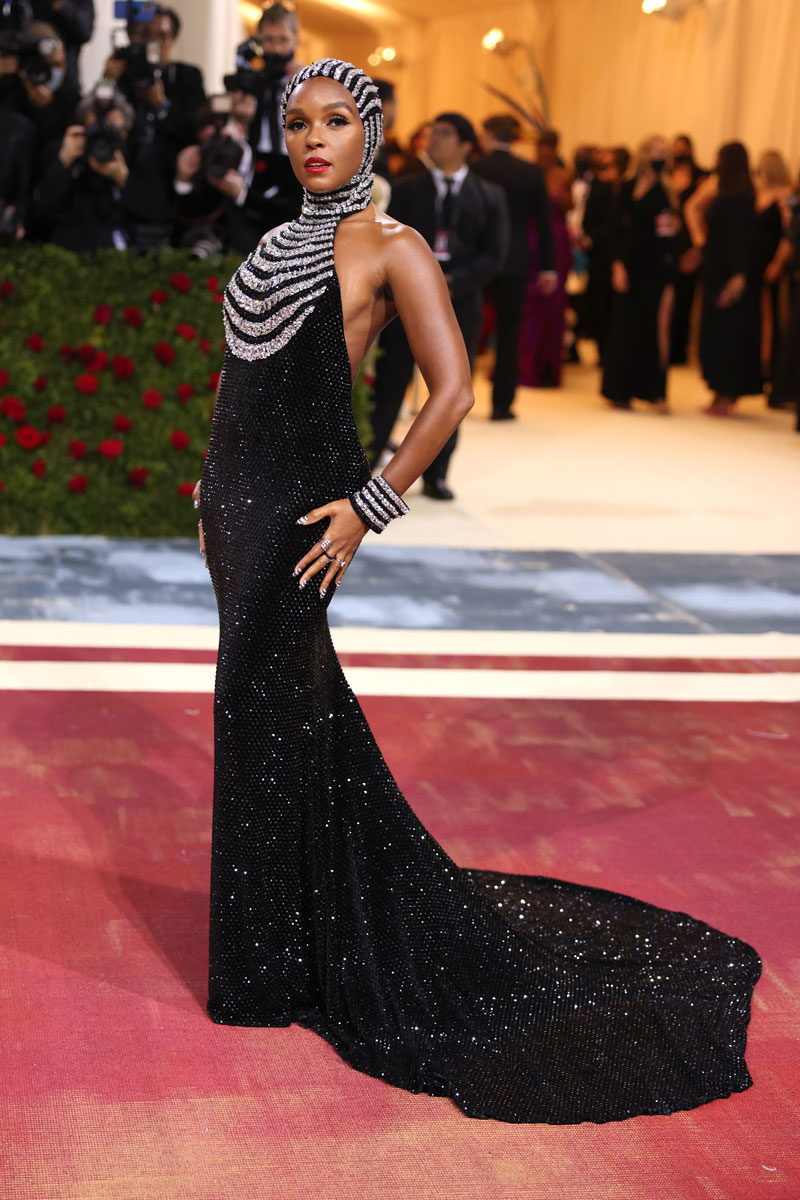
2 Janelle Monáe’s futuristic getup

Janelle MonáeJanelle Monáe attends The 2022 Met Gala Celebrating “In America: An Anthology of Fashion” at The Metropolitan Museum of Art on May 02, 2022 in New York City. (John Shearer/Getty Images)The singer, actor and author also donned Ralph Lauren on the Met Gala carpet. Their outfit, described as “gilded glamour from the future,” consisted of a black-and-white figure-fitting gown along with an embellished headset. 

Monáe’s look references their recently released sci-fi book titled “The Memory Librarian: And Other Stories of Dirty Computer.” Per the Associated Press, the book expands on Monáe’s Afrofuturistic album “Dirty Computer” and highlights stories about how “queerness, race, gender plurality and love — become tangled with future possibilities of memory and time in such a totalitarian landscape.” 

“It’s supporting LGBTQI plus communities through Afrofuturism,” Monáe told Vogue on Monday.

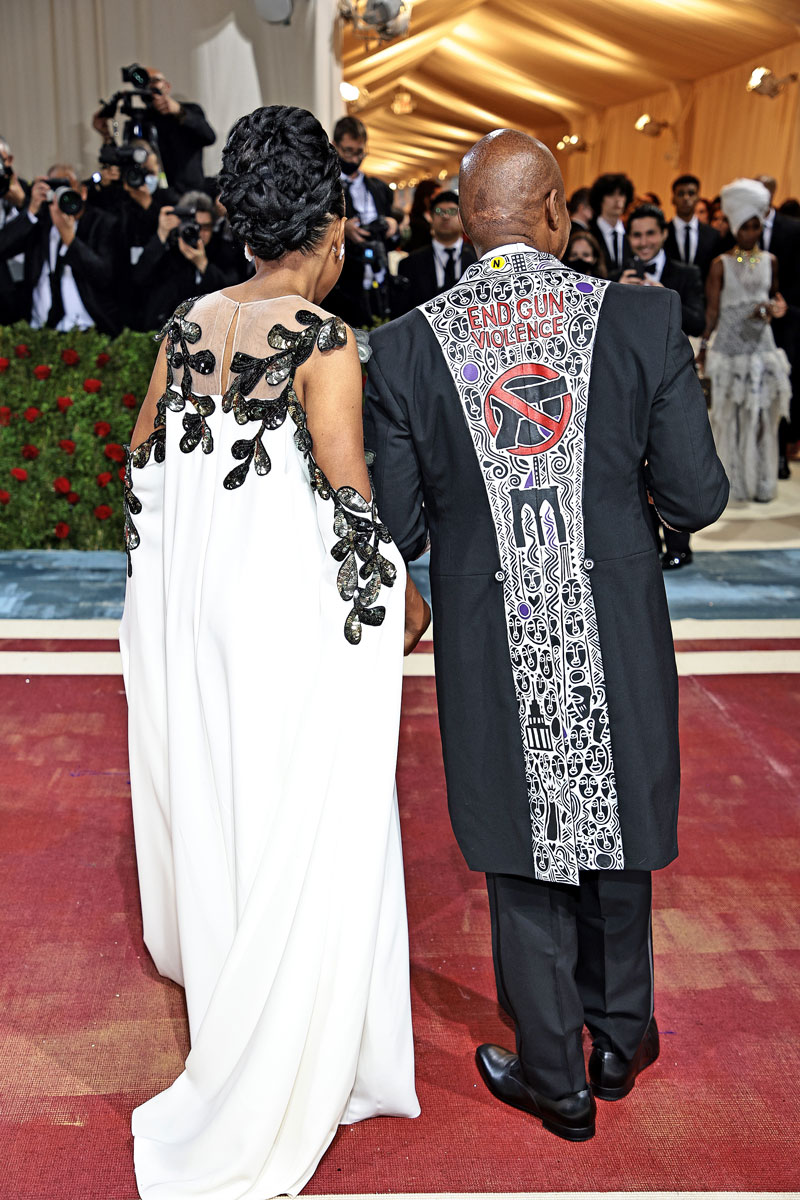
3 Eric Adams’ “End Gun Violence” tuxedo

Tracey Collins; Eric AdamsTracey Collins and New York City Mayor Eric Adams, fashion detail, attend The 2022 Met Gala Celebrating “In America: An Anthology of Fashion” at The Metropolitan Museum of Art on May 02, 2022 in New York City. (Dimitrios Kambouris/Getty Images for The Met Museum/Vogue)New York City’s newly elected mayor collaborated with NYC-based Nigerian artist Láolú Senbanjo for his look, which highlighted both the city’s transit system and longstanding struggles with gun violence. The complete outfit featured hand-drawn designs on Adams’ tuxedo along with the words “End Gun Violence” plastered on the back. 

“The mayor has a great sense of style. And he came up with the idea,” Adams’ press secretary Fabien Levy told the New York Post. “He wants to send a message specifically. One of the things that is causing problems in our society is gun violence.”

Naturally, Adams’ statement drew criticism as performative lip service considering his record of reestablishing violent police units and how shootings have increased since he’s been mayor. 

4 Hillary Clinton’s wine-red dress celebrating women

Hillary ClintonHillary Clinton attends The 2022 Met Gala Celebrating “In America: An Anthology of Fashion” at The Metropolitan Museum of Art on May 02, 2022 in New York City. (Jamie McCarthy/Getty Images)Clinton, who hadn’t attended a Met Gala since May 2001, finally returned after 21 years. She strutted in a custom made Joseph Altuzarra gown embroidered with the names of 60 women who have inspired her the most. 

“I knew that I wanted the dress to have a personal component for her,” Altuzarra told Vogue about Clinton’s dress. “I felt like I had to be very thoughtful about what the dress would mean to the theme and to the occasion.” 

Notable names on Clinton’s gown included Rosa Parks, Ruth Bader Ginsburg, Madeleine Albright, Abigail Adams, Harriet Tubman, Lady Bird Johnson, and Clinton’s mother, Dorothy Rodham.

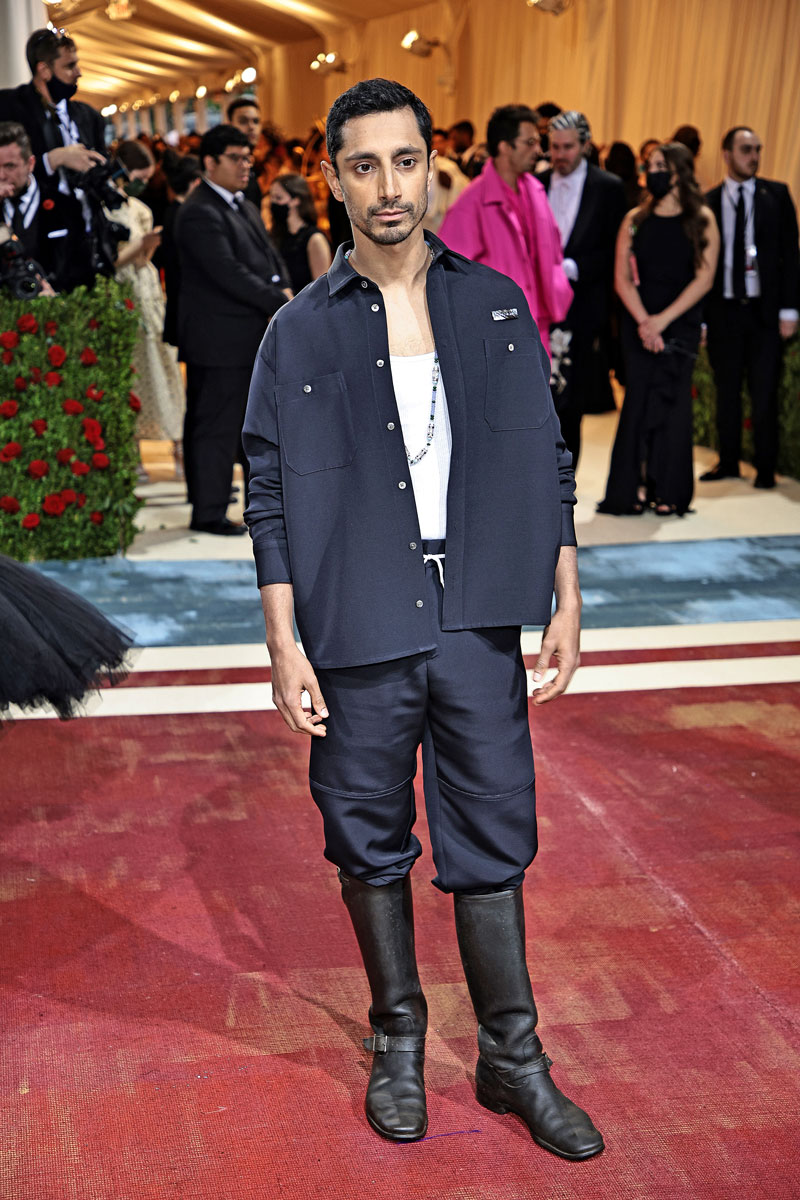
5 Riz Ahmed’s immigrant laborer attire

Riz AhmedRiz Ahmed attends The 2022 Met Gala Celebrating “In America: An Anthology of Fashion” at The Metropolitan Museum of Art on May 02, 2022 in New York City. (Dimitrios Kambouris/Getty Images for The Met Museum/Vogue)The “Sound of Metal” actor ditched the opulent accessories and opted for a simple ensemble of a navy blue jacket from immigrant designer, 4S Designs, a white tank top, drawstring pants and knee-high black leather boots. Ahmed topped it all of with a Cartier necklace, which he told Vogue was inspired by traditional Indian jewelry. 

“This is an homage to the immigrant workers who kept the Gilded Age going,” he said of his full outfit. Ahmed’s stylist, Julie Ragolia, also told Vanity Fair, “In thinking about the Met Gala theme of ‘Gilded Glamour,’ I wanted to focus on the people without whom nothing Gilded would exist: the laborers, the workers, the unseen. This look is for everyone who thinks they don’t have a voice. They do.”

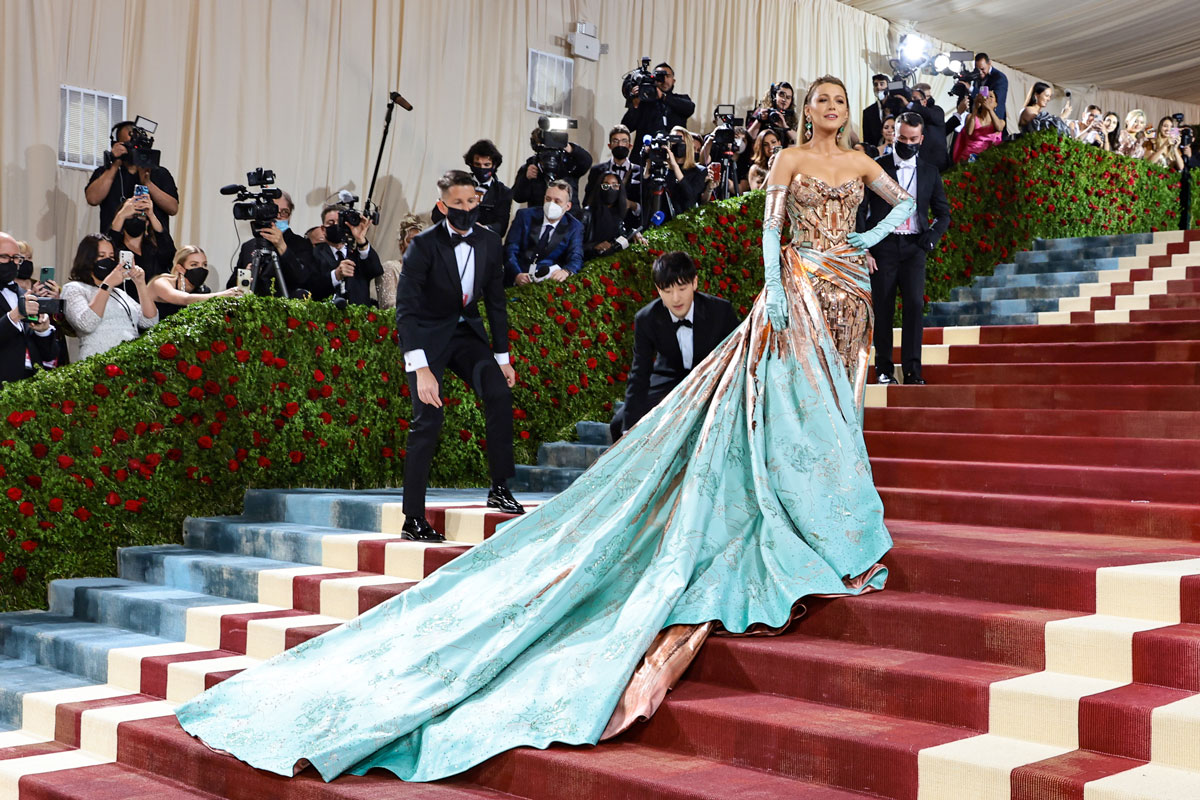
6 Blake Lively’s Statue of Liberty gown

Blake LivelyBlake Lively attends The 2022 Met Gala Celebrating “In America: An Anthology of Fashion” at The Metropolitan Museum of Art on May 02, 2022 in New York City. (Jamie McCarthy/Getty Images)Lively’s beaded Versace dress, which touted blue and copper tones in the trailing skirt and oversized bow, paid tribute to the Statue of Liberty, a legendary symbol of American freedom and justice, but also welcoming in immigrants and refugees.

“This dress is an homage to New York City and so many of the classic, iconic buildings,” Lively said during Vogue’s livestream of the event. “This is detailing from the Empire State Building, some of the draping from the Statue of Liberty . . . (and) the constellation from Grand Central Station.”

Lively also wore a seven spiked tiara, which greatly resembled Lady Liberty’s iconic crown.

More stories you might like:

“Potential wokie”: Ohio’s only anti-Trump GOP Senate candidate is gaining steam and triggering Trump

Former President Donald Trump launched an angry rant while speaking on an Ohio radio talk show Tuesday against a GOP Senate primary candidate who recently has surged in the polls against J.D. Vance, who he recently endorsed.

During an appearance on “The Bruce Hooley Show,” Trump made up the term “potential wokie” while disparaging candidate Matt Dolan. Hooley teed up Trump by saying he doesn’t believe that Dolan is “an authentic conservative” because the candidate supports Ohio’s Equality Act, which would afford protective status to LGBQT citizens. The former president was only too happy to use that as a starting point to jump into the fray.

“I don’t know that much about him, but what I do know is that he’s involved with the Cleveland Indians. Being somewhat of a baseball fan, I didn’t think that name change was a good thing. I think that anybody who does is wokie, or potentially wokie,” Trump opined.

He then extended his criticism of sports teams that have changed their nicknames so as not to continue disparaging Native Americans by saying he also was against the decision by the Washington football team to drop the moniker “Redskins” in favor of the “Commanders.”

Dolan, an Ohio State Senator and chairman of the Senate Finance Committee, very deliberately did not seek out Trump’s endorsement. He is part of the ownership group of the recently renamed Cleveland Guardians professional baseball team.

Of the name change, Trump groused, “That would actually get me not to vote for somebody like that.”

Adoption means abortion just isn’t necessary, SCOTUS claims: That’s even worse than it sounds

“Less abortion, more adoption. Why is that controversial?” 

That was the response of Rep. Dan Crenshaw, R-Texas, to Politico’s bombshell revelation Monday night: a leaked Supreme Court majority opinion suggesting that we face the imminent reversal of Roe v. Wade. 

About halfway through the 98-page opinion, which was authored by conservative Justice Samuel Alito — and which Chief Justice John Roberts acknowledged on Tuesday as genuine — came a familiar argument: that “modern developments,” including the availability of “safe-haven” laws, which allow parents to anonymously relinquish babies without legal repercussions, have rendered abortion unnecessary. The opinion noted that “a woman who puts her newborn up for adoption today has little reason to fear that the baby will not find a suitable home.” 

Tucked into a footnote for that statement was a telling citation from a 2008 CDC report that found “nearly 1 million women were seeking to adopt children in 2002 (i.e., they were in demand for a child), whereas the domestic supply of infants relinquished at birth or within the first month of life and available to be adopted had become virtually nonexistent.”

RELATED: Kayleigh McEnany wants more “Christian babies”: It’s an overt call-out to racist paranoia

As Politico noted, that passage strongly resembled the argument Justice Amy Coney Barrett made last December, when the case in question, Dobbs v. Jackson Women’s Health Organization, concerning Mississippi’s 15-week abortion ban, came before the court. During oral arguments, Barrett, who is herself an adoptive mother, suggested that the existence of safe-haven laws and adoption in general rendered moot the pro-choice argument that abortion access protects women from “forced motherhood.” Rather, she continued, “the choice, more focused, would be between, say, the ability to get an abortion at 23 weeks, or the state requiring the woman to go 15, 16 weeks more and then terminate parental rights at the conclusion.” 

Critics quickly pointed out that safe-haven laws are so rarely used that in many states the number of infants relinquished through them each year can be counted in single digits. But the larger problem is more basic: the suggestion that adoption entails nothing more than several months of inconvenience before women can wash their hands of the entire ordeal profoundly fails to understand how relinquishment affects parents. After reporting on adoption issues for more than a decade, it’s clear to me that anyone who argues that adoption is a tidy solution to the abortion debate has never spoken with — or actually listened to — the people most affected by that decision. 

Anyone, on any side, who argues that adoption offers a tidy solution to the abortion debate has never actually listened to the people most affected by that decision.

If you want to understand what using adoption as the solution to unplanned pregnancies looks like, you don’t need to look far. But you do need to look. There’s a long and ugly history in the U.S. of coercive and even forced adoption. From roughly 1945 to 1972 — the year before the Supreme Court’s original Roe v. Wade decision — somewhere between 1.5 million and 6 million women relinquished infants for adoption, often after being “sent away” to homes for unwed mothers, where many women faced brutal coercion, were prohibited from contact with outsiders, went through labor and gave birth in segregated sections of hospitals, and were urged to relinquish their newborns while recovering from anesthesia. Close to 80 percent of residents ended up being separated from the babies they delivered. But the fact that estimates of how many women were affected vary so widely testifies to how secretive these places were: liminal spaces where women were often forbidden from using their real names, in order to facilitate their return to society as though nothing had ever happened. 

Many of the women were told they would forget about the babies and go on to live fuller lives, says Ann Fessler, author of the groundbreaking oral history, “The Girls Who Went Away.” Instead, many experienced lifelong guilt, worry, trauma and the sort of unresolved grief that family members of missing persons endure. One 1999 medical review found that women who had relinquished children for adoption had “more grief symptoms than women who have lost a child to death.” 

After Roe v. Wade, the number of children relinquished for adoption began to drop precipitously. In 1972, close to 20 percent of unmarried pregnant white women relinquished their babies for adoption, but by the late 1990s, the rate had dropped to around 1 percent. (Infant relinquishment rates among never-married Black women have been statistically zero for decades.) 


Want a daily wrap-up of all the news and commentary Salon has to offer? Subscribe to our morning newsletter, Crash Course.


For some people, that steep decline in the number of American children available for adoption was a problem. The stats Alito cited in his opinion — contrasting an overly abundant “demand” for adoptable children with a “virtually nonexistent” “supply” — reveals a little-recognized truth. First, adoption is an industry driven by supply and demand, as unpalatable as those terms may sound when we’re talking about human children. Second, the reflexive liberal retort to anti-abortion rhetoric — well, those right-wingers had better be ready to adopt all those extra babies! — badly misunderstands how this particular industry works. 

Even in the heyday of maternity homes, there were concerns that growing demand was outstripping the supply of the sort of babies prospective parents wanted most. In 1961, one sociologist even warned, “If the demand for adoptable babies continues to exceed the supply … then it is quite possible that, in the near future, unwed mothers will be ‘punished’ by having their children taken from them right after birth.” By the 2000s, conservative publications were publishing fretful pieces about the “Last Days of Adoption.” 

Anti-abortion crisis pregnancy centers sent the message that choosing adoption was, in some cases, a chance for a woman to “prove her character by relinquishing her child.”

In response, in the mid-2000s, some anti-abortion crisis pregnancy centers began trying to deploy market research to determine what “subconscious emotional motivators” might make adoption more appealing. Two reports that emerged from that research — one bluntly titled “Birthmother, Good Mother: Her Story of Heroic Redemption” — counseled CPCs to use a common message: that single women who opted to parent their children were being selfish and immature, while choosing adoption was more mature and loving and even, in some cases, a chance for a woman to “prove her character by relinquishing her child.” 

That sort of rhetoric had real effects. One mother I met was sent to a modern maternity home in Washington state when she got pregnant at 19. There she was told that choosing adoption would both please God and prove that she loved her child more than if she kept him. Isolated from her friends, family and boyfriend, she was instead encouraged to spend time with the couple who wanted to adopt her child. She came to feel like a surrogate rather than a “real” mother, and when she expressed doubts about going through with the plan, she was chastised severely. When she fell into a deep depression after relinquishing her child, the family closed what was originally intended to be an open adoption, and she wasn’t allowed to see her son again.

Another woman in North Carolina responded to an ad in the Yellow Pages offering help for unplanned pregnancies, and was quickly placed with a “shepherding family” in another state. When she went into labor, in a town hundreds of miles from her family, no one was there for her except the prospective adoptive parents, the shepherding family and an adoption agency staffer. When she said she didn’t think she could go through with the adoption, the shepherding family told her she would be on her own. 

“I was never an ‘expectant mother,’ a ‘mom-to-be,’ or even ‘Carol,'” the woman told me. “I was simply one of the agency’s ‘birthmothers,’ although I hadn’t signed a thing. I felt like a breeding dog . . . a walking uterus for the agency.”

Narratives of coerced adoption can become invisible in a culture where adoption is seen as a “win-win-win,” and where Democrats try to triangulate the abortion morass by making adoption “more available.”

There are a lot of stories like this, but they’re often rendered invisible in a culture where adoption is seen as a unilateral good or a “win-win-win”; where Democrats have long sought to triangulate the abortion morass by offering, somehow, to “make adoption more available“; and where media depictions of birthmothers are often limited to seedy reality-show storylines. In a dynamic where adoptive parents are almost universally wealthier and more powerful than birthparents, even the language we use privileges one side of the story, leaving almost no neutral way to discuss the issue. 

These narratives have also played out against the backdrop of a much larger phenomenon, as international adoption rates have plummeted from their peak of around 23,000 in 2004 to just over 1,600 in 2020 (the most recent year for which there is data). This has caused such a constriction in the adoption field — a market contraction, to return to the business metaphor — that numerous agencies and even a large-scale lobbying organization have been forced to close shop.

“The underlying consideration of adoption in the leaked opinion reflects the view that the decline of American infants available for adoption is inherently an adverse trend,” says sociologist Gretchen Sisson, author of the forthcoming book “Relinquished: The American Mothers Behind Infant Adoption.” Rather, she continues, “this trend reflects that more women are parenting the children to whom they give birth — which would have been the preferences of many ‘baby scoop’ era birth mothers as well.”

In researching more than 600 mothers who relinquished children from adoption, Sisson found that most had done so in the context of extreme poverty or instability. Most reported income of less than $5,000 per year, most were unemployed, and a fifth were homeless at the time they relinquished. Statistics like those cast relinquishment not as a selfless choice, or one parents can easily forget, but rather, as Sisson says, “a reflection of an American failure to not just allow people the dignity of making their own choices about their bodies and lives, but to invest in families at the most basic level.” 

The reality is, Sisson says, that in general “women are not particularly interested in adoption,” but may feel forced to consider it when they cannot access abortion services or when they feel “wholly unsupported” in parenting. “This was true for ‘baby scoop’ mothers, and it is true of relinquishing mothers today.”

This is all necessary context when we hear right-wing Supreme Court justices arguing that adoption — and falling adoption rates — are part of the justification for re-criminalizing abortion. It’s also key to understanding, and rebutting, the various responses to Alito’s opinion that weaponize adoption to make a point: whether from pro-choicers trying to shame their opponents or anti-abortion advocates hopeful that adoption waitlists may get a little shorter. Neither is reckoning with what it is they’re actually calling for. 

Read more from Kathryn Joyce on religion and the far right:

Manchin stays firm in face of abortion leak: “We’ve protected women’s rights with the filibuster”

Sen. Joe Manchin, D-W.Va., is reportedly unwilling to nuke the filibuster in order to protect Roe v. Wade, the landmark ruling that established America’s constitutional right to abortion, even as Republicans and anti-abortion activists are calling for a nationwide ban.

On Tuesday, asked whether he’d get rid of the cloture threshold in order to enshrine Roe into law, Manchin told reporters that “the filibuster is the only protection we have in democracy.”

“We’ve protected women’s rights with the filibuster,” he added. 

In the past, Manchin has consistently defended the filibuster despite progressive calls to limit or eliminate it altogether. 

Sen. Kyrsten Sinema, D-Ariz., his fellow obstructionist, also rejected the idea of scrapping the procedure this week, saying that “protections in the Senate safeguarding against the erosion of women’s access to health care have been used half-a-dozen times in the past ten years, and are more important now than ever.”

Their remarks come just a day after The Washington Post reported that GOP lawmakers are arranging meetings to push through a nationwide ban after six weeks into pregnancy, with Sen. Joni Ernst, R-Iowa, gearing up to introduce a piece of legislation that would achieve just that.

RELATED: Samuel Alito’s leaked anti-abortion decision: Supreme Court doesn’t plan to stop at Roe

Marjorie Dannenfelser, president of Susan B. Anthony List, told the Post that she has spoken with ten potential GOP presidential candidates who would throw their support behind a nationwide ban. 

Planned Parenthood Action Fund Executive Director Kelley Robinson has called the effort “terrifying.”

“By [Republicans] saying out loud that their goal is to push a nationwide abortion ban, it makes it clear that we have to elect more pro-reproductive health champions on the national level and in the states,” Robinson told the Post.


Want a daily wrap-up of all the news and commentary Salon has to offer? Subscribe to our morning newsletter, Crash Course.


At present, a nationwide prohibition on abortion would be exceptionally difficult for Republicans to pass in a 50-50 Senate. Republicans would have to overcome an inevitable Democratic filibuster, which requires that the GOP garner at least 60 votes in support of a cloture. Additionally, President Biden would have to rubber-stamp such a law, which he almost certainly would not do. 

But while Republicans are blocked on the legislative front, they might have their day in court. 

On Monday, in a first-of-its-kind report, Politico published a leaked copy of the Supreme Court’s majority opinion initial draft on Roe. In the draft, penned by conservative Associate Justice Samuel Alito back in February, Alito calls Roe “egregiously wrong from the start.”

“We hold that Roe and Casey must be overruled,” he added. “It is time to heed the Constitution and return the issue of abortion to the people’s elected representatives.”

RELATED: Why the right-wing is having a complete meltdown over the Supreme Court’s leaked anti-abortion draft

Meanwhile, many Republican-led states, like Texas, Alabama, Arizona, already have taken it upon themselves to curtail abortion access, meaning that at least 13 state would institute bans the moment that Roe is struck down

Susan Collins says Brett Kavanaugh lied to her about abortion — but Josh Hawley is not buying it

Sen. Susan Collins, R-Maine, suggested on Tuesday that Supreme Court Justices Neil Gorsuch and Brett Kavanaugh lied to her about their stance on abortion. 

Her comments come just a day after Politico published a leaked copy of the Supreme Court’s initial draft majority opinion on Roe v. Wade, the landmark 1973 ruling that enshrined the constitutional right to abortion. The draft strongly indicates that the high court will ultimately rule against the law, rolling back decades of progressive advocacy aimed at expanding abortion across the country.

“If this leaked draft opinion is the final decision and this reporting is accurate, it would be completely inconsistent with what Justice Gorsuch and Justice Kavanaugh said in their hearings and in our meetings in my office,” Collins told NBC News. “Obviously, we won’t know each Justice’s decision and reasoning until the Supreme Court officially announces its opinion in this case.”

RELATED: Why the right-wing is having a complete meltdown over the Supreme Court’s leaked anti-abortion draft

But Collins’ own Republican colleague in the Senate, Josh Hawley of Missouri, is not buying her sudden disappointment.

“The justices did exactly what they said they would do,” Hawley told reporters on Tuesday when asked about Collins’ statement. 

On Monday, following news of the Supreme Court’s leaked draft, old videos of Collins quickly surfaced showing the senator expressing full faith in Kavanaugh’s alleged unwillingness to overturn Roe. 

“I do not believe that Brett Kavanaugh will overturn Roe. v. Wade,” Collins told CNN back in 2018, during Kavanaugh’s embattled confirmation process. “When I asked him whether it would be sufficient to overturn a long-established precedent if five current justices believed it was wrongly decided, he emphatically said no.”

Collins would go on to repeat this claim several times throughout that year, alleging that Kavanaugh, a staunch Catholic, had indicated that he would not touch abortion. 

Even in 2019, after Kavanaugh was the lone dissenter to a majority opinion that blocked the Georgia legislature from curtailing abortion access, Collins stuck to her guns. “To say that this case, this most recent case, in which he wrote a very careful dissent, tells you that he’s going to repeal Roe v. Wade I think is absurd,” she told CNN at the time. 

Collins is one of the only Republican pro-choice senators in the legislature, apart from Sen. Lisa Murkowski, R-Alaska. Back in February, Collins and Murkowski introduced a bill that would formally codify Roe v. Wade into U.S. law

RELATED: Senator Collins comes under fire after SCOTUS signals support for restrictive abortion ban

The best nonalcoholic tequilas

Before bartenders and restaurants began to treat nonalcoholic drinks with the same respect as craft cocktails, the virgin margarita, often just some bottled mix thrown in a blender with ice, was sadly one of the more interesting beverage options for those abstaining from alcohol. But tequila (and its sister spirit, mezcal) can add way more than just a buzz to mixed drinks. The herbal, earthy, spicy, smoky flavor of agave-based spirits brings balance to sour citrus, sweet syrups, and savory tomato juice in margaritas, palomas, Bloody Marias, and other drinks.

As producers began to make zero-proof spirits to taste like and act as a substitute for liquor in mixed drinks, the selection of nonalcoholic gin, bourbon, and rum taste-alikes exploded, while the list of tequila and mezcal alternatives lagged (very) far behind. Luckily, producers of alcohol-free spirits have started to make up ground on tequila alternatives, at last. While there are still fewer nonalcoholic tequilas than, say, nonalcoholic whiskeys or gins, we tried a wide range of currently available options and found plenty worth drinking. Here are our recommendations:

Best all around

If you’re looking for a one-size-fits-all (or at least most) bottle, these are your best bets. Any one of these will make an easy nonalcoholic substitute for tequila or mezcal in existing cocktail recipes and in your own booze-free experiments.

Free Spirits The Spirit Of Tequila

My go-to when I want to make the nonalcoholic version of a fancy craft tequila cocktail, Free Spirits The Spirit of Tequila is solid and reliable no matter the context. Agave is the main flavor, slightly acidic with a big dose of green bell pepper and the slightest touch of sweetness, with a substantial but not overwhelming burn. If you make a lot of tequila drinks, and want one bottle that will perform equally well in sweet, sour, and savory cocktails, this is the one to buy. Free Spirits also fortifies their spirits with B vitamins and amino acids for a boost of energy without caffeine.

Mockingbird Spirit Agave

Made from actual agave, Mockingbird Spirit Agave’s flavors of Mexican vanilla and cinnamon shine over a perfect balance of caramel sweetness and gentle acidity, with a woodsy, young oak base humming underneath. With the slightest bit of chest-warming heat that glows rather than burns, Mockingbird is as nice to drink as it is to look at, in its pretty rose-gold-accented bottle. This is one of my favorites to use when creating new cocktails because it plays just as well with heavier flavors like red berries and black teas as it does tropical fruits and tart citrus. I do, however, recommend caution when mixing it in a savory drink.

Lyre’s Agave Blanco and Agave Reserva

As with their other nonalcoholic spirits, Lyre’s two recently released tequila alternatives have the most accurate replication of the original liquor’s flavor.

Lyre’s Agave Blanco has a clean nose of lemon juice and pine, a good agave aroma, and a big chile pepper burn. This is your replacement for a nice silver tequila, excellent in a classic margarita and mixed with red-fruit-based mixers, like AVEC Hibiscus & Pomegranate, which brings out an otherwise hidden creamy vanilla from the Agave Blanco. The pronounced capsaicin burn gives such a cheek-warming flush that you might be tempted to break out a salt shaker and some lime wedges to do shots of this.

Lyre’s Agave Reserva is comparatively understated, with less fire and a more complex flavor profile. The nose opens with an aggressive blast of lemon peel oil, toasted oak, coriander, and green jalapeño, and is both slightly sweet and much more herbal on the palate. Like a nicely flavored, wood-barrel-aged reposada or agave tequila, Agave Reserva works well in lighter and simpler cocktails where it is allowed to really shine, like a Tommy’s margarita, or half and half with Fever-Tree Sparkling Pink Grapefruit.

Top-shelf delicacies

Though not as versatile as the options above, these unique zero-proof spirits deserve a place on your shelf for their distinguished and singular flavors. Nothing else tastes quite like them, and their multilayered complexity makes for delectable, one-of-a-kind cocktails.

Harmony Smoked Apéritif

Not only my favorite mezcal alternative but possibly my favorite nonalcoholic spirit right now period, on first whiff Harmony Smoked Apéritif evokes a bonfire under the stars on a desert night. It tastes slightly savory, with mesquite wood in addition to oak to more accurately convey mezcal’s smokiness; slight heat from ginger and cayenne add a complex, multilayered warmth. With a full mouthfeel without the addition of sweet glycerin, Harmony Smoked Apéritif adds a unique umami roundness to anything it’s mixed with, without clashing with fruit flavors. Put this in a paloma or a Bloody Maria, or add an ounce or two to a michelada made with Athletic Brewing Company’s Cerveza Atletica nonalcoholic beer.

Optimist Botanicals Smokey

While not technically an imitation of either tequila or mezcal, Optimist Botanicals Smokey is made for drinking as you would a smooth tequila. While the actual agave cactus is not present in the mix, Smokey is not lacking in similar elements, due to a huge and multilayered blend of green herbs and zesty florals. Oregano and sage are dominant from first sniff to the long, medicinal finish, while jasmine and spicy geranium tickle the nose at the front. Toasty heat from ginger and just a kiss of fruity habanero are followed by soothing, lightly cooling clove. A great addition to citrus cocktails, Smokey is also wonderful mixed with red berries and stone fruits, and it brings a seasonally appropriate herbal balance when substituted for tequila and mezcal in cozy autumn cocktails like this Smoky Pear & Ginger Margarita.

The honorable mentions

Even though their utility might be more limited than the Best All Around, these nonalcoholic tequila and mezcal options still work well when appropriately paired with the right flavors and mixers.

Ritual Zero Proof Tequila Alternative

Ritual Zero Proof Tequila Alternative has about a dozen notes that might be found across three or four different tequilas all combined in one bottle. Big oak, a touch of hot asphalt, tropical fruits, a huge dose of chiles, tons of green bell pepper, and even a strangely sweet green pea finish make for a kitchen-sink combination of flavors on its own. Though not for drinking by itself, the round mouthfeel and herbal medicinal notes make for a surprisingly tasty, if very spicy, margarita that may be nonalcoholic, but with a bold edge that is anything but “virgin.”

CleanCo Clean T

On the opposite end of the heat spectrum is CleanCo’s Clean T, which is all agave and oak on the nose, but zero burn on the palate. The mouthfeel is on the weaker side; this is more of an essence of tequila you can smell rather than taste. Added to a mixer with a bite, like AVEC Jalapeño & Blood Orange, however, the agave aroma on top of the chile heat drinks like a real tequila cocktail.

Escape Mocktails Non-Alcoholic Mezcal

While I would not recommend Escape’s Tequila expression, which tastes like a spicy vanilla oak caramel, with none of the vegetal agave flavors that make tequila taste like tequila, Escape Mocktails Non-Alcoholic Mezcal has a big oaky nose, sweet and toasty heat on the palate, and a smoky, herbal finish. The glycerin base gives it a slightly syrupy mouthfeel, which adds both flavor and body to frozen margaritas, and rounds out the flavor of low-sugar mixers like AVEC. While it is definitely sweeter and more viscous than a real tequila, those with a sweet tooth might prefer Escape Mezcal to the others on this list; I kept finding myself going back for another sip of it straight from my tasting glass.

Fluère Smoked Agave

Heavy on the acidity, with a pronounced vegetal flavor, Fluère Smoked Agave not only tastes of its namesake, but nopal cactus, as well. Smoked Agave would add a nice green element to a Bloody Maria and would function well as a nonalcoholic side for sangrita. Though the tequila burn is missing, and the spirit may not be bold enough not to disappear in a margarita, Smoked Agave has a lovely salinity that complements grapefruit beautifully. Try it in place of Patrón in this Shio Kosho Margarita from Masahiro Urushido.

Whether you’re looking for an option to spice up your Virgin Mary, whipping up a pitcher of margaritas for Taco Tuesday, or relishing a slowly sipped glass to warm up your winter, there’s a zero-proof tequila or mezcal alternative out there for you!

“We’re mobilizing”: Massive protests planned as Supreme Court readies to overturn Roe v. Wade

Abortion rights advocates geared up to mobilize in the nation’s capital and across the United States on Tuesday following the leak of a draft decision signaling that the Supreme Court’s right-wing majority is poised to overturn Roe v. Wade.

While the decision outlined in the draft opinion — authored by Justice Samuel Alito — is not yet final, it would strike a devastating blow to reproductive rights in large swaths of the U.S. Experts at the Guttmacher Institute have estimated that if the landmark 1973 decision is overturned, 26 states are “certain or likely” to completely outlaw abortion.

At least 13 states—including Arkansas, Kentucky, Utah, and Louisiana — currently have in place so-called “trigger laws” that would ban abortion in all or most cases automatically if the Supreme Court ends Roe.

The high court’s final ruling in the closely watched case, which is centered on an abortion ban in Mississippi, is expected within the next two months.

“We’re mobilizing,” Shaunna Thomas, co-founder of UltraViolet, tweeted in the wake of “Politico”‘s report on the draft, which set off widespread outrage and spurred flash protests outside the Supreme Court Monday night.

“Be at SCOTUS or any federal courthouse tomorrow at 5 pm,” Thomas wrote late Monday. “The leaked draft decision overturning Roe has confirmed everything we knew about this court’s intentions and it is giving us an opportunity to show them how ungovernable we will be if they follow through.”

An end to Roe is an outcome that right-wing forces in the U.S., backed by corporate power and cash, have been working toward for decades—and they appear prepared to take full advantage should the high court ultimately rule in their favor.

Citing a person familiar with the court’s deliberations, “Politico” revealed that “four of the other Republican-appointed justices—Clarence Thomas, Neil Gorsuch, Brett Kavanaugh, and Amy Coney Barrett—had voted with Alito in the conference held among the justices after hearing oral arguments in December, and that line-up remains unchanged as of this week.”

Hours before Alito’s draft opinion was made public, the “Washington Post” reported that “leading anti-abortion groups and their allies in Congress have been meeting behind the scenes to plan a national strategy that would kick in if the Supreme Court rolls back abortion rights this summer, including a push for a strict nationwide ban on the procedure if Republicans retake power in Washington.”

“The effort, activists say, is designed to bring a fight that has been playing out largely in the courts and state legislatures to the national political stage—rallying conservatives around the issue in the midterms and pressuring potential 2024 GOP presidential candidates to take a stand,” the “Post” noted.

Democratic attempts to enshrine Roe into federal law, meanwhile, have foundered as Senate Republicans and Sen. Joe Manchin (D-W.Va.) remain opposed to legislation that would do so. In late April, Manchin joined the unified GOP in filibustering the House-passed Women’s Health Protection Act (WHPA), refusing to even allow a vote on the measure itself.

“As one of the 1 in 4 women in this country who have chosen to have an abortion, I am outraged and disgusted by the reported draft SCOTUS opinion,” Rep. Pramila Jayapal (D-Wash.), chair of the Congressional Progressive Caucus, said late Monday.

“People should take to the streets across the country,” Jayapal added. “Right now, the Senate can pass an exception to the filibuster and codify Roe v. Wade. This is the most dramatic setback for women’s rights in decades.”

Nancy Northup, president and CEO of the Center for Reproductive Rights, echoed that warning in a statement.

“If the Supreme Court overturns Roe v. Wade, it will be an unjustified, unprecedented stripping away of a guaranteed right that has been in place for nearly five decades,” said Northrup. “It would represent the most damaging setback to the rights of women in the history of our country.”

Samuel Alito’s leaked anti-abortion decision: Supreme Court doesn’t plan to stop at Roe

It’s fitting that, if the Supreme Court is going to overturn Roe v. Wade, they’d have the justice with the most incel-esque affect be the one to write the opinion. Samuel Alito has always been the conservative on the court who was least able to conceal the right-wing resentment that fuels him, glowering his way through President Barack Obama’s State of the Union addresses and generally being a whiner on the level of Donald Trump. Clarence Thomas might be the most unhinged member of the court, Amy Coney Barret the most uncanny, and Brett Kavanaugh the best at spittle-flecked public meltdowns. But if I had to bet money on who is most likely to spend their nights on sleazy internet forums, whining that feminism has “ruined” women, it would 100% be on the court’s creepiest member, Alito. 

Late Monday night, Politico leaked a draft of the Supreme Court opinion, written by Alito, that would, without reservation, overturn Roe and allow states to ban abortion outright. (Which they are already doing.) Though heavy with legal-ese, Alito’s misogyny shines through like a deplorable beacon. His contempt for the very idea that women are rights-bearing people is not hard to discern, even as he claims to hold no ill will towards them. Sewn throughout this decision is a deep, abiding belief that women simply aren’t people in any meaningful sense. Women’s lives, ambitions, pain, joys, and autonomy have absolutely no value he can discern. Instead, he treats women as ambulatory uteruses who have no more right to reject a pregnancy than your refrigerator has a right to reject holding your milk and eggs. 

RELATED: Are women people? Why the Supreme Court just signed off on a Texas law that denies women’s humanity

The inability — or unwillingness — to think of women as rights-bearing people kicks in early in this draft decision, when Alito complains that, “far from bringing about a national settlement of the abortion issue,” Roe “enflamed debate and deepened division.” The unsubtle implication of this is that if anyone doesn’t like women having rights, then well, that right just has to go. The language may be fancier than Donald Trump’s “grab ’em by the pussy” rant, but the logic is the same. Yeah, it’s your body, ladies, but if someone else wants to use it, as Trump memorably said, you have to let them do it. 

Samuel Alito has always been the conservative on the court who was least able to conceal the right-wing resentment that fuels him. 

Alito’s tendency to imagine women as appliances instead of people is inescapable. He blithely dismisses the idea that forced childbirth is a burden on women, claiming medical costs are “covered by insurance or government assistance” and after the baby is born, all a woman must do is “drop off babies anonymously” and should have “little reason to fear that the baby will not find a suitable home.” 


Want more Amanda Marcotte on politics? Subscribe to her newsletter Standing Room Only.


Alito doesn’t acknowledge that a woman might have objections to being pregnant outside of the financial burden to her family or fears for the baby’s future. Being pregnant and giving birth is inherently difficult and time-consuming. Pregnancy affects your relationships with everyone from the person who impregnated you to your family to your friends and work colleagues. Pregnancy is notoriously impossible to conceal from others! But these burdens simply do not rate in Alito’s imagination, any more than one would ask if the oven suffers when you turn it on. 

And if women don’t like it, he sneeringly writes, well, “[w]omen are not without electoral or political power,” as they still retain their right to vote. It’s an argument in such idiotic bad faith that even Twitter trolls don’t dare make it. That some women don’t like abortion doesn’t mean that all women should be denied the right. But Alito doesn’t pause to consider that women are a diverse, complex group of people. Great idea, giving someone with such a mean imagination the right to abolish the human rights of millions. 

RELATED: Republicans simplify their defense of Texas abortion ban: Women are too stupid to have rights

Speaking of women’s suffrage, it’s a good thing it was obtained by constitutional amendment. If it weren’t, we can’t be sure that Alito wouldn’t be taking potshots at that right, as well. Alongside his contempt for women as rights-bearing people, this draft opinion is rife with loathing of any social progress made after the 19th century. Alito repeatedly notes that no right to abortion was legally established before “the latter part of the 20th century,” as if the relative newness of the legal right inherently makes it illegitimate. 

“Until the latter part of the 20th century, there was no support in American law for a constitutional right to obtain an abortion. Zero. None,” he writes, the whiny tone unmistakable. 


Want more Amanda Marcotte on politics? Subscribe to her newsletter Standing Room Only.


Of course, there are a plethora of rights that were not established until the latter part of the 20th century.

Women did not have the right to use birth control, have their own credit cards or bank accounts, be paid fairly for their work, or decline sex with a husband until the latter part of the 20th century, either. Jim Crow laws and segregated schools were still legal until the latter part of the 20th century. And, crucially, the rights to have sex in the privacy of your own home — even with someone of the same sex — and to have a same-sex marriage were established even later, in the 21st century. 

I challenge anyone to read Alito’s draft opinion and his repeated, scornful invocation of “the latter part of the 20th century,” as if everything that progressed during that time is a stain on our nation.

Alito is aware of all this, and indeed, cites many of the cases that established these rights in his decision. He glibly dismisses the possibility that overturning Roe will lead to the overturn of the right to birth control or any LGBTQ rights, however, claiming that those are different because none involve “potential life.” But just as he claims that there should be no legal distinction between pre- and post-viability abortions, it’s easy to see how one could argue that contraception and homosexuality threaten “potential life” by redirecting sexual energies away from conception. This isn’t outlandish speculation, it is already the argument that the anti-choice movement makes against both legal contraception and legal homosexuality.  

RELATED: Florida’s “don’t say gay” bill is just the beginning: Republicans want to claw back all gay rights

Alito tries to cover his rear by writing, “Nothing in this opinion should be understood to cast doubt on precedents that do not concern abortion.” But Bush v. Gore has similar language in it, and that hasn’t prevented it from being used as precedent in literally hundreds of cases. More importantly, the whole of the decision suggests Alito doesn’t believe his own claims that other human rights aren’t in danger. As Slate’s legal expert Mark Joseph Stern noted on Twitter, Alito’s one sentence is contradicted by paragraphs of contemptuous language about the illegitimacy of all those decisions from “the latter part of the 20th century” and equally lengthy diatribes about how the court’s duty to respect precedent is overrated. 

As Stern notes, Alito “makes it extremely clear that he is *not* including” decisions that legalized same-sex sexual relations or marriage.” Republicans have elsewhere indicated that, however. After they end Roe, they’re coming for Obergefell v. Hodges, the decision that legalized same-sex marriage. After all, the conservatives on the court — including Alito — voted against Obergefell the first time. Now they have another crack at it, with a majority that opposes the right. Anyone would be a fool to think they aren’t eager to take it. And frankly, if privacy rights are delegitimized by the court, Griswold v. Connecticut, which legalized contraception, is on the chopping block. It is, after all, the first case that established the privacy rights all these other cases are built on. 

RELATED: I was one of the lawyers who helped win marriage equality. And yes, the GOP can take it away

In a recent column at the Washington Post, Paul Waldman argued that the Republican agenda is “a return to the 1950s, a dramatic rollback of social progress.” He notes this is no exaggeration, citing multiple Republican politicians who have admitted that they want to overturn Griswold v. Connecticut, allowing birth control to be banned again. But of course, when progressives argue that Republicans want to undo the past 70 years of progress, they get accused of hyperbole, on the specious grounds that the same people who voted for Donald Trump couldn’t be that bad. 

Well, I challenge anyone to read Alito’s draft opinion and his repeated, scornful invocation of “the latter part of the 20th century,” as if everything that progressed during that time is a stain on our nation. Republicans are willing, indeed eager, to force childbirth on people as a punishment for sex. In itself, that is an argument against the idea that Republicans are constrained by morality, decency, or empathy. Republicans are coming for the whole panoply of women’s rights, LGBTQ rights, and racial equality. They don’t even bother to hide it. It’s just a matter of the public believing Republicans when they show us who they are. 

Democrats vow to vote on codifying abortion into law after Supreme Court leak

President Joe Biden on Tuesday said that his administration is “ready” to protect the fundamental right to abortion and Senate Majority Leader Chuck Schumer, D-N.Y., vowed to have his chamber “vote on legislation to codify the right to an abortion in law” after the Supreme Court’s draft decision to overturn Roe v. Wade, the landmark 1973 decision that enshrined America’s constitutional right to abortion, leaked late Monday evening. 

“If the rationale of the decision as released were to be sustained,” Biden said on Tuesday, “a whole raft of rights would be at risk.” 

“It goes far beyond the right to choose,” the president explained, calling that right “fundamental.” 

Calling the Supreme Court’s decision correct, Biden said “Roe has been the law of the land for almost fifty years, and basic fairness and the stability of our law demand that it not be overturned.”

“At the federal level,” he added, “we will need more pro-choice Senators and a pro-choice majority in the House to adopt legislation that codifies Roe, which I will work to pass and sign into law.”

The leaked decision, Biden said, is “a fundamental shift in jurisprudence.” 

Biden’s remarks come just a day after Politico published a leaked initial draft of the court’s majority opinion on Roe v. Wade and Planned Parenthood v. Casey, a 1992 decision that reaffirmed the right to abortion. The draft, written in February, indicates that the high court will reverse its past rulings on both cases, effectively turning back the clock of reproductive rights by half a century.

Immediately after the report, Sen. Ed Markey, D-Mass., called the court “stolen” and “illegitimate,” saying that it “appears set to destroy the right to abortion, an essential right which protects the health, safety, and freedom of millions of Americans.”

“There is no other recourse,” he added. “We must expand the court.”

House Speaker Nancy Pelosi, D-Calif., called out Republican justices who they said had “lied to the U.S. Senate.”

“The Republican-appointed Justices’ reported votes to overturn Roe v. Wade would go down as an abomination, one of the worst and most damaging decisions in modern history,” the top Democrats added


Want a daily wrap-up of all the news and commentary Salon has to offer? Subscribe to our morning newsletter, Crash Course.


RELATED: Why the right-wing is having a complete meltdown over the Supreme Court’s leaked anti-abortion draft

Sen. Bernie Sanders, R-Vt., called on Congress to codify Roe v. Wade into law before it is reversed. “And if there aren’t 60 votes in the Senate to do it, and there are not, we must end the filibuster to pass it with 50 votes,” he tweeted. 

Meanwhile, a number of state Democrats appear to be taking the fight into their own hands.

On Tuesday, California Assembly Speaker Anthony Rendon announced plans to enshrine the right to choose into the Golden State’s constitution.

“We know we can’t trust the Supreme Court to protect reproductive rights, so California will build a firewall around this right in our state constitution,” Rendon tweeted. “Women will remain protected here.”

In Michigan, Democratic Gov. Gretchen Whitmer has already filed a lawsuit with the state’s Supreme Court to protect abortion access. And on Monday, Whitmer reminded her followers of that effort, tweeting, “Our work is more important than ever. I’ll fight like hell to protect abortion access in Michigan.”

An abortion ban is already on the books in Michigan. So if Roe is overturned, roughly 2.2 million people in Michigan will effectively lose access to the procedure. 

RELATED: Corporate America steps up to fight for abortion access — after backing anti-abortion Republican

The best ways to use lemon balm at home

Every week we get Down & Dirty, in which we break down our favorite unique seasonal fruits, vegetables, and more. 

Thanks in no small part to Deborah Madison’s Vegetable Literacy, it has become impossible for us to stroll through a farmers market without thinking about which fruits and vegetables belong to which plant family. One look at lemon balm leaves — whether coarse and hairy in texture, arrowhead or heart-shaped, or scallop-edged — and you’d likely guess that the plant belongs to the same family as mint and shiso, rather than being a direct relative of the lemon fruit. And you’d be right. One more clever deduction, this time from its name, and you’ll figure out that this herb is lemon-scented. Some compare its lemony flavor and aroma to that of furniture polish (and, in fact, the leaves can be used to polish wood), but you’re probably better off putting lemon balm to use in other ways. It’s a culinary wizard and far too prime to use in place of a countertop spray.

The health benefits of lemon balm

This lemon-scented herb (which comes from the Lamiaceae family) is native to Europe and has long been used as a culinary, medical, and cosmetic herb. It’s widely considered to have calming properties, is prized for its ability to reduce stress and anxietypromote better sleep, and ease indigestion and bloating, according to Mount Sinai. Health studies have shown that lemon balm can increase individuals’ sense of well-being, happiness, and alertness. 

Lemon balm (aka Melissa officinalis) has been used medicinally for a long time to treat a wide variety of ailments, most commonly stress and anxiety. Research has somewhat confirmed its calming effect, but you’ll probably pick up on it anecdotally, and we can almost guarantee it will be a beneficial addition to your garden. It’s often planted to attract bees and releases a pleasant lemony scent as you brush up against it. You can even crush the leaves and rub them on your skin as a mosquito deterrent. But that’s not all: Lemon balm will become a go-to herb in your kitchen, too. 

How to use lemon balm

As a general rule of thumb, treat lemon balm as you would any other fresh herb. It works especially well in place of mint, offering bright, fragrant notes. Add whole lemon balm leaves to green salads, or chiffonade the leaves and scatter them over a fruit salad for added zesty flavor. Lemon balm also pairs beautifully with poultry — try adding sliced leaves to chicken salad, fish dishes, and even vegetable dishes to serve on the side. Unlike other herbs, you’re less likely to find dried lemon balm in the spice and herb aisle of your grocery store (though you might find it in specialty health stores and online). Give lemon balm tea a try too; it’s just as soothing as chamomile or lavender but with a lovely citrus flavor.

Just like mint or basil, you can also candy lemon balm leaves and use the finished product as a crunchy, crystallized garnish over ice cream or tarts. It also works wonders in recipes that call for lemon verbena (like these cookies) — but note that lemon balm isn’t as intense, so adjust the amounts as necessary.

For a thirst-quenching sip, infuse water with lemon balm leaves, which you can drink as is or use to create granita, a light, icy dessert. After all, nothing is fancier than flavored water. When it comes time for happy hour, “lemon balm makes an absolutely delicious liqueur,” says Greenstuff. Similarly, infuse heavy cream with lemon balm leaves to make panna cotta or crème brûlée.  

Seasonality

Lemon balm grows in cold weather and is in season throughout the summer into early fall. Want to plant it yourself? Choose the sunniest spot you can, though it can and will handle a teeny bit of shade. Water it frequently and watch as it grows nearly two feet tall.

Other forms of lemon balm

In addition to the fresh herb, you can also consume lemon balm in the form of an oil or supplement. Lemon balm oils may be cut with water and vegetable glycerin, which just makes it safe to consume orally or used directly on your skin. While it isn’t a cure for any illnesses or diseases, it can act as an aid to soothe sore muscles, reduce inflammation, and even reduce the swelling and redness associated with certain skin conditions like chicken pox, eczema, or psoriasis. Look for organic lemon balm oil made with minimal ingredients from a reputable retailer. Ahead, we’re sharing some recipes that use lemon balm in four refreshing ways.

Our favorite lemon balm recipes

Okra Seed Couscous Salad

Okra seed “couscous” is a neat, nutty ingredient that shines in this loosely Mediterranean-inspired salad. Thin slices of cucumbers are tossed with fresh lemon balm, sumac powder, and feta cheese, plus the okra, for a light summer side.

Cannellini Bean Croquettes

There’s not enough good things we can say about these crispy, golden brown vegetarian bites. A handful of fresh herbs such as lemon balm perks up the robust vegetarian mixture made with cannellini beans, bread crumbs, and Parmesan cheese.

The Sunset Palmer

Perk up a classic Arnold Palmer with a power-packed blend of fresh lemon balm, lemongrass, lemon verbena leaves, and lemon zest. Combine freshly brewed black tea with the lemon-herb mixture for a cooling sip on a hot day. Beyond this beverage, use lemon balm to make fancy ice cubes or a simple syrup to sweeten any drink.

Radish and Herb Salad with Sungold Tomatoes and Strawberries

Two cups of mixed bright herbs (think: lemon balm, dill, basil, and mint) are a lovely addition to this juicy summer salad. The simplest dressing made from yogurt and maple syrup introduces sweet, creamy notes that coats each element of this dish.

Why the right-wing is having a complete meltdown over the Supreme Court’s leaked anti-abortion draft

Conservatives are doing a victory lap in light of a recent report that the Supreme Court is poised to overturn Roe v. Wade, the landmark 1973 decision establishing the constitutional right to abortion, while at the same time seemingly having a complete meltdown about the potential impact of its release. 

The bombshell report came late Monday evening, when Politico published a leaked draft of Associate Supreme Court Justice Samuel Alito’s majority opinion, written back in February, rehashing the constitutionality of Roe v. Wade and Planned Parenthood v. Casey, which upheld Roe in 1992. According to the outlet, the draft is “a full-throated, unflinching repudiation” of both laws.

“Roe was egregiously wrong from the start,” Alito reportedly wrote in his opinion. “We hold that Roe and Casey must be overruled.”

This week, conservative pundits and politicians immediately praised the controversial draft, which culminates a decades-long campaign by Republicans to roll back reproductive rights all across the nation. 

On Monday, Sen. Josh Hawley, R-Mo., a vehement anti-abortion advocate, called the court’s alleged draft “a heck of an opinion.”

“Voluminously researched, tightly argued, and morally powerful,” he tweeted. 

South Dakota Gov. Kristi Noem vowed to call a special session in support the potential decision’s rollout.

“If this report is true and Roe v. Wade is overturned, I will immediately call for a special session to save lives and guarantee that every unborn child has a right to life in South Dakota,” the governor tweeted.

RELATED: Leaked majority opinion says Supreme Court is set to overturn Roe v. Wade


Want a daily wrap-up of all the news and commentary Salon has to offer? Subscribe to our morning newsletter, Crash Course.


Other conservatives railed against the leak of draft, arguing that the move impugns the court’s apparent nonpartisanship.

“Leaking a draft SCOTUS ruling is worse than January 6th. The Court was the one institution where conservatives and liberals lived in peace and trust,” wrote right-wing commentator Mike Cernovich. “You disagreed but the trust was sacred. This completely destroys the Court’s inner workings. Totally in shock right now.”

“To violate an understanding that has held for the entire modern history of the Court – seeking to place outside political pressure on the Court and the justices themselves – is dangerous, despicable, and damaging,” echoed Sen. Mike Lee, R-Utah. 

Sen. Marco Rubio, R-Fla., suggested the draft’s leak was a coordinated assault by the left. “The next time you hear the far left preaching about how they are fighting to preserve our Republic’s institutions & norms remember how they leaked a Supreme Court opinion in an attempt to intimidate the justices on abortion,” Rubio wrote. 

Politico’s report does not mark the first time that the draft of any pending Supreme Court case has been publicized before a ruling is made public. While the draft offers an unprecedented glimpse into the bench’s deliberations, which the court has historically kept strictly confidential, it is important to note that the original Roe v. Wade decision was similarly released, infuriating the court. 

RELATED: Even if the U.S. did support mothers — and it doesn’t — there will always be a need for abortion

The most recent draft, no doubt a strong indication of the court’s jurisprudence on abortion, is sure to set back the state of reproductive healthcare in America by a matter of decades. According to the Guttmacher Institute, If Roe v. Wade is overturned, at least 26 states will severely curtail abortion access or outlaw the practice altogether.

Risk aversion is ruining science

Science is built on the boldly curious exploration of the natural world. Astounding leaps of imagination and insight — coupled with a laser like focus on empiricism and experimentation — have brought forth countless wonders of insight into the workings of the universe we find ourselves in. But the culture that celebrates, supports, and rewards the audacious mental daring that is the hallmark of science is at risk of collapsing under a mountain of cautious, risk-averse, incurious advancement that seeks merely to win grants and peer approval.

I’ve encountered this problem myself. Years ago, after I completed my Ph.D. in physics, I began doing postdoctoral research studying cosmic voids, the vast regions of almost nothing that dominate the volume of the universe. A few collaborators and I were using voids to understand the evolution of the cosmos, and we were also fascinated by voids as objects themselves. However, as I was applying to jobs beyond that postdoc, I was told multiple times by senior (and well-meaning) scientists that I should focus on something else. Something more mainstream. Something safer. (Today, thanks to the dogged determination of my collaborators, cosmic void analysis is now a part of most major upcoming galaxy surveys.)

My experiences were not singular. I’ve met many junior scientists who were given similar advice, and senior scientists — now that I number among their ranks — confide that their top priority is in achieving deltas: a physics jargon word that they use here to refer to tiny, incremental advances of their current research. They quietly concede that the tenure system, designed to give academics the freedom to safely explore new directions, rarely serves that purpose.

To be sure, some risk-aversion is to be expected in science. As research fields mature and scientists pick off more of the low-hanging fruit, the problems become harder, requiring more people and more resources to solve. It’s also easy to fall into a trap of conformity. Graduate students work on the problems that their advisers find interesting, almost always probing a specific sub-problem of a much larger domain; junior scientists, under pressure to please the senior scientists who make grant and tenure decisions, opt for small, incremental advancements of existing knowledge over risky, high-payoff research lines; even senior researchers tend to choose research directions that their peers will approve of.

The realities of the current grant funding climate play a role, too. It’s becoming increasingly difficult to get a federal grant. According to the National Science Foundation’s annual merit review report, during most of the past decade the agency has funded around 20 percent of the research proposals it receives, down from roughly 30 percent in the 1990. Two-thirds of all grant awards go to researchers who are more than 10 years beyond their Ph.D., and proposals from these senior researchers are accepted at a higher rate than those of junior scientists, by about 5 percentage points.

The fierce competition has set the stage for a cultural shift from “What problems am I interested in?” to “What problems are likely to be funded?” Because without funding, the ability for a scientist to do science becomes severely limited.

This culture of risk-aversion is putting science itself at risk. An incremental approach to scientific study — where large collaborations spend enormous amounts of money to refine existing knowledge to greater degrees of precision — may win grant funding in the short term because it’s a sure bet, but it cannot be sustained in the long run. Eventually, policymakers and the public will lose interest in science and disconnect from what makes science so illuminating and engaging: namely, discovery.

To prevent science from becoming yet another bureaucracy that exists only to perpetuate itself, scientists have to begin by making changes at a cultural level.

The first step is to reward risk. We need to allow scientists to make mistakes — to explore interesting research directions and find nothing of value. This goes double for junior scientists. They need the freedom to use their fresh perspectives to find new research directions that the senior scientists may have overlooked. We can reward risky bets by celebrating null results and non-results as much as we do great discoveries. After all, both paths lead to new knowledge, a fact that is not nearly recognized enough.

We can incentivize risk by hiring and promoting junior scientists who do something new, even if they weren’t lucky enough to have it pay off. As long as an investigator shows sound intent, effort, and clarity of insight — the hallmarks of a great scientist — they should be considered for awards, positions, and prestige.

We can also reward risk in the grant proposal process. According to the NSF merit review report, the program officers who ultimately make the recommendation to award or deny a grant proposal are expected to consider, among other factors, “support for high-risk proposals with potential for transformative advances” when weighing their decisions. (That itself implies that riskiness is something to be managed, not celebrated). Indeed, the agency even supports some funding mechanisms that are specially designed to encourage research that is high-risk and high-reward, the most prominent being the Early-concept Grants for Exploratory Research program, or EAGER. In the past decade, however, EAGER grants have amounted to only 1 to 2 percent of NSF’s allocated research grant money. Why can’t it be 5 percent? Or 50 percent? What’s stopping us? A fear of failure?

But perhaps just as important, scientists need to manage the expectations of the public and policymakers. For several decades now, scientists and their advocates have played a dangerous public relations game, essentially billing science as an institution that can deliver society a guaranteed rate of return on a given investment. Science is messy and full of mistakes and blind alleys. Discoverers of all kinds don’t know what they’re going to get until they go out and look for it themselves. We need to level with the taxpayer that scientists shouldn’t be expected to always deliver promising new results. We need to celebrate — both internally in the scientific community and with the public at large — the so-called failures that also represent the growth of knowledge.

To give scientists the confidence and support they need to make truly great new discoveries, we need to get the public to see science as the daring act of inquisitiveness that it is. And that is a very, very risky thing, indeed.

Despite COP26 pledges, the world is losing way too many trees

It may be Arbor Day, but it’s generally a tough time to be a tree lover. That’s according to the latest edition of The World Resources Institute’s Global Forest Review, which found that millions of trees were removed in 2021, potentially putting global climate goals at risk.

“We’re losing a lot of forest cover,” said Mikaela Weisse, Deputy Director of Global Forest Watch, or GFW. “That’s definitely alarming, especially given all the commitments and attention towards forests.”

The report, which is released by WRI annually, looks at global forest data and tree cover loss. According to Elizabeth Goldman, Global Forest Watch’s senior GIS research manager, the group was particularly interested in this year’s numbers. Last November at United Nations Climate Change Conference, or COP26, 141 countries signed the Glasgow Leader’s Declaration on Forests and Land Use committing to “halt and reverse forest loss by 2030.” 

But despite those promises, the group found that the world’s pristine forests were destroyed at a “relentless” rate in 2021. The latest analysis highlighted old-growth forest loss (also known as “primary” forest loss) in the Tropics as an area of particular concern. Last year, the world lost an estimated 3.75 million hectares — the carbon equivalent of India’s total annual fossil fuel emissions — of tropical rainforest.

But raw numbers are only part of the story: When it comes to tree loss, the type of forest matters too. Tropical primary forests, for example, are critically important both in terms of maintaining biodiversity and removing and storing carbon from the atmosphere. While boreal forests — those found throughout the U.S. and Russia — have experienced tremendous losses due to wildfires, 96 percent of tropical forest loss is due to human-caused deforestation. Additionally, there is evidence that boreal forest loss can be temporary while tropical forest loss is often permanent. 

The report wasn’t all bad news. 

For the fifth year in a row, Indonesia significantly cut its tropical tree loss, reducing its tropical forest loss by 25 percent from 2020 to 2021. Some of that credit goes to the government, which enacted new forest conservation measures following massive forest and peatland fires in 2015 that burned over 600,000 hectares of land. The country’s Ministry of Environment and Forestry increased the country’s fire monitoring capacity, enacted a permanent moratorium on the conversion of tropical primary forest and peatland to palm oil plantations, and, in conjunction with the Roundtable on Sustainable Palm Oil, strengthened the palm oil harvesting certification requirements.

Because the palm oil industry drives so much of Indonesia’s tropical deforestation, those crackdowns have been highly effective at reducing the country’s forest losses in recent years. Weisse compares Indonesia’s success to a similar policy enacted in Brazil in the early 2000s: “The Amazon had a big decline in deforestation at that time, in part because of things like the soy moratorium,” she explained. “Soy expansion was no longer permitted to clear forests, but also there was better enforcement of the rules that were on the books.”

But there is a downside to policy-driven measures to fight deforestation: Should a country’s economic or political situation change, those protections are likely to be watered down or even reversed. One factor in Indonesia’s successful tree protection efforts, for example, has been the relatively low price of palm oil over the last few years. Should the value of palm oil rise in the future, it’s possible that Indonesia’s tropical forest protections could be overturned.

“Palm oil prices started ticking up in mid-2020, and there tends to be a year lag between when palm oil prices start going up and when deforestation linked to palm oil starts to go up,” Goldman said.

In October, Indonesian President Joko Widodo halted the temporary freeze on new palm oil plantation permits that was enacted in 2018. The possibility of a wave of new palm oil plantations coupled with a COVID-19 starved economy could jeopardize what has otherwise been a tropical preservation success story.

Russia, the U.S. and the Ukraine war: Dance of death in an age of self-delusion

Blinded by what Barbara Tuchman calls “the bellicose frivolity of senile empires,” we are marching ominously toward war with Russia. How else might we explain Secretary of Defense Lloyd Austin’s public declaration that the U.S. goal is to “weaken Russia” and Joe Biden’s request for another $33 billion in “emergency” military and economic aid (half of what Russia spent on its military in 2021) for Ukraine?

The same cabal of generals and politicians that drained the state of trillions of dollars in the debacles in Afghanistan, Iraq, Syria, Libya and Somalia and learned nothing from the nightmare of Vietnam, revel in the illusion of their omnipotence. They have no interest in a diplomatic solution. There are billions in profits to be made in arms sales. There is political posturing to be done. There are generals itching to pull the trigger. Why have all these high-priced and technologically advanced weapons systems if you can’t use them? Why not show the world this time around that the U.S. still dominates the globe? 

The masters of war require an enemy. When an enemy cannot be found, as George Orwell understood in “Nineteen Eighty-Four,” an enemy is manufactured. That enemy can become an ally overnight — we allied ourselves with Iran in the Middle East to fight the Taliban and later the Caliphate — before being instantly reinstated as the incarnation of evil. The enemy is not about logic or geopolitical necessity. It is about stoking the fear and hatred that fuels perpetual war. 

RELATED: In war, there are no “worthy” or “unworthy” victims: That’s how we justify our crimes

In 1989, I covered the revolutions that toppled the communist dictatorships in Central and Eastern Europe. President Mikhail Gorbachev, like his successor Boris Yeltsin and Vladimir Putin in the early stages of his rule, hoped to integrate Russia into the Western alliance. But the war industry places profits before national defense. It needed an antagonistic Russia to push the expansion of NATO beyond the borders of a unified Germany in violation of a promise made to Moscow. There were billions of dollars to be made from a Russian enemy, as there are billions more to be made from the proxy war in Ukraine. There would be no “peace dividend” at the end of the Cold War. The war industry was determined to continue to bleed the U.S. dry and amass its obscene profits. They provoked and antagonized Russia until Russia filled its preordained role.

The humiliating withdrawal from Afghanistan and two decades of disaster in the Middle East have magically been atoned for: We have taken ownership of the Ukrainians.

The humiliating withdrawal from Afghanistan and two decades of military disasters in the Middle East have magically been atoned for in Ukraine, although we have yet to place any troops on Ukrainian soil. We have taken ownership of the Ukrainians, as we did with the mujahideen we funded to fight the Soviets in Afghanistan.

“For the first time in decades, an American president is showing that he, and only he, can lead the free world,” wrote George Packer, one of the most ardent cheerleaders for the invasion of Iraq, in the Atlantic.

“NATO has been revitalized, the United States has reclaimed a mantle of leadership that some feared had vanished in Iraq and Afghanistan, and the European Union has found a unity and purpose that eluded it for most of its existence,” the New York Times crowed.

Gen. Mark A. Milley, the chairman of the Joint Chiefs of Staff, the New York Times wrote, carries around a map of Ukraine, marked with tactical details. “With aides, he drills down for details about the location and combat readiness of specific Russian ground units and ship movements,” the paper noted.

Former NATO commander Richard Shirreff told BBC Radio 4’s “Today” program the West should prepare to fight Russia.

“The worst case is war with Russia,” he said. “By gearing itself up for the worst case, it is most likely to deter Putin because ultimately Putin respects strength.”

War is a drug. It cripples your body. It fogs your brain. It reduces you to poverty. But each new hit sends you back to the euphoric heights where you began.  


Want a daily wrap-up of all the news and commentary Salon has to offer? Subscribe to our morning newsletter, Crash Course.


More weapons mean more fighting. More fighting means more death and destruction. More death and destruction mean more antagonization of Moscow. More antagonization of Moscow means we circle closer and closer to open warfare with Russia. Following Ukraine’s strikes on Russian military and energy facilities, Moscow threatened to attack incoming NATO weapons shipments. Reeling from sanctions, Moscow halted gas supplies to two European countries. It warned that the risk of a nuclear war is very “real” and that any direct foreign intervention in Ukraine would provoke a “lightning fast” response. As Finland and Sweden debate joining NATO, Russia has called further expansion of NATO another dangerous act of aggression, which of course it is. There is mounting pressure for a no-fly zone, a move that would trigger direct confrontation between Russia and NATO, as would a Russian attack on a NATO arms convoy in a Ukrainian neighbor country. Putin’s revanchism is matched by our own.

The disorganization, ineptitude and low morale of the Russian army conscripts, along with the repeated intelligence failures by the Russian high command, who were apparently convinced Russia would roll over Ukraine in a few days, exposes the lie that Russia is a global menace. Russia’s 40-mile convoy​ of stalled tanks and trucks, broken down and out of fuel, on the muddy road to Kyiv was not an image of cutting-edge military prowess. Russia has been unable to overwhelm a poorly equipped and numerically inferior force in Ukraine, many of whose troops have little or no military training. Russia poses no threat to the NATO alliance or the United States, barring a nuclear attack.

“The Russian bear has effectively defanged itself,” historian Andrew Bacevich writes.

But this is not a truth the war makers impart to the public. Russia must be inflated to become a global menace, despite nine weeks of humiliating military failures. A Russian monster is the raison d’être for increased military spending and the further projection of American power abroad, especially against China. Militarists need a mortal enemy. That enemy may be a chimera, but it will always be led by the new Hitler. The new Hitler was once Saddam Hussein. Today it is Vladimir Putin. Tomorrow it will be Xi Jinping. You can’t drain and impoverish the nation to feed an insatiable military machine unless you make its people afraid, even of phantoms.

Militarists need a mortal enemy, always led by the new Hitler. That was once Saddam Hussein. Today it is Vladimir Putin. Tomorrow it will be Xi Jinping.

The war in Ukraine is intimately linked to the real existential crisis we face — the climate crisis. The latest UN Intergovernmental Panel on Climate Change (IPCC) report warns that greenhouse gas emissions must peak by 2025, and be nearly halved this decade, to thwart global catastrophe. UN Secretary General António Guterres characterized the report as “an atlas of human suffering and a damning indictment of failed climate leadership.” Triggered by war in Ukraine, soaring energy prices have pushed the U.S. and other countries to call on domestic oil producers to increase fossil fuel extraction and exacerbate the climate crisis. Oil and gas lobbyists are demanding the Biden administration lift prohibitions on offshore drilling and on federal lands.

Black and brown people, who suffered in the brutal wars in Yemen, Iraq, Somalia, Afghanistan and Syria, without the Western support and sympathy shown white Ukrainians, will again be targeted. The Indian subcontinent is currently plagued with temperatures as high as 116.6 degrees, power outages of 10 to 14 hours a day and dying fields of crops. An estimated 143 million people will be displaced over the next 30 years, nearly all from Africa, South Asia and Latin America, the IPCC writes.

These endless conflicts will inevitably militarize our response to the climate breakdown. Absent measures and resources to halt the rise in global temperatures, curtail our reliance on fossil fuels, foster a plant-based diet and curb profligate consumption, nations will increasingly use their militaries to hoard diminishing natural resources, including food and water. Russia and Ukraine account for 30% of all wheat traded on world markets. Since the invasion, the price of wheat has gone up by between 50% and 65% in commodities exchanges. This is a hint of what is to come.

The Ukraine war is part of a world order where the rule of law has been jettisoned for aggressive, preemptive war, a criminal act of aggression. These wars bring with them black sites, kidnapping, torture, targeted assassinations, censorship and arbitrary detention. Rogue private contractors, along with covert intelligence paramilitary units, carry out off-the-book war crimes. Russia’s Wagner Group (the name Wagner is supposedly the call sign of its founder and commander, an ex-GRU officer called Dmitry Utkin, who reportedly has Waffen-SS insignia tattooed on his collarbones) or the U.S. mercenary group Academi, founded by the Christian-right leader Erik Prince, function as little more than death squads. 

War is a spectacular form of social control. It secures a blind, unquestioning mass consent propped up by what Pankaj Mishra calls an “infotainment media” that “works up citizens into a state of paranoid patriotism,” while “a service class of intellectuals talks up the American Revolution and the international liberal order.”

In the London Review of BooksMishra writes:

Humiliation in Iraq and Afghanistan, and at home by Trump, demoralised the exporters of democracy and capitalism. But Putin’s atrocities in Ukraine have now given them an opportunity to make America seem great again. The Russian bear has long guaranteed, more reliably than “Islamofascism” or China, income, and identity to many in the military-industrial and intellectual-industrial complex. An aging centrist establishment — battered by the far right, harangued by post-Occupy and post-BLM young leftists, frustrated by legislative stalemate in Washington — seems suddenly galvanised by the prospect of defining themselves through a new cold war.

This world of fantasy is sustained by myths — the myth that the people of Afghanistan and Iraq would welcome us as liberators, that Ukraine is not a real nation, that Ukrainians see themselves as pan-Russians, that all that stands between Iraqis, Afghans, Syrians, Somalis, Yemenis and Libyans and ourselves are terrorists, that all that stands between Putin and Ukrainians are neo-Nazis and their supporters in the West.

Those that challenge these fantasies, whether in Russia or the U.S., are attacked, marginalized and censored. Few notice. The dream is more appealing than reality. Step by step, these blinded, bloodied cyclops of war stumble forward, leaving mounds of corpses in their wake.

Read more from Chris Hedges on war, peace and global turmoil:

Madison Cawthorn’s scandalous freshman term: 12 controversial moments since joining Congress

North Carolina Rep. Madison Cawthorn has been involved in so many scandals since his 2020 congressional election that we need a timeline to keep track. Just last week, an ethics complaint against the freshman congressman was filed . Cawthorn failed to disclose gifts and loans he provided to Stephen L. Smith, his cousin and scheduler. In a video, Smith gropes Cawthorn’s crotch. And Venmo transactions between the two in 2018 and 2019 contain messages such as “getting naked for me in Sweden” and “the quickie at the airport.” 

Cawthorn is facing a raft of Republican challengers, so North Carolina Republican Sen. Thom Tillis called for an investigation into Cawthorn’s insider trading involving a pump-and-dump cryptocurrency scheme. On April 26, he was caught — again — carrying a loaded firearm through airport security. And just last month, he claimed to receive an invite to an orgy in Washington D.C. Later, he admitted he made it all up. 

In case you’re having trouble keeping up, here’s a comprehensive timeline of Cawthorn’s scandals:

1 Jan. 6, 2021: Pushes false claims of election fraudulence at a “Stop the Steal” rally 

Looking over a crowd of impassioned January 6th rioters touting red MAGA signs, Cawthorn announced the 2020 presidential election was a fraud. “This crowd has some fight in it,” Cawthorn said. “The Democrats, with all the fraud they have done in this election, the Republicans hiding and not fighting, they are trying to silence your voice. Make no mistake about it, they do not want you to be heard.” Later, he stated that if elections are stolen, there would be “more bloodshed.”

2 Feb. 4, 2021: Cawthorn defends his Jan. 6 inciting speech

While on January 23, Cawthorn did admit in an interview with CNN that the 2020 presidential election was “not fraudulent,” two weeks later, he backtracked. In an interview with Youtube host Carlos Watson, Cawthorn later refused to apologize for the “Stop the Steal” rally and for advocating violence at the riot.

“I don’t regret it, actually,” Cawthorn said. “I was specifically trying to get across to the people that, ‘Hey, I am in Congress, I am going down to the Capitol right now to speak on your behalf.'”

3 February 6, 2021: Details emerge about Cawthorn’s sexual harassment during college

In February 2021, Buzzfeed News released a bombshell report. More than a dozen former students described instances of sexual harassment Cawthorn allegedly perpetrated while attending Patrick Henry College, a small Christian university in Virginia. Cawthorn is accused of calling women derogatory names on campus, forcing them to sit on his lap and touching them without their consent. 

His “fun drives” became notorious among female students. Women described feeling trapped as he lured them on off-campus drives and asked them intrusive questions regarding their virginity and sexual experience. “It didn’t take long for women on campus to start warning one another: You don’t want to be alone with him, especially in his car,” Buzzfeed described

4 Aug. 30, 2021: Cawthorn calls jailed Jan. 6 rioters “political hostages”

At a Republican event in North Carolina, Cawthorn compared jailed January 6th rioters to “political prisoners” and claimed he wanted to “bust them out of jail.” He also reiterated claims of election fraudulence and told attendees to “defend their children” from the Covid vaccine. “I’ll tell you, anybody who tells you that Joe Biden was dutifully elected is lying,” he declared.

5 Feb. 1, 2022:  Cawthorn sues North Carolina over the effort to disqualify his reelection 

In January, the nonprofit organization Free Speech for People filed a challenge with the North Carolina State Board of Elections to remove Cawthorn’s name from the re-election ballot. Cawthorn’s support for January 6th rioters, they claimed, made him an “insurrectionist.” Cawthorn swiftly retaliated. He sued the state of North Carolina, claiming the State Board of Elections did not have the power to take him off the ballot. 

“Running for office is not only a great privilege, it is a right protected under the Constitution,” Cawthorn said in a statement. “I love this country and have never engaged in, or would ever engage in, an insurrection against the United States.”

Though a federal judge allowed Cawthorn to run for re-election in North Carolina’s 11th congressional district, his odds at winning remain precarious — he retains only 38% Republican support in the district. 

6 March 9, 2022: Cawthorn is caught driving with a suspended license

For a second time, Cawthorn was pulled over for driving with a revoked license — a misdemeanor that had the potential to land him in jail for 20 days. A few months prior, he racked up two speeding tickets across three North Carolina counties. Former North Carolina Senator Richard Burr commented, “On any given day, he’s an embarrassment.” 

7 March 9, 2022: Cawthorn calls Zelensky a “thug”

On March 9, 2022, shortly after Russia launched its full-scale, bloody invasion of Ukraine, Cawthorn decided to weigh in on Ukrainian president Zelensky. “Remember that Zelensky is a thug,” Cawthorn said, addressing a group of supporters in Asheville, North Carolina in a video. “Remember that the Ukrainian government is incredibly corrupt and it is incredibly evil and it has been pushing woke ideologies.”

Even Republicans were horrified. “Like 90% of the country is with Ukrainians and is opposed to Putin,” said South Carolina Sen. Lindsey Graham. “So when you see a member of Congress say things like this, the one thing I want you to know: they’re outliers.”

8 March 28, 2022: Cawthorn says he’s been invited to a Washington D.C. “orgy”

During a podcast interview with host John Lovell, Cawthorn compared the political system of Washington D.C. to the corrupt fictitious universe of “House of Cards.” “All of a sudden you get invited — ‘We’re going to have a sexual get-together at one of our homes, you should come.’ …” he said. “What did you just ask me to come to? And then you realize they’re asking you to come to an orgy. … Some of the people leading on the movement to try and remove addiction in our country, and then you watch them do a key bump of cocaine right in front of you. And it’s like, this is wild.”

Several Republican senators had questions for Cawthorn. “I think it is important, if you’re going to say something like that, to name some names,” Rep. Scott Perry said.

But of course, Cawthorn couldn’t name any names. In an interview with House Minority Leader Kevin McCarthy, Cawthorn provided little evidence to back up his podcast allegations. According to McCarthy, he “maybe” saw a staffer doing cocaine in a parking garage 100 yards away. 

A Freedom Caucus leader told Politico that there were responses from “across the political spectrum … saying ‘what the hell?'”


9 April 22, 2022: Photos emerge of Cawthorn partying in lingerie

On April 22, Politico obtained exclusive photos of Cawthorn wearing a lacy black bra, a sheer white lingerie top and large silver hoop earrings. Given Cawthorn’s public defense of hypermasculinity and opposition to Washington’s culture of “sexual perversion,” the photos seemed jarring. “I was raised on Proverbs and pushups,” Cawthorn said in a 2020 podcast.

Cawthorn defended the photos on Twitter.

“I guess the left thinks goofy vacation photos during a game on a cruise (taken waaay before I ran for Congress) is going to somehow hurt me?” he tweeted. “They’re running out of things to throw at me… Share your most embarrassing vacay pics in the replies.”

10 April 26, 2022: Cawthorn brings a loaded gun to an airport — again

For the second time in 14 months, airport security found a loaded gun in Cawthorn’s luggage in the Charlotte, North Carolina airport. He was issued a misdemeanor for possession of a dangerous weapon on city property, a charge that carries a fine of up to $13,900. The incident prompted Democratic leaders to write a letter to TSA Administrator David P. Pekoske concerning the increasing number of firearms discovered by TSA officers.

“Those who break the law and endanger the safety of other passengers — and especially repeat offenders such as Rep. Cawthorn — must be held to account,” Rep. Bennie G. Thompson, D-Miss., and Rep. Bonnie Watson Coleman, D-N.J., wrote.

11 April 27, 2022: Cawthorn called out for alleged involvement in insider cryptocurrency trading

Cawthorn’s arch-nemesis in the Senate, North Carolina’s Thom Tillis, piled on in the final days before Cawthorn’s primary, calling for an investigation into Cawthorn’s support for the “Let’s Go Brandon” cryptocurrency, a meme coin created in opposition to President Biden. In an Instagram post on December 29, Cawthorn stated he owned the currency and that it would “go to the moon” the following day.

It did. NASCAR driver Brandon Brown announced the currency would be his primary sponsor during the 2022 racing season. On December 30, the “Let’s Go Brandon” coins soared in value to $570 million. 

“Insider trading by a member of Congress is a serious betrayal of their oath, and Congressman Cawthorn owes North Carolinians an explanation,” Tillis said in a tweet. “There needs to be a thorough and bipartisan inquiry into the matter by the House Ethics Committee.”

Cawthorn’s non-disclosure could result in an investigation by the Justice Department and the Securities and Exchange Commission. 

12 May 4, 2022: Video clip shows Cawthorn nude in bed with another man

A political action committee campaigning against Cawthorn released a graphic video clip that appears to show the Republican naked in bed with another man. Cawthorn defended himself and described the incident as, “Being crass with a friend” and “acting foolish.”

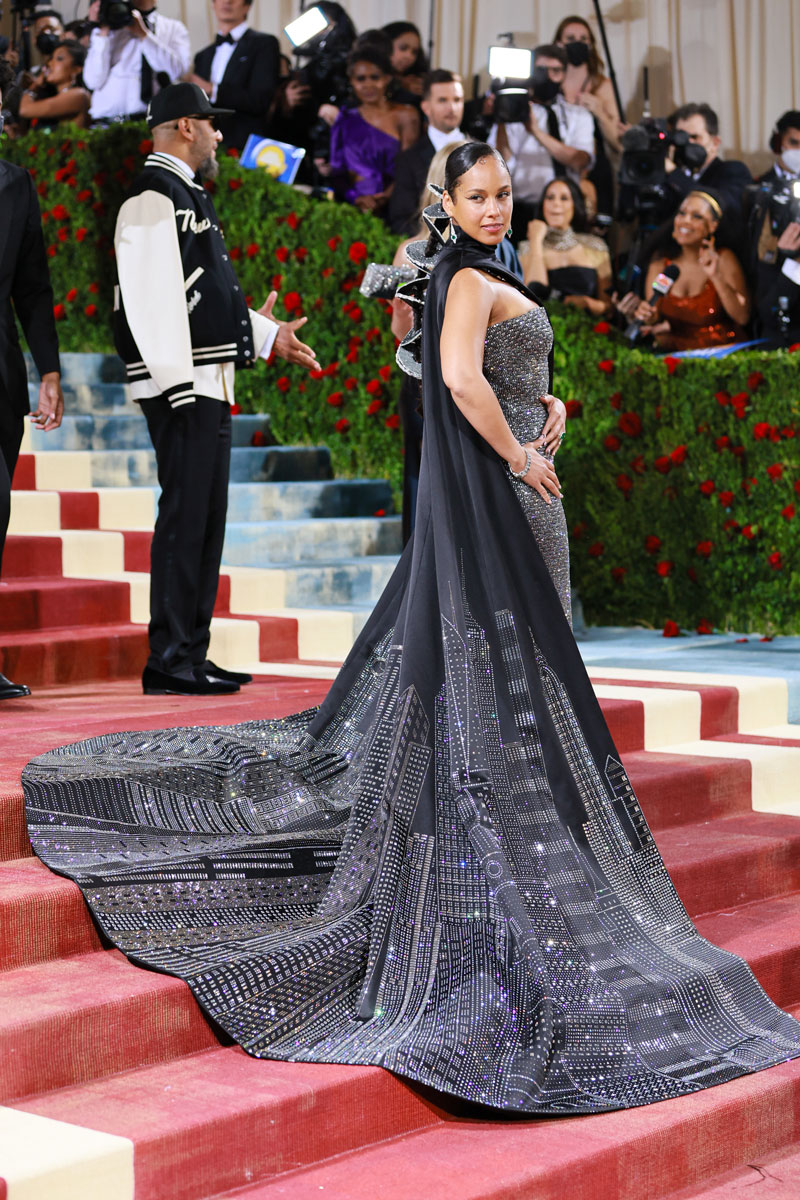
Ron DeSantis tramples the First Amendment: GOP’s Disney payback is clearly unconstitutional

When Gov. Ron DeSantis and the Florida Republican Party punished Disney for its criticism of the “Don’t say gay” bill — in other words, for corporate speech that was clearly political in nature, their retaliation was not just fiscally shortsighted, it was illegal. Any government attempt to restrict a corporation’s speech based on the content of that speech must satisfy the strictest scrutiny, meaning the restriction adopted by the government must be narrowly tailored to serve a compelling government interest. Restrictions based on political viewpoint have long been prohibited. Stripping Disney of its special tax status in two Florida counties (which both lean Democratic), while leaving intact more than 1,800 similar tax districts in largely Republican counties, is not narrowly tailored to achieve any clear objective, nor is silencing political critics a compelling or even legitimate government interest in the first instance.

More than 10 years ago, the U.S. Supreme Court vested corporations with the same legal protections as other individuals when speaking on political issues. In the infamous Citizens United decision of 2010, the court elevated the protection due corporate political speech, shielding corporate expenditures for that purpose under the First Amendment. Maligned by the left for largely valid reasons, Citizens United has empowered Big Oil, utility companies and other deep-pocket industries to boost politicians like DeSantis, who symbiotically protect their corporate profits instead of protecting constituents worried about climate, even as Florida’s coasts sink visibly around them.  

RELATED: Betsy DeVos and Ron DeSantis: GOP dynamic duo team up to defund public schools

Vesting well-funded corporations with expanded political speech rights may have sealed the fate of our rising oceans, but Citizens United also arms corporations like Disney with legal ballast to protect themselves against would-be autocrats who seek to silence them. Although DeSantis was quick to disavow any retaliatory motive in his move to strip Disney of its independent taxing status, his disavowal is absurd in light of the timing and his own comments. Late in 2021, DeSantis warned Florida’s most powerful companies not to display “corporate wokeness,” widely regarded as showing support for LGBTQ rights and racial justice. He further threatened that if corporations did display “wokeness,” the state would “look under the hood” of their operations, with the clear implication that they would examine more closely business practices previously deemed acceptable.  

Although DeSantis disavowed any retaliatory motive in his move against Disney, that seems absurd in light of the timing — and his own comments.

Several months later, DeSantis made good on that threat. On March 28, the governor signed the controversial “Don’t say gay” bill into law, prohibiting teachers from discussing sexual orientation and encouraging parents to sue over ill-defined violations. On that same day, Disney’s CEO criticized the new law, vowing to see it repealed. Disney released a statement that the bill “should never have been signed into law… Our goal as a company is for this law to be repealed by the legislature or struck down in the courts, and we remain committed to supporting the national and state organizations working to achieve that. We are dedicated to standing up for the rights and safety of LGBTQ+ members of the Disney family, as well as the LGBTQ+ community in Florida and across the country.”

DeSantis was triggered. The next day, he responded scathingly, rebuking Disney for its criticism, warning Disney that it doesn’t “run this state” and saying it “will never run this state as long as I’m governor.” Two days later, and after more than 50 years of mutually beneficial operations,during a special legislative session convened for an entirely unrelated purpose, DeSantis and the GOP announced plans to revoke Disney’s legal entitlement to independent tax status, while preserving over 1,800 similar tax districts in the state.


Want a daily wrap-up of all the news and commentary Salon has to offer? Subscribe to our morning newsletter, Crash Course.


Evidence of DeSantis’ retaliatory motive isn’t limited to the calendar, the sequence of events or the common-sense inference that Disney’s 50-plus years of successful taxing authority would not be revoked out of the blue. DeSantis and the GOP’s own statements render obvious their lust for retaliation, and make clear that they moved against Disney in direct consequence of Disney’s politically motivated speech against “Don’t say gay”: 

  • DeSantis: “Disney and other woke corporations won’t get away with peddling their unchecked pressure campaigns any longer… (We) view corporations like Disney trying to impose a woke ideology on our state as a significant threat… we take a very big stand against that… If Disney wants to pick a fight, they chose the wrong guy.” At the bill signing ceremony, DeSantis continued, “You’re (Disney) a corporation based in Burbank, California, and you’re gonna marshal your economic might to attack the parents of my state… We view that as a provocation, and we’re going to fight back against that.”  
  • Lt. Gov. Jeanette Núñez: “How dare they. (The Walt Disney Company) has no right to criticize legislation by duly elected legislators… Gov. DeSantis and I won’t stand for it.” Appearing on Fox News, Núñez questioned whether companies like Disney even have the “right to criticize” state policymakers’ efforts.
  • DeSantis press secretary Christina Pushaw: “It was unfortunate that Disney decided to wade into a political debate and attempt to overturn a common-sense law… The opponents of “Don’t say gay,” she suggested, were “probably groomers” (i.e., those who “groom” children for sexual abuse). 
  • Republican Rep. Randy Fine, who sponsored the bill to strip Disney of its status: “When Disney kicked the hornet’s nest several weeks ago (by criticizing ‘Don’t say gay’), we started looking at special districts… This is something that makes sense to do in general but because of the way Disney has behaved, there’s now the political will to do it.”Disney had the political power to prevent (stripping its status) for decades. What changed is bringing California values to Florida… You are a guest. Maybe you don’t deserve the special privileges anymore.”
  • Republican Rep. Joe Harding, sponsor of “Don’t say gay”: “Large corporations must be held accountable.”
  • Republican Jackie Toledo: “Once upon a time Disney was a great partner with the state of Florida… We’ve granted them privileges because of our shared history, shared goals and shared successes. Shamefully, Disney betrayed us (by opposing ‘Don’t say gay’).”
  • Republican Sen. Jeff Brandes, who opposed the measure: The retaliatory law “leaves the sword of Damocles over Disney’s head for 13 monthsIt shuts them up.” 

Brandes’ reference to 13 months reflects the effective date of the law, which will not take effect for more than a year, further indicating that this was political theater and a misuse of state power. Allowing over a year to pass will afford DeSantis and the GOP time to modify, retract or edit their work, and will also give DeSantis room to try to address the fiscal implications. Since dissolution of the district will mean that the counties must provide services Disney used to provide, such as road maintenance, and will also require the two counties to absorb nearly $1 billion in Disney’s debt, DeSantis clearly needs time to figure out who might pay for it. Delaying the measure long past the next election suggests that he understood all along it would never take effect as passed, but wanted to show that he could and would punish Disney for its political statements. 

Delaying the payback measure long past the next election suggests that DeSantis understood it was political theater all along.

Brandes, the lone Republican vote against the measure, went on: “Nobody actually thinks this is going to happen. The cost to the state would be astronomical, potentially billions of dollars… DeSantis is relishing the feud… This is about staying on Fox. This is about extending the media life of this storyline. This is gold for him.” Last year, in an ominous but prescient warning of exactly this kind of GOP retribution targeting ‘woke’ entities, Mitch McConnell said, “My advice to the corporate CEOs of America is to stay out of politics.”  

Unfortunately for McConnell, DeSantis, Núñez and the rest of the GOP, whose lust for punishing critics is palpable, the Supreme Court has forcibly struck down government efforts to deter corporations from speaking out in the first instance. In the Pacific Gas & Electric decision of 1986, the court noted that “(T)he essential thrust of the First Amendment is to prohibit improper restraints on the voluntary public expression of ideas.” The court struck down the government order at issue because it “discriminate(d) on the basis of the viewpoints of the selected speakers.” Similarly, here Republicans seek to punish Disney, a corporation that has significantly benefitted Florida, that led the meteoric rise of Florida’s tourism industry and that employs more Floridians than any other private company in the state, specifically and demonstrably because of its disfavored political speech criticizing DeSantis and the “Don’t say gay” legislation. 

Political speech is the heart of the First Amendment. Based on our founders’ mistrust of governmental power, the premier and most exalted amendment to the U.S. Constitution was crafted to protect against the government’s “attempts to disfavor certain subjects or viewpoints,” and soundly “prohibits the government from restricting speech based on content of that speech,” as the court wrote in U.S. v. Playboy Entertainment Group (2000), which struck down content-based restrictions. Using state power to silence political speech of critics has wider and more frightening implications than whether sex education is taught in schools. That Florida is attacking LGBTQ people, reproductive rights and racial minorities simultaneously may be alarming, but it isn’t nearly as ominous as DeSantis and the GOP’s trampling of the First Amendment. 

Silencing political opponents, whether by imprisonment or by imposing an effective ideology tax, presents the steepest of autocratic slopes. If Floridians lose the right to publicly criticize or disagree with their government, they have lost the right to choose who that government will be. The principal reason autocrats and dictators control speech is to consolidate power.  Silencing critics means that the state controls the narrative, and is free to create, spin and disseminate “alternative facts” which are almost always designed to ensure that those who hold power get to keep it.  

During our time, silencing critics and controlling political speech means that autocrats can say anything they want, and the public never hears information to the contrary. It means that an entire country believes Ukraine is the aggressor, and that the United States should be punished for provoking Russia. It means an entire country would feel justified in a preemptive nuclear strike that could wipe out millions. In our founders’ time, silencing political critics meant the Intolerable Acts, passed in 1774 to punish colonists for their political speech against the British government. 

That act of political suppression led to the Revolutionary War, which eventually produced a brilliant treatise that was centuries ahead of its time. In laying out principles of freedom and free governance the world had not yet seen or conceived, the framers of the U.S. Constitution showed a singular and unmatched genius that continues to inspire the world, including new countries like Ukraine, fighting now to the death for democracy and freedom of speech. Having suffered from state-imposed religion, our founders forged a new government scrupulously separated from the church. Having been punished and taxed for their speech against government, our founders wrote the First Amendment.

Understanding our nation’s history, fully grasping what led desperate men to give their lives to separate church and state, and why they took up arms to defend the right to criticize the government, is the only way to appreciate the First Amendment: “Congress shall make no law respecting an establishment of religion, or prohibiting the free exercise thereof; or abridging the freedom of speech, or of the press…” To understand the historical underpinnings of the First Amendment is to revere it for the stroke of genius, timeless insight into human conduct, and beacon for universal freedom that it was. To understand its singular beauty is also the only way to grasp the danger of allowing DeSantis and the Republican Party of Florida to trample it.  

Read more on Disney, DeSantis and the Sunshine State:

Leaked majority opinion says Supreme Court is set to overturn Roe v. Wade

The Supreme Court is set to overturn Roe v. Wade, according to a leaked draft of a majority opinion written by Justice Samuel Alito that Politico published on Monday night. 

​”We hold that Roe and Casey must be overruled,” Alito wrote in the document, labeled as the “Opinion of the Court.” “It is time to heed the Constitution and return the issue of abortion to the people’s elected representatives.”

According to Politico, the ruling was drafted in February and would immediately end nearly 50 years of guaranteed abortion rights mandated by the Roe v. Wade decision in 1973, which ruled that the U.S. Constitution protected a pregnant woman’s right to have an abortion. If the Supreme Court overturns Roe as expected, it would be up to each individual state to decide whether to ban or allow abortions. Roughly half of all U.S. states would be likely either to outlaw all abortions or enact sweeping new restrictions.

RELATED: After Roe v. Wade: Now the fight for reproductive justice moves to the states

Politico reports that it’s unclear whether there have been any changes to the draft ruling since it was written. The site says it received the draft from “a person familiar with the court’s proceedings in the Mississippi case along with other details supporting the authenticity of the document.” The Supreme Court is currently deliberating the constitutionality of a Mississippi state law that prohibits abortion after 15 weeks of pregnancy, but the opinion in that case — which was widely expected to result in overturning Roe v. Wade — wasn’t expected to be published until late June.

As noted in the Politico report, it is unprecedented for a draft decision to be leaked while a case is still pending. Also without precedent is the view this draft offers into the justices’ deliberations. 

“Roe was egregiously wrong from the start,” Alito writes. “Its reasoning was exceptionally weak, and the decision has had damaging consequences. And far from bringing about a national settlement of the abortion issue, Roe and Casey have enflamed debate and deepened division.”

If the ruling comes to pass and Roe v. Wade is overturned, the map for reproductive health care in the United States will be completely redrawn. Guttmacher Institute, a nonprofit pro-choice research organization, predicts as many as 26 states will severely restrict abortion access or ban it entirely if Roe v. Wade is overturned. The states likely to ban abortions entirely and immediately without federal protections would include virtually the entire South, from Texas to Florida, and several Midwestern and Plains states as well. Women in these states who sought to terminate pregnancies would be forced to travel elsewhere for abortion services, if they were able to do so.

As reported by the New York Times, research suggests that nearly half of women who won’t have access to legal abortion in a post-Roe America would be forced to carry their pregnancies to term. Such a scenario could resemble the U.S before the Roe decision, when a patchwork of different laws in different states meant that access to abortion varied greatly in different regions of the country. The Times cited a 2019 study by a Middlebury College economics professor predicting that a reversal of Roe would result in a 32.8% decrease in the number of abortions performed in the United States. 

“In the year following a reversal, increases in travel distances are predicted to prevent 93,546 to143,561 women from accessing abortion care,” the paper noted. 

“We are going to see some women will still do dangerous things like having the boyfriend hit them in the belly or throwing themselves down stairs or taking dangerous herbs,” Carole Joffe, a professor at the University of California-San Francisco’s Bixby Center for Global Reproductive Health, told the New York Times. 

Pro-choice and women’s health organizations across the country are swiftly responding to the report. Mini Timmaraju, president of NARAL Pro-Choice America, called the report the most “ominous and alarming sign yet” that Roe v. Wade is poised to be overturned by the high court. 

“While this is a draft opinion and abortion is still legal, we need to brace for a future where more and more people are punished and criminalized for seeking and providing abortion care,” Timmaraju said in an emailed statement to press. “Now more than ever, we must support those working to provide abortion care and elect champions who will relentlessly fight for reproductive freedom and take bold action to safeguard abortion rights.”


Read more on reproductive rights in the United States:

“Ozark” recap: Marty and Wendy are losing it

Watching the second half of this final season of “Ozark,” I’m finding myself feeling extremely grateful that I lead a pretty simple life. While, yes, there’s always the possibility of something terrible happening to me on any given day along the lines of a home invasion, mugging, or the sun finally exploding in the sky; at my very worst I have it VERY easy compared to just about every character acting out their miserable back-stabby lives in “Ozark.” These are overly exciting, and extremely exhausting comings and goings to be a fly on the wall for. And it’s getting harder and harder to imagine, after everything we’ve seen, any of these people successfully putting out all the fires they’ve started over these four seasons.

During this next batch of two episodes we get backstory on Ben’s (Tom Pelphrey) death, and more evidence pointing to the fact that Wendy (Laura Linney) was always ruthless, even as a kid, she’s just gotten craftier at it and has developed loftier ends to her means in adulthood.

RELATED: “Ozark” is back to close out its final season

In Ben’s flashback we go back to the last night of his life and see the story play out from his perspective, rather than his sister’s. After Wendy ditches him at the roadhouse they went to together he goes looking for her in the bathroom and sees that she’s not in there. For a moment the reality of his circumstances flashes over his face as it registers that his sister is a piece of s**t, and then he clouds up again, refusing to believe the truth about the woman he later references to his killer as being “the only thing on the whole planet that really loved me.” If this were actually true, he’d still be alive. 

In the parking lot he’s met by Nelson (Nelson Bonilla) who sticks a gun in his side and forces him into his waiting car. On the ride to the secluded location where he’ll eventually die, Ben spends his remaining moments talking about the sister who led to his end. He asks Nelson to tell Wendy that he forgives her and then, on his knees on a tarp in what looks to be an abandoned barn, stays Nelson’s hand to question if what’s happening is a dream. The loud boom that comes next answers that question for him.

Laura Linney as Wendy Byrde in “Ozark” (Courtesy Of Netflix)

What is Wendy occupied with? Not matters of forgiveness or redemption but more efforts of manipulation to save her own ass.

Cut back to present day and what is Wendy occupied with? Not matters of forgiveness or redemption but more efforts of manipulation to save her own ass.

As Marty (Jason Bateman) is being prepped by Navarro (Felix Solis) to go to Mexico and handle business in his absence, Wendy is puppeteering three different women; Ruth (Julia Garner), Clare (Katrina Lenk) and Navarro’s sister, Camila (Veronica Falcón); all who have their own strings to pull.

Clare is more or less a money pawn in this equation with Ruth and Camilla as the ones Wendy really needs to watch out for. Now that Ruth sold off all of Darlene’s (Lisa Emery) heroin and is the rightful owner of the majority of Darlene’s land due to paperwork signed when she became Wyatt’s (Charlie Tahan) legal guardian, she’s got more leverage than ever. But, as we’ve learned several times in this show, the more a person has, the more they have to lose. 


Want a daily wrap-up of all the news and commentary Salon has to offer? Subscribe to our morning newsletter, Crash Course.


 Camilla, an even match to Wendy when it comes to craftiness and unpredictability, has motives in this that are unclear at this point because there are two different stories being told about her; the story we get from the words and actions coming from Camilla herself, and the story of her being fed and framed by Wendy.

Basically anything bad that’s happening, Wendy is probably behind it. She just sucks that bad.

We’re being told, mostly from poison Wendy’s pouring into Marty’s ear, that Camilla is the one who put a hit out on Navarro in prison as revenge for him killing Javi (Alfonso Herrera,) her son. But he didn’t actually kill Javi anyway, Ruth did, and it’s my theory that Wendy is the one responsible for everything she’s blaming Camilla for, and Camilla knows it. We’re also being made to believe that Camilla is trying to keep Navarro on the SDN list, but I think Wendy is behind this too. Basically anything bad that’s happening, Wendy is probably behind it. She just sucks that bad.

And the more Wendy becomes entrenched in her own dirty dealings, the more we see the wool over Marty’s eyes coming unraveled. 

Described quite accurately by Ruth in a past episode as c**t struck, Marty is getting sick of Wendy’s whole deal. He no longer believes she’s doing any of what she does for her family so, in turn, he’s pulling his kids closer the further she shoves them away. 

When not watching people be tortured in a dank pit in Mexico, Marty’s having heart-to-heart talks with Charlotte (Sofia Hublitz) and checking in on Jonah (Skylar Gaertner) where he’s currently living at the Lazy-O Motel. Even offering to give him a ride to school, which was a heartwarming moment in the midst of all the chaos in this family. 

In the middle of all the fundraisers, negotiations, and wheelings and dealings with every form of law enforcement available, this is still a story about a family. And judging by Marty beating the ever-lovin’ crap out of a guy in a moment of road rage, not even wrinkling his polo shirt in the process, he’s still very much willing to fight for that family. With Wendy’s participation or not.

Read more:

The baptism of Nic Cage in the bloodbath of “Mandy,” one of the actor’s most underappeciated roles

In 2016’s “USS Indianapolis: Men of Courage,” Nicolas Cage battled sharks. Perhaps he learned from them how some species must keep moving to survive. Throughout his long and varied career, Cage has kept swimming. The waters – and the roles — just keep getting wilder. 

It’s been a weird ride for the actor, both onscreen and off, from geeky heartthrob to action star to direct-to-video slump to . . . wherever he is now, currently staring as none other than the actor Nicolas Cage in the meta flick “The Unbearable Weight of Massive Talent.” To survive as an artist, you must change. But I earlier in his career I didn’t think much about Cage, dismissed him as prolific if not especially moving, until one film above all showcased his bloody power, not only for rage but for love: “Mandy.”

In fact, in “Massive Talent,” Cage’s superfan Javi Gutierrez (Pedro Pascal) makes sure to single out “Mandy” as well. Even though Javi cites John Woo’s 1997 action thriller “Face/Off” as his favorite film from his idol, he acknowledges that “Mandy” is underrated. 

RELATED: Give in to Nicolas Cage’s “Massive Talent,” a clever caper with the power to make anyone a fan

Famously, Cage was born into a show biz family, the nephew of Francis Ford Coppola and cousin of Sofia Coppola and Roman Coppola. He changed his last name, as writer Joe Hill, son of Stephen King would, to avoid accusations of nepotism, after begging his uncle Francis to give him a screen test as a teenager. Cage based his stage name on Marvel superhero Luke Cage and on composer John Cage.

James Dean inspired Cage to act, and in early performances, Cage has a kind of floppy-haired nonchalance, as if this business of acting is easy, no problem. And then there’s “Mandy.”

It’s a world of trust and safety they’ve built with each other — and it’s temporary, of course. 

It’s hard to explain Panos Cosmatos’ 2018 film, co-written by Cosmatos and Aaron Stewart-Ahn. It’s either your kind of thing — or it’s not. “Mandy” is another world both close to and very far from our own. The film is divided into parts: The Shadow Mountains, Children of the New Dawn and Mandy. I wish I could live in the first part. But all of us who are not men live in the last. Cage walks through all three with ease.

Set “circa 1983 AD” in a forest that could be the Pacific northwest, the film starts with Cage as Red, a soulful logger. Red’s live-in romantic partner is Mandy (Andrea Riseborough, who is haunting), an artist who works in a backwoods store by day and by night, reads and draws fantastical illustrations. Mandy’s interested in astronomy, and she and Red share a love of science fiction. They watch a sci-fi movie, joke about Galactus.

They also seem to share violent pasts: Red may be an alcoholic in recovery, and Mandy survived a childhood marked by an abusive father.

The couple live in a many-windowed house that glows at night, pulsing with light and steam like a greenhouse. Or, like the chambers of a heart. They don’t have curtains. They live in such a remote place that Mandy leaves the door open. In a premonition of violence, Red wonders if they should move away, go somewhere different. But Mandy refuses to give up “our little home.”

One of the worlds of “Mandy” is the world of the lovers: an isolated, rich embrace. The first part of the film drips with the richness of nature like a Maxfield Parrish painting: hills of pine, skies with clouds that have the eerie green rinse of just after rain. Red and Mandy sleep surrounded by windows. They boat on an emerald lake — Crystal Lake — that dissolves into a shot of flames: a campfire. It’s a world of trust and safety they’ve built with each other — and it’s temporary, of course. 

Mandy catches the eye of a man. 

Jeremiah disrobes before a captive and drugged Mandy after playing one of his songs for her — a kind of “Frampton Comes Alive!” for the cult leader set. 

A failed musician and burgeoning cult leader: Jeremiah Sand (the incredible Linus Roache). The world of Jeremiah is that of a run-of-the-mill narcissist masquerading as the messiah. He has a handful of followers in a “Texas Chainsaw Massacre” vanAnd like Father Yod and Charles Manson (he even calls Red and Mandy pigs), he has an album. Jeremiah’s world includes a lot of drugs, keeping his followers in a haze and free love for him only. His hair and makeup look like Iggy Pop left in the rain, and he alternates between wearing a Luke Skywalker robe and tight Jimmy Page pants with a cross necklace. He’s an easily wounded, mediocre man.

But like the world of the lovers with its Galactus, the world of the Children of the New Dawn, Jeremiah’s cult, has its specific language too including the Horn of Abraxas, a kind of moon rock used to summon a biker gang Jeremiah hires as muscle, and a knife described as the “tainted blade of the pale knight, straight from the abyssal lair.” 

Phrases like these sound like a marriage between heavy metal and LARPing — and with a certain tone, it would be funny. It is funny. And when Jeremiah disrobes before a captive and drugged Mandy after playing one of his songs for her — a kind of “Frampton Comes Alive!” for the cult leader set — she has a natural, honest and simple reaction. She laughs. 

As the apocryphal phrase, attributed to Margaret Atwood, goes: “Men are afraid that women will laugh at them. Women are afraid that men will kill them.”

In this world of men, humiliation is unforgiveable. Women only occupy a few roles in Jeremiah’s mind; after all — he has merely two female followers: a crone (Olwen Fouéré, who is mesmerizing) and a maiden — and deviant is not one of them. Mandy becomes the only other thing a woman can be if she’s not sexual: a witch to burn.

For all its red mist and LSD eaten like peanut butter, “Mandy” is ultimately a film about love.

Mandy already doesn’t fit in. Neither she nor Red are young, and they don’t have children — aspects I love about them as a couple. She makes art, reads, walks in the woods alone. She doesn’t wear makeup, and she has mismatched pupils and a long, jagged scar on her face that is not explained; she simply has it. She’s lived through a lot, Mandy. But not this.

Red is plunged into the world of grief, grief as I’ve never seen represented so accurately, so painfully, onscreen. It’s embarrassing, keening, real. It’s absurd, as death always is, and the last part of the film is the heavy metal world of blood vengeance. Red has his own named weapon too, the Reaper, and he forges another: a silver ax. Things get pretty medieval with a knight and beheadings as Red travels a landscape of tunnels and jagged cliffs like one of Mandy’s drawings come to life. And if you think Cage isn’t the one to dispatch a bike gang, you don’t know Cage.  


Want a daily wrap-up of all the news and commentary Salon has to offer? Subscribe to our morning newsletter, Crash Course.


Despite the wildness of the film, it stays grounded thanks to its specificity. Nothing seems out of place — not a telepathic chemist, not a tiger, not the best chainsaw scene since “Evil Dead” — because this the table that has been set for us.  

In my work as a fiction writer, people always ask about world-building. The truth is two things: It has to be real for you and it has to be very specific. You have to choose stark elements and stick to them, refer to them the same way every time. It’s the sticking, the consistency, that makes a world real. So, “Mandy” invents a sci-fi novelist — whole, vibrant pages from her trade paperback — and a TV commercial for a brand of demonic mac and cheese. It’s the ’80s on an alternate timeline, maybe the Berenstain Bears one. 

It also reinvents Cage, reborn as a gentle man with burning, divine vengeance running through his veins, believable as no mere accidental action star, but a psychedelic folk horror hero. “Mandy” set the tone for Cage transformations to come, the soulfulness of “Pig,” the casual desperation of “Willy’s Wonderland,” fully harnessing Cage’s depths not only for mania but for quiet suffering. 

Because for all its red mist and LSD eaten like peanut butter, “Mandy” is ultimately a film about love, and how wicked this world can be. And that makes it our world, very much indeed, and the one to walk through it, wielding a blood-stained ax, bringing you home (at least in his nightmarey dreams) is Cage. 

“Mandy” is currently available on demand.

More stories like this: