Spring Sale: Get 1 Year, Save 58%

Kyrsten Sinema doesn’t need to be saved by Republicans

I have often observed that shamelessness is the American right-wing’s superpower and that is never better illustrated than when they call for the smelling salts over Democratic “incivility.” We are once again undergoing such a phony hissy fit in the case of Arizona Senator Kyrsten Sinema, a Democrat, who was accosted by protesters who followed her into a public restroom, in one instance, and asked her questions on an airplane flight in another. 

Let me just say that I think the bathroom thing was ill-advised, and cornering anyone on an airplane is pretty aggressive since there is literally no escape. It’s not like a business owner asking someone to leave the premises, such as what happened to Donald Trump’s former press secretary Sarah Huckabee Sanders or when his former DHS Secretary Kirstjen Neilsen was taken to task by fellow diners in a restaurant in Washington, both of which also caused right-wingers to froth and fume. Sinema was in no physical danger from these protesters and neither were Sanders and Neilsen. As President Biden said when asked about it on Tuesday, “I don’t think they’re appropriate tactics, but it happens to everybody … it’s part of the process.”

The right-wing is staging this fit because they are currying Sinema’s favor in the hopes that she will destroy the Democratic agenda. But this is a common tactic — hypocritical faux outrage about left-wing misbehavior is one of their oldest tricks.

As Salon’s Zachary Petrizzo reported, former Trump adviser turned podcaster Steve Bannon railed about the fact that the protesters were “illegal aliens” (always a good bet to get the right-wing base riled up.) Breitbart News claimed that the protesters “stalked and harassed” Sinema and Red State wondered if a crime had been committed. A Fox News anchor declared that Sinema was “assaulted” on the airplane and wondered why the FAA didn’t intervene. And in one of the more embarrassing examples of right-wing self-righteousness, the National Review’s Charles Cooke wrote this:

If, instead of a left-winger berating a moderate Democrat in the loo, a right-winger had berated a moderate Republican, it would have been the biggest news of the year. Within minutes, the incident would have had a name — the “Arizona Attack,” perhaps. Within a day, it would have been deemed to be representative of everything that was wrong with the American Right — and with the United States itself. Within a week, we would have been drowning in breathless TV segments, tendentious op-eds, and mawkish lectures about the sanctity of democracy in the United States.

I don’t know how to break it to him but you don’t have to imagine it. It’s happened. A lot.


Want a daily wrap-up of all the news and commentary Salon has to offer? Subscribe to our morning newsletter, Crash Course.


Last January, just before the joint session of Congress to certify the presidential vote, GOP Senator Mitt Romney was accosted in the Salt Lake City airport and rudely confronted by Republicans angry at him about his unwillingness to object to the electoral count. On the airplane full of people coming to the rally scheduled for January 6th, they chanted, “traitor, traitor, traitor!” and yelled at Romney to resign. (At the insurrection rally on January 6th, President Trump asked the crowd, “I wonder how Romney liked his flight last night,” to the delight of the crowd.)

Likewise, Senator Lindsey Graham, R-S.C., was angrily confronted by a mob of Trump supporters at Reagan National Airport a couple of days later. They called him a traitor too and crowded him to the point that airport security had to escort him to safety. In one of the videos of the incident, a woman was heard saying, “one day they will not be able to walk down the street; it is today.”

Last month Republican Congressman Anthony Gonzales of Ohio dropped out of his race for re-election citing the fact that he had to have police escorts for himself and his family at airports due to threats from Trump supporters angry over his vote for impeachment. I’m sure Congresswoman Liz Cheney has similar stories. And while they didn’t manage to find Vice President Mike Pence on January 6th, we know what they planned to do with him if they did, don’t we?

Right-wing protesters aren’t just attacking politicians. All over the country, they are threatening health care workerselection officials and school board members about everything from masks to vaccines to critical race theory. It has gotten so bad for local school officials and teachers that the Department of Justice has announced a plan to intervene. But yet, in another example of egregious shamelessness, Senator Josh Hawley took the other side of the argument in a Senate hearing this week, arguing that these were just fine examples of parents looking out for their children. MSNBC’s Chris Hayes rounded up some examples of such civic protest for Hawley since he didn’t seem to have the full picture of what’s been going on:

Meanwhile, we have the predictable claims that the protesters who confronted Kyrsten Sinema were financed by the great leftwing boogeyman, George Soros. It’s true that the group they belong to got money from Soros’ foundation in 2017 and 2019, but there is no evidence that the foundation is involved in the protests in any way. It certainly isn’t directing the protests with talking points and strategy as the Washington Post reported the Koch brothers network has been doing with the school board protests.

This is nothing new for GOP activists. In 2009, the very similar angry protests over the Affordable Care Act were likewise directed from on high by groups financed by big-money donors who bused activists all over the country with instructions to disrupt the town hall meetings. They put out a strategy memo that said:

— Artificially Inflate Your Numbers: “Spread out in the hall and try to be in the front half. The objective is to put the Rep on the defensive with your questions and follow-up. The Rep should be made to feel that a majority, and if not, a significant portion of at least the audience, opposes the socialist agenda of Washington.”

— Be Disruptive Early And Often: “You need to rock-the-boat early in the Rep’s presentation, Watch for an opportunity to yell out and challenge the Rep’s statements early.”

— Try To “Rattle Him,” Not Have An Intelligent Debate: “The goal is to rattle him, get him off his prepared script and agenda. If he says something outrageous, stand up and shout out and sit right back down. Look for these opportunities before he even takes questions.”


Want a daily wrap-up of all the news and commentary Salon has to offer? Subscribe to our morning newsletter, Crash Course.


Recall that all those nice “protesters” even gathered in Washington one day to yell racist epithets and spit on congressmen? Clearly, the right thinks that protesting masks and vaccine mandates will deliver them the same win that the Obamacare protests did in 2010, which is highly debatable. We have 700,000 people dead from COVID and the majority of Americans are not amused at these antics.

But no matter what, Trump or no Trump, the Republicans will still be wringing their hands about at the alleged incivility of the left and whining about the supposed denial of their rights even as they do everything they claim the other side is doing. As I said, shamelessness is their superpower.

In cities, dangerous heat exposure has tripled since the 1980s, with the poor most at risk

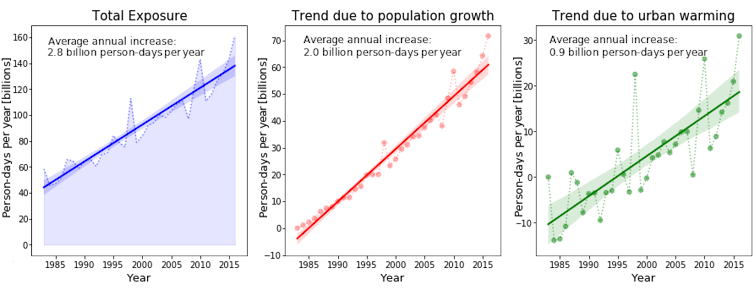
Extreme urban heat exposure has dramatically increased since the early 1980s, with the total exposure tripling over the past 35 years. Today, about 1.7 billion people, nearly one-quarter of the global population, live in urban areas where extreme heat exposure has risen, as we show in a new study released Oct. 4, 2021.

Most reports on urban heat exposure are based on broad estimates that overlook millions of at-risk residents. We looked closer. Using satellite estimates of where every person on the planet lived each year from 1983 to 2016, we counted the number of days per year that people in over 13,000 urban areas were exposed to extreme heat.

The story that emerges is one of rapidly increasing heat exposure, with poor and marginalized people particularly at risk.

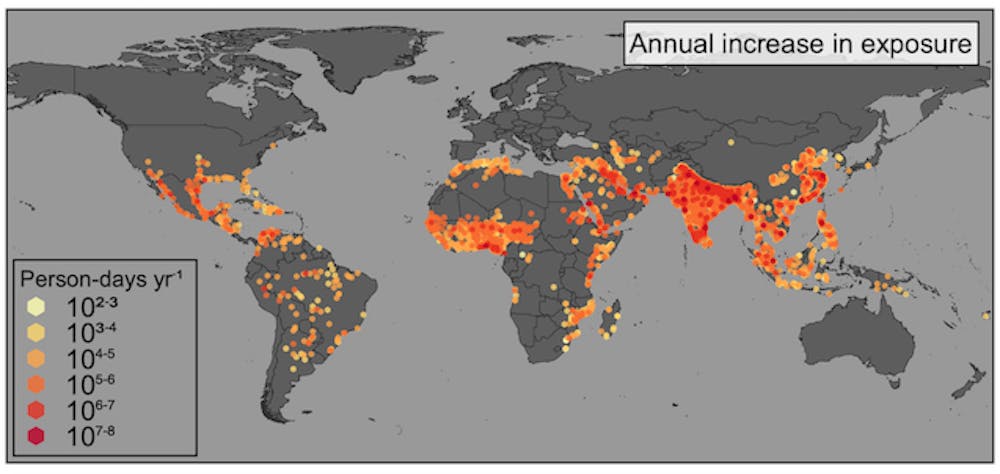
Nearly two-thirds of the global increase in urban exposure to extreme heat was in sub-Saharan Africa and southern Asia. This is in part because of climate change and the urban heat island effect – temperatures in urban areas are higher because of the materials used to build roads and buildings. But it is also because the number of people living in dense urban areas has rapidly increased.

Urban populations have ballooned, from 2 billion people living in cities and towns in 1985 to 4.4 billion today. While the patterns vary from city to city, urban population growth has been fastest among African cities where governments did not plan or build infrastructure to meet the needs of new urban residents.

Three charts showing total exposure and the trends due to population and climate change increase

Urban population exposure to extreme heat and the influence of urban warming and population growth. Extreme heat is defined as at least one day with a wet-bulb globe temperature greater than 30 C. Wet-bulb globe temperature takes into account temperature, humidity, wind and radiation to gauge the effect on humans. Tuholske et al, 2021

Climate change is raising the heat risk

It is clear that there is a dangerous interaction of increasing temperatures and rapid urban population growth in countries that are already very warm.

How much worse will it get, and who will be most affected? Chris Funk explores these heat exposure projections for 2030 and 2050 in his new Cambridge University Press book “Drought Flood Fire.”

Urban population growth is expected to continue, and if greenhouse gases continue on their rapid growth path, we will see massive increases in heat exposure among urban dwellers. The planet has already warmed just over 1 degree Celsius (1.8 F) since pre-industrial times, and research shows warming is translating to more dangerous weather and climate extremes. We are almost certain to experience another degree of warming by 2050, and likely more.

This amount of warming, combined with urban population growth, could lead to a 400% increase in extreme heat exposure by 2050. The vast majority of people affected will live in South Asia and Africa, in river valleys like the Ganges, Indus, Nile and Niger. Hot, humid, populated and poor cradles of civilization are becoming epicenters of heat risk.

At the same time, research shows that marginalized people – the poor, women, children, the elderly – may lack access to resources that could help them stay safer in extreme heat, such as air conditioning, rest during the hottest parts of the day and health care.

Counting who’s at risk

To count the number of urban residents exposed to extreme heat, we used data and models that incorporate advances in both social and physical sciences.

More than 3 billion urban residents live 25 kilometers or farther from a weather station with a robust reporting record. Climate model simulations that estimate past weather were not designed to measure a single person’s risk; rather, they were used to gauge broad-scale trends. This means the effects of extreme heat for hundreds of millions of impoverished urban residents worldwide have simply not been documented.

Map showing heat exposure increases by color

The increase in extreme heat exposure in cities around the world from 1983 to 2016. Tuholske et al, 2021

In fact, the official record states that only two extreme heat events have had significant effects on sub-Saharan Africa since the 1900s. Our results show that this official record is not true.

Reasons for action

Urban population growth itself is not the problem. But the convergence of changes in extreme heat with large urban populations calls into question the conventional wisdom that urbanization uniformly reduces poverty.

Historically, urbanization was associated with a shift in the workforce, from farming to manufacturing and services, in tandem with industrialization of agricultural production that increased efficiency. But in parts of sub-Saharan Africa, there has been urbanization without economic growth. This may be due to post-colonial technological changes that improve health. People are living longer and more children are surviving past infancy thanks to medical advances, but post-colonial governments often don’t have or don’t mobilize the resources to support huge numbers of people moving to cities.

What worries us is that because urban extreme heat exposure has largely been left off the development policy radar, poor urban residents will have a harder time escaping poverty. Numerous studies have shown that extreme heat reduces labor productivity and economic output. Low-income workers tend to have fewer worker protections. They are also burdened with high costs for food and shelter, and often lack air conditioning.

Steps cities can take

The coronavirus pandemic and the Black Lives Matter movement have amplified demands for greater political and scientific attention to inequality and injustice. Better data that helps to capture the true lived experiences of individuals is a key feature of more integrated and socially relevant climate-health science. Collaborations across scientific disciplines like ours can help governments and businesses accommodate new urban residents and reduce harm from heat.

Implementing early warning systems, for example, can reduce risks if they are accompanied by actions like opening cooling centers. Governments can also implement occupational heat standards to reduce heat risks for marginalized people and empower them to avoid exposure. But these interventions need to reach the people most in need.

Our research offers a map for policies and technologies alike, not just to reduce harm from urban extreme heat exposure in the future, but today.

Cascade Tuholske, Postdoctoral Research Scientist, Center for International Earth Science Information Network (CIESIN), Columbia Climate School, Columbia University; Chris Funk, Director of the Climate Hazards Center, University of California Santa Barbara, and Kathryn Grace, Associate Professor of Geography, Environment and Society, University of Minnesota

This article is republished from The Conversation under a Creative Commons license. Read the original article.

GOP lawmaker: COVID deaths are Vatican plot — and vaccines contain “living organisms with tentacles”

According to New Hampshire Public Radio, New Hampshire GOP state Rep. Ken Weyler is now facing bipartisan calls to be stripped of leadership — including from GOP Gov. Chris Sununu. According to the accusations, the state House Finance Committee chairman circulated a series of bizarre COVID-19 conspiracy theories laced with attacks on the Catholic church.

“Sununu’s statement comes after Weyler, 79, emailed colleagues materials full of COVID conspiracy theories, including a discredited, false report that claims COVID deaths are driven by a plot orchestrated out of Vatican City, Washington, D.C. and London,” reported Josh Rogers. “‘It’s all one huge puppet theatre, where the majority of the people — even most of those who are complicit — haven’t got the slightest clue what is going on and how everyone is being played,’ the report states. Among other false claims, the report says some COVID vaccines include ‘living organism(s) with tentacles.'”

According to WMUR’s Adam Sexton, Weyler also called the Catholic church a “criminal network” full of “Satanists” and “Luciferians” dabbling in “dark ancient spiritual practices.”

Weyler also spread COVID-19 conspiracy theories in a hearing in September, where he flatly refused to believe the state health commissioner’s data that 90 percent of COVID-19 hospitalizations in the state were unvaccinated.

“Rep. Mary Jane Wallner, the ranking Democrat on the House Finance Committee, also criticized Weyler in a statement,” said the report. “‘The continued dissemination of disinformation on COVID from Rep. Weyler is a danger to public health in New Hampshire and to the credibility of the legislature as a whole,’ she said.”

Norm Ornstein on the crisis of democracy: “This is the same roadmap we saw in Germany”

In a recent interview with MSNBC, former Republican strategist Steve Schmidt issued a stern warning to Americans who have not yet grasped the nature of our present crisis of democracy. “We have an autocratic movement teeming with violence and the intimations of violence in this country,” he said, inviting viewers of the liberal news channel to imagine “that domestic terrorist, that criminal who desecrated the American flag by wrapping it around his head, who committed violence in the name of right-wing extremism.”

What is it that he has heard? He has heard that he lives in an occupied country with an illegitimate president who lost the election, who was put into power by millions of fraudulent votes, mostly Black and brown votes out of the inner cities. …

Discussing the threat still posed by former President Donald Trump, Schmidt observed that Republicans seem obsessed with “the language of violence, the image of the gun, the idea that their countrymen are their enemies”:

 So, historically, we know when you put all of that fuel on the ground and you start throwing sparks at it, you can ignite a conflagration, and when you dehumanize people the way that this man and this movement has, in the end, it kills people. Historically, this type of politics has wound up, in its worst excesses, killing tens of millions of people. That’s why it’s such a frightening moment, and that’s why it’s time to wake up and understand that we don’t have a shortage-of-panic-buttons problem. We have a political extremism problem that is very quickly metastasizing into violent extremism that we’ll be dealing with for a generation because of what happened over the last five years.

New polling and other research show that tens of millions of Americans have been radicalized into potentially supporting political violence in order to remove Joe Biden — who they perceive as a usurper — from office. This is part of a larger pattern where the Republican-fascist movement will support any strategy or tactics they believe will help preserve their “way of life.”

To that point, a new poll from the University of Virginia’s Center for Politics shows that more than 50% of Trump voters would support  seceding from the Union. Given the racial grievance and white supremacy politics of Trump’s followers, such a course of action could lead to a second American civil war. It is no coincidence that a fair number of Trump’s terrorists waved Confederate flags as they attacked the U.S. Capitol on Jan. 6.

Ultimately, the coup attempt of January is only a prelude to similar events in the future, when Republicans and their allies fully intend to overthrow any election they lose, and therefore deem illegitimate. In a much-discussed recent essay at the Washington Post, Robert Kagan summarizes this moment of existential crisis:

The United States is heading into its greatest political and constitutional crisis since the Civil War, with a reasonable chance over the next three to four years of incidents of mass violence, a breakdown of federal authority, and the division of the country into warring red and blue enclaves. The warning signs may be obscured by the distractions of politics, the pandemic, the economy and global crises, and by wishful thinking and denial….

We are already in a constitutional crisis. The destruction of democracy might not come until November 2024, but critical steps in that direction are happening now. In a little more than a year, it may become impossible to pass legislation to protect the electoral process in 2024. Now it is impossible only because anti-Trump Republicans, and even some Democrats, refuse to tinker with the filibuster. It is impossible because, despite all that has happened, some people still wish to be good Republicans even as they oppose Trump. These decisions will not wear well as the nation tumbles into full-blown crisis.

What comes next? Can a full-on collapse of America’s democratic institutions and political culture be stopped? Why has the mainstream news media consistently normalized the anti-democratic and other politically deviant behavior of the Trump regime and the Republican Party? Can the media confront its own culpability in terms of failing to warn the American people about the rising threat of fascism?

In an effort to answer these questions, I recently spoke with Norm Ornstein, emeritus scholar at the American Enterprise Institute and co-author of the bestselling books “One Nation After Trump: A Guide for the Perplexed, the Disillusioned, the Desperate, and the Not-Yet Deported” and “It’s Even Worse Than It Looks: How the American Constitutional System Collided with the New Politics of Extremism.”

Ornstein has been a guest on numerous cable and broadcast news outlets, including CBS News, CNN, MSNBC, NPR and “PBS NewsHour.” His essays and other writing have appeared in The New York Times, The Wall Street Journal, USA Today, Foreign Affairs, The Atlantic and other leading publications.

This conversation has been edited for clarity and length.

American democracy and our system of government feels like it’s all on the verge of collapse. These deep crises that made Trumpism possible feel like a type of national breakdown or crackup. My concern is that once things are this broken, they cannot be put back together again. Help me make sense of these feelings and intuitions.

I believe that it is more broken than anything else. There are several layers of problems here.

One layer is that the Republican Party has really descended into the abyss. It’s not a party anymore. It’s a cult, a full-blown cult. We could call it a cult of personality, but it was really a cult before Donald Trump came along. He’s just the leader right now. We see this, for example, with the fact that literally only two Republican members of Congress were willing to stand up to a violent insurrection and a complete collapse of norms — and that is in the House and Senate combined.

Mitch McConnell is saying that if the Republicans recapture the majority in the Senate, he won’t vote to seat any Supreme Court nominee from Joe Biden. There is also the COVID response by Republican governors and other elected officials.

This problem is going to get worse before it gets better at the level of elected officials. Every serious candidate that Republicans have for president is going to be saying, “I’m just like Donald Trump, except I’m tougher, meaner and stronger.” Anybody who is even to the slightest side toward sanity is going nowhere in today’s Republican Party. That is a big problem at the level of elites and across the federal, state and local levels.

There is also the problem that begins with the leadership of Trump and extends down through Tucker Carlson, Mark Levin, Laura Ingraham and many others, including social media more generally. That’s the problem of disinformation, misinformation and conspiracy theories.

There is a major cultural gap that is not going away anytime soon. For example, 30% of the Republicans basically say that violence is appropriate if people are supposedly trying to “destroy your way of life.” In this case, “destroying your way of life” means basically doing anything that does not protect white people first.

Then you’ve got the fact that there’s not just voter suppression, but that direct attempts to overturn the results of lawful and fair elections are running rampant.

We are also seeing a Supreme Court that will basically provide no boundaries. There is the farce of having the most extreme partisan justices saying, “Well, it’s ridiculous to think that decisions are made on the basis of personal views or partisanship.” These Supreme Court justices are not only partisans, they are liars.

We can mitigate some of these problems with election and voting reform. We can also reform the laws that enabled Donald Trump to use executive power in misguided ways. But ultimately, I would say the system is broken.

Why do America’s political elites, especially the pundit class, keep treating these “revelations” about Trump and his regime’s criminality and attacks on democracy as something surprising? The coup attempt and attack on the Capitol on Jan. 6 were all obvious and threatened in public by Trump and his followers. 

The sheer volume of scandals dilutes the impact of each of them singularly and together. Most people don’t pay close attention, day to day, to what’s going on. When you see a scandal become something of political consequence is when it gets hammered away at, day after day and week after week. That can be a real scandal or a faux scandal.

An example would be the Afghanistan withdrawal. The American news media were all over that story for 10 days. Almost all of the coverage was harshly critical. For a large number of Americans who had not really spent three minutes thinking about Afghanistan previously, the story is processed as being something terrible that happened all of a sudden.

The signal that goes out to the general public is that if something is discussed on the front page on a regular basis, or on the cable news programs and the Sunday programs, over and over and over again, it must therefore be something serious and important. If a news story comes up and then disappears the next day, that must mean it is not important.

There is an obsession with being “neutral” and doing the “both sides” type of coverage. They do not know how to treat abnormal behavior, therefore the American news media largely normalizes it. And there’s a certain amount of bandwidth that news organizations are going to give to stories about a president or a president’s family or an administration. If there are 20 stories, 19 of them are not going to get covered — and the 20th story will soon be superseded by another one that comes along.

We are also in a situation where the mainstream news media wants to show equal treatment, which means they take a president like Joe Biden, who doesn’t have scandals of any significance, and then blow them up by using the same amount of bandwidth as was used to cover Donald Trump. That story on Biden has more resonance because there is only one such story to focus on.

So many members of the media kept denying even the possibility that Trump and his regime would attempt a coup. They were openly contemptuous of voices who kept trying to warn the public about what was obvious and imminent. Will those individuals and organizations in the media ever publicly explain or apologize for their failings in terms of Jan. 6 and the Trump era more generally?

The New York Times, just days before the 2016 election, had a front-page, above-the-fold story saying that the FBI says there is no evidence of Russian connections to Trump’s campaign. That story had a big impact. Whoever in the FBI gave the Times that story lied. Now, does the Times out the person who lied?

If you have a source and the bargain is that they will remain anonymous if they give you significant information, and they lie to you, that bargain is broken. Has the New York Times ever apologized for publishing an utterly inaccurate and distorted and deceptive story that could have turned the election? No, of course not. Are there news organizations that are willing to apologize for their failures or their misleading stories? No. If you get a story on the front page that’s wrong and you show factually that it’s wrong, you’ll get a correction somewhere inside.

This notion that a news organization never explains and never apologizes unless they are under threat of a lawsuit that could cost them large sums of money is deeply ingrained in the DNA of journalism. This is especially true of large and highly influential news organizations. If they are wrong about a major story — because they just didn’t get what was going on, not because they published something that was flat out wrong — the likelihood that you’ll get an apology or that they’ll learn a lesson from it or do anything about it is zero.

It is one thing to make mistakes and or do false equivalents on the small stuff. When a country is at a point where it is crystal clear that the fundamentals of your political system are on the cusp of being destroyed, the first thing that will happen, if and when those democratic norms and institutions are gone, is that the free press will no longer exist. We have seen that with every authoritarian society. So the failure to change, to understand and to be blunt about the reality of what’s happening in this country is not just reckless for the American people. It is suicidal for the news media. In the end, that just shows how ingrained these practices I outlined above are.

For Black and brown folks, poor and working-class folks, women as a group, gays and lesbians, undocumented people and other marginalized folks, none of this is an abstraction. America’s democracy crisis and the rising fascist tide are literally a matter of life and death for those communities. But so many in the media elite are members of a social milieu where they are deeply invested in the system and have convinced themselves that they are immune from these threats. Is it that simple?

In general, it is just denial. It’s denial and it is also just an unwillingness or inability to change decades-long patterns of behavior. In terms of the reporters who cover the White House and Congress, their own careers are tied to access. They pal around with the people they cover. I see not just Manchin and Sinema but many others talking about their “Republican friends” and how they can all get along. I know a lot of these Republicans. I’ve had meals with many of them.

There are some who are really kind of fun to be around — not the completely crazy ones — but others have gone along with all of the bad behavior. You can get lulled into thinking that is all just temporary, or that the Republicans really don’t believe these extreme things. You can convince yourself that it’s only a small fringe group doing such things. It distracts a person who operates in this political insider world that the Republicans vote for these policies repeatedly. They protect each other and they’re all in on the cult.

There is another disconnect as well. So many members of this political class I am describing have never faced discrimination. It is just not on their radar screens in the same way as people who have. They’re not sensitive to it. How can you not look at what we have seen, with a violent coup and everything else that’s followed, and not recognize that you are at risk of racism and nativism?

People who have had in their family histories a history of discrimination and worse are going to be more sensitive to the path that’s being taken here in this country — and sensitive to the reality that this is the same roadmap that we saw in Germany.

But even for a whole lot of journalists who are or should be in that category, it gets superseded by the way in which they do their own business. To me, that is as sad as anything else.

Is American democracy and its political culture and governmental system facing a legitimacy crisis?

Yes, the United States is experiencing a legitimacy crisis. One recent prominent example: the Arizona fraudulent “audit” says that Biden “won.”

How do I analyze that? What it says to me is this is the setup for the next election. What is going to happen is that the Republicans and their agents will say, “We, we did it fair and square so we can do the same thing all over again.” And then they’ll bring in the Cyber Ninjas or whoever and overturn the results of the next election.

The Trumpists and other Republicans have completely undermined the legitimacy of elections by targeting election workers as well.

The events of Jan. 6 were also at attack on the legitimacy of Congress. Gerrymandering, and the way the Senate does not properly represent the will of the American people are also a part of the country’s legitimacy crisis.

For example, 30% of Americans will elect 70 senators. Those 30% of the population are in no way representative of the diversity of the country or its economic dynamism.

Those senators will not be representative of the country, and they are not going to be sensitive to the concerns of a large number of Americans. Over time, this notion that you vote and you’re supposed to end up with representatives who will reflect the larger public’s needs and views is going to disappear.

There is also the Electoral College, which is growing more and more distorted. Even if the elections are fair, it means there’s a greater likelihood that we will elect, several more times, presidents who lose the popular vote, perhaps by millions of votes.

At some point the majority of Americans are going to see those presidential elections as illegitimate. We’ve got crises all over the place in this country and society.

Tip O’Neill’s “bipartisan” politics are long gone — but Democrats can still forge a path forward

Tip O’Neill is gone — and so is the party system he once described by saying, “All politics is local.” In Congress, the Republicans have replaced it with a party loyalty system which at times resembles a Leninist “party line.” This reality underlies President Biden’s response to the conflict among Democrats over whether to fund both “hard” infrastructure, which has bipartisan congressional support, and investments in climate and social infrastructure which, while popular with voters of both parties, are uniformly opposed by congressional Republicans.

The New York Times, like some moderate Democratic senators and representatives, appears reluctant to recognize this fundamental reality. As a result, it badly misrepresents the president’s stance, claiming that Biden “throws in with the left” and heavily quoting disgruntled moderates who feel the president should have embraced the bipartisan legislation and effectively risked the climate and human investments in the Build Back Better package. That might have been a possible conclusion in O’Neill’s era. No longer.

What Biden actually said to both factions was they have have to forge unity within the Democratic caucus. That’s the only way to implement any Democratic platform, because the Republicans won’t provide enough votes to enact any agenda that might unite our party.” The starkest evidence of this reality that the locally-based bipartisanship of which Tip O’Neill was the master is dead can be seen in the debt ceiling battle. No one seriously believes that the voters of Maine demanded that Sen. Susan Collins should risk a global economic crisis and the destruction of America’s “full faith and credit” in the pursuit of Mitch McConnell’s desire to blame Democrats for any increase in the national debt. Everyone understands that Collins voted against raising the debt ceiling as part of her newly forged obligation to her party and Fox News — Maine voters and their local concerns be damned.

The Democrats, as an already diverse party becoming more diverse, are at a disadvantage in such a parliamentary, party-line system. It’s understandable that moderate Democrats like Joe Manchin and Kyrsten Sinema would prefer to bring back O’Neill’s local-loyalty politics. Its crushing defeat by GOP conservatives has extinguished moderate Republicans — and now it is marginalizing moderate Democrats.

But what Biden understands — and moderates need to accept (along with the Times) — is that Democrats, including the president, cannot pull a Lazarus to revive the entrepreneurial, multi-factional Congress of the late 20th century.

Biden was careful not to side with either faction of his party: He simply stuck to the premise that the Democrats need to pass an actual Democratic agenda. He pointed out that neither a “hard infrastructure only” bill nor a more expansive $3.5 trillion climate and social agenda can unite enough Democrats to pass without Republican votes. If there are no Republican votes available to raise the debt ceiling — and apparently there are not — there are certainly none for any version of a Democratic agenda.

Biden’s solution is, so far, the only fix on offer — but it’s not getting traction with the media. Journalists display a broad reluctance to accept that congressional Republicans and Fox News journalism are determined to kill whatever vestiges of bipartisanship remain. Since Democrats cannot reverse the parliamentary takeover of national politics, they must master winning within it. So far Joe Biden has been consistent in telling both sides, in essence: You can’t have what you want politically. Partisanship is a reality and an electoral map tilted against us is a given. We still have to give the public what it needs and wants.

Taken out of the specific parliamentary rules governing the reconciliation package, Biden’s approach, and his offer to both factions, runs something like this:

To maintain a Democratic majority, our party’s platform must have enough appeal to independents and Republicans that we can win not only narrow but significant popular vote majorities in congressional and presidential races.  Progressive Democrats must find ways to achieve their goals that appeal to moderate and conservative voters. Democrats running in more conservative districts must learn to sell those programs directly to their voters, rather than validating their stands by citing bipartisan support in Congress — because that makes them hostage to the Republican leadership. The Democratic Party nationally must learn to present its programs in a way that alienates neither progressives (no more Sister Souljah moments) nor moderates (avoid “Defund the police” shorthand).

But if moderate Republicans and Democrats are challenged by the rise of a parliamentary, party-divided Congress, so are climate advocates. The key point that must be recognized is that there are Democrats in both the House and Senate who represent constituents who are heavily reliant upon, and supportive of, continued fossil fuel production and consumption. In a closely divided Congress, that makes a unilateral end to fossil fuel use through congressional mandate is beyond immediate reach, even if a majority of Americans come to favor it.

Even so, tens of millions of Americans who aren’t yet ready to give up fossil fuels are eager to embrace clean energy. Over the years, that number has remained about 10% of the respondents to an average poll, enough of a swing vote to elect a decisive, pro-clean energy majority. Clean energy — wind, solar, electric vehicles, zero-emission homes and offices — is now cheaper than coal, oil and gas. As long as the government clears the way and provides the low-cost finance for massive increases in renewables and electrification, the country can still move off of fossil fuels, at an accelerating pace, in time to meet our Paris obligations.

So the climate movement’s top priority should be to ensure that the provisions in the Build Back Better bill to support and encourage clean energy are strengthened and broadened, since the provisions designed to phase out fossil fuels are likely to be weakened.

 Second, since phasing out policies that favor fossil fuels remains vital but incomplete work, Congress needs to soften the resistance in fossil fuel-producing regions. The bill should invest heavily in helping those regions diversify their economy. We need to put social insurance and government revenue security mechanisms in place before oil and gas join coal in the inevitable market collapse.  

Third, remember that thus far, every significant U.S. step towards decarbonization — the coal plant shutdowns, the transition to cleaner cars and the agreement to phase out HFC refrigerants — was not driven from Washington, but from civil society, cities, states and businesses, and only then ratified by the federal government.

The debilitating impact of a narrowly divided, party-line Congress is absent from most local and state governments. This  enables them — red and blue alike — to make rapid progress and create market facts on the ground that even a badly broken federal government cannot resist. Politics in Washington may no longer be local, but politics in most of the country is still responsive to local values and local economic needs. This opens up healthy and vital opportunities for wind, solar and electrification to replace more and more of our outmoded dependence on coal, oil and gas. These steps toward decarbonization, like the recent Illinois move to clean electricity, in turn change national politics — even when politics is polarized along party lines.   

It will be this combination — robust clean energy incentives, a just transition for fossil dependent regions and vigorous local climate leadership — that must carry  the U.S. toward its Paris commitments and accelerate progress toward a zero-carbon economy. And this can still happen even if the final version of the Build Back Better bill won’t get us there by itself.

Mike Lindell’s new conspiracy theory: Fox News “invited” Dominion lawsuit in order to fire Lou Dobbs

MyPillow CEO Mike Lindell has a new conspiracy theory about the 2020 presidential election.

The pillow executive told Real America’s Voice host Steve Bannon that he believes Fox News secretly “invited” a lawsuit from Dominion Voting Systems as an excuse to fire Fox Business host Lou Dobbs and stifle discussion about the election.

“I still believe Fox said, ‘Hey, come and sue us quick, so we can fire Lou Dobbs,'” Lindell explained.

“Whoa, whoa, whoa,” Bannon replied. “You’re going pure conspiracy theory.”

“I think they invited the lawsuit,” Lindell insisted. “After Nov. 3 — after they called Arizona early — they didn’t talk about the election. You go back in time, and you can’t find them talking about the election. They were too busy talking about Hunter Biden’s laptop after the fact.”

“I believe because they were sued by Smartmatic, which was kind of weird,” he continued. “And all of the sudden, they invited Dominion in, and then fired Lou Dobbs the next day — whenever it was. And then nobody could go on Fox anymore and talk about the 2020 election. It’s a good excuse for Fox.”

You can watch the video below via Twitter

Stephanie Grisham: Jared Kushner and Ivanka Trump believed they were running a “shadow” presidency

During a long interview with CNN “New Day” hosts John Berman and Brianna Keilar, former Donald Trump White House press secretary Stephanie Grisham admitted that Ivanka Trump and her husband Jared Kushner came to believe they were running the U.S. government.

Grisham, who is out promoting her tell-all book, “I’ll Take Your Questions Now,” unloaded on the couple during the interview, saving most of her ire for Kushner, who she has notably dubbed “Rasputin in a slim-fitting suit.”

“I believe he changed as we went through the White House. He got really heady with power,” Grisham began. “You know, Jared Kushner had his own chief of staff. He hired his own staff. He did what he wanted — and nobody challenged him.”

“[Former White House chief of staff] Mark Meadows — when he started, he put a freeze on [hiring] anybody. Nobody could hire anybody in any department unless Mark Meadows specifically said ‘yes.’ Jared Kushner basically told him what he thought of that and got to do what he wanted. So that was — you know, nobody ever challenged Jared. You couldn’t — this was the president’s son-in-law.”

“So he would dive into these areas where I know he had absolutely no expertise and — you know — claim to save the day. And then he would leave,” she continued. “There was a running joke in the White House — when things were getting really tough, they suddenly disappeared on vacations. He was tough to deal with — and I think he got really heady with power. I do not think he left there the best version of himself. I believe that he and Ivanka kind of thought they were a shadow president and first lady.”

“Who is the brains: Ivanka or Jared?” Grisham was asked.

“I think Ivanka is the brains. I do believe that Jared is an intelligent man, but I think that Ivanka is very controlling of her image. She’s very controlled in what she does. She is very calm, which is unlike her father. I think she’s the smarter one.”

“They thought they should be involved in every single thing that the president and first lady were doing,” she elaborated. “It was really inappropriate. You know, our last foreign trip to India — it was the same thing. They were negotiating what stops we would make. They were involved in, like, tours that [Prime Minister Narendra] Modi was giving the former president and first lady. There they were, too. You know, they were always right there — it was really inappropriate. That would make Mrs. [Melania] Trump upset because she is a big rule follower in terms of protocol and whatnot. It was really inappropriate, so we in the East Wing would do what we could to stop it or mitigate it. But, at the end of the day, it’s his daughter and son-in-law — nobody could work around them.”

You can watch the video below via YouTube:

Watch the first trailer for “Game of Thrones” prequel “House of the Dragon”!

Alright kids, this is it. HBO has dropped the first teaser trailer for “House of the Dragon,” its prequel to “Game of Thrones.” Set over 100 years before the original series, the new show is about the Dance of the Dragons, a brutal civil war fought between rival factions of the Targaryen dynasty. Brother will fight sister, friend will fight friend, and of course, dragon will fight dragon . . . a lot.

Watch the teaser trailer below!

Okay, here are some random things I noticed:

  • The visuals look pretty slick, as we should expect from a production this important. The one shot of the giant dragon (possibly Vhagar, the biggest dragon alive at this time) looks a little muddy but it’s early to have full special effects yet.
  • Matt Smith and Milly Alcock look good as Daemon and Rhaenyra Targaryen, who of the big players in this drama. The white-blonde wigs didn’t always look great in behind-the-scenes shots but I always assumed they would look cleaned up on film.
  • The trailer says the show takes place 200 years before “Game of Thrones.” The actual Dance of the Dragon kicks off around 170 years before, but the events that lead to it happen around 200 years prior, or even earlier. It’s about right.
  • The music kind of evokes the original “Game of Thrones” theme, but mostly it sounds different. And I definitely hear Daenerys Targaryen’s theme at the end there.

Why is the Iron Throne different in the “House of the Dragon” teaser trailer?

And I have to say something about the Iron Throne. It’s basically the same as the one we remember from “Game of Thrones,” except that they’ve surrounded it with other swords poking up out of the floor. This seems to be an acknowledgment that the Iron Throne as depicted on the original show wasn’t the same as the one George R.R. Martin imagined when writing his “Song of Ice and Fire” books; that one is bigger and spinier.

It’s cool that they’ve modified the design a bit, but it strikes me as a half-measure; they didn’t actually redesign the Iron Throne; they just put more swords around it. It looks neat, but I think I would have preferred a whole new throne design, or else just keep the original. What do you think?

But overall, a promising start! “House of the Dragon” premieres on HBO and HBO Max sometime in 2022.

“Disgraceful”: Florida faces questioning from Biden admin after failing to submit COVID funding plan

Florida was the only state that failed to submit a plan necessary to qualify for a federal aid program designed to buoy the state’s public school system, according to the U.S. Department Education – and the department is struggling to ascertain why. 

“[The Florida Department of Education’s] delay raises significant concerns because of the unnecessary uncertainty it is creating for school districts across the state and because it is hindering their ability to confidently plan for how to use these funds to address the needs of students,” wrote Ian Rosenblum, Deputy Assistant Secretary for Policy and Programs for the U.S. Department of Education, in a Monday missive. 

The state’s failure “to meet its responsibilities is delaying the release of essential … resources that are needed by school districts and schools to address the needs of students most impacted by the pandemic,” Rosenblum added, noting that the state missed multiple timelines for the relief money.

Back in March, as part of President Biden’s American Rescue Plan Elementary and Secondary School Emergency Relief (ARP ESSER), Florida received two-thirds of its $7 billion federal aid package to support “students’ health and safety and address their social, emotional, mental health, and academic needs in response to the COVID-19 pandemic,” Rosenblum explained in his letter. 

But according to The Tallahassee Democrat, the federal government is still holding onto $2.3 billion of this package because the Sunshine State failed to submit plans detailing how the remainder would be spent. 


Want a daily wrap-up of all the news and commentary Salon has to offer? Subscribe to our morning newsletter, Crash Course.


In addition, Department of Education records indicate that Florida has scarcely spent the federal funds it has already been distributed by the Biden administration. The state has reportedly spent 79% of its disbursement from the CARES Act, 15.6% of its allotment from the Coronavirus Response and Relief Supplemental Appropriations Act, and 4% of its ARP funds. 

No money has been directed to local school districts, according to federal officials, but parents, employees, and local officials have clearly expressed that Florida’s public school system is in dire need of a lifeline, Rosenblum said in his letter. 

“There is a massive crisis with bus shortages and teacher shortages. It’s clear that districts need the money,” Andrew Spar, president of the Florida Educators Association, echoed to The Tallahassee Democrat. 

Meanwhile, the governor’s office has casted doubt over the scope of the state’s needs, telling CNN on Tuesday: “At this time, no district has articulated a need for funding that cannot be met with currently available resources. Whenever this may change in the future, the state of Florida will coordinate with USDOE to ensure Florida students and educators have all the resources they need.”

State Sen. Lori Berman, who sits on Florida’s Education Committee, suggested that the state’s failure to meet the federal relief is likely an “ideological statement.”

“It’s disgraceful. I’ve seen this state repeatedly turn down federal money because of ideological reasons,” Berman told Salon in an interview. “You have to look no further than the issue of Medicaid expansion. We are one of only twelve states in the country that has not expanded Medicaid, and it’s billions of federal dollars that we continually refuse to draw down because of ideological reasons.”

State Sen. Tina Polsky, speculated that the state’s failure to use and apply for federal aid stems from a pattern of “distrust and dislike of public schools.”

“I don’t understand because 90% of Floridian students go to public school,” Polsky told Salon in an interview. “As much as [Republicans] would like to change that to all voucher, all charter, or all anything but public, it’s not going to happen. And they’re not looking out for the 90%.”

The development is just the latest in an ever-widening rift between Biden and Florida Gov. Ron DeSantis, CNN notes. Throughout this year, the governor has fought tooth-and-nail against Democratic-backed proposals to institute vaccine and mask mandates for both schools and businesses. 

Back in July, DeSantis issued an executive order banning the enforcement of mask mandates in schools, even though children under twelve are not eligible for vaccines. In August, Florida’s Department of Education further revealed that it withheld money from school districts whose boards backed mask mandates. 

But Biden has started to push back on DeSantis’ crusade. Last month, the U.S. Department of Education repaid members of school boards whose salaries were withheld by Florida’s Department of Education. It has also opened a civil rights probe into whether the governor’s ban on mask mandates violates the rights of students with disabilities.

Netflix’s “Maid” shows all the ways that our society – and the men in it – enable abusers

Netflix’s new series “Maid,” adapted from Stephanie Land’s memoir, follows a desperate woman left virtually alone as she tries to free herself and her daughter from an abusive relationship. After fleeing her abusive partner Sean (Nick Robinson), young, single mother Alex (Margaret Qualley) is in and out of shelters and left trying to make ends meet as a house cleaner in order to provide a life free of fear and control for her young daughter Maddy (Rylea Nevaeh Whittet). 

Throughout the series, Alex faces the reality that it’s not just her boyfriend who’s entrapped her, but a range of factors, like the government’s lacking support systems, or other men who enable Sean. The limited series’ expansive cast of male characters are all uniquely toxic, and even violent on varying levels. Their behaviors expose the many ways women like Maddy can face abuse even when it’s not in the form of physical violence.

As the story begins, Alex flees Maddy’s alcoholic father after he punches a wall, sending shattered glass into Maddy’s hair and almost hurting her. And while it’s clear Sean has never physically attacked Alex or Maddy directly, Alex quickly realizes a devastating truth that many victims of domestic abuse have often faced: seeking help and being taken seriously might have been easier for her if her partner had been physically abusive. “Maid” demonstrates how multiple forms of domestic abuse exist, and the illogical barriers and gatekeeping in place that often keep victims like Alex from receiving the help and resources they need.

The government is no help

At different points in “Maid,” Sean controls Alex’s finances, her access to a car and phone, her access to the outside world and relationships with other people, and even her access to Maddy, their daughter. On top of this, when Alex first leaves Sean, she struggles to even prove to the government that she needs help, because of the lack of physical violence from her abusive relationship with Sean.

When she seeks help from a social worker, she’s told to file a police report. “And say what?” Alex asks. “That [Sean] didn’t hit me?”

As the series progresses, we’re treated to different glimpses into the barriers that prevent Alex from breaking away from her old life. Even crashing at a friend’s house is out of the question when Alex learns that Sean had called Alex’s friend, and was already on the way over to catch her.

Alex also struggles to get free from this devastating cycle, because of the tangled web that is being a working, single mother in poverty. But she can’t apply for subsidized housing without a job, she can’t get a job without child care, and she can’t apply for daycare without having a job. She’s stuck.

Throughout “Maid,” we witness the many ways domestic abuse and intimate partner violence can unfold beyond physical attacks. Lacking government programs all but force victims like Alex to remain with their abusers in some capacity, or lose housing for themselves and their children — and even lose access to a phone, an income, food, health care, and other basic needs, too.

At one point, Alex even loses custody of Maddy to Sean, who only gives up full custody when he realizes how taking care of Maddy triggers his alcoholism. This experience isn’t rare; many poor mothers with abusive partners are punished for struggling to parent while facing abuse, living below the poverty line, and receiving no help.


Want a daily wrap-up of all the news and commentary Salon has to offer? Subscribe to our morning newsletter, Crash Course.


The men who enable Sean 

Throughout “Maid,” Alex is repeatedly denied agency and entrapped in complex, seemingly inescapable webs created or enabled by Sean, the government, and even two other men who are close to her.

The abuse she faces from Sean doesn’t happen in a vacuum. 

Alex is initially rescued by Nate (Raymond Ablack), a man who is not-so-secretly in love with her and immediately positions himself as her savior. He takes Alex and Maddy in, gives them food and housing, and even provides them with a car. But when Nate eventually seeks to cash in on his support for Alex by asking her out on a date, he’s unable to comprehend her clear refusal: “I don’t think I can be with anybody right now.”

He also doesn’t realize that, as Alex points out, he’s putting her in a difficult position because of the vastly different power dynamics that underlie their situation.

“You are the only difference between us sleeping in a bed and sleeping in the streets,” Alex explains. “It’s not equal between us.” 

Nate just doesn’t understand: “I don’t really care about that stuff, I think you like me and I know I like you. That’s equal, right?”

Of course, if Nate’s inability to take no for an answer didn’t sufficiently burst his “nice guy” facade, his subsequent actions do. When he finds out Alex had a sexual encounter with Sean, Nate throws her and Maddy out. It’s pretty clear he never actually cared about her at all, and that his supposed generosity was merely transactional — once he didn’t get what he wanted, he couldn’t care less what happened to Alex. Nate’s actions force the mother and daughter to move back in with their abuser, and essentially prove Alex’s point about the dangers that can come with highly unequal relationships like theirs.

Soon after Alex and Maddy return to Sean’s house, it becomes clear he intends to entrap and refuse to let them leave. And even though Nate allowed Alex to keep the car, he’s since reclaimed it thanks to Sean, which means she’s stuck once again with her abuser.

The series also gradually reveals that the pattern of abuse in Alex’s life began with her semi-estranged father Hank (Billy Burke), who is also an alcoholic like Sean. Throughout Alex’s upbringing, he at times became abusive toward her, and ends up unsurprisingly enabling Sean in harming Alex and Maddy.

Hank bears witness to Sean’s abusive behaviors and his alcoholism, but the two men have bonded and become close friends through attending the same AA meetings together. When Alex’s custody of Maddy is on trial once again, Hank refuses to testify against Sean. Instead, he blames Alex for her own situation, a typical manipulative tactic by abusers to force victims to remain victims.

Alex’s eventual triumph at the end of “Maid” is even more meaningful in the context of all the men who came together in a real group effort to ruin her life.

Stories of abuse should take a page from “Maid”

“Maid” follows a growing and important trend of more nuanced, survivor-centric media representation of gender-based violence — specifically, as it lacks the typical, gratuitous displays of physical violence against women. For years, on-screen portrayals of domestic and gender-based abuse solely as physical acts have misled audiences into thinking this is the only legitimate form of abuse, and resulted in the toxic judgment and gatekeeping of the experiences of survivors.

But more recently, we’ve seen important change. The plucky, feminist adult cartoon “Tuca & Bertie,” which in one episode explores a main character’s ongoing trauma stemming from sexual assault, very deliberately excludes a scene of the assault, to instead center the survivor, and not allow anyone to judge or question the survivor’s reaction to her trauma. The 2020 movie “Promising Young Woman,” which follows one woman on a quest to avenge her friend who was sexually assaulted, centers almost entirely around the aftermath of the assault, without ever featuring it. 

“Maid” furthers this trajectory of improving storytelling around gendered violence, by not only deliberately excluding portrayals of physical violence, like the aforementioned projects, but also impressing upon audiences that domestic violence isn’t just physical. Violence can also entail controlling someone’s contact with the outside world, taking away their options, forcing them to choose between being with you or sleeping in the streets. As onscreen stories about gender and abuse continue to grow, explore new territories, and challenge long-held narratives, future stories should follow the example of “Maid,” and shine light on the experiences and resilience of survivors of all kinds of violence.

“Maid” is currently streaming on Netflix.

[CORRECTION:  A previous detail about Nate reclaiming his car was fixed to indicate that it was returned to him.]

The “Squid Game” English subtitle translation doesn’t do justice to the story’s societal commentary

Netflix’s “Squid Game” has taken the world by storm, and defied all expectations of the foreign language series that began streaming last month. Set in South Korea, the show follows a mass of desperate, impoverished contestants playing lethally dangerous adaptations of children’s games for a chance at about $40 million U.S. dollars. 

“Squid Game” has drawn both critical acclaim and a massive global audience. And now, some are pointing out how it could have been even better — namely through more accurate English subtitles.

One “Squid Game” fan who’s fluent in Korean shared a now viral TikTok in which she highlights how the English translations of the subtitles have resulted in meaning being lost in some of the dialogue, as well as the erasure of mainstream Korean popular culture. “The dialogue was so well written and zero of it was preserved [in the subtitles],” Youngmi Mayer said in a Twitter post.

According to Mayer, this was especially true for the character 212, or Han Mi-nyeo (Kim Joo-ryeong), whose lines were particularly changed or decontextualized in the English translation. Mi-nyeo is one of the more controversial characters of “Squid Game,” as a brash, seemingly fearless woman who is constantly mouthing off to the guards who hold the power of life or death over the contestants, and often spars with 101, Jang Deok-su (Heo Sung-tae), who torments and abuses her.

In one specific clip, the given English translation for a line from Mi-nyeo awkwardly reads, “I’m not a genius, but I still got it work out. Huh.” But per Mayer’s translation in her TikTok, the actual line is closer to “I am very smart. I just never got a chance to study.” This, according to Mayer, is a popular saying in Korean media, roughly meaning that Mi-nyeo is probably “street smart,” but not formally educated like some of the other contestants participating in “Squid Game.”

This clip is just one of many examples of Korean popular culture and deeper meanings being lost in the English translation. But it’s an especially significant mistranslation given what it reveals about the unequal backgrounds of the game’s contestants, with some having formal or even decorated educational backgrounds, and others not. Considering how the guards and creators of the fictional Squid Game have repeatedly impressed upon the contestants that they prioritize fairness and equality, the significant differences in background, skill and ability among the contestants poke a hole in this narrative.

Now that Youngmi’s TikTok has drawn more than one million views, and her Twitter posts on the matter have also drawn thousands of retweets, some “Squid Game” fans are highlighting that there is another English subtitle option available to viewers, and Youngmi’s TikTok focuses on the English closed captioning subtitles rather than the English language subtitle option. Closed captioning subtitles are auto-generated and often less accurate.

Youngmi has since acknowledged this, and called the English language subtitles — which differ from the closed captioning subtitles — “substantially better.” But this translation is also ultimately lacking the full magic and breadth of the Korean dialogue. “The misses in the metaphors – and what the writers were trying to actually say – are still pretty present,” Youngmi has said.


Want a daily wrap-up of all the news and commentary Salon has to offer? Subscribe to our morning newsletter, Crash Course.


As foreign language media become more popular and accessible – especially following the 2019 Oscar triumph of the Korean-language movie “Parasite” and Netflix’s overall international strategy – there have also been criticisms of translations and subtitles failing to capture the full meaning of the onscreen dialogues. In Youngmi’s TikTok and tweets, she’s stressed that this isn’t the fault of translators, but lacking working conditions and investments made in accurate and quality translations.

“The reason this happens is because translation work is not respected and also the sheer volume of content,” Youngmi wrote. “Translators are underpaid and overworked and it’s not their fault. It’s the fault of producers who don’t appreciate the art.”

Netflix has yet to comment on the controversy around subtitle translations in “Squid Game,” as fans desperately await news about a highly anticipated, potential second season.

How the COVID crises cracked up the Trump White House

Many of the post-Trump presidency books have searched for blame amid the COVID crisis, but former National Security Advisor Robert O’Brien made it clear, pinning it on Treasury Secretary Steven Mnuchin.

In Bob Woodward’s book Rage, he describes President Donald Trump and his advisers linking his success over the COVID-19 crisis to the economy. Trump falsely believed that if the economy came roaring back that his presidency would be saved and his second term would be secured. Woodward made it clear that the former president never fully understood that to save the economy, he first had to fight the virus,

In Stephanie Grisham’s new book, I’ll Take Your Questions Now, the former White House press secretary recalled the debate over closing the borders and stopping flights into the United States, as part of the president’s Covid response plan. Dr. Anthony Fauci famously argued that it wouldn’t help because the virus was already in the U.S. and “stopping flights coming in from China” hadn’t actually stopped flights coming in from China. 

Ultimately, 430,000 people came into the U.S. from China after Trump announced his ban. Meanwhile, the virus was coming into the U.S. from Italy and the U.K. At that point, the White House team thought they could stop the virus by banning all travel.

They had to stop the virus, but Mnuchin was more concerned about the impact it would have on the already-tanking economy.

“He felt that the recommendation to shut down the borders was far too severe and the financial impact to our country and the world would be something we would not recover from for years,” the Grisham book revealed. “The discussion got quite heated, especially between the secretary and National Security Advisor O’Brien, who at one point said to Mnuchin, ‘You are going to be the reason this pandemic never goes away.'”

Mnuchin spent his final months in the White House traveling all over the Middle East. Just one month after Trump left office, Mnuchin announced the formation of his new hedge fund, backed by the same Middle Eastern nations he visited in those final months as Trump’s secretary, Forbes reported at the time. As of Sept. 2021, the fund had $2.5 billion.

Silencing dissent or quelling violence? Feds seek to help schools dealing with anti-mask protests

Attorney General Merrick Garland announced on Monday that federal authorities would be dispatched to school boards to address “a disturbing spike in harassment, intimidation, and threats of violence” against public school employees. 

Over the next thirty days, Garland said, the FBI will be holding strategy sessions involving federal, state, and local authorities in various U.S. districts to develop plans aimed at cooling the community-level unrest, according to AP News.  

“Threats against public servants are not only illegal, they run counter to our nation’s core values,” Garland wrote in a press release. “Those who dedicate their time and energy to ensuring that our children receive a proper education in a safe environment deserve to be able to do their work without fear for their safety.”

“While spirited debate about policy matters is protected under our Constitution, that protection does not extend to threats of violence or efforts to intimidate individuals based on their views,” the attorney general added. 


Want a daily wrap-up of all the news and commentary Salon has to offer? Subscribe to our morning newsletter, Crash Course.


The move comes on the heels of a plea issued last week by the National School Boards Association (NSBA), a nonprofit which represents over 90,000 local school board members, calling on President Biden to provide federal aid for public employees targeted by angry – and at times violent – protesters of school mask mandates. 

“As these acts of malice, violence, and threats against public school officials have increased, the classification of these heinous actions could be the equivalent to a form of domestic terrorism and hate crimes,” the association wrote in a missive, according to AP News. 

The letter details shocking instances of threats and violence that have played out in various states throughout the country, including California, Florida, Wisconsin, Georgia, New Jersey, Virginia, Ohio, and more. In Michigan, the letter documented, one man disrupted a meeting by yelling a Nazi salute in protest of the a school’s mask mandate. School board members have also been routinely accosted by angry mobs of parents opposed to public health measures, the letter adds, noting that some board members have been individually targeted with intimidation and threats of violence. 

“We are coming after you and all the members on the … [Board of Education],” one angry mailer reportedly wrote to a board member. “You are forcing them to wear mask—for no reason in this world other than control. And for that you will pay dearly.”

Earlier this month, AP reported that an Arizona man was arrested after he and two other men brought large military-style zip ties to make a “citizen’s arrest” of a school principal that backed a school quarantine. 

Last month, NPR reported that school board members, largely unpaid volunteers, have begun to resign as animosity grows between parents and public employees. The uproar over mask mandates has also compounded with recent outrage toward the use of “critical race theory” in classrooms. For months, conservative media and policy organizations have poured millions into a political operation designed to root out “radical leftism” from public schools, encouraging disgruntled parents to sabotage school board meetings in protest of apparent “leftist indoctrination.”

NSBA interim Executive Director and CEO Chip Slaven said in a statement that the attorney general’s move sends a “strong message to individuals with violent intent who are focused on causing chaos, disrupting our public schools, and driving wedges between school boards and the parents, students, and communities they serve.”

“We need to get back to the work of meeting all students’ needs and making sure that each student is prepared for a successful future,” Slaven added. “That’s what school board members and parents care about.”

From Iceland to Italy, a Wisconsinite cheesehead’s guide to European cheese

While many stereotypes are far from true, the one about Wisconsinites and their cheese is certainly true for me — though being from the state probably isn’t the reason I fell in love with it. 

Growing up in a Chassidic Jewish household with over a dozen children, cheese felt more precious than gold. My parents kept kosher, and all of our cheese had to be made with Chalav Yisroel milk, which means that it had a special certification indicating that a Jew had watched the entire milking process and ensured the cow’s milk wasn’t mixed with any other animal’s milk, which was often the case historically. 

Poverty added to the allure of cheese, as well. 

For most of my childhood, nearly all the cheese we ate was whatever we got from WIC. The volume depended on how many little ones were eligible for the supplemental nutrition program in the family at the time. Some years, we’d just get four, 8-ounce sticks of cheddar to share between all of us. However, we made it count. 

The joy was palpable when we got those four precious sticks of cheddar and watched as the orange blocks were transformed into luscious macaroni and cheese. Maybe it was the luxury of a hot meal, or perhaps it was my Wisconsin roots — but whatever the reason, I fell hard for cheese. 


Want more great food writing and recipes? Subscribe to Salon Food’s newsletter.


My tastes got better with age (much like good cheese tends to do). The blocks of cheddar turned into deep-fried cheese curds, which turned into intricately-designed charcuterie boards and trips to stores that specialize in cheese. When it came time to plan my European honeymoon this year — a belated treat for my wife and I after a guestless pandemic wedding —I knew that I just simply had to eat as many of the pungent, creamy and aromatic cheeses that I possibly could. 

Iceland

Our first and last stop on our honeymoon was Iceland, which most people don’t associate with cheese. I know I didn’t, but there was cheese everywhere. Breakfast at the Silica Hotel included an assortment of cheeses. I sat at the window, eating a slice of Icelandic gouda that had the texture of silk and a remarkably delicate flavor. 

Later, I discovered my new favorite bleu cheese at the Sky Lagoon in Kópavogur. Auður is uniquely luscious because where most bleu cheeses are produced using around 26% milkfat, it is made with whole milk that contains 33% milkfat. When paired with steaming, chewy Icelandic bread and tart bilberry jam, it is the ideal combination. I might just come back to Iceland just to eat it again! 

Italy 

I’ve eaten parmesan cheese in the States before, but usually it’s grated onto or into something. However, when we took a boat tour of Lake Como, I opened the food that was provided to us by the host and found big hunks of Parmigiano Reggiano. Apparently, Italians simply eat hunks of it! When paired with prosecco — as well as the gentle breeze and breathtaking views — the fruity, sharp and slightly gritty bite was perfect. 

Switzerland 

Much like cheddar cheese, I have memories of Swiss cheese from my youth. My father offered it to me once with a warning, “You’ll have to wait six hours before you can eat meat, Musia!”

Observant Jews don’t eat meat and dairy together, though when eating most dairy products, an hour is sufficient to wait to eat meat again. However, my father informed me that aged cheese, like Swiss, is the exception and a full six hours is required; this dissuaded me from eating Swiss cheese to this day. 

But when I planned my trip to Switzerland, I knew I wanted to try Swiss cheese — but not that Swiss cheese. I’m a Wisconsin girl who was obsessed with cheese and after incessantly watching videos about fondue, it was definitely on the itinerary. 

However, it was ultimately nothing like the videos I had so diligently watched. When we tried to blindly order at Auberge de Savièse, we were gently redirected to the fondue they thought we would like best. “It’s more flavorful,” the server told me. 

We were served hunks of crusty bread and a pot of bubbling gruyère, mixed with some other cheese and dry white wine. As soon as the custardy cheese-soaked bread hit my tongue, all my concerns simply melted. It was heaven. 

While I couldn’t bring home all the cheeses I tried with me, I will be bringing back that Swiss fondue recipe where it will permanently live on my roster of party recipes. I wonder how it would taste made with Wisconsin cheddar? 

For more cheese content, check out: 

Mozzarella schnitzel will save us all

Big Little Recipe has the smallest-possible ingredient list and big everything else: flavor, creativity, wow factor. That means five ingredients or fewer — not including water, salt, black pepper, and certain fats (like oil and butter), since we’re guessing you have those covered. Psst, did you hear we’re coming out with a cookbook? We’re coming out with a cookbook!

* * *

Years back, I used to spend most of my free time in an ice skating rink, which meant a lot of spandex, Pac-Man, scrunchies, hand warmers, and, best of all, mozzarella sticks. I was never that good at skating — and honestly never that good at Pac-Man — but I was especially good at eating snack-bar snacks, greasy from the fryer, hot enough to burn my tongue.

Years later, I learned that you can make mozzarella sticks at home. In fact, we have not one, but two(!) encouraging guides on this topic. Sarah Jampel insisted that homemade mozz sticks “will be better than any you can find in the freezer aisle of your local grocery store (or at the pool or bowling alley or roller rink ‘Snack Shack’).” Erin Alexander assured, “It’s really not as hard as it sounds (don’t let the hot oil scare you off!).”

And they’re right! DIY is better than what I stuffed my face with at the skating rink. It is more flavorful. It is more customizable. And it is more achievable than you’d expect. But — there’s always a but — it’s also enough of an investment that if you, like me, get an uncontrollable mozz stick craving (UMSC) at 12:43 p.m., exactly 17 minutes before your next Zoom meeting, you’re out of luck.

Which is why this Big Little Recipe isn’t a mozz stick, not technically. Instead of the signature stick shape, we are making something that is less curvy and more flat, something that is less of a project and more of a whim. We are making schnitzel.

German for “cutlet,” schnitzel refers to a super-duper thin slice of meat, breaded with eggs and crumbs, and fried until crispy as all get-out. Veal, as in wiener schnitzel, is traditional in Austria, but you can also schnitzel all sorts of meats, like pork or chicken.

Or you could schnitzel all sorts of not meats. Think: carrotmushroomcabbage, and, today, cheese. Cheese!

Low-moisture, pre-sliced mozzarella is nothing if not convenient. It is already square and thin, so no need for cutting or pounding. Just stack up a few pieces, press them together with your hands, and look, you have a cutlet.

All that’s left is to dip it in beaten egg, tumble it in crackly panko, and pan-fry it in a skillet. No seasoning besides salt and pepper. No deep frying (and then cleaning up after deep frying). No driving to the skating rink. Just badabing, badaboom.

It’s extra-crunchy, oh-so gooey, and ripe for a cheese pull if that’s your thing. Serve on the immediate with a lemony salad and, if the day slash time slash mood allows, a very cold beer.

***

Recipe: Mozzarella Schnitzel

Prep time: 5 minutes
Cook time: 5 minutes
Serves: 1

Ingredients:

  • 2 to 4 slices low-moisture mozzarella
  • 2 tablespoons all-purpose flour
  • 1 large egg
  • 1/4 cup panko
  • Kosher salt and freshly ground black pepper
  • Neutral oil, such as canola or grapeseed

Directions:

  1. Stack enough mozzarella slices to reach about 3/4 centimeter in height. (For me, this is three, but it depends on how thick your slices are.) Gently press down on the stack to encourage the slices to stick together. 
  2. Set up a dredging station in this order, leading toward the stove: Flour on a rimmed plate; egg cracked into a shallow bowl or rimmed plate and whisked until smooth; panko on another rimmed plate. Generously season each with salt and pepper. 
  3. Set a cast-iron skillet over medium-high heat and add enough oil to thickly coat the bottom. 
  4. While that heats, dredge your mozzarella: Coat the mozzarella stack in flour, then egg, then panko. Press firmly at the last station, so as many crumbs as possible adhere. 
  5. Drop a piece of panko into the oil. If it instantly sizzles, you’re ready to cook. If not, wait a little longer. 
  6. When the oil is hot, add the breaded mozzarella. Cook for 2 to 3 minutes on the first side, until deeply browned around the edges and golden in the middle. Carefully flip, then cook for another 1 to 2 minutes on the other side until you get that same golden-middle, browned-edges color here. 
  7. Transfer to a paper-towel-lined plate and quickly blot both sides and remove excess oil. Eat immediately.

“They play Santa Claus”: Humanitarians tested by a stuck Land Rover in savage comedy “Intregalde”

No good deed goes unpunished, a lesson learned by the three humanitarian aid workers in Radu Muntean’s savage frustration comedy, “Întregalde.” This film, screening Oct. 5-6 at the New York Film Festival, has Maria (Maria Popistasu) joining Dan (Alex Bogdan) and Ilinca (Ilona Brezoianu) as they deliver food to the needy in rural Transylvania.

En route to one of their drop offs, they meet an old man, Kente (Luca Sabin), who they agree to drive to a nearby sawmill. However, their Land Rover gets stuck in the mud, and Kente wanders off on his own. After the trio drive off, they get stuck in an even worse spot on the unpaved road. Dan goes off to get help. Meanwhile, Maria and Ilinca are met by a Roma man and his son who tell them there is no sawmill, and, in their efforts to assist with moving the vehicle, the men make the bad situation even worse. Things only go downhill from there. With the wintry night falling, Maria insists they find Kente who might freeze to death.

Muntean punctures the bleeding heart liberals with pointed comments about altruism, privilege, and inequality, while also making points about the ineffectual government (the mayor was supposed to send help). That the humanitarians are attended to by the very folks they are there to assist is an irony not lost on viewers. 

The filmmaker, who is one of the best directors to come from the Romanian New Wave, spoke to Salon about his new film, the prejudices of people and the irony of altruism.

What can you say about the tone of “Întregalde?” For some viewers it will be a kind of horror film, but for me, it’s a dark frustration comedy.

I’m not really good at labelling my movies. You may be right. I don’t know. I didn’t mean it as any type of genre. It’s a little comedy, there’s a little tension There’s a moral statement in it. There’s a little bit of everything. 

What inspired this story? The film uses the stuck Land Rover as a metaphor. What points did you want to make here?

It was 10 years ago when I found out about these humanitarian trips organized by off-road adventure clubs. They play Santa Claus. They organize and gather food and [presents] and deliver to these remote Romanian villages. In the winter, it’s really hard for these people to get around. The roads are really bad, and they are quite isolated. I thought these trips are a good starting point to question the motives of generosity and altruism and what makes us do these kinds of things. Of course, that questions if it’s something you are doing for yourself, that you impose a moral standard on this kind of thing.

What decisions did you make regarding the characters and the situations they faced? There is minimal backstory but as things unfold, we get to know more about the characters through their behavior and decisions. It is a canny approach to storytelling.

When we wrote the script, with Alexandru Baciu and Razvan Radulescu, my cowriters, we were experimenting with building the characters without telling too much of their biographies. They are characterized by actions first and foremost. There are small side stories that allow you to deduce things about them, but there are not strong cliffhangers. This is an interesting and new approach for me to tell a story. It’s really tricky and we wanted to play with the prejudice of the viewer. Folks think it’s a thriller or a horror story, or that something bad is going to happen to the characters unrelated to the main story. Because we are taking about the prejudice of main characters towards to the locals and this world that they are visiting, we wanted to play with prejudice of the viewer. It’s interesting that if you give your characters [backstory], you open the door of prejudice, but not doing this is more intriguing. 

How much of the film was improvised?

It was not improvised. We knew what we were doing in the shooting, but it changed before the shooting during rehearsal time. Some of Kente’s stories were his stories, because he had the same job as the character, so he told me the stories before we started shooting and we inserted them into the dialogue. I modified things all the time during rehearsal. We shot in 29 days, after two weeks of rehearsal in Bucharest without the locals and rehearsed another two weeks on location. This is a movie we can shoot during the pandemic because we were in a safety bubble. For these people lockdown is way of life! They are isolated by default.

How do you want viewers to identify with the characters? Are we supposed to decide what we would do in this situation? Would you get in a car with the Roma as Ilinca does? Would you go out in the middle of the night to save Kente like Maria does?

I had this debate at a live Q&A about who would have gone to the sawmill to help Kente. And it was half of the audience. I didn’t start the debate, but the film engaged the audience that deeply. The interesting thing for me as a director is that I don’t judge my characters or give lessons from a pedestal. It’s just me posing questions — what would you do in this difficult situation? Everyone can be generous when they are comfortable, but when their life is in danger, you have to think twice. If you are doing it, maybe you are doing it more for yourself?

What happens with Kente is more important to Maria than it is to Kente. I like that viewers identify themselves with different characters. They take the position of Maria or Dan. Dan has his own reason when he says Kente will die anyway. That if Kente wants to go to the mill, in the dark and cold, it’s his destiny. I like that you can choose who you want to identify with. There is no one or right answer. It’s important that the people are lucid. They know that generosity comes with this personal gratification. It’s OK to do this, but there is a moral standard we are trying to achieve. Knowing this, it is important to question your actions.

Yes, you are satirizing the bleeding heart liberals here. 

And they are eating the food they are bringing to the locals! But they have to do this because it’s the only food they have! 

Do you think your film will play differently in the U.S. than in Romania?

I have had screenings in Cannes and Cluj [a city in Transylvania]. The audience reacted more or less ways at the same points; it wasn’t that different. The characters don’t understand what the Roma father and son are saying. Kente is almost as odd and strange and alien to the middle class Romanian city folk as he is to the American audience. The way he talks is funny, and you can understand it better if you are Romanian. But he is strange for us as well. 

I love that Kente’s character is enigmatic. Someone says he is gay, and we don’t know if that is true or not. There are several moments in the film where the characters are getting misinformation. Can you talk about that? There is a political overlay there.

You might be right, but that was not my intention to have a political view when we made the film — but it might be a valuable angle. I agree. The “gay” issue is funny, it’s related to the middle class urban people’s prejudice. For them it is so exotic that there are gay people in this area of the country. It makes him more alien. And it could be untrue. The Roma people have prejudice about Kente as well. It plays with what you hear, and what your culture makes you assume about these characters. 

What can you say about the environment of the forest as a crucible? How did you work on building tension and creating a space that was both organic and foreboding?

Nature was intended to be a character. In that area, the landscape changes every two to three kilometers. There are very beautiful open spaces and valleys in the daytime, and it’s really pleasant; you feel nothing wrong can happen. Immediately, you go in the forest and it becomes a dark, unknown character, and the characters are afraid of the unknown. We played with this.

How do you handle crisis? Has your experience as a filmmaker helped you with problem solving and being grace under pressure?

I am really, really involved in this process. I’m like the football trainers who want to go in the field and play with the team. I think I can handle pressure. I believe that if there’s a problem, there’s a solution. This is my philosophy. To abandon everything is really hard. I have to be proved wrong several times to abandon a situation.

Why does organic mayo taste funny?

On the whole, I support buying organic foods whenever available and affordable. I welcome the occasional critter on the inner lettuce leaves; it’s his land, too. The sole, willful exception I make when buying organic is mayonnaise, because it tastes, well, weird — usually like stale nuts offset by an assertive tang.

I consider mayonnaise to be one of life’s great little flourishes, the condiment equivalent of a ruffle on a sleeve or dab of glitter on the corner of each eye. I’m also a Hellmann’s and Duke’s mayo lifer. I count on these products’ unfailing balance of creaminess, salt and tang to lend swipes of richness to turkey, ham, or tomato sandwiches, and subtle roundness to tuna salads and vinaigrettes.

I’ve tried buying organic mayo in the past, but even in small doses, it tastes funny enough to alter entire dishes. People reassure me that it’s because I haven’t found the right brand. What about Sir Kensington’s? Spectrum? Chosen Foods with avocado oil? Off. Off. The latter is far and away the best, but still no Hellmann’s.

Wrong. Two tubs later (to be sure it wasn’t a fluke), that familiar stale-nut taste overwhelmed my no-fail tuna salad, lingering on my tongue long after lunch like an unwelcome guest. That afternoon, I emailed the company asking why it tasted different and whether the legions of Hellmann’s lifers like me noticed, too.

After weeks with no reply, I sought answers at the next best place: world-renowned authority on the chemistry of food and cooking, Harold McGee, who wrote “On Food and Cooking.” Like some sort of food science therapist, he immediately categorized the off flavors I was struggling to decipher. “Products that lack an antioxidant or preservative are likely to develop rancidity in the oil,” he wrote, “and that can be metallic, fishy, painty, or stale-nut-like depending on the recipe.”

Mary Ellen Camire, PhD and food science professor at the University of Maine’s School of Food and Agriculture, concurred that rancid oils were likely the culprit, owing to “not enough vitamin E and other natural antioxidants” in the organic version. It’s not detrimental to us; it just doesn’t taste right.

When I compared the ingredient list between regular and organic Hellmann’s, I found that besides the organic versions of eggs, soybean oil, vinegar and lemon concentrate, the most notable differences in the organic version were the addition of dried cane syrup (“likely to balance the tartness of the vinegar and mask oxidation off-flavors,” Camire said) and the absence of a preservative called calcium disodium EDTA.

Turns out, said additive is regular mayo’s magic ingredient. An odorless crystalline powder with a slightly salty flavor, calcium disodium EDTA is a chelating agent, meaning it binds to metals and prevents them from participating in chemical reactions that might cause spoilage or loss of flavor and color. The FDA deems it safe for these uses in mayo at levels of up to 75 parts per million. (If, like me, a part per million means nothing to you, visualize instead putting four drops of ink in a 55-gallon barrel of water and mixing it thoroughly.)

Surely there are organic antioxidants that can stave off rancidity in oils, too? Rosemary extract comes to mind (and is used in Chosen Foods’ organic mayo, which boasts high customer reviews for flavor), though it can contribute herbaceous flavors.

McGee pointed to organic concentrates of vitamin E, aka tocopherols, as the best bet for mayo. “They’re usually extracted from vegetable oils, where they occur naturally but in relatively dilute form,” he wrote.

But this still doesn’t answer how this poor facsimile of Hellmann’s mayo passed muster at a massive food company like Unilever, where consistency is king. Where trained sensory panels are deployed to taste mayo for a living with palates adapted to detect such taints in anticipation of scrutiny from Hellmann’s lifers’ “mayo-attuned palates.” (I wish I’d coined this phrase, but credit goes to Mackenzie Hannum, a postdoctoral fellow at the nonprofit Monell Chemical Senses Center at the University City Science Center campus in Philadelphia, whose research centers on how and why people perceive taste and smell the way they do.)

“As a company, you want it to be as good as the real thing,” said Hannum. “They might have tested it with the sensory panel and know that they recognize a slight off taste, then tested it with Whole Foods organic shoppers who may have been more inclined to think that it’s OK. At the end of the day, you want to taste good for every person, but all our palates are different. Companies will go on consensus.”

Perhaps the focus groups sampled the mayo long before the oils had time to oxidize during the long journey to store shelves, where it would then wait to be purchased for days or even weeks. If you thought refrigeration might be the answer, all three food scientists told me that shipping and storing at lower temperatures can only delay, not prevent, rancidity in fats. Not to mention, “refrigerated storage costs much more,” Camire added.

The next (or maybe first) best thing, of course, would be to make my own mayo using my own mostly organic ingredients. Because as all this digging reminded me, an egg-, oil- and acid-based emulsion was never really intended to live for months on a supermarket shelf, chilled or not. Still, no matter how often I try, I can never get mine to taste quite as good as Duke’s or Hellmann’s.

Scientists believe they’ve discovered a planet that orbits three stars

In one of the most iconic scenes from the original “Star Wars” movie, Luke Skywalker gazes at two suns setting on his home planet. While a planet with two sunsets might seem like the kind of thing that only happens in science fiction movies, it is not at all. In fact, a solar system that hosts two stars isn’t uncommon; it is believed that half of all star systems consist of two or more stars that are gravitationally bound to each other. Astronomers have also discovered at least 20 “circumbinary exoplanets,” meaning planets outside of our solar system that orbit two stars.

But what about a planet that orbits three stars at once? Is such a thing possible? Astronomers have long suspected that planets were less likely to last long in three-star systems, because of the chaotic nature of three-body systems. In part, that’s because the long-term motion of a three-star system is likely to be chaotic; for a solar system to last millions of years like our own would require long-term stability in the motion of its largest bodies. (Notably, there have been planets discovered within trinaries, although these worlds only orbited one or two of these system’s three stars.)

Yet the universe is full of surprises, and new astronomical data suggests that there exists at least one such planet orbiting three suns at once.

Hence, in a distant star system called GW Ori, which is 1,300 light-years away from Earth, researchers and astronomers may have just discovered the first known planet to orbit not one, or two, but three stars, according to a new study published in the Monthly Notices of the Royal Astronomical Society. Thanks to observations from the powerful Atacama Large Millimeter/submillimeter Array (ALMA) telescope in Chile, astronomers had the opportunity to observe a dust ring, which is important to planet formation, around the three stars in this distant star system.

Puzzled by the way the dust ring looked, researchers like Jeremy Smallwood, lead author of the study and recent University of Nevada-Las Vegas graduate, who has a Ph.D. in astronomy, took a closer look.


Want more health and science stories in your inbox? Subscribe to Salon’s weekly newsletter The Vulgar Scientist.


“What we find is that when we look in this disc through our telescopes, we see a large gap,”  Smallwood said. “And it’s not quite clear how the gap is formed, but our scenario is that a planet is actually currently forming in the disc, and then, as the planet orbits around the three stars. The planet actually gathers all the gas around it and creates a gap in the disc.”

The planet’s orbit through the dusty disc essentially clears a path, creating an imprint that Smallwood and his colleagues were able to observe. Of course, since this star system is so far away, it’s impossible to see exactly what’s going on — which is why the astronomy team turned to modeling to help figure out what’s going on. 

“From our simulations, we found that this planet does indeed carve a gap in this disc, and we kind of matched that with the observations and they’re in good agreement,” Smallwood said. “We can’t directly see the planet so it’s just a possibility because of the gap in the disc.”

What additional information is needed for scientists to confirm this theory?

“I think the answer to every question on this topic is that we just need more higher-resolution observations,” Smallwood said. “We need to point more telescopes at this system.”

Further observations from the ALMA telescope are expected in the coming months. Still, Smallwood and his team are able to theorize specific characteristics about this hypothetical planet, one being that if it is being formed in this disc, it is likely to be a gas giant like Jupiter. Scientists know that such big planets are likely the first ones to form within a star system; terrestrial planets, like Earth, form later. 

Smallwood told Salon that not only would this hypothetical planet be a first for astronomers, but it could change the way astronomers think about planet formation.

“We know a bunch of planets in triple star systems, but we don’t know any planets that orbit around all three stars. Some orbit one star in a triple star system, but no planet has been discovered to orbit around all three,” Smallwood said. “If there’s a disc present, you can assume the planets will be forming in that disc, but if there’s a planet orbiting around all three stars, that actually makes planet formation more robust.”

That means, Smallwood said, planet formation can happen in a “wide variety of environments.”

“So you just don’t need planet formation around one star, you can have planet formation around two, three, or maybe four stars,” Smallwood said.

Could it be possible that if this planet orbits three stars, there would be three sunsets? Unfortunately, it’s unlikely, Smallwood said. In GW Ori, two stars are really close to each other, and the third is a little further away.

“You would just see two points of light in the sky because the planet is so far away,” Smallwood said. “If your planet was a little closer, you’d probably make out all three stars, but since this planet is kind of far away, you’d probably see two points of light in the sky.”

Smallwood added: “But I’m not sure how day and night would work if you saw all three stars in the sky, it could get a little complicated.”

We’ll leave that for science fiction writers to figure out for now.

A new California oil spill is a pollution nightmare

On Saturday, a ruptured pipeline off the coast of southern California near Huntington Beach spewed around 144,000 gallons of oil into the Pacific Ocean. While the precise cause of the rupture was unclear, some speculate that the pipeline may have been struck by a ship’s anchor. Amplify Energy, which owns the 17-mile pipeline, notified authorities about the spill more than 12 hours after an oil sheen was first noticed around the site of the accident. The leak has now stopped, but the oil slick stretches from Huntington Beach to Newport Beach and has already caused dead birds and fish to wash ashore.

According to Orange County Supervisor Katrina Foley, the oil has also entered the local wetlands. She lamented the damage to the wetland ecosystem. 

“These are wetlands that we’ve been working with the Army Corps of Engineers, with the Land Trust, with all the community wildlife partners to make sure to create this beautiful, natural habitat for decades,” Foley said. “And now in just a day, it’s completely destroyed.”

Foley’s comments had their parallel in remarks by Newport Beach Mayor Brad Avery, who told Foley that he had spotted dolphins swimming through thick oil plumes. Foley speculated that the damage to local wildlife would be severe, telling reporters that “you can’t get wildlife back that are killed in this process, and some of the habitat the plant species, they’re going to be impacted for years to come.”

The sense of outrage is not limited to either Foley, Avery and the fate of dolphins and wetlands.

“Big company doesn’t invest in infrastructure,” tweeted environmental activist Erin Brockovich. “Big company has a blow out. Big company gets sued. Lawyers get rich, people and the planet get screwed. Nothing f**king changes.”

California Assemblyman Jared Huffman expressed a similar view, tweeting that “this is terrible but not surprising.  Where you drill you spill.  It’s passed time to end our dirty, deadly, planet-killing addiction to fossil fuel.”

One environmental activist expressed dismay at media reports that focused on the cancellation of a scheduled air show.

“People are prioritizing entertainment over the destruction of the natural world!” tweeted Alexandria Villaseñor, who described how being exposed to crude oil can damage your nerves or liver, cause chemical cancer or pneumonia, or result in a number of other serious health ailments. Villaseñor then added that “the next time someone is more worried about their own inconveniences or lack of entertainment because of a massive oil spill, tell them these things, or maybe just tell them they are part of nature too and what happens to the planet affects us all.”

There are a number of health problems associated with oil spills for humans, as well as for the animals that suffocate or absorb poisonous chemicals. Those tasked with cleaning them up can experience skin or eye irritation. More broadly, anyone exposed to oil spills is at risk of liver damage, increased cancer risk, immune system issues, respiratory issues, reproductive issues and a higher presence of toxic substances in their bodies. These are only the known health problems: There is a dearth of studies that comprehensively catalogue long-term complications from being exposed to spilled crude oil.

Some reports raise questions about the timeline for public information release about the oil spill. As Sammy Roth of the Los Angeles Times reported, people in Huntington Beach and the surrounding area could smell oil on Friday night, but for most of Saturday were reassured by officials that there was only a small spill. That story did not change until Saturday night, when officials and Anthem acknowledged that the spill was a significant disaster. Initial reports pegged the leak at 126,000 gallons; that was later revised to 144,000.

In addition to fueling an industry that causes global warming, oil spills are also more likely as a result of climate change. While the origins of the California spill remain unclear, scientists agree that extreme weather events like hurricanes make spills more likely. Oil drilling is a complex process that demands extensive, delicate infrastructure. Natural disasters that break machinery on rigs, platforms and production facilities will become more common as the planet warms, which increases the likelihood of spills taking place.

The oil spill off of American coastal waters comes only a month after an oil spill in the Gulf of Mexico that began in the days before Hurricane Ida hit the Gulf Coast. That spill occured when an underwater pipeline at an offshore drilling site two miles south of Port Fourchon, Louisiana, began oozing oil. As the oil slick spread out on the water, officials would eventually find more than 100 birds pickled in crude oil, with satellite images showing a dark cloud drifting eastward for miles.

Mike Lindell’s new genius plan: Knock on your door and ask whether you’re dead

After numerous failed attempts to overturn the results of the 2020 election, now-infamous pillow mogul Mike Lindell has a new plan of sorts: He’s begun meeting with Republican lawmakers in deep-red states and plans to send out door-to-door canvassers aiming to prove the election was faked.

Josh Merritt, a former member of Lindell’s “red team” at his August “cyber symposium” in Sioux Falls, South Dakota, told Salon that Lindell is funding a last-ditch door-knocking effort based on rumors that there are many “phantom voters” — people who have died or moved away — on official rolls. This claim is not new, and has been thoroughly debunked

Merritt added that Lindell is “targeting areas of question based off info from guys like Dr. Douglas Frank and Seth Keshel.” Frank and Keshel are two of Lindell’s close associates, who have pushed a variety of baseless claims of voter fraud on the pillow tycoon’s behalf over the past year.

In a recent video appearance by Lindell on his Frank Speech website, he discussed why he believes the canvassing effort is important, albeit in his usual tangled grammar and disrupted syntax. “We are in a race here, how much damage they can do before we get this election pulled down,” he said last week.

“I want to show everybody with the — with the data in the packet captures —all the stuff we had. What we did over five months, everybody I extrapolated, we had the cyber experts extrapolate that into numbers that we can read into real data. I want to do an example.” Telling an assistant to “pull up” a graphic display, “I want to tell everybody the conversation I had with North Dakota today. Well, first of all, for about a month and a half now, you guys, I’ve been going to the red states. I’ve been going to your Missouris. Your Alabamas. I’m in Florida right now.” 


Want a daily wrap-up of all the news and commentary Salon has to offer? Subscribe to our morning newsletter, Crash Course.


Exactly what Lindell has been doing in “your Missouris” and “Alabamas” is unclear. Continuing with his monologue, the pillow kingpin declared he now has the “real numbers” from the 2020 election after funding canvassing exercises in numerous states.

“What happened was, all of the ground people, people on the ground, just patriots out there [were] telling their legislators and their governors to meet with Mike Lindell’s team,” he continued. “‘Let him show you the evidence.’ So we met with these guys, and we show[ed] them that it happened in their state; you get to Missouri, they go, ‘Oh, it didn’t happen here.’ Alabama, ‘Oh it didn’t happen here,’ and then you show them a county, and you show them the evidence of that county, then you go canvass. You do a canvassing, and now you’ve got real numbers.” 

This quest for “real numbers” through door-to-door canvassing efforts does not seem to square well with Lindell’s previous claims about his supposed “packet captures,” which he has repeatedly said would eliminate any need for audits or canvassing and would deliver all the proof one would ever need that Donald Trump actually won the 2020 election. 

Lindell and members of his alleged voter fraud team didn’t return Salon’s request for comment on this story.

Salon was unable to track down any Arizona or Missouri voters who had been personally contacted by Lindell’s team. It’s certainly possible that voters in those or other states had no idea who was knocking on the door or why. 

Lindell seems to think the canvassing efforts are yielding startling results, claiming in a recent broadcast that after the canvassing, an unknown official in a “red state” asked him: “How did dead people vote? How did non-residents vote?”

In recent days, Lindell has not mentioned a deadline for Trump’s “reinstatement” as president, which he does not seem aware is a constitutional impossibility. Last month he suggested his still-nonexistent legal case might reach the Supreme Court before Thanksgiving, while also claiming that the U.S. government has attempted to kill him and repeatedly contradicting his own legal arguments in the $1.3 billion civil lawsuit filed against him and various other election-truthers by Dominion Voting Systems.

“Unclenching the Fists” is a shattering picture of one woman’s inability to escape her needy family

Ada (Milana Aguzarova), the fragile heroine of writer/director Kira Kovalenko’s shattering “Unclenching the Fists,” screening Oct. 5-6 at the New York Film Festival, is first seen coyly hiding from Tamik (Arsen Khetagurov), a young man who desires her. She’s zipped up her jacket over her mouth and nose so little more than her eyes are exposed. When he finds her, he hopes she will go off with him. 

But Ada, as this slice of Russian miserablism unflinchingly shows, is very tied to her family. Her brother, Dakko (Khetag Bibilov) shows up after Tamik has gone and teases her about him. Their playful relationship continues at home as they do laundry. But at night, Dakko crawls into bed with Ada, spoons her and hugs her tightly, intimately, and does not let her go despite her protestations. The scene hints at incest, an uneasy feeling that extends beyond just these siblings as this brutal film unfolds. 

Kovalenko, who won the Best Director prize at Cannes this year for this drama, fixes her lens so tightly on Ada throughout the film, it is as if the camera is gripping her too. (The stifling cinematography, much of it handheld, is by Pavel Fomintsev). Ada is often seen in close-up. Moreover, she is confined physically by her ailing father (Alik Karaev), who keeps her locked in the house except when Ada goes out with the family or off to work. Just the way her father places his hand on the back of her neck as she clips his toenails indicates what a domineering man he is. And when he makes her empty a bottle of perfume he finds in her room, she pours it out over her fingers as if trying to absorb as much of this rare, simple pleasure as she can.

“Unclenching the Fists” is full of such poignant details, like Tamik giving her a candy bar, that make Ada sympathetic. But her yearning to escape her family that loves her too much is really painful. While she tries to set boundaries with Tamik, she has very little power with her family. And when her other brother Akim (Soslan Khugaev) returns from Rostov — the film is set in Ossetia — things become more intense. Ada begs Akim to help her get away from her father. “It’s like being in jail,” she insists, but her pleas fall on deaf ears.

One of the most astonishing moments (in a film full of them) is a three-minute long static shot in which Ada’s father chases after Ada following a physical fight. The camera sits outside the passenger window of a car and observes — though the driver side’s open door and windshield — the action that is taking place in the background, some of it completely off-screen. Kovalenko follows this up with some equally dramatic moments once the family returns home — including one that reveals the depths of just how damaged Ada is. These scenes, which are devastating to watch, illustrate Ada’s need for protection and self-preservation. When she claims, “I can’t go on like this,” it is gut-wrenching. 

Kovalenko’s urgent, unsentimental approach is what makes “Unclenching the Fists” so potent. There is an interesting scene of the siblings dancing that provides a brief respite from all of the grimness, but then there is also a really difficult scene between Tamik and Ada. He is trying to seduce her showing her his scars. When she lifts up her shirt to reveal the wounds she received from an explosion, it is a tender moment. But as Tamik takes things further, their relationship goes from one extreme to another very quickly. Does Tamik intend to marry Ada as he says? And does he fully realize how vulnerable she is?

The film offers no easy answers, which is what makes it so engrossing. Every moment Ada is on screen there is tension about what will happen and what she will absorb. Milana Aguzarova plays Ada with an almost childlike innocence, which may stem from the fact that she is beaten down, exhausted, and defeated, but also deeply loved. Yet she appears to be in a state of such despair that she possibly cannot recover. Her father, who suffers from his hand cramping, grips her so tightly at one point and cannot release her. (Hence the title, a literal and figurative metaphor). Aguzarova’s eyes, as she lies in bed with her father relentlessly clinging to her, express so much of her mixed emotions that suggests that old cliché — the ties that bind can also strangle. 

Kovalenko practically suffocates the viewer as well. Her film plunges viewers into this hothouse atmosphere so fully that it is hard to catch one’s breath. Which makes the film’s final, dazzling sequence, when it comes, such a relief.

Facebook’s outage proves Elizabeth Warren right: It’s time to break up Big Tech

The timing couldn’t have been more dramatic when Facebook and its other popular products, including WhatsApp and Instagram, went down for over five hours on Monday. The worldwide outage happened between Sunday’s dramatic unveiling of whistleblower Frances Haugen on “60 Minutes” and Haugen’s scheduled Senate testimony on Tuesday. The hearing is looking at the negative social impacts of Facebook and its other apps. The company attributed Monday’s outage to technical problems. Still, the event functioned as a formidable reminder of how much power Facebook has over the lives of billions of people around the world. 

“The Facebook outage on Monday was a planetary-scale demonstration of how essential the company’s services have become to daily life,” Raymond Zhong of the New York Times writes, adding that Facebook and its many apps “are critical platforms for doing business, arranging medical care, conducting virtual classes, carrying out political campaigns [and] responding to emergencies” around the entire planet. 

The social media outage didn’t just make it harder to peruse your high school sweetheart’s Facebook wedding photos or linger overlong on some of the more embarrassing thirst traps you follow on Instagram. As people trying to shop online or use subscription services were reminded, a huge percentage of sites use Facebook as a login program. In some parts of the world, Facebook and WhatsApp stand in for phone service, thereby serving as the main way people communicate with family members, many social services and businesses. Some businesses, such as food vendors, do all of their sales through Facebook-owned platforms.

This illustration of Facebook’s power was likely a coincidence, but it’s still chilling in light of what the Washington Post reports as Facebook’s changed P.R. approach, which comes in the face of Haugen dumping a ton of documents revealing that the company has been aware of how much social damage it causes, but doesn’t care because it’s profitable. 

“Facebook is approaching its latest controversy over political polarization and the toxic effects of social media in a more aggressive and defiant way than it has previously,” Post reporters Elizabeth Dwoskin and Craig Timberg write. Instead of the usual Facebook response to controversy, where CEO Mark Zuckerberg offers a hand-wringing apology and an empty promise to change, this time “the company has deployed a slate of executives to mount a public defense.”

The lesson of Monday’s outage is not that the world is too in the thrall of Facebook to do anything to fight back against its abuses, but the opposite. It’s an illustration that Sen. Elizabeth Warren of Massachusetts, as usual, is right: It’s time to break up Big Tech


Want more Amanda Marcotte on politics? Subscribe to her newsletter Standing Room Only.


Warren launched her war on Facebook in the spring of 2019, during her campaign to win the 2020 Democratic presidential nomination. While her proposal to take on Silicon Valley addressed other behemoths like Amazon and Google, her campaign deliberately made Facebook the face of tech’s monopoly problem by running ads on Facebook calling out the company’s “vast power over our economy and our democracy.” It was a smart move, betting that the company would react in an infantile manner. Sure enough, Facebook took down (and then swiftly restored) the ads, giving Warren an opportunity to draw attention to “their ability to shut down a debate over whether FB has too much power.” 

Warren’s plan to break up Big Tech was complex, involving both legislative and executive action. The former has no more chance of getting through the obstinate filibuster defense of Sens. Joe Manchin of West Virginia and Kyrsten Sinema of Arizona than any other meaningful legislation to save democracy. But the latter plan, to unleash federal regulators who will aggressively enforce existing antitrust laws against Big Tech companies, has gained traction, and in a surprisingly bipartisan fashion. In December, the Federal Trade Commission and attorneys general in 48 states filed suit against Facebook, accusing the company of maintaining “its monopoly position by buying up companies that present competitive threats and by imposing restrictive policies that unjustifiably hinder actual or potential rivals that Facebook does not or cannot acquire.”

Looking out at the international damage done by a mere five-hour shortage of Facebook’s services proves the point of the lawsuit. As the New York Times reported, some people were literally unable to communicate with health care workers and some businesses lost total contact with customers because Facebook products have so completely monopolized communications in their communities. Warren accused Big Tech of using “their resources and control over the way we use the Internet to squash small businesses and innovation,” but even she probably didn’t imagine that the problem is so serious that an empanada seller in Colombia would lose a day of sales without WhatsApp.

Warren responded to the Facebook controversies and the outage on Monday with concision:

But TMZ, of all outlets, got a little more out of Warren, asking her about Haugen’s “60 Minutes” appearance and testimony. 

“She’s trying to save our democracy,” Warren told the TMZ reporter, with regards to Haugen. “And she recognizes the kind of threat that Facebook poses.” 


Want more Amanda Marcotte on politics? Subscribe to her newsletter Standing Room Only.


Tuesday’s hearing featuring Haugen is focused on the rather narrow question of the dangers that Facebook presents to kids. Haugen is the source of internal documents published by the Wall Street Journal showing that Facebook is well aware that Instagram increases depression and anxiety among teenage girls, who often obsessively compare themselves to the impossible ideals of beauty promoted on the app. 

Monday’s outage can hopefully help beef up the FTC case against Facebook. The original case was thrown out in June by a federal judge who argued that it wasn’t strong enough. Federal regulators didn’t give up, though, and are putting together a more extensive case arguing that Facebook failed “to compete with new innovators” like Instagram and WhatsApp, so instead “bought or buried them when their popularity became an existential threat.”

It’s suddenly a lot harder to deny the negative impacts of such anti-competitive practices. There was, quite literally, an international communications breakdown across a number of apps on Monday simply because Facebook had an outage. The situation is made worse by the fact that all these different apps are governed by the irresponsible attitudes that Haugen is now detailing publicly.

More competition won’t change the market forces that drive right-wingers to spread disinformation or cause teenage girls to worry about body image, but it could make it easier to pressure companies to do better by their customers. Right now, Facebook can afford this “f*** you!” stance because, for much of the world, they’re the only game in town. Until that changes, there’s no hope of making Facebook act more responsibly. 

Top State Dept. official rips Biden’s “illegal” and “inhumane” deportations on his way out

A senior State Department adviser on Saturday ripped President Joe Biden’s use of a Trump-era deportation policy as “illegal” and “inhumane” before stepping down from his position.

Harold Koh, a legal adviser at the State Department who also served in the Obama administration, said the Biden administration’s continued use of the unprecedented Trump-era Title 42 public health policy, which permits rapid deportation of undocumented immigrants over COVID concerns is “not worthy of this Administration that I so strongly support,” in a memo published by Politico.

“I believe this Administration’s current implementation of Title 42 authority continues to violate our legal obligation not to expel or return … individuals who fear persecution, death, or torture, especially migrants fleeing from Haiti,” Koh wrote after the administration’s accelerated deportation of thousands of Haitian migrants. “Lawful, more humane alternatives plainly exist,” he added.

Border Patrol data show that nearly 700,000 people have expelled under the policy since February, the month after Biden took office, and more than 91,000 were “forcibly removed” in August alone, Koh wrote, warning that the use of the policy violates federal and international law. The removal of Haitian migrants is particularly “unjustifiable” because the administration in May gave Haitians temporary protected status due to “serious security concerns, social unrest, an increase in human rights abuses, crippling poverty, and lack of basic resources” even before the assassination of President Jovenel Moïse and a devastating earthquake plunged the country into deeper chaos, he said.


Want a daily wrap-up of all the news and commentary Salon has to offer? Subscribe to our morning newsletter, Crash Course.


An administration official told Politico that Koh was stepping down to take a job at Oxford University in a long-planned departure but would continue in a consulting role to the department. His memo nonetheless underscores the growing acrimony inside the administration over Biden’s continued use of Trump’s draconian immigration policies, which some officials believe is out of “fear of Republican attacks,” according to the report.

“There’s a lot of discontent,” an administration official told The Guardian, adding that Koh’s “views are pretty widespread within the State Department.”

Olivia Troye, who served as a top aide to former Vice President Mike Pence, said she resigned last year because of the policy, which she said was hatched by anti-immigration hardliner Stephen Miller.

“That was a Stephen Miller special. He was all over that,” she told the Associated Press. “There was a lot of pressure on DHS and CDC to push this forward.”

A White House official told Politico that the CDC has determined that the use of the policy is “necessary due to the risks of transmission and spread of COVID-19 in congregate settings.”

White House press secretary Jen Psaki defended the policy during a briefing on Monday.

“We don’t see Title 42 as an immigration policy; it is a public health authority because we’re still in the middle of a pandemic, and it is determined by the CDC,” she told reporters. “It is also true that there are several exceptions for Title 42, including those who are fleeing persecution, who express a concern of fear. It goes through a process. Those who have health issues — those are individuals who go through our immigration proceedings and process. So it remains in place because we’re in the middle of a pandemic.”

A federal judge last month blocked the administration from using the policy to deport migrant families seeking asylum but an appellate court last week issued a stay of that ruling, allowing the policy to continue while it is litigated.

The policy drew widespread condemnation when it was introduced by Trump as immigration advocates accused the administration of using the pandemic to advance its hardline agenda. But the mass deportation of thousands of Haitian migrants under Biden has prompted renewed outrage from longtime State Department officials.

Daniel Foote, the administration’s special envoy to Haiti, resigned last month in protest of what he called the “inhumane, counterproductive decision to deport thousands of Haitian refugees.”

Psaki told reporters after the resignation that Foote had “ample opportunity to raise concerns about migration during his tenure” but never did. Foote said in a letter to Secretary of State Antony Blinken that his “policy recommendations have been ignored and dismissed, when not edited to project a narrative different from my own.”

Numerous Democratic lawmakers leaped to Foote’s defense. Rep. Yvette Clark, D-N.Y., lamented that Foote’s “opinions and knowledge of what was taking place was not incorporated into the decisions.” Rep. Maxine Waters, D-Calif., similarly criticized the administration for ignoring the veteran diplomat, and expressed sharp disapproval of the recent treatment of migrants at the Mexican border, where videos have shown border agents on horseback swinging their reins at migrants.

“I am demanding that this detestable behavior be stopped immediately,” she told Politico.

Biden last week said the images of border agents abusing migrants were an “embarrassment,” “dangerous” and “wrong.” The Department of Homeland Security temporarily barred agents from using horses to patrol the border at Del Rio, Texas, where many of the Haitian migrants have sought to enter. 

Koh in his memo urged the administration to suspend all Title 42 flights, “especially” to Haiti, and to better screen asylum seekers for fear of persecution.

“Our recent efforts to assist tens of thousands of vulnerable Afghans show the best that the United States can do to protect individuals at risk in a crisis,” he wrote. “Yet our actions and approaches regarding Afghan refugees stand in stark contrast to the continuing use of Title 42 to rebuff the pleas of thousands of Haitians and myriad others arriving at the Southern Border who are fleeing violence, persecution, or torture.”

EDITOR’S NOTE: A previous version of this story referred to border patrol agents using “whips.” An original source for that claim subsequently issued a correction, noting, “Our reporting team witnessed at least one agent on horseback swing his reins like a whip. We have updated the story to clarify that fact since it was not an actual whip.” This article has been updated to reflect that correction.

How to pick the best apples this fall (including the “perfect apple for the American palate”)

I wasn’t born to love apples. Since I can remember, my mom had to coax me to have some. She was obsessed with the taste, appreciated the nutrition and certainly believed in the phrase, “an apple a day keeps the doctor away.” 

Passing by Chinese fruit vendors, she always pointed at apples and lectured me about them. At home, she peeled the apple skin, chopped the apples into small pieces, then placed them in a bowl. Her efforts, my nightmare — this apple bowl was an invisible battle between us. Maybe like most kids, the dislike grew out of childish rebellion: I wanted to be more like a grown-up, and I wanted to make my own decisions. 

Now, I’m a grown-up and growing up means being away from home and away from my mom. Being far away from all the “apple talking,” the weirdest thing happened: I started to fall for apples. The versatility — apple pie, apple salad, applesauce — amazes me. The taste, which is crunchy, a bit sour and mostly sweet, is addictive, triggering my childhood memories.

Every time I’m in a grocery store, I stare at apples and wonder: “Why are there so many apples in the States?” I just couldn’t figure it out. Losing myself in the apple sea, I found it overwhelming and intimidating to pick just one.

That said, Ann Ziata, the chef instructor of the Health-Supportive Culinary Arts career program at the Institute of Culinary Education, said among 100 or more commercially-available apples, grocery stores only pick the most common 

She gave me a primer on picking the best kinds: 

How many types of apples are there?

In a grocery store, usually, we only see five or six types of apples, but there are about 7,500 varieties of apples out there. The reason behind it is intuitive: customers recognize the most common and familiar ones. If you want to try different apples, Ziata said, you can go to a farmer’s market, go apple picking or visit an apple farm.

“The difference will just be in their flavor or texture,” she explained. “The color, how juicy they are and how crunchy they are. So, they all kind of vary in that way.”

What most impacts the taste of apples?

Temperature is the key. To keep your apples in good shape for longer, stick them in a refrigerator (around 32 degrees Fahrenheit is ideal) instead of leaving them on the counter. This mimics the climate where they grow best, places like New York or Washington. 

What is a nice all-American apple variety?

“Picking a favorite apple is very personal,” Ziata said. People’s preference varies, though there are some commonalities. Most people like crunchy, juicy apples that are sweet — but not too sweet — and that don’t bruise too easily.

But for most Americans, Honeycrisp apples are a great choice. 

“It was bred to be this perfect apple for the American palate,” she said.  “But right now I’ve noticed other varieties that are on the way.”

The next Honeycrisp apple could be a variety like the Ginger Gold or Jazz apple, Ziata said.

How do I pick the best apple for my cooking needs? 

Varieties that hold their shape well, like Braeburn apples, are good for either sauteing and baking. For applesauce, soft apples, such as the McIntosh variety, are great because they get creamy quickly. For salads, you sure don’t want an apple that browns early; for that reason, Ziata doesn’t recommend Red Delicious apples for salads, but would opt for a Honeycrisp.

Speaking of browning, she shared tips to slow the browning process: If you’re cutting apples to make a pie, you can submerge the cut apples in water with a little lemon juice while you’re making the dough. If you’re serving apple slices at a party, you can squeeze a little bit of lemon juice on the top. All we need is something acidic to prevent them from oxidizing.

Should I eat my apples with or without the skin? 

The answer is simple: it depends on the thickness of the skin, the way you consume the apples and, most importantly, your preferences. The apple skin does hold a lot of nutrients and Ziata suggests that, if the skin is thin and you’re serving or eating it raw, you just keep the skin on. 

If the skin is thick and you’re cooking it, you’d better peel it off because otherwise the apple will separate from the skin. More unpleasantly, the apple flesh will become soft while the skin remains hard.

What should I make with apples? 

We all know apples are versatile — from pies, to tarts to this skillet pancake recipe. According to Ziata, you can also get a little more creative with dishes like apple chutney, apple chips and cider.

“My favorite would just be to saute some crispy apples and a little butter,” Ziata said. “Maybe some cinnamon. Have that with oatmeal or pancakes. It’s just heavenly.” 

Here are some of our favorite apple recipes: