Spring Sale: Get 1 Year, Save 58%

When mushrooms meet brown butter: 5-ingredient egg noodles that steal the show

As the weather cools, I find myself returning to the kitchen after months of warm-weather reprieve. This dish came about more by happenstance than planning, but I’m deeply grateful for that serendipity.

A few years ago, I wrote about the comforting magic of "soft and pliant" egg noodles, the base for one of my all-time favorite meals: my Nana's cream chicken. I described it as "a steaming bed of freshly boiled egg noodles, the curlicues dancing on the plate, topped with chunks of tender chicken and a blanket of creamy, rich sauce—its color reminiscent of Italian-American vodka sauce, but with flavors rooted in Eastern Europe. Best enjoyed in a large bowl, the sauce suffusing every nook and cranny of the chicken and noodles."

For the longest time, that was the only way I ever ate egg noodles. But one day, tired of the usual side dishes like rice, potatoes or vegetables, I decided to try something simple: egg noodles tossed with butter.

It was . . . sensational.

Over the years, I began experimenting — adding fresh or dried herbs, browning the butter, or tossing in a splash of stock or broth. One evening, while making a sautéed chicken dish with a rich cherry tomato and spinach sauce, I noticed a package of mushrooms languishing in the fridge. They were fast approaching the point of no return. I sliced them quickly and cooked them in a half stick of unsalted butter.

As I’ve written before, mushrooms are like sponges — porous as heck — and they absorb whatever you "feed" them. That day, I was in a brown butter mood, so I cooked the mushrooms until they were deeply crisped and golden, their flavor intensified by the nutty richness of browned butter.

I roughly chopped some parsley, stirred it in, and salted the mixture generously before tossing it with freshly boiled egg noodles and a few extra pats of butter.


Want more great food writing and recipes? Subscribe to Salon Food's newsletter, The Bite.


Goodness gracious. Let me tell you: I devoured those mushroom egg noodles with far more enthusiasm than the chicken dish they were supposed to accompany. There was an unpretentious joy in the meal. I ate with gusto, going back for seconds of a "side dish" that completely outshone the main course. The combination of butter, mushrooms, noodles, and parsley elevated a humble, pantry-friendly dish to something extraordinary.

I hope you enjoy this as much as I did.

Note: I used parsley because it’s what I had on hand (flat-leaf, Italian-style), but dill — or practically any other herb, fresh or dried—would be just as delicious. European-style unsalted butter adds a little extra richness, but use whatever you have. The mushrooms were baby bellas, or creminis, though any variety will work. As I always say, "It’s your kitchen."

We need your help to stay independent

Egg noodles with mushrooms, brown butter and parsley
Yields
4 servings
Prep Time
2 minutes
Cook Time
20 minutes

Ingredients

1 bag egg noodles (I love the No Yolks brand, extra broad variety)

1 stick unsalted butter, divided (or more? I won't tell)

1 pint mushrooms of your choosing, de-stemmed and sliced, but not overly thinly. This is a rustic dish so don't fret about the diameter of your mushroom slices, please.

Bunch of fresh parsley, stems reserved, roughly chopped

Kosher salt


Directions

  1. Bring a large pot of water to a boil. 
  2. In a saucepan, melt a half stick of butter and toss in sliced mushrooms. Cook, undisturbed, for 5 to 7 minutes. Toss, stir or other disturb your 'shrooms, stirring them around as your butter gets nutty and browned and your mushrooms take on the butter's characteristics. Do not salt! 
  3. As your mushrooms cook, salt water and add egg noodles to boiling water and cook according to package directions. When just shy of al dente, drain in a colander. Return pot to same burner you cooked the noodles on, add pasta back to now-empty pot and turn heat off (the residual heat will help melt the butter later.) 
  4. When your mushrooms are sufficiently browned, season with salt and add freshly chopped herbs. Stir well and add to pot with noodles, along with a few more pats of unsalted butter or whatever you have on hand.
  5. Taste for seasoning; you might need a little more salt.
  6. Serve in large bowls and don't be alarmed when your family or friends nearly bowl you over in a mad rush to eat . . . this smells absurdly good. 

“Hot Ones” finale: Ben Stiller defends “Zoolander 2” — and a scene cut from the first film

Ben Stiller doesn’t think “Zoolander 2” deserved the negative reception from critics and audience members alike. The actor shared his thoughts about the 2016 sequel while eating extra spicy chicken wings on the season 25 finale of “Hot Ones.”

When asked by host Sean Evans which of his movies “was most misunderstood or treated unfairly by critics, now with the benefit of hindsight,” Stiller named “Zoolander 2” after some thought. “Oh, man, I don't know,” Stiller told Evans. “I mean, look, it's very hard to analyze why critics like something or don't. I'm always surprised when critics love something and I'm always surprised when they hate something because it's so subjective.” 

The comedy-action flick currently has a 22% rating from critics and a 20% rating from viewers on Rotten Tomatoes.

“It’s hard to think that it was that bad that people didn’t like it that much,” Stiller added. “But maybe I'm wrong.”

This isn’t the first time Stiller has opened up about “Zoolander 2” being a complete flop. In 2022, Stiller told Esquire in an interview that the film’s poor reception and performance was “not a great experience.” That negativity, however, was redirection for Stiller who steered clear of comedies to direct Showtime’s crime drama series “Escape at Dannemora.”

“If ‘Zoolander 2’ had been a huge hit, and then people were saying ‘Zoolander 3! Do this movie! That movie!’ — that might have taken me off the road of having the space to work on developing ‘Dannemora,’” Stiller told the outlet.

“I might have gotten distracted by other bright, shiny objects, but instead it opened a path where I could just do what I’d honestly wanted to do for years and years, which was: just direct something!” he continued. “To say, I’m just going to work on this project that I want to work on, because it takes a little time to get these things going, and if you don’t stick with it, you don’t get there.”

Most recently, Stiller told audience members at the 2024 Toronto International Film Festival that he hadn't starred in a lead movie role in seven years before his latest film “Nutcrackers.”

Elsewhere in his “Hot Ones” interview, Stiller revealed that he delivered a speech to the MPAA when they wanted to bump up the rating of “Zoolander” from PG-13 to R over a goat orgy scene.


Want more great food writing and recipes? Subscribe to Salon Food's newsletter, The Bite.


“The goat orgy was something that they didn’t care for…they didn’t think it was wholesome enough,” Stiller joked. “The whole thing was so ridiculous. I wrote, like, a little speech and I had to go through it all. I think I had to talk about other movies that had come out that had worse things in them.” 

As for the final decision, the 2001 film includes an orgy, sans goat.

“This was a real thing. It was nerve-racking because it was so important,” Stiller said. “When you have a comedy and you have jokes that you know work, the last thing you want to do is have to cut them for a rating.”

In the end, Stiller conquered the infamous Wings of Death.

Watch the full episode below, via YouTube:

“My only heartbreak is for my family”: Jay-Z denies claim he raped a child with Diddy in new lawsuit

Jay-Z, born Shawn Corey Carter, is pushing back against allegations leveled against him in a new lawsuit that accused him and Sean "Diddy" Combs of raping a 13-year-old girl in 2000, calling the claims "idiotic."

A lawsuit filed on Sunday claimed that 24 years ago, Carter and Combs allegedly assaulted an unidentified minor at an MTV Video Music Awards after-party. The lawsuit also said another unidentified female celebrity witnessed the assault and did nothing to stop it. The lawsuit was initially filed in October with only Combs as a defendant. But on Sunday it was refiled to include Carter, NBC News first reported

However, the lawsuit has led to a contentious battle between Carter and attorney Tony Buzbee, who has recently filed several other lawsuits against Combs. Carter took to X after the filing on Sunday to address the lawsuit and Buzbee. On the Roc Nation X page, Carter explained he was a blackmail target in an alleged attempt by Buzbee to extort money out of Carter.

Carter said, "These allegations are so heinous in nature that I implore you to file a criminal complaint, not a civil one!! Whomever would commit such a crime against a minor should be locked away, would you not agree? These alleged victims would deserve real justice if that were the case."

He continued, "My only heartbreak is for my family. My wife and I will have to sit our children down, one of whom is at the age where her friends will surely see the press and ask questions about the nature of these claims, and explain the cruelty and greed of people. I mourn yet another loss of innocence."

He added, "Only your network of conspiracy theorists, fake physics, will believe the idiotic claims you have levied against me that, if not for the seriousness surrounding harm to kids, would be laughable."

Merriam-Webster’s word of the year really sums it all up

In 2003, Merriam-Webster kicked off the annual tradition of choosing a "word of the year," based on search volume on the dictionary publisher's website, which serves as an on-the-nose superlative of the current cultural landscape. 

The first word chosen—"democracy"—aligned perfectly with where American heads were at during the start of the Iraq War and a George W. Bush presidency. Decades later, their latest pick is equally fitting when it comes to summarizing the headlines published during one of the tensest election years in history.

Beating out close contenders like "demure," "fortnight," "pander" and "weird," 2024 saw the widest number of Merriam-Webster.com users interested in one word above all — "polarization," defined as "division into two sharply distinct opposites … a state in which the opinions, beliefs, or interests of a group or society no longer range along a continuum but become concentrated at opposing extremes," which seems about right.

“Polarization means division, but it’s a very specific kind of division,” said Peter Sokolowski, Merriam-Webster’s editor at large, in an exclusive interview with The Associated Press ahead of Monday’s announcement. “Polarization means that we are tending toward the extremes rather than toward the center.”

Compared to the "word of the year" in 2023 — "authentic" — this year's pick reflects a year that ended with American voters aligning with Donald Trump in his campaign against Kamala Harris, but Sokolowski is letting the data speak for itself.

“It’s always been important to me that the dictionary serve as a kind of neutral and objective arbiter of meaning for everybody,” Sokolowski said. “It’s a kind of backstop for meaning in an era of fake news, alternative facts, whatever you want to say about the value of a word’s meaning in the culture.”

Police identify suspect in killing of UnitedHealthcare CEO caught with handwritten manifesto

A man is being held by police in Pennsylvania in connection to the killing of UnitedHealthcare CEO Brian Thompson, ABC News reported Monday. 

The man was identified by authorities as 26-year-old Luigi Mangione. He was traveling on a Greyhound bus and stopped at a McDonalds in Altoona, Pennsylvania, where he was recognized by a witness from the photos circulated by police, law enforcement sources told ABC. 

Mangione was carrying a fake New Jersey ID that matched the ID used by the gunman to check into a hostel on the Upper West Side before the shooting. He was also carrying a handwritten manifesto that criticized healthcare companies for "putting profits above care," law enforcement sources told The New York Times.

Altoona police arrested Mangione on firearm charges, New York City Police Department Commissioner Jessica Tisch told reporters. She added that Mangione is believed to be their "person of interest." 

On Wednesday morning, Thompson was shot and killed in midtown Manhattan in what police say appears to be a "premeditated, preplanned targeted attack.” A new video obtained by ABC showed the gunman waiting for Thompson to exit the New York Hilton Midtown, before running across the street and shooting him. The video has not yet been released publicly.

The shooter fled the scene on foot and then on a rental bike before boarding a bus outside of New York City. Police have been unable to locate the suspect since. 

Sources told ABC that the NYPD is sending detectives to Altoona to question the Mangione.

What is a food pharmacy? The emerging concept underscores the importance of food as medicine

In 2012, Wholesome Wave — a nonprofit organization working to end food and nutrition insecurity — launched its Produce Prescription Program. The program combines healthcare with nutrition incentives, offering those who have a diet-related illness with prescriptions for healthy foods, namely fruits and vegetables.     

Wholesome Wave’s ongoing initiative is just one of many so-called food pharmacies. The emerging concept is an extension of the Food is Medicine (FIM) movement, which emphasizes the correlation between healthy eating and longevity. Food pharmacies are exactly what their name suggests: Healthcare organizations and medical professionals provide patients with physical prescriptions for healthy foods along with resources highlighting the importance of a well-rounded diet. Many pharmacies work in tandem with the healthcare system, although several exist outside of the system.  

A 2021 research article published in the American Journal of Preventive Cardiology explained that food pharmacy programs “primarily focus on removing barriers to healthy eating, such as financial constraints, through coupons and financial incentives to promote consumption of healthy foods, particularly fruits and vegetables.” Some programs may also take extra steps to make nutritional education more accessible.

“Food pharmacy programs may also target a variety of barriers, such as a lack of knowledge of healthy eating and cooking skills through inclusion of nutrition or culinary education, a lack of household or community support through peer-support components in the program, or a lack of geographic access to fresh produce through transportation assistance or facilitation of establishment of new locations for vendors of healthy foods,” the article specified.

Poor diet remains the leading cause of mortality among adults in the United States, according to the National Institute of Health (NIH). The most common diet-related illnesses include type 2 diabetes, cardiovascular disease (CVD), obesity and certain cancers. As of 2022, 126.9 million Americans ages 20 and older have some form of CVD, the NIH reported. Today, obesity remains the second leading cause of preventable death in the States. Over 40% of adults nationwide are obese, the Centers for Disease Control and Prevention (CDC) reported in September. Twenty-three states have the highest adult obesity rates, which the CDC defines as 35% or higher: Alabama, Alaska, Arkansas, Delaware, Georgia, Illinois, Indiana, Iowa, Kansas, Louisiana, Michigan, Mississippi, Missouri, Nebraska, New Mexico, North Dakota, Ohio, Oklahoma, South Carolina, South Dakota, Tennessee, West Virginia, and Wisconsin.

Diet-related illnesses disproportionately affect underserved communities that live in food deserts. “Access to healthy nutritious foods is an essential social determinant of health and is heavily influenced by local environments and community infrastructure,” the NIH specified, adding that evidence-based policy solutions are a necessity to “foster an equitable and climate-smart food system” that improves overall nutrition and eliminates health disparities.   


Want more great food writing and recipes? Subscribe to Salon Food's newsletter, The Bite.


That’s where food pharmacies come into play.

Per the American Journal of Preventive Cardiology, studies have shown that food pharmacies are effective in lessening social, physical and financial barriers to healthy eating. The prevalence of food pharmacy programs has also increased in recent years. In the spring of 2017, the New York City Health Department launched Pharmacy to Farm, a program that gives funds for fresh produce to low-income New Yorkers who receive Supplemental Nutrition Assistance Program (SNAP) benefits and are on medication for hypertension. Similarly, Geisinger Health System introduced its Fresh Food Farmacy in Pennsylvania to help food-insecure patients suffering from type II diabetes. A study cited in a 2018 article published by the New England Journal of Medicine’s Catalyst journal found that Fresh Food Farmacy patients’ hemoglobin A1C (HbA1c) levels dropped an average of 2.1% compared to a 0.5 – 1.5% drop when exclusively on medication.

On October 21, the DMV-based Capital Area Food Bank announced its partnership with Unity Health Care to launch a new food pharmacy in Washington, D.C. The program provides approximately 40 pounds of medically tailored groceries on a bimonthly basis to food-insecure patients suffering from chronic conditions. Patients receive fresh produce and shelf-stable foods that are low in sugar and high in fiber and nutrients.

Despite its benefits, food pharmacies have their fair share of limitations, including financial constraints, lack of neighborhood availability and personal barriers (like a “lack of desire” to eat fruits and vegetables among certain patients), the American Journal of Preventive Cardiology noted. The programs, however, are still a step forward in the right direction to reduce diet-related chronic diseases and food insecurity.

How the Museum of Food and Drink is redefining museums, one bite at a time

Brooklyn's Museum of Food and Drink (MOFAD) is a first-of-its-kind institution, dedicated to exploring the rich intersections of food, culture and science. According to MOFAD President Nazli Parvizi, the museum’s origins trace back to a pivotal question posed by founder Dave Arnold in 2005: “Why isn’t there a Smithsonian-level institute dedicated to the study of the culture and science behind food?” Arnold decided to do something about it and the result was MOFAD.

The rest, as they say, is history.

In a recent conversation with Salon, Parvizi waxed poetic about the museum’s programs and events, each offering a unique and fascinating perspective on food and its role in our lives.

From exhibits on COVID-19’s impact on taste and smell, to a history of Chinese-American restaurants, to the foodways of Black Americans — curated by the legendary Dr. Jessica B. Harris — MOFAD dives deep into how food shapes and is shaped by, our history and identities.

It’s an essential destination for food lovers and anyone curious about the culture behind what we eat.

The following interview has been lightly edited for clarity and length. 

Can you talk a bit about the history of the museum?

MOFAD was founded around 2005 by Dave Arnold, who was the founder of the Food Tech Program at the French Culinary Institute. I think for him, it was a simple question of why isn't there a Smithsonian-level institute dedicated to the study of the culture and science behind food.

And with that question, he set about trying to answer it with the creation of MOFAD. Things really took shape with the opening of MOFAD Lab, MOFAD's first space in Williamsburg.  It was meant as a proof of concept space to show what kinds of exhibitions were possible – from a show on the history of cereal to "CHOW," a history of the Chinese-American restaurant in America.

What exactly is the MOFAD Lab?

That is the space in Williamsburg that had opened. We don't use the same name for the current DUMBO space, but I think for us, our spaces have been these sort of experimental, pop-up, proof of concept spaces that we hope to show and prove the value of a food museum to visitors – in the hopes that we will be able to grow into a larger museum where we can have a dedicated kids wing, cultural wing, science wing and be able to offer many exhibitions and programming. We have big dreams for the future of MOFAD and in the meantime, we'll start small and build our way up to them.

What are some of the current exhibits?

Well, we call ourselves a bite-sized museum. We were so lucky to be able to open up again last winter inside the historic Empire Stores building in DUMBO. But we still operate more as a gallery than a museum and show one exhibition at a time. Our current exhibition is called Flavor: the World to Your Brain and it's our meditation on COVID. Many cultural institutions have not figured out how yet to reflect on COVID.

As a food museum, we realized that for the first time, tens, maybe hundreds, of thousands of people lost their sense of smell and didn't really understand what was happening in their own bodies. The first half of the show unpacks the sensory systems that leads people to experience flavor in a nanosecond. The second half of the exhibition is really about the history and birth of the flavor industry and how we have decided to categorize what is “natural” and what is “artificial”.

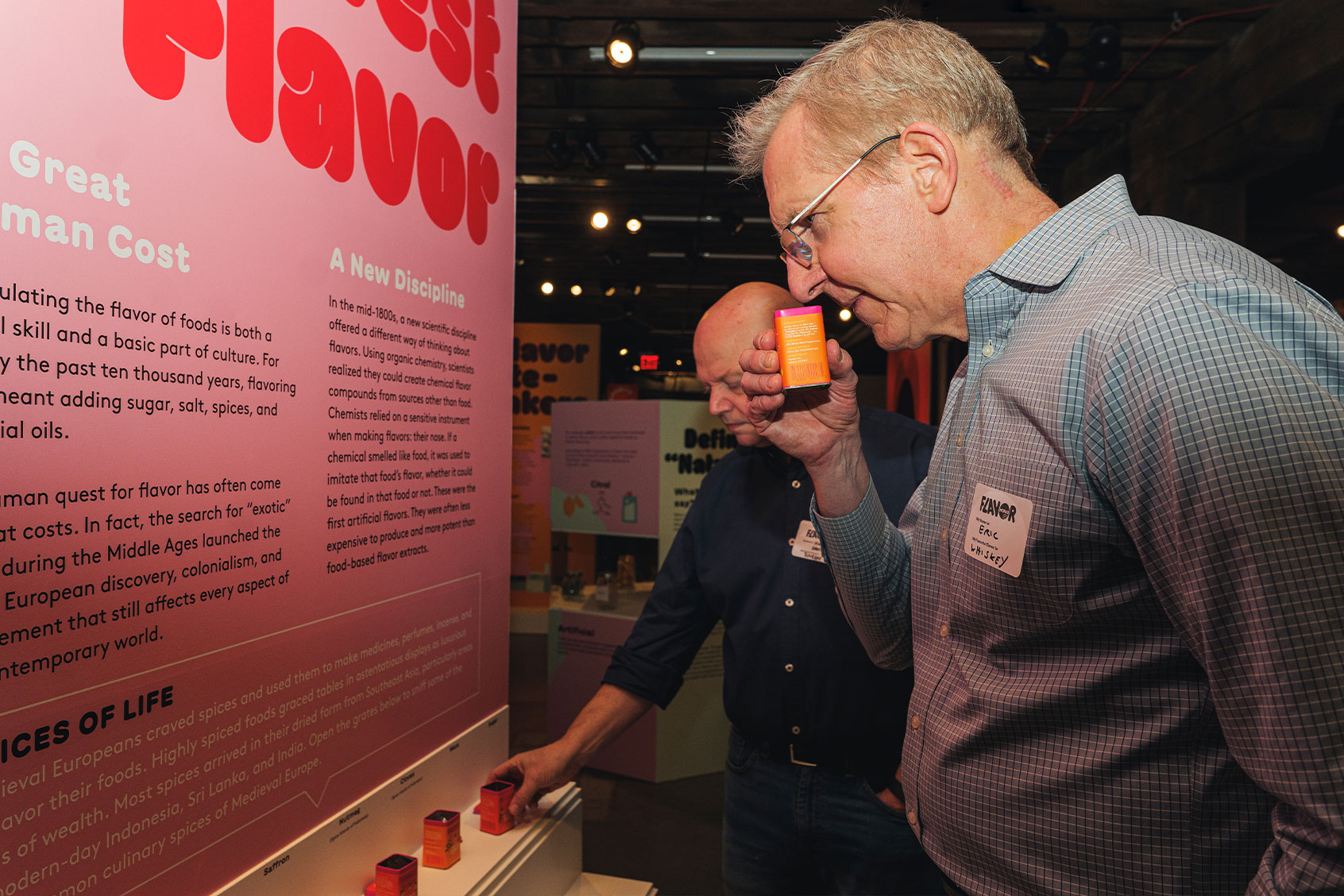
Visitors at the Museum of Food and DrinkVisitors at the Museum of Food and Drink (Courtesy of MOFAD)
Are there any especially exciting upcoming exhibits or events?

We always have amazing evening programs at MOFAD which really highlight the breadth and depth of what we care about.  This fall, we are hosting our first gala since 2019. We're so thrilled! And the gala is actually loosely themed around our next exhibition, opening in 2025, which will be a history of street carts and street vending in New York City.

We think it's a really timely moment to talk about street vending, especially with the vitriolic language around immigration and migration in the city and in the country – street vending has always been an informal economic ladder up and has helped lift up new Americans and the city’s economy.

Can you tell our readers a bit more about "Flavor: The World To Your Brain"? 

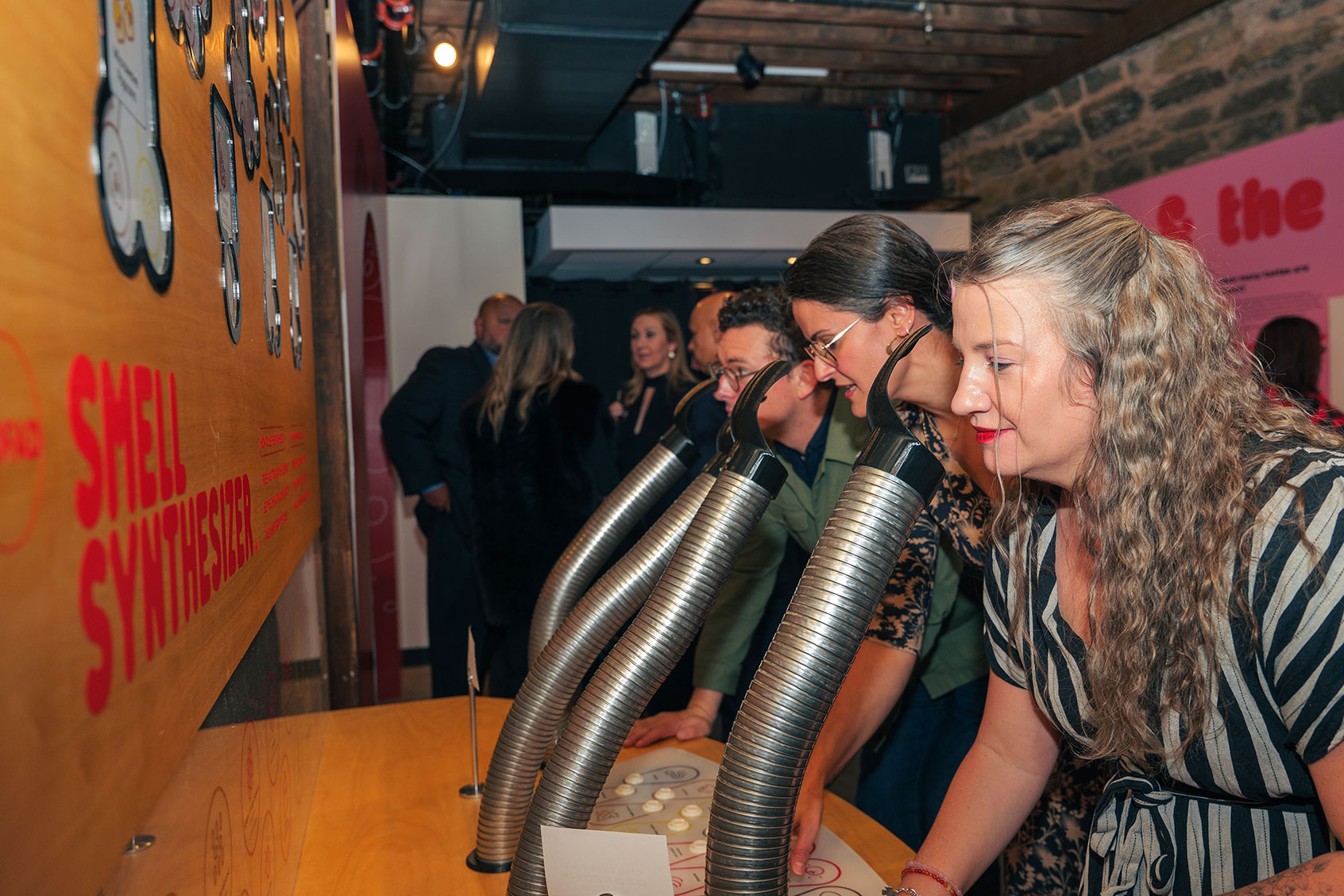
It's a meditation on COVID and really unpacks the sensory experience that leads to flavor. It's a really interactive exhibition — you smell things, you taste things. We have a brainwave machine that charts your brain activity while you're tasting different types of food. We have an incredible smell synth — instead of playing music notes, it plays notes of odor and you can really see how things mix together to form familiar scents and unfamiliar scents. So, it's a really fun, interactive show. 

And everyone walks away knowing not just more about how their bodies work, but also discovering that there's a flavor industry, I think, is really surprising to people. I think it's something most people don't even think about — that there's this entire sector of the food world and food scientists exist and they're responding to climate change, to cultural shifts, to immigration patterns, to trends and foretelling the flavors of the future.

So I always say when I give tours, like you think you like matcha, but you know, 10 years ago there wasn't anything matcha flavored outside of Japan. So it's kind of a "Devil Wears Prada" moment: You think you chose that sweater, but it was probably chosen by 10 food scientists working out of a lab out in Princeton, New Jersey somewhere.


Want more great food writing and recipes? Subscribe to Salon Food's newsletter, The Bite.


MOFAD has had some amazing exhibits in recent years. Were there any that especially stood out for you?

MOFAD really has had some amazing exhibits in recent years, but the one that especially stands out for me was African/American: Making the Nation's Table.  In college, I did a research project focusing on Black women in Harlem and their relationship to soul food.

So I've always been interested in both African foodways and Afro Caribbean foodways. Dr. Jessica B. Harris, who was our guest curator for the exhibition, was one of the few sources that I had. You know, 25 years ago, when I was conducting my research, there were almost no scholars writing about and talking about Black food.

And so to be able to, all these years later, have an exhibit on Black food and have it be so rich and so documented and just to see the canon of Black food, especially cookbooks, but scholars as well, to see it grow so much since that time, you know, 25, 26 years ago, when I was trying to do research was really special.

I also think it was incredible because I got to see the impact of the exhibition on both Black and non-Black audiences. I think for Black audiences, there was such immense pride. Every single one of our stories, whether about rice agriculture, whiskey distilling, fine dining or the Civil Rights Movement was rooted in the immense pain and violence of enslavement. But I think that it was really special to see that the basis of agriculture, the basis of fine dining, really just the foundation of what we know as American food was born out of practices, skills and teachings of African American farmers, cooks, scholars and craftspeople – whether those contributions were forced or freely given.

And then I think for non-Black audiences, just to get the full breadth and depth of what we mean by Black food and what we mean when we say it’s the foundation of American food and how so much of what we know today, whether it’s food like ice cream or French fries, farming practices and tools or distilling methods – to reveal those stories, I think was really eye opening for folks.

The legacy of it and, to this day, who benefits from that labor and who doesn't, I think we have to continue to reckon, acknowledge and try to correct the inequities that have been built into the food system — as they've been built into so many other systems.

But again, I think we showed it in a way that was really enlightening. And of educated people in a way that was very approachable and very joyful without hiding the dark past behind any of those stories.

We need your help to stay independent

What kind of other programs do the museum offer?

MOFAD offers other kinds of programs. Of course, we offer school tours, so we love to welcome, for this exhibit, grades four all the way through college and grad school students.  We love to welcome them into the space and give them guided tours. We also offer evening programs, again through a various range of topics.

Just last week, we had an incredible program. There were many ancient artifacts of Mayan and Aztec origin that were used in chocolate making that are being repatriated back to the National Museum  of Mexico and the objects were displayed at MOFAD on their way over. We had chocolate experts and historians talk about the artifacts, what they could have been used for. We had incredible chocolate makers provide chocolates and hot chocolate for us. So a lot of our programs, as true to our name, both educate, inspire and feed you. We also offer morning programs and book programs for children and adults alike.

"So it's kind of a 'Devil Wears Prada' moment: You think you chose that sweater, but it was probably chosen by 10 food scientists working out of a lab out in Princeton, New Jersey somewhere."

How can people in New York City and surrounding areas get involved with MOFAD?

There are a lot of ways of getting involved with MOFAD. We are always in search of volunteers and docents, whether it's program volunteers or during the day when we're open for the exhibition. We love having docents who can help guide visitors through our space. Then of course, if folks want to get involved in larger ways, we're always looking for creative partners to help us activate MOFAD or partner with us in interesting ways.

There have been so many closures of small museums and museums have to think about how to operate in different ways while still staying true to their missions. But I think it also opens the door for really fun collaborations. And when you run a food and drink museum, there's really interesting and fun ways of partnering with different brands.

Visitors at the Museum of Food and DrinkVisitors at the Museum of Food and Drink (Courtesy of MOFAD)
Can you talk a bit about the MOFAD Fall Gala, which was held at Essex Market?


Comedian Wyatt Cenac was the host, we had toasts from Assemblyperson/Mayoral candidate Zohran Mamdani, activist/author/influencer and angel investor Hannah Bronfman, actress/comedian/community organizer/host of Shop Cats Michelladonna, Street Vendor Project president Mohamed Attia, Found of MOFAD, author and bar genius Dave Arnold and Osteida Oyster Vodka maker Manya Rubenstein.

We had the king of burgers George Motz on deck spinning records, Night Kitchen catered an incredible meal and treats from Dhamaka, Baby's Buns, Solid Wiggles, Karl's Balls, Via Carota and Lady Wong. The gala was a dedication the the Russ family and Mark Russ Federman, Niki Russ Federman and Josh Russ Tupper all made beautiful speeches full of fascinating stories about Russ & Daughters! (Did you know R&D had a tinned fish speakeasy during WWII?) 

We broke bread, exchanged stories, spoke to the importance of telling food stories of all walks of life and raised a ton of money to continue our efforts to continue to amplify the voices that spread hope and kindness and lift up the scholars, food workers, chefs and writers who use the power of food to learn how to create a more thoughtful, equitable and delicious future.

This is Part 1 of Salon's interview with MOFAD president Nazli Parvizi; Part 2 will run later this week. 

UPDATE: This story has been updated to reflect that the MOFAD FallGala has now taken place.

“I haven’t the time, nor, frankly, the inclination”: Prue Leith’s case for a simpler kitchen

For anyone resolving to cook more in the New Year, Prue Leith has a message: take a breath, roll up your sleeves and don’t let perfectionism keep you from the stove. In her latest cookbook, “Life’s Too Short to Stuff a Mushroom: Really good food without the fuss,” out now from Carnival, the legendary chef and “Great British Bake Off” judge argues that good food is within reach for every cook — even those with little patience, know-how or time. 

“It’s taken me a long life to know for sure that life is for living, and that hard graft has to be worth it,” Leith writes in the introduction to the book. “So, if you are whacked, short of time or just don’t like cooking, cheating is fine. I cheat all the time, and I LOVE cooking.”

The title alone nods to the playful pragmatism that guides the book, a riff on a well-worn adage coined by “Superwoman” author Shirley Conran in the 1970s. “I think everyone is busier today than before, scrambling from job, to childcare, to housework,” Leith told Salon, diagnosing the plight of the modern home cook. 

“Many young people didn’t learn to cook at school,” she continued. “Mum didn’t teach them because she was out at work and Dad ditto, if he ever could cook!” 

While many American home cooks were likely introduced to Leith through “Bake Off,” where she spends week after week judging pastries and cakes that are technical behemoths, the no-nonsense approach of “Life’s Too Short” feels particularly well-suited to an era of ambitious resolutions that fizzle by February. In place of complicated recipes requiring a full afternoon of mise en place, she offers shortcuts designed to reduce anxiety and, crucially, the risk of giving up altogether. 

“They are daunted by instructions: ‘Chop an onion’ or ‘Peel the ginger,’” Leith said. “I’m not a snobby chef who thinks boxed custard or frozen mash is a crime. I bet there is not a chef in the country who doesn’t have a jar of Hellman's mayo in their home fridge!” 

Her book brims with intuitive recipes built on big flavors, including several that would impress if included in a holiday spread, like the brown sugar meringue with roasted pear and salted caramel sauce, or the baked camembert and olive wheels. Weeknight fare abounds, too, with options like spaghetti with a tomato, chili and fennel sauce, as well as herbed salmon parcels. There are also clever tips, like how to safely extract an avocado pit without a trip to the emergency room (“avocado hand” is a well-documented injury in both British and American hospitals) and how to make a “star loaf” of bread. “You end up with a fancy tear-and-share bread worthy of Paul Hollywood,” she said. “Actually it’s his idea that I stole.” 

We need your help to stay independent

Embracing simplicity in this way reflects Leith’s own evolution in the kitchen. 

“When I look at some of my earlier recipes, I cannot believe how unnecessarily complicated they were,” she said. “To make trifle, I’d have told you how to make the custard, how to make the sponge cake, probably even how to make the jam.” 

She continued: “But now I make trifle with any leftover cake or croissants or raisin bread, any spread from chocolate to jam to lemon curd or marmalade, lots of any booze — I tend to use up those half-bottles strange liqueurs one accumulates in the back of the drinks cupboard — custard from a box — not a tin, that’s disgusting! — and whipped cream.” 

That evolution has been informed by a career spanning Michelin-starred restaurants, bestselling cookbooks and years on television. Yet Leith still relishes the art of borrowing. “I think all cookery writers steal ideas all the time, and I’m no exception. I take ideas from restaurants, books, friends, anywhere,” she said 

"I like baking, but I never do the elaborate things you see on the show. I haven’t the time, nor, frankly, the inclination."

For instance, her tenure as a judge on “The Great British Menu” gave her an up-close look at the techniques of the United Kingdom’s best chefs; and while “Bake Off” has deepened her understanding of baking, she remains grounded in her priorities. 

“I think of myself as a cook more than a baker,” Leith said. “I like baking, but I never do the elaborate things you see on the show. I haven’t the time, nor, frankly, the inclination.”

It’s worth noting, too, that Leith’s philosophy regarding accessible cooking extends beyond the home kitchen. As an advocate for better food in schools and hospitals, she sees her love of “cheats” as a tool to help institutions create better meals without overburdening their staff. 

“There are some great charities publishing books to help,” she said, citing “Feed Your Family: Exciting recipes from Chefs in Schools” and “The Healthcare Chefs’ Knowledge,” which was developed following Leith’s work on a 2020 report about hospital food. “Both authors are aware that time is limited, it’s hard to get highly trained staff, and recipes must be straightforward and simple.”

In “Life’s Too Short to Stuff a Mushroom,” Leith makes a compelling case for ditching culinary guilt and embracing imperfection—a perspective as refreshing as it is liberating. The New Year often arrives laden with high expectations, but for Leith, the key to lasting success in the kitchen lies in cutting yourself some slack. “When I talk of cheating or short cuts, I’m not recommending junk food or ready meals,” she said. “Just simpler ways of doing things and recipes that are quick or easy to follow.” 

Whether you’re resolving to cook more or simply hoping to reduce mealtime stress, Leith’s book offers a way forward that feels achievable and— most importantly — human.

Daniel Penny acquitted in the subway killing of Jordan Neely

Daniel Penny was acquitted Monday for the killing of Jordan Neely on a New York City subway.

A Manhattan jury of seven women and five men found that Penny’s actions were not criminal when he held Neely, 30-year-old a homeless man with a history of mental illness, in a chokehold on the floor of a subway car in May 2023. The chokehold lasted six minutes. 

The decision came on the fifth day of deliberations after jurors spent three days deciding whether Penny, a 26-year-old former Marine, was guilty of manslaughter, CNN reported. The jury could not reach a unanimous decision, so Judge Maxwell Wiley dismissed the more serious charge.

Jurors ultimately decided that Penny was not guilty of criminally negligent homicide, which “involves causing someone's death by acting in a manner that was reckless, inattentive, or careless.” 

Penny faced up to four years in prison for criminally negligent homicide and up to 15 years for manslaughter. 

A witness told jurors that upon entering the subway on May 1, 2023, Neely was acting erratically and shouting about “being hungry and thirsty and said that he wanted to return to jail and didn’t care if he lived or died,” NBC news reported. Penny stepped in because he thought Neely may attack other passengers, his attorneys told jurors. 

Penny’s attorneys also argued that the chokehold was not the cause of Neely’s death, despite a New York City medical examiner concluding that Neely died from compression to his neck.

Outside the courtroom, Neely's father Andre Zachary expressed his frustration and disappointment with the criminal justice system, CNN reported.

“I miss my son. My son didn’t have to go through this. I didn’t have to go through this either,” Andre Zachary told reporters. “It hurts, it really, really hurts. What are we going to do, people? What’s going to happen to us now? I’ve had enough of this. The system is rigged.”

Others have pointed to Penny's indictment as a failure to protect New York City's most vulnerable populations from harm. 

"The outcome of this trial is a searing indictment of the systemic failures that continue to plague our pursuit of justice for society’s most vulnerable," New York City Council Member Yusef Salaam wrote in a statement. 

U.S. judge rejects rule capping credit card late fees at $8

A federal judge in Texas declined to revive a new regulation that would cap credit card late fees at $8 after business lobbyists and banks protested the policy as unconstitutional.

The regulation would prevent card issuers with more than one million users from charging more than $8 for late fees unless they could prove to the Consumer Financial Protection Bureau that they needed the money to cover costs. U.S. District Judge Mark Pittman in Fort Worth issued an injunction in May that barred the rule from taking effect. On Friday, Pittman declined the CFPB's request to lift his order.

The policy would ease the burden on cash-strapped Americans by $800 million in late fees every month, according to The Washington Post. But when the cap was proposed, numerous groups moved swiftly to sue the government, including the U.S. Chamber of Commerce — arguing that sizable late fees were necessary for deterring late payments and ensuring that no “raised costs” fell on credit card users.

Pittman, appointed by President-elect Donald Trump in his first term, said the rule violated the Credit Card Accountability and Disclosure Act, a 2009 law aimed at protecting consumers from unfair practices by card issuers, Reuters reported.

“This ruling is a major win for responsible consumers who pay their credit card bills on time and businesses that want to provide affordable credit,” Maria Monaghan, who serves as counsel for the U.S. Chamber’s Litigation Center, said in a statement.

The late fee cap policy was part of the Biden administration's crackdown on “junk fees,” which included other regulations such as requiring resorts and music services to disclose all fees upfront, mandating airline ticket refunds in case of major delays and requiring all companies to make it as easy to cancel a service as it was to sign up.

The CFPB estimates that without the regulation, Americans will spend more than $56 billion on credit card fees over the next five years, according to Reuters.

“Unwavering in her loyalty”: Trump taps his attorney Alina Habba for Kellyanne Conway’s old job

President-elect Donald Trump announced on Sunday that he selected his advisor and defense attorney, Alina Habba as counselor to the president.

“Alina has been a tireless advocate for Justice, a fierce Defender of the Rule of Law, and an invaluable Advisor to my Campaign and Transition Team,” Trump wrote on Truth Social. “She has been unwavering in her loyalty, and unmatched in her resolve – standing with me through numerous 'trials,' battles, and countless days in Court.”

“Few understand the Weaponization of the ‘Injustice’ System better than Alina, who has fought relentlessly against the full force of Lawfare with courage and an unshakable commitment to Justice,” the president-elect added.

The role of counselor in Trump’s first term was previously held by Kellyanne Conway. 

Habba represented Trump in both the defamation and civil rape lawsuits filed by writer E. Jean Carroll. Trump was found liable for sexual and guilty for defamation.

Habba often accompanied Trump on the campaign trail and has since spent significant time in Mar-a-Lago, the Associated Press reported.

"As a first generation American of Middle Eastern Heritage, she has become a role model for women in Law and Politics, most recently being named Chaldean Woman of the Year," Trump wrote.

Habba is just the latest loyalist to be appointed to Trump’s Cabinet as he seeks to fill his administration with steadfast supporters. 

“Honor of my life to serve the 45th and 47th President and the American people,” Habba wrote on X.

In similar social media posts on Sunday evening, the president-elect announced several other Cabinet appointments, including Michael Anton as director of policy planning and Christopher Landau as deputy secretary.

Lara Trump resigns as RNC co-chair amid Senate speculation

Lara Trump is stepping down as the co-chair of the Republican National Committee (RNC) and would "seriously consider" joining the U.S. Senate, the Associated Press reported on Sunday.

Donald Trump's daughter-in-law over the weekend announced her resignation from the RNC after holding the position since March.

“The job I came to do is now complete and I intend to formally step down from the RNC at our next meeting,” Lara Trump wrote on X, touting her accomplishments as co-chair, including fundraising records, election integrity and voter turnout. 

Her resignation comes as a number of Trump allies have floated her as a replacement for Sen. Marco Rubio, R-Fla., who Trump has tapped to be his secretary of state. If Rubio is confirmed, it will be up to Florida Gov. Ron DeSantis to pick who will fill the position. 

"The next senator for Florida should be @LaraLeaTrump. The Senate is an old man’s club. We desperately need a smart, young, outspoken woman who will reveal their secrets," wrote Maye Musk, the mother of billionaire and Tesla CEO Elon Musk, in a post on X. 

“Lara Trump is genuinely great,” Elon Musk responded to his mother's post. 

Sen. Rick Scott, R-Fla., has also pushed Lara Trump as a replacement for Rubio.

It's an opportunity she would "seriously consider," Lara Trump told the AP.

“If I’m being completely transparent, I don’t know exactly what that would look like,” she said. “And I certainly want to get all of the information possible if that is something that’s real for me. But yeah, I would 100% consider it.”

The 42-year-old elaborated on her political ambitions in an interview with Fox News on Sunday, reiterating her willingness to join the Senate.

“Certainly, we’ve all had the opportunity over the past nine years to fully involve ourselves in politics, to understand the American people, what they want, and we’ve all been residents of the state of Florida now for over three years,” she told host Howard Kurtz.

“If that’s something that’s put in front of me, it would be a true honor.”

How “Squid Game” Season 2 received a Golden Globe nomination before it even premiered

The long-awaited and highly anticipated second season of "Squid Game" hasn't even aired but it has already received award nominations. 

Audiences are still waiting for the second season to drop on Dec. 26 but that hasn't stopped the Golden Globes from recognizing the Netflix drama with a Golden Globe nomination. On Monday morning, the smash hit Korean drama was nominated for best drama series alongside other shows like "The Day of the Jackal," "The Diplomat," "Mr. and Mrs. Smith" and "Slow Horses." 

"Squid Game" revolves around a secret competition in which hundreds of contestants experiencing financial hardship participate in children's game in hopes of winning a massive cash prize. The twist? Disqualification or failure means death. 

But unlike the other shows that have aired, "Squid Game" second season hasn't been seen by global audience. However, that doesn't mean the show cannot be considered for a Golden Globe. According to The Hollywood Reporter, it isn't unusual for the voting body of the Golden Globes to nominate a television show or film that hasn't been released to the public yet. 

To be considered for a 2025 Golden Globe, a show must have premiered in 2024 and have episodes available and submitted to the voting body before they premiere or at time of broadcast by Nov. 4. Apparently, screeners were provided to the Golden Globes members in advance. This has allowed the second season of "Squid Game" to snag a spot in the coveted best drama category even though it launches in two weeks.

The Netflix show has been nominated for three Golden Globes in 2021 for its bombshell first season. The nominations earned a win for supporting actor, Oh Young-soo, South Korea's first Golden Globe winner.

Check out the full list of all the other 2025 Golden Globe nominees.

"Squid Game" Season 2 premieres Thursday, Dec. 26.


Problematic to perfect: Navigating the minefield of workplace gifts

A couple years ago, I gave a terrible work gift. My agent’s team had done a phenomenal job of championing me in a negotiation and I thought a basket full of deli food and coffee from New York City's iconic Zabar’s was the perfect way to thank these Los Angeles folks. I failed to consider that most of them were working remotely or on vacation, and I never received confirmation anyone had received the basket. I think that babka spent the holidays going stale in the mailroom, being picked off by random employees or nibbled by mice.

What would have been fine five years ago is now problematic. The post-pandemic eternal question of “who’s in, who’s out” of the office adds a new twist to the age-old question of appropriate work gifts.

Lizzie Post, great granddaughter of Emily Post and co-president at the Emily Post Institute, suggested that going forward, take the extra step to ask if a gift would be easily received and the best time and place to send it — especially for perishables.

But that’s not the only way people run into trouble.

Never gift up the ladder

Generally, it’s inappropriate to give presents to your boss, Post says. “Gifts are always down the ladder. The exception is when there's a two-person team, think ["Sex and the City"] Carrie Bradshaw and her assistant.” Gifts up the ladder are awkward not only because they can appear as an attempt to curry favor, but they may make your boss feel uncomfortable too.

It is fine to do a group gift or card from the entire team to a supervisor, “but you never want to just do it on your own or just a couple of people. It's important to be all in, or none,” Post said. “Get everybody's buy-in to participate in a group gift, and then you come up together with a number that feels right for everybody. And I would make it lower than you’re thinking. If your brain goes, ‘Oh, $50 bucks would be easy,’ make it $25 per person,” she said.

We need your help to stay independent

Cost can vary by person, workplace or industry, but keep it reasonable. Rachel Moore of Calabasas, California was mortified to receive a diamond ring from a coworker she didn’t know well. “A coffee mug or a candle or literally anything else that's a normal work-appropriate gift and under $15 would've been preferred, or nothing at all!”

Liz Sweeney of Boise, Idaho, had the opposite problem when she was 19 and a new manager came on board at the small manufacturing company where she worked. “This woman presented me with a large, wrapped box that, she said, ‘contained the goals to my career.’

“It contained well-worn clothes, including a flannel nightgown and a worn-out bra; used makeup; and some costume jewelry…also used. She gave it to me privately and I think she wanted me to be extremely grateful. Instead, I was uncomfortable and wished I hadn't been put in that situation.”

Skip the sexy, the sacred and the weird

The golden rule of gift-giving etiquette is to avoid religion, politics and sex,” said Richie Frieman, an expert on work manners. “Even if the person is of the same religion as you, now is not the time to present that to the entire group. For one, you never know how religious a person is, and gifting them something with a faith-based message may not be received as expected.”

When selecting a gift, always consider the professional relationship and avoid anything too personal,” said etiquette expert Jamila Musayeva. "Absolutely avoid giving anything that could feel too personal or intrusive — think of items like skincare products, perfumes or clothing. These can easily overstep boundaries. Additionally, stay away from humor-based gifts or anything that could be seen as overly casual.”

"Always consider the professional relationship and avoid anything too personal"

If the idea is to bring in cheer, make sure it’s not mean-spirited. “It's one thing when a gift is just funny, it's different when you're making fun of someone with a gift. That’s a line that can sometimes get crossed at the office,” Post said, using the example of a gift that refers to a mistake or a failure. It might be funny to you, but it absolutely won’t be to the recipient.

And we shouldn’t have to say it, but we will because people are still giving vibrators — avoid anything sex-related. Apparel, joke presents, or equipment are all off the table. Those items aren’t just embarrassing — they could spark an HR inquiry.

Put these on your list

People appreciate gifts that convey thoughtfulness and show awareness of our new way of living and working,” said Musayeva. “Above all, personalized gestures are meaningful — such as a handwritten note, which adds a warm, considerate touch that makes the recipient feel genuinely appreciated … Also, keep inclusivity in mind; some people may prefer non-material acknowledgments or gestures instead, so being attuned to what resonates with each person is important.”

"The last thing you want to do is remind someone that distance has separated your relationship"

Whether it’s stationery, a book you loved, a special pen, a plant or a tray of goodies from a favorite bakery, it only takes a few minutes to figure out a meaningful — and appropriate — gift.

“The most important gift-giving rule post-pandemic is to remember that any gift, regardless of where a person may live now or how often you see them, is intended to show appreciation,” said Frieman. “The last thing you want to do is remind someone that distance has separated your relationship (even if everyone is remote), but rather, you still know who they are and care for them.”

And should you be caught in the awkward position of receiving a gift without a reciprocal one on hand, Post advises to act with grace and say a sincere thank you and compliment the gift — don’t make up a lie that you forgot their gift or it’s coming later. “Instead, just accept the gift and focus on this person's generosity. That's how you honor that moment.”

Trump “can’t guarantee” his tariffs won’t raise prices for American families

President-elect Donald Trump on Sunday said he “can’t guarantee” that American consumers won’t pay higher prices under his proposed tariff plan in an interview on NBC’s “Meet the Press.” 

“I can’t guarantee anything. I can’t guarantee tomorrow,” Trump told NBC News host Kristen Welker after she asked him whether he could guarantee American families won’t pay more if he chooses to impose tariffs on the United States' most important trading partners, which he’s repeatedly promised to do.

“But I can say that if you looked at my — just pre-COVID, we had the greatest economy in the history of our country. And I had a lot of tariffs on a lot of different countries, but in particular China,” Trump added.

Tariffs are taxed imposed by the government on imported or exported goods, but they are paid by the American companies that import those goods, not the country that exports them. When tariffs are imposed, the cost of everything from home goods to electronics increases.

"These new duties are often described as ’tariffs on China’ or ’tariffs on the United States,’ but they’re really taxes on American businesses, workers, and consumers," Ed Gerwin, a senior fellow for trade and global opportunity at the Progressive Policy Institute, previously told Salon

Trade taxes on "items like auto parts, electrical components, and machinery will raise costs for American businesses, make it harder for them to compete, and destroy many more American jobs than they protect. And, even if American consumers don’t pay the tariffs directly, they’ll ultimately pay higher prices,” Gerwin added.

We need your help to stay independent

Increased tariffs were central to Trump’s presidential campaign. He proposed a 60% increase on imported goods from China, along with a 10% to 20% tariff on goods imported from other countries. Last month, Trump threatened to impose a 25% tariff on Canada and Mexico unless they crack down on migrants passing through their borders.

“I think tariffs are the most beautiful word. I think they’re beautiful. It’s going to make us rich,” Trump said on NBC. “If we’re going to subsidize them, let them become a state. We’re subsidizing Mexico and we’re subsidizing Canada and we’re subsidizing many countries all over the world. And all I want to do is I want to have a level, fast, but fair playing field.”

China, Canada and Mexico, make up nearly half of U.S. import volumes. American consumers could lose as much as $1,200 in purchasing power, according to an estimate from The Budget Lab at Yale University shared with NBC. 

“Another way to think about this is it’s 4 to 5 months of a normal year’s inflation in one fell swoop,” Ernie Tedeschi, The Budget Lab’s director told NBC.

Several companies, including Walmart and Best Buy, have already said the president-elect’s trade plan will likely force them to raise prices.

Despite these warnings and countless others from economic experts, Trump remains steadfast that tariffs will create jobs and benefit Americans. When Welker pointed out that tariffs from Trump’s first term “cost Americans some $80 billion,” Trump responded that tariffs “cost Americans nothing.”

“They have many purposes, tariffs, if properly used. I don’t say you use them like a madman, I say properly used. But it didn’t cost this country anything. It made this country money,” the president-elect said.

Cracks in cosmological theory: James Webb telescope is challenging what we know about the universe

This month marks three years since the James Webb Space Telescope was first launched, which still feels something like a miracle given how many years of delays it took to finally get it orbiting our planet. The advanced technology onboard the spacecraft hasn't just sent back some pretty pictures, it's also challenged some of the basic tenets of cosmology, the study of some pretty big questions, including how the universe formed and how we got here.

For decades, the cosmological field was working under the assumption that, after the universe began in a hot dense soup of energy that expanded in the Big Bang, it continued to expand, forming the galaxies and stars that make up the universe. But in recent years, this understanding of how the universe expands has been put into question as two independent measurements to calculate this rate, which is called the Hubble constant, mysteriously diverged. In other words, we're trying to find out the speed limit of the expanding universe, but some measurements have given us different answers.

“The question arose: Is this a real discrepancy?” said Wendy Freedman, the leader of the Chicago Carnegie Hubble Program (CCHP). “Is this indicating new physics and demanding that we change our understanding of what we know as the standard model of cosmology — or were there still systematic uncertainties that made it seem like there was a tension?”

Over the past decade, scientists have been retracing their steps to try and understand whether a mathematical error was behind the conflicting numbers or whether this disparity meant the way cosmologists were imagining the model of the universe was in some way flawed. But time and again when researchers crunch the numbers, the tension persists. 

"There is nothing more exciting than not understanding something."

Because the Hubble constant factors into what we know about the age of the universe, its size, and what it's made of, this divergence, known as the “Hubble tension,” has begun to unravel our fundamental and previously held assumptions about reality.

“There is nothing more exciting than having something not work out because it is pointing to the fact that you don’t understand something,” said Adam Frank, an astrophysics professor at the University of Rochester. “There is nothing more exciting than not understanding something.”

In 1929, Edwin Hubble discovered that galaxies in the universe were moving away from us at a rate directly proportional to the distance the galaxy was from Earth. In other words, things further away were moving faster. As a result of this observation, Hubble concluded that the universe must be expanding, and his calculated rate of expansion became known as the Hubble constant. 


Want more health and science stories in your inbox? Subscribe to Salon's weekly newsletter Lab Notes.


The Hubble constant can be measured in two ways. The distance ladder method involves measuring objects, like bright stars called Cepheids or stars at the tip of the red giant branch, and comparing them to objects further away to determine the rate of expansion. The second method, called the early relic method, involves measuring the leftover light from the Big Bang in what is called the cosmic microwave background

In the former method, scientists calculate that the expansion rate of the universe is about 73 km/s/Mpc, and in the latter they calculate that it is about 67 km/s/Mpc. That mpc is what's known as a megaparsec, roughly 3,260,000 light years. Although the difference between 67 and 73 might seem small, it is statistically significant and has persisted throughout more than 10 years of calculations of distances across the universe performed to determine the expansion rate. 

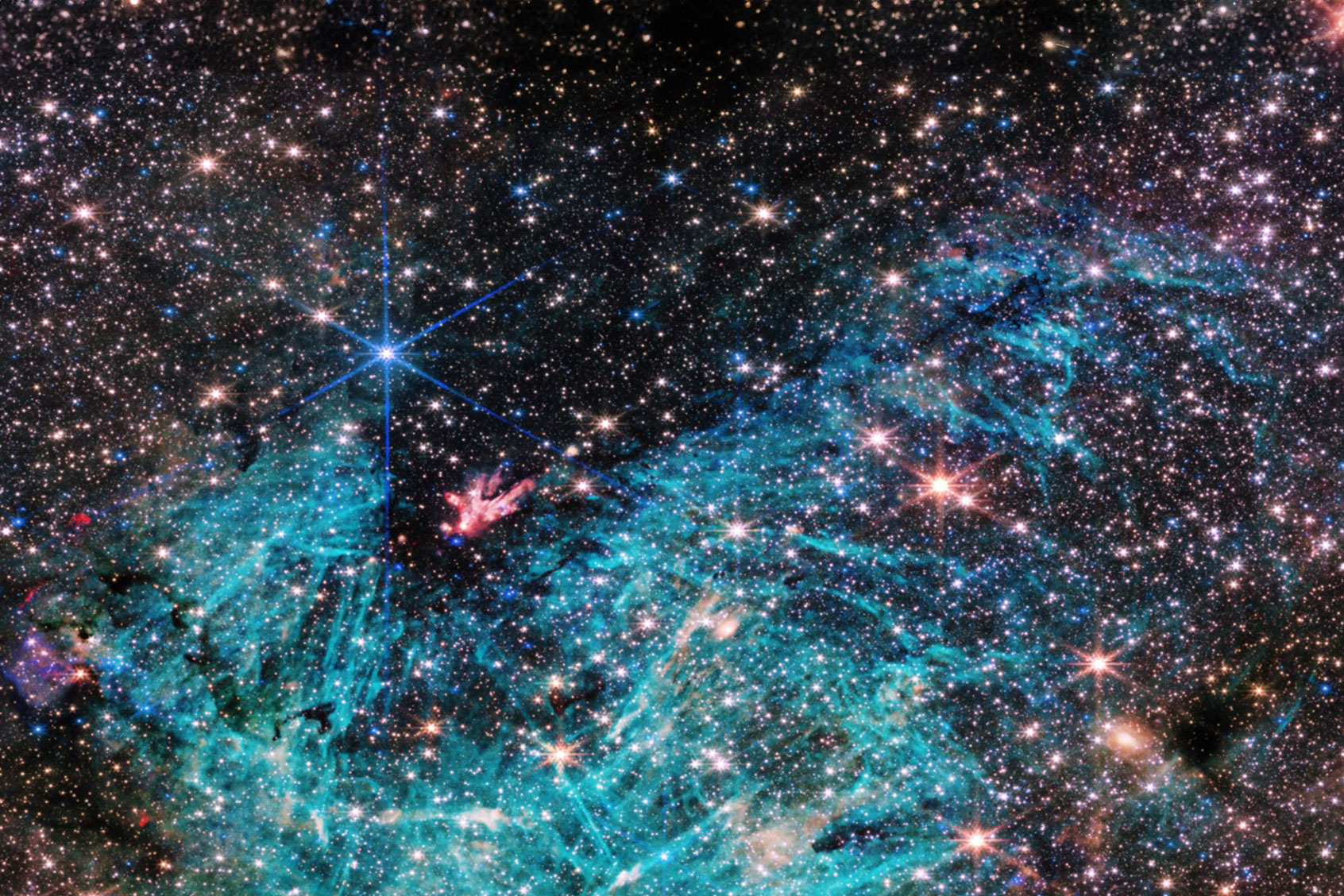
Image of the Sagittarius C (Sgr C) regionThe NIRCam (Near-Infrared Camera) instrument on NASA’s James Webb Space Telescope’s reveals a portion of the Milky Way’s dense core in a new light. An estimated 500,000 stars shine in this image of the Sagittarius C (Sgr C) region, along with some as-yet unidentified features. (NASA, ESA, CSA, STScI, and S. Crowe (University of Virginia))When the James Webb Telescope came online in 2021, it promised to give a clearer picture of the universe that could help cosmologists better measure some of these distances and therefore the expansion rate. But the high-resolution images thus far have confirmed that the tension persists.
A study published today in The Astrophysical Journal using images from the JWST confirmed the measurements made by the Hubble telescope, ruling out the possibility that the tension was caused by differences in telescope measurements or some other error in the Hubble telescope. However, the JWST is still relatively young, meaning its dataset is much smaller than Hubble's so far.

With larger and larger sample sizes, the chance that the Hubble constant is caused by a mistake continues to decrease and the chances that the divergence in numbers is being caused by something else we don’t yet understand increases.

“If there was some simple knob that one could turn that would reconcile this, we would happily turn the knob and reconcile it,” said Daniel Eisenstein, the chair of the theoretical cosmology department at Harvard  University. “People routinely investigate dozens of other alternatives, and none of those alternatives particularly fix this problem.”

"If there was some simple knob that one could turn that would reconcile this, we would happily turn the knob and reconcile it."

Theorists haven’t been able to come up with a solution to the Hubble tension that could explain the difference yet either, said Saul Perlmutter, a Nobel Prize–winning cosmologist at the University of California, Berkeley. One of the challenges in doing so is that the model does help explain many other elements of the universe with high certainty.

“The Hubble constant is one of the basic constants that you can put into all of these different equations that works so well, so we know we can’t just say 'let’s just start over again,'” Perlmutter told Salon in a phone interview. “We know that there is something right about our picture of cosmology because we are getting so many things well-predicted and understood.”

One possibility is that dark energy, which is thought to comprise roughly 68% of the universe and cause the universe to expand, could be behaving in a way that we don’t understand and that the current cosmological model doesn’t fully explain it. It could also involve the formation of magnetic fields in the early universe or another particle in the universe called the neutrino.

“The obvious places to look for new physics are the places we don’t fully understand, like dark matter and dark energy,” said Dr. Andreea Font, a computational astrophysicist at Liverpool John Moores University in England.

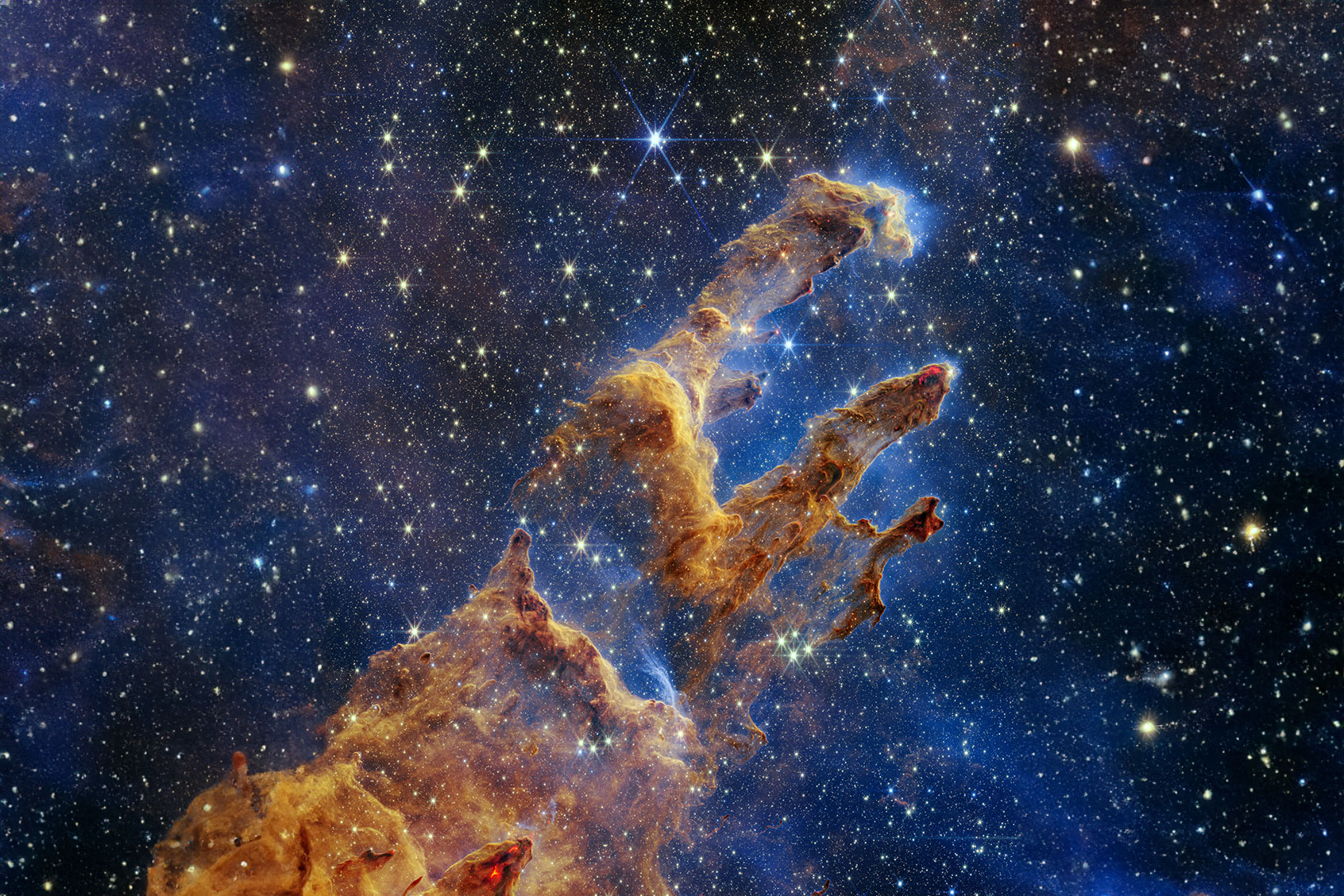
Pillars of Creation (NIRCam Image)The Pillars of Creation are set off in a kaleidoscope of color in NASA’s James Webb Space Telescope’s near-infrared-light view. The pillars look like arches and spires rising out of a desert landscape, but are filled with semi-transparent gas and dust, and ever changing. (NASA, ESA, CSA, STScI, Joseph DePasquale, Anton M. Koekemoer, Alyssa Pagan)Historically, “tensions” in cosmology have resulted in major breakthroughs in discovery. At the turn of the 20th century, it was believed that light was propagated through an invisible medium called the luminiferous ether, but scientists could not prove the existence of the ether with data. Then, Albert Einstein solved the tension by coming up with the theory of relativity, which explains how massive objects cause distortions in spacetime. 
Other tensions in cosmology co-exist with the Hubble tension today as well. The S8 tension arose when measurements of how clustered galaxies were in the universe diverged, and JWST also illuminated tensions in how massive early galaxies are compared with how massive they were predicted to be under the current model.

Data from the Dark Energy Spectroscopic Instrument (DESI) research group has reported that dark energy might be evolving or thawing in a way that wouldn’t fit with the current cosmological model. This was another “crack” in the current cosmological theory to explain the universe, said Adam Reiss, an astrophysicist at Johns Hopkins University who was a co-winner of the 2011 Nobel Prize in Physics for the discovery of dark energy.

“If this isn’t the right model and someday we have a new understanding, in the best case, all of these cracks may become part of what cements a new model,” Reiss told Salon in a video call. “But we’re not at that stage yet. We are at the finding the cracks stage.”

It could be that a universal solution solves all of these tensions at once and fundamentally changes our understanding of the universe. Or, they might be tackled one by one. However, the field is still in the stage of completely ruling out the possibility that the Hubble tension is in fact being caused by an error or something that was overlooked in the current model. 

We need your help to stay independent

“We’ve seen over the last several years what you might call cracks in the model, and the Hubble tension would be the chief crack,” Reiss said. “But there are others as well, and some people have a feeling that we may be on the edge of overthrowing the model with some new understanding. But the challenge is, nobody knows quite what that is.”

With the launch of the JWST, along with other telescopes at the Vera Rubin Observatory, many in the field are hopeful that they might know what is behind the Hubble tension within the next few years, if not sooner.

Although some have referred to the Hubble tension as a “crisis” or a “problem,” many in the field are excited by it, as it opens up the possibility of discovering something entirely new in the universe that helps us better understand it. 

“When I look at something and I don’t understand what it is, somebody might say that is a problem” Reiss said. “I would say: That is an opportunity.”

Elon Musk can no longer hide Donald Trump’s mess

Last month's presidential election was a disappointment, to say the least. Ever since then, it's felt as if the air has just been slowly leaking out of the opposition. Much of the mainstream media seems to be attempting to change course and curry favor with the new administration, while Democratic officials appear to be in shock. In some ways, it's reminiscent of the lead-up to the Iraq war in 2003, with quiet resignation taking the place of the febrile excitement that characterized the push to rally around the flag. People just seem enervated and spiritless. Sometimes it's hard to remember why we fight when it all seems so futile.

Well, I think the opposition is about to get its mojo back.

Once the country sees him as president again I suspect that the disconsolate lethargy so many have been feeling will lift and we'll see some energy return to the opposition.

For the last month, all we saw (to the extent we were even paying attention, which many of us couldn't bring ourselves to do) was the news telling us about what Trump is doing, who he's nominating and what he's planning. And that's all bad! In fact, it's worse than many of us thought it would be. But all that has a sense of unreality because Trump himself, for the first time in years, has been scarce. It's been reported that he was completely exhausted at the end of the campaign, which is to be expected for a man pushing 80 years old. So he was happy to spend the last month holding court down at Mar-a-Lago with his new best bud, the richest man in the world, Elon Musk, and basking in the adoration of his fans and sycophants. He has not been in front of us and that absence has led to the sense of ennui among the opposition. Unless he's out there in front of the cameras, I think many people understandably put him at the back of their minds and forget how crazy it is that such a man is going to be the leader of the most powerful nation on earth. Again.

In the last few days, he emerged from his Florida lair and flew to Paris for the reopening of Notre Dame. And it all came flooding back:

I don't think anyone really knows why Trump shook hands with French President Emmanuel Macron that way, but it's just weird. So is the fact that instead of bringing his wife, Trump brought along his new BFF, Musk, whom he apparently can't be without even for a minute. At some point just before the ceremony, Musk walked up to Trump, who was seated with the dignitaries. They had words and then Trump, appearing annoyed, pointed at Musk, who retreated back to the seat he was assigned.

Why is it that these scenes only happen when Donald Trump is on the world stage? He makes a fool of himself and the country everywhere he goes.

While it was a relief not to have to see or hear him for the last month, that also made it easier to chalk up the horror of his campaign rhetoric to the heat of the moment and his desire to win at any cost. His appearance on NBC's "Meet the Press" on Sunday put any such thoughts to rest. He's just as angry, vengeful and deranged as he was on the campaign trail. In a wide-ranging interview, Trump defended his tariff scheme, saying that he doesn't believe it will cost consumers more, but can't guarantee that they won't. Insufferably blathering on about his supposedly historic first term's massive economic success, he said:

 I think they’re beautiful. It’s going to make us rich. We’re subsidizing Canada to the tune of over $100 billion a year. We’re subsidizing Mexico for almost $300 billion. We shouldn’t be — why are we subsidizing these countries? If we’re going to subsidize them, let them become a state.

That is absurd. The U.S. is not "subsidizing" Canada or Mexico and this trolling about them becoming a state is simply insulting. He also told Welker that after he spoke with Mexican President Claudia Sheinbaum and threatened her with a 25% tariff, that somehow had immediate effects:

[W]ithin 10 minutes after that phone call, we noticed that the people coming across the border, the southern border having to do with Mexico, there was at a trickle. Just a trickle. In fact, I called the border. See, unlike my opponent, I do call the border a lot. And I said, "How’s the border looking today?" They said, "There’s nobody here." They couldn’t believe it.

He "called the border"? What's its phone number? Is there a central switchboard or something? And the "invasion" stopped within 10 minutes of his threat to impose tariffs? Were all the potential migrants vaporized? That he believes anyone would swallow such an absurd fantasy is delusional.

We need your help to stay independent

That was the tip of the iceberg. Trump also said he thought the entire Jan. 6 House committee should be put in jail. He insisted he would leave it up to his designated FBI director, Kash Patel, and Attorney General-designate Pam Bondi to decide whether his enemies should be prosecuted, so I suppose we can always hope they weren't watching TV on Sunday morning. He also says he will likely pardon all the Jan. 6 insurrectionists, unless it turns out some were actually antifa or FBI plants.

Trump said he plans to end birthright citizenship on the first day, and that U.S. citizens whose family members are undocumented immigrants can be deported with them. He claimed that the Biden administration allowed 13,000 murders into the country — that statistic actually represents the past 40 years — and that he thinks Robert F. Kennedy Jr. should look into whether vaccines cause autism. (They don't.) There is so much more.

But even writing that brief synopsis amounts to sanewashing Trump. The best thing you can do is either watch the whole interview, which is painful, or read the transcript, which is simply mind-boggling. He literally makes no sense half the time and the rest of the time he's filibustering, lying, bullying and deflecting. It's nothing new, but it's worse than it was before.

He's mentally a complete mess and it's fair to speculate that there's a reason Musk is stuck to his side like superglue these days. Is Musk his Rasputin? Perhaps it would be smarter for "Meet the Press" to interview him, instead of this man who has completely lost the thread.

Once the country sees Trump take office as president again, I suspect that the disconsolate lethargy so many have been feeling will lift and we'll see some energy return to the opposition. At least, I certainly hope so. Hiding our heads in the sand isn't going to make him go away. 

Formaldehyde causes more cancer than any other toxic air pollutant, but little is done to stop it

Reporting Highlights

  • An Ever-Present Danger: Formaldehyde is all around us and causes more cancer than any other chemical in the air. It can also trigger asthma, miscarriages and fertility problems.
  • Industry Fights Back: Companies use formaldehyde for everything from making furniture to sterilizing food. Industry has repeatedly thwarted government efforts to limit its health risks.
  • Closer Than Ever: Federal regulators were recently on track to make modest reforms, but those are all but guaranteed to hit a dead end when Donald Trump takes office.

These highlights were written by the reporters and editors who worked on this story.

In a world flush with hazardous air pollutants, there is one that causes far more cancer than any other, one that is so widespread that nobody in the United States is safe from it.

It is a chemical so pervasive that a new analysis by ProPublica found it exposes everyone to elevated risks of developing cancer no matter where they live. And perhaps most worrisome, it often poses the greatest risk in the one place people feel safest: inside their homes.

As the backbone of American commerce, formaldehyde is a workhorse in major sectors of the economy, preserving bodies in funeral homes, binding particleboards in furniture and serving as a building block in plastic. The risk isn’t just to the workers using it; formaldehyde threatens everyone as it pollutes the air we all breathe and leaks from products long after they enter our homes. It is virtually everywhere.

Federal regulators have known for more than four decades that formaldehyde is toxic, but their attempts to limit the chemical have been repeatedly thwarted by the many companies that rely on it.

This year, the Biden administration finally appeared to make some progress. The Environmental Protection Agency is expected to take a step later this month toward creating new rules that could restrict formaldehyde.

But the agency responsible for protecting the public from the harms of chemicals has significantly underestimated the dangers posed by formaldehyde, a ProPublica investigation has found.

The EPA is moving ahead after setting aside some of its own scientists’ conclusions about how likely the chemical is to cause myeloid leukemia, a potentially fatal blood cancer that strikes an estimated 29,000 people in the U.S. each year. The result is that even the EPA’s alarming estimates of cancer risk vastly underestimate — by as much as fourfold — the chances of formaldehyde causing cancer.

"In the end, they chickened out … It was kind of heartbreaking."

The agency said it made the decision because its estimate for myeloid leukemia was “too uncertain” to include. The EPA noted that the National Academies of Sciences, Engineering and Medicine, which the agency paid to review its report, agreed with its decision not to include myeloid leukemia in its cancer risk. But four former government scientists with experience doing statistical analyses of health harms told ProPublica that the myeloid leukemia risk calculation was sound. One said the risk was even greater than the agency’s estimate.

Jennifer Jinot, one of the EPA scientists who spent years calculating the leukemia risk, said there is always uncertainty around estimates of the health effects of chemicals. The real problem, she said, was cowardice.

“In the end, they chickened out,” said Jinot, who retired in 2017 after 26 years working at the EPA. “It was kind of heartbreaking.”

The EPA has also retreated from some of its own findings on the other health effects of formaldehyde, which include asthma in both children and adults; other respiratory ailments, including reduced lung function; and reproductive harms, such as miscarriages and fertility problems. In a draft report expected to be finalized this month, the agency identified many instances in which formaldehyde posed a health threat to the public but questioned whether most of those rose to a level the agency needed to address. In response to questions from ProPublica, the EPA wrote in an email that the report was not final and that the agency was in the process of updating it.

Still, if the past is any guide, even the limited efforts of President Joe Biden’s administration are all but guaranteed to hit a dead end after Donald Trump is inaugurated. And one of the longest-running attempts to restrict a dangerous chemical in American history would be set back yet again.

ProPublica reporters have spent months investigating formaldehyde, its sweeping dangers and the government’s long, frustrating battle to curb how much of it we breathe.

They have analyzed federal air pollution data from each of the nation’s 5.8 million populated census blocks and done their own testing in homes, cars and neighborhood businesses. They have interviewed more than 50 experts and pored through thousands of pages of scientific studies and EPA records. They’ve also reviewed the actions of the previous Trump administration and what’s been disclosed about the next.

The conclusion: The public health risks from formaldehyde are greater and more prevalent than widely understood — and any hope of fully addressing them may well be doomed, at least for the foreseeable future.

Since its inception, the EPA has been outgunned by the profitable chemical industry, whose experts create relatively rosy narratives about their products. That battle intensified over the last four years as the EPA tried to evaluate the scope of the public health threat posed by formaldehyde.

Trump has already vowed to roll back regulations he views as anti-business — an approach that promises to upend the work of government far beyond formaldehyde protections.

Regulatory rules put the onus on the government to prove a chemical is harmful rather than on industry to prove its products are safe. Regardless of who is in the White House, the EPA has staff members with deep ties to chemical companies. During some administrations, it is run by industry insiders, who often cycle between jobs in the private sector and the government.

Trump has already vowed to roll back regulations he views as anti-business — an approach that promises to upend the work of government far beyond formaldehyde protections. Still, this one chemical makes clear the potential human toll of crafting rules to serve commerce rather than public health. And Trump’s last term as president shows how quickly and completely the efforts now underway might be stopped.

At the EPA, he appointed a key figure from the chemical industry who had previously defended formaldehyde. The agency then quietly shelved a report on the chemical’s toxicity. It refused to enforce limits on formaldehyde released from wood products until a judge forced its hand. And it was under Trump that the agency first decided not to include its estimate of the risk of developing myeloid leukemia in formaldehyde’s overall cancer risk calculation, weakening the agency’s ability to protect people from the disease.

The latest efforts to address formaldehyde pollution are likely to meet a similar fate, according to William Boyd, a professor at UCLA School of Law who specializes in environmental governance. Boyd has described formaldehyde as a sort of poster child for the EPA’s inability to regulate chemicals. Because formaldehyde is key to so many lucrative industrial processes, companies that make and use it have spent lavishly on questioning and delaying government efforts to rein it in.

“The Biden administration was finally bringing some closure to that process,” said Boyd. “But we have every reason to suspect that those efforts will now be revised. And it will likely take years for the EPA to do anything on this.”

Invisible Threat

Perhaps best known for preserving dead frogs in high school biology labs, formaldehyde is as ubiquitous in industry as salt is in cooking. Between 1 billion and 5 billion pounds are manufactured in the U.S. each year, according to EPA data from 2019.

Outdoor air is often suffused with formaldehyde gas from cars, smoke, factories, and oil and gas extraction, sometimes at worrying levels that are predicted to worsen with climate change. Much of the formaldehyde outdoors is also spontaneously formed from other pollutants.

Invisible to the eye, the gas increases the chances of getting cancer — severely in some parts of the country.

This year, the EPA released its most sophisticated estimate of the chance of developing cancer as a result of exposure to chemicals in outdoor air in every populated census block across the United States. The agency’s sprawling assessment shows that, among scores of individual air pollutants, formaldehyde poses the greatest cancer risk — by far.

But ProPublica’s analysis of that same data showed something far more concerning: It isn’t just that formaldehyde poses the greatest risk. It’s that its risk far exceeds the agency’s own goals, sometimes by significant amounts.

ProPublica found that, in every census block, the risk of getting cancer from exposure to formaldehyde in outdoor air over a lifetime is higher than the limit of one incidence of cancer in a million people, the agency’s goal for air pollutants. That risk level means that if a million people in an area are continuously exposed to formaldehyde over 70 years, the chemical would cause at most one case of cancer, on top of those from other risks people already face.

According to ProPublica’s analysis of the EPA’s 2020 AirToxScreen data, some 320 million people live in areas of the U.S. where the lifetime cancer risk from outdoor exposure to formaldehyde is 10 times higher than the agency’s ideal.

(ProPublica is releasing a lookup tool that allows anyone in the country to understand their outdoor risk from formaldehyde.)

In the Los Angeles/San Bernardino, California, area alone, some 7.2 million people are exposed to formaldehyde at a cancer risk level more than 20 times higher than the EPA’s goal. In an industrial area east of downtown Los Angeles that is home to several warehouses, the lifetime cancer risk from air pollution is 80 times higher, most of it stemming from formaldehyde.

Even those alarming figures underestimate the true danger. As the EPA admits, its cancer risk calculation fails to reflect the chances of developing myeloid leukemia. If it had used its own scientists’ calculation — “the best estimate currently available,” according to the agency’s August report — the threat of the chemical would be shown to be far more severe. Instead of causing 20 cancer cases for every million people in the U.S., formaldehyde would be shown to cause approximately 77.

Using the higher figure to set regulations of the chemical could eventually help prevent thousands of cases of myeloid leukemia, according to ProPublica’s analysis.

As Mary Faltas knows, the diagnosis can upend a life.

Faltas, 60, is still sorting through the aftermath of having myeloid leukemia, which she developed in 2019. “It’s like having a storm come through,” she said recently. “It’s gone, but now you’re left with everything else to deal with.”

It wasn’t always clear she’d survive. There are two types of myeloid leukemia. Faltas had the more deadly acute form and spent a year and a half undergoing chemotherapy, fighting life-threatening infections and receiving a bone marrow transplant. Too sick to work, she lost her job as a dental assistant. She and her husband were forced to sell their house in Apopka, Florida, and downsize to a small condo — a move that took place when she was too weak to pack a box.

It’s almost always impossible to pinpoint a single cause for someone’s cancer. But Faltas has spent her entire life in places where the EPA’s data shows there is a cancer risk 30 times the level the agency says it strives to meet. And in that way, she’s typical. Nationwide, that’s the average lifetime cancer risk from air pollution; formaldehyde accounts for most of it. Factor in the EPA’s myeloid leukemia calculation, and Faltas has lived in places where cancer risk from formaldehyde alone is 50 to 70 times the agency’s goal.

Layered on top of the outdoor risk we all face is the much more considerable threat indoors — posed by formaldehyde in furniture, flooring, printer ink and dozens of other products. The typical home has a formaldehyde level more than three times higher than the one the EPA says would protect people against respiratory symptoms. The agency said it came up with its recommended level to protect sensitive subgroups and that the potential for health effects just above it are “unknown.”

The EPA’s own calculations show that formaldehyde exposure in those homes would cause as many as 255 cancer cases in every million people exposed over their lifetimes — and that doesn’t reflect the risk of myeloid leukemia. The agency also said “there may not be a feasible way currently to reduce the average indoor level of formaldehyde to a point where there is no or almost no potential risk.”

ProPublica will delve more into indoor risks, and how to guard against them, in the coming days.

The Long Road to Nowhere

The fruitless attempts to limit public exposure to formaldehyde stretch back to the early ’80s, soon after the chemical was shown to cause cancer in rats.

The EPA planned to take swift action to reduce the risks from formaldehyde, but an appointee of President Ronald Reagan named John Todhunter stopped the effort. He argued that formaldehyde didn’t pose a significant risk to people. A House investigation later revealed he had met with chemical industry representatives, including a lobbyist from the Formaldehyde Institute, just before making his decision. Todhunter denied being influenced but resigned under pressure.

In 1991, under President George H.W. Bush, the EPA finally deemed formaldehyde a probable human carcinogen and calculated the likelihood of it causing an extremely rare cancer that affects a part of the throat called the nasopharynx. But it quickly became clear that more protection was needed.

A 2003 study showed that factory workers exposed to high levels of formaldehyde were 3 1/2 times more likely to develop myeloid leukemia than workers exposed to low levels of the chemical. “Having human data showing an effect like that … it’s a rare thing,” said Jinot, the former EPA statistician and toxicologist. “You want to seize that opportunity.”

She and colleagues at the agency crunched numbers, immersed themselves in the medical literature and consulted with other scientists to conclude that formaldehyde was a known carcinogen and caused myeloid leukemia, among other cancers.

But in 2004, their work hit a roadblock. Sen. James Inhofe, R-Okla., persuaded the EPA to delay the update of its formaldehyde report until the National Cancer Institute released the results of a study that was underway.

The harms, meanwhile, continued to mount. In 2006, people who lost their homes in Hurricane Katrina and were housed in government trailers began to report feeling sick. The symptoms, which included breathing difficulties, eye irritation and nosebleeds, were traced to high levels of formaldehyde.

In 2009, under the Obama administration, the EPA was once again poised to release its report on the toxicity of formaldehyde. By then, the National Cancer Institute’s study had been published, making the link between formaldehyde and myeloid leukemia even clearer.

The outside review found “problems with clarity and transparency of the methods” used in the EPA report.

This time, another U.S. senator intervened. David Vitter, R-La., who had received donations from chemical companies and a formaldehyde lobbyist, held up the confirmation of an EPA nominee. He agreed to approve the nomination in exchange for an additional review of the formaldehyde report by a panel of the National Academies of Sciences, Engineering and Medicine.

The outside review found “problems with clarity and transparency of the methods” used in the EPA report and recommended that, in its next version, the EPA employ “vigorous editing” and explain its arguments more clearly.

But the EPA would not issue that next version for more than a decade. After the outside review, the chemical industry seized on its findings as evidence of fundamental problems at the agency. For years afterward, the EPA’s release of chemical assessments — and its work on the formaldehyde assessment — slowed. “They became completely cowardly,” Jinot said. “They were shell-shocked and retreated.”

As the EPA went about revising its report, it fell behind others around the world in recognizing that formaldehyde causes cancer. The World Health Organization’s arm that researches cancer had already concluded in 2006 that the chemical is a carcinogen. Five years later, scientists with the Department of Health and Human Services found that formaldehyde causes cancer, citing studies linking it to myeloid leukemia.

Between 2011 and 2017, the Foundation for Chemistry Research and Initiatives, which had been created by an industry trade group, funded 20 studies of the chemical. The research presented formaldehyde as relatively innocuous. The industry trade group still disputes the mainstream science, insisting that “the weight of scientific evidence” shows that formaldehyde does not cause myeloid leukemia.

The trade group’s panel on formaldehyde also complained that regulation would be devastating for business. The argument was undercut by one of the few limits the EPA did manage to put in place.

In 2016, the EPA issued a rule limiting the release of formaldehyde from certain wood products sold in the U.S. Under Trump, the agency did not implement the rule until a court ordered it to in 2018.

But once the regulation was in effect, many companies complied with it. Necessity bred invention, and furniture and wood products makers found glues and binders with no added formaldehyde.

Still, under Trump, the EPA refused to move forward with other efforts that had been underway to tighten regulations of formaldehyde. When he assumed office, the agency was yet again preparing to publish the toxicity report that Jinot had been working on.

One of the new Trump appointments to the EPA was David Dunlap, a chemical engineer who, as the director of environmental regulatory affairs for Koch Industries, had tried to persuade the EPA that formaldehyde doesn’t cause leukemia. Koch’s subsidiary, Georgia-Pacific, made formaldehyde and many products that emit it. (Georgia-Pacific has since sold its chemicals business to Bakelite Synthetics.) At the EPA, Dunlap had authority over the division where Jinot and other scientists were working on the toxicity report.

Ethics rules require federal employees not to participate in matters affecting former clients for two years. Dunlap complied with the law, recusing himself in 2018 from work on formaldehyde, but only after taking part in internal agency discussions about its health effects. He signed his recusal paperwork the same day the EPA killed the toxicity report. Dunlap did not respond to requests for comment.

Imperfect Progress, Inevitable Disruption

This August, the Biden EPA finally managed to carry that report across the finish line, getting it reviewed by other agencies and the White House. For the first time, it also set a threshold to protect people from breathing difficulties caused by formaldehyde, such as increased asthma symptoms and reduced lung function.

In a draft of another key report on formaldehyde released this year, the EPA found that levels of the chemical were high enough to potentially trigger health problems in dozens of scenarios, including workers using lawn and garden products and consumers who might inhale the chemical as it wafts from cleaners, foam seating and flooring. But the agency is required to address risks only if they are deemed “unreasonable.” For many of those risks, the EPA said it wasn’t certain they were unreasonable.

The EPA made the decision after employing a variety of unusual scientific strategies. One involved outdoor air. The EPA first estimated the amount of formaldehyde in the air near some of the country’s biggest polluters. To determine whether those amounts posed an unreasonable risk of harm, the agency compared them to a specific benchmark — the highest concentration of formaldehyde measured by government monitors in outdoor air between 2015 and 2020. EPA records show that peak level was recorded in 2018 in Fontana, California, about 50 miles east of Los Angeles. The EPA concluded the levels near polluting factories would not be unreasonable if they were below this record high, even though local scientists had noted that the Fontana reading didn’t meet their quality control standards, according to documents obtained by ProPublica. Local air quality officials said they didn’t know what caused the temporary spike in the level of formaldehyde near the Fontana monitor.

The fact that an air monitor in Fontana once registered a fluke reading that dwarfs the level of formaldehyde in the air near her home is of little comfort to Rocky Rissler.

A retired teacher, Rissler shares her home in Weld County, Colorado, with her husband, Rick, two horses, one dog and 12 highland cows; she calls it the “Ain’t Right Ranch” — a name that feels increasingly fitting as the number of oil and gas facilities near her home has ballooned in recent years.

The rural area is one of hundreds around the country — many of them in Colorado, New Mexico, North Dakota and West Virginia — where the formaldehyde risk is elevated because of oil and gas production. Gusts of nausea-inducing pollution have become so frequent that Rissler now carries a peppermint spray with her at all times to ease the discomfort. She has frequent headaches, and her asthma has worsened to the point where she’s been hospitalized three times in recent years.

Rissler, who is 60 but says she feels “closer to 99,” has also been diagnosed with chronic bronchitis and chronic obstructive pulmonary disease, or COPD — conditions that have been linked to formaldehyde exposure. Just walking up the slight hill from her horse barn to her front door can leave her winded.

“It feels like a gorilla is sitting on my chest,” she said. And while she used to jog in her youth, “these days, I’m only running if there’s a bear chasing me.”

Under Biden, EPA scientists have been sharply divided over how to gauge all the dangers of formaldehyde. Some employees throughout the agency have been working to strengthen the final health assessment expected later this month. But they are fighting against immense outside pressure.

During the past four years, no fewer than 75 trade groups have pushed back against the EPA’s findings. Among them are the Fertilizer Institute, the Golf Course Superintendents Association of America, the Toy Association, the National Chicken Council, the Asphalt Roofing Manufacturers Association, the Independent Lubricant Manufacturers Association, the RV Industry Association, the Halogenated Solvents Industry Alliance and the American Chemistry Council, which represents more than 190 companies and led the charge. Meanwhile, scientists with ties to the industry are pushing the EPA to abandon its own toxicity calculations and use theirs instead — a move that could seriously weaken future limits on the chemical.

“I’ve seen the industry engage on lots of different risk assessments,” said Tracey Woodruff, a professor and director of the Program on Reproductive Health and the Environment at the University of California, San Francisco. “This one feels next level.”

An EPA spokesperson wrote in an email that the agency’s draft risk evaluation of formaldehyde was “based purely on the best available science.”

The industry’s fortunes have now shifted with Trump’s election.

Despite campaign assurances that he wants “really clean water, really clean air,” Trump is expected to eviscerate dozens of environmental protections, including many that limit pollution in water and air. He will have support from a Republican Congress, where some have long wanted to rewrite environmental laws, including the one regulating chemicals.

Trump has already laid out a plan to require federal agencies to cut 10 rules for every one they introduce, a far more aggressive approach than he took during his last time in the White House, when he rolled back more than 100 environmental rules. And his transition team has floated the idea of relocating the EPA headquarters, a move that would surely cause massive reductions in staff.

According to regulatory experts consulted by ProPublica, the incoming administration could directly interfere with the ongoing review of formaldehyde in several ways. The EPA could simply change its reports on the chemical’s health effects.

“They can just say they’re reopening the risk assessment and take another look at it. There may be some legal hurdles to overcome, but they can certainly try,” said Robert Sussman, an attorney who represents environmental groups and served in the EPA under Presidents Bill Clinton and Barack Obama.

Project 2025, the conservative playbook organized by the Heritage Foundation, calls for the EPA’s structure and mission to be “greatly circumscribed.” Its chapter on the agency specifically recommends the elimination of the division that evaluated the toxicity of formaldehyde and hundreds of other chemicals over the past three decades. Project 2025 also aims to take away funding for research on the health effects of toxic chemicals and open the EPA to industry-funded science.

Trump distanced himself from Project 2025, saying, “I don’t know what the hell it is.” But after the election, some of his surrogates have openly embraced the document, and Trump picked an architect of the conservative plan to fill a key cabinet post.

Last month, Trump announced he had chosen former U.S. Rep. Lee Zeldin of New York to head the EPA. Zeldin could not be reached for comment, and the Trump transition team did not respond to questions about formaldehyde. In his announcement, Trump said Zeldin would deliver deregulatory decisions “to unleash the power of American businesses.”

“The election of Trump is a dream for people who want to deregulate all chemicals,” said Woodruff, the University of California, San Francisco, professor. “We are going to continue to see people get sick and die from this chemical.”

ProPublica is a Pulitzer Prize-winning investigative newsroom. Sign up for The Big Story newsletter to receive stories like this one in your inbox.

America’s addicted to the “destruction narrative”

The Age of Trump is a symptom of much deeper and older problems in American society and life. Specifically, how there is a deep brokenness and division in this country, one that has been nurtured and grown over the last few decades by a range of actors and societal forces.

The American people do not communicate with one another across the political divide. They do not consume the same news sources and are increasingly stuck in their own personally curated media echo chambers and subjective realities. These echo chambers are made much worse by the algorithm and “technofeudalism”, where private corporations (and wildly wealthy individuals) profit from causing conflict and exasperating some of the worst human behavior.

America’s communities and neighborhoods are also politically and culturally segregated, with values and ways of living that correlate with income and education. Anti-intellectualism, hostility to expertise and science and an embrace of conspiracism have become a defining feature of the American right-wing and “conservatives” in the Age of Trump and the country’s democracy crisis. By comparison, liberals, progressives, centrists and traditional small “c” conservatives still respect expert knowledge and science.

Religion is also highly politicized as well. To that point, research by PRRI shows that White Christianity is now largely the domain of MAGA and authoritarianism. The spaces in civil society and associational life such as unions, bowling leagues and other community activities and “third spaces” have been greatly diminished by gangster capitalism, technological change and a general atrophying of the country’s civic life and social democracy.

In increasing numbers, Americans are not dating, marrying, or generally socializing with members of the other political tribe. The result is a cycle of alienation if not dehumanization of those with whom we disagree about politics.

Political scientists and other experts have long focused on how it was the elites who were polarized and that the average person was much closer to one another in their political values and beliefs ("ideologically innocent"). In the Age of Trump and the years and decades that birthed the democracy crisis, elite polarization has trickled down to the average American. Even more worrisome is how politics and political polarization now mark almost every area of life, which includes such superficially apolitical activities as sports, music, food, fashion and popular culture more broadly.  

Americans no longer disagree with one another about politics while still finding areas of broad agreement. The country’s politics are now beset by the phenomenon known as negative partisanship (or affective polarization) where those people on the other side of a given issue are not just wrong but instead are viewed as evil and an existential threat. In such a polarized and divided society, violence as a way of getting and keeping power is viewed as necessary if not inevitable.

With the historic 2024 election, a slim majority of voters chose Donald Trump to be the country’s first elected authoritarian. Whatever their individual motivations or reasoning, the sum result will be massive harm, both structurally and personally, to their fellow Americans. Those Americans who chose to not vote also tacitly gave their consent to such an outcome and the end of multiracial pluralistic democracy.

"This rhetoric works because it taps into our primal fear of harm to the innocent and vulnerable — our feelings of being prey, of being threatened by outsiders, allow culture wars to explode."

Thus the ominous question(s) that looms over so much of the Age of Trump and Trump’s promise and threat to be a dictator on “day one”: Have the day-to-day relationships and shared sense of community, norms, reality and meaning that make a healthy society and democracy possible been broken beyond repair? Or are these divides greatly exaggerated and there is much more that ties the American people together than divides them and in the end that may be their salvation?

In an attempt to gain some perspective on these questions and a divided America, I recently spoke with Dr. Kurt Gray. He is a Professor in Psychology and Neuroscience at the University of North Carolina at Chapel Hill, where he directs the Deepest Beliefs Lab and the Center for the Science of Moral Understanding. Gray is the co-author of the book “The Mind Club: Who Thinks, What Feels and Why it Matters.” His new book is “Outraged: Why We Fight About Morality and Politics and How to Find Common Ground.”

In this conversation, Gray cautions that while the American people are very divided there are many areas of agreement that need to be emphasized and nurtured for the good of the country’s social and political life. He explains what the research shows about the tensions between nature and nurture and group dynamics and how it informs political tribalism and polarization. Gray also explains why partisanship distorts our perceptions of our political opponents and the role that fear and survival instincts play in our political decision-making and reality.

How are you feeling about the results of the election? With Trump’s imminent return and his promise to be a dictator on “day one” who will purge the “enemy within,” many Americans are terrified — as they should be. We are truly in unprecedented territory as a country.

Promises of revenge and dictatorships are scary, especially when I — like so many other Americans — care deeply about democracy. It’s okay to feel upset by these promises, although I take some solace knowing that many people who voted for Trump — who also care about democracy — do not believe in these promises. 

What are you doing to manage your emotions in the aftermath of what has been described as “the anxiety election”?

I’m a psychologist and so the way I manage any negative feelings is to intellectualize: I think about the causes and context of a situation. Here, that might include thinking about the thoughts and feelings behind the many people who voted differently than most people I know. It also includes thinking about the power of partisanship to shape our perceptions.

What do we know from the research about how partisanship impacts our judgment of others, especially those deemed to be our political enemies and the opposition?

Partisanship distorts our judgments of others. Once we learn that someone is on the “other side” our perceptions of them get vastly more negative. We think of people on the other side as both very stupid — voting against their own self-interest — and very evil, intentionally trying to harm others.

For example, work led by Daniela Goya-Tocchetto demonstrates how people’s minds misrepresent partisan policy trade-offs, like the tension between environmental protections versus blue-collar jobs when it comes to the fossil fuel industry. The data show that Democrats prefer increasing environmental protection at the risk of cutting blue-collar jobs and they regret cutting those jobs. Likewise, Republicans prefer creating blue-collar jobs but regret harming the environment. 

However, people neglect these feelings of regret on the other side, believing that our political opponents want to cause harm. Rather than seeing voters and state legislators as well-meaning people trying to navigate thorny trade-offs, we see our opponents as malicious, as trying to burn it all down, like evil superheroes. I call this the “destruction narrative” because the story we tell ourselves is that the millions and millions of voters on the other side are trying to destroy America.

We need your help to stay independent

But this isn’t true — each of us is trying our best to protect ourselves and our family. Our actions are better described by the “protection narrative.” 

We all learn that humans evolved as apex predators. In museums, there are dioramas with cave people hunting mammoths with spears and movies are filled with examples of aggressive ancestors. But although we sit at the top of the food chain today and our very recent ancestors could hunt many animals with stone tips and spears, for millions of years we were more prey than predator.

Our hominid ancestors were much smaller than we were and were easily preyed upon by big cats and big birds. It wasn’t unusual for a hominid child to be picked up and carried away by a harpy eagle or a sabertoothed cat to creep up on a sleeping family, grab an infant and disappear into the night. It’s likely why humans — and especially kids — are terrified of the dark. It’s prey animals who most fear the threat of the unknown.

More obvious evidence of humans as prey: look at our claws — soft fingernails — and look at the claws of a real predator like a lion. No comparison. But the real evidence that we were preyed upon comes from the anthropological record, which finds ample evidence of predation (much more than scientists once considered) on our historical ancestors (e.g., Australopithecus africanus) and our contemporary primate cousins (e.g., chimpanzees).

It’s because we are more prey than predator that the “protection narrative” makes sense. We are not out there trying to burn down the world; we are sitting huddled at home, worried about the threats that surround us, hoping that someone will protect us from them.

The research and conventional wisdom suggest that the American people are extremely divided and polarized against one another. This applies to a range of political, cultural and social issues — to the degree they can even be disentangled. Add some nuance here if you can.

One thing that is true: we are more separate from the other side than ever before. Our neighborhoods and schools are politically segregated, which means that we rarely have meaningful, positive and repeated contact with people on the other side. And we know from much research in social psychology that meaningful, positive and repeated contact is essential for humanizing the “other side.”  

When we only hear about our political opponents on social media or on cable news, it becomes very easy to demonize them and we see them as fundamentally different, with different concerns. Rather than well-meaning, thoughtful people trying to protect themselves, we see them as foolish or evil.

There is a report from the organization More in Common that I really love and it surveys the American electorate and finds that most people are not politically rabid and not bent on the destruction of the other side. Instead, 65% of Americans are part of “the exhausted majority”. They are tired of all the rhetoric and the anger and just want a government that helps them live their lives — and helps them feel safe.

What is the role of “nature vs nurture” in our understanding of political identity, values and feelings of community? And who we define as a member of our "tribe” and someone who is the Other and a potential threat? As we have repeatedly seen, these divisions are easily exploitable for purposes of power and influence. 

It is our nature to worry about protecting ourselves, but nurture — our communities — teach us what threats we should most fear. Because we are no longer afraid of the obvious threat of wild animals coming to eat us, our fears are more flexible, shaped into whatever threats are most popular in our social media bubbles. Politicians and the media also capitalize on the long-standing human fear of outgroups — the "Other" — people who seem different from your tribe and who threaten your way of life. For example, during the election, Vance famously — and wrongly — argued that immigrants in Springfield were eating people’s pets.

This rhetoric works because it taps into our primal fear of harm to the innocent and vulnerable — our feelings of being prey, of being threatened by outsiders, allow culture wars to explode. Issues that are ultimately complex questions of policy and tradeoffs — like taxes and tariffs — become stark us-versus-them competitions, where people fear exploitation if the other side wins. Issues involving children are especially supercharged because kids are obviously vulnerable to harm, pushing our harm-focused moral minds to maximum outrage. For example, panic about elementary-school books.

Group dynamics are central to properly understanding politics — especially in a supposed populist moment. What do we know about how cues and permission from a leader impact the behavior of his or her followers? In this case, when Trump and MAGA are “winning” how will that impact their collective psychology and view of the Other, the outgroup? What about the group dynamics of the Democrats, liberals, progressives and the so-called Resistance collectively? We know many of them are tired, exhausted and already disengaging from politics to go into survival mode?  

Groups inevitably take cues from their leaders and the psychology of "winning" versus "losing" is interesting. Winners can feel emboldened to make big changes, like conservative judges overturning Roe, or Biden pushing through a giant infrastructure program. Winners also feel less threatened (they just won!) and this can make them calmer and less aggressive. On the other side, losing can spur resistance — both peaceful and violent — but can also be demoralizing, encouraging disconnection and apathy. Moral outrage is something we feel most when we're confident in the righteousness of our groups and although Democrats largely feel righteously opposed to Trump, they are surprised at how many Americans did not share their indignation.

This misperception of consensus has left progressives unbalanced: they thought more people agreed with their perceptions of harm and their assessments of threat and now wonder whether MAGA is mainstream. I study how to make sense of moral disagreement, but many are opposed to trying to understand the other side, especially now on the left, where people feel so threatened. But causing change requires building coalitions and creating allies and that requires understanding people beyond your tribe and also helping them understand you. 

Unpardonable double standards

Mainstream media spent last week in a self-righteous frenzy over Joe Biden’s pardon of his son. Almost none of the coverage explained that Hunter Biden was pardoned for offenses rarely prosecuted in the first place. 

Because he was in recovery and not using at the time, Hunter Biden answered “no” on a gun permit application where it asked about drug addiction. While this may have been a ‘context needed’ response, according to the National Criminal Justice Association, almost no one gets prosecuted for grey or even false answers on a gun permit application. Similarly, the tax charges brought against Hunter Biden were for first time tax offenses related to mis-claimed expenditures; such charges are rarely brought against first-time offenders, and almost never result in jail time. 

When Trump pardons Jan. 6 rioters who assaulted federal police and wanted to hang Mike Pence, the upset over Hunter’s pardon for lying on a form will look ridiculous.

The rarity of similar, arms-length prosecutions in both cases supports a strong inference that Hunter was prosecuted for politics, not cause, as President Biden made clear. 

On the surface, Biden’s justification echoed Trump’s repeated claims of victimhood, but there’s no factual comparison. Lying about expenses on a personal tax return, or drug use on a permit for a gun that was never used, isn’t in the same league as Trump inciting a violent mob to attack the U.S. capital. Nor is it anywhere near Trump asking a state official to find 11,000 votes to rig an election, decades of business and financial fraud, a jury finding of sexual abuse and defamation, or staggering emoluments from foreign governments. 

Media malfeasance on parade

Since the pardon was announced, Fox News has churned non-stop false narratives equating the “Biden crime family” with Trump’s long litany of felonies. Fox News ran over 80 features covering the Biden pardon over the past week alone, yet to this day has still never factually discussed J6 or Trump’s role in it. 

Fox similarly offers no criticism of Trump’s plan to install a psychopath to turn the FBI into a dragnet against American citizens. Kash Patel is so rabidly obsessed with Trump’s ‘revenge’ he’ll make J. Edgar Hoover look like a puppy. Fox calls Patel, who writes children's books about a persecuted ‘King Donald,’ an “advocate for truth” who will use the FBI to “bust the deep state.” 

We need your help to stay independent

Fox will continue to propagandize Trump to low-information voters in service to Murdoch’s and Trump donors’ deep-pocket interests and no surprise there. What is surprising is that the NYT and other mainstream outlets have engaged in similar malfeasance, continuing the same media double standard that helped return a felon to the presidency. The day Biden’s pardon was announced, The New York Times devoted nearly its entire cover page to the story, and, over the past week, has run at least 28 features covering the pardon, almost none supportive.  

Self-righteous objections disregard reality

Critics are correct that Biden previously said he would not pardon his son. But Biden made this statement before an untethered criminal was re-elected who, post-election, has paraded his plans to abuse his office for un-American revenge. 

Pundits also argue that the pardon weakens Democrats’ commitment to the rule of law, even though Trump issued pardons for far more consequential offenses. Trump pardoned his in-law Charles Kushner, and has offered him an ambassadorship, after Kushner pleaded guilty to 18 federal charges including witness tampering, violating election laws, and tax evasion. After Kushner found out members of his family were cooperating with authorities, he hired a prostitute to seduce his brother-in-law and sent a videotape of the affair to his sister. Chris Christie, then-U.S. attorney, called it “one of the most loathsome, disgusting crimes” he had ever prosecuted.

Trump also pardoned Michael Flynn after he admitted he lied to the FBI to protect Trump in the Russia investigation. Along with Roger Stone, Paul Manafort, drug dealers and over 175 other defendants, the crimes Trump pardoned are venomous snake bites compared to Hunter Biden’s mosquito bite. 

When Trump pardons Jan. 6 rioters who assaulted federal police and wanted to hang Mike Pence, the upset over Hunter’s pardon for lying on a form will look ridiculous.

Norm follows function

One pundit after another argues that Biden should honor norms, stand on ceremony, and throw his son to Trump’s lawless and vindictive FBI to prove a point. 

If upholding norms resulted in anything like reciprocity, i.e., if it would lead Republicans to follow suit, standing on principle might have merit. But there is no evidence whatsoever that Trump’s enablers care about norms; if anything, ‘owning the libs’ and other juvenile ethos from the right require rejecting them.   


Want a daily wrap-up of all the news and commentary Salon has to offer? Subscribe to our morning newsletter, Crash Course.


Endorsing Biden’s pardon isn’t just a matter of disregarding norms already discarded by the other side. It’s a reality-based refusal to stand on a burning platform while the other side holds the torch. Any recollection of Trump’s first term coupled with the pre-planned miscarriage of justice for his second makes objecting to Biden’s pardon look naïve to the point of virtue signaling.

Biden needs to pardon everyone in Trump’s crosshairs

If anything, Biden needs to keep the pardon ink flowing as Trump showcases the most dangerous and unqualified cabinet in American history, expressly assembled to take down his “domestic enemies.” Biden should also initiate FBI background checks, immediately, for any nominees Trump refuses to vet.  

In light of Trump’s public vow to wreck the government and the people in it, Biden should use his remaining time in office to issue blanket pardons to those on Patel’s target list, including prominent Republicans like Liz Cheney of Wyoming, whom Trump says “should go to Jail along with the rest of the Unselect Committee.” 

Trump’s sinister threats of vengeance against every American who lawfully sought to hold him accountable for his crimes are rapidly materializing. Instead of enabling Trump’s reign of terror by letting it unfold as Trump, Patel, Hegseth and other blood-thirsty goons have threatened, Biden has the pardon power to preemptively kneecap it, and he should use it.

A president’s duty to protect and defend demands no less.

How the mid “Skeleton Crew” makes us nostalgic for the wretched “Star Wars” holiday specials of yore

Since the first “Star Wars” blasted a hole in popular culture we've been gifted a few unforgettable (and not in a good way) Christmas-adjacent stories. This refers to calendar placement, not theme. The only true “Star Wars Holiday Special," bequeathed to Generation X, centered its celebration on Life Day, a tradition of Chewie's home planet of Kashyyyk. Getting home to his family required special guest star appearances by Harvey Korman, Bea Arthur, Diahann Carroll and Jefferson Starship.

You may be picturing something enchantingly weird, like the "Pee-wee's Playhouse Christmas Special." Regrettably, no. The "Star Wars Holiday Special"  was such a legendary misfire that it aired on CBS primetime only once. George Lucas wanted all memories of it erased from our cultural databases. For all of his innovation and forward thinking, in 1978 he did not conceive of such a thing as the internet. No one did. Anyway, almost 50 years later, the whole ugly 90-plus minutes live on YouTube.

Baby Millennials got somewhat luckier with “Caravan of Courage: An Ewok Adventure” and “Ewoks: The Battle for Endor” and their golden-haired moppet Cindel Towani (Aubree Miller), which debuted on ABC in the subsequent Novembers of 1984 and 1985. Whether that’s a good thing depends on how you feel about the franchise’s battle-ready teddy bears. At least it didn’t propose that Chewbacca has a son named Lumpy and a father named Itchy. 

Gen Z got spoiled with three dumb prequels, which is why those people are how they are. Take that any way you want. Why couldn’t it be a compliment? 

Anyway, now there’s “Star Wars: Skeleton Crew,” a new series about four pre-teens whose humdrum life on their Spielbergian planet of At Attin is interrupted by a sudden trip into deep space. 

“Skeleton Crew” features pre-teen stars but is spiked with hooks meant to capture the attention of Children of the ‘80s and ‘90s. Jaleel White is in it – that’s right, Urkel from “Family Matters.” Jude Law is in it too, playing a more central role he needn’t be ashamed of or defend later in life: a Force user with shades of that scoundrel vibe that made Harrison Ford a sex symbol way back when.

Star Wars: Skeleton CrewStar Wars: Skeleton Crew (Disney+)But the main hero, the Jedi-obsessed Wim (Ravi Cabot-Conyers) passes the time staging pretend lightsaber battles with his best friend Neel (Robert Timothy Smith). “Skeleton Crew” takes place sometime after the events of “Return of the Jedi,” when the New Republic was still putting the galaxy back together, making it a contemporary of “The Mandalorian.” But its world looks nothing like the dusty outposts Din Djarin and Grogu (aka Baby Yoda) haunt.
Surveying the badness of our childhood favorites as adults helps us gauge how far we have come as a culture, and how much wonder we’ve shed in exchange for maturity.

Wim and Neel’s neighborhood resembles the golden-hue fantasy suburbia captured in “E.T.” where kids have an unsupervised life separate from their parents and safety is taken for granted. The planet is surrounded by a barrier that prevents them from seeing the stars at night, but also keeps them isolated so its denizens can contemplate their role in what Wim's teachers and instructive droids refer to as The Great Work. 

All that changes when Wim stumbles on what turns out to be a derelict starship. Strong-armed by the class rebel and ruling queen bee Fern (Ryan Kiera Armstrong) and her best friend KB (Kyriana Kratter), who wears a techno-cracking visor like Geordi LaForge in “Star Trek: The Next Generation," the kids break in and escalate the situation by pressing the wrong switches. The autopilot kicks on, waking the ship’s broken-down droid SM-33 (Nick Frost)  and launching these little numbnuts toward a pirate colony, the only familiar port SM-33 knows.

“Skeleton Crew” is structurally serviceable. Solidly mid. There's even a twist that channels a touch of M. Night Shyamalan. (Not one of his better movies. Don’t get your hopes up that much.) By rights, this thing should be Gen Alpha’s joy and memory stain, but it’s a work that belongs to both everyone and nobody. Which is a shame.

Star Wars: Skeleton CrewStar Wars: Skeleton Crew (Disney+)Every age deserves regrettable sci-fi movies and TV blunders that are specific to their era, and that play more magically in our recall than they do once revisited with older eyes and sensibilities. The version of me that was barely out of toddlerhood was probably thrilled to find out Chewbacca had a kid my age, in the same way adult me noticed many years later with both hilarity and horror that Chewie’s dad Itchy looks like a genital wart. 
We need your help to stay independent

The ABC Ewok adventures are somewhat less embarrassing – at least enough for them to remain discoverable on Disney + — but still a laughable combination of weird writing and nostalgia bait. I mean, “Caravan of Courage” is narrated by beloved Rankin Bass emcee Burl Ives. “The Battle for Endor” proposed that namesake moon in a galaxy far away also had “Flintstone”-style flying creatures and a sexy witch.

What these early “Star Wars” side trips share is a willingness to take chances while playing to a fandom they assumed was in it for the toys. 

Surely the writers and producers of “The Star Wars Holiday Special” didn’t think what they were doing was a crime against entertainment. They were simply shoving the stars of a blockbuster space opera into a variety special format that worked well enough in previous decades. 

In any case, the fact that we can’t forget it means that it was, in some minor way, a creative swing. “Skeleton Crew” may turn out to be one too, and in the best sense, but there’s not much evidence of that within its first three episodes.


Want a daily wrap-up of all the news and commentary Salon has to offer? Subscribe to our morning newsletter, Crash Course.


Instead, it is a reminder of how close to nothing fits that description in the current “Star Wars” universe, which is down to fracking the narrative fumes out of a mythology few have successfully stretched beyond its long-established parameters.

“Skeleton Crew” probably won’t ever be as borderline unwatchable as the other live-action “Star Wars” fever dreams that dropped in holidays long past. 

Most people would call that a good thing. But I’m not so sure. Surveying the badness of our childhood favorites as adults helps us gauge how far we have come as a culture, and how much wonder we’ve shed in exchange for maturity.  “Skeleton Crew” is a distillation of other generations’ fondness for their childhoods and what they view as better movies and better-loved TV shows. It certainly isn’t terrible, but I wonder if we’ll remember it in a year. 

New episodes of "Star Wars: Skeleton Crew" stream Tuesdays on Disney+.

“At long last”: Biden says Assad ouster is “act of justice” in Syria

President Joe Biden addressed the coup in Syria from the White House on Sunday, calling the removal of President Bashar al-Assad a "fundamental act of justice" and a "moment of historic opportunity for the long-suffering people of Syria."

"After 13 years of civil war in Syria, more than half a century of brutal authoritarian rule by Bashar al-Assad and his father before him, rebel forces have forced Assad to resign his office, flee the country," he said. "At long last the Assad regime has fallen."

Syrian rebels, led by the Sunni Islamist group Hayat Tahrir al-Sham, took the Syrian capital of Damascus late on Saturday. Biden said that the overthrow of Assad created a "moment of risk and uncertainty" in the region and shared that he planned to support Syria's neighbors to mitigate some risks of destabilization.

To that end, Biden said the U.S. conducted dozens of “precision air strikes” on camps run by the Islamic State group, in the hopes of preventing the group from taking advantage of the power vacuum in Syria. 

"ISIS will try and take advantage of any vacuum to reestablish its credibility, and create a safe haven," Biden said. "We will not let that happen."

Biden said he's watching the moves of HTS closely as they begin the process of establishing a new government in Syria. Members of the group have promised safety for minorities within the country, but Biden said his administration will keep a "vigilant" eye on the group that's been deemed a terrorist organization by the U.S. State Department.

"Make no mistake, some of the rebel groups that took down Assad have their own grim record of terrorism and human rights abuses," he said. “As they take on greater responsibility, we will assess not just their words, but their actions."

In his speech, Biden also boasted his ongoing support of Israel in that country's multi-front war against forces in Gaza, Lebanon and Iran. Israel captured the demilitarized territory along the border between the two countries shortly after Assad fled, claiming that the agreement between the two countries was nullified by the coup.

Watch Biden's speech below:

“Send them all back”: Trump says U.S. citizens would be included in his mass deportation plan

Donald Trump's planned first-day crackdown on illegal immigration would undoubtedly snare U.S. citizens, and that's just fine by Trump. 

In a chat with NBC's "Meet the Press," the president-elect saw no reason why something like citizenship should get in the way of his mass deportation scheme. 

When interviewer Kristen Welker asked the president how he planned to deal with families with mixed immigration statuses, Trump said that he would "keep them together," provided they all chose to leave the country.

"I don’t want to be breaking up families, so the only way you don’t break up the family is you keep them together and you have to send them all back," he said.

Trump also refused to acknowledge that forced deportation of legal residents of the U.S. could be horrible on its face. He said that any outrage around the program would be the result of media manipulation and ginned-up controversy.

"I’ll tell you what’s going to be horrible, when we take a wonderful young woman who’s with a criminal. And they show the woman, and she could stay by the law, but they show the woman being taken out," he said. "Your cameras are focused on her as she’s crying as she’s being taken out of our country. And then the public turns against us. But we have to do our job."

Trump also said he's looking to end birthright citizenship, as it complicates his deportation schemes for people who immigrated illegally and then had children. 

“We have to end it,” he said of the right protected under the 14th Amendment.

Watch the entire interview below:

“Unzip, let it rip and fly”: Bridget Everett put it all out there for us — and got a gift in return

Bridget Everett is dancing to Blondie and Bette Midler. She is snarling like a tiger and kicking up her high heels as she poses for photographs in Salon’s New York studio. And all I want to do is tell her about the dead people in my life. 

The star, writer and executive producer of HBO Max's beautifully honest and critically-acclaimed show "Somebody Somewhere," which winds down after three seasons this Sunday, first gained attention for her fearlessly campy cabaret act. She gained wider exposure through her work on the Comedy Central sketch show “Inside Amy Schumer” and Schumer’s raunchy rom-com “Trainwreck.” Now, she has emerged as one of our greatest storytellers on loss and loneliness.

Everett has a gift for pulling you along wherever she’s going. She has said she wants her audience to feel free, and that freedom may come with a cathartic, lonely cry or hooting along with a song about fellatio

In the bittersweet thick of her victory lap as the Peabody Award-winning "Somebody Somewhere" ends its third and final season, Everett appreciates how her show about a middle-aged woman in small-town Kansas navigating the crushing loss of her sister to cancer, has complicated her hard-hitting stage persona — “tits and all that,” as she explains. 

“The show explains a little bit about how that stage person came to be,” she says. “There's a thing about the in-your-face presence of my stage stuff that is, in a way, screaming to have people see this person." 

Watch the video version of this interview here:


"I was always getting in trouble for my blue sense of humor."

Everett’s success seems both unlikely and inevitable. The 52-year-old Manhattan, Kansas, native spent decades flying just under the mainstream radar, honing her bawdy cabaret act while waiting tables in New York, including at the still-missed Ruby Foo's. When I tell her she surely must have served me edamame at some point in the last 20 years, she offers a knowing nod. I can only hope I tipped her generously. 

Everett arrived in New York in the late 1990s, after studying music and opera in college, uncertain of what her next step would be. "I thought, I don't have that pop star body, that pop star look, so maybe I'll try Broadway," she says. 

When that didn’t work, she found something she liked better: karaoke bars.

"I loved it," she recalls. "I would get on top of the bar, I'd rip my shirt off. The further I went, the more people engaged."

Bridget EverettBridget Everett at Salon's New York studio. (Salon)From there, Everett developed her famously interactive cabaret style. (If you've ever seen her live, your face may have spent time in her cleavage.). She built a devoted following, and kept working as a server.
"I was happy to wait tables so I could do my cabaret act," she says. "Did I love waiting tables? No. Did I love being 42 and working next to somebody who's 24 and they're looking at me like, 'Look at you. You're still trying to go for this?'" 

Everett speaks like a woman who recognizes the banality of the alternative. "Yeah, I'm still trying to go for it," she says. "You'll be lucky if you have the heart to stick around as long as I have."

As she refined her act, she caught the attention of artists like Patti LuPone, Amy Sedaris, Adam Horovitz and drag king Murray Hill, whom she counts among her fans and collaborators. Her signature style included “tactile, visceral” audience interaction. 

"I didn't think my cabaret audience would follow me to the show, and I was dead wrong about that."

“It wasn't ever about trying to shock or do anything wild. It was just what felt exciting in the room at the moment,” she says. “What the audience was asking for, I was giving. I feel like we created it together.”

The result has often been gleefully, hilariously ribald. 

"When I grew up in Kansas, I was always getting in trouble for my blue sense of humor,” she says. But she comes by that rejection of inhibitions honestly. She describes her mother, who was a school teacher, as “very conservative” — and also prone to going to the grocery store in just a nightgown and no bra. 

“She would go to Food for Less with her beavertails just down to her waist and get the shopping cart,” she says, gesturing toward her midsection. “That was my favorite side of my mom. Didn't give a s**t. She was just loose and free and happy. I was like, this is what I want." 

In an odd way, that’s where she eventually went, pitching “Somebody Somewhere” with a simple concept: What if Bridget Everett never left Kansas? Like her character Sam, Everett had a sister who died of cancer, and the show was built around her loss. Grief becomes a launching place for Sam’s shifting relationship with her surviving sister Tricia and the new community of friends she builds. Over three seasons, “Somebody Somewhere” was embraced by fans and critics for its authentic portrayal of hurting, healing and personal growth.

“Having the show to deal with those things helped me by the time I lost my mom,” she says. (Fredrica Everett died in 2023) “It's all connected and it's oddly a gift.”

 Bridget Everett (Salon)

Everett credits her co-stars with giving her an understanding of different kinds of love and ways of grieving that helped her play Sam to such acclaim. They also made the show a true ensemble, portraying, in a way rarely depicted on television, the lives of gay and trans people in small-town America. Sam’s church-going, tax-paying, uncloseted friends believe, as one character says early in the first season, “We deserve to be happy.” That means doing their Zumba and making their vision boards right there in Kansas. 

“Those people are people that we've created that feel very real to me,” Everett says. “I think about the world through their eyes a lot of times.” 

And her castmates, in turn, credit Everett’s commitment to just going for it as a foundation of that ensemble work. 

In season three, for instance, Sam helps guide Brad, her best friend Joel’s boyfriend, through a tuneful declaration of his devotion. 

"I’ll never forget the look on Bridget’s face when I was having trouble singing," actor Tim Bagley, who plays Brad, tells me in an email. "She stepped in with such love and sang the song, then encouraged me to sing the rest of it. The expression on her face was pure love and support.” 

Jeff Hiller, who plays Joel, writes in an email, "We were making a show about 'found families' and we became a found family. Puke, amiright? Sorry, sometimes the truth is ugly." 

"Bridget is a brave performer,” he adds. “She is known for broad, bawdy comedy, but she chose to do this show that is personal, tender, revelatory and raw. It makes me want to be braver too."

"It’s ruined everything for me," says Bagley. "Now I just want to work this way, quietly, intimately, deeply, and with all of my heart. It’s going to be awkward next time I have to say, 'Here’s your salad ma’am' using all of myself. I feel bad when the next director has to say, 'Um, Tim, it’s just a salad, put it down and disappear.'" 

Mary Catherine Garrison, who plays Sam's sister Tricia, was Everett’s roommate in a cramped Upper West Side apartment for eight years. “You know when you find your tribe. Bridget and I went through a time where we didn't talk very often, but I knew we'd come back around,” she tells me. “I know we'll know each other forever, and I'm surely grateful for that.”

"This just feels like doing a show with friends," says series co-star Murray Hill. Everett praises Hill for helping set the tone for her experience on set, specifically the scene in the pilot in which Sam encounters Hill’s character Fred Rococo directing choir practice. 

“I struggle when I go into a set for a movie or TV show,” she says. “I always feel like I'm trying to prove something. But here I was just with friends, and it gave me an opportunity to get out of my head and just relax." 

"I just want to keep going. That's all. I don't want this to be the end."

Everett’s devotion to “Somebody Somewhere” shows in how deeply she recognizes how the show has changed her life since it debuted nearly three years ago. And as ever, a big part of that growth means taking the audience along with her.

“I didn't think my cabaret audience would follow me to the [TV] show, and I was dead wrong about that,” she says. “I did a [stage] show a couple of weeks ago, and I was like, people that know me from that TV show are not going to understand this. And I couldn't have been more wrong.” 

If in the past she’d been screaming for us to see “this person” — the person who is complicated, sometimes mournful, and sometimes belting out a tune while sitting on a stranger's lap — it’s undeniable we do now. 

“There's a lot of things about [Sam], in ways that she's grown, that have helped me through my grief and belief in myself,” Everett says. 

Bridget Everett(Salon)She seems keenly aware her next chapter will likely look very different. "We created this show for me," she says. "I don't know that people are going to be like, ‘We need a Bridget Everett type for this Marvel movie.’ I don't think Spielberg's going to be calling me. And I don't mind. This can be the time it happened, and I can go on and create other things.” 

In the meantime, though, the world of Sam and Joel and Tricia is still not over for her, she says, even if it lives on only in her head. 

“Maybe we can do a movie or something down the line,” she adds. “I hope that we get to revisit the world of 'Somebody Somewhere' somehow, some way, someday. I just want to keep going. That's all. I don't want this to be the end."