Spring Sale: Get 1 Year, Save 58%

Majority of contributions from agro-political action committees went to Republicans, report finds

A Wednesday report from Agri-Pulse has found that agribusiness and food-related political action committees have contributed largely to Republicans. Campaign finance data is released quarterly by the Federal Election Commission. The most recent statistics were released on Sept. 22.   

Two hundred and sixty-two agro and food-related PACs awarded nearly $27 million total to congressional campaigns in the 2024 election cycle. Sixty-six percent of those donations went to Republicans, according to recent data compiled by the Center for Responsive Politics and analyzed by Agri-Pulse. Total donations also included nearly $1.8 million in contributions from the PAC operated by the National Rural Electric Cooperative Association.   

House Agriculture Committee Chairman Glenn "GT" Thompson, R-Pa., earned the most donations ($158,106). Other top GOP recipients within the House were House Speaker Mike Johnson, R-La., Majority Whip Tom Emmer of Minnesota, and two members of the Committee on Ways and Means, Adrian Smith of Nebraska and Michelle Fischbach of Minnesota.

Top recipients among House Democrats included Rep. Jim Costa of California, Rep. Sanford Bishop of Georgia, Rep. Angie Craig of Minnesota, and Rep. David Scott of Georgia.   

Sen. Amy Klobuchar, D-Minn., who is the favorite amongst Democrats to lead the Senate Agriculture Committee in 2025, earned the most donations ($101,000) amongst all Senate candidates. Klobuchar also earned significantly more donations than any Senate Republicans. Republican Sen. Deb Fischer from Nebraska received the most donations ($70,500).

Delaware Rep. Lisa Blunt Rochester — who is looking to succeed the retiring senior Sen. Thomas Carpe — Sen. Jon Tester from Montana, Sen. Tammy Baldwin from Montana and Sen. Bob Casey from Pennsylvania were other top recipients amongst Senate Democrats.

The top contributor amongst agro- and food-related PACs is American Crystal Sugar, a Minnesota-based cooperative specializing in sugar production.

Russia helped spread right wing misinformation during recent US hurricanes

Russia has helped spread false and misleading information on the internet about Hurricane Helene and Hurricane Milton, two climate change-fueled natural disasters that recently struck the American southeast.

According to the recent report, which was published by the London-based think tank the Institute for Strategic Dialogue (ISD), social media accounts linked to Russian state-affiliated media spread content focusing on right -wing themes. They incorrectly depicted incompetence in the government's hurricane response to discredit the Biden administration, and often argue this insufficient response is due to U.S. support for Ukraine in its war against Russia. On one occasion, a Russian state-owned news agency known as RIA Novosti shared an AI-generated image of Florida's Disney World being supposedly destroyed by Hurricane Milton, which quickly went viral.

While the disinformation exists on a number of social media platforms, the ISD notes that "this type of content is especially prominent on X (formerly Twitter), in line with other recent moderation failures identified by ISD."

On at least one occasion, the Russian trolls seemed to work directly with a U.S. congressman. Rep. Paul Gosar (R-Ariz.) shared misinformation disparaging the government’s response to the hurricanes on the Russian media station Sputnik. Russian troll accounts successfully boosted that clip across social media platforms.

By inaccurately claiming that relief organizations such as the Federal Emergency Management Agency (FEMA) were either incompetent or actively trying to harm ordinary Americans, the internet trolls caused real-world harm. Many hurricane victims became convinced FEMA would only pay them up to $750 or that accepting relief money could get their land seized. FEMA staffers report being demoralized, while workers on the ground report it has hindered relief efforts.

Former President Donald Trump, the Republican presidential nominee, has spread some of this misinformation himself in order to harm the candidacy of his Democratic opponent, Vice President Kamala Harris. Among other things, Trump has spread the false claim about a $750 limit and that there was widespread bungling of the relief response.

Earlier this month, President Biden responded to Trump's claims by telling reporters at a press conference that Trump needs to "get a life." He also said that “Mr. Trump and all those other people know it’s a lie to suggest that’s all they’re going to get. It’s just bizarre. They got to stop this. They’re being so damn un-American with the way they’re talking about this stuff.”

The ISD argued that the Russian government, in spreading this misinformation, is similarly trying to cause harm to the American people.

“The Kremlin’s overarching goal in these disinformation campaigns is not simply to critique the Biden administration’s handling of hurricanes Milton and Helene, but to sow distrust in U.S. institutions,” the ISD writes. “By painting the U.S. government as either incompetent or actively malicious, Russian media attempts to undermine public confidence in the US disaster relief system, federal agencies including FEMA and broader political leadership.”

“This is cowardice”: Ex-editor blasts Washington Post after Jeff Bezos blocks Harris endorsement

The head of The Washington Post on Friday announced that the newspaper owned by Jeff Bezos will not be endorsing anyone in the 2024 presidential race, a revelation that came hours after more than a dozen people who worked for Donald Trump endorsed Marine Gen. John Kelly's assessment that he is a "fascist" threat to the constitutional order.

"The Washington Post will not be making an endorsement of a presidential candidate in this election. Nor in any future election. We are returning to our roots of not endorsing presidential candidates," Will Lewis, the paper's chief executive office, announced in a statement to the newsroom, as reported by The New York Times.

The Times reported that staffers had already drafted an endorsement for Vice President Kamala Harris when the decision was made. The decision not to publish was made by Bezos, according to the Post

"This is cowardice, with democracy as its casualty," tweeted Marty Baron, the former executive editor of the Washington Post, warning that Trump would "see this as an invitation to further intimidate" Post owner Jeff Bezos. 

"Disturbing spinelessness at an institution famed for courage," Baron added.

Lewis previously worked for right-wing media mogul Rupert Murdoch and was implicated in the UK's tabloid phone-hacking scandal, reportedly commissioning a story based on stolen material as an editor at The Sunday Times. He took over as the Post's publisher and CEO earlier this year.

The Post has consistently endorsed Democrats since 1976, when it backed former President Jimmy Carter's campaign for the White House. The decision to endorse no one this time around comes after Trump, during his first term, was repeatedly angered by the Post's critical coverage, which he blamed on its billionaire owner.

In 2019, Amazon accused Trump of seeking to prevent the company from being awarded a $10 billion Pentagon contract, claiming he had intervened in the process in order to hurt "his perceived political enemy." The contract, for cloud computing, was instead awarded to Microsoft, prompting a legal battle that ended in 2022, when the Defense Department announced that Amazon, Google and Oracle would also get a share.

According to sources who spoke to the Post's own reporters, the decision to not publish an endorsement of Harris, which had already been drafted, "was made by The Post’s owner — Amazon founder Jeff Bezos."

We need your help to stay independent

The Los Angeles Times this week announced it too would forgo a presidential endorsement after billionaire owner Patrick Soon-Shiong intervened to prevent his editorial board from backing Vice President Kamala Harris. A number of editors at the Times have since resigned.

At the same time, former officials who worked for Trump during his first term in office are sounding the alarm about their ex-boss, warning that the stakes of the November election could not be any higher. In a letter obtained by Politico, 13 alum of the Trump administration said they backed the assessment of Gen. Kelly, who served as the former president's chief of staff and says he is the definition of a "fascist."

“We applaud General Kelly for highlighting in stark details the danger of a second Trump term," the officials, including a former Trump press secretary and a national security advisor to former Vice President Mike Pence, state in the letter. "Like General Kelly, we did not take the decision to come forward lightly. We are all lifelong Republicans who served our country. However, there are moments in history where it becomes necessary to put country over party. This is one of those moments. Everyone should heed General Kelly’s warning.”

Maybe “Love Is Blind,” but does politics adjust the lens on this show’s relationships?

The second episode of the Washington D.C. “Love Is Blind” season is named for a game a few women play to pass the time: “Perfect Husband, but…” It’s about as serious as a slumber party as they offer a series of theoretical dealbreakers: “Perfect husband, but he doesn’t wear shoes anywhere.” “Perfect husband but, like, he can’t read.”

One of them, Taylor, delivers a recurring version of “I can work with that” in response, offering to peruse the menus for both of them. Compromise, we’ve heard, is the backbone of any lasting relationship.

Reality series incorporate these little detours to keep the energy light and lively. Now that the show’s wedding episodes have aired, one can’t help wondering if the show’s producers were spooning out a bit of foreshadowing.

In this same episode, Ramses Prashad holds forth about his rejection of toxic masculinity, which warmed the heart of Marissa George, the woman on the other side of the famed blue wall dividing their dating pod.

Love Is BlindRamses Prashad and Marrisa George in “Love Is Blind” (Netflix)“I absolutely love that more than you might realize, because I’m used to military masculine men,” George says, adding, “I usually date guys who are like, pretty smart. I dated a conservative Trump supporter for, like three years . . . But then I dated, like, a progressive liberal guy. Like, I date people for who they are.”

Later, Monica Davis asks Stephen Richardson whether he voted in the 2016 and 2020 elections. Richardson affirms he did, then reveals who he voted for.

“I’ll be completely honest: I voted for President Trump because I didn’t like Hillary in the first election,” Richardson tells Davis. “But I despise the way that he handled his time in office. And I voted for Biden, and I can honestly say I definitely put a lot more thought and passion into that second vote than I did the first. And I will happily admit that my first vote wasn’t the most educated.”

Perfect husband or wife, but . . .?

Since its 2020 debut, “Love Is Blind” has invited us to tag along as people who might not have given each other a glance in the real world fall in love in its pods based solely on the emotional connections forged by their conversation.

Hosts Nick and Vanessa Lachey frequently ask whether race, age, family, faith or financial considerations will get in the way of each couple making it to the altar.

But this may be the first season in which politics joins that list of possible stumbling blocks, even if they don’t say so. Actions are louder: Prashad’s reflexive response to George disclosing she dated a MAGA man is to blurt out an expletive.

No reality TV series is 100% honest in the way it presents its narratives. This one has several lawsuits and published allegations from past contestants of abusive workplace conditions attached to it to remind us of this.

Still, the fact that it took seven seasons for “Love Is Blind” to show participants’ conversations about their politics and voting choices shouldn’t go unnoticed.

Surely participants in prior seasons had these conversations, too. We just haven’t seen them.

The seventh’s D.C. setting probably made it necessary. The dating pool in our nation’s capital is stacked with singles who either work in government or politics, and it does not favor Republicans.

“When it comes to disclosing their affiliation with Trump, no ground is more fraught than courtship,” Politico observed back in 2018. “’Trump supporters swipe left’ —meaning ‘don’t even bother trying’—might be the single most common disclaimer on dating app profiles in Washington.”

Surely participants in prior seasons had these conversations, too. We just haven’t seen them.

That sentiment holds six years later and far beyond the district’s limits. Some “Love Is Blind” suitors didn’t even have to announce their affiliation to draw partisan-flavored scorn to their onscreen missteps.

Season 5’s Jared “JP” Pierce didn’t make it past the engagement vacation with his pod match, Taylor Rue, after he voiced that her makeup turned him off: “It felt like you were fake.” That’s enough of a red flag by itself, but JP’s 24/7 style commitment to stars, stripes and ye olde red, white and blue had viewers scouring footage for signs of a telltale scarlet cap.

Some might read clues about a person’s politics during the obligatory family visits. In Season 2, Kyle Abrams meets Shaina Hurley’s extremely religious brood where one of her brothers lists his hobbies as being outdoors, riding dirt bikes and “being an American” before he asks Kyle, an atheist, “Are you a Godly man?”

Assumptions viewers might have made about Shaina’s family in those moments say more about who they are than her. Reality TV is a safe space to be judgmental, and “Love Is Blind” offers us an expansive, cushioned one.

Unlike “The Bachelor” its suitors come by their matches honestly, in that the audience can see whether they’re advertising themselves truthfully before the person who can’t see them before they say yes finds out for themselves. In this sense, it confirms many of the horror stories and pitfalls of the modern era while frequently (albeit less in later seasons) reminding us that romance isn’t entirely six feet under and can overcome daunting obstacles.

Whether a couple makes it to “I do” at all depends on what brings each man and woman in this heteronormative marriage market together in the first place, which is truthful communication. Both couples moved beyond the Trump needle skips quickly, although George and Prashad struggled past another obstacle during the show’s seventh episode when they discussed her past Naval service. George grew up in a military family. Since leaving the Navy, she has come to oppose America’s interventionist policies while supporting the people who, like her, enlist at an age where they don’t entirely understand what they’re signing up for.

Prashad, being from Venezuela, says he takes “the perspective of people from the outside looking in  . . .  I understand that I’m privileged to live in this country. But, at the same time, I will always heavily critique how the U.S. has sort of just destabilized entire countries.”

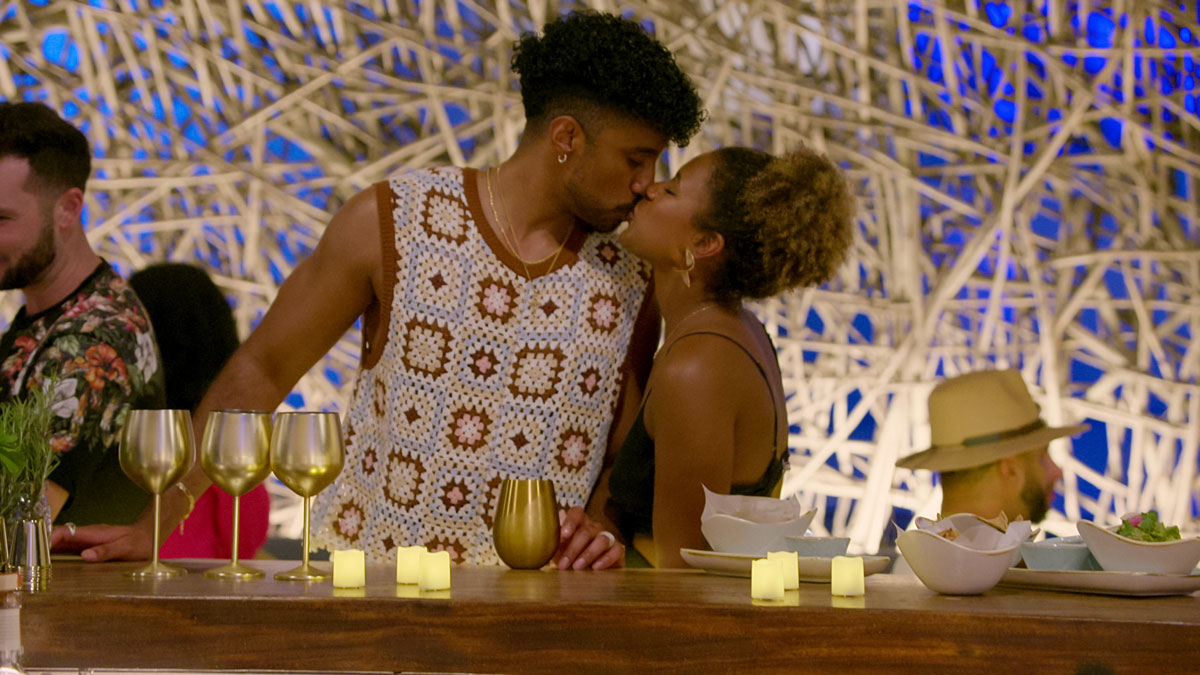
Later he’ll mention Palestine, mostly in passing. This is still a show where whatever swishing inside those omnipresent golden goblets takes the edge of most tensions. But not all.


Want a daily wrap-up of all the news and commentary Salon has to offer? Subscribe to our morning newsletter, Crash Course.


In the end, the votes of Richardson and George’s past lovers had little bearing on why and how their relationships with Davis and Prashad imploded. Davis stumbled on a text chain on Richardson’s phone showing him exchanging lurid texts with another woman, putting his by-the-by remarks about his uncontrollable tumescence into eye-opening context.

Prashad’s willingness to marry George slowly chilled after he broached concerns about contraception (he didn’t want to use condoms, but he didn’t want children right away, placing the burden on George to figure things out) but eventually came down to a nebulous excuse about mismatched energies.

Love Is BlindStephen Richardson and Monica Davis in “Love Is Blind” (Netflix)Kink-shaming Robertson or dragging Prashad for leading George right up to her bachelorette celebration before pulling the plug is easy. Social media users are making it this week’s new hobby. (Davis is making a multi-course Instagram meal of her heroic, in-the-moment insistence that Robertson Venmo her the money she lent him before he exited her life completely.)

But the deeper lesson in both their stories, one that recurs time and again, is the essentiality of being forthright with the other person about one’s history and identity, personal and political. That, and recognizing the obvious mismatches everyone at home can see.

Before they broke up Prashad and George wondered aloud if love was enough, while showing it might have been if he’d told her what she needed to know instead of what he wanted her to hear. Sight is only one sense and doesn’t tell even half the story.

All episodes of “Love Is Blind” are streaming on Netflix.

Trump says immigrants are like trash and America like “a garbage can for the world”

Donald Trump, the Republican nominee whose former chief of staff describes as a "fascist" who praises Adolf Hitler, continued his dehumanizing attacks on immigrants at a campaign stop in Arizona on Thursday, describing them as human refuse.

"People coming out of the Congo. Not just South America. They're coming from 181 countries as of yesterday," the former president said at a rally in Tempe. "We're a dumping ground. We're like a garbage can for the world. That's what's happened. That what's happened to — we're like a garbage can."

Trump, echoing Nazi rhetoric, has previously claimed that immigrants are "poisoning the blood of our country." Earlier this month, he also asserted that immigrants are genetically inferior, claiming that their "bad genes" make them more likely to commit violent crimes, a lie contradicted by studies that have repeatedly shown that immigrants commit fewer criminal offenses than native-born Americans. If elected, he also promised a militarized campaign of deportation that would entail arresting and detaining millions of people in internment camps.

Demonizing those born outside the United States is nothing new for the 78-year-old, now in his third campaign for the White House. In 2015, Trump formally launched his political career with a racist attack on Mexican immigrants as largely "rapists" and criminals; he has since himself been found liable for sexual assault and convicted of 34 felonies.

As Trump has aged, however, he has become even less filtered in public, noted Kristen Holmes, a correspondent for CNN.

"There's all this conversation about Donald Trump really going off the rails, but a lot of what he is saying now publicly is stuff we know he has said in private — the cursing, the denigrating remarks," Holmes commented Friday. "Now he's just taking it to the campaign trail."

“They’re being called to save the country”: Jackson Katz on how MAGA masculinity sells men purpose

America’s gender troubles helped to spawn the Age of Trump and the democracy crisis we currently face.

Fascism is coded as a masculine political ideology insofar as it emphasizes the strongman figure, violence and rejection of “political correctness." Politeness and empathy are branded as feminine and weak. Women are deemed vessels for producing more soldiers for the state. Rape culture is a defining feature of fascism. Fascism is also both homosocial and homoerotic in its aesthetic and attempts to channel male libidinal energy in the form of a fake populist mass movement in service to the Dear Leader (the fascist leader is almost always a man).

Donald Trump, like other fascist and authoritarian leaders, fulfills most, if not all, of these roles for his MAGA cultists. Social scientists have shown hostile sexism and misogyny is tied to support of Trump, the MAGA movement and authoritarianism more broadly. Trump has been accused of sexual assault and harassment by many women. In the civil case filed by E. Jean Carroll, a court of law deemed Trump a sexual assaulter.

Public opinion polls consistently show that Trump’s most enthusiastic supporters are white men who are drawn to his regressive and reactionary performance of white masculinity. The white masculinity that Trump is performing is also racist and white supremacist. This does not limit its appeal to nonwhite people. Social scientists and other experts have shown that there are Black and brown men who are also attracted to Trump’s fake alpha male persona. Black and brown men’s support of Trump and the MAGA movement may be a deciding factor in what will be a very close 2024 election.

"The global crisis in democracy is tied directly to a crisis in masculinity."

Jackson Katz, Ph.D., is an educator, author and scholar-activist who has long been a major figure in the growing global movement of men working to promote gender equity and prevent gender-based violence. He is a frequent contributor to Ms. Magazine, where he writes about masculinities, politics and violence. His new film is entitled
The Man Card: 50 Years of Gender, Power, and the American Presidency." He is also a co-founder of the Young Men Research Initiative. Katz is the author of two books, including the classic bestseller "The Macho Paradox: Why Some Men Hurt Women and How All Men Can Help." His next book, entitled "Every Man: Why Violence Against Women Is a Men's Issue", is scheduled to be published by Penguin Random House UK in February 2025. His TEDx talk on that topic has been translated into 27 languages and has over 5.5 million views. He has lectured and trained in all fifty U.S. states, eight Canadian provinces and every continent except Antarctica.

In this conversation, Katz shares his concerns about the 2024 election and how too many men are willing to destroy democracy by supporting Trump and the neofascist MAGA movement. Katz details how the MAGA movement and the larger global antidemocracy movement are an unhealthy and destructive reaction to changes in society that make many men feel lost, marginalized and searching for meaning and community in their lives. Katz offers some hope that if Kamala Harris defeats Trump it will create an opportunity to vanquish Trumpism and to weaken the types of violent and antisocial masculinity that he and the MAGA movement exemplify and empowers and the great harm it does to American society.

How are you feeling? How are you managing this moment with the election being less than two weeks away?

This election is so consequential — and the race is way too close for comfort. For my part, I’m doing whatever I can to promote the idea that men who are concerned about the present and future of democracy and sanity in this country need to speak directly to our fellow men — including young men — and pull some of them back from the abyss. The polls are clear; there is a very large gender gap and men are on the Trump side of it — especially among white men.

On a more positive note, it’s encouraging to see that many people are really interested in thinking more critically about men and masculinities than perhaps they've ever been. To be sure, some of that interest is rooted in the fears of a Trump restoration and the role of the men’s vote in making it happen. Like some of us have been saying for the past decade, a critical factor in the rise of Trumpism and right-wing populism around the world is a sense of aggrieved entitlement on the part of white men. The global crisis in democracy is tied directly to a crisis in masculinity. And the crisis goes beyond white men.

The systemic and institutional and cultural problems related to gender and our democracy are very deep. We need to be having a sustained conversation about the epic struggle between traditional and more 21st-century understandings of “masculinity,” and the role of this struggle in the American and global democracy crisis. With popular initiatives like White Dudes for Harris that have arisen in this election cycle, I think it’s fair to say that this broader conversation is finally underway. 

In many ways, Trumpism and the American neofascist movement reflect a crisis in white masculinity. For all the years of talk about "working class" rage, it is not Black and brown working-class people who put Trump in office and are the foundation of MAGA, for example. White "working class" people, and white men in particular, elevated Trump and Trumpism. Trump and his MAGA movement are powered by white male rage.

It sure is. But it's important to consider that Trump and Trumpism didn’t arise out of nowhere. Since Richard Nixon’s landslide election to the presidency in 1972, the Republican Party has sought to appeal to white working and middle-class men not by offering them anything of value regarding policy, but by speaking to their identities and aspirations as men. Trump’s hypermasculine posturing and bullying behavior is merely an exaggerated version of a dynamic that was there all along. In a nutshell, that’s the premise of my new film “The Man Card: 50 Years of Gender, Power and the American Presidency.” And of course, it’s not just conservatives in media and politics who are uncomfortable talking about issues of race and gender and how they intersect.

We need your help to stay independent

Many men who identify as liberals or on "the left" walk very cautiously on this terrain. When it comes to feminist critiques of white masculinity, either they don't know what to say, or they make a joke about it, or they just shut up because they’re worried that they might slip up and say something that comes off as misogynous. Some of that discomfort is a function of not having thought too deeply and engaged in robust debates about these issues. Think about how many men over the past couple of generations have graduated from college without ever taking a course on gender and sexuality. Or a course in Women’s Studies? We should criticize the racism and misogyny at the heart of Trumpism, but it is much easier to criticize men on the right and MAGA than it is to look closer to home and address how these dynamics show up in liberal and progressive circles. That having been said, when Trump says Make America Great Again, he’s really just telling white men that he's going to put them back on center stage again. 

As an expert, how do you understand the concepts of "gender" and "masculinity"? These are foundational concepts that are often misunderstood by the general public.

The simple answer is sex is biological and gender is socially determined — and therefore highly variable. For example, different societies around the world have very different ideas about what is “masculine” and what is “feminine.” In the same society, definitions change over the generations. Look at how many young fathers today are emotionally present in the lives of their kids, compared to the fathers of people in my generation.

On a more superficial level but still revealing, when I was young in the 1970s, I only knew a handful of men who had ever worn an earring. Today you see all sorts of tough men who wear two earrings — and no one cares. Also, masculinity as a singular concept is too narrow, because it doesn’t account for all the differences between and among men. Men occupy a range of social positions based on race, socioeconomic status, sexuality, etc. There is a definite hierarchy among men that reflects larger hierarchies of power and privilege in American, Western and global societies. A gay working-class Black man experiences — and performs — his masculinity in very different ways than a rich heterosexual white man. That is why thinking more broadly about "masculinities" instead of one singular type of "masculinity" is more useful and productive.

Also, our notions of gender are much more complex and nuanced now. We are not limited to binaries: men vs. women, straight vs. gay, masculine vs. feminine. In fact, one of the driving forces behind right-wing populism and authoritarianism is that it’s a reaction to the breakdown of these binaries and the social changes that have resulted. Many people want simple solutions from what they believe were simpler times. For a certain percentage of white men, supporting MAGA — on an emotional level — means supporting a return to "traditional" values and social norms, where the world made sense because straight white men were firmly in charge.

What does it mean to be a man in the MAGAverse and TrumpWorld? In the Age of Trump?

Traditionally, the two main pillars of men's identity in Western societies have been protector and provider. Of course, men of color and poor men have often been denied the opportunity to live that out. In the current moment, long-term shifts in the global economy and labor markets, automation and new technologies like AI and the ongoing societal transformations catalyzed by feminism have challenged those pillars of masculine identity. More and more men are living economically precarious lives. This has unsettled their understanding of what it means to be a man. It’s important to see MAGA as more than a political phenomenon. MAGA is also a social movement that gives people a sense of meaning and purpose and a powerful feeling of camaraderie and community. Many men who are drawn to Trumpworld feel validated and supported as if they still matter in an era of feminist-inspired social change. In fact, if you listen to the rhetoric on the right, they’re being called to save the country!


Want a daily wrap-up of all the news and commentary Salon has to offer? Subscribe to our morning newsletter, Crash Course.


For white evangelical Christians, there’s the added appeal that they’re fulfilling a Biblical mandate to reassert their authority — especially in the family. Trump might be a deeply flawed person, but he’s the blunt instrument that’s going to return them to lost glory. 

In the last few years, there has been much talk about a so-called crisis among men and boys. Where is this coming from?

This notion of a "crisis in masculinity" is a recurring theme in American history. It turns up almost every time there's a major shift in the economy or a powerful women’s movement that challenges traditional patriarchal power. These developments unsettle traditional ideas about gender and power — and millions of men find themselves searching for some sort of stable identity as men. It’s important to acknowledge that many men and young men are struggling, in many ways because the old definitions of “manhood” no longer work — if they ever did. Men and boys today have all sorts of challenges: mental health crises, depression, relational challenges, loneliness and opioid addiction. Unfortunately, right-wing voices in media and politics continue to push them to respond by doubling down on traditional expressions of masculinity — which is tragic because some aspects of traditional masculinity — like the idea that “real men” can’t acknowledge vulnerability and just have to “suck it up” — have contributed to many of their problems in the first place! I believe strongly that people to the left of center need to acknowledge and recognize that the struggles of boys and men are real and then go out and make the case that progressive policies would benefit men and boys way more than the policies of MAGA and neofascist movements that want to roll back women’s rights, LGBTQ gains and other forms of social progress. 

What type of masculinity does Donald Trump channel and perform?

I have long believed that Trump rose to political power because he correctly intuited that people would respond to the image he had created of himself as a tough guy businessman who was a counterpuncher; when he was hit, he’d hit back harder. That’s the way he channeled the many resentments of white men — and many of the white women adjacent to them as well.

I think there are dueling narratives at play here. Many liberals and progressives look at Trump and see a conman, a deeply insecure, malignant narcissist who lacks basic human empathy; a man of immense wealth and privilege who was born with a silver spoon in his mouth and who doesn’t care about anyone but himself and a few family members. But his MAGA people and other followers see something very different. They see an antihero who’s sticking it to the smug elites. Or they see a heroic tough guy who’s standing up for them, who responded to an assassination attempt with a cry of ‘fight, fight, fight!”  

Mel Gibson endorses Trump and says Harris has “IQ of a fence post”

Mel Gibson made scathing remarks about Vice President Kamala Harris' intelligence in his endorsement of Donald Trump, stating that the Democratic nominee has "the IQ of a fence post."

On Thursday evening, the Oscar-winning actor and director briefly participated in an interview with TMZ, where he made the comments that are now widely circulating on Variety and several other outlets. 

When prompted to share his opinions of the 2024 presidential election, Gibson said, “I don’t think it’s going to surprise anyone who I vote for."  

“I’m gonna guess Trump. Is that a bad guess?” A cameraman who stopped Gibson at an airport asked.

“I think that’s a pretty good guess,” Gibson responded.

When asked what he thinks a second Trump presidency would look like, Gibson said, “I know what it’ll be like if we let her in. And that ain’t good."

The actor riddled off a list of reasons including, "[Harris has a] miserable track record. No policies to speak of. She’s got the IQ of a fence post.”

Gibson remains a controversial Hollywood figure as the once sought-after actor has been in hot water for years because of his infamous DUI arrest, where he spewed an antisemitic rant. The actor also was heard on a leaked tape using the N-word at his previous partner, Oksana Grigorieva, who also alleged that Gibson was physically abusive.

Recently, former co-worker Andrew Garfield has praised his "Hacksaw Ridge" director for having "done a lot of beautiful healing with himself." Garfield, who is Jewish, said everyone, including Gibson, deserves a second chance because, "none of us are infallible," Variety reported.

Wall Street Journal sinks Trump pal Elon Musk’s denials, reports secret regular “contact” with Putin

What if a Pentagon contractor from South Africa, using his money and social media platform to try and return a seemingly declining former president labeled a “fascist” by his former top aide to the White House, did not have the best interests of America at heart?

That’s the alarming possibility raised by Wall Street Journal. On Thursday, the newspaper owned by Rupert Murdoch reported that Elon Musk, the CEO of X and Tesla, has been “in regular contact” with Russian President Vladimir Putin since late 2022.

Musk previously denied that he was in constant conversation with a dictator. In October 2022, he was adamant that he was being defamed: Ian Bremmer, president of the Eurasia Group, had just reported that the 53-year-old billionaire spoke with Putin before he himself proposed a Ukraine “peace” deal on X — one that called for Kyiv ceding territory to Moscow and pledging to remain “neutral” by never joining NATO.

“I have spoken to Putin only once and that was about 18 months ago,” Musk responded. “The subject matter was space.”

But, according to the Journal, citing officials in the U.S., Europe and Russia, Musk has been engaged in conversations not just with Putin but “other high-ranking officials” ever since, “past 2022 and into this year.” Conversations have touched on everything from “geopolitical tensions,” the outlet reported — Putin asked Musk to shut off his Starlink internet service above Taiwan as a favor to China, where the billionaire also has substantial business dealings — to unspecified “personal topics.”

The Journal previously reported that Musk’s erratic behavior and use of illegal drugs was of concern to executives at his own company, raising questions as to why he still enjoys a security clearance from the Department of Defense.

The new reporting provides possible context for some of Musk’s eyebrow-raising interventions in Ukraine, from his pro-Russia peace plan to his decision to shut off Starlink satellite internet service above Crimea, thwarting Ukrainian efforts to take back the illegally annexed peninsula and disable Russian military assets stationed there. At the time, Musk said Ukraine’s “obvious intent” was to sink Russia’s Black Sea Fleet, which would have made Starlink’s parent company, the U.S. defense contractor SpaceX, “explicitly complicit in a major act of war and conflict escalation.”

Musk is also not the only right-wing billionaire in America reportedly having regular phone calls with the man responsible for Russia’s invasion of Ukraine. Former President Donald Trump — who sent Putin COVID tests for his own personal use during the height of the pandemic, according to the Kremlin and journalist Bob Woodward — has not denied that he too is staying in touch with the Russian strongman.

We need your help to stay independent

Asked at a recent appearance to confirm reporting that he has been regularly speaking with Putin since losing the 2020 election, Trump responded with a pointed non-denial. “If I did, it’s a smart thing,” he assured his audience at the Economic Club of Chicago.

And consider that the Russian government was recently caught paying millions of dollars to right-wing influencers, including Benny Johnson, Tim Pool and Dave Rubin, who all promoted anti-Ukraine, pro-Russia content on their respective channels.

What emerges, if one also assumes that nothing good can come from three right-wing billionaires conspiring, is a grim portrait of the political reality in 2024: that there is an international plot — increasingly out in the open — to undermine democracy in the United States and elsewhere. Musk and Putin are both spending millions of dollars to elect Trump, who has been more critical of the U.S. Constitution than the Kremlin’s decision to invade Ukraine, and all three are objectively more interested in money and power than democracy or the rule of law.

Whether this elite, actually existing conspiracy pans out is still up to American voters, at least the ones living in the seven competitive states. If it does, though, Trump has already promised his wealthiest supporter a role in his next administration — one that would enable someone who has made billions of dollars from U.S. government contracts to recommend cuts to “inefficient” government spending.

“I look forward to serving America,” Musk wrote on his website last month, “if the opportunity arises.”

Trump’s retribution plan begins with MAGA

Maryland Rep. Jamie Raskin, the top Democrat on the House Oversight Committee, sent out a statement this week drawing attention to the fact that Donald Trump's campaign is slow-walking the presidential transition process. Both candidates are expected to participate in anticipation of a possible win in November. The process generally starts months ahead of the election to allow for sufficient vetting of potential staffers and political appointees throughout the administration. Coordinating with the current administration's staff to ensure a smooth transition to the new presidency is critical. So far, the Trump team has missed two important deadlines to sign agreements to get it started.

The corruption that characterized Trump's first term is already evident.

Trump, you may recall, doesn't respect this process very much, having fired his first transition team right after the 2016 election, He prevented Joe Biden's transition team from accessing the process in 2020 while he contested the election. Still, one might think it's a bit odd for Trump's team to again delay the process since once the papers are signed, a campaign is granted access to money and essential services. But it doesn't take a very stable genius to figure out why they are dragging their feet. According to the New York Times, until all the documents are signed, Trump's campaign can avoid federal rules limiting private contributions to the transition process as well as ethics rules that bar conflicts of interest. The Trump team doesn't care for such restraints.

Trump has refused to take the usual security briefings, giving the excuse that he doesn't trust the Biden administration (or the "deep state") not to leak and blame it on him so at least we don't have to worry about that. But we can see by this early decision to delay this standard bureaucratic process that our impression that they don't plan to play by any of the usual rules is correct. The corruption that characterized Trump's first term is already evident.

The Trump transition team is headed by Howard Lutnick, a longtime personal friend of Trump's from the Wall Street firm Cantor Fitzgerald, and Linda McMahon, Trump's director of the Small Business Administration and the former wife and business partner of Vince McMahon of World Wrestling Entertainment (WWE) fame.

McMahon, as the New York Daily News reports, has just been accused of "knowingly allowing the grooming, exploitation and sexual abuse of young boys throughout the 1980s and ’90s," when she was helping to run the WWE, according to a new lawsuit filed on behalf of five alleged victims. Such damming allegations would probably be cause for her resignation from any other presidential transition, but considering Trump's own history of sexual abuse it's unlikely that he would care about such mundane accusations. It's par for the course in any Trump administration.

Politico reported that Lutnick is causing quite a bit of consternation among Trump loyalists who believe that he's edging out members for the first administration so that he can place his own people in the White House for his personal benefit. Republicans on Capitol Hill are likewise sounding the alarm that he seems to be leveraging his position to lobby on behalf of Cantor Fitzgerald among other investments, including some very controversial crypto projects.

But Lutnick has a very important ally in Donald Trump Jr., who is taking an important role in transition planning. He has said that he expects to have veto power to "block the guys that would be a disaster," he told Axios' Mike Allen:

I want a veto power to cut out each and every one of those people," he said, adding that an "advantage" of a second Trump term is that "now we know" who possible administration officials are.

He claims to trust Lutnick implicitly to pick the right people, telling Politico, “There’s nobody more loyal and capable than Howard, which is why my father picked him to help put together the greatest collection of talent to ever serve in the United States government."

Lutnick claims that any complaints are all sour grapes from people associated with Project 2025 who have apparently been excommunicated from Trump's inner circle for making the former president look bad. But the Times reports that there's a different, much more secretive group that's been putting together a very similar project, called "The America First Agenda" produced by the America First Policy Institute, a group formed four years ago in the wake of the 2020 election. Unlike Project 2025 this group is working directly with the Trump campaign, preparing for the second term. One of its directors is Linda McMahon, the co-chair of the Trump transition.

We need your help to stay independent

According to the Times, this agenda isn't as voluminous as the 900-page Project 2025 and doesn't feature some of the more sensational policies like outlawing pornography and prohibiting the mailing of abortion pills but it's MAGA all the way. It calls for policies like mandatory ultrasounds for medication abortion and establishing only two legal genders along with a bunch of standard-issue conservative movement policies going back decades. They claim to have already drafted nearly 300 executive orders ready for Trump’s signature.

There is one issue they take even further than Project 2025, however. It calls for "the elimination of nearly all civil service protections for federal workers by making them at-will employees." That aspect of the plan is being implemented by none other than Howard Lutnick who has apparently frozen out all those Project 2025 Trump lackeys who signed on with the wrong team.

So you can see why the campaign doesn't feel the need to bother with a traditional transition process. They are already vetting hundreds of MAGA faithful and planning to start dramatically expanding executive power the minute Trump takes power. But as with everything else associated with Trump, the whole project appears to be one part grift and one part vengeance with loyalists already backstabbing each other and currying favor with the Dear Leader. Some things never change. 

No, your menstrual cup is probably not causing prolapse

Squatting in the shower with my hands covered in blood, I cursed my menstrual cup for its leak-proof suction, which, while great at preventing leaks as it said on the box, was winning the battle I was waging to get that slippery little bugger out of me. For more than an hour, I had twisted and contorted myself trying without success to get a grip on that two-inch piece of silicone. This was my first time using a cup and the first time I had spent such an extended period of time digging inside my vaginal canal. Somewhere along the way, I was horrified to feel something warm, soft, and round bulging out far lower than I had ever felt before.

Feeling a renewed sense of urgency to get the hell out of there, I cried tears of joy when I finally managed to hook a finger under the cup’s seal and pull it out. Then, I turned to the internet to see if what I had experienced was normal. What I found was several women online reporting a similar experience and a BBC article that claimed “menstrual cup misuse ‘can cause pelvic organ prolapse.’” 

Most commonly caused by childbirth, prolapse occurs when pelvic organs that serve as walls supporting the vagina collapse, like the cervix or the uterus. With toxic metals recently found in tampons and “forever chemicals” detected in menstrual pads, (though these studies should be interpreted with caution), I wasn’t ready to give up on the menstrual cup just yet. I haven’t had kids, but I wondered: Could this tiny cup possibly exert the same amount of force required to push another human being out of my vagina? 

The chances are slim to non-existent, according to pelvic floor and prolapse specialists I spoke to for this story. No research has shown that menstrual cups can increase the risk for prolapse, with one study even showing that menstrual cups could potentially help strengthen pelvic floor muscles.

Dr. Christine Vaccaro, a urogynecologist in private practice and an associate professor at the Uniformed Services University of the Health Sciences, has to pull the uterus down in surgeries to work on it, which requires a significant amount of force. When she thinks about how that compares to the suction that a menstrual cup is capable of, those two measures are not on the same scale, she said.

“I really can’t see how the suction would be so strong that it would pull down an organ,” Vaccaro told Salon in a phone interview. “I don’t think that the menstrual cup causes prolapse.”

"We don't have studies to show this because studies on women are grossly underfunded and underdone."

Prolapse occurs when ligaments and muscles in the pelvic floor weaken and can no longer support the pelvic floor organs. It affects nearly one in three women by age 60 and can be caused by things like repeated heavy straining and chronic constipation. People who have had hysterectomies, and people with conditions like obesity or Ehlers-Danlos syndrome, which affects collagen and makes tissues stretchier, are at a higher risk.

It would be helpful to know how menstrual cup use affected people with these conditions, but there is a paucity of research investigating menstrual products and women’s health issues in general, said Lauren Keller, a pelvic floor specialist in Texas.

“Unfortunately, we don't have studies to show this because studies on women are grossly underfunded and underdone,” Keller told Salon in a phone interview.

Estimates vary but around 50% of people who have had babies experience some degree of prolapse and the use of forceps or a vacuum during birth increases the risk. The chances of experiencing prolapse also goes up in general with age, as estrogen levels decrease the strength of the connective tissues in the area during perimenopause.

Many mild cases do not need treatment, but more severe cases can cause problems with urinary or bowel function and can be treated with physiotherapy or surgery depending on what a patient and their provider decide.

"If someone notices a bulge when they're putting in a menstrual cup and it's never bothered them before, it probably isn't anything to worry about," said Dr. Rachael Sussman, a urogynecologist in private practice and at MedStar Georgetown. "If they have a concern, they should get checked out, but if it's just a minor prolapse, then it's probably always been there."


Want more health and science stories in your inbox? Subscribe to Salon's weekly newsletter Lab Notes.


A common treatment for prolapse, a device called a pessary, actually resembles a menstrual cup. It is inserted into the vaginal canal much like the cup and bolsters the tissues that support the pelvic floor organs, preventing them from falling down, Vacarro said. It may be that some women who unknowingly already have prolapse select the menstrual cup as their product of choice because it feels more comfortable, and then are confronted with the prolapse once they have to get up close and personal with their vaginal canal to take out the menstrual cup, Sussman said.

“I suspect a menstrual cup in a lot of women might actually help with their prolapse rather than cause prolapse,” Sussman told Salon in a phone interview. “They may become more aware of prolapse when using a menstrual cup rather than a tampon.”

Vaccaro acknowledged a chance that removing the menstrual cup incorrectly could create some damage over the course of many years. It’s recommended to always break the seal of the menstrual cup that causes the suction before pulling down on it, otherwise it can cause more strain on the muscles used to support the pelvic floor organs. Bearing down and straining can also cause issues.

“Straining itself and bearing down like you are having a bowel movement over time can contribute to pelvic floor disorders like prolapse,” Vaccaro said. “If they were straining a lot, frequently, for a long period of time they could be inducing pelvic floor microtrauma each time, especially if you are not breaking the seal and that sort of thing.”

Other women might think they are experiencing prolapse when they are really just noticing parts of their anatomy that were always there, but they hadn’t familiarized themselves with. For example, the uterus naturally shifts throughout the ovulation cycle and may sit lower during ovulation.

As such, it’s a good idea to explore the layout of the vaginal canal at various points in the cycle before using a menstrual cup to become familiar with the body and its changes to tell if there are any abnormalities that happen when using a menstrual cup, Keller said. 

”The more knowledge we have before we go into this, the better, because you know where your cervix sits when you're menstruating, you know where your cervix sits when you're ovulating, and you know those natural fluctuations that happen,” Keller said.

We need your help to stay independent

At this point, there are various menstrual cup shapes and sizes available, and even menstrual discs that are designed to catch blood without suction. In my experience, the cup I selected was too small for my body, leaving me fishing around for it for hours. 

Not long after my panicked online search, the bulge I felt when removing my menstrual cup receded back upward along with any fears I had surrounding prolapse. Still, it would have been nice had the information I was looking for been a little more readily available.

“I don't think we're ever going to be caught up on educating women about their anatomy, especially when it comes to anything related to the vagina, pelvic floor health, and genital genitalia,” Vaccaro said. “I think we need a lot more information out there.”

Are we misinformed about misinformation?

In June, the journal Nature published a perspective suggesting that the harms of online misinformation have been misunderstood. The paper’s authors, representing four universities and Microsoft, conducted a review of the behavioral science literature and identified what they characterize as three common misperceptions: That the average person’s exposure to false and inflammatory content is high, that algorithms are driving this exposure, and that many broader problems in society are predominantly caused by social media.

“People who show up to YouTube to watch baking videos and end up at Nazi websites — this is very, very rare,” said David Rothschild, an economist at Microsoft Research who is also a researcher with the University of Pennsylvania’s Penn Media Accountability Project. That’s not to say that edge cases don’t matter, he and his colleagues wrote, but treating them as typical can contribute to misunderstandings — and divert attention away from more pressing issues.

Rothschild spoke to Undark about the paper in a video call. Our conversation has been edited for length and clarity.

Undark: What motivated you and your co-authors to write this perspective?

David Rothschild: The five co-authors on this paper had all been doing a lot of different research in this space for years, trying to understand what it is that is happening on social media: What’s good, what’s bad, and especially understanding how it differs from the stories that we're hearing from the mainstream media and from other researchers.

Specifically, we were narrowing in on these questions about what the experience of a typical consumer is, a typical person versus a more extreme example. A lot of what we saw, or a lot of what we understood — it was referenced in a lot of research — really described a pretty extreme scenario.

The second part of that is a lot of emphasis around algorithms, a lot of concern about algorithms. What we’re seeing is that a lot of harmful content is coming not from an algorithm pushing it on people. Actually, it’s the exact opposite. The algorithm kind of is pulling you towards the center.

And then there are these questions about causation and correlation. A lot of research, and especially mainstream media, conflate the proximate cause of something with the underlying cause of it.

There’s a lot of people saying: “Oh, these yellow vest riots are happening in France. They were organized on Facebook.” Well, there's been riots in France for a couple hundred years. They find ways to organize even without the existence of social media.

The proximate cause — the proximate way in which people were organizing around [January 6] — was certainly a lot of online. But then the question comes, could these things have happened in an offline world? And these are tricky questions.

Writing a perspective here in Nature really allows us to then get to stakeholders outside of academia to really address the broader discussion because there’s real world consequences. Research gets allocated, funding gets allocated, platforms get pressure to solve the problem that people discuss.

UN: Can you talk about the example of the 2016 election: What you found about it and also the role that perhaps the media played in putting forth information that was not entirely accurate?

DR: The bottom line is that what the Russians did in 2016 is certainly interesting and newsworthy. They invested pretty heavily in creating sleeper Facebook organizations that posted viral content and then slipped in a bunch of non-true fake news towards the end. Certainly meaningful and certainly something that I understand why people were intrigued by. But ultimately, what we wanted to say is, “How much impact could that plausibly have?”

"A lot of research, and especially mainstream media, conflate the proximate cause of something with the underlying cause of it."

Impact is really hard [to measure], but at least we can put in perspective about people’s news diets and showcase that the amount of views of Russian direct misinformation is just a microscopic portion of people's consumption of news on Facebook — let alone their consumption of Facebook, let alone their consumption of news in general, which Facebook is just a tiny portion of. Especially in 2016, the vast majority of people, even younger people, were still consuming way more news on television than they were on social media, let alone online.

While we agree that any fake news is probably not good, there is ample research to see that repeated interaction with content is really what drives underlying causal understanding of the world, narratives, however you want to describe it. Getting occasionally hit by some fake news, and at very low numbers for the typical consumer, is just not the driving force.

UD: My impression from reading your Nature paper is that you found that journalists are spreading misinformation about the effects of misinformation. Is that accurate? And why do you think this is happening if so?

DR: Ultimately, it’s a good story. And nuance is hard, very hard, and negative is popular.

UD: So what’s a good story, specifically?

DR: That social media is harming your children. That social media is the problem.

There’s a general want to cover things on a more negative light. There is certainly a long history of people freaking out over and subscribing all society ills to new technology, whether or not that was the internet, or television, or radio, or music, or books. You can just go back in time, and you can see all of these types of concerns.

Ultimately, there’s going to be people that benefit from social media. There’s going to be people that are harmed from social media, and there’s going to be many people who will progress with it in the way that society continues to progress with new technology. That is just not as interesting a story as social media is causing these problems, without counterbalancing that.

“Social media is the problem, and it’s really the algorithms” provides a very simple and tractable solution, which is that you fix the algorithms. And it avoids the harder question — the one that we generally don't want to do — about human nature.

A lot of the research that we cite here, and ones I think that make people uncomfortable, is that some segment of the population demands horrible things. They demand things that are racist, degrading, violence-inducing. That demand is capable of being satiated in various social media, as well as it was satiated beforehand in other forms of medium, whether or not it was people reading books, or movies, or radio, whatever it was that people were listening to or gaining information from in the past.

Ultimately, the various channels that we have available definitely shift the ease and distribution and way in which these are distributed. But the existence of these things is a human nature question well beyond my capacity as a researcher to solve, well beyond a lot of people's capacity — most people’s, everyone’s. I think it makes it tricky and also makes you uncomfortable. And I think that’s why many journalists like to focus in on “social media bad, algorithms the problem."

UD: On the same day that Nature published your piece, the journal also published a comment titled “Misinformation poses a bigger threat to democracy than you might think.” The authors suggest that “Concern about the expected blizzard of election-related misinformation is warranted, given the capacity of false information to boost polarization and undermine trust in electoral processes.” What’s the average person to make of these seemingly divergent views?

DR: We certainly do not want to give off the impression that we tolerate any bit of misinformation or harmful content or trivialize the impact it has, especially to those people that it does affect. What we’re saying is that it is concentrated away from the typical consumer into extreme pockets, and it takes a different approach and different allocation of resources to hit that than the traditional research, and the traditional questions you see popped up about aiming towards a typical consumer, about aiming towards this mass impact.

I read that and I don’t necessarily think it’s wrong, as much as I don’t see who they’re yelling at, basically, in that piece. I don’t think that is a huge movement — to trivialize — as much as to say, “Hey, we should actually fight it where it is, fight it where the problems are.” I think that it’s a talking past each other, in a sense.

UD: You’re an employee of Microsoft. How would you reassure potentially skeptical readers that your study is not an effort to downplay the negative effect of products that are profitable to the tech industry?

DR: This paper has four academic co-authors, and went through an incredibly rigorous process. You may not [have] noticed on the front: We submitted this paper on Oct. 13, 2021, and it was finally accepted on April 11, 2024. I’ve had some crazy review processes in my time. This was intense.

We came in with ideas based off our own academic research. We supplemented it with the latest research and continue to supplement it with research coming in, especially some research that ran counter to our original conception.

The bottom line is that Microsoft Research is an extremely unique place. For those who are not familiar with it, it was founded under the Bell Labs model in which there’s no review process for publications coming out of Microsoft Research because they believe that the integrity of the work rests on the fact that they are not censoring as they come through. The idea is to use this position to be able to engage in discussions and understanding around the impact of some things that are near the company, some things that have nothing to do with it.

In this case, I think it’s pretty far afoot. It’s a really awesome place to be. A lot of work is joint-authored with academic collaborators, and that certainly always is important to ensure that there are very clear guidelines in the process and ensure the academic integrity of the work that it does.

UD: I forgot to ask you about your team’s methods.

DR: It’s obviously different than a traditional research piece. In this case, this was definitely started by conversations among the co-authors about joint work and separate work that we’ve been doing that we felt was still not breaking through into the right places. It really started by laying down a few theories that we had about the differences between our academic work, the general body of academic work, and what we were seeing in the public discussion. And then an extremely thorough review of literature.

As you’ll see, we’re somewhere in the 150-plus citations — 154 citations. And with this incredibly long review process in Nature, we went line by line to ensure that there wasn’t anything that was not undefended by the literature: either, where appropriate, the academic literature, or, where appropriate, what we were able to cite from things that were in the public.

The idea was to really create, hopefully, a comprehensive piece that allowed people to really see what we think is a really important discussion — and this is why I'm so happy to talk to you today — about where the real harms are and where the push should be.

None of us are firm believers in trying to pull out a stance and hold to it despite new evidence. There are shifting models of social media. What we have now with TikTok, and Reels, and YouTube Shorts is a very different experience than what the main social media consumption was a few years ago — with longer videos — or the main social media a few years before that with news feeds. These will continue to then be something you want to monitor and understand.

This article was originally published on Undark. Read the original article.

The plastics industry’s wish list for a second Trump Administration

Tucked into a green-sounding federal recycling bill filed last month is a wish list, not of tough new mandates to get a handle on the world’s plastic’s crisis, but of regulatory rollbacks and government assistance that would boost the plastics industry.

Endorsed by petrochemical lobbyists, the legislation is being criticized by environmentalists who are calling it the industry’s own Project 2025 — a playbook for a potential Trump administration to support an oil and gas industry that’s increasingly dependent on manufacturing plastic.

Among the bill’s supporters’ litany of wishes: They want taxpayers to help prop up “advanced” chemical recycling methods that companies have oversold as a solution for plastic-choked oceans and communities.

They want one of the plastic industry’s dirtiest and most inefficient technologies — one akin to incineration — to be redefined as manufacturing, which would make it exempt from air pollution laws.

They want to legitimize an accounting method that allows companies to exaggerate how much recycled plastic is in their products.

And they want to ensure secrecy around how companies process old plastic and prevent states from setting more stringent regulations for the industry.

Even though the bill itself is a legislative long shot, federal agencies under Donald Trump could adopt some of its most extreme provisions without congressional approval, said Daniel Rosenberg, director of federal toxics policy at the Natural Resources Defense Council.

The previous Trump administration had already started the most consequential rollback — the exemption from air pollution regulations — before the Biden administration reversed it.

“The likelihood of really bad stuff happening is exponentially greater under a second Trump administration,” Rosenberg said. The Trump campaign didn’t return a request for comment.

Lobbyists could also break up the bill and try to push it through one piece at a time regardless of who wins the election, he added.

The bill doesn’t include any of the fixes that researchers have found would be most effective in curbing the plastics crisis: capping plastic production, limiting single-use plastic and removing toxic chemicals from plastic products.

The American Chemistry Council, a prominent plastics lobby, praised the bill as “ground-breaking, solutions-oriented legislation aimed at increasing plastics recycling and preventing plastic from ending up in the environment.” The bill echoes key provisions from a 2022 ACC policy plan. Council spokesperson Andrea Albersheim pushed back on the “inflammatory” characterization that the bill is akin to Project 2025 and noted that it has bipartisan sponsorship.

Rep. Don Davis, a Democrat from North Carolina, and Dr. Larry Bucshon, a Republican congressman from Indiana, co-sponsored the bill, titled Accelerating a Circular Economy for Plastics and Recycling Innovation Act of 2024.

Bucshon is retiring at the end of the legislative session. Davis is in his first term in Congress and faces a competitive reelection race in November; he serves on congressional committees involving agriculture and the military, not science or the environment.

Neither congressman answered ProPublica’s questions about the bill’s creation or its contents. Davis’ press release about the legislation included a statement of support from the CEO of Berry Global, a major plastic packaging manufacturer with a facility in Davis’ district.

Berry supports the act “because it would help modernize the nation’s fragmented recycling infrastructure and significantly increase use of recycled material in new products,” CEO Kevin Kwilinski said in the statement.

Bucshon noted in the release that his district is “home to a number of plastic manufacturers.”

Albersheim, the industry spokesperson, lauded Bucshon’s “long track record of working in a bipartisan fashion on recycling infrastructure legislation.” Bucshon “reached out to a variety of stakeholders,” she said, “including ACC, for perspectives, information and feedback.”

The bill doesn’t include any of the fixes that researchers have found would be most effective in curbing the plastics crisis: capping plastic production, limiting single-use plastic and removing toxic chemicals from plastic products.

The pro-recycling claim hides the bill’s true intent, which is to increase the use of chemical recycling, said Cynthia Palmer, senior analyst for petrochemicals at Moms Clean Air Force. “If you don’t nerd it out and spend your nights and weekends studying these details, then it sounds really good.”

Expanding a Mirage

The plastics industry, which plans to double production over the next few decades, prefers to tackle the plastics crisis through waste management rather than reducing its output. It has long heralded recycling as a cure, despite knowing that traditional methods can barely make a dent in the problem. More recently, the industry has touted new forms of chemical recycling as the solution.

ProPublica explored the most popular form of chemical recycling, pyrolysis; we found it is so inefficient that it yields products with almost no actual recycled content. Companies use a kind of mathematical sleight of hand called mass balance to inflate the recycledness of their most lucrative products by taking credit for the recycled content of other, less lucrative products. It allows a plastic cup with less than 1% recycled plastic to be advertised as 30% recycled.

The Environmental Protection Agency recently issued the first federal policy against mass balance and the California attorney general has sued ExxonMobil for “deceptive” plastic recycling practices, including mass balance. An ExxonMobil spokesperson recently told ProPublica that the company’s chemical recycling process works, and that it has “processed more than 60 million pounds of plastic waste into usable raw materials, keeping it out of landfills.”

The bill would reverse course and require the EPA to authorize various forms of mass balance for recycled plastic packaging. A federal rule along these lines would override state laws and prevent states like California from placing restrictions on mass balance or chemical recycling within their borders, according to the bill.

If an industry-friendly administration takes over, Rosenberg said, the EPA could easily legitimize mass balance. Further changes could come from the Federal Trade Commission, which issues the Green Guides — national guidelines on how companies can advertise environmentally friendly products without deceiving the public. The Biden administration has spent nearly two years working on an updated version of the Green Guides that will likely define what counts as recycling and whether companies can use mass balance to advertise their products.

The nation’s chemical recycling capacity is extremely limited right now. The few American facilities — including one owned by ExxonMobil — can only handle a tiny fraction of the nation’s plastic waste.

The ACC recently told ProPublica that it is lobbying for mandates that would require more recycled plastic in packaging; this would create more demand for the technologies, which would spur growth.

The bill calls for a national standard to increase recycled content in plastic packaging by up to 30% by 2030. To meet that goal, “it will be necessary for the recycling market in the United States to expand its deployment of advanced recycling technologies,” the bill states.

It dedicates a significant chunk of federal resources toward expanding plastic recycling infrastructure and smoothing the way for new chemical recycling facilities. There are few details on the scope and cost of these initiatives, or whether they could work at scale.

Under then-President Trump, the EPA began the process of redefining pyrolysis as manufacturing.

Some of the funding would come from fines against companies that don’t comply with the new recycling standard. The bill also requires considerable labor and time from government employees who are tasked with setting up guidelines and requirements to standardize and expand plastic recycling. For instance, regulators must create “data collection procedures” to calculate the annual amount of plastic waste that chemical recyclers could process into new plastic. Another provision points to federal support for using plastic as a construction material, possibly for seawalls that protect communities from sea-level rise and storm surges.

Plastic production was responsible for roughly 5% of the world’s greenhouse gas emissions in 2019 — the very thing driving climate change and severe flooding. The industry’s emissions could double or triple by 2050.

A study authorized by the bill sets the stage for even more government spending. The report, which requires input from plastic and chemical recycling industry representatives, will provide recommendations on financial incentives for improved collection and sorting of recyclables — a necessity for chemical recycling — and potentially expanding the EPA’s National Recycling Strategy to incorporate mass balance. Under a Trump administration, the EPA could update the strategy with that change, Rosenberg said.

Up in Smoke

During pyrolysis, materials like plastic are heated in a low-oxygen environment until they break down into other chemicals. The process produces hazardous waste and releases carcinogens like polycyclic aromatic hydrocarbons, which are toxic at very low concentrations.

The EPA has defined pyrolysis facilities as incinerators for decades, and the Clean Air Act defines anything that combusts any solid waste — including discarded plastic — as an incinerator, said Jim Pew, an attorney at the advocacy group Earthjustice.

This bill would count pyrolysis as manufacturing, not incineration. That bureaucratic shuffle would remove federal air pollution regulations that govern the facilities’ toxic air emissions, Pew said. There are no manufacturing regulations that would automatically apply, so the EPA would need to create brand-new rules, among other changes, he added, which is unlikely to occur because it would take sustained efforts over multiple administrations.

“It is not accurate to suggest that the bill would exempt or remove pyrolysis regulation under the Clean Air Act or other environmental laws,” Albersheim, the ACC spokesperson, said. “Instead, the bill aims to address uncertainty under the current laws and correct a misunderstanding about how the technology works.”

When ProPublica asked which federal air pollution laws would apply if pyrolysis is no longer considered incineration, Albersheim said some facilities would not release enough pollutants to meet certain EPA regulation thresholds.

After lobbying from the ACC and others, about half of all U.S. states have passed laws classifying pyrolysis as manufacturing. But the federal government has ultimate authority to enforce the Clean Air Act.

Under then-President Trump, the EPA began the process of redefining pyrolysis as manufacturing. The Biden administration later reversed that decision but “left the door open” for a future attempt, Rosenberg said. If Trump wins, he said, it would be even easier for a Republican administration to remove pyrolysis from the Clean Air Act.

The bill gives regulators authority to audit companies’ recycling practices, but the results could be kept from the public. Any “proprietary information” uncovered during these investigations would not be subject to the Freedom of Information Act. Journalists and researchers routinely use FOIA to access government records and inform the public about corporate wrongdoing or public health threats.

Trade secrets are already protected under FOIA; Rosenberg fears the wording of the bill could broaden the definition of what’s exempt from public disclosure. The bill’s co-sponsors didn’t respond to questions seeking clarification.

Palmer of Moms Clean Air Force said the bill gives the industry cover as it tries to triple plastic production over the next few decades. All these efforts to increase recycling through whatever means possible are meant to “divert our attention” from the “sinister” effects that plastic has on the environment and our communities, she said.

Series: Selling a Mirage:The Deception Behind Plastic Recycling

More in this series

“Daddy’s home”: Tucker Carlson’s bizarre troll distills Trump’s false promise to male voters

It seems accidental, but there's no denying Tucker Carlson's timing. He was likely unaware that a new story about Jeffrey Epstein feeding sexual assault victims to Donald Trump had hit the news, when he warmed up a MAGA rally with an incest-and-pedophilia-tinged fantasy about the GOP candidate. Comparing liberals to a 15-year-old girl who slams her bedroom door in a tantrum, Carlson waxed poetic about the sexualized abuse of a minor. 

"When dad gets home, you know what he says? ‘You’ve been a bad girl. You’ve been a bad little girl, and you’re getting a vigorous spanking right now," Carlson fantasized, while the crowd of young conservatives cheered wildly. Meanwhile, the Guardian was rolling out new sexual abuse accusations against Trump, this time in the context of his long friendship with notorious pedophile Epstein. Former model Stacey Williams, unaware of Epstein's sex crimes, dated the deceased criminal briefly in the 90s. During this time, she alleges, Epstein trapped her with Trump, who sexually assaulted her in front of Epstein. She says she saw Epstein and Trump share smiles during the assault. 

Sexual abuse as a bonding ritual between men was also the theme of Carlson's "daddy" speech on Wednesday. While he repeatedly discussed the joy of giving a teenage girl "a vigorous spanking because you’ve been a bad girl," the rally crowd went nuts. When Trump took the stage, they chanted "daddy's home," in celebration of a man who a jury ruled sexually assaulted journalist E. Jean Carroll around the same time Williams claims to have been assaulted. Trump himself has bragged about sexually assaulting women, which he described in giddy detail on the infamous "Access Hollywood" tape. 


Want more Amanda Marcotte on politics? Subscribe to her newsletter Standing Room Only.


Trump's love of sexual violence turns most voters off, but as the rhetoric of sexual assault at the Georgia rally shows, the hardcore MAGA crowd loves this stuff. Sexual assault is a coward's way to feel powerful. Like kicking puppies or abusing children, it's about inflicting pain and humiliation on someone smaller, often after trapping them, as Trump did to Carroll in a department store dressing room. Or, in Carlson's fantasies, because the victim is your child — he made sure to emphasize children "live in his house" — she has nowhere to escape. Sexual abuse is for men who are too weak and pathetic to pick on people their own size. So it is perfect for Trump and his fans who want to live vicariously through this fantasy of domination. 

As adrenaline-pounding as virulent misogyny is in the moment, in the longer term, it's just going to make men's problems much worse.

This election will likely have a record-setting gender gap because Trump's bluntly sexist message is sucking in male voters while driving off women. From Carlson's spanking fantasies to Trump's misogynist insults of Vice President Kamala Harris to the use of "It's A Man's Man's Man's World" as walk-on music for his stump speech to his running mate, Sen. JD Vance of Ohio, carping about "childless cat ladies," the message of the Trump campaign to men is not subtle: Vote for Trump and he will bring women to heel. As Paul Waldman argued in his newsletter, Trump is an aspirational figure because he "is sexist, racist, crude and lewd, and nobody can tell him not to be."

As the cheers at the Georgia rally show, this fantasy has a lot of power with Trump's voters. But, Waldman points out, when it comes to anything material Trump could offer male voters, the answer is "precisely nothing." He isn't interested in helping them get jobs or education or homes or wealth or anything that would substantively improve their lives. And despite the misogyny of the messaging, Trump can't "ban women from demanding that their partners treat them as equals or getting college degrees." Nor are men helped by the abortion bans that Trump caused with his first term and will expand if he returns to the White House. Sure, Trump's incel fans may have a dream of trapping a woman with pregnancy, but in reality, forced parenthood tends to be a detriment to both men's and women's economic futures. 

What Trump is offering men is, I'd argue, even worse than nothing. The cheap thrill of misogyny offered in rhetoric like Carlson's is obviously fun for a lot of men. There's a sugar rush in blaming all your problems on women, screaming about how you'd like to inflict violence on them for what Carlson described as being "disobedient." But as adrenaline-pounding as virulent misogyny is in the moment, in the longer term, it's just going to make men's problems much worse. 

We have all heard much about the male loneliness crisis, and how masculinity grifters like Andrew Tate, Joe Rogan and Jordan Peterson exploit their audience's gender insecurities to sell them snake oil and right-wing politics. Trump is building on the same con job and, with his various interviews with masculinity influencers, tapping the same audience. What's less discussed, however, is how the "cures" offered by the influencers and the MAGA movement just make men's problems worse.

Can't get a woman to date you, much less marry you? Becoming a bile-spewing woman-hater will not help. Can't get a job or promoted at work? Refusing to develop the necessary people skills to get ahead because you think it's effeminate will keep you from moving ahead. Even the implicit promise of a male-oriented community is a phantasm. The hyper-competitiveness and shallowness of this toxic masculinity aren't conducive to developing true friendships with other men. When you embrace anti-social behavior as your model of masculinity, you can't be surprised when no one wants to be around you. 

We need your help to stay independent

We can see this play out in the story of Trump and Epstein's sociopathic imitation of a friendship. No doubt when they were sexually assaulting girls and women and grinning at each other, they felt powerful. (Though, again, nothing is more cowardly than picking on people who can't fight back.) But where they ended up is also telling. Epstein killed himself in prison. Trump, if he can't win the presidency, may also be headed to prison. But even if he saves himself from that fate, no one could mistake him for a happy person. He's angry and exhausted and unhealthy.

And for a person who is surrounded by hangers-on, he also seems very alone. Even with the threat of lost alimony hanging over her head, they can barely get Melania Trump to be around her husband, even for a photo-op. His kids wouldn't even show up for his trial until their absence became so notable it threatened their political and therefore economic futures. Whatever he's got going with Laura Loomer, it's clearly just a power grab from her and not authentic affection. A former adult film actress makes fun of his penis in public

The worst part is that Trump, in all his deranged misery, is still better off than the foolish fans who use him as a role model. He's got money and a bunch of people who kiss his ring because he's got power. All they get is a chance to pay Elon Musk $8 a month for the privilege to call feminists "cat ladies" on Twitter. Not that they deserve any pity. Being a better man is free.

“I cannot vote for someone like that”: Ohio women voters fume at Bernie Moreno’s abortion “joke”

POWELL, Ohio — A small group of Ohioans gathered last Friday morning at the former restaurant-turned-Fred Astaire Dance Studios in Powell, Ohio, a small suburban town some 18 miles north of Columbus, to hear Democratic Sen. Sherrod Brown speak alongside local voters in a late-campaign press conference to call out controversial abortion comments made by his challenger, luxury car dealer Bernie Moreno.

The speakers — two central Ohio Republican voters and one Independent — addressed the handful of attendees huddled by the farthest wall from the studio's entrance around the stone brick fireplace and a black podium outfitted with a "Bernie Moreno thinks he knows better than Ohioans" sign.

Ann Fischer, the Independent voter from Dublin, opened the remarks by describing how an abortion once saved her life. 

"I am only able to stand here before you today because I was able to receive a life-saving abortion in 1992 after experiencing an ectopic pregnancy. I could have died and most likely would have died. But at 4 a.m., the emergency surgery saved my life," she said, choking back tears.

"Bernie Moreno is not on our side. He doesn't respect the will of Ohio voters, and he certainly doesn't respect me or the countless women like me for whom this issue isn't hypothetical, it's personal. I cannot vote for someone like that," Fischer said between sniffles, adding: "I'm not going back 50 years. I'm voting for Sherrod Brown."

Though Ohioans officially voted to protect their access to abortion last fall, the hot-button issue has re-entered the fray in the state's Senate race as incumbent progressive Brown and Trump-backed Moreno face off for his seat. The highly contentious toss-up contest, which is key to either party's control over the upper chamber during the next presidency, has hinged on the subject of abortion rights for the last month as Moreno faces backlash over his comments about Ohio women voters.

In a now-viral moment during a Warren County town hall in September, Moreno accused suburban women of being single-issue voters when it comes to abortion rights, singling out older women and calling it "a little crazy" to prioritize abortion access in their voting decisions. 

“You know, the left has a lot of single-issue voters,” Moreno said. “Sadly, by the way, there’s a lot of suburban women, a lot of suburban women that are like, ‘Listen, abortion is it. If I can’t have an abortion in this country whenever I want, I will vote for anybody else.’ … OK. It’s a little crazy by the way, but — especially for women that are like past 50 — I’m thinking to myself, ‘I don’t think that’s an issue for you.'”

"It's not just a single issue. It has so many other issues involved in it."

Moreno's comments, first reported by local publication NBC4i, immediately sparked outrage. Earlier this month, more than 1,200 Ohio women across party lines signed an open letter to the Cleveland businessman telling him they didn't find his comments funny and wouldn't be voting for him because of it. 

Since then, Brown's campaign has seized on the ongoing backlash from Moreno's comments, mentioning it in media appearances, hosting events like Friday's presser and running response ads in a bid to show Ohio voters that Moreno is out of touch with their wants before they cast their ballots. 

“While Sherrod stands with the majority of Ohioans who believe that a woman has the right to make her own health care decisions, Moreno has made it clear he thinks he knows better," campaign spokesperson Maggie Amjad told Salon in a statement. "Moreno went so far as to mock Ohio women for caring about this issue and has repeatedly said he will overturn the will of Ohio voters by voting for a national abortion ban and that he is ‘100% pro-life with no exceptions.’” 

A spokesperson for Moreno said at the time of the initial blowback that the businessman made the comment as a "tongue-in-cheek joke about how Sherrod Brown and members of the left-wing media like to pretend the only issue that matters to women voters is abortion." Moreno echoed that sentiment during an appearance on former Fox News host Megyn Kelly's show last week. 

During Friday's event, Brown offered a pithy rebuttal.

"I don't think people should joke about women's health," he told reporters, noting Moreno's stance on abortion. "That's not a joking matter."

The Moreno campaign did not respond to an emailed request for comment.

We need your help to stay independent

Brown, who has held elected office in the state since the 1970s, has worked to establish an image as a defender of reproductive health and freedom of choice. Earlier this year, he signed onto a Senate proposal supporting federal birth control protections that Republicans blocked. 

Moreno has voiced support for a 15-week national abortion ban during the state's primary and told a Cincinnati radio host in 2022 that he's "absolute pro-life, no exceptions," according to The Columbus Dispatch. In July, he received an endorsement from SBA Pro-Life America, an anti-abortion organization that has vowed to support candidates who back a 15-week ban. 

For his part, Moreno slightly moderated his stance to align with the national GOP platform as the 2024 election cycle progressed. The luxury car salesman has since indicated he backs the Republican Party policy of allowing states to decide for themselves (though he still personally supports a 15-week ban) and for some exceptions in cases of rape, incest and the pregnant person's health, according to The Hill.

Marcie Seidel, the Republican former chief of staff for the first lady of ex-Ohio Gov. Bob Taft, said in her remarks at Friday's event that she felt insulted by Moreno's September comments and urged her fellow Republicans to vote for Brown. 

While she said she is pro-life herself, she described her stance as all-encompassing, including advocacy for policies that address poverty, housing and food insecurity, improved healthcare for mothers and children, treatment for mental health and substance use disorders, and better gun regulations. "That's pro-life," she said.

Seidel, who voted for Vice President Kamala Harris and said she has never voted for former president Donald Trump, told Salon that she defected from the Republican Party because she could no longer recognize it. She said she rejects the notion that abortion is a single issue.

"It's not just a single issue. It has so many other issues involved in it, and what [Americans] need to know is that personal freedom, I believe, is at stake," she said in an interview, emphasizing that, though she's pro-life and isn't against others opposing abortion, she believes every patient should decide for themselves what's right for them.

"We start taking that freedom away from people — what's next? I don't know," she added.

Ohioans voted 57% to 43% last fall to enshrine a right to reproductive care, including access to abortion care up through the point of fetal viability, into the state's constitution. Voters in the state navigated confusion around the labeling of the ballot issue, a sneaky referendum attempting to raise the threshold for a ballot measure to take effect, and deceiving language approved by Republican Secretary of State Frank LaRose all in an off year.

Delaware County, the Republican-leaning region where Powell sits, had one of the highest rates of voter turnout in the state during that election (60.69%) and overwhelmingly voted to protect abortion access, making the state's paused six-week trigger ban unconstitutional

"It's clear that people in Delaware, like people everywhere, believe that decisions should not be made by politicians," Brown told reporters Friday. "These decisions are intensely, intensely personal decisions to be made by women and their doctor securely. That's separated. It's not a partisan issue."


Want a daily wrap-up of all the news and commentary Salon has to offer? Subscribe to our morning newsletter, Crash Course.


Brown said he's heard Republicans, Independents and Democrats all speak out for allowing women to make abortion care decisions with their doctors and speak out against Moreno's comments. 

"Ohio women understand the stakes of this election," he added. 

Still, the furor over Moreno's comments and abortion access may not be enough to sway Ohioans amid the barrage of attack ads from both campaigns and their affiliates alongside the state's allegiance to the Republican Party. Polls show Brown and Moreno neck-and-neck, with the Decision Desk HQ and The Hill polling average placing Moreno 0.2 percentage points ahead of Brown. With a national decline in split-ticket voting and a state that overwhelmingly voted to elect Donald Trump in the last two election cycles, the Democrat faces an uphill battle that courting moderate and disaffected Republicans may not be enough to overcome. 

Delaware County, which supported Trump in 2016 and 2020 and backed Brown's challenger in 2018, also makes clear the high stakes of the race for the Cleveland progressive amid his attempts to court Republican voters. 

Peeking out from the red and orange leaves of an unusually warm Ohio autumn, "Trump-Vance" and "Bernie Moreno" signs sporadically dotted yards along the snaking, wooded roads heading east to State Route 315, a main highway of central Ohio. Unlike in the solidly blue capital city just miles south, not a "Sherrod Brown" sign was in sight. 

Abortion is a nonpartisan issue, experts say. It could still affect the outcome in swing states

In this election, 10 states will ask voters how their states should regulate abortion — including a couple of presidential swing states like Arizona. The ballot initiatives come two years after the U.S. Supreme Court overturned Roe v. Wade with the Dobbs decision, which led many states nationwide to restrict abortion access. 

According to an abortion policy tracker from KFF, 13 states have banned access to abortion, 6 states have gestational limits between 6 and 12 weeks from a pregnant woman’s last menstrual period, and 5 states have a gestational limit between 15 and 22 weeks. Most of the initiatives in the 10 states would allow abortion until fetal viability and guarantee access to abortion by adding amendments to the state constitutions.

Pro-abortion advocates are hopeful these measures will pass, as similar ballot measures have succeeded in every state in the past, including conservative-leaning ones, in the 2022 and 2023 elections. The shift speaks to the changing landscape of the issue of abortion and how voters value it in a post-Dobbs landscape. As a bonus, what has long been seen as a divisive issue among politicians, could result in more voter turnout, especially in presidential swing states. The 10 states with abortion on the ballot are Arizona, Colorado, Florida, Maryland, Missouri, Montana, Nebraska, Nevada, New York, and South Dakota.

“There are some key strategies for winning on issues that are traditionally deemed progressive when we're working in states that are largely conservative or swing states,” Kelly Hall, The Fairness Project’s executive director, said in a press conference. “One of those is the importance of communicating to Republican and independent voters who do support this issue, but may be turned off by the messages that progressives would use if they were speaking to fellow progressives, and figuring out how to tailor that messaging to the entire electorate.” 

"The ping pong around these policies is endangering our health and it's limiting our freedoms to make our decisions for ourselves."

Laura Dent, the campaign manager for Arizonans for Abortion Access, said that voter enthusiasm in support of Arizona’s measure, Prop 139, has been “undeniable.” Prop 139 would amend the state constitution so the government cannot “limit access to abortion before fetal viability without establishing that the limitation.” Notably, it would also protect access to abortion after fetal viability “if a treating healthcare provider determines an abortion is needed to protect the life or physical or mental health of the patient, using accepted clinical standards and evidence-based medicine,” as explained by the supporting campaign.

Arizona has been at the forefront of the national abortion debate since the Dobbs decision. Earlier this year, the Arizona Supreme Court upheld a 1864 law that banned nearly all abortions in the state. The decision, at the time, superseded the lower court’s ruling on a 15-week ban that happened in 2022. After a protracted back-and-forth between courts, abortion remains accessible up to 15 weeks of pregnancy. However, there is no exception for rape or incest. Arizona is also a presidential swing state, where polls show both presidential candidates are nearly tied


Want more health and science stories in your inbox? Subscribe to Salon's weekly newsletter Lab Notes.


“The ping pong around these policies is endangering our health and it's limiting our freedoms to make our decisions for ourselves,” Dent said, adding that the campaign got more than 800,000 signatures to get Prop 139 on the ballot, which was nearly more than half of what was needed. “One in five voters in Arizona signed this petition, and that was from the left, the right, and the center.” 

Dent said this is the strongest citizen-led initiative ever in Arizona, adding this isn’t a “controversial issue.”

“The nation is with us on the freedom to make these decisions, and Arizona is absolutely with us as well,” Dent said. “We are seeing incredible support across independents in particular.”

By some estimates, undecided independent voters could be what tips the scale in swing states. 

"People don't like politicians involved in their private medical decisions."

In Florida, Amendment 4 is the abortion initiative on this year’s ballot. If passed, the initiative would amend the Florida state constitution to prohibit government interference with the right to abortion before viability. According to the University of North Florida’s Public Opinion Research Lab, 70 percent of Florida voters said they would vote “yes” on Amendment 4. Ballot initiatives in Florida need 60 percent of voters to pass. 

Lauren Brenzel, campaign director of Yes on 4, told Salon in a phone interview, that her experience on the ground when talking to voters is that abortion isn’t a partisan issue.

“People don't like politicians involved in their private medical decisions,” Brenzel told Salon. “And that's not limited to Democrats — that’s Republicans and independents who don't like that interference, as well.”

While Florida isn’t seen as a top swing state this year, the abortion issue could change how voters vote along party lines. A study published in the Proceedings of the National Academy of Sciences earlier this year suggested that the issue of abortion could be more influential in the 2024 election than other issues like the economy as it directly affected congressional voting in 2022. Diana Mutz, author of the study and director of the Institute for the Study of Citizens and Politics, told Salon, that in a state like Florida, abortion has the potential to shift people to vote Democrat when they normally vote Republican.

“The reason I think it's likely in 2024 is when we compare people who vote in midterms with people who vote in general elections, we know turnout goes up in a general election,” Mutz told Salon. “And we have a larger group of voters who aren't hardcore party voters in general elections.

We need your help to stay independent

In her study, they found that people who were in favor of having “some sort of choice on a federal basis” shifted toward Democratic congressional candidates in 2022.

“Now, that doesn't mean there weren't some that went in the other direction,” she said. 

However, even in states where Trump is expected to win, pro-choice advocates are hopeful their abortion initiatives will pass. For example, in Missouri, Amendment 3 would enshrine the right to an abortion in the state constitution. Missouri has one of the most restrictive abortion bans in the country.

“If the past two years have shown us anything, it is that voters' opinions on abortion are far more nuanced and far less partisan than our typical right versus left political discourse would have you believe,” Rachel Sweet, the campaign manager for Missourians for Constitutional Freedom, said at a news conference recently. “It's a health care issue, it is about our personal freedom and liberty to make our own decisions, and we know the majority of Americans support the right to abortion, and that includes the majority of Missourians.”

The two-hour conversation that changed my relationship with my dad

“Why didn’t we talk about this before?” I demanded, holding back tears. In my dad’s oak-paneled home office, I felt like I was teetering over a precipice, moments from plunging toward a shattering truth. 

What my dad said next changed everything.

Before that conversation, I often felt distant from him. He was a technology-obsessed risk management analyst. Meanwhile, I only valued computers to the extent that they provided Internet access. He spent his career making recommendations in uncertain circumstances, whereas I dreaded decisions, from selecting college classes to choosing between job offers. 

To feel closer to my dad growing up, I embraced his skiing hobby. On weekend trips, I closely followed him down snow-covered mountains, trying to fit my skis within his tracks. My enthusiasm had a performative aspect, though. I clung to this interest because I couldn’t grasp anything else. 

Still, despite our differences, I valued his insight. After my high school counselor discussed potential careers with me and shared pamphlets on teaching and journalism, I consulted my dad. Until that point, I’d spent my childhood immersed in books, developing a love for words. The obsession was born when I “wrote” my first story by copying "Madeline" onto construction paper. I progressed beyond unknowing plagiarism as I grew older and penned novels, relishing the feeling of ideas shaping themselves into words. 

Yet by the time I turned 18, writing didn’t seem practical. My dad confirmed my hunch, saying, “Do something with a stable income to support yourself.” 

We need your help to stay independent

I took his suggestion to heart. Opening my college application, I changed my major from “English” to “Teaching English.” As I did, I felt something break loose inside me. 

I buried the feeling. During college I did peer tutoring and volunteered at schools to prove to myself that I enjoyed teaching. I took creative writing classes too but saw them as passion pursuits. 

I graduated with a teaching job lined up. But as I entered a field notorious for burnout and low wages, I had lingering doubts.

My fears solidified during my first year teaching at a Manhattan public school. My classroom boasted a shattered window and a leak that forced us to evacuate twice. Every week I spent eight hours toiling outside my contractual workday. Listening to some students discuss their trauma or poverty in their neighborhoods, I worried about them. 

There were bright moments as well, like when a student wrote a note thanking me for pushing him, or when another student hugged me after she finally read her essay about self-harm aloud. At my best, I was honored to do my work. But teaching required surrendering all needs — the bathroom, food, time to pay that bill —for eight hours a day. Giving so much to others meant I lacked energy for my passions or friends, and I ached for more time to process my thoughts on the page. 

Longing for a career that sustained my creativity and wishing I had studied English in college, I began applying to editorial jobs on weekends. When I explained my struggles to my dad, he validated my feelings. “Just don’t linger on things you can’t change,” he warned.  

But I couldn’t stop thinking that I had made a mistake. I knew I wanted to write since I was six —why had I thrown that gift of clarity away? 

After my first year of teaching, I visited my parents, feeling lost: Should I do grad school to become qualified for a new field? Should I teach for a while to save money first? Angry and regretful, I wondered how my dad didn’t realize the immense influence he wielded. Of course a girl who grew up skiing in his tracks would do whatever he said. Following his guidance was, I realized, another way to feel closer to him. But that didn’t mean it was the right choice.

One night that August, my dad and I discussed my dilemma. He said attending grad school for writing would be costly without guaranteeing a job. When I asked why he hadn’t discouraged my sister from her similarly expensive, ambiguous humanities degree, he said, “It was undergrad, not a master’s she was paying for alone.” Outrage stirred inside me — a feeling that I had trapped myself, and he had unwittingly helped build the cage.

“I guess I should’ve studied what I loved when you were helping fund my degree, then. Why didn’t you say this before?” I asked desperately. 

He looked at me, his expression sincere. Everything else fell away as he said, “If you switch careers, I’ll support you fully. I just wanted you to be able to take care of yourself. My role is helping you do that.”

I sat back, stricken with a realization: My dad was just a person, trying to be the best parent he could be. His word wasn’t infallible, but helping me secure financial independence was an expression of his love. 

My dad was just a person, trying to be the best parent he could be.

If I had expressed my feelings more in high school, maybe he would have nudged me toward journalism. I’ll never know, but I now realize that it is unrealistic for parents to provide perfect advice all the time. Instead, I can expect that everything my dad says is well-intentioned and then make my own decisions, knowing best what’s in my heart. 

We talked for two more hours that evening. Having my dad hear me and explain his perspective was a turning point. The whole time I was thinking, "This is all I ever wanted!" Finally, a conversation where we both were engaged as equals.

Now, in my second year of teaching, I’ve let go of blame. Recently I called my dad as I was researching grad school. He picked up on the first ring, and we talked for an hour. I was thrilled that what we shared that August night wasn’t gone. He was there for me. In turn, I wanted to know about him — the conferences he was attending, his project to convert vinyl records into MP3 files for his friend with Alzheimer’s. 

Feeling more secure in our relationship helped me feel confident in my decision to pursue writing professionally, too. No longer skiing solely in his tracks, I’m building on the foundation of his lessons and love to forge my own path. This time, I’ll leave words in my wake.

“He doesn’t have a personality”: Yang shares his struggles with playing Vance on “SNL”

“Saturday Night Live” star Bowen Yang Yang has embodied Charli XCX, viral pygmy hippo Moo Deng, and Ariana Grande’s future son-in-law so far in the show's 50th season, but taking on vice presidential candidate JD Vance has been his toughest role.

In an interview with Them, the show's first Asian cast member said he was vocal that he might not be the best fit. Outside of current "SNL" cast member James Austin Johnson and his uncanny Donald Trump impersonation, the series has largely used stunt casting to cover the election. In sketches, he faces off against show alums Maya Rudolph, Dana Carvey, and Andy Samberg as Kamala Harris, Joe Biden, and Doug Emhoff.

“Up until the show, I tapped ["SNL" creator Lorne Michaels] on the shoulder and I was in the full beard and the full geish and I was like, ‘You can do a buyback if you want,’” the comic joked.

Yang said his biggest hurdle in embodying the Ohio senator was finding a personality in Vance, whose core belief system shifts with the tides. Cracking Vance for Yang involved watching the screen adaptation of his book, “Hillbilly Elegy.” In that memoir, Vance recalls a time he briefly considered whether he might be gay. His grandmother quickly shut down that line of questioning.

“I was just like, Oh, this guy doesn’t have a personality because he’s never had the spine to claim it,” Yang said. 

Elsewhere in the interview, the “Las Culturistas” podcast host lauded the long-running sketch show for making space for his brand of queer comedy.

“Queer media has been stuck in this niche purgatory for so long,” he said. “[SNL] puts queer content on a horizontal plane with other things.”

Los Angeles Times editor resigns after billionaire owner blocks Harris endorsement

The editorials editor of the Los Angeles Times is resigning after the paper’s billionaire owner Patrick Soon-Shiong blocked the paper's editorial board from endorsing Kamala Harris.

Mariel Garza had already drafted an outline of the editorial board’s planned endorsement of Harris in mid-October when Soon-Shiong intervened. The owner of the paper since 2018 sent a message to Garza via executive editor Terry Tang, saying the paper would not make an endorsement in the 2024 election. Garza said she couldn't tolerate the move.

“I am resigning because I want to make it clear that I am not okay with us being silent,” Garza told the Columbia Journalism Review. “In dangerous times, honest people need to stand up. This is how I’m standing up.”

“The non-endorsement undermines the integrity of the editorial board and every single endorsement we make,” Garza wrote in her resignation letter. “In these dangerous times, staying silent isn’t just indifference, it is complicity. I’m standing up by stepping down from the editorial board.”

The Trump campaign touted the non-endorsement as a “humiliating blow” to Harris in a statement.

For over 120 years, the Los Angeles Times had either endorsed a Republican or no one for president. That changed in 2008 when the paper threw in behind Barack Obama. It's endorsed the Democratic candidate in every election since. 

Soon-Shiong took to X on Wednesday to defend his move, claiming that he suggested an alternate path to a typical endorsement. He suggested they write a "factual" and "non-partisan" analysis of the candidates, saying they "chose to remain silent." He did not mention Garza's resignation.

“Enemy of the people”: Trump attacks press at Arizona rally

Former President Donald Trump called reporters the “enemy of the people” at a rally on Thursday, intensifying his attacks on the press at the same time former allies claim he’s a “fascist.”

“Until we get a fair and free press in this country, they’re just bad people,” Trump told the Tempe crowd. “They’re the enemy of the people, they are. I’ve been asked not to say it, I don’t want to say it. They’re the enemy of the people.”

Trump has previously lobbed the “enemy of the people” attack on political opponents. He suggested he would call in the military on this "enemy within" in multiple interviews.

In his first four years in office, Trump reportedly weaponized the Department of Justice to invade the privacy of reporters,  seizing New York Times reporters’ cell phone records. The ex-president is has spent his campaign threatening to revoke the broadcasting licenses of outlets he disagrees with.

The attacks on the press in Arizona follow reports that Trump praised Hitler and showed fascist leanings to former officials in his administration. The crucial swing state has been a regular stop for the Trump and Kamala Harris campaigns and the election season has led to tension throughout the area.

A Tempe Democratic campaign office was forced to close earlier this month after three shootings allegedly perpetrated by an Arizona man arrested for planting an unidentified white powder on Democratic campaign signs. In nearby Phoenix, an arson attack at a mailbox on Thursday morning damaged at least 20 mail-in ballots.

“Trump is an American tyrant”: Springsteen backs Harris at Atlanta rally

Bruce Springsteen continued his support of Kamala Harris' presidential campaign on Thursday, playing a few songs during a star-studded rally in Atlanta. 

"I want a president who reveres the Constitution…who believes in the rule of law and the peaceful transfer of power," Springsteen said while introducing "Land of Hope and Dreams."

"Donald Trump is running to be an American tyrant," Springsteen added. "He does not understand this country, its history or what it means to be deeply American." 

Springsteen was one of many A-listers who showed up for Harris in Atlanta. Media mogul Tyler Perry, director Spike Lee and actor Samuel L. Jackson were also on hand to lend support to the campaign.

The "Born in the USA" rocker has ramped up his support for the vice president in recent weeks, sharing his endorsement earlier this month in a video posted to social media.

“Donald Trump is the most dangerous candidate for president in my lifetime,” Springsteen said at the time, adding that Trump should be disqualified from the office of president due to a lack of respect for the Constitution. 

Trump responded to Springsteen's criticisms at his own Atlanta rally, while bashing Harris for supposedly needing entertainers to fill out her rallies. 

"I'm not a huge fan." Trump said. "I have a bad trait I only like people that like me."

“They have paid their debt to society”: LA district attorney wants Menendez brothers resentenced

Los Angeles County District Attorney George Gascón will ask a judge to resentence convicted murderers Erik and Lyle Menendez on Friday, potentially giving the pair a shot to go free after nearly 35 years behind bars.

“After very careful review of all the arguments that were made for people on both sides of this equation, I came to a place where I believe that under the law resentencing is appropriate,”  Gascón said in a Thursday press conference.

The Menendezes murdered their parents, Jose and Kitty Menendez, in 1989. They were each sentenced to life in prison without the possibility of parole in 1996. Erik and Lyle Menendez contest that they were driven to kill their parents after years of abuse at Jose’s hands and that evidence of that abuse was kept under wraps during their trial.

Earlier this month, Gascón’s office announced plans to look into new evidence that attorneys for the brothers claimed supported their allegations of long-term abuse.

“We’re going to recommend to the court that life without the possibility of parole be removed,” Gascón said on Thursday. “Under the law, since they were under 26 years of age at the time that these crimes occurred, they would be eligible for parole immediately."

Erik and Lyle Menendez’s case came back into the public eye earlier this year when Ryan Murphy’s “Monsters: The Lyle And Erik Menendez Story” premiered on Netflix. Despite bringing renewed attention to their case, the brothers (and fans alike) were not pleased with “Netflix's dishonest portrayal” of them.

“Is the truth not enough?” Erik Menendez wrote in a September Facebook post. “How demoralizing to know that one man with power can undermine decades of progress in shedding light on childhood trauma.”

“He has to be defeated”: Wisconsin GOP lawmaker endorses Harris after Trump’s reported Hitler praise

The list of Republican elected officials pulling the lever for Kamala Harris in November keeps growing.

Wisconsin lawmaker Rob Cowles, the longest-serving member of the state’s Senate, told local radio station Civic Media that he plans to cast a ballot for Harris following reports that Trump previously praised Hitler and his generals.

“I probably should have done this sooner, but there was concern about blowback, you know, and public safety,” Cowles admitted. “This is one of the most important things I’ve done.”

For Cowles, the decision to endorse ultimately came down to Trump’s reported support of the Nazi leader and what Cowles sees as his disdain for the Constitution.

“You’ve got Trump saying nice things about Hitler? And sucking up to Putin? No. He is clearly our enemy, Putin,” Cowles said.

Cowles noted that he didn’t agree with much of Harris’ agenda, but said the stakes were too high to sit the race out.

“Trump has to be defeated. And we have to protect the Constitution,” Cowles said. “The country will go on, even with some liberal things that Harris might do.”

On Wednesday, Cowles' fellow Wisconsin Republican Shawn Reilly endorsed Harris, too. The mayor of Waukesha told local Fox affiliate WITI that he was “terrified” of a second Trump term, urging voters in the Republican stronghold he governs to back Harris.

Other prominent Republicans including former Vice President Dick Cheney and former Michigan congressman Fred Upton have backed Harris. Former Vice President Mike Pence and former President George W. Bush have declined to endorse Trump.

Watch Cowles' interview below:

82 Nobel Prize winners “strongly” endorse Harris

More than eighty Nobel Prize laureates published an open letter on Thursday declaring that the scientific policies of Vice President Kamala Harris are “vastly superior” to the ones proposed by her opponent, former President Donald Trump.

Representing scientists from fields including chemistry, economics, medicine and physics, the 82 scholars said Trump’s opposition to federal funding for the sciences, independent universities, immigration rights and international collaboration “would undermine future U.S. leadership” on issues like expanding life expectancy and improving living standards. "Harris also recognizes the key role that immigrants have always played in the advancement of science," they added.

The laureates negatively contrasted Trump’s stances with those taken by Harris, concluding that “this is the most consequential presidential election in a long time, perhaps ever, for the future of science and the United States. We, the undersigned, strongly support Harris.”

This is not the first time a collective of experts praised Harris’ scientific policies as superior to Trump’s. Speaking with Salon earlier this month Mark Peterson, a Yale University historian, bluntly stated that American founding father Thomas Jefferson “would have been repulsed by Project 2025's rejection of scientific knowledge."

Among the 82 scholars there were 23 economists, representing more than half of the living US recipients of the Nobel Prize for economics. In a separate open letter, the collective economists criticized Trump’s proposal for higher tariffs and tax cuts to benefit corporations and wealthy individuals. These policies, they argued, "will lead to higher prices, larger deficits, and greater inequality." They contrasted this with Harris’ policies, which have focused on strengthening the middle class by encouraging entrepreneurship.

Similarly Pulitzer Prize-winning historian Garry Wills told Salon earlier this month that Harris' economic policies were similar to those of President George Washington, saying that like Harris he had to try to make "this a national economy." Similarly Dean Caivano, an assistant professor of political theory at Lehigh University and author of "A Politics of All: Thomas Jefferson and Radical Democracy," told Salon that "Vice President Harris follows this tradition, advocating for federal government intervention in economic matters to maximize positive social outcomes."

Donald Trump’s campaign sells “MAGADonald’s” t-shirts following recent McDonald’s visit

Donald Trump is capitalizing on his viral visit to McDonald's by now selling a “MAGADonald's” campaign t-shirt.

The Republican presidential nominee made headlines on Sunday when he was seen working the fry station during a stage-managed visit to a McDonald’s in Pennsylvania. According to The Washington Post, Trump manned the fry station for about five minutes and spent about 15 minutes at the drive-through window, where he answered questions from reporters. Trump reportedly praised McDonald’s and the restaurant’s staff. He also served several motorists, who were screened by the U.S. Secret Service before his arrival.

Trump’s new shirt features a photo of the former president leaning out a drive-thru window and waving alongside text that reads “MAGADonald's.”

“I have a McGift for you!” Trump’s campaign store website says. “I am the first and only 2024 presidential nominee to work at McDonald’s.” However, the shirt’s are currently “gone for good,” the website clarified in an update.

Trump’s recent McDonald’s visit was meant as a response to Vice President Kamala Harris, who said she worked at the fast food chain in college. Back in 2019, Harris also visited a Las Vegas McDonald’s location to push for a $15 minimum wage. Meanwhile, Trump has previously claimed that Harris never even worked at McDonald's, albeit with no evidence.

“I'm looking for a job, and I always wanted to work at McDonald's. I never did,” Trump said in a video posted on X

Harris' vice presidential candidate, Tim Walz, spoke about Trump's recent comments during an appearance on "The View." 

“Vice President Harris and I grew up middle class, we understand that," he said. "She actually worked in a McDonald's"

He continued: “She didn't go and pander and disrespect McDonald's workers by standing there in your red tie and take a picture. His [Trump's] policies are the ones that undermine those very workers that were in that McDonald's, whether it's home ownership, health care, reproductive rights or cost of products.”