Spring Offer: Get 1 Year, Save 58%

In Kamala Harris Trump again confronts his worst nightmare

Fans of the Broadway musical Hamilton will remember a moment late in the show when, after a series of songs about Hamilton’s personal life, one of the characters asks plaintively, “Can we get back to politics?” Joe Biden’s courageous and patriotic decision to end his presidential campaign allows American voters to refocus their attention from questions of age and infirmity and get back to politics.

The question now is what kind of politics will it be?

With Vice President Kamala Harris as the likely Democratic nominee, our politics will bring into sharp relief, indeed sharper relief than ever,  a choice between embracing America as a multicultural democracy or pursuing a White Christian nationalist future. Harris is the living embodiment of the best of the American experiment.  

And former President Trump can’t stand it.

Another strong, accomplished woman threatens to stand between him and his ability to satisfy his lust for power. First Hilary Clinton, then Fani Willis, now Kamala Harris. It drives him crazy.

By looking at the playbook Trump used against Clinton and  Willis we can get a preview of what is to come in our politics.

Before we do, let’s assess how a Harris candidacy resets the 2024 race.

First, there is the obvious jolt of energy and excitement that helps put the recently completed Republican National Convention in the rearview mirror. That jolt of energy is reflected in the torrent of donations that already have come into Democratic coffers.

The New York Times reports that “Democrats greeted President Biden’s departure from the presidential race with an avalanche of cash, donating more than $30 million online on Sunday and making it the single biggest day for online Democratic contributions since the 2020 election — with hours still to go. 

“With Mr. Biden gone and Vice President Kamala Harris building momentum to claim the nomination,” the Times said, “Democrats went online to contribute at a startling pace. Donations spiked from an average of less than $200,000 per hour in the hours before Mr. Biden quit to $7.5 million in a single hour later on Sunday.”

“This might be the greatest fundraising moment in Democratic Party history,” wrote Kenneth Pennington, a Democratic digital strategist on X.

Second, the Harris candidacy will be making history. She would be the first woman of color and the first person of South Asian and Caribbean descent to head a national ticket.

She will bring an excitement to the 2024 campaign that has been absent among progressives and young people since Barack Obama ran in 2008. People who then cried tears of joy at the thought that a Black man could be president have reason to cry again.

Third, Harris will help to energize younger voters who, before Biden’s withdrawal, saw nothing for themselves in the 2024 campaign. Those voters played a key role in the president’s 2020 victory.

We need your help to stay independent

Until Sunday, the news was bad for the Democrats. On July 11, USNews reported that “many young people feel their lives have gotten worse, and they are disappointed with both major candidates for president.”

“Forty-nine percent of young adults say they’re still deciding whom to vote for or could be easily convinced to change their mind. And when asked about the most notable accomplishments of President Joe Biden or former President Donald Trump, their most common answer was: nothing.”

That changed yesterday.

And the mere thought of Harris at the top of the ticket has already brought a cascade of ugly, vile taunts from Trump, exposing last week’s appeal for unity for what it is, a sham.

At a rally in Michigan on Saturday Trump mocked her. “Kamala, I call her laughing Kamala. Have you seen her laughing? She is crazy. You can tell a lot by a laugh. She is nuts.”

On July 9, Trump had used an interview with Bloomberg Businessweek to suggest that he didn't think that Harris was ready for prime time. He indicated that if she became the Democratic candidate for president he would tie her to Biden. 

His campaign said Biden and Harris owned each other’s records, and “there is no distance between the two.”

Trump boasted that Harris would be easier to defeat than Biden. Now the plan is to paint her as not just crazy, but worse yet, as a crazy lefty. 

Trump’s attack on Harris is reminiscent of what he has said in the past about women.  


Want a daily wrap-up of all the news and commentary Salon has to offer? Subscribe to our morning newsletter, Crash Course.


In 1992, he said, “women: you have to treat him like shit.” Later, he told his biographer that his favorite part of the film Pulp Fiction was the scene when “Sam has his gun out in the diner and he tells the guy to tell his girlfriend to shut up. Tell that bitch to be cool.” 

“I love those lines,” Trump said.

In 1997, he wrote that women “have one of the great acts of all time.”

“The smart ones act very feminine and needy,” Trump continued, “but inside they are real killers. The person who came up with the expression ‘the weaker sex’ was either very naïve or had to be kidding. I have seen women manipulate men with just a twitch of their eye – or perhaps another body part.”

In Harris, a tough, accomplished former prosecutor he will be up against someone capable of showing just how skillful such a “real killer can be.”

Turning to Trump’s 2016 attacks on Hilary Clinton, as CNN reported, he accused Clinton, among other things,  of being “unbalanced” and “unstable,” called her a “dangerous” and “pathological” liar and warned voters that a Clinton presidency would lead to “the destruction of this country from within.”

Previewing the kind of lines we will surely hear Trump say about Harris, he claimed: “Unstable Hillary Clinton, lacks the judgment, temperament and moral character to lead this country – and I believe that so strongly,” 

“She’s really pretty close to unhinged, and you’ve seen, you’ve seen it a couple times. The people in the background know it, the people who know her know it and she’s like an unbalanced person.”

In another episode of what happens when Trump runs up against a strong accomplished woman, he used an August 2023 speech to label Fulton County District Attorney Fani Willis, who indicted him for election interference, a “racist.” 

As Trump put it: “They say there’s a young woman, a young racist in Atlanta. She’s a racist. And they say, I guess they say that she was after a certain gang and she ended up having an affair with the head of the gang or a gang member. And this is the person that wants to indict me. She’s got a lot of problems.”

In March 2024, he even mocked Willis’ first name. “It’s spelled Fani, like your ass.”

Who knows what hateful things Trump will now say about the likely Democratic nominee for president, another woman of color?

Clinton, Willis and Harris represent the kind of strong women who threaten Trump’s manhood and attachment to a bygone patriarchy. They offer a vision of a more egalitarian, inclusive America, an America that promises opportunity to people of talent no matter their race and gender. 

As we get back to politics and the business of electing a president, we should remember that that vision might just be Donald Trump’s kryptonite. 

“This has not been a net positive”: Milwaukee’s post-RNC hangover

MILWAUKEE — I started writing this at Milwaukee’s Mitchell Airport waiting to catch a long-delayed flight back to Newark having spent the full week covering the Republican National Convention. I am stationed on the floor near an electrical outlet to recharge my phone. From my on-the-ground vantage point, I have a bird's eye view of the airport wheelchair attendants who are people of color straining to push RNC attendees to their gates for their departure flights back home.

I came here as the executive producer of Pacifica Radio Network’s "We Decide: America at the Crossroads 2024," a community-based reporting project  I created that’s been funded by some of the nation’s largest unions as well as state and regional locals. The concept, inspired by my reporting on the City of Trenton, that lies beyond the State Capitol Complex, was to cover the national political conventions through the context and experience of the neighborhoods surrounding these multi-million dollar spectacles.

Might the duality in our state, where lawmakers spent $300 million on rehabbing their gold dome Capitol, while the City of Trenton struggled, extend to the convention host cities of Milwaukee and Chicago and the nation? Could the pronounced wealth divide and concentration that manifested in Trenton be a manifestation of a widening disconnect between the political class and the circumstances of the people they purport to represent be also evident with the RNC and DNC gatherings? Is there actually any connection between our abstract concepts of democracy, how it’s been framed historically and how the major two political parties conduct themselves in 2024? Has the billions in corporate money that feeds the spectacle totally big-footed the conversation between the American people and their political leaders who are beholden to the big donors?

We produced a nightly national two-hour live broadcast from 104.1 WXRW Riverwest Radio, a beloved low-power community-based FM station on East Center Street. The storefront radio station (think urban Northern Exposure) sits in a tree-lined working class neighborhood that’s home to a number of dynamic cultural non-profits and where the unsheltered find an impromptu kind of sanctuary.

Our news gathering team included Madison Wisconsin’s WORT’s Sara Gabler, Faye Parks and Chali Pittman as well as  WXRW-LP’s Keith Gaustad and Peter Donalds from Riverwest Radio. We were supported by technical teams in New York and in Wisconsin as well as nationally.

Pacifica is a progressive non-profit network that’s composed of  WBAI (New York City)  99.5 FM, WPFW (Washington DC), KPFT (Houston), KPFK (Los Angeles), KPFA (San Francisco) as well as 250 affiliates. Our archives include the soundtrack of the 1960s and 1970s peace and civil rights movements.

While the corporate media and the Republican media auxiliary anchored their coverage from the heart of the spectacle, our approach was to be both on the floor of the convention and to embed ourselves in the community outside the compound in order to get a feel for how the broader community experienced the RNC.

Who were the winners and losers? Who was left out of the conversation? Did the promised economic development windfall happen? How did the Black Democratic Mayor of Milwaukee justify hosting a former President who vowed to be a dictator on his first day in office?

My first national political convention was in 2000. With the passage of the Presidential Protection Act of 2000, and 9/11 the quadrennial gatherings have increasingly become paramilitary affairs. The just concluded RNC gathering was no exception.  Thanks to a fortified hard perimeter cutting of a major swath of downtown Milwaukee between the Fiserv complex that hosted the RNC and the Milwaukee River anticipated convention foot traffic never materialized.

It’s kind of ironic. The Jan. 6 violent mayhem caused by Trump’s partisans fighting to derail the certification of Joe Biden as president and Kamala Harris as vice president no doubt informed this 21st-century feudalism risk threat matrix that required a moat in Milwaukee.

The City of Milwaukee was the beneficiary of a $75 million federal windfall to cover the cost of security and mustering an ad hoc complement of 4,000 law enforcement officers from a wide array of state, regional and local police agencies, including a large contingent of New Jersey State Police, all under the direction of the U.S. Secret Service.

Keep in mind that in 2016, Donald Trump carried Wisconsin and while the state has had a proud progressive tradition, it elected Scott Walker, a Republican governor, and both houses of the state legislature are controlled by the Republicans since 2011.

It’s a battleground state.

We need your help to stay independent

In a wide-ranging interview, Milwaukee Mayor Cavalier Johnson, a Democrat, expressed strong support for President Biden and the Democratic Party but didn’t see his city’s hosting former President Trump as a contradiction with his political values.

“It doesn’t really matter where Donald Trump accepts the Republican nomination—if he wins the whole country would be under that rule—I think that’s a straw man argument,” Johnson said. “There is an opportunity though for us to elevate Milwaukee and put Milwaukee on the map nationally and globally and grow our hospitality and tourism industry laying a better foundation for workers on the ground many of whom are people of color working in that industry.”

Being clued into the city outside the hard perimeter gave the Pacifica team a distinct advantage for covering the fatal shooting on Tuesday of Samuel Sharpe Jr., a homeless veteran, who was shot by five Columbus, Ohio police officers about a mile outside the RNC perimeter.

Police reported that Sharpe was wielding a knife.

“The thing that becomes so difficult here is who is to be held accountable because it was obviously Columbus (Ohio) Police are going back to their state and city but we invited them here and who is to answer for how this happened,” Aurelia Ceja, co-chair of the Milwaukee Alliance Against  Racist and Political Repression, told us.

Local community police accountability activists had warned that the mass formation of disparate police units thrown together for four days carried real risks for the local population.

In the weeks leading up to the RNC with the buildout underway, private security guards beat Dvontaye Mitchell, an unarmed Black man at the Hyatt Regency, which the key press check point for getting entry into the RNC.

On Wednesday morning I went out to a TV production facility on the industrial periphery of Milwaukee to tape an interview on Democracy Now about Sen. Bob Menendez’s conviction and the police killing of a local Milwaukee unsheltered veteran by five out-of-state police officers a mile from the RNC perimeter.


Want a daily wrap-up of all the news and commentary Salon has to offer? Subscribe to our morning newsletter, Crash Course.


Walking back to the downtown along the railroad tracks and under the massive interstate overpasses there was a mix of vacant industrial sites and the tents housing homeless people. This neck of town also housed what can only be described as the back lot for the massive federal, state, and regional police command center with a fleet of specialty vehicles that monitored what was going on.

It was a provocative juxtaposition, the hardware and rolling stock of a multi-billion dollar national security state parked in the same neighborhood where the homeless slept. In a country that spends close to a trillion dollars on the military, there’s a lot of misery and scarcity that gets ignored at the margins.

Milwaukee, a city with a long tradition of electing socialist Mayors, had successfully bid for and gotten the DNC nod to host the Democrats 2020 convention. COVID derailed those plans but the city’s dry run gave them a leg up for getting the GOP’s 2024 convention.

Local businesses complained to any reporter who would ask that the promised windfall from the RNC never materialized. But the Milwaukee Area Service and Hospitality Workers Organization, an independent union that represents the workers at the Fiserv complex, did see a significant pay boost.

In fact, the very existence of the union was a consequence of the success of local organizing in response a few years back to the Wall Street types who owned the Milwaukee Bucks and threatened to pull the basketball team out of the city unless they got hundreds of millions in support from taxpayers for the construction of what is now the Fiserv Forum and surrounding redevelopment district.

Peter Rickman, president of MASH, an independent union, told me 25 percent of his 1,100 members opted not to work the RNC, which their master contract with the venue permits. MASH workers got a $4 an hour boost as well a $2 differential if they worked overnight.

“That’s the power of a strong local union and it’s an incredible lift for people who have to pay their rent,” Rickman told me.

However, the union leader noted there were venues his union serves that opted to close during the heavily policed RNC. “My view this has not been a net positive,” he said. “I’ve heard from our members that work elsewhere, for all the promises that have been made, very little has returned on that.”

The RNC did generate well-organized local peaceful protests that drew several hundred participants who were kept far away from the militarized perimeter. In one of the so-called free speech zones way outside Fort RNC, a few dozen activists gathered to highlight the nation’s drug overdose epidemic and deepening healthcare crisis.

These activists had come from all over the country to tell their individual stories about the loss of a loved one to opioids and a health care system that puts profits over people.

Alexis Pleus is the founder and executive director of Truth Pharm, which is committed to reducing the “harms of substance abuse” and confronting “the failing of our government to care for those who need help, treatment, harm reduction programs, non-discriminatory practices and policies.” Pleus lost her son in 2003 who was prescribed opioids after a knee surgery. She had traveled from Binghamton, New York in hopes of speaking with the RNC delegates and elected officials.

“We were out here to talk to people about the overdose epidemic and what we want from our elected officials and candidates. We anticipated an audience but we didn’t have that because somebody chose to put demonstrators out here in the middle of where no one is listening,” she told me. “It’s an incredible disappointment. Our message is truly not political. We believe that every candidate, left or right, Democrat or Republican, all have an opportunity to do the right thing. And our message typically resonates with all of them and so why on earth remove us from the people we need to talk to?”

Pleus said the overemphasis on securing the RNC had short-circuited any link of the GOP event to democracy.

“We need to 100 percent reevaluate how we are doing these [the national conventions],” she told me. “One of the people in our group joked yesterday and said maybe they need to just pick a piece of land in Kansas out in the middle of nowhere where they can have their conventions. They are disruptive to downtown communities and they are disruptive literally to democracy because they are not even giving people the chance to speak to the very people that need to hear us…For them to remove us out of the action is absolutely outrageous.”

Pleus noted the vast expense of securing the RNC and the plight of the homeless which was clearly evident everywhere you looked in the city.

“This is exactly what we have been talking about the last couple of days,” Pleus said. “Even things we have been hearing from candidates about being so angry about the unhoused while they are oozing money into this convention that could house hundreds of people. If they don’t like tent cities and unhoused people, let’s put them inside houses but no, they’d rather waste money on this political charade than actually take care of American people. It’s also why we have an addiction crisis and an addiction epidemic. Young people don’t have hope for their future in this country anymore.”

Pleus also plans on attending the DNC because she thinks both parties are implicated in America’s healthcare dysfunction.

“What we have to think about is that America’s healthcare system is embedded in desiring profit,” she said. “We don’t have universal healthcare. We have big money mixed into medical care. It will never work. We look at what our nation spends per individual, compared to other countries.”

Pleus continued. “We spend the most and we have the worst results. We have the highest overdose fatality rate literally in the world. Our life span has been reduced… Big pharma has no interest in making us better. Big pharma has an interest in being richer and richer until it kills us all. They make customers. They don’t make cures.”

You can bet that the one thing big pharma has at both the RNC and DNC is access.

Are climate change deaths increasing? Here’s why experts expect humans to adapt to our heating world

Climate change poses a major existential threat to humanity, meaning billions of people could die as the planet becomes too hot and unstable to live. Case in point, the rash of record-breaking heat waves that have dominated this summer thanks to unprecedented temperatures have caused mass casualty events. This includes more than 100 people in India dying of extreme heat in the last three-and-a-half months, to more than 60 people who died in a Mexican heat dome, to nine confirmed deaths in Las Vegas during its recent heat wave, to more than 550 people who died in Saudi Arabia while performing an important Islamic religious journey known as Hajj.

While summer heat waves have pretty much always been a thing, it's clear that human activity is making them hotter and deadlier. emit greenhouse gases like carbon dioxide, methane, nitrous oxide, fluorinated gases and water vapor into the atmosphere, they continue overheating the planet, pushing Earth's life forms to the limits of their thresholds for survival.

"If we don’t adapt, heat wave mortality will increase sharply."

"If we don’t adapt, heat wave mortality will increase sharply," Michael Wehner, a senior scientist in the Computational Research Division at the Lawrence Berkeley National Laboratory, told Salon. "Fortunately, humans are an adaptable species and some of that is already happening in efforts to increase awareness of heat wave dangers."

Yet this can only accomplish so much, as the high temperatures are inherently dangerous "and people will die from them as we won’t be able to adapt completely," Wehner said. "Those at risk — the very poor, the very old, the very young the very ill and those who work outdoors — must be very careful during these unprecedented heat waves."

Martin Siegert, a glaciology professor at the University of Exeter and former co-director of Imperial College London's Grantham Institute for Climate Change, elaborated on exactly why both heat waves and the other major extreme summer weather event linked to climate change — storms — are so dangerous.

"For heat, when temperatures get too hot for the human body, between 40º-50º C the body needs more energy to cool itself – and stops functioning properly," Siegert said. "As temperatures push above that, or consistently at it, then we expect many deaths. Perhaps in huge numbers in places where air conditioning and shelter is absent. For storms, the situation is different — here risk to life is in flying debris, floods and poor decisions when risks are high — such as driving through floods, or under flooded underpasses."

This is not the limit of how global heating will endanger people, Siegert said; in a seeming paradox, the warming phenomenon can actually lead to "some colder conditions as the atmosphere becomes more energetic — and this too is a killer."

Patrick Brown, a visiting research professor at San Jose State University's Wildlife Interdisciplinary Research Center, disagrees with those who say climate change is causing increased mortality, citing the IPCC Sixth Assessment Report while doing so.

"Heat deaths are declining over time, despite warming, because societies are becoming less sensitive to temperature faster than temperatures are rising," Brown, who also works for the Breakthrough Institute founded by Michael Shellenberger and Ted Nordhaus, said. "Here is how the IPCC puts it: 'Heat-attributable mortality fractions have declined over time in most countries owing to general improvements in health care systems, increasing prevalence of residential air conditioning, and behavioural changes. These factors, which determine the susceptibility of the population to heat, have predominated over the influence of temperature change.'"

Some have argued that fossil fuel companies, being directly responsible for these deadly temperatures, should be charged with homicide. The consumer advocacy nonprofit Public Citizen released a model prosecution memo last month laying out a case to hold major fossil fuel companies criminally accountable for deaths from climate disasters as well as other climate-related harms in Maricopa County, Arizona.


Want more health and science stories in your inbox? Subscribe to Salon's weekly newsletter Lab Notes.


"Heat deaths are declining over time despite warming because societies are becoming less sensitive to temperature faster than temperatures are rising."

However, some experts believe climate-related deaths could peak as humans adapt. Indeed, because of humanity's technological advances, Brown expects death rates in general to go down in the foreseeable future.

"I don't expect death tolls to increase but instead continue to decrease because crop yields and calories available per person have increased," Brown said. "Death rates from malnutrition and famines have decreased; the share of the population with access to safe drinking water has increased; the rates of climate-influenced diseases like malaria and diarrheal disease have decreased; death rates from natural disasters have decreased; death rates from non-optimal temperatures (hot and cold) have decreased; and the fraction of people in extreme poverty has plummeted."

Siegert offered a contrasting perspective, anticipating that in addition to increased deaths caused by heat waves and super storms, people should also expect heightened mortality rates because of flooding, whether due to sea level rise or weather events.

We need your help to stay independent

"The largest impacts from hurricanes are flood-related," Siegert said. "Many people drown in these events both from saltwater floods driven by storm surge and by freshwater flooding driven by copious amounts of rainfall. Many of these deaths are avoidable if people would heed evacuation notices."

Siegert added, "There is some concern about increases in the range of infectious tropical diseases but that is not as well understood as heat wave risk."

By contrast, Brown told Salon that finds it "interesting that many people are under the impression that we should expect to see large increases in deaths from climate change-related shifts in natural disasters when the evidence for this is so weak. I think this speaks to the information environment that we live in being potentially quite divorced from reality."

Joe Biden demonstrates the meaning of unity: The president drops out so Kamala Harris can step up

Joe Biden is done.

The president who brought us back from the brink after four years of Donald Trump’s atrocities, a horrible COVID pandemic and multiple subversions of democracy by the U.S. Supreme Court bowed out of his re-election bid Sunday after more than 30 Democratic officeholders, the party’s mega donors asked him to go.  Biden quickly endorsed Vice President Kamala Harris as his successor.

It started with a horrible debate performance and was accentuated by a letter that actor George Clooney submitted to the New York Times two weeks ago urging Biden to step aside.

The donors and the elites have told us the voters don’t matter,  Mary Trump said on her “Nerd Avengers” show Sunday. “It was a decision driven by the white, power elite,” she added. 

This happened just days after The Republican Party nominated a convicted felon, former president Donald Trump, for president.

This is just a reminder that the 2006 movie “Idiocracy” directed by Mike Judge, featuring Luke Wilson, Maya Rudolph, Terry Crews and Dax Shepard was meant as satire. It wasn’t supposed to be a documentary.

Yet there was Hulk Hogan channeling President Camacho on the closing night of the MAGA convention in Milwaukee. Prior to introducing Trump, I half expected Hogan or UFC head Dana White to say, “I know shit's bad right now, with all that starving bullshit, and the dust storms, and we are running out of french fries and burrito coverings. But I got a solution.” Instead, he just ripped open his shirt to reveal a “Trump-Vance” tank top. And the WWE fans went wild. All he needed was a monster truck.

That’s MAGA politics. All show and no go. Trump’s former attorney Ty Cobb, quoted in the Independent Friday, gave the convention high marks for its theatrics but said Trump is an empty suit of blind ambition and no principles. 

The repetition of that message sounds like tinnitus to some, a song of hope for others, and just nothing worth listening to for all those at the convention who bought t-shirts picturing Jesus hugging Trump. 

There sure was plenty to laugh at as the MAGA party closed out its convention in Milwaukee this week, leaving behind fetid flies, rotting garbage and tons of soiled linen, and that’s just following the 92-minute self-congratulatory filibuster that constituted convicted felon Trump’s acceptance speech.

He was supposed to call for unity, and I’m sure in what passes for deep thought in the shallow recesses of his mostly empty skull, he nailed it. Yet, as the AP reported, “as quickly as he called for an end to the ‘demonization of political enemies,’ he turned the issue exclusively toward Democrats,” wherein he pushed his greatest hits of accusations that the justice system was weaponized against him, he was a victim, the Democrats were evil and he’s the victim, savior and best dancer of all time.

About the only specific policies he mentioned in his 92-minute excremental, self-aggrandizing speech was promising to roll back Biden administration efforts to combat climate change, redirect infrastructure spending and impose steep tariffs.

Afterward, his bobbleheaded sycophants took to the airwaves where they dutifully regurgitated the mantra of a unified party, while also assuring us Trump walks on water and if he lays hands on you he can cure you of warts. The bobble-headed anchors on most major networks nodded their approval and reflected on the unity of the GOP and the pensive nature of Hulk Hogan and Donald Trump.

Some say the best way to move forward is for Biden to go one step further: resign now and welcome Kamala Harris as president and let her run as an incumbent.

Lost was the fact that the Republican Party only appears unified because no one but MAGA members are left in the party. Anyone capable of cogent, critical thought has abandoned that unholy alliance years ago, seeking shelter from the racism, misogyny and authoritarian policies it has embraced. All that’s left are so-called Christians arguing about how to engage in mass deportations of anyone who doesn’t think like they do. If the "Man in the High Castle" and "The Handmaid’s Tale" ever made a baby together, it would look a lot like the Republican Party in 2024. I’m sure the “Hunger Games” and “The Purge” are looking on in envy.

All the Republican National Convention did well was scare the living crap out of Democrats who are trying to figure out how they can take down Trump. They seemed to have a sure thing in President Joe Biden until he stared off into space at a debate with Trump nearly a month ago. It does say something about the Democrats that they are trailing or within the margin of error in most polls to a convicted felon who once suggested sunlight and bleach injections could cure COVID.

Still, the Democrats had a president who has a long list of legitimate accomplishments in the last four years, but 30 Democratic officeholders, including West Virginia Senator Joe Manchin, said with “heavy heart” they had to recommend he leave. They torched Biden as if he’s a witch in Old Salem. With their own hair on fire, they’re babbling like they’re binging on hallucinogenics and washing it down with multiple shots of espresso.  Ahead of the president’s surprise announcement, I spoke with a Biden staffer bewildered by the push to get him out., “My God, what do we have to do?” Another Democrat, who wanted Biden to drop out echoed the sentiment Friday, “My GOD why can’t we come together on this?” 

We need your help to stay independent

God has as little care for Biden and his minions as he has for Trump and his, but everyone’s calling out his name seeking help, salvation, and the proper numbers for this week’s Lotto. It ain’t working. We’re on our own folks.

Friday Sen. Sherrod Brown of Ohio became the fourth Democratic senator to call on Biden to step down from his re-election efforts. NBC exclusively reported that Brown, who faces a competitive race in November said his constituents have told him over the last few weeks that they are concerned about growing jobs, giving law enforcement resources to combat fentanyl as well as protecting Social Security and Medicare from cuts and preventing a national abortion ban. “At this critical time, our full attention must return to these important issues. I think the President should end his campaign.” 

Wait. What? That’s a hell of a leap and a horrible non-sequitur.  The issues Brown names have been the central theme of the Biden administration and contain some of his greatest victories. 

The Democratic cartoon carnival of chaos due to freaking out over Donald Trump’s polling ahead of Biden in July is sardonically and tragically funny – if you discount the fact that should Trump win, what’s left of this country will be wrapped up and sold to Russia within a week of Trump crawling back into the Bully Pulpit to kiss Vladimir Putin’s flaccid backside. Maggie Hagerman will no doubt get the New York Times exclusive on that.

The Democrats are scared. But, now so are the Trumpers. They had figured out Biden, but they are scrambling to figure out who will replace Biden. Preparing poignant hate-filled rhetoric takes time. We had to settle with Trump’s immediate reaction; Harris is the same as Biden and complicit in the “worst presidency” in history. 

That’s why watching the Democrats dissolve into a puddle of tears on a nationwide stage while tar and feathering their own president is both entertaining and horrifying. There is no consensus on who will replace Biden. Hopefully the Democrats will listen to the president’s recommendation for his successor, but there is no guarantee of that since his party already burned him to the ground. 

For a second, I hope that voters remember Biden supported the first Black president, named the first female black vice president, and at the end showed his patriotism like a modern day Cincinnatus – he walked away. 

Some say the best way to move forward is for Biden to go one step further: resign now and welcome Kamala Harris as president and let her run as an incumbent. “That would unify the party,” Wajahat Ali said on The Nerd Avengers Sunday. That won’t happen.

Consider this; We have two political parties in this country. One has kicked out all dissenters who won’t cast their lot with an authoritarian, empty vessel, convicted felon. That’s their candidate for president. 


Want a daily wrap-up of all the news and commentary Salon has to offer? Subscribe to our morning newsletter, Crash Course.


The other party controls the White House and kicked to the curb a president who negotiated a pandemic, created record job growth, passed a historic infrastructure bill, relieved student debt and lowered the cost of prescription medication while supporting unions, women, minorities and the Constitution. He was very good at doing the job. 

He was horrible at communicating that fact. It ultimately cost him a second term. 

Make no mistake, the person most frightened by Biden’s Sunday decision is Donald Trump. And the MAGA Republicans are now pointing their finger at the Democratic donor class, accusing them of staging their own version of Jan. 6 – unable to accept that Biden won.

The question for the Democrats now is, can they close this cannibal buffet and come together in time to defeat the felon? Kamala Harris is the only viable candidate, but who could she get as a vice presidential candidate to appeal to the voters who love Joe Biden, but who aren’t necessarily as fond of her? Sunday afternoon, the name of Kentucky Governor Andy Beshear, a Democrat in a Republican state, emerged as a possible answer. “He’s actively interested,” a Beshear advisor told me. 

Late Friday afternoon, Harris, at the request of the White House many of us were told, met with donors to discuss “urgent, emerging needs” and that the call was “centered around ending the infighting and pivoting to winning.” Suffice it to say the more than 81 million people who voted for the Biden-Harris ticket four years ago would like to see that too. 

Kamala Harris is all in

In a follow-up to his announcement on Sunday that he is officially bowing out of his reelection campaign, President Joe Biden bumped it over to VP Kamala Harris, writing that he gives her his "full support and endorsement" to be the nominee of the Democratic party this year. And she's all about it.

“I am honored to have the President’s endorsement and my intention is to earn and win this nomination. I will do everything in my power to unite the Democratic Party—and unite our nation—to defeat Donald Trump and his extreme Project 2025 agenda. We have 107 days until Election Day. Together, we will fight. And together, we will win,” Harris said in a statement of her own on Sunday. 

Having said as much, Harris has already put in work to secure the bag in terms of fundraising and has additionally received endorsements from the Clinton family and others.

"Joe Biden is one of the handful of truly great presidents in American history and a patriot beyond measure. We Democrats will be unified and focused behind our next President, Kamala Harris, to keep their great success going and to defeat the autocrats, theocrats and plutocrats," writes Congressman Jamie Raskin in a statement of support. 

"We’ve lived through many ups and downs, but nothing has made us more worried for our country than the threat posed by a second Trump term. He has promised to be a dictator on day one, and the recent ruling by his servile Supreme Court will only embolden him to further shred the Constitution. Now is the time to support Kamala Harris and fight with everything we’ve got to elect her. America’s future depends on it," former President Clinton and Secretary Clinton write in their statement, both backing Harris. 

It goes without saying that, if elected, Harris will make history two times over. 

"I have full faith in Vice President Harris to lead a new generation of leadership for our country," writes Congressman Andy Kim, currently running to represent New Jersey in the U.S. Senate. "Her candidacy is historic, not just the opportunity to elect the first woman, the first AAPI President, and a Black woman, but to continue on the incredible progress we’ve started. The time to unify is now. The stakes are high. Let’s move forward together."

Reactions to Biden’s decision to “stand down” vary, but Donald Trump seems thrilled

On Sunday, President Joe Biden announced his decision to "stand down" in his campaign for reelection, officially offering his "full support and endorsement" for Kamala Harris to be the nominee of the Democratic party this year. 

In response to the news that many were anticipating, following rumblings in the press that Biden was expected to drop out at the end of this week, Donald Trump was quick to throw in his two cents, stomping down on Biden's neck in a written statement posted to Truth Social.

"Crooked Joe Biden was not fit to run for president, and is certainly not fit to serve – And never was! He only attained the position of president by lies, Fake News, and not leaving his Basement," Trump writes. "All those around him, including his Doctor and the Media, knew that he wasn’t capable of being president, and he wasn’t – And now, look what he’s done to our Country, with millions of people coming across our Border, totally unchecked and unvetted, many from prisons, mental institutions, and record numbers of terrorists. We will suffer greatly because of his presidency, but we will remedy the damage he has done very quickly. MAKE AMERICA GREAT AGAIN!"

Backing Trump in his sentiments of glee in witnessing Biden back down in the race, Carolina Congresswoman Nancy Mace offers her own take to social media, throwing in some conspiracy theories for good measure, with, "It doesn’t matter who Democrats put up. They have misled, lied and covered up Biden’s cognitive decline for a long time now. Kamala was part of the cover up. They all were along with their friends in the press."

Marjorie Taylor Greene, one of Biden's most vocal opposers went in even harder, writing a lengthy drag to social media: 

"There’s a soft civil war happening in the deep state and the elites in power. The Democrats, the IC, and their activists in the media have been lying to us saying there’s nothing wrong with Biden for years," Greene writes. "Next, they start a coup against him demanding he drop out of the race when they couldn’t hide it anymore. Then came the assassination attempt on Trump for the crime of winning. Today, Joe Biden, after weeks of saying he’s in, announces he is dropping out of the presidential race, but remains POTUS. The Biden’s must have gotten the price they demanded for the presidential library that will pay the entire family for years to come. We all know Biden can’t be president if he can’t run for president, but he’s avoiding coronating Kamala by not resigning from office. Never forget they rigged the DNC Convention in 2016 against Bernie Sanders and for Hillary Clinton. It’s a long time until November."

Even actor James Woods went in on Biden, offering, "If you think Joseph Biden was a danger to America as president, wait until you see what he’ll be like as a bitter, enraged lame duck. He MUST resign immediately, lest he go even more insane than he already is."


Want a daily wrap-up of all the news and commentary Salon has to offer? Subscribe to our morning newsletter, Crash Course.


But for as many celebrating Biden's decision as a sign that it's in the bag for Republicans this year, there are as many congratulating Biden for making the tough choice to put the greater good ahead of his own political desires.

"Joe Biden has earned his place among the best and most consequential presidents in American history," writes Pete Buttigieg. "I am so proud to serve under his leadership, and thankful for his unwavering focus on what is best for our country."

"Joe Biden’s presidency has been transformational. He accomplished more in the past four years — to bring back jobs, stand up to big corporations, and build an economy that works for all of us — than we have been able to get done in the last forty," writes Elizabeth Warren. "He deserves full credit for beating Donald Trump in 2020, and his selfless decision today gives us our best shot at doing it again in 2024. While Donald Trump tried to tear down our democracy to maintain his grip on power, Joe Biden willingly stepped aside in order to protect our democracy. President Biden’s selfless action is a profound gift to the people of the United States — and it’s on all of us not to waste it. I endorse Kamala Harris for President. She is a proven fighter who has been a national leader in safeguarding consumers and protecting access to abortion. As a former prosecutor, she can press a forceful case against allowing Donald Trump to regain the White House. We have many talented people in our party, but Vice President Harris is the person who was chosen by the voters to succeed Joe Biden if needed.  She can unite our party, take on Donald Trump, and win in November."

And Gavin Newsom, whose name is often tossed around as a good replacement for Biden on the ticket, honors his work, writing, "President Biden has been an extraordinary, history-making president — a leader who has fought hard for working people and delivered astonishing results for all Americans. He will go down in history as one of the most impactful and selfless presidents."

With much left up in the air, Biden details in his announcement on Sunday, "I will speak to the Nation later this week in more detail about my decision." 

Joe Biden drops out of the presidential race, amid Democratic donor pressure

President Joe Biden will leave the presidential ticket, bowing to pressure from top donors, moderate representatives and strategists within the Democratic Party.

After an uninspiring debate performance sent party leaders and pundits into chaos — which was only intensified by the deepest-pocketed Democratic financiers pulling their support of the candidate — Biden will not be moving forward in his plan to beat Donald Trump, clearing the way for another candidate to pick up the fight in his stead. 

In an official letter from Biden posted to social media on Sunday afternoon, he writes, "It has been the greatest honor of my life to serve as your president. And while it has been my intention to seek reelection, I believe it is in the best interest of my party and the country for me to stand down and to focus solely on fulfilling my duties as president for the remainder of my term."

Biden thanks Vice President Kamala Harris in his letter for "being an extraordinary partner in all this work," but makes no mention of handing the reins to her, although he does so in a later post to social media, writing, "Today I want to offer my full support and endorsement for Kamala to be the nominee of our party this year. Democrats — it’s time to come together and beat Trump. Let’s do this."

Biden, who was approached by the senior-most Democrats in each chamber of the legislature earlier this week, caved to pressure to step down after serving a wildly successful term, by most indications. However, a three-week civil war within the Democratic Party dashed his hopes of continuing the work he started.

What happened?

At the start of a second term, Joe Biden, 81, would have been the oldest elected president in U.S. history. But the vast majority of Democratic voters embraced his candidacy during the party’s primary, with Biden winning over 87% of the vote.

Struggling to improve favorability and poll numbers in a stagnant race, Biden headed into the first presidential debate in a dead heat in polling averages. 

His performance during the CNN debate  in which he gave rambling answers in a quiet, at times barely intelligible voice, while his opponent delivered lies and racially charged rhetoric with comparable vigor  opened a flood of questions about his fitness to serve, and crucially, his chances of winning in November.

Initially steadfast, President Biden received the vocal support of top Democrats including former President Barack Obama and Speaker Emerita Nancy Pelosi, and took to the campaign trail to crush chatter, making roughly two dozen stops in the two weeks following the debate.

Immediately after the debate, a handful of congresspeople and a more significant chunk of Democratic donors voiced their public opposition to the aging president’s candidacy, with voters expressing discontent with both candidates in polls following the event.

But days after the performance, the president remained committed to sticking in the race, as calls against him climbed slowly and fundraisers froze in their tracks. 


Want a daily wrap-up of all the news and commentary Salon has to offer? Subscribe to our morning newsletter, Crash Course.


Top strategist James Carville went so far as to tell donors to put pressure on down-ballot candidates, instructing them to turn off the faucet for candidates who didn’t call for ticket change.

The president and his critics stood at a stalemate until actor George Clooney penned a call in the New York Times for the beleaguered Biden to leave the race, calling it his duty to “save democracy” by calling it quits. The op-ed opened the floodgates amongst donors, who pulled millions of dollars in planned donations contingent on a new candidate.

Biden, who left the door open to dropping out in an interview with ABC’s George Stephanopoulos, saying he’d only leave the race if pollsters told him “there’s no way you can win,” apparently heard just that from congressional leaders, including Pelosi, House Speaker Hakeem Jeffries, and Senate Majority Leader Chuck Schumer in closed-door meetings over the past weeks.

Schumer and Jeffries reportedly scrambled the president’s efforts to secure a virtual confirmation vote ahead of the party’s official convention on August 19, sowing further doubt in the president’s candidacy. 

President Biden’s late-campaign COVID diagnosis forced the candidate to step back from the trail, keeping him from campaigning and fundraising amid the highly publicized Republican National Convention, where surrogates and sycophants for his opponents took shots at Biden’s advanced age and increasingly commonplace verbal flubs.

But perhaps a more imminent concern than the president’s health was his support amongst the billionaire and millionaire elites of the party, who his campaign relied on for fundraising. Per NBC News, the Biden campaign’s original big donor fundraising projections were slashed by 75% by Thursday, as the Trump campaign pulled in hundreds of millions of commitments from tech and business leaders like Elon Musk.

“The Boys” gives us a grim warning of Trumpism’s endgame

In 2018, I had a short conversation with a well-known TV journalist that I’ll never forget about “The Handmaid’s Tale.” This person had asked me about a commentary I wrote about its harrowing second season and weighed in with a contrary view that went along the lines of, “Actually, it makes me feel optimistic.” Baffled by that interpretation, I asked why.

“Because that will never happen here,” they said.

There is no way this person could have known Roe v. Wade would be overturned four years later. Scratch that — maybe they could have, if they noticed the steady erosion of reproductive freedoms already in motion.

I share this anecdote to illustrate the pitfalls of cloaking real-world crises in elaborate settings, costumes and dystopian oddity. Don't take that the wrong way; these descriptors apply to some of my favorite stories.

But the proliferation of such unrealities allows many to accept “The Handmaid’s Tale” at face value, drawing relief from its alternate reality designation. Who would ever think that the right to work, read or exist apart from men would be stripped from women? Or that a woman's reproductive rights would be controlled by the state? Or that we'd ever find ourselves where we are now?

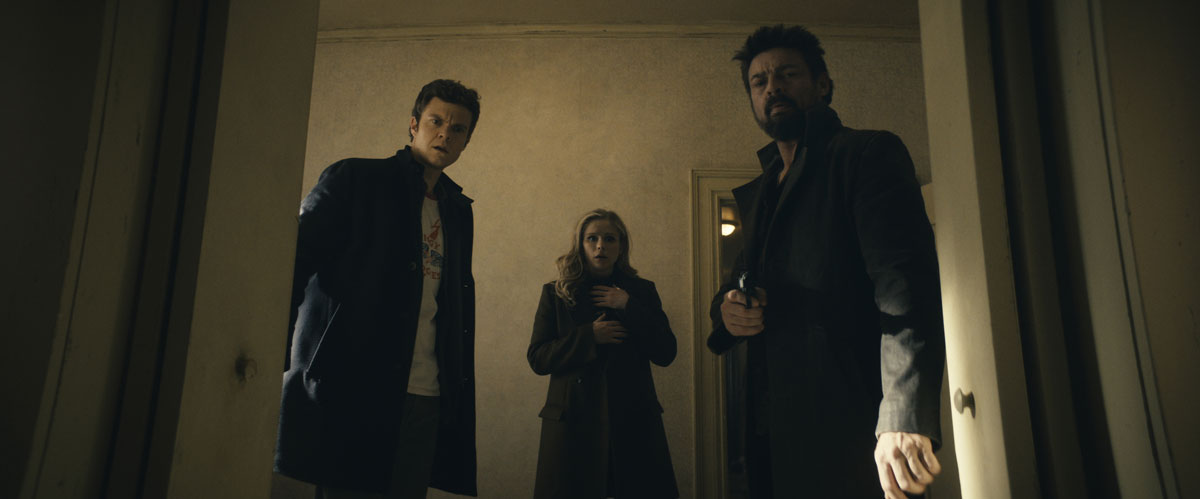
The BoysJack Quaid (Hughie Campbell), Erin Moriarty (Annie January aka Starlight) and Karl Urban (Billy Butcher) on "The Boys" (Prime Video)
Genre fiction traffics in extremes that make certain scenarios seem impossible. But nearly all such work is influenced by events that have already happened or are happening someplace on Earth. Just not here. Never here. And that is how people who should know better, like my colleague, can confidently dismiss concerns that these doom-filled stories might actualize as baseless.

My memory of that conversation turned over in my head as I rewatched the fourth season finale of “The Boys.” The Prime Video series made headlines on Thursday when the episode went live with a new “Viewer Discretion Advised” title card that also reads, “This episode contains scenes of fictional political violence. Any similarities to recent events are completely coincidental and fictional. Prime Video, MGM Studios, Sony Pictures Television and the producers of The Boys oppose, in the strongest terms, real-world violence of any kind.”

The finale, which was filmed in 2023, was originally titled “Assassination Run.” In light of the July 13 assassination attempt on Donald Trump at a Pennsylvania rally, it is now simply called “Season Four Finale.”

I’ve already written about the fourth season’s uncanny prescience and brazen anti-Trumpism for which the series’ creator Eric Kripke does not apologize. “I clearly have a perspective, and I’m not shy about putting that perspective in the show,” he told The Hollywood Reporter in June. “Anyone who wants to call the show ‘woke’ or whatever, that’s OK. Go watch something else. But I’m certainly not going to pull any punches or apologize for what we’re doing.”

Kripke declined to talk about the finale with Salon, and a request to Prime Video for an interview with the episode’s writers Jessica Chou and David Reed went unanswered. 

The finale’s title is not worth discussing in depth beyond the unsettling coincidence in its timing. Other movies and TV shows have had to postpone their debuts or rename episodes in light of violent tragedies, most of them related to school shootings.

“The Boys,” however, is an outsized apologue of the worst-case ending that is the product of outsized political rhetoric, years and years of it, that demonizes anyone that doesn’t agree with you.

Nearly all genre fiction is influenced by events that have already happened or are happening someplace on Earth. Just not here. Never here.

Kripke, Chou and Reed are simply expanding what they already knew about our partisan atmosphere in 2023 to its darkest end. What I wanted to ask them is whether they consulted Project 2025 as they were writing these scripts. It's not as if they needed to, since most of what these superhuman overlords say and do are slight variations of what Trump promises at his rallies, along with Fox News pundits' talking points.

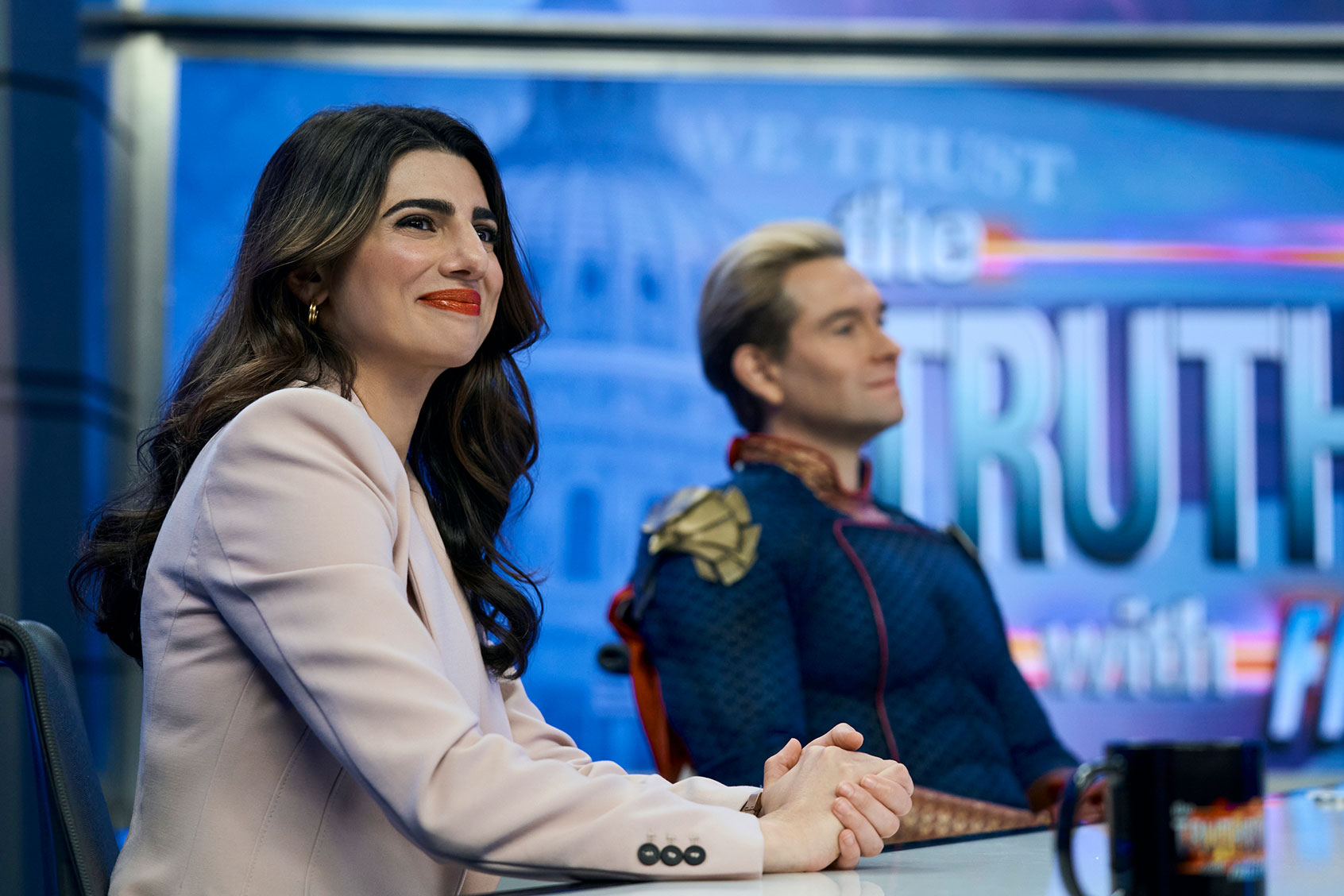
The BoysClaudia Doumit (Victoria Neuman) and Antony Starr (Homelander) on "The Boys" (Prime Video)
Homelander and his Congressional allies also have a vast propaganda machine devoted to portraying them as heroes, or at worst wrathful (but just!) gods and their critics into demons. Topping that list is Starlight (Erin Moriarty), a former member of Homelander's team who defects to become the face of progressive dissent. Firecracker paints her as a "baby-killer" and a pedophile to her Vought News viewers, inviting them to hunt her supporters, called Starlighters. 

The nation’s wealthy conspire with them to build and operate internment camps into which any dissenters opposing their oligarchy can disappear.

“Season Four Finale” shows the culmination of those plans, dropping in on the show’s version of Jan. 6. The House speaker moves to certify the election results making President-elect Robert Singer (Jim Beaver) the new Commander-in-Chief with Victoria Neuman (Claudia Doumit) as his Vice President. Elsewhere the show’s non-powered vigilante heroes are moving quickly to take out Neuman since they and Singer know she’s actually a Supe.

They’re also aware she’s working with the show’s Trump stand-in Homelander (Antony Starr) to invoke the 25th Amendment, placing her in power and giving Homelander a green light to hunt his "enemies," starting with Singer.

We need your help to stay independent

But the top hero isn’t content to let events occur as planned and outs Neuman as “super-abled” on national television, sparking riots across the country.  While this is happening, a shapeshifter assassin pretending to be Starlight tries to kill Singer in his bunker.

The chameleon nearly succeeds before the actual Starlight emerges from her imprisonment and dispatches her impersonator. But it’s all for nothing since they record Singer talking about his plan to take out Neuman.

That clip leaks to the press right after The Boys’ ousted leader Billy Butcher (Karl Urban) murders Neuman, setting in motion Homelander’s master plan. Singer is arrested, the Speaker of the House is named president and by executive order declares martial law, naming Homelander the country’s top cop.

His first act is to hunt anyone who threatens his reputation, or that he just doesn’t like. He and the three remaining members of his squad The Seven begin his purge by murdering half of his company's employees.

“The Boys” promotes the belief that most people harbor good intentions while understanding that is not enough to save us.

Before she’s killed Neuman warns him that for his plan to work, he must take out half the country, a task easily handled once he deputizes everyone with powers. A handful make quick work of The Boys, who are swiftly renditioned despite their best efforts to disappear before everything goes sideways on a global scale.

This happens as the backdrop to Vought Network talking head and Christian fascist Firecracker (Valorie Curry) theatrically celebrating this violent regime change with her 2024 version of “It’s Morning in America”:

“We wake up to a new world where hope, purity, and Jesus’ love shine down on us all,” she says, “. . . Where America finally sees the woke mob for what it is: monsters who want to destroy our heritage, traffic our children and feminize our men. Where, with Homelander’s guidance, we will come together in unity.”

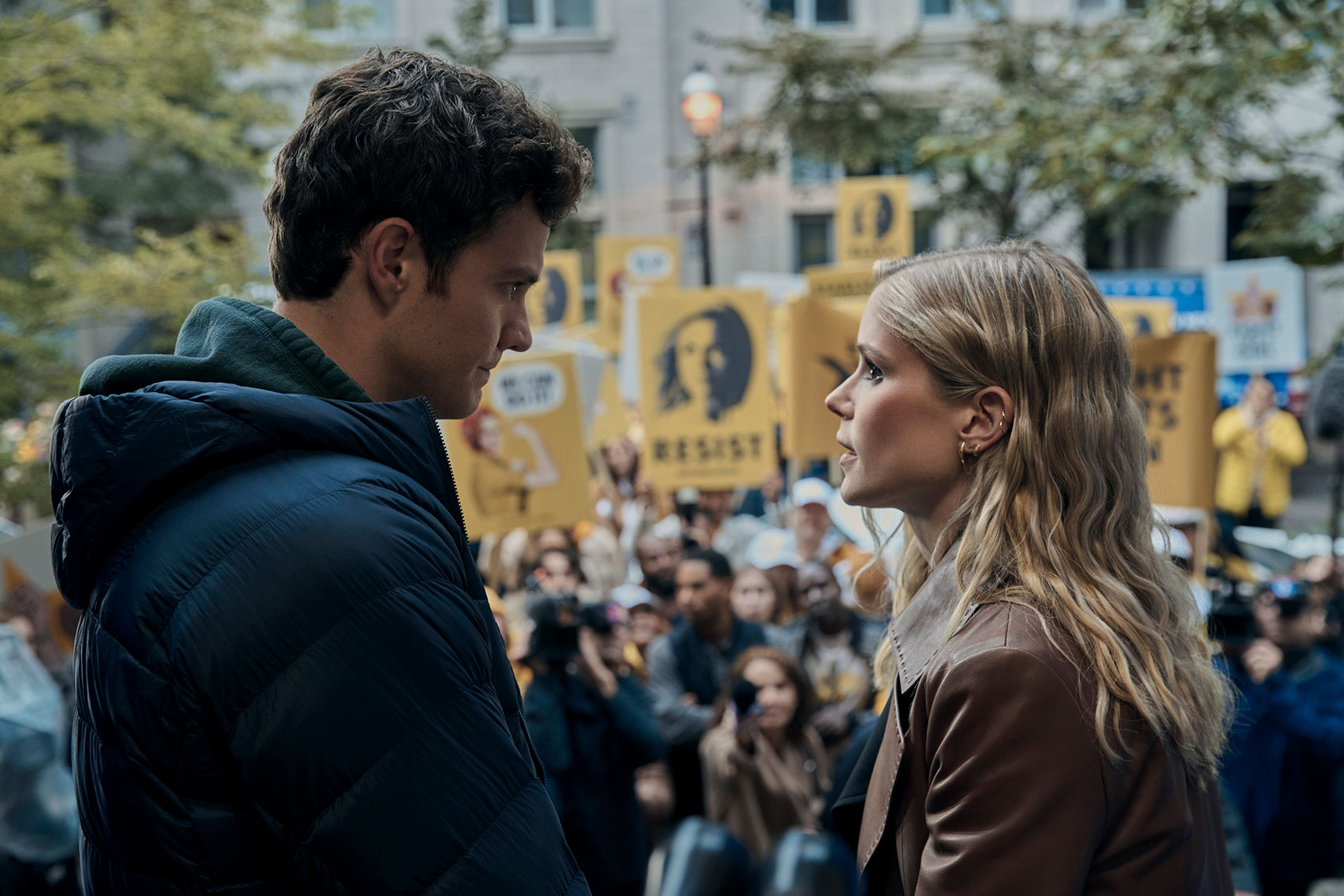
The BoysJack Quaid (Hughie Campbell) and Erin Moriarty (Annie January aka Starlight) on "The Boys" (Prime Video)

There it is again, the recurring buzzword at last week’s Republican National Convention in Milwaukee. Of course, as Salon's senior politics writer Amanda Marcotte observed after interviewing convention attendees, Trump's followers interpret "unity" in all kinds of ways while denouncing Democrats for reminding the public of Trump's statement that he would be a dictator "on day one,"  and citing his followers' readiness to embrace fascism and violence.

Supporters like Heritage Foundation president Kevin Roberts, who declared on Real America's Voice network that "we are in the process of the second American Revolution, which will remain bloodless if the left allows it to be."


Want a daily wrap-up of all the news and commentary Salon has to offer? Subscribe to our morning newsletter, Crash Course.


It may have been easier in the past to simply view “The Boys” as nihilistic escapism or somehow comfort ourselves by pointing to its impossible components as evidence that our society would never fall that far. This is despite many people citing our culture’s love affair with superheroes as a symptom of our willingness to associate wealth and celebrity with suitability for leadership.

The “if/then” game of speculative writing is devoted to reshaping the possible into situations the reader or viewer can assure themselves aren’t real and never could be. But these latest chapters of “The Boys” contain too many correlations to current events to not view it as a warning.

Even so, this fourth season of “The Boys,” its penultimate, promotes the belief that most people harbor good intentions while understanding that is not enough to save us.

This is the conclusion its everyman hero Hughie (Jack Quaid) lands on when their chances of survival have diminished to nothing. “If we’re ever going to win against monsters,” he says, “I think we need to start acting human.”

That only works if those aligned against you don't get off on inhumanity. Our last view of Hughie shows him being stuffed into a windowless truck by people in black uniforms. He signals to his fiancée Starlight to fly away, not fight. With that, she flings herself into the endless unknown, throwing her lot in the rest of us.

All episodes of "The Boys" are streaming on Prime Video.

Biden honors civil rights supporter Sheila Jackson Lee, dead at 74, as right-wingers celebrate

When the news began to circulate this weekend that Rep. Sheila Jackson Lee (D-TX) died on Friday night from pancreatic cancer, the response to her passing created a metaphorical scale, with Democrats heaping thankfulness for her work as a civil rights supporter on one side, and right-wingers like Laura Loomer tossing disrespect on the other. Still, Loomer's efforts and those of others like her didn't tip the scale much.

Among her many achievements throughout her career, Jackson Lee is perhaps best known for helping to lead federal efforts to protect women from domestic violence, and for working to make sure that Juneteenth will forever be recognized as a national holiday, which President Joe Biden took time from his period of convalescence, after being diagnosed with COVID, to recognize.

“I had the honor of working with her during her nearly 30 years in Congress,” Biden said in a statement Saturday. “No matter the issue — from delivering racial justice to building an economy for working people — she was unrelenting in her leadership.”

And while Biden and most others of a right mind view Jackson Lee as “a towering figure in our politics,” as the president describes her, Loomer, a white nationalist and MAGA enthusiast, went on a racist tirade to smear her name.

"Even on her death bed, this ghetto b***h couldn’t keep President Trump’s name out of her disgusting mouth," Loomer wrote in a post to X on Friday. "I’d say rest in peace, but we all know lying democrats who have destroyed our country are going to hell. Sheila Jackson Lee will be remembered as a destructive force in America and one of the most low IQ members of Congress in the history of our nation. Today she died. Instead of spending her final moments with her family, she was talking s**t about Trump on X and spewing more lies. She won’t be missed. But, I’m sure she will still be voting Democrat this November. Good riddance!"

As The Daily Beast points out, Loomer doubled down on her remarks Saturday afternoon, adding: “I meant every word I said,” and “everything I said about Sheila Jackson Lee is true.”

In the face of Loomer's hateful words, many others flooded social media to heap praise upon Jackson Lee.

"We loved Sheila Jackson Lee. Her legacy will live on in all the good she did and all the people she inspired to follow in her footsteps," writes Hillary Clinton in a post to X. 

"Congresswoman Sheila Jackson Lee was a tenacious advocate for justice, a tireless fighter for the people of Houston and the people of America, and a dear friend for many years," adds VP Kamala Harris, in a post of her own. "She was relentless — one of our nation’s fiercest, smartest, and most strategic leaders in the way she thought about how to make progress happen."

Palestinian chef Fadi Kattan on food waste, sustainability and the Palestinian-Israeli conflict

Chef Fadi Kattan, whose new cookbook "Bethlehem: A Celebration of Palestinian Food" was released in May, says that he "couldn't understand and I still don't understand what's happening" in his home country, referring of course to the ongoing Israeli offensive in Gaza.

Kattan doesn't mince words, his immense passion and love for his country suffusing every word in our conversation. He says that he has "no words to describe the horror" and even sometimes "lose[s] the focus on what I'm trying to do." 

As he puts it, though, "I still live in Bethlehem and for me, telling the story through food is telling the diversity of the Palestinians." 

For Kattan, who comes from "one of the oldest Christian families in Bethlehem," championing Palestinian cuisine is one of the most important things. He discusses the varying terroir (the coast, the desert and the inland), the standout ingredients, what caused food to be so important in his life — both personally and professionally — and why food waste management and cooking sustainability are "not something new" and are something that have been practiced for generations. "It's not a trend," he says. 

"What I have to say is cook Palestinian … wherever you are," Kattan tells me, adding that he hopes people can "entertain the hope that we have that my book doesn't become an archeology history book, but is actually just a step in celebrating a lively civilization." 

Bethlehem: A Celebration Of Palestinian Food by Fadi KattanBethlehem: A Celebration Of Palestinian Food by Fadi Kattan (Photo courtesy of Hardie Grant North America)

The following interview has been lightly edited for clarity and length.

What does it mean to you to celebrate Palestinian food, especially in the current moment? 

Celebrating Palestinian food is telling the story: the story of our culture, our identity, our traditions, but also the story of our perseverance, our attachment to the land, our attachment to those flavors, sharing it, sharing it with the world, and in those moments, in those horrible moments of a genocide happening in front of our eyes. It was very confusing in the beginning to cook, to celebrate the cuisine, but at the same time, I think it's a necessity. We have to be able to tell the story.

I'm sure there's a notion of frivolity to discussing food and ingredients at a time so full of strife, suffering and death. How do you reconcile with that? The book has come out at such a pivotal moment. 

It has been very difficult. The first few weeks after the 7th of October, I couldn't cook. I couldn't imagine cooking, I couldn't understand and I still don't understand what's happening. 

I have no words to describe the horror. We all have friends, family, people we know in Gaza and seeing the silence, the silence of many, too many, progressive liberal, cultivated people in the world in front of this horror, seeing the violence that's happening on the ground, but also the public discourse. Violence is suffocating. It is heartbreaking, it is infuriating and talking about food and ingredients and producers and artisans is quite a challenge emotionally. It is an emotional roller coaster.

I sometimes lose the focus on what I'm trying to do, which is to actually just say, we are there, we exist, we are human like anybody else, we're people that have a long history of everything and that long history includes food, that we are people that love life, like any other people.

I'll steal words from a Palestinian poet, Rafeef Ziadeh, that we teach life. I think teaching life is about always despite the darkness, having hope that humanity will prevail, that this madness will be stopped. 

BethlehemBethlehem (Elias Halabi)

The book says that “cooking is how I tell Bethlehem’s story.” Can you speak a bit about that? 

I grew up in Bethlehem. I still live in Bethlehem and for me, telling the story through food is telling the diversity of the Palestinians. I imagine that people dining with us or cooking from Bethlehem. The book, it will evoke the alleyways, it'll evoke the old stones. It'll evoke the vibrant feel in the market. It'll evoke the scent of spices. It's telling that journey. It's telling that path of food in my city.

Can you talk a bit about your family and your history in Bethlehem, both from a food context and within a larger perspective? 

My family's one of the oldest Christian families in Bethlehem. They've seen a lot. They've seen hundreds of years of beauty and of challenge. They've seen the Ottoman occupation, the British occupation, the Jordanian presence, the Israeli occupation. They've seen the Intifadas, they've seen the genocide today and in spite of this, we stay. We stay because that's where we come from. That's where our roots are. That's where our story has been made and is being made.

"Palestinian cuisine is very much inscribed in the land of Palestine."

We've also left at different periods of time. My grandparents on my paternal side went to Japan and then India and the Sudan. On my mother's side, my grandfather grew up in France. He was born in Bethlehem, but grew up in France and those are not exceptions. Those are common stories that Bethlehem families have. I have at a larger scale, so cousins once and twice removed in some 79 countries, it's the people that have lived with history, with the roots, with the spice routes, with the trade routes, with the cotton route, with the souvenir route, the religious artifacts, all of that, and that's all led to people's travel. Now with the food context, I've grown up in my parents' house and my grandparents on both sides with a lot of different influences. 

As a kid, I had maybe as much French food as Palestinian food, as Indian curries, as Italian food because of all these aunts and uncles being a bit all over the world — and I'm talking about aunts and uncles of my parents. From the empanadas of San Salvador to the bracciole of Italy, to the curries of India, to the French cuisine, all of that was very present because that traveled with the family also.

Are there any standout go-to ingredients that you prioritize within Palestinian food? 

Sumac, zaatar, olive oil, laban jameed and those other champions of Palestinian cuisine. 

Communal dish in PalestineCommunal dish in Palestine (Ashley Lima)
For those entirely unfamiliar with Palestinian cuisine, what would you say are its trademarks, its signature ingredients, its ethos? 

Palestinian cuisine is very much inscribed in the land of Palestine. To make it simple, we have three terroirs: the coast, the inland, which is the olive and fig landscape, and then the desert expands and the cuisine is designed around those three terroirs. It comes from that land, so the ethos of it is very, very short seasons that represent the season of Zatar, the season of spinach, the season of squash, the season of apricots and so forth, and that's the rhythm of that cuisine. 

The signature ingredients come regionally. In Gaza, it'll be chili and dill. In Hebron, it'll be lamb meat. It'll also be a lot of grape derivatives, grape molasses, dibes. In Bethlehem, it'll be meat. It'll be dried yogurt. Laban jameed that comes from the bedouin tradition that's in proximity of Bethlehem. It'll be also vine leaves. It'll be arayes up north. It'll be goat yogurt instead of the dry yogurt, and the trademarks is a reflection of that land. It's a cuisine that's very, very close to the land.

We need your help to stay independent

Do you have a favorite recipe in the book? 

All the recipes are my favorite. I designed all recipes with an approach of being able to be cooking them, to be able to make them easily, and that is the essence.

Would you say there's a good starter recipe in the book for those looking to prioritize or highlight Palestinian food? 

I would say the easiest recipe in the book is the fig recipe, where you just slice a fig in fourths and sprinkle it with some olive oil and sumac.

For me, each mouthful is saying Palestine, and then from that, people can progress to slightly more complicated recipes, but none of the recipes are too complicated. I've designed all of them for people to be able to replicate and not only replicate, but also adapt. What comforts me is people using local seasonal produce, and that is essential for people to feel that they can adapt the recipes.

What stands out for you as a formative moment that got you into cooking or food at large?

Growing up in my grandmother Julia's kitchen, growing up in my mother Micheline's kitchen, the excitement of seeing the produce turn into delicious recipes, the excitement of hospitality, of seeing the house, being prepared for receiving guests, helping out, laying the table, helping out, preparing the food, all of those moments are moments that have really marked me and got me into wanting to cook. 

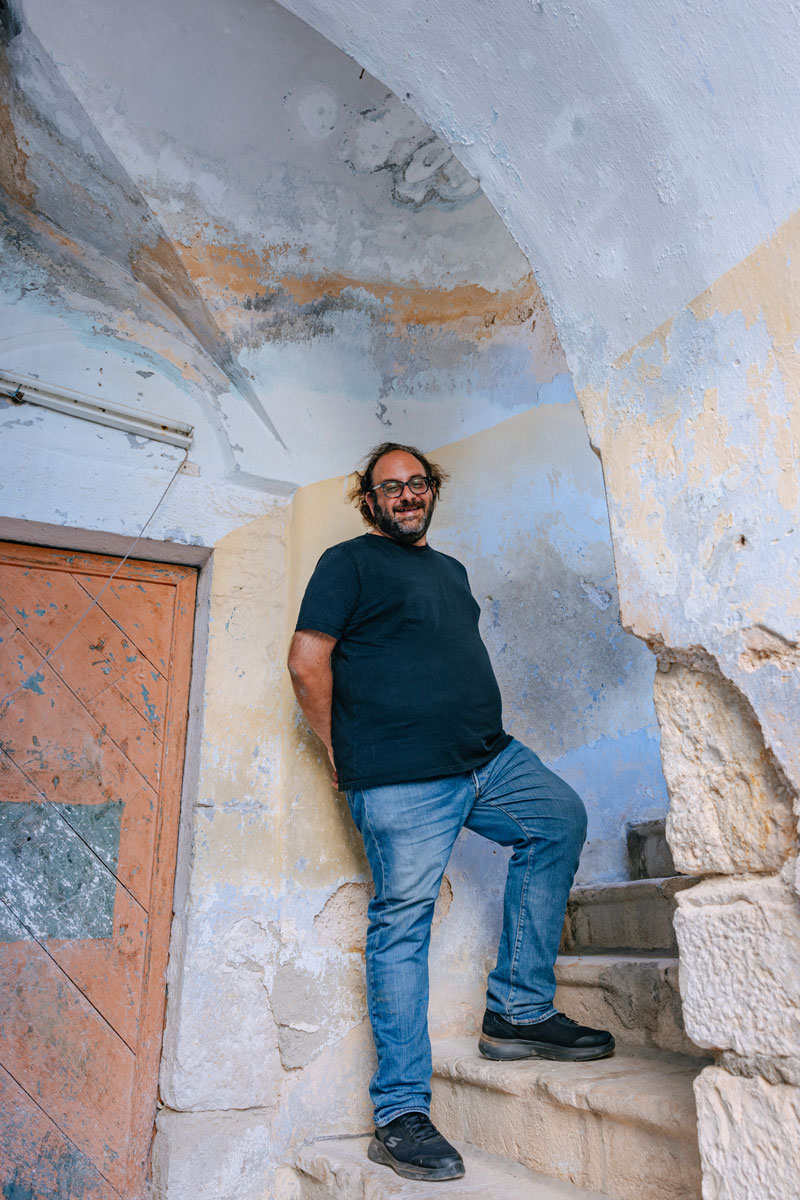
Fadi KattanFadi Kattan (Elias Halabi)

Do you have any tips for cutting down on food waste? 

Food waste management is not something new. It's not a trend. It's what our great grandparents used to do. When I peel vegetables, I use the peels to make a broth. When I buy meat, I buy it with a bone and I use the bones to make broth when I have leftovers and I rarely do. I have to think of how to use them.

I'll give you an example: The base of labaneh is fantastic because that creamy acid labaneh could actually take any topping on it, and you can just think of how to integrate whatever salad leftover you have, whatever herb leftovers you have onto the labaneh. You can do the same with freekeh. I very often cook freekeh and make a salad out of all the bits and pieces that I still have in the fridge. That earthy smoky flavor of the freekeh carries well a lot of flavors and it's easy to adapt.

How do you practice sustainability in your cooking and recipes? 

I only source locally. Everything that is fresh in my recipes and in my cooking is sourced very locally, whether it's in London, Toronto, Bethlehem or Paris or wherever I'm cooking. I also make sure that all the producers are sustainable, and in that sense, I look at farmers that are growing in a sustainable scale, but also in a responsible manner.

"That emotion of sharing food with everyone is important."

I will always prioritize not using a specific cut of meat because in Palestine, we're lucky at the butchers you can take a quarter of a lamb and then use every bit in it differently. Then again, nose to tail is not something new. That's what we practice in Palestine every day and we've been doing it for hundreds of years.

Those are, for me, the essences of sustainability and of course managing waste. I always aim to have one and a half to 2% waste maximum, and in that approach we can all make compost. I do compost, we can all recycle. I don't use plastic, and all of that's very important to be able to maybe somehow give back what we owe to the planet.

What's your favorite cooking memory? 

There's so many of them, but I'd go to a very recent memory. I cooked at the Refettorio in Geneva; the concept it offers is a paying lunch and then in the evening, dinner served for people from fragile backgrounds.

Cooking for people at large without any sense of who has to pay and who doesn't have to pay because you are just sharing that moment of pleasure is one of my most powerful memories. That emotion of sharing food with everyone is important.


Want more great food writing and recipes? Subscribe to Salon Food's newsletter, The Bite.


It’s obviously really difficult to prioritize or highlight tourism in Bethlehem or Palestine right now, but can you speak a bit about Kassa, the boutique hotel in Bethlehem?

Kassa is a passion project that was developed with Elizabeth Kassis, who's a Palestinian-Chilean. Her family bought what was originally their family home in Bethlehem before they immigrated to Chile in 1936, and she came up with this vision of our collaboration to create a boutique hotel, six rooms, the most upscale Bethlehem has to offer. In Kassa, it's a lot of other things. 

It's highlighting Palestinian and Chilean artisans. It's offering the space inside the old city where people can stay and then go discover the city. What is great is they have a little map of the city that actually doesn't show tourism only. It shows where you can buy the best breads and where you can buy the best vegetables and herbs, and the idea is to have people stay longer in Bethlehem and actually discover all of that beauty of the city.

In speaking with Palestinian bakers, butchers, etc., how are they doing both professionally and holistically? It must be so challenging to focus on their business amidst all of that's going on.

You may have seen the short videos where when I went back home with the first copies of the book. I went to see the people I work with and who are in the book and I gave them copies of the book. What you haven't seen is the amount of tears and pain that we share because of seeing this genocide happening, of seeing the settler attacks in the West Bank, of seeing everything we believe in being threatened to disappear, everything that makes us who we are: those olive trees, the vineyards and the whole beauty of Palestine being so threatened.

I know when I talk to the winemakers we work with — and there's fantastic wine makers in Palestine — they share the same fear as the artisans, the butchers, the bakers, the farmers. Again, we've seen very recently another enormous land grab by the Israeli government in the Jordan Valley. Those thefts of land in Palestine by the Israeli government and by the settlers are scary.

What's happening in Gaza, it's been nine months that Palestinians are being massacred. The world's not willing to stop this, so we all have this fear. Professionally, it's a disaster. Bethlehem has seen tourism disappear on the 7th of October because people are no longer coming out there, and that's thousands and thousands of people who have lost their jobs, but the impact is also on all the purchases than from bakers, from butchers, from farmers . . . from everybody. 

We don't have any social support from the government and therefore people who lose their jobs technically lose their income and go from an income to zero income. Nine months is a very long time. It's extremely worrying. The Palestinian economy is collapsing and that impacts everybody I love back home. 

Palestinian TetaPalestinian Teta (Elias Halabi)

Tell me a bit about Teta's Kitchen. How did that come to be? Have you connected with any of the women since?

Teta's Kitchen came with a collaboration with an organization called PIPD, and it was just at the end of the COVID Pandemic. I had the time. They also wanted to create something where we tell the story of Palestinian food, and it was an incredibly emotional period where I was lucky to go into people's homes and cook with them. Also, in the case of the episode with Gaza — physically, as a Palestinian from the West Bank — I'm not allowed by the Israelis to go into Gaza, and this was way before the 7th of October, so we had a crew filming with in Gaza and I was in Bethlehem. 

Very emotional moments of seeing that splintering of our country into pieces — disconnected. Every episode was very powerful, and then there was one in homage to my grandmother Julia, where I revisited her home that I haven't really been to much since her passing. I think that's the episode I can't really watch because the reason I cook is her. The reason I enjoy hospitality is her, and I hope I did justice to her in that episode.

I have connected with some of the tetas, most of them, but as you can imagine on the 8th or 9th of October, I tried calling Um Jayab, who's from Gaza, and luckily she was abroad. She was visiting one of her children that lives outside and she's safe. I wish I could say the same about every person in Gaza.

What would you say were some of the main takeaways from Ramblings of a Chef? 

Ramblings of a Chef was the radio show and then the podcast that I started with Radio Alhara during the COVID Pandemic. It was incredible to see the support of people who are just curious, who were locked up at home, across the world, and people who are just curious about Palestinian food.

I also have to thank every cook chef, food writer who's accepted to be interviewed by me. Then, I did it quite rudimentary, using a phone, editing quite badly. Didn't know much about editing sound, and it was a great adventure, but it also allowed me to connect with a lot of people in thinking on how important food is for us.

How do you differentiate between Akub and Fawda? 

Akub is in London. I cook with Palestinian flavors and British produce. It's very different than Fawda. Fawda didn't have a menu. I would cook with whatever farmers had in Bethlehem, and so there are two different ways of telling the story of Palestinian cuisine and they're both exciting.

Is there anything else you'd like readers to know about Palestinian cuisine or the current conflict? 

It is not a current conflict. It's an ongoing 76 years of occupation and it's an ongoing genocide. It's not a conflict. The conflict is between two countries. What's happening, and that's not me saying it's international law, it's an ongoing occupation of Palestinian lands. It's the forced occupation on us by the Israeli government. 

I have a lot to say about this, but I'd say one thing and it's a request for people who are reading this: Please don't fall in the trap that this Israeli government has said to equate what is happening on the ground to people's faith. This is not about Judaism, Christianity and Islam. This is a state called Israel that was created in 1948 on our lands without our consent that today is conducting a genocide against our people in a long context of 76 years of ongoing occupation, in breach of every international law, in breach of every UN resolution, and again, it's not me saying it. Look them up. Look at the UN resolutions. They're there. That's the international law that governs and should govern all of us as humanity.

About Palestine cuisine, what I have to say is cook Palestinian, wherever you are, and entertain the hope that we have that my book doesn't become an archeology history book, but is actually just a step in celebrating a lively civilization that's been going on for thousands of years, and that hopefully will go on for thousands of years in a more just humanity.

Former White House physician details the extent of Trump’s assassination attempt injuries

On Saturday, Donald Trump and JD Vance held a joint campaign rally in Grand Rapids, Michigan — the first public rally since Trump's assassination attempt — and although appearing to be in plucky spirits otherwise, Trump still wore a bandage on the ear that was injured in the July 13 shooting in Pennsylvania.

On the same day that Trump spoke to a crowd about a number of his favorite topics — such as the "fake news" media, President Xi being "brilliant" and sharks — former presidential physician Ronny Jackson released a letter detailing the full extent of Trump's injuries from the attempt on his life over a week ago, revealing that while he did not require stitches for the ear that was said to have been grazed by a bullet, it does still bleed from time to time.

In the letter, Jackson writes that he has “evaluated and treated” Trump’s 2 cm wide wound on his ear daily, which he believes to have been caused by the track of a bullet “that extended down the cartilaginous surface of the ear," going on to specify that "there is still intermittent bleeding requiring a dressing to be in place.”

As The Washington Post highlights in their coverage of the letter, Jackson — who is only authorized to practice medicine in a military facility — also noted that the trauma initially caused bleeding and swelling, but that the swelling has since resolved and the wound was beginning to “heal properly.”

Weighing in on Trump's injuries in a conversation with CNN’s Wolf Blitzer on Friday, Former White House chief medical adviser Dr. Anthony Fauci referred to the damage to Trump's ear as a “superficial wound.”

“I mean, from what we’ve seen and what we’ve heard, it was … a bullet shot that grazed his ear and injured his ear . . . I don’t think there is much more to it,” he said.

This aligns with the information in Jackson's letter which, all in all, negates the alternative theory that Trump's injury was caused by flying debris. 


Those magic half-hours at Lozano Car Wash, where my dad was all mine

Every year on the day my father died, I get my car washed at a beloved Bay Area spot. Turning off El Camino Real in Mountain View, I pull into Lozano Brushless Car Wash. When we used to enter the forest green girders of this mid-century modern space-agey car wash, my father was present, wholly mine for a magical half hour.

As an adult, I kept this ritual: I drive up to the attendant and ask for a full-service wash and vacuum. She hands me a ticket and while I wait for the row of cars ahead, my muscle memory takes over: roll up the windows, cram any loose bobby pins and pens into my purse, check the windows again, pop the trunk. I turn off the radio blaring the classic oldies my father used to play when he was the driver and I his joyful passenger, trusting of wherever he would take me.   

After relinquishing my keys, I walk to the pay station, grabbing a coupon from the cracked plastic brochure holder that’s been there since my father began bringing me here when I was a small child. He had been going for decades — the business opened in Mountain View in 1957, a few years before he arrived in California at the age of 17 from northern Iraq.

While in line to pay, I watch children take turns on the coin-operated Sandy horse. “Ride the Champion 1 ¢” reads the turquoise sign under the peeling chestnut lacquer of the hooves. This was my original ride, a vehicle of my childhood imagination that could carry me anywhere I wanted to go.

In the early 1990s, my father owned a car dealership, and when anyone asked him where to clean their cars, this is where he sent them. They’ll never ruin your paint, he’d proclaim in that charming way he had of stating opinions as facts. 

By the time my 2007 Mercury Milan emerges into the light, my eyes are full of tears.

In the partially enclosed waiting area, parents stand on both sides of me, hoisting their kids onto their shoulders to watch the cars glide through the tracks of swishing cloth towers. I remember the way my father would teach me about different cars as they emerged through that dark tunnel. The makes, the models, the mufflers that could furnish even the junkiest car with an impressive sound — how every detail felt like a secret he was revealing just to me, his only child.

Coming to Lozano’s was our weekend ritual for much of my childhood, before my father abruptly shut down his dealership and became a different sort of businessman — a “financial consultant,” he told me. I didn’t know what that meant except that he wasn't around as much anymore. He left for Europe on a business venture when I was seven years old, and I sobbed under my covers for hours after we dropped him off at the airport. Almost every morning he was gone, we talked briefly on the phone after I read the newspaper comic strips, and I would ask him when he was coming home. He always said, “soon.”

It took me a year to realize he was lying to me, and it took him two years to come back — for a little while, anyway, before he began traveling again. Whenever he was gone, the car would get washed in our driveway, where my mom used a single bucket of warm, soapy water, a bottle of glass cleaner, a squeegee, and faded cotton T-shirts to wipe the streaks away, narrating each step along the way.

Childhood photo of the author with her fatherChildhood photo of the author with her father (Photo courtesy of Natalie Jabbar)

Passing through the waiting area, I see families crowded around the retro red popcorn wagon. They fill those crinkly carnival bags with buttery kernels and pour lemonade into small Dixie cups. Even without drinking the phosphorescent liquid, I can taste the sweetness of the artificial syrup I once savored. By the time my 2007 Mercury Milan emerges into the light, my eyes are full of tears. The air is heavy with the smell of soap and cleaning sprays, and I walk outside to where my shiny sedan is being wiped down and dried by two attendants. I thank them and hand each the cash tips that were folded in my back pocket, just as my father had taught me.

For a while, I had stopped going to Lozano’s after sharing the recommendation with a friend and an online review led me to a local news article about some trouble there. I remember my heart sinking when I read that the U.S. Department of Labor reported that the car wash was cheating workers of their wages on slow business days, forcing the business to provide back pay to 270 workers who had labored there between 2006 and 2008.

“Your car is so filthy it looks stolen,” my father mumbled to me repeatedly during his final visit in 2013, when he returned to the Bay Area so I could take care of him through cycles of chemo and radiation. Before he was diagnosed with oral cancer, I barely saw him every few years as he continued his itinerant international quests. “Please go to Lozano’s,” he slurred. Ss and Zs were challenges for his reconstructed tongue.

Lozano Car WashLozano Car Wash (Photo courtesy of Natalie Jabbar)

And so, I started going back. It was only two blocks away from the Residence Inn where he stayed during his treatment. I would drive there sometimes after leaving my father tucked in bed, his shrinking five-foot-six-inch frame engulfed by an extra-large cotton T-shirt, baggy basketball shorts. The car wash was my escape to a place where it felt like nothing had changed, where I could re-imagine the father whom I chose to take care of even though he had abandoned me time and time again for reasons he could never honestly explain.

I used to go to Lozano’s to remember a time when I could be lifted onto my father’s shoulders without knowing what else they carried.

After he died, after I placed his ashes in the Pacific Ocean — where it could wash away his radiated mouth, his poisoned blood, the stench from the gaping hole stretched across his cheek after the last clinical trial, so deep I could see his jawbone — I would return to Lozano’s every July 24.

But Lozano’s isn’t Lozano’s anymore. On the Monday afternoon after Father’s Day this year, I drive up to an almost-empty lot. The trademark retro armature of the original Lozano's still stands, though painted a brighter Kelly green. Everything else is gone. In preparation for this July, the tenth anniversary of my father’s passing, I thought I would try the new automated wash that finally replaced Lozano’s after it closed a few years ago.  

An attendant in black dress pants, a white short-sleeve button down, and a tie asks if I want the $10 or extra bells and whistles $15 wash. He swipes my credit card from the window and tells me I will stay in the vehicle for the entire wash, pointing me to the second attendant on my journey. “I used to come to Lozano’s all the time with my dad,” I start rambling out unconsciously as he nods at me, clearly the recipient of much nostalgia. The second attendant guides me onto the tracks, tells me to put my car in neutral, and waves me off.

For the next three minutes I submit myself to the automated wash. The world beyond my windows disappears as soapy water streams down the dash. I feel suffocated and claustrophobic, and my heart rate accelerates as the terry cloth towers batter my car from all sides, and I experience my deepest fear: a loss of control. I am not prone to panic attacks, but I’m on the verge of one as my brain begins imagining all the things that can go wrong in this sudsy storm surrounding me. Arcs of green and red lights flash as my car moves down the tunnel. Drying vents affixed to massive undulating columns blast air until every rivulet of water disappears.

When my car shifts off the tracks, and I switch into drive to exit the lot, my limbs continue to tremble. Nothing about that experience felt neutral. A new kind of grief washes over me. Not only for my father, but for the men and women with their drying rags and scented sprays, for the salty popcorn, for the connection I felt in that space, a space where past became present and present became past, a space I chose to love despite its flaws.

Like Lozano’s, only never held accountable, my father was shady in more ways than I can divulge in one essay, not the least of which was devouring my mother’s life savings and never paying her back, not even years later when they divorced and he finagled a way out of it without owing her a cent. Not the least of which was abandoning my mother both times she had cancer, leaving us to take care of each other — when I was only eight, and again when I was 14 — to pursue who knows what. There were stretches of time when I could barely look him in the eye, when I kept him at arm’s length to protect myself. But I loved him, too.

For years, I used to go to Lozano’s to feel close to my childhood. I used to go to Lozano’s for ablution. I used to go to Lozano’s to remember a time when I could be lifted onto my father’s shoulders without knowing what else they carried. Yet it feels right that the space has changed as much as my life has. I was 27 years old when my father died a decade ago. I know in my bones now that sometimes grief is as much a feeling as it is a place, and I will miss that car wash where sentiment and landscape collided.

However, I no longer need to visit Lozano’s every July 24 to bring back a simpler version of my father. I miss the tender dad who used to take me there, who cared for me in the small, splintered ways he could. But I cannot scrub away the sullied enigma who hurt me in the colossal, copious ways he did. Each of those fathers shaped me. Today, I remember them both.

The week America was undoubtedly at its worst

The late Gore Vidal explained that one of his ambitions as a historian and novelist was to determine “when the great cretinism began in the United States…when people got really dumb.” While there is plenty of room to debate the origin, it is beyond dispute that we’re living in peak cretinism. 

The attempted assassination of Donald Trump has exposed America at its worst – not only dumb, but hysterical, cowardly, and sickly sentimental. It has placed in the spotlight a dysfunctional political culture incapable of performing the heavy lifting necessary to maintain a vigorous democracy at precisely the moment when democracy is under assault. 

The blood of Trump has washed away the sins of the right-wing world.

As if everyone on the planet were mere props in his solipsistic dream, Trump seized the moment of the failed assassination attempt, ordering the Secret Service agents to “wait.” He then struck his heroic pose. Media reaction was instantly one of awe, with commentators ranging from Fox News’ Sean Hannity to CNN’s Van Jones, praising the image as “iconic.” It is rare to hear anyone point out the obvious: irresponsible It was irresponsible for Trump, who did not know if a second shooter was taking aim, to endanger his audience and those sworn to protect him for the purpose of creating the ultimate photo-op. 

Neil Postman wrote in "Amusing Ourselves to Death" that “entertainment is the supra-ideology of all discourse on television.” Trump gave the world a Hollywood-like moment of entertainment, transforming a disturbing escalation of political violence into a cinematic climax. Mainstream media commentators joined the queue with their popcorn.

Despite Trump surviving, with even his wounded ear intact, the assassination attempt was fatal for Corey Comperatore, a retired fire chief who was struck by a bullet when using his body to shield his wife and daughter. The heroism and tragic death of Comperatore has proven inconvenient for the Republican Party. While clamoring to celebrate Trump’s fist-pumping pose, leaders of the GOP, have added a new story to the “God Bless the USA” Lee Greenwood Bible – The Miracle of Butler. 

We need your help to stay independent

Donald Trump said that “God alone” spared his life. Senator Marco Rubio bowed his head and tweeted that “God protected President Trump.” On the first night of the Republican National Convention, Senator Tim Scott referred to the events in Butler, Pennsylvania as a “miracle.” What kind of miracle includes Corey Comperatore violently dying in front of his wife and child? Perhaps, God is not good at multitasking. Clearly, the Republican Party is equally poor at demonstrating sensitivity to the deceased and bereaved.

Trump did not call Helen Comperatore to offer his condolences until July 17, four days after her husband’s death, and after criticism of his callousness went far and wide on social media. 

Given that the Republican Party had already morphed into a cult of worship surrounding Trump, the shedding of blood – a favorite Biblical trope – will only solidify his standing as a messiah. The mainstream media has questioned none of the idolatry surrounding Trump since the assassination attempt. 

If the Hollywood ethos and religious nonsense were not enough to turn American culture into a madhouse, the abundance of borderline-insane conspiracy theories will do the job. Immediately, countless political observers on the left took to their social media feeds to announce that the assassination attempt was “staged.” Photoshopped pictures of the Secret Service agents smiling as Trump posed went viral. The news that the shooter, Thomas Matthew Crooks, appeared in a Black Rock commercial also excited millions who appear to believe that the entire event happened according to some diabolical plan to make Trump appear immortal. Could even the greatest marksman in the world intentionally graze the ear of a man standing over one hundred yards away from the barrel of the gun?

Questions like these are never asked by those who believe that the “Deep State” can engineer complicated events, down to the most meticulous detail, but still cannot create an efficient health care or public transportation system. 

Mike Rothschild, an expert on conspiracy theories, wrote about the prevalence of left-wing conspiracy theories following the assassination attempt. He described Trump as an “accelerant” of leftist conspiracy thinking, just as Barack Obama and Hillary Clinton, were accelerants for conspiracy theories on the right. Processing information through conspiracy theories, Rothschild explains, risks filling “the gaps in our understanding with garbage rather than simply [sitting] in a lack of understanding.”

The right-wing was no better than the left, but the key difference is that its conspiracy lunatics included members of Congress.

Rep. Mike Collins, R-Ga., asserted that Biden “sent the orders” to have Trump killed. While it is not a conspiracy theory, other members of Congress, including Senator Marsha Blackburn of Tennessee and, most significantly, Senator JD Vance, who is now Trump’s running mate, blamed Biden and the Democrats for the assassination attempt. They claim that the “incendiary language” of accurately calling Donald Trump a “threat to democracy” pushed the would-be assassin to act. 

They also revealed an inability or refusal to deal with metaphor by arguing that Biden’s innocuous statement to donors – “It’s time to put Trump in the bullseye” – was partially responsible. Lester Holt, NBC news anchor, brought up the “bullseye” comment to Biden when interviewing him on Monday night, suggesting that it “contributed” to the volatility of our age. Holt became the team captain in the media’s game of feigned ignorance and real timidity. Ignoring that, even according to the FBI, the overwhelming majority of political violence comes from the right, media hosts, like Holt and CNN’s Jake Tapper, who has called for “everyone” to “lower the temperature," have turned dangerous rhetoric into a “both sides” issue. 

The blood of Trump has washed away the sins of the right-wing world. Donald Trump himself mocked the attack on Paul Pelosi, which almost took his life, made light of the plot to kidnap and kill Michigan Governor Gretchen Whitmer, saying, “maybe it wasn’t a problem,” encouraged the Proud Boys, a hate group dedicated to political violence, to “stand by,” and most infamously, told the would-be insurrectionists on January 6 to “walk to the Capitol” and “fight like hell.”

In his response to Holt’s shallow interrogation, Biden showcased why the majority of his party’s voters would like him to drop out of the race. He struggled to find examples of Trump’s incitement, stumbled over his words, and said things like, “I’m not the guy who challenged an election.” 


Want a daily wrap-up of all the news and commentary Salon has to offer? Subscribe to our morning newsletter, Crash Course.


Thomas Matthew Crooks, the shooter actually responsible for the crime, appears to have had no political motive. He was a registered Republican, but once made a donation to a progressive organization. The FBI revealed on Wednesday that it found images of President Biden, House Speaker Mike Johnson, House Minority Leader Hakeem Jeffries, Fulton County DA Fani Willis and former New York City mayor Rudy Giuliani on his cell phone. Lacking patience and the willingness to “sit in our lack of understanding,” JD Vance baselessly claimed Biden’s “rhetoric led directly to President Trump’s attempted assassination.” Trump named him as his running mate days later. Self-important wind puppets like Bill Maher, merely hours after the shooting, declared that the assassination attempt “damages the left.” One might have noticed that since the background information about the shooter cannot “damage the left,” the mainstream media has all but dropped the story, barely mentioning his name. Also absent from post-Butler coverage are the names, James Copenhaver and David Dutch, the two men injured by gunfire. 

Media outlets, including Axios, are declaring, without evidence, that Trump is a “changed man.” He has told America to “unite,” without explaining what that means, and has selected a man as his running mate who called January 6th insurrectionists “political prisoners” and promotes the racist and antisemitic Great Replacement Theory. But he was shot in the ear. So, we must take him at his word. 

On CNN, the Miracle of Butler appears to have led to a few conversions. Dana Bash, while reacting to JD Vance’s weird speech, which mixed endless paeans to Trump with macabre drug-related tales, said that his discussion of economic policy was “stunning.” Turn the channel to MSNBC, and you’ll find a network that refused to air “Morning Joe” on Monday morning out of fear that a host or guest would make an insensitive comment regarding the attempt on Trump’s life. NBC News’ coverage of the RNC, meanwhile, called it “so notable” that Republicans have made a post-shooting “shift” in rhetoric on a night when signs demanding “mass deportations now!” filled the convention hall.

The final night of the cult gathering combined embarrassment and bigotry. It was as if a fifth-grade Mussolini acted as director. Hulk Hogan, tearing open his shirt and declaring the rise of “Trump-a-mania,” drew a standing ovation. Kid Rock leading the crowd in chants of “Fight, fight!” and “Trump, Trump!” served as the culture segment. Dana White, the president of UFC, introduced Trump, challenging media complacency in coverage. 

A jury of his peers has found that Trump sexually assaulted E. Jean Carroll, and dozens of women have accused the former president of sexual assault and/or harassment. White was caught on video twisting his wife’s wrist and slapping her. Hulk Hogan’s ex-wife has accused him of domestic violence, which he denies. Night four of the Republican National Convention was the equivalent of the Democratic Party nominating Harvey Weinstein for president, and asking P. Diddy to introduce him. CNN and the major newspapers failed to note violence against women in their response to the concluding events of the RNC. 

As far as Trump’s speech is concerned, his delivery was Castro on quaaludes – rambling for 92 minutes about everything from Hogan’s “entertainment” skills to “the late, great Hannibal Lecter.” He resurrected the racist chestnut, “China virus,” when referring to the Covid 19 pandemic, and likened Latino immigrants to drug dealers, rapists, murderous gang members, and the world’s most famous cinematic cannibal. He accused Democrats of “destroying our country,” making special mention of “Crazy” Nancy Pelosi, and lied that the 2020 election was “rigged.” 

In the beginning, he said, “The discord and division of our country must be healed,” slurring the word, “discord.” The Boston Globe, Dallas Morning News, and Chicago Tribune lead their stories on the speech with headlines describing Trump’s call for unity, while the hosts and commentators at CNN, who had spent all week predicting and promoting a “new Trump,” struggled to explain his narcissistic and dishonest exhibition of logorrhea. Most of them settled on the false assertion that it was a “great convention, but disappointing speech,” in the words of Van Jones.

Anderson Cooper took the gold medals in absurdity and phoniness when he called Hulk Hogan’s juvenile antics, “Extraordinarily compelling.” 

The only thing that is staged is happening without a script, but due to the ignorance and poor instincts of the two major parties, the mainstream media, and millions of voters. It is the further erosion of a responsible and thoughtful political culture that can strengthen democratic liberalism. Even the Democratic Party is playing along. In a pathetic move, the Biden campaign put its television advertisements “on pause” following the assassination attempt. 

Conspiracy theory, religious nonsense, media complacency, and Democratic gutlessness coalesce not out of a grand plan, but as a consequence of American failure. Democracy is in the crosshairs. 

Trump’s brush with assassination handed him his most powerful meme – and maybe even election victory

Last Saturday, former President Donald Trump joined his supporters in Butler, Pennsylvania, where he narrowly missed being assassinated. With a slight turn of the head, Trump’s ear was injured when he was shot at, which left him bleeding.

The gunman, identified as 20-year-old Thomas Matthew Crooks, fired off shots from an AR-15-style rifle, killing an attendee of the election rally and seriously injuring two others. Moments later, Secret Service agents shot and killed Crooks.

After the near hit, Trump grabbed his right ear and ducked behind the podium. A gaggle of agents clad in suits covered Trump with their bodies to protect him from being hit again. More shots burst through the crowd, causing chaos to break out.

Memes are a contagion for ideas with a potent ability to construct and disseminate political propaganda.

People screamed and crouched down, not knowing where to run. Some pulled out their phones to start recording the scene. As the agents tried to cart Trump down the stairs to safety, he abruptly stopped. He yelled, "Wait, wait, wait!! and proceeded to fist-pump the air several times in a sign of defiance. In response, the crowd began chanting "USA!" over and over again.

AP News photographer Evan Vucci captured the image of Trump, with an American flag blowing in the background, blood splattered across his face. The photo became an instant viral sensation, rapidly spreading across the internet in the form of a meme. Simultaneously, video footage of the scene surfaced, which was shared online to the same effect. 

People started editing photos and videos, creating more memes and snowballing impact. Videos of Trump were paired with 50 Cent’s "Many Men," a song about the rapper's own brush with death, comparing Trump to a gangster. Soon enough, 50 Cent performed the song live against the backdrop of an image of Trump’s face superimposed onto his body from the 2003 "Get Rich or Die Tryin'" album cover. 

In a video edit of Trump that has racked up over 262,000 likes, one commenter wrote, “Bro has infinite aura now.” According to Bustle, aura points are "all about the vibe or energy you give off." You lose them when people find you cringe and embarrassing and gain them when you are perceived as cool and confident. In his near brush with death, Trump scored innumerable aura points, catapulting him to god-tier levels of online infamy.

Memes are a contagion for ideas with a potent ability to construct and disseminate political propaganda. Capitalizing on his close call, Trump has effectively positioned himself as a powerful political force in the 2024 election. He’s ready to fight for America and even die for his country. 

“The doctor at the hospital said he never saw anything like this, he called it a miracle,” Trump told The New York Post. “I’m not supposed to be here, I’m supposed to be dead.” In the aftermath of major political events, people across the ideological spectrum will speculate on what happened and derive their own conclusions. In turn, countless conspiracy theories have proliferated online and have been shared via memes.

People have questioned why it took so long for the Secret Service agents to intervene, asking if the whole scene was a setup. Perhaps, the assassination attempt was carried out by none other than reigning President Joe Biden himself. Maybe Trump orchestrated the close encounter with death to win the election. Many have suggested that Trump is divinely protected and was saved by the hand of God.

We need your help to stay independent

Tucker Carlson has argued that the assassination attempt is evidence that a “spiritual battle is underway.” He’s even gone so far as to say that this is more than a political divide but the work of forces “whose only goal is chaos, violence, destruction.” If that’s the case, Trump is battling the devil and is the savior of Christian America.

All of this conjecture has oscillated heavily around a single moment, one likely to brew in the imaginations of Americans for many years to come. Even in a state of shock, Trump was media-savvy enough to know this moment was one to leverage, quite literally, for the history books. And this is all made possible through memes.

Donald Trump RNC screensFormer US President Donald Trump attends the Republican National Convention (RNC) in Milwaukee, Wisconsin, United States on July 18, 2024. (Jacek Boczarski/Anadolu via Getty Images)Memes are formidable when it comes to simplifying complex political and social commentary into easily digestible tidbits. Their ability to communicate ideology is limitless, as is their exponential potential to grow, mutate, and spread online. They transfer cultural units of information from person to person, often transcending political divides.
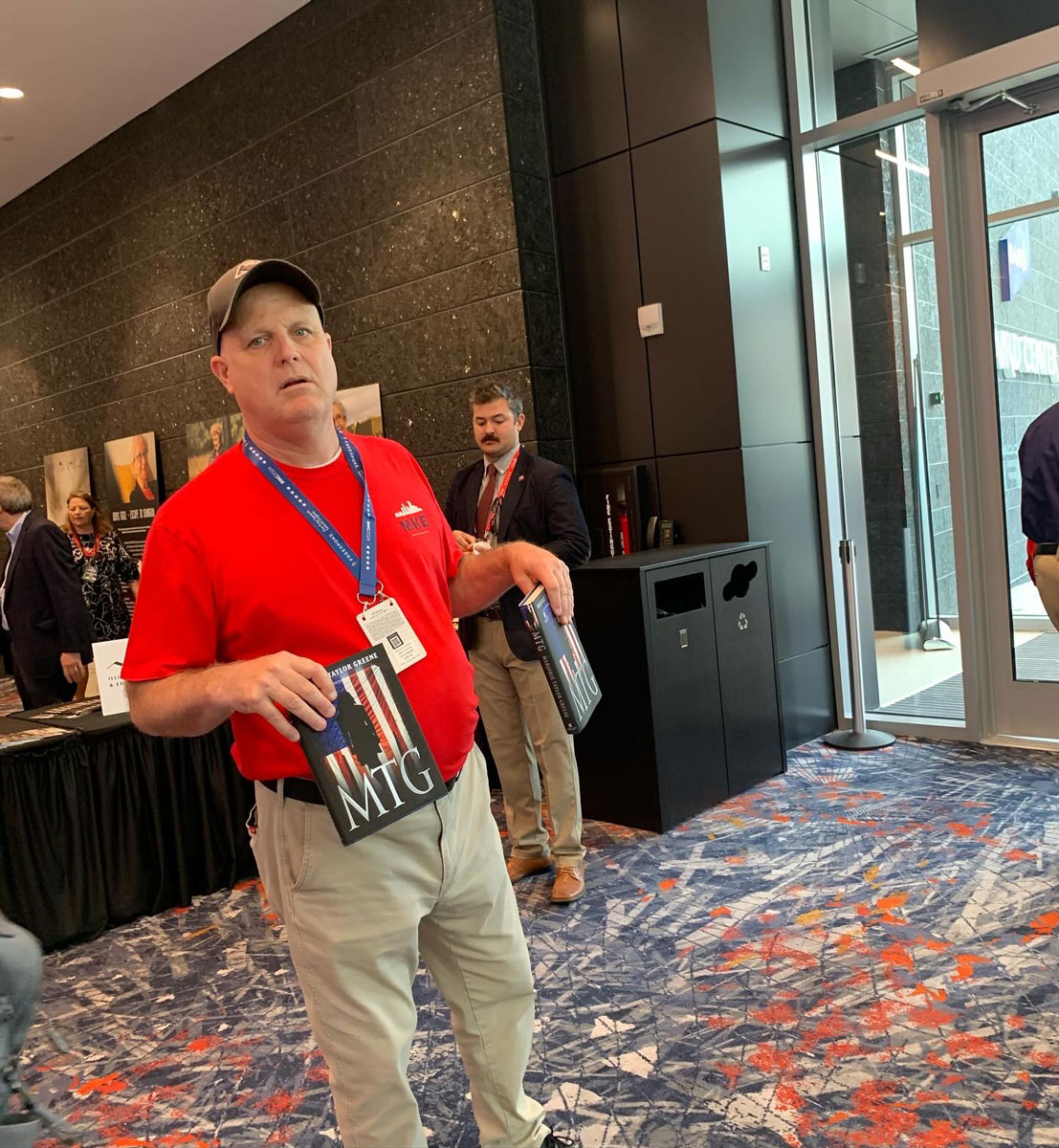
While this meme may be his most defining, Trump is no stranger to the art form. On his hit reality TV show "The Apprentice," Trump would yell "You're fired!" at contestants who were abruptly kicked off. The iconic phrase, a meme in and of itself, constructed Trump as a wealthy and powerful businessman who could destroy the dreams of hopeful candidates in an instant.

But memes have made Trump more than just a measure of masculinity and financial prowess in a bustling New York City. In 2016, he became the messiah to assuage the white fear of demographic change in America. This racist rhetoric, which posits that white people are being replaced or overtaken by those who are racialized, has had a substantive impact on politics. 

Across the political spectrum, white people have become increasingly conservative about topics including everything from affirmative action and immigration to defense spending and health care reform. Racial resentment has become so prolific that white millennials already voted Trump into office. And this same situation could be playing out once more.

During this first election campaign, Trump became a “mascot of anti-political-correctness” for disaffected young, white men on Reddit and 4chan. These online communities have turned into echo chambers for the most hateful ideas that exist. The alt-right has used memes to vocalize their most extreme opinions, stoke a Trump movement and enact real political change.


Want a daily wrap-up of all the news and commentary Salon has to offer? Subscribe to our morning newsletter, Crash Course.


In the meme wars, Trump has emerged as triumphant, time and time again. His political opponents in both the 2016 and 2024 elections have memetically paled in comparison. When facing off with Hillary Clinton, Trump nicknamed her “Crooked Hillary,” constructing her as a corrupt politician and unfit to lead. This year, Trump has deployed the same moniker, calling the current president “Crooked Joe.” 

Trump has weaponized memes to create the narrative that he is indomitable. Simultaneously, he has used them to attack Biden at every misstep. Biden’s cognitive capacity has been called into question, with many arguing he is too feeble of an old man to lead a nation. Just recently, Biden accidentally called Ukrainian President Volodymyr Zelenskyy "President Putin" while the two stood on stage together. While Trump and Biden are only three years apart in age, the gap in memeable discourse continues to widen.

As the election looms in the relatively near future, Trump’s most memeable moment may spell victory. Regardless of the outcome, Trump knows how to market his moment of peril to the masses. Whether he is the Rat King of the alt-right or a messenger of God, as far as memes go, Trump remains a political force to be reckoned with.

Sharks have weathered numerous mass extinctions. Will they survive us?

Sharks have undeservedly earned a bad reputation, striking fear in the hearts of many, who often describe oceans as "infested" with the creatures. But it's not technically possible for them to infest their own home. Indeed, sharks have roamed the oceans for 450 million years, producing giants like the Megalodon, the Otodus and the Ptychodus. For many ages of world history, sharks could be regarded as the unchallenged masters of the ocean.

With such robust evolutionary versatility, these cartilaginous fishes have survived not one, not two, but five mass extinctions in Earth's history. On geological timescales, nature regularly goes on killing sprees, wiping out countless species forever. But sharks have surprising resilience and have weathered the Late Devonian Extinction, which ended the "golden age" of sharks; the Permian-Triassic mass extinction that wiped out 90 percent of marine species; and even the Cretaceous-Paleogene Extinction, which famously wiped out the non-avian dinosaurs about 66 million years ago.

Despite how resilient sharks may seem, though, they may not be able to dodge the fate of the dodo or the passenger pigeon. Human activity, which seems to be driving a sixth mass extinction, is making it harder and harder for them to survive. It begs the question: Will sharks be able to outlive us?

Sharks have been getting a raw deal from humans for a long time. Almost sixty years before the classic 1975 creature feature "Jaws" scared moviegoers away from the beaches, President Woodrow Wilson infamously declared a "war on sharks" to retaliate against the species for a series of New Jersey shore attacks. Countless innocent sharks were slaughtered by hunters eager to claim state rewards.

As humans pump greenhouse gases into the atmosphere by burning fossil fuels, out-of-control heat waves are causing "weird" weather while killing thousands of humans. Sharks are also heavily impacted by these rising temperatures, as they inhabit an ocean that traps increasing quantities of heat causing sea levels to continuously rise and millennia-old ocean current patterns to shift.

"Temperature is the most pervasive climate change stressors on sharks, affecting their metabolic rates, distribution patterns and overall survival, as it influences every aspect of their physiology and behavior, from growth and reproduction to prey availability and habitat selection," Dr. Jodie L. Rummer, a James Cook University marine biology professor, told Salon. "Elevated water temperatures increase metabolic rates in sharks, necessitating higher food intake while reducing prey availability. For instance, a 3° C increase can significantly impact energy levels and recovery times of reef shark pups, making them vulnerable to predation and exhaustion."

The sharks aren't just tired from this global heating, they are also shrinking, less resembling the Hollywood "monsters" from "Jaws" and "The Meg."

"Warmer temperatures are causing sharks to grow to smaller sizes, which can limit their ability to swim long distances and migrate to new habitats as their current ones become unsuitable," Stockholm University zoology assistant professor Dr. Valentina Di Santo said. "Ocean acidification, driven by higher levels of carbon dioxide, affects the mineralization of shark skeletons. This makes their bones denser and heavier, reducing their buoyancy and increasing the energy they need to swim."

As if being punier is not bad enough, the sharks also become inferior hunters.

"Acidification also interferes with their ability to detect prey," Di Santo said. "These combined stressors not only affect individual sharks but also have broader implications for shark populations and the health of marine ecosystems."


Want more health and science stories in your inbox? Subscribe to Salon's weekly newsletter Lab Notes.


"Warmer temperatures are causing sharks to grow to smaller sizes, which can limit their ability to swim long distances and migrate to new habitats as their current ones become unsuitable."

Sharks are even vulnerable to global heating before they have been born. 

"Early life stages, such as newborn and juvenile sharks, are particularly vulnerable due to their narrow temperature tolerance ranges and the dynamic conditions of their coastal nursery habitats," Rummer said. "For example, epaulette 'walking' sharks, which develop in an egg (i.e., kind of like a chicken), show a reduced incubation time (i.e., from 4 to 3 months) under warming conditions, and those neonates hatch smaller, with less yolk reserves (energy), but with higher metabolic costs than their current day temperature counterparts."

Rummer added, "Finally, being K-selected species characterized by slow growth, late maturity and low reproductive rates, makes sharks more vulnerable to these changes, as they cannot adapt quickly enough (i.e., over generations) to keep pace with the rapidly shifting environmental conditions around them."

In addition to greenhouse gas emissions, sharks are endangered by human activities such as overfishing, pollution, habitat destruction and as the unintended victims of commercial fishing, or "bycatch," in which the become tangled in commercial fishing gear, leading to injury or death​.

"Sharks are heavily targeted for their fins, meat and liver oil," Rummer said. "The global shark fin trade is particularly devastating, with millions of sharks killed annually​." 

The animals also rely on habitats like coral reefs and mangroves that humans are destroying, all of which makes "it harder for sharks to find suitable breeding, nursery and feeding grounds​," Rummer said. Finally, "chemical pollutants and plastics accumulate in sharks, causing health issues and impacting reproductive success​."

Both Rummer and Di Santo agree that sharks are worth protecting because of their intrinsic value. Rummer works for The Physioshark program, which works to establish and protect marine protected areas and shark sanctuaries. Predominantly doing field work in French Polynesia, Rummer works in the world's largest shark sanctuary which "provides an ideal environment for studying and protecting shark populations without fishing pressures."

We need your help to stay independent

"My team’s work with newborn sharks in Mo'orea involves capturing, tagging, and studying these animals in their natural habitats," Rummer said. "These experiences deepen our understanding and commitment to shark conservation, highlighting the importance of protecting these vulnerable stages of shark life​. Since we have been doing this for over a decade now, we are starting to see the babies of our first babies, which is really remarkable."

She recalled several special moments: "Capturing a newborn shark that was probably born within the hour, learning to tell how old a newborn shark is by how much their umbilical scar (i.e., their belly button) has healed, using an ultrasound on a female blacktip reef shark to confirm she’s pregnant, and of course learning from Polynesians about the rich culture surrounding sharks."

Di Santo, by contrast, has a formative shark memory with which millions can immediately identify.

"When I was about three years old, my older brother thought it would be hilarious to watch 'Jaws' with me," Di Santo said. "I was absolutely terrified— For weeks, I was convinced there was a shark lurking in our bathtub. Over the years, I’ve been lucky enough to study many different shark species. While Hollywood loves to spotlight the great whites, I’ve gravitated towards the less glamorous, but equally fascinating benthic sharks (and stingrays and skates.) These bottom-dwellers might not get the same attention, but their unique locomotor adaptations (some can walk and swim!) are endlessly intriguing to a biomechanist like me."

Arab and Muslim media on the Trump shooting: Dark jokes, darker warnings

Editorials in many major newspapers in Arab and Muslim countries were relatively restrained in addressing the attempted assassination of Donald Trump, mostly focusing on the well-known problem of violence in America. Social media comments, however, were another story, often reflecting the widespread view of Trump as an enemy of Muslims — if not of Islam in general.

There were two widely shared theories: One proposed a mo’amara (Arabic for conspiracy) in which Iran, the most anti-American nation in the region, was behind the assassination attempt. Indeed, statements from top American intelligence experts that they were expecting “something” from Iran, although they didn’t cite anything specific, were seen as further evidence. 

The second involved masrahiya (Arabic for a staged event). In the 1999 film “Al-Walad Mahroos,” Adel Imam, an Egyptian actor known throughout the Arab world, played a security guard who is shot protecting a political candidate during an assassination attempt, but survives. The guard then exploits his injuries to gain sympathy and a level of popularity rivaling that of the candidate himself.

That popular comedy is often cited in Arabic-language social media as an analogy explaining Trump's apparent increase in popularity after the assassination attempt.

Many Muslims seemed convinced that Trump had staged the Pennsylvania incident: One commenter stated that since Trump was “al-Shaitan” (Satan or the devil), he was clearly capable of doing that.

As noted above, more serious commentary was found in some major newspapers, most of it about rising political violence in America, a country often seen as eager to enforce its standards on others.

One example came in an editorial in the National, an English-language paper in the United Arab Emirates: “The attempt on Trump’s life marks an odious moment in America’s darkening political cycle … The country has witnessed an unacceptable rise in political violence in recent years.”

The Gulf Times of Qatar was even more direct: “As ugly as it may sound, the attempt to assassinate Trump is somewhat normal, in the sense that it is consistent with a widespread pattern of recourse to brute force in American life.”

A columnist in Saudi Arabia's Asharq Al-Awsat sought to connect recent events to historical lessons many Americans seem eager to avoid: “Violence in America started with the annihilation of the original population by the White invaders … later, the importation of African slaves in bottom of ships as if they were animals.”

Many commenters on Arab and Islamic social media launched personal attacks on Trump, particularly focused on the “Muslim ban” from the beginning of his presidential term. 

Curiously enough, some Muslim commenters had apparently paid attention to comments made by evangelicals at the Republican National Convention in Milwaukee, used to make their point that Trump and his party are opposed to Islam. Commenters noted that Trump was described as a Christian martyr, who had been falsely accused and convicted just as Jesus was.

Here are two comments, originally written in Arabic in WhatsApp:

Everything shows Trump’s hate of Muslims. May Allah cause his hate to unite us, the Muslims, and wake us up from our present miseries.

Funny, the Jews enjoy the support of Christian Americans, not knowing the Christians want Israel to disappear, so Jesus Christ returns.

There were also many far more sober comments, suggesting that since Trump seems closer to regaining the White House after the assassination attempt, Muslims should expect another travel ban and other forms of U.S. government persecution.

JD Vance joked that the U.K. might become the first “truly Islamist” country with nuclear weapons. This provoked many angry responses from Muslim social media.

One comment on the Arabic-language site Elaf site cited Trump’s 2016 campaign promise to “get rid of radical terrorist Islam from the face of the earth.” A comment on Al Jazeera's Arabic site recalled Trump's proposal to institute an “ideological test” for Muslim immigrants and visitors to the U.S. A third comment, on the site Al-Itihad, observed that “the Americans, looking for an enemy after the fall of the Soviet Union, targeted Islam.”

Trump's infamous "Muslim ban” of 2017 was officially titled Executive Order 13769, “Protecting the Nation from Foreign Terrorist Entry into the United States.” It had numerous legal and logistical problems and never went into full effect. A revised order was issued and the list of countries affected kept changing; there were intergovernmental quarrels along with protests from U.S. allies in the Muslim world. President Biden revoked the entire package as soon as he took office in 2021, with Secretary of State Antony Blinken declaring that the entire affair was “a stain on our national conscience.”

Now Trump hopes to bring the ban back, eight years later. As part of his promise to act as a dictator on "day one" of his administration, he has told supporters he would immediately begin “ideological screening” for all immigrants and bar those who sympathize with Hamas and Muslim extremists.


Want a daily wrap-up of all the news and commentary Salon has to offer? Subscribe to our morning newsletter, Crash Course.


Many Pakistani social media posters, writing in English, said they expected further punitive measures from Trump in a second term. Several remembered this Trump tweet from 2018: “The United States has foolishly given Pakistan more than 33 billion dollars in aid over the last 15 years, and they have given us nothing but lies & deceit, thinking of our leaders as fools … No more!”

Commenters also noted recent remarks by Sen. JD Vance, Trump’s running mate, who suggested that under the newly-elected Labour Party government, the U.K. might become the first “truly Islamist” country with nuclear weapons. Vance's supposed joke, presumably intended as a critique of immigration, provoked many angry responses, both in Britain and the Muslim world. More moderate commenters simply observed that the Ohio senator had been chosen to continue Trump’s anti-Muslim policies into the next generation.

Some commenters also reflected on the apparent rise of Christian nationalism in America, noting that two-thirds of white evangelical Christians saw Trump as an ally in advancing their agenda and that new laws in Louisiana and Oklahoma, respectively, mandated posting the Ten Commandments in classrooms and teaching Bible lessons in public schools.

For many Muslims, the ironic question drawn from recent events in America seemed obvious: Who are the real extremists?

Priscilla Presley sues former business partners, claiming financial elder abuse

Since the January 2023 death of Elvis Presley's only child Lisa Marie Presley transferred the sole ownership of his estate into the hands of his granddaughter, Riley Keough, his ex-wife, Priscilla Presley, has been shuffled into a minor role, and she hasn't been happy about it.

Shortly after the death of her daughter, Priscilla filed a petition in Los Angeles Superior Court to contest amendments to a living trust that named her granddaughter sole trustee and removed her and former business manager Barry Siegel as co-trustees. Allowed to act as special adviser to the trust and receive a monthly payment for her role, Priscilla is back in court again, claiming "financial elder abuse" due to her ex-business partners and Priscilla Presley Partners, LLC leading to the misappropriation of more than $1 million dollars, forcing her into a "form of indentured servitude." 

According to the details of the latest filing, which were first reported on by TMZ and picked up by other outlets such as People, Priscilla's lawyer Marty Singer writes that ex-partner Brigitte Kruse left her high and dry by "gaining her trust, isolating her from the most important people in her life, and duping her into believing that they would take care of her (personally and financially)."

"This action arises out of a meticulously planned and abhorrent scheme by the defendants in this action to prey on an older woman," Singer adds in the lawsuit.

In response to the allegations, Kruse posted a Winston Churchill quote to her Instagram on Saturday afternoon and wrote, “The truth always comes out. Sometimes, you must stand still, pray for those that hurt you so deeply that it steals your breath, your words, breaks your heart and scars your soul. Trust that the good Lord will do the work. I pray for blessings everyday for those that truly need them (even if they have hurt me).”

As Vulture points out, Kruse sued Priscilla in October 2023, claiming that she "illegally walked away from their business partnership around the time of her daughter Lisa Marie’s death." 

Priscilla and Kruse, primarily an auctioneer, began their working relationship in 2021 after meeting via mutual friends and discussing ways in which Kruse could help to sell Elvis memorabilia. From there, Kruse was able to "fraudulently induce [Priscilla] into giving them power of attorney, control over her family and personal trusts, and control over her bank accounts," per the lawsuit. 

On July 25, GWS Auctions issued a statement regarding the allegations, writing, "GWS stands behind everything that it sells, and categorically denies trafficking in fake or inauthentic items attributed to Elvis Presley, or otherwise. Through innuendo, and without proof, a shadow has been unfairly cast over GWS and its operations after over 15 years of stellar service to its consignors, bidders, and buyers."

“The Grindr Super Bowl”: Gay dating app saw influx of users during Republican National Convention

The 2024 Republican National Convention was a veritable sausage fest, by all accounts, with Salon's Amanda Marcotte reporting in her on-site commentary, "Trump's GOP is no country for MAGA women," that mostly young men, not women, turned out to show their support for Donald Trump, JD Vance and all the other conservative big names this election year. But, according to reports from Newsweek and several other outlets, these young men were turning out for other men in a multitude of ways while visiting the Milwaukee area.

Grindr, the gay dating app launched in March 2009 — which quickly became the largest and most popular gay mobile app in the world — received outage reports from over 1,000 users in the Milwaukee area around 4 p.m. on Tuesday, according to Downdetector, a website that collects online service status information, as reported by Newsweek, with the outlet adding intel from an anonymous user who noticed way more profiles than usual.

"On any given day, you'll go on there and see a headless torso or blank profile," the man told the outlet Thursday, saying he "stopped counting at 50 anonymous profiles when he checked the app."

Former Republican Congressman George Santos weighed in on the reported Grindr outage in a video posted to social media, saying, "Grindr executives are calling the RNC convention the Grindr Superbowl."

"Let me tell you something: just come out of the closet boys. Come on, it's fun. You can be gay and conservative," he says in the video. "But look, Grindr is already outing you anyway based on the hits and guess who is in town? It's all you conservatives."

According to The Milwaukee Journal Sentinel

Grindr did not immediately respond to a request for comment about an increase in usage or reported outages during the 2024 RNC, and according to status.grindr.com, no operational incidents have been recorded by Grindr since May, when partial outages for the grid, chat and albums features were noted. In June and July, all Grindr features were 100% operational according to the app’s official status tracker.  

Blair Underwood embraces the demonic dark in “Longlegs” with Nicolas Cage

Blair Underwood terrified me last weekend to the point where my Sunday was ruined. 

Yes, I am talking about that Blair Underwood –– the Peabody, Grammy, Emmy Award-winning actor from “L.A. Law,” “Set it Off,” “Origin” and countless other film credits. And no, he didn't jump out of the bushes or pop up wearing a bright red MAGA hat on my social media timelines. I brought the terror on myself by going to see his new film “Longlegs.”

"Longlegs," written and directed by Oz Perkins, is a horror-thriller starring Underwood, Maika Monroe and Nicolas Cage, about a bizarre serial killer with a talent for recruiting unlikely accomplices. Underwood takes on the role of Agent Carter, a stand-up American boss who transitions from protector and hero to demonic adversary. 

After seeing "Longlegs," I met Underwood for a "Salon Talks" conversation. He carried his signature good-guy look — a stark contrast to his "Longlegs" character. If you've followed his career you know what I mean. He's typically the dreamy, clean-cut brother that mothers and fathers hope their daughters meet in college. In "Sex and the City," he played a doctor who treated Miranda with the utmost respect. In "Set it Off," Underwood courted, loved on, and swept Jada Pinkett Smith off her feet, even though she was using him to rob a bank.

Of course, he's perfectly capable of playing the bad guy, too, as he did in "Just Cause" and in other roles. But how many times have you found yourself rooting for his character's demise? I did in "Longlegs." My wife and I strode into theater with no expectations and were blown away by the end of Act One, confused but locked in by the end of Act Two, and as freaked out as we were terrified by the end of Act Three. We were not alone; "Longlegs" has been going viral since we left the theater and earned an impressive $22.6 million on its first weekend.

“$22 million is $22 million,” Underwood explained. “People say, 'Ah, it's not $100 million or $50 million.' But the thing is, for a horror film, that's an original story that was made for $10 million, to do $22.6 million the first weekend is phenomenal.” 

This is Blair Underwood's first horror film, but it won't be his last. He said he enjoyed the process of going dark. "It's a dark film," Underwood said. "You're dealing with satanic worship. I stayed prayed up before I went to work, and when I left work, I stayed prayed up."

Watch my "Salon Talks" episode with Blair Underwood here on YouTube or read our conversation below to hear more about his love for the horror genre and his upcoming new show, "Three Women," based on Lisa Taddeo's frank nonfiction book about real women and desire. He calls it his most "overtly intimate" and sexual role yet.

The following interview has been lightly edited for clarity and length.

"Longlegs" did $22 million over the weekend. Did you know it was going to be that successful?

No, no idea. You know, it’s become the story of the weekend. You know, $22 million is $22 million and people say, "Ah, it's not $100 million or $50 million," but the thing is, for a horror film, that's an original story that was made for $10 million, to do $22.6 million the first weekend is phenomenal. And a lot of that, it's based on the strength of Oz Perkins as the writer and director, definitely Nicolas Cage and his brand all over the world, and the rest of us bring what we bring.

I went and saw the film this weekend, and then my wife and I had to make two or three stops on the way home and we're telling people about, "Yo, we just saw this film," and people in a restaurant who we don't even know are like, "Oh, s**t, you're talking about 'Longlegs'?"

And the other cool part about it is that every person that we encountered, they all have their own takeaways or different things that they saw, that one scene that sticks out to them.

That's dope.

I'm not going to tell everything, but I'm just going to say: I don't ever want to hear a person sing “Happy Birthday” to me again.

What's dope about it is that Neon, who distributes the film, they were very smart in not showing Nic Cage's face.

I noticed that.

I should say, it's a film about a serial killer played by Nicolas Cage, who's a satanic worshipper, he's into the occult, and the female lead played by Maika Monroe is following him. I play Maika's boss. But you never see his face, so just the mystery of that and the film itself is so damn scary. So I think all those elements together have created this kind of surge and viral moment, which is exciting for all of us.

Agent Carter seems like a pretty solid guy, good guy to work with, good family man. Take us into his world.

"This is some creepy stuff."

Agent Carter, the character I play, is an FBI man, been doing it for years, playing by the rules and everything, and has a good instinct on the world and what he does and is good at what he does. And then this young woman, FBI agent, comes in and she's very intuitive. You saw the movie, so you know she's kind of very odd in the way she presents herself, but she's very deep in her thinking, and he clocks that in her. He says, "Well, she's onto something," because whatever she senses is right on point. So he rocks with it.

The chemistry was good. It seemed like you guys have been working together for a long time. Was it natural or was it something that you got a chance to build on set?

Thanks, man. No, it was natural. We had never even met before, but I think we have a very similar approach to the work, which is just do the work. It ain't that deep, it’s not curing cancer. You do your work, I do my work. And then when they say action, we play. And again, because you saw, it's a dark film. You're dealing with, like I said, satanic worship and some dark elements. I often say, which is true, man, I stayed prayed up before I went to work, and when I left work, I stayed prayed up.

It deals with so many demonic references. And I don't rattle easily at all, but when I left the film, I felt kind of heavy. Someone walked past my chair in the middle of the film and I thought it was Nicolas Cage. How does one prepare themselves to step into this world?

You know for me it was great that Oz Perkins was the writer and the director. This is a world, it's completely original, that he created. We're not taking from a "Saw" franchise or any other kind of franchise. He created this world and these characters. So as an actor, you walk into that world and he's the sounding board, all the answers are within him. So it's like, "What do you want? What are you looking for? What's the world?"

It always helps whenever you step into any kind of project, and I've been very blessed to have done many different genres, it always helps to get an idea of [the] visual. I'm a visual learner, visually to see, “What does the world look like?” And if you can see what it looks like, you can see what it feels like. So I came in three days after they were filming, so there were already some dailies or photos of what they shot. So I can look at this, "Okay, this is a different texture. This is eerie. You know, this is some creepy stuff."

It's like an advantage kind of, you get to just come in and you already see what’s happening.

It's definitely an advantage. And then you literally step into that world. If it's a Disney movie, it's going to be a whole different flavor.

One of the things that stood out to me in the film that separates it from so many other horror films: this whole underlying idea of family. How we need family, the dangers of not checking in and failing to properly nurture those relationships. Can you speak to that theme of the film?

Family, I think, is one of the most vital and critical and visceral dynamics you can put in a film. One of my favorite movies is “The Godfather.” It's a crime movie, it's an action film, but ultimately it's about family. And you get the same thing here. We were shocked. You asked if we were ready for this? Oz will tell you — we're all shocked, the response to the film. But then when I started talking to people who had seen it, one of the things that made it so eerie is that you're dealing with family, and I'm not giving really a lot away because they have a whole website, but the issue in this film is that fathers are killing their children and wives. Fathers are killing their families.

"Family is the most important thing to me."

So you look at something and see, Oz Perkins is the son of Tony Perkins, who's a star of Alfred Hitchcock's “Psycho.” One of the most iconic moments in cinematic history is Janet Leigh, the female lead, in a shower. Shower curtain opens, you see a knife, that's all you think of with “Psycho.” What made that so scary was the fact that you are your most vulnerable in the shower. You're butt-naked, you're wet, you're vulnerable.

Same thing with this movie. You're dealing with family. Where should you be the safest? In your home. Who should you feel safest with? Your father, your mom and dad. The strength in that, how the physical strength in that house is the father. So you put all of that in jeopardy and it gets under people's skin.

Yo, it's so bugged out. But I also want to congratulate you because you broke the stereotype. They normally kill the Black guy first.

In the first 30 seconds.

You held it down for us!

I made it through. I made it through.

You had some longevity.

I was like, "I'm going to do my first horror film, is the brother going to live? OK, cool."

Was that something that your agent had to go in and negotiate and say, "Look, we are interested, but he’s going to make it past Act One."

I was ready for it. We need more Black [horror] roles actually, come to think of it, so we all survive.

Yeah, but I feel like this is going to just open a door. I watch a lot of film, I watch a lot of television, I read this stuff and people who never have conversations about horror films, they're talking about it.

Wow, that's cool.

You mentioned you watched the film with your family, and your daughter in particular loved it. What was that like for you?

You know, it’s great. Again, family. Family is the most important thing to me so my wife Josie, and my three kids, were at the premier and they hadn't seen it. I hadn't told them a lot. I usually share everything with them as they walk through life, they see these experiences and…

Well, you just wanted to ruin their night a little. You wanted them to have a good night, but you wanted to freak them out a little bit.

Yeah, but wanted to freak them out a little bit, that's right, and did. Because [with] this one, I didn't tell them anything. And you saw the movie, so everything that happens in that third act at the end of the movie, they didn't see coming. But yeah, my daughter Brielle said, "This was one of my favorite projects, if not my favorite project you've done." And I think my boys co-signed on it, my two sons.

When you leave set, are you able to just shake it regardless of whatever role you're playing?

Yeah, not always, but a film like this, it’s harder to do because [of] those elements you're dealing with, you know those spiritual elements. The scary stuff, things jumping around the corner, that's funny — you know the mechanics of that. But it's the stuff that is real. And the ultimate message of this film really is that evil persists.

It's the ultimate battle between good and evil. Evil persists, but so does God. Goodness and righteousness persists. But those battles will always persist and that's what the message is at the end of this movie. I think that in and of itself is unsettling because you want to see evil just kind of beat down and be done with by the time the curtain goes down.

Your body of work is all over the place, you did everything. Like, I didn't even know you directed Tony Terry's video?

Yeah, “With You”.

Yo, “With You”!

[singing] "When I'm with you." I directed that 30 years ago, but that was our first dance when I got married in June, and he came in and sang it live, to her surprise.

"When I got the opportunity to play something dark and sinister, I jumped at the chance. I always loved playing bad guys."

Oh, that's fire.

We're talking about your wife buying your clothes, you buying her jewelry. I bought her Tony Terry for the day. I'm done for the next decade!

He still had a flat top or did he let it go?

No, he let that go. 

So did you imagine horror being part of your body of work? Because this is the first time you did a horror film, right?

Yeah, I did a satirical one, a comedic one called “Bad Hair” which was great fun to do, but this is the first time. Done a couple of psychological thrillers, “Just Cause” and “Asunder”, but nothing that is smack dab in that genre of horror.

What made you take the step?

I did “Krush Groove” in 1985. It'll be 40 years in this business.

Beautiful.

Thank you, thank you. And I thank God, literally thank God every day for that because I don't take longevity for granted. But the only way you can have longevity is to reinvent yourself and do different things. So to me, it's something different to try. And I'm a horror fan myself. I've never been in one until now, but I'm a fan of horror films.

Over the 40 years, what projects stick out?

The ones that challenged me. I'll say the next one, but the ones that challenged me the most.

That's such an actor answer from an actor.

Yeah, yeah. You know, the ones that you love. Really my favorite roles are the ones on stage. Playing Othello, doing “Streetcar Named Desire” here on Broadway, “Soldier's Play.” Film, probably “Just Cause” because that meant a lot to me professionally and personally. I played a serial killer, a pedophile. You didn't know until halfway through the movie, you think this guy's innocent. He does a twist on you. So because that was unexpected, because I wasn't allowed or given those opportunities for 10 years prior to that, when I got the opportunity to play something dark and sinister, I jumped at the chance. I always loved playing bad guys. They're the most interesting to play.

How has the industry changed since you played Denise's boyfriend on “The Cosbys”?

Man, you taking it all the way back. Yo, the biggest change is social media and everything that comes with this. This movie, “Longlegs,” they didn't buy any ads on TV. Everything was done [on] social media. A couple of billboards, they had like Nicolas Cage, half of his face and an evil number that you could call and then you hear his voice, but almost all of it was done through viral marketing. That was never the case before. 

People are probably going to want your skincare regimen. I don't think anyone's going to believe you've been in the industry for 40 years. A lot of times, when you get asked about aging in Hollywood. They talk about the pressures, but we don't really have that conversation with men. Did you think about that? Or you have that magical cream?

What did Chris Rock say? "Rich is the new lotion." But I'm not rich, so I can't really say that. So nah, of course you have that conversation because really, your body of work is your brand, but also what you present physically is your brand. So I just want to stay healthy before I can even get to the profession and what I do in front of the camera. I just want to stay healthy and I want to kick Father Time in his throat as often as possible and as long as possible.

A lot of people don't know about your activism. Could you talk about just the role of an artist and a person who cares about change and cares about us living in a country we deserve during these wild and crazy political times?

Yeah. I would tell you that my mentor, who's passed away, is the great Sidney Poitier. But I watched people like Sidney Poitier and Harry Belafonte, and they're very active, especially in the '60s and [the] Civil Rights movement. Harry Belafonte, really, his whole life. But I learned from them, watching them from afar as a kid and then getting to know them as an adult. And it just inspired me that you have a say.

Before we are artists, or maybe celebrities, you're a person, you're a citizen of these United States. You are a man of God, or whatever. But there are many different categories we are in addition to just being an artist. So because of that, we have the right to speak up. And then you have a platform — if you're blessed to have a platform — in front of cameras or whatnot and you can reach people, to speak to that audience. I don't tell people what to think, but I've been involved in a number of voting registrations. And just speak your conscience, but vote. Get involved in the system, in the process.

What's next for you?

The next thing is a series on Starz called “Three Women.” And this is deep, man, because I play the husband of one of the women played by DeWanda Wise. Her character's name is Sloan. 

Maryland chick. That's what's up.

Yeah, yeah, that's right. That's right. She's much younger than me. She's real frisky, the character, and she's very fluid. She likes to be with men and women. And our agreement is we're basically swingers — old term — polyamorous today. But my agreement is so you can be with whoever you want to, but I got to control it. I want to know. I want to watch and I might get involved. So it's drama. This is based on a true story. So it is going to funky because she's going to start dancing outside those realms. You know that's coming.

That's the conflict.

But I'll tell you, I've never done anything this overtly intimate or sexual and yeah, it was pretty wild. It was pretty wild.

Tasty haute couture: Why certain food and fashion collabs just make sense

Last month, luxury fashion line Kate Spade New York and Heinz, the food processing company best known for its ketchup, announced that they were joining forces to launch a limited-edition, saucy fashion collection. Dubbed “condiment couture,” the new line features tote bags and pouches resembling packets of ketchup, slip-on-shoes adorned with opened ketchup packets, t-shirts emblazoned with Heinz’s iconic typography along with small leather goods, key chains and phone cases.

“Kate Spade New York shares many values with Heinz — from creating products of the highest quality that are expertly crafted by masters and leave no detail untouched, to exhibiting true devotion to our fans,” Megan Lang, the head of global Heinz brand communications and creativity, shared in a statement. “In return, both brands have incredibly loyal fanbases that transcend generations. At Heinz, we love to celebrate the unique and unconventional ways our fans show their love for us, and this collection is the perfect opportunity to do so.” 

Although the partnership may seem unlikely, Kate Spade is no stranger when it comes to food-themed fashion. The designer brand boasts a strawberry milk printed crossbody, a coffee break tote, a silk tomato ketchup bandana, a snack pendant and gold-toned ketchup packet, fries and hot dog drop earrings.

“At Kate Spade New York, we believe in exploring the journey of self-expression through style in fun, unexpected ways,” Jennifer Lyu, SVP and head of design at Kate Spade New York, added in the statement. “It’s the thoughtful details that bring this collection with Heinz to life — from the embellishments on the tee and the way our 3D ketchup bag looks just like that classic red and white packet. The playful designs are perfect for all of summer’s special moments, capturing the spirit of the season.”

Kate Spade and Heinz join a growing list of food-fashion collaborations that have gone viral in the past decade. Ben & Jerry’s teamed up with Nike to launch their “Chunky Dunky” sneakers — a reference to “Chunky Monkey,” the ice cream brand’s famed flavor. Forever 21 partnered with Taco Bell to release a line of tops, bodysuits, sweatshirts and anoraks — all adorned with prints of the chain’s Tex-Mex-inspired food. Heineken joined forces with Japanese brand BAPE to create a series of streetwear. And Moschino once debuted a collection inspired by McDonald’s, in which models dressed like McDonald's employees and carried Golden Arches-emblazoned handbags on plastic food trays.

Back in 2022, Balenciaga partnered with Frito-Lay to debut its $1,500 leather clutch that resembled a crumpled, discarded bag of Lay's potato chips. Called the “L.O.L. Clutch,” the bag came in four distinct “flavors”: Classic, Flamin' Hot, Limón, and Salt & Vinegar. Each design mimicked the OG chip packets without explicitly mentioning the individual “flavors” on the bag.

The bag — part of Balenciaga's Spring and Summer 2023 collection — was introduced at the fashion house’s “Mud Show” presentation at Paris Fashion Week before going viral across social media. While most commentators poked fun at the bag’s ludicrous concept and its ridiculous price point, many expressed a craving for chips — albeit ones that didn’t exist.

“It's very upsetting to see a Hot Lay's bag when y'all don't have Hot Lay's in any store or even online,” one commenter wrote on the Lays Instagram account. “Like, we have enough of the other flavors […] and now we can't find [Hot Lay's.]”

We need your help to stay independent

Despite the disappointed reactions, Balenciaga’s clutch quickly became an online spectacle — both in the worlds of fashion and food. On the fashion front, the bag became a wacky yet unique it-accessory both on and off the runway (several sharp-sighted fashionistas spotted Balenciaga's creative director Demna clutching an empty bag of Lay's Original Wavy Potato Chips at the graduate show of Antwerp's Royal Academy of Fine Arts). On the food front, the bag spurred people’s craving for chips, namely Frito-Lay’s brand. 

The clutch’s initial launch proved to be so successful that Balenciaga released a new line of potato chip-inspired handbags. The bags come in three shades — yellow (cheese and onion), blue (salt and vinegar) and red (spicy chili) — all adorned with “Balenciaga” and their respective flavors in a bold font. Actor Michael Shannon was recently seen posing with the yellow handbag on the 2024 Met Gala red carpet.

“When done right, collaborations between food and fashion brands can expand their identities and consumer bases,” according to a blog post from Vyudu Inc., a digital marketing agency for some of the biggest names in fashion and beauty, including Brinker & Eliza, ASOS and Gucci. “They tap into the retail culture's appetite for exclusivity, offering limited-edition products that resonate with consumers.” 


Want more great food writing and recipes? Subscribe to Salon Food's newsletter, The Bite.


There’s also the “wow” factor — that secret sauce that makes a simple, everyday product stand out from anything ever seen before. In an age where likes, clicks, views, shares and re-shares reign supreme, it’s what makes a certain product gain traction and be all the more enticing amongst consumers.

Take for example McDonald’s line of custom-designed Crocs, which included a pair of clogs featuring Grimace, the infamous purple mascot behind the berry-flavored Grimace Shake and a macabre TikTok trend. Or the limited edition Oreo x Supreme snack, in which the iconic cookies were colored red and decorated with the Supreme logo on one side. There’s also the limited edition Pop-Tarts Crocs, which took the shoes to a new level with the addition of edible pins. The complete pack included a pair of Crocs Classic Clogs along with a box of Pop-Tarts and edible crocodile-shaped Jibbitz candies.

As for Kate Spade and Heinz, their $398 ketchup packet purse has already been declared an “accessory of summer” by Eater. The collaboration also taps into a sense of nostalgia, which can’t be said for other major brands, like Betsey Johnson or LC Lauren Conrad, that also came out with food-shaped purses of their own.  

“For people around the world, HEINZ + Kate Spade New York are everyday staples that elevate life’s moments — whether on your plate or in your wardrobe,” said Alexandra Lieberman, the brand PR manager at Kraft Heinz. “The partnership is inspired by the generations of fans that grew up alongside both brands and unites Kate Spade New York’s colorful, playful, and expertly crafted style with HEINZ’s iconic and unmistakable iconography and red color.”

“It’s not that complicated”: Pete Buttigieg on why a gay billionaire is backing JD Vance

In a segment of "Real Time with Bill Maher" at the start of the weekend, openly gay United States Secretary of Transportation and one-time presidential hopeful, Pete Buttigieg, was asked to lay out his thoughts on why Peter Thiel — gay billionaire and former CEO of PayPal — has supported JD Vance's political career thus far, despite Vance's anti-LGBTQ+ stance.

Buttigieg offers a simple explanation: Money follows money.

"I think it's a profound contradiction, but maybe it's not that complicated," Buttigieg says. "I know there are a lot of folks who say, 'What's going on with these Silicon Valley folks veering into Trump world with JD Vance, and backing Trump?' . . . We've made it way too complicated. It's super simple. These are very rich men who have decided to back the Republican party that tends to do good things for very rich men."

Following Trump's announcement at the Republican National Convention that Vance is officially moving forward as his pick for VP, publications like USA Today did some digging on Vance's financial backers and found that his ties to Thiel go all the way back to 2011, when Vance was a student at Yale Law School and Thiel was a venture capitalist, going on to donate $15 million to support Vance's campaign to win a seat in the U.S. Senate.

"I knew a lot of people like him," Buttigieg said of Vance, looking back at his own Ivy League days spent at Harvard. "I found a lot of people like him who would say whatever they needed to, to get ahead. Five years ago that seemed like being the anti-Trump Republican, so that's what he was . . . Five years later, the way he gets ahead is that he's the greatest guy since sliced bread."

Using Mike Pence as another example of someone who he initially knew as having very different values than Trump, but embraced him in order to get power, only to be offered up as a sacrifice at the end when he held on to "the last shred of integrity he still had" during the events of Jan. 6, Buttigieg hopes for a better outcome for Vance's run as vice president, should his chosen team win.

"I hope things work out a little bit better for JD Vance than they did for Mike Pence," he says.

Watch here:

Harris tries to rescue campaign from fundraising pitfall, as donors drop Biden

Vice President Kamala Harris called 300 top Democratic donors to urge them to get back on board after party elites turned against Biden’s continued candidacy, following his debate performance.

The VP, who has taken an increasingly central place in the campaign amid reports that top Democratic opponents of Biden want her out, too, rejected the idea that Biden’s battle was un-winnable.

“I will start by sharing something with all of you,” Harris reportedly told donors, per an anonymous listener who spoke to the New York Times. “Something I believe in my heart of hearts, it is something I feel strongly you should all hear and should take with you when you leave. And tell your friends, too. We are going to win this election.”

Harris' call, which featured LinkedIn founder and Democratic donor Reid Hoffman splitting from an increasingly MAGA-backing Silicon Valley, was focused on winning back donors to the cause.

The message of optimism comes amidst deeply mixed polling, with some counts suggesting the president could lose multiple key swing states without a dramatic change. 

Biden, one of the most economically left presidents in modern American memory, has faced severe scrutiny and calls to quit the race from ultra-rich Democratic donors and pundits alike following his lackluster debate performance more than three weeks ago.

Democrats are reportedly experiencing a campaign finance crisis, losing tens to hundreds of millions in pledged funds, while the Trump campaign pulls in tens of millions a month from Elon Musk and recruits big tech allies to boost fundraising efforts.

 But both Biden and Harris have stood steadfast on their ticket, rebuking calls from Hollywood stars, moderate legislators, and media figures alike to switch the party’s candidate just four months out from the election.

Harris’ rescue effort comes after progressives urged their colleagues to get in line behind Biden, with Congressperson Alexandria Ocasio-Cortez accusing Biden’s critics of wanting to toss out the entire ticket, including Harris.

JD Vance’s “Hillbilly Elegy” ignores the real Appalachian crisis it portrays

I started reading JD Vance's 2016 memoir "Hillbilly Elegy" on election day, 2020. I didn’t plan it this way. I’d been asked to review the film and I felt that I should read the book beforehand and Tuesday, November 3, 2020 is when the book arrived. Up until then, I had pointedly avoided reading Vance’s memoir, which is back in the news this week after Donald Trump named the now-senator from Ohio as his running mate. I didn’t need to read the book because I had my own experiences with the culture that Vance deemed to be “in crisis.” I was born and raised on top of Muddy Creek Mountain outside of Alderson, West Virginia, a town of less than a thousand people nestled into the Greenbrier River valley just southeast of the coalfields.

From the passionate response pieces that I had read, I was somewhat prepared for the eugenics-tinged genetic arguments that stain the text and the deeply clichéd tropes that strangle the film version, but I was not prepared for a stunningly major omission: the fact that though much of the 265 pages of the book and hour and 56 minutes of the movie are taken over by suicide attempts and domestic and substance abuse, neither one manages to grapple at all with mental health.

The ways in which each version of "Hillbilly Elegy" avoids this crucial topic are different, but both are tragically ill-advised. The book itself is a Frankenstein hybrid of looping, repetitive memoir chapters told almost entirely in a voice-over style summary (the creative writing teacher in me kept screaming give us something to see, smell, feel — any sensory detail at all, please!) sandwiched between slapdash social science commentary on the “lurking” “ethnic component.” Vance argues that the bad genes passed down through his Scots-Irish ancestors are the cause of the current social ills he is examining. He bases this argument almost entirely on a blog post from Discover magazine by a writer with a history of contributing to racist, far-right publications

Both Vance and Howard have strewn their stories with suicide and domestic violence and then looked at every reason except for the psychiatric ones.

Even more surprising, many critics were duped by these deeply troubling genetic theories. It is one thing to call Vance a “Trump whisperer” and attempt to utilize his book as an answer for the vote, but it is something else entirely to take him on as a “fiercely astute social critic.” For all of his supposedly fierce astuteness, and all of his focus on hereditary genes, Vance somehow managed to never engage with the fact that his mother and grandmother both struggle with mental health issues that look very much like bipolar episodes.

In his film adaptation, Ron Howard mostly avoids the second half of Vance’s hybrid — the overtly political part — but what he substitutes instead is possibly even worse. The film is peopled by gaudy clichés in place of real human characters. Vance’s grandmother, played by Glenn Close, is her own kind of Frankenstein, an amalgamation of every stereotypical mamaw character Hollywood has ever peddled from the Ma Kettle to Granny May Moses. When she’s not spouting curse words, she’s spouting “hill people” philosophies. Her wildly roving eyes are matched in their melodrama only by the sweeping orchestral soundtrack attempting to pull the film up out of its doldrums.   


Want a daily wrap-up of all the news and commentary Salon has to offer? Subscribe to our morning newsletter, Crash Course.


There are many problems with Howard’s adaptation of "Hillbilly Elegy" but one of the most basic ones is that without his eugenics rants, Vance’s story is nothing but a pat on his own back, and rendering this half of the story into a movie doesn’t help it. Sure, in the film, we can see the visual details lacking from the book, but that isn’t enough. The dramatic soundtrack and jump cuts between past and present try to make up for the lackluster storyline but within ten minutes of her first screen appearance, Vance’s mother Bev (Amy Adams) has quoted four canned clichés: “I’ve got a hot date with not being bored off my ass,” “I’ll kill him. I’ll kill him,” “Get the hell out of Dodge” and “Thank God, back to civilization.” This supposedly complex and dynamic woman (a salutatorian who put herself through nursing school as a single mom) is whittled down to nothing more than a hot mess. Vance may have refused to engage with her mental health, but at least a twinge of his love for her shone through in the book. In Howard’s version, she does nothing more than hold her son back.

Appalachia has a long and deeply troubled relationship with media representations and Howard pushes nearly every one of these familiar buttons: the shirtless, longhaired redneck who is stupid but nonetheless threatening, the signature quick-to-anger hillbilly who would kill anyone who threatened his or her family, the hillbilly who mistrusts all outsiders. And in his characterization of Bev, he revives yet another stereotype: the Appalachian parent as a figure who stands between their children and progress.

This trope has been displayed in various ways throughout the years but it was perhaps first potently branded in the American mind in 1937 with the Michael Curtiz film "Mountain Justice." In a New York Times review that could just as easily be describing Howard’s "Hillbilly Elegy", Frank S. Nugent wrote, "[T]he film gallops posthaste in all directions and never really gets anywhere. The point it makes, if any, is that mountain men are an ornery lot" who would “shoot a 'furriner' on sight and whale the daylights out of [their] daughter when she sold her acre to help Doc Barnard establish a health clinic in the hills.” "Mountain Justice" pits a hillbilly father against his daughter who, Nugent wrote, “picked up her new-fangled notions at a nurses' training school.” The daughter is trying to better herself and work to uplift her people, just like plucky little JD Vance, but her father would rather beat her than see her succeed. In Howard’s film, Bev may not be holding a shotgun between her child his progress but her pleading, trembling hand (seen in close up several times) serves just as well. 

It is disheartening to see that Ron Howard chose to recycle trite Appalachian stereotypes instead of digging deeper into a story ripe with salient issues, not the least of which is mental health. At a time when, according to the American Psychological Association, “we are facing a national mental health crisis that could yield serious health and social consequences for years to come,” both Vance and Howard have strewn their stories with suicide and domestic violence and then looked at every reason except for the psychiatric ones.

The closest Vance ever comes is to say of his mother that “she listened too much to the wrong voice in her head.” Of his own mental health, he says he tried counseling once but “it was just too weird.” Howard opts for hysterics, zooming in on a scantily clad Adams laying in the street with blood dripping from her razored wrists, only to have her mother sum up the situation by saying, “She just stopped trying.” The film closes with a Vance voice-over explaining that “we choose every day who we become,” a statement that feels like it is pointed directly at the “choices” of hot mess Bev.

But Vance and Howard have made choices too. In a period when psychologists have published studies showing the direct links between untreated mental health problems and poverty — evidence indicating that poverty causes stress and negative affective states which in turn may lead to short-sighted decision-making — and in a region where mental health services are just as rare as waning jobs and clients often travel more than an hour to see a psychiatrist, Vance and Howard have chosen to avoid the subject entirely.

One of the most sadly ironic aspects of Vance’s book, and by default Howard’s film, is the link between the mental health crises that impact his family and the eugenics movement that Vance hints at favoring. When Vance and Howard depict Bev’s mental health crises as poor choices and weak will that are a result of “racialness” and inherited “bad traits” they are echoing a long lineage of eugenicist doctors and scholars. To put it bluntly, if Bev had been born just a little earlier, she likely would have been sterilized if her own mother was not sterilized first. At the top of the list of “characteristics targeted for elimination from the human population” from the late 19th century up through at least the 1950s were “manic-depressive psychosis” and “bipolar disorder.”

Lack of adequate access to mental health care has historically been widespread in Appalachia but up until frighteningly recently, there was another very common method deemed appropriate to deal with psychiatric illness. Proponents of eugenics saw Appalachia as a particularly ideal location for their experiments because they looked around and, just like JD Vance, saw a preponderance of “people coming into the world to get on the welfare.” As one Welfare Director from Montgomery County Virginia recalled, “they were hiding all through these mountains, and the sheriff and his men had to go up after them” to bring them to a clinic and sterilize them. Dr. Joseph DeJarnette, one of the leading advocates of sterilization, practiced just an hour and a half from where I grew up. He penned a poem called “Mendel’s Law: A Plea for a Better Race of Men” and which read in part:

Oh, why are you men so foolish —
You breeders who breed our men
Let the fools, the weaklings and crazy
Keep breeding and breeding again?
The criminal, deformed, and the misfit,
Dependent, diseased, and the rest —
As we breed the human family
The worst is as good as the best.

Just two years before Vance’s grandfather was born, a court case that began in the foothills of Virginia set a precedent for the widespread use of eugenics. The Supreme Court’s decision in Buck v. Bell cleared the way for the sterilization of over 70,0000 “unfit” individuals. And just one year before the birth of Vance’s beloved Mamaw, Adolph Hitler enacted the Law for the Prevention of Offspring with Hereditary Diseases, which American doctors, including Dr. DeJarnette, praised highly. DeJarnette thought American doctors were not doing nearly enough. “Germany in six years has sterilized about 80,000 of her unfit,” he noted, “while the United States with approximately twice the population has only sterilized about 27,869.” I say all of this to point out that Vance’s genetic take on current “social ills” is nothing new, it has a deep, dark history, one which easily could have affected his own grandmother and mother.

A year after Vance’s debut, poet Molly McCully Brown, who grew up not far from my hometown, published a book titled "The Virginia State Colony for Epileptics and Feebleminded." In her poems, Brown, who has cerebral palsy, wrestles with the reality of being raised in the shadow of one of the infamous eugenics hospital founded by DeJarnette in Lynchburg, VA. Regarding a visit to the grounds, she writes “by some accident of luck or grace,/ some window less than half a century wide,/ it is my backyard but not what happened/ to my body—”. It is through that same window that Vance’s own mother escaped — a window that is uncomfortably narrow, and one that Vance seems to want to make even narrower still.

While sterilization is mostly a practice of the recent past (the Forced Sterilization Law in my home state of West Virginia was only repealed in 2013), the lack of mental health care is very much present in Appalachia. I knew that the situation was dire from my own personal experience of trying to access counseling services after moving back to my hometown in 2015 but when I began to research the statistics, I was struck by not only how difficult access is but also how little this has changed over time. The language about the dearth of mental health facilities in Appalachia in a 1988 monograph is nearly word for word identical to quotes from articles published in 2017. According to Kaiser Health News, “Getting mental health services [in Appalachia] is fraught with challenges. But the need is great.” Dr. Joanna Bailey who practices in McDowell and Wyoming counties in southern West Virginia says that 30 percent of her caseload is treatment for mental health issues.

Wyoming County is a perfect example of the role that the waning economic prospects in Appalachia play in mental health crises. The World Health Organization asserts a direct causal link between “economic vulnerability, lack of educational opportunities, reduced access to health and social services” and “worsened mental health” and this link is illustrated painfully well in former coal company communities.

When the Pocahontas Fuel Company came to Wyoming County in 1916, the Guyandotte River valley was home to small family farms. Pocahontas Fuel bought 1,000 acres and built a mine and mine camp that was a quintessential paternal company town. Everything was controlled by the shareholders, including the name of the new settlement, Itmann for the principal shareholder I. T. Mann. At its heyday, Pocahontas Fuel employed 1,800 men and built an enormous sandstone complex that included a grocery store, schoolrooms, a post office, doctor’s office, barbershop, pool room and payroll office. The Itmann Company Store complex functioned as “the center of the community,” according to the building’s National Register nomination form, “The building was not only the location of much-needed services, but also the center of casual social interaction between Itmann residents.”

The problem was, it did not belong to the residents but rather to the shareholders. And so when Pocahontas Fuel Co. closed its mines in the 1980s, the community lost not only the entire local source of employment but also all the services, social and financial, that were linked to Itmann. The sandstone store-school-health complex was abandoned until sometime around 2007 when a homeless rehabilitative service called Stone Haven opened a shelter there. The structural center of a once bustling town became the last physical refuge and only local source of mental health care for a community suffering cataclysmic losses. But by 2010, the shelter had lost funding and the building was once again abandoned—empty stone corridors echoing and classrooms littered with sleeping bags and mouse-chewed sweaters.

To write a book and shoot a film about the struggles of a multigenerational Appalachian family without mentioning mental health is not only a travesty, it is dangerous. To blame Bev’s psychiatric crises on bad genes and ethnicity is to shift blame entirely away from entities like the Pocahontas Fuel Company who profited off of our land until it was no longer profitable and then left black holes of economic and social devastation in their wake. Howard scratched the surface of this dynamic when he juxtaposed shots of the booming industrial Middletown of the 1940s with the shuttered factories of the 1990s but he did not engage beyond the optics of it. Vance does no better. 

Near the end of the book, Vance muses that “a lot European countries seemed better than America at the American Dream.” He states this with an apparent total unawareness of the fact that many European countries provide ample social safety nets for their citizens — free healthcare (including mental health), free education, monthly stipends for students, childcare stipends, and ample maternity and paternity leave. It is Vance’s dreaded welfare that is helping Europeans achieve the American Dream and it is the very lack of this safety net that is dragging Americans down. But Vance and Howard, through "Hillbilly Elegy," would rather have us believe our personal failures are what's holding us back — those bad ethnic choices we make every day.

If you are in crisis, please call the 988 Suicide and Crisis  Lifeline by dialing 988, or contact the Crisis Text Line by texting TALK to 741741.

Correction: A previous version of this story mentioned the poet Molly McCully Brown as having epilepsy and has been edited to reflect that she has cerebral palsy. 

Trump’s GOP is no country for MAGA women

MILWAUKEE — On the third night of the Republican National Convention, Donald Trump's WWE-inspired entrance came complete with a trollish musical cue, James Brown's infamous ode to traditional gender hierarchies, "It's A Man's Man's Man's World."

Earlier that day, Rep. Majorie Taylor Greene, R-Ga., learned the song's lesson the hard way. The once-soaring MAGA star was facing down a painfully small crowd at the signing of her book "MTG." Just before the trollish congresswoman was scheduled to arrive, a group of red-clad workers busied themselves with building big stacks of Greene's hardcover, published in November 2023. But only a few American flag-festooned folks had lined up. An hour later, Greene still hadn't arrived, but the crowd hadn't gotten much bigger, with fewer than 20 people waiting. When she finally rolled in at 3 PM, Greene took one look at the underwhelming crowd, muttered something to her entourage and then quickly hid in a nearby room.

Some people were milling around, but they were mostly journalists and photographers. After all, Greene is still an attraction for mainstream and liberal media outlets, whose readers enjoy hating her. The weak turnout of actual conservative consumers, however, suggests Greene's purported fan base has cooled its ardor.

An RNC volunteer tries to tempt people to Rep. Marjorie Taylor Greene's book signingAn RNC volunteer tries to tempt people to Rep. Marjorie Taylor Greene's book signing (Photo by Amanda Marcotte)Eventually, some attendees did swing by, curious about what had drawn the press. This added enough people to pull Greene out of hiding. Still, as we left, we spied a volunteer in a red shirt, offering people free copies as bait to draw them to Greene's table. It's possible, of course, that Greene has personally worn out her welcome with the MAGA crowd. Her trolling isn't triggering the liberals like it used to. Her alliance with the ousted House speaker Kevin McCarthy of California tarnished her MAGA credentials. While sales figures for her book aren't public, Greene's mandatory financial disclosures as a member of Congress suggest copies sit dusty on bookstore shelves. She did have a speaking role on the main stage at the RNC, but they shunted her to Monday night, the holding dock for the figures the party least wished to highlight. 

Want more Amanda Marcotte on politics? Subscribe to her newsletter Standing Room Only.


After four days at the RNC, I suspect a major source of her woes was something darker. The GOP, already the party of sexism, is getting more gratuitous with its toxic masculinity. Everywhere one looked at the convention, Republicans were exalting maleness with an ardor that reads as "defensive" to outsiders but appears to be a convincing display to those inside the MAGA cult. The overcompensation led to a grand finale featuring both pro wrestler Hulk Hogan and Ultimate Fighting Championship president Dana White, rather than the traditional activists and politicians one hears at a convention. Hogan declared Trump a "gladiator," which should be funny applied to a doughy senior citizen caked in make-up, but appears to have been taken at face value by the RNC crowd. Along with the James Brown song, Trump used "Macho Man" by the Village People as intro music, still indifferent to the irony of the song. 

The GOP, already the party of sexism, is getting more gratuitous with its toxic masculinity.

The boys club vibe spread throughout the convention. Women were welcome, but only as support staff. A few years ago, female provocateurs like Greene were riding high, feeling like they could troll their way into MAGA stardom like their male counterparts. The message being sent at the GOP's 2024 convention: It's time for the gals to take a back seat.  

Kari Lake, the current GOP senate candidate for Arizona and failed gubernatorial candidate, did not have a good convention. Her speech was early in the evening on Tuesday, and poorly attended. Lake, a former newscaster, is not getting the juice she seemed to think would be hers if she rebranded as a MAGA loudmouth. She did her best, dropping the Sarah Palin-associated phrase "mama bear" liberally throughout her speech. She even tried to rile up the crowd by yelling "fake news" at the media section. The two-minute hate fell flat. There were only a handful of reporters even sitting in the press section. Even Fox News declined to air her speech

On Thursday, Lake had her book signing next to ones held by Donald Trump Jr. and former Trump aide Peter Navarro, recently released from prison. The two men were greeted like rock stars, with attendees happily waiting over an hour to meet their MAGA heroes. A few people did buy books from Lake, but her paltry line stood out even more next to those of her male counterparts. 

Arizona GOP senate candidate Kari Lake waits for people wanting a book signedArizona GOP senate candidate Kari Lake waits for people wanting a book signed (Photo by Amanda Marcotte)Plenty of female speakers had a better reception, but only when they were playing the role of cheerleader for the real MAGA leaders: men. Kellyanne Conway, who once seemed to believe being a Trump spokeswoman was a launching pad for herself, was a sad sight. She praised Trump's history of "promoting" women to a crowd that could not care less. The message had an unintended irony. Conway once enjoyed a reputation on Capitol Hill as a trusted political consultant. But the way she beclowned herself as Trump's spokesperson — remember "alternative facts?" — has rendered her a joke, even to Trump's loyal supporters. 
"The Republican convention is just making it totally explicit that the project of Trumpism is centrally about masculinity,” Jackson Katz, who researches the tropes of masculinity, told 19th News. As Mel Leonor Barclay writes, it's "key to a Trump victory," because "Trump has a significant advantage among men — 27 points in a New York Times/Siena College survey of registered voters — that surpasses Biden’s advantage among women." 

The crowd at the RNC certainly reflected this. While attendance was far lower than in the past —  27,000 people came this year, compared to the reported 45,000 in 2016. The convention also appeared to have more young people than eight years ago. But it was mostly young men, not women. Everywhere one looked at the Milwaukee RNC, packs of men in their 20s and 30s roamed around, often in tailored suits instead of the khakis and polo shirts preferred by their older brethren. But the dandified fashion of the young would-be fascist should not fool anyone. The key to attracting all these young men is a deeply misogynist message: Feminists deprived them of their "right" to dominate, and only through Trump can they regain the glorious patriarchal past. 

The ironic result is that the avowedly anti-feminist would-be female leaders of the GOP now go ignored. Concerned Women for America has long been a Republican powerhouse, central to organizing the Christian right. But no matter how loud their microphones were, they couldn't attract attendees for public prayer sessions. The only people watching as the "concerned women" prayed were journalists. 

Concerned Women for America at RNC 2024Concerned Women for America pray while journalists look on at the RNC (Photo by Andrew O'Hehir)

We need your help to stay independent

Harold Meyerson of the American Prospect recently wrote about the research showing that the vibe isn't just try-hard. Hard evidence shows this chest-beating MAGA display is driven by what he deems "precarious manhood." I simply call it "insecurity." Citing a 2020 study by psychology researchers that found a correlation between Google searches for "erectile dysfunction, penis size, penis enlargement, hair loss, hair plugs, testosterone, and Viagra" and voting Republican, Meyerson writes that precarious manhood turns some men into "putty for a demagogue who blames your plight on MAGA’s usual suspects." However the young men in expensive suits talking about how they want a "tradwife" are not motivated by economic anxiety, as Meyerson assumes. Still he's not wrong that everything from Hogan ripping off his shirt to Trump pretending he's a general egging on troops is a collective overcompensation by a whole lot of men. 

In this mass psychodrama, there isn't a place for female leaders.

For a few minutes during the Trump administration, there did seem to be a path to power for women like Greene or Lake or their Colorado counterpart, Rep. Lauren Boebert. Most of the early enthusiasm appears due to the novelty of seeing right-wing women who could hold their own in the competition to be the loudest bully in the room. Such women were especially good at triggering liberals, who may not be as misogynist as Republicans but still have sexist expectations that it's especially unbecoming for women to act this way. But in the past year or so, dating at least back to when Boebert got caught groping her date at "Beetlejuice: The Musical," the shine has come off. Liberals no longer react to female MAGA's provocations with outrage, but with eye-rolling. Without the trigger-the-liberals effect, it appears lady trolls have little to offer the Republican base. They certainly aren't valued as leaders in a party where men live in a constant state of paranoia about being emasculated.