Spring Offer: Get 1 Year, Save 58%

Giancarlo Esposito is serious about taking the lead in “Parish.” In life, he’s ready to lighten up

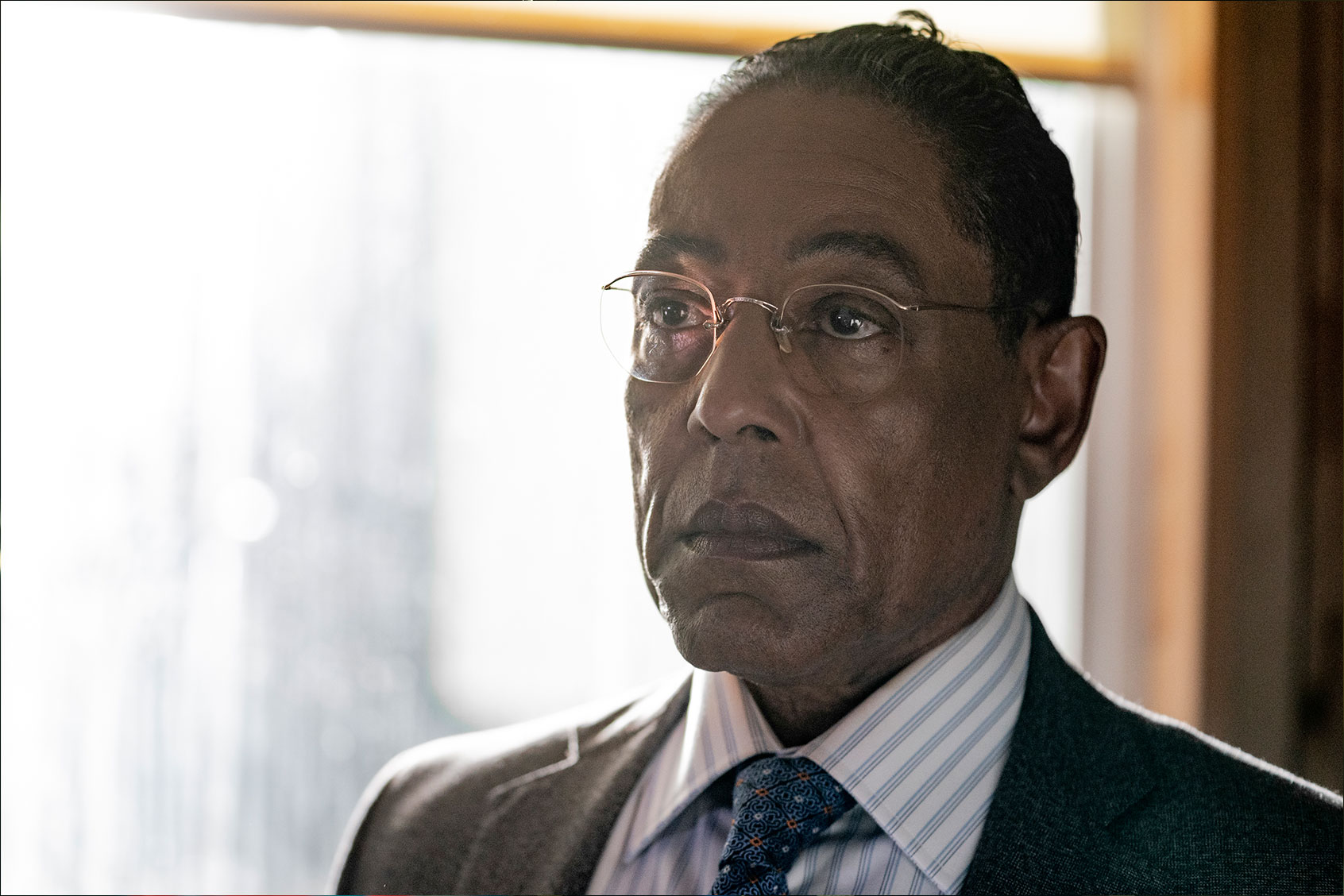
Giancarlo Esposito has a different energy about him these days. The shift may be subtle enough to evade someone sitting down to “Parish,” the new AMC drama in which he plays the title role and serves as executive producer. But chatting with him in person reveals a lightness that hasn’t always been there, especially over the decade when all anyone wanted to rave about was his portrayal of Gustavo Fring.

I pointed that out to him in February, with no expectation that he'd remember the last time we spoke, a few weeks before the pandemic lockdowns began in 2020. Esposito talks to a lot of journalists and interacts with exponentially more fans. To him, I am merely a drop in humanity’s ocean. Nevertheless, he confirmed what I was sensing.

 “I think that I'm a little over myself, you know?” he said with a shrug. “I do what I do because I love it. And I love the effect it has on people. But I’m the sum of a journey. Every role that I've ever played has led me to the role I'm playing now.”

That’s a blessing and a curse — my words, not his. Esposito’s screen career stretches back to 1979, a full decade before his scene-chewing performance in Spike Lee's landmark 1989 film “Do the Right Thing.” 

Better Call SaulGiancarlo Esposito in "Better Call Saul" (AMC)
Much of his recent filmography was defined by his roles in “Breaking Bad” and “Better Call Saul” — and by playing Gus. You can’t watch his work in “The Gentlemen” or his glower and stalking throughout “The Mandalorian” without being reminded of his performance as the unforgettable narcotics distributor and imposing proprietor of Los Hermanos Pollos.

Flecks of Fring are discernible in Gracián Parish, a New Orleans driver whose loved ones call him Gray. Esposito’s title character slips back into that city’s criminal underworld when he can’t pay his bills, a plot motivator that initially invited comparisons between Parish and Walter White.

Each starts as a good man whose morals harden and contort under pressure. Each is a father who has fallen on hard times and is desperate to prevent his family from tumbling into economic ruin. Gray agrees to serve as a wheelman for a criminal syndicate — this time, it's a Zimbabwean family known as the Tongais — but only for as long as it takes to get his close friend and his business out of trouble.

"Every role that I've ever played has led me to the role I'm playing now.”

“Parish” is an American adaptation of the British action drama called “The Driver” and was nearly eight years in the making — “a long cultivation,” as Esposito describes it, with interruptions he couldn’t have predicted. One of them gripped the planet shortly after we last spoke in 2020.

Esposito considers the COVID-19 pandemic as a “great equalizer”: “No matter how rich you are, there's no escape. Right? It depends on how healthy you are inside,” he said.

For him, the health check was primarily psychological. He retreated to a home he had bought while still mostly on the road and working. Once that all ground to a halt, he took stock of where and who he was: a divorced father of four, supporting two households and paying for five cars.

He called his accountant. How long can I last? he asked. About a year, he was told, placing him in a better spot than most. Panic set in anyway.

We need your help to stay independent

“You think of a lot of things in those desperate moments to try to keep your head above water and that of your family,” Esposito said. “And then you know, you think about reprehensible things that you might do… I remember thinking, ‘If I just got someone to bump me off…’ I was insured for a lot of money, and my family would be able to survive.”

“And that's a horrible thing,” he concluded. “But that's that survivor kind of thought, that I’ve got to do something and I don't know what to do.”

Then he got over himself.

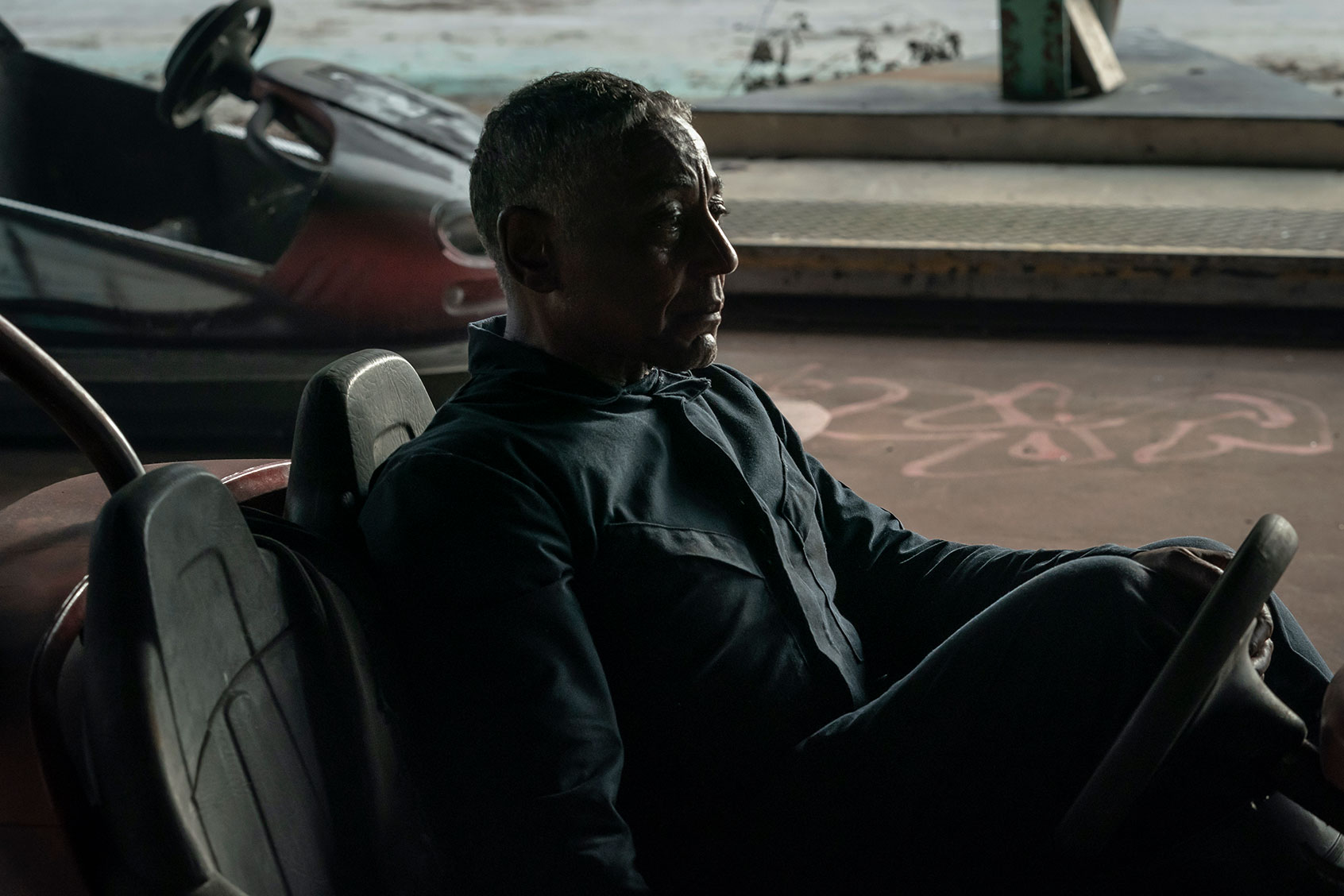
ParishGiancarlo Esposito in "Parish" (AMC)

He thought about all the people who didn't have a year. “What about the person who is good until next week? Or good for three days? And what about the Everyman and Everywoman who doesn't have the means to survive, who can never take a day off of work and can't get sick, because their family depends on them?” he wondered.

“That's what started me to think about ‘Parish’ and ‘The Driver,’ and helped me make it something that that American audiences could get their heads wrapped around,” Esposito continued. “And it's been very, very connected for me. Because a part of my life, and the circumstances of my life, have some similarities to Gracián Parish.” 

In other ways, however, he and his character are highly dissimilar. As top-billed executive producer on “Parish,” Esposito has power over how the story is shaped and told, cashing in part of the currency mountain he’s acquired over a 45-year career in film and TV.

These days, he says, he can go to network and point out the lack of Blackness in their shows, and throw in that the content he champions can serve as a corrective. That mindset informs the New Orleans setting of "Parish," offering a means of examining that city’s international and intermixed culture, as well as the racism permeating its political and social fabrics.


Want a daily wrap-up of all the news and commentary Salon has to offer? Subscribe to our morning newsletter, Crash Course.


Esposito also wanted to tell a story of immigrant entrepreneurial success through an affluent family from an African country, a type rarely seen on TV. He makes clear that the Tongais can't exactly be seen as an aspirational success story: They built their wealth and influence on human trafficking.

“My journey as a creator is to be present in what I'm actually involved in at the moment."

“Now, Gray has no clue about what they do. What he sees is they are successful, and he is not,” Esposito explained. “I really wanted to play with the idea that many of us who were born to soar are unable to make ends meet. And then we have people who come from countries and they’re able to make it happen. They have abundance. What does that say about us as Americans? That is an investigation I wanted to play with in Gray’s story.”

Long known for his prolific output, Esposito says he’s also working on a graphic novel along with prepping to co-star with Uzo Aduba in “The Residence,” a Netflix drama produced by Shonda Rhimes’ Shondaland. There's also an action movie project. It’s a to-do list that would be impressive for anybody.

Esposito thinks of it in another way. “My journey as a creator is to be present in what I'm actually involved in at the moment. That’s what gets all of my attention,” he said. “It's nice to look back and appreciate some of the characters I've played, and to study them and go, ‘Oh, wow, I made a huge impression with that.’”

Then he pondered some work he did recently with Chris “Lethal Shooter” Matthews, a private skills coach who works with players in the NBA and the WNBA.

To keep looking back in the rearview mirror at his biggest roles is almost like “celebrating the shot,” he says, which is fine in that glorious moment. “But the point is to not celebrate the shot, but to make the shot, and then move on to the next shot, and not be attached to the outcome.”

“The journey of that is what improves me. It’s what inspires me.”

New episodes of "Parish" air at 9 p.m. Sundays on AMC. 


Ozempic, Big Food and why eating intuitively is easier said than done

Sarah Jessica Parker doesn’t want her daughters, 14-year-old twins Tabitha and Marion, to be afraid of food. As someone who has experienced the severely weight-obsessed side of Hollywood and who also grew up in a house where sugar, chocolate and white bread were forbidden (“And, of course, all we did the minute we moved out was buy Entenmann’s cakes and cookies,” Parker said in last week’s episode of week’s episode of “Ruthie’s Table 4” podcast), the actress wants her children to experience something different. 

“I didn’t want them to have a relationship with food that was antagonistic, or they felt like it was their enemy,” she said. 

To facilitate this, Parker said that cookies, cake and other desserts are regularly on offer in the home she shares with husband, Matthew Broderick. Unlike in her childhood, Parker is trying to set up a kitchen that is devoid of “good foods” and “bad foods,” and instead just focuses on providing an array of options. “You can’t make someone like something they don’t like or want, and I hope they can maintain their affection for the experience and their delight in taste and find their own ways to have that be healthy for them,” Parker said. 

It’s apparent in the conversation that Parker’s hope for her daughters is also underscored by some anxiety because even with the best planning and intentions, experts say that eating intuitively is easier said than done, especially in a modern society that is so adept at facilitating “food noise,” or our internal preoccupations about food. That’s especially true right now as two major industries — Big Food and Big Pharma — are changing how we discuss satiety and what it means to eat healthfully in real time, and not always in a way that benefits average Americans. 

While the phrase “intuitive eating” has become a social media darling, it often loses its full meaning when disseminated through reels and TikToks. According to the National Eating Disorders Association, intuitive eating is about trusting your body to make food choices that feel good for you, without judging yourself or the influence of diet culture. There are actually 10 generally agreed-upon principles of intuitive eating — ranging from rejecting the “diet mentality” to finding kinder ways to deal with difficult emotions than feeding them with food — that largely shift the focus away from eating as a way to lose weight towards eating as a way to nourish and fuel our bodies. 

This makes it a popular approach for individuals who have struggled with disordered eating. 

“Let me be clear, food is not good or bad and labeling it as such can pose many problems,” Aaron Flores, a registered dietician nutritionist who specializes in intuitive eating, wrote for the National Eating Disorders Association in 2018. “Nutritionally, just like bodies, all foods are different. Emotionally though, all foods must be equal. One food does not make you bad while the other makes you good. If we can approach [all foods] as emotionally equal, we can truly begin to connect with our own inner wisdom. Intuitive eating is about making peace with food and giving up the needless war against our body and how we eat.” 

We need your help to stay independent

He continued: “Intuitive eating is challenging and can be difficult to understand. It’s completely opposite of how we’ve been taught to think about food. It’s not black or white, it’s gray, nuanced and there is no one ‘right way’ which is why it can be so confusing. Intuitive eating is a beautiful part of recovery. It is also an essential piece in the prevention of eating disorders.” 

At its core, eating intuitively is anti-diet, meaning that it pushes back against “the diet books and magazine articles that offer you the false hope of losing weight quickly, easily, and permanently.” However, that message often gets flattened by both critics and adherents, especially on social media where it is often positioned as a movement that greenlights eating past the point of being comfortably full. Anti-diet messaging is now also being twisted by major food companies who see it as an opportunity to cash in. 

Last week, an investigation by The Washington Post and The Examination, a nonprofit newsroom that covers global public health, found that one company in particular, General Mills, maker of Cocoa Puffs and Lucky Charms cereals, “has launched a multipronged campaign that capitalizes on the teachings of the anti-diet movement.” 

“General Mills has toured the country touting anti-diet research it claims proves the harms of ‘food shaming,’” the investigation team writes. “It has showered giveaways on registered dietitians who promote its cereals online with the hashtag #DerailTheShame, and sponsored influencers who promote its sugary snacks. The company has also enlisted a team of lobbyists and pushed back against federal policies that would add health information to food labels.” 

The Post and The Examination conducted an analysis of over 6,000 social media posts authored by 68 registered dietitians, who each had a minimum of 10,000 followers. The findings revealed that approximately 40% of these influencers, collectively reaching over 9 million followers, consistently employed anti-diet rhetoric in their content.

“Most of the influencers who used anti-diet language also were paid to promote products from food, beverage and supplement companies,” the analysis found.

Major food brands have preyed on purchasers' insecurities — be those financial-, health- or status-based — since the advent of advertising. However, there’s something particularly insidious about General Mills and similar companies putting their finger on the scale of public health discourse in this way, which also reinforces why eating in a way that is truly intuitive can feel so challenging these days. 

"There’s something particularly insidious about General Mills and similar companies putting their finger on the scale of public health discourse in this way, which also reinforces why eating in a way that is truly intuitive can feel so challenging these days."

Running parallel to the anti-diet movement are major conversations about the future of weight loss medications like Ozempic and Wegovy, which work by targeting hormones in the body that regulate appetite and metabolism. 

Ozempic, a once-weekly injectable medication, belongs to a class of drugs called GLP-1 receptor agonists, which mimic the effects of a naturally occurring hormone to reduce hunger and promote feelings of fullness. Similarly, Wegovy, a newly approved once-weekly injectable, operates by activating receptors in the brain that control appetite and food intake. Both medications have shown significant efficacy in aiding weight loss when combined with diet and exercise, offering new options for individuals struggling with obesity and related health issues.

Many patients report that taking these medications has reduced the amount of “food noise” they experience throughout the day. In speaking with PBS, patient Kathleen Olivieri said she had “no idea that there was such a thing as a normal appetite” until she started using Mounjaro, an injectable diabetes medication, for weight loss. Casey Mason, another patient, told the network that beginning injections cut food noise from her life. 

“It ruled my whole day every single day,” Mason said. “As soon as I woke up [I thought], ‘what am I eating?’ I just don’t think about food anymore.”

However, critics have also voiced concerns about the long-term effects of these medications, especially when it comes to patients’ lifetime relationship with food and especially when those patients are average-sized. In her Newsweek commentary published in September, writer Jackie Goldschneider — who struggled for years with anorexia — wrote about the trend of celebrities and then, eventually, everyday people taking semaglutides and tirzepatides to lose weight for special events or vanity. This sets up a dangerous precedent, Goldschneider said.

“Consider the hallmarks of an eating disorder: An unhealthy relationship with food, shutting off your hunger instead of feeding it, eating too little, risking harm to your organs for the sake of being thin,” she wrote. “When you consider that, it becomes clear: These drugs induce an eating disorder, especially in the average-sized people who don't need them. People willingly endure debilitating nausea and constipation to lose weight, and risk pancreatitis, intestinal blockage and thyroid cancer in order to be a smaller size. They choose to pre-emptively eliminate their hunger instead of feeding it.” 

Rather than nourishing themselves, she continued, they choose to numb their appetites with medicine the way I once numbed my own with guilt and self-criticism. 

“They sign up for a life sentence, since going off the drugs generally means the return of a voracious appetite and almost all of the weight lost, if not more,” Goldschneider said. 

In the evolving landscape of food culture, the rise of the anti-diet movement stands as a counterpoint to traditional dieting. However, this movement faces challenges in a society already inundated with conflicting messages about food and body image — and that’s even without both Big Food and Big Pharma asserting their influence across culture and what intuitive eating means. 

Trump positions himself as a “modern day Nelson Mandela” in Truth Social rant

In a lengthy post to Truth Social on Saturday, Donald Trump airs a string of grievances ramping up to the start of his hush money trial on April 15, focusing mainly on a gag order from Judge Juan Merchan attempting to keep him from berating people involved in the case. 

In the expanded order, handed down on Monday, Merchan writes that Trump's "pattern of attacking family members of presiding jurists and attorneys assigned to his cases serves no legitimate purpose. It merely injects fear in those assigned or called to participate in the proceedings, that not only they, but their family members as well, are 'fair game' for Defendant's vitriol." But if Trump's recent posts to social media are interpreted correctly, he views this behavior as nothing more than speaking the truth; saying he'd happily go to jail in order to continue doing so, and comparing himself to South African anti-apartheid activist, Nelson Mandela.

"Now, we have Merchan, who is not allowing me to talk, thereby violating the Law and the Constitution, all at once," Trump writes. "It is so bad what he is trying to get away with – How was he even chosen for this case??? I heard he fought like hell to get it, and all of the rest of them also! If this Partisan Hack wants to put me in the 'clink' for speaking the open and obvious TRUTH, I will gladly become a Modern Day Nelson Mandela – It will be my GREAT HONOR. We have to Save our Country from these Political Operatives masquerading as Prosecutors and Judges, and I am willing to sacrifice my Freedom for that worthy cause. We are a Failing Nation, but on November 5th, we will become a Great Nation again. MAKE AMERICA GREAT AGAIN!"


Say it bluntly: The president just moved heaven and earth

Ultimatum: n. a final proposition, condition or demand 

Especially: one whose rejection will end negotiations and cause a resort to force or other direct action 

-Merriam Webster

It sounded like an ultimatum. 

Thursday President Biden spoke for about 30 minutes with Israeli Prime Minister Benjamin Netanyahu. The call came after Biden took it in the shorts from a variety of critics after the IDF killed humanitarian workers in Gaza. Biden told Netanyahu the “overall humanitarian situation is unacceptable” and that there was a clear need for “Israel to announce and implement a series of specific, concrete and measurable steps to address civilian harm, humanitarian suffering and the safety of aid workers.”

According to the readout of the call provided by the White House, Biden also said he made it clear, “that U.S. policy with respect to Gaza will be determined by our assessment of Israel’s immediate action on these steps.”

In my neighborhood, that’s called an ultimatum, and one could only imagine what the conversation with Netanyahu was actually like. On background, some administration officials said it would be a stretch to say it was characterized as a “shot across the bow” to Netanyahu. 

Others said it was spicier than that. 

Biden is hip-deep in a re-election bid and trying not to lose the coalition that put him into office nearly four years ago. Part of that coalition consists of younger voters and Arab-American voters – both groups which are currently extremely upset with Biden. Just about everywhere the president goes these days you can find protesters screaming “Genocide Joe.” So, I have no doubt Biden was extremely curt with Bibi. I’m sure Biden reminded him in direct terms who Israel’s greatest ally is and how Netanyahu is risking that friendship by killing innocent people. After all, as we’ve been told in the briefing room by Admiral John Kirby for the last three months, we’ve often tried to guide Israel in how to conduct the war and inflict minimal casualties on civilians.

If Israel’s immediate reaction to that phone call is any indication, then it is obvious Biden was a bit more strident. I’m sure there were some words used that would be best not spoken in public.

And that’s the way it should have been. But, Biden’s team, and the president himself would not call it an ultimatum, though it had the effect of being just that. Hours after Biden and Netanyahu spoke, the Israeli Prime Minister fired those responsible for ordering the attack that led to the deaths of humanitarian workers and also announced plans to provide additional aid to the citizens of Gaza.

You’d think Biden won it in a walk-off, and could now silence the critics who continue to ask if Biden has lost influence in Israel.  Obviously, that’s not the case. But, when I asked Press Secretary Karine Jeanne-Pierre in the briefing room Thursday if that was an ultimatum, she balked at calling it such. Really? Just say it.

The closest I got was a background comment from an administration official who called it, “a very direct statement of concern.” Like I said, in my neighborhood, it was an ultimatum. I appreciate we’re not in my neighborhood, but if the president is hoping to keep his coalition intact  in the fall, he might try to visit that neighborhood.

It was at least a partially successful ultimatum as well. 

As White House NSC spokesman John Kirby told ABC News anchor George Stephanopoulos Friday morning, the actions taken were “good starts.” Now, Kirby added, “we’re going to have to watch and see where they go from here.”

We need your help to stay independent

In his first on-camera comment about the phone call Thursday, before he left the White House to visit the site of the recent Francis Scott Key Bridge collapse in Baltimore, Biden said “I asked them to do what they’re doing.” That’s fine. So, when he showed up to Baltimore I asked him on two occasions if he was “satisfied” with what Israel has done. The first time, he completely ignored me. The second time he just looked at me. He didn’t answer.

Someone needs to explain to the president that his actions, which have already paid some dividends, are worth clarifying for the American people. Those close to the president say the “shot across the bow” was also a “stern warning”, but those actions have not been promoted enough, nor have they been clarified.

That’s important for Biden because it answers several of his critics who say he’s a weak leader. With all that he’s done, from infrastructure to strengthening the economy (300,000 new jobs in March) gets buried because the White House simply can’t hit the layups. These are easy. Biden’s actions in Israel show strong leadership. The March jobs report announced Friday does the same thing.

The action Biden has taken in Baltimore to support the rebuilding of the Francis Scott Key bridge does the same thing – and that news got buried even though Biden flew to Baltimore Friday, got a birds-eye view of the damage and then spoke about it before reporters. It got buried under the political circle-jerk speeches of the Baltimore Mayor, County Executive, Congressional delegation from Maryland, Transportation Secretary Pete Buttigieg and the Maryland governor before Biden came out and thanked all of them after they had already thanked each other. He then told us how quickly they all responded to the crisis. Then he thanked them again, and they accepted his thanks and were all thankful for it.

With all the glad-handing done, Biden then told us one channel in the port would be open before the end of the month, and the entire port will be open by the end of May. That was the news that should have topped every speech. 


Want a daily wrap-up of all the news and commentary Salon has to offer? Subscribe to our morning newsletter, Crash Course.


All of this was done on a cold, blustery day with the collapsed bridge situated behind Biden as he spoke, on a low stage, behind a black curtain, on a soggy, newly sodded piece of turf behind the Maryland Transportation Authority’s office, with inadequate lighting, poor framing and inadequate facilities. At least the sound was good. 

If it had been Trump it would have been a Hollywood production – especially the framing and the lighting. Trump also loves a large stage. The larger the better. Biden is understated, almost shy about the things he does. And while that endears him to some, it makes for lousy television and doesn’t translate well to those who think he’s not a very good leader.

He almost needs to be out there a bit more and loving it a lot more. For all the pomp and circumstance of a presidential visit, Friday’s trip to Baltimore was flat. There were more reporters than guests, who clapped quietly and politely until Biden encouraged them to step up their game. Biden’s advance team even removed a row of empty chairs from the newly sodded field so the cameras wouldn’t show empty seats.

Retiring Maryland Sen. Ben Cardin said afterward that he agrees that the Biden team needs to get better at messaging. “I’ve said that too,” he explained. Is anyone listening?

Say it bluntly.

Biden delivered an ultimatum to Israel and Netanyahu responded.

Biden pledged he’d have the back of everyone in Baltimore and the federal help will enable to the port to re-open quickly, thus saving jobs and billions of dollars in the local and national economy.

There. 

Mount Everest was the riskiest place I had practiced medicine until I became an OB/GYN in the South

On the eastern glacier of Everest in Tibet, where avalanches boomed in the distance and icy winds blew through my nylon tent, I tucked in at night within a cocoon of uncertainty. I kept my stethoscope and blood pressure cuff nestled by my thighs to keep them warm and ready to use. Months stretched out in isolation with me on high alert — alone in my medical role — fearing I’d fail when most needed. Most nights I shivered as I donned my down layers, slept with two hats, and tucked a hot water bottle beside my feet for warmth. I envied the rest of the all-male team who slept bare.

In the middle of one night, my fears became reality. Two severely injured climbers crawled over uneven rocks to stumble into camp. They shouted our names for help, piercing the black air. Half asleep, with shoelaces untied and blades of hail stinging my face, I stumbled toward the sound of their voices, then helped them back to our tents, and began a marathon of care. At 18,000 feet, the thin air mirrored my nascent experience as a 25-year-old medical student. I worried about their conditions and the care I was delivering. Was I doing everything correctly? Remembering the protocols? What else should I be doing?  

My journey to Everest was a leap of faith. I was raised a New York City girl and felt like an unlikely candidate for a Himalayan expedition, but I couldn’t resist the call of the mountains. Once I joined the team as the Medical Officer, I dove into mountaineering medicine, sought counsel from experts, and armed myself with knowledge. Yet nothing could prepare me for how isolated we’d be. We saw no outsiders for months and knew there was no chance for rescue on the East Face of the mountain in Tibet. 

A few days later, back in Base Camp, I laid out packages of gauze, tape, scissors, antiseptic and checked the antibiotics on hand. While tending to a climber with severe frostbite injuries affecting both hands and feet, I tipped his hat over his eyes and suggested he look away. I removed the bandage I’d placed at Advanced Base Camp from his first finger. A shrunken black stub of a distal phalanx — the whole tip of his finger — stared back. He lifted his hat, saw his finger, and looked up at me with wide eyes. Then he rounded his back away from me like an animal curled up in defense. More unwrapping, more fingers, more rocking with sobs, digit after digit, dead, inch-long black fingertips. He wailed, shook his head, and his sobs pierced my heart. I wished I could protect him from this pain. His eyes were pleading, but I had no answers. I, too, was surprised at how rapidly his shredded fingers had turned to coal.

Since the Dobbs decision, I don’t have the autonomy I had on the mountain to deliver the best care possible.

“Will I ever be able to climb again?” he asked. The gauze adhered to his final two fingers. 

I didn’t have an answer.

My only motivation was to provide the best care possible while being present with compassion. We were all at the knife edge of our limits and digging deeply for strength.

Each of us on that mountain had weighed our risks and vulnerabilities and had chosen to be there. The climbers had chosen the extreme challenge of Everest and did everything in their power to remain alive. I had chosen to work in these circumstances and was delivering the best care I could under difficult conditions.

Not so in my OB/GYN practice in Georgia. Since the Dobbs decision, I don’t have the autonomy I had on the mountain to deliver the best care possible. This is a different kind of isolation, and it’s more unnerving. Despite years of medical training and a commitment to evidence-based care, physicians are hamstrung by state laws, and our patients are suffering. 

A few weeks ago, I entered an exam room to find a young woman staring at her phone, wearing a college sweatshirt and crocs decked out with charms. She had driven alone to Georgia from Tennessee seeking an abortion. Georgia law permits abortions until approximately two weeks after a missed period, whereas Tennessee bans all procedures with narrow medical emergency exceptions.

After discussing how she felt and clarifying information in her medical history, I said, “Your ultrasound doesn’t show a pregnancy in the uterus, which can happen for a few reasons, most commonly because it’s too early in pregnancy. But the level of pregnancy hormone in your blood and medical history makes me concerned you could have an ectopic pregnancy — one that grows outside the uterus, typically in the fallopian tubes.”

Here, the peaks are legal hurdles, the valleys emotional.

We discussed what might be going on and the next steps we could take, but this young woman dissolved into tears. Getting advanced care to rule out an ectopic pregnancy would require involving her health insurance, which would alert her parents, something she wanted to avoid. I left the room to give her space and time to compose herself while I went to investigate options for care. 

Sobbing patients overwhelmed by difficult decisions resulting from abortion restrictions are now part of our everyday practice as OB/GYNs. We’re not discussing plans of care based on science — we’re sorting out travel, logistics, time off work, childcare, emotional distress, and legal ramifications. Here, the peaks are legal hurdles, the valleys emotional.

This is taking a toll on us. A recent survey by EL Sabbath et al. of OB/GYNs in states with bans documents immense personal impacts “including distress at having to delay essential patient care, fears of legal ramifications, mental health effects, and planned or actual attrition.” The majority reported symptoms of anxiety or depression as a direct consequence of Dobbs. Ninety-three percent of respondents had situations where they or their colleagues could not follow standard of care. Eleven percent had already moved to another state without restrictions, and 60% considered leaving but have family and other obligations making them stay for now.

Although we’ve spent years in medical training, our expertise has been erased by politicians with no medical background. Not being able to practice in accordance with the ethical principles of respecting patient privacy and autonomy in the decision-making process is wounding us.

A May 2023 survey found that 55% of Idaho OB-GYNs were seriously or somewhat considering leaving the state due to the abortion ban, and a hospital there was forced to close its labor and delivery unit due to related staffing issues. Fewer OB/GYNS means less maternal care and yet many of the states with abortion restrictions have the highest maternal mortality rates.

Take this a step back and medical trainees are being affected. Abortion bans are affecting almost half of OB/GYN training programs. A recent survey of medical students in Indiana found 70% were less likely to pursue residency in a state with abortion bans. With decreased training — and diminishing numbers of OB/GYNs willing to practice in these states — maternal mortality will rise. Care of other gynecological conditions such as endometriosis, infertility, fibroids and cancer will suffer. This affects the most vulnerable among us, low-income and minority patients.

My patient’s insurance would only work in Tennessee. She reminded me of my youngest daughter. I couldn’t picture her processing this information on her own. I was most worried that my patient would need to drive herself back across state lines in this fraught emotional state.

Unlike my experience on Everest, I am not choosing these risks — to my patients or to myself — of practicing under untenable circumstances where I cannot deliver optimal care.

She returned to Tennessee, where her bloodwork confirmed an ectopic pregnancy. Even though treatment of ectopic pregnancies is permitted in that state, the hospital released her without immediate treatment. Delayed care could put her at risk for impaired future fertility, emergency rather than elective surgery, and even death. I can only hope none of that happened. Treating people crossing state lines, who we cannot adequately care for ourselves, is stressful. I still think of her.

I’ve also been thinking a lot about the decision I made to go to Everest with the risks involved and the potential for trauma. I’d joined the team to experience the majesty of the Himalayas. To wake up to fine blue mountain light, live within vastness, and quell the warnings from girlhood to stay small and be safe. To this end, I made peace with the risks I was taking and ultimately grew from facing my fears. When trauma beset us, each team member grew into the best version of themselves.

My family moved to Georgia almost three decades ago, a different kind of unlikely for this city-raised girl. I grew to love the rolling hills of north Georgia, the breathtaking palette of autumn, the scent of apple cider and boiled peanuts. I learned how to cook collards — without ham — their rough stems of veins running through me.

But in the South now, we are not expanding and growing; we are shrinking, boxed in by medical practice governed by legislators, lawyers and hospital administrators. 

Unlike my experience on Everest, I am not choosing these risks — to my patients or to myself — of practicing under untenable circumstances where I cannot deliver optimal care. If I were finishing my training today and choosing somewhere to practice, I would not come to this state or anywhere with these restrictions on practice. 

I would never have predicted, when I was shivering, afraid, and alone providing care on the mountain, that I would feel threatened 36 years later by simply practicing basic healthcare in America. I couldn’t have known that after studying and working hard, I would not be able to put my education, knowledge, and skills to their best use. That I would be hampered when fulfilling the essence of my dream to care for women with skill and compassion. I couldn’t have known how alone, isolated and abandoned I would feel. Right here, at home. 

Why suspicious deaths and violence plague the seafood industry and what we can do about it

There is a certain romanticism about fishing, an ancient practice that brings to mind the Biblical Saint Peter, famously a fisherman, or perhaps the titular protagonist of Ernest Hemingway's "The Old Man and the Sea." Behind every fish, crustacean and other form of seafood we eat is a story, or how that food landed on our plates.

"Violence in the fishing industry and fish fraud are two ends of the spectrum."

In an ideal world, the process would be simple and direct. A lone fisher or group of happy fishers would go to the ocean, a river or lake, then haul in endless bounties of aquatic creatures. The workers would be treated with respect, the environment would be respected and the seafood would be carefully handled.

But in reality, there are multiple steps between when seafood is caught and sold, during which workers can be exploited, pollution can be dumped in the environment and fish depleted, mislabeled or otherwise mishandled.

Perhaps most strangely of all, the people who speak out against these things often wind up mysteriously dead.

There was Emmanuel Essien, a 28-year-old fisheries observer who mysteriously disappeared in July 2019 while aboard the Chinese-owned vessel Meng Xin 15. Although the police said there were no signs of violence or any other crime, Essien's family insists his disappearance was linked to his reports of illegal fishing on a trawler, including environmentally unsustainable practices.

That wasn't all; the Environmental Justice Foundation, which investigated Essien's apparent death, reported at the time that roughly 90% of Ghana's industrial trawlers are owned by Chinese companies that regularly abuse their workers by beating them, forcing them to work in unsafe conditions and paying substandard wages.

Next Eritara Aati Kaierua, a fisheries observer in Kiribati, died under mysterious circumstances in March 2020 on a Taiwanese vessel in the Pacific Ocean, with Human Rights at Sea International investigating the matter and finding the state's official story to be highly flawed. Then in October 2023 another Ghanaian fisheries observer went missing, this time 38-year-old named Samuel Abayateye. He had been assigned to a South Korean vessel; his decapitated body washed ashore the coast of Ghana six weeks later.

Instead of being limited to Ghana, the problem of fisheries observers facing physical danger is global in nature. While outright murder is relatively rare, violence is pervasive. A survey of fisheries observers in the United States found that roughly half had been harassed on the job, and the Association of Professional Observers (APO) routinely logs stories of people being threatened at knifepoint, locked in their rooms, raped, starved, forced to accept bribes or otherwise physically harmed while performing their professional duties.

But these people being threatened are simply trying to ensure that seafood is safer for everyone. The fisheries observers exist to make sure companies do not worsen the dire problem of plastic pollution, which could overwhelm and eradicate much of ocean life by 2050. Plastic pollution is linked to various forms of cancer, as well as infertility, and studies show our seafood is full of plastic products.

Fisheries observers also prevent catches from being mislabeled, a common practice known as fish fraud. In 2016 the non-profit group Oceana released a report which revealed that one out of five of the more than 25,000 samples of seafood that they tested from 55 countries were mislabeled. Worldwide Asian catfish, hake and escolar were the fish most likely victims. Nearly 60 percent of the time, the replacement fish were from species that could get certain consumers sick.

In other words, the problems of the abused fishers and fishery observers very quickly become the problems of seafood consumers.


Want more health and science stories in your inbox? Subscribe to Salon's weekly newsletter Lab Notes.


"It will always be a mess unless consumers start demanding transparency of the fisheries and accountability of managers who control the fishing."

"Violence in the fishing industry and fish fraud are two ends of the spectrum," Elizabeth Mitchell-Rachin from the APO Board of Directors said to Salon. "There is the catching of the fish. Then there is the consumer’s convenience of grabbing a can of 17g of protein off the shelf after a workout. Everything in between is an opaque mess." Even though consumers will think they are making responsible purchases if they see stickers saying a product is "bait to plate," "eco-friendly," "dolphin-free" or "wild-caught," those claims are frequently false.
 
"It will always be a mess unless consumers start demanding transparency of the fisheries and accountability of managers who control the fishing," Mitchell-Rachin said.

Ian Urbina, a journalist who authored The New York Times bestseller "The Outlaw Ocean" and founded the journalism nonprofit The Outlaw Ocean Project, said that consumers will need to insist on companies faithfully tracking the conditions on their fishing ships and in their processing plants. The Outlaw Ocean Project recommends solutions from enforcing existing laws to engaging in social auditing of fishing companies. If there is one edge that reformers have over industry abusers, it is that the public is generally unaware of how China — which The Outlaw Ocean Project describes as "the superpower of seafood" — and other countries behave unethically at sea. The full extent of the problem is simply not widely known.

"Various types of crimes go hand in hand at sea," Urbina said, including "fish laundering, invading other nations' waters, using debt-bonded and trafficked workers, violence on crew, wage theft, criminal neglect (such as deckhands dying of diseases like beriberi)" and general abuse of workers.

"All stem typically from captains and companies above them looking to cut corners for cost saving reasons," Urbina explained. "All also happens because downstream buyers have accepted not knowing their true supply chains."

Mitchell-Rachin says that fishery resources need to start being publicly owned, with governments possessing broader authorities to regulate them.

"The key is transparency," Mitchell-Rachin said. "Start with making all fisheries monitoring data publicly accessible as well as accountability of fisheries management practices. The devil is in the details."

If the general public understood to ask about observer bycatch data, witnessed reports of violations, learning whether specific monitoring protocols are followed and other key pieces of information, ordinary citizens could play an active role in holding fishing companies accountable. For that to work, however, companies must be required to tell the truth.

"You can say that you have an observer program, but without accountability and transparency at all levels, programs are vulnerable to corruption and obfuscation," Mitchell-Rachin said. "It seems instead that the laws are protecting the privacy of illegal fishers more than the rights of the fishery workers, including observers. We need more transparency, not less."

We need your help to stay independent

David Hammond, a non-practicing barrister and executive director of Human Rights at Sea International, also told Salon that transparency is critical, albeit from a someone different vantage point. Hammond says that seafood consumers need to comprehend a "fundamental" fact about the people who put their favorite foods on their plates. The simple fact that they work at sea means that their basic human rights cannot be guaranteed as easily as if they worked on land.

"We need more transparency, not less."

"The issue is one of transparency and accountability, and the context of what happens out at sea is not the same as what would happen on land, quite simply because of the environment," Hammond said. "On land if there's an issue you can invariably walk away."

That option obviously doesn't exist in the middle of the ocean — or, for that matter, even in countries like Indonesia, where indentured servitude still exists. Compounding the difficulty caused by the environment, there is a "lack of enforceability and oversight by constabulary forces, such as coast guards," Hammond explained, "who invariably operate within coastal jurisdiction or the 200 multiple-mile limit, which is the common exclusive economic zone around the world," which limits their effectiveness.

"Most people simply do not understand the complexity of ocean governments," Hammond said. "They do not understand the fundamental principle that rights at sea often do not exist as they do on land. It is just not part of the common language."

Until that principle is more widely understood, Mitchell-Rachin says, people like the families of the deceased fisheries observers will never feel as if they have received justice.

"In the absence of transparency around these deaths and how they were investigated, they all become suspicious," Mitchell-Rachin said. "We're in contact with the families who have a right to know every aspect of, not only how their loved ones passed, but also about the job and what the government is or isn’t doing to protect others. Most have come to us saying they just want to prevent another family from experiencing the same trauma." 

Dwayne “The Rock” Johnson raises eyebrows after saying he regrets endorsing Biden in 2020

During the 2020 election, professional wrestler turned actor, Dwayne “The Rock” Johnson, used his platform to publicly endorse Joe Biden as his pick in the presidential race. But in a recent interview with Fox News, he says he regrets doing that, and won't be doing it again for this year's election.

Speaking to host Will Cain, Johnson revealed that he's not happy with the state of America right now, highlighting "wokeness" and "cancel culture" as contributing to a division in the country that really bugs him.

Tying this in with his comment on Biden, he says, "My goal is to bring our country together. There’s gonna be no endorsement. Not that I’m afraid of it at all, but it’s just, I realize that this level of influence, I’m gonna keep my politics to myself. And I think it’s between me and the ballot box."

In 2017, he toyed with the idea of running for office himself, commenting during an appearance on Jimmy Fallon's "The Tonight Show" that he'd like to see a different leadership. But in his interview with Fox this week, he seems to have put away those aspirations, for now.

“I’m not a politician. I’m not into politics," he says. "I care deeply about our country. I’m a patriot, and I believe you are too, as well. And right now, my desire and my priorities are my babies and school drop-offs and pickups — that’s important to me."

Watch here:

Arson suspected as cause of small blaze outside of Bernie Sanders’ Vermont office

Vermont police are on the hunt for a suspected arsonist believed to be the cause of what's being referred to as a "small blaze" in front of Sen. Bernie Sanders (I-VT) office on Friday.

According to details pieced together by local authorities, an unknown male fled the scene after spraying a possible accelerant which, once ignited, led to damages but no injuries. The suspect is still at large at the time of this writing, and no known motive has been given.

“A significant fire engulfed the door and part of the vestibule, impeding the egress of staff members who were working in the office and endangering their lives,” Burlington police said in a statement obtained from AP News. “The sprinkler system then engaged and largely extinguished the fire.”

“We are grateful to the Burlington Fire and Police Departments who responded immediately today to a fire incident that took place in our office building,” said Sanders’ state director Kathryn Van Haste in a statement. “We are relieved that no one on our staff and, to our understanding, no one in the building was harmed.”

A press release issued by Capitol Police at the start of the year highlights an uptick in threat assessment cases, many of which involve "concerning statements and direct threats." Sanders' fire is one of many to occur in recent months. 


Even Don Winslow’s mob characters wouldn’t vote for Donald Trump

Of arms and the man he sings — no, seriously, he does. Don Winslow's latest novel, "City in Ruins," completes his Danny Ryan trilogy, the saga of a mid-level Irish-American mob soldier from Providence, Rhode Island, who flees across the country to build a new life, first in Hollywood and finally as an empire-builder in Las Vegas. Winslow says the trilogy took 30 years to complete — nearly his entire writing career, in other words — and also says it's his final work of fiction. We'll get to that. All three novels have been published in rapid sequence — the widely acclaimed "City on Fire" in 2022, followed by "City of Dreams" in 2023. They're loosely based, Winslow says, on the real-life gang war that paralyzed Providence in the late 1980s and early '90s, in which nearly 40 people died. (Someone in "City on Fire" observes that Providence tolerates only three religions: Irish Catholicism, Italian Catholicism and the Red Sox.)

But the Ryan trilogy is also based on "The Aeneid," the Homeric knockoff epic by the Latin poet Virgil that turns a minor figure from the tale of the Trojan War into the founder of Rome. Yeah, Winslow is a guy who writes hard-boiled crime fiction full of leggy, tough-talking dolls and guys with $70,000 watches and short, telegraphic sentences. ("First thing you learn in this kind of life: Never get in the car.") But he's also another kind of guy, a historian by training and inclination, as he told me during his recent visit to Salon's New York studio. He's not kidding about "The Aeneid": After our conversation, he sent me the "character key" for the Danny Ryan novels, which runs to three pages. So I could tell you who his cognates are for Achilles, Hector, Helen of Troy, Aphrodite, Odysseus and a whole bunch of others. But Winslow asked me not to share it, and as a character in his fiction might say, he seems like the kind of guy you don't want to cross.

Well, OK, Danny Ryan is Aeneas, the wandering hero of Virgil's epic. That much is obvious. Like the Roman poet, Winslow takes this relatively ordinary figure — a working-class guy with decent intentions, who does bad things for bad people — and turns him into a highly resourceful if not entirely admirable protagonist, as well as a representative symbol of his time and place. Winslow had already become politicized while writing his trilogy about the drug war (beginning with "The Power of the Dog" in 2005), but while he was writing the Danny Ryan books, he says, he couldn't avoid noticing that America was changing, becoming increasingly divided, embittered and polarized.

Winslow is putting his fiction aside, after publishing 26 novels in 33 years, he says, because the times demand it. As a social media activist and anti-Trump propagandist — working in concert with screenwriter and filmmaker Shane Salerno, his close friend — he believes he can reach millions more people, potentially changing hearts and minds and moving the needle of history, than would be possible by spinning more gripping, surprising, economical yarns about men who kill each other. Virgil, I suspect, might disagree. We can't ask him about that, and we can't ask Danny Ryan whether he would have voted for Donald Trump in 2016. A lot of real-life Danny Ryans went down that road like Aeneas entering a really bad version of the underworld, chasing some absence or lack they felt in themselves or in life, and never came back. But Danny's creator stuck up for his boy: Absolutely not, Winslow told me, Danny would have spotted that "punk" miles away. We'll have to take his word for it.

This transcript of our interview has been edited for length and clarity.

I would describe you as one of the signature crime novelists or popular novelists of our age, but I don't know if you even like those labels. We could just say writer.

Writer is good. I've had so many labels and most of them have been negative. They tell me what I'm not. You're not a bestselling author. You're not an airport author. Cult writer was my favorite label over the years.

It's a friendly cult. It's not like the alleged cult associated with someone else with your first name, whom we might talk about later.

We could drop the alleged, I'm comfortable with that.

You say your new novel is your last novel.

It's the truth, actually.

Your new and final novel is “City in Ruins,” which is the conclusion of a trilogy that began with “City on Fire.” I understand you've been working on this trilogy for a long time.

30 years.

That's incredible. What took you so long? 

"You have to go through 10 or 20 bad pages sometimes to get to that one good one."

Just lazy, I guess. No, 23 other books I think, kept me [busy]. To give you a serious answer, it was tough to do. I was trying to take the Greek and Roman classics and use all those characters and stories and themes, but write a completely modern contemporary crime epic because I'm a crime fiction writer; that's my beloved genre. 

It took a while to do that successfully. I failed at it a lot. So I'd set it down, I'd do another book, and then between books I'd go, “Let's pick that up again and try it,” and then I'd fail again. This process repeated itself for three decades.

It’s important to experience failure. Every successful writer has to go through periods of not getting it right.

Yeah, I would say more days than not. I think when you're a young writer it feels crushing, but you get a little experience under your belt, you've done a few laps around that pool, and you realize, yeah, Tuesday I sucked, but I’ll just keep at it. I think you have to go through 10 or 20 bad pages sometimes to get to that one good one.

While reading the first book in the trilogy, “City On Fire,” it actually took me a minute to figure out that it was rooted in mythology. It is a very engrossing story, beginning around 1987 on a beach in Rhode Island, and it took me a minute to be like, “Oh, this is a story about one guy from one gang who steals a somewhat mysterious, beautiful woman from a guy in another gang. This precipitates a devastating and destructive conflict. Where have I heard that story before?”

Well, you might've heard it in this little thing called "The Iliad," but I will tell you that a very similar incident to that happened in New England between the Irish and Italian mobs that launched a 10-year gang war that ended up costing about 40 lives. So, when I read "The Iliad," I already knew this story because it was part of my youth.

In the books, you're following Danny Ryan from Providence, Rhode Island, in the first book, to L.A. in the second, then Vegas, for the third. To some extent, I see the pattern. You could look at Martin Scorsese films and say, “OK, the gangsters tended to go in that direction,” but why those three cities in particular?

Providence, Rhode Island, because that's where I grew up and I wanted a small environment where all of these people knew each other and maybe even [were] related before the war breaks out. That felt ideal because I could just walk out my door and listen and I was there. 

Hollywood, really, and it took me a while because in "The Aeneid" — and Danny Ryan is Aeneas — Aeneas goes into a cave shipwrecked in Carthage and there are murals of the Trojan War. He sees himself, he sees his late wife, his friends, his home. I thought, OK, what's the contemporary equivalent to that? A movie — someone making a movie about basically what's in book one. It just seemed to be fun, frankly, because I've spent some time in Hollywood, to take some of these Rhode Island punks and put them at the craft services table at a Hollywood studio, because they'd be like raccoons. They'd never leave. Free food and all of that. So that was why Hollywood.

"I'm not interested in the morality of it. I'm not trying to be objective. I'm trying to be subjective when I'm typing."

Vegas, same thing. At the last half of "The Aeneid," Aeneas has to build an empire. It’s embarrassing, but it took me years to figure out: What could that empire be in contemporary America? I didn't want to do a drug empire; it felt wrong and nasty. I thought about continuing with a Hollywood empire, but that also felt false and unrealistic. Then it occurred to me, like one of those Eureka moments, where I went, “Well, in Las Vegas, if you have the cash, you can build anything you want.” They have built Rome there, right? Caesar's Palace, Venice, Paris, pirate ships, pyramids, whatever you want. When I hit on that, then book three started to click.

There is a version of social history in these books. How important was that for you in constructing this trilogy?

Pretty important. I think crime writing's a big tent in this room for all kinds of different stuff. I'm a historian by education and by inclination. I love history, which is one thing that's made me hard to label frankly. It has been an issue that I like getting social history in there because to me it's interesting. I often think we underestimate our readers. They think, “OK, it's got to be action, action, action, action, action.” I'm saying it doesn't, necessarily, that we can incorporate these things. 

I was interested in writing about America and about Las Vegas at a particular era, which was when the mob had pretty much faded out and corporate America was taking over. It was the era of the mega hotels and "greed is good," and the bigger the better. To me, that was interesting to write about and I hope it is interesting to read about.

One of the things I appreciate about the way you approached Danny Ryan as a character is that you're not completely on his side. You're not advocating for him, as in the way that a lot of crime fiction would, as the hero. He lives by his own moral code, but you're not necessarily saying it's a good one all the time.

My job is to take the reader into a world that she or he could not necessarily otherwise enter, or maybe help them see a little differently. Because I do have a lot of readers who are criminals — I guess I'm very big in prisons — so to do that, I have to look at the world through that character's eyes. I approach it, I guess, the way maybe a method actor would approach taking a role. I'm not interested in the morality of it. I'm not trying to be objective. I'm trying to be subjective when I'm typing. Now, I might have my own moral opinions about what's going on, but I try not to inject those into that point of view.

There's a technique that you use where you will move even within a chapter or a couple of pages from one character's perspective to another without announcing it. There's no narrative voice informing us that that is happening. You don't have signals on the page the way that some writers do, like, “Now we're in person X's head.” It struck me that you can read it and almost not notice this happening. It must have been difficult or at least interesting to work that out.

Listen, I've never had a writing class, so I don't know what the names of these techniques are. Nobody taught it to me. I think it was kind of instinctual. Again, I'm trying to put the reader into that person's point of view, and what I think is that readers are pretty smart. I don't think we need to hold up a sign that says, “Now we're in Danny's head.” I think if I can do it skillfully enough, we just go there. 

A critic one time said, "Man, you changed the point of view inside of a sentence one time." I said, "Yeah, and if I can find a way to change it inside of a word, I will."

It reminds me in some ways of the classic thing that would happen in 19th-century fiction. Charles Dickens or George Eliot would have this other voice — this hovering UFO — who is announcing everything and making ironic commentary. But you don't do that at all.

I try not to. Sometimes I think of it in film terms, because I think it would be disingenuous for anyone of my generation to say we haven't been influenced by film and television. I'm not trying to write a movie, but sometimes I'll think, “Well, maybe I need an establishing shot here. Maybe I need to back up and get high and look down at the city of Las Vegas or give a background on a character.” But other times, I think, “No, I want an extreme close-up.” Other times I think, “No, I want this to be from the point of view — a film term — of that character.”

Speaking of that, am I correct that there is a TV adaptation of this series in the works?

You're semi-correct. It's a film adaptation. They're making three films.

Oh, fantastic. How much can you tell us about this at this point?

Well, what I can tell you is that Danny Ryan is being played by Austin Butler.

No kidding. That's an interesting choice. 

"I don't want to publish just for the sake of publishing or just for the sake of a paycheck. I'll probably always write. I might just write and never do anything with it."

It's funny. I had just seen "Elvis." My wife and I had just watched the film. Then the next day or the day after, my agent called up and said, "Hey, what do you think about Austin Butler? He wants to do Danny." Oh, yeah, great. Then in the interim, I've been watching “Masters of the Air,” and he's great in that. It’s intense. Tough to watch, but very, very good, as you would expect from that crew. I'm delighted about it. The strike slowed everything down. I think we were supposed to go take these guys out on location last summer, and I think that's going to happen this summer, where I'll take them to the beach that you alluded to that Danny's lying on.

There's a lot of discussion about Rhode Island clam chowder. I was unfamiliar with the Providence versus Boston clam chowder battle.

Yes, which I triggered — much, much to my downfall. I made some snarky remark, I thought off the record, to a reporter at a Boston paper that was printed. The next night I had to be in Boston, but I was asked about that in Germany. It's very serious.

Crime fiction has become cooler and respectable in a way that it wasn’t before. Colson Whitehead and John Banville are two examples of literary novelists who started writing crime books. Should they stay in their lanes?

No. Listen, man, nobody owns the genre. I'd be the last person in the world to try to close the door behind me because the door was closed in front of me for a long time. My attitude is, welcome in; if you can do it well, do it well. Welcome, I'll read it, I'll enjoy it. I hope that you're never going to find me slamming another writer in any way, shape or form.

Well, you've talked about the fact that the genre was, for a long time, dominated by white guys.

Yeah, people like me.

It is a lot more diverse now.

It is, yeah, which is really good. For a long time we were looked down on, which I liked. I had a very literary journalist ask me one time, “As a crime fiction writer, do you feel you live in a literary ghetto?” It was not asked in a particularly friendly tone. I said, “Absolutely, and I love my neighborhood.”

I think it's been a little bit to our benefit because I think you get that slight chip on the shoulder, a little bit of an attitude that I think is useful. I also think that it's been my experience that inside the genre, we tend to be a bit more collegial with each other. We help each other out, it's pretty friendly. You don't see the kind of backbiting and rivalries that I think you see elsewhere.

Now we get to talk about why this is your last novel, after writing 26 of them. Many people will know you from your social media interventions in politics. You and your friend, Shane Salerno, have been doing stuff on social media. It's gotten 300 million views cumulatively. I know you've sold a lot of books, but probably not 300 million.

It's in the 295 million [area] — I don't think I've hit 300. Maybe this afternoon. After this airs, we're way up.

What made you decide to stop writing?

I've been busy on what used to be Twitter — I guess now is X — and doing pretty much daily commentary now for quite a few years, since about 2015. It wasn't a revelation, really. This volume is sort of, I think, the culmination of my life's work. It's something I've been trying to do for 30 years, and I finally completed it, and I hope successfully. I'm not the person to judge that. 

Around the same time, all of this stuff has been happening in this country, what I consider to be correctly considered a neo-fascist movement in America. Those things coming together now and thinking we're seven months away from an election that I think is going to determine what the world looks like for the next era. That my energies, such as they are, I'm not a young guy, are better spent in that fight and I just want to focus on that.

That has to go past the question of this one election, doesn't it? I'm sure you're going to tell me that the problem of this election is critical, but the problem in the country is much bigger than what happens in the first week of November.

Sure. Well, yes and no. I think we need to focus on the first week of November. You know that old saying, “How do you deal with a nest of cobras? You kill the closest one first.” We have to win that. All right, I'm not thinking past that now. OK, let's cross that bridge when we get to that bridge. Right now we have to win that election, period, and that's where my focus is. Then we'll see what the world looks like.

I feel like in our profession, in the journalism that we do in this room and on this website, we've been compelled to think a lot about what the country will be like under a second Trump term: the possible formations that could occur in Congress, how that will change our roles, how that will shape the future of politics. You don't want to cross that rhetorical bridge.

It's not useful right now to me. I'm sure it is to you and what you do. To me, that's not useful right now. I'm focused on the battle, on the fight. I want to win that one. Then let's see where we're at.

So you're really ready to put fiction down now?

Yes.

You could write 10 or 12 more books.

"He would look at Donald Trump like he'd look at any other punk."

Could. Look, I've had such a much bigger and better career than I ever thought I'd have, than I'd ever dreamed. It's been fantastic and I'm grateful for that, truly. I don't want to push it. I don't want to publish just for the sake of publishing or just for the sake of a paycheck. I'll probably always write. I might just write and never do anything with it. I’ll just write because I want to write this or I want to write that. I love researching, and there's a lot of topics I'm interested in.

I'm never bored. I don't understand how, except for in airports, anyone ever is. There's so much to do, so much to see. I'm not worried about laying on the couch eating potato chips or something.

Obviously you get a lot of feedback on social media, and I'm sure not all of it is positive. How often do you hear the response from people who have read your books and like them, but say, “You communist, go away and stick with what you do.”

Oh, every day. Every day. I call it the “shut up and type” — as opposed to the "shut up and dribble" — factor. Sometimes it gets worse, sometimes a little nastier. Threats.

Have you had actual threats?

Oh, yeah. That's common. Most of these people are physical, as well as moral cowards.

Would Danny Ryan have voted for Trump in 2016?

Absolutely not. I'm telling you, man. No, he would not have. He would not have. Look, Danny is a working-class Rhode Island guy. Right?

You can't tell me that there weren't some working-class Rhode Island guys who went there.

I know them, but not this guy. He would look at Donald Trump like he'd look at any other punk.

Activist Greta Thunberg arrested while protesting fossil fuel subsidies

Swedish climate activist Greta Thunberg was arrested by Dutch police this weekend as part of a group aiming to block The Hague's A12 highway in a move against the Dutch government's tax concessions for companies connected to the fossil fuel industry, with Shell and the airline KLM among them. 

According to BBC, Thunberg and the other activists joining her timed their efforts to send a message prior to a planned debate about fossil fuel subsidies in June, carrying signage reading, "Stop fuel subsidies now!" and "The planet is dying!" An assembly of local police were said to be waiting for them at the end of their march, where Thunberg and others were taken into custody.

"It's important to demonstrate today because we are living in a state of planetary emergency," Thunberg said to press at the protest. "We must do everything to avoid that crisis and to save human lives." When asked if she was worried about the police, she responded, "Why should I be?"

Organizing similar events since she was 15, she commented on her efforts in a recent post to social media while engaged in another protest last month, writing, "Elected officials are in major positions of power, and choose to actively maintain and worsen our current extremely violent and destructive system."


“We all have responsibility for the safety of minors”: “Quiet on Set” directors on new fifth episode

It's often the case that the most difficult conversations to have — at both a personal level and as a societal collective — are also the most important.

Such is the case in "Quiet on Set: The Dark Side of Kids TV," Investigation Discovery's groundbreaking docuseries that illuminates allegations of systemic toxicity and abuse at children's television channel, Nickelodeon. Chief among those were claims leveled at Dan Schneider, the mind behind some of Nickelodeon's most popular shows, by former cast members and staffers. Separate from Schneider's behavior, "Quiet on Set" marked the first time former child actor Drake Bell publicly shared how he was sexually assaulted by Nickelodeon dialogue and acting coach Brian Peck when he was 15 years old, opening the door for critical conversations about innately hierarchical power structures between children and adults (and sometimes, interadult manipulation as well.)

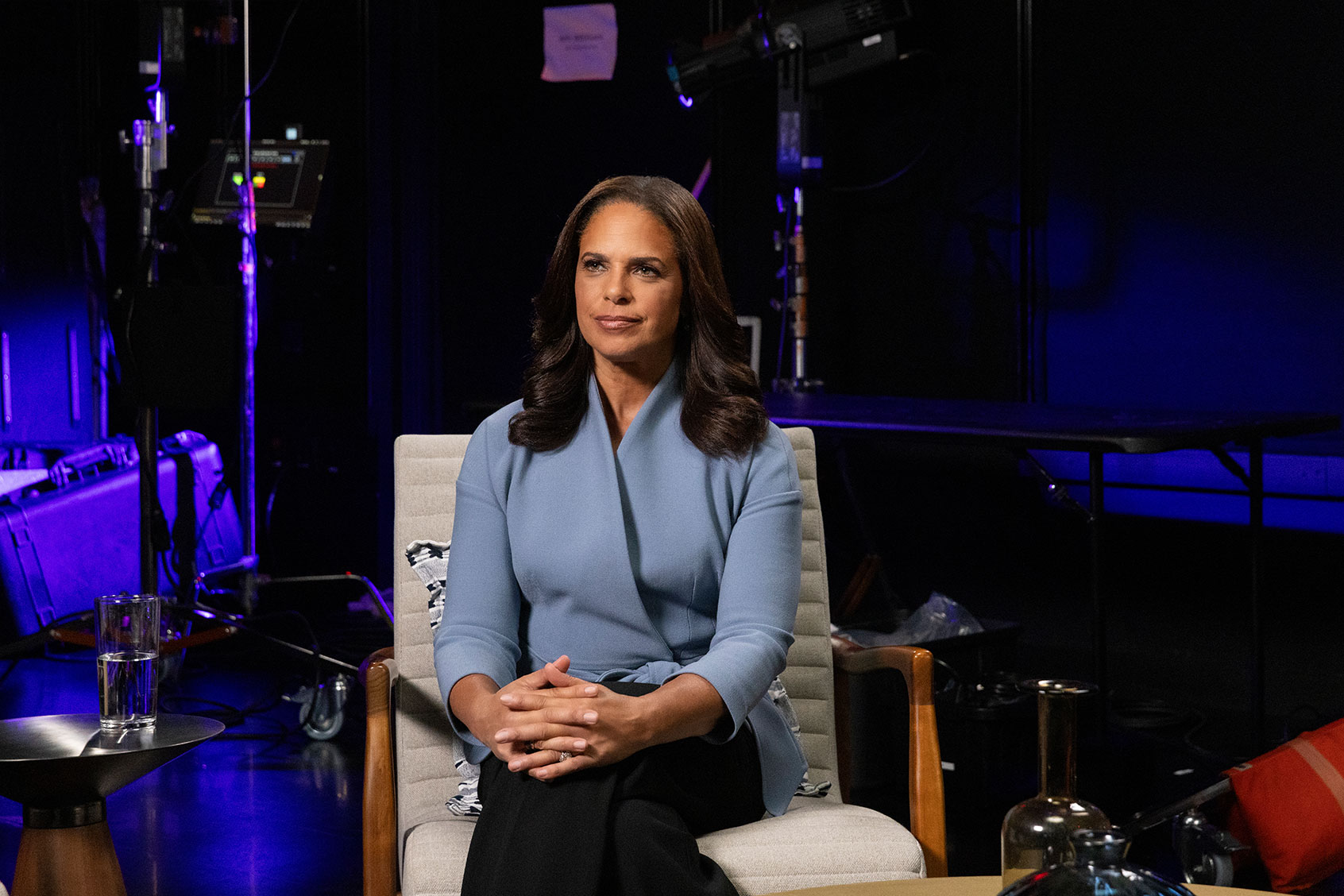
"Quiet on Set" saw meteoric success following its March 17 premiere, so much so that directors Mary Robertson and Emma Schwartz elected to move forward with a fifth installment of the docuseries. Moderated by award-winning journalist Soledad O'Brien, "Breaking the Silence" will build upon the harrowing discoveries unearthed by the first four episodes by further excavating the dark underbelly of children's stardom. Interviewees previously featured in "Quiet on Set" — Drake Bell, sketch-comedy show "All That" cast members Giovannie Samuels and Bryan Hearne, and Hearne's mother, Tracey Brown — will return for the fifth episode, joined by another former "All That" star, Shane Lyons. 

“With 'Breaking the Silence,' we’re digging deeper into the crucial conversations the docuseries ignited and exploring the lingering questions left in their wake to provide further insight from the brave voices who’ve spoken out previously and those who are coming forward again,” said Jason Sarlanis, President, TNT, TBS, TruTV, ID & HLN, Linear and Streaming, in a press release.

The "Quiet on Set" directors spoke to Salon about "Breaking the Silence" ahead of its forthcoming debut on Sunday, April 7, along with the pivotal onus we all share to protect children in the entertainment industry and more broadly. 

The following interview has been edited for length and clarity. 

This series has garnered immense interest, much of it positive for exposing dangers to minors in the industry. But it's also been very mixed. What would you say has been the most difficult or surprising reaction that you've had to address since "Quiet on Set" premiered? 

Robertson: Honestly, primarily we've been deeply moved by the response to this project. The engagement has been so voluminous and sustained, and I think that we've seen a lot of sensitivity manifest and a lot of compassion for the contributors manifest. We've seen a lot of people engage in a reappraisal of their childhood and power structures and the entertainment industry. So it is nothing but gratifying to see the work foster compassion and ignite conversation.

Quiet on Set: The Dark Side of Kids TVQuiet on Set: The Dark Side of Kids TV (Photo courtesy of Investigation Discovery) How did the conversations for a fifth episode start? Did you consider not doing it and what was required to sort of put it all together after the first four episodes came out? 
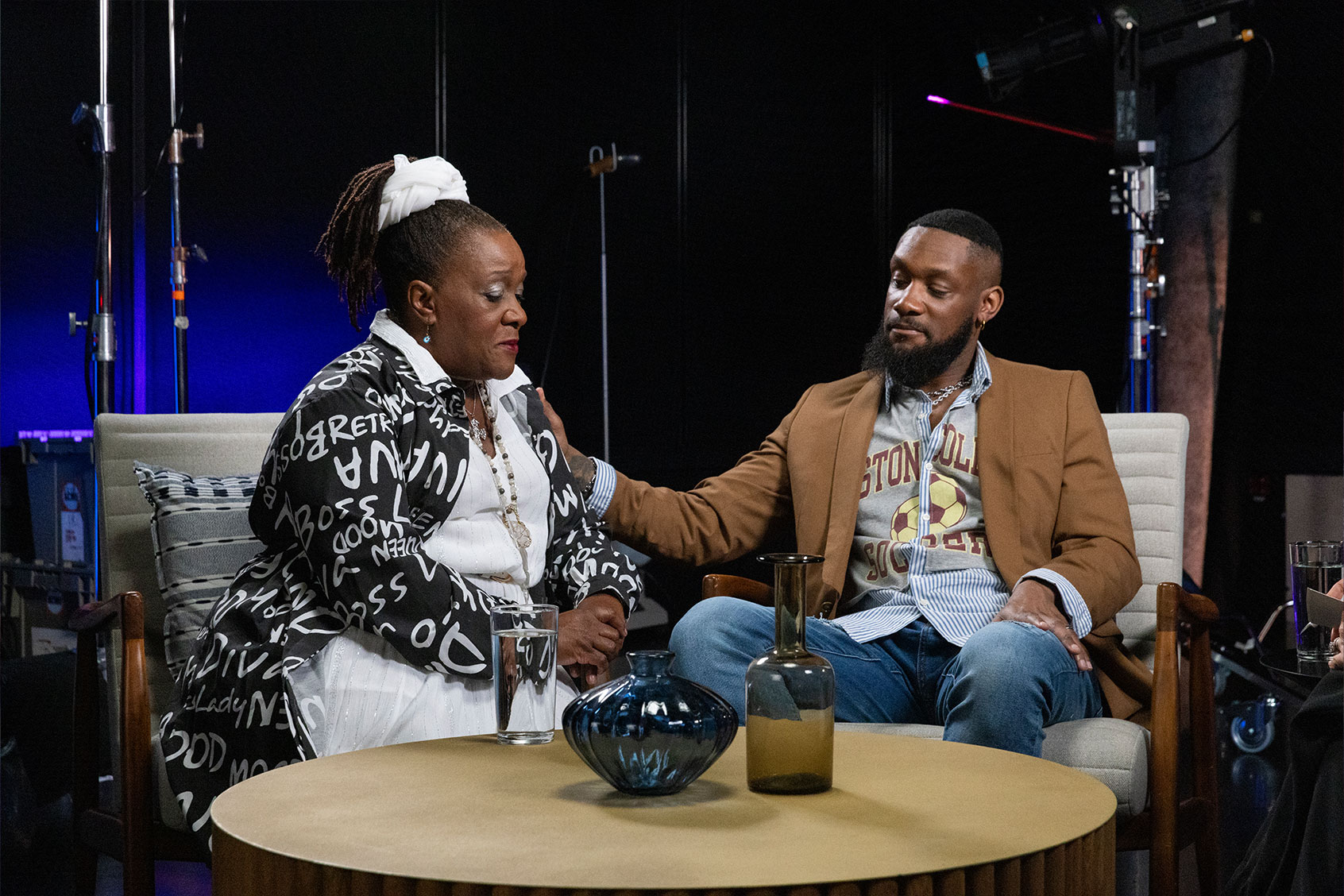
Robertson: Honestly, it came together so quickly. We knew, I think right after the trailer was released. The trailer went viral, the conversation started, there were questions and questions about questions and questions about questions, and I think we felt rather immediately that there was value that we could add in that moment, that the questions were fast moving and evolving and that there was value to sort of jumping in as soon as we could. So we enlisted award-winning journalist Soledad O'Brien. She brings such intelligence and sensitivity to her questioning. There's a cast member of "All That" who, after the documentary came out and he saw the reception, decided that he felt comfortable sharing his story. So he's coming forward and sharing his story. In the fifth episode, Gio and Brian and Brian's mother, Tracey, who were featured in the first four episodes are in this episode. They're engaging with a lot of the public response and some of the, you know, poignant and sometimes sharp questions that have emerged around the series. There's never before seen footage. And Drake Bell is also interviewed in this episode.

SchwartzI'll just add here, I think part of what we saw was that the docuseries was creating a conversation beyond just the contours of the stories that we told in social media, in articles — articles like the one that you wrote, which I thought was fantastic — about sort of the system of child acting of kids' TV writ large. And we wanted to sort of continue to help be a part of that conversation and give a space to some of our participants to discuss the aftermath and their experience of this sort of growing conversation.

That's actually a great segue into my next question. In the first four episodes of "Quiet On Set," we see a statement from Nickelodeon that's presented again and again. What do you think is any network's sort of responsibility for the safety of minors? What should be happening on a corporate level and what kind of oversight could these networks be putting in place for kids who are at a developmental age, effectively?

Robertson: We all have responsibility for the safety of minors.

SchwartzI think one thing that you're seeing from a number of the participants and one of the motivating forces for some of them to come forward and tell their story was a hope that there could be changes in more protections for kids put in place. And there's a range of what that can mean. If you go back in the 1938 federal legislation, there's a specific exemption for child entertainers. They don't have the same protections. We, by law, allow children to work in an adult environment without a lot of regulations. States have some of them, but it's very much a patchwork. And so there's a range of things that I know many of the people who participated or people in this space have been talking about. There's not universal background checks required for people working on sets with kids. We have requirements about schools. What about sets and whether there should be legislation in that space? You know, Jenny Kilgen has publicly written a letter to SAG-AFTRA, you know, asking them to re-examine the kinds of rules and protections they offer child actors. And you've heard from other participants calling for things like social workers or mental health specialists, people who can sort of engage with kids in their own sort of questions and discomforts that are not like their boss or their parents, where there's a lot of power dynamics at play. And so I think these are parts of the sort of conversations and movements that people are having. And obviously, it's always exciting to see people sort of take your work and see bigger actions and questions, even if we don't necessarily see ourselves as the advocates, but very excited to see where that heads and whether there are more protections that will come into play as a result.

Quiet on Set: The Dark Side of Kids TVQuiet on Set: The Dark Side of Kids TV (Photo courtesy of Investigation Discovery)Going off of that, beyond Nickelodeon, are child labor laws and allegations of ethically unsound practices in the world of child entertainment and Hollywood more broadly something that you want to pursue more now? Could we see, say, Disney or the dark underbelly of the Food Network, for example?
Robertson: We're passionate about the subject matter. We're devoted to continuing the lines of investigation. We're very much on it. And, you know, we're here. We're findable. We don't want to apply pressure. We know that some folks, unfortunately, have felt as though we've received pressure to come forward and share stories. We don't want to apply pressure on anyone to share a story — a very personal experience or an upsetting experience. But, you know, we're here if and when individuals with related accounts are ready. And I think that, we have been really moved by the amount of compassion sort of exhibited towards those who have come forward to share stories in the first four episodes.

Do you think this docuseries would have been different if Amanda Bynes, for example, had been able to participate in it? What do you think you're missing by not having Amanda's participation, for example?

Robertson: You know, we loved spending time revisiting the material from her early career. Everyone says she's so talented. There are so many people who speak so passionately about what she meant to them when she was growing up to see this young girl who was so funny, who was so versatile as a performer, who defied typecasting. You know, she was such a big part of that era at Nickelodeon and imprinted so deeply on the audience. You know, it's inconceivable to think of covering this era without honoring her talent and representing her talent. There are a lot of swirling questions around Amanda's experiences and her story. There's a lot of conspiracy. You know, there may be some facts. We tried to include that — I mean, we included that, which we could substantiate and left it at that.

Schwartz: And I'll just sort of add, I think, everyone is at a different place in terms of their openness, their processing and their own mental health about examining where they have been. And I think it's really important that we give people the space that they need to tell their stories when and if they ever are ready.

Absolutely. In an interview with The Hollywood Reporter, you noted that you were very curious about the letters of support for Brian Peck that are featured in episode four. Have you contacted anyone who wrote a letter and how would you plan on investigating the conditions under which those letters were written if you were to?

Roberston: We're very curious.

Schwartz:  Before the series aired, we reached out to everyone who we named in the documentary. We sent them a copy of their letter and asked if they had any comment on that letter. And we included the responses that were received in the documentary. You know, we continue to have questions about the circumstances under which those letters were written, what people were told, what questions they asked, what questions they didn't ask about writing those letters.

One of the biggest issues with non-criminal allegations that "Quiet On Set" sort of lays out is the moral murkiness underpinning them, which is to say that Schneider seems to perpetually toe the line of unethical behavior. How have you responded to naysayers who may have disregarded some of the interviewees' claims of racism, sexism, and sexualization as subjective?

Schwartz: You know, I think that just because something isn't a crime doesn't mean that it's not impactful and doesn't mean that it doesn't have a long-standing impact on individuals who went through and experienced those. And I certainly leave it to people's judgment watching it, but I was very moved by the experiences that people shared in "Quiet On Set" about how, you know, they felt on those sets. And having spoken to people — not just people on camera — but many others who weren't willing to come forward, I know that there are many, many people for whom these skits, these power dynamics had huge impacts on their emotional and mental health for years to come.

Robertson: I've been paying attention to the positive responses that have been directed towards a lot of the contributors and the compassionate responses that have been directed towards them. I saw a lot of people online expressing shock and outrage that Jenny and Christy, the two women writers featured in the first episode, have been asked to split one salary. And I thought it was a really interesting response because we're not talking about a violent criminal act; but nonetheless many in the audience felt true outrage that that was their experience.


Why you feel poorer than ever: It ain’t the price of eggs

If you’re reading this, you’re likely a lot poorer than you think.

Many people have felt that way over the past three years because of the unusually high overall inflation the nation has experienced. But the real reason you’re poor has very little to do with the prices of the past three years — and everything to do with the prices of the past 30 years. This is inflation that we were told, for the most part, had been kept low and steady. Much of this period is made up of the “Great Moderation,” as economists call it, a period when no matter what else happened in the country or the rest of the world, overall inflation never seemed to deviate much from the 2% target that the Fed has revered for so long.

It's a fantastic story. A triumph of policy intersecting with markets. The zenith of economic mastery. And the best possible outcome for Americans at all levels.

Too bad the story isn’t true.

Oh, the headline inflation numbers were technically correct; that’s not the issue here. It’s the “triumph” part. The “zenith.” The idea that the Great Moderation was actually great, or, for that matter, moderate. And most importantly, the suggestion that this — the economy we’ve landed in after all that time — is what was best for Americans.

In reality, inflation in the U.S. has been unofficially split into two major categories for decades: the things we want, and the things we need. Due in large part to globalization and offshoring, the prices of the things we want — electronics, household appliances, off-the-rack designer clothing and so forth — have generally increased slowly, or even gone down. Meanwhile, the costs of the things we need, like shelter or medical care — the kinds of things that can’t be offshored and for which demand can’t fall to any substantial extent — have risen faster than general inflation year after year after year. At any single moment in time, this is not particularly major news, which is why the topic has garnered relatively little attention. “Medical Bills Expanded Somewhat Faster Than Broad Consumer Prices In 1995” isn’t much of a headline. But when the same thing happens over and over again, the burgeoning buildup of the resulting imbalances can completely reshape an economy, even the largest economy the world has ever seen.

To set the stage for this retelling of history, it helps to know that overall inflation between 1993 and 2023 totaled 110%. Keep that number in mind, because most of the ones that follow won’t be anywhere close to it. 

Prices of the things we want — electronics, household appliances, off-the-rack designer clothing — have increased slowly, or even gone down. But costs of the things we need, like shelter or medical care, have risen faster than general inflation year after year after year.

Take new cars, for example. While a certain bare minimum of new vehicles must be produced every year in order to replace those that have permanently broken down or been destroyed, the vast majority of new car purchases are not only completely unnecessary, but have been called the single “worst investment” a person can make by a range of sources from Suze Orman to CNBC and even Cadillac’s own customer message board. A new car is a want, not a need. And luckily for those who have fulfilled this particular wish, the cost of a new car went up by just 34% between 1993 and 2023. In fact, until the recent spurt of widespread inflation that started in 2021, the average price had only gone up by 11% over the preceding 28 years.

Then there’s apparel. Again, nobody would dispute the fact that a certain quantity of clothing is essential — but that doesn’t change the fact that a vast number of U.S. purchases are superfluous. The EPA estimates that Americans throw away more than 17 million tons, or 34 billion pounds, of textiles every year. That’s more than 100 pounds for every man, woman and child living in the country. Every. Single. Year. Those 100 pounds have to be replaced by something, namely buying more outfits that we wear less often. Yet even such a powerful “want” has failed to keep up with increasing supply and decreasing manufacturing costs, as the overall price of clothing has jumped very little in the past 30 years; in fact, despite the recent spike, the average cost has actually decreased by 2.5% since 1993.

That dip is nothing compared to the same measurement for children’s toys, which have plummeted in price by a whopping 76% during the timeframe in question. But the big kahuna of consumer deflation is electronics. In three decades, the cost of IT hardware (as a broad category) and services has fallen by 91%. The more specific category of personal computers, smart home assistants and “peripheral” equipment has only been tracked by the BLS since 1997, but in that time, the measure has fallen off a cliff, to the tune of 97%. TVs have gone right over that same cliff, just beating out computers by crashing more than 98%.

Why You Feel Poor - Median Household Income graph inline 01 (U.S. Bureau of Labor Statistics/U.S. Census Bureau)
(At this point, there surely must be an army of naysayers asking, “How have televisions gotten that much cheaper when my curved, foldable, voice-activated, 90-inch Megatron 17K Code Red Plutonium-Plasma HHHHD Doritos Locos Extreme 5000 smart TV still cost me $799?” Well, the BLS evaluates improvements across all products and services over time, and factors those improvements into the actual values that consumers are getting for the same basic type of product. Just as today’s smartphones have tens of thousands of times more computing power than the Apollo 11 spacecraft while costing millions of times less, these drastic changes are taken into account just as much as the number on the store tag.)

So far, this seems like excellent news. While countless articles have been written about the slow long-term growth of wages, median household income has still outpaced inflation since 1993, pushing upward by 138%. Earnings are up, and plenty of prices are down. Despite what the celebrated economist Mick Jagger said, it would appear that we can, in fact, get what we want.

The problem is getting what we need.

Anyone who’s bought eggs since the COVID lockdowns began four years ago might suspect that everyday necessities like groceries and gasoline are the main drivers of new poverty. But over the long term, such items keep pace with the growth of personal income surprisingly well (albeit with more volatility, in the case of fuel) in a functional economy, and don’t alter its fundamental structure — although it’s clearly true that spikes in those prices are the most likely to cause widespread anger among consumers. (To quote John Schoen of NBC News, “As anyone who drives a car is painfully aware, few other products require that you stand and stare at the price, in giant lettering, for several minutes.”)

No, the needs that have changed American life amount to a four-headed monster that has been fed by a perversion of market forces. For these sectors of the economy, the basic relationship between producer supply and consumer demand simply doesn’t exist in the same way it does for cars, computers or one brand of peanut butter to another.

The needs that have changed American life amount to a four-headed monster that has been fed by a perversion of market forces.

The first head is housing, where prices have repeatedly shattered all-time highs just a decade and a half after crashing from their previous all-time highs and sparking the worst financial crisis since the Great Depression. The benchmark Case-Shiller Index has risen by 306% since 1993, including a nearly-70% leap from the pre-crisis peak in 2006, a statistic made all the more astonishing (or, for aspiring home buyers, devastating) by the fact that 30-year mortgage rates hit their 21st-century high last October. Things are, of course, at their worst in places like San Francisco, where the annual income needed to buy a median-priced home is more than $400,000 and the median monthly mortgage payment is over $10,000. But it’s not just the biggest, most expensive cities where people feel this problem; according to property data publisher ATTOM, home ownership is now considered “unaffordable” (defined as eating up more than 28% of the local median income) in roughly 80% of counties across the country.

Much of this reflects the drastic undersupply of housing that exists all over the US because of local zoning laws, HOAs and NIMBYism. But it also has to do with the permanent bureaucratic decision across both parties, multiple presidential administrations and all ideologies that the federal government must use its financial might to “promote homeownership” — which is just another way of saying “boost demand.” So as prices went up, it was deemed necessary that mortgage debt must become cheaper and easier to access, which made prices go up further, which required debt to become even cheaper and easier, and so on.

The road to hell, as they say, is paved with good intentions. And in a vacuum, expanding homeownership — especially by eliminating racial redlining and other discriminatory practices — is an excellent intention. However, we all know the story leading up to 2008, and how it turned out. The policies were successful. Enormously successful. As it turned out, given the spread of things like “NINJA” (No Income, No Job or Assets) loans and financial products with names such as “unfunded synthetic mortgage-backed securities,” much too successful. Homeownership peaked in 2004, followed by housing prices in 2006, at what were records for each measure at the time. They hovered in place for a bit longer until the bottom fell out.

A couple of things happened after that. One, the largest financial bailouts in U.S. history made it clear that the government would do anything to stop a collapse of the housing market. Two, the feds went to the same people who were being bailed out, the same people who invented NINJA loans and unfunded synthetic mortgage-backed securities and other kinds of inscrutable financial garbage — Wall Street — and asked them for help. In the ashes of the crisis, Fannie Mae launched a 2012 pilot program allowing investment funds to buy up swathes of homes that were sitting empty after foreclosures. This effort proved exceptionally popular and was expanded repeatedly, providing the necessary demand to drive housing prices skyward once again even as individual homeownership has fallen from that 2004 peak of 69% to 65%, which is where it was in 1997.

Today, Blackstone, the largest private equity manager in the world, is also America’s largest landlord. In some metro areas, such as Atlanta, institutional investors own the outright majority of homes in some neighborhoods, and just three companies own 11% of all rental homes in the entire state of Georgia. These large-scale purchases are concentrated on specific areas of the country, like the Sun Belt. It just so happens that rental prices in the Sun Belt have jumped by nearly twice as much as the national average over the past few years.

Blackstone, the largest private equity manager in the world, is also America’s largest landlord. Just three companies own 11% of all rental homes in the entire state of Georgia.

These investment funds would say that their share of the overall rental market in the entire country is still small, which is true: they own about 5% of the entire national sum of single-family rental homes right now. But they’re buying more of them at a furious pace, with MetLife projecting that the same firms could own almost half the total stock of such homes by 2030. This trend, combined with the fact that with the broader shift of millions of people from homeownership back to renting, has thrown a giant monkey wrench into what would be the natural market reaction to astronomical housing prices: Don’t buy, rent. Well, average rents across the country (including multi-family units) have soared by 50% since 2012, while personal income has increased by 46%. That doesn’t seem like a catastrophic mismatch, but the problem is that buying a house has become radically expensive, while renting a house has become slightly more expensive at the  same time. What else are people supposed to do? 

Jimmy McMillanFormer New York gubernatorial candidate Jimmy McMillan was right: The rent is too damn high. Unfortunately, housing prices are even higher. (Audrey C. Tiernan-Pool/Getty Images)
The story is similar in the world of education, primarily driven by colleges and universities, which make up a larger portion of the BLS measurement than all other levels of schooling combined. This broad-based figure has grown by a mammoth 278% in 30 years, with university tuition dragging that figure upward, surging by 305%. By sheer lack of coincidence, only college and post-graduate education can be funded by what is effectively an unlimited form of personal debt, which is more difficult to discharge in bankruptcy than virtually any other type of debt.

Again, as with home ownership, this is not to say that the goal of higher education is misguided. It’s the way we’ve decided to pay for it that’s the issue. “Student loan programs began with altruistic intent,” Hope College president Matthew Scogin told USA Today last October. “There was a problem, though. With no limits on the amount students could borrow, colleges and universities had a clear path to raise the sticker price of tuition year after year. After doling out all available aid, colleges simply directed students to federal loan programs to close any funding gaps — however big.”

While the federal government had guaranteed a small volume of loans made by educational institutions since 1958, then guaranteed all student loans made by private lenders since 1965, and has outright purchased a certain quantity of such loans since 1972, this system amounted to relying upon thousands of middlemen with limited resources and differing standards. Washington began the process of dispensing with such middlemen and funding loans directly, with no merit- or needs-based qualifications of any kind, in a wildly convenient year for the purposes of this article: 1993. Under the Student Loan Reform Act of 1993, the total amount of money that graduates owed straight to Uncle Sam went from the obvious starting point of zero to $1.62 trillion in 2023. Adding in the small amount of privately-funded student loans that still exist, the total came to $1.77 trillion, easily eclipsing the $1.03 trillion of credit card debt on the books at the time.

Nonprofit Quarterly writer Steve Dubb came to a straightforward conclusion when writing about how bad the student debt problem was five years ago: “It’s a simple lesson — if you subsidize demand but don’t have sufficient supply, the price goes up… US higher education spending now is highest in the world (except Luxembourg) — about $30,000 a student.” In his commentary, Dubb cited one of the original architects of federal student loans, economist Alice Rivlin, and her opinion on the project she pushed so hard for in her younger days. With those efforts, she said, “We unleashed a monster.”

Once again, the private equity industry spotted the above trends and determined that a major stream of revenue was ripe for the picking. UC Berkeley professor Charlie Eaton studied the purchases of nearly 1,000 educational institutions and the resulting effects. While tuition and student borrowing increased more quickly per year than at comparable educational institutions not subject to that type of ownership, Eaton found “sharp declines” in “student graduation rates, loan repayment rates, and labor market earnings after private equity buyouts.” But even as academic budgets were generally cut across the board, increased recruiting budgets meant that there were always new students in the pipeline, and the data from these thousand schools suggest that “profits triple after a buyout.”


Want a daily wrap-up of all the news and commentary Salon has to offer? Subscribe to our morning newsletter, Crash Course.


Private equity, Eaton concluded, just “leads to better capture of government aid” than other forms of ownership.

A similar analysis also applies to the many areas of health care into which private equity has injected itself, notably specialist fields, in which single firms often own more than half the practices of various specialties in entire cities, and senior care facilities or nursing homes, where you — yes, you! — can buy shares in nursing-home real estate funds, which have been nauseatingly described as “the surprise heroes of high-yield investing.” But the health business as a whole and the reasons for its exploding costs are infinitely more complicated than those found in virtually any other sector. Suffice it to say, the United States has conclusively proven that a Frankenstein’s monster of health “consumers” (a misuse of the word if there ever was one) who have no idea what their “purchases” will actually cost, profit-driven private insurance companies that pay different amounts to different providers for identical care, a random mix of public and private providers who all charge different amounts to different consumers for the same care, a regulatory apparatus that has been completely captured by the pharmaceutical and medical device industries that the apparatus is supposed to be regulating, and a giant flow of government money undergirding the whole system… does not work.

You — yes, you! — can buy shares in nursing-home real estate funds, which have been nauseatingly described as “the surprise heroes of high-yield investing.”

As the country has stumbled its way through decade after decade of proving just how much this assemblage of throwaway parts from a grab bag of differing health care philosophies doesn’t work, the share of the economy taken up by health care spending has grown to more than 17%, or roughly one-sixth, of our entire GDP, roughly twice the average of OECD nations overall. We spend more per capita by far than any other country on the planet — and yet have the lowest life expectancy, highest death rate for avoidable conditions and highest maternal and infant mortality of any OECD member, not to mention dozens of other statistics that paint just as pathetic a picture. This is not a plea for any specific replacement for the current structure of American health care; it is simply a testimony to how massive a failure that current structure is. And we the people are paying, or even worse, not paying for it — medical bills are the No. 1 cause of personal bankruptcy in the U.S.

Finally, there’s the rapidly accelerating cost of something that non-parents might be blissfully unaware of: child care. The Department of Labor declared in 2023 that, according to its data, paying for child care is “untenable for families across all care types, age groups, and county population sizes.” The cost of care for two children “exceeded the average rent in the District of Columbia and all 49 states with available data.” This is happening with providers consistently losing workers to fast food and big-box stores whose jobs pay better, despite the outlandish prices of child care. Treasury Secretary and former Federal Reserve chair Janet Yellen has noted that care employees only make an average of $27,000 a year, putting them in “the bottom 2% of all occupations.” According to Yellen, “child care is a textbook example of a broken market.” 

Unfortunately, there is no single definition of “child care costs,” making it difficult to track exactly how much they have changed over time. Oddly enough, even sources that claim to use the same data from the BLS come up with different numbers, and the BLS itself does not appear to track an isolated “child care” price number every single year. Most sources, however, agree that the inflation-adjusted cost of such care has at least doubled the overall rate of inflation in the past 30 years — some say it is much worse than that, but this article will take the conservative approach and merely apply the doubling statistic.

Why You Feel Poor - Consumer Price Index graph inline 02 (U.S. Bureau of Labor Statistics / S&P Dow Jones Indices LLC)


From those four types of expenses for today’s families — the four fundamental forces of America’s modern-day household sector and the four horsemen of America’s slow-motion economic apocalypse — we can explain why so many people experienced such a hard hit when eggs (those damn eggs) doubled in price, or at the multiple moments when gas prices have shot upward. Most people simply have a smaller percentage of their income to devote to anything other than these “fundamental forces,” despite the fact that real wages (minus COVID stimulus checks) are at an all-time high and the U.S. has the fourth-highest income per capita in the world. In other words, being rich never felt so poor.

Most people simply have a smaller percentage of their income to devote to anything other than these “fundamental forces,” despite the fact that real wages are at an all-time high. Being rich never felt so poor.

The median household earned $31,240 in 1993 (in 1993 dollars) and earned $74,580 in 2022 (in 2022 dollars). If the household had one adult who graduated from college in 1993, the average student debt burden would have been $9,320. In 2023, it was $37,650. If this household bought a, well, house, the median cost in 1993 would have been $125,000; in 2023, it would have been $417,400. If the people of this young household decided to have a child early, the monthly cost of child care in 1993 would have been $323. Three decades later, to use the rough estimate from above, the cost would be $1,036 per month. And even if the members of the household were covered by their parents’ health insurance, they would still pay out-of-pocket costs of $2,854 for childbirth in 2023; the same figure is difficult to pin down for 1993, but since overall costs (insurance payments plus out-of-pocket contributions) have roughly tripled in that time, it’s a reasonable guess that those services would have come in at around $951.

No worries on that last point, however; as William Friedewald, chief medical director for MetLife back in those good ol’ days of 1993, helpfully pointed out, “You can have a delivery in a taxicab, and it’s free.”

Albert Einstein may not have actually made his apocryphal proclamation that compound interest is the most powerful force in the universe, but it wouldn’t take the smartest man of the 20th century to spot the mathematical atomic bomb slowly ticking away when the basic cost of living in a country is compounding faster than the ability to make a living in that same country. And while Einstein may get unmerited credit for that claim, economist Herb Stein deserves real kudos for coining another phrase that could just as well be applied to the same situation: “That which cannot go on forever, won’t.”

This is it: the true story of the modern American economy. It is the saga of the declining costs of indulgence, overwhelmed by the rising costs of necessity. It is the reason why millennials and Zoomers are planning for a world in which material prosperity will not be determined by how much they have, but by how little they owe. It is the sound of statistical inevitability, the sound of the death of the American dream, should these trends continue — eventually, this system will break down.

We can only hope the next one will hit a triumphant zenith that isn’t entirely imaginary.

Biologists like us want to find out how birds will respond to darkness in the middle of the day

The total solar eclipse on April 8, 2024, coincides with an exciting time for wild birds. Local birds are singing for mates and fighting for territories as they gear up for their once-a-year chance to breed.

Tens of millions of migrating birds will be passing through the path of totality, and they mostly migrate at night.

Because birds use light to match their behaviors to their environment, scientists like us have lots of questions about how they will respond to the eclipse. Will they pause their fighting and wooing and shift toward bedtime-like behaviors? How about a nocturnal animal like an owl or those nighttime migrants – will they start to rustle from their roosts before they realize it’s not night?

As behavioral biologists at Indiana University, we research wild breeding birds, with a goal of understanding why animals behave the way that they do in response to environmental challenges and opportunities. For the 2024 eclipse, our team is launching a new project and developing an app. If everything goes as planned, we should end up with a large dataset after the eclipse, collected by community scientist volunteers across the country.

There’s an app for that

On average, a total solar eclipse occurs in the same place only once every 375 years. Most wild animals, like most people, have never seen the sky quickly switch to night in the middle of the day. These rare events are a natural experiment that can help scientists like us understand how animals respond to an unusual sudden change in light.

A map of the U.S. showing a dark band starting at Texas, moving up towards Illinois, Indiana and Ohio, and through New York and Maine.

The path of totality for the 2024 total solar eclipse. NASA

Most past research on animal behavior during total solar eclipses is anecdotal. Observers have reported that zoo animals acted distressed or went into their enclosures. Scientists have spotted spiders starting the nightly deconstruction of their webs in the middle of the day, and farmers have heard their roosters start to crow after totality, as if it’s once again dawn. Other reports suggest more subtle effects on animal behavior.

Massive amounts of standardized data can help to make sense of these observations. But because totality covers such a large swath of the globe in a short amount of time, it would be impossible for one scientist or even one small team to get enough observations to figure out why some animals respond more strongly to a solar eclipse than others.

With collaborators across our campus – including Jo Anne Tracey at the Office of Science Outreach and Paul Macklin at Indiana University’s Luddy School of Informatics, Computing, and Engineering – we have created an app called SolarBird.

Anyone can download SolarBird for free in the Apple Store and Google Play. The app asks participants to find a bird and watch it or listen to it for 30 seconds, while clicking a few prompts on what the bird does before, during and after totality. You don’t need to have any prior knowledge or bird expertise to participate.

These types of public science projects have aided lots of scientific discoveries, and we are hoping the public can help us learn more about bird behavior during an eclipse, too. Anyone can help. Even observations outside of totality collect important baseline data.

Technology and bird behavior

Apps like Solarbird aren’t the only technologies that help researchers observe more than what any one individual scientist can see or hear.

For example, during the August 2017 solar eclipse, researchers collected data from weather stations across the United States, including several sites along the path of totality. Like the weather forecaster on your local news channel, they used radar to detect movement in the skies, but instead of clouds, they focused on the radar signatures of flying insects and birds.

The team saw some changes in activity – mainly, the birds didn’t follow their typical daytime activity patterns as much, but they saw no consistent increase in night-like activity. Because they used radar, it’s not clear exactly which bird behaviors increased or decreased.

The April 2024 eclipse will last longer than 2017’s, with four full minutes of darkness. And, with spring in high gear, birds are singing up a storm.

Bird songs generally convey two critical messages: “keep away” to a rival and “come here” to a prospective mate. Singing is also really easy for observers to notice. Most birds sing at 85 decibels, measured at 3 feet (1 meter) away. That’s the equivalent of a power mower – loud enough to notice that it’s happening or that it’s suddenly stopped, even across your yard or a public park.

Birds sing for different reasons. Recording their songs can tell researchers how birds respond to an eclipse.

With Dustin Reichard from Ohio Wesleyan University, our team has put out passive audio recorders to record how the eclipse affects birds’ singing.

Researchers tracking wildlife have used autonomous recording units for years. These army-green, weatherproof devices are about the size of a Kleenex box, and typically strapped to a tree while they record virtually anything within earshot. We have 20 of them out now, at rural, suburban and urban sites.

A green box strapped to a tree in the woods.

An autonomous recording unit, which records bird songs. National Parks Service

Software advances help to automate the process of identifying bird songs by species with less work on the human end. We started recording the last week of March to collect song rates at a typical dawn and a typical dusk. We also measured important controls like how much birds normally sing at at 3:06 PM, the peak of totality here in Bloomington, Indiana.

We hope to use these recordings to figure out why some animals might be more or less affected by a solar eclipse.

For example, artificial light at night can affect bird physiology, behavior and abundance, and the total solar eclipse gives us a new way to test how light pollution affects behavior.

Urban birds may have gotten used to odd changes in light. Forest dwellers might differ from grassland birds, based on the amount of light in their natural habitat. Or, social species might increase their alarm calls, which would give insight into how animals use social bonds to navigate the unknown.

If you’re in the path of totality this April, be sure to take in the celestial show. But you may also want to look around and listen for birds, insects and other wildlife to see how they’re responding to this once-in-a-lifetime moment.The Conversation

Kimberly Rosvall, Associate Professor of Biology, Indiana University and Liz Aguilar, Ph.D. Student in Ecology, Evolution and Behavior, Indiana University

This article is republished from The Conversation under a Creative Commons license. Read the original article.

A fungal pandemic is massacring frogs, but scientists just found a virus that could lead to a cure

Imagine a fungus that makes your skin turn angry red. Some of the skin breaks into ulcers, especially at the tips of your toes, while in other places, pieces of skin shed off entirely. By the time it reaches your heart, which is inevitably fatal, death is probably a welcome relief.

"When tested for its effects on the fungus' ability to attack frogs, it seemed to actually increase the virulence of the fungus against the frog."

That is the fate of the millions of frogs who have suffered from Batrachochytrium dendrobatidis, or BD for short. Over 500 species of amphibians are suffering major population declines due to BD while there have been 90 possible extinctions and near extinctions, threatening endangered species like Panamanian golden frogs (Atelopus zeteki) and yellow-legged mountain frogs (Rana muscosa.) BD is driving one of the great mass extinctions of the current era — and yet now researchers believe that a virus may help herpetologists develop a cure.

Meet BdDV-1, a viral fragment discovered by scientists whose paper was recently published by the journal Current Biology. The researchers found it in much the same way that one disentangles a knot, by pulling on individual threads to see where they lead. While examining the BD fungus to learn about weaknesses, they discovered a single-stranded DNA virus trapped within the genome of the fungus. Although this only applied to certain strains, when infected they produced fewer spores than the uninfected fungi. Now the next step is to see if researchers can clone and engineer this virus so that it kills BD and saves the frogs.

That will not be the easiest task to accomplish, however, for a big reason: Currently the virus makes the fungus more deadly to the frogs, rather than less so.

Panamanian golden frogPanamanian golden frog (Getty Images/travelview)

"While the virus might have a depressive effect on the growth of the fungus in the lab, when tested for its effects on the fungus' ability to attack frogs, it seemed to actually increase the virulence of the fungus against the frog," Timothy Y. James, corresponding author and professor at the University of Michigan's Department of Ecology and Evolutionary Biology.

In fact, the virus even surprised researchers by not impacting the health of the host frogs and fungi in normal ways.

"Interestingly, by looking at many genomes, we found the surprising pattern that BdDV-1 was only really present in the enzootic strains [strains constantly present in an animal population] and not found in the strains isolated from outbreaks, the so called global panzootic lineage (GPL) strains," James said. "So, we expected the virus might have a negative effect on Bd virulence and were stunned to find the opposite effect."


Want more health and science stories in your inbox? Subscribe to Salon's weekly newsletter Lab Notes.


"If that ultimately led to a Trojan horse type of strategy to kill the fungus great, but our research is touching on the basic biology that shows that indeed the fungus can be infected by a virus."

While it may seem discouraging that the BdDV-1 fragment does not made the fungus less virulent or deadly, in fact scientists are embracing the news. Researchers had previously struggled even to find a virus that could infect the BD fungus, much less one that could be kept alive in a laboratory and potentially bioengineered. The BdDV-1 checks all of those boxes.

"Before this research we had been trying for years to determine if there was a virus that could infect this fungus," James said. "Finally discovering that there was one, and that it was a DNA virus rather than an RNA virus settled the score and also opened up a broad field of research to our team, as DNA viruses are understudied in fungi."

The next step, of course, is modifying the BdDV-1 fragment so that it has the effect on the fungus that humans wants: Helping frogs.

"We need to be able to move the virus in and out of Bd strains through a genetic modification process called transformation," James said. "This will allow us to modify the sequence of the virus to test its function."

We need your help to stay independent

The research also transforms our understanding of fungus biology, a field known as mycology. Prior to this study, experts did not even know if viruses that can infect fungi (mycoviruses) could do so unless they were RNA viruses. This is the first full-length CRESS virus of Circoviridae (a specific family of viruses) that is known to infect fungi. It is a mystery to the scientists — including its mechanisms of action.

“We don’t know how the virus infects the fungus, how it gets into the cells,” UCR microbiology doctoral student and paper co-author Mark Yacoub said in a press statement. “If we’re going to engineer the virus to help amphibians, we need answers to questions like these.”

Yet even though it is "not clear" how their new knowledge will help them save frogs, James said, the experts at least know "that the fungus can be infected by a DNA virus [so] we can start considering using that viral backbone as a way of delivering a gene of interest into the fungus. If that ultimately led to a Trojan horse type of strategy to kill the fungus great, but our research is touching on the basic biology that shows that indeed the fungus can be infected by a virus."

James added, "The rest comes far down the road."

Merrick Garland, Donald Trump and the fall of France

During the past three years, there have been numerous critics of the Justice Department under Attorney General Merrick Garland’s leadership. I have been among them. It did not seem encouraging that in one of his first major acts after taking office, Garland intervened in the E. Jean Carroll lawsuit to argue that Donald Trump had presidential immunity in a case that had no bearing on any possible scope of his presidential duties.

Garland’s apparent slowness when it came to appointing a special counsel to prosecute Trump was also puzzling. Some of my correspondents, a few of them with law degrees, scoffed at my amateurish take on the matter: Main Justice was playing a diabolically clever game of twelve-dimensional chess, they assured me, and had Trump right where they wanted him. The legal art, or so I was given to understand, is so infinitely subtle that outsiders were committing a species of lèse-majesté to question Garland’s approach. 

On March 22, the New York Times published a lengthy and revealing tick-tock account of the Justice Department’s efforts to prosecute Trump. It largely confirms the widespread impression that the investigation has been much too slow.

Its sluggish pace was also compounded by erroneous leads that fizzled out. Garland first concentrated on “following the money,” but unlike in ordinary organized crime or drug cases, the insurrection was about political power in the first instance, not money. The case was patently not about who paid for insurrectionists to stay at the Comfort Inn in Arlington (if they paid for it themselves, was Trump off the hook?), but rather the overt acts of the insurrectionists — and of Trump himself — which were painstakingly documented from every angle by television cameras.  

Aside from the missteps and delays, two paragraphs in the Times’ piece underline a rather breathtaking attitude at Justice:

In trying to avoid even the smallest mistakes, Mr. Garland might have made one big one: not recognizing that he could end up racing the clock. Like much of the political world and official Washington, he and his team did not count on Mr. Trump’s political resurrection after Jan. 6, and his fast victory in the 2024 Republican presidential primary, which has complicated the prosecution and given the former president leverage in court.

In 2021 it was “simply inconceivable,” said one former Justice Department official, that Mr. Trump, rebuked by many in his own party and exiled at his Florida estate Mar-a-Lago, would regain the power to impose his timetable on the investigation.

One has trouble taking at face value the claim that “the political world and official Washington” had written Trump off politically in 2021. And was his future political viability literally “inconceivable”? A majority of House Republicans voted to nullify Biden’s election victory just a few hours after the insurrection, and shortly after that a solid majority of Senate Republicans voted against an impeachment conviction. Soon, Republicans whose very lives had been threatened by the mob, like then-House Minority Leader Kevin McCarthy, would obediently make their pilgrimage to Mar-a-Lago.

But the key factor, as the Times article clearly demonstrates, was always time. Garland’s by-the-book, plodding approach played into the one successful legal strategy Trump has consistently used his entire adult life: delay. One does not have to be “official Washington” to read the calendar and recognize that it will be an election, not a single piece of elusive evidence, that by default will decide Trump’s legal status and the future of democracy in America.

As the tagline goes, justice delayed is justice denied. It is one of the abiding traits of the Anglo-American legal system that its workings can be parried by endless motions, continuances and appeals — a process that blatantly favors the rich, de facto granting them a legal near-impunity close to that of aristocrats in a feudal regime. 

Garland, then, grasped neither the political realities, the stakes involved nor the imperative of timely action. He has been like a chess player doggedly pursuing his prepared game plan while ignoring how his opponent’s countermoves have changed the dynamic of the match. 

Garland’s by-the-book, plodding approach played into the one successful legal strategy Trump has consistently used his entire adult life: delay.

Given the existential stakes involved, and the fact that judicial politics has become — at least to this point — war minus the shooting, a more appropriate analogy than chess might be armed conflict, the most violent, kinetic and unpredictable of human activities. Unlike in chess, in war the rulebook is tossed out the window. The single most important factor in war is often time: It invariably works for one side and against the other, upsets strategies, defeats commanders who disregard its iron constraints.

Garland brings to mind the commander of the French Army in 1940, Gen. Maurice Gamelin. He was regarded as having an intelligent and subtle mind, and had risen to the top via a series of staff jobs. He was a believer in methodical battle, the precise coordination of military force according to a rigid timetable. 

As he prepared to face a German invasion in the spring of 1940, Gamelin and his staff were sure the German army would come at them the same old way, through Belgium, as in 1914. In other words, he prepared to fight the last war against a normal, predictable opponent. Accordingly, when the invasion began, he would send the cream of his army into Belgium to cut off the invader (and incidentally keep war damage away from French territory).

But as history records, the enemy did not come the same old way. In one of his demonic flashes of intuition about the weakness of opponents, Hitler changed his army staff’s long-standing plan, instead sending his main strike force further south, into France. Belgium would merely be a baited trap.


Want a daily wrap-up of all the news and commentary Salon has to offer? Subscribe to our morning newsletter, Crash Course.


Once Gamelin duly sent his best units north, they were outflanked and ensnared. It would become a race against time to extricate them. Alistair Horne’s classic account, “To Lose a Battle,” reports that Gamelin’s headquarters lacked telephone or other electronic links to his field commanders; it had to make do with dispatch riders. Horne quotes contemporaries calling the headquarters “a submarine without a periscope”: a huge blunder when facing the Wehrmacht's speedy, flexible operational plans. The French army was doomed.

Like Gamelin, Garland assumed he had all the time in the world to take down a conventional opponent. In his metaphorical submarine without a periscope, the attorney general and his senior staff were oblivious to what was occurring on Capitol Hill just a few blocks from the Justice Department building.

He was also facing an unconventional opponent. While the Germans’ secret weapon was tanks, Trump’s is his comprehensive propaganda machine. His perpetual railing at perceived enemies and claims of martyrdom have had a perverse effect on DOJ: Garland’s painstaking effort not to appear political has in fact created its own form of politicization, expressed in excessive circumspection and careful weighing of each legal move for its political implications. Beyond causing agonizing and seemingly endless delay, that amounts to a kind of psychological submission to Trump’s strategy. 

No historical analogy is perfect because concrete circumstances always differ in detail. But human behavior is remarkably consistent — particularly the tendency of people under stress and high stakes to undermine their own success — and examples from the past can illuminate present issues. Above all, time’s irreversible arrow is always a constant in human affairs. We can hope that when placed under stress, the institutions of democracy will prevail. But in politics as in war, hope is never a viable strategy for victory.

“This is a big deal”: Experts say Judge Cannon’s order signals “bad news” for fate of Trump case

U.S. District Judge Aileen Cannon on Thurday denied Donald Trump's dismissal motion in his Florida federal criminal case, tossing out the former president's argument that the Presidential Records Act (PRA) turned classified records into his personal documents after he left office.

But Cannon, in her decision, also declined to rule on special counsel Jack Smith's request for clarity on the jury instructions she asked the parties to submit and did not signal whether she believed the PRA could constitute a permissible defense that Trump could raise later, according to The Washington Post

Her refusal leaves open the possibility for the PRA to come back to bite during trial — and legal experts warn that could lead to problems down the line. 

The "good news" for the special counsel is that Cannon rejected Trump's motion to dismiss the case based on the PRA argument, Barbara McQuade, a University of Michigan law professor and former U.S. attorney, told Salon. But the "bad news" is that Cannon indicated her decision is a "pretrial ruling only" and that she could dismiss the case later on those grounds should Trump raise it as a defense. 

"That would actually be a worse outcome for Jack Smith because he would be unable to appeal once a jury has been sworn in," McQuade said.  

The judge's decision came three weeks after she held a hearing on the presumptive GOP nominee's PRA motion and two days after Smith rebuffed the presumed thinking underlying her request for proposed jury instructions.

On Tuesday Smith urged Cannon in a court filing to decide "promptly" on whether the interpretation of the PRA the jury instructions were based on, which seemed to align with Trump's perspective of the act, represents her position. He warned that, should that be the case, he would appeal her before trial, noting that such a viewpoint stems from a "fundamentally flawed legal premise."

Cannon, in her latest, three-page order, rebuked Smith's request, writing that "to the extent the Special Counsel demands an anticipatory finalization of jury instructions prior to trial, prior to a charge conference, and prior to the presentation of trial defenses and evidence, the Court declines that demand as unprecedented and unjust.”

Her request for the proposed jury instructions last month "should not be misconstrued as declaring a final definition on any essential element or asserted defense in this case,” the judge said Thursday. "Nor should it be interpreted as anything other than what it was: a genuine attempt, in the context of the upcoming trial, to better understand the parties’ competing positions and the questions to be submitted to the jury in this complex case of first impression."

Cannon's response, the Post notes, reveals her discontent with Smith's "characterization" of her order requesting the instructions. But even with the explanation she provided, her response to Smith is "bizarre" because she introduced the issue to begin with, former federal prosecutor Neama Rahmani told Salon. 

"Normally you don't talk about jury instructions until well into trial, and we don't have a trial date, not a confirmed trial date yet. So the fact that she's entertaining this nonsense, number one, doing it when she's doing it, well before trial, and refusing to issue a final ruling on it — it's just either bizarre or just outright biased depending on your view of things," he said, adding that he would expect that "when a judge asks for something that he or she rule on it."

We need your help to stay independent

In seeking the proposed jury instructions, Cannon described two scenarios for the parties to consider in their responses, both of which misstated what the PRA does, according to legal experts. In one scenario, Cannon requested instructions that assume the PRA empowers the president to claim any documents as personal at the end of a presidency, which Trump has claimed. She also directed the parties to write instructions for a scenario in which the jury has to determine whether the documents Trump is accused of illegally retaining are presidential or personal. 

Trump faces 32 felony counts of violating the Espionage Act, which governs classified materials, each for a specific document prosecutors say he illegally retained at his Florida resort club after leaving office. The former president has pleaded not guilty to those charges and the other eight felony counts against him in connection with alleged attempts to obstruct government efforts to retrieve the sensitive records.

Cannon's ruling against Trump's motion based on the PRA — "a civil law that has no relevance to the criminal charges — could signal that she won’t inject it into a wacky jury instruction," writes Jordan Rubin, a former New York prosecutor and the legal blog writer for MSNBC's "Deadline."

By declining to rule on the jury instructions matter, Cannon could be "punting" the matter "for now," David Schultz, a Hamline University professor of legal studies and political science, explained, noting that that approach reflects a "more typical" pattern because judges "traditionally" do not address jury instruction issues "upfront."


Want a daily wrap-up of all the news and commentary Salon has to offer? Subscribe to our morning newsletter, Crash Course.


But Cannon neglecting to address Smith's objections raises "a little bit" of concern for how she may conduct the trial and what she may consider with respect to the PRA, he said. 

"It could potentially speak to how it still might guide the judge in terms of conducting the trial, in terms of, perhaps, how she might rule on future motions or objections during the trial," Schultz speculated, reiterating that her waiting to rule on jury instructions, as is typical, could be a good sign. 

Waiting to issue a decision could also benefit the special counsel "in the sense of saying that they get to present their case closer to what they think the triers of fact should be thinking about in terms of what the law is regarding the Presidential Records Act," Schultz added. Trump "clearly would love" for the judge to accept one of those two jury instructions because of how, based on Cannon's approach, it could have determined the course of the trial.

Her ruling, though "maybe not a home run" for Smith, is "a good development on one level for the prosecution's case," Schultz said. 

On another level, however, Cannon's decision not to rule on the legal premise underlying the instructions puts Smith at a disadvantage because, without a "definitive ruling," he can't appeal to the 11th Circuit Court of Appeals before trial should he find it necessary, Rahmani explained. 

Even if the judge were to issue an "incorrect ruling, it's better than no ruling at all because it does give him the opportunity to go to the 11th Circuit," he said. "What you don't want is incorrect jury instruction in the middle of trial or at the end of trial that goes to the jury and then there's an acquittal. That's a problem. You can't really appeal an acquittal because of double jeopardy."

Without a ruling on the jury instructions, it's "unclear what, if anything" Smith will do about the matter, Rubin writes, speculating that Smith may "decide to take the win (such as it is) and live to fight another day."

Rahmani expects Smith to continue pushing Cannon to issue a ruling and seek a writ of mandamus from the appellate court, which would order her to fulfill her official duties and "follow the law essentially," if the judge doesn't make a decision. 

At this stage, McQuade added, Smith's "best option" may be to file a motion in limine, asking Cannon to "preclude any reference whatsoever" to the PRA ahead of trial so that he can appeal to the 11th Circuit if she rules against him. 

"This is a big deal because the judge is going to entertain this argument that the records are personal and not presidential and allow jurors to consider this issue, which really, it's a legal issue that should be decided by the judge," Rahmani argued. "That's a problem."

Money in politics: The unlikely hero of the 2024 election

In the mostly forgotten 1990 film "Crazy People," Dudley Moore's character, an advertising executive, has a nervous breakdown and starts creating brutally honest ads. "Volvo," one reads. "They're boxy, but they're good." It's a funny scene, but it also taps into a deep-seated suspicion many people harbor: Advertising is, at its core, a form of deception – a way of spinning the truth to sell us something we don't need. 

Nowhere is this suspicion more pronounced than in the world of political advertising. With its ominous music, grainy black-and-white footage, and doom-laden narration, the average political ad is often seen as the ultimate example of manipulative, truth-bending propaganda. But in the strange, unsettling landscape of the 2024 U.S. presidential election, these much-maligned 30-second spots may be the last, best hope for preserving the most precious commodity of all: the truth. 

The once-derided dark art of political advertising emerges as a last-ditch savior.

As we barrel toward the 2024 election, our country finds itself in uncharted waters. The very fabric of our democracy is under threat, and the institutions we once relied on to find the truth are faltering. The courts, meant to be impartial arbiters of the law, are slow-walking any number of 2020 election-related cases, with Trump's trials strategically delayed until after the election. And in a media landscape fractured into echo chambers and filter bubbles, the once-mighty fourth estate is no longer able to cut through the noise and hold power to account. 

The stakes in this election couldn't be higher with the former president, Donald Trump, campaigning for a comeback while facing a staggering 81 criminal charges across four cases. The alleged felonies paint a portrait of a leader unmoored from the rule of law, hell-bent on power at any cost. Yet according to a recent poll conducted by veteran Democratic pollster Geoff Garin for the group Save My Country, a mere 31% of swing state voters polled have heard about Trump's most brazenly authoritarian boasts, from pledges to be "dictator for one day" to musing about "terminating" Constitutional protections. 

We need your help to stay independent

But here's the kicker: When these same voters were presented with Trump's own words unfiltered, his unfavorability ratings shot up. Fast. After hearing some of Trump’s most outlandish statements – like his claim that immigrants are "poisoning the blood of our country," his vow to pardon Capitol rioters, and his threat to persecute the "vermin" opposition – the number of these critical swing voters who viewed him as a "dangerous" would-be "dictator" leaped by 7-9 points. 

This is where the Biden team's billion-dollar ad blitz comes in. Trump’s campaign is still significantly behind Biden’s in fundraising. By saturating the airwaves in battleground states with ads highlighting Trump's own words and deeds, the Biden campaign has the potential to cut through the noise and chaos, and drive home the severity of the threat Trump poses. In an atomized attention economy, this shock-and-awe approach may be the only megaphone loud enough to shatter information deserts and shift the needle with the voters who matter most. 

Of course, the political landscape can shift on a dime, and there's no guarantee that this ad offensive will be the silver bullet that saves democracy. But in a world where truth is under assault and accountability is in short supply, it may be our last, best hope for ensuring that voters go to the polls with their eyes wide open. 

The very notion of political commercials as democracy's savior would have been laughable just a decade ago. In an age of relative normalcy, the art of campaign messaging was deployed to sway votes, not stave off authoritarianism. But in 2024, against a GOP standard-bearer whose contempt for the rule of law is matched only by his talent for warping reality, the old rules no longer apply. 


Want a daily wrap-up of all the news and commentary Salon has to offer? Subscribe to our morning newsletter, Crash Course.


If sunlight remains the best disinfectant, then the antidote to MAGA misinformation may just be to flood the zone with a truth unimaginable in a pre-Trump era: that a major party nominee poses an existential threat to the Republic. Executed with surgical precision and emotional resonance across platforms, using his own words, a shock-and-awe spotlight on Trump's extremism could jolt under-informed voters into grasping just what is at stake in this election. 

To be clear, no amount of advertising can completely reverse the tide of political polarization in our nation, and aggressive anti-Trump messaging is not entirely risk-free. But when preserving democracy hangs in the balance, those hoping to hold the line can’t unilaterally disarm just because the tools at hand are imperfect. In the scrum of the most consequential election in generations, every persuadable voter moved is a win. 

And so, in a surreal plot twist, the once-derided dark art of political advertising emerges as a last-ditch savior. With truth under assault and accountability seemingly non-existent, a billion-dollar bullhorn sharing micro-targeted messages on multiple platforms may not be an ideal deus ex machina, but it is the one our info-siloed public square demands. 

In the final reckoning, if political ads become the unlikely last line of defense for the American experiment, so be it. Because if preserving government of, by, and for the people requires turning the weapons of mass persuasion toward mass civic education, it will be a billion dollars well spent. In 2024, there is no price too steep for the truth.

California’s $20 minimum wage law has workers, franchisees and politicians divided

California’s $20 minimum-wage mandate officially went into effect on April 1, much to the dismay of major franchisees and Republican critics. AB 1228, hailed as “extraordinarily beneficial” by Gov. Gavin Newsom, faced immense backlash amid its initiative process back in Sept. 2022. That backlash has only intensified as fast-food chains scramble to offset the bigger pay checks.

In anticipation of the minimum wage hike, several franchises in the state laid off their workers in an effort to cut costs and remain profitable. Pizza chains, notably Pizza Hut and Round Table Pizza, began by cutting an estimated 1,280 delivery jobs this year, per a Wall Street Journal report. Southern California Pizza Co. announced layoffs in December of around 841 drivers across the state, FOX Business said. Small restaurants also followed suit. Two San Jose-based Vitality Bowls restaurants are currently being operated by two employees instead of the typical four. The restaurants’ owner, Brian Hom, told the WSJ that he is “definitely not going to hire anymore.”

AB 1228 is essentially a collective deal between state lawmakers, labor unions and franchisees following a months-long battle regarding a wage increase for local fast-food workers. Business owners opposed the initially proposed $22 per hour rate by raising $71.8 million to fight the law, $50 million of which were loans from giant corporations. In response, labor unions sponsored legislation that would have forced fast-food corporations to share liability for labor violations with franchise owners. Democratic lawmakers also restored funding to the Industrial Welfare Commission for the first time in almost 20 years. The IWC, originally established in 1913, has the power to set wage and workplace standards for multiple industries.

A compromise was finally reached on Sept. 11, 2023. Under the revised bill, fast-food workers will be awarded a 25% hourly raise, increasing the previous $16 per hour rate by $4. California’s newly created Fast Food Council can also increase the minimum wage by up to 3.5% yearly, depending on inflation.

Despite the agreement, fast-food franchisees say AB 1228 still comes with its fair share of financial consequences. Scott Rodrick, the owner of 18 McDonald's restaurants in Northern California, told CNN that he raised menu prices in response to the minimum wage hike. “We have looked at price, although I can't charge $20 for a Happy Meal,” he said. “My customers' appetite to absorb menu-board prices is not unlimited.” That price is nearly three times more than the current cost of a hamburger Happy Meal at a McDonald's in Sacramento, California.

Additionally, Rodrick said he plans to make diners pay for at least some of the wage increase and for the time being, will hold off on costly renovations like updating dining rooms and buying new grills. 

“I've got to look at every option for business survivability. I've got to be aggressive in seeking labor-efficient growth,” he told FOX News. “I'm going to have to explore more digital and delivery avenues. I'm going to obviously have to make, like any smaller-business owner, harder choices around big capital expenditures.”

Harris Liu, who owns 21 McDonald’s restaurants in the Sacramento area, called the minimum-wage mandate “totally unfair” to businesses across the state. “This is really hitting family-owned businesses,” Liu told the National Review. “You have to be a larger business to survive this kind of environment. If I was a one- or two-unit franchisee, I don’t know if I would be able to make it. Even as it stands, I’m not sure I’m going to make it long-term.”

Alex Johnson, who owns 10 Auntie Anne’s Pretzels and Cinnabon restaurants in the San Francisco Bay Area, expressed similar sentiments, telling Fortune that he had to lay off his office staff and is now relying on his parents to help with payroll and human resources. Johnson said he’ll have to raise menu prices anywhere from 5% to 15% at his stores in order to stay in business. Increasing his employees’ wages will also cost him about $470,000 each year.

We need your help to stay independent

Other companies are taking extra measures, like installing more digital kiosks, expanding in other states, cutting back on employee hours, closing stores during slower periods and no longer hiring additional staff.

On the flip side, fast-food workers who still have their jobs praised the new law. The increase in pay allows workers more flexibility and the ability to work fewer jobs, both within and outside the fast-food industry.

AB 1228 applies to fast-food chains with 60 or more locations around the country. Chains exempted from the new law include those that “prepare and bake bread on-site to be sold as a standalone menu item,” FOX Business explained. Panera Bread was initially given a pass until February, when Gov. Newsom said the chain must now comply with the law. The change came after Bloomberg reported that Newsom pushed for the exemption on behalf of billionaire Greg Flynn, a longtime donor of the governor, who owns two dozen Panera locations across the state.

Newsom once again came under fire for paying workers of his own luxury restaurants less than the state standard. Active job listings for PlumpJack Cafe, an Olympic Valley-based restaurant partially owned by the governor, recently advertised several open positions (including “busser,” “host,” “server” and “food runner”) with $16 hourly wages. Another Newsom-owned restaurant, the Balboa Cafe, based in San Francisco's Marina district, is hiring an “on-call cocktail server” for $18.07 per hour, per an online posting.


Want more great food writing and recipes? Subscribe to Salon Food's newsletter, The Bite.


Newsom described AB 1228 as “a big deal” and proof that the “future happens [in California] first.” The governor’s prior Panera exemption has been heavily criticized by Republicans, who also sought to shut down the law. Critics claimed the bill would replace workers with self-checkouts and “robot cooks.”

“Nearly everyone will be worse off: higher prices, fewer jobs, fewer eating options as places close, and fewer small businesses,” Doug LaMalfa (R-Calif.) told the DailyMail. “Ultimately this new $20 minimum wage will affect nearly every job, with similar results.”

On his podcast “The Verdict,” Sen. Ted Cruz (R-Texas) claimed minorities and teenagers would be most impacted by the law: “The statistics tell us [they] are very likely to be Hispanic or African American, to be teenagers with limited skills. And this was their first job where they were getting skills and Democrats are pulling up the ladder and saying you don't get to get skills. Instead you should be unemployed but guess what? We got a welfare check for you.”

He continued, “The argument lefties say is, well you know, if you're making 10 bucks an hour flipping burgers, you can't feed a family of four on 10 bucks an hour. You know what, they're right. It's actually very hard to feed a family of four on 10 bucks an hour.”

Kurt Cobain’s daughter marks the 30th anniversary of his death with a loving tribute

When Kurt Cobain died on April 5, 1994, Frances Bean — his only child with wife Courtney Love — was still in diapers. On the 30th anniversary of the Nirvana lead's passing, she looks back on a life spent without him in a loving tribute posted to Instagram, writing, "I wish I could've known my dad."

Sharing several photos of herself as a baby on their last days together before his passing, as well as a few of her dad when he was just a young boy, she remembers how Kurt's mom, Wendy, would often press her hands to her cheeks and say, with a lulling sadness, “you have his hands," breathing them in as if it were her only chance to hold him just a little bit closer.

"In the last 30 years my ideas around loss have been in a continuous state of metamorphosing," she writes. "The biggest lesson learned through grieving for almost as long as I’ve been conscious, is that it serves a purpose. The duality of life and death, pain and joy, yin and yang, need to exist along side each other or none of this would have any meaning."

Pondering the impermanent nature of human existence, she goes on to write, "I wish I knew the cadence of his voice, how he liked his coffee or the way it felt to be tucked in after a bedtime story." Ending with the last line of a letter her dad wrote to her before she was born, which reads, “Wherever you go or wherever I go, I will always be with you.” 

https://www.instagram.com/p/C5YfN2YrBwM/?utm_source=ig_web_copy_link

Marjorie Taylor Greene thinks earthquake and eclipse are a warning from God

On Friday morning, a 4.8-magnitude earthquake was felt throughout much of the Northeast, with the United States Geological Survey reporting its epicenter to be near Whitehouse Station, N.J. But, from Marjorie Taylor Greene's perspective, it originated from Heaven.

In a post to X (formerly Twitter) written shortly after the rumbling subsided, Greene warns of the rare — but natural — occurrence as being a sign from God, grouping in the upcoming total solar eclipse on Monday as a prompt to collectively take a knee, writing, "God is sending America strong signs to tell us to repent. Earthquakes and eclipses and many more things to come. I pray that our country listens."

Greene's tweet, which now features a context note at the bottom explaining that "Monday’s eclipse was predicted hundreds of years ago; it will not have been caused by contemporary actions," as well as a factual explanation of the rumbler felt today, reading, "Earthquakes occur naturally and happen (on average) more than 30 times a day across the world, although many are too subtle to feel," adds to a dump of conspiracy theories surrounding these two events.

On Wednesday, Alex Jones weighed-in on the upcoming eclipse with, "All this is a dress rehearsal. No government in modern times have ever acted like this for a solar eclipse." While others on social media pointed out, mostly in jest, that today's earthquake, centered only 6.5 miles from Donald Trump’s Bedminster National Golf Club, had something to do with him.

"Trump basically said he was Jesus and then an earthquake hit his golf course right before his criminal trial. If there was ever a sign from God," writes @BlackKnight10k.


The neighborhood bodega, a telltale measure of who is (and isn’t) an “authentic” New Yorker

For many New Yorkers, their local bodega holds a special place in their hearts. The bodega is more than just your average convenience store — or, god forbid, the tiny corner-store-sized Whole Foods Market Daily Shop. It’s a testament to the city’s vibrant immigrant communities, a cultural hub that’s steeped in rich history and filled with love from generations past. Where supermarkets are closed, the bodegas are open. Not to mention that these local stores are also home to some of New York’s most iconic dishes: chopped cheese, bacon-egg-and-cheese and chicken cutlets, just to name a few. Even amid a ruthless pandemic, the bodega persevered and continued to serve as the backbone of NYC. So it makes sense why bodega culture is such a big deal amongst city dwellers. Where you go and, most importantly, what you get matters.

In recent weeks, bodegas have been a major topic of discussion online thanks to Jennifer Lopez. The singer, actor and dancer is being ruthlessly ridiculed over what she claims is her go-to bodega order. Lopez quickly became a laughingstock on TikTok following the release of her musical film “This Is Me… Now: A Love Story,” which critics described as “confusing” and straight up ludicrous. The trolling intensified after a clip from her latest documentary “The Greatest Love Story Never Told” went viral for once again being straight up ludicrous. In it, Lopez, who appears to be at the gym, takes her hair down and says: “I like taking my hair out like this. It reminds me like, when I was 16 in The Bronx running up and down the block.” Cue the jokes, recreations and impersonations.

In an effort to be relatable and flaunt her New York upbringing, “Jenny From the Block” became a newfound meme. As if the mockery wasn’t already enough, a clip from Lopez’s 2022 interview for Vogue’s “73 Questions” series surfaced shortly after. Lopez is asked what her go-to bodega order is, to which she replies, “Ham and cheese on a roll, a small bag of chips and an orange drink. If you know, you know.”

Turns out, no one knows what Lopez is talking about. Fellow New Yorkers pointed to Lopez’s choice of sandwich, which they claimed was “basic” in comparison to other signature bodega offerings. “Anybody that’s really from New York — I’m from Brooklyn, she’s from the Bronx, whatever — knows that it’s not just a ham and cheese sandwich. It comes with a whole bunch of other stuff after it and it just rolls off the tongue,” explained TikTok creator WellWithTiffany. Many took issue with Lopez’s choice of beverage, which they said could be a multitude of things — Crush Orange Soda? SunnyD? Fanta Orange? Sunkist Orange Soda? Some even questioned whether she was actually from New York. “So she might not still be Jenny from the block,” wrote one user on Reddit.

Several individuals who also grew up in the city amid the 80s and 90s defended Lopez’s order, saying ham and cheese on a roll is actually really good. Same with the unnamed orange drink, which is apparently really sweet and “kind of like orange soda but without fizz.” Regardless, Lopez along with her order were still lambasted as peak cringe.


Want more great food writing and recipes? Subscribe to Salon Food's newsletter, The Bite.


Celebrities attempting to be relatable to us average folks isn’t anything uncommon. “Celebrities, they're just like us!" many will proclaim. Except they’re not because oftentimes, their efforts come across as out-of-touch and awkward. The same can be said for celebrities attempting to prove their nativism to a certain city (i.e. Hilaria Baldwin). New York, like many major cities, has its own smell-test of sorts. And the bodega is just one aspect of it — a gauge of who is (and isn’t) an “authentic” New Yorker.

Prior to Lopez, the internet questioned whether former Democratic presidential hopeful Andrew Yang was actually a New Yorker after he posted a video of himself shopping at what he described as a bodega. “Can you imagine a New York City without bodegas?” he said, after buying green tea and bananas. But the midtown shop, which the New Yorker's Michael Schulman wrote is a Yemeni-owned establishment, looked too sleek and spacious for some viewers, prompting many to accuse Yang of not knowing what a “real” bodega is.

The infamous incident, known as “bodega-gate,” subsequently pushed Yang to prove just how much of a New Yorker he truly is. Yang posted about sampling pickles on the Lower East Side and visiting a food pantry in Flushing. “I’m learning a lot about my city,” he tweeted at the time. He also rode a bicycle (“this is my commute,” he said).

Following his bodega flop, Yang responded to the roastings with a simple, “Haha I love New York” (alongside a smiley face). As for Lopez, she has yet to respond to the ridicule — and probably won’t do so anytime soon. Perhaps the most New Yorker thing about her is that she’s mastered the art of being unbothered.

A timeline of the most talented Mr. Ripleys

Who doesn’t want to be someone else from time to time? That question is at the heart of author Patricia Highsmith’s most famous character, the aloof  Tom Ripley, “a liar, a forger, and an impersonator” and the titular talented character from the 1955 novel “The Talented Mr. Ripley.”

According to biographers, Highsmith mirrored Ripley in some ways. She was queer when it was not safe to be out, and lived for a spell in Europe where she didn’t quite fit in with the moneyed class. The character of Ripley can be seen as a kind of auto-fiction, a way for Highsmith to live as someone else.

And what a character! Ripley’s confidence is as seductive as it is persuasive. Tom can make others believe he is someone else — specifically, that he is Dickie Greenleaf, the wealthy scion he was asked to bring home from Italy. But how deep do his lies go, and how much does he believe? Is he slipping into psychosis?  

Upon meeting Dickie, Tom first only wants to be with him. Then, after befriending Dickie, Tom only wants to be him. He resorts to murder to fulfill his desires, but Tom considers this less a crime — Dickie was punished for being rude to Tom — and more a sense of self-preservation. Moreover, this mindset justifies subsequent murders of people who can expose Tom as Dickie. 

Perhaps what is so great about “The Talented Mr. Ripley,” and why this unscrupulous antihero endures is because (depending on the version), Tom Ripley is a sociopath who gets away with murder — and we want him to.  

But one could also read the books (and subsequent film adaptations) as a critique of a self-loathing gay man. Ripley’s thinly veiled homosexuality (in an era when that was criminal) is about Ripley not fitting in, and not being discovered for his crime(s). He wants to escape who he really is, and he does that by becoming who he (shouldn’t) desire.

Perhaps this was Highsmith’s very point in creating the character, who was featured in five Ripley novels. The first book, “The Talented Mr. Ripley,” cemented her reputation as a thriller writer. Highsmith won the Edgar Allan Poe Scroll (a special award) for best novel from the Mystery Writers of America, and the Grand Prix de Littérature Policière for the French edition. She followed it up with four sequels: “Ripley Under Ground” in 1970; “Ripley’s Game” in 1974; “The Boy Who Followed Ripley” in 1980; and “Ripley Under Water” in 1991. 

Various screen adaptations were also made. To prepare for the new Netflix series “Ripley,” here is a timeline of cinematic Tom Ripleys.

01
"Purple Noon" (1960)
Purple NoonAlain Delon in "Purple Noon" (Courtesy of the Criterion Collection)
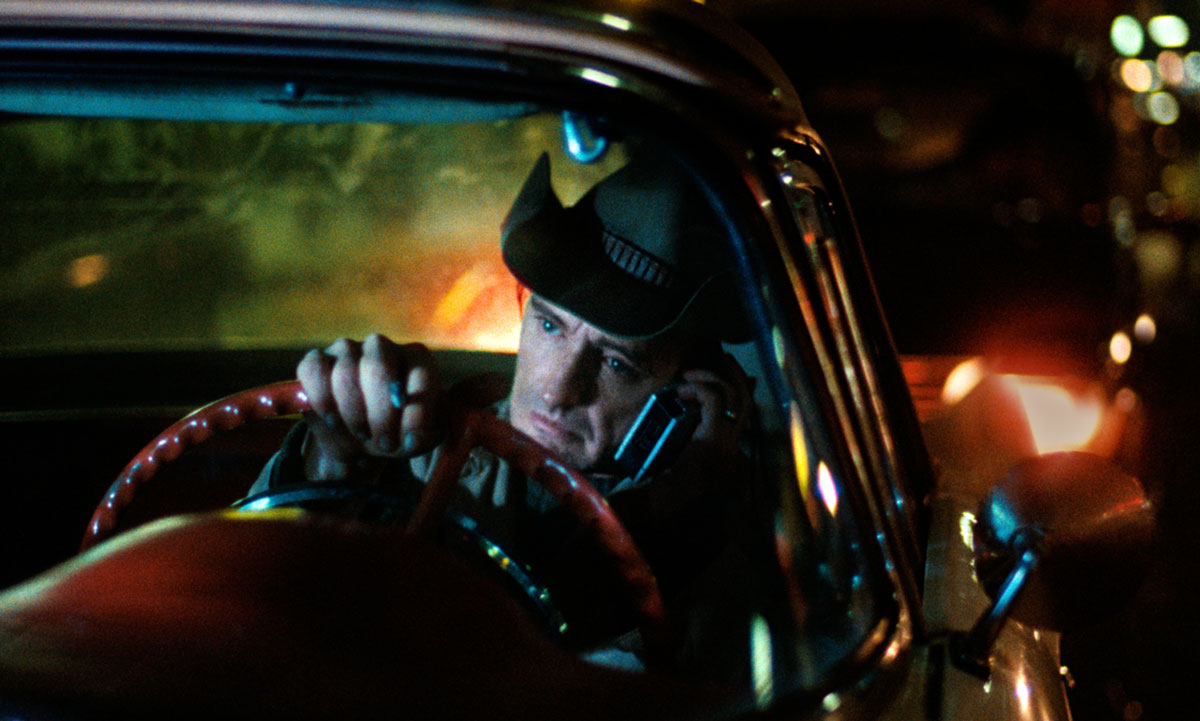
Alain Delon is the swooniest Tom Ripley in this first screen adaptation of Highsmith’s “The Talented Mr. Ripley.” A forger who reportedly “can do anything,” this Ripley cares only about money. He is in Italy to convince the film's version of Dickie, Philippe Greenleaf (Maurice Ronet), to return to the States, but he fails at that task because Philippe will not readily comply. Losing out on the $5,000 he was promised by Philippe’s father, Ripley resorts to murder. He then becomes Philippe, hiding his crime, emptying Philippe’s bank account and dispatching anyone who stands in his way.


The pleasure of the gorgeous “Purple Noon” is watching the gorgeous Delon as Ripley cover his tracks as the noose around him tightens. He may wince at times — he is often close to being caught — but he is clever in how he manipulates others. But can he get away with it? There are some marvelous set pieces, including an extended sequence on a claustrophobic boat and a narrow escape from an apartment that ratchet up the tension. Delon delivers a star-making performance in this classic film even if the ending deviates from the book (which irked Highsmith).


Available on Criterion Chanel

02
"The American Friend" (1977)
The American FriendDennis Hopper in "The American Friend" (Courtesy of the Criterion Collection)
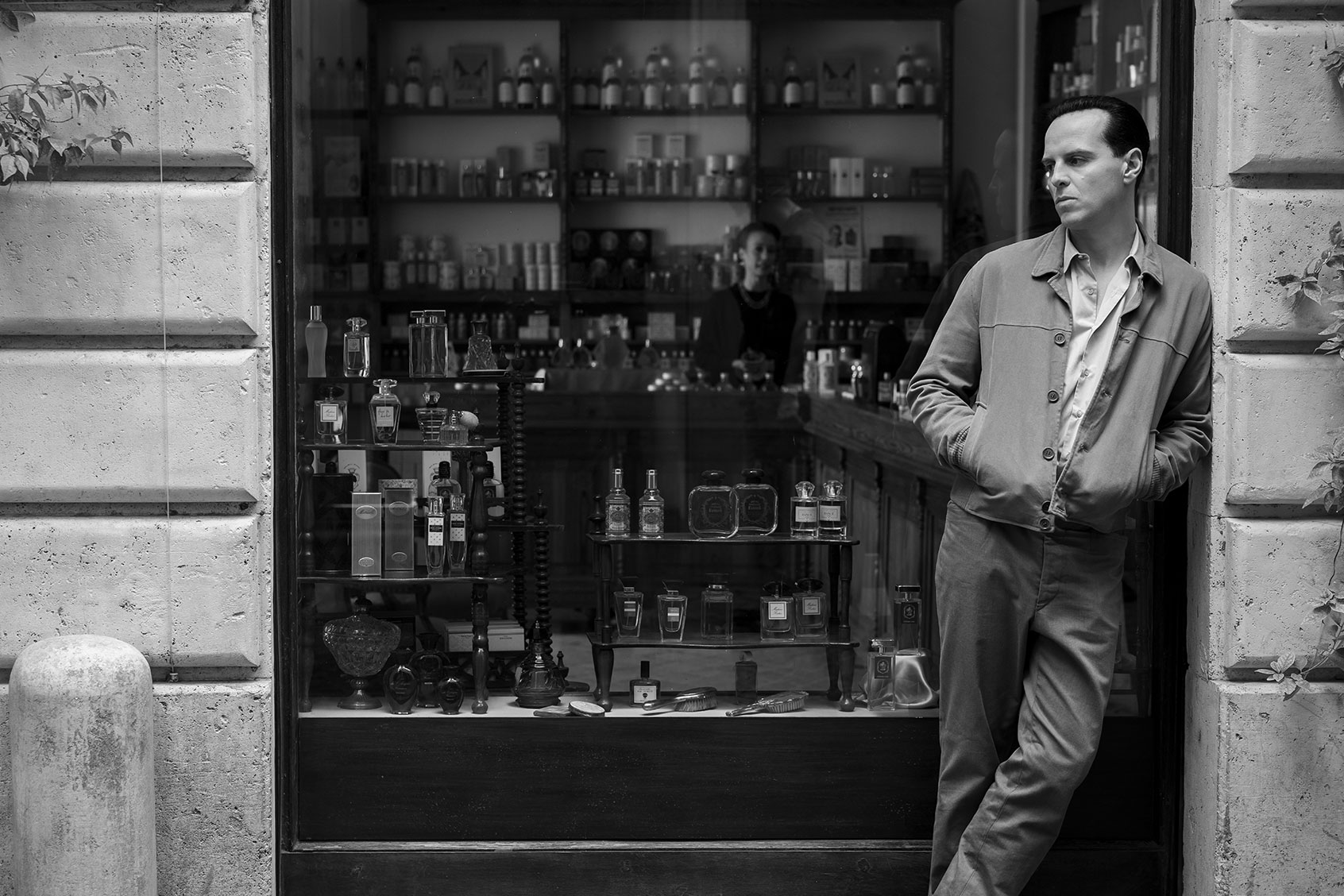
Wim Wenders wrote and directed this cool take on Highsmith’s second sequel, “Ripley’s Game,” making it an existential drama that also includes the art forgery story fragment from “Ripley Under Ground.” Here Ripley (Dennis Hopper) wears a cowboy hat and confesses into a tape recorder, “I know less and less about who I am.” (No wonder Highsmith reportedly didn’t like this adaptation, though she eventually told Wenders she did.) Ripley heads to Germany to sell a fake painting by a “dead” artist (the esteemed American filmmaker Nicholas Ray plays ‘Derwatt’). When Jonathan Zimmerman (Bruno Ganz, superb), a frame shop owner with leukemia, slights Tom at an auction, Tom embroils him in a murder plot. A thrilling and wordless 10-minute sequence in the Paris metro where Jonathan commits the assigned crime is a highlight of this film. But as Ripley and Jonathan become friends (cue coded gay subtext), they work together to kill a few more people in a suspenseful train sequence. Meanwhile, Jonathan’s wife, Marianne (Lisa Kruezer, Wenders’ then-wife) suspects her husband is up to something and confronts him, only to regret learning the truth. Wenders’ film is extremely stylish from the deep colors (Robbie Müller did the fantastic cinematography), and the masterful shot compositions, but this Ripley story is the coldest of all the adaptations.
 
Available on the Criterion Channel

Anthony Minghella’s fabulous, jazzy adaptation may be the screen version that gets closest to the tone of Highsmith’s novel. It is certainly the gayest “Ripley.” Matt Damon captures Tom Ripley’s “flagrant casualness” best; he always seems to be in the right place or say the right thing, and it appears effortless but surely, he is calculating. Tom is upfront with Dickie Greenleaf (Jude Law) when he tells him his talents are “forging signatures, telling lies, and impersonating practically anybody.” And as Tom comes to love the way Dickie lives, Tom will also stop at nothing until it becomes his. Tom soaks in Dickie’s life, and a scene where Tom ogles Dickie in and out of the bath, makes it clear how much and how badly Tom wants to possess Dickie. Which is why Dickie is not wrong when he accuses Tom of being “a leech.” Unfortunately, that comment may be what prompts Tom to murder Dickie. Watching Tom take over Dickie’s identity is spellbinding. It goes beyond Tom dressing in Dickie’s clothes, and extends to him passing as Dickie, gaslighting Dickie’s girlfriend Marge (Gwyneth Paltrow) and eluding the police. As Tom says, “I always thought it would be better to be a fake somebody than a real nobody.” And watching that unfold in Minghella’s film is exhilarating.


Available to stream on Paramount+ and Showtime

04
"Ripley's Game" (2002)

John Malkovich is deliciously louche as Tom Ripley in director/cowriter Liliana Cavani’s suave adaptation of Highsmith’s novel. As the nifty pre-credit sequence proves, Tom can kill with a withering look or an unexpected outburst of violence. When his ex-partner Reeves (Ray Winstone) shows up wanting Ripley to kill someone, Ripley passes the assignment on to Jonathan (Dougray Scott), his inexperienced neighbor. After Jonathan succeeds at one murder, he is assigned another job, but it is one that requires assistance from Ripley.


Malkovich’s performance is like the garrote used to kill in the film — he applies the right pressure to the right part. He is called arrogant, but he is often unfailingly polite. But he does not suffer fools. When he overhears Jonathan describing him as having, “too much money and no taste,” Ripley feels slighted, which is why he gets Jonathan involved in doing Reeves’ dirty work. Besides, Ripley here is best when talking about himself. He tells Jonathan, “I am a creation, a gifted improviser. I lack your conscience and when I was young that troubled me. It no longer does. I don't worry about being caught because I don't believe anyone is watching. The world is not a poorer place because those people are dead.” And later he counsels, “You know the most interesting thing about doing something terrible? After a few days, you can't even remember it.” Malkovich is arguably the most memorable screen Ripley. 


Available for rent on Amazon and iTunes

05
"Ripley Under Ground" (2005)
Highsmith’s quote, “I think it’s criminal the way people get so worked up about a little murder,” sets the comic-ironic tone in this little-seen film based on the author’s second Ripley novel. A buff Barry Pepper stars as an American in London first seen winning over his angry landlady over missing rent. But his charms are wasted on another character, Dean Bentliffe (Simon Callow), who uncovers his lies. The main plot kicks in when Philip Derwatt (Douglas Henshall), a promising artist dies. Ripley conspires with Derwatt’s gallerist (Alan Cumming) and their mutual friends Cynthia (Claire Forlani) and Bernard (Ian Hart), to fake Derwatt’s paintings to rake in the cash.
 
Ripley here is described as someone who “has a soft spot for psychopaths,” but the film, directed by Roger Spottiswoode, and cowritten by Donald E. Westlake (“The Grifters”), is more farcical than sinister. Ripley moves several corpses around to stay one step ahead of Scotland Yard’s John Webster (Tom Wilkinson), and he courts the wealthy Heloise (Jacinda Barrett), much to the chagrin of her father Antoine (François Marthouret), who knows Ripley is a charlatan. This is the weakest screen Ripley, and also the straightest. 

Want a daily wrap-up of all the news and commentary Salon has to offer? Subscribe to our morning newsletter, Crash Course.


06
"Ripley" (2024)
RipleyAndrew Scott in "Ripley" (Netflix)
Andrew Scott assumes the title role in this eight-part series based on Highsmith’s “The Talented Mr. Ripley.” Shot in crisp black and white, “Ripley” follows the novel’s plot of Tom being asked to fetch Dickie Greenleaf (Johnny Flynn) in Europe.
 
Writer/director Steve Zaillian is faithful to the source novel in many places, but he also takes some liberties. Seeing how Ripley builds up his charm offensive provides most of the thrills in this slow-burn adaptation. Andrew Scott is initially almost childlike around Dickie, which may be his way of slowly sizing him up and seducing him. But Dickie’s girlfriend Marge (Dakota Fanning), is distrustful, as is Freddie (Eliot Sumner). After Tom commits murder, the series shifts into gear as Tom becomes more active than passive, living the life he wants and feels he deserves, even if it's not his own. Scott is often poker-faced, and while sometimes he is not always that talented in committing murder, he remains chillingly amoral.

"Ripley" is now streaming on Netflix.


Experts: Yes, efforts to eliminate DEI programs are rooted in racism

Right-wing activists who have long criticized liberalism and “wokeness” in higher education and helped force the resignation of Claudine Gay, Harvard University’s first African American president, have now set their sights on ending the diversity, equity and inclusion, or DEI, programs that these activists claim helped place figures like Gay in her job in the first place.

Christopher Rufo, the conservative activist who played a pivotal role in forcing Gay’s resignation, stated this view bluntly on X – formerly known as Twitter– following Gay’s ouster: “Today, we celebrate victory. Tomorrow, we get back to the fight. We must not stop until we have abolished DEI ideology from every institution in America.”

The DEI initiatives and programs at the center of these controversies aim to help organizations identify and more effectively tackle disparities or inequities in their organizations.

In the past year, a number of states have begun to dismantle their DEI programs. Alabama, Utah, Texas and Florida have all passed and signed into law anti-DEI legislation ranging from prohibiting diversity training to terminating all positions associated with DEI efforts. Florida lawmakers have restricted the teaching of what they call racially “divisive” subject matter in public schools, colleges and universities. Legislatures in more than two dozen additional states are considering similar measures.

Critics of these measures say they are racist. DEI opponents are quick to deny this.

Is opposition to DEI programs unrelated to racism? Or does racism play an important role in opposition to DEI programs?

We are survey researchers who study how racial attitudes affect Americans’ attitudes toward public policies. In a recent poll, we investigated what, if any, influence racism may have on public opinion toward DEI programs.

Implausible claims about DEI

Utah Gov. Spencer Cox defended anti-DEI measures in his state by characterizing them as reaffirming the ideal of colorblindness in American society.

“We used to aspire toward the dream of Martin Luther King Jr. of a future where our children ‘will not be judged by the color of their skin, but by the content of their character,’” he said. “Now, Americans are accused of systemic racism for quoting these same immortal words of Dr. King. Up is down.”

But statements by other conservative politicians and commentators seem more transparently racist.

Following the deadly accident that destroyed the Francis Scott Key Bridge in Baltimore, several Republican elected officials and candidates claimed — implausibly — that DEI policies were responsible. One conservative commentator reposted video footage of a news conference on the tragedy held by Baltimore Mayor Brandon Scott, who is Black, with the comment, “This is Baltimore’s DEI mayor commenting on the collapsed Francis Scott Key Bridge. It’s going to get so, so much worse. Prepare accordingly.”

In our January, 2024 survey of a nationally representative sample of 1,064 U.S. adults, we sought to identify what influence racism may have on public opinion about DEI programs. We asked respondents, “From the following list, please indicate if you believe the indicated professionals and/or members of institutions should or should not receive Diversity, Equity, and Inclusion (DEI) training.”

The list included medical professionals, teachers, police officers, members of the U.S. armed forces, public sector employees and private sector employees.

Next, we assessed respondents’ racial attitudes with questions that measure their acknowledgment of the existence of racism in the U.S. and their emotional reaction to the problem of racism in the nation. We also asked respondents about their partisan identity, ideological affiliation and demographic characteristics.

‘Huge’ impact on support for DEI

We found that a strong majority of Americans support DEI training for each of the professions we listed in the survey. On average, 7 in 10 Americans support DEI training for medical professionals, teachers, police officers, members of the U.S. armed forces and public employees, while 65% of Americans support this training for private sector employees.

However, among Americans with negative racial attitudes – which is a phrase used by scholars of public opinion to characterize respondents who hold prejudicial, stereotypical or racist views of people of color – support for DEI training was much lower.

On average, only 46% of Americans who believe that racial problems are rare support DEI training; 45% of those who are not angry that racism exists support DEI training, and 38% of those who do not believe that white people have advantages because of their skin color support DEI training programs.

Next, we summed up interviewees’ responses across questions to create an overall measure of support for DEI training and analyzed how negative racial attitudes affect support for DEI. We did this while taking into account characteristics such as gender identity, age, education, income, race, political party identification and ideology.

After taking these characteristics into account, we found that the effect of negative racial attitudes on support for DEI programs was huge. Support for DEI programs was 73 percentage points lower among individuals with the most negative racial attitudes compared to those with the most positive attitudes.

This doesn’t mean that every person who opposes DEI training is racist. But it does mean that people with the most negative racial attitudes are, on average, most opposed to DEI training.

Many Americans understandably wish that the nation has achieved Martin Luther King Jr.’s dream of a “colorblind” society. But the troubling connection between racism and opposition to DEI programs highlights that there is still work to be done until the nation’s citizens are truly judged by the content of their character and not the color of their skin.


Tatishe Nteta, Provost Professor of Political Science and Director of the UMass Amherst Poll, UMass Amherst; Adam Eichen, PhD Student, Political Science, UMass Amherst; Douglas Rice, Associate Professor of Political Science and Legal Studies, UMass Amherst; Jesse Rhodes, Associate Professor, Political Science, UMass Amherst, and Justin H. Gross, Associate Professor of Political Science and Computational Social Science, UMass Amherst

This article is republished from The Conversation under a Creative Commons license. Read the original article.

“Hot Ones”: Shakira says she “can take spice” while discussing her first album release in 7 years

Shakira joined host Sean Evans on this week’s episode of “Hot Ones.” The Colombian singer-songwriter reflected on her musical career, revealed that she’s a huge fan of “Family Guy,” and discussed her latest album “Las Mujeres Ya No Lloran,” which is her first in seven years. The album itself is being marketed as Shakira’s grand comeback following her highly-publicized breakup from partner Gerard Piqué.

When asked by Evans if she has any “gut-wrenching” tales of losing her handwritten song lyrics, Shakira said there’s one moment that comes to mind: “When I was, like, 21 I had written a whole body of work and it got lost at an airport in bogota. I had all my lyrics in my dad’s briefcase because I used to travel with my parents back in the day.

“And I think that it just disappeared at the airport and that’s why I named that album, ‘Where Are The Thieves?’ (‘Dónde Están los Ladrones?’) after that story,” she continued, referring to her fourth studio album. “I had to reconstruct all of the lyrics in my head and I was able to after a great deal of effort.”

Shakira, whose accolades include three GRAMMY wins, numerous Billboard top hits and more, has become the most successful Latin female artist of all time. So much so that she’s been hailed as “The most successful Latin female artist of all time.” Despite her successes, Shakira said she does have some regrets when it comes to her earlier tunes.

“I think I used to overdo the cries in my voice,” she said, before replicating her old style: “‘Lo de lo de lo de’ — it’s too much. I think I was exaggerated. Too much, Shakira.”

She continued, “And I noticed that after my pregnancies my voice got thicker, more rounded, more full. Also my choices are more mature. I have evolved as a woman, as a person. My intellect has evolved.”

As for which of her songs she’s most likely to hear fans sing to her in public, Shakira said it’s definitely “Hips Don’t Lie.”

“‘Shakira! Do your hips lie?'” she imitated her fans. “I’m like, ‘I have other songs, you know.'”

Elsewhere in her interview, Shakira said she wanted Seth MacFarlane to do the English translation of her 2009 hit “She Wolf” because she’s a huge fan of his sitcom “Family Guy.” 


Want more great food writing and recipes? Subscribe to Salon Food's newsletter, The Bite.


“I was a huge ‘Family Guy’ fan and I always thought that he was so creative and so musical as well,” Shakira said of MacFarlane. “I really admire the musical production of the show so I looked for him but then I ended up writing it myself. I found the right words, I found what I wanted to say.”

Shakira’s latest release, “Las Mujeres Ya No Lloran,” recently debuted at No. 13 on the Billboard 200 and No. 1 on the Top Latin Albums chart. It features collaborations with Cardi B, Bizarrap, Rauw Alejandro, Karol G and more.

“Once you put out an album, it doesn’t belong to you,” Shakira said. “It belongs to others and it becomes a soundtrack of peoples’ lives. That’s the ultimate purpose of albums, I think.”