Spring Sale: Get 1 Year, Save 58%

Legal experts warn that Trump-hyped court victory is actually the “very worst decision” he could get

A Colorado judge on Friday allowed former President Donald Trump to appear on the state’s presidential ballot despite finding that he engaged in insurrection in the Jan. 6 Capitol riot.

The ruling came in response to a lawsuit seeking to disqualify Trump from the ballot under Section 3 of the 14th Amendment, which bars people who participated in rebellion against the government from holding federal office.

Denver District Judge Sarah B. Wallace in her ruling wrote that Trump “acted with the specific intent to disrupt the Electoral College certification of President Biden’s electoral victory through unlawful means; specifically, by using unlawful force and violence.”

The judge concluded that “Trump incited an insurrection on January 6, 2021 and therefore ‘engaged’ in insurrection.”

But Wallace also determined that Section 3 does not apply to him, writing that the section refers to some offices by name as well as those who are an “officer of the United States,” but does not specifically mention the presidency, according to The Washington Post.

Wallace wrote that the writers of Section 3 “did not intend to include the President as ‘an officer of the United States,’” though she noted that it does technically apply to those who swear an oath to “support” the Constitution. Trump took an oath to “preserve, protect and defend” the Constitution.

Wallace wrote that she did not want to disqualify a candidate “without a clear, unmistakable indication” that it was the intention of those who wrote the amendment.

Despite leaving him on the ballot, Wallace blasted Trump’s “history of courting extremists and endorsing political violence.”

“The evidence shows that Trump not only knew about the potential for violence, but that he actively promoted it and, on January 6, 2021, incited it,” she wrote.

The ruling is expected to be appealed and could wind up in the state Supreme Court and ultimately make its way to the U.S. Supreme Court.

The Minnesota Supreme Court ruled earlier this month that Trump cannot be removed from the primary ballot and a Michigan judge reached a similar decision.

Trump during a rally in Fort Dodge, Iowa on Saturday took a victory lap, claiming that Democrats and the media were "having an absolute meltdown because last night, our campaign won a gigantic court victory in Colorado."

Trump called the lawsuit an “outrageous attempt to disenfranchise millions of voters by getting us thrown off the ballot,” and called Citizens for Responsibility for Ethics in Washington, the watchdog group that brought the case on behalf of Republican and independent voters in the state, a “bunch of losers.”

CREW President Noah Bookbinder vowed to appeal the ruling.

"The court's decision affirms what our clients alleged in this lawsuit: that Donald Trump engaged in insurrection based on his role in January 6th," Bookbinder said in a statement. "We are proud to have brought this historic case and know we are right on the facts and right on the law."

Former acting Solicitor General Neal Katyal pushed back on Trump’s declaration of victory, warning that “as an appeals lawyer,” the headline for the ruling should be “This is the very worst decision Donald Trump could get from the trial court.”

“Because it’s going to go on appeal to the Colorado Supreme Court, perhaps the U.S. Supreme Court and there Trump is going to face extreme headwinds,” Katyal said.

We need your help to stay independent

Katyal noted the difference between Wallace’s “factual finding” that Trump engaged in insurrection and the “legal part” of her ruling that it does not apply to the president. “It’s almost impossible to overturn a trial judge’s factual finding” because they get “massive deference” by the appeals courts but the legal findings can be overturned because “that’s basically a fresh look.”

"And here, this judge factually made devastating findings against Trump,” he said, calling the judge’s exemption of the president a “weak” technicality.”

“The reason for that is that there are other parts of the constitution that say that the president is an office holder of the United States, which is kind of obvious, and the text printed in bold when you flash the 14th Amendment, says it applies to 'any office, civil or military, under the United States, as long as you taken an oath.' And of course, the president does take an oath,” he said. “And it would be an insane reading otherwise — would mean [former Presidents] Jefferson Davis or Robert E. Lee could have run for the presidency in 1868. That could not possibly be the law, and I don't think that will command a majority of the Colorado Supreme Court, or certainly the United States Supreme Court."


Want a daily wrap-up of all the news and commentary Salon has to offer? Subscribe to our morning newsletter, Crash Course.


Former U.S. Attorney Harry Litman told MSNBC that the judge’s ruling “had to happen” to set the stage for the Supreme Court to take up the case.

"This is the necessary and real seismic ruling,” he said. “Yes, he engaged — his First Amendment claim is wrong — in an insurrection. This is 95% of what an opinion disqualifying him would look like and the extra 5% is something that a higher court could do, whereas they couldn't do the part that she has now done. They could not adjudicate it on the facts."

Watergate prosecutor Jill Wine-Banks took issue with the argument that the amendment does not apply to the president.

“The argument that he is not an officer, and that there is a difference between his oath and the oath that a senator takes, is a difference without distinction,” she argued. “The difference between ‘protect’ and ‘support’ doesn't make any sense to me. Of course, ‘protect’ is even a higher burden. If the president has to ‘protect’ the constitution, he also has to ‘support’ it."

Wine-Banks argued that that part of the ruling is “wrong on the law.”

"Of course on the facts she is right, and she made a factual finding that he is insurrectionist. And that would bar him if he were an officer,” she said. “And I believe that any higher court will find that it was the intent to bar such a person from holding the office of president. And that he will be barred."

MAGA conspiracy-theory defense keeps failing in court: Bad news for Donald Trump?

Putting David DePape, Paul Pelosi's attacker, on the witness stand wasn't a great idea. But it was the only thing DePape's defense had. He has admitted, even bragged, about his attempted murder of Nancy Pelosi's husband last year at the couple's home in San Francisco. Predictably enough, on the witness stand DePape rambled on about the conspiracy theories he believed, telling the jury that he worshiped Donald Trump and believed every cockamamie nugget of disinformation churned out by the MAGA media ecosystem. DePape was captured on video smashing Paul Pelosi's head with a hammer, and has repeatedly admitted he went to the Pelosi house that night in hopes of kidnapping the then-speaker of the House and forcing her to endorse Trump's false claims about the 2020 election lies. This was a Hail Mary move from DePape's lawyers, at best, built on the dubious premise that he'd seem too delusional to be a full-blown domestic terrorist. 

In other words, conspiracy theories got DePape into this situation, and he hoped conspiracy theories would get him out. It didn't work. The jury found DePape, whose far-right radicalization goes all the way back to Gamergate in 2014, guilty on all charges. 

This "I believed a conspiracy theory" defense shouldn't come as a big surprise. Outside the courtroom, Trump and his acolytes have relied heavily on conspiracy theories to deflect blame for their role in inspiring DePape's murderous rage. Within hours of the attack on Paul Pelosi, the right-wing noise machine was cranking out homophobic lies based on the false claim that DePape was a sex worker or that he and Paul Pelosi were lovers. (They had never met before the break-in.) Trump continues to push this slanderous nonsense without taking responsibility for it, cracking crude jokes that could well encourage further violence. 

In general, Trump treats conspiracy theories as an all-purpose tool to get what his way. He used his BS claims about Barack Obama's birth certificate" to rally the deplorables to his cause way back when. He uses the QAnon cult to prop up the illusion that his sociopathic behavior is just a front for a superhero out to save the world. And of course he used the Big Lie, claiming that Joe Biden stole the 2020 election, to justify his very real attempts to overthrow democracy. 


Want more Amanda Marcotte on politics? Subscribe to her newsletter Standing Room Only.


Trump has also been trying to use conspiracy theories the same DePape did, in hopes of wriggling out of his legal difficulties. Every single day, in every single utterance, he claims to be an innocent man targeted by an elaborate "deep state" conspiracy to take him out. He also invents smaller fictions to prop up this big one, such as accusing the law clerk in his New York civil trial of secretly controlling the judge (and of being Sen. Chuck Schumer's "girlfriend.")

But like DePape, Trump seems to be investing heavily in the "I really believed it" defense. In both the federal case and the Georgia RICO case related to Trump's January 2021 coup attempt, Trump's team has signaled that he may argue that he sincerely believed the election had been stolen. The hope here is to downgrade the long list of crimes in Trump's indictments to innocent mistakes made by a guy who just didn't know better.

This is being called the "advice of counsel" defense in the media, since Trump plans to argue he just picked up his conspiracy theories from lawyers and other advisers. But we could also think of it as the "innocent by reason of stupidity" defense.

Trump's team has signaled that he may argue he sincerely believed the election had been stolen, in hopes of downgrading his long list of alleged crimes to innocent mistakes by a guy who just didn't know better.

But as the DePape example shows, juries aren't necessarily going to buy this. In fact, this was just the latest in a line of MAGA-inspired criminal defendants who have failed to get off the hook by depicting themselves as credulous idiots who believed the wrong people. Alex Jones tried to wiggle out of a defamation lawsuit by playing an ignorant dumbass, but evidence of sinister intent was swiftly established from his phone communications. Both the Proud Boys and the Oath Keepers tried out a variation of this defense, arguing that they let their belief in ludicrous fantasies get the better of them during the Capitol riot. They were convicted. Indeed, many Jan. 6 insurrectionists have rolled out the "well-meaning moron" argument at trial and, by and large, have found themselves headed to prison. 

The court system, in other words, is where MAGA conspiracy theories go to die. That's because the legal system can deprive a conspiracy theory of the oxygen it needs to thrive: Willful ignorance. Social media, Trump rallies and Fox News are all environments where facts can be ignored and malicious actors can spread outrageous lies without consequence. This allows believers to wallow in their preferred narratives, while simply avoiding countervailing evidence.

The courtroom, though, has a captive audience in the jury, along with a system of rules that help filter out the noise so facts can be perceived more clearly. Hardcore partisans who will sticking to their lies no matter what largely get removed during jury selection. It's not impossible to BS people in the courtroom, but a lot tougher to pull off, as one MAGA malefactor after another has found out. 

It's frustrating that one of the most important Trump cases, regarding the classified documents he stashed at Mar-a-Lago, is being handled by Judge Aileen Cannon, a Federalist Society tool who is doing everything in her power to rig the case in Trump's favor. But it's telling nonetheless that Cannon's main tactic is to allow endless delays. That suggests she knows perfectly well that Trump is likely to lose the case, even with her thumb on the scale. That's another reason why Trump's trials should be televised, so people can hear the evidence for themselves rather than filtered through the GOP spin machine. 

There are no guarantees in life. Trump could get lucky and land a juror or two who is so deeply MAGA-fried they will refuse to convict him no matter how much evidence they see. After eight years of practice, some Trump supporters are so good at self-deception that they can ignore reality when it's staring them right in the face. But look at the track record of his fellow travelers when they leave behind the hyperbolic world of social media for the somber atmosphere of a courtroom and their empire of lies collapses. Trump is clearly worried about that, as he should be. 

Donald Trump dreams of an American Fourth Reich — and he’s not kidding

Donald Trump’s hate sermons are becoming even more intense and combustible. As he comes ever closer to openly quoting Adolf Hitler and the other 20th-century fascists, his behavior is clearly intentional and strategic.

Trump publicly admires and praises tyrants and demagogues and views them as role models. If he returns to power in 2025, he intends to create an American Fourth Reich. Consider Trump's speeches, interviews and social media posts over the last few weeks.

At a rally in Hialeah, Florida, last Wednesday, Trump painted a picture of a hellish (predominantly white) America overrun by serial killers and other human monsters from foreign (and predominantly nonwhite) countries, insisting that only he could save (white) America from the death and contamination caused by Democrats and “the left.”

“Anybody ever hear of Hannibal Lecter?” Trump asked the crowd. “He was a nice fellow. But that’s what’s coming into our country right now.”

The Atlantic’s John Hendrickson continues from there:

The leader of the Republican Party — and quite likely the 2024 GOP nominee — was on an extended rant about mental institutions, prisons, and, to use his phrase, “empty insane asylums.” Speaking to thousands of die-hard supporters at a rally in South Florida, Trump lamented that, under President Joe Biden, the United States has become “the dumping ground of the world.” That he had casually praised one of the most infamous psychopathic serial killers in cinema history was but an aside, brushed over and forgotten.

This was a dystopian, at times gothic speech. It droned on for nearly 90 minutes. Trump attacked the “liars and leeches” who have been “sucking the life and blood” out of the country. Those unnamed people were similar to, yet different from, the “rotten, corrupt, and tyrannical establishment” of Washington, D.C. — a place Trump famously despises, and to which he nonetheless longs to return.

Over the past seven or so years, I have watched many of Trump’s speeches. This was one of the most frightening and most disturbing I have seen. It was fascinating in much the same way as witnessing the aftermath of a horrible car accident or watching a horror movie.

Although many among the news media, pundit class and other professional politics-watchers avoid saying this, Trump’s dark charisma can be highly compelling. I'm convinced they feel its allure as well, even if they publicly deny it.

On Friday, in an interview with Univision, Trump threatened to use the Department of Justice to put his political enemies in prison: “They have done something that allows the next party … if I happen to be president and I see somebody who’s doing well and beating me very badly, I say, ‘Go down and indict them.’ They’d be out of business. They’d be out of the election.” Trump also defended his regime’s cruel family separation policy (and by implication concentration camp system) that targeted millions of brown and Black migrants and refugees.  

These white supremacist plans are part of a larger project to revoke birthright citizenship, invoke the Alien Enemies Act to imprison or deport (or worse) the Trump regime’s perceived enemies, and using the law more generally as a weapon to crush dissent and resistance.

Last weekend, on Veterans Day, Trump escalated his Nazi-style threats by declaring that his political enemies to be "vermin" or human poison to be purged from the system. That came at a MAGA rally in New Hampshire and also in a post on his Truth Social platform:

In honor of our great Veterans on Veteran’s Day, we pledge to you that we will root out the Communists, Marxists, Fascists, and Radical Left Thugs that live like vermin within the confines of our Country, lie, steal, and cheat on Elections, and will do anything possible, whether legally or illegally, to destroy America, and the American Dream. The threat from outside forces is far less sinister, dangerous, and grave, than the threat from within. Despite the hatred and anger of the Radical Left Lunatics who want to destroy our Country, we will MAKE AMERICA GREAT AGAIN!

At a fundraising event in San Francisco last Tuesday, President Biden spoke out against Trump’s antisemitism and white supremacy: “In just the last few days, Trump has said, if he returns office, he’s gonna go after all those who oppose him and wipe out what he called … the vermin in America — a specific phrase with a specific meaning…. It echoes language you heard in Nazi Germany in the '30s.”

We need your help to stay independent

In a post on Truth Social that went largely ignored by the mainstream media, Trump continued to summon Nazi imagery by threatening to imprison “Radical Left Zealots" in a “mental institution”:

Deranged Jack Smith, Andrew Weissmann, Lisa Monaco, the “team of losers and misfits” from CREW, and all the rest of the Radical Left Zealots and Thugs who have been working illegally for years to “take me down,” will end up, because of their suffering from a horrible disease, TRUMP DERANGEMENT SYNDROME (TDS!), in a Mental Institution by the time my next term as President is successfully completed. MAKE AMERICA GREAT AGAIN!

Declaring that the enemies of the regime and the Great Leader are mentally ill and then imprisoning them for "treatment" is a common practice in authoritarian states.

Predictably, the mainstream news media and responsible political class responded with performative shock and surprise at Trump’s week-long channeling of Hitler and Nazism. In fact, Trump’s hateful behavior and language are no surprise.

The media, and by implication the public, have apparently forgotten that for weeks Trump has been spreading Nazi-style conspiracy theories: He has been “stabbed in the back,” America is being “poisoned” by immigrants, “good Jews” should support him while “bad Jews” will be punished.

For at least the last seven years (and for decades before that), Trump has shown himself to be a casual antisemite. He reportedly once slept with a copy of Hitler’s speeches in a cabinet next to his bed. It is no coincidence that professed Nazis, white supremacists and other hate-mongers are among Trump’s strongest supporters, or that he refuses to publicly disavow or condemn them.

It appears that the American news media and political class, and by implication the mass public, have already forgotten that since at least September Trump has publicly spread conspiracy theories about being “stabbed in the back,” suggesting that the country is being “poisoned” by immigrants and that “good Jews” should support him while “bad Jews” will be punished for their “betrayals.”

But the mainstream media is bored with Trump's rhetoric and has now largely moved on. That irresponsible choice further normalizes Trump’s evil and the larger neofascist assault on the country’s democracy and civil society.

It is nearly incredible that the presumed nominee of one of the country’s two institutional political parties is explicitly channeling Hitler and the Nazis. That should be dominating the news. Trump's Fourth Reich aspirations constitute a national emergency. But America is an unhealthy society where all this will likely be normalized as just "culture war" tactics or political "polarization."


Want a daily wrap-up of all the news and commentary Salon has to offer? Subscribe to our morning newsletter, Crash Course.


If Donald Trump's American neofascist movement did not have tens of millions of followers, it would not pose an existential threat to democracy. History is full of examples of “good people” who become capable of doing horrible things to others once they are given permission and encouraged by fascist leaders, fake populists and demagogues.

In his book “Promise Me You’ll Shoot Yourself,” which examines mass suicides by Germans at the end of World War II, historian Florian Huber writes:

After leaving the German Reich in 1933 to run the Paris offices of the Daily Express, British newspaper correspondent Sefton Delmer returned in 1936. He found people transformed. Three years had been enough to put them under the Führer’s spell. “They were adoring his firm ruthless rule. They were in raptures at being told what to think, whom to hate, when to cheer.” … He knew, and knew how to galvanize, their feelings, yearnings and prejudices—how to transform depression into exhilaration. As a man of the people, he spoke their language. He was the faith healer they had been waiting for.” …

Silence in the arena, as his voice swelled. He spoke of victory over the past, of the present, and the future, work and happiness — and every member of the audience seemed to feel as if he we addressing them personally. … [H]e transformed their vague but urgent feelings into something more tangible. People’s longings and resentments were laid out before them, on public view. Their most secret thoughts were no longer to be ashamed of; they belonged to everyone in the hall.

Trump has a similar power over his MAGA followers. Here is Hendrickson’s description of the scene at Trump’s Florida rally last week:

No other candidate has legions of fans who will bake in the Florida sun for hours before gates open. No one else can draw enough people to even hold a rally this size, let alone spawn a traveling rally-adjacent road show, with a pop-up midway of vendors hawking T-shirts and buttons and ball caps and doormats and Christmas ornaments. Voters don’t fan themselves with cardboard cutouts of Chris Christie’s head.

Multiple merchandise vendors told me that the shirts featuring Trump’s mug shot have become their best sellers. Some other tees bore slogans: ultra maga, ultra maga and proud, cancel me, trump rallies matter, 4 time indictment champ, super duper ultra maga, f*ck biden. “Thank you and have a MAGA day!” one vendor called out with glee. … In the hours before the night’s headliner, this felt less like a political event and more like a revival.

Trump’s Fourth Reich will not be an exact copy of its German counterpart from nearly a century ago. Instead, Trump’s Fourth Reich (or that of his successors) will be adapted to fit contemporary America’s cultural norms, values and institutions. The final horror is still evolving, but the threat and dangers are very clear. The American people are running out of time.

Turbulent minds: The mental health stigma facing pilots echoes the crisis among men more broadly

In late October, news broke that Alaska flight 2059 had to make an emergency diversion in Portland on its way to San Francisco after an off-duty pilot had tried to “disrupt the operation of the engines.” 

Identified as Joseph Emerson, news later broke that he was subdued by the flight crew and taken into custody. Today he faces 83 counts of attempted murder — one for every passenger and crew member on board. In a recent interview with the New York Times, Emerson revealed a portrait of a man who made a “big mistake” in the middle of a mental health crisis.

According to the report, he was still suffering the aftereffects of a nightmarish psychedelic trip triggered by the psilocybin mushrooms he consumed 48 hours prior, which left him feeling "trapped in a dream." He took the psychoactive fungi on a trip with friends to commemorate the death of his best friend — a loss that threw him into a deep state of grief and forced him to confront long-standing mental health issues. In the report, Emerson says his therapist commented that he was likely suffering from depression, but the therapist couldn’t diagnose him. He was told to consider getting an official diagnosis from a doctor and perhaps get on an antidepressant medication. The only problem was that he feared this could put his family’s livelihood and career in jeopardy. 

As details about what happened to Emerson on the flight have been revealed, the Federal Aviation Administration (FAA) announced November 9th that it was establishing a committee “to provide recommendations on breaking down the barriers that prevent pilots from reporting mental health issues to the agency.”  The FAA can disqualify pilots with depression or taking some prescription treatments from flying. In 2010, the agency approved certain antidepressants for use for those with mild or moderate depression. But it comes with a monitoring period that can last years. 

"This avoidance can have serious consequences, as it may lead to reported health issues that could affect the pilot’s performance — and in our business performance impacts safety.”

In August, the Washington Post reported that federal authorities were investigating 5,000 pilots who have allegedly falsified their medical records to hide benefits they were earning for health issues that could affect their ability to fly. In 2016, a study of anonymous participants published in Environmental Health found hundreds of commercial airline pilots could be clinically depressed and still flying. A more recent study found that many pilots avoid medical professionals due to a fear that revealing health problems could lead to them losing their medical certificate that they’re required to have to fly.

Captain Reyné O’Shaughnessy, cofounder and CEO of Piloting 2 Wellbeing, told Salon this fear often stems from the aviation industry’s “stringent regulations.”

“And the perception that health issues might jeopardize their ability to fly, and in some cases it does,” she said. “The significance of this is that this avoidance can have serious consequences, as it may lead to reported health issues that could affect the pilot’s performance — and in our business performance impacts safety.”


Want more health and science stories in your inbox? Subscribe to Salon's weekly newsletter Lab Notes.


Indeed, Emerson is far from the first pilot to have a public breakdown. In 2012, passengers on a Jetblue flight had to restrain a pilot from having a "bizarre midair breakdown," as the New York Times put it. In July, a United Airlines pilot took an ax to a parking barrier at the Denver airport. He told police he had “hit his breaking point.” In 2015, a Germanwings pilot deliberately crashed a plane into the French Alps, killing all 150 people onboard.

O’Shaughnessy said the industry is making progress in terms of encouraging more transparency. Before 2010, if a pilot disclosed they had depression or anxiety, they wouldn’t be flying. 

“Now, the paradox is we have this system that we need to self-report if we are struggling with depression or anxiety,” she said. “But the paradox is, why would pilots report that if it impacts their livelihood?”

“Mental health and mental well being should be a shared responsibility, and that means involving all stakeholders in this aviation industry.” 

The FAA claims that 0.1% of medical certificate applicants who disclose health issues are denied, trying to encourage more pilots to come forward. Yet not all who disclose and go through the monitoring period have sick days to carry them through. Plus, there’s the fear of what others might think.

O’Shaughnessy said a “culture change” is one part of the solution, in addition to prioritizing mental fitness in pilot training, and addressing the demanding lifestyle that’s required of pilots, which can include sleepless nights and not being provided a hot meal on the job.

“What I'm seeing is that basically companies are just ticking the boxes,” she said. “Mental health and mental well being should be a shared responsibility, and that means involving all stakeholders in this aviation industry.” 

While it’s understandable that there’s a required mental health standard for pilots who are responsible for hundreds of lives each day, some mental health experts say this is yet another way in which systemic forces perpetuate the ongoing mental health crisis among men in America. And that the culture change O’Shaughnessy referred to could come from outside the aviation industry, too. In America, women are twice as likely to get a depression diagnosis, yet men are more likely to die by suicide. Nearly 80 percent of suicides are among men — a majority of those over the age of 75, and those who work in more male-dominated industries, like construction and transportation. 

We need your help to stay independent

Men are less likely than women to get treatment and seek out help. Dr. Carla Manly, a clinical psychologist and author of "Joy From Fear," told Salon that employees in a workplace culture who feel as if they have to “camouflage” mental health issues due to a fear of repercussions can have a negative effect. 

“Given the pervasive nature of certain ridiculous beliefs such as ‘real men are tough’ and ‘only weak people need psychological support,’ those who suffer from mental health issues are often afraid to seek the support they need,” she said. “In my clinical work, I have certainly noted that males — even more than females — are hesitant to reveal their mental health issues out of being judged, sidelined or worse.”

Erin Pash, LMFT, founder and CEO of Ellie Mental Health, told Salon society needs to rethink what it means to be “strong.”

“Men who lean in and accept support for their mental health think about strength differently,” she said. “Being ‘mentally strong’ is being able to work through complicated feelings and come out on the other side smarter, more adaptable, and more engaged in their life.”

Former first lady Rosalynn Carter dies at 96 after a lifetime of humanitarian work

As the weekend comes to a close, The Carter Center issued the sad announcement that former first lady Rosalynn Carter has died "peacefully, with family by her side" at 2:10 p.m. ET after being diagnosed with dementia earlier this year. She was 96-years-old.

Former President Jimmy Carter was quick to memorialize the loss of his wife in a heartfelt tribute on Sunday, writing, "Rosalynn was my equal partner in everything I ever accomplished. She gave me wise guidance and encouragement when I needed it. As long as Rosalynn was in the world, I always knew somebody loved and supported me." He himself entered into hospice care in February at the age of 98 after facing some health issues in recent years and receiving treatment for cancer in 2015.

Rosalynn Carter leaves behind a wealth of accomplishments, having played an active role in the White House and dedicating her time to mental health research and a variety of other humanitarian causes. In a now famous quote, she said, “I wanted to take mental illnesses and emotional disorders out of the closet, to let people know it is all right to admit having a problem without fear of being called crazy. If only we could consider mental illnesses as straightforwardly as we do physical illnesses, those affected could seek help and be treated in an open and effective way.” 


“SNL” rips George Santos for spending campaign money on Botox and OnlyFans

"Saturday Night Live" made good use of their "Weekend Update" sketch this week, with cast member Bowen Yang reprising his semi-regular spoof of Rep. George Santos, R-N.Y., in a hilarious riff on House ethics investigators revealing his use of campaign funds to purchase Botox, designer clothes and OnlyFans videos.

"This has not been a good week for you," Colin Jost intros, tossing it up for Yang as Santos to take it away, spot-on stink-face and all. 

"Oh, please. Isn't Congress kind of like OnlyFans anyway? People paying you to do nasty things on a sad, bad livestream?" he shoots back. 

For those not familiar, OnlyFans is an online platform and app created in 2016 which allows users to pay money to watch people do sex stuff. According to The New York Times, Santos made "small purchases" using campaign funds to view videos there and spent additional funds on trips to casinos in Atlantic City and the Hamptons, purchases at Hermès and Ferragamo, and regular cosmetic treatments labeled “Botox” on internal campaign records.

“I will not stand by as I am stoned by those who have flaws themselves,” the real-life Santos wrote in a statement posted to X (formerly Twitter) after these purchases hit the headlines.

What the "SNL" sketch here:

Ron DeSantis turns a blind eye to Elon Musk’s antisemitic conspiracy theory controversy

In a segment of State of the Union on Sunday, Florida Governor and Republican presidential candidate Ron DeSantis came to Elon Musk's defense, weighing in on his recent antisemitic conspiracy theory controversy by not really weighing in at all.

Speaking to Jake Tapper, who asked for his opinion on the matter seeing as though he announced his campaign on Musk's platform earlier this year, DeSantis claimed to have not seen the discourse that led to many big-name advertisers pulling away from X (formerly Twitter) in which Musk backed antisemitic claims.

“I did not see the comment," DeSantis said. "I know Elon has had a target on his back ever since he purchased Twitter because he’s taking it in a direction that a lot of people who are used to controlling the narrative don’t like. So I was a big supporter of him purchasing Twitter. I think that they’re obviously still working some stuff out, but I did not see those comments.” 

Further into the discussion, DeSantis referred to Musk as "a guy that believes in America," going on to say that he's "never seen him do anything" and that it would be surprising to him if the claims made against him were true. 

East Coast Italian goes Hollywood: Here’s what happens when a ‘Top Chef’ opens a red sauce joint

To be frank, I see practically everything, especially food, through a decisively Italian-American, North Jersey lens. So to me, a "red sauce joint" is an inherently East Coast experience. 

For "Top Chef" alum Chef Jackson Kalb, though, he's looking to subvert that form, turning the realm of Italian-American cuisine on its head and injecting some humor and levity into the medium.

Salon Food spoke with Kalb about his brand new restaurant Jemma, the menu itself, his approach and ethos towards food and cooking at large, his time on "Top Chef" and what might on the horizon going forward.

The following interview has been lightly edited for clarity and length.

For those who are unfamiliar, what were you primarily working on between filming Top Chef and now opening Jemma? 

Jemma is our fourth store. I began cooking professionally at age thirteen at 2-Michelin-starred Melisse. Between high school and opening our first tiny restaurant, Jame in El Segundo in 2018, I also worked at 3-Michelin-starred Joel Robuchon in Las Vegas and Alinea, as well as Union Square Cafe. We opened our second store, Ospi in the middle of the shitstorm in 2020 because we signed our lease in 2019. In March, we could give investors back 30 cents on the dollar or go for it. It was incredibly painful, but somehow my wife, Melissa, and I made it work . . . and we are so glad we did.

Top Chef called me in 2021. After the show aired, we decided to take a stab at a seafood-focused Jemma di Mare in Brentwood. It was supposed to be a spinoff of Jemma Hollywood, but as you know things rarely work out the way you think we will. So, we opened Jemma di Mare before Jemma.

Now, along with our newborn, Kobe, my hands are quite full these days, but I cannot stress enough how excellent my team is. Without them, almost none of this would be possible. I am extremely grateful for them every day. While I am still in charge of 95% or more of the food development and almost all of the high-level decisions, I rely on them to maintain high levels of excellence at all times. And believe me when I say they excel at what they do.

Jemma Hollywood Restaurant InteriorJemma Hollywood Restaurant Interior (Photo by Wonho Frank Lee)

What led to your developing and opening Jemma? I could be mistaken, but I don’t recall your making too many Italian/Italian-American-inspired dishes during your Top Chef tenure? 

Top Chef was a very interesting experience. Almost all of my decisions were made completely based on gut instinct. I had COVID right before filming, so I did the entire show without a sense of smell or taste. In restaurants, I think people are looking for a sense of comfort and familiarity. In my opinion, this is the foundation of a successful restaurant.

While I enjoy dining at restaurants that push the envelope of what a dining experience can be, I don't think it makes for a successful business model. On the other hand, Top Chef is all about taking calculated risks and creating something exciting for judges who have seen twenty years of some of the highest-caliber chefs in the country. What translates in business does not translate to TV judges. So, I relied mostly on my creative background as a chef, even though most of that food is not served in my restaurants.

We need your help to stay independent

Italian-American food is oftentimes seen as generally casual or not "elevated," but Jemma is marketed as "upscale casual." How does this classification impact the menu, the recipe development and the ingredients used?

My Michelin background is a part of my identity and you can't take that away from me. While the food may appear simple on the surface at Jemma, we work diligently to procure high-quality ingredients and use top-tier techniques. For example, our Spicy Eggplant Parm is listed as just that. But to make it, we double-fry the eggplant in rice flour, which is a technique I picked up while learning how to make traditional French fries from scratch.

For the sauce, we manipulate the onions and carrots to a consistency that is so fine they essentially melt into the sauce. Instead of sprinkling parmesan onto the eggplant, we make it into a fondue. Instead of coating the eggplant in breadcrumbs, which inevitably turn soggy after adding tomato sauce to the dish, we take the base of a classic Italian-American dish, vongole oregenata and turn those into a version of fresh, scratch-made breadcrumbs packed with a ton of flavor.

What we're going for is the "wow" factor. The dishes are described quite simply, but if we do our job well, it is hopefully the absolute best version of that dish that you've ever had.

Pasta With ClamsPasta With Clams (Photo by Max Milla)

The website says "east coast Italian fare.” I’m biased, but the bulk of Italian-American cuisine feels so inherently East Coast to me  but this is a restaurant based in Hollywood, interestingly enough. How would you differentiate Italian-American cuisine on the east coast vs. the west coast?

I think old-school, east-coast Italian-American food tends to be quite heavy. We lighten up a lot of that fare and we use a lot of local produce. Our kale salad, which is served in all of our stores, is made with avocado and almonds. You would find difficulty finding any of those ingredients at a traditional red sauce joint in New York. We serve this salad at all of our stores because it is the best version of kale salad that we could make, even if it's not strictly Italian.

I also like toying with the idea of high-low cuisine. How can we take something that's generally cheap, uses inexpensive ingredients and make the best possible version of it? That's exactly what we do with our Italian beef sandwich. In Chicago, they often go for a few bucks and are made with inexpensive cuts of beef and a special, but very inexpensive and sometimes pre-frozen bread. We use prime rib from pastured Angus beef from Texas, shave it thin to order and pile it high on a house-made bread that I believe has the perfect amount of chew while still being light and airy. And because I enjoy a sense of humor in some of what we do, we serve the entire thing on a silver platter with a fresh beef jus that takes two days to make.

What is your definition of a "red sauce joint?" 

A red sauce joint is a place of comfort. I grew up eating a lot of this food, and admittedly, a lot of it wasn't very good. If you come across any photos of me as an adolescent, I don't need to tell you that I overindulged quite a bit when I was younger. I like to joke that everyone who knew me back then knew I was the same weight as I currently am but half the height. Let's just say I didn't have any girlfriends for a very long time. There is something inherently comforting about that style of cuisine that brings me back to a place of joy, so I have wanted to do this concept for a very long time.


Want more great food writing and recipes? Subscribe to Salon Food's newsletter, The Bite.


Can you tell me a bit about how Jemma contrasts with Opi, Jame Enoteca and Gemma di Mare? What sets each apart?

Jemma is our take on a modern version of east-coast Italian fare. I've been working on the pizza dough for over five years. It's still a work in progress, honestly. We have a sign in the kitchen showing how old our sourdough starter is for the dough. It's currently on its 1,556th day. Jemma di Mare is also Italian-American but with a focus on seafood. Ospi is heavily focused on Southern Italy and a very specific type of pizza called romana tonda, which translates to "Roman round." The crust is paper thin and was obnoxiously hard to develop. I actually landed on a successful method accidentally by stretching the dough once and forgetting about it in the fridge. A few hours later, instead of tossing the dough, I decided to stretch it again. After letting the gluten structure relax, I was able to get the dough paper-thin, which is exactly what I was looking for.

Jame is our baby, even though it's not as prominently known as our other restaurants. It's the store that started my career as an owner and has a special place in my and Melissa's heart. That was kind of a splat of my scatter-brained creativity and is heavily focused on pasta. When I was first running it, the menu changed weekly or a few times a week.

We couldn't raise any money for that store, but I was absolutely determined to make something happen. After eleven months of getting exactly zero dollars and over four hundred "no’s" from potential investors, I was completely beaten down and broken. A month later, a few people each put in a few thousand dollars and we opened with whatever was existing in an old BBQ and meatloaf quick-service restaurant in possibly the worst location of a rundown strip mall in El Segundo. Almost everything was broken. If you want to talk about being scrappy, I can wax poetic endlessly on the first year of opening that restaurant. I'm actually writing a children's book about persistence and perseverance and am basing it on Jame's opening. I also love that nobody knows how to pronounce it. It is a combination of “JA” for Jackson and “ME” for Melissa.

I think naming a restaurant after yourself is kind of arrogant and it started with a different name, but two weeks after we opened, a restaurant in a different California city threatened legal action if we didn't change our name. We honestly thought it was a joke and didn't listen. They sent in a lawyer to hand-deliver us a cease and desist. If we had to pay our lawyers to defend ourselves, the new sign with the name change, new employee shirt and payroll in the same week, we would have closed within the first month. If you want to see a grown man cry in an uncontrollable fit of tears, rewind to the day I was given that notice. I think I chugged an entire warm bottle of white wine to “calm down.”

Margherita PizzaMargherita Pizza (Photo by Max Milla)

The menu is amazing! I love that the crispy provolone is served with vodka sauce, that there's caciocavallo cheese on the garlic bread (with a ranch dip!), the spicy eggplant parm, "caci-au poivre," multiple uses of lambrusco and so much more. There's a casual, fun aspect and almost a “fusion” element that unites the menu. Talk to me a bit about the process behind developing it  and what's to come next?

As I mentioned, I like to add a bit of humor to the menu. If you're laughing with me, that’s perfect. If you're laughing at me, then I've done a poor job of marketing myself. What I want you to walk away with is the thought, "This is the best version of XX I've ever had," and not, "How am I supposed to eat this?" My friend recently came in to eat and said the garlic bread reminded him of the best version of Domino's garlic bread he's ever had. It made me giddy with joy. We make the focaccia over a 48-hour fermentation with a starter and use a technique I learned at Alinea to emulsify garlic confit into an oil so it can slather the bread in a light, garlicky essence rather than using a bunch of harsh minced garlic. Our ranch is homemade with fresh dill and buttermilk. We even make a seasoning blend in-house to season the blend of imported and local cheeses.

If I'm going to spend my life in this grueling industry, what's the point if I take myself too seriously? Maybe I won’t win a James Beard award with that attitude, but I’m hoping I can at least be considered as a chef who can compete at that level. As for what’s next, we have another restaurant in the works in Montecito next year. I’ve been pining for a restaurant there for three years, so I’m extremely excited about this one! And because I’m bored and have nothing to do these days, we’re probably doing a pop-up with Caruso in the Palisades next month and possibly a fried chicken restaurant somewhere in Los Angeles before Montecito opens. But you didn’t hear any of that from me!

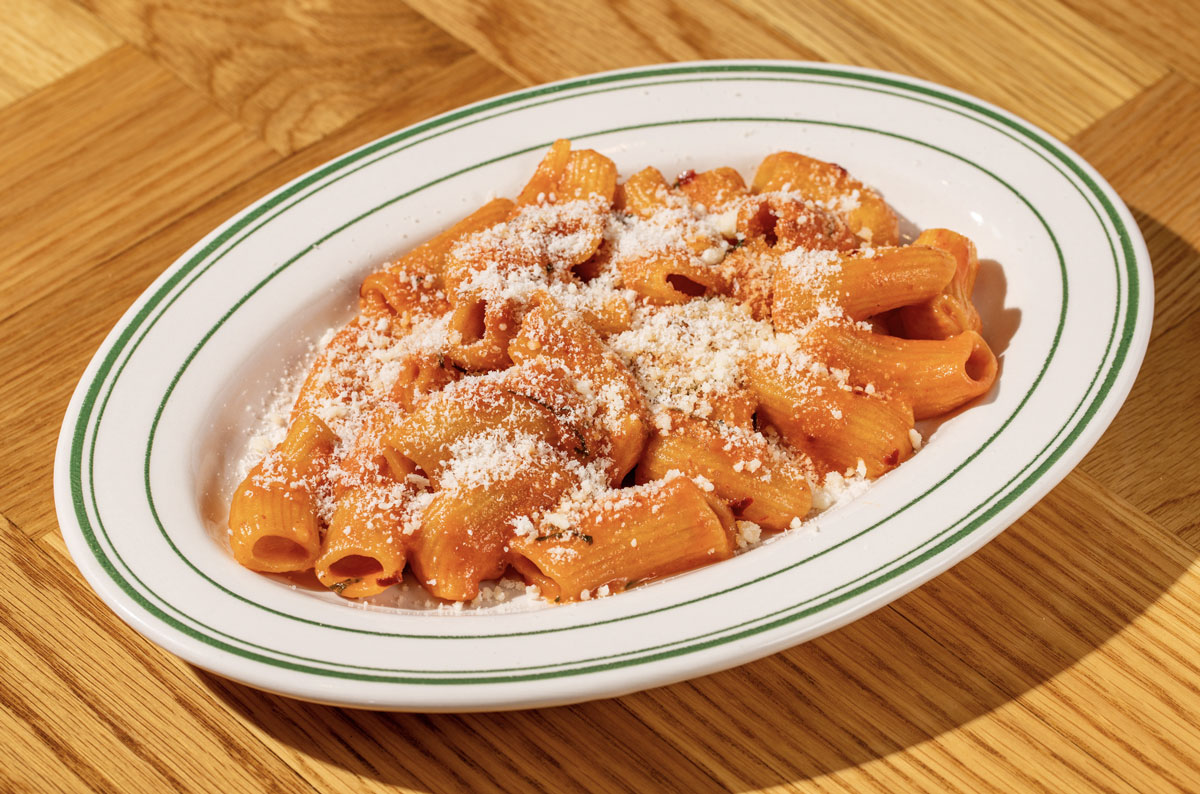
Spicy RigatoniSpicy Rigatoni (Photo by Max Milla)

Is there a clear-cut most popular or best-selling dish on the menu currently? Or conversely, is there a dish you’re especially fond of? 

We don’t have a best-seller yet as we’ve only been open for a week, but I am in love with all of the pizzas, the Italian Beef and the veal parmigiana. We receive whole racks of pasture-raised (meaning very well-treated) veal and leave about an inch of meat on the bone. We then braise that whole and separately pound out the rib loin paper-thin. On the plate, you get a traditional thin and crispy chop and this surprise giant bone that looks like it is traditionally fried. When you slice into it, it's so tender you can almost eat it with a spoon.

Would you compete on Top Chef again, if asked? 

I would be open to competing on Top Chef again. I’m very competitive and I especially don’t like the circumstances with how I left. My life is very different now and it would be very hard to leave baby Kobe and my wife for eight weeks again, but I want to either win or go out on the basis of my cooking rather than my sh**ty, anxious front-of-house (lack of) skills.

In another interview, you mentioned that Jemma will have spaghetti and meatballs — but I don't see it on the menu! I'd be so fascinated to see your iteration of the iconic classic. Perhaps it'll be added sometime down the road? 

Angel hair and meatballs will be on the menu very soon!  The second we opened, my first “Oh, sh*t” moment was realizing I forgot to add the meatballs to the angel hair.

If you were to pinpoint a particularly unique or "special" technique in one of the components or recipes of an item currently on the menu, is there any specific dish that stands out for you?

We use quite a few modern techniques in my restaurants and it all comes from my enthusiasm and never-ending hunger for knowledge, combined with my Michelin training. I’ve already mentioned a few of the techniques above.

I got extremely into cocktail development during the pandemic when we planned on expanding Jame into a full-service bar. The restaurant had previously only had beer and wine. I took a chef’s approach to the cocktails and to date have developed all of the cocktails in all of our restaurants.

My favorite is the sea foam on top of our basil margarita at both Jemma di Mare and Jemma. We make a salty foam with lime juice and a hydrocolloid and use an actual aquarium air stone with a pump to get the texture as light as air. Then we scoop that in a huge mound on top of the margarita. It’s much more interesting than a salted rim.

Another accused sex offender in the sports world, sheltered by U.S., may finally face justice

So far, one of the biggest current news stories in Ireland has gone completely unremarked upon in American media. It involves what followers of competitive swimming — there, here and everywhere — need to understand about the fate of George John Gibney, coach of the Irish Olympic swimming team in 1984 and 1988, who has been living as a quasi-fugitive in the U.S. for more than a quarter of a century.

Survivors of Gibney’s many alleged and well documented acts of sexual abuse may stand to get some relief from the Irish judicial system at long last. Missing from the associated commentary is a larger truth: This very late dragnet, if it happens, will still leave open the problem of “accountability delayed, accountability denied.” The enablers of this monster have intertwined in the worldwide institutional cover-ups that help youth sports coach sexual abuse continue to thrive.

Multiple Irish news outlets are reporting that the Garda Síochána, Ireland's national police agency, has forwarded to the director of public prosecutions a recommendation to indict Gibney on up to 50 counts of sexual assault, based on evidence brought forward by newly emerging victims. Further, the reports say, U.S. authorities have been alerted that a request to extradite Gibney from Florida may be forthcoming.

The BBC, producer of the 2020 podcast series “Where Is George Gibney?”, by Irish journalist Mark Horgan, said 18 survivors gave the gardaí information on fresh incidents, never before investigated, during the production and its aftermath. This evidence, aimed at a new generation of news consumers not quite as fatigued by one of Ireland's nearly innumerable legacies of abuse in high places, could be breaking through the DPP’s resistance, nearly 30 years running, to undertake a second Gibney prosecution.

The first prosecution 1.0 came undone thanks to a controversial 1994 Irish Supreme Court ruling, which found that the passage of time had fatally compromised Gibney’s right to a fair trial, after he was indicted the previous year on 27 counts of indecent carnal knowledge of juveniles. One of the barristers who argued Gibney’s case, Patrick Gageby, is the brother of Supreme Court justice Susan Denham (later the chief justice). This level of nepotism is not unfamiliar in Ireland (or, to be fair, in many other places).

The following year, Gibney made it to the U.S. on the basis of a precious diversity lottery visa. The timeline suggests he’d been keeping the visa in his pocket for the right moment. Gibney even briefly coached for a USA Swimming age-group program in suburban Denver before his past caught up with him in that community.

In 1998, a cryptically composed Irish government report found that Gibney’s victims “were vindicated” by the evidence that had been accumulated in various cases. But the DPP never reopened the original case, which would have involved challenging the Supreme Court’s shaky legal scholarship with respect to historical abuses — a doctrine no longer favored in the case law.

Hats off to BBC podcaster Horgan if his effort has succeeded in returning Gibney to Ireland in handcuffs. At the same time, “Where Is George Gibney?” tiptoed around unpleasantness like the apparent corruption Supreme Court and the likely collusion of the American Swimming Coaches Association in arranging Gibney's relocation and reinstallation on our side of the Atlantic.

We need your help to stay independent

Asked about Gibney at a deposition for a lawsuit alleging USA Swimming’s responsibility in the abuses of another coach, the group’s then-chief executive, Chuck Wielgus — already accused by some of giving false or misleading testimony in other abuse cases — said, “Sounds like a — sounds like an Irish — is he an Irish coach? Yeah, I think I’ve heard the name.” (In 2014, a petition campaign by abuse survivors forced the International Swimming Hall of Fame to rescind Wielgus’ induction. He died three years later.)

In my FOIA case for material from Gibney’s immigration records, federal judge Charles Breyer said in 2016, “I have to assume that if somebody has been charged with the types of offenses that Mr. Gibney has been charged with, the United States, absent other circumstances, would not grant a visa. We’re not a refuge for pedophiles.” This was just before the FOIA settlement at the Ninth Circuit Court of Appeals, which included the release of a letter in which ICE officials determined that Gibney was not a candidate for deportation, even after he withheld from his failed 2010 U.S. citizenship application the information that he had been prosecuted for sex crimes in his native country. ICE’s rationale was that since Gibney had never been convicted of anything, the U.S. would not revoke his green card for false statements on a citizenship application. One wonders whether the same standards would apply to an immigrant from a different part of the world with a different skin color. 


Want a daily wrap-up of all the news and commentary Salon has to offer? Subscribe to our morning newsletter, Crash Course.


None of that was in the BBC podcast. Following the FOIA case, FBI agents were dispatched to Peru to investigate Gibney’s travel there on a children's medical mission, along with a group from his Catholic parish in Colorado. Gibney was then, and may still be, under investigation at the Justice Department’s Money Laundering and Asset Recovery Section, in a probe directed by the unit’s human trafficking finance specialist. That wasn’t mentioned in “Where Is George Gibney?” either.

We Americans are in no position, however, to lecture the Irish on the timidity of their news media. Several years ago, major newspapers here reported on a federal grand jury investigation of USA Swimming in the Southern District of New York, related to insurance fraud and cover-up of abuse cases. It has barely been mentioned since.

Friendship is a health booster, but it has a “dark side,” a surprising study finds

America is in the middle of what’s been called a “friendship recession.” 

The term took off after the Survey Center on American Life reported that over the past 30 years, American friendship groups have shrank in size, and the number of Americans without any close confidants had rapidly increased — especially among men. Multiple studies have shown that a higher number of Americans report having fewer friends and spend less time with the few they have. 

There are many implications to a society that is increasingly seeing fewer people have fewer meaningful friendships. Some have posited that a decline in friendships is leading to a decline in civic engagement. Loneliness can prime a person’s immune system to be more vulnerable to disease and more susceptible to disease progression. Some researchers have found that loneliness can be a risk factor for dementia, and thus friendship can help protect against it.

Considering the detrimental health effects loneliness can have on a person's health, it’s easy to think that having more friendships unequivocally equals good health and there are only upsides to having friends. According to a new study published in Epidemiology and Psychiatric Sciences, there is a “dark side” to friendships, too. (The good news is that it might not matter much in the grand scheme of things.)

Friendships were associated with a 43% increased likelihood of smoking and 48% increased likelihood of heavy drinking.

In the study, researchers looked at data from around 13,000 adults over age 50 to examine associations between different facets of friendship and 35 health and well-being outcomes four years later. In a phone interview Bill Chopik, an associate professor of psychology at Michigan State University, told me that he and his colleagues wanted to focus on friendships, because most existing literature explores the health effects of marital or parent-child relationships.

But increasingly more Americans are remaining single and finding companionship in familial-like friendships. Curiously, the others wanted to know how much it matters to have friends. Some of the outcomes they found were that friendships were associated with a 24% reduced risk of death, 19% reduced risk of stroke, and a 17% reduced risk of depression. 

“Having good and frequent friendships was associated with you living longer, you’re happy in nearly every way and you have a bit more of a healthy personality,” he said. “Those were by far the good things, and there were some interesting results.”

Specifically, they found that friendships were associated with a 43% increased likelihood of smoking and 48% increased likelihood of heavy drinking.


Want more health and science stories in your inbox? Subscribe to Salon's weekly newsletter Lab Notes.


“It looks like having more and better friendships has you drinking a little bit more, which we didn't expect, and smoking a little bit more, which we normally try to deter people from doing,” he said. “The interesting thing is you, you imbibe a little bit more in these substances — and yet you still live longer.”

What’s interesting is that being without friends or being lonely in general, is just as bad, if not worse than smoking.  Research has shown that people who seek treatment for substance use problems report feeling lonely, suggesting there is a connection between isolation and substance abuse. Yet it seems if you have more friends, you’re at a higher risk to smoke and drink, too. 

Chopik said this could be part of what’s called the “amplification system” of friendships, which means your friends can amplify either your good or bad behaviors. 

“There’s a saying, ‘you are who your friends are,’” he said. “And that's what we meant by the amplification system, it accentuates our best and worst traits."

We need your help to stay independent

However, the trade off is “small,” Chopik said. In other words the increased likelihood of smoking or drinking is worth taking for your health and living longer. The takeaway certainly isn’t to spend the second half of your life without friends for the fear or drinking or smoking. In fact, it’s the opposite. Chopik said he hopes this study reinforces the importance of friendship when it comes to enriching the human experience.

“The trade off isn't as dramatic as I think we're talking about, it’s not like ‘I’m going to force you to smoke three cigarettes in exchange for you being happy,” he said, elaborating that despite the increase in drinking and smoking people with fulfilling friendships are still living longer. "In some ways, the story is really simple that there are no drawbacks to having really amazing friends, the difficulty is finding friends and keeping friends.”

“The Curse,” HGTV and the curb appeal of gentrification

Throughout “The Curse” Asher (Nathan Fielder) and Whitney Siegel (Emma Stone) grow more desperate to be thought of as good people. Wherever Whitney walks in the couple’s adopted New Mexico community of Española, she smiles and waves at strangers, pets their dogs and asks about their spouses. She preaches the feel-good gospel of investing locally and bringing jobs to this predominately Hispanic and Native American working-class community.

Like the twee strip mall showrooms she and Asher run, they do not fit in. No matter, since in their view, their mission is to inspire (read: force) their neighbors to rise to their standards.

The couple would vehemently object to that description, insisting that bringing sustainable living to Española will be a boon to all. Moneyed urbanites searching for affordable housing will flock to the town, Asher hopes, bringing their spending power, raising property values and creating new jobs.

What happens when the cost of living also goes up? In the short run, and mainly while their producer Dougie (Benny Safdie) is filming these good works, Whitney and Asher negotiate on behalf of residents whose rents are going up and forge connections with government officials. But they assure those who ask that the profits for the homes they sell will be used to subsidize the locals' rising rents.

“There are no losers,” they assure all doubters, be they longtime residents or a profoundly skeptical TV reporter from a local station.

The newlyweds’ obsessive quest blinds them to their damaging sense of superiority; even as they believe they’re doing the right thing they can’t help screwing over others. A coffee shop featuring pour-over brews showcases the couple’s ethos, along with an overpriced denim boutique situated next door. This is part and parcel of Whitney and Asher’s commitment to sustainable living which they hope to turn into an HGTV series called “Flipanthropy.” In Española there are plenty of low-priced abandoned or tear-down homes in neighborhoods that, to outsiders, have seen better days.

"Flipanthropy" is essentially “Fixer Upper” with a comically massive injection of white guilt paired with saviorism.

Asher buys them, and Whitney transforms them into eco-friendly “passive homes” covered in mirrors as if to meld Frank Lloyd Wright’s “organic architecture” philosophy with a disco ball or a carnival funhouse. Inside they are an Instagram influencer’s fantasy of Southwest chic with pueblo blankets hanging on whitewashed walls and earth tone accents.

The show’s title comes from Ash’s fateful interaction with a little girl selling soda in a parking lot, urged into existence by Dougie, who tells him he needs B-roll of Asher doing good deeds.

When it goes sideways, the kid inhales deeply, trains a hard glare on Asher, and says, “I curse you.” Those three words end up holding a power over him he can’t shake.

Fielder’s forte is cringe comedy honed to a needle’s precision in the cult favorites “Nathan For You” and his recent HBO project “The Rehearsal.” Unlike those improvised sensations “The Curse” is scripted, making its satire more laser-focused on hitting interlopers like Asher and Whitney – please, call them Ash and Whit! – squarely in their conscience.

But it also burst the feel-good comfort we take in rehab shows that play up the nobility of restoring neglected properties in "up and coming" neighborhoods. Rarely do we hear about the people who lived in those places before or live around them now, and rarely do we think about what life will be like for them once the hosts pack up and the cameras are gone.

Fielder and Safdie co-wrote the series to be a treatise on gentrification, actual and metaphorical. By placing it within the world of home improvement TV they and co-executive producer Carrie Kemper, who co-wrote two episodes, remove the city limits from that concept and present it for what it is: a wrongdoing normalized by TV, TikTok and Instagram.

Fixer Upper: HotelChip and Joanna Gaines in "Fixer Upper: Hotel" (Magnolia Network)"Flipanthropy" is essentially “Fixer Upper” with a comically massive injection of white guilt paired with saviorism. Asher and Whitney are less charismatic versions of Chip and Joanna Gaines, more eager to be successful than environmentally friendly. Through Ash and Whit’s misadventures, “The Curse” shows us what that much-loved home improvement program and others like it don’t, mainly the financial and social costs incurred on the communities around their fantastically upgraded properties.  

We need your help to stay independent

Whitney tries to rope in the local creative community, by courting a supposed friend who is both a visual and performing artist, and who barely veils her disdain for Whitney but will happily accept her fawning compliments. (One reliable aspect of gentrification is the artist's role as recon agent and shock troops.) Asher simply doesn’t want to fail and will exploit anyone to ensure he doesn’t, including former friends and co-workers.

As they attempt to get “Flipanthropy” up and running Española’s residents keep reminding them of the less pleasant realities of attracting newcomers to a place based on images projected on TV or online. Surely the Gaineses faced this as they transformed Waco, Texas, from a place that was notorious for the wrong reasons into a tourist destination synonymous with homey Americana. Contemplating the area's rising property taxes or longtime residents being priced out and perhaps displaced is not a topic audiences want to engage with. 

Nevertheless in 2019, not long after the Gaineses announced the launch of Magnolia Network, a reporter from Buzzfeed paid an extended visit to Waco to experience “the Fixer Upper effect” and speak to the town’s natives about what it’s meant for them.

Contemplating rising property taxes or longtime residents being priced out and displaced is … not a topic audiences want to engage with. 

Depending on who the reporter asked, Chip and Joanna’s town-wide “restoration” has been a Godsend or a blight. The reporter found a place that is, in the shadow of the famed Magnolia silos, welcoming and aesthetically pleasing, and elsewhere has stoked displacement fears due to skyrocketing property taxes. Additionally, there’s the fear of the existing culture being overpainted in a push for development that favors consumers who are white and upper middle class to the detriment of their Black, brown, and Indigenous neighbors.

“They want to come in and fix me. Fix us,” one resident is quoted as saying. But you know what? We’re not broken. Do we want to better ourselves and our circumstances? Of course. But that doesn’t mean we need fixing.”

This describes the tragicomedy of Asher and Whitney – they are convinced they know better and can therefore force people to live better. In an upcoming episode, one of their new-to-town buyers immediately accuses their neighbors of porch piracy, and Whitney takes it upon herself to police the person, insisting they live the “flipanthropy” way. It doesn’t work because people are selfish and don't like being told what to do – especially people who feel like their presence is a favor to the communities they’re invading and might otherwise write off if not for the approval of the world's Whits.

The CurseNathan Fielder as Asher and Emma Stone as Whitney in "The Curse" (John Paul Lopez/A24/Paramount+/Showtime)Some shows make a serious effort to do right by the people living in the places they're rehabbing. HGTV’s “Bargain Block” has made stars out of home designers and renovators Keith Bynum and Evan Thomas, who purchase multiple tumbledown homes on the same block in Detroit, fix them up, and sell them for under $200,000.

Their goal is to bring people back to urban neighborhoods that emptied when the city's economy tanked and to provide quality opportunities for first-time homebuyers.  BridgeDetroit says Bynum and Thomas have rehabbed at least 40 homes as of June 2023. The hosts also work with a local credit union to assist buyers who its president and CEO told the outlet “haven’t been treated as well by the financial industry and others” to secure mortgage loans.


Want a daily wrap-up of all the news and commentary Salon has to offer? Subscribe to our morning newsletter, Crash Course.


The article cites data from local think tank  Detroit Future City indicating that white mortgage applicants were much more likely to have their home loans approved than Black applicants. Nearly 30% of the 1,717 African American home loan applicants were denied compared to less than 15% of the 913 white applicants, the report says.

Of course, as is the case with all of these shows, the host and producers of “Bargain Block,” along with their realtor and friend Shea Hicks-Whitfield, have no idea whether their homebuyers are from the communities they want to help or, like Asher and Whitney’s target customers, speculators buying into a neighborhood at a lower price to sell when the property values rise.

In a real way, they appear to be making efforts to do good in addition to meaning well with an eye on honoring the cultural fabric of the communities where they’re working, which is more than one can say about other shows promoting home rehab as nothing but a net benefit for both homeowner and neighbors. A blessing, you might say, instead of a curse.

And if not Fielder, Safdie and Stone bringing us the squeamish misadventures of their eager "Flipanthropist" couple in New Mexico, we might never think otherwise.

New episodes of “The Curse” premieres Fridays on Paramount+ with Showtime and at 10 p.m. Sundays on Showtime.

When a liberal president goes to war: Lessons of the LBJ era are relevant today

Hey! Hey! LBJ! How many kids did you kill today?
Antiwar chant, circa 1967

I was among the hundreds of thousands, perhaps even millions of young people who chanted those words as the horror of the Vietnam War dragged on despite rapidly growing opposition in 1967. I was morally outraged at the slaughter of innocent children in my name, and particularly by the unforgivable decisions of a president who had shown such sober, even bold and inspiring leadership in the past — in passing the Civil Rights Act and the Voting Rights Act, as prime examples.

I've never wavered in my belief that calling out Lyndon Johnson that way was the right thing to do. Yet it ultimately led to LBJ  abandoning his re-election bid in 1968, and thus to the election of Richard Nixon (aided by some seditious conspiracy) and 50-plus years of mostly horrible foreign and domestic policy — starting with Nixon prolonging, worsening and expanding the same horrific slaughter of innocents I had been protesting.

I can honestly say that there's no comparison: LBJ was far and away the best U.S. president of my lifetime. His policy record — on civil rights, social programs (Medicare, Medicaid), environmental protection (even environmental justice. via his wife), consumer protection, you name it — towers over everyone else, and over the entire half-century. Without it, we'd be a nation so backward that even present-day Mississippi might look like a beacon of hope.

What’s more, we now know two fundamental things about the Vietnam War: First, that Johnson felt tormented and dragged into it, as tapes released decades ago make clear and, second, that he was not alone: The entire political class was complicit in leading the U.S. into a futile and disastrous war — something that should have been avoidable after the dire military misadventure of Korea. Historian Robert Mann, a former Senate staffer and author of “A Grand Delusion,” an invaluable Senate-centric history of the Vietnam War, summarized it in an email:

The tragedy of Vietnam was individual and collective. I don't want to downplay the horror of the individual atrocities committed by rogue soldiers or underestimate the corrupt and reckless decisions made in the White House, Pentagon or State Department. But I've always believed that the Vietnam War was a catastrophic, collective decision that didn't involve the public in any meaningful way.

If Johnson had been honest with the public and had Congress fulfilled its constitutional duties, the calamity might have been prevented.

The Gulf of Tonkin Resolution in 1964 was “the original sin,” Mann said. But hardly the only one:

Throughout the 1960s, Congress — most of its members understanding little about Vietnam and our reasons for fighting — supported the American policy, fearing political retribution if they did not. But the leaders knew. Most leaders of both parties in Congress understood our involvement's futile and reckless nature but did too little to stop our headlong rush into Southeast Asia. Johnson bears the lion's share of the blame, for sure, but it wouldn't have happened without the help and/or abdication of every other military, political and diplomatic institution.

So what does all this mean, when we look at Joe Biden today? How should today's left, and the broader progressive movement, respond to his military support for Israel? We can protest it vigorously, sure — but how? Do we drive him from office and end up with Donald Trump? Echoing what happened with Johnson and Nixon — but honestly far worse, given what experts on authoritarianism tell us — doesn’t seem like a sound strategy to me. It doesn’t sound like a strategy at all, and it would leave all the other enablers in place, some even stronger than ever.

How should today's left, and the broader progressive movement, respond to Joe Biden's military support for Israel? We can protest it vigorously, sure — but how? Do we drive him from office and end up with Donald Trump?

Of course, if you’re as horrified and angry with Biden as I was with LBJ, you might not listen — and I’d understand. I couldn’t vote yet in 1968, but I would have voted for the Peace and Freedom Party, created the previous year to give voice to people like me. (It ran two candidates for president, curiously enough: comedian Dick Gregory in some states, Black Panther Eldridge Cleaver in others.) Although I supported Rep. Shirley Chisholm in the Democratic primaries four years later — when she became the first Black woman to run for president — and campaigned with a friend who went to Miami as a Chisholm delegate, I remained primarily identified with Peace and Freedom until I volunteered with Jesse Jackson’s 1988 Democratic campaign. So I probably wouldn’t have listened to me, either. But I genuinely wish there had been an older me around, at least to make this argument and push younger-me to think more systemically and more long-term.

It's not that my 1967-'68 experience should count for anything special. The world has changed, America has changed, the left has changed — all of them dramatically since the chants I joined in helped drive LBJ from office. To take that experience in such a different context as a beacon of eternal truth would be foolish. But so would ignoring it entirely. It's an experience that should be considered as part of the framework for making a better way forward. I believe that the possibilities for the left today — particularly here in America — are far greater than they were for us in back in the late '60s, and we should be far more ambitious in fighting for systemic change. 

For one thing, we have far more mass support from young voters in particular, across a broad range of issues — on inequality,  climate, abortion, guns and LGBTQ rights, substantial majorities support progressive positions and are potentially receptive to systemic left arguments. The connections that have produced broad support for a Gaza ceasefire and for Palestinian rights more fundamentally are evidence of how many people are able to understand networked and intersecting issues. In contrast to where we stand today, consider the implausible but true fact Nixon won a majority of younger voters in 1968. The future, in terms of potential mass politics, is far brighter today, in contrast to the threatening darkness we see close at hand. 

There’s also an immediate threat to that: The pro-Israel lobby AIPAC plans to spend $100 million in Democratic primaries next year, with the principal aim of ousting progressive incumbents. This comes at a time when polling suggests that 80% of Democratic voters — and, for that matter, 57% of Republicans — support a ceasefire in the Gaza war. Defending folks like Reps. Cori Bush of Missouri, Rashida Tlaib of Michigan, Ilhan Omar of Minnesota, Jamaal Bowman of New York and Summer Lee of Pennsylvania is vital for leftists and progressives, whatever strategic, tactical or ideological choice you might make about Joe Biden. Building solidarity by uniting to defend those people and other progressive legislators is a good start toward building a strategy that resonates with the majority of Americans who already agree with us on a broad range of front-line issues.  

Defending progressive legislators against the pro-Israel lobby is a vital cause for the left, no matter what strategic, tactical or ideological choice you might make about Joe Biden.

We also don’t have to limit ourselves to playing defense. Run for Something has been doing a great job of promoting progressive candidates from the bottom up, and their model provides a path for going on offense as well. It can be quite liberating to realize that presidential politics doesn’t have to dominate your life. You can choose where to put your time, energy and resources, can give presidential politics no more than a few minutes of effort on Election Day — and can still work effectively to save America from Trump. If you find my larger argument persuasive, that is. And even if you don’t, we’ll be a lot closer to building the kind of political power that can actually change things over the long term. 

Big picture: getting rid of leaders to get rid of wars doesn’t have a great track record. Consider the example of Barack Obama following George W. Bush. This shouldn’t surprise anyone familiar with any sort of leftist systemic analysis. Systems are the problem; politicians are symptoms of that system, at best. If anything, changing leaders can relieve the pressure to end the war. That’s what happened with Nixon, and again with Obama.

I’m not saying we should give Biden a pass — far from it. He needs to be pressured on his deeply misguided decision, as does every other facet of the Democratic establishment. But to do what, and toward what end? And as part of what larger systemic project?

To get a handle on that, consider Biden's speech that sought to combine support for Ukraine and support for Israel in a single overarching pro-democracy framework. It won wide approval from the liberal media, particularly in contrast to the chaos in the GOP-led House. But the view from the Democratic base — particularly among younger voters — as well as from around the world, was markedly different. 

Notwithstanding Beltway conventional wisdom, neither Israel itself nor America's support for Israel has much to do with defending democracy or the "rule of law." Neither country’s democracy is doing so well just now, as even a cursory glance at the headlines will tell you. It's even worse when we come to the rule of law. Israel’s illegal West Bank settlements and its broader apartheid system, recognized by Amnesty International, Human Rights Watch and even a former head of Mossad, clearly put it outside the rule of international law. And the U.S. has issued 34 Security Council vetoes to protect Israel as that nation has grown increasingly lawless, making our sanctimonious our claims about the rule of law ring equally hollow. Insisting otherwise only serves to sow deep cynicism toward the very value system we are supposedly trying to uphold. It's actively helping Putin and Xi Jinping — and, closer to home, Donald Trump too.

What Biden should be doing in this moment is incredibly difficult, as well as unlikely: He should break with decades of false pieties. But it should also be clear, if only we had a realistic understanding of the Cold War, and what the U.S. did right and wrong during those decades. Our post-World War II failure to respect a pluralistic, self-determined majority of new nations, in the spirit of our own Declaration of Independence, did incredible damage to our claims of moral superiority at the time, severely weakening the spread of democracy and planting the seeds for much of the chaos and right-wing authoritarian violence we see across the world today. 

The Vietnam War, in fact, offers a prime example. Ho Chi Minh had been reaching out to America, appealing to stated values of freedom and self-determination, since the Paris Peace Conference in Versailles in 1919, as Marilun Young lays out in her classic, “The Vietnam Wars 1945-1990.” So America's folly long predated the Cold War, but that era of superpower conflict supercharged it.  

We failed to respect the people of Iran and Guatemala, just to cite the first two CIA-backed coups of that era, and we're still living with the poisonous fruits of that betrayal. When I was a young teenager, my family hosted an Iranian foreign exchange student named Said, who gave me a visceral first-hand account of how the CIA’s overthrow of Mohammad Mosaddegh’s democratically-elected government — for the sin of trying to reclaim Iran’s oil wealth — had plunged his nation backward into a nightmarish police state under the Shah.  

America refused to respect the democratic choices of the people of Iran and Guatemala, and we're still living with the poisonous fruits of that betrayal.

Yet like so many other Iranians even down to the present day, Said looked to American ideals, American culture and the American people with admiration. Only our government’s policy was wildly at odds with what he and so many others, in Iran and around the world, found so appealing about America. It’s a lesson I’ve never forgotten, and in return a part of me feels Iranian to this very day. The hope and then the betrayal of the 1979 revolution, the point at which most Americans belatedly discovered Iran, still seems like yesterday to me. 

By demonizing Iran rather than recognizing its complexity and America's role in poisoning its politics, we created an enormous, ever-evolving geopolitical problem that never had to exist at all. Obama at least tried to reckon with this when he reached the historic multilateral nuclear deal in 2015, which drew in both China and Russia as partners. That was only a first step, but so clearly in the right direction. But the demonization of Iran has been so powerful that Biden hasn't even reinstated the deal that Trump so off-handedly destroyed. Not only has our relationship with Iran grown sharply more hostile, the idea of partnering with China and Russia once again seems absurd. So much opportunity has been lost or wasted that we’ve grown accustomed to accepting desolation as our baseline, which is exactly what fascism requires in order to present itself as an appealing option.

What happened in Guatemala is also worth considering. The CIA overthrew the democratically-elected government of Jacobo Árbenz in 1954 for daring to attempt its own version of the New Deal, starting with a minimum-wage law and going so far as to legalize the Communist Party. Guatemala had only gotten rid of its military dictatorship a decade earlier, but a decade of democracy was too much for Cold War America. The possibility of even modest social democracy spreading to the developing world was more than enough reason for the CIA to oust Árbenz and usher in generations of military dictatorship, political instability and violence, which has essentially continued to this day. 

Indeed, violence in Central America — partly fueled by an extensive history of U.S. intervention, with an overlay of climate crisis and disrupted food security — is the primary reason for the border crisis we’re experiencing today. That’s another basic geopolitical fact that has absolutely no place in elite America’s political discourse about the most salient problems we face.


Want a daily wrap-up of all the news and commentary Salon has to offer? Subscribe to our morning newsletter, Crash Course.


We need to find some way to atone for those sins — an impossible task, you might say. You're probably right. But we have to try anyway, because only by doing that can the U.S. actually become what we pretend to be on the world stage. And that's the only way, in the long run, that democracy and the rule of law can actually have a chance to prevail with America playing any significant role in the process.

Living up to America's supposed ideals has always been problematic. “All men are created equal,” while some are slaveowners and others are slaves? Really? But for the foreign policy purposes at hand we can start with the early Cold War. As I noted recently, Cold War liberalism had diverse tendencies, including George Kennan's Long Telegram, the initial defining document of the Cold War, in which he exhibited progressive aspirations and even praise for Scandinavian socialism. Kennan’s outlook should be seen as related to FDR’s “Four Freedoms” speech, defining what we were fighting for in World War II, and also to Eleanor Roosevelt’s role in establishing the Universal Declaration of Human Rights in 1948. (That, by the way, includes “the right to a nationality,” which Israel is denying to the Palestinian people, with U.S. support.) All three reflect an aspect of Cold War liberalism that was far more open to the left, and more committed to America's professed values, than the term usually conveys. It’s something that can be built upon, even by those of us critical of that tradition.

As I’ve written about before, as far back as 2007, the Cold War as Kennan understood it was not the Cold War actually fought by U.S. elites fought, as a 1998 paper by Efstathios T. Fakiolas, "Kennan's Long Telegram and NSC-68: A Comparative Analysis," helps to clarify. NSC-68 was a secret national security memo written under the supervision of Paul Nitze that profoundly influenced Cold War foreign policy, particularly though not exclusively in terms of the use of covert actions. Fakiolas describes both documents in terms of the realist school of thought about international relations, but based on different paradigms. Nitze’s “billiard ball” paradigm sees only state actors as significant, and thus only zero-sum possibilities exist: Whatever one country gains, another loses. Kennan’s “tectonic plate” paradigm recognizes multiple kinds of actors, and therefore non-zero-sum outcomes are possible: everyone can be better or worse off. As I wrote back in 2007:

Kennan favored a strategy of containment that emphasized strengthening the West socially, economically and culturally, addressing its flaws which the Soviets exposed. In contrast, Nitze ignored issues of the West's internal flaws, and focused almost exclusively on military force to combat the Soviet Union.

It's my own observation, based on this analysis, that we fought Nitze's Cold War, but we won Kennan's. It was not, in the end, military strength that defeated the Soviet Union; it was the appeal of our culture of openness and freedom. The history of Eastern European resistance movements, especially in Czechoslovakia and Poland, makes this abundantly clear. Through their influence on dissident culture, Frank Zappa and Lou Reed did more to win the Cold War than any division of tanks ever did — or even a wing of nuclear-armed B-52s.

What I wrote then remains true today, except that the West has lost more of its cultural appeal as the folly unleashed by our response to 9/11 has continued to undermine the world order we halfheartedly built. That’s both a good and a bad thing. It’s bad because undermining that world order has opened the floodgates for a resurgence of fascism. But it’s good because the failures exposed are now understood far more broadly than ever before — and therefore are ripe for fixing.

The challenge for leftists and progressives now is to salvage what is best in the Cold War liberal vision — particularly the egalitarian framework of international law that the Universal Declaration of Human Rights did so much to advance — and build on it along with other progressive traditions from around the world, including our own Black liberation traditions and Henry David Thoreau’s tradition of nonviolent resistance, so powerfully expanded and enriched by Mahatma Gandhi and his associates in India, Dr. Martin Luther King Jr. and his allies in America and Nelson Mandela and his allies in South Africa. 

Building a new world, the “beloved community,” as Dr. King called it, is far more difficult than simply getting rid of a tragically misguided leader. But it’s far more rewarding, too. That should be our North Star in the days, weeks, months and years ahead. If it is, we will not regret it, not even 50-odd years in the future.

Want to host better dinner parties? Take notes from these Thanksgiving cookbooks

The kitchen in my graduate school apartment was far from perfect — a thin galley corridor where stubby gray carpet gave way to yellowing linoleum, on top of which sat a temperamental oven and one stovetop burner that would respond to any coaxing with only a gasping, gassy hiss — but I trusted Sam Sifton when he wrote, over a decade ago, that there was no reason to fear. This could be the site of my best Thanksgiving yet. 

In the introduction to his 2012 cookbook, "Thanksgiving: How to Cook It Well," Sifton, the longtime food editor at “The New York Times,” painted a gorgeous picture of what the holiday can be: A fire has been stoked in the fireplace, its gentle crackle occasionally cutting through the muted crowd sound of the football game on TV. The kids are spread out on the floor doing jigsaw puzzles, while your cousin from Erie isn’t crying in the hallway this year. In the kitchen, the menu is set — a seasonal array of pies, stuffing that will make guests swoon, bacon and chipotle-dressed butternut squash, an expertly roasted turkey

“This is not a fantasy,” Sifton promised. “If you prepare, it will happen.” 

Now, I knew that my celebration, held for about a dozen members of my student cohort before we all went home to have “real Thanksgiving” with our families, was going to look a little different than Sifton’s picturesque scene. Instead of a fireplace, I had a YouTube video of a log burning on-loop . Instead of kids on the floor, one of my classmates asked if she could bring her diabetic cat to the party. Regardless, prepare I did. 

I followed all Sifton’s instructions and most of his recipes, some of which I scanned at the university library and glued to notecards for easier transport to the supermarket. I took the imperative “there should be napkins, too, real ones” seriously and raided the nearby Goodwill’s linen section, lucking into a dozen identical crisp white serviettes. Yes, I learned to make decadent mashed potatoes, the aforementioned swoon-worthy stuffing and turkey (and a pretty damn good one at that). But most importantly, I really absorbed Sifton’s message that good entertaining is worth putting in real effort. 

“Shortcuts are anathema to Thanksgiving, which is a holiday that celebrates not just our bounty but also our slow, careful preparation of it,” Sifton wrote. “There is no room in Thanksgiving for the false wisdom of compromise — for ways to celebrate the holiday without cooking, or by cranking open cans of gravy to pour over a store-roasted turkey re-heated in the microwave. Thanksgiving is no place for irony. We are simply going to cook.” 

That book changed how I look at Thanksgiving, and that Thanksgiving changed how I view entertaining. That’s why, if anyone were ever to ask me how to make hosting a dinner party any time of year a more seamless experience, I’d tell them to pick up a Thanksgiving-specific cookbook. 

We need your help to stay independent

Sifton’s “Thanksgiving” is perhaps my favorite in the genre, which is of course comparatively slim compared to the cookbook market overall, but there are a lot of gems: Mark Bittman’s “How to Cook Everything: Thanksgiving” includes a great primer on timing out the big meal, advocating for some preparation in advance, as well as offering the sage advice that even the most impatient guests can be pacified with a good sour cream dip; “Vegan Holiday Cooking From Candle Cafe” clearly makes the case for letting seasonal ingredients be the focus of the night, whether cooking for vegans or omnivores; Diane Morgan’s “The Thanksgiving Table” reinforces my love of a good planning spreadsheet. 

Just as cookbooks that are focused on one ingredient — say, a single lemon, fig or tomato — tantalize readers with the idea that they will be taught to eek the absolute most out of that ingredient, Thanksgiving-centered cookbooks also hold a certain loftier promise than simply guiding cooks through making lump-free gravy. 

If you can tackle the biggest food holiday of the year — one rife with cultural and culinary expectations — you can absolutely handle gathering some friends for a Tuesday pasta night, if that’s the kind of thing you want to do. And as someone who once, as an awkward tween obsessed with Food Network, saw dinner parties as the hallmark of sophisticated adulthood, that was something I very much wanted to do. 

Don’t get me wrong, I love the myth that entertaining can be effortless. There’s something almost achingly whimsical about the idea of waking up one morning and calling your most interesting friends and asking them to bring their most interesting friends to your place that night. You head to the surprisingly bountiful farmer’s market which definitely isn’t picked over in spite of the fact that you don’t believe in getting up at 6 a.m. on a Saturday just for a chance at a $17 bundle of microherbs. Despite having no plan, the menu simply presents itself. It’s simultaneously easy, yet intricate and leaves you enough time for a full bubble bath before slipping into a similarly effortless outfit before your guests arrive. 

But in reality, a lack of planning and preparation will more likely leave a hostess rushing at the last minute to Trader Joe’s to try to clear out the frozen appetizers section. 

The bulk of Thanksgiving cookbooks fly in the face of the effortlessness myth; hosting a multi-course meal with, as Sifton puts it, an “animal carcass the size of a toddler” at the center is no joke. It takes organization, technique and effort, just as all dinner parties do. It also takes a desire to actually be a host, to relish the magic that can happen — that you can create — when you get the right people around the table to share a meal together. 

In “Thanksgiving,” Sam Sifton offers this guide: “There is going to be a proper dinner table even if it turns out to be a slab of plywood over some milk crates, covered by a sheet. There are going to be proper place settings for each person and glasses for water and wine. There are going to be candles. There will be dessert.”

In the case of my first Thanksgiving, the dinner table was a card table long enough to fit twelve, covered in a thrifted table cloth. It was a deep forest green and managed to warm up the gray living room. I lit candles and made twee little place cards wrapped with twine, a sage leaf and baby’s breath. Somebody brought a decent bottle of white wine and set up a game of “Scrabble.” And while we ate, we watched the virtual fire crackle and pop. 


Trauma seems to be passed down genetically — but experts still aren’t sure what that means

Trauma is an experience so harrowing that it can alter our gene expression — and in some cases, these changes can be passed down to future generations. But if the traumas experienced by our parents, grandparents and other ancestors can be directly transmitted to us through our genes — and presumably, we pass down our own psychological residue to our kids — what does that mean exactly? Are we doomed to an endless cycle of genetic anguish?

"Trauma can directly and indirectly affect across generations and… this is likely due to a mix of behaviors, sociocultural factors, exposure, patterns, biological factors, genetics and epigenetics."

A growing body of research is shedding light on this phenomenon. For example, a 2020 paper published in the American Journal of Psychiatry analyzed blood samples of Jews who directly experienced the Holocaust, comparing them with both the blood samples of their children and the blood samples of Jews who lived outside of Europe during the Holocaust. Notably, the scientists found that mothers who survived the Holocaust had changes in their DNA in the sections that regulate stress responses — and that their children, who did not experience the Holocaust, had those same changes.

So this proves that intergenerational trauma is both real and biologically based, right? Not so fast says Dr. Rachel Yehuda, director of the Center for Psychedelic Psychotherapy and Trauma Research at the Icahn School of Medicine at Mount Sinai. Yehuda has done other research on intergenerational trauma and, when speaking with Salon by email, she emphasized that there is still a lot more work that needs to be done before more conclusive statements can be made.

"I don’t think we can say anything 'for sure' about genetic or environmental factors that lead to intergenerational effects," Yehuda said. "We can measure things in blood and maybe [the] brain that we think associate with intergenerational effects, but we don’t know much about the mechanisms of transmission or even how to fully interpret what we see."

Because the data that experts have obtained are always from single points in time, they are correlative — that is, while a link can be proven, it is not definitive that the one development has actually been caused by the other.

"These data serve us best when they generate hypotheses to explore in more rigorous studies, not when we use them to try to 'explain' why we behave the way we do in the here and now," Yehuda explained.

According to Dr. Sophie Isobel, a senior clinical lecturer at the University of Sydney who has also studied intergenerational trauma, scientists know very little for sure about the causes of this specific type of trauma, but they do know that trauma more broadly is passed from generation to generation by a number of variables.


Want more health and science stories in your inbox? Subscribe to Salon's weekly newsletter Lab Notes.


"It is proposed that intergenerational trauma can lead to cellular changes that alter the expression of genetic material, which over time become encoded."

"We know that trauma can directly and indirectly affect across generations and that this is likely due to a mix of behaviors, sociocultural factors, exposure, patterns, biological factors, genetics and epigenetics," Isobel told Salon. "Across studies and populations, individuals in generations not directly exposed to trauma show traumatic effects similar to those who were directly exposed."

Although for a long time scientists believed this was primarily due to a person's environment, recent evidence suggests that there are biological factors involved as well — in particular, that sinewy area of genetics known as epigenetics.

"Epigenetics is about how certain genes can get turned on and off in response to environment," Isobel explained, comparing it to how caterpillars and butterflies have the same genetic material but look and act very differently based on their environment and life cycle. "Basically, the DNA itself doesn’t change — but how it is expressed does. It is proposed that intergenerational trauma can lead to cellular changes that alter the expression of genetic material, which over time become encoded, and that it is a vulnerability to traumatic effects that is passed across generations and then ‘activated’ or not activated by environmental triggers."

Although the changes are not as drastic to a human as the metamorphosis from a caterpillar to a butterfly, Isobell said "there is research demonstrating impacted psychosocial functioning and wellbeing in second and third generations, even when life is stable and safe."

"In populations where exposure to trauma is widespread and sustained, epigenetic changes can become hardwired to enable survival."

While this analysis sheds light on individual instances of intergenerational trauma, it also raises questions about collective intergenerational trauma. When one looks at the current wars going on in Israel, Ukraine and elsewhere, it is natural to wonder about the role played by intergenerational trauma in both fostering and perpetuating those conflicts. To what extent are Israelis and Palestinians alike motivated by the past human rights violations that their ancestors endured? Will the conflict in Ukraine lead to intergenerational trauma passed on by Ukrainian parents to their children?

"There is a crucial difference between generations who are safe and living in non-traumatic contexts but are impacted by the experiences of their parents, grandparents or ancestors [versus] people, families or cultures who are impacted by trauma transgenerationally," Isobel pointed out. "In populations where exposure to trauma is widespread and sustained, epigenetic changes can become hardwired to enable survival and it can be very difficult to separate out direct trauma responses and those passed down across generations. Trauma of past generations and present don’t exist as discrete occurrences — they blur into a way of being and knowing, reinforced by environmental factors and events."

Isobel added, "In these situations, intergenerational trauma compounds primary trauma leading to complex experiences of transgenerational trauma."

We need your help to stay independent

Perhaps the best way of understanding intergenerational trauma is to keep in mind that, as Yehuda put it, "what we do know or can observe in people who have an ancestral legacy of trauma cannot be linked to the biology at this point."

In addition, there probably is no single response to intergenerational trauma that is easily identifiable: "Sometimes the fact that prior generations have undergone what you are going through makes your current situation seem more acute and intensifies emotions, but sometimes it reminds you that we survive things after all," Yehuda explained. In the end, while the science has yet to offer definite explanations for intergenerational trauma, what we do know for sure "is that in some form, we carry effects of our parent and grandparents' pasts with us. Our ancestors’ past matters."

Yehuda added, "Whether this helps us or hurts us or even whether we have control to use the legacy of these past experiences to our best survival advantage is something we need to learn a lot more about."

“He’s going to lose”: Bill Maher bashes Biden in “Real Time” segment

Bill Maher does not see Joe Biden winning the 2024 presidential election and he made this much very clear during a conversation with former DNC chair Donna Brazile and former Republican congressman Adam Kinzinger in a segment of "Real Time" on Friday night.

Bringing Democrat David Axelrod’s recent comment that Biden should “get out or get going” to the table, to which Brazile expressed agreement, saying, "Look, people think that Joe Biden is perhaps too old. They’re right," Maher jumped in with his own take on the matter, and how the issue is a "case by case" thing.

"But for that argument to have teeth at all, you also have to be the person who can go, 'Yeah, but this is the case,'" Maher offered. "And I’ve said it before. Do I think Joe Biden can do the job? Absolutely. I don’t think he can win the job. And that’s what I care about. He’s going to lose. Because the people think he’s too old. And perception is reality. I’m sorry."

Saying, "He's been counted out so many times, I've just lost track," Brazile jumped to Biden's defense, listing examples of times he's won where others presumed he had no chance. But Maher's opinion wasn't swayed here, shifting focus to a joke about Snoop Dogg quitting pot. 

Watch here:


This 5-minute salsa is the perfect last-minute appetizer

My wife fell in love with taco night during the pandemic.

Actually, taco night was three times a week at our home –– and the spread was glorious. We chose from ground turkey or beef, shrimp or chicken in addition to guacamole, five different types of sauces, fresh pico de gallo, an assortment of cheeses, fresh jalapeños, hot sauce, rice, beans and mezcal.

We did this consistently; as you can imagine, it was as amazing as it sounds.

I wasn't a big taco guy; I liked them enough, but our hyped-up way of preparing them and the ensuing fun made me fall in love with them.

The problem is eating all that salsa and cheese and chasing it down with mezcal isn't sustainable. My liver, kidney and arteries can't talk, but if they could, I would imagine them screaming for dear life every time I advocated for Taco Tuesday on a Wednesday . . . and then again on a Thursday night.

Luckily for me, the world slowly began to open back up, and I had the opportunity to make it out to some of my favorite restaurants: the kind you don't visit every week. Thus, if you would like to splurge on some unhealthy food, you don't have to feel completely guilty about it. Besides, taco or burger night once every few weeks can’t be as bad as taco night eight times a week in your own home.

We need your help to stay independent

Like most of us trapped in a house during the pandemic, I quickly reemerged into the world, hungry to eat up anything that wasn't cooked from my home kitchen. Beautiful Jamaican food, chicken cheesesteaks from my favorite carry-outs, five-course meals from Michelin-starred restaurants and my favorite Mexican spot in Baltimore: Clavel.

The food at Clavel is as impressive as the ambiance –– authentic Mexican cuisine and the best cocktails anyone has ever had. They specialize in mezcal and have multiple different types, as well as experts to teach you about what you drink. I couldn't get enough of this place — until my doctor told me to cut back on the salt.

"Do you guys make salt-free guacamole or something. Maybe some salt-free chips that I can dip in some salt free salsa?"

Like a good patient, I stayed away from the restaurant. I almost forgot how much I loved it until my manager decided to have her birthday dinner there. I attended, and yes, I drooled as they passed the bowl of guacamole, the many different types of salsas and all of those beautiful tacos and tostadas directly in front of my hungry face. 

"Excuse me, I gotta go grab this phone call," I said to the table. No one cared; they were all drunk, full and having a beautiful time. I didn’t actually receive a phone call, but I was starving. I snuck around the corner to one of my good friends who managed the bar and asked, "Do you guys make salt-free guacamole or something. Maybe some salt-free chips that I can dip in some salt free salsa?"

He patted me on the shoulder and said, "Get the salt-free-fu*k outta here. This is the worst place in the world to eat; if you are trying to avoid salt, you should go home and quickly."


Want more great food writing and recipes? Subscribe to Salon Food's newsletter, The Bite.


He then gave me a hug and sent me on my merry way. I was determined to reclaim a small piece of taco night the next day. There was no way I was going to be the guy who gets defeated when the market has any and everything that we need to create the dishes we deserve.

With that energy — and mainly that hunger — I whipped up my first batch. Now, I'm sharing the recipe with you.

Note: You will need a food processor or a blender or the ability to dice, dice, dice without chopping off one of your fingers.

Salt-Free Salsa
Yields
8 servings
Prep Time
5 minutes (plus 2 hours refrigeration time)

Ingredients

  • 1/2 bunch fresh cilantro
  • 2 jalapeños
  • 1/4 cup chopped red onion
  • 2 green onions
  • 1 clove garlic, chopped
  • 1 lime
  • 1 teaspoon chili powder
  • 5 fresh Roma tomatoes
  • Store-bought unsalted chips

Directions

  1. Mix all the ingredients in a blender or food processor (or by hand, if you're especially skilled), opting for your consistency of choice.

  2. Refrigerate for about 2 hours.

  3. Serve with 365 Organic Restaurant Style Unsalted Tortilla Chips or any other unsalted chip.

Forget about the alpha male. The internet’s new favorite heartthrob is the “Cinnamon Roll Man”

In The Onion’s 2014 satire piece, “Beautiful Cinnamon Roll Too Good For This World, Too Pure,” a simple cinnamon roll is hailed as a gentle creature of sorts. Its mere existence is rather ethereal. After all, the cinnamon roll, The Onion wrote, is “too pure for this world, too perfect.” 

“Look at this angelic confection. Never in my life have I laid eyes on such an immaculate swirl, nor glimpsed a crust as delectably golden brown in hue,” exclaimed one awestruck, albeit fictitious, witness of the aforementioned pastry. “Alas, we toil in far too cold and dark a world for such cinnamoned purity as this, such perfection, whose rich, buttery brilliance conjures the divine.”

The cinnamon roll soon became more than just a delectable sweet treat — it was also a newfound persona. Drawing inspiration from The Onion’s spoof and the roll’s physicality (a bit hard on the outside, but soft and sweet on the inside), romance novelists concocted a new kind of male protagonist known as the “Cinnamon Roll Hero.” The Cinnamon Roll Hero is thoughtful, but complicated. He’s the kind of man who’s no stranger to a life of pain and suffering. But at his core, he’s one big ol’ softie.

Most recently, a variation of the “Cinnamon Roll Hero” has been used to describe a popular subset of Hollywood heartthrobs. Dubbed the “Cinnamon Roll Man,” the persona spotlights a new brand of A-lister men who abandon the testosterone-fueled alpha male stereotype rooted in toxic masculinity. In other words, the “Cinnamon Roll Man” holds a “passion for high culture, ethical collaborations and beautiful clothes, while still loving their mums,” as said by The Daily Mail.

The epitome of “Cinnamon Roll Man” is arguably former One Direction frontrunner Harry Styles. Following his boy band departure, Styles arose as a global superstar, producing hit single after hit single and attaining a vast fanbase. Many of his stans are tweens and young adults, who pledged allegiance to him during his X Factor days. Others are a bit older, specifically in their 40s.

We need your help to stay independent

“The broad appeal of Styles, oft cited as a swirl of Jagger’s sex appeal and Bowie’s gender-bending, has been well documented,” wrote Michelle Ruiz for Vogue. In the past few years, Styles’ androgynous fashion sense has been at the center of immense praise (and criticism). When Styles graced the December 2020 cover of Vogue in a Gucci dress, people went completely berserk, hailing the showcase as “groundbreaking.” Despite the praise, Harry remained humble when speaking to Vogue about his solo shoot: “There's so much joy to be had in playing with clothes. I've never thought too much about what it means — it just becomes this extended part of creating something.”

On top of being a ladies man, Styles is a momma’s boy. He shares a close relationship with his mother, Anne Twist, and sister, Gemma. There’s also “his seemingly cosmic, intergenerational bond with Stevie Nicks; and his presence at a Christmas carol sing-along at Joni Mitchell’s house,” Ruiz added. Not to mention that Styles featured Shania Twain (even invited her for a duet of “Man! I Feel Like a Woman!”) at his first headlining set at Coachella in April of last year.

In this day and age, when dating app failures are a common tale and misandry is a kind-of social media trend, seeking out men who are caring, respectful, in tune with their emotions and easy on the eyes is like searching for a needle in a haystack. Yes, the bar is quite literally in hell, which is why men who exceed the bare minimum are (rightfully) idolized.


Want more great food writing and recipes? Subscribe to Salon Food's newsletter, The Bite.


Those standards apply to celebrities too. In addition to Styles, another so-called “Cinnamon Roll Man” is Timothée Chalamet. The “Call Me By Your Name” star stole hearts with his infectious charm, smoldering looks and sensitive demeanor. Chalamet also has a way with words. At the 2022 Venice Film Festival, he spoke about his dislike of being chronically online: “To be young now, and to be young whenever — I can only speak for my generation — is to be intensely judged.”

There’s also Irish actor Paul Mescal, who first graced our screens as shy boy Connell in the hit television adaptation of Sally Rooney's “Normal People.” Mescal’s relationship with former partner Phoebe Bridgers and fellow “Normal People” co-star Daisy Edgar-Jones were also of public interest. And his recent campaign with Gucci is, well, incredibly swoon-worthy.

Thanks to Pinterest and TikTok, aesthetic culture has become rampant, almost epidemic-like. Much of the focus is placed on women — cottagecore (which celebrates countryside living) regency-core (which romanticizes the United Kingdom's Regency era), coquette (which spotlights hyperfemininity) and succubus chic (which embodies the modern day femme fatale) are just a few prevalent aesthetics that come to mind.

As for men, the alpha, beta and sigma males are long-standing (although problematic) “boy” aesthetics that continue to be running jokes online. So long are the worst aspects of stereotypically masculine attributes. And long live the Cinnamon Roll Man!

Taylor Swift reacts to death of young fan at Eras Tour concert in Rio de Janeiro

On Friday night, a fan died during Taylor Swift's Eras Tour concert in Rio de Janeiro and in a letter posted to her Instagram Stories, Swift expressed feeling devastated over the loss of the 23-year-old, saying she was "so incredibly beautiful and far too young."

According to AP News, the cause of death for Ana Clara Benevides Machado has not yet been announced, but other attendees had been complaining that they were not allowed to take water into the stadium despite soaring temperatures. The office of Rio’s public prosecutor has opened a criminal investigation, and authorities are saying that free water will be made available at all future shows.

“I’m not going to be able to speak about this from stage because I feel overwhelmed by grief when I even try to talk about it," Swift wrote in her statement. "I want to say now I feel this loss deeply and my broken heart goes out to her family and friends. This is the last thing I ever thought would happen when we decided to bring this tour to Brazil.”

According to the show's organizer, Time4Fun, paramedics attended to the fan after she reported feeling unwell, taking her to a first-aid center and then to a nearby hospital, where she died an hour later. 

5 takeaways from Dolly Parton’s “Rockstar,” her glorious tribute to rock ‘n’ roll

Never doubt Dolly Parton when she says she’s going to do something. Take, for instance, when she was inducted into the Rock & Roll Hall of Fame in 2022 and vowed to make a rock ‘n’ roll record. A little over a year later, that album “Rockstar” is here.

“I still thought I needed to earn it,” she told the Hollywood Reporter, referring to her induction. “That’s why I thought, ‘Well, timing is perfect. There’s a real reason for me to do this rock ’n’ roll album. Here I am a rock star at 77.’”

As a country icon, Parton could’ve made a record focused on genres in her wheelhouse, like Southern rock or Americana. However, she told the Hollywood Reporter she wanted to avoid the easy route: “I don’t want it to be half-a** country.” 

To quote one of Parton’s most famous songs, “Rockstar” reflects several heaping cups of ambition. The 30-track album bursts with star power — to name just a few, Elton John, Paul McCartney, Ringo Starr, Stevie Nicks, Steve Perry, Peter Frampton, Michael McDonald, Debbie Harry and Joan Jett — and features a healthy mix of covers and originals.

Best of all, “Rockstar” doesn’t skimp on fun — it’s clear Parton is having a ball unleashing her not-so-inner rockstar. Here are five takeaways from “Rockstar”

01
Parton sounds like a natural collaborating with hard rockers

One of the album’s highlights is a slinky cover of Heart’s 1975 single “Magic Man” featuring two members who played on the original song: vocalist Ann Wilson and guitarist Howard Leese. 


Thematically, “Magic Man” feels like a classic Parton yarn, as it’s about a young woman bewitched by an older (and dangerous) man. Vocally, Parton makes the song her own, taking the perspective of a wise-beyond-her-years narrator looking back at her youthful self. Musically, it sounds gloriously like 1975 — with a new bridge added during which Parton and Wilson generate a mystical vibe that’s transcendent.


Elsewhere, she teams up with fellow Class of 2022 Rock & Roll Hall of Famers Pat Benatar and Neil Giraldo for a barnburning version of their smash “Heartbreaker,” while her take on REO Speedwagon’s epic power ballad “Keep on Loving You” with that band’s vocalist Kevin Cronin is a delightful surprise that brims with emotion.

02
Her ‘80s collaborations are on point

Parton enjoyed great mainstream pop success in the 1980s thanks to tracks like and her Kenny Rogers duet “Islands in the Stream,” so it’s perhaps no surprise that she sounds fantastic collaborating with that decade’s icons. 


Of particular note is an inspired cover of the Police’s 1983 smash “Every Breath You Take” with Sting that’s reimagined as a meditative country smolder with curled pedal steel, shaded vocals and glacial grooves. This also features one of Parton’s best vocal performances: She taps into the obsession at the heart of the song and imbues it with deep, guttural longing — transforming “Every Breath You Take” from a menacing stalker’s anthem to a song for heartbroken outsiders forced to watch an ex move on without them. 


Parton also sounds tender on a faithful version of Journey’s 1981 hit “Open Arms”—in no small part because former Journey frontman Steve Perry adds smoky vocal contributions throughout. He emphasizes certain lines to underscore the song’s pleading tone (“This empty house seems so cold,” “Please stay”) and harmonizes perfectly with Parton. 


On a completely different note, Parton goes toe-to-toe vocally with Joan Jett on a snarling cover of 1988’s “I Hate Myself for Loving You” that starts with a brief interlude where the two banter back and forth about being dealing with frustrating love.

Dolly Parton's RockstarDolly Parton's "Rockstar" (Vijat Mohindra/Courtesy Butterfly Records)

03
She has a generous definition of rock ‘n’ roll, with lovely results

The definition of rock ‘n’ roll is notoriously malleable — and Parton leans into that idea, with dynamite results. 


She and Melissa Etheridge team up for the fierce Heartland rocker "Tried to Rock and Roll Me," while her Michael McDonald duet “Bittersweet” brims with lovely acoustic guitars and  anguished vocal performances. 


Elsewhere, Parton teams up with “Trio” collaborator Emmylou Harris to honor the third member of their troupe, Linda Ronstadt, with a fantastic cover of Ronstadt’s signature tune, “You’re No Good” that also features Sheryl Crow


And she collaborates with another 2022 Rock Hall inductee, Simon Le Bon of Duran Duran, for a new take on her 1971 song “My Blue Tears.” Hewing toward Celtic folk — tin whistle and all — before majestic electric guitars storm into the mix, the tune finds both Le Bon and Parton demonstrating deeply moving vocal vulnerability.

04
Her original rock songs pack a punch

Given her decades-long track record of writing indelible tunes, it only makes sense that Parton would also write some original rock songs for “Rockstar.” The incendiary “Bygones" — which features Mötley Crüe’s Nikki Sixx and Parton’s Rock Hall BFF Rob Halford of Judas Priest on venomous vocals — is a ferocious hard rock-metal hybrid that works beautifully.


Driven by jagged guitar riffs, the haunting single “World On Fire” also pulls no punches critiquing the state of the world today: “Greedy politicians present and past / They wouldn’t know the truth if it bit ‘em in the a**.” 


In an interview with TODAY, Parton clarified who she was talking about: “All of (the politicians). Any of ‘em. I don’t think any of ‘em are trying hard enough. I’m sure we’re all trying, but I just really think often that they worry more about their party than they do about the people.”


Want a daily wrap-up of all the news and commentary Salon has to offer? Subscribe to our morning newsletter, Crash Course.


05
The Stevie Nicks duet exceeds any expectations

The internet lost their collective mind when Stevie Nicks shared a photo of her and Parton in the studio together. The resulting collaboration, "What Has Rock and Roll Ever Done for You,” exceeded every expectation. The song has been circulating for years as a demo from the sessions from Nicks’ 1985 solo album “Rock-a-Little,” and this modern version is bluesy hard rock with languid honky-tonk guitars and plenty of attitude.


"Rockstar," the 49th solo studio album by Dolly Parton, is out now.

Elon Musk goes thermonuclear as X bleeds advertisers post antisemitic conspiracy theory controversy

A number of blue chip companies are pulling ads from Elon Musk's X (formerly Twitter) due to what CNN Business is referring to as his "increasingly vocal endorsement of extremist beliefs."

Earlier this week, Media Matters for America reported that Musk declared on X that a paid X Premium user's peddling of an antisemitic conspiracy theory attacking Jewish people was the "actual truth," which kicked-off the platform's advertising bleed.

Witnessing reports of Disney, Paramount, NBCUniversal, Comcast, Lionsgate, Warner Bros. Discovery and Apple cutting ties with X, Musk is going into damage control mode, issuing a statement saying, “The split second court opens on Monday, X Corp will be filing a thermonuclear lawsuit against Media Matters and ALL those who colluded in this fraudulent attack on our company."

X CEO Linda Yaccarino wrote in a post to the platform on Friday that “X has been extremely clear about our efforts to combat antisemitism and discrimination. There’s absolutely no place for it anywhere in the world.” 

“At risk of stating the obvious, anyone advocating the genocide of *any* group will be suspended from this platform,” Musk wrote on X Friday evening.

In response to Musk's threat to sue, Media Matters President Angelo Carusone issued the following statement on Saturday: “Far from the free speech advocate he claims to be, Musk is a bully who threatens meritless lawsuits in an attempt to silence reporting that he even confirmed is accurate. Musk admitted the ads at issue ran alongside the pro-Nazi content we identified. If he does sue us, we will win." 

Joe Biden at history’s crossroads: Is backing Bibi’s Gaza war a fatal mistake?

Joe Biden was the Democratic Party’s duct-tape solution to a national emergency, the compromise candidate who was almost everyone’s second (or third) choice. Given that, the duct tape held surprisingly well for a while, in increasingly precarious circumstances. Until it didn’t.

It would be foolish in the extreme to predict the outcome of an election that’s almost a year away, especially under these chaotic circumstances. In all likelihood, the 2024 presidential election will be decided by events that haven’t happened yet, both “known unknowns” such as Donald Trump’s criminal trials and unknown unknowns still to be revealed. 

But we can clearly say that Biden and the Democrats, along with the rest of us, now face not just a national but a global emergency, one that threatens to expose the abundant contradictions underlying American politics and American foreign policy. 

Biden’s literal and figurative embrace of Benjamin Netanyahu, and his unqualified support for Israel’s war in Gaza — which is, at minimum, already a humanitarian disaster and a PR disaster, without even getting into contested questions about “war crimes” and “ethnic cleansing” — feels like a turning point in present-tense history, and not in a good way. 

Recent polling suggests the scale of political danger involved here for Biden and most of the Democrats in Congress, who risk blowing apart the already duct-taped electoral coalition that ousted Trump in 2020 and partly withstood the expected “red tsunami” of 2022. A new survey from Quinnipiac University finds that majorities of registered Democrats, voters under 35 and Black voters (along with pluralities of both independents and Hispanic voters) disapprove of Israel’s response to the appalling terrorist attack of Oct. 7. On a more ambiguously-phrased question about whether voters’ “sympathies” lie more with Israelis or Palestinians, pluralities of registered Democrats and Black voters (and a clear majority of voters under 35) favor the Palestinians.

Being president, to be sure, is not supposed to be about following the polls, and sometimes involves making decisions your own supporters won’t like. There is a compelling or at least rational argument that Biden had no choice — in moral, political or geo-strategic terms — but to stand with Israel after the devastating trauma of Oct. 7, which affected not just that nation but Jewish people all around the world. But beneath that argument lies a cynical, short-term electoral calculation that we cannot afford to ignore, which holds that younger voters and voters of color are still relatively unimportant compared to older white voters, who overwhelmingly support Israel. Anyway, the thinking goes, those folks who aren’t happy with Biden now have nowhere else to go: When showdown day comes, they’ll hold their noses and vote for Biden over Trump.

Beneath Biden's decision lies a cynical electoral calculation: the premise that younger voters and voters of color are still relatively unimportant compared to older white folks, who overwhelmingly support Israel.

That analysis could be proven right one more time next November, as far as I know, and I’m certainly not qualified to advise Biden or Antony Blinken on what they could or should have done differently in the days after the Hamas attack. But I hardly need to tell Salon’s readers that Biden already faces a dead-even race, or worse, against a guy who has been indicted on four different sets of criminal charges and has pretty much announced that if he wins he intends to suspend the Constitution, deport millions of immigrants and throw political opponents and unfriendly journalists in jail. In that context, losing a few thousand Black voters in Georgia and Pennsylvania, a few thousand Latino voters in Arizona and Nevada, and maybe a few thousand white lefty vegan snowflakes in Wisconsin or wherever (insult them all you like!) could lead, let’s just say, to a less than optimal outcome.

But even beyond the admittedly troubling question of whether Democrats can get their immensely unpopular president re-elected because most Americans (justifiably enough) fear and despise his opponent, Biden’s decision to grab hold of the proverbial third rail of American politics — that is, the U.S.-Israel relationship, or the Israel-Palestine question more broadly — has a larger significance. 

We need your help to stay independent

Among other things, it makes clear that the ideological and generational split within the Democratic Party’s coalition — what we used to call the Bernie vs. Hillary divide, although neither of those people is especially relevant now — has not been directly addressed, let alone resolved. In fairness, Biden and his team deserve considerable credit for their efforts, during the first two years of his presidency, to enable dialogue and compromise between the party’s “moderate” and “progressive” factions, which correlate partly (but not entirely) with older, predominantly white and more affluent voters on one hand and younger, more demographically diverse and more financially precarious voters on the other. Given the barest possible majorities on Capitol Hill, and the grotesquely inflated roles of ostensible Democrat Joe Manchin and apostate Democrat Kyrsten Sinema, they accomplished more than anyone could have reasonably expected.

That almost feels like a vanished golden age now. Most Democratic voters do not want Joe Biden to run again, and are simply being told by the party’s Washington leadership to wake up and smell the bottomless cup of decaf that comes with the senior breakfast special at Denny’s. On the most charitable reading of the evidence, Democrats are sharply divided on supporting Israel’s Gaza war, and many clearly oppose it. But only 18 Democratic members of Congress signed onto a nonbinding resolution urging an immediate ceasefire — and all 18 were people of color who represent deep-blue urban districts. It’s safe to assume that quite a few other Democrats who privately support that resolution concluded that they could not afford to say so, for a variety of more or less obvious reasons.

America is locked into a two-party system as far as we can see (which admittedly isn’t far), and both parties inevitably contain contradictions and rival factions. Even the Republicans still do, sort of, although the tax-cutting, churchgoing small-town bank presidents of days gone by have been consumed by a brain-eating virus, and now must pretend to care about a long list of imaginary “woke” concerns they can barely understand. 

But the Democrats’ problem is that their two main voter pools — affluent, well-educated boomer and Gen-X white folks in or around major cities; and a younger, visibly struggling cadre of Black, brown, Asian, white and mixed-race folks who are spread impressively across the spectrum of gender and sexual identities and who overwhelmingly favor dramatic social and economic reforms — have directly competing interests. As I said earlier, Biden or someone in his inner circle (most likely) understood this well enough, and I can only imagine that innumerable party strategy sessions have been held on how to manage this tension. But sooner or later, the day of reckoning will come. (Assuming we still have a two-party system and some approximate version of democracy and all that. Let’s not count chickens!)

Finally, but in some ways most important of all, we come to the massive, even staggering hypocrisy of American foreign policy, a widely accepted fact around the world of which most actual Americans are blissfully unaware. Oh, and to return to the subject of younger folks who are a collective thorn in Joe Biden’s butt, is it a coincidence that the first generation to grow up with global social media is also the least hypnotized by the myths of American exceptionalism? Possibly not.

Biden’s national address from the Oval Office after his return from Israel probably didn’t carry much political risk; no one cares what politicians say. But as Fintan O’Toole wrote recently in the New York Review of Books, the president’s rhetorical effort to equate Israel’s war against Hamas with Ukraine’s defensive war against Russia did not create a “single moral cause,” but rather “exposed a double standard.” If anything, that's too gentle: It was a transparent propaganda ploy, meant to depict those who oppose either military aid to Ukraine (Republicans) or military aid to Israel (Democrats) as unpatriotic.


Want a daily wrap-up of all the news and commentary Salon has to offer? Subscribe to our morning newsletter, Crash Course.


It remains astonishing that someone like Secretary of State Blinken, whom I believe on good authority to be an intelligent person with humane instincts and a sense of ultimate justice, can talk about a global “rules-based order” with a straight face. Everyone understands — and by “everyone,” I mean a lot of people around the world but hardly any Americans — who sets those "rules" and who is expected to follow them, and that they are only invoked against designated U.S. enemies, never against countries or regimes of any description that have made accommodations with the world’s rapidly declining but still dominant superpower. 

Vladimir Putin is without question an execrable tyrant, and those on the far fringes of the left who have talked themselves into making excuses for him, or what-about-ing themselves into some brilliant post-Marxist analysis, are — Jesus Christ, don’t get me started. But as O’Toole observes, Biden handed the Russian leader an unearned propaganda victory: Putin can only be delighted to observe that the U.S. has been “so fierce in its denunciation of [Russia’s] attacks on civilians, [but] has been so forbearing in its attitude to similar assaults on Gaza,” and Putin’s oft-expressed contention that “ethical standards are just weapons in the propaganda war is being vindicated.”

It remains astonishing that an intelligent and decent person like Tony Blinken can talk about a global "rules-based order" with a straight face, when everyone understands (except most Americans) who sets the rules and who is supposed to obey them.

I mean: How else are we to understand Biden fist-bumping Mohammed bin Salman, who had a prominent journalist (and U.S. legal resident) chopped up and dissolved in industrial chemicals, so that his fiancée will never know where he is buried? Or Biden’s recent love-fest encounter with Indian Prime Minister Narendra Modi, who is doing his level best to turn the world’s largest so-called democracy into a Hindu theocracy? Both the left and the right in America are obsessed with Viktor Orbán, probably because he’s a white guy in a picturesque European country with lots of tourist destinations. But for the love of God: Compared to the leaders I just mentioned, he’s about as meaningful and dangerous as a stoned Disneyland character sharing white supremacist views on TikTok.

Why have nearly all nations in the Global South, including important players like Brazil and South Africa, stayed on the sidelines of the Ukraine war? I doubt they hold any illusions about Putin, or that they feel no compassion for the Ukrainian people. But they see no percentage in taking sides in a proxy war between two global powers who are equally willing (as many perceive it) to twist language to mean whatever they want it to mean. There is already widespread sympathy for the Palestinian cause in many formerly colonized developing nations, and Biden's actions over the past month are not likely to improve that dynamic.

Why has there been a wave of “anti-democratic” military coups across the Sahel region of northern and central Africa over the past year — in most cases with majority support from the local population? Same answer, basically. I am eager to defer to actual experts, but it’s clear enough that the brand of “democracy” promoted by the U.S. and its allies (in this case, it’s a lot about France), looks increasingly like a con game to many people around the world. 

I don’t think Joe Biden is either dumb or senile. His “too old” affect comes partly from reading off a Teleprompter, partly from his lifelong speech impediment and partly from Donald Trump’s relentless mockery (a tedious but effective element of his standup routine). But Biden has now opened an entire super-sized can of whoop-ass on himself, driven by what we can probably call good intentions but with little apparent understanding of how badly it might go. 

Honestly, I think more compassion than contempt is in order. Joe Biden’s entire adult life has been spent within the unquestioned assumption that America's self-interest — largely as defined by parties unseen, not by American voters — is a moral imperative. We can’t reasonably expect him to transcend that ideological frame the way that Abraham Lincoln transcended 19th-century views on race and slavery. (No nation gets that kind of grace more than once.) Biden has come a long way, and deserves our gratitude, even our love. He has suffered for us, in his endearingly inarticulate fashion. It might not be enough.

Decades of U.S. war crimes led to what Israel is doing in Gaza

We have both been reporting on and protesting against U.S. war crimes for many years, and against identical crimes committed by U.S. allies and proxies like Israel and Saudi Arabia: illegal uses of military force to try to remove enemy governments or “regimes”; hostile military occupations; disproportionate military violence justified by claims of “terrorism”; the bombing and killing of civilians; and the mass destruction of whole cities.

Most Americans share a general aversion to war, but tend to accept this militarized foreign policy because we are tragically susceptible to propaganda, the machinery of public manipulation that works hand in hand with the machinery of killing to justify otherwise unthinkable horrors.

This process of “manufacturing consent” works in a number of ways. One of the most effective forms of propaganda is silence, simply not telling us, and certainly not showing us, what war does to the people whose homes and communities have been turned into America’s latest battlefield. 

The most devastating campaign the U.S. military has waged in recent years dropped over 100,000 bombs and missiles on Mosul in Iraq, Raqqa in Syria and other areas occupied by ISIS or Daesh. An Iraqi Kurdish intelligence report estimated that more than 40,000 civilians were killed in Mosul, while Raqqa was even more thoroughly destroyed.

The shelling of Raqqa was the heaviest U.S. artillery bombardment since the Vietnam War, yet it was barely reported in the U.S. corporate media. A recent New York Times article about the traumatic brain injuries and PTSD suffered by U.S. artillerymen operating 155mm howitzers, which each fired up to 10,000 shells into Raqqa, was appropriately titled "A Secret War, Strange New Wounds and Silence from the Pentagon."

Shrouding such mass death and destruction in secrecy is a remarkable achievement. When British playwright Harold Pinter was awarded the Nobel Prize for Literature in 2005, in the midst of the Iraq war, he titled his acceptance speech “Art, Truth and Politics,” and used it to shine a light on this diabolical aspect of U.S. war-making.

After talking about the hundreds of thousands of killings in Indonesia, Greece, Uruguay, Brazil, Paraguay, Haiti, Turkey, the Philippines, Guatemala, El Salvador, Chile and Nicaragua, Pinter asked: “Did they take place? And are they in all cases attributable to U.S. foreign policy? The answer is yes, they did take place and they are attributable to American foreign policy,”

“But you wouldn’t know it,” he went on. "It never happened. Nothing ever happened. Even while it was happening it wasn’t happening. It didn’t matter. It was of no interest. The crimes of the United States have been systematic, constant, vicious, remorseless, but very few people have actually talked about them. You have to hand it to America. It has exercised a quite clinical manipulation of power worldwide while masquerading as a force for universal good. It’s a brilliant, even witty, highly successful act of hypnosis.”

But the wars and the killing go on, day after day, year after year, out of sight and out of mind for most Americans. Did you know that the U.S. and its allies have dropped more than 350,000 bombs and missiles on nine countries since 2001 (including 14,000 in the current war on Gaza)? That’s an average of 44 airstrikes per day, day in, day out, for 22 years.

The U.S. and its allies have dropped more than 350,000 bombs and missiles on nine countries since 2001 (including 14,000 in the current war on Gaza). That’s an average of 44 airstrikes per day, day in, day out, for 22 years.

Israel, in its present war on Gaza, where children make up more than 40% of the more than 11,000 people killed to date, would surely like to mimic the extraordinary U.S. ability to hide its brutality. But despite Israel’s efforts to impose a media blackout, the massacre is taking place in a small, enclosed, densely-populated urban area, often called an open-air prison, where the world can see a great deal more than usual of how it impacts real people. 

Israel has killed a record number of journalists in Gaza, and this appears to be a deliberate strategy, as when U.S. forces targeted journalists in Iraq. But we are still seeing horrifying video and photos of daily new atrocities: dead and wounded children; hospitals struggling to treat the injured; desperate people fleeing from one place to another through the rubble of their destroyed homes.

Another reason this war is not so well hidden is because Israel is waging it, not the United States. The U.S. is supplying most of the weapons, has sent aircraft carriers to the region and dispatched Marine Gen. James Glynn to provide tactical advice based on his experience conducting similar operations in Fallujah and Mosul in Iraq. But Israeli leaders seem to have overestimated the extent to which the U.S. information warfare machine would shield them from public scrutiny and political accountability. 

We need your help to stay independent

Unlike in Fallujah, Mosul and Raqqa, people all over the world are seeing video of the unfolding catastrophe on their computers, phones and TVs. Netanyahu, Biden and the corrupt “defense analysts” on cable TV are no longer the ones creating the narrative, as they try to tack self-serving storylines onto the horrifying reality we can all see for ourselves.

With the reality of war and genocide staring the world in the face, people everywhere are challenging the impunity with which Israel is systematically violating international humanitarian law.

Michael Crowley and Edward Wong have reported in the New York Times that Israeli officials are defending their actions in Gaza by pointing to U.S. war crimes, insisting that they are simply interpreting the laws of war the same way the U.S. has interpreted them in Iraq and other war zones. They compare Gaza to Fallujah, Mosul and even Hiroshima.

But copying U.S. war crimes is precisely what makes Israel’s actions illegal. And it is the world’s failure to hold the United States accountable that has emboldened Israel to believe it too can kill with impunity.

The U.S. systematically violates the U.N. Charter’s prohibition against the threat or use of force, manufacturing political justifications to suit each case and using its Security Council veto to evade international accountability. Its military lawyers employ unique, exceptional interpretations of the Fourth Geneva Convention, under which the universal protections guaranteed to civilians are treated as secondary to U.S. military objectives. 

The U.S. fiercely resists the jurisdiction of the International Court of Justice and the International Criminal Court, to ensure that its exceptional interpretations of international law are never subjected to impartial judicial scrutiny.

Copying U.S. war crimes is precisely what makes Israel’s actions illegal. And it is the world’s failure to hold the U.S. accountable that has emboldened Israel to believe it too can kill with impunity.

When the U.S. allowed the ICJ to rule on its war against Nicaragua in 1986, the court ruled that deployment of the “Contras” to invade and attack Nicaragua and the mining of Nicaragua’s ports were acts of aggression in violation of international law, and ordered the U.S. to pay war reparations to Nicaragua. When the U.S. declared it would no longer recognize the jurisdiction of the ICJ and failed to pay up, Nicaragua asked the U.N. Security Council to enforce the reparations. The U.S. vetoed the resolution.

Atrocities like Hiroshima, Nagasaki and the bombing of German and Japanese cities to “unhouse” the civilian population, as Winston Churchill called it, together with the horrors of Germany’s Nazi holocaust, led to the adoption of the Fourth Geneva Convention in 1949, meant to protect civilians in war zones and under military occupation.

On the 50th anniversary of the convention in 1999, the International Committee of the Red Cross, which is responsible for monitoring international compliance with the Geneva Conventions, conducted a survey to see how well people in different countries understood the protections the convention provides. 


Want a daily wrap-up of all the news and commentary Salon has to offer? Subscribe to our morning newsletter, Crash Course.


They surveyed people in 12 countries that had been victims of war, in four countries (France, Russia, the U.K. and the U.S.) that are permanent members of the U.N. Security Council, and in Switzerland. where the ICRC is based. The ICRC published the results of the survey in 2000, in a report titled, "People on War — Civilians in the Line of Fire."

The survey asked people to choose between a correct understanding of the convention’s civilian protections and a watered-down interpretation of them that closely resembles that put forward by American and Israeli military lawyers. 

The correct understanding was defined by a statement that combatants “must attack only other combatants and leave civilians alone.” The weaker statement held that “combatants should avoid civilians as much as possible” as they conduct military operations.

Between 72% and 77% of the people in the other UNSC countries and Switzerland agreed with the correct statement, but the U.S. was an outlier, with only 52% agreeing. In fact. 42% of Americans agreed with the weaker statement, twice as many as in the other countries. There were similar disparities between the U.S. and other nations on questions about torture and the treatment of prisoners of war.

In U.S.-occupied Iraq, the exceptionally weak American interpretations of the Geneva Conventions led to endless disputes with the ICRC and the U.N. Assistance Mission for Iraq, which issued damning quarterly human rights reports. UNAMI consistently maintained that U.S. airstrikes in densely populated civilian areas were violations of international law. 

For instance, its human rights report for the 2nd quarter of 2007 documented investigations of 15 incidents in which U.S. occupation forces killed 103 Iraqi civilians, including 27 killed in airstrikes in Khalidiya, near Ramadi, on April 3, and seven children killed in a helicopter attack on an elementary school in Diyala province on May 8.

UNAMI demanded that “all credible allegations of unlawful killings by MNF [multinational force] forces be thoroughly, promptly and impartially investigated, and appropriate action taken against military personnel found to have used excessive or indiscriminate force.” 

A footnote explained: “Customary international humanitarian law demands that, as much as possible, military objectives must not be located within areas densely populated by civilians. The presence of individual combatants among a great number of civilians does not alter the civilian character of an area.”

UNAMI also rejected U.S. claims that its widespread killing of civilians was the result of the Iraqi resistance using civilians as “human shields,” another propaganda trope that Israel is mimicking today. Israeli accusations of human shielding are even more absurd in the densely populated, confined space of Gaza, where the whole world can see that it is Israel that is placing civilians in the line of fire as they seek safety from Israeli bombardment.

Calls for a ceasefire in Gaza are echoing around the world: through the halls of the U.N.; from the governments of traditional U.S. allies like France, Spain and Norway; from a newly united front of previously divided Middle Eastern leaders; and in the streets of London and Washington. The world is withdrawing its consent for a genocidal “two-state solution” in which Israel and the U.S. are the only two states allowed to settle the fate of Palestine.     

If U.S. and Israeli leaders are hoping that they can squeak through this crisis, and that the public’s habitually short attention span will wash away the world’s horror at the crimes we are all witnessing, that may be yet another serious misjudgment. As Hannah Arendt wrote in 1950 in the preface to "The Origins of Totalitarianism":

We can no longer afford to take that which was good in the past and simply call it our heritage, to discard the bad and simply think of it as a dead load which by itself time will bury in oblivion. The subterranean stream of Western history has finally come to the surface and usurped the dignity of our tradition. This is the reality in which we live. And this is why all efforts to escape from the grimness of the present into nostalgia for a still intact past, or into the anticipated oblivion of a better future, are vain.

Thanks to climate change, autumn will never be the same

One of the great pleasures of autumn is its colorful aesthetics. The phenomenon in which normally green leaves transition into shades of red, orange, yellow and eventually brown is known officially as "leaf phenology," which some people eagerly anticipate each year. But like many ways in which climate change is radically altering our weather patterns — from blistering heat waves to sea level-induced floods — autumn itself is changing.

"Climate change and global warming is not inconsistent with snow at all, and in fact you may actually get more snow."

According to a study published earlier this year in the journal PLOS One, the season length is growing, meaning that it is taking longer for leaves to change their colors. And this is not the only way in which climate change is messing with the season so many of us love.

"It's trees are holding onto their leaves longer," explained Dr. Howard Diamond, senior climate scientist at NOAA's Air Resources Laboratory, when speaking to Salon. "I can see that in my own neighborhood, where I can remember 20 years ago the leaves would drop a lot sooner than they do now. That's more anecdotal, but it is backed up by research that we're seeing."

Climate change isn't just causing the leaves to change later. We can also expect later frosts, according to Dr. Michael E. Mann, a professor of Earth and Environmental Science at the University of Pennsylvania. Mann told Salon that "means that mosquitos and disease-carrying pests like ticks persist further into autumn, posing a greater health risk to us."

Mann also pointed out that El Niño — the climate phenomenon in which the ocean surface warms in the central and eastern tropical Pacific Ocean and thereby alters weather patterns — is going to set a new record for global temperatures every year in which the event happens. This means more extreme heat in the summers, as well as worsened tropical storms and intensified droughts.

As Dr. Kevin E. Trenberth, a distinguished scholar at the National Center for Atmospheric Research, told Salon by email, "This year there is a major El Niño underway and in strong El Niño conditions there is a strong tendency for a southward shifted jet stream across the U.S.: storm track favored further south than usual and wetter through to Florida, but dryer and warmer in the northern tier States."

If there is any good news at all, though, we may be able to stave off this development. Citing a recent study in Frontiers in Science, Mann pointed out that if humans limit their carbon dioxide emissions, they can still prevent the worst effects of climate change from pounding them during the autumn months.


Want more health and science stories in your inbox? Subscribe to Salon's weekly newsletter Lab Notes.


These sorts of changes are baked into our future, because the full effects of the greenhouse gases already emitted have not yet been felt.

"A new study just out today provides further evidence that surface warming will likely stop after carbon emissions reach zero," Mann told Salon, a point that he echoed in his recent commentary for Live Science. Yet even though some of the more radical aspects of climate change altering autumn can be rolled back, others are going to be here to stay.

For example, as Trenberth noted, "one way to think of climate change effects is that the summer gets longer and the winter shorter. So the autumn is a bit later." These sorts of changes are baked into our future, because the full effects of the greenhouse gases already emitted have not yet been felt.

"Now clearly that does not apply to the light: the equinox is still at the same time," Trenberth added, commenting on the fact that the technical definition of autumn — which depends on Earth's position relative to the Sun — is not going to change. "So some things get out of sync. That can badly affect many critters, such as birds who rely on bugs and food at certain times to feed their young" because even though certain aspects of autumn are going to proceed as they always have, the weather surrounding the season will often be quite different.

"You'll have warmer weather also leading to a little bit more humidity in the air, especially on the east eastern part of the country," Diamond said. "It's not as dry and crisp in the mornings as you might expect, and there will be warmer weather when you do get rains."

That can translate into heavier precipitation events because warmer air holds more moisture and more water vapor, Diamond explained. "You're probably going to have more warm days in the autumn than you used to have."

We need your help to stay independent

Diamond also emphasized the importance of not blaming every new autumn-related development on climate change. For example, nor'easters — or intense storms that originate off the American northeast — are going to happen regardless of climate change. At the same time, "I think what we might see is more intense nor'easters because of the fact that we have very much warmer ocean temperatures." Also, while it may seem counterintuitive, climate change also means there might be more snow.

"In higher temperatures you actually have more precipitation, so more snow," Diamond observed. "Same thing with the sea surface temperatures in the ocean. If they're higher, there's more water vapor and more energy for the storms. So for instance, a couple years ago in Boston, it was a really large one day blizzard, record setting. And at the same time, the sea surface temperature to where we were high were much elevated just off the coast of Boston. So people may see snow and wonder, 'What's the deal with climate change?' And climate change and global warming is not inconsistent with snow at all — in fact you may actually get more snow."

“Chilling”: Maryland lawmakers threaten to cut aid to immigrants because group criticized Israel

More than 50 organizations and Jewish activists have banded together to express solidarity with an immigrant rights group after nine Democratic state senators in Maryland threatened to withdraw state funding due to the group’s calls for an immediate ceasefire in Gaza.

CASA, the Maryland-based immigrants’ rights organization, issued a statement earlier this month saying that they stand “in resolute and steadfast solidarity with the people of Palestine in their relentless fight for freedom.” The organization condemned “the utilization of US tax dollars to promote the ongoing violence” and called for “an immediate ceasefire” to stop “the systematic ethnic cleansing of the Palestinian people.”

"Their message is clear – we support immigrants and refugees, as long as you agree with our Israel politics."

But after their statement was released, nine lawmakers who represent Montgomery County, issued a response saying they were “deeply disappointed” by CASA’s statement and its lack of acknowledging “the long and painful history of antisemitism in its myriad forms.” As a result, the Montgomery County Senate Delegation proposed the potential of withdrawing state support for the organization.

“This might be an appropriate time to reevaluate the state’s mechanism for providing financial aid and support to our immigrant community,” the senators wrote. “More specifically, we must ensure that public funds are not being used to promote antisemitism and Jewish hate.”

Dozens of organizations signed a letter demanding that the senators retract their public letter which “explicitly threatens” the immigration rights non-profit by stating that they intend to “re-evaluate” their legislative funding. 

“While your threat targets CASA directly, it also threatens thousands of immigrants and low-income communities that rely on CASA’s safety net and advocacy services,” the letter said. “And your statement further sends a ‘chilling effect’ to the growing (and now even majority) number of Americans who want the genocidal attacks on Gaza to stop and have been expressing sentiments similar to those in CASA’s tweet.”

About two-thirds of the group’s funding comes from local, state and federal governments. CASA received $4.89 million in government grants and another $11.3 million in government contracts, out of its total $25.7 million in revenue according to its 2021 tax filings, The Intercept reported

CASA has served Maryland with critical programs and services for more than 35 years,  Gustavo Torres, the executive director of CASA de Maryland, told Salon

“When they first arrive to the area, many immigrants first stop at a CASA office,” Torres said. “They can find community – and they seek English classes, legal services, health services and a job.”

Torres has had discussions with many of the senators who signed the letter and described them as being “positive.”

“I called these legislators, whom we have worked alongside with for so long, so I can personally apologize to them and tell them that I am learning a lot,” he added.

The Arab American Institute was one of the groups that signed the letter in support of CASA. The two organizations have been allies on immigration issues and have worked together for several years, James Zogby, the institute’s president, told Salon.

“I was troubled by the fact that the statement they issued caused someone to attack them and not only attack them, but threatening to suspend their funding would put thousands of people at risk of not having the services that they provide,” Zogby said.

This is part of a “growing sense of intolerance and impunity” where some groups supportive of Israel feel that they can be “punitive” to those who are not as supportive as them and that is “disturbing,” he added. It creates a type of “intolerance that silences discussion,” which is “dangerous.”

“There was nothing antisemitic in it,” Zogby said about CASA’s statement. “It was critical of what Israel is doing, and if we get to a point where the very real problem of antisemitism – which is a serious issue that has to be addressed – is conflated with criticism of Israel, we do damage to the real fight against antisemitism and we create a situation where Israel becomes beyond reproach.”

We need your help to stay independent

The ACLU of Maryland also put out a statement “firmly” supporting CASA and their right to issue statements of public concern.

“It would be both wrong and unconstitutional for the Montgomery County Senate Delegation, or any government officials, to act on threats to punish CASA based on their protected political speech,” the ACLU wrote

At the end of their statement, they said that if any “retaliatory action” is taken to defund the essential services that CASA provides to the immigrant community, the ACLU “will respond accordingly.”

Jewish organizers and activists who have worked closely with CASA for years supporting Maryland’s immigrant communities also put out a letter calling out elected officials.

“We are outraged that elected officials are weaponizing Jewish pain in the wake of the recent atrocities by Hamas to attack and undermine CASA in response to its tweets criticizing Israel and calling for a ceasefire,” their letter said. “To be clear: As Jews, there was nothing in CASA’s statements that we found to be antisemitic or hateful.”

Rabbi Ariana Katz, who signed the letter, told Salon she was “horrified” at the way Jewish organizations and elected officials are punishing CASA for their statement in solidarity with Palestinians impacted by this “heinous war.” 

“These individuals, organizations, and elected officials are not only punishing CASA for their statement which was, in our view, not antisemitic or the other accusations, they are threatening any other organization that receives foundational or governmental support with speaking out against the actions of the Israeli government,” Katz said.

Criticism of the Israeli government is “not antisemitic and anti-Zionism is not antisemitic,” Katz added. However, in the last several years there have been growing efforts to “silence voices'' that are speaking out against Israel's actions. 

“I grieve with CASA and my Jewish community [about] the horrific violence in Israel on October 7 and share deepest prayers for all hostages to be returned home,” Katz said. “I am humiliated by this institutional Jewish response to an organization that has done incredible work for immigrants and refugees. Their message is clear – we support immigrants and refugees, as long as you agree with our Israel politics. The weaponizing of antisemitism weakens the actual fight against antisemitism.”


Want a daily wrap-up of all the news and commentary Salon has to offer? Subscribe to our morning newsletter, Crash Course.


CASA has since pulled its original social media postings and acknowledged that their words “have caused hurt” through a public apology they issued on Thursday. 

“We wholeheartedly regret not reaching out to allies and communities grieving the October 7 terrorist attack by Hamas in Israel when it occurred,” the letter said. “In the weeks since then, we should have done deeper work to understand the crisis and the ways in which language is understood by people much closer to the situation. We grieve for all innocent lives lost in this latest conflict, no matter their faith or ethnic identity.”

But one of their private donors, the Harry and Jeanette Weinberg Foundation, which helped build two major CASA offices – the Multicultural Center and Baltimore Center – announced that it was pulling $150,000 in promised donations.

The foundation has provided CASA with more than $5 million in grant funding and supported them for more than 15 years. However, they said they were “deeply disturbed by the offensive and antisemitic statement” that CASA released and had “additional concerns” leading them to make the decision to direct funds to another nonprofit committed to serving refugees and asylum seekers in Maryland.

Weinberg stated that future grant requests from the immigrants' rights organization would not be considered "unless and until the organization demonstrates a genuine understanding of the harm that it has caused.”

On Tuesday, 19 Jewish members of the General Assembly reiterated a similar sentiment in a statement they sent to CASA, saying they “believe more intentional actions are needed.”

But at least five senators that Torres has spoken with have told him that they accept his apology and that “it is time to move forward.” 

“I shared with them all the internal work we need to do, including receiving the necessary training, so that these messaging mistakes don’t happen again,” Torres said. They heard my apology.”

The fact that CASA is willing to take the “extra step in the direction of reconciliation is commendable,” but if it is not “enough of a submission” then that is “dangerous,” Zogby said.

When the senators label CASA’s statement as “divisive,” what truly seems divisive is the threat posed to a group like CASA, which actively engages in important work and expresses solidarity with the struggles of Black and Brown communities, he added.

If these attacks on young people and progressives persist, exemplified by cases like CASA's – where governance power was wielded to threaten funding cuts – and similar efforts to defeat progressive members for expressing mild support for justice for Palestinians continue, “the rupture, it's going to cause within the Democratic coalition will be irreparable,” Zogby said.